B C
www.cabe.org
Vol. 23, No. 11
December, 2019
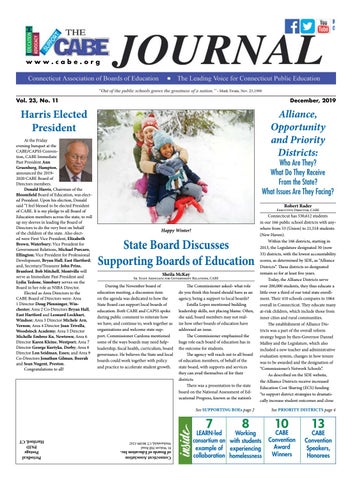
Harris Elected President At the Friday evening banquet at the CABE/CAPSS Convention, CABE Immediate Past President Ann Gruenberg, Hampton, announced the 20192020 CABE Board of Directors members. Donald Harris, Chairman of the Bloomfield Board of Education, was elected President. Upon his election, Donald said “I feel blessed to be elected President of CABE. It is my pledge to all Board of Education members across the state, to roll up my sleeves in leading the Board of Directors to do the very best on behalf of the children of the state. Also elected were First Vice President, Elizabeth Brown, Waterbury; Vice President for Government Relations, Michael Purcaro, Ellington; Vice President for Professional Development, Bryan Hall, East Hartford; and, Secretary/Treasurer John Prins, Branford. Bob Mitchell, Montville will serve as Immediate Past President and Lydia Tedone, Simsbury serves on the Board in her role as NSBA Director. Elected as Area Directors to the CABE Board of Directors were: Area 1 Director Doug Pfenninger, Winchester; Area 2 Co-Directors Bryan Hall, East Hartford and Leonard Lockhart, Windsor; Area 3 Director Michele Arn, Vernon; Area 4 Director Joan Trivella, Woodstock Academy; Area 5 Director Michelle Embree Ku, Newtown; Area 6 Director Karen Kleine, Westport; Area 7 Director George Kurtyka, Derby; Area 8 Director Lon Seidman, Essex; and Area 9 Co-Directors Jonathan Gilman, Bozrah and Sean Nugent, Preston. Congratulations to all!
Alliance, Opportunity and Priority Districts:
Who Are They? What Do They Receive From the State? What Issues Are They Facing? Robert Rader
Executive Director, CABE
Happy Winter!
State Board Discusses Supporting Boards of Education Sheila McKay
Sr. Staff Associate for Government Relations, CABE
During the November board of education meeting, a discussion item on the agenda was dedicated to how the State Board can support local boards of education. Both CABE and CAPSS spoke during public comment to reiterate how we have, and continue to, work together as organizations and welcome state support. Commissioner Cardona mentioned some of the ways boards may need helpleadership, fiscal health, curriculum, board governance. He believes the State and local boards could work together with policy and practice to accelerate student growth.
The Commissioner asked- what role do you think this board should have as an agency, being a support to local boards? Estella Lopez mentioned building leadership skills, not placing blame. Often, she said, board members may not realize how other boards of education have addressed an issue. The Commissioner emphasized the huge role each board of education has in the outcome for students. The agency will reach out to all board of education members, of behalf of the state board, with supports and services they can avail themselves of for their districts. There was a presentation to the state board on the National Assessment of Educational Progress, known as the nation’s
Connecticut has 530,612 students in our 166 public school districts with anywhere from 53 (Union) to 21,518 students (New Haven). Within the 166 districts, starting in 2013, the Legislature designated 30 (now 33) districts, with the lowest accountability scores, as determined by SDE, as “Alliance Districts”. These districts so designated remain so for at least five years. Today, the Alliance Districts serve over 200,000 students, they thus educate a little over a third of our total state enrollment. Their 410 schools compares to 1064 overall in Connecticut. They educate many at-risk children, which include those from inner cities and rural communities. The establishment of Alliance Districts was a part of the overall reform strategy begun by then-Governor Dannel Malloy and the Legislature, which also included a new teacher and administrative evaluation system, changes in how tenure was to be awarded and the designation of “Commissioner’s Network Schools”. As described on the SDE website, the Alliance Districts receive increased Education Cost Sharing (ECS) funding “to support district strategies to dramatically increase student outcomes and close
inside
See SUPPORTING BOEs page 2
7
8
LEARN-led Working consortium an with students example of experiencing collaboration homelessness
See PRIORITY DISTRICTS page 4
10
CABE Convention Award Winners
13
CABE Convention Speakers, Honorees
81 Wolcott Hill Road Wethersfield, CT 06109-1242
Connecticut Association of Boards of Education Inc.
Periodical Postage PAID Hartford, CT
2
The Journal – Connecticut Association of Boards of Education | December, 2019 PRESIDENT COMMENTARY
I Am Honored to Serve You Donald Harris President, CABE
I would like to thank the members of the Association for putting their faith and trust in me as the President of CABE. I am proud to be able to serve the many board of education members who work passionately to make the future brighter for the children of the state of Connecticut. To begin, I thought I should tell you a bit about myself. I was born and raised in Hartford and moved to Bloomfield to begin my sophomore year in high school 60 years ago. When I was elected to the Bloomfield Board of Education, I became a second-generation school board member to my father who also served on the Bloomfield Board of Education from 1967 to 1975. I graduated with a B.S. degree in Physical Education from Springfield College in 1967. My first teaching assignment was in my alma mater, Bloomfield High, where I served in several roles, including that of a teacher, coach, athletic director, vice principal and finally as Principal until my retirement in 2006. Living a life of service to my community meant that after my retirement I was not finished. While starting a new career as a real estate agent, I also served as a Deacon at the Union Baptist Church. I was approached about running for the Town Council and was elected to serve as Deputy Mayor of Bloomfield from 2007-2011. I was elected to the Bloomfield Board of Education in 2011 where I have been privileged to serve as Board Chair ever since. In 2011, I became a member of the CREC Board of Directors where I’ve served as a member and Chair, Vice Chair and Secretary/Treasurer. I have served in a variety of capacities at CABE, as well. I served on the Board of Directors, the CABE Executive Committee, Federal
CABE Area Breakfasts
CABE Area 1/EdAdvance
December 12 • 7:30 AM Partnership Learning Academy 77 Main Street, Terryville (across from Town Hall)
CABE Area 5/EdAdvance January 9 • Time: TBD Location: TBD
CABE Area 2/CREC February 20 • 8:00 AM State Capitol, Hartford
Relations Chair, First Vice-President and chaired the CABE Diversity Committee. In 2017, Gov. Dannel Malloy appointed me to serve on the Connecticut State Board of Education. I believe that my experiences will allow me to serve CABE well. Having classroom, administrative and leadership experience has given me insight on how to continue to move CABE forward to the next step. CABE, like many other not-for-profit organizations, is struggling to best serve our membership at a time when resources are harder to get. It is a priority of mine to work hard to make sure that CABE is appreciated, trusted and the first place someone calls when they need help regarding school governance. We plan to do a better job of telling our story, so I am going to work with the Board and CABE staff on a process of strengthening our communications. It is important that our communities see the importance of boards of education and equally important that boards of education recognize the importance of CABE. That enhanced visibility will be one of my goals over the next two years. Of course, the best way to ensure relevance is strategic planning and I believe it is time for CABE to participate in that process. I will be encouraging the Association to undergo that process to ensure a sound, healthy organization as we face future challenges. We anticipate broad data collection from as many members (and non-members) as we can to ensure that CABE truly meets the expectations of boards of education across the state. In my time at CABE I have regularly encouraged CABE and the boards we represent to be more inclusive. As I go across the state, I have seen many boards of education, who often represent a diverse student population, with few, if any, minority groups represented on the board. This is not a new situation on the CABE Board of Directors, and while we have all
SUPPORTING BOEs
(continued from page 1)
report card.This assessment is not given to all students in each state, it is a sampling of students. Connecticut continues to lead the national public school student averages. It was noted, Connecticut’s need students is now over 50%. That includes English learners, low income and disabled. While those percentages have grown, the scores of Connecticut’s students continue
Mission: To assist local and regional boards of education in providing high quality education for all Connecticut children through effective leadership. Vision: CABE is passionate about strengthening public education through high-performing, transformative local school board/ superintendent leadership teams that inspire success for each child.
Board of Directors recognized the problem and worked to fix it, we must have a concerted effort to take strong action to diversify our board. The work has not gone fast enough, yet I anticipate that CABE’s Diversity Committee will place renewed energy to this serious initiative. As President, I will do all I can to encourage that. Just as CABE has always encouraged boards of education to perform an annual self-evaluation, I will encourage the CABE board to likewise, evaluate itself. The best boards challenge themselves and hold themselves to a high standard of performance. We have excellent people serving on the CABE Board, but I think we can find ways to be more effective as a leadership team. Evaluating the Board of Directors can help us in this endeavor. Finally, CABE has been an effective spokesperson for Connecticut boards of education for more than 100 years. I envision the long-term health of boards of education in general as being dependent on a healthy state Association. Our job as board members is to work collaboratively with our Superintendents to provide quality educational opportunities for ALL the children in the State of Connecticut. It is my goal, with the help of the CABE board and staff to work with all boards of education to value being a part of an organization created to support Connecticut’s public schools. I will look to you, board of education members from across the State, to help me in this effort.
to excel. The Board also discussed a draft computer science plan and the recent legislative and credential changes that have grown the computer science field. It was June of 2018 when the State Board of Education adopted standards, and this plan is the implementation necessary for putting them in place across the state-recognizing the different stages/needs of each district.
EXECUTIVE COMMITTEE Donald Harris | President, Bloomfield Elizabeth Brown | First Vice President, Waterbury Michael Purcaro | V ice President for Government Relations, Ellington Bryan Hall | V ice President for Professional Development, East Hartford John Prins | Secretary/Treasurer, Branford Robert Mitchell | I mmediate Past President, Montville Christopher Wilson | Member at Large, Bristol Lydia Tedone | NSBA Director, Simsbury AREA DIRECTORS Doug Pfenninger | Area 1 Director, Winchester Bryan Hall | Area 2 Co-Director, East Hartford Leonard Lockhart | Area 2 Co-Director, Windsor Michele Arn | Area 3 Director, Vernon Mic helle Embree Ku | A rea 5 Director, Newtown Karen Kleine | Area 6 Director, Westport George Kurtyka | Area 7 Director, Derby Lon Seidman | Area 8 Director, Essex Jonathan Gilman | Area 9 Co-Director, Bozrah Sean Nugent | Area 9 Co-Director, Preston ASSOCIATES Julie Ausere | Associate, Canton Eileen Baker | Associate, Old Saybrook Bruce Kimmel | Associate, Norwalk Robert Trefry | A ssociate, CT Technical High School System COMMITTEE CHAIRS Becky Tyrrell | Chair, Federal Relations, Plainville Michelle Embree Ku | Chair, State Relations, Newtown CITY REPRESENTATIVES Julio Flores | City Representative, Hartford Darnell Goldson | City Representative, New Haven Betsy Allyn | C ity Representative, Stamford Charles Stango | City Representative, Waterbury STAFF
Robert Rader | Executive Director Patrice McCarthy | Deputy Director and General Counsel Rebecca Adams Rieder | Senior Staff Attorney Nicholas Caruso | Senior Staff Associate for Field Services and Coordinator of Technology Sheila McKay | Senior Staff Associate for Government Relations Vincent Mustaro | Senior Staff Associate for Policy Service Lisa Steimer | Senior Staff Associate for Professional Development and Communications Teresa Costa | Coordinator of Finance and Administration Pamela Brooks | S enior Administrative Associate for Policy Service and Search Services Terry DeMars | Administrative Associate for Policy Service Gail Heath | Administrative Associate for Government Relations Wilmarie Newton | Administrative Associate for Labor Relations Nancy Propfe | Administrative Assistant for Membership Services Corliss Ucci | Receptionist and Assistant to Executive Director
The CABE Journal (ISSN 1092-1818) is published monthly except a combined issue for July/August as a member service of the Connecticut Association of Boards of Education, 81 Wolcott Hill Road, Wethersfield, CT 06109, (860) 571-7446. CABE membership dues include $30 per person for each individual who receives The CABE Journal. The subscription rate for nonmembers is $75. Association membership dues include a subscription for each Board Member, Superintendent, Assistant Superintendent and Business Manager. The companies and advertisements found in The CABE Journal are not necessarily endorsed by CABE. “Periodicals Postage Paid at Hartford, CT.” POSTMASTER: Send address changes to The CABE Journal, CABE, 81 Wolcott Hill Road, Wethersfield, CT 06109-1242. Email: lsteimer@cabe.org. Members can find the CABE Journal online at: www.cabe.org/ page.cfm?p=1024
The Journal – Connecticut Association of Boards of Education | December, 2019
CABE Affiliate Members BUSINESS AFFILIATES VALEDICTORIAN Finalsite SALUTATORIAN
Berchem Moses PC HIGH HONORS
Pullman & Comley Shipman & Goodwin HONOR ROLL Anthem Blue Cross and Blue Shield Arthur J. Gallagher & Company Corporate Cost Control ESS JCJ Architecture Milliman Milone & MacBroom, Inc. SCHOLAR Albert Risk Management Consultants Brown & Brown Chinni & Meuser LLC Coordinated Transportation Solutions COUNTABILITY, Inc. Dattco, Inc. Goldstein & Peck, P.C. Kainen, Escalera & McHale, P.C. The Lexington Group OneDigital Health and Benefits Perkins Eastman The S/L/A/M Collaborative
EDUCATIONAL AFFILIATES American School for the Deaf Area Cooperative Educational Services Capitol Region Education Council The College Board Connecticut Association for the Gifted Connecticut Association of School Business Officials Connecticut Center for School Change Connecticut School Buildings and Grounds Association Connecticut School Counselor Association Connecticut Technical High Schools Cooperative Educational Services EASTCONN EdAdvance Explorations Charter School Girls Scouts of Connecticut Interdistrict School for the Arts and Communications (ISAAC) LEARN Unified School District #1
3
EXECUTIVE DIRECTOR COMMENTARY LGBTQ RIGHTS:
Are We Moving Backwards? Robert Rader
Executive Director, CABE
Editor’s Note: Having written previously on the challenges of having a transgender child, Bob was recently asked his reaction to the Trump Administration’s actions concerning the rights of lesbian, gay, bisexual and transgender individuals. We thought you might want to read what he wrote. I am not an expert on gay, lesbian or transgender students. I do not have the expertise and knowledge of an official representative of GLSEN (the Gay, Lesbian and Straight Education Network) or an officer of any of the PFLAG (Parents, Families and Friends of Lesbians and Gays) chapters around the nation. However, as a father of a transgender child and the father-in-law of a transgender woman, I have watched with great sadness the recent spate of news reports on the Trump Administration’s battle against how LGBT individuals can be treated in our society. Then-Candidate Trump tweeted in June. 2016, “Thank you to the LGBT community!” Trump again tweeted in June 2016: “I will fight for you…” As President, Trump, has done the opposite. Lost in the discussion of the President’s disdainful statements and comments on immigrants, Mexicans, blacks and others, is what is actually happening to LGBT students and their futures. The Obama-issued Federal Department of Education’s Guidance for protecting the rights of transgender students was withdrawn in 2017 by Secretary DeVos. While not dealing with students, the Administration’s denial that Title IX’s prohibition on discrimination “on the basis of sex”, in a case now before the U.S. Supreme Court, belies the President’s claim that he will fight for the LGBT community. Should the Court follow the Administration’s reasoning, individuals could be fired from the their jobs in states where there is no LGBT protection without any recourse. As Lawrence Hurley wrote in an article in Reuters, Trump’s “administration has supported the right of certain businesses to refuse to serve gay people on the basis of religious objections to gay marriage, restricted transgender service members in the military and rescinded protections on bathroom access for transgender students in public schools.” While our concern is for students, now, how does their future look? The Court’s decision on gay marriage in Obergefell v. Hodges raised expectations in the LGBT community and among its supporters that life would be getting better for them — they finally had the same rights to marry as heterosexuals (cisgen-
der individuals). They were not asking for greater rights, just the same rights. However, now we see progress stopped and reversed.* While we cannot forecast what the Supreme Court will decide, we can predict that a decision in the President’s favor will darken the future of LGBT students and adults. LGBTQ students and adults have a much higher chance of committing suicide than others. What will be the effect of these further attempts to limit their rights? Is that the America we want?
My Perspective
My son, Dusty, told us first that he was gay and, later, that he believed he was a man. While I still struggle with pronouns (his are ‘he’, ‘him’ and ‘his’) I am proud of him not because he is transgender, but because he is my son and, thanks to the support of family and friends, is able to be proudly out and share his experiences and advice. He speaks to teachers, administrators, school board members and others who need to understand what it was like for him to have grown up and taught in the public schools. He helps create empathy, hope and enriches the lives of the people listening. Because of his circumstance, he even allows me to write articles like this. Too many children and, adults, cannot tell the world because they believe the world is not yet ready to accept these differences. The severe psychological strain of not being able to tell classmates, teachers or even parents of their “true identity”, leads to all kinds of mental and emotional ills. I have seen 40 and 50-year old men terribly conflicted because they don’t know how their parents would react to learning that they were transgender or gay. Imagine living with such a secret for your whole lives. Imagine not being able to talk about something so central to your life. Imagine feeling that you are not able to count on the support of your friends, coworkers or your family. Or, your State or Nation. Now, added to this burden, in many places in our nation being gay or transgender is thought of as being somewhat “less”. Taunting, bullying and otherwise shunning students who are thought of as different goes on all the time among children. However, the Court can help those who want to treat them as second class. Too often, it is the adults who do not provide the “code of conduct” that says that this is intolerable. Now, imagine all of that ratcheted up in the psychological makeup of students who feel ashamed of what their feelings
are. People tell me that I have courage for speaking out about this issue and being so open about my family. But, I don’t see it like that. I believe I have a responsibility to help students who are facing discrimination for gender identity, just as much as I would if they were facing discrimination for another arbitrary reason. I want to celebrate students and adults like my son, because I think all people deserve that. In our society, especially here in liberal Connecticut where we protect the rights of the LGBT community, it doesn’t take much courage to say what you believe in. I think most of our citizens understand the need to protect LGBTQ students and adults. However, I would ask those who don’t whether, if it was a member of their family that they loved, how could they turn against him or her because of something over which he or she had no control? Do you hate a child because he was born disabled? Or, because she isn’t as naturally smart as her brother? Do you think this is a choice – that people would actually choose to be gay or transgender and face a lifetime of harassment and discrimination? Our job in the public schools is to make sure every student is prepared to make the most of their schooling and to leave ready for the future. LGBTQ students deserve this right as much as any other students. They will succeed, like anyone else, if they are free of intimidation, bullying and harassment and, instead, are supported, loved and safe. It is the responsibility of boards, superintendents and staff to make sure that this happens in our school districts. We owe no less to all of our students who are different. No matter what the Supreme Court might say. *For a list of anti-LGBTQ actions taken by the Trump Administration see https://www. glaad.org/tap/donald-trump. GLAAD is an organization that “rewrites the script for LGBT acceptance.”
4 PRIORITY DISTRICTS
(continued from page 1)
achievement gaps by pursuing bold and innovative reforms”. In order to receive the additional funding, Alliance District boards of education must apply to the Commissioner of Education. The plans they submit may contain: (1) A tiered system of interventions for the schools under the jurisdiction of such board based on the needs of such schools, (2) ways to strengthen the foundational programs in reading to ensure reading mastery in kindergarten to grade three, focusing on standards and instruction, proper use of data, intervention strategies, current information for teachers, parental engagement, and teacher professional development, (3) additional learning time, including extended school day or school year, (4) a talent strategy, (5) training for school leaders and other staff on new teacher evaluation models, (6) provisions for the cooperation and coordination with early childhood education providers to ensure alignment with district expectations for student entry into kindergarten, (7) provisions for cooperation and coordination with other governmental and community programs to ensure that students receive adequate support and wraparound services, (8) provisions for implementing and furthering state-wide education
The Journal – Connecticut Association of Boards of Education | December, 2019 standards adopted by the State Board of Education, (9) strategies for attracting and recruiting minority teachers and administrators, and (10) enhancement of bilingual education programs.
Successes and Issues Faced
I asked SDE Chief Turnaround Officer Desi Nesmith to provide some information on both the successes and the challenges faced by Alliance Districts. His response: “In 2018-19, some of our Alliance Districts saw increases over the state average in the areas of proficiency and growth. Additionally, some of our Alliance Districts saw a decrease in chronic absenteeism greater than the state average. Alliance Districts work to implement their annual plans which list major priorities and ESSA (Every Student Succeeds Acts) related goals in four areas: Talent, Academic, Climate/Culture and Operations. Additionally, Alliance Districts designated as one of the 10 state Opportunity Districts also receive a higher level of CSDE cross-divisional team assistance and support.” An examination of the issues discussed at recent meetings of the Alliance Districts included trauma-informed schools; implicit bias in preschool; developing executive functioning skills in young learners; Head Start partnerships; assessing, planning and monitoring sustainability of district priority reforms; and, culturally and linguistically appropriate national standards.
Priority School Districts
Priority Districts are formula-determined based on a number of different factors. SDE does not determine which districts are on the list. The State Board of Education administers the priority school district grant program to assist designated school districts in improving student achievement and enhancing educational opportunities, including early reading intervention programs. Grant awards are authorized after proposals have been submitted by eligible school districts and approved through the Commissioner. Funding may be used to focus on the following initiatives: (1) the creation or expansion of programs or activities related to dropout prevention; (2) alternative and transitional programs for students having difficulty succeeding in traditional education programs; (3) academic enrichment, tutorial and recreation programs or activities in school
buildings during non-school hours and during the summer; (4) development or expansion of extended-day kindergarten programs; (5) development or expansion of early reading intervention programs including summer and after-school programs; (6) enhancement of the use of technology to support instruction or to improve parent-teacher communication; (7) initiatives to strengthen parent involvement in the education of children and parent; and other community involvement in school and school district programs; or, (8) for purposes of obtaining accreditation for elementary and middle schools from the New England Association of Schools and Colleges. At least 20 percent of each grant must be used for early reading intervention programs.
List of 2018-19 Alliance Districts
Ansonia Bloomfield Bridgeport Bristol Danbury Derby East Hartford East Haven East Windsor Groton Hamden
Hartford Killingly Manchester Meriden Middletown Naugatuck New Britain New Haven New London Norwalk Norwich
Putnam Stamford Thompson Torrington Vernon Waterbury West Haven Winchester Windham Windsor Windsor Locks
2018-19 Designated Priority School Districts Ansonia Bridgeport Danbury Derby East Hartford Hartford
Meriden Manchester New Britain New Haven New London Norwalk
Norwich Putnam (transitional district receiving phase-out funding in 2016-17)
Stamford Waterbury Windham
The plans for each Alliance District can be found at https://portal.ct.gov/SDE/Lists/Alliance-District-Approved-Plans/2018-2019-Plans. Resources for Alliance Districts can be found at: https://portal.ct.gov/SDE/Alliance-Districts/Alliance-Districts/Related-Resources CABE and Plainville Board of Education members run and walk to support middle school sports.
Resources for Priority Districts can be found at: https://portal.ct.gov/SDE/Turnaround/Priority-School-District-Grants
Creating Emotionally Intelligent School Communities RULER is an evidence-based approach to social and emotional learning (SEL) that supports the entire school community in: • Understanding the value of emotions • Building the skills of emotional intelligence • Creating and maintaining positive climates Features include: • Staff personal and professional learning • PreK-12 classroom curricula, activities, and routines • Family engagement and education resources • Comprehensive implementation support LEARN MORE at www.rulerapproach.org/offerings/events/
The Journal – Connecticut Association of Boards of Education | December, 2019
5
See You in Court – The Nutmeg Board of Education
Religion in Public Schools
Thomas B. Mooney, Esq. Shipman & Goodwin
The Nutmeg Board of Education makes many mistakes. The latest imbroglio created by the board will be reported here each issue, followed by an explanation of what the board should have done. Though not intended as legal advice, these situations may help board members avoid common problems. Last year, the holiday season was awash in controversy for the Nutmeg Public Schools after the principal of Acorn Elementary School came to school dressed as Santa Claus and passed out presents to students the day before the holiday vacation. One parent went on Facebook and blasted the principal as “an insensitive nincompoop” who promotes a divisive school environment. That post then provoked a flurry of contrary posts and tweets, which lauded the principal as “a keeper of our finest traditions.” At the Board meetings that followed, speakers during Public Comment argued vehemently on both sides of the issue, and for three meetings running, Public Comment devolved into loud arguments between the Board members on opposite sides of the issue. However, with the spring came a thaw. The Board members started talking to each other respectfully about whether and how religious holidays should be celebrated in the schools. The Policy Committee took up the issue, and it came up with a draft policy, which the Board discussed in executive session last month as a confidential preliminary draft. After a lengthy discussion in executive session, the Board reconvened in open session to take action. On behalf of the Policy Committee, Penny Pincher presented the new policy to the Board members and the public. It was simple in design and broad in its sweep: Out of respect for the many cultures and traditions of the members of the Nutmeg Public Schools community, the Nutmeg Board of Education prohibits any and all references to religious holidays in the Nutmeg Public Schools, including but not limited to songs played at concerts and related symbols and characters such as Santa Claus and the Easter Bunny. The Board then passed the policy unanimously with no further comment from the Board members. The day after the meeting, social media was abuzz with indignant tweets and posts about the “cowardice” of the Board and the problem of political correctness. At the Board meeting that followed, speaker after speaker stood up during public comment to excoriate the Board members for their action. One member of the public even singled out Penny as Chairperson of the Policy Committee, suggesting that she
should seek God’s forgiveness for coming up with such a policy. For some, mere words were not opposition enough. Peter Pious, a longtime Nutmeg resident, sought an injunction in federal court against enforcing the Board policy, claiming that a policy prohibiting celebration of religious holidays in the public schools is unconstitutional because it is “anti-religious” and interferes with the First Amendment right of his children to receive information. He also filed a complaint with the Freedom of Information Commission, claiming that the Board violated the FOIA by discussing the draft policy in executive session. What are the chances that the court will enjoin enforcement of this new policy? And how will the Board fare before the Freedom of Information Commission? • • • • • • • • • • • • • • • Whether and how to celebrate religious holidays in our public schools is a constant challenge. School officials are free to include activities in schools that acknowledge the religious holidays, but they must assure that the schools do not promote any particular religious tradition. Adding to the challenge is the fact that decisions on such matters do not simply relate to the legal issues of what school officials are permitted to do under the First Amendment. Rather, these issues involve questions of what school officials should do to promote an inclusive school environment. We start the analysis with a review of the well-known “three-part test” announced by the United States Supreme Court in its 1971 decision in Lemon v. Kurtzman. There, the Court established an analytical framework for considering whether actions by school officials violate the Establishment Clause of the First Amendment: (1) does the action have a secular purpose? (2) does the action neither advance nor inhibit religion, and (3) does the action avoid excessive entanglement with religion. When questions can be answered yes, the action will be held constitutional. Over the years, this Lemon test has been variously endorsed, criticized and ignored by the Court, but it remains a helpful tool. The United States Supreme Court has never ruled on the specific issue of celebrating religious holidays in the schools, but in 1980 it let stand an Eighth Circuit decision holding that permitting the performance of religious holiday music and discussion of religious holidays in school does not violate the First Amendment. Florey v. Sioux Falls School District 49-5, 619 F.2d 1311 (8th Cir.), cert. denied, 449 U.S. 987 (1980). In the Florey case, the court applied
the Lemon test. It found that these activities had the secular purpose of educating students about religious traditions, that they neither advanced nor inhibited religion, and that they did not entangle school officials with religion. However, the court recognized that “when Christmas carols, or other music or drama having religious themes, can be sung or performed by students in elementary and secondary public schools without offending the First Amendment” will depend upon the specifics of the activities involved. More recently, the Third Circuit rejected a challenge similar to the challenge brought here by Peter Pious. Stratechuk v. Board of Educ., South Orange-Maplewood School Dist., 587 F.3d 597 (3d Cir. 2009). There, the court upheld a board of education policy that essentially prohibited the playing of religious music in the schools. The court noted that playing such music is permitted (subject to limitations described above), but it held that playing such music may also be prohibited: “Certainly, those of us who were educated in the public schools remember holiday celebrations replete with Christmas carols, and possibly even Chanukah songs, to which no objection had been raised. . . . Many decisions
about how to best create an inclusive environment in public schools, such as those at issue here, are left to the sound discretion of the school authorities.” School officials may thus decide what activities will be permitted and should consider whether they will promote an inclusive school environment. Finally, we note that Peter will have better luck with his claim under the Freedom of Information Act that the Nutmeg Board should not have discussed the draft policy in executive session. “Preliminary drafts and notes” are indeed confidential, but once a draft is shared with members of a public agency, it is “part of the process by which governmental decisions and policies are formulated,” and, as such, is no longer confidential. Accordingly, the discussion by the Nutmeg Board of Education of the proposed new policy should have been held in open session. Attorney Thomas B. Mooney is a partner in the Hartford law firm of Shipman & Goodwin who works frequently with boards of education. Mooney is a regular contributor to the CABE Journal. Shipman & Goodwin is a CABE Business Affiliate.
The Ninth Edition – Now Available!
A Practical Guide to Connecticut School Law by Thomas B. Mooney, Esq. Shipman & Goodwin
CABE is delighted to announce that the Ninth Edition of Tom Mooney’s Practical Guide to Connecticut School Law is now available. PRICING: CABE Members: $54.99; CABE Non-Members: $79.99; Students: $44.99 There have been many changes in school law in the last few years, and the Ninth Edition has been extensively revised to provide updated guidance on the legal issues that govern our schools. Changes include descriptions and commentary on:
• Changes in teacher evaluation and teacher tenure. • New rules regarding employee background checks. • New requirements concerning student data privacy. • New rules for suspension, expulsion and alternative educational opportunities. • Revised requirements governing seclusion and restraint. • The new “Every Student Succeeds Act” and how it has changed “No Child Left Behind Act” requirements. • The CCJEF case and ongoing litigation over equal educational opportunities. • The Minimum Budget Requirement and new duties to collaborate with town officials. • A host of other changes in the rules that boards of education and school administrators must follow.
6
The Journal – Connecticut Association of Boards of Education | December, 2019
Aim Higher
Creative legal solutions for Connecticut’s public schools – because sometimes it is rocket science.
Shipman & Goodwin’s school law attorneys have more than 40 years of experience, and represent over 125 public school districts, as well as public school member organizations and associations, on a full range of legal issues that they confront, from general education law to special education matters.
Our school law site, www.ctschoollaw.com is devoted entirely to emerging school law issues. Attorneys counsel clients, monitor legislation and provide periodic alerts and updates. We regularly present seminars, quarterly workshops, webinars and professional development workshops for schools on current topics of interest. Our Practice Group Co-Chair, Tom Mooney, has written A Practical Guide to Connecticut School Law, a comprehensive treatise on Connecticut school law, published by CABE and used by teachers, administrators and board of education members throughout the state.
Education is a core focus of our law firm.
Facebook “f ” Logo
CMYK / .eps
Facebook “f ” Logo
CMYK / .eps
www.ctschoollaw.com
Contact: Thomas B. Mooney or Linda L. Yoder | 860.251.5000 | www.shipmangoodwin.com GREENWICH
|
HARTFORD
|
LAKEVILLE
|
NEW HAVEN
|
NEW YORK
|
OLD LYME
|
STAMFORD
|
WASHINGTON DC
The Journal – Connecticut Association of Boards of Education | December, 2019
7
LEARN-led Consortium a True Example of Regional Collaboration Matthew Engelhardt
Marketing, Communications, and Advocacy Coordinator, LEARN
LEARN successfully facilitated a process to secure an efficient financial management system for school districts and municipal governments in the area. Representatives from 12 school districts and three town governments acted as a single bidder, led by LEARN, to conduct a search and ultimately enter into an agreement for a business function system, including payroll, accounts payable, and budgeting. The cooperative efforts led to a regional solution, resulting in considerable savings of time and money for those involved. In August 2018, PowerSchool purchased Phoenix Accounting & Payroll Software, the software used by many school systems and towns across the state. Following the purchase, Powerschool announced that Phoenix, which was familiar and effective, would be discontinued as of June 30, 2020. In its place, Powerschool would introduce a different program with a much higher price tag. This left the area school districts and local governments with a big decision regarding an unanticipated expense, which would have to be made in a limited scope of time.
It became clear that another option was needed - a creative and collaborative solution for districts and towns. LEARN, a Regional Educational Service Center (RESC) dedicated to supporting the needs of public school districts in southeastern Connecticut, rose to meet the challenge. LEARN leaders listened to the needs of the districts and towns and organized a Request for Proposal process. Preston Public School Director of Finance John Spang was the first in the region to recognize the problem. He credits LEARN with bringing together a diverse group of stakeholders for a common purpose. “Schools and towns each will share in this benefit in large part because of the broad range of extensive school district and municipal leadership experiences that the LEARN staff brought to the table,” Spang said. “When this leadership combined with LEARN’s ability to roll up their sleeves for the heavy lifting involved, schools and towns realized significant long term economies of scale.” The ultimate goal was to obtain the best price on new replacement software and meet the July 1, 2020 deadline for implementation. Acting as one collective purchaser, the consortium shared the cost of soliciting bids, reduced the time of
reviewing proposals, and increased negotiating power. “By working together, not only did the districts ensure a good price, but they also chose a financial system that works well and offers critical support with implementation,” said Michael Belden, LEARN’s Chief Financial Officer. “It was a great opportunity for LEARN’s Business Office to provide a service across the region and state and we are pleased that it has been so well received.” Vendors presented to the districts in late September and the participants will choose a new financial accounting system by January 1. Mark Izzo, business manager of Derby Public Schools, said his district has only about 1,300 students and funding is limited. The RFP process greatly helped Derby by saving money and convening experts and experienced business managers at a level that would be impossible in a small district. “I am so pleased that LEARN invited us to join,” Izzo said. “There are numerous areas where a regional solution can benefit smaller districts, such as human resources management, payroll, health insurance and accounts payable.” Many of the participating districts and towns were smaller organizations, in-
cluding Preston, Ansonia, Derby, Lisbon, and North Stonington. Other districts and towns include East Haven, Plainfield, Griswold, and Region 9, which includes Easton/Redding. LEARN is committed to providing regional solutions to educational and financial challenges that school systems face. True collaboration happens when districts and towns choose to tackle common challenges in a collective manner. LEARN strives to be a resource and conduit for collaborative work that increase efficiencies and supports districts in doing their work effectively. About LEARN Serving Southeastern Connecticut for more than 50 years, LEARN is a Regional Educational Service Center working with and for its member districts to improve the quality of public education for all learners. LEARN provides leadership for teaching and learning; high quality, innovative schools and programs; identifies and delivers customized and cost-effective programs and services; and, promotes collaborative partnerships and regional cooperation. LEARN is a member of the Connecticut RESC Alliance.
8
The Journal – Connecticut Association of Boards of Education | December, 2019
Recent Legislation Highlights the Process for Districts Working with Students Experiencing Homelessness Stacey Violante Cote
Director of the Right Direction: Homeless Youth Advocacy Project, Center for Children’s Advocacy
Louis Tallarita
Education Consultant and McKinney-Vento State Coordinator, Connecticut State Department of Education
Schools have long wrestled with the difficulties of educating students whose experiences outside the school building affect their ability to learn. Whether it be violence in the home or community, hunger, or students’ mental health needs, schools have been at the forefront. Schools have persevered through these barriers to keep students in their seats and learning. Such is the case with students experiencing homelessness. Schools are a critical resource for these students- sometimes providing the only stability in their young lives. One subset of students who are experiencing homelessness presents even thornier issues. These are youth who are experiencing homelessness and living on their own- a situation the law terms “unaccompanied homeless youth.” Issues arise not only as to how to best educate these students but also regarding decisions these students can make on their own, determining when students are experiencing homelessness and what to do when disagreements about students’ housing status arise. During the 2017/18 school year, Connecticut identified 5015 students experiencing homelessness. Two-hundred and forty two (242) of those were unaccompanied homeless youth (youth not in the physical custody of a parent/guardian). Further, 1164 were special education students and 1578 were English Language Learners. This data illustrates that many of these students have learning challenges in addition to housing instability. Take, for example, the case of Stephanie, a seventeen year senior in a suburban school district. During her junior year, she was living with her mother with whom she had a tenuous relationship. One morn-
ing her mother physically assaulted her. Stephanie left the house and began staying with friends, essentially “couch surfing” for months. Her guidance counselor called DCF who investigated and determined that Stephanie should stay at her grandmother’s house in another town. However, she continued couch surfing since her grandmother was being evicted from her house. The school district provided transportation to and from school through the end of her junior year. At the start of her senior year, the district disagreed that she was still homeless and declined further transportation. Stephanie was not aware, nor was she provided notice from the school district, of her right to a hearing regarding her status as “homeless” or the discontinuation of transportation. After contacting the Connecticut State Department of Education (CSDE), Stephanie was informed of her right to appeal the school’s decision as an unaccompanied homeless youth under the federal McKinney-Vento Homeless Assistance Act, the federal law detailing educational rights of students experiencing homelessness. Fortunately, Stephanie’s issue was resolved through informal mediation. Recently passed legislation provides clarity to school districts regarding the practices and procedures for districts to follow when they have a student who is experiencing homelessness, including unaccompanied youth. Public Act 19-179 (https://www.cga.ct.gov/2019/ACT/pa/ pdf/2019PA-00179-R00HB-07313-PA.pdf), effective July 1, 2019, reaffirms portions of the McKinney-Vento Act. It also reaffirms existing state law that disputes regarding students’ homeless status are to be handled through Connecticut’s residency process outlined in Conn. Gen. Stat. §10-186 and that students are entitled to continue in attendance, or immediately enroll, pending the residency process. The Act also highlights the role of the McKinney Vento liaison in each district and the requirements that students receive a written explanation of a district’s denial of their homeless sta-
MEETINGS OF INTEREST December 4
State Board of Education • 9:30 am State Department of Education 450 Columbus Boulevard, Hartford
December 4
December 6
Advisory Council on Intergovernmental Relations 10:30 am • Legislative Office Building, Room 1B
Governor’s Counciil on Women & Girls: December 17 Education & Steam Subcommittee Meeting EdTPA Working Group (Teacher 1:00 pm • Legislative Office Performance Assessment) Building, Room 1D, Hartford 3:00 pm • Legislative Office Building, Room 1D, Hartford
December 5
EdTPA Working Group (Teacher Performance Assessment) 3:00 pm • Legislative Office Building, Room 1D, Hartford
December 17
Birth to 3: Preschool Special Education Working Group • 1:00 pm • Legislative Office Building, Room 1D, Hartford
*Meetings and Public Hearings subject to change.
tus in a manner and form understandable to the student and/or parent and informs them of their right to appeal. This was the missing piece in Stephanie’s case. When she and the district disagreed about her housing status and the district declined to provide further transportation, she should have been provided with a written notice of her right to appeal. While these situations can be difficult to untangle, the National Center for Homeless Education (NCHE) provides resources and best practice tips for districts. In a brief entitled, “Confirming Eligibility for McKinney-Vento Rights and Services,” (available at: https://nche.ed.gov/wp-content/uploads/2018/10/conf-elig.pdf) NCHE recommends that districts: •U se a housing questionnaire incorporating informative, yet noninvasive, questions about a student’s living arrangement as part of the district’s enrollment process. •E stablish a district protocol for confirming information about a student’s living arrangement. •T rain district and school staff on the McKinney-Vento Act’s definition of homeless and steps to take if working with a student whose living arrangement may meet the definition. NCHE further recommends that districts AVOID: •C ontacting people or agencies outside the school system to seek information about a family’s or youth’s situation.
•C onducting invasive surveillance of families or youth. • I nsisting that families or youth provide documents like eviction notices, utility bills, or notarized letters from the party whose housing they are sharing. While some families may be willing and able to provide this paperwork, others may be unable to do so. For questions or additional support, contact CSDE (louis.tallarita@ct.gov / 860-807-2058). Other resources include Schoolhouse Connection (https://www. schoolhouseconnection.org) or the National Association for the Education of Homeless Children and Youth (https://naehcy.org). Locally, resources are available at http:// youth-help.org/ including links to a school engagement toolkit, videos for students and staff as well as legal information for students. Stacey Violante Cote, JD, MSW, is an attorney at the Center for Children’s Advocacy where she is the Director of the Right Direction: Homeless Youth Advocacy Project. Stacey also chairs the Youth and Young Adult Homelessness Workgroup of the Reaching Home Campaign, CT’s campaign to prevent and end homelessness (http://pschousing.org/youth-and-youngadults-homelessness-workgroup). Louis Tallarita, LMSW, is an Education Consultant and McKinney-Vento State Coordinator at the Connecticut State Department of Education.
CABE Deputy Director and General Counsel Patrice McCarthy and Sr. Staff Attorney Rebecca Adams Rieder presented a webinar on conducting an organizational meeting on November 7. All webinars are archived on the CABE website.
Current Vacancies: EAST GRANBY Superintendent
MARY BRODERICK, ED.D SENIOR CONSULTANT
WOODBRIDGE Principal (PK-8)
For more information contact
CABE Search Services
81 Wolcott Hill Road, Wethersfield, CT 06109
860-608-1763
Equal Opportunity Employer
The Journal – Connecticut Association of Boards of Education | December, 2019
9
CABE Legal Issues Workshop: Spotlight on Special Education October 22
CABE Sr. Staff Attorney Rebecca Adams Rieder presented on D.S. v. Trumbull Board of Education at the CABE Legal Issues A good crowd learned more about special education. Workshop.
(l to r) Michael McKeon, Attorney, Pullman & Comley; Rebecca Rudnick Santiago, Attorney, Shipman & Goodwin; Chris Chinni, Attorney, Chinni & Meuser; Christina Ghio, Attorney, The Law Offices of Christina Ghio; and Fred Dorsey, Attorney, Kainen, Escalera & McHale presented on tips to avoid costly mistakes.
Christine Sullivan, Attorney, Berchem Moses, presented on D.S. v. Trumbull Board of Education
Saturday Morning General Session – George Couros Nicholas Caruso, Jr.
Sr. Staff Associate for Field Services and Coordinator of Technology, CABE
George Couros is a leading educator in the area of innovative leadership, teaching, and learning. He has worked with all levels of school, from K-12 as a teacher, technology facilitator, and school and district administrator. George is a leader in the area of innovation, yet his focus is always on the development of leadership and people and what is best for learners. His belief that
meaningful change happens when you first connect to people’s hearts, is modeled in his writing and speaking. He is the author of the books, The Innovator’s Mindset; Empower Learning, Unleash Talent, and Lead a Culture of Creativity and Innovate Inside the Box. In his Saturday morning keynote address, for attendees of the annual CABE/ CAPSS Convention, Couros talked about his unique leadership style as a division principal in Alberta Canada. Starting from his roots as the son of
two Greek immigrants he stressed the need for making students feel welcome, valued and appreciated. He spoke at length about the need for children to feel safe – and how those feelings translate into more learning. Couros also spoke about the need to innovate and “think different” – not always doing things just because it has always been done that way. To make his point, he reminded the attendees of the quote, “Tradition is peer pressure from dead people”. His main message is that preparing a strong learning environment means creat-
ing a place of safety, comfort and centered on the needs of children. Couros exhorted the conference-goers to be learning-centered, not teacher-centered, and to focus learning on what students are passionate about. Finally, he made one last point related to being a teacher with a positive impact on students; “I want to be the person that someone would cross the street to greet me”. Follow George on his blog, The Principal of Change (georgecouros.ca) or through Twitter @gcouros.
10
The Journal – Connecticut Association of Boards of Education | December, 2019
Congratulations to the CABE Board of Distinction Award Winners: LEVEL I! Photos courtesy of Lifetouch National School Studios
Editor’s note: Summaries have been edited for space.
BLOOMFIELD Bloomfield’s Board of Education adheres to three primary criteria for Board effectiveness: 1. Understanding our role as Board members to govern by setting policy and monitoring the management systems of the district. 2. Decisions are based on relevant research and data gathered from our schools. 3. Guided by a common purpose and aligning our governance with the District Plan of Excellence (included in the submission). The Plan outlines the vision and goals for the successful education of Bloomfield’s children. This plan is the blueprint for district growth and progress, keeping all members of the team focused on strategic resource allocation and policy considerations that promote student achievement.
BOLTON The Bolton Board of Education’s leadership is especially effective because it is focused on clear set of district beliefs and goals, a strategic plan to carry them out, and constant, monitoring centered on what is right and best for kids. Their discourse and difference are about important issues related to student achievement and well-being and are never personal. Regardless of political party affiliation, members, continuously work together to represent the interests of whole district.
BRANFORD The Branford Board of Education continues to be a beacon for the Branford community. Comprised of nine members from varied backgrounds, the Board’s professionalism and devotion to all students is exemplary! They continue to conduct their duties apolitically and because of this approach, their collective focus is on supporting the administration in its endeavor to intentionally and purposefully impact all students.
EAST HAMPTON The East Hampton Board of Education is especially effective because our Board members are active participants in the community and the schools. They are or have been parents of students, coaches of students, head of Project Graduation, various Booster Club members etc. they volunteer to support teachers in the classroom and we are willing to offer their diverse talents that include participating as a musician in the High School Musical Pit orchestra. They take every opportunity available to visit classrooms and see instruction in progress. They are excited about honoring students, staff, and community members at Board meetings and love hearing directly from the Principals and teachers at meetings. EAST HARTFORD The East Hartford Board of Education has developed a model for cooperative and effective governance that stands
as a model for Connecticut School Boards and has begun to show significant results in student achievement. When asked to identify the components that contributed to this success, the following three areas stand as major points of focus: • Commitment to developing and following through on a comprehensive strategic plan. • Relentless Focus on Student Achievement Data. • Strong, Accountable and mutually supportive relationships centered on “what’s best for kids”.
PRESTON The Board of Education of Preston conducts regular meetings in a professional and forthright manner. They provide at least one, and as a routine, two opportunities for the public to give input at each meeting. The Board members are an integrated part of the district’s leadership operations. Several Board members also hold positions on other Town Boards like zoning and Youth Services Bureau.
TRUMBULL Members work together, treat each other with respect and listen to each other’s ideas. That is not to say that we always agree, but differences in opinion are never personal, but instead, are about working through important issues related to student achievement, safety and well-being. Board members make strong use of our committee structure (Policy, Curriculum, Finance and Facilities), working in conjunction with the superintendent and/ or other staff members, to review most agenda items before actionable items are brought to the full board.
WEST HAVEN Our West Haven Board has been extremely productive the last two years. We have not only advocated for our students, staff and administration, but have also started new initiatives for the elected board. This Board has worked very well together, putting political differences aside and working together for the best interest of our students. We spent much time, for example, fighting for additional funding and directing that money towards classrooms. The Board has spoken publically at City Council meetings outlining the needs for our buildings, teacher resources and technology. We have also attempted to educate the public concerning test scores, use of the monies attained through grants and curriculum.
WINCHESTER Four years ago Winchester Public Schools and Board of Education were in Receivership. This essentially removed all “power: from the Board. The Board. Remained steadfast in developing their purpose, process, and ability to guide the future development of the town educational system. The Board, went through extensive training with CABE to ensure they could effectively develop community, budgets, and policies that would guide the district.
Congratulations to the CABE Board of Distinction Award Winners: LEVEL II! Photos courtesy of Lifetouch National School Studios
initiatives related to our strategic plan and facilities issues. BERLIN
Information Unavailable
BETHEL The bethel Board of Education has demonstrated significant growth over the last eight years. They have publicly committed to being “apolitical” in their collective work and have pledged their commitment to the families of bethel by signing and
posting a Code of Ethics. They use their annual summer retreats to self-evaluate and apply themselves to supporting enhanced programmatic opportunities, which continues to propel the system as being progressive. They are highly visible in the school community and routinely visit the schools to learn about curriculum
COVENTRY Coventry has implemented full-day kindergarten, increased graduation requirements, developed a one-to-one device program for every student in grades eight through twelve, assumed responsibility
of a preschool program, established a stand-alone alternative education program at Coventry High School and enhanced security district-wide. Most recently, our Portrait of the Graduate initiative has us building on the success we have experienced over the past several years. This work will position our students to achieve individual goals that ensure they are ready for future college and career opportunities. Last, although each member has their own political affiliation, their bipartisanship should serve as a model to other Boards of Education. Even though difficult budgetary discussions, they continue to work together as one team with student achievement at the very forefront. Their combined efforts and growth as a team on behalf of
The Journal – Connecticut Association of Boards of Education | December, 2019 the students of Coventry, validates the confidence the community had in electing these individuals to office.
DERBY Their relentless pursuit for knowledge, feedback and improvement. Our board leadership consumes all their available time with learning more about the state’s new initiatives and participates actively to ensure all board members are provided with professional development on these activities. In addition, we have again scheduled eight meetings throughout the year that are dedicated to reporting on and learning more about student achievement and improvement. Our Chairman was the catalyst behind our newly created position of Director of Curriculum, Instruction and Assessment last year and a new position for a Director of Teaching and Learning this year to support teachers with this work. Support for the creation and appointment of this position is a testimony to the commitment the board has to improve student learning. Without this leadership and a willingness by all members to lead a part of the journey, we would not be able to create the experience we do for our kids and staff.
the Board’s endorsement of high school’s new Fieldwork Experience Program developed over the 2018-19 school year and launching over the 2019-20 school year. Another example of the Board’s commitment to improved student achievement is its endorsement of and support for the district’s focus on School Climate, Safety and Social Emotional Learning. GRANBY The Board of Education of the Granby Public Schools has been extremely supportive of public education both within the state and the local community. Granby’s school system and the community have benefitted from strong and consistent Board leadership and decision-making over a period of many years. The Board has exhibited unique ability to work collaboratively and supportively with the community and town officials in a non-partisan fashion as strong advocates for students and education.
GROTON
Information Unavailable
PLYMOUTH The Plymouth Board’s leadership is especially effective in improving student achievement because they understand the improvement process. They have adopted Board goals that represent the highest priority work at the district level. They understand and support the District Improvement Plan that outlines the specific strategies that the district is using to improve student achievement and they understand and support the important of school improvement plans that outline specific high leverage strategies use by teachers. The Board is also supportive of curriculum material ha align with our curriculum standards. The Board also encourages presentations at the Board meetings to review student achievement data and steps implemented to encourage further gains.
MONTVILLE
Information Unavailable
EAST LYME
Information Unavailable
NEWINGTON
Information Unavailable
GLASTONBURY We are proud of the administrative structure, public presentations and careful budgeting that lead to the highest student achievement. Each fall we listen to the successes, challenges and future needs of our students in very discipline as we work toward developing a budget that will support our goals and be approved. The shared vision for career and college readiness guide all of our discussions. We are proud of our outstanding educators who embrace innovation and provide the best learning opportunities for our students while utilizing effective curriculum, interdisciplinary projects and focused professional development. Most importantly we concentrate on educating the whole child, providing academic challenge, social emotional support, extracurricular opportunities and community involvement.
PUTNAM In addition to providing adequate resources for instruction, the Board of Education has taken a number of steps to provide for the basic needs of students. The Board believes that students will be able to learn if their basic needs are satisfied. The Board continues to partner with Generations Healthcare to provide a School Based Health Clinic for district. The district also helps to fund a very successful Family Resource Center. The school system also runs a Holiday Giving campaign in December ensuring that all students have a happy holiday by providing gifts and winter clothing for families in need. OLD SAYBROOK
PLAINVILLE The Plainville Board of Education maintains an unwavering commitment to maximizing student achievement in all five schools. Our Board continually seeks, advocates for and secures the resources and supports necessary to bring achievement to the next level of success. Our Board is steadfastly focused on the continuous improvement of achievement at all levels, and work in concert with administration to wholeheartedly support this focus. One consistent measure of the Board’s leadership impact on student achievement is evidenced in a review of graduate statistics. Another example of the ongoing collective efforts of the Board of Education to move student achievement to the next level, is
Information Unavailable
SIMSBURY The #1 goal of the Simsbury Board of Education continues to be student achievement. Principals from each school present
11 to the Board of Education their academic indicators of success on an annual basis. Through our continuous improvement cycle the Board of Education goals drive the district strategic plan, the individual school strategic plans and teacher goals.
THOMASTON The Thomaston Board of Education’s leadership is especially effective in improving student achievement through two specific ways: (1) through student voice and (2) through data. The Thomaston Board of Education proudly supports through policy and action a student representative program by which students in grades 11-12 hold positions on the Board of Education that allows for a direct voice from those served by the Board. These positions have and continue to provide student opinions on policy and budget. The data utilized by the Board comes from the administration, staff, students, parents and greater community.
VERNON The Vernon Board of Education along with the Superintendent, have created a District Leadership Theory of Action that drives strategies toward improved student learning. In addition, every Board Meeting has a “Teaching and learning” presentation to highlight the growth of student achievement in the district.
WATERBURY The Waterbury Board of Education seeks to improve student achievement through focused efforts related to policy, equity in budget decisions and building community partnerships. Building on the findings of a District Cohesive audit conducted by the Center for School Change, the Board, Superintendent and representation from school personnel and community partners, identified three areas to focus on: school climate; classroom instruction/professional development and school leadership.
WINDSOR
Information Unavailable
12
The Journal – Connecticut Association of Boards of Education | December, 2019
Congratulations to the CABE 2019 Bonnie B. Carney Award of Excellence for Educational Communications Award Winners
Social Media Naugatuck Public Schools Norwalk Public Schools Winchester Public Schools Going Green EASTCONN Plainville Public Schools Wilton Public Schools Newsletter Berlin Public Schools Norwalk Public Schools Region 6 Public Schools Region 12 Public Schools
Annual Report EASTCONN East Hartford Public Schools Plainville Public Schools
District Budget Fairfield Public Schools New Canaan Public Schools Region 6 Public Schools
Naugatuck Public Schools Norwalk Public Schools Plainville Public Schools Windsor Locks Public Schools
Parent/Student Handbook EASTCONN Wolcott Public Schools
Special Project (AV) Berlin Public Schools Brookfield Public Schools Glastonbury Public Schools Region 12 Public Schools
Course Selection Guide EASTCONN Plainville Public Schools Trumbull Public Schools
Computer Generated Projects Bethany Public Schools Brookfield Public Schools Fairfield Public Schools
Calendar Glastonbury Public Schools New Fairfield Public Schools Region 5 Public Schools Woodbridge Public Schools
Website EASTCONN Glastonbury Public Schools New Canaan Public Schools Region 18 Public Schools
Special Project Fairfield Public Schools
Honorable Mention Bethany Public Schools Brookfield Public Schools C.E.S. Derby Public Schools EASTCONN Glastonbury Public Schools Greenwich Public Schools Madison Public Schools Newington Public Schools Plainville Public Schools Region 5 Public Schools Region 6 Public Schools Region 12 Public Schools Region 18 Public Schools Simsbury Public Schools Trumbull Public Schools Vernon Public Schools Wilton Public Schools Winchester Public Schools Windsor Public Schools Wolcott Public Schools Woodbridge Public Schools
Friday Morning General Session – Dr. Derrick Gay Nicholas Caruso, Jr.
Sr. Staff Associate for Field Services and Coordinator of Technology, CABE
The 2019 annual CABE/CAPSS Convention started with a rousing address by noted educator, Dr. Derrick Gay. Dr. Gay is an international consultant with two decades of experience as a classroom teacher, musical director, senior administrator, and educational consultant. A sought-after speaker, facilitator and keynote, Dr. Gay has partnered with hundreds of businesses, schools, education, arts, and philanthropic organizations – domestically and
abroad. In this capacity, he collaborates with thought leaders to cultivate cultural competency, promote empathy, and deepen inclusion. Dr. Gay focused his message on diversity and cultural competency, in particular reframing diversity for the 21st century. Dr. Gay asked the audience to consider diversity a double-edged sword, one that could benefit society, or cause additional challenges for all. He suggested that most people consider diversity too narrowly. He likened it to a window or a mirror where you are observing diversity without considering that you might be
CT School Attorneys Hold Annual Meeting Patrice McCarthy
Deputy Director and General Counsel, CABE
The Connecticut School Attorneys Council held their annual meeting in conjunction with the CABE/CAPSS Convention. Patrice McCarthy provided an overview of task force reports that may impact the 2020 Legislative Session and Rebecca Adams provided an update on
collective bargaining and labor relations issues. The roundtable discussion among the 20 attorneys included school climate, student hate speech and intolerance, special education issues, and Section 504 accommodations and expulsions at magnet schools. Officer elected were Melinda Kaufmann (Pullman & Comley) President, John Khalil (Berchem Moses) Secretary and Patrice McCarthy (CABE) Treasurer.
Did You Know?
For the price of CABE dues, your board and superintendent are eligible for: • Unlimited telephone consultation on policy issues • Sample school board policies and regulations whenever you need them • Legislative breakfasts
part of it. He also spoke to the idea that diversity is not all about race or culture, but that it encompasses many other groups, including intergenerational, cultural and even left-handed vs. right-handed. He suggested that people get to know themselves and to look at other’s differenc-
es to appreciate those differences. The message to school board members and superintendents was both to foster this kind of thinking in schools as well as for each and every person in the audience to embrace the philosophy themselves.
CABE-Meeting CABE-Meeting is a user-friendly online service offered by CABE specifically for school boards. Users can eliminate unnecessary paperwork, increase efficiency and reduce costs while enabling board members to utilize the latest in cutting edge technology. Using CABE-Meeting, the Meeting Manager can create an electronic meeting from developing the agenda to creating the minutes and everything in between. • • • • •
CABE-MEETING OFFERS:
Secure login access for board and district staff Access from any location with Internet access Search archived agenda and meeting related items in a flash Ability to download and print attachments Option to provide a public link to board meeting information
YOUR SUBSCRIPTION PROVIDES: • • • •
Access to CABE-Meeting Initial and ongoing training Support and maintenance Upgrades to the service
CABE MEMBER SUBSCRIPTION FEES: Initial Subscription – $3,000 Annual Maintenance – $1,500
If you have an interest in this service, contact Lisa Steimer at 860-571-7446 or lsteimer@cabe.org
The Journal – Connecticut Association of Boards of Education | December, 2019
13
CABE/CAPSS Convention | General Session Speakers | Honorees Friday General Session photos courtesy of Lifetouch National School Studios
Chris Wilson (Bristol) Vice President for Professional Development, CABE.
Veterans led participants in the Pledge of Allegiance both Friday and Saturday mornings.
Convention participants ready to learn! Saxophonist Evan Parker (Preston Middle School) welcomed Convention participants as they entered the Friday morning General Session.
Robert Mitchell (Montville) Immediate Past President, CABE
Friday Keynote Speaker Dr. Derrick Gay.
Kathy Greider (Farmington) President, CAPSS was named 2020 CAPSS Superintendent of the Year.
Alan Addley (Darien), 2019 CAPSS Superintendent of the Year, announces the 2020 Superintendent of the Year. Commissioner Miguel Cardona addressed participants at lunch on Friday.
Robert Rader, Executive Director, CABE.
Fran Rabinowitz, Executive Director, CAPSS.
Convention participants visit the Exhibit Hall on Friday.
Saturday Keynote Speaker George Couros.
A special thank you to EASTCONN and LEARN for their technology support!
2020 Connecticut Teacher of the Year Meghan Hatch-Geary.
Donald Harris (Bloomfield) is named CABE President.
Rep. Bobby Gibson presented CABE President Donald Harris with a legislative proclamation.
Participants were entertained Friday evening by Sea Tea Improv. Friday morning Student Performers John Wallace Middle School Jazz Band (Newington), directed by Brian Kelly.
Bonnie B. Carney Awards of Excellence in Educational Communications winners and honorable mentions on display for all to see.
Saturday morning Student Performers Canton Middle School African Drummers, directed by Liz DiDomenico.
14
The Journal – Connecticut Association of Boards of Education | December, 2019
We Are Well Suited to Respond to the Legal Needs of Boards of Education Attorneys and Counselors at Law
Berchem Moses PC is a leading player in the State of Connecticut in the field of Education Law. With 10 attorneys dedicated to this specialized practice, we offer a long history of experience and deep resources. We promise the highest level of service in a more cost effective manner. We work with boards of education to address a myriad of complex issues including labor and employment, student issues, special education, general counsel, and other challenges facing educators today. Be sure to visit www.connecticuteducationlawblog.com where our attorneys regularly cover legal matters that pertain to Connecticut schools.
www.berchemmoses.com Milford
75 Broad Street Milford, CT 06460 Phone: 203-783-1200
Westport
1221 Post Road East Westport, CT 06880 Phone: 203-227-9545
The Journal – Connecticut Association of Boards of Education | December, 2019
15
THE POLICY CORNER Vincent A. Mustaro
Senior Staff Associate for Policy Service, CABE
Policy Basics for New Board Members
The addition of new board members this month as a result of the November local elections makes this an excellent time to review the board’s policy manual. Each new board member has the capacity to positively contribute to decisions as the board handles the important work of governing the district. The review of the policy manual is appropriate for veteran board members as well as those recently elected. Policy is the backbone of the district and one of the board’s core responsibilities. New board members should initially review the bylaw series (Series 9000) pertaining to board governance and operations to familiarize themselves with their new and varied roles. Orientation for these new members at the local level and through CABE’s workshops will address the important role of policy in understanding the many complexities of board membership. Districts need sound policies in place in order to operate effectively and efficiently. Through policies and their implementing administrative regulations boards can address certain reoccurring problems in a consistent manner. Well-written policies establish the parameters within which the district operates. Policy, the board’s leadership tool, is an idea designed to bring the kind of action and results the board wants. High functioning school boards are always working on policy.
Policy is the Board’s Major Role
New members need to learn and realize that developing and adopting policy is one of the board’s most important roles. School board policy establishes broad principles and goals to guide the community’s educational program. Well written policy helps ensure compliance with federal and state statutes and regulations and establishes a foundation for fair, effective and efficient school governance. It is important that all board members, especially new ones, become quickly oriented to the local policy manual and knowledgeable about its varied contents. New members review many documents and discuss many issues during the initial orientation period, but none is more important than becoming familiar with and knowledgeable of the board’s policy statements. Policy provides the one voice necessary for a board to communicate its wishes to students, staff, and the community. Board policy is adopted by the board and used by the staff to make management decisions. The purpose of most policies is to make three simple but powerful statements: What is to be done; Why (or how much of it must be done) and; Who is going to do it. The board’s policy manual must be
viewed as a living document and updating it should be an ongoing process. Laws and regulations are constantly updated, school climate and culture changes and hot topics emerge and evolve; all contributing to the need to add new policy or revise existing ones.
Delegating Authority to the Superintendent
After policies are adopted by the board, the superintendent should be given the authority to develop the procedures, known as administrative regulations, for implementing the board’s policies. Properly written administrative regulations, of which staff must be made aware, have the full legal weight of policy and are to be followed as a condition of employment for staff and enrollment of students. A board, through policy, controls the district’s direction and future development. Therefore, board members must know what it says, agree on its meaning and insist that all policies be followed. New board members can bring a fresh perspective to policy review and development. At some point each board member should read or reread the contents of the policy manual. While this may appear to be a difficult and uninteresting task, it’s worth the effort and can save board meeting time and legal confrontations if policies are not understood, followed or fairly and consistently enforced. This familiarization with the contents of the board manual will also provide a basis for determining where revisions or new policies are needed. New board members are advised to spend the early months of their terms learning, listening and reading; especially board policies and administrative regulations. The administration should be used as the primary resource in this suggested learning period. However, a seasoned board member or the board chairperson can serve in a mentoring capacity to the new board member. New members should use the knowledge of administrators and experienced board members wisely, paying attention to administrative concerns. Ultimately, however, each board member must make up his/her own mind about the efficacy of each policy.
Policy Must Be Clear and Understandable
Good policy is easy to follow and difficult to misinterpret. As policies are read by new board members for the first time, close attention should be given to understanding their meaning and the philosophy it espouses on the topic. If a board member has difficulty understanding a policy, then the public will also experience similar difficulty in under-
standing. It is essential to remember that in addition to policy providing direction to the administration and staff, it also serves to explain the board’s concerns, beliefs and priorities to the public. It’s critical that policy be easily understood, interpreted and implemented. When new and existing board members read and review policies, as recommended, determine when the manual was last totally revised. Also consider the manner in which the board keeps its manual up-to-date and the process used to monitor and review policies. CABE’s many policy services can be of assistance. Policy development, like curriculum review and development is a continual, never-ending process. A welcome is extended to the newly elected to school board service and to their key role as policy makers! Most of the joys and frustrations of local board service will eventually come back to the use made of policy. It should be kept in mind that when done well, policy drives the district’s management to ever-improving levels of excellence. Poorly developed policy or policy that is inadequately enforced, monitored or written without great care and deliberation can be a source of anguish and act as an
impediment to meeting the board’s goals, especially the primary goal of improving student achievement. New and existing board members should rely on the administration for experience and professional knowledge and should look to CABE for guidance as necessary. The CABE Policy Service encourages boards to adopt orientation policies to ensure the information provided to new board members is comprehensive and systematic. The board member’s knowledge of policy provides the basis to ask the right questions of the professional staff. Policy is basically a matter of fair play and common sense. If the board’s policy system doesn’t make sense to new board members and to existing members, it probably needs close scrutiny, discussion and updating. It is vital to keep in mind that the board is responsible for policies that create goals and a vision for the school district, setting the parameters that the administration will operate within and providing accountability to the citizens of the community, with the focus on student achievement. The policy manual is a living, breathing extension of the board’s directives. It is not a dusty document on a shelf I the district’s offices.
Think of your Association
CABE,
when you do your holiday shopping! When you shop @AmazonSmile Amazon will make a donation to
The Connecticut Association of Boards of Education, Inc. https://smile.amazon.com/ch/06-0767770
16
The Journal – Connecticut Association of Boards of Education | December, 2019
CABE Fall Meeting of Superintendents’ Administrative Professionals October 15
Superintendents’ Administrative Professionals getting down to business and learning.
CABE Sr. Staff Attorney Rebecca Adams Rieder provided a session on legal issues.
CABE Deputy Director and General Counsel Patrice McCarthy provided a legislative update.
Superintendent’s Secretary Krista Cherry (Bloomfield) shared best practices in preparing for a board meeting and also an expulsion hearing.
Superintendent’s Executive Assistant Trish Buchanan (Vernon) shared best practices in district communications.
Superintendents’ Administrative Professionals from across the state share challenges, solutions and success with one another.
The Journal – Connecticut Association of Boards of Education | December, 2019
17
CABE: Working for YOU
Individualized Workshops | Professional Development Opportunities Legal Services | Policy Services | Representing You Statewide and Nationally Below are the highlights of activities that the CABE staff has undertaken on your behalf over the last month. We did this:
B y providing opportunities for members to learn how to better govern their districts: z Met with Bridgeport Acting Superintendent Michael Testani on how CABE might help the Bridgeport Board of Education. z Facilitated workshop of Trumbull Board of Education on the Superintendent Search Process. z Responded to 68 requests for policy information from 32 districts, one RESC and one university providing sample materials on 56 topics. Further, districts continue to access CABE’s online Core Policy Reference Manual and/or online manuals posted by CABE for policy samples. The topics of greatest interest included attendance issues, student use of sunscreen, transportation issues, disciplinary issues, special education and sexual assault/harassment.
B y helping school boards to increase student achievement: z Facilitated board/adminsitration workshop for the Ellington Board of Education. z Facilitated meeting for the Scotland Board of Education. z Provided School Governance Council Training for Waterbury’s 28 Councils on School Governance Council Basics: What Every School Governance Council Member Needs to Know. z Sent two issues of “Policy Highlights” via email listserve covering topics that affect student achievement. Included topics pertained to the observance of religious holidays in the public schools, holiday season issues, use of electronic/ vaping devices, school absenteeism and the providing of transitional services for students with autism.
B y ensuring members receive the most up-to-date communications: z Hosted and facilitated workshop of Superintendents’ Administrative Professionals.
z Discussed legislative issues with South Central Area Superintendents. z Prepared materials, as part of the Custom Policy Serive for Cromwell, Montville, Sharon, and Stamford. By promoting public education: z Discussed recent NAEP results on WTIC-AM. z Provided a review of board member and superintendent roles and responsibilities for administrator prep course at Sacred Heart University.
B y providing services to meet member needs: z Hosted and facilitated Board Chair Roundtable on some of the issues facing boards of education z In the process of auditing the policy manual of the Stafford Public Schools. z Released an issue of the Policy Update Service quarterly publication detailing additional legislation, recently passed, impacting board policy. z Provided legal overview and explanation of recommended policies, employment policy series at Ansonia Board of Education Policy Committee.
board chair regarding requesting information from the Superintendent. z Provided webinar on Holidays in the Schools. z Provided webinar on conducting a board organizational meeting.
B y attending Professional Development to strengthen staff knowledge and skills. z Attended Connecticut Association of School Personnel Administrators (CASPA) meeting and program. z Co-presented at CBA Labor and Employment Section regarding sweeping changes to FMLA and sexual harassment prevention laws. z Participated in COSA webinars on topics such as Student rights 101, bullying student rights and district responsibilities, and federal law update of transgender.
z Participated in superintendent training at Sacred Heart University. z Attended CAS Board of Diretors meeting. z Participated in Education Week web summit on educator professional development. z Participated in Social Emotional Learning Collaborative meeting.
z Attended State Board of Education meeting.
B y representing Connecticut school boards on the state or national level:
z Met with representatives of Communities in Schools about how this group could help member districts.
•F orms and processes for background checks and fingerprinting of school volunteers.
z Attended the Second Annual Connecticut Association of Latino Administrators and Superintendents (CALAS).
•A quorum is a simple majority of the board of education members unless board bylaws or town charter provides otherwise.
z Participated in Northeast Regional LAB and Governing Board meeting, primarily focused on what states are doing in relation social-emotional learning (SEL).
•A quorum is required for the board to meet and take action, but the number of members voting need not be a quorum for action to be valid.
z Participated in meeting with Commissioner Cardona, CAPSS Executive Director Fran Rabinowitz and Connecticut State Department of Education Division Director Glenn Peterson follow-up meeting on joint letter on eliminating intolerance.
•B oard Roles – check protocol with
z Attended CAPSS Technology Subcommittee meeting.
z Attended NSBA State Association Counsel meeting and COSA Law Seminar.
•C oaches are school district employees – they are hired, evaluated, supervised, and fired by district personnel.
•A nonymous letters to the board should be shared with all board members.
z Met with Susan Kohler Gray, a consultant for the Hartford Foundation for Public Givings’s Nonprofit Support Program on the Organizational Assessment she performed for CABE.
z Attended Governor’s press conference on creating the Workforce Council.
Topics included:
•B oard is not required to read letters to the board “into the record.”
z Taught UConn class for Dr. Paul Freeman and Dr. Casey Cobb Educational Leadership Class on how best to work with school boards.
z Attended civility program at UConn Law.
z Met with Paul Mounds, Jr., Governor Lamont’s Chief Operating Officer and Chris Soto, the Governor’s Director of Legislative Affairs on how we can work together.
z Provided information in response to 62 legal and labor relations questions from 18 districts.
better together.
z Participated in meeting of CABE/CAPSS Executive Committees on how we can help boards and superintendents work
z Attended CAPSS Board of Directors meeting.
B y helping districts operate efficiently and conserve resources: z Provided CABE Legal Issues Workshop. z Presented regarding CABE’s amicus participation in special education case on behalf of Trumbull Board of Education and Boards statewide, in the second circuit. z Provided superintendent contracts and wage and benefit data to three districts. z Analyzed and provided language and contract term comparison information for four non-certified contracts in one district.
People in the News Nicholas Caruso, Jr., Sr. Staff Associate for Field Services and Coordinator of Technology of CABE has been named to the Discovering Amistad Board of Directors.
18
The Journal – Connecticut Association of Boards of Education | December, 2019
The Media Message by Ann Baldwin, President and CEO, Baldwin Media Marketing, LLC
Trending: Why Public Relations Matters for Your District Public Relations, or PR for short, is simply a strategic process to help position your school district in a positive light. Especially in today’s world of dwindling designated education reporters and an increase in social media madness, not telling your own story can be dangerous. If your school doesn’t select the words and the stories you share, someone else will and chances are that you will not like the result. PR has become necessary for almost every public school system in our state. Some have the luxury of having
either a full-time, or a part-time public relations professional in their district, but many don’t. PR is all about choosing how to present your district. It should be done with a strategy in mind and trust me, it can be a full-time job. Typical school public relations goals are to communicate to your constituents (parents, students, staff, community members and other stakeholders) the good and maybe even the bad things that are happening in your district. The big word these days is
“transparency” and if you don’t communicate in your words what is happening, you stand the risk of a situation taking on a life of its own on social or in traditional media outlets. Effective school public relations is a great tool for establishing trust and building respect with your school community. People want to be a part of a school where great things are happening, however, the only way that they will know about them is if you tell them. If you are waiting for the media to show up for a good story, you may be
waiting a while. Done right, public relations means that your strengths are highlighted, your positive stories are shared and your accomplishments are applauded. Public relations encompasses all interactions and communications with the public by everyone in your school district from school secretaries, to maintenance workers, to teacher, principals board members and students. Good public relations is something everyone involved with a school should be practicing every day.
A Critical Health Issue: High School Start Times Bruce Kimmel
Board Member, Norwalk Board of Education
A shorter version of this article appeared in Norwalk’s local media as part of the campaign to educate residents about the BOE’s start time initiative. What follows includes events that occurred after that article was published. For years, the Norwalk Board of Education conformed to standard practice by focusing almost exclusively on academic growth. However, current research indicates greater academic success can be achieved by focusing on the physical health, as well as the social and emotional needs, of students. We have thus taken steps to ensure these needs are properly addressed in city schools. An issue that pertains to student health has recently emerged: the start time of high school students. Years ago, medical science determined that biological changes take place among adolescents that alter sleep patterns. Unfortunately, most school districts ignored the research and high school students continued to start class earlier than middle and elementary school students. At its 2018 summer retreat, the BOE adopted a number of priority implementation steps for the 2018-19 academic year, one of which was: “Conduct a study and develop plans to address findings of the American Academy of Pediatrics and the Center for Disease Control concerning later high school start times.” The task force – which included teachers, administrators, and parents, as well as a bus consultant, sleep expert and pediatrician – began its work a few months later. However, due to the complexity of the issue and budget constraints, this implementation step was postponed to the 2019-20 school year. The charge for the task force was to rework all start times, so they conformed to what is now settled science regarding the sleep patterns of adolescents. The task force organized high school student focus groups,
as well as elementary and high school parent forums. It also conducted a comprehensive survey. This input informed the committee, which met eleven times, as it developed its recommendations. The executive summary captures the report’s overall thrust: “Based on the science and growing understanding of the importance of sleep, the American Academy of Pediatrics, the American Medical Association, the Center for Disease Control and Prevention, and the American Academy of Sleep Medicine have all recommended that high school start no earlier than 8:30.” Our current schedule has high school students starting at 7:30. The report contains a letter from ten local pediatricians that cites the above-mentioned organizations and concludes, “This public health epidemic needs to be taken as seriously as any other health issue…. We recognize that such a structural change may have its challenges but, as pediatricians, we indefatigably advocate for the health and welfare of children and stand in solidarity in support of this initiative for the betterment of our community.” In a section called “Sleep deprivation in teens is a public health epidemic,” the report states, “While it may be tempting to place blame solely on poor habits such as the use of electronics for teens’ lack of sleep, there is clear evidence that factors out of teens’ control, such as biology and school schedules, play a key role in the health crisis facing today’s teens.” The report notes, “Sleep deprivation increases the likelihood teens will suffer a wide range of negative consequences, including an inability to concentrate, poor grades, substance abuse, drowsy-driving incidents, anxiety, depression, thoughts of suicide and even suicide attempts…. Scientists have learned that around puberty, adolescents’ biological clocks shift later so that it is difficult for them to fall asleep before 11 p.m. or wake up before 8 a.m., even when they practice excellent hygiene.”
The report cites studies that show, “Thousands of adolescents have shifted to later school start times and the results show very clearly that, in spite of concerns that teens will simply stay up later, bed times either stay about the same or even shift slightly earlier in some cases.” Moreover, there is substantial evidence that student achievement improves when high school students get more sleep. After examining twelve scenarios, each one with a separate cost, the task force recommended that our high school start time be moved from 7:30 to 8:30. It recommended keeping our middle school start time at 8:15, and strongly urged that no elementary school start before 8:00 to ensure our youngest students do not wait for buses in the dark. This scenario would cost about $457,000 because five additional buses would be required. Realizing that smooth implementation of the initiative would require the board to work with other city departments, board members met with the Mayor, the staff of the city’s Mobility, Transportation and Parking department, and the city’s director of Economic and Community Development. The MTP department agreed to include funds in its 2020-21 capital budget request for a traffic consultant to plan and monitor whatever transportation issues arise once the new start times begin. The board plans to meet periodically with city officials in the coming months to ensure everything moves forward smoothly. On October 7, the week before the board was scheduled to vote on the initiative, one last public forum was held at City Hall to provide residents and stakeholders an opportunity to weigh in on the new start times. And prior to the actual board vote on October 14, about twenty people spoke during the public comments portion of the meeting. The majority of speakers, while recognizing logistical concerns, were in favor of the recommendations contained in the report. The board approved the initiative by a 6-2 vote. The two negative votes were based
on traffic and budgetary concerns, not the science behind the initiative. During the coming months, the board will address a variety of concerns to ensure the start time initiative is smoothly implemented next year. For instance, high school schedules will be examined carefully, with an eye on making sure after-school activities, including sports, are not disturbed. Adjustments may be necessary to ensure all out-of-school services are maintained at current levels. We will work to ensure that despite the new dismissal time students will be able to keep their part-time jobs. And we will make sure all before-school activities, especially for elementary students, are maintained. In the years to come, we will carefully examine data that pertain to absentee rates, test scores, a variety of behavioral issues, and other concerns that may emerge during the first year of implementation. We also plan to survey parents the next few months on the reasons they drive their children to and from school instead of using buses. The task force report can be found on the Norwalk Public School website. Ed. Note: According to CBS News and other sources, high schools in California will soon start their days after 8:30 AM. The new mandated start time benefits teens, who naturally like to sleep in. Governor Gavin Newsom signed legislation that will require all high schools in the state to begin their days after 8:30 a.m. The new law also requires middle schools to start after 8 a.m. The changes will go into effect for the 2022-2023 school year. California is the first state in the country to mandate school start times… “studies have shown later start times help combat sleep deprivation in teens, who naturally fall asleep later than their parents would like, and improve academic success, attendance, mental health and cut sleep-related car accidents.”
The Journal – Connecticut Association of Boards of Education | December, 2019
19
UNDERSTANDING CONNECTICUT’S FOIA
“Strange” Meetings and “Non-Meetings”: What Gatherings Are Covered by the FOIA?
Mark J. Sommaruga, Esq. Pullman & Comley, LLC
Let us start with a fundamental question: When is a board of education (or committee) meeting covered by Connecticut’s Freedom of Information Act (“FOIA”)? First of all, what is a “meeting”? The FOIA’s “meeting” definition broadly covers “any hearing or other proceeding of a public agency, any convening or assembly of a quorum of a multimember public agency, and any communication by or to a quorum of a multimember public agency, whether in person or by means of electronic equipment, to discuss or act upon a matter over which the public agency has supervision, control, jurisdiction or advisory power.” So must there be a quorum in order for there to be a meeting subject to the FOIA? A common (and generally correct) view is that in the absence of a quorum, a “meeting” that is subject to the FOIA cannot occur. However, the FOIA’s “meeting” definition includes “any hearing or proceeding” of a public agency, which, unlike the rest of the definition, does not require the presence of a quorum. Previously, both Connecticut’s Freedom of Information Commission (“FOIC”) and the courts have found various instances where such a “proceeding” constituted a “meeting” covered by the FOIA even in the absence of a quorum, such as: 1) a group of school board members gathering during a recess
to review Robert’s Rules of Order and report back to the full board in public session, and 2) an “informal information session” held by the remaining members of a commission when a meeting was adjourned for lack of a quorum. The Appellate Court recently limited the circumstances in which such a “hearing or proceeding” covered by the FOIA will be found to take place to adjudicative type proceedings, for example, the taking of testimony, consideration of evidence and issuance of findings. As such, the Court held that a gathering of city council political leaders (i.e., the council majority and minority leaders and their deputies) to discuss the search for a new city manager was not such a “hearing or proceeding” and thus (in the absence of a quorum) was not a meeting under the FOIA. This case is now before Connecticut’s Supreme Court, so stay tuned. Electronic meetings? Since a “meeting” may include communications “by means of electronic equipment”, the FOIC has held that a series of telephone calls or “telephone polling” (or a series of e-mails or “e-mail polling”) by and between a quorum of board members concerning board business may be deemed to be a “meeting” under the FOIA. “Retreats”? Board retreats are still considered “meetings” under the FOIA, and thus must be properly posted. A board could still hold a retreat in “executive session” if it is for purposes specified under the FOIA’s executive session exceptions. Conversely, a
C.O.P.S
What will provide YOUR district? • A policy manual updated within days of a board meeting. • Access to your policy manual 24/7 anywhere with Internet capability. • Timesaving links to legal and cross references. • A search engine specifically designed for board policy manuals. • The ability to search other online districts for similar policies or language. • A happier staff that will have less paper to deal with. If you would like additional information on CABE’s Connecticut Online Policy Service (C.O.P.S.), call
Vincent Mustaro at 860-571-7446
or email vmustaro@cabe.org for full details
retreat that does not concern such an exempt purpose may have to be held in public. Site visits? Sometimes, board members gather at outside locations for purposes of “site” visits and inspections, especially in construction related matters. Such site visits may constitute “meetings” covered by the FOIA. Sometimes, members have conducted these site visits in small groups, perhaps in order to avoid a quorum and the resulting creation of a “meeting” subject to the FOIA. However, the FOIC has found that site visits by a quorum of an agency (even where the quorum visited “in stages” of smaller groups) constitute a meeting; the FOIC found that the members’ “collective decision” to divide into smaller groups constituted the creation of “ad hoc” committees that would be covered by the FOIA. What if we call the meeting something else? The FOIC does not look favorably upon those who assert that a meeting was not really a “meeting” but rather just a “workshop”, “information session” or “listening session”. Regardless of labels, a meeting to discuss the
public’s business is a meeting that is subject to the FOIA. Last but not least, there are “non-meetings”! However, not every gathering of a public agency (even if there is a quorum) constitutes a “meeting” under the FOIA. The FOIA specifically exempts certain gatherings from its definition of “meeting,” thus freeing such events from the FOIA’s usual posting and open meetings requirements. These exempted gatherings are often oxymoronically referred to as “non-meetings.” Some prominent examples of “non-meetings” include: 1) meetings of personnel search committees for executive level employment candidates; 2) “chance” or social meetings neither planned nor intended for the purpose of discussing matters relating to agency business; 3) meetings to discuss collective bargaining strategy (or to conduct the actual negotiations), and 4) caucuses of agency members of a single political party. Attorney Sommaruga is the author of “Understanding Connecticut’s Freedom of Information Act” (5th Edition 2018).
“ Leadership is the capacity to transform vision into reality.” – Warren G. Bennis
20
The Journal – Connecticut Association of Boards of Education | December, 2019
Serving the Legal Needs of Connecticut’s Boards of Education Pullman & Comley’s School Law practice works with school districts, their boards of education and administrators to find practical, innovative and cost effective solutions to the legal issues they face. We provide legal counsel to school districts in connection with reviewing and revising policies and procedures, Freedom of Information Act issues, student discipline matters, and addressing other challenges school districts face on a daily basis. Additionally, our attorneys have significant experience in successfully representing school districts with respect to: O
Special education issues
O
All aspects of employment and labor relations matters, including collective bargaining and counseling concerning employee discipline issues
O
Cases in the federal and state courts and before administrative agencies
Please visit Education Law Notes, our school law blog that covers issues of great interest to school districts, including labor and employment, special education, gender and disability rights, FOIA, social media, bullying and policies and procedures at http://schoollaw.pullcomblog.com/.
pullcom.com
@pullmancomley
William R. Connon 860.424.4385 wconnon@pullcom.com
Donald F. Houston 203.330.2245 dhouston@pullcom.com
Melinda B. Kaufmann 860.424.4390 mkaufmann@pullcom.com
Zachary D. Schurin 860.424.4389 zschurin@pullcom.com
Stephen M. Sedor 203.330.2137 ssedor@pullcom.com
Mark J. Sommaruga 860.424.4388 msommaruga@pullcom.com
Michael P. McKeon 860.424.4386 mmckeon@pullcom.com
BRIDGEPORT
HARTFORD
SPRINGFIELD
STAMFORD
WATERBURY
WESTPORT
WHITE PLAINS
203.330.2000
860.424.4300
413.314.6160
203.324.5000
203.573.9700
203.254.5000
914.705.5355