B C
www.cabe.org
Vol. 24, No. 4
April, 2020
Spotlight on Watertown’s Cultural Change
View from the Capitol Patrice McCarthy
Deputy Director & General Counsel, CABE
Robert Rader
Executive Director, CABE
Resources Concerning the Coronavirus (COVID-19)
Responding to the Coronavirus:
https://www.nsba.org/resources/coronavirus This NSBA webpage contains information and resources to help school board members prepare for the Coronavirus.
Coronavirus Guidance for School Districts: https://portal.ct.gov/SDE
Stay in contact with your local health department, monitor the CDC website daily for the most updated guidance related to planning preparedness, travel advisories as well as the DPH website for Connecticut-specific information for schools. This page links directly to the CDC website and the Connecticut Department of Public Health.
Coronavirus (COVID-19) FAQs:
shorturl.at/ceg57 CABE has created a FAQ sheet that is updated as new information becomes available. CABE will continue to share information with Superintendents and Board Members on the Coronavirus as we receive it. CABE staff participate in conference calls with Commissioner Cardona at least weekly.
inside
At press time, the Coronavirus (COVID-19) situation in Connecticut was rapidly changing. Regularly updated web resources include:
Connecticut Association of Boards of Education Inc.
See CULTURAL CHANGE page 4
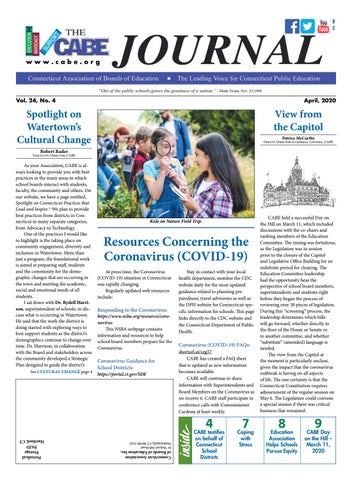
Kids on Nature Field Trip.
81 Wolcott Hill Road Wethersfield, CT 06109-1242
As your Association, CABE is always looking to provide you with best practices in the many areas in which school boards interact with students, faculty, the community and others. On our website, we have a page entitled, Spotlight on Connecticut Practices that Lead and Inspire.* We plan to provide best practices from districts in Connecticut in many separate categories, from Advocacy to Technology. One of the practices I would like to highlight is the taking place on community engagement, diversity and inclusion in Watertown. More than just a program, the foundational work is aimed at preparing staff, students and the community for the demographic changes that are occurring in the town and meeting the academic, social and emotional needs of all students. I sat down with Dr. Rydell Harrison, superintendent of schools, to discuss what is occurring in Watertown. He said that the work the district is doing started with exploring ways to best support students as the district’s demographics continue to change over time. Dr. Harrison, in collaboration with the Board and stakeholders across the community developed a Strategic Plan designed to guide the district’s
4
CABE testifies on behalf of Connecticut School Districts
7
Coping with Stress
CABE held a successful Day on the Hill on March 11, which included discussions with the co-chairs and ranking members of the Education Committee. The timing was fortuitous, as the Legislature was in session prior to the closure of the Capitol and Legislative Office Building for an indefinite period for cleaning. The Education Committee leadership had the opportunity hear the perspective of school board members, superintendents and students right before they began the process of reviewing over 30 pieces of legislation. During this “screening” process, the leadership determines which bills will go forward, whether directly to the floor of the House or Senate or to another committee, and whether “substitute” (amended) language is needed. The view from the Capitol at the moment is particularly unclear, given the impact that the coronavirus outbreak is having on all aspects of life. The one certainty is that the Connecticut Constitution requires adjournment of the regular session on May 6. The Legislature could convene a special session if there was critical business that remained.
8
Education Association Helps Schools Pursue Equity
9
CABE Day on the Hill – March 11, 2020
Periodical Postage PAID Hartford, CT
2
The Journal – Connecticut Association of Boards of Education | April, 2020 PRESIDENT COMMENTARY
What’s Happening at CABE Donald Harris President, CABE
As I approach my mid-year self-evaluation as your President, I can proudly state that I am pleased with the progress we (the CABE Board of Directors and Staff) have made. When I took office in November, I talked about the three goals that I had for this administration: • Develop a Strategic Plan and a Self-evaluation instrument for the CABE Board of Directors; • Rebranding/Public Relations/ Communications to be able to broadcast to every Board of Education member in the State exactly what CABE can do for their district; • Reactivate the Diversity, Equity, Inclusion Committee. In the March issue of the CABE Journal, Bob Rader and Patrice McCarthy wrote an article explaining the development and adoption of the CABE Strategic Plan along with a Code of Conduct for all Board members. This was accomplished at a CABE Board Retreat held in February that was facilitated by former Education Commissioner, George Coleman. This plan focuses on improving the longterm health of the Association, while strengthening boards of education.
In the area of rebranding/communications, we hired a company that had already done some very successful work with the Massachusetts Association of School Committees. Marketing consultant Chris Horan began working for us in December with the development of a video that was presented at our Annual CABE Day On the Hill. This video focuses on what CABE can do for your school board and can be accessed via a link on our website (www.cabe.org). Our Diversity Committee nomenclature has been changed. It is now called the DEI (Diversity, Equity, Inclusion) Committee. The committee is now under the leadership of Leonard Lockhart, Board Chair from Windsor, with a broad base of members from urban, suburban and rural communities representing several ethnicities. We will plan, going forward, to generate ways to utilize the Equity Toolkit that was developed last year through a grant given to CABE. We are also providing, along with our consultant, Dr. Martha Brackeen-Harris, an “Implicit Bias” workshop for the CABE Board members and Staff. The question is where do we (CABE) go from here? What are hot-button issues that we can help you with? As a former high school principal,
Mission: To assist local and regional boards of education in providing high quality education for all Connecticut children through effective leadership. Vision: CABE is passionate about strengthening public education through high-performing, transformative local school board/ superintendent leadership teams that inspire success for each child.
Board of Directors I have paid particular attention to an ongoing concern regarding the use of Native American logos. This has been a hotly debated issue beginning with professional football teams more than a decade ago. My focus will be local school districts in the State of Connecticut. The State currently has nineteen (19) school districts that use nicknames and/or imagery focusing on Native Americans. I have no intention to single out school districts in the middle of this debate in this editorial. This is a local decision best solved on the local level. However, this subject is being discussed by many. As a Bloomfield High School “Warhawk”, I am well aware of the deep history and tradition that are within school logos. This does not make it right, but it does begin to explain the resistance to change. CABE remains ready to help local boards of education who want assistance in dealing with this challenging issue. If any board wants guidance on how to work through this sensitive issue, please reach out to me, or the CABE staff and we’ll do what we can to assist.
EXECUTIVE COMMITTEE Donald Harris | President, Bloomfield Elizabeth Brown | First Vice President, Waterbury Michael Purcaro | V ice President for Government Relations, Ellington Bryan Hall | V ice President for Professional Development, East Hartford John Prins | Secretary/Treasurer, Branford Robert Mitchell | I mmediate Past President, Montville Christopher Wilson | Member at Large, Bristol Lydia Tedone | NSBA Director, Simsbury AREA DIRECTORS Bryan Hall | Area 2 Co-Director, East Hartford Leonard Lockhart | Area 2 Co-Director, Windsor Joan Trivella | Area 4 Director, Brooklyn Mic helle Embree Ku | A rea 5 Director, Newtown Karen Kleine | Area 6 Director, Westport George Kurtyka | Area 7 Director, Derby Lon Seidman | Area 8 Director, Essex Sean Nugent | Area 9 Director, Preston ASSOCIATES Julie Auseré | Associate, Canton Eileen Baker | Associate, Old Saybrook Ethel Grant | Associate, Naugatuck Ann Gruenberg | Associate, Hampton Robert Trefry | A ssociate, CT Technical High School System COMMITTEE CHAIRS Leonard Lockhart | Chair, Resolutions, Windsor Becky Tyrrell | Chair, Federal Relations, Plainville Michelle Embree Ku | Chair, State Relations, Newtown CITY REPRESENTATIVES Yesenia Rivera | City Representative, New Haven Jack Bryant | City Representative, Stamford Charles Stango | City Representative, Waterbury STAFF
Robert Rader | Executive Director Patrice McCarthy | Deputy Director and General Counsel Rebecca Adams Rieder | Senior Staff Attorney Nicholas Caruso | Senior Staff Associate for Field Services and Coordinator of Technology Sheila McKay | Senior Staff Associate for Government Relations Vincent Mustaro | Senior Staff Associate for Policy Service Lisa Steimer | Senior Staff Associate for Professional Development and Communications Teresa Costa | Coordinator of Finance and Administration Pamela Brooks | S enior Administrative Associate for Policy Service and Search Services Terry DeMars | Administrative Associate for Policy Service Gail Heath | Administrative Associate for Government Relations Wilmarie Newton | Administrative Associate for Labor Relations Nancy Propfe | Administrative Assistant for Membership Services Corliss Ucci | Receptionist and Assistant to Executive Director
The CABE Journal (ISSN 1092-1818) is published monthly except a combined issue for July/August as a member service of the Connecticut Association of Boards of Education, 81 Wolcott Hill Road, Wethersfield, CT 06109, (860) 571-7446. CABE membership dues include $30 per person for each individual who receives The CABE Journal. The subscription rate for nonmembers is $75. Association membership dues include a subscription for each Board Member, Superintendent, Assistant Superintendent and Business Manager. The companies and advertisements found in The CABE Journal are not necessarily endorsed by CABE. “Periodicals Postage Paid at Hartford, CT.” POSTMASTER: Send address changes to The CABE Journal, CABE, 81 Wolcott Hill Road, Wethersfield, CT 06109-1242. Email: lsteimer@cabe.org. Members can find the CABE Journal online at: www.cabe.org/ page.cfm?p=1024
CABE held a Board Chair Roundtable on February 25.
The Journal – Connecticut Association of Boards of Education | April, 2020
CABE Affiliate Members BUSINESS AFFILIATES VALEDICTORIAN Finalsite SALUTATORIAN
Berchem Moses PC Shipman & Goodwin HIGH HONORS
Pullman & Comley HONOR ROLL Anthem Blue Cross and Blue Shield ESS JCJ Architecture SCHOLAR Brown & Brown Chinni & Meuser LLC Coordinated Transportation Solutions Dattco, Inc. Goldstein & Peck, P.C. Kainen, Escalera & McHale, P.C. The Lexington Group OneDigital Health and Benefits Perkins Eastman T-Mobile The S/L/A/M Collaborative Zangari Cohn Cuthbertson Duhl & Grello, P.C.
EDUCATIONAL AFFILIATES American School for the Deaf Area Cooperative Educational Services (ACES) Capitol Region Education Council (CREC) The College Board Communities in Schools Connecticut Association of School Business Officials Connecticut Center for School Change Connecticut School Buildings and Grounds Association Connecticut School Counselor Association Connecticut Technical High Schools Cooperative Educational Services (C.E.S.) EASTCONN EdAdvance Exploratioins Charter School Integrated Day Charter School ISAAC LEARN
3
EXECUTIVE DIRECTOR COMMENTARY
Help Build Our Best Practices Clearinghouse! Robert Rader
Executive Director, CABE
Successful boards of education maintain a culture of high expectations of board members, superintendents, staff and students. Continuous learning, whether from attending workshops, an annual board retreat or even the joint reading of a book, is an important aspect of this culture. Board members are very busy people. Often, they have full-time jobs or other time-consuming responsibilities and then they spend countless hours at board and committee meetings, to say nothing of the time and effort they invest in supporting students, teachers and others in a variety of activities. So, how can we expect board members to put in even more time in professional development? How can we make the process easier and less time consuming? We have been examining this issue for quite some time. We know from surveys and discussion with our members that they want CABE to provide them with examples of best practices. We launched Spotlight on Connecticut Practices that Lead and Inspire a few years ago, however, we think it is time to ramp up the work we are doing in helping with examples of best practices. How do we do this? Well, we need your help!
Spotlight on Best Practices
One of the ideas that we stole, err, borrowed is from the New Jersey School Boards Association. Yes, some good things do come from Jersey! We call our initiative Spotlight on Connecticut Practices that Lead and Inspire. The idea is to build a library of best practices that are easily accessible, concise and provide sufficient information, like contact information, that could lead a board member, a superintendent or other staff to additional resources. To me, the most interesting part of what we borrowed from New Jersey is that it mostly focuses on best practices for school boards. There are many sources of data and best practices available for teachers in particular, including lesson plans and other instructional suggestions. However, a best practices library, posted on the CABE website, will be the first one that
I know of in our State, focusing on the critical and difficult work that you do. There are 12 areas in which to categorize any best practices. Among them are advocacy, community engagement, student achievement, governance/board leadership/policy, diversity/inclusion and equity and professional development. If you have developed some great ways of addressing these issues, please tell us about them! There is a survey at https://www.surveymonkey.com/r/9WGPZJM which lets you do this easily and quickly. To launch this renewed effort, I wrote an article, with the help of Watertown Superintendent Dr. Rydell Harrison, on the diversity/inclusion and equity going on in that town (see page ). As the CABE Diversity/Inclusion and Equity Committee’s work continues, we will include more best practices in Spotlight.
Providing Professional Development
We are trying to accomplish the provision of professional development, through a variety of means. For example, this fall we began a new series of webinars, available for viewing live on just about every other Thursday and available 24/7 once they archived on our website (https://www.cabe. org/page.cfm?p=1394). They include information on brain science, the Next Generation Accountability Standards, the College Board’s “Landscape” Tool and other issues. I hope all Board members and Superintendents become aware of the opportunities they have for accessing CABE PD! To “spotlight” some of these •C ABE can provide workshops tailored to the needs of your school board. Whether it’s Board Self-Assessment, Roles and Responsibilities, FOIA or any other issue that we can help you with—
that’s our role. And, it is included as part of your dues. • If you don’t know about the Lighthouse Project, you certainly should. This work, which is part of a national study, helps boards to better understand their leadership role in raising student achievement. It is a rewarding one-year training process in which your board will learn about how to best use the data it receives, how to build relationships and support your superintendent in increasing student growth and how to engage the community in this work. • In addition, besides the many emails you get – Advocacy Highlights, provided weekly during the Legislative Session, Policy Highlights every two weeks, the weekly What’s Going On At CABE, we also provide information on FaceBook and Twitter. I know that some people do not use social media. But, our hope is that for those who do, they will be helpful. • Because of cost, we provide the CABE Journal digitally every month and on paper six times a year. We are now surveying our members to see how that works for them. Please respond to this email when you get it! It will only have a couple of questions—I promise! If you have thoughts on this subject please let me know. We are always looking to become even more efficient and effective in serving you!
Categories for the Spotlight on Connecticut Practices that Lead and Inspire: • Advocacy • Community Engagement/Communication • Curriculum/Student Achievement • Diversity/Inclusion and Equity • Facilities/Buildings and Grounds • Finance • Governance/Board Leadership/Policy • Professional Development for Board/Staff
• School Climate • School Security • Shared Services • Special Education • Social/Emotional Learning • STEM Education • Sustainability • Technology
4
The Journal – Connecticut Association of Boards of Education | April, 2020
CABE TESTIFYING ON BEHALF OF CT SCHOOL DISTRICTS
CABE State Relations Chair Michelle Embree Ku (Newtown) testifies before the Educaiton Committee on special education funding.
CULTURAL CHANGE
CABE Deputy Director and General Counsel Patrice McCarthy testifies before the Education Committee on legislation creating a process to remove a board of education member from office.
new phenomenon, but this was a new way in Watertown of engaging them. A subcommittee of the Board focuses specifically on family engagement and “the parents are seen as equal partners.” According to Dr. Harrison, a number of committees have been established to bring stakeholders into this work. For example, there is a new Superintendent’s Parent Advisory Council, which provides an opportunity for parents to network and speak to the Superintendent. Another focus is a Superintendent’s Student Advisory Council, which consists of 24 students, holds meetings monthly and are focused on providing feedback on issues such as instructional strategies. Dr. Harrison receives much information about what is occurring in classrooms from this
(continued from page 1)
work over the next three years. One major area of the plan is a focus on families leading to the establishment of a family resource center. The district is using SDE’s framework for engaging families and the Board’s Governance and Community Engagement Committee utilized the guiding principles from the framework to analyze parent survey data. As the committee continues with its commitment to authentic family engagement and consider new ways to engage families as full, equal and equitable partners, it is creating avenues for all voices to be heard. The idea of including parents in the work of a district is certainly not a
CABE First Vice President Liz Brown (Waterbury) testifies before the Appropriations Committee.
group. It is comprised of a diverse set of students (six for each grade). The success of the students in school is varied. In other words, a student does not have to be a top performer to be part of the Committee. At the same time this work is occurring, the district is embracing RULER, the social-emotional learning tool developed by the Yale Center for Emotional Intelligence. The district is working with faculty on this and next Fall, will start using it with students. The purpose of all of this work, Dr. Harrison explained, was to “lift up voices which aren’t amplified. This is central to providing the foundation for further work on equity.” As he explained, cultural change takes time to achieve and the “foundational steps” have to be put in place to ensure that
the faculty, students and the community are prepared for that change. With the changes that are taking place through increased input and respect, Dr. Harrison expects that “if people are not treated right, others will understand their duty to help out.” By treating people with respect and upholding high expectations, Dr. Harrison and the Board of Education are not only building better school climate, but, helping lead the way in preparing students for the world they will enter. *Spotlight can be found at https:// www.cabe.org/page.cfm?p=1218. **SDE’s Community Engagement Framework can be found at https:// portal.ct.gov/SDE/Publications/ Full-Equal-and-Equitable-Partnerships-with-Families.
“ A leader... is like a shepherd. He stays behind the flock, letting the most nimble go out ahead, whereupon the others follow, not realizing that all along they are being directed from behind.”
– Nelson Mandela Services include:
a Waterproofing a Preventative has partnered with OMNIA to expand roofing service options from small repair jobs to full roof replacements.
Current Vacancy: CANTERBURY
Maintenance
a Inspections a Emergency Weather and Leak Repair
Superintendent
MARY BRODERICK, ED.D SENIOR CONSULTANT
For more information contact
CABE Search Services
81 Wolcott Hill Road, Wethersfield, CT 06109
For more information, visit www.crec.org/marketplace
860-608-1763
Equal Opportunity Employer
The Journal – Connecticut Association of Boards of Education | April, 2020
5
See You in Court – The Nutmeg Board of Education
It Started with Public Comment and Unraveled from There Thomas B. Mooney, Esq. Shipman & Goodwin
The Nutmeg Board of Education makes many mistakes. The latest imbroglio created by the board will be reported here each issue, followed by an explanation of what the board should have done. Though not intended as legal advice, these situations may help board members avoid common problems. The Nutmeg Board of Education has four standing committees, including the Policy Committee, which has three members. Most of the time, an indifferent public ignores its meetings. This spring, however, was a different story. Veteran Board member Bob Bombast chairs the Policy Committee, and at the last meeting of the full Board, Bob lamented the critical remarks members of the public regularly make at Public Comment. “We do, we do, we do for these people, and this is the thanks we get. Why should we bother to give these crepehangers an audience? At the next meeting of the Policy Committee, I will be proposing that we amend our bylaws to eliminate Public Comment from our standard agenda. If the good people of Nutmeg have a problem with us, let them send us their complaints by email.” Bob’s comments resulted in a protest on social media. Someone posted the time and place for the next Policy Committee meeting, and soon dozens commented that they would make their voices heard at the next Policy Committee meeting. Even Bob was taken aback, and he asked Ms. Board Attorney to provide a legal opinion on Board’s rights to limit or eliminate Public Comment. About 50 angry people were in the audience at the next meeting of the Policy Committee, and many of them were giving Bob the evil eye. Given the controversy, all the other members of the Board were also in attendance. Bob gamely called the meeting to order, but he was quickly interrupted by Nancy Newshound, ace reporter for the Nutmeg Patch, the new online newspaper covering Nutmeg and environs. “This is an illegal meeting!” Nancy claimed loudly. “What was posted was a meeting of the Policy Committee, but what I see is a meeting of the Board of Education because every single Board member is present.” Bob started to lose it, responding testily to Nancy, “This is a public meeting, and the other Board members have the same right to attend as you do!!” But fellow Board member Mal Content sent him a text telling him to calm down. When Bob heard his phone buzz, he read the text, nodded to Mal and moved on with the meeting.
“As some one of you know,” Bob began, “I think that Public Comment is a waste of time, and I recommend to the Committee that we revise our policy to eliminate Public Comments from our agenda. What do you all think?” Mal Content and Penny Pincher were the other two members of the Committee, and the crowd intimidated both of them. “Can we even do that?” Penny asked. Bob responded by suggesting that the Committee go into executive session to discuss an “attorney-client privileged communication.” Mal and Penny promptly agreed, and after Committee members moved to go into executive session, Bob asked that all people present other than Board members leave the room. Nancy Newshound interrupted again, stating, “You can’t go into executive session, because it is not listed on your agenda! I will be filing a complaint with the Freedom of Information Commission!” “File away, Nancy!” Bob responded, and he and the other Board members proceeded with the executive session. Has the Policy Committee violated the FOIA? • • • • • • • • • • • • • • • Yes and no. The Committee has the right to convene into executive session, but the way it did so violated the Freedom of Information Act. At the beginning of the meeting, Nancy claimed that the presence of a quorum of the Board of Education at a committee meeting violates the FOIA. Presumably her theory is that when a quorum of the Board attends a meeting posted as a committee meeting, their presence transforms the gathering to a meeting of the full Board, which was not posted. Under the Freedom of Information Act, that is not necessarily the case. Conn. Gen. Stat. § 1-200(2) provides: “A quorum of the members of a public agency who are present at any event which has been noticed and conducted as a meeting of another public agency under the provisions of the Freedom of Information Act shall not be deemed to be holding a meeting of the public agency of which they are members as a result of their presence at such event.” Thus, the mere attendance of all the Board members at the meeting of the Policy Committee did not cause a problem in the first instance. That said, the actions of the Board here did violate the FOIA. The other Board members were not merely present at the meeting. Rather, as evidenced by their being permitted to attend the executive session, they were treated as Board members, and the
gathering thus became a meeting of the full Board, which was not posted. To avoid this problem, whenever board members attend a meeting of a committee of which they are not members, they should be treated as are any other member of the public. That includes limiting their participation in discussion to the same extent as members of the public and even making sure that they not sit at the table with the committee members. Nancy’s other objection was that the Policy Committee should not have convened in executive session because the agenda for the meeting did not include executive session. In this respect, Nancy was incorrect. Public agencies are not required to include “executive session” on their agenda. Rather, they may move into executive session by a two-thirds vote whenever they are discussing a topic privileged to executive session. Executive session is a procedural status, not an agenda item. In fact, including “executive session” on the agenda without more can invite an FOIA violation because the members may be tempted to go into executive session without properly identifying the reason for executive session in the motion. Here, the members of the Policy Committee (but not
the other members of the Board) had the right to convene into executive session to discuss a privileged communication. However, the FOIC has ruled that the stated reason for an executive session relating to confidential attorney-client communications should include the topic of the legal advice. Finally, we note that Mal’s text to Bob also raises issues under the FOIA. It is no surprise that Mal created a public record with his text (though its content was benign). What may be surprising is that Mal’s text could also be a violation of the open meeting requirements of the FOIA. The right of the public to attend a meeting includes the right to hear what is being said. A text is perforce silent, and a text that relates to the public’s business received by a board member during a board meeting may be considered denial to the public of access to the meeting. Attorney Thomas B. Mooney is a partner in the Hartford law firm of Shipman & Goodwin who works frequently with boards of education. Mooney is a regular contributor to the CABE Journal. Shipman & Goodwin is a CABE Business Affiliate.
The Ninth Edition – Now Available!
A Practical Guide to Connecticut School Law by Thomas B. Mooney, Esq. Shipman & Goodwin
CABE is delighted to announce that the Ninth Edition of Tom Mooney’s Practical Guide to Connecticut School Law is now available. PRICING: CABE Members: $54.99; CABE Non-Members: $79.99; Students: $44.99 There have been many changes in school law in the last few years, and the Ninth Edition has been extensively revised to provide updated guidance on the legal issues that govern our schools. Changes include descriptions and commentary on:
• Changes in teacher evaluation and teacher tenure. • New rules regarding employee background checks. • New requirements concerning student data privacy. • New rules for suspension, expulsion and alternative educational opportunities. • Revised requirements governing seclusion and restraint. • The new “Every Student Succeeds Act” and how it has changed “No Child Left Behind Act” requirements. • The CCJEF case and ongoing litigation over equal educational opportunities. • The Minimum Budget Requirement and new duties to collaborate with town officials. • A host of other changes in the rules that boards of education and school administrators must follow.
6
The Journal – Connecticut Association of Boards of Education | April, 2020
Aim Higher
Creative legal solutions for Connecticut’s public schools – because sometimes it is rocket science.
Shipman & Goodwin’s school law attorneys have more than 40 years of experience, and represent over 125 public school districts, as well as public school member organizations and associations, on a full range of legal issues that they confront, from general education law to special education matters.
Our school law site, www.ctschoollaw.com is devoted entirely to emerging school law issues. Attorneys counsel clients, monitor legislation and provide periodic alerts and updates. We regularly present seminars, quarterly workshops, webinars and professional development workshops for schools on current topics of interest. Our Practice Group Co-Chair, Tom Mooney, has written A Practical Guide to Connecticut School Law, a comprehensive treatise on Connecticut school law, published by CABE and used by teachers, administrators and board of education members throughout the state.
Education is a core focus of our law firm.
Facebook “f ” Logo
CMYK / .eps
Facebook “f ” Logo
CMYK / .eps
www.ctschoollaw.com
Contact: Thomas B. Mooney or Linda L. Yoder | 860.251.5000 | www.shipmangoodwin.com GREENWICH
|
HARTFORD
|
LAKEVILLE
|
NEW HAVEN
|
NEW YORK
|
OLD LYME
|
STAMFORD
|
WASHINGTON DC
The Journal – Connecticut Association of Boards of Education | April, 2020
7
Coping with Stress When stress exceeds your ability to cope, normal tasks can feel overwhelming. The goal of this article is to help you become mindful of barriers to moderating stress and shift to constructive action. Remember, stress is neither good nor bad, it’s a natural reaction to your environment.
Be aware of current coping habits
When pressured, some people fill their schedules with social activities in an attempt to avoid facing problems. Others deal with stress by withdrawing from friends and family. A person might also turn to alcohol, junk food, or other unhealthy activities to help them escape stress. While another tells themselves they are a victim of bad circumstances, thinking things like “I shouldn’t have to deal with this”. Be conscious of how you currently deal
For Your Information Motivation Tip:
Do your most difficult, time consuming, least favorite job first. If you tackle the toughest job, the rest of your tasks will seem that much easier.
Be Mindful of Others Feelings:
When you are stressed, take care to mind your tone when speaking with others; co-workers and family included. Make an effort not to take out your feelings on others or spread discomfort. In the long-term, elevating work culture and being kind at home helps keep you happy in turn. Being altruistic improves social, emotional and psychological well-being.
with stressful situations. Acknowledge your previous reactions to stress by learning to take mindful steps and working on positive stress release tactics.
Identify ways you think yourself to higher levels of stress
Stress is a feeling: it isn’t something that happens to you, but rather how you think about what is or has happened. Take a step back and reflect: Are your thoughts making situations worse? Do you feel you have to be perfect and everything is of critical importance? Simply put, stressful thoughts add to real life pressures. Work at adopting more moderate views. Put stressful situations in perspective. Is every problem absolutely urgent? Are these things I have to do by myself or would it be better to ask for help? What is one small thing I can do today to help alleviate my worries? 1. A sk yourself: What specific problems or conflicts are troubling and which problems can I effectively tackle? It’s okay to acknowledge your distress. Don’t ignore it. Think about when, and why, you feel stressed. Then, rather than focusing on how to cope with a number of issues, narrow your list down to what you feel is manageable. Are there issues that are out of your control? If so, eliminate stressors that cannot be solved by you alone. Focus on tasks or stressors for which you are able to make a difference. Taking small steps and handling manageable tasks will help you to feel accomplished and effect
positive change in your daily life. 2. I ncrease your ability to cope with stress. An active and balanced lifestyle is your best defense against stress. Stress experts recommend the following: • Avoid using alcohol, caffeine or
nicotine as a means of alleviating stress.
•E xercise regularly or take a 20-minute
walk to dissipate stress and lift your mood.
•E at well-balanced, nutritious meals
and avoid processed foods.
•R educe consumption of refined
sugars, which cause frequent fluctuation in blood glucose levels, increasing your stress.
•P ractice relaxation daily. Try deep
breathing, yoga, meditation, imagery, listening to quiet music, or enjoying nature.
•K eep to a sleep schedule and get 7-8
hours of rest nightly.
•R elease tension or worry by sharing
your feelings with a close friend, family member, or counselor. In the future, make a point to turn these practices into coping mechanisms. If you’ve had a bad day, pick something off this list to do for yourself before that day is over. 3. Practice deep breathing. Give your mind and body a moment, absent of stress by practicing slow, deep breathing. Close your eyes and inhale slowly and deeply through your nose (approx. seven seconds), then exhale slowly through your mouth (approx. eight
seconds). If you prefer, say a soothing word or phrase as you exhale like “relax” or “I can do this”. Do this for five minutes, three times a day. This technique, known as the “relaxation response,” will quiet thoughts, lower your heart rate, and bring respiration back to normal. Another quick, but great technique for when you feel stiff is to: close your eyes, roll your head in a circle- twice clockwise and twice counterclockwise, then take a breath in, clench all of your muscles for five seconds, and release your breath while focusing on relaxing your muscles beginning with your toes all the way up through the body. Editor’s Note: We have used the Lexington Group for CABE’s Employee Assistance Program for many years. They also are CABE Business Affiliates. They sent this out this morning and we thought it might be helpful. If your district is interested in working with Lexington, please call them at 800-571-0197. Used with the permission of the Lexington Group.
For Your Information
Parenting During Stressful Times:
If you feel you have been stressed, most likely your child has noticed. They may also be worried about their own problems. Take the opportunity to sit down with them and listen, assure them if they are upset. Talk together to find manageable solutions which will help deal with the situation.
Balancing Work & Home:
Upon arriving home from work, these tasks may help you transition from your professional to your personal life: •C hange your clothes and wash your hands, or take a quick shower to unwind. Let this action be a symbol of your switch to “home mode.” • T ake a break, set a timer for 15 minutes, and use that time to do absolutely nothing. •R emind yourself to “change roles.” Separate work from family time.
Commissioner Miguel Cardona met with participants of CABE’s Leadership Institute on February 20, 2020.
8
The Journal – Connecticut Association of Boards of Education | April, 2020
Education Association Helps Schools Pursue Equity The Day Editorial Board New London
The Connecticut Association of Boards of Education (CABE) recognizes a need to embrace diversity so that the folks making policy and teaching reflect the diversity of the students in the seats. It starts at the top with the school boards, notes the nonprofit organization that represents the interests of boards across Connecticut. According to CABE, only a small number of board members in Connecticut are of color, about 12% African American, 4% Latino, the latter number particularly alarming given the state’s expanding Latino population. In Norwich and New London, diverse boards of education do reflect the racial and ethnic diversity of those communities, but not so in Groton. We agree with CABE’s observation that local political parties should strive to attract more people of color to run for school boards. In a recently published “Equity Toolkit for Connecticut Boards of Education,” the association not only lays out succinctly why diversity is import-
ant, but also provides practical steps how school systems can start working toward that goal. The toolkit defines equity as “giving students what they need to be successful, academically and socially. To reach equity, students will need to ‘see themselves’ in their curriculum and instructional materials.” Its lofty, meritorious goal is to reach a point “when there are no systematic disparities in academic outcomes based upon race, ethnicity, gender, economic status, or zip code.” The state remains far away from that destination, but getting their begins, as CABE recognizes in quoting the vision statement of the State Board of Education, with the “core principle that, with the right supports and rich learning opportunities, every student will meet high academic standards, regardless of a child’s life circumstances.” Credit the organization, whose association represents school boards controlled by both Republicans and Democrats, with tackling a subject which, unfortunately, gets dragged into the political culture wars. CABE has long advocated for recruiting great teachers, but also ones who, through minority recruitment efforts, reflect
Think of your Association,,
CABE,
when you do your shopping! When you shop @AmazonSmile Amazon will make a donation to:
The Connecticut Association of Boards of Education, Inc. https://smile.amazon.com/ch/06-0767770
student diversity. The “Equity Toolkit” outlines how to begin “community conversations” that allow people from diverse backgrounds to speak openly about how well, or not, they think students are being served and families supported. The aim is to “engage members of the community who are not typically involved in conversations about excellence in education,” helping all better understand how the needs of students can be met, and how parents can contribute. This worthy effort by CABE deserves consideration by local school boards.
The Day editorial board meets regularly with political, business and community leaders and convenes weekly to formulate editorial viewpoints. It is composed of President and Publisher Tim Dwyer, Editorial Page Editor Paul Choiniere, Managing Editor Tim Cotter, Staff Writer Julia Bergman and retired deputy managing editor Lisa McGinley. However, only the publisher and editorial page editor are responsible for developing the editorial opinions. The board operates independently from the Day newsroom. This first appeared in the February 14 issue of The Day. It is used with permission.
OECD Study Examines Students’ Career Aspirations Robert Rader
Executive Director, CABE
What are you going to be when you grow up? The Organization of Economic Cooperation and Development asked teenage students for their answers to this deceptively simple question. As reported by Sarah D. Sparks in Education Week**, the “dream jobs” desired by students today match those from 2000—jobs that were fine for the 19th or 20th Century, but, not for the 21st Century. Teenagers have become more focused and expected to work “in only one of only 10 jobs… boys and girls preferred to be doctors, teachers, lawyers, architects, and police, while girls also favored nurses/ midwives, psychologists, designers, and veterinarians, and boys also expressed interest in becoming information technology professionals, sportspeople, and motor vehicle mechanics.” The article stated that the “focus on fewer careers and the misunderstanding of the preparation needed for different jobs meant that students often overlooked more accessible jobs in expanding fields", the OECD found. According to Sparks, the study of 41 countries found that “fewer than 40 percent of 15 year-olds reported taking part in any career-development activities in primary or secondary grades.” As Connecticut and the nation discuss and examine initiatives boosting college and career readiness, the next comment by Sparks is especially
noteworthy: “Students who participated in job fairs, work-shadowing, and internships were more likely to be motivated to work hard at school and to see education as relevant to their future… [h]igh-performing, low-income students who participated in those activities were also more likely to say they expected to be professionals or managers.” As our member school boards, the State, Campaign for Working Connecticut, the Connecticut Voices for Children and others continue their efforts to ensure our students are prepared for the future, one of the principle tenets must be ensuring that students have the types of opportunities mentioned above. Opening their eyes to what is possible for them will ensure that a new list of dream jobs will be identified. Enabling that to happen will encourage our students in ways that vague ideas of their future prospects will not. *According to its website, the OECD, is “an international organization that works to build better policies for better lives.” It is “a unique forum where the governments of 36 member states with market economies work with each other, as well as with more than 70 non-member economies to promote economic growth, prosperity, and sustainable development.” **Education Week, February 12, 2020, page 12.
The Journal – Connecticut Association of Boards of Education | April, 2020
9
CABE DAY ON THE HILL MARCH 11, 2020
CABE President Donald Harris (Bloomfield) welcomed participants.
CABE Executive Director Robert Rader thanked participants for attending.
CABE Deputy Director and General Counsel Patrice McCarthy and Sr. Staff Associate for Government Relations Sheila McKay provide participants with a legislative update.
CABE Vice President for Government Relations Michael Purcaro (Ellington) reminded participants that it only takes one voice to make a difference.
Representatives Robert Sanchez and Kathleen McCarty talked about SEL among other topics.
Waterbury Board member Ann Sweeney asks a question of the presenters.
Senators Douglas McCrory and Eric Berthel discussed the importance of preparing students for the future.
While we didn’t march to the Capitol, we gathered for a group photo. Public schools, our future!
10
The Journal – Connecticut Association of Boards of Education | April, 2020
We Are Well Suited to Respond to the Legal Needs of Boards of Education Attorneys and Counselors at Law
Berchem Moses PC is a leading player in the State of Connecticut in the field of Education Law. With 10 attorneys dedicated to this specialized practice, we offer a long history of experience and deep resources. We promise the highest level of service in a more cost effective manner. We work with boards of education to address a myriad of complex issues including labor and employment, student issues, special education, general counsel, and other challenges facing educators today. Be sure to visit www.connecticuteducationlawblog.com where our attorneys regularly cover legal matters that pertain to Connecticut schools.
www.berchemmoses.com Milford
75 Broad Street Milford, CT 06460 Phone: 203-783-1200
Westport
1221 Post Road East Westport, CT 06880 Phone: 203-227-9545
The Journal – Connecticut Association of Boards of Education | April, 2020
11
THE POLICY CORNER Vincent A. Mustaro
Senior Staff Associate for Policy Service, CABE
Policy and School Culture and Climate Parents, teachers, administrators and students often sense some special aspect of the school district and its individual schools with which they are involved. This pervasive yet elusive element is often referred to as either the district’s or school’s culture or climate. A school’s culture or climate influences everything that goes on in schools. School climate sets the tone for all the learning and teaching done in the school environment. Research indicates that school climate is predictive of students’ ability to learn and develop in healthy ways. P.A. 19-166 defined school climate to mean the quality and character of school life based on patterns of students’, parents’, and school employees’ experiences of school life, including norms, goals, values, interpersonal relationships, teaching and learning practices, and organizational structures. This same legislation also defined “positive school climate” as a school climate in which: a. norms, values, expectations, and beliefs are promoted that support feeling socially, emotionally, and physically safe; b. students, their parents and guardians, and school employees feel engaged and respected and work together to develop and contribute to a shared school vision; c. e ducators model and nurture attitudes that emphasize the benefits and satisfaction gained from learning; and d. e ach person feels comfortable contributing to the school’s operation and care of its physical environment. Though the terms are often used interchangeably, school climate and school culture are not the same. School climate is created by the attitudes, beliefs, values and norms that underlie the instructional practices, the level of academic achievement and the operation of a school. School climate, largely created by the adults in a school, is driven by how well, and how fairly the adults in the school create, implement, model, and enforce these attitudes, beliefs, values and norms. Climate is the essence of the school that draws teach-
ers and students to love the school and to want to be a part of it. The product of good school climate is a strong school culture. Climate is viewed as behavior, while school culture is used to refer to the actual state of the school comprised of the values, shared beliefs, and norms of the school. School culture is “the way we do that here,”’ or the “way we don’t do that here.” A school’s culture is largely determined by how the adults in the school enact the rules, values, shared beliefs, and behavior of all the various stakeholders within the school community and reflects the school’s social norms. It is not possible to significantly improve student achievement unless a school’s culture and climate are adequately addressed. The school principal directly affects the culture and climate. Schools are expected to promote a positive school culture that encourages interpersonal and intergroup respect among students, staff and between students and staff.
Key Factors
The key factors which impact climate include, but are not limited to, one’s perception of their personal safety, interpersonal relationships, teaching, learning, as well as the external environment. The factors which affect school culture include staff expectations of student behavior and academic achievement, school policies and procedures, consistent and equitable treatment of students, equity in, and access to, resources, equity in and access to support services and student and family engagement. University professors Kent Peterson and Terrence Deal, in Educational Leadership defined school culture as the underground stream of norms, values, beliefs, traditions and rituals that have built up over time as people work together, solve problems, and confront challenges. These authors stated that, “This set of informal expectations and values shapes how people think, feel and act in schools. This highly endur-
ing web of influence binds the school together and makes it special. The school leaders, principals, teachers and often parents, must help to identify, shape, and maintain strong, positive, student-focused cultures to help reforms to succeed and student learning to improve.” The board’s role is to help create and enhance the climate in its schools in order to bring out the very best in its students, staff and community. It is important for the board to concentrate on its role as visionary policymaker. Policies and administrative regulations (procedures) are necessary to ensure smooth, efficient, and consistent operations in district schools. The policies should be periodically examined to determine if they encourage the best practices and make each school a flourishing environment that welcomes and encourages all who work and learn there. Policies which help develop a positive school climate are those which encourage and permit rather than restrict or direct. Policies need to be clear, understandable and easily accessible affording the entire school community the knowledge of the board’s position on important issues.
The Board’s Role
Boards of education can do the following to help create a positive climate: •U tilize surveys to determine how the staff perceives the district as a place to work, how students feel about the programs offered and what the community believes about its schools. • I nform staff of the board’s interest in programs by scheduling reports at board meetings. •A dopt and practice a communications policy emphasizing two-way communication. • I nvolve staff and community members in the process leading to major decisions. •C ommunicate in an open, honest, timely and factual manner with the staff. •E xplain the board’s decisions
clearly, especially if they are controversial. • Reexamine your role as an educational leader. Is the board doing what it’s always done because it’s always been done that way, or does the board look for ways to improve and change the district’s environment? • Define and communicate the district’s vision and mission; then involve staff and the community in the development of long-range and short-range goals. Constantly evaluate the progress toward those goals. Boards of education must be seen as models of local educational leadership by teachers, administrators, students and the community. Therefore, boards have to lead by example. School board members help set the tone for how the district’s schools, administrators, teachers and students approach challenges and opportunities. The board must remember its policies during budget preparation. Improving school climate may involve some changes in staff, facilities and programs that have an economic impact. School leaders from every level are contributing factors to shaping school culture. Principals communicate core values in their everyday work. Teachers reinforce values in their actions and words. Parents bolster spirit when they visit school, participate in governance, and celebrate success. Students in their interactions with their peers contribute to the desired climate. In addition, students who feel comfortable talking to adults at their schools are more likely to share information about planned events of violence, episodes of bullying and other issues that can affect school safety. Leadership comes from many sources in the most successful districts and schools. Through attention to the climate and culture, identifying aspects which are destructive and which are constructive, leaders can help develop the foundation for change and success.
12
The Journal – Connecticut Association of Boards of Education | April, 2020
HARTFORD AREA LEGISLATIVE BREAKFAST FEB. 20, 2020 CO-SPONSORED BY CREC, CABE AND HASA
Rep. Jeff Currey and East Hartford Superintendent Nate Quesnel talk about education issues of concern.
CABE Deputy Director and General Counsel Patrice McCarthy provides a legislative update.
CABE President Donald Harris (Bloomfield) greets participants.
CABE Sr. Staff Associate for Government Relations Sheila McKay and Ellington Superintendent Scott Nichol discuss shared services and special education.
The Journal – Connecticut Association of Boards of Education | April, 2020
13
CABE: Working for YOU
Individualized Workshops | Professional Development Opportunities Legal Services | Policy Services | Representing You Statewide and Nationally Below are the highlights of activities that the CABE staff has undertaken on your behalf over the last month. We did this:
B y providing opportunities for members to learn how to better govern their districts: z Hosted and facilitated a Board Chair Roundtable. z Attended Connecticut State Department of Education (CSDE) Conference call on implicit bias. z Conducted CABE Leadership Institute session. z Responded to 50 requests for policy information from 25 districts and one newspaper, providing sample materials on 37 topics. Further, districts continue to access CABE’s online Core Policy Reference Manual and/or online manuals posted by CABE for policy samples. The topics of greatest interest pertained to recess time and discipline, class size, medical assessments of students, suspension and expulsion, use of sunscreen and food allergies. z Provided Roles and Responsibilities training for the East Haven, Griswold, Weston and Windham Boards of Education. z Provided legal compliance and alignment with policy training for the New Britain Board of Education. z Met with Bryan Klimkiewicz, from the CSDE Bureau of Special Education regarding developing a board webinar series about special education law and funding requirements. z Held a meeting of the CABE Diversity, Equity and Inclusion (DEI) Committee.
B y helping school boards to increase student achievement: z Sent two issues of “Policy Highlights” via e-mail listserve covering topics that affect student achievement. Included topics pertained to civility, school safety and security, homeless students, air quality, public participation at board meetings, and nutrition standards. z Meet with leadership of the Plainville Board of Education to begin Lighthouse Training.
B y ensuring members receive the most up-to-date communications: z Provided webinar in preparation for Day on the Hill. z Prepared materials, as part of the Custom Policy Service for Danbury, Montville, New Haven and Woodbridge. z Updated and distributed to board members and superintendents the sample policy and administrative regulation pertaining to pandemics/ epidemics. z Communicated via CABE chair listserv immediate updates and urgent correspondence from State Department of Education health and safety – considerations for pandemic.
B y promoting public education: z Attended the Pullman & Comley School Law conference.
B y providing services to meet member needs: z Visited Watertown Public Schools to gather information for article (see page 1). z Hosted and participated in meeting of the CABE/CAPSS Convention Committee. z Hosted and participated in Connecticut Society of Association Executives (CSAE) workshop on ethics. z Facilitated Woodbridge Board of Education retreat. z Auditing the policy manual of Region 15. z Completed the audit of the policy manual of the Orange Public Schools. z Provided, as part of the Custom Update Service, policy updates for East Hampton, Newington, and North Stonington. z Facilitated board goal evaluation for the Ellington Board of Education. z Facilitated problem solving session for the Stonington Board of Education. z Facilitated board evaluation and goals for the Columbia Board of Education. z Facilitated goal setting for the Sprague Board of Education.
z Facilitated board workshop for the Region 15 Board of Education. z Responded to 103 requests for legal, human resources and labor relations research and information from 41 districts. z Prepared memo to school districts – voting on anything requires a quorum, action taken after illegal executive session is void/invalid. z Prepared memo regarding chain of command and handling individual citizen complaints.
B y attending Professional Development to strengthen staff knowledge and skills. z Attended RULER 2020 program hosted by the Yale Center on Emotional Intelligence. z Attended and participated in the ConnPELRA Annual Collective Bargaining Workshop for Municipal and School District Personnel: Topics and Trends, Settlements and Arbitration Awards; Trends in Medical Plans and their Place in Today’s Negotiations; The Importance of Contract Language; and, Best Practices in Labor Contract Negotiations.
B y helping districts operate efficiently and conserve resources: z Responded to 14 requests for
research and information on human resources and labor relations topics from nine districts. B y representing Connecticut school boards on the state or national level:
z Attended Connecticut Voices for Children’s College and Career Readiness Convening. z Participated in Connecticut AntiDefamation League (ADL) Board of Directors Annual Meeting. z Met with The Day’s Editorial Board (see editorial, page 8). z Co-hosted CREC/CABE/HASA Legislative Breakfast. z Attended Central Connecticut State University program on Significance of African-American Church in American History. z Represented Connecticut on NSBA
Northeast Regional conference call. z Attended 1619 Project program on the African-American experience in America. z Met with representatives of the Connecticut Association of Arts Administrators. z Met with various legislators. z Provided testimony on numerous issues impacting education. z Discussed school lunch debt on Fox 61. z Discussed school district coronavirus preparations on WNPR, Fox 61, and Channel 8. z Participated in Social and Emotional Learning Collaborative meeting. z Participated in Connecticut Bar Association Civics Education Committee meeting. z Attended Connecticut State Board of Education meeting. z Provided training to prospective superintendents about boards of education at Sacred Heart University. z Working with CSDE and ConnCASE to develop webinar series. Topics generally – to be 1. Special Education Basics – including legal foundation - these are all federal legal requirements. They override all local law - charter, ordinance, policy, regulation, and also override state law or policy that conflicts. 2. Funding – required maintenance of effort, excess cost, lack of federal and state funding driving local cost increases. Increasing costs despite declining enrollment 3. Discipline of Special Education Students under federal law. Cannot expel if the behavior is because of the disability 4. Monitoring and supervision requirements – state oversight and district performance 5. Including coverage of “Least Restrictive Environment” (LRE) types of services and placements – not just outplacements. Legal and fiscal requirements
14
The Journal – Connecticut Association of Boards of Education | April, 2020
Coronavirus:
Keeping All Stakeholders Informed Mark Benigni
Superintendent, Meriden Public Schools
Stay calm, be cautious, provide clarity and plan conscientiously — all to point the community in the right direction For the past couple of weeks, school system leaders across our nation have been searching for information, direction and support in addressing the challenges that the coronavirus (COVID-19) poses to their schools, staff and the students they are trusted with educating in safe, supportive learning environments. So what can district leaders do during such uncertain times, where the situation is fluid and information is coming at them from government leaders, health officials, parents, staff, media outlets and even students? At Meriden Public Schools — a small urban district serving over 8,500 diverse learners in Connecticut and
about two hours from Boston and New York—we are committed to staying calm, being cautious, providing clarity and planning conscientiously. The coronavirus prompted our schools to close March 13.
Taking a team approach
With constant news coverage of the coronavirus and worst-case scenarios grabbing headlines, we remained calm and committed to providing factual information in a timely manner. Regular leadership meetings were held with key stakeholders, including city leaders and local health officials. A team approach, led by our health experts, ensured that decisions would be made with caution and clarity. With so many different opinions and much misinformation, district leaders decided that they would use their notification system to ensure that all district messages were clear, concise and consistent among all stakeholders.
Messages to staff, students and families were provided with complete honesty.
Sharing information communitywide The typical message acknowledged that this is a fluid situation and the decisions we are making today are based on the latest information available. Constituent groups were kept informed and all were receiving the same information—at the same time. This approach helped minimize confusion and disruptive social media posts. The situation remains fluid and times are uncertain, but our families, students and staff can be certain that we will remain calm, cautious, clear and conscientious. So what did we share with our constituent groups? 1. Cleaning efforts: All schools were utilizing a powerful disinfectant that was approved
as a product to fight COVID-19. Custodial and maintenance staff were providing additional cleaning services on all hightouch areas in all school facilities. 2. Student learning: Learning packets and online learning options were shared with all students and families as the district completed their distance-learning plan. This distance-learning plan ensures that all students learn in the safety of their own homes while school is out of session. 3. Continuation of essential services: As a district with over 77% of our students eligible for free and reduced-price lunches, and one that provides universal See CORONAVIRUS page 15
The Journal – Connecticut Association of Boards of Education | April, 2020 CORONAVIRUS
(continued from page 14)
free breakfast and lunch for all, closing our schools was not only a disruption to learning, but also to the general welfare of our students. Many of our parents were also facing job instability and limited childcare options. The district could not stand by idly; it was essential that our meal program be up and running quickly. 4. Staff work schedules: All employees will continue to support student success as distance learning has been implemented. All employees will receive their full compensation as they receive dynamic work expectations to meet our students’ needs in this digital learning environment. Food service staff are providing lunch and breakfast for all children age 18 and younger at eight sites throughout the city. Residents can visit one of these sites to pick up lunch and breakfast for the next morning. This process eliminated the need for multiple meal pickups
15
and kept staff in line with social distancing recommendations. Crossing guards help maintain safe and orderly walking paths at our food distribution sites. The situation remains fluid and times are uncertain, but our families, students and staff can be certain that we will remain calm, cautious, clear and conscientious. While we cannot control the coronavirus, we shared resources with our families and encouraged them to have conversations with their children. All students need time to share their thoughts, express their feelings, voice their concerns and learn from challenging times. That is what we, as educators, do every day. Editor’s Note: This article first appeared in the March 17, 2020 issue of District Administrator and is used with permission. You may link to the article in District Administrator by going to shorturl.at/dmoqR.
YOUR JOB gets you more.
Get our Unlimited Premium plan for the price of our Unlimited Plus plan. Req. validation at sprint.com/verify. $10/mo./line discount on Unlimited Premium plan applied within 2 bills. 1 Hulu ad-supported plan per eligible Sprint acct. HD content varies by device & connection. Includes Tidal HiFi. Data deprioritization during congestion.
That’s an additional value of
875
$
line/year
ON US.
Value with Unlimited Premium compared to Unlimited Plus for 12 mo.
Limited time offers. Activ. Fee: Up to $30/line. Credit approval req. Reqs. eBill. Sprint Unlimited Premium Plan: Pay $70/mo. for line 1, $50/mo. for line 2 & $30/mo. /line for lines 3-5 with discount & autopay. (Switchers pay $10/mo./line for lines 3-5 until 4/30/21). Includes unlimited domestic calling, texting, data, & 100 GB/mo LTE MHS, VPN & P2P, reduced to 3G speeds after allotment. Third-party content/downloads are add’l charge. Plan not avail. for tablets or MBB devices. Select Int’l svcs. are included for phone lines. See sprint.com/globalroaming. Subsidized devices incur an add’l. $25/mo. charge. AutoPay: $5/mo. discount may not reflect on 1st bill. Hulu: Only available in the U.S. Incl. access to one Hulu ad-supported plan per each eligible Sprint account (excl. other Hulu plans and add-ons) while eligible Sprint plan is active and in good standing. Valid for new or returning Hulu subscribers or certain existing ad-supported plan subscribers. Select Hulu content streams in HD on supported devices subject to connectivity. Tablets may stream Hulu content via included Sprint Hot Spot or may subscribe to separate unlimited data plan for tablets. Not redeemable or refundable for cash or gift subscriptions. Hulu may place account on inactivity hold based on Hulu usage. Cancel Hulu anytime. See full offer terms at sprint.com/hulu. Amazon Prime: Included with select rate plans. Offer subject to change. Amazon Prime has a $12.99/month value. Amazon.com is not a sponsor of this promotion. Quality of Service (QoS): Customers who use more than 50 GB of data during a billing cycle will be deprioritized during times & places where the Sprint network is constrained. See sprint.com/networkmanagement for details. Usage Limitations: To improve data experience for the majority of users, throughput may be limited, varied or reduced on the network. Sprint may terminate service if off-network roaming usage in a month exceeds: (1) 800 min. or a majority of min.; or (2) 100 MB or a majority of KB. Prohibited use rules apply. See sprint.com/termsandconditions. Sprint Perks Discount: Phone lines only with Unlimited Premium. Credit approval req. Avail. for eligible company employees, university employees/students or org. members (ongoing verification). Acct. must remain in good standing to receive discount. Discount subj. to change according to the company’s/university’s/org.’s agmt. with Sprint & is avail. upon request. Exclusions apply. Limit 1 Sprint Perks Corp ID per acct. No add’l. discounts apply. Other Terms: Offer/coverage not available everywhere or for all phones/networks. Accounts that cancel lines within 30 days of activating on promo pricing may void savings. Included features/content may change or be discontinued at any time. May not be combined with other offers. Restrictions apply. See store or sprint.com for details © 2020 Sprint. All rights reserved. Sprint & the logo are trademarks of Sprint. All Amazon ®, TM & © are IP of Amazon.com, Inc. or its affiliates. Other marks are the property of their respective owners.
16
The Journal – Connecticut Association of Boards of Education | April, 2020
Serving the Legal Needs of Connecticut’s Boards of Education Pullman & Comley’s School Law practice works with school districts, their boards of education and administrators to find practical, innovative and cost effective solutions to the legal issues they face. We provide legal counsel to school districts in connection with reviewing and revising policies and procedures, Freedom of Information Act issues, student discipline matters, and addressing other challenges school districts face on a daily basis. Additionally, our attorneys have significant experience in successfully representing school districts with respect to: O
Special education issues
O
All aspects of employment and labor relations matters, including collective bargaining and counseling concerning employee discipline issues
O
Cases in the federal and state courts and before administrative agencies
Please visit Education Law Notes, our school law blog that covers issues of great interest to school districts, including labor and employment, special education, gender and disability rights, FOIA, social media, bullying and policies and procedures at http://schoollaw.pullcomblog.com/.
pullcom.com
@pullmancomley
William R. Connon 860.424.4385 wconnon@pullcom.com
Donald F. Houston 203.330.2245 dhouston@pullcom.com
Melinda B. Kaufmann 860.424.4390 mkaufmann@pullcom.com
Zachary D. Schurin 860.424.4389 zschurin@pullcom.com
Stephen M. Sedor 203.330.2137 ssedor@pullcom.com
Mark J. Sommaruga 860.424.4388 msommaruga@pullcom.com
Michael P. McKeon 860.424.4386 mmckeon@pullcom.com
BRIDGEPORT
HARTFORD
SPRINGFIELD
STAMFORD
WATERBURY
WESTPORT
WHITE PLAINS
203.330.2000
860.424.4300
413.314.6160
203.324.5000
203.573.9700
203.254.5000
914.705.5355