B C
www.cabe.org
Vol. 25, No. 11
December, 2021
Secretary Cardona Addresses Convention Participants
Update on Pilot Program Implementation Sheila McKay
Sr. Staff Associate for Government Relations, CABE
This academic year is a pilot year for the new African American/Black and Puerto Rican/Latino coursework, before full implementation next academic year. The State Board of Education heard at its monthly meeting how the pilot was working across the state. A “Teacher Summer Institute” was held to introduce courses of study and help build up content. About 30 schools are participating in the pilot year and have had success with a high level of participation and engagement in full days of virtual training and professional learning. There was a high demand for course access and high level of student engagement. Challenges were found in the number of units to be scheduled, pacing related to school schedules and students varied background knowledge. Teachers now are experiencing an inability to attend professional development due to lack of substitute teachers. State Department of Education (SDE) staff along with the State Education Resource Center (SERC) have been offering technical assistance and coaches to the pilot districts.
Lisa Steimer
Sr. Staff Associate for Professional Development and Communications, CABE
Robert Rader
Executive Director, CABE
Happy Holidays!
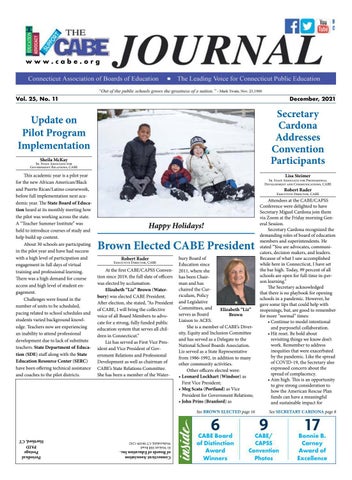
Brown Elected CABE President Robert Rader
Executive Director, CABE
At the first CABE/CAPSS Convention since 2019, the full slate of officers was elected by acclamation. Elizabeth “Liz” Brown (Waterbury) was elected CABE President. After election, she stated, “As President of CABE, I will bring the collective voice of all Board Members to advocate for a strong, fully funded public education system that serves all children in Connecticut.” Liz has served as First Vice President and Vice President of Government Relations and Professional Development as well as chairman of CABE’s State Relations Committee. She has been a member of the Water-
bury Board of Education since 2011, where she has been Chairman and has chaired the Curriculum, Policy and Legislative Committees, and Elizabeth “Liz” serves as Board Brown Liaison to ACES. She is a member of CABE’s Diversity, Equity and Inclusion Committee and has served as a Delegate to the National School Boards Association. Liz served as a State Representative from 1986-1992, in addition to many other community activities. Other officers elected were: •L eonard Lockhart (Windsor) as First Vice President; •M eg Scata (Portland) as Vice President for Government Relations; • J ohn Prins (Branford) as
inside
See BROWN ELECTED page 16
6
CABE Board of Distinction Award Winners
Attendees at the CABE/CAPSS Conference were delighted to have Secretary Miguel Cardona join them via Zoom at the Friday morning General Session. Secretary Cardona recognized the demanding roles of board of education members and superintendents. He stated “You are advocates, communicators, decision makers, and leaders. Because of what I saw accomplished while here in Connecticut, I have set the bar high. Today, 99 percent of all schools are open for full-time in-person learning.” The Secretary acknowledged that there is no playbook for opening schools in a pandemic. However, he gave some tips that could help with reopenings, but, are good to remember for more “normal” times: • Continue to model intentional and purposeful collaboration. • Hit reset. Be bold about revisiting things we know don’t work. Remember to address inequities that were exacerbated by the pandemic. Like the spread of COVID-19, the Secretary also expressed concern about the spread of complacency. • Aim high. This is an opportunity to give strong consideration to how the American Rescue Plan funds can have a meaningful and sustainable impact for
9
See SECRETARY CARDONA page 8
CABE/ CAPSS Convention Photos
17
Bonnie B. Carney Award of Excellence
81 Wolcott Hill Road Wethersfield, CT 06109-1242
Connecticut Association of Boards of Education Inc.
Periodical Postage PAID Hartford, CT
2
The Journal – Connecticut Association of Boards of Education | December, 2021 PRESIDENT COMMENTARY
A Collective “We”! Elizabeth Brown President, CABE
Fellow Board Members and friends of public education, as I assume the Presidency of CABE I would like to take this opportunity to thank outgoing President Don Harris for his outstanding leadership on behalf of CABE’s mission. His legacy of fiscal stability and advocacy for equity in education for all children is a hallmark of his presidency. Certainly not only big shoes to fill but gigantic ones! It has been a true honor to serve with Don and I look forward to building on his legacy with the help of the entire CABE community. I cannot tell you what an honor it is to be elected to serve as the president of CABE. If anyone told me 10 years ago when first elected to the Waterbury Board of Education that I would be standing here… well it is not something that I ever imagined. CABE is so successful because of the talent and great team effort and leadership of Bob Rader, Patrice McCarthy and all the staff. As I assume my new role on CABE’s leadership team, I want to take time to think about what CABE is all about. Why you are Board members and why, more than ever, the commitment to serving children must be our priority. The history of public education parallels our history as a country. As a country we have always struggled against inequality, racism, suppression, and a society divided by the haves and the have nots. Dr. Martin Luther King, Jr. encapsulated the struggle, “the arc of the moral universe is long, but it bends towards justice.” Public education must be that
arc, we must bend our society toward justice. Public education has a significant and historic role to play in our time to ensure every child thrives and succeeds. Make no mistake, we all must double down on our commitment to public education and its promise for all children in this political climate of distrust and animosity. I know as the newly elected President of CABE, I am committed to the promise of public education for all students, and I believe every Board member stands together for our students and for that promise. The success of CABE and our advocacy for public education is not about I as an individual but as US. A COLLECTIVE WE! The past 18 months have challenged us as never before; COVID-19 is a watershed event in our lives. We will never fully understand the impact on our students, families, communities, our society and the entire world. CABE spent the last 20 months bringing us together with state and local experts to make sure we were informed and could make the best decisions for our students, teachers, and entire school districts. We listened to the science and implemented best practices to stop the spread of this contagious virus. We came together with one purpose, to protect our districts. Yes, we faced criticism from some factions and even experienced shouting matches at board meetings, but every district stood strong! Every district did the right thing, and we can be proud of that accomplishment. As I begin my two-year term as President, I count on all of you to stay involved and continue CABE’s strong
Mission: To assist local and regional boards of education in providing high quality education for all Connecticut children through effective leadership. Vision: CABE is passionate about strengthening public education through high-performing, transformative local school board/ superintendent leadership teams that inspire success for each child.
voice for public education in Connecticut and on the national level. CABE’s legislative priorities voted on at the Delegate Assembly include a commitment to equity and fully funding the ECS formula and removing the cap on special education reimbursement. Your voice will be critical in the next legislative session, please work with CABE and join advocacy efforts. CABE is working on many fronts to bring people together to discuss and make sense out of a tumultuous political climate. Take advantage of the newly established Affinity groups led by Dr. Martha Brackeen-Harris and join the conversation. It is always beneficial to listen and learn from our peers and share experiences and concerns. I would also like to congratulate all the newly elected board members across Connecticut. You are serving your community during very unusual times and will face many challenges. Please know that CABE is here to serve you and you can reach out in times of need. I am excited about our work on behalf of public education and thank you for your confidence. I look forward to working with each one of you. Keep in mind, as Mark Twain posited, “Out of public education comes the greatness of a nation.”
Board of Directors EXECUTIVE COMMITTEE Elizabeth Brown | President, Waterbury Leonard Lockhart | First Vice President, Windsor Meg Scata | V ice President for Government Relations, Portland John Prins | V ice President for Professional Development, Branford Lon Seidman | Secretary/Treasurer, Essex Donald Harris | I mmediate Past President, Bloomfield Christopher Wilson | Member at Large, Bristol Lydia Tedone | NSBA Director, Simsbury AREA DIRECTORS Leonard Lockhart | Area 2 Co-Director, Windsor Joan Trivella | Area 4 Director, Woodstock Academy George Kurtyka | Area 7 Co-Director, Derby Robert Guthrie | Area 7 Co-Director, West Haven Lon Seidman | Area 8 Director, Essex ASSOCIATES Eileen Baker | Associate, Old Saybrook Ethel Grant | Associate, Naugatuck Ann Gruenberg | Associate, Hampton Robert Trefry | Associate, CT Technical High School System COMMITTEE CHAIRS Becky Tyrrell | Chair, Federal Relations, Plainville Ethel Grant | Chair, Resolutions, Portland Christopher Wilson | Chair, State Relations, Bristol CITY REPRESENTATIVES John Weldon | City Representative, Bridgeport Ayesha Clarke | City Representative, Hartford Yesenia Rivera | City Representative, New Haven Andy George | City Representative, Stamford Charles Stango | City Representative, Waterbury STAFF
Robert Rader | Executive Director Patrice McCarthy | Deputy Director and General Counsel Nicholas Caruso | Senior Staff Associate for Field Services and Coordinator of Technology Sheila McKay | Senior Staff Associate for Government Relations Vincent Mustaro | Senior Staff Associate for Policy Service Lisa Steimer | Senior Staff Associate for Professional Development and Communications Conrad Vahlsing | Staff Attorney Teresa Costa | Coordinator of Finance and Administration Pamela Brooks | S enior Administrative Associate for Policy Service and Search Services Terry DeMars | Administrative Associate for Policy Service Gail Heath | Administrative Associate for Government Relations Wilmarie Newton | Administrative Associate for Labor Relations Nancy Propfe | Administrative Assistant for Membership Services Corliss Ucci | Receptionist and Assistant to Executive Director
CABE Journal (ISSN 1092-1818) is published bi-monthly by Connecticut Association of Boards of Education, 81Wolcott Hill Road, Wethersfield, CT 06109. Periodicals postage Paid at Hartford, CT.” POSTMASTER: Send address changes to The CABE Journal, CABE, 81 Wolcott Hill Road, Wethersfield, CT 06109-1242. CABE membership dues include $30 per person for each individual who receives The CABE Journal. The subscription rate for nonmembers is $75. Association members dues include a subscription for each Board Member, Superintendent, Assistant Superintendent and Business Manager. The companies and advertisements found in The CABE Journal are not necessarily endorsed by CABE.
The Journal – Connecticut Association of Boards of Education | December, 2021
CABE Affiliate Members BUSINESS AFFILIATES VALEDICTORIAN Connecticut Business Systems – A Xerox Company Finalsite SALUTATORIAN
Berchem Moses PC Shipman & Goodwin HIGH HONORS
Pullman & Comley HONOR ROLL Anthem Blue Cross and Blue Shield ESS JCJ Architecture Newman/DLR Group SCHOLAR Brown & Brown Chinni & Associates, LLC Coordinated Transportation Solutions Dattco, Inc. Goldstein & Peck, P.C. Kainen, Escalera & McHale, P.C. The Lexington Group Network Support Co. OneDigital Health and Benefits Perkins Eastman T-Mobile The S/L/A/M Collaborative Zangari Cohn Cuthbertson Duhl & Grello, P.C.
EDUCATIONAL AFFILIATES American School for the Deaf Area Cooperative Educational Services (ACES) Capitol Region Education Council (CREC) The College Board Communities in Schools Connecticut Arts Administrators Association Connecticut Association of School Business Officials Connecticut School Buildings and Grounds Association Connecticut School Counselor Association Connecticut Technical High Schools Cooperative Educational Services (C.E.S.) EASTCONN EdAdvance Explorations Charter School Integrated Day Charter School ISAAC LEARN Live Girl
3
EXECUTIVE DIRECTOR COMMENTARY
Yes, Civics Can Help Teach SEL Robert Rader
Executive Director, CABE
In mid-October, at a time of increased focus on the role of boards of education, especially on curriculum issues, responses to COVID-19 and school board elections, Education Week published a Special Report on Making Social-Emotional Learning Work for Teens. Among the excellent articles was How to Teach Older Students Social-Emotional Skills? Try Civics, written by Arianna Prothero. She states that behaviors such as understanding others’ viewpoints, “solving problems collaboratively, and building relationship skills” are not only the same as those “cultivated through social-emotional learning [SEL], but the reverse is also true: Civic engagement can be a meaningful way to teach and reinforce social and emotional skills.”
Civics for All
In the article, Prothero quotes Jenna Ryall, the director of Civics for All, a New York City Department of Education program, as stating that: “[Civics] is relatable. It’s a practical application of social-emotional learning — if students can see how it’s applied beyond the classroom walls, if they can see how it’s improving their interpersonal skills, if they can see how it’s allowing them the opportunity of using their voice, if they can see the results of co-creating the school community with the adults around them and the respect they are getting as a co-creator of those things.” Civics for All, is designed to “augment its traditional civics education with civic-engagement opportunities--schools can sign up to receive school improvement funding. But, there’s a catch: The students decide where the money is spent.” Prothero writes that civic engagement “has been on the decline for years.” As political scientist Dr. Robert Putnam wrote in Bowling Alone, engagement in clubs, charities and civic organizations, has been falling. That was written 20 years ago. “Social capital”, that is, the trust and involvement we have in our institutions, has been falling for a long time.
As school board members and superintendents surely know, Prothero writes that “[o]ne doesn’t have to look any further than a number of recent school board meetings across the country where community members have made threats to board members over masking policies, to see the value of well-developed social-emotional skills to civic life.”
CASEL Survey
This kind of real-life experience provides students with core social-emotional learning competencies as defined by CASEL, the Collaborative for Academic, Social, and Emotional Learning. This group does considerable work across the country and Yale’s Center for Emotional Intelligence’s Dr. Marc Brackett serves on its Board of Directors. Prothero writes about a CASEL survey in which students in “strong SEL” schools were compared with those in “weak SEL” schools. CASEL found that of those in the former category, 57 percent of those students and young adults said they “regularly volunteered in their community,” compared with 28 percent from “weak” SEL schools. Seventy-seven percent of high school students from strong schools said they would get involved with the “fulltime military, national or public service for their community or country.” She suggested that schools consider ways to engage students in their communities, such as: •R ecruiting students to help staff leadership teams “addressing issues like school improvement or equity and diversity”; •E ncouraging student-led advocacy around issues they care about; •G etting student “input on school climate, academic engagement and relationships with adults and other students through surveys; and •H aving students “examine the results and figure out ways to solve the problems exposed by the data”. Of course, having students on the Board of Education should go beyond just having them state when student activities are coming up. Students on boards can make real contributions
on the very difficult problems faced by districts. It is a very solid way to get them involved.
SDE’s Take and Voice4Change
I emailed SDE’s Social Studies Consultant Stephen Armstrong about SEL and civics. He responded with the following: “Schools are where students need to learn both the knowledge necessary to become good citizens and the necessary civic skills that good citizens utilize. Many students have few opportunities after their high school years to learn how to be effectively engaged in civic issues. In some schools, being involved in Student Council is largely symbolic; in other schools, students are asked to take on decision-making roles concerning school policy. Connecticut’s Voice4Change program invites high school students to propose and vote on ways that $1.5 million dollars in federal relief funds can be used to improve Connecticut’s schools. Programs of this nature ask students to utilize their civic knowledge and skills in a positive way.”
My Take
I remember in high school back in the ‘60s (yes, the nineteen sixties), I was in Key Club and very interested in discussions of politics, the Vietnam War and Civil Rights. While I have always been interested in and did well in Social Studies, I have been fortunate to work for school boards for almost my entire career and part of my love for public education and civil, thoughtful discussion of the issues was certainly nourished by having those experiences. To me, tying civics directly to SEL makes great sense. I think it provides a great opportunity to provide life skills at the same time students are learning about current events, history and geography. Does your district see it that way?
4
The Journal – Connecticut Association of Boards of Education | December, 2021 See You in Court – The Nutmeg Board of Education
A Grievance and FOIA: How Did the Nutmeg Board Do? Thomas B. Mooney, Esq. Shipman & Goodwin
The Nutmeg Board of Education makes many mistakes. The latest imbroglio created by the board will be reported here each issue, followed by an explanation of what the board should have done. Though not intended as legal advice, these situations may help board members avoid common problems. In Janus v. AFSCME (U.S. 2018), the United States Supreme Court ruled that imposing compulsory agency fees on non-union members violates employee First Amendment rights. Ever since, the Nutmeg Union of Teachers (NUTS) has actively picked fights with the Nutmeg Board of Education to convince unit members that they need NUTS’ help. In the face of such activism, Ms. Superintendent has worked hard to resolve the various grievances NUTS has filed. But when Ms. Superintendent refused to approve Tom Teacher’s request to attend a conference in Las Vegas, NUTS filed a grievance against Ms. Superintendent’s decision. Last week, Ms. Superintendent informed the members of the Nutmeg Board of Education in executive session that a grievance was coming their way. She described the grievance, and she cautioned them that approving Tom’s request would set a terrible precedent. Veteran Board member Bob Bombast expressed concern. “If we are going to hear this grievance, Ms. Superintendent, should you be telling us about this grievance now? Aren’t we supposed to be impartial judges?” Ms. Superintendent explained that processing Tom Teacher’s grievance is part of the collective bargaining process, and that she and the Board are on the same team. Nonetheless, she responded, she would be happy to wait for the hearing to tell the Board why Tom’s grievance should be denied. Last night, the Board held the grievance hearing. Ms. Chairperson started the hearing by recognizing Bruno, the NUTS representative. Bruno’s first request, however, was to ask the Board to convene into executive session. Ms. Superintendent objected to executive session, stating that the public has the right to know what NUTS is up to. Bruno promptly countered with the accusation that Ms. Superintendent was attempting to intimidate NUTS and Tom Teacher
by requiring a hearing in public. Ms. Chairperson didn’t join in that argument, and she simply asked the Board members whether there was a motion to go into executive session for the purpose of conducting a grievance hearing. There were only crickets in response. “OK, then,” Ms. Chairperson announced, “I guess we will be doing this in open session. Bruno, please proceed.” “Thank you, Ms. Chairperson. Tom simply wants what he is entitled to under the contract. He wants to attend a conference on social-emotional learning, and it’s not Tom’s fault that it is in Las Vegas. The contract provides that permission for conferences should not be unreasonably withheld, and Ms. Superintendent’s denial was clearly unreasonable.” Ms. Chairperson thanked Bruno for his succinct presentation, and she asked Ms. Superintendent to present her side of the story. Ms. Superintendent thanked Ms. Chairperson, and she explained that she denied Tom’s request because Tom Teacher could certainly learn about social emotional learning in Connecticut. “If you have any other questions,” Ms. Superintendent concluded, “I will be happy to answer them during the Board deliberations.” “Wait a minute!” Bruno interjected. “If Ms. Superintendent is going to share more information, she should do so now or in an executive session as we requested. Ex parte communication between the Board and the Superintendent about Tom’s grievance is unfair!” Ms. Chairperson was unmoved. “The grievance hearing is adjourned. The Board will now deliberate, and Ms. Superintendent will join us. Thank you, Bruno, and give our best to Tom Teacher.” Is it proper for the Board to deliberate privately with Ms. Superintendent? • • • • • • • • • • • • • • • In a word, yes, for the reason Ms. Superintendent gave. More generally, this grievance hearing raises a number of legal issues. First, given that processing grievances is part of the collective bargaining process, shouldn’t the Nutmeg Board of Education be able to conduct the hearing on Tom’s grievance privately in a non-meeting? That sounds reasonable, but it is only partially true.
In Waterbury Teachers Association v. Freedom of Information Commission, 240 Conn. 835 (1997), the Connecticut Supreme Court considered whether a grievance hearing before a board of education can be considered “strategy or negotiations with respect to collective bargaining,” which would be exempt from FOI requirements. The court however, held that grievance hearings are “meetings” of a public agency under the FOIA because they involve the presentation of information, not just discussion of strategy: [W]e hold that [the FOIA] must be construed to contemplate a bifurcated grievance hearing. Grievance hearings are meetings that must be open to the public during the presentation of evidence regarding the underlying facts allegedly giving rise to the grievance, but they may be closed to the public, in the absence of a waiver, during negotiations regarding appropriate remedies or settlements. Therefore, the Board here properly held the grievance hearing in open session. NUTS, however, wanted the Board to hear the grievance in executive
session. Whether and when a board can conduct any part of a grievance hearing in executive session depends on what the information the Board receives. If such information is otherwise privileged to executive session, for example, records of teacher evaluation or records that are confidential under FERPA, that portion of the discussion may be held in executive session. That was not the case here, and the Board had every right to proceed with the grievance hearing in public session. Deliberations, however, are a different story. In the Waterbury Board of Education case, the court focused on the fact that the presentation of evidence in a grievance hearing does not relate to strategy decisions, but rather is simply information. Conversely, once the evidence has been presented, the resolution of a grievance does indeed involve strategy discussions. Therefore, a board of education may adjourn the hearing and then conduct its discussion as to potential resolution of the grievance in private session outside of FOIA requirements. Boards of education may include the union See SEE YOU IN COURT page 16
The Ninth Edition – Now Available!
A Practical Guide to Connecticut School Law by Thomas B. Mooney, Esq. Shipman & Goodwin
CABE is delighted to announce that the Ninth Edition of Tom Mooney’s Practical Guide to Connecticut School Law is now available. PRICING: CABE Members: $54.99; CABE Non-Members: $79.99; Students: $44.99 There have been many changes in school law in the last few years, and the Ninth Edition has been extensively revised to provide updated guidance on the legal issues that govern our schools. Changes include descriptions and commentary on:
• Changes in teacher evaluation and teacher tenure. • New rules regarding employee background checks. • New requirements concerning student data privacy. • New rules for suspension, expulsion and alternative educational opportunities. • Revised requirements governing seclusion and restraint. • The new “Every Student Succeeds Act” and how it has changed “No Child Left Behind Act” requirements. • The CCJEF case and ongoing litigation over equal educational opportunities. • The Minimum Budget Requirement and new duties to collaborate with town officials. • A host of other changes in the rules that boards of education and school administrators must follow.
The Journal – Connecticut Association of Boards of Education | December, 2021
5
It’s Personal Relationships fuel success. We earn your trust by taking your success as personally as you do. However you define value, Shipman delivers.
Shipman’s school law lawyers have over 50 years of experience, and represent over 100 public school districts, as well as public school member organizations and associations, on the broad range of legal issues that school districts confront. We call on lawyers experienced in school law, special education, employment law, labor relations, intellectual property, data privacy, construction and environmental issues, and business contracts to provide effective and efficient legal assistance for our clients.
It all adds up to a relationship that delivers added value for each of our school district clients.
Our Practice Group Co-Chair, Tom Mooney, has written A Practical Guide to Connecticut School Law, a comprehensive treatise on Connecticut school law, published by CABE and used by teachers, administrators and board of education members throughout the state.
Education is a core focus of our law firm.
Facebook “f ” Logo
CMYK / .eps
Facebook “f ” Logo
CMYK / .eps
www.ctschoollaw.com Contact: Thomas B. Mooney or Linda L. Yoder | 860.251.5000 Shipman & Goodwin LLP
Connecticut | New York | Washington, DC | www.shipmangoodwin.com
6
The Journal – Connecticut Association of Boards of Education | December, 2021
Congratulations to the CABE Board of Distinction Award Winners: Spring & Fall LEVEL I! Editor’s Note: Summaries have been edited for space.
Bethany Our Board effective uses multiple sources of data throughout the year to make informed decisions. The Board focuses their attention on developing policy and allocating resources to support high levels of achievement for ALL students in Bethany. The Bethany Board conducts ongoing evaluations, formally with a self-evaluation instrument, and informally at monthly scheduled Board Committee meetings to assess the effectiveness of its work which focuses on high-quality teaching and learning.
3. G uided by common purpose and aligning our governance with the District Plan of Excellence. This plan is the blueprint for district growth and progress, keeping all members of the team focused on strategic resource allocation and policy considerations that promote student achievement.
East Hampton The East Hampton Board of Education is especially effective as a result of their cohesive decision-making. During the pandemic, they have considered both safety of students and staff along with the educational and emotional needs of students. Decisions certainly have not been easy; however, every Board member’s voice and opinions are heard and respected. The pandemic has been a trial for the Board members who usually finish with unanimous votes on issues; however, as a result of serious discussions and hard decision-making, the Hampton Board has emerged stronger. Meriden Information Unavailable
Bloomfield Bloomfield’s Board of Education adheres to three primary criteria for Board effectiveness: 1. Understanding our role as Board members to govern by setting policy and monitoring the management systems of the district. 2. Decisions are based on relevant research and data gathered from our schools.
New London The New London Board of Education is comprised of seven bipartisan officials elected by the voters of the City. Knowing the importance of collaboration, reflection, and being United in Excellence, the Board chose to hold a self-evaluation which provided the opportunity to both recognize their strengths and areas of op-
portunity for growth. The Board strives for equity and diversity for all and continue to lead with these values at the forefront. Montville
Newtown Newtown Board’s strengths lie within the Board members’ commitment to working together, respecting each other’s contributions, and delegating responsibility. All board members take responsibility for the way meetings are conducted, in which meetings were mostly virtual, it has been a challenge to maintain the connections and personal interactions that help inspire our work. We look forward to a return to “normal.” Oxford The Oxford Board is an especially effective team. What makes our board special is that every single person is committed to create policy and budgets that best serve the children in our town. There are discussions and debates, all carried out with respect and our final vote and decisions are respected. This Board deserves to be recognized for its dedication and commitment to the community.
Rocky Hill Under the leadership of our Board, the school district has consistently performed at the top of our district reference group (DRG D) with respect to student achievement as measured by SBAC, HGSS, and high school AP results. In addition, the Board has placed a strong and concerted effort on the importance of maintaining facilities – with the high school completely renovated in 2017 and the construction of the new intermediate school, Moser, which received recognition in 2020 from the American School and University Magazine for the category of “outstanding design.” By consistently placing the needs of our students as its highest priority, the Board has earned the respect of the greater Rocky Hill community as well as staff members throughout the school district.
Simsbury The Simsbury Board of Education develops five year goals that represent the next level of work that the staff and administration will engage in as we strive to improve PreK-Grade 12 education in Simsbury. The first goals of the Board of Education is student achievement.
Congratulations to the CABE Board of Distinction Award Winners: LEVEL II! Berlin Information Unavailable
priorities outlined in the District Plan of Excellence. Bethel Aligned to the Strategic Plan, the Bethel Board of Education adopted a set of goals that enables the school district to focus on what’s most important – improving student outcomes. The Board’s goals keep student growth as the foremost priority and connect the work of the schools with the vision we hold for our students. Bloomfield Bloomfield Board’s policymaking and oversight is rooted in data-driven decision-making. The Board routinely reviews data on student performance and other aspects of district functions. The analysis of data helps Board members understand how best to support continued academic growth by ensuring that all policies and resources are aligned with our four district
Coventry Under the leadership of the Coventry Board, the district has implemented fullday kindergarten, increased graduation requirements, developed a one-to-one device program for every student in grades 8-12. Even through difficult budgetary discussions, the Board continues to work together as one team with student achievement at the very forefront.
Derby The Derby Board of Education members continuously seek to learn more about state and district initiatives and ensure there is alignment between the district and state. This involves scheduling additional meetings with the specific focus to develop more as a Board and stay informed with the latest initiatives in education as well as Board members’ attendance at CABE workshops.
East Hartford The East Hartford Board of Education has developed a model for cooperative and effective governance that stands as a model for Connecticut School Boards and has begun to show significant results in student achievement. The following three areas stand as major points of focus: • Strong, accountable and mutually supportive relationships centered on “what is best for kids.”
• Commitment to developing and following through on a comprehensive strategic plan. • Relentless focus on student achievement data. East Lyme Information Unavailable Glastonbury Each fall, we listen to the successes, challenges, and future needs of our students in every discipline as we work toward developing a budget that will support our goals and be approved. The shared vision for career and college readiness guide all of our decisions in the context of our Strategic Plan. Most importantly, we concentrate on educating the whole child, providing academic challenge, social and emotional support, extracurricular opportunities, and community involvement. Especially since the beginning of the pandemic, we have worked to continue to meet each student’s academic and social, and emotional needs. Granby The Granby Board has exhibited a unique ability to work collaboratively and supportively with the community and town officials in a non-partisan fashion as strong advocates for students and edu-
The Journal – Connecticut Association of Boards of Education | December, 2021 cation. As an example, the Board made a decision for Granby Public Schools to strive for in-person learning this past fall. The Stronger Together Plan for reopening schools was developed through a Reopening Task Force of which the Board was very involved, along with staff, teachers, parents, community, and town officials. Newington The Newington Board of Education recently revised their Vision and Mission statements to encompass their efforts in closing the achievement gap in Newington Public Schools. These are tightly aligned to the district and school improvement plans to ensure a coherent approach. Additionally, the Portrait of a Graduate serves as the “North Star” for all of our work as a district.
Old Saybrook While board members may not always agree, they always listen and respect each other’s position and unique views. The Board also respects and admires the staff and administrators, trusting in their professionalism and passion for each student’s success, which allows for a robust and safe environment for everyone to focus on what’s best for the children in our district. The teachers and administrators feel their voices are heard and valued. Beyond the important work the Board does, the example of how to work together is a
model for the students and adults in the district. In today’s contentious world, the environment created by a vibrant Board of Education renews everyone’s faith in the collaborative process, and shows what it really means to put students first.
7
Vernon The Vernon Board of Education, along with the Superintendent, have created a District Leadership Theory of Action that drives strategies toward improved student learning. In addition, every Board meeting has a “Teaching and Learning” presentation to highlight the growth of student achievement in the district. first months of the pandemic the Board met weekly to strategize and discuss and approve action plans. The Board played a vital role in receiving and evaluating feedback and reviewing and approving learning models.
Plainville The Plainville Board maintains an unwavering commitment to maximizing student achievement in all five schools. Our Board continually seeks, advocates for and secures the resources and supports necessary to bring student achievement to the next level of success. Our Board is steadfastly focused on the continuous improvement of achievement at all levels, and works in convert with administration to wholeheartedly support this focus. Thomaston The Thomaston Board of Education offers a level of leadership focus that has been effective in improving student achievement, taking actions that support instructional programs and curriculum updates through measured budgeting. The Board also allows its staff to advise and serve as education experts when implementing a plan of action to improve student achievement and which is done in a way that demonstrates an understanding of the roles and responsibilities of a Board.
Waterbury The Board in conjunction with the Superintendent, embarked on a comprehensives strategic planning process. The Plan encompasses new mission, goals and values that reflect the commitment to equity, success for all students and a pathway to achieve these goals through policy, practice and budget allocation. Wilton The Wilton Board is singularly committed to improving student achievement in the Wilton Public Schools. Through the
Windsor The Windsor Board of Education prides itself on offering challenging and diverse curriculum and extensive technology, fine arts, and sports programs for all of its students. Through its budget, it supports the technology needs of the district, as well as other programming such as MTSS and SEL. Through staff presentations at Board of Education meetings, they receive data from the State Accountability Report, SATs, APs and the School Development Plans and are able to monitor student performance through such platforms. The Board also engages in spirited discussions on academic achievement, discipline, diversity, equity and inclusion throughout the district.
Did You Know?
For the price of CABE dues, your board and superintendent are eligible for: • Advocacy Highlights, Policy Highlights and other emailed updates, as well as the CABE Journal with information on current issues and best practices. • Unlimited help for your advocacy efforts with the Legislature, the State Board of Education and other state and federal officials • CABE Labor Relations survey information
8
The Journal – Connecticut Association of Boards of Education | December, 2021
THE POLICY CORNER Vincent A. Mustaro
Senior Staff Associate for Policy Service, CABE
Policy Basics for New Members
Welcome new school board members! New board members bring optimism and a future-focused mindset to boards of education. Each new board member has the capacity to positively contribute to decisions as the board handles the important work of governing the district. The addition of new board members this month as a result of the November elections makes this an excellent time to review the board’s policy manual. The review of the policy manual is appropriate for veteran board members as well as those recently elected. Policy is the backbone of the district and one of the board’s core responsibilities. New board members should initially review the bylaw series (Series 9000) pertaining to board governance and operations to familiarize themselves with their new and varied roles. Orientation for these new members at the local level and through CABE’s workshops will address the important role of policy in understanding the many complexities of board membership. Districts need sound policies in place in order to operate effectively and efficiently. Through policies and their implementing administrative regulations boards can address certain reoccurring issues in a consistent manner. Well-written policies establish the parameters within which the district operates. Policy, the board’s leadership tool, is an idea designed to bring the kind of action and results the board wants. High functioning school boards consistently work on policy.
Policy is the Board’s Major Role
New members need to learn and realize that developing and adopting policy is one of the board’s most important roles. School board policy establishes broad principles and goals to guide the community’s educational program. Technically, a board can adopt a policy on anything that is not prohibited by law, providing the board has the authority under law. Well-written policy helps ensure compliance with federal and state statutes and regulations and establishes a foundation for fair, effective and efficient school governance. It is important that all board members, especially new ones, become quickly oriented to the local policy manual and knowledgeable about its varied contents and the manner in which new policies are adopted and existing ones revised. New members review many documents and discuss many issues during the initial orientation period, but none is more important than becoming familiar with and knowledgeable of the board’s policy statements. Policy provides the one voice necessary for a board to communicate its wishes to students, staff, and the community.
Board policy is adopted by the board and used by the staff to make management decisions. Board policies generally focus on what is to be accomplished and why. The board’s policy manual must be viewed as a living document and updating it should be an ongoing process. Laws and regulations are constantly updated, school climate and culture changes and hot topics emerge and evolve; all contributing to the need to add new policy or revise existing ones.
Delegating Authority to the Superintendent
After policies are adopted by the board, the superintendent should be given the authority to develop procedures, known as administrative regulations, for implementing the board’s policies. Properly written administrative regulations, of which staff must be made aware, have the full legal weight of policy and are to be followed as a condition of employment for staff and enrollment of students. A board, through policy, controls the district’s direction and future development. Therefore, board members must know what it says, agree on its meaning and insist that all policies be followed. New board members can bring a fresh perspective to policy review and development. At some point each board member should read or reread the contents of the policy manual. While this may appear to be a difficult and uninteresting task, it’s worth the effort and can save board meeting time and legal confrontations if policies are not understood, followed or fairly and consistently enforced. This familiarization with the contents of the board manual will also provide a basis for determining where revisions or new policies are needed. In some instances, unnecessary policies will be identified for board action to remove them from the manual. New board members are advised to spend the early months of their terms learning, listening and reading; especially board policies and administrative regulations. The administration should be used as the primary resource in this suggested learning period. However, a seasoned board member or the board chairperson can serve in a mentoring capacity to the new board member. New members should use the knowledge of administrators and experienced board members wisely, paying attention to administrative concerns. Ultimately, however, each board member must make up his/her own mind about the efficacy of each policy.
Policy Must Be Clear and Understandable
Good policy is easy to follow and difficult to misinterpret. As policies are read by new board members for
the first time, close attention should be given to understanding their meaning and the philosophy it espouses on the topic. If a board member has difficulty understanding a policy, then the public will experience similar difficulty in understanding. It is essential to remember that in addition to policy providing direction to the administration and staff, it also serves to explain the board’s concerns, beliefs and priorities to the public. It’s critical that policy be easily understood, interpreted and implemented. When new and existing board members read and review policies, as recommended, determine when the manual was last totally revised. Also consider the manner in which the board keeps its manual up-to-date and the process used to monitor and review policies. CABE’s many policy services can be of assistance. Policy development, like curriculum review and development is a continual, never-ending process. Most of the joys and frustrations of local board service will eventually come back to the use made of policy. It should be kept in mind that when done well, policy drives the district’s management to ever-improving levels of excellence. Poorly developed policy or policy that is inadequately enforced, monitored or written without great care and deliberation can be a source of anguish and act as an impediment to meeting the board’s goals, especially
the primary goal of improving student achievement. New and existing board members should rely on the administration for experience and professional knowledge and should look to CABE for guidance as necessary. The CABE Policy Service encourages boards to adopt orientation policies to ensure the information provided to new board members is comprehensive and systematic. The board member’s knowledge of policy provides the basis to ask the right questions of the professional staff. Policy is basically a matter of fair play and common sense. If the board’s policy system doesn’t make sense to new board members and to existing members, it probably needs close scrutiny, discussion and updating. It is vital to keep in mind that the board is responsible for policies that create goals and a vision for the school district, setting the parameters that the administration will operate within and providing accountability to the citizens of the community, with the focus on student achievement. The policy manual is a living, breathing extension of the board’s directives. It is not a dusty document on a shelf in the district’s offices or located somewhere on the district’s website.
SECRETARY CARDONA
in a greater way. Resources for social emotional, behavioral and mental health can be found at the Department of Education website at https://search. usa.gov/search?utf8=%E2%9C%93&affiliate=ed.gov&query=Social-Emotional+Learning#:~:text=www2.ed.gov/ documents/students/supporting,learning Secretary Cardona shared how proud he is of the work being done by Connecticut’s boards of education and superintendents and how we lead the nation in so many ways. He stated he “is proud to be from Connecticut and that it will always be his home.” Secretary Cardona closed with, “Our best days in education are ahead of us.” Immediately following Secretary Cardona’s presentation, CAPSS President and Superintendent of Schools in Meriden, Mark Benigni and CABE President and Board Chair in Bloomfield, Donald Harris, presented the Secretary with the first ever CABE and CAPSS Courageous Leadership Award for Distinguished Leadership from Connecticut to Washington, DC.
(continued from page 1)
generations to come. •Y ou have a role in civility, especially in difficult times. You are ambassadors of democracy. Your actions are on full display for all. •L eave your mark. Your legacy will be written on the decisions made in the next two years. Secretary Cardona said, “The ground is fertile for new growth and you are the master gardener.” He added, educational leaders have to have the courage, strength and resolve to truly improve education and boldly challenge inequities. Secretary Cardona shared that we are very close to passing the greatest increase in education funding in years. The Secretary also spoke of the 140,000 students who lost a parent or caregiver during the pandemic. Of those 140,000, 65% are black or brown students. The Secretary continued that we have to embed Social-Emotional Learning and mental health supports into the DNA of our schools
If you have any questions about policy or need samples, please contact the CABE Policy Department and/or access the material posted on the CABE website in the member section.
The Journal – Connecticut Association of Boards of Education | December, 2021
9
CABE/CAPSS CONVENTION
United States Secretary of Education Miguel Cardona addressed Convention participants via Zoom. Secretary Cardona was also presented with the CABE and CAPSS Courageous Leadership Award for distinguished leadership from Connecticut to Washington, D.C.
Paul Freeman (Guilford), 2021 CAPSS Superintendent of the Year, announces the 2022 Superintendent of the Year.
Tom Moore (West Hartford) was named 2022 CAPSS Superintendent of the Year.
CABE Deputy Director and General Counsel Patrice McCarthy, Board Chair Anthony Perugini (Cheshire) and Superintendent Jeff Solan (Cheshire) presented the Pre-Convention session on Civility in Divisive Times.
Bryan Hall (East Hartford), Vice President for Professional Development, CABE. Don Harris (Bloomfield), CABE President.
10
The Journal – Connecticut Association of Boards of Education | December, 2021
CABE/CAPSS CONVENTION
Fran Rabinowitz, Executive Director, CAPSS.
Commissioner Charlene Russell-Tucker addresses Convention participants during lunch.
Elizabeth Brown (Waterbury) is named CABE President.
Commissioner Charlene Russell-Tucker and former acting Commissioner of DPH Deidre Gifford accepted the CABE Friend of Public Education Award on behalf of the “team” of State Department of Education and Department of Health staffers who have guided school boards, superintendents and other members of the school community on Tuesday morning webinars since August 2020.
Bonnie B. Carney Awards of Excellence in Educational Communications and honorable mentions on display for all to see. Rep. Bobby Gibson and Rep. Geraldo Reyes were named CABE Distinguished Legislators in recognition of their efforts on issues in the Connecticut General Assembly that have made a significant contribution to public elementary and secondary education in Connecticut.
The Journal – Connecticut Association of Boards of Education | December, 2021
11
CABE DELEGATE ASSEMBLY
CABE President Don Harris, welcomes delegates to the CABE Delegate Assembly.
Participants from across the State attended the CABE Delegate Assembly and took part in discussion and voting on the proposed resolutions which the State Relations Committee will use to identify the 2022 CABE Legislative Priorities.
(left to right) CABE Immediate Past President Robert Mitchell (Montville), Deputy Director and General Counsel Patrice McCarthy, Resolutions Chair Meg Scata (Portland), Vice President for Government Relations Meg Scata (Portland), CABE Resolutions Chair, Leonard Lockhart (Windsor), and CABE Executive Director Robert Rader. chaired the CABE Delegate Assembly.
CABE Executive Director Robert Rader and Deputy Director and General Counsel Patrice McCarthy presented training for the Hartford School Governance Councils on October 21.
On November 4, CABE Executive Director Robert Rader spoke at the Governor’s press conference on the Screen and Stay Initiative.
12
The Journal – Connecticut Association of Boards of Education | December, 2021
CABE 2021 LEGAL ISSUES WORKSHOP OCTOBER 27
Attorney Zachary Schurin of Pullman & Comley spoke about the Legal Contours of Board Member Speech.
CABE Deputy Director and General Counsel Patrice McCarthy and staff attorney Conrad Vahlsing presented on Emerging Legal Issues.
Board members and superintendents from across the state gathered in person for CABE’s Legal Issues workshop.
Attorney Richard Mills of Shipman & Goodwin spoke about Employment Related Challenges in the Ongoing Pandemic.
Harnessing the Power of Student and Teacher Voice:
Using Students and Staff as Speakers, Presenters, or Guest Writers Effective communications are authentic communications. They resonate with people. They are moving and powerful. They feel real. But in many cases, our communications aren’t fully spontaneous. They have to be carefully crafted, vetted, and polished to make sure we are saying just what is intended. Precise language can be critically important in many official communications, but there is a way to capture more of that authentic feel. Including student and teacher voice in your communications can balance out the more scripted pieces of your message. In addition, hearing directly from students and teachers can remind your audience what this work is all about. Effective messaging is not just about what is said. It is also about who is talking. We hear things differently based on how we perceive the speaker. Sometimes the best way to get your point across is to get out of the way and let others do the talking – especially if those others are a trusted source like teachers or students.
Teacher power
Teachers can be incredible spokespeople. Many educators are articulate, passionate, and good with groups – natural traits for any public speaker. Others may not like public speaking but are skilled writers. Whenever possible, identify educators who are passionate about a topic you need to communicate and ask for their help. While good teachers are always busy, many will be willing to help share a message they believe in.
Showcasing students
When it comes to authenticity and honesty, nothing beats student voice. The simplicity, straightforwardness, and clarity with which students often speak can be incredibly powerful and can cut straight to the root of an issue. While many students will not be as polished in their writing or public speaking, with a little support they can be an incredible asset to your communications efforts.
Supporting without scripting
Whenever you give the mic – literally
or figuratively – over to someone else, you give up a degree of power and control. While you cannot (and should not) fully control your alternate spokespeople, you can remain involved and supportive and set some parameters to ensure the message is effective. It is important to set clear expectations early. Make sure your teacher or student is clear about what you are asking them to do and what everyone’s role will be. If you are asking for a written piece, do you expect to see it first? Do you have specific topics you want covered? Do you want to have editing privileges? If you are asking them to speak, do you expect to see a written draft in advance? Do they understand the time limits? Will you be offering public speaking coaching or tips? If you will be working with the media, is this something they are familiar and comfortable with? Have you gone over what to expect and what to do if they are asked a question they are not comfortable answering? Making sure everyone is on the same page from the beginning will result in a better end result and a more successful
experience overall. Whenever possible, create a collaborative environment where you can provide tips and suggestions to strengthen their piece (you are the communications expert after all) but where their voice and personality shine through. Make sure you are clear that you are here to support them in getting their message out most effectively. For educators, offering talking points or even a draft, if desired, is totally appropriate. However, make sure to encourage teachers to make each piece their own. Stress that you want to hear their thoughts and experiences. Students are less likely to understand how to take generic language and make it their own so sharing general topics or ideas for places to start may be the most helpful. It can be tricky to find the right balance between supporting strong messaging and over scripting. If something ends up sounding more like you than the student or teacher, it might be time to pull back on the support a bit. Reprinted from a past issue of the CABE CONNection.
The Journal – Connecticut Association of Boards of Education | December, 2021
13
14
The Journal – Connecticut Association of Boards of Education | December, 2021
Boys and Girls: Why the Learning Disparity? Robert Rader
Executive Director, CABE
There are approximately 513,000 students in Connecticut’s public school system. If nationwide information is correct, a higher percentage of the 248,525 females will complete college than of the 264,440 males. Why? According to Fordham Institute’s Michael J. Petrilli, the problem starts early. Quoting a recent Wall Street Journal article, Petrilli stated that “women made up 59.5 percent of college students, an all-time high, and men 40.5 percent, according to enrollment data from the National Student Clearinghouse.” If the trend continues, according to the Journal, “in the next few years, two women will earn a college degree for every man.” He also quotes the Journal article as implying that young men are “giving up on college.” However, Petrilli states that the college readiness gap is perfectly predictive of the college completion gap.”
Petrilli tried to determine where the “college gender gap” began. According to him, the gap “begins in kindergarten, I mean it literally. Not fourth grade. Not eighth grade. Certainly not twelfth grade. Kindergarten! And that has implications for what’s causing the gender gap and what might be done to address it.” After examining data on college degree attainment; the nation’s report card, the National Assessment of Educational Progress (NAEP); math and reading scores; and, the Early Childhood Longitudinal Study, Petrilli finds that “girls made significantly more progress in kindergarten and first grade, and somewhat more progress in second and third grades, so that by the end of third grade [girls] were four [percentage] points ahead” in literacy. He states that the “high school graduating class of 2013… NAEP tells us that 33 percent of male students scored at the proficient level in reading, versus 42 percent of girls…” and according to analyses of NAEP results, “scoring proficient is a very good pre-
What will CABE’s
Connecticut Online Policy Service (COPS) provide YOUR district?
• A policy manual updated within days of a board meeting • Access to your policy manual 24/7 anywhere with Internet capability • Time saving links to legal and cross references • A search engine specifically designed for board policy manuals • The ability to search other online districts for similar policies or language • A happier staff that will have less paper to deal with!
If you would like additional information on CABE’s Connecticut Online Policy Service (C.O.P.S.), call Vincent Mustaro at 860-571-7446 or email vmustaro@cabe.org for full details
Connecticut Data by Gender Girls are rated about .18 to .25 standard deviations higher than boys on the Kindergarten Entrance Inventory. Percent Proficient on Smarter Balanced In ELA, girls achieve better than boys in Grade 3; the gap is higher in Grade 8. In Math, boys achieve better than girls in Grade 3, but by Grade 8 girls achieve higher.
ELA Math
Girls
Boys
Grade 3
58.2
50.5
Grade 8
62.3
49.5
Grade 3
53.9
56.2
Grade 8 45.4 41.7 • B oys get suspended at twice the rate as girls (8.9 percent for boys to 4.4 percent for girls. • F emale high school graduation rates (92 percent) are higher than that of males (85.9 percent). •C ollege entrance rate for females (78.6 percent) is substantially higher than for males (65.9 percent). •C ollege completion rate for females (57.6 percent) is substantially higher than for males (43 percent).
dictor of college preparedness…” He then goes on to discuss studies that have compared teachers’ perceptions of boys’ reading abilities with their results from literacy tests. “And guess what.[sic] Teachers systematically underestimated little boys’ reading abilities—both at kindergarten entry and as they made their way through elementary school. Previous studies indicate that this might be because of the ‘good girls’ theory: Teachers think little girls are better readers because they tend to behave better, and think squirrely little boys are poor readers, even when they aren’t.” According to the article, boys stay pretty close to the girls in math, but, it is reading achievement that is believed to be twice as predictive of positive long-term outcomes as math scores. However, SDE finds that math is a much better predictor of college and labor market success. These expectations can have a large effect on how students do in the future. Boys can be put into less-challenging reading groups and asked to read easier books. Such perceptions can affect student learning. As when expectations differ based on race, those premised on gender can also have tremendous effects.
sure that all teachers understand and are ready to use the ‘science of reading’ in the early grades” and teachers should be “aware of any anti-little boy biases they might harbor.” He suggests formative assessments might help teachers have a better understanding of students’ current reading abilities. These assessments are more than just tests. According to the Council of Chief State School Officers, they are a “planned, ongoing process to elicit and use evidence of student learning to improve student understanding and learning”. Petrilli also encourages the hiring of male elementary school teachers, where 89 percent are female. He also mentions outside factors for boys not doing as well, such as growing up in a single-parent family, but, also, states that schools have little control over such situations. SDE’s EdSight data portal and research library contain a wealth of information that is summarized below. We know that ALL students are helped by having teachers of color and the impact of more males at the elementary levels would probably have a good effect on all students. If we can decrease the gender gap in the early ages, we might just see more equality in high school graduation rates and, even college completion rates.
Addressing Gaps
Petrilli’s article, the College Gender Gap Begins in Kindergarten, can be found at https://fordhaminstitute.org/ national/commentary/college-gender-gap-begins-kindergarten.
Petrilli relies on Richard Whitmore for recommendations as to how address the boy/girl gap: ‘We need to keep working to en-
The Journal – Connecticut Association of Boards of Education | December, 2021
15
CABE: Working for YOU
Individualized Workshops | Professional Development Opportunities Legal Services | Policy Services | Representing You Statewide and Nationally Below are the highlights of activities that the CABE staff has undertaken on your behalf over the last month. We did this:
y providing opportunities B for members to learn how to better govern their districts: z Presented workshops on Board Roles and Responsibilities for candidates to the Naugatuck, Somers and Union Boards of Education. z Discussed Roles and Responsibilities with the Danbury Board of Education. z Responded to 66 requests for policy information from 30 districts and the SDE, providing sample materials on 54 topics. Further, districts continue to access CABE’s online Core Policy Reference Manual and/or online manuals posted by CABE for policy samples. The topics of greatest interest were those pertaining to the COVID-19 staff vaccination mandates, masks, remote meetings of boards of education, purchasing procedures and use of facilities.
B y helping school boards to increase student achievement:
z Participated in CABE Diversity, Equity and Inclusion Committee meeting. z Participated in SDE’s Educators Rising meeting. z Provided webinar on conducting a board organizational meeting. z Sent two issues of “Policy Highlights” via e-mail list serve covering topics that affect student achievement. Included topics pertained to the board/
superintendent relationship, student enrollment practices, cybersecurity, and crowdfunding.
B y ensuring members receive the most up-to-date communications:
zA ttended weekly SDE/DPH webinars on the COVID-19 crisis. zH osted CABE Board Chair Check-In and Update. zP repared materials, as part of the Custom Policy Service, for Brookfield and Region #15. z Revised policies in the master resource file of policies and in the online Core Manual. z Developed a new “Procedural Guide” to assist districts utilizing the Custom Policy Service to develop a new manual.
B y promoting public education:
zF acilitated training for Hartford and Norwalk School Governance Councils. zF acilitated discussion with Stamford Public Schools Cabinet. zT aught class at Southern Connecticut State University. z S ubmitted CABE resolutions to NSBA Delegate Assembly. z Attended CAPSS Board of Directors Meeting.
B y providing services to meet member needs:
z Facilitated board retreat for the Hamden and Region #7 Boards of Education. z Completed a draft of the January Policy Update Service publication.
zR evised policies, as part of the Custom Update Policy Service, for East Hampton.
B y helping districts operate efficiently and conserve resources:
z Hosted CABE Superintendent Administrative Professionals meeting which included legal, legislative and policy presentations. z Posted policies online, as part of the C.O.P.S. Program for Barkhamsted, Bethel, Bolton, Branford, Chaplin, Derby, Granby, Griswold, ISSAC, Monroe, Orange, Portland, Region #4, Region #18, Sherman, Somers, Voluntown, Westport, Woodbridge, and the CABE Core Manual.
B y attending Professional Development to strengthen staff knowledge and skills.
z Attended nonprofit webinar on Theory of Change for associations. z Attended CT Association of Schools workshop on racial issues. z Participated in Nellie Mae Foundation workshop on racial issues. z Continued work on eCornell’s courses on DEI. z Attended Hartford Public Library workshop on Helping your Nonprofit Thrive. z Participated in NSBA Council of School Attorneys virtual conference.
B y representing Connecticut school boards on the state or national level:
z Attended Regional Education Lab Northeast & Islands October Governing Board meeting.
z Represented Connecticut on National School Boards Association meeting for the Northeast and with executive directors across the country. z Participated in WTIC, Associated Press, School Administrator and Peter Mezzitti (Shoreline) interviews on issues facing Boards of Education. z Attended NSBA/U.S. Department of Education webinar on safety resources for school districts. z Attended East Hartford celebration for Bryan Hall. z Hosted CABE/CAPSS Convention Committee meeting. z Participated in Special Education State Performance Plan stakeholders meeting. z Participated in state association counsel virtual meetings. z Participated in Connecticut Family School Partnership Advisory Council meeting. z Participated in SDE Family Engagement Roundtable meeting. z Participated in Connecticut Bar Association Education Law Committee meeting. z Attended the CAPSS Technology Subcommittee meeting. z Chaired a meeting of the Digital Advisory Board for the Connecticut Commission for Educational Technology. z Attended Discovering Amistad Board of Directors meeting. z Participated in NSBA Convention Managers work alike meeting.
16
The Journal – Connecticut Association of Boards of Education | December, 2021
BROWN ELECTED
SEE YOU IN COURT
(continued from page 1)
(continued from page 4)
Vice President for Professional Development; and, • Lon Seidman (Essex) as Secretary/ Treasurer. • Donald Harris (Bloomfield) will serve as Immediate Past President. • Christopher Wilson (Bristol) will serve as Member at Large on the Executive Committee. • NSBA Director Lydia Tedone (Simsbury) also serves on the Executive Committee.
and the administration in such deliberations, or it may exclude the union and/or the administration. After such deliberations, the board must make a decision, but even that decision can be reached privately, without a public vote. Given that the union can typically appeal any grievance decision to arbitration, the grievance decision can be considered a proposal to resolve a collective bargaining matter, and as such can be maintained confidentially until the grievance process has concluded.
Finally, we note that NUTS protested that Ms. Superintendent was permitted to join the Board in its deliberations. To be sure, there are situations in which board members do indeed act as impartial judges, which is the case in teacher tenure hearings, student expulsion or student school accommodation hearings. However, as Ms. Superintendent noted, processing a grievance is part of the collective bargaining process, and boards are certainly not impartial vis-à-vis a union claim concerning a decision of the superintendent. Accordingly, a board of education can (and should) include the superintendent in deliberations over
how best to respond to a grievance. A response to a grievance sets precedent, and there may be other relevant facts that the superintendent may prefer to share confidentially, and boards of education should make their grievance decisions with all the relevant facts. Attorney Thomas B. Mooney is a partner in the Hartford law firm of Shipman & Goodwin who works frequently with boards of education. Mooney is a regular contributor to the CABE Journal. Shipman & Goodwin is a CABE Business Affiliate.
For an update or more information on vacancies go to our website:
https://www.cabe.org/ page.cfm?p=1176 MARY BRODERICK, ED.D SENIOR CONSULTANT
For more information contact
CABE Search Services
81 Wolcott Hill Road, Wethersfield, CT 06109
860-608-1763
Equal Opportunity Employer
There when you need us for: •C risis Communications • Working with the Media •S chool Board Messaging and Professional Development •M edia Training and School Board/ Administrator • Presentation Skills • Full Video Storytelling Capabilities •S ocial Media Management and Strategies
Ann Baldwin, President
860-408-1580 | baldwinmedia.net ann@baldwinmedia.net
The Journal – Connecticut Association of Boards of Education | December, 2021
17
Congratulations to the CABE 2021 Bonnie B. Carney Award of Excellence for Educational Communications Award Winners
Congratulations to the Spring 2021 Bonnie B Carney Award of Excellence in Education Communications Award Entries Social Media Clinton Public Schools Plainville Community Schools West Haven Public Schools Annual Report C.E.S. ACES District Budget Clinton Public Schools Newtown Public Schools Greenwich Public Schools Special Project Granby Public Schools Simsbury Public Schools Computer Generated Project Windsor Locks Public Schools Website Old Saybrook Public Schools Madison Public Schools Newsletter ACES
Parent/Student Handbook Simsbury Public Schools Course Selection Guide Madison Public Schools
Calendar New Fairfield Public Schools Special Project (AV) Bloomfield Public Schools Plainville Community Schools CREC Greenwich Public Schools Honorable Mentions Windsor Locks Public Schools Wilton Public Schools Brookfield Public Schools Newtown Public Schools Plainville Community Schools Vernon Public Schools Brookfield Public Schools Simsbury Public Schools CREC East Hartford Public Schools
Congratulations to the Fall 2021 Bonnie B Carney Award of Excellence in Education Communications Award Entries Social Media Litchfield Public Schools ACES Berlin Public Schools Wilton Public Schools Newsletter Region 18 Public Schools Newington Public Schools Glastonbury Public Schools Annual Report EASTCONN Newington Public Schools District Budget Region 18 Public Schools Course Selection Guide EASTCONN Berlin Public Schools Meriden Public Schools Parent Student Handbook Thomaston Public Schools Wilton Public Schools
Special Project EASTCONN Berlin Public Schools Windsor Public Schools Glastonbury Public Schools Greenwich Public Schools
Special Project (AV) Old Saybrook Public Schools Cheshire Public Schools Greenwich Public Schools Websites Region 18 Public Schools Newington Public Schools Bloomfield Public Schools Wilton Public Schools Glastonbury Public Schools Calendar Amity Region 5 Public Schools Honorable Mentions C.E.S. Region 18 Public Schools EASTCONN Mansfield Public Schools Litchfield Public Schools/Regional School District 6 Windsor Locks Public Schools New Fairfield Public Schools Newington Public Schools
18
The Journal – Connecticut Association of Boards of Education | December, 2021
The Journal – Connecticut Association of Boards of Education | December, 2021
19
UNDERSTANDING CONNECTICUT’S FOIA
More Pandemic-Era Meeting Issues: Practical Concerns and Pointers Mark J. Sommaruga, Esq. Pullman & Comley, LLC
In my last column, I provided a summary of the “budget implementer” bill that amended Connecticut’s Freedom of Information Act (“FOIA”) so as to preserve elements of the pandemic-era Executive Orders concerning “remote” and “hybrid” meetings through April 30, 2022. Specifically, pursuant to the budget implementer a public agency such as a school board can continue to hold meetings through 1) electronic equipment only (i.e., “remote meetings”) or 2) remote participation in conjunction with an in-person meeting (i.e., “hybrid meetings”). Nevertheless, certain meetings-related issues have continuously occurred, so this may be a good time to address them even as we have an eye on the future to a more permanent fix (not to mention the end of the pandemic). Are we required to have a remote or hybrid meeting? No. A board could choose to have all of its meetings in-person. In that context, all of the elements of the “old” or “normal” FOIA would remain in effect, but (with one notable exception) the board need not worry about the budget implementer bill’s various requirements for remote and hybrid meetings. If you have an in-person meeting, you are NOT required to provide live/ real-time electronic public access to your meetings. Rather, you simply have to make sure that your meetings are in facilities that can accommodate and allow for the public to attend, consistent with any public health protocols. Regarding that exception… So what about board members who do not want to attend in-person? Even if you have an in-person meeting, the new/temporary FOIA provisions mandate that board members must be provided with the opportunity to participate in meetings remotely. In these circumstances, the fact that a board member is participating remotely does not convert the inperson meeting into a remote meeting
that is now otherwise subject to the various temporary FOIA “remote meetings” requirements. If we have remote meetings, are we required to have video? Not per se. Under the (temporarily) revised FOIA, boards holding remote meetings are required to use technology that “facilitates real-time public access to meetings,” such as “telephonic, video or other conferencing platforms.” By its very wording, a board could go “old school” and just use old-fashioned audio/telephonic conferencing as the method for a remote meeting, provided it allows for real time access to the meeting. If you choose to have in-person meetings, must attendees wear masks? This is not strictly a FOIA issue but is still worth addressing. The answer is “it depends” based upon the location of the meeting. Obviously, if the town in which the meeting is taking place has a mask requirement, masks will be required by all (board members and the public). Current (binding) Department of Public Health (“DPH”) guidance requires the wearing of masks regardless of vaccination status at PreK-12 public and private school buildings at times when students are present. The DPH guidance then notes as an example of this exception to its binding guidance that fully vaccinated custodians or office staff do not need to wear masks when in a school building on a weekend or after hours when students are not present. So what does that mean for your board meeting? If you are meeting in a school building, and if and only if there are not ANY students present in the building, and if and only if the school district (or the town) does not have a general policy mandating the wearing of masks at all times in its buildings, you could arguably forego requiring masks. However, that is a lot of “ifs” to deal with, and it would be rare to meet all of these conditions.
What can we do if persons disregard a mandate to wear masks at our board meeting? You would obviously have the right to request that the offending person wear a mask. Things may get dicey if the person then refuses to put a mask on. The FOIA provides that if a meeting is interrupted by any person so as to render the orderly conduct of the meeting unfeasible, and if order cannot be restored by the removal of persons willfully interrupting the meeting, the agency may order the meeting room cleared and continue with its meeting. In this context, if a person refuses to honor a request to put a mask on so as to comply with a mask mandate, and if you cannot remove that person from the meeting, then under these circumstances, you could remove the meeting from the
persons (so to speak) by (for example) having the board members go to an adjacent room to continue the meeting. While understanding the difficulties in ejecting a non-compliant person (especially where you may not have law enforcement available to remove the person from the meeting), this is a measure of last resort. In these circumstances, only matters on the agenda may be considered in such a meeting, and “duly accredited” representatives of the press/news media (except those participating in the disruption) must be allowed to attend.
Attorney Sommaruga is the author of “Understanding Connecticut’s Freedom of Information Act” (5th Edition 2018).
20
The Journal – Connecticut Association of Boards of Education | December, 2021