7 68 33 25
('8&$7,21
$'92&$&<
7+(
www.cabe.org
www.facebook.com/ConnecticutAssociationBoardsEducation
-2851$/
&RQQHFWLFXW $VVRFLDWLRQ RI %RDUGV RI (GXFDWLRQ 7KH /HDGLQJ 9RLFH IRU &RQQHFWLFXW 3XEOLF (GXFDWLRQ Vol. 18, No.10
November 2014
³2XW RI WKH SXEOLF VFKRROV JURZV WKH JUHDWQHVV RI D QDWLRQ ´ 0DUN 7ZDLQ 1RY
Connecticut Astronaut to speak at CABE/CAPSS Convention
Briefing from NSBA
Beyond Fiction: At a Glance Christine Duchouquette Kristen Loschert Patte Barth
Lisa Steimer
One of the distinguishing characteristics of the Common Core State Standard’s approach to English Language Arts is the explicit call for more reading, interpreting, and analysis of nonfiction texts alongside novels, drama, and poetry. Common Core authors defend the move as crucial to ensuring students leave school “able to read and comprehend independently and proficiently the kinds of complex texts commonly found in college and careers.� Common Core critics claim that the emphasis will drive literature out of classrooms, with some questioning whether so-called informational reading even contributes to students’ college and career readiness. In it’s research brief, the Center for Public Education examined the role of informational reading in postsecondary education, workplace and day-to-day life and how well American students and adults perform in this domain. After sifting through the available data on
Senior Staff Associate for Professional Development, CABE
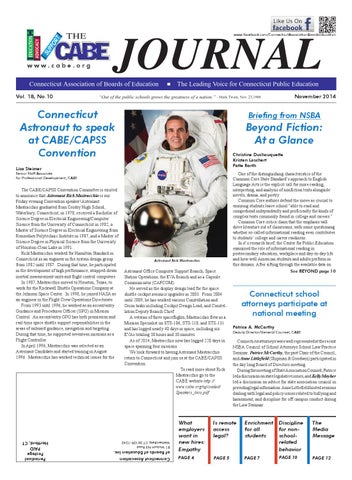
The CABE/CAPSS Convention Committee is excited to announce that Astronaut Rick Mastracchio is our Friday evening Convention speaker! Astronaut Mastracchio graduated from Crosby High School, Waterbury, Connecticut, in 1978; received a Bachelor of Science Degree in Electrical Engineering/Computer Science from the University of Connecticut in 1982, a Master of Science Degree in Electrical Engineering from Rensselaer Polytechnic Institute in 1987, and a Master of Science Degree in Physical Science from the University of Houston-Clear Lake in 1991. Rick Mastracchio worked for Hamilton Standard in Connecticut as an engineer in the system design group from 1982 until 1987. During that time, he participated in the development of high performance, strapped-down inertial measurement units and flight control computers. In 1987, Mastracchio moved to Houston, Texas, to work for the Rockwell Shuttle Operations Company at the Johnson Space Center. In 1990, he joined NASA as an engineer in the Flight Crew Operations Directorate. From 1993 until 1996, he worked as an ascent/entry Guidance and Procedures Officer (GPO) in Mission Control. An ascent/entry GPO has both premission and real-time space shuttle support responsibilities in the areas of onboard guidance, navigation and targeting. During that time, he supported seventeen missions as a Flight Controller. In April 1996, Mastracchio was selected as an Astronaut Candidate and started training in August 1996. Mastracchio has worked technical issues for the
Astronaut Rick Mastracchio
Astronaut Office Computer Support Branch, Space Station Operations, the EVA Branch and as a Capsule Communicator (CAPCOM). He served as the display design lead for the space shuttle cockpit avionics upgrades in 2003. From 2004 until 2009, he has worked various Constellation and Orion tasks including Cockpit Design Lead, and Constellation Deputy Branch Chief. A veteran of three spaceflights, Mastracchio flew as a Mission Specialist on STS-106, STS-118, and STS-131 and has logged nearly 40 days in space, including six EVAs totaling 38 hours and 30 minutes. As of 2014, Mastracchio now has logged 228 days in space spanning four missions. We look forward to having Astronaut Mastracchio return to Connecticut and join us at the CABE/CAPSS Convention. To read more about Rick Mastracchio go to the CABE website http:// www.cabe.org/uploaded/ Speakers_bios.pdf
See BEYOND page 10
Connecticut school attorneys participate at national meeting Patrice A. McCarthy Deputy Director/General Counsel, CABE
Connecticut attorneys were well represented at the recent NSBA Council of School Attorneys School Law Practice Seminar. Patrice McCarthy, the past Chair of the Council, and Anne Littlefield (Shipman & Goodwin) participated in the day long Board of Directors meeting. During the meeting of State Association Counsel, Patrice led a discussion on state legislative issues, and Kelly Moyher led a discussion on advice for state association council in providing legal information. Anne Littlefield hosted sessions dealing with legal and policy issues related to bullying and harassment, and discipline for off campus conduct during the Law Seminar.
What employers want in new hires: Empathy
Is remote access legal?
Enrichment for all students
Discipline for nonschoolrelated behavior
The Media Message
PAGE 4
PAGE 5
PAGE 7
PAGE 10
PAGE 12
81 Wolcott Hill Road Wethersfield, CT 06109-1242
of Boards of Education Inc. Connecticut Association
Periodical Postage PAID Hartford, CT
2
The Journal – Connecticut Association of Boards of Education/November 2014 PRESIDENT COMMENTARY
Thank You for your dedication and service Wow! I can't believe it has been a year since our last CABE/CAPSS Convention. I want to take this opportunity to say thank you to my predecessor, collaborator, and friend Lydia Tedone. I am grateful for her partnership. We have an amazingly dedicated Executive Board beginning with First Vice President Ann Gruenberg, Hampton Board of Education. Ann may be quieter then some of us but no one is a more forceful advocate for children and public education. Our Vice President for Government Relations, Robert Mitchell, Montville Board of Education, is retired Navy and he brings a different perspective to the Executive Committee. Elaine Whitney, Westport Board of Education, has been a welcome addition to the Executive Committee, her passion and enthusiasm is infectious. John Prins, Branford Board of Education, has been a vigorous but thoughtful advocate for the arts. Finally, my friend Donald Harris, Bloomfield Board of Education, who has been around the block a few times, (ha-ha) and is willing to eloquently share his experiences. I learn something from these folks every time I am with them, thanks to all of you for your service and dedication. I have really enjoyed getting to know so many wonderful and awesome board members from all corners of the State who truly believe in public education. I anticipate meeting more board members in the upcoming year. Last but certainly not least I must thank the CABE staff for their collective and individual hard work and support of Connecticut's Boards of Education. Under the capable leadership of Bob Rader and
CABE Search Services Call CABE for your recruiting needs For an update or more information on vacancies go to our website:
www.cabe.org
For more information contact, CABE Search Services, 860-539-7594 Jacqueline V. Jacoby, Senior Search Consultant Paul Gagliarducci • Associate Consultant Mary Broderick - Associate Consultant Bob King • Associate Consultant P.O. Box 290252, Wethersfield, CT 06129-0252 www.cabe.org/support Equal Opportunity Employers
Patrice McCarthy the staff is a welloiled machine in regards to organization and garnering support for advocacy efforts on behalf of public educaRichard Murray tion in this state. So, I look forward to seeing, talking and learning with Connecticut board members at the annual CABE/CAPSS Convention at the Mystic Marriott Hotel in Groton on November 14 and 15. I hope to meet with as many of you as possible. Thank you for your support this past year and continued support in the upcoming year. See you in soon!
People in the News! On Sunday, October 19, at the National School Boards Association (NSBA) Northeast Regional Meeting, CABE President Richard Murray (Killingly) was elected to the position of Northeast Regional representative to NSBA’s Policy and Resolutions Committee. First Vice President Ann Gruenberg (Hampton) was elected first alternate to the Nominating Committee.
Convention Sponsors
Thank You
Mission: To assist local and regional boards of education in providing high quality education for all Connecticut children through effective leadership. Vision: CABE is passionate about strengthening public education through high-performing, transformative local school board/superintendent leadership teams that inspire success for each child.
CABE Board of Directors EXECUTIVE COMMITTEE Richard Murray .................................................. President, Killingly Ann Gruenberg ................................. First Vice President, Hampton Robert Mitchell ................ VP for Government Relations, Montville Elaine Whitney ........... VP for Professional Development, Westport John Prins ......................................... Secretary/Treasurer, Branford Lydia Tedone ............................................ Immediate Past President Donald Harris ........................................................ Member at Large
AREA DIRECTORS Susan Hoffnagle ............................. Area 1 Co-Director, Winchester Mari-Ellen (Mimi) Valyo ............... Area 1 Co-Director, Winchester Daniel Gentile ................................... Area 1 Co-Director, Plymouth Jeffrey Currey ............................. Area 2 Co-Director, East Hartford Susan Karp ................................... Area 2 Co-Director, Glastonbury Donald Harris ................................. Area 2 Co-Director, Bloomfield Laura Bush ................................................. Area 3 Director, Vernon Douglas Smith .................................. Area 4 Co-Director, Plainfield Andrea Veilleux ................................ Area 6 Co-Director, Stratford Elaine Whitney .................................. Area 6 Co-Director, Westport Roxane McKay ............................. Area 7 Co-Director, Wallingford John Prins ......................................... Area 7 Co-Director, Branford Lon Seidman ................................................. Area 8 Director, Essex Aaron Daniels ........................................... Area 9 Director, Norwich
ASSOCIATES Eileen Baker .............................................. Associate, Old Saybrook Sharon Beloin-Saavedra .............................. Associate, New Britain Gary Brochu .......................................................... Associate, Berlin Robert Guthrie .............................................. Associate, West Haven Robert Trefry ........... Associate, CT Technical High School System COMMITTEE CHAIRS Elizabeth Brown ......................... Chair, State Relations, Waterbury Donald Harris ......................... Chair, Federal Relations, Bloomfield Becky Tyrrell ...................................... Chair, Resolutions, Plainville
CITY REPRESENTATIVES Jacqueline Kelleher ....................... City Representative, Bridgeport Matthew Poland ................................ City Representative, Hartford Carlos Torre .................................. City Representative, New Haven Polly Rauh ........................................ City Representative, Stamford Charles Stango ............................... City Representative, Waterbury
STAFF
PLATINUM SPONSOR Nellie Mae Education Foundation Renaissance Learning GOLD SPONSORS Berchem, Moses & Devlin ConnCAN Shipman & Goodwin SILVER SPONSORS EASTCONN LEARN Pullman & Comley Vantis Life Insurance Company
Robert Rader ....................................................................... Executive Director Patrice McCarthy .................................. Deputy Director and General Counsel Bonnie Carney ............................................ Sr. Staff Associate for Publications Nicholas Caruso ............................................ Sr. Staff Assoc. for Field Service and Coord. of Technology Sheila McKay ............................. Sr. Staff Associate for Government Relations Kelly Moyher ......................................................................... Sr. Staff Attorney Vincent Mustaro ..................................... Sr. Staff Associate for Policy Service Lisa Steimer .............................. Sr. Staff Assoc. for Professional Development Teresa Costa .................................. Coordinator of Finance and Administration Pamela Brooks ......................... Sr. Admin. Assoc. for Policy Ser. /Search Ser. Terry DeMars ............................................... Admin. Assoc. for Policy Service Gail Heath ........................................ Admin. Assoc. for Government Relations Wilmarie Newton ........................................ Admin. Assoc. for Labor Relations Denise Roberts .................................... Admin. Asst. for Membership Services Corliss Ucci .................................. Receptionist/Asst. to the Executive Director
The CABE Journal (ISSN 1092-1818) is published monthly except a combined issue for July/August as a member service of the Connecticut Association of Boards of Education, 81 Wolcott Hill Road, Wethersfield, CT 06109, (860) 571-7446. CABE membership dues include $30 per person for each individual who receives The CABE Journal. The subscription rate for nonmembers is $75. Association membership dues include a subscription for each board member, superintendent, assistant superintendent and business manager. The companies and advertisements found in The CABE Journal are not necessarily endorsed by CABE. “Periodicals Postage Paid at Hartford, CT.” POSTMASTER: Send address changes to The CABE Journal, CABE, 81 Wolcott Hill Road, Wethersfield, CT 06109-1242. Email: bcarney@cabe.org. Members can find the CABE Journal online at: www.cabe.org/ userlogin.cfm?pp=84&userrequest=true&keyrequest=false& userpage=84
3
The Journal – Connecticut Association of Boards of Education/November 2014 EXECUTIVE DIRECTOR COMMENTARY
CABE Affiliate Members BUSINESS AFFILIATES DIAMOND MEMBER Finalsite GOLD MEMBERS
Advanced Corporate Networking dba. Digital BackOffice Berchem, Moses & Devlin Centris Group Guidance Counselors for Senior Teachers Pullman & Comley Shipman & Goodwin SILVER MEMBERS Anthem Blue Cross and Blue Shield Corporate Cost Control Milliman, Inc. Milone & MacBroom, Inc. Perkins & Eastman Siegel, O’Connor, O’Donnell & Beck The Segal Company BRONZE PLUS MEMBERS BL Companies Friar Associates Goldstein & Peck, P.C. Lindburg & Ripple Milone & MacBroom Morganti Group O & G Industries The S/L/A/M Collaborative Trane BRONZE MEMBERS Brown & Brown Insurance Chinni & Meuser LLC Dattco Inc. Fuller & D’Angelo Architects and Planners JCJ Architecture Kainen, Escalera & McHale, P.C. The Lexington Group Muschell & Simoncelli Ovations Benefits Group Suisman Shapiro Attorneys at Law
EDUCATIONAL AFFILIATES American School for the Deaf Area Cooperative Educational Services Capitol Region Education Council The College Board Connecticut Association of School Business Officials Connecticut Center for School Change Connecticut School Buildings and Grounds Association Cooperative Educational Services EASTCONN EDUCATION CONNECTION LEARN Unified School District #1
Superintendents have no effect on Student Achievement: REALLY? A recent study by the Brown Center on Education Policy at the Brookings Institute, came to the conclusion that superintendents of schools have little or no influence on student achievement in their districts. The report states that “Superintendents whose tenure is associated with sizable, statistically reliable changes in student achievement in which they serve, controlling for the many other factors that affect student achievement, are quite rare. When district academic achievement improves or deteriorates, the superintendent is likely to be playing a part in an ensemble performance in which the superintendent’s role could be filled successfully by many others… it is the system that promotes or hinders student achievement. Superintendents are largely indistinguishable.”[emphasis added] Wow! That was followed by an editorial in the New Haven Register, the name of which said it all: “School Superintendents—Six Figures Worth of Nothing”. It then discussed the Brookings Institute report and tacked on some negative stories about Connecticut superintendents, which go back years – one even 10 years. One was a candidate for a superintendency, not a superintendent in Connecticut at all. And, the stories had very little to do with stu-dent achievement. What’s going on here? Is this just the tenor of how we treat leaders? Or is this real, helpful information? The Brookings report was based on only two states, Florida and North Carolina. It measured only student achievement in terms of test scores— nothing about other goals we have for our students, such as career or college readiness, good citizenship or all the subjects other than reading or math. It does not consider the significant impact superintendents have on the effectiveness of teachers and principals which do have a large impact on student success. It ignores the many roles of superintendents, including in hiring, training and supervising, just to name a few. The Register editorial, after citing the older cases and, in one case, the conduct of a superintendent candidate, contained this comment: “The bottom line, that school superintendents don’t make a difference, is something every parent, taxpayer and hard-working teacher and principal in Connecticut should take as an insult – and something that must inspire the state’s leaders and lawmaker to begin a process to reform the system…” That’s what the editorial writer of the second-largest general circulation newspaper in Connecticut thought? To me, at a time when superintendents are struggling to implement educational reform combined with difficult funding challenges, the editorial is gratuitously insulting.
Robert Rader
I have known many superintendents of schools over my 33 years working with boards of education. The great majority work huge numbers of hours, care deeply about student achievement and their districts and provide excellent advice to their school boards. I think all education leaders will acknowledge that, just like in any other profession, not every superintendent does that well. But, probably every one believes in and is working on continuous improvement. To imply that superintendents add nothing to the educational achievement of the students in their districts adds nothing to our understanding of the roles and responsibilities of the superintendent. CAPSS Executive Director Joe Cirasuolo, Deputy Director and General Counsel Patrice McCarthy and I have spent the last couple of months working on a revised edition of our Governance Statement (the current one, developed in 2004, is available on the CABE website). While not yet finished, the new statement will again stress the idea that superintendents and boards represent a leadership team, with all the expectations that implies. The leadership team has a huge impact on student achievement. This was shown by the Iowa Association of School Boards Foundation’s Lighthouse study, which showed that when a school board and superintendent believe that all children can learn, none can be left behind and that excuses such as the child lives “on the wrong side of the tracks” or comes from a culture that deemphasizes education, the powerful message flows down from the leadership team and helps strengthen the positive climate throughout the district… and helps increase student achievement. In districts with similar demographics and wealth, where boards believe the opposite, a negative message also flows down through the district, helping restrain increases in student growth. NSBA’s Center for Public Education has also identified eight characteristics of effective school boards. Included is this:
effective school boards lead as a united team with the superintendent, each from their respective roles, with strong collaboration and mutual trust. One boss I had years ago used to say that the job of the CEO of a company, nonprofit corporation or even a school superintendent, is to “create the environment” so that employees, in our case, principals, teachers and other staff members can be successful. Using that thought in the context of our districts acknowledges that superintendents have a role that, while possibly not directly adding points to student’s test scores, better explains the role of the superintendent. Any institution that has a CEO or president responsible for the operations of the institution, must have someone to see the big picture and implement the governing body’s decision. In a school district, that is the superintendent. Would anyone suggest that a corporation’s CEO or president is unnecessary? While his or her job is to enable the company to make bigger profits, would anyone characterize the CEO as “six figures of nothing” if merely one of the many profit centers did not hit its target? We are living in difficult times and certainly holding public employees accountable is one area that we have ramped up over the last few years. School boards and superintendents need to carefully consider the factors that impact student achievement in their district and keep in mind that better test scores have many components – the biggest one being the relationship between a teacher and a student and the superintendent’s vital role in ensuring a successful relationship. But, castigating superintendents as if they alone are responsible for test scores and they have no other role in our schools undermines the credibility of our leadership team and public education. It contributes to a misunderstanding of superintendents and school boards’ roles in student achievement. So, to answer my questions in my fifth paragraph, I believe that the study and the editorial added nothing to our knowledge and, instead, has merely caused damage. They undermined the public’s confidence and weakened the effectiveness of the State’s leadership teams working diligently to raise student achievement!
Management is about arranging and telling. Leadership is about nurturing and enhancing. – Tom Peters
4
The Journal – Connecticut Association of Boards of Education/November 2014
What employers want in new hires: Empathy The many columns written in Fortune Magazine by Geoff Colvin are usually very much to the point, taking a no-nonsense approach to issues, such as corporate inversions (companies relieving themselves of American tax burdens by moving their “headquarters” to another country) and other dollars and cents issues. But, in the September 22nd issue, he tackled something different, an issue that we have stressed over the years as a critical part of being a board member and something we need to teach our children. The title of his article said it all: Employers Are Looking for New Hires With Something Extra: Empathy. Empathy, that is, “sensing at a deep level the feelings and thoughts of others”, is not usually a word found in many help-wanted ads, and especially not in the technology sector. But, that is exactly what many info-tech businesses are searching for. That may seem a little strange in this time of competition for the best technology brains, not only for tech companies, but also for those which do many other types of work. As an example, the CEO of Infor, which makes enterprise software, described how his company competes against an industry giant such as Oracle: we offer “beautiful business software for your business processes.” But, Colvin writes, this “clear trend is not some fad in the software industry. A mushrooming demand for employees with affective, non-logical abilities spans the economy.” He cites a group of executives and educators in the
We need to ensure that they have not only the knowledge that they will need in the global marketplace, but also the life skills that will make them more than standardized, factory-built citizens.
U.K. which stated that “Non-cognitive skills and attributes such as team working, emotional maturity, empathy, and other interpersonal skills are as important as proficiency in English and mathematics”. Colvin says that this is occurring for the following reasons: • A “search for differentiation in a world where many products and services are becoming commoditized”. When so many products work fine, how does a company distinguish its products? The CEO of Intuit “knows the question to ask: ‘Did it leave me with a positive emotion?’” • “CEOs are finding that in order to compete and win, “they first need to understand the customer’s inner experience. Their employees need empathy. And that trait is becoming ever more valuable…
because the supply of candidates who possess it seems to be shrinking” according to researchers. • “We have evolved exquisitely to connect in person.” If you are alone, working in a cube, you may miss some of the opportunities to connect with people. Because of the way we live our lives, “our individual worlds become increasingly cognitive and virtual, lacking in face-to-face contact.” While the thoughts in Colvin’s article are not unique (remember 21st Century skills?), with the emphasis on reading and mathematics brought on by the implementation of the Common Core, err, Connecticut Core Standards, it is important to remember that we must teach our children not only the “hard” subjects, but also the softer ones. We need to ensure that they have not only the knowledge that they will need in the global marketplace, but also the life skills that will make them more than standardized, factory-built citizens. One of the founders of our thinking about emotional intelligence skills is Dr. Daniel Goleman, PhD. He has written that emotional intelligence, such as empathy, can mean much more than mere high IQ when predicting future success. It now appears that this is even true for those in the technology sector. It is important that board members and superintendents consider the importance of these skills, in addition to those taught in other “harder” subjects. Robert Rader Executive Director, CABE
5
The Journal – Connecticut Association of Boards of Education/November 2014 See You in Court – The Nutmeg Board of Education
A Nutmeg Board of Education questions: Is remote access legal? Thomas B. Mooney, Esq. Shipman & Goodwin
The Nutmeg Board of Education makes many mistakes. The latest imbroglio created by the board will be reported here each issue, followed by an explanation of what the board should have done. Though not intended as legal advice, these situations may help board members avoid common problems. The other members of the Nutmeg Board of Education were surprised when Ernie Entrepreneur was elected to serve as its newest member. Though respected in Nutmeg, Ernie was notoriously overextended with his business commitments, and the other Board members wondered how Ernie would manage to attend Board meetings. It didn’t take long to find out. At the first Board meeting after the election, Ernie pulled out his phone to check his calendar against the Board calendar, and he announced grandly that he had some big deals brewing and that he would be out of town for four of the next six meetings. “That’s too bad,” veteran Board member Bob Bombast commented snarkily. “We sure are going to miss you.” “Actually, I will be attending the meetings by Skype,” Ernie responded. “No matter what important business takes me out of town, I will fulfill my obligations to the voters of Nutmeg.” “Is that legal?” Board member Mal Content asked. “I thought we actually had to come to these meetings, tiresome though they may be. What gives?” “Of course!” said Ernie. “I will be Skyping in for each meeting.” The other Board members didn’t want to pick a fight, and they simply nodded in silent acquiescence. They were, however, curious how Ernie’s Skyping would work. They found out at the next meeting. Mr. Chairperson was ready to call the meeting to order, and all the Board members were present . . . except for Ernie. A laptop was placed in front of the Board table, eye level for the other Board members, with a big blank screen. Ring Ring. The IT technician promptly placed a call to Ernie as the other Board members waited impatiently. Ring Ring. No answer. “Well?” Bob Bombast asked impatiently. Are we going to wait forever?” “Obviously we have some technical difficulties,” responded Mr. Chairperson. “Let’s just chill out here and give Ernie another few minutes.” Ring Ring. “Hello?” everyone heard as Ernie’s smiling face appeared on the screen. “What did I miss?” asked Ernie, his hair apparently wet from the shower. Mr. Chairperson called the meeting to order, and things went smoothly, more or less. Twice the Board lost the Skype connection with Ernie, but the technician was able to restore the connection promptly each time. Ernie even participated in the discussions and started to cast a vote . . . . “Point of order,” interjected Bob
Bombast. “Ernie can attend the meeting in the same way as the folks at home can watch us on cable, but he can’t vote, can he?” Mr. Chairperson quickly waved Bob off. “Unless you can cite some law, Bob, I am not going to interfere with Ernie’s right to vote.” With that, Mr. Chairperson called the vote, counting Ernie’s vote in announcing the total. “Fine,” Bob responded. “Have it your way. Two can play at this game.” Bob did not explain his cryptic remark, and the meeting continued, with Ernie on Skype, commenting and voting as well as he could from his hotel room. Right before the next Board meeting, however, Bob sent Mr. Chairperson a note stating that he would not be attending the meeting but that his votes on the proposed motions were attached. Sure enough, Bob had written “Yays” and “Nays” on the agenda that he provided to Mr. Chairperson. Can Bob vote this way? Can Ernie? Starting with Bob, the answer is no – he cannot vote that way. Boards of education are deliberative bodies. That means that they make decisions through discussion. A key part of that decisionmaking process is to listen to the perspectives of the other board members. Voting ahead of time is inconsistent with that approach. For example, in assessing whether a board member has a conflict of interest, we don’t only look at whether the board member voted. Rather, we must consider whether the board member spoke in favor or against the issue. It is through discussion and comment as well as through votes that board members affect decisions. Given the way in which boards of education make decisions, a board member may not vote by proxy or simply mail in his or her decision. He or she should have the benefit of hearing the discussion of the other board members before voting. Accordingly, Mr. Chairperson was not obligated to grant Bob’s request to permit him to vote ahead of time. By contrast, Ernie’s request to participate in the meeting by Skype is consistent with law and custom. Starting with law, the Freedom of Information Act has provided since its inception that public officials may participate in meetings of public agencies “by electronic means.” Ernie’s participation in meetings of the Nutmeg Board of Education by Skype, therefore, is perfectly legal. Moreover, many boards of education permit their members to participate in their meetings by computer videoconferencing. The devil is in the details, of course, and boards of education must think about whether and under what circumstances to permit members to participate in meetings remotely. First, a blanket rule against such participation may be unwise. There may be circumstances in which the board desperately needs a quorum, and the only
way to achieve a quorum may be to permit a member to participate “by electronic means.” Second, electronic participation should be a second-choice. There is no substitute for being physically present to see the body language and to feel the mood in the room. If board members can attend the meeting in person, they should do so. Third, electronic participation raises a host of policy issues. Should the board member attending the meeting remotely sit through the entire meeting? What do we do if the line is busy or the connection is lost? How do we protect the security of executive session (how do we know who else is in the room with the board member)? Boards of education can seek to address these issues with policies and
procedures. However, it is hard to deal with every eventuality through policy, and it may be best simply to treat such participation as a procedural issue on which the chairperson should rule ad hoc, depending on the circumstances. If the chairperson’s ruling is adverse, the affected person may appeal as with any other point of order. In sum, it may be best, at least for now, to deal with such situations as they arise, with the overriding principles being to encourage personal participation and to allow remote participation as circumstances may warrant. Attorney Thomas B. Mooney is a partner in the Hartford law firm of Shipman & Goodwin who works frequently with boards of education. Mooney is a regular contributor to the CABE Journal.
COMING SOON Eighth Edition
A Practical Guide to Connecticut School Law by Thomas B. Mooney, Esq. Shipman & Goodwin The Guide comes with a CD which provides hyperlinks to many cases and statutes and will permit word searches as a supplement to the Index. The Eighth Edition was substantially rewritten to reflect statutory changes, significant case law developments in state and federal courts. Some of the numerous legal developments and update are as follows: • School Safety and Security • Bulying Law • • Teacher Evaluation and Support • Teacher Tenure Act • New Requirements for Professional Development • Budget Issues • Prohibitions on Electronic Notifications of Referenda • Minimum Budget Requirements • FMLA for Paraprofessionals • Child Abuse and Neglect Reporting Requirements • Uniform Regional School Calendars • Excusal • Student Assessments • Pool Safety • Concussion Prevention and Education • Sudden Cardiac Arrest Prevention and Education • Administration and Storage of Epinephrine • Excused Absences • Student Free Speech • Employee Free Speech The 8th edition will be available in mid-November from CABE. Order your copy TODAY by going to the CABE website: www.cabe.org/page.cfm?p=749
6
The Journal – Connecticut Association of Boards of Education/November 2014
CABEMeeting
The Policy Corner Vincent A. Mustaro, Senior Staff Associate for Policy Service, CABE
Family and Medical Leave Act Policy Update for Paraprofessionals gulations is May 12, 2014. Hours worked daughter or parent; and The 2012 Connecticut General after that date by a school district employ• To care for a spouse, son, Assembly passed Public Act 12-43, ee who falls under the paraprofessional daughter or parent who suffered “An Act Concerning Family and Medidefinition set out in the regulations will a serious injury or illness in the cal Leave Benefits for Certain Municiline of duty. pal Employees,” to provide Family and begin to count towards the required 950 The Connecticut paraprofessional Medical Leave Act (FMLA) benefits to hours. Therefore, this means that covered emFMLA generally should be administerschool paraprofessionals who, typicalployees will likely not be eligible for their ed in the same way as the existing ly, did not work enough hours each first leave under the new regulations until federal FMLA. Human resources year to be eligible under the federal sometime late in the current 2014-2015 managers and staff should follow the FMLA. same rules with Federal respect to the cerFMLA applies tification of serinot only to “The new regulations define a paraprofessional ous health condiprivate sector as ‘a school employee who performs duties that tions, concurrent employers with use of paid leave 50 or more are instructional in nature or deliver either direct and other issues. employees, but The new regulaalso to municior indirect services to students and/or parents tions require dispalities and tricts to post noboards of eduand serves in a position for which a teacher has tices that explain cation and reultimate responsibility for the design and the new paraproquires employfessional FMLA ees to work at implementation of educational programs and entitlement and least 1,250 hours that inform emin the 12 months services.’” ployees of the immediately preprocedures for ceding FMLA filing complaints leave. school year, based upon the typical work- with the State Department of Labor. Connecticut’s FMLA law expressly week of a paraprofessional in the school Notices must be posted prominently excludes coverage of municipalities, setting. in places where they can be seen by boards of education and private eleThe new regulations define a paraproemployees and job applicants. Elecmentary and secondary schools. fessional as “a school employee who pertronic posting may be sufficient so Therefore, the Legislature crafted forms duties that are instructional in nalong as the electronic posting meets all the new law to require boards of ture or deliver either direct or indirect other regulation requirements. education to provide benefits equal to services to students and/or parents and The Department of Labor has dethose under the federal FMLA if a serves in a position for which a teacher veloped a model notice that employers paraprofessional worked only 950 has ultimate responsibility for the design can post to comply with the regulahours in the 12 months immediately and implementation of educational protions’ notice requirement. preceding an FMLA leave, rather than grams and services.” The model notice and additional the standard federal requirement of P.A. 12-43 and its newly issued reguinformation is available online at: 1,250 hours. lations expand the number of school dishttp://www.ct.gov/sots/lib/sots/ The 2012 legislation also required trict employees eligible to take FMLA regulations/recentlyadopted/ the Commissioner of Labor to adopt ecopy_reg_6160.pdf. implementing regulations. The new law leave. This law extends to paraprofessionals all of the rights, responsibilities further specified that no paraprofessand obligations that employees and emional would begin accruing the necessary 950 hours before those regulations ployers have dealt with under the federal FMLA. became effective. The Connecticut Policy Implications Paraprofessionals will be eligible for Secretary of State’s website posted the The new 950-hour eligibility the same FMLA leave benefits as other Department of Labor’s Family and requirement requires amendment FMLA eligible employees. This means Medical Leave for School Paraprofesto the board of education’s paraprofessionals will be eligible to use sionals final regulations on May 12, FMLA policy and regulations, FMLA: 2014. #4152.6/4252.6, “Family and • Upon the birth of the employee’s Similar to the federal FMLA’s 1,250 Medical Leave Act.” This is a son or daughter, or to care for the hour requirement, only actual hours recommended policy for employee’s newborn child; worked count towards the 950 hours inclusion in a district’s policy • In connection with the employee’s requirement, as determined by Fair manual. CABE has several serious health condition; Labor Standards Act principles. versions of this policy and • To care for a spouse, son, daughter Time off, whether paid or unpaid, accompanying administrative or parent who has a serious health does not count, including paid holidays, regulation. Also, a sample notice, condition; personal time off, etc. Summer recess developed by the Connecticut • In connection with a qualifying does not count as FMLA leave time Department of Labor, pertaining exigency relating to the foreign unless a paraprofessional is required to to the new paraprofessional deployment or call (or impending report to work during the summer FMLA entitlement, as described call) to active military duty of a months. above, is available from CABE. paraprofessional’s spouse, son, The effective date of the new re-
CABE-Meeting is a user-friendly online service offered by CABE specifically for school boards. Users can eliminate unnecessary paperwork, increase efficiency and reduce costs while enabling board members to utilize the latest in cutting edge technology. Using CABE-Meeting, the Meeting Manager can create and electronic meeting from developing the agenda to creating the minutes and everything in between. When the meeting is ready, the Meeting Manager emails your board members and designated administrators to let them know they can log in. Users can login from the comfort of their homes or work place. With a mouse click, agenda and related documents are open and ready for viewing. Using the search features, administrators and board members can easily locate information from previous board meetings. No more time consuming, tedious searches through mounds of paper!
What Else Does CABE-Meeting Offer? • Secure login access for board and district staff • Password protected access for certain features and audiences • Access from any location with Internet access • Search archived agenda and meeting related items in a flash. • Ability to download and print attachments • Option to provide a public link to board meeting information • Calendar for tracking events of district interest
Your CABE-Meeting Subscription Provides: • • • •
Access to CABE-Meeting Initial and ongoing training Support and maintenance Upgrades to the service
CABE Member Subscription Information: Initial Subscription Fee – $3,000 Annual Maintenance Fee – $1,500 If you have an interest in this service, contact Lisa Steimer at 860-571-7446 or lsteimer@cabe.org.
The Journal – Connecticut Association of Boards of Education/November 2014
7
Excellence through enrichment for ALL students Beverly Katz, Executive Director and Becky Hamman, Vice President for Outreach Connecticut Association for the Gifted
The adoption of the Common Core State Standards (CCSS) has significant implications for teachers. The standards call for general education teachers to recognize and address student learning differences and incorporate rigorous content and application of knowledge through higher-order thinking skills. Despite the obvious connection to the field of gifted education, how do educators address this for ALL students? Enrichment through content is one way to help implement the CCSS. Using general exploratory activities, group training activities, and individual and small group investigation of real problems, students can learn to think more creatively, be deeply challenged, and delve into self-selected work while being guided by teachers. The Schoolwide Enrichment Model (SEM), developed using the Renzulli’s Enrichment Triad has been implemented in over 2,000 schools across the country and interest in this approach has continued to expand internationally. The SEM model is proven effective at serving high-ability students and providing enrichment in a variety of educational settings, including schools serving culturally diverse and low socioeconomic populations, based on over 30 years of research and field-tests.
Schoolwide Enrichment Model The Enrichment Triad Model serves as the theoretical and curricular basis for the SEM that currently is implemented schoolwide to service special education,
general, and gifted education students in a variety of settings, including gifted programs. In the SEM, teachers help students better understand three dimensions of their learning – their abilities, interests, and learning styles. All of this information focuses on student strengths rather than deficits. Curriculum modifications are also accounted for by: (a) adjusting levels of required learning so that all students are challenged, (b) increasing the number of in-depth learning experiences, and (c) introducing various types of enrichment into regular curricular experiences.
Enrichment Learning & Teaching Four principles underlie the enrichment and teaching approach: 1. each learner is unique; 2. learning is more effective when students enjoy what they are doing; 3. learning is more meaningful and enjoyable when content (i.e. knowledge) and process (i.e. thinking skills, methods of inquiry) are learned within the context of a real and present problem; and 4. some formal instruction may be used, but the student is encouraged to develop his/her own construction of meaning. Ultimately, the goal of SEM is to replace dependent and passive learning with independence and engaged learning. The SEM is well aligned with the CCSS philosophy. SEM provides the opportunity for ALL students to
develop their gifts and talents and to begin the process of life-long learning, culminating in higher levels of creative and innovative work in their areas of interest and passion as adults. For more information about SEM, please contact the Connecticut Association for the Gifted (www.ctgifted. org) or the Neag Center for Gifted Education and Talent Development (www.gifted.uconn.edu). The Connecticut Association for the Gifted, founded in 1969, is the pre-eminent parent, teacher, school resource, and legislative advocate for Connecticut’s gifted and talented students. CAG provides parents with information and resources to benefit their talented children, educators with high quality professional development, and Boards of Education with the tools to support talented students. CAG meets with legislators to advocate for legislation to provide high quality students with challenging curriculum. Visit www.ctgifted.org for more information.
8
The Journal – Connecticut Association of Boards of Education/November 2014
Conduct unbecoming: disciplining educators for non-school-related behavior Michael P. McKeon, Esq. Pullman & Comley
The involvement of a Connecticut middle school Principal and a middle school Guidance Counselor in the writing and production of films the media has described as being replete with female nudity, violence and sexually suggestive, if not downright explicit, dialogue raises questions about the extent to which school boards can discipline employees for non-criminal conduct that occurs off school grounds and outside the school day. Although it is indisputable that everyone is entitled to his or her own private life, for public school educators, what happens in Vegas (or even in Connecticut) does not necessarily stay in Vegas. Over twenty years ago, the Connecticut Supreme Court held in Kelley v. Bonney that public school teachers qualify as “public officials.” While the court’s decision focused on the appropriate legal standard for defamation claims brought by a public school teacher in response to criticisms of his classroom performance, it reflected the wider reality that the public has a significant interest in the conduct of educators – particularly those within their community’s public schools — regardless of where that conduct occurs. Two years earlier, in the 1990 case of Rado v. Board of Education, the Connecticut Supreme Court affirmed the
termination of a tenured teacher despite the fact that he had been acquitted at trial of eavesdropping on other school employees, a felony. Similarly, in the 1997 case of Gedney v. Groton Board of Education, the Connecticut Appellate Court upheld the termination of a tenured teacher who was arrested for possession of both cocaine and drug paraphernalia, despite the fact that upon his compliance with the terms of the accelerated rehabilitation which he had been granted, his criminal record was, as a matter of law, expunged. Both the Rado and Gedney courts based their decisions, at least in part, upon the fact that the respective school boards had established “due and sufficient cause” for the terminations, which “includes any ground which is put forward . . . in good faith and which is not arbitrary, irrational, unreasonable, or irrelevant to the committee’s task of building up and maintaining an efficient school system.” Due and sufficient cause can be predicated upon behavior that “must necessarily have undermined [the educator’s] capacity to effectively work . . . with fellow staff members, sets an extremely poor example for students and staff and reflects personal values inconsistent with [his] continued employment as a teacher.” In fact, in considering whether conduct constitutes due and sufficient cause, the courts held that “the impact of that conduct upon the operation of the school is a
significant consideration” (emphasis added). The Rado and Gedney decisions both involved criminal misconduct. In elucidating the parameters of “due and sufficient cause,” however, the courts did not cite the illegality of those employees’ conduct, but rather its effect. Using the rubric established in Rado and Gedney, an educator’s creation and promulgation of films that might be perceived as sexually objectifying women could possibly hinder the educator’s ability to “effectively work” with colleagues, particularly if he holds a supervisory position and is therefore responsible for leading and evaluating staff. Similarly, such conduct might be deemed “an extremely poor example for students,” especially when considered in conjunction with Title IX’s proscriptions against gender-based discrimination. One might argue that non-schoolrelated conduct that involves creative works implicated First Amendment, freespeech protections, thereby distinguishing it from the behaviors addressed in Rado and Gedney. Over 45 years ago, however, the United States Supreme Court held that even constitutionally protected speech must be balanced against an employer’s right to maintain an orderly workplace. Thus, in 2003, the United States Court of Appeals for the Second Circuit — which has federal appellate jurisdiction
over Connecticut – applied that balancing test to reject a teacher’s claim that his termination for off-campus conduct violated the First Amendment. The court noted that a teaching position “requires a degree of public trust not found in many other positions of public employment,” and thus, an educator is “beholden to the views of parents in the community,” and any “disruption created by parents can be fairly characterized as internal disruption to the operation of the school.” Needless to say, all relevant factors should be carefully weighed before any employee is disciplined. A particular act should not be considered in a vacuum, unless, of course, the conduct is so obviously egregious as to outweigh any prior positive performance. Nonetheless, even with those protections in place, it is important for both educators and school boards to understand that when considering the appropriateness of a public school educator’s conduct, that inquiry is not necessarily limited to what occurs within the scope of the school day or of the educator’s pedagogical duties. Attorney McKeon is a Member of the law firm of Pullman & Comley LLC, which represents a number of Connecticut school districts. More articles about issues pertaining to school districts and other educational institutions can be found on the firm’s blog Education Law Notes at: schoollaw.pullcomblog.com
NSBA Northeast Region meeting in Mystic; Murray, Gruenberg elected to NSBA Committees State school boards association leaders from all of the NSBA Northeast Region met in Mystic on October 17-19th. The leaders, including virtually all presidents and executive directors of the state associations from Maine to Maryland and the Virgin Islands and NSBA leaders including President Anne Byrne, who will speak at the upcoming CABE/CAPSS
Convention, spent the better part of three days learning, sharing ideas and choosing representatives. CABE President Richard Murray (Killingly), who chaired the Business Meeting, was elected to the position of Northeast Regional representative to NSBA’s Policy and Resolutions Committee. First Vice President Ann Gruenberg
Participants from the northeast met at the NSBA Northeast Regional meeting at the Mystic Marriott Hotel in Groton.
(Hampton) was elected first alternate to the Nominating Committee. Connecticut had last hosted the meeting in 2002. About 80 people were in attendance this year. NSBA has decided to hold a once-ayear meeting in Chicago rather than some of the meetings that had taken place at different times of the year. Delegates voted, however, to continue to hold an annual meeting, rotated among the states, in addition to the Chicago meeting. CABE Deputy Director and General Counsel Patrice McCarthy and Executive Director Robert Rader engaged the attendees in discussing issues facing school boards and how to ensure their relevancy in the future. Former CABE and NSBA President Mary Broderick helped attendees learn more about how to be even more effective in their leadership at their state associations. CABE Senior Staff Associates Lisa Steimer and Bonnie Carney played huge roles in making this conference such a success. The warmth and hospitality they generated, in addition to effectively hand-
ling logistical and communications duties, were as beneficial to the overall success in this meeting, as our members have witnessed at the CABE/CAPSS Convention. Other CABE attendees included First Vice President Ann Gruenberg (Hampton), Vice President for Government Relations Robert Mitchell (Montville), Vice President for Professional Development Elaine Whitney (Westport), Secretary/Treasurer John Prins (Branford), Immediate Past President Lydia Tedone (Simsbury), and Member at Large Donald Harris (Bloomfield). The attendees also toured the Mashantucket Pequot Museum, a unique and interesting site. Attendees told us that it was a very valuable tour and they will come back to visit with their children or grandchildren. Overall, attendees believed it was a very valuable conference. If such meetings in Northeast states continue, Connecticut will probably host again in 2026! Robert Rader Executive Director and
Patrice A. McCarthy
Deputy Director/General Counsel, CABE
9
The Journal – Connecticut Association of Boards of Education/November 2014
The
Media Message
from Ann Baldwin, Baldwin Media Marketing, LLC CABE and Baldwin Media: Partners in Managing Communications
Don’t wait to communicate – a true story It was a Wednesday afternoon that I received a call from a school superintendent that she may have to put her school on lock-down and that she might need my help. She then proceeded to tell me that the Athletic Director found what he believed to be a shell casing from a bullet in the high school gym. The problem was that he found it the previous Friday and this was just now being brought to her attention. My first question was, “Why are you just finding out about this now?” My second question was, “Are you sure this is a shell casing from a bullet?” Two very different and important questions that had to be asked and answered in my opinion before any further decisions were made. First of all, think about the public relations
disaster that you will have on your hands if you put a lockdown in place nearly six days after the discovery of a shell casing? That was a real concern. So, strategically we decided that we needed a police expert to take a look at the object and confirm what it came from. We were able to make that happen immediately and in the end it was quickly determined that it was actually a shell casing from a nail gun. There was work being done on the
roof and apparently a stray casing landed in the gym. Deep sigh of relief for everyone, but the lesson learned here is twofold from a communications perspective. “If you see something, say something” to quote the infamous marketing strategy out there, but I’d like to add the word “immediately” – if you see something, say something immediately, don’t wait! Had this person reported what he found when he found it and due diligence was done to find out exactly what they were
dealing with, this would have all been nothing more than an exercise in good communication. In the end, it could have been disastrous. Sometimes we are so close to a situation that we don’t always take the time that we should to think it through. Whether you have minutes or hours, you have to think about what actions you take before hitting the panic button. Following this situation, the district looked at this as an opportunity to reevaluate their communications process and to reinforce their reporting protocol. It also points to the fact that as CABE members you have access to the services of Baldwin Media 24/7, should you need assistance with any situation, or just need some quick advice or guidance.
10
The Journal – Connecticut Association of Boards of Education/November 2014
CABE: working for YOU Individualized Workshops • Professional Development Opportunities Legal Services • Policy Services • Representing You Statewide and Nationally Below are the highlights of activities that the CABE staff has undertaken on your behalf over the last month. We did this:
•
➤ By representing Connecti-
•
•
•
cut school boards on the state or national level:
•
•
•
•
• • • • • • • •
Attended CAPSS Technology Subcommittee meeting. Participated in Big 6 meeting on creative ways to save money for school districts with Educational Research Services. Met with CAPSS Executive Director Joe Cirasuolo on updating our Governance Statement and Team Assessment documents. Presented white paper on the Future of Boards of Education to the National School Boards Association (NSBA) Board of Directors on behalf of executive directors from around the country. Met with Executive Director Cam Staples (former co-chair of the Education Committee) of the New England Association of Schools and Colleges (NEASC) and former Commissioner of Education Ted Sergi NEASC proposed changes. Taped videos on public educationrelated issues with Ann Baldwin of Baldwin Media. Planned and presented a workshop to Charter School Board members on their roles and responsibilities. Participated in NSBA Conference Call on the National Connections program. Attended the Connecticut Consortium of Education Foundation’s annual conference. Attended a Shipman and Goodwin legal seminar. Participated in an NSBA management audit of the Idaho School Boards Association. Participated in meeting of the Connecticut Coalition for Public Education. Attended meeting of CAPSS Board of
• • •
•
Directors with Governor Malloy. Attended Capitol Region Education Council (CREC) Council meetings, facilitated discussion on essential qualities for a new commissioner. Attended Connecticut Coalition for Justice in Education Funding (CCJEF) Steering Committee meeting. Presented session on legislative issues to Southern Connecticut State University (SCSU) aspiring administrators class. Attended Sandy Hook Commission meeting. Attended Connecticut Association of School (CAS) board meeting. Attended NSBA Council of School Attorneys Board of Directors meeting fall seminar and State Association Attorneys meeting. Attended CAPSS International Education Committee meeting.
➤ By providing opportunities for members to learn how to better govern their districts:
•
• • • • • •
Provided roles and responsibilities workshops for the Barkhamsted, Region 5 and Region 6 Boards of Education. Provided the Stafford Board of Education with a board self-evaluation workshop. Met with town leadership team and North Stonington Board of Education on community engagement. Worked with the Columbia and Norwich Boards of Education on community engagement. Provided the Region 8 Board of Education with a board evaluation workshop. Held a workshop on effective meetings and district goals with the Windsor Board of Education. Met with Region 13 Board Chair Kerrie Flanagan and Superintendent Kathryn Veronesi on CABE services, programs and activities.
Beyond Fiction: At A Glance (continued from page 1) this issue, we arrived at several conclusions: • The ability to understand and retrieve information, whether it be from an encyclopedia, a billing statement or the back of a prescription bottle, is a necessary life skill • American grade school students do well at reading literature, compared to their international peers but not in reading for information • This gap widens with age; U.S. 15year-olds are at the international average in reading while literacy rates of American adults overall ranked below the international average on an OECD survey • Poor literacy skills often lead to a host of negative outcomes including
fewer employment opportunities and depressed wages Our findings clearly demonstrate the importance of giving informational reading co-star billing to its literary sibling. Christine Duchouquette is a former policy intern at the Center for Public Education, who now works as the coordinator for the University of Maryland’s Academic Achievement Program. Kristen Loschert is writer, editor, and editorial consultant, specializing in education and public policy issues. Patte Barth is director of the Center for Public Education. Reprinted with permission from the National School Boards Association Center for Public Education. See more at:www.centerforpubliceducation.org/ beyondfiction#sthash.yIPjyCZh.dpuf
• • •
Trained Derby staff on CABEMeeting. Participated in Partners’ Meeting with states using eMeeting. Provided policy information to 26 districts and the State Department of Education through 40 answered requests for information or sample policies, on 38 topics. Further, districts continue to access CABE’s online Core Policy Reference Manual and/or online manuals posted by CABE for policy samples. The topics of greatest interest pertain to technology issues, student discipline and student health issues.
to meet members needs:
•
•
• • • •
Assisted facilitation with the Milford Board of Education on district reorganization. Held a board retreat with the Wethersfield Board of Education and worked on planning a retreat for the East Hartford and Region #13 Boards of Education. Participated in conference call with William Daggett, CABE/CAPSS Convention keynote speaker to discuss the audience, logistics, etc. Staffed CABE Nominating Committee meeting. Worked on an audit of the Bloomfield Schools Policy Manual. Completed an audit of the Windham Public Schools manual. Revised sample policies pertaining to graduation requirements, suspension and expulsion.
➤ By ensuring members
• •
receive the most up-to-
Attended CAPSS’ workshop on Personalized Learning. As part of the development of new policy manuals utilizing the Custom Policy Service, materials were prepared for Clinton, Cromwell, North Haven, Thomaston and Wethersfield.
➤ By helping school boards to increase student achievement
• •
➤ By providing services •
date communications:
• •
Provided Lighthouse training for the Vernon Board of Education. Participated in conference call on Communicating the Core (Common Core). Attended, planned and implemented successful workshop on Special Education. Sent out two issues of Policy Highlights via email listserv covering topics that affect student achievement. This included graduation requirements and state assessments, use of E-cigarettes, board of education selfevaluation, energy conservation, food allergies, and expungement of expulsions of student records.
➤ By promoting • •
public education:
Met with the Branford and Newtown Policy Committees. Answered questions about the current legal issues facing boards of education. “HOT” topics this month were: executive session privilege, timeliness of FOI requests, records retention, use of school buildings, and capital budget.
Available from the CABE Bookstore!
Understanding the Connecticut Freedom of Information Act and Access to Public Meetings and Records - Fourth Edition Written by:
Mark J. Sommaruga, Esq. Pullman & Comley, LLC to order the FOIA book go to the CABE Online Bookstore at www.cabe.org/page.cfm?p=749
The Journal – Connecticut Association of Boards of Education/November 2014
11
Special Education: The Law the Process and Hot Button Issues Participants from around the state met at the Four Points by Sheraton in Meriden. Some of the “Hot Button Issues” discussed were: • Physical and mental impairment • Major life activities • Special education process • Discipline of special education children
Kelly Moyher, Senior Staff Attorney, CABE, welcomed participants and gave an overview of the morning workshop.
Attorney Anne Littlefield, Shipman & Goodwin, spoke about due process hearings and settlements: making the best of a difficult situation for both parties.
Attorney Marsha Moses, Berchem, Moses and Devlin, gave an overview of relevant state and federal law pertaining to special education.
CABE President Richard Murray (Killingly), with the youngest workshop attendee.
12
The Journal – Connecticut Association of Boards of Education/November 2014