7 68 33 25
('8&$7,21
$'92&$&<
7+(
www.cabe.org
www.facebook.com/ConnecticutAssociationBoardsEducation
-2851$/
&RQQHFWLFXW $VVRFLDWLRQ RI %RDUGV RI (GXFDWLRQ 7KH /HDGLQJ 9RLFH IRU &RQQHFWLFXW 3XEOLF (GXFDWLRQ Vol. 18, No.3
Questions from Southern Students Impress
View from the Capitol Patrice A. McCarthy Deputy Director and General Counsel, CABE
Robert Rader Executive Director, CABE
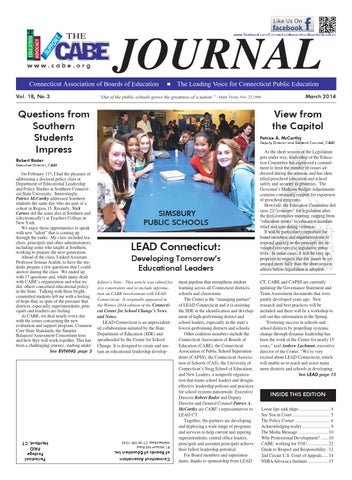
SIMSBURY PUBLIC SCHOOLS
LEAD Connecticut: Developing Tomorrow’s Educational Leaders Editor’s Note: This article was edited for size constraints and to include information on CABE involvement with LEAD Connecticut. It originally appeared in the Winter 2014 edition of the Connecticut Center for School Change’s News and Notes. LEAD Connecticut is an unprecedented collaboration initiated by the State Department of Education (SDE) and spearheaded by the Center for School Change. It is designed to create and sustain an educational leadership develop-
81 Wolcott Hill Road Wethersfield, CT 06109-1242
of Boards of Education Inc. Connecticut Association
On February 11th, I had the pleasure of addressing a doctoral policy class at Department of Educational Leadership and Policy Studies at Southern Connecticut State University. Interestingly, Patrice McCarthy addressed Southern students the same day who are part of a cohort in Region 15. Recently, Nick Caruso did the same also at Southern and (electronically!) at Teachers College in New York. We enjoy these opportunities to speak with new “talent� that is coming up through the ranks. My class included teachers, principals and other administrators, including some who taught at Southern, working to prepare the next generation. Ahead of the class, I asked Assistant Professor Sousan Arafeh, to have the students prepare a few questions that I could answer during the class. We ended up with 17 questions and, while many dealt with CABE’s organization and what we did, others concerned educational policy in the State. Talking with these bright, committed students left me with a feeling of hope that, in spite of the pressure that districts, especially superintendents, principals and teachers are feeling. At CABE, we deal nearly every day with the issues concerning the new evaluation and support program, Common Core State Standards, the Smarter Balanced Assessment Consortium tests and how they will work together. This has been a challenging journey, starting under See EVNING page 2
March 2014
³2XW RI WKH SXEOLF VFKRROV JURZV WKH JUHDWQHVV RI D QDWLRQ ´ 0DUN 7ZDLQ 1RY
ment pipeline that strengthens student learning across all Connecticut districts, schools and classrooms. The Center is the “managing partner� of LEAD Connecticut and it is assisting the SDE in the identification and development of high-performing district and school leaders, especially in the state’s lowest-performing districts and schools. Other coalition members include the Connecticut Association of Boards of Education (CABE), the Connecticut Association of Public School Superintendents (CAPSS), the Connecticut Association of Schools (CAS), the University of Connecticut’s Neag School of Education, and New Leaders, a nonprofit organization that trains school leaders and designs effective leadership policies and practices for school systems nationwide. Executive Director Robert Rader and Deputy Director and General Counsel Patrice A. McCarthy are CABE’s representatives to LEAD CT. Together, the partners are developing and deploying a wide range of programs and services to help current and aspiring superintendents, central office leaders, principals and assistant principals achieve their fullest leadership potential. For Board members and superintendents, thanks to sponsorship from LEAD
As the short session of the Legislature gets under way, leadership of the Education Committee has expressed a commitment to limit the number of issues addressed during the session, and has identified preschool education and school safety and security as priorities. The Governor’s Midterm Budget Adjustments contains continuing support for expansion of preschool programs. However, the Education Committee did raise 23 “concepts� for legislation after the first committee meeting, ranging from “education issues� to education mandate relief and teen dating violence. It will be particularly important for board members and superintendents to respond quickly as the concepts are developed into specific legislative initiatives. In some cases, it will be very appropriate to request that the issues be examined more fully than the short session allows before legislation is adopted. CT, CABE and CAPSS are currently updating the Governance Statement and Team Assessment documents that were jointly developed years ago. New research and best practices will be included and there will be a workshop to roll out this information in the Spring. “Fostering success in schools and school districts by propelling systemic change through dynamic leadership has been the work of the Center for nearly 15 years,� said Andrew Lachman, executive director of the Center. “We’re very excited about LEAD Connecticut, which will enable us to reach and assist many more districts and schools in developing See LEAD page 13
INSIDE THIS EDITION Loose lips sink ships ............................ 4 See You in Court .................................. 5 The Policy Corner ............................... 6 Acknowledging reality ......................... 9 The Media Message .......................... 10 Why Professional Development? ...... 10 CABE: working for YOU .................. 22 Guide to Respect and Responsibility . 12 2nd Circuit U.S. Court of Appeals ..... 14 NSBA Advocacy Institute .................. 15
Periodical Postage PAID Hartford, CT
2
The Journal – Connecticut Association of Boards of Education/March
2014
PRESIDENT COMMENTARY
Stand up 4 public education STAND UP 4 PUBLIC EDUCATION is the new advocacy campaign the National School Board Association (NSBA) wants the over 750 Board of Education members who attended the first annual Advocacy Institute (formerly Federal Relations Network - FRN) in Washington D.C. to bring home to their districts. NSBA’s new advocacy efforts will be three pronged – legal, legislative, and public. For example, the legal arm of the new NSBA will monitor the federal government’s attempts to expand its reach into the operations of school districts. The legislative advocacy efforts will continue to work towards increasing federal funding of Title 1 and IDEA. The NSBA sponsored bill “Local School Board Governance and Flexibility Act” aims to restore maximum flexibility to local school boards in the delivery of federal education programs. The third prong of the advocacy efforts are school board members. To be truly effective advocates, we need to be well informed about public education issues that we face locally as well as issues at the state and federal levels. We can change the tenor of the conversation about public schools, in fact we must, for the future of public schools and for local school board governance. For more information regarding NSBA’s advocacy campaign go to www.standup4publicschools.org. One of the many speakers we heard in Washington was The Reverend Bernice King, Dr. Martin Luther King’s youngest child. She stated that public education is the civil rights issue of our time and that board members need to do more to ensure all children were getting a high quality public education. Connecticut and CABE were capably represented at the Advocacy Institute by First Vice President Ann Gruenberg from Hampton, Vice President for Government Relations Robert Mitchell from Montville, Federal Relations Chair Donald Harris from Bloomfield, City Representative Jacqueline Kelleher from Bridge-
port, East Hartford Superintendent Nathan Quesnel, and me. CABE Staff Robert Rader, Patrice McCarthy, and Sheila McKay also attended the Advocacy Institute in Washington. Their dedication, experience, and professionalism, made it possible for our team to be organized and Richard Murray prepared to converse with our Senators, Representatives and/or their aides about education in our districts and in the state of Connecticut while meeting with them on Capitol Hill. We had four issues to discuss with our Legislators: • The woefully inadequate funding of IDEA. • Increasing the availability of high quality Pre-k and early education opportunities for three and four year olds. • Continued focus and funding for school security. • And increasing mental health services for school age children. Connecticut’s legislators were extremely receptive to our requests. Unfortunately, all lamented the state of gridlock and lack of discourse that currently plagues our nation’s Capitol. Our team was passionate and eloquent in its support and advocacy for public education for all of Connecticut’s children and it was an honor to work with them at the first annual Advocacy Institute.
Questions from Southern Students Impress (continued from page 1) then-Commissioner Mark McQuillan years ago. So, it was nice to deal with other issues. I thought it might be interesting for you to see some of the questions, with my responses: • CABE must rely on a great deal of research. What kind of research does it utilize primarily, where does it get that research, what kind of staff or consultants, etc. are tasked with doing the research end of things, and what kinds of research products do you typically generate or how is this research used? We rely on a great many sources for our research. We ask board members and superintendents their opinions on issues; we rely on NSBA, our parent organization for information; we have a wealth of knowledge at CABE, having staffers who have worked in various positions in education for many years; and, of course, depending on the subject, educational publications, scholarly articles, newspapers and other sources of information. • The CABE website offers many examples of ways in which you help support school boards. What do you find to be the most essential element of any highly effective school board? We think it is critical that board members believe that all children can succeed. We base this on the original Lighthouse study, which showed that if board members believed this and worked to ensure that every student got the support he needed, great things can happen. • As evidenced by the 2012 CT high school graduation rates, there is a large achievement gap in Connecticut between white students and Hispanic and African American and also between students eligible for free lunch and those who are not with males fairing worse than females. Why the disparity? What has Connecticut been doing to improve graduation rates? The State has tried for many years to close the gap. But, there are so many reasons for it, poverty being above all else. But, through the Sheff remedies, Alliance District aid and the new Commissioner’s Network, there is ongoing focus on these critical issues. • How do local school districts plan to respond to the
request for universal Pre-K? I think they will respond positively, as long as the State picks up the costs. • My question is why advise Boards of Education? Aren’t they independent bodies who answer to their municipal voters? I don’t really understand the purpose of CABE. I posed this question back to the student: What do you think would happen if we got 7 or 9 lay people together with no experience working together, possibly never serving on a board of any type, with little knowledge of education or of each other to make the most important educational decisions for their communities? Providing help, including guidance, training and advocacy is why CABE exists. • From your perspective, and based on your experience, is there anything specific about how schools boards are conceived, elected, and conducted that you would change to improve their quality, utility, and effectiveness? Yes, I’d like to see more of our citizens interested in either board service or finding other ways to support boards in their communities. Businesses used to give time off for board service and this doesn’t happen as often anymore. We still need leaders of their communities on our boards and more diversity as our nation and our State consist of more people of color. • Do you think having 166 Boards of Education in CT is effective? I think having this number is effective. They already share many services and each community’s schools are important to that community. Working together (“regionalism”) is sometimes effective in finding efficiencies. Forced consolidation (“regionalization”) is not the way to treat this cornerstone of democracy. I look forward to these students moving higher in the ranks of our educators. They ask good questions, care about issues like positive citizen engagement, in addition to ensuring all students are college- and career-ready. Despite the difficulties in moving our new initiatives, the future of public education in our State is bright! I am glad that we are growing our own and that they are smart, resourceful and caring!
Mission: To assist local and regional boards of education in providing high quality education for all Connecticut children through effective leadership. Vision: CABE is passionate about strengthening public education through high-performing, transformative local school board/superintendent leadership teams that inspire success for each child.
CABE Board of Directors EXECUTIVE COMMITTEE Richard Murray .................................................. President, Killingly Ann Gruenberg ................................. First Vice President, Hampton Robert Mitchell ................ VP for Government Relations, Montville Elaine Whitney ........... VP for Professional Development, Westport John Prins ......................................... Secretary/Treasurer, Branford Lydia Tedone ............................................ Immediate Past President Donald Harris ........................................................ Member at Large
AREA DIRECTORS Susan Hoffnagle ............................. Area 1 Co-Director, Winchester Mari-Ellen (Mimi) Valyo ............... Area 1 Co-Director, Winchester Daniel Gentile ................................... Area 1 Co-Director, Plymouth Jeffrey Currey ............................. Area 2 Co-Director, East Hartford Susan Karp ................................... Area 2 Co-Director, Glastonbury Donald Harris ................................. Area 2 Co-Director, Bloomfield Laura Bush ................................................. Area 3 Director, Vernon Douglas Smith .................................. Area 4 Co-Director, Plainfield Andrea Veilleux ................................ Area 6 Co-Director, Stratford Elaine Whitney .................................. Area 6 Co-Director, Westport Roxane McKay ............................. Area 7 Co-Director, Wallingford John Prins ......................................... Area 7 Co-Director, Branford Lon Seidman ........................................... Area 8 Co-Director, Essex Michael Camilleri ............................ Area 8 Co-Director, Cromwell Aaron Daniels ........................................... Area 9 Director, Norwich
ASSOCIATES Eileen Baker .............................................. Associate, Old Saybrook Sharon Beloin-Saavedra .............................. Associate, New Britain Gary Brochu .......................................................... Associate, Berlin Robert Guthrie .............................................. Associate, West Haven Robert Trefry ........... Associate, CT Technical High School System COMMITTEE CHAIRS Elizabeth Brown ......................... Chair, State Relations, Waterbury Donald Harris ......................... Chair, Federal Relations, Bloomfield Becky Tyrrell ...................................... Chair, Resolutions, Plainville
CITY REPRESENTATIVES Jacqueline Kelleher ....................... City Representative, Bridgeport Matthew Poland ................................ City Representative, Hartford Carlos Torre .................................. City Representative, New Haven Polly Rauh ........................................ City Representative, Stamford Charles Stango ............................... City Representative, Waterbury
STAFF Robert Rader ....................................................................... Executive Director Patrice McCarthy .................................. Deputy Director and General Counsel Bonnie Carney ............................................ Sr. Staff Associate for Publications Nicholas Caruso ............................................ Sr. Staff Assoc. for Field Service and Coord. of Technology Sheila McKay ............................. Sr. Staff Associate for Government Relations Kelly Moyher ......................................................................... Sr. Staff Attorney Vincent Mustaro ..................................... Sr. Staff Associate for Policy Service Lisa Steimer .............................. Sr. Staff Assoc. for Professional Development Teresa Costa .................................. Coordinator of Finance and Administration Pamela Brooks ......................... Sr. Admin. Assoc. for Policy Ser. /Search Ser. Terry DeMars ............................................... Admin. Assoc. for Policy Service Gail Heath ........................................ Admin. Assoc. for Government Relations Wilmarie Newton ........................................ Admin. Assoc. for Labor Relations Corliss Ucci .................................. Receptionist/Asst. to the Executive Director
The CABE Journal (ISSN 1092-1818) is published monthly except a combined issue for July/August as a member service of the Connecticut Association of Boards of Education, 81 Wolcott Hill Road, Wethersfield, CT 06109, (860) 571-7446. CABE membership dues include $30 per person for each individual who receives The CABE Journal. The subscription rate for nonmembers is $75. Association membership dues include a subscription for each board member, superintendent, assistant superintendent and business manager. The companies and advertisements found in The CABE Journal are not necessarily endorsed by CABE. “Periodicals Postage Paid at Hartford, CT.” POSTMASTER: Send address changes to The CABE Journal, CABE, 81 Wolcott Hill Road, Wethersfield, CT 06109-1242. Email: bcarney@cabe.org. Members can find the CABE Journal online at: www.cabe.org/ userlogin.cfm?pp=84&userrequest=true&keyrequest=false& userpage=84
The Journal – Connecticut Association of Boards of Education/March
3
2014
EXECUTIVE DIRECTOR COMMENTARY
CABE Affiliate Members BUSINESS AFFILIATES DIAMOND MEMBER Finalsite GOLD MEMBERS
Advanced Corporate Networking dba. Digital BackOffice Berchem, Moses & Devlin Centris Group Guidance Counselors for Senior Teachers Pullman & Comley Shipman & Goodwin Siegel, O'Connor, O’Donnell & Beck, P.C SILVER MEMBERS Anthem Blue Cross and Blue Shield Corporate Cost Control Milone & MacBroom, Inc. Quisenberry Arcari Architects The Segal Company
BRONZE PLUS MEMBERS Brown & Brown Insurance Friar Associates Goldstein & Peck, P.C. Guidepost Solutions, LLC Lindburg & Ripple O & G Industries The S/L/A/M Collaborative Trane UltiPlay Parks & Playbrounds, Inc.Whitsons School Nutrition
BRONZE MEMBERS Chinni & Meuser LLC Dattco Inc. Fuller & D’Angelo Architects and Planners Kainen, Escalera & McHale, P.C. The Lexington Group Muschell & Simoncelli Ovations Benefits Group
EDUCATIONAL AFFILIATES American School for the Deaf Area Cooperative Educational Services Capitol Region Education Council The College Board Connecticut Association of School Business Officials Connecticut Center for School Change Connecticut School Buildings and Grounds Association Cooperative Educational Services EASTCONN EDUCATION CONNECTION LEARN Unified School District #1
An Important Life Skill for You and Your Students One of the major buzzwords over the last year in the media, especially the social media, is “mindfulness”. That term refers to helping individuals quiet their restless minds, developing an “in the moment” way of living that allows focus, free of distractions. If you are like many board members and superintendents, your life is filled with the interruptions of landlines, cellphones, text messages, emails and all the other distractions of our lives. The result can be a feeling of anxiety, depression and a feeling of being overwhelmed. If you go on vacation and are still tethered to all of your devices, chances are you are not going to completely occupy the place where you physically are. We see this all the time. People are driving, texting at stop lights, calling their families and doing a million other things in their attempts to multi-task and occupy more than one place. Who doesn’t see the cellphones, ready to invade our focus at every meeting we attend, in movie theaters and at restaurant tables? Time Magazine’s February 3rd issue had a cover story on mindfulness. It discusses the experiences of Kate Pickert, the author, as she takes a course in Mindfulness Based Stress Reduction (MBSR), which teaches meditation as an essential part of mindfulness. She states that there are “nearly 1,000 certified MBSR instructors… in nearly every state and more than 30 countries”. This is not the fad that meditation was in the 1960s and ‘70s. It has two factors, according to the article, that “set it apart and give it a practical veneer that is helping propel it into the mainstream.” First, instructors tell their students to think of paying attention to your mind as a muscle, which you can exercise “and will strengthen from that exercise.” Second is what “science is learning about our brains’ ability to adapt and rewire. This phenomenon, known as neuroplasticity, suggests there are concrete and provable benefits to exercising the brain.” While the science is not yet conclusive, this science is “gaining traction with people [including scientists, businessmen and tech leaders] who might otherwise find mind-body philosophies a tough sell and it is growing into a sizeable industry.”
Our Students The article also mentions that educators “are turning to mindfulness with increasing frequency – perhaps a good thing, considering how digital technology is splitting kids’ attention spans, too.” A Bay-Area program “called Mindful Schools offers online mindfulness training to teachers, instructing them how to equip children to concentrate in classrooms and deal with stress.”
The author states that the average American teen sends and receives more than 3,000 text messages a month. As schools provide more technology to students, as well as teachers, and expect students to be ready to take standardized and other tests on computers, I would predict an increase in examining tools like mindfulness. As I have heard from teachers, students can no longer concentrate on a single subject for as long as their predecessors did. This will, over time, have significant effects on their ability to succeed. The article mentions that Steve Jobs, Apple founder, attributed his ability to meditate “was responsible for his ability to concentrate and ignore distractions.”
“Board members and superintendents, principals, teachers and of course, our students, must look to any reasonable solution to ease the stresses of our lives, especially at this demanding time of implementation of new initiatives and resource issues.”
Board Members and Superintendents Daniel Goleman, author of several books on the importance of Emotional Intelligence, has written about the problem of distractions, which, he suggests, are “the enemy of focus”. Living in a time “when we are more inundated by distractions more than ever in human history”, he writes that there are two varieties of distraction: sensory and emotional. We are used to living with the first – they exist everywhere, those assaults on our five senses. We are usually able to ignore them, even those “enticing pingy popups on your computer screen.” Paying attention means that we are ignoring them. But, much harder to ignore are the emotional distractions, those that “trigger a strong reaction – annoyance or anger, anxiety or even fearfulness – that distraction will instantly become the focus of your thoughts, no matter what you’re concentrating on.” We create “thought
Robert Rader
loops about whatever’s upsetting us . . . until we come up with some solution or new understanding that at least tentatively solves the difficulty.” How does Goleman deal with these difficulties and focus? Every morning he begins with breakfast with his wife and then meditates, where he “gathers my focus.” While he does his writing, he doesn’t “look at emails, take phone calls, or otherwise let distractions creep into [his] focused time. That keeps the sensory kind out, and the emotional kind to a minimum. I’ve got the rest of the day to deal with those.” Board members and superintendents, principals, teachers and of course, our students, must look to any reasonable solution to ease the stresses of our lives, especially at this demanding time of implementation of new initiatives and resource issues. Keep in mind that everyone is under some of these stresses and while some handle them better than others, (I am not necessarily one of those!) we need to make the most thoughtful decisions we can even when we are dealing with issues that appear most urgent. If you’re wondering, there are hundreds of mindfulness and meditation apps. It is ironic to turn to the tools that are often increasing to stress to lessen it, but that’s the world we’re living in! So, I hope you find a way to power down and help those around you do the same. If the studies are to be believed, meditation and mindfulness training can “lower cortisol levels and blood pressure, increase immune response” and help us be more productive. Wouldn’t mindfulness help you deal betterwith the difficult issues with which you’re faced pretty much every day?
NEW Follow CABE on Twitter @CTAssocBdsofEd
4
The Journal – Connecticut Association of Boards of Education/March
2014
Loose Lips Sink Ships Nicholas D. Caruso Sr. Staff Associate for Field Services and Coordinator of Technology
As part of our work in helping school board members understand their roles and responsibilities, we try and get them to understand the problems presented when they speak casually (or maliciously) about issues in public. There is real tension between a person’s First Amendment right to speak, and the conflict of interest that these comments might generate. I am not a constitutional lawyer, and don’t intend to speak to those legal rights, but even I understand that while a person does have the right to say what they think, it does not always mean that there won’t be consequences for those comments. As elected officials, especially as those responsible for your community’s most precious resource (children) what you say does impact what goes on around you. Community members hear you speak (or read your letters, tweets or Facebook comments), and your comments can have serious impact on the district. Technology and social media have certainly eased how your words can come back to haunt you. In the past, if you wrote a letter to the editor, or spoke directly to a reporter, your words might be out in the public, but more or less limited by your own discretion (or lack of it).
Nowadays we have e-mail, Facebook, Twitter, etc. and these new media mean that a careless use of words can be seen around the town (and the globe for that matter) in a matter of minutes. Because there is no “hard copy” we sometimes don’t think about how permanent a comment might become. I’m sure you have heard of examples where a board member, superintendent or other staff member posts something on Facebook – a thoughtless comment or a picture that really should not be made public and then the fallout hits. People have lost jobs, been forced to resign or been sued. E-mail conversations, when made public cause serious breaches of trust. There is no such thing as total confidentiality and the ramifications of your comments being disclosed could seriously hurt you or your school district. There are examples of board members being required to turn in their personal (or work) computer for examination to see if confidentiality was violated or other laws broken. I don’t have the space to discuss the issue of electronic media being used to circumvent the FOI laws; although that certainly is an important issue to be aware of, or the retention of records required by Federal law. In
Away from the Board Table: Tips for Dealing with the Public as an Individual Board Member Kelly B. Moyher Sr. Staff Attorney
• When approached by a member of the public or media when away from the board table (the supermarket, library, social gathering), remind individuals that you have no authority or power on your own away from the board table. Actions can only made by the board of education as a whole when gathered at a meeting. • If you are approached by a member of the media or public for the board of education’s position on an issue or to discuss a pertinent matter, an easy way to make sure the correct statements are made on behalf of the board is to refer the individual to the board chair, as the official spokesperson for the board, and/or the superintendent. • If you are asked to discuss an issue regarding a district employee or a matter concerning a student, try to stop the conversation by reminding the information gatherer that sometimes these matters involve issues of privacy and confidentiality and it is your duty as a board member to remain impartial should the matter of discussion ever come before you and the rest of the board in a hearing. Again, this is also a time to remind the person that you have no individual authority as a board member and the person should work through the chain of command within the school (teacher, department head, principal, superintendent) to resolve the issue or obtain information. Sometimes you can get away with not saying or writing anything at all, but in situations where some response is warranted and you want to state the correct, and legal, response, the above tips are excellent tools to keep in your back pocket as you venture out to live your life as a citizen, but also as a board of education member.
2014 CABE/CAPSS Convention Committee
this article I just want you to be aware of the serious issue of speaking indiscreetly. A very important role of board members is to serve as an impartial hearing panel in serious matters such as a personnel discipline issue, or a denial of education (expulsion) for a student. These are serious matters with serious consequences for those involved in the hearing. Those individuals have legal rights and hearings have to be set up to ensure impartiality and confidentiality. Imagine being in a hearing involving a teacher and the teacher’s attorney asks one of the presiding board members, Attorney: “Mr. Jones, isn’t it true that on April 2nd you were in the supermarket talking to a parent and you told the parent that this teacher was the worst teacher you child ever had?” Board member: “How did you hear that?” Attorney: “It doesn’t matter how we heard it, is it true?” Board member: “Well, yes, but…. how did you hear that?” This conversation actually happened in a hearing I was involved in many years ago and it really complicated an otherwise simple case. What should have been a 15minute meeting turned into a multi-hour marathon. If this had been a termination hearing it could have jeopardized the board’s ability to govern appropriately. My advice is to be very careful about what you say in public. Even prefacing a comment with, “I’m not speaking as a board member, but as a member of the public (or a parent, etc.)” only gets you so far. The public sees a board member speaking no matter what. If you don’t want your comment to appear on the front page of the local newspaper (or on TV), just don’t say it.
What will the Connecticut Online Policy Service (C.O.P.S.) provide YOUR district? • A policy manual updated within days of a board meeting. • Access to your policy manual 24/7 anywhere with Internet capability. • Timesaving links to legal and cross references. • A search engine specifically designed for board policy manuals. • The ability to search other online districts for similar policies or language. • A happier staff that will have less paper to deal with. If you would like additional information on CABE’s Connecticut Online Policy Service (C.O.P.S.), call Vincent Mustaro at 860-571-7446 or email vmustaro@cabe.org for full details.
Let the CABE staff make your policy life easier. The planning has begun for the 2014 CABE/CAPSS Convention. The Convention will be held on November 14-15, 2014; at the Mystic Marriott Hotel, Groton. The Committee discussed the theme, workshop strands, format and recapped the 2013 Convention.
5
The Journal – Connecticut Association of Boards of Education/March 2014 See You in Court – The Nutmeg Board of Education
The Nutmeg Boards Deals with Executive Session and FOIA Compliance Thomas B. Mooney, Esq. Shipman & Goodwin
The Nutmeg Board of Education makes many mistakes. The latest imbroglio created by the board will be reported here each issue, followed by an explanation of what the board should have done. Though not intended as legal advice, these situations may help board members avoid common problems. As was its custom, the Nutmeg Board of Education convened in executive session at 6:00 p.m. for an hour before its regular meeting started at 7:00 p.m. Veteran Board member Bob Bombast arrived a few minutes late. He was surprised to see Nancy Newshound standing outside the room with her ear to the door. “What on earth are you doing?” Bob thundered. “The Board is in executive session, and you are violating the law.” Nancy, a fixture at Board meetings in her role as reporter for the Nutmeg Bugle, was surprised but not intimidated when Bob confronted her. “Oh really? How is it that the Board is properly in executive session? I have been here since 5:45 p.m. Board members walked by me into the conference room. Some even said hi. But the Board never convened a meeting. So I was just listening in on the conversation.”
“Oh sure” Bob responded. “Just listening . . . .” Bob pushed past Nancy and joined the other Board members in the conference room. “What is wrong with you,” Mal Content asked. “You look awfully cranky.” “It is that Nancy Newshound! I don’t know what her problem is. We have ‘Executive Session’ on the agenda, don’t we?” Bob asked. “Of course. Just as we do every month. What is the problem?” asked Mal. “Nancy claims that we should have started the meeting in public session and that she had the right to listen in on our discussions until we did.” Now Bob was wondering whether Nancy had a good point. “Maybe we should take care of the niceties and avoid a problem with the press,” Bob suggested. “OK, OK,” responded Mr. Chairperson, as he opened the door to the conference room. “Come on in, Nancy. There has just been a misunderstanding here, and we want to put things right. Will the March meeting of the Nutmeg Board of Education come to order! Mr. Superintendent, what is the first order of business?” “Executive session. Nancy, will you please leave now?” Nancy looked up in surprise, but then
Seventh Edition
A Practical Guide to Connecticut School Law by Thomas B. Mooney, Esq. Shipman & Goodwin
The Guide comes with a CD which provides hyperlinks to many cases and statutes and will permit word searches as a supplement to the Index. New to the Seventh Edition: Bullying, Background Checks, Child Abuse Reporting, Discrimination Issues, Educational Reform, FERPA, Freedom of Information, State Aid for Education and much, much more The 7th edition is now available from CABE. Call and order your copy TODAY at 860.571.7446 or 800.317.0033
smirked. “Have it your way,” she said. Once Nancy left the room, the Board members relaxed. Left in the room were only the Board members, the Superintendent, the Assistant Superintendent, the Superintendent’s secretary and his administrative intern. “Finally,” Mr. Chairperson said with a sigh, “it is just us friends. Mr. Superintendent, what do you have for us today in executive session?”
an increased price and only until all such property has been acquired or the transaction is otherwise over. • Information contained in records exempt from disclosure under the FOIC. That last category permits executive session discussion of various topics that are confidential, including attorney-client privileged communications, confidential
“Executive session is a privilege that allows confidential discussion only as permitted by law. . . . . it is illegal to discuss any topic in executive session except as permitted by the FOIA.”
“Just a few things,” responded Mr. Superintendent. Mr. Superintendent then updated the Board on custodian negotiations. Mr. Superintendent also warned the Board members to behave during a grievance that was scheduled for later that night. As the Board was wrapping up the executive session, Board member Penny Pincher, told Mr. Superintendent about a parent complaint concerning a teacher. “Wow,” said Mr. Chairperson. “We have a lot going on! It is a shame that Nancy cannot attend our executive session, isn’t it?” Mr. Chairperson chuckled. Will Nancy Newshound have the last laugh here? The Nutmeg Board of Education has forgotten that executive session is appropriate only when it complies with the related legal requirements. First, before a board of education (or any other public agency) can convene in executive session, the board must have on its agenda a topic that is privileged to executive session. Significantly, “executive session” is not an agenda item, and those words alone on a board agenda never themselves authorize an executive session. Conversely, there is no requirement under the FOIA that the agenda include reference to executive session. Rather, there must always be an agenda item, the discussion of which may occur in executive session. If there is and the board follows the procedural requirements as set forth below, the board can convene in executive session. The FOIC sets forth five topics that are privileged to executive session: • The appointment, employment, performance, evaluation, health or dismissal of a public officer or employee. (NOTE: the officer or employee may require that the discussion as to them occur in open session, but the officer or employee cannot insist upon attending the executive session.) • Strategy and negotiations with regard to pending claims or litigation. • Security strategy or the deployment of security personnel or devices. • Acquisition of real estate if publicity concerning the site could cause
collective bargaining strategy documents, and personally-identifiable student information (which is the basis for holding student expulsion hearings and school accommodation hearings in executive session). The procedural requirements for executive session are simple, but they are crucially important. When the board has an agenda item appropriate to executive session, it must meet two requirements. First, the motion to go into executive session requires a two-thirds vote. The calculation is made on the basis of those present and voting, and where votes are weighted in regional school districts, those weighted votes count in reaching the requisite two-thirds vote. Second, in taking that vote, the board must state the reason for the executive session. Doing so is important, because that reason must be set forth in the minutes of the meeting. Moreover, the Commission has ruled that the statement of the purpose of the executive session must give the public fair notice of what is being discussed. The Commission has ruled repeatedly, for example, that “personnel matters” or “litigation” is not adequate notice, and the board must provide more information in its motion to go into executive session. The last procedural requirement deals with those who attend the executive session. The minutes of the executive session must list the names of those present (except for persons attending for the purpose of a job interview). Equally important, attendance at the executive session must be limited to the members of the board and those persons whose opinion or testimony it requests. Some of those present in Nutmeg should not have attended the executive session, including the secretary and the intern. Finally, board members must be vigilant to stay on topic. Executive session is a privilege that allows confidential discussion only as permitted by law. It is tempting to share juicy information in the comfort of executive session. But it is illegal to discuss any topic in executive session except as permitted by the FOIA. Attorney Thomas B. Mooney is a partner in the Hartford law firm of Shipman & Goodwin who works frequently with boards of education. Mooney is a regular contributor to the CABE Journal.
6
The Journal – Connecticut Association of Boards of Education/March
CABEMeeting CABE-Meeting is a userfriendly, web-based service specifically designed to assist the board, superintendent and central office staff in preparing for and running board of education meetings. An exciting feature designed for use by committees, in addtion to boards of education, was recently added to CABEMeeting. Now all your board work and committee information is conveniently located in one place!
“CABE is incredibly user-friendly and serves as a model for so many others on how to offer a quality product with exceptional service”. Dr. Joseph V. Erardi, Jr. Superintendent, Southington Public Schools
For more information, or to schedule a demonstration for your board, call Lisa Steimer at 800-317-0033 or 860-571-7446 or email lsteimer@cabe.org
2014
The Policy Corner Vincent A. Mustaro, Senior Staff Associate for Policy Service, CABE
Policy Direction for Responsible Computer, Network and Internet Use The advantages of digital media now greatly outweigh the disadvantages and require that schools update their thinking and policies to provide guidance on the use of these tools to improve student learning and achievement. When the federal Children’s Internet Protection Act (CIPA) was enacted in 2000, the major concern on the part of legislators and education policymakers was to protect children from viewing pornography and other inappropriate sites on the Internet. Now, current mobile devices, social media and other Internet applications have become mainstream in many sectors of society, and an increasing number of educators are demonstrating the power of these applications to enrich the learning environments and instructional practices in their classrooms. Many of the problems raised by these new technologies, from bullying to engaging in risky behavior, are not new to the public discourse, but are merely being delivered in different media. The challenge to responsible educators remains the same: to provide stimulating and safe learning environments that support the acquisition of knowledge and practical skills necessary for full participation in this new century.
Surveys Recent surveys conducted by the Pew Research Center Institute and American Life Project indicated that 95% of all teens, ages 12 through 17, use the Internet on a regular basis, 80% use social networking and 75% have cellphones. The policy environment, which originally banned cell phones from the school environment, is rapidly changing. The growing popularity of “bring your own technology/device” programs is being partly fueled by the realization that allowing studentowned devices to supplement schoolpurchased technology can cut costs and that learning can benefit from technology when students are mentored in appropriate applications. Low-cost tablets are now provided to students in some school districts. Schools participating in the E-rate program, have the responsibility to show that they have in place an Internet safety program that educates minors about appropriate online behavior, including interacting with other individuals on social networking websites and in chat rooms, as well as
cyberbullying awareness and response. Boards of education currently provide students and staff access to a multitude of technology resources. Access to information and communication technologies (ICT) is considered a privilege and not a right. ICT resources consist of any technology and/or devices that access or convey information, software applications, Internet resources and Internet environments.
Resources These resources provide opportunities to enhance learning and improve communication within the local community and with the global community beyond the local campus. The advantages of having access to these resources should be viewed by local boards as far greater than any potential downside. However, with the privilege of access is the responsibility of students, teachers, staff and the public to exercise appropriate personal responsibility in the use of these resources. Board policies are intended to promote the most effective, safe, productive, and instructionally sound uses of networked information and communication tools. Districts must also make a good faith effort to protect its students from exposure to Internet materials that are harmful or explicit through a system of Internet content filtering devices and software controls that meet federal standards established in the Children’s Internet Protection Act (CIPA). School districts use information and technology in safe, legal, and responsible ways. It is incumbent upon all members of the school community to use technology ethically, constructively, and with respect for the work of others. Independent and appropriate use of information and communication technologies is predicated upon responsible and ethical conduct. Such conduct can be elaborated in policy language stressing the attributes of a responsible digital citizen, whether staff, student or volunteer. Responsible use of the technology resources provided and/or permitted by the Board is expected to be ethical, respectful, academically honest, and supportive of the school’s mission. Each computer user has the responsibility to respect every other person in the community and on the Internet. Digital storage and electronic devices used for school purposes are treated as extensions of the physical school space. Administrators, or their designees, may review files and communications (including electronic mail) to insure that users
are using the system in accordance with Board policy. Users should not expect that files stored on servers or disks will be private. Some activities are expressly prohibited by law. Users are expected to abide by the generally accepted rules of network etiquette, elaborated in board policy language. Policy should contain guidelines that are intended to clarify expectations for conduct, but they should not be construed as allinclusive. Given the nature of emerging technologies, it is impossible to anticipate or prevent all problems that may occur. Most important, however, is that the use of electronic devices should be consistent with the educational objectives, mission and curriculum of the district.
School Districts School districts across the country are beginning to rethink and revise their Acceptable Use Policy (AUP). Schools are starting to drop many bans pertaining to technology use in the school setting and instead are focusing on policy goals that go beyond the narrow set of website access issues that were the focus of many earlier AUPs. School systems are starting to move away from the traditional AUP approach, which has students and family members sign a form “accepting” certain rules, with little action after that, to a “responsible-use policy” (RUP) that emphasizes education and treats the student (and staff members) as a person responsible for ethical and healthy use of the Internet and mobile devices. Clearly, the key to online safety and security is adequate student education. Many believe that one of the most powerful reasons to permit the use of social media and mobile devices in the classroom is to provide an opportunity for students to learn about their use in a supervised environment that emphasizes the development of attitudes and skills that will help keep them safe outside of school. Online safety issues are not about blocking, they’re about safety education, which can begin in the primary grades. CABE’s has developed a “Responsible Computer, Network and Internet Use” or Responsible Use Policy (RUP). It has been codified the same as the “Acceptable Use Policy, (AUP),” #6141.321 and can be considered as an alternative to a district’s current AUP policy.
The Journal – Connecticut Association of Boards of Education/March
2014
The art of making people smile. Delta Dental knows what it takes to keep you and your employees happy. At Delta Dental, we can help you create a dental plan that’s sure to paint a smile on your employees faces: • Expertise. We’re part of the most experienced dental benefits company in the country. • Flexibility. We can help you design a plan that meets your needs and budget—without compromising on value. • Network of Dentists. We offer access to the largest network of dentists in the U.S.— with 4 out of 5 dentists participating nationwide. • Simplicity. You can count on us for easy plan administration. • Customer Satisfaction. Add it all up: the largest network, unbeatable expertise, flexibility, value and cost savings, and it’s easy to see why Delta Dental is your best choice. Delta Dental. We’re committed to promoting oral health for all your employees. Call 1-860-633-9200 or visit www.deltadentalct.com. In CT, Delta Dental Insurance Company writes dental coverage on an insured basis and Delta Dental of New Jersey administers self-funded dental benefit programs.
7
8
The Journal – Connecticut Association of Boards of Education/March
2014
9
The Journal – Connecticut Association of Boards of Education/March 2014
Acknowledging Reality Education leaders can build trust - with candor about room for improvement Paul Diego Holzer Executive Diretor, Achieve Hartford
Editor’s Note: This article is the sole opinion of the author and does not necessarily represent the views of CABE. Every year when state test scores are released, we tend to hear in detail about where gains were made and a bit about what may have led to those gains. Rarely do we hear details on where gains were not made and what may have led to disappointing results. When their schools don’t perform as expected, school communities are often left wondering what happened. And if their schools happen to be in the middle of an aggressive reform effort with (as of yet) minimal return on investment, they usually hear nothing at all. From my experience working in Hartford and actively engaging the “village” that exists outside school walls, I think education leaders throughout our state (and throughout our nation) are making a huge mistake when they don’t talk in detail about the areas of lackluster performance.
There are only two ways education leaders can really build trust with their school communities: (1) produce great results and (2) fully acknowledge the challenges and own up to the lack of results. But shining the light on deficits is a daunting prospect, especially when compared to the alternative of not saying anything and waiting another year, hoping then to report tangible gains. Waiting to communicate, however, can be a terrible mistake. When the challenges at a school are too great for a small set of reform strategies to address in one or two years’ time, I submit that the only way leaders can confront them is with help from the very community they may be ignoring.
So, what story should be told when the results aren’t there? The story should go something like this: • Despite phenomenal efforts (like
what we have seen in Hartford’s reform), so much more focused problem solving is needed to address the incredible challenges our students and teachers face; • The data we have analyzed show us which efforts have paid off, and which efforts have still not paid off, and here is where we will invest our time, energy and resources for the coming year and what we expect to see happen; and • Lastly, these efforts won’t work without you – the parents and community partners – playing your unique roles, and here is what we need you to do. While this may seem less than inspiring, or even a downer, my read of communities experiencing reform is this: We can handle the truth! When the results are disappointing, people don’t want to be sold on all that is working; that sounds like an excuse – or an evasion. Instead, results are a time of reckoning and responsibility – and a perfect time to sell people on all that must still be done and on how they can plug in.
Legislative Breakfasts
Area 8 Legislative Breakfast held in Deep River.
Area 4 Legislative Breakfast held in Plainfield.
Area 3 Legislative Breakfast held in Vernon.
Area 7 Legislative Breakfast held in Wallingford.
Funders, nonprofits, policy makers and especially parents are already inclined to support their local schools. Now they need to truly buy into their role in helping that school get better … much, much better.
Who needs to hear this message? • Parents and residents, whose support for aggressive reform is desperately needed; • Teachers, whose disposition to reform can sometimes correlate to whether or not there is public acknowledgment by education leaders of the difficulty of their work; • Corporate and foundation partners, who will soon tire of supporting reform efforts that lack a clear approach to really combating poverty; and even • Students, who want to see their district leaders take the quality of their education so seriously that they speak openly about what’s not working, which they experience everyday. Hartford’s reform has been held up as an example across this state. Its praises are absolutely warranted because of the undeniable reversal of the long trend of declining performance. Given the challenges facing Hartford students, this is nothing short of remarkable. But: • Ask Hartford parents whether their children get all the support they need; • Ask ninth-grade teachers whether their students are prepared for high school, and whether they have the resources to catch their students up; and • Ask neighborhood Hartford students whether their high school is preparing them to compete at the highest levels. The answer to each of these questions is most likely, “No,” yet their realities are very rarely acknowledged publicly. It isn’t enough to act with urgency on behalf of students and families. As an education leader, you must take pains to communicate the urgency to address the challenges everyone already admits are close to insurmountable. Not doing so is to risk a dangerous disconnect between you and the key stakeholders in your community – a disconnect that leads inevitably to a lack of faith in, and discontent with, school districts and boards. As politicians in micro-settings, education leaders are subject to the same suspicion and mistrust we see in Congress and in so many state and local scandals. The antidote to this widespread public cynicism is to take bold actions for sure – but also to be bold in your communications. Let your stakeholders know that on your watch, no one is underestimating the challenges at hand. Laying the cards on the table is absolutely necessary to building trust – and stronger schools.
10
The Journal – Connecticut Association of Boards of Education/March
The
2014
Media Message
from Ann Baldwin, Baldwin Media Marketing, LLC CABE and Baldwin Media: Partners in Managing Communications
Changing the Landscape: Social Media In this CABE Journal article, I felt that it would be timely to talk about the changing landscape of “today’s media.” The media, whether it be traditional or social media is somewhat like being on a rollercoaster ride. Because of the business that I am in (public relations and crisis communications), I deal with editors and reporters almost on a daily basis. I also spend about one day a month in an actual Connecticut newsroom. Therefore, I can tell you first-hand that things are changing drastically. There are more junior level journalists entering our market and fewer newsroom resources – kind of like fewer mechanics to make sure that the rollercoaster that you are about to ride is in good repair. What that usually means is that the reporters covering a story may need some “hand-holding” and some education regarding the particular educational topic that they are covering. Often times, if we don’t take the time to educate the press, they have a
greater chance of getting things factually incorrect, which can result in a news story that is just plain wrong. Unfortunately, it is the news media that the community turns to in forming public opinion and they also have an influence over key issues. In other words, as I have said before, the story goes on with or without you! Therefore it is important that you at least try to get your side of the story out there to balance out the information.
Can wrong information be fixed? I get asked this question at almost every media training session that I conduct, or immediately after a story runs, or is posted on social media and contains misinformation. The good news is yes! The story can be (and should be fixed) and here is why: If there are factual errors in the story, those errors can and will probably resurface. For example, if a story airs on a television station in the
morning, that same story will probably run again at noon, 5:00, 6:00 and even 11:00! I would compare this to the rollercoaster that has jumped off of the track and is raging on out of control. Therefore, it is up to whoever had contact with the reporter to pull the emergency brake. Stop the ride and contact them directly and get the information corrected. It is harder to manage and fix information with social media outlets. Often, a story will run in an on-line publication and the detractors will come out of the woodwork with horrible comments. In that case there is very little one can do about that, other than to try to garner as many supportive and positive comments as you can. Hopefully the bad stuff sinks to the bottom.
Create allies! Like anything else, the better the relationship that you have with your See CHANGING page 11
Why Professional Development? Lisa Steimer Sr, Staff Associate for Professional Development, CABE
Today’s economy makes it increasingly challenging to “justify” professional development expenses to communities However with reform implementation and the rapidly evolving landscape of education, it is even more important than ever to take advantage of these learning opportunities. Why is board member professional development so critical? • Board members play a critical role in setting the vision, goals and direction of the school district. Board members need to keep up-todate on issues and trends affecting public education. • Many board members join their boards with little understanding of their roles and responsibilities and need to better sharpen their knowledge in this area. • It’s critical to bring all board members to the same level of knowledge about the district, educational trends, legal concerns, budgetary matters and other issues, which are becoming more complex. • It takes hard, collaborative work to build the most effective board possible. • It’s critical to learn the skills
involved in working with others to be the most effective board member possible. As a board member, it is your own professional development that will provide you with what you need to do your part to provide high quality education for all children in your district. You are encouraged to take advantage of the Board Member Academy Programs that CABE will offer during the remainder of the 2013-2014 year. CABE staff also provides workshops for individual boards to meet their specific needs. Workshop topics include,
but are not limited to, roles and responsibilities, goal setting, self evaluation, and Freedom of Information Act. We even provide legislative updates to individual boards. While participating in professional development adds another layer of commitment to your schedule, it will help you be the most effective board member you can be. Make a commitment to yourself, your board, and the children in your district to take advantage of the professional development opportunities offered by your Association.
CABE Webinar Sheila McKay and Patrice A. McCarthy, held a webinar on February 7, addressing the impact Governor Malloy’s budget will have on boards of education. To listen to the webinar go to: http:// www.cabe.org/ cf_media/ index.cfm?obj=299
Mark your CALENDAR Don’t miss these professional development opportunities! March 5 CABE Day on the Hill 8:30 am The Bushnell, Hartford May 13 CABE Legislative Wrap-Up Legislative Office Bldg., Room 2A Hartford Workshop information as well as registration information is also published on the CABE website at: www.cabe.org. If you have any questions, please contact Lisa Steimer at the CABE Office 800-317-0033 or 860-571-7446 or email Lisa at lsteimer@cabe.org.
We want to meet your needs! The CABE Journal is now provided both electronically and paper copy via U.S. mail. Please contact Cory Ucci (860-5717446/cucci@cabe.org) to let her know which way you prefer to receive the CABE Journal in the future. If you do nothing, you will continue to receive the CABE Journal both electronically and via U.S. mail. Thank you for your cooperation.
The Journal – Connecticut Association of Boards of Education/March
CABE Leadership Institute
CABE: working for YOU Individualized Workshops • Professional Development Opportunities Legal Services • Policy Services • Representing You Statewide and Nationally Below are the highlights of activities that the CABE staff has undertaken on your behalf over the last month. We did this:
•
➤ By helping school boards to
•
•
•
increase student achievement
• • •
Kristin Campanelli, Berlin Board of Education, receiving media training from Ann Baldwin, Baldwin Media Marketing.
•
Planned and implemented successful Pre-K workshop (see page 13). Held first CABE/CAPSS Convention Committee meeting of the year. Held a Lighthouse planning meeting with the Vernon Board of Education. Participated in meeting of the Professional Educators Advisory Council (PEAC), on the evaluation and support initiative. Sent out three issues of Policy Highlights via email listserv covering topics that affect student achievement. This included one-to-one computer programs, nutrition standards for schools, job descriptions, emergency operation plans, discipline, disabled students and athletics.
• •
•
•
•
Donald Harris, Chair, Bloomfield Board of Education, and CABE Federal Relations Chair receiving media training from Ann Baldwin.
Attended Wallingford Board of Education meeting to present Communications Award. Discussed school funding with SCSU class for aspiring administrators. Participated in CABE/CAPSS Governance Committee meeting on updating the Governance Statement and the Team Assessment document. Completed the audit of the policy manual for the Thomaston Board of Education. Agreed to do an audit of the Branford policy manual. Completed as part of the Custom Update Service packets of new and/or revised policies for the districts of Ansonia, Columbia, East Hampton, East Windsor, Franklin, Gilbert School, Marlborough, New Fairfield, New Hartford, Newington, North Stonington, Old Saybrook, Oxford, Ptnamm, Regional School District 6, Stafford, Sterling, West Haven, Westbrook, and Windham Boards of Education. Completed and mailed the third edition of the Policy Update Service publication. The topics covered included time devoted to physical education, electronic reading devices, impact of the Supreme Court decision pertaining to the Defense of Marriage Act, pregnant
• • • •
• •
•
• • • • • • • • • •
Participated in meeting of the CAPSS International Education Committee. Attended sub-committee meeting of Connecticut Commission for Educational Technology. Presented workshop at the Kentucky School Boards Association annual conference. Hosted meetings of the WhatWillOur ChildrenLose Coalition (CABE, CAPSS, CAS, CASBO)) and the Big 6 Partnership (CABE, CAPSS, CAS, CBIA, CCER and ConnCAN). Both discussed the upcoming legislative session. Participated in Governor Malloy’s Press Conference on increasing aid to districts for safety and security infrastructure. Participated in several meetings of the National School Boards Association’s Leadership Conference on the Future of Boards of Education. Participated in meeting of the NSBA’s Executive Directors’ Professional Development Subcommittee on planning upcoming professional development. Participated in NSBA’s Leadership Conference and Advocacy Institute. Participated in the Coalition for Public Education February meeting. Attended a meeting of the CAPSS retired superintendents committee. Participated in MORE Committee meeting on Education, Regional Entities and Special Education. Attended Legislative Breakfasts in CABE Areas 1, 3, 4, 7, 8 and East Hartford. Spoke on WTIC “Face Connecticut” discussing legislative issues. Attended CREC Legislative Committee meeting. Met with Education Committee leadership. Participated in NSBA Council of School Attorneys Nominating Committee. Participated in Connecticut Financial Literacy Coalition Meeting.
➤ By providing opportunities
for members to learn how to better govern their districts:
• • • Ann Baldwin educates Leadership Institute participants on how to work with the media.
• • • •
cut school boards on the state or national level:
to meet members needs:
•
and parenting students and one-to-one tablet programs. Met with Policy Committees from the Branford, Stratford and Wethersfield Boards of Education. Modified policies for the Region 12 Board of Education that were identified in the policy audit as reqiring revision. Entered into an agreement with the Derby Board of Education to place its policy manual online.
➤ By representing Connecti-
➤ By providing services
Jeffrey Currey, Chair, East Hartford Board of Education, receiving media training from Ann Baldwin.
11
2014
Conducted the 10th Annual CABE Leadership Institute. Planned successful School Governance Council training for Waterbury. Took part in podcast for author Doug Eadie on the relationship between
boards of education and their superintendents. Facilitated workshop with the East Hampton Board of Education, Superintendent and Administrator. Presented a roles and responsibilities workshops for the Canterbury, and Sterling Boards of Education. Met with Trumbull Board of Education chair and superintendent to plan a board retreat. Provided policy information to 19 districts, 2 out-of-state school boards associations, through 20 answered requests for information or sample policies, on 24 topics. Further, districts continue to access CABE’s online Core Policy Reference Manual and/or online manuals posted by CABE for policy samples. The topics of greatest interest pertain to graduation requirements and personnel issues.
➤ By promoting
public education:
•
• •
Held Board of Directors’ Retreat concentrating on the Future of Boards of Education and how CABE can better serve its members now. Facilitated discussion on school boards and superintendents in a course at Southern Connecticut State University. Answered questions about the current legal issues facing boards of education. “HOT” topics this month were: Budgets (capitol and operating), specificity of board agenda, reasons for executive session, residency, and conflicts of interest.
➤ By ensuring members
receive the most up-to-date communications:
• • •
Provided webinar on Governor’s proposed budget adjustments. Participated in and helped sponsor Parent-Teacher Community Forum on Common Core and its debriefing. As part of the development of new policy manuals utilizing the Custom Policy Service, materials were prepared for Avon, Derby, Griswold, North Haven, Stratford, Wethersfield, Windsor Locks and Woodbridge Boards of Education.
Changing the landscape: social media (continued from page 10) local media, the better your chances of getting some positive press. I’m am sure that many of you are taking issue with that statement right now, but I have seen it first-hand. Those that have built media relationships prior to any negative story, or crisis situation, usually have better results. If you aren’t comfortable speaking with the press, then you may need some additional media training to help with your comfort level, or perhaps you may have to appoint someone else from your organization to be your spokesperson. Just make sure that whomever is taking on this responsibility has their seatbelt on safe and tight across their lap!
12
The Journal – Connecticut Association of Boards of Education/March
2014
A Guide to Respect and Responsibility Lawrence Hardy Senior Editor, American School Board Journal
Editor’s Note: Reprinted with permission from the American School Board Journal. This article appeared in the February 2014 issue. Say what you will about “good news” stories, the news media thrives on disaster, dysfunction, and entropy. “Students Getting a Great Education” may be a nice headline, but “Raging Bystander Leaps Atop Table Amid Bitter Board Dispute” (an actual story from a Midwestern district a few years back) is a lot more — how to put this? — fun to write. Maybe that’s what a reporter from a weekly paper near Hartford, Conn., was thinking when he faced one of those “all the news is good” problems and came up with a novel way of finding that kernel of controversy that is the news media’s lifeblood. It’s seems that the Berlin Board of Education had an unusual number of 9-0 votes on major issues, which may have seemed fine to the untrained (read “nonmedia”) eye. But what if there were some nefarious reason why the board was voting in seeming lockstep, a hidden power beneath its guise of comity? An expose was clearly in the making, and the reporter went right to one of his primary sources — Board President Gary Brochu — to ferret it out. Brochu laughs as he tells this story: “Why is it you never disagree about anything?” the reporter asked. “What makes you think we don’t disagree?” an amused Brochu answered. In Berlin, a 3,000-student district in the suburbs south of Hartford, of course disagreements exist. What the reporter didn’t grasp was that the board members talked these disagreements out in committees long before those votes. They made sure they all had the same information (and understood that information) so when it came time to vote on a given issue, the way forward was usually apparent to all. “We aspire,” says Brochu, not entirely joking, to “boring professionalism.”
Shared understanding Now Berlin’s “boring professionalism” has been codified into a board member handbook, copies of which have been requested by boards in Colorado, Florida, New York, and other states. Of course, the work of a board member is anything but boring – unless you consider the nurturing and education of America’s future leaders to be a trivial task. What Berlin’s board is seeking to standardize is a shared understanding of the job and a way of deliberating, behaving, and conducting itself that reflects that common belief. “The expectation is that it be a professional board,” says Robert J. Rader, executive director of the Connecticut Association of Boards of Education. “It acts respectfully and responsibly to each other as well as to the staff. Hopefully, it will be institutionalized.” Rick Maloney, vice president of the board of directors for the University Place
School District near Tacoma, Wash., heard Rader and Brochu speak on the handbook at NSBA’s 2013 Annual Conference in San Diego. “They gave a great presentation on how they approach the job of a board member, and a board member handbook really fits well with their approach,” Maloney says. In fact, Maloney liked what the speakers had to say so much that he asked for a copy of Berlin’s handbook to use as a template for his own board. He revised it for his 5,000-student district, and now he and Ken Gass, a board member for the Bellingham Public schools whose board also revised the handbook for its own use, have made a presentation on board handbooks themselves.
Core values So what does Berlin’s handbook look like? It’s 22-pages long, including a helpful three-page list of commonly used educational acronyms and what they mean. That list alone would be worth a read by any new board member or anyone brushing up on what a DSAP is (for the record, Durational Shortage Area Permit). It starts with a two-paragraph preamble, followed by a mission statement, board goals, (student achievement, communication, facilities and educational adequacy, and board governance) and core values. Among these values: 1. Deliberate in many voices, but govern as one. 2. Cultivate a sense of group responsibility; understanding that it is the board, not the staff or the administration, which is responsible for excellence in governance. The second core value resonated with Brochu when, after one of his presentations, a board member from another district approached him and said her board’s meetings would be less dysfunctional if it wasn’t for the superintendent. Brochu didn’t buy that, saying that it was the board’s responsibility, not the superintendent’s, to make the meetings productive. The seventh core value is also telling: “Commit, both individually and collectively, to being well-informed on local, state, and national issues.” Despite this kind of effort from board members, there will be times when Brochu senses that some board members might not fully understand an issue. At these times, the board is inclined to postpone the vote so members can get more information. This is one way of avoiding divided votes, which often is caused more by misunderstanding than a fundamental difference in board policy. “We can disagree, but the question is, what are we disagreeing about?” Brochu says. If, for example, you’re continually needing to discuss Roberts Rules of Order – well, you’ve got bigger problems than just procedure, Brochu says. He recalls a board president from another district once telling him: “All I need is five votes” to get something through his nine-member board.
“I agree with you,” Brochu replied. “You only need five to pass – but then what?” David B. Erwin, Berlin’s superintendent, doesn’t have to deal with that problem. “It’s really been great working with them because there’s such an ethos of strong professionalism in this district,” Erwin says.
“Berlin’s board standardized a shared understanding of the job and a way of deliberating, behaving, and conducting itself.”
Maintaining board culture If a district’s board and staff are so professional, why do you even need a handbook? Brochu talks a lot about the importance of continuity, about leaving a legacy and a board culture that does not depend on one or more person’s personality or dedication. It’s the very opposite of the idea, popularized in some school districts, that one person (a superintendent, perhaps) can come into a troubled district, shake things up for the better, then turn around and ride off into the sunset a few years later. Rarely, is this kind of progress — if, indeed, it is real progress — sustained. Another reason for a handbook is that board membership changes, sometimes dramatically. Berlin, for example, welcomed three new board members this fall, but its board culture remained the same. As University Place puts it in its board handbook: “A new board is formed every time a new member joins.” The changes may not be great if a new member joins a large board, but the dynamic will shift nonetheless. That’s even truer for someone joining a small board like University Places, which has just five members. “In our case, one board member – that’s 20 percent of the vote,” Maloney says.
‘Soft power’ In addition to underlying principals and guidelines, Berlin’s handbook also addresses specifics such as NSBA’s Key Work of School Boards, and a description of the district’s three standing committees. Erwin, who says he knows of
districts with 15 or 16 such committees, says he appreciates that his board took the time to limit the number to what it considered the board’s core functions. These are represented by a student achievement committee, a communications committee, and an educational resources committee. Of course, additional temporary or ad hoc committees can be formed as the need arises. Berlin is a high-performing district, and in recent years student achievement has been increasing. This year, for example, nearly 50 percent of 10th-graders were deemed “advanced” on state writing tests, compared to about 25 percent in 2007. The district was also one of 477 honored this year by the College Board for increasing access to Advanced Placement (AP) coursework while maintaining or increasing the percentage of students scoring 3 or higher on AP exams. School board members do more than vote on issues and make policy: They set the tone and model the behavior for the entire district — something Brochu refers to as the board’s “soft power.” And it is this influence that the board member handbook seeks to leverage for the benefit of the entire school system and community. “We have an obligation, a moral obligation to model for the district how we expect the district to conduct itself,” Brochu says. “We want to say, ‘This is who we are. This is what we agree together to be, and we’re going to hold ourselves accountable.’”
The Journal – Connecticut Association of Boards of Education/March
13
2014
LEAD Connecticut: Developing Tomorrow’s Educational Leaders (continued from page 1) leaders at all levels using proven strategies.” The Wallace Foundation’s Learning from Leadership Project report, Investigating the Links to Improved Student Learning, has shown that leadership is “central in addressing and facilitating the work of teaching and learning, as well as managing the influences related to the work outside of the school.” Leaders, at all levels of school systems, play extremely important roles in ensuring educational success.
Leadership Summit Recent research has shown that effective leadership is essential to school and district success, yet leadership has seldom been the focus of educational reform efforts in the past. Rather, school leaders, especially principals, often have been viewed as managers, responsible for the operation of schools, but minimally engaged in what goes on within classrooms. The new coalition got to work shifting that paradigm with a two-day summit on leadership for Connecticut superintendents and board members at the end of May at which Connecticut Commissioner of Education Stefan Pryor framed the importance of working to support and develop leadership among other educational priorities. “The Leadership Summit served as an opportunity to unveil and energize the Connecticut reform effort,” says Robert Villanova, director of LEAD Connecticut. Former superintendent of Farmington and a founding member of the Center for School Change’s Connecticut Superintendents’ Network, Villanova has served as a facilitator with the network for the past two years. “The LEAD Connecticut deliverables were planned in close collaboration with both Connecticut and national partners we invited because of their long experience and expertise in school reform efforts,” he notes. “The activities are designed to strengthen existing leadership and create a culture of leadership that can be nurtured and developed going forward.” Villanova adds that metrics to measure the impact of LEAD Connecticut’s activities will be employed throughout the program, ensuring that the work is having its intended impact.
designed as an introduction to a year-long community of practice. Participants had opportunities to work with several nationally known leaders in education reform. The program received high marks from participants. To ensure the participating principals are successful in putting the institute’s ideas to productive use in their schools, each has been assigned a coach who will work with him or her weekly. The coaching is focused specifically on the turnaround leadership competencies known to be necessary for success. Additionally, the entire cohort will meet monthly. “We have a long way to go with leadership development in Connecticut,” says Sarah Barzee, chief talent officer at the State Department of Education, “but I am very optimistic about the potential of LEAD Connecticut. We are wrestling with some important questions. How do we recruit educational leaders? How do we prepare them, support them, develop them and then retain them? How do we
ensure that the right people are in the right positions, working to make sure that our schools are successfully serving students?” Barzee cited the need for new approaches, different from those used in the past. “The promise of LEAD Connecticut is that in convening all of the stakeholder
Ambitious Agenda The turnaround principal program is just one facet of LEAD Connecticut’s wideranging plan. During 2013-14, the coalition will address leadership at all levels of Connecticut public schools, including: • Selection and ongoing support of principal coaches. • Design and implementation of a coach credentialing system. • Development of an Effective Superintendent Competency framework. • Development of a board/superintendent governance project. • Expansion of an Alliance District early career superintendent support program that includes executive coaching. • Producing an on-line tool for human capital development.
Hot Topic: Pre-K
Participants from around the State gathered at the Keeney Memorial Center in Wethersfield for the workshop.
Patrice A. McCarthy, Deputy Director and General Counsel, CABE welcomed everyone to the workshop and introduced our speaker.
High Marks An eight-day August institute was held after four months of planning by LEAD Connecticut. Each of the 17 participating turnaround principals was recommended by his or her superintendent. They represented elementary, middle and high schools. Fourteen had been principals for three or fewer years. Held in Hartford, the institute was
groups we can not only define those strategies and tactics,” she says, “but begin to introduce them into our schools and support their implementation, forming the foundation for a seamless and self-perpetuating continuum of leadership development that transforms education in Connecticut.”
Myra Jones-Taylor, Executive Director, Connecticut Office of Early Childhood spoke about the role of school boards in Pre-K and where the State is going with its Pre-K initiatives.
14
The Journal – Connecticut Association of Boards of Education/March
2014
2nd Circuit U.S. Court of Appeals Upheld Ruling in “P.J.” Case The 2nd Circuit U.S. Court of Appeals (CT, NY, VT) has upheld a ruling of a lower court in a case that has become known throughout the state in education circles as the “P.J.” case. The case arose over 10 years ago when the Department of Education was sued over the claim that intellectually disabled students should spend more time with their non-disabled peers in the classroom. In 2002, the parties to the case reached a settlement where the state agreed to achieve five goals for intellectually disabled students. The goals were set out as follows: • To increase the percentage of intellectually disabled students in regular education classes; • To reduce the disproportionately high rates at which certain groups were classified as intellectually disable, such as by race, ethnicity or gender; • To increase the percentage of the school day intellectually disabled students spent with non-disabled peers; • To increase the percentage of students with intellectual disabilities attending their home school; • To increase the percentage of regu-
lar education students participating students with intellectual disabilities.” in extra-curricular activities with The plaintiffs in the case have the non-disabled peers. option of appealing the case to the United The plaintiffs in States Supreme the case filed a Court. Attorney motion in 2009 David Shaw has “. . . . the Court stated stating the state was represented “P.J.”that the state not in com-pliance Patrick Jordan of with the 2002 West Hartford“made significant agreement. Speciand other plaintiffs fically, the motion and they will decide progress” toward indicated that the collectively whether accomplishing the state was not or not to appeal to adhering to adhering the highest court in goals, “posting large to the agree-to goals the land. set forth in the “I am certainly percentage gains on agreement. disappointed with the integration of The 2nd Circuit the ruling, upheld a 2012 U.S. especially since the students with District Court ruling data published on which found in favor the federal website intellectual of the State (www.ideadata. disabilities.” Department of org) shows that Education and that it placement of had adequately intellectu-ally complied with the agreement between the disabled students in regular classes has parties. declined since the district court ruled in In its ruling, the Court stated that the favor of the state,” Shaw said. state “made significant progress” toward “Hopefully the state will at least pubaccomplishing the goals, “posting large lish the data on regular class placement of percentage gains on the integration of intellectually disabled students so that
parents can determine by viewing the Connecticut State Department of Education’s website (www.sde.gov.) whether the state and their local school districts are making efforts to maintain the gains made during the time the Settlement Agreement was in effect.” Jaclyn M. Falkowski, director of communications for the attorney general’s office, which represented the State Department of Education, said the office is please the appeals court affirmed the state’s favor. “We are particularly gratified that the Court of Appeals agreed with Judge Chatigny of the lower court because he had carefully reviewed the evidence and recognized that the Department of Education took seriously its commitment to the population it serves and that staff had ‘consistently made good faith efforts’ to meet that commitment,” Falkowski said. Presently, this case does not require any changes by boards of education or staff. This case will be closely followed if it proceeds to the U.S. Supreme Court level. Kelly B. Moyher Sr. Staff Attorney
The Journal – Connecticut Association of Boards of Education/March
NSBA Advocacy Institute
15
2014
(center) Congressman Jim Hines (D-4); Patrice A. McCarthy, Deputy Director and General Counsel; Lydia Tedone, Simsbury, Immediate Past President; Jacqueline Kelleher, Bridgeport, City Representative; Sheila McKay, Sr. Staff Associate for Government Relations; and Ann Gruenberg, Hampton, First Vice President.
l. to r., Jacqueline Kelleher, Bridgeport, City Representative; Congressman Rosa DeLauro (D3); Richard Murray, Killingly, President; and Patrice A. McCarthy, Deputy Director and General Counsel.
At the Institute, Senator Chris Murphy was honored by being asked to speak to all attendees. l. to r., Superintendent Nathan Quesnel, East Hartford; Sheila McKay, Sr. Staff Associate for Government Relations; Jacqueline Kelleher, Bridgeport, City Representative; Richard Murray, Killingly, President; Robert Mitchell, Montville, Vice President for Government Relations; Lydia Tedone, Simsbury, Immediate Past President; Congressman Chris Murphy; Donald Harris, Bloomfield, Area 2 Co-Director and Federal Relations Chair; Patrice A. McCarthy, Deputy Director and General Counsel; Ann Gruenberg, Hampton, First Vice President; Robert Rader, Executive Director. l. to r., Superintendent Nathan Quesnel, East Hartford; Robert Rader, Executive Director, CABE; Congressman John Larson (D-1); Area 2 Director Donald Harris, Bloomfield; and Vice President for Government Relations Robert Mitchell, Montville.
Representing Connecticut at the NSBA Advocacy Institute in Washington, D.C. were: Immediate Past President Lydia Tedone, Simsbury; Robert Rader, Executive Director; Vice President for Government Relations Robert Mitchell, Montville; City Representative Jacqueline Kelleher, Bridgeport; Superintendent Nathan Quesnel, East Hartford; Area 2 Director and Federal Relations Chair Donald Harris, Bloomfield; President Richard Murray, Killingly; First Vice President Ann Gruenberg, Hampton; Sheila McKay, Senior Staff Associate for Government Relations; and Patrice A. McCarthy, Deputy Director and General Counsel.
CABE Search Services is recruiting for Southington Public Schools Superintendent of Schools 6,500 PK-12 sSudents
Newtown High School Principal 1,716 students in Grades 9-12 For an update or more information on vacancies go to our website: www.cabe.org For more information contact, CABE Search Services, 860-539-7594 Jacqueline V. Jacoby, Senior Search Consultant Paul Gagliarducci • Associate Consultant Mary Broderick - Associate Consultant Bob King • Associate Consultant P.O. Box 290252, Wethersfield, CT 06129-0252 www.cabe.org/support • Equal Opportunity Employers
l. to r., Shelia McKay, Sr. Staff Associate for Government Relations; Robert Rader, Executive Director; Robert Mitchell, Montville, VP for Government Relations; Richard Murray, Killingly, President; Congressman Joe Courtney (D-2); Jacqueline Kelleher, Bridgeport, City Representative; Lydia Tedone, Simsbury, Immediate Past President; Ann Gruenberg, Hampton, First Vice President; Nathan Quesnel, East Hartford, Superintendent; and Patrice A. McCarthy, Deputy Director and General Counsel.
NOW Available from CABE!
Understanding the Connecticut Freedom of Information Act and Access to Public Meetings and Records Fourth Edition Written by: Mark J. Sommaruga, Esq., Pullman & Comley, LLC to order the FOIA book go to the CABE Online Bookstore at www.cabe.org/page.cfm?p=749
16
The Journal – Connecticut Association of Boards of Education/March
2014