7 68 33 25
('8&$7,21
$'92&$&<
7+(
www.cabe.org
www.facebook.com/ConnecticutAssociationBoardsEducation
-2851$/
&RQQHFWLFXW $VVRFLDWLRQ RI %RDUGV RI (GXFDWLRQ 7KH /HDGLQJ 9RLFH IRU &RQQHFWLFXW 3XEOLF (GXFDWLRQ Vol. 18, No.4
April 2014
³2XW RI WKH SXEOLF VFKRROV JURZV WKH JUHDWQHVV RI D QDWLRQ ´ 0DUN 7ZDLQ 1RY
View from the Capitol Patrice A. McCarthy Deputy Director and General Counsel, CABE
Editor’s Note: The Top Common Core Myths and Facts were distributed at a press conference held on March 12. Sponsors of the press conference were CABE, CAPSS, CCER, CAS, ConnCAN, and CBIA. The Common Core State Standards establish a consistent understanding of what children need to know and be able to do in English Language Arts and Mathematics in each grade, K-12 to be ready for the challenges ahead. The standards are the result of a state-led initiative to provide students with robust, relevant, real-world learning experiences that are the foundation for success in college and careers. Since the creation of these standards,
Connecticut Association
Follow CABE on Twitter @CTAssocBdsofEd
Top Common Core Myths and Facts
of Boards of Education Inc.
NEW
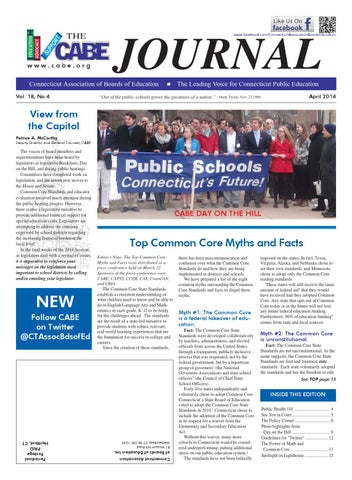
CABE DAY ON THE HILL
81 Wolcott Hill Road Wethersfield, CT 06109-1242
The voices of board members and superintendents have been heard by legislators at legislative breakfasts, Day on the Hill, and during public hearings. Committees have completed work on legislation, and the action now moves to the House and Senate. Common Core Standards and educator evaluation received much attention during the public hearing process. However, there is also a legislative initiative to provide additional financial support for special education costs. Legislators are attempting to address the concerns expressed by school districts regarding the increasing financial burden at the local level. In the final weeks of the 2014 Session, as legislators deal with a myriad of issues, it is imperative to reinforce your messages on the legislation most important to school districts by calling and/or emailing your legislator.
there has been miscommunication and confusion over what the Common Core Standards do and how they are being implemented in districts and schools. We have prepared a list of the eight common myths surrounding the Common Core Standards and facts to dispel those myths.
Myth #1: The Common Core is a federal takeover of education. Fact: The Common Core State Standards were developed collaboratively by teachers, administrators, and elected officials from across the United States through a transparent, publicly inclusive process that was originated, not by the federal government, but by a bipartisan group of governors1 (the National Governors Association) and state school officers2 (the Council of Chief State School Officers). Forty-five states independently and voluntarily chose to adopt Common Core. Connecticut’s State Board of Education voted to adopt the Common Core State Standards in 2010.3 Connecticut chose to include the adoption of the Common Core in its request for a waiver from the Elementary and Secondary Education Act. Without this waiver, many more schools in Connecticut would be considered underperforming, putting additional stress on our public education system.4 The standards have not been federally
imposed on the states. In fact, Texas, Virginia, Alaska, and Nebraska chose to set their own standards, and Minnesota chose to adopt only the Common Core reading standards. These states will still receive the same amount of federal aid5 that they would have received had they adopted Common Core. Any state that opts out of Common Core today or in the future will not lose any future federal education funding. Furthermore, 90% of education funding6 comes from state and local sources.
Myth #2: The Common Core is unconstitutional. Fact: The Common Core State Standards are not unconstitutional. As the name suggests, the Common Core State Standards are first and foremost state standards. Each state voluntarily adopted the standards and has the freedom to edit See TOP page 13
INSIDE THIS EDITION Public Health 101 ................................ 4 See You in Court .................................. 5 The Policy Corner ............................... 6 Photo highlights from Day on the Hill .................................. 8 Guidelines for “Twitter� .................... 12 The Power of Math and Common Core ................................. 13 Spotlight on Lighthouse ..................... 15
Periodical Postage PAID Hartford, CT
2
The Journal – Connecticut Association of Boards of Education/April
2014
PRESIDENT COMMENTARY
Common Core State Standards Journey This month I thought I would write about my journey with The Common Core State Standards (CCSS). Thanks to NSBA and CABE sponsored seminars and workshops I began learning about the CCSS in 2008-09. My initial impressions were not necessarily positive. I was concerned about the political implications of the involvement of the National Governors Association, as well as the increasing influence of for profit corporations, many of whom are members of the Education Industry Investment Forum. My concern also extended to Foundations such as the Gates, Broad, and the Walton Family Foundations and their increasing, behind the scenes, influence on public education. I also was not happy about the lack of discussion and debate about the Standards impending implementation by State Boards of Education around the country. I also wondered if we would lose whatever cultural education we still teach to more of an education based on job skills knowledge. I still believe our primary charge is to produce good citizens. While some of my concerns still exist, the more I learned about the Standards the more I began to understand the benefits for Connecticut’s children and in fact all of America’s public school children. I also began to learn about the Common Core’s potential to give students the knowledge and skills they will need to succeed by building on the strengths and lessons of the old state standards, not abolishing them. It is expected that the great numbers of students needing remedial work when they enter college will decrease dramatically. The Standards are expected to improve students’ ability to communicate, collaborate, solve problems with critical thinking skills, and to be self-directed. The Common Core State Standards also ask students to demonstrate a conceptual understanding of the content. The ELA/Literacy standards look to have a balance of literature and informational text for kindergarten through 5th grade. For 6th through 12th grades the standards aim for greater literacy in science, social studies, and history. In other words, all teachers will be teachers of reading and writing. I love what Doug Reeves wrote a couple of years ago, “Teachers must be engaged intellectually so they are not just delivering material to students, but adding creativity, energy, and challenge to lessons based on the Common Core”. He goes on to say, “the most competitive districts will be those that use the Common Core as a floor, not a ceiling”. I still have concerns about the growing influence of the large foundations and the Education Industry Association on the overall direction of public education in this Country. I have no doubt that having higher standards and higher expectations for all children in our public schools is the right path. Too many of our
Mission: To assist local and regional boards of education in providing high quality education for all Connecticut children through effective leadership.
children are not career -and collegeready, as evidenced by the high remediation rates at institutions of higher learning. Thank you to CABE for providing board members numerous opportuRichard Murray nities to learn about and understand the Common Core State Standards and the implications of the Standards for local districts and the children we are elected to serve and educate.
CABE welcomes new staff member! Please join us in welcoming Denise Roberts as our new Administrative Assistant for Membership Services. Since graduating college in December of 2012, Denise has devoted much time pursuing her desire to start a career in the nonprofit field. After a few years of interning and volunteering at Denise Roberts various nonprofits in Connecticut she is excited to share her experiences and grow as a CABE staff member. When you are in the CABE office, please feel free to stop by, say ‘hello’ and introduce yourself to Denise.
Vision: CABE is passionate about strengthening public education through high-performing, transformative local school board/superintendent leadership teams that inspire success for each child.
CABE Board of Directors EXECUTIVE COMMITTEE Richard Murray .................................................. President, Killingly Ann Gruenberg ................................. First Vice President, Hampton Robert Mitchell ................ VP for Government Relations, Montville Elaine Whitney ........... VP for Professional Development, Westport John Prins ......................................... Secretary/Treasurer, Branford Lydia Tedone ............................................ Immediate Past President Donald Harris ........................................................ Member at Large
AREA DIRECTORS Susan Hoffnagle ............................. Area 1 Co-Director, Winchester Mari-Ellen (Mimi) Valyo ............... Area 1 Co-Director, Winchester Daniel Gentile ................................... Area 1 Co-Director, Plymouth Jeffrey Currey ............................. Area 2 Co-Director, East Hartford Susan Karp ................................... Area 2 Co-Director, Glastonbury Donald Harris ................................. Area 2 Co-Director, Bloomfield Laura Bush ................................................. Area 3 Director, Vernon Douglas Smith .................................. Area 4 Co-Director, Plainfield Andrea Veilleux ................................ Area 6 Co-Director, Stratford Elaine Whitney .................................. Area 6 Co-Director, Westport Roxane McKay ............................. Area 7 Co-Director, Wallingford John Prins ......................................... Area 7 Co-Director, Branford Lon Seidman ........................................... Area 8 Co-Director, Essex Michael Camilleri ............................ Area 8 Co-Director, Cromwell Aaron Daniels ........................................... Area 9 Director, Norwich
ASSOCIATES Eileen Baker .............................................. Associate, Old Saybrook Sharon Beloin-Saavedra .............................. Associate, New Britain Gary Brochu .......................................................... Associate, Berlin Robert Guthrie .............................................. Associate, West Haven Robert Trefry ........... Associate, CT Technical High School System COMMITTEE CHAIRS Elizabeth Brown ......................... Chair, State Relations, Waterbury Donald Harris ......................... Chair, Federal Relations, Bloomfield Becky Tyrrell ...................................... Chair, Resolutions, Plainville
CITY REPRESENTATIVES Jacqueline Kelleher ....................... City Representative, Bridgeport Matthew Poland ................................ City Representative, Hartford Carlos Torre .................................. City Representative, New Haven Polly Rauh ........................................ City Representative, Stamford Charles Stango ............................... City Representative, Waterbury
People in the News Donald Harris, Bloomfield Board of Education member and CABE Area 2 Co-Director and Elizabeth Brown, Waterbury Board of Education member and CABE State Relations Chair, Donald Harris have both been appointed to the Governor’s Common Core Task Force. Elizabeth Brown
2014 Graduating Class of the CABE Leadership Institute. Graduates were: l. to r. Kristin Campanelli (Berlin), Cynthia Kobus (Berlin), Tyron Harris (East Hartford), Jeffrey Currey (East Hartford), Donald Harris (Bloomfield) a two-time graduate, and Christopher Daur (Hamden). Not pictured but part of the graduating class was Beth Campbell (Thomaston).
STAFF Robert Rader ....................................................................... Executive Director Patrice McCarthy .................................. Deputy Director and General Counsel Bonnie Carney ............................................ Sr. Staff Associate for Publications Nicholas Caruso ............................................ Sr. Staff Assoc. for Field Service and Coord. of Technology Sheila McKay ............................. Sr. Staff Associate for Government Relations Kelly Moyher ......................................................................... Sr. Staff Attorney Vincent Mustaro ..................................... Sr. Staff Associate for Policy Service Lisa Steimer .............................. Sr. Staff Assoc. for Professional Development Teresa Costa .................................. Coordinator of Finance and Administration Pamela Brooks ......................... Sr. Admin. Assoc. for Policy Ser. /Search Ser. Terry DeMars ............................................... Admin. Assoc. for Policy Service Gail Heath ........................................ Admin. Assoc. for Government Relations Wilmarie Newton ........................................ Admin. Assoc. for Labor Relations Denise Roberts .................................... Admin. Asst. for Membership Services Corliss Ucci .................................. Receptionist/Asst. to the Executive Director
The CABE Journal (ISSN 1092-1818) is published monthly except a combined issue for July/August as a member service of the Connecticut Association of Boards of Education, 81 Wolcott Hill Road, Wethersfield, CT 06109, (860) 571-7446. CABE membership dues include $30 per person for each individual who receives The CABE Journal. The subscription rate for nonmembers is $75. Association membership dues include a subscription for each board member, superintendent, assistant superintendent and business manager. The companies and advertisements found in The CABE Journal are not necessarily endorsed by CABE. “Periodicals Postage Paid at Hartford, CT.” POSTMASTER: Send address changes to The CABE Journal, CABE, 81 Wolcott Hill Road, Wethersfield, CT 06109-1242. Email: bcarney@cabe.org. Members can find the CABE Journal online at: www.cabe.org/ userlogin.cfm?pp=84&userrequest=true&keyrequest=false& userpage=84
The Journal – Connecticut Association of Boards of Education/April
3
2014
EXECUTIVE DIRECTOR COMMENTARY
CABE Affiliate Members
Silent Cal and What Our Children Need Today
BUSINESS AFFILIATES DIAMOND MEMBER Finalsite GOLD MEMBERS
Advanced Corporate Networking dba. Digital BackOffice Berchem, Moses & Devlin Centris Group Guidance Counselors for Senior Teachers Pullman & Comley Shipman & Goodwin Siegel, O'Connor, O’Donnell & Beck, P.C SILVER MEMBERS Anthem Blue Cross and Blue Shield Corporate Cost Control Milliman, Inc. Milone & MacBroom, Inc. Quisenberry Arcari Architects The Segal Company
BRONZE PLUS MEMBERS Brown & Brown Insurance Friar Associates Goldstein & Peck, P.C. Guidepost Solutions, LLC Lindburg & Ripple Milliman, Inc. O & G Industries The S/L/A/M Collaborative Trane UltiPlay Parks & Playbrounds Whitsons School Nutrition
BRONZE MEMBERS Chinni & Meuser LLC Dattco Inc. Fuller & D’Angelo Architects and Planners Kainen, Escalera & McHale, P.C. The Lexington Group Muschell & Simoncelli Ovations Benefits Group
EDUCATIONAL AFFILIATES American School for the Deaf Area Cooperative Educational Services Capitol Region Education Council The College Board Connecticut Association of School Business Officials Connecticut Center for School Change Connecticut School Buildings and Grounds Association Cooperative Educational Services EASTCONN EDUCATION CONNECTION LEARN Unified School District #1
Last September my wife, Megan, and I took a trip with our history-loving friends to the birthplace of Calvin Coolidge, our 30th president. We try to make at least one trip a year—our friends want to visit the birthplace of all of our presidents. And, we’re glad to join them. So, we went up to the beautiful state of Vermont to the town of Plymouth Notch, where Coolidge was born, sworn in as president because of the sudden collapse and death of Warren Harding and is the site of his grave. What struck us all was how in this little town, all of the necessities of life were within a quick 5 minute walk: his home, his father’s store, the one-room school, cheese factory and the blacksmith. While Coolidge was president from 1923-29, the era of the Roaring Twenties and the beginnings of the Great Depression, he is rarely discussed among the giants of the early 20th Century. This was probably because he was, to quote from his National Parks Service, “[f]amous for his honesty, thrift and taciturnity… ‘Silent Cal restored confidence in government after the Harding scandals and symbolized stability during a period of rapid, disorienting social change.” The whole Calvin Coolidge Homestead District is 130 acres in size. It epitomizes late 18th Century New England. It is not hard to imagine this future president growing up with the Yankee traits of hard work, self-reliance and a firm belief in the common man.
Persistance One of the quotes attributed to this lawyer, who also served at various times in the legislatures of both Vermont and Massachusetts, is that pictured on this page. I was particularly interested in two parts of it. The first was that, “Nothing in the world can take the place of PERSISTANCE… education will not; the world is full of educated derelicts” Looking at this 82 years later, it seems to me that while persistence is a trait that our children must learn as part of their 21st Century skills, it is not an answer to
the ills of mankind by itself. It needs to be matched by talent and education; without these, persistence runs into Einstein’s much-quoted maxim: insanity is “doing the same thing over and over again and expecting different results”. While I would not have used the words “derelict” or “full of”, there is no question that the world has lots of individuals who do not apply what they have learned. Making that connection between learning and he relevancy of what has been learned has always been a concern of public education. How can we ensure that the things we teach today are relevant to the world of tomorrow—a world where we cannot even imagine the jobs that will exist? In the ultra-competitive world our children will inhabit, it is more important than ever to think about this issue. I believe that the Common Core is aimed at bridging the divide between what is learned and how to apply it. I looked at the comparisons that SDE disseminated showing the differences between CMTs and CAPT and what will be required under SBAC. I could remember how to do some of the work from my high school days, but when I got to the SBAC and had to apply this knowledge, it was much more difficult.
What Children Need I think that’s what children need: a better focus on how to use the rules they’ve learned and creatively apply them to solve real problems. It is not just a question of memorization of rules, though that is sometimes helpful in spelling and in math. It is also about seeing how the rules work in the real world. And, that is an area in which we might have been effective. Silent Cal’s second statement that I question is whether “‘Press On’ has solved and always will solve the problems of the human race.” In today’s world, even in our nation and State, children are born into different strata of society and have different opportunities, not only to learn, but also to apply their learning to the workplace and their lives in general. Pressing on without the appropriate education in this still-difficult economic situation is a recipe for both frustration and unhappiness. The fact that our unemployment rates have gone down is attributable, in part, to those who have just given up.
Robert Rader
That does not mean that giving up is a solution that anyone would favor, but I believe our schools have an obligation to help prepare students so that they have the necessary skills to find quality jobs. It is one of many responsibilities. Higher standards, increased graduation rates and better preparation for work, college and the responsibilities of being a good citizen of our towns, communities, states and the nation are the keys to a good future to the children of our State and our nation. While Common Core may not be the whole answer, making education more relevant to what our children will need is always a good start. If implemented properly, it also will make learning more relevant, and children – no matter what their background or personal motivation—learn better when they are learning something they see as important. Cowboy/comedian/philosopher Will Rogers is reported to have said that “as president, Calvin Coolidge didn’t do much of anything but at the time, that’s what we needed to have done.” Today, we must do more. Let’s work together to ensure that our children have persistence, education and the knowledge and wisdom of how to apply them all.
4
The Journal – Connecticut Association of Boards of Education/April
2014
Public Health 101: Capstones with a Social Conscience Cindi Billian Stern Billian Stern Consulting, LLC for CT Public Health Association Mentoring Organization Registry
In the fall of 2012, Chris Willems of New Haven’s Metropolitan Business Academy, became the first teacher to teach Public Health 101: From Disease Prevention to Disaster Preparedness, a course designed for high school students. The high interest content, including topics like teen pregnancy and water scarcity, and its “blended” format, emphasizing online and experiential learning, appealed to Mr. Willems. When interviewed last spring, he was upbeat about the course, noting, “Students really enjoy digging deep into these topics …like the EPA plastic ban in Connecticut. They like … getting involved in by first learning science behind the [plastic] ban and then how to use the legislative process to deal with it.” Public Health courses are catching on in Connecticut and winning national praises. Newtown High School adopted the course in 2013, and in 2014, the U.S. News and World Report’s Annual Edition on Best Colleges named Public Health as a “… top degree that leads to a job.” Connecticut’s high school version of the course helps prepare students for the undergraduate degree, which is leading to better job opportunities.
What is Public Health 101 for high schools? Public Health 101 was developed for Education Connection by a team of public health professionals and digital learning experts. Each of the eight units below prepares students for careers and volunteerism in public health, while raising their awareness of the connection between their personal health behaviors and the community’s health with opportunities for experiential learning and capstones. • Unit 1: Protect, Prevent, Live Well: What is Public Health? • Unit 2: Looking for Answers in all the Right Places: Public Health Research • Unit 3: Got to Get a Message to you: Health Communication • Unit 4: Risky Business: Social and Behavioral Health • Unit 5: Catch Me If You Can: Disease Prevention
NOW Available from CABE!
Understanding the Connecticut Freedom of Information Act and Access to Public Meetings and Records Fourth Edition Written by: Mark J. Sommaruga, Esq. Pullman & Comley, LLC to order the FOIA book go to the CABE Online Bookstore at www.cabe.org/page.cfm?p=749
and Control • Unit 6: In a Not So Perfect World: Global Public Health • Unit 7: Every Breath you take: Environmental Health and Public Health Preparedness • Unit 8: Think Globally, Act Locally: Emerging Issues in Public Health and Careers that Address Them A key component of the course is a cadre of talented public health professionals with degrees (Masters in Public Health) that few high school educators hold. The state’s two public heath 101 teachers, Mr. Willems, and Susan McConnell of Newtown High, continue to be supported by classroom mentors from The Connecticut Public Health Association’s Mentoring Organization Registry (CPHA MOR). CPHA is the state affiliate of the American Public Health Association. CPHA board members started the Mentoring Organization Registry (MOR) with seven public health organizations that agreed to lend staff to schools to grow the future workforce. Today there are 34 MOR members including the American Cancer Society, Yale School of Public Health, University of Connecticut and Southern Connecticut State University MPH programs, the CT Department of Public Health, and 11 local and regional health departments. They provide experiential learning for teachers and students in all eight counties. MOR member and health communications consultant from Yale, Linda Bergonzi-King, worked with Newtown’s Public Health 101 teacher, Susan McConnell, who immersed her students in a challenging
CABE Search Services is recruiting for
Southington Public Schools Superintendent of Schools 6,500 PK-12 Students
Windham Public Schools Superintendent of Schools 3,200 PK-12 Students
Newtown High School Principal 1,716 Students in Grades 9-12 For an update or more information on vacancies go to our website:
www.cabe.org
project just weeks into the course, the World Health Organization’s Hand Washing video contest. BergonziKing volunteered to guide the teacher and class in this early project, being careful to allow the students to create the message and the video. Students began by researching the extent of disease caused by poor hand washing, then imbedded written facts into the video. They demonstrated cultural consciousness by counting to 20 in different languages while washing their hands. Public Health Wash Your Hands won them first place in their age group in this international contest. Susan McConnell has been impressed with student gains, noting, “…their cultural awareness has really been heightened because of this class and they have learned …that they CAN make a difference.” April 7-13, 2014 National Public Health Week is a time when the MOR makes a special effort to engage Connecticut schools in public health activities. Our goal is to reach 1,000 students through guest speakers at high schools and our Day at the Capitol, where students learn about key issues from experts in public and environmental health and about the process of advocacy. The CPHA MOR has provided educators and students from over 70 CT schools with presenters, online materials and workshops on integrating public health into established courses such as biology, sociology, health and environmental sciences. For internship manuals, resources and information visit CPHA MOR or contact Cyndi.Billianstern@cpha. info or Pamela.Kilbey-fox@cpha.info
What will the Connecticut Online Policy Service (C.O.P.S.) provide YOUR district? • A policy manual updated within days of a board meeting. • Access to your policy manual 24/7 anywhere with Internet capability. • Ti m e s a v i n g links to legal and cross references. • A search engine specifically designed for board policy manuals. • The ability to search other online districts for similar policies or language. • A happier staff that will have less paper to deal with.
For more information contact, CABE Search Services, 860-539-7594 Jacqueline V. Jacoby, Senior Search Consultant Paul Gagliarducci • Associate Consultant Mary Broderick - Associate Consultant Bob King • Associate Consultant
If you would like additional information on CABE’s Connecticut Online Policy Service (C.O.P.S.), call Vincent Mustaro at 860-571-7446 or email vmustaro@cabe.org for full details.
P.O. Box 290252, Wethersfield, CT 06129-0252 www.cabe.org/support Equal Opportunity Employers
Let the CABE staff make your policy life easier.
The Journal – Connecticut Association of Boards of Education/April 2014
5
See You in Court – The Nutmeg Board of Education
The Nutmeg Boards Deals with a grievance filed by Tom Teacher Thomas B. Mooney, Esq. Shipman & Goodwin
The Nutmeg Board of Education makes many mistakes. The latest imbroglio created by the board will be reported here each issue, followed by an explanation of what the board should have done. Though not intended as legal advice, these situations may help board members avoid common problems. On the rare evenings that he is not out on Board business, Bob Bombast, veteran member of the Nutmeg Board of Education, keeps a close eye on his 1,000 Facebook friends. Bob was surprised one evening to read on Tom Teacher’s Facebook page that his principal had denied his request for personal leave to serve as a chaperone in a neighboring school district for his fifth-grade son’s trip to Nature’s Classroom. On his “wall,” Tom snidely questioned Mr. Principal’s competence, and he vowed to file a grievance to get “justice,” i.e. three days off with pay. Bob was intrigued. Bob called Tom right up at home, “Tom, I was surprised to read your posts about your request for personal leave.
Have you filed your grievance yet?” Tom was pleased to hear from a Board member, and he unloaded on Bob with vitriol about Peter Principal’s mismanagement. He explained that other teachers were being granted leave for all sorts of things, but when he asked for three days of personal leave, Mr. Principal slammed the lid of the cookie jar down on his fingers. Bob wasn’t so sure that Tom’s analogy was apt, but he did question Mr. Principal’s decision. He was especially moved when Tom told him that he was recently divorced, and his doing Nature’s Classroom with his son would be a great way for the two to bond. At the end of the call, Bob assured Tom that he would get a full and fair hearing from the Board. Sure enough, the next day Mr. Superintendent notified the members of the Nutmeg Board of Education through confidential memorandum of the grievance hearing concerning Tom Teacher. There, Mr. Superintendent described the facts underlying the grievance, and he told the Board members that Tom had rejected his offer at Level Two to let Tom take the time off without pay.
Seventh Edition
A Practical Guide to Connecticut School Law by Thomas B. Mooney, Esq. Shipman & Goodwin
The Guide comes with a CD which provides hyperlinks to many cases and statutes and will permit word searches as a supplement to the Index. New to the Seventh Edition: Bullying, Background Checks, Child Abuse Reporting, Discrimination Issues, Educational Reform, FERPA, Freedom of Information, State Aid for Education and much, much more The 7th edition is now available from CABE. Call and order your copy TODAY at 860.571.7446 or 800.317.0033
The hearing itself was uneventful. grievance hearings like court proceedings. Tom sat quietly, wearing a tie for the first Some even exclude the superintendent time in years, as Bruno, staff representa(and his/her lawyer, if any) during their tive for the Nutmeg Union of Teachers, deliberations. Boards should never do argued that Mr. Superintendent had that. violated the contract by arbitrarily and The superintendent acts in collective capriciously denying Tom his contractual bargaining matters as the agent of the right to personal leave “for matters that board of education, and the board has cannot be scheduled with reasonable every right to talk to its agent, especially conveif it is nience consider“. . . boards of education must act as ing outside the work day.” impartial judges when making deci- reversing “I ask or you!” sions on eligibility for school privi- modifyBruno ing action thundered. leges (residency cases) or making the “How superindecisions in nonrenewal or termina- tendent could Tom reschedule tion hearings concerning teachers.” previNature’s ously Classtook. room? Tom has the right to personal Clear communication with the superintenleave. Period. I rest my case!” dent is also important because grievance After Tom and Bruno left the room, decisions set precedent for interpreting the Board began to deliberate. Bob the contract. started right in on Mr. Superintendent . . . Here, for example, a decision in favor “How could you do that to poor Tom? of Tom here would make it between He and his son are hurting from the recent difficult and impossible for administrators divorce, and he should be able to be a to deny future requests for personal leave. chaperone for Nature’s Classroom!” Therefore, boards of education have the Fellow Board member Mal Content right and responsibility to consult with raised an eyebrow. “Bob, how did you their superintendent and other administraknow about Tom’s divorce? I didn’t hear tors before making grievance decisions. anything about that at the hearing!” In any event, it is clear that Bob Bob shrugged his shoulders. “I may overstepped here. The superintendent is have talked to Tom a little, but so what?” responsible for administering the contract. Mal jumped on that. “Mr. ChairperBoard members should let the superintenson, it is obvious that Bob is biased and dent do his or her job, and they should not should not participate in this grievance talk privately with teachers about grievhearing. I move that Bob not be allowed ances that the Board will be hearing. to participate in this grievance hearing.” Bob’s secret conversation with Tom Should Bob recuse himself? Can he may have encouraged Tom to hang tough participate despite his talking to Tom? and to reject Mr. Superintendent’s offer at Level Two to permit him to take unpaid Bob’s actions were certainly over the days to serve as a chaperone for Nature’s top, but there is no legal basis for excludClassroom. ing him from the hearing. Grievance hearings also raise issues Sometimes board members must be under the Freedom of Information Act. impartial. For example, when board The grievance itself is a record subject to members hear student disciplinary public disclosure. matters, the affected students have a due However, grievance responses are not process right to have an impartial decipublic until the grievance is resolved, sion-maker. because interim responses are considered Similarly, boards of education must act collective bargaining strategy. as impartial judges when making deciSimilarly, a grievance hearing is a sions on eligibility for school privileges public meeting. A Board-level grievance (residency cases) or making decisions in hearing should be posted, and the hearing nonrenewal or termination hearings can be held in executive session only if concerning teachers. there is an applicable executive session In each of these cases, as a matter of privilege, such as discussion of a due process, board members must decide teacher’s employment (provided that the the case independently of the superintenteacher does not require that the discusdent, and they must decide the matter sion be held in open session). impartially based on the evidence However, once the hearing is over the presented at the hearing. Board may adjourn its public meeting, but By contrast, grievance hearings are an continue to talk about how to resolve the extension of the collective bargaining grievance. Such deliberations are process. Due process and good faith collective bargaining strategy discussions bargaining are two very different conthat the Board can conduct privately. cepts, and when hearing grievances, Attorney Thomas B. Mooney is a partboards of education need not act as ner in the Hartford law firm of Shipman & impartial judges. Goodwin who works frequently with Some boards of education do not boards of education. Mooney is a regular understand this fact, and they conduct contributor to the CABE Journal.
6
The Journal – Connecticut Association of Boards of Education/April
CABEMeeting
The Policy Corner Vincent A. Mustaro, Senior Staff Associate for Policy Service, CABE
Policy Direction Needed to Improve Civility
CABE-Meeting is a userfriendly, web-based service specifically designed to assist the board, superintendent and central office staff in preparing for and running board of education meetings.
The topic of civility has gained notoriety at the present time, partially due to highly publicized news stories about related issues such as bullying, workplace violence and harassment, contentious political campaigns and the actions of governmental organizations. The media and popular culture seem to exemplify the angry argument as the mode of communication.
An exciting feature designed for use by committees, in addtion to boards of education, was recently added to CABEMeeting. Now all your board work and committee information is conveniently located in one place!
Boards of education and school districts are bucking the increasingly common “in-your-face” model of dealing with conflict. These days, more people at public meetings are displaying more aggressive behavior than in the past. The problem appears to be getting worse. Recent studies indicated that incivility is a major problem in America today and an increase in the growth of incivility at work. Incivility of some kind in school districts has become more common. Civility can be defined simply as civilized conduct; especially courtesy, politeness, or simply a polite act or expression. It may also be defined as the extent to which individuals speak and act in ways that demonstrate a caring for the welfare of others, as well as the welfare of the culture they share in common. Therefore, civility can be associated with qualities that are valued as the virtues and manners of individuals which include tolerance, self-restraint, mutual respect, commitment to other people, social concern, involvement and responsibility. It also relates to professionalism, ethics, leadership, compassion, empathy, civicness, etiquette and decorum. In short, civility can be seen as an expansive term open to subjective interpretation. Within the setting of a school system, incivility can be defined as any self-centered behavior that is impolite, boorish or shows a disregard to the rights of others, whether they be students, staff, parents or community members. It has been also referred to as bullying, emotional abuse or mobbing. Uncivil conduct includes, but is not limited to, the following: • directing vulgar, obscene or profane gestures or words at another individual; • taunting, jeering, inciting others to taunt or jeer at an individual; • raising one’s voice at another
“CABE meeting has been a terrific investment for the Region #18 Schools. We have saved money by eliminating the need for paper packets as well as the cost of mailing those packets. As an added benefit, we now have the ability to allow board members to follow along in “real time” with our monthly education presentations. This tool is a must have in today’s digital world.” Ian Neviaser Superintendent, Region 18 Public Schools
For more information, or to schedule a demonstration for your board, call Lisa Steimer at 800-317-0033 or 860-571-7446 or email lsteimer@cabe.org
2014
School Boards
individual, repeatedly interrupting another individual who is speaking at an appropriate time and place; • imposing personal demands at times or in settings where they conflict with assigned duties and cannot be reasonably met; • using personal epithets, gesturing in a manner that puts another in fear for his/her personal safety; • invading the personal space of an individual after being directed to move away, physically blocking an individual’s exit from a room or location; • remaining in a classroom or school area after a teacher or administrator in authority has directed one to leave; • violating the privacy of another individual’s belongings (except for lawful searches conducted by school officials); or • other similar disruptive conduct. Uncivil conduct does not include the expression of controversial or differing viewpoints that may be offensive to some persons, provided (1) the ideas are presented in a respectful manner and at a time and place that are appropriate, and (2) such expression does not materially disrupt, and may not be reasonably anticipated to disrupt, the educational and/or meeting process. Such differing viewpoints are permitted within the freedom of expression guaranteed by the First Amendment.
School Districts School systems need to care about encouraging civility in district schools and in the manner in which those within the educational community interact with each other. Incivility impacts organizational integrity, employee satisfaction, and student outcomes. Incivility has the potential to influence all aspects of the school campus, including satisfaction and productivity among board of education members, faculty, staff and students. Numerous studies have reviewed the effects of incivility on worker satisfaction, organizational integrity, and productivity. Incivility can be linked to decreased job performance and satisfaction. A safe, civil environment is essential to high board, student and staff achievement, to the free exchange of ideas central to a quality educational process, and to the development of youth as thoughtful participants in our democracy. Conversely, uncivil conduct, like other forms of disruptive behavior, interferes
“. . . . Be civil to all, sociable to many, familiar with few, friend to one, enemy to none.” - Benjamin Franklin with a board’s ability to fulfill its appropriate leadership role and with a student’s ability to learn and a school’s ability to educate its students. Clear expectations of civil conduct and problem-solving must be maintained throughout the school district. The board of education should set an example in its deliberations at its meetings and refuse to condone uncivil conduct at board meetings, on school grounds or at school-sponsored activities, whether by board members, staff, students, parents, volunteers or other visitors to the district. Civility codes codified in board bylaws and policies provide ground rules for communication among board members, teachers, parents and students. Benjamin Franklin stated, “Be civil to all, sociable to many, familiar with few, friend to one, enemy to none.”
Board Policies Policies pertaining to the issue of civility can provide direction for board of education actions, students and for community-school district interactions. Boards members in particular, should model civil thoughtful behavior. The purposes of such policies are to promote a work and learning environment that is safe, productive and nurturing for all board members, staff and students, which encourage the free flow of ideas without fear or intimidation. Students are provided with appropriate models for respectful problemsolving by such policies. Such policies can also reduce the potential triggers for violent conduct, such as fear, anger, frustration and alienation. New policies pertaining to the topic of civility have been developed. These include bylaw #9273, “Civility Code” (Board of Education Bylaw), policy #1316.2,”Civility” (Community Relations) and policy #5145.53,” Civility” (Students). Policy #1316, “Conduct on School Property” also pertains to this topic. These are all available from CABE’s Policy Department upon request.
The Journal – Connecticut Association of Boards of Education/April
2014
“. . . . Be civil to all, sociable to many, familiar with few, friend to one, enemy to none.” - Benjamin Franklin
The art of making people smile. Delta Dental knows what it takes to keep you and your employees happy. At Delta Dental, we can help you create a dental plan that’s sure to paint a smile on your employees faces: • Expertise. We’re part of the most experienced dental benefits company in the country. • Flexibility. We can help you design a plan that meets your needs and budget—without compromising on value. • Network of Dentists. We offer access to the largest network of dentists in the U.S.— with 4 out of 5 dentists participating nationwide. • Simplicity. You can count on us for easy plan administration. • Customer Satisfaction. Add it all up: the largest network, unbeatable expertise, flexibility, value and cost savings, and it’s easy to see why Delta Dental is your best choice. Delta Dental. We’re committed to promoting oral health for all your employees. Call 1-860-633-9200 or visit www.deltadentalct.com. In CT, Delta Dental Insurance Company writes dental coverage on an insured basis and Delta Dental of New Jersey administers self-funded dental benefit programs.
7
8
The Journal – Connecticut Association of Boards of Education/April
2014
Highlights from
CABE’s Day on the Hill
CABE Executive Director Robert Rader welcomed everyone to CABE’s Day on the Hill.
Governor Dannel Malloy addressed the group and then took questions from the audience.
CABE Vice President for Government Relations Robert Mitchell encouraged participants to get more involved in CABE.
CABE President Richard Murray (Killingly), Patrice McCarthy, Deputy Director and General Counsel and Sheila McKay, Senior Staff Associate for Government Relations, discussed legislation that is of interest to school boards.
Senator Beth Bye (Co-Chair, Appropriations Committee) talked about some of the legislation that is before the Appropriations Committee and encouraged students and board members to become involved in legislation before the Committee.
Representative Andy Fleischmann (Co-Chair Education Committee) discussed some of the legislation that is before the Education Committee. He also took questions from audience members.
Representative Toni Boucher talked about some of the bills being considered by the Education Committee. She also took questions from the audience.
CABE’s Day on the Hill
Alliance Districts Meeting
CABE’s Day on the Hill held at the Bushnell in Hartford was attended by school board members, superintendents, students along with their teachers, as well as other education leaders.
Alliance districts meet in the afternoon of CABE’s Day on the Hill. Morgan Barth, State Department of Education, met with the group for a discussion of issues and concerns.
9
The Journal – Connecticut Association of Boards of Education/April 2014
Highlights from
CABE’s Day on the Hill Student Participation
Students, advisor, and Superintendent Kevin Case from the Canton Public Schools. Students and Leah Clark from the Academy of Aerospace and Engineering, CREC.
Students, Jennifer Kordek (teacher) and CABE Secretary/Treasurer John Prins from the Branford Public Schools.
Student, John Burns, board member and Superintendent Kevin Farr from the Killingly Public Schools.
Students and Susan Rosenstein (teacher) from the East Granby Public Schools.
CABE Vice President for Government Relations Robert Mitchell (Montville) and student.
Students and advisor from the Granby Public Schools.
CABE Area 4 Director Doug Smith (Plainfield) accompanied students at Day on the Hill.
CABE Immediate Past President Lydia Tedone (Simsbury) accompanied students to Day on the Hill.
Students and advisor from the Stratford Public Schools.
Students and board members from Plainville Public Schools.
Students and Paul Coppola (teacher) from the Madison Public Schools.
CABE City Representative Charles Stango (Waterbury) with students and teachers William Rice and Linda Riddick Baron at CABE’s Day on the Hill.
10
The Journal – Connecticut Association of Boards of Education/April
2014
CABE’s Day on the Hill Student Participation Students gather around for a lively discussion of issues that are important to them.
Governor Malloy shakes hands with students at CABE’s Day on the Hill.
A student from Madison asks a question during the session at the Bushnell.
A small group discussion after the session with CABE President Richard Murray, Immediate Past President Lydia Tedone and students from the CREC Academy of Aerospace and Engineering. Student session was held in the afternoon of CABE’s Day on the Hill. l. to r., Lydia Tedone (Simsbury), Representative Noreen Kokoroda, Representative Brian Sears, and a student from Simsbury.
The Journal – Connecticut Association of Boards of Education/April
11
2014
CABE: working for YOU Individualized Workshops • Professional Development Opportunities Legal Services • Policy Services • Representing You Statewide and Nationally Below are the highlights of activities that the CABE staff has undertaken on your behalf over the last month. We did this:
•
➤ By promoting
public education:
• • •
•
Attended Hartford Area Legislative Breakfast. Attended legal seminar presented by Shipman & Goodwin. Answered questions about the current legal issues facing boards of education. “HOT” topics this month were: School security, reasons for executive session, agenda/motion specificity, board vacancy, and nepotism. Discussed the role of boards of education and legislative issues with Central Connecticut State University superintendent preparation and University of New Haven teacher preparation classes.
• •
• • •
• •
➤ By providing services
•
•
•
to meet members needs:
•
•
Facilitated a workshop on the Superintendent Search process for the Portland Board of Education. Completed, as part of the Custom Update Service packets of new and/or revised policies for Ansonia, New Fairfield, Stafford, Boards of Education. Completed and mailed the third edition of the Policy Update Service publication. The topics covered included time devoted to physical education, electronic reading devices, impact of the Supreme Court decision pertaining to the Defense of Marriage Act, pregnant and parenting students and one-to-one tablet programs.
➤ By representing Connecti-
• •
➤ By ensuring members
receive the most up-to-date communications:
•
•
•
cut school boards on the state or national level:
• •
• •
• •
Attended meetings of the Connecticut Commission for Education Technology. Met with the editorial boards of the Hartford Courant and The New London Day. Participated in meeting of the WhatWillOurChildrenLose Coalition. Hosted and participated in Child Emergency Preparedness Committee meetings. Attended LEAD CT Partners’ meetings. Hosted and facilitated meetings of the CABE/CAPSS Governance Committee, updating and strengthening the
Governance Statement and the Team Assessment document. Co-sponsored and participated in the Parent-Teacher-Community Forum on the Common Core State Standards in Norwich. Hosted Day on the Hill. Met with Big Six (CABE, CAPSS, CAS, CCER, CBIA and ConnCAN) Coalition on various issues of common concern. Spoke at Big Six press conference on Common Core State Standards Attended CAPSS Board of Directors meeting. Participated in Connecticut Society of Association Executives program on Business Development Strategies. Participated in CAPSS International Education Committee meeting. Participated in a preparatory evaluation visit on behalf of the New England Association of Schools and Colleges to the JFK German-American School in Berlin. Participated in the CAPSS Personalized Learning Committee meeting. Participated in the MORE Special Education Task Force meeting. Met with numerous legislators to discuss education issues Participated in NSBA Council of School Attorneys Executive Committee conference call.
•
Met with UConn graduate students on their Capstone Project, concerning obstacles to board member participation in CABE Advocacy opportunities. Attended retirement from Hamden reception for Fran Rabinowitz, now Interim Superintendent in Bridgeport. As part of the development of new policy manuals utilizing the Custom Policy Service, materials were prepared for Griswold, North Haven, Region 12, Stratford, Wethersfield, Woodbridge and Union Boards of Education. Tracking current proposed legislation for policy implications.
➤ By providing opportunities
for members to learn how to better govern their districts:
•
Presented a roles and responsibilities workshops for the Trumbull and Nor-
CABE BUILDS LEADERS! “You don’t need to be in a leadership position to be a leader.” Jill Thompson
•
•
• •
folk Boards of Education. Presented a board evaluation workshop for the Canterbury Board of Education. Met with State Department of Education officials on CABE’s role in providing professional development to School Governance Councils. Facilitated a retreat with the South Windsor Board of Education. Provided policy information to 33 districts, one out-of-state school boards associations, through 44 answered requests for information or sample policies, on 35 topics. Further, districts continue to access CABE’s online Core Policy Reference Manual and/or online manuals posted by CABE for policy samples. The topics of greatest interest pertain to graduation requirements,
volunteers, student dismissal precautions, safety, use of restraint and seclusion and homeschooling.
➤ By helping school boards to
increase student achievement:
• •
•
Held a Lighthouse planning meeting with the Vernon Board of Education. Attended Connecticut Council for Educational Reform (CCER) Best Practices Forum. Sent out two issues of Policy Highlights via email listserv covering topics that affect student achievement. This included food service programs, retention, adult education and GED testing and sex education.
CABE Appointments Editor’s Note: Below are board members and CABE staff who have volunteered to represent school boards on state committees, task forces and other groups dealing with education issues. • Eileen Baker, Old Saybrook, serves on the CT Interscholastic Athletic Conference (CIAC) Board of Directors. • Gary Brochu, Berlin, serves on the CT School Nurse Advisory Council. • Nick Caruso, Sr. Staff Associate for Field Services and Coordinator of Technology, CABE, serves on the CT Commission for Educational Technology. • Ron Goldstein, Colchester, serves on the Red Tape Committee (Mandate Reduction). • Ann Gruenberg, Hampton, serves on a subcommittee of the Performance Evaluation Advisory Committee (PEAC); and Group Mental Health Task Force with DCF. • Joyce Hall, former board member Enfield, serves on the Public-Private Partnership Workgroup in conjunction with the CT Early Childhood Education Cabinet and the new Office of Early Childhood • Donald Harris, Bloomfield, serves on the LEAD CABE/CAPSS Governance Committee, and the Distinguished Educator Work Group. • Cal Heminway, former board member of Granby, serves on the Teacher of the Year Council. • Susan Karp, Glastonbury, serves on the Group Mental Health Task Force with DCF. • David Kennedy, former board member Stratford, serves on the Achievement Gap Task Force. • Patrice McCarthy, Deputy Director and General Counsel, CABE, Perfor-
•
•
•
•
•
mance Evaluation Advisory Committee (PEAC), LEAD CABE/CAPSS Governance Committee, LEAD Partners, Uniform Regional School Calendar Task Force, Capital Region Education Council (CREC) Board of Directors, School Governance Council Advisory Committee, Group Mental Health Task Force with DCF, and Connecticut Coalition for Justice in Education Funding (CCJEF) Steering Committee. Sheila McKay, Sr. Staff Associate for Government Relations, CABE, serves on the CT School Indoor Environment Resource Team. Richard Murray, Killingly, serves on a subcommittee of the Performance Evaluation Advisory Committee (PEAC); LEAD CABE/CAPSS Governance Committee, and represents the Killingly Board of Education on the Connecticut Coalition for Justice in Education Funding Steering Committee. Robert Rader, Executive Director, CABE, serves on the Performance Evaluation Advisory Committee (PEAC), Educator Preparation Advisory Council (EPAC), LEAD CABE/ CAPSS Governance Committee, P-20 Council, LEAD, Partners, Group Mental Health Task Force with DCF, and School Governance Council Advisory Committee. Lydia Tedone, Simsbury, serves on the P-20 Council, Distinguished Educator Work Group and on the Teacher of the Year Selection Committee. Elaine Whitney, Westport, serves on the CT Advisory Commission for Intergovernmental Relations (ACIR); and on a subcommittee of the Performance Evaluation Advisory Committee (PEAC).
12
The Journal – Connecticut Association of Boards of Education/April
CABE Advocacy Efforts
The
CABE Vice President for Government Relations Robert Mitchell (Montville) testifying before the Education Committee.
CREC Legislative Breakfast
Becky Tyrrell (Plainville) talking with Superintendent Kathy Greider (Farmington) at the CREC Legislative Breakfast.
Media Message
from Codie Landsman, Baldwin Media Marketing, LLC CABE and Baldwin Media: Partners in Managing Communications
Testimony
CABE President Richard Murray (Killingly) testified at the Legislative Office Building before the Appropriations Committee.
2014
Guidelines for “Twitter” Social media is an ever-evolving and sometimes useful tool for successfully getting your message across from many different platforms – whether you’re an educator, parent, student, or business. But as with anything new, there often come questions. So where to begin? There are so many different social media outlets and new ones seem to be popping up every day. Most of us have got Facebook down pat – we’re aware of the concept of “likes” and friend requests, sharing posts and tagging other users. But what about Twitter? It seems more people are a bit confused about this one, so I thought I would take the opportunity to share some information. Twitter is a social media tool in which you primarily gauge your reach and effectiveness through “retweets,” “followers,” and “favorites.” Provided are some basic guidelines to get you started with your Twitter account. 1. You send information via “tweets” and these messages can only be 140 characters long, so make sure to get your point across quickly and concisely. 2. Make sure to utilize hashtags! (#ThisIsAHashtag) Hashtags are used before relevant key words to categorize different topics, for example, #Education, #Advocacy,
3.
4.
5.
6. 7.
#Students. But don’t overwhelm your posts with hashtags … This looks tacky and is almost the equivalent of a bad salesperson trying to sell something. One of the most important guidelines to remember is consistency. There is nothing like leaving days or weeks between your posts to ruin your credibility. The most reputable accounts are tweeting multiple times a day. If people follow you, follow them back! Gaining followers also increases your credibility and allows your messages to reach a wider audience. Make sure to follow relevant accounts. If these are large-scale accounts, such as news stations or public figures, make sure that they are verified – you will see a little blue circle with a white check-mark to the right of the username. Oftentimes, they are, but beware of fake accounts. Images, images, images! Just like Facebook, images really grab the user’s attention. Reply to @ messages – which is when someone types @ before your username to tag you. This means they are mentioning you in a post, or trying to connect with you directly. The more you reply, the more
Massachusetts study shows snow days don’t hinder achievement Gayle Simidian Research Analyst
School snow days don’t affect student achievement, according to a Harvard University study. Responding to a request from the Massachusetts Department of Education, Joshua Goodman, an assistant professor of public policy at Harvard’s Kennedy CREC Executive Director Bruce Douglas talks School, tried to isolate the effect of snow with Rep. David Baram and Donald Walsh days on scores on end-of-year state exams (CREC). called Massachusetts Comprehensive Assessment System (MCAS) for grades 3-10. He contacted all Massachusetts school districts by email or phone to get seven years of snow day information, from 2003 to 2010. He noted that closures typically are made up after spring MCAS exams. While school closures don’t affect MCAS Rep. Doug McCrory, CABE Executive Director Robert Rader, CABE scores, Goodman found President Richard Murray (Killingly) and CABE Area 2 Co-Direcmath scores drop when tor Donald Harris (Bloomfield) at Legislative Breakfast.
schools are open during inclement weather and some students are absent. “Closures have no impact,” Goodman reported. “Absences do.” In fact, absences can explain as much as 20 percent of the achievement gap between poor students and non-poor students. “Moderately bad weather impacts absences and achievement,” he found. “Extremely bad weather impacts closures but not achievement.” He hypothesized that districts anticipate and have plans to address learning losses due to snow days, but not student absences. “With slack time in the schedule, the time lost to closure can be regained. Student absences, however, force teachers to expend time getting students on the same page as their classmates.” To view the report, go to http://goo.gl/ EDwQYr. Reprinted with permission from “On Board” published by the New York School Boards Association, February 2014.
engaged you will be. Retweet your information. This is an especially useful tool because it keeps content in its original form, which keeps your message intact. It’s a useful way for your content to travel, and to share tweets created by others. 9. Attach links to relevant content/ articles. 10. Allow and respond to direct messages – these are private messages that do not appear publicly on Twitter. It is good way to have longer conversations if you need to. 11. Don’t be afraid to HAVE FUN!! For example, tweet #HappyMothersDay on the holiday. These kind of hashtags are often trending world-wide… So think of how many people have the potential of seeing your post. You can tweet fun catchphrases like #HappyFriday or #ThrowbackThursday, too. 8.
12. It only gets easier with practice… so start now! Just make sure, as you would with any form of communication, that you check your tweet for content and tone before you send it!
We want to meet your needs! The CABE Journal is now provided both electronically and paper copy via U.S. mail. Please contact Cory Ucci (860-571-7446 or cucci@cabe.org) to let her know which way you prefer to receive the CABE Journal in the future. If you do nothing, you will continue to receive the CABE Journal both electronically and via U.S. mail. Thank you for your cooperation.
The Journal – Connecticut Association of Boards of Education/April
13
2014
The Power of Math and Common Core Patte Barth Director, NSBA Center for Public Education
Educators and parents have long known the importance of early literacy to preschoolers’ later academic success. What they may not know is that their math skills are equally important. A major study shows that young children’s math abilities are far more predictive of their academic achievement throughout their school years than their social or emotional behaviors, neither of which, it turns outs, has much effect on later achievement. Math also has a slight edge on literacy in its long-term influence. The research team, led by Northwest-ern University’s Greg Duncan, analyzed six studies including data for more than 35,000 preschoolers. The team found that knowledge of numbers had the most impact on students’ academic achievement through age 14, followed closely by early reading and language skills. Math-related skills do not just predict later math performance, but reading achievement, too. Moreover, early mastery has a lasting impact. Duncan found that students who struggled with math in elementary school were less likely to graduate from high school and far less likely to attend college later on, by 13 and 29 percentage points, respectively. Mathematical development in fact starts in infancy. Psychologists such as Alison Gopnik at the University of California, Berkeley, are showing that babies are natural statisticians who use data to make sense of the world. In one study, 2-year-olds were able to infer probabilities — for example, the likelihood a toy will light up — and revise predictions based on new information. Other studies have identified babies as young as 8 months showing a basic understanding of random sampling.
Math should be central Despite the importance of early numeracy, the math conversation in education policy circles tends to focus on course-taking in high school. To date, 23 states and the District of Columbia have established graduation requirements that align with college- and career-readiness, including three to four years of math at least through Algebra II. These policies enjoy wide public support, as well. According to a survey by Achieve, Inc., nearly nine in 10 voters support having college and career graduation requirements for all students. There are good reasons for this support. A large body of research — including studies from NSBA’s Center for Public Education — points to high-level high school math as a strong predictor of success in college and the workplace — in addition to making better citizens as measured by voting, volunteering, and healthier lifestyles. But we’re also learning that attention to math skills can’t start too early. If we’re serious about improving all students’ chances for success after graduation, we really need to grant mathematics a central
spot in comprehensive education policies covering pre-k through high school students.
Common Core applications The Common Core State Standards (CCSS) could be a good place to start. The CCSS are intended to be internationally competitive, and have college- and career-readiness in mathematics and English language arts as their ultimate goal. Starting with that end in mind, the CCSS map backwards to establish gradelevel benchmarks all the way down to kindergarten. This means that the math skills children learn in the earliest grades are designed to set them on the path toward success after high school. The CCSS are now the standards of record in 46 states and the District of Columbia. But the widespread adoption
of CCSS does not make them immune to debate. Some of the objections are political: Opinions vary over whether we even should have national standards, voluntary or otherwise. But the CCSS also have prompted some controversy about their educational content, particularly in math. The CCSS differ from most state math standards in important ways. One, they define specific mathematical practices for students at all levels. These practices include the ability to make sense of problems and persevere in solving them; construct viable arguments using mathematics; reason abstractly and quantitatively; and use appropriate tools strategically. The CCSS also place more emphasis on data, probability, and statistics than U.S. students typically receive, and it begins early. Kindergartners, for example, will be
asked to classify objects such as organisms with wings and without wings, sort them, and compare the numbers. By third grade, students will be organizing and graphing their data to scale. Throughout elementary school, there is also more attention to algebraic thinking so students will be ready for the demands of algebra in high school. And there are clearer expectations for learning fractions, a topic that U.S. students have struggled with for decades.
Common Core critics Most of the criticism is aimed at the CCSS’ treatment of high school math. Ze’eve Wurman, a high-tech industry executive and former official in the U.S. Department of Education, and Sandra Stotsky of the University of Arkansas reviewed the CCSS for the Pioneer InstiSee THE POWER page 14
Top Common Core Myths and Facts (continued from page 1) and modify the standards to meet the particular needs and outcomes of their individual state. In Connecticut each school district is required to adopt its own curriculum that is aligned with the standards. This means that local districts, not state or federal officials, make decisions about what content is taught and how it’s taught.
Myth #3: Teachers do not support the Common Core. Fact: Across the country and here in Connecticut, the majority of teachers support the Common Core State Standards. A recent Harrison Group survey7 of 279 Connecticut teachers found that “nearly three in four (73 percent) English language arts, science, and/or social studies teachers in Connecticut are enthusiastic about the implementation of the Common Core State Standards in their classroom.” These results are consistent with national findings that—although they anticipate that Common Core implementation will be difficult—teachers generally agree that it will make a positive difference for most students.8
Myth #4: The Common Core State Standards are too hard for our students. Fact: Today, standardized tests across the country are holding students to different and inconsistent standards. Our kids need greater consistency of expectations if they are going to be ready to compete in our increasingly mobile and global society. The Common Core State Standards raise expectations for all students to the same high level, and studies9 have shown students will achieve at higher levels when higher expectations are set for them.10 The reality is that the lower education standards we had set for our students prior to Common Core have not prepared them for college or careers.
Today, 1 in 5 freshmen11 need to take remediation courses before being allowed to enroll in regular college courses. The Common Core standards are internationally benchmarked and will enable U.S. students to better compete in the global marketplace.12
Myth #5: Standardized testing is bad for students and bad for the education system. Fact: Standardized tests certainly are not the only way that students learning should be measured. However, standardized tests are one important method by which school systems can determine the extent to which children know and are able to do what is expected of them. The Common Core standards, and the tests aligned with those standards, emphasize critical thinking and analytical skills, as opposed to rote learning. They allow students and teachers to dive deeply into content and are designed to avoid lowlevel instruction and test-based learning. The new tests provide an important, independent, objective measure that tells us how each of our kids are doing, every year. If a child falls behind, assessments can provide information that teachers and principals can use to make adjustments in instruction and curriculum in order to better meet students’ learning needs. Standardized test results help drive improvements to our education system at large. Assessment information helps focus and drive critical conversations13 about the effectiveness of curriculum, pedagogy, and state and district policies. We need to constantly evaluate our system of education so that we can keep all kids on the path to success.
Myth #6: Common Core leads to over-testing of our children. Fact: The standardized tests that are aligned to the Common Core are not
additional testing of students, but rather will replace the current state standardized test. Studies have shown that very little instructional time is spent on preparing and taking tests, approximately 1.3 – 1.7%14.
Myth #7: Common Core is the brainchild of corporations in order to privatize education. Fact: The Common Core State Standards were developed by state governors and education chiefs, and were written by educators and education experts. They are supported by the business community15 because business leaders understand the value of having children learn the critical skills they need for 21st Century jobs. Common Core standards emphasize analytical thinking, enabling students to be more competitive in the international workforce.
Myth #8: Common Core State Standards dictate what texts teachers will use for instructions. Fact: The Common Core State Standards define what students in each grade need to know and be able to do; they do not define what teachers should teach or how students should learn. In other words, although the standards do establish expectations of content mastery and skills, they do not tell teachers that they must teach them in a specific way. The standards preserve what the American Federation of Teachers calls the “freedom for curriculum choice,”16 as local teachers, principals, superintendents, and school boards continue to make decisions about curriculum and how their school systems operate. Footnotes can be found on the complete article which is posted on the CABE website @ www.cabe.org/page.cfm?p= 900.
14
The Journal – Connecticut Association of Boards of Education/April
2014
The Power of Math and Common Core (continued from page 13) tute, a libertarian think tank. In their view, the math standards are not on a par with those of high-achieving nations, mostly because Algebra 1 content was deferred to ninth grade. Looking through the lens of four-year college admissions offices, they also were concerned that the standards do not precisely follow the algebra-dominated college prep curriculum. W. Stephen Wilson, a mathematician at Johns Hopkins University, picks up on this line of thinking. Regarding the CCSS emphasis on data, Wilson wrote that “statistics and probability [are] probably irrelevant for college preparation.” Their proponents, however, point out that the CCSS are intended to prepare students for a range of postsecondary options, including but not exclusively for four-year colleges. The Educational Policy Improvement Center at the University of Oregon conducted a survey of higher education faculty who had reviewed the CCSS for how well they aligned to the skills needed to succeed in both general education and career-focused courses. Unlike Wurman, Stotsky, and Wilson, the instructors — representing both twoand four-year institutions — found a great deal to admire, particularly in the standards for mathematical practices. William Schmidt of Michigan State University is the leading expert on TIMSS
— The International Math and Science Study of fourth- and eighth-graders — and was the first person to alert the U.S. on its problems with a math curriculum that is “a mile wide and an inch deep.” He has found that CCSS math standards “closely mirror those of the world’s highest-achieving nations.” He especially commended the CCSS for being focused and bringing badly needed coherence to how our students will learn math. The debate no doubt will continue and won’t be settled until the CCSS have had a chance to be fully implemented. As educational consultants Jay McTighe and Grant Wiggins have written, “The standards come to life through the assessments.” The two state consortia developing CCSS assessments have begun to release sample items (see sidebar for a math example) that tangibly show what students will be expected to know and do. Schmidt cautions: “The key ingredient in the implementation of standards is whether districts, schools, and, most importantly, teachers, deliver the content to students in a way that is consistent with those standards.” Obviously, school districts have a lot to do to prepare. Elementary teachers in particular have traditionally been less comfortable with math than with other subjects. They will need content-rich, ongoing professional development to learn the new math standards and engaging ways to teach them. And don’t forget
the little ones. Districts should reach out to the pre-k providers in their communities to align their math programs so that kindergartners are ready when they arrive. As research shows, one of the best things we can do to prepare young people for a successful life is give to them a good,
early start in math. Reprinted with permission from “American School Board Journal”, January 2013. Copyright 2013 National School Boards Association. All rights reserved.
By the Numbers
Before and After Both items below test 5th graders’ knowledge of how to write expressions, but demand different skills. Before the Common Core:
What’s the difference?
There are a total of y students in Mr. Smith’s classroom. Which of the following represents the number of students in the classroom when 3 students are absent?
The first requires one step to solve.
Virginia SOL released items, grade 5 math, 2010
After the Comon Core: Write an expression that records the calculations described below, but do not evaluate. Add 2 and 4 and multiply the sum by 3. Next, add 5 to that product and then double the results. Illustrative mathematics, retrieved April 16, 2012 Source: Center for Public Education
The second requires several steps to solve. It also has multiple correct responses as follows: 2(5+3(2+4)) or (5+3(2+4))2 or 2(3(2+4)+5) or (3(2+4+5)2 or 2((2+4)3+5) or ((2+4)3+5)2 or (5+3(2+4))+(5+3(2+4))
The Journal – Connecticut Association of Boards of Education/April
15
2014
Spotlight from Lighthouse The Board of Education’s Role in Student Achievement Warren Logee CABE Lighthouse Consultant
The future of our state, our country, and our society depends on how well our schools provide the highest quality education for our children who will become our future. “A child is a person who is going to carry on what you have started. He is going to sit where you are sitting, and when you are gone; attend to those things, which you think are important. . . . . The fate of humanity is in his hands. So it might be well to pay him some attention.” – Abraham Lincoln School districts that perform the task
of providing high quality instruction have a well-conceived, coordinated plan for assuring the success of its students. The district’s Board of Education plays a vital role in that success. The CABE Lighthouse team, with support from the Connecticut State Department of Education, has been providing training for interested Connecticut Boards of Education for the past five years. This program emphasizes the importance of an effective BOE/superintendent team that works together toward high achievement for all students in the district. Lighthouse training, based on research, emphasizes the critical importance of seven specific conditions found
Eight Characteristics of an Effective School Board 1. Effective school boards commit to a vision of high expectations for student achievement and quality instruction and define clear goals toward that vision 2. Effective school boards have strong shared beliefs and values about what is possible for students and their ability to learn, and of the system and its ability to teach all children at high levels. 3. Effective school boards are accountability driven, spending less time on operational issues and more time focused on policies to improve student achievement. 4. Effective school boards have a collaborative relationship with staff and the community and establish a strong communications structure to inform and engage both internal and external stakeholders in setting and achieving district goals.
5. Effective boards are data savvy; they embrace and monitor data, even when the information is negative, and use it to drive continuous improvement. 6. Effective school boards align and sustain resources, such as professional development, to meet district goals. 7. Effective school boards lead as a united team with the superintendent, each from their respective roles, with strong collaboration and mutual trust. 8. Effective school boards take part in team development and training, sometimes with their superintendents, to build shared knowledge, values and commitments for their improvement efforts.
A Dozen Danger Signs While this paper did not specifically focus on characteristics of ineffective school boards, it may be helpful to review some of the descriptions of ineffective boards mentioned in the research: 1. Only vaguely aware of school improvement initiatives, and seldom able to describe actions being taken to improve student learning 2. Focused on external pressures as the main reasons for lack of student success, such as poverty, lack of parental support, societal factors, or lack of motivation 3. Offer negative comments about students and teachers 4. Micro-manage day-to-day operations 5. Disregard the agenda process and the chain of command. 6. Left out the information flow; little
communication between board and superintendent 7. Quick to describe a lack of parent interest in education or barriers to community outreach 8. Looked at data from a “blaming” perspective, describing teachers, students and families as major causes for low performance. 9. Little understanding or coordination on staff development for teachers 10. Slow to define a vision 11. Did not hire a superintendent who agreed with their vision 12. Little professional development together as a board. See more at: www.centerforpublic education.org/Main-Menu/Publiceducation/Eight-characteristics-ofeffective-school-boards/Eightcharacteristics-of-effective-schoolboards.html#sthash.MR7Altiv.O4oH2Yof.dpuf
to be present in highly successful school districts. Research also has looked at the five roles the Board of Education must perform in the educational process. 1. The Board sets the expectation for high achievement for all staff and students. Through its policies, agendas, and actions on issues brought before it, the Board of Education delivers its message as to what is important in the district. It is incumbent on the board to communicate its expectations through every action taken. 2. The Board holds the district accountable for meeting its goals for high achievement. The board has the responsibility to provide oversight for delivery of programs that foster the highest levels of achievement for all students in the district. In its function as board of directors for the school district, the board must hold the district accountable for what is expected. In this way, the board provides stewardship for the tax dollars provided to achieve student academic and personal success. To hold the district accountable, the board must require data to assess the viability and effectiveness of all initiatives. What gets measured gets done! 3. The Board provides the resources necessary for achieving the district’s goals. To hold administrators, staff, and students accountable for any achievement, program or action, the Board of Education must provide the resources necessary for a reasonable expectation that their policies and decisions are implemented at a high level. While the district must be held accountable for delivery of services, the board is accountable for providing the resources and environment required for success as dictated by the board. This is referred to as “Reciprocal Accountability”.
4. The Board promotes the public will for performance at the highest levels. A clearly communicated and coordinated plan for student success depends on a commitment by the community to the importance of educating all children in the district to the highest levels possible. This must be a community value and it is the role of the Board of Education to promote that value and garner support for the efforts of the district. In this regard, the board must become the cheerleader for the success of the district. 5. The Board learns together what it needs to know to make the best decisions relative to high achievement for all staff and students. For the board to make solid, rational decisions based on research that provides evidence of successful programming, the board must learn together to gather the knowledge necessary to make the decisions (program and policy) to promote high achievement for all students. The board must depend on the superintendent and other administrators to provide them with the appropriate material and documentation to support recommended programs and policy, but the members of the board must commit themselves to evolving and ongoing acquisition of knowledge about the district and its systems. The Lighthouse program provides boards with an interactive process for focusing energies on the essential roles of the Board of Education in the attainment of district goals. In subsequent issues, we will explore the seven conditions for success that research has shown exist to a strong degree in successful school districts.
CABE recently held a webinar on The Affordable Care Act and Collective Bargaining in Connecticut's Schools. Presenters were: Attorney Richard Mills, Shipman & Goodwin, and Joseph Spurgeon, MHA, Senior Health Benefits Consultant, Milliman. The webinar can be found on the CABE website at www.cabe.org/page.cfm?p=354.
16
The Journal – Connecticut Association of Boards of Education/April
2014