68 33 25 7
('8&$7,21
$'92&$&<
Welcome Back to School! 7+(
www.cabe.org
-2851$/
&RQQHFWLFXW $VVRFLDWLRQ RI %RDUGV RI (GXFDWLRQ 7KH /HDGLQJ 9RLFH IRU &RQQHFWLFXW 3XEOLF (GXFDWLRQ Vol. 17, No. 8
Common Core preparation continues
³2XW RI WKH SXEOLF VFKRROV JURZV WKH JUHDWQHVV RI D QDWLRQ ´ 0DUN 7ZDLQ 1RY
EASTFORD PUBLIC SCHOOLS
Chris Seymour Reporter, CABE
Pilot provides valuable lessons for boards across the state Cody Semmelrock, CABE Research Intern, Williams ‘14
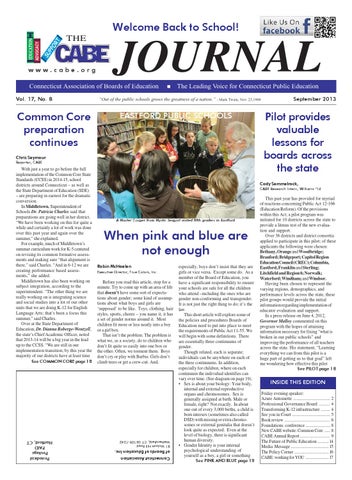
A Master Cooper from Mystic Seaport visited fifth graders in Eastford.
When pink and blue are not enough Robin McHaelen Executive Director, True Colors, Inc.
Before you read this article, stop for a minute. Try to come up with an area of life that doesn’t have some sort of expectations about gender; some kind of assumptions about what boys and girls are ‘supposed’ to be like. Toys, clothing, hair styles, sports, chores – you name it, it has a set of gender norms around it. Most children fit more or less neatly into a boy or a girl box. That isn’t the problem. The problem is what we, as a society, do to children who don’t fit quite so easily into one box or the other. Often, we torment them. Boys don’t cry or play with Barbie. Girls don’t climb trees or get a crew-cut. And,
81 Wolcott Hill Road Wethersfield, CT 06109-1242
of Boards of Education Inc. Connecticut Association
With just a year to go before the full implementation of the Common Core State Standards (CCSS) in 2014-15, school districts around Connecticut – as well as the State Department of Education (SDE) – are preparing in earnest for the dramatic conversion. In Middletown, Superintendent of Schools Dr. Patricia Charles said that preparations are going well in her district. “We have been working on this for quite a while and certainly a lot of work was done over this past year and again over the summer,� she explained. For example, much of Middletown’s summer curriculum work for K-5 centered on revising its common formative assessments and making sure “that alignment is there,� said Charles. “And in 6-12 we are creating performance based assessments,� she added. Middletown has also been working on subject integration, according to the superintendent. “The other thing we are really working on is integrating science and social studies into a lot of our other units that we are doing K-12 for English Language Arts; that’s been a focus this summer,� said Charles. Over at the State Department of Education, Dr. Dianna Roberge-Wentzell, the state’s Chief Academic Officer, noted that 2013-14 will be a big year in the lead up to the CCSS. “We are still in our implementation transition; by this year the majority of our districts have at least time See COMMON CORE page 18
September 2013
especially, boys don’t insist that they are girls or vice versa. Except some do. As a member of the Board of Education, you have a significant responsibility to ensure your schools are safe for all the children who attend –including the ones who are gender non-conforming and transgender. It is not just the right thing to do; it’s the law. This short article will explore some of the policies and procedures Boards of Education need to put into place to meet the requirements of Public Act 11-55. We will begin with some definitions. There are essentially three continuums of gender. Though related, each is separate; individuals can be anywhere on each of the three continuums. In addition, especially for children, where on each continuum the individual identifies can vary over time. (See diagram on page 19). • Sex is about your biology: Your body, internal and external reproductive organs and chromosomes. Sex is generally assigned at birth. Male or female, right? Not exactly. In about one out of every 3,000 births, a child is born intersex (sometimes also called DSD) with missing or extra chromosomes or external genitalia that doesn’t look quite as expected. Even at the level of biology, there is significant human diversity. • Gender Identity is your internal psychological understanding of yourself as a boy, a girl or something See PINK AND BLUE page 19
This past year has provided for myriad of reactions concerning Public Act 12-166 (Education Reform). Of the provisions within this Act, a pilot program was initiated for 10 districts across the state to provide a litmus test of the new evaluation and support. Over 36 districts and district consortia applied to participate in this pilot; of these applicants the following were chosen: Bethany, Orange and Woodbridge; Branford; Bridgeport; Capitol Region Education Council (CREC); Columbia, Eastford, Franklin and Sterling; Litchfield and Region 6; Norwalk; Waterford; Windham; and Windsor. Having been chosen to represent the varying regions, demographics, and performance levels across the state, these pilot groups would provide the initial information regarding implementation of educator evaluation and support. In a press release on June 4, 2012, Governor Malloy commented on this program with the hopes of attaining information necessary for fixing “what is broken in our public schools� and improving the performance of all teachers across the state. His statement, “Learning everything we can from this pilot is a huge part of getting us to that goal� left me wondering how effective this pilot See PILOT page 18
INSIDE THIS EDITION Friday evening speaker: Azure Antoinette ................................. 2 Professional Governance Board .......... 4 Transforming K-12 infrastructure ........ 4 See you in Court .................................. 5 Book review ......................................... 6 Foundations conference ...................... 8 New CABE website: Common Core ..... 8 CABE Annual Report ........................... 9 The Future of Public Education .......... 14 Media Message .................................. 15 The Policy Corner ...............................16 CABE: working for YOU ..................... 17
Periodical Postage PAID Hartford, CT
2
The Journal
– Connecticut Association of Boards of Education • September 2013
PRESIDENT COMMENTARY
A new school year - a new focus It’s back-to-school-time. Students return to new classes and schedules. Teachers return to new faces before them. Parents are prepared for another year, whether their first or last. Principals are ready to welcome another year, even cafeteria menus offer new nutritional choices. And, as school education leaders, we face new challenges ahead while we embrace the possibilities that are before us. During August, I attended the NSBA President’s Retreat held in Memphis, Tennessee. In attendance were over 150 dedicated and engaged school board leaders who gathered for a weekend of professional training and advocacy. Enlightening session and workshops gave us the chance to reflect on our accomplishments and opportunities ahead while highlighting the importance of local governance and decision making in the national debate on public education. Effective school boards matter. We have a direct and positive impact on student achievement. Our successes or failures will have significant implications in the lives of our students. We are in changing times, and to paraphrase one speaker, “We are the pioneers in the New Frontier in Public Education.” A new initiative for NSBA is the recently—created Grassroots Advocacy Plan, that envisions a strong, strategic lobbying program at the federal level as well as support to our state associations as we continue our efforts to focus on legislative, legal and public advocacy in our own states. Sitting in a Leadership session gave me time to ponder my skills – how to lead through transitions such as school safety, funding and simultaneous adaptive changes – Common Core and the evaluation process. How to rethink public education and build schools of tomorrow so every child is prepared for the 21st century. A final workshop included in-depth training that both
challenged and examined leadership and teambuilding skills. As part of the training, we participated in an interactive Space-Flight Simulation which required us to work effectively as a crew member of a spacecraft. Our beforehand preparation and participation was key to our success. Our mission, roles, responsibilities, communication, vision and goals were the focus for performing a safe landing. Similar Lydia Tedone outcomes not unlike ours as board members! As I returned home, I reflected on those whom I met. Not just colleagues, rather a local teacher from Memphis, a parent who just relocated and a sales associate with a special needs child. A new year begins for them. New pathways of leading for me.
Mark your Calendar! November 14, 2013 CABE Delegate Assembly 3:00 - 6:00 pm Mystic Marriott Hotel, Groton Come and help shape CABE’s Legislative agenda for 2014.
CABE/CAPSS announces Friday Evening Conference Speaker Azure Antoinette The CABE/CAPSS Conference Committee is pleased to announce that Azure Antoinette will be our Friday evening banquet speaker. Called “the Maya Angelou of the Millennial generation,” Azure Antoinette is a poet, spoken word artist, freelance photographer, and youth and arts advocate whose performance poetry explores the ways social media is reshaping humanity. In 2011, she founded a NYC arts-in-education program that provides custom workshops to excite and educate teen girls on how spoken word, performance poetry, and social media can make an impact on the world. For this project and many others, she was included in Forbes’s 100 Most Powerful Women in the World issue in 2012 and was featured in a special section titled “Women Helping Women.” Most recently, she was named a global ambassador for 10x10, a social action campaign based around the feature film Girl Rising that uses the power of storytelling to deliver a single message: educating girls in developing nations will change the world. Recently, Antoinette and ABC Family launched the “You Should Know This About Me” Campaign, which seeks to capture the authentic voices and stories of the Millennial generation through media submissions. Antoinette has been commissioned to write for the former first lady of California Maria Shriver, Tuskegee Airmen Col. Lee Archer, and the American Cancer Society and has shared the stage with such artists and performers as Kenny Lattimore, Treasure Davis, Rudy Francisco, James Avery, Danny Glover, Vanessa A. Williams, Ben
Guillory, CCH Pounder, Elliott Gould, and Delroy Lindo. A published author, her first book, Bittersweet, was released in May 2009, and was followed by Commissioned and her newest title for the sake of BREVITY. Ms. Antoinette will be available for a book signing immediately following her session. Look for additional information about the CABE/ CAPSS Conference in upcoming issues of the CABE Journal.
People in the News Patrice McCarthy has been appointed to the Connecticut Bar Association Executive Committees for both the Education Law section and the Labor and Employment Law section.
Mission: To assist local and regional boards of education in providing high quality education for all Connecticut children through effective leadership. Vision: CABE is passionate about strengthening public education through high-performing, transformative local school board/superintendent leadership teams that inspire success for each child.
CABE Board of Directors EXECUTIVE COMMITTEE Lydia Tedone .................................................. President, Simsbury Richard Murray ............................. First Vice President, Killingly Ann Gruenberg ........... VP for Government Relations, Hampton Stephen Wright .... VP for Professional Development, Trumbull Robert Mitchell ............................ Secretary/Treasurer, Montville Don Blevins ........................................... Immediate Past President John Prins ........................................................... Member at Large
AREA DIRECTORS Susan Hoffnagle ....................... Area 1 Co-Director, Winchester Mari-Ellen (Mimi) Valyo ........ Area 1 Co-Director, Winchester Daniel Santorso ........................... Area 1 Co-Director, Plymouth Becky Tyrrell ................................. Area 2 Co-Director, Plainville Susan Karp ............................... Area 2 Co-Director, Glasbonbury Don Harris ................................. Area 2 Co-Director, Bloomfield Laura Bush ............................................. Area 3 Director, Vernon Douglas Smith .............................. Area 4 Co-Director, Plainfield Steve Rosendahl ....................... Area 4 Co-Director, Woodstock Gavin Forrester ............................. Area 6 Co-Director, Stratford Elaine Whitney ............................. Area 6 Co-Director, Westport John Prins ............................................ Area 7 Director, Branford Pamela Meier ....................................... Area 8 Director, Madison Gail MacDonald ............................. Area 9 Director, Stonington
ASSOCIATES Eileen Baker ........................................... Associate, Old Saybrook Sharon Beloin-Saavedra .......................... Associate, New Britain Gary Brochu ........................................................ Associate, Berlin Robert Guthrie .......................................... Associate, West Haven Cal Heminway ................................................... Associate, Granby COMMITTEE CHAIRS Elizabeth Brown ...................... Chair, State Relations, Montville Beverly Washington ................. Chair, Federal Relations, Groton Becky Tyrrell ................................... Chair, Resolutions, Plainville
CITY REPRESENTATIVES Jacqueline Kelleher .................. City Representative, Bridgeport Matthew Poland ........................... City Representative, Hartford Carlos Torre ............................. City Representative, New Haven Polly Rauh .................................... City Representative, Stamford Charles Stango ........................... City Representative, Waterbury
STAFF Robert Rader ...................................................................... Executive Director Patrice McCarthy ................................ Deputy Director and General Counsel Bonnie Carney ........................................... Sr. Staff Associate for Publications Nicholas Caruso ............................................ Sr. Staff Assoc. for Field Service and Coord. of Technology Sheila McKay ............................ Sr. Staff Associate for Government Relations Kelly Moyher ......................................................................... Sr. Staff Attorney Vincent Mustaro ..................................... Sr. Staff Associate for Policy Service Lisa Steimer .............................. Sr. Staff Assoc. for Professional Development Teresa Costa ............................... Coordinator of Finance and Administration Pamela Brooks ......................... Sr. Admin. Assoc. for Policy Ser. /Search Ser. Terry DeMars .............................................. Admin. Assoc. for Policy Service Melissa Dickinson ........................... Admin. Assist. for Membership Services Gail Heath ...................................... Admin. Assoc. for Government Relations Wilmarie Newton ...................................... Admin. Assoc. for Labor Relations Corliss Ucci .............................. Receptionist/Asst. to the Executive Director
The CABE Journal (ISSN 1092-1818) is published monthly except a combined issue for July/August as a member service of the Connecticut Association of Boards of Education, 81 Wolcott Hill Road, Wethersfield, CT 06109, (860) 571-7446. CABE membership dues include $30 per person for each individual who receives The CABE Journal. The subscription rate for nonmembers is $75. Association membership dues include a subscription for each board member, superintendent, assistant superintendent and business manager. The companies and advertisements found in The CABE Journal are not necessarily endorsed by CABE. “Periodicals Postage Paid at Hartford, CT.” POSTMASTER: Send address changes to The CABE Journal, CABE, 81 Wolcott Hill Road, Wethersfield, CT 06109-1242. Email: bcarney@cabe.org. Members can find the CABE Journal online at: www.cabe.org/ userlogin.cfm?pp=84&userrequest=true&keyrequest=false& userpage=84
The Journal
3
– Connecticut Association of Boards of Education • September 2013
EXECUTIVE DIRECTOR COMMENTARY
CABE Affiliate Members BUSINESS AFFILIATES DIAMOND MEMBER ACT, Inc. - Northeast Region Finalsite GOLD
MEMBERS
Advanced Corporate Networking dba, Digital BackOffice Berchem, Moses & Devlin Centris Group Pullman & Comley Shipman & Goodwin Siegel, O'Connor, O’Donnell & Beck, P.C
SILVER MEMBERS Anthem Blue Cross and Blue Shield Corporate Cost Control Milone & MacBroom, Inc. Quisenberry Arcari Architects The Segal Company
BRONZE PLUS MEMBERS Brown & Brown Insurance Friar Associates Goldstein & Peck, P.C. Lindburg & Ripple O & G Industries The S/L/A/M Collaborative Trane Whitsons School Nutrition
BRONZE MEMBERS Chinni & Meuser LLC Dattco Inc. Fuller & D’Angelo Architects and Planners Kainen, Escalera & McHale, P.C. The Lexington Group Muschell & Simoncelli Ovations Benefits Group
EDUCATIONAL AFFILIATES American School for the Deaf Area Cooperative Educational Services Capitol Region Education Council The College Board Connecticut Association of School Business Officials Cooperative Educational Services Connecticut Center for School Change Connecticut School Buildings and Grounds Association EASTCONN EDUCATION CONNECTION LEARN Unified School District #1
Where is the balance? Where is the balance between board members disagreeing with each other and people trying to be good team players? Recently, Associations Now, a publication of the American Society of Association Executives (CSAE), ran an article by David M. Patt, owner of Association Executive Management, in which he stated that “conformity is far too pervasive in the association community.” According to Patt, association leaders worry that saying or doing anything that someone else may not like “implies they are not team players” and that it might “prevent them from earning respect” as well as from future career advancement. Patt argues that “diversity of opinion is normal. What’s the chance that everybody will agree about everything all the time? Critique, discussion, and debate should be viewed as helpful tools for creating sound policies and programs.” The real problem, according to Patt is that most people “don’t want to be different. They don’t want to risk being thought of as unwise or unprofessional or less than competent. They want to be accepted and get along with everyone else. So they conform.” He ends his article by recommending that people “always be nice when you’re disagreeing, but never apologize for disagreeing. Criticize ideas, not people. And have something more than a complaint: Explain how you believe a different idea or way of doing things can be successful.” Reading this made me think of the conduct of some school board members, particularly at board meetings. In this, I believe Patt is correct and the article, while about association executives, is relevant to board members, too.
The Board’s Leadership Must Be A Team CABE and CAPSS have long recommended viewing the board and the superintendent as the “leadership team”. We view that team as working together, using the strengths of each member to build a successful culture, upholding the highest of standards and working towards increasing student growth. CABE’s Code of Ethics for members of boards, embodied in policy manuals across the State sets out high standards, setting the “rules of the game” for board members. It lays out aspirational ideas, all aimed at bringing out the best in board members, giving them a framework for their board service. Are you reluctant to disagree because of the push for teamwork? There is a fine line between disagreement and acting in an inappropriate manner. It is critical that board members, in representing the diverse desires of their communities, strongly argue their positions and attempt, to the best of their ability, to influence other members of the board to their side of the issue. Now, consensus has its place and
boards, especially the chair as the leader of the board, have an important role in trying to move everyone towards agreement. But, as I have told boards that seem to want to work ONLY on a consensus basis, if all controversial issues are decided by a unanimous vote after little discussion, then we really need only one person to serve as the school board. I do, of course, realize that some boards have much of their discussion at committee meetings, where ideas and disagreements are hashed out. So, what looks like consensus on every issue may very well be the fruits of earlier disagreements being worked out.
Polite and Civil A willingness of everyone on the board, on issues of importance, to have a say and disagree, in a polite, civil, respectful manner if they so choose, is what representative democracy is all about. And, so is the rest of the board listening and thoughtfully weighing those ideas. Personal, angry attacks rarely have the effect that the attacker might want. Sure, they may make for a good sound bite in the newspaper, but the ill will generated may lead to ever-more fractious discussions. And, if it is continued on all issues, in addition to the one being discussed right then, board members will eventually ignore the speaker, feeling they’ve heard all this before. The result: an undermining of the board—and its members. Take a look at Congress’s polls if you want to see what inability to work together gets us. It is the positive, even passionate, backand-forth of all board members working towards a positive result that will frequently result in a better understanding of the issue, new ideas thrown into the mix and the opportunity to make what might be a good decision even better.
Robert Rader
An effective board member will accept the final decision of the board unless it’s greatly contrary to his/her principles. Such a board member understands that on other issues he or she might be the winner. This is an improtant attribute for good boardsmanship. So, speak out when you need to. Rather than losing respect, if it is done in an appropriate way, you will gain in stature. Disagree without being disagreeable. And, help your board, your community and students, in the long run.
Back-to-School Board meetings are an excellent time to speak about the importance of appropriate conduct at school board meetings. Some Boards put their policies on ethical issues on their agendas for a brief discussion. Some Boards also ask all members to sign it and display the signed policy in a public place. The CABE Code of Ethics is in the Core Manual (#9271), which can be found in the Member Section of the CABE website.
4
The Journal
– Connecticut Association of Boards of Educatio • September 2013
The Professional Governance Board
The seven characteristics of professional governance boards Gary Brochu Chair, Berlin Board of Education
Board governance – how a board of education chooses to operate and govern itself and its school district – matters. It matters a lot. Simply put, the failure of a board of education to clearly and consciously determine issues of board governance will prevent it from leading its school district on issues of student achievement and staff performance. Given the importance of professional school board governance, what does a professional governance board look like? Like successful schools and educators, successful professional boards of education appear in a variety of guises – large and small, partisan and nonpartisan, experienced and new to the work. But among them they share certain essential beliefs and operating principles. These are the core elements upon which their work of governing their school district and themselves is based. What follows is a listing of the seven essential characteristics of a professional governance board.
Model desired behavior The first job of every leadership position, individual or board, is to exemplify the qualities and behaviors that you expect of your organization and members. A professional governance board should use each meeting, each action, each opportunity, to communicate through its actions how a professional learning community should operate. Board of education meetings should be nothing less than the exemplar of professionalism for the entire school district.
Understand your leadership role and responsibilities A professional governance board has a clear understanding of that which it can and must do. This includes understanding not just what the board must do, but equally important, understanding that which the board should not do. Professional boards understand and embrace that their function is to lead the school district, not to manage or administrate it. Boards of education have an extremely limited capacity to manage a school district, and attempts to do so, however well meaning, always result in a poorly run school district. Worse, when boards seek to manage a school district, they abdicate their responsibility to lead the district, forfeiting the unique leadership role that only the board of education can assume.
Professional governance boards learn to say “no” to the less important, so that they can say “yes” to the essential.
Focus and insist on real accountability One of the most important functions of a board of education is to build into its work a rigorous and sustainable accountability system. This means an accountability system that informs all actors of what is important and ensures that the essential work of the school district is being performed well, as opposed to the more common “gotcha” system that many board members employ at meetings. Be clear about objectives, timelines and metrics, and then devote valuable board time to their review. A professional governance board understands that delegation is not abdication.
Board and its members are always prepared Being a professional governance board is more than just showing up for meetings. It means real preparation on the part of members and the board itself. Members should be prepared for meetings, prepared to intelligently discuss issues, prepared to make decisions, and prepared to hold one another, and themselves, accountable. A professional governance board prepares by ensuring that it has in place clearly defined and understood processes and procedures, and established goals for its performance. Being a professional board of education involves homework, and membership entails more than just showing up.
Govern as one board Deliberate in many voices, govern in one. This does not mean that a professional governance board is characterized by identical members, but by different individuals committed to the same values, working toward the same goals. Membership involves the willingness on the part of individuals to sacrifice and compromise to achieve its collective goals. A governance board cannot sustain itself and its organization if individual members seek to undermine decisions made by the whole.
Board and its members are characterized by high expectations Successful boards of education have high expectations for its students, for the See SEVEN page 19
Transforming K-12 infrastructure from bricks and mortar to the Cloud Dale Bruckhart V.P. Public Sector Marketing, Digital BackOffice
“Common Core Standards will use computer adaptive testing technologies to the greatest extent possible to deliver meaningful feedback and actionable data.”1 After years of tentative efforts to embrace on-line teaching and learning, the time has arrived when on-line assessments have been adopted by the Connecticut State Board of Education and are required! Simultaneous testing of all students is the real network stress test for technology directors and school administrators. How does the technology director know if the inter-school and inter-district networks and data infrastructure will support intensive cloud based testing? Are the network switches, access points and security components up to the job? Has the board, the superintendent or business manager established service level and network availability goals with the Information Technology Director? Corporate CIO’s expect a minimum 99.9% service level guarantee from vendors which equals less than nine hours of annual unscheduled network downtime. A four nines (99.99%) service level means that you should expect less than one hour of annual unscheduled downtime. Of course, unexpected outages happen and according to Murphy’s Law they will happen at the most inconvenient time, i.e., in the middle of the summative assessments. Mitigating network outages or degraded performance is possible and school administrators should look to IT industry best practices and standards for solutions, including contracting with service providers who offer service level guarantees. Online learning and assessments are sustainable with the right management tools and management processes to monitor network service levels, diagnose service affecting network activity and most importantly control all endpoint devices. The flood of personal, mobile devices, while exciting for users, has created security and support headaches for network managers and technology directors. Mobile devices indiscriminately connect to known and unknown networks as the user travels from home to school, coffee shops, restaurants, libraries, etc. Mobile devices contain valuable personal information, and may also contain private school data, making them attractive targets for hackers and cybercriminals. Automation is critical in quickly identifying harmful or compromised endpoints and minimizing network affecting activity. Manual efforts to identify harmful network activity or endpoints can take hours, or even days, often resulting in network slowness or outages. Continuous threat prevention is essential to protect the network infra-
structure, support the implementation of Common Core curriculum and assessments, and ensure constant maintenance and upkeep of school resources. As new devices, increasingly mobile and wireless, are used as instructional resources and as delivery devices for online assessments, real-time, automated policy enforcement protects the network, network resources and confidential information from degradation, failure and data loss. School Boards should require documentation of the operational controls and best practices from the IT director or business manager. The documentation should provide in detail the network architecture and processes to achieve the policy objectives, such as the service level goal described earlier. Good network documentation is critical to managing network service levels during periods of malicious or network affecting activity. Do business managers or administrators have access to passwords for core firewalls, servers or switch hardware? Does anyone besides the technology director know how to change passwords or configurations on core network hardware? What is the process for securing the network infrastructure should the technology director resign or leave unexpectedly? Schools also have a legal responsibility to maintain and nurture a safe school climate, both on school premises and increasingly on personal devices used off school property. Security, malware protection, automated control and adherence to acceptable use policies are a priority before opening network access to any personal device, including staff, teachers and students. As legacy analog services (video, voice, HVAC, security) transition to digital Internet Protocol (IP) interfaces, schools will see a further explosion of IP enabled endpoints all sharing and vying for available inter-school LAN and interdistrict WAN bandwidth. Without the ability to control endpoints and monitor network activity investment in additional bandwidth offers no guarantee of network stability or availability when you need it most! Contracted service providers are profit motivated to offer and maintain service level agreements. When the Murphy’s Law moment arrives, service providers are the single point of contact (one throat to choke) to restore service in a timely manner. Outsourcing network infrastructure services is generally more cost-effective and productive than self-maintaining the myriad components that make up today’s electronic highways. Managed service providers are an attractive alternative to self-maintaining the network infrastructure because a contracted provider offers: See TRANSFORMING page 19
The Journal
– Connecticut Association of Boards of Education • September 2013
5
See You in Court – The Nutmeg Board of Education
The Nutmeg Board deals with developing a school safety plan Thomas B. Mooney, Esq. Shipman & Goodwin
The Nutmeg Board of Education makes many mistakes. The latest imbroglio created by the board will be reported here each issue, followed by an explanation of what the board should have done. Though not intended as legal advice, these situations may help board members avoid common problems. The Nutmeg Board of Education wanted to get a jump on planning new security measures for the Nutmeg Public Schools. Accordingly, last month it named itself the School Security Committee, and it held a number of meetings to plan improvements in the security of each of its schools. The Board invited the Chief of Police and the Town Manager into the executive sessions, given their expertise. However, despite his repeated requests to be included, Mr. Chairperson chose not to include Seymour Dollars, venerable chair of the Nutmeg Board of Finance. Seymour was miffed at what he saw as the Board’s disrespect, and in an angry email to Mr. Chairperson, Seymour vowed to object to any action the Board took on security measures without his input.
After several long executive session discussions, the Board finally met in open session last week, and with little public discussion it voted to place an armed security guard in each of its schools. After hearing about the Board’s action, Seymour promptly convened a meeting of the Nutmeg Board of Finance. After its own lengthy executive session, the Board of Finance reconvened in open session, and it voted to recommend that the Board of Education rescind its action and install video cameras at far less cost than hiring armed guards. Seymour explained, “Video cameras will discourage trouble-makers, and they do not require health insurance benefits. The Board of Education should listen to us.” Bob Bombast, veteran member of the Nutmeg Board of Education, got angry over Seymour’s presuming to advise the Board on security matters. He promptly called Nancy Newshound, ace reporter for the Nutmeg Bugle, to give his side of the story. Nancy interrupted Bob and asked him how the Board could justify discussing such matters in executive session, given the intense public interest in security matters. Bob conceded that perhaps the Board should have kept the discussion in open
Seventh Edition Now Available
A Practical Guide to Connecticut School Law by Thomas B. Mooney, Esq. Shipman & Goodwin The Guide comes with a CD which provides hyperlinks to many cases and statutes and will permit word searches as a supplement to the Index. New to the Seventh Edition: Bullying, Background Checks, Child Abuse Reporting, Discrimination Issues, Educational Reform, FERPA, Freedom of Information, State Aid for Education and much, much more The 7th edition is now available from CABE. Call and order your copy TODAY at 860.571.7446 or 800.317.0033
session. “But let’s not get off track. The Board of Education is responsible for school security, and Seymour should back off and mind his own business. You can quote me on that.” Nancy did just that, and she started a war. Bob’s comments incensed Seymour, and he too called Nancy. “The Board of Education had better get with the program. The Town holds the purse strings, and we will not be appropriating money to squander it on salaries and benefits unless the Board explains its thinking to us in writing and convinces us. And good luck with that.” Should the Nutmeg Board provide a written response to the Board of Finance? Next year boards of education will have to provide written explanation to the appropriating authority under certain circumstances. Public Act 13-60 requires boards of finance (or other appropriating authorities) reviewing the itemized budget estimate of the board of education to “make spending recommendations and suggestions to such board of education as to how such board of education may consolidate noneducational services and realize financial efficiencies” within ten days of receiving the itemized budget estimate.
ties regarding school safety and security. While a comprehensive review is beyond our scope here, the legislation is specific in requiring that boards of education establish a school safety and security committee at each of its schools by July 1, 2014. Moreover, it prescribes the membership of such committees to include a police officer, first responder, mental health professional, teacher and administrator. Such committees will be responsible for assisting in the development and annual updating of the school security and safety plan that will be required for each school (and which must be submitted annually to the Department of Emergency Services and Public Protection). We note that both the Board of Education and the Board of Finance discussed security issues in executive session. As to the Board of Education, that discussion was appropriate. Executive session discussion is permitted concerning the deployment of security devices and personnel. Moreover, in convening such an executive session, the Board of Education can decide whom to invite into the executive session, based on whose “opinion or testimony” it wishes to hear. However, it
“In addition, and more problematic, is the requirement that each board of education must now annually make available on its Internet website the aggregate spending on a number of specified different items for each of its schools.” The board of education may accept or reject such recommendations, but if it rejects them, it must explain in writing its reasons for rejecting the suggestions. Depending on what suggestions the Town would make here, however, it is not clear that Seymour’s idea would be a proposed “consolidation” that triggers this duty. There are two other new provisions of note regarding board of education financial matters. Public Act 13-60 also now requires that the board of education provide the legislative body of the town or city with a written explanation if and when an authorized agent makes line item transfers on an emergency basis, as provided in Section 10-222. In addition, and more problematic, is the requirement that each board of education must now annually make available on its Internet website the aggregate spending on a number of specified different items for each of its schools. P.A. 13-247, Section 192. Given the term “aggregate” and that some of these expenses are not budgeted or tracked on a school-byschool basis, it is not clear how school districts will be able to comply with this requirement. This situation raises other issues as well. The Nutmeg Board of Education jumped the gun in naming itself a School Safety Committee. The comprehensive gun control legislation passed this year, Public Act 13-3, imposes new responsibili-
is doubtful that the Board of Finance can also properly discuss such matters in executive session, given that the Board of Finance is not responsible for such decisions. There is another basis for executive session, at least for the Board of Education. Boards of education may discuss information set forth in confidential documents. Section 1-210(b)(19) provides that records are confidential if their disclosure would result in a security risk (as presumably would be the case with most school safety and security plans). However, that determination is not left to the school district, but rather must be made by the Commissioner of Emergency Services and Public Protection. Finally, the Board’s plan to employ armed security guards at each school is subject to an important limitation. P.A. 13-188 limits the employment of security personnel who will possess a firearm to fulfill their job duties to sworn members of the local police department or retired police officers. Any such retired police officers are required to receive annual training and must complete annual firearms training that meets the standards of the Police Officer Standards and Training (POST) Council. Attorney Thomas B. Mooney is a partner in the Hartford law firm of Shipman & Goodwin who works frequently with boards of education. Mooney is a regular contributor to the CABE Journal.
6
The Journal
– Connecticut Association of Boards of Education • September 2013
Book review
Saturday morning keynote speaker’s book on leadership Wouldn’t it be great to have a template for finding great leaders when you really need them? How about a screening process you can rely on? If your school district is going through, say, difficult fiscal times (okay, all times are now fiscally difficult) or have a special upcoming project that must be done with as few errors as possible, wouldn’t it help to match candidates up against a guide that could help you make a decision? Well, unfortunately, the perfect template does not exist. Human beings are too fallible, somewhat unpredictable and situations change so that it is difficult to find the “right” person for all cases. Finding that one critical leader is always a hard job. While it is one of the most important responsibilities of school boards, finding the “right” match is often difficult. According to Harvard Business School Assistant Professor Gautam Mukunda, many believe that the difference made by leaders is often indistinguishable from what other people would do under similar circumstances. However, in Indispensable: When Leaders Really Matter, he writes that leaders very much make a diference and he provides a loose template for finding the right man or woman for the job. Professor Mukunda has developed what he calls a Leadership Filtration Process (LFP). He examines, in some detail, the leadership of several historical figures, including Thomas Jefferson, Abraham Lincoln, Neville Chamberlain and Winston Churchill, business leaders such as Jamie Dimon (Bank of America) and Al Dunlap (Sunbeam) and a medical researcher named Judah Folkman. The LFP is based on how the potential candidates for leadership positions have been “filtered”. For example, the U.S. military “filters” its potential leaders by ensuring they go up through the ranks where they are constantly evaluated. This “tight” LFP, similar to what is done in many companies, enables those who have done well to continue to move up, while screening out those who haven’t. It generally results in very few individuals with the highly-prized characteristics to move all the way to the top. On the other hand, looser LFPs results in a much better chance of people moving up – and the people who do are likely to be more dissimilar than each other than you would have in a tighter LFP. There is a much better chance of ending up with an “Extreme”, that is an outlier, who is very different than what a tighter LFP would consider an acceptable candidate. So, how does the LFP work? To a good extent, that will depend on the job. An Extreme might actually be better in some situations, especially those in which real out-of-the-box thinking and action may be appropriate. But, for the most part, the selection committee or person, will look at the length of a person’s career, the frequency of evaluation, whether there is a winnertake-all process, the system’s tolerance for failure, the age of the organization and unique advantages of a candidate.
Examples: Dunlap and Churchill Al Dunlap graduated from West Point in 1960, ranked 537th out of his graduating class of 550. After three years in the Army, he joined Kimberly-Clark and thereafter spent time in a number of other companies, where he appeared to turn them around, including Scott Paper, where he laid off more than “a third of its employees, including 71% of the headquarters staff and half of management.” He cut research spending, delayed maintenance for a year and his strategy was aimed at maximizing short-term profitability. Kimberly-Clark then bought the company for three times what it was worth when he came on. Kimberly-Clark then realized it “had massively overpaid for Scott and would have to reverse many of Dunlap’s changes to turn it into a company that was profitable over the long term”. Sunbeam, was a “deeply troubled” company and Dunlap was brought in to lead it with little examination of his record and most board members “never even had a chance to meet him before he was hired.” His stay at Sunbeam was a disaster. Stock prices “fell drastically and many of his supposed improvements were the product of questionable accounting.” So, here, was a basically unfiltered Extreme leader, who destroyed the company he was hired to save. Now, let’s examine the case of Winston Churchill. Here we have a leader with many, many years of experience both in and out of Parliament and at Cabinet level positions. He had some successes, but, especially in World War I, many large failures. Before he was called on to take the prime minister position in 1940, the “British system had evaluated Churchill and decided that it did not trust him with power”. Professor Makunda considered him as having been filtered out of the system, but his career was “resurrected by the most extraordinary combination of circumstances imaginable”. He was obviously the right man at the right time for England and this highlights one of the guidelines from the book: Traits That Prevent Passage Through LFP Can Sometimes Produce Great Successes in Office. Churchill was an Extreme, but it was what Britain needed at the beginning of the war. But, as he said, he was given the “Order of the Boot” by British voters as soon as the war was over. This review cannot go into all details on how the LFP template would work. But, what it illustrates, through the parade of the leaders Professor Mukunda discusses, is the importance of examining how people rise through a system as one way to predict how a candidate will do once he or she gets the position. So, if you ever need to find a leader, it is absolutely critical that you do a thorough background check and learn as much as you can about a candidate and the circumstances he or she faced. This is probably one of the best ways to learn what a potential new leader will perform once given the position. Professor Mukunda is the Saturday morning at this year’s CABE/CAPSS Conference on leadership. Robert Rader, Executive Director, CABE
The Journal
– Connecticut Association of Boards of Education • September 2013
7
8
The Journal
– Connecticut Association of Boards of Education • September 2013
Foundations Conference to feature The Honorable Bob Wise Liz Stokes President, CTCEF
Former West Virginia Governor Bob Wise, President of the Alliance for Excellent Education (the Alliance), will speak at the Connecticut Consortium of Education Foundation’s (CTCEF) 14th annual conference on Tuesday, October 1, from 8:00 a.m. to 2:00 p.m., at the Crowne Plaza Cromwell Hotel. Bob’s topic will be College- and Career-Ready Standards: An American Imperative. Led by Governor Wise since 2005, the Alliance has become a respected advocate for the Common Core State Standards, deeper learning, digital learning, adolescent literacy, and other key education policy issues. The eight conference workshops will cover a variety of topics. Continuing Bob Wise’s theme, Robyn Oatley from the Prichard Committee in KY will lead a community conversation on the collegeand career-ready agenda. Participants may share their experiences in strengthening stakeholder relationships, building goodwill, and fostering ownership. Dianna Roberge-Wentzell will discuss The Common Core State Standards and Opportunities for Foundation Investment in Student Success. The rest of the workshops will help foundations grow and become more effective. Technology topics include Strategies for Improving Your Online Marketing (Adria Pearl-Belport, Van Pearl Associates) and Untangling the
Web: Web Site Maintenance Options for Smart “Dummies” (Christine Mackenzie, Cape Elizabeth Education Foundation). Fundraising topics will be Planned Giving: Simple and Cost Effective (Chris Templeman, Morgan Stanley Smith Barney) and Building Relationships that Give Back: Alumni (Kathleen Brooks, Harris Connect). If your town’s foundation is exploring board issues, R.E.A.P. (Recruitment— Engagement—Administration— Productivity) the Benefits of a Better Board will provide important strategies for boards. Trish Brigham, Co-President, Cape Elizabeth (ME) Education Foundation will present the workshop. In Ask the Experts, Southington superintendent and CTCEF board member Joe Erardi will moderate a panel of experts who have years of experience and represent a variety of types and sizes of education foundations. The panel will help your foundation find simple solutions to complex issues that pertain to many education foundations. CTCEF will present its annual Foundation Celebration Award during lunch. Luncheon Discussion Groups will cover a variety of topics. CTCEF is a statewide non-profit organization whose mission is to facilitate the creation, growth, and effectiveness of local education foundations in Connecticut and was founded on the principle that community engage-
ment is a key factor in improving schools and local education foundations can play a lead role. The number of education foundations in Connecticut has grown from 30 in 1999 to about 90 today, thanks in part to many superintendents and board of education members who have attended the conference with members of their communities. Register now for this important confer-
ence and take advantage of our Early Bird Special (four or more people from the same organization register at the same time with a check, purchase order, or PayPal payment that must be received by September 9). Visit our Web site at www.ctcef.org and click on Events. For more information, contact CTCEF president, Liz Stokes, at 203-227-9323.
New section on CABE website: Common Core Along with the many other states, Connecticut is transitioning to use of the Common Core State Standards (CCSS). The new curriculum is aimed at ensuring that our students will be better prepared for the future. It entails changes as to how students are taught, when they learn various subjects, how deeply subjects are examined and how students’ knowledge and ability to use what they have learned. CABE has compiled resources on CCSS and is proud to make it available in one place, on our website www.cabe.org. Included are articles, commentary and other information. We hope that it will help boards and superintendents, school faculty, students, parents and the community at large in better understanding this very significant change in schooling of our children. Feel free to let me know if there are other resources that you believe should be linked to the CABE website. Bob Rader Executive Director rrader@cabe.org
Now More Than Ever... Your District Needs Medicaid Direct
A fully integrated module of IEP Direct that simplifies Medicaid tracking and claiming, enhances compliance, and optimizes reimbursement
With Medicaid Direct, recovering Medicaid funds is less complex and time-consuming. This innovative web-based solution will provide a positive return on investment and benefit your school district by: U Saving time and improving data accuracy U Optimizing and accelerating reimbursement U Enhancing compliance and best practices U Simplifying service tracking and the billing process U Reducing paperwork burden with online documentation by providers U Allowing service providers to enter service encounters online U Providing integration with IEP Direct For a demonstration and information on Medicaid Direct visit IEPDirect.com or call 516.766.4448.
Tel: 516.766.4448 U Fax: 516.766.4896 U www.IEPDirect.com
The Journal
9
– Connecticut Association of Boards of Education • September 2013
2012-13 CABE Board of Directors
2012-2013 CABE Staff
Executive Committee
ADMINISTRATION
Robert Rader Executive Director rrader@cabe.org
Teresa Costa Coordinator of Finance and Administration tcosta@cabe.org
Cory Ucci Receptionist/Assistant to the Executive Director cucci@cabe.org
Lydia Tedone President Simsbury 860-658-1173 (h) 860-658-4465 (b)
Richard Murray First Vice President Killingly 860-774-4165 (h)
Sheila McKay Senior Staff Associate for Government Relations smckay@cabe.org
Robert R. Mitchell Secretary/Treasurer Montville 860-447-8882 (h) 860-443-7441 (b)
Don Blevins Immediate Past President Waterford 860-444-0733 (h)
John Prins Member at Large Branford 203-481-6279 (h)
Area Directors
GOVERNMENT RELATIONS
Patrice A. McCarthy Deputy Director and General Counsel pmccarthy@cabe.org
Stephen Wright VP for Professional Development Trumbull 203-459-0079 (b)
Ann Gruenberg VP for Government Relations Hampton 860-455-1211 (h) 860-465-5268 (b)
Gail Heath Administrative Associate for Government Relations gheath@cabe.org
Susan Hoffnagle Area 1 Co-Director Winchester 860-379-1249 (h)
Daniel Santorso Area 1 Co-Director Plymouth 860-940-9188 (h)
Mari-Ellen Valyo Area 1 Co-Director Winchester 860-379-4054 (h) 860-480-1515 (c)
Becky Tyrrell Area 2 Director Plainville 860-793-0615 (h)
Susan Karp Area 2 Co-Director Glastonbury 860-633-5603 (b)
Don Harris Area 2 Co-Director Bloomfield 860-878-1403 (b)
Laura Bush Area 3 Director Vernon 860-872-2420 (h) 860-798-1693 (b)
POLICY SERVICE
Doug Smith Area 4 Co-Director Plainfield 860-564-8339 (h) Vincent A. Mustaro Senior Staff Associate for Policy Service vmustaro@cabe.org
Pamela Brooks Senior Administrative Associate for Policy Service and Search Services pbrooks@cabe.org
Terry DeMars Administrative Associate for Policy Service tdemars@cabe.org
Steve Rosendahl Area 4 Co-Director Woodstock 860-928-3136 (h)
Gavin Forrester Area 6 Co-Director Stratford 203-377-0218 (b)
Elaine Whitney Area 6 Co-Director Westport 203-221-7335 (h)
John Prins Area 7 Director Branford 203-481-6279 (h)
Pamela Meier Area 8 Director Madison 203-245-2868 (h) 203-530-0513 (c)
Gail MacDonald Area 9 Director Stonington 860-599-8654 (h) 860-572-0506 (b)
City Representative
Associates
LABOR RELATIONS
Kelly B. Moyher Senior Staff Attorney kmoyher@cabe.org
Wilmarie Newton Administrative Associate for Labor Relations wnewton@cabe.org
Eileen Baker Associate Old Saybrook 860-388-2761(h)
Sharon Beloin-Saavedra Associate New Britain 860-827-0136 (h)
Robert Guthrie Associate West Haven 203-934-7565 (h) 203-996-2382 (c)
MEMBERSHIP SERVICES
Gary Brochu Associate Berlin 860-828-1579 (h) 860-251-5705 (b)
Nicholas Caruso Senior Staff Associate for Field Services and Coordinator of Technology ncaruso@cabe.org
Melissa Dickinson Administrative Assistant for Membership Services mdickinson@cabe.org
Lisa Steimer Senior Staff Asociate for Professional Development lsteimer@cabe.org
You may contact staff at 800-317-0033 or 860-571-7446.
Becky Tyrrell Resolutions Plainville 860-793-0615 (h)
Beverly Washington Federal Relations Groton 860-445-7328 (h)
Matthew Poland City Representative Hartford 203-695-6303 (b)
Carlos Torre City Representative New Haven 203-387-1277 (h) 203-6689940 (c)
J. Callender Heminway Associate Granby 860-653-3851 (h) 860-653-0550 (b)
Committee Chairs Bonnie B. Carney Senior Staff Associate for Publications bcarney@cabe.org
Jacqueline Kelleher City Representative Bridgeport 203-365-4472 (b)
Elizabeth Brown State Relations Waterbury 203-754-7163 (h) 203-560-7028 (c)
Polly Rauh City Representative Stamford 203-325-9379 (h) 203-977-4105 (b)
Charles Stango City Representative Waterbury 203-575-0411 (h)
If you have any questions about or suggestions for the Association, please feel free to contact any member of the Board of Directors. They are here to represent you, our members.
10
The Journal
– Connecticut Association of Boards of Education • September 2013
Report to the Membership 2012-2013 CABE: Dedicated to strengthening public education through advocacy, professional development and service to boards of education. The last year has been very positive for CABE. We had very good participation from member boards and this translated in part into a successful year at the Legislature. It also provided more opportunities for CABE to help our members increase their effectiveness and address their needs. The key event that affected all of Connecticut (and the Nation) was the school tragedy last December. CABE reached out to the Newtown Board and Superintendent and provided advice and other help as they dealt (and continue to deal) with this unspeakable tragedy. The event led us to work even closer with CAPSS, CAS (representing principals) and CASBO (school business officials) as we quickly put together a very well-attended symposium on school safety and testified before task forces helping all Connecticut districts take appropriate action in light of the tragedy. Members of the CABE staff also worked on legislative and policy issues dealing with school safety and also
spoke at national events on legal and other ramifications of the tragic event. CABE built on a number of initiatives that had been started over the last few years. We continued our work with five other organizations including CAPSS and the Connecticut Association of Schools, business and reform groups. This “Big Six Partnership” was especially helpful as we focused on the reform agenda and possible changes to it. Our partnership also resulted in more access to legislators and the Governor’s staff and greater visibility, both at the Capitol and in the media. The whatwillourchildrenlose Coalition (CABE, CAPSS, CAS and CASBO) also worked tirelessly to ensure that financial resources needed from the State (especially ECS) were made available and that we did not suffer the cuts that were the focus of so much attention. We also continued our partnership with the State Department of Education, particularly with our increased emphasis on the
need for student growth, through the Lighthouse Project, our work with school governance councils and workshops which also highlighted each board’s critical role in increasing student achievement. As our members began to implement the new Common Core State Standards, we published articles on the issues facing districts and held a conference with the GE Foundation and the Connecticut Council for Education Reform on CCSS. We also worked hard on the Performance Evaluation Advisory Council (PEAC) and its subgroups. Thanks go to the members of our Board of Directors who worked with our staff to ensure that we had helpful input into the process. Communications and Technology The Association continues to work on improving communications with our membership. CABE has a new Facebook page. If you
have a Facebook account you can join CABE https://www.facebook.com/ ConnecticutAssociationBoardsEducation. We are posting national news from the National School Boards Association (NSBA), photo highlights from workshops and conferences, Communications Tips, some Journal articles, upcoming meeting announcements, Flashback Thursday (a look at our past), and much more. Finance and Support The Association ended the fiscal year in a positive financial situation. CABE has continued to ensure its resources are consistent with the needs of our members. We want to remind you, if you would like to use the Rovins Conference Room, please let us know. We don’t charge for use of the room and it’s a great place for a meeting or a retreat. We want our building to be seen by board members as your building!
Activities we have undertaken to serve you better this past year. Board Member Academy provides points
briefings, new board member, negotiations,
of Education Member (MBEM), which requires 20 additional credits. The Academy addresses the continuing educational needs of school board members by focusing on core areas of board responsibilities.
workshops were sponsored, in part, by the State Department of Education. Additionally, we co-sponsored a school security symposium that approximately 850 educational leaders attended in January.
Individual Board Workshops CABE staff continues to regularly meet with boards of education as they desire to provide professional development. Staff facilitated customized workshops from basic roles and responsibilities, the superintendent search process, goal setting and fullday board retreats.
CABE/CAPSS Convention The Convention, Boards and Superintendents: The Challenges and Opportunities Involved in Reforming and Transforming Education was held on November 16 and 17, 2012. • Attendance at the Convention was 633 board members, superintendents, business managers, administrators, education officials and invited guests • General session speakers included Mary Broderick, Connecticut Education Commisisoner Stefan Pryor,
Providing opportunities for for service, leading to two awards: Certifi- legal issues, leadership, policy, and an upmembers to learn how to bet- cated Board of Education Member (CBEM), date on what happened at the 2013 Conter govern their district which requires 20 credits and Master Board necticut General Assembly. Several of these Board Member Academy Throughout the past year, CABE has continued its commitment to be the NUMBER ONE Connecticut provider of professional development, by providing high quality training for local school board members across Connecticut. By offering workshops, hot topic workshops, an annual Convention, area meetings, individual workshops, the CABE Journal and other publications, CABE presents board members and administrators with many ways to increase their knowledge and skills. Board Member Academy Certification To encourage board members’ participation in professional development, CABE’s
Statewide Workshops Attendance at our workshops was approximately 600. Workshop topics included: candidate
Gina Barreca, and Pedro Noguera. • Workshops included: A Regional Approach to the Common Core, Educating Your Community About Local Education funding, A Practical Guide to Great Board Meetings, Developing Leaders, Effective Parent Engagement, Technology Safety, and Technology as a Transformative Tool. • Members of the State Board of Education participated in a lively discussion with the attendees • Approximately 56 exhibitors of education-related goods and services participated in the exhibit hall. Leadership Institute CABE’s Leadership Institute graduated its ninth class, having now served over 85 participants. The participants were very enthusiastic about their experiences and urged CABE to continue this program as well as incorporate opportunities for graduates to continue to develop their leadership skills. It is jointly sponsored by CABE and the State Department of Education. Participants met for five four-hour sessions, including a webinar. Through facilitated discussion and outside presenters, they had the opportunity to discuss in depth a variety of education issues. Publications The CABE Journal was published eleven times over the last year. Its primary audience is school board members, superintendents and district administrators throughout the state. The Journal is also sent to state and federal legislators, other education organizations (local and national) and others who have an interest in keeping upto-date with education issues in our state. The Model Student Parent/Guardian
Participants from around the state gathered in the CABE office to hear the latest information on the new evaluation guidelines.
(please see page 11)
The Journal
– Connecticut Association of Boards of Education • September 2013
11
Report to the Membership 2012-2013 CABE: Dedicated to strengthening public education through advocacy, professional development and service to boards of education. (continued from page 10) Handbook was revised to reflect current issues and legislative changes. This year we published updated versions of the Connecticut Glossary of School Board Terms and The Collective Bargaining Handbook. Policy Highlights Twenty-six issues of the email newsletter, Policy Highlights, were distributed on an every-other-week basis to board members and superintendents, highlighting current educational topics with policy implications. Throughout, the major focus remained on issues pertaining to student achievement. Policy Requests and/or Samples Approximately 600 requests for policy information and/or sample policies from member districts were addressed, usually on the same day the request was received. The website-based Core Policy Manual continues to receive a large number of “hits” for sample policies in addition to the district manuals that have been placed on line through the CABE Connecticut Online Policy Service (C.O.P.S.). In addition, 24 dis-
tion as necessary. This past year the team has worked to streamline the process and we look forward to serving more boards with a shorter timeline and fewer meetings. We anticipate training several new boards this year. We are pleased to see some of our first Lighthouse districts complete their training this year and look forward to starting a new crop of boards this year.
Ensuring members receive the most up-to-date communications Board Chair Listserv CABE has seen a very successful continuation of the Board Chair listserv. This listserv began in the late spring of 2009 and has provided board chairs with a new means of communicating ideas and concerns with each other and CABE. Topics of discussion and sometimes friendly debate have included special education and board budgets. We aim to track budget developments from around the state on an ongoing basis
tive action or judicial rulings or contemporary policy issues, especially in the areas of technology, health, student discipline and personnel issues. Sixty-four districts also received this publication electronically to facilitate local district usage of the sample material. CABE Policy Reference Core Manual The CABE Policy Reference Core Manual, containing over 550 sample policies and regulations, was continuously revised throughout the year. Moreover, new policy topics were added. It is easily “searchable” and remains accessible for CABE members on the CABE website in a multi-searchable user-friendly format. Policy Audit Service Six districts had audits completed of their existing policy manuals. This service provides the district with a report of the strengths and weaknesses of the existing manual with recommendations to update the manual. Three of the audit districts then engaged CABE to update their manual based upon the audit findings.
Robert Rader, Executive Director, CABE; Patrice A. McCarthy, Deputy Director and General Counsel, CABE; Karissa Niehoff, Executive Director, CAS; Joseph Cirasuolo, Executive Director CAPSS; and Lydia Tedone (Simsbury), CABE President speaking at a “Big 6” press conference.
tricts were under contract for Customized Policy Services during the year for the review and development of new district policy manuals or updates to selected portions of the manual.
during budget season and provide districts with a spreadsheet of budget information. CABE looks forward to continuing this excellent means of fostering communications between member board chairs and CABE.
Lighthouse Project Our partnership with the Connecticut State Department of Education (SDE) continues to be highly successful. Funded by a grant from SDE; CABE and SDE personnel have helped a number of districts improve student achievement through more effective board leadership. Lighthouse trainers have been working with a cohort involving four other states and ten Connecticut school districts. Most of the original Lighthouse districts have completed the foundation work and may receive follow-up training and facilita-
Customized Policy Manuals Six districts entered into contracts for customized policy manual development. New manuals were completed for two districts. Four additional districts have new manuals close to completion. Policy Update Service Ninety-seven districts subscribed to the Policy Update Service publication. Subscribing districts received four mailings which reflected current and timely policy issues, including the need for new and/or revised policy topics based upon legisla-
Custom Policy Update Service Nineteen districts subscribed to the Custom Policy Update Service. In this service, CABE assumes the responsibility for updating the district’s existing policy manual. Major focus was placed on providing needed policies, administrative regulations and information. Some of the topics pertained safety and security, bullying, technology, workplace climate, student health issues, evaluation of personnel, staff development and various personnel issues. Connecticut Online Policy Service (C.O.P.S) Thirty-six districts subscribed to the Connecticut Online Policy Service (C.O.P.S.). Districts appreciate that their manuals are easily accessible and searchable online and are kept current through CABE.
Promoting public education Awards CABE Board Recognition Awards are presented to boards of education which exhibit the most effective leadership, characterized by their ability to work together as a “team.” CABE Board Leadership Award Level One – In 2012, 10 boards of education received the Board Leadership Award for their continued work on their leadership skills. Boards need to fulfill 22 of 34 Level One criteria to earn this Award. CABE Board of Distinction Award Level Two – In 2012, 12 boards of education received the Board of Distinction Award. This Award was granted to boards who have achieved Level One at least twice in the prior four years and meet the eligibility criteria. Student Leadership Awards – The CABE Student Leadership Awards program continues to be very popular, with 348 students from 96 CABE member school districts earning the award. This program enables each high school and middle school in member districts to nominate a boy and a girl to be honored for their leadership qualities. Awards of Excellence for Educational Communications – This year CABE presented 32 Awards of Excellence in Educational Communications and 56 Honorable Mentions. Effective communications with parents and taxpayers are extremely important in school district operations. Affiliate Membership Program — Business Affiliates – CABE invites private sector companies, institutions and firms with an interest in public education, to become our partners and to show their support. The program grew to 28 partners in 2012-2013. Membership consisted of: 2 Diamond, 5 Gold, 5 Silver, 8 Bronze Plus and 8 Bronze Members. Education Affiliates – This program helps provide education-related organizations with a closer relationship with CABE. In 2012-2013, we had 12 Education Affiliates. A current list of Business and Education Affiliate members can be found on page 3.
Providing services to meet member needs Advocacy: Supporting School Boards at the Legislature, State Board and Congress CABE’s positions on a broad range of local, state and federal issues are adopted each year at the Delegate Assembly. The State Relations Committee then develops CABE’s Legislative Priorities, and board members and staff implement the advocacy agenda. CABE was involved in an unprecedented number of discussions with legis(please see page 12)
12
The Journal
– Connecticut Association of Boards of Education • September 2013
Report to the Membership 2012-2013 CABE: Dedicated to strengthening public education thorugh advocacy, professional development and service to boards of education. (continued from page 11) lative leaders and the Governor’s office, and partnered with numerous other organizations to promote public education. Highlights of CABE’s advocacy efforts were: • Relentless efforts to maintain current levels of education funding, including maintaining the student transportation grants; • Participation in meetings with legislators around the state. Board members were able to give legislators factual and anecdotal information on issues to be debated in the General Assembly. • CABE staff reviewed all pending legislation, and monitored, provided testimony and lobbied those with an impact on education. The focus of CABE’s legislative efforts centered on increasing flexibility for school districts, defeating numerous new mandates, and working with other organizations on issues of mutual interest. • A successful Day on the Hill program, which included the participation of many high school students and school business officials. • The Advocacy Action Center, which makes it easier for board members to communicate with their legislators and to access more information on pending legislation. During the session emails were sent out on a regular basis to all members who requested the most current legislative information. • Participation in and monitoring of numerous task forces, including those addressing school security, the achievement gap, the Education Cost Sharing formula, implementation of high school reform, and teacher and administrator evaluation. Federal Relations Program Our Federal Relations Committee lobbied the Connecticut Congressional delegation on several key issues: the reauthorization of ESEA, school safety and security, modifying federal special education requirements, and limiting the US Department of Education authority and recognizing the responsibilities of local school board governance. Legal Issues Over the last year, CABE’s attorneys have responded to hundreds of requests from board members and superintendents asking for individual assistance on legal issues involving student discipline, teacher tenure, contract issues, personnel practices, freedom of information, parliamentary procedure, meeting procedures, grievances, referenda, special education and other issues. Other legal services to school districts included: workshops for board members and other organizations on such issues as
referenda, freedom of information, collective bargaining, student discipline, board roles and responsibilities and parliamentary procedure. CABE also participates as amicus curiae in cases of statewide impact. In the last year, we’ve conducted several workshops on teacher evaluation and student achievement, including CABE’s annual Collective Bargaining workshop. The Legal Issues workshops included Teacher Evaluation, Bullying and School Climate, freedom of information, religion in the public schools and the annual Negotiations Workshop at the CABE Convention. In addition to legal issues, CABE has also been collecting and distributing information on district budgets each season. This past season marks the 3rd year CABE has been collecting data and sharing districts’ budget information on our Board Chair Listerv. Negotiations and Labor Issues CABE redesigned its surveys for collection of the salary and benefit information of superintendents, administrators, teachers, paraprofessionals, and custodians. CABE has now started the redesign of its database file system to enhance the organization of the data and promote efficiency. The report formats are designed to be more userfriendly. Many individual data reports were also provided upon request to assist individual boards with their negotiations. Data and surveys are also available online to members at the CABE website.
CABE e-Services CABE Website — (www.cabe.org) – The CABE website, “powered” by finalsite, is provided to keep board of education members and the general public up-to-date about various services and information provided by the Association. Through our website, members have access to: policies and regulations from the CABE Core Policy Manual; The CABE Journal; superintendent/administrator data; a NCLB Resource Page; and much more. Webinars – CABE has continued using webinars to provide timely information to more people. Some of these are presented live and others are recorded and placed on the CABE website for review at our members convenience. To see our growing selection of Webinars, visit our website and click on Podcast/webinars from our Education tab. CABE Email Service – We provide CABE Email Services as a way for our members to receive information on areas of interest with no additional membership fee. By providing us with an email address members receive: Advocacy, Policy, Program and Labor Relations Highlights and the weekly (biweekly during July and August) e-newsletter, What’s Going on at CABE. CABE CONNection In 2012-2013, 19 school districts took
advantage of this communications service. CABE offers this service to school districts to assist them in communicating with their many publics. Ten times a year, a packet full of communications ideas, tips, and articles is mailed or emailed to subscribers. CABE-Meeting This program allows your central office to create and deliver board packets in a paperless environment. This program saves districts time and money, and allows board members easier access to data before and
2012-13. This program, which is administered by CCC, offers consultation, claims processing and full administration of all unemployment compensation claims for a district. Business Travel Insurance CABE contracts to provide Business Travel Insurance to all school board members whose boards are CABE members. This policy provides $25,000 of Accidental Death coverage and is free of charge to CABE members.
Board members, superintendents, administrators and students marched to the State Capitol in support of public education.
during meetings. As of August 15, we have 18 school districts enrolled in this program. We demonstrated CABE-Meeting to a number of additional districts that inquired about the product but have not yet made a decision about using CABE-Meeting.
Coverage is for any school board member traveling on school board business, whether it is local commuting to school board meetings, meetings sponsored by CABE, or any state or national meeting related to being on the board.
CABE Search Services As part of CABE’s ongoing effort to provide local boards of education with the resources they need to carry out their most important responsibilities, we continue to strengthen our Search Services program. Jacqueline Jacoby, Senior Search Consultant and Associate Consultants Paul Gagliarducci, Mary Broderick and Robert King are uniquely qualified to assist boards in recruiting and retaining key personnel such as superintendents, principals and other critical members of your district staff. This year CABE Search Services sent out 12 proposals to Boards of Education looking to hire key personnel. The districts are as follows: Amity Region 5, Canterbury, Connecticut Technical Schools, East Haven, New Haven, Old Saybrook, Preston, Region 13, Region 15, Thomaston, Westbrook, and Woodstock Academy. CABE Search Services has performed 3 successful searches or is conducting searches for the following Boards of Education: Amity Region 5 - Superintendent of Schools, Canterbury- Superintendent of Schools and Derby - Superintendent of Schools.
Media Assistance for Member Districts CABE continues to offer this ervice to members who need the services of a comunications experts: • To improve internal communcations with political leaders, parents, students and taxpayers. • For member boards to get help in times of crisis communications. • To learn about timing your message to rally support for your budget. • To help member boards get the message out on the good programs in their district. This work, in conjunction with Baldwin Media, will continue over the next year.
Unemployment Cost Control Our Unemployment Cost Control Program membership totaled 21 districts in
Providing services to meet member needs School Governance Councils CABE continues to provide training for those School Governance Councils that request our support. We view this collaboration between local boards of education and Councils as a way to help transform schools, as well as galvanizing the community on education issues. We provided training for School Governance Councils in two districts and are glad to help out when other members desire the training for their councils.
The Journal
– Connecticut Association of Boards of Education • September 2013
13
14
The Journal
– Connecticut Association of Boards of Education • September 2013
The Future of Public Education No best model for school district goverance I have been working with executive directors of state school boards associations to begin a conversation with other execs, NSBA and state association leaders, on the issue of the future of boards of education. As part of my research, I have been reading Education Governance for the Twenty-First Century: Overcoming the Structural Barriers to School Reform. The book is a compilation of scholarly articles on issues of importance to boards of education and superintendents, covering issues such as failures of American education governance today (written by Chester E. Finn and Michael Petrilli), standards, funding and the way forward. What really interested me was a controversial chapter by Frederick Hess, a well-known speaker in educational circles and Olivia Meeks. Entitled Rethinking District Governance, the authors begin with some of the comments made over the last few years on school boards, for example, “first, kill all the school boards”, local control “essentially surrenders over the schools to the teacher unions” and “school boards are an aberration, an anachronism, an educational sinkhole… Put this dysfunctional arrangement out of its misery”. Philanthropist Eli Broad, who has given millions of dollars to train school boards, also stated, “I look across America and I
see 14,000 to 15,000 school boards frankly made up of political wannabes, wellmeaning parents, people representing labor organizations—many of whom think they’re in the business of giving jobs away rather than educating kids.” Rather insulting words, indeed, but this is a subject that stirs powerful emotions. It is not merely a case of trying to get people to make the most outrageous statements, but to call attention to a perceived deficit in public education. Hess and Meeks’ chapter discuss the literature on school boards and elicit some of the possible “solutions” for those who believe that our current system is truly failing us. I think you’ll find them interesting, but maybe shortsighted, too. They spend quite a bit of the chapter on mayoral takeovers, but many of these comments are applicable to other types of takeovers: • “Most school boards… feature limited electoral accountability, are populated by members skeptical of systems change, and are heavily reliant on superintendents for information and direction… board members have little cause to push for transformative change.. chances that such institutions will be the bearers of revolutionary change in governance, are…slim, at best.” • “Regardless of the model these trends
in governance reflect what Columbia University’s Jeffrey Henig calls “the end of educational exceptionalism, that is, the reabsorption of the once fiercely local issue of education back into the fold of general policy topics.” • The case for mayoral control includes: a belief that there is more “electoral accountability” because so few vote in school board elections; less influence of special interests; the need for continuity of leadership and better management of the district. • Once a mayor takes control there can be: challenges to transparency in decisionmaking; reduced opportunity for minority representation (the authors cite an analysis of district data on resource allocation, staffing and other policy concerns by Meier and England, which found that in 82 large urban districts ,”black membership on boards was correlated with policies that were more equitable for black students and staff”); accommodation of special interests since mayors, too, “can be susceptible to the influence of teachers unions and aggrieved neighborhoods”; and “politicization of educational governance.” • “Ultimately, there is no ‘best’ model of school governance… Appointed boards can provide coherence, focus, and a degree of removal from factional politics; elected urban boards are typically chosen in low-turnout
elections in which particular interests wield great control. However, such rules are neither hard nor fast…” • “It is hard to argue, based on either theory or evidence, that school hoards will drive school improvement – but it is also tough to be confident that mayoral control will provide dramatically better results in most communities over the long haul.” This seeming dead end points to a larger truth: Perhaps the problem with today’s school systems is not the hands on the tiller so much as the design of the ship itself.” (Italics added.) • More than 75% of districts were consolidated in 1930-1970. This led to a centralization of regulatory power and the reduction of school board discretion. Now we have “putatively non-political governance of school systems and the rigidity of school operations [which] have been with us for most of the last century.” • Schooling “organized by [geographic] districts reinforces the self-perpetuating cycle between community affluence and school quality, as the affluent drive up home prices in communities with good schools, making those communities more exclusive and less accessible to low-income families.” Geographic organization is not how most businesses are organized. We (please see REVIEW page 16)
Welcome back to school!
The RESC Alliance salutes all that you do to support Connecticut’s public schools. Rediscover what the Connecticut RESC Alliance can do for you – supporting Connecticut’s public schools through: o Administrative Services
o Community and Adult Education
o Early Childhood Education
o Magnet Schools and Choice Programs
o Professional Learning
o School Improvement
o Special Education and Pupil Services
o Technology Services
Visit us online at rescalliance.com or contact your local RESC for more information.
The Journal
– Connecticut Association of Boards of Education • September 2013
15
CABE and Baldwin Media: Partners in Managing Communications
The
Media Message
from Ann Baldwin, Baldwin Media Marketing, LLC
Top reasons why you need a public relations plan A district’s public relations (PR) strategy was often used to communicate positive news and messages to the community. It was a one-way flow of information intended to showcase the positive happenings in and around a school or district to gain community support. Unfortunately, today’s news media seeks out negative stories, from reports of disappointing academic performance, to violence in our schools. This has led to an unfortunate amount of negative publicity. Here are some PR tips to change that: 1. Filter the Content You Send Lately, a district’s PR plan isn’t necessarily planned out and executed thoroughly. There has been less informational content being distributed that easily gets looked over because they are bombarded from all channels. An effective public relations plan needs to convey useful information that the audiences can use. 2. Promote Partnerships Unfortunately, many adults in communities are not “partners” of
public schools by choice. Older people often vote against increased school funding because they feel they have no stake in the process. Some private school parents may not want to support public school systems, as well. The reality is that every voting member of your community has the opportunity to have a positive impact on student achievement, and the overall wellness of their community. You will want to make sure that your PR plan exemplifies the positives. 3. Provide PR Professional Development Most commonly, districts don’t provide training in PR and most superintendents, administrations usually learn the hard way- when their school is thrown into the media spotlight. The best PR comes from schools who proactively promote themselves. If you don’t, the public may determine their own conclusions about a district, which may not always be positive. Questions to ask when creating or revising your public relations plan: • How does our plan promote community input? • What image problems are we facing
(internal and external)? • How are we as a district on staying up-to-date and relevant with the communications vehicles that we have (website, Facebook, newsletters etc.)? • Does our plan call for distributing informational materials for budget/ bond issue campaigns? • Have we created a standard process for promoting student/staff recognition in the media? • Have we included a crisis communications strategy in our plan? • Have we trained our employees about the importance of public relations? It is an ever-changing world when it comes to communications/public relations. It can either help you or hurt you and effective communication is essential to your district’s overall image and success. With strong leadership and an effective PR plan, schools can forge ahead with new improved relationships, a new image, new leaders- the feedback you receive from a good PR plan will speak for itself.
This month’s leadership quote: “If the only tool in your toolkit is a hammer, every problem you see will look like a nail.” Harriet Green, Chief Executive at travel firm Thomas Cook
Schedule your board professional development for the Fall now! Elections will be taking place before you know it and board training will be on your mind soon after. It’s not too early to schedule a fall session with CABE trainers. Whether a board retreat, goal setting or just a refresher on board roles and responsibilities, it’s best to get on the calendar now; rather than calling at the last minute. In order to ensure that you can get a CABE trainer to assist you when you need it most, contact Nick Caruso, Senior Staff Associate for Field Service and Coordinator of Technology today.
16
The Journal
– Connecticut Association of Boards of Education • September 2013
The Policy Corner Vincent A. Mustaro, Senior Staff Associate for Policy Service, CABE
Policy priorities for a new school year A new school year does not necessitate the readopting of all board of education policies. Board policy, once adopted, continues in perpetuity until the policy is revised or rescinded. However, board members and administrators must be familiar with the school system’s policies and the process for policy development. Policy development, and its subsequent review and revision, remains a major function of the board, equal in importance to the selection of a superintendent. Policies are the board’s official statements of the expectations for and requirements of the school district. The development of policy also can foster cohesion among the board members. There is no single board responsibility that can impact the district for years to come than policy development. Policies are critical for framing the legal, efficient, and effective operation of the district. They plot the destination toward which the superintendent is expected to direct the local school system. Policy has been defined as “ideas with the power to set direction for the school system to bring about prudent action by the administration, the staff and the board
itself.” Policies can also be defined as “guidelines adopted by the board to chart a course of action.” The board’s role is to develop policy to provide direction to the district, build consensus for education and protect the district against litigation. Effective policies describe what the board wants to happen and why, and identify those responsible for implementing them. Policies should be broad enough to allow for discretionary action by the administration when addressing issues on a daily basis, yet be specific enough to give clear guidance. Some board policies do not change because the philosophy, laws and regulations upon which they are based have not changed over time and the policies continue to be valid for their intended purpose. However, laws, regulations, opinions and conditions cause the need for other policies to be revisited, some relatively often. These result in the need for policies to be revised or rescinded or new ones developed. Changes in federal and state laws and court decisions and regulatory language by governing agencies necessitate constant revision of board policies. Policies must be changed in accordance with the board bylaw pertaining to policy development and revision. As we start a new school year, some
guidelines should be kept in mind that will help boards govern effectively through policy. Board members are in a leadership position. Therefore, policies reflect what the board wants to see happen. Policies adopted by the board should be designed to achieve the vision and mission of the school system. Avoid detailed policies that move the board into administrative issues. Some federal and state statutes require school boards to place in policy detailed language and/or procedures on certain issues, which normally would not be in policy. In these situations, boards have no alternative but to comply with such requirements. Effective governance through policy should cause improvements in district schools moving the school system in the desired direction. Development and adoption of policy is only the beginning of bringing about the desired action. It is essential that policy be monitored to ensure that it is being followed and the results the board desires are being achieved. Don’t abandon your policies to the boardroom shelf, website or CD. The board must maintain a program of vigorous policy oversight. Policy oversight means ensuring that your policies are accomplishing what they were designed to achieve producing the desired results. When evaluating the effectiveness of policy, also look to see if unintended consequences have occurred.
direction to the district’s administrative, instructional and support staff in the uniform administration of board policy. The purpose of administrative guideline, often also called procedures, is to fill in broad policy statements with the details that ensure that what the board wants done, actually happens. The board does not adopt administrative regulations. The superintendent may share them with the board in order to provide assurance that he/she understands and is attempting to carry out the intent of the board’s policy.
The Most Powerful Tool Policy is the school board’s most powerful tool for bringing its vision, mission and goals into reality. They provide a basis for evaluating staff work, for governing student behavior and much more. They keep the district moving toward the vision the board and the community holds for the schools. Policy can and should be a force for leadership and school reform. Local boards should govern aggressively to create the educational vision of their community, ensure there is an infrastructure in place to achieve the community’s vision, establish academic standards designed to achieve the community’s vision and an assessment system to measure how the vision is being achieved. This is the board’s policy role!
Easy Access and Up-to-Date It is also essential that district staff as well as community members have easy access to the board’s policies. This can be achieved through their placement on the district’s web site, in town and school libraries, school offices and at town hall. CABE’s “Connecticut Online Policy Service (C.O.P.S.) assists many boards to place the district’s policy manual online, keeping it up-to-date, and providing easy “searchable access. School board policy manuals must be kept up-to-date. Policy development is an unending responsibility and process. CABE policy updates should be used for adopting and/or changing policies in a timely fashion. Policies should also be regularly reviewed to determine conformity with current statutes and judicial decisions as well as be sure that what the policies say and what the district does actually agree. Policies on controversial or sensitive issues should be adopted at a time before such issues actually arise in the district. Sound legal advice resulting in appropriate policy can help the board avoid litigation. Adopting policies on controversial or sensitive issues may often be an uncomfortable and contentious process, but it is necessary and will help a district stay out of court. Not all policies require the development and issuance of administrative regulations by the superintendent. However, many policies should have written administrative procedures to ensure the board that policy is implemented fairly, consistently and in the manner the board desires. Administrative regulations provide guidance and
No best model for school district governance (continued from page 14) should, in light of technology and other changes, “allow providers to deliver their services directly to a growing population of students or across a range of schools and geographies.” So, Hess and Meeks do not present a view of school boards which is very positive – but, neither do they find a “better” solution to the issues before us. In Connecticut, most boards function well. Pick up any newspaper, of course, and you’ll have the opportunity to learn about those that don’t. I believe boards have a brighter future than the authors believe. There will always be work for CABE and others to help smooth rough spots and help boards that are struggling become more effective. And, we stand ready to work with all boards to succeed. But, the larger point is that boards have much to be proud of, despite the obstacles thrown their way. The future is positive for boards. Don’t let those who say differently win this argument. Churchill said that “you can always count on Americans to do the right thing - after they’ve tried everything else.” The right thing, in my view, is to strengthen, not weaken our current system. Let’s, this one time, not try “eveything else”. Robert Rader, Executive Director, CABE
The Journal
– Connecticut Association of Boards of Education • September 2013
17
CABE: working for YOU Individualized Workshops • Professional Development Opportunities Legal Services • Policy Services • Representing You Statewide and Nationally Below are the highlights of activities that the CABE staff has undertaken on your behalf over the last month and a half. We did this:
➤By helping school boards to increase student achievement:
• Met with State Department of Education Chief Student Academic Officer Diana Roberge-Wentzel and other SDE officials about activities we can do jointly and on providing CCSS information to our members. • Facilitated board retreats for the Shelton and Stonington Boards of Education. • Sent three issues of “Policy Highlightsâ€? via email listserv covering topics that affect student achievement. This included use of technology in the classroom, civics education, impact of poverty on education, student suspensions, support for pregnant students, disaster preparedness, required state and federal notice postings, emergency operations plans, and school meals.
➤By representing Connecticut school boards on the state level:
• Attended School Nurse Advisory Council meeting. • Participated in NSBA Advisory council conference call. • Participated in NSBA Council of School Attorneys State Association Counsel meeting planning call. • Chaired NSBA Council of School Attorneys State Outreach Committee conference call. • Attended meeting of “Big 6â€? on school funding. • Testified on a panel on school safety and security before the School Security Infrastructure Council.
• Attended Commissioner Pryor’s Backto-School workshop. • Participated in teleconference of the Governor’s Prevention Partnership Audit Committee. • Participated in CSAE webinar on Exhibit Halls.
➤By promoting
public education: • Staffed meetings of CABE State Relations, Resolutions and Government Relations Committees. • Helped prepare a white paper on the Future of Public Education and School Boards and helped lead discussion on this at the NSBA Summer Institute for State Association Executive Directors. • Presented at the new State Association Executive Directors workshop at the NSBA Summer Institute for Executive Directors. • Answered questions about the current legal issues facing boards of education. “HOTâ€? topics this month were: Records retention schedules, board vacancy, timeliness of FOI requests, and conflicts of interest.
➤ By ensuring members
receive the most up-to-date communications: • As part of the development of new policy manuals utilizing the Custom Policy Service, materials were prepared for Derby, Ellington, Wallingford and Watertown.
➤By providing services
to meet members needs: • Met with Newtown Board of Education on their superintendent search. • Met with Robin McHaelen, Founder and Executive Director, True Colors, on issues of importance to the LGBT
American School for the Deaf
W ELCOMES S TUDENTS B ACK
TO
S CHOOL
Since 1817, ASD has served deaf and hard of hearing children, adults, their families as well as the organizations and institutions that serve them. Š !=U =J@ /AOE@AJPE=H -NA ( "HAIAJP=NU 'N 0N %ECD 0?DKKHO Š !=U =J@ /AOE@AJPE=H -NKCN=I BKN AD=REKN=HHU !EOKN@ANA@ !A=B =J@ %=N@ KB %A=NEJC 0PQ@AJPO Š KILNADAJOERA Q@EKHKCE?=H 0ANRE?AO Š "@Q?=PEKJ=H OOAOOIAJPO KQJOAHEJC Š ENPD PK 1DNAA 0ANRE?AO Š "@Q?=PEKJ=H ,QPNA=?D 0ANRE?AO PK -Q>HE? 0?DKKHO Š ,J =ILQO 0QIIAN -NKCN=IO Š =IL &OKH= AHH= 139 North Main Street West Hartford, CT 06107 Š Ä PPU
Ä B=T SSS =O@ org
community and school districts. • Facilitated CABE Area 9 meeting on discussing shared services. • Entered into an agreement to do an audit of the policy manual of the Madison Board. • Completed as part of the Custom Update Service packets for new and/or revised policies for Marlborough. • Currently working on audits for Wethersfield and Bolton. • Completed the policy manual audit for Stratford. • Made revisions to CABE’s Model Student Handbook to reflect new legislation. • Placed the policy manual of Orange online utilizing the Connecticut Online Policy Service. • Mailed to subscribing districts the legislative issue of the Policy Update Service publication which contains an overview of legislation impacting policy.
➤By providing opportunities for members to learn how to better govern their districts:
• • •
•
•
•
• •
and Board Chairman Jeff Curry of East Hartford about joining CABE. Facilitated a retreat with the Woodbridge Board of Education Attended meeting of LEAD CT on building leadership for our schools. Participated in conference call with Gil Noam, a presenter at the 3rd Annual CABE Summer Leadership Conference. Planned and implemented successful 3rd Annual CABE Summer Leadership Conference. Planned and implemented successful meeting for CABE-Meeting Meeting Managers. Trained the Coventry and New Fairfield staff and boards on the use of CABE-Meeting. Trained a new staff person in Somers on the use of CABE-Meeting. Provided policy information to 23 districts, one out-of-state school board association and the Office of Legislative Research through 33 answered requests for information or sample policies, on 29 topics. The topics of greatest interest included student handbooks, student attendance, student records, video surveillance and search and seizure.
• Facilitated Montville goals setting. • Met with Superintendent Nate Quesnel
Does your policy manual look like this? Then you are the perfect candidate for the CABE Customized Policy Service! CABE’s Customized Policy Service tailors a policy manual for a subscribing board of education that reflects the specific needs and priorities of that community. The service includes: • Review and analysis of existing policies for relevancy and compliance with federal and state statutes and regulations. • Review of current contracts and student and personnel handbooks for explicit and implied policies. • On-site consultation for school board members and school administrators by CABE staff. • Update of existing policies • Legal referencing of policies: Connecticut and U.S. statutes Federal/state court decisions • Development of needed policies and regulations. • Use of CABE Codification System • Printing of policies and arrangement in manual. • Manual on CD Fee is based on school district enrollment. For more information contact Vincent Mustaro at CABE 860-571-7446 or 800-317-0033. You can also email Policy Services at vmustaro@cabe.org.
18
The Journal
– Connecticut Association of Boards of Education • September 2013
Common Core preparation continues (continued from page 1) aligned content, so it’s really getting at the deep changes in the instruction,” she explained. Indeed, CCSS professional development for educators will be a major focus of SDE in 2013-14, according to RobergeWentzell. “I think that will be the majority of our focus [this year],” she added. “There are some really deep changes that we need to be making and we have to help our teachers know what that looks like.” Roberge-Wentzell said the professional development from the state would be available to teachers, coaches and principals beginning this fall. She explained, “There’s already been a significant amount of what I would call awareness type professional development by the state, but what we are going to be moving into is supporting sort of the deep instructional changes that are needed and some of the really instructionally focused professional learning that will really help beyond just the content of which things you teach in which years.” As with any new initiative, challenges are sure to pop up. This past spring, SDE heard concerns from school systems regarding tech readiness when practice assessments were done, according to Roberge-Wentzell. “We heard a lot from them when we did the practice assessments and initially we were hearing a lot of concerns around tech readiness,” she said. “And, in response to the tech readiness concerns, we have been able to get access to some bonding money from the state that we have made available to the districts.” Districts are now applying through a grant process for financial support to improve their tech readiness for the new
online assessments, explained RobergeWentzell. “And I do think the tech readiness remains a big concern for districts, although in Connecticut we are very fortunate because we are much further along than a lot of other states,” she said. SDE has been utilizing a technology readiness tool that’s been provided by the Smarter Balanced Assessment Consortium, noted Roberge-Wentzell. “Our districts input all of their data and then we are able to constantly monitor kind of a dashboard of tech readiness for the state,” she said. “And we are very close to 100 percent tech readiness in Connecticut—we are lucky. But some communities still have some investments that need to be made and this will help us support them in bridging that gap.” Roberge-Wentzell highlighted two key aspects of tech readiness— bandwidth and device readiness— that districts have been focusing on. “Bandwidth is one factor because the new assessments will be delivered online, and then the other is device readiness [meaning having] enough devices that are compatible with the test,” she said. “There’s a wide range of devices that are compatible but districts are looking at making sure they have enough.” Fortunately, school districts don’t need to worry about having to deliver the online assessments all at once, she noted. “When we did our practice assessment this spring, I think it really helped districts feel better about that because I think a lot of us, when we first heard about this movement to the online assessments, imagined just transitioning from our current assessment program, where everyone takes the test at the same time,
CABE Search Services is recruiting for
SUPERINTENDENT OF SCHOOLS NEWTOWN PUBLIC SCHOOLS 36.96%
For an update or more information on vacancies go to our website: www.cabe.org For more information contact, CABE Search Services, Jacqueline V. Jacoby • 860-539-7594 9.07% Randall H. Collins • 860-625-5495 Paul Gagliarducci • 413-218-5692 Bob King • 203-461-0388 P.O. Box 290252, Wethersfield, CT 06129-0252 www.cabe.org/support • Equal Opportunity Employers
and thought, ‘I’m going to have to have a computer for every child.’ I know the first time I heard it years ago I thought that,” said Roberge-Wentzell. “But it’s really not as burdensome as it at first appears.” Roberge-Wentzell added that she has also heard some concerns from districts around the area of content readiness but stressed that the conversion to the CCSS is a process and one that will take some time—multiple years, in fact. “There is some anxiety about content readiness, like, ‘Will our kids really be ready?’ ‘Have we fully made that transition in our curriculum and instruction?’ And I think that people need to recognize that this is a multi-year transition,” she pointed out. Despite all of the hard work it has required, Roberge-Wentzell believes the conversion to the CCSS is well worth the effort. “I really think of educational standards as a promise we make to our students and their families and their
communities; and we want our promise to be of the same quality and rigor that the kids in all those other states [who have adopted the CCSS] are getting,” said Roberge-Wentzell. “So we want to make sure kids in Connecticut are being promised an education at the level they need,” she added. “And for years we have talked about preparing them for their futures but we tended to focus on continuing to provide what we provided traditionally and we do recognize that the demands of the workplace, and post-secondary life in general, have changed significantly and we need to make sure our rigors in the classroom are really giving them the experiences they need.” Charles echoed that sentiment, observing, “This is an important thing we know we have to do and ultimately once all this hard work is done it’s going to pay off for our students,” she said.
Pilot provides valuable lessons for boards across the state (continued from page 1) program has been, and curious as to how the lessons learned were going to be applied to the rest of the state, when implementation would be expected before thorough analysis could be provided. As such, I have attempted to compile some responses from various administrators within these pilot districts, and provide not only a more timely resource for our school districts across the state but also a student’s perspective on the issue most commonly discussed by legislators, administrators and educators. Of the responses, there were several reoccurring themes. Higher levels of accountability and increased discussions on “the art of teaching” were both welcomed and viewed as beneficial aspects of the new system. Although these benefits were seen and noted by many, challenges also abound. Implementation has proven to be the most significant of these challenges. Administrators noted the time (or lack thereof) necessary for properly carrying out every observation and evaluation. Some conveyed worry that without restructuring of roles the entire SEED system would collapse. Not only was it difficult to adjust to these new standards and expectations in the first year, but the rolling and fluid nature of the pilot created problems. As one superintendent aptly stated this process is analogous to driving a car and changing the tires at the same time. As it is difficult to carry out a process when the system is still being developed. There was also a marked disappointment with the lack of closure for the teachers within the program. Administrators noted complaints regarding the anticlimactic summative number used to classify a year-long process, and the lack of test scores (CAPT/CMT) at the end of the school year needed to give teachers their final student data. As such, I would urge that providing substantial feedback at the end of such a laborious process be paramount. Teachers are obviously central to this system, and although the goal is increased student achievement,
providing them gratifying and substantial feedback and attention is essential. The term “proficient” is currently used by the state SEED model to classify teachers who perform at a level below exemplary, but above under-performing. Several participants noted frustration that was due specifically to that terminology. Teachers seem to have felt slighted and inadequately labeled by this distinction and substitutes like “efficient” held more weight, less controversy and proved to reduce the level of frustration held by the teachers in regard to the model. As such, accounting for these preferences can go a long way when attempting to convince your staff to fully buy into this new process. Another obstacle that should be recognized and eventually addressed is the notion of a checklist. Several administrators noted the tendency for staff and teachers alike to view this process as such. While there are requirements that should be met, and standards that need to be recognized, the evaluation and support system needs to be looked at holistically. Make sure that your district is not falling into the convenient trap of checking off the required boxes, and rather, view this process as a potential tool in attaining greater student achievement is necessary. As the state continues to move forward on this issue, it is important for your district to realize the lessons that can be learned from your partners across the state. There will be challenges associated with these changes, especially as the wrinkles of the system are ironed out. But I wish to leave you with this: the effort being made is commendable. The notion of holding teachers to a greater level of accountability is admirable and responsible. And this same responsibility is embodied by and begins with your board! Be sensitive to the relevant issues in your district and the added pressures that will be placed on your superintendents and their staff. Continue advocating for the necessary funding and attention that your districts deserve, and let’s work for stronger support of our teachers, administrators and students across the state.
The Journal
When pink and blue are not enough (continued from page 1) more or different than those two categories. Most children know what gender they are by two or three. • Gender expressions is what sex and gender identity look like on the outside: Your clothing, hair, accessories, mannerisms, way of walking, talking and communicating, what kinds of things you like to do, etc. It is often thought of as continuum of masculinity and femininity. • Gender non-conforming is a term used to describe elementary age children whose gender identity and/or gender expression is different than the sex they were assigned at birth. Some examples: a male-bodied child who prefers to dress in clothing more common for girls (or vice versa); A female-bodied child who consistently, persistently and insistently identifies as a boy (or vice versa); a gender fluid child who isn’t sure yet, what gender they are. • Transgender is a term generally used later in the child’s development (usually at or around puberty) to describe individuals whose gender identity and/or expression is different than the sex they were assigned at birth. This term is also used to describe adults. • Affirmed Gender is the gender identity or expression with which a child, youth or adult consistently, persistently and insistently identifies, whether or not that matches the sex assigned at birth. So what does this mean on the ground and in the schools? In short, it means that students must be recognized and allowed to participate in school as their AFFIRMED gender even when that gender is different than their birth sex. A child who affirms her identity as a girl is allowed to use her chosen name and pronoun, participate as a girl in activities, sports, bathrooms, locker rooms, etc. and vice versa. The Connecticut Human Rights Organization, together with the Connecticut Safe Schools Coalition, created a question and answer document designed to help schools explore the ramifications of this requirement and how to successfully meet it. (www.chro.org). If your school system has not yet done so, here are three key recommendations: • Ensure that your non-discrimination, school climate and anti-bullying policies include both sexual orientation and gender identity/expression.
• Ensure that your district offers training opportunities for board members, administration, school support and faculty. • Encourage the development of gender neutral language, curriculum, and programming. Some examples: o In the younger grades: § “Our school doesn’t have girl toys or boy toys – we have toys and any child can play with them.” § Create a climate where gender assumptions are challenged. i.e. When a child says, ‘Boys don’t ...’ remind them that some boys do. § Use something other than gender to organize children. Line children up by birthdays (January-June; July – December); Let children pick their own name tags instead of automatically putting up footballs for boys and flowers for girls, for example. o In the middle grades: § Offer one dress code with common elements: underwear can’t be visible; skirts, dresses and shorts can’t be more than 2 inches above the knee, etc. § Offer alternative spaces for any child who would like additional privacy in changing or using the bathroom. § Encourage faculty and staff to continue to challenge gender assumptions: “Where do you think the idea comes from that girls are like this and boys are like that?” § Support the formation of diversity clubs that include gender and orientation. The existence of a Gay/Straight Alliance has been shown to reduce suicidality in Lesbian, Gay Bisexual and Transgender (LGBT) youth. o In High School: § Encourage Faculty and Staff to offer opportunities for youth to talk about the impact of gender stereotypes on their lives and relationships. § Include information about LGBT figures in history, literature and science curriculum and classroom discussions. There are many elementary, middle and high schools across Connecticut that are already successfully integrating their
Identify Exists on Four Related but Unique Continuums
Masculine
Women
Gender Identity (MInd)
Gender Expression
Sexual Orientation
Woman
Feminine
Man
Female
Sex (Body)
Male
19
– Connecticut Association of Boards of Education • September 2013
Men
gender non-conforming and transgender gender students – and without much difficulty. With the proper policies and training, your schools can do so too! Resources: A sample policy on these issues is available from the CABE Policy Service Department. It is Policy CPS 5145.53. Other resources include www. ct.gov/chro/lib/chro/Guidelines_for_ Schools_on_Gender_Identity_and_ Expression__Updated_10.4.12.pdf; Federal Department of Education Dear Colleague Letter regarding policies and programs for gender non-conforming children and youth: www2.advocate.com /pdfs/dear_colleague.pdf; True Colors: www.ourtruecolors.org 860-232-0050.
that success for individual members can only exist in the context of the success of the board and the organization. Professional governance boards possess clarity of vision, and its members share clarity of purpose. As a member of a board of education, the temptation is to race to deal with the latest issue confronting the school district. It is easy for a board to fill its calendar and agendas with the urgent and, in the process, ignore the essential. Take the time to build a professional governance board and both your board and school district will reap the benefits.
Transforming K-12 infrastructure from bricks The seven characteristics and mortar to the Cloud of professional (continued from page 4) • One fixed annual operating expense to governance boards (continued from page 4) schools, but most of all, high expectations for itself. A professional governance board maintains the core belief that there is a possibility of real excellence for itself and its organization, and acts based on that belief. It refuses to accept the comfort of a status quo of “above average” in its drive to succeed.
Individual members assume personal responsibility for success of board Almost invariably, unsuccessful boards of education are characterized by individual members who are at odds with their board. Successful boards are made up of members who embrace the board’s common values and vision, and act to achieve them. Members of a professional governance board, universally, believe
maintain all network components. • Provides 24x7 help desk coverage with no additional payroll cost • Weekend coverage means no Monday morning surprises • Fixed terms for infrastructure repair, upgrade or consulting. • 99.9% or higher Service Level Guarantee with financial penalties • An escalation process/path to multiple technology specialists and vendor help desks Cloud based education and testing is here… are you ready? Note 1: Smarter Balanced Assessment Consortium, Technology Strategy Framework and System Requirements Specifications Dale Bruckhart is Vice President of Public Sector Marketing at Digital BackOffice located in Milford, CT. Contact Dale at daleb@digitalback office.com or visit the website at www.digitalbackoffice.com
CABE-Meeting CABE-Meeting is a user-friendly, web-based service specifically designed to assist the board, superintendent and central office staff in preparing for and running board of education meetings. An exciting feature designed for use by committees, in addtion to boards of education, was recently added to CABE-Meeting. Now all your board work and committee information is conveniently located in one place!
“CABE-Meeting has been a great program for our district. We have saved time and money and increased our ability to disseminate information quickly. I encourage Board members to consider the advantages of CABE-Meeting.” Becky Tyrrell, Member, Plainville Board of Education
For more information, or to schedule a demonstration for your board, call Lisa Steimer at 800-317-0033 or 860-571-7446 or email lsteimer@cabe.org
20
The Journal
– Connecticut Association of Boards of Education • September 2013