68 33 25 7
('8&$7,21
$'92&$&<
7+(
www.cabe.org
-2851$/
&RQQHFWLFXW $VVRFLDWLRQ RI %RDUGV RI (GXFDWLRQ 7KH /HDGLQJ 9RLFH IRU &RQQHFWLFXW 3XEOLF (GXFDWLRQ Vol. 17, No. 3
March 2013
³2XW RI WKH SXEOLF VFKRROV JURZV WKH JUHDWQHVV RI D QDWLRQ ´ 0DUN 7ZDLQ 1RY
View from the Capitol
2013 Federal Relations Network
Patrice A. McCarthy, Deputy Director and General Counsel, CABE
The public hearing process is continuing at a rapid pace, with legislation of concern to school districts being heard in the Education, Appropriations, Public Health and Labor committees. We anticipate that there will be a package of the bills focused on school security that come from the bipartisan legislative task force. As local budgets are being debated in every community throughout the state, the Legislature is proceeding to tackle the difficult challenge of the state budget. While the local budget adoption process follows set timelines, final action on the state budget is not likely until shortly before the session ends on June 5th.
Ann Gruenberg Hampton Board of Education and Vice President for Government Relations, CABE
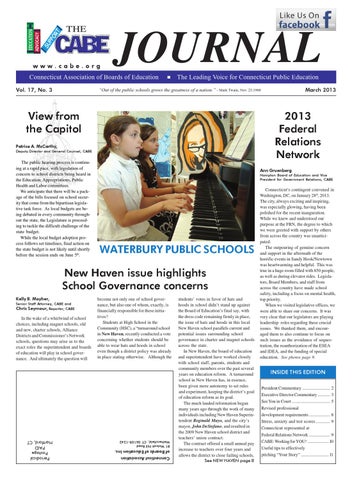
WATERBURY PUBLIC SCHOOLS
New Haven issue highlights School Governance concerns
Connecticut Association
In the wake of a whirlwind of school choices, including magnet schools, old and new, charter schools, Alliance Districts and Commissioner’s Network schools, questions may arise as to the exact roles the superintendent and boards of education will play in school governance. And ultimately the question will
become not only one of school governance, but also one of whom, exactly, is financially responsible for these initiatives? Students at High School in the Community (HSC), a “turnaround school in New Haven, recently conducted a vote concerning whether students should be able to wear hats and hoods in school even though a district policy was already in place stating otherwise. Although the
of Boards of Education Inc.
Senior Staff Attorney, CABE and Chris Seymour, Reporter, CABE
81 Wolcott Hill Road Wethersfield, CT 06109-1242
Kelly B. Moyher,
students’ votes in favor of hats and hoods in school didn’t stand up against the Board of Education’s final say, with the dress code remaining firmly in place, the issue of hats and hoods in this local New Haven school parallels current and potential issues surrounding school governance in charter and magnet schools across the state. In New Haven, the board of education and superintendent have worked closely with school staff, parents, students and community members over the past several years on education reform. A turnaround school in New Haven has, in essence, been given more autonomy to set rules and experiment, keeping the district’s goal of education reform as its goal. The much lauded reformation began many years ago through the work of many individuals including New Haven Superintendent Reginald Mayo, and the city’s mayor, John DeStefano, and resulted in the 2009 New Haven school district and teachers’ union contract. The contract offered a small annual pay increase to teachers over four years and allows the district to close failing schools, See NEW HAVEN page 8
Connecticut’s contingent convened in Washington, DC, on January 28th, 2013. The city, always exciting and inspiring, was especially glowing, having been polished for the recent inauguration. While we knew and understood our purpose at the FRN, the degree to which we were greeted with support by others from across the country was unanticipated. The outpouring of genuine concern and support in the aftermath of the horrific events in Sandy Hook/Newtown was heartwarming and helpful. This was true in a huge room filled with 850 people, as well as during elevator rides. Legislators, Board Members, and staff from across the country have made school safety, including a focus on mental health, top priority. When we visited legislative offices, we were able to share our concerns. It was very clear that our legislators are playing leadership roles regarding these crucial issues. We thanked them, and encouraged them to also continue to focus on such issues as the avoidance of sequestration, the reauthorization of the ESEA and IDEA, and the funding of special education. See photos page 9.
INSIDE THIS EDITION President Commentary ......................... 2 Executive Director Commentary ........... 3 See You in Court .................................. 5 Revised professional development requirements ................... 8 Stress, anxiety and test scores ............. 9 Connecticut represented at Federal Relations Network ................... 9 CABE: Working for YOU! ...................10 Useful tips to effectively pitching “Your Story� .........................11
Periodical Postage PAID Hartford, CT
2
The Journal
– Connecticut Association of Boards of Education • March 2013
PRESIDENT COMMENTARY
Guiding principles While participating in the Grammy Awards program recently, Justin Timberlake made a special point to thank his teachers. This is not the first young musician to thank those teachers who inspired them. I also recently asked one of my district’s high school students, “what does performing arts mean to you?” He replied, without hesitation, “the peaceful pursuit of my passion”. A new Music Educator Award is seeking nominations for outstanding music educators. “They Found You” was their theme. Conceptually, all of this interest creates opportunities for young musicians, and the teachers who helped them discover their talents. Music, and the arts; whether through performance or painting, sculpting or animation, to name just a few, give great meaning and value to our lives. Not everyone will take a talent in the arts to a level of a Justin Timberlake, with wealth and fame. But many students will derive a lifetime of pleasure from their ability to create. The message is that many talented people would never have had an opportunity, if not for a teacher who inspired and encouraged them. Needless to say, that these extracurricular activities, like sports, band or the debate team is often what make school worthwhile to our children. Now the hard part…. We all know the pinch our economy is in. Local, State and Federal funding is in jeopardy with deficits and shortages galore. Pressure from new standards, tests and evaluations will put even more pressure on school budgets to reach some sort of compliance. We risk taking the part of school that most identifies with our young people – the things they are most passionate about, and substituting instead the things that are least interesting or motivating to young minds. It is impossible to make a student passionate about the CMT. Our challenge is to figure out how to give students what they need – not just for a financial success; or a higher GPA; but rather to give them what they need to pursue their passions. At the recent National School Board Association, Federal Relations Network Conference in Washington, DC, our focus was grassroots advocacy for public education. Our collective theme to our respective
SAVE THE DATE April 2, 2013 Common Core Standards: What Board of Education Members Need to Know 8:30 am - Registration 9:00 am - 12:00 pm - Program Aqua Turf, Southington Sponsored in part by a grant from the State Department of Education In partnership with the GE Foundation and Connecticut Council for Education Reform
Congressional Delegations was advising on the federal programs that work well for our schools – Reauthorizing the ESEA Act; Increase federal funding for Title 1 and IDEA; Support effective school safety initiatives and Sequestration and Federal Funding for Lydia Tedone Education. Our concern was loud and clear – there are higher expectations at a time when there will be fewer and fewer resources. If we are to maintain the part of school that has the most impact on a student’s passion, we are going to have to fight for it from the state and federal governments that expect us to deliver more and greater rigor. Attend CABE’s Day on the Hill on March 6. Involved board members who are committed to grassroots advocacy with in our State, have significant responsibilities by making education a top priority for the General Assembly. Exercise your power and voice by telling your legislator what helps or hinders your school district. Be knowledgeable on priority legislative issues and strategies that affect every student in CT. Our one united voice for public education can be effective. We need the resources to ensure we don’t have to make decisions like art vs. math. music vs. reading. All are critical and need to be supported.
UCONN/CABE Capstone Project Bob Rader, Patrice McCarthy and Lisa Steimer have been working with UConn graduate students on a survey designed to elicit information from school board members. It is important that CABE knows more about our members in order to better serve them. Part of the survey is dedicated to helping increase CABE/CAPSS Convention attendance. You will be receiving an emailed or regular mailed surveys in the next few weeks. Please fill them out and return them as soon as possible. We appreciate your willingness to help us help you!
Condolences Richard F. Schneller Former State Senator Richard Schneller died recently at the age of 90. The former Senate Majority Leader served five terms in the Connecticut State Senate from 1975 to 1984 representing Connecticut’s 20th Senatorial District. During his Senate tenure he served successively as Senate Chairman of the Legislature’s State and Urban Development Committee (1975-1976), Education Committee (1977-1978), Appropriations Committee (19791980), and Senate Majority Leader (1981-1984). He was former chairman of the Region 4 Board of Education. In 1984, he was honored with CABE’s Outstanding Legislator Award in recognition of his leadership and statesmanship. CABE extends condolences to his family. Patrice A. McCarthy, Deputy Director and General Counsel, CABE
CABE Board of Directors EXECUTIVE COMMITTEE Lydia Tedone .................................................. President, Simsbury Richard Murray ............................. First Vice President, Killingly Ann Gruenberg ........... VP for Government Relations, Hampton Stephen Wright ............. VP for Professional Development, Trumbull Robert Mitchell ............................ Secretary/Treasurer, Montville Don Blevins ........................................... Immediate Past President John Prins ........................................................... Member at Large
AREA DIRECTORS Susan Hoffnagle ....................... Area 1 Co-Director, Winchester Mari-Ellen (Mimi) Valyo ........ Area 1 Co-Director, Winchester Daniel Santorso ........................... Area 1 Co-Director, Plymouth Becky Tyrrell ................................. Area 2 Co-Director, Plainville Susan Karp ..................................... Area 2 Co-Director, Glasbonbury Don Harris ........................................ Area 2 Co-Director, Bloomfield Laura Bush .................................................. Area 3 Director, Vernon Douglas Smith ...................................... Area 4 Co-Director, Plainfield Steve Rosendahl .............................. Area 4 Co-Director, Woodstock Gavin Forrester ................................... Area 6 Co-Director, Stratford Elaine Whitney ................................... Area 6 Co-Director, Westport Sheila McCreven ........................... Area 7 Co-Director, Woodbridge John Prins ............................................ Area 7 Co-Director, Branford Pamela Meier ............................................. Area 8 Director, Madison Gail MacDonald .................................... Area 9 Director, Stonington
ASSOCIATES Eileen Baker ........................................... Associate, Old Saybrook Sharon Beloin-Saavedra .......................... Associate, New Britain Gary Brochu ........................................................ Associate, Berlin Robert Guthrie .......................................... Associate, West Haven Cal Heminway ................................................... Associate, Granby COMMITTEE CHAIRS Elizabeth Brown ............................ Chair, State Relations, Montville Beverly Washington ....................... Chair, Federal Relations, Groton Becky Tyrrell ....................................... Chair, Resolutions, Plainville
CITY REPRESENTATIVES Jacqueline Kelleher ......................... City Representative, Bridgeport Matthew Poland ................................. City Representative, Hartford Carlos Torre ................................... City Representative, New Haven Polly Rauh ......................................... City Representative, Stamford Charles Stango ............................... City Representative, Waterbury
STAFF Robert Rader ...................................................................... Executive Director Patrice McCarthy ................................ Deputy Director and General Counsel Bonnie Carney ........................................... Sr. Staff Associate for Publications Nicholas Caruso ............................................ Sr. Staff Assoc. for Field Service and Coord. of Technology Sheila McKay ............................ Sr. Staff Associate for Government Relations Kelly Moyher ......................................................................... Sr. Staff Attorney Vincent Mustaro ..................................... Sr. Staff Associate for Policy Service Lisa Steimer .............................. Sr. Staff Assoc. for Professional Development Teresa Costa ............................... Coordinator of Finance and Administration Pamela Brooks ......................... Sr. Admin. Assoc. for Policy Ser. /Search Ser. Terry DeMars .............................................. Admin. Assoc. for Policy Service Melissa Dickinson ........................... Admin. Assist. for Membership Services Gail Heath ...................................... Admin. Assoc. for Government Relations Wilmarie Newton ...................................... Admin. Assoc. for Labor Relations Corliss Ucci .............................. Receptionist/Asst. to the Executive Director
The CABE Journal (ISSN 1092-1818) is published monthly except a combined issue for July/August as a member service of the Connecticut Association of Boards of Education, 81 Wolcott Hill Road, Wethersfield, CT 06109, (860) 571-7446. CABE membership dues include $30 per person for each individual who receives The CABE Journal. The subscription rate for nonmembers is $75. Association membership dues include a subscription for each board member, superintendent, assistant superintendent and business manager. The companies and advertisements found in The CABE Journal are not necessarily endorsed by CABE. “Periodicals Postage Paid at Hartford, CT.” POSTMASTER: Send address changes to The CABE Journal, CABE, 81 Wolcott Hill Road, Wethersfield, CT 06109-1242. Email: bcarney@cabe.org. Members can find the CABE Journal online at: www.cabe.org/ userlogin.cfm?pp=84&userrequest=true&keyrequest=false& userpage=84
The Journal
– Connecticut Association of Boards of Education • March 2013
3
EXECUTIVE DIRECTOR COMMENTARY
CABE Affiliate The revolution is occurring before Members our eyes: What’s your role? BUSINESS AFFILIATES DIAMOND MEMBER ACT, Inc. - Northeast Region Finalsite GOLD
MEMBERS
Berchem, Moses & Devlin Centris Group Shipman & Goodwin Siegel, O'Connor, O’Donnell & Beck, P.C Sullivan, Schoen, Campane & Connon
SILVER MEMBERS Anthem Blue Cross and Blue Shield Corporate Cost Control Milone & MacBroom, Inc. Quisenberry Arcari Architects The Segal Company
BRONZE PLUS MEMBERS Brown & Brown Insurance Friar Associates Goldstein & Peck, P.C. Lindburg & Ripple O & G Industries The S/L/A/M Collaborative Trane Whitsons School Nutrition
BRONZE MEMBERS Chinni & Meuser LLC Dattco Inc. Fuller & D’Angelo Architects and Planners Kainen, Escalera & McHale, P.C. The Lexington Group Muschell & Simoncelli Ovations Benefits Group
EDUCATIONAL AFFILIATES American School for the Deaf Area Cooperative Educational Services Capitol Region Education Council The College Board Connecticut Association of School Business Officials Cooperative Educational Services Connecticut Center for School Change Connecticut School Buildings and Grounds Association EASTCONN EDUCATION CONNECTION LEARN Unified School District #1
CABE’s position on all these changes. I hope you take a little time to read the article on page 1 about how governance is We have been involved in them and changing in the State. I think every board advocated for many of them, especially last year when we worked with the “Big should discuss this and what it means to Six” Partnership (CABE, CAPSS, CAS, their districts as we move forward. CBIA, the Connecticut Council for Over the years, public education has Education Reform and ConnCAN). We gone through many transformations. We have a good rela-tionship with all of them, are a long way from the one-room schoolbecause our work is based on principles house. Education reform is revolutionizRobert Rader that we all agree on. This year, we went ing public education. This will have huge impact on the mission of boards of educa- back to those principles and updated them. There are other issues on which we with more flexibility. We support these tion, which has long been to connect the new proposals. disagree – and we go separately and will of the community to the education of We need to examine all aspects of what lobby for the positions adopted by our its students. we do. For example, we don’t really know Delegate Assembly. The Federal Government is behind how to talk about the many fine things much of this revolution . With Race to the that we do in public education. One exTop and the NCLB waiver, it has used ample: we spend millions a year on funding as a way to encourage states, Choice, magnets, charters and other proWhat’s the Goal? state departments of education, school jects in order to desegregate our schools. Still, I am left with the over-arching boards and other Do we take pride in educational this? Do we ever leaders to think about the great change how they “. . . this is the time of year when your voice is needed things we are doing were “doing for kids to rectify . . . Let your representatives know that you are con- problems that have business”. Connecticut been decades (cencerned about these issues and you want to ensure that turies?) in the making? has been I understand that unlucky three times in attempt- they think about them as they consider flexibility for according to the Sheff desegregation case ing to get Race districts and the funding of public education.” plaintiffs, we have not to the Top done enough. I get funding and four that. But, let us take times if you question: Where are we going with all of pride in what we have done. examine the individual dis-tricts which Few other states still focus on this this? When do we take stock and get an tried to get funding. Despite that, with idea of what needs to be better supported, important issue. Let’s take pride in what the strong effort led by Governor Dannel we do. pulled back or deleted altogether? Malloy, the State Board of Education and There is no doubt that we need to And, in the long run, who will run our Commissioner Stefan Pryor, we have seen improve on many metrics: overall public education system? Will it be the wholesale changes in the professional achievement of our students, the achieveFederal and State governments? evaluation and support of teachers and ment gap, preparing our students for their If it will be the Federal and State principals, the beginnings of implementafuture. But, let’s think through the impligovernments running the schools in the tion of the Common Core and more. cations of all these changes. I urge you to way they think best, who will fund the While this is all going on, there are get involved with CABE as we think schools? Can we really ask taxpayers at new structures, aimed at changing the about these important issues. the local level, through real estate taxes, very nature of how education is delivered This is the time of year when your to pay more at a time when boards are in our schools. We now have Alliance voice is needed on these issues with the having less and less control over their Districts, Commissioner’s Network Legislature. children’s education? Let your representatives know that And, why would we want more and Schools, more charter schools, two State you are concerned about these issues more prescription from those governinterventions and other initiatives aimed and you want to ensure that they think at eliminating the state’s achievement gap. ments at a time when they are giving us about them as they consider flexibility for less money – barely enough to keep up districts and the funding of public with inflation? education. On the other hand, there are bills beMore prescriptive fore the Legislature that provide districts Welcome to our next big conversation! At the same time, we are finding that the Federal and State action on educational issues is more prescriptive than it was years ago. For example, many years ago, the Legislature saw a need for boards to think about the homework assigned to students. So, they did what we encouraged them to do: required all boards to adopt a policy in this area. That enabled Through a partnership with AEPA and CREC, Tremco, a leading innovator and boards to tailor their policies to what they provider of roofing and weatherproofing solutions, delivers unique facility asset believe(d) was best for their districts. management solutions designed to reduce your roofing and building envelope But, that is not what is happening tolife-cycle costs while improving performance day. For example, we have had, imposed from above, new wellness, nutrition, The benefits to buyers include: school governance councils, bullying and t A streamlined procurement process t Buying power of a national contract other requirements. These enactments t Single-source responsibility: turnkey t Shorter project time have put a real strain on the staffs of all school districts. t Pre-competed line item pricing t Use of “best in class” contractors The underlying theme seems to be: we can’t trust boards of education to take For more information, contact Cara Hart at 860-524-4021 or chart@crec.org. care of our students in an appropriate way. We need to make sure they do things exactly as we want them done. This is not the venue to debate
5RRÀQJ DQG %XLOGLQJ 6ROXWLRQV
4
The Journal
– Connecticut Association of Boards of Education • March 2013
The art of making people smile. Delta Dental knows what it takes to keep you and your employees happy. At Delta Dental, we can help you create a dental plan that’s sure to paint a smile on your employees faces: • Expertise. We’re part of the most experienced dental benefits company in the country. • Flexibility. We can help you design a plan that meets your needs and budget—without compromising on value. • Network of Dentists. We offer access to the largest network of dentists in the U.S.— with 4 out of 5 dentists participating nationwide. • Simplicity. You can count on us for easy plan administration. • Customer Satisfaction. Add it all up: the largest network, unbeatable expertise, flexibility, value and cost savings, and it’s easy to see why Delta Dental is your best choice. Delta Dental. We’re committed to promoting oral health for all your employees. Call 1-860-633-9200 or visit www.deltadentalct.com. In CT, Delta Dental Insurance Company writes dental coverage on an insured basis and Delta Dental of New Jersey administers self-funded dental benefit programs.
The Journal
– Connecticut Association of Boards of Education • March 2013
5
See You in Court – The Nutmeg Board of Education
The Nutmeg Board deals with disciplining a board member and paying said member Thomas B. Mooney, Esq. Shipman & Goodwin
The Nutmeg Board of Education makes many mistakes. The latest imbroglio created by the board will be reported here each issue, followed by an explanation of what the board should have done. Though not intended as legal advice, these situations may help board members avoid common problems. After her granddaughter Vivian was born, Penny Pincher decided to resign her position as a member of the Nutmeg Board of Education. Soon after Penny’s resignation became public, Mayor Megillah was on the telephone with each of the remaining members of the Board, lobbying for his nephew Wiley Waze, who had just recently moved to back Nutmeg after a mysterious absence that may have included time in prison. The Board members didn’t want to antagonize the Mayor, but they did want to make it look good, so after convening into executive session, the Board interviewed Wiley, the PTO President and a member of the Youth Athletic League. The Board members then discussed the candidates and quickly decided on Wiley.
After all, Board member Bob Bombast noted, how much trouble can one Board member cause? The Board soon found out. Wiley was quite the operator, and the Board members learned that every time that Wiley raised an issue, there would be some angle of self-advantage. At a Board meeting shortly after he was appointed, he announced that he would be putting in not only for reimbursement for his expenses, but also for a modest hourly rate to compensate him for his “research” on various issues coming before the Board. “Nothing extravagant, of course,” he assured the Board members, “but more than the minimum wage to compensate me for my public service.” At the Board meeting last evening, Wiley made another move under New Business. “With our tight budget, we need to squeeze every nickel,” Wiley proclaimed. “Some classrooms are too hot, and some classrooms are too cold. We need expert help to keep our temperatures just right.” With that, he passed out to the other Board members and Mr. Superintendent a brochure that advertised “Energy Matters,” a newly-
Seventh Edition Now Available
A Practical Guide to Connecticut School Law by Thomas B. Mooney, Esq. Shipman & Goodwin The Guide comes with a CD which provides hyperlinks to many cases and statutes and will permit word searches as a supplement to the Index. New to the Seventh Edition: Bullying, Background Checks, Child Abuse Reporting, Discrimination Issues, Educational Reform, FERPA, Freedom of Information, State Aid for Education and much, much more The 7th edition is now available from CABE. Call and order your copy TODAY at 860.571.7446 or 800.317.0033
formed consulting firm right in town. After a lengthy introduction, Wiley proposed that the Board hire Energy Matters for such consulting services, explaining that he had arranged a special public sector discount with the owner. Dramatically, he ended his presentation by exhorting his fellow Board members to take advantage of this very special offer. “Wait a minute,” interrupted Bob Bombast as he perused the brochure. “Isn’t the owner your girlfriend?” Wiley smiled and quickly acknowledged that such is the case. “I can assure you that my fondness for the owner has nothing to do with my position here. This is the best deal the Board could ever find. However, to avoid the appearance of conflict of interest, I will not be voting on this matter,” Wiley said grandly. With little discussion, the other Board members voted to reject the proposed contract from the consulting firm. But that was not the end of it. Bob Bombast was incensed by what he considered to be deceptive tactics by Wiley, and he made a motion that Wiley be censured and given a final warning that he would be removed from the Board if he ever again pulls a stunt like that. Wiley’s protestations were in vain, and the other quickly passed Bob’s motion without discussion. Does Wiley have any recourse?
Robert’s Rules of Order includes disciplinary procedures that can be followed when board of education members act inappropriately. However, Robert’s Rules address two different situations – those involving an offense during a meeting and those involving an offense that occurs away from the meeting. Here, it was appropriate for the Board to act without further ado; there was no need for additional fact-finding because Wiley’s misconduct occurred in front of everyone. By contrast, if a board is considering censure of a member for action taken away from the meeting (as for example if and when a board member is accused of disclosing executive session discussion), Robert’s Rules contemplates more of a trial, in which the facts are established and in which the accused has an opportunity to respond. Such procedures are used sparingly, of course. In any event, boards of education do not have the authority to exercise the ultimate sanction of removal from office. The misconduct, of course, was Wiley’s promoting his girlfriend’s company without disclosing the connection. Significantly, his saying he wouldn’t vote on the contract remedied nothing. When there is a conflict of interest, a board member should also not participate in any of the related discussion. Boards of education make their decisions through deliberations in which board member discussion may and should affect how people vote, and the discussion is part of the decision-making process. This situation involves a number of other issues as well. Conn. Gen. Stat. § 10-219 provides that, unless otherwise provided by charter or special act,
vacancies on the board of education shall be filled by the remaining members of the board until the next regular town election, when a successor will be elected for the unexpired portion of the term. In filling such vacancies, boards of education have the right to interview and to discuss candidates in executive session. However, the Board here appears to have overlooked a requirement. As with personnel, such executive session discussion is permitted as long as the person being discussed does not
“If any member of such board is employed contrary to the provisions of this section, the office to which he or she was elected or appointed shall become vacant.” require that the discussion as to him or her be held in open session. The Board should have notified the candidates of their right to require that the discussion as to them take place in open session. Also, discussion of the proposed contract under “New Business” violated the FOIA. The agenda for meetings of public agencies must fairly apprise the public of the business to be conducted, and business includes discussion, not just action items. Under “New Business,” it is appropriate to identify topics for future agendas. However, a substantive discussion of any such topic should not occur at that time. Finally, if Wiley accepted payment from the Board on his bill for “research,” he is no longer on the Board at all. Conn. Gen. Stat. § 10-232 prohibits employment by a board of education of its members, and it goes on to provide: “If any member of such board is employed contrary to the provisions of this section, the office to which he or she was elected or appointed shall become vacant.” Recently, a former board member in Plainfield learned that employment can involve receipt of any compensation. There, the board member requested and was paid $15 per hour for serving as staff in going on a field trip that included her son. When the board member accepted payment, board counsel opined that her board office became vacant by operation of Section 10-232, and the board of education filled her position. She challenged that determination in court, and last month the superior court ruled denied her request for an injunction to reinstate her to her former position. Attorney Thomas B. Mooney is a partner in the Hartford law firm of Shipman & Goodwin who works frequently with boards of education. Mooney is a regular contributor to the CABE Journal.
6
The Journal
– Connecticut Association of Boards of Education • March 2013
Now More Than Ever... Your District Needs Medicaid Direct
A fully integrated module of IEP Direct that simplifies Medicaid tracking and claiming, enhances compliance, and optimizes reimbursement
With Medicaid Direct, recovering Medicaid funds is less complex and time-consuming. This innovative web-based solution will provide a positive return on investment and benefit your school district by: U Saving time and improving data accuracy U Optimizing and accelerating reimbursement U Enhancing compliance and best practices U Simplifying service tracking and the billing process U Reducing paperwork burden with online documentation by providers U Allowing service providers to enter service encounters online U Providing integration with IEP Direct For a demonstration and information on Medicaid Direct visit IEPDirect.com or call 516.766.4448.
Tel: 516.766.4448 U Fax: 516.766.4896 U www.IEPDirect.com
^Ɖ ^ƉĞĐŝĂůŝnjŝŶŐ /Ŷ͗ ŶƌŽůůŵĞŶƚ WƌŽũĞĐƟŽŶƐ ^ĐŚŽŽů ZĞĚŝƐƚƌŝĐƟŶŐ ͬ ZĞĐŽŶĮŐƵƌĂƟŽŶ >ŽŶŐ ZĂŶŐĞ &ĂĐŝůŝƚLJ WůĂŶƐ 'ƌŽǁƚŚ &ŽƌĞĐĂƐƟŶŐ ,ŽƵƐŝŶŐ ŶĂůLJƐŝƐ WƵďůŝĐ KƵƚƌĞĂĐŚ
dŽ ůĞĂƌŶ ŵŽƌĞ ĂďŽƵƚ ŽƵƌ ƐĞƌǀŝĐĞƐ͕ ĐŽŶƚĂĐƚ DŝŬĞ ƵďĂ Ăƚ ŵŝŬĞnjΛŵŝůŽŶĞĂŶĚŵĂĐďƌŽŽŵ͘ĐŽŵ
ǁǁǁ͘ŵŝůŽŶĞĂŶĚŵĂĐďƌŽŽŵ͘ĐŽŵ ŽŶŶĞĐƟĐƵƚ Ͳ DĂŝŶĞ Ͳ DĂƐƐĂĐŚƵƐĞƩƐ Ͳ ^ŽƵƚŚ ĂƌŽůŝŶĂ Ͳ sĞƌŵŽŶƚ
The Journal
7
– Connecticut Association of Boards of Education • March 2013
21st Annual
Model Schools Conference DOING MORE WITH LESS Common Core Nex t Generation Assessments Teacher Evaluation
June 30 – July 3, 2013 | Washington, D.C.
Bill Daggett
Sue Gendron
Ray McNulty
Sharon Wolder
Sue Szachowicz
Register Today! www.modelschoolsconference.com
Ken Wesson
8
The Journal
– Connecticut Association of Boards of Education • March 2013
Revised professional development requirements Vincent A. Mustaro, Senior Staff Associate for Policy Service, CABE
The requirement that professional certificate holders successfully complete 90 CEUs every five years as a condition of certificate renewal has been eliminated by P.A. 12-116, “An Act Concerning Educational Reform.” Starting July 1, 2013, all certified employees, including initial and provisional certificate holders, are still requir-ed to participate in professional development programs. The reform legislation revised professional development to emphasize improved practice and individual and smallgroup coaching sessions. It continues current requirements that districts (1) offer professional development according to plans developed in consultation with a professional development committee consisting of the district’s certified personnel and other appropriate members; (2) determine specific professional development activities with the advice and help of their teachers, including their union representatives; and (3) that the activities give full consideration to the Connecticut State Board of Education’s (SDE) priorities related to student achievement. School districts yearly must make available at least 18 hours of professional development for certified employees at no cost. The new legislation requires that a
preponderance of the 18 hours be in a small-group or individual instructional setting and to: 1. improve integration of (a) reading instruction, (b) literacy and numeracy enhancement, and (c) cultural awareness, and include strategies to improve English language learner instruction into teacher practice; 2. be used to improve teacher and administrator practice based on general results and findings from teacher evaluations reported by the school superintendent or designee; 3. foster collective responsibility for improved student performance; 4. be comprehensive, sustained, and intensive enough to improve teacher and administrator effectiveness in raising student achievement; 5. focus on refining and improving effective teaching methods shared among educators and fostering collective responsibility for improving student performance; 6. be (a) aligned with state student academic achievement standards, (b) conducted among educators at the school, and (c) facilitated by principals, coaches, mentors, distinguished educators, or other appropriate teachers; 7. occur frequently for teachers indivi-
dually or in groups, within their jobs, and as part of a continuous improvement process; and 8. include a repository of teaching best practices developed by each school’s educators which is continuously available to them for comments and updates. The new legislation eliminated the following professional development requirements: • for those with childhood nursery through grade three or elementary endorsements, at least 15 hours of training in teaching reading, reading readiness, and reading assessment; • for those with elementary, middle, or secondary academic endorsements, at least 15 hours in how to use computers in the classroom unless they can demonstrate competency; and • for those with bilingual endorsements, training in language arts, reading, or math for elementary school teachers and in the subject they teach, for middle and secondary school teachers. The new law also requires the State Department of Education (SBE) to audit district professional development programs and allows SBE to assess financial penalties against districts it finds out of compliance based on such an audit.
Policy Implications Policy #4131, “Staff Development,” has been revised. This is a recommended “best practice” policy for inclusion in a district’s policy manual. In addition, the administrative regulation which accompanies this policy has been replaced with a new version which reflects the statutory changes and the memorandum, dated September 21, 2012, from Nancy L. Pugliese, Chief of the Bureau of Educator Standards and Certification, pertaining to the substantive changes to the requirements for the professional educator certificate and the new requirements for professional development. The new administrative regulation reflects the changes to be in place for the 2013-2014 school year. CABE supports the recommendation that district leadership, in collaboration with teacher representatives, begin the professional development planning process during the current 2012-2013 school year and begin to align the professional development program with the individualized teacher needs identified through the current evaluation process.
New Haven issue highlights School Governance concerns (continued from page 1) give merit bonuses and include student performance in the evaluation of teachers. As to the additional autonomy given to certain schools, whether a turnaround school or charter school, the contract speaks to retaining a committee and voting processes, as well as a school plan design with the board of education and teachers’ union able to veto certain proposed changes. Assistant Superintendent Garth Harries came to New Haven in 2009 after working for many years on special education reform in New York. In describing New Haven’s reformation efforts and the set-up of its schools Mr. Harries said, “A core part of our school change effort is a portfolio approach to schools, which means we recognize that each school faces its own opportunities and challenges and we need to support them on their own unique path to success while holding them accountable for outcomes”. “In general, it’s up to the schools to build their culture, organization and academic culture. The key outcome we don’t waiver on is achieving results for students”, Harries said. And, as ended up being the case of hats and hoods in HSC, sometimes the desire for autonomy runs “flat into district policy or other limitations and district policy will trump as it did here”, Harries continued.
Issues Will Arise The example of what took place at HSC is just the tip of the iceberg of what could potentially become very serious issues among school districts and the State Department of Education. Considering the number of possible types of schools, the question of what role the local superintendent and board of education are to play will inevitably arise. Former superintendent and CAPSS Executive Director Joe Cirasuolo, suggests that the roles of boards and superintendents will vary according to the type of school. For instance, boards and superintendents have no role in the operation of magnet schools, unless the schools are established by local boards. In such cases, the boards’ and superintendents’ roles are identical to those they play with all other district run schools. “With respect to Alliance Districts, the superintendent’s role is to develop a proposal for submission to the SDE, but it is not yet clear what the role of the board is in the process. The best practice at this time is to at least have the superintendent and board review the proposal together before its submission. Once the proposal is approved, the superintendent’s role is to implement the proposal and the board has no formal role in this process”. Cirasuolo continued, “With respect to the Commissioner’s Network schools, the board has the responsibility of appointing
two people as voting members of the committee that develops the proposal for submission to the SDE. The superintendent is the non-voting chairperson of this committee and the proposals go directly to the SDE.”
Needed: A Unified Structure So who is going to make all these schools and initiatives work? According to Cirasuolo, there is no structure currently in place to pull these initiatives together. “This is a serious problem because separate efforts to achieve roughly the same goals with no systemic coordination almost always does not achieve anywhere near what they are capable of achieving. “ Coordination among all of these efforts is desperately needed so those trying to achieve the most for our children and districts do not ultimately fail to meet their goals. “Commissioner’s Network schools and alliance districts should have board members, superintendents and appropriate SDE staff charged with developing a structure that will bring coordination to these efforts. With respect to magnet schools, those not run by districts should remain under the control of the RESC’s (Regional Education Service Centers). However, the RESC’s governing boards, which are made up of local board of
education members from within the RESC’s area, need to assume authority over all policy matters related to those schools including the approval of budgets and tuition fees.” CABE Executive Director Robert Rader urged that with reform being driven by the State and Federal governments, boards of education must remain engaged, active and influential if they are to continue to connect the will of their communities to the education of their children, “It is the role of all boards of education and their superintendents to work with the State Board, the Commissioner and the Legislature to work together to build a system that works for all of our children, urban, suburban and rural. We are going through a period of tremendous change throughout the State and it is incumbent upon all of us to build a system ensuring all of our children have the opportunity to succeed, “said Rader. While schools like High School in the Community in New Haven grapple with issues of autonomy and other schools and districts across the state deal with school governance and financial matters, we look toward the work being done in our state’s Capitol by the legislature and the SDE for guidance.
The Journal
9
– Connecticut Association of Boards of Education • March 2013
Stress, anxiety and test scores Robert Rader, Executive Director, CABE Whether or not you agree with the use of testing as it has come down to school boards from the State and Federal Governments, there is little doubt that highstakes testing is here to stay. All teachers and principals and even many superintendents will have their performance based in part, on how students do on tests. I understand the concerns about this, as expressed in detail by teachers and others who believe that we don’t build our children’s love of education by testing them. I remember the adage that a pig doesn’t grow bigger by weighing it more often. But, there is little doubt that testing and the analysis of how students do, including whether they are on grade level and whether there continues a large achievement gap in the State, will depend on their ability to take and deliver good results on the next generation of tests. The purpose of this article is not to debate testing, good or bad, but rather to discuss some of the impact of examinations on our children.
Connecticut represented at NSBA Leadership and Federal Relations Network Conferences
It behooves all of us to start thinking about how we can help our students do better on exams. I’m not talking specifically here about learning the content of the materials, which is obviously critical, but about how students approach tests. Two recent articles dealt with test anxiety. I would bet that almost all of us have had to deal with it before we faced a big exam. I know I have—as illustrated by my difficulty sleeping before a big test. I am sure I am not the only one.
Time Tackles the Issue In its February 11th issue, Time Magazine contained an article entitled, “Relax, It’s Only a Test”. It discussed the “crippling anxiety” that tests can cause in students. But, it also set out some of the ways in which cognitive research and psychology is helping to give us a “better understanding of the link between stress and performance and allowing experts to develop specific strategies for helping kids manage their fears.” And, this is important as we work on
CABE President Lydia Tedone (Simsbury) and First Vice President Richard Murray (Killingly) represented Connecticut at the NSBA Leadership Conference.
Attending the Federal Relations Network Conference (FRN) from Connecticut were: Superintendent Nathan Quesnel (East Hartford) representing CAUS, Beverly Washington (Groton), Robert Rader (CABE), Sheila McKay (CABE), Lydia Tedone (Simsbury), Cal Heminway (Granby), Richard Murray (Killingly), Patrice McCarthy (CABE), and Ann Gruenberg (Hampton).
eliminating the achievement gap: the anxiety of taking tests “can be especially common among minority and female students.” This apprehension can lead such students “to perform below their capabilities”. According to a Stanford University psychologist, “the nervousness everyone feels when they’re being evaluated, plus the worry – conscious or not – that a poor performance will prove that [a] negative assumption about their group is correct puts everyone in stress mode”. So, what are the strategies set out in the article? • In order to lessen the anxiety, one strategy that has proven successful in a “recent trial” is to “have students spend 10 minutes writing about their thoughts and feelings immediately before taking a test.” This is called “expressive writing” and used to lessen the negative thoughts running through a student’s brain. “Writing about their worries had the effect of offloading them onto the page…”
Executive Director Robert Rader and Deputy Director and General Counsel Patrice McCarthy spoke at both NSBA’s Leadership and Federal Relations Network Conference. They spoke to hundreds of state school board leaders from across the country on school safety, security and CABE’s support of Newtown and all of our members after the tragedy.
Attending a meeting with Senator Chris Murphy were: Sheila McKay (CABE), Robert Rader (CABE), Cal Heminway (Granby), Lydia Tedone (Simsbury), Senator Chris Murphy, Beverly Washington (Groton), Patrice McCarthy (CABE), and Ann Gruenberg (Hampton).
• To reduce the “stereotype” issue, the strategy is to have students write before the test about “something they value and describe why it matters to them”. This has a way of affirming their values and in one study, it “shrank the performance gap between white and black students by 40%”. Frankly, that is a huge narrowing and I wonder if it would be borne out in other studies. • Another strategy is to change the way students study for them. They should review the information and, still studying, replicate the time and format so they come into the real test better prepared. • Relaxation exercises before a test also helped. Yoga-type exercises, concentrating on breathing can help the nervousness go away.
The Times also weighs in A second article, reported in the Marshall Memo discusses a recent New York Times Magazine article concerning how people deal with stress. According to Bronson and Merryman, long-term stress is not healthy, but short-term stress “can actually help people perform, and viewing it that way changes its effect. Even for those genetically predisposed to anxiety, the antidote isn’t necessarily less competition – it’s more competition. It just needs to be the right kind.” A gene in our bodies is involved in how we react to stress. The gene “carries the assembly code for an enzyme that clears dopamine from the prefrontal cortex of our brains.” We work best when dopamine is maintained at a balanced level. They argue that for some people, the right amount of stress will actually help them perform better on tests and in general. So, there are what they call “warriors”, who perform better with more stress and “worriers”. They believe that academic competitions are very healthy in that warriors thrive on the competition and worriers “get the gradual stress inoculation they need, so that one day they can do more than just tolerate stress – they can embrace it. And through the cycle of preparation, performance and recovery, what they learn becomes ingrained.” Anxiety and how the body reacts to stress remains a difficult and important area of study. But, research is teaching us more about how anxiety can affect the work of our schools. Our job is to harness that research and use it to our best advantage. If you would like copies of the articles, please do not hesitate to contact me.
10
The Journal
– Connecticut Association of Boards of Education • March 2013
CABE: Working for YOU!
CABE/CAPSS CONVENTION
Individualized Workshops • Professional Development Opportunities • Legal Services • Policy Services Representing You Statewide and Nationally Below are the highlights of activities that the CABE staff has undertaken on your behalf over the last month and a half. We did this:
• •
Attended Hartford Area Legislative Breakfast (CREC). Attended State Board of Education meeting.
to increase student achievement •
➤ By representing Connecticut school boards on the state or national level: • • • • •
• • • •
• • • • • • •
Participated in meeting of the Governor’s Prevention Partnership Audit Committee. Participated in meetings of the What Will Our Children Lose coalition. Participated in meeting of the Connecticut Coalition for Public Education. Participated in meeting of the “Big Six” Partnership. Met with CAPSS and our new facilitator for our re-examining of our Governance and Team Assessment documents. Participated in Professional Educators Evaluation Committee (PEAC). Participated in meeting of the Educator Preparation Advisory Council. Attended Conecticut Society of Association Executives (CSAE) Annual conference. Participated in panel discussion on school security at NSBA Leadership and Federal Relations Network Conference. Lobbied Connecticut’s Congressional delegation. Attended Connecticut Coalition for Justice in Education Funding (CJEF) Steering Committee. Met with individual legislators and legislative leadership to discuss CABE’s priorities. Testified before Bipartisan Legislative Task Force on School Security subcommittee. Participated in NSBA State Association Counsel meeting planning call. Participated in NSBA Council of School Attorneys (COSA) Executive Committee conference call. Chaired NSBA Council of School Attorneys (COSA) Nominating Committee.
➤ By providing opportunities for members to learn how to better govern their districts: • • • • • • • • • •
•
Met with East Haven Board of Education on the superintendent search process. Helped facilitate a roles and responsibilities workshop for the Westport Board of Education. Participated in CABE Board of Directors’ Retreat. Trained Glastonbury Board of Education and Central Office Staff on use of CABE-Meeting. Demonstrated CABE-Meeting for Clinton Central Office staff. Participated in IQM2 webinar on paperless meetings. Staffed and participated in three sessions of the 9th Annual CABE Leadership Institute. Had phone meeting with Mansfield staff about CABE-Meeting. Participated in meeting of CABE Senior Staff and Executive Committee. Held several conference calls to plan program on the Common Core Standards for Board of Education members. Provided policy information to 37 districts, two out-of-state school board associations, three RESC’s, one attorney and one newspaper through 57 answered requests for information or sample policies, on 45 topics. The topics of greatest interest included issues pertaining to school security which included crisis plans, video surveillance and school resource officers. Other topics included attendance and truancy; bring you own technological devices to school, computer aceptable use policies and school volunteers.
•
•
l. to r., CABE Area 9 Director Gail MacDonald (Stonington) pesented the Salem Board of Education with two Awards of Excellence in Educational Communications for their District Budget and Website. Receiving the Awards were: Superintendent Joseph Onofrio, Kim Gadaree, Board Chair Stephen Buck and Jennifer Kayser.
Attended program, featuring Pedro Noguera, sponsored by the Hartford Foundation for Giving. Provided Lighthouse training for Ansonia, Danbury, Killingly, Norwich, Shelton and Vernon Boards of Education. Sent three issues of Policy Highlights via email listserv covering topics that affect student achievement. This included nutrition standards, staff-student relationships, homework, dropouts, technology and school security.
Talented Student Due: May 17, 2013 Does your district have an outstanding student performance group? We are looking for talented students to entertain participants at the 2013 CABE/CAPSS Convention, November 15-16, 2013. Applicants should send a recent recording of the group on CD or DVD along with the application form. Please be sure to include the amount of space needed for displays and contact information. Go to http://www.cabe.org/ uploadedConvention2013_Showcase_ your_talented_student.pdf for more information and the application form.
➤ By promoting public education: •
•
•
• • •
Participated in meeting of the State’s Emergency Preparedness Committee (discussed boards’ concerns about school safety). Met with the Hartford Courant and The Day’s editorial boards. Met with UCONN Capstone project students. Met with CAPSS’ Executive Director Joe Cirasuolo, and with President and First Vice President of AFT-CT on issues in common. Presented Communications Awards to Glastonbury Board of Education. Participated in the meetings of the Child Emergency Preparedeness Committee Answered questions about the current legal issues facing boards of education. “HOT” topics this month were: Expulsion hearing officers, meetings under FOIA, Magnet school transportation, recording meetings, and school year.
Convention Hotel Reservation Information Mystic Marriott Hotel and Spa 625 North Road, Route 117 Groton, CT 06340 Those attending the annual CABE/CAPSS Convention have been guaranteed a room rate of $149. When making your reservation, be sure to mention that you are with the CABE/CAPSS Convention in order to take advantage of this special room rate. This rate of $149 is guaranteed only until 4:00 pm on October 16, 2013. After this date, reservations for Convention participants are based on availability and are offered at the prevailing rate. You are encouraged to make reservations online at https:// resweb.passkey.com/Resweb.do? mode=welcome_gi_new&groupID =18612158. You may also make reservations by calling 877-9016632. Purchase orders are NOT accepted.
➤ By providing services to meet members needs: • •
CABE Communications Awards
November 15-16, 2013
➤ By helping school boards
•
Attended CABE/CAPSS Small District Capacity Committee meeting. In the process of doing an audit of the policy manual of the Ellington Board of Education. Completed as part of the Custom Update Service packets of new and/or revised policies for: Ansonia, Columbia, East Hampton, East Windsor, Franklin, Gilbert School, Marlborough, New Fairfield, New Hartford, Newington, North Stonington, Old Sayborok, Oxford, Region No. 6, Stafford, Sterling, West Haven, Westbrook, and Windham Boards of Education.
➤ By ensuring members receive the most up-todate communications: •
Provided and attended webinar the day after the release of the Governor’s Budget.
•
•
•
Prepared Custom Policy Service, material were prepared for ACES, Griswold, Hartford, Region No. 17, Watertown, Windsor Locks, and Woodbridge. Entered into a contract with Avon to develop a new policy manual for the district. Prepared draft of Update Service Publication No. 3 pertaining to issues of school safety and security.
The Journal
11
– Connecticut Association of Boards of Education • March 2013 CABE and Baldwin Media: Partners in Managing Communications
The
Media Message
from Ann Baldwin, Baldwin Media Marketing, LLC
Useful tips to effectively pitching “Your Story” As many of you know, having your school, company, product, or executive appear in an appropriate media outlet is great marketing. Not only do you reach your audience directly, you can also utilize this as a credibility piece in reprints or Web links. In many cases media coverage means legitimacy. For many years now, I have been on the pitching side of the news business. No longer behind the anchor desk, now my job is to reach out to the media to convince them to recognize the significance of the story that I am pitching on behalf of the company or organization that I am representing. In the process I have drafted hundreds of press releases and created too many emails to count. “Pitching” a news story isn’t easy. The good news is, I am more than happy to pass along a few tips so that you can be more successful with your next “pitch”.
TIP #1: Is it newsworthy? Journalists hate getting junk in their inbox as much as anyone. When email queries come in to reporters who don’t cover that particular area, all it does is harm the reputation of the sender. Be selective and ask yourself, is this story newsworthy? Why do you want people to know?
TIP #2: Target your pitch to a specific publication. Better
yet, target an individual journalist. Taking the time to read a publication and then crafting a unique pitch to a particular journalist can work wonders. Mention a specific story that he or she reported on, or an article they wrote and then explain why your story idea would be interesting for the journalist to look at. Make certain the subject line of the email is also attention grabbing, so the email gets opened.
TIP #3: Send email as plain text with no attachments. These days, it is a rare that a reporter will open an email attachment they don’t expect – even from people they recognize. Yet many people still send press releases out as email attachments. Don’t! Send plain text emails. If you’re asked for other information, you can send as attachments, but clearly reference that in the email. Make it as easy as possible to read. If there are too many clicks and attachments to open, it will look like a lot of work.
release, how about “Press Release: Our Company Releases [insert description here].” Many PR pitches look like spam because of the convoluted subject lines and are often deleted as spam.
TIP #5: Help the journalist understand the big picture. Often it’s difficult to understand how your story idea fits in. (what is the hook?) You make a journalist’s job much easier if you describe the big picture trends of why this particular subject is of interest.
TIP #6: Cut to the chase. Reporters receive several dozen press releases in an average week from people that want them to write a story or do a news segment about them. Most reporters are too busy to decipher press release gobbledygook. Most “decision makers” give a press release ten seconds to catch their attention. The surest way to get a release deleted is out of frustration because it is written in a way no one can understand.
TIP #7: Be available. If you send out a press release looking for media coverage make sure you are available to make the interview happen. Regardless of what else is happening and whether or not you are having a good hair day, the story goes on with or without you!
TIP #8: Let people know. After all of that, if you get the coverage let people know about it! Post the information on your Facebook page (if you have one), or put out an email letting people know when the story is going to be printed or aired on television. There is nothing more satisfying than going through all of the hard work of soliciting positive news coverage and getting it! Editorial Note: CABE and Baldwin Media partner to provide media training service sessions through CABE and delivered by Baldwin Media. For further information, contact Executive Director Robert Rader at 860-571-7446 or rrader@cabe.org.
TIP #4: Use email subject lines that make sense. Subject lines should, in fact, contain some reference to the subject of your story pitch. For example, writing something like “Story Pitch on Outstanding Test Results.” If it contains a press
CABE-Meeting CABE-Meeting is a user-friendly, web-based service specifically designed to assist the board, superintendent and central office staff in preparing for and running board of education meetings. An exciting feature designed for use by committees, in addtion to boards of education, was recently added to CABE-Meeting. Now all your board work and committee information is conveniently located in one place!
CABE Search Services is recruiting for SUPERINTENDENT OF SCHOOLS Amity Region No. 5 Public Schools
“CABE-Meeting has been a great program for our district. We have saved time and money and increased our ability to disseminate information quickly. I encourage Board members to consider the advantages of CABE-Meeting.” Becky Tyrrell, Member, Plainville Board of Education
For more information, or to schedule a demonstration for your board, call Lisa Steimer at 800-317-0033 or 860-571-7446 or email lsteimer@cabe.org.
For an update or more information on vacancies go to our website: www.cabe.org For more information contact, CABE Search Services, Jacqueline V. Jacoby • 860-539-7594 Mary Broderick • 860-739-7866 Paul Gagliarducci • 413-218-5692 Bob King • 203-461-0388 P.O. Box 290252, Wethersfield, CT 06129-0252 www.cabe.org/support • Equal Opportunity Employers
12 The Journal
– Connecticut Association of Boards of Education • February 2013
REPRESENTING CONNECTICUT SCHOOL BOARDS FOR MORE THAN 35 YEARS THE LAW FIRM OF
SULLIVAN, SCHOEN, CAMPANE & CONNON, LLC With over thirty five years experience providing legal representation to Connecticut’s public school districts, Sullivan, Schoen has set the standard for public sector collective bargaining, has created an unparalleled body of case law favorable to school boards, and has established a proactive partnership with its clients to develop policies and practices that anticipate the law’s ever-evolving demands. Call us and see how we can help you.
646 Prospect Avenue Hartford, CT 06105-4286 Phone: 860-233-2141 Fax: 860-233-0516 William R. Connon, Partner
Website: sscc-law.com