68 33 25 7
('8&$7,21
$'92&$&<
7+(
www.cabe.org
HAPPY HOLIDAYS!
-2851$/
&RQQHFWLFXW $VVRFLDWLRQ RI %RDUGV RI (GXFDWLRQ 7KH /HDGLQJ 9RLFH IRU &RQQHFWLFXW 3XEOLF (GXFDWLRQ Vol. 17, No. 11
³2XW RI WKH SXEOLF VFKRROV JURZV WKH JUHDWQHVV RI D QDWLRQ ´ 0DUN 7ZDLQ 1RY
Bryant receives CABE Friend of Public Education Award
David Nee retrospective David Nee, Executive Director, Connecticut Center for School Change
Robert Rader, Executive Director and Patrice A. McCarthy, Deputy Director and General Counsel, CABE
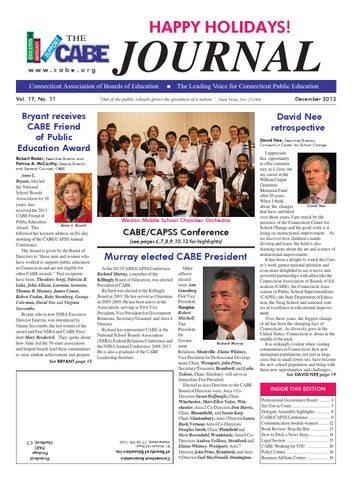
Weston Middle School Chamber Orchestra
CABE/CAPSS Conference (see pages 6,7,8,9,10,12 for highlights)
Murray elected CABE President At the 2013 CABE/CAPSS Conference Richard Murray, a member of the Killingly Board of Education, was elected President of CABE. Richard was elected to the Killingly Board in 2003. He has served as Chairman in 2005-2009. He has been active in the Association, serving as First Vice President, Vice President for Government Relations, Secretary/Treasurer and Area 4 Director. Richard has represented CABE at the National School Boards Association (NSBA) Federal Relations Conference and the NSBA Annual Conference 2008-2013 He is also a graduate of the CABE Leadership Institute.
81 Wolcott Hill Road Wethersfield, CT 06109-1242
of Boards of Education Inc. Connecticut Association
Anne L. Bryant, who led the National School Boards Association for 16 years, has received the 2013 CABE Friend of Public Education Anne L. Bryant Award. This followed her keynote address on Fri-day morning of the CABE/CAPSS Annual Conference. The Award is given by the Board of Directors to “those men and women who have worked to support public education in Connecticut and are not eligible for other CABE awards.� Past recipients have been: Theodore Sergi, Patricia B. Luke, John Allison, Lorraine Aronson, Thomas B. Mooney, James Comer, Robert Frahm, Betty Sternberg, George Cole-man, David Nee and Virginia Seccombe. Bryant, who is now NSBA Executive Director Emerita, was introduced by Ginnie Seccombe, the last winner of the award and Past NSBA and CABE President Mary Broderick. They spoke about how Anne led the 50-state association and helped boards lead their communities to raise student achievement and prepare See BRYANT page 15
December 2013
Other officers elected were: Ann Gruenberg, First Vice President, Hampton; Robert Mitchell, Vice President for GovernRichard Murray ment Relations, Montville; Elaine Whitney, Vice President for Professional Development, Chair, Westport; John Prins, Secretary/Treasurer, Branford; and Lydia Tedone, Chair, Simsbury, will serve as Immediate Past President. Elected as Area Directors to the CABE Board of Directors were: Area 1 CoDirectors Susan Hoffnagle, Chair, Winchester, Mari-Ellen Valyo, Winchester; Area 2 Co-Directors Don Harris, Chair, Bloomfield, and Susan Karp, Chair, Glastonbury; Area 3 Director Laura Bush,Vernon; Area 4 Co-Directors Douglas Smith, Chair, Plainfield and Steve Rosendahl, Woodstock; Area 6 CoDirectors Andrea Veilleux, Stratford and Elaine Whitney, Westport; Area 7 Director John Prins, Branford; and Area 9 Director Gail MacDonald, Stonington.
I appreciate this opportunity to offer commentary as I close out my career at the William Caspar Graustein Memorial Fund after 20 years. When I think David Nee about the changes that have unfolded over those years, I am struck by the presence of the Connecticut Center for School Change and the good work it is doing on instructional improvement. As we discover how children’s minds develop and learn, the field is also learning more about the art and science of instructional improvement. It has been a delight to watch the Center’s work garner national attention and even more delightful to see it move into powerful partnerships with allies like the Connecticut Association of Boards of Education (CABE), the Connecticut Association of Public School Superintendents (CAPSS), the State Department of Education, the Neag School and national centers of excellence in educational improvement. Over these years, the biggest change of all has been the changing face of Connecticut. As diversity goes in the United States, Connecticut is about in the middle of the pack. It is strikingly evident when visiting communities in Connecticut, how new immigrant populations, not just in large cities but in small towns too, have become the new school population and bring with them new opportunities and challenges. See DAVID NEE page 19
INSIDE THIS EDITION Professional Governance Board .......... 4 See You in Court .................................. 5 Delegate Assembly highlights ............. 6 CABE/CAPSS Conference ................... 6 Communication Awards winners ......... 12 Book Review: Stop the Bus ................ 13 How to Pitch a News Story ................. 14 Legal Section ......................................15 CABE: Working for YOU ....................16 Policy Corner ......................................18 Business Affiliate Corner ....................19
Periodical Postage PAID Hartford, CT
2
The Journal
– Connecticut Association of Boards of Education • December 2013
PRESIDENT COMMENTARY
Past, present and future Editorial Note: This was Richard Murray’s acceptance speech at the 2013 CABE/CAPSS Conference after being elected President of the Association. I am honored and humbled to be standing here tonight. I would like to begin by thanking our now Past President Lydia Tedone. She has been an amazing leader. Her energy on behalf of this Association has been unparalleled. Lydia and I agreed many years ago to form an informal partnership for the four years of our terms. So, luckily for CABE, Lydia will not be going away. Before I go any further, I want to acknowledge and thank the Killingly Board of Education, without their support I would not be standing here tonight. Through the years, I have worked with many dedicated members, past and present, who are committed to the education of young people in our town. I look out at the people sitting here tonight and I am in awe of the commitment so many of your have for public education in Connecticut, and the intelligence, experience, and compassion you bring to the table. It is time we worked together to diversify our local boards so they more accurately reflect our student bodies and communities as a whole. We should have more diversified representation on the CABE Board of Directors, as well. We need everyone to feel represented by local boards of education, or some will not see local governance as the answer. Let’s face it… the more stakeholders we bring to the table… the more voices and the greater the range of opinions and ideas, and the stronger CABE will be as an Association. Many boards and their members may be feeling overwhelmed with Common Core, teacher evaluation, charter schools, education reform, school security, special education issues, the list goes on and on, all the while dealing with stagnant budgets. Urban and rural poverty is a pressing issue, and may determine the relevance of school boards. Poverty is a major determining factor in the achievement gap. For example, in my community the latest data shows that students on free lunch had a graduation rate of 50%, which is totally unacceptable. We know that many children growing up in poverty and violence-prone urban environments have great hurdles to overcome and education is the hope for their future. One hurdle many children face is coming to school hungry. Did you know that Connecticut is ranked 50th in the nation in the number of schools serving breakfast? We are also last in student participation. Regardless of where our districts are located, we do face many of the same issues. Now, more than ever, we need to look beyond our district’s borders to find quality professional development. Besides curriculum, boards should be looking at other issues that impact school climate and the ability of students to learn, such as student health and safety and creating a positive school culture. CABE, of course, offers a variety of opportunities for board members and superintendents to become more knowledgeable about the issues we face in our local districts throughout the year culminating with this annual conference. There is an increasing push from state, federal and private entities to influence public education, for a variety of reasons. It is really up to us to keep the
“public” in public education. We need to stand and deliver the story of public schools and local school board governance. As we know, local governance is essential to connecting the community and the education of our students. School board members in Connecticut are elected volunteers. That is a powerful combination and our voices need to be Richard Murray heard! We know this country’s public schools, while not perfect, are a vital cornerstone of our democracy and the foundation on which the middle class was built. The President of NSBA is asking us to become an army of advocates for public schools and local governance. I’M IN!! I do not believe that high stakes testing and many of the other mandates coming from the federal and state governments are the only answer. There are better interventions. It is universally acknowledged that quality preschool will have a significant impact on the long term benefits for all children, particularly those living in poverty. The latest data shows that low-income children who are enrolled in high quality early education are 40% less likely to need special education services and 30% more likely to graduate from high school. We also need to make our public schools safe havens where adults, from bus drivers to administrators, care about kids and their everyday lives. Russell Quaglia, President of the Quaglia Institute, said it best in the American School Board Journal: “schools need to be a welcoming environment where student’s hopes and dreams are known, understood and supported”. He also states that “school boards need to realize that before students can achieve (academically or personally) they need to have self-worth, be meaningfully engaged in their learning and have a sense of purpose.” Before kids can achieve they need high expectations and encouragement to create realistic goals and see success as achievable. We need these children to grow into citizens who contribute to society and not be a potential burden on taxpayers. So I am hoping we can work together to diversify our school boards, become knowledgeable about issues we face in districts, across the state, and around the country. We need to become more effective advocates for public education and local school board governance. I will close with the newly crafted CABE Vision Statement: “CABE is passionate about strengthening public education through high-performing transformative local school board/superintendent leadership teams that inspire success for each and every child.”
RESCHEDULED • Register Now! Hot Topic: Pre-K January 15, 2014 • 9:00 - 11:00 am NEW LOCATION: Keeney Memorial Cultural Center, 200 Main Street, Wethersfield Under executive order, the Office of Early Childhood (OEC) will become the lead agency for the coordination and delivery of early childhood services. Come hear from the OEC’s Executive Director, Myra Jones-Taylor, about what she sees the role of school boards to be in Pre-K and where the State is going with its Pre-K initiatives. We will also discuss how we can ensure that Pre-K and the school system provide a smooth transition to Kindergarten for parents and their children.
Mission: To assist local and regional boards of education in providing high quality education for all Connecticut children through effective leadership. Vision: CABE is passionate about strengthening public education through high-performing, transformative local school board/superintendent leadership teams that inspire success for each child.
CABE Board of Directors EXECUTIVE COMMITTEE Richard Murray ............................................... President, Killingly Ann Gruenberg ............................. First Vice President, Hampton Robert Mitchell .......... VP for Government Relations, Montville Elaine Whitney ... VP for Professional Development, Westport John Prins ...................................... Secretary/Treasurer, Branford Lydia Tedone ........................................ Immediate Past President Don Harris .......................................................... Member at Large
AREA DIRECTORS Susan Hoffnagle ....................... Area 1 Co-Director, Winchester Mari-Ellen (Mimi) Valyo ........ Area 1 Co-Director, Winchester Susan Karp ............................... Area 2 Co-Director, Glastonbury Don Harris ................................. Area 2 Co-Director, Bloomfield Laura Bush ............................................. Area 3 Director, Vernon Douglas Smith .............................. Area 4 Co-Director, Plainfield Steve Rosendahl ....................... Area 4 Co-Director, Woodstock Andrea Veilleux ............................ Area 6 Co-Director, Stratford Elaine Whitney ............................. Area 6 Co-Director, Westport John Prins ............................................ Area 7 Director, Branford Gail MacDonald ............................. Area 9 Director, Stonington
ASSOCIATES Eileen Baker ........................................... Associate, Old Saybrook Sharon Beloin-Saavedra .......................... Associate, New Britain Gary Brochu ........................................................ Associate, Berlin Robert Guthrie .......................................... Associate, West Haven COMMITTEE CHAIRS Elizabeth Brown ...................... Chair, State Relations, Montville Don Harris ......................... Chair, Federal Relations, Bloomfield Becky Tyrrell ................................... Chair, Resolutions, Plainville
CITY REPRESENTATIVES Jacqueline Kelleher .................. City Representative, Bridgeport Matthew Poland ........................... City Representative, Hartford Carlos Torre ............................. City Representative, New Haven Polly Rauh .................................... City Representative, Stamford Charles Stango ........................... City Representative, Waterbury
STAFF Robert Rader ...................................................................... Executive Director Patrice McCarthy ................................ Deputy Director and General Counsel Bonnie Carney ........................................... Sr. Staff Associate for Publications Nicholas Caruso ............................................ Sr. Staff Assoc. for Field Service and Coord. of Technology Sheila McKay ............................ Sr. Staff Associate for Government Relations Kelly Moyher ......................................................................... Sr. Staff Attorney Vincent Mustaro ..................................... Sr. Staff Associate for Policy Service Lisa Steimer .............................. Sr. Staff Assoc. for Professional Development Teresa Costa ............................... Coordinator of Finance and Administration Pamela Brooks ......................... Sr. Admin. Assoc. for Policy Ser. /Search Ser. Terry DeMars .............................................. Admin. Assoc. for Policy Service Gail Heath ...................................... Admin. Assoc. for Government Relations Wilmarie Newton ...................................... Admin. Assoc. for Labor Relations Corliss Ucci .............................. Receptionist/Asst. to the Executive Director
The CABE Journal (ISSN 1092-1818) is published monthly except a combined issue for July/August as a member service of the Connecticut Association of Boards of Education, 81 Wolcott Hill Road, Wethersfield, CT 06109, (860) 571-7446. CABE membership dues include $30 per person for each individual who receives The CABE Journal. The subscription rate for nonmembers is $75. Association membership dues include a subscription for each board member, superintendent, assistant superintendent and business manager. The companies and advertisements found in The CABE Journal are not necessarily endorsed by CABE. “Periodicals Postage Paid at Hartford, CT.” POSTMASTER: Send address changes to The CABE Journal, CABE, 81 Wolcott Hill Road, Wethersfield, CT 06109-1242. Email: bcarney@cabe.org. Members can find the CABE Journal online at: www.cabe.org/ userlogin.cfm?pp=84&userrequest=true&keyrequest=false& userpage=84
The Journal
3
– Connecticut Association of Boards of Education • December 2013
EXECUTIVE DIRECTOR COMMENTARY
CABE Affiliate Book Review: Reign of Error: The Hoax of the Members BUSINESS AFFILIATES DIAMOND MEMBER Finalsite GOLD
MEMBERS
Advanced Corporate Networking dba. Digital BackOffice Berchem, Moses & Devlin Centris Group Guidance Counselors for Senior Teachers Pullman & Comley Shipman & Goodwin Siegel, O'Connor, O’Donnell & Beck, P.C SILVER MEMBERS Anthem Blue Cross and Blue Shield Corporate Cost Control Milone & MacBroom, Inc. Quisenberry Arcari Architects The Segal Company
BRONZE PLUS MEMBERS Brown & Brown Insurance Friar Associates Goldstein & Peck, P.C. Lindburg & Ripple O & G Industries The S/L/A/M Collaborative Trane Whitsons School Nutrition
BRONZE MEMBERS Chinni & Meuser LLC Dattco Inc. Fuller & D’Angelo Architects and Planners Kainen, Escalera & McHale, P.C. The Lexington Group Muschell & Simoncelli Ovations Benefits Group
EDUCATIONAL AFFILIATES American School for the Deaf Area Cooperative Educational Services Capitol Region Education Council The College Board Connecticut Association of School Business Officials Connecticut Center for School Change Connecticut School Buildings and Grounds Association Cooperative Educational Services EASTCONN EDUCATION CONNECTION LEARN Unified School District #1
Privatization Movement and the Danger to America’s Public Schools The first half of Diane Ravitch’s newest book seems to read, are you with us or against us? Are you for reform or against it? Are you in favor of our traditional relationships with unions, individual teachers and your community or do you want to see them totally upended? Problem is, as those on school boards know, the issues facing public education are rarely black or white. The shades of gray (I would guess more than 50 of them) color one’s perspective and views on many of these issues that are faced by boards. But, the second half of the book provides sometimes workable, sometimes piein-the-sky solutions to many of the issues facing public education. This is a very interesting, though long, book. For new board members, it provides a history of the reform movement and while you may not agree with everything Ravitch says, it is thoughtful, comprehensive and provides evidence for the case she is making—something she would argue the “reformers” do not. It is written much like Ravitch speaks: rapid fire, authoritative and credible. Those who read her earlier book, Death and Life of the Great American School System: How Testing and Choice are Undermining Education, will find plenty of new things to think about as they ponder the future of public education. Ravitch sets the context for reform and discussing the arguments of reformers, who include President Obama and Education Secretary Duncan; ex-Washington D.C. Chancellor and current head of Students First Michelle Rhee; former Florida Governor and creator of of the Foundation for Excellence in Education Jeb Bush; Democrats for Education Reform (DFER) the American Legislative Exchange Council (ALEC) ; foundations including Gates, Milliken, Walton and Broad; and for-profit providers of educational services. She characterizes the reform movement as being “determined to cut costs and maximize competition among schools and among teachers. It seeks to eliminate the geographically based system of public education as we have known it for the past 150 years and replace it with a competitive market-based system of school choice—one that includes traditional public schools, privately managed charter schools, religious schools, voucher schools, for-profit schools, virtual schools, and for-profit vendors of instruction. Lacking any geographic boundaries, these schools would compete for customers.” Many chapters set out her concerns with two simple statements, the Claim by Reformers and the Reality, which is, in her opinion, often quite different. For example, in a chapter entitled “Why Merit Pay Fails”, the Claim is that “Merit pay will improve achievement.” The Reality: Merit pay has never improved achievement.” Her “solutions” chapters also start with two-sentence summaries of her thinking.
The chapters go into some depth on many critical education issues, including: test scores; the achievement gap, international test scores, high school graduation results; parent trigger legislation; vouchers; and teachers’ tenure and seniority. One thing I really appreciate about the book is the solutions she proposes. It’s long been my feeling that one of the reasons the reform movement has grown is that the traditional educational groups have really not proposed good solutions (except for more resources) for troubled school districts, especially those in our cities. Nature (and politics) abhors a vacuum and that’s what we had. For those parents whose children went to schools that provided (and may still provide) subpar education, is it any wonder that they have, in many cases flocked to charters or pushed for vouchers? If you were a parent in such a situation, wouldn’t you do the same for your child?
Poverty One of the most interesting issues that Ravitch discusses is poverty. She makes the strong argument that we must deal with the issues in education and society at same time. Reformers may be right that poverty is not an excuse, but “it is a harsh reality.” She calls for deep thinking on the issues of poverty as they so affect student achievement. Ravitch’s thoughtful and evidencebased solutions go beyond what the schools alone can do, such as: • providing good prenatal care; • making “high-quality early childhood education available to all children” with well-prepared teachers; • ensuring every school has “a full, balanced, and rich curriculum”, including the subjects that were not been tested under NCLB and RTTT (arts, science, history, civics, foreign language and physical education) and there must be other indicators of what makes a good school, besides high test scores; • banning for-profit charters and charter chains and ensuring that charter schools collaborate with public schools for a better education for all students; • providing the wrap-around services that many students so desperately need (including healthcare, summerand after-school enrichment programs) and parent education to support the other services; • measuring knowledge with what students know and can do, rather than with high-stakes assessments; • ensuring that teachers, principals, and superintendents are professional educators; • governing districts through elected school boards or by boards in large cities “appointed for a set term by more than one elected official.” In other words, appointed boards should not be appointed solely by the mayor; and, • defining public education as “a public
Robert Rader
responsibility, not a consumer good”. Throughout the book she argues that reformers’ solutions will not lead to better outcomes for our students. She states that the purpose of public education is not necessarily to make students collegeready, it is to prepare them to be good citizens. Another purpose is to provide equal educational opportunities for all students and she believes that the charter school movement might, instead, create a dual system of education for our youngsters. She believes that under the “present setup, local school boards are nearly irrelevant” as so many decisions are made in Washington, D.C. She touts the benefits of local boards of education, including the idea that they “are a check and balance against concentrated power in one person or agency.” She states that since public schools need public support and “should be governed by those who are willing to work diligently to improve them and by those who have the greatest stake in the success of the children and the community.”
My Takeaway I believe that, as in many real life situations, every community, the state and even the nation will have to determine what is best among the black and white, as well as gray, solutions to the problems of public education—to the extent that they are permitted to do so. With the momentum of the accountability, school choice and charter schools train roaring down the federal and state tracks, local boards, as well as state associations and NSBA must think through the consequences of their decisions and how they will respond to Ravitch’s warning. As the best governance is often done as close as possible to those affected, school boards are in a unique place to take the best from traditional and/or reform models. It is good that Diane Ravitch makes her arguments so passionately. I know she cares deeply about the future of public education. She questioned what CABE was doing when we joined a coalition with reform groups. And, those of us thinking about the future of boards of education must sit up and pay careful attention. Her book is a very passionate discussion of, as Paul Harvey used to say, “the other side of the story.” It is one that board members, superintendents and even reformers should carefully analyze to determine the future of public education.
4
The Journal
– Connecticut Association of Boards of Education • December 2013
The Professional Goverance Board
Ten essential elements for a successful board-superintendent relationship Gary Brochu Chair, Berlin Board of Education
Perhaps the most important characteristic of a professional governance board is a close and effective working relationship between the Superintendent of Schools and the Board. Yet this type of relationship is not inevitable, but is the result of hard, focused work. Below is a list of ten necessary elements for an effective Board-Superintendent relationship. 1. Remember Why You Are There Serving as a superintendent or as a Board of Education member can be stressful. The issues can be polarizing, the public scrutiny is often intrusive, and the temptation to battle over turf irresistible. But you should never forget the responsibility that you have agreed to assume – the education of our children. Everything else is secondary. Anything that takes away from your focus on providing the best possible education for all of your students must be rejected. There’s too much at stake to waste time and energy on anything else. 2. Communicate, Communicate, Communicate The importance of frequent, timely, and honest communication between board members and the superintendents cannot be overstated. The two-way sharing of information between board members and superintendents helps to focus their efforts and prevents the misunderstandings that can develop when there is an information vacuum. 3. Recognize the Other’s Strengths One of the most frequent mistakes made by board members and superintendents alike is to fail to recognize, and take advantage of, the skills and abilities of each other. This applies not only to the board member who fails to acknowledge the educational background and experience of his superintendent, but also to the superintendent who neglects to take advantage of the skills and experience of board members. 4. Support Each Other Once the board of education makes a decision, it is essential that the superintendent publicly support that decision. And, in the same fashion, once the Superintendent makes a
decision or implements the Board’s policies, it is equally critical that the Board supports its educational leader. Neither the board nor the superintendent can be effective without the support and success of the other. 5. No Surprises – Ever The last thing that a board member or superintendent wants is to appear uninformed or surprised. Not only are you placed in a position where an informed and thoughtful response is often impossible, but the public’s perception of your effectiveness is also diminished. 6. One Message to the Public It’s not only important for the superintendent and board of education to communicate with each other, but they also need to communicate with the public. And the message they communicate needs to be consistent and uniform. It is difficult enough to effectively communicate your message to a diverse public audience, inconsistent signals from the district’s leadership team makes it impossible. 7. Run Interference for Each Other There are times when board members or the superintendent will come under attack. One aspect of being part of a leadership team is that each party must be prepared to accept criticism and blame without passing it off to the other. If recriminations are necessary, they can be aired in private. Undermining each other in public only leads to ineffectiveness for everyone. 8. Don’t Sweat the Small Stuff One of the easiest things to do when working on a school district’s leadership team is to be consumed by details and daily “emergencies.” This micro-managing can best be avoided by the Board and Superintendent understanding their unique roles and responsibilities, with Board members willing to allow the Superintendent to act as the school district’s CEO. 9. Think Long Term Board members and superintendents are continually confronted with things that need to be done “right now.” But they need to avoid the trap of only focusing on the immediate at the expense of the future. Failure to plan for the future doesn’t mean it doesn’t come, but only that your school district will be
unprepared once it gets here. As an additional benefit, if boards of education and superintendents can agree on their district direction and goals, it tends to minimize the inevitable conflicts on the more immediate and mundane matters. 10. Take Time to Get Away Board members and superintendents should interact in venues other than board meetings. Something as simple as sitting at a sporting event together allows for informal communication that can lead to a better understanding of, and greater respect for, one another. Additionally, it is a good idea for boards of education
and superintendents to schedule workshops or retreats where they can meet to discuss issues, ideas and goals for the school district. This time together can help build a solid foundation for the inevitable storms to come. An effective Board-Superintendent relationship can be an extraordinary asset for a school district. But like anything of value, its existence isn’t happenstance, but the result of a common purpose and hard work. Take time to assess the status of this essential relationship, and take steps to build a solid foundation for your district’s work.
What will the
Connecticut Online Policy Service (C.O.P.S.) provide YOUR district? • A policy manual updated within days of a board meeting. • Access to your policy manual 24/7 anywhere with Internet capability. • Timesaving links to legal and cross references. • A search engine specifically designed for board policy manuals. • The ability to search other online districts for similar policies or language. • A happier staff that will have less paper to deal with. If you would like additional information on CABE’s Connecticut Online Policy Service (C.O.P.S.), call Vincent Mustaro at 860-571-7446 or email vmustaro@cabe.org for full details.
Let the CABE staff make your policy life easier.
The Journal
– Connecticut Association of Boards of Education • December 2013
5
See You in Court – The Nutmeg Board of Education
The Nutmeg Board deals with First Amendment rights of teachers and students Thomas B. Mooney, Esq. Shipman & Goodwin
The Nutmeg Board of Education makes many mistakes. The latest imbroglio created by the board will be reported here each issue, followed by an explanation of what the board should have done. Though not intended as legal advice, these situations may help board members avoid common problems. The new teacher evaluation plan was driving Mr. Principal crazy, but it did have one upside for Mr. Principal. Given the need to conduct so many formal and informal observations of teachers, he was out and about, seeing students and teachers hard at work. However, that was how the trouble started. Sitting in the back of a senior honors English class, Mr. Principal watched Sam Smart make a presentation to the class on bullying. He was shocked, however, when he noticed that Sam was wearing a T-shirt with “BITCH” written in large letters on the front, in a circle with a line through it. As soon as the class ended, he told the young man to come with him to the office for a little “talk.” “Why on earth are you wearing that vulgar T-shirt?” Mr. Principal demanded as soon as he and Sam were in his office. Sam asked pointedly, “Don’t you get it? The slash means ‘No Bitches,’ and my T-
shirt protests girl-on-girl bullying. Bullying is a terrible problem in our school, and girl-on-girl bullying is the worst. Girls can be SO mean to each other. Through my T-shirt, my Facebook account and my Instagram account, I am reminding my fellow students, and especially the girls, always to be nice. So what’s the problem, old man?” “Watch yourself!” Mr. Principal cautioned. “The problem is that your Tshirt is vulgar and insulting to women, which I will not allow in my school. Your choices are to turn the T-shirt inside out or be suspended for a day. What will it be?” Sam Smart scoffed at Mr. Principal’s benighted view that “Bitch” in this context was pejorative, and he chose suspension. He also warned Mr. Principal that he would be using his free time to meet with the American Civil Liberties Union to discuss how best to deal with Mr. Principal’s violation of his First Amendment rights. Sure enough, Mr. Principal got a demand letter from the ACLU the next day, threatening litigation if Mr. Principal did not relent and permit Sam to wear the T-shirt. Bob Bombast, veteran member of the Nutmeg Board of Education, heard Sam and his lawyer being interviewed on the radio, and he decided that Mr. Principal needed the cover of a Board policy to
Seventh Edition
A Practical Guide to Connecticut School Law by Thomas B. Mooney, Esq. Shipman & Goodwin The Guide comes with a CD which provides hyperlinks to many cases and statutes and will permit word searches as a supplement to the Index. New to the Seventh Edition: Bullying, Background Checks, Child Abuse Reporting, Discrimination Issues, Educational Reform, FERPA, Freedom of Information, State Aid for Education and much, much more The 7th edition is now available from CABE. Call and order your copy TODAY at 860.571.7446 or 800.317.0033
protect him. That very night, at Bob’s insistence Mr. Chairperson convened an emergency meeting of the Nutmeg Board of Education. At the meeting, Bob reminded Board members that children should be seen but not heard, and he proposed a new policy stating: “School is a place of business. Students may not wear T-shirts that are vulgar or that raise controversial topics that could distract students or disrupt the
officials in Easton, Pennsylvania thought so, and they prohibited two middle-school students from wearing bracelets with the slogan, “I [Heart] Boobies (KEEP A BREAST).” But the students said that they were acting to heighten awareness of breast cancer, and they sued, claiming that the prohibition violated their free speech rights. The lower court agreed with the students, finding that the bracelets were
“School officials have a right to maintain an orderly school environment, but they must pick their fights carefully when it comes to the free speech rights of students.” educational process.” The policy passed unanimously. Mr. Principal announced the policy over the intercom the next morning. After reading them the new policy, he informed students that they had a one-day grace period, but that the policy will be effective and enforced as of tomorrow. Is Nutmeg all set now? Yes — if being “all set” means being a defendant in constitutional litigation. Otherwise, the Board and the Principal should reconsider and change the policy. The United States Supreme Court changed the legal landscape in 1969, when Justice Fortas famously observed in Tinker v. Des Moines Independent Community School District that “it can hardly be argued that either students or teachers shed their constitutional rights to freedom of speech or expression at the schoolhouse gate.” While the premise is inarguable, its application in specific situations can be a challenge for school administrators, who may have to make decisions about student speech. In Tinker, the Court ruled that Mary Beth Tinker, her brother and their friend had the right under the First Amendment to wear black armbands to school to protest the war in Vietnam. It held that school officials can regulate student speech only when they can reasonably forecast that the speech will violate the rights of others or cause substantial disruption or material interference with the educational process. Since Tinker, the Court has established three exceptions, holding (1) that vulgar speech can be prohibited irrespective of disruption (1986), (2) that school-sponsored speech can be regulated simply upon a showing of legitimate pedagogical interest (1988), and (3) that speech can be prohibited if it can be interpreted as advocating the illegal use of drugs (2007). While the Tinker rule and its exceptions are easily stated, student free speech cases are a challenge, as school officials struggle in specific cases to determine whether they can prohibit student speech that they consider either vulgar or disruptive. For example, is “No Bitches” vulgar? We are not sure. Is it vulgar to refer to female breasts as “boobies”? School
neither vulgar nor disruptive, and this year the Third Circuit Court of Appeals affirmed. By contrast, this year the federal district court for the Northern District of Indiana considered a prohibition against the very same bracelets, and it ruled in favor of the school district. Clearly, reasonable people can differ on what is vulgar. By way of further example, last year a student in Wolcott, Connecticut, protested the Day of Silence by wearing a Tshirt that referred to a Day of Excessive Talking and depicted a rainbow with a slash through it. The student claimed that he was told that he could not wear the Tshirt, but after the ACLU got involved, school officials sent a letter clarifying that the student would be permitted to wear the T-shirt. School officials have a right to maintain an orderly school environment, but they must pick their fights carefully when it comes to the free speech rights of students. They may prohibit disruptive or vulgar speech, but those terms are not self-defining. The only way to answer the question definitively in a particular case may be litigation in federal court, an exercise that can cost tens or hundreds of thousands of dollars. As a consequence, in close cases school officials are well-advised to allow student speech. Notably, Bob’s policy prohibiting Tshirts with controversial topics provides no help here. Student free speech rights are defined by constitutional rulings, not Board policies. Moreover, the Nutmeg policy was too vague to be enforceable in any case. Finally, in its eagerness to address this situation, the Nutmeg Board of Education violated the Freedom of Information Act. In emergencies, public agencies can meet without posting the meeting twenty-four hours in advance. However, Bob’s dyspepsia over this free speech controversy was no emergency, and meeting should have been properly posted. Attorney Thomas B. Mooney is a partner in the Hartford law firm of Shipman & Goodwin who works frequently with boards of education. Mooney is a regular contributor to the CABE Journal.
6
The Journal
– Connecticut Association of Boards of Education • December 2013
CABE Delegate Assembly • November 14, 2013 CABE President Lydia Tedone (Simsbury), Don Blevins, Immediate Past President; Becky Tyrell,(Plainville) Resolutions Chair; Parliamentarian Cal Heminway (Granby); Patrice McCarthy, Deputy Director and General Counsel; Ann Gruenberg (Hampton), VP for Government Relations; and Robert Rader, Executive Director.
2013 CABE/CAPSS Conference Highlights
Delegates voting on one of the many resolutions before the Delegate Assembly.
Session Speakers
Honorees Forrester receives Distinguished Service Award
Stephen Wright (Trumbull) Vice President for Professional Development, CABE
CABE’s Philip S. Fenster Distinguished Service Award was presented to Gavin Forrester, Chair, Stratford Board of Education. He served on the finance, long-range facilities, curriculum, personnel, athletic and school plant/planning committees. He also served as a liaison committee member for the town council representatives and the board of education. At the state level, Gavin was very involved with C.E.S. and CABE. He served as CABE Area 6 Co-Director and participated in the CABE/CAPSS Conference and Day on the Hill. On the national level, he represented Connecticut at the National School Boards Association (NSBA) Conference.
Betty Feser (Milford) President of CAPSS Lydia Tedone (Simsbury) President of CABE CAPSS Executive Director Joseph Cirasuolo
CABE Executive Director Robert Rader
Friday Morning General Session speaker Anne L. Bryant
Governor Dannel Malloy
Connecticut Education Commissioner Stefan Pryor
CABE President Lydia Tedone (Simsbury) presents the Philip S. Fenster Distinguished Service Award To Gavin Forrester (Stratford).
CAPSS announces 2013 Superintendent of the Year Friday Banquet speaker Azure Antoinette
Senator Richard Blumenthal
Saturday Morning General Session speaker Gautam Mukunda
More photos from the 2013 CABE/CAPSS Conference are available on the CABE website under Professional Development/Gallery www.cabe.org/page.cfm?p=108.
Saturday Luncheon Program was facilitated by David Nee, Executive Director, William Caspar Graustein Memorial Fund.
At the 2013 CABE/CAPSS Conference Dr. Janet Robinson, Superintendent, Stratford Public Schools, was named the CAPSS 2014 Superintendent of the Year. Robinson’s prior experience as superintendent was in Newtown and Derby. She also served as the former Deputy Executive Director of the Cooperative Educational Services in Trumbull. CAPSS Executive Director Joseph Cirasuolo said, “We are pleased to bestow the honor of Superintendent of the Year upon Dr. Robinson and look forward to continuing our work with her as she leads the Stratford Public Schools.”
The Journal
7
– Connecticut Association of Boards of Education • December 2013
2013 CABE/CAPSS Conference
CABE/CAPSS Conference Anne L. Bryant: General Session Speaker
What an American school and district of the future look like Ann Baldwin President, Baldwin Media
Cal Heminway announced the three Teacher of the Year finalists Chris Todd (Windsor), Deb Flaherty (Region #16) and Eric August (Trumbull) and the 2014 Connecticut Teacher of the Year John Mastroianni (West Hartford). Pictured l. to r. are Blair Messinger, 2013 Connecticut Teacher of the Year; Chris Todd (Windsor High School), Cal Heminway (Granby); and CABE President Lydia Tedone.
Congratulations to the CABE Board of Distinction winners - Level II What makes you board’s leadership especially effective in improving student achievement? Bethel Board of Education recently adopted a set of goals that enables the district to focus on what’s most important – improving student achievement. The board’s goals keep student growth as the foremost priority and connects the work of the schools with the vision we hold for our students. The goals that were adopted are ambitious and highlight the most important work that needs to be done this year to improve student achievement. Shifts in technology, economics, and demography all highlight the dramatic changes taking place in our society. Bloomfield Board of Education’s decisionmaking process is rooted in data-driven decision making. The board is routinely viewing data on student performance and other aspects of district functions. This is evident at regular and committee meeting where data is routinely analyzed to determine course corrections and/or next steps. The analysis of data helps board members understand how best to support continued academic growth by ensuring that all support and resources are aligned with our four district priorities: holistic accountability; strengthen curriculum, instruction and assessment; positive school climate; and parent and community engagement.
Granby Board of Education has been extremely supportive of public education both within the state and the local community. Granby schools have benefited from strong and consistent board leadership and decision-making over a period of many years. The board works collaboratively and supportively with the community and town officials in a nonpartisan fashion as strong advocates for students and education. Granby students continue to excel academically. Granby has received many honors over the years. The successful completion of district building projects, support for budgets, the proactive provision of educational opportunities for students, early childhood and elementary languages. Old Saybrook Board of Education believes that it is “especially effective in improving student achievement” due to our broad-based, teamwork approach to leadership. Given the importance of the school-home connection, we are particularly focused on securing and incorporating input from parents and the community as we plan educational initiatives. Our strategic planning process began several years ago with the organization of a 34-member steering committee. As the strategic initiatives that were developed for this plan were developing, seven strategic initiative subcommittees were formed and
During her recent remarks as one of the general speakers at the 2013 CABE/ CAPSS Conference, at the Mystic Marriott in Groton, Connecticut, Anne Bryant filled the entire room with school board members, school superintendents and others like me, all of whom were hanging on to every word as she spoke about her vision of what an American school and district of the future will look like. According to Anne, there are physical buildings, but the learning is almost 24/7. The school is open and airy, and the furniture is flexible and comfortable. There are very few desks and chairs. The students’ personal devices are with them constantly- not always in use, but pretty close to it. Very few textbooks are in this school, because the resources are mostly online. There are plenty of books, but they are for reading, not for laying out rules of reading! The library is a resource center, where the students often meet to collaborate. It is often VERY noisy, because students are working together. All of the students’ courses are integrated and all of the teachers work together. Faculty takes the time to work together across all subjects for each
additional members of the community, parents and staff joined in this collaborative work. Plainville Board of Education maintains a commitment to optimizing achievement district wide. This commitment is evidenced in many actions of the board over the years. One example is the unwavering dedication to maintaining small class sizes. Another example is the board’s support for the district’s technology, understanding the integral role technology plays in educating our students in the 21st Century. This year, every student in grades 8-12 received a Chrome book computer. Last year, the district expanded to full day kindergarten and we are seeing the results in our first graders. The board has clearly demonstrated its effectiveness in improving student achievement, through the lens of continuous improvement. Plymouth Board of Education is very handson in their approach to district leadership. They attend PTA meetings district-wide and constantly communicate with town governance on behalf of the students and staff and are present at school activities and fun-raising events, even though most board members do not have children attending the schools, on the weekends and evenings. They care immensely about the well-being of staff and students, they often make extended
group of students. Their small offices are in a pod off of the classrooms. The faculty at this school incorporates both seasoned, long-term teachers, along with business volunteers who coach and work with teams of students and newer teachers. There are high expectations of everyone, including students, teachers and staff. There is a strong sense of seriousness about learning and a joy of the place. There is absolutely zero bullying in these schools- scores are higher, suspensions are very rare, and drop outs are unheard of because kids are simply not allowed to do so. The entire community is behind these students and their schools. There are periods in the day reserved for movement, ensuring that all of the children are getting a good dose of exercise. Several of the schools got the L.E.A.D. certification when they were built in 2010, and proudly maintained solar panels which, in collaboration with the water system, have saved the district thousands of dollars over the past three years. The solar panels and water system is actually a part of the curriculum. “Classes” are not like they were in the past. Different aged students can be found in an English class, because see American page 9
efforts to commend student achievements or staff accomplishments. Most notable is their accessibility, availability and receptiveness. They recently developed a new mission statement to challenge inspire and prepare each student for success in an ever-changing and complex world. Simsbury Board of Education ensures students are provided with a rich and rigorous academic foundation that enables students to thrive in a global society. Board members work together and support the district’s continuous improvement cycle. Stratford Board of Education developed district goals with the primary focus being student academic achievement. They revisit them annually. To that end, the board became invested in the state’s CALI initiatives, data analysis, and revision of existing and implementation of new curricula throughout the district. Data-driven decisionmaking is now ingrained throughout the district including at the board level. The board reviews all school improvement plans and requires presentation from all principals on the status of strategies to improve student achievement. Analysis of data is also used for budgetary considerations like staffing levels and in salary negotiation decisions, course offering decisions, class size goals, and facilities usage. The board recognizes that parent involvement See CONGRATULATIONS page 8
8
The Journal
– Connecticut Association of Boards of Education • December 2013
Congratulations to the CABE Board Recognition Award winners - Level I What makes you Board’s leadership especially effective? Derby Board of Education members continuously seek to learn more about state and district initiatives and ensure there is alignment between the district and state. This involves scheduling many additional meetings to include retreats with the specific focus to develop more as a board and stay informed with the latest initiatives in education. Board members make sure they are represented at all school functions both during the day and in the evening. The board members have taken ownership of their role on committees and work hard to ensure completion of the action steps, improving our schools and following the plan. Glastonbury Board of Education has a proud tradition of working collaboratively with our administration and staff, communicating effectively with our community and providing thorough explanations for critical decisions and changes. Perhaps our greatest strength is the unique and informed perspective that is brought forward by each board member. We recognize that our community expects excellent results and we are very careful to balance the needs of our students with the impact on our taxpayers. Through careful planning, excellent analysis and exhaustive discussion we strive to continue to provide the best for our students and educators while embracing the many significant changes in education. Killingly Board of Education works very closely with the superintendent, daily if necessary. We support his work in the district and feel his support of our role as board members. As the board chair, I meet often with the superintendent to ensure we are on the same page and work hand-in-hand. Our board has a strong desire to improve student achievement and champion the district to the community. Shelton Board of Education members routinely work across party lines to ensure our policies and programs are best for the students.
While we promote aggressive goals, we don’t micromanage staff. A recent example of our ability to work together to quickly reach decisions is our Full Day Kindergarten (FDK) Committee. By the start of their second meeting they conducted a site visit to a nearby district to observe how their program was working, and the information obtained was strong enough to decide it was a worthwhile program so we could move on by determining the best strategy to accomplish the goal of starting FDK by the start of the next school year. Vernon Board of Education utilizes a system of committees to move the work of the Board forward. Committee meetings are held on nights separate from the regular board meetings. Minutes of the discussions of each committee meeting are disseminated to the rest of the board and all committees make recommendations to the full board for discussions on policy, personnel, budget, technology, curriculum and facilities. West Hartford Board of Education is a collaborative group that strives to act in the best interest of our students. Meetings are fun effectively and professionally with attention paid to proper protocol and community and student input. The board works in partnership with the superintendent, administrators, teachers, families and the community to craft a Mission Framework. This is a living document that drives our continuous improvement efforts and is monitored by the board and superintendent. The board is a model of good government diligently attending to its responsibility to hire and evaluate the superintendent, review, develop and monitor policy, and develop the district’s annual budget. Wolcott Board of Education is a policydriven board that focuses on student learning in the classroom. The leadership style is innovative and all members are concerned about the facts that affect students’ academic, social, emotional growth.
Salem Board of Education Winchester Board of Education
Stonington Board of Education
Thank You Conference Sponsors PLATINUM Renaissance Learning
Waterford Board of Education
Wethersfield Board of Education
GOLD Berchem, Moses & Devlin Connecticut Coalition for Achievement Now (ConnCAN) Shipman & Goodwin SILVER EASTCONN Fuller and D’Angelo Architects and Planners Generation Ready Kainen, Escalera & McHale LEARN LLB Architects Pullman & Comley The Breakthrough Coach Tourbillon Alliance Partners Vantis Life Insurance Company
Congratulations to the CABE Board of Distinction winners - Level II
Montville Board of Education
Berlin Board of Education
Newington Board of Education
Madison Board of Education Putnam Board of Education
The Journal
– Connecticut Association of Boards of Education • December 2013
9
Gifted Education Pedagogy and Practice: Effective Levers for CCSS/NGSS Implementation Codie Landsman Baldwin Media
Training in and understanding of the Common Core State Standards and practice exemplars is critical for all teachers for students’ optimal learning gains. Gifted education research and practice inherently supports Standards’ implementation and 21st Century skills. This session allowed participants to investigate how key components and strategies of teaching high-ability students will directly support Common Core implementation for all teachers and their students of all ability levels, and how supporting teachers’ effective practice in these areas will yield student growth and an advanced skill set from their onset. Shari Valencic, Gifted Education
Consultant of the Florida Association for the Gifted (FLAG), discussed integration strategies and resources regarding crucial information on the Common Core Standards in the classroom. Shari holds her doctorate degree in educational leadership and has taught elementary and middle school children and their teachers for the past twenty years. Since 1979, the mission of FLAG has been to support educationally appropriate programs for gifted students through exchanging information, promoting research, supporting constructive changes in all areas of gifted education, and cooperating with local and state organizations in reaching mutual goals and objectives in support of students who are gifted. Throughout her presentation, Shari
open up dialogues, like this one here today.” Miriam Morales Taylor, Director of Student Support of New London Public Schools and Board Member of the Connecticut Association for the Gifted (CAG) provided further insight on gifted children and the Common Core. CAG is a volunteer advocacy group dedicated to helping gifted and talented children reach their full potential by providing information, support, resources, and events to meet a child’s academic, social and emotional development needs, to make friends, share ideas, and of course, to have fun. CAG provides a variety of educational program options such as curriculum compacting, cluster grouping, and tiered assignments.
What an American school and district of the future look like
When Do Leaders Make a Difference? Guatam Mukunda, Keynote Speaker for the Saturday morning General Session, is an Assistant Professor in the Organizational Behavior Unit of Harvard Business School and the author of Indispensable: When Leaders Really Matter. Prior to joining the business school, Mukunda was the National Science Foundation Synthetic Biology ERC Postdoctoral Fellow resident at the Massachusetts Institute of Technology’s (MIT) Center for International Studies. He received his PhD. from MIT in Political Science and an A.B. in Government from Harvard University, magna cum laude. His research focuses on leadership, international relations, and the social and political implications of technological change. He is a member of the Council on Foreign Relations and MIT’s Security Studies Program in addition to the Program on Emerging Technologies. Mukunda’s speech strived to answer two critical questions: What makes a society properly function, and what constitutes a successful leader: one who possesses the skill set necessary to make a lasting impact on society? He explored the idea of a leader selection process, called the “leader filtration theory,” in which candidates who possess the characteristics needed to lead a society are filtered through a leader filtration process (LFP). Some factors are random, and unrelated to the ability to govern properly, such as height or weight. Other factors have a more direct correlation to proper governance, such as persuasion and power. Candidates have different probabilities of succeeding in
encouraged decision makers and money spenders to look toward practitioners to get a better feel for how the system is working. These decision makers also need to look to the parents and ask, “How did your child respond to the teacher?” instead of focusing just on a number from teacher evaluations. We need to look to effective teachers for modeling and share this set of skills with new teachers. We also don’t have time to “reinvent the wheel” – it’s important to realize that everyone has a lot on their plate, especially when quick responses are necessary to move forward. Shari also encouraged the use of “joyful sharing.” She urged, “Don’t be afraid to collaborate with one another! It’s not just about paying each other for information- we need to
LFP and are dispersed into two pools: the modals, and the extremes. Modals are high probability winners: all of these candidates have similar characteristics to one another, and will ultimately have a low impact on society as a leader. On the other hand, extremes are low probability winners, vary greatly from one another, and have the potential for high impact on their society. A likely modal is a leader who has frequently been evaluated prior to their seat as a leader, such as Thomas Jefferson, who possessed vast experience in the U.S. government prior to his election as President. In contrast, a likely extreme is an exceptionally unfiltered candidate, or one who the public does not know much about prior to their seat as a leader, such as Abraham Lincoln. Lastly, Mukunda discussed the impact of power and the effects it can have on individuals. Filtration processes are crucial, especially in modern-day interviewing and evaluative settings, because once you give someone a position of power, it can be very difficult to take that away. Codie Landsman Baldwin Media
Editor’s Note: CABE Executive Director Robert Rader wrote a review of Indespensible, Mukunda’s book. It can be found on the CABE website at www.cabe.org/page.cfm?p=892.
(continued from page 7) classes are based on their reading/ composition/comprehension levels. The “school” is the center of the community. A health clinic is used by many in the community. The Boys and Girls Clubs use the school space for their activities. Online learning is ubiquitous. Students can take many language courses online and the school’s servers and Wi-Fi are linked to a plethora of resources for the student. Ultimately, Anne Bryant’s future school district has a focus on 21st century skills, learning environments that have rigor, high expectations for students and teachers, and are caring and nurturing places to learn and work. She ended her presentation with this message for those in the room:
“You are my heroes and heroines. You have more collective common sense and brains than all the other leaders in the nation. I am counting on YOU to be the change for our students.” About: Anne L. Bryant is the Executive Director Emerita of the National School Boards Association (NSBA), having retired in September, 2012. Currently, she serves on four not-forprofit boards (Education Development Center, The American Architectural Foundation, The Malcolm Baldrige Foundation, and the Character Education Partnership). She holds an Ed.D from the University of Massachusetts, a B.A. from Simmons College, two honorary degrees, and has received numerous awards for leadership in education.
Student Performers The Ashford Jazz Band performed at the Friday morning General Session.
10
The Journal
– Connecticut Association of Boards of Education • December 2013
The Power of Poetry and Spoken Word on the Millennial Generation Azure Antoinette, called “the Maya Angelou of the Millennial generation,” is a poet, spoken word artist, freelance photographer, and youth and arts advocate whose poetry focuses on social media and its impact on humanity. She founded an arts-in-education program in New York City that provides workshops aimed to teach young women how social media, spoken word, and performance poetry can positively affect the world. She was featured in Forbes’s 100 Most Powerful Women in the World in 2012 and was named global ambassador for 10x10, a social action campaign based around the feature film Girl Rising that uses the
power of storytelling to deliver a single message: educating girls in developing nations will change the world. Antoinette and ABC Family recently launched the “You Should Know This About Me” campaign, which seeks to capture the authentic voices and stories of the Millennial generation through media submissions. Antoinette has been commissioned to write poetry for first lady of California Maria Shriver, the American Cancer Society, and was hand-selected by Oprah to be featured in the first-ever poetry issue of O Magazine. Antoinette’s gift as a storyteller be-
came apparent from the moment she stepped on stage. Her effortless humor and undeniable charm was clear as she captivated the crowd, and left the audience laughing and cheering throughout her entire presentation. Antoinette recalled being raised by her mother, a lawyer who made sure that her two daughters knew what a “tort” was by the age of four. Following the path laid out by her mother, Antoinette worked briefly in a corporate position before leaving in order to pursue her love of poetry and spoken word. She laughed, recalling the days she spent unemployed in a Starbucks in Los Angeles, with
nothing more than four dollars in her pocket. Now, Azure Antoinette is in high demand as a poet, arts-in-education consultant, speaker, and workshop facilitator on expression and creative writing. She concluded her speech with a powerful poem regarding the impact of children on our society, which earned her a standing ovation. Antoinette believes that we should all strive to do what we love for a living, and lives by a quote which she penned in 2010: “Take it moment by moment, sometimes a day is too much.” Codie Landsman Baldwin Media
Communications Awards
Student at Saturday Session
Samples of the winning districts were available on the Awards of Excellence in Educational Communications.
“It’s a pleasure for CABE to join with CAPSS and share this information with Boards of Education so they may assist them as they are looking at plans that would be available to their staff that would help individuals make the difficult decision as to whether or not to retire. This is one resource we think is valuable for districts to look at and we bring you this information as a service to our members.” Patrice A. McCarthy Deputy Director and General Counsel, CABE
The Journal
– Connecticut Association of Boards of Education • December 2013
11
12
The Journal
– Connecticut Association of Boards of Education • December 2013
Congratulations to the school districts which won CABE’s 2013 Award of Excellence for Educational Communications contest CABE recognized school districts for excellence in educational communications at the CABE/CAPSS Convention. Members of the CABE Board of Directors and Staff will present the Awards to the winning boards at a meeting in their district after the first of the year. Entries were judged by Susan Saks of Susan Saks Voiceovers. Award Winners Newsletter Redding Public Schools The Tiger Telegraph Madison Public Schools The Board Bridge Glastonbury Public Schools “Staff News and Notes” Annual Report Region 6 Public Schools Annual Report & Performance Profile A.C.E.S. A.C.E.S. Innovators in Education Annual Report 2011-2012 Stamford Public Schools Report to the Community 2011-2012
District Budget Mansfield Public Schools Mansfield Board of Education Proposed Budget 2013-14 East Lyme Public Schools East Lyme Board of Education Approved 2013-2014 Budget – Departmental Budget Ridgefield Public Schools Budget Book Parent/Student Handbook Redding Public Schools Redding Elementary School Handbook Wolcott Public Schools Wolcott High School Student Handbook West Hartford Public Schools REACH Student Handbook Course Selection Guide EASTCONN Programs & Services Catalog 2013-2014 Newington Public Schools Program of Studies 2013-2014
New Publication Available from CABE
Understanding the Connecticut Freedom of Information Act and Access to Public Meetings and Records - Fourth Edition
West Hartford Public Schools Life Learn Adult/Summer Options for Kids 2013 Calendar C.E.S. C.E.S. 2013-2014 Member District Calendar Region 5 Public Schools 2013-2014 Amity District Calendar Hamden Public Schools District Calendar Special Project EASTCONN EASTCONN Annual Board Update 2012-2013 Cheshire Public Schools 6th Grade Orientation to Dodd West Hartford Public Schools Smith Elementary School Mural Special Project (AV) Redding Public Schools Everyday Heroes Bethel Public Schools BHS Freshman Orientation Wallingford Public Schools Open House Video Computer Generated Projects EASTCONN 2012-2013 Review and 2013-2014 Preview New Fairfield Public Schools Superintendents’s Recommended Budget 2013-2014 West Hartford Public Schools Charter Oak’s Daily Video Announcements
Web Sites Canton Public Schools Canton Public Schools Website Plainville Public Schools Plainville Community Schools Website West Hartford Public Schools WHPS – website Going Green Wolcott Public Schools Wolcott Goes Green West Hartford Public Schools The Paper Savers Honorable Mentions Area Cooperative Educational Service (A.C.E.S.) Bethany Public Schools Canton Public Schools Cooperative Educational Services (C.E.S.) EASTCONN East Lyme Public Schools Fairfield Public Schools Glastonbury Public Schools Granby Public Schools Mansfield Public Schools New Fairfield Public Schools Newington Public Schools New Milford Public Schools Norwich Free Academy Plainville Public Schools Putnam Public Schools Redding Public Schools Region 6 Public Schools Salem Public Schools Simsbury Public Schools Stafford Public Schools West Hartford Public Schools Westport Public Schools Wolcott Public Schools
State Board of Education’s Legislative Proposals Sheila McKay Sr. Staff Associate for Government Relations, CABE
Written by: Mark J. Sommaruga, Esq., Pullman & Comley, LLC Topics covered in the book are: Section One • The FOIA’s Public Meetings Provisions; When is a Meeting Not a “Meeting”?; Notice of Regular Meetings; Agenda; Minutes and Votes; Access of Public and Media; Adjournment; Special and “Emergency” Meetings; Executive Session: The Exception(s) to the Rule; and When is an Executive Session Permissible? Section Two • The FOIA’s Access to Public Records; Some Notable Exemptions to Disclosure (Educational Records and Tests, Personnel Records, Preliminary Drafts and Notes, Attorney-Client Privileged Documents, and Other Important Exceptions to Disclosure); Responding to a Request for Documents; E-Mail – The FOIA Hits the 21ST Century; Destruction of Records and the Records Retention Act; Other Important Exceptions to the Usual Disposal Requirements. Section Three • FOIA Penalties: So What is the Price of Failure? (Proceedings before the FOIC, Civil Remedies, Penalties, Other Orders by FOIC, ) and Criminal Penalties. Conclusion Index
to order the FOIA book go to the CABE Online Bookstore at www.cabe.org/page.cfm?p=749
At its November meeting, the State Board approved four items to submit to the Legislature. They are: • An Act Making Local and State Charter Schools More Accountable and Transparent This proposal seeks to equalize state and local charters in the way they must post public information; have a chance for a random annual financial audit; have the opportunity for a cooperative agreement; and, are eligible for state assistance for capital expenses. Additionally, it defines and lowers the town contribution for local charter funding and assigns an amount to be allocated for pre-K students. • An Act Concerning the Connecticut Technical High School System The Connecticut Technical High School System’s Board is requesting that the state’s technical high schools be eligible for the State’s security grant program. It also changes the approval of reports by its Board rather than the State Board of Education. • An Act Concerning the Sale of Beverages To be in compliance with national standards, the Board seeks technical changes on milk, sweeteners, saturated fats, sodium, caffeine and the size limits of a beverage. • An Act Concerning Magnet Schools Allows a school that is not in compliance with minority enrollment requirements to maintain its status if it submits a compliance plan to the Commissioner. It also requires the Department to report, by January 1, 2015, its recommendations to amend the statutory diversity requirements for interdistrict magnet schools to conform to changes in federal and state laws.
The Journal
– Connecticut Association of Boards of Education • December 2013
13
Book Review:
Stop the School Bus: Getting Education Reform Back on Track Former Connecticut Education Commissioner Gerald Tirozzi makes a strong case for continued local control of public education, pointing out that it is “part of a longstanding American tradition, one that is embedded in the nation’s psyche and carries out the vision of our founding fathers” in his book “Stop the School Bus: Getting Education Reform Back on Track.” He notes that the federal government provides only nine to ten percent of the nation’s total funding for K-12 public education. The remaining ninety percent is funded by state and local taxes. Given the overwhelming local and state share of funding, he questions why the federal role in driving a national education reform agenda has become so strong. Tirozzi believes that the “one size fits all” testing systems fail to take into account brain research and Howard Gardner’s work on multiple intelligences. He quotes Gardner to emphasize that “people do learn, represent and utilize knowledge in many different ways…these differences challenge an educational system that assumes that everyone can
learn the same material, in the same way, and that a universal measure is sufficient to test student learning.” Among the recommendations he makes with respect to teacher evaluation is one that may complement and support Connecticut’s new educator evaluation and support system – a special certification for the position of teacher evaluator, granted to individuals with experience as successful classroom teachers who currently serve as principals, superintendents and other educational staff, as well as recently retired administrators and other educators. The certificate would be valid for three to five years, with recertification required to ensure that the evaluators are competent in current trends and teaching pedagogy. Tirozzi cites research indicating that generally it takes three-to-five years to turn around a low performing school. He contrasts that with several of the federal models, which require the replacement of a principal as the first course of action, prior to identifying the cause of the achievement gap.
Tirozzi concludes with a number of recommendations for the role of the federal government, including the following: • Provide research based federal recommendations to inform state based school reform • Promote civic engagement in Patrice A. McCarthy, Deputy Director and General Counsel and school reform former Commissioner Gerald Tirozzi. improvement • Promote expanded summer school initiatives programs • Hold states and school districts Gerald Tirozzi served as Connecticut accountable for student achievement Commissioner of Education (1983-1991), • Provide leadership in education Assistant Secretary of Elementary and research Secondary Education (1996-1999), and • Identification of best practices in Executive Director of the National Associteaching, with a focus on teacher ation of Secondary School Principals effectiveness (1999-2011). • Promote preschool and early Patrice A. McCarthy childhood education Deputy Director and General Counsel, CABE • Promote community education
14
The Journal
– Connecticut Association of Boards of Education • December 2013
CABE and Baldwin Media: Partners in Managing Communications
The
Media Message
from Ann Baldwin, Baldwin Media Marketing, LLC
How to Pitch a News Story…WHO…WHAT…WHEN…WHERE Public Relations is a great way to build awareness for many of the great things going on in your district and an opportunity for you and your schools to connect with your constituents, but too often people blow their chance for positive media coverage by making a few avoidable mistakes.
1. Not researching the outlet It’s important that you pitch the right news story to the right outlet. Media companies have to meet their readers/ viewers needs just like anybody else, so they run only those stories that relate to their audience and to the heart of their publication or broadcast. Also, know which reporters work where! Let us not forget that often times this is a business of many egos and to confuse one reporter
with another can eliminate any chance that you have had to get coverage of your news story. You also don’t want to pitch a finance or education angle to a health reporter.
2. Not reaching out to the appropriate contact Within a media outlet, there are a variety of reporters, hosts, producers, editors, writers, and managers. Each one manages and is often times more passionate about a different topic or “beat.” You should also ask yourself before reaching out to these folks, “Why does (or should) the public care?”
they’re sifting through dozens (and sometimes) hundreds of pitches they need to quickly sort through the piles of emails, faxes, and voicemails to find the gems that are going to make it onto the assignment board and ultimately in the hands of a reporter. Make it easy for them (and improve your chances) by providing them with a suggested angle for the piece. Don’t make them search for it in an email that does nothing more than sing the praises of your school community. Explain how what you’re doing is of value to your community.
4. Long-winded pitches 3. Not pitching an angle
People in the media are driven by
deadlines. They don’t have time to read two-page emails. Boil down your pitch to the key angle and core facts, and don’t forget to include contact information so they can follow up with you if they need to.
5. Too Much Information The days of the long winded press release are pretty much over. It will usually end up as the victim of the delete key, or in the trash can. Today’s reporters pretty much just want the basics” Who, What , When & Where. Once you peak their interest with that information they will take it from there. Below is an example of a media advisory that we sent out to the press as an example. I hope that you all enjoy a wonderful holiday season.
Journalists are busy people, and when
FOR IMMEDIATE RELEASE Contact: Ann Baldwin (860) 985-5621
Attention Journal Readers We Want to Meet Your Needs! Starting with the January
2014 issue of the
MEDIA ADVISORY Governor Malloy to Join Education Leaders at Day on the Hill WHAT:
CABE Journal we will be sending the Journal out both electronically and on paper copy. Please contact Cory Ucci at 860-571-7446/ cucci@cabe.org to let her know if you wish to receive one method or the other. If we do not hear from you, you will receive both the electronic copy and the paper copy. Thank you for your cooperation.
SAMPLE
WHEN: WHERE:
The Connecticut Association of Boards of Education (CABE) Day on the Hill: A state legislative network program for school board members, superintendents, education professionals, students and guests. Governor Malloy to address participants regarding education issues in the state: including the “Education Funding Gap” brought on by the 270 million dollar a year federal stimulus package. Wednesday March 9, 2013 8:30am – 5:00pm 8:30 am – 12:00 pm The Bushnell , Autorino Great Hall Remarks by legislative leadership and issues briefing. 10:00 am Gov. Malloy to address education leadership and attendees 12:00pm – 3:00 pm Room 310, State Capitol “March to the Hill” Supporters participate in the traditional “March” from the Bushnell to the Capitol. Upon arrival: students, legislators, board members engage in educational issues discussion and individual lobbying. 3:00pm – 5:00pm Room 310, State Capitol Legislative Reception. End of day desert reception with legislators and participants.
ABOUT: Participants to include members of the What Will Our Children Lose coalition. Comprised of representatives from the Connecticut Association of Boards of Education, Connecticut Association of School Business Officials and the Connecticut Association of Public School Superintendents. These advocates for public education pledge to provide information to the community and statewide education leaders in order to find attainable results for their school districts. For more information visit www.WhatWillOurChildrenLose.com
The Journal
15
– Connecticut Association of Boards of Education • December 2013
Legal Section Kelly B. Moyher,
Senior Staff Attorney, CABE
FOIC rules in favor of the Groton Board of Education In Harp v. King, the 2002 Connecticut Supreme Court adopted a moderate approach to strike the fairest balance between the competing policy interests of preserving confidential attorney-client communications and encouraging the party seeking the benefit of the attorneyclient privilege to take care in handling otherwise privileged material. Paul Kadri, former superintendent of Groton Public Schools, appealed to the Freedom of Information Commission, alleging that Groton’s Board of Education and its chairman violated the Freedom of Information Act by failing to comply with his records request. The record in issue at the hearing was an email published, in part, by the New London Day. It was undisputed that the email once comprised a confidential attorney-client communication. The complainant contended that the disclosure was intentional and the privilege waived. The FOIC found that the respondent board placed the complainant on administrative leave, pending an investigation. The email concerned a response to the chairperson’s request for legal advice concerning the risks in revealing to the complainant’s counsel the investigation report before it was finalized. The chairperson shared the email with board mem-
bers. Days later, an article appeared quoting the confidential communication. The FOIC found that the disclosure was unexplainable. Applying Harp’s fivestep analysis, the FOIC concluded that the unexplained disclosure did not constitute a waiver of the attorney-client privilege. Factors considered included the reasonable precautions taken to prevent inadvertent disclosure. The email was prominently marked, “Confidential: Subject to the Attorney Client Privilege” and the chairperson reiterated to board members that the document attached to her contained privileged legal advice and should not be shared outside of the board. Following publication, the chairperson contacted the newspaper and was informed the document was anonymously dropped off. The board convened in public to discuss the disclosure and members expressed outrage. The board attended a FOIA training session where privilege was discussed. The overriding interest of fairness factor weighed against finding waiver. The FOIC could not say the board was the source of the disclosure, only that the board did not authorize the disclosure. The respondents did not violate the FOIA in refusing to disclose the email. The complaint was dismissed. Connecticut Law Tribune, Nov. 4, 2013
Bryant receives CABE Friend of Public Education Award all students to succeed in a rapidly (continued from page 1) changing global society. Currently, Bryant serves on four not-for-profit boards and the People-to-People Advisory Committee. While at NSBA, she served as vice chair of the Schools and Libraries Committee of the Universal Service Administrative Company, which includes oversight of the billion dollar discount fund for schools and libraries known as E-Rate and was past chair of the Learning First Alliance bringing together a large coalition of education associations. On a personal level, since we both served on the NSBA Board during her executive directorship, we appreciate her many years of inspiration, thoughtfulness and friendship. She has been a good friend of Connecticut and is always ready to give of herself whenever we called upon her. She is truly a stateswoman for public education!
Labor Relations News Connecticut teacher pay well above U.S. average Connecticut teachers made as much as 21 percent more money on average than their national counterparts in 2012, according to new data from the U.S. Bureau of Labor Statistics. Salaries in four of the state’s six metro areas were significantly higher than the national average. Middle school teachers in the state had the highest salary spread compared to national salaries at $68,190, a difference of $11,910.
Connecticut elementary school teachers earned an average of $67,070, 19.5 percent above the national median, while secondar school teachers made $67,370, 16.6 percent above average. In the Greater Hartford area, elementary school teachers had the highest average salary of $67,350, 20 percent above the national median. Reprinted from the Hartford Business.com a publication of the Hartford Business Journal. Kelly B. Moyher, Senior Staff Attorney, CABE
16
The Journal
– Connecticut Association of Boards of Education • December 2013
Thirty years after A Nation At Risk 2013 marks the 30th anniversary of the release of “A Nation at Risk” by the National Commission on Educational Excellence. The report was released as I began my career at CABE, and I have been reflecting on the journey we have taken in public education during those 30 years. The report concluded that “the educational foundations of our society are presently being derided by a rising tide of mediocrity that threatens our very future as a Nation and a people.” Concerns were expressed over test scores, curriculum and the quality of teacher preparation programs, as well as an education system which encouraged passive learning over creativity. Throughout these 30 years, there have been numerous efforts at the federal, state and local levels to address these issues and others, particularly the achievement gap. Some of these changes have shown results, some have been sustained – but the quest is ongoing. In 2001, the Federal No Child Left Behind legislation attempted to force improvement through stringent accountability measures, with a mandate that every child be proficient in language arts and math by 2014. In recent years, states
such as Connecticut have received waivers in exchange for statutory changes to educator evaluation and interventions in low performing schools. In 2009, Race to the Top offered competitive grants to states to fund student achievement efforts – creating winners and losers in the “race” for resources. In Connecticut, there have been ongoing initiatives at the state and local level to address the issues identified in “A Nation at Risk”. Expanded access to preschool, as well as enhanced requirements for early childhood staff, was undertaken to increase the number of students entering school ready to learn. The 1986 Education Enhancement Act increased salaries to attract more qualified teacher candidates, while also raising certification requirements. The secondary school reform legislation, while not yet fully implemented, attempted to focus on more personalized learning plans for students, but still utilized “seat time” requirements. Most recently, adoption of the Common Core Standards and Connecticut’s new educator evaluation and support system raises the bar for
students and teachers – with a promise of the resources needed to meet the new standards. Some progress has been made on the 1983 recommendation for more time devoted to learning. According to the National Center for Education Statistics (NCES), high school graduates in 1990 earned an average of 23.6 credits; by 2009, the number of credits earned climbed to 27.2, and graduating students completed 400 more hours of instructional time than their 1990 counterparts. Some issues have taken a more prominent role since 1983 such as school security and rapid advances in technology. School boards, administrators and teachers are learning to make better use of available data to focus resources on individual student needs. Given the importance of education not only important to the individual, but to the strength of our democratic society, our quest to insure a high quality educational opportunity for all our students must continue. Patrice A. McCarthy Deputy Director and General Counsel, CABE
CABE: Working for YOU Individualized Workshops • Professional Development Opportunities • Legal Services • Policy Services Representing You Statewide and Nationally topics of greatest interest included physical activity for students, education, safety and security, attendance, excused and truancy, and food allergies. Districts continue to access CABE’s online Core Policy Reference Manual.
Below are the highlights of activities that the CABE staff has undertaken on your behalf over the last month and a half. We did this:
➤ By providing opportunities for members to learn how to better govern their districts:
• • • •
•
• •
• • •
Planned and implemented successful Legal Issues workshop. Met with Bloomfield Central Office staff about CABE-Meeting. Planned and implemented successful CABE/CAPSS Conference. Met with East Hampton Superintendent Diane Dugas on CABE programs, services and activities. Met with Region 15 Board Chair Janet Butkus and Superintendent Regina Botsford on CABE programs, services and activities. Staffed CABE Annual Delegate Assembly. Facilitated Board Self-Evaluation workshop with the Danbury Board of Education. Participated in Board Training with the New London Board of Education. Planned and implemented successful CABE/CAPSS Conference. Provided policy information to 27 districts, one out-of-state school boards association, and one charter school and one newspaper through 34 answered requests for information or sample policies, on 29 topics. The
➤ By providing services
to meet members needs:
•
•
•
• •
•
Met with members of SDE’s Turnaround Staff on the roles and responsibilities of boards of education and on CABE’s role in helping districts undergoing turnarounds. Met with the Naugatuck and Windham Boards of Education on the Superintendent Search process. Held individual teleconferences with all of the CABE/CAPSS Conference’s main session speakers on how to make their sessions as helpful as possible to attendees. Entered into an agreement to develop a new policy manual for Wethersfield. As part of the Custom Update Service, revising policies for the districts of Ansonia, Columbia, East Hampton, East Windsor, Franklin, Gilbert School, Marlborough, New Fairfield, New Hartford, Newington, North Stonington, Old Saybrook, Oxford, Putnam, Region #6, Stafford, Sterling, West Haven, Westbrook, and Windham. Completed audit of the Madison policy manual and currently working
• •
on an audit of the Cromwell policy manual. Provided workshop on FOI and Roles and Responsibilities for Region 14. Filmed cable TV program discussing state education funding and the MBR in Winchester.
➤ By helping school boards to increase student achievement:
•
•
• •
Met with Diana Roberge-Wentzel on the Lighthouse Project, which is a joint initiative of CABE and the State Department of Education (SDE) to help boards to better focus on student achievement. Sent two issues of Policy Highlights via email listserv covering topics that affect student achievement. This included guidance/counseling programs, libraries, use of tablets in the classroom setting, observance of religious holidays in schools, and food allergies. Facilitated Board Retreat with the Stratford Board of Education. Facilitated Strategic Planning session for the Stafford Public Schools administrative team.
➤ By representing Connecticut school boards on the national level:
•
Attended Connecticut Society of See CABE page 17
CABEMeeting CABE-Meeting is a user-friendly, webbased service specifically designed to assist the board, superintendent and central office staff in preparing for and running board of education meetings. An exciting feature designed for use by committees, in addtion to boards of education, was recently added to CABE-Meeting. Now all your board work and committee information is conveniently located in one place! “CABE-Meeting enables Board Members to access their meeting documents at least three days earlier than packets mailed to their homes. Members are literally ‘on the same page’ during meetings and attachments are easily accessed. It’s a dream for administration and real leap in productivity for the board.” Jim Witkins, Chair, Region 18 Board of Education
For more information, or to schedule a demonstration for your board, call Lisa Steimer at 800-317-0033 or 860-571-7446 or email lsteimer@cabe.org
The Journal
17
– Connecticut Association of Boards of Education • December 2013
Cal Heminway Honored
CABE: Working for YOU (continued from page 16) Association Executives (CSAE) program on strategic program analysis. • Attended CSAE annual conference. • Participated in State Board of Education’s Comprehensive five-year Plan Advisory Committee meeting. • Took part in several conference calls, speaking with state executive directors of school boards across the nation on the future of boards of education. • Attended Granby Chair and CABE Past President Cal Heminway’s retirement gathering. • Attended Connecticut Voices for Children reception, honoring Graustein Executive Director David Nee, Representative Jason Rojas, DCF Commissioner Joette Katz and United Way of Connecticut’s 2-1-1 project • Attended the Connecticut Society of Association Executives’ Annual Conference. • Attended the Governor’s P20 Task Force meeting. • Attended the Parent, Teacher, Community Forum on improving communications. • Attended Freedom of Information and Social Media workshop. • Attended annual CABE/CAPSS
• •
•
•
• •
•
• • • • •
Conference and presented a workshop on policy implications of recent legislation. Attended CREC Council meeting to provide Legislative Update. Attended Connecticut coalition for Justice in Education Funding Steering Committee meeting. Attended State Department of Education (SDE) Alliance District Meeting. Met with CAPSS and CASBO to discuss the Uniform Chart of Accounts; met with Speaker Sharkey on this issue. Attended CREC Mental Health Symposium Participated in NSBA Council of School Attorneys Nominating Committee Conference call. Attended CAPSS Personalized Learning Committee meeting and symposium. Represented CABE at the Uniform School Calendar Committee meeting. Attended State Board of education meeting. Attended Commission on Children Chronic Absenteeism workshop. Attended meeting of CAPSS Technology Subcommittee. Presented for a graduate program in Educational Leadership at Teachers College - New York City.
Cal Heminway, Past President of CABE, was honored recently in Granby for his years of service to the community, including serving 32 years on the board of education. In addition to serving as CABE President and holding numerous other leadership positions on the Board of Directors, he served as a member and chair of the Capitol Region Education Council. Each speaker, including Bob Rader and Patrice McCarthy, emphasized Cal’s tireless advocacy on behalf of children.
The Granby Education Foundation, which Cal helped found, announced the creation of the Cal Heminway Tribute Fund, with initial donations of $10,000. The fund will support programs to engage students in the community and in public service. The board of education meeting room in the Granby central office building was also named in honor of Cal. Cal received CABE’s Philip S. Fenster Distinguished Service Award in 2006. Patrice A. McCarthy
•
•
Presented for a graduate program in Educational Leadership at Southern Connecticut State University.
➤ By promoting
Deputy Director and General Counsel, CABE
•
public education:
•
•
Answered questions about the current legal issues facing boards of education. “HOT” topics this month were: Organizational meeting for election of officers, board vacancy, residency determination, access to public records, and personnel files. Met with representatives of the Connecticut Education Association on the future of public education.
Attended “Stone Soup” conference provided by the Graustein Memorial Foundation, focusing on racial issues and poverty. Met with Jeff Villar, new Executive Director of the Connecticut Coalition for Education Reform.
➤ By ensuring members
receive the most up-todate communications:
•
Prepared Custom Policy Service material for Columbia, Derby, North Haven, Region #17, Stratford and Wethersfield Boards of Education.
18 The Journal
– Connecticut Association of Boards of Education • December 2013
The Policy Corner Vincent A. Mustaro, Senior Staf Associate for Policy Services, CABE
Policy basics for new board members The addition of new board members this month as a result of local elections makes this an excellent time to review the board’s policy manual. New board members should initially review the bylaw series pertaining to board governance and operations to familiarize themselves with their new and varied roles. Orientation for these new members at the local level and through CABE’s workshops will address the important role of policy in understanding the complexities of board membership. Districts need sound policies in place in order to operate effectively and efficiently. Through policies and their implementing administrative regulations boards can address certain reoccurring problems in a consistent manner. Wellwritten policies establish the parameters within which the district operates. Policy, the board’s leadership tool, is an idea designed to bring the kind of action and results the board wants.
Policy is the Board’s Major Role New members need to learn and realize that developing and adopting policy is one of the board’s most important roles. School board policy establishes broad principles and goals to guide the community’s educational program. Well written policy helps ensure compliance with federal and state statutes and regulations and establishes a foundation for fair, effective and efficient school governance. It is important that all board members, especially new ones, become quickly oriented to the local policy manual. New members review many documents and discuss many issues during the initial orientation period, but none is more important than the board’s policy statements. Board policy is adopted by the board and used by the staff to make management decisions. The purpose of most policies is to make three simple but powerful statements: What is to be done; Why (or how much of it must be done); and Who is going to do it.
Delegating Authority to the Superintendent After policies are adopted by the board, the superintendent should be
given the authority to develop the procedures, known as administrative regulations, for implementing the board’s policies. Properly written administrative regulations, of which staff must be made aware, have the full legal weight of policy and are to be followed as a condition of employment for staff and enrollment of students. A board, through policy, controls the
Policy Must Be Clear and Understandable Good policy is easy to follow and difficult to misinterpret. As policies are read by new board members for the first time, close attention should be given to understanding their meaning and the philosophy it espouses on the topic. If a board member has difficulty understand-
“It should be kept in mind that when done well, policy drives the district’s management to ever-improving levels of excellence.”
district’s direction and future development. Therefore, board members must know what it says, agree on its meaning and insist that all policies be followed. New board members bring a fresh perspective to policy review and development. At some point each board member should read or reread the contents of the policy manual. While this may appear to be a difficult and uninteresting task, it’s worth the effort and can save board meeting time and legal confrontations if policies are not understood, followed or fairly and consistently enforced. This familiarization with the contents of the board manual will also provide a basis for determining where revisions or new policies are needed.
Policy Basics for New Board Members New board members are advised to spend the early months of their terms learning, listening and reading; especially board policies and administrative regulations. The administration should be used as the primary resource in this suggested learning period. However, a seasoned board member or the board chairperson can serve in a mentoring capacity to the new board member. New members should use the knowledge of administrators and experienced board members wisely, paying attention to administrative concerns. Ultimately, however, each board member must make up his/her own mind about the efficacy of each policy.
People in the News CABE President Richard Murray (Killingly Board of Education) has recently been appointed as a second alternate to the NSBA Policy and Resolutions Committee by the Northeast Region.
ing a policy, then the public will also have experience similar difficulty in understanding. It is essential to remember that in addition to policy providing direction to the administration and staff, it also serves to explain the board’s concerns, beliefs and priorities to the public. It’s critical that policy be easily understood, interpreted and implemented. When new and existing board members read and review policies, as recommended, determine when the manual was last totally revised. Also consider the manner in which the board keeps its manual up-to-date and the process used to monitor and review policies. CABE’s many policy services can be of assistance. Policy development, like curriculum review and development is a continual, never-ending process. A welcome is extended to the newly elected to school board service and to their key role as policy makers! Most of the joys and frustrations of local board service will eventually come back to the use made of policy. It should be kept in mind that when done well, policy drives the district’s management to ever-improving levels of excellence. Poorly developed policy or policy that is inadequately enforced, monitored or written without great care and deliberation can be a source of anguish and act as an impediment to meeting the board’s goals, especially the primary goal of improving student achievement. New and existing board members should rely on the administration for experience and professional knowledge and should look to CABE for guidance as necessary. The CABE Policy Service encourages boards to adopt orientation policies to ensure the information provided to new board members is comprehensive and systematic. The board member’s knowledge of policy provides the basis to ask the right questions of the professional
staff. Policy is basically a matter of fair play and common sense. If the board’s policy system doesn’t make sense to new board members and to existing members, it probably needs close scrutiny, discussion and updating. It is vital to keep in mind that the board is responsible for policies that create goals and a vision for the school district, setting the parameters that the administration will operate within and providing accountability to the citizens of the community, with the focus on student achievement.
Don’t miss these professional development opportunities!
✔
Mark your CALENDAR December 10 New Board Member and Leadership Conference 9:30 am - 7:15 pm Sheraton Hartford South Hotel (formerly Rocky Hill Marriott) Rocky Hill January 15, 2014 Hot Topic: Pre-K 9:00 - 11:00 am Keeney Memorial Cultural Center Wethersfield March 5, 2014 CABE Day on the Hill 8:30 am The Bushnell, Hartford Workshop information as well as registration information is also published on the CABE website at: www.cabe.org. If you have any questions, please contact Lisa Steimer at the CABE Office 800-317-0033 or 860-571-7446 or email Lisa at lsteimer@cabe.org.
The Journal
– Connecticut Association of Boards of Education • December 2013
19
Business Affiliate Corner The value of strategic planning for school security Christopher Grniet, CPP, AIA Regional Vice President, Guidepost Solutions
Students are encouraged to have strategic plans to secure their educational futures. They receive advice from parents, teachers and other educational professionals who utilize their knowledge and experience to help students examine all possibilities, set attainable goals and achieve those goals effectively and efficiently. Once equipped with this advice, the student can then set an appropriate course for their future. Unfortunately, school systems often fail to plan a similar course for success as they hastily procure a security solution without the support of trusted and qualified advisors. This is understandable, as Districts feel external pressure to act quickly and to do so with limited finances. Given the daunting challenges of selecting from an endless variety of systems and contractors, while incorporating the advice of a myriad of opinionated parties and conflicting interests, where does a District start?
Where to Start District officials are often approached by systems manufacturers or security contractors whose main goal is to sell them products. While their intentions are good, purchasing product without
developing an informed security plan can lead to a plethora of complications down the road, including being encumbered with expensive and unnecessary security equipment and add-on components which are never fully utilized to their potential, if utilized at all. In other situations, District officials may be guided by the sage advice of local law enforcement officials who have extensive experience in crime deterrence and response through manpower, but who often have limited experience and/or knowledge in the architectural and technology arenas of security. In many cases these disparate solutions become overly costly and/or serve limited value. So where do you start? Often, the best place to start is engaging an unbiased third-party security consultant. With no other interest than to provide the District with the most effective, efficient, economical solutions, an independent security consultant will provide you with an honest opinion of your District’s security needs and costs, which are often presented in a strategic plan.
factors including, but not limited to, geographic location and adjacencies (Are there risks associated with neighboring facilities?), the architectural characteristics of each facility (How many doors are there?), the academic and non-academic activity (When and where do athletic, community and other types of events occur?), and the supporting operational programs for security and safety (Are there emergency plans, alert systems, training and drills, police support, etc.?). Strategic planning ensures that all implemented security solutions are customized to meet the needs of each facility within the District and can be prioritized based on budgeting and academic schedules. There is no such thing as a one-size-fits-all solution, and just because it works for one District or building, does not mean it will work for you.
Many of these pitfalls can be avoided by engaging a third party to provide an impartial, unbiased examination of the operations and to develop a strategic plan which is in the best interest of the District and identifies the overall scope of considerations through strategic planning. Critical questions regarding the implementation and continued effective operation need to be asked during this process. For example: Will the school share video images and alarms with local law enforcement? Will additional staff need to be hired to operate or maintain the systems? These are the types of questions that provide direction for creating unique security and safety solutions, while meeting the needs of each facility.
Value
Developing a strategic plan using an independent expert allows a District to examine all aspects of their program and develop solutions within the framework of their operations. Every facility’s needs are different and can be affected by many
In developing strategic plans, you must consider that almost all security systems bear long-term costs which aren’t always apparent at the time of purchase. Service, maintenance, operations, equipment upgrades and software license renewals are all factors that can drive up the cost of security solutions, which many users are ill-prepared to fund without understanding the costs during each budget cycle.
Of course, many people shy away from engaging a consultant because they believe the cost to be high, but it has been my experience that the ROI for such services are most commonly realized through the right sizing of the program, identification of actual costs, and the competitive bid and acquisition process which occurs as the strategic plan is implemented. For more information, contact Christopher Grniet at CGrniet@guidepost solutions.com. Guidepost Solutions is a CABE Business Affiliate member.
places that welcome newcomers, that support them better and that help them participate fully as residents of our towns, while preserving their cultures as well. The third big change in Connecticut relates to early care and education and will come as no surprise to anyone who has touched the work of the Memorial Fund in the last two decades. The Memorial Fund is, after all, a long-term investor in birth to eight, working with Connecticut communities, advocates and others. Brain research and other science have long taught us that “early is good.” However, as new data and research develops, at the Memorial Fund we now say, “early is good but earlier is even better.” Researchers can track significant differences in language development in children at age 24 months, and while there is a significant gap between poor children and working class children, an even bigger gap exists between working class children and more affluent children. Call it a preparation gap; call it an opportunity gap; however we label it, we cannot tolerate this disparity among children. A robust Connecticut economy demands a highly educated workforce. We need to ensure that all children in this state have what they need early on, so they can succeed later. Our destinies are
linked across generations, and it matters for all of us if children do not succeed. As one former superintendent put it, every superintendent in this state, if given the resources, should be prepared to accept responsibility for the education of children from age three up, within a mixed system of school and community providers; and superintendents and board members must be outspoken advocates for birth to three programs. I cannot improve on those sentiments. Trying to cure the achievement gap by looking at dropout rates and the transition to college, is a little like trying to build a house by starting with the third floor instead of the foundation. We have got to get busier earlier. We can no longer afford to say we will do better for young children when the economy turns. Early child development must be seen as economic development in itself. My final observation concerns community engagement. I mentioned the growing diversity of the state’s population and the richness it brings for all of us. We need to get out more. We all need to be more like that superintendent in the eastern part of the state, and fully commit to learning how to relate to new populations in our communities. We in Connecticut are not who we
used to be, and we are not yet who we are going to be. Those of us who have been around awhile can be about the business of helping communities create a vision for their children and then work to implement it. That is really at the heart of the Discovery initiative through which we have partnered with 52 Connecticut communities. Some 40 of these communities have created plans for their children from birth to age 8, and are engaged in constructing strategies to realize the vision they want to see for all their children. One of the things I have learned at the Memorial Fund over the years, when it comes to building a system that works for all children, there are no outsiders. Every one of us is part of the system, whether administrator, board member, government official, service provider, teacher, student, parent, advocate or foundation executive. We all need to get off the sidelines and engage with each other and with our newest citizens. Together, we can work a little smarter and more cooperatively, to make Connecticut a better place for children now and tomorrow. David Nee is retiring after serving 20 years at the Graustein Memorial Fund. He and the Fund were the 2011 CABE Friend of Public Education Award winners.
The Strategic Plan
The Real Cost
David Nee retrospective (continued from page 1) I once asked a superintendent in eastern Connecticut what he considered to be the leading challenge to engaging parents from his town. The response was learning how to reach out to Southeast Asian com-munities that have come to their town from abroad. One of our board members, who has taught in both regular schools and charter schools, told me that she saw no large differences between the two: both are places where a predominately white faculty must learn to teach a student population that is predominately young people of color. What goes along with that is the need for teachers to become culturally competent, in order to understand how to make education meaningful for people from different backgrounds. These large-scale demographic changes create excitement at the possibility of a new Connecticut, one that draws richly from many cultures around the world, as our ancestors did so often in response to past waves of immigration. We are all acutely aware of the achievement gap in Connecticut. In addition to the technical changes that teachers must make, there is also a larger adaptive challenge to which we all must contribute solutions. Not just our schools, but our communities have to be
20 The Journal
– Connecticut Association of Boards of Education • December 2013