68 33 25 7
$'92&$&<
('8&$7,21
7+(
www.cabe.org
-2851$/
&RQQHFWLFXW $VVRFLDWLRQ RI %RDUGV RI (GXFDWLRQ 7KH /HDGLQJ 9RLFH IRU &RQQHFWLFXW 3XEOLF (GXFDWLRQ Vol. 17, No.3
³2XW RI WKH SXEOLF VFKRROV JURZV WKH JUHDWQHVV RI D QDWLRQ ´ 0DUN 7ZDLQ 1RY
March 2012
Attend the NSBA Convention! Robert Rader Executive Director, CABE and
Patrice A. McCarthy
Deputy Director and General Counsel, CABE
For the first time, the National School Boards Association Annual Conference is coming to a city near us – Boston, Massachusetts. It’s April 21-23! At this Convention, Connecticut will thank outgoing NSBA President from East Lyme, for her many years of dedicated service, not only to NSBA, but to CABE, too. The networking reception, still in the planning stages, will take place on Saturday evening. Generally, NSBA conferences have been held far from our home state – in places like New Orleans, San Francisco, Chicago and San Diego. This year’s easy travel for Connecticut board members and superintendents is a wonderful opportunity to get together for one or more days
of great speakers, workshops and all the other aspects of this major convention. We are working with NSBA to make this as pleasant an experience as possible for our members. NSBA has arranged for a one-day registration option for those who would like to attend. For more information visit the NSBA website at www.nsba.org. Please talk about this with other members of the Board and your superintendent. It would be wonderful for us to have a large delegation to thank Mary for her years of service. Here is the link to the NSBA information on the Convention: https://secure. nsba.org/register/annual/2012/acreg_ welcome.cfm. Please feel free to contact us if we can help you make this a terrific professional development for you and/or your Leadership Team!
Full day kindergarten: What’s happening across the State?
of Boards of Education Inc. Connecticut Association
According to the State Department of Education, 65 school systems in Connecticut provide full-day kindergarten (FDK) to all children. While research suggests full-day kindergarten can boost student academic achievement and improve their social and emotional skills, implementing a new program like FDK can be a costly endeavor in these challenging economic times. CABE recognizes the great benefits of FDK, but has urged a cautious approach when it comes to the implementation in
all districts. “Unfortunately, the space, staff and fiscal resources necessary to provide such programs are not uniformly available,� states CABE’s response to the NextEd report. The implementation of the rigorous Common Core State Standards in 2014-15 means all school systems may have to eventually implement FDK—with a halfday program, they may not have enough time to teach all that is required. Around the state, districts are in various stages of full day kindergarten. See KINDERGARTEN page 9
81 Wolcott Hill Road Wethersfield, CT 06109-1242
Chris Seymour, Reporter, CABE
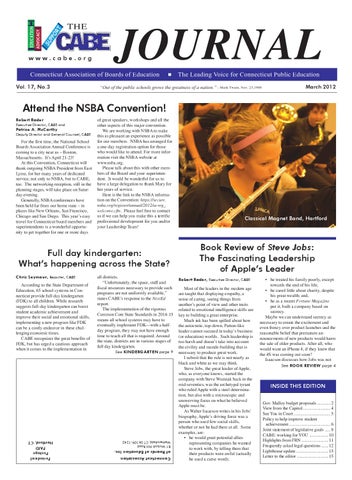
Classical Magnet Band, Hartford
Book Review of Steve Jobs: The Fascinating Leadership of Apple’s Leader Robert Rader, Executive Director, CABE Most of the leaders in the modern age are taught that displaying empathy, a sense of caring, seeing things from another’s point of view and other traits related to emotional intelligence skills are key to building a great enterprise. Much ink has been spilled about how the autocratic, top-down, Patton-like leader cannot succeed in today’s business (or education) worlds. Such leadership is too harsh and doesn’t take into account the civility and morale-building that is necessary to produce great work. I submit that the rule is not nearly as black and white as we may think. Steve Jobs, the great leader of Apple, who, as everyone knows, started the company with Steve Wozniak back in the mid-seventies, was the archetypal tyrant who ruled Apple with a steel determination, but also with a microscopic and unswerving focus on what he believed Apple must be. As Walter Isaacson writes in his Jobs’ biography, Apple’s driving force was a person who used few social skills, whether or not he had them at all. Some examples, are: • he would greet potential allies representing companies he wanted to work with, by telling them that their products were awful (actually he used a curse word);
• he treated his family poorly, except towards the end of his life; • he cared little about charity, despite his great wealth; and, • he as a recent Fortune Magazine put it, built a company based on secrecy. Maybe we can understand secrecy as necessary to create the excitement and even frenzy over product launches and the reasonable belief that premature announcements of new products would harm the sale of older products. After all, who would want an iPhone 4, if they knew that the 4S was coming out soon? Isaacson discusses how Jobs was not See BOOK REVIEW page 4
INSIDE THIS EDITION Gov. Malloy budget proposals ............ 2 View from the Capitol ......................... 4 See You in Court ................................. 5 Policy to help improve student achievement ..................................... 6 Joint statement of legislative goals ..... 8 CABE: working for YOU ................. 10 Highlights from FRN ........................ 11 Frequently asked legal questions ...... 12 Lighthouse update ............................. 15 Letter to the editor ............................ 15
Periodical Postage PAID Hartford, CT
2
The Journal – Connecticut Association of Boards of Education PRESIDENT COMMENTARY
Education here, there, everywhere Recently, I had the opportunity to participate in a discussion about how urban and suburban school leaders should respond to increasing racial and economic diversity. This project, called “One Nation Indivisible”, tells stories about, connects and mobilizes people who are building and sustaining racially, culturally, linguistically and economically integrated schools, social institutions and communities in the United States. In attendance was a national network of educational thinkers, educators, strategists, policy experts and community builders. The session was held outside Minneapolis where the focus was on a district that is increasingly facing challenges that accompany demographic shifts, coupled with ongoing public discourse. The school leaders present, through compelling discussions and developed
awareness of education in similarly situated districts around the country, began to formulate recommendations for national and state policies. More importantly, reform for local practices would support educators who understand the value of racial and socioeconomic diversity, equity and cultural relevant pedagogy. Connecting one another, via federal, state and local policy makers, can demonstrate support for school leaders in changing districts, while conversations and insights from the national participants helped demonstrate the commitment to public education with varying degrees of success. On the flight home, I reflected on a thought, “if it takes a village to raise a child,” then “it takes a district to educate ALL children…” During the first week of February, I
CABE Board of Directors EXECUTIVE COMMITTEE Lydia Tedone President, Simsbury Richard Murray First Vice President, Killingly Ann Gruenberg VP for Government Relations, Hampton Stephen Wright VP for Professional Development, Trumbull James Marpe Secretary/Treasurer, Westport Don Blevins Immediate Past President John Prins Member at Large Mary Broderick NSBA President, East Lyme AREA DIRECTORS Susan Hoffnagle, Area 1 Co-Director, Winchester Mari-Ellen (Mimi) Valyo, Area 1 Co-Director, Winchester Daniel Santorso, Area 1 Co-Director, Plymouth Becky Tyrrell, Area 2 Director, Plainville Laura Bush, Area 3 Director, Vernon Gavin Forrester, Area 6 Co-Director, Stratford Elaine Whitney, Area 6 Co-Director, Westport Michael D’Agostino, Area 7 Co-Director, Hamden Sheila McCreven, Area 7 Co-Director, Woodbridge John Prins, Area 7 Co-Director, Branford Robert Ruggiero, Area 8 Co-Director, Madison Pamela Meier Area 8 Co-Director, Madison Gail MacDonald, Area 9 Director, Stonington CITY REPRESENTATIVES Bob Trefry City Representative, Bridgeport Michael R. Nast City Representative, New Haven Polly Rauh City Representative, Stamford Charles Stango City Representative, Waterbury
COMMITTEE CHAIRS Robert Mitchell, Chair, State Relations, Montville Beverly Washington, Chair Federal Relations, Groton ASSOCIATES Eileen Baker, Associate, Old Saybrook Sharon Beloin-Saavedra, Associate, New Britain Gary Brochu, Associate, Berlin Robert Guthrie, Associate, West Haven Cal Heminway, Associate, Granby
STAFF Robert Rader, Executive Director Patrice McCarthy, Deputy Director and General Counsel Bonnie Carney, Sr. Staff Associate for Publications Nicholas Caruso, Sr. Staff Assoc. for Field Service and Coord. of Technology Sheila McKay, Sr. Staff Associate for Government Relations Kelly Moyher, Sr. Staff Attorney Vincent Mustaro, Sr. Staff Associate for Policy Service Lisa Steimer, Sr. Staff Assoc. for Professional Development Teresa Costa, Coordinator of Finance and Administration Pamela Brooks, Sr. Admin. Assoc. for Policy Ser. /Search Ser. Terry DeMars, Admin. Assoc. for Policy Service Gail Heath, Admin. Assoc. for Government Relations Wilmarie Newton, Admin. Assoc. for Labor Relations Corliss Ucci, Receptionist/Asst. to the Executive Director
The CABE Journal (ISSN 1092-1818) is published monthly except a combined issue for July/August as a member service of the Connecticut Association of Boards of Education, 81 Wolcott Hill Road, Wethersfield, CT 06109, (860) 571-7446. CABE membership dues include $30 per person for each individual who receives The CABE Journal. The subscription rate for nonmembers is $75. Association membership dues include a subscription for each board member, superintendent, assistant superintendent and business manager. The companies and advertisements found in The CABE Journal are not necessarily endorsed by CABE. “Periodicals Postage Paid at Hartford, CT.” POSTMASTER: Send address changes to The CABE Journal, CABE, 81 Wolcott Hill Road, Wethersfield, CT 06109-1242. Email: bcarney@cabe.org. Members can find the CABE Journal online at: www.cabe.org/userlogin.cfm?pp=84&user request=true&keyrequest=false&userpage=84
attended the Federal Relations Network (FRN) Conference, sponsored by the National School Boards Association (NSBA) in Washington, DC. I gathered with 900 of our fellow school board members from around the country, where “our” goal was to “speak together” as one collective voice regarding educational issues facing us, whether national, state or local. Legislative issues addressed were: ESEA/NCLB Reauthorization; Federal Funding for Title 1 and IDEA; School Board Governance; and the future vision for public education – 21st century learning; pre-k; teacher/principal effectiveness; recommended standards/assessments; STEM support and child nutrition. As we converged on Capitol Hill to meet with our Congressional delegation, we were a solid state presence of public education advocates demonstrating our dedication and commitment to influencing federal legislation. As board members, we witness first hand that local school boards are relevant and our local knowledge is critical more than ever to setting the education legislative agenda for the year – the “Agenda for America’s Schoolchildren.” Upon my return to Hartford, I was greeted with Gov. Malloy’s State of the State Address where his proposals for education reform dominated his speech. This budget year is now commonly known
Lydia Tedone
as the “Year of Education”, if only for a few short legislative months. Not a day passes in the press or media without headlines reading: “School Reform,” “Overhauling Education,” “Student Achievement,” “School Funding,” “Tenure,” “Evaluation,” “Education ReVamp,” “Fix Schools,” “Teacher Talent,” “Teacher Pay,” “Work Together,” and “Education Opportunity.” From op-eds to blogs to social media outlets, the word EDUCATION is the key word. As Board Members, our collective knowledge of state and local legislation and policies impacts our districts and our schoolchildren. Connections with our local legislators will strengthen local support for sustained investments in our school systems, as we continue to strive for quality public education, whether in Connecticut, Washington, DC . . . or Minnesota.
Governor Malloy’s “Year of Education” budget proposals Governor Malloy has identified 2012 as the “Year of Education”, and presented a comprehensive package of education reform proposals to the General Assembly. The proposals include increased education funding for the 2012-13 budget, as well as changes to teacher tenure. A summary of some of the most significant proposals follows.
Education Cost Sharing (ECS) The budget documents indicate that “The unfortunate truth is that since FY 2009 the Education Cost Sharing (ECS) Grant has been flat funded, making efforts to turn around student achievement difficult at best”. For FY 2013, there is an increase of $50 million in the ECS grant. The foundation level will increase from $9,867 to $12,000. No town’s ECS will be reduced from 2011-12 levels, and 130 towns will receive ECS increases. $39.5 million of this new money will go to the lowest performing districts, based on their ability to achieve reforms, such as increased school learning time, recruitment and compensation of the most effective teachers and leaders.
Early Childhood Programs • $4 million in funding for an additional 500 school readiness slots; • $5 million in bond funds to develop the Tiered Quality Rating and Information System (TQRIS); and • $3 million in professional development and incentives for using the new system.
Intervention and supports to turn around Connecticut’s lowest-performing schools and districts $22.9 million in funding to create a “Commissioner’s Network”. Comprised of the lowest performing schools, the network would give SDE significant latitude to intervene in low performing schools and provide new school management. Teachers and school leaders in network schools would be eligible for significant compensation and other incentives to work – and remain – turnaround schools. These incentives could include signing bonuses and pay increments in return for minimum length of (please see GOVERNOR’S page 11)
3
The Journal – Connecticut Association of Boards of Education EXECUTIVE DIRECTOR COMMENTARY
Are school boards irrelevant? I don’t think so! As I wrote in my review of Steven Brill’s Class Warfare in the November CABE Journal, some in the media, as well as those in educational leadership, have been wondering if boards of education are still relevant. Even as Washington and Hartford have enacted laws (NCLB, stimulus money with strings attached, bullying) that are new mandates, at the local level we are moving into a more decentralized system of providing education. This decentralization is reflected in more magnet schools, charter schools, programs that provide more choice to our students and their parents including inter-district schools, even as the majority of local students attend traditional schools. And other states, including Massachusetts, are dealing with the implications of virtual schools. Everything is done through the internet in these schools. There is much to praise in Governor Malloy’s proposals about more funding, reform of teacher tenure and support for underperforming schools. However, there is concern about spending more money, including that of school districts, to pay for students attending charter schools. We recognize the need to ensure choice, but not at the expense of school districts across the State. More and different types of alternatives with an emphasis on serving the unique needs of all students may result in a forward-looking school district, but you also may have a recipe for dysfunction.
Are Boards An Anachronism? What is the role of a Board and superintendent in a district that must govern and lead based on these conflicting needs? How does a Board handle the myriad of issues this creates in the midst of change and competing needs? Well, if you believe some, the Board itself is an anachronism. Even here in Connecticut, there have been recommendations that schools be regionalized and that either an all powerful-Board or a strong superintendent governing the resulting larger district. Previously we were told that districts should be consolidated or regionalized in
from Nick Caruso, our Senior Staff order to save taxpayers’ money. But, Associate for Field Services, who has research has shown that, despite the worked for years with districts and the belief that “getting rid of all those administrators” will save big bucks, the State Department of Education on the savings are minor and the governing body Lighthouse Project. or person is so removed from the students, parents and the community that the system is less flexible and accountable. Questions for Consideration That still leaves us with the question • Have the Board and Superintendent of how to govern disparate schools and discussed NextEd and what the programs within effect of its provisions on districts. Obviously, your district may be? “I don’t think it’s Board members have Have you thought about a critical role in the CABE-and CAPSSan overstatement policy decisions, but supported idea that they must start with a students’ progress be to say that what mindset that may be based on demonstrated different than if all competency, not seat we do in the next the schools were time? uniformly operated. • Does your Board few years will I was asked this discuss the whole very question by a panoply of options that determine the superintendent in a students have as they take large city in Conadvantage of choices? relevancy of necticut. How can Do they look at how, for we get Boards to a example, charter schools Boards for the comfort level with all in the district may of the change (call it succeed in achieving future.” “reform”, call it higher student growth, “transformation”) and how the district may and enable them to see the whole, oftenbe able to use those same practices? confusing picture? • Do the Board and Superintendent The answer to this question is best understand the implications of all of addressed at the local level. We have the choices in the district? How do long emphasized local differences as we they ensure accountability? have discussed how cookie cutter • Is it appropriate for the Board to solutions don’t work at the local level. It examine how all students in the is time that Boards consider these issues, community, no matter which schools build capacity to deal with the issues that they attend and where they’re from, will arise and figure out how to impledo in preparing students for the ment best practices. future? Here are some questions about the Board’s role in implementation of ideas Boards’ Role from the big issues: in Addressing Big Issues • Does your Board hold an annual (semi-annual) retreat or periodic We believe that Boards and superinworkshops to allow for more intendents should determine where they depth discussions to gain in-depth stand on various issues and then decide what they need to do to get there. knowledge of teaching practices, Determine your destination and then the learning needs, curriculum and path you must take. student demographics? In order to help focus a Board discus• Does your Board have a clearly sion on the “big” issues, here are a few defined set of expectations for questions to get the conversation started. addressing the big issues? Are they We developed these questions with help in your District Improvement Plan,
Robert Rader
District Goals, Mission, Strategic Plan, policies, budget? Are they aligned with school goals? State goals? • Does your Board ever look at student data outside of the traditional Mastery/CAPT presentations? Do they actually spend time working with the data, or is the presentation of the data mostly oneway? The questions above are a mere starting point for the in-depth conversations that must take place between Boards and Superintendents and with the community. Some districts have gotten a start on that – and others have not had the chance during this busy budget and legislative season. We must find a way to discuss these transformative ideas if Boards are to maintain and strengthen their ability to help our students succeed. We must find ways to act upon them – not only locally, but at the State and national levels. Our voices must be strong and united and CABE and CAPSS will do all we can to make that happen. I don’t think it’s an overstatement to say that what we do in the next few years will determine the relevancy of Boards for the future. It will be at our peril if we don’t take this opportunity to think about how best to maintain and even strengthen our work on behalf of our students across the State. Editor’s Note: If your board would like CABE to facilitate a discussion on these issues, contact Nicholas Caruso at 860571-7446 or ncaruso@cabe.org. .
CABE Affiliate Members BUSINESS AFFILIATES DIAMOND MEMBER Finalsite GOLD MEMBERS
Berchem, Moses & Devlin Connecticut Business Systems Shipman & Goodwin Siegel, O'Connor, O’Donnell & Beck, P.C Sullivan, Schoen, Campane & Connon
SILVER MEMBERS Anthem Blue Cross and Blue Shield Corporate Cost Control Lindberg & Ripple Inc. Ovations Benefits Group Quisenberry Arcari Architects The Segal Company Trane BRONZE PLUS MEMBERS Blue Ribbon LLC Brown and Brown Fletcher Thompson Architects Friar Associates Goldstein & Peck, P.C. Kaestle Boos Associates, Inc. O & G Industries
BRONZE PLUS MEMBERS The S/L/A/M Collaborative Suisman, Shapiro, Wool, Brennan, Gray & Greenberg Whitsons School Nutrition BRONZE MEMBERS Nathaniel G. Brown, LLC Chinni & Meuser LLC Dattco Inc. Fuller & D’Angelo Architects and Planners JCJ Architecture Kainen, Escalera & McHale, P.C. The Lexington Group Muschell & Simoncelli
EDUCATIONAL AFFILIATES American School for the Deaf Area Cooperative Educational Services Capitol Region Education Council The College Board Connecticut Association of School Business Officials Cooperative Educational Services Connecticut Center for School Change Connecticut Educators Computer Association Connecticut School Buildings and Grounds Association EASTCONN EDUCATION CONNECTION LEARN
4
The Journal – Connecticut Association of Boards of Education
Book Review of Steve Jobs: The Facinating Leadership of Apple’s Leader (continued from page 1) unaware of other peoples’ feelings, but he used them as a weapon to break them down. Isaacson writes that “He could size people up, understand their inner thoughts, and know how to relate to them, cajole them, Steve Jobs or hurt them at will.” But, despite his epic lack of people skills, Jobs built an empire with great, revolutionary, beneficial and beautiful products that have changed our world . Isaacson’s book was written at Jobs’s request. Isaacson has written wonderful biographies of Einstein, Benjamin Franklin and others and this book is a fascinating read. While Isaacson writes about Jobs growing up in California, what I found particularly interesting was the narrative on how Jobs was a real ‘60’s kid. He spent a year in India when he was in his teens, used LSD and, throughout his life, had very strange eating habits. He would eat only one thing for weeks, like carrots and, when he went to restaurants, he would order something, then often send it back three or four times, telling the waiter it was “inedible.” His formal schooling was hit and miss – he went to Reed College in California,
but audited more classes than he attended. It was obvious that he was more interested in design and work with early computers than formal schooling. Isaacson follows him through the early years, hits and misses with various computers over the years, his firing at Apple, his success with Pixar, his hugely successful return to Apple and the last months of his life. What kept hitting me, despite the huge successes was that even as he tried to balance his life with a more “humane” streak, he remained difficult to work with. But, even so, with his brilliance, he created an army of followers, who knew that his products were top-notch and changed everything. They love Apple for its us-against big, bad Microsoft theme and loved Jobs because he was a revolutionary – or at least portrayed himself as one, even as this company hired most of its workers outside the U.S. and freely admitted it stole ideas from others. Moreover, they loved Jobs in spite of his personality, because of his passion and desire to be at the crossroads of technology and the humanities and for his artistry. Jobs loved art and design and worked extremely hard. He had his own very, very strong feelings and beliefs about what a product should look like and was involved in every aspect of product design, production, advertising and sales. Despite his harsh manner with people, he put strong, highly intelligent people
around him – a real “A” team. Those people he abused often ended up saying that he got them to do things they never thought possible. So, as I sit here writing this review on an Apple iPad2, while I often use my iPod and also have an iPhone, it may seem incongruous to discuss Job’s leadership faults. But, the truth is that this very brilliant man, who built this huge company, had huge flaws as well. And, that’s the lesson: in order to be successful as the type of person Jobs was, you also have to have much greater strengths. For a person who looked for balance through Far Eastern ideas, Jobs really had none, except in the strict sense of balance in the products he built. He was farsighted in regard to what the future could bring and how he could help get Apple there. But, he was not the type of man that most employees today would want to work with. For most of us, collaboration, morale-boosting and using our emotional intelligence to help others is what motivates us.
And, makes our enterprises good places in which to work – and grow.
Jobs on Public Education From Isaacson’s Steve Jobs Towards the end of his life, Jobs gave his views on public education. He “attacked America’s education system, saying that it was hopelessly antiquated and crippled by union work rules. Until the teachers’ unions were broken, there was almost no hope for education reform. Teachers should be treated as professionals, not as industrial assembly-line workers. Principals should be able to hire and fire them based on how good they were. Schools should be staying open until at least 6 p.m. and be in session eleven months of the year. It was absurd… that American classrooms were still based on teachers standing at a board and using textbooks. All books, learning materials, and assessments should be digital and interactive, tailored to each student and providing feedback in real time.”
View from the Capitol The “year of education” is leading to a frantic pace of activity at the state capital for everyone involved in public education. The Education and Appropriations Committees already have heard testimony on the Governor’s reform proposals. At legislative breakfasts around the state, as well as our individual meetings with legislators, they have repeatedly urged board members and superintendents to provide their input on these proposals. Seize this opportunity! CABE’s upcoming Day on the Hill provides another
opportunity, coupled with invitations to your legislators to meet with your board of education. For this to truly be the year of education in Connecticut, we must all engage in the legislative process! Patrice A. McCarthy Deputy Director and General Counsel, CABE
2012 CABE/CAPSS Convention Lisa Steimer Senior Staff Associate for Professional Development, CABE
It is not too early to be thinking about the 2012 CABE/CAPSS Convention which will be held November 16-17. The Convention Committee met in January to begin planning this annual event. They determined the theme of the 2012 Convention to be Boards and Superintendents: The Challenges and Opportunities in Reforming and Transforming Education. Supporting the theme are five strands under which breakout sessions will fall. They are: Reform and Transform, Effective Boardsmanship, Maximizing Resources, Increasing Student Achievement, and Developing and Fostering School/Family/Community Partnerships. A Call for Proposal has been mailed to solicit workshop proposals for the Convention. Call for Proposal
information is also available at www.cabe.org. If you are interested in submitting a proposal for consideration by the Committee, please note the deadline is Friday, March 9. Information for Student Performers and the Talented Student Display was also mailed in early February. Talented Student information is also available at www.cabe.org. If you are interested in entering your students, please complete the entry form and return to CABE with necessary supporting materials. Now is your chance to brag about the talented students in your district! Be sure to mark your calendar – we look forward to seeing you at the 2012 CABE/CAPSS Convention on November 16-17! If you are interested in joining the CABE/CAPSS Convention Committee or have Convention breakout session ideas, please contact Lisa Steimer at lsteimer@cabe.org. Watch future issues of the CABE Journal for the most up-to-date Convention news.
5
The Journal – Connecticut Association of Boards of Education See You in Court – The Nutmeg Board of Education
The Nutmeg Board is dealing with budget issues and FOIA matters Thomas B. Mooney, Esq. Shipman & Goodwin
The Nutmeg Board of Education makes many mistakes. The latest imbroglio created by the board will be reported here each issue, followed by an explanation of what the board should have done. Though not intended as legal advice, these situations may help board members avoid common problems. Mr. Superintendent was pleased to hear all the big talk about education reform. If the Governor is willing to spend State money to improve education, he thought, shouldn’t we expect the Town fathers in Nutmeg to do the same? Unbeknownst to Mr. Superintendent, however, education reform has indeed been on the mind of Seymour Dollars, Chair of the Nutmeg Board of Finance. Seymour and his cronies have been hatching a plot to tell the Board of Education how to save money and provide costeffective education. The Board of Finance plan has several elements. First, it will require that the Board of Education bid all contracts above $5,000 to assure the best price for all goods and services. Second, given the
availability of training videos on the Internet, no additional funds will be appropriated for professional development activities. Third, and most significant in terms of costs, the health insurance plan will be managed by the Town, and that insurance will now be provided through a self-insurance program. The members of the Nutmeg Board of Education were chagrined to first learn about Seymour’s plan when they received calls asking for comment on the plan from Nancy Newshound, ace reporter from the Nutmeg Bugle. Veteran Board member Bob Bombast didn’t hold back when Nancy explained the plan. “Seymour should stick to Town matters!” he barked. “We will not permit the Town to usurp the authority of the Board of Education.” The Board of Education started its next meeting by convening into executive session to discuss Seymour’s plan. Board members conceded that the bidding requirement was likely required by statute anyway, and getting rid of professional development was probably a step in the right direction. But they all expressed grave concern
Seventh Edition Now shipping
A Practical Guide to Connecticut School Law by Thomas B. Mooney, Esq. Shipman & Goodwin The Guide comes with a CD which provides hyperlinks to many cases and statutes and will permit word searches as a supplement to the Index. New to the Seventh Edition: Bullying, background checks, child abuse reporting, discrimination issues, educational reform, FERPA, freedom of information, state aid for education and much, much more You can call CABE at 860-571-7446 or 800-317-0033 and purchase your copy
NOW!
over the Town’s assuming responsibility for employee health insurance. The Board members were not alone. When it reconvened in open session, the Board moved right to Public Comment, and Mal Content, President of the Nutmeg Union of Teachers, was first to speak. “The Town Administration is incompe-
“ . . . under the proposed reform legislation, the State Department of Education will be auditing school districts to assure that effective in-service instruction is provided.” tent. NUTS will never agree to let those bozos take over our health insurance.” Some Board members nodded in agreement, secretly hoping that Seymour was not watching the meeting on cable access. Bob Bombast, however, could not care less, and he is always only too happy to say what the other Board members think to themselves. “I wouldn’t trust those people to gas up my car,” Bob scowled. “I move that the Board accept the first two elements of the Town’s plan for education reform, but that we unequivocally reject the Town’s plan to take over health insurance. As it turns out, Seymour was indeed watching the meeting on cable access, and he promptly sent a text to Bob, with copies to the other Board members and Mr. Superintendent as well. With his flare for the dramatic, Bob was only too happy to read it aloud at the meeting: “Dear Board members. Obviously, you have forgotten who holds the purse strings. We have already taken the money from your budget. Have a nice day. ” Can the Board of Finance do that?
Boards of education act as the agent for the state to assure that all resident children receive a suitable program of instruction, and, as such, they are independent of town control as they fulfill that responsibility. To provide the necessary funds, the town is required, first, to consider the budget request of the board of education and then, in light of other demands on the town’s financial ability, to appropriate the funds reasonably necessary to that end. Connecticut General Statutes, Section 10222, makes the independent authority of boards of education clear. It provides that the “money appropriated by any municipality for the maintenance of public schools shall be expended by and in the discretion of the board of education.”
Given this independent authority of the board of education, the town, acting through the board of finance, the town council, the mayor, etc., does not have the right to tell the school board how to operate. As to the first element, there are a few bidding requirements by statute, such as for school construction and school lunch programs. However, absent a charter provision imposing specific requirements, the board of education has the right to decide whether and when to put contracts out to bid. The Board has the responsibility to provide teachers with professional development activities. However, here, there are also statutory concerns. Currently, boards of education are required to provide eighteen hours of professional development to teachers each year. Moreover, under the proposed reform legislation, the State Department of Education will be auditing school districts to assure that effective in-service instruction is provided. It is unlikely that training videos will suffice. The main event, of course, is health insurance, which is a basic part of the right and responsibility of boards of education to employ teachers and others to fulfill their educational mission. The town cannot unilaterally take on the responsibility to provide health insurance to school board employees. Collaboration on health insurance between school and municipal officials is possible and may indeed be welcome. However, since the board of education may expend its appropriation “in its discretion,” it and the town must agree on any role for the town in providing and/or funding health insurance. As long as the obligations of both town and board of education are clearly spelled out, under some circumstances, selfinsured plans can offer savings. Moreover, in general unions do not have the right to bargain over such funding issues. However, the board of education may have to bargain over related mandatory subjects, such as state mandates and benefits administration. Finally, as so often happens, there are FOIA issues in Nutmeg. First, it appears that the Board convened an illegal executive session. Issues relating to the budget are not privileged to executive session. Unless the Board members were discussing a confidential document, such as legal advice concerning the Town’s plan, it should not have convened in executive session to discuss these matters. Second, texting about the operation of the public schools, as Seymour did, creates public records. Seymour’s text was more obnoxious than embarrassing, but such is not always the case. Board members are well advised to be cautious before texting their colleagues or others about board business. Attorney Thomas B. Mooney is a partner in the Hartford law firm of Shipman & Goodwin who works frequently with boards of education. Mooney is a regular contributor to the CABE Journal.
6
The Journal – Connecticut Association of Boards of Education
Use policy to help improved student achievement Vincent A. Mustaro Senior Staff Associate for Policy Service, CABE
The need exists to improve education in Connecticut and to significantly raise student achievement levels. This is reflected in federal mandates and new state initiatives. Local school board members, in addition to CABE, NSBA and school staff, have a compelling leadership role in this task. The challenge of improving student achievement for all children represents an opportunity for school boards to beneficially impact the lives of each child in the district and thereby elevate their own standing as a force in education and as a governing body.
The boards focus on students The primary focus of school boards must be on students. Boards of education support student achievement through attention to vision, standards of performance, assessment, accountability, alignment of resources to meet performance standards, school and district climate, collaborative relationships and a commitment to the concept of continuous improvement. Board of education meeting time must be centered about students, their needs and level of achievement. Boards want what is best for students but that won’t happen by accident. Raising student achievement, the most important challenge school boards face, requires concerted action. School boards can be and must remain major players in efforts to raise student achievement. By exercising policy leadership and effective governance practices, boards are not just observers on the road to improved results; they can be leaders. Boards help educators to focus on results. Through the district’s vision and goal statements, boards help establish a successful learning environment, exercise accountability for results and use advocacy to build support for the district’s efforts.
In the effort to bring student achievement to desired levels, the board must place a high priority on the development of a strong school board team. The board’s bylaws and operating principles help establish a tone of respect and honesty crucial to the effort to lead an organization through these challenging times. Boards, through policy direction, establish their role as educational advocates and define needed relationships with important stakeholders and groups. Policies relating to the relationship with the superintendent and staff are crucial. These policies should be monitored to determine their effectiveness in establishing the desired tone crucial to a positive team effort that results in the needed changes in our educational system to contribute to improved student success.
Focusing on improving student achievement Board planning must be focused on improving student achievement with clearly
Change in Connecticut Jobs by Education Level: 2008 to 2018 Source: The Georgetown University Center on Education and Workforce
defined outcomes focused on student achievement. The board’s policy statements pertaining to the district’s mission, vision, philosophy and goals help assure a focus on student achievement. Data should be properly used to determine the level of student achievement. Also, the board should hear regular reports pertaining to student achievement, based on a variety of assessments, at its meetings. Such reports also serve the important function of monitoring how successfully its policies are working in key areas. Through policy, boards should establish, in addition to regular board meetings, work sessions to permit the board to gain in-depth knowledge about teaching practices, learning needs, achievement, curriculum and student demographics. Regular board meetings do not allow sufficient time to study such issues in depth. The annual district goal setting process should be used by the board to direct the administration to make sure that individual school and staff goals, an integral part of the evaluation process, are aligned with the district and state goals wherever possible. The goal setting process at all levels should include an accountability system that permits and utilizes frequent assessment. Another important policy, the board’s philosophy policy statement should state the board’s commitment to students with emphasis on success for all students. District practices should support a student-centered philosophy, including appropriate allocations of resources to the important categories of instruction, students, administration, operations and maintenance. Resources must support district efforts. The budget process should target areas for improvement and the resources needed for those areas.
The decision-making process
Graph courtesy of the Connecticut College of Independent Colleges (CCIC). For more information contact CCIC, 21 Calcott Notch Road, Suite 1, Farmington, CT 06032; phone 860-678-0005.
The decision-making process should be guided by how any pending decision will affect students. This maintains a board and staff focus on students. In addition, boards should consider, through policy direction, the involvement of students in the development or revision of policies that affect them. Students can provide insight into the prac-
tical effect of many policies. Also, a board policy can make students a regular part of board meetings. Research supports the relationship between parental involvement and higher student achievement. The board should review its parental involvement policy and support actions which encourage a high level of such involvement. Related to this are policy statements related to a positive working relationship with parent organizations, staff development to assist staff in working and communicating with parents and parents as part of board advisory committees. The board’s willingness to cooperate and utilize the input of school governance councils should also be formalized in board policy. Schools should exhibit a positive school climate that is user friendly in response to board expectations. Therefore, policies pertaining to safety, discipline and related topics should be reexamined. In addition, recent legislation pertaining to bullying requires the development of safe school climate plans. Boards, involved in monitoring student achievement, must use data appropriately to identify strengths and shortcomings, and the areas needing improvement. The board doesn’t initiate programs on its own, but directs the administration to present to it plans for the improvement of student achievement. Board members, through effective questioning, should be interested in and determine how the proposed improvement program can contribute to improved student achievement for all groups of students. Public confidence in the board’s governance of the district will be improved through regular progress reports pertaining to goal achievement. Clear information about the areas that were selected for improvement and the improvement strategies used should be included in these reports. The board should also give credit and celebrate results in order to keep the improvement process active and people motivated. Board meetings should be used to praise the efforts, results, staff and students. Recognition efforts provide a clear message about the board’s expectations and values. The board should advocate through policy and actions for students in the community. Partnerships should be created with individuals and other agencies that serve children and families. Presentations should be made to civic organizations to explain the needs of district students, what the schools are doing and how community groups and organizations can help.
Conclusion In short, schools boards through policy and the implementation of appropriate practices can steer the direction the system takes to improve student results. The policy development, review, adoption, and monitoring process can lead to steps to make the difference only a board can accomplish. In a time where significant changes are proposed for transforming education in our state, the role of boards of education in the process must be preserved and utilized as a cooperation partner.
The Journal – Connecticut Association of Boards of Education
7
8
The Journal – Connecticut Association of Boards of Education CABE, CAPSS, CAS, CBIA, CCER, CONNCAN Joint Statement of Legislative Goals February 2012
Every student in Connecticut has a right to a high-quality education, regardless of his or her race, ethnicity, wealth, or zip code. Unfortunately, every student in Connecticut is not receiving a highquality education, as demonstrated by our state’s largest achievement gaps in the nation and by the gap between what our highest-performing students learn and what they need to know to meet international benchmarks for learning. The primary reason for this unacceptable situation is the fact that the education system in Connecticut is not designed to guarantee that every child will learn what he or she needs to lead full and productive lives. We, therefore, must take bold
actions that change the system if we want to ensure a brighter future for our students, our communities, and our state. It is in this spirit that our organizations, the Connecticut Association of Public School Superintendents (CAPSS), Connecticut Association of Schools (CAS), Connecticut Association of Boards of Education (CABE), Connecticut Business and Industry Association (CBIA), Connecticut Council for Education Reform (CCER), and Connecticut Coalition for Achievement Now (ConnCAN), come together, for the first time, to form a common position on important educational challenges facing our state. Each of our organizations has our own individual agendas and we may not always agree on how to solve problems in our education system. However, we do share common positions on the following issues and we jointly call on our state leaders to take action on these goals during this legislative session.
Educator preparation and certification Our current systems to prepare and certify teachers, principals, and superintendents must be improved and become more flexible in order to find the best possible candidates for the jobs. Preparation programs, both traditional and nontraditional, must be more clinically oriented, with both preparation and certification based primarily on demonstrated ability to perform well on the job.
Teacher evaluation and support The goal of an evaluation system must be two-fold: to develop and support teachers to become highly effective, and to dismiss ineffective teachers at any career level, including those who do not or cannot demonstrate improvement with support. Recently, the State Board of Education approved a set of guidelines for evaluation systems that include four levels of performance and multiple measures of a teacher’s effectiveness, with a clear focus on student learning. These guidelines were developed by the state’s Performance Evaluation Advisory Committee (PEAC). We support the principle evaluation guidelines as adopted by the PEAC and the State Board of Education. In addition, we believe that: • Reductions in force, when necessary, should be guided primarily by teacher evaluation results. If dismissals are needed, they should occur within levels of performance, beginning first with ineffective teachers and working up from there. • Teacher tenure should be earned and kept based on satisfactory evaluation results. At any point, teachers who do not consistently receive at least a proficient rating should be dismissed. We support an
expedited due process that is focused on whether the evaluation procedures were followed fairly. • Teachers who consistently receive the highest evaluation CABE Executive Director Robert Rader speaking at the press conferratings ence held on February 14 at the Legislative Office Building in should be Hartford. Other groups in participating were: Connecticut Association eligible for of Public School Superintendents (CAPSS); Connecticut Coalition for recognition, Achievement Now (ConnCAN); Connecticut Association of Schools (CAS); Connecticut Business and Industries Association (CBIA); and including Connecticut Council for Education Reform (CCER). promotions along a career ladder and salary increases.
Principal evaluation and support Principal evaluation systems should mirror the goals for teacher evaluations: to develop and support principals to become highly effective, and to dismiss ineffective principals, including those who do not or cannot demonstrate improvement with support. We believe that principals must be held accountable for their performance and, at the same time, be given the training, autonomy and authority to build the capacity needed to ensure fair, objective, and effective teacher evaluations. We support the principle evaluation guidelines as adopted by the PEAC and the State Board of Education. In addition, we believe that: • Growth of student achievement in the building or instructional unit for which the principal is responsible should be the most significant element in principal evaluation. • The principal must have highquality training and support in teacher evaluation. • The principal should have a significant voice in deciding who is employed in his/her school or instructional unit.
Relationship between time and learning We need to measure student learning not by time spent in classrooms, but by mastery of content. The first step in moving toward such a system is to allow local boards of education to award students credit for evidence of work and experiences that demonstrate mastery in relation to the Common Core college- and career-readiness standards, rather than Carnegie Units earned or “seat time” accumulated, regardless of the time required for such mastery. Flexibility in meeting student learning needs must be used both for remediation for students who need additional learning time to master content, and for enrichment opportunities for advanced study.
School and district accountability
We support a system of differentiated accountability for schools and districts that provides varied support and interventions based on where schools and districts fall across a range of student performance levels. We know that many schools and some districts are consistently underperforming. It is imperative that we improve these schools and districts, and provide their students with high-quality education right away. This goal can be addressed by: • Developing a system in which our lowest-performing schools and districts receive immediate and intensive support and intervention. • Ensuring that any increases in funding to these schools and districts is aimed at increasing student achievement. • Recognizing our high-performing, highest-need schools and replicating their success. • Supporting innovative models to address the learning needs of every student.
Pre-kindergarten All children should have access to programming beginning at age three that is developmentally appropriate and staffed by highly effective teachers, with initial priority given to low-income students. In addition, families need clear information about the quality of their prekindergarten options.
Education contract negotiations During contract negotiations, we encourage the parties to consider new ways of structuring contracts to focus on student learning needs. In education contract negotiations, if the school district and the local teachers union cannot come to agreement, the decision goes to binding arbitration. We believe that the state law on binding arbitration must be amended so that students’ learning needs are the primary factors that guide the binding arbitration process.
9
The Journal – Connecticut Association of Boards of Education Full day kindergarten: What’s happening across the State? (continued from page 1)
Glastonbury Starts FDK In Glastonbury, seven teachers will be added in 2012-13 in order to implement full-day kindergarten. But the town didn’t luck out and come across a windfall in order to be able to afford FDK in these tough economic times. Instead, there will be a reduction of seven classroom sections at the elementary level. The reduction of seven sections in grades 3-5 is the result of a decade long drop in the birthrate in town, according to school officials. Recognizing that a full-day program might not be right for all children, the school system also plans on offering parents a choice between half-day and full-day kindergarten in 2012-13. Glastonbury Board of Education member Pandora Wohler said she feels “strongly” parents should be offered a choice between full-day and half-day this fall. “They are their child’s first teachers and know the child best,” she said of parents. “Some children may not be ready for a full day of school; for example, the child may still take a daily nap. Additionally, some parents have expressed that they would prefer to provide enrichment activities at home. Whatever the parents’ reasons, they should be allowed to choose what is best for their son or daughter.” Wohler also touched on the changing landscape of kindergarten curriculum. “The amount of academic curriculum, primarily language arts and mathematics… being taught in kindergarten now would probably surprise anyone who has not been in a kindergarten classroom in recent years. This is not your father’s kindergarten – it is not even your older children’s kindergarten,” she said. And with the implementation of the new Common Core State Standards roughly two years away, the kindergarten experience will continue to evolve. “These curriculum requirements will increase in 2014 when Connecticut adopts the Common Core State Standards,” added Wohler. Providing FDK is “not about providing daycare or the perception that our kindergarteners are not coming to school ‘ready to learn,’” explained Wohler. “Rather it is about the additional expectations these young children will face. What is being squeezed out of the kindergarten day is time for the social and emotional development, which is so important for our youngest students,” she said. With all that is and will be expected of them, kindergarten teachers and students simply need more time, added Wohler. “Remember the book, All I Really Need To Know I Learned in Kindergarten? Well those are the things teachers are having difficulty fitting into the half-day program—sharing, listening, cooperating, etc. A full-day program would allow for more time to fit everything in. I believe that, like adults, our children would learn better if they were not rushed—they might even have time for recess.”
New Britain Has FDK – At A Cost In New Britain, the Hardware City currently has universal all-day kindergarten, according to Board of Education Chair Sharon Beloin-Saavedra, who also serves on the CABE Board of Directors.
“We have had some form of a full-day program for almost 10 years but in the last five have been able to provide this program to all our kindergarten students,” she explained. But providing that program to all students has obviously come with a cost. “It has come at the expense of other programs/staff in our budget,” she noted. To preserve the FDK program the New Britain Board has had to make cuts in other areas, mostly at the middle school level – these include cuts to guidance counselors, foreign language and consumer sciences, according to BeloinSaavedra. “We also count on the 2% set aside ECS grant to help pay for this program,” she added.
Despite its cost, Beloin-Saavedra said FDK is “a must have program” in urban communities. “I absolutely believe (data will show) a full day program is essential to mitigating the preparation gap and better preparing students to be reading at grade level by the third grade,” she said. New Britain could have 40 FDK kindergarten classes this fall. “We currently have 36 all-day kindergartens and believe that next school year we will or should add four additional classes. The cost of the program is in the personnel (teachers) and classroom space – [the] full-day program requires double the space of running half-day programs...and, of course, materials and teachers for special area subjects such as art/music/PE.”
Ideally, a full-day program would include the support of a paraprofessional and a class size capped at no more than 20, said Beloin-Saavedra. “This we are unable to do in New Britain because of financial limitations,” she said.
Stamford Weighs In In another urban community, Stamford, full-day kindergarten has been in full swing since 1980, according to Board Chair Polly Rauh, who also serves on CABE’s Board of Directors. “We piloted FDK in 1979 and in 1980 went to FDK for all students. It has been in place ever since,” she explained.
10
The Journal – Connecticut Association of Boards of Education
CABE: working for YOU Individualized Workshops • Professional Development Opportunities Legal Services • Policy Services • Representing You Statewide and Nationally Below are the highlights of activities that the CABE staff has undertaken on your behalf over the last month. We did this:
✦ By ensuring members receive the most up-to-date communications: • Met with retiring Bethel Superintendent Gary Chesley and incoming Superintendent Kevin Smith. • Met with Board Chair Christopher Mickey and Superintendent Teresa Kane of East Windsor on CABE programs, workshops and services. • Met with Board Chair Andrea Saunders and Superintendent Jeff Kitching (Plainville) and Board Chair Mary Grace Reed and Superintendent Kathleen Greider (Farmington) to discuss CABE’s programs, activities and services. • Developed new policy manuals utilizing the Custom Policy Service. Materials were prepared for Derby, Putnam, Sherman, Union and Windsor Locks. • Prepared and disseminated Convention Call for Proposals and Talented
Student information. • As part of the development of new policy manuals utilizing the Custom Policy Service, materials were prepared for Derby, East Windsor, Putnam, Wallingford, Windsor Locks and Woodbridge Boards of Education. • Met with the Policy Committee of the Wallingford Board of Education.
✦ By helping school boards to increase student achievement: • Worked with a new coalition, made up of CABE, CAPSS the Connecticut Association of Schools (CAS), the Connecticut Council on Education Reform, Connecticut Business and Industry Association (CBIA) and ConnCAN on how to increase student achievement. The group held a press conference and released a joint statement on February 14. [See page 8.] • Provided training to Hamden School Governance Councils • Participated in Glastonbury strategic
Governor’s Malloy’s “Year of Education” budget proposals (continued from page 2) service commitments.
Expand the availability of high-quality school models, including traditional schools, magnets, charter and others Additional funding to expand and replicate high quality school models including charter, magnet and CommPACT schools. The charter school formula will be integrated into the ECS appropriation “to ensure financial security for these schools”. The recommended budget includes: • Charter schools - increase the state per-pupil grant from the current $9,400 to $11,000 per-pupil as well as expand the number of slots for charter schools There is also a municipal share of $1,000 per student that a sending district would pay to charter schools that its resident students choose to attend; • Incentives for local charter schools, including $3,000 per pupil and $500,000 start-up grant • $5 million to fund an increase in the per pupil grants for non-Sheff magnet schools in order to phase in parity for those magnet schools with the Sheff magnet schools; • $750,000 for the Vocational Agriculture Program and a new competitive grant to increase the number of students coming from Priority School Districts • Increased funding of $7 million for compliance with the Sheff settlement.
Connecticut Technical High School System (CTHSS) Create a new governing board with eight members, four of whom are
appointed by the State Board of Education and four of whom are recommended by Regional Chambers of Commerce.
Remove red tape and other barriers to success, especially in high-performing schools and districts • Eliminate the continuing education requirement and the Master’s degree requirement for attaining a professional certificate;· • Expand reciprocity with educators who are certified in out-of-state institutions of higher education and Alternative Route to Certification through a Commissioner’s waiver; • Create a Red Tape Council to remove unnecessary rules
Enhance Educator Quality $12 million in funding for recruiting and developing the best education professionals, and training for teachers and administrators on the new evaluation systemThe changes to teacher tenure include “making tenure a privilege, not a right” Teachers would be employees at will for 1 year (currently 90 days), would earn tenure in 3-5 years on the basis of performance, and could be dismissed if “ineffective” or “unprofessional”. The termination appeals process would be conducted by a single impartial arbitrator, and limited to a review of whether the evaluation and support process was followed.
Districts under 1000 Pupils The Governor proposes to reduce ECS grants beginning in 2015-16 to school districts with fewer than 1000 pupils whose per pupil expenditure exceeds the state wide average.
planning meeting. • Participated in and held CABE/ CAPSS Convention Committee meeting. • Provided Lighthouse training for the Danbury, Killingly, Norwalk, Norwich, Shelton and Windham Boards of Education. • Sent two issues of “Policy Highlights via email covering topics that affect student achievement. This included use of technology in class, sex education standards, reading programs, religion in public schools, class size, sexual harassment, food allergies, and social networking.
✦ By providing opportunities for members to learn how to better govern their districts: • Facilitated retreats with Cromwell, Franklin (with members of the Lebanon, Bozrah and Columbia Boards), Somers, Sprague, Stamford, Watertown, Killingworth and Waterbury on board roles and responsibilities. • Facilitated Board retreat for the Salem Board of Education. • Held and participated in two sessions of the CABE Leadership Institute. • Demonstrated CABE-Meeting for Glastonbury and Southington Boards of Education and the Glastonbury Town Council. • Provided policy information to 39 districts, one attorney, two newspapers, one radio station, one RESC and one out-of-state school board association through 73 answered requests for information or sample policies, on 60 topics. The topics of greatest interest were wellness, child abuse reporting, administration of medication, computer acceptable use, and security issues.
sory Committee. • Met with new Executive Director Ray Ann Knopf of the Connecticut Council on Education Reform. • Met with the Hartford Courant, New Haven Register, The Day editorial boards to explain our positions, especially on legislative issues. • Attended meeting of the CAPSS Technology Subcommittee. • Attended meeting of Connecticut council for Advanced Technology Advisory Committee. • Attended NSBA Leadership and Federal Relations Network conferences, took active parts in several workshops and other activities, including meeting with member of the Connecticut congressional delegation. • Participated in Governor’s Prevention Partnership’s Board of Directors meeting. • Participated in meeting of the What Will Our Children Lose Coalition. • Attended CAPSS International Committee meeting. • Participated in CSAE Board of Directors and Governance Committee meetings. • Attended meeting of Connecticut’s Child Emergency Preparedness Committee. • Attended CAPSS Board of Directors meeting.
✦ By promoting public education: • Met with State Department of Education representatives on Connecticut NCLB waiver application. • Continued to work with the State Department of Education and the Department of Children and Families to finalize a new policy pertaining to child abuse reporting to fulfill legislative requirements. • Answered questions about the most current legal issues facing boards of education on referenda, board minutes and agendas, negotiations, executive session, nepotism and board vacancy.
✦ By representing Connecticut school boards on the state, national or international levels: ✦ By providing services to meet • Attended Title I Committee of Pracmembers needs: titioners meeting. • Attended CT Coalition for Justice in Education funding steering committee meeting. • Attended CREC Council meetings to provide legislative update. • Attended ECS Task Force Committee meetings. • Attended Legislative breakfasts in Rockville, Westport, Hartford and Colechester. • Participated in NSBA Council of School Attorney Nominating Committee meeting • Participated in NSBA Board of Directors meeting • Attended Secondary School Reform Implementation Task Force meeting. • Attended State Board of Education meeting. • Met with Education Committee members to discuss Legislative Priorities. • Attended former Interim Commissioner George Coleman’s Retirement Reception. • Attended meeting and teleconference for the Professional Educators Advi-
• Delivered webinar on the Governors Education Reform Package. • Met with CAPSS Executive Director Joe Cirasuolo on school capacity. • Met with Bridgeport Superintendent Paul Vallas and Hartford Superintendent Christine Kishimoto on how CABE can help their school districts. • Attended Lessons in Leadership session, concerning relationships in the workplace. • Prepared Custom Policy material for Ansonia, Columbia, East Hampton, East Windsor, Franklin, Gilbert School, Hebron, New Fairfield, New Hartford, Newington, Marlborough, North Stonington, Old Saybrook, Oxford, Regional School District No. 6, Stafford, Sterling, West Haven, Westbrook and Windham. • The audit of the Brooklyn policy manual is in progress, nearing completion.
The Journal – Connecticut Association of Boards of Education
11
College Board Highlights opportunities for your students from Federal Alan Bernstein process. Relations AP Potential fits squarely into using data to inform school policy and course Conference scheduling decisions. From our research, This October over three million Senior Educational Manager, K-23 Services, The College Board
students across the country took the PSAT/NMSQT® and in Connecticut that translated into a participation rate well over eighty percent for all of our public school juniors and sophomores, and a slightly higher percentage if we include independent schools in Connecticut. Looking back 32 years ago when I sat for the PSAT/NMSQT, the test then was little more than a practice run-up for the SAT® that most of us would take later in the spring of our junior year. Some of us – not me mind you – also were chosen as National Merit Scholars by virtue of doing exceptionally well on the test. To say that the PSAT/NMSQT has changed in the 32 years since I took the exam is a putting the issue mildly. Back in the day, the test was really about test preparation and selecting National Merit Scholars. Telescoping to the present, the PSAT/ NMSQT is now a college readiness learning resource with something for everyone: teachers, administrators, counselors, and students. Because so much has been added to the PSAT/ NMSQT, we now have more sophomores taking the test than we do juniors, something that was unheard of even ten years ago. So what’s new with the PSAT/ NMSQT?
PSAT One of the most useful features that the College Board added to the PSAT/ NMSAT is AP Potential™ which answers the question of how the results from the PSAT/NMSQT can be used to predict later success in Advanced Placement® courses. Because the College Board owns both the PSAT/NMSQT and Advanced Placement it is uniquely able to determine the outcomes and the predictive relationship from the PSAT/NMSQT assessment to up to 25 different AP courses. Each school is given an access code and a series of steps where they are able to generate rosters of their own students who show promise for having success in any of 25 different AP® courses, as defined by a score of three or higher. Schools have the option to determine for themselves the minimum criteria for success, e.g., fifty percent likelihood of AP success, sixty percent likelihood, and so forth. Once the minimum is chosen, the AP Potential tool generates a list of students who show promise of likely success should they opt for AP. This is a powerful, quantitative tool that the College Board makes available to schools at no cost in order to expand what has traditionally been a restrictive AP selection
we know that thousands of students have a strong likelihood for succeeding in various Advanced Placement courses but are not afforded access or not encouraged to participate in AP. We also know that AP Potential is an untapped resource that more schools should use.
College Quick Start Another important PSAT/NMSQT tool for students is My College Quick Start™ Students who take the PSAT/NMSQT have a wealth of dynamic online resources that they can access with a code provided to them on their paper score report. Once students log-on, they receive detailed question-by-question feedback from the PSAT/NMSQT. Unlike the CAPT assessment, for instance, every question on the PSAT/NMSQT is publicly released so nothing is held back; all questions are available for review and this is particularly useful to educators who want to use the data for school improvement. With My College Quick Start, students can also get a full length practice SAT, helpful suggestions on where they may need to focus as they look towards the SAT, and access to the College Board’s dynamic college search engine that enables students to filter and search from nearly 4000 colleges in our database.
My Road Another feature in My College Quick Start is My Road™ that provides students with a wealth of college planning tools, including information on hundreds of potential careers and college majors. My Road is a useful tool for counselors and advisors as they begin the college planning process with students. AP Potential, My College Quick Start, and My Road are just some of the new features that are available to schools and students who participate in the PSAT/ NMSQT. Much has changed since many of us took the PSAT/NMSQT. If you or your colleagues are interested in learning more about all of the no-cost resources that come with the PSAT/NMSQT, I would happy to follow up and answer your questions contact me at 781-6632736 (work); 617-455-5457 (cell); abernstein@collegeboard.org (email). The College Board is a not-for-profit membership organization committed to excellence and equity in education whose mission is to connect students to college success and opportunity. We are proud to be an educational affiliate of CABE.
Representatives of the Connecticut Association of Boards of Education traveled to Washington, D.C recently for the National School Boards Association’s Annual Federal Relations Network Conference, where they participated in briefings on federal education issues and met with key staff of Connecticut’s Congressional delegation. Primary issues of concern were the need for reauthorization of the Elementary and Secondary Education Act (currently known as the No Child Left Behind Act) and funding for the Individuals with Disabilities Education Act. Given that these are currently separate bills in the House and Senate on ESEA, with significant differences between them, reauthorization during this session of Congress is unlikely. The impact of the Common Core standards on teaching and assessment, and the need for support for implementation, was also discussed extensively. Patrice A. McCarthy
Standing in front of the Capitol are: Ann Gruenberg (Hampton) Vice President for Government Relations; Superintendent Mark Benigni (Meriden); Robert Rader and Patrice A. McCarthy (CABE).
Lobbying Representative Rosa DeLauro were: Patrice A. McCarthy, Lydia Tedone (Simsbury) President; Beverly Washington (Groton) Federal Relations Chair; Representative DeLauro; and Richard Murray (Killingly) First Vice President.
Deputy Director and General
Lobbying Representative Chris Murphy were: Ann Gruenberg (Hampton) Vice President for Government Relations; Lydia Tedone (Simsbury) President; Representative Murphy; Robert Rader (CABE); and Mark Benigni (Meriden).
Lobbying Representative John Larson were: Ann Gruenberg (Hampton); Mark Benigni (Meriden); Representative Larson; Lydia Tedone (Simsbury); Sheila McKay and Robert Rader (CABE); and Cal Heminway (Granby).
Lobbying Representative Joe Courtney were: Ann Gruenberg (Hamton); Beverly Washington (Groton); Patrice McCarthy (CABE); Representative Courtney; Cal Heminway (Granby); Lydia Tedone (Simsbury); Mary Broderick (East Lyme) President, NSBA; Richard Murray (Killingly) and Robert Rader (CABE).
12
The Journal – Connecticut Association of Boards of Education
Frequently asked legal questions
Disseminating information to the public on referendum issues Kelly B. Moyher Senior Staff Attorney, CABE
Boards of Education often have questions about the ability to disseminate information to the public when a referendum on the budget or a school construction project is pending. The following are among the most frequently asked questions. • Can school district staff and board members advocate for passage of the referendum at public meetings, civic groups, and churches after the referendum date is set? Yes. Municipal officials and employees retain their right to speak freely on these matters once the referendum date is set so long as no municipal resources are used to convey the advocacy message. Accordingly, these officials and employees may speak freely on their own time (time for which that they are not compensated by the municipality). They also may write letters to the editor of newspapers using their official titles. If the public meeting at which the advocacy occurs is conducted in a municipally funded facility, then groups that desire to use the facility to advocate their opposing viewpoint on the referendum must be treated on the same terms.
• What information can be distributed before a referendum is set? Before a referendum is scheduled or anytime during the year when no referendum has been officially set, a board of education, PTAs, PTOs, Administrators, and Superintendents can distribute information on: - Budget priorities - Rationale for new initiatives - Budget proposals - The need for construction projects • What restrictions are there on students and PTAs/PTOs when a referendum date has been set? Students may not be used as couriers of information that advocates a position on a referendum. A notice indicating the time, place and question to be voted upon, information that is content neutral, may be sent home with students. PTAs, PTOs, administrators and other groups may not use school equipment and supplies to advocate a position on a referendum. • Can architectural drawings remain on display once the referendum date is set? Yes. The continuing display of such drawings would not trigger the procedural requirement of the legislative body of the municipality to approve the display. If the drawings are included in printed materials that
contain other information concerning the referendum, then the legislative body would have to authorize its printing and dissemination and such accompanying information could not advocate the passage of the referendum. • If the superintendent or his/her young child prepares a PowerPoint presentation on their home computer, which includes both factual information as well as advocates for the passage of the referendum, can the superintendent use that PowerPoint presentation when making public speeches after the referendum date is set? Yes. Municipal officials, such as the superintendent, can spend their own money and time advocating for the referendum as long as no municipally funded resources are used for advocacy. The superintendent may make the PowerPoint presentation to groups such as area chambers of commerce and PTA/PTO groups after the normal workday to ensure that no municipal expenditures are made for advocacy prohibited by § 9-369b of the General Statues. • Can the superintendent use a PowerPoint presentation prepared by school district staff that contains architectural renderings, information on the cost of the project, state reimbursement information and data on population growth in the community
after the referendum date is set? Yes, provided the information does not advocate passage of the referendum. If the PowerPoint presentation is reproduced and disseminated in printed form, the legislative body would have to authorize its distribution as it would any other form of printed material disseminated after the referendum date is set. • Can the board of education website continue to contain a link to the PTA or PTO website after the referendum date is set, even if the linked site advocates adoption of the referendum? Yes. A mere link to the PTA or PTO website that has a prior existence apart from the referendum would not result in a municipal expenditure for the purpose of advocating a referendum. • May board members, superintendents, teachers and other municipal employees participate in political committees that advocate positions on pending referenda? Absolutely. Again, these officials do not lose their right to associate with others for advocacy purposes. Political committees must use private (not public) resources to advocate their positions on referenda. Municipal officials may contribute their own time and money to any such political committee that is registered with the town clerk of the municipality.
Northeast Region adopts position statement Editor’s Note: CABE is a member of the Northeast Region of the National School Boards Association (NSBA). After much discussion that took place at the annual Northeast Regional Meeting, the following position statement was adopted in early February. We hope that school boards and superintendents will see it as a forward-looking vision for public education and that it will help inform disucussions at the local level. Many of its aspects are already the positions of the various states, including Connecticut. This document is intended to encourage action and leadership by local school boards. Local school boards and state associations must take a proactive role in preserving and defending a system of public education that has a primary mission of promoting the success of all students. In addition, school boards are community leaders, representing the voice, heart and soul of their districts. Local boards empower communities to define the unique values that describe success for their students. Given the critical role that school boards must play in strengthening local
governance and advancing student achievement, the leaders of the state school board associations in the Northeast Region propose and endorse the following set of principles and action steps to drive that agenda. These principles are not meant to be a complete or detailed checklist, but are intended to provide a frame of reference for true education reform in our states and for the advocacy efforts of NSBA. • The mission of the school board and its actions must focus on the best interests of children o This includes articulating a vision of high expectations for student achievement with no exceptions, no excuses o This includes adopting policy, negotiating labor contracts, adopting budgets and hiring superintendents and, where appropriate, key administrators, in addition to all other roles and responsibility of the board o This requires that decisions be based on relevant, reliable data and best practices o This includes advocating for children, social issues, economic
justice and emotional well-being (the Whole Child) o This includes providing for a safe and secure learning environment • Staff Relations should focus on policies that reflect the best interests of children o Educator evaluations should be based on best interests of children o Properly-focused and relevant professional development should be provided to all educators, most particularly those in the most challenging learning environments o Teachers in the most challenging learning environment must be provided additional support o The central focus of collective bargaining should be on student achievement and the development of high quality professional and support staff o The needs of students must come before the needs or convenience of adults. Factors in student achievement, including length of school day and year, and student contact time are examples
• School boards must prioritize and address concerns about underperforming schools o School boards should confront and correct performance issues and not allow them to become fodder for voucher and other anti-public education forces • School board members must always be focused on the right work: student achievement o Boards should focus their meetings to discuss student achievement o Both candidates and experienced school board members must understand their critical role in the continuous improvement of student achievement o School boards should engage in professional development, selfevaluation and reflection to strengthen their effectiveness School boards recognize and communicate their critical role as elected officials in providing exemplary public service in a democratic society and appreciate the critical functions of engaging the public and representing the interests of the community, articulating its values, and strengthening a democratic society through public education.
13
The Journal – Connecticut Association of Boards of Education CABE and Baldwin Media: Partners in Managing Communications
The
Media Message
from Ann Baldwin, Baldwin Media Marketing, LLC
Governor Malloy declares this
“The Year of Education” Time for educators to speak up Now that we are one month into this short Legislative Session it is fairly obvious that education is the “hot topic” and while many in the world of education are mostly pleased with the Governor’s proposal, I think that most also agree that there is still a lot that has to happen on a Legislative level to adequately support education reform in Connecticut. While I am not a political operative by any means, as a communications professional, I understand the role that the media plays in generating dialogue and often times results. I think that we have all seen that education reform is at the forefront of what is making headlines in our state so this could be your opportunity to take an active role in communication. The media plays an important role in the world of Legislative leaders: representing the way that the media portrays the issues before them to the outside world and more importantly their constituents can have a huge impact on their future political aspirations. Ask any Legislator and they will tell you that press relations and public perception matter. While media resources are dwindling in our state, we are fortunate that we still have a Capitol press corps that is focused on Legislative issues. The Legislative process is one of the most complex and least understood aspects of American Democracy. Reporters assigned to cover the Legislature will have varying degrees of understanding of how it works and will appreciate the input and expertise of a credible source. I bring this up because this is an opportunity for those involved and impacted by education reform to have a voice, not only in what ultimately ends up happening in this year’s Legislative session, but it is also an opportunity to use the words of Joe Cirasuolo, Executive Director of CAPSS, to “plant the seeds” for future educational reform. So how do you do that? This is an opportunity for you to be part of the story. A time to reach out to educational reporters, or your local reporters and let them know that you would be available to be a source on education, Because the media can do more that provide visibility they can be an influential trigger for legislative action as well. Perhaps you have a strong opinion about an issue that arises that would fit well into an op-ed piece in your local paper or on-line publication? The need for people who involved in all levels of education to weigh in is great. From local boards of education, educators and superintendents this is an opportunity to be heard and to give the general public a grass roots perspective on the real impact and need for better support for Connecticut’s public school children.
Governor Malloy will be attending CABE Day on the Hill March 14, 2012 8:30 am
The Bushnell, Hartford Register NOW and together we can make our voices heard! Contact: Gail Heath at 860-571-7446 to register or email gheath@cabe.org
What is your policy on bullying? Keeping your policies current is our business.
CABE Policy Services Is your policy up to date? Does your policy meet legal requirements, address current issues and reflect the latest technological advances. Is your policy aligned with recent court decisions? Has your policy been reviewed or updated within the last two years? If your answer to any of these questions is no, we can help. CABE offers a variety of customized policy services to assist local school districts with developing and maintaining updated, enforceable and legally compliant policy manuals. For information on CABE’s variety of policy services, please contact CABE Policy Services at 800-317-0033 or 860-571-7446 or visit www.cabe.org.
is recruiting for
SUPERINTENDENT OF SCHOOLS AMITY REGION 5 PUBLIC SCHOOLS MANCHESTER PUBLIC SCHOOLS OXFORD PUBLIC SCHOOLS REGION 12 PUBLIC SCHOOLS ROCKY HILL PUBLIC SCHOOLS For an update or more information on vacancies go to our website: www.cabe.org For more information contact, CABE Search Services, Jacqueline V. Jacoby • 860-539-7594 Randall H. Collins • 860-443-5735 P.O. Box 290252, Wethersfield, CT 06129-0252 www.cabe.org/support • Equal Opportunity Employers
14
The Journal – Connecticut Association of Boards of Education
CABE-Meeting CABE-Meeting is a user-friendly, web-based service specifically designed to assist the board, superintendent and central office staff in preparing for and running board of education meetings.
Is CABE-Meeting for you?
Learn more:
• Do you want to save your district money? • Do you want to utilize technology to enable staff to be more efficient? • Do you want to focus more of your human and financial resources on increasing student achievement in your district? • Do you want to enhance communication with your community? • Do you want to model the methods that should be used to infuse technology in your schools? If you answered “yes” to at least one of the above questions, read on. CABEMeeting can help you!
Take a few minutes and go to
http://www.cabe.org/ page.cfm?p=158 to complete our CABE-Meeting cost analysis worksheet (located at the bottom of the page) and see how much your district can save in one year. Districts can save thousands of dollars each year by using CABE-Meeting. For more information or to schedule a demonstration for your board, call Lisa Steimer at 800-317-0033 or 860-5717446 or email lsteimer@cabe.org.
CABE-Meeting Lisa Steimer Connecticut Association of Boards of Education 81 Wolcott Hill Road Wethersfield, CT 06109 www.cabe.org
Congressman write Duncan on Race to the Top Editor’s Note: The letter below was signed by three members of the Connecticut Congressional Delegation, Rosa DeLauro, John Larson and Joe Courtney. We thought it would let you know how strongly they felt about Connecticut’s loss in the Race to the Top competition and about the use of competitive grants in general in a time of economic challenge. We appreciate the work they, and others in Congress are doing on these vital issues. The letter was addressed to Secretary of Education Arne Duncan.
December 19, 2011 Arne Duncan Secretary of Education U.S. Department of Education 400 Maryland Avenue SW Washington, DC 20202 Dear Secretary Duncan, We write to express our disappointment with the Department’s decision to not provide funding for the state of Connecticut through the Race to the Top — Early Learning Challenge. While we were pleased by your decision to dedicate a portion of Fiscal Year 2011 Race to the Top funds to early education, we are deeply disappointed that those funds will not support early education in our state of Connecticut. Unlike many states, Connecticut has taken aggressive action to support early childhood education. With the passage of Public Act No. 11-181 earlier this year, Connecticut continued its steps to improve the quality of education for young children in our state while dramatically increasing accountability for programs that serves children in their formative years. While we are hopeful that Connecticut will continue down the path to improving early childhood education, the decision not to provide additional federal funds could hinder that effort. As you are aware, in 2010 Connecticut passed landmark reforms in an effort to receive Race to the Top funding provided by the American Recovery and Reinvestment Act. However, once the decision was made not to fund Connecticut’s application in Round 1 or Round 2, our state legislature took steps to delay many of those reforms citing a lack of resources. Given this precedent and the continued economic challenges facing our state, we are rightfully concerned about the fate of recent reforms to Connecticut’s early childhood system. All of us believe that investing in education is a vital to reforming our education system and giving each child, regardless of their socioeconomic status, a chance to succeed. Yet at a time when schools are laying off teachers, cutting programs and raising class sizes, we are deeply concerned with the level of funding that is going to programs like Race to the Top which provide resources to only a few states while others are left behind. It is particularly troubling that funding for the Race to the Top program has appeared to take precedence over core formula programs like Title I, IDEA, Perkins grants and others which are the bedrock of federal funding for our schools. At a time when Title I is being essentially flat funded and our commitment to IDEA is well below the statutory requirement, continued funding for the Race to the Top is hard to justify. As your department finalizes its budgetary requests for Fiscal Year 2013, we urge you to focus on funding core formula programs that help children in all states. While we understand your strong belief in the value of the Race to the Top model, we believe that it is the duty of the federal government to meet our obligation to schools across this country by increasing funds for proven education programs that schools need to maintain basic services and staffing levels. Given the scarcity of resources and the impending cuts that all departments are likely to face, we strongly urge you to prioritize core formula funding programs ahead of Race to the Top in Fiscal Year 2013. Sincerely, ROSA L. DeLAURO Member of Congress
JOE COURTNEY Member of Congress
JOHN B. LARSON Member of Congress
The Journal – Connecticut Association of Boards of Education
Lighthouse update where we stand . . . Nicholas Caruso Senior Staff Associate for Field Service and Coordinator of Technology, CABE
Recently CABE and the Connecticut State Department of Education (SDE) celebrated the third anniversary of the Lighthouse Project, a multi-state program designed to help boards of education focus their leadership on improving student achievement through a partnership between CABE and SDE. In those three years we’ve seen the program evolve and grow. This year we see several important changes taking place that promise to make Lighthouse even better.
•
•
Connecticut Lighthouse Unlike most of the other states participating in Lighthouse, our project is a direct partnership between SDE and CABE. As we moved forward with our training (both for ourselves and our districts), it became obvious that Connecticut districts had some unique differences with other states. We are spending time this year to more clearly define what we want Lighthouse to do for Connecticut districts. The theory behind Lighthouse is research-based and has been proven to work in districts where the culture has been changed to support Lighthouse conditions. However, we felt that we could better define how a Lighthouse board works to achieve those conditions. Our team (with both SDE and CABE staff members) has been doing that. As most of our first cadre of districts is through with the foundational part of the training, we are working hard to ensure that boards change their efforts to focus clearly on work that only the board can do. This means a closer look at what boards talk about and what actions they spend their time on during their meetings. How much time is devotes to student achievement? How does the board look at data? One thing we have done recently is to identify the characteristics of a Lighthouse board. While still a draft, this list includes: • Focuses relentlessly on the improvement of student achievement for all students. • Monitors and holds the district accountable for implementation of the District Improvement Plan (DIP). • Provides the resources necessary for the approved DIP. • Works effectively with the superintendent as a collaborative leadership team to focus priorities around high achievement for all
• •
•
•
•
students in the district. Demonstrates a belief that high quality instruction in every classroom is the foundation for high achievement for all students. Monitors the conditions and beliefs necessary for improving teaching and learning in the district and pro-vides leadership to address issues around those conditions and beliefs. Makes decisions based on analysis of relevant research and data. Communicates clearly the goals and expectations for the district, staff, and students with an emphasis on high achievement for all students in the district. Bases decisions about resources and budget on goals and vision for the district with high achievement and continuous improvement for all students as the priority. Conducts meetings that are efficient and effective that focus primarily on student achievement and other district priorities. Treats fellow Board members, the superintendent, staff, and members of the public with respect.
What’s next? As we wind down the work with our first cadre of districts, we want to ensure that the work they have done will endure past the foundation they received. We continue to refine how we can help those districts move forward. We are also starting work with a second round of districts (Norwalk, Norwich and Danbury) to provide an even better experience. The Lighthouse team is anticipating a jump in the number of participating districts as more of the SDE partner districts join in. We will continue to scale up our resources to ensure a quality program for all districts who participate in Lighthouse. We are also working to streamline the process, so that more boards will be willing to make the commitment to Lighthouse training. Last, but not least, we will start to analyze multiple years of data to ensure that the desired outcomes for Lighthouse are, in fact, happening with our participants. We anticipate the next three years will be even better!
15
Letter to the Editor CCJEF speaks out on state’s subpoena action Frank Carrano President, CCJEF and Chair, Branford Board of Education
The State of Connecticut has issued subpoenas to ten school districts that are members of the Connecticut Coalition for Justice in Education Funding in conjunction with the school finance lawsuit CCJEF v. Rell. Those districts are Bridgeport, Danbury, Hartford, New Britain, New London, Norwich, Plainfield, Stamford, Waterford, and Windham. All except Waterford are home districts for named plaintiff students in the suit. The scope of the identical subpoenas is massive, covering all facets of school district operations over the past 10 years — including finance, personnel, curriculum and instruction, pupil support services, instructional technology and materials, student outcomes, and facilities. About two-thirds of what’s being requested is already substantially collected annually by the State Department of Education. This amounts to an extraordinarily costly duplication of state reporting burdens. The largest districts are still tabulating estimates on effort and labor costs, but small and mid-sized districts report that answering the subpoena as currently written is likely to require between 550 and 1600 hours of effort, at an approximate cost ranging from $35,000 to $100,000, and no district expects to be able to fully retrieve the vast amount of decade-old information being requested. That such enormously onerous production orders would be issued to school districts in the midst of peak budget season – just as superintendents and their boards of education are negotiating with their municipalities and collective bargaining units to close any current budget gaps and to eke out a minimally acceptable budgets for 2012-13 – and less than a month away from the administration of the state assessments appears to me to be clear harassment. In any litigation the plaintiff parties fully expect to get subpoenaed for the collection of pertinent facts directly related to the case, but these subpoenas go far beyond that. In my view, they constitute a punitive action brought to intimidate school communities that have the audacity to have finally drawn a line in the sand about the state’s failure to adequately and equitably fund their public schools at a level that ensures that every Connecticut PK-12 student has equal educational opportunity. If every school district in this state were to stand up at this time and say to the Governor and Legislature, “Enough is enough! Fund our schools, and stop pushing the burden off onto our municipalities and their property taxpayers,” would all 166 districts then get subpoenaed? And does the state now intend to similarly punish the dozens of other communities that are members of CCJEF?
There’s also considerable irony here, in that these subpoenas and their massive and duplicative reporting burden come just at a time that Governor Malloy has announced that reducing state paperwork and reporting mandates on school districts is a critical part of his education reform effort! Next steps? CCJEF and the individual districts are presently reviewing the subpoenas and determining the appropriate response. Certainly the extremely short turnaround time is a huge issue; each district has just 30 days from the date of service to respond, though the Office of the Attorney General may be showing some limited flexibility in that regard on a district-by-district basis. According to CCJEF’s legal counsel, the Yale Law School Education Adequacy Clinic, the burdensome and vague nature of the demands, coupled with the fact that the state already possesses much of the information requested of the districts, means that the subpoenas are likely on unsteady legal ground. For those new board of education members who may not be familiar with CCJEF, the Connecticut Coalition for Justice in Education Funding is a broadbased coalition of municipalities, local boards of education, statewide professional education associations, unions, and other pro-education advocacy organizations, parents and Connecticut schoolchildren aged 18 or older, and other concerned Connecticut taxpayers. Even though member school communities are home to nearly half of all public school students, including some three-fourths of all minority students, those from lowincome families, and students from homes where English is not the primary language, the issue of adequacy effects all of our districts CABE was a founding member of CCJEF and holds a permanent seat on its governing body. In late 2005, CCJEF filed suit against the state for its failure to adequately and equitably fund the public schools. In 2010, the Connecticut Supreme Court ruled that under the Connecticut constitution all children are entitled to a quality (adequate) education and the state must pay for it. That landmark pretrial victory for schoolchildren allowed CCJEF v. Rell to proceed to trial on the merits of plaintiffs’ adequacy and equity claims. The case is now in the discovery phase, with trial scheduled for July 2014.
People in the News Pamela Meehl Coyle, who previously served as the Senior Staff Associate for Policy Services, recently accepted a position as a Research Analyst for the Office of Planning and Institutional Research at Stonehill College. In her new role, she serves on the College’s Strategic Planning and Institutional Assessment committees. Congratulations Pam! Patrice A. McCarthy Deputy Director and General Counsel, CABE
16
The Journal – Connecticut Association of Boards of Education
REPRESENTING CONNECTICUT SCHOOL BOARDS FOR MORE THAN 35 YEARS THE LAW FIRM OF
SULLIVAN, SCHOEN, CAMPANE & CONNON, LLC Our Business Is Your Business With over thirty five years experience providing legal representation to Connecticut’s public school districts, Sullivan, Schoen has set the standard for public sector collective bargaining, has created an unparalleled body of case law favorable to school boards, and has established a proactive partnership with its clients to develop policies and practices that anticipate the law’s ever-evolving demands. Call us and see how we can help you. Hartford Office
Danbury Metro Office
646 Prospect Avenue Hartford, CT 06105-4286 Phone: 860-233-2141 Fax: 860-233-0516 William R. Connon, Partner
24 Stony Hill Road, Suite 106 Bethel, CT 06801-1166 Phone: 203-778-3600 Fax: 203-778-8877 Roseann G. Padula, Partner
Website: sscc-law.com