68 33 25 7
$'92&$&<
('8&$7,21
7+(
www.cabe.org
-2851$/
&RQQHFWLFXW $VVRFLDWLRQ RI %RDUGV RI (GXFDWLRQ 7KH /HDGLQJ 9RLFH IRU &RQQHFWLFXW 3XEOLF (GXFDWLRQ Vol. 17, No.7
July-August 2012
³2XW RI WKH SXEOLF VFKRROV JURZV WKH JUHDWQHVV RI D QDWLRQ ´ 0DUN 7ZDLQ 1RY
Performance Evaluation Guidelines Adopted by State Board
New health insurance cooperative formed Chris Seymour Reporter, CABE
Patrice A. McCarthy Deputy Director and General Counsel
China Sister School Partnership Eleanor S. Cruz Superintendent, Hebron Public Schools
In November of 2008, my Board Chair, Jane Dube, and I traveled, along with a contingent of superintendents and Board of Education members from all over the state of Connecticut, to China in hopes of establishing a sister school partnership. Under the expert guidance of Dan Gregg, who was then the Chair of the Social Studies Department at the State Department of Education, and our faithful guide Peng we became immersed in a culture that forever changed our lives and perspectives on global awareness. Since 2008, Hebron schools has subsequently sent one administrator and seven teachers
of Boards of Education Inc. Connecticut Association
See PERFORMANCE page 3
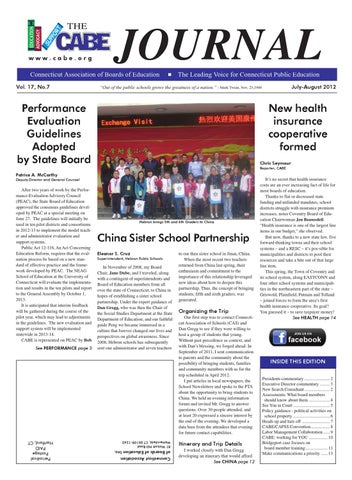
Hebron brings 5th and 6th Graders to China.
81 Wolcott Hill Road Wethersfield, CT 06109-1242
After two years of work by the Performance Evaluation Advisory Council (PEAC), the State Board of Education approved the consensus guidelines developed by PEAC at a special meeting on June 27. The guidelines will initially be used in ten pilot districts and consortiums in 2012-13 to implement the model teacher and administrator evaluation and support systems. Public Act 12-116, An Act Concerning Education Reform, requires that the evaluation process be based on a new standard of effective practice and the framework developed by PEAC. The NEAG School of Education at the University of Connecticut will evaluate the implementation and results in the ten pilots and report to the General Assembly by October 1, 2013. It is anticipated that interim feedback will be gathered during the course of the pilot year, which may lead to adjustments in the guidelines. The new evaluation and support system will be implemented statewide in 2013-14. CABE is represented on PEAC by Bob
to our then sister school in Jinan, China. When the most recent two teachers returned from China last spring, their enthusiasm and commitment to the importance of this relationship leveraged new ideas about how to deepen this partnership. Thus, the concept of bringing students, fifth and sixth graders, was generated.
Organizing the Trip Our first step was to contact Connecticut Association of Schools (CAS) and Dan Gregg to see if they were willing to host a group of students that young. Without past precedence as context, and with Dan’s blessing, we forged ahead. In September of 2011, I sent communication to parents and the community about the possibility of bringing students, families and community members with us for the trip scheduled in April 2012. I put articles in local newspapers, the School Newsletters and spoke to the PTA about the opportunity to bring students to China. We held an evening information forum and invited Mr. Gregg to answer questions. Over 30 people attended, and at least 20 expressed a sincere interest by the end of the evening. We developed a data base from the attendees that evening for future contact capabilities.
Itinerary and Trip Details I worked closely with Dan Gregg developing an itinerary that would afford See CHINA page 12
It’s no secret that health insurance costs are an ever increasing fact of life for most boards of education. Thanks to flat or decreased state funding and unfunded mandates, school districts struggle with insurance premium increases, notes Coventry Board of Education Chairwoman Jen Beausoleil. “Health insurance is one of the largest line items in our budget,� she observed. But now, thanks to a new state law, five forward-thinking towns and their school systems – and a RESC – it’s pos-sible for municipalities and districts to pool their resources and take a bite out of that large line item. This spring, the Town of Coventry and its school system, along EASTCONN and four other school systems and municipalities in the northeastern part of the state – Griswold, Plainfield, Putnam and Tolland – joined forces to form the area’s first health insurance cooperative. Its goal? You guessed it – to save taxpayer money! See HEALTH page 14
INSIDE THIS EDITION Presidents commentary ....................... 2 Executive Director commentary ......... 3 New Search Consultant ....................... 2 Assessments: What board members should know about them ................... 4 See You in Court ................................. 5 Policy guidance - political activities on school property ................................. 6 Heads up and hats off ......................... 7 CABE/CAPSS Convention ................. 8 Labor Management Collaboration ...... 9 CABE: working for YOU ................. 10 Bridgeport case focuses on board member training .................... 11 Make communications a priority ...... 13
Periodical Postage PAID Hartford, CT
2
The Journal – Connecticut Association of Boards of Education/July-August 2012 PRESIDENT COMMENTARY
How I spent my day in summer school While soaking up the summer rays at the shore recently, I attempted to catch up on various education articles stuffed into my beach bag. With sand and sunscreen sticking to pages, reading becomes more challenging, not unlike the headlines written. Whether in Egypt where an education revolution is contemplated; or China where university entrance testing is debated; or Broward County, Florida where the conversation is charter schools or even in Connecticut where turnaround schools are being implemented, children still need free, unscheduled time to master skills in their own learning environment. For some children, the benefits of tree climbing or firefly chasing are imagined only in the books they are read to in summer school. As I walked into a classroom one recent morning, ten heads automatically turned in my direction. They, curious to my presence and I, just as curious to learn about them. Before the teacher could introduce me, one fidgety second grader asked why am I here? As I took my place in the circle on the floor, I said, “Your teacher is my friend and asked if I would like to meet her students in summer school.” So here I am. When I asked several students why they are here, answers ranged from, “excited to be here,” “because it’s fun,” “I can learn to read better to go to third grade,” “to get smart,” “to go to college,” “be a good kid,” “because I HAVE to listen,” and… “because it’s all summer.” They delighted in describing favorite things of their last school year: exercising in gym, special centers, counting money, field trips and books that weren’t scary. Books about plants, flowers, dinosaurs and tornadoes. I asked them what they liked about their classroom and school they were quick to respond, “beautiful, nice decorations, clean, and I feel safe here every day.” When asked about what makes their teacher special, the dazed looks turned to smiles, “she teaches us fun stuff, super kind, listens, makes me laugh, and helps me calm down when I’m afraid.” All the while, I noticed several yawns from a cross legged student before me. As he propped his head with
his hand, I asked if he was sleepy and he said no, “just very hungry.” Our conversations ranged from wanting to take tambourine or guitar lessons to learning a dance step or two. Future career aspirations ranged from policeman to baker or doctor, with being a teacher, “to help children read.” Hearing a child chuckling to herself in a near corner, I walked Lydia Tedone over and asked what was so funny with the open book in her lap. She was “pretending” to read as she imagined she was one of her favorite characters. She proudly displayed the “Governor’s Challenge Form” nearby, where books read to children are charted by points with prizes received upon completion. The challenges of summer school – When the cupboards are bare. Where a student makes a copy of a house key to let himself in. Where the primary language is not English. Where “playtime” isn’t an option outside. Where the swimming pool in the park is bus rides away. Where feeling scary and lonely means a blanket is within reach. Where lunch in the café is the only meal. Where there is no place to call home. . . Ten second graders with eleven different backgounds. Students who reminded me, “when I get a bad grade, I want to work harder, to get the E for effort.” “Then I will be proud.” Students who delight in occasionally assisting their “favorite” custodian, because they are proud of their school. As we prepared to go to the cafe for lunch, two girls giggling in line asked me if I had fun that day, and if I was ever coming back. Of course, I said. . . because, “I have all summer.”
CABE welcomes Dr. Paul Gagliarducci to CABE Search Services Dr. Paul Gagliarducci, retired superintendent, is joining Jacqueline Jacoby, Randall Collins and Robert King, as a consultant for CABE Search Services. Paul was superintendent of schools in Somers from 1987-2001. He retired from Somers and held positions ranging from adjunct Paul Gagliarducci faculty member to senior consultant from 2001-2009. Paul is currently owner and principal consultant for Ridgetop Associates, a management consulting firm; a consultant team member of MARS Consultant Group – MA Regional School Consultant firm; and is serving as superintendent of schools in Bozrah on a part-time basis (100 days a year). CABE Search Services provides high-level search for superintendents, assistant superintendents, principals and other critical positions for boards of education. Over 23 searches have been conducted since Jacqueline Jacoby became Senior Consultant in 2009. Among CABE Search Services’ searches done or to be done in 2012 include those in Amity Region #5, Bethany, Derby, East Hartford, Manchester, Oxford, Region #12, Rocky Hill, Scotland, Simsbury, Stamford and Stratford. Executive Director Robert Rader was delighted that Dr. Gagliarducci has decided to join the search “team.” He stated that “it is great to have Paul join CABE Search
Services, which is dedicated to ensuring that boards have the best possible help in selecting their most important employee. His long experience in two states, deep understanding of the relationship of boards and their superintendents and his warm manner will be greatly beneficial in these rapidly changing times.” When the CABE Board of Directors started Search Services its goal was to empower boards to make the best decisions possible on the hiring of their superintendents, help provide another alternative to the few search firms available and to enhance CABE’s reputation for working with integrity in a difficult area. With Paul joining our team, the Service will be strengthened and we will be even better at serving the needs of our members.
People in the News Governor Dannel P. Malloy recently appointed Ronald Goldstein, Chair of the Colchester Board of Education, to the Red Tape Review and Removal Task Force. The group will study how the state can remove cureaucratic barriers to academic excellence. The Governor announced his plan to reduce state education mandates and to unleash innovation by empowering local districts to improve student achievement.
CABE Board of Directors EXECUTIVE COMMITTEE Lydia Tedone ..................................................... President, Simsbury Richard Murray ................................. First Vice President, Killingly Ann Gruenberg ................. VP for Government Relations, Hampton Stephen Wright ........... VP for Professional Development, Trumbull James Marpe ..................................... Secretary/Treasurer, Westport Don Blevins .............................................. Immediate Past President John Prins ............................................................. Member at Large
AREA DIRECTORS Susan Hoffnagle ............................. Area 1 Co-Director, Winchester Mari-Ellen (Mimi) Valyo ............... Area 1 Co-Director, Winchester Daniel Santorso ................................ Area 1 Co-Director, Plymouth Becky Tyrrell .......................................... Area 2 Director, Plainville Laura Bush ................................................. Area 3 Director, Vernon Gavin Forrester ................................. Area 6 Co-Director, Stratford Elaine Whitney .................................. Area 6 Co-Director, Westport Michael D’Agostino ........................... Area 7 Co-Director, Hamden Sheila McCreven .......................... Area 7 Co-Director, Woodbridge John Prins ......................................... Area 7 Co-Director, Branford Robert Ruggiero ................................ Area 8 Co-Director, Madison Pamela Meier ..................................... Area 8 Co-Director, Madison Gail MacDonald ................................... Area 9 Director, Stonington
ASSOCIATES Eileen Baker .............................................. Associate, Old Saybrook Sharon Beloin-Saavedra .............................. Associate, New Britain Gary Brochu .......................................................... Associate, Berlin Robert Guthrie .............................................. Associate, West Haven Cal Heminway ..................................................... Associate, Granby COMMITTEE CHAIRS Robert Mitchell ............................. Chair, State Relations, Montville Beverly Washington ...................... Chair Federal Relations, Groton
CITY REPRESENTATIVES Bob Trefry ....................................... City Representative, Bridgeport Matthew Poland ................................ City Representative, Hartford Michael R. Nast ............................ City Representative, New Haven Polly Rauh ........................................ City Representative, Stamford Charles Stango ............................... City Representative, Waterbury
STAFF Robert Rader ....................................................................... Executive Director Patrice McCarthy .................................. Deputy Director and General Counsel Bonnie Carney ............................................ Sr. Staff Associate for Publications Nicholas Caruso ............................................ Sr. Staff Assoc. for Field Service and Coord. of Technology Sheila McKay ............................. Sr. Staff Associate for Government Relations Kelly Moyher ......................................................................... Sr. Staff Attorney Vincent Mustaro ..................................... Sr. Staff Associate for Policy Service Lisa Steimer .............................. Sr. Staff Assoc. for Professional Development Teresa Costa .................................. Coordinator of Finance and Administration Pamela Brooks ......................... Sr. Admin. Assoc. for Policy Ser. /Search Ser. Terry DeMars ............................................... Admin. Assoc. for Policy Service Melissa Dickinson ............................. Admin. Assist. for Membership Services Gail Heath ........................................ Admin. Assoc. for Government Relations Wilmarie Newton ........................................ Admin. Assoc. for Labor Relations Corliss Ucci .................................. Receptionist/Asst. to the Executive Director
The CABE Journal (ISSN 1092-1818) is published monthly except a combined issue for July/August as a member service of the Connecticut Association of Boards of Education, 81 Wolcott Hill Road, Wethersfield, CT 06109, (860) 571-7446. CABE membership dues include $30 per person for each individual who receives The CABE Journal. The subscription rate for nonmembers is $75. Association membership dues include a subscription for each board member, superintendent, assistant superintendent and business manager. The companies and advertisements found in The CABE Journal are not necessarily endorsed by CABE. “Periodicals Postage Paid at Hartford, CT.” POSTMASTER: Send address changes to The CABE Journal, CABE, 81 Wolcott Hill Road, Wethersfield, CT 06109-1242. Email: bcarney@cabe.org. Members can find the CABE Journal online at: www.cabe.org/ userlogin.cfm?pp=84&user request=true&keyrequest=false&userpage=84
3
The Journal – Connecticut Association of Boards of Education/July-August 2012
CABE Affiliate Members
EXECUTIVE DIRECTOR COMMENTARY
Change is coming – Are you ready?
BUSINESS AFFILIATES DIAMOND MEMBER Finalsite GOLD MEMBERS
Berchem, Moses & Devlin Connecticut Business Systems Shipman & Goodwin Siegel, O'Connor, O’Donnell & Beck, P.C Sullivan, Schoen, Campane & Connon SILVER MEMBERS Anthem Blue Cross and Blue Shield Corporate Cost Control Lindberg & Ripple Inc. Ovations Benefits Group Quisenberry Arcari Architects The Segal Company Trane BRONZE PLUS MEMBERS BL Companies Brown and Brown Fletcher Thompson Architects Friar Associates Goldstein & Peck, P.C. Kaestle Boos Associates, Inc. O & G Industries BRONZE PLUS MEMBERS The S/L/A/M Collaborative Suisman, Shapiro, Wool, Brennan, Gray & Greenberg Whitsons School Nutrition BRONZE MEMBERS Nathaniel G. Brown, LLC Chinni & Meuser LLC Dattco Inc. Fuller & D’Angelo Architects and Planners JCJ Architecture Kainen, Escalera & McHale, P.C. The Lexington Group Muschell & Simoncelli
EDUCATIONAL AFFILIATES American School for the Deaf Area Cooperative Educational Services Capitol Region Education Council The College Board Connecticut Association of School Business Officials Cooperative Educational Services Connecticut Center for School Change Connecticut Educators Computer Association Connecticut School Buildings and Grounds Association EASTCONN EDUCATION CONNECTION LEARN
The education world is quickly becoming a different place. Not only in Connecticut, but across the nation. Change is coming – in fact, it’s already here. If you read Education Week or newspapers, look at blogs or follow various people on Twitter (I read, not tweet) like Diane Ravitch or the National School Boards Association, you soon realize that this is a pivotal time for public education. Across the nation, we see “reformers”, though perhaps a better label would be “catalysts for change”, pushing for a heavier emphasis on accountability for all stakeholders and more focus on financial aspects of public education. And, they are focused on the achievement gap. They also would like to see more charter schools and, in our State, money following the child. However you feel about these issues, the push for change is on…BIG TIME. In Connecticut, we are watching closely as the State Department of Education wrestles with the appropriate tools for turning around districts. Bridgeport, Windham and New London are the first three strong interventions in school districts since Hartford was taken over by the State in the late 1990s. All three are receiving different approaches from the State. We have a Governor and Commissioner who support charter schools and certainly see themselves as reformers. At the same time, they are supportive of traditional public schools and are trying to free the most successful ones from the burden of over-regulation. The requirements set out in law and in our NCLB waiver mandate changes in the way we evaluate teachers and principals. The many, long, intense and often divisive meetings of the Performance Evaluation Advisory Council and its subgroups, testify to the difficulty of making change. We are happy that the final document, now passed by the State Board of Education, will provide every district with the opportunity to better assess the performance of principals and teachers; provide support based on best practices; and enable school districts to take appropriate action when a principal or teacher does not reach the standards that are expected of a professional. As we reminded our partners on PEAC, superintendents and principals are key in making this work. The Board’s role is limited – as it has been for years – to hearing appeals of certain decisions. But, Boards have to provide the resources and support the implementation to have this done right. Patrice McCarthy (Deputy Director and General Counsel) and I serve as your representatives at PEAC (which will monitor the results) and, besides us,
James Marpe (Vice Chair, Westport, CABE Secretary/Treasurer), Elaine Whitney (Westport, CABE Area 6 Director), Ann Gruenberg (Hampton, CABE Vice President for Government Relations), Richard Murray, (Killingly, CABE First Vice President) and Sheila McKay (Sr. Staff Associate for Government Relations) served on the PEAC subgroups.
More Resources Are Needed! The “three-pronged” reforms of instituting the PEAC guidelines, Common Core Standards and secondary school reform will cost all districts in resources,
“CABE is changing even as public education is changing. As the summer ends, we are gearing up for the new era. My question to boards and superintendents: are you?” including staff time (especially of principals) and funding. A lot will change. New Alliance Districts, which can apply to receive additional funding from the State in return for making certain changes in how the schools are run, will find the relatively small amount of new funding they will receive is very welcome. But, the cost for implementing the changes can be higher than what the State is providing. We have heard that at least one town council is urging the district not to apply, concerned that the funding could dry up in the future and the town will be stuck with the continuing bill. The What Will Our Children Lose Coalition is looking at financial issues facing school districts. The group, made up of CABE, CAPSS and CASBO, has focused on its raisin d’être of ensuring that the State funds ECS. Last year, the issue was preventing school districts from going over the cliff with the falloff in federal funding. This year and into the Legislative Session, we will be calling for more funding for districts so that you have the resources you’ll need to implement required changes.
CABE’s Role CABE believes that many of the reforms are positive. We must ensure that evaluations are done in a professional manner and that student achievement (which, after all, is the reason we have
Robert Rader
school districts) be an integral part of the evaluation system. We believe that local boards must be able to govern their districts in an effective way and that State intervention should be subject to certain conditions: brevity, a timely and tailored definition of the conditions under which the State will intervene and withdraw, consent of the State Board of Education and opportunity for the Board to receive professional development. Just as our districts are changing, CABE is, too. We are working with the 30 Alliance Districts to better understand their needs and how we can help them, as well as our other members. We are examining our vision in a committee chaired by Past NSBA and CABE President Mary Broderick. Another committee, chaired by Area 7 Director Sheila McCreven (Woodbridge) is examining how we can better communicate with all of our members. We are going to ask all members to fill our a short survey to ensure we are taking your needs and desires in how we communicate with you into account. Please take it seriously when you receive it. So, expect changes to our publications, professional development and many of our other programs, activities and services as we try to stay ahead of the curve. CABE is changing even as public education is changing. As the summer ends, we are gearing up for the new era. My question to boards and superintendents: are you?
Performance Evaluation Guidelines Adopted by State Board (continued from page 1) Rader and Patrice McCarthy. PEAC also included representatives from the Connecticut Association of Public School Superintendents, the Connecticut Association of Schools, Connecticut Federation of School Administrators, the Regional Educational Service Centers, Connecticut Education Association and the American Federation of Teachers – Connecticut. Work still remains to develop the state models which will be utilized by districts that do not develop their own evaluation and support systems. Several subgroups continue work on these models, which also include CABE representation. (See editorial above.)
4
The Journal – Connecticut Association of Boards of Education/July-August 2012
Assessments: The basics and what board members should know about them How do we measure the progress of our students? How do we get information that can be used by teachers and principals to alter their teaching and ensure that all children are learning? Do we just look at their results on standardized tests and consider that sufficient feedback to begin to raise student achievement? Board members should be aware that there are different types of tests to measure performance of students. They need not be experts in the types of assessments; that expertise is available from their superintendents and their instructional staff. However, board members should be aware of the different kinds of assessments being administered throughout the year, and the purposes for which they are used. These different types of assessments may very well be part of the evaluations of your principals pursuant to the Performance Evaluation and Assessment Council (PEAC) guidelines. This article attempts to give a bird’s eye view of these different types of assessment.
Formative Assessment Tools and Practices Assessments take many different forms. According to an article entitled The Concept of Formative Assessment, “formative assessment” is defined “broadly to include all activities that teachers and students undertake to get information that can be used diagnostically to alter teaching and learning. Under this definition, formative assessment encompasses teacher observation, classroom discussion, and analysis of student work, including homework and tests.” In other words, formative assessment is a process, not a thing.
Interim Assessments A well designed interim assessment system allows for the use of flexible assessments that assess content at a finer grain level than a summative assessment. Interim assessments should provide actionable data on student skills and understanding to support teaching and learning.
Mary Broderick honored The East Lyme Public Schools recently honored Mary Broderick, past president of both CABE and NSBA, by naming the “Mary Broderick Auditorium” at East Lyme High School. Members of the CABE Board of Directors and staff had the honor of attending the ceremony. The auditorium has special meaning to Mary, as she is a passionate supporter of the arts, and her children Katie and Michael both performed in the auditorium when they were students. The arts were very much a part of the celebration, with the student art exhibition on display in the Commons, and music provided by the high school string quartet and acappella group. Superintendent Dr. James Lombardo, former superintendent Dr. Jack Reynolds, East Lyme Board Secretary Dr. Richard Steel, Selectman Kevin Seery and NSBA Executive Director Dr. Anne Bryant were among those paying tribute to Mary. The program noted “Mary’s love and passion for all children has been motiva-
tion for all she has accomplished in education. She continually advocates for finding new ways for enhancing the qualities and fullness of education for each and every child.” Anne Bryant wrote “Thank you for your years of service on the NSBA Board of Directors, CABE’s Board and your 24 years of service to the East Lyme Schools. In each and every role you have demonstrated thoughtful, deliberate, wise and articulate leadership. You listened to all sides; and you let every voice be heard”. Mary will continue her leadership role as Chairman of CABE’s vision committee. Patrice A. McCarthy Deputy Director and General Counsel
Summative Assessments Summative assessments are designed to measure students’ performance at specific points in time. They “generally take place after a period of instruction and requires making a judgment about the learning that has occurred (e.g., by grading or scoring a test or paper)”.
Which Is More Effective? The answer to this question is not as easy as it appears. The answer will depend on the purpose of the assessment. For example, the article quoted above mentions a study where authors concluded that “efforts to strengthen formative assessment produce significant learn-ing gains as measured by comparing the average improvements in the test scores of the students involved… with the range of scores found for typical groups of students on the same tests… formative assessment apparently help[ed] low achieving students, including students with learning disabilities, even more than it helped other students.” Obviously, the feedback as part of formative assessment, is the key to successfully instituting change that will lead to better results. It helps teachers learn more about their students and “become aware of any gaps that exist between their desired goal and their current knowledge, understanding, or skill and guides them through actions necessary to obtain the goal.” Other studies have shown that the most helpful type of formative assessment provide “specific comments about errors and specific suggestions for improvement and encourages students to focus their attention thoughtfully on the task rather than on simply getting the right answer.” The PEAC guidelines focus mostly on the use of summative assessments. Fortyfive percent of a teacher’s evaluation is to be based on academic growth and development to measure those goals and ob-
jectives. For a teacher in a grade in which there are either CMTs or CAPT must base at least 22.5 percent of the evaluation on these standardized exams.
“Value- Added” Assessment Value-added assessment is aimed at providing information not only about how a child does on an individual test, but examines how a student performs over time. “Value-added” is a statistical approach to using assessment data rather than an assessment per se. The value-added assessment model of accountability was developed in the early 1980s at the University of Tennessee by statistician William Sanders. He found that raw test scores provided a “snapshot” of student achievement but gave no information about the rates at which various individual students were making progress over time. He created a method of measuring the rate of improvement of students, as well as schools and districts. Regardless of where on the achievement scale a child begins, this model measures the value added to his or her performance by the educational system each year. Included with the standardized tests in the PEAC guidelines is the use of Indicators of Academic Growth and Development (IAGD), which are used to follow up on goals and objectives set in the teacher’s goal-setting conference. Information on types of assessments, particularly The Concept of Formative Assessment, is available from the Education Resources Information Center (ERIC), sponsored by the Institute of Education Sciences (IES) of the U.S. Department of Education, www.eric.ed.gov. This article was written with the help of the Connecticut State Department of Education’s Student Assessment Bureau, specifically, Joe DiGarbo, Gail Pagano and Renee Savoie. Robert Rader Executive Director, CABE
Norwich Board of Education working on Lighthouse
The Journal – Connecticut Association of Boards of Education/July-August 2012
5
See You in Court – The Nutmeg Board of Education
The Nutmeg Board deals with copyright infringement Thomas B. Mooney, Esq. Shipman & Goodwin
The Nutmeg Board of Education makes many mistakes. The latest imbroglio created by the board will be reported here each issue, followed by an explanation of what the board should have done. Though not intended as legal advice, these situations may help board members avoid common problems. Bob Bombast was concerned. If the members of the public don’t know about the good work of the Nutmeg Public Schools, he pondered, they won’t be as willing to spend the money Nutmeg needs. So Bob came to the next meeting of the Nutmeg Board of Education ready with a public relations plan to woo the public. “Mr. Chairman,” Bob intoned at his first opportunity. “I have a matter of utmost urgency, and I move that we suspend the rules to address it. While it is not on our agenda this evening, the Board must to engage the public in the wonderful work of our students and staff. Our current efforts are woefully inadequate.” “Wait a minute,” interjected Board member Penny Pincher. “I thought we were limited to agenda items. If it is open
season, I have some additional cuts to propose.” Mr. Chairman banged his gavel. “It is not open season, Penny, but sometimes we have to be a little flexible. Bob and I have talked this over, and it is important to address this issue now. Bob, please proceed.” “Thank you, Mr. Chairperson, for your sage leadership,” Bob unctuously responded. “I have a couple ideas to improve public relations in Nutmeg. First, we must do something about the God-awful website. The term ‘webmaster’ is certainly a misnomer when we are talking about our website. That guy couldn’t sell water to a camel. I propose that we fire him posthaste and hire someone with some pizzazz.” “Wait a minute,” interrupted Mr. Chairperson. “We cannot talk about an employee in open session. Refrain from such comments, but carry on.” “OK, OK,” Bob responded. “Whether we fire the guy or not, we have to make our school websites more interesting. The Internet is a treasure trove of exciting things. Therefore, I propose a contest among our schools to post the most engaging pictures of student learning. The
Seventh Edition Now shipping
A Practical Guide to Connecticut School Law by Thomas B. Mooney, Esq. Shipman & Goodwin The Guide comes with a CD which provides hyperlinks to many cases and statutes and will permit word searches as a supplement to the Index. New to the Seventh Edition: Bullying, background checks, child abuse reporting, discrimination issues, educational reform, FERPA, freedom of information, state aid for education and much, much more You can call CABE at 860-571-7446 or 800-317-0033 and purchase your copy
NOW!
Board will judge the posts in executive has purchased sheet music, it has the right session, and the school that posts the most to use that music, but not to copy it. interesting pictures it finds on the Web Similarly, if a district purchases ten will win.” licenses for a software program, making “What’s the prize?” asked Penny an additional copy is an infringement for Pincher. “We don’t have any money.” which the district is liable. Even movies “Public recognition of a job well done can give rise to a claim. A movie purshould be enough,” Bob responded. chased for home use cannot be shown in Sure enough, there was great enthusischool for entertainment, because the asm for the contest, and some principals license one purchases is for personal use, even enlisted students and their parents in not for the entertainment of others. the hunt for the most engaging picture. Second, school districts can be also After a month with each school posting liable for what is called “vicarious intheir submissions on its website, the fringement.” That can happen when a Board convened in executive session and school district permits another party, e.g., selected a winning the PTA, to post on its photo and a runnerwebsite and that party “Therefore, it is very up. The Board infringes a copyright. then declared the If copyrighted important to make winners in open material is posted session, and they without permission, sure that the school were posted on the there may be liability, district has a license district’s website. even when a third A month later, party commits the or other permission Mr. Superintendent infringement unwas surprised to wittingly. Education to use any material get a lawyer letter and vigilance are thus claiming that the essential on its website . . . .” posting of the As usual, the winning picture activities of the was a copyright violation. The whole Nutmeg Board of Education also raise matter can be resolved promptly, it went Freedom of Information Act issues. on, if the district would pay $2,500 for the Under the FOIA, boards of education can violation and remove the picture immedionly deal with matters on their agenda ately. For another $1,000, however, the (including items that they may add at a district could “license” the picture and regular meeting by a two-thirds vote). keep it on the website. This is ridiculous, Bob’s sense of urgency did not justify Mr. Superintendent thought to himself as dealing with the issue of public relations he threw the letter away. There was no even though it was not on the agenda. copyright notice, and so the picture is in Significantly, action is not required. Any the public domain. substantive discussion by the Board of a Does Nutmeg have a problem? matter not on the agenda is a violation. By contrast, when Bob talked about In a word, yes. In this technological firing the webmaster in open session, he age, school districts must be very careful did not violate the FOIA. The Act perabout the intellectual property rights of mits discussion of employment and disothers. Here, Nutmeg may well be liable. missal of an employee in executive sesThe Copyright Act allows a copyright sion, provided that the employee has owner to register her copyright in a work, advance notice and the opportunity to but one does not need to have a copyright require that the discussion be held on registration to have protection; a registraopen session. tion documents the intellectual property, However, it does not prohibit open but the protection exists regardless of session discussion of an employee’s registration and even without the © performance. Keeping such matters consymbol. Mr. Superintendent was just fidential is a matter of good practice, not wrong to presume that a picture posted on legal obligation. the Internet somehow loses its copyright Finally, the ill-conceived contest also involved an FOIA violation. Boards of protection. education can convene in executive sesAccordingly, while it may feel like sion only for purposes specified in the highway robbery, the copyright holder law, i.e., discussion of personnel, claims can indeed claim copyright infringement and litigation, purchase of real estate, and demand compensation. Therefore, it deployment of security personnel and is very important to make sure that the devices, and discussion of information school district has a license or other percontained in confidential documents (e.g., mission to use any material on its website student records). or otherwise. Indeed, one school district Selecting a winner in such a contest is had to repaint its gymnasium floor when not such a topic, and though perhaps it the logo in the center of the floor it had would have been awkward, the Board copied off the Internet turned out to be a should have held that discussion in open specially-designed letter that was copysession. righted. Attorney Thomas B. Mooney is a partDistricts must be vigilant in two relatner in the Hartford law firm of Shipman & ed respects. First, the right to use intelGoodwin who works frequently with lectual property is often limited to a boards of education. Mooney is a regular particular use. For example, if the district contributor to the CABE Journal.
6
The Journal – Connecticut Association of Boards of Education/July-August 2012
The Policy Corner
Vincent A. Mustaro, Senior Staff Associate for Policy Service, CABE
Policy guidance needed for political activities on school board property must balance the employee’s right to free speech against the interests of the school district. In addition, time, place and manner restrictions may apply. Boards must recognize that professional employees enjoy private lives and may associate with others outside of school for political, economic, religious, cultural or personal reasons. The board’s supervisory staff, however, has the responsibility to evaluate employees in terms of their effectiveness in discharging assigned duties and responsibilities. When non-school activities impact upon a staff member’s effectiveness and job performance as a school district employee, the board reserves the right to evaluate the effect of such non-school activities upon the staff member’s performance of employment responsibilities in the school district. Free speech Generally, school board employees In the often-cited Tinker v. Des Moines have the right to School District case, actively participate the United States “A board of in political activities Supreme Court on behalf of any declared that education’s policy candidate, party or “Neither students nor issue providing such prohibiting the teachers shed their activities are outside constitutional rights distribution of political their assigned hours to freedom of speech of employment. or expression at the Presidential, as well as congressional, local and state elections have become hotly contested political events. Many states are again emerging as battleground states and the public schools in all states will not be immune from the fury of political activity. The fall elections are drawing near. Therefore, it is appropriate to review issues related to the political activities of staff and of political activities on school grounds and how policy can provide necessary direction. Political activity and the distribution of campaign materials and visits by candidates and/or their campaigning supporters at public schools remains a controversial issue. The courts have provided some guidance.
materials must not
school house gate.” However, this does distinguish between not mean that Rights to political parties, teachers and students information enjoy the freedom to Also to be candidates or viewspeak on any topic at considered are the any time. issues of candidates’ points. If it does, the In the Bethel rights to information, School District v. district potentially employee participaFraser ruling, the in political opens the mailboxes to tion U.S. Supreme Court campaigns, distribuindicated that all political expression tion of campaign schools need not literature and visits tolerate “lewd, of candidates or their and faces charges of indecent or offensive campaigning speech.” School discrimination.” supporters to schools districts also can and school classes take appropriate and/or functions. steps to distance itself from certain kinds Any candidate for any office, whether of speech, such as in a school newspaper or not currently in office, has the same or school website, when such speech may right to public and existing information as be inconsistent with the school’s basic does any other citizen. This includes the educational mission. right to meet with an administrator for a Therefore, within these principles, a reasonable period and to be given a tour result of Supreme Court rulings, boards of of the school facilities, if requested. education may set reasonable time, place District employees should not particiand manner restrictions on student pate in nor may district facilities be used speech, even if the speech is “protected.” in political campaigns during school or This could result in the school’s interests work hours. Neither candidates nor their in preserving the classroom for educasupporters, including school district tional purposes to outweigh the student’s employees, should be allowed to caminterests in engaging in political speech. paign on school grounds during school The courts have taken a similar hours. position with district employees, espeAnyone wanting to use district facilicially teachers. When the speech pertains ties for political activities outside school to a matter of public concern, the courts
hours should apply for such use in conformity with the district’s “Community Use of School Facilities” policy. It is advised that if a class or schoolsponsored group plans a political debate during the school day, the principal/ teacher/sponsor should ensure that all candidates for the same public office or who have differing opinions on a political issue are given equal opportunity to participate. Political candidates or their supporters should not be allowed to appear at a school unless they are invited to visit or speak to a class or other school-related activity during school hours. The requirements for debates or forums should apply and other candidates for the public office should be invited to visit at the same time or be provided an equivalent opportunity. Distribution of campaign literature and political statements by candidates or their supporters may occur in class and at a school event only as part of an instructional discussion of controversial issues. Teachers can use political materials as part of the instructional program, provided the material is germane to the instructional objectives of the class/ course. Any presentation of political materials, or issues, or expression of view, however, must be balanced, fair and subject to policy parameters.
Distribution of material Another issue to be considered is the distribution of political or campaign literature. The U.S. Supreme Court in Perry Educational Association v. Perry Local Educators’ Association established that teacher mail boxes in a school system’s interschool mail system are “nonpublic” forums, meaning they are not open to general debate or the free exchange of ideas.
A district may impose reasonable viewpoint-neutral restrictions on teacher mailboxes in order to exclude speakers or literature that would disrupt the system or hinder its effectiveness. Restrictions on access to teacher mailboxes may be considered reasonable when it is clear that the mailboxes are used exclusively for school-related purposes. The courts will look at the availability of other channels of communication. In addition, the courts have acknowledged the school district’s need to avoid any appearance of political favoritism. A regular newsletter of an employee organization that is normally distributed via the teacher mailboxes is not considered political material if it simply contains news of a political nature taken by the organization. However, a publication from, or newsletter primarily containing news or discussion about, any political action committee is considered political material and may not be distributed through the staff mailbox system. A board of education’s policy prohibiting the distribution of political materials must not distinguish between political parties, candidates or viewpoints. If it does, the district potentially opens the mailboxes to all political expression and faces charges of discrimination. A number of policy areas are impacted by this topic. Policy #1311.2, “Political Activities in the Schools” is available upon request. Other policies which are applicable to this issue include: (1) #1140, “Distribution of Materials by Students,” (2) #1311.1, “Political Activities of School Employees,” (3) #1330/ 3515, “Community Use of School Facilities,” (4) #3543.13, “ Mail and Delivery,” (5) #4118.21, “ Academic Freedom,” (6) #6144, “Controversial Issues,” and (7) #6153.2, “Student Participation in Election Process.”
Talented Student Subcommittee
2012 CABE/CAPSS Convention Committee subcommittee, Superintendents Dave Erwin (Berlin), Irene Cornish (Stratford) and Board Members Beverly Washington (Groton), Doug Smith (Plainfield) served on the Talented Students Selection Committee which met in June. The Committee selected the Mystic Middle School Jazz Band to perform on Friday morning and the Waterbury Arts Magnet School High School Chorus to perform on Saturday morning.
7
The Journal – Connecticut Association of Boards of Education/July-August 2012
Heads up and hats off! Emerging changes in Protective Service in Connecticut: Implications for education Ann Gruenberg Member, Hampton Board of Education Vice President for Government Relations, CABE
With the busy legislative session over and change an ever-present reality, those of us involved with education may anticipate a little “down time” during the summer. In fact, in addition to multiple educational initiatives, there is another wave of momentum from the systems focusing on child protective services. Specifically, the Department of Children and Families, under the leadership of Commissioner Joette Katz and Deputy Commissioner Janice Gruendel is fully in gear for some major paradigm shifts and new initiatives which promise to have far-reaching impact across systems, including education. The seeds of some of these initiatives were planted last autumn, when a representative team from Connecticut participated in a New England Early Development, Science and Child Welfare Summit in New Hampshire. This was described in a previous article (Gruenberg, December 2011). The Summit was fully sponsored by the Casey Family Services.
It was based on a cross-sector, collaborative model of addressing concerns and possibilities regarding child protective services, based on accurate and current research about child development, toxic stress and the importance of healthy relationships in the lives of children. The intent was that each statewide team would be fully representative of various agencies, such as public health, social services, education, etc. Experts in the field presented relevant research, with implications for practice. Those involved from each state were charged with following up locally, based on the six state summit. Connecticut team members reconvened, and began planning a follow-up event. The event occurred on June 18, 2012, in the Legislative Office Building. Both Governor Dannel Malloy and Lieutenant Governor Nancy Wyman addressed the group; with morning and afternoon sessions, the content was shared with over four hundred participants from across many agencies, who appreciated the urgency and scope of the work being done. The initiative has been termed the
Collective Bargaining Workshop
Kelly Moyher, Sr. Staff Attorney, welcomed everyone to the workshop.
Attorney Fred Dorsey, Siegel, O’Connor, O’Donnell & Beck, talked about such trends as dealing with the economy, language issues and employee contributions.
Attorney Kenneth Weinstock, Kainen, Escalera & McHale, talked about board and teacher strategy at the negotiations table, step schedules and health insurance.
Patrice A. McCarthy, Deputy Director and General Counsel, shared with participants an update on what’s happening at the PEAC meetings.
“First 1000 Days”, to highlight the significance of early development and the need for a shared commitment. The keynote speaker in both sessions was Matthew Melmed, Executive Director of Zero-toThree based in Washington, DC, who was also a major speaker at the New England Summit. He shared crucial information about the importance of early experience and relationships as they relate to ongoing brain development in young children. The risk of toxic stress is well-documented, as well as the potential positive impact of healthy protective factors. The evidence supporting the science of early childhood is compelling. Both the morning and afternoon sessions also included panel discussions with Commissioners from a range of agencies, including public health, the judicial system, the Department of Developmental Services, the Department of Social Services, and Education. Some of the key themes emerging from last fall’s Summit and the event in June included the following: • The urgency of working with young children and their families to enhance their optimal development, especially when there are mental health and/or substance abuse issues; systematic improvement of prevention. • The importance of prevention, using data to increase accountability and inform practice. This includes a differential response system, through which DCF can prioritize situations based on imminent severity and risk. • The consistent focus on healthy relationships, helping parents understand the significance of their engagement with their children. • The significance of emerging knowledge regarding neuroscience and the crucial role of experience on early brain development; the potential compounded effects of Adverse Childhood Experiences and toxic stress, compared with protective factors and support. • Cross sector participation, including education; agencies and communities all doing what is possible to provide supports. • The need for restructuring systems, including hospital protocol. • Wide dissemination of information
about recommended practices; moving “From fact to act”.
A Painful Case in Point Since the event in June, the Department of Children and Families has continued to be in the news. A recent example includes the continued investigation of a heartbreaking tragedy, with a three year old having been beaten to death by her mother’s boyfriend. Information about how the school in which this child was enrolled followed protocol has been discussed. The fact that school personnel made a report on suspected abuse has appeared on the front page of newspapers as well as T.V. news coverage. Increasing scrutiny across systems means it is imperative that schools and Boards of Education be fully up-to-date with changes and requirements. In light of the tragic death of Athena, Commissioner Katz is proposing significantly revised protocol for hospitals addressing medical concerns when there is reason to suspect child maltreatment. This changing protocol includes an increased focus on consideration of the well-being of the whole child and increased coordination of information from one medical visit to the next. There is ample evidence that the current representative team of leaders focusing on child protective services is thoroughly committed to reforming systems in any and every way necessary to reduce the occurrence of child maltreatment in Connecticut, and increase options for foster care. Such a crosssector initiative is much needed. The Governor and the Lieutenant Governor have recently visited the Department of Children and Families, further demonstrating their dedication to this important initiative, and offering support to all who work in this agency. As tragic as some circumstances are, there is some hope in an initiative that systematically coordinates all resources to more effectively provide for the needs of young children and their families, without avoiding the degree of seriousness of these issues. There is clearly a commitment to much-needed reform in the systems, within and between agencies.
Participants listening intently as Patrice A. McCarthy talks about the new Education Reform legislation.
8
The Journal – Connecticut Association of Boards of Education/July-August 2012
C A B E
/
C A P S S
C O N V E N T I
0 N
Boards and Superintendents: The Challenges and Opportunities Involved in Reforming and Transforming Education Workshop Lineup
Convention Lodging
While most of us are thinking of summer vacation plans, the CABE/ CAPSS Convention Committee has their sights set on November 16 and 17. The 2012 CABE/CAPSS Convention promises to be another quality professional development experience for board members and superintendents. There will be workshop offerings appropriate for everyone from newly elected board of education members to experienced board members and superintendents. Issues to be discussed at the 2012 Convention include, but are not limited to: Negotiations, CT FOIA, Roles and Responsibilities, Effective Parent Engagement, The Role of Arts Education, Secondary School Reform, The School Board and the School Governance Council and the Annual Meeting of the Nutmeg Board.
Those attending the annual CABE/ CAPSS Convention have been guaranteed a room rate of $149 at the Mystic Marriott Hotel. When making your reservation, be sure to mention that you are with the CABE/CAPSS Convention in order to take advantage of this special room rate. This rate of $149 is guaranteed only until 4:00 p.m. on Wednesday, October 17, 2012. After this date, reservations for Convention participants will be based on availability and are offered at the prevailing rate. You may make reservations directly with the Mystic Marriott’s reservation department by calling 866-449-7390. You may also make reservations online at www.cabe.org/page.cfm?p=408. The online code is already entered in the appropriate field. Purchase orders are NOT accepted.
Register now! Members of CABE and CAPSS - Be sure to register early for the CABE/ CAPSS Convention to secure your spot at this annual event and to save your district money. Registration fees increase on September 1. You may register online at www.cabe.org or complete and return the registration form that was mailed to you at the end of June.
For More Information Go to the CABE website http:// www.cabe.org/page.cfm?p=408. Be sure to watch your email and read the CABE Journal for more CABE/ CAPSS Convention news! Lisa Steimer Senior Staff Associate for Professional Development
CABE-Meeting CABE-Meeting is a user-friendly, web-based service specifically designed to assist the board, superintendent and central office staff in preparing for and running board of education meetings. An exciting feature designed for use by committees, in addtion to boards of education, was recently added to CABE-Meeting. Now all your board work and committee information is conveniently located in one place!
Learn more: Is CABE-Meeting for you? • Do you want to save your district money? • Do you want to utilize technology to enable staff to be more efficient? • Do you want to focus more of your human and financial resources on increasing student achievement in your district? • Do you want to enhance communication with your community? • Do you want to model the methods that should be used to infuse technology in your schools? If you answered “yes” to at least one of the above questions, read on. CABE-Meeting can help you!
Take a few minutes and go to http://www.cabe.org/page.cfm?p=158 to complete our CABE-Meeting cost analysis worksheet (located at the bottom of the page) and see how much your district can save in one year. Districts can save thousands of dollars each year by using CABE-Meeting. For more information or to schedule a demonstration for your board, call Lisa Steimer at 800-317-0033 or 860-571-7446 or email lsteimer@cabe.org. CABE-Meeting Lisa Steimer Connecticut Association of Boards of Education 81 Wolcott Hill Road Wethersfield, CT 06109 www.cabe.org
The Journal – Connecticut Association of Boards of Education/July-August 2012
9
Labor Management Collaboration at the National Level In the midst of sometimes contentious labor management discussions in Connecticut about various aspects of education reform, I had the opportunity to attend the U.S. Department of Education’s second Labor- Management Conference-Collaborating to Transform the Teaching Profession. The Conference, convened by U.S. Secretary of Education Arne Duncan, included leaders of all the national education organizations – the National School Boards Association, Council of the Great City Schools, Federal Mediation and Conciliation Service, American Association of School Administrators, National Education Association, American Federation of Teachers and Council of Chief State School Officers – as well as labor –management teams from individual school districts. The national organizations have committed to sustained collaboration to improve student learning and educational equity. They identified and agreed to the following elements of a transformed profession:
A Culture of Shared Responsibility and Leadership: In a transformed profession, educators take collective ownership for student learning; structures of shared decisionmaking and open-door practice provide educators with the collaborative autonomy to do what is best for each student; and the profession takes upon itself the responsibility for ensuring that high standards of practice are met. In this professional culture, teachers and principals together make the primary decisions about educator selection, assignment, evaluation, dismissal, and career advancement - with student learning at the center of all such decisions.
Top Talent, Prepared for Success: Students with effective teachers perform at higher levels; they have higher graduation rates, higher college-going rates, higher levels of civic participation, and higher lifetime earnings. Thus, attracting a high-performing and diverse pool of talented individuals to become teachers and principals is a critical priority - whether these are new graduates or career switchers, and whether they enter the profession through traditional or alternative pathways. We must support programs that prepare highly effective educators and offer high quality and substantive curricula and clinical preparation experiences. We should expand the most successful programs, help other programs improve, and close down the lowestperforming programs if they fail to improve after receiving support. Preparation should include significant clinical opportunities that involve highly effective teachers or principals to oversee, mentor, and evaluate aspiring educators (preferably in the school environments in which
the candidates will ultimately work). Further, aspiring educators must meet a high bar for entering the profession, demonstrating strong knowledge in the content they teach; have mastered a repertoire of instructional strategies and know when to use each appropriately; have the dispositions and aptitudes to work effectively with students and with colleagues; and are learners themselves who know how to plan purposefully, analyze student learning outcomes, reflect on their own practice, and adjust as needed.
Continuous Growth and Professional Development: Effective teachers and principals are career-long learners. Effective schools and districts are learning communities where teachers and principals individually and collaboratively continuously reflect on and improve their practice. Such communities of practice thrive when there is structured time for collaborative work informed by a rich array of data and access to internal and external expertise. We must take seriously the need to evaluate the efficacy of professional development so that we can more methodically improve it, channeling our investments into activities and supports that make a difference. From induction for novice teachers designed to accelerate their growth and development, to replicating the practices of the most accomplished teachers, professional development is a critical lever of improvement. As a profession, we must develop greater competency in using it.
Effective Teachers and Principals: Effective educators have high standards of professional practice and demonstrate their ability to improve student learning. Thus, effectiveness must be evaluated based on measures of student academic growth, evidence from classroom and school practice, and contributions to colleagues and the school community. The results of the evaluations should guide professional support and development and inform personnel decisions such as teacher and principal assignments, the granting of professional status (e.g., tenure), promotion to leadership roles, and dismissal for those who, despite receiving support, are ineffective. Good evaluation systems should provide feedback to educators from both colleagues and supervisors that is meaningful, credible, and actionable, and should use evidence-based processes that are fair, accurate, and transparent.
A Professional Career Continuum with Competitive Compensation: Educators are one of our nation’s most valuable resources. We must create a
profession that attracts great people into our schools and classrooms - and keeps them in the profession. To do this, we need to offer educators career pathways that provide opportunities for increasingly responsible roles, whether they choose to stay in the classroom, become instructional leaders, or move into administration. And these roles must be coupled with compensation that is high enough to attract and retain a highly skilled workforce; reflects the effectiveness, expertise, and contributions of each educator; and is consistent with the societal regard accorded to comparable professions.
Conditions for Successful Teaching and Learning: High-functioning systems can amplify the accomplishments of their educators, but a dysfunctional school or district can undermine the impact of even the best teachers. We need schools and districts whose climates and cultures, use of time, approaches to staffing, use of technology, deployment of support services, and engagement of families and communities are optimized to continuously improve outcomes for the students they serve. Further, we must be prepared to get the best teachers and principals to the highest-need students (including lowincome students, minority students, English learners, and students with disabilities), and to ensure that all students have access to the other resources (such as technology; instructional
materials; and social, health, and nutritional services) necessary to support their academic success.
Engaged Communities: Finally, no community can flourish unless its children are safe, healthy, wellnourished, and well-educated; and no school can be a strong pillar of a thriving community without deep community responsibility for and ownership of the school’s academic success. Thus, recognizing that the fate of communities and their schools are inextricably linked, we must make schools stronger by educators embracing community resources, expertise, and activities; and we must make communities stronger by anchoring them around highly effective schools.
Discussions at the Conference The 600 attendees discussed some of the critical challenges to transforming teaching. Similar to the discussions in Connecticut that led to the changes in the teacher and administrator evaluation and support system, there was emphasis on the need for multiple measures of student achievement, strong and uniform standards for teacher preparation, building capacity for teacher preparation and professional development, and the need for time – for collaboration, coaching and planning. One of the breakout sessions focused specifically on expanding learning time through such mechanisms as flexible (please see LABOR page 10)
10
The Journal – Connecticut Association of Boards of Education/July-August 2012
CABE: working for YOU Individualized Workshops • Professional Development Opportunities Legal Services • Policy Services • Representing You Statewide and Nationally Below are the highlights of activities that the CABE staff has undertaken on your behalf over the last month. We did this:
✦ By ensuring members receive the most up-to-date communications: • Planned and attended CABE Collective Bargaining workshop. • Distributed issue #4 of the Policy Update Service publication which contained the policy implications of recently passed bills. • Prepared Custom Policy Service material for Brooklyn, Park City Prep Charter School, Putnam, and East Windsor. • Met with Teresa Kane, superintendent, East Windsor, to review the policy project. • Entered in a contract to develop a new policy manual for Columbia. • Updated list of required and recommended policy were placed on the CABE website.
✦ By representing Connecticut school boards on the state or national level: • Participated in PEAC Committee and subcommittee meetings. • Worked on legislative issues with “Big 6” Coalition. • Attended U.S. Department of Education Labor-Management Conference. • Attended Connecticut Coalition for Justice in Education Funding annual meeting. • Attended CAPSS’ International Education Committee meeting. • Discussed education reform legislation on WTIC. • Planned and attended joint Connecticut/Massachusetts School Attorneys meeting. • Participated in State Department of Education panel on excused and
unexcused absences. • Attended Achievement Gap Task Force meetings. • Attended State Department of Education Alliance District meeting. • Participated in Financial Literacy Coalition meeting. • Attended NEASC international school accrediation training. • Attended ECS Task Force meetings. • Attended State Board of Education meetings. • Attended CSAE Leadership Symposium and participated in CSAE Board of Directors meeting. • Attended the Connecticut Association of Schools’s Governor’s Scholars Luncheon. • Participated in meeting of Executive Directors to discuss NSBA’s strategic planning and executive director search. • Attended dedication of auditorium in Mary Broderick’s honor at East Lyme High School and reception thereafter. • Attended two meetings of the Connecticut Coalition for Public Education discussing issues such as State budget, committees, other information. • Participated in Performance Evaluation Assessment Council, and its subgroups on Principal and Teacher evaluation. • Spoke before Bridgeport School Governance Councils. • Presented award at the Connecticut High School Musical Theatre Awards. • Participated in What Will Our Children Lose teleconferences. • Attended Dr. Diane Ullman’s retirement from Simsbury reception. She is now Associate Commissioner for Talent at the State Department of Education. • Participated in meeting of the State
Labor Management Collaboration at the National Level (continued from page 9) scheduling and moving beyond the current framework of the teacher day being equivalent to the student day. Other strategies included the use of technology to provide students with academic support, staggering the teacher work year, and providing the opportunity for high school students to experience internships twice a year. (For additional information, go to www.timeandlearning. org/ELTtransformsteaching.) There was also discussion of the need to change the collective bargaining mind-
set from a list of demands to a problem solving process. Representatives from both the New Haven and Meriden public schools had the opportunity to present sessions highlighting the significant changes they have made as a result of the collaborative process. Meriden’s focus is on their continuous improvement system, and New Haven provided an update on their School Change Initiative. Patrice A. McCarthy Deputy Director and General Counsel, CABE
Advisory Committee on School Governance Councils.
✦ By providing services to meet members needs: • Provided workshop on education legislation for C.E.S. administrators • Provided Legislative Wrap-Up workshop • Prepared Education Law Summaries. • Facilitated Montville goal-setting workshop. • Provided workshop on education legislation at CASBO Conference. • Provided workshop on school finance for the Norwalk Education Foundation. • Provided legislative update for LEARN Board of Directors. • Staffed and participated in Resolutions and Government Relations Committee meeting. • Provided webinar on Alliance Districts legislation. • Participated in meetings of CABE Communication’s Committee on how to strengthen CABE communications with our members. • Attended Hartford Foundation’s workshop on communications trends for nonprofit leaders. • Attended and planned CABE mortgage burning which, in the long run, will help CABE find resources for better helping our members. • Met with Madison Board Chair Debbie Frey and Superintendent Tom Scarice on CABE services, programs and activities. • Met with Dean Ralph Mueller and others from the University of Hartford College of Education, Nursing and Health Profession on working together. • Entered into contract to place policy manual of the Windsor Public Schools online. • Custom Policy update materials were sent to Ansonia, Columbia, East Hampton, East Windsor, Franklin, Gilbert School, Hebron, Marlborough, New Fairfield, New Hartford, Newington, North Stonington, Old Saybrook, Oxford, Region #6, Stafford, Sterling, West Haven, Westbrook and Windham. • Contracted to do an audit of the policy manuals of Scotland, and Watertown. The audit for these districts is in progress. • West Haven policy manual was placed online.
✦ By providing opportunities for members to learn how better govern their districts: • Demonstrated CABE-Meeting for the Glastonbury, Naugatuck and Stratford Boards of Education. • Entered into an CABE-Meeting agreements with Lyme-Old Lyme
(Region 18) and Windsor. • Attended New London Board of Education meeting with Education Commissioner Pryor and other representatives of the State Department of Education. • Facilitated workshop on Roles and Responsibilities for Marlborough and Scotland. • Facilitated Board Self-Evaluation workshop with the New London, Stafford and Stonington. • Met with the New London Chair to discuss effective meetings. • Provided policy information to 53 districts, one RESC, four newspapers, and one attorney through 80 answered requests for information or sample policies, on 62 topics. The topics of greatest interest included bring your own devices to school (BYOD), school health services social networking, E-Rate, dress codes, workplace bullying, and attendance and truancy issues.
✦ By promoting public education: • Answered questions about the current legal issues facing boards of education. “HOT topics this month were: board evaluation, public attendance rights at meetings, negotiations committees, email between board members, and residency determinations. • Helped Manchester High School prepare for upcoming strategic planning meetings. • Took part in three meetings of the Governor’s Prevention Partnership’s Ad Hoc Impact Committee and meeting of its Board of Directors. • Attended CAPSS Retirement Members Subcommittee and CABE Board of Directors.
✦ By helping school boards to increase student achievement: • Met with and participated in the meeting with Alliance District board chairs and superintendents on their need for help from CABE as they implement new work. • Provided Lighthouse training for the Killingly, Norwich and Shelton. • Facilitated Goal Setting workshop with Stafford. • Sent four issues of Policy Highlights via email covering topics that affect student achievement. These included the use of restraint and seclusion, board self-evaluation, summer and student learning, absenteeism and student achievement, USDA meal standards, workplace bullying, cyber bullying education, E-rate program policy implications, and required and recommended due process parental notification.
11
The Journal – Connecticut Association of Boards of Education/July-August 2012
Bridgeport case focuses on crucial board member training in Connecticut Kelly B. Moyher
Senior Staff Attorney, CABE
The Connecticut Supreme Court ruled in February that the State violated the law when it disbanded the City of Bridgeport’s elected board of education last summer and replaced it with an appointed board. The high court’s decision was viewed as a setback by school reformers. Bridgeport Mayor Bill Finch began pressing for the take-over in early 2011 as a means of asserting greater control of local school spending. Specifically, the justices of the Supreme Court found, based on Connecticut law and relevant legislative history, that: • the training provision is a condition precedent (i.e., a preceding requirement to taking action) to the state board’s authority to authorize reconstitution, • the failure to satisfy the training provision renders the State Board powerless to authorize reconstitution, and • because the training provision concerns the scope of the Legislature’s grant of power to the State Board, the local board, as a separate agent of the state and a body inferior to the legislature, could not alter the scope of the grant by waiving the provision. The decision states, “Simply put, the state board cannot reconstitute a local board of education without first requiring the local board to undergo and complete training. Requiring training is therefore a condition precedent to the state board’s ability to authorize reconstitution.” In other words, the State Board lacks the power to authorize reconstitution until it first has required the local board to undergo and complete training…” The court rejected arguments by the
state and by Bridgeport that the takeover complied with the law because a 6-3 majority on Bridgeport’s elected board essentially dissolved itself when it voted in July to authorize the takeover. Takeover supporters had argued that the July vote effectively waived the training requirement. The Court went on to state that “only if the state board chooses to exercise the extreme remedy of reconstitution will a local board of education be entirely supplanted by state appointed board members”. The Bridgeport Board of Education received two session of training in 2010 with CABE, but not all board members attended those meetings.
Duties of Local Boards The Court went on to find three general principles of legislative intent behind Connecticut General Statute section 10223e, the statute which governs the respective duties of the state and local boards of education: First, the Court found that reconstitution is an extreme remedy, to be used only sparingly after it becomes apparent that other remedial measures have failed to produce results. Second, the testimony and remarks of legislators track the plain language of the statute, which mandates that the State Board require a local board of education to undergo and complete training before the State Board authorizes reconstitution of the local board. It also appears that certain legislators anticipated that the State Board would reassess its initial decision to pursue reconstitution after the local board had successfully completed its training. Third, any time that a legislator expresses concern over the ramifications
Alliance districts meet
of allowing the State Board to authorize reconstitution of a local board of education, that concern was grounded specifically in the usurpation of local democratic will, or more specifically, that reconstitution, especially one without any procedural check in place, would trample rights of the people who had duly and democratically elected their representatives to the local board. It appeared to the Court that the legislative intent presented little concern regarding the rights of the local boards of education or its members and there was apparently no discussion amongst legislators about whether local boards could seek out reconstitution or could
waive the State Board’s obligation to require training. In summary, the Court found that the Legislature intended that the State Board follow a clear, transparent and deliberate process if it decides to authorize reconstitution of an underperforming local board of education and that the statutory provision could not be waived by a local board of education. CABE will continue to work with Connecticut’s boards of education to help ensure that reconstitution or any other usurpation of a local board, takes place only in extreme circumstances (see editorial, page 3).
Resolutions and Government Relations Committees meet
CABE’s RESOLUTIONS COMMITTEE met on June 20 to review the Resolutions process; they discussed any possible Committee Resolutions and all Resolutions send in by school boards. The GOVERNMENT RELATIONS COMMITTEE reviewed the 2012 General Assembly Session and CABE’s Day on the Hill; and they discussed the Distinguished Legislator Award and Delegate Assembly logistics. Those in attendance were: Bob Trefry, Bridgeport; Ronald Goldstein, Colchester; Cal Heminway, Granby; Jennifer Dayton, Greenwich; Ann Gruenberg, Hampton; Becky Tyrrell, Plainville; Gail MacDonald, Stonington; and Lydia Tedone, Simsbury. CABE staff in attendance were: Robert Rader, Executive Director, Patrice A. McCarthy, Deputy Director and General Counsel; Sheila McKay, Sr. Staff Associate for Government Relations; and Gail Heath, Administrative Associate for Government Relations.
CREC School Transportation Our School Transportation Division SURYLGHV VDIH DQG HIÀFLHQW transportation services, including: Consulting services including RFPs, contracts, analysis and training Management of a districts transportation services Regionalization planning and/or management Van transportation
Visit www.crec.org/transportation, call 860-524-4056 or e-mail mthrall@crec.org In light of recent legislation, CABE called the Alliance Districts together to brainstorm on how CABE could help them as their districts move forward. The Districts who sent representatives were: Derby, Killingly, Naugatuck, Simsbury, Stamford, Winchester, and Windsor.
12
The Journal – Connecticut Association of Boards of Education/July-August 2012
Sister school partnership (continued from page 1) the students and families a broad view of China from a cultural and historical lens. We also wanted to build in enough time at our sister school in Jinan so the students could make the connections we were hoping for. With that in mind, we arranged for homestays for the students and teachers in hopes of further enriching and authenticating the experience. I was able to contact the principal of the Zhangqiu Primary School directly through email to make those arrangements. I forwarded a biography that we had translated into Chinese of each student along with a photograph. My executive assistant worked handin-hand with the travel agency to organize the group visas, passports, payment timelines and general organizational details such as special diets and medical/ insurance issues that needed to be addressed and planned for.
Team Building We felt it was important to build a sense of community within the group of 21 travelers that included teachers, parents, students, grandparents, relatives, a former Board of Education Chairperson and community members. Therefore, along with the three Saturday China sessions offered at CAS in Cheshire, CT, the Hebron China Planning Committee decided to host evening forums with the parents where they could discuss practical issues such as attire, food, cultural differences in social interactions, gifts for the host families, and basic Mandarin Chinese lessons. The teachers set up a Wiki so the families and students could blog about preparation for the trip. The teachers met with the six students (three fifth graders and three sixth graders) every Monday to also build a sense of teamwork among the children. They worked together on Shutterfly
CABE’s Model Student and Parent/Guardian Handbook 2011-2012 Available on CD with accompanying hard copy! Check out the advantages of the Handbook on a CD: 4 FREES up staff’s time — no need for staff to do the research. 4 All essential legal areas are covered. Provides listing of mandatory, recommended and optional topics for a handbook. 4 Contains information that meets requirements for student and parent notification. 4 References are made to appropriate existing policies, as well as to Connecticut General Statutes. 4 Modify the material on the diskette to fit your school district’s needs. Major additions added this year are: advanced placement courses, student support services, online course credit, computer resources and telecommunication devices. Plus many other changes that will bring your handbook up-to-date. The handbook is available to member districts for $200, plus $20 for additional copies of the CD. The cost to nonmember boards is $500, plus $40 per extra CD. To order, please go to the CABE website www.cabe.org/ page.cfm?p=773.
Hebron students who participated in the China trip.
Books that were to be given to the sister school and to the host families including pictures of their families and pets, and a typical day in Hebron Schools. The Hebron Education Foundation donated funds so the students could design sling backpacks for their host families.
School Preparation Prior to the departure date, the teachers and students going to China held a school-wide assembly and a China Day celebration which included ethnic food, music, art and cultural activities so the entire school could share this exciting experience. Each student made a paper kite and puzzle that would be brought as gifts for the sister school students.
Managing the Unexpected On our way to the airport to see our travelers off, the principal and I received a phone call from Dan Gregg who was already on his way to China. Our sister school arrangement had fallen through. As we ran down the causeway to the gate from which our group was departing, I tried to think of what to say to the students and families. I shared with the teachers that there was a problem, but we would try our best to get it resolved by the time they landed in Beijing nearly 24 hours later. It was devastating to think that the homestays and school arrangements were all up in the air and very possibly could not happen. Through the relentless efforts of Dan Gregg and his connections with the Shandong Government, by the time the traveling group left Beijing, a new sister school partnership was formed with the Lin Yi School which is affiliated with Lin Yi University in Lin Yi, China. What could have been a crisis, turned out to be a gift. The Lin Yi School made all the homestay arrangements and school visits possible for our travelers and have agreed to send teachers and students to Hebron this fall.
Academic Connection Lin Yi School specializes in math, science and engineering which aligns with our district STEM initiatives. We are very excited about the possibilities that are yet to unfold. We have agreed with our Chinese partners to have a problemsolving focus in our shared work, and we have started the process for welcoming our new friends to Hebron in the fall. The group of travelers has shared their experiences with the Board of Education and has been interviewed on numerous occasions by local newspapers. They have also presented to the CAPSS International Committee. All of the parents that went on the trip have volunteered to host the students and teachers from Lin Yi. We have been communicating on a regular basis with our new sister school and couldn’t be more thrilled with our unfolding relationship.
The Journey I am grateful for all the hard work put forth by the teachers and support staff as we forged new ground in sister school partnerships. Dan Gregg was so helpful in finding us another sister school in such a short period of time. The parents were resilient and understanding and the students made the trip worthwhile. Key elements for a successful trip: dedicated and committed staff, ongoing and continuous communication, and perseverance. We look forward to the sister school visit this fall, and would welcome inquiries from those that would be interested in exploring a similar trip for their district. I can be reached at 860-228-2577 or email: ecruz@hebron.k12.ct.us. I wish to thank Jane Dube, Karen Conderino, Dan Gregg, Peng, Virginia Valace, Kim Pedersen, Kris Garofalo, Paula Graef, Laura Quarticelli, Kate Maupin, Jason Kearns, Amy Campbell and Kathy Veronesi for their continued commitment and contribution to this project.
The Journal – Connecticut Association of Boards of Education/July-August 2012
13
CABE and Baldwin Media: Partners in Managing Communications
The
Media Message
from Ann Baldwin, Baldwin Media Marketing, LLC
Make communications a priority this school year Now that most of us have been able to hopefully enjoy a bit of a break this summer, it’s time to start thinking about getting prepared for the new school year. Summer time is the perfect time to make sure that your public relations, community outreach and crisis communications plans are in good shape and up to date. Getting prepared NOW on what, how and to whom you want to get pertinent information to will only make life easier once school has started and you get bogged down with other priorities. Here are some easy steps that you can begin to do to make sure that your communications vehicles are in place and current. We all understand the importance of communication to our school community, so why not make sure you have your plan in place with the following five core tasks that can make your job a whole lot easier? 1. Sort through your contacts. Whether you have a full-time communications person or not (most districts don’t) make sure your contact information is up to date. People come and people go, especially in the media business, so make sure that if you are
going to distribute a press release or a media advisory that you have the latest information on who you are going to send it to. Also, make sure that you have all of the relevant contacts on your list. With online publications popping up more frequently, it is important to stay on top of where your “constituents” are getting their information. 2. Update you community outreach list. As we all know, a good district communications plan goes beyond the brick and mortar of the school. In many instances, it is also important that community and business leaders also are kept updated on what is happening in your district. Therefore, this is another list that has to be consistently updated and inclusive to those folks in your community who also have a vested interest in what is happening in your school system. 3. Review your website. Parents especially get frustrated when they go to a website and the information is outdated. This is why at the beginning of the school year they should see a fresh letter from the Superintendent welcoming students
back. Websites are also where people go for key dates and upcoming events, so staying on top of that will only make life easier and alleviate a lot of unnecessary calls to the office with questions that could easily be answered on your website. 4. Dust off your crisis communications plan. Make sure it’s current and still relevant to potential threats to your organization. When working with CABE member district’s my number one piece of advice is; “Don’t wait until all hell is breaking loose to figure it out! Have a plan. If you never have to use it, great!” 5. Take time to actually plan your communications strategy.
Before (or near) the beginning of the school year is the perfect time to put together a yearlong PR plan with goals, objectives, strategies and tactics. Remember that Baldwin Media is available to CABE members for any initial crisis communications advice. During our nearly seven year relationship as the agency of record for CABE, we have assisted many board members and superintendents through some very challenging situations. We have also worked with several districts on assisting them with their communications plans and positive media outreach as well. For more information on Baldwin Media Marketing, go to our website at: www.baldwinmedia.net
Running a district is hard
SUPERINTENDENT OF SCHOOLS
Lighten your load with an updated policy manual
BETHANY PUBLIC SCHOOLS DERBY PUBLIC SCHOOLS EAST HARTFORD PUBLIC SCHOOLS SCOTLAND PUBLIC SCHOOLS STRATFORD PUBLIC SCHOOLS
You need an up-to-date policy manual to run your district effectively. CABE can help. Our policy specialists will assist in updating your manual, ensuring your district’s policies are current and up-to-date with the Connecticut statutes. Call Vincent Mustaro, Senior Staff Associate for Policy Service (860) 571-7446 or (800) 317-0033 to begin updating your manual today.
is recruiting for
For an update or more information on vacancies go to our website: www.cabe.org For more information contact, CABE Search Services, Jacqueline V. Jacoby • 860-539-7594 Randall H. Collins • 860-235-6340 Paul Gagliarducci • 413-218-5692 P.O. Box 290252, Wethersfield, CT 06129-0252 www.cabe.org/support • Equal Opportunity Employers
14
The Journal – Connecticut Association of Boards of Education/July-August 2012
New health insurance cooperative formed (continued from page 1) “The EASTCONN health insurance cooperative is a great opportunity … When the state began allowing towns and school districts to group together for things like insurance, we were excited about the possible cost savings this might provide,” said Beausoleil. The cooperative, known formally as the Eastern Connecticut Health Insurance Program (ECHIP), should provide some real cost savings to its members, according to EASTCONN Executive Director Paula M. Colen. “We estimate that participants in ECHIP will see an average savings of 5 percent over their precooperative, projected employee health insurance costs,” said Colen. EASTCONN will provide staffing for the cooperative, whose new insurance policy period took effect on July 1. There are no membership fees to join the cooperative. In addition, a district does not need to be a member of EASTCONN to join ECHIP – assuming that a health collaborative doesn’t exist in their RESC region at the time of their application, said Colen. Though there are currently no plans to add any other school systems or municipalities, Colen noted that additional districts and municipalities may request membership in ECHIP during the coming
fiscal year of 2012-2013 for fiscal year 2013-2014. If more districts and towns join ECHIP, prices could go down, noted Colen. “Generally speaking, costs are reduced as membership increases based upon the number of employees receiving health benefits through the cooperative,” she explained. ECHIP aims to reduce health insurance costs for all parties, while increasing local decision-making related to the provision of employee health benefits, according to John Baskowski, EASTCONN’s Chief Financial Officer. EASTCONN has been working with municipalities, school districts, and insurance carriers – in particular, CIGNA – to “hammer out” the details of this insurance cooperative for the last two years, said Baskowski. In fact, ECHIP’s formation on May 2 came nearly two years after the passage of Connecticut Public Act 10-174, which allowed school districts and municipalities to jointly purchase employee health insurance. Beausoleil was pleased that her town will join ECHIP without having to switch health insurance carriers. “And this is possible without having to change the type of benefits offered to our staff. It is the same carrier that Coventry was already using,” she pointed out. “Our town and school district employees will
Front row, l to r: Holly McCalla, Griswold Public Schools Business Manager; Kelly Vachon, Plainfield Town Finance Director; Executive Board Chairman Steve Werbner, Tolland Town Manager; William Hull, Superintendent Putnam Public Schools; and Erik Christensen, Griswold Town Finance Director. Back row, l to r: William Guzman, Superintendent Tolland Public Schools; John Elsesser, Coventry Town Manager; alternate Beth Bauer, Coventry Town Finance Director; Doug Cutler, Putnam Town Administrator; alternate Robert Carroll, Coventry Public Schools Finance Director; Ronald Lussier, Plainfield Public Schools Finance Director; and John Baskowski, EASTCONN Chief Financial Officer. Missing from photo: Coventry Superintendent Dave Petrone.
see no change in their coverage or carrier.” Brooklyn Board of Education member Sheila Johnson, who also serves on the EASTCONN Board of Directors, expressed her support for ECHIP. “Since insurance has been climbing at an alarming rate over the years, anything that can be done to help school districts keep the cost at a reasonable rate is good news for towns, small and large, who are facing shrinking tax revenues and rising costs for transportation, heating oil, etc.,” she observed. “The more Boards of Education are able to use their limited resources where they belong, in the classroom, the better.” Johnson’s district did not initially get involved with ECHIP, and she added that
“I really can’t say if they will join or not. They did not join for this budget year because our cost went up very little.” But not all districts are in that enviable position and Colen said she hopes ECHIP is replicated around the Nutmeg State. “We hope that this successful collaboration will encourage other regions to take advantage of the changes in state law and create similar cost-saving opportunities,” she said. Other founding members of ECHIP are also excited about the new program’s prospects. “It’s a great start. Hopefully, it’s something that will save towns money and bring the region together collaboratively to help all our employees,” remarked executive board member William Hull, Putnam Superintendent of Schools.
CABE Board of Directors meets
On June 6, the CABE Board of Directors met and unanimously passed a budget for 20122013. Also, Commissioner Pryor attended the beginning of the meeting and discussed and answered questions about current and upcoming legislation and education policy.
15
The Journal – Connecticut Association of Boards of Education/July-August 2012
Mortgage Burning CABE recently celebrated the completion of mortgage payments on CABE’s office space at 81 Wolcott Hill Road in Wethersfield. This marks the first time in CABE’s 106 year history that CABE owns its own space, free of all debt. The goal of a permanent headquarters for CABE was promoted by the late Nino Canzonetti of New Britain when he was CABE President in 1983-85. In 2002, President Beverly Bobroske of Bristol signed the purchase agreement, and in June 2012 President Lydia Tedone
of Simsbury presided over the mortgage burning. Members of CABE’s Board of Directors and staff maintained their commitment to “home ownership” providing stability for the organization in the future. CABE’s home provides meeting space in the Rovins Conference Room for the CABE Board of Directors, statewide organizations and workshops, and is also available for school board retreats at no cost. Patrice A. McCarthy Deputy Director and General Counsel, CABE Robert Rader, Executive Director talks with representatives from Fletcher Thompson, which helped sponsor the event.
Robert Rader, Executive Director; Beverly Bobroske, Past President; Nicholas Caruso, Sr. Staff Associate for Field Services; Lydia Tedone, President and Patrice A. McCarthy, Deputy Director and General Counsel participated in the mortage burning ceremony.
CABE Presidents who attended were: (back row) Mary Broderick, East Lyme; Don Blevins, Waterford; Bob Hale, Madison; (front row) Beverly Bobroske, Bristol; Lydia Tedone, Simsbury; Patricia Luke, New Britain; and Cal Heminway, Granby.
Does you policy manual look like this? Then you are the perfect candidate for the CABE Customized Policy Service! CABE’s Customized Policy Service tailors a policy manual for a subscribing board of education that reflects the specific needs and priorities of that community. The service includes: • Review and analysis of existing policies for relevancy and compliance with federal and state statutes and regulations.
-
Connecticut and U.S. statutes Federal/state court decisions
•
Development of needed policies and regulations.
Review of current contracts and student and personnel handbooks for explicit and implied policies.
•
Use of CABE Codification System
•
Printing of policies and arrangement in manual.
•
On-site consultation for school board members and school administrators by CABE staff.
•
Manual on CD
•
Update of existing policies
•
Legal referencing of policies:
•
Fee is based on school district enrollment. For more information contact Vincent Mustaro at CABE 860-571-7446 or 800-317-0033. You can also email Policy Services at vmustaro@cabe.org.
16
The Journal – Connecticut Association of Boards of Education/July-August 2012
REPRESENTING CONNECTICUT SCHOOL BOARDS FOR MORE THAN 35 YEARS THE LAW FIRM OF
SULLIVAN, SCHOEN, CAMPANE & CONNON, LLC Our Business Is Your Business With over thirty five years experience providing legal representation to Connecticut’s public school districts, Sullivan, Schoen has set the standard for public sector collective bargaining, has created an unparalleled body of case law favorable to school boards, and has established a proactive partnership with its clients to develop policies and practices that anticipate the law’s ever-evolving demands. Call us and see how we can help you. Hartford Office
Danbury Metro Office
646 Prospect Avenue Hartford, CT 06105-4286 Phone: 860-233-2141 Fax: 860-233-0516 William R. Connon, Partner
24 Stony Hill Road, Suite 106 Bethel, CT 06801-1166 Phone: 203-778-3600 Fax: 203-778-8877 Roseann G. Padula, Partner
Website: sscc-law.com