68 33 25 7
$'92&$&<
('8&$7,21
7+(
www.cabe.org
-2851$/
&RQQHFWLFXW $VVRFLDWLRQ RI %RDUGV RI (GXFDWLRQ 7KH /HDGLQJ 9RLFH IRU &RQQHFWLFXW 3XEOLF (GXFDWLRQ Vol. 17, No.1
2012 Legislative Priorities
CAPSS Transformation Project
Patrice A. McCarthy
Editor’s Note: The CAPSS transformation initiative, known as NextEd, contains the following recommendations. The entire report is available at www.ctnexted.org. Next month we will feature an article by CAPSS Executive Director Joe Cirasuolo on the initiative.
Deputy Director and General Counsel, CABE
CABE’s State Relations Committee recently adopted the Association’s 2012 Legislative Priorities. These priorities reflect the shared state and local goal – to continue to improve student achievement. The priorities include:
• Support a system where learning is the constant, not time. • Increase access to early childhood programs and kindergarten. • Align educator evaluation and placement systems with multiple measures of student achievement and school district reform needs. • Provide support to low performing students.
Maximize Resources • Reduce constraints on the delivery of education and remove mandates that fail to promote student achievement. • Place the burden of proof in special education due process hearings on See PRIORITIES page 10
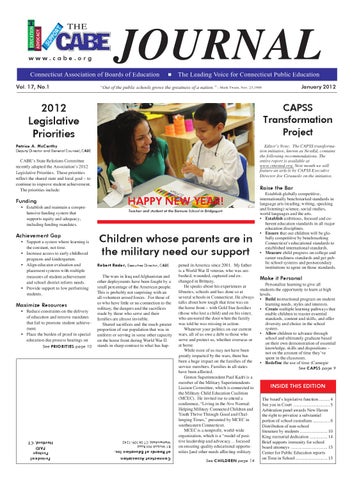
Teacher and student at the Barnum School in Bridgeport.
Children whose parents are in the military need our support Robert Rader, Executive Director, CABE
pened in America since 2001. My father is a World War II veteran, who was ambushed, wounded, captured and exchanged in Brittany. He speaks about his experiences at libraries, schools and has done so at several schools in Connecticut. He always talks about how tough that time was on the home front – with Gold Star families (those who lost a child) and on his sister, who answered the door when the family was told he was missing in action. Whatever your politics on our current wars, all of us owe a debt to those who serve and protect us, whether overseas or at home. While most of us may not have been greatly impacted by the wars, there has been a huge impact on the families of the service members. Families in all states have been affected. Groton Superintendent Paul Kadri is a member of the Military Superintendents Liaison Committee, which is connected to the Military Child Education Coalition (MCEC). He invited me to attend a conference, “Living in the New Normal: Helping Military Connected Children and Youth Thrive Through Good and Challenging Times,â€? presented by MCEC in southeastern Connecticut. MCEC is a nonprofit, world-wide organization, which is a “model of positive leadership and advocacy‌ focused on ensuring quality educational opportunities [and other needs affecting military
Connecticut Association
Achievement Gap
HAPPY NEW YEAR!
of Boards of Education Inc.
• Establish and maintain a comprehensive funding system that supports equity and adequacy, including funding mandates.
Raise the Bar
See CHILDREN page 14
The wars in Iraq and Afghanistan and other deployments have been fought by a small percentage of the American people. This is probably not surprising with an all-volunteer armed forces. For those of us who have little or no connection to the military, the dangers and the sacrifices made by those who serve and their families are almost invisible. Shared sacrifices and the much greater proportion of our population that was in uniform or serving in some other capacity on the home front during World War II stands in sharp contrast to what has hap-
81 Wolcott Hill Road Wethersfield, CT 06109-1242
Funding
January 2012
³2XW RI WKH SXEOLF VFKRROV JURZV WKH JUHDWQHVV RI D QDWLRQ ´ 0DUN 7ZDLQ 1RY
Establish globally competitive, internationally benchmarked standards in language arts (reading, writing, speaking and listening) science, social studies, world languages and the arts. • Establish ambitious, focused and coherent education standards in all major education disciplines. • Ensure that our children will be globally competitive by benchmarking Connecticut’s educational standards to established international standards. • Measure child progress on college and career readiness standards and get public school systems and postsecondary institutions to agree on those standards.
Make it Personal Personalize learning to give all students the opportunity to learn at high levels. • Build instructional program on student learning needs, styles and interests. • Create multiple learning pathways that enable children to master essential standards, content and skills, and offer diversity and choice in the school system. • Allow children to advance through school and ultimately graduate based on their own demonstration of essential knowledge, skills and dispositions – not on the amount of time they’ve spent in the classroom. • Redefine the use of time (Carnegie See CAPSS page 9
INSIDE THIS EDITION The board’s legislative function .......... 4 See you in Court ................................. 5 Arbitration panel awards New Haven the right to privatize a substantial portion of school custodians ............... 6 Distribution of non-school literature by students ......................... 10 King memorial dedication ................ 14 Brief supports immunity for school board attorneys ................................. 15 Center for Public Education reports on Time in School ............................. 15
Periodical Postage PAID Hartford, CT
2
The Journal – Connecticut Association of Boards of Education PRESIDENT COMMENTARY
A call to action and I’m calling you! On November 18, 2011 I was honored to be elected President of CABE. My first duty was to present my thoughts at the CABE/CAPSS Convention. Here are some excerpts from that speech. “A call to action.” And I am calling you. Because it’s a privilege to be part of this organization. Our organization. I know first-hand being on a board of education is not easy. Whether you have just won your re-election or been appointed as a new board member, I congratulate you for answering “the call.” We take a beating from time to time, from our constituents, the media, those who sit in the Legislature and even the Governor’s Office. If you recall, it’s been mentioned repeatedly that this will be “the Year of Education.” Each of us should be proud and honored of the work we do, collaboratively, collectively and individually, whether at the Board table, in the community, at the state or national level, as a guest speaker to a High School Civics class or invited to read your favorite book to an elementary class. When times are tough, each of us should realize that our individual Boards of Education serve a critical function in
our democracy and more importantly in the education of our young people we choose to serve, year after year. We are the local “governance” not the local “control.” As school board members, we oversee organizations that spend billions in Connecticut’s taxpayer’s dollars and employ thousands of people in our state. There are more than 1,400 dedicated citizens serving in our Connecticut public school districts and we board of education members represent the largest elected body in our state. Over the next two years, my personal goal as President of CABE is to harness our collective power and help bring about more positive change in our educational system in Connecticut. Together, we can make that difference not only for our students of today, but more importantly for their future. We should no longer think of ourselves in terms of “what makes us different.” We need to be proactive in what ‘makes us the same’ in education. No more thinking as the two Connecticut’s. No more high wealth versus low wealth. No more urban versus suburban versus rural. We need to focus on what ties us
CABE Board of Directors EXECUTIVE COMMITTEE Lydia Tedone President, Simsbury Richard Murray First Vice President, Killingly Ann Gruenberg VP for Government Relations, Hampton Stephen Wright VP for Professional Development, Trumbull James Marpe Secretary/Treasurer, Westport Don Blevins Immediate Past President John Prins Member at Large Mary Broderick NSBA President, East Lyme
AREA DIRECTORS Susan Hoffnagle, Area 1 Co-Director, Winchester Mari-Ellen (Mimi) Valyo, Area 1 Co-Director, Winchester Daniel Santorso, Area 1 Co-Director, Plymouth Becky Tyrrell, Area 2 Director, Plainville Laura Bush, Area 3 Director, Vernon Gavin Forrester, Area 6 Co-Director, Stratford Elaine Whitney, Area 6 Co-Director, Westport Michael D’Agostino, Area 7 Co-Director, Hamden Robert Guthrie, Area 7 Co-Director, West Haven Sheila McCreven, Area 7 Co-Director, Woodbridge John Prins, Area 7 Co-Director, Branford Robert Ruggiero, Area 8 Director, Madison Gail MacDonald, Area 9 Director, Stonington
CITY REPRESENTATIVES Bob Trefry City Representative, Bridgeport Michael R. Nast City Representative, New Haven Polly Rauh City Representative, Stamford Charles Stango City Representative, Waterbury
COMMITTEE CHAIRS Robert Mitchell, Chair, State Relations, Montville Beverly Washington, Chiar Federal Relations, Groton
ASSOCIATES Eileen Baker, Associate, Old Saybrook Sharon Beloin-Saavedra, Associate, New Britain Gary Brochu, Associate, Berlin Cal Heminway, Associate, Granby
STAFF Robert Rader, Executive Director Patrice McCarthy, Deputy Director and General Counsel Bonnie Carney, Sr. Staff Associate for Publications Nicholas Caruso, Sr. Staff Assoc. for Field Service and Coord. of Technology Sheila McKay, Sr. Staff Associate for Government Relations Kelly Moyher, Sr. Staff Attorney Vincent Mustaro, Sr. Staff Associate for Policy Service Lisa Steimer, Sr. Staff Assoc. for Professional Development Teresa Costa, Coordinator of Finance and Administration Pamela Brooks, Sr. Admin. Assoc. for Policy Ser. /Search Ser. Terry DeMars, Admin. Assoc. for Policy Service Gail Heath, Admin. Assoc. for Government Relations Veronica Martinez, Admin. Asst. for Membership Services Wilmarie Newton, Admin. Assoc. for Labor Relations Corliss Ucci, Receptionist/Asst. to the Executive Director
The CABE Journal (ISSN 1092-1818) is published monthly except a combined issue for July/August as a member service of the Connecticut Association of Boards of Education, 81 Wolcott Hill Road, Wethersfield, CT 06109, (860) 571-7446. CABE membership dues include $30 per person for each individual who receives The CABE Journal. The subscription rate for nonmembers is $75. Association membership dues include a subscription for each board member, superintendent, assistant superintendent and business manager. The companies and advertisements found in The CABE Journal are not necessarily endorsed by CABE. “Periodicals Postage Paid at Hartford, CT.” POSTMASTER: Send address changes to The CABE Journal, CABE, 81 Wolcott Hill Road, Wethersfield, CT 06109-1242. Email: bcarney@cabe.org. Members can find the CABE Journal online at: www.cabe.org/userlogin.cfm?pp=84&user request=true&keyrequest=false&userpage=84
together as board members – all the students we serve. This is why I am adopting as my theme: “Leadership through Advocacy.” To be effective in our roles, we must identify the opportunities for change and growth, and address them collectively. You can begin answering my call to you by serving on CABE’S State Relations or Federal Relations Committees. Or by attending with your fellow board members CABE’s Day On The Hill on March 14. Or testifying before our State Legislature, or even attending meetings of the Governor’s Education Task Force Committees at the Legislative Office Building. Or, all of these! Events such as these should be as important as your local board meetings. Take your role as an elected official beyond your district boardroom. Becoming an advocate for your schools, for your students and your communities has to be a priority if we want to foster the positive change in our educational system for the future. As elected officials, we have a responsibility to establish relationships and ongoing dialogues with our state and federal legislators. I truly believe, that together, our combined membership can make that
Lydia Tedone
difference for our students, our teachers and even our taxpayers. Too much is at stake before us – we can’t afford to sit on the sidelines as Washington and Hartford decide the fate of our students, our schools and communities. The voice of our Connecticut school boards needs to be heard loud and clear. We can accomplish that goal by embracing the theme of “Leadership Through Advocacy.” Find your “call to action” as a board member. Develop your passion in education. Ask for support from your state Association. You have the ability to fulfill your role to the highest ability, not only on behalf of public education but more importantly, the students of Connecticut.
CABE Day on the Hill March 14, 2012 8:30 am
The Bushnell, Hartford More information will be mailed in mid-January.
3
The Journal – Connecticut Association of Boards of Education EXECUTIVE DIRECTOR COMMENTARY
South Korea’s situation suggests need for “real” conversations Even as districts are examining their roles as we move into another tough budget season, comparisons to other states and countries remain an important part of learning what does and doesn’t work. The December 5th issue of Time magazine had a fascinating article on education in South Korea. This country has scored at the top against all other countries in reading and math. President Obama and Secretary of Education Arne Duncan “speak glowingly about the enthusiasm South Korean parents have for educating their children, and they lament how far U.S. students have fallen behind.” But, at what cost to the people of South Korea? The author of the article, Amanda Ripley, gives a stunning look at what life and instruction is like for these Korean students. She writes about students sleeping in class so that they can stay up late studying and stores selling special pillows that go on students’ forearms to make that sleeping more comfortable. Numerous students attend “hagwons”, which are after hours tutoring academies and take the year off after high school and attend hagwons to help them improve scores on college admissions tests. There are now curfews (10 p.m.) and police even raid the hagwons so students aren’t up all night. The author, who visited a hagwon, wrote that it was in a “warren of small study rooms with low ceilings and fluorescent lights, [where] about 40 teenagers sit at small individual carrels. The air is stale. It is a disturbing scene, sort of like a sweatshop for children’s brains.” (My emphasis.) The typical academic schedule begins at 8 a.m. and ends sometime between 10 and 11 p.m., depending on the ambition of the student. There are more after school instructors in the country than regular teachers. “Cramming” and extremely high
admissions standards to college has long towards the “one size fits all” been part of Korean culture. But, mentality of the Asians. Koreans now are trying to change things. Shouldn’t we figure out how best Their problem is that the incentives to to take advantage of this American work brutally hard and get into a prestitrait and strengthen how we teach it? gious university are still high. Music, art, drama, foreign language Interestingly, Ms. Ripley believes that ability are rarely, if ever, tested the parents will be the hardest people to internationally, because they’re so agree to change and that it’s sometimes difficult to judge and because they difficult to know who is doing the are so individualistic. But, isn’t competing – the students or their parents. ensuring the “whole child” is In one case nearly educated the job of 50 years ago, a every board? “Real evaluations must • With all of the school entrance exam was given in discussion of the be relevant and valid which the students school calendar in were asked about every district in order to both help the ingredients in because of our twin those who need help taffy. The exam storms in the fall, the apparently conto improve and to pro- issue has been on tained two right which days students answers, but only may have to come to vide a fair system to one was counted as schools. Cut winter determine whose sercorrect. To protest, or spring vacations? parents started Go longer into June? vices must be termicooking taffy Isn’t the question outside government we should really be nated.” offices. The Vice asking, once we get past this year’s “freak”, which days Education Minister and Seoul’s education issues, is how much schooling is superintendent both resigned as a result. necessary for a child to successfully master the things he or she will need to lead a productive life? One Lessons for Us – Need for hundred eighty days may be the law, Real Discussion! but, just as our calendar was set by So, what does this that tell us about the need to have children available what we should be focusing on in Conto harvest in the summer, isn’t it necticut? now critical that we examine the Balance. It is critical that we balance global marketplace today and what the demands we put on students with their our children must do to be successneeds as youngsters: ful and the time required to fulfill • We need a real discussion about this responsibility? how to take advantage of the Boards have a primary responsibilAmerican ability to help students ity to ensure quality instruction. develop their creativity. Asian That is much more important than countries who do so well on how long or hard a school day is. If standardized tests are trying to copy the teacher is teaching children well, the parts of our system that lead to they will learn more. All the hours more development of the individual, in the day will not offset bad while we seem to be moving more instruction.
Robert Rader
Take a look at NSBA’s Center for Public Education’s report (see article page 15) on how we compare with other countries regarding the school year. • How about what accountability really means – for students, teachers, school staff and, yes, school boards? In Korea apparently it is so difficult to get into schools that students are worked ridiculously hard. Accountability and performance are based on tests… so much so that the society is trying to push away from that. Back in Connecticut, a better evaluation system for administrators and teachers is something that boards and unions are discussing, both at the state level and locally. Real evaluations must be relevant and valid in order to both help those who need help to improve and to provide a fair system to determine whose services must be terminated. What does accountability mean for our boards? Certainly there is accountability at the ballot box, but there is also a need for boards to self-assess and determine whether the board is providing the best possible education so that all children can grow. It is time that we have some real conversations on how to retain our current advantages and ensure balance in what we expect of our students, our teachers, our administrators and our boards of education. I urge all boards and their superintendents to discuss these critical issues.
CABE Affiliate Members BUSINESS AFFILIATES DIAMOND MEMBER Finalsite GOLD MEMBERS
Berchem, Moses & Devlin Connecticut Business Systems Shipman & Goodwin Siegel, O'Connor, O’Donnell & Beck, P.C Sullivan, Schoen, Campane & Connon
SILVER MEMBERS Anthem Blue Cross and Blue Shield Corporate Cost Control Lindberg & Ripple Inc. Quisenberry Arcari Architects The Segal Company Trane BRONZE PLUS MEMBERS Blue Ribbon LLC Brown and Brown Fletcher Thompson Architects Friar Associates Goldstein & Peck, P.C. Kaestle Boos Associates, Inc. O & G Industries
BRONZE PLUS MEMBERS The S/L/A/M Collaborative Suisman, Shapiro, Wool, Brennan, Gray & Greenberg Whitsons School Nutrition BRONZE MEMBERS Nathaniel G. Brown, LLC Chinni & Meuser LLC Dattco Inc. Fuller & D’Angelo Architects and Planners JCJ Architecture Kainen, Escalera & McHale, P.C. The Lexington Group Muschell & Simoncelli
EDUCATIONAL AFFILIATES American School for the Deaf Area Cooperative Educational Services Capitol Region Education Council Connecticut Association of School Business Officials Cooperative Educational Services Connecticut Center for School Change Connecticut Educators Computer Association Connecticut School Buildings and Grounds Association EASTCONN EDUCATION CONNECTION LEARN
4
The Journal – Connecticut Association of Boards of Education
The board’s legislative function Vincent A. Mustaro Senior Staff Associate for Policy Service, CABE
Board members, both newly elected and experienced, must remember that among the main responsibilities of school boards are planning, evaluation and making policy, a legislative function. The most important and continuous task is that of legislating, or adopting, policy. Policy establishes and defines general goals and specific objectives of the school district. Good policy provides direction and compels action for successful educational programs and related services. School boards set policy each time a vote is taken on a course of action or indicates what the board wants to see happen and establishes acceptable parameters for the operation of the school district. The philosophy, goals and positions of the board should be through resolution of an issue. The proper use of organized written policies is a major difference between an efficient, well-informed board and a board experiencing frequent turmoil.
Policy provides direction Policy reflected in policy. Policy also provides direction and assigns responsibility to district staff which helps to ensure a quality educational program for students. However, all too frequently,
board policy is one of the most neglected areas in school governance. A fragile balance exists between board policy-making and administrative managerial roles. Policy does not mean detailed directions for operating the school system or a specific program. Such specificity belongs in the administrative regulations which accompany many policies.
Policy governance Policy is the governance tool the state has granted to local boards of education. Boards need to establish written, effective policy to appropriately execute that authority. The policy function is based squarely on the tasks of planning and delegating as opposed to “doing.” The time and experience of board members is better used when the policy function of the board is a priority. This requires judicious use of effort and information correlated with the delegation of and the accountability for assigned tasks. Policy should be designed to concentrate efforts to produce desired and better results, with a focus on student achievement. Policy statements should be clearly and concisely written and be easily understood by all those affected. Policies need to be workable. Vague or very general policies will not give sufficient guidance, while too much specificity may plague the district with administrative red tape. Also
to be in compliance with a policy, people must be aware of its existence.
assess and improve the educational program provided by the district.
Policy implementation
Policy must comply with laws
The implementation of board policy is the responsibility of the administration and staff. The board of education, the legislative and policy-making authority, hires the superintendent to administer or implement the adopted policies. The superintendent is responsible for developing administrative regulations, also known as procedures or guidelines, to effectively implement board policy within established parameters. These administrative regulations detail the manner in which the board policies are to be implemented. The superintendent, a professional policy implementation ex-pert, also recommends policy and has the responsibility of helping boards follow policy and stay within the parameters of the law.
Board policies carry the weight of law and serves as a legal record. Therefore, policies must comply with applicable federal and state statutes and regulations, State Department of Education regulations, judicial decisions and negotiated collective bargaining unit agreements. Maintaining an accurate, current policy manual can be viewed as legal insurance for a school district. Policies which are not in compliance with current law and corresponding regulations are useless, possibly illegal and potentially dangerous. Keeping policies up-to-date demands awareness of necessary changes and a method of implementing those changes. It is necessary to constantly monitor developments in the law and draft appropriate updates on a timely basis. CABE’s Update Services can help in fulfilling this major responsibility. Designating a place on the board’s agenda monthly for policy is one way to ensure the district’s policies remain current. The best policies are the result of cooperation and communication among the board, district staff and community. The board should establish and use a policy development cycle.
Policy communications and dissemination Communicating and disseminating board policy are important aspects of policy development. For maximum retrieval and effect, policies should be organized in a manual and codified according to a simple, subject-related classification system that accommodates access and promotes understanding. The manual should be easily accessed. Such access can be greatly facilitated by placing it online on the district’s website. CABE’s Online Policy Service can assist boards with the placement of its manual online with an easily searchable format. A major purpose of policy is clarifying roles and responsibilities within the district and establishing boundaries within which they are accomplished. Adopted policy must clearly express the board’s intent concerning the responsibilities of those to whom it delegates authority. Well-written policies provide direction to the superintendent without usurping professional judgment and allow discretion in dealing with the district’s day-today occurrences. Clear, well-defined policies also serve as the basis for accountability and evaluation of programs and employees, which are used to govern,
Leadership role The superintendent, as the educational leader, normally has the leadership role in policy development, review and revision. Throughout the policy process the superintendent or a designee serves as the information conduit between board and staff. The board’s policies, when carried out effectively and responsibly, are the best way to provide effective and efficient school programs for children. They are also an excellent way to communicate while representing the citizens of your respective school district. Legislating policy is, and should be, one of the primary roles and responsibilities of a board. CABE’s Policy Service is prepared to assist new and experienced board members in meeting this responsibility.
CABE presented at MASC Annual Conference
Patrice A. McCarthy, Deputy Director and General Counsel, CABE, presented a workshop on “Staying Out of Legal Trouble”.
Lisa Steimer, Senior Staff Associate for Professional Development, CABE, presented a workshop on CABE-Meeting the Association’s “paperless” board meeting tool, at the Massachusetts Association of School Committees’ Annual Conference.
5
The Journal – Connecticut Association of Boards of Education See You in Court – The Nutmeg Board of Education
The Nutmeg Board deals with the role of the board chair and FOI Act Thomas B. Mooney, Esq. Shipman & Goodwin
The Nutmeg Board of Education makes many mistakes. The latest imbroglio created by the board will be reported here each issue, followed by an explanation of what the board should have done. Though not intended as legal advice, these situations may help board members avoid common problems. It had been a hard fought election for Board Chairperson. Of the nine members of the Nutmeg Board of Education, five were new. After many years on the Board, Veteran Board member Bob Bombast finally saw an opening to become Chairperson, and he went for it, big time. He sent a barrage of emails to the new Board members, even before they were sworn in. Bob tried everything to persuade the new members to support him for Board Chairperson. He promised committee chairmanships. He told them how happy he was finally to be serving with intelligent people. He even raised questions about whether the current Chairperson has a drinking problem. Unfortunately for Bob, however, two of the new Board members had no interest in giving Bob a
bigger stage for his drama. When the vote was finally taken, Mr. Chairperson was reelected by a five-to-four vote. Mr. Chairperson had a chance to be gracious in victory, but it was not to be. He decided to teach Bob and his followers a lesson. Mr. Chairperson appointed his supporters to all of the committee chair positions, and though Bob had chaired the Personnel Committee for many years, that assignment was given to another Board member. Bob and his supporters were out in the cold. Bob did not take these developments lying down. The Board’s Bylaws provide that, at the end of each meeting, Board members have an opportunity to propose new agenda items for the next meeting. When the Board came to that part of the agenda, Bob’s hand shot up. Mr. Chairperson tried not to notice Bob, but Bob’s vocalizations while waving his hand made it impossible to do so, and he recognized Bob. “We need to add an agenda item limiting your authority,” Bob stated. “You aren’t God, you know! We need to give power back to the people.” “That isn’t going to happen. The Board elected me Chairperson, and with that office come the prerogatives of the
Seventh Edition coming in January
A Practical Guide to Connecticut School Law by Thomas B. Mooney, Esq. Shipman & Goodwin The Guide comes with a CD which provides hyperlinks to many cases and statutes and will permit word searches as a supplement to the Index. New to the Seventh Edition: Bullying, background checks, child abuse reporting, discrimination issues, educational reform, FERPA, freedom of information, state aid for education and much, much more You can call CABE at 860-571-7446 or 800-317-0033 and reserve your copy NOW! We will ship them out as soon as we receive them from the printer.
Chair,” Mr. Chairperson responded. “Changes to our Bylaws will be considered only if and when I decide to propose them.” On this acrimonious note, Mr. Chairperson banged his gavel to end the meeting. But Bob was not done. The
necessary or is requested in writing so to do by three of its members. If no meeting is called within fourteen days after such a request has been made, one may be called by any three members by giving the usual written notice
“Whenever . . . any Board member receives a copy of any email relating to Board business, even one from persons not on the Board, that email becomes a public record.” next day, Bob delivered a handwritten petition signed by him and the three new Board members who had supported him. The petition demanded that Mr. Chairperson place on the agenda Bob’s proposals to amend the bylaws to restrict the authority of the Chairperson. However, Mr. Chairperson laughed and shot an email to the four Board members, telling them to “give it up.” Then Bob announced by email that he was calling a meeting himself. He even posted an agenda in Town Hall that included two items, “Amendment of Bylaws and Removal of the Board Chair.” By this time, Mr. Chairperson’s retaliatory behavior had antagonized the rest of the Board members, even his former supporters. As a result, everyone but the Chairperson attended the meeting Bob had called. Do these eight Board members have the right to take action at this “meeting”? Board members should serve their communities better than did either Bob or Mr. Chairperson here. However, this situation reminds us that the role of the chair is to facilitate board operation, not to control it. Control of the agenda is a critical function because boards of education can act only by addressing agenda items through votes at publicly-called meetings. By establishing appropriate agendas, boards of education can assure that they operate in an effective manner. For most boards of education, the bylaws address the process of setting the agenda. Typically, the chairperson and the superintendent set the agenda for the coming board meeting. In so doing, the chairperson and superintendent should be respectful of the wishes of other board members. Board meetings should not get bogged down with pet agenda items supported only by a few members. But here Mr. Chairperson was thwarting the will of a significant number of Board members. A longstanding statutory provision gives guidance on when a matter should be included on the agenda. Connecticut General Statutes Section 10-218 provides in relevant part: “The chairperson of the board of education or, in case of such chairperson’s absence or inability to act, the secretary shall call a meeting of the board at least once in six months and whenever such chairperson deems it
to the other members.” A meeting is simply a series of agenda items, and thus this provision appears to mean that three board members can independently call a meeting on an agenda item, as Bob did, if the chairperson will not include that agenda item in a regular or special meeting. However, three board members alone would not create the quorum necessary for action, and thus this approach would work only if the three (or more) members calling such a meeting can get a quorum of the full Board to the meeting. Agenda items also raise Freedom of Information Act issues. Under the FOIA, the agenda item must “fairly apprise the public of the business to be conducted.” Thus, some specificity in describing agenda items is important. “Board operations,” for example, would be overly vague. However, an agenda item that is overly specific can be equally problematic. If the agenda item is “Discussion of” a specified topic, board action on that item would not be proper. A general formulation of “discussion and possible action on . . .” the agenda item avoids this problem and permits the board to action when it wishes. More generally, board bylaws describe the authority of the board chair. Often bylaws provide that the chairperson appoints committee members and/or chairs of committees. Sometimes, that authority is subject to board approval, sometimes not. The significant point here is simply that the board itself through bylaw determines what authority to delegate to its chair. Finally, Bob Bombast and other Board members must remember that every email they send that pertains to the business of the Nutmeg Board of Education is a public record under the Freedom of Information Act. Interestingly, emails exchanged by the new Board members before their election are not subject to disclosure under the FOIA, because they were not public officials until they are sworn in. But whenever Bob or any other Board member receives a copy of any email relating to Board business, even one from persons not on the Board, that email becomes a public record. Attorney Thomas B. Mooney is a partner in the Hartford law firm of Shipman & Goodwin who works frequently with boards of education. Mooney is a regular contributor to the CABE Journal.
6
The Journal – Connecticut Association of Boards of Education
Arbitration panel awards New Haven the right to privatize a substantial portion of school custodians Floyd J. Dugas, Esq. Berchem, Moses & Devlin
In what will no doubt be viewed as a landmark decision, an interest arbitration panel has issued an award which will allow the New Haven Public Schools to privatize 86 of the 186 positions in its custodial and maintenance union, and in the process save nearly $4 million dollars. Faced with skyrocketing pension and health insurance cost which are expected to outpace the growth in revenues over the foreseeable future, the City of New Haven and its Board of Education were forced to look for ways to substantially cut operating costs. Having already laid off nearly 300 employees over the last two fiscal years, the Board and the City began to look at other options. Among the options considered was outsourcing services that could continue to be provided at a substantial savings. An option that emerged was the outsourcing of school custodial and related services, which cost the Board $16 million per year. As a result of an RFP, the Board found a national firm willing to perform the same services for just $8 million, which would mean a net savings to the
which included angry outbursts during the budget of $8 million per year. proceedings. Although the Board had contract In the end, the Board’s last best offer language which arguably provided it with proposed that 86 of the 186 jobs would be the right to unilaterally subcontract this outsourced, rather than the entire unit. In work, given the State Board of Labor other words, a core Relations propensity to component of district require that such “The decision is not- employees would language be crystal remain in place and be clear, and the consenable in that it is one supplemented by nonsus that the language of, if not the first union employees. could be construed as Faced with a choice less than so, the Board time, a state arbitra- between the compromade the tactical mise position of the decision to propose in tion panel has Board, and the refusal negotiations clearer awarded sweeping of the Union to offer language which unequivocally gave it rights to a municipal- any meaningful solution, the Panel the right to subcontract union work. ity to privatize union selected the Board’s position. Not surprisingly, the work in an effort to In addition to union, an AFSCME the right to subcontract Local, refused to save money.” a substantial number of engage in any meaningful discussion of the issue, and as a result, the case went into binding interest arbitration. What followed was a nearly year- long battle, complete with picketing featuring the likes of Al Sharpton, and
positions, the Board also won the elimination of a number of contract provisions which were considered impediments to operating efficiently. It also achieved a number of material changes in the areas of pension and healthcare, including the elimination of retiree health insurance for new hires. The decision is notable in that it is one of, if not the first time, a state arbitration panel has awarded sweeping rights to a municipality to privatize union work in an effort to save money. Whether the New Haven award is the result of the proverbial perfect storm, or is a harbinger of things to come, has yet to be seen. It does, however, provide strong precedent for other Towns/Cities and Boards of Education looking for ways to deliver services in a more economical way in these difficult economic times.
Delegates voting on resolutions before the Delegate Assembly on November 17.
CABE holds Delegate Assembly CABE held its Delegate Assembly on November 17, preceding the annual CABE/ CAPSS Convention, to vote on resolutions that are our guiding principles. In preparation for the Delegate Assembly, CABE’s Resolutions Committee met twice over the summer to discuss modifications to existing resolutions as well as proposed resolutions submitted by member school boards. Among the resolutions discussed were education finance, 21st Century schools, special education burden of proof, universal preschool, mandates, technical high schools, and nonpartisan boards of education.
Updates were provided on the state task forces currently discussing the achievement gap, education cost sharing formula, technical high schools, and secondary school reform. CABE’s State Relations Committee met in December to identify legislative priorities for the upcoming session. Watch your mail in January for a copy of the State Agenda describing the positions of the Association; and plan to attend Dayon-the-Hill – March 14, 2012. Patrice A. McCarthy Deputy Director and General Counsel, CABE
7
The Journal – Connecticut Association of Boards of Education
Never put off until tomorrow what you can do the day after tomorrow - Mark Twain Lisa Steimer Senior Staff Associate for Professional Development, CABE
Many a procrastinator could have written that quote, but may not have gotten to it right away. Unfortunately, procrastination is a reality that plagues all too many. Psychology Today says that twenty percent of us are procrastinators. Certainly, many procrastinate to some degree by simply putting off unattractive tasks or more likely, because there is already too much on the plate. Most procrastinators don’t like to procrastinate. They don’t like the stress it creates nor do they like that nagging feeling that there are things left undone. Even when not working on a project that is on deadline, it is pretty certain that the procrastinator is thinking about it.
Why procrastinate? Procrastination does not translate into laziness or inefficiency. It is a developed habit and it can be overcome. Why do the twenty percent identified by Psychology Today procrastinate to the point where they are discouraged or overburdened by their actions (or inaction)? It is no surprise that a number of universities have online resources dealing with procrastination. The Writing Center at the University of North Carolina at Chapel Hill cites several that include: • Fear of failure • Fear of success • Fear of losing autonomy • Expectation of perfection Others sources cite reasons such as: • Feeling overwhelmed with a situation • Given up hope that a situation can be changed or affected • Can’t make a decision • Overworked or tired • Want to avoid work you don’t like
Is
there a fix?
How can overcoming procrastination help board members and their boards? An article from Lifehack.org offers some practical advice adapted for boards of education. 1. Get clear about what you want. Do a board goal setting session. Once you have the list, cut it down to the top ten, then down to the top five, and then the top three that are aligned with the district’s strategic plan. 2. Delete or delegate from your to-
do list those things that don’t relate to your top goals. Boards should not be micromanaging. Be clear about the role of the board and the role of the superintendent. Stick to these roles. 3. Plan your week just enough to schedule in the big things you know you want to get done. Sometimes procrastination happens simply because a task is not scheduled. Be sure to include time to review your board packet thoroughly and to take care of any commitments you have made to your fellow board members or the superintendent. 4. Just do it, but don’t overdo it. We often put pressure on ourselves to do certain tasks more often than we really need to. Give yourself a break and set a schedule for these things that is not overwhelming. Be realistic in assessing the frequency with which tasks need to be done. 5. Break down big tasks into smaller pieces. We procrastinate on tasks that are vague and nebulous because we don’t have clear idea of what to do next. Break down a larger task and schedule it into your calendar in pieces. Be clear and concise. 6. Believe in yourself, your board and in your ability to accomplish anything you want. A little bit done every day adds up to a lot over a year. At the end of the year you can reflect on the accomplishments that have added up over time. 7. Celebrate. Celebrate your successes, big and small, along the way. Your successes deserve to be celebrated and celebration will give you fuel to keep moving forward. The New Year is a great time to refocus and attempt to eliminate the crazy cycle of procrastination. If you are interested in scheduling a board goal setting session, contact the CABE Office at 800-317-0033 or 860-571-7446.
CABE-Meeting CABE-Meeting is a user-friendly, web-based service specifically designed to assist the board, superintendent and central office staff in preparing for and running board of education meetings.
Is CABE-Meeting for you?
• Do you want to save your district money? • Do you want to utilize technology to enable staff to be more efficient? • Do you want to focus more of your human and financial resources on increasing student achievement in your district? • Do you want to enhance communication with your community? • Do you want to model the methods that should be used to infuse technology in your schools? If you answered “yes” to at least one of the above questions, read on. CABEMeeting can help you!
Learn more:
Take a few minutes and go to
For more information or to schedule a demonstration for your board, call Lisa Steimer at 800-317-0033 or 860-5717446 or email lsteimer@cabe.org.
Condolences Charles G. Crump, III, a former member of the Wallingford Board of Education and President of CABE in 1967-68 died recently at the age of 95. He was a tireless volunteer in the Wallingford community. CABE extends our condolences to his family. Patrice A. McCarthy Deputy Director and General Counsel, CABE
http://www.cabe.org/ page.cfm?p=158 to complete our CABE-Meeting cost analysis worksheet (located at the bottom of the page) and see how much your district can save in one year. Districts can save thousands of dollars each year by using CABE-Meeting.
CABE-Meeting Lisa Steimer Connecticut Association of Boards of Education 81 Wolcott Hill Road Wethersfield, CT 06109 www.cabe.org
8
The Journal – Connecticut Association of Boards of Education
New Board Member Orientation and Board Leadership Conference Pre-Conference
CABE Executive Director Robert Rader discusses School Governance Councils.
Chair of the State Board of Education Allan Taylor talked about the future of public education in Connecticut. Elsa Nunez, President, Eastern Connecticut State University addressed a joint session of the two groups and talked about closing the achievement gap.
CABE Senior Staff Associate for Policy Service Vincent Mustaro discussed the board’s policy role.
CABE Deputy Director and General Counsel Patrice A. McCarthy discusses school funding.
CABE Senior Staff Associate for Government Relations Sheila McKay updates participants on the latest legislative news.
Robert Rader, Executive Director, CABE moderated a discussion of roles and responsibilities of board members and superintendents. Leading the discussion were CABE President Lydia Tedone (Simsbury) and CAPSS President Judy Palmer (Region 7).
President of Baldwin Media Ann Baldwin shared some tips to get the media on your side.
CABE Senior Staff Attorney Kelly Moyher talked about some of the legal issues that pertain to board members. CABE Consultant Robert King talked about cultural responsiveness.
More photos on page 10
9
The Journal – Connecticut Association of Boards of Education CAPSS Transformation Project (continued from page 1) unit/calendar) in order to support a personalized learning system; make achievement the constant and time the variable. Allow students to learn anytime, anywhere.
Start with Early Childhood Make quality early childhood experiences available to all three- and four-yearolds in order to get all children ready to learn as they enter kindergarten. • Make quality preschool education universally available in Connecticut. • Reallocate state funding and alter educational policy so that programs are positioned for measurable success at raising oral language, reading and numeracy skills. • Establish a structural relationship between preschool and the K-12 system. • Provide a challenging all-day kindergarten program to all children.
Retool Assessments and Accountability De-emphasize standardized tests and create new methods of assessments to give students choices for how and when they demonstrate their knowledge and skills. • Adopt a more varied system of assessment to account for the fact that students not only learn best in different ways, they also demonstrate their mastery of information in a variety of ways. • Make accountability transparent, tailored to different uses and able to com-
municate student progress. • Replace instructional state mandates – focused on inputs – with student learning outcomes. • Include rewards/incentives in accountability system. • Base accountability on the four core disciplines – language arts, science, mathematics and social studies.
Offer More Options and Choices Increase diversity, flexibility and autonomy in school districts to maximize resources and better address the needs and interests of all students. • Review existing district structures based on 1) the capacity to provide different options for children to meet education standards; 2) economic, social and geographic factors. • Provide students and their parents with a menu of options, including magnet schools, charter schools and vocational technical schools as well as different schedules and curriculums. • Increase capacity for educators to provide options and choices for children. • Structure school districts so that they’re fiscally independent.
Reform Leadership Realign Connecticut’s education system for success by making authority and responsibility equal. • Define the role and responsibilities of the Superintendent of Education (formerly Superintendent of Schools) in state statutes; make authority commensurate with responsibilities and eliminate ambiguity. • Change the state statutes so that: – The Governor appoints the Commissioner of Education with the
Make sure you visit the new CABE website!!! Fresh New Look Easier to Navigate New Online Bookstore More MultiMedia Content Access to CABE Journal Archives
statutory authority and responsibility to provide educational leadership. – The position of the Superintendent of Education provides leadership to the Board of Education. – The District Board of Education makes decisions only on policy matters, the annual budget and the hiring, supervision and evaluation of the Superintendent. – The contract between the District Board of Education and the Superintendent of Education can be for a five-year period and is renewable. • Restrict authority of the Board of Education to its role as a representative body for the community it serves.
Boost Quality Attract, develop, support and retain teachers and principals of the highest quality. • Recruit and retain the best and brightest in the education profession. • Require first-year teachers to have extensive clinical experience, supported by strong coaching from experienced teachers as well as content knowledge and teaching skills. • Support exemplary teacher and school district leadership development programs and publicize key achievements. • Revise tenure law to include a rigorous, standards-based review process more closely tied to student learning. After educators show outstanding performance in student learning, they will receive five-year contracts, which districts may or may not renew.
Involve Students and Parents Engage parents, caregivers and community organizations as partners in a child’s education.
• Foster a partnership for success among parents, schools and communities. • Help parents and caregivers understand how they make a difference in a child’s education. • Provide parents with choices for educating their children. • Work with parents and adults to support high expectations for learning. • Utilize community organizations to help families foster reading skills and produce literate children by grade three.
Leverage Technology Use technology to transform teaching and learning. • Provide educators and students with equal access to technology. • Personalize learning with technologybased systems. • Ensure broadband access to Internet and wireless connections. • Provide on-demand access to learning resources, information and services 24/7 • Integrate technology throughout school districts, facilities, leadership and management to increase efficiency and safety.
Continue Transformation Ensure that transformation is a continuous process, not a one-time event. • Keep the educational system flexible to meet changing needs and expectations. • Support innovation in the public school systems. Change state regulations to promote and reward continued transformation. • Create mechanisms for teachers and administrators to propose and obtain approval for innovative practices that lead to improved student outcomes.
10
The Journal – Connecticut Association of Boards of Education
Distribution of non-school literature by students School districts often allow students to distribute non-school literature on school grounds. Such literature includes a range of documents from flyers for community organizations such as the Boy Scouts or Little League to invitations to a classmate’s birthday party. Controversies arise occasionally based upon the content of the material or the means of distribution. If a district allows students to distribute non-school material to classmates, the First Amendment of the U.S. Constitution must be considered. Court cases involving the First Amendment have concluded that a school district can adopt reasonable rules to control the distribution of materials. The rules however may not discriminate based upon the viewpoints expressed in the materials. Non-school literature is defined as any material that the district itself does not produce or control. Examples of such material include students’ personal cards, letters, pamphlets about a community activity, invitations to a church social event or copies of the Bible. However, materials distributed for a school purpose or in an instructional setting are considered “school related” and are not covered by a policy pertaining to the distribution of non-school literature. School-related materials include all of the materials disseminated by the school or district and include such items as textbooks, permission slips or information related to school-sponsored activities. If this distribution occurs under the supervision of district staff, such as teachers, for an instructional purpose,
such distribution is considered schoolrelated. It is the common practice for school districts to create a “limited public forum” for student distribution of non-school materials by permitting distribution only at certain times and places and under specified conditions. By definition, a “limited public forum” allows some, but not all, distribution of non-school materials. A forum is either a place for communication, such as a classroom, or a means of communication, such as a school newspaper or the schools’ public address system.
Disemmination of Material Within a limited public forum, a school district cannot decide which materials will be distributed and which will not be based solely upon the viewpoints expressed in the materials. In short, once the district has made the decision to allow the distribution of non-school materials, the district may not choose which to distribute based upon the content of the materials. The district may not bar a student from distributing materials simply because they may be controversial or that the district disagrees with the message. However, there are some reasons for banning the distribution of certain materials which should be listed in school district policy. District policy pertaining to this issue should require that non-school materials be reviewed by a school official before distribution. If the intended distribution is during the school day or at a school function with students present, the district
is permitted to impose such a prior-review requirement. Court rulings have indicated, however, that a prior-review requirement cannot be imposed at school-sponsored events that take place after hours for adults, such as a parents’ night or school board meeting. However, in such situations, the district’s other policies concerning distribution of non-school literature, such as limitations on content and time, place and manner restrictions still apply. Even if a district has opened a limited public forum for the distribution of nonschool materials, the district maintains some control of the content of the materials that can be distributed. In utilizing the prior-review requirement, school officials’ decisions must be viewpoint neutral.
Prohibition of Distribution Because the speech rights of students are not coextensive with those of adults, schools may prohibit the distribution of some types of student literature altogether. Therefore, school officials may screen the material for content that is lewd, obscene, or otherwise likely to cause a substantial disruption of school operations. Material that violates the rights of others could be prohibited. Included in this category would be literature that is libelous, that invades the privacy of others or infringes on a copyright. It is also possible to prohibit material that advertises products that are illegal for minors such as alcohol. However, the district cannot bar distribution just because it
New Board Member Orientation and Board Leadership Conference Robert King, Consultant, CABE, led a joint session on the board in action - small group discussions with case studies.
contains a controversial message or content with which the district disagrees. District policy is necessary to provide administrators and students clear guidance and consistent enforcement about prohibited content. In permitting a limited public forum for student distribution of non-school literature, the district and its schools can impose reasonable “time, place, and manner” restrictions on distribution. Distribution can be limited to times before and after regular school hours, during recess, lunch or homeroom periods. Also, the distributions can be limited to designated locations, such as school entrances or exits, a handout table or bulletin boards. A common question is “May students distribute religious or political literature at school?” Generally, students have the right to distribute religious or political literature on public school campuses, subject to reasonable time, place and manner restrictions. These restrictions should be reasonable and must apply evenly to all non-school student literature. CABE does not recommend that the policy specify times or places for the distribution of the materials. The policy should require the individual schools to set reasonable rules regarding the distribution of such materials. However, it is important that school distribution rules be reasonable, clearly communicated to the student body and enforced consistently. The district may want to consider steps to be taken to avoid an appearance of school sponsorship of non-school materials. The policy could contain a disclaimer or require that a disclaimer statement be printed or affixed to all nonschool material distributed on school grounds. A prominent disclaimer indicates that the district does not endorse, approve or sponsor the activities, views, or events promoted by the materials. If a disclaimer is used, it must be done uniformly with all materials. Policy Implications: CABE’s current policy #1140, “Distribution of Materials by Students (Use of Students)” pertains to this issue. Several versions, in addition to an administrative regulation, are available. In addition, policy #1140.1, “Distribution of Non-School Literature/Publications” also applies to this topic. Vincent A. Mustaro Senior Staff Associate for Policy Service, CABE
2012 Legislative Priorities CAPSS Executive Director Joseph Cirasuolo shared information on the CAPSS Transformation Project.
CABE Senior Staff Associate for Field Services and Coordinator of Technology Nicholas Caruso talked about the Common Mistakes Board Members Make.
(continued from page 1) the party challenging the placement. • Raise the dollar threshold for school construction projects subject to prevailing wage. • Enhance local capacity to manage labor expense through modification of collective bargaining statutes. • Include performance based pay in the teacher retirement board calculations for purposes of retirement. • Refocus the State Department of Education resources on support to local districts rather than enforcement.
11
The Journal – Connecticut Association of Boards of Education
CABE: working for YOU Individualized Workshops • Professional Development Opportunities Legal Services • Policy Services • Representing You Statewide and Nationally prevention, suspension/expulsion, observance of religious holidays in the schools, graduation requirements and student health issues.
Below are the highlights of activities that the CABE staff has undertaken on your behalf over the last month. We did this:
✦ By ensuring members receive the most up-to-date communications: • Met with Board Chair Betty O’Brien and Superintendent of Schools David Sklarz of Marlborough on CABE services, programs and other activities. • As part of the development of new policy manuals utilizing the Custom Policy Service, materials were prepared for East Windsor, Pomfret, Putnam, Regional School District 17, Windsor Locks and Woodbridge Boards of Education
✦ By helping school boards to increase student achievement: • Participated in two meetings of the Glastonbury Strategic Planning Committee. • Provided Lighthouse training for the New London and Norwalk Boards of Education. • Sent two issues of Policy Highlights via email listserv covering topics that affect student achievement. This included virtual schools oversight, cell phones and cyberbullying, cameras on buses to deter bullying, monitoring teachers, community engagement, curriculum and staff use of cell phones.
✦ By providing opportunities for members to learn how to better govern their district: • Hosted our Biannual New School Board Member/Leadership Conference. • Presented Roles and Responsibilities workshops for the Danbury, East Lyme, Middletown, New London and Shelton Boards of Education. • Hosted CABE Delegate Assembly. • Provided policy information to 36 districts, the SDE, one attorney, and four out-of-state school board associations through 58 answered requests for information or sample policies, on 43 topics. Topics of greatest interest were: bullying
✦ By promoting public education: • Took part in WNPR’s “Where We Live” on NextEd, the CAPSS Transformation Project. • Demonstrated CABE-Meeting , CABE’s paperless board meeting tool, for Region 18. • Answered questions about the most current legal issues facing boards of education on quorums, non-meetings, roles of the chair, ex officio members of the board, and magnet school transportation. • Attended CAPSS Board of Directors meeting • Hosted the CABE/CAPSS Convention.
✦ By providing services to meet members needs: • Met with SDE representative on
• •
•
•
•
•
•
distance and virtual learning. Met with Apple representative on technology in the schools. Met with SDE representatives on school governance councils and their professional development. Provided training to 14 School Governance Councils in Waterbury. Participated in P20 Council’s Educator Effectiveness Committee meeting, primarily on teacher preparation. Hosted State Relations Committee meeting to develop legislative priorities. Facilitated vision/mission statement review with East Haddam Board of Education. Prepared custom policy materials for Ansonia, Columbia, East Hampton, East Windsor,
•
•
•
•
Franklin, Gilbert School, Hebron, Marlborough, New Fairfield, New Hartford, Newington, North Stonington, Old Saybrook, Oxford, Region 6, Stafford, Sterling, Stonington, West Haven, Westbrook and Windham Boards of Education. Revised additional policies in the resource library of sample policies. Some new models of policies pertaining to existing topics were also added. Completed work on the Columbia policy manual adit and signed agreement to audit the Brooklyn policy manual. Signed contract with Westport to place their policy manual online utilizing CABE’s Connecticut Online Policy Service (C.O.P.S.). Completed draft of 2nd Edition of the Policy Update Service. Topics covered include: workplace bullying in school, civility on school property, student use and possession of synthetic drugs, school gardens, and district-sponsored social media.
•
•
• • • •
• • • •
✦ By representing Connecticut school boards on the state, national or international levels: • Participated in two meetings of the Whatwillourchildren lose.com Coalition on State aid. • Participated in meetings of the Connecticut Coalition for Public Education. Issues included the upcoming legislative session,
• • • • •
other common concerns. Attended Military Services Group Conference on the education of children of military families (see page 1) Participated in meeting with Commissioner Stefan Pryor, other State Department of Education (SDE), State Board and CAPSS representatives on issues facing Connecticut public education. Participated in meeting of the Governor’s Prevention Partnership’s Board of Directors Attended Graustein Memorial Fund dinner and meeting on early childhood education. Participated in two-day NSBA Board of Directors meeting. Participated in Connecticut Coalition for Justice in Education Funding Steering Committee meetings. Attended Connecticut AfterSchool Council meeting Attended CREC Council meeting Attended and provided testimony to Technical High School Task Force meeting. Attended State Board of Education meeting. Attended CAPSS Technology Subcommittee meeting. Attended Education Cost Sharing Task Force meeting. Attended CT Special Education Professional Development Council meeting. Attended Achievement Gap Task Force meeting. Participated in CSAE Board of Directors annual strategic planning meeting.
12
The Journal – Connecticut Association of Boards of Education
Legal Briefs Kelly B. Moyher, Court rules in favor of Board of Education An identifiable victim who is subjected to imminent harm may be entitled to an exception to government immunity, if it is apparent to a public official that the official’s conduct is likely to subject the victim to harm. The plaintiff, Kathleen Stoll, alleged that she worked for the defendant board of education and was injured because a student knocked her to the ground, when she volunteered to work at a school dance. Stoll sued the board of education and the parent-teacher organization, alleging that they were negligent. The defendant board of education moved for summary judgment and argued that government immunity barred the negligence claim. The plaintiff maintained that an exception to government immunity existed, because she was an identifiable victim who was subjected to imminent harm. The court found that teacher attendance at the 5:30 p.m. school dance, which took place after school hours, was voluntary, and that the plaintiff was not paid to attend. The plaintiff did not dispute that she was not required to attend. The parentteacher organization, as opposed to the defendant board of education, organized the school dance. The plaintiff belonged to the parent-teacher organization and was responsible to supervise her sons, who went to the dance. The court was not persuaded that the plaintiff was an identifiable victim subject to imminent harm, because her attendance was voluntary. The plaintiff did not belong to a narrowly defined class of foreseeable victims. Government immunity barred the plaintiff ’s negligence claim, and the court granted the defendant board of education’s motion for summary judgment. Municipal Law Report 9/19/2011
Arbitrators rule on seniority grievance A collective bargaining agreement can provide that in the event of a layoff, an employee may bump another employee, within the same or lower classification, who has less seniority than the employee being laid off, provided that the employee who bumps is qualified. The New Britain Board of Education hired Plummer Carroll as a security or custodial supervisor in November 2004. The board discharged Carroll in July 2010, as a result of financial difficulties. Carroll sought to bump another worker, Joseph Vaverchak, who was hired as an attendance officer in January 1996 and who became an attendance supervisor in November 2007. The board denied Carroll’s request, and the union filed a grievance and argued that Carroll had greater seniority
Senior Staff Attorney, CABE
as a supervisor and within the supervisors’ union. Arbitrators denied the grievance. The collective bargaining agreement defines “seniority” as “the length of service of the employee from the last date of employment by the Board.” Vaverchak possesses greater seniority than the grievant, because he worked for the employer longer. The grievant was not entitled to bump on the basis of seniority. Even if he were, he lacked the qualifications to be an attendance supervisor. Municipal Law Report, 9/19/2011
Court rules on assault Connecticut General Statutes §10-236 a provides, “Each board of education shall protect and save harmless any member of such board or any teacher or other employee . . . from financial loss and expense, including payment of expenses reasonably incurred for medical or other service necessary as a result of an assault upon such teacher or other employee while such person was acting in the discharge of his or her duties within the scope of his employment.” Erin Gorman was hired to help M, a blind child who was unable to speak in sentences. Allegedly, Gorman helped M learn the alphabet and work on puzzles and games until M struck Gorman on Jan. 9, 2007. She sued the board of education, which moved for summary judgment and argued that the plaintiff did not qualify as a “teacher or other employee” and that the incident did not constitute an “assault,” because M lacked intent to injure. The court found that the word “teacher” in C.G.S. §10-236a is ambiguous. The court construed the statute broadly, because it is a remedial statute, and rejected the board of education’s argument that only individuals who obtain certification are “teachers.” Although the plaintiff lacked certification as a teacher, she provided instruction to M about the alphabet and life skills. The court also rejected the board’s argument that the statute only covers employees, because it includes the phrase “teacher or other employee.” Viewed in the light most favorable to the plaintiff, who worked for a third-party intervenor, Ability Beyond Disability, there is a genuine issue of material fact with respect to whether she was an employee of the board of education. The board also argued that “assault” requires intent. The court observed that the statute is a civil statute and that assault in the civil context includes a negligent assault. Even if assault does require intent, there is a genuine issue of material fact with respect to whether M, who is mentally and physically disabled, intended the assault. The court denied the board’s motion for summary judgment on the plaintiff’s indemnification count, pursuant to C.G.S. §10-236a, and the case will proceed. Municipal Law Report, 9/26/2011
Board violates Freedom of Information Act A board of education violated C.G.S. §1-231(a) by permitting two nonparticipating attorneys to attend the entirety of an executive session and a third attorney, who entered the session approximately halfway through, to stay beyond the time he participated. Three members of the Board of Education of the Bridgeport Public Schools, Sauda Baraka, Maria Pereira and Bobby Simmons, filed a complaint with the Freedom of Information Commission (FOIC) alleging that the Board of Education of the Bridgeport Public Schools and certain officials and members including Barbara Bellinger, the board’s president, violated the Freedom of Information Act in several ways during a special meeting. The alleged violations included improper voting to enter executive session during the meeting, failure to state the purpose of the executive session during the meeting and allowing three attorneys to improperly attend the executive session. The FOIC found that the respondents did not provide evidence that the purpose for entering the executive session was
stated during the meeting or that a twothirds vote was taken to enter the session. As a result, the FOIC concluded that the respondents violated C.G.S. §1-225(f) as alleged. The respondents did not provide evidence as to why three attorneys were permitted to attend the executive session. Two of the attorneys said nothing during the executive session and stayed throughout the entire executive session. The third attorney entered the executive session approximately half way through and stayed beyond the time he participated. The FOIC concluded that the respondents violated C.G.S. §1-231(a) as alleged. Minutes were found timely filed on the seventh day following the special meeting pursuant to C.G.S. §1-225(g). It was not a violation of the FOIA to fail to identify which members made which motions in the meeting minutes. But, by failing to state the reason for the attendance of the non-members in executive session in the minutes, the respondents violated C.G.S. §1-225(a). The FOIC directed the respondents, henceforth, to strictly comply with the requirements of C.G.S.§1-225 and §1-231. Municipal Law Report, 10/5/2011
School Governance Councils Advisory Committee meeting
The School Governance Council Advisory Committee met recently at the CABE office. This Committee provides input and advice to the State Department of Education on the implementation of the legislation concerning school governance councils, and includes representatives of constituencies who have a stake in the success of all Connecticut students. During the meeting, the staff from the Stamford Public Schools provided a presentation on their community outreach efforts to inform and engage parents and community members. They have put real energy and effort into creating and supporting school governance councils, and they have seen positive results in the initial level of participation on their councils. They
recognize that an ongoing challenge will be to sustain the engagement of the council members. They plan to encourage each council to set goals and assess their impact in order to maintain the motivation. CABE remains actively involved in providing professional development to new school governance councils, most recently working with members of the school governance councils in Waterbury. The Advisory Committee discussed the need for continuing professional development for councils, and the State Department of Education will be working with organizations including CABE and CAS to provide those opportunities. Patrice A. McCarthy Deputy Director/General Counsel, CABE
13
The Journal – Connecticut Association of Boards of Education CABE and Baldwin Media: Partners in Managing Communications
The
Media Message
from Ann Baldwin, Baldwin Media Marketing, LLC
Start your New Year with a new you – make your next presentation a winner As educators, oftentimes many school board members and superintendents are asked to speak or present information. For many of us this can be a scary proposition. After all, public speaking is the number one source of apprehension in the United States. However, the reality is that the more we do it, the better we get. Speaking in front of people is often expected of us and avoiding it can be devastating to both our personal and professional growth. As someone who has assisted many CEOs and individuals with putting together their presentations I wanted to share the following information on how I advise the people that I work with to take some of the angst out of getting started.
Analyze your audience Who is it that you are going to be speaking to and why do they care about what you have to say? For example, if you are speaking to a group of educators your presentation will be significantly different than if you are speaking to a group of high school students. It is imperative that you gear your words to fit your audience in order to engage them in what may be a traditionally dry subject.
Find out how much time you have Modern speaking tends to go no longer than 45-60 minutes at a time, but it is still important to edit. Too many speakers fall in love with their words and phrases, and insist they must cover every detail of their subject, or simply don’t understand how to get to the bottom line before their audience wants to escape.
Present points as sound bites instead of stories When you tell me what you want without showing me why you want it, you waste your breath and my time. A presentation, much like a media interview is not a normal conversation. You have to put your key talking points into nice little packages, also known as sound-bites. For this reason it is important that each word be chosen carefully and that you “turn yourself up” when you are delivering your key messages. Remember, it’s not only what you say…it’s how you say it.
is recruiting for
SUPERINTENDENT OF SCHOOLS
Try to insert a little humor If it is appropriate, try to find a little humor in your speech. If you don’t, your listeners will turn into uninterested watchers, cartoon scribblers, or Blackberry escapees.
Don’t run out of time before you reach your conclusion Hopefully you realize this in practice, not in front of a live audience. As professionals, we need to constantly edit our work. We learn something new every time we deliver a speech and we must continue to edit our speeches to keep them fresh. Sharpen your editing blade to keep you flexible on the fly. Take a speech you currently give, or are about to give, and cut out 20 percent. Look for unnecessary set-up phrases, dialogue cues, and passive sentences. Consider the strength of each story and a bit of humor.
AMITY REGION 5 PUBLIC SCHOOLS MANCHESTER PUBLIC SCHOOLS REGION 12 PUBLIC SCHOOLS For an update or more information on vacancies go to our website: www.cabe.org For more information contact, CABE Search Services, Eliza K. Holcomb • 203-878-4565 Jacqueline V. Jacoby • 860-539-7594 Randall H. Collins • 860-625-5495 P.O. Box 290252, Wethersfield, CT 06129-0252 www.cabe.org/support • Equal Opportunity Employers
Have a call to action If your speech is about improving education and urging lawmakers to fund increased mandates then make sure that you have supporting points in your speech to tell me not only why it is important, but what people in your audience can do to support it. Make sure that you include a “call to action”. It doesn’t do anyone any good if you get folks all fired up and they leave not knowing what to do with their support. For example; calling their local legislators.
If all else fails hire a speech coach Hire a speech coach to cut down your speech for you. Speech coaches aren’t married to your words like you are, and will show no mercy in paring your speech down to the essentials. After the speech is in its most basic form, the speech coach will help you build it back up into a trim but powerful piece. Editorial Note: CABE and Baldwin Media have partnered to provide crisis management services in the initial phase of a media emergency to all CABE members. In addition, we now offer communications services through CABE and delivered by Baldwin Media. For further information, contact Executive Director Robert Rader at 860-571-7446 or rrader@cabe.org.
What will the Connecticut Online Policy Service (C.O.P.S.) provide YOUR district? • •
• •
•
•
A policy manual updated within days of a board meeting. Access to your policy manual 24/ 7 anywhere with Internet capability. Timesaving links to legal and cross references. A search engine specifically designed for board policy manuals. The ability to search other online districts for similar policies or language. A happier staff that will have less paper to deal with.
If you would like additional information on CABE’s Connecticut Online Policy Service (C.O.P.S.), call Vincent Mustaro at 860-571-7446 or email vmustaro@cabe.org for full details.
Let the CABE staff make your policy life easier.
14
The Journal – Connecticut Association of Boards of Education
Dr. Martin Luther King Jr. memorial dedication Forces of nature can sometimes have fortuitous consequences. The memorial to Dr. Martin Luther King Jr. was originally scheduled to be dedicated in August – during the weekend that we were moving our daughter Sara into George Washington University for her freshman year. The impending arrival of Hurricane Irene, however, caused the postponement of the dedication. The event was rescheduled for October 16, which coincided with parent’s weekend at GW. My husdand Don, Sara and I took the opportunity to walk over to the National Mall and share an amazing experience. The monument itself is certainly bigger than life – standing 3 stories tall. What was most amazing, however, was the crowd of tens of thousands of people who had gathered to pay tribute on this historic day. They ranged in age from infants to the elderly, representing all races and nationalities. In spite of the size of the crowd, everyone treated each other with the greatest respect and kindness. I have
never felt so safe in such a large gathering. President Obama, in his remarks, captured that feeling when he said “Look at the faces here around you, and you see an America that is more fair and more free and more just than the one Dr. King addressed that day. We are right to savor that slow but certain progress – progress that’s expressed itself in a million ways, large and small, across this nation every single day, as people of all colors and creeds live together, and work together, and fight alongside one another, and learn together, and build together, and love one another.” Throughout the morning, civil rights leaders, family members, musicians and poets paid tribute to Dr. King. The program culminated with an address by President Obama. President Obama’s address had great relevance as we struggle, at the local, state and national level, to close the achievement gap. “And so this moment, when our politics appear so sharply
polarized, and faith in our institutions so greatly diminished, we need more than ever to take heed of Dr. King’s teachings. He calls on us to stand in the other person’s shoes; to see through their eyes; to understand their pain. He tells us that we have a duty to fight against poverty, even if we are well off; to care about the child in the decrepit school even if our own children are doing fine; to show compassion toward the immigrant family, with the knowledge that most of us are only a few generations removed from similar hardships.” As we observe Dr. Martin Luther King Day this January, let this be our call to action. Patrice A. McCarthy Deputy Director and General Counsel, CABE
Children whose parents are in the military need our support (continued from page 1) children] for all military-connected children affected by mobility, family separation, and transition.” As Superintendent Kadri promised, the information presented was an “eye opener.” I (and I bet, you) did not realize it, but every county in Connecticut has hundreds, if not thousands of these military children. Overall, there are at least 10,000 such students across the state. The largest number, live near the submarine base in Groton where there are around 1,000 such children, from birth to age18. The conference covered issues described in the Connecticut Steering Committee for the Conference “Intent” statement: heightening awareness of the challenges and needs faced by military families, identifying our community capacities and gaps and synchronizing our resources to improve support for Connecticut’s military-connected children. The conference was attended by superintendents, early childhood educators, social workers, guidance counselors and others representing other sectors of the community. Children of members of the military often have very different experiences than other children. They move a lot, due to one or both of their parents being posted to new places. Imagine the effect on these children of moving seven or eight times during their K-12 years, including times when they had just adjusted to a new area and to new friends! Many of these children suffer from psychological issues due to their parent(s)’ deployments. The stress of physical and/or mental wounds suffered during the deployment greatly affect their
children. The conference videos showed soldiers who had lost limbs and the heartbreaking effects on their children, who sometimes cannot understand why Daddy can no longer run or throw a ball with them. These children need support and, disturbingly, too few members educators are aware of the number of such children in their districts, schools or classes. Often the children do not identify themselves as military children because they do not want to be singled out.
What can boards and superintendents do? Here are some suggestions on what boards and superintendents can do to ensure that these children are identified and provided with the supports they need to be successful, even as they and their families are under strain: • Boards and administrators can ensure that there is continuing support for students as they progress through their school years; • Ensure that parents and, if appropriate, the children themselves are aware of services available to help them; • Ensure that community leaders and others are aware of the need to provide support and resources for the children and their families; • Address less predictable issues. For example submariners will suddenly be told they are deploying without an opportunity to tell their families due to security concerns. Ensure all administrators and teachers are aware of such issues, because they
might affect how military children are doing; and • Use Veteran’s Day or other days in which we honor veterans, to remind students of the sacrifices that the families of veterans and their families make—as well as the effect on active service members.
CABE will soon develop a board policy to help our members with this critical issue. Watch for more information, coming soon. For more information on the Military Child Education Coalition, go to www.MilitaryChild.Org .
Connecticut Military Children Demographics* Age Groups County
0-5
6-12
13-18
Total
Fairfield
248
248
199
695
Hartford
532
660
440
1,632
Litchfield
82
138
73
293
Middlesex
154
144
87
385
New Haven
427
493
339
1,259
2,223
1,722
990
4,935
118
145
104
367
Unknown
1
0
0
1
Windham
159
214
155
528
3,944
3,764
2,387
10,095
New London Tolland
Grand Total
*These figures include Active Duty Connecticut National Guard (Army & Air) and Army, Air Force, Navy & Marine Reserve children identified by the county residence of their legal military guardians as of 9/30/ 2010. Please note that these figures do not reflect a large number of other children affected: children whose grandparents or siblings are in the military and the children of those who have already served (veterans). So, the number of Connecticut children affected by military deployment is actually higher than listed above.
15
The Journal – Connecticut Association of Boards of Education
NSBA brief supports immunity for school board attorneys Marybeth Gordon, Legal Intern, CABE Quinnipiac University School of Law
The National School Boards Association (NSBA) has filed a brief with the Supreme Court in a show of support for private attorneys who are retained to work with government employees. The brief addresses the case Filarsky v. Delia, which the Court has recently agreed to hear. While the Filarsky case involves an attorney hired by a fire department, the Court’s decision will ultimately affect attorneys hired by school boards as well. Filarsky, an attorney in private practice, was hired by a fire department to investigate whether an employee was abusing his sick leave. As part of the investigation, Attorney Filarsky asked the employee to produce building materials at his home in order to prove that he had not been doing home remodeling work while on sick leave.
“The unintended consequence of such a ruling would be that school districts could have difficulty retaining high quality, affordable legal counsel to represent them in their most challenging disputes.”
The employee was ultimately cleared of the charges. The employee then sued the city, the fire department, and Attorney Filarsky for violating his Fourth Amendment rights against unreasonable search and seizure,
Center for Public Education reports on Time in School Alexis Rich Communications Director, NSBA
Most U.S. schools require at least as much or more instructional time as other countries, even high-performing countries like Finland, Japan, and Korea; according to a new report on instructional time released by the National School Boards Association’s Center for Public Education. The report, “Time in School,” measured the minimum number of hours of instruction per year (also known as compulsory hours) countries require their public schools to provide in a formal classroom setting. In the U.S., most states require between 175 and 180 days of school and/or between 900 and 1,000 hours of instructional time per year, depending on the grade level. ”There is a perception among policymakers and the public that U.S. students spend less time in school than students in other countries,” said Jim Hull, the Center’s Senior Policy Analyst and author of the report. “The data clearly shows that most U.S. schools require at least as much or more instructional time as other countries, however these comparisons are based on required minimums. It’s possible that certain schools in these countries and states do provide more time for instruction. Furthermore, students in countries like China, India, Japan, and (see page 3) Korea have a tradition of receiving
additional instruction through non-formal schooling such as tutoring and night schools, especially at the high school level, which could also have an impact.” Hull stressed that the relationship between time and student learning is not about the amount of time spent in school. Rather, it is how effectively that time is used. The report also showed that there is no relationship between simply requiring more time and increased achievement. The data showed that a number of countries that require fewer hours of instruction outperform the U.S., while the U.S. performs as well as or better than some other countries that require more hours of instruction. “Providing additional time can be an effective tool for improving student outcomes, but how that time is used is most important,” Hull said. For the complete report go to: The Center for Public Education (www.centerforpubliceducation.org). The Center is a national resource for credible and practical information about public education and its importance to the wellbeing of our nation. The Center provides up-to-date research, data, and analysis on current education issues and explores ways to improve student achievement and engage public support for public schools. The Center is an initiative of the National School Boards Association.
in addition to other claims. Filarsky tried to argue for qualified immunity, which would protect him from lawsuits as a governmental entity. However, immunity was denied because Filarsky was not an employee of the city. The suit was allowed to go forward. Attorney Filarsky is now appealing to the Supreme Court. His appeal prompted NSBA to file a supportive brief with the Court, urging permission for private lawyers to claim qualified immunity when working for a public entity. As NSBA points out to the Court, if Filarsky’s appeal is denied, private attorneys would be less likely to represent public entity clients for fear of being exposed to suit. The NSBA brief encourages the Court to follow its precedent ruling that favors the private attorney representing the public client. Under the prior ruling, all persons, even those not directly employed by a public entity, have qualified immunity if they perform “an essential govern-
mental function”: work that is performed on behalf of the public good, and that requires the exercise of judgment and discretion. Private attorneys who represent school districts do perform an “essential government function,” argues NSBA. NSBA General Counsel Francisco M. Negron, Jr., commented upon the detrimental effect the Court’s decision could have on school boards, should the high court rule against Attorney Filarsky: the decision “could be a disincentive for lawyers to continue to offer counsel to school districts across the plethora of legal specialization areas facing schools today. The unintended consequence of such a ruling would be that school districts could have difficulty retaining high quality, affordable legal counsel to represent them in their most challenging disputes.” NSBA Legal Clips, 12/1/11; NSBA Newsroom, 11/30/11
What is your policy on this? Keeping your policies current is our business.
CABE Policy Services Is your policy up to date? Does your policy meet legal requirements, address current issues and reflect the latest technological advances. Is your policy aligned with recent court decisions? Has your policy been reviewed or updated within the last two years? If your answer to any of these questions is no, we can help. CABE offers a variety of customized policy services to assist local school districts with developing and maintaining updated, enforceable and legally compliant policy manuals. For information on CABE’s variety of policy services, please contact CABE Policy Services at 800-3170033 or 860-571-7446 or visit www.cabe.org.
16
The Journal – Connecticut Association of Boards of Education
REPRESENTING CONNECTICUT SCHOOL BOARDS FOR MORE THAN 35 YEARS THE LAW FIRM OF
SULLIVAN, SCHOEN, CAMPANE & CONNON, LLC Our Business Is Your Business With over thirty five years experience providing legal representation to Connecticut’s public school districts, Sullivan, Schoen has set the standard for public sector collective bargaining, has created an unparalleled body of case law favorable to school boards, and has established a proactive partnership with its clients to develop policies and practices that anticipate the law’s ever-evolving demands. Call us and see how we can help you. Hartford Office
Danbury Metro Office
646 Prospect Avenue Hartford, CT 06105-4286 Phone: 860-233-2141 Fax: 860-233-0516 William R. Connon, Partner
24 Stony Hill Road, Suite 106 Bethel, CT 06801-1166 Phone: 203-778-3600 Fax: 203-778-8877 Roseann G. Padula, Partner
Website: sscc-law.com