68 33 25 7
$'92&$&<
('8&$7,21
7+(
www.cabe.org
-2851$/
&RQQHFWLFXW $VVRFLDWLRQ RI %RDUGV RI (GXFDWLRQ 7KH /HDGLQJ 9RLFH IRU &RQQHFWLFXW 3XEOLF (GXFDWLRQ Vol. 17, No.4
April 2012
³2XW RI WKH SXEOLF VFKRROV JURZV WKH JUHDWQHVV RI D QDWLRQ ´ 0DUN 7ZDLQ 1RY
View from the Capitol Patrice A. McCarthy Deputy Director and General Counsel, CABE
CABE marches to the Capitol focusing on education
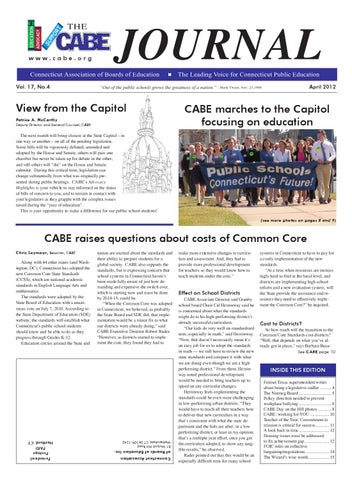
The next month will bring closure at the State Capitol – in one way or another – on all of the pending legislation. Some bills will be vigorously debated, amended and adopted by the House and Senate, others will pass one chamber but never be taken up for debate in the other, and still others will “die� on the House and Senate calendar. During this critical time, legislation can change substantially from what was originally presented during public hearings. CABE’s Advocacy Highlights is your vehicle to stay informed on the status of bills of concern to you, and to remain in contact with your legislators as they grapple with the complex issues raised during the “year of education�. This is your opportunity to make a difference for our public school students! (see more photos on pages 8 and 9)
CABE raises questions about costs of Common Core
of Boards of Education Inc. Connecticut Association
Along with 44 other states (and Washington, DC), Connecticut has adopted the new Common Core State Standards (CCSS), which are national academic standards in English Language Arts and mathematics. The standards were adopted by the State Board of Education with a unanimous vote on July 7, 2010. According to the State Department of Education (SDE) website, the standards will establish what Connecticut’s public school students should know and be able to do as they progress through Grades K-12. Education circles around the State and
nation are excited about the standards and their ability to prepare students for a global society. CABE also supports the standards, but is expressing concern that school systems in Connecticut haven’t been made fully aware of just how demanding and expensive the switch over, which is starting now and must be done by 2014-15, could be. “When the Common Core was adopted in Connecticut, we believed, as probably the State Board and SDE did, that implementation would be a minor fix to what our districts were already doing,� said CABE Executive Director Robert Rader. “However, as districts started to implement the core, they found they had to
81 Wolcott Hill Road Wethersfield, CT 06109-1242
Chris Seymour, Reporter, CABE
make more extensive changes to curriculum and assessment. And, they had to provide more professional development for teachers so they would know how to teach students under the core.�
Effect on School Districts CABE Associate Director and Granby school board Chair Cal Heminway said he is concerned about what the standards might do to his high-performing district’s already successful curriculum. “Our kids do very well on standardized tests, especially in math,� said Heminway. “Now, that doesn’t necessarily mean it’s an easy job for us to adopt the standards in math — we still have to review the new state standards and compare it with what we are doing even though we are a high performing district.� From there, Heminway noted professional development would be needed to bring teachers up to speed on any curricular changes. Heminway feels implementing the standards could be even more challenging in low-performing urban districts. “They would have to teach all their teachers how to deliver that new curriculum in a way that’s consistent with what the state department and the feds are after; in a low performing district, at least in my opinion, that’s a multiple year effort, once you get the curriculum adopted, to show any tangible results,� he observed. Rader pointed out that this would be an especially difficult time for many school
systems in Connecticut to have to pay for a costly implementation of the new standards. “At a time when resources are increasingly hard to find at the local level, and districts are implementing high school reform and a new evaluation system, will the State provide the assistance and resources they need to effectively implement the Common Core?� he inquired.
Cost to Districts? So how much will the transition to the Common Core Standards cost districts? “Well, that depends on what you’ve already got in place,� says Barbara BeauSee CABE page 10
INSIDE THIS EDITION Former Texas superintendent writes about being a legislative staffer .......... 4 The Nutmeg Board ............................. 5 Policy direction needed to prevent workplace bullying ............................. 6 CABE Day on the Hill photos ............ 8 CABE: working for YOU ................. 10 Teacher of the Year: Commitment to mission is critical for success ............ 11 A look back in time ........................... 12 Housing issues must be addressed to fix achievement gap ...................... 12 FOIC rules on collective bargaining/negotiations ..................... 14 The Wizard’s wise words .................. 15
Periodical Postage PAID Hartford, CT
2
The Journal – Connecticut Association of Boards of Education/April 2012 PRESIDENT COMMENTARY
“Focus” on public education The neon green stickers said it all. “FOCUS” on public education. We wore them proudly on our lapels as we participated in CABE’s Day on the Hill. “We” were the one hundred fifty plus Board of Education Members, Superintendents, School Business Officials, PTAs and other Educational Leaders and the more than one hundred students representing numerous school districts in Connecticut. We needed your help and you responded. Your voices were heard as we gathered to support public education; especially this year, “The Year of Education.” Our engagement and participation with our Legislators, is even more crucial as the Education Committee is considering Governor Malloy’s education reform legislation (SB 24). As Governor Malloy addressed the Day on the Hill audience, I thought of his recent Education Reform tours, which I attended in two towns, listening to the questions asked of him. Hostile audiences
and the tenure topic aside, mutual agreement on many of these reform efforts are long overdue and necessary, and provide us the best opportunity to FOCUS on our public education system now. During February and March, it seemed as if I boarded the non-stop, Education Reform Train – testifying at Legislative Hearings; meetings with Senator Stillman and Representative Fleischmann, the Education Committee Co-Chairs; Commissioner Pryor; participating in our “What Will Our Children Lose” Coalition’s Press Conference and attending Legislative Breakfasts and Policy Forums, while never leaving the Capitol/LOB station. The train ride continues. Whether the stops along the way involve proposals to increase ECS funding, making teacher evaluations more accountable or the impact of poverty and housing on education, the FOCUS must remain on an education
CABE Board of Directors EXECUTIVE COMMITTEE Lydia Tedone President, Simsbury Richard Murray First Vice President, Killingly Ann Gruenberg VP for Government Relations, Hampton Stephen Wright VP for Professional Development, Trumbull James Marpe Secretary/Treasurer, Westport Don Blevins Immediate Past President John Prins Member at Large Mary Broderick NSBA President, East Lyme AREA DIRECTORS Susan Hoffnagle, Area 1 Co-Director, Winchester Mari-Ellen (Mimi) Valyo, Area 1 Co-Director, Winchester Daniel Santorso, Area 1 Co-Director, Plymouth Becky Tyrrell, Area 2 Director, Plainville Laura Bush, Area 3 Director, Vernon Gavin Forrester, Area 6 Co-Director, Stratford Elaine Whitney, Area 6 Co-Director, Westport Michael D’Agostino, Area 7 Co-Director, Hamden Sheila McCreven, Area 7 Co-Director, Woodbridge John Prins, Area 7 Co-Director, Branford Robert Ruggiero, Area 8 Co-Director, Madison Pamela Meier Area 8 Co-Director, Madison Gail MacDonald, Area 9 Director, Stonington ASSOCIATES Eileen Baker, Associate, Old Saybrook Sharon Beloin-Saavedra, Associate, New Britain Gary Brochu, Associate, Berlin Robert Guthrie, Associate, West Haven Cal Heminway, Associate, Granby
COMMITTEE CHAIRS Robert Mitchell, Chair, State Relations, Montville Beverly Washington, Chair Federal Relations, Groton CITY REPRESENTATIVES Bob Trefry City Representative, Bridgeport Matthew Poland City Representative, Hartford Michael R. Nast City Representative, New Haven Polly Rauh City Representative, Stamford Charles Stango City Representative, Waterbury
STAFF Robert Rader, Executive Director Patrice McCarthy, Deputy Director and General Counsel Bonnie Carney, Sr. Staff Associate for Publications Nicholas Caruso, Sr. Staff Assoc. for Field Service and Coord. of Technology Sheila McKay, Sr. Staff Associate for Government Relations Kelly Moyher, Sr. Staff Attorney Vincent Mustaro, Sr. Staff Associate for Policy Service Lisa Steimer, Sr. Staff Assoc. for Professional Development Teresa Costa, Coordinator of Finance and Administration Pamela Brooks, Sr. Admin. Assoc. for Policy Ser. /Search Ser. Terry DeMars, Admin. Assoc. for Policy Service Gail Heath, Admin. Assoc. for Government Relations Wilmarie Newton, Admin. Assoc. for Labor Relations Corliss Ucci, Receptionist/Asst. to the Executive Director
The CABE Journal (ISSN 1092-1818) is published monthly except a combined issue for July/August as a member service of the Connecticut Association of Boards of Education, 81 Wolcott Hill Road, Wethersfield, CT 06109, (860) 571-7446. CABE membership dues include $30 per person for each individual who receives The CABE Journal. The subscription rate for nonmembers is $75. Association membership dues include a subscription for each board member, superintendent, assistant superintendent and business manager. The companies and advertisements found in The CABE Journal are not necessarily endorsed by CABE. “Periodicals Postage Paid at Hartford, CT.” POSTMASTER: Send address changes to The CABE Journal, CABE, 81 Wolcott Hill Road, Wethersfield, CT 06109-1242. Email: bcarney@cabe.org. Members can find the CABE Journal online at: www.cabe.org/userlogin.cfm?pp=84&user request=true&keyrequest=false&userpage=84
reform message that deals with the difficult issues we are faced with while striving to improve the lives of all of our state’s school children. Your focus, voice and assistance are critical when it comes to how our Legislators view the policy changes in SB24. Please help address these frameworks, guidelines and measures by contacting or visiting with your Legislator. Contribute an Op-Ed piece for the press, familiarize yourself with CABE’s “Talking Points” which can be found at www.cabe.org/ page.cfm?p=468 as well as the shared priorities of the recent collaboration of six prominent education groups, of which CABE is one; and if so inclined, read the actual bill, all 166 pages worth. As our Day on the Hill continued, about thirty students from four high schools conducted their own “mock testimony hearing,” in one of the hearing rooms. Last year’s bullying legislation was the testimony of choice, with comments, questions and thoughts diverse in nature, representing the diverse student body that now occupied the chairs. Discussion soon began to emerge among this group of students, soon turning into conversation from cyberbullying, to teaching to the test, to the need for creative arts, to mentor support systems for students. The net result was an impromptu experiment with a group of students that resulted in thought-provoking, high level communication on topics that pertained to them every day regardless of the school in which they attend. To summarize, Jefferson Wilkes, a Simsbury High School Senior, e-mailed me his comments: “This was a great opportunity to hear different perspectives on education, from the Governor to Legislators to BOE members and students from across the state, to be heard and to express our
Lydia Tedone
opinions to these groups, as the programs they are discussing impact all of us directly. Education is not merely a list of test scores; it’s been the framework of our lives since pre-school, and the opportunity to participate in maintaining and altering that framework is not something we take for granted. For students, Day on the Hill is the best chance we have to ensure that in the midst of a recession and budget crisis, WE are not forgotten. It’s the best chance we have, to meet with student reps from across the state and to discover what it is that we students have in common, what beliefs we all hold that would make the educational experience better for all in our state. Connecticut’s education system has a responsibility, not only to prepare us academically for our futures but to prepare us as people to face the world; the opportunity to participate in events such as these means we have a chance to help Connecticut’s students become the type of people they want to become.” I encourage all board members, educators and students to keep up the pressure. If education reform doesn’t take place now, with the spotlight on it from the Governor on down, it might never happen. You can all make a difference. Stay on the Education Reform Train until it reaches the station!
OP-ED | Teachers Rise to the Occasion – Let’s Let Them Scott Sugarman Director of Education Initiatives, Our Piece of the Pie
I was a public school principal in Washington, D.C. – arguably one of the most challenging districts in the entire country – when the new educator evaluation system was put in place there. Every day I saw that teachers had a tremendous impact on their students’ learning. And based on much of the static that’s going on around Connecticut, readers may be surprised to learn that in my experience, the best teachers were also the ones who rose to the occasion under the new evaluation system based on student achievement. These educators leapt at the opportunity to educate higher-needs students, and they were excited to be part of a life altering profession whose impact can change lives and open doors to more opportunities. Great teachers saw the evaluation as a professional growth tool, a way to take
focused feedback and channel that into professional growth in and out of the classroom. They avoided attacking the system, or evaluator, and understood that their personal and professional learning did not stop after achieving tenure. The great teachers were, or became, lifelong learners in constant pursuit of the perfect classroom, so their kids had the ultimate chance at success. The best teachers I spoke with understood that, “If I am teaching at the highest levelit is inevitable that my students will learn and grow socially, emotionally, and intelligently.” They embraced the challenge because they wanted to be treated like professionals and evaluated like professionals because they understood their profession was the most vital in any society. For these teachers, the adult issues were always second to student issues. Connecticut should strive to have the (Please see TEACHERS page 13)
3
The Journal – Connecticut Association of Boards of Education/April 2012 EXECUTIVE DIRECTOR COMMENTARY
If not now, when? In this frenetic Legislative Session as the Year of Education is compressed into three months, Boards of Education and Superintendents have the unique opportunity to make meaningful changes to education in ways that we have not seen in many years. For example, I was hired in 1981 at the New York State School Boards Association. The first question I got from a school board member was “when are we going to reform the tenure system?” Actually, he said something even stronger about his frustration with tenure. This year’s discussion is not only about tenure, though from some quarters, that seems to be the sole focus. There are other issues exceedingly important to our members and we continue to push for needed changes to SB 24, the Governor’s omnibus reform bill. Even before the Legislative Session started we began working with other organizations and found common ground. We have formed a powerful partnership, we call the “Big Six”, consisting of CABE, CAPSS, CAS (Connecticut Association of Schools), CBIA (Connecticut Business and Industry Association), ConnCAN and the Connecticut Council for Education Reform. Let me make it clear that we don’t agree with the other groups on every issue. We have differences based on the needs of our constituents. In particular, Patrice McCarthy, Sheila McKay, members of our Board and I continue to lobby hard on the issues of importance to you. We have separate meetings with the legislators, including the leaders, on school board concerns. We also continue to work with CAPSS and CASBO on funding and other issues of importance to the governance and management of our schools. These are the issues that the “Big Six” are working on: • Educator Preparation and Certification • Teacher Evaluation and Support
• Principal Evaluation and Support • Relationship Between Time and Learning • School and District Accountability • Pre-Kindergarten • Education Contract Negotiations All of these areas, the details of which can be found on our website, www.cabe.org, have a profound impact on how our education system works. The
Second, lost in much of the discussion is that the evaluation provisions which the Performance Evaluation Advisory Committee (PEAC) put together over nearly two years of slow, difficult discussions, is that the new system will depend heavily on our ability to ensure that teachers and principals receive sufficient professional development. In our discussions, we all supported helping to free principals from Robert Rader
“We have to stand up for students and what will make our school districts as effective as possible in increasing student growth and closing the achievement gap.” Big Six strongly believe that taking the steps outlined in our Statement would go a long way to fixing the system and strengthening it for the future. We see these as the issues that must be addressed — and done so as soon as possible.
Comments and Op Eds on Tenure I have heard lots of comments on television and read them on blogs, in newspapers, both online and on paper, about the Governor’s recommendations, particularly on his tenure position. There are lots of negative comments and I want to address two issues that have gotten much notice, but little rebuttal. First, none of us (including the Governor) sees the tenure recommendations as THE SOLUTION to the achievement gap. It was never proposed as the single thing that would solve the issue. We see it as a part of a bigger picture that will require lots of reforms that will help us better prepare our students in both underperforming schools and those that are doing better.
some of their paperwork and bureaucratic responsibility in order to spend more time observing and helping teachers become the best they can be. PEAC also expects that teachers would get other help through having mentors, better professional development (especially more one-on-one training) and opportunities to move on career ladders. Only if a teacher, after getting this help, was still determined to be ineffective would the streamlined termination proceedings take place. CABE also has concerns about other parts of the Governor’s bill, including the “coerced consolidation” of some of our smaller districts, money from local districts going to charter schools and aspects of the section on underperforming schools and state takeovers. We will continue to raise these concerns at the Legislature.
We Need You, NOW! But, the work that the CABE Board of Directors and staff are doing is not enough. We need you to talk or write to
your legislators as soon as possible to let them know how you feel about the issues that the Governor has raised. The tenure issue is one that has been a bedrock concern of CABE for years. We need you to show how you feel. The unions are pushing very hard, organizing their members to raise concerns about the tenure issue in particular. I know — my wife is a union member and she has gotten a very specific letter on the Governor’s bill and a robo-call from a union leader about this issue and the callin town hall meeting they were holding. The unions have every right to try to safeguard the protections they feel are in the best interests of their members. As Tom Mooney stated in his Hartford Courant op ed, that’s why unions exist. On the other hand school boards exist to ensure that the will of the community is connected in the most effective way possible to the education of its children. We have to stand up for students and what will make our school districts as effective as possible in increasing student growth and closing the achievement gap. It is imperative that we stand up now for our children, in this, the best opportunity we have had in many years to effectively reform our schools. If we don’t, I predict it will be many years before we get this opportunity again. So I ask you: If not now, when?
CABE Affiliate Members BUSINESS AFFILIATES DIAMOND MEMBER Finalsite GOLD MEMBERS
Berchem, Moses & Devlin Connecticut Business Systems Shipman & Goodwin Siegel, O'Connor, O’Donnell & Beck, P.C Sullivan, Schoen, Campane & Connon
SILVER MEMBERS Anthem Blue Cross and Blue Shield Corporate Cost Control Lindberg & Ripple Inc. Ovations Benefits Group Quisenberry Arcari Architects The Segal Company Trane BRONZE PLUS MEMBERS BL Companies Brown and Brown Fletcher Thompson Architects Friar Associates Goldstein & Peck, P.C. Kaestle Boos Associates, Inc. O & G Industries
BRONZE PLUS MEMBERS The S/L/A/M Collaborative Suisman, Shapiro, Wool, Brennan, Gray & Greenberg Whitsons School Nutrition BRONZE MEMBERS Nathaniel G. Brown, LLC Chinni & Meuser LLC Dattco Inc. Fuller & D’Angelo Architects and Planners JCJ Architecture Kainen, Escalera & McHale, P.C. The Lexington Group Muschell & Simoncelli
EDUCATIONAL AFFILIATES American School for the Deaf Area Cooperative Educational Services Capitol Region Education Council The College Board Connecticut Association of School Business Officials Cooperative Educational Services Connecticut Center for School Change Connecticut Educators Computer Association Connecticut School Buildings and Grounds Association EASTCONN EDUCATION CONNECTION LEARN
4
The Journal – Connecticut Association of Boards of Education/April 2012
Former Texas superintendent writes about being a legislative staffer Retired Superintendent Belinda W. Pustka, from Texas, wrote in the March School Administrator about what it was like to work for a state legislator in the Texas House of Representatives. As a staffer, she has a unique perspective on how to be most effective when you advocate, whether with Congressmen or State Legislators as we hope you’re doing now. Below in italics or quotation marks is the advice that the superintendent gave. While she wrote about working mostly with legislative staffers, the advice also makes sense in regard to the legislators, state or federal, as well. We added in comments to help Connecticut board members and superintendents: • Get to know the key players. “This means the chiefs of staff and the individual staffers assigned to public education matters.” As we find when we lobby, particularly in Washington, these key players often have more influence than anyone else on a congressman’s decision on how to vote on important issues. • Arrange for face time. It is always helpful to set up meetings face-toface with legislators to develop a real relationship, both in your district and in Hartford. Many legislators are in their positions for many years, so, as the superintendent says, “the time you spend building rapport… will pay dividends in future sessions.”
• Play a teaching role. Those assigned to work on public education in legislator’s offices, as well as the representatives themselves, “are seeking as much information as possible to help them understand the issues under debate”. As school board members or superintendents, you are in a great position to “fill in the void” and give them information in a “forthright and honest manner”. And, don’t forget to give them contact information and offer to serve as a resource for them. • Recognize the competing demands. Obviously, legislators get constituent demands, just as school board members hear from the public. Keep this in mind as you meet with them. And, don’t be afraid to remind them, in an appropriate way, that you hear from the public as well and that you are public officials, too. • Make the personal connections. The personal touch is often critical to building trust and understanding. Legislators are more likely to rely on information from those they know or that serve in their districts. • Get to the point while testifying. “I heard some excellent testimony during public education committee meetings. Especially welcome were
those who kept their messages short.” Everyone is pressed for time. Keep it brief — you can always provide longer testimony in writing. • Keep your cool. “If a legislator asks you a question following your testimony, don’t respond in anger or with accusations.” While this may appear to be obvious, if you don’t know an answer, offer to get it. Getting angry, even if you have waited many hours to testify, will not help you get your point across. • Make it simple. The more complex it is, the more difficult it is to
explain in brief testimony. We live in a sound-bite world and must behave accordingly. Don’t be afraid to offer to give a longer explanation in a separate meeting or to put the idea in printed testimony. Good luck in your work with legislators and their staff! Advocacy is a critical role for board members and superintendents and if we can help, let us know! The article, The View Inside the Legislator’s Office, can be found at http:// www.aasa.org/content.aspx?id=22422. Robert Rader Executive Director, CABE and
Patrice A. McCarthy
Deputy Director and General Counsel, CABE
Testifying at the State Capitol
CABE First Vice President Richard Murray, Killingly Board of Education, before the Education Committee testifying on the Education Reform proposals.
Doreen Richardson, Windsor Board of Education.
CABE State Relations Chair Robert Mitchell, Montville Board of Education, before the Appropriations Committee on the Governor’s budget proposals. CABE Deputy Director and General Counsel Patrice A. McCarthy testifying before the Education Committee.
5
The Journal – Connecticut Association of Boards of Education/April 2012 See You in Court – The Nutmeg Board of Education
The Nutmeg Board deals with the issue of residency of students Thomas B. Mooney, Esq. Shipman & Goodwin
The Nutmeg Board of Education makes many mistakes. The latest imbroglio created by the board will be reported here each issue, followed by an explanation of what the board should have done. Though not intended as legal advice, these situations may help board members avoid common problems. The budget of the Nutmeg Public Schools has been tight for the last five years, and Mr. Superintendent has been running out of ways to cut costs. He was, therefore, intrigued when a local busybody sent him a list of three students who allegedly did not live in Nutmeg. He got right on it to see how many students he could send packing. The first case was straightforward. The student’s parents had moved back to Venezuela, and the student was living with his uncle in Nutmeg. Mr. Superintendent promptly sent the uncle a letter informing him that the student was excluded and should not return upon pain of arrest for trespassing. The next case was harder – the student’s family owned a house in town, but they were living in a motel in a neighboring town while their house was
renovated. Mr. Superintendent saw an opportunity for a little revenue, and he called up the father and told him, “We know how your son is sneaking into our schools, and we understand that you don’t want to withdraw him. So just for you, we will permit your child to continue to attend school in Nutmeg upon your payment of the tuition for the year.” The father was apoplectic, protesting that he was a taxpayer and that he and his family would soon be returning to their home. But Mr. Superintendent was unmoved, and he informed the father that he expected to receive a tuition check by the end of the week. In the last case, the address did not match up with any residential housing, but rather was in a commercial zone. Again, Mr. Superintendent simply sent a letter excluding the student from school. Even if the student lived “above the store,” he figured, the family was in violation of zoning regulations. Mr. Superintendent thought that he had expediently cleared out some nonresidents, and he was very surprised to receive a nastygram from local legal scourge Bill Alot. In his letter, Attorney Alot demanded that a hearing be held before the Nutmeg Board of Education to
Seventh Edition Now shipping
A Practical Guide to Connecticut School Law by Thomas B. Mooney, Esq. Shipman & Goodwin The Guide comes with a CD which provides hyperlinks to many cases and statutes and will permit word searches as a supplement to the Index. New to the Seventh Edition: Bullying, background checks, child abuse reporting, discrimination issues, educational reform, FERPA, freedom of information, state aid for education and much, much more You can call CABE at 860-571-7446 or 800-317-0033 and purchase your copy
NOW!
review Mr. Superintendent’s “illegal and discriminatory actions” in excluding the Venezuelan student. In addition, the parents of the student whose house was being renovated filed their own appeal, and they even asked for a stay of execution, to permit their child to continue in attendance while the appeal is heard. Mr. Superintendent was now having
child actually resides. The student whose parents returned to Venezuela, for example, is entitled to attend school in Nutmeg as long as he can show his residence in Nutmeg is permanent, provided without pay and not for the sole purpose of education. With the student’s parents gone, Mr. Superintendent was hard-pressed to say where the student
“Before a student can be denied [the right to attend] school, officials must give the affected student and his/her family notice that they are deemed not eligible for school privileges.” second thoughts about his actions. He figured he needed guidance from the Board, and during the executive session at the end of the last meeting, he kept the Board for another few minutes to tell them about these cases. For once, veteran Board member Bob Bombast was totally supportive of Mr. Superintendent’s actions. “You have my vote,” Bob pledged. “We have to draw the line somewhere.” The other Board members murmured their assent, and they and Mr. Superintendent agreed that they would hold any hearings as necessary to make sure that these students either paid tuition or got out of town. Does the Board have anything to worry about? Yes. Mr. Superintendent and the Board should be worried about at least three different things. First, the right to attend school is an important expectation, akin to a property right. Before a student can be denied that right, school officials must give the affected student and his/her family notice that they are deemed not eligible for school privileges. That notice must also inform them that they may appeal and that their child has the right to attend school pending the outcome of that appeal. Simply sending letters excluding these children from school was a due process violation. Due process also requires an impartial decision-maker. Here, it was inappropriate for Mr. Superintendent to talk with the Board members ex parte about these cases, and Bob was way off base to pledge his support to Mr. Superintendent before he even heard the parents’ side of the story. Board members hear these cases as impartial judges, and they must not talk with administration about the facts of the cases ahead of time. All discussion of the facts should occur at the hearing. On the merits, Mr. Superintendent’s decision-making was also flawed. We start with the basic premise that there is a strong public policy in favor of educating children. If a child is physically present in a school district, there is a presumption in favor of his/her eligibility to attend school. Issues such as where the parents live, zoning and even immigration status do not affect a child’s right to attend school. The critical question is where the
should otherwise be attending school. School boards have more discretion when a student is moving into or out of the school district. Most school boards have special rules for such situations, such as permitting the student to complete the school year after the move (provided that the parents provide transportation). Some boards even permit students to complete their senior year if the move occurs anytime during the junior or senior year. Those are policy judgments, however, and students are legally entitled to attend school in a school district only when they reside there. The converse situation can be problematic. Parents may present their children for enrollment based on the fact that they are building or renovating a house in the district. The legal duty to enroll the student does not arise until the family is actually in residence. However, many boards of education make accommodations so that the student need not transfer mid-year. Such accommodations may include an agreement for reimbursement of tuition if the family does not in fact move in by the deadline set. By contrast, the student in the family that was temporarily displaced during renovation retained the right to attend school, because the family’s residence never changed. Indeed, the school district in which the motel was located had the better argument to exclude the student, since the family’s stay in the motel was temporary and did not establish residence. Motel stays of homeless families is a different story, however, and homeless children must be admitted to school while we figure out who is responsible. Finally, the temptations of executive session once again caused a problem. Public agencies can discuss matters in executive session only if the item is on the agenda, is privileged to executive session, and the reason for the executive session is announced before the executive session. Here, there is no indication that any of these requirements were met as Mr. Superintendent informally filled in the Board members on these residency issues at the end of the executive session. Attorney Thomas B. Mooney is a partner in the Hartford law firm of Shipman & Goodwin who works frequently with boards of education. Mooney is a regular contributor to the CABE Journal.
6
The Journal – Connecticut Association of Boards of Education/April 2012
The Policy Corner
Vincent A. Mustaro Senior Staff Associate for Policy Service, CABE
Policy direction needed to prevent workplace bullying The Workplace Bullying Institute reported that 37 percent of American employees had been bullied at work and that it occurs four times more often than discriminatory harassment protected by law. Wrestling with changes in the level of civility in society is a nationwide challenge. It is necessary for students to have the adults in the school setting model appropriate behavior. In addition, there is overwhelming evidence that workplace bullying may cause severe damage to a target’s mental and physical health. Workplace bullying, like childhood bullying, is the tendency of individuals or groups to use persistent aggressive or unreasonable behavior against a co-worker or subordinate. Workplace bullying can be defined as repeated inappropriate behavior, direct or indirect, whether verbal, physical or otherwise, conducted by one or more persons against another or others, at the place of work and/or in the course of employment, which could reasonably be regarded as undermining the individual’s right to dignity at work. It can also be defined as repeated, unreasonable actions of individuals or a group directed against an employee or group, which are intended to intimidate, degrade, humiliate, or undermine; or which create a risk to the health or safety of the employee(s). Such bullying can involve an abuse or misuse of power. Such bullying behavior creates feelings of defenseless-ness and injustice in the targeted individual and under-mines an individual’s right to dignity in the workplace. It is also possible in the school setting for adults to bully students based upon the manner in which they interact with them. Such bullying can include such tactics as verbal, nonverbal, psychological, physical abuse and humiliation. This type of aggression is difficult because, unlike the typical forms of school bullying, workplace bullies often operate within the established rules and policies of their organization and society. Workplace bullying is often perpetrated by management and takes many forms.
Examples of Workplace Bullying A pattern, including, but not limited to, of the following behaviors are examples of workplace bullying: unwarranted or invalid criticism; blame without factual justification; treatment which is different from the rest of the work group; verbal abuse; exclusion or social isolation; humiliation or ridicule in connection with one’s work; and harassment through excessive monitoring or micro-managing. Additional examples include exposure to an unmanageable workload; work with unrealistic deadlines; blame for things beyond the person’s control; overwork and devaluation of personal life; over evaluation and manipulation of information; or management by threat and intimidation.
How Workplace Bullying Affects People and the Organization Victims of workplace bullying experience significant physical and mental health problems. Such problems can include high stress or post-traumatic stress disorder; financial problems due to absence; reduced self-esteem; loss of self-confidence; musculoskeletal problems; phobias; sleep and digestive disturbances; increased depression/self-blame; family tension and stress; and adverse effects on a person’s career. Each of the individual consequences cited above can also be costly for the organization. Costs of such bullying generally fall into three categories. First, there is the cost of replacing staff members that leave as a result of being
bullied and the cost of training new employees. Next, work effort being displaced as staff cope with bullying incidents in which effort is directed away from work productivity and towards coping. Lastly, there are costs associated with investigations of ill treatment and potential legal action.
Workplace Bullying in the School Setting Connecticut schools are required to have policies and a school climate plan that targets bullying; but these are aimed at students. However, a need exists for school districts to also develop and adopt anti-bullying policies for their adult employees. A core employment value is the commitment to ensuring that every individual is guaranteed a safe working environment where he/she may expect to be treated with dignity both by management and work colleagues. This approach is a positive emphasis on the importance of each individual and the contribution each makes to the success of the workplace. It guarantees the optimal working conditions that allow individuals to freely maximize their roles in the workplace. Sound management ethos is based on providing leadership that encourages individuals in this regard. This is best achieved in the school setting through the creation and maintenance of a positive working environment within a safe school climate. Workplace bullying in schools occurs when the staff of a school engages in bullying or harassment. In many cases of workplace bullying in schools, the behavior of the staff bullying mimics the behavior of student bullies. Workplace bullying in schools consists of bullying from staff, usually teachers or instructors against students or others in the workplace such as other teachers or support staff. Such workplace bullying can include intimidation, humiliation, physical and verbal harassment, aggressive behavior, uncooperative attitude, rumors or other antisocial behavior. When directed against students it can create a very uncomfortable learning environment and lead to not only academic problems but also psychological disorders. When directed against other staff, it can create a hostile working environment and also provides a bad example for students to follow. Workplace bullying in schools can either be overt or covert. Covert bullying occurs when no one is around to witness it. Covert bullying can be particularly frightening
for the victim as the victim has no support and does not know how far the bullying will escalate. Overt bullying takes place in public with witnesses. Self-esteem can be damaged by such bullying. Workplace bullying in schools cannot be completely prevented. However, through preventative measures it can be significantly reduced. Such measures include the adoption and implementation of code of conduct policies which outline the prohibited behavior. The code should be required reading for all staff and consideration should also be given to a training seminar on the topic. Consequences should also be a part of the policy. The policy must be focused on creating an environment where bullying is treated very seriously.
Recommended Policy Action Through policy, a board of education can voice its desire to provide the right examples to students by the adults modeling appropriate behavior. The board of education must be committed to providing all of employees and students with an environment that is free from any form of workplace bullying. The objective of the board’s policy must be to eliminate workplace bullying and to contribute to a supportive environment where the staff and students have the right to carry out the responsibilities of the school. The policy must also guarantee that all complaints will be taken seriously and investigated promptly, and that all parties will be treated with respect. Also, the staff must be protected from victimization or discrimination for assisting in an investigation. Retaliation as a result of a staff member raising a complaint should not be tolerated. Through the adoption of a policy pertaining to workplace bullying, a board of education can establish its desire to provide the right examples for students through adults modeling appropriate behavior in the school/ workplace. Adult behavior becomes a means of educating students. It is important that as we look at the issue of student bullying that it is necessary for adults to behave appropriately in order to avoid sending mixed messages to students. A new policy, #4118.15/4218.15, “Workplace Bullying (Congenial and Healthy Workplace),” has been developed and is available upon request.
State Board adopts position statement on exceptionalities In early February, the State Board of Education adopted the position statement on the Education of Students with Exceptionalities.
All students, including students with disabilities and those with outstanding talents in the creative arts or extraordinary learning abilities, should receive educational services that enable them to develop their full potential. A varied educational environment with a continuum of opportunities and supports is necessary to accommodate each student’s strengths and challenges, and will help prepare students with exceptionalities for entry into higher education and he workforce. This position statement and the accompanying guidance to assist districts may be found on the Board’s website at www.sde.ct.gov/sde/cwp/view.asp?a=2683&q=320314. If you would like additional information please contact the Bureau of Special Education at 860-713-6910.
The Journal – Connecticut Association of Boards of Education/April 2012
7
8
The Journal – Connecticut Association of Boards of Education/April 2012
CABE’s DAY ON THE HILL
STUDENT PARTICIPANTS
Students from the CREC Public Safety Academy in Enfield. Branford Public school students along with school board member and CABE Director John Prins.
Students from the CREC Metropolitian Learning Center in Bloomfield.
Students from Killingly Public Schools chaperoned by school board member and CABE First Vice President Richard Murray. Students from East Windsor Public Schools. Students from Granby Public Schools.
Students from the Plainville Public Schools, chaperoned by school board member Becky Tyrrell.
Students from the Simsbury Public Schools chaperoned by school board chair and CABE President Lydia Tedone.
Students from the New Britain Public Schools.
Students from the Union Public Schools
Students from the Stratford Public Schools.
Students from the Waterbury Public Schools. Students from the Waterbury Public Schools. Students from the Waterbury Public Schools.
9
The Journal – Connecticut Association of Boards of Education/April 2012
CABE’s MARCH TO THE CAPITOL
SPEAKERS
CABE President Lydia Tedone, Simsbury
CABE Executive Director Robert Rader
CABE Deputy Director and General Counsel Patrice A. McCarthy
State Comptroller Kevin Lembo
STUDENT CONVERSATION
Representative Christie Carpino opened up the conversation with the students.
Students debated the effect bullying has on the students in their schools. They also talked about effective ways to improve the climate in the schools.
U.S. Congressman John Larson addressed the group after the march. He talked about the importance of education and the valuable work of school board members.
CABE Day on the Hill briefing where school board member, superintendents and students learned the most up to date information before they went to the Legislative Office Building to lobby their representatives and senators.
CABE Sr. Staff Associate for Government Relations Sheila McKay
Governor Dannel Malloy
Representative Andy Fleishmann
Representative Larry Cafero
LEGISATIVE RECEPTION
CABE Executive Director Robert Rader talks with Representative Pam Sawyer
Board members and Legislators at the CABE Reception held in the Old Judiciary Room of the State Capitol. This reception gave board members an opportunity to talk with Legislators in an informal setting.
Attorney General George Jepsen talks with CABE Deputy Director and General Counsel Patrict A. McCarthy at the reception.
Windsor Board Chair Doreen Richardson speaks with Representative Elaine O’Brien.
Fairfield Board of Education member Phil Dwyer talks with Representative Brenda Kupchick.
CABE Deputy Director and General Counsel Patrice A. McCarthy, State Board of Education member Patricia B. Luke, and CABE Senior Staff Associate for Field Services Nick Caruso discuss the issues.
10
The Journal – Connecticut Association of Boards of Education/April 2012
CABE: working for YOU Individualized Workshops • Professional Development Opportunities Legal Services • Policy Services • Representing You Statewide and Nationally Below are the highlights of activities that the CABE staff has undertaken on your behalf over the last month. We did this:
✦ By ensuring members receive the most up-to-date communications: • Prepared Custom Policy material for East Hampton, Marlborough, New Hartford, Old Saybrook, and West Haven. • Conducted the audit of the Brooklyn policy manual and sent it to the district. • Participated in meeting of the Connecticut Society of Association Executives Governance Committee.
✦ By providing services to meet members needs: • Attended conference given by the Georgia School Boards Association on services that may be of help to Connecticut school districts. • Attended CABE/CAPSS Convention Committee meeting. • Demonstrated CABE-Meeting for a member of the Region 1 Board of Education. • Met with the superintendent, IT Director and Superintendent Secretary in Southington about CABE-Meeting. • Planned, implemented and attended CABE Board of Directors Retreat.
• Participated in conference call with Kentucky School Boards Association about upgrades to CABEMeeting.
✦ By ensuring members receive the most up-todate communications: • Provided webinar on education reform legislation. • Met with the Waterbury Board to discuss policy matters. • As part of the development of new policy manuals utilizing the Custom Policy Service, materials were prepared for East Windsor, Newtown, Ridgefield, Waterbury, Windsor Locks and Woodbridge. • Met with the Watertown Board to discuss policy options.
CABE raises questions about costs of Common Core (continued from page 1 din, Associate Commissioner of Education Division of Assessment, Research and Technology. “The answer to this question depends on the quality and level of fiscal, human and material resources that the district has in place,” according to Beaudin. There are some critical tasks districts will need to complete and activities districts will have to engage in to make the transition by the 2014-15 school year, she added. These include: • establishing a new curriculum aligned to the new standards, by grade or grade span, subject; • informing and involving teachers; • purposing instructional materials and purchasing new materials, as needed; • designing formative assessments and data/monitoring teams; • providing professional development for English Language Arts and math teachers and across other content areas for application; • incorporating the implementation of the CCSS in teacher and principal evaluations; and • informing parents, business leaders, policymakers, pre-school teachers and other early childhood constituent groups about the importance of the standards and expected outcomes of the new assessment system. Almost halfway across the country, Michigan is also in the process of implementing the standards, according to William Schmidt, a Michigan State University Distinguished Professor in the Department of Counseling, Educational
Psychology and Special Education. Like Rader and Heminway, Schmidt feels implementing the standards will not come without challenges. “The biggest cost in my mind is the cost in terms of the time that the district and the teachers will have to put into making sure that they line up whatever curricular materials they have with the Common Core,” explained Schmidt. “We are working with some of the [Michigan] districts toward implementing these and it does take a substantial effort on the part of the districts to recognize the differences that have to occur.” One major difference would be a change in textbooks, said Schmidt. “The biggest impediment to the implementation unfortunately is the textbooks that are out there, because none of them really line up well with the new standards,” noted Schmidt. As a result, Schmidt said he is advising school systems in his state to abstain from buying new textbooks until there are sets that are tailored specifically to the Common Core State Standards. All in all, despite all of the work that the transition will require from districts across the country, Schmidt feels it will all be well worth it. “I think there’s just no question this is one of the best opportunities we as a nation have had to really improve our kids’ learning of math; these standards are every bit national and internationally benchmarked,” said Schmidt. “They’re very focused; they’re rigorous and coherent. The word ‘common’ means they’re intended to be for all kids across the country … so I think that this is a golden opportunity for us to really fix our math education so our kids learn more mathematics and learn it better.”
✦ By providing opportunities for members to learn how to better govern their districts: • Conducted CABE Leadership Institute. • Facilitated workshops for Hartford, Groton, Oxford, Stratford and Watertown Boards of Education on board member roles and responsibilities. • Facilitated workshop for Norwalk Board of Education on evaluations. • Met with the Board Chairs and Superintendents from Southington and Willington on CABE services, activities and programs. • Provided policy information to 31 districts, one attorney, two newspapers, one RESC, two out-of-state school board associations and the State Department of Education through 51 answered requests for information or sample policies, on 45 topics. The topics of greatest interest were alcohol, drugs and tobacco; bullying; and social networking. • Planned and implemented Module 3 of School Governance Council training for Waterbury.
✦ By helping school boards to increase student achievement: • Held hot topic workshop on the CAPSS Transformational Initiative, “NextEd”. • Attended Connecticut Mirror event on early childhood education. • Provided Lighthouse training for the Danbury, Norwalk, Norwich, Windham Boards of Education. • Sent two issues of “Policy Highlights via email covering topics that
affect student achievement. These included home schooling, staffstudent relationships, traits of effective principals, cyberbullying, key policy issues, and disciplinary issues.
✦ By representing Connecticut school boards on the state, national or international levels: • Met with numerous legislators to discuss education issues. • Attended CREC Council meeting to provide a legislative update. • Developed testimony for public hearings. • Participated in Education Panel at the Council of Small Towns Annual Conference. • Chaired NSBA Council of School Attorneys officers conference call. • Participated in Jumpstart financial literacy meeting. • Attended Partnership for Strong Communities on the effect of insufficient housing for the poor and the education of their children. • Participated in Connecticut Coalition for Public Education meeting, dealing with Common Core of Education, and other issues of statewide concern.
✦ By promoting public education: • Attended meetings pertaining to the CAPSS Transformation Project. • Attended CABE’s Day on the Hill. • Finalized work with State Department of Education and Department of Children and Families resulting in a new policy pertaining to child abuse reporting to fulfill legislative requirements. • Met with members of the Trumbull PTA about a program they created that explains the budget process to the community. • Answered questions about the most current legal issues facing boards of education superintendent evaluation, meeting agendas, bingo parties, email between board members, and residency determination. • Attended CREC legislative breakfast. • Spoke at the whatwillourchildren lose.org press conference on education funding. • Attended Connecticut Council for Education Reform reception and screening of “Great Expectations”. • Met with legislative leaders, attended Governor’s forum on SB24.
11
The Journal – Connecticut Association of Boards of Education/April 2012
Teacher of the Year: Commitment to mission is critical for success David Basso CT Teacher of the Year, Berlin High School
Once again, the national discourse on education centers on restoring America’s position as the preeminent political and economic global power, and the nation’s educational system, to many observers, is vital to this reemergence. It is interesting to note the parallels with past educational reform movements sparked by Sputnik and A Nation at Risk. In the 1980s, we were in awe of Japan’s educational and economic prowess, even as we remained weary of their growing strength. Today, we are increasingly alarmed about the rise of China and India, and wonder how the educational systems of nations such as Finland continue to score so highly on international standardized tests. All the while, we are concerned about what American schools and educators are doing wrong. Inherent in the arguments, then as now, are several issues that have informed the education reform debate, including competing visions on how to create an accountable, highly competent, and professional class of educators to ensure widespread educational excellence. In Connecticut, in light of Governor Dannel Malloy’s recently proposed bill on educational reform, we are again faced with the various aspects of this long-standing debate. The catchphrase, “Year of Education,” is being bandied about much like in was in the mid-1980s, and the need for economic and educational competitiveness drives the debate. In the early 1980s, Governor William O’Neill and several other officials sought to boost Connecticut’s economic viability by traveling abroad to seek foreign investment, much like the goal of Governor Malloy’s trip to Davos, Switzerland in January. Stefan Pryor, our new
Commissioner of Education, is looking to seize the momentum much like Gerald Tirozzi did in the early 1980s. In both eras, authorities have associated the revitalization of Connecticut’s economy with its educational system, and this has inspired educational reform efforts. This is true on a national scale as well. Few people, if any, would disagree
conversation about reform is monopolized by those who have ulterior, often political or financial, motives. Significantly, a common characteristic of high-achieving educational systems abroad is the respect afforded to educators and the culturally elevated nature of the profession. Financial incentives notwithstanding, positive social perceptions and feeling valued for carrying out
“All of us, regardless of the position and views we hold, have a moral obligation to make sure we embrace and uphold the core values of our central mission.”
with the need for systemic educational reform in Connecticut schools and throughout the nation. The points of contention, as they always have been, rest with how to enact appropriate, effective, and enduring changes. If the most important values and goals of education inform our work, and students are always kept at the fore of our efforts, then common ground can be found. If, however, testing, international comparisons, and other objective measurements unduly dominate the educational landscape and associated dialogue, and teaching and learning follow in this vein, we run the risk of overlooking the true purpose of education. As educational stakeholders, we all have important roles to play in this transformation, and we all have certain views determined by our experiences. We must be careful to include everyone’s perspective, but also to be mindful of the crucial role educators contribute to this process. Too often, educators’ views and experience are not incorporated, and the
2012 CABE Leadership Institute
Participants with Jack Reynolds, retired superintendent, who served as a consultant to the Institute. Graduates were: Donald Harris (Bloomfield); Bob Rossi (Brooklyn); Robert Maynard (East Windsor); Philip Dwyer (Fairfield); Richard Murray (Killingly); Ava Hart (Middletown); Cheryl McClellan (Middletown); Darin Hudson (Region #1); Jonathan Moore (Region #1); Kate Donnelly (Region #11); Andrea Veilleux (Stratford); Jeff Cugno (Berlin); and Doreen Richardson (Windsor).
such vital work are important motivations for educators. Having a voice in any reform process is reflective of the level of esteem for the profession. Regardless of our roles and contributions, if we desire genuine and sustainable reform, we must sincerely and wholeheartedly uphold the core values of what we do, values typically delineated, most notably, in schools’ mission statements. In doing so, we will take significant steps toward truly empowering our students. Mission statements cannot be mere rhetoric, but rather actual manifestations of what takes place in our schools on a daily basis. The core of any educational reform effort, in essence, aims to dismantle the discrepancy between the ideal – as represented by mission statements – and the reality, which we experience every day. In addition to improved student learning as measured by performance outcomes, we must make sure that the ideals embodied in the true purpose of schooling are carried out as well. If we are overly focused on assessment results, for instance, then we will likely neglect the deeper meaning of education. In other words, if our students score exceptionally high on standardized tests and improve
our international ranking, yet we fail to foster compassion, kindness, love for learning, and other often intangible and difficult to quantify attitudes and practices, then we are seriously misguided in this important endeavor. By remaining mindful of the important responsibility of teachers in developing students who are lifelong learners, critical thinkers, active and knowledgeable citizens, and empathetic and tolerant individuals, we take the necessary steps toward the expression of our schools’ missions. While high expectations, a rigorous curriculum, and appropriate assessments are indeed necessary, academic achievement for its own sake at the expense of true, meaningful learning is counterproductive and potentially harmful to society. If such an approach disproportionately dictates schooling norms, values, and practices, we will continue to waste energy and resources contemplating why our schools are apparently failing, rather than taking action to instigate significant and lasting reform. Too often, cultural attitudes towards educators become hardened given the emotional and personal nature of the discourse. When educators are highly respected and assume an elevated role in society and education is seen as integral to societal growth, however, schooling takes on a different tone. Unquestionably, other than children, educators are the greatest resource a society has, and we clearly have the capacity to effect positive change. With the proper dispositions and efforts, educational excellence can become the cultural norm and positively self-reinforcing. All of us, regardless of the position and views we hold, have a moral obligation to make sure we embrace and uphold the core values of our central mission. These ideals should be present in all of our efforts to improve education. In doing so, we continually reaffirm our belief in the promise that all children have, as well as in our own capacity to make good on that promise.
NSBA President Mary Broderick and Jack Reynolds led a session on macro and micro management, which concluded with a “Rocket Ship” team building activity.
12
The Journal – Connecticut Association of Boards of Education/April 2012
A look back in time a 75+ year retrospective on the budget season Robert Giesen, Director of Finance and Operations, Region 12 (Bridgewater, Roxbury, Washington) It is budget season again and time to begin the journey by school districts across the state to present, defend and ultimately put a budget in place that will address the student’s educational needs for another year. With this context in place it was an interesting discovery that I made several years ago related to the town of Washington, in northwest Connecticut. It is a look back at a budget put forth for consideration nearly 75 years ago when things were simpler. Or were they? The school board was questioned by the public about: • the high salary cost representing nearly 55.6% of the budget; • the transportation costs of 25.8%; • the increasing costs of utilities (now reaching 4.07%);
• nearly 6.8% of the budget devoted to the maintenance of the buildings; and • spending only 3.57% for textbooks and supplies on the students. The public asked, how can you expect us to pay for this ever increasing budget? The year was 1935/1936 and the budget was $33,184. Oh, to have those problems today! Now, we move forward to the year 2011/2012 and the budget is being presented once again. The public again questions the board about the high salary cost representing nearly 55.4% of the budget, the transportation of 7.0%, and the utilities at 3.2% with only 2.0% devoted to textbooks and supplies. The budget was $21,258,228 and you might wonder what else may be driving these costs. On an overview of the current budget one can see costs that did not exist in the “good old days):
Housing issues must be addressed to fix achievement gap David Fink, Policy Director, Partnership for Strong Communities A home, at its core, is shelter from the elements. A home is also security or, as Maya Angelou has told us, “the safe place where we can go as we are and not be questioned.” But for children, their families and their future, a home is the foundation of opportunity. If it is affordable, of high quality and well-situated, a home can be the springboard to educational success and economic independence. If it is overcrowded, unaffordable, substandard and located in an overburdened school district and a community with few services, a home will provide little, if any, support. In Connecticut, the achievement gap between white and minority children is the largest in the nation based upon the National Assessment of Educational Progress (2009). In national tests given to 4th and 8th graders, results showed that low-income students in Connecticut performed at dramatically lower levels than non-low-income students – sometimes up to three grade levels behind. And while the achievement gap is not exclusively an urban problem, children at the wrong end of the achievement gap too often live in tenuous circumstances. • Of Connecticut’s 169 cities and towns, 10% of the housing stock is affordable in only 31 communities that tend to have the most overbur-
dened school districts, with neighborhoods that typically lack access to fresh foods, community services, youth programs and other needs. Those families, and their children, are barred by the high cost and limited supply of housing from choosing communities that boast many services children and their families require, and schools with enough resources to serve individual needs. • Of Connecticut’s 1.4 million households, 27% of the 412,000 that rent their homes earn so little – half the median income or less – and pay so much in rent – half that income or more – that they have very little left over for food, clothing, healthcare, transportation and other needs. They are, therefore, left to make do. They send their children to school between 9 a.m. and 3 p.m., where devoted and experienced professionals attempt to enhance their education. Then, between 3 p.m. and 9 a.m., they return to environments where the concerted efforts made during the school day often receive little reinforcement: homes that are often overcrowded, plagued by allergens and other healthcare hazards, located in neighborhoods that are unsafe or lack services, and yet so costly that their parents must work long hours to make ends meet rather than remain home to (please see HOUSING page 14)
• benefits and taxes for social security and Medicare; • debt not found in the good old days (buildings were probably purchased without borrowing); • purchased services; • physicians, psychologists, social service workers, lawyers and consultants; and • special education costs (nonexistent in the earlier budget).
Many of the costs that made their way into today’s educational system budget and increased the bottom line are often referred to as “mandates”. Others describe these costs as “societal changes”. Whatever they are called, they add to this annual dilemma we call the budget season, Please take the time to review the comparison. What I learned from studying it is: what changes really stays the same!
How do we compare after 75+ years? Categories Salaries Text books Supplies Transportation Utilities (heat, light, water) Maintenance supplies, salaries Repairs Equipment General control Insurance
Town of Washington Region 12 1935-1936 Budget 2011-2012 Budget $18,450 55.60% $11,555,418 54.36% 600 1.81% 111,503 0.52% 583 1.76% 321,707 1.51% 8,567 25.82% 1,484,574 6.98% 1,350 4.07% 671,200 3.16% 2,250 6.78% 649,579 3.06% 500 1.51% 273,204 1.29% 300 0.90% 168,662 0.79% 400 1.21% 184 0.55% 109,350 0.51%
All other expenses Benefits, taxes Debt service Purchased professional & technical services Special education Tuitions All other expenses $33,184
3,329,462 781,484 495,437 2.33% 697,452 609,195 100% $21,258,228
15.66% 3.68%
1935-1936 1.78% 1.81%
25.82%
4.07%
55.60% 8.78%
1.51% 0.90%
0.55%
1.21%
2011-2012 2.87% 3.28%
3.68%
2.33%
15.66%
0.51% 1.29% 0.79% 54.36% 6.98%
3.06% 3.16%
0.52% 1.51%
3.28% 2.87% 100%
13
The Journal – Connecticut Association of Boards of Education/April 2012 CABE and Baldwin Media: Partners in Managing Communications
The
Media Message
from Ann Baldwin, Baldwin Media Marketing, LLC
Power up your PowerPoint I recently came across an article on “Creating Effective PowerPoint Presentations” and thought that this month’s article would be a great opportunity to share some of that information with all of you. While PowerPoint has, thankfully, taken the place of the dreadful overhead projector there are still too many people who don’t know how to craft a good PowerPoint presentation. Remember, just because your presentation has a visual component doesn’t mean it speaks for itself. You still have to “perform” as a presenter and your visual should not be used as a distraction from people focusing on you, it should be an added attraction. There are effective ways to use PowerPoint, particularly as a visual backdrop to your story and it’s not the only game in town anymore. Apple’s Keynote has earned staunch support from the design community. Tools such as Prezi have re-imagined what a presentation should look like and online software like Sliderocket and Slideshare have enabled us to collaborate and share presentations virtually. The idea of what a presentation “is” is being reinvented over and over again as technologies emerge. So what’s a novice presentation designer to do? First, don’t lose hope. Here are five simple ways to make your PowerPoint presentations sizzle: 1. What’s your story? An effective presentation requires a narrative; you want your audience to remember your message. It’s the free-time paradox: We don’t have 30 seconds anymore to listen to a sales pitch (DVRs are a blessing), but we have 30 minutes to hear a great story.
Teachers rise to the occasion – let’s let them (continued from page 2) most rigorous evaluation, certification and hiring processes in the nation because the research is clear: high quality teachers and administrators are the number one factor to a student’s long term success, both inside and beyond the classroom. It is critical to ensure, however, that we increase rigor not only in the evaluation, certification and training processes, but also in the hiring process for educators. When I was a principal I found that the more rigorous I made the hiring process, the more attractive my school became to high-quality teachers. Great teachers will not run from a difficult hiring process; they will be attracted and want to work for a state, district, school that holds the teaching profession to a higher standard. Connecticut should also strive to raise the bar and expectations for all educators that work in schools, establishing a rigorous set of standards and core professional values that educators and administrators need to meet in order to receive tenure and additional benefits within the school setting. Being an educator is the most important job one could have. We need to expect the best out of the adults in order to get the best out of our youth. This is why we need to ensure all teachers have professional development that address the academic and other needs of all kids. Based on my experience as a teacher, principal, and now director of educational initiatives at a nonprofit serving at-risk youth in Hartford, I believe that the edu-
cation reforms being considered in Hartford go a long way toward setting Connecticut back on the right path. Now is the time for true education reform focused on training, hiring, evaluating, and retaining the best teachers and administrators, not only in the region, but in the country. Connecticut cannot afford to have a system that does not quickly and efficiently provide assistance for teachers who need it, but also remove teachers who cannot perform at an acceptable level. We cannot continue to tell parents, “Your son or daughter is struggling because they have an ineffective teacher…but let’s give that teacher another chance to perform.” Because we know that just one year of having an ineffective teacher can impact a child for many years to come. If there are any teachers or principals out there who have questions or concerns about what it will mean for Connecticut to have student centered educator evaluations and recruitment practices, I would be happy to talk to you about my experiences in D.C. I can promise this is the right direction to go in if we are all able to agree that the priority should be educating all of our students – yes, all of them. Even the ones who have been written off by the system for generations. Scott Sugarman is the director of education initiatives at Our Piece of the Pie, a youth development organization in Hartford, CT. He has been a public school teacher and principal. His email address is scott.sugarman@opp.org
Find the story at the heart of your presentation by asking, “What are your audience’s needs? What do they care about? What problems are keeping them up at night? How will information make their lives better? and; What do you want people to do with the information that you are presenting? Perhaps there is a call to action. 2. Focus on one idea. You’re lucky if your audience walks away remembering even one idea you presented; that’s just the reality of presenting. So if your audience should retain one thing, what would that be? Find that one idea—that one reason you’re standing up there presenting—and make sure every bit of content in your presentation revolves around that idea. If it doesn’t, you have to scrap it. 3. Shatter your template. PowerPoint templates are inherently constricting, and most are terrible. Most businesses require employees to use a template, which is fine, but if the template doesn’t give a wide variety of slide options, it will inhibit you. If you can ditch the template, ditch it. If not, see how far you can take it. Can you use full-bleed images? Does the logo have to be on every slide? 4. Images, images, images. What was revolutionary five years ago is now old hat—but it’s a very important hat. Using vibrant images brings your presentation to life and provides a visual cue that your audience’s brains can attach to your message. 5. Give your ideas room to breathe. People retain just so much information at once, and when multiple ideas are delivered on one slide (often as bullet points), there’s little opportunity for the audience to attach a visual cue to each idea. Thus, audience recall is drastically reduced. Instead, put each important idea on its own slide, along with supporting imagery. There’s no difference between spending two minutes on one slide or 30 seconds on each of four slides). Your idea and its supporting points are like actors in a play. You rarely recall those in the ensemble, but those in the spotlight are unforgettable. Allow each point in your presentation time to shine. Creating an effective presentation, particularly when using PowerPoint, is far more than just knowing how to import images and resize fonts. If you follow these five tips, you’ll launch out of that starting block and be well on your way to creating dynamic presentations that resonate with audiences for days, weeks, months, or even years.
is recruiting for
SUPERINTENDENT OF SCHOOLS AMITY REGION 5 PUBLIC SCHOOLS MANCHESTER PUBLIC SCHOOLS OXFORD PUBLIC SCHOOLS ROCKY HILL PUBLIC SCHOOLS SIMSBURY PUBLIC SCHOOLS For an update or more information on vacancies go to our website: www.cabe.org For more information contact, CABE Search Services, Jacqueline V. Jacoby • 860-539-7594 Randall H. Collins • 860-235-6340 P.O. Box 290252, Wethersfield, CT 06129-0252 www.cabe.org/support • Equal Opportunity Employers
14
The Journal – Connecticut Association of Boards of Education/April 2012
CABE/CAPSS CONVENTION November 16-17, 2012 Lisa Steimer Senior Staff Associate for Professional Development
Talented Student Due: May 18, 2012 Does your district have an outstanding student performance group? We are looking for talented students to entertain participants at the 2012 CABE/CAPSS Convention, November 16-17, 2012. Applicants should send a recent recording of the group on CD, DVD or VHS along with the application form. Please be sure to include the amount of space needed and contact information. Go to http://www.cabe.org/uploaded/ Convention/Showcase_your_talented_ student.pdf for more information and the application form.
Convention Hotel Reservation Information Mystic Marriott Hotel and Spa 625 North Road, Route 117 Groton, CT 06340
Those attending the annual CABE/ CAPSS Convention have been guaranteed a room rate of $149. When making your reservation, be sure to mention that you are with the CABE/ CAPSS Convention in order to take advantage of this special room rate. This rate of $149 is guaranteed only until 4:00 pm on October 17, 2012. After this date, reservations for Convention participants are based on availability and are offered at the prevailing rate. You may make reservations directly with the Mystic Marriott’s reservation department by calling 866-449-7390. You may also make reservations online at http://www.marriott.com/ hotels/travel/gonmm?groupCode= CCACCAA&app=resvlink&from Date=11/15/12&toDate=11/17/12. The negotiated rate code already entered in the appropriate field, allowing you to quickly make your room reservation. Purchase orders are NOT accepted.
Housing issues must be addressed to fix achievement gap (continued from page 12) supervise homework and recreation. Overall, housing quality, affordability and location can significantly impact school performance. Families who are homeless, or frequently move, may be forced to transfer their children from school to school in mid-year, increasing the likelihood of classroom and social difficulties. Insecure housing situations can lead to emotional and behavioral problems, and substandard housing can cause physical maladies. To provide all Connecticut households with a wider array of educational choices that can work best for their children’s individual needs, and to offer the benefits of diversity and an integrated student body, Connecticut has established the Open Choice program, magnet schools and charter schools in addition to its
FOIC rules on collective bargaining/negotiations Kelly B. Moyher Senior Staff Attorney, CABE
The Freedom of Information Act (FOIA) allows an exemption from public disclosure for collective bargaining negotiations and strategy discussions. However, in Martin Gould v FOIC, the Freedom of Information Commission has won a case where New Britain Superior Court Judge Henry Cohn ruled that where arbitrations are concerned, the evidentiary portions of salary discussions were open to the public. Of particular interest in this case was if the “conduct and strategy of collective bargaining” exception to the public disclosure requirements of the Freedom of Information laws apply to public sector union negotiations as well as to impasse resolution procedures. The Commission had previously found
that negotiations which take place during the arbitration process do not have to be conducted in open session. Judge Cohn noted that arbitrators are not independent contractors performing a service for hire, but are selected from lists maintained by the State Department of Education and as such, are a committee of that agency. This case stems from the 2010 Torrington School Board’s contract arbitration hearings where a reporter from the Republican-American newspaper was excluded from the hearings. An appeal was made to the FOIC, which agreed with the newspaper that the state open meetings law had been violated. Board of education and union arbitrators appealed the FOIC decision to Superior Court, where the court upheld the FOIC’s decision. The decision is likely to be appealed to the Connecticut Supreme Court.
CABE-Meeting CABE-Meeting is a user-friendly, web-based service specifically designed to assist the board, superintendent and central office staff in preparing for and running board of education meetings.
neighborhood schools. Those options tend to be oversubscribed, however, and none provide the other benefits that often accrue to families that can live in those school districts or neighborhoods 24/7. A more comprehensive answer will be affordable homes and high-resource schools in both cities and suburbs so parents can choose the educational and community options that work best for their children’s particular needs. Not suburb, or city, but both. A wide range of research and reporting has been done on the connections between housing and school performance, and housing and the well-being of students. The full policy brief can be found at: http://www.pschousing.org/news/housingeducation-focus-partnerships-first-2012policy-brief.
Is CABE-Meeting for you?
• Do you want to save your district money? • Do you want to utilize technology to enable staff to be more efficient? • Do you want to focus more of your human and financial resources on increasing student achievement in your district? • Do you want to enhance communication with your community? • Do you want to model the methods that should be used to infuse technology in your schools? If you answered “yes” to at least one of the above questions, read on. CABE-Meeting can help you!
C.E.S. wins Award of Excellence
Learn more: CABE Vice President for Professional Development Stephen Wright (Trumbull), recently presented the Award of Excellence in Educational Communications to C.E.S. Representative Council President Arlene Liscinsky, (Shelton) and Executive Director Evan Pitkoff in Trumbull.
CABE-Meeting Lisa Steimer Connecticut Association of Boards of Education 81 Wolcott Hill Road Wethersfield, CT 06109 www.cabe.org
Take a few minutes and go to http:// www.cabe.org/page.cfm?p=158 to complete our CABE-Meeting cost analysis worksheet (located at the bottom of the page) and see how much your district can save in one year. Districts can save thousands of dollars each year by using CABEMeeting. For more information or to schedule a demonstration for your board, call Lisa Steimer at 800-317-0033 or 860571-7446 or email lsteimer@cabe.org.
15
The Journal – Connecticut Association of Boards of Education/April 2012
The Wizard’s wise words Richard Lewis, CAE, Executive Director, Ohio School Boards Association As school districts across the state assemble new management teams, they might be wise to look to the “Wizard of Westwood” as an exemplar. The Wizard was better known as John Wooden, the head basketball coach at UCLA from 1948 to 1975. During a spectacular run, Wooden won 10 NCAA national championships in a 12-year period, including seven in a row. During this streak, his teams won a record 88 consecutive games and he was named national coach of the year six times. Wooden taught his players that their chances of having a successful team may be in direct proportion to the ability of each player to live up to a set of suggestions. Many of those suggestions apply to school boards. Let’s take a look.
1. Be a gentleman at all times Your jobs as elected leaders will sometimes become emotional, and through all the challenges, the eyes of your community will be upon you. Strive each day to be a role model to others. Wooden urged each of his players — “Be more concerned with your character than your reputation, because your character is what you really are, while your reputation is merely what others think you are.”
2. Be a team player, always The board, its superintendent, treasurer and administrators need to work in concert to fully reach the district’s potential. Any member of the team more concerned with putting personal agendas ahead of the district’s mission damages the team’s chance of success. Know your role; perform it well; help others excel in their roles; and be a catalyst for your teammates’ success. In Wooden’s words, “The main ingredient of stardom is the rest of the team.”
3. Be a good student in all subjects — not just basketball The Wizard often said, “The worst thing about new books is that they keep us from reading the old ones.” Read more. Learn more. It is not enough to be the technology guru or finance expert on the board. Good board members acquire a working knowledge in all areas of boardmanship, including governance, fiscal management, support services, facilities, personnel, negotiations, instruction, community relations and more.
4. Be enthusiastic, industrious, dependable, loyal and cooperative According to the coach, “The player who gives his best is sure of success, while the player who gives less than his best is a failure.” The same is true for board members. If it’s true that enthusiasm is contagious, then be a carrier throughout your community.
5. Earn the right to be proud and confident Winning a national championship is no small feat. Winning 10 is almost unimaginable. Wooden drilled into his team, “Winning takes talent, to repeat takes character.” If you are new to your team, give credit to those who have gone before. Your job is to continue that successful march to the future. Repay that trust and earn the right to be proud of what is accomplished with your contributions and remember the coach’s belief that “little things make big things happen.”
6. Keep emotions under control without losing fight or aggressiveness Public education will face a mountain of adversity on your watch. Political challenges, financial challenges and societal challenges all will conspire to test your mettle. Wooden maintained, “Adversity is the state in which man most easily becomes acquainted with himself, being especially free of admirers then.” There will be no shortage of community members and parents who will display charged emotions at meetings or perhaps give up on your schools. You do not have that luxury. Never lose control or hope.
7. Work constantly to improve without becoming satisfied “It’s what you learn after you know it all that counts.” What great advice. The challenges facing education evolve each year. No matter how long you’ve been on board, there will always be the opportunity to learn more and improve. Take advantage of your OSBA membership by reading the association’s communications and participating in webinars, workshops, region programs and the annual Capital Conference. The investment of your time will pay enormous dividends.
8. Acquire peace of mind by becoming the best that you are capable of becoming If things are going poorly take heart, because it will not last forever. If things are going well, enjoy it while it lasts, because that surely will not last
forever, either. In the end, the UCLA mentor’s advice would be, “Don’t measure yourself by what you have accomplished, but by what you should have accomplished with your ability.”
9. Never criticize, nag or razz a teammate “A coach is someone who can give correction without causing resentment.” This Wooden axiom applies to education leaders, as well. It’s inevitable that a fellow board member — perhaps misinformed or misguided — will err. Always praise publicly and correct privately. No matter what, you must remain the professional.
10. Never miss or be late for any class or appointment Nothing looks worse than an unprepared board member, whether it’s arriving 10 minutes after the meeting is called to order or opening your board packet for the first time in full view of your staff and community. Take your charge seriously and be prepared. You were entrusted with the future of your community’s children and you owe it to each one to dedicate the time necessary to do the job the best it can be done.
11. Never be selfish, jealous, envious or egotistical Wooden would tell you, “Consider the rights of others before your own feelings, and the feelings of others before your own rights.” There is no room on the school board for those who would deny others’ rights and feelings. If you can offer leadership to the board by chairing committees or serving as a liaison, it is your responsibility to volunteer. If others are selected for that privilege instead of you, then recognize that every member of the team can contribute and support them in any way you can.
12. Never expect favors Wooden practiced that “it isn’t what you do, but how you do it.” Perhaps more important than the advice to not expect favors is the admonition to not grant them. You were elected to represent the entire community. Your roots may be with the quarterback club or the music boosters. Your passion may lie with special education or gifted students. Your personal views may be to promote levies or keep them from appearing on the ballot. Regardless, you now represent the entire district and not a special interest group. Your constituents are the students of your schools.
Each and every decision must be made with that in mind.
13. Never waste time “Never mistake activity for achievement.” Time is your most precious resource. There will be many efforts that demand your time. Community forums, task forces and special meetings will fill the calendar. Use the limited time of your board and staff wisely. Before embarking on a new project, insist that adequate time is also given to planning and preparation. “If you don’t have time to do it right, when will you have time to do it over?”
14. Never alibi or make excuses Wooden observed, “If you’re not making mistakes, then you’re not doing anything.” Sometimes, despite your best efforts, things will not go as you planned. Remember that any single failure is temporary. Take responsibility and move on. And never blame fellow board members, your staff or the community.
15. Never require repeated criticism for the same mistake While we should not make excuses for our mistakes, neither should we repeat them. Learn from those experiences and improve. Wooden picked up his players when they were down and kept them humble in their success. “You can’t let praise or criticism get to you. It’s a weakness to get caught up in either one.”
16. Never lose faith or patience “Success is never final, failure is never fatal. It’s courage that counts.” That charge requires you to stay the course. The challenges may be great, and the rewards may be few, but if you prepare for your role on the board and make decisions based on the best information available, you will make a difference in your schools and your community. You may never know the full impact you make until years after your term of office has ended.
17. Never have reason to be sorry afterward Your time on the board is limited. Make the most out of every opportunity. Never have the occasion to look in the mirror and say, “Tomorrow I will try harder.” Article first appeared in February 2012 issue of the OSBA Journal. Copyright 2012 Ohio School Boards Association. All rights reserved. Reprinted with permission.
16
The Journal – Connecticut Association of Boards of Education/April 2012
REPRESENTING CONNECTICUT SCHOOL BOARDS FOR MORE THAN 35 YEARS THE LAW FIRM OF
SULLIVAN, SCHOEN, CAMPANE & CONNON, LLC Our Business Is Your Business With over thirty five years experience providing legal representation to Connecticut’s public school districts, Sullivan, Schoen has set the standard for public sector collective bargaining, has created an unparalleled body of case law favorable to school boards, and has established a proactive partnership with its clients to develop policies and practices that anticipate the law’s ever-evolving demands. Call us and see how we can help you. Hartford Office
Danbury Metro Office
646 Prospect Avenue Hartford, CT 06105-4286 Phone: 860-233-2141 Fax: 860-233-0516 William R. Connon, Partner
24 Stony Hill Road, Suite 106 Bethel, CT 06801-1166 Phone: 203-778-3600 Fax: 203-778-8877 Roseann G. Padula, Partner
Website: sscc-law.com