Maharlika to acquire 11.2% of Asian Terminals By Reine Juvierre S. Alberto
S
OVEREIGN wealth fund manager Maharlika Investment Corporation (MIC) will be acquiring 11.2 percent of Asian Terminals Inc. (ATI) to take a minority stake in one of the country’s key port operators. In a statement on Tuesday, MIC said the acquisition will be done through direct share purchases and a tender offer to public shareholders, all while ATI voluntarily delists from the Philippine Stock Exchange (PSE). Related story in B1 Companies. Under the transaction, MIC will offer to acquire shares from the public float at P36.00 per share,
WORLD » A9
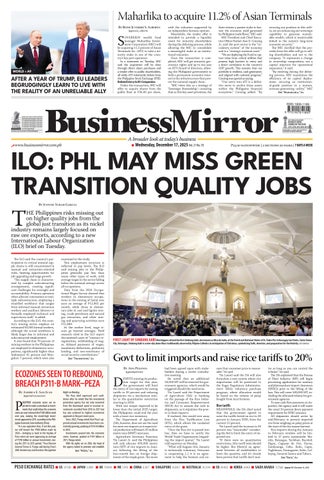
AFTER A YEAR OF TRUMP, EU LEADERS BEGRUDGINGLY LEARN TO LIVE WITH THE REALITY OF AN UNRELIABLE ALLY
ROTARY CLUB OF MANILA JOURNALISM AWARDS
2006 National Newspaper of the Year 2011 National Newspaper of the Year 2013 Business Newspaper of the Year 2017 Business Newspaper of the Year 2019 Business Newspaper of the Year 2021 Pro Patria Award PHILIPPINE STATISTICS AUTHORITY 2018 Data Champion
@reine_alberto
with the valuation supported by an independent fairness opinion. Meanwhile, the tender offer is intended to provide a liquidity event for minority shareholders during the delisting process, while allowing the MIC to consolidate a meaningful stake at an institutional valuation. Once the transaction is completed, MIC will get minority governance rights and up to one seat on ATI’s board of directors, allowing the Philippine government to hold a permanent economic interest in the infrastructure that powers the national supply chain. “MIC views this as a strategy of ‘Sovereign Stewardship’—ensuring that as this key asset privatizes, the
State retains a passive stake to harvest the economic yield generated by Philippine trade flows,” MIC said. MIC President and Chief Executive Officer Rafael Jose D. Consing Jr. said the port sector is the “circulatory system” of the economy and is a “strategic national asset.” “We are deploying the Fund to capture value from critical utilities that possess high barriers to entry and a direct correlation to the country’s GDP growth. This ensures that our portfolio is resilient, cash-generative, and aligned with national progress,” Consing was quoted as saying. “Our entry into ATI is a definitive move to anchor these assets within the Philippine financial ecosystem,” Consing added. “By
securing our position in this utility, we are enhancing our sovereign capability to generate sustainable wealth, which is inextricably linked to the nation’s long-term economic security.” The MIC clarified that the proceeds from the offer will go to selling shareholders and not to the company. “It represents a change in ownership composition, not a capital injection for operational expansion,” it said. “By entering during the delisting process, MIC maximizes the efficiency of its capital deployment, securing an institutional-grade position in a mature, revenue-generating utility,” MIC See “Maharlika,” A2
BusinessMirror A broader look at today’s business
EJAP JOURNALISM AWARDS
BUSINESS NEWS SOURCE OF THE YEAR
(2017, 2018, 2019, 2020, 2021) DEPARTMENT OF SCIENCE AND TECHNOLOGY
2018 BANTOG MEDIA AWARDS
ILO: PHL MAY MISS GREEN TRANSITION QUALITY JOBS www.businessmirror.com.ph
T
n
Wednesday, December 17, 2025 Vol. 21 No. 70
P25.00 nationwide | 2 sections 20 pages | 7 DAYS A WEEK
By Justine Xyrah Garcia
HE Philippines risks missing out on higher quality jobs from the global just transition as its nickel industry remains largely focused on raw ore exports, according to a new International Labour Organization (ILO) brief on Tuesday. The ILO said the country’s participation in critical mineral supply chains is still concentrated in manual and extraction-oriented roles, limiting opportunities for job upgrading and wage growth. “The supply chain is characterized by complex subcontracting arrangements, creating significant challenges for oversight and accountability. Primary operators often allocate concessions to multiple subcontractors, employing a stratified workforce that ranges from informal manual extraction workers and auxiliary laborers to formally employed technical and supervisory staff,” it added. According to the ILO, the country’s mining sector employs an estimated 93,000 formal workers, although the actual workforce is likely larger due to informal and subcontracted employment. It also found that 70 percent of mining workers in the Philippines are employed in elementary occupations, significantly higher than Indonesia’s 41 percent and Mongolia’s 7 percent, which were also
examined in the study. This employment structure is reflected in pay levels. The ILO said mining jobs in the Philippines generally pay less than many other types of work, with average wages in the sector falling below the national average across all occupations. Data from the 2024 Occupational Wages Survey showed that workers in elementary occupations in the mining of metal ores earn an average of P12,965 per month, while those in elementary jobs in coal and lignite mining, crude petroleum and natural gas extraction, and other mining and quarrying activities earn P11,884. At the worker level, wage issues go beyond averages. Field research cited in the ILO report documented cases of “contract irregularities, withholding of wages, delayed payments of wages, mandatory deductions, predatory lending, and non-remittance of social security contributions.” See “Transition,” A2
ECOZONES SEEN TO REBOUND, BREACH P311-B MARK–PEZA By Andrea E. San Juan
P
@andreasanjuan
HILIPPINE economic zones are expected to make a comeback as investments that could infuse the economic zones are seen to breach the P300-billion mark next year, nearing the record-high investments approved in 2011, according to the Philippine Economic Zone Authority (Peza). “It is our aspiration that, if not this year, we will breach the P300-billion mark by 2026—bringing us back to the heyday of Peza when we were approving an average of P290 billion in annual investments during the 2011 to 2015 period,” Peza Director General Tereso O. Panga said during Peza’s 30th Anniversary and Investors Recognition
Night on Monday. The Peza chief expressed such confidence after he noted that the investment promotion agency has not only recovered from the downward spiral in ecozone investments recorded from 2016 to 2021 but has also achieved its highest investment approvals in the past seven years. Since 2022, Panga noted that Peza’s approved annual investments have been consistently growing, peaking at P214.18 billion in 2024. Investments poured into the economic zones, however, peaked at P319 billion in 2011, Panga noted. With his sights set on 2026, the head of the agency tasked to promote and establish See “PEZA,” A2
FIRST LIGHT OF SIMBANG GABI Worshippers attend the first Simbang Gabi, also known as Misa de Gallo, at the Parish and National Shrine of St. Padre Pio in Barangay San Pedro, Santo Tomas City, Batangas. Simbang Gabi is a nine-day dawn Mass traditionally observed by Filipino Catholics in anticipation of Christmas, symbolizing faith, devotion, and preparation for the Nativity. ROY DOMINGO
Govt to limit imports and raise rice tariffs to 20% By Ada Pelonia
D
@adapelonia
ESPITE missing its production target for this year, the government will limit the entry of rice imports by raising tariffs to 20 percent and reducing shipments via a mechanism similar to the quantitative restriction starting in 2026. With rice output expected to be lower than the initial 2025 target, the Philippines could end the year with a lower rice inventory. The Department of Agriculture (DA), however, does not see the need for more rice imports as it expects local production will breach 20 million metric tons (MMT) next year. Agriculture Secretary Francisco Tiu Laurel Jr. said the Philippines will only allocate 450,000 metric tons (MT) of rice imports in January following the lifting of the four-month ban on foreign shipments of the staple grain. The move
had been agreed upon with stakeholders during a recent consultative meeting. He noted that an additional 50,000 MT will be reserved for government agencies, which would be triggered should the need arise. Tiu Laurel said the Department of Agriculture (DA) is banking on the passage of the Rice Industry and Consumer Empowerment (RICE) Act to sustain the curb in shipments, as it stipulates the power to limit imports. If realized, this would veer away from the Rice Tariffication Law (RTL), which allows the unabated entry of the grain. “Once the Rice Act is passed into law, then we have to notify the World Trade Organization [regarding the import quota],” Tiu Laurel told reporters on Monday. “What will happen this January is technically voluntary. Everyone is cooperating [...] it is an agreement to help the farmers and en-
sure that consumer price is reasonable,” he said. Tiu Laurel said the DA will also formulate a new system where rice importation will be patterned to the Sugar Regulatory Administration’s (SRA) voluntary purchase program, where allocation would be based on the volume of palay bought from local farmers.
Rice tariffs
MEANWHILE, the DA chief noted that the government agreed to raise the tariffs levied on rice to 20 percent in January 2026, from the current 15 percent. Tiu Laurel said the increase to 20 percent was “reasonable” considering the bid to limit the entry of imported rice. “If there were no quantitative restrictions, [the tariff rate] should be higher. But [there’s] an agreement between all stakeholders to limit the quantity, and it’s clearly been proven that tariffs don’t mat-
ter as long as you can control the volume,” he said. The DA explained that the Bureau of Plant Industry (BPI) will begin processing applications for sanitary and phytosanitary import clearances (SPSICs) prior to the lifting of the ban. This will cover 500,000 MT, including the allocated volume for government agencies. To ease cash-flow pressures on importers, the agency said it will waive the usual 10-percent down payment requirement for SPSIC issuance. All shipments should arrive by mid-February to prevent imported rice from weighing on palay prices at the start of the dry season harvest. Rice imports during the January to February window will be limited to 17 ports nationwide: Manila, Batangas, Tacloban, Bacolod, Iligan, Cagayan de Oro, Davao, Zamboanga, Cebu, Iloilo, Capiz, Tagbilaran, Dumaguete, Subic, Calbayog, General Santos and Tabaco. See “Rice,” A2
PESO EXCHANGE RATES n US 59.1180 n JAPAN 0.3809 n UK 79.0940 n HK 7.5970 n CHINA 8.3877 n SINGAPORE 45.8457 n AUSTRALIA 39.2544 n EU 69.4932 n KOREA 0.0403 n SAUDI ARABIA 15.7568 Source: BSP (December 16, 2025)
News
BusinessMirror
A2 Wednesday, December 17, 2025
Inflation… Continued from A12
months of 2025, in a survey conducted in September 2025.
Vietnam has fully recovered arrivals
“SO for the current period the last four months, 44 percent of experts expressed optimism…[it] will be better than last year,” said Ruescas, citing the survey responses to the question: “What are your prospects for your destination in September to December 2025.” Six percent of the respondents said prospects will be “much better.” In terms of the factors that concern the tourism experts, the UN Tourism survey showed that inflation such as “high transport and accommodation costs” is the main challenge that will affect the prospects of their destinations, said 61 percent of the survey respondents. The rest were “other economic factors” at 39 percent including low consumer confidence (28 percent), other geopolitical risks (25 percent), increase in trade tariffs (23 percent), travel requirements (22 percent), extreme weather events (18 percent), visitor congestion (16 percent), staff shortages (15 percent), among others. Meanwhile, Ruescas showed that only Vietnam, among Southeast Asian countries, recovered its visitor arrivals to prepandemic levels (+20 percent), in the Asia-Pacific region. The best performer was Bhutan at +203 percent. While the Philippines has yet to recover its prepandemic arrivals, the country has become a major source of tourists in Asia Pacific, and specifically in Southeast Asia. (See, “PHL emerges as top source market for ASPAC travel,” in the BusinessMirror, Dec. 15, 2025.)
www.businessmirror.com.ph
Villars sell Prime Water utility to Lucio Co group
V
Jobs…
Continued from A12
in July 2023. The MIC is the sole vehicle for mobilizing and utilizing the MIF
for investments in transactions aimed at generating optimal returns on investments.
Peza…
This is P12 billion short of this year’s lowerend target of P250 billion, but Panga stressed: “We’re getting some applications still.” In fact, Panga revealed that at least four projects may still be approved by Peza before the year ends. “These are manufacturing [firms] and some of these are coming in new. There’s one American, some are Japanese. I cannot name yet unless they actually file their application into Tourism, which is another big-ticket investment. This time, it’s Ultra Luxury Tourism brand,” the Peza chief also noted. With the P238-billion investments approved by Peza as of December 12, it has already surpassed last year’s P214.18 billion in investments. The amount of investments greenlighted by Peza in 2024 is 21.89 percent up compared to the P175.71 billion in 2023. In his speech during the Investors Recognition Night, Panga said Peza has generated over P4.5 trillion in cumulative investments since its establishment in 1995, created more than 1.81 million direct and quality jobs, and contributed over $1.12 trillion in exports. “We managed to transform wastelands into industrial hubs, sleepy towns into bustling central business districts, and rural communities into thriving new growth areas—driving both local and national development,” the Peza chief underscored.
relatively low, Velasco cautioned that displacement data based on retrenchment reports tend to understate actual job losses, particularly in the construction sector. “Retrenchment reports will always be less than actual, [especially] if those affected are informal in status and in [subcontracting arrangements],” he said. The scale of the disruption has also surfaced during Senate budget plenary debates, with Senator Sherwin Gatchalian flagging the potential impact of license cancellations on construction workers. Gatchalian, who sponsors the proposed 2026 budget of the labor department, earlier said that around 100,000 workers in the construction sector may be affected by the ongoing enforcement actions tied to the flood control issue. The lawmaker said the construction sector is showing signs of a “slowdown” and cautioned that labor market disruptions could persist in the coming months if activity in public infrastructure remains subdued. Gatchalian added that DOLE is preparing mitigation measures, including redeploying displaced workers, expanding temporary employment support, and accelerating upskilling and reskilling programs in coordination with the Technical Education and Skills Development Authority (Tesda). This was echoed by NUBCW Secretary General Santiago Nolla, who told the BusinessMirror that the agency has helped ease the displacement of some affected workers. Nolla said some displaced workers were immediately referred to DOLE for livelihood assistance and skills upgrading under Tesda, while others were absorbed into ongoing government projects, including the North– South Commuter Railway. “Others were adopted by EEI for its Metro Manila Subway Project and other private construction projects,” he said in a text message last week, December 11. The DOLE earlier said that the corruption scandal will not likely result in widespread job losses in the construction sector. (See: https://businessmirror.com.ph/2025/09/17/ flood-control-project-probe-willnot-result-in-job-losses-dole/). “No, because historically, during the ‘ber’ months, there’s an increase [in jobs]...We are more concerned to make sure that as employment rises, these are quality jobs—not just temporary ones,” Laguesma told reporters when asked if corruption probes could dampen hiring in the industry.
nickel mining is limited, especially among subcontracted workers who account for a large share of employment. Where unions exist, membership is often confined to directly hired workers, constraining collective bargaining and workers’ ability to raise concerns on wages and safety. “Subcontracted workers, often found where formal and informal economic activities intersect, make up the majority of the workforce and face the most severe OSH risks, and tend not to be members of any union. In some regions, no union activity was reported,” it stated. The report also flagged gender disparities in Philippine nickel mining, noting that while women account for up to 40 percent of workers in some areas, they are often concentrated in informal or subcontracted roles, with limited access to technical positions and
employment benefits. In contrast, the report pointed to Indonesia’s downstream nickel strategy, which expanded domestic processing and created more formal jobs with higher wages and better social protection. The ILO said that 97 percent of workers in downstream nickel processing in Indonesia hold formal contracts, while copper mining in Mongolia is characterized by high formalization and social security coverage exceeding 90 percent The comparison, the report noted, underscores how industrial policy choices shape labor outcomes in critical mineral supply chains. “In Indonesia and Mongolia, greater domestic processing in nickel and copper supply chains has created formal jobs with higher wages and better social protection, showing that moving beyond raw material export can generate improved working conditions and greater value capture locally,”” it also stated.
By VG Cabuag
ILLAR-CONTROLLED Prime Water Infrastructure Corp. on Tuesday said it sold the company to the Lucio Co group. In a statement, Prime Water said it has entered into definitive agreements for the acquisition of 100 percent of the company by Co’s Crystal Bridges Holding Corp. No other details were given. “Upon completion, Crystal Bridges will acquire PrimeWater’s entire portfolio of operations across the Philippines,” the company said. Prime Water operates water and
wastewater infrastructure projects nationwide, including water district joint ventures, bulk water supply and septage and wastewater management services. In the past several months, it had been in the news owing to mounting complaints of alleged poor service in various parts of the country, prompting investigations by both the Executive and Congress.
Maharlika…
lished under Republic Act No. 11954, mandated to generate sustainable long-term returns that support national economic priorities. The MIC made its first investment by acquiring a 20-percent stake in the National Grid Corporation of the Philippines (NGCP) in January this year, after the MIF was created
Continued from A1
added. The MIC is the manager of the Maharlika Investment Fund—the country’s sovereign wealth fund—estab-
THE Villar group has sold all of its stake in utility firm Prime Water Infrastructure Corp. to the Lucio Co group. Pictured here from left Vincent Co; Leonardo Dayao, Cosco Capital Inc.’s president; Manuel B. Villar Jr., chairman of the Villar group; Lucio Co, chairman of Cosco Capital; and Manuel Paolo A. Villar, president of Prime Water.
Continued from A1
economic zones in the country unveiled what’s driving his optimism for next year. “We’re traveling to the US to meet with another big-ticket investor in the first week of January to discuss about their big-ticket investment to start the year with a bang,” Panga told reporters on the sidelines of the event on Monday night. The highest investment pledges recorded by Peza was during the administration of former President Benigno S. Aquino III. As such, he said: “That’s why we said this will bring us back to the heydays of Peza. But we’re hoping and praying it’s going to be an upward, consistent trajectory.” Explaining the trend of the investment approvals within the ecozones, Panga said: “It’s been increasing,” adding, “These investors are investing in the future more than the present.” “That means they have their trust and confidence, huge trust and confidence in current leadership. And that eventually we will surpass all these troubles besetting us now,” added Panga. As 2025 comes to a close, Panga reported that the Peza Board has already approved P238 billion in investments as of December 12,2025.
Transition… Continued from A1
“These deficits are particularly noted among workers in subcontracted arrangements, such as drivers and manual workers,” it added. Occupational safety and health (OSH) gaps were also identified as a major concern, despite the country having an existing OSH law. According to the ILO, workers reported exposure to nickel dust, inadequate protective equipment, unsafe road conditions, and weak regulatory enforcement. “In addition, there are community reports and complaints about widespread nickel dust pollution, with homes and water sources near mining sites becoming contaminated,” ILO added. The labor organization also said that union presence in Philippine
Govt to limit imports and raise rice tariffs… Continued from A1
The DA forecasts rice imports to reach between 3.6 MMT and 3.8 MMT in 2026, while expecting palay output to hit a record 20.3 MMT. The Philippines posted an all-time high harvest of 20.06 MMT in 2023.
www.businessmirror.com.ph
Wednesday, December 17, 2025
DPWH to Senate: So sorry By Lorenz S. Marasigan
T
@lorenzmarasigan
HE Department of Public Works and Highways (DPWH) has apologized to the Senate for providing insufficient data that led to a P54-billion budget reduction, submitting revised estimates that account for project-specific costs like hauling distances and site conditions. In a December 15 letter to Senate Finance Committee Chairman Sherwin Gatchalian, Public Works Secretary Vivencio Dizon acknowledged that the initial submission containing only regional adjustment factors was inadequate to determine accurate cost savings in nearly 10,000 affected projects. “We would like to respectfully apologize for the insufficient and limited data and information earlier transmitted to the Committee on Finance on the application of
the updated CMPD,” Dizon wrote, referring to the Construction Materials Price Data. The Senate reduced DPWH’s 2026 budget to P570.48 billion from the P624.48 billion approved by the House, citing projected savings from lower materials costs under the updated CMPD. “We recognize that the initial submission, which consisted only of the Regional Adjustment Factors, was insufficient to arrive at an accurate adjustment to the
Legislator says standoff over public works budget could stall ₧400-billion projects
T
HE House of Representives Committee on Appropriations chairman on Tuesday reiterated her warning that unresolved differences over the 2026 budget of the Department of Public Works and Highways could stall nearly P400 billion worth of infrastructure projects and negatively impact economic growth, employment, and community services. Suansing said the issue is not whether to remove overpriced components, but how cost reductions are applied, stressing the need for a workable approach that does not render projects unimplementable. Lawmakers clashed on Sunday over the DPWH’s request to reverse the P45-billion cuts imposed by the Senate on the House version of the agency’s budget. Senators have stood by the reductions, which House lawmakers believe—if applied wholesale—could make close to 10,000 projects worth an estimated P400 billion unimplementable. Suansing said the potential impact has already been quantified. She said stalled infrastructure spending would have ripple effects across the economy, the labor market, and local communities. The dispute centers on the revised construction materials price data (CMPD) submitted by the DPWH to the Senate, which the upper chamber used as the basis for its cuts. The House, however, said the Senate erred in applying the CMPD reductions across the board rather than on a projectspecific basis. Public Works Secretary Vivencio Dizon has said the CMPD should be applied per project, citing variations in construction material costs depending on location. Suansing said the House is pushing for a workable and transparent solution that removes overpriced components without derailing projects already programmed for implementation. She stressed that discussions should continue openly and collectively to arrive at a solution. Suansing also warned that prolonged delays threaten the completion of the budget itself. Meawhile, a vice chairman of the House Committee on Appropriations on Tuesday called for the adoption of the “Singson formula” as a crucial reform to generate savings from the Department of Public Works and Highways’ (DPWH) proposed 2026 budget. Batangas Rep. Leandro Legarda Leviste said the Singson formula—introduced during the term of former Public Works Secretary Rogelio Singson—requires the automatic rejection of bids that are not, on average, at least 10 percent lower than the Approved Budget for the Contract (ABC), alongside across-the-board reductions in budgeted project costs. Singson presided over the DPWH during the presidence of Benigno Aquino III, when only a few public works projects were implemented. “Even if DPWH prices in the 2026 budget remain high, costs can still be brought down by strictly applying the Singson formula and rejecting bids that fail to meet the 10-percent threshold,” Leviste said. Jovee Marie N. dela Cruz
almost 10,000 affected projects,” Dizon said. He noted that the initial adjustment factors used generic material cost assumptions that “do not reflect actual project-specific impacts and should not be treated as a conclusive basis for budget cuts or funding reductions.” He explained that proper CMPD application requires project-specific, pay item-level recomputation of Programs of Work and Approved Budgets for the Contract, consistent with established engineering and procurement rules. The department submitted updated adjustment factors incorporating additional costs typically incurred during actual implementation, particularly hauling materials from sources to project sites, localized market behaviors, and unique site conditions. However, Dizon stressed the updated CMPD will still be strictly applied on a project-by-project basis under the 2026 budget, in accordance with Department Order 210 dated December 11, 2025. The department order mandates implementing offices to
apply reduced mater ia l costs to ensure project budgets accurately ref lect prevailing market conditions. “Should any priority project nonetheless become unimplementable, the department will seek appropriate funding augmentation from the Office of the President, including the use of generated savings within the DPWH,” Dizon said. According to the December 11 department order, DPWH offices must follow a mandatory workflow including recomputing affected unit costs, revising detailed estimates and approved budgets for contracts, and submitting multiple documentation layers before procurement can proceed. Personnel who fail to comply with the guidelines face administrative sanctions including reprimand, suspension, or dismissal. Acts involving falsification or manipulation of data could result in criminal charges under existing anti-corruption laws. The letter was also furnished to House Committee on Appropriations Chairperson Mikaela Angela Suansing.
A3
Lay-over tours, medical lounge now available at Naia By Samuel P. Medenilla @sam_medenilla
W
ITH the offering of new amenities at Terminal 3 of the Ninoy Aquino International Airport (Naia), President Marcos is confident that the country can become a tourism powerhouse in Asia. On Tuesday, Marcos inaugurated new facilities at the Naia, including e-gates, which allow passengers to complete immigration clearance in 20 seconds; an all-Filipino food hall and a mezzanine food hall to provide passengers with more dining choices; and the Dignitaries Lounge for very important persons. Terminal 3 now also has a Medical Tourism Concierge. The Department of Tourism introduced the Transit Tour, which allows even layover passengers to explore local sites. “Instead of spending hours confined to the terminal, travelers
now are given the chance to enjoy a thoughtfully curated glimpse of the Philippines including its culture, heritage, and people or what we call experiential tourism,” Marcos said. Marcos hopes the newly renovated Naia will not only provide better travel experience, but can also help draw more foreign travelers to the country. Naia is operated by the San Miguel Corp. through its subsidiar y New Naia Infra Corp. (NNIC). “We joined hands with the NNIC to ensure that the progress will be felt by the people who use systems—these systems every day. So, in doing so, we reaffirmed our commitment to position the Philippines as a tourism powerhouse here in Asia,” he said. Marcos made the statement after the Department of Tourism reported that visitor arrivals in See “Naia,” A7
A4
Wednesday, December 17, 2025
www.businessmirror.com.ph
Legislator warns of dire effect of Maifip funding reduction By Jovee Marie N. dela Cruz
M
@joveemarie
ORE than one million Filipinos could be deprived of immediate, life-saving emergency care if funding for the Medical Assistance to Indigent and Financially Incapacitated Patients (Maifp) program were reduced, the chairperson of the House of Representatives Committee on Appropriations said on Tuesday. Nueva Ecija Rep. Mikaela Suansing, Appropriation committee chairman, said Maifip served around 3.3 million beneficiaries in 2025 with a General Appropriations Act (GAA) allocation of P41.2 billion. She cautioned that failure to
adopt the House version of the Maifip budget for 2026 would slash the number of beneficiaries by about 1.1 million. “In 2025, the number of beneficiaries given the GAA [General Appropriations Act] amount of P41.2 billion was 3.3 million
beneficiaries. If the House version [of the Maifip 2026 budget] is not adopted, this would reduce the number of beneficiaries by 1.1 million. That is how severe the potential impact is,” Suansing said, noting that Maifip beneficiaries are among the country’s most indigent Filipinos. The House proposed P49.2 billion for Maifip in 2026, while the Senate initially pushed for only P28 billion. During the bicameral conference committee meeting last Saturday, lawmakers from both chambers agreed to increase the a l location to P51.6 billion.
Crucial role
DEPUTY Speaker Kristine Singson-Meehan said Maifip plays a crucial role in strengthening the Universal Health Care (UHC) program. “ Ma i f ip f i l l s c r it ic a l gaps where insurance coverage, for example Philhealth’s, is insufficient or unavailable. Maintaining strong MAIFIP funding
supports UHC by ensuring that no patient is denied care due to cost,” Singson-Meehan, who represents Ilocos Sur, said. Under the program, hospitals— whether public or private—are assured of payment when they provide emergency treatment to indigent patients. Sen. Raffy Tulfo, who supported the budget increase, noted that hospitals outside urban centers often rely solely on Maifp guarantees to accept emergency patients. Palawan Rep. Jose Alvarez also assured the public that Maifip funds go directly to hospitals, not to politicians. “No funds pass through the hands of politicians. The payment goes straight from the DOH regional office to the hospitals once the bills are submitted,” Alvarez said. Negros Occidental Rep. Javier Miguel Lopez Benitez welcomed proposals to shift Maifip from a patronage-based system to an institution-based approach, similar to how assistance is provided in
tertiary education. “The reason patronage or selective access exists is because of limited resources,” Benitez said, expressing hope that a similar institutional model could be adopted in the health sector.
Concerns
HOW E V ER , Hou se A ssist a nt Minor it y Leader Sarah Elago questioned the bicam panel ’s d e c i s ion to i nc re a s e M a i f ip funding, warning that the prog ra m per pet u ates pat ron age pol it ics and fa i ls to add ress the root causes of the countr y’s healthcare crisis. “From our first day in Congress, Gabriela Women’s Party has already questioned the increase in Maifip funding because it has become a source of patronage politics and does not address the real problems in our healthcare system,” Elago, the Gabriela nominee to the House, said. She argued that expanding Maifip does not solve Filipinos’ immediate healthcare needs and
instead reinforces a system where access to medical assistance depends on political connections. G a b r i e l a Wo m e n’s P a r t y stressed that expanding Maifip does not resolve Filipinos’ immediate healthcare needs and instead perpetuates a system where access to medical aid depends on political connections. “Increasing funds that pass through padrino systems and g u a ra ntee let ters is not t he solution. It only strengthens patronage politics while hospitals remain lacking in beds, facilities, and health workers,” Elago said. The lawmaker underscored that fixing the country’s healthcare system requires direct, long-term investment. “The government must stop forcing patients to line up for hours just to get minimal hospital bill discounts. The budget should go directly to public hospitals for more beds, better facilities, additional health workers, medicines, and diagnostics,” she said.
Consumer group to Congress: Adopt clear, strong data policies By Rizal Raoul Reyes @brownindio
C
ONSUMER advocacy group CitizenWatch Philippines on Tuesday urged lawmakers to adopt clear and robust data localization policies, warning that failing to do so leaves Filipino consumers exposed as digital technology reshapes education, work, and business. “AI [artificial intelligence] has already become part of everyday life for Filipino consumers, especially among students and young professionals,” said CitizenWatch Philippines Lead Convenor Orlando Oxales. “As adoption expands, policies must evolve alongside technology so consumers can safely and reliably benefit from AI.” Recent data has shown how AI has taken hold in the country. According to Statista and We Are Social–Meltwater, the Philippines ranks sixth globally in ChatGPT usage, with about 46 percent of internet users engaging with the platform, well above the global average of 26 percent. Meanwhile, the 2025 State of Higher Education report by education technology firm Instructure Holdings Inc. found
that 63 percent of Filipino students use generative AI tools such as ChatGPT for writing, translation, and research. Oxales said the surge in use manifests the rapid expansion of the local AI economy. Market estimates project the Philippine AI sector to grow from roughly $772 million in 2024 to as much as $30 billion by 2030. In a separate study, the Department of Trade and Industry has said AI adoption could contribute up to 12 percent of gross domestic product (GDP) growth, or about $92 billion. These trends point to a sharp rise in data generation, connectivity demand, and reliance on cloud-based digital infrastructure. CitizenWatch also pointed out that AI use is becoming more customized, with platforms now allowing users and organizations to develop taskspecific AI tools and agents. These systems require constant internet connectivity and large computing resources, which aretypically hosted on cloud infrastructure—making the physical location of data storage a growing policy concern. Oxales cited local technology companies such as Senti AI, Xurpas AI Lab, and Kital
Philippines that are developing AI-powered solutions for customer service, analytics, and Filipinolanguage processing while sectors including fintech, logistics, media, and business process outsourcing are deploying AI for credit scoring, workflow automation, content moderation, and customer engagement, further increasing dependence on data centers and cloud services. “As AI systems grow more complex, they require larger volumes of data and continuous data exchange,” Oxales said. “Where these systems are hosted directly affects performance, reliability, and user experience.” On the other hand, Jimmy Go, president and chief executive officer of tech distributor VST ECS Philippines, said localized data storage can improve speed and reliability while also encouraging investments in power, cooling, and energy infrastructure. “AI is now being embedded into critical industries such as AboitizData Innovation that has deployed AI tools to optimize power plant performance and electricity management, while Globe Telecom has reported using AI to optimize energy use across its network generating electricity savings of 11.3
million kilowatt-hours in 2024, equivalent to around P125 million,” Oxales said. Without a clear data localization framework, CitizenWatch warned that AI systems and data generated by Filipinos could be stored overseas, placing them beyond Philippine oversight and exposing users to risks from cyber incidents, service disruptions, or geopolitical instability. In addition, the group noted that the local data center industry is already expanding, with telecommunications firms and foreign investors building new capacity. Market reports indicate operational data centers nationwide, with significant additional capacity expected in the coming years. CitizenWatch said it supports ongoing discussions among government agencies and industry stakeholders and reiterated its call for a balanced data localization policy that protects consumers while supporting innovation and investment. “When policies are clear and forward-looking, consumers gain more reliable services, better protection, and greater confidence in the technologies they use every day.”
House bill giving pension to all seniors on track
T
HE House Special Committee on Senior Citizens on Tuesday approved the committee report and substitute bill on the proposed Universal Social Pension for Senior Citizens, which seeks to mandate the provision of a social pension for all Filipino se-
nior citizens. Under the current system, only indigent senior citizens are eligible to receive the P1,000 monthly social pension, while pensioners of the Social Security System (SSS) and the Government Service Insurance System (GSIS) are excluded.
The approved substitute bill aims to address this gap by expanding coverage and making the social pension mandatory for all senior citizens, ensuring that no elderly Filipino is left behind owing to restrictive definitions of indigence. Marikina Rep. Miro Quimbo, one of the authors of the bill, noted that only a limited number of senior citizens receive SSS or GSIS pensions, and even those who do often continue to contribute to household expenses despite having little or no regular income. He also stressed that existing GSIS and SSS pensions are generally insufficient to meet the daily and medical needs of older Filipinos. “One of the key issues I want to address through this proposed amendment to the social pension law is the disqualification of SSS and GSIS pensioners. First, the amount received from SSS and GSIS is no longer realistic when compared to the daily and medical expenses of senior citizens. More importantly, why are we penal-
izing those who worked and supported themselves during their youth? It is unfair to penalize those who contributed to the nation through taxes while they were working. Excluding them from the social pension is discriminatory, and this is something we need to amend,” Quimbo said. He added that the proposed measure not only reflects the real situation faced by senior citizens, but also upholds their dignity and sense of security as they age. “Our senior citizens spent their entire lives working, raising families, and contributing to their communities. Yet in their old age, many of them struggle to meet everyday expenses. By extending this universal benefit, we are honoring their contributions to society and helping them meet their needs with dignity and peace of mind,” Quimbo said. The approved substitute bill will now be transmitted to the House plenary for further deliberation. Jovee Marie N. dela Cruz
FIRST Balfour employees and workers at a project in the First Philippine Industrial Park in Santo Tomas, Batangas, drop their plastic waste into a designated container, which is collected every Thursday for recycling by The Plastic Flamingo Philippines, a pro-environment social enterprise and recycler.
Company collects 6 tons of plastic waste for recycling
F
IRST Balfour Inc., the Lopez Group’s construction and engineering arm, has reached a new milestone in its partnership with The Plastic Flamingo Philippines (PLAF), a pro-environment social enterprise and recycler, by collecting for PLAF more than six tons of reusable plastic waste since the start of their cooperation in 2022. First Balfour, particularly its head office in Parañaque City and the FPIP Plaza construction site in Santo Tomas, Batangas, collected the plastic waste not only from company operations but also from supportive employees. “As a committed PLAF partner, First Balfour has collected and delivered the plastic waste to PLAF’s facility in Muntinlupa. So, instead of sending the waste to landfills, these materials were transformed into sustainable construction products,” said Vicente M. de Lima II, First Balfour head of strategic business planning and corporate sustainability. PLAF collects and transforms plastic waste into eco-boards and eco-products. These eco-boards are then used to build new schools, homes, and shelters, helping communities manage plastic pollution while strengthening resilience against the country’s many natural hazards. With these eco-boards, PLAF also manufactures 100-percent recycled plastic products such as sorting bins, desks, counters, and other custom-made furniture, as well as school chairs for under-resourced schools in the Philippines. First Balfour carefully records all the plastic waste it collects and donates to PLAF. The volume, in kilograms, amounted to 451.3 in 2022; 2,163.42 in 2023; 2,037.14
in 2024; and 1,632.14 as of October 2025. “It is a true honor to partner with First Balfour in plastic collection. Together, we have reached significant collection milestones of 6,000 kilograms, and we cannot wait to reach the next ones over the coming years,” said Krisha Rubia, PLAF senior partnerships and operations manager. “This could not have been achieved without the strong commitment of First Balfour’s employees, who consistently do their part to make the world a better place. Thank you for your constant support of such a great cause.” De Lima also disclosed that other First Balfour project sites now also implement various plastic reduction initiatives to divert more waste away from landfills. These initiatives include upcycling plastics into usable site materials, such as trash bins and simple recycled fixtures. Several First Balfour construction sites, along with the head office, have, likewise, phased out plastic utensils, cups, and straws, particularly in cafeterias, and have transitioned to reusable or eco-friendly alternatives as they implement single-use plastic programs. “Our partnership with PLAF is anchored on First Balfour’s commitment to support the United Nations Sustainable Development Goals [SDGs], particularly SDG 12 on Responsible Consumption and Production,” de Lima explained. “Through responsible waste management practices and meaningful collaborations, First Balfour advances FPH’s mission of forging collaborative pathways toward a decarbonized and regenerative future,” de Lima said.
Wednesday, December 17, 2025
A5
Malacañang probes Bondi terror suspects’ Davao visit By Samuel P. Medenilla @sam_medenilla
Rex AnthonyNaval & Joel R. San Juan @jrsanjuan1573
M
ALACAÑANG has announced authorities are looking into the prior activities in Davao in November of the Bondi Beach shooters in Australia, who killed at least 15 people. The attack was reported to be perpetrated by Indian nationals, Sajid Akram, 50, and his 24-yearold son, Naveed during the weekend after they visited Davao last month. The Australian government tagged the shooting incident as a terror attack and said it may have been driven by “Islamic State ideology.” Citing the National Security Council, Palace Press Officer Claire Castro said local authorities are still validating information on the said visit of both Indian nationals to
the country. “At this time, there is no confirmed information indicating that their visit posed a security threat, and this is not considered a serious or immediate concern,” she said in a press briefing last Tuesday. The Presidential Communications Officer (PCO) undersecretary said they are now coordinating with Australian authorities on the matter. She also assured that “standard security, immigration, and counterterrorism protocols remain fully active” in the country’s borders. According to government data, both Indian nationals arrived in Davao from Sydney on 1 November 2025. They left the country on 28 November 2025 to return to Australia. Last Sunday, the two gunmen attacked people in Bondi Beach, which resulted in 15 fatalities and 24 others being hospitalized.
PHL vows stronger law enforcement cooperation with Australia after Bondi Beach tragedy By Malou Talosig-Bartolome
T
HE Philippines has vowed to deepen cooperation with Australia in security and law enforcement following the Bondi Beach massacre that left at least 15 people dead during a Hanukkah celebration. Foreign Affairs Secretary Ma. Theresa Lazaro said she spoke by phone with Australian Foreign Minister Penny Wong to extend condolences and underscore Manila’s commitment to joint efforts against intolerance, hatred, and violence. “The Philippines stands firmly in solidarity with Australia and underscores strong PHL–AUS cooperation in security and law enforcement matters,” she wrote on X (formerly
Twitter). Lazaro’s statement comes as Philippine authorities continue to verify travel records of the suspects, Sajid Akram and his son Naveed, who were confirmed to have visited Davao from November 1 to 28, 2025 before returning to Sydney. The National Bureau of Investigation has launched its own probe into their activities in the country, coordinating with the Bureau of Immigration, the Armed Forces of the Philippines, and regional offices. With an estimated 86,000 Filipinos residing in Sydney, the DFA said it is closely monitoring developments and reaffirmed its commitment to safeguard overseas communities amid rising concerns over extremist violence.
The Bureau of Immigration (BI) said Sajid was an Australian resident and an Indian national. BI spokesperson Dana Sandoval said Akram, an Indian national, and his son, Naveed Akram, an IndianAustralian national, arrived in the Philippines together last November 1, 2025 from Sydney, Australia. Sandoval said the two reported Davao as their final destination based on their records. “They left the country on November 28, 2025 on a connecting flight from Davao to Manila, with Sydney as their final destination,” Sandoval said. Meanwhile, the National Bureau of Investigation (NBI)-Counter Terrorism Division is now looking into the activities of the Akrams while in the country. “The NBI, through its Counter Terrorism Division, motu propio, is looking into the matter without having to wait for a request from
By Jonathan L. Mayuga @jonlmayuga
T
HE Department of Environment and Natural Resources (DENR) has forged a landmark multisector partnership with the Department of the Interior and Local Government (DILG), the Municipality of Tanay, Bureau of Corrections (BuCor), A Brown Company, Inc., the University of Rizal System (URS), and the National Commission on Indigenous Peoples (NCIP) to implement the “Regenerative Tourism for Resilient Tanay” project in Tanay, Rizal. Carried out under the DENR’s Project TRANSFORM or Transdisciplinary Approach for Resilience and Environmental Sustainability through Multistakeholder Engagement, the initiative was officially launched through the signing of a memorandum of agreement (MOA) recently. The ceremony was led by DENR Secretary Raphael P. M. Lotilla and Regional Executive Director Nilo Tamoria, Tanay Mayor Rex Manuel C. Tanjuatco, Provincial Board Member Reynaldo San Juan, Bu-
Cor Director Melencio S. Faustino, DILG Provincial Director Lionel L. Dalope, A Brown Company, Inc. Assistant Vice President Jason Santos, NCIP Director Reynaldo A. Dingal, and URS President Nancy T. Pascual. A ceremonial tree planting followed the MOA signing, symbolizing the partners’ collective commitment to sustainable development, climate resilience, and inclusive environmental governance on December 13. In his keynote message, Secretary Lotilla highlighted Tanay’s unique ecological context, noting that much of the municipality falls within a protected area. This, he emphasized, calls for a careful balance of development and conservation. “As part of Project TRANSFORM, we would like to congratulate you and your partners. This is a partnership among you. This is your project. We are here to facilitate, we are here to support. But at the end of the day, it is you who are going to sustain this particular project, and you also are going to be the beneficiaries of the project,” he said. See “DENR,” A7
before returning to Australia.
AFP validating info, claims
ABOUT Bondi Beach suspects, while the BI had confirmed the visit of the two suspects in the Bondi Beach shooting last November, the Armed Forces of the Philippines (AFP) on Tuesday said that it is still too early to tell on whether they have links and training with any terrorist group in the country. “The BI confirms their visit to the country, however, it is not conclusive on the claims that both suspects are linked to any terrorist group and received training here in our country,” AFP spokesperson Col. Francel Margareth Padilla said in a message to reports. She also added that the AFP is still in the process of “validating such information” together with other government agencies and the broader intelligence community. Padilla also said the AFP remains
CHED, OCD, PNP launch nationwide training to fortify HEIs amid surge in bomb threats By Claudeth Mocon-Ciriaco @claudethmc3
T
O he lp H ig her E duc ation Institutions (HEIs) strengthen preparedness and reinforce campus safety amid recent bomb threat incidents, the Commission on Higher Education (CHED), in close coordination with the Office of Civil Defense (OCD) and the Philippine National Police (PNP), has launched the Crisis/ Incident Management and Bomb Threat Response Training. CHED noted that from this year alone, 209 bomb threats were reported in HEIs, with 128 incidents occurring in October and November, according to data from PNP and a CHED survey. These incidents have disrupted academic activities and raised safety concerns among students, faculty, and staff. In response, CHED has rolled out targeted interventions to help institutions strengthen prevention, response, and continuity measures, ensur-
ing the safety and well-being of all stakeholders. The first run of the program was held from December 6 to 8 at Mariano Marcos State University (MMSU) in Batac, Ilocos Norte, with 48 representatives from 16 State Universities and Colleges (SUCs) identified as highly vulnerable to such threats. During the three-day program, participants completed intensive modules, expert-led discussions, and practical emergency simulations facilitated by specialists from the OCD and PNP. CHED Chairperson Dr. Shirley C. Agrupis affirmed the Commission’s strong commitment to campus safety and resilience, stressing the crucial role of HEIs in protecting learners, personnel, and communities. “I hope that we continue to give the highest importance to safety measures in our institutions,” she said. The initiative, she said, also signals the need to develop more
academic programs that advance knowledge in protecting our civil society. “Through this training program, I hope CHED can create new learning pathways dedicated not only to safeguarding higher education but also to promoting the safety of our society,” she added Overseen by CHED Commissioner Dr. Ricmar P. Aquino, the program equips faculty, staff, security personnel, and administrators with crisis management competencies, including threat evaluation, bomb threat response protocols, coordinated communication strategies, contingency simulations, and emergency drills. Three additional training cohorts are scheduled for January and Februar y 2026, ensuring broader sectoral coverage and reinforcing CHED’s sustained drive to help HEIs develop robust security systems and maintain safe, resilient campuses for all learners and personnel.
DPWH yields to safety concern, cancels Malacañang’s wish to open Davao City’s coastal road prematurely By Manuel T. Cayon
DENR chief: Project Transform promotes ‘Regenerative Tourism’ in Tanay, Rizal
Australian authorities,” NBI spokesman Palmer Mallari said. Mallari said the NBI is currently coordinating with its regional and district offices, the BI and the Armed Forces of the Philippines in order to backtrack the activities of the two gunmen. Based on initial reports, Sajid was killed by Australian authorities during the shooting rampage that took place in Bondi beach, a famous beach in Sydney, Australia. His son is reportedly in critical condition in a hospital after sustaining injuries during a shootout with authorities. Reports further said that authorities were able to recover Islamic State group flags and improvised explosive devices (IEDs) in the gunmen’s vehicle. The two reportedly underwent militar y-style training in Southern Philippines, where I s l a m ic e x t re m i s t s o p e r at e ,
@awimailbox
D
AVAO CITY—The Department of Public Works and Highw ay s t w ice post poned the opening of the west exit of the 18.8-kilometer coastal road yielding to public and official admonition on road safety concern and quality of the section of the project. In a statement on Monday, the DPWH said it was postponing anew the opening of the closed section of coastal road, from the Times Beach area in the eastern section through the recently in-
augurated 1.3-kilometer Bucana Bridge to the western exit connecting to the Roxas Avenue in downtown Davao. “The DPWH informs the public that the temporary opening of the Davao City Coastal Bypass Road Segment B [Tulip Drive -Roxas] scheduled tomorrow, 16 December will not push through,” it said. It said the decision “was made in the interest of public safety, as additional safety measures and assessments are still being undertaken to ensure the protection of all motorists and road users,” it added. It was the second postponement, the first one calling also the
postponement of the opening on Monday, the date that President Ferdinand Marcos announced after he inaugurated the Chinafunded bridge two weeks earlier. The DPWH apologized “ for any inconvenience this may cause and respectfully ask for the public’s understanding. Rest assured that the safety and welfare of the public remain our top priority. The Department will continue to provide timely updates regarding the opening of the road”. Mayor Sebastian Duterte on Monday warned the DPWH was See “DPWH,” A7
committed to working with the broader security sector to maintain vigilance against any form of terrorism. She also said the military is also fully committed to supporting civilian authorities in safeguarding national security, in accordance with the Constitution and existing laws. Meanwhile, the Philippine National Police (PNP) said that it remain on high alert to prevent any untoward similar incidents in the country, Acting PNP chief Lt. Gen. Jose Melencio Nartatez Jr. said all police units across the country have been instructed to strengthen their presence in public areas, major thoroughfares, and key venues where holiday events and gatherings are expected. “The PNP is maintaining heightened vigilance to deter provocateurs and prevent any security threat,” he added.
Anna Liza Logan named Marcos’ new chief presidential legal counsel
P
RESIDENT Ferdinand Marcos, Jr. has appointed Anna Liza G. Logan, one of the recent nominees for Ombudsman, as his new chief legal counsel, according to Malacañang. In a press briefing Last Tuesday, Palace Press Officer Claire Castro said Logan will replace former Chief Presidential Legal Counsel Juan Ponce Enrile, who died last month. Prior to her new appointment, Logan served as Deputy Executive Secretary for Legal Affairs of the Office of the President. She also worked as an Associate of Agabin Verzola Hermoso Layaoen and De Castro as well as a junior partner of Marcos Ochoa Serapio and Tan, the law firm founded by First Lady Louise “Liza” Araneta Marcos. The Palace lawyer has extensive law practice in Civil and Criminal Litigation; Family, Labor and Human Settlements Adjudication; and Commercial Practice. Logan was also among the seven nominees for Ombudsman, which was submitted by the Judicial and Bar Council to the President last month. The Chief Executive, however, picked former Justice Secretary Jesus Crispin “Boying” C. Remulla as the new Ombudsman. Aside from Logan, Castro also announced the new appointments of the following officials of the Office of the Executive Secretary (OES): Senior Deputy Executive Secretary Atty. Maria Luwalhati “Alu” C. Dorotan Tiuseco; Deputy Executive Secretary for General Administration Atty. Danielle Marie Rieza-Culangen; and Deputy Executive Secretary for Financial Affairs Atty. Joseph Irvin A. Obenza. Also included in the list were Deputy Executive Secretary for Legal Affairs Atty. Jess Hermogenes Andres; Undersecretary for Economic Affairs OES Atty. Erwin Sta. Ana; and Assistant Secretary OES Atty. Alemar Mosquito. The changes in the OES come after Executive Secretary Lucas P. Bersamin left the Cabinet last month. Samuel P. Medenilla
Group launches ‘Iwas Paputoxic’ for safe, healthy Christmas, NY celebrations
A
S the season of merr y making draws near, a local waste and pollution watchdog has launched its antifirecracker campaign, joined by health professionals, government agencies, and environmental advocates. The “Iwas Paputoxic” campaign launched at Pinyahan Elementary School in Quezon City aims to promote a safe, healthy and non-polluting celebration, especially among children. The event gathered over 1,000
students and teachers led by Dr. Jocelyn Ladica, the school principal, for a timely program highlighting the dangers of firecrackers and fireworks. Year in and year out, Christmas and New Year (NY) revelry cause injuries, fires, toxic emissions, and hazardous residual garbage. The activity encouraged children to avoid firecrackers and instead create and use alternative noisemakers that are fun, safe, and environmentally friendly.
Guests from partner organizations joined the call for a “paputok-free” celebration. Dr. Percival Lao of the Ateneo School of Medicine and Public Health spoke about the risks of firecrackerrelated injuries, as well as the risks linked to firecracker smoke, which contains harmful chemicals and particulates that can trigger asthma, respiratory irritation, and other health issues. “Firecrackers and fireworks are not toys for children to play with. Injuries from the use of these
devices can cause serious harm requir ing emergenc y medica l attention. But the risks extend beyond human health, Dr. Lao pointed out. “As a One Health specialist, we must recognize the interconnected impacts on people, animals, and our shared environment. Loud explosions cause significant distress to pets and wildlife, triggering panic, disorientation, and even fatal stress responses in animals. The See “Paputoxic,” A7
A6
Wednesday, December 17, 2025
www.businessmirror.com.ph
No charges filed in court vs Atong Ang yet–DOJ By Joel R. San Juan @jrsanjuan1573
T
HE Department of Justice (DOJ) has yet to formally file a criminal complaint before the trial court against businessman Charlie “Atong” Ang and 21 others almost a week after it found prima facie evidence with “reasonable certainty of conviction” to prosecute them
for kidnapping with homicide or kidnapping with serious illegal detention or both in connection with the disappearance of 34 cockfighting enthusiasts or “sabungeros” four years ago. At a press briefing, DOJ spokesman Polo Martinez said the information that will be filed in court is still being reviewed to ensure that it would not be dismissed by the court.
“ T he information is under review. Besides the volume, you have to look into the wording of the information meticulously because if there are errors in the information, it’s washable, meaning there are grounds for the court to dismiss it,” he added. Martinez also admitted that the possibility of the respondents leaving the country owing to the delay in filing the cases
is a concern for the DOJ. There is always that concern, but that it applies to each and every case pending before the department, that’s why sometimes we are very cautious of what we reveal to the public…,” Martinez said. “But in the ordinary course of things, the information really has to be scrutinized first before it is filed in court,” he added.
It may be recalled that the DOJ released its resolution on December 9, indicting Ang and his corespondents for kidnapping with homicide or kidnapping with serious illegal detention or both. Martinez said the cases will be filed in three different courts— the Regional Trial Courts (RTC) in Lipa City; Santa Cruz, Laguna; and San Pablo City. The cases stemmed from the
extrajudicial confession made by whistleblower Julie “Dondon” Patidongan, who accused Ang, who operates the e-sabong company Pitsmasters, as the one who orchestrated the disappearance of the cockfighting enthusiasts after they were caught cheating. Patidongan initially worked as a security guard in one of Ang’s farms before becoming A ng’s close aide.
Teodoro assails China’s ‘dangerous, inhumane actions’ at WPS Former DPWH Metro Manila
N
ATIONAL Defense Secretary (SND) Gilberto Teodoro on Tuesday scored China for the “dangerous and inhumane actions” taken by its maritime forces against Filipino fishermen at Escoda Shoal (also known as Sabina Shoal) in the West Philippine Sea. In a statement, Teodoro said the water cannoning, aggressive maneuvering and the cutting of anchor lines resulting in physical injuries of Filipino civilians are inconsistent
with the duty of all States to ensure the safety of human lives. On December 12, China Coast Guard ships harassed artisanal Filipino fishermen in Escoda Shoal which lies 70 nautical miles away from mainland Palawan and well within the Philippines exclusive economic zone. Teodoro said the attempt by the spokesperson of China’s Ministry of Foreign Affairs to justify these actions by invoking “indisputable sovereignty” and peddling blatant
lies like “knife-wielding” fishermen are not supported by facts and evidence. Teodoro called on China to stop spreading false narratives and engaging in state-orchestrated disinformation campaigns. “States aspiring for regional leadership should act responsibly,” he said. “We reiterate that maritime entitlements in the area are governed by the United Nations Convention on the Law of the Sea [Unclos], and
that the 2016 Arbitral Award is final and binding. Claims and actions that disregard these legal principles undermine the rules-based international order and erode regional peace and stability,” he added. Teodoro said the Philippines also rejects the assertion that other nations have “no right” to comment or respond. “Unlike China, we in the Philippines don’t silence dissent with violence and intimidation,” Teodoro said. PNA
director returns ₧40 million
F
ORMER Department of Public Works and HighwaysNat iona l Capita l Reg ion (DPWH-NCR) director Gerard Opulencia has returned P40 million in kickbacks from infrastructure projects to the Department of Justice (DOJ). DOJ Acting Secretary Fredderick Vida said the amount was part
of theP150 million that Opulencia committed to return to the government in a bid to be accepted as a state witness in the flood control anomalies. “ This is part of his bigger commitment to raise the P150 million he declared he earned See “Returns,” A7
RP, US navies conduct 10th MCA at WPS
F
ILIPINO and American sailors and airmen conducted the 10th bilateral maritime cooperative activity (MCA) west of Zambales, and within the country’s exclusive economic zone in the West Philippine Sea (WPS), on Monday. The Armed Forces (AFP) in a statement said the activities conducted with the United States Indo-Pacific Command (USIndopacom) included: Communication Checks Exercise, Maritime Domain Awareness Reporting, Raid Exercise, Division Tactics-Officer of the Watch Maneuver with Photo Exercise, Low Pass/ Fly-by and Visit, Board, Search, and Seizure (VBSS) activity. The Navy (PN) deployed the guided missle frigate BRP Miguel Malvar (FFG-06), three A-29B Super Tucano aircraft, three FA50 “Fighting Eagle” jets, and a W-3A “Sokol” search-and-rescue helicopter. US forces that participated in the exercise include the guided missile cruiser
USS Robert Smalls (CG-62), an MH-60R Seahawk helicopter, and a P-8A “Poseidon” reconnaisance aircraft. In a statement on Tuesday, the AFP said the activity aimed to demonstrate the Philippines’ growing operational readiness and its ability to integrate with allied forces in complex maritime scenarios. “The successful conduct of the 10th Bilateral MCA underscores the shared commitment of the Philippines and the United States to uphold a rules-based Indo-Pacific region in accordance with international law, while affirming support for freedom of navigation and overflight, and contributing to maritime security, regional stability, and a free and open Indo-Pacific,” the AFP said. From December 9 to 10, the two countries conducted their ninth bilateral maritime cooperative activity in the West Philippine Sea. Rex Anthony Naval
www.businessmirror.com.ph
Wednesday, December 17, 2025
Marcos hails Filipina hero who saved baby in deadly HK fire
P
RESIDENT Ferdinand Marcos, Jr. commended a Filipina worker for her heroism when she saved a baby from a massive fire in Hong Kong’s Tai Po district last month. The Chief Executive met Rhodora Alcaraz Tuñacao last Tuesday when he visited the Ninoy Aquino International Airport for the launching of the facility’s new amenities and the 2025 Presidential Pamaskong Salubong Para sa mga Bagong Bayani ng Bansa. “Despite the danger she faced, she chose to save the baby she was caring for. This shows the natural concern of Filipinos for their fellow man,” he said in Filipino during the event. Tuñacao was able to protect the baby from the heavy smoke from the fire by embracing him for several hours. She was hospitalized after the incident, which killed 160 people--making it the deadliest fire worldwide since 1980. The Department of Migrant Workers and the Overseas Workers Welfare Administration assisted Tuñacao’s recovery and provided her with financial aid. Aside from Tuñacao, the President together with First Lady
Returns. . . Continued from A6
from various projects that he did not get legally,” Vida said. Opulencia has been provisionally admitted to the Witness Protection Program (WPP). Vida said Opulencia’s knowledge about anomalies in the flood control projects of the government is vital for the prosecution of cases. “This was studied by our panel of prosecutors who can help strengthen our case. Secondly, we were able to verify his statements…,” the DOJ chief said. Opulencia is one of the respondents in a complaint involving a ghost flood control project in Bulacan. However, Prosecutor General Richard Anthony Fadullon said the money that he returned is from other transactions during his term as director.
Naia. . . Continued from A3
the country from January to November this year dropped by 2.16 percent to 5.235 million from 5.35 million in the same period last year. While still managed by the Manila International Airport Authority (Miaa), Naia was ranked among the worst airports in the world owing to flight delays as well as poorly maintained facilities. The problematic state of NAIA was among the
Louise Araneta-Marcos met with other overseas Filipino workers, who returned home for the Christmas holidays. Recognizing the sacrifices of OFWs in working abroad to provide for their family and help in the country’s economic development, Marcos assured the government will continue to provide them with better services. “Like Rhodora, every OFW is striving to provide a better future for their family despite loneliness and danger,” Marcos said in Filipino. “That is why the government is doing everything to make our services closer, faster, and more reliable for our OFWs,” he added. Among the said initiative, he said, is the processing of 130 abandoned containers vans with balikbayan boxes. He said he ordered the Bureau of Customs to start releasing the balikbayan boxes on Tuesday. Some of the said balikbayan boxes have been in BOC’s custody for about a year. “Some [of these boxes] were sent as a Christmas gift last year, so we’ll finally make sure they receive it before Christmas [this year],” Marcos said. Samuel P. Medenilla
Fadullon said Opulencia has denied receiving kickbacks from flood control projects. The Independent Commission on Infrastructure (ICI) earlier recommended the filing of criminal charges against Opulencia before the Ombudsman for direct or indirect bribery and corruption of public officials, plunder and other administrative offenses. Among Opulencia’s co-respondents in the ICI report were former senator Ramon Revilla Jr. and 10 others. Aside from Opulencia, former DPWHBulacan district engineer Henry Alcantara has also returned P110 million to the DOJ last month out of the P200 million he allegedly pocketed from funds intended for flood-control projects. Alcantara, Opulencia and former Public Works Undersecretary Roberto Bernardo have been placed under the government’s Witness Protection Program (WPP). Joel R. San Juan
reasons, which discouraged some travelers from visiting the country. NNIC took over the operations of Naia last year and committed to make significant improvements in the facility. Among its achievements was a singleday high of 92 percent on-time performance for its flights and a first-ever customer experience accreditation from the Airports Council International. Marcos lauded NNIC for the said milestones, which he said will benefit all travelers, including families with children, the elderly and overseas Filipino workers.
A7
Marcos unaware of VP Sara’s alleged Pogo, drug links, Malacañang says By Samuel P. Medenilla @sam_medenilla
M
ALACAÑANG said President Ferdinand Marcos Jr. was unaware of the alleged dealings of Vice President Sara Duterte with operators of Philippines Offshore Gaming Operator (Pogo) and drug dealers during the 2022 polls. Palace Press Officer Claire Castro made the statement last Tuesday when asked if the Chief Executive expressed any concern on the said report since Duterte was his running
DPWH. . . Continued from A5
unnecessarily rushing up the work on that portion of the coastal road just to please Malacañang but compromising the safety of riders and commuters who would be using the road. “DPWH will open only two of the four
Paputoxic. . . Continued from A5
hazardous smoke and debris contaminate our air, water, and soil, affecting ecosystems that humans and animals alike depend on.” “Let us safely usher in the New Year, in a way that protects not only our family and friends but also our animal companions, wildlife, and the environment we all share,” said Dr. Lao. Representatives from the Department of Health (DOH), Philippine National Police (PNP), and Bureau of Fire Protection (BFP) also reminded students of the annual spike in injuries and fire-related incidents caused by firecrackers, urging families to practice
DENR. . . Continued from A5
“We assure you that we will continue to work with you to make sure that future generations of the people in Rizal and in Tanay will have a bright future living in harmony with nature and the environment,” he added. Project TRANSFORM brings together diverse institutions to co-create solutions, ensuring that local realities, scientific knowledge, community insights, and multisector collaboration shape the decisions and interventions undertaken. The partnership aims to position Tanay as a model for regenerative tourism. This approach goes beyond minimizing negative impacts and instead aims to actively restore and enhance the environmental, social, and cultural well-being of the area. The project area will be chosen from existing National Greening Program (NGP) sites established between 2011 and 2015, located within the Kaliwa River Forest Reserve and areas covered by Presidential Proclamation 1636. Key objectives under the MOA include promoting sustainable practices such as waste reduction, energy efficiency, and habitat conservation to help protect ecosystems from the negative effects of tourism; providing
mate in the said elections. “ The President has no personal knowledge of any transac tions the Vice President may have had with Pogo operators or drug lords. He has nothing to say about that,” she said in a press briefing last Tuesday. The new allegations against Duterte were contained in a sworn affidavit submitted by the Vice President’s former aide, Ramil Lagunoy Madriaga, before the Ombudsman. Madriaga claimed the fund was utilized for the Inday Sara Duterte Is My President movement.
The camp of Duterte denied the said claims against the Vice President from a “polluted source.” House Deputy Minority Leader Leila de Lima said Madriaga’s expose can serve as basis for a new impeachment complaint against the Vice President. De Lima was imprisoned for allegedly accepting drug money during the administration of the Vice President’s father, former President Rodrigo R. Duterte. Last July, the Supreme Court ruled that the previous impeachment complaint against the Vice President involving her alleged
misuse of confidential and intelligence funds violated the one-year rule. Ca s t ro s a i d t h e Pa l a ce w i l l n o t oppose any impeachment complaint or investigation on the possible wrongdoing of any government official, including the Vice President. “If anyone can provide any evidence against any public servant and it has to do with anomalies, embezzlement, theft of public funds, it should be investigated, just make sure that this is not politicized. Those who should be held accountable must be held accountable,” Castro said in Filipino.
lanes of the Coastal Road–Roxas exit today, in compliance with the careless pronouncement of the President regarding its opening,”Duterte said. It also reminded the agency about its previous estimate of the work that“all four lanes are scheduled for completion by March 2026”. He pointed out that an inspection conducted by the Davao City Road Project Advisory and Monitoring Board (DCRPAMB) on December
14 “observed that only two lanes were nearing completion [and] there are no streetlights or safety and traffic signages installed at the Roxas exit”. “Members of the DCRPAMB also asked DPWH why Segment B would be opened despite being unfinished; no proper answer was given,” he said. He said the integrity and safety of public roads must not be compromised “simply
because a deadline has been carelessly set”. The 18.8-kilometer stretch of the coastal road has been in construction before the pandemic. “To DPWH: should anything happen to Dabawenyos in that area because of inadequate streetlights and safety measures, that is on you and your stupidity. I ask DPWH: do you still know how to do your job? Under whose authority was the decision made to open this unfinished coastal segment?,” Duterte said.
preventive safety measures. EcoWaste Coalition National Coordinator Aileen Lucero appealed to the young participants to celebrate the holidays in creative and eco-friendly ways as she advocated for the use of handmade noisemakers from common household items to prevent injuries and reduce waste. “We want children to enjoy the holiday season without risking their health or safety,” Lucero emphasized. “By saying no to firecrackers and fireworks and by choosing safe substitute noisemakers, we protect not only ourselves but also the air we breathe and the environment we share with others, including our children, cats and dogs, who are very vulnerable to noise, fire, smoke and pollution.”
Among the “alternatibong pampaingay” featured at this year’s Iwas Paputoxic school event were assorted “pa-alog” or shakers crafted from used boxes and containers filled with some“bato, buto, barya or tansan,” coconut shells, piggy banks, “maracas de lata,” “tansan tambourine,” musical instruments, and kitchen utensils like casseroles, pans, and pots, among others. During the program, each section shouted as loudly as they possibly could their chosen slogan advocating for injury and pollution prevention, and then played their alternative noisemakers with great enthusiasm, energy, and enjoyment. Parent leader Juana Sanat and student leader Julian Dennise Cruzat, speaking on behalf of the Parent-Teacher Association (PTA) and the Supreme Elementary Learner Government (SELG), also encouraged the
participants about the importance of protecting both personal and community health as they appealed to the students assembled not to use firecrackers, which are not considered toys. The Iwas Paputoxic campaign is part of the EcoWaste Coalition’s long-running advocacy that started in 2006 to reduce firecracker-related injuries, air pollution, and toxic waste during the holiday period, and to encourage families and communities to adopt safer and more sustainable ways of celebrating New Year’s Eve. The group’s Iwas Paputok drive is conducted in support of the government’s Iwas Paputok program, led by the Department of Health (DOH).
educational programs for tourists and residents on sustainable and regenerative practices; developing tourism management strategies based on the carrying capacity of the area; and encouraging investments that restore degraded ecosystems and strengthen the long-term resilience of the community. Planned activities include resource management, conservation, protection, and reforestation efforts, as well as urban greening initiatives grounded in science-based assessments. Local people’s organizations will play an active role in the implementation to ensure community ownership and inclusive development. Project TRANSFORM is a flagship DENR initiative that mobilizes the entire society, including government agencies, academe, private sector organizations, civil society groups, and local communities, to advance environmental sustainability and climate resilience at the local level. Rizal Province, particularly the municipality of Tanay, was selected as one of the pilot areas due to its ecological significance and its diverse mix of upland and lowland environments. The province hosts key protected landscapes such as the Upper Marikina River Basin Protected Landscape and the Kaliwa River Forest Reserve, which provide essential ecosystem services for both CALABARZON and the National Capital Region.
Jonathan L. Mayuga
A8
Wednesday, December 17, 2025
TheWorld
Editor: Angel R. Calso
US officials say Washington agreed to give Ukraine security guarantees in peace talks By Stefanie Dazio & Aamer Madhani
B
The Associated Press
ERLIN—The US has agreed to provide unspecified security guarantees to Ukraine as part of a peace deal to end Russia’s nearly four-year war, and more talks are likely this weekend, US officials said Monday following the latest discussions with President Volodymyr Zelenskyy in Berlin.
The officials said talks with President Donald Trump’s envoys, Steve Witkoff and Jared Kushner, led to narrowing differences on security guarantees that Kyiv said must be provided, as well as on Moscow’s demand that Ukraine concede land in the Donbas region in the country’s east. Trump dialed into a dinner Monday evening with negotiators and European leaders, and more talks are expected this weekend in Miami or elsewhere in the United States, according to the US officials, who spoke on condition of anonymity because they were not authorized to comment publicly by the White House. “I think we’re closer now than we have been, ever,” Trump told reporters at an unrelated White House event. He added, “We’re
having tremendous support from European leaders. They want to get it ended, also.” The US officials said the offer of security guarantees won’t be on the table “forever.” They said the Trump administration plans to put forward the agreement on guarantees for Senate approval, although they didn’t specify whether it would be ratified like a treaty, which needs the chamber’s two-thirds approval. In a statement, European leaders in Berlin said they and the US committed to work together to provide “robust security guarantees,” including a European-led “multinational force Ukraine” supported by the US. They said the force’s work would include “operating inside Ukraine” as well as assisting in
rebuilding Ukraine’s forces, securing its skies and supporting safer seas. They said Ukrainian forces should remain at a peacetime level of 800,000. Witkoff and Kushner were accompanied by US Air Force Gen. Alexus Grynkewich, who heads NATO’s military operations and the US European Command, as talks honed in on the particulars of what the US officials described as an “Article 5-like” security agreement. Article Five in the NATO treaty is the collective defense clause stating that an attack on one member is an attack on all. The US side presented the U k ra inians a document t hat spelled out in greater specificity aspects of the proposed US security guarantees—something that Ukrainian officials said was missing from earlier iterations of the US peace proposal, according to US officials. German Chancellor Friedrich Merz called it a “truly far-reaching, substantial agreement that we did not have before, namely that both Europe and the US are jointly prepared to do this.” Questions over Ukraine’s postwar security and the fate of occupied territories have been the main obstacles in talks. Zelenskyy has emphasized that any Western security assurances would need to be legally binding and supported by the US Congress. Meanwhile, Russia has said it will not accept any troops from NATO countries
said trying to predict a potential time frame for a peace deal was a “thankless task.” “I can only speak for the Russian side, for President Putin,” Peskov said. “He is open to peace, to a serious peace and serious decisions. He is absolutely not open to any tricks aimed at stalling for time.” Putin has denied plans to attack any European allies.
Drone strikes continue
UKRAINE’S President Volodymyr Zelenskyy reacts during a press conference with German Chancellor Friedrich Merz at the Chancellery in Berlin, Germany, Monday, Dec. 15, 2025. AP/MARYAM MAJD
being based on Ukrainian soil. Zelenskyy on Monday called the talks “substantial” and noted that differences remain on the issue of territory. Zelenskyy has expressed readiness to drop Ukraine’s bid to join NATO if the US and other Western nations give Kyiv security guarantees similar to those offered to NATO members. But Ukraine’s preference remains NATO membership as the best security guarantee to prevent further Russian aggression. Ukraine has continued to reject the US push for ceding territory to Russia. Russian President Vladimir Putin wants Ukraine to withdraw its forces from the part of the Donetsk region still under
its control as a key condition for peace. The US officials on Monday said there is consensus on about 90% of the US-authored peace plan, and that Russia has indicated it is open to Ukraine joining the European Union, something it previously said it did not object to. The Russian president has cast Ukraine’s bid to join NATO, however, as a major threat to Moscow’s security and a reason for launching the full-scale invasion in February 2022. The Kremlin has demanded that Ukraine renounce the bid for alliance membership as part of any prospective peace settlement. Asked whether the negotiations could be over by Christmas, Kremlin spokesperson Dmitry Peskov
RUSSIA fired 153 drones of various types at Ukraine overnight Sunday into Monday, according to Ukraine’s Air Force, which said 133 drones were neutralized, while 17 more hit their targets. In Russia, the Defense Ministry on Monday said forces destroyed 130 Ukrainian drones overnight. An additional 16 drones were destroyed between 7 a.m. and 8 a.m. local time. Eighteen drones were shot down over Moscow itself, the defense ministry said. Flights were temporarily halted at the city’s Domodedovo and Zhukovsky airports as part of safety measures, officials said. Damage details and casualty figures were not immediately available. Madhani repor ted f rom Washington. Seung Min Kim and Darlene Superville in Washington; Pietro De Cristofaro in Berlin; Illia Novikov in Kyiv, Ukraine; and Katie Marie Davies in Manchester, England, contributed to this report.
Australian police say Bondi Beach mass shooting was inspired by Islamic State By Charlotte Graham-Mclay & Rod Mcguirk The Associated Press
M
ELBOURNE, Australia — A mass shooting in which 15 people were killed during a Hanukkah celebration at Sydney’s Bondi Beach was “a terrorist attack inspired by Islamic State,” Australia’s federal police commissioner Krissy Barrett said Tuesday. The suspects were a father and son, aged 50 and 24, authorities have said. The older man, whom state officials named as Sajid
Akram, was shot dead. His son was being treated at a hospital. A news conference by political and law enforcement leaders on Tuesday was the first time officials confirmed their beliefs about the suspects’ ideologies. Prime Minister Anthony Albanese said the remarks were based on evidence obtained, including “the presence of Islamic State flags in the vehicle that has been seized.” There are 25 people still being treated in hospitals after Sunday’s massacre, 10 of them in critical condition. Three of them are patients in a children’s hospital.
Also among them is Ahmed al Ahmed, who was captured on video tackling and disarming one assailant, before pointing the man’s weapon at him and then setting it on the ground. Those killed ranged in age from 10 to 87 years old. They were attending a Hanukkah event at Australia’s most famous beach Sunday when the gunshots rang out.
restrict access to guns, in part because it emerged the older suspect had amassed his cache of six weapons legally. “The suspected murderers, callous in how they allegedly coordinated their attack, appeared to have no regard for the age or ableness of their victims,” said Barrett. “It appears the alleged killers were interested only in a quest for a death tally.”
Calls for stricter gun laws
Authorities probe suspects’ trip to Philippines
ALBANESE and the leaders of some of Australia’s states have pledged to tighten the country’s already strict gun laws in what would be the most sweeping reforms since a shooter killed 35 people in Port Arthur, Tasmania in 1996. Mass shootings in Australia have since been rare. Officials divulged more information as public questions and anger grew on the third day following the attack about how the suspects were able to plan and enact it and whether Australian Jews had been sufficiently protected from rising antisemitism. Albanese announced plans to further
THE suspects traveled to the Philippines last month, said Mal Lanyon, the Police Commissioner for New South Wales state. Their reasons for the trip and where in the Philippines they went would be probed by investigators, Lanyon said. He also confirmed that a vehicle removed from the scene, registered to the younger suspect, contained improvised explosive devices. “I also confirm that it contained two homemade ISIS flags,” Lanyon said. The Philippines Bureau of Immigration confirmed Tuesday that Sajid Akram
traveled to the country from Nov. 1 to Nov. 28 along with Naveed Akram, 24, giving the city of Davao as their final destination. Australian authorities have not named the younger suspect. Groups of Muslim separatist militants, including Abu Sayyaf in the southern Philippines, once expressed support for the Islamic State group and have hosted small numbers of foreign militant combatants from Asia, the Middle East and Europe in the past. Decades of military offensives, however, have considerably weakened Abu Sayyaf and other such armed groups, and Philippine military and police officials say there has been no recent indication of any foreign militants in the country’s south.
Albanese visits man who tackled shooter
EARLIER, Albanese visited al Ahmed in hospital. Albanese said the 42-year-old Syrian-born fruit shop owner had further surgery scheduled on Wednesday for shotgun wounds to his left shoulder and upper body. “It was a great honor to meet Ahmed al Ahmed. He is a true Australian hero,” Albanese told reporters after a 30-minute meeting with him and his parents. “We are a brave country. Ahmed al Ahmed represents the best of our country. We will not allow this country to be divided. That is what the terrorists seek. We will unite. We will embrace each other, and we’ll get through this,” Albanese added.
Lifeguards praised for actions during massacre
THE famous blue-shirted lifeguards of Bondi Beach attracted praise as more stories of their actions during the shooting emerged. One duty lifeguard, identified by the organization’s Instagram account as Rory Davey, performed an ocean rescue during the shooting after people fled, fully clothed, into the sea. Another lifeguard, Jackson Doolan, posted to his social media a photo taken as he sprinted, barefoot and clutching a first aid kit, from Tamarama beach a mile away towards Bondi as the massacre continued.
“These guys are community members and it’s not about the surf,” Anthony Caroll, one of the stars of a popular reality television show called “Bondi Rescue,” told Sky News on Tuesday. “They heard the gunshots and they left the beach and came right up the back here into the scene of the crime, into harm’s way while those bullets were being shot.”
Record numbers sign up to donate blood as Australians mourn at scene of shooting
ISRAEL’S Ambassador to Australia Amir Maimon visited the scene of the carnage on Tuesday and was welcomed by Jewish leaders. “I’m not sure that my vocabulary is rich enough to express how I feel. My heart is torn apart because the Jewish community, the Australians of Jewish faith, the Jewish community is also my community,” Maimon said. Thousands have visited Bondi from all walks of life since the tragedy to pay their respects and lay flowers on a mounting pile at an impromptu memorial site. One of the visitors on Tuesday was former Prime Minister John Howard, who was responsible the 1996 overhaul of gun laws and an associated buy-back of newly outlawed weapons. In the aftermath of the shooting, a record number of Australians signed up to donate blood. On Monday alone close to 50,000 appointments were booked, more than double the previous record, the national donation organization Lifeblood told The Associated Press. Almost 1,300 people signed up to donate for the first time. Such was the enthusiasm at Lifeblood’s Bondi location that appointments to give blood were unavailable before Dec. 31, according to the organization’s website. A total of 7,810 donations of blood, plasma and platelets were made across the country on Monday, spokesperson Cath Stone said. Australian news outlets reported queues of up to four hours at some Sydney donation sites. Graham-McLay reported from Wellington, New Zealand.
Wednesday, December 17, 2025
A9
After a year of Trump, EU leaders begrudgingly learn to live with the reality of an unreliable ally By Lorne Cook
The Associated Press
B
RUSSELS—Over the course of 2025, a new reality has sunk in for Europe. The United States, long its strongest ally, has chipped away at the European Union’s unity, economies, security and even its democracies, setting the backdrop for an EU summit this week at the end of an exceptionally trying year. After putting an indefinite freeze last week on Russian assets in Europe, EU leaders face a new test of strength at Thursday’s summit. Ukraine is in dire financial straits, and they have promised to meet Kyiv’s economic and military needs for the next two years, most probably through a new reparations loan. “It’s crunch time for Europe and Ukraine,” warned Danish Foreign Minister Lars Løkke Rasmussen, whose country holds the EU’s rotating presidency. “We need to take this decision in order to secure the Ukrainian economy, but also in order to send a signal to the rest of the world, which will include the White House in (Washington) D.C., that Europe is a strong geopolitical player.” As the continent’s biggest land war in decades rages on, the Europeans have been tested by President Donald Trump’s threats, his support for Europe’s far right, and his camaraderie with Russian President Vladimir Putin. At first, they responded with flattery. Less so in recent months. Since January, as the leaders have tried to keep Ukraine in the fight against its bigger neighbor, Trump has switched back and forth, appearing to support Kyiv one month, Russia the next. He has mostly remained critical of Europe, and that criticism now has a sharper edge. European leaders have worked to fill the gap and shore up military support for Ukraine, but they concede that the United States is an irreplaceable partner, and Trump is the only person Putin might talk peace with. German Chancellor Friedrich Merz warned last week that “we are really witnessing a watershed moment now and nothing is the way it was before. We’re living in a different time, and this time requires different responses than we’ve given in the past.”
Europe starts to respond WEEKS after Trump returned to office in January, his administration signaled that US security interests lie elsewhere: Europe must now look after itself and Ukraine, whose president was humiliated at a White House meeting in February. Days later, Vice President JD Vance met with a far-right leader in Germany, claiming that free speech is in retreat in Europe, sparking allegations of election interference. Vance’s themes were developed this month in a US National Security Strategy. The text also attacked EU migration policy, suggesting that Europe faces “the prospect of civilizational erasure” and might not be reliable as an American partner. Judy Dempsey, from the Carnegie Europe think tank, said that “Europe has no choice but to respond.” “Europe and the rest of the world now know how poorly this US administration regards them and they cannot keep pretending otherwise,” she said. Merz is already speaking more forcefully. “We in Europe, and so also in Germany, must become much more independent from the US in terms of security policy. This is not a surprise, but it has now been confirmed again,” he said.
Poor plans and new trade deals ANOTHER troubling document for the EU was circulated last month: the Trump administration’s 28-point plan to end the war, drafted with Russia. It contained old Kremlin demands, promises of Russian business opportunities and a call to rehabilitate Putin on the world stage. It was mostly unacceptable to Ukraine and its European backers. Not so to Russia as it tries to drive a wedge between the US and the allies. Trump, Russian Foreign Minister Sergey Lavrov said, is “the only Western leader” who shows “an understanding of the reasons that made war in Ukraine inevitable.” Back in April, on so-called Liberation Day, Trump announced sweeping tariffs across the globe to protect national security. He said that “our country has been looted, pillaged, raped and plundered” by other nations, including US allies in the world’s biggest security organization, NATO. Trump declared an economic emergency. By July, he and the EU had agreed a trade framework setting a 15% tariff on most goods, staving off far higher import duties. The response of the EU has been to seek deals with other jilted partners, notably throughout Asia. The world’s biggest trading bloc has also accepted that higher tariffs were probably the best price to pay for continued US support in Ukraine.
Off with the EU defense brake UNSETTLED by the trade rift, Europeans at NATO still agreed to Trump’s demand that they invest 5% of GDP on defense, although it remains unclear whether many will hit the target by the 2035 deadline when they have struggled to meet the old 2% target. Still, the EU has since taken its foot off the defense spending brakes and aims to be capable of defending against outside attack by 2030. Officials believe Putin could order an attack elsewhere in Europe in three to five years should Russia defeat Ukraine. In fresh warnings this week, Blaise Metreweli, the new head of the U.K. MI6 spy agency said that Putin’s “export of chaos” is likely to continue until he “is forced to change his calculus.” British Armed Forces head Air Chief Marshal Richard Knighton said that the Russia leader’s aim is “to challenge, limit, divide and ultimately destroy NATO.” Thursday’s EU summit, with its focus on funding Ukraine’s economy and military effort over the next two years, is another step alone without the United States. EU Council President António Costa, who will chair the meeting, has threatened to keep the leaders at EU headquarters for days until an agreement is reached.
A10 Wednesday, December 17, 2025 • Editor: Angel R. Calso
Opinion BusinessMirror
www.businessmirror.com.ph
editorial
The digital harvest: Why a data hub is crucial for Philippine agriculture’s future
T
HE agriculture sector contributed more than $1.53 trillion to the GDP of the United States in 2023, the US Environmental Protection Agency said on its website. In 2022, it accounted for 10.4 percent of total US employment. These include not only on-farm jobs, but also jobs in food service and other related services, with food service accounting for the largest share at 12.7 million.
Exports of food products is a significant source of income for a number of companies and farmers in the US. It is a key exporter of soybeans, other plant products, tree nuts, animal feeds, and veal. The Philippines is one of its major buyers of soybeans, which is used for making animal feeds. The US journey towards becoming an agricultural powerhouse has been supported not only by the necessary investments in the sector, but also its reliance on data. American experts gather data for agricultural producers and use it to plan for the future. This is why the US Department of Agriculture can churn out reports on a regular basis and is able to maintain a database that American farmers can use in making decisions on production. This could be the inspiration behind the Philippine agriculture agency’s goal of putting up a data hub, which purportedly seeks to shield the country from wild swings in food prices. (See, “DA: Data hub aims to shield PHL from food price volatility,” in the BusinessMirror, December 15, 2025). The DA said it is building a command center that would serve as a consolidated data hub integrating real-time information on commodities. This data hub will include crop production, livestock inventory, weather patterns, import and export flows, price movements, satellite field monitoring, and supply chain conditions. The success of this data hub rests largely on the accuracy of information and data that it will be able to collect. It is an endeavor that would involve not only the central offices of the Department of Agriculture, but also regional and other field units. These units would undoubtedly be able to contribute to the agency’s efforts to build the envisioned command center for essential farm data. This initiative should be supported by local government units (LGUs), particularly in areas that consider agriculture as their major source of income. These LGUs are in a better position to collect the data required by the command center and are also the ones that would benefit the most if it is finally established. They must work with the national government to turn this data hub into reality given the challenges posed by extreme weather events to food production. The US has long ago realized the importance of providing their farmers important insights on producing crops and other food items. Production decisions that are based on existing realities on the ground based on accurate data will not only protect farmers from predatory trade practices but also ensure stable food prices. Since 2005
BusinessMirror A broader look at today’s business ✝ Ambassador Antonio L. Cabangon Chua Founder Publisher Editor in Chief Associate Editor News Editor Senior Editors
T. Anthony C. Cabangon Lourdes M. Fernandez Jennifer A. Ng Vittorio V. Vitug Lorenzo M. Lomibao Jr., Gerard S. Ramos Lyn B. Resurreccion, Dennis D. Estopace Angel R. Calso, Dionisio L. Pelayo
Online Editor
Ruben M. Cruz Jr.
Creative Director Chief Photographer
Eduardo A. Davad Nonilon G. Reyes
Chairman of the Board President Advertising Sales Manager Group Circulation Manager
D. Edgard A. Cabangon Benjamin V. Ramos Aldwin Maralit Tolosa Rolando M. Manangan
BusinessMirror is published daily by the Philippine Business Daily Mirror Publishing, Inc., with offices on the 3rd floor of Dominga Building III 2113 Chino Roces Avenue corner De La Rosa Street, Makati City, Philippines. Tel. Nos. (Editorial) 817-9467; 813-0725. Fax line: 813-7025. (Advertising Sales) 893-2019; 817-1351, 817-2807. (Circulation) 893-1662; 814-0134 to 36. E-mail: news.businessmirror@gmail.com
www.businessmirror.com.ph
Printed by BROWN MADONNA Press, Inc.–Sun Valley Drive KM-15, South Superhighway, Parañaque, Metro Manila MEMBER OF
Publishers Association of the Philippines Inc.
Still solid economic numbers Mark Villar
THE BUILDER
T
HE economy may have suffered a hiccup when the gross domestic product (GDP) registered a 4-percent growth year-onyear in the third quarter of 2025, the slowest in four years.
But I expect the lower growth to be temporary given the other positive economic numbers emerging last week and the decision of the Bangko Sentral ng Pilipinas (BSP) to cut its key interest rate by another 25 basis points to 4.5 percent. The ordinary Filipino will not quickly appreciate the impact of the BSP rate cut on his or her everyday routine. The decision, however, exactly matters to every Filipino. A rate cut means lower cost of money or borrowing for employers. The cheaper cost of money induces
companies to expand or increase their output. That means more employment opportunities. For construction companies engaged in infrastructure, it means faster completion of projects and a greater ability to hire more personnel. The BSP rate cut creates a welcome cycle that leads to higher consumer spending (with the jobs that it creates) and robust economic expansion. The BSP rate cut is in response to the weaker outlook for domestic
The BSP rate cut is in response to the weaker outlook for domestic economic growth. The overall business sentiment is also declining due to concerns over governance issues and lingering uncertainty in global trade policy.
economic growth. The overall business sentiment is also declining due to concerns over governance issues and lingering uncertainty in global trade policy. The BSP, nonetheless, expects domestic demand to rebound slowly as the full effect of monetary policy easing impacts the economy and as the pace and quality of public spending improves. The BSP decided to lower the cost of borrowing after noting a benign inflation regime. The inflation eased to 1.5 percent in November 2025 from 1.7 percent in October, averaging 1.6 percent in the first 11 months, or below the target range of 2 percent to 4 percent for the year.
With higher consumer spending expected next year, the BSP decided to revise its inflation forecasts upward to 3.2 percent in 2026 and 3.0 percent in 2027. The unemployment rate, meanwhile, shows mixed results, but I see positive indicators here. The Philippines’ unemployment rate increased to 5.0 percent in October 2025 from 3.9 percent in the same month last year, per the Philippine Statistics Authority (PSA). The data translates to 2.54 million unemployed individuals, higher than the 1.97 million recorded in October 2024. A closer look at the numbers, however, showed encouraging signs. Underemployment, which measures employed individuals seeking additional work or hours, dropped to 12.0 percent in October 2025 from 12.6 percent a year earlier. The Department Economy, Planning and Development (DEPDev) attributed the lower figure to a decrease in visibly underemployed individuals, esSee “Villar,” A11
Xi faces calls for stronger yuan in rare public currency debate
I
N well-connected circles within China, the yuan’s persistent weakness is increasingly being seen as an obstacle to the country’s growth.
A rising number of Chinese economists and former central bank officials are arguing a stronger currency is needed if the country is to rebalance the economy away from exports, boost tepid consumer demand and reduce trade conflicts. Open discussions about such a sensitive subject as currency management are notable in President Xi Jinping’s China, where policy decisions are typically opaque. The calls are fueling speculation policy makers will allow broader appreciation in the managed currency, which Goldman Sachs Group Inc. estimates is undervalued by a quarter relative to economic fundamentals, although few expect a substantial rise. “It’s significant that there is an internal debate about the costs and benefits of continuing with China’s weak yuan policy,” said Brad Setser, a senior fellow at the Council on Foreign Relations and a former US Treasury official. “A weak yuan has real costs for China’s consumers and the broader economy.” The Chinese currency lost 13 percent in value against the dollar in the three years through 2024 as a protracted real estate slump and growing US rivalry weighed on the economy and dried up foreign investment inflows. While the yuan has eked out an almost 4 percent gain this year, that’s come against a backdrop of declines against most major peers, including a 9 percent
drop versus the euro. Recently the People’s Bank of China has been seen acting to limit strength in the yuan, which is allowed to trade up to 2 percent either side of a daily fixing. Since late November, the central bank has mostly set the reference rate at weaker than estimated levels, while state-owned banks have been buying dollars, according to traders. The country’s economic policy makers last week reiterated a pledge to keep the yuan basically stable on a reasonable equilibrium. The PBOC didn’t immediately reply to a faxed inquiry for comment. Broad declines in the yuan have come as exports surged this year, helping to rescue an economy weighed down by weak consumer spending and acute price wars that are fueling deflationary pressure. In a stark illustration of the imbalance in demand China is facing, the country recorded a $1 trillion trade surplus in goods in the first 11 months of the year. A stronger yuan is seen as a partial remedy to fix that divergence, which is drawing growing international concern. In recent days, French President Emmanuel Macron called China’s surplus “unsustainable,” the International Monetary Fund said the yuan’s depreciation was fueling trade imbalances, and Mexico greenlit tariffs on Chinese goods. China’s real effective exchange
rate, which is the currency value adjusted for prices, is close to the lowest since 2011, according to data from the Bank for International Settlements. “China’s foreign trade strategy requires a major adjustment in the next five years,” Liu Shijin, a former member of the People’s Bank of China’s monetary policy committee, said in a speech this month in Beijing. “It’s necessary to achieve a basic balance between imports and exports.” A “reasonable” appreciation in the currency would increase purchasing power overseas and boost consumption, as well as help widen global usage of the yuan, said Liu.
Room to appreciate
SHENG SONGCHENG, a former director of the People’s Bank of China’s statistics and analysis department, last month highlighted the disconnect in the yuan’s value based on purchasing power parity, or the prices of similar goods and services in different countries. The yuan last traded at 7.04 per dollar. “From the perspective of purchasing power parity, the exchange rate wouldn’t be 1 to 7—it might be 1 to 5 or even 1 to 4,” Sheng said in a speech at a conference in Shanghai. “That implies undervaluation and the yuan has significant room to appreciate more.” How much the yuan should strengthen is a matter of debate. A 50 percent gain in the yuan in five years would accelerate the pivot to high-quality development and lure more foreign investment, Wei-
jian Shan, executive chair of private equity firm PAG, wrote in a column published in the Financial Times on November 28. Allowing the currency to rise 10 percent to 30 percent in the medium to long term would be one option to narrow the trade surplus and increase the value of China’s nontrade industries such as services, Zhang Jun, dean of the School of Economics at Fudan University, said in a November 23 speech at a forum in Shanghai. Zhang Ming, deputy director of the Institute of Finance & Banking at the Chinese Academy of Social Sciences, called for a 4 percent increase in the real exchange rate to help the country avoid the middle-income trap faced by developing countries, according to a December 7 note. To be sure, some see a stronger yuan more as a political tool than a solution to addressing the country’s growing trade surplus. They argue the real issue behind the surge in exports is the fall in prices domestically, which is allowing Chinese companies to aggressively undercut overseas rivals. Data released this week shows trend is only worsening. China’s factory deflation extended into a 38th month in November as overcapacity persisted and consumption remained weak. Retail sales grew just 1.3 percent, the slowest pace on record excluding the pandemic, while fixed-asset investment continued to shrink. “Yuan appreciation could help to ease trade tensions, but I don’t think See “Xi,” A11
www.news.businessmirror@gmail.com
Trump sues BBC for $5 billion over 2024 documentary edit
Opinion BusinessMirror
Battling illicit trade: My 40-year journey against smuggling
By Erik Larson
P
RESIDENT Donald Trump sued the BBC for $5 billion over a misleading edit in a documentary last year that gave the impression he’d made a direct call for violence in a speech leading up to the January 6, 2021, attack on the US Capitol by his supporters. The defamation lawsuit against the British Broadcasting Corp. was filed Monday in federal court in Miami. Trump threatened to sue after BBC Chairman Samir Shah acknowledged November 10 that the edited footage of Trump’s speech, aired on the Panorama program in 2024, wrongly gave “the impression of a direct call for violent action.” Days later, the broadcaster issued a second apology, but rejected the president’s demand for compensation. “I’m suing the BBC for putting words in my mouth,” Trump said Monday at the White House. “Literally, they put words in my mouth. They had me saying things that I never said coming out.” The BBC did not immediately respond to a message seeking comment. The documentary made it appear that Trump had told his supporters they should “walk down to the Capitol” and “fight like hell” before the riot. In fact, he said they should “cheer on our brave senators and congressmen and women.” The “fight like hell” remark was from a different part of the speech. The suit alleges the editing was a “brazen attempt to interfere in and influence the election’s outcome to President Trump’s detriment.” “This instance of doctoring—in the form of distortion of meaning and splicing of entirely unrelated word sequences—is part of the BBC’s longstanding pattern of manipulating President Trump’s speeches and presenting content in a misleading manner in order to defame him, including fabricating calls for violence that he never made,” Trump’s lawyer said in the complaint. The BBC met some of Trump’s demands last month when it issued a formal apology and retracted the broadcast, titled “Trump: A Second Chance,” which aired a week before the 2024 presidential election. That followed the surprise November resignations of BBC Director-General Tim Davie and head of news Deborah Turness days earlier. The BBC’s response was deemed inadequate by Trump, who last month upped his demand from $1 billion to as much as $5 billion while talking to reporters aboard Air Force One. Trump has a history of taking legal action against media outlets
Trump has a history of taking legal action against media outlets for reporting the president sees as unfair or biased. By using, or threatening to use, the courts and his administration’s authority, Trump has already forced major concessions from some of the largest outlets in the US.
Villar. . .
week to lower its GDP growth forecasts for the Philippines for 2025 and 2026. The ADB, in its Asian Development Outlook (ADO) released in December 2025, reduced the Philippines’ 2025 GDP growth forecast to 5.0 percent from 5.6 percent projected in September. The 2026 outlook was also cut to 5.3 percent from 5.7 percent. As I’ve said in the early part of this column, the third-quarter growth was more of a blip on the radar. The Philippines has tamed the inflation rate and the economy is still growing by a respectable 5 percent. We have a healthy gross international reserves (GIR), which reached $110.25 billion at the end of October, just short of the all-time high of $112.71 billion reached in September 2024. With these positive economic numbers, I am optimistic that the Philippines will do better next year and, hopefully, employ more Filipinos.
continued from A10
pecially in “other service activities” and “agriculture and forestry.” Key indicators of employment quality also showed notable gains, including an increase in wage and salary workers in private establishments, a rise in middle- and highskilled workers and more full-time employment. Moreover, the employment rate stood at 95.0 percent as the number of working individuals increased to 48.62 million, up by 463,000 from last year. The labor force participation rate rose to 63.6 percent, indicating that a million additional individuals joined the workforce. The October labor market, in sum, shows progress in improving the quality of work available to Filipinos. The labor market could have registered more impressive numbers, if not for lower government spending on flood control and other infrastructure projects and stricter fiscal and budget-execution controls. The stalled projects prompted the Asian Development Bank (ADB) last
for reporting the president sees as unfair or biased. By using, or threatening to use, the courts and his administration’s authority, Trump has already forced major concessions from some of the largest outlets in the US. CBS agreed to pay $16 million to settle a suit by the president accusing the network of election interference over how the network’s news show 60 Minutes edited a quote from an interview with presidential candidate Kamala Harris, which he claimed made her sound more coherent. ABC paid a similar amount to settle a suit over news host George Stephanopoulos’s incorrect reference to Trump being “found liable for rape” in a lawsuit by E. Jean Carroll, while the jury had only found him liable for sexual abuse. The jury didn’t accept Carroll’s rape claim. The president also has multibillion lawsuits pending in Florida against the New York Times and the Wall Street Journal over allegations of defamation that both organizations deny. The Times was sued over an alleged pattern of coverage that harmed the president’s brand and reputation, while the Journal was sued over a report that Trump had sent a crude birthday note to disgraced financier Jeffrey Epstein in 2003. Yet there are significant legal differences between the claims against the BBC and the US media companies that Trump has previously targeted. The Panorama documentary at the center of the dispute was never aired in the US and the program was geo-blocked on the BBC’s streaming service. The president would also need to prove that the BBC had acted with “actual malice” toward him when it edited the documentary—a high bar required for public figures that was established by the US Supreme Court in 1964 in order to protect free speech. Bloomberg
For feedback e-mail to senatormarkvillar@ gmail.com or visit our web site: https://markvillar. com.ph
Wednesday, December 17, 2025 A11
Dr. Jesus Lim Arranza
MAKE SENSE
I
HAVE been at the forefront of the relentless battle against smuggling and other forms of illicit trade for over 40 years. In my capacity as FPI chairman for decades, I have engaged persistently in this battle. Illicit trade causes significant harm to the Philippine economy in numerous ways—it undermines government revenues, deters investment, stifles innovation, and disrupts fair competition. Studies estimate that the Philippines faces an annual influx of approximately P2.3 trillion from both outright and technical smuggling. These activities not only lead to revenue losses of around P250 billion for the government, but they also restrict its ability to fund essential public services such as healthcare, education, and infrastructure development.
I have taken on this fight against smuggling without expecting any financial gain or recognition. Moreover, I have the right to voice my concerns when government officials fail to fulfill their duties. Over the years, only two Philippine Presidents recognized my efforts: Former President Gloria Macapagal Arroyo and President Ferdinand Bongbong Marcos Jr. Both leaders understand the detrimental impact that smuggling and illicit trade can have on our economy, which is why they each launched their own anti-smuggling campaigns. President Arroyo established the Presidential Anti-Smuggling Group (PASG) to protect national interests and promote economic stability. Smuggling and illegal importation have long threatened the Philippine economy, undermining legitimate businesses and depriving the government of vital revenue. By creating an organization with the authority to apprehend, investigate, and prosecute these crimes, the Arroyo administration reaffirmed its dedication to upholding the law and advancing economic reforms. This collaborative approach, which includes various government agencies and the private sector with me as a representative, enhances operational efficiency and ensures a strong response to smuggling activities. During former President Gloria Macapagal Arroyo’s term, I
felt honored when she recognized and commended my long-standing efforts in anti-smuggling initiatives in front of business leaders and cabinet officials. Following his acknowledgment of the serious smuggling issue and his pledge to pursue legal action against smugglers in his State-of-the-Nation Address, President Ferdinand “Bongbong” Marcos Jr. enacted the Anti-Agricultural Economic Sabotage Act (Republic Act No. 12022). This legislation aims to strengthen efforts against smuggling, hoarding, and cartel activities within the agricultural sector. It designates these actions as economic sabotage, classifying them as non-bailable offenses with penalties of life imprisonment and fines that can reach up to five times the value of the smuggled goods. What I admire most about President Marcos is his swift response to my letters and my BUSINESSMIRROR columns. When stakeholders in the coconut industry expressed concerns about the influx of imported palm olein in the Philippine market—smuggled and sold as cooking oil, jeopardizing the viability of the coconut oil industry—I reached out to the President regarding their complaints. I emphasized that smuggled palm olein not only competes unfairly in the cooking oil sector but is also used as a cheaper substitute as bio-diesel additive, undermining
the position of the more expensive coconut oil, which ultimately hurts coconut farmers and the coconut industry as a whole. To my surprise, President Marcos immediately responded to my letter. Through the Presidential Management Staff, he instructed the Department of Agriculture to promptly look into the matter. I received a copy of the letter from Malacañang, addressed to Agriculture Undersecretary Domingo Panganiban. Following this, Panganiban, along with other officials from the Department of Agriculture, including the head of the Bureau of Animal Industry, held a meeting. We discovered that while this agency had been granting tax exemptions to palm olein importers for animal feed, many of these shipments were actually being rerouted to the market as cooking oil or, as mentioned earlier, used as a substitute for coconut oil in biodiesel production. I have consistently received prompt responses from Malacañang whenever I wrote to the President, which indicated his concern for Philippine industries. However, the replies ceased after I was informed by the Presidential staff that my letters would now be coursed through the Executive Secretary. Since then, I haven’t received any correspondence from Malacañang until he resigned from his position as Executive Secretary. Why is palm olein smuggling considered a serious threat to the coconut industry and the Philippine economy? During his tenure as Chairman of the House Committee on Ways and Means in the 19th Congress, Rep. Joey Salceda initiated an investigation into palm oil smuggling. He estimated that the government has lost approximately P45 billion due to the misdeclaration of P300 billion worth of palm oil as animal feed additives. Here’s a simple explanation: To get palm olein from palm oil, you use a process called fractionation to separate its liquid (olein) from its solid (stearin) components, followed by filtration, a thermomechanical separation technique that leverages the different melting points of the fats to yield liquid cooking oil. The basic
steps involve refining crude palm oil first, then pre-heating, slow cooling/ crystallization, and filtering the oil to separate the liquid olein. After this process, palm olein can be used as cooking oil. However, the Bureau of Animal Industry (BAI) has been granting tax exemptions to palm olein importers under the pretense that it is unfit for human consumption and is only used purportedly for compounding of animal feeds. In reality, these imports are being redirected to the market, where they are sold as cooking oil or as a substitute for coconut oil in biodiesel production. When the Food and Drug Administration (FDA) was still the agency responsible for determining whether imported palm oil was unfit for human consumption, categorizing it instead as animal feed, imports of palm olein remained below a million kilograms. For instance, in 2016, palm oil imports totaled only 721,730 kilograms. A significant increase in palm oil imports occurred when the authority to classify imported palm oil as unfit for human consumption was transferred from the FDA to the Bureau of Animal Industry. Records from the Bureau of Animal Industry (BAI) and the Bureau of Customs reveal that millions of kilograms of palm olein have entered the country under the guise that these imports are for animal feed additives. The BAI, which issues sanitary and phytosanitary certificates for these imports, has noted a troubling increase in these import declarations, even during the devastation of the Philippine hog sector due to African swine fever outbreaks. Specifically, the inspected net weight of palm olein imports rose from 2,781,370 kilograms in 2017 to 8,515,376 kilograms in 2018. President Marcos ultimately halted palm olein imports, driven by concern for the coconut industry and the need to combat smuggling— a decision that protects the industry and benefits the country. Dr. Jesus Lim Arranza is the Chairman Emeritus of the Federation of Philippine Industries and Fight Illicit Trade; a broad-based, multisectoral movement intended to protect consumers, safeguard government revenues and shield legitimate industries from the ill effects of smuggling.
Nasdaq seeks SEC approval for 23-hour trading during weekdays By Katherine Doherty
N
ASDAQ Inc., the secondlargest exchange in the US, is looking for regulatory approval to extend trading hours on its stock venues to 23 hours during the work week. The firm asked the Securities and Exchange Commission for permission to add an additional trading session, from 9 p.m. to 4 a.m. ET, according to a filing Monday. That would be on top of the pre-market, regular and postmarket hours the firm already operates, the firm said. “This evolution reflects a simple reality: global investors expect access on their terms, in their time zones, without compromising trust or market integrity,” Chuck Mack, senior vice president of North American markets at Nasdaq, said in an emailed statement.
Xi . . .
continued from A12
it would have a major impact on the trade imbalances, which are rooted in China’s weak consumption relative to industrial output,” said Duncan Wrigley, chief China economist at Pantheon Macroeconomics. China’s top leaders this month made strengthening domestic demand their top economic priority for 2026, while hinting at a measured approach to stimulus. Unless Beijing takes accompanying measures to effectively stabilize the property market and consumption, the drag a stronger yuan would
The exchange joins peers in touting growing interest in trading US stocks outside of traditional market hours, which run from 9:30 a.m. ET to 4 p.m. Market participants outside US trading welcomed the potential for faster pricing on earnings and macroeconomic developments, though they cautioned that near-continuous trading would give investors less time to digest after-hours headlines and may lead to more extreme swings during hours when liquidity is thin. Earlier this year, Nasdaq announced its intention to offer additional trading hours on its equities exchange, seeking to capitalize on growing global demand for US stocks. It expects to be ready for extended trading early in the third quarter of 2026, pending regulatory approval and alignment with the rest of the industry. Nasdaq’s move “is absolutely a game-
changer,” said Dilin Wu, research strategist at Pepperstone Group in Australia. “It effectively brings US stocks into our local trading hours, increasing liquidity and allowing investors here to react in real time instead of waiting for overnight sessions. For anyone active in tech or high-beta US equities, it’s a significant step toward a truly global market.” Other exchanges have also outlined their own path to extending trading hours on their venues, including the New York Stock Exchange, which plans to offer trading 22 hours on weekdays. That proposal got initial approval from the SEC in February, pending updates to the market’s data feed. To make this a reality, key players including the Depository Trust & Clearing Corp., which handles clearing, and the Operating Committees of the Securities Information Processors, which display real-time pricing,
need to extend their hours too. Both organizations have submitted their plans, with the DTCC saying it plans to begin clearing equity trades 24 hours a day, five days a week by the second quarter of 2026. The development may appeal “to more retail investors in different markets around the world,” said Kerry Craig, global market strategist at JPMorgan Asset Management in Melbourne. Extended trading hours became more common during the pandemic, allowing investors to react to marketmoving events immediately. Firms such as Robinhood Markets Inc. and Interactive Brokers Group Inc. started enabling customers to buy and sell US stocks 24 hours a day, five days a week on off-exchange venues like Blue Ocean’s alternative-trading system. With assistance from Winnie Hsu and Ruth Carson/Bloomberg
likely have on export growth may deepen deflation, according to Ting Lu, chief economist at Nomura Holdings Inc. That, ironically, could renew depreciation pressure on the currency, Lu wrote in a report last week. “Using yuan appreciation to reduce the trade surplus may not be the best strategy for Beijing,” said Lu. “Instead, we think Beijing should raise the ‘real yuan exchange rate’ by ending deflation.” Still, the growing chorus of voices calling for gains both internally and outside the country is likely to increase pressure on Chinese policy makers to shift strategy. And that’s prompting some bullish calls from analysts.
Losing patience
for now. Some economists say Beijing is wary of the Japanese yen’s rapid appreciation in the wake of the 1985 Plaza Accord—which helped fuel asset bubbles and financial instability. A shock one-off devaluation in the yuan in 2015 roiled markets and undermined global confidence in the government’s handling of the exchange rate. “I think they will promote a stronger yuan, but in a controlled fashion as they will be worried about exports,” said Pantheon’s Wrigley. “A big appreciation is out of the question. Policymakers view the Plaza Accord and Japan’s subsequent asset market bubble collapse as a cautionary tale which China must avoid replicating at all costs.” Bloomberg
GOLDMAN Sachs said the “deeply undervalued” Chinese currency is among its “highest conviction” trades, according to a note dated December 9. In one of the boldest calls, Eurizon SLJ Capital chief executive Stephen Jen predicts the yuan will rally 12 percent to 6.25 per dollar by the end of next year as the world loses patience with China’s weak exchange rate. In a note this week, Jen wrote Beijing has realized an undervalued yuan is fueling a “vicious circle” of excess capacity, weak domestic demand and huge trade surpluses. Even if Beijing allows the currency to gain, a fast pace is seen as unlikely
A12 Wednesday, December 17, 2025
2nd Front Page
Q4 PALAY OUTPUT SEEN DOWN 3% ON HARVEST AREA DECLINE By Ada Pelonia
T
@adapelonia
HE country’s palay output likely fell by nearly 3 percent in the fourth quarter due to a decline in harvest area, according to the Philippine Statistics Authority (PSA). The PSA said palay harvest may have dipped by 2.9 percent to 7.02 million metric tons (MMT) in October to December from 7.23 MMT last year. This was also 1.8 percent lower than the agency’s initial forecast of 7.15 MMT. Total palay harvest area in the fourth quarter also likely slipped by 3.6 percent to 1.72 million hectares (ha) from the 1.79 million ha recorded in the same period last year. Despite this, the PSA said crop yield per hectare inched up in the reference period. “Based on standing crop for the period October to December 2025, the yield per hectare of palay may increase to 4.07 metric tons or by 0.7 percent from the previous year’s same period yield per hectare of 4.04 metric tons.” As of November 1, PSA said about 1.10 million hectares, or 63.8 percent of the
1.72 million hectares of updated area of standing crop, have been harvested. This translates to a palay output of 4.61 MMT. “Of the total area of 961,070 hectares of standing palay as of 01 November 2025, 45.9 percent were at the maturing stage, 36.8 percent were at the vegetative stage, and 17.3 percent were at the reproductive stage.” Earlier, the Department of Agriculture (DA) further lowered its projection for palay output this year to stand between 19.61 MMT and 19.89 MMT. The agency added that the revised forecast was below its initial target of 20.46 MMT as fourth-quarter projections were adjusted downward due to recent typhoons that ravaged plantations. If realized, this would be lower than the all-timehigh palay output in 2023 at 20.06 MMT, but it would surpass the 19.09 MMT recorded paddy rice harvest in 2024. Despite the lower paddy rice outlook, the DA said local production remained “robust” amid the several typhoons that entered the country in the last quarter.
BusinessMirror
www.businessmirror.com.ph
Construction jobs dip since August amid flood work mess
C
By Justine Xyrah Garcia
ONSTRUCTION employment has declined continuously since August, coinciding with the government’s flood control project probe, labor data showed.
Data obtained by BusinessMirror from the Philippine Statistics Authority (PSA) showed the number of employed individuals in construction declined to 4.71 million in October from 4.97 million in September and 5.28 million in August, translating to a cumulative loss of 569,000 jobs over two months. On a month-on-month basis, construction employment fell by 308,000 in September and by a further 261,000 in October. PSA data showed that job losses were concentrated in the construction of buildings subsector, where it declined by 359,000 from August to September and by 414,000 from September to October. Other construction subsectors also posted declines over the pe-
riod. From August to September, employment in construction of roads and railways and other specialized construction activities fell by 77,000, while from September to October, employment in construction of utility projects, including plumbing, heat, and air-conditioning installation, declined by 28,000. University of the Philippines–Diliman labor professor Benjamin B. Velasco said the suspension of floodcontrol projects likely contributed to the contraction in construction employment, as workers involved in affected projects were laid off. “Definitely, the construction workers who got laid off due to the stoppage of flood control projects contributed significantly to the total unemployment in the industry,”
Velasco told the BusinessMirror on Thursday. To recall, the government launched a probe into flood control projects in August after President Ferdinand Marcos Jr. said a small group of contractors had cornered about P100 billion worth of such works, nearly 20 percent of the Department of Public Works and Highways’ P545-billion budget allocation for the year. Several flood control projects were then suspended, while government agencies initiated to blacklist some contractors and cancel their licenses. Velasco acknowledged that the Department of Labor and Employment (DOLE) has rolled out shortterm assistance, including emergency employment through the Tulong Panghanapbuhay sa Ating Disadvantaged/Displaced Workers (TUPAD) program, as well as skills training and job facilitation. The agency has also conducted a dialogue with the National Union for Building and Construction Union (NUBCW) after this newspaper published an exclusive report about construction workers left in limbo amid the ongoing investigation. (See: https://busi-
nessmirror.com.ph/2025/09/09/ construction-workers-in-limboas-flood-control-projects-stall/). However, Velasco said there was still no available information on the effectiveness of these interventions in reversing job losses in the sector. “Short-term assistance and social dialogue are most welcome. But there is no information about the impact of these interventions,” he said, adding that if construction unemployment remains elevated, more effective responses would be needed.
Construction among top sectors with job displacement
MEANWHILE, separate data from the Department of Labor and Employment (DOLE) showed that job displacement in the construction sector rose sharply year on year. From January to November 2025, a total of 121,651 construction workers were displaced, up from 80,125 in the same period in 2024, representing an increase of 34.14 percent, based on DOLE’s preliminary job displacement report. Of the 121,651 displaced workers, 52,879 were recorded from August to November alone. While reported figures remain See “Jobs,” A2
Asia-Pacific tourism still catching up as inflation tops experts’ concerns By Ma. Stella F. Arnaldo
I
PRICE CHECK BEFORE THE RUSH Department of Agriculture Assistant Secretary Genevieve Guevarra, joined by officials from the Department of Agriculture and the Department of Trade and Industry, leads a joint price and supply monitoring activity at Mega Q-Mart in Quezon City on Tuesday, December 16, 2025. The inspection is part of the government’s intensified market watch to ensure vendors comply with suggested retail prices of basic goods, as demand is expected to surge ahead of the Christmas and New Year holidays. NONOY LACZA
ALI sells ATC stake to Madrigal family for ₧13.5B
A
YALA Land Inc. (ALI) on Tuesday said it sold its 50-percent stake in Alabang Town Center (ATC) to its joint venture partner, the Madrigal family, for P13.5 billion. The transaction involves the sale of Ayala Land’s ownership in Alabang Commercial Center Corp. to its joint venture partner. The opportunity allowed the company to realize a compelling value for the mature asset, crystallizing future earnings potential today, it said. “The unsolicited offer from our joint venture partner provided a premium, allowing ALI to recognize gains from the sale and monetize its stake in Alabang Town
Center,” the company said in its disclosure. “Proceeds from the sale will fuel further growth in our Leasing portfolio and provide our stakeholders with return of capital,” it said. The company said the move is “a deliberate execution” of its strategy to be a premier creator of value. It showcases a disciplined approach of developing assets, stabilizing their operations and monetizing them at an optimal valuation to aggressively fund future growth and enhance shareholder returns, it said. “Our strategy is focused on a dynamic cycle of value creation. We build, we stabilize, and we unlock
value at the right time to fuel our next wave of innovation,” Anna Ma. Margarita B. Dy, the company’s president and CEO, said. “This transaction is a prime example of that strategy in action. We are monetizing a legacy asset at peak valuation to accelerate the rollout of our expansive pipeline of commercial and retail spaces, which will define the Ayala brand of development for the next decade.” The company said the proceeds will be a key driver in funding the company’s leasing pipeline, which includes nearly 700,000 square meters of new gross leasable area in the next five years, set to trans-
form the landscape in key growth centers across the country. In the Alabang area, the company said it continues to serve the local community with ongoing developments like its 6.6-hectare Cerca Estate. The mall was envisioned to be the anchor development of the Ayala and the Madrigal families of the large tracts of land of what was once a farming district and cattle grazing area during the 1960s. Alabang Town Center was opened in 1982, then named as Alabang Commercial Center, mainly to serve the newly developed highend residential communities like Ayala Alabang Village. VG Cabuag
Special to the BusinessMirror
NFLATION, or the rate by which consumer goods and services rise, is a major concern of tourism experts worldwide, although a majority of them feel that tourism in their respective destinations will perform better in the last quarter of the 2025. This developed as new UN Tourism data showed that the Asia-Pacific region continues to play catchup to the rest of the world in terms of prepandemic tourism recovery. In a recent presentation on Travel Insights 2025 and Travel Trends 2026 on Asia Pacific presented by Amadeus and UN Tourism, Javier Ruescas, UN Tourism’s Senior Specialist/Officer for Tourism Market Intelligence and Competitiveness, said there were over 1.1 billion in international travels worldwide from January to September this year, up 5 percent from the same period in 2024, and 3 percent more than the pre-pandemic level in 2019. But, “In Asia Pacific, the story is quite different, and some destinations in Southeast Asia and Northeast Asia were slower to reopen, which is why their recovery was slightly more prolonged,” he said. “So although globally, arrivals recovered to pandemic levels in the year 2024, in Asia, the recovery was still at 86 percent in 2024...So far, this year between January and September, the recovery reached 90 percent [of prepandemic levels].” For the reference period, international arrivals in Asia Pacific grew
8.2 percent to some 336 million from 2024. In particular, international travelers to Southeast Asia reached some 126 million, up 3.1 percent from the same nine-month period in 2024.
Visitor spend now at 2019 levels
WHILE international arrivals to the region have been slow to return to prepandemic levels, Ruescas said international receipts—or the amount spent by visitors in a destination— recovered to 96 percent of the prepandemic levels in 2024. “This is in line with the trend we’ve seen for the last few years where average spending per trip has actually increased, during and after the Coronavirus pandemic,” he added. For the Philippines, for instance, the Department of Tourism keeps underscoring that despite the 5.95 million international arrivals in 2024, which was 39 below arrivals in 2019, international visitor receipts reached some P761 billion last year, exceeding the P600-billion they spent in 2019. (See, “Missed goal: 5.95-M foreign tourists visited PHL in 2024,” in the BusinessMirror, Jan. 6, 2025.) Local tourism experts explained, however, that the higher spending by foreign tourists was likely due to the depreciated peso vs the greenback and higher airfares and hotel rates, as well as more expensive food and beverages. Meanwhile, 50 percent of the UN Tourism’s Panel of Experts see a better tourism performance in their respective corners of the globe in the last four See “Inflation,” A2
VIETNAM is the only Southeast Asian destination which has recovered its visitor arrivals to prepandemic levels at 20 percent in the nine months to September 2025.
Companies BusinessMirror
Editor: Jennifer A. Ng
Wednesday, December 17, 2025
B1
EDC earmarks lower capital ERC set to review 5RP rate of NGCP expenditure budget for 2026 T By Lenie Lectura
L
@llectura
OPEZ-LED Energy Development Corp. (EDC) is setting aside P19 billion for next year’s capital expenditures (capex), including its geothermal projects. EDC Chief Financial Officer Erwin Avante said the programmed capex for next year is lower than what it spent this year and in 2024. “Our capex target for next year is P19 billion, if I’m not mistaken. In the last two years, our capex was very heavy in terms of drilling and in terms of growth projects. So, next year, we’re winding down on drilling. There’s still drilling, but it’s not as much. And then in terms of growth
projects, ours are almost tapering off. So, we had growth projects in the last three years,” said Avante. For 2026, EDC will pursue its joint venture project in Indonesia. “In Indonesia, we signed a joint venture agreement. We’re looking at developing the sites. We have six sites between the two of us. We’re looking at developing two of the projects. Right now, I think the working number is $5 million per megawatt.
So, depending on the size. Again, early days right now in terms of putting money.” EDC was earlier granted surface ex ploration and dr illing rights, also known as the preliminar y sur vey assig nments plus exploration (PSPE), for two greenfield geothermal projects in Indonesia. These are the Koto Sani Tanjung Bingkung and Bora Pulu which have an estimated capacity of 40 megawatts (MW) for each concession area with a combined investment cost of about $228 million per area. The company also has a concession in Graho Nayabu in Sumatra, Indonesia. It said it is committed to continue pre-development activities in its geothermal concessions in Chile and Peru. EDC has over 1,464.5 MW of total installed capacity that accounts for
almost 20 percent of the country’s total installed renewable energy capacity. Its 1,169.85MW geothermal portfolio comprises 80 percent of the country’s total installed geothermal capacity, making the Philippines the third largest geothermal producer in the world. Its growth projects are the 29MW Palayan Binary Geothermal Power Plant, the 28-MW Mahanagdong Binary Geothermal Power Plant in Leyte, the expansion of its 140-MW Bacon-Manito (Bac-Man) geothermal facility by 90 MW, three Battery Energy Storage Systems Projects totaling 40 MWh, which comprise the 20-MW BESS in BacMan, 10-MW in Leyte, and 10 MW in Negros Oriental. The company expects to complete its 5.6-MW Bago Binary Geothermal Power Plant in Negros Occidental by 2026.
ATI delisting from PSE gets nod of board By VG Cabuag @villygc
T
ANCO-LED Asian Terminals Inc. (ATI), the country’s second largest port operator, will delist from the Philippine Stock Exchange (PSE), following the entry of state-owned Maharlika Investment Corp. (MIC) into the firm. The company’s board approved its delisting following its receipt of notice from MIC, which expressed its intention to conduct a tender offer for a portion of its public float shares, including employeeheld shares. The board also expanded ATI’s buyback program to acquire remaining public float shares and employ-
ee-held shares, through the same tender offer. A special shareholders meeting is set on January 30 next year for the approval of the voluntary delisting by ATI stockholders, in accordance with applicable rules and regulations by the Securities and Exchange Commission (SEC) and PSE. Supported by an independent fairness opinion, the tender offer was pegged at P36 per share. The company’s shares were last traded on Monday at P34.30 apiece. At the said price, the company said it “affords public float shareholders a clear opportunity and a regulated mechanism to unlock the value of their holdings, protecting investor interests and ensures com-
pliance with SEC and PSE rules”. Following the completion of the tender offer, and subject to the level of tenders received, MIC is expected to hold approximately 11.2 percent of ATI’s outstanding capital stock. ATI said the move to delist is “a strategic step to optimize the company’s structure for long-term growth,” enabling faster decisionmaking, greater investment flexibility and enhanced operational capabilities. This allows ATI to advance its plans for efficiency, infrastructure modernization and market development, aligned with its mandate to make trade flow efficiently and sustainably, the company said. ATI further said MIC’s tender
offer interest reaffirms the company’s strong industry position and reflects independent external confidence in ATI’s performance, governance and critical role in the national logistics and port ecosystem, consistent with MIC’s mandate to invest in strategic sectors of the Philippine economy. It said the delisting process will not affect its day-to-day operations or relationships with employees, customers, and partners. Its services, contracts, and commitments remain unchanged, with ongoing investments focused on capacity expansion, technology adoption, and sustainable marketleading practices. With reports from Lorenz S. Marasigan
Puregold’s Vincent Co pushes experiential retail initiatives The company reported higher store sales and improved revenue in its latest financial results, citing stronger customer perception and increased brand visibility. Vincent remains confident that these projects play an important role in keeping Puregold competitive in
PUREGOLD President Vincent Co
P
UREGOLD Price Club Inc. President Vincent Co is steering the retailer toward experience-led and community-driven initiatives that strengthen the brand’s relevance beyond routine grocery shopping. Puregold’s recent initiative, the Hakot Relay Run, drew more than 8,000 participants, adapted the Filipino hakot practice into a team relay activity and featured direct product exposure for partner brands. A concert capped the program, extending foot traffic and engagement beyond the usual store environment. Puregold President Vincent Co said the initiative forms part of a wider strategy to embed the retailer more deeply into community and cultural spaces. “When consumers feel connected to the brand, loyalty and business growth follow,” he stated. The company said its experiential portfolio, which includes Puregold CinePanalo and OPM CON, supports its goal of building recurring touchpoints with consumers, especially younger demographics. It has also expanded its digital content offerings through the Puregold Channel and collaborations under the Nasa Atin ang Panalo banner campaign. “To us, innovation matters because of the value it delivers to our communities,” Vincent added. Under Vincent’s leadership, Puregold aims to offer value not only through products and pricing, but through experiences that highlight Filipino culture.
a changing retail environment. As consumer expectations evolve, Puregold will continue to pursue programs that integrate culture, entertainment, and commerce, ensuring that the brand remains relevant while delivering consistent value to shareholders.
HE Energy Regulatory Commission (ERC) is proceeding to evaluate the rate application of the National Grid Corporation of the Philippines (NGCP) for the fifth regulatory period (5RP) after it denied a motion for extension sought by the National Transmission Corp. (TransCo). In a six-page order promulgated last December 15, the commission “resolves to deny intervenor TransCo’s second motion for extension of time.” “While the commission sees no intention on the part of TransCo to delay the proceedings in the instant case, allowing further extension to receive comments from concerned parties, as Intervenor TransCo in this case, will delay the final resolution of the 5th Regulatory Reset of applicant NGCP. In disallowing this second motion for extension, the Commission takes into consideration the urgency and necessity of the resolution of applicant NGCP’s regulatory reset and the public interest,” the ERC said. TransCo asked for a 10-day extension or until December 24 to submit its supplemental comment to the final report of the ERC’s consultant, NCL Power Consulting Corp. (NCL) entitled, “Prudency Review of Land and Land-Related Capital Expenditure (CAPEX) Projects of the NGCP and TransCo Covering the Period from the Calendar Years 2009 to 2023.” TransCo was already granted a 30-day extension or until December 14 within which to file its comment to the final report. “The Commission holds that the initial 10-day period and additional 30-day period provided by the Commission to Intervenor TransCo is more than sufficient time within which to file its comment to the final report,” the ERC said. The ERC had tapped a third-party consultant to assist it in an ongoing review of NGCP’s Maximum Annual Revenue (MAR) for the 5RP, in accordance with the alternative form of rate setting methodology under the Rules for Setting Transmission Wheeling Rates (RTWR). MAR is the maximum amount the NGCP is allowed to take in annually to recover its expenses. The grid operator is required submit its forecasted expenditures and proposed projects over a period of five year years.
NGCP’s 5RP covers the years 2023-2027. However, there had been delays on the part of the ERC in evaluating and coming out with a decision on NGCP’s MAR. ERC Chairperson Francis Saturnino Juan said the commission is determined to catch up and eliminate all backlog cases, particularly the pending rate reset applications of distribution utilities and the grid operator. The rate reset process, he said, is usually a forward-looking exercise that requires the regulated entity to submit forecast expenditures and proposed projects. “We are actually now in the process of reviewing, evaluating the rate reset filing of the NGCP for the 5th regulatory period because our market really needs to be updated. If we are able to issue the decision already on the 5RP by next year then there are two years (2026, 2027) at least in that RP that will be the basis for the MAR that NGCP can charge for years 2026 and 2027,” Juan said. Under NGCP’s 4RP, covering the years 2016-2022, the ERC allowed the grid operator to collect a total under-recovery of P28.3 billion from consumers. The ERC used the “As spent” approach and adopted a weighted average cost capital (WACC) of 11.33 percent in determining NGCP’s MAR. NGCP holds the sole and exclusive concession and franchise for the operation of the country’s power transmission network, which links power generators and distribution utilities to deliver electricity nationwide. Synergy Grid & Development Philippines Inc. (SGP), a consortium led by tycoons Henry Sy Jr. and Robert Coyiuto Jr., controls 60 percent of NGCP while State Grid Corp. of China (SGCC) owns the remaining 40 percent. Lenie Lectura
B2
Wednesday, December 17, 2025
Companies BusinessMirror
‘ERC has clear roadmap for reviewing rate reset of PDUs’
T
By Lenie Lectura
@llectura
HE Energy Regulation Commission (ERC) has directed all private distribution utilities (PDUs) to file their respective actual weighted average tariff (AWAT) applications for the lapsed period or the years when the rate reset process was not accomplished. In Resolution No. 23, Series of 2025, the commission resolved to adopt a confirmation and true-up process in determining the rate of the PDUs to address the lapsed period for the respective entry groups. The ERC also recently published the Rationalized Rules for Setting Distribution Wheeling Rates for Privately Owned Electricity Distribution Utilities Operating Under Performance Based Regulation (RRDWR). Under the RRDWR, the PDUs have been grouped. The first entry group include Cagayan Electric Power & Light Co. Inc., Cotabato Light & Power Co. Inc., Dagupan Electric
Corp., and Manila Electric Co. Their first regulatory period (RP) is on July 1, 2026 to June 30, 2030. The second entry group includes Clark Electric Distribution Co., Davao Light & Power Co. Inc., Iligan Light & Power Co. Inc., Mactan Electric Co., Olongapo Electricity Distribution Co., and Shin Clark Power Corp. Their first RP is on January 1, 2027 to December 31, 2030. The third entry group is composed of Cabanatuan Electric Corp., Ibaan Electric and Engineering Corp., La Union Electric Co. Inc., Tarlac Electric Inc., Visayan Electric Co., and First Bay Power Corp. Their first RP is on July 1, 2027 to June 30, 2031.
DigiPlus: Earnings from online games rising
O
NLINE gaming firm DigiPlus Interactive Corp. said it continues to recover from the loss of its traction amid an evolving regulatory and competitive environment. The company said its online gross gaming revenues have improved over the past months, reflecting its “proactive measures to strengthen platform resilience, enhance player experience and ensure operational continuity.” To support this momentum, DigiPlus accelerated efforts to transition players to its proprietary appbased platforms, as it reinforces security, accessibility and control over the overall user experience. As part of these initiatives, the company partnered with Tanco-led PhilFirst Insurance to introduce a surety bond program that insures player funds, providing an added layer of financial protection and reinforcing player confidence. DigiPlus also expanded its payment ecosystem by introducing new cash-in and cash-out options through Bangko Sentral ng Pilipinas-accredited and leading providers Bayad Center and Pay&Go, further improving convenience and accessi-
bility for players. These initiatives are beginning to deliver positive results. The company said it is reviewing and refining its advertising and marketing materials to ensure campaigns are responsibly designed and do not inadvertently reach youth or vulnerable sectors. DigiPlus is also enhancing its responsible gaming initiatives through educational campaigns, self-exclusion tools, and partnerships with mental health professionals and financial literacy experts. “We assure the investing public that there are no material changes to DigiPlus’ operating performance, regulatory standing or overall business outlook,” DigiPlus Chairman Eusebio Tanco said. “The company continues to execute its strategy as planned, with operations and financial performance tracking in line with expectations,” he said. “DigiPlus remains focused on disciplined capital allocation and long-term value creation.” DigiPlus saw its net income declining by more than half to P1.71 billion from P3.52 billion last year, after the government’s order to remove online gaming access to ewallets. VG Cabuag
Lastly, the fourth entry group includes Angeles Electric Corp., Bohol Light Co. Inc., More Electric and Power Corp., Subic Enerzone Corp., San Fernando Electric Light & Power Co. Inc., and Negros Electric Power Corp. Their first RP is on January 1, 2028 to December 31, 2031. The RRDWR prescribes the rationalized methodology in setting the maximum distribution wheeling rates that may be charged for the provision of regulated distribution services by PDUs operating under Performance-Based Regulation. The filing of the reset applications under the RRDWR for the second, third, and fourth entry groups must be done nine months before the start of the first RP. The conduct of jurisdictional, expository, evidentiary, and clarificatory hearings will be done three to seven months before the start, while the issuance of decision is between one to two months before the start of the first RP. “The new ERC has cut the Gordian knot. After more than a decade of delays in reviewing the rates of privately-owned distribution utilities, ERC now have both a clear roadmap and the unwavering determination to see this through,” ERC Chairperson Francis Saturnino Juan said.
MUTUAL FUNDS
Meanwhile, the agency said it has adopted a revised methodology for determining the applicable load billing determinant used in computing ancillary service (AS) charges. Under the newly-adopted approach, the load billing determinant for AS charges will now be based on the average of the 12 monthly demands coincident with the monthly transmission system peak. This replaces the previous reliance on each customer’s non-coincident peak demand and promotes a more equitable and system-reflective allocation of AS costs. The commission said this move will help prevent disproportionate and unexpected cost burdens on load customers while reflecting the operational realities of the transmission grid. By synchronizing the determinant for AS billing with transmission system peaks, the ERC ensures that customers are billed based on actual system needs and not isolated demand spikes. “As AS plays a critical role in maintaining reliability and stability in the power system, the commission aims to ensure that its cost recovery mechanisms remain reasonable, transparent, and aligned with both operational data and stakeholder feedback,” Juan said.
December 16, 2025
NAV ONE YEARTHREE YEAR FIVE YEAR Y-T-D PER SHARE RETURN* RETURN STOCK FUNDS PRIMARILY INVESTED IN PESO SECURITIES (SHARES) ALFM GROWTH FUND, INC. -A215.04 -3.61% 0.99% -1.29% -1.07% -1.97% ATRAM ALPHA OPPORTUNITY FUND, INC. -A 2.1326 17.8% 17.41% 9.79% 6.33% 17.49% ATRAM PHILIPPINE EQUITY OPPORTUNITY FUND, INC. -A 2.8746 -5.6% -0.49% -2.05% -2.13%-3.66% CLIMBS SHARE CAPITAL EQUITY INVESTMENT FUND CORP. -A 0.751 1.72% 3.16% -1.78% N.A5.26% FIRST METRO CONSUMER FUND, INC. -A 0.5612 -11.9% -4.56% -6.07% N.A -11.98% FIRST METRO SAVE AND LEARN EQUITY FUND, INC. -A 4.4063 -6.78% -1.75% -2.55% -1.56% -5.11% FIRST METRO SAVE AND LEARN PHILIPPINE INDEX FUND, INC. -A 0.6428 -8.43% -2.89% -3.6% N.A-7.31% MBG EQUITY INVESTMENT FUND, INC. -A 88.41 24.75% 5.52% -2.54% N.A 24.32% PAMI EQUITY INDEX FUND, INC. -A 41.3845 -6.69% -1.43% -2.7% -0.89% -5.34% PHILAM STRATEGIC GROWTH FUND, INC. -A 451.45 -4.01% 0.47% -1.77% -0.85% -2.34% PHILEQUITY DIVIDEND YIELD FUND, INC. -A 1.5644 12.9% 9.67% 5.79% 3.17% 12.2% PHILEQUITY FUND, INC. -A34.684 -2.5% 1.32% -0.22% 0.55% -1.02% PHILEQUITY MSCI PHILIPPINE INDEX FUND, INC. -A 0.896 -1.26% 1.77% -0.59% N.A 1.11% PHILEQUITY PSE INDEX FUND, INC. -A 4.4767 -4.68% -0.16% -1.6% 0.05% -3.38% PHILIPPINE STOCK INDEX FUND CORP. -A 735.32 -5.77% -0.61% -1.96% -0.16% -4.51% SOLDIVO STRATEGIC GROWTH FUND, INC. -A 0.7029 -3.43% 1.58% -0.89% -1.68% -1.38% SUN LIFE PROSPERITY PHILIPPINE EQUITY FUND, INC. -A 3.23 -9.04% -1.39% -2.53% -1.35%-7.58% SUN LIFE PROSPERITY PHILIPPINE STOCK INDEX FUND, INC. -A 0.8246 -6.74% -1.1% -2.36% -0.45%-5.46% UNITED FUND, INC. -A3.24331.82% 1.58% -0.68% 0.57% 2.53% PRIMARILY INVESTED IN PESO SECURITIES (UNITS) COL EQUITY INDEX UNITIZED MUTUAL FUND, INC. -A 1.0335 -5.84% -0.74% N.A N.A -4.47% COL STRATEGIC GROWTH EQUITY UNITIZED MUTUAL FUND, INC. -A 1.0433 -1.83% N.A N.A N.A -1.11% PHILEQUITY ALPHA ONE FUND, INC. -A 0.9429 -9.05% -3.2% -3.14% N.A -9.07% PHILIPPINE STOCK INDEX FUND CORP. -A 886.97 -6.46% -0.84% N.A N.A -5.19% EXCHANGE TRADED FUND (SHARES) FIRST METRO PHIL. EQUITY EXCHANGE TRADED FUND, INC. -A,C 100.0468 -6.2% -0.36% -1.69% 0.35%-4.94% PRIMARILY INVESTED IN FOREIGN CURRENCY SECURITIES (SHARES) ATRAM ASIAPLUS EQUITY FUND, INC. -B $1.0002 16.85% 4.61% -3.31% 1.47% 20.46% SUN LIFE PROSPERITY WORLD VOYAGER FUND, INC. -A $2.1888 10.33% 14.02% 5.96% N.A 13.66% BALANCED FUNDS PRIMARILY INVESTED IN PESO SECURITIES (SHARES) ATRAM PHILIPPINE BALANCED FUND, INC. -A 2.1444 1.14% -1.4% -1.26% 0.21% 0.59% ATRAM UNICAPITAL DIVERSIFIED GROWTH FUND, INC. -A 1.6361 2.59% 3.91% -0.48% -0.34%4.87% FIRST METRO SAVE AND LEARN BALANCED FUND, INC. -A 2.4693 -3.09% -0.5% -1.42% -0.72%-1.84% FIRST METRO SAVE AND LEARN F.O.C.C.U.S. DYNAMIC FUND, INC. -A 0.232 5.74% 6.42% 2.98% N.A6.91% NCM MUTUAL FUND OF THE PHILS., INC. -A,1 2.002 -0.03% 1.11% 0.25% 1.29% -0.49% PAMI HORIZON FUND, INC. -A3.7928 1.64% 3.17% -0.07% 0.83% 2.79% PHILAM FUND, INC. -A16.0391-1.63% 1.74% -1.18% 0.22% -0.63% SOLIDARITAS FUND, INC. -A2.1088 -1.07% 1.94% 0.06% 0.69% 0.28% SUN LIFE OF CANADA PROSPERITY BALANCED FUND, INC. -A 3.4618 -2.18% 1.26% -0.78% -0.16%-0.91% SUN LIFE PROSPERITY DYNAMIC FUND, INC. -A 0.9156 -2.54% 1.36% 0.38% 0.06% -1.25% PRIMARILY INVESTED IN PESO SECURITIES (UNITS) SUN LIFE PROSPERITY ACHIEVER FUND 2028, INC. -A 0.9781 0.88% 2.26% -0.97% N.A 1.52% SUN LIFE PROSPERITY ACHIEVER FUND 2038, INC. -A 0.8452 -3.22% 0.4% -2.52% N.A -1.8% SUN LIFE PROSPERITY ACHIEVER FUND 2048, INC. -A 0.8104 -4.96% -0.46% -3.01% N.A -3.76% PRIMARILY INVESTED IN FOREIGN CURRENCY SECURITIES (SHARES) COCOLIFE DOLLAR FUND BUILDER, INC. -A $0.03419 3.01% 1.63% -2.62% -0.35% 6.51% PAMI ASIA BALANCED FUND, INC. -B $1.2024 9.67% 1.1% 3.35% 21.19% 23.96% SUN LIFE PROSPERITY DOLLAR ADVANTAGE FUND, INC. -A $5.2709 8.44% 9.9% 3.48% 5.56%11.18% SUN LIFE PROSPERITY DOLLAR WELLSPRING FUND, INC. -A $1.1729 5.81% 5.53% 0.28% N.A 8% BOND FUNDS PRIMARILY INVESTED IN PESO SECURITIES (SHARES) ALFM PESO BOND FUND, INC. -A419.18 3.9% 3.57% 2.51% 2.66% 4% ATRAM CORPORATE BOND FUND, INC. -A 1.9563 2.86% 1.33% 0.59% 0.32% 2.62% COCOLIFE FIXED INCOME FUND, INC. -A 3.5799 3.79% 3.52% 2.19% 3.51% 3.24% EKKLESIA MUTUAL FUND, INC. -A 2.4557 3.14% 4.08% 1.37% 1.93% 4% FIRST METRO SAVE AND LEARN FIXED INCOME FUND, INC. -A 2.5703 2.64% 2.36% 0.95% 1.55%3.18% PHILAM BOND FUND, INC. -A4.6158 2.95% 3.29% -0.06% 1.55% 3.96% PHILAM MANAGED INCOME FUND, INC. -A 1.5212 4.75% 4.78% 2.9% 2.76% 4.91% PHILEQUITY PESO BOND FUND, INC. -A 4.3204 3.58% 3.71% 1.66% 2.41% 3.88% SOLDIVO BOND FUND, INC. -A1.1203 3.82% 3.1% 1.55% 2.04% 4.04% SUN LIFE OF CANADA PROSPERITY BOND FUND, INC. -A 3.5665 3.51% 4.11% 2.2% 2.98% 4.28% SUN LIFE PROSPERITY GS FUND, INC. -A 1.8873 3.05% 3.54% 1.52% 2.37% 3.82% PRIMARILY INVESTED IN FOREIGN CURRENCY SECURITIES (SHARES) $528.08 ALFM DOLLAR BOND FUND, INC. -A 3.49% 3.22% 1.79% 2.38% 3.44% ALFM EURO BOND FUND, INC. -AЄ223.44 1.79% 2.05% 0.4% 0.81% 2.02% ATRAM TOTAL RETURN DOLLAR BOND FUND, INC. -B $1.0736 2.58% 2% -3.32% -0.18% 3.47% FIRST METRO SAVE AND LEARN DOLLAR BOND FUND, INC. -A $0.0265 4.74% 3.65% 0% 0.91% 6% PAMI GLOBAL BOND FUND, INC. -B $1.0594 22.06% 6.82% -0.58% 0.01% 23.19% PHILAM DOLLAR BOND FUND, INC. -A $2.4743 5.06% 4.16% -0.42% 1.63% 6.65% PHILEQUITY DOLLAR INCOME FUND, INC. -A $0.0643756 3.11% 2.44% 0.66% 1.51% 3.47% SUN LIFE PROSPERITY DOLLAR ABUNDANCE FUND, INC. -A $2.9212 4.22% 1.73% -1.83% 0.31%6.3% MONEY MARKET FUNDS PRIMARILY INVESTED IN PESO SECURITIES (SHARES) AIB MONEY MARKET MUTUAL FUND, INC. -A 1.165 3.12% N.A N.A N.A 2.97% ALFM MONEY MARKET FUND, INC. -A 148.44 4.34% 3.7% 2.73% 2.65% 4.18% FIRST METRO SAVE AND LEARN MONEY MARKET FUND, INC. -A 1.1962 3.96% 3.71% 2.69% N.A3.64% SUN LIFE PROSPERITY PESO STARTER FUND, INC. -A 1.4793 3.93% 3.43% 2.69% 2.65% 3.75% PRIMARILY INVESTED IN PESO SECURITIES (UNITS) ALFM MONEY MARKET FUND, INC. -A 113.74 4.34% 4.28% N.A N.A 4.15% PRIMARILY INVESTED IN FOREIGN CURRENCY SECURITIES (SHARES) SUN LIFE PROSPERITY DOLLAR STARTER FUND, INC. -A $1.1752 3.13% 3.2% 2.24% N.A 2.95% FEEDER FUNDS PRIMARILY INVESTED IN PESO SECURITIES (UNITS) ALFM GLOBAL MULTI-ASSET INCOME FUND, INC. -A 46.2842 1.16% 2.02% N.A N.A 4.23% SUN LIFE PROSPERITY WORLD EQUITY INDEX FEEDER FUND, INC. -A 2.143 16.44% 18.58% 14.08% N.A21.74% SUN LIFE PROSPERITY WORLD INCOME FUND, INC. -A 1.1152 2.12% N.A N.A N.A 6.11% PRIMARILY INVESTED IN FOREIGN CURRENCY SECURITIES (UNITS)
www.businessmirror.com.ph
PSE STOCK QUOTATIONS
Net Foreign Stocks Bid Ask Open High Low Close Volume Value Trade (Peso) Buy (Sell) FINANCIALS
ASIA UNITED BDO UNIBANK BANK COMMERCE BANK PH ISLANDS CHINABANK CITYSTATE BANK EAST WEST BANK METROBANK PB BANK PBCOM PHIL NATL BANK PSBANK RCBC SECURITY BANK UNION BANK BRIGHT KINDLE DOMINION HLDG MEDCO HLDG MANULIFE NTL REINSURANCE PHIL STOCK EXCH SUN LIFE VANTAGE
38.8 130.9 9 120.5 52.75 16.98 11.42 67.7 7.8 16.3 50.6 53.8 24.5 66.95 26.65 0.65 1.16 0.094 1,880 0.71 200 3,360 1.02
38.9 131.3 9.2 120.6 53 18.4 11.46 67.9 7.84 16.64 50.9 55.4 25 67 26.9 0.66 1.17 0.104 1,995 0.73 202 3,440 1.04
38.9 128.5 9.1 118.5 52 16.58 11.46 67.45 7.86 16.3 50.85 55.6 24.3 67.5 26.9 0.65 1.16 0.106 1,995 0.73 203 3,400 1.04
38.9 131.7 9.2 121.1 53.7 19.2 11.6 68.4 7.86 16.3 51 55.6 24.3 68.45 26.9 0.66 1.16 0.106 1,995 0.73 203 3,400 1.05
38.6 127.3 9 118 52 16.58 11.46 67.15 7.84 16.3 50.6 53.5 24.2 66.8 26.4 0.64 1.15 0.104 1,880 0.71 202.8 3,360 1.01
38.9 131.3 9 120.5 52.75 16.98 11.46 67.9 7.84 16.3 50.6 55.4 24.2 67 26.65 0.66 1.15 0.104 1,880 0.71 202.8 3,400 1.04
67,300 4,968,110 90,000 2,307,320 240,110 3,716,100 190,600 2,364,370 300 100 184,270 1,150 23,600 1,178,950 82,200 113,000 294,000 70,000 1,255 35,000 130 295 79,000
2,602,870 647,816,721 814,688 277,448,466 12,728,493.50 63,143,358 2,186,954 160,586,105.50 2,356 1,630 9,349,650 62,590 571,270 79,135,058 2,187,730 73,460 339,550 7,360 2,362,850 25,450 26,376 996,000 80,390
-1,869,645.00 62,606,422 139,301,322 606,037.50 11,886 307,632 36,371,590.50 -3,708,539.50 -539,680 10,422,202 -1,858,355 8,120.00 2,274,800 -8,112 996,000 -
INDUSTRIAL ACEN CORP 2.81 2.83 2.75 2.88 2.73 2.83 33,129,000 93,485,050 13,173,530 0.455 0.47 0.465 0.465 0.465 0.465 50,000 23,250 ALSONS CONS 0.8 0.83 0.84 0.85 0.8 0.83 6,492,000 5,271,400 -650,090 ALTERNERGY HLDG ABOITIZ POWER 44.3 44.35 44.6 45.05 44.15 44.35 3,893,200 174,434,675 19,065,595 RASLAG 0.84 0.81 0.83 0.83 0.8 0.83 19,000 15,450 -840 0.114 0.116 0.115 0.117 0.114 0.117 550,000 62,980 BASIC ENERGY 4.09 4.14 4.13 4.23 4.09 4.14 141,000 580,970 CITICORE RE FIRST GEN 18 18 17.72 17.9 17.62 17.72 367,400 6,539,192 -1,506,912.00 FIRST PHIL HLDG 72.25 73 72.1 73 72.1 73 22,820 1,656,032 -1,503,721 585 590 595 583 585 538,640 317,474,450 -61,358,005 MERALCO 585.5 40.9 40.95 40.1 41.5 40.05 40.95 3,278,700 134,316,840 19,604,735 MANILA WATER MAYNILAD 273,833,846 16.7 16.78 16.64 16.96 16.6 16.78 16,335,900 -65,112,756 PETRON 2.35 2.36 2.34 2.39 2.34 2.35 367,000 867,750 6.1 6.15 6.25 6.25 6.15 6.15 16,100 99,725 REPOWER ENERGY 28 28.1 28.4 28.5 27.9 28.1 1,568,200 44,041,310 -18,299,620 SEMIRARA MINING SYNERGY GRID 17.08 17.1 16.14 17.3 16.1 17.1 3,879,700 65,550,870 8,046,774 SHELL PILIPINAS 5.94 6.02 6.02 6.37 5.94 6.02 404,700 2,448,483 -377,323 10.5 10.9 10.24 10.8 10.2 10.8 946,200 9,953,176 7,786,560 SPC POWER 1.11 1.12 1.14 1.14 1.11 1.12 10,171,000 11,453,100 -1,341,720.00 SP NEW ENERGY TOP LINE 1.61 1.62 1.63 1.63 1.59 1.62 949,000 1,529,640 -71,280 VIVANT 18.44 18.44 19.44 18.44 18.44 18.44 6,300 116,172 0.57 0.59 0.59 0.58 0.58 1,226,000 711,890 0.58 AGRINURTURE 2.16 2.18 2.17 2.16 2.18 422,000 923,510 26,520 AXELUM 2.21 CENTURY FOOD 38.9 39 39.2 39.5 39 39 747,800 29,218,625 -17,427,190 DEL MONTE 5.29 5.29 5.26 5.16 5.16 5.29 36,700 192,179 3.75 3.77 3.78 3.83 3.63 3.77 7,188,000 26,992,610 507,900 DNL INDUS 15.2 15.22 15.24 15.3 15.18 15.2 568,600 8,651,252 -5,166,122 EMPERADOR SMC FOODANDBEV 54.2 54.4 54.6 54.9 53.7 54.2 102,570 5,604,070 -3,652,292.50 FIGARO GROUP 0.56 0.56 0.55 0.54 0.54 0.55 1,051,000 580,640 -54,500 FRUITAS HLDG 0.64 0.64 0.62 0.63 0.63 0.63 257,000 161,950 290 289.2 292 289.2 290.4 1,020 296,400 -37,796 290.4 GINEBRA 189 189.7 187.7 190.2 186.8 189 1,344,260 30,379,277 JOLLIBEE 254,251,701 KEEPERS HLDG 2.35 2.35 2.34 2.35 2.34 2.35 761,000 1,786,750 -93,940 LIBERTY FLOUR 34 34.4 34 34.6 33.9 34.4 1,500 51,140 2.27 2.34 2.33 2.34 2.3 2.3 119,000 277,880 -32,200.00 MAXS GROUP 0.061 0.063 0.06 0.067 0.06 0.063 170,000 10,590 6,200 MG HLDG MONDE NISSIN 5.99 6.01 6.06 6.09 5.96 5.99 10,424,400 62,578,177 -41,057,032.00 SHAKEYS PIZZA 6.72 6.73 6.7 6.73 6.72 6.72 2,800 18,829 673 2.74 2.78 2.68 2.9 2.68 2.78 164,000 462,450 -157,680 ROXAS AND CO 4.58 4.64 4.62 4.65 4.58 4.58 364,000 1,681,540 -1,156,110 RFM CORP UNIV ROBINA 64.65 64.75 66.25 66.25 64.55 64.65 2,434,500 158,086,273 -59,014,741.50 VITARICH 0.55 0.55 0.53 0.53 0.53 0.55 74,000 39,240 44.1 48.95 50 50 49 49 40 1,978.50 -998.5 CONCRETE B 1.07 1.09 1.08 1.1 1.07 1.09 66,000 71,490 -17,560 CONCREAT HLDG EEI CORP 2.68 2.68 2.65 2.68 2.64 2.65 44,000 116,430 31,680 MEGAWIDE 3.15 3.07 3.13 3.13 3.05 3.14 1,051,000 3,274,460 584,440 15.66 16.4 16.4 16.4 100 1,640 PHINMA 16.4 16.4 1.63 1.66 1.67 1.67 1.63 1.63 10,000 16,460 CROWN ASIA EUROMED 1 1 0.98 0.98 0.98 1 21,000 20,960 -2,000 MABUHAY VINYL 4.92 5.1 5.01 5.14 5.01 5.1 12,900 64,946 12.8 12.9 12.9 13 6,300 81,770 13 13 PRYCE CORP 149.5 160 182.5 182.5 182.5 20 3,650 UNIHOLDINGS 182.5 CONCEPCION 13.68 13.68 13.52 13.68 13.5 13.68 1,405,400 18,973,584 0.187 0.186 0.176 0.191 0.175 0.187 16,330,000 3,013,950 35,860 GREENERGY 3.42 3.45 3.35 3.6 3.35 3.45 604,000 2,066,730 -299,860 INTEGRATED MICR 1.03 1.04 1.02 1.04 276,000 283,130 IONICS 1.04 1.04 10.5 10.56 10.56 10.56 2,900 30,624 PANASONIC 10.56 10.56 CIRTEK HLDG 0.63 0.63 0.62 0.6 0.6 0.62 47,000 28,920
HOLDING & FRIMS
ABACORE CAPITAL 0.38 0.39 0.39 0.39 0.38 0.39 3,990,000 1,542,150 236,100 20 23.95 24.6 24.6 20 23.95 11,300 243,050 ASIABEST GROUP 460.2 462 470 470 458 462 289,470 134,049,432 -22,314,374 AYALA CORP ABOITIZ EQUITY 26.55 26.55 26.5 26.55 26.3 26.5 557,100 14,767,000 -5,000,750 ALLIANCE GLOBAL 7 7.05 6.96 7.14 6.85 7 4,933,800 34,581,305 -14,246,069 13.2 13.26 13.78 14 12.9 13.2 13,300 176,394 ANSCOR 0.65 0.67 0.6 0.7 0.59 0.65 1,159,000 743,730 134,870 ANGLO PHIL HLDG ATN HLDG A 0.495 0.53 0.495 0.495 0.495 0.495 190,000 94,050 0.49 0.495 0.495 0.495 0.495 0.495 200,000 99,000 ATN HLDG B 6.98 6.99 7 7.03 6.98 6.98 180,500 1,260,245 135,902 COSCO CAPITAL 10.28 10.3 10.3 10.4 10.28 10.3 3,499,800 36,086,804 -22,246,802 DMCI HLDG FILINVEST DEV 4.45 2,000 4.71 4.74 4.74 4.74 4.74 9,480 -9,480 GT CAPITAL 574 575.5 555.5 578 555.5 575.5 171,760 98,413,855 18,225,695 22.95 23 23 23.4 22.8 23 1,627,500 37,463,540 4,580,405 JG SUMMIT 0.355 0.375 0.375 0.36 0.36 120,000 44,300 LODESTAR 0.365 LOPEZ HLDG 3.63 3.75 3.7 3.7 3.7 3.7 30,000 111,000 -55,500 LT GROUP 14.28 14.36 14.4 14.5 14.28 14.28 2,629,400 37,641,856 -26,052,216 1.12 1.19 1.18 1.2 1.12 1.12 49,000 57,600 PRIME MEDIA 2.55 3.17 2.24 2.5 2.24 2.5 85,000 190,660 REPUBLIC GLASS SOLID GROUP 1.27 1.29 1.35 1.35 1.29 1.29 65,000 84,710 699.5 700 706 708.5 699.5 700 519,180 364,802,730 -82,201,735 SM INVESTMENTS 82 82.6 81 83.45 80.85 82 286,040 23,589,284 873,221 SAN MIGUEL CORP 61 61.5 64.15 64.15 60.05 61.5 6,440 393,463 -4,203.50 TOP FRONTIER PROPERTY ARTHALAND CORP 0.41 0.425 0.41 0.41 0.41 0.41 60,000 24,600 22.7 22.75 22.55 22.85 22.1 22.7 28,267,200 638,968,425 -83,861,240 AYALA LAND 1.32 1.35 1.32 1.32 1.31 1.32 118,000 155,710 -99,000 AYALA LAND LOG AREIT RT 42.75 42.8 42.9 43.1 42.75 42.8 916,400 39,303,290 -7,109,045 A BROWN 1 1 0.99 0.98 0.97 1 7,175,000 7,110,260 -1,828,000 0.56 0.57 0.56 0.56 0.56 0.56 126,000 70,560 CITYLAND DEVT 2.3 2.32 2.36 2.36 2.3 2.3 267,000 615,770 -525,370 CEB LANDMASTERS CENTURY PROP 0.68 0.69 0.7 0.7 0.68 0.7 494,000 337,540 3.58 3.59 3.64 3.65 3.59 3.59 1,844,000 6,665,450 -506,720 CITICORE RT 9.17 9.21 9.24 9.12 9.21 166,300 1,526,202 159,409 DOUBLEDRAGON 9.25 1.03 1.04 1.02 1.03 1.02 1.03 1,097,000 1,126,720 7,140 DDMP RT DM WENCESLAO 5 5.3 5.1 5.1 5 5 108,200 543,381 -536,311 EMPIRE EAST 0.106 0.106 0.105 0.104 0.104 0.106 190,000 19,880 2.99 3.03 3.02 3.02 2.99 2.99 398,000 1,194,740 -59,770 FILINVEST RT 0.74 0.75 0.76 0.78 0.73 0.74 3,056,000 2,261,890 -3,740 FILINVEST LAND GLOBAL ESTATE 0.64 0.64 0.63 0.64 0.63 0.64 607,000 385,480 910 999 1,000 1,000 909 996 265 251,737.50 GOLDEN MV 0.37 0.385 0.39 0.39 0.38 0.385 1,360,000 518,650 39,000 PHIL INFRADEV 0.51 0.52 0.52 0.52 0.51 0.52 35,000 17,900 CITY AND LAND MEGAWORLD -8,686,860.00 2.01 2.02 2.04 2.04 2 2.01 10,742,000 21,609,210 MRC ALLIED 0.92 0.93 0.89 0.95 0.89 0.93 32,557,000 29,974,780 2,277,460 13.96 13.98 14 14 13.96 13.96 220,600 3,084,766 -501,566 MREIT RT 0.28 0.285 0.285 0.285 0.285 0.285 10,000 2,850 PHIL ESTATES PREMIERE RT 1.01 1.02 1.02 1.03 1.02 1.02 455,000 466,970 1,030 PRIMEX CORP 1.06 1.19 1.1 1.1 1.1 1.1 9,000 9,900 7.99 8.05 8.07 8.08 7.96 7.99 11,243,100 90,318,393 30,176,028 RL COMM RT 16.1 16.12 16.22 16.26 15.94 16.1 717,500 11,543,442 5,110,870 ROBINSONS LAND ROCKWELL 1.73 1.69 1.71 1.71 1.68 1.71 403,000 684,370 -27,690 SHANG PROP 3.41 3.42 3.43 3.43 3.4 3.42 432,000 1,473,110 358,140 STA LUCIA LAND 2.24 2.44 2.44 2.44 2.44 2.44 1,000 2,440 23.5 23.8 23.2 23.8 23.1 23.8 15,267,200 360,954,735 1,793,730 SM PRIME HLDG 1.05 1.14 1.13 1.13 1.13 1.13 1,000 1,130 VISTAMALLS SUNTRUST RESORT 0.6 0.62 0.62 0.63 0.62 0.62 105,000 65,130 0.87 0.89 0.92 0.92 0.87 0.89 712,000 633,210 13,940 VISTA LAND 1.38 1.35 1.35 1.38 199,000 270,770 -1,390 VISTAREIT RT 1.39 1.39 SERVICES ABS CBN 3.4 3.5 3.4 3.4 3.4 3.4 76,000 258,400 5.27 5.28 5.28 5.29 5.24 5.27 169,500 892,208 GMA NETWORK 1,574 1,573 1,560 1,574 34,670 54,430,880 -30,556,665 GLOBE TELECOM 1,575 1,575 PLDT 1,279 1,280 1,288 1,288 1,275 1,280 48,220 61,718,580 -13,179,575 APOLLO GLOBAL 0.0062 0.0063 0.006 0.0064 0.006 0.0063 784,000,000 4,891,200 15 15.24 15.04 14.82 15 3,232,500 48,993,862 1,929,602 15.46 CONVERGE 0.77 0.79 0.8 0.8 0.76 0.79 56,000 42,790 -800 DFNN INC DITO CME HLDG 0.66 0.67 0.69 0.7 0.66 0.67 19,855,000 13,579,150 -2,215,600 ISLAND INFO 0.128 0.131 0.125 0.128 0.122 0.128 3,630,000 451,130 -20 0.69 0.68 0.67 0.7 1,530,000 1,057,700 662,060.00 NOW CORP 0.7 0.7 0.138 0.141 0.138 0.143 0.138 0.141 260,000 36,430 14,150.00 TRANSPACIFIC BR CHELSEA 0.96 0.96 0.92 0.9 0.9 0.96 302,000 281,570 45,500 CEBU AIR 32 32.4 31.2 32.9 31.2 32.05 40,200 1,301,230 -140,120 567 569 584 594 567 567 1,284,860 742,582,425 -161,293,220 INTL CONTAINER 8.88 9 8.25 8.88 8.25 8.88 7,500 66,285 LBC EXPRESS LORENZO SHIPPNG 0.64 0.64 0.58 0.64 0.64 0.64 11,000 7,040 -640 MACROASIA 4.57 4.41 4.49 4.5 4.45 4.49 556,000 2,494,700 1,369,740 3.75 3.8 3.8 3.8 27,000 102,600 -79,800 PAL HLDG 3.8 3.8 0.51 0.53 0.51 0.51 0.51 0.51 62,000 31,620 3,060 HARBOR STAR BOULEVARD HLDG 0.038 0.039 0.04 0.042 0.039 0.039 13,600,000 535,600 0.425 0.425 0.39 0.425 0.425 0.425 200,000 85,000 WATERFRONT 15.18 15.2 15.18 15.18 8,800 133,696 15.2 15.2 CENTRO ESCOLAR 800 814.5 814.5 814.5 800 800 230 184,165 FAR EASTERN U STI HLDG 1.42 1.42 1.41 1.42 1.4 1.41 1,134,000 1,602,480 33,840 BELLE CORP 1.31 1.36 1.36 1.37 1.31 1.36 439,000 578,930 2,720 2.66 2.67 2.7 2.65 2.67 4,885,000 13,059,010 -4,963,450 BLOOMBERRY 2.72 1.72 1.77 1.73 1.73 1.72 1.72 30,000 51,800 PACIFIC ONLINE PH RESORTS GRP 0.142 0.15 0.151 0.151 0.151 0.151 10,000 1,510 301,204,442 16.58 16.68 17.62 17.96 16.5 16.58 17,580,800 -106,927,640 DIGIPLUS PHILWEB 6.09 5.94 6.15 6.19 5.86 5.94 2,574,100 15,289,257 9,683,968 0.03 0.031 0.031 0.03 0.031 41,400,000 1,257,300 -265,200 ALLDAY 0.032 7.22 8 8 8 200 1,600 BERJAYA 8 8 ALLHOME 0.255 0.265 0.265 0.265 0.25 0.255 600,000 152,950 1.15 1.15 1.14 1.15 1.14 1.14 1,058,000 1,206,150 1,150 METRO RETAIL 39.5 40 40.5 40.5 38.25 40 6,541,400 10,452,875 PUREGOLD 257,473,055 32.95 33.15 33.3 33.3 32.9 32.95 1,644,400 54,339,365 -2,087,260.00 ROBINSONS RTL PHIL SEVEN CORP 35.55 37 38 38 35.5 35.55 61,600 2,214,335 -33,200 SSI GROUP 2.56 2.59 2.64 2.64 2.57 2.59 1,012,000 2,621,300 2,420.00 0.7 0.72 0.71 0.72 0.71 0.72 8,000 5,740 UPSON INTL CORP 6.96 7.05 7.1 7.19 6.96 6.96 4,074,500 28,460,071 -22,804,937 WILCON DEPOT APC GROUP 0.11 0.112 0.11 0.114 0.11 0.11 810,000 89,140 70,400 MEDILINES 0.26 0.26 0.245 0.26 0.26 0.26 20,000 5,200 2.53 2.63 2.63 2.63 1,000 2,630 2.63 2.63 PAXYS 0.24 0.245 0.235 0.249 0.235 0.245 500,000 119,790 PRMIERE HORIZON SBS PHIL CORP 3.53 3.67 3.67 3.67 3.67 3.67 1,000 3,670 MINING & OIL ATOK 1.99 2 2.04 1.98 2 567,000 1,134,170 42,000 2.04 11.28 11.3 11.6 11.7 11.28 11.3 5,747,900 65,550,880 6,336,934 APEX MINING ATLAS MINING 5.68 5.7 5.72 5.72 5.67 5.68 935,300 5,322,286 -1,313,405 BENGUET A 4.43 4.54 4.48 4.48 4.43 4.43 200,000 888,360 0.029 0.03 0.024 0.03 0.024 0.03 238,700,000 6,724,200 -237,600 COAL ASIA HLDG 4.26 4.38 4.32 4.32 4.2 4.2 21,000 89,680 DIZON MINES FERRONICKEL 1.18 1.19 1.16 1.19 1.15 1.18 1,098,000 1,270,080 97,130 GEOGRACE 0.089 0.086 0.09 0.09 0.08 0.088 2,680,000 231,480 0.177 0.178 0.18 0.18 0.177 0.178 46,290,000 8,220,560 LEPANTO A 0.177 0.179 0.179 0.179 100,000 17,900 LEPANTO B 0.179 0.179 MANILA MINING A 0.0072 0.0073 0.007 0.0074 0.007 0.0072 41,000,000 287,900 0.68 0.69 0.68 0.69 0.67 0.69 234,000 158,350 MARCVENTURES 0.35 0.38 0.38 0.38 20,000 7,600 -7,600 0.38 0.38 NIHAO 3.6 3.64 3.69 3.72 3.6 3.6 7,958,000 29,151,730 634,410 NICKEL ASIA OCEANAGOLD 30.6 30.5 30.4 30.7 30 30.6 652,100 19,842,420 7,882,815 PX MINING 9.91 9.92 10.12 10.14 9.8 9.92 2,367,800 23,464,314 3,176,651.00 0.0043 0.0049 0.0045 0.0045 0.0043 0.0044 8,000,000 35,200 UNITED PARAGON 3.21 3.45 3.4 3.4 3.38 3.38 13,000 43,960 ENEX ENERGY ORNTL PETROL A 0.011 0.012 0.011 0.011 0.011 0.011 20,400,000 224,400 0.0092 0.0089 0.009 0.0088 0.0088 0.0089 48,000,000 428,600 -26,400 PHILODRILL 2.4 2.42 2.42 2.45 2.4 2.4 650,000 1,562,060 PXP ENERGY PREFFERED ACEN PREF B 1,055 1,060 1,065 1,065 1,055 1,055 145 153,100 105,500 1,988 2,002 1,986 1,987 1,986 1,987 75 148,975 AC PREF B3R 1,972 2,028 2,048 2,048 2,048 2,048 5 10,240 AC PREF B4R ALCO PREF D 471 485 485 485 485 485 850 412,250 34.3 34.3 33.95 34 33.95 34.3 1,000 34,055 CEB PREF 1,000 1,025 1,001 1,001 1,000 1,000 550 550,235 CLI PREF A1 96.1 96 96 96.3 53,320 5,128,146 172,890 DD PREF 96.3 96.3 EEI PREF B 95 96.3 96 96.3 95 96.3 120 11,472 1,002 1,004 1,004 1,004 1,004 1,004 50 50,200 FDC PREF B 970 999 1,010 1,010 1,010 1,010 140 141,400 GTCAP PREF B 104.2 104.3 104.3 104.3 104.3 104.3 60 6,258 MWIDE PREF 6C PCOR PREF 4A 979.5 1,010 1,005 1,010 1,005 1,010 400 402,050 986 1,000 1,000 1,000 1,000 1,000 155 155,000 PCOR PREF 4B 1,000 1,005 995.5 1,000 995.5 1,000 120 119,730 PCOR PREF 4C 75.25 75.6 75.25 75.25 75.25 75.25 3,000 225,750 SMC PREF 2I SMC PREF 2N 80 81 80.7 80.7 80.7 80.7 20 1,614 80.05 80.5 82 82 80.5 80.5 53,330 4,309,028 SMC PREF 2O 76.4 76.9 76 76.4 76 76.4 20 1,524 SMC PREF 2Q 76 77 76 76 76 76 39,020 2,965,520 SMC PREF 2R SMC PREF 2S 75.6 76.5 75.6 75.6 75.6 75.6 810 61,236 76.1 77.7 76.5 76.5 76 76 82,000 6,242,395 SMC PREF 2U 12.12 12.94 12.9 12.96 12.9 12.96 1,400 18,066 TECH PREF B2C 8.04 8.32 8 8.02 8 8.02 1,400 11,204 TECH PREF B2D VLL PREF 2A 84.15 89.7 86 89.7 84.05 84.05 50 4,298 90.1 92.95 90.1 92.95 90.1 92.95 20 1,830.50 VLL PREF 2B
PHIL. DEPOSITARY RECEIPTS
ABS HLDG PDR GMA HLDG PDR
3.01 5.05
ALFM GLOBAL MULTI-ASSET INCOME FUND, INC. -A $0.8144 0.53% 0.33% -3.63% N.A 3.09% SMALL, MEDIUM & EMERGING BALAI FRUITAS 0.355 A - NAVPS AS OF THE PREVIOUS BANKING DAY. B - NAVPS AS OF TWO BANKING DAYS AGO. C - LISTED IN THE PSE. 1.05 HAUS TALK 1 - EFFECTIVE OCTOBER 1, 2025, ITS FUND MANAGEMENT IS WITH BPI WEALTH. 0.91 ITALPINAS MAKATI FINANCE 1.51 * THE FIRST TRANCHE (CORPORATE DEBT FUND 1) OF THE ATRAM UNITIZED CORPORATE DEBT VEHICLE, INC. 0.395 MERRYMART MATURED ON MAY 25, 2025. 0.248 XURPAS
“While we endeavor to keep the information accurate, the Philippine Investment Funds Association (PIFA) and its members make no warranties as to the correctness of the newspaper’s publication and assume no liability or responsibility for any error or omissions. You may visit http://www.pifa.com.ph to see the latest NAVPS/NAVPU.”
December 16, 2025
NEXGEN ENERGY
3.03
3.99 5.18 5.05 5.05 5.05 5.05 100 0.365 1.09 0.92 1.89 0.41 0.26 3.1
EXHANGE TRADE FUNDS FIRST METRO ETF
99.6
99.7
0.36 1.04 0.9 1.61 0.405 0.26 3.02
0.36 1.09 0.93 1.61 0.41 0.265 3.1
0.355 1.04 0.9 1.61 0.39 0.249 3
0.36 1.09 0.92 1.61 0.41 0.26 3.1
1,010,000 127,000 19,000 1,000 230,000 18,670,000 9,000
505
-
362,200 132,810 17,220 1,610 92,250 4,682,850 27,310
-28,400 42,500 -70
99.7 100.9 99 99.7 23,070 2,306,252 676,334
www.businessmirror.com.ph
Entrepreneur BusinessMirror
Editor: Vittorio V. Vitug • Wednesday, December 17, 2025 B3
TikTok shop spotlights 100 Filipino MSMEs through #SarilingAtin Local Brands Festival Empowered confidence
R
ECENTLY I was blessed to have a lunch and learn session with one of my mentors. I’ve known him for more than two decades and worked with him on numerous endeavors. Yet I cannot hide my excitement whenever I find opportunities of meeting him—these meetings are always surefire learning and growth moments. So right off the bat, I blasted away with my barrage of questions! As our meeting progressed, I asked how he was preparing on the area of succession. He paused awhile and said, “Lex, how do you teach empowered confidence?” But that was not a question for me. Apparently, my mentor was deeply reflecting on the subject as if he was brewing the beans of his professional experiences and personal discipline. What ensued afterwards was a generous outpouring of wisdom from a genuine sales leader. One of the common traits of successful sales leaders is empowered confidence. It is the ability to autonomously make intentional choices, guided by a deep-seated belief in your own capabilities. Decisiveness, deep conviction and strong-willed mindset are among its by-products. But how do you transfer this to your team members? Here are three things to remember in order to effectively transfer empowered confidence to your team.
Only secure leaders can empower others
JOHN MAXWELL mentioned this in his book The 21 Irrefutable Laws of Leadership on the topic of the Law of Empowerment—“Only secure leaders can empower others.” This is true. Let’s do a quick audit. Currently, is your personal glory more important than the success of the team? If it is, then you may not be able to effectively empower your team. You see, empowering your people can reach a point where your team, or certain members of it, may be regarded as “hero” of the organization. If you put more value on your personal glory, your insecurity may lead you to sabotage the success of the team. This is a common pitfall of insecure sales leaders. In order to effectively transfer empowered confidence, aspire to achieve a higher level of maturity in leadership by constantly lifting
your lid level and focusing on the overall goal.
Set clear rules for engagement
EFFECTIVE sales leaders are not simply goal-oriented, they are also adept in the rules of engagement. The realities of business and the negotiations that go with it, are more often not a straight line. And since there are numerous ways to approach it, sales leaders must therefore be given a free hand in exploring the playing field. Allow them to make crucial decisions within the bounds of their leadership realm. Letting them take control of that certain “business territory” builds confidence, resilience and autonomy. But what if they abuse this liberty of leadership? Well, that’s the purpose of defining clear boundaries. Besides, you can start with a limited area of autonomy then gradually increase it as their performance progresses.
Give the gift of a good example
PEOPLE do what people see— know that your team of sales leaders are always looking at how you conduct your business. Ultimately, you are their role model. In fact, corporate values are actually influenced (consciously or otherwise) by your character. So consistently give them a gift of a good example. And remember Theodore Roosevelt’s reminder that “People don’t care how much you know until they know how much you care.” So make sure to develop a close professional relationship with your sales leaders, invest your time with them and set up regular coaching sessions to further enhance their confidence in achieving goals. Surely, good examples and positive relationships build confidence and promote empowerment. You can do this. God bless! Alexey Rola Cajilig is the Founder, President & CEO of ARCWAY Consultancy Inc. He is a Sales Leadership Coach, Strategic Sales Operations Consultant, Christian Motivational Speaker, Human Ecologist and Author of Life is a Classroom, The Effective Seller, Solving the Sales Puzzle and Practical Market Intelligence. He is also the creator of ARCH Styles, a behavioral and personality assessment & discovery tool. If you have questions and suggestions, you may connect with him at https://www.facebook.com/ coachlexey and at https://www.linkedin.com/ in/alexey-rola-cajilig.
T
IKTOK Shop highlighted Filipino entrepreneurship in its recent #SarilingAtin Local Brands Festival, a flagship initiative designed to celebrate homegrown products and strengthen support for micro, small, and medium enterprises (MSMEs) and local sellers across the Philippines. The festival served as a platform for national pride and economic inclusion, gathering over 100 MSMEs, 200 creators and affiliate partners, and key partners to spotlight the richness of Filipino creativity and innovation. With over 1,000 attendees, the #SarilingAtin Local Brands Festival reinforced TikTok Shop’s commitment to the Buy Local, Shop Local movement and its mission to drive discovery and brand love for local products. “Every Filipino brand has a story worth sharing, and TikTok Shop is here to help them reach customers who appreciate quality, authenticity, and creativity,” said Franco Aligaen, Marketing Lead at TikTok Shop Philippines. “Through #SarilingAtin, we’re creating more touchpoints for MSMEs to learn, grow, and build real momentum in the world of social commerce.”
how small businesses can express identity, values, and craftsmanship through content that resonates with Filipino shoppers. According to Aligaen, connecting MSMEs with both creators and consumers is fundamental to TikTok Shop’s mission. “Community is what powers TikTok Shop,” he added. “When sellers, creators, and partners come together, we create an ecosystem where local businesses thrive.”
A closer look at standout homegrown brands
THE festival highlighted a wide assortment of Filipino MSMEs spanning fashion, homecare, personal care, food, and lifestyle essentials. Among the brands featured were: n Dood—Redefining comfort,
THE #SarilingAtin Local Brands Festival gathered sellers, creators, and partners to celebrate the creativity and resilience of Filipino MSMEs.
curtains are easy to install while reflecting a distinct design sensibility. n SukiGrocer—Acting as a bridge between local farmers and consumers, SukiGrocer delivers fresh, responsibly sourced goods directly from producers to buyers. n Verdefy—Providing natural and gentle products, making effective personal care accessible to Filipinos. “TikTok Shop is the best platform for local brands, as they support us with the tools to grow our business,” said Maria Necilyn Manguino, CoFounder and Marketing Head of Dood, who cited TikTok Shop’s live selling capabilities as key to effec-
A space for learning, discovery, and community
THE program featured fireside conversations with top-performing local sellers, creators, and industry partners, offering attendees a look into what drives success on the platform. Educational segments tackled best practices for TikTok Shop creators and sellers, insights into scalable monetization programs, and expert guidance from TikTok Shop. Creativity was also at the forefront, with a dedicated #SarilingAtin Showcase spotlighting standout homegrown brands, underscoring
#SARILINGATIN highlighted the wide range of Filipino MSME products available on TikTok Shop, from modern innerwear by Dood to locally made curtains for La Chica, sustainable groceries from SukiGrocer, and natural personal care products from Verdefy.
Dood offers modern innerwear and wardrobe solutions, including seamless basics and pasties designed for everyday wear. n La Chica—Bringing style and function to Filipino homes, La Chica’s
tive customer engagement. “Pag narinig namin yung “Sariling Atin,” naiisip namin na nakapagbibigay kami ng comfort at confidence sa bawat Pilipina na bumibili” (when we hear “Sariling Atin,” we’re reminded that
we’re able to give every Filipina who shops with us a sense of comfort and confidence), she added. From food and fashion to home décor and lifestyle solutions, #SarilingAtin demonstrates how Filipino MSMEs are harnessing TikTok Shop’s short-form discovery experience to reach buyers in authentic, lifestyledriven ways, highlighting the vibrancy of the local entrepreneurial scene.
Long-term investment in strengthening the Philippine MSME sector
BEYOND the festival, TikTok Shop continues its commitment to nationbuilding and inclusive digital growth through initiatives like #SarilingAtin and Unlad Lokal, a mentorship and training program for local sellers in partnership with the Department of Trade and Industry (DTI) and local government units such as the City of Taguig. These initiatives also form part of TikTok Shop’s ongoing long-term investment strategy for local sellers and MSMEs, ensuring that platform enhancements, policy updates and partnerships deliver real, measurable value for homegrown brands. With every new seller that joins the platform, TikTok Shop continues to celebrate what makes local products meaningful, distinctive and proudly Filipino.
DTI launches Tatak Pinoy Program with strong industry support
I
N a bid to promote Filipino capability, quality and spirit, and secure the nation’s economic future, the Department of Trade and Industry (DTI) formalized and launched the Tatak Pinoy Program on December 2, 2025. This initiative is underpinned by the Tatak Pinoy Strategy (TPS), the Philippines’ first institutionalized national industrial policy. Presented as a collective investment in a stronger, more resilient Bagong Pilipinas, the TPS is a multiyear industrial roadmap designed to strengthen key sectors, elevate Filipino products and services to global standards. It also mandates a whole-of-government approach to prioritize local goods in its procurement process. At the Launch of the Tatak Pinoy Program, themed “Pilipinas: Likhang Lokal, Lakas Global,” Trade Secretary
Cristina A. Roque delivered the keynote message, stating that the Tatak Pinoy initiative was born from years of shared aspiration and a firm belief that Filipino talent deserves to shine on the global stage. “For generations, we have dreamed of an economy that truly rewards our hard work and honors our craftsmanship. We have seen raw talent underutilized, and our best products undervalued. But the Tatak Pinoy Program will be the game changing story,” said Secretary Roque. The TPS serves as the guiding light of the Tatak Pinoy Program, underscoring that the success of the country’s industrial policy hinges on strong collaboration among government, industry, and civil society. At the Launch, which was attended by around 500 participants, DTI sought to demonstrate its alignment with the nine priority
areas identified in the Strategy. The Department partnered with 16 domestic enterprises as exhibitors, allowing them to showcase homegrown products and services that embody the strength, excellence, and creativity of Filipino manufacturers and industry leaders. Former senator and current Education Secretary Sonny Angara, the principal author of Republic Act (RA) No. 11981, or the “Tatak Pinoy (Proudly Filipino) Act,” also graced the launch to deliver a message of support. He underscored how Tatak Pinoy is anchored on the need for economic complexity and sophistication in Filipino products and services to drive innovation, competitiveness, and sustainable economic growth in the country. The TPS was formulated by the Tatak Pinoy Council, chaired by
Secretary Roque, and was officially approved by President Ferdinand R. Marcos Jr. on October 24, 2025, through Memorandum Circular (MC) No. 104. This MC instructs the entire government to comply with deepening support for Filipino industries and prioritizing domestic products and services in government procurement The DTI, through its Tatak Pinoy Strategy Office, is currently working on the Tatak Pinoy Seal and its implementing guidelines—a certification mechanism that will allow the government to identify those high-quality, sophisticated, complex, and homegrown Filipino products and services that align with the TPS. To know more about the TPS, visit the DTI website. To learn more about the efforts of the Tatak Pinoy Strategy Office, visit DTI Tatak Pinoy at Facebook and Instagram.
Quezon farmers’ co-op signs marketing agreement with market vendors By Jonathan L. Mayuga @jonlmayuga
T
HE Department of Agrarian Reform (DAR) has strengthened market access for local farmers by facilitating a marketing agreement between a group of agrarian reform beneficiaries and public market vendors in Quezon Province. The Samahan ng mga Magsasaka na Nagkakaisa para sa Kaunlaran
(SAMANAKA) of Buenavista and the Public Market Vendors Association of Catanauan Inc., formalized the market agreement, ensuring that agrarian reform beneficiaries (ARBs) have a stable and ready market for their vegetables and other farm products. Quezon Provincial Agrarian Reform Program Officer II Ma. Gemma A. Esguerra said he initiative was implemented under the Partnership Against Hunger and Poverty
Program (PAHPP), which addresses food security and poverty by providing guaranteed markets for ARB products, strengthening links with institutional buyers, and promoting inter-agency collaboration. SAMANAKA Manager Rommel Olavario and Ms. Rosario Tan Zulueta of the Public Market Vendors Association led the contract signing. Under the agreement, SAMANAKA will directly supply its harvested
vegetables and other agricultural goods to the association, eliminating middlemen and enabling farmers to earn higher income. Esguerra emphasized that the project plays a crucial role in connecting ARBs with reliable buyers, ensuring that their produce reaches the market at the right time and at fair prices. “This partnership gives our ARBs an assured market and opens more opportunities to intro-
duce their products to new institutional buyers,” she said. She added that DAR continues to coordinate with various markets to expand the reach of ARBO products and sustain long-term market linkages. SAMANAKA Manager Rommel Olavario thanked the marketing agreement, made possible by DAR. SAMANAKA Manager Rommel Olavario expressed gratitude for DAR’s continued support. “We thank
DAR for making this agreement possible. We assure our partner association—the Public Market Vendors Association of Catanauan Inc.—that we will consistently produce and deliver high-quality products,” he said. Jail Officer III Jerica Abenilla of Catanauan Municipal Jail joined the event and shared an encouraging message, noting their ongoing partnership with the Grupong Magsasaka ng San Nicolas Inc.
B4
Banking&Finance BusinessMirror
Wednesday, December 17, 2025 • Editor: Dennis D. Estopace
www.news.businessmirror@gmail.com
Banks’ resources hit ₧35.311T as low rates sustained lending T
Pag-IBIG says raffle draws led to growth in members
T
By Reine Juvierre Alberto
@reine_alberto
HE total resources of the Philippine banking system rose to P35.311 trillion as of October, driven by sustained loan growth amid lower interest rates.
Latest data from the Bangko Sentral ng Pilipinas (BSP) showed that the combined funds and assets of banks (excluding the BSP) and nonbank financial institutions (NBFIs) increased by 6.75 percent to P35.311 trillion as of October 2025, from P33.077 trillion during the same period in 2024. Banks accounted for the bulk, or 82.72 percent, of total resources, while NBFIs held the remaining 17.28 percent. Resources held by banks climbed 7.19 percent to P29.208 trillion from P27.248 trillion a year earlier.
Broken down, universal and commercial banks (UKBs) continued to dominate the sector, holding 92.87 percent of total banking resources, or P27.126 trillion. This is higher by 6.41 percent from P25.490 trillion last year. Thrift banks accounted for 4.86 percent of all resources in Philippine banks, at P1.421 trillion, posting a 23.99-percent increase from the P1.146 trillion recorded in the same period last year. Resources of rural and cooperative banks also grew 1.52 percent to P505.9 billion, representing 1.72
percent of the banking system’s assets, from last year’s P505.9 billion. Digital banks also expanded resources, contributing P155 billion or 0.53 percent of the total. This went up by 36.20 percent from P113.8 billion a year earlier. Meanwhile, resources held by NBFIs reached P6.103 trillion as of October 2025. This was a 4.71-percent year-on-year increase from P5.828 trillion. NBFIs include BSP-supervised investment houses, financing companies, investment companies, securities dealers/brokers, pawnshops, lending investors and non-stock savings and loan associations. Credit card companies, government non-bank financial institutions, such as the Philippine Guarantee Corporation and Small Business Corporation, and authorized agent banks forex corporations are also considered as non-bank institutions. According to Michael L. Ricafort, chief economist at Rizal Commercial Banking Corp., the expansion in the total resources of the banking sys-
tem continues to outpace economic growth, largely supported by robust lending activity. Ricafort said this is a “good signal” since banks have been among the most profitable industries in the country for many years. The economist noted that the cumulative 200-basis-point rate cuts since August 2024, along with 175 basis points of policy easing by the US Federal Reserve since September 2024, have helped reduce borrowing and financing costs and supported double-digit loan growth. “Further cuts and Fed rates would further reduce borrowing costs that would further support faster growth in bank loans, banks’ and financial system total assets,” Ricafort said. “These would also lead to more trading gains, net interest income, and overall net income of banks that, in turn, lead to further growth in the capital and total resources of banks and also of the whole financial system, especially if asset quality is better managed based on global best practices on credit risk management,” he added.
BSP cuts settlement delays in the financial system
T
HE Bangko Sentral ng Pilipinas (BSP) has enhanced its Intraday Settlement Facility (ISF) by automating the crediting of funds backed by eligible securities to speed up transactions by cutting settlement delays in the financial system. In its Memorandum M-2025-039, the BSP said its committee for Peso Real-Time Gross Settlement (RTGS) Payment System Management has approved amendments to the rules governing the ISF. The ISF is an automated liquidity
facility wherein eligible participants in the RTGS payment system may obtain funds from the BSP through a sale and repurchase mechanism. The revised rule stated that the BSP “provides an ISF to eligible participants to ensure the smooth flow of payments through the Real-Time Gross Settlement (RTGS) Payment System and the timely execution of interdependent settlements to manage systemic risk.” Specifically, the key enhancement in the system is the automated crediting of the value of securities lodged
at the start of the business day. Prior to this, the proceeds from these securities had to be credited manually, a process that also required banks’ manual acceptance and approval. With the automation in place, funds are now credited to banks’ accounts within seconds at the start of the day, reducing settlement frictions and preventing payment queueing beyond 15 minutes. The amended rules also allow participants to re-avail of the facility multiple times within the busi-
ness day by transferring additional eligible securities. Each availment is treated as a sale of eligible securities to the BSP, equivalent to the amount of intraday liquidity drawn. For extended ISF, the BSP said participants are required to repurchase the covered securities on the succeeding business day within the central bank’s prescribed timeframe. Failure to do so will bar the participant from repurchasing the securities at a later time and date, the BSP added. Reine Juvierre S. Alberto
Maya Bank to sell travel insurance via app By Lorenz S. Marasigan @lorenzmarasigan
T
HE Maya Bank Inc. announced it has partnered with M Pioneer Insurance Inc. to sell travel insurance through the Maya app, as Filipino travel demand surges. The product the digital bank calls “SafeTrip” covers emergency medical treatment, evacuation and repatriation, flight delays, baggage issues, trip cancellations and hazardous activities. “Travel continues to grow, and ‘SafeTrip’ brings critical protection directly into the Maya app, making it simple for Filipinos to safeguard themselves from unexpected costs, wherever they go,” said Shailesh Baidwan, Maya Group president and co-founder of Maya Bank. The Philippines is becoming a strong contender as a source market for tourists within the Asia-Pacific region, and specifically, Southeast Asia. (https://businessmirror. com.ph/2025/12/15/phl-emerges-as-topsource-market-for-aspac-travel/) According to the ForwardKeys website operated by Forward Data S.L.U., its data
specific to travel to Southeast Asia showed the Philippines ranking second as a source market after South Korea, with Thailand in third place, then Malaysia, the US, India, Indonesia, Taiwan, and mainland China. “Partnering with Maya allows us to bring insurance closer to Filipinos in the way they already live—digital, on-demand, and accessible,” M Pioneer President James P. Quin said. “Maya’s ecosystem gives us the ability to distribute protection products at scale, reaching customers faster and more efficiently than traditional channels ever could.” The partnership leverages Maya’s “miniapp” architecture and M Pioneer’s API-ready infrastructure to enable real-time policy issuance. The companies didn’t disclose the value of the partnership. “Our goal is to make insurance effortless,” said Chris Manguera, head of Maya New Business division. “With M Pioneer, we were able to go live quickly and deliver a full digital experience—proving how insurance can be accessible, scalable and integrated.” M Pioneer is jointly owned by Pioneer Insurance & Surety Corp. and Manila Electric Co.
PAGCOR BACKING
This Tuesday, December 16, 2025, photo shows Philippine Amusement and Gaming Corp. Chairman and CEO Alejandro H. Tengco speaking during the blessing and inauguration of the Philippine Military Academy Alumni Association Inc. Center for Leadership and Excellence at Fort Bonifacio in Taguig City. The completion of the mid-rise, multipurpose facility worth P600 million marked a key milestone for the country’s premier military alumni organization. The center was funded by the Newport World Resorts Foundation that the Pagcor approved and supported in 2024. CREDIT: PHILIPPINE AMUSEMENT AND GAMING CORP.
Sovereign loan from ADB to fund DOE mechanism By Lenie Lectura @llectura
T
HE Department of Energy (DOE) announced it has tapped the Land Bank of the Philippines (Landbank) to implement the Philippine Geothermal Resource De-Risking Facility (PGRDF), a strategic mechanism designed to accelerate early-stage geothermal exploration by sharing exploration risks and costs. On Tuesday, executives of the DOE and the Landbank signed a Memorandum of Agreement (MOA) to operationa lize the PGRDF, which is supported by the Asian Development Bank (ADB) through a sovereign loan to the
Philippine government. According to DOE Undersecretary Rowena Cristina L. Guevara, the PGRDF is worth $170 million. Under the MOA, the DOE will serve as the executing agency, responsible for policy direction and governance, including the establishment of technical standards, eligibility criteria, and overall program oversight. Landbank, for its part, will act as the facility administrator and manager, overseeing sub-loan applications, milestone-based funding releases, collections, and program reporting. “Geothermal development requires significant investment long before a single kilowatt is delivered
to consumers. Through the PGRDF, government is helping de-risk the exploration stage so that viable prospects can move faster from resource confirmation to project development,” DOE Secretary Sharon S. Garin said. The PGRDF addresses one of the most persistent barriers to geothermal development: the high upfront expenses and inherent uncertainty of exploration and initial drilling. By mitigating risk at the earliest and most capital-intensive stages, the program enables developers to drill exploration wells with greater confidence and advance new greenfield prospects toward development. Guevara, who supervises the country’s renewable energy program,
said the PGRDF is expected to accelerate geothermal capacity additions beyond the Philippine Energy Plan (PEP) 2023–2050 reference scenario by unlocking more viable prospects for development. “By de-risking exploration and enabling more projects to move from uncertainty to confirmation, we are widening the pipeline of investible geothermal opportunities, strengthening the resilience of our power system, and reducing our exposure to volatile imported fuel prices,” Guevara said. “This is how we translate energy transition goals into firm capacity that supports affordability and longterm energy security for Filipino consumers,” she added.
HE Home Development Mutual Fund, commonly known as Pag-IBIG Fund, awarded cash prizes of up to P500,000 to members in its year-end raffle draw. Three pairs emerged as winners in the state-run firm’s “One-Plus-One Grand Draw” last Tuesday. One pair received P500,000 each, another took home P250,000 each while the third pair won P100,000 each. The draw also named 30 referred members, or “plus ones,” and 30 “PagIBlGfluencers,” who each received P10,000 in consolation prizes. According to the Pag-IBIG, it believes the raffle helped in the expansion of the agency’s membership base, including overseas Filipino workers and informal sector workers. By encouraging active members, nonmembers were able to register, while inactive members reactivated their accounts. Meanwhile, the multi-purpose loan (MPL) “Loan-to-Win (LtW) Raffle Promo” also yielded 24 winners, four who received P50,000, four who won P40,000, and 16 recipients of P30,000. An additional 80 MPL borrowers were awarded P10,000 each in consolation prizes. Launched in February, the LtW promo recognized members who
availed of Pag-IBIG’s MPL, a shortterm financing facility used for expenses such as medical care, education, small business funding, and household needs. Eligible borrowers earned one raffle entry for every approved loan, with additional entries granted to first-time borrowers, those who applied online via the “Virtual PagIBIG,” and members who took out loans exceeding P50,000. Pag-IBIG Fund Vice President for International Operations Group, Florencio O. Galang Jr. said the raffle reflects the agency’s “continuing commitment” to make membership more rewarding, inclusive and responsive to the diverse realities of Filipino workers. “By bringing these two promos together in one event, we highlight Pag-Ibig Fund’s commitment to delivering real value, inclusivity and tangible benefits to Filipino workers not only here at home, but wherever they may be in the world,” Galang said in his opening remarks. According to the Pag-IBIG, the year-end winners added to the 756 recipients from earlier MPL raffle draws and the 94 winners from previous “One-Plus-One” draws conducted throughout the year. Reine Juvierre S. Alberto
One fact-based antidote for corruption “For which of you, intending to build a tower, does not first sit down and estimate the cost, whether he has enough to complete it?” (Luke 14:21)
T
HE Philippine Government is the largest spending entity and the biggest employer in the nation. It has the biggest budget hereabouts, so that the gross domestic product is partially determined by the level of government expenditure, consumer spending and investments. Thus, when corruption infects the budget process, the s**t hits the fan; scattering inordinate filth to everyone in the room. Imagine a trillionpeso leakage in flood control projects alone. Just imagine the rest. The corruption caravan covers the entire gamut of the budget process. From the provincial development councils that ideally gather barangay proposed projects, to the regional development council, to the various line agencies leading to the erection of the National Expenditure Program (also named as the President’s Budget), to the approval of both Houses of Congress and the finalization by the Bicameral Committee, to the final veto/approval of the president. The after-the-fact audit is then supposedly done by the Commission on Audit. The most important part of the process is the “cost estimates,” which normally cover the design, engineering component, personnel and delivery. This is where cost padding, overbilling, inflated claims, rigged bidding and kickback mechanisms are established. But it seems that even the “bible” of approved costs used by the government is already padded by about 30 percent, so just by following rules, crooked government people already shortchange the tax-paying public by that much. We discovered that anomaly when we chanced upon a gem of a book called “The Philippine Construction Cost” book published by Quantity Solutions Inc., with main Cost Authors Robert Alarcon and Rynor G, Jamandre (Member of the Royal Institute of Chartered Surveyors). The publishers of this guidebook for efficiency and accountability have been vested with the “Highly Commended Quantity Surveying Team” by the Royal Institution of Chartered Surveyors in Southeast Asia for 2024. The data-driven financial com-
FINEX FREE ENTERPRISE Zoilo ‘Bingo’ Dejaresco III pass grants readers access to accurate cost information. Available are verifiable data for more than 10,000 construction items and prices for “materials, labor and equipment.” It has a list of reliable suppliers and digitally convertible data, allowing for comparison among honest suppliers. It gives a fighting chance for honest contractors to compete (given verifiable data) against established monopolistic and often collusive cartels. It empowers the government to design better-proofed budgets and the state auditors to pinpoint irregularities. The literature is all-encompassing, providing “cost ranges for civil, structural, architectural, mechanical, electrical, plumbing, sanitation, fire protection, communication and auxiliary systems.” It even gives practical sample costings for various industries (15), including government types of projects like: high rise building, bare factory building, ice manufacturing plant, community wet market, 5-star hotels and buildings, premium hospitals, medical centers, public parking buildings, commercial buildings, regular steel warehouse, budget hotel, community mall, workers’ dormitory, offgrid farmhouse and cold storage and warehousing. Globally, the nation has suffered reputational damage and financial downgrading due to the vast corruption, the biggest in recent memory. Being armed with this facts-laden book provides one a virtual crucifix against the thieving Draculas who have been pilloried from pillar to post by an angry public. It can be one antidote that could put order to chaos and make graft and corruption less easy an occupation for those in power. Zoilo P. “Bingo” Dejaresco III, a former banker, is a financial consultant and media practitioner. He is a Life and Media member of Financial Executives Institute of the Philippines (Finex). His views here, however, are personal and do not necessarily reflect those of Finex and the BusinessMirror. Email: bingo8dejaresco@gmail.com
www.businessmirror.com.ph • businessmirror.lifestyle@gmail.com
Image BusinessMirror
Editor: Gerard S. Ramos • Wednesday, December 17, 2025
B5
Knowing when enough is enough MAXENE Magalona shared how she navigates solo living using services like GrabMart. She highlighted that the on-demand grocery delivery platform guarantees fresh quality and prices that are the same as in-store.
Maxene Magalona talks about healing, solo living and reconciliation this Christmas IN a candid sit-down interview for broadcast journalist Karen Davila’s vlog series that underscores her pivot from the mainstream limelight to being a holistic-wellness advocate, Maxene Magalona has offered the most comprehensive look yet at her selfdiscovery and healing journey, and the reconciliation that happened thereafter with her family. Appearing on the latest episode of Davila’s vlog series, the daughter of the late Philippine rap icon Francis Magalona discussed personal moments— from her “cool off” period with her family, to her mental health struggles, healing, and advocacy. Magalona addressed the “healthy distance” she placed between herself and her family, a move she described as imperative to their shared healing. Referencing her diagnosis of Complex Post-Traumatic Stress Disorder (C-PTSD), the actress revealed that the space was necessary. However, Maxene was happy to share how, following her healing process, she was able to renew and strengthen her relationship with her mother and siblings. “You know, when we were not together, I was actually praying for her. And she said she was doing the same for me.”
INDEPENDENT IN HER SELF-LOVE JOURNEY
THE conversation pivoted to the practicalities of her solo-living lifestyle, where Magalona highlighted that her healing is rooted in discipline, specifically regular meditation and mindful eating. Even as a solo condo-dweller and an advocate of holistic wellness, she prioritizes cooking her own food—a habit made sustainable, she says, thanks to GrabMart. Magalona emphasized, “May connection ang eating with mental health. Before, wala pa akong idea. Syempre, kumakain lang tayo ng kahit anong masasarap. Ang na-realize ko in my journey is that we have to practice mindful eating. The food affects the brain. Everything is connected. “Now, I have to make my own [food]. And cooking is very therapeutic also. I order [groceries online]. Simple lang naman. I order through my Grab app—sa GrabMart. Sobrang convenient. Kasi ang ginagawa ko, syempre pag busy na ako dito, marami akong ginagawa, I can’t go to the grocery by myself. Kailangan ko idaan sa aking GrabMart.”
SAME PRICE, MORE SAVINGS
THE episode saw the duo putting the platform’s “Same Same” campaign to the test, visiting a physical grocery store to confirm that prices on the app mirrored shelf tags exactly. Through Grab’s strategic partnership with SM and Robinsons Supermarkets, users of GrabMart are assured that items online and in the actual stores of the brands have the same price. The pair also validated the freshness of the produce, giving a nod to the quality of merchant partners and well-trained in-store pickers. By positioning Grab as her partner in making every day better, Magalona stands as a representative for thousands of Filipinos living on their own and who are wholeheartedly embracing their self-love journeys. Adding to the convenience is the new Saver Delivery option, allowing shoppers to enjoy delivery for as low as ₱49—perfect for those last-minute holiday hauls. For Maxene, this kind of convenience is what makes GrabMart a game-changer for modern households. “When it comes to your mental health, it’s [about asking as much] help from others. Para mabawasan ’yung to-do list mo, nandiyan si GrabMart para sa atin,” said Maxene. So in preparation for the holidays, Filipino families and those living solo can take a cue from Maxene Magalona: spend smart, live mindfully, and celebrate the holidays with confidence.
W
E live in a world that quietly tells us to keep pushing, polishing and proving. There is always a better version to chase, a higher bar to clear, and someone who appears to be doing more with less effort. Over time, this message shapes how we measure our worth. We start believing that being good enough means settling or falling behind. Making peace with being good enough is not about lowering standards. It is about choosing balance, clarity, and self-respect in a culture that often rewards exhaustion more than effectiveness. We recognize the pattern all too well. We complete a task at work, yet instead of feeling satisfied we focus on what could have been improved. We send an e-mail and reread it multiple times, wondering if it sounds polished enough. Even after long hours, we feel uneasy taking a break because there is always something else we could refine. This mindset turns professional life into a constant performance review that never ends. Over time, it drains motivation and dulls our sense of achievement. Being good enough means meeting the real requirements of our roles, not the imaginary expectations we impose on ourselves. If a report is accurate, clear, and delivered on time, it has fulfilled its purpose even if it is not perfect. If a presentation communicates the key message and supports sound decisions, it has succeeded even if it lacks dramatic flair. Good enough is not careless or lazy. It is aligned with what actually matters. In the middle of all this striving, we often forget to acknowledge what we have already accomplished. We move quickly from one deadline to the next without pausing to recognize progress. Satisfaction does not require grand celebrations. It can be as simple as noting that we met a difficult deadline, learned a new skill, or handled a challenging situation with composure. By deliberately reflecting on completed work, we ground ourselves in reality rather than in constant comparison. Keeping a short list of weekly accomplishments, no matter how modest they seem, helps us build a more balanced view of our efforts and reminds us that forward movement has already
happened. One practical way to apply this mindset is to define success before we begin. At the start of any assignment, we can ask what outcome is truly required. Is the goal to inform, to decide, or to document. Writing that goal down and using it as a guide helps us stop at the right point. When we feel tempted to keep revising, we can return to that definition. If the goal has been met, the work is complete. This habit prevents unnecessary overwork and supports confident closure. Another useful practice is to notice where perfectionism hides in our work habits. It often appears as excessive preparation, constant checking, or delaying submission until everything feels ideal. We may tell ourselves that we will share our work once it feels complete, but “completion” keeps shifting. Delivering output when it meets agreed standards helps us build trust in our professional judgment and reduces anxiety around performance. We can also apply being good enough to how we manage time and energy at work. Not every task deserves the same level of effort. We can reserve our best focus for high-impact responsibilities and allow routine work to remain functional rather than
flawless. Taking breaks when concentration fades, instead of forcing productivity, supports sustainable performance over time. The workplace becomes healthier when we allow ourselves to be good enough. We contribute more consistently, collaborate more openly, and recover faster from setbacks. Mistakes become sources of learning rather than proof of inadequacy. We stop equating our value with constant output and start measuring it through reliability, clarity and progress. Letting go of the need to be exceptional at every moment does not erase ambition. It sharpens it. We gain the freedom to aim for excellence where it truly counts, instead of spreading ourselves thin across everything. Good enough creates space for focus, creativity and resilience. These are not rewards reserved for later success. They are tools that support it. Making peace with being good enough is a daily practice, not a single decision. Some days we fall back into comparison and self-criticism. When that happens, we can pause and ask a simple question. Is what we are doing sufficient for the role and the moment. Very often, the honest answer is yes. And yes is more than enough.
Expert tips to ease financial pressure and avoid holiday overspending NEW YORK—Are you feeling overwhelmed by the pressure to spend money on gifts, parties and travel this holiday season? The job market is tough, student loan and credit card debt are rising, and prices for many items remain high due to inflation. If you’re feeling financially strained, know that you’re not the only one feeling that way, said Lindsay Bryan-Podvin, a financial therapist and host of the Mind Money Balance podcast. To avoid putting additional pressure on your finances, use the holidays as a time to be extra-mindful of how you spend. Remember that spending money isn’t the only way to show your love to your friends and family. “We add on all of the years of nostalgia and pressure that we put on the holidays to meet some sort of picture-perfect version,” BryanPodvin said. From setting a budget to creating your own traditions, here are expert recommendations to avoid financial stress this holiday season:
START WITH A BUDGET
WHAT is marketed as “the most wonderful time of the year” can quickly become stressful, said Jennifer Seitz, director of education at family finance app Greenlight. Setting a budget can help you avoid overspending on gifts, decorations, or any other holiday expenses. “Be sure to include your travel, your shipping, your seasonal tipping, knowing what you plan to spend in
much they care for their loved ones, that is not the best way to approach the holiday season if you’re financially strained.
DON’T BE AFRAID TO SAY NO
each category and then having a cap in place can make it easier to avoid debt in January,” Seitz said. While having a budget is the first step, sticking to it is equally essential. Bryan-Podvin also recommended that you include your regular debt payments in your holiday budget. That way, you avoid falling behind or acquiring more debt.
SHOP AROUND FOR THE BEST DEALS
WHEN you’re doing your holiday gift shopping, look for sales, coupons or other holiday discounts so you can reduce your overall costs, said Trae Bodge, a shopping expert. “I’m always looking for maybe a coupon code so I can save a certain percentage off, or I can earn cash back, or I can get a free shipping offer. I really believe in those tools and use them every single time I shop,” Bodge said.
Bodge also recommends you try finding deals with browser extensions such as PayPal Honey and Rakuten.
DECIDE WHAT MATTERS MOST TO YOU
THE holidays are the season of giving, but spending too much money and energy can have adverse effects on your mental health. Deciding what you care about most can help you avoid financial stress. Bryan-Podvin recommends that you write down your holiday expenses: travel, celebrations, gifts, etc. Then ask yourself if buying or participating in all of those activities and costs feels good. “That helps you prioritize what are the things that are most important to you this holiday season,” she said. While many people equate how much they spend on gifts or how many events they attend with how
BETWEEN work parties, family functions and gatherings with friends, the holiday season can quickly become overwhelming both emotionally and financially. If you’re feeling stressed, don’t be afraid to place a boundary and say no to an event or a gift exchange. “Most people who you say a boundary to are going to understand and (some) are going to be relieved,” Bryan-Podvin said. Being open about your money can be difficult, but sharing if you are struggling with debt or other financial issues can help family and friends understand that they should prioritize low-cost gifts or activities.
CREATE YOUR OWN TRADITIONS IN recent years, Seitz has noticed a shift away from spending money on goods and more of a focus on creating meaningful experiences with family. “I think it’s really important for families to create alternative forms of joy that aren’t necessarily tied to buying. Kids often remember those memories and those traditions, most of all,” Seitz said. New ways of celebrating don’t have to include a greater expense, they can be as simple as organizing a pancakemaking morning with the entire family, playing a new board game, or doing a homemade gift exchange. AP
PHOTO BY THOUGHT CATALOG ON UNSPLASH
B6 Wednesday, December 17, 2025
Legends on the Mat: Exclusive Elite Grappling Experience Comes to The Bellevue Manila
Unilever Philippines Ends the Year Strong T with Top Marketing and Media Honors
U
nilever Philippines strengthened its industry leadership this year with numerous major wins at two of the most distinguished award bodies in modern marketing and media innovation: the Marketing + Media Alliance (MMA) 2025 SMARTIES™ Philippines Awards and the Media Specialists Association of the Philippines (MSAP) ICE Awards 2025. The company achieved consecutive Advertiser of the Year honors in both programs, complemented by recognitions across its Beauty & Wellbeing, Foods, and Personal Care brands. The MMA SMARTIES™ Philippines Awards, one of the world’s most respected platforms in modern marketing, recognized 71 winning entries this year. Unilever Philippines emerged as one of the night’s most decorated companies, bringing home a total of 12 awards, including two major Industry Awards: Advertiser of the Year for the second consecutive year, marking a back-to-back win for the company; and Best in Show for Dove’s “Beat the Invisible Game” campaign Several awards were proudly earned across the company’s iconic brands – Dove, Closeup, Knorr, and Lady’s Choice – whose purpose-
The Unilever Philippines team was present during the awarding ceremony at MMA SMARTIES™ Philippines to receive their awards for their campaigns including two major Industry Awards such as Advertiser of the Year for the second consecutive year and Best in Show for Dove’s “Beat the Invisible Game” campaign. driven campaigns secured Gold, Silver, and Bronze SMARTIES honors. Unilever Philippines’ streak of excellence carried through to the 2025 MSAP ICE Awards, the country’s media industry benchmark for best practices and measurable high-impact campaigns. The company clinched the Advertiser of the Year Award and its business units secured multiple Gold, Silver, and Bronze medals for its innovative and insight-driven campaigns across multimedia and execution. Unilever Philippines’ roster of campaigns captivated audiences through immersive executions, compelling storytelling, and culturally rooted resonance, underscoring the company’s comprehensive strength across the full range of marketing and media disciplines. “In line with our Social-First efforts to create desire at scale, each campaign created for our brands at Unilever Philippines is grounded in real
community and cultural insights – and these back-to-back wins at both the SMARTIES and the MSAP ICE Awards affirm the impact of that mission,” said Marinelle Villanueva, Unilever Foods Marketing & Demand Creation Lead. “We share this honor with our teams, our agency partners, and the communities who inspire us to keep raising the standards.” In a year defined by breakthrough creativity and media innovation, marketing remained a powerful value driver for Unilever Philippines to spark conversations, inspire action, and create meaningful change for Filipinos – all while delivering strong business results. As it celebrates these achievements, Unilever Philippines remains steadfast in the belief that purpose-led and data-powered creativity drives real and lasting impact in its mission to champion real beauty, celebrate Filipino food culture, and uplift communities that bring people together.
Puregold CinePanalo student shorts winners to receive full scholarships, tuition discounts from APFI
I
N a recently forged partnership, the Puregold CinePanalo Film Festival and the Asia Pacific Film Institute committed to providing full scholarship grants and tuition discounts for winners and participants in the Festival’s Student Shorts Category. These benefits are on top of the Festival’s creative grant of PHP200,000 per Student Short. Entering its third year, the Puregold CinePanalo has firmly solidified itself as one of the most prestigious film festivals in the country. This is in no small part due to the festival’s unwavering support for aspiring filmmakers. Since its inception, the Puregold CinePanalo Film Festival has endowed them with hundreds of thousands worth of grants, a largesse that is likewise extended to student filmmakers. This year, through the tandem of Puregold CinePanalo and the Asia Pacific Film Institute, not only will the student participants receive funding to create the movies of their dreams, but they will be given the resources to achieve their academic aspirations as well. Under the partnership, the Asia Pacific Film Institute will award three full scholarships to the winners of the major awards in the Student Shorts category, namely the Best Film, Jury Prize, and Best Director. In addition, the APFI shall provide a 100 percent scholarship for specific subjects chosen by
APFI General Manager Russel Frederick Oledan, Puregold CinePanalo Festival Director Christopher Cahilig, and Festival Chair Ivy Hayagan-Piedad affirm their new partnership with a handshake, a step that strengthens scholarship grants for young, aspiring filmmakers. the organization, including courses in Advanced Cinematography, Production Design, Scriptwriting, Acting, Editing, and Sound Design. The APFI will also provide a 10 percent tuition discount on selected subjects for all students, crew, and members of each participating film, whether in the Student Shorts category or Full-Length category. On top of all this, the APFI will organize Career Talks during the Festival, which will help student filmmakers translate their artistic aspirations into sustainable career paths in the film and media industry. According to APFI, the Puregold CinePanalo’s advocacies in supporting the dreams of young filmmakers totally align with its own mission as an independent, self-sustaining, and industry-focused film school. “The participants of Puregold
CinePanalo have already proven themselves as talented storytellers with the potential to succeed,” says Russel Frederick Oledan, General Manager of APFI. “Asia Pacific Film Institute is thus honored to support their journey by providing the mentorship, training, and platform to refine their craft.” Oledan further affirms that the partnership reflects APFI’s vision of nurturing young storytellers who will shape the next generation of Philippine cinema. “It is a dream we share with the folks at Puregold,” he states. Ivy Hayagan-Piedad, Puregold Senior Marketing Manager, agrees and believes the shared passion of Puregold and APFI will bring the CinePanalo to heights it has never seen before. “CinePanalo just keeps growing. We’re seeing even more institutions rally behind the cause. Partners like the Asia Pacific Film Institute remind us that uplifting Philippine cinema is a shared mission, one that starts by investing in the next generation of storytellers,” said HayaganPiedad. The festival proper will be held at the Gateway Cineplex 18 and select Ayala Cinemas. Seven full-length films and 20 student shorts will make up the festival lineup. To date, a number of Puregold CinePanalo alumni films have been showcased—and won awards—at both local and international film festivals. For more information on the Puregold CinePanalo, you may stay updated through the official Festival Facebook page at facebook.com/puregoldcinepanalo
HE Bellevue Manila proudly announces Legends on the Mat: Exclusive Elite Grappling Experience, a rare and historic two-day jiu-jitsu event happening on January 31 to February 1, 2026. In partnership with PHYGT and led by two of the most influential figures in Brazilian Jiu-Jitsu, Ralph Gracie and Renzo Gracie, this event is set to be one of the most significant martial arts gatherings ever held in the Philippines. The Gracie family is globally recognized as the pioneering force behind Brazilian Jiu-Jitsu (BJJ), having shaped the discipline’s philosophies, techniques, and global rise. Their legacy spans nearly a century, influencing martial artists, athletes, and MMA champions worldwide. Ralph Gracie and Renzo Gracie, both respected masters and champions, have not only competed at the highest levels but have also built some of the world’s most successful and respected jiu-jitsu academies. Ralph Gracie Jiu-Jitsu is known for its disciplined, competition-ready training culture while Renzo Gracie Academy is home to world champions, UFC legends, and the world renowned Danaher Death Squad lineage To have both Ralph and Renzo together in one training experience is extraordinarily rare, making this event a once-in-a-lifetime opportunity for practitioners, fans, and athletes in the Philippines. PhyGiverse is a progressive mobility, lifestyle, and tech-driven brand that bridges physical experiences and digital innovation. Focused on elevating consumer engagement, PhyGiverse creates curated, highperformance lifestyle programs—from sports activations and luxury mobility collaborations to community-driven wellness events. With a strong commitment to innovation and experiential execution, PhyGiverse partners with top global talents and brands to deliver premium, futureforward experiences across the Philippines. Participants will be immersed in a comprehensive jiujitsu and self-defense experience that includes: Live Demonstrations led by Ralph and Renzo Gracie NO-Gi Super fights featuring elite grapplers Exhibition matches Self-Defense Sessions guided by the Gracie brothers The following tickets are available for the event:
In the photo are, from left, Raquel King, Director – BOD; Agustin Uy, Director - BOD, Kristine Uy - President, Reliance Auto Dynamics Incorporated, Norihide Takei, Director & General Manager of Automobile Division, Suzuki Philippines Incorporated, Yukio Sato, General Manager of After-Sales Service and Marine Division, Suzuki Philippines Incorporated.
Suzuki Philippines, Reliance Auto Dynamics Inc. Open Suzuki Auto Calapan
S
UZUKI Philippines Incorporated (SPH), in partnership with Reliance Auto Dynamics Inc., proudly celebrated the grand opening of Suzuki Auto Calapan, the group’s first 3S dealership located along Km. 9 in Puting Tubig, Calapan City, Oriental Mindoro. This milestone marks a strengthened presence for Suzuki in the region and highlights the brand’s commitment to bringing mobility solutions and dependable service closer to Filipino communities. The dealership features a modern showroom capable of displaying up to six vehicles and a fully equipped workshop with ten service bays, complete with wheel alignment facilities. The celebration also included the ceremonial release of new Suzuki units to Suzuki Auto Calapan’s first customers, symbolizing the early trust and excitement of the community. During the program, Norihide Takei, Director and General Manager for the Automobile Division of Suzuki Philippines, expressed enthusiasm for this new partnership and the promising potential of Calapan as a developing hub. He shared, “This dealership is more than a new showroom - it represents our shared vision for partnership, growth, and service to the community. Together with Reliance Auto Dynamics Inc., we look forward to providing reliable mobility solutions and standing By Your Side as the community continues to grow.” Yukio Sato, General Manager for After Sales and Marine Division, underscored the importance of long-term customer care and service quality, noting that the Calapan facility is equipped to deliver comprehensive maintenance support. He stated, “This facility strengthens our after-sales support in Oriental Mindoro. With dedicated service bays and wheel alignment equipment, Suzuki owners here can expect expert care, dependable maintenance, and peace of mind
Seeing Double This Holiday? Unwrap perfect vision with Vision Express’ BOGO promo
W
ITH every establishment in the metro all decked up with the ornate Christmas trees and elaborate light displays, do you tend to see double, scatter, or blurry? Holiday rush hour, and the traffic lights appear too bright? It’s high time for you to get your eyes checked. Vision Express, the leading premium optical retailer in the Philippines, shares a quick guide on what kind of eyeglass lenses you need according to your lifestyle. Simply described as prescription eyeglasses and sunglasses in one, light adaptive lenses reduce glare for extra protection from the sun, making it perfect for beach trips, hiking expeditions, or to wear with that friend who’s always out and about during weekends. Users will forget about having eye strain or fatigue for long hours under the sun. These lenses bring convenience as they automatically adjust to changing light conditions, transitioning to darker tints outdoors and becoming clear indoors
and vice versa. Would you believe that there is a type of lens that hits the jackpot? Customized for maximum comfort and a more seamless experience, progressive lenses allow users to see clearly across multiple distances. That means you’ll only need one eyewear for reading, driving, and doing work in front of a screen. Talk about an all-in-one. Progressive lenses are ideal for mature users like hands-on parents who juggle driving their kids to school and then heading to executive meetings, business lunches, all in a day. These are also perfect for that Tita or Tito who always has a meeting at the polo club, followed by a holiday shopping affair for their nieces, nephews, or grandchildren. Given their on-the-go lifestyle, having one pair of custom eyeglasses is one of the best accessories they can own. Young Filipinos are known to be exposed to screens over seven hours a day-
Renzo Gracie P5,500 net– Two-day event access with snacks and lunch P8,000 net – Event access plus hotel stay at The Bellevue Manila P7,500 net– Event access plus hotel stay at B Hotel Alabang This event aligns with The Bellevue Manila’s thrust toward sustainability, health, wellness, and sports tourism. As the hospitality industry continues to evolve, The Bellevue Manila remains committed to creating meaningful, high-impact experiences that promote physical wellbeing, community engagement, and cultural exchange. “We are honored to host Ralph and Renzo Gracie— true legends who have shaped the art of jiujitsu,” said Ryan Chan, Managing Director of B Hotels. “This collaboration underscores our dedication to elevating sports tourism while offering world-class opportunities for Filipino athletes and enthusiasts.”
being on their phones, playing games on a tablet or PC, or simply watching TV. Blue light protection lenses serve as a barrier to protect their eyes from UV light coming from these screens, while reducing eye strain and light sensitivity. For those who tend to pull an all-nighter, wearing glasses with blue light lenses is essential for better sleep quality and everyday comfort. Now is the best time to get you and your loved ones new eyeglasses, as Vision Express is running a Buy One, Get One holiday promo. Choose from curated designer brands and elevate your shopping experience by getting two pairs for the price of one today until December 31, 2025. This is your chance to unwrap happiness and a clearer vision. Unwrap the holidays with Vision Express by visiting our stores nationwide https://visionexpressph.short.gy/FindOurBranch. To learn more about Vision Express, follow them on Instagram, Facebook, and TikTok.
throughout their ownership.” Representing the dealership group, Kristine Uy, President of Reliance Auto Dynamics Inc., highlighted the significance of this milestone for both the company and the city of Calapan. She said, “This moment is the culmination of months of planning, dedication, and teamwork - and it marks the beginning of a new journey not just for our business, but for the entire Calapan community.” She emphasized their commitment to customers by adding, “With this new dealership, we aim to provide not just vehicles—but trust, service, and a relationship that lasts far beyond the showroom floor. We assure you Suzuki Auto Calapan will be your reliable partner on every journey.” She also expressed gratitude to all who made the project possible, saying, “To our partners at Suzuki Philippines, thank you for your trust and support. To our customers, we are here to serve you with excellence, integrity, and heart.” She concluded with heartfelt pride: “Mabuhay ang Suzuki Auto Calapan. Mabuhay ang Calapan.” With the opening of Suzuki Auto Calapan, Suzuki Philippines and Reliance Auto Dynamics Inc. reaffirm their commitment to providing dependable vehicles, elevated customer care, and a service experience anchored on Suzuki’s promise to always be By Your Side. The new dealership is poised to become a trusted mobility hub for the entire Oriental Mindoro community for many years to come. For more information, you may check out any authorized Suzuki Auto dealerships nationwide or visit http://suzuki. com.ph/auto/. For daily updates on Suzuki, please like Suzuki Auto PH’s Facebook page at https://www.facebook. com/SuzukiAutoPH, follow them on X at https://x.com/ SuzukiAutoPH and Instagram at @suzukiautoph.
BusinessMirror
Editor: Tet Andolong
Wednesday, December 17, 2025 B7
The Bistro Group diversifies presence in SM MOA By Rizal Raoul S. Reyes
T
SHOWN in photo are from left: RC Tiongson- Chief Operating Officer, The Bistro Group; Perkin So- Senior Ass. Vice President for Mall Operations for SM Mall of Asia; Jean Paul ManuudPresident of The Bistro Group; Toni Gonzaga- Celebrity and Content Creator; Edwin Chen- Chairman of the Board, The Bistro Group; Patricia Lim- Bistro Group Board Member; and Souni Felipa- International Operations Support of Darden International.
@brownindio
HE SM Mall of Asia (MOA) is the growth engine for The Bistro Group’s bullish mode, providing immediate sales volume, critical brand validation, and a strategic staging ground to execute their ambitious plan of expanding their portfolio of homegrown and international dining concepts. Now under the leadership and management of the Chen family, The Bistro Group continues to adopt a positive outlook as it recently opened two new restaurants in the SM MOA complex. The management’s decision to establish a strong presence in the MOA area is likely driven by several key strategic factors that make the location highly desirable for a large restaurant operator. First, MOA has a high foot traffic and diverse market reach as it is one of the largest and most visited malls in the Philippines and the world. Further, the sheer size ensures extremely high foot traffic, providing a
JESSY MENDIOLA, along with officials of the Bistro group, led the opening of the newest Krazy Garlik branch.
PBGen Rodelio Jocson alongside representatives from the Makati City Police, the Makati Fire Department, and Department of Tourism, were among the guests of the Christmas Lighting ceremony of Seda Residences Makati.
constant stream of potential customers. As a diverse market, MOA attracts a mix of local residents, office workers from the surrounding business district, and a large number of local and international tourists. The strategic location of MOA functions as a major hub of transport vehicles in Bay City in Pasay City, a gateway to the South and the Ninoy Aquino International Airport and major thoroughfares leading south of Metro Manila. By having different concepts in MOA, the Bistro Group achieves operational efficiency, and stronger brand presence. Right now, there are at least seven of their restaurant concepts operating within the SM Mall of Asia complex itself, with another one in the immediately adjacent S’ Maison. These are Krazy Garlik, Italianni’s, Modern Shang (Chinese cuisine), Watami (Japanese
casual dining), Bulgogi Brothers (Korean barbecue), Bulgogi Brothers, LongHorn Steakhouse (Steakhouse), and TGI Fridays (American casual dining). In the S' Maison, there is Texas Roadhouse.
For the carnivores LONGHORN Steakhouse opened on November 20 its second location in the Philippines. Located in Level 2, North Entertainment Mall, SM MOA , the opening was graced by Bistro officials, media, influencers and Filipino media personality, host, actress, businesswoman, singer, and vlogger Toni Gonzaga. Designed for true steak lovers, the 180 seater space offers a warm, relaxed setting that makes it an ideal steakhouse destination for friends and family. Its maiden location is at Streetscape, Shangrila Plaza Mall, Mandaluyong City.
Mixed outlook for retail and hotel in 2026
T
HIS is the conclusion of Colliers Philippines’ prognosis for retail and hotel sectors in 2026. The retail segment continues to record strong performance, and we see this spilling over 2026. The leisure sector faces headwinds moving into 2026 and hotel operators and other stakeholders should remain agile in positioning their properties. New foreign brands will open in the country, especially Metro Manila. A challenge that we see over the next 12 months is the lower-than-expected arrivals. This is compounded by persistent challenge of diversifying the country’s international arrival base. What’s interesting is that the local market remains robust and the strong take up for MICE is also helping raise ADRs and occupancies in key destinations outside Metro Manila.
Subpar tourist arrivals resulting in soft occupancy FOREIGN arrivals reached 4.8 million as of 10M 2025, down 2.3 percent YOY and behind the government’s full-year target of 7.7 million set in 2024. The Tourism department is looking at other foreign markets
(India, Canada and France) to fill the void left by subpar arrivals from South Korea and China. The Philippine government’s goal is to attract 12 million international tourists in 2028. Metro Manila occupancy rates are likely to hover above 60 percent (vs. 72 percent in 2019) despite lower foreign arrivals. Local tourists are likely to partly offset lower than expected foreign arrivals. Meanwhile, in-person events will continue driving the demand for meetings, incentives, conferences and exhibition (MICE) facilities. This should also raise daily rates and occupancies.
Tempered hotel completion as developers bank on MICE demand COLLIERS expects the delivery of about 3,100 new hotel rooms in the capital region in 2026, the highest since 2018. The Bay Area and Makati CBD will account for more than two-thirds of the new supply. From 2026 to 2028, we expect the annual delivery of 1,900 hotel keys, lower compared to the 2,200 new rooms completed from 2017 to 2019. Foreign brands will account for more than half of hotel openings in Metro Manila during the period. There is a strong case for the Philippine leisure sector to diversify its tourism markets and expand meetings, incentives, conferences and exhibition (MICE) facilities especially now that conferences and business events continue to flourish. Colliers believes that the domestic market will likely help fill the void left by plummeting South Korean and Chinese tourists so it’s pivotal for hotel operators and other
Getting ‘krazy’ over garlic WITH The success of its maiden One Ayala location, the Bistro Group opened in December 4 its Krazy Garlik in SM MOA to enable foodies to to use garlic as the hero ingredient to make food krazy good. Located at Level 2, Entertainment Mall, the newest branch has quirky interiors, a bar, and an al fresco dining area with a seaside view. It can seat 104 people. To add glamour to the event, actress Jessy Mendiola graced the opening ceremonies.
Christmas lighting at Seda Residences SEDA Residences Makati recently officially ushered in the holiday season with its 2025 Christmas Tree Lighting Ceremony, joined by community representatives, corporate partners, and hotel guests. The ceremony began with a Christmas serenade by the
Polytechnic University of the Philippines Parañaque Chorale—Sinta Himaya, followed by a holiday message from General Manager Kim Joseph Guimba. Makati’s Traffic Enforcers were honored as this year’s Community Heroes, recognizing their vital role in maintaining order and safety in the city. The ceremony was graced by guest of honor PBGen Rodelio Jocson alongside representatives from the Makati City Police, the Makati Fire Department, and Department of Tourism. Immediately following the tree lighting, the evening transitioned into a vibrant Year-End Corporate Night. Valued corporate guests and partners were treated to an evening of food, fun and engagement; providing a seamless experience for attendees to connect and celebrate successful partnerships as the year comes to a close.
CENTURY PROPERTIES MARKS TRIPLE MILESTONE AS AZURE NORTH PAMPANGA’S NEW PHASE GAINS MOMENTUM
leisure-related businesses to continue innovating to corner more domestic travelers.
Proactive differentiation PROPERTY developers are heavily differentiating given the Philippine leisure sector’s evolution. Firms with leisure footprint are building hotels and condotels complemented by golf courses as well as scenic views. Hotel operators should prudently assess what the market requires and should add amenities that cater to the needs of business travelers, backpackers, and “staycationers.” We also see more hotel operators putting a premium on sustainability, and this is one trend that we see likely to be highlighted by developers in the years to come. Whether in the form of business and lifestyle amenities or topnotch concierge services, hotel operators should drum up their key offerings to stand out in the market. This is crucial especially as we attempt to attract more business conventions and international sporting events particularly in thriving MICE hubs outside Metro Manila such as Clark, Cebu, Iloilo, Davao, Cagayan de Oro, and Bulacan.
Diversify markets RELATED to forging strong public-private initiatives in the leisure sector is the hotel players’ goal to attract more foreign tourists aside from our traditional markets such as South Korea, Japan, and Taiwan. Hotel players should closely follow the new foreign markets that the Tourism department is trying to pursue, including India, Qatar, Israel, and Cambodia. Hotel operators should also work with airlines that have mounted direct flights to Manila such as Air France, Air Canada, and Air India. These are source markets that could potentially help fill the void left by plummeting arrivals from South Korea and China.
Complement hotels with MICE facilities WE see several in-person events driving demand for meetings, incentives, conferences, and exhibition (MICE) facilities. Colliers believes that these networking and special events will continue to propel demand for MICE facilities especially in MICE hubs such as Clark in Pampanga, Cebu, Davao, and Iloilo. Property firms should keep this demand driver in mind whenever they build their own accommodation facilities or bring in foreign partners.
CENTURY Properties Group and House of David Mark Key Milestones in Pampanga. Executives from Century Properties Group (CPG) and House of David came together at Azure North in San Fernando, Pampanga for the groundbreaking ceremony of Azure North TownVillas and the first concrete pouring for the Mykonos Tower.
S
AN FERNANDO, PAMPANGA—Century Properties Group Inc. (CPGI) has reached a significant turning point in its Central Luzon expansion, celebrating three major milestones simultaneously at its Azure North Estate. The developments underscore the company's commitment to establishing a stronger footprint in the region's growing residential market. The celebration marked the first concrete pouring for Mykonos Tower, the groundbreaking of Azure North Townvillas, and the inauguration of the completed Barbados Tower—each representing distinct phases in the estate's evolution into a comprehensive residential resort community.
Expanding Product Portfolio Beyond High-Rise
THE Azure North Townvillas represents a strategic shift for CPGI as it enters the premium house-and-lot segment in Pampanga within the estate. The exclusive 0.8-hectare enclave offers 49 units of 3- and 4-story homes with lot areas ranging from 69 to 133 square meters, featuring up to five bedrooms. The limited inventory has already sold out, and the development is expected to generate P1.3 billion in revenues with completion targeted for 2028. Construction is also progressing on the Mykonos Tower, the estate's first mid-rise building launched in February 2025. With P1.2 billion in capital expenditures and sales projections of P2.7 billion, the tower is slated for completion by the end of 2027. The development features generous unit cuts that exceed Metro Manila standards—studios range from 26.34 to 28.15 square meters compared to the typical 21 to 25 square meters in the capital, while one-bedroom units average 44 square meters versus the usual 35 to 40 square meters. The inauguration of Barbados Tower marks the completion of the estate's third and final high-rise building. The tower adds 820 units with a capital ex-
penditure of P1.6 billion, bringing the total high-rise inventory across all three towers to 2,426 units. The building achieved 99 percent sell-out and is now ready for homeowner turnover.
Enhancing the Resort Experience
BUILDING on the success of Phase 1 amenities that include a man-made beach lagoon, wave pool, and exclusive clubhouse, CPGI is investing P215 million in the Azure North Waterpark, expected to be completed by 2028 alongside a new playpark. The enhanced amenity package will feature water slides, a basketball court, children's playground, and pet park, further differentiating Azure North's resort-style living proposition. Marco Antonio, President and Chief Executive Officer at CPGI, emphasized the milestone's significance. “These milestones reflect our commitment to delivering on the aspirations of homeowners and the promise of quality living,” Antonio stated. “Our focus extends beyond construction—we're building the foundation for a lasting community where families can flourish,” he added.
Value for Multiple Market Segments
ANTONIO emphasized how the project attracts homeowners and people looking to invest, especially Filipinos working abroad. He described their approach as building vibrant communities that offer familyfriendly environments with recreational opportunities for kids while also providing opportunities to generate rental revenue. The 7.8-hectare Azure North Estate is strategically positioned in San Fernando, Pampanga, near major commercial centers including SM Pampanga and Robinson's Starmills. Antonio stressed the company's commitment to the region's growth trajectory, noting, “‘Triple Wave’ is a testament to our strong commitment to keeping pace with San Fernando's rapid growth.”
Sports BusinessMirror
B8 Wednesday, December 17, 2025
mirror_sports@yahoo.com.ph | Editor: Jun Lomibao
Joanie-Kristine show; EJ frustrates Thai foe By Jun Lomibao
B
ANGKOK—From the rivers of Rayon to the Suphachalasai National Stadium, Team Philippines bravely snatched four gold medals on Tuesday in the 33rd Southeast Asian Games. In between Joanie Delgaco and Kristine Paraon’s victory in women’s doubles sculls of rowing and Asian champion and record-holder Ernest John “EJ” Obiena’s scary escape in men’s pole vault, Zyra Bon-as emerged victorious in kickboxing as the country stood sixth overall in the medals’ race. Delgaco and Paraon surpassed their own expectations at the Royal Thai Navy Rowing and Canoeing Training Centre by winning gold in eight minutes and 16.976 seconds, beating by five seconds favored Thais to Sukkaew Rawiwan and Chaempudsa Parisa and 10 seconds faster that bronze medalist Nguyen Thi Van Anh and Pham Thi Bich Ngoc of Vietnam. “If it’s the Lord’s will, nothing is impossible,” said Delgaco, 27, and the country’s lone athlete in rowing at the Paris Olympics last year. “We didn’t expect this gold medal,” said the 23-year-old Paraon. “We just trusted each other and I am always inspired competing with Joanie.” It was indeed an unexpected win in the
2,000-meter race as Delgaco came off her training in the Philippine Navy and only trained two months for the games. Obiena? He didn’t win in runaway fashion after local boy Patsapong Amsamarng gave him ample reason to walk the tightrope—the two-time Olympian soared in his first attempt at 5.70 meters, a height the Thai cleared but after his third try. They went toe-to-toe at 5.75m and they missed to go 1-2 on the podium with Elijah Kevin Cole giving the Philippines a bronze medal with his 5.20m effort. “It’s good. I won and that’s what I came here to do, it’s a well job done,” Obiena told BusinessMirror after the medal ceremony. “Everything else is a bonus, too close for comfort, but I will take the victory.” Obiena competed at the worlds, Asian championships and several indoor competitions in Europe but could go no higher than 5.80m, his season best. Bon-as, on the other hand, beat Jantakarn Manoban of Thailand, 2-1, at the John Paul II Sports Center inside the Assumption University in the outskirts of Bangkok to join the revered gold medalists’ roster. “It was a tough final because I went up against an opponent from the hosts,” said Bon-as on
her victory in the 48-kg low kick event. “That’s why I had to focus and made my heart control my body…and of course, that trust in God.” Filipino boxers, meanwhile, finally got over the semifinal hump as Jay Brian Baricuatro and Flint Jara advanced to the gold-medal matches of their respective at the Chulalongkorn University Sports Center. The boxing victories came as Philippine Olympic Committee president Abraham “Bambol” Tolentino cautioning against the Thais determined effort—at all cost—to dominate the games. “With the tide obviously favoring the host in almost all fronts, the target is to get fourth place overall,” Tolentino said. “Saying it’s a misfortune for our athletes for missing the golds is unfair—they trained hard and are deserving to be sea games champions.” He added: “But the circumstances and atmosphere of the competitions arent on our side.” Buoyed by the loud cheers from the Filipino crowd that included the members of the Gilas Pilipinas women’s squad, both
Pros Marcial, Mindoro starts campaign in Bangkok THAILAND 2025 33RD SEA GAMES
MEDAL TALLY R
Country
G
1
Thailand
146
2
Indonesia
54
3
Vietnam
40
4
Singapore
34
5
Malaysia
6
S
B
Total
88
61
295
66
64
184
47
71
158
33
40
107
27
28
79
134
Philippines
25
39
81
145
7
Myanmar
3
17
23
43
8
Laos
2
6
16
24
9
Brunei Darussalam
1
3
4
8
10
Timor-Leste
0
0
2
2
As of December 16, 2025 Source: olympics.com
B
By Josef Ramos
ANGKOK—Eumir Felix Marcial and Weljon Mindoro carry in their gloves practically the entire Philippine boxing team in the 33rd Southeast Asian Games after most of their teammates already exited, some victims of questionable judging. After drawing a bye in the five-player cast of their respective divisions, the two will fight for slots in the finals on Wednesday—Marcial against Vietnamese Nguyen Manh Chong in the 80kg (light heavyweight) class and Mindoro taking on another Vietnamese, Bui Phuoc Tung, in the men’s 75 kgs (middleweight)at the Chulalongkorn Sports Center. Paris Olympics bronze medalist Aira Villegas also fights Wednesday against Mya Moe Thu of Myanmar in
the semifinals of the women’s 50-kg flyweight category. The plight of Filipino boxers here is not lost on the three, especially Marcial, a Tokyo Olympics bronze medalist and Paris Olympian Marcial, who is seeking his fifth straight SEA Games crown since 2015 and the clear favorite for the gold. “With what is happening now here, I can’t go for a decision win. We must go for a clear win and that is what I will do and what we need to do,” the 30-yearold fighter from Zamboanga said. “My condition is good and I am health. I am ready to fight anyone,” added Marcial, who has been training in Bangkok since mid-November. Marcial will go into the fight at 5 p.m. (6 p.m. Manila time) favored to win, having beaten Chong in the preliminary round of the Hangzhou Asian Games via a 5-0 decision.
Baricuatro and Jara put on a show as they dominated their way to an assured silver medal for the boxing team. Baricuatro scored a first-round stoppage of Timor Leste’s Antonio da Silva in the men’s 48-kilogram division, while Jara defeated Singapore’s Ang Jin Yang in the 54-kg class via unanimous 5-0 decision. Baricuatro was quick to assert his might in the contest as a pair of vicious hooks that followed up an earlier booming counter right proved to be enough for the referee to stop the fight with five seconds left in the opening frame. Jara also slugged it out with his Singaporean opponent through the first round before a right straight from him led to a standing eight count. With Josef Ramos
He is expected to flash his strength and punching prowess that have powered him to seven straight wins in the pros, four of them via KO. If he wins, he will advance against 2022 SEA Games heavyweight gold winner Yomkhot Jakkapong of Thailand, who beat Indonesian Muskita Maikhel Roberrd via a 5-0 decision, in the gold medal match. Mindoro, who is sporting a 150-1 win-loss-draw record with 15 knockouts as a pro, will make his debut in the biennial games against Tung, a Hangzhou 19th Asian Games campaigner, at 4:45pm. “I don’t go out of my hotel. I just train and rest so I can give my best during the fight,” said Mindoro, 25, who is being trained by Joven Jimenez since last month. “We have been here training for one month and a few weeks. I am ready to fight now and hope to score a clear victory.” Villegas of Tacloban, Leyte squares off against Thu at 2:15 p.m.
Indonesians send Alas Pilipinas to drawing board
B
ANGKOK—Indonesia proved lethal for the men’s national volleyball team Alas Pilipinas which took a 17-25, 25-27, 24-26 beating from the unscathed defending champions in the 33rd Southeast Asian Games on Tuesday at the Indoor Stadium Huamark. The result, however, didn’t matter with Alas Pilipinas already through the semifinals with its own rout of Myanmar the other day. But the Indonesians, led by star spiker Rivan Nurmulki, reminded
Alas why they’re the reigning threetime games champions. The Filipinos fell into a spate of errors including five off their serves in the first and six in the second set. “We just had some things that were not going well today, and I think it’s very evident that the serve was not going well,” Alas coach Angiolino Frigoni said. “We had the same problem against Myanmar, and I hope we get better with our service.” Alas tried to extend the match in the third set with Marck Espejo saving
a match point to knot it at 24. But Nurmulki was quick to answer with a kill before Daffa Naufal Mauluddani soared for a kill block to complete Indonesia’s two-game sweep of Group B. The Indonesians, who defeated Alas in the gold medal match in Manila in 2019, will face the No. 2 seed in Group A in the semifinal on Thursday. Alas will take on the top seed in the other group, which could either be Thailand or Vietnam, which were still playing as of press time. Jun Lomibao
Airtight defense and big fighting heart THE first two games were helluva close fight. Down the wire. La Salle took Game One behind a dagger triple by Jacob Cortez as the Green Archers surged to a 74-70 victory after erecting a slim 71-70 lead with mere ticks to go. University of the Philippines (UP) came back to win Game Two behind the six-point rampage by Gerry “The Scary” Abadiano in a 6-3 run that broke a 59-all deadlock and gave the Fighting Maroons a 65-62 lead. Cortez lost the ball with 49 seconds left, regained ball possession but missed a difficult game-tying three at the 38.9 mark amid an ambush defense. The rebound scramble produced spills and a player pileup, resulting in Cortez being awarded a technical free throw. Cortez canned the charity for his 16th point that, alas, would also prove to be his final point of the game as he got
shackled again in the last 35 seconds or so by a defense overload. With barely five seconds left, Vhoris Marasigan, the 6-foot-
NAOMI MARJORIE CESAR at 16 shows a lot of potential. POC MEDIA POOL
Eala on track for first SEAG singles crown
B
ERNEST JOHN “EJ” Obiena has a target on his back every time he competes in the region. POC MEDIA POOL JOANIE DELGACO and Kristine Paraon book an unexpected victory in women’s doubles sculls of rowing. POC MEDIA POOL
ANGKOK—Alex Eala is living up to her superstar status on Team Philippines after advancing to the gold medal match of women’s singles tennis in the 33rd Southeast Asian Games. Eala earned the chance to fight for her first gold medal in the games after humbling Thailand’s Thasaporn Naklo, 6-1, 6-4, in the semifinals on Tuesday afternoon at the National Tennis Development Centre in Nonthanburi. After going through the motions and imposing her world No. 52 ranking in the first set, the Thai—ranked 332nd by the Women’s Tennis Association but owns three International Tennis Federation titles—managed to get into Eala’s game in the second set. Naklo broke Eala to go 2-0 and despite winning another game to prevent an absolute rout, the Filipina, cheered on by a sizeable Filipino crowd, surged to 5-3 and never looked back. Eala faces another Thai, world No. 100 Manachaya Sawangkaew, in the final on Thursday. Maricris Fernandez-Gentz won the country’s last women’s singles gold medal in Brunei 1999—six years before Eala was born. “I think her opponent is a very experienced player,” women’s team head coach Denise Dy, a two-time SEA Games gold medalist. “I think Alex definitely handled the center court very well. She had some resistance, especially in the second set.” “I thought the Thai player, Naklo, did a very good job battling and trying to compete back,” she said. “That’s also what makes Alex great. She was able to not only respond very well, but close it out, which I think was very important for her.” Eala and Niño Alcantara are eyeing another shot at the gold in the mixed doubles semifinals on Wednesday. Josef Ramos
ALEX EALA goes through the motions in winning her semifinals match. POC MEDIA POOL
Youngsters hog spotlight in athletics
B
ANGKOK—Southeast Asian Games first-timer Naomi Marjorie Cesar is only 16 but delivered a breakthrough performance by capturing the women’s 800 meters gold medal in athletics on Tuesday night at the Suphachalasai National Stadium. Sharing the limelight was Hussein Loraña, who dominated the men’s race. So the future of Philippine athletics have been locked, loaded and ready to go for more. “The Philippines is now slowly building up an inventory of world class very young heroes and with enormous potential to be worthy of emulation by Filipino youngsters,” Philippine Athletics Track and Field Association president Terry Capistrano told Philippine Sports Commission chairman Patrick Gregorio on Tuesday. “They become exponential multipliers,” he said. “The proactiveness of the PSC is the best. You guys also recently approved a national pool for very young athletes. Perfect timing.” Capistrano added: “The public must be aware of these simple but innovative moves. There will be challenges as always but I hope you will stick it out for the next decade.” Cesar, Capistrano said, is part of the
2 Archer who had earlier pushed La Salle to within 62-63 before Abadiano made it 65-62, went for the killer three. It had good trajectory, half of the ball getting in—only for the ball to rattle the ring thrice before the goal would do voodoo-woodoo by spitting the ball out to the massive sigh of La Salle fans. UP’s 6-foot-10 Francis Nnoruka secured the rebound and, with 3.8 ticks left, he got fouled by Luis Pablo, the former Maroon. Nnoruka sank the front end of his two free throws before UP sealed its 66-63 win as La Salle ran out of time, necessitating a Game Three today, Wednesday, for the University Athletic Association of the Philippines Men’s basketball crown beginning 4 p.m. at the Smart Araneta Coliseum. Today’s winner-take-all clash is literally a photocopied script of the past two championships that both sides had split. La Salle won in 2023 in three games against UP starring Kevin Quiambao, before UP prevailed over La Salle in 2024, also in three
PATAFA-PSC collaboration that sent younsters to international under-18 and under-20 competitions. The Philippines has so far won four golds in track and field—from Cesar, Loreña, decathlete king Hokett delos Santos, and 110-m hurdler John Cabang Tolentino. They already matched the gold medal haul in the last Cambodia games in 2023. Gregorio, in response to Capistrano, said the “best is yet to come for the next coming years in Philippine sports.” “This message from PATAFA president Terry Capistrano is for all of us. This is my vitamin. This is what inspires me,” Gregorio said. “This acknowledgment should inspire all of us in PSC. Join me in this transformational journey.” Track officials had to go to the photo finish equipment before handing Cesar the gold medal—she clocked 2:10.20, only one-tenths faster than Vietnam’s Thi Thu Ha Nguyen with compatriot Bernalyn Bejoy not far behind for the bronze at 2:10.6. Baguio City pride Loraña clocked 1:48.80 to claim the men’s gold over crowd favorite, Thailand’s Joshua Robert Atkinson (1:49.24) and Malaysia’s Wan Zahari Wan Muhammad Fazri (1:49.85). Jun Lomibao
matches, behind one-and-done Quentin Millora-Brown. Both Quiambao and Millora-Brown are now key cogs in the Gilas Pilipinas team campaigning in the Fiba World Cup qualifiers. As in every final dance, no one between UP and La Salle has the clearer step over the other as both teams waltz their way to ecstasy land. So that in moments like this, suffice it to say that whoever has the airtight defense to go with a big fighting heart at the clutch will come out hoisting the trophy by game’s end. But let me lift my glass first, please? THAT’S IT Congrats to San Beda for beating Letran again in Game Two last weekend of their best-of-three finals for Season 101 of the NCAA men’s basketball tournament—to the utter joy of dyed-in-the-wool Bedan Freddie Abellar. It was San Beda’s 24th crown, making the Red Lions the winningest team in the country’s oldest basketball varsity league—doing it after making it to the Final Four in 18 of the event’s last 19 seasons. What a feat.