FORGING THE FUTURE OF SUPPLY CHAINS – INSIDE GIS’S TRANSFORMATION OF ENERGY PROCUREMENT

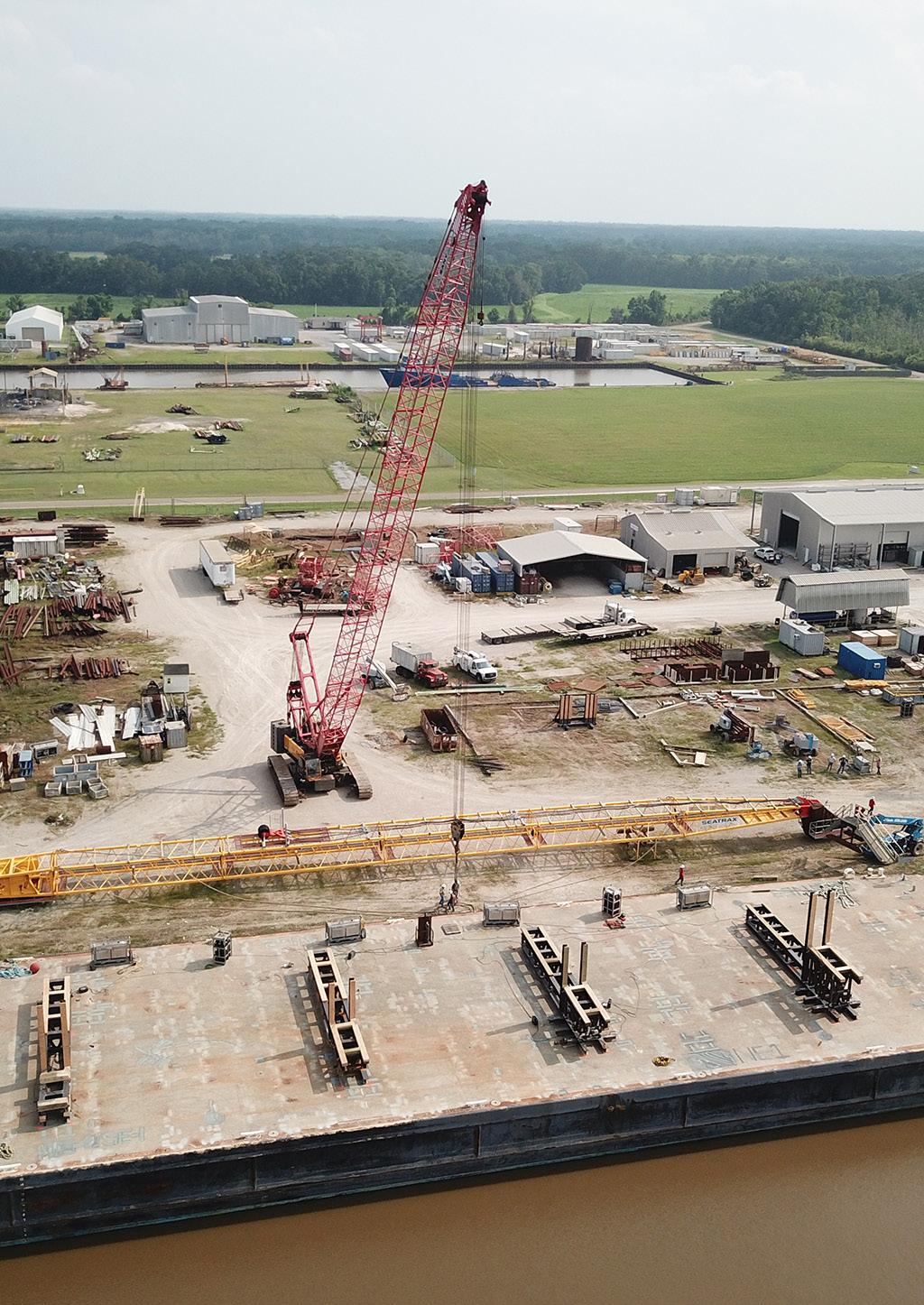


GRAND ISLE SHIPYARD
PROJECT DIRECTED BY: ADEL MHIRI
In an industry defined by volatility, complexity and high operational stakes, procurement has become one of the most critical engines of resilience. At Grand Isle Shipyard, the procurement and supply chain function has evolved into a strategic pillar that underpins the company’s performance across construction, engineering, and fabrication operations . Today, the team is not only solving logistical problems but shaping how GIS competes, innovates and delivers value across the Gulf of America region and beyond.
The work they undertake is vital but often invisible. Materials appear on

time, schedules stay on track, and safety remains uncompromised. These outcomes do not happen by chance. They are the product of a highly coordinated procurement organisation that blends data-led thinking, local relationships, cross-functional expertise, and a culture that places people and safety at the centre of every decision.
Vice President of Procurement and Supply Chain, Jason Johnson, offers an articulate view into how this function has matured. While he plays a leadership role, he is clear that the strength of GIS procurement is the collective capability of the team. He describes procurement

not as a transactional unit but as a strategic partner embedded in every corner of the business. “We try to be a thought partner with the business,” he notes, explaining that the team’s focus is to anticipate needs, remove friction, and enable operational excellence in an environment that is often unpredictable.
That environment has never been more challenging. Steel remains one of GIS’s largest categories of spend, and the volatility of steel pricing has had a significant effect on project planning across the energy industry. Tariffs, supply shortages, and variable lead times require constant vigilance. The team must balance price, availability, and project requirements with speed and accuracy. This is not simply a purchasing task. It is a strategic discipline that requires foresight and agility.
The procurement group works to expand the supplier base while ensuring that every partner reflects the company’s values. Safety is central to that evaluation. For GIS, a supplier is not just a vendor but a steward of the same standards that keep workers safe offshore, in fabrication yards, or on renewable energy project sites. As Johnson explains, “It is super important for us that suppliers’ safety records reflect who we are as a company.” The team consistently audits safety performance, near misses, and regulatory compliance. If a subcontractor has significant safety incidents, the procurement team assesses whether they are the right partner, regardless of how attractive the commercial terms may appear.
Cost efficiency, reliability and safety must coexist, even if achieving all three is seldom straightforward. The team does not view procurement through the narrow lens of unit cost. It views it through the broader lens of project success, lifecycle optimisation and long-term relationships. Johnson describes procurement’s core balancing act through three central variables: price, speed and quality. Every project requires a different equilibrium, and it is the procurement group’s responsibility to work with internal stakeholders to determine which factors matter most for each scenario.

This approach has shaped GIS’s stocking strategies and sourcing frameworks. By maintaining a diverse inventory approach and creating contract structures that protect against tariff-driven cost escalations, the team shields the business from sudden shocks. Contract language is designed to manage risk and provide clarity for customers, suppliers and the business itself. Procurement’s work here is not back-office; it is frontline. It directly influences competitiveness and client trust.
Advanced use of data has played a central role in this evolution. Johnson brings a background in analytics, the entire procurement organisation is now increasingly built around data-led decision-making. Forecasting, spend visibility, lead-time tracking and supplier performance metrics have become core operational tools. Johnson uses the analogy of a boxing match to describe the power of analytics, explaining that data provides “the tale of the tape” that


reveals the facts, the risks and the strategic choices that must be made. The team uses this information to guide decisions with confidence, but only when the data is accurate. Clean, reliable inputs remain the foundation of strong analysis, and the group has prioritised improvements in data quality across its systems and processes.
Those efforts have led to several major technological initiatives. The procurement team launched a new approved vendor list system that increases transparency, improves functional access and standardises supplier onboarding. They are also in the midst of a major ERP implementation that will reshape how procurement, supply chain and wider business operations are executed. Integrating supply chain modules into a large enterprise system is no simple task, yet the team has taken on the challenge with focus and discipline, understanding the long-term benefits for accuracy, visibility and efficiency.
The value of this capability was demonstrated clearly during a recent
disruption in the steel market. When domestic supply collapsed under the pressure of tariff-driven demand, lead times on steel piles for a major solar project doubled within days. The procurement team recognised immediately that they needed to act before schedule delays impacted liquidated damages and client commitments. Initial negotiations with a distributor progressed slowly, hindered by competing priorities and complex commercial requests. As lead times continued to deteriorate, the procurement team’s relationship-building efforts paid off. Through transparent conversations, they were placed directly in contact with the manufacturer, bypassing layers of cost and inefficiency.
What followed was an intense negotiation process that took place over several weeks. The procurement team collaborated closely with the renewables division, the contracts group and the category management team. They analysed requirements, revised terms, challenged assumptions and ultimately secured a contract that provided improved pricing,

reduced lead times and full alignment with project specifications. The move saved approximately 600,000 dollars and protected the project schedule from further disruption. Johnson describes the outcome as a direct result of the team’s ability to apply analytical thinking, relationship management and crossfunctional coordination. The achievement underscored the quiet strength of the procurement function: decisive action, supported by expertise and collaboration. The team responsible for this work is substantial. Partnering with technology solutions for administrative repeatable tasks, their large team of professionals contribute to remaining strategic procurement and supply chain operations across GIS, with specialists in category
management, contracts, renewables supply, operations support and strategic procurement analysis. Johnson’s direct reports each lead sub-teams and manage complex portfolios. It is a structure that has grown significantly over time. Their expansion has mirrored the company’s growth, particularly in renewables and construction services.
This growth has also allowed GIS to introduce a new service offering to the market. The procurement function now provides supply chain optimisation consultations to customers, drawing on the team’s accumulated expertise. They assess material management, inventory accuracy, data integrity, MRP performance and cycle-counting processes, helping

clients reach best-in-class standards. This service is built on the same analytical approach that has strengthened GIS internally, reflecting the maturity of the procurement team’s capabilities.
Despite these advancements, Johnson stresses that the team remains focused on continuous improvement. Data visibility, accuracy and functionality still form major priorities. The ERP implementation is ongoing and transformative. New supplier partnerships are being established as GIS enters new markets and regions. The team’s mission for the year carries the theme of procurement transformation, with the goal of embedding value and visibility across every stage of the process. It is ambitious work, but the
team approaches it with a spirit of progression rather than perfection.
The future of procurement at GIS will increasingly involve artificial intelligence and automation. Johnson describes AI as both intimidating and exciting, reflecting a broader industry sentiment. The GIS philosophy, however, is rooted firmly in people-first values. “We want to understand how we can partner with AI tools to be better at our jobs,” he says, “but we are not going to use it as a justification to let people go.” The team is focused on retraining, upskilling and enabling employees to use AI as an amplifier of human capability rather than a replacement. This approach builds confidence and aligns with GIS’s



PM International Suppliers delivers pipe and fittings, tubing, valves, flanges and other forms in exotic materials such as Duplex, Super Duplex, 6% Molybdenum, Titanium, Copper Nickel and Nickel alloys.
PM delivers to the petrochemical segment, mining, ship building, geothermal, chemical manufacturing, aerospace, desalination, power plants, water treatment facilities and more. PM’s customers are worldwide, and they handle everything from one-off emergency deliveries to complex, longranging project installations.
ISO 9000 certified, PM has offices in Florida and Houston in USA; and in the United Kingdom and Norway. They have positioned themselves globally to provide international services at local levels. While addressing individual country needs, PM has developed a central network of intelligence on global sources and sophisticated logistic solutions
that enables them to provide competitive prices on quality products, and short lead times.
PM possesses superior technical knowledge of standards including ANSI, API, ASME, ASTM, MSS, NACE,NORSOK, PED, EEMUA, and Achilles. While there are many suppliers in the industry, what sets PM apart is the manner in which it shares its expertise, not only with customers but also manufacturers.
With close to 40 years in the industry, PM understands the need for excellent service and are well-versed in meeting critical needs and delivery challenges. Says founder Petter Madsen; “Our philosophy is to surpass expectations and provide a service level above anything customers have experienced elsewhere. We see ourselves as a connector between production and utilization, with the philosophy that shared knowledge is shared success for all parties involved.”


long-standing emphasis on integrity, performance and safety.
Local partnerships remain a defining characteristic of GIS’s procurement function. While the company operates across the Gulf region, many projects are anchored in specific communities. For procurement, this means identifying local suppliers who can deliver goods and services efficiently while supporting economic development in the region. Johnson explains that working with local vendors not only improves lead times and cost structures but strengthens community ties. He notes that a small operation in an overlooked part of the country may, through relationships and extended networks, be connected to critical distributors. “You never know where those relationships will lead,” he reflects. This mindset has helped GIS build a resilient network that supports both operational success and community investment.
Looking across the organisation, the procurement and supply chain team at GIS has become a foundational element of the company’s ability to deliver projects safely, efficiently and competitively. Their influence touches every department, project site and customer relationship. They anticipate risks, navigate disruption, protect margins and uphold the company’s values. Their integration of data, technology and human expertise positions GIS to compete effectively in a market where uncertainty has become the norm.
The picture that emerges is not simply one of a strong leader guiding a capable team, but of a collective discipline that defines the organisation’s strength. Through thoughtful planning, relentless relationship-building and a commitment to integrity and performance, the procurement team at GIS is helping the company chart its course through an evolving energy landscape. Their work does not seek the spotlight. It seeks results. And in every measure that matters, it continues to deliver.
www.gisy.com