Two Years Helping Make Thetford a Great Place to Live
* Your sizes. Your selection.
1. Visit our showroom with your room sizes.
2. Order from our roll stock carpet, vinyl and underlay (Full price items only)
3. Arrange the collection or delivery** of your order. **Delivery charges will apply.
VEHICLE HIRE
•
•
•
Ford
or similar from £30/day
Ford Puma or similar from £40/day
Hyundai Tucson or similar from £65/day
Welcome to Issue 13 of Reflections of Thetford magazine, a magazine for Thetford, by Thetford and only Thetford
By Martin Angus (Editor)
Welcome to Issue 13 of ‘Reflections of Thetford’ magazine, celebrating 2 years of helping make Thetford a Great Place to Live! We set out to promote a positive perception of Thetford to anyone picking up our little magazine, and also offer our advertisers affordable quality advertising, all the time giving our readers a ‘jolly good’ read. From the feedback, and the fact we are still here, I think between us we have done a half decent job.
A huge thank you to all our contributors, this not only includes those who have physically written pieces for the magazine, but also the hundreds of readers who have offered feedback, or an idea, this has been so important to help us represent and include as large a cross section of our great town as we can.
Our advertisers make this all possible, most of whom have been with us from day one, with new businesses joining us each issue. Some of these advertisers wouldn’t usually advertise locally, but have seen the value of what we are trying to achieve, and want to support the venture for the larger local community.
Last but not least, the businesses, volunteers, local faces, who have trusted the magazine and shared their stories. I have seen up close the nervousness of some of these individuals, especially when they are talking about the struggles they have faced, either personally or with setting up their businesses. These have been some of the most memorable and magical moments for me listening to these people. The value of these stories has been immeasurable, inspiring and reassuring others, that not everything goes to plan. On the surface it all looks perfect, but behind the scenes it never is.
We will continue with our little magazine for as long as the town wants us to, revealing the heart and history of our town, and why Thetford has remained a major town inviting and receiving investment, and why so many arrive from afar, try it out, then remain and settle. It can’t be that bad of a place!
Looking forward to continuing working and collaborating with everyone, please enjoy our 2nd anniversary edition of ‘Reflections of Thetford’ magazine.
Thetford’s Quiet Superpower Quarter Past Three After Maths Where Creativity Meets Well-being Copper Roots, Global Reach The Good Fight The Town that Launched a Nation The Power of Saying “Yes” A Clean Start The Care, Consent and Craft The Quiet Lad The Medusa Project The Place to Be Moulded in Thetford Taking
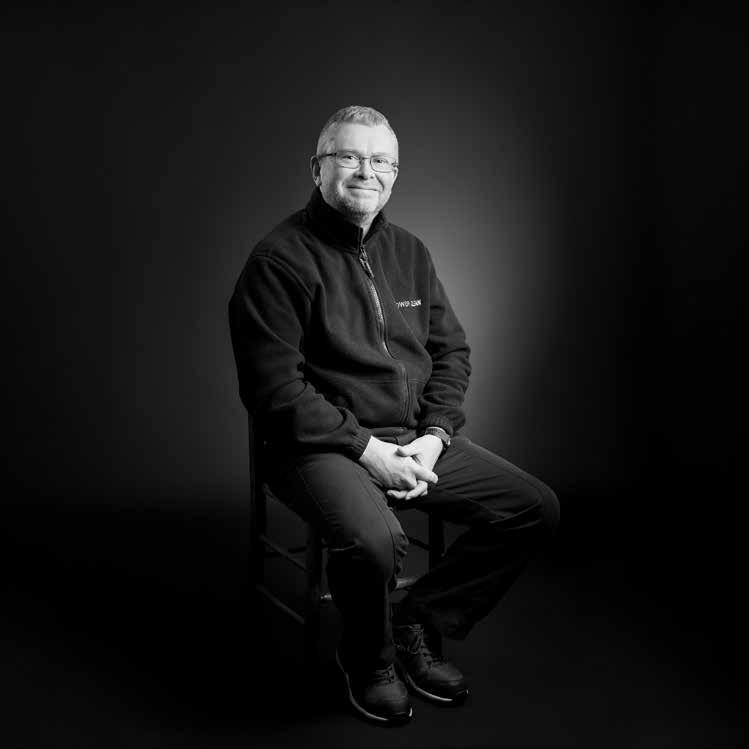
Photograph
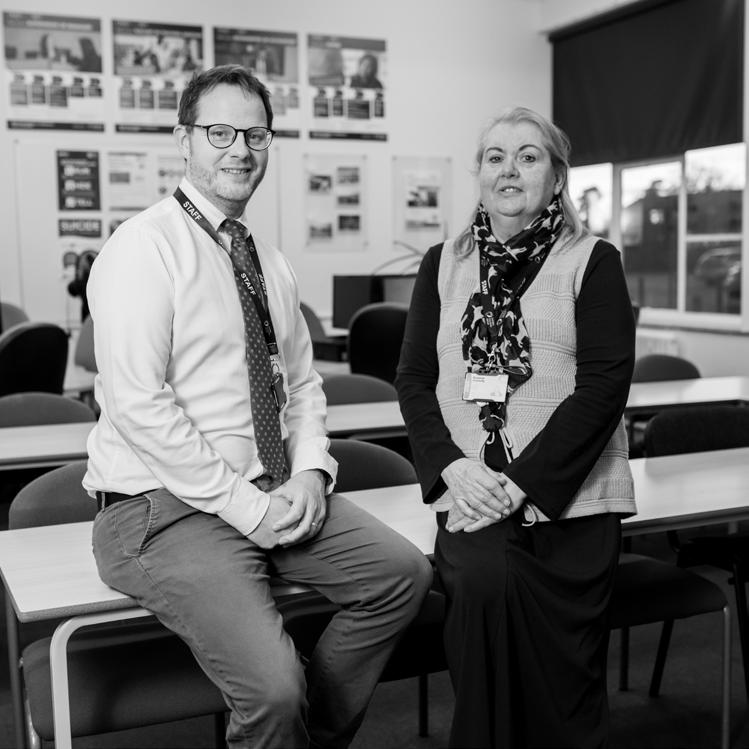
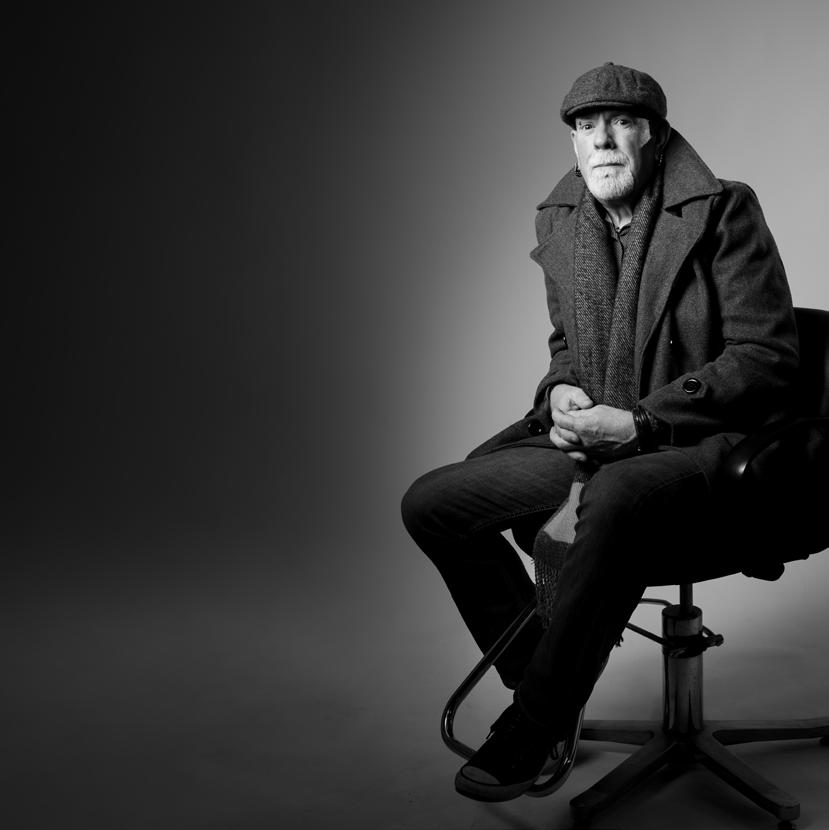
‘Ian Evans’ by Mangus Photography
Thetford’s Quiet Superpower:
A Learning Centre That Puts People First
Written by Martin Angus
An editorial drawn from a conversation with Ian Evans and Suzanne Connolly at Eastern Education Group’s learning centre in Thetford.
Thetford is used to reinvention. We’re a town that has learned, repeatedly, how to adapt, whether that’s to shifting industries, changing communities, or the everyday pressures of modern life. But there’s a kind of reinvention we don’t celebrate enough: the moment an adult decides to learn again.
It rarely looks dramatic. It might be a hesitant phone call. A quick glance through a window. A half-muttered, “I’m not sure what I want… I just want to do something.” It might be someone stepping into a classroom for the first time since school and feeling their stomach drop, because school didn’t go well, or life got in the way, or confidence drained out over the years like air from a tyre.
And yet, behind that ordinary moment is something quietly radical: a person choosing to widen their life
options.
That, in essence, is what Thetford Learning Centre exists to do.
A new name, and a clearer purpose
If you’ve heard the centre described in different ways over the years, you’re not imagining it. Ian Evans, who heads the service locally, explained that the centre has recently had a small but meaningful rebrand. Eastern Education Group, which operates the centre, is moving away from “Personal and Professional Learning Centre” and returning to a simpler, more locally rooted identity: Thetford Learning Centre, a local learning centre in the truest sense.
The name matters because it signals what the place is, and what it isn’t.
It isn’t only for teenagers. It isn’t only for people who already feel “academic.” It isn’t only for those with a
neat career plan and a binder full of confidence. It’s for the person who wants to get their maths back. The person who needs English for work. The person who has cared for others for years and is finally, bravely, choosing themselves. The person who wants a hobby that pulls them out of isolation. The person who wants to start over.
Ian described the centre in a sentence that deserves to be printed and stuck on fridges across town: it offers “an opportunity for people within the community to enhance their life options… within education.”
Suzanne Connolly, who many learners will know as the warm, practical presence at the front desk, added something equally important: for many people, the centre is also a place to rebuild social confidence and human connection, especially after COVID.
That second part is not a footnote. It’s central.
Adult learning isn’t just about skills. It’s about fear.
One of the most striking themes in Ian and Suzanne’s conversation wasn’t course lists or qualifications. It was anxiety, how common it is, how quietly it sits in the background, and how often it’s the real barrier to learning.
Ian spoke about the first questions people ask when they consider adult education:
“Am I going to be the oldest in the room?”
“Am I going to be the youngest in the room?”
On the surface, that’s about age. Underneath, it’s about belonging. It’s about fear of being judged. Fear of sticking out. Fear of repeating a bad experience.
Suzanne sees the same thing from the very first
inquiry. People arrive with a lifetime of reasons why education “isn’t for them”, family commitments, caring responsibilities, early parenthood, interrupted schooling, difficult experiences, long years in the same job, or years of being told they weren’t good at something. Often, they’re not even sure what they want yet. They just know something needs to change.
In those early moments, the centre’s role isn’t only administrative. It’s emotional. It’s human. It’s reassurance without patronising, clarity without pressure.
And it’s worth saying plainly: Thetford needs places like that.
The gentle power of a familiar face
There’s a particular kind of care that can’t be automated. It comes from continuity, knowing there will be someone on the other side of the desk who remembers how nervous you were the first time, even if you don’t return for years.
Ian noted that Thetford Learning Centre has been supporting learners locally for around a decade, and Suzanne has been a constant presence for much of that time. When people come back, sometimes after life disrupted a course, there can be embarrassment. There can be a sense of personal failure. Ian and Suzanne work hard to dismantle that feeling.
The message they try to give people is simple: life happens, and you’re welcome back. With adult learners, that isn’t just kind, it’s practical. The last few years have been unsettled for many households. If the centre wants to be useful, it has to be forgiving.
Suzanne described the small, thoughtful system she uses when learners miss sessions on vocational courses. She’ll email after week one: “We missed
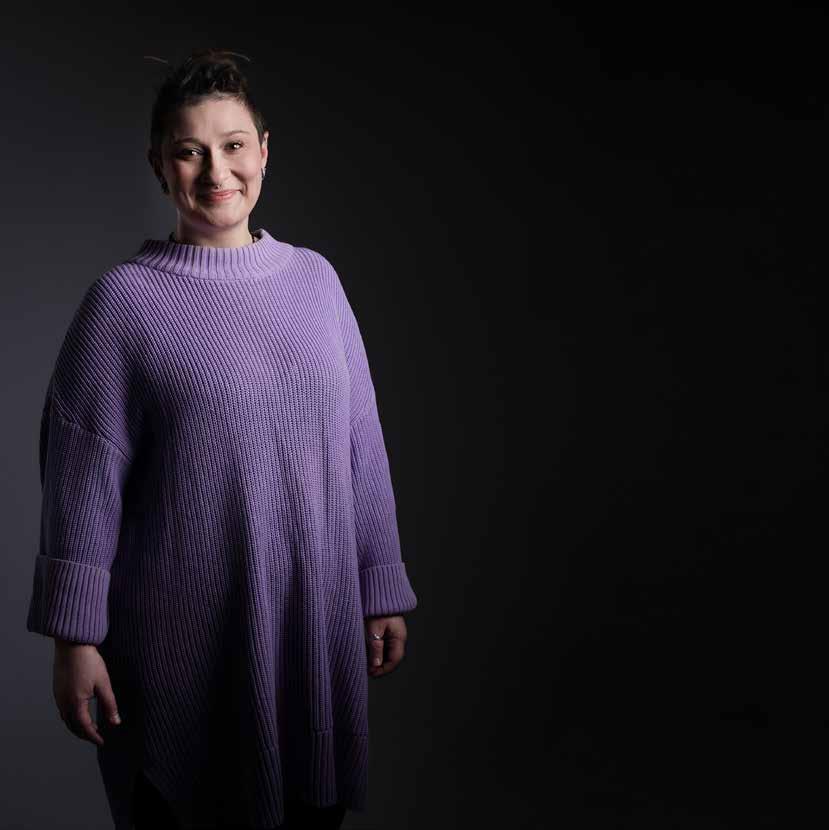
Photograph ‘Suzanne Connolly’ by Mangus Photography
you.” After week two: a reminder and a gentle checkin. After week three: a crucial option, reply “yes” if you want to come back, or simply “no” if plans have changed. No explanation required.
That “no explanation required” is not a minor detail. It’s an act of respect. It removes the pressure of having to justify yourself. It keeps the door open without making people feel watched or shamed.
This is what a community service looks like when it’s built around dignity.
“Administrator” doesn’t begin to cover it
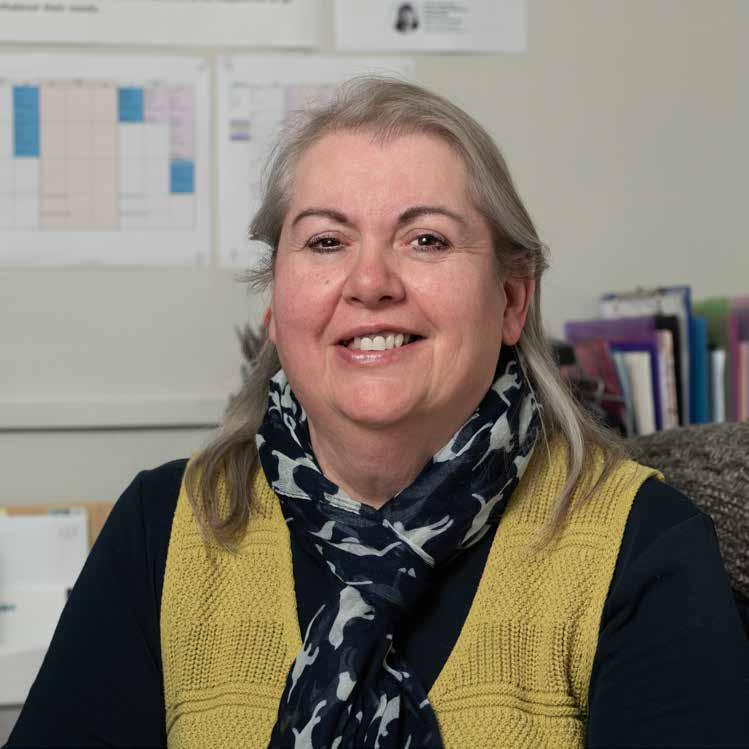
If you’ve ever assumed Suzanne’s role is mostly paperwork, think again. Ian made a point of challenging the job title itself: in local learning centres, the “administrator” is often the person who guides someone from that first uncertain inquiry all the way to achievement, sometimes right through to invigilating their exam and handing over their certificate.
Suzanne is also trained in information, advice and guidance. She helps people map a route: functional skills first, then perhaps access courses, then maybe university, or a new career, or a qualification that builds confidence step by step.
And she’s one of the centre’s mental health first aiders, supporting staff as well as learners, quietly, confidentially, and with clear boundaries. In a world where many people feel they have to cope alone, that matters. It’s also a reminder that education isn’t separate from well-being. The two are tangled together: confidence affects learning; learning affects confidence.
The most telling detail? Suzanne joked that much of her day involves directing people to the toilets
for the Charles Burrell Centre. It’s funny, but it also speaks volumes. This is a building used by many, and not everyone arrives knowing what Thetford Learning Centre is. Her job begins with ordinary human moments, someone lost, someone uncertain, someone asking, “I want to do something” but not knowing what.
And that’s often exactly where learning begins.
The “magic” of mixed ages
The centre serves adults across a huge age range, from young adults to retirees, and the staff see that diversity as a strength, not a challenge to manage away.
In mixed-age classes, older learners aren’t “behind” and younger learners aren’t “too green.” Instead, they bring different life experiences to the same table. Anxiety about age tends to evaporate once people realise that everyone is there for the same reason: to improve their options.
Ian pointed out something quietly powerful about functional skills classes: learners who are now at Level 1 or Level 2 often started at entry level themselves. That creates a natural mentoring environment. The class becomes a small community where people encourage each other, share practical tips, and sometimes, wonderfully, form WhatsApp groups that outlast the course.
Learning becomes less of a solitary struggle and more of a shared project.
The most life-changing course might be the one you fear most
When asked which course surprises people with how
life-changing it can be, both Ian and Suzanne circled back to the same answer: functional skills English and maths, particularly maths.
Maths, for many adults, is not just a subject. It’s a scar. It’s the memory of feeling stupid in front of others. It’s the story someone told themselves for years: “I’m just not a maths person.”
Suzanne pushes back on that story in the simplest way: you use maths all the time. Budgeting. Fuel. Shopping. Time. Measurement. You’re not stupid, you’ve just never had it taught in a way that clicked, or you’ve never had the chance to return on your own terms.
For learners who want access courses, professional training, or university pathways, functional skills can be the bridge. Suzanne mentioned a learner who wanted to become a midwife, didn’t know how to reach that goal, and used the centre’s guidance and qualifications to get onto the right path. These are not small outcomes. These are life shifts, new careers, new identities, new confidence.
And importantly, the centre tries to avoid a brutal pass/fail culture. Ian described an approach built around readiness: exams when learners are ready, and support if things don’t work first time. The message is steady: “We’re not going to drop you off the train.”
For anyone who has ever felt left behind by education, that single idea can change everything.
ESOL: learning the language, and building a life
Thetford’s multicultural character isn’t a side note; it’s part of the town’s everyday reality. The centre’s ESOL provision (English for Speakers of Other Languages) is one of the most important ways it supports social
cohesion and opportunity.
Suzanne described learners who have lived in the UK for many years but stayed mostly within their own language communities. Sometimes adult learners arrive who cannot yet read and write confidently in any language, and they are now attempting to learn English reading and writing as well. That is a huge achievement, and it deserves more recognition than we give it.
Ian spoke about the “holistic” approach: ESOL might be the first step, but the real conversation is often about someone’s hopes, starting a business, changing industry, transferring skills from another country, rebuilding a professional identity. Suzanne noted that many people who come to the UK from Eastern Europe, for example, arrive with high-level skills and serious work histories. The language barrier forces them to start again in lower-skilled roles. With the right support, that doesn’t have to be the end of the story.
Education is one of the few tools that can turn a barrier into a bridge.
Learning that fits real life, and real work
If Thetford is known for anything economically, it’s the strength of industry and manufacturing. That brings opportunity, but also complexity, particularly for shift workers.
Ian acknowledged a hard truth: traditional class schedules don’t always work for people on rotating patterns like four-on, four-off. In response, the centre is working more directly with employers, including going into workplaces and shaping provision around shift patterns, an outward-facing model that treats learners’ lives as the starting point, not an inconvenience’.
They also described relationships with local employers and organisations, including Two Sisters Food Group, Baxter Healthcare, TROX, and Warren Services, along with an ongoing presence at the Jobcentre every Monday to provide information and guidance sessions for jobseekers.
What do employers most want learners to develop right now? In their experience: English language skills, digital skills (including plenty of demand for Microsoft Excel), and leadership/communication at supervisor and middle-management levels. They also flagged the often-overlooked fact that apprenticeships are not only for young people, adults already in work can sometimes turn a role into an apprenticeship pathway with the right conversations and support.
This is adult education at its best: practical, responsive, rooted in the town’s real economy.
Not just qualifications: joy, confidence, connection
There’s another side to Thetford Learning Centre that deserves equal attention: leisure learning and short, confidence-building courses.
Suzanne spoke about learners who are still recovering socially after COVID, people who lost the habit of meeting others, who now find it daunting to step into a room. Leisure learning offers a gentle on-ramp: a hobby, a creative skill, a reason to leave the house, a chance to talk to someone new without the pressure of grades.
It’s not trivial. It’s preventative medicine for isolation.
They also described how friendships form in classes, sometimes lasting for years. In one example, photography learners met through the centre and now go on holidays together. That might not show up on
a funding report, but it’s one of the most meaningful outcomes a community service can create.
And if you have a skill you’d like to teach, the centre is open to new leisure learning tutors, people with passion and expertise who want to share it. You don’t necessarily need a high-level teaching qualification to begin; there are routes into training.
New directions: floristry, sustainability, and the future
One of the most surprising developments discussed was a new floristry qualification, launching locally with funding available for many learners depending on circumstances. It’s a reminder that adult education doesn’t have to stay boxed into the “usual suspects.” If you’ve ever thought, “I’d love to turn that into something,” these kinds of courses can be the spark.
Suzanne even shared her own personal reason for signing up, hoping to do wedding flowers for her daughter one day. It’s a lovely detail because it shows what learning really is: not just employability, but meaning. A new skill can become a gift, a retirement plan, a small business, a new identity, or simply a source of pride.
They also highlighted growing provision in environmental sustainability, qualifications across multiple levels, reflecting the reality that businesses increasingly need environmental awareness and compliance, and learners increasingly want their CVs to reflect the direction the world is moving.
The centre’s ambition, Ian said, is to plan further ahead: not just reacting to what’s available now, but anticipating skills needs years down the line, healthcare roles, evolving industries, new local developments. That kind of long-view thinking is exactly what a town like Thetford should want in its
education partners.
Busting the myths, starting with cost
If there’s one myth they want to break, it’s that adult education is automatically expensive. Ian stressed that a significant amount of qualifications, especially at entry level, Level 1 and Level 2, can be government funded depending on eligibility. Suzanne added another myth: that it’s “too late” to change direction. It isn’t. People come to the centre to pivot careers, to recover missed opportunities, and to build a future that fits who they are now, not who they were at sixteen.
But perhaps the deepest myth is this: that adult education is only for “other people.” More confident people. More organised people. More academic people.
That isn’t true. The centre’s daily work is helping ordinary people, often anxious, often uncertain, take a first step.
So what is the first step?
If you’re reading this and feeling curious but unsure, Ian and Suzanne’s advice is refreshingly straightforward:
• Call, email, or drop in for a conversation.
• Come to an open event, walk around, and see what it’s really like.
• If you’re not ready to speak yet, follow the centre on social media or visit their website to explore what’s available:
www.wsc.ac.uk/adult-learners/centres/thetford
• If you’re exploring ESOL, expect a skills check so you’re placed in the right level, no judgement, just a practical starting point.
And perhaps most importantly: you don’t have to
arrive with a perfect plan. You can arrive with a feeling. A curiosity. A small sense that something needs to change.
Thetford should be proud of this place
It’s easy to talk about “skills” as if they’re a sterile economic unit. It’s easy to measure success only in certificates. But listening to Ian and Suzanne, a different picture emerges: adult learning as community infrastructure, like a library, a park, a good café, a neighbour who checks in.
Thetford Learning Centre is, in many ways, a builder of second chances. Sometimes third chances. Sometimes quiet, slow chances that take years.
It doesn’t promise a magic wand. Ian put it honestly: adult education requires commitment and sacrifice, time carved out of a busy life, effort sustained when motivation dips. Suzanne put it just as honestly: the centre can’t do it all for you, but it can give you the starting grid.
And in a town where many people are carrying heavy loads, work, family, money worries, health pressures, giving someone a realistic starting grid might be one of the most valuable gifts we can offer.
Thetford has plenty to be proud of. We should add this to the list: a learning centre where the love of learning doesn’t end, and where people who once felt education wasn’t for them discover, sometimes to their own surprise, that it still can be.
Because the real story here isn’t about courses.
It’s about people.
And in Thetford, people are still choosing to grow.
Photograph
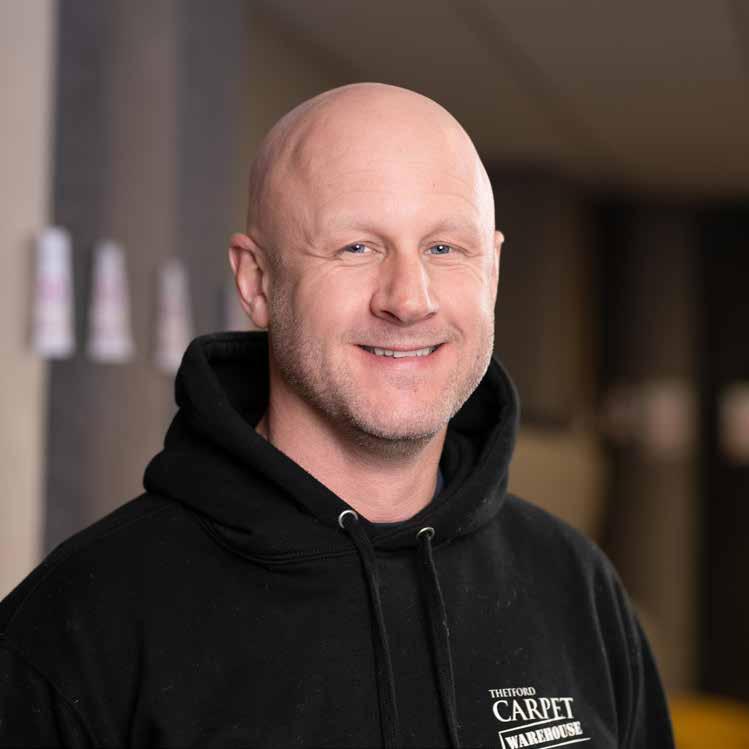
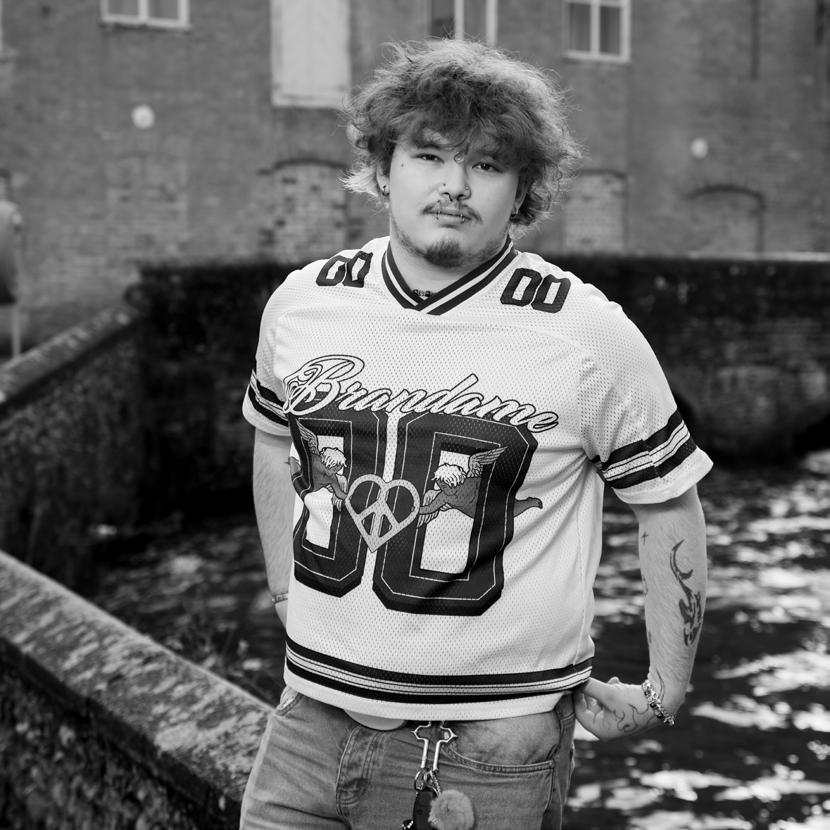
‘Brett’ by Mangus Photography
Quarter Past Three After Maths
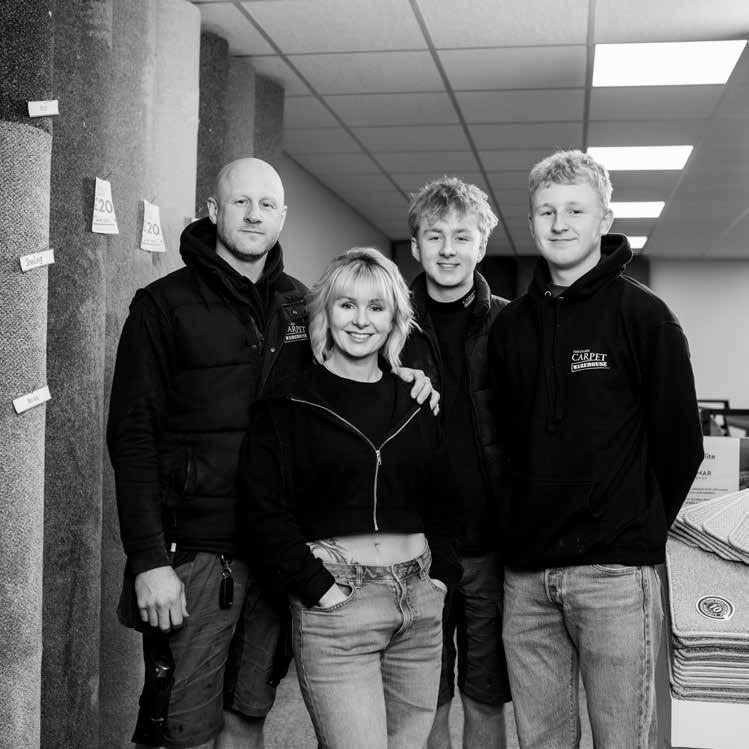
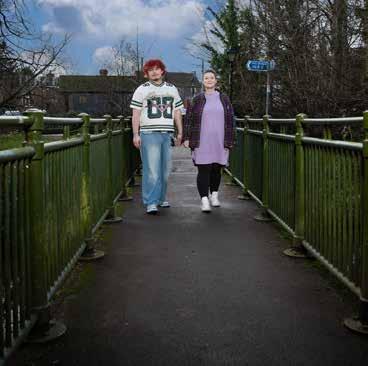
From Schoolyard Sweethearts to Thetford’s Flooring Family
Written by Martin Angus
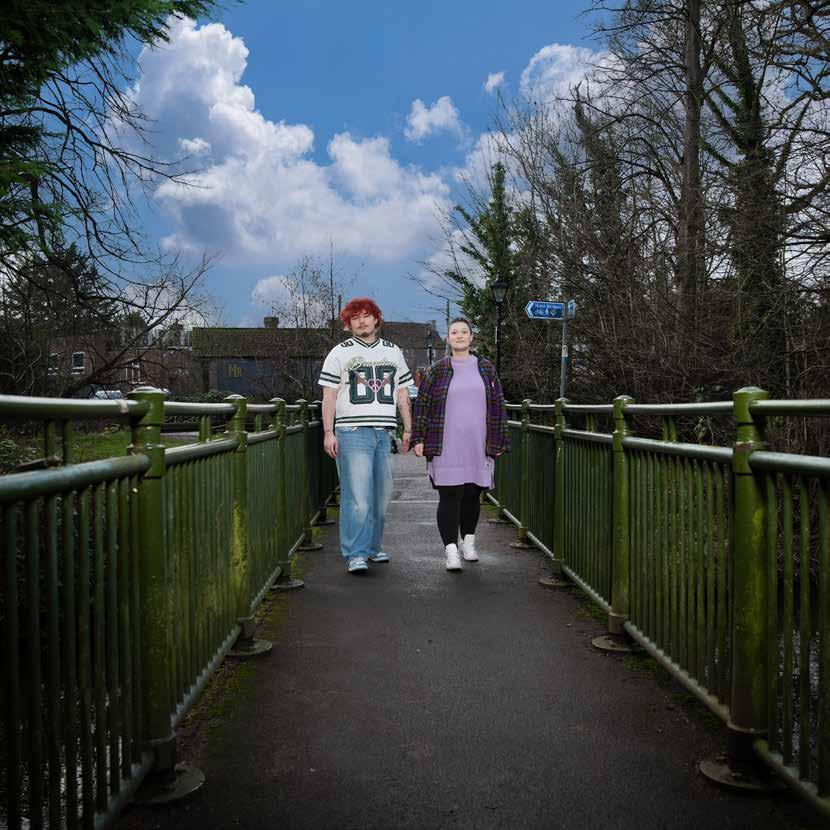
On a Wednesday afternoon, at precisely quarter past three, after maths, two 13-yearolds in Thetford made a decision that would quietly outlast most teenage certainties.
“Wednesday the 16th of April. Quarter past three after maths,” Gemma says, without blinking, as if she’s reading it off a calendar still pinned to the wall at Rosemary Musker High School. “That was when we started being boyfriend and girlfriend. And that’s 30 years ago.”
It’s the sort of detail that makes you sit up straighter. Not because it’s showy, it isn’t, but because it tells you everything you need to know about how Gem and Brett run Thetford Carpet Warehouse: with memory, care, and an almost stubborn commitment to doing things properly. In a town that’s watched plenty of shopfronts change hands, go quiet, rebrand, disappear, here are two people still showing up, still smiling, still finishing quotes at midnight, still remembering the colour of the carpet you chose a
decade ago.
They’re childhood sweethearts, yes, but they’re also a working partnership that makes sense in a very unromantic, practical way. Gemma is the voice, the organiser, the steady presence in the showroom. Brett is the craft, the measuring tape, the fitting, the warehouse logic. Together, they’ve built something that feels increasingly rare: a local business that stays local, stays personal, and stays honest, even when honesty might cost them a sale.
Two prams, one heater, and a seven-day week
The first thing you learn when you talk to Gemma is that their “journey” isn’t a highlight reel. It’s graft. It’s cold fingers. It’s doing what needs doing because there are two babies and a business to build, and no one is coming to do it for you.
Thetford Carpet Warehouse opened in May 2010. Fin was born in June 2008. Cam arrived in September
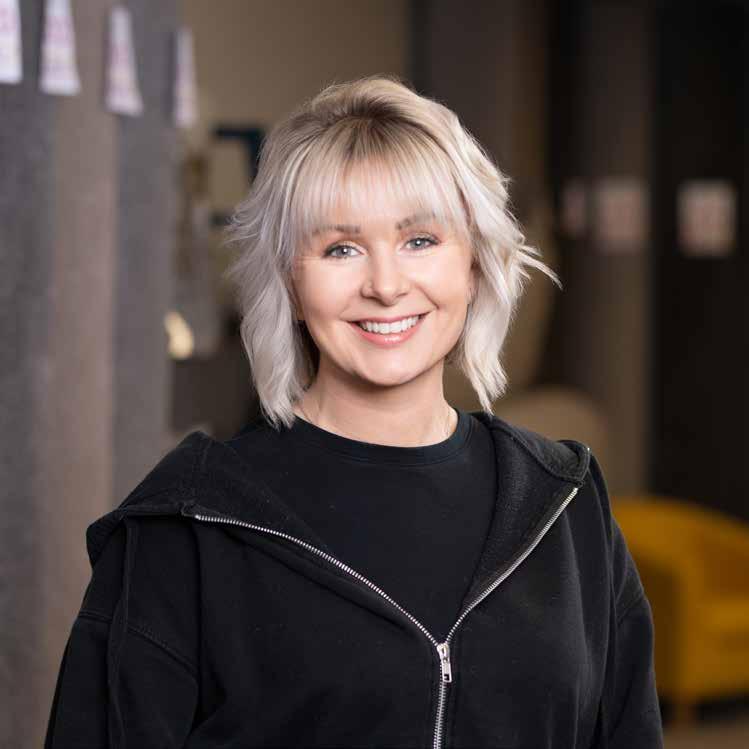
Photograph ‘Gemma’ by Mangus Photography
2009. Do the maths and you get the full picture: two very young children, a brand-new business, and opening hours that would make most people wince. “Cam was eight months old,” Gemma says. “And we were open seven days a week, with no staff. Nine till six.”
There’s a pause, the kind that suggests she can still feel those days in her shoulders.
They started in the old Maltings building on Old Market Street, the one many locals remember, where you could lose body heat just by walking to the back wall. “It was such a huge building and it was so, so cold,” she says. “We’ve got photos of them in their double buggy in front of a heater, wrapped up at 11 o’clock at night because we had to take them down there so we could work.”
The image sticks: two prams in an office; a heater glowing; parents pushing through because the work has to be done, and the only way out is through. It’s very Thetford, in a way, not flashy, not dramatic, just determined.
The biggest challenge in those early days wasn’t a rival shop or a bad batch of stock. It was survival economics.
“We had to sacrifice everything,” Gemma says. “We literally started from the ground up. We moved out of our house… and in with parents… to make sure our outgoings were an absolute minimum, because we had to put everything into this with two babies.”
If you’re reading this in Thetford, you’ve probably seen that story up close in one way or another, the family who makes it work because they tighten every belt they can find. It’s not a sob story. It’s a business origin story told in British: quietly, plainly, without the self-congratulation.
And then, almost casually, Gemma delivers the line that really matters: “And we’re still smiling. I don’t know how!”
“Why don’t we start a carpet company?”
The truth is, Brett’s relationship with flooring started even earlier than his relationship with Gemma. He was working Saturdays as a teenager, “13 even,” Gemma says, at the original Cosy Carpets building that used to be where the bus station now is. “Then there was a big fire and it got burnt down,” she adds, like an aside, as if Thetford history is just something you mention over a cup of tea.
Brett came out of school and went straight into the trade full-time, still with Cosy’s. Warehouse work, management, apprenticeships, the whole ladder. It’s “literally all that he knows,” Gemma says, and she means it in the best way.
By 22, Brett went self-employed as a floor layer (around 2006). Four years later, with Gemma staring down the chaos of maternity leave and workplace uncertainty, “I went back to work… only to tell my boss, by the way I’m pregnant again. Went down like a lead balloon”, Brett floated the idea.
“He said, why don’t we start a carpet company?”
Just like that. A sentence that becomes a life.
Gemma’s version of events is refreshingly honest: she didn’t dream of running a carpet shop. She earned her degree and worked as a graphic designer, not a flooring retailer. “I never had any aspiration to open a carpet shop,” she admits. “I was quite happy doing my graphic design.”
But she also knows exactly why it worked. “That’s why we’re a good team,” she says. “He has the ideas and
I’m just like, oh yeah, I’ll sort everything else out.”
Not suited and booted, just… normal
Spend five minutes in their showroom and you understand the vibe immediately. It’s not a place where you’re pounced on. You’re greeted like a neighbour. You’re allowed to wander, to touch the samples, to stare at the choices and quietly panic about whether “greige” is a real colour.
“We’re normal people,” Gemma says, and she says it like it’s the whole philosophy. “We treat people how we like to be treated ourselves.”
Her customer approach is simple: enough attention to help, not so much that you feel trapped. “There’s a fine line,” she explains. “You need to make sure you aren’t on top of customers, but also that you don’t leave them too long so they feel a little bit ignored and a little bit lost.”
Because people do get lost with flooring. Some customers haven’t bought carpet in 20 or 30 years. Some have never done it at all. Some arrive with nothing but a vague notion that their room looks tired and they’d like something “not too light, not too dark, not too hairy.”
And this is where Gemma shines. She describes her own knack as “a pretty good vision.” Tell her your wall colour, your sofa tone, how much light the area gets, and she can start making suggestions that feel like a friendly shortcut through a maze. Not telling you what you want, “but I can make suggestions,” she says, and it’s clear she means it.
Brett brings the technical confidence that keeps the whole thing upright. “There is literally nothing that he doesn’t know,” Gemma says. She laughs at herself for finding some of it dull (“why do you need
to know about glue like that?”), but she also knows it’s why customers trust them. Brett can look at a subfloor, spot a problem, plan the job from every angle, access, wear, the customer’s mobility, the kind of traffic a hallway sees versus a spare room no one uses.
That competence matters. Because flooring isn’t like a lamp. You don’t just pop it in a basket, carry it home, and hope it works. Done well, it disappears into your life. Done badly, it becomes the thing you notice and resent every day.
“I don’t need to tell you this… but”
Most businesses have a customer service slogan. Gemma has a principle: honesty, even when it’s inconvenient.
“I think good customer service is honesty,” she says.
“And to be honest, I think sometimes we’re too honest.”
Then she tells me about a customer who chose a carpet for her stairs and landing, lovely, but high pile. Gemma could’ve taken the money and moved on. Instead, she warned her.
“I said to her, I don’t need to tell you this… but you’re not going to be happy with it in six months to a year’s time, because you’re going to walk up the middle of your stairs, day in, day out, and you’re going to see where you’ve walked, and it’s going to flatten.”
It’s the sort of moment that explains why people keep returning. Not because Gemma is trying to be a hero, because she’s doing what she’d want someone to do for her mum.
“The last thing that we would want is for Mrs Smith, Mrs Smith is my mother, to come in, buy a carpet that’s not suitable… and come back in six months and say, you sold me this carpet. It looks really rubbish.”
They don’t want that. They want repeat business for the right reasons.
And Brett backs it up from his side, in the plainest way possible: “The biggest compliment you can ever be paid is when someone wants to spend their hardearned money with yourselves, and they do come back again and again and again.”
In an era of online baskets and faceless customer service queues, that line lands. It’s not marketing fluff. It’s a small business truth.
The town, the trade, and the next generation
Thetford doesn’t just feature in their story, it is the story. Gemma and Brett were schooled here, grew
up here, and built their business here. Beginning in Old Market Street and moving premises in 2017 to Faraday Place, their work mostly remains in Thetford and nearby villages: Brandon, Watton, the surrounding edges, but not Norwich, not Cambridge, not the big-city sprawl. They’re focused on the town.
That localness goes both ways. They sponsor Thetford Cricket Club and have supported local football teams over the years. And they talk about Thetford with the kind of honesty you only get from people who genuinely belong to a place.
“It could be a lot better than what it is,” Gemma says, not unkindly. “If there was a little bit more support for independent businesses, our town could be thriving. It could be a beautiful little town… It’s a bit grey at the minute.”
She isn’t alone in that feeling. Anyone who’s watched the High Street change will recognise it: the wish for more independents, more reasons to linger, more local character. She mentions Grow Indoor Plants, the plant shop on Riverside, and how much she wants them to do well. She talks about the pressures: rents, rates, the sheer weight of overheads that can crush good intentions.
“The building that we were in, our rent and business rates was astronomical,” she says of their old premises. “When COVID happened, had we not have already moved out of that building, I can tell you that we wouldn’t be here now.”
That’s not drama. That’s reality.
The other reality: trades are changing. Good floor layers are getting harder to find because the older ones are retiring and not enough younger people are coming through. Gemma doesn’t mince words: “It is literally a dying trade.”
And then she smiles because, quietly, they’re doing something about it. Fin (the eldest of the two babies in the pram mentioned earlier) is thriving, a year and a half into his floor-laying apprenticeship. “So he’s coming through as well, learning the trade,” she says, proud but practical. Cam, 16 (the youngest baby from the double buggy pram), is focused on golf at a near-professional level — home educated since 2024 and GCSEs completed at 15, he’s also learning fitting as a sideline. Options. Skills. A family where everyone knows how to muck in.
It’s hard not to feel a bit warmed by that, especially when you remember those photos: two small boys in a double buggy, bundled near a heater late at night, while their parents tried to build something. Those boys are now part of the “something.”
Staying small on purpose
Many businesses brag about growth. Gemma and Brett talk about restraint, not because they lack ambition, but because they know exactly what they’re protecting.
They’ve had chances to expand. They’ve chosen not to.
“Staff’s very hard to get,” Gemma says, and there’s history behind the understatement. “We’ve had our fingers burned… we’ve had people… who stole from us.”
Brett puts it bluntly: in the early days, one of the biggest challenges was “trusting the wrong people, and probably believing everyone’s got your best interest at heart.”
So now they keep the business intentionally tight. They’d rather be able to service every customer at the level they believe in than chase volume and risk
standards slipping. “You can lose a good reputation overnight,” Gemma says. “And we haven’t done all of this just to lose it.”
That’s why you still get the personal memory, the recognition that you’re not an invoice number. That’s why the showroom doesn’t feel pushy. That’s why they’ll tell you not to buy something, even if it means walking away from easy money.
The moment it clicked
Ask Gemma when she knew they’d made the right choice, and she doesn’t point to a sales milestone. She points to a family decision.
“When our six-day opening went down to five-day opening,” she says, “because we chose to close on Sundays… our boys were a little bit older and they started to play football, and we could have that family time.”
That’s the point where the business stopped feeling like an emergency and started feeling like a life. The point where the work served the family, not the other way round.
Brett’s version of the “click” is equally grounded. It happened when customers returned quickly after a first job. “As soon as you had returned customers, we kind of thought, ah, we’re probably doing something right because they’ve come back again.”
That’s the through-line: not grand gestures, but repeat trust.
A town that keeps them here
By the end of the conversation, you realise this is not just an editorial about a carpet shop. It’s about what
it means to build a living in Thetford, to stick with it, to raise kids inside it, to know your customers by name, to sponsor the local teams, to quietly wish the High Street had more independents and fewer empty windows.
It’s also, in a funny way, about love, not in the gushy sense, but in the practical, long-haul sense. The kind that begins on a Wednesday after maths and continues through sleepless nights, two prams in a freezing building, years without holidays, and still finds time for a laugh in the warehouse when the whole family is together.
Gemma gives the best advice to couples thinking about starting a business: “Make sure you like each other.”
It’s a joke, but it’s also not. Because liking each other is what gets you through seven-day weeks and latenight quotes. It’s what keeps a husband and wife team “pretty awesome,” as Gemma puts it, a line she delivers with a grin, like she knows exactly how cheeky it sounds.
Sixteen years in, Thetford Carpet Warehouse isn’t trying to be everywhere. It’s trying to be here, reliably, recognisably, and with the kind of steady decency that towns like ours are built on.
And if you ever forget the difference between “doing it” and “doing it properly,” Gemma has a way of reminding you, gently, honestly, and probably with a mental picture already forming of your walls, your sofa, your light, and the life that’s going to happen on that floor.
To find out more about this family business, or to contact Gemma and Brett, please see their advertisement on page 3.
Photograph ‘Beverly Harrison’ by Mangus Photography
Fun with Fabrics
Where Creativity Meets Well-being
Written by Liz Gibbons
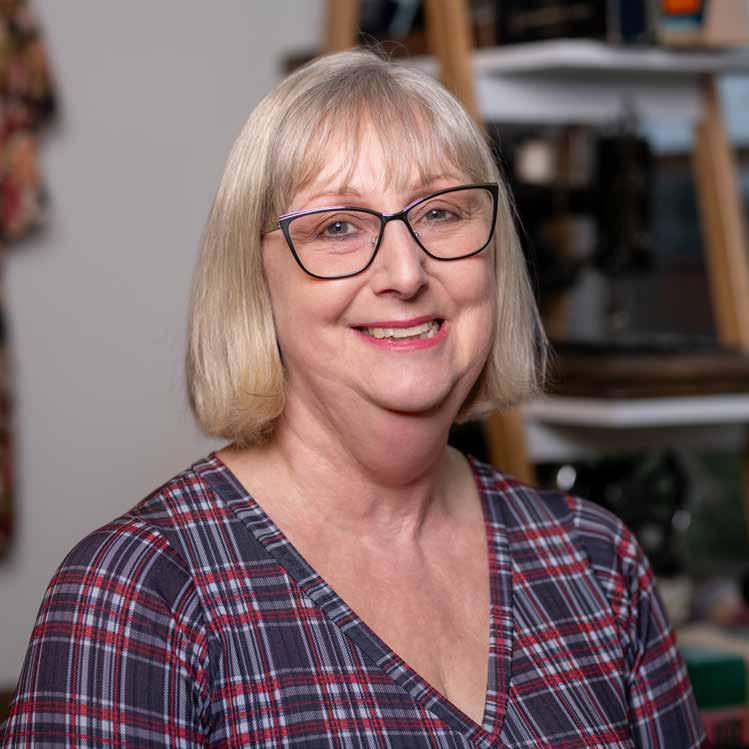
It is a crisp January morning as I arrive at the Charles Burrell Centre to meet entrepreneur Beverly Harrison, the woman behind Thetford-based sewing business Fun with Fabrics. As I am shown through the building, I meet Beverly in the corridor and we immediately fall into easy conversation. Warm, welcoming, and smiling, she is only too happy to lead me to the room where the sewing-magic happens.
Before we even step inside, my eye is caught by a wreath hanging on the door. It is made up entirely from sewing treasures: bobbins wound with brightly coloured threads, zips, cotton reels, a sewing machine fitting, a quick-unpicker and a measuring-tape ribbons tied into a bow. Beverly is delighted that I have noticed the wreath and explains that the pieces once belonged to her mother-in-law, who has since moved into a care home. She created the piece as a touching tribute to her mother-in-law’s sewing days. On the other side of the door I am greeted by Beverly’s husband, who offers a warm welcome
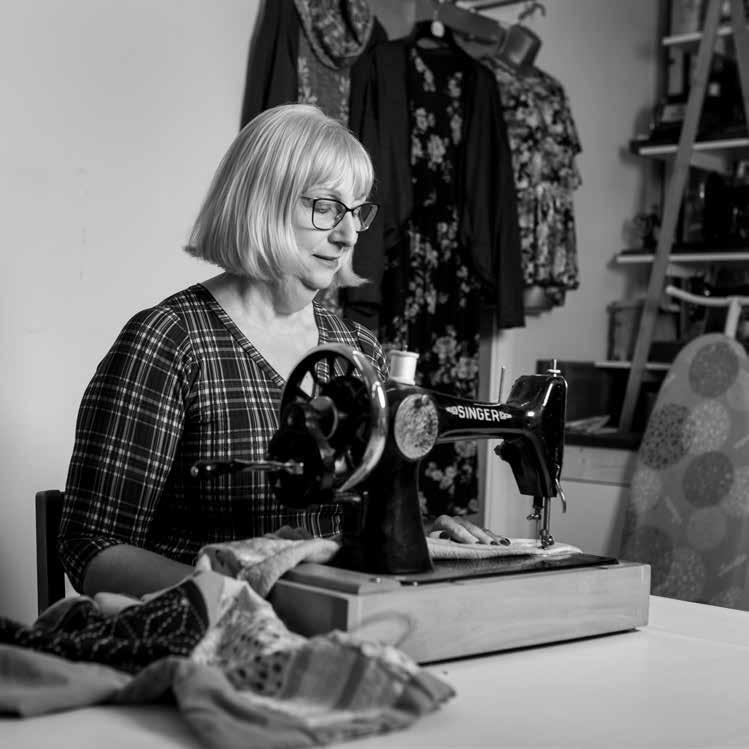
before allowing me to take in the creative space. Flooded with natural light from large windows, the room immediately feels calm and inviting. A display of Singer sewing machines sit in a display in front of the windows, nestled amongst these iconic machines is a showcase of projects made by recent groups: a fabric Christmas tree, a festive gonk, and a tower of pumpkins in varying shades and sizes. Long tables run down the centre of the room, surrounded by bunting, framed sewing-themed pictures, neatly arranged supplies of thread and other class essentials, examples of handmade clothing, and an ironing board propped in the corner. It is a creative space that feels special and thoughtfully curated. When I tell Beverly how welcoming it feels, she beams.
We then move through to the café at the front of the Charles Burrell Centre, where, over steaming hot drinks, we settle in for our interview.
From the gentle hum of sewing machines to the
Delicious Tray Bakes, Gooey Brownies and Comforting Oat-Based Bakes
Hand-Crafted in Thetford
quiet concentration of careful stitches, Beverly’s relationship with sewing has been lifelong, deeply rooted in family, creativity and community.
Her story begins at home, guided by her grandmother. “When I was nine, my grandmother bought me a pattern and some fabric and said, learn to sew. If you can sew, you’ll always have good clothes.” Beverly was talked through her first project, “the first thing I made was a skirt” she recalls. From that moment on, sewing simply became part of who she was. “It’s one of those things that I don’t ever remember being talked to about, I’ve just done it my whole life.” Living with her grandmother meant creativity was woven into their lives. “She always sewed and it was all around us, a part of everyday life, so, it was one of those things that I just always knew.”
Rather than formal lessons, Beverly learned by watching and doing. “I just followed sewing through my grandmother, saw what she was doing sort of, copied her really.” Clothes, she informs me, were not something just bought on a whim. “If I wanted anything in particular, I didn’t get to go and buy an outfit. I’d get some material because in those days, that was what you did… You made your own clothes because it was cheaper.” Skills were developed through necessity, curiosity and practice, and by the time sewing appeared on the school curriculum, Beverly was already well ahead. “There was nothing that they taught me that I didn’t already know… I sort of knew as much as the teacher by then.”
Over the years, sewing evolved, becoming an intrinsic part of Beverly’s life. Clothes came first, then “bags and cushions,” and eventually teaching. Beverly’s professional background lies in specialist education. “My teaching qualification is in Specific Learning Difficulties, including dyslexia and dyspraxia.” Life
took Beverly in different directions including carer’s responsibilities, part-time work in a haberdashery, and then on to a management role but each step added experience. “I actually learned what was a good way of doing things and what people want from sewing classes,” Beverly says, knowledge she later brought into her own business.
The turning point came during lock-down. “Covid came, and obviously there was no work. We were all at home,” she recalls. Long-held dreams resurfaced. “I’ve always wanted to have a haberdashery, that’s always been my thing.” With encouragement from her husband, teaching became the natural starting point, quite literally at home. “My husband said to me, if you want to teach, start with me. So, I taught him to sew, and he made himself two shirts over the lock-downs.”
Classes soon followed, first in hired halls between restrictions, then, after a long search and normality returning, a permanent base at the Charles Burrell Centre. “After viewing quite a few rooms, as soon as I walked into the one you’ve just seen, I knew it was perfect.” The large windows, generous space and plentiful sockets were exactly what she needed. From there, Fun with Fabrics began to grow. Beverly launched her Facebook page in April 2020 and gradually expanded from small adult classes into something much broader. “I started out by just teaching adults… but with my teaching specialty in neurodivergence, I started teaching children as well. I teach from as young as six-years-old.”
Today, Beverly offers a vast and varied teaching range. “I can do one-to-one sessions for all ages and abilities. Right from absolute beginners.” Alongside dressmaking, classes now include “free-motion embroidery, quilting, cushion and bag making” and more. Sewing parties for small groups and, more recently, sewing retreats have also become
a highlight. Sadly, the Charles Burrell Centre is not open on Sundays so Beverly was unable to offer a sewing weekend. With her husband’s support, Beverly organised her first getaway for a group of eleven ladies and herself last year. “We all went to the Dragonfly Hotel in Bury St Edmunds and did two days of sewing in the form of four mini workshops from 10-1pm then 2-5pm. The retreat included an evening meal and games.” Beverly delights in telling me that, “It was really well received, and I had so many positive feedback forms.” Another retreat has already been booked for later on this year, this time at the Country Hotel near Watton.
When I ask Beverly what she loves most about her classes at Fun with Fabrics, her answer is immediate. “I love it when people have made something and they just have a big smile on their face because of what they’ve achieved.” Some even leave wearing what they have made. “That’s definitely the best part.” The challenge, she admits, is getting the balance right. “If you’ve got a group of people and they’re all different levels, it’s keeping them all working together, catering to all the different abilities.”
In terms of inspiration, Beverly often starts online, “I use social media and follow a lot of pattern company websites.” Ideas can come from anywhere though, including people on the street, a magazine image or something glimpsed in passing. “I’ll see something interesting and find the pattern online,” she says. Preparation, is apparently key. “I will always buy the patterns and make up samples, so I’ve road-tested the pattern.” Teaching, Beverly explains, means carefully considering what is achievable within a class. “I also have to bear in mind that I’m teaching people that are still learning.”
Over Beverly’s five years of teaching I am eager to hear if she has a story that stands out above all
others. “I work with a neurodivergent nine-year-old girl who’s been struggling in school a little bit,” Beverly tells me. “She came and did some classes with me and has hit her niche and really found her place in the world.” Sewing truly proved to be transformative for her. For Halloween, the girl made herself a lion costume and loved it so much she refused to take it off. “Her mum videoed her dancing down the corridor in her lion outfit, and that, for me, was just wonderful.” Beverly smiles fondly as she shows me the video on her phone. I cannot help but smile too, it’s such a lovely story that perfectly illustrates how sewing and creativity can make a meaningful impact on people’s lives.
Looking ahead, Beverly has clear hopes for the future. “I would like a bigger room and I would like to be able to teach full-time.” A haberdashery remains the dream, alongside more retreats and reaching a wider audience. “What I do is part of well-being as well,” she explains. In her sewing room, conversation flows and the group can set the world to rights and then, “When you sew, you’re not thinking about anything else because you’re concentrating. It’s a very calming environment.”
With specialist training in neurodivergence and a firm belief that “there’s no upper age limit when learning to sew,” Beverly continues to stitch together creativity, confidence, and community, one project at a time.
Facebook page: Fun with Fabrics - Classes and Tuition
Instagram: funwithfabricstuition
Email: funwithfabricsclasses@outlook.com
Class price list: 1-2-1 sessions start at £30 for 2 hours (under 16 years)
Full day classes around £50 for 6 hours
Photograph ‘Rachael Lomax’ by Mangus Photography
Copper Roots, Global Reach:
How One Thetford Salon Changed the Colour Conversation
Written by Martin Angus
In a modest market town known for its forest, history and resilience, an unlikely global story has been quietly unfolding for nearly two decades. It begins, as many of the best stories do, not with certainty, but with curiosity, risk and a refusal to be the same as everyone else.
When Rachael Lomax first opened the doors of what would eventually become Copper Queen Salon, she didn’t inherit a bustling hair studio filled with mirrors and dryers. She inherited a beauty salon with no hair facilities at all. Everything that followed, every chair, colour bowl, concept and client, was built from scratch. And in many ways, that blank slate set the tone for everything that came after.
Now, 18 years on, Rachael’s work is recognised far beyond Norfolk. She educates colourists across the UK and Ireland, collaborates with major industry brands, and is widely regarded as the UK’s leading authority on copper hair. Yet despite international acclaim, awards and global visitors, her base remains firmly rooted in Thetford.
That choice is not accidental.
Building Something Different
From the very beginning, Rachael knew one thing for certain: she did not want to replicate what already existed. At a time when many salons followed similar models, she actively sought out what others were not doing, new techniques, emerging trends, fresh approaches. It was less about rebellion and more about instinct.
“I never wanted to be the same as every other salon,” she has often said. “I wanted to stand out, even if I didn’t yet know how.”
In the early years, growing a business in Thetford required relentless energy. This was before Instagram grids and viral transformations. Marketing meant newspaper adverts, town events, school visits, prom hair and community involvement. Rachael immersed herself in local life, building trust one client at a time.
Looking back, she acknowledges that those years were harder in many ways, but they shaped her profoundly, both as an entrepreneur and as a creative. They taught her adaptability, resilience, and the importance of evolving before stagnation sets in.
Her guiding principle became simple: reinvent every seven years.
Reinvention and Self-Understanding
That commitment to evolution gained deeper meaning later in Rachael’s career, when she was diagnosed with ADHD. What once felt like restlessness or a constant need for novelty suddenly made sense. Her drive to innovate, to pivot, to stay creatively stimulated wasn’t a flaw, it was fuel.
The diagnosis reframed her business choices, her teaching style and even her approach to leadership. Today, her education is deliberately inclusive, designed to support different learning styles and attention patterns. It’s one of the reasons her courses resonate so strongly with students who previously felt overlooked in traditional education settings.
And it’s also why lockdown, unexpectedly, became a turning point.
The Lockdown That Changed Everything
For many businesses, 2020 was about survival. For Rachael, it became a period of deep reflection.
When salons reopened with strict one-to-one restrictions, something clicked. The quieter pace, the undivided attention, the absence of back-to-back pressure, she loved it. Clients loved it too. What emerged was a new model: a luxury, one-to-one service built entirely around bespoke colour. No generic
formulas. No off-the-shelf solutions. Every shade would be designed around the individual in the chair, their hair history, integrity, genetics and lifestyle.
It was during this same period that Rachael finally recognised what her work had been quietly telling her for years.
Copper was her calling.
Finding the Copper Thread
Although she had always loved reds and warm tones, Rachael had spent years mastering blonding and balayage, often ahead of the curve. But as social media exploded during lockdown, she and her coach reviewed her work with fresh eyes. Her grid told a story she hadn’t consciously written: copper, auburn, strawberry blonde, warmth in all its complexity.
There was also something more personal at play. Rachael herself is a natural auburn, part of a family lineage where red hair appears unexpectedly, skipping generations. This sparked a deep dive into genetics, and a realisation that hair education barely scratches the surface of what makes red and copper hair unique.
Only 2% of the population are natural redheads, yet countless people carry dormant warm pigments that can be enhanced, neutralised or transformed. This science, largely absent from mainstream hair training, became Rachael’s obsession.
She found her niche not by narrowing her craft, but by deepening it.
More Than a Colour
To the untrained eye, copper hair is bold, vibrant, even daring. But for Rachael, it is nuanced, scientific and
Abbey Garage
deeply emotional.
Creating the “perfect copper” can take hours before colour even touches hair. Consultations are extensive. Swatches are tested. Underlying pigments, hair integrity and long-term fade patterns are all considered. Clients leave not only with bespoke colour, but with a personalised home-care plan designed to protect longevity.
This meticulous approach challenges a common misconception: that copper is hard to maintain or impossible to remove. In the hands of a specialist, Rachael insists, neither is true.
Perhaps more importantly, copper offers something emotional. Clients often describe feeling more confident, more visible, more themselves. For some it’s a dramatic transformation; for others, a subtle warmth that changes how they see themselves.
“It brings joy,” Rachael says. “It brings people out of their shell.”
From Thetford to the World
Today, Rachael’s salon welcomes clients from Cambridge, London and beyond. Students travel from Scotland, Ireland and across the UK to train in Thetford. The town’s excellent transport links help, but the real draw is expertise.
Rachael teaches from her own salon, runs online courses and mentors through organisations such as Fellowship of Hairdressing, where she supports emerging talent and helps shape the next generation of colourists.
She is also proudly brand-neutral, a rarity in an industry often dominated by exclusivity contracts. Having worked with companies such as Redken and L’Oréal, and educated for Yellow by Alfaparf, Rachael now focuses on
teaching colourists how to maximise what they already have, which also involves educating for brands, rather than chasing new products.
That independence has made her both a “nightmare and a dream” for brand representatives, but it’s also made her education respected, practical and refreshingly honest.
Recognition Without Ego
Awards have followed. Among them: Colour Educator Genius at Colour World, winner of the prestigious Most Wanted Award for Education (Rachael’s most proud of this one), silver wins at the Top Hair & Beauty Awards, and a place among finalists at the British Hairdressing Business Awards, often described as the Oscars of the hair world.
For Rachael, the accolades matter not as validation, but as opportunity. Many of her industry platforms are deliberately shared with her students, giving them visibility and confidence long before they might otherwise receive it.
Her philosophy is clear: education is not about gatekeeping. Knowledge shared is knowledge multiplied.
A Salon as a Community Hub
Back in Thetford, the Copper Queen Salon has evolved into more than a workplace. It is a co-working and education space, where independent professionals can rent chairs, host training and grow their own niches with support.
Bridal specialists, educators and creatives work side by side. Brands hire the space for events. Local students gain work experience and mentorship. The salon has become a hub, not a hierarchy.
And despite international travel, teaching schedules and collaborations, Rachael remains behind the chair three to four days a week. She is, first and foremost, a hairdresser.
Lessons for Thetford’s Future
Rachael’s story carries a powerful message for young people in Thetford with creative ambitions: geography is not a limitation.
“You’re never limited by where you live,” she says. “What matters is passion, consistency, authenticity and hard work.”
She emphasises foundations over speed, mentors over shortcuts, and networks over isolation. Her own journey is proof that small, steady steps, taken consistently, can lead to extraordinary places.
Crucially, she also believes in visibility. After 18 years of national and international recognition, she still hopes for greater acknowledgment at home. Not for ego, but for inspiration, so others in the town can see what is possible.
Rooted, Not Restricted
As for the future, Rachael has no plans to leave Thetford. Her roots are here. Her salon will continue to grow as an education space, a community hub and a launchpad for others’ dreams.
More events, more mentoring, more collaboration, all from a town that many might once have overlooked.
In the story of Copper Queen, Thetford is not a footnote. It is the foundation.
And perhaps that is the most powerful colour of all.
her
‘RachaelCopper was
Calling’ Photography by Mangus Photography
Photograph ‘Wanda Szczygiel’ by Mangus Photography
The Good Fight
Wanda Szczygiel - Serjeant & Son Solicitors
Written by Joanne Lock
As a managing partner solicitor, Wanda’s life could be seen by others as one of privilege. Privilege that may have always been present in her life, the helping hand getting her to where she is now.
I’m sure we all know a certain well known saying about assumptions, there is a lesser known saying coined by actor Henry Winkler “assumptions are the termites of relationships” as they lead us to a place of misunderstandings, conflict and a lack of trust.
It’s refreshing, optimistic and hopeful to know that Wanda got to where she is today through sheer determination, hard work and through very difficult circumstances where the only things she owned was her resilience and resourcefulness.
Wanda’s father is Polish and his side of the family
is related to the E. Wedel family, an historic and renowned chocolate making family. He fought in The Warsaw Uprising in 1944 where the Polish Home Army fought to liberate Warsaw from Nazi Germany where he was captured and became a prisoner of war. After being freed he joined the British Army to continue the fight through Italy and eventually was brought over to the UK where he settled.
Wanda’s mother was from Ireland and came to the UK aged 15 looking for work. Both her mother and father experienced racism.
Racism would later be instrumental in the breakdown of Wanda’s relationship with her father.
Wanda was raised in Yorkshire in a working class family of five children and attended a state school. Even though Wanda was hyper intelligent and
always top of the class, law was never presented as an option.
Career options at the time consisted of nursing, teaching or secretarial. The school curriculum was not challenging enough for Wanda who found she could get good results without trying. Wanda became disruptive and rebellious to relieve the boredom she felt.
Instilled with values from her parents about injustice Wanda attended protest marches with her friendship circle which included friends from different races and backgrounds. Racism had left Wanda’s father with a distrust of others and not wanting to form any relationships with anyone that wasn’t part of his circle. Wanda’s mother was the opposite and was accepting of others. Both of them were worried about Wanda at this time in her life and tried to contain her.
This containment was too much for Wanda and she left home at 15.
While she finished her O Levels, Wanda sofa surfed and when a friends’ parents got fed up, she would then move to a different friend’s house. Wanda did try to go back home, but felt unable to remain there as her father was still too strict.
Wanda got a job briefly and rented a flat with a friend, until they were illegally evicted and Wanda found herself out on the streets of Leeds with her stuff in bin bags. Not willing to go home to bend to her father’s will and compromise her values or disown her friends, Wanda survived by sleeping rough and going to see her aunts, usually around meal times.
With hindsight Wanda can see that her dad was
being overprotective. It was too much and had the opposite effect, pushing her back out onto the streets where she was unsafe. Wanda was faced with the ultimatum of apologising to allow her to return home and her dad forbade her mum from seeing Wanda until she did apologise.
Wanda’s mum got where Wanda was coming from and would secretly meet her in Leeds to check that she was ok and give her some food.
On the streets, most of the people in Wanda’s own age group were children who had been in care and pushed out at 16. Not eligible for any housing help until they were 18. Like them Wanda was in no man’s land.
Wanda got in with a group of New Age travellers, who were arty. They would draw pictures and sell them for money. Wanda went to Greenham Common with them and the group would also work on farms. It was an aimless life, nice in summer but not so in winter when the work dried up.
On her return to Leeds, Wanda found the Leeds Challenge project who took in homeless people aged 16 - 18, young people who had found themselves in that no man’s land between the care system and being able to receive help with housing.
Leeds Challenge housed the young people in a mansion in the middle of the countryside, where they would be taught life skills, how to wash clothes and cook. In addition to learning life skills work placements would also be arranged, a couple of weeks here and there. Wanda also spent a couple of weeks in Germany with the project. The project would also help to put young people in touch with other organisations who could help with housing.
Wanda got a work placement with a legal help clinic, whose work was similar to the Citizens Advice. The clinic offered advice and advocacy to those who had experienced illegal eviction. Wanda who had already been protesting for people’s rights now saw how law and advocacy played a part in helping vulnerable people and this fired her interest in law.
Wanda’s next move was to a hostel in Leeds, during this time most hostels were for men under the age of 18 who couldn’t get housing. The hostel where Wanda stayed was advertised as being for black youth, which Wanda was told when she walked in to which she responded with ‘that’s racist’ and so they took her in. Wanda stayed at the hostel for 2 years, the wardens there were fantastic. The wardens found Wanda a work placement to do electrical engineering and a place at college where she studied for a HND and later they helped Wanda to find a flat.
After receiving a job offer in Kent, Wanda moved south at the age of 18 where she went to work in a research institute. The institute’s work included producing satellites to send into space and other top secret projects.
Here Wanda was introduced to CAD which she picked up really quickly. These were the cutting edge days where she spent her time designing printed circuit boards for a salary of £3K per year. It was a low salary even for the time but she was learning a new skill.
Wanda went on to work in London, the company’s offices were located in Covent Garden where above them was a famous casting agency and below them in the building was Pineapple Dance Studio. In such a prestigious location the space
taken up by a waste paper basket cost the equivalent of £1K per month.
Wanda progressed in her career, becoming a consultant and was promoted to director of the company. At this stage in Wanda’s career her work involved selling systems, which eventually became boring for her. Things had changed for Wanda on a personal level too, she now had a child and decided to take a career break to have children.
During this break in her career, Wanda started to think about what’s next and picked up a prospectus from her local university - Greenwich, with a view to doing a management degree, rather than technical.
Wanda then saw law and decided to do a law degree instead. When Wanda rang her sister to tell her she had decided to do a law degree, her sister simply said ‘of course you are’.
Although reality wasn’t as simple as that, Wanda’s qualifications and experience were science based and universities classify law as an arts degree. To enable Wanda to be accepted by the university to study for her law degree meant that she would have to get A Levels in relevant subjects. Wanda needed two B’s, she sat her exams 6 weeks before giving birth to her second child, the grades she got were E & D.
Determined to study law, Wanda got on the phone to the head of the law school and said that she would keep coming back until she was accepted and she was. While studying for her law degree she had two more children and left university with first class honours.
On leaving university Wanda went to work for
Citizens Advice and then a law firm in Norwich where she had another child (making 5) just as she qualified as a solicitor. After some time with her children she then went back to education to obtain a masters degree in law, joined a large firm in Norfolk and then left to do an in house role, before buying Serjeant & Son Solicitors in 2016.
Serjeant & Son Solicitors is a very old firm, established around 1790 and has been going for over 230 years.
The partners who sold the firm to Wanda were retiring. When Wanda acquired the firm both the decor and practices were stuck in the 70’s, management were brought tea at specific times by support staff. There was apathy amongst the staff who were no longer enjoying coming into work. Wanda wanted to create something that not just her, but something her colleagues were also proud of.
Wanda had seen first hand what can happen when someone creates and opens up opportunities for others. She set about modernising the offices and asked everyone what they liked and disliked about their jobs. From these chats Wanda moved people around to where they best fit and everyone started to feel happier and went from hating to loving coming into work.
Wanda has created an environment of opportunity for those who want to study and grow up from the roots. Whether it’s receptionist to qualified solicitor. Progression isn’t just law based either, someone’s office management ambitions would be supported and encouraged too.
Serjeant & Son have moved away from a culture common in most law firms, Wanda has taken the
view to do away with hourly targets and she is determined to eliminate a cut throat atmosphere. A team works best when they are working together, not against each other and a primary objective is to ensure that costs are covered and people are happy, rather than profits.
Staff wellbeing is a priority and if you visit the Serjeant & Son website you will notice that there are a few unexpected members of the team, the dogs. Team members bring their best friends into work, cuddles and lunch hour walks have proved to be effective stress relief.
It works. Everyone who works there is both happy and friendly, the team love their work advocating and wanting to see justice done. Everyone does their best to achieve this within the confines of the legal system and the team shares all of these moments together both good and frustrating.
Wanda believes that everyone should be supported to be the best version of themselves that they can be.
Wanda says that on average a person will only use a solicitor a few times in their life and it is often for difficult circumstances such as divorce, child arrangements or being sued, clients are already feeling really anxious when they walk through the doors of Serjeant & Sons. Wanda and her team have created a friendly and comfortable atmosphere to help put their clients at ease when sitting down for a face to face chat over a coffee to find out more and how the team can help clients better. The presence of the dogs plays a big part in helping clients to relax.
Thetford
The Town that Launched a Nation
Written by Dave Griffiths
The more you read about Thetford, the more you realise the vital role it had in the history of the region and the country. The statement I make in the title might raise a few eyebrows, but I think there are compelling arguments to support it and to justify a great pride in the role of the town in the history of Britain. Read on and see if you agree.
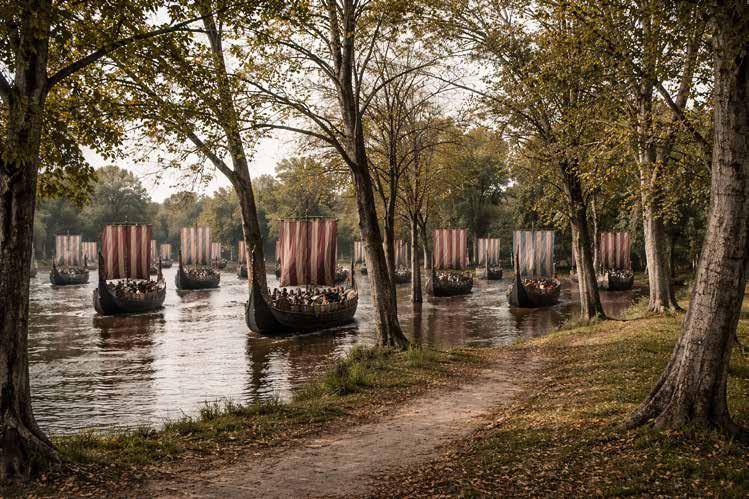
“Flickers of light dawn over Thetford in the early hours of a cold, crisp, misty, late September morning in 865 AD. All is quiet bar the occasional stirring of a tethered animal around the settlement’s huts, in an area west of the river between Nuns Bridges and the Red Castle. Just another sleepy autumn morning. Then around a bend in the river, close to the current site of Thetford Priory, the image of a carved wooden dragon’s head silently pokes its nose out of the misty gloom. Following the head comes an elegant neck and then the prow of a beautifully designed
Viking long boat. A straining ear can make out the gentle lap of oars touching water and the muffled coughs of passengers. Before the first boat comes fully into sight a second prow emerges then another, and another… The boats glide down to where the Nuns Bridges are now and silently moor up one behind the other, on either side of the river. 100 vessels or more. The Scandinavians on board jump on to shore, stretching, yawning and stamping their feet. A drowsy teenager emerges from a hut and, answering the call of nature in the open air, gazes sleepily about when the image of a sea of tall, bearded Northern folks comes into view. He freezes for a moment doubting his eyes then comes to his senses and screams “Attack, Attack!” running back into the hut. The Vikings are here.”
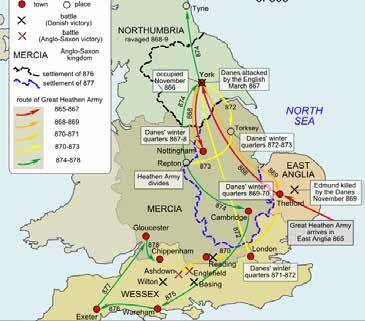
This was the arrival of the Great Heathen Army, the largest invading force ever to land on British shores, and they chose as their landing place
Thetford. Already an important town with excellent river and road access and a gateway to East Anglia. There had been many incursions of Vikings into Britain over nearly 100 years, but this was the main invasion, and it started here in our town, in Thetford.
The Vikings came not to attack and conquer immediately but to settle and prepare. They knew that they could not bring all they needed for a sustained campaign across the sea by boat, so rather they chose a place that they could make their base and gather what they needed for the coming campaigns. Their choice was a good one with East Anglia being lightly fortified yet having abundant food from the extensive farmland. And they were cunning arriving in early Autumn, postharvest with barns full of food ripe for the plunder! They settled in, over wintered in Thetford, gathered horses and fashioned the tools of war. In fact, they stayed through the winter and the summer of 866 AD, leaving only after the harvest was in, with their ships and carts bursting at the seams. They headed north to Northumberland by land, river and sea, ready for war. So, Thetford was the foothold, the foundation on which the Viking campaigns and successes of the next 100 years were built.
That Thetford was the launching pad for Viking invasion is therefore a matter of fact and not opinion. But perhaps the longer lasting legacy of the Great Heathen Army was not in war and conquest, but in the way they organised themselves and lived. Learning from the nomadic lifestyles of the Mongols, when they arrived in Thetford with up to 10,000 people, they brought not just warriors but a whole community, with supplies and animals, able to settle and set up a “pop up town” quickly. The Britain they found was a thin distribution of farmsteads and villages. Thetford was considered a sizeable town but with
a population of only about 1,500. The Vikings must have overwhelmed Thetford and the whole region who were helpless to resist. All very uncomfortable for the residents at the time but historians now credit The Great Heathen Army’s stay in Thetford as the first example anywhere in Britain of what we would recognise as urban living. A model that has been refined but endures to the present day. So, Thetford pioneered a fundamental building block of the organisation of society that has lasted over 1,000 years.
The economic consequences of the Army’s stay were perhaps even more profound. You had up to 10,000 Vikings with pockets full of coin gained from their travelling plunder, all centred in one location. Trades people of all types flocked from across the country and even abroad to sell their wares in this new, flourishing local market. Many of them stayed after the Vikings moved on and economic boost propelled Thetford to be one of the largest 6 towns in the country listed in the Doomsday Book alongside Norwich, Oxford, Lincoln, York and Winchester. So, Thetford and the arrival of the Vikings pioneered the fundamentals of market economics and the benefits of having concentrated centres of population. A model that endures to the modern day.
The Great Heathen Army, after conquering Northumberland, came back to East Anglia and defeated and killed King Edmund in 869 AD. The Great Summer Army arrived in 871 AD to bolster numbers as many of the soldiers (who were really both farmers and skilled warriors) had left the army and settled down. Guthrum led the Summer Army and took command of the combined army and led the army to defeat Mercia in 873 AD. Only Wessex and its King, Alfred, remained. For 4 years Alfred adopted tactics learned in large part from the Vikings. Cat and mouse battles, picking his battles,
running and hiding when necessary. Guthrum and the Viking army was finally defeated in 878 AD. Alfred and Guthrum negotiated peace by splitting the country into Wessex, ruled by Alfred, and Danelaw (the east of the country comprising Northumberland, East Anglia and most of Mercia), ruled by the Vikings. The great leader and warrior (although slightly tainted by loss to Alfred) Guthrum became king of East Anglia ruling here for 10 very successful years until his defeat. Thetford would have doubtless been one of his seats of power in the region.
Another effect of the Viking invasion that started in Thetford, was to wake up a sleepy and fairly defenceless nation to the threats it faced. The key to Alfred’s success was (apart from shrewd tactics) to build a network of fortified locations across Wessex to house and protect standing forces and rally locals to arms in time of attack. Those structures evolved during the Great Heathen Army battles, during Danelaw and well into the 10th century. Through the establishment these structures, Wessex were able to gradually win back Danelaw territory until in around 950 AD the last Viking king in Northumberland was defeated. The whole country was for the first time brought under single rule and name “Engla Land”, the “Land of the Angles” or “England” was born. So, Thetford was the launch pad for the Vikings who triggered the coming together of the peoples of various disparate regions into the new country called England.
The England that emerged from the Viking defeat was very much a hybrid Anglo Saxon/Viking country merging the peoples, customs and skills. Quite apart from the fighting skills that Vikings are well known for, they were seasoned travellers and traders collecting items and skills from far East and South. All this knowledge was assimilated into
The Great Heathen Army’s campaign
English life and so Vikings were more absorbed than conquered. Their world leading ship building skills influenced ship construction in England and its eventually mastery of the waves.
But the Vikings weren’t quite done and Thetford was to appear again in the key events that followed. Sweyn Forkbeard had usurped his father King Harald Bluetooth, the King of Denmark, and had conquered Norway and had gained control over large parts of Sweden. He therefore commanded a vast Scandinavian Empire. Likely bored and needing a new challenge, he headed for East Anglia with a sizeable raiding party intent on plunder and mayhem! In 1004 AD he landed, sacked and burned Norwich to the ground. Ulfcytel Snillingr (meaning Ulfcytel the Bold) held the command of East Anglian forces. He and some councillors met with Sweyn and negotiated a truce to withdraw in exchange for money. Sweyn took the money but a few days later broke the truce, sacked and burned Thetford. Ulfcytel was not happy and rallied his forces. He would have had a limited standing force so the army would have been voluntary, of modest size and not well trained.
He intercepted Sweyn as he headed away from Thetford. The ensuing battle was fierce with the Vikings proclaiming that “they had never met with harder hand-play [fighting] in England than Ulfcytel gave them”. After much bloodshed there was no clear victor and Sweyn left the field rushing back to his ships to escape England. Ulfcytel had given orders for the ships to be scuttled but the order was not carried out. It was 10 years before Sweyn returned with a huge force, conquered England, became King. Unfortunately for him 5 weeks later this immense King, warrior and leader of men, fell off his horse and died. An ignominious death for a great man. If Ulfcytel’s orders had been carried out, Sweyn may have been trapped in England
in 1004 AD and his return and conquest never happened. Ulcytel’s achievement to stand up to Sweyn against all odds and force him to leave the field was immense. It led to great plaudits both in the Anglo-Saxon Chronicle and from his enemies in many skaldic verses. Ulfcytel defended Thetford again in 1010 against another fearsome raider, Thorkell the Tall, but lost this time and the town was sacked and burned. The Vikings seemed to like sacking and burning Thetford! He eventually died in the Battle of Assandun in 1016 where Cnut defeated the English and became the enduring Viking King of England.
So, to sum up, The Great Heathen Army landed the largest invading force ever seen on British soil in Thetford and prepared for their campaign here. The town pioneered the first example of urban living in Britain and the flourishing economy in the area it drove showed the merits of a model still in place more than 1,000 years later. The effects of this Viking invasion, with its roots in Thetford, were to wake the country up and fundamentally reorganise how it defended itself. This laid the foundations for the creation of England, imbuing it with world leading ship building skills along with countless innovations discovered by Viking travelling east. What emerged in the mid-10th century was a country infinitely more capable, united and economically successful than it had been 100 years earlier. And it all started at dawn on the banks of a sleepy river in Thetford, the town that started the process that led to the birth of England.
The Ancient House, Museum of Thetford Life, on White Hart Street has displays about the ‘History Highlights’ of the Thetford area including the town’s fascinating Anglo-Saxon and Viking history. Exhibits include material from the excavations undertaken by Group Captain Guy Mainwaring
Cnut II and I (Danish: Knud II; 25 May 994 — 12 November 1035) nicknamed the Great (Danish: den Store) was the King of Denmark as Cnut II from 1018, King of England as Cnut I from 1016, and King of Norway from 1028 until his death in 1035. Cnut was considered one of Europe’s most powerful rulers during his time. He ruled over England, Denmark, Norway, and a part of Sweden on which are called the North Sea Empire.
Knocker in the 1950s. Knocker and his team discovered evidence for the domestic and industrial life of the town, including the production of pottery, metalwork and bone artefacts. After the Viking great army over-wintered in Thetford and defeated King Edmund and the East Anglians, Thetford seems to have taken off as a major settlement with a large area to the south of the rivers as well as an area north of the rivers. Artefacts on display in the museum include a bone skate, Thetford ware pottery cresset lamps and a gilded and enamelled jewel, possibly a fitting for a casket. Visitors also have the opportunity to try on a replica Viking helmet.
The Ancient House has a busy programme of events and activities which can be seen here: https://www.ancienthouse.norfolk.gov.uk/ article/30685/Whats-on-at-Ancient-House All welcome!
Photograph ‘Annie Foster’ by Mangus Photography
From Thetford to the Top:
Annie Foster and the Power of Saying “Yes”
Written by Martin Angus
In a town like Thetford, careers are often shaped less by rigid five-year plans and more by practicality, curiosity and opportunity. People grow up here knowing that good, meaningful work exists locally, in manufacturing, healthcare, logistics and management, but they may not always see how those paths unfold, or whether leadership roles are really “for them”.
That is why stories like Annie Foster’s matter.
Annie is now a Quality Manager at Baxter Healthcare’s Thetford Compounding site, a role she stepped into in her early thirties. She leads teams responsible for ensuring pharmaceuticals are safe, compliant and fit for patients who depend on them every single day. It is a role that carries responsibility, pressure and influence, and one she never actually planned to do.
For girls in Thetford considering careers in Quality, leadership or management, Annie’s journey is not a polished, straight-line success story. It is something far more useful: proof that you can start without certainty, learn as you go, and still build a career that matters.
Not a Masterplan – Just a First Step
When Annie left college at 18, she didn’t have a clear vision of where she would end up. Like many young people, she was simply looking for a job that felt interesting.
“I didn’t think I was going to be a quality manager,” she says. “I was just trying things to see what I liked.”
That openness led her to a role as a pharmacy assistant at Bury Hospital. It was a practical job, but one that immediately sparked her interest. She enjoyed the environment, the pace, and the knowledge that what she was doing had a direct impact on patient care.
From there, she enrolled on a two-year pharmacy technician training programme at West Suffolk College. The course was government funded and competitive, and came with a risk: if there was no job available at the end, there was no guaranteed next step.
For Annie, that uncertainty was worth it.
“It gave me a good foundation,” she explains. “I understood pharmaceuticals, how drugs are compounded
and why standards matter.”
That technical grounding would later become one of her greatest strengths – but at the time, she was simply learning a trade she enjoyed.
A Tour That Changed Direction
One moment that quietly changed Annie’s future was a tour of Baxter’s compounding facility in Thetford. Her mum worked at the site, and managers were showing students what pharmaceutical manufacturing looked like beyond a hospital setting.
At 22, Annie walked into a world of cleanrooms, specialist equipment and tightly controlled processes. More importantly, she saw people who were deeply invested in doing things properly.
“I was really interested in what was happening,” she says. “It just clicked.”
She joined the Total Parenteral Nutrition (TPN) unit and quickly began to stand out. Not because she demanded attention, but because she asked questions, volunteered for new tasks and showed genuine curiosity.
When new machinery arrived on site, Annie wanted to understand it. She helped validate equipment, learned how it worked, and trained others. That enthusiasm led to her becoming a team leader and trainer far earlier than she had expected.
“I was keen to progress,” she admits. “I wanted to learn more.”
For young women reading this, there is an important lesson here: career progression does not always come from declaring your ambition. Sometimes it comes from consistently showing interest, reliability and willingness to step forward.
Building Confidence by Learning Everything
Rather than staying in one lane, Annie deliberately moved across different areas of the business. She asked to learn how other teams worked, took on a trainee supervisor role, and then stepped into full supervisory responsibilities.
This meant learning not just technical processes, but how people, customers and operations fit together.
“I got to learn a lot about compounding and customer service,” she says. “It gave me a much broader view.”
That breadth of experience later helped her gain credibility when managing teams and influencing senior stakeholders. She wasn’t speaking from theory; she had done the work herself.
“I do think it makes a difference when you have come up through the organisation” Annie reflects. “People have confidence you understand the processes.”
For anyone considering management, especially at a young age, this is powerful reassurance. You do not need to arrive fully formed. You earn trust by learning deeply and respecting the people around you.
An Unexpected Move into Quality
Perhaps the most surprising part of Annie’s journey is how she entered Quality. It wasn’t something she had planned or even considered.
“I didn’t think I had the experience or quality background,” she admits.
But someone else saw her potential and encouraged her to apply for a Quality Specialist role. That moment, being seen by a mentor and trusted before she fully trusted herself, was pivotal.
Once in Quality, Annie thrived. She took on increasing responsibility, supervised the quality team, and developed the judgement and confidence required to make highstakes decisions.
By her mid-twenties, she was firmly established in the Quality function. By her early thirties, she stepped into the Quality Manager role.
Her story challenges a common myth: that you must know your destination before you begin. Sometimes the right role finds you when you are ready for it.
Why Quality Is About More Than Rules
To outsiders, Quality Management can sound dry or overly procedural. Annie sees it very differently. “At the heart of it is the patient,” she says. “Everything we do is about patient safety.”
Every decision carries weight. Pharmaceuticals produced in Thetford are used by people undergoing chemotherapy, receiving antibiotics or requiring intravenous nutrition. That reality grounds every conversation, audit and risk assessment.
“It can be busy and pressurised,” Annie explains. “But everyone knows what we’re doing matters.”
For girls drawn to careers that combine science, ethics and responsibility, Quality offers something unique. It demands technical understanding, clear decision-making and moral courage, and it rewards people who care deeply about getting things right.
Learning to Lead People, Not Just Processes
Stepping into leadership was one of the biggest learning curves of Annie’s career. Managing processes was one thing; managing people was another entirely.
“I don’t think anyone understands the struggles of leading people until you’re doing it,” she says.
Support made all the difference. Annie was given a mentor when she became a supervisor, someone who helped her navigate difficult conversations, conflicting personalities and the emotional weight of leadership.
She also completed leadership training and DISC profiling, which revealed something surprising about herself. Early on, Annie was highly task-driven: focused on results, compliance and efficiency.
“I just wanted to get the job done,” she laughs. “I wasn’t the type to start with a quick ‘how is your day going?’”
Over time, and particularly after becoming a parent, her leadership style evolved. She became more empathetic, more people-focused, and more aware of how individuals experience work.
Colleagues noticed the change.
“That feedback was interesting,” she says. “Life experiences really do change how you lead.”
For aspiring leaders, this is an important message: leadership is not fixed. It grows with experience, reflection and self-awareness.
Finding Your Voice as a Young Woman
One of the hardest challenges Annie faced early in management was confidence.
Learning to speak up in meetings, to trust her judgement, and to believe she belonged in senior discussions took time.
“You have to learn to have your voice in a room,” she
explains. “That’s hard when you’re younger.”
Rather than waiting to feel ready, Annie chose to act. She put herself into meetings, shared her views, and learned from mistakes. Each step outside her comfort zone built credibility and self-belief.
That approach is particularly relevant for young women, who often wait until they feel 100% prepared before stepping forward.
Annie’s advice? You don’t need to know everything, you need to be willing to learn.
Women, Leadership and the Question of Balance
When asked about gender-related barriers, Annie reflects thoughtfully. She does not describe overt discrimination, but something many women will recognise: internal doubt.
“When you’re younger, you ask yourself, can I have this career and a family?”
Today, Annie has two young sons and a demanding leadership role. It is not easy, but it is possible.
“You can do both,” she says honestly. “It’s tough, but you can.”
Importantly, motherhood did not weaken her leadership, it strengthened it. She became more empathetic, more aware of people’s pressures, and more intentional about boundaries.
For young women weighing ambition against future family life, Annie’s experience offers reassurance: you do not have to choose one or the other.
The Real Lessons Annie Learned Along the Way
Looking back, Annie doesn’t point to dramatic failures or
regrets. Instead, she highlights practical lessons learned through experience:
• You cannot do everything yourself – and you shouldn’t try
• Delegation builds stronger teams
• Feedback is essential for growth
• Confidence comes from action, not perfection
• Mentorship changes careers
• Learning never really stops
If she could change anything, she would push herself earlier.
“Grab opportunities sooner,” she says. “Put yourself out there more.”
That advice is simple, but powerful, especially for young people who underestimate how capable they already are.
A Thetford Story with Wider Meaning
What makes Annie Foster’s story particularly inspiring is that it didn’t begin in a big city or a prestigious university. It began here, with local opportunities, practical choices and a willingness to learn.
Her journey shows that careers in Quality and Management are not distant or abstract. They are happening now, in Thetford, led by people who once stood exactly where today’s students stand.
For any girl reading this and wondering whether leadership, Quality or management could be for her, Annie’s story offers a quiet but confident answer:
You don’t need to know everything. You don’t need to be fearless.
You just need to be curious, committed, and willing to say yes.
And sometimes, that is more than enough.
Photograph ‘David George’ by Mangus Photography
A Clean Start:
David George’s Thetford Journey
Written by Martin Angus
On a bright Sunday morning on Snetterton Market (when it was in full swing and before it sadly closed down), there’s a particular kind of small-town theatre that can stop you mid-step. Not the market busker, not the charity cake stall, not even the dog in a tiny coat (although that helps). This was a man, a length of carpet, a handful of mud, and a machine that looked like it meant business.
“I used to take a bit of carpet,” David George tells me, “throw mud on it, and clean it in front of everyone.”
It’s the sort of sentence that should come with a disclaimer, do not try this at home unless you’re fully insured and enjoy public scrutiny. But that very stubborn, very British, very “right then, let’s crack on” approach is precisely how David built Powerclean: one clean patch at a time, in a town where reputation travels faster than a takeaway menu on a Friday night.
If you’ve lived in Thetford long enough, you’ve almost certainly heard of him, even if you don’t immediately recognise the name. You might recognise the legend.
“Oh, it’s the guy with the blue pipe,” David laughs. “I’ve heard that one.”
It’s not the grandest origin story, but it’s the most believable. In a world of glossy branding and overnight “success”, Thetford’s favourite carpet-and-everythingelse cleaner is known not for a slogan, but for a practical detail spotted in the wild: a pipe, a van, and a job done properly.
From Pinner to Thetford: the big move
To understand Powerclean, you have to wind the tape back to the year 2000, back when David was living in Pinner, Middlesex, in what he calls “a tiny little flat” and working a van-driving job he’d been doing for eight years.
“I was getting fed up with it, to be honest.”
Like many turning points, the next bit begins with a day out that wasn’t meant to change everything. David went with his father to an exhibition at Wembley, a
Support you can trust when you need it most
For over 100 years we have provided care, reassurance and professional support to local families when they need it most.
Our friendly and experienced funeral arrangers are here to guide you through each step of your journey.
Our services include:
• Personalised funerals
• Pre-paid funeral plans
• Direct cremation
• Flowers, transport and stationery
• Expert guidance
• Multi-faith services
• Masonry
• In-home consultations
Your local Funeral Arranger, Lisa
Thetford
33-35 Bury Road, Thetford, Norfolk IP24 3DD
01842 845874
We’re open
Monday to Friday 10am–3pm Saturday Closed Sunday Closed
Find out more about all our services at: eastofengland.coop/funerals
franchise exhibition, the sort of place where you can accidentally buy your future between a free pen and an overenthusiastic brochure.
That’s where he saw it: a truck-mount carpet cleaning machine. Not a little portable box you wheel to the front door, but a proper unit bolted into the van, with a 60-gallon tank and the kind of presence that suggests it could clean your carpet and your conscience in one pass.
“I’ve always liked cleaning and keeping clean,” David says, as if this is a character trait you either have or you don’t. “And I saw this. I thought, that’s good. I thought, I’m going to do that.”
At the same time, he and his partner Annette were thinking about moving. London was expensive, and space was tight. Thetford entered the picture via family ties: Annette’s twin sister married a man from Thetford. Visits were made. The town was liked. Then came the moment that has lured many a Londoner north and sideways: the property prices.
David sold the flat and bought a terraced house at Melford Common for “half the price of the flat in London.” With the rest, he bought a van and the machine that had caught his eye at Wembley.
He began as part of a franchise. It lasted about a year.
“The franchise didn’t do well,” he shrugs. “So I just said, right… the machine’s not particularly tied to the franchise. It’s an independent machine. So I just called myself Powerclean.”
And just like that, somewhere around 2001, he was on his own, new town, new business, and no guarantee the phone would ever ring.
The hard bit: “don’t sit there waiting”
If you’ve never been self-employed, here’s the part people rarely put on the brochure: the quiet days. The days when you stare at the phone and wonder if it’s broken. The days when you consider advertising, then look at the cost (then consider selling a kidney or, failing that, a few thousand leaflets - Editors note: this was before the days of Reflections of Thetford magazine.
“The biggest challenge is mentality,” David says. “The big challenge is to not sit there waiting for the phone to ring.”
So he didn’t. He got out. He talked to people. Annette took a job behind the bar at the Conservative Club, and between pints, conversations, and familiar faces, the network began to form. David cleaned where people could see him. He demonstrated. He introduced himself, not with a business card, but with results.
It helped that, in those early days, Thetford didn’t have many people offering private carpet and upholstery cleaning locally. David filled a gap, and he did it with kit that looked like the real deal.
“I was quite fortunate in that respect,” he admits. “Because I started up… and my machine isn’t a little portable machine. It’s a bigger machine. And that interested people.”
Then came a major early milestone: a contract with Centre Parcs. For five or six years, David was there every Monday and Friday.
“It was quite a kick up the backside,” he says, because eventually the contract ended when the cleaning was brought in-house. “I thought, well, I can’t rely on that. I need to fill up five or six days a week now.”
This is a familiar lesson to anyone who’s run a small business: one big client can feel like safety… until it isn’t. David responded the only way he seems to know
Need a professional space to meet?
Anglia House Business Centre offers modern, fully equipped meeting rooms, book by the half day or day, and focus on what matters.
Anglia House
Bridge Street
Thetford IP24 3AG 07342 72701
how: by working, adapting, and building something that didn’t depend on one account, but on many relationships.
Family advice: steady in the peaks and dips
Although Powerclean is firmly rooted in Thetford, the business has a family thread running right back to London market life. David’s father was self-employed all his life, a trader with stalls across London, selling cheese, eggs, and cooked meats, up early and loud on the weekends.
“Proper trader,” David grins, remembering Brick Lane on a Sunday morning. “All the guys shouting what they’re selling.”
It’s more than nostalgia. It shaped David’s sense that working for yourself is hard, but honest. And his father gave him one piece of advice that comes up again and again as we talk, the kind that should be printed and handed out with every new business registration.
“He told me not to get too high when you’re really busy,” David says, “and not to get too low when it was quiet. There’s usually a medium in between where it’ll work itself out.”
His father passed away in 2013 after Alzheimer’s, a loss David speaks about quietly, with the plain heartbreak of someone still surprised by how cruel it can be. But the practical wisdom remained, and you can hear it in the way David describes everything from pricing to customer care: calm in the good weeks, steady in the slow ones.
From carpets to… pretty much everything
For roughly 14 or 15 years, Powerclean was focused on carpets and upholstery. If you’ve ever had a sofa cleaned and watched the water turn a suspicious enquiries@angliahousebusinesscentre.co.uk www.angliahousebusinesscentre.co.uk
shade of “how is this possible”, you’ll understand why that’s a full-time occupation on its own.
But then customers started asking a different kind of question, not “can you clean this?” but “do you know anyone who cleans that?” Driveways. Patios. Gutters. Exterior work.
By 2015, David had heard it enough times that he made a decision that would change the shape of the business.
“I thought, I might as well do this myself.”
He trained with a company in Northamptonshire and discovered a piece of equipment that sounds like something Batman would keep in the shed: the Skyvac, a powerful vacuum system with carbon fibre poles that lets you clear gutters from the ground.
“I don’t like heights,” David says, with the relief of a man who has found an invention that respects his nerves.
He bought a bigger vehicle. He invested in proper kit: the gutter vacuum, a large petrol pressure washer, carbon fibre poles, roof-cleaning tools. And suddenly, Powerclean wasn’t just inside the home, it was outside, on the driveway, up at the gutter line, and across the patio.
The best part? It all connected.
“Some people call you up to clean a settee… and I’ll notice you do this as well, could you give me a price for it?” he explains. “And vice versa. So it works well.”
He also discovered something the internet has known for years: pressure washing is strangely addictive.
“There’s something cathartic about it,” he says, describing the hypnotic satisfaction of turning a mossy,
tired patio into something you’d happily put a garden chair on again. David has even had customers confess they watch pressure washing videos for fun, and frankly, if it gets you through January, who are we to judge?
Thetford, word-of-mouth, and the speed of gossip
Ask David what really built the business, and he doesn’t say marketing. He says people.
“You need good people who recommend you,” he says. “Word of mouth.”
In Thetford, this is the true social currency. A good job gets mentioned. A bad job gets mentioned more. David puts it bluntly: in a small town, if you do something wrong, “believe me, that gets around faster than doing a good job.”
It’s why he’s careful not only about his own work, but about the tradespeople he recommends. Customers ask him for plumbers, electricians, boiler servicing, and he understands that your recommendation is part of your reputation.
“It’s no good giving… just the person you think of,” he says. “Because it’s going to reflect bad on you.”
He tries to keep everything local. Thetford people for Thetford jobs. A community that supports itself, not in a sentimental way, but in a practical, neighbourly one.
The modern customer: less polite, more informed
David has noticed something else changing over the years: customers are more willing to ask questions.
He describes the old British habit perfectly: you’re in a restaurant, the soup is cold, the waiter asks if everything is okay, and you smile and say, “Yes, lovely, thank you,” while privately considering a life of crime.
That’s shifting. People work hard for their money, and they want to know what they’re paying for.
“They ask me more how the system works,” David says. “What chemicals am I using? What if something goes wrong, am I insured?”
It’s not a complaint. He sees it as a sign that standards matter. And he’s comfortable explaining, because he’s done the training and he’s invested in proper equipment. He also manages expectations with the clarity of someone who has had to say it kindly, many times:
“I’m cleaning the carpet,” he says. “I’m not providing you with a new carpet.”
A job that’s really about people
If you want the heart of David’s work, it’s not just the machines and hoses. It’s that he spends his days in people’s homes, hearing their stories, the quiet, surprising human histories tucked behind ordinary front doors.
He tells me about meeting a “lovely little old couple” where, casually, the wife mentioned that her husband had been the chief designer of the de Havilland Mosquito aircraft. Another customer had climbed Everest. Another had flown jets over Scotland in the early days of British aviation. Yet another worked on marble for a major London hotel renovation, commuting to supervise stone brought in from Italy.
“Behind every closed door,” David says, “even in a small town… people with fascinating stories. Everyone’s got a book.”
It’s part of why he likes the work. He once had an office job and found it mind-numbing. Now he meets Thetford
NMV Sweet & Savoury
Elegant Cakes & Desserts for Any Occasion
At NMV Sweet & Savoury, we create stunning wedding cakes, birthday cakes, and custom cakes for any occasion. Our menu also includes French mousse mini cakes, desserts, and appetizers, perfect for adding a touch of elegance to your celebration. Delivery available.
Visit us online: www.nmvsweetandsavoury.co.uk
Follow us on social media: Facebook @nmvsweetandsavoury
07936 612846
in all its variety: elderly residents with decades of lived experience, younger ones with unexpected careers, families in the middle of life’s usual chaos.
And he chats. Not in a salesy way, in a human way.
“I don’t like that thing where you do this living room in 45 minutes and move on,” he says, recalling a training course that tried to standardise the job like a factory line. “Especially if you go into an elderly person’s house and they don’t see a lot of people… you’ve got to spend a bit of time with people.”
Sometimes, he admits, that means doing a little extra: clearing cobwebs while he’s there, or helping with something small because it’s five minutes and it matters. It’s not the kind of thing you can put on a price list, but it’s exactly the kind of thing that makes someone tell their neighbour, “Get David. He’s decent.”
The equipment matters… but so does the attitude
David’s pride in his kit is obvious, and justified. Truckmount carpet machines are serious investments (he mentions they’re around the £20,000 mark these days), and he keeps his immaculate, serviced regularly, because it’s both his livelihood and a signal to customers that he takes the work seriously.
The exterior equipment has evolved too: lighter carbon fibre poles, upgraded motors, new cameras for gutter inspections, pressure washer attachments that make the job quicker without cutting corners.
But the real consistency, he says, comes down to one simple rule he learned from his father:
“Don’t do a job for someone that you wouldn’t be happy with yourself.”
It’s wonderfully straightforward. No jargon. No
corporate mission statement. Just: would you accept this standard, in your own home?
Looking ahead: “I just keep going”
David is 59 now, and when asked about the future, he’s honest: there’s no grand exit strategy pinned to the fridge.
“It’s a physical job,” he says. “I just want to carry on and try and do a good job for people.”
His son is academically flying, a sixth former with a passion for history and politics, likely heading to university. The business could be sold one day, David says. There’s a client base, there are accounts, there’s equipment. It has value. But for now?
“I don’t know what I’d do myself,” he admits. “So… I’ll keep doing it as long as possible.”
It’s not a flashy ending. It’s a deeply Thetford one: steady, practical, quietly proud. The kind of future plan that isn’t a plan at all, just a man who likes working, likes doing things properly, likes meeting people, and likes the moment when a customer looks at a newly cleaned carpet or a transformed patio and says:
“I can’t believe how that’s come up.”
In the end, that’s what Powerclean is: not just cleaning, but restoration, of homes, of little corners of pride, of the sense that things can be made right again with the proper tools, patience, and someone who genuinely cares.
And if you spot a blue pipe running into a house somewhere in town, you’ll know exactly who’s inside, making Thetford a little cleaner, one story at a time.
ModelTammi
Photoshoot The Care,
Consent and Craft of
Carry Vendi
There is a long-standing myth that body piercing belongs to a single look, a single age, a single type of person. It’s a myth built on outdated assumptions and narrow imagery, one that ignores the reality visible every day inside piercing studios. This shoot exists to challenge that idea and quietly dismantle it.
The seven models featured in these pages are not professionals chosen for a specific aesthetic. They are clients. Individuals who walked through the doors of Moomoo’s Piercing with their own reasons, their own stories, and their own sense of self. Together, they represent a cross-section of society that is far broader and more nuanced than any stereotype allows.
Piercing is, at its core, deeply personal. For some, it marks change or reclamation; for others, it is simply adornment, something chosen because it feels right. The people in this shoot span different generations, identities, backgrounds, and professions. What
connects them is not how they look, but the agency behind their choices.
Carry Vendi’s work reflects that philosophy. Moomoo’s Piercing is not about shock value or rebellion for its own sake. It is about care, consent, and craft. It is about creating a space where everyone, whether confident or cautious, curious or certain, is treated with respect. The diversity shown here is not staged; it is an honest reflection of the studio’s community.
Each portrait captures a moment of quiet confidence. There is strength and softness, contrast and familiarity. These are people you might pass on the street, work alongside, or call family. Their piercings do not define them, they simply exist as part of who they already are.
This shoot invites the viewer to look again. To move past assumptions. To see body piercing not as a label, but as a form of personal expression, individual, intentional, and entirely human.
ModelTyler
ModelZach
ModelCameron
ModelPaulina
The amazing models were courtesy of Moomoo’s Model Agency: Tammi, Lacie, Tyler, Zach, Cameron, Paulina and Rachel
Piercing - Carry Vendi (Moomoo’s Piercing)
Photography - Martin Angus (mangus.co.uk)
Various Locations - Thetford
Professional Piercer and High Quality Jewellery
Photograph
‘Alfie Lynch’ by Mangus Photography
The Quiet Lad who Loves Fight Day
Inside Alfie Lynch’s Rise
Written by Martin Angus
On an ordinary day in Thetford, you can walk past the usual rhythms, school runs, supermarket queues, the quiet shuffle of people getting on with it, and miss the fact that a man from our town has stepped into a world stage most of us only glimpse through highlight reels.
Alfie Lynch doesn’t arrive with fireworks. No entourage, no noise. In person he’s polite, almost understated, more “mate, how you doing?” than “main event.” The surprising part isn’t that he fights for a living. It’s that, for all the drama and spectacle his sport sells, he carries himself like someone who’s still half-expecting to be asked to move his car because he’s parked a bit wonky.
And yet: Alfie Lynch is Thetford’s professional kickboxer. The kind who doesn’t just train hard locally and dabble on weekends. The kind who signs contracts, travels, cuts weight, takes risks for pay, and comes back to teach the next generation in a gym that grew from village halls into a hub people travel to.
He’s 23. He’ll be 24 in June. And at an age when many
people are still deciding what they want to be, he’s already lived two lives: the quiet kid with a football kit in the boot, and the calm professional who can switch on a fight-night persona that feels, to anyone watching, like a different human being.
The quiet kid, the football weekends
Before the gloves and the lights, Alfie was, by his own description, “always just a quiet kid.” Football was the centre of things. School in the week. Weekend trips down to Essex to see his dad and play. If you imagine a childhood built out of routine and miles on the road, you’re not far off.
He moved up this way young, around eight or nine, he thinks, old enough to remember it, too young to put grand meaning on it. It wasn’t a dramatic reinvention; it was just life shifting sideways. New classrooms. New faces. That peculiar feeling of being the new one, not because you chose to be interesting, but because your postcode changed.
Photograph ‘Fight Night’ by Isabela Brown
He remembers the bigger jolt later: secondary school. The first try didn’t quite fit. Another move. Another fresh start. Looking back, that’s the moment the story begins to turn, because it was around then that his mum clocked what parents often see before kids can name it: he was quiet, keeping himself to himself, needing something that was his.
And like most turning points, it didn’t arrive with a grand announcement. It arrived with a suggestion.
Try this.
Three village halls and a door opening
The way Alfie tells it, finding Billy Brown and East Anglian Kickboxing is the kind of small-world story that makes you laugh after you’ve stopped being amazed by it.
Billy, ten years older, is originally from the same area of Essex as Alfie’s family. The web gets stranger: Billy’s dad used to drink with Alfie’s uncle (or great uncle, family trees get blurry in retelling). Different generations, different circles, same patch of map. Life quietly stitching people together before they realise they’re part of the same fabric.
Alfie’s brothers went to a session first. Alfie watched. His mum encouraged him to try. He did. He loved it.
At the time, there wasn’t a dedicated gym. The training rota was a tour of village halls, one in Thetford, one in nearby places, one elsewhere. If you’ve ever carried kit bags through a cold community hall at dusk, you’ll understand the charm: not glamorous, not cinematic, but honest. The kind of environment where you have to want it, because nobody’s paying you to pretend.
That hunger showed early. “The week after,” Alfie says, he decided he’d do all three sessions. Then, almost
immediately, there was a tournament. “Ten minutes later,” he jokes, he had his first fight.
It sounds like exaggeration. It isn’t. His entry into kickboxing was less slow burn, more match strike. And what’s remarkable is how fast it caught.
Ten weeks in… and Team GB
Alfie trained for around ten weeks before his first tournament. Not ten months. Ten weeks. In that first one-day event, he placed bronze, third. A solid result for anyone, let alone someone still learning which nerves belong to excitement and which belong to fear.
That bronze qualified him for something that still feels surreal even when he describes it calmly: the chance to go to South Africa and fight for Team GB at the World Championships.
He’d been training six months by the time the trip came around, six months to go from “I’ll try it” to “I’m representing my country.” If you’re reading this with no knowledge of kickboxing, here’s the only detail you need: that kind of acceleration doesn’t happen unless there’s talent, obsession, or both.
Alfie came home with bronze again: third in the world after six months of training.
That’s the sort of sentence that makes you reread it.
Third in the world. Six months.
It’s also the kind of moment that quietly changes a young person’s whole internal map. At some point, “this is a hobby” stops fitting. “This could be my life” starts to feel possible.
And somewhere in that shift, football began to fade. Alfie had played at a good level and was signed with
Ipswich as a kid. He was realistic about it, he wasn’t convinced he’d make it all the way, even if he had talent. Football is a crowded dream. He enjoyed it, but he knew the odds. “Every kid starts playing football,” he says, and then you realise how narrow the funnel gets.
Kickboxing, by comparison, grabbed him and didn’t let go.
The switch: enthusiasm becomes discipline
There’s a line Alfie offers that feels like it belongs framed on a gym wall, not because it’s dramatic, but because it’s true.
At the start, you train because you love it.
Later, you train because you’re disciplined.
It’s a quiet distinction, but it’s the difference between dabbling and building a career. Enthusiasm is the fuel that gets you through the door. Discipline is what keeps you turning up when the novelty is gone, when your mates are out for food, when it’s cold and you’re tired and you know Monday is hard sparring day.
Alfie understands that shift because he lived through the drop-off years. Teenagers start exploring other worlds. Some drift away from sport. Some lose interest. Some get distracted. “That’s when a lot of people give up,” he says, when the initial buzz fades.
He didn’t.
He stayed.
And because he stayed, because he made sacrifices early, he reached 19 and looked at what he’d built and thought: why would I stop now?
His biggest fear isn’t losing a fight. It’s failing to reach
go mystical. He goes practical.
Calm wins, noise spends energy
If you expect a professional fighter to talk about aggression like it’s a superpower, Alfie will surprise you. He doesn’t romanticise rage. He doesn’t sell the “killer mindset” myth.
In fact, he argues the opposite: kickboxing isn’t an anger sport. The calmer person often wins. Anger burns energy; calm conserves it. Calm keeps your brain online when everything is moving too fast.
Alfie describes himself as a calm person by nature, never angry in the build-up. It’s part temperament, part training. It’s also why his relationship with Billy works: Billy knows exactly what kind of energy Alfie needs on fight day.
Some fighters need to be revved up. Others shut down if they’re shouted at. A good coach learns the difference. Alfie says Billy knows how he takes criticism, what he can hear and what will bounce off. That understanding has been earned over years, built from trust, and it shows in the decisions they make.
At one point, Alfie was offered a title opportunity. He wanted it. Billy said no, wrong time. They turned it down. Alfie trusted him. In hindsight, Alfie believes it worked out better long-term.
That’s not just coaching. That’s partnership.
And it explains something important to readers at home: this isn’t random violence with gloves. It’s planning, strategy, timing, patience. It’s a craft.
What training actually looks like (the unglamorous truth)
Ask Alfie what a fight camp looks like and he doesn’t
It’s not one heroic session. It’s a week-by-week system.
He works with Billy as head coach for kickboxing, and with strength and conditioning coach Rui Rodriguez, based in Norwich. The structure is built around high days and low days, hard sessions followed by lowerintensity technical work so the body can actually adapt, not just accumulate fatigue.
Monday: hard sparring, high day. Sprints. Conditioning.
Tuesday: lower day. Technical work. A lighter strength session.
Over a week: around ten sessions. Sometimes two-adays. Sometimes one.
It’s surprisingly methodical. The point isn’t to “go hard every day.” If you do, Alfie says, by midweek what you think is hard is actually 60% because you’re exhausted. You’re not hitting the systems you need. You’re just collecting tiredness.
In an ideal world, he likes an eight-week camp. Sometimes the sport doesn’t give you ideal. Sometimes you get five weeks and you adapt.
And all of it, training, strength & conditioning, nutrition, works in a tight loop. The team talks. Calories go up on hard days. Strength work adjusts around sparring. If a sparring invitation appears, the plan changes.
It’s a modern athlete’s ecosystem, running out of Thetford.
The part you don’t see: the cut
If you’ve only ever watched fight-night clips, the hardest part of Alfie’s lifestyle may surprise you.
Not the punches. Not the travel. Not the nerves.
The diet. The weight cut.
He explains it carefully, not wanting to overcomplicate it, but not sugarcoating it either. Fighters have a “walking around” weight, what they are outside camp. In the weeks leading up to a fight, they diet down. Then in fight week, many do a water cut, losing a significant percentage of body weight in days through controlled dehydration, then rehydrating after the weigh-in.
And here’s the bit most people never consider: you can’t simply opt out. If you decide you won’t cut weight, you might face someone who does, and they’ll step into the ring significantly heavier than you by fight time. The playing field shifts.
So the hardest part becomes mental: sticking to the targets, avoiding little slips, knowing that if you arrive even slightly heavy, fight week becomes harder, riskier, more stressful. And you’re managing that stress at the exact moment your nerves are already humming because tomorrow you fight.
It’s not glamorous. It’s not viral. It’s the job.
The switch that nobody can explain
Then there’s the other mystery: the “two Alfies” problem.
Day-to-day Alfie is relaxed, sociable, friendly. Fightnight Alfie is confident, animated, theatrical, an entertainer.
Even he can’t quite explain what flips the switch. “I honestly don’t know,” he says. He only knows that fight day is the day he enjoys most.
That’s unusual. Many fighters dread fight day, the build-up, the waiting, the nerves. They love the feeling after they win, but they hate the hours leading into the moment.
Alfie is the opposite. He’ll sometimes feel more nervous turning up to a hard sparring session than he does walking into a fight.
Fight day, for him, is the point of everything. The culmination. The release. The place he feels comfortable.
It’s hard to explain to people who haven’t experienced it. But anyone who’s ever performed, on stage, in sport, even in a big meeting, might recognise the shape of it: a version of yourself that only appears under lights.
The goosebump moments, and the numbers
Every career has its “I made it” moments. Alfie names two.
The first: his professional debut. October 2023. First-round knockout. “I’m professional now,” he remembers thinking. “That’s it.”
The second: signing a contract to fight on ONE Championship, one of the biggest combat sports promotions in the world, offering the kind of platform and money that can change a life. For most fighters, it’s the dream logo.
Alfie also lays out his current record plainly, without hype: 6–2 as a professional, with three knockouts. He
started 5–0, won a British title (which he expects to defend in his next fight), and reached a point where the UK scene didn’t have many obvious steps left. He took a fight against an experienced, world-level opponent, someone with decades of ring knowledge and a deep pro record. Alfie lost a decision, but it proved something important: he can compete at that level.
Then came the call for ONE.
Now the goal is clear: build back, rack up wins, and return. In his words, he wants the UK number one spot again, and beyond that, to keep pushing toward the promotions where the money becomes “lifechanging.”
Thetford, the village-hall miles, and the people who got him there
For our local magazine interview, the most moving part of Alfie’s story isn’t the contracts. It’s the unglamorous support system that made the contracts possible.
Before he could drive, his mum took him to every session, Thetford one day, another village hall the next, then another. Over and over. For years. That’s petrol money, time, evenings given away, a quiet family decision that says: we’ll back you.
“If they hadn’t done that,” Alfie admits, “and I was only training once a week, I don’t think I’d be where I am now.”
It’s the kind of detail Thetford will recognise. Big dreams here are rarely funded by big-city budgets. They’re funded by lifts, by favours, by time, by people doing the extra run because they believe in you.
Alfie also works. He’s self-employed, does resin flooring, and teaches for Billy. Sponsorship helps, but he’s clear: the priority is to keep working and keep training. The myth of fighters living glamorous lives disappears quickly when you hear the actual juggling act.
And perhaps the most quietly powerful reflection he offers is about fighting outside the ring.
He says training makes you less aggressive, not more. When you do combat sports in a controlled environment, week after week, you lose the urge to prove anything in the uncontrolled world. You’ve got nothing to demonstrate on the street. You’re trying to make weight. You’re trying to stay healthy. You’re trying to show up on the date that matters.
That might be the most valuable message in the whole conversation: real fighters don’t go looking for fights. They’re too busy preparing for the one they’ve agreed to.
What he wants Thetford to know
When Alfie talks about legacy, he doesn’t chase the obvious answer, he doesn’t say he wants to be remembered as the toughest man in the room. He says he wants to be remembered as exciting, entertaining, and still the same person outside the ring.
Not “cocky, crazy fighter” as a full-time identity. Not the silent killer act. He wants people to feel they can talk to him in public, and then watch him become something else under the lights.
Because that’s the truth of sport at this level: it’s not just competition, it’s performance. It’s entertainment. It’s a craft you build in silence and reveal in spectacle.
And for Thetford, it’s something else too: proof.
Proof that world-level ambition can grow out of village halls. Proof that a small town can produce a professional athlete with international contracts. Proof that the long way round, accepting lifts from friends and family, late nights, early mornings, rigid meal plans, disciplined weeks, can still get you there. Alfie’s story isn’t finished. He’s still in it, living it “one step at a time,” as he puts it, refusing to stare too far into the future. But if you spot him around town, quiet, polite, ordinary, remember this:
Somewhere inside that calm exterior is a man who loves fight day, who has already stood on podiums far from home, and who carries Thetford with him into rings most of the world will never step into.
And when the lights hit and the bell goes, when the other Alfie appears, our town is in there with him.
MEMBERSHIPS
The Medusa Project Thetford
Extreme sports Special – on a mobility scooter! Dirt tracking, ice road trucking and the unboxing match
Photography, high jinks and words by Bob Blogg
Firstly: Dirt Tracking.
This didn’t start out as an extreme sport special. We have Adrian to thank for this dirt track episode. He was going to film his trip to Norwich to visit his daughter on my good old Tiglet mobility scooter – actually it’s a good young T-Sport X5 auto-fold (under six months old) but he’s still affectionately called Tiglet after his predecessor.
Anyway, in true Adrian form, he only realised he had left the cameras at home when he got to the station!
So I said, well, screamed actually, “Get your sorry a*** out in the woods at the back of the Abbey Farm Estate and bring me some footage I can use, or you’re fired!”
This was his first solo, unsupervised filming trip so my hopes weren’t high.
I was pleasantly surprised – in fact I was gobsmacked.
He took on the challenge and delivered a superb woodland adventure, even remembering to turn on all the cameras and his microphone.
Treating the scooter like a powerful off-road dirt bike he went motor-crossing!
At the back of the estate, squeezed between the railway line and the A11 is a small area of woodland that is used for exercising and dog walking, and a lot more besides that is probably best left unmentioned. Also a lot of kids use it for dirt biking, tearing up the pathway into a muddy and pitted track that is the dream of any self respecting motor-cross enthusiast.
It was into this maelstrom that Adrian fearlessly took my Tiglet – admittedly he had Heather, his wife, and Paddy, his dog, with him to rescue him if he did anything silly.
His objective was to see if it was possible to get to Greggs, which is situated at the BP Service Station on the Thetford bypass, using this route. Quite a long trek to get a sausage roll!
The path started off well. It was fairly smooth and even, and Tiglet had no problem negotiating the forest trail as they went deeper into the woods towards their objective.
But it wasn’t long before Adrian’s language got a bit more colourful. As the X5 had to plough through muddy ruts that got deeper and deeper, it soon became a treacherous quagmire that tried to swallow the scooter.
But this little scooter was having none of it. It slid about a bit but it refused to get stuck and just kept going.
It was an awesome performance for such a small scooter.
But this ‘dirt tracking’ was about to take on a new meaning. It became ‘rubbish hunting’!
Everywhere Adrian looked someone had dumped some rubbish: empty bottles and tins lined the trail, along with empty cartons, crisp packets and food wrappers.
And that’s just the small stuff. He found a giant glass fish tank, a burnt out two-seater sofa and a burnt out fridge.
Soon the trees thinned out and Adrian could see his
destination. The service station came into view on the right of a T-junction he arrived at. At the same time it also became apparently that turning right was not an option for the mobility scooter. A really steep bank and a concrete rampart separated the woodland from the BP Garage and no wheeled vehicle could make the crossing – well maybe a Tank could. An able bodied human could make it, but they probably couldn’t get back after filling up on junk food.
Anyway, Adrian turned left and carried on exploring. You could tell he was having fun though. Despite his litany of complaints about motor-bikers and rubbish (he had added broken beer bottles, nappies, plastic carrier bags, tyres, cookers and more to his dump list), he kept saying how much he was enjoying himself on the X5, how nice it was to be out in the fresh air with Heather and Paddy, and how he hated people who disrespected the environment and what he would like to do to them!
And despite a quagmire or two, and the odd pockets of rubbish, it was a really pleasant journey with dappled sunshine and beautiful scenery. They soon made it safely back home. It was a great dirt tracking day out and the mobility scooter was clearly the winner.
Scan the QR code below to go...
...Dirt Tracking in the Woods
Secondly: Ice road trucking.
You have probably all seen those huge ice road trucks that batter through arctic winds, snow and ice in the far north of Canada and Alaska to deliver live saving goods to nutters who have never heard of the Mediterranean!
Well this is Thetford, similar weather, similar conditions, but I’m on Tiglet and trying to get to Karvin’s Budgens by the riverside near the cinema.
I had already come from Old Market Street, along a very slippery pavement, a bit of wet and dry road, and through a snow ridden Nether Row.
I reached the start of the ice road. I huge stretch of unbroken snow and ice that faded into the distance alongside the river Thet until it reached the wee bridge at the confluence of the Thet and Little River Ouse by the Nationwide Building Society.
I think that last sentence has just cost me any hope of winning the prize for best composition and poetry in a shrinking landscape!
Maybe I should have ended that sentence thusly: ...and the Little River Ouse with the imposing presence of Duleep Singh visible on the opposite
bank, proudly mounted on his brave steed, wearing a coronet of icicles and guarding the entrance to Button Island.
Anyway, I am sure you get the idea. It was a true winter challenge for any scooter.
You just couldn’t see the path from the School Lane end where I started but I needed bread and milk. So in the true British bulldog spirit off I went. I have already told you about the T-Sport X5 mobility scooter, Tiglet, and how impressed both I (I was going to say ‘me’ but my grammar checker threw a hissy fit!) and Adrian were with its handling, but this was an extreme challenge that I had no right to demand. Funnily enough, I wasn’t worried in the least. I was confident we would get through.
Yes. I did slip and slide about a bit but the traction was surprisingly good for the most part. Ok I did get stuck. This was really my fault. I was waffling around sightseeing, talking to dogs and waving to swans and ducks, and not looking where I was going.
Suddenly the wheels were spinning and I was going nowhere. I was on a little hilly bit and digging in.
A passing lady walking her dog ask me if I was alright and I assured her that I was and was just having fun in the snow but I might need her dog to tow me out later!
And I was having fun, I was really enjoying myself. I am lucky enough that I have a bit of strength in my legs; I just can’t walk on them, so I gave myself a little push and soon got going again.
Shortly after that, I reached the little ramp that leads up to the exit from the riverside.
This was another slippery slope, but I was expecting it. With a couple of leg sweeps I soon scooted up it and whizzed over the little bridge to arrive on what I call the Captain Mainwaring side of the river.
Fortunately, the bridge was free of snow and ice. There was just one ramp between me and Budgens now.
This ramp leads up to the Travelodge, fitness centre and other shops above the river.
This ramp proved to be the most fun of all, my scooter slalomed up it like an Olympic skier late for the medal ceremony!
We made it safely to Budgens and with a few more wheel spins I made it through the door which they kindly held open for me despite the cold.
This was the first Monday morning after the new year so I wasn’t expecting them to have much in stock but they had all I needed and some tasty snacks that I probably didn’t.
On the way back, with the cameras turned off, we had great fun racing up and down that snowy ramp. Eat your heart out Eddie the Eagle!
Scan the QR code below to take...
... The Ice Road to Budgens
Finally: The unboxing match.
Ding, seconds out – round 3! Well, we have been raving about my new T-Sport X5 mobility scooter to anyone who cared to listen. We have taken it on some extreme challenges, up and down precipitous inclines, all around the London Docks in the pouring rain, and across the snow and ice. We have been most impressed with it and filmed all these adventures.
As it turns out we were not the only ones. T-Sport was very impressed too.
So much so that they shipped us up another one of their scooters so that we could review it and test drive it.
Finally, someone is taking us seriously about independently reviewing mobility scooters. My heartfelt thanks go to Simon, at T-Sport.
It is a Scote 48350 folding 3 wheel mobility scooter. I keep forgetting the number so I will just call it the Scote for now – although I have to admit I keep putting an accidental ‘r’ in its name when I’m typing!
It’s got some pretty impressive specs: It has two 350w hub motors, giving 700w in total; a powerful 48v 15ah lithium ion battery, you can also get an airline approved battery if you want to take it on holiday; 3 speed modes giving 4, 8 and 12 mph - the max legal speed in the UK is 8 mph; it also has a range of about 20 miles.
Anyway, let’s get it out of the box. We had to do this carefully. We didn’t want to damage the box so we had it intact when we wanted to send it back. Send it back??
It is a two man job to lift it out but Adrian and I managed it quite easily between us, even getting it out of the polystyrene without breaking that. The scooter weighs 26kg.
We ended up sitting down to catch our breath with Adrian cuddling the front wheel like he had found his missing baby and me holding onto the certificate of conformity like it was a subpoena!
We soon got our act together, and with me reading the instructions and helpfully pointing out the obvious to Adrian, assembly began.
Frankly, there wasn’t a lot of assembly needed. You have to bolt the front wheel on, screw on the mudguards and the front light, and then put the battery on charge.
It might be tricky for some whose disability limits their movements and prevents them from getting down low to the ground. I certainly can’t get on the ground. Well I can but I can’t get up again! Adrian can get on the ground and up again, but he shakes a lot so holding a screw driver or spanner steady is really difficult and frustrating for him.
Still, with me passing him his nuts and the odd Allen key he soon had it done.
In one of the pictures you can see Adrian on the ground while I am supervising things on my phone!
All we had to do now was put it on charge. This was when a lot of head scratching happened.
The manual said: Plug the charger in and turn it on. Simple enough you would think but we couldn’t find whereabouts on the battery to plug it in!
It wasn’t until we got the battery off of the scooter that we discovered the secret.
The battery has a handle, and when the battery is in place on the scooter the handle is folded up.
The charging socket is hidden behind this handle.
The Scote comes with a spanner and a very good set of Allen keys, as well as a basic pump for the tyres. Simon told me that the recommended tyre pressure for the tyres is 30 to 35 psi so you should check them before setting out because when the scooters are shipped they are not always fully inflated.
The hand pump works but I’m lazy so I cheated and used a digital air compressor I got from Amazon!
Anyway, despite being on the ropes a few times, we have now got this scooter up and running and fully charged.
Now, we can’t wait to take it on some extreme road trips and, of course, around our Nuns’ Axe and Triangle Mobility Scooter Test Track, where I think it will be challenging the leaderboard. You will be able to watch all the action in the next issue of the magazine.
Meanwhile, scan the QR code below for a blow by blow view of...
...the Unboxing Match
Happy scootering.
Photograph
‘Ruth Bartram’ by Mangus Photography
The Place to Be:
The Heart of Thetford Dolphins Swimming Club
Written by Martin Angus
On a winter evening at Breckland Leisure Centre & Waterworld, the air has that unmistakable “poolside” cocktail: a warm fog of chlorine, the soft slap of water against tiles, and the rhythmic whistle of effort, breath, kick, turn, repeat. It’s a familiar soundtrack to many Thetford families. Yet if you pause for a moment, if you look beyond the lanes and the stopwatches, you begin to notice something else happening here.
There’s a kind of civic magic in the corners: a parent refilling water bottles for a lane of ten; a teenager quietly guiding a younger swimmer toward the right starting block; a coach leaning in to offer feedback with a tone that says I believe in you. And in the midst of it, wearing the calm, capable expression of someone juggling a thousand moving parts without dropping any, is Ruth Bartram, Chairperson of Thetford Dolphins Swimming Club, a local institution that is equal parts sporting programme, support network, and second home.
“It’s the place to be,” Ruth says, with a smile that
suggests she knows exactly how bold that sounds, and how true it feels once you’ve stepped into the Dolphins’ world. Her two committee colleagues, Julie Malcolm and Dawn MacDuff, sit nearby. The three of them talk with the ease of people who have solved problems together at short notice, often, and without fuss. Ruth laughs at one point and calls them “the three musketeers,” and while it’s said lightly, there’s a seriousness underneath: the Dolphins don’t run on wishful thinking. They run on people.
A club with deep roots, and a bigger future
Thetford Dolphins isn’t new. In fact, its story begins in 1971, when it was formed by Mr Hegarty at StaniForth High School, back when school pools were still part of the local landscape. Julie, who swam with the club in the 1980s, remembers a time when there were around 80 swimmers. Today, the Dolphins support around 120. Growth like that doesn’t happen by accident, not in a sport that demands early mornings, deep commitment, and a level of logistical organisation that could make a
Julie’s connection to the club runs through decades: swimmer first, then a gap, and then a return “as a parent” around 11 years ago. That kind of circular loyalty says something important about the Dolphins: this is the sort of club that people don’t really leave. They orbit it. They come back when life allows. The Dolphins are stitched into the community fabric, not always loudly, but firmly.
Ruth nods as Julie speaks, clearly appreciative of that longer lens. Ruth herself has only been Chairperson for “nearly three months” (at the time of the interview), and she tells it as a joke, “I’ve survived!”, but you can hear the drive behind it. She is not the type to warm a seat. She is the type to move a club forward.
“I like to be a busy person. I have to keep busy,” she says, matter-of-factly, as if this is simply a law of nature. She served on the committee first, got to know how things worked, and then stepped up. “If I can come in to make more of a difference… then I’ll jump at the chance.”
A teacher by day, Ruth volunteers by night, as do Julie and Dawn, Julie working full time in the week, Dawn retired, all three donating hours that most people would reserve for rest. Their reward is not financial. It’s the moment a swimmer who once couldn’t face a starting block stands tall on one. It’s the moment a shy child looks up after training with that specific glow of I did it.
Competitive swimming, without losing the child behind the goggles
The Dolphins are, unapologetically, a competitive club. This is a place where swimmers progress through squads, where technique is refined, where you learn to be disciplined about warm-ups, turns, and the quiet mental toughness of racing yourself as much as others. Ruth lists the squad system with the ease of someone
who could recite it in her sleep: Dolphins, Development, County Development, County, Performance. Each squad has different training times and expectations. Some swimmers train an hour a week; others are in the pool for nine hours, plus land training.
And yet, what’s striking is how often the conversation drifts away from medals and times. When asked what “success” looks like beyond the stopwatch, Ruth’s answer is immediate and expansive.
“Success for every child looks different anyway,” she says. For some, it is about rankings and personal bests. For others, it’s about developing as a person. “Do they learn to eat better? Do they learn to do land training and be fit and healthy? Think more about their frame of mind and have more mindfulness?”
Her emphasis is always on the individual starting point. “We don’t know where everybody’s starting points in life,” she says, gently. It’s a reminder that a swimming club, like any youth community, contains a hundred private stories. Some children arrive brimming with confidence. Some arrive carrying weight that has nothing to do with sport. In that context, a “small win” can be enormous: speaking up to ask a coach a question; remembering to pack their own kit; finishing a race they once feared.
That kit, incidentally, is a recurring theme. Ruth grins as she describes the familiar pre-training chorus: “I haven’t got my trunks.” “I forgot my hat.” It’s funny because it’s true, and because those small errors are treated not as failures, but as steps toward independence. The Dolphins’ monthly newsletter, Ruth explains, doesn’t just celebrate “Swimmer of the Month.” It also quietly coaches families in the background: what to eat before a gala, how to pack like a young athlete, how to become more self-sufficient.
The message is clear: this club develops swimmers, yes,
but it also develops young people.
Land training, lane discipline, and the art of showing up
Swimming is one of those sports that looks deceptively simple to the untrained eye. People see arms windmilling and legs kicking. What they don’t always see is the craft behind it, the warm-up rituals, the muscle conditioning, the technical details that keep bodies safe and improve performance.
Land training is a perfect example. Before they get in the water, swimmers gather poolside and “pick a card” of exercises: stretches, movements that raise the heart rate, muscle activation that helps prevent injury. Then, for the older squads, there’s additional land training, teamwork exercises, ball skills, reflex work, anything that can translate into speed and control in the pool.
This is where the Dolphins’ ethos starts to show itself in practical form. The environment is focused, but not harsh. Expectations are high, but not brittle. There’s a sense that training is something you do with swimmers, not something you impose on them.
That balance matters, because the club runs sessions six days a week. For families, competitive swimming is a lifestyle: early starts, long weekends at meets, bags packed with multiple towels, snacks, water bottles, spare goggles, warm layers for poolside waiting. Ruth is frank about it: “Competitive is brilliant, but it does take away sometimes from the fun… You’ve got to keep that open dialogue all the time.”
Her advice to parents considering the pathway is refreshingly honest. “Your child might… probably not make it to the Olympics,” she says. “But they can have a darn good try getting there.” The point isn’t fantasy. The point is possibility, and the character built along the way.
And if money is the barrier? The Dolphins, it seems,
try to meet families with humanity. Dawn talks about supporting parents who hit hard times: “If a parent said… I’ve lost my job, we would say we can work something out.” It’s not corporate policy. It’s community instinct.
The mini gala: where nerves become courage
If you want to see what Thetford Dolphins truly are, Ruth suggests, go to a mini meet.
Three times a year, swimmers of all abilities are split into colour teams, paraded around the pool with cheering parents and waving flags. Older swimmers, club captains and vice captains, help organise and mentor. It’s half sporting event, half rite of passage. For some swimmers, it’s their first experience of racing in front of a crowd. Two lengths can feel like a lifetime when you’re ten years old, standing on a starting block, hearing “On your marks,” and realising that everyone you know is watching.
“It doesn’t matter if you can’t actually make it to the end of that 50 metres,” Ruth says. “That was your first gala and well done to you, hats off.”
There it is again: the Dolphins’ quiet genius. They make competition feel like belonging.
And they make sure children can see what’s possible. Younger swimmers watch older ones race and think, That could be me. Parents watch and understand the pathway: how confidence is built one carefully structured experience at a time.
SwimMark: governance, safeguarding, and the unseen work
Local sports clubs can sometimes be romanticised as casual, cheerful gatherings with a whistle and a clipboard. Julie gently demolishes that idea.
In July 2024, Thetford Dolphins achieved SwimMark Essential Club Accreditation, an external recognition of standards in governance, safeguarding, and
development. Julie describes the process with the tone of someone who has stared down a mountain of documentation and lived to tell the tale.
Swim England introduced new governance requirements, and clubs faced a choice: a smaller affiliation process or a fuller accreditation involving 15 elements. The Dolphins chose the full route. That meant business plans, training needs assessments, verifying that every poolside role had the right qualifications, ensuring DBS checks, safeguarding training, risk assessments, financial reports, budgets, the lot.
“It was a lot of work,” Julie says plainly, crediting Dawn for help on the financial side and the committee for support. It wasn’t glamorous, but it mattered: not just as a certificate on a noticeboard, but as proof that this volunteer-run club takes standards seriously.
Later, Swim England paused the SwimMark process and moved clubs to an annual affiliation renewal system. The Dolphins successfully renewed in 2025 and are due again in 2026. “They’ve still left the important parts,” Julie notes: risk assessments, club personnel qualifications, governance declarations. The essentials.
If you ever wonder why volunteers look tired on poolside, this is part of the answer. Their work isn’t just cheering and organising. It’s compliance, safeguarding, insurance, and the quiet responsibility of other people’s children.
The committee machine: more than “people in blue T-shirts”
Ask what parents might not realise, and Ruth laughs. “There’s so much.”
From the outside, the committee might look like a small group meeting once a month. In reality, it’s an ecosystem of roles: poolside helpers, team managers, volunteer coordinators, membership officers, trophy officers, fundraising officers, parent liaisons, PR/press support, 121
and a “hundreds club” draw that raises money and pays out prizes.
On gala weekends, such as the County Championships at UEA (University of East Anglia), team managers become the practical backbone: making sure swimmers have eaten, drunk enough, are wearing the right kit, are in the right place at the right time. Coaches can then focus on performance conversations, while volunteers handle the logistics of keeping children calm, organised, and ready.
And then there’s the community-building side: Dolphins Week, roller skating, soft play, laser tag, barbecues, fun swims. These aren’t “extras.” They are the glue, especially in a club where many swimmers don’t train with school friends. The Dolphins become their social world, their wider tribe.
“There’s an awful lot of stuff, a lot of hours,” Ruth says. “You have to be very committed and dedicated.” She’s not complaining. She’s stating the truth, perhaps hoping a few more parents will hear it and think, We could help.
The Links Gala: where swimming becomes travel, culture, and confidence
Then comes the story that feels like it belongs in a coming-of-age novel: the Links Gala, a twinned swimming event connecting Thetford with clubs in Germany and Holland.
Children over 12 stay with host families abroad. Last year, visitors came to Thetford for what was also the 50th anniversary of the event; this year, Thetford swimmers travel to Holland. Next year, Germany. It rotates, building friendships that stretch across borders and decades. Ruth talks about German girls staying with her family, about FaceTiming at Christmas, about pen pals and invitations to visit again. National anthems are played. Parents even swim in some events. The sense of
community extends beyond Thetford into Europe.
“Travel is the greatest education,” someone remarks in the interview, and no one disagrees.
It’s hard not to think: in an age where many children’s worlds shrink to screens, here is a club quietly expanding them, through sport, yes, but also through culture and connection.
Nifty 50s and the art of running a great gala
If the Links Gala is about international friendship, the Nifty 50s Open Meet is about local pride.
Held annually in September, it’s a highlight not just because it’s fast-paced, mostly 50m races, but because the Dolphins host it. Hosting is a statement: we can organise; we can welcome; we can run a meet smoothly enough that other clubs email afterwards to say thank you.
There’s catering, a coffee van, lunches provided for coaches and officials, and the kind of atmosphere that makes visitors want to return. As Julie explains, it’s also a licensed meet, meaning swimmers’ times can qualify them for championships. In other words: it’s friendly and serious, community-focused and high standard.
It’s also an excuse for a brilliant bake sale. At the last Nifty 50s weekend, the club raised around £435, helped by the centre allowing food on site. It’s not just fundraising; it’s another mechanism of belonging, with parents and children baking together and contributing something tangible to the club’s future.
And the club is always looking ahead: new suppliers for the swim shop; personalised t-shirts for county swimmers; and, most ambitiously, new diving blocks. The cost? Around £14,000. Swimming, Ruth points out, is an expensive sport. Equipment isn’t cheap. Pool time isn’t
cheap. Yet the Dolphins approach big numbers the way they approach big races: break it down, plan it, move forward.
They’re also exploring sponsorship, openly inviting local businesses to step in, a reminder that while football and rugby often dominate sponsorship conversations, swimming can be oddly “invisible” despite its demands and benefits. The Dolphins would love to change that narrative.
Masters swimming: Ruth’s “big adventures”
Perhaps the most exciting idea on the horizon is the creation of a Masters section, swimming for anyone over 18, whether ex-swimmers, parents of swimmers, or adults looking for fitness and focus.
Ruth describes it like a door opening. Masters swimmers could train several times a week, compete in licensed meets, and even race alongside younger swimmers in open events. It’s a way to keep people in the sport, to build a wider club identity, and to give adults in Thetford an accessible, purposeful athletic community.
The Dolphins’ oldest current swimmer is around 19. The Masters plan would extend the club’s age range dramatically, and deepen its community roots in the process.
The real lesson: water safety, confidence, and life skills Near the end of the interview, the conversation shifts into something almost philosophical: the wider value of swimming.
Ruth and Julie talk about how swimming opens doors, lifeguarding, teaching, water sports, travel. Ruth mentions surfing lessons in Morocco and sailing, the kind of adventures made possible by one simple foundation: confidence in water.
“Every child should learn to swim,” they say. It lands not as a slogan, but as a belief.
In a town like Thetford. with its rivers, lakes, and families taking holidays by the sea, water safety is not abstract. It is practical life knowledge. And the Dolphins, while competitive, sit firmly on that broader truth: swimming is a skill for life.
“Train hard. Keep fit. Make friends.”
The Dolphins’ motto is printed clearly and repeated often. It’s simple enough to fit on a cap. But what it really does is describe a whole culture.
Train hard: in disciplined squads, with land warm-ups, with coaches who teach technique and resilience.
Keep fit: in a sport that builds bodies and minds, that teaches preparation, nutrition, and self-awareness.
Make friends: in mini galas, social events, overseas trips, and poolside communities that quietly become families.
When asked to sum up the club in one sentence for Thetford readers, Ruth brings it home: “Train hard. Keep fit. Make friends… This is the place to be.”
It’s an invitation, really, one that extends beyond swimmers. The Dolphins are always looking for volunteers, for supporters, for sponsors, for parents who want to be part of something that gives back more than it takes.
On poolside, the water keeps moving. Lanes keep churning. Kids keep learning that they can do hard things. And in the background, a committee of volunteers, led by a busy teacher with big plans, keeps the whole current flowing.
In Thetford, that’s something worth shouting about.
‘Coach Emma and Ruth’ Photography by Mangus
The Patent Pulp Manufacturing Company, Mill Lane, early 1900’s
Photograph courtesy of Bernard Bullock
Moulded in Thetford
The Patent Pulp Manufacturing Company
Written by Andy Greenhouse
Thetford has always been associated with many of the well-known household brand names of industry. They just roll off the tongue - Jeyes, Travenol, Thermos, Nichol, to name a few. Most are gone now, either consigned to the history books as no longer in business or swallowed up by larger companies so that only the memory of their name lingers, even though their legacy continues.
One such company is, was, The Patent Pulp Manufacturing Company, founded in 1879 in Mill Lane. They specialized in producing items from a waterproof papier-mâché-like material, and called ‘Thetford Pulp Ware’.
The Norfolk Mills website, www.norfolkmills.co.uk has a whole section dedicated to this particular mill, where the story begins:
The location should come as no surprise. A mill had stood on the site since the late Saxon period,
around the 10th to 11th century.
Originally a cloth mill, it was converted to paper production in the 17th century, becoming known as Bishops Mill or St. Audreys Mill — the latter name now echoed in the residential street that occupies the site today.
The earliest known reference to the site as a paper mill appears in 1735 when the antiquarian, Francis Blomefield, mentioned it in correspondence. He visited to examine the quality of the paper being produced and ended up ordering eight or more reams to be delivered to his home in Fersfield, at six shillings per ream.
He referred to the mill again in 1737, noting that a huge sturgeon had been caught in the millpool, weighing an impressive 13 stone 10 lb (192 lb).
Toward the end of the 1860s the mill began hatfelting, and until 1879 this, along with the
“A waterproof papier-mâché-like material”
Photograph courtesy of Margaret Sowter
“Thetford-Bishops-map-1882 - norfolk mills co uk”
production of paper and pulp goods, was carried out by Charles Vickers & Co., later Vickers & Knowles.
The business failed in 1879, paving the way for the establishment of the Thetford Patent Pulp Manufacturing Company, which used both steam power and water in its pulpware production.
There was an extensive fire in 1897 that resulted in much of the mill being rebuilt, which meant a full switch to water instead of steam, with the installation of a Gilkes water turbine that delivered a massive 30 horsepower output! This was used until about 1958 when Paxman diesels were introduced.
In fact, more so in the early years of the 1900s, the factory was dogged by fire and flood.
Mill c1924 – norfolk mills co uk
“100yr flood and fire” - The Late David Osborne Collection
The residents of Spring Walk suffered regular flooding due to the volume of water being held in order to drive the turbines.
The factory itself flooded at least twice in the years after the war, sometimes at the alarming rate of an inch per hour that understandably caused a lot of damage to both produce and machinery.
The dangers of fire were never far away either, but by the 40s, several of the employees were also members of the town’s voluntary fire brigade so were well placed in times of fiery misfortune!
The actual patented pulping method was interesting in itself.
According to information gleaned from the 100 year anniversary booklet, it went something like this…
The basis of the pulp was jute bagging. Although
any other vegetable fibres that were available could be used.
The raw material was boiled with lime to filter any impurities and then ground to a fine pulp in a rag engine. It would then be fed to the ‘formers’ which were wire sieves in the shape of whatever the finished article was going to be.
These would then be put in a hydraulic press to squeeze out any remaining water.
Once dry it felt stiff, like cardboard. It would then be pressed into shape by powerful cam machines and soaked in linseed oil which turned them brown. Decorative transfers could be added at this point and then they’d be finished with lacquer for waterproofing and acid resistance.
The range of finished products was numerous, and varied from things such as basins, bowls, baths, mugs and the ubiquitous trays through buckets and pails to more robust protective
Image courtesy of:
1 & 2 - “Thetford paper mill worker hats” & “pulp products” - norfolk mills co uk
3 & 4 - “1942 Tank Helmets” - norfolk mills co uk
5& 6 - Bowl and Label - Jennifer Jackson 7 & 8 - Bowl/Tray - Margaret Sowter
stuff like miners and motorcyclist helmets, these latter items obviously sowing the seeds of future endeavours.
By the 1930’s miners all over the world were wearing hard hats moulded from Thetford pulp. Royalty also have worn their hats when visiting mines, including a very young Charles.
During WWII they produced countless protective helmets for tank crews, and vulcanised fuel tanks for aircraft. It’s said that lots of secret government papers were shredded for pulp as part of the war effort in making these items. There have been several documented instances over the years where heavy objects have fallen onto workers heads, but they escaped unscathed from injury due to the safety headgear they were wearing.
site to Howlett Way on the Fison Way Industrial Estate.
This move marked the end of the mill’s industrial life — the old buildings were demolished and replaced with housing, namely a road simply called St. Audreys.
Thetford Moulded Products Limited officially became Centurion Safety Products Ltd on April 30, 1997.
The name change was part of a strategic shift to focus exclusively on the company’s “Centurion” range of personal protective equipment (PPE), such as safety helmets.
It is my intention to continue with the Centurion side of the story in the next episode.
The last true pulp ware products were produced in the early fifties bringing an end to this line of manufacture as the company started shifting towards new modern materials such as fibreglass, polythene and polypropylene for manufacturing holloware.
The company changed its name from The Patent Pulp Manufacturing Co., Ltd. to Thetford Moulded Products Ltd in 1964.
In 1990, the company moved from the historic mill
For the moment, it has been impressive and very interesting to read the history of Thetford Moulded Products and to see how it truly was a part of Thetford’s heart.
In trying to find out more of the company’s past, I turned to Facebook, the wonderful ‘Down Memory Lane’ page in particular, to reach out to the people of Thetford that might have worked there at some point to see what stories they could tell... and they didn’t disappoint. So here, in their own words, are some of the personal memories from
the ‘family’ that was Thetford Moulded Products:
Irene Bilverstone (my aunt!)
I worked there from 1954 to 1958 so from age 15 to 19. Derek started a little while after me and stayed for about 5 yrs.
“Derek at work – Irene Bilverstone”
That’s Derek making baby baths in the picture. The sink thing had a mould in it, and it would fill up with pulp forming the shape of a bath, which would then be sent to the next step where it would be dried and more moisture taken out, then onto a room where it would be spray painted.
I made crash helmets on a smaller mould, more or less the same way, doing four at a time, smoothing them as they drained. They came out with a rim on them, looking like a big sun hat, then you put it on the shelf behind you, and the press workers put two at a time in a press to remove more water. Once hardened they were inspected for safety, then they went to a drying room to harden off, then to different rooms to be finished off, smoothed out, linings and straps attached and painted.
Laminated trays came a bit later. Derek worked on them for a while. He once was naughty and thought he could press a coin into a tray, but it dented the press and he spent his whole dinner hour fixing it so he didn’t get in trouble. The trays had pictures of animals, scenery and houses put onto them.
The staff used to have their lunch at a room across the road and had rolls from Adderleys.
I remember a man called Fred who was in charge of making the pulp. He would take deliveries of lorry loads of paper, not sure where from though, but I remember if anyone needed some brown paper for a parcel, Fred would fish out a few good bits for them. It was a lovely environment to work in, more like a big family.
Molly Banham
I started work at TMP straight from school aged 15.
I worked in the sewing room and was trained by Gwen Saunders with 2 other school leavers. We made the crash helmet liners, and it was hard work as you were only paid for what you produced (piece work).
The sewing room was located above the cutting room where all the foam, ever flex and silks were cut out.
In those days people were allowed to smoke in these areas and the foam was highly flammable. The sewing room had a wooden floor and one set of stairs. Later a second set of stairs was added for safety.
You had to clock in and make your way along a
long dark corridor adjacent to the stores to get to the sewing room. Beyond that was where they made the trays.
I remember it being very noisy and smelly and the pressers looked like something out of Victorian times. Past that was the mould shop which housed the injection moulding machines which fascinated me as plastic granules went in one end and crash helmets or industrial helmets popped out every minute or so.
I later worked in the test lab in the Quality dept. This was very close to where the river cut under the fibreglass helmet line building.
Both the lab and the adjoining buildings got flooded on a few occasions.
I used to enjoy working in the lab, dropping weights on the various helmets to see how they perform and checking they still met British Standard requirements.
All of the buildings at that time were very old and draughty. Later a new building was built across the road that housed the assembly lines and most of the production side.
When the company changed its name to Centurion it later moved to Howlett way and I eventually became Quality Manager.
Lee Wes
Seem to remember lots of helmets in the river down Spring Walk behind the site. Early 90s probably.
Gillian Bell
We used to go to Whist drives in the late 1960s in Thetford Pulp Works social club in Mill Lane.
They were held every Wednesday night and were organised by Jim and Win Squires. We often won Pulp works trays as prizes. Still have several.
Debra Pidd
I started working there in 1981, working on the fibre-glass side assembling the crash helmets. Met my husband who worked on the other side of the road. We have been married 37 years. I have a lot of memories there… met some nice people and still see some of those people about today and some have passed.
Ian Spinney
I worked in Production Control from 1984 to 1987 and installed the company’s first computerised production control/stock control system (at a time when computers were only starting to be found in offices and workplaces).
I reported to the Rev. Roy Ritchie, the Production Manager, and worked closely with Roy Gooch (Quality Manager), Martin Read (Purchasing Manager), and Barbara Wake (Personnel Manager), and knew most people across all the floors. Elvira was our Receptionist at the time, and her voice was often heard across the tannoy. I wish I could remember more names.
I was there when the fibreglass shed caught fire - We were all evacuated, but the MD kept trying to get us back to work while the Fire Brigade kept preventing us until it was safe.
Because I rode motorbikes, I was given the Pilot helmet to trial.
Roger Powell worked in the design office in the seventies, and designed the Centurion 2000 motorbike crash helmet, and the 1100 industrial helmet, which were both Centurion’s top selling
products throughout the 70s and 80s. Roger later became my stepdad.
I loved my short time there but left to work in London and go travelling.
Roger Powell
I was product designer from 1971 to 1979 and was responsible for the introduction of the full-face motorcycle helmet in Great Britain and the 1100 industrial safety helmet still in production after 46 years, as is the bump cap used in abattoirs etc.
Gill O’Donnell
I worked there for about 10 yrs on the main production line…. riveting the straps onto the helmets. Sandra Gibson worked there also. I remember the little canteen hut we went to for breaks …. They used to make lovely rice pudding! I think I’ve still got the glass we were given to celebrate TMP centenary back in 1979 somewhere in the loft.
“TMP Centenary Glass” Lorna Jukes
Lorna Goddard
My Auntie, who lived in the West Midlands, used to visit us often. She sometimes went to TMP and literally bought a car full, wholesale for selling at various WI and church functions, I think! This would have been late 60s and early 70s, hence why I have 4 in my collection, as we used to look at a lot of the designs before she took them away. The bird one was inherited from my grandmother.
Nigel Makins
My uncle Bill Hiller worked there for years. He took me inside the factory to choose a crash helmet when I got a motorbike in ‘68.
Virginia Wright
My mum Peggy Backshall was the wages clerk in the office for many years until she retired. I worked on the crash helmet line along with Arthur and Bertha Bues who were there for many years. Lots of Thetford people worked there.
years II
Heather Walker
My mama Jean Fawcett worked evening shifts there on skateboard helmets, I think. It was her “100
little oasis of ‘me time’. She used to say as she was a busy mum of 3 with another part-time day job.
She did everything in the home so no doubt she saw working at TMP as a break.
Peter Leverkus
My father, Tony Leverkus, worked there as Sales Manager, then Director, after WW2 until 1980.
I had a summer holiday job there while I was a student, over maybe 2 years. That got me into the plastics industry. It was a big part of our family life! I too have a few trays etc. They never wear out!
The Adler family used to own the business, I think. Was Douglas Adler chairman?
Some names of MDs in the 1960s-1970s - Jim Sears, Brian Whybrow, John Barford. They lived in the big house on site.
The Production Manager was Mr Pearson, who lived in Vicarage Road.
My dad’s salesman was Don Hewitt, who drove a brownish Ford Consul.
(Peter also shared some interesting technical information about the tray making process)
The 2 small St Albans trays were made in very small numbers and demonstrate how simple it was to change the final design by inserting the required paper pattern in the melamine resin lamination process. The traditional method (for larger, more durable trays) used a phenolic resin/ paper brown core laminated between melamine layers, including a paper or fabric layer to provide the design.
Wull Ruthven
I worked at Thetford Moulded twice - first time in 1979 as a tray laminator then in early 80s as a
sander of motorbike helmets. Both times great times. I also attended the Centurion motorcycle race day at Snetterton in ’79. That was brilliant, sorry I can’t remember many names from then my friend Dave Brown was there in ’79. Also, Scottish Grant. We also made a float for Thetford Carnival back then I think ‘79 as well.
Janice Riches
My Aunt Dot and Uncle Tubby (Mutum) worked there for 50 years!! She also did some of the drawings for tray production. Here’s their retirement picture.
Auntie Dot was well known in the town and especially at TMP. I can’t be certain of dates but will do some investigating. She died I think 20 years or more ago, aged 92.
Dot and Tubby Mutum retirement – Janice riches
Linzi Treby
My mum, Mallory Treby, was Peter Ripon’s PA. I used to walk to meet her from work. I think it was behind the Ladies estate. Mum passed away in 2020.
Ann Wood Butters
I have an old photo of my mum with moulded products.
manufactured on an ancient water mill site that had been making things since the Middle Ages.
“Ethel
She worked there when she was eighteen. Her name was Ethel Butters nee Brame. She’s no longer with us.
Lynda Simpson (also my aunt!)
I was 16/17, but not there for long. I just remember it being cold. For tea break I drank Oxo! I was on a sewing machine making the insides of crash helmets.
Roger Peacock
When I joined Thetford Moulded Products as a (wet behind the ears) junior marketing assistant in 1972, I was surprised to find a loyal and dedicated staff of over 100, many of whom belonged to the “21 club” meaning they had served at least that number of years. It was also surprising to find so many married couples on the team, with Arthur and Bertha Bues, Jim & Win Squires and Tubby & Dot Mutum to name a few. And it was pleasing to see decorative and technical products all being
It is lovely to see so many of those products still in regular use today after half a Century. One suspects not many of today’s products will stand such a test of time.
Owen Thompson
I worked there in the 1970s, but not making trays - I was on a machine making fibreglass miners’ helmets. One day I was sent to the warehouse to help another young man stack helmets. Some were for, I believe, the Pakistan army. I put one on and said, “I wonder how effective these are”. Next thing I knew he had hit my head from behind with an iron bar! It didn’t hurt at all but I certainly felt the shock go down my spine!
And I don’t know if anyone has mentioned, but there is a Dad’s Army episode where they are marching past the factory. “Filming of “The Deadly Attachment” took place on Mill Lane in Thetford.
By far the biggest response I had to my Facebook post was the one that asked people to post pictures of their trays.
Trays have always been a mainstay in the output of the Thetford mill and I could not begin to fathom a guess at how many are still around today, let alone how many designs there have been.
Here’s a good selection of the ones that were sent in. As you can see, they came in all shapes, sizes and colours. They’re all stamped on the back with the Thetford logo, though some have stickers, and some, eg RSPB, were stamped with the name of the organisation that commissioned them.
Butters nee Brame” – Ann Butters
You can also see a Wholesale Price List, which looks to be from around the early 80s.
The information used in writing this article came from various sources and would not have been possible without the kind permission of the following people:
Bernard Bullock for photos and the booklet, 100 Years – Thetford Moulded Products 1879-1979
The Facebook page, Thetford – Down Memory Lane for countless snippets and photos
Jonathon Neville of Norfolk Mills for use of several photos. mill history and many interesting facts –www.norfolkmills.co.uk
And last but by no means least, the many good people of Thetford for their words and pictorial contributions
I thank you all.
Tray Price ListsBernard Bullock
Tray Contributors - Adrian Barclay, Alison Oatridge, Amanda Penick, Barbara Bysouth, Caroline Jacobs, Dave Webdale, Debra Gafen, Debra Pidd, Doreen Morley, Elaine Jones, Gill Packer, Heather Eastman, Heather Germany, Jacqi Mayes, Janice Lydle, Jason Purdey, Jayne McGrath, Jenifer Jackson, John Smith, Judith Soloduk, Julie Harris, Kirstie Phipps Ford, Linda Moederzoon, Lorna Goddard, Lorna Jukes, Joey Macaron, Malcolm Norton, Mary Yarham, Michelle Styles, Nigel Locke, Pauline Webdale, Peter Leverkus, Rhonda Jackson, Ruth Lawson, Sarah Buckenham, Sheila Godbold, Simon Rudling, Su Spidey, Sue Hall, Terry Coulson, Trish Hayward and Wendy Brown.
Photograph
‘Rob Harper’ by Mangus Photography
Taking the Wheel:
Rob Harper, Thetford, and the Courage to Go It Alone
Written by Martin Angus
In Thetford, most people know someone who has thought about starting their own business. Fewer actually do it. Fewer still walk away from a secure, longterm job, step into the unknown, and keep going when the nerves, doubts and what-have-I-done moments kick in.
Rob Harper is one of those people.
After sixteen years in steady employment at Baxter Healthcare, Rob made the leap into self-employment and became a driving instructor, eventually launching Harper’s Driving School, a one-man business built on calm teaching, genuine care and a huge belief in people.
His story isn’t about overnight success or flashy entrepreneurship. It’s about listening to a nudge, trusting your instincts, and having the courage to leave your comfort zone, even when your legs are shaking as you walk out the door for the last time.
For anyone in Thetford quietly wondering “Could I
do something for myself?”, Rob’s journey might feel uncomfortably familiar – and deeply encouraging.
A Thought That Wouldn’t Go Away
Rob didn’t wake up one morning and decide to run his own business. The idea crept in slowly, over several years, nudged along by family life.
Working nights had always been tough. His wife Tracey never liked being home alone, and when his daughter Maddie started learning to drive, something unexpected happened. Rob found himself sitting in the passenger seat, calm as anything, helping her practise.
“I never felt nervous,” he says. “I just felt relaxed.”
Other people couldn’t understand it. Teaching someone to drive sounded stressful, terrifying even. But Rob enjoyed it. He liked explaining things. He liked watching confidence grow.
Then came the comment that planted the seed properly.
“I bet you’d like doing this, Dad,” Maddie said one day. “You’d be a good driving instructor.”
Rob laughed it off at first, but he also started Googling. Quietly. Just to see what was involved.
The Push Everyone Needs
The truth is, most big changes don’t happen without someone giving us a push. For Rob, that person was Tracey.
“If you don’t do it,” she told him, “you’ll regret it.”
That was the moment everything shifted.
Leaving a full-time job after sixteen years is no small thing. Baxter had been Rob’s routine, his security, his community. It was his comfort zone, and stepping away from that meant becoming self-employed, taking on costs, risk, and uncertainty.
“There were so many emotions,” Rob admits. “Even on my last day, walking out of the building, I had tears in my eyes.”
That door closed in October 2023. And with it, a huge chapter of Rob’s life.
What opened next was something completely new.
The First Day: Excitement Meets Imposter Syndrome
Rob’s first day as a driving instructor is etched into his memory. Picking up his first pupil, he felt the weight of it all land at once.
“This is real now,” he thought. “What am I doing?”
Like many new business owners, Rob experienced imposter syndrome, that nagging voice telling you you’re not ready, not good enough, not really meant to be here. Especially when he realised just how many driving instructors were already out on the roads around Thetford.
But then he started teaching.
The nerves faded. The training kicked in. He watched a learner’s face light up as the car rolled forward for the first time. He saw white knuckles loosen their grip on the steering wheel.
And suddenly, it felt right.
“That feeling,” Rob says, “of giving someone a skill that opens up their world, it’s incredible.”
Learning the Hard Way (And the Right Way)
Becoming a fully qualified driving instructor is not quick, easy or guaranteed. Rob’s training journey involved multiple exams, intense pressure, and moments where quitting would have been the easier option.
He failed. He questioned himself. He went away, regrouped, and came back stronger.
The final hurdle, the Part 3 test, nearly broke him. Two failed attempts left him with one last chance. One more shot before the door closed for good.
“I was terrified,” he admits. “But I knew I couldn’t go back.”
With feedback from trainers, support from fellow instructors, and the belief of those around him, Rob delivered the lesson of his life.
On 18 November 2024, he passed.
“That weight just lifted,” he says. “I’d done it. I’d proved to myself I could.”
More Than Driving: Confidence, Trust and Psychology
Ask Rob what makes his business special and he won’t talk about cars or pass rates first. He talks about people.
“I’m calm,” he says. “I don’t shout. I don’t panic.”
That calmness is his trademark. Learners often arrive nervous, overwhelmed, convinced they’ll never ‘get it’. Rob’s approach is simple: patience, praise and belief.
He asks questions instead of barking instructions. He encourages learners to think, reflect, and build confidence. And often, that confidence spills into the rest of their lives.
Rob tells stories of shy pupils who barely spoke at first, then slowly opened up. One young man told Rob that learning to drive had helped him feel confident enough to work and interact with people.
Another learner described Rob as “a true friend” in a review, something that still makes him smile.
“You do become a bit of a counsellor,” Rob laughs. “People open up in the car.”
Running a Business, and Being the Boss
One of the strange things about self-employment, Rob says, is that you don’t suddenly feel like a boss.
“I never sit there thinking, ‘I’m the boss now’,” he says. “It doesn’t really cross my mind.”
What does hit home is the responsibility. Your car. Your reputation. Your income. If you’re ill, the business stops. If you mess up, it’s on you.
Rob is meticulous. His car is always clean inside, smells good, and feels welcoming. Learners notice, and they remember.
Word spreads. Recommendations follow.
“That means everything,” he says. “When someone chooses you, that’s trust.”
The Year That Tested Everything
Just as Rob’s business was gaining momentum, life threw him a brutal curveball. A fall down the stairs left him with a badly broken leg, surgery, weeks in hospital, and months off work.
For a new business owner, it was terrifying.
“How am I going to cope?” he remembers thinking. “How am I going to pay for everything?”
This is the side of self-employment no one glamorises. The sleepless nights. The fear. The moments where everything feels like it’s about to collapse.
What got Rob through wasn’t grit alone, it was people. His family. Friends. Fellow instructors. His franchise support. Everyone stepped in, paused payments, offered help, and believed he’d come back.
And he did.
Eleven weeks later, Rob was back in the car, phased in gently, grateful beyond words.
“That year nearly broke me,” he says. “But it also showed me how much support I have.”
The Best Moments Make It Worth It
Ask Rob what his proudest moment is, and he doesn’t hesitate.
“Seeing someone pass.”
Not just the test, but the transformation. The freedom. The confidence. The smile when they walk back to the car holding that pass certificate.
Rob messages pupils before tests, telling them he believes in them. Sometimes it nearly makes them cry.
“That belief matters,” he says. “People need someone to believe in them.”
His first independent pass as a solo business owner is something he’ll never forget. It wasn’t about money or milestones, it was about meaning.
Advice for Anyone Thinking of Going It Alone
So what would Rob say to someone in Thetford quietly considering starting their own business?
“Go for it,” he says. “Don’t live with regret.”
He’s honest: it’s hard. It’s scary. You will doubt yourself. But with the right support, belief, and willingness to learn, it’s possible.
“You’ve got to believe in yourself,” Rob says. “Because if you don’t, how can anyone else?”
Looking Ahead
Five years from now, Rob isn’t chasing an empire. He’s happy. Fulfilled. In control of his time.
Maybe he’ll expand one day. Maybe he won’t. For now, he’s content building something that reflects who he is, calm, caring, and quietly determined.
“I don’t regret leaving,” he says. “Not for a second.” And that, perhaps, is the most inspiring part of all.
In a town full of people with ideas quietly waiting to be acted on, Rob Harper’s story is proof that sometimes, the bravest thing you can do… is take the wheel and drive.
Photograph ‘Wendy Raphael’ by Mangus Photography
Breckland Cat Protection
Wendy Raphael, let’s talk about cats
Written by Andy Eden
When we talk about cats, a number of different images can come to mind depending on our experiences. If you are a cat owner, one in every four homes has a cat after all, then you will probably think of your own cat sitting in its favourite place. You may also think of a tom cat prowling around its territory or a ‘crazy cat person’ who’s house is full to overflowing with animals or even a feral cat living a wild existence. All of these situations can be seen daily and nowhere more so than here in and around Thetford.
The relationship between cats and people is very old and can be traced back as far as 10,000 years. It is, usually, a symbiotic relationship where all parties get something from the deal. Cats get food, shelter and protection while we get comfort and company. That is how it is in most cases but unfortunately, it’s not always like that. That is where Cats Protection comes in.
I recently visited the home of Wendy Raphael, the
local coordinator for the charity to discuss their work and the challenges they face. Several other members of the group were there as well, Elizabeth, Christine, Rita, Alison, Sue (L) and Ann, all keen to tell their stories and talk about the problems they encounter.
Perhaps the first thing to say is that the people I met were just a part of the Breckland branch. There are 16 or 17 members based here in Thetford although not all of them live in the town. They, like the cats they help, are spread over a much wider area. The Cats Protection charity is a nationwide organisation with the Thetford branch, officially, covering four post codes, IP24, 26, 27 and 28. In practice, it has been called to many more locations in support of neighbouring branches such as Stowmarket and Ely. It all depends on the resources available in any one area.
So, what exactly does Cats Protection do? Well, the clue is very much in the title. They work to protect
and help cats (and their owners) including advice and guidance as well as rescue and rehoming. The idea is not just to help cats today that need it, but to try and avoid the same problems repeating themselves year after year. Unfortunately, that is easier said than done.
Cats can pass through the hands of Cats Protection for many reasons. Unwanted litters of kittens, stray cats, owners that can’t keep their pets for any one of a number of reasons, irresponsible owners and feral cats to name just a few. All together, the Breckland branch is called upon to help around 400 cats a year, almost half of them feral.
Why worry about feral cats, you might ask. They are after all, pretty much wild animals. While that might be true, a feral kitten, brought up in a home will revert to domesticity. The main issue with feral cats, is the alarming rate at which they reproduce. One female cat can be responsible, directly and indirectly, for the birth of as many as 20,000 kittens over a five year period. No, that’s not a typo. It does allow for his offspring reproducing and so on but it is still a staggering number.
Cats Protection keeps an eye on several feral colonies, feeding them occasionally to help keep them healthy. They also have a policy of catch, neuter and return. Once neutered, the cat’s ear is clipped so it can easily be identified. In this way they hope to reduce the birth rate and at least keep the problem under control. Some feral cats have been re-homed to farms and small holdings. This takes the situation back to the original symbiotic relationship. The cat keeps the rodent population down helping the farmer and they, in turn, provide extra food and shelter for the cat.
The majority of Cats Protection cases are domestic though. Some are unavoidable, the death of an
elderly owner or the inability to continue looking after a cat through ill health or any other reason. It is probably worth mentioning at this point that there is a Cat Guardian scheme which makes provision for cats in the event of an owner’s death.
Unfortunately, many of the cases are very much avoidable. One thing that came up time and again while speaking to Wendy and her colleagues was the need to neuter cats. So often an individual or family will take on a cat, possibly with the intention of having it neutered but not getting around to it, then suddenly there is another unwanted litter of kittens. If they are then given away the cycle may repeat itself. Any cat re-homed by Cats Protection is always neutered. For those who may be experiencing financial hardship but still want to have their cat neutered, Cats Protection can supply a voucher that can be redeemed at a local vet.
As you might expect, abandoned cats and kittens are a large part of the charity’s work. Often a member of the public will contact Cats Protection after spotting a cat they believe has been abandoned. Wendy was keen to stress just how much they rely on the public’s help in bringing cases to their attention. Once they pick up a cat it is scanned to see if it has a microchip. If so, it can be returned to the owner which highlights the importance of getting your cat microchipped. Again, cost can be a barrier and some people turn to mobile chippers who are usually cheaper. In many cases the reason they are cheaper is that they don’t register the microchip. That is the responsibility of the owner. Without registration, there is no link between the cat with its chip and the owner.
If you have recently acquired a cat and are looking at the range of vaccinations, insurance and microchipping, it can amount to a fair sum of money. No matter how necessary they may be (and they are necessary), the cost can be a real problem. As
previously mentioned, Cats Protection can help with a voucher for neutering and Jollyes in Thetford have reduced cost vaccinations and microchipping on Fridays which may help some owners.
Cats are abandoned for many reasons. Service personnel, both British and American, are often cited as culprits. The USAF will pay for one pet to be transported when a serviceman is posted but any more than that is the owners responsibility. Another reason for cat abandonment is, what was described as, cat hoarders. People who just can’t say no to another cat and probably don’t have those they own neutered. Sometimes the owner just can’t cope and decides to get rid of their cats while in other situations, the authorities may have stepped in. One person was found to have 20 cats in their house. Not a healthy situation for the cats, the owner or the neighbours. The volunteers I spoke to remember a case 8 or 9 years ago where 56 cats were dumped at Croxton one night. The person believed to be responsible for this then started collecting again and some years later dumped another large number of cats.
With Thetford having a population made up with such a diverse mix of cultures, there can be occasions where attitudes don’t always align. To some, the idea of neutering a cat goes against their idea of how things should be done. “Let nature take its course” is one often stated opinion. Unfortunately, letting nature take its course can cause a good deal of distress for the animals concerned. On one occasion a female cat had to have teeth removed because its body’s constant need to produce milk for kittens had taken its reserves of calcium.
Looking around the room at the volunteers who I had the pleasure to meet, it is clear that they are a passionate and dedicated team. Each of them gives up their time without any financial reward, in order to
help cats in the local area. They do get expenses of course. Next year the Breckland branch will celebrate its 25th anniversary. That’s 25 years of helping and re-homing cats, which if we apply the present annual rate of 400, equates to 10,000 cats!
While the branch is very much alive and well, they do have an eye on the future. Many of the volunteers are retired and they are aware that new, possibly younger, people are needed to keep up the good work. They don’t only need people to foster cats though. Fund raisers for the branch are very important and anyone who thinks they may be able to help, even for a few hours a month should contact Wendy.
It is important to say that the public play a big part in the work of Cats protection, both in reporting cases where help is needed and the donations that are made to the branch. The volunteers are very grateful.
Thinking back to my meeting with the volunteers, I can hear several themes coming through loud and clear. Getting cats neutered, getting them vaccinated and buying pet insurance would reduce the times Cats Protection are called in. It is clear that all their stories of the work they do are centred on the cats they help, not the volunteers themselves. They are dedicated and ardent supporters of the charity but most of all the cats.
Contact 01842 810018 wendy.raphael@breckland.cats.org.uk or corodinator@breckland.cats.org.uk
www.cats.org.uk/breckland
Details of the Cat Guardians scheme can be found on the above website.
You can find them on Facebook under Breckland Cats Protection.
“Wendy with some of the local Breckland Cat Protection volunteers”
Photograph ‘Step One’’Breckland Cat Protection
TNR
Trap, Neuter and Return - Breckland Cat Protection
Written by Rita Thompson
Trap, neuter and return, or TNR as it is commonly known means exactly what it says. We trap feral cats and sometime abandoned cats so that they can be neutered. Our traps are humane traps, when the cat enters the trap to eat the tasty food put down for him, and he approaches the metal plate on which the food has been placed, which then triggers the door to close behind him, so that he cannot escape. We have four very dedicated ladies who are out in all weathers trapping cats, which are then taken to our vet for neutering, and then released. We try to do all we can to keep the kitten population down.
The cat is then taken to our vet, still in the trap, for neutering. This also helps us decide if the cat is in fact feral, or if it a domestic cat that has been dumped. The vet will check for a microchip and if there is no chip, then the cat is classed as a ‘stray’. True feral cats cannot be homed. They have never been handled or close to humans and all we can do
for them is to stop them breeding. They are often put back where they are found. Some farms are happy to feed the cats and offer them shelter in a barn, as they help to keep the rodent population down, and also protect their bags of feed which are given to their farm animals.
The traps are set mainly at night, and often covered over with plastic sheeting, so the cat doesn’t get wet if it rains, and also to disguise the trap. Hungry cats are tempted inside the trap with some smelly food such as tuna to entice them in to eat. They are obviously not happy in the trap, and true feral cats will do all they can to escape. But it is for their own good. Neutering not only stops unwanted kittens from being born, but reduces roaming and therefore the risk of getting lost, injured or killed in a road accident. Neutered male cats are less likely to fight with other cats which helps prevent them from catching and spreading infectious diseases such as Feline Immunodeficiency virus and Feline
Leukaemia virus. Unneutered female cats are also prone to womb infections and mammary cancers which are 90% less likely if cats are spayed before they are six months old. The traps are checked in the morning and taken to the vet for neutering. One vet keeps a space for us every day, as we never know when we are going to find a cat in a trap, and we can’t keep it there indefinitely, so once it is neutered, we return it to where it was found.
The other problem we have is with the US air bases which are in our area. US citizens come here for a limited time, get a cat and some of them abandon them when they leave the country. These cats are tame and often traumatised and need rehabilitation for a long time.
With stray or dumped cats, often found on farms or in woodlands, we try to find them homes. Some are obviously domestic and are friendly, which are much easier to home. But it becomes more and more difficult to home any cats and kittens at the moment, because of the cost of living, and the vet fees being so high.
We are very lucky to have our TNR ladies. They are often fosterers too and either have a pen in their garden or foster indoor, until the cat or kitten has been found a home. One of the ladies has told me of the physical and emotional toil of trapping. It can cause exhaustion and distress when you are trying to trap an injured cat or a kitten . This lady has recently trapped a mum and her kitten, leaving one kitten behind who wouldn’t go into the trap. The kitten is on her mind night and day, she loses sleep and is anxious and worries about the kitten, all by itself outside. I can’t imagine what that must be like.
For help or advice, or if you need assistance with the cost of neutering, please call us on 01842 810018
Letters to the Editor
Back by popular demand, we are publishing a few of the letters and correspondence we have received from some of our avid local readers.
AWARDS 2026
3
Dear Editor,
We would like to invite your readers to vote for their favourite business in the 2026 Thetford Business Awards.
Now in its 9th year, involving local small and medium businesses, together with local community groups, recognising their contribution to Thetford and the local economy.
To nominate, please use this QR code
Thank you, The Founders
Dear Editor,
Before it closed down, I went to the Post Office accidentally queued twice. Once for the counter, and once just because everyone else was doing it. By the time I realised, it felt rude to leave.
I posted nothing, but I did come away with a sense of belonging and a packet of mints.
Still Waiting, Steve D
Dear Editor,
Someone has moved my wheelie bin approximately six inches to the left. I know this because I measured.
If this is a prank, it is an excellent one, but I would like it noted that I
Millie Youngest Reader Award - age
am now watching the street through the net curtains in shifts. Yours alertly, Russell J
Dear Editor,
I attempted to fix a squeaky door using WD-40, duct tape, and optimism. The door no longer squeaks, but it does slide open unexpectedly whenever someone coughs nearby.
I consider this progress.
Innovatively yours, Dan P
Dear Editor,
I believe the bench near the river is haunted. Every time I sit on it, someone immediately asks if I’m feeding the ducks. This cannot be coincidence.
The bench remembers.
Respectfully unsettled, Daisy G
Dear Editor,
I have modified my lawnmower so it can also edge the lawn, collect leaves, and slightly toast bread. The bread function is experimental.
During testing, the mower performed admirably, although the toast was uneven and the neighbour expressed concern. Still, I believe with a few tweaks, and perhaps less smoke, this could revolutionise weekend chores.
Progressively Yours, Brandan C
Dear Editor,
At precisely 6:14 a.m. on Tuesday, I heard a noise in my garden that can only be described as “organised.” When I looked out, the fox was sitting calmly on my shed roof, staring at the horizon like a general.
I do not know what he was waiting for, but it felt significant. I stayed awake for another hour in case orders were given. None were, but I didn’t sleep properly until lunchtime.
Yours cautiously, Paul C
Dear Editor,
I took my dog for a walk around Castle Park yesterday, which
I consider less “walking a dog” and more “negotiating with a small, furry activist.” He stopped every few feet to conduct what I assume were urgent scent investigations, all of which required intense focus and no explanation to me whatsoever. At one point he refused to move unless I walked around a particular patch of grass. I complied, as I sensed it was a matter of principle. Moments later he attempted to greet another dog by lying completely flat on the path, as if hoping to ambush it socially.
By the time we reached home, I was exhausted, muddy, and carrying a bag of dog treats I had somehow paid for myself. The dog, meanwhile, appeared refreshed, fulfilled, and morally superior.
If this is what people mean by “a nice relaxing walk,” I suggest we redefine the phrase. Yours obediently, Sean H, Thetford
Dear Editor,
I took my little dog for a walk, but he took me for a performance. He barked at a wheelie bin, challenged a Labrador three times his size, and then refused to move unless carried like a celebrity.
Several people said “aw, he’s brave.” He is not brave. He is under four kilos and delusional.
Yours exhausted, Simone P, Thetford
Dear Editor,
Further to my previous letter, I regret to inform readers that my little dog has learned he can be carried. He now refuses to walk unless conditions are favourable, the pavement is dry, and he feels emotionally supported. Yesterday he sat down in the middle of the path and stared at me until I complied. A passing toddler offered him a snack in solidarity.