Founded in 1902, Brunswick School is an independent, college preparatory day school in Greenwich, Connecticut, providing characterbased education for boys Pre-Kindergarten through Grade 12.
The Upper School is located at 100 Maher Avenue in Greenwich, and can be reached by phone at (203) 625-5800.
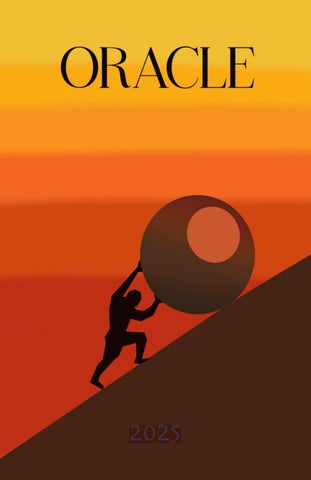
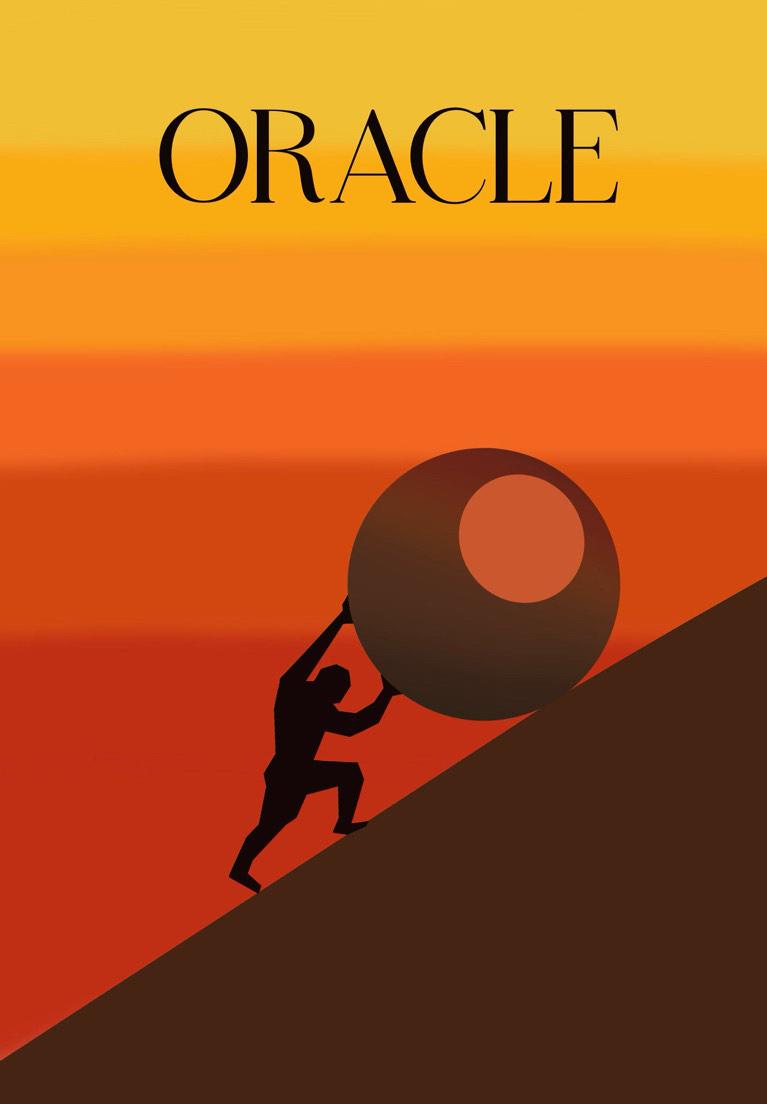
Submission to The Oracle is open to all Brunswick Students and faculty who desire to display their creative talent. Submissions can be emailed to: oracle@brunswickschool.org Cover Design: Donnelly Rodgers '25
Oracle 2025
Editors-in-Chief
Leo Simon ’25
Emil Sogaard-Srikrishnan ’25
Junior Editors
Pierce Crosby ’26
Nicholas Stern ’26
Additional Writers
Dylan Arouh
Harrison Castelli
George Kapp
Jacob Pelham
Roby B. Sickles
Henry Wise
Faculty Advisor
Dr. Brian Freeman
Writers and Works
Dylan Arouh: The Wayward Boy (p. 18)
Harrison Castelli: C Major (p. 54)
Pierce Crosby: Supernova (p. 34)
Brian Freeman: Die Fledermaus (p. 65)
George Kapp: The View From 27C (p. 61)
Jacob Pelham: Flammable Moments (p. 58)
Roby B. Sickles: A Pair of Faded Blue Jeans (p. 6)
. . . The River (p. 66)
Leo Simon: Guitar Player (p. 56)
. . . The Performance (p. 67)
Emil Sogaard-Srikrishan: Untitled (p. 28)
Nicholas Stern: The Poetic Licence of God (p. 60)
. . . The Misty Night (p. 63)
Henry Wise: Summer Sands (p. 59)
. . . Mountains Within (p. 64)
Struggles— Mental and Physical
A PAIR OF FADED BLUE JEANS
Roby B. Sickles
It was a cold fall morning. The sun had barely crested the horizon and was just beginning to warm the air. The little light that was available shone through the dazzling multicolored leaves, casting colored shadows onto the trail that Caspian walked on. These bright colors did not, however, match
Caaspian’s mood. It was not the chill that bothered him, for he always dressed in the same warm attire. A blue t-shirt, puffy coat, woolen socks with blue chucks, and lightly faded blue jeans.
Caspian’s attire was usually the subject of some curiosity among his schoolmates, even without the matching color scheme. While Willbrook High School usually required a uniform, there were days when students could dress however they wished. Most chose to wear sweatpants, sneakers, and other casual attire. Jeans were rarely seen around campus and usually only worn by teachers. His friends would often ask him why he did not wear sweatpants like everyone else.
“They’re so comfortable,” his friend James had said one day. “I just don’t understand why you wear jeans instead of sweatpants!”
“They’re comfortable,” Caspian had responded.
“They are work clothes. They’re stiff and uncomfortable. Why can’t you see that no one wears them anymore? At least not in our generation. C’mon man, why wear the jeans?” Caspian never had a convincing answer to this question.
His unhappiness grew as Caspian continued to trudge along the path aimlessly. He could not stop thinking about what had transpired yesterday. It had been a Friday. A cloudy, dreary day that usually would dampen any person’s spirit. Caspian, on the other hand, had been especially happy that day, for it was on cloudy, dreary days that the jeans felt the most comfortable. It was no mystery why fall was his favorite season. The day had been uneventful as most Fridays were, and Caspian was excited to head home to enjoy the restful weekend. At lunch period, Caspian hopped into line, hoping beyond hope that the lunch would not be…
Ugh, Cuban sandwiches. Why is it always Cuban Sandwiches? grumbled Caspian to himself. He decided to try his luck at the salad bar instead and began to walk over. As Caspian passed by a window, the noon sun’s glint on the windshield of a car momentarily blinded him. The disorientation lasted mere moments but that is all it took. A person carrying a large cup of
8 chocolate milk stepped into Caspian’s path and they collided. Their heads knocked together and Caspian fell backwards as the chocolate milk flew out of the person’s hand. Caspian could only watch as the milk splashed across his shoes, face, and blue jeans. The sticky chocolate milk soaked his pants thoroughly. Caspian had always thought of himself as a kind, understanding person, and with good reason, too. Teachers, relatives, and people in general complimented Caspian on his calm, polite manner, which they thought unusual for a teenager of seventeen years. However, as Caspian looked at his soaked jeans through his throbbing head, a terrible and uncontrollable rage began to build up inside of him. He attempted to quell this storm of emotion and succeeded in suppressing an outburst of anger. That is, until the completely dry person, whom Caspian recognized as a Junior named Darius, began to speak.
Darius managed to yell, “What the hell, man! Why aren’t you watching where you’re going? I can’t believe…” before Caspian straightened off the ground and struck him in the face.
Caspian’s shoe struck a root embedded in the path, forcing him back to the present. He wildly flung out his arms as he began to fall forward, barely managing to stop his face from crashing into the ground. Caspian's knee struck a stone, sending jagged pulses of pain throughout his leg. He cried out into the forested area.
“Damn it!” he cursed under his breath as he looked at the damage to his knee. The pain soon began to fade, but Caspian’s jeans were badly ripped. Under the rip, he could see the skin on his knee already bruising like a dropped apple. Caspian thanked God that he was alone on this old forest trail. Of this he was sure.
Caspian had discovered the trail when he and his family first moved to Baycharl, New York. He had been eight at the time, and Caspian easily recalled the immense excitement of the new adventure. They had previously lived in Taiwan, where his Dad had worked in an investment firm. They had traveled all over Asia, and Caspian had developed a love of adventure and the natural world. He had been very disappointed when he’d gotten a chance to explore the town. Baycharl had been and still was unremarkable in all aspects except that it was close to New York City and had the incredibly prestigious private school, Willbrook. These facts were, however, of little importance to eight-year-old Caspian and his three other brothers, so the discovery of a hidden trail had brightened Caspian's little heart. The trail was little more than a dirt path that stretched into the woods behind his house. It felt like it extended forever, curving and twisting around boulder formations and between ancient trees. His three brothers' excitement for the trail quickly vanished when Caspian’s entire family decided to walk the trail. After roughly eight miles, the trail ended at the base of a massive boulder pile.
“I guess this explains why the trail was abandoned,” said Caspian’s mom.
“You mean this is it?” said Caspian’s youngest brother, “It just ends here?”
“I suppose so. They must have closed down the trail a while back when this landslide blocked the trail,” said Caspian’s dad.
“What’s on the other side then?” said Caspian’s older brother.
“Probably nothing. This trail hasn’t been maintained for years, and anything on the other side of this is probably overgrown,” replied Caspian’s mom.
Caspian had been silent throughout this conversation, wondering what was on the other side of those rocks. After the hike, Caspian’s brothers had lost interest in the trail, allowing Caspian to explore it alone. As he grew older, Caspian’s love for this trail grew. It had become a way to relieve himself of stress and anxiety. Once he started high school, he walked the trail almost every afternoon. Always he wore his jeans, and never did he have time to make it back to that pile of boulders. The sun would begin to set, or he would grow tired.
As Caspian picked himself off the ground, he grunted from the dull ache he still felt in his knee. He leaned his head back and breathed deeply through his nose, trying to calm himself down with the crisp fall air. He hated how he’d managed to ruin another pair of jeans. The chocolate milk incident had been bad enough, even without the repercussions that had followed.
His principal, teachers, friends, and family had all been shocked by what he had done. Striking another student? Over literal spilled milk? This was only more dumbfounding by the fact that Caspian had never been cited for anything. He had always worn his uniform, gone to class, and was generally kind to everyone in the school. Caspian had never been guilty of such an extreme act of aggression. Since this was Caspian's first broken school rule, severe as it was, he had been merely suspended for the following week. Caspian had barely spoken throughout the school hearing, completely horrified with himself. When his parents demanded an explanation, Caspian could not give a valid justification for his actions. After his parents had determined that he was indeed truly sorry, they quickly forgave him.
“We understand that it was probably an accident,” said Caspian’s mom.
“We forgive you. Just try to control yourself a little better in the future, Caspian,” said Caspian’s dad. Caspian, however, did not forgive himself. As he stood on that path in the middle of the woods, he could not bring himself to forget about what had happened. Why did I make such a fool of myself? That familiar rage, fueled by the dull pain in his knee, crept up his body. It seeped into every corner of his body, poisoning his heart and mind. My parents raised me to be compassionate and kind, I am a good person. Caspian attempted to calm himself, but it was too late. The terrible rage
Page 12 was brimming to explode, and he needed some way to dispel it. So, he began to run. Caspian ran as fast as he could down the trail, away from his house. He ran from his mistake, from his failure to live up to his parents’ values, from that boy he had punched in the face. Caspian flew over roots, around trees, and under branches. Never stopping. The beautiful background of the fall trees quickly turned into a blur, and the calming sound of wind rustling leaves soon became blotted out by the sound of Caspian’s pounding heart. For what seemed like an eternity, Caspian sprinted deeper into the woods. Only when his legs burned like fire and his lungs begged for air did Caspian stop running.
As he lay on the ground, gasping for breath, the sun fully rose into the sky. The warm rays of light that emanated from the sun warmed Caspian's cold limbs. When he finally caught his breath, Caspian continued to lie on the ground as he finally noticed the beautiful display of colors in the leaves. Each shade of yellow, orange, and red seemed vibrant and happy. Ever so slowly, the anger and shame that had built up in Caspian faded away, and he breathed deeply. After a few breaths, he noticed a bird perched on a branch not too far above him. It was a small bird. No bigger than Caspian's palm. Its feathers were mostly grey and white, except for the top of its head and below its beak, which was pitch black. As Caspian gazed at it, the bird opened its beak and sang a two-note tune. Ee-dee. After hearing that song, Caspian instantly knew it to be a black-capped chickadee.
Caspian clearly remembered the day when he had learned about this very bird.
It had been a hot summer day when Caspian was in the seventh grade. His mom had taken his two younger brothers on a hike while his older brother was at a friend’s house. Caspian had decided not to go with his younger siblings; instead, he had decided to spend the day reading under a tall oak tree that grew next to the trail’s entrance. He had just started rereading The Lion, The Witch, and the Wardrobe when he looked up to see his father walking over, carrying a small box under his arm.
Caspian had been annoyed at the time because he had been looking forward to relaxing by himself. So he had attempted to ignore his dad and keep reading.
“What are you reading there, Caspian?” his father had said as he sat down.
“A book,” Caspian had told him bluntly. He loved his father and respected him immensely, but he had had a long day at school and was hoping for some peace.
“Ah, I see,” his dad had spoken. They had sat in silence for what had certainly felt like an eternity. In the distance, a birdsong could be heard. “You hear that son? That’s the song of a chickadee.”
Ah well, so much for reading, Caspian had thought.
“You can tell because of their two distinct songs. Ee-dee, and Chick-a-dee-dee.”
“Why do they have two songs?”
“Well, the first one is a simple, happy way for them to communicate with each other. The second one, however…” his father had taken an annoyingly long dramatic pause, “is for danger. The more dee-dees in the song, the more danger there is.”
“Huh, so if you hear it with a lot of the dee things, you should be worried?”
Caspian’s dad had chuckled at this. “No, usually it will only have to do with a smaller predator. Like a fox or ferret.”
“Oh,” Caspian had sat in silence for a time after this. It was then that he had noticed the box next to his dad. “What’s that?”
“Open it and see.”
“It’s not even my birthday yet.”
“I know, but you’re getting older and I feel like it’s time you had a pair of these yourself.”
“Okay, thanks, Dad.” Wondering what was in the box, Caspian had unlaced the neat ribbon to reveal the contents of the box.
CHICK-A-DEE-DEE-DEE-DEE-DEE-DEE! The minuscule bird let loose a loud cry that shocked Caspian out of his reminiscing. The chickadee had seen him and thought him alarming enough to warrant six dees. I must look pretty frightening right now if that’s the case, thought Caspian. The sprinting had caused him to sweat profusely, and he was thoroughly covered him with debris from lying on the loose dirt
Page 15 and leaves. Caspian sat up and looked around the portion of the trail he had managed to run to in his fit of rage. To his surprise, he realized that he had made it to the boulder pile that blocked the trail. Caspian picked himself off the ground and began dusting himself off. As he did this, he examined the pile of grey stone. Each rock was roughly his size, and they were so tightly packed together that they looked like a single, moss-covered lump. As Caspian gazed at the mound of rock, he remembered how much he had wanted to see what was on the other side. Out of curiosity, Caspian attempted to see if one could walk around the pile. This was impossible, though, as one end of the pile hugged the side of a tall cliff of rock that protruded out of the forest floor and ran along the length of most of the trail. The other side was so densely packed with trees and brush, that Caspian could not even see what was on the other side of them. Content to relax knowing that no one would miss him at home for a few more hours, he decided that he would finally satisfy his curiosity about what was on the other side of this pile of rock. So Caspian removed his puffy coat, retied the laces on his chucks, and began to clamber up the pile. The going was slow at first, for the rocks were slick from the moss, but Caspian quickly adapted and was soon scaling the rocks with ease. As he climbed, he thought back to everything he had been pondering throughout the morning. His act of aggression against the boy who had spilled chocolate milk all over his jeans, against his very boulder pile when he was a young boy. The chickadee’s melodies and the
16 memory that came with them. That was the day his father had given him his first pair of jeans. As Caspian placed his hand on a boulder's smooth surface so he could ascend those last couple of feet and finally see what was on the other side, he paused as he remembered what his father had told him that day.
“You are going to be a man soon. And I want to give these to remind you of a couple of things while you grow older and take on responsibilities. A good pair of jeans can be incredibly comfortable, but they are designed to be roughed up. My dad and his dad wore no other type of pants but jeans every day when they worked in lumber yards and construction so that I could have a good education and raise you well. I wear jeans to remind myself that hard work can accomplish almost anything. Also, jeans are a responsibility. By wearing these, you are saying that you can take blows, and put in the work. And the only way that these will tear is if you are doing something stupid and not treating them right. I believe you are ready to start bearing responsibility, which is why I am giving you these, and when the day comes when you have to overcome whatever life throws in between you and your happiness, you will be ready once you learn the importance of these pants.”
As the memory of his father's words washed over him, Caspian looked down at the rip in his jeans, remembered his unbridled aggression towards that kid, and looked up to the last couple of feet of rock that separated him from the truth of what lay on the
17 other side. A large cloud passed over the sun, dropping the temperature by several degrees. Caspian took in a deep breath past some tears that were welling up in his eyes. A painful lump grew in his throat, and he began to slowly clamber down from the rocks. When he reached the bottom, Caspian sat with his back against a boulder and tried to stop himself from crying. I am not ready, I am not worthy, I am not strong enough, he thought to himself over and over again. He had been so desperate to imitate his predecessor's strength that he had worn these jeans, hoping it would be enough. The truth, however, was that Caspian had not been strong like his father and his fathers. He had believed himself to be ready for everything in life and did not even know how to control his feelings. The cloud that had passed over the sun moved on, allowing the sun’s morning warmth to once again shine through the fall leaves, warming the ground and Caspian’s back. The tears slowly stopped, and the sharp lump in his throat melted. Caspian lifted himself onto his feet and looked back at that pile of boulders. I am not ready… yet. A smile crept onto Caspian’s face. With that thought, he turned around and began to head back down the trail towards his house, confident in the thought that that wall of stone, and whatever mysteries lay on the other side, would wait for him. Caspian knew he would return someday to those rocks, wearing his puffy coat, blue t-shirt, woolen socks, and chucks. And a pair of lightly faded, slightly patched, pair of jeans. When he was ready.
THE WAYWARD BOY
Dylan Arouh
Basini Borukhova sat in a chair oriented toward the table where he was now eating. Its fit was snug. He wore, as they all did, the ruffled green tie, the stained khakis, and of course the blazer with the creases. His clothes bore fewer stains, though—the tie-knot was tighter and the blazer worn rather than carried.
It was fall now, two o’clock and dark. The doors of the dining hall at Arcada Academy were shut. Grey clouds lined a grey sky visible through the glass exposure, dividing inside from out. The table issued, correctly, the perfunctory nod at Borukhova’s arrival and continued much as they had before.
“Whitman’s goin’ down,” one said, and the others promptly contorted to appear quite in agreement, hoo-ing and ha-ing, Basini leading the effort with a brimming, odd smile. His teeth were white, and his braces were thick. Silver, with
the Class III bands clasped clearly onto the back molars before gripping the incisors firmly. The thick lines of moisture attached themselves to the brown rubber, occasionally forming thin walls of saliva when he spoke.
“I heard they’ve got that Clemson commit,” another responded. Borukhova knew this one, and he did not reply. Basini examined the boy’s face. It was red. There were red pockets of pus and the scars from the scratching. The scratching had not expelled the pus.
“No, I will not respond,” Borukhova knew.
Basini went about busying himself with eating. It was a hamburger, a verboten food as the elder Borukhova was fond of reminding him. He thought of his father now—the kippah, the long, if dull—recollections of Sabba battling the Nazis; Bubbe, Stalin. And that black hair with the curls at the end, ironed and permed. He had been the one to urge the switch to Arcada, something about “brotherhood” and “community” had been the deciding factor. And yet he had been so strong about it—what with the seals and the rights and all the constant, ethnic pestering—“Kosher?” “Kosher?” Always, always would get tight whenever they had gone to any nice restaurant, Basini remembered. Shake Shack, especially. But grease now lined the bun, with the melted butter, with the two thin patties—laterally, carefully, closely—placed under cheese and tomato. It was not—would not be—verboten anymore, not for Basini Borukhova.
“Basini? Basini? Hello?” One of the boys had been waving his hands, and the others smiled along in faint agreement.
Basini looked up. “Yeah?”
“Well, someone's out of it,” the other boy—Mark, was it?—questioned, stopping to glance. “Heard you got zonked this weekend.”
Borukhova chuckled, feeling the press of rubber against rubber. “Nah, man. Just . . . tired.”
“You locked for Whitman?”
Basini débuted a new variation of the smile, this time without teeth showing. “Dialed.”
“You were going crazy in practice, though,” another of the boys offered encouragingly.
Embarrassed, he smiled; a breathy “yeah” proceeded. He had been. Trying, striving—intensely, of course—in all the practices. But that was expected, required of me, Borukhova knew. If there was a domain in which I should apply myself, it would be this one. But the application was more circumstance, upon which his attendance was premised, than pomp. Why else would they give the financial aid, his mother had wondered. They were of respectable means, of course. He was an insurance agent; she was “a homemaker.” The Borukhovan clan was a happy one, though not a wealthy one.
Basini had imbibed a truly remarkable number of the sort of movie that falls under the Academy genre. The Dean
21 character would always use that word—“apply”—and so it had entered and proceeded to dominate the otherwise circumscribed vocabulary of young Borukhova. He remembered now all the ways and types of things that were said to be applied. Paint was applied to walls to make them pretty. Fabric was applied to furniture to hide the insides. And affect, too, was applied by the actor onto himself in preparation for the role.
A coach, an assistant one, had seen him, he recalled. It had been this coach who broached the subject of coming over to Arcada. The football was exceptional; one could not argue, so Basini did not.
“Heard you had like twenty TDs last year, at . . . where was it? Taft? Deerfield?”
Basini had lapsed again. He knew when he heard the statement, with the intonation declaring it so. He pinched jaw on jaw.
“Forest Hills,” Basini said.
The other boy considered it for a moment. “Yes?”
Basini nodded.
“Is that day or boarding?”
“Day—in a sense,” Borukhova muttered.
“Hmm?”
Basini smiled, revealing the teeth again. “Public.” And then Basini gave a non-sequitur that was, in fact, not a
22 non-sequitur. “Yeah, my father’s in finance. Works for JP Morgan.”
“Nice.” One of the others smiled faintly, raising his eyebrows.
Then the coach came by, putting an end to it. “Boys —bus is here in five. Get all your stuff ready.”
The clouds were dark—and growing darker still.
The bus was something large in essence. It was a cosmic bus holding sparks and backfiring into the Milky Way and turning into the corner Betelgeuse without a hand signal. [1] Nylon-veiled memory foam, one inch thick, attended each passenger, with the cupholder and Gatorade bottle adjacent. By virtue of its comfort, no reasonable objection could be made by its occupants.
The engine was turned on, the door sealed, and—if such subtleties proved insufficient—the coach then spoke. He said, with that contrived righteousness and faux-solemnity employed in the first instance by managers (during a meeting, presumably) and, in the second, football coaches (before a game), “Boys, got a long ride ahead of us—5 hours ‘till game time. I don’t need to tell you this is a big deal.” Stopping to clear his throat, he continued. “It’s the Suffield game. Last year was close—blowout first quarter. We worked in that second half, but it wasn’t enough. We had guys thinking this was a joke, just a game. When we go on that field, I’m not
23 gonna’ see that. Boys, you’re not doin’ this for yourself. You’re doin’ this for the team—for Arcada. I want you to think about what this community means to you [Here he reached the rousing part, where the voice is generally seen to gain a few decibels, so he did so] What this brotherhood means to you. What would you do for it?”
“Yeahhhhh,” the team grumbled.
“How hard would you work for it?”
“Yeahhhhh.”
“How hard would you grind for it?”
“Yeahhhhh.”
“So, let’s get on that field and show them just what Arcada is all about!”
Sufficiently familiar verbiage, in the appropriately loud tone, followed. Basini put his headphones on.
He looked out the window, observing the houses passing by. Each was brilliant. An architectural mosaic whose image, if not entirely clear, certainly demonstrated a certain chutzpah on the part of whoever had built the things. Foam columns cloaked in a paint giving the vague impression of plaster; Spanish tiles deftly suggesting expat status; a roof-line which had been subject to far more torment than the Lord the occupants worshiped, though it was in the name of cathedral ceilings and not humanity’s salvation. It was formed via the butchering, quartering and subsequent reassembling of elements from every style and era, save those preceding the
24 early aughts. The result was a confused Chimera of a building that, by its very appearance, seemed to plead for immediate leveling. He had seen a few on sale for mid-seven figures.
The town gave way to rural acres quickly. Glass to brick, Bucks to barns (the roof lines were conspicuously simple). Now, long tracts of green hillside stretched out before the windows of the bus, with only the occasional home to mark the end of one plot and the beginning of the next. Trees, long and tall; leaves on the grass, all reds and maples and yellows. It was a cool September, and, by the virtue of intransigence, the bus’s AC had been kept on. They had been driving perhaps a couple hours when Basini saw the “Welcome to Massachusetts” sign, which seemed promising enough. The sky remained dark, though, and the bush had taken on a similar tinge. He neatly folded the blazer, placing it in the bag his mother had given for his nice clothes, and put a sweatshirt on. Homework had been attended to prior—that wasn’t much of the issue anyway—and so he attempted to occupy himself with glancing at the landscape.
A few hours later it occurred to Borukhova that, apparently being a shy boy, he did not like the noise. Throughout the entire trip, the steady beat of that chattering remained. It carried on—nasal, affected, vapid—in a way that had become profoundly irritating after a month of exposure. He put on his headphones and still it didn’t drown it out—it
25 went on and on. How dare it, how dare it, it with its blustering unearned confidence, it with its breathy ignorance; it with an inertia conspiring to rob Borukhova of that which at the very least he remained entitled to!
The thought was cut short by the coach’s announcement.
“Everyone—we’re passing back playbooks now, you should have this down, but just take a moment to refresh yourself. I know you guys are having fun, but now’s the time we need to focus.”
Basini hastened to oblige the coach’s instruction, readying himself the best he could. He changed Spotify playlists. He redid the knots on each cleat, taking care to loop around for a second and then a third time. Not to mention the meditations some vague acquaintance had recommended, which on a whim he had now loaded onto his phone. (They involved, simultaneously, ancient Asian and Greek knowledge. One breath in, then out, hold for three seconds, in, out, complete lung saturation, and then full carbon-expulsion, which would also include the toxins.)
And then the rain started. It began with a trickle, then became a slight pouring, until a dime-puddle attached itself to the window. And then it beat on and on, till the roads had yielded that wet concrete smell and the tires began to make a splashing noise when they passed over the potholes. League rules dictated they still arrive – it was too late now to
order an advanced cancellation – and so the bus barreled on through the rain.
“Quarter hour more now, and then what was it, three on the way home? No, with the rain there will be traffic…” Borukhova thought. So what if it had been called off. Just a game—nothing vital had been lost, he understood.
Sometime later, they arrived at the place. The field was a rained-out mess, and the team was back on the bus quickly, where they were meted out a word from Coach Dan, heretofore absent from the communications-giving. He was a hanger-on from the era when a boy could be, as he once put it in an unpublished interview with the school magazine, “molded.” The coach stroked his grey beard and said, “Boys” before stopping to let the profundity sink in. “This was a letdown, no doubt about that. You know, boys, sometimes you’ll face a moment like this. A hard one, a disappointment. But the important thing isn’t how you fall down, but whether you get up. (What inclement weather had to do with managing adversity, Basini did not know; that one should not say such a thing, he did.) So, we didn’t get what we wanted out here, but we wanted to make it up to you guys. We were gonna’ go for it after the win, but now you’ll get it now…” before, abruptly, pausing again.
Oh God, he’s burying the lead now, thought Basini. What is it—contemplation? Reflection? What is it that he hopes to achieve with this, this performance?
“We’re takin’ everybody to McDonald’s.”
Cheering commenced, and then died down.
McDonald’s, as the old man was fond of putting it, was three minutes away. That much was made clear by the iridescent glow visible from I-90. It was only upon arriving, though, that a fuller sense of the place could be ferreted out. The building had somehow avoided the remodeling and brand refreshments, which seemed so current in that era, such that it remained, preserved, in original form. The advertisements for the Speedy Service system—present; exultations of the billions served— exulted. All that was quaint, selected, and cast in amber.
The bus door unsealed and the boys flowed out. The restaurant was empty save a late-middle-aged trucker, who, upon seeing them, quickly left. Boys lined up one by one, clad in full football gear. Basini saw the burger flippers and fry friers, headsets donned, and listened. There was a monotony to it. Orders were taken and received, instructions followed after that, and the cycle began again. He heard the hum of the soda machines, saw the grid (five by eight, timers above each slot) where the patties went in. Many minutes after arrival, Basini came to the front of the line. He ordered a drink, and not a hamburger.
[1] From John Steinbeck, in a letter, describing the “wayward bus” of his 1947 novel of the same name.
UNTITLED
Emil Sogaard-Srikrishnan
“I think that’ll do it for today — have a great weekend everybody.” As the class packed up, Mr. Morrison pulled aside one of his students.
“Tessa. I heard you’re a pretty good babysitter. I know it’s a little short notice, but would you like to look after my five-year-old, Luci, tonight?”
Tessa sat for a moment. Babysitting the neighbor’s kids Saturday, and a new family next weekend. Not too much homework — should be fine. She gladly accepted, thanking him for the offer.
“Great, can you be there at 7:00 tonight? My address is 50 Banshee Lane, I can give you more details when you get there.”
“Perfect, that works! I’m really excited to meet Luci, I’ll see you tonight.” Tessa smiled, radiating a bright energy.
That night, Tessa pulled into Mr. Morrison’s house hurriedly. She glanced down at her car’s clock. 7:14. A few miles ago, the landscape had shifted from town to forest — her phone was useless in the wilderness.
She began to knock on the door, but before her hand could even reach, Mr. Morrison was there.
“I’m so sorry I’m late, my GPS shut off a few minutes away. I had to find your house on my own.”
“Don’t worry about it. I should’ve told you, there’s a deadzone here — too far away from the rest of town, I guess,” Mr. Morrison said, welcoming her in.
As Tessa stepped inside, the bleak house dampened her bright spirit. The brown and gray walls, the faded 18thcentury oil paintings, the eerie yet elaborate chandelier hanging in the living room — this was unmistakably the home of a history teacher.
Tessa didn’t even bother to ask for a wifi password; the electricity in the house could barely power the lights, which flickered and dimmed just enough for Tessa to notice.
“Now listen, I think you’ll be fine, but I just thought you should know—Luci can be a little shy around new faces, especially with all the babysitters Luci’s met in the past.
“Okay, good to know. Did things not work out with your previous babysitters?” Tessa asked curiously, now feeling a bit nervous to meet Luci.
“Oh, no.” He chuckled softly. “They’re still around. Just can’t hurt to have one more, can it?”
Mr. Morrison felt a tug on his shirt, prompting him to look down. “Speak of the devil, here he is. Luci, can you say hi?”
Luci stepped out from behind Mr. Morrison’s legs and locked eyes with Tessa.
Tessa blinked, momentarily taken aback. She prepared to introduce herself, but Luci spoke up first.
“It’s short for Lucifer.” His voice tinged with annoyance, clearly tired of explaining his name.
Tessa restarted, “Well, Lucifer, it’s great to meet you. I’m really excited to get to know you better. Is that a Deadpool shirt? I love Deadpool.”
Luci’s face lit up at Tessa’s enthusiasm. Seeing this, Mr. Morrison said, “It looks like you two will get along. I have to run now, but thanks again for your help. One last thing— under no circumstances should you open the basement door.” He looked at Tessa intensely for a brief moment, making sure she understood.
Not questioning the strange command, Tessa headed dutifully to the kitchen. Luci followed behind enthusiastically.
“So what else do you like to do now?” Tessa resumed the conversation. After an hour, when he had finished his dinner, Luci had really begun to warm up to her.
“Do you want some dessert?” Tessa offered, and Luci accepted gladly. Tessa pulled open the freezer, craving mint chocolate ice cream. Tessa froze—the sound of the freezer crackling open was drowned out by a loud scratching sound coming from the hallway. She stayed still, listening carefully. But the sound was gone. Tessa glanced at Luci, who was grabbing a spoon for himself. He hadn’t heard anything —or perhaps, he had chosen to ignore it.
As Luci licked the last bit of ice cream from his spoon, a phone rang. Tessa searched as the phone continued to ring, finding the old-fashioned wall phone in the hallway, a few feet from the basement door. Mr. Morrison was on the other end.
“How’s everything going? Is Luci behaving?”
Tessa responded, “Luci’s been great, we’ve been having an awesome time. Just finished eating dessert, and now we’re about to get ready for bed.”
“Perfect. I left some money in the kitchen drawer for you. Once Luci’s in bed, you should be good to go.
Overhearing his dad, Luci ran from the kitchen and clung to Tessa’s leg.
“I never want Tessa to leave, we’re having so much fun!”
Tessa smiled at Luci and patted him on the head, hanging up the phone.
“Ok, let’s go. Brush your teeth and get your pjs on, then bedtime.” Luci trod upstairs reluctantly, one foot dragging behind the other. Tessa followed him in his bedtime routine, carefully tucking him into his bed and flicking off his lights.
“Goodnight.” Tessa shut his bedroom door, and headed down to the kitchen to collect her payment.
As she reached the bottom of the stairs, Tessa heard a frightening cry for help. This time, it was no mystery where the noise came from. Tessa eyed the basement door, Mr. Morrison’s words echoing through her head. Do not open the door. But the more she lingered, the more she felt the urge to peek inside.
Tessa opened the door, letting a woosh of warm air escape from the basement. She flicked on the lights, and, nothing. It was just a basement. As she ventured deeper, she felt a hand land on her back.
“You shouldn't have done that."
Tessa spun around as Luci extended his arm. His demonic glare sent a shiver down Tessa’s spine, as she tumbled down the stairs until she ran into the basement wall. Slam. Flick.
Click.
Tessa crawled up the stairs, tears streaming down her cheeks. She clawed at the door, but to no avail. Her cries were lost in the warm, dark basement.
SUPERNOVA
Pierce Crosby
Neil Courter had long cherished the smell of old books. Memories of sitting with his father in the study adjacent to the expansive family library were embalmed in the soft aroma of worn paper. Neil could pass hours listening to his father lecture about the history, oratory, poetry, and prose encased in his thousands of volumes. When his father died, Neil inherited the country estate and the library, but without his father, he could no longer stand amongst the rows of books. He sold the property and moved to a modestly sized but luxuriously furnished
apartment in Manhattan. In a closet-like room off his bedroom he stored a few select pieces from his father’s collection, a far less imposing sight than the library of his childhood.
Neil stared at the small piles of books and watched as the light caught the stagnant dust that obscured his vision. He moved to pick up a book but immediately drew his hand back, allowing the books to remain virginal to his touch. A voice forced its way into Neil’s mind, but it was not sufficient to lure him from his trance. It was not until his wife called him several times that Neil finally pulled the cord to the hanging lightbulb and closed the door.
Neil entered the kitchen to his wife’s raucous annoyance at his ignoring her calls for breakfast. She had prepared a steaming plate of scrambled eggs—his favorite in the morning—that had now gone cold, with sausage, toast, and fresh fruit she bought at the market that morning.
“Sorry, honey,” he said tiredly, “I must not have heard you. Do you mind if I take this in the car? I’m running pretty late.”
“I guess,” she replied, rather disappointed. “I just thought we could eat breakfast together today.”
“Thanks,” he was already shouting as he ran for the door with a piece of toast in hand, not hearing her last statement. “Bye.”
Neil was an investment banking senior analyst at Goldman Sachs. He had risen swiftly through the corporate ranks but suffered the drastic cost of one-hundred-hour work weeks. In truth, he never minded the time away from home as it saved him from hearing how he should be writing instead of slaving away in finance.
“Neil, my man,” shouted John Saunders, hovering outside of Neil’s office. He was the kind of person whose excessive friendliness could quickly become irritating when you’d been around him for too long. Neil diagnosed him as someone trying to revive his college glory as a fraternity president. But his intentions were nice enough. “The guys are getting drinks later, you in?”
“Yeah, I’ll let you know, Johnny. Thanks for the invite.”
“Of course, man. You gotta come. You know we always have a good time.”
“You’re right, we do. Let me just check with my wife.”
“Alright. Hey, by the way, you still working on that book of yours?”
“Yeah, you know, I write a little here and there.” Neil’s current definition of “writing a little” was sitting in front of his computer with the unfinished first chapter of the novel he started in college open as he scrolled on his phone.
“Yeah, Neil is gonna write the next great American novel. Right, Johnny?” laughed Ethan Bernard sarcastically as he strode to the copy machine. Ethan was generally disliked amongst the analysts for his uptight demeanor and his sycophantic behavior towards their superiors. It was clear he sought to climb the corporate ladder by any means necessary: a true Machiavellian in mindset, Neil noted, but lacking the social skills to achieve his ends.
“Just wait. Neil’s gonna win a Nobel Prize. Ain’t that right, Neil,” said Johnny. Neil let out a forced chuckle
“Yeah, he’s the next Ernest Hemingway,” called Ethan as he passed from sight.
Johnny shook his head at Ethan’s weak sarcasm. “See you tonight, Neil.”
“Yeah, see you,” Neil replied, although he no longer had any interest in meeting Johnny for drinks. Something about the mention of his “novel” struck a painful nerve in Neil. For the remainder of the day, his vision shifted between the empty Excel spreadsheet and the clock on his wall, contemplating when would be an appropriate time to leave.
“How was work?” asked Sydney as Neil entered the apartment. She was sitting on the marble countertop of the kitchen island.
“Fine.”
“Just fine?”
“It was good.”
“Okay…Neil, don’t forget we have that dinner party tomorrow night for Katie’s thirtieth birthday.”
“Right. Which of George’s houses are we going to this time”
“The one in Greenwich. It’s the really old one, remember.”
“Oh, yes.”
“What do you want to do for dinner? I was thinking we could order in. We could get that Chinese place you like and maybe watch a movie?”
“Yeah, Chinese sounds good. I have a lot of work to do tonight though so I’m not sure about the movie.”
“Oh…okay.”
Neil opened the untitled document on his computer that contained his life’s work—a page and a half of poorly crafted sentences and weakly strung together ideas that formed the first chapter of his novel. He studied the words, reading them over and over again. Eventually, he found himself staring blankly into the screen, trying to locate the individual pixels making up each letter. He blinked a few times before standing, closing his laptop, and leaving the small study.
He thought the company of his father’s books might help stir his mind. So, Neil lowered himself gingerly onto the dusty floor of his book-closet and placed the laptop on his legs. But, still without inspiration, he set the computer aside and instead peered at the books. They seemed so timeless, as if Neil was looking at a photograph of the room rather than sitting inside of it. And yet, the dust and smell radiated the age of the books. It seemed to Neil that he was witnessing a mere moment in a miraculous transformation of paper into parchment.
Neil gave up on writing and left the room, and, seeing his wife asleep, realized it was quite late. He quietly got ready for bed and lay down beside her. She groaned and turned toward the wall. He rubbed her shoulder softly and whispered in her ear “It’s me, honey.”
In response, he received a rather harsh “Go to bed, Neil.”
“C’mon, baby, please,” he pleaded, kissing her on the cheek. He paused for a second in the ensuing silence. “I love you so much, babe. Let me show you how much I love you.”
“Neil, I said go to bed.”
Frustrated, Neil turned away. “God forbid a man has a hard day and wants to sleep with his wife,” he muttered.
Neil woke up early the following morning, his brimming anger from the night before mostly subsided. Neil was now possessed by a tired but cool and contemplative mood. He decided to go for a walk, but before he reached the door, he passed back through the bedroom, where his wife still dozed, and selected a copy of Crime and Punishment from atop one of the piles in the book room.
Outside, the air was brisk and the promise of rain was evident in the sky. The sun was hidden behind clouds, prohibiting a true sunrise in favor of the misty grayness that signified the transition to daytime on a sunless morning. Neil navigated the lazy early-Saturday streets and arrived at Central Park. He dodged the morning runners and found a peaceful area near The Lake. The book in his hand was much newer than the other volumes in his collection. Neil’s father had considered Dostoevsky one of the world’s finest novelists, so Neil felt obligated to read Crime and Punishment. But, as his father only owned the book in its original Russian, Neil needed to purchase his own translated version. Despite his determination to read the novel, Neil could never get past Dostoevsky’s tedious description of Raskolnikov’s life. In college, he read some obscure scholar’s analysis of the novel and effectively replicated it on his final exam, earning him significant praise from his credulous professor.
Neil opened to the first page. After two hours and only thirty pages, he found himself lost and practically begging for Raskolnikov to kill Alyona. Dejected, Neil wandered listlessly around the park, absorbed in thoughts of his failure. He blamed his father for focusing only on his own intellect without fostering the same in his child. He blamed genetics for not granting him the intelligence of his parents. He blamed the school system and his professors for not providing him with an adequate education. Most of all, he blamed his wife. Why did she love him so little? Because of her, he could never understand true love and thus could never write about it. Didn’t she know that he required love as inspiration in order to earn a spot alongside the great writers on the shelves of his father’s library? That was her sole role in his life. He saw her now as a minor character in his tale. One day, scholars would write of him as they do Dostoevsky and tell of Sydney, the cold, unloving wife of the illustrious Neil Courter.
His stream of consciousness was abruptly interrupted by a tugging at his coat. A small child stood behind him. “I think you left this, sir,” he said, holding up Neil’s copy of Crime and Punishment.
Neil observed the child intently. He was very young, maybe eight years old, Neil estimated. He was exceptionally clean and well-dressed, uncommon for a child of his age. A symbol of purity and innocence juxtaposed with the
insanity of murder. What a beautifully twisted image. I should write about this, thought Neil. Sing in me, Muse, and tell me of the child who delivered death to Neil Courter. Yes, my readers would love this story.
“Thank you, buddy.”
Neil arrived at his apartment at five in the afternoon.
“Neil, where the hell have you been? The car’s going to be here in thirty minutes.” Neil ignored his screeching wife. He crossed the kitchen and opened the highest cabinet above a small serving area and produced a bottle of Johnny Walker Black. He filled a low-ball with some ice and poured until the amber liquid nearly crossed the rim of the glass. He would have to dull himself significantly in order to entertain his unaffectionate wife and her ignorant friends.
“You know what? I’m not dealing with you right now. You better be ready,” said Sydney.
Neil finished his drink and refilled his glass. He brought it with him to shower in the guest bathroom. Before the couple left for Greenwich, Neil topped off his glass once more so he would have something to distract him in the car.
They arrived at the country home of George Cooke just before seven. George was a sixty-something-year-old descendant of the great financier Jay Cooke. Katie, George’s third wife, had been Sydney’s roommate and
43 closest friend in college. Erected by Jay’s daughter in the late 19th century, the home had been passed down in the Cooke family for generations. Neil and Sydney’s car passed through a garden precisely interwoven with the driveway. Above, a canopy supported hanging vegetation. George had once described the expansive garden to Neil as his personal Babylon. Emerging from the garden into the main circle, Neil and Sydney came into the shadow of the massive home. The stone exterior created an intimidating façade with wings projecting forward towards the circle. Behind the house, storm clouds gathered, the rain having held off since morning.
The couple was greeted at the door by a butler, who offered to take Neil’s jacket. Neil curtly dismissed the man. “I’ll deal with the jacket. How about a drink— Scotch.” While waiting for his drink, Neil observed his surroundings. In front of him stood a large marble staircase, the same marble that clicked beneath his shoes when he walked in. The walls boasted intricate mahogany carvings and some post-Renaissance paintings. Above was a beautiful replica of The Creation of Adam with the face of Jay Cooke substituted for Adam’s.
“Sydney, so great to see you!” a woman's voice radiated behind Neil. He turned to see that the Andersons had arrived. Courtney Anderson was Sydney’s childhood friend who now taught eighth-grade chemistry at St.
David’s. Her husband Blake was a self-proclaimed entrepreneur who was supposedly working on several startups. Neil believed that these companies were fictitious and served as poor attempts to disguise the fact that Blake suffered from sloth.
“Blake,” Neil said, sticking out his hand, as the ladies gossiped. Behind Blake the open door revealed that the rain had begun.
“Neil. How are you doing?”
“Good, now that he’s here,” Neil announced, nodding to the butler returning with his drink. “See you in there, Blake,” said Neil, dragging Sydney from her conversation.
Once out of the Andersons’ earshot, Neil derided them to his wife. “He’s a lazy, pretentious asshole and she’s just a dumb teacher.”
“Do you have to be so negative about everything and everyone? She’s my friend. Please be nice tonight. Do it for me, your wife.”
Neil took a long sip from his drink. Why would I be nice for you? You’ve never been nice to me. You never even loved me.
When the couple arrived at the dining room, George bounded up and boisterously greeted them. His gut was pressed aggressively against his shirt and he had grown some new wrinkles since Neil had last seen him, but he
looked happy. “I’m so glad you guys could make it. You don’t know how excited Katie is to see you, Sydney. It’s been too long. Please, please, sit down.”
Neil and Sydney took their spots towards the end of the long, dark oak table. Across from them were Jacob and Alessandra Kowalski and to their left was a seat reserved for James Walsh. Walsh was notoriously late and incessantly drunk, two attributes that were almost certainly related. His presence usually irritated George’s guests, but George never failed to invite him anytime he was hosting a party. Walsh’s father had been George’s family’s gardener, so the two practically grew up as siblings.
Once everyone had settled down, George stood to make a speech. “I’m not the best with words, so I’ll keep this brief. First and foremost, I would like to thank everyone for coming tonight to celebrate my lovely wife’s thirtieth birthday. Katie is the most perfect person I have ever met and I could not imagine anyone else to spend the rest of my life with.” (You probably said the same thing about all your past wives, thought Neil.) “Katie, I love you so much. Now, with that out of the way, let our little Dionysia begin.”
Neil watched as George sat. Katie touched his forearm affectionately and whispered something in his ear, to which George chuckled merrily. He then pulled her tight to his body and kissed her.
Neil signaled to one of George’s waiters and ordered another Scotch. Sydney, realizing that Neil was already quite drunk, said “No, he doesn’t need any more.”
Neil, feeling emasculated and still resentful toward his wife, retorted, “How dare you cut me off!” He turned to the waiter. “Don’t listen to her. Another drink, please.” Sydney looked away, disgusted. Neil’s drink arrived promptly. Though his vision was slightly blurred and he could feel his head start to sway, he quickly downed it to spite Sydney.
A cacophony sounded from the hallway, marking the stumbling entrance of James Walsh. “George, buddy, great to see you,” Walsh bellowed into the sudden silence, embracing his old friend. “And there’s the beautiful birthday girl.” He bent over to kiss Katie on the cheek and bumped into the table as he rose.
“Ah, Neil, good man, how are you?” asked Walsh, his words slurring, as he fell roughly into his chair.
“Good, Walsh. You?”
“Never been better. Now, where can I get one of those?” He pointed to Neil’s empty drink.
“Come, Walsh. We’ll go to the bar ourselves. Enough of these pathetic waiters.”
“Neil, where are you going?” questioned Sydney, worried about her husband’s inebriated condition.
“Oh, we’re just going to the bathroom,” answered Neil slowly. He looked sideways at Walsh and burst out in laughter before hastily departing.
Neil and Walsh wandered through the halls of the house before finally locating a small barroom on the second floor. Neil removed a bottle of scotch from the shelves behind the bar and poured two drinks. Neil was about to return to the party when he noticed that Walsh was gone. He circled the area a few times before hearing Walsh in the next room. “Neil, Neil, come here. You gotta see this.”
Neil, carrying the two drinks, followed Walsh’s voice into a small room consisting of a pool table, fireplace, and large leather chairs, but not containing the source of the voice.
“Out here, Neil,” called Walsh’s voice from the window. Neil poked his head out the window and saw the back of Walsh standing on the edge of the roof. The rain had paused briefly, creating an enchantingly cool evening setting. There was a soft patter of liquid colliding with grass, and Neil soon comprehended that Walsh was urinating.
“Isn’t it amazing? The stars, I mean. The night sky…” exclaimed Walsh as Neil stepped out onto the roof. Neil was silent, transported back to some obscure, foreign memory. It was as if he were remembering the life of an entirely separate person. “Borne ceaselessly into the past,” Neil muttered.
“What was that?” asked Walsh as he zipped up his pants.
“Nothing,” said Neil, shaking off the odd feeling and blaming it on the alcohol.
“Then let’s drink.” Walsh snatched a glass out of Neil’s hand. Together they sipped on the whisky and appreciated the beauty of a rainy evening. Now this, thought Neil, this is something I could write about: night’s inexplicable effect on the human mind.
They finished their drinks and passed back through the window. By now Neil was stumbling and could hardly see. As they were walking back to the dining room, Neil repeated his earlier criticism of the Andersons. “...she’s nice, but stupid. Still, it’s a shame she has to be married to him, the terrible excuse for a husband. I mean the guy presents himself as some genius entrepreneur just because he went to Wharton. He hasn’t had one successful business ever! So goddamn pretentious.”
“I wouldn’t be so quick to attack Blake,” Walsh responded thoughtfully.
Neil hesitated, confused by Walsh’s unexpected statement. “But you have to admit, he is pretentious, right? And annoying?”
“Sure,” Walsh said tersely. After a long silence, he changed the topic. “Oh, Neil, I’ve been meaning to ask you. How’s that book coming along?”
The abrupt mention of the reality of his writing career evoked a great fury in Neil. He acted as he simply missed the question, but within him wrath was brewing. They entered the dining room and his wife rushed toward him. “Where have you been, Neil? You’d better not have been drinking more.”
“Shut the fuck up, Sydney!” he shouted, infuriated. “I’m so tired of your shit.” Sydney gasped. “You sit here and tell me to stop drinking and yell at me when I leave for too long. I mean, for God’s sake, I’m your husband not your son. And you say you love me but you know it's not true. You won’t even have sex with me! You hear that?” Neil announced, addressing the partygoers, who were already staring. “My wife doesn’t love me. She won’t even have sex with me.” The final statement he emphasized with a slight laugh.
At this point, George intercepted Neil and attempted to mollify him. “Neil, why don’t you go for a walk and calm down.”
“No, George. Don’t tell me what to do. You’re just some rich wannabe intellectual. You cover your house in art, and you make references to obscure things you read online to seem worldly, but the truth is that you’ve been living off your family’s money your whole life and haven’t experienced the real world once. And this party for your wife? Give me a break. You don’t love your wife any more
than my wife loves me. What is this, number three? I wonder how long this one will last.”
The diatribe halted. No one spoke. Walsh’s laughter broke the deafening silence. Neil spun around, ready to attack, but the fact that Walsh found comedy in his great tirade somewhat derailed him. While he was contemplating Walsh’s uncanny response, Sydney strode briskly out the door. The rain had resumed and was now coming down more violently than before
“Where are you going honey?”
“Home, and away from you.” She opened the door to their car.
“Don’t leave…you know I love you.”
“Fuck you, Neil. I never want to see you again.” Sydney slammed the door shut and the driver sped away.
“You know what, I don’t even care. I’m so far above you,” he screamed at the car. “And all of you too,” he said, turning toward the crowd that had gathered behind him. “You could never possibly understand me. I will be the greatest writer of all time, you’ll see. You’ll all see. Just wait.”
Walsh’s laughter intensified. It haunted Neil as he sprinted out the door and into the rain. He ran as fast as he could, trying to escape the ineluctable laughter. It rang in the back of his mind as he entered the woods.
When Neil awoke the sky above him was still dark and starry. His head throbbed and his throat felt like it was filled with hot sawdust. He sat up slowly and examined the unfamiliar landscape. The small clearing in the cedar woods surrounding him was elevated above a field he could barely perceive in the darkness.
Memories of the night quickly began to flood Neil’s mind. He reflected on his anger. It was my wife’s fault, he told himself. She tried to control me and my response was completely just; she doesn’t even love me. But he knew this was a lie.
He took a deep breath and gazed at the stars. Neil recalled seeing the very same stars only hours earlier on the rooftop and suddenly remembered the elusive memory he had been searching for that night—a memory from that first year with Sydney.
Neil and Sydney met in college. Their introduction was the product of a mutual friendship, and Sydney was immediately fascinated by Neil’s sunny smile and comforting eyes. She quickly learned that his demeanor matched his appearance: soft, kind, and romantic. The two were soon inseparable, entranced by mutual obsession. Their friends joked that their relationship was the pinnacle of love.
However, there was another side to Neil invisible to all but Sydney. He was obviously intelligent and would
effortlessly impress his professors with his vast knowledge and his ability to process the intricacies of the world’s literature. But there was something else, something that separated him from all other smart students. His mind was a sea of ideas tormented by storm. Thoughts circled in whirlpools, waiting to be seized.
One night, they left a party early, desiring each other’s uninterrupted company. The couple wandered about before eventually settling in a grassy field. Bewitched by the vast expanse above, Neil stood suddenly and professed his love for Sydney. As he spoke, his eyes reflected the stars, and they appeared to Sydney a telescope to view the cosmos behind him. He told of the great plans that swirled in his mind. He saw the world in a different light than everyone else, and his pen would be his weapon to conquer them all. Neil was different, the best of men. There did exist some love, some real love, between them then. Neil looked out at the field below him and up at the sky, trying to relive the memory, but clouds had settled over the stars and the field was eliminated from his vision. He felt impotent in comparison to the immense power of nature, and his humanity soon reasserted itself. Whatever exceptional disparity had once existed between him and the inhabitants of the world was now diminished. He realized that all of his criticisms of the partygoers lived within himself as well. His imperfections were just as great as
theirs. He was alone in the deserted woods but had never felt so connected to the human race.
Finally, his thoughts recentered on Sydney. He knew now that his most severe flaw had manifested itself in his relationship with her. His selfish arrogance had blinded him to his blatant neglect. He equated love with sex and thus lost the pure connection they once shared. She was the victim of his human failings.
Finally, he had arrived at a revelation that he could truly write about. He was no esteemed intellectual or acclaimed author. His work would never rival that on his father’s shelves. But he no longer sought fame and wealth; he did not desire the applause of the human race. He wanted only to be one among many, to explore the human experience in all its flawed beauty.
The sun crept over the horizon, driving the stars from the sky. Its golden rays shone ubiquitously, piercing deep into the hearts of every person. Day after day the sun would witness the events of mankind, failures and successes alike. The universal experience was timeless in its cyclical nature.
C MAJOR
Harrison Castelli
Ignoring those around him, the man dressed in a brown leather jacket set himself up at the bar. Two or three empty stools separated him from the nearest customer. A drink awaited him just as it had yesterday. His evening began as his lips touched his glass of bourbon on the rocks.
Sip after sip, glass after glass, he indulged. In his head, he listened for the fellow on the piano to play those happy chords he sought. Sitting alone, nursing his drink, the tunes coming from the jukebox in the corner reminded him of his better days. The pianist moved up the scale as he finished another drink. More came, and as they disappeared, a song crossed his mind that he wished to hear. He spun his stool and stepped off in the direction of the jukebox.
As he left the stool, his foot sank onto the floor, and the picture frames on the wall swayed like leaves caught in a subtle gust of wind. Although he didn’t have his glasses on, everything fogged up, making it challenging to find where
55 he was going. He marched on the hardwood floor, yet he couldn’t feel the soles of his feet making contact.
He smirked as he slipped the spare change in his pocket into the machine. His song was next in the queue. Pivoting around, he bee-lined it for his empty seat. Using his free hand, he got himself situated himself back where he liked it. As the final notes of the song currently playing faded, the smooth opening of Steely Dan’s “Only a Fool Would Say That” took its place. He held his finger in the air and murmured to the bartender, “Make this my last one.”
Finishing the drink, he rose one last time to make the journey home. Getting out the door with the help of the chairs along the way, he stumbled outside.
Four blocks—he’s just four blocks downhill from his home. He gets his momentum started with a single step, the next one follows a bit too far to the right. Struggling to keep his balance, he trips over the nonexistent curb under him, then miraculously regains his balance. He fights against the grain of the slope, holding that feeling inside him, like the pianist in his mind keeps climbing the scale, as he battles to sustain his progress. Tripping over the faded rock at his feet, the man desperately throws one leg in front of his falling body. His weight pushes him with no control of his limbs as he ragdolls across the sidewalk and onto the asphalt. As his
head cracks against the pavement, the little pianist in his mind strikes the happy chord of C major.
GUITAR PLAYER
Leo Simon
I saw black leather boots. Slick, worn out but not worn through. The man’s forest brown leather bag sat below his black metal chair. The blackness of the guitar fit well with the black and red sweatshirt he wore, along with his black fur winter hat. It was cold outside, but his spirit was warm. So was his smile. The darkness of his garments was a better reflection of those who walked by him on the sidewalk, not showing care or recognition to this man. A small table with a rectangular red and white towel draped over it sat next to him. A small blue box sat upon the towel. Donations.
I sat there in the warmth of the coffee shop, peering out the window, watching this man. His fingers twitched methodically along the strings of his beautiful
57 black guitar. The sun hid behind the clouds. Every once in a while, it would peek through, and I saw a glimpse of its rays hit this man right in the face. His smile became even warmer as he moved his left hand along the headstock. People passed him by. People who likely had things to get to. People who probably had places to be. People who might have other people waiting for them.
This man did not let it pass him by. By it, I mean time, life. Life is just a moment in time, after all. This man was not just succumbing to it. He sat on his black metal chair with that black guitar and black sweatshirt and black hat and shined up the sky. Lit up the sidewalk. Brightened my day. I did not ask for anything of this man, nor had I given anything to this man to make him do this for me. He was being himself. Unapologetically, enthusiastically, happily himself. That made me happy.
I watched him for another ten minutes or so.
Peering out the window of this coffee shop. He tuned and perfected his instrument. Trying to find the right pitch to match his song to the sound of the guitar. It was already perfect, though. I could not hear any of his music or songs. I was in the coffee shop after all. I had only been watching through the window. I only saw a man. A joyous man. A guitar player.
I stepped outside as I then had somewhere to be. A person to go see. Time had caught up with me. I dropped a
small green piece of paper with a tiny five in its corners in his blue box set on the small chair. The paper could not speak about how much he helped me that day. I don’t know his name. I don’t know what he sang. I don’t even know what his guitar sounded like. I was in the coffee shop after all. But I was thankful for what I had seen. What I witnessed with my own eyes right in front of me through that window. Hope. I saw hope.
Flammable Moments
Jacob Pelham
Around the flame: sitting within reach, As we admire the view. The flame dances differently for each. Our leftover days, so few.
Quickly, A brisk chill flows through: turning the chapter, we pursue the next.
The flame is now the old memories’ new captor.
The flame took most days; yet the most memorable moments remain. Unfazed, like the ocean fighting a blaze. Solo memories fade while our shared ones remain.
Flash—moments of injuries and lost time, bring forth a thunderous crack. The flame begins to decline, but, like a phoenix, it will be back.
SUMMER SANDS
Henry Wise
Scanning surroundings, The gloom is confounding. White eyes pierce the dark. Searching for solace— —but it cannot be found. Peace scatters and blows in the wind, Ripped away by waves at the shore—
Absorbed by the cold summer’s sand. Yet with ingenuity, His feet walk intuitively Where can it be found:
The solace that was once promised. Does it hide in the haze amidst the clouds— Or in the ambience that drowns?
The elements blur As stillness finds a pocket— One warped in lies But muffled by the blanketing sky. It moves, never stopping—
The Poetic License of God
Nicholas Stern
Riverrun, past Eve and Adam’s, Through the corridors of pyramids, Into the womb of Greek tragedies To glimmer on a rock below a cross. Buried deep in the mind of Nero, Coursing violently through the hot-blooded Paris, Delivered fairly by the sword of Arthur But brutally born by Shakespeare’s Pen. You must not hear it, though, Old Boy, For He deals not with us— but the alien river racing through his mind; so, as you lay in the still dirt, pelted by rocks, Getting kicked, battered, and beaten by Heroes Of time, remember: Nature is over-flowing.
THE VIEW FROM 27C
George Kapp
The subtitles on the screen of the man sitting in 27B could be read:
“We don’t read and write poetry because it’s cute. We read and write poetry because we are members of the human race. And the human race is filled with passion.”
He was the last person you would’ve suspected would have a breakdown. His crisp, well-tailored suits, hair perfect, with not one strand out of place, and neatly-trimmed beard seemed incongruous with the redness of his eyes.
I sat in the aisle, staring at a blank document, slowly mustering motivation to break ground on an English assignment—a romantic poem of my own—but any semblance of a creative spark was barricaded out by my survey of this man.
“We are now beginning our initial descent into JFK International Airport…”
For nearly three hours, my page sat blank, and only now, in the final five minutes of the flight, have I anything to show for my efforts:
The Man in 27B
He slumped forward motionless, tears beading and lingering in his beard before contributing to the amassing pool, droplets flooding the tray table.
And so, I watched
I watched as Neil Perry brought tears streaming down his face,
And I watched as John Keating put a grown man in a fetal position
And I wondered what could break a man like this.
The rain abated, The man, having shed his final tear Had been left a husk of his former self.
And the clouds parted,
“Oh, Captain, My Captain!” can be read—
Only for the downpour to resume The sun had broken through.
THE MISTY NIGHT
Nicholas Stern
The clouds roll menacingly overhead as you step into the car.
The car sputters to life with a passive acknowledgmentYou pull out of a friend's house late at night, the cool, crisp air bites at your cheek through the open windows. the bright lights shine ahead, but the darkness encompasses you.
the clouds above flash a brilliant purple light; you observe them converge, fuse, and accumulate overhead. your foot gets heavy on the pedal as you force your way home.
the trees pass by faster… and faster… and faster— you suddenly release the pedal, jolted by your own— the world slows down, the lights flick off—
Crack! the rain pours down in thick droplets as the car begins to shake.
In a flash, the lightning finally comes. . . The shadow of the trees occludes the blinding surge.
Finally, the pearly bright light of the garage opens up for you.
As you enter, you are bathed in beams of warming luminescence.
You are home.
MOUNTAINS WITHIN
Henry Wise
Black-stained feet ascend the chalky mountain— Above lies a pinnacle of promise, The young mind corrupted by nature’s delusion.
The sun he’s known forever, looms above Orange and fiery— The soul wants more.
Hands grab what they can. Muscles ache with uncertainty Are ends met by means?
All emotions bundle in the boy’s knees, Crack after crack.
These are sketches of Spain; In the distance, Miles Davis plays.
Is the jazz within— Or only felt outside? The answers are found in the struggle: Through a journey coagulated, Like blood forming puddles.
His heart feels deeply, but gets worn down to rubble. Hunger persists, Like a hatchet through thickets— Nothing deters the soul’s Ascension through struggle.
DIE FLEDERMAUS
Brian Freeman
A sudden fluttering on the pillow, and sleep’s flown. Leathery wings beat about the dull air beside you. You jump, cry out, turn on the light— And the flying mouse arises, circling, blinded. Confused, it flaps about the reeling room. You run down the stairs, but the bat follows, Darting, till you open the door—and out it flies.
THE RIVER
Roby B. Sickles
In total fear, I stand and wait on shore For battle to be waged ‘tween man and stream. The raft is pushed to the ford; I take an oar And gaze upon the frothing foam and dream.
The world of waves that others see as art Fills me with fear, unquenchable and strong, As if the river lives within my heart, A frothing storm. My soul rings like a gong.
I crest the water white and venture out And fly down the frothing river, face my foes, As fear so dreaded washes away with doubt; My soul is free, my heart—it simply glows.
The vast unknown I feared for far too long— But facing it, I knew that I’d been wrong.
THE PERFORMANCE
Leo Simon
I hear the claps, the feet tap. I bow to tip my fellow cap.
Earth shakes, my heart breaks. For now, I sit with my mistakes.
I have not won, and now I’m done. Here is where I lose the fun.
I start to seek, my hopes have leaked. Never have I been so weak.
Weak is bad, but better than sad. Cause sad is where the problems add.
Maybe I could, but it does no good. So, I sit alone where once I stood.
Stood proud, showed off to the crowd. Yet now I stand, and no one bowed.