BRUNSWICK SCHOOL
Academic Update
WINTER 2026
As Brunswick strives for the fullest intellectual development of every young man, our academic programs seek to challenge each boy to fulfill his unique potential, to foster critical-thinking skills, to instill in each student a desire to learn, and to develop the creative and independent qualities of mind necessary to reach intellectual maturity and increased self-confidence. Brunsw ick School and Greenw ich Aca demy
This e-newsletter, published twice yearly, offers parents a top-line view of the latest happenings and curricular initiatives in selected academic departments. For greater detail, please refer to the Course Catalogue. Course Cata
logue 2025 – 2026
English Department P H I LO S O P H Y & G O A L S
To challenge students on several levels of perception and understanding; upon graduation, a student will not only have made significant strides toward developing reading and writing skills, but will also have gained the less quantifiable yet arguably equally essential ability to enjoy literature’s power to reveal both the wider cultural landscape and the nuanced interior of his own self.
▶ A NEW ELECTIVE TAUGHT BY PETE ADAMS has
senior boys reading some of the titans of Western literature, with the goal of developing the kind of “strength of intellect” championed by great writers.
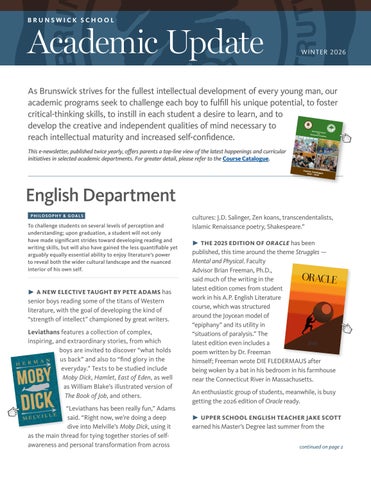
Leviathans features a collection of complex, inspiring, and extraordinary stories, from which boys are invited to discover “what holds us back” and also to “find glory in the everyday.” Texts to be studied include Moby Dick, Hamlet, East of Eden, as well as William Blake’s illustrated version of The Book of Job, and others. “Leviathans has been really fun,” Adams said. “Right now, we’re doing a deep dive into Melville’s Moby Dick, using it as the main thread for tying together stories of selfawareness and personal transformation from across
cultures: J.D. Salinger, Zen koans, transcendentalists, Islamic Renaissance poetry, Shakespeare.”
▶ THE 2025 EDITION OF ORACLE has been published, this time around the theme Struggles — Mental and Physical. Faculty Advisor Brian Freeman, Ph.D., said much of the writing in the latest edition comes from student work in his A.P. English Literature course, which was structured around the Joycean model of “epiphany” and its utility in “situations of paralysis.” The 2025 latest edition even includes a poem written by Dr. Freeman himself; Freeman wrote DIE FLEDERMAUS after being woken by a bat in his bedroom in his farmhouse near the Connecticut River in Massachusetts. An enthusiastic group of students, meanwhile, is busy getting the 2026 edition of Oracle ready.
▶ UPPER SCHOOL ENGLISH TEACHER JAKE SCOTT
earned his Master’s Degree last summer from the
continued on page 2
Academic Update
WINTER 2026
English Department continued from page 1
Middlebury Bread Loaf School of English, an intensive master’s and continuing education program designed to inspire and energize teachers. Scott said that he uses the assignments, knowledge, and experience he gained at Bread Loaf every day as a teacher in Brunswick classrooms. “There are incredible college professors who spend their summers on Bread Loaf Mountain teaching,” he said. “I took a course on Herman Melville’s Moby Dick and another course on early American art with a Yale professor and leading art history scholar, Bryan Wolf.” Vermont offered up more than just education to Scott. He met his fiancé, Annie, on his first day of his Bread Loaf program in 2021. The two got engaged on July 4. Meanwhile, teaching fellow Liam Benjamin ’18 read every one of Shakespeare’s 154 sonnets — and memorized #130 — as he embarked on his first summer of Bread Loaf coursework last year. Benjamin is a graduate of the University of Colorado Boulder, where he earned a double major in English and Psychology. He cited two highlights from his first summer of studies in Vermont; his short story, Last Scene of a Mother and Her Son, was published in The Bread Loaf Summer Journal, and he got to serve as a theater tech for a production of Curse of the House of Atreus, an adaptation by Brian McEleney that played at the Little Theater in July.
▶ GRIEF AND THE UNIVERSAL EXPERIENCE OF
GREAT ART were the subjects of an Upper School visit
from a New York Times bestselling author in October. Patrick Bringley, author of All the Beauty in the World, spoke in Baker Theater and had lunch with faculty and students. Later in the day, he visited AP Literature and AP Art History classes.
Bringley spoke to students about grief and discussed the solace and meaning he ended up finding through his decade working as a security guard at the Metropolitan Museum of Art. He said he was just 22 years old and working at what he thought was his dream job at The New Yorker when his older brother, Tom, got sick. He began to spend a lot of time inside hospital rooms. “You know, Tom was just 26 when he died, and the whole thing felt kind of very mysterious on the one hand but also very plain, very simple, very elemental. Kind of the bedrock of the human story,” Bringley said. “And to me, that’s how great art often feels.” After his brother died, Bringley left The New Yorker and found his way to a job as a security guard for The Met. He described the museum as a “world in miniature,” with its 12 acres drawing in over 7 million visitors a year — more than the Yankees, Mets, Giants, Jets, Knicks combined — and its contents too important to leave only to scholars, curators, to people with Ph.Ds. “The Met is not really about our history,” he said. “It’s not really about art. If you want to learn one of those continued on page 3
2
Academic Update
WINTER 2026
English Department continued from page 2
poems and essays, interspersed with drawings and paintings that showcase the talent of every contributor.
things, that’s fine, but it’s a museum whose interests stretch right up to the heavens and down into the tombs we’re headed for. It touches on every aspect of how it feels and what it means to live in the space between those things.
“Seeing their names in print both empowers and validates each student’s creative spirit,” Faculty Advisor Sarah Pribyl said. “In the age of AI, it is more important than ever to keep the humanity behind the creative process. Paw Prints provides the opportunity for each student to identify as both a writer and an artist.
▶ JUNIORS TREKKED INTO MANHATTAN last
spring to see the Broadway revival of Othello, which starred Denzel Washington and Jake Gyllenhaal and featured characters dressed as American soldiers and was set in an hypothetical American future, instead of Venice in the late 16th century. Boys were invited to jot down notes on set design, costumes, lighting, and more, and were also asked to evaluate the play through the lens of Courage, Honor, Truth. Students brought their thoughts to a discussion held in Bryant Park after the show.
▶ COURAGE WAS THE SUBJECT
of Roby Sickles’ ’26 original sonnet, which took second place in the 2025 English Speaking Union I AM Shakespeare Competition, held in Greenwich in March. Sickles said he wrote the poem about rafting a raging river to show how facing and conquering fear can open up “a whole new world of excitement and wonder, which never would have been available if you didn’t take a leap into the unknown.” Sickles said he enjoys the challenge poetry presents.
Brunswick M
iddle School
2024-25 Liter ar
y Magazine
In addition to the contents, five seventh and eighth grade boys served as editors of Paw Prints, collaborating and formatting the layout. “An artistic endeavor in its own right!” Pribyl said. Pribyl and Annie Kohart are faculty coordinators, along with art teacher Betsy Root. All submissions are published; English teachers cull student’s work throughout the year. The next Paw Prints comes out in May, and submissions are accepted from now through March. This year, teachers from across all disciplines are being encouraged to submit student work — to highlight the fact that the craft of writing extends far beyond English class and has a role in every endeavor. “It brings such joy to the campus to see the boys take pride in both their own and their classmates’ names in print!” Pribyl said.
▶ AUTHOR AND ILLUSTRATOR NICK BRUEL
“The truth is, I started trying out writing poetry because I was never very good at it, and I wanted to leave my comfort zone,” he said. “The rigid structure of a Shakespearean sonnet appealed to me as a form of supportive scaffolding as I tested the waters.”
brought his Bad Kitty series of children’s books to life in a visit to the Lower School in October; Bruel read from Bad Kitty: Party Animal, gave a live drawing demonstration, and worked with students to create a story together.
▶ THE MIDDLE SCHOOL LITERARY MAGAZINE PAW
“The boys were completely engaged — Nick had them laughing, guessing, and shouting out ideas as he built a story with them step-by-step,” Lower School librarian Beth Barsanti said. “Teachers shared that the
PRINTS continues to grow, with the most recent edition published in May. In all, 42 seventh and eighth grade boys submitted their creative writing and artwork; the result is a 24-page digital magazine chock full of original
continued on page 4
3
Academic Update
English Department continued from page 3
visit sparked a lot of excitement for both reading and drawing, with many boys heading back to class eager to try their own comics!”
▶ THE PRE SCHOOL HAS ROLLED OUT a new
Handwriting program with the help of Learning Specialist Amy Mancini, a veteran educator with 22 years of teaching experience, and a curriculum that is considered “the gold standard” in handwriting instruction. The curriculum, developed by Zaner-Bloser, Inc., has a track record of inspiring penmanship, including the
WINTER 2026
creation of “beautiful-looking letters,” for more than 100 years. Mancini said the digital age has brought setbacks to handwriting success, but the act of writing and holding a pencil properly remain as important as ever. In fact, handwriting is considered a foundation of literacy, and numerous studies have shown that the simple act of writing longhand activates the “language areas of the brain.” Boys work on handwriting for 10-15 minutes two to three times a week. “The resources are incredible,” Mancini said.
History & Social Science Department P H I LO S O P H Y & G O A L S
Upon graduation, students will be empathic global citizens, able to do more than merely understand historical forces that have shaped the contemporary world; we strive to ensure students witness how human agency has impacted the past — those forces that have advanced and regressed the human condition — so that they will be inspired to act for the betterment of humanity.
▶ THE NASCENT UPPER AND MIDDLE SCHOOL
HISTORY BOWL TEAMS are honing their skills
in regional and national competitions that feature questions on a huge range of topics — from history to
geography to political science — from every era and every region of the globe. At the Upper School, the History Bowl team held its first-ever meeting just two years ago, and students have made two appearances at National Championships since then. Last spring, the team travelled to Arlington, Va., to compete in the Varsity/ JV History Bee and Bowl National Championships; team members included Henry Graham ’26, continued on page 5
4
Academic Update
WINTER 2026
The inaugural, first-ever Middle School History Bowl team, meanwhile, also qualified for nationals last spring, with all team members heading to Orlando for competition in May. Teammates Angel Veliz ’30, Yorman Veliz ’29, Max Jayaweera ’30, and Joe Riemer ’30 fielded all sorts of questions from common trivia to the obscure. One example: Which Incan ruler’s name means “earth-shaker” or “he who overturns space and time”? The answer: Pachacuti.
History & Social Science Department continued from page 4
Vijay Ranganathan ’26, Jonathon Packard ’27, Will Stemerman ’27, Scott Mendell ’28, and Joe Riemer ’30. Students came away with impressive results; the team finished with an overall record of 7-3, and in the afternoon consolation bracket, the team went 5-0, winning the bracket. Individually, Riemer made the semifinals of both the National History Bee and the U.S. History Bee, at which he finished 11th of 93 in the JV division. A seventh grader, Riemer also earned the 13th highest score on the JV American Geography Exam and the 9th highest score on the JV Ancient History and Recent History exams. Ranganathan, meanwhile, earned the 10th highest score on the varsity Historical Geography exam, while Stemerman earned the 17th highest score in American History. The team recently began its 2025-26 season, hosting a competition at the Upper Middle School, and, for the third straight year, qualifying to attend Nationals.
“The boys did very well,” Faculty Advisor Jay Crosby said. Individually, Riemer placed 9th overall in the seventh grade Geography Bee (out of 198 competitors) and 2nd overall in the US Geography Bee (out of 59). More recently, both Riemer and Angel Veliz have competed regionally, with Riemer winning both of his events and Veliz finishing 5th in the History Bee and 3rd in the Geography Bee, his first medal.
▶ HISTORY TEACHER ROBERT TAYLOR will teach
a new, career-focused AP Business with Personal Finance course next September. The class, which is closely aligned with collegelevel “introduction to business” courses, will teach “workforceready skills that prepare students for careers in a range of businesses — from startups and large corporations, to regional and local organizations.”
Taylor also teaches AP Economics and two semesterlong electives, Entrepreneurship and Personal Finance. “Before joining Brunswick, I worked in finance as an investment banker and was a founder of an internet startup in the late 1990s,” Taylor said. “Over the years, I have advised numerous entrepreneurs, including Brunswick alumni. Also, my family, three children, their two spouses, and my wife are all entrepreneurs.” continued on page 6
5
Academic Update
WINTER 2026
History & Social Science Department continued from page 5
▶ UPPER SCHOOL HISTORY TEACHER and game-
based learning impresario Jared Fishman visited RAND headquarters in Washington, D.C., last winter, serving as a special guest to playtest a game called Tsunami. The geo-political think tank designs games to help better understand complex topics like AI; Tsunami tries to shed light on the question of what an AI driven political system/economy/ military would look like. Players each take on the role of a country and look to grow, form alliances, ice out enemies, and more. Recently, Fishman also: • Visited Edinburgh to tour Stirling and the surrounding areas to learn about Scottish independence and William Wallace. Fishman recorded a show for his podcast, 20 Sided Gamified, and developed teaching material for use in his History of Warfare class; Fishman received a school grant for this trip. • Connected with Mark Fastoso, a YouTuber and an Emmy award-winning producer, to help him record a mini documentary about the Battle of Gettysburg. “We walked the Gettysburg battlefield, discussed the actions of Dan Sickles, the infamous Union general, and played a game about The Peach Orchard,” Fishman said. The show can be viewed here. • Attended the Connections Wargaming Conference at Johns Hopkins University, where he ran a workshop that showcased a game his company developed, Challenge to Power: The Medieval World.
▶ UPPER SCHOOL MODEL UN has had a banner
year, as international relations took the spotlight as the club hosted its first-ever conference in April. Model UN also traveled to New Jersey for the Princeton Model UN Conference in November. Hosted by Princeton University’s International Relations Council, the annual
conference attracts more than a thousand high school students each year and is considered the preeminent forum for high school diplomatic role playing.
▶ ANOTHER EDITION of the The Brunswick and Greenwich Academy Magazine of History has been published; the 29-page magazine is full of student work and highlights the many different ways that students presented their historical research at the 2024 National History Day competition. All projects engaged the National History Day’s required 2024 theme, Turning Points in History. Freshmen, sophomores, and juniors enthusiastically selected their topics and spent weeks doing primary source research. The work of several Brunswick and Greenwich Academy students advanced to the state level. “Please enjoy reading and viewing the incredibly creative, interdisciplinary, and well-researched projects of the students at Brunswick and Greenwich Academy!” Faculty Advisor Brian Hoffman said. continued on page 7
6
Academic Update
WINTER 2026
History & Social Science Department continued from page 6
▶ FIVE UPPER SCHOOL STUDENTS advanced to the
state National History Day competition last spring. In the category of Senior Papers, Benjamin Burgess ’28 earned third place for his paper, Poet and Prophet: How Bob Dylan and Folk Music Brought the Message of Civil Rights and Freedom Movements to the Masses. In the category of Senior Group Exhibit, Max Stabinsky ’27 and Justo Iraola ’27 earned second place for their project, Guantanamo Bay: Security Measures at the Cost of Rights School. Charles Nook ’27 and Brendan Robinson ’27 earned an honorable mention for their project, NCAA Sanity Code.
▶ FOURTH GRADERS enjoyed a virtual field trip to
Plimoth Patuxet Museums, a living history re-creation of both the English village established by the Pilgrims on Plymouth Bay and an historic Patuxet homesite. Each fourth-grade class had a separate one-hour visit with a museum educator. Then, a member of the Wampanoag nation spoke to the boys for 45 minutes about what life was like for the Wampanoag at the time the Pilgrims arrived in 1620. “He told the boys about daily life — food, shelter, jobs, family structure,” teacher Fiona Collins said. “He also showed them some artifacts such as tools, pots, and leather clothing. The boys had a chance to ask questions at the end of each session.” The field trip supports the fourth-grade history curriculum in which boys study the arrival of Europeans in North America and the establishment of colonies at Jamestown, Plymouth, and elsewhere. “The field trip gives the boys a better idea of the lives of the native people who were here and how they lived before Europeans started settling in the area,” Collins said.
▶ FOURTH GRADERS TRAVELED BACK IN TIME
for Colonial Day, donning the characters of artisans, shopkeepers, blacksmiths, wheelwrights, printers, and every kind of tradesman you can imagine as they recreated the village of Hingham, Mass., in 1764.
Each year, Colonial Day serves as a culminating highpoint of fourth grade study of Colonial America; Everett Gymnasium is transformed as students show off their interdisciplinary effort to model the bustling, early American fishing village. It’s an interdisciplinary endeavor that brings together art, design, presentation skills, collaboration, and much more. For fourth grade teacher Susie Foyle, December marked her 33rd year of Colonial Day adventures. “It’s a really good, hands-on culminating experience for the boys,” she said. “And, in a special treat this year, Upper School boys who turned up for the Lower School morning handshake stepped up their game to help carry Colonial Day props and material to the second-floor gym.” Many of the older boys paused to remember their own turn in the village. “It was a full-circle moment,” Foyle said. “And a sweet start to Colonial Day.”
7
Academic Update
WINTER 2026
Science Department P H I LO S O P H Y & G O A L S
From the onset of their science experience, to engage students in hands-on, inquiry-based science through interactive, investigative study; to develop students’ skills in scientific observation, data collection, analysis, and the drawing of scientific conclusions; upon graduation, to ensure young adults’ scientific literacy and strong, scientific critical-thinking skills.
▶ STUDENTS IN DANA MONTANEZ’ Honors Science
Research course were joined by students from Max Kennedy’s Environmental Science and Sustainability elective for a special sit-down discussion with The Brunswick Trust visiting author Susan Casey this fall.
Casey is The New York Times bestselling author of both The Wave: In Pursuit of the Rogue, Freaks and Giants of the Ocean, and The Devil’s Teeth: A True Story of Obsession and Survival Among America’s Great White Sharks. She spoke to students and parents in Baker Theater in separate talks that were replete with science, research, adventure, exploration, great white sharks — and giant ocean waves. She told boys that science now offers an explanation for the monstrous, sudden, ominous, and
out-of-the ordinary waves that appear with no warning and sink ships. “We now know a lot more about giant waves than we did,” she said. “And one of the reasons we know how to explain most rogue waves is because of the advent of non-linear physics and quantum mechanics. The ocean is non-linear. “So, some waves can suddenly become 10 times their size or eight times their size because the energy is going non-linear — one plus one equals two, but one plus one suddenly veers into eight.” Meeting with students, Casey shared a copy and details of her newest book, The Underworld Journeys to the Depths of the Ocean. Students were highly engaged and peppered Casey with questions about the ocean and her research. Afterward, Casey described her time in the classroom as the high point of her visit — the spirited, knowledgeable conversations with students gave her hope for the future. “I thought the discussion with Susan Casey was a uniquely special opportunity that went very well,” Kennedy said. “Susan emphasized topics such as the intelligence of oceanic animals as well as the tremendous risks associated with deep-sea mining continued on page 9
8
Academic Update
WINTER 2026
Science Department continued from page 8
(of polymetallic nodules in particular). Her intense passion, knowledge, and curiosity were inspiring and thought-provoking.”
▶ THE SCIENCE OF SMELL was the topic of an Upper
Middle School visit from retired mine-detecting dog Rico Cosby in November. Rico Cosby is a Belgian Malinois who retired in 2022; earlier, the Brunswick community raised money to sponsor and train him for the Children Against Land Mines Program.
Like all dogs, Rico Cosby has a sense of smell that is millions of times more sensitive than human sense of smell. His visit was an opportunity to illustrate for boys how dog anatomy and specialized olfactory receptors give canines their super-human abilities. “This is a great one for our biology classes, as it addresses bodies on a cellular level,” teacher Deanna Smyers said. “Seeing the difference in dog anatomy, compared to their own, allows boys to understand why different noses function the way they do.” Smyers said she ties the lessons in canine anatomy into the curriculum on Human Body Systems, as well as Evolution. “Surely, a dog’s ability to smell applies to Evolutionary concepts like ‘Natural Selection’ and ‘Survival of the Fittest,’” Smyers said. “Having Rico Cosby here to demonstrate gives boys a realworld connection they will not soon forget!”
▶ FOURTH GRADER SCIENCE STUDENTS were
asked to power up their science imagination this fall in service of the real-world problem of water scarcity, dreaming up water purifying inventions to create fresh drinking water from the vast reserves of salt water that cover the earth. It was a mini-chemistry exercise that asked students to figure out how to separate a solution into its components, rather than combining them into a mixture. “There are eight billion people on the earth and growing,” science teacher Brett Martell noted. “The need for water is at an all-time high. Water is necessary for survival.” Reverse osmosis, desalination plants; boys put their inventions on posters that were on display in Martell’s classroom throughout the fall. “Every idea sounds crazy at first,” Martell noted. “Not that long ago, if you had described an iPhone — no one would have believed you.” “It has to start somewhere. Why not here?”
▶ FOR THE SECOND YEAR in a row, second graders
will take a field trip to the Westchester Children’s Museum in Rye. The museum is super hands-on, offering all sorts of science-based exploration, including exhibits on Wind Power, a Physics Lab, an Architecture Design Zone, and even a Weather Station.
9
Academic Update
WINTER 2026
Computer Science Department P H I LO S O P H Y & G O A L S
To nurture innovation through interactive, experiential learning aimed at building relevant skills for the modern world. Our curriculum is tiered to match students’ developmental stages: Lower School introduces foundational coding via user-friendly, drag-and-drop platforms. This progresses to more intricate programming methods in Middle School and reaches its apex with exposure to advanced languages and application development in Upper School. Focused on enhancing analytical and problemsolving abilities, Computer Science has successfully transitioned from being an optional course to a required element for graduation.
▶ THE THEME for the Computer Science Department this year is Build Something That Matters. The theme dovetails with a mission statement the Department established in 2023, From Algorithms to Applications: Navigating the Digital Frontier, and underscores the Department’s commitment to teaching computer science in a way that transcends mere coding skills. “We want the boys to see coding as a way to solve real-world problems, far beyond just screens and code,” Department Chairman Sunil Gupta said. “Their class projects push them to think about the bigger picture in STEM — what it means, who it helps, and why it counts. “Our goal is to inspire our students,” he said.
▶ THE UPPER SCHOOL COMPUTER SCIENCE CLUB
went head-to-head with area schools at a packed competition at TigerHacks at Greenwich Country Day School.
Boys battled through some seriously tough coding problems — cracking six of nine challenges before the clock ran out. They finished in the top-10 and walked away with plenty of hard-earned insights. “You can already hear them plotting their next moves for upcoming events like Lockheed Martin Code Quest and Cyber Quest,” Gupta said. “The excitement is real, and they can’t wait to dive back in.”
▶ ANOTHER STANDOUT MOMENT this fall was
the launch of a brand-new Cyber Security Club for Upper School boys. A group of students, inspired by a growing curiosity about digital safety, has been meeting regularly to tackle practice challenges and master the building blocks of cybersecurity. “It has been great watching boys build something from the ground up,” Gupta said. Students have their sights set on national cyber competitions, and they’re also preparing for the new AP Cyber Security course that lands at Maher Avenue in September. The new, yearlong course is being piloted in select communities this year and will roll out across the country in the fall. Topics will include foundational cybersecurity concepts, threats, vulnerabilities, and risk mitigation.
▶ AN UPPER SCHOOL/LOWER SCHOOL
COMPUTER SCIENCE PARTNERSHIP is in year four. The partnership pairs Upper School mentors with younger students for fun, hands-on coding sessions. The partnership gives older students a chance to teach, lead, and guide, and younger students a friendly entry point into the field.
10