Information for Parents and Pupils
Years
1 and 2
1 and 2
It gives me great pleasure to welcome you to another exciting year in the Prep School at Brighton College Vietnam Whether you are joining us for the first time or returning for a new chapter in your child’s learning journey, we are delighted to have you as part of our community. The year ahead promises to be full of discovery, growth, and joyful learning as our Key Stage 1 pupils continue to flourish.
At Brighton College Vietnam, our guiding values of kindness, curiosity, and confidence lie at the heart of everything we do. These values underpin the way we teach, learn, and connectensuring that every child feels seen, supported, and inspired. In Key Stage 1, we follow the English National Curriculum, providing a broad and balanced education that builds strong foundations in literacy, numeracy, and creative expression.
The English National Curriculum in Key Stage 1 at Brighton College Vietnam encourages children to develop a love of learning through curiosity and exploration. Our pupils engage with rich texts, develop early writing and communication skills, and grow as confident readers and storytellers. They learn to question, imagine, and express themselves with enthusiasmlaying the groundwork for lifelong learning
At Brighton College Vietnam, we also believe that education extends far beyond the classroom. We nurture the whole child- their emotional wellbeing, character, and individualityequipping them with the essential skills to thrive in an ever-changing world. Through collaboration, problem-solving, and reflection, our pupils learn not only how to succeed but how to do so with empathy and integrity
This KS1 Parent Curriculum Handbook has been created to give you an insight into your child’s learning experiences and how you can support them at home. We believe that the strongest outcomes emerge when parents and teachers work hand in hand Your encouragement, engagement, and partnership are invaluable in helping each child reach their full potential.
I look forward to another year of joyful learning, meaningful connections, and shared success. Together, we will continue to nurture confident, curious, and compassionate young learners who are ready to embrace the world with open minds and open hearts
Head of Prep School
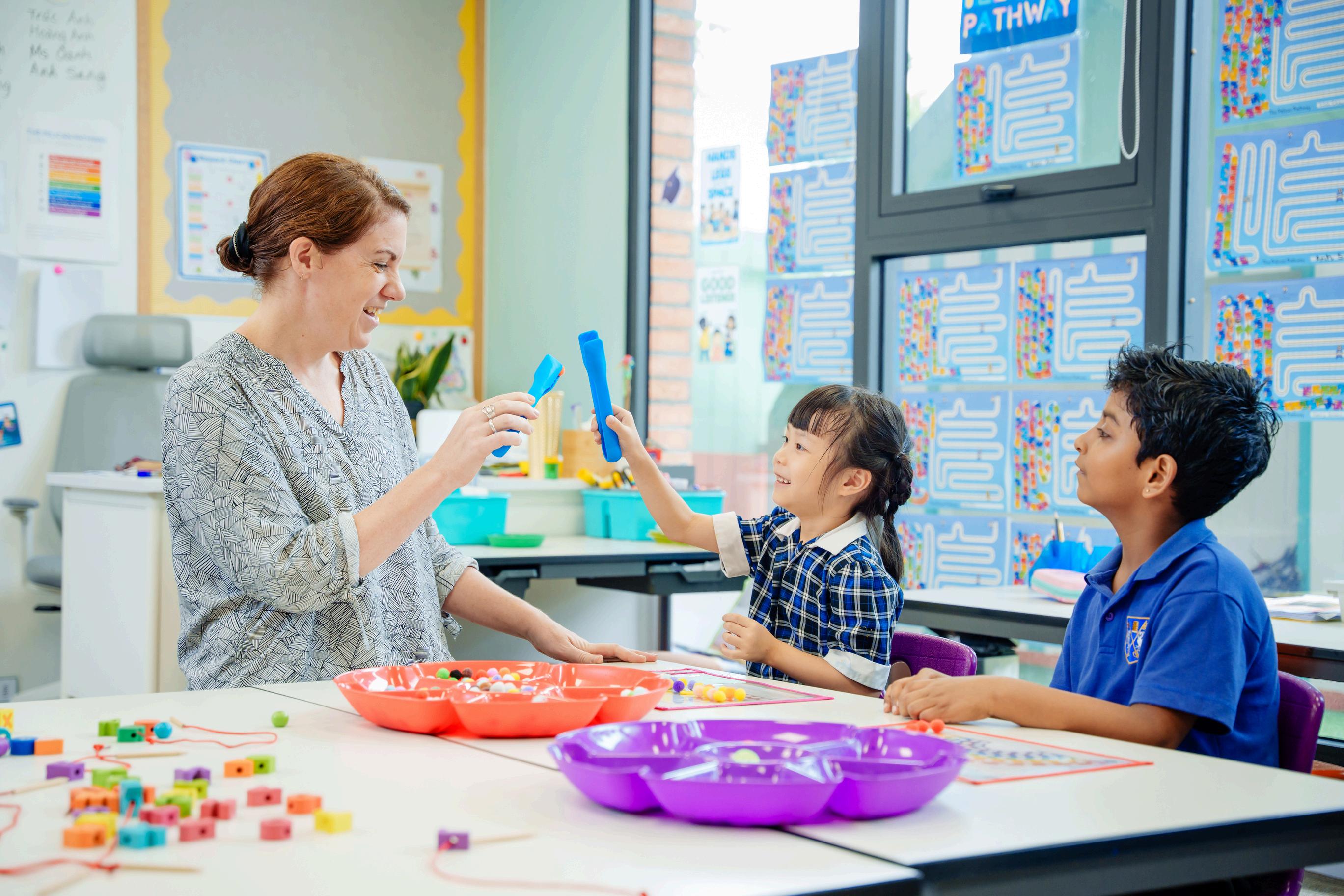
Our bespoke Brighton College curriculum uses the English National Curriculum as the framework for teaching and learning and provides our youngest learners with the core knowledge and skills for Years 1 and 2 Our curriculum is culturally relevant in our Vietnamese context and we ensure that it is inclusive for all our learners. Where needed, we offer support through both our English as Additional Language and Additional Educational Needs departments We extend all of our learners through our personalised learning approach that is always pupil-centred.
We hope this guide helps you to understand our curriculum and that your child enjoys their first years with us at Brighton College Vietnam.
Introduction
Our pupils begin their learning journey with the development of excellent English skills at the forefront of all we do.
In Years 1 and 2, we start with the building blocks of language for reading and writing: phonics
Pupils learn the sounds in English and the letters that represent them. They also begin to learn how to form the letters as they start their writing journeys.
English comprises nearly one third of the KS1 curriculum. It forms the foundation from which all other subjects will be based In addition to reading and writing, pupils are immersed in an English-rich environment where they learn the language of kindness and curiosity from the very beginning, starting to understand the nuances of how language is interpreted. Pupils are supported, not only with vocabulary acquisition, but also pronunciation They are given opportunities to listen to and respond to English in a range of contexts so that their listening and speaking skills are honed from an early age.
By the end of Year 2, pupils will be ready to become more independent with their English skills and will embark upon the next stages of English learning
Aims
For pupils to learn to read in English with confidence
To develop a habit of reading for pleasure and for information
To acquire a wide vocabulary and understanding of grammar appropriate for their English and age level
To start to appreciate the varied and rich literature available in English
To write clearly and coherently, adapting their language for a range of styles and contexts
To be able to articulate and discuss their learning, reflecting their growing understanding
To develop the important skills of speaking and listening
Year 1
of Curriculum
1
Place value, addition and subtraction, geometry (shape)
Year 2
At Brighton College Vietnam, we believe that mathematics should be relevant and applicable Of course, our pupils will learn how to calculate, but they will also develop a deeper conceptual understanding of mathematics. Our mathematics scheme embeds repetition whilst introducing more complex and challenging tasks to build on knowledge and go deeper into each topic every time our pupils learn. The mathematics curriculum incorporates and promotes manipulatives such as blocks, number lines or interlinking cubes so that pupils can physically see the mathematics come alive.
To develop knowledge and understanding of foundational mathematical concepts and techniques
To acquire a foundation of mathematical skills for next learning steps in KS2
To enjoy using and applying mathematical techniques and concepts, and become confident in using mathematics to solve ageappropriate problems.
To appreciate the importance of mathematics in our world.
Addition and subtraction,length and height, mass and volume multiplication and division
Place value, addition and subtraction, geometry (shape), money
Multiplication and division, length and height, mass, capacity and temperature
Fractions, geometry (position and direction), place value, time
Fractions, time, statistics, position and direction
Our Brighton College Vietnam science curriculum offers an exciting, hands-on introduction to answer many of those ‘big questions’ our youngest learners have Theory and conceptual understanding are explained in a child-centred manner to help pupils to understand our wonderful world. Our engaging science programme allows pupils to not only study the principles of science, but they will also have the opportunity to conduct simple experiments with real life objects. Pupils will make links with other subjects such as mathematics and be confident in using the language of science to describe and report about their scientific learning
Aims
To develop early scientific knowledge and conceptual understanding through our fun, engaging curriculum
To develop an understanding of the nature, processes and methods of science to help pupils to answer scientific questions about the world around them
To teach pupils the correct scientific vocabulary and concepts to enable them to articulate their ideas with developing accuracy
Year 1
Year 2
The human body, seasonal changes, materials, plants and planting
Animals, caring for the planet, seasonal changes, plants and planting
Animal needs for survival, humans, materials, plants (light and dark)
Living things and their habitats, plants (bulbs and seeds)
Growing and cooking, seasonal changes
Growing up, wildlife
For pupils to learn the Vietnamese phonetic sounds and tone marks
For pupils to apply their phonics sounds to reading, moving into development of their spoken and written Vietnamese
To enjoy stories, poems and non-fiction texts, building a fluency and love of reading in Vietnamese
To appreciate and study life in wonderful Vietnam
Non-Native Vietnamese:
The Vietnamese curriculum for nonnative speakers will follow a bespoke programme designed to enable pupils to communicate with their peers, particularly outside of school. Pupils will learn common vocabulary and phrases and begin to understand how the language is used in everyday life At KS1, the focus is on speaking and listening, but will also incorporate elements of reading and writing We want our non-native speakers to have an appreciation of the rich linguistic heritage that Vietnam has to offer
Introduction
To produce creative work in a range of styles
To develop proficiency in drawing, painting, sculpting and other arts and crafts techniques
To learn about and be inspired by some significant artists, craft makers and designers
The art curriculum in KS1 includes:
Being taught to use a range of materials creatively, both to design and make
Using skills in drawing, painting and sculpture to develop and share ideas, experiences and imagination
Developing a wide range of art and design techniques and the use of colour, pattern, texture, line, shape, form and space
Learning about the work of a range of artists, craft makers and designers
Introduction
Our youngest pupils are growing up in a world where they have always been surrounded by computers They are digital natives in our world of fast-moving technology We can see how technology inspires them and fills them with excitement. It is vital that each child is confident with computing as it is used throughout their learning. The subject of computing is somewhat different, with the core of computing being computer science. In lessons, pupils are taught the principles of information and computation, how digital systems work, and how to put this knowledge to use through programming This is taught using robots and age-appropriate software which makes learning dynamic and hands-on for our youngest learners.
To understand how to use technology responsibly and carefully
To gain experience of skills in a wide range of technology in a way that will enhance learning opportunities
To ensure pupils are developing as digital citizens
To ensure pupils keep safe when using technology
Content of Curriculum
The computing curriculum in KS1 includes:
Introducing pupils to the world of computing and exposing them to technologies they might not have encountered at home
Understanding what algorithms are
Understanding how using clear language and precise instructions creates computer programmes
Creating and debugging simple programs
Using logical reasoning to predict the behaviour of simple programs
Using technology purposefully to create, organise, store, change and retrieve digital content
Using technology safely and respectfully, keeping personal information private Identifying where to go for help and support when pupils have concerns about content or contact on the internet or other online technologies
Introduction
This practical subject draws on pupils’ creativity and imagination to design and make products that solve real and relevant problems within a variety of contexts Our Design Technology (DT) curriculum ensures our pupils begin to understand how innovation works in designing and making objects, as well as the impact of DT on daily life. Pupils will become the real-life designers, architects and tech experts as they start to explore and think about ways to create and solve design needs.
Aims
To develop the creative, technical and practical skills needed to perform everyday tasks confidently
To participate confidently in an increasingly technological world
To begin to build a repertoire of knowledge and skills to design and make their own products
To learn the fundamentals of how to critique, evaluate and test their ideas and products and the work of others
Content of Curriculum
Introduction
Drama, at Brighton College Vietnam, is a subject that uses the body, voice, and imagination to develop creative skills and produce simple performances It encourages creativity, communication and teamwork. In KS1, all pupils will have the opportunity for bespoke drama lessons which we see as being crucial to develop their confidence and fluency in English. Drama gives children the opportunity to learn many skills; to interpret language in new ways; to work in a team and to actively pursue resilience through their acting. We want all of our young learners to experience the excitement and energy of performance.
Aims
To develop pupils' skills in creating and performing, through individual and group opportunities
To allow pupils to understand and interpret the English language in new ways, developing pronunciation and broadening their vocabularies
To enjoy working creatively with others, taking pride in developing new skills
Content of Curriculum
Introduction
Music is a universal language that embodies one of the highest forms of creativity. Our highquality music education will engage and inspire pupils to develop the foundations for understanding music and develop their talent as musicians. We want every pupil to enjoy our vibrant music curriculum through singing, playing percussion instruments and starting to use and understand correct music terminology Brighton College Vietnam’s modern theatre gives pupils the opportunity to perform on stage, even from the very youngest years, increasing their self-confidence, creativity and sense of achievement
Introduction
"Our Planet and Our Past" refers to the teaching of geography and history at Key Stage 1, as an appreciation of how the two disciplines are connected is essential to understanding the wider world. Pupils will learn about different places both locally and globally. They will also learn how historical events have changed our human and physical environment and understand the nature of processes which continue to have a significant impact on our planet.
To perform, listen to and begin to evaluate music across a wide range of genres, styles and traditions
To learn to sing and use their voices to enjoy group songs
To experience and understand musical instruments
To create and eventually compose music on their own and with others
To have the opportunity to learn a musical instrument and use technology appropriately
To understand and explore inter-related dimensions such as pitch, duration and tempo by hands-on experiential learning
To develop contextual knowledge of globally significant places
To understand the processes that give rise to physical and human geographical features
To start to use geographical information and vocabulary
To know and understand significant aspects of the history of the wider world
To develop an understanding of chronology and start to ask history-based questions, linking past and present
Introduction
The PE curriculum in KS1 includes:
Developing core movements including running, jumping, throwing and catching as well as balance, agility and coordination
Participating in team games and developing tactics for attacking and defending
Performing dances using simple sequenced movement patterns
Learning some simple swimming skills and building water confidence
Aims
To develop competence in a broad range of physical activities
To perform physical activities for sustained periods of time
To learn the basics of competitive sports and activities
To lead active, healthy lives
Introduction
To encourage self-awareness, self-esteem and self-confidence
To develop independence and responsibility and prepare for the opportunities, responsibilities and experiences of our wider society
To communicate feelings and develop positive relationships with others
To support pupils to develop both co-operative and leadership skills for life
To understand the importance of family and people who care for us
To be able to establish caring friendships and understand the importance of respecting one another
To know the boundaries of online relationships and keep themselves and others safe
Term 1 Term 2 Term 3
Year 1 Being Me in My World
Feeling special and safe, being part of a class, rights and responsibilities
Celebrating Difference
Similarities and differences understanding bullying and knowing how to deal with it
Year 2 Being Me in My World
Hopes and fears, rewards and consequences, a safe and fair learning environment valuing contributions, recognising feelings
Celebrating Difference
Making new friends diversity, celebrating difference and remaining friends
Dreams and Goals
Identifying successes and achievements, tackling new challenges
Healthy Me
Keeping myself healthy keeping clean, being safe, medicine safety/safety with household items
Dreams and Goals
Achieving realistic goals
perseverance, learning with others, group co-operation, contributing to and sharing success
Healthy Me
Motivation, healthier choices, healthy eating and nutrition
Relationships
Belonging to a family, making friends/being a good friend
Changing Me
Life cycles – animal and human, changes in me since being a baby, differences between female and male bodies (correct terminology)
Relationships
Different types of family, physical contact boundaries, friendship and conflict
Changing Me
Life cycles in nature, increasing independence, differences in female and male bodies (correct terminology), assertiveness, preparing for transition
Our wealth of Co-Curricular Activities (CCAs) enhance and enrich our pupils’ learning, but also offer choice in trying new things outside of class time CCAs take place from Monday to Thursday after school each day. We see this as an important part of the everyday timetable and pupils are encouraged to choose these activities they take part in We suggest that parents support each child to choose their options and that there are a range of different activities chosen across the week. If required, staff can help with recommendations and support pupils to pick clubs which will work best for them. These activities can range from physical to intellectual, but always incorporate new skills and, most of all, enjoyment!
The aims of the CCA programme are to add challenge and offer further opportunities for pupils to try new things and begin to own their own learning and achievement.
Brighton College Vietnam's CCAs range from specialist to general and will includes activities such as:
Art Club
Choir
Lego Club
Team Games
Sporty Club
Board Games
Club
Jigsaw Club
Mini Makers Club
Gardening Club
Book Club
Pokémon Club
Tech Toys and Games
Club
Cookery Club
Animal Fun Club
Dance Club
Drawing & Colouring Club
Brain Busters Logic
Puzzles Club
Storytelling Club
Science Club
Languages Club