Medicare turns 50: Independence, Truman played big part in its birth Jul 30, 2015 By Brent Schondelmeyer Special to The Examiner Medicare and Medicaid turn 50 today, and the birth certificate was signed here in Independence. The reason was simple. President Lyndon Johnson secured easy passage of the landmark health insurance program for the elderly, but genuinely felt the real credit belonged to former President Harry Truman. “I’m going to make Harry Truman’s dream come true,” said Johnson, according to his presidential aide Jack Valenti. “Old folks are not going to be barred from a doctor’s office or a hospital because they don’t have any money for medical attention.” Johnson continued: “They are never again going to have to be sick and hurt and cry alone. It’s a god-damned crime and we’re never going to have that happen again in this country. When this bill is passed, I’m going to Independence, and I’m going to sign it in Harry Truman’s presence.” It was Truman, six months into his presidency, who addressed Congress and spoke about the poor medical health of prospective soldiers in the just-completed World War. By the war’s end, 5 million males between ages 18 and 37 were deemed unfit for military service mostly related to poor health. Truman proposed a five-point plan to address the nation’s health needs – increase the number and distribution of physicians and hospitals, develop stronger public health services, expand medical research, cover the loss of income due to illness, and get more people health insurance.
On health insurance, Truman specifically recommended expanding Social Security – initially adopted during the Great Depression – to provide the “broadest possible coverage” for all wage earners. Individuals would choose their insurance, and participation by physicians would be voluntary. Truman committed deeply to the idea again when he gave his first State of the Union address in January 1946. The proposal faced stiff opposition from organized medicine and went nowhere, but congressional leaders continued to hope. *** Twenty years later, Johnson remembered Truman’s efforts. Johnson was fond of the former president. Both had been in Congress at the same time – Johnson in the House and Truman in the Senate. Johnson was elected to the Senate in 1948 in a highly contested race, in the same year in which Truman, confounding pollsters’ predictions, won a full term. Both men were unexpectedly chosen vice president – consensus compromises by party leaders – and assumed the high office upon the death of the president under whom they served: Franklin D. Roosevelt died in April 1945 and John F. Kennedy was assassinated in November 1963. Another plus for Truman, in LBJ’s book: He publicly expressed his disapproval of the young Kennedy during the 1960 presidential campaign, disliking in particular Kennedy’s father and his isolationist politics. As president, Johnson hoped to burnish Truman’s languishing reputation by recognizing his bold call 20 years earlier for a national health insurance program. Johnson had a plan. In a June 1965 phone call, Johnson told his aide Valenti to arrange a personal visit to Truman in Independence and provided three solid reasons: “I want to see him. I love him and I haven’t seen him in a good while, and I wanted to pay some attention to him and get some advice from him.” “Number two, I want to concentrate the attention of the world on Truman because he had so much to do with saving the United Nations.” “Three, I just personally would like to get some advice from him, and I thought I would do that.” That summer, the Medicare legislation was moving through Congress. The political metaphor of gridlock was years to come. The Democratically controlled Congress – many of them swept into office in Johnson’s 1964 landslide – passed Medicare and Medicaid by a large margin, with final approval coming on a 70-24 Senate vote on July 28. The bill included insurance for those 65 years or older (Medicare) but provided limited insurance for the poor (Medicaid).
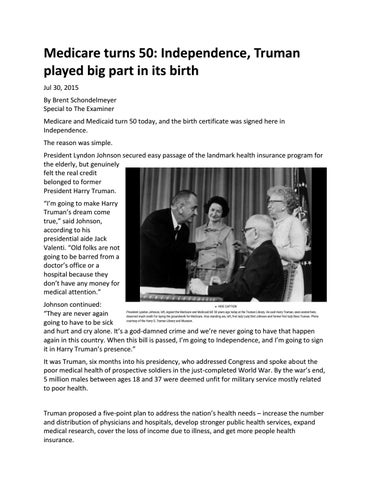
Johnson, certain of Medicare’s passage, had called Truman the prior day to check in on his “old friend.” After small talk about playing poker with Truman, who insisted he always lost, Johnson quickly got to the real reason he was calling the 81-year-old former president. Johnson: “Do you feel like my coming out to see you anytime soon?” Truman: “Any time you say.” Johnson: “I’ll give you a day’s notice, and I thought maybe I’d just fly out there sometime in the next week or 10 days and ... Truman: “Well, whenever you come, I’ll be available.” Three days later Johnson boarded Air Force One in Washington, D.C., and headed to the downtown Kansas City airport. Vice President Hubert Humphrey arrived in a separate plane, and a third carried a large contingent of congressional leaders and the press. The airborne entourage was descending upon Independence to see Johnson sign the Medicare bill in the presence of Truman. Temperatures were in the mid-80s. Johnson arrived at the Truman Library in a bubble-topped car and emerged wearing a blue suit, his “tanned face breaking into a warm smile.” Even with short notice, about 3,000 folks gathered in front of the Truman Library on July 30 to witness the historic event. Among them was an 11-year-old boy (myself) taken there by his mother. Details from the day – forgotten to a youthful memory – are recounted at length in the local newspapers – The Kansas City Times (morning), The Kansas City Star (afternoon) and The Examiner (then an afternoon newspaper). The coverage was exhaustive if not exuberant. The Examiner July 30 headline read “Independence Again ‘Capital’ – President Johnson Here to Sign Medicare Bill”, suggesting that “for two hours the city was once again the most important place in the United States …” The ceremony was held the presidential library auditorium. In a dramatic touch, the Medicare bill would be signed on the same table Truman used to sign many bills, including one that ultimately came to be known as the Truman Doctrine, which in 1947 provided foreign assistance to Greece and Turkey to thwart Soviet threats. Ironically, the Medicare bill that Johnson traveled to Independence to sign inadvertently was left on the presidential plane at the downtown airport and hurriedly had to be driven out to Independence for the event. Truman opened the ceremony with short comments: “You have done me a great honor in coming here today, and you have made me a very, very happy man. This is an important hour for the nation, for those of our citizens who have completed their tour of duty and have moved to the sidelines. ... These people are our prideful
responsibility, and they are entitled, among other benefits, to the best medical protection available.” Johnson followed with an evocative tribute: “The people of the United States love and voted for Harry Truman, not because he gave them hell – but because he gave them hope.” As he intended, Johnson lavished attention on the former president – a one-time Grandview farmer – for “planting the seeds of compassion and duty which have today flowered into care for the sick, and serenity for the fearful.” Johnson recounted the legislative efforts to pass Medicare, but reverted to again connecting with Truman because “it all started really with the man from Independence.” The Medicare bill – a signature piece of domestic policy – was 135 pages long. Signing pens were passed out as a crowd of political leaders looked on, including the two presidents’ wives – Bess Truman and Lady Bird Johnson – while reporters rushed to file stories. The lower library floor was equipped with typewriters, Teletypes and Western Union operators to help file the story. Transmitting dishes for television appeared on the library roof. Truman recounted, in a conversation with Johnson, how his own aides had opposed their boss on the health insurance issue. He finally told them: “We’re going to do it, boys, we’re going to do it. We may not make it now, but someday will we will.” Truman led Johnson to his private office to discuss domestic issues and also Vietnam – an escalating conflict. The U.S. troop presence had grown from 23,300 in 1964 to 184,300 by the end of 1965. The growing war ultimately fueled a serious political debate about whether the country could afford both “guns and butter.” Medicare and the related Medicaid, providing health insurance to low-income families, proved to be policy successes. The war was a disaster and ultimately derailed Johnson’s presidency. But those events lay ahead. After their visit, Truman accompanied the motorcade back to the airport. The departing Johnson was headed to his Texas ranch for the weekend. The idea, not forgotten, was realized – health insurance for seniors. Medicare became the law of land.
*** Truman had also championed the construction of new hospitals. Ironically, the same day Johnson signed the Medicare bill, the Kansas City Star carried a front page story about the construction of a new hospital complex with federal support. Federal funds would allow the acquisition of land and the demolition of 197 structures for construction of Children’s Mercy Hospital, a new dental college and expansion of General Hospital – a project that later was renamed Truman Medical Center. Truman’s hopes were being realized. When Truman made his health insurance proposal in 1945, the average life expectancy was 65.9 years. When Medicare was passed in 1965, it had inched up 70.2 years. In short, Medicare would provide health care for the few years between eligibility and actuarial mortality. Johnson would return six months later to the Truman Library to announce establishment of the Harry S. Truman Center for the Advancement of Peace at Hebrew University in Jerusalem. Toward the end of his remarks, Johnson brought up “one more bit of business.” The president had something for the Trumans and handed Harry Medicare card No. 1 and gave Bess card No. 2. “But we wanted you to know, and we wanted the entire world to know that we haven’t forgotten who is the real daddy of Medicare,” said Johnson reminding those present of Truman’s paternal role in the new health policy, which went into effect that July. This being government, Truman had to sign a Medicare application form, which Johnson officially witnessed. The historic Medicare cards, rarely seen, went to the Truman Library following the death of Bess Truman in 1982. *** Other presidents, wanting to expand health insurance, would return to Independence, arguing they were only trying to complete what Truman had begun. Bill Clinton kicked off his campaign for national health insurance with a speech in front of the Truman Courthouse on the Independence Square on July 30, 1994 – the same day 29 years after Johnson signed the Medicare law. By that time, the holders of the first two Medicare cards were gone. Clinton, in a forceful speech, said opponents were using the same tiresome arguments mounted against Truman. “And what did they say?” Clinton asked rhetorically. “Harry Truman’s a radical liberal. He’s for socialized medicine. He’s for big government. He’s going to take this country down.” The Arkansas Democrat, another big Truman fan, continued: “Well, the truth is Harry Truman had Independence, Missouri, values. He had this old-fashioned notion that we value work and family and faith. And people who work hard and play by the
rules ought to help one another when they need it, ought to join together to help themselves and to help their children have a better life.” Clinton’s health efforts proved largely unsuccessful, but a later president took up the issues, resulting in passage of the Patient Protection and Affordable Care Act of 2010 – the hallmark domestic initiative of President Barack Obama. Federal involvement in health care remains a controversial subject as evidenced by the ongoing opposition to the 906-page ACA. Health care in Truman’s time was 4 percent of the gross domestic product; today it tops 17 percent. The world we lived in changed that day in 1965. Seniors got health insurance, and Medicare became a highly popular domestic program. Something Truman planted has grown. The current Medicare system has more than 55.3 million enrollees. Life expectancy in 2015 is 79.2 years. Seniors live longer, healthier lives taking comfort in knowing they have health insurance coverage – something Truman that July day said they deserved. “These people are our prideful responsibility and they are entitled, among other benefits, to the best medical protection available,” he said. Happy birthday, Medicare. Brent Schondelmeyer lives in Independence. In three more years, he will be eligible for Medicare.