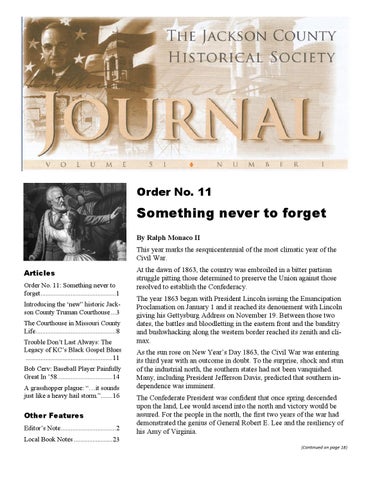
Order No. 11
Something never to forget By Ralph Monaco II This year marks the sesquicentennial of the most climatic year of the Civil War. Articles Order No. 11: Something never to forget .............................................1 Introducing the ‘new” historic Jackson County Truman Courthouse ...3 The Courthouse in Missouri County Life ................................................8 Trouble Don’t Last Always: The Legacy of KC’s Black Gospel Blues ....................................................11 Bob Cerv: Baseball Player Painfully Great In ’58 .................................14 A grasshopper plague: “…it sounds just like a heavy hail storm.” .......16
Other Features Editor’s Note .................................2
At the dawn of 1863, the country was embroiled in a bitter partisan struggle pitting those determined to preserve the Union against those resolved to establish the Confederacy. The year 1863 began with President Lincoln issuing the Emancipation Proclamation on January 1 and it reached its denouement with Lincoln giving his Gettysburg Address on November 19. Between those two dates, the battles and bloodletting in the eastern front and the banditry and bushwhacking along the western border reached its zenith and climax. As the sun rose on New Year’s Day 1863, the Civil War was entering its third year with an outcome in doubt. To the surprise, shock and stun of the industrial north, the southern states had not been vanquished. Many, including President Jefferson Davis, predicted that southern independence was imminent. The Confederate President was confident that once spring descended upon the land, Lee would ascend into the north and victory would be assured. For the people in the north, the first two years of the war had demonstrated the genius of General Robert E. Lee and the resiliency of his Amy of Virginia.
Local Book Notes .......................23 (Continued on page 18)
2
Fall 2013
Jackson County Historical Society
Sharing our history
OFFICERS R. James Stilley Jr., President Sharon Williams, President-Elect Karen Penrod, Secretary Angie Felarca, Treasurer Ralph A. Monaco, II, Vice President DIRECTORS A. Scott Cauger Debra Gildehaus Karen Graves Jimmy Johnson, III George B. Lopez Benjamin Mann Hon. Michael Manners J. Bradley Pace Al Pitzner, Jr. Barbara Potts Charlotte Ronan David Ross Brent Schondelmeyer Gloria J. Smith Shirley Wurth STAFF Steve Noll, Executive Director David W. Jackson, Archivist ALL surface-mail correspondence must be delivered to PO Box 4241, Independence, Mo. 64050-4241. JCHS History Center 112 W. Lexington, Independence, Mo. 64050 1859 Old Jail and Museum 217 N. Main St. Independence, Mo. 64050 Volume 52, Number 2, Fall 2013. The Jackson County Historical Society Journal (ISSN 0888-4978) is published semiannually by the Jackson County (Mo) Historical Society, a non-profit Missouri educational corporation. Back issues are available on the JCHS website www.jchs.org. All photographs are from the Society’s collections unless otherwise noted. The Society assumes no responsibility for statements made by contributors. All rights reserved. Contents, when fully credited, may be used with written permission.
JCHS Journal
Ours is a rich history – more varied than we imagine – particularly when we expand our world to include larger cultural and social interests. We are thrilled to restart The Jackson County Historical Society Journal – our first journal in over three years. This issue includes several articles that cover three different centuries and take up a variety of topics – an intentional choice. It is almost obligatory we feature an article about Order No. 11 – not only what happened – but its relevance for our lives to today. This is a singular and still controversial event in our regional history. We share two companion articles about Missouri courthouses – one about the remarkable reopening of the courthouse on the Independence and now the new home of the JCSH History Center but another article that considers the importance and fate of all of Missouri county courthouses. We are thrilled to share an article about a much overlooked topic – African-American gospel music in Kansas City and how it later lead to development of Kansas City jazz and blues. And given the recent successes of our area sports team, we thought it would be fun to share a piece about a long forgotten Kansas City Athletics baseball player (no it is not Roger Maris) and his remarkable season. We also share a wonderful first-person letter about an early grasshopper plague that was “so thick on the houses you can hardly tell a brick house from a frame house.” We also share some recent books which relate, in part, or entirely about Jackson County and the Kansas City region. Our small staff has been extraordinarily busy so we have formed an editorial board to take up this important task and hope to publish two JCHS Journals annually. We thank our authors for their excellent contributions and helping us restart this publication. We have missed publishing The Journal and sharing the wonderful history of our region. Let us know what you think. Suggest articles or features you would like to see or consider contributing an article for consideration. Enjoy. Brent Schondelmeyer
JCHS Journal
Fall 2013
3
Introducing the ‘new’ Historic Jackson County Truman Courthouse By David W. Jackson The Historic Jackson County Truman Courthouse on Independence Square, Independence, Missouri, is a monument to the past and symbol for our future. A new book published by the Jackson County Historical Society recounts the history of the Courthouse and the origin and evolution of the Square. More than one third of Missouri’s 114 counties boast courthouses over 100 years old. They represent the most architecturally significant building in their county at the time of construction at the “county seat,” a town or city selected as the administrative center of its county. Often, county courthouses have imposing, elaborate structural ornamentation, domes, and clock towers alluding to the prosperity and pride of its citizenry. Jackson County has the rare distinction of claiming not one, but two surviving 19th century courthouses: the 1827 Log Jackson County Courthouse, and the first, permanent, brick Jackson County Courthouse erected in 1838. J. Bradley Pace, past-president of the Jackson County Historical Society, and author of, “Survivors: A Catalog of Missouri’s Remaining 19th Century County Courthouses,” said, “There can be no doubt that they are today among the county’s most tangible links with its past.” The 1838 nucleus of the present structure on Independence Square turned 175-years-old in 2013. This notable anniversary and rededication coincided with the
building’s complete restoration and adaptive reuse for the benefit of future generations of Jackson County citizens . . . and the many tourists who visit Independence each year. After considerable planning, construction and expense, the Courthouse you see today—which was last remodeled under Harry S. Truman’s tenure as an elected county official in 1933—was re-
dedicated in 2013 as the Jackson County Historic Truman Courthouse, in recognition of the 80th Anniversary of Truman’s Great Depression-era accomplishment. In addition to being timely, the recent restoration projects were much needed. Hardscaped retaining walls surrounding the County Courthouse from a 1970s Urban Renewal project have been re-
moved and the beautiful, manicured lawn has been installed. Long-lost parking was restored to the Square to accommodate patrons at restaurants, a movie theater, and a unique assortment of boutique shops. Teenagers for entertainment on Friday and Saturday nights between the 1930s through the mid1960s used to cruise one-way around the Courthouse Square…
walking, biking, or showing off their cars by driving. They called it, “winding the clock.” What a perfect time to look back on the history of the Truman Jackson County Courthouse, and its predecessors. It is remarkable that the first Jackson County Courthouse has survived for more than 175 years, and remains open to the public. It is a
4
Fall 2013
JCHS Journal souri’s western boundary. Even more interesting is that emigrants did not ride in wagons as portrayed in Hollywood movies. Without wagon seats or shocks, people walked the 2,000+mile journey through the late spring and summer months each year. Perhaps the most infamous wagon train of some 250 wagons leaving Independence Square was the ill-fated Donner Party of 1846. Their stories, and those of other diarists, too, are documented just a few blocks away in the Merrill J. Mattes Research Library of the National Frontier Trails Museum.
log structure built in 1827 using African-American slave labor. That temporary structure originally located one block east of the Square at the corner of Lexington Avenue and Lynn Street, was moved in 1916 to the old City Hall property at 107 West Kansas, one block south of Independence Courthouse Square. The log structure was replaced with a brick building constructed in 1831 in the middle of Independence Square. That building was improperly constructed and was soon replaced with the first, permanent brick Jackson County Courthouse in 1838. Interestingly, this building was never torn down and comprises the nucleus of the building you see today. There are at least three areas within the current-day building where one can glimpse the 1838 Courthouse. A first-floor closet is a remnant of one of the original four corner fireplace flues. Inside the Jackson County Historical Society’s History Center, just to the left of its vault door, you can stand at a once-exterior corner of
the 1838 structure and look out the current-day windows to see just how large the Courthouse lawn was in those earliest days. But, to get the best feeling of the 1838 structure, stand in the Circuit Court courtroom (commonly known as the Brady Courtroom) upstairs. Excluding the north side extension of the room, the Brady Courtroom is the second floor of the 1838 Jackson County Courthouse. Each of the four, angled corners represents the location of the original corner fireplace flues. In the basement, you can still see a brick-lined tunnel beneath that first structure. Imagine the hustle and bustle of thousands of travelers who circled the Courthouse Square on their way west on the Santa Fe Trail, Oregon Trail and California Trail. Rowdy saloons and clanging blacksmith shops . . . horses, mules, oxen and every type of animal-pulled vehicle by people from all over the U.S. and abroad. Before them lay a 6-month journey across the continent once they ‘jumped off’ from Mis-
In 1853, the Courthouse was enlarged. This building was requisitioned during the Civil War. Soldiers were quartered inside and it was used as a field hospital, and endured bullets fired in two major battles that raged through Independence Square, not to mention other skirmishes during the Border War and Civil War period, 1854-1864. The Courthouse suffered damage by troops in Colonel Jennison’s regiment of Kansas Volunteers in November 1861. A year later in August 1862, the building was caught in the middle of the First Battle of Independence under Colonel Burris, when afterwards 19 or 20 wounded soldiers were moved to the Courthouse for care. The command under Colonel Pennick between September 1, 1862, and June 13, 1863, wrought more havoc to the Courthouse such that on July 6, 1863, Frederick F. Yeager, Miles Washington Burford, and James C. Carpenter were appointed by the County Court as commissioners to assess damages to the Courthouse, fencing and lawn.
JCHS Journal
Fall 2013
5
They reported that damages included the destruction of chairs, tables, stands, doors, windows, plastering etc. to the extent of $510.90. Additionally, 70-feet of cobblestone and 902-feet of railing would cost another $4,138. In April and May 1864, the Court replaced windows panes and repaired the Courthouse roof. At the close of the “War Between the States,” the County Court paid Peter Hinters $28 on March 20, 1865, to clean the landscape surrounding the Courthouse. The Courthouse was significantly remodeled in 1872, and had a minor facelift in 1887, before being completely redone, again, in 1907. The 1907 Courthouse on Independence Square served Jackson Countians for 25 years until they, at the beginning of the Great Depression, passed a multimilliondollar bond issue that allotted $200,000 for a new County Courthouse on Independence Square. “As the highest elected official in the County of Jackson, Judge [Harry S.] Truman provided the leadership not only to pave thousands of miles of roads [and build bridges] but to provide improvements to the Independence Square Courthouse and to construct a new 15-story Courthouse in downtown Kansas City in the style of the times, Art Deco. He took a prominent interest in the Courthouse renovation in Independence. He traveled the country studying the architecture of other public building and talking to architects at his own expense and on his own time. It was at Judge Truman’s direction and insistence
that the core of the 1836 Courthouse structure remain.” One of the persons who personally vouched for the “historic treasure” was Dwight Brown, Kansas City Architect. Brown, as a young professional just out of college, worked on the complicated rehabilitation project in 1932-1933.
Brown was working with David Frederick Wallace, Mr. Truman’s brother-in-law, whose special interest, talent, and training were in colonial architecture. Wallace’s concept of design was the one from which the courthouse architectural firm, Keene and Simpson, made the working drawings.
6
Fall 2013
JCHS Journal seeds sown by Ken and Cindy McClain added to efforts of the Independence Square Association−a nonprofit association of merchants, bankers, property owners, and community volunteers−work together to revitalize downtown through historic preservation and community participation.
Unfortunately, there were no blueprints of the 1838 Courthouse and they could find no working drawings of the 1887 and 1907 remodelings, Brown added. The County Court had voted to raze all of the structure, save the 1838 original, Brown said. In actuality, this was not done, as major portions of previous additions were salvaged and incorporated into the 1933 design. Demolition was required of the east portion that supported the square clock tower and wing on the west, which had been added in 1887. Brown said his assignment was to make a drawing of the nearly century-old unit (at that time). “I measured the old building inside and out—every wall, partition and beam,” Brown said. “I can testify to its antiquity.” Brown recalled that some of the beams were joined with wooden pegs and that the plaster was “horse hair” vintage. “Wallace drew his plans to
enclose the 1836 [sic.] unit,” Brown added. The buff brick facing, which had given the courthouse a new look in 1907, was removed. Red colonial brick and white Indiana limestone trimmings were added to punctuate classical columns and porticos on the north and south. Pace described the endresult of the 1933 remodeling as, “a pleasing and elegant structure inspired by Independence Hall and resembling a Colonial Virginia meetinghouse.” Independence Square and the Jackson County Courthouse were not alone in dealing with the decay of its traditional hometown, downtown central business district through the late 1950s and early 1960s. Finally, in the late 1990s momentum began to build that culminated in a three-phase, decade-long restoration project that completely re-vamped the building and surrounding grounds. The
Remnants of several portions of former courthouse renditions were saved. One relict from the past has survived many years . . . an 1879 steamboat bell that had been installed in one of the 19th century renditions of the Courthouse. Printed reports gathered over the years indicate there were periods—long periods—when the bell would cease tolling for whatever reason. In 1975, County Public Works verified that an old bell about two and a half feet across was at the top of the cupola. There was no clapper in the bell, but attached to a rope was a 10-pound metal striker, or metal hammer arm which struck the edge of the bell. “The bell will chime again, on the hour. ‘The sound is beautiful. It’s got a great tone to it,” Jackson County Executive, Mike Sanders, said. After several years of dedicated work to restore the historic building, Sanders re-dedicated the Historic Jackson County Truman Courthouse on Saturday, September 7, 2013, at exactly 80-years to the day and time from when Harry S. Truman (whose position at the time was akin to the County Executive) first dedicated the building, and Missouri Governor Guy B. Park, delivered the keynote address.
JCHS Journal “Citizens Helped to Rebuild County Courthouse in 1837,” Independence (Mo.) Examiner, 27 Aug. 1937. Jackson County Court Minutes, July, 1863, 12:100600. On March 2, 1863, the roof was repaired in preparation for the Circuit Court session (12:100510), with thanks to Nancy M. Ehrlich, who also found Yager (1860 U.S. Census spelling) was a master carpenter; Burford was director of Independence Branch of the Southern Bank of St. Louis; and, Carpenter was a Rhode Islandborn farmer living south of 24 near Salem Church. Ehrlich also found the notation that, “most of the wounded have been taken to Kansas. Those that were not able to be moved, are at the courthouse, are well taken care of, and are getting along well. There are nineteen or twenty here,” in the Cleveland Morning Leader (Cleveland, Ohio), 3 Sept. 1862, (http://chroniclingamerica.loc.gov.lccn/ sn83035142/1862-09-03/ed-1/seq-1/ viewed 3 Apr. 2013). Per Nancy M. Ehrlich, on April 4, 1864, the County Court paid J. C. Atkins $70.90 to replace glass (Jackson County Court Minutes (12:101771); and, on May 2, 1864, paid Pollard and Fairman $470 for repairing the Courthouse roof (12:100794). Years later in 1908, Jackson County received “$410 rental for the Courthouse and jail in Independence occupied by soldiers in war time…. The original [war] claim filed by the Jackson County officials amounted to $21,684. It was based upon the fact that about November 1, 1861,
Fall 2013 Union troops under Colonel Jennison took possession of the Independence Courthouse, the jail and Square upon which those buildings stood and occupied them as officers’ quarters and for hospital purposes. Other troops under the command of Colonel Buell, Colonel Van Horn, Colonel Penick and others occupied the buildings until July 1865. The claim was itemized as follows: Rent of the Courthouse and Square, three years eight months and 14 days at $3,000 a year, $11,116; rent of jail from January 1, 1862, to July 15, 1865, at $720 a year, $2,548; repairs to buildings made necessary by reason of such occupancy, $8,000; total, $21,664.Old War Claims Paid.” The Blue & Grey Chronicle. (June 2013): 16: 5: 12-13. County Court Minutes, per Nancy M. Ehrlich, Vol. 12, p. 336. Hinters, a barber by trade, became Mayor of Independence shortly thereafter. In 1877, he used his straight razor to commit suicide. Snyder, Brian K. “Harry Truman’s Courthouse and Beyond.” Three-leave manuscript, possibly draft text for a subsequently published article. Jackson County (Mo.) Historical Society Archives, Document ID 276.01276.03. . Snyder continues, “Judge Harry Truman’s public improvement project was a huge success and was touted in a 122-page book entitled “Results of County Planning, Jackson County, Missouri.” Harry Truman took these successes with him to Washington D.C. In the summer of 1947 while at a speaking engagement at the University of Virginia,
7 surrounded by the architecture of Thomas Jefferson, President Truman was inspired to add a balcony to the south portico of the White House. He even imagined that he would be fulfilling a plan that Jefferson himself would have implemented. Months later, President Truman would begin to notice signs of deterioration of the White House structure itself. One of the grand chandeliers swayed from just foot traffic while its support chain had stretched to its limits and was near failure. One of Margaret Truman’s pianos actually broke through the floor. [A special] commission would eventually recommend the historic preservation alternative and the nation was about to implement one of its largest restoration project in its history. The exterior walls were to remain and be restored. The interior structure would be dismantled and reconstructed with the addition of a two-story basement. The entire structure would be supported and reinforced with modern materials combined with updates for security and modern conveniences for a total cost of $5,761,000.” Fox, Jeff. “Courthouse Bell Will Chime Again,” The (Independence, Mo.) Examiner, 13 July 2013.
Get new book on Jackson County Courthouse For more fascinating details . . . and lots of photographs . . . about the history and evolution of the Jackson County Courthouse and Independence Square, see the Society’s newest book , “Winding the Clock on Independence Square: Jackson County Historic Truman Courthouse, 1933-2013,” by JCSH archivist.David W. Jackson. This 80th Anniversary Commemorative Edition and other books on local history topics, are available in the Society’s History Center inside the newly renovated courthouse. The Society’s products, services and programs are also online at jchs.org.
8
Fall 2013
JCHS Journal
The Courthouse in Missouri County Life By J. Bradley Pace The recent remodeling of the Jackson County “Truman” Courthouse reminds us the central place county courthouses have had in Missouri history. Their first and most obvious role is to house the court system – that human institution designed to be the great leveler. In Harper Lee’s novel “To Kill a Mockingbird”, fictional attorney Atticus Finch, later played to perfection on film by Gregory Peck, explains to the jury that the court is the one place in all the land where we are all truly equal, whether rich or poor, uneducated or college president. But a court is only as good as its jury, and in “Mockingbird” the jury listened carefully to closing arguments and then promptly convicted an innocent man. In the real world we know that the occasional injustice does occur but society still by and large places its trust in the justice system, embodied in brick and mortar by the courthouse. Courthouses, like the nation they serve, are as much an idea and a place. While the legal role of the county courthouse is obvious, they have also historically enjoyed a very high social relevance. In the age before the automobile most people spent the majority of their lives within the confines of their county. Cities competed vigorously and sometimes violently for the coveted status of county seat. County government, particularly in smaller jurisdictions was traditionally housed in the courthouse, providing the school boards, tax com-
missions, roads, etc. The county courthouse was usually constructed on prime real estate at the center of the town square, and was the natural site for civic gatherings, protests, rallies and speeches of all kind. The courthouse was literally and figuratively the center of the town. A trip to the courthouse square offered all the necessities of life, shops, restaurants, government, and the town clock. Although now diminished by technology and interstate highways, county courthouses and the roads linking them have historically constituted a kind of national network, or “skeleton”, serving as market centers and transportation hubs. The county courthouse has always been built with a great deal of pride, and with something more in mind than mere functionality. Particularly in the 19th century, courthouses were intended
to evidence the greatness of the county and often boasted elaborate ornamentation or symbolic design elements. When first built many where the most architecturally significant structure in their county, and some remain so still. Some, like Iron County’s 1858 courthouse, featured gazebo style bandstands used for concerts, speeches, town events, and even Christmas caroling. Others, like Cass County’s 1897 building, originally included a comfortably furnished room set aside for weary travelers, town square shoppers, and those just needing a meeting place. Their modern replacements clearly have a tough act to follow. In the past as now, financing a new county courthouse has always been difficult. Cass County purchased bricks for a new courthouse just before the Civil War. The hardship produced by that conflict and the financial hard times that followed meant that the citizens had to wait over 30 years before their 1897 courthouse was finally constructed at a cost of $45,000.00. Even that expense, a huge amount for the day, was not enough to pay for a working clock in the clock tower. It was left to a grass roots effort to raise the necessary capital. So it was that in 1908 the all female “Town Clock Club” was organized to stage fundraising events including pie suppers, “most industrious women contest”, “laziest man contest”, and a minstrel show. The money was raised in less than a year. A similar challenge arose
JCHS Journal when the 1859 Miller County courthouse was remodeled in 1910-13. Lacking the funds for a proper timepiece, a temporary fix was provided when a clock face was simply painted onto the clock tower. The county never did raise the necessary money and so the painter’s illusion became permanent, with the fake clock face being repainted many times over the years. The opening of a new courthouse has traditionally been a major social event. When the Moniteau County courthouse opened in 1867 the locals celebrated by holding a ball in the courtroom. Attendees arrived by horse from all across the county. The ball is reported to have lasted two days with the courtroom hosting at alternate times up to 24 couples dancing the cotillion, or 3 double lines for the Virginia reel. When in 1898 rural Caldwell County held cornerstone ceremonies for its new courthouse in Kingston, 2000 people showed up to see and be seen. As late as 1958, when the 1858 Ralls County courthouse was rededicated, the courts and mayors of the three main towns in the county declared a legal holiday. Businesses were closed so no one should miss the festivities, which included dancing, food and drink, speeches, a parade, and the coronation of “Queens” representing the seven townships in the county. Close examination of any county courthouse in Missouri will reveal much history. The grounds typically include various plaques and inscriptions, memorials, plus the occasional relic or time capsule. From the civil war cannon on the lawn of the 1888 Barton
Fall 2013 County courthouse, to the “Old Drum” dog statue guarding Johnson County’s 1896 building, to the cannonball embedded in the 1849 Lafayette County structure, all the courts have a rich story to tell. When Jasper County constructed its 1895 courthouse in Carthage the obvious choice for a building material was the locally mined light colored limestone known as “Carthage marble”, a stone partly responsible for the great wealth in the county at that time. Several surviving Missouri courthouses, including Lafayette County mentioned above, still bear scars from the Civil War. The 1858 Iron County courthouse played a central role in the Battle of Pilot Knob. Cannon and rifle wounds can still be seen on the building. During the battle the courthouse served as barracks and was occupied at alternate times by Confederates and Federals. After the fighting it was pressed into service as a badly needed hospital. Today two ancient army cannons stand on its front lawn as evidence of that bitter time. The 1885 Crawford County courthouse hosted a slice of Americana when in 1954 2000 people attended an elaborate ceremony to celebrate the end of the county’s outdated crank telephone system. Festivities included a parade, free barbecue, speeches, and the dynamiting of an old switchboard. The parade stopped in front of the courthouse as an “Old Cranker” phone was actually buried on the lawn. Final respects were given in a eulogy by a local Baptist minister, and a call was then placed to the Governor over a new rotary phone. Not exactly an important legal
9 moment, but a classic example of a small courthouse at the center of county life. In the 21st century many of Missouri’s old county courthouses face an uncertain future. In some cases economics and a lack of public awareness have resulted in their destruction. The 1870 Warren County courthouse was demolished in 1995, and the 1871 Clark County courthouse was destroyed in 2011. Every time one of these structures falls to the wrecking ball a large part of its county’s history is lost forever. Some, like the Jackson County “Truman” courthouse, have thankfully been saved through a creative mix of public and private uses. Others may find their niche in a purely commercial role. Efforts have recently been underway to convert the Miller County courthouse for possible use as a bed and breakfast inn, for example. Over the years Missouri’s county courthouses have captured the imagination of not only the public, but also two of the state’s most celebrated artists, George Caleb Bingham (1811—1879) and Thomas Hart Benton (1889 – 1975). Both men spent much of their lives in Missouri and sought to chronicle its history and colorful characters. A rich portrayal of frontier life can be found in Bingham’s “The County Election”, which depicts last minute electioneering on the courthouse steps. Although “County Election” shows only part of the courthouse itself, it is the center of gravity for all the activity displayed. Bingham presents another scene on the courthouse steps in “The Verdict of the People”, depicting the announcement of elec-
10 tion results. In the 1930s Thomas Hart Benton was commissioned to produce a major work of murals in the Missouri State Capital building in Jefferson City. In one mural a courthouse is shown amid much town square activity, including a political gathering. Another panel depicts an interior scene where a trial is underway before a sleeping judge. The murals are collectively entitled “A Social History of Missouri” and can be seen in the House Lounge, Missouri State Capital. In 1959 the former President Harry S. Truman commissioned Benton to paint a large mural in the entrance of his Presidential Library. The theme for the mural is conveyed through its title, “Independence and the Opening of the West.” The lower portion (or predella) of the mural shows the city of Independence as it would have been encountered in the 1840s, a bustling center for trade and migration, complete with covered wagon, a farmer bringing hay to market, and of course the courthouse on the town square. The square two story building with four corner chimneys and central tower included in the mural is the 1836 Jackson County courthouse in its original configuration. The building is presented as an essential part of the city scene, and representing the final stage in settlement of the West.
Fall 2013 Notes on Sources: Harper Lee, To Kill a Mockingbird, J.B. Lippincott & Co., 1960. J. Bradley Pace, Survivors: A Catalog of Missouri’s Remaining 19th Century County Courthouses, CreateSpace, North Charleston, South Carolina, 2011. “Have a Seat”, The Washington Post, July 4, 1999. Notes from Speech by David McCullough, “Neighbor Truman’s Town: An American Treasure”, May 8, 1993. National Register of Historic Places Inventory – Nomination Form (Iron County Courthouse), Claire F. Blackwell, Department of Natural Resources, Office of Historic Preservation, Jefferson City, Missouri, 1979. Cyrus Peterson and Joseph Hanson, Pilot Knob: The Thermopylae of the West, New York, the Neale Publishing Company, 1914. Historic Missouri Courthouses, Missouri Historical Review, Vol. 58 (July 1954), inside back cover. The Cass County Democrat, Harrisonville, Missouri, May 21, 1976. “The Harrisonville Town Clock Club”. Bulletin of the National Association of Watch and Clock Collectors, Inc., Vol. XIX, Feb., 1977.
JCHS Journal Daily Capital News, Jefferson City, Missouri, May 18, 1960. “Grand Inaugural Ball Held for Courthouse 70 Years Ago”, California Democrat, May 13, 1937. The Hamiltonian, Hamilton, Missouri, September 2, 1898. “Ralls County Courthouse Centennial July 26”, St. Louis PostDispatch, July 10. 1958. “Construction was a Challenging Undertaking”, The Carthage Press, August 15, 1994. Crawford County, Missouri 18291987, by Crawford County History Book Committee, Turner Publishing Co., 1987, pages 8, 30. “George Caleb Bingham” – The Making of The County Election”, http://www. slam.org/bingham/ “Jefferson City, Missouri Murals of Thomas Hart Benton”, http:// www.wpamurals.com/ JeffCity.htm “Independence and the Opening of the West”, http:// www.trumanlibrary.org/teacher/ benton.htm Marian M. Ohman, Encyclopedia of Missouri Courthouses, Columbia, Missouri: University of Missouri-Columbia Extension Office 1981. Various plaques on courthouse grounds.
JCHS Journal
Fall 2013
11
Trouble Don’t Last Always:
The Legacy of KC’s Black Gospel Blues By Paul Wenske Everyone knows Kansas City is famous for its jazz and blues. But the same forces that shaped these expressive musical forms also account for Kansas City’s traditional gospel blues. Like the blues, gospel music expresses the adversity faced by many African Americans through history. But the ultimate message of black gospel blues is one of hope and overcoming trials, the promise that, like the old spiritual says: “Trouble Don’t Last, Always.” Kansas City’s contribution to the legacy of gospel music complements, and even rivals, the traditions that evolved in Chicago, Memphis, Detroit, New York and Los Angeles. Yet, the role played by Kansas City’s pioneer gospel community is not well documented. No single depository exists that collects this rich heritage. Records, photos and accounts are housed mainly in church collections, disparate archives and individual memories. In addition, Kansas City’s blues and jazz may have eclipsed gospel because those art forms catered to a commercial audience, while gospel singing was viewed more as a ministry best served in church. Still, many of Kansas City’s gospel luminaries performed on a national stage. Etta Moten Barnett starred in movies, including a singing role in “Flying Down to Rio” with Fred
Astaire and Ginger Rogers,” and was the first black female performer to sing at the White House. Eva Jessye was choral director for George Gershwin’s “Porgy and Bess” and led the choir at the 1963 March on Washington. Composer and critic Nora Holt became a figure in the Harlem Renaissance. The Kansas City Melodyaires, a female gospel quartet featuring Mildred Clark and Genetter Bradley, gained national attention after singing at the Apollo Theatre in the 1960s. Composer and director Michael Charles led workshops and choirs across the nation, as well as in Kansas City. Some former Kansas City gospel singers, like Marva Whitney and Johnnie Taylor, left their gospel roots to become national pop stars. And today, pioneer groups, such as Alma Whitney and the Whitney Singers, the Heaven Bound Travelers and the Sensational Wonders, to name a few, continue to perform regionally. Church Influence Kansas City’s gospel heritage traces, in part, back to the period of slavery, when Quindaro, Kan., was a stop on the Underground Railroad. In 1862, Freedman School was founded in Quindaro to educate freed slaves. Later bought by the AME Church, it became Western University, a technical arts school known for providing blacks the best musical training west of the
Mississippi River. It closed in the late 1930s. In 1907, the school’s charismatic choir director, Robert Jackson, formed the Jackson Jubilee Singers, which travelled the country performing classical music and spirituals. Moten Barton, Jessye and Holt, were alumnae of the jubilee singers. Other graduates went on to be choir directors, and instructors in the churches that served the burgeoning African American community. Kansas City’s central location as a railroad hub and meatpacking center made it a natural destination for immigrants looking for better jobs and new lives. By the early 1900s, the 18th and Vine community was the center of African American life, writes Charles E. Coulter, author of Take up the Black Man’s Burden. Residents, who endured segregation in white Kansas City, found refuge in the churches. New arrivals from the south brought with them a bluesy style of sanctified singing, with its rhythms, shouts and call-andresponse, rooted in field songs. Rev. Tommy Arnick recalls taking a train north to Kansas City from southern Texas, promised a job at a packinghouse and an audition with the Ruffin Brothers, a popular local gospel quartet. “One of the Ruffin Brothers called me up and asked me, ‘you want a job?’ So I got on a train and come up here. There was a line outside the plant but the man that was hir-
12 ing called my name. I went right in.” Some churches initially frowned on the harder-edged gospel blues. But other churches, especially the Pentecostal, Missionary Baptist and Church of God in Christ denominations, embraced the emotionally expressive songs. “Black Americans had to have something within that would give them a ray of hope,” said the Rev. James Tindall, Bishop of the Metropolitan Spiritual Church of Christ in Kansas City. “These were songs of liberation,” he said. Historian and author William Worley said the “the music reflected the black culture of that time. It created a special experience that didn’t exist outside the church,” Church leaders soon realized the music’s power to attract parishioners. “The music brought people into the church. It became a pivotal piece of the churches’ success, both spiritual and economic,” Worley said. The music became so popular it couldn’t be contained in the churches alone. It spread to outside venues, many long since razed, such as the Ivanhoe Temple, the Lincoln Theatre, the Transit Union Worker’s Hall and one of the most beloved, the Cross of Christ. The Cross of Christ, a cramped space upstairs from an auto mechanic’s garage at 18th and Lydia, became a gathering place for both local and national groups, where singers would compete for applause.
Fall 2013
JCHS Journal
“You would plan and rehearse and lay out your clothes three weeks ahead knowing you had a program at the Cross of Christ,” recalled the late Michael Charles in an interview.
piano, sounding much like Joe Turner belting out the blues.
“There were no microphones. You had to sing loud and project your voice. You sang your heart out,” he said.
Besides promoting such jazz greats as Bennie Moten and Hattie McDaniel, he launched his own Meritt label, one of the first to market to a black audience, and placed a victrola outside his shop at 18th and Woodland to advertise the records he made in his back room.
Musical crossroad Kansas City’s central location also made it a destination for national touring groups, said Chuck Haddix, jazz historian and director of the Marr Sound Archives at the University of Missouri-Kansas City. “If you had to go east or west or north or south, you had to go through Kansas City,” he said. In addition, Kansas City was the western turn around point on the Theatre Owners Booking Association circuit, a string of 80 theatres between New York and Kansas City. So Kansas City became an entertainment center for gospel as well as jazz. After all, he said both styles share the same musical roots. “When the preacher calls out and the congregation responds, it is really the building block of American blues and jazz. “In jam sessions there is a dialogue. Maybe Dizzy Gillespie calls out and Charlie Parker responds to that.” By the mid-20s, blues and gospel were prevalent on 18th & Vine. And except for the message, it was sometimes hard to tell the difference. Old 78-rpm records from that time feature gospel singers, accompanied by a rollicking
One 18th & Vine entrepreneur sought to capture the sound. Winston Holmes opened the Winston Holmes Music Company in 1925.
“Winston tried his best to make the Meritt label go,” said Haddix. “But he could never get national distribution.” His biggest success was recording Rev. J.C. Burnett performing “The Downfall of Nebuchadnezzar.” The record proved so successful, that Columbia records persuaded Burnett to leave Meritt and record for it. Holmes sued for breach of contract, but he lost. With the coming of the depression in 1929, Holmes went out of business. Growing Recognition From the 1940s to the 1960s, arguably the golden age of traditional black gospel blues, Kansas City developed a number of recognized groups. Michael Charles, who was musical director at both Metropolitan Spiritual Church and St. James United Methodist Church, wrote one of the few histories of those years in 1987, in trying to develop a national gospel music fraternity. The short but rich history documents local groups that gained regional and national fame, groups like the Whitney Singers,
JCHS Journal the Voices of Faith, the NuLight Singers, the Ray Manning Singers, the Dawna Ward Singers, the K.C. Clouds of Joy and the Wings of Grace. Indeed, the popularity of Kansas City’s eclectic mix of groups and quartets attracted other performing groups, who attracted huge crowds. One could attend a battle of song featuring national touring groups like the Blind Boys of Alabama, the Dixie Hummingbirds, the Pilgrim Travelers and local groups such as the Dixie Wonders and the Ruffin Brothers. Arnick recalls practicing for hours in preparation for these performances. He recalls one night singing with the Ruffin Brothers when “one woman got to shouting and she fainted. Another one got to shouting and they had to take her to the hospital. After that night we said we aren’t going to sing so hard. We don’t want to kill somebody.” Even so, while Kansas City was a great place to be, it was difficult for local groups to make a name outside the city. For one thing, the big promoters, record labels and publishing companies were in Chicago, Los Angeles and New York City. Some groups did leave for greener pastures. The Kansas City Gospel Singers, a top quartet, moved to Los Angeles. For another thing, traveling to gospel performances could be challenging. Segregation limited where a group could stay. And quartets that had day jobs had to limit their travel to weekends. Creating a legacy “People didn’t make money,” recalled Alma Whitney, leader of
Fall 2013 the Whitney Singers. “Being on the road was hard. Sometimes you got paid and sometimes you didn’t.” Whitney, who has been a gospel singer for more than 50 years, preferred spending more time in Kansas City where she darned a reputation developing youth gospel choirs. Sherri Goff, whose mother, Mildred Clark, led the Kansas City Melodyaires, recalls how her mother taught her group to be self -sufficient on the road. “They learned how to change the oil, a flat tire, the different belts, so that if they broke down, they first could try to fix it themselves before they would call someone else for back up,” she said. Persistence, however, garnered the Melodyaires national fame that eluded some others. Genetter Bradley, a former lead singer for the quartet, recalled their debut at the Apollo Theater. “You have 15 minutes to sell yourself,” she said. “And you have to do your very best.” The Melodyaires proved their stuff. “People in the audience were reaching for you. They just wanted to touch you. They would be waiting for you to come out. You knew then you were stars.” But after several successful years, Genetter Bradley also came home off the road, marrying James Bradley, who sang nationally with The Bright Stars. As she tells it, “Jim said, ‘Genetter if you come home off the road, I’ll buy you a house. In those days, when you think about it, you’ve been out there singing for the Lord and don’t even have a picket fence.”
13 After returning to Kansas City, Bradley ran a successful gospel workshop until the late 1980s. She still continues to sing. Today, she says, the real value of gospel is not the commercial success that some contemporary groups chase. Instead, she says, it’s the “spiritual anointing that falls on you. That’s the highlight – telling the good news, and that’s what we were doing, and enjoyed it.” Bob Maravich, a historian and founder of the Black Gospel Blog in Chicago, said the legacy of Kansas City’s pioneer gospel groups continues to inspire because “of their religious conviction. “They got very little money and still they pursued their conviction. These are the ones that paved the way for today’s artists,” he said.
14
Fall 2013
Bob Cerv: Painfully Great In ’58 By Aaron Stilley Baseball fans outside of Kansas City may be familiar with Bob Cerv as the fourth outfielder on the potent early ‘60s Yankees teams (and as Roger Maris and Mickey Mantle’s roommate in Billy Crystal’s 2001 HBO film 61*). But for Kansas City fans, he should be remembered for his painful but great 1958 season, when he was a MVP candidate for the fledgling Kansas City Athletics despite suffering a series of injuries. Heading into that season, Cerv was a 32-year-old marginal major leaguer. After seven years in the Yankees organization that included plenty of time on a major league bench but no regular playing time, the A’s purchased his services before the ’57 season. A full-time starting spot was finally his, but he had a disappointing year. He was looking at the possibility of being platooned in ’58, if he won a job at all. Motivated by the sense that ’58 was a now or never year, Cerv shed 15 pounds in the off-season, earned the right to remain the A’s full-time leftfielder, and shot out of the gates like a bucking bronco. Just 25 games in, Cerv had 11 homers (equaling his ’57 total) and 30 RBI. But On May 17, Cerv made the curious decision to try to score from second on a squeeze play. Detroit catcher Red Wilson was waiting for him at the plate with the ball. Cerv slammed into Wilson, who held onto the ball, and Cerv came away with a broken jaw. Cerv said, “From opening day one I had a hot bat…And now here I
JCHS Journal
was, flat on my back at St. Luke’s Hospital in Kansas City, waiting for them to set my jaw and listening to a nurse tell me it might be six weeks before I could play ball again. The last thing I remember thinking just before going to sleep was thinking over and over to myself, ‘Not me! They won’t keep
way back into the lineup after missing just three games. After a swing and miss in his first game back, his jaw hurt so much Cerv thought he’d “jarred it out of place.” He played the next month subsisting on a liquid diet and in a great deal of pain. Cerv said, “Whenever I threw hard, I thought
me out six weeks—or even six days!’” After waking up with his jaw wired shut, he headed to friend Maurice Bluhm’s Lake Lotawana home to convalesce. Waiting for him there was a gift basket from his teammates full of chewing tobacco and gum.
my teeth would come right out of my mouth. And when I slid, which wasn’t often, my whole face hurt.” He couldn’t breathe naturally so sucked on an oxygen tank in the dugout. During a road trip in Washington, Cerv dumped his hotel room service dinner into a blender and sent it flying around the room when he forgot to put the lid on. Somehow he clouted six homers in that miserable month and still led the league when the wires were removed on June 16.
After just a couple of days, Cerv started itching to get back on the field, saying, “I wouldn’t mind sitting around if I had a broken leg and couldn’t move. But all I’ve got wrong with me is a broken jaw. I don’t see why I can’t play.” Incredibly, Cerv forced his
JCHS Journal On July 1, Cerv broke a toe but only sat out two games. He hit home run number 22 in his first game back. Cerv started the All-Star game on July 8, where he collected a single and an intentional walk in three trips to the plate to go along with a “sparkling” catch in left. As a team, the A’s were off to a surprisingly good start, clinging to a winning record of 38-37 at the AllStar break, good for second place. The team success, of course due in large part to Cerv’s heavy hitting, motivated him to stay in the lineup. In addition to his broken jaw and toe, Cerv also busted his hand running into a wall, sprained his knee on a slide, and was stung by pitches to the hand and elbow during the season. “One thing’s for sure,” said A’s teammate Joe DeMaestri, “Cerv leads the major leagues in pain this year.” The toe may have been the worst of them because it
Fall 2013 forced Cerv to ease up on his swing.
15
bled down to more familiar territory in fifth, sixth, then seventh place, where they ended the year. Bob Cerv Night took place at KC’s Still, their 73-81 record was the Municipal Stadium on July 22nd, best an A’s team could muster in with former President Harry Truman and the governors of Kansas, 13 seasons in Kansas City, and Cerv’s season was the best—and Missouri, and Cerv’s native Nemost grueling—individual year by braska making presentations in Cerv’s honor. Cerv was given gifts a Kansas City A’s player. of an organ, color TV, washing machine, and side of beef. His torrid Sources: home run pace slowed down, “I Played Without Eating,” Bob though slightly, in the second half. Cerv, Saturday Evening Post, July The only home run drought of any 19, 1958 significance came during August The Sporting News when Cerv played 22 games with- The Kansas City Athletics, John E. out going yard. He bounced back Peterson with nine homers in the season’s final month to finish with 38, good for fourth in the AL, and still the record for a KC major leaguer, A’s or Royals. After the break, the A’s resumed their losing ways, and quickly tum-
16
Fall 2013
JCHS Journal
A grasshopper plague:
“…it sounds just like a heavy hail storm.” Introduction By the time Henrietta Eccles Bush came to Independence in 1865 as a young widow with her 7year-old son, Benjamin, she had experienced much of what life could bring. Henrietta was born in Indiana to John and Jane Eccles. Her great grandfather William Shepherd had been one of the founders of Harrodsburg, KY and her father John D. Eccles Jr. and his father John D. Eccles Sr. were lawyers in Mercer County before moving to Johnson County, Indiana. At the age of 18, Henrietta married William Bush, bore four children, three of whom died in infancy, and by 1864, William Bush had died, leaving Henrietta a widow at age 25 with her son to raise. While living in Springfield, IL, she met Robert B. Tindall who had been mustered out of the Union Army and together they moved to Independence, MO, when they were married in October 1865. They settled in the 300 Block of North Main where they lived and raised there family. She died in her home in 1922. After settling in Independence, Mr. Tindall had opened a business as a carriage trimmer and later built greenhouses, eventually expanding this business to encompass their property on North Main. The impending grasshopper invasion of 1875 was certainly a worry for the Tindall family as described in Henrietta's letter to her sister.
More information The last major swarms of Rocky Mountain locust were between 1873 and 1877. Locust caused $200 million in crop damage in Colorado, Kansas, Minnesota, Missouri, Nebraska, and other states. The cause of their extinction was probably the plowing and irrigation by settlers that disrupted the natural life cycle of the insects in the very small areas where they lived in between swarms. Source: http://www.kshs.org/kansapedia/ grasshopper-plague-of-1874/12070
A fictionalized description of their devastation is found in the novel “On the Banks of Plum Creek” by Laura Ingalls Wilder. The description is based on actual incidents that happened to her family in western Minnesota during the summers of 1874 and 1875.
JCHS Journal
Fall 2013
17
Actual letter transcription Letter addressed to Mrs. Harriett Bottoms Renick, Randolph, Missouri Independence, Missouri May 25 (1875) Dear Sister: I thought I would write to you and let you know what a time we are having with grasshoppers but I know you will hardly believe me when I tell you there is nothing green to be seen, not a life on a bush or tree, not a vegetable to be seen. Less than a week ago we had such a nice garden now there is nothing but the bare ground. We heard on last Saturday that they were coming and all the neighbors that had gardens dug trenches. Robert and Frank worked two days trying to keep them out but it was of no use. They caught 35 bushels in one day but they came so thick and fast they filled the trenches and crossed over before they could do any more. When they come it sounds just like a heavy hail storm. The whole lot is full. I have to keep the doors and windows closed and if you step in the yard you can hardly see where you are going; you will be covered all over. Robert keeps his lot beds covered but he has to ship all his plants. He has shipped some sweet potato plants today to Renick to the postmaster. I wish you would tell your neighbors and friends to go there to get their plants. They are raised from the very best potato that could be bought.
Image of actual letter
He shipped some a few days ago to Moberly and Mexico. If you will help to sell you can have all the plants you want free. I was thinking of coming to see you but can’t tell now what to do. Robert says he lost three hundred dollars worth of stuff. We had such a beautiful green grassy yard. There is nothing now but the bare ground. They are so thick on the houses you can hardly tell a brick house from a frame house. The City kept men all around the Square scooping them up. Day before yesterday they hauled thirty five barrels. You never saw such a site in your life I know but enough about the grasshoppers. We are all well as could be expected under the circumstances. Write soon. Henrietta Tindall
18 (Continued from page 1)
To the Lincoln Administration and other defenders of the Union the latest catastrophe at Fredericksburg the previous month had only heightened a sense of peril of losing the war. The struggles in Western Missouri and Eastern Kansas had also been unsettling to the preservation of the Union. Unlike the battles in the east, the western front had been marked by a relentless and unforgiving guerrilla war of insurrection. In Jackson County the violence had become so pronounced that no one regardless of his or her loyalty was safe.
Fall 2013 bels against militias, volunteers and federal troops. Rebel guerrillas or Partisan Rangers frequently utilized an Indianstyle of fighting against an opponent who was generally ill equipped and understaffed. Much of the bushwhacker success came from aid and support provided by a citizenry principally cultured in an agrarian southern mindset. As the seminal year unfolded, the Confederate confidence felt at the beginning of the year would devolve into desolation. The foreshadowing of grim events ironically evolved out of General Lee’s brilliant victory at the Battle of
JCHS Journal sissippi at Vicksburg. These two Union victories marked the end of the high-point for the Confederacy and began the road to Appomattox and surrender two years later. At the dawn of the third year of the Civil War, terrorism reigned along the Missouri-Kansas border. The border had been overrun by lawless bands of desperadoes. These gangs were composed of reckless and unrestrained soldiery who had “rioted upon the substance of the people” and had “wantonly destroyed their property and trampled upon their most sacred rights. Theft, robbery, house-burning, and other crimes” had “been perpetrated with impunity,” and “plunder and vandalism” had prevailed. A large portion of Jackson County had been left impoverished and almost depopulated due to these ravages. Western Missourians had been harassed, threatened, robbed or killed by Kansas Red-legs and Jayhawkers, and rebels, guerillas and bushwhackers had retaliated against Kansas border towns in similar fashion. As 1863 progressed, Lincoln could not ignore these atrocities. In May, Lincoln took affirmative steps to modify the military leadership by reappointing Gen. John Schofield as commanding general of the Armey of the Frontier.
Along the border, there had been no great battle fought or contested; no grand armies paraded or marched. Engagements were fought in wooded areas, over fence-lines, along by-ways, on farm fields and front-yards and in the streets of towns. Most fights were skirmishes between smallnumbered bushwhackers and re-
Chancellorsville. In the waning hours of the battle, Lee would lose his most dependable commander. General Thomas “Stonewall” Jackson was mortally wounded when he was mistakenly shot by a Confederate soldier and died on May 10. Within two months the Confederate misfortunes climaxed in Pennsylvania at Gettysburg and in Mis-
Schofield promptly realigned the district of western Missouri and eastern Kansas placing it under the leadership of General Thomas Ewing, Jr. As the summer heat intensified along the borders of Kansas and Missouri, these military decisions would prove to be cataclysmic. The people of Jackson County were openly outraged over
JCHS Journal Ewing’s appointment. Ewing an attorney and emigrant from Ohio had settled in Leavenworth, Kansas during the drama of Bleeding Kansas where he had played an integral part in the free-soil movement.
Fall 2013 suspects or enemies of the Union, including the three-story, vacant building located near 14th & Grand. The seizure of this facility and its conversion into a women prison
19 to likewise fall. The gathering crowd grew intensely and openly hostile and outraged. Ewing fearing a riot sent troops to garrison the vicinity. No violence broke out, but the echoing cries
When Kansas was admitted to the Union in January 1861, Ewing was elected the state’s first Chief Justice of the Supreme Court. Most troubling to the residents of Jackson County was the fact that Ewing was seen as a political pawn of the hated, senior U.S. \ Senator from Kansas, James Lane, the Grim Chieftain. No one in Missouri would ever forget or forgive Lane and his minions, such as Charles “Doc” Jennison, James Montgomery and Dan Anthony, Mayor of Leavenworth and brother of suffragette Susan B. Anthony, for the bloodletting and barbaric guerilla attacks these Redlegs and Jawhawkers had inflicted upon western Missouri since the outbreak of the War. Ewing was considered to be no different than Lane and his followers, and his position was seen as an insult and slap in the face of western Missourians.
was unusual. It had not been designed as a jail; it was owned by the wife of George Caleb Bingham, the State Treasurer of Missouri, an avid Union loyalist and rabid anti-secessionist.
Ewing assumed command on June 9 establishing his headquarters at the Pacific House on Delaware Street in the river market area of Kansas City. He soon ordered the incarceration of anyone known or suspected of having provided aid, succor or support to guerillas and bushwhackers, including women and children who had relatives fighting under Quantrill.
By the afternoon of Thursday Aug. 13, the number of prisoners in this abnormal jail ranged from as few as nine to as many as twenty-seven. For two weeks, rumors had been swirling that the structure was showing signs of collapse and dilapidation. Around 2:00 with the summer heat and humidity enveloping the town, the brick building collapsed, burying many women prisoners under the brick and mortar—four were crushed to death and a fifth was mortally injured.
When prison facilities in Jackson County became overcrowded, Ewing commandeered warehouses and other facilities to incarcerate
The magnitude of the building’s destructive force caused the adjoining building to its south and owned by Mrs. Elizabeth Cockerel
from the injured, maimed and killed fostered intense revengeful sentiments throughout Jackson County. Despite resentment and hostility towards Ewing after the building’s collapse, he did not allow time to pacify these sentiments before inflicting his intended retaliatory total war military measures against rebels and their sympathizers. On Aug. 18, Ewing issued General Order No. 9 and Order No. 10. Order No. 9 applied to the emancipation of slaves owned by disloyal citizens while Order No. 10 ordered such rebel families living within the District of the Border to leave their properties within fifteen days. They were only permitted to take, unmolested, their stock, provisions, and household goods, and if they failed “to remove promptly” or refused to comply with the
20 evacuation order they were to be sent under military escort “for shipment south” with their clothes and such necessary household furniture and provision as may be worth removing. Ewing had utilized his military authority to wage war against the civilian population—a population in Jackson County he considered to be at least two-thirds kin “to bushwhackers actively engaged in feeding, clothing and sustaining them.” Three days after the issuance of Orders No. 9 and No. 10 and eight days after the deaths of the five southern women, Quantrill and some four hundred and fifty gue-
Fall 2013 during the days of Bleeding Kansas; it was the home of their hated enemies Doc Jennison and James Lane; and the town was seen as the source for the agony, suffering, grievance and sorrow experienced in Missouri. The rebels were given names of marked men to kill—number one on the hit list was Jim Lane. Around 5:00 a.m. on Friday, Aug. 21, the guerilla cavalry formed into columns of four and rapidly galloped and charged unmolested from south to north straight down Massachusetts (the Main Street of Lawrence) and parallel streets. Their rebel cry and chants of “Remember Osceola” or “Remember the Women in Kansas
JCHS Journal Lawrence was robbed, looted, burned, pillaged and destroyed. Its residents were subjected to wanton wrath, murder and mayhem. The town offered neither defense nor resistance. Witnesses saw men slain in a “most fiendish manner.” The rampage through the streets of Lawrence lasted about four hours. To the victims and their families it had been an eternal, relentless nightmare. Around 10:00 a.m., the annihilation and obliteration had ended. In their wake, Quantrill and his followers abandoned Lawrence in the grips of death, fire, smoke and ashes. Millions of dollars in property damage had befallen the ravaged town. Most haunting was the tragic reality that more than two hundred people had been wounded, killed or mortally injured. In the end, the rebel assault became the most “barbarous act” of the entire Civil War. It appeared to have been a ruthless victory of total war for the rebels. By the following day, Quantrill and his men had successfully retreated and eventually secretly scattered throughout western Missouri.
rillas marched undetected to Lawrence, Kansas.
City” bellowed from the Eldridge House to Mt. Oread.
Neither the Orders nor the disaster caused the rebel attack, but clearly the bushwhackers had knowledge of them. Quantrill’s men chose to retaliate upon Lawrence for several reasons: they considered it as the root of the free-soil, radicalism
The two to three thousand citizens of Lawrence experienced the most horrible wrath and destructive force ever waged or unloosed upon an American civilian population during the Civil War.
After the Lawrence atrocity, Gen. Ewing realized the disaster necessitated the implementation of prompt and sweeping retaliatory measures and sanctions against western Missouri. On Aug. 25, Ewing issued General Order No. 11, which mandated all citizens residing in the counties of Jackson, Cass, Bates and northern Vernon in Missouri, except for those living within a one mile radius of Independence, Kansas City,
JCHS Journal Westport and Hickman Mill’s in Jackson County and Pleasant Hill and Harrisonville in Cass County, to leave their properties within fifteen days and report to a military post. Ewing also ordered the destruction of all crops in the impacted area as well. For Ewing and his protagonists, the Order was issued out of military necessity to put-down the rebellion and to quash guerilla activities. Antagonists considered Order No. 11 the greatest deprivation of civil rights ever witnessed in the United States. When word of Order No. 11 reached State Treasurer George Caleb Bingham at Jefferson City, his blood pressure boiled and he became exercised and enraged. Loyal Missourians advised the State Treasurer to go to Kansas City to demand the rescission of the Order and request the arrest of Lane as a seditionist. It has become part of the Bingham lore that he traveled from the Capitol by steamboat to Kansas City where he personally challenged Ewing and his Order. No extant letters or official contemporary records exist of Bingham having made the trip or meeting with Ewing at his headquarters in the Pacific House, but according to Bingham, he met Ewing at the Pacific House and promptly demanded the immediate rescission of the Order. Bingham reminded Ewing that the Order would “damn” him before the world. Ewing’s response was emphatically curt and pointedly explanatory: “I am a soldier and have to obey orders.” Ewing promptly refused Bingham’s demand and summarily ordered the State Treasurer out of his office.
Fall 2013 With this rebuke and discharge, Bingham spun on his heels allegedly proclaiming, “I will make you infamous with my pen and brush as far as I am able.” Order No. 11 marked the beginning of Bingham’s “war” against Ewing, a war that Bingham waged against Ewing on canvas in his famous paintings and that Bingham waged throughout the rest of his life and beyond—literally. There is no question that Order No. 11 had a massive and everlasting impact upon Jackson County and the border counties to its south. It would eventually have a similar impact upon Ewing’s career. November 1863 proved to be the denouement of the most climatic year of the Civil War. As Lincoln addressed the crowd at the dedication of the Gettysburg Cemetery on Nov. 19, 1863, Ewing in the same month relaxed portions of Order No. 11 by allowing loyal citizens to return and tend to their farms. The Civil War in Missouri and in particular Jackson County had been an “uncivil affair” that climaxed during the summer of 1863 with the most drastic military measure of deprivation of civil rights ever imposed upon American civilians to that date. The story of Order No. 11 remains shrouded in debate and controversy by the progenies of its antagonists and protagonists. It has become enshrined in the law of military necessity and the artistic fabric of the 19th Century. Most importantly, the meaning, purpose and ramification of Order No. 11 continue to be part of a modern America faced with national and international terrorism.
21 Order No. 11 was a military measure imposed against everyone, especially women, children and the elderly—or to use today’s nomenclature, a war against noncombatants. Its memory continues to haunt Jackson County, and Bingham’s two paintings depicting the holocaust of Order No. 11 has helped enshrine it in the lore of the horrific rebellion along the border of Missouri and Kansas. O.R., 22.2:485-488; and Reminiscences of the Women of Missouri During the Sixties, Missouri Division, United Daughters of the Confederacy, publication date unknown, 124 (hereinafter “Reminiscences”). Black Flag, 73. O.R. 22:2:450-451. O.R. 22:2:428-429. O.R. 22:2:450-451. Cummins, 103-104. The Devil Knows How to Ride, 199-200; Bleeding Kansas, 236; Gray Ghosts, 121; Frontier State, 126-127; and Bloody Bill, 29.
22
Fall 2013
JCHS Journal
About our Authors David Jackson is the Jackson County archivist and the author of several books on local history including Kansas City Chronicles (MO): An Up-to-Date History. Ralph A. Monaco II is a lifelong resident of Raytown, Mo with a passion for local history. He is the author of several local history books including Scattered to the Four Winds: General Order No. 11 and Martial Law in Jackson County, Missouri, 1863. Monaco shares firstperson historical characters based on original research. He is a past president of the Jackson County Historical Society. J. Bradley Pace is a past president of the Jackson County Historical Society and an attorney. His published book Survivors: A Catalog of Missouri’s Remaining 19th Century County Courthouse is available for sale at the Jackson County Historical Society Archives. Aaron Stilley shares his passion for all things Kansas City baseballrelated online through various blogs including Royal Heritage: The Past and Present of Baseball in Kansas City found at http:// kcbbh.blogspot.com. Paul Wenske is an award-winning journalist and freelance writer who has been researching and documenting African-American gospel music in Kansas City while working on a documentary film project. He works in community affairs at the Kansas City Federal Reserve Bank.
Editorial Guidelines The Jackson County Historical Society welcomes submission of articles relating to the history of Jackson County, Mo. and the Kansas City area. Materials should be written for an interested general audience. Manuscript should be between 1,500 to 2,500 word and include sufficient notes and sources. Authors should submit manuscripts electronically. JCHS does not accept responsibility for statements of facts or opinions made by authors. Original articles are preferred though articles previously published may be considered if reprint rights are secured. An editorial board will review and select articles for publication based on subject, quality and sharing a broad view of the region's history.
JCHS Journal
Fall 2013
23
The Jackson County Historical Society PO Box 4241 Independence, Mo. 64051-4241
NonProfit Org. U.S. Postage
PAID Independence, MO. Permit No. 212