Remembrance and Anti<eipation
This will be the last time I write for this column, as I will be stepping down as dean of the College of Arts & Sciences at the end of 1998 to devote my full attention to the OSU Center for Science Literacy (CSL). When one has been in the position of dean for more than 17 years, as I have, it's only natural to reflect on the university, the student body, and the education OSU gives those students.
The quality of education afforded to undergraduate and graduate students at OSU is the equal of that found in any first-rank institution in this country. Mind you, not every student takes advantage of the educational opportunities at OSU, but those who do are able to compete with the best.
Our graduates enter the best graduate and professional schools and vie successfully for challenging jobs across this country and abroad. Employers continually laud the preparation and job skills of their OSU employees. Alumni report that their degree from OSU has allowed them to compete successfully throughout their careers.
And, for the first time, the quality of the education afforded by OSU has received recognition from the Rhodes selection committee with the selection of A&S English major Blaine Greteman as OSU's first Rhodes Scholar. We congratulate Blaine, those Rhodes candidates who came before him, those who will follow him, and all others who obtain an OSU degree. Know that your alma mater is very proud of you.
Before we get too complacent, however, we need to realize that we have much to do if we are to continue to maintain a quality education at OSUand this brings me full circle to the beginning of my comments: the CSL One of the biggest challenges OSU faces is providing our state and the nation with technologically-trained graduates. If we are to compete as a state and a nation in the 21st century, we must
have qualified scientists and engineers. Yet nationally and locally we find that student interest in and preparation for technical careers are diminishing.
This is particularly evident in our incoming freshmen, and it stems from the messages we send and the training we give children from earliest childhood. Students generally dislike and avoid mathematics and science. Parents, through their insistence on grades and not knowledge, insure grade inflation in the secondary schools. For example, Oklahoma high school graduates habitually report grades in the 90th percentile, yet their American College Testing (ACT) score average is below the national average. As a result, the university faces a massive remediation problem and an unnecessary dropout rate.
The CSL (see related story, page 6) is OSU's attempt to address both the preparation and the awareness issues.A joint effort of five of OSU's colleges, the CSL is charged with the leadership in revising science courses for undergraduates, developing graduate programs to enhance the science and math content knowledge of K-12 teachers, providing professional development for teachers, and raising the public's awareness of the need for improved performance in science and math.
It is a major challenge, but one that OSU must meet if we are to dischargeour responsibilities to the state and the country- and continue to produce more students of the caliber of Blaine Greteman.
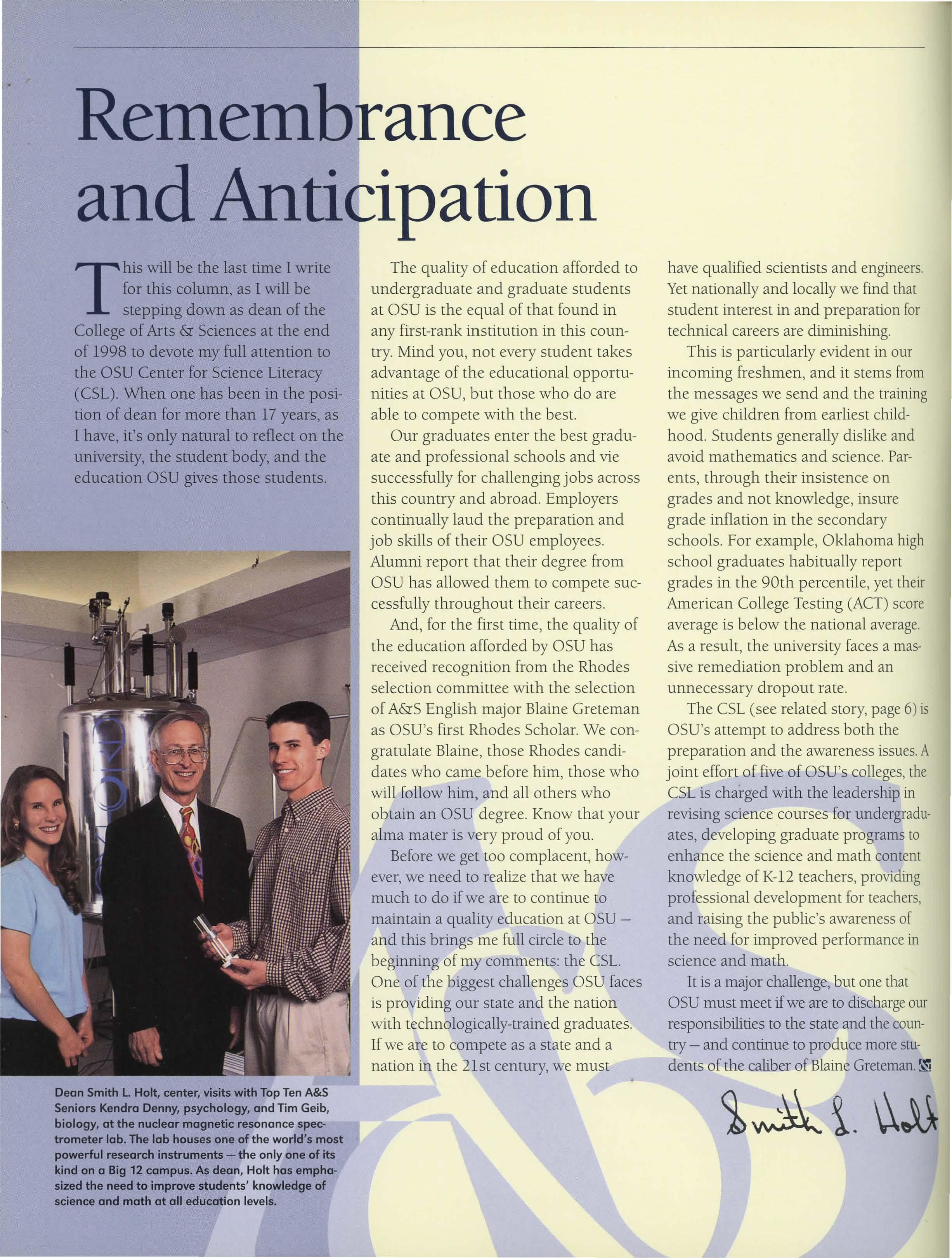
Dean Smith L Halt, center, visits with Top Ten A&S Seniors Kendra Denny, psychology, and Tim Geib, biology, at the nuclear magnetic resonance spectrometer lab. The lab houses one of the world's most powerful research instruments - the only one of its kind on a Big 12 campus. As dean, Holt has emphasized the need to improve students' knowledge of science and math at all education levels.
4 TheEducationPilot
Slowdown?Never!Formorethan 17 years, SmithL.Holthasbeenbuildingan actionlegacy for educationthat willcontinueevenafter he retiresas deanat the endof 1998.
10 Rhodesto Success
BlaineGreteman,OSU'sfirst RhodesScholar,is proofthat dreamsdo cometrue. He'sheadingto the Universityof Oxfordin Englandfor graduate studies.
14 DownloadingSuccess
Whethercomingfrom backgroundsin science and mathor musicand English,A&Salumsare utilizingtheireducationsto do bigthingsin the computerindustry.
20 Carvingan OSUNiche
Thisfriendof the universityhaspouredhisheart and soulintothe musicdepartmentthroughhis "instrumental"gifts.
22 Shapinga Worldof Culture
Whilepreparingfor a Washington,D.C.,exhibit, clayartistAnitaFieldstookherworkto another level,portrayingsuchabstractionsas the strengthsand weaknessesof the humanspirit.
25 A&SDepartments & Heads
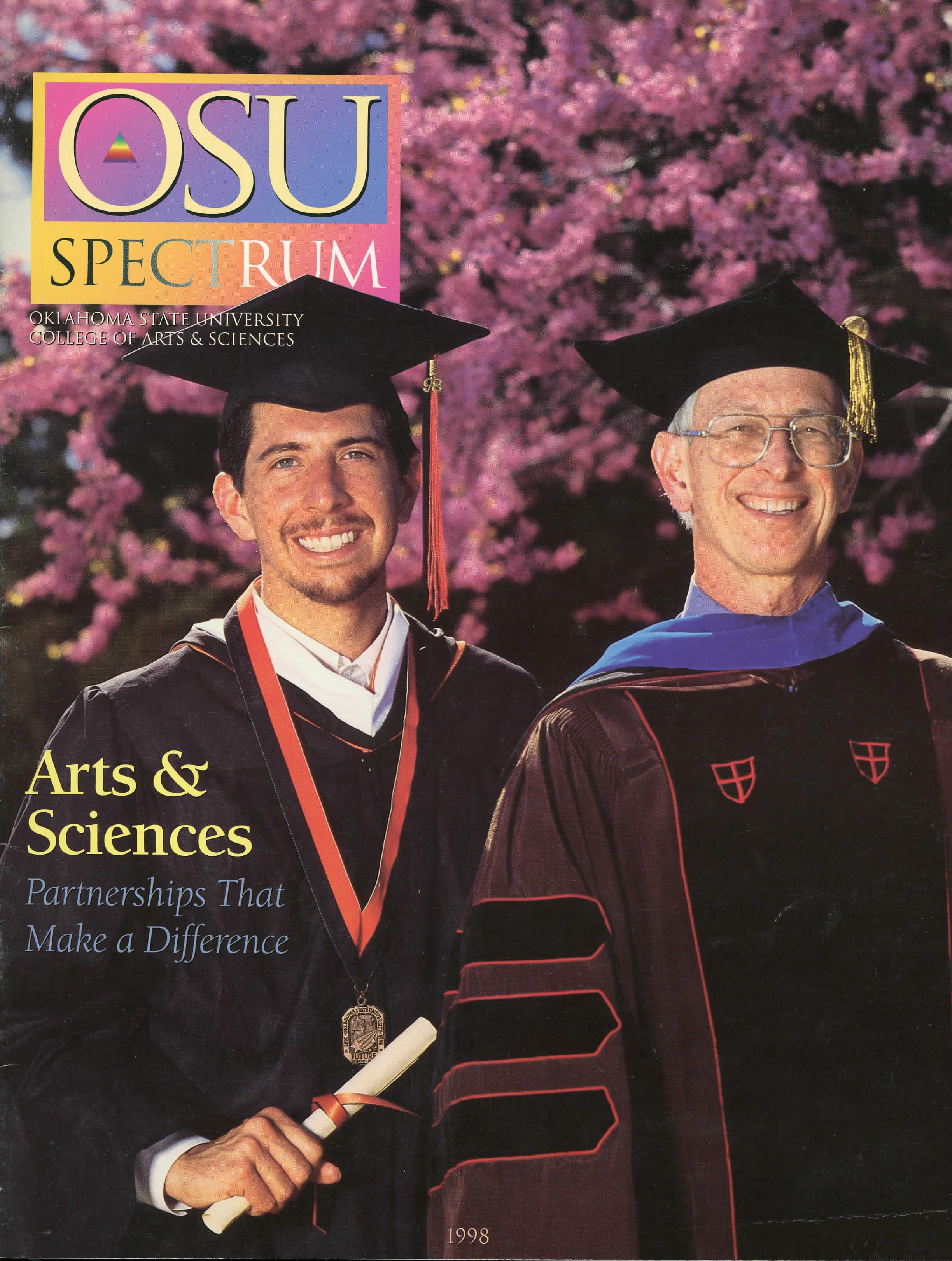
COVER:SpringgraduateBlaineGreteman,OSU'sfirst RhodesScholar,andDeanSmithL. Holtwillbesayinggoodbye to tl1eCollegeofArts& Sciencesthisyear,buttheyandothers likethemhavemadethecollegewhatit istodaythroughtheir pal'lnershipsofpurpose. It takeseveryone - administrators, teachers,students,staff,alumniandfriends - workingtogether to bringaboutexcellence in education.
Directorof Development
DevelopmentAssistant
Editor
Art Director
Photography Jeanne Short Ilda Hershey Lisa M. Ziriax Paul V Fleming
Andy Maxey (unlt5s othe,wise ,,o,,d) AssociateEditor Janet Varnum Directorof Natalea Watkins CommunicationsServices
SPECTRUMis a publicationof the OklahomaState UniversityCollegeofArts& Sciencesdesignedto provide informationon collegeissuesand concernswhilefostering communicationamongOSUalumniand friends.
CollegeofArts& Sciences
OklahomaStateUniversity Stillwater,Oklahoma74078-3015 (405) 744-7274
e-mail:shortj@okway.okstate.edu http://www.cas.okstate.edu/alumni/
OklahomaStateUni¥ersityin compliancewithTitleVI andVIIof the CivilRightsActof 1964,ExecutiveOrder11246as amended, Title IXof the EducationAmendmentsof 1972,Americanswith D1sobilitiesActof 1990,and otherfederallowsend regulations, does not discriminateon the basisof race, color,notionalori• gin,sex,oge,religion,disability,or status as o veteraninonyof its policies,practicesor procedures.Thisincludesbut is not limited to admissions,employment,financialaid and educational services.Thispublication,issuedbyOklahomaStateUniversity as authorizedbythe Collegeof Arts& Sciences,wasprintedby TheAudioVisualCenter,UniversityPrintingServicesat no cost to thetaxpayersof Oklahoma.,2325 6/98
©1998OklahomaStateUniversity
Imitatin Li e, rea ingDreams
Dean Stringer, "Bringing Dreams to Life" campaign chair for the College of Arts & Sciences, reports that nearly $10 million has been raised for the college, placing its campaign at 71 percent of the $14 million goal. The campaign ends June 30, 2000.
Dean Stringer, distinguished alumnus and chairman for the College of Arts & Sciences campaign, understands the importance of the arts in education and learning. And his philosophy on the subject is simple and direct.
"The arts are a part of life - they help expression, imagination and understanding. They prepare all for everyday life," he explains. "And students who receive arts instruction outperform those who don't." So, for the institution that educates Oklahoma's educators: "We have to be out front and produce only the best. That takes focus and money."
Through the campaign efforts, many donors have been given the opportunity to make an impact on this mission. Several examples of OSU's recent endeavors to improve the economic and cultural vitality of the state are reflected in both corporate and individual support.
Corporate Connections
Oklahoma business leaders like the Bank of Oklahoma Financial Corp. have always recognized the role they must play in arts education. BOk recently identified a way to assist by boosting a new OSU program for arts education. Through a grant from BOk, a program is in place to help Oklahoma teachers introduce fine arts and cultural history to their students.
This program, and BOk's support, is critical due to the requirements of HB 1017, which says that all Oklahoma students will begin to be tested in fine arts and culture in
the next two years. Today, 70 percent of Oklahoma elementary schools have no art teachers while the remaining 30 percent have part-time or shared positions. The grant will help fund the two-year project, which develops programs to fill this need. Utilizing the OSU Department of Art, the program will deliver information into the classrooms through interactive telecommunications and computer technology and provide in-service training for teachers in the use of new technical materials.
The Kirkpatrick Foundation joined BOk in underwriting the program. A long-time advocate of arts education in Oklahoma, the foundation is striving to see the day when all Oklahoma schoolchildren will have the opportunity to improve their academic performance and self.esteem through meaningful arts education.
"Artseducation has been shown to improve academic performance as evidenced by higher scores on the ScholasticAptitude Test (SAT)," says Kirkpatrick executive director Susan McCalmont. "We know this is true. There's proof in programs that the Kirkpatrick Foundation has sponsored in the past. We knew this program needed to happen."
Oklahomans are making dreams a reality for Oklahoma schoolchildren.
A Case for the Arts
Sqmewhere ... early in Lyn Gunter's life ... the small seed of artistic yearning was present. But for Gunter, that innate urge and capacity to be artistically expressive had to wait for cultivation. It lay dormant until she retired from successful careers as a journalist and highly-decorated Air Force colonel.
When her creativity blossomed, it became her passion. It all happened at the OSU art department over a period of years. She took both watercolor and oil painting, jewelry design, drawing, and printmaking - but her heart belonged to ceramics. Gunter became an excellent potter. She loved the process as well as the finished product. She loved to dig the clay from the ground, dry it, grind it, sift it, remix it then throw it on the wheel. She would look at a finished pot and say, "Now that one speaks to my soul."
Gunter's love - and her life - were cut short by cancer in 1996. Her beautiful paintings, jewelry and pottery stand in quiet testimony to her talent, spirit and zest for life. But perhaps the most significant tribute is the Lyn Gunter Memorial Art Scholarship established this year by Dr. Merrillyn Hartman, OSU assistant professor. Each year, the $1,500 endowed scholarship will rotate between the visual arts disciplines.
It is only fitting that the first Lyn Gunter Memorial Art Scholarship has made ceramic student Barbara Menefee's dream come true. Somewhere, Gunter is smiling.
Lasting Legacy
When Stillwaternative Malinda Berry Fischer says she believesthe arts add meaning to life, she "puts teeth" into that belief. She
established the Wise-Diggs-BerryEndowed Arts Faculty Award Fund to promote the arts at OSU by honoring excellence in teaching. Fischer, an OSU graduate, serves as president and CEO of Thomas N. Berry & Co., a family-held oil and gas company incorporated in 1937.
The gift was established as a tribute to Fischer's mother and grandmother. Malinda Blanche Wise Diggs was one of the first female graduates from OSU in 1898 and spearheaded saving Old Central as an OSU landmark. Cynthalice Diggs Berry, who attended OSU in the '30s, served on the first state arts and humanities council.
'This gift helps to underscore the importance of the arts to OSU," Dean Smith L Holt says. "It sends a highly-visible signal that the arts are an important part of our culture. Malinda's gift provides a lasting legacy of this long-held belief in her family."
Dr. Gerald D. Frank, OSU professor of music, couldn't agree more. He is the first recipient of the award for his outstanding work at OSU and for his tireless efforts on behalf of the arts.
Another dream brought to life.
The Vision of a Dream
Some dreams are just that - visions, waiting for the catalyst to make them a reality. Such is the vision to create a museum at OSU that would accommodate world-class exhibitions from leading art, historic and cultural institutions of the world. This vision would provide a unique opportunity to expand the exposure and impact of art and culture not only for the OSU family, but for the citizens of Oklahoma.
What better place to be that catalyst for renewed emphasis on the arts, world culture and education in heartland America than a university ... than OSU
The dream is in place. It can be a reality, the legacy from OSU's "Bringing Dreams to Life" campaign.
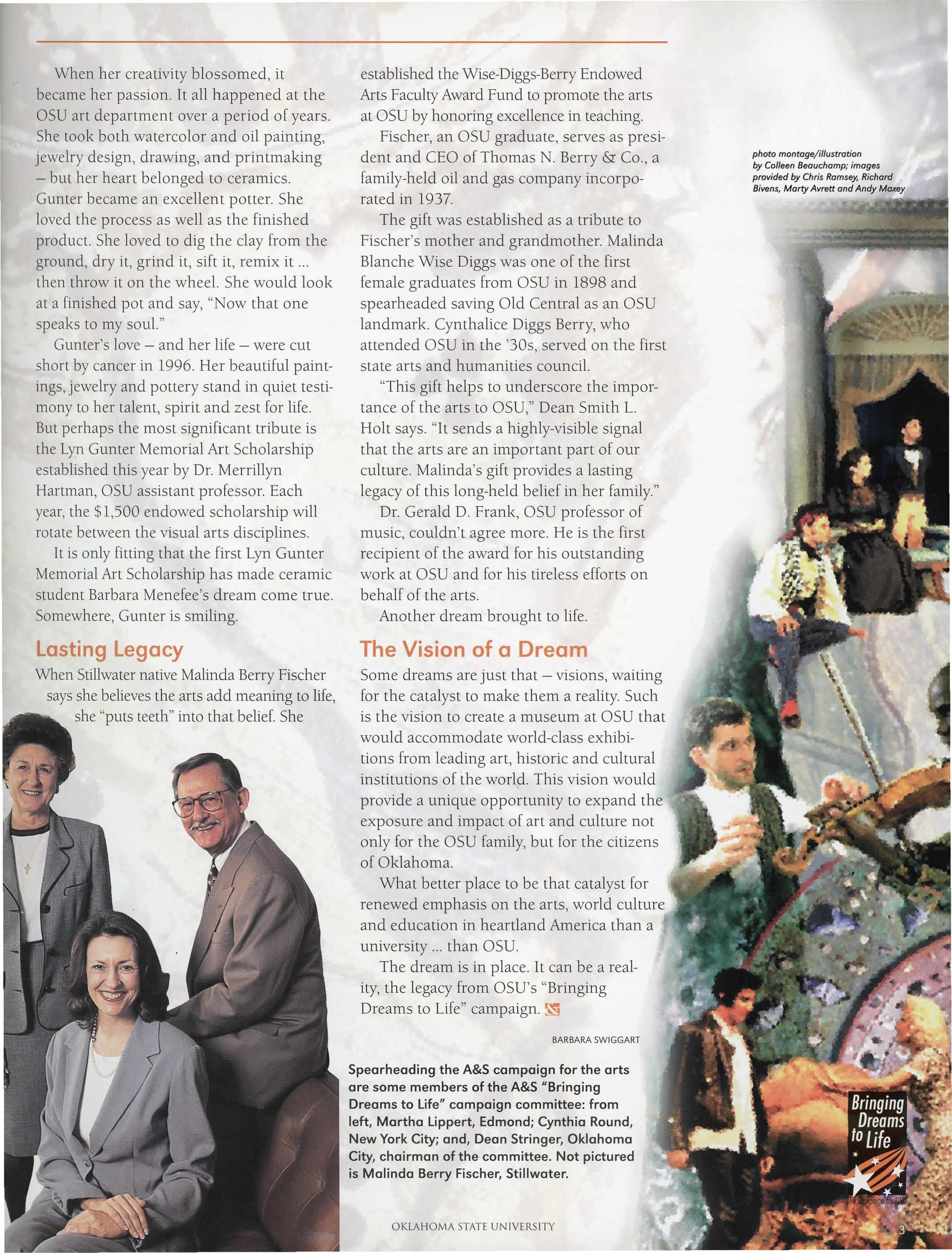
Spearheading the A&S campaign for the arts are some members of the A&S "Bringing Dreams to Life" campaign committee: from left, Martha Lippert, Edmond; Cynthia Round, New York City; and, Dean Stringer, Oklahoma City, chairman of the committee. Not pictured is Malinda Berry Fischer, Stillwater.
BARBARA SWIGGART
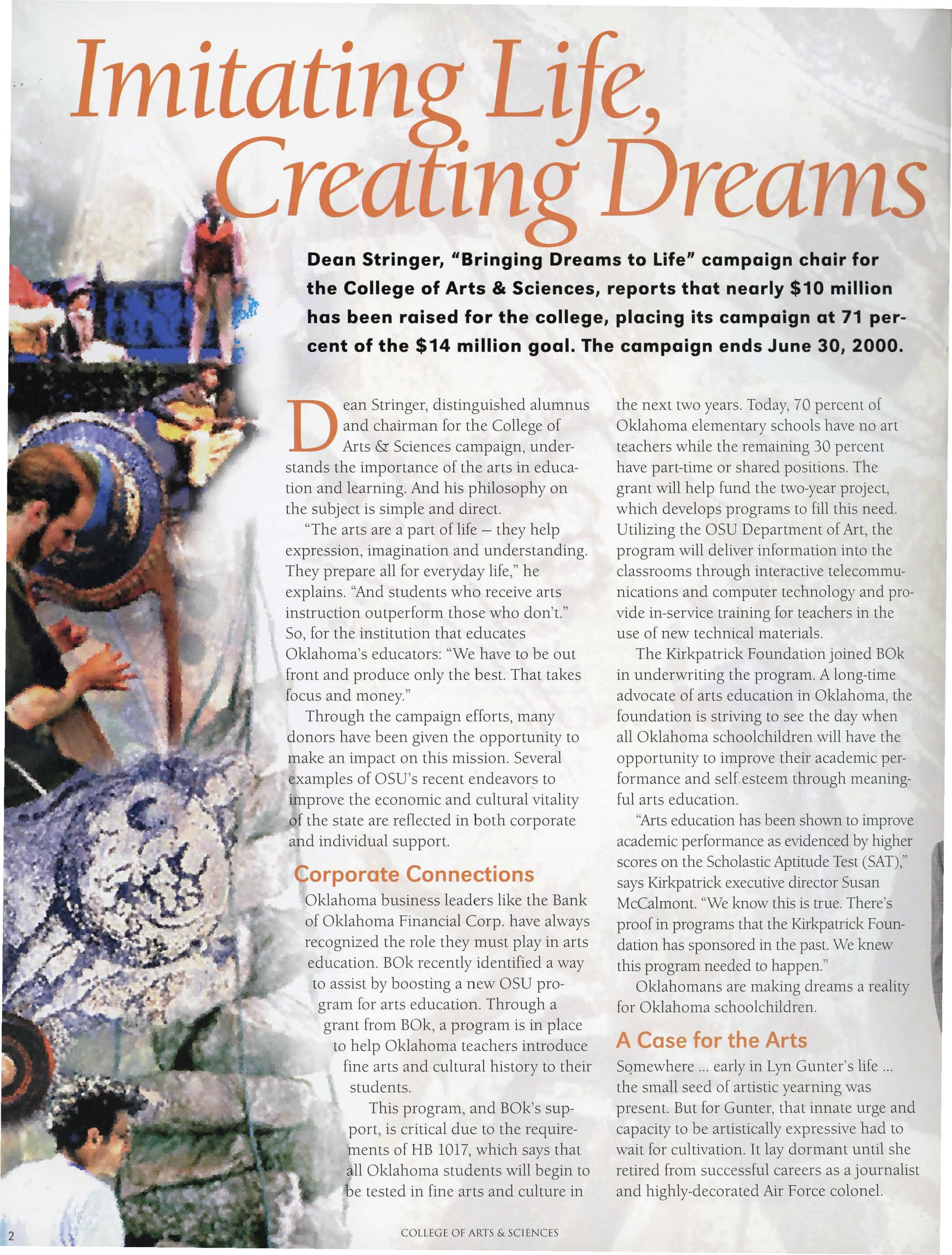
photo montage/illustration by Colleen Beauchamp; images provided by Chris Ramsey, Richard Bivens, Marty Avrett and Andy Maxey
t CJJlLtttVt
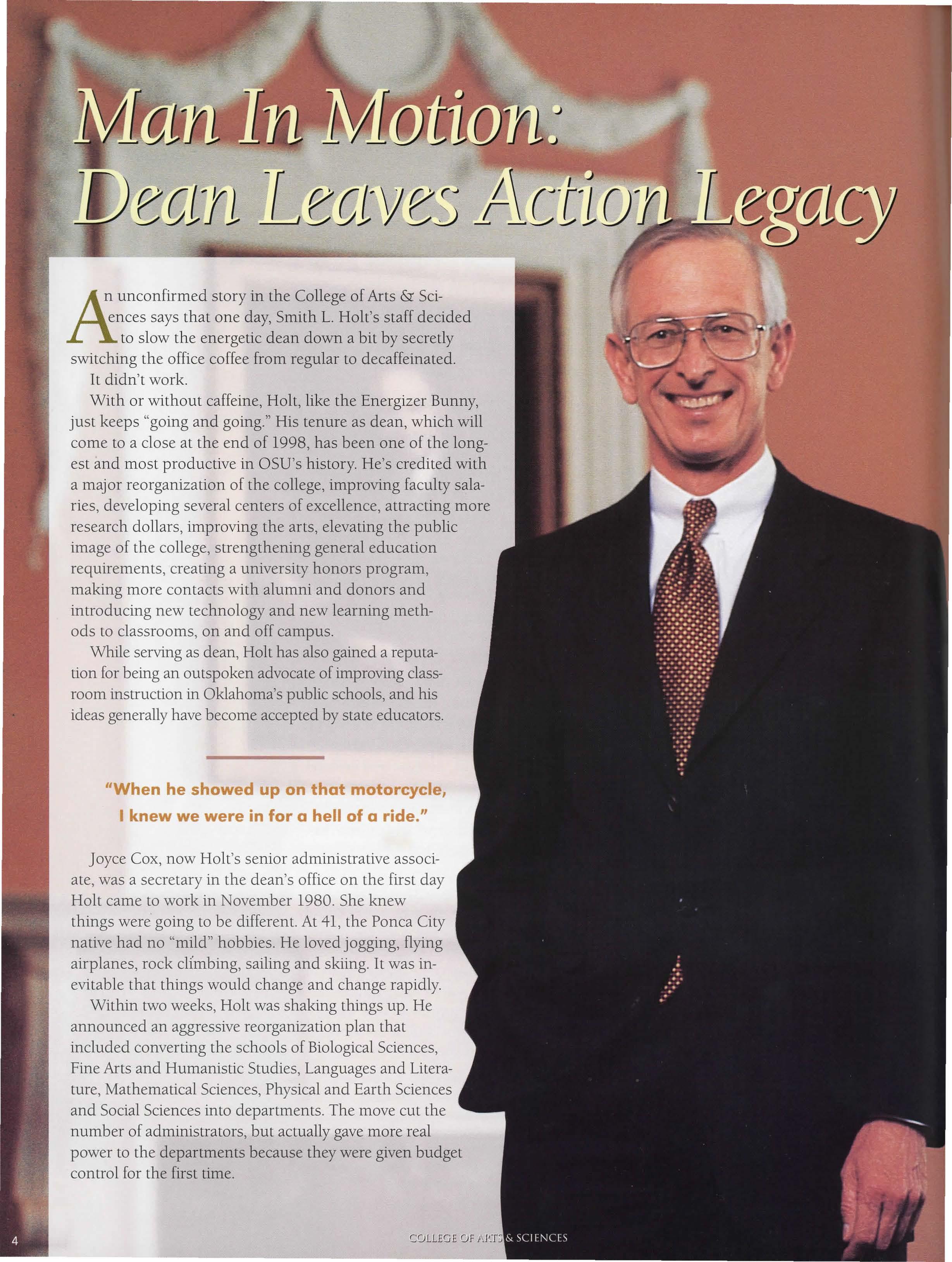
unconfirmed story in the College of Arts & Scinces says that one day, Smith L. Holt's staff decided to slow the energetic dean down a bit by secretly switching the office coffee from regular to decaffeinated. It didn't work
With or without caffeine, Holt, like the Energizer Bunny, just keeps "going and going." Hi.s tenure as dean, which will come to a close at the end of 1998, has been one of the longest and most productive in OSU's history. He's credited with a major reorganization of the college, improving faculty salaries, developing several centers of excellence, attracting more research dollars, improving the arts, elevating the public image of the college, strengthening general education requirements, creating a university honors program, making more contacts with alumni and donors and introducing new technology and new learning methods to classrooms, on and off campus.
While serving as dean, Holt has also gained a reputation for being an outspoken advocate of improving classroom instruction in Oklahoma's public schools, and his ideas generally have become accepted by state educators.
"When he showed up on that motorcycle, I knew we were in for a hell of a ride."
Joyce Cox, now Holt's senior administrative associate, was a secretary in the dean's office on the first day Holt came to work in November 1980. She knew things were going to be different. At 41, the Ponca City native had no "mild" hobbies. He loved jogging, flying airplanes, rock climbing, sailing and skiing. It was inevitable that things would change and change rapidly.
Within two weeks, Holt was shaking things up. He announced an aggressive reorganization plan that included converting the schools of Biological Sciences, Fine Arts and Humanistic Studies, Languages and Literature, Mathematical Sciences, Physical and Earth Sciences and Social Sciences into departments. The move cut the number of administrators, but actually gave more real power to the departments because they were given budget control for the first time.
Holt also slashed the bureaucracy in his own office and said he would hire only the number of people necessary to allow the college to function efficiently.
"Money that can be used to hire administrative personnel can be better used at the department level for faculty and teaching assistants essential to the educational process," he said in a 1981 interview.
Within three months, Holt was unveiling more plans, including a five-year"Design for Excellence" strategy which would dovetail with the university's Centennial Decade program - the 10 years leading to OSU's 100th birthday in 1990.
During the decade, Holt said, the college would attract $50 millionin outside funding, establish several new centers of excellence,launch a campus-wide Distinguished Speaker's Program, a Scholars-in-Residenceprogram, an annual week-long Festivalof the Arts and Culture of the Southwest, a program of outdoor performances and a major fund-raising campaign.
"I
remember how absolutely confident Dean Holt was that you could foster positive change in education if you had the ability, worked hard - and let enough people know about it."
Dr. Robert Graalman, now director of the Office of University Scholarships, describes Holt's instinctive awareness of the importance of public relations. One of his first actions as dean was to activate a college "Image Elevation Committee" and to start several public relations campaigns. He knew that support for growth in college programs would only come about through public awareness of the college's abilities and expertise.
Holt considers public relations everyone's job, and he doesn't exempt himself. He advertised a "Have Slides; Will Travel"show and landed numerous appearances before civic groups throughout the state. He was frequently interviewed by state media, was a guest on numerous television programs and was host of his own show on KOSU, the university's public radio station. Called "Issues and Insights," the show featured experts from throughout the college and the university. The dean discussed with his
guests issues such as world hunger, abortion, nuclear waste disposal, capital punishment and the Middle East.
Communicating with alumni was something the college had never attempted. Holt launched a new publication, "Arts & Sciences Reports," just for that purpose. His Century Note (C-note) campaign was the first college-based fund-raising effort at OSU. He asked college faculty and alumni to contribute $100 a year during the Centennial Decade, with an eventual goal of $1.5 million.
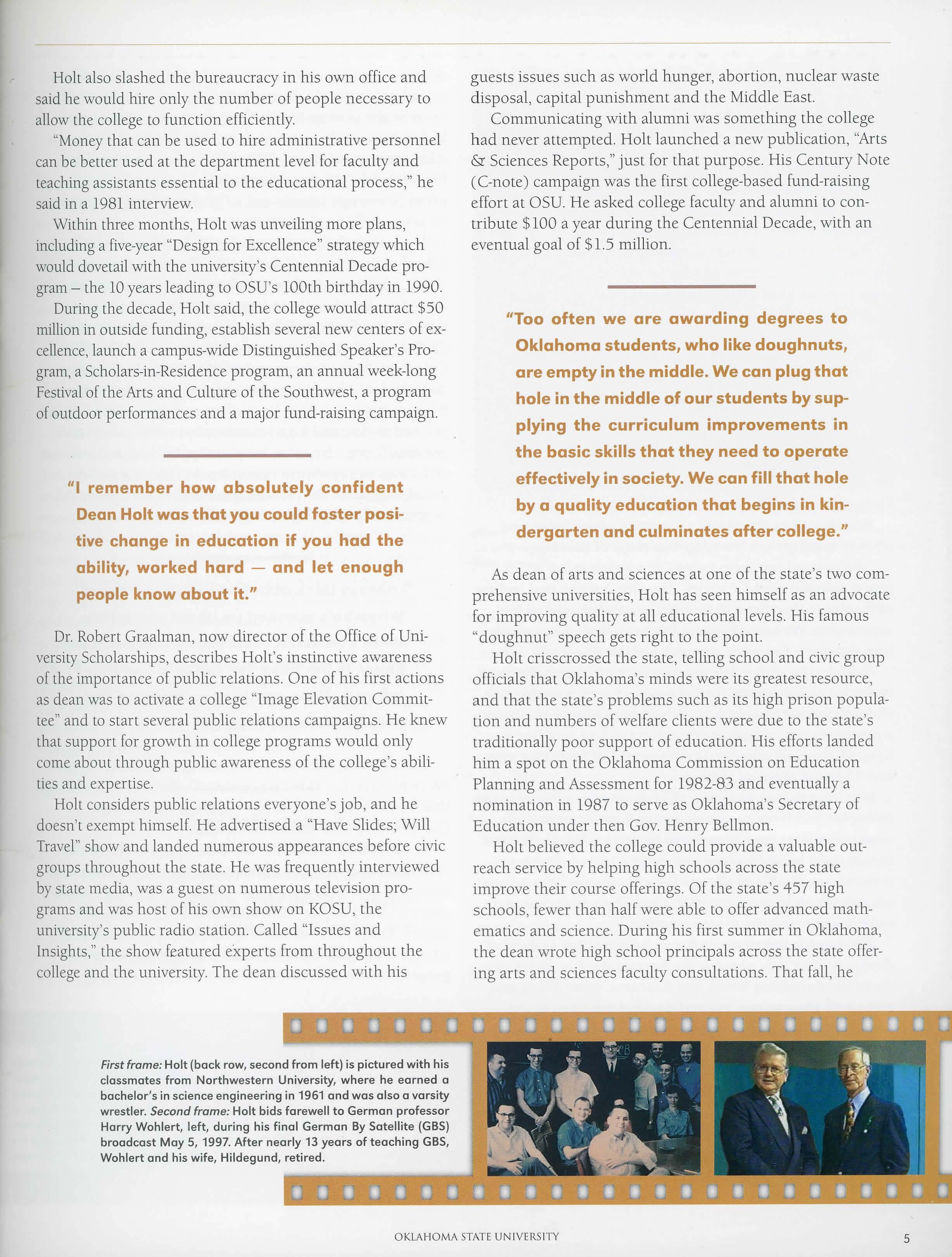
during his final German By Satellite (GBS) broadcast May 5, 1997. After nearly 13 years of teaching GBS, Wohlert and his wife, Hildegund, retired.
"Too often we are awarding degrees to Oklahoma students, who like doughnuts, are empty in the middle. We can plug that hole in the middle of our students by supplying the curriculum improvements in the basic skills that they need to operate effectively in society. We can fill that hole by a quality education that begins in kindergarten and culminates after college."
As dean of arts and sciences at one of the state's two comprehensive universities, Holt has seen himself as an advocate for improving quality at all educational levels. His famous "doughnut" speech gets right to the point.
Holt crisscrossed the state, telling school and civic group officials that Oklahoma's minds were its greatest resource, and that the state's problems such as its high prison population and numbers of welfare clients were due to the state's traditionally poor support of education. His efforts landed him a spot on the Oklahoma Commission on Education Planning and Assessment for 1982-83 and eventually a nomination in 1987 to serve as Oklahoma's Secretary of Education under then Gov. Henry Bellman.
Holt believed the college could provide a valuable outreach service by helping high schools across the state improve their course offerings. Of the state's 457 high schools, fewer than half were able to offer advanced mathematics and science. During his first summer in Oklahoma, the dean wrote high school principals across the state offering arts and sciences faculty consultations. That fall, he
First frame: Holt (bock row, second from left) is pictured with his clossmotes from Northwestern University, where he earned a bachelor's in science engineering in 1961 and was also a varsity wrestler. Second frame: Holt bids farewell to German professor Harry Wohlert, left,
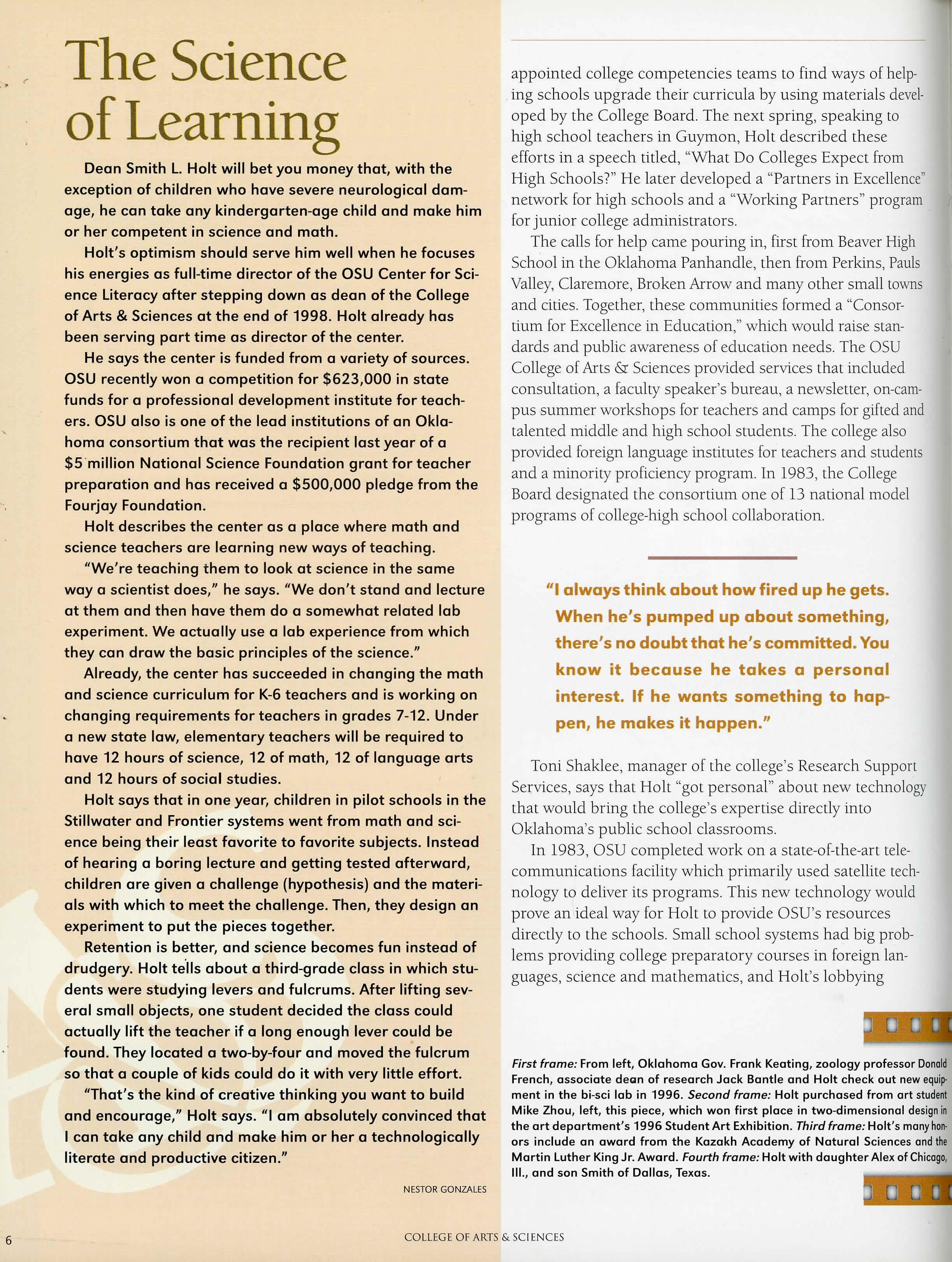
The Science of Learning
Dean Smith L. Holt will bet you money that, with the exception of children who have severe neurological damage, he can take any kindergarten-age child and make him or her competent in science and math.
Holt's optimism should serve him well when he focuses his energies as full-time director of the OSU Center for Science Literacy after stepping down as dean of the College of Arts & Sciences at the end of 1998. Holt already has been serving part time as director of the center.
He says the center is funded from a variety of sources. OSU recently won a competition for $623,000 in state funds for a professional development institute for teachers. OSU also is one of the lead institutions of an Oklahoma consortium that was the recipient last year of a $5 'million National Science Foundation grant for teacher preparation and hos received a $500,000 pledge from the Fourjay Foundation.
Holt describes the center as a place where math and science teachers are learning new ways of teaching.
"We're teaching them to look at science in the same way a scientist does," he says. "We don't stand and lecture at them and then have them do a somewhat related lob experiment. We actually use a lab experience from which they can draw the basic principles of the science."
Already, the center has succeeded in changing the math and science curriculum for K-6 teachers and is working on changing requirements for teachers in grades 7-12. Under a new state law, elementary teachers will be required to have 12 hours of science, 12 of math, 12 of language arts and 12 hours of social studies.
Holt says that in one year, children in pilot schools in the Stillwater and Frontier systems went from math and science being their least favorite to favorite subjects. Instead of hearing a boring lecture and getting tested afterward, children are given a challenge (hypothesis) and the materials with which to meet the challenge. Then, they design an experiment to put the pieces together.
Retention is better, and science becomes fun instead of drudgery. Holt te.lls about a third-grade class in which students were studying levers and fulcrums. After lifting several small objects, one student decided the class could actually lift the teacher if a long enough lever could be found. They located a two-by-four and moved the fulcrum so that a couple of kids could do it with very little effort.
"That's the kind of creative thinking you want to build and encourage," Holt says. "I am absolutely convinced that I con take any child and make him or her a technologically literate and productive citizen."
appointed college competencies teams to find ways of helping schools upgrade their curricula by using materials developed by the College Board. The next spring, speaking to high school teachers in Guymon, Holt described these efforts in a speech titled, "What Do Colleges Expect from High Schools?" He later developed a "Partners in Excellence" network for high schools and a "Working Partners" program for junior college administrators.
The calls for help came pouring in, first from Beaver High School in the Oklahoma Panhandle, then from Perkins, Pauls Valley, Claremore, Broken Arrow and many other small towns and cities. Together, these communities formed a "Consortium for Excellence in Education," which would raise standards and public awareness of education needs. The OSU College of Arts & Sciences provided services that included consultation, a faculty speaker's bureau, a newsletter, on-campus summer workshops for teachers and camps for gifted and talented middle and high school students. The college also provided foreign language institutes for teachers and students and a minority proficiency program. In 1983, the College Board designated the consortium one of 13 national model programs of college-high school collaboration.
"I always think about how fired up he gets. When he's pumped up about something, there's no doubt that he's committed. You know it because he takes a personal interest. If he wants something to happen, he makes it happen."
Toni Shaklee, manager of the college's Research Support Services, says that Holt "got personal" about new technology that would bring the college's expertise directly into Oklahoma's public school classrooms.
In 1983, OSU completed work on a state-of-the-art telecommunications facility which primarily used satellite technology to deliver its programs. This new technology would prove an ideal way for Holt to provide OSU's resources directly to the schools. Small school systems had big problems providing college preparatory courses in foreign languages, science and mathematics, and Holt's lobbying
First frame: From left, Oklahoma Gov. Frank Keating, zoology professor Donald French, associate dee.in of research Jock Bentle and Holt check out new equipment in the bi-sci lob in 1996. Second frame: Holt purchased from art student Mike Zhou, left, this piece, which won first place in two-dimensional designin the art department's 1996 Student Art Exhibition. Third frame: Holt's manyhonors include an award from the Kazakh Academy of Natural Sciences and the Martin Luther King Jr. Award. Fourth frame: Holt with daughter Alex of Chicago, Ill., and son Smith of Dallas, Texas.
convinced school administrators this was an area that could and should be improved. In fact, arts and sciences, on its own, had instituted a more rigorous foreign languages requirement for its graduates.
In the meantime, an OSU foreign languages professor named Harry Wohlert and the superintendent at Beaver High School were arranging an experiment that would bring instruction in German to students in the small Oklahoma Panhandle school. Using a telephone line and some software that he developed, Wohlert began teaching, and other schools began noticing. The State Department of Education got interested and asked the Legislature to appropriate funds for schools to buy satellite-receiving equipment. The telephone pilot project began in January 1985. By the fall '85 semester, 50 schools had signed on to receive a video version called German by Satellite, which featured Wohlert and his wife, Hildegund.
By its second year, the program had mushroomed to include schools in 20 states. By its sixth year, 300 classes in 256 schools were receiving German by Satellite, and the Arts and Sciences Teleconferencing Service (ASTS) was getting attention from The New York Times, "CBS News" and The Wall Street Journal. The service eventually offered courses in advanced placement (AP) physics, AP calculus, geometry and chemistry. Later, the U.S. Congress noticed and passed the "Stars School" Act, which provided millions of dollars for additional courses, programs and equipment at needy schools throughout the nation. At one point, ASTSwas offering 750 hours of programming to classes in more than 40 states. Eventually, other universities and educational companies would catch on and compete with OSU for the same students, but OSU had pioneered the concept, and Holt's college had proven that it would work.
"I'll remember Dean Holt serving as an 'auctioneer' at one of our benefit auctions. He did an excellent job. I'll also remember him being in our gallery, from the very beginning of his term as dean, and buying art produced by our students and faculty."
Nancy Wilkinson, head of the OSU Art Department, says Holt, a chemist by profession, has strengthened programs in theater, music and art and made sure the arts are a high priority during fund-raising campaigns.
Those efforts paid dividends in 1981 when the late Tulsa industrialist F.M. "Pete" Bartlett and his wife, Helen (also known as Pat), decided to give $1 million to renovate historic Gardiner Hall into the Bartlett Center for the Studio Arts. The renovation was a major morale boost for the department and led to the restoration of the bachelor of fine arts degree and an increase in enrollment.
Under Holt's leadership, the departments of theater and music also have flourished. Cox says the music department has grown and become a vital part of the music scene on campus and throughout the state. OSU's theater department is well-respected and draws audiences from throughout Oklahoma. Both departments have won regional and national awards.
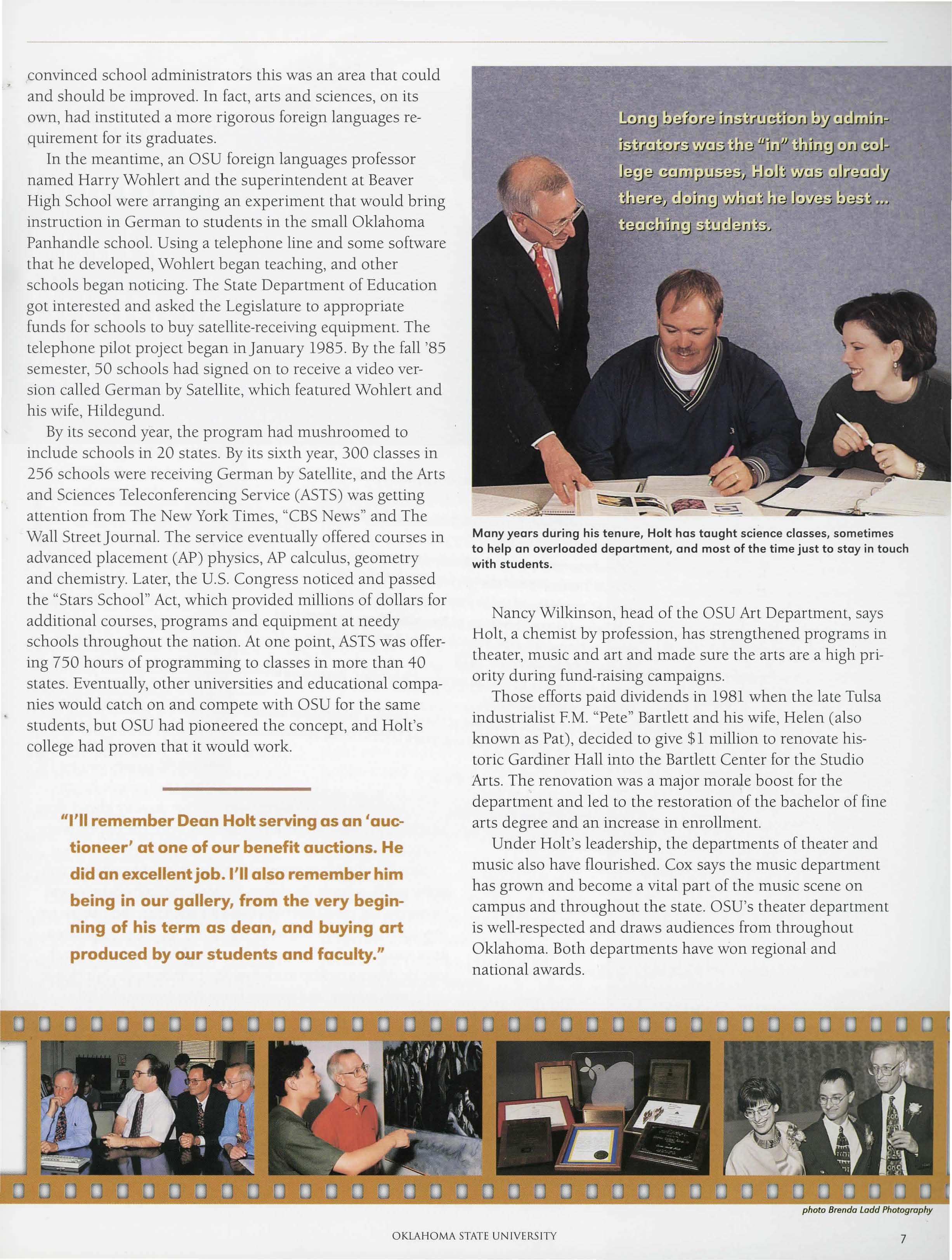
Many years during his tenure, Holt hos taught science classes, sometimes to help on overloaded department, and most of the time just to stay in touch with students.
"He was constantly concerned about the academic integrity of the institution - to the point where I never recall a situation where he was worried about himself. It was always a college, university or state issue. It was always something in which he believed."
Joe Weaver, Holt's fiscal officer for many years and now OSU's director of Planning, Budget and Institutional Research, says Holt always has been focused on academic issues. Under the dean's leadership, both the arts and the sciences have flourished. Six months after the Bartlett gift, another $1 milhon donation came in, this time from Texas oilman and OSU geology graduate Boone Pickens. The gift paid for the new Boone Pickens School of Geology, which was incorporated into the Noble Research Center.
During Holt's tenure, the college attracted a $2 million grant from the Howard Hughes Institute to help Native American schoolchildren discover careers in the sciences. The program targeted K-12 children from
As it turns out, Holt has been ahead of his time in many areas. The satellite educational programs began a national trend. His pleadings for improved educational quality eventually were taken up as a cause by the Oklahoma State Regents for Higher Education, the state coordinating board for higher education, and resulted in higher entrance standards for college freshmen and more rigorous academic requirements in Oklahoma's high schools.
LifetimeofAccomplishment
• Born Dec.8, 1938, in Ponca City
• Parents owneda clothing store
• Graduated from Ponca CityHigh School , . . ngineeringin 1961 from
• Earned a bachelors m se1encee h as also a varsity wrestler NorthwesternUniversitywhere e w . d PhD in 1965 in inorganiccheffilstryat Brown
• He earne a
• ·ty in Providence,R.l.
• ~:t:::lmarried Elizabeth Manners, a fellowdoctoral student at Brown d Smith III,
• Raised two children, Alexandra,born m 1967, an born in 1969
. N th
And, Holt has been a pioneer in one more thing. Long before teaching by administrators was the "in" thing on college campuses, Holt was already there. Many years during his tenure, he has taught freshmen chemistry, sometimes to help the chemistry deparm1ent if it was overloaded, and most of the time just to stay in touch with students. Teaching is one of his favorite activities, say friends and colleagues. He always wants the best for students.
• Receivedone-yearpost-doc_tor~lfellowshipwit~:::a:: Atlantic Treaty Organizationm Copenhagen, kl n d ·ntment to the PolytechnicInstitute of Broo y
• Accepte appoi h pent nine
• Later move_dto thheUni;r;~tpyr~!e::~;;~! :::::1e::ed years, achievedt e ra OutstandingEducator for 1973
• Taught six months at the _Universityof Bordeaux,France, on a Fulbright-HaysFellowship d of the chemistry department at the
• Appointedprofessor_and hea t ears prior to being selected University of Georgiafor the wo y A&Sdean at OSU
###
Ponca City, Pawnee and the Frontier schools at Red Rock.
In the "Bringing Dreams to Li.fe"campaign, the college has raised nearly $10 million in private gifts under Holt's leadership.
Holt began the Dean's Incentive Program, a new idea to provide faculty with start-up money for attracting research grants or engaging in scholarly activities. The concept is now established university-wide. In the last 10 years, research grants to the college went from $3 million to $12 million per year.
Although sometimes criticized for moving too quickly on some issues, Holt has no regrets. "You get all the information you can get within a reasonable period of time. You listen to everybody who needs to be listened to, and you make a decision. You don't sit there and think about it forever. If you do, the world passes you by. I'd rather that people be un-
happy with me for moving ahead than be unhappy with me because 1 did not seize the opportunity when it came by."
Next i.sa crusade to improve the quahty of science instruction in the pubhc schools. As always, Holt will run into obstacles and naysayers, but most observers think it's safe to predict that his energy and enthusiasm will make the Center for Science Literacya great success. He's 17years older and "maybe" a httle more mellow. He drives a pickup truck instead of a motorcycle, but Holt is still moving, and moving faster than anyone else.
NESTORGONZALES
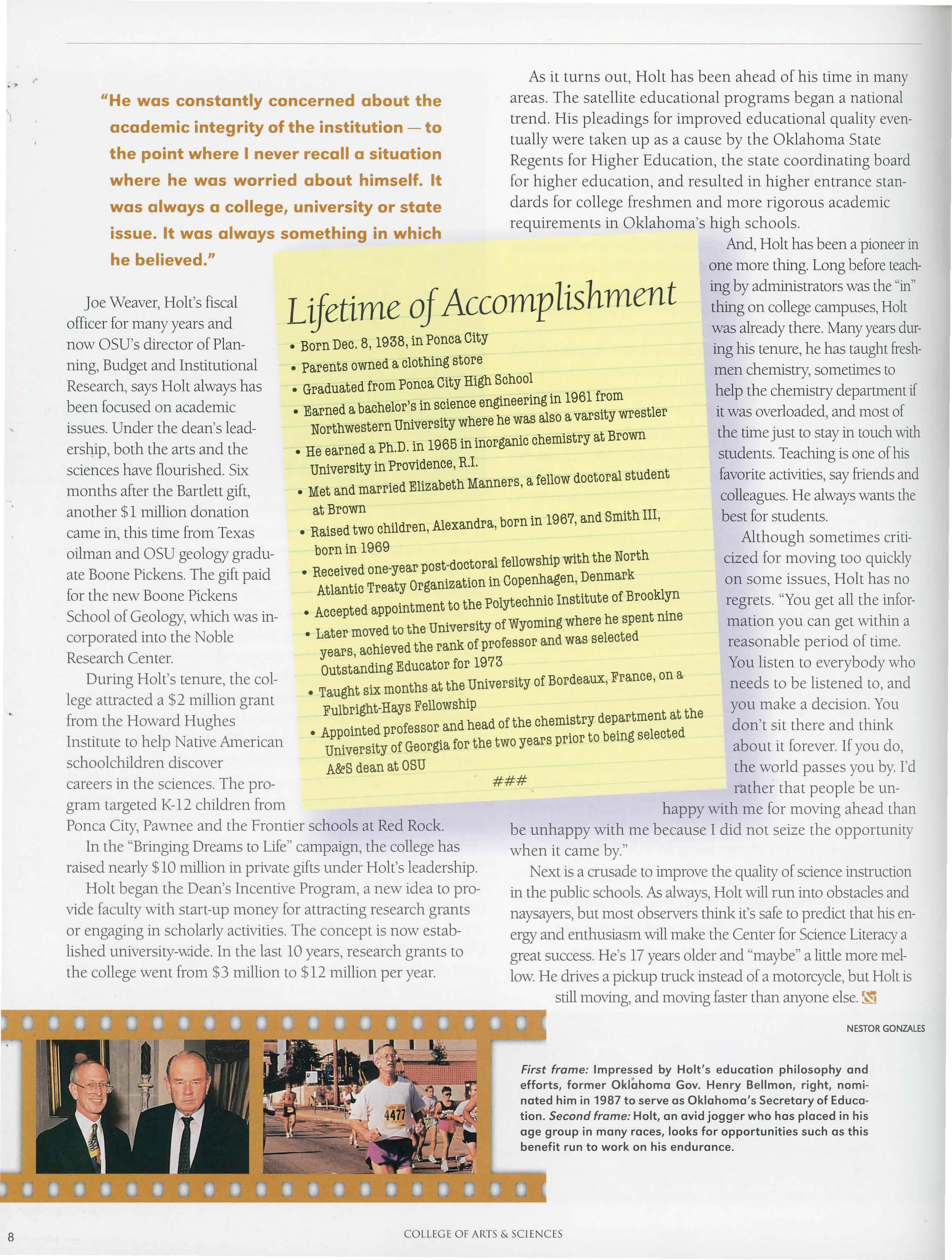
First frame: Impressed by Holt's education philosophy and efforts, former Oklahoma Gov. Henry Bellman, right, nominated him in 1987 to serve as Oklahoma's Secretary of Education. Second frame: Holt, an avid jogger who has placed in his age group in many races, looks for opportunities such as this benefit run to work on his endurance.
From a backyard project in a chicken house to a multi-million dollar international business, Jeanie Clinton has realized the entrepreneur's dream. A business she cofounded in 1973 is now United Design Corp., the largest figurine manufacturer in the United States.
Clinton was named a "Distinguished Friend" of the College of Arts & Sciences at the college's awards banquet April 8. The award recognizes outstanding accomplishments by someone who can serve as an inspiration for students.
'Jeanie is an excellent role model for young women," Dean Smith L. Holt says. "She took her talent in art and turned it into one of the biggest businesses of its kind in the world."
Clinton was born in Cushing and spent the first four months of her life in OSU's Veterans Vill~ge while her parents attended OSU. After graduating from high school in Switzerland, she studied sculpture at OSU. She also attended the Academy of Fine Arts in Florence, Italy, and the University of Oklahoma.
While president of Noble-based United Design, Clinton oversaw the company's international division, which included manufacturing operations in Canada and China and a sales and distribution center in England.
The company, which manufactures and wholesales more than 3,500 gift items to some 40,000 retail outlets in the United States and around the world, has been recognized by Inc. Magazine twice in the last decade as one of the nation's top 500 fastestgrowing privately held firms.
In January, the company was sold to a New York-based firm, Charterhouse Group International. Although Clinton has future business plans, right now she is enjoying her many hobbies and spending time with her four sons. A well-rounded person with a multitude of interests, Clinton likes piloting her Cessna 182 and Beech 18, collecting vintage cars and traveling. Descended from both Native Americans and Land Run settlers, she loves to study Native American culture and is involved with various projects including a running program for Native American youth.
Grateful for her success, Clinton believes in giving something back. She is establishing a foundation to help other women be successful in business. She also volunteers her time for work with the Boy Scouts of America and has received numerous awards from the organization. r~
"Wecreateour own lifesituations,first throughthe thoughtsthat we thinkand thenby our own actions. We are responsible Jor our own satisfactionor dissatisfactionwith life."
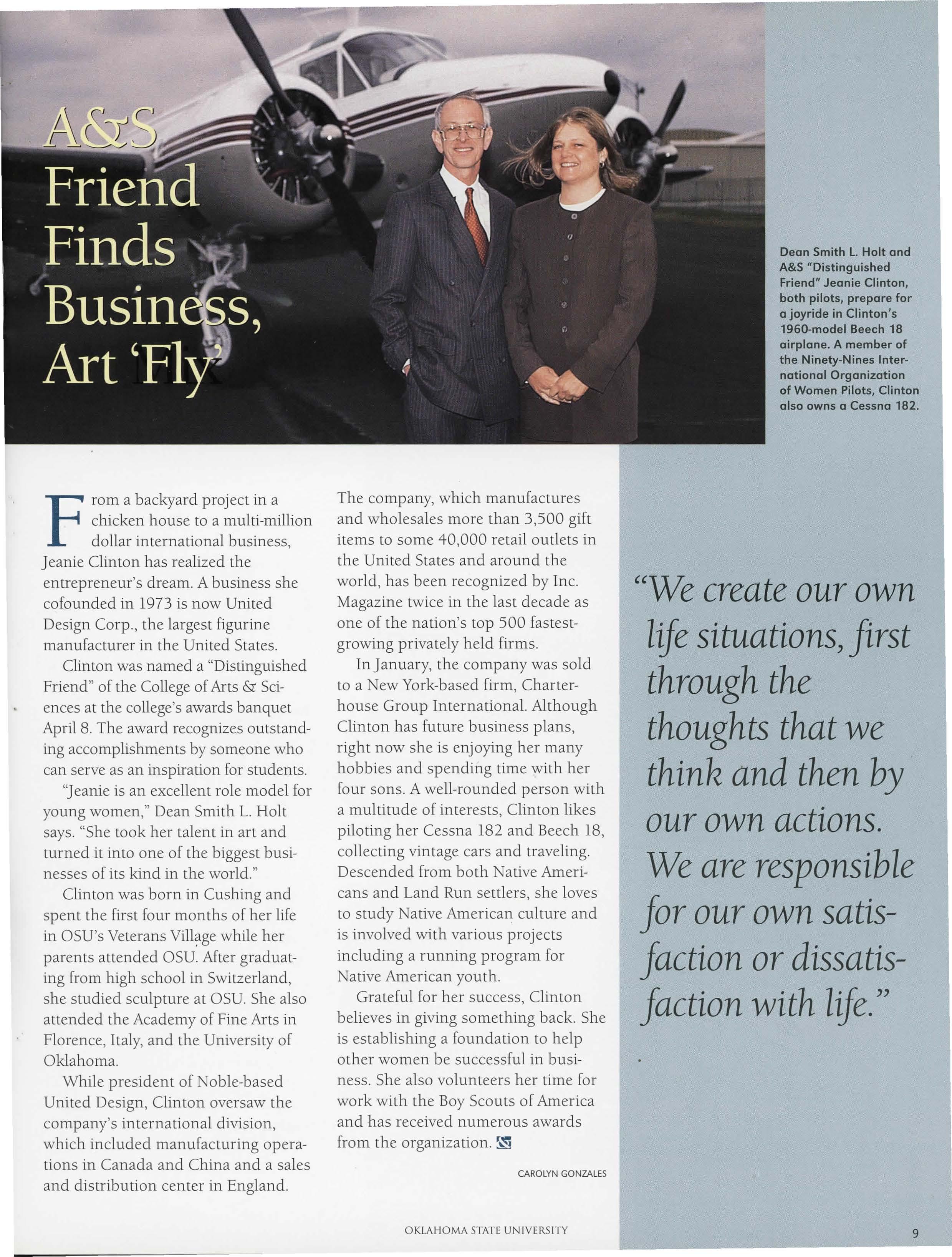
Dean Smith L. Holt and A&S "Distinguished Friend" Jeanie Clinton, both pilots, prepare for a joyride in Clinton's 1960-model Beech 18 airplane. A member of the Ninety-Nines International Organization of Women Pilots, Clinton also owns a Cessna 182.
SU's Blaine Greteman majored in English, but made history. The Hydro native was the first OSU student to win the prestigious Rhodes Scholarship and only the 57th Oklahoman to win the award.
Greteman will realize his lifelong dream of studying at the University of Oxford in England, thanks to the Rhodes Scholarship, which pays full tuition and a maintenance allowance for two years of study at the university. He plans to pursue a doctor of philosophy degree in English studies, with a focus on the Renaissance. He eventually wants to come home to Oklahoma to teach at the college level.
Winning the Rhodes has given Greteman a lot of visibility. His story has appeared in front page newspaper articles across the state. His photo has graced the cover of numerous university magazines. He received special recognition at A&S graduation ceremonies May 9 when he was named an A&S Distinguished Alumnus, marking the first time the prestigious award has been presented to an immediate graduate. He also made a special presentation to the state legislature about his experience with Oklahoma higher education.
"lt has given me the opportunity to talk about ~he good things we're doing in public education," he says.
An interest in education comes naturally to Greteman. His father, Doyle, is school superintendent at Lindsay, and his mother, Brenda, is a counselor at Bridge Creek Public Schools.
Blaine's sister, Autumn, was a freshman in the OSU College of Human Environmental Sciences this year, and his wife, Mandi Bozarth, also from Hydro, is an outstanding OSU English major in her own right. She's won numerous awards and will join Greteman in England after she graduates from OSU next year.
While at OSU, Greteman has distinguished himself with his outstanding scholarship, leadership and hard work in a number of other areas. He was an
editorial columnist for the Daily O'Collegian and helped found OSU's literary magazine, "Papyrus."
He also received a Wentz Scholarship which allowed him to work with Dr. Ed Walkiewicz in the English department on a special project. He chose to write a research paper titled "The Effects of The Grapes of Wrath' on Oklahoma." The article has received critical acclaim and may be printed in a majorpublication.
Greteman is praised by his professors. Dr. Edward Jones, associate professor of English, says, "His achievements stem from good work habits, a creativeintelligence and a willingness to take risks. Whether commenting on the state image of Oklahoma, examining the inequality of the sexes in Milton's 'Paradise Lost,' painting a house or playing his guitar, Blaine displays a winsome personality others want to know."
Greteman also has a modest nature. When asked about winning the Rhodes Scholarship, he says his accomplishment is "an affirmation of the quality of our OSU student body in general."
He goes on to say that he probably wouldn't have tried to win the Rhodes without the help and encouragement of a number of people.
"The process is just too daunting," he says.
He gives much of the credit to a mentoring program operated by Dr. Robert Graalman, director of the Office of University Scholarships, and to the facultywho participate in the program.
Graalman teaches an honors seminar titled "Windows to the World" which is limited to students who have an interest in applying for major scholarships.
"The students work on their writing skills and interview techniques, and the current events discussion requires two students each week to be responsible for 'news of the day' topics," Graalman
says. "So far, we've had four Truman Scholarship winners and a Rhodes recipient come through the class."
He adds that he modeled the program after one at Kansas State University, which is the public institution with the best record for students winning these particular scholarships.
Jones works in partnership with Graalman in grooming Rhodes candidates.Jones and Walkiewicz were mentors for Greteman in his major, and Dr. Jeff Cooper of history also helped him.
After completing the honors seminar, Greteman stayed in touch with Graalman's office and continued to work toward his goal.
"The whole thing would have been pretty much impossible without the help I received," Greteman says.
He cites this experience as one more reason he came to OSU.
"I always thought it was a nice place where people care about students," he says.
In a typical understatement about his own accomplishments, he says winning the Rhodes Scholarship is a "nice capstone" for his college career at OSU. •~
CAROLYNGONZALES
photo Nasir Hamid, C>University of Oxford
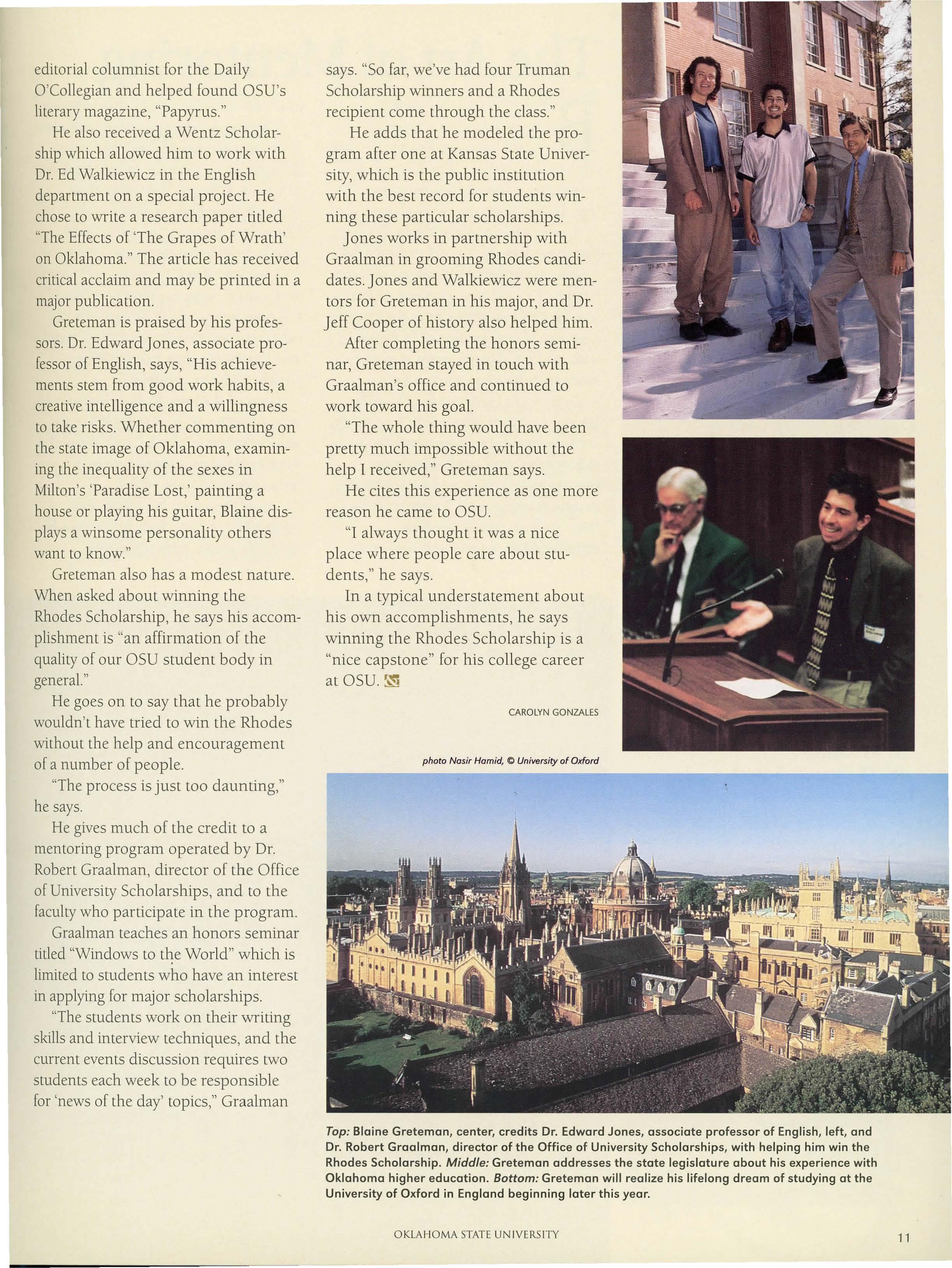
Top: Blaine Greteman, center, credits Dr. Edward Jones, associate professor of English, left, and Dr. Robert Graalman, director of the Office of University Scholarships, with helping him win the Rhodes Scholarship. Middle: Greteman addresses the state legislature about his experience with Oklahoma higher education. Bottom: Greteman will realize his lifelong dream of studying at the University of Oxford in England beginning later this year.
College Alumni Board Members
President
AlisonAnthony,Mannford BA'87, MA '90 English
Vice President/President-Elect
DavidK. Parrack,Tulsa BA'80 History
National Board Representative
W. JohnLamberton,IV,Tulsa BS'70 Psychology,PhD'81 Sociology
Members at Large
ChristopherGafney,Edmond BS'90 Statistics
NancyS. GloriodJones,Duncan BA'84 Spanish
RichardL. Hauschild,Edmond BS'78 Geology
CarolR. Kilpatrick,OklahomaCity
BA186 SpanishandJournalism/News
PaulKnapp,OklahomaCity
BS'79, MS'81 ComputerScience
EllenChanceLyons,Edmond BS'82 Math
KristyBakerMclaughlin,Stillwater BS'84 Sociology
SteveNelson,Tulsa
BS'83 Geology, MS188 ComputerScience
KarenKaySpeer,OklahomaCity BS'87 Journalism/PublicRelations
Departmental Representatives
ClaudiaBartlett,Sapulpa
BS'80 Journalism/Advertising
Dana K. Glencross,OklahomaCity BA'82 English,MA•186 PoliticalScience
AngelikaPotter,Mannford BA'93 Philosophy
RobertR. Springer,OklahomaCity MS'77 Geography
Staff Liaisons
WilliamA. Ivy,Stillwater A&SAlumniRelations
Ilda T.Hershey,Stillwater A&SAlumniActivities and Development
The Art of Mentoring
Bill Goldston is the perfect example of what a mentor should be, according to the A&S Alumni Association, which promotes mentoring relationships between college alumni and current students.
Twelve years ago, Goldston, OSU art department alumnus and president of Universal Limited Art Editions of Long Island, N.Y.,initiated a unique opportunity for OSU art students in the form of a semester-long residential internship with his firm. The program is open to students from every art specialty.
Goldston's firm helps such wellknown artists as Jasper Johns and Robert Rauschenberg make limited edition prints from their work. Goldston interns have a chance to help with the printmaking process, experience the New York art world, become acquainted with distinguished artists
and gain valuable practical experience.
"Oklahoma wasn't a progressive state as far as contemporary art, and it was difficult for its students to see examples of what was being done other than through magazines or slides in the art history department," says Goldston, who himself never served an internship.
The interns receive room and board and a small wage for their semester of full-time work, which includes duties ranging from cleaning and filing slides and setting up shows to working closely with the printers.
Many of the interns, such as studio art senior Danika Mills, actually live in the same building in which ULAE is basedthe converted caretaker's cottage of a Victorian estate on Long Island.
"Allof the artists have been wellestablished in New York and across the world for years," says Mills, who
A Circle of Friends
Nancy Gloriodjones and her fellow A&S Alumni Association members are helping to keep alive the legacy of the College of Arts & Sciences. After attending an OSU music faculty presentation for
alumni in Oklahoma City last year, Jones, who joined the organization in 1996, wanted to bring a similar program to her hometown of Duncan. In March,Jones' dream became a reality when more than 100 people attended
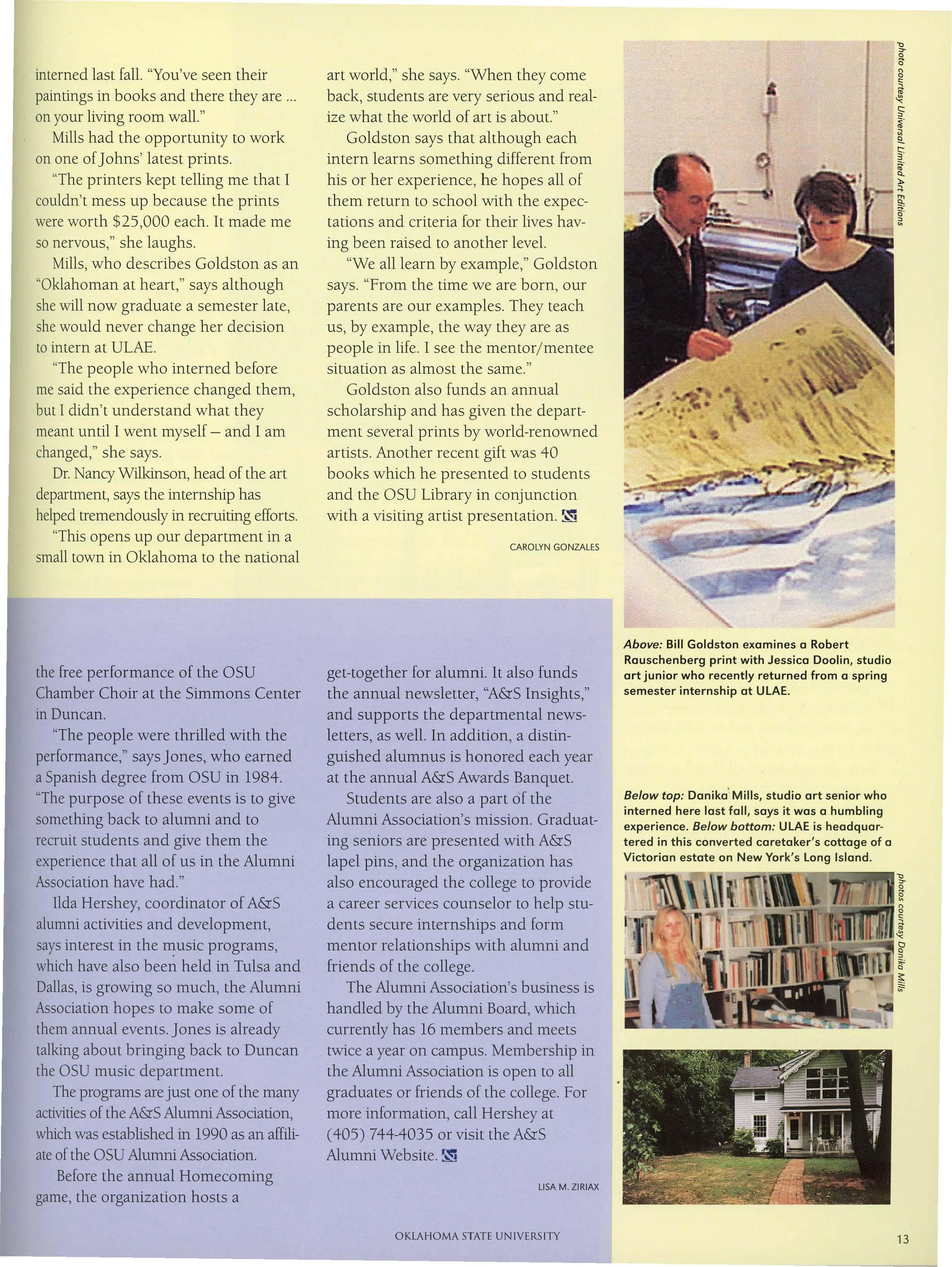
Nancy Gloried Jones, third from left, greets Cari Earnhart, David Ritter and Patrick Lytle, all members of the OSU Chamber Choir, after a spring concert sponsored by the A&S Alumni Association.
interned last fall. "You've seen their paintings in books and Lhere they are on your living room wall."
Mills had the opportunity to work on one ofJohns' latest prints.
"The printers kept telling me that I couldn't mess up because the prints wereworth $25,000 each. It made me so nervous," she laughs.
Mills,who describes Goldston as an "Oklahoman at heart," says although she will now graduate a semester late, she would never change her decision to intern at ULAE.
"The people who interned before me said the experience changed them, but I didn't understand what they meant until I went myself - and I am changed," she says.
Dr.Nancy Wilkinson, head of the art department,says the internship has helpedtremendously in recruiting efforts.
"This opens up our department in a smalltown in Oklahoma to the national the free performance of the OSU Chamber Choir at the Simmons Center in Duncan.
"The people were thrilled with the performance," says Jones, who earned a Spanish degree from OSU in 1984. "Thepurpose of these events is to give something back to alumni and to recruit students and give them the experience that all of us in the Alumni Associationhave had."
Ilda Hershey, coordinator of A&S alumni activities and development, saysinterest in the ~usic programs, which have also been held in Tulsa and Dallas,is growing so much, the Alumni Associationhopes to make some of them annual events. Jones is already talking about bringing back to Duncan the OSU music department.
The programs are just one of the many activitiesof the A&S Alumni Association, whichwas established in 1990 as an affiliateof the OSU Alumni Association.
Before the annual Homecoming game, the organization hosts a
art world," she says. "When they come back, students are very serious and realize what the world of art is about."
Goldston says that although each intern learns something different from his or her experience, he hopes all of them return to school with the expectations and criteria for their lives having been raised to another level.
"We all learn by example," Goldston says. "From the time we are born, our parents are our examples. They teach us, by example, the way they are as people in life. I see the mentor/mentee situation as almost the same."
Goldston also funds an annual scholarship and has given the department several prints by world-renowned artists. Another recent gift was 40 books which he presented to students and the OSU Library in conjunction with a visiting artist presentation. r~
CAROLYNGONZALES
get-together for alumni. It also funds the annual newsletter, "A&S Insights," and supports the departmental newsletters, as well. In addition, a distinguished alumnus is honored each year at the annual A&S Awards Banquet.
Students are also a part of the Alumni Association's mission. Graduating seniors are presented with A&S lapel pins, and the organization has also encouraged the college to provide a career services counselor to help students secure internships and form mentor relationships with alumni and friends of the college.
The Alumni Association's business is handled by the Alumni Board, which currently has 16 members and meets twice a year on campus. Membership in the Alumni Association is open to all graduates or friends of the college. For more information, call Hershey at (405) 744-4035 or visit the A&S Alumni Website. r~
LISA M. ZI RIAX
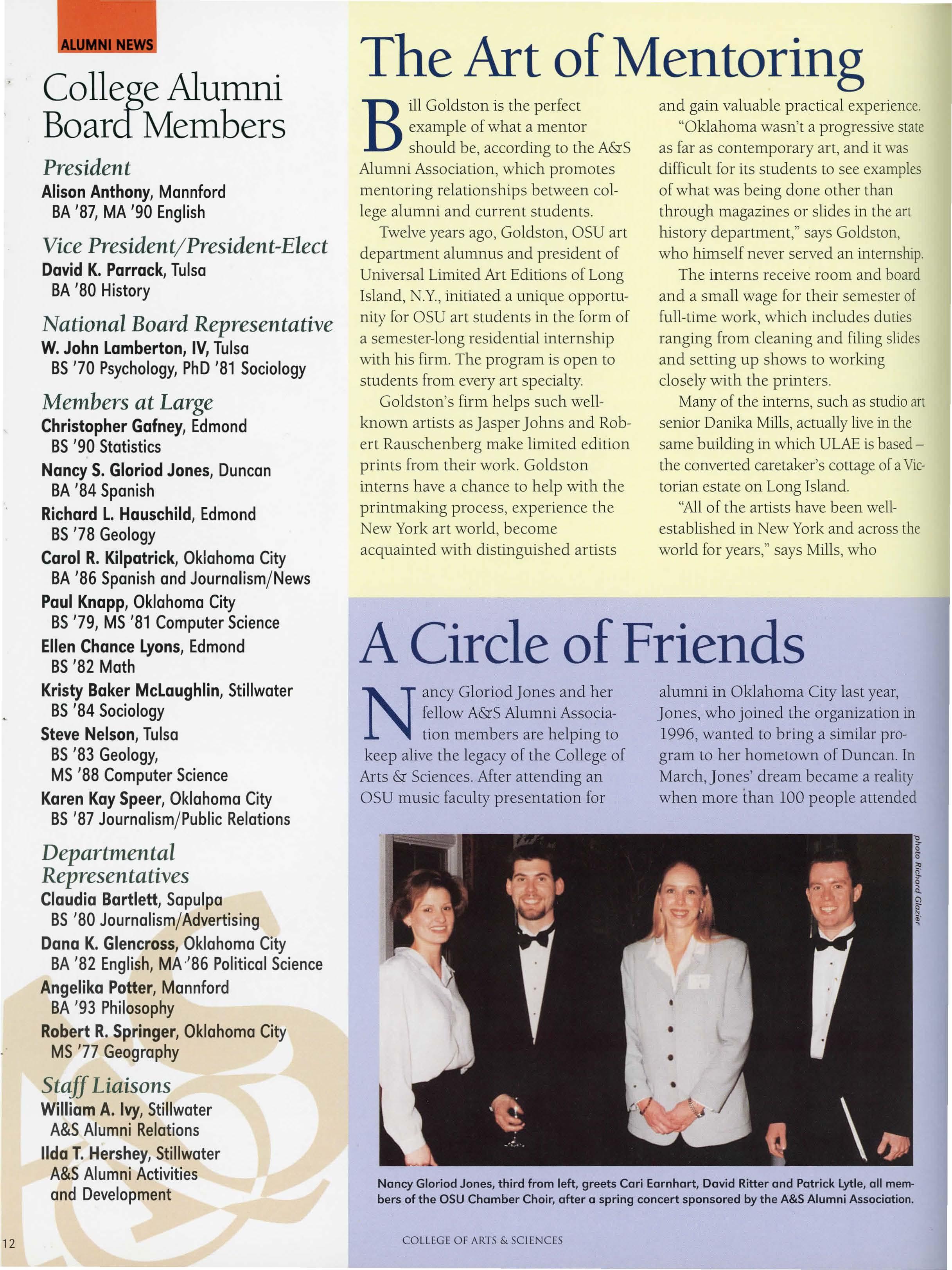
Above: Bill Goldston examines a Robert Rauschenberg print with Jessica Doolin, studio art junior who recently returned from o spring semester internship at ULAE.
Below top: Danika' Mills, studio art senior who interned here last fall, says it was a humbling experience. Below bottom: ULAE is headquartered in this converted caretaker's cottage of a Victorian estate on New York's Long Island.
Takinga Byte Out of Industry
Computersare here to stay. Plain and simple. Fewwill arguewith that now. But how many predictedtwo decadesago this massiveinfluenceof the high-techindustry on everyday life?SeveralperceptiveA&S alumni did, and their successstoriesprove theirforecastswere right on target.
'Prompted' by the Will to Succeed
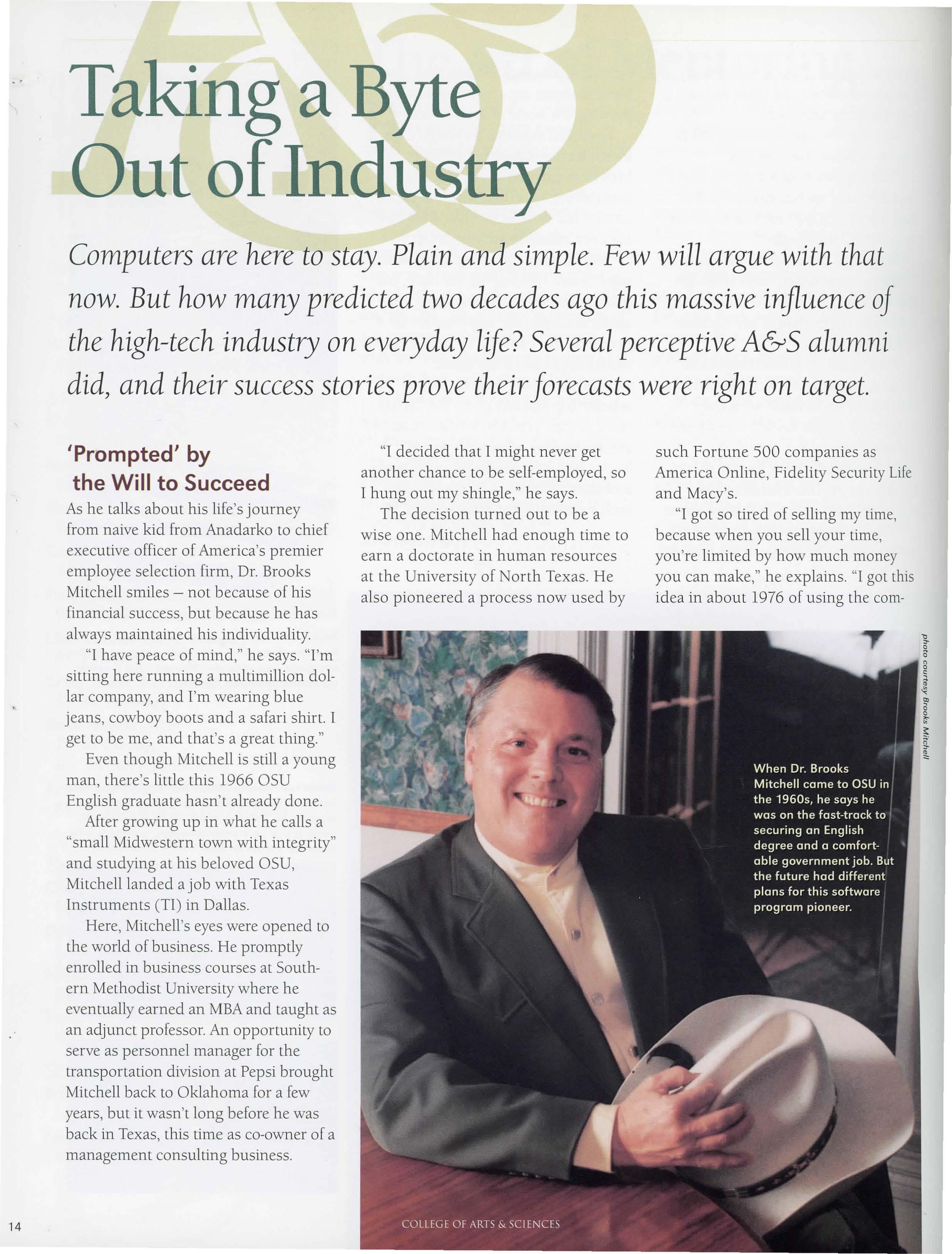
As he talks about his life's journey from naive kid from Anadarko to chief executive officer of America's premier employee selection firm, Dr. Brooks Mitchell smiles - not because of his financial success, but because he has always maintained his individuality.
"I have peace of mind," he says. 'Tm sitting here running a multimillion dollar company, and I'm wearing blue jeans, cowboy boots and a safari shirt. I get to be me, and that's a great thing."
Even though Mitchell is still a young man, there's little this 1966 OSU English graduate hasn't already done.
After growing up in what he calls a "small Midwestern town with integrity" and studying at his beloved OSU, Mitchell landed a job with Texas Instruments (Tl) in Dallas.
Here, Mitchell's eyes were opened to the world of business. He promptly enrolled in business courses at Southern Methodist University where he eventually earned an MBAand taught as an adjunct professor. An opportunity to serve as personnel manager for the transportation division at Pepsi brought Mitchell back to Oklahoma for a few years, but it wasn't long before he was back in Texas, this time as co-owner of a management consulting business.
"1 decided that I might never get another chance to be self-employed, so 1 hung out my shingle," he says.
The decision turned out to be a wise one. Mitchell had enough time to earn a doctorate in human resources at the University of North Texas. He also pioneered a process now used by
such Fortune 500 companies as America Online, Fidelity Security Life and Macy's.
"I got so tired of selling my time, because when you sell your time, you're limited by how much money you can make," he explains. "I got this idea in about 1976 of using the com-
puter to interview a person for a job. I was the firstperson as far as I know to say a computer can conduct a preliminary job interview. I became a minor celebrity in human resources and got a lot of national publicity."
In 1985, a near-fatal rafting accident caused Mitchellto reassess his life. He decided to move himself,his wife, Vickie, and their four children to Wyoming to enjoy a "higher standard ofliving."
He joined the faculty at the University of Wyoming in Laramie in 1986. He also renamed his business Aspen Tree Software and moved it to the basement of his home.
Eventually, the company outgrew this arrangement, and Mitchell bought a couple of 125year-old Victorian homes, turned the interiors into modern office space, and moved in. Less than a year ago, SHL, a top British firm, purchased what is now SHL Aspen Tree Software and named Mitchell president.
If this isn't enough to keep the Distinguished Alumnus of OSU busy, he has written several articles about employee selection and motivation, has been featured in more than 75 national publications including The New York Times and The Wall Street Journal, is in international demand as a speaker, and has offered the world his philosophy of employee selection through his book, "Bet on Cowboys, Not Horses."
But no matter what Mitchell does, he does it because he wants to.
"Being successful allows you to be who you are," he says. 'Tm always proud that I'm Brooks Mitchell from Anadarko, Oklahoma. I don't have to try to be something I'm not."
Seizing a 'Window' of Opportunity
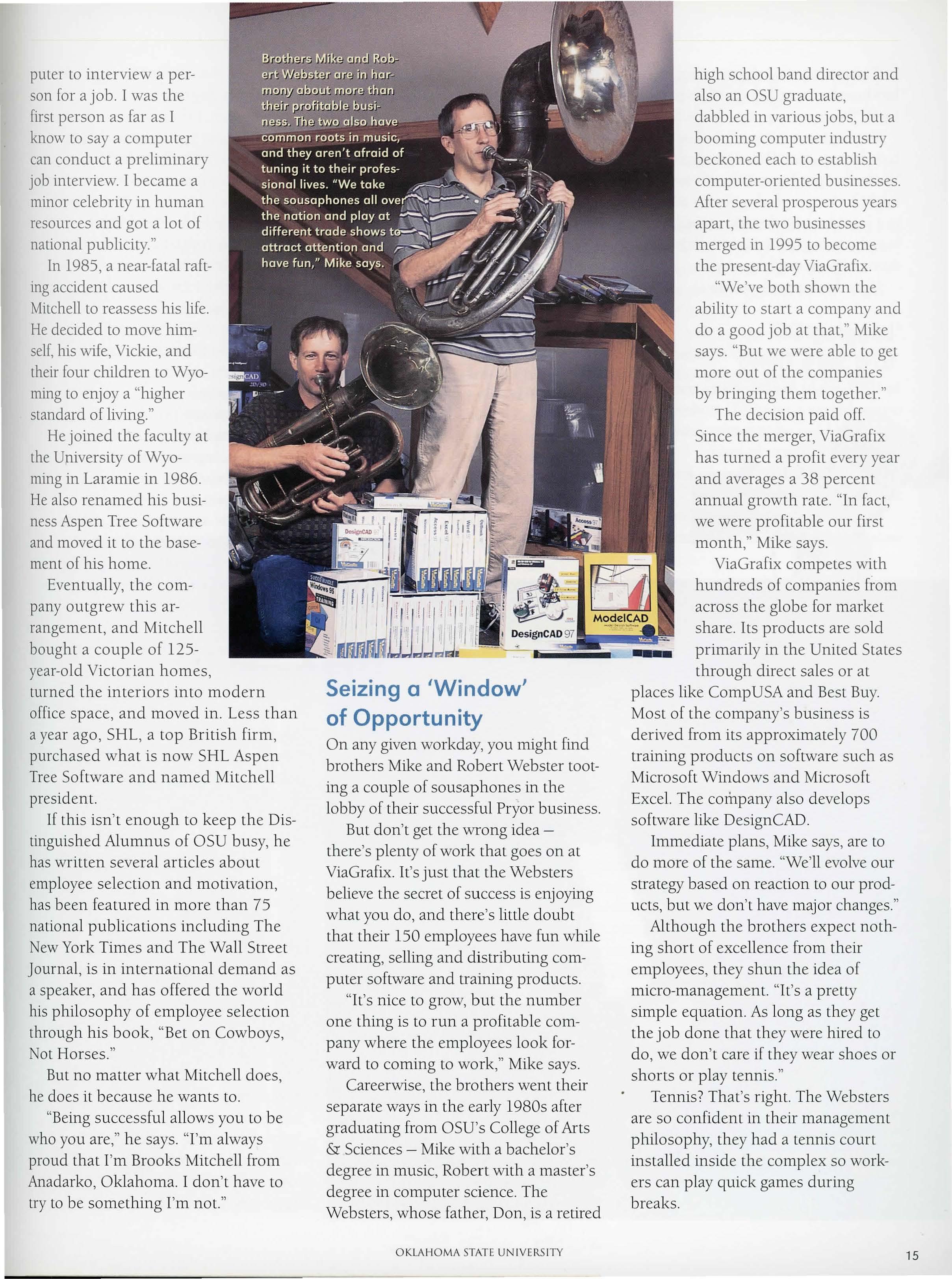
On any given workday, you might find brothers Mike and Robert Webster tooting a couple of sousaphones in the lobby of their successful Pryor business.
But don't get the wrong ideathere's plenty of work that goes on at ViaGrafix. It's just that the Websters believe the secret of success is enjoying what you do, and there's little doubt that their 150 employees have fun while creating, selling and distributing computer software and training products.
"It's nice to grow, but the number one thing is to run a profitable company where the employees look forward to coming to work," Mike says.
Careerwise, the brothers went their separate ways in the early 1980s after graduating from OSU's College of Arts & Sciences - Mike with a bachelor's degree in music, Robert with a master's degree in computer science. The Websters, whose father, Don, is a retired
high school band director and also an OSU graduate, dabbled in various jobs, but a booming computer industry beckoned each to establish computer-oriented businesses. After several prosperous years apart, the two businesses merged in 1995 to become the present-day ViaGrafix.
"We've both shown the ability to start a company and do a good job at that," Mike says. "But we were able to get more out of the companies by bringing them together."
The decision paid off. Since the merger, ViaGrafix has turned a profit every year and averages a 38 percent annual growth rate. "In fact, we were profitable our first month," Mike says.
ViaGrafix competes with hundreds of companies from across the globe for market share. Its products are sold primarily in the United States through direct sales or at places like CompUSA and Best Buy Most of the company's business is derived from its approximately 700 training products on software such as Microsoft Windows and Microsoft Excel. The company also develops software like DesignCAD.
Immediate plans, Mike says, are to do more of the same. "We'll evolve our strategy based on reaction to our products, but we don't have major changes."
Although the brothers expect nothing short of excellence from their employees, they shun the idea of micro-management. "It's a pretty simple equation. As long as they get the job done that they were hired to do, we don't care if they wear shoes or shorts or play tennis."
Tennis? That's right. The Websters are so confident in their management philosophy, they had a tennis court installed inside the complex so workers can play quick games during breaks.
The two say that the fact they are brothers has no effect on the business itself. "We have the same goals here."
But business is not all the brothers have in common. When they're not at ViaGrafix "putting out fires," they might be found playing Sousa marches in a local parade, climbing mountains in Italy, running the New York Marathon or flying airplanes.
Now that's an eclectic pair!
'Logging On' to a Sure Thing
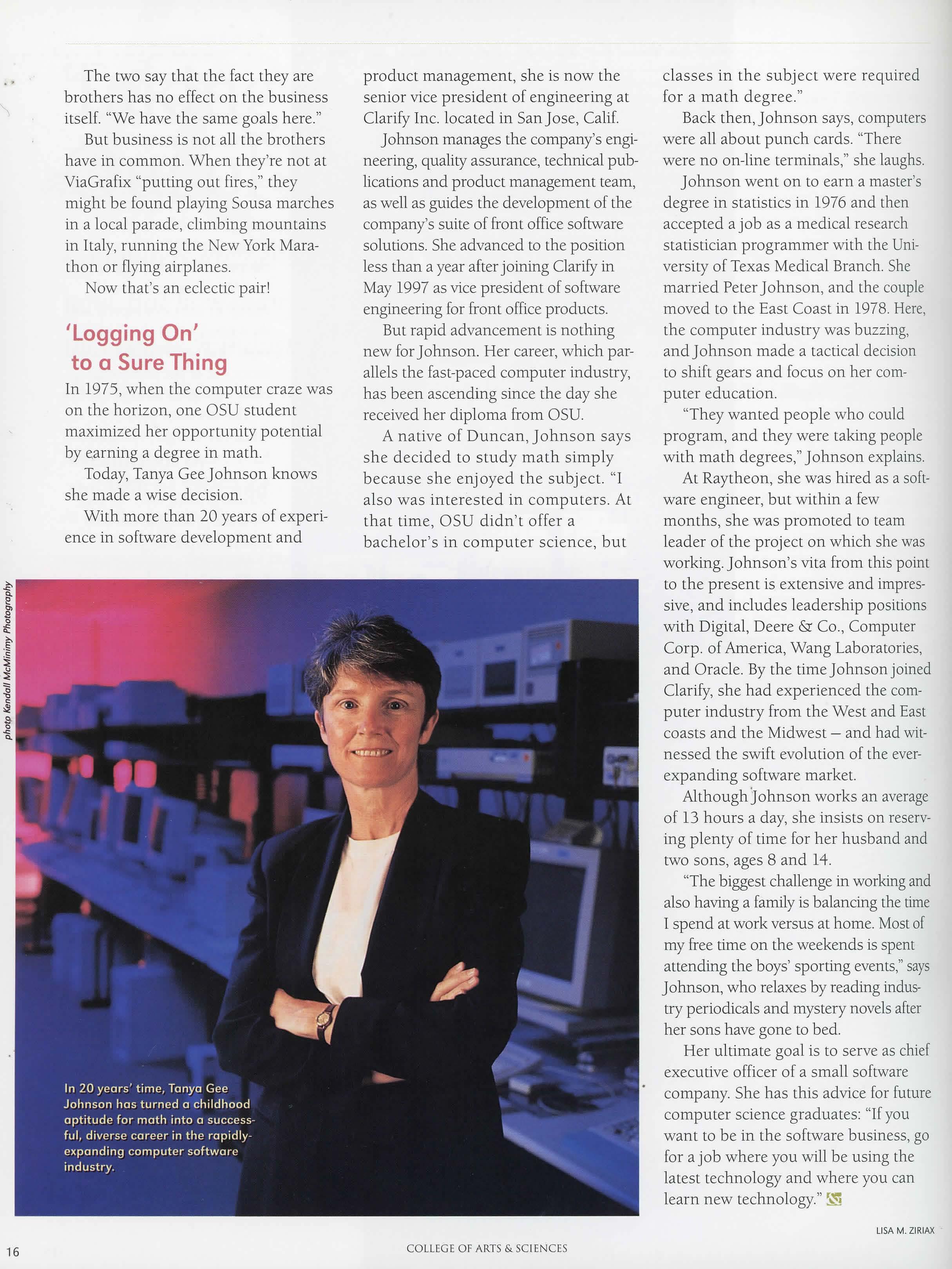
In 1975, when the computer craze was on the horizon, one OSU student maximized her opportunity potential by earning a degree in math.
Today, Tanya Gee Johnson knows she made a wise decision.
With more than 20 years of experience in software development and
product management, she is now the senior vice president of engineering at Clarify Inc. located in Sanjose, Calif. Johnson manages the company's engineering, quality assurance, technical publications and product management team, as well as guides the development of the company's suite of front office software solutions. She advanced to the position less than a year after joining Clarify in May 1997 as vice president of software engineering for front office products.
But rapid advancement is nothing new for Johnson. Her career, which parallels the fast-paced computer industry, has been ascending since the day she received her diploma from OSU.
A native of Duncan, Johnson says she decided to study math simply because she enjoyed the subject. "I also was interested in computers. At that time, OSU didn't offer a bachelor's in computer science, but
classes in the subject were required for a math degree."
Back then,Johnson says, computers were all about punch cards. "There were no on-line terminals," she laughs.
Johnson went on to earn a master's degree in statistics in 1976 and then accepted a job as a medical research statistician programmer with the University of Texas Medical Branch. She married Peter Johnson, and the couple moved to the East Coast in 1978. Here, the computer industry was buzzing, and Johnson made a tactical decision to shift gears and focus on her computer education.
"They wanted people who could program, and they were taking people with math degrees," Johnson explains.
At Raytheon, she was hired as a software engineer, but within a few months, she was promoted to team leader of the project on which she was working. Johnson's vita from this point to the present is extensive and impressive, and includes leadership positions with Digital, Deere & Co., Computer Corp. of America, Wang Laboratories, and Oracle. By the time Johnson joined Clarify, she had experienced the computer industry from the West and East coasts and the Midwest - and had witnessed the swift evolution of the everexpanding software market.
Although Johnson works an average of 13 hours a day, she insists on reserving plenty of time for her husband and two sons, ages 8 and 14.
"The biggest challenge in working and also having a family is balancing the time I spend at work versus at home. Most of my free time on the weekends is spent attending the boys' sporting events,"says Johnson, who relaxes by reading industry periodicals and mystery novels after her sons have gone to bed.
Her ultimate goal is to serve as chief executive officer of a small software company. She has this advice for future computer science graduates: "If you want to be in the software business, go for a job where you will be using the latest technology and where you can learn new technology." r~
Revealsa Whole New World
Scott Hall, a residence hall constructed in the 1960s, is about to be the site of a new research laboratory offering state-of-the-art facilities.
Since 1994, Dr. Tom Wikle has been anticipating renovations that are just now beginning to take place. Scott Hall will be modernized into research facilities used for geographic information systems (GIS) and remote sensing research.
"GIS has a growing reputation as a tool for basic and applied geographic research," says Wikle, associate professor and head of the geography department. "The proposed renovation will provide research infrastructure to continue on the cutting edge of geographic research well into the 21st century."
Wikle, the principal investigator for the project, submitted the renovations proposal in 1993. "The idea was a result of not only an increased student interest in GIS, but more importantly, an answer to the nationwide need for research and applied work in GIS," he says.
GIS is an interdisciplinary technology with close theoretical and applied ties to the academic subject of geography and is useful to every discipline utilizing geographic data.
"GIS is used to model population growth and distribution, urban development, transportation expansion, manufacturing location, movement through networks, and many other processes," Wikle says.
From government agencies to private industry, OSU geography students will have new capabilities and broader research experience from the expanded space provided by the new labs, Wikle says.
"It will be a first-class
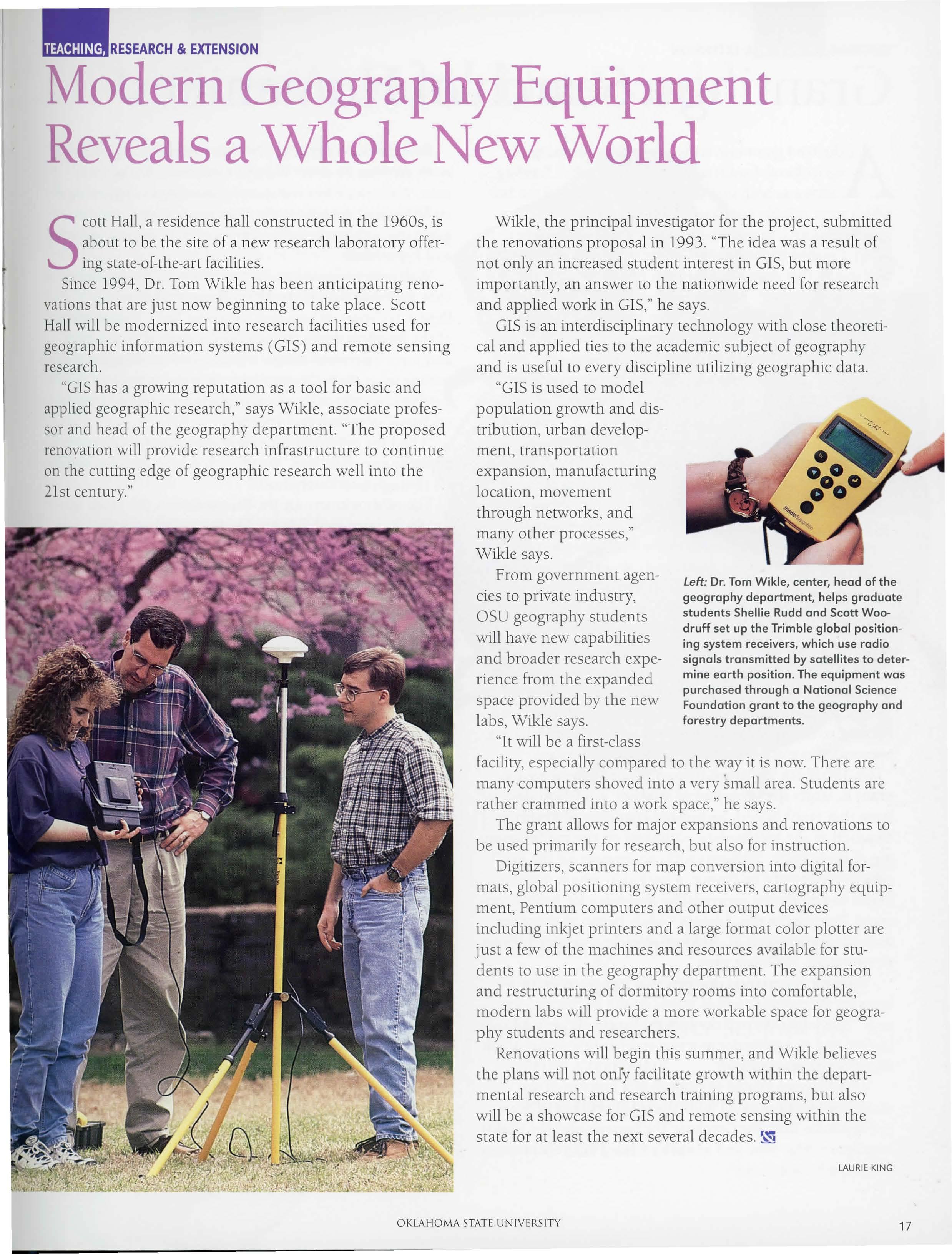
Dr. Tom Wikle, center, head of the geography department, helps graduate students Shellie Rudd and Scott Woodruff set up the Trimble global positioning system receivers, which use radio signals transmitted by satellites to determine earth position. The equipment was purchased through a National Science Foundation grant to the geography and forestry departments.
facility, especially compared to the way it is now. There are many computers shoved into a very small area. Students are rather crammed into a work space," he says.
The grant allows for major expansions and renovations to be used primarily for research, but also for instruction.
Digitizers, scanners for map conversion into digital formats, global positioning system receivers, cartography equipment, Pentium computers and other output devices including inkjet printers and a large format color plotter are just a few of the machines and resources available for students to use in the geography department. The expansion and restructuring of dormitory rooms into comfortable, modern labs will provide a more workable space for geography students and researchers.
Renovations will begin this summer, and Wikle believes the plans will not onry facilitate growth within the departmental research and research training programs, but also will be a showcase for GIS and remote sensing within the state for at least the next several decades. r~
Left:
Granting a Search of Humanities
Athe land grant university - where engineering, agricultural, business and science research funding serves as both institutional sustenance and the bell which most reliably stimulates a Pavlovian response from administrators - humanities research goes largely unheralded. Creative endeavors by College of Arts & Sciences faculty ensure that does not happen at OSU.
In recent years, OSU professors have made an impressive sweep of Oklahoma Foundation for the Humanities Scholar Research Grants.
In fact, A&S faculty brought home 11 of the 15 awards presented in 1998 by the foundation.
Now known as the Oklahoma Humanities Council, the foundation has served as the local arm of the National Endowment for the Humanities since 1971. It supports scholarly research in the humanities by providing grants and encouraging institutions of higher learning to offer matching funds. OSU is the most generous of Oklahoma institutions in providing matching moneys, one reason why its faculty has been so successful in landing foundation grants, says Roxanne Rhoades, program officer for the council.
"We have a preponderance of applicants from OSU, and because so many of them are high quality, we always have a preponderance of winners from OSU," Rhoades says.
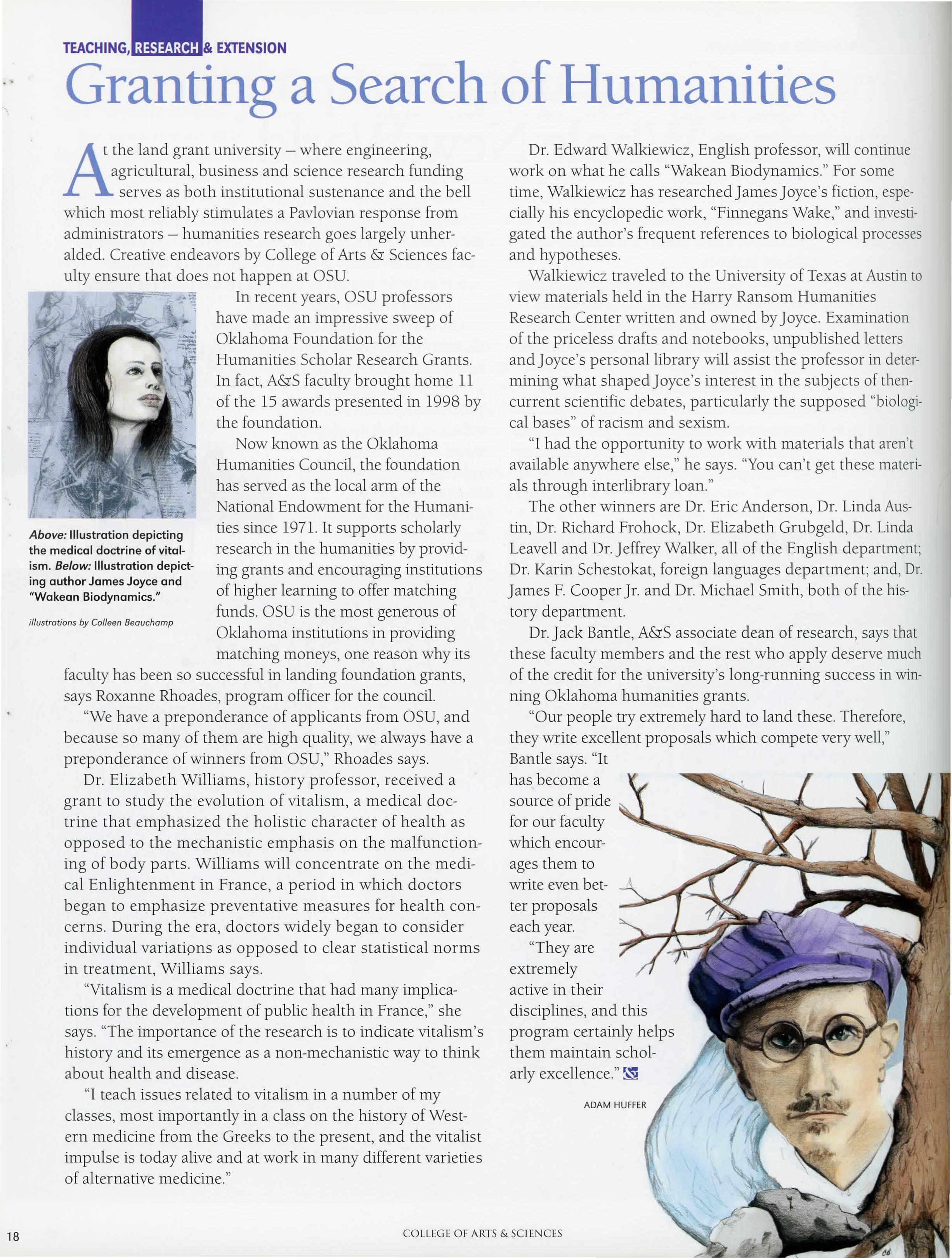
Dr. Elizabeth Williams, history professor, received a grant to study the evolution of vitalism, a medical doctrine that emphasized the holistic character of health as opposed -to the mechanistic emphasis on the malfunctioning of body parts. Williams will concentrate on the medical Enlightenment in France, a period in which doctors began to emphasize preventative measures for health concerns. During the era, doctors widely began to consider individual variatipns as opposed to clear statistical norms in treatment, Williams says.
"Vitalism is a medical doctrine that had many implications for the development of public health in France," she says. "The importance of the research is to indicate vitalism's history and its emergence as a non-mechanistic way to think about health and disease.
"I teach issues related to vitalism in a number of my classes, most importantly in a class on the history of Western medicine from the Greeks to the present, and the vitalise impulse is today alive and at work in many different varieties of alternative medicine."
Dr. Edward Walkiewicz, English professor, will continue work on what he calls "Wakean Biodynamics." For some time, Walkiewicz has researched James Joyce's fiction, especially his encyclopedic work, "Finnegans Wake," and investigated the author's frequent references to biological processes and hypotheses.
Walkiewicz traveled to the University of Texas at Austin to view materials held in the Harry Ransom Humanities Research Center written and owned by Joyce. Examination of the priceless drafts and notebooks, unpublished letters and Joyce's personal library will assist the professor in determining what shaped Joyce's interest in the subjects of thencurrent scientific debates, particularly the supposed "biological bases" of racism and sexism.
"I had the opportunity to work with materials that aren't available anywhere else," he says. "You can't get these materials through interlibrary loan."
The other winners are Dr. Eric Anderson, Dr. Linda Austin, Dr. Richard Frohock, Dr. Elizabeth Grubgeld, Dr. Linda Leavell and Dr.Jeffrey Walker, all of the English department; Dr. Karin Schestokat, foreign languages department; and, Dr. James F. Cooper Jr. and Dr. Michael Smith, both of the history department.
Dr. Jack Bantle, A&S associate dean of research, says that these faculty members and the rest who apply deserve much of the credit for the university's long-running success in winning Oklahoma humanities grants.
"Our people try extremely hard to land these. Therefore, they write excellent proposals which compete very well," Bantle says. "It has become a source of pride for our faculty which encourages them to write even better proposals each year.
"They are extremely active in their disciplines, and this program certainly helps them maintain scholarly excellence." r~
Above: Illustration depicting the medical doctrine of vitalism. Below: Illustration depicting author James Joyce and "Wakean Biodynamics." illustrations by Colleen Beauchamp
OSU Goes Around The World
In the area of distance education, Oklahoma State University and the College of Arts & Sciences continue to prove they are one step ahead of the game.
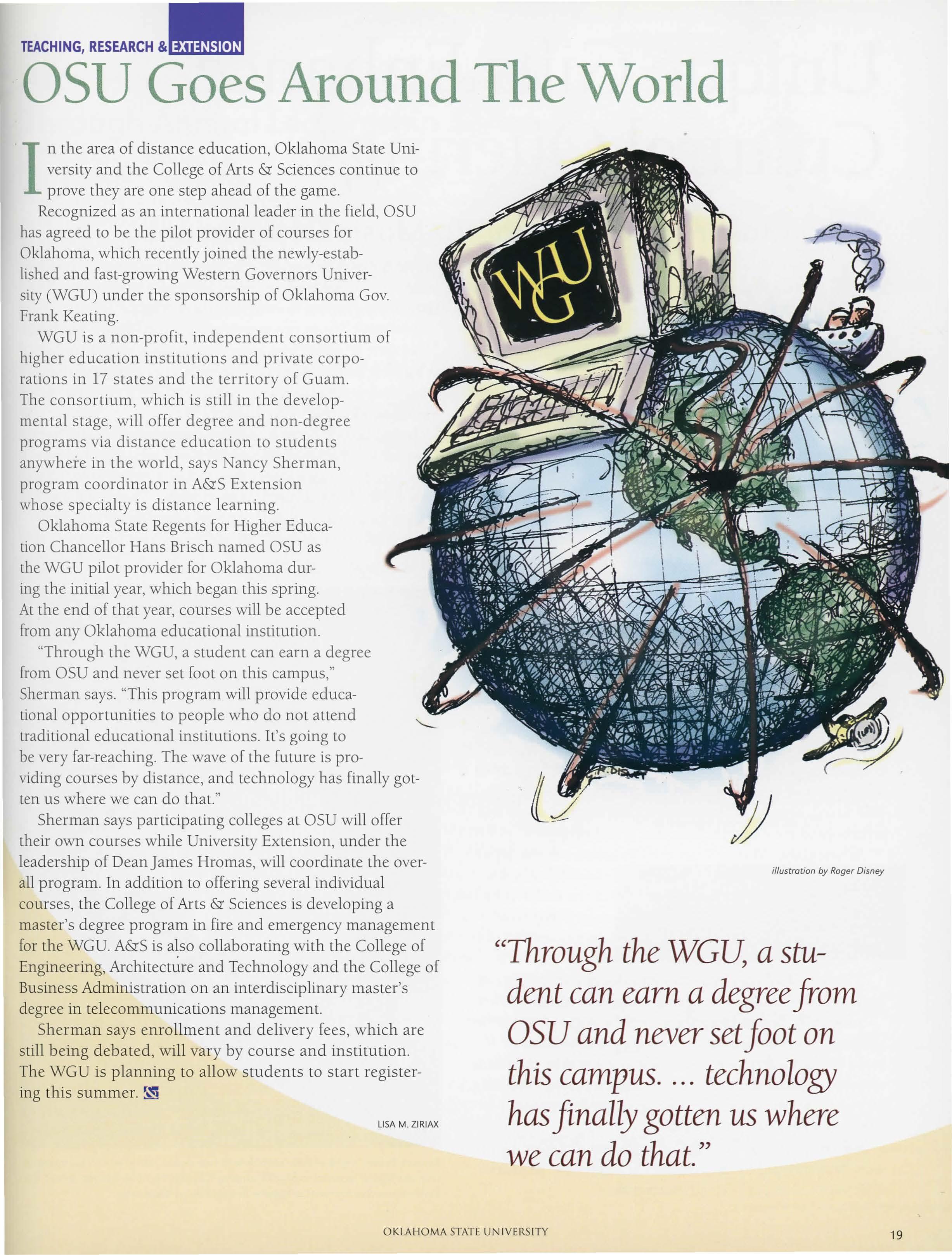
Recognized as an international leader in the field, OSU has agreed to be the pilot provider of courses for Oklahoma, which recently joined the newly-established and fast-growing Western Governors University (WGU) under the sponsorship of Oklahoma Gov. Frank Keating.
WGU is a non-profit, independent consortium of higher education institutions and private corporations in 17 states and the territory of Guam. The consortium, which is still in the developmental stage, will offer degree and non-degree programs via distance education to students anywhere in the world, says Nancy Sherman, program coordinator in A&S Extension whose specialty is distance learning.
Oklahoma State Regents for Higher Education Chancellor Hans Brisch named OSU as the WGU pilot provider for Oklahoma during the initial year, which began this spring. At the end of that year, courses will be accepted from any Oklahoma educational institution.
"Through the WGU, a student can earn a degree from OSU and never set foot on this campus," Sherman says. "This program will provide educational opportunities to people who do not attend traditional educational institutions. It's going to be very far-reaching. The wave of the future is providing courses by distance, and technology has finally gotten us where we can do that."
Sherman says participating colleges at OSU will offer their own courses while University Extension, under the leadership of Dean James Hromas, will coordinate the overall program. In addition to offering several individual courses, the College of Arts & Sciences is developing a master's degree program in fire and emergency management for the WGU. A&S is also collaborating with the College of Engineering, Architect~re and Technology and the College of Business Administration on an interdisciplinary master's degree in telecommunications management.
Sherman says enrollment and delivery fees, which are still being debated, will vary by course and institution. The WGU is planning to allow students to start registering this summer. r~
LISA M. ZIRIAX
"Throughthe WGU, a student can earn a degreefrom OSUand neversetf oat on thiscampus . ... technology hasfinallygottenus where we can do that."
illustration by Roger Disney
Unique Gifts Enhance CulturalOfferings
Violin Maker 'Instrumental' To Music Department
When Robert Brown listens to the OSU Symphony Orchestra, he hears the labor of his hands. At that moment, he understands why he spends hours in his Oklahoma City home workshop perfecting a hobby he embraced after retiring from the Federal Aviation Administration 20 years ago.
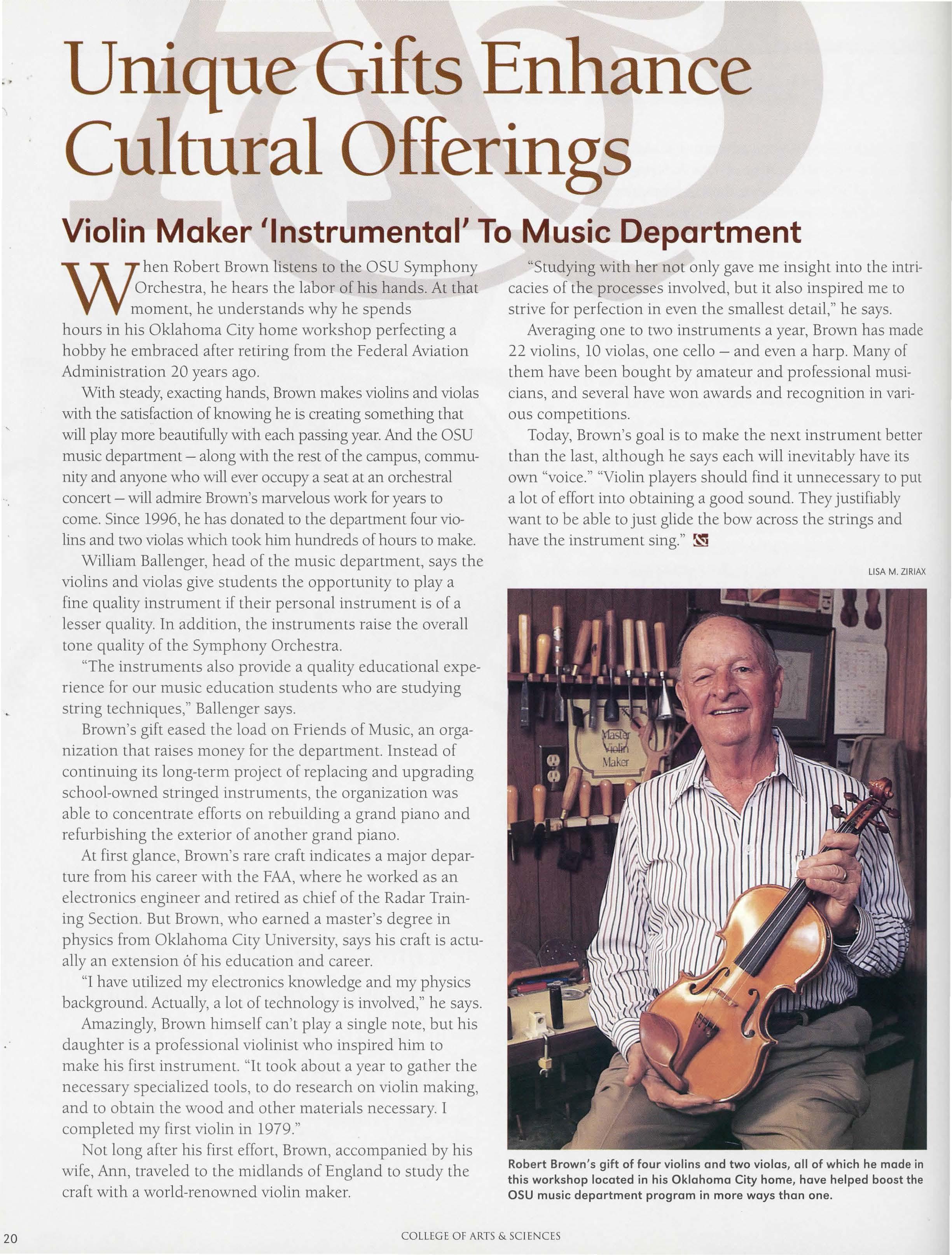
With steady, exacting hands, Brown makes violins and violas with the satisfaction of knowing he is creating something that will play more beautifully with each passing year.And the OSU music department - along with the rest of the campus, community and anyone who will ever occupy a seat at an orchestral concert -will admire Brown's marvelous work for years to come. Since 1996, he has donated to the department four violins and two violas which took him hundreds of hours to make.
William Ballenger, head of the music department, says the violins and violas give students the opportunity to play a fine quality instrument if their personal instrument is of a lesser quality. In addition, the instruments raise the overall tone quality of the Symphony Orchestra.
"The instruments also provide a quality educational experience for our music education students who are studying string techniques," Ballenger says.
Brown's gift eased the load on Friends of Music, an organization that raises money for the department. Instead of continuing its long-term project of replacing and upgrading school-owned stringed instruments, the organization was able to concentrate efforts on rebuilding a grand piano and refurbishing the exterior of another grand piano.
At first glance, Brown's rare craft indicates a major departure from his career with the FM, where he worked as an electronics engineer and retired as chief of the Radar Training Section. But Brown, who earned a master's degree in physics from Oklahoma City University, says his craft is actually an extension of his education and career.
"I have utilized my electronics knowledge and my physics background. Actually, a lot of technology is involved," he says.
Amazingly, Brown himself can't play a single note, but his daughter is a professional violinist who inspired him to make his first instrument. "It took about a year to gather the necessary specialized tools, to do research on violin making, and to obtain the wood and other materials necessary. I completed my first violin in 1979."
Not long after his first effort, Brown, accompanied by his wife, Ann, traveled to the midlands of England to study the craft with a world-renowned violin maker.
"Studying with her not only gave me insight into the intricacies of the processes involved, but it also inspired me to strive for perfection in even the smallest detail," he says.
Averaging one to two instruments a year, Brown has made 22 violins, 10 violas, one cello - and even a harp. Many of them have been bought by amateur and professional musicians, and several have won awards and recognition in various competitions.
Today, Brown's goal is to make the next instrument better than the last, although he says each will inevitably have its own "voice." "Violin players should find it unnecessary to put a lot of effort into obtaining a good sound. They justifiably want to be able to just glide the bow across the strings and have the instrument sing."
LISAM. ZIRIAX
Robert Brown's gift of four violins and two violas, all of which he made in this workshop located in his Oklahoma City home, have helped boost the OSU music department program in more ways than one.
Arts, Humanities Programs Flourish Through Annual Lectureship Series
0SU community and area residents had a rare opportunity this year to hear a Pulitzer Prizewinning poet read her work, as well as to listen to and interact with internaLionally-recognizedexperts on American literature, German politics, Russian literature and Chinese philosophy, thanks to the gen-
Selected visiting scholars or artists are expected to give a series of interdisciplinary lectures, teach a short onecredit course, and/ or present a public performance or art exhibition.
A presentation by Pulitzer Prize winning poet Louise Gluck was sponsored, in part, by Norris endowment money. In addierosity of a very special friend of the universitythe late Fae Rawdon Norris.
A successful banker and accomplished artist, Norris appreciated the value of educa-
tion, these funds helped support presentations by a professional theater lighting designer and two distinguished philosophers who discussed the place of religion tion and the importance of enhancing basic curriculum with a broad range of cultural experiences.
When she died in 1993, Norris left $175,000 in her
"Eachprofessorship grantedallowsthe studentsand faculty ... to interact and to broaden
theirviews, insights and appreciation for theircontemporaryfields."
estate for the establishment of a new professorship in the humanities at OSU. The OSU Foundation secured matching funds for the professorship.
Each year, a committee of OSU arts and humanities faculty members solicits proposals to bring vi.siting scholars, or visual or performing artists to campus to fill the Fae Rawdon Norris Humanities Professorship. The committee selects proposals showing broad interdisciplinary benefit.
"Each professorship granted allows the students and faculty of two or more departments to interact and to broaden their views, insights and appreciation for their contemporary fields by working side by side with the scholar," says Peter Westerhoff, committee chairman and theater professor.
in society. Although Norris grew up in Oklahoma City and attended the University of Oklahoma, she and her husband,
J. Perry Norris, who earned a master's degree in industrial arts from OSU in 1944, became OSU supporters after they moved to Stillwater early in their marriage.
For many years, Norris was director of the First Bank and Trust Company of Yale,and her husband, who died in 1989, taught in the Okmulgee Public School system before he took a position with the Oklahoma Department of Vocational Education headquarters in Stillwater.
Through the years, they enjoyed visiting OSU's campus and meeting the students who received the scholarship they had established. Norris has succeeded in continuing her and her husband's support of OSU by leaving a unique legacy of cultural and educational enhancement in the arts and humanities. r~
to a highly appreciated stockthatpays lowdividends?
Why not unlock the potential of your stock and receive:
Increasedincome
Preferredtreatmentor elimination of capitalgains
Relieffrominvestmentmanagement
Potentialreductionof estatetaxes
A life income gi,Jtcan help you and provide vital support for the College of Arts & Sciences.
For a free iriformational brochure call (800) 622-4678 or mail the form below to:
PLANNED GIVING OFFICE
OSU FOUNDATION
P.O. BOX 1749
STILLWATER. OK 74076-1749
NAME ADDRESS
Potter'Molds' Her Way
To Washington Exhibit
Anita Fields, OSU graduate, Osage tribe member and wellknown clay artist, was invited to show her works in Washington, D.C., at the National Museum of Women in the Arts. The exhibit, "The Legacy of Generations: Pottery by American Indian Women," celebrates the cultural heritage and achievements of 28 potters of the 19th and 20th centuries who have preserved ancient traditions while advancing their art form through innovative ideas and skillful work. The only Oklahoman selected, Fields displayed five works and created a special installation piece titled "Elements of Being."
In 1997, Fields' work gained recognition when her clay sculpture titled "Turtle Women's Purse" received "Best of Division" at the prestigious Santa Fe Indian Art Market. A year earlier, her clay work won first place.
Field's belief in art is realized as a participant in the Artistin-Residence program sponsored by the State Arts Council of Oklahoma. She travels to schools around the state, sharing the enjoyment of creating with clay and the importance of art in education.
Fields and her husband, Tom, and their three children live in Stillwater.
LearningFrom TheMaster
Pakistani artist Bashir Ahmed, the world's leading expert on Indian miniature painting, visited OSU last fall, bringing with him examples of his art which he shared with OSU art students and the general public.
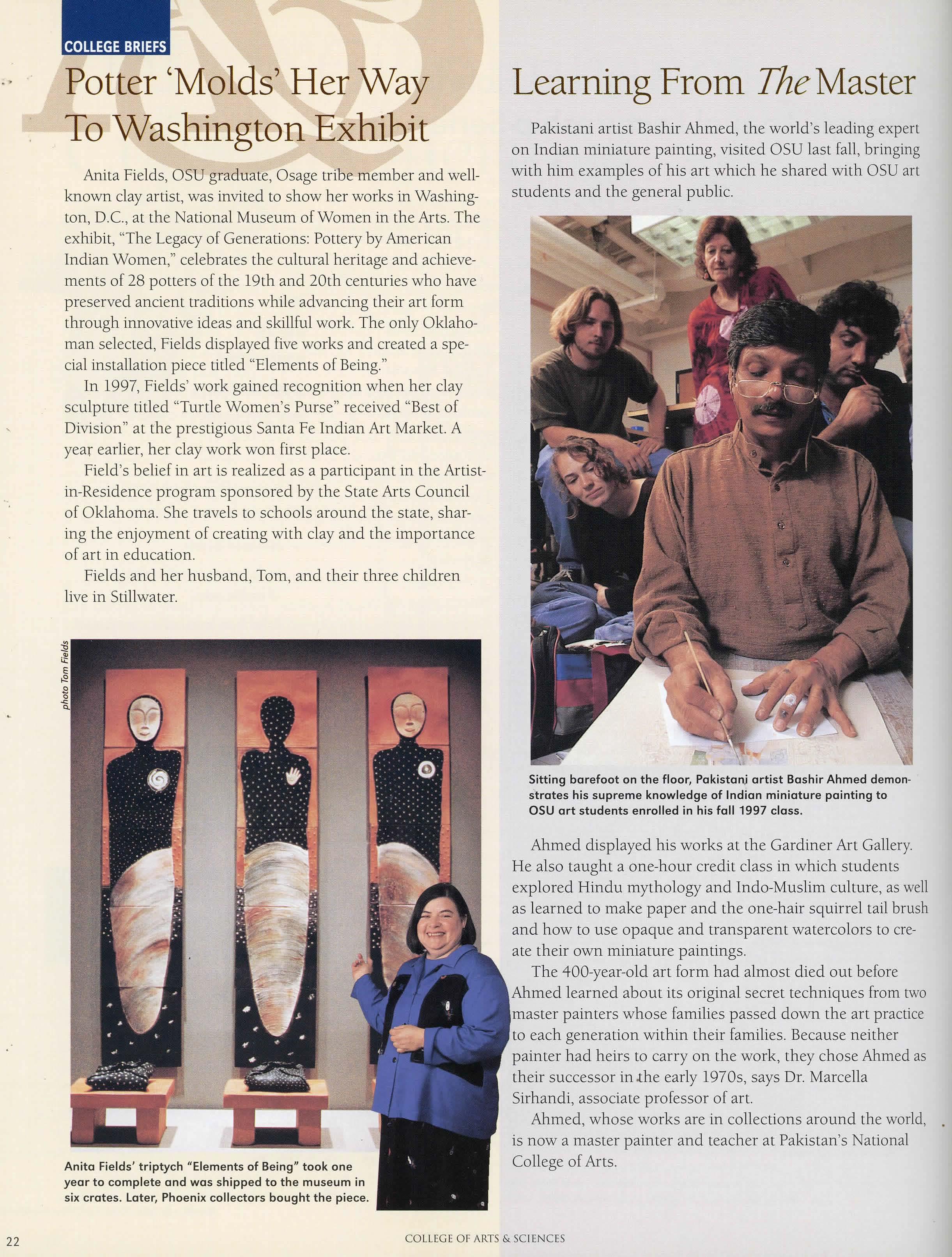
Ahmed displayed his works at the Gardiner Art Gallery. He also taught a one-hour credit class in which students explored Hindu mythology and Indo-Muslim culture, as well as learned to make paper and the one-hair squirrel tail brush and how to use opaque and transparent watercolors to create their own miniature paintings.
The 400-year-old art form had almost died out before Ahmed learned about its original secret techniques from two master painters whose families passed down the art practice to each generation within their families. Because neither painter had heirs to carry on the work, they chose Ahmed as their successor in .the early 1970s, says Dr. Marcella Sirhandi, associate professor of art.
Ahmed, whose works are in collections around the world, is now a master painter and teacher at Pakistan's National College of Arts.
Anita Fields' triptych "Elements of Being" took one year to complete and was shipped to the museum in six crates. Later, Phoenix collectors bought the piece.
Sitting barefoot on the floor, Pakistanj artist Bashir Ahmed demonstrates his supreme knowledge of Indian miniature painting to OSU art students enrolled in his fall 1997 class.
WWII Story Awakens in Son's Film
More than 50 years after his father died in the worst maritime Lt. Col. Robert Neil Brittan disaster in American history,
Shawnee Nelson Brittan has produced a film documenting the circumstances of his father's death when a Japanese prisoner-of-war ship was mistakenly torpedoed by Allied submarines. Ignoring international law, the Japanese had not marked the Arisan Maru as a prisoner-of-war vessel.
Brittan's father, Army Lt. Col. Robert Neil Brittan, a 1932 OSU animal husbandry graduate, was captured when the Japanese took the Philippines in 1942. Two years later when U.S. forceslanded there, Brittan and 1,800 other American prisoners were quickly loaded onto the ship to be sent to Japan to provide slave labor. When the ship was sunk Oct. 24, 1944, Brittan and most of the prisoners died. Only eight survived.
The younger Brittan, along with executive producer Joanna M. Champlin, filmed the five remaining survivors as they told their stories at a recent reunion in Arizona. The resulting film, "Sleep My Sons: The Story of the Arisan Maru," premiered last fall at the National Cowboy Hall of Fame in Oklahoma City and is available on video. He is negotiating with major cable television networks, movie producers and a publisher to further tell the story of the Arisan Maru.
Brittan, a 1961 OSU liberal arts graduate, grew up in Stillwater where his mother, Rena Penn Brittan, was a member of OSU's art faculty.
He would like to talk to spouses and children of veterans who were in the Philippines at the time it was captured by the Japanese, or anyone interested in the video. His phone number is (405) 841-4004.
A Hot New Degree
The Department of Political Science's new degree program, the master's of political science with an emphasis in fire and emergency management, is attracting firefighters and other interested applicants from across the United States.
The 39-hour degree program, which was established in the fall of 1997, is aimed at those who are serving or who aspire to serve as managers or administrators in fire service or emergency management. It has already attracted more than 40 students from as far away as Florida and California.
The program is designed to help those who are already working by providing course work that can be completed during two-week summer sessions. Eventually, most, if not all, of the courses will be offered over the Internet, says Dr. Robert England, political science professor and co-graduate director.
The first summer sessions are being offered this year, and students will have the opportunity to earn six hours of graduate credit during each session. Students can specialize in such areas as environmental science, business, health administration, political science, sociology, labor relations and organizational behavior.
England says the idea for establishing the program came from OSU's fire protection and safety technology, often ranked number one in its field nationally. Although quality is an important attribute, the program's rapid success is largely due to its individuality, he says.
"We are the only major comprehensive university offering this program," he says. "There's no other degree quite like it."
For more information, contact the Department of Political Science by calling ( 405) 744-5569 or sending e-mail to pamos@okway.okstate.edu r~
First Fulbright Student Shines
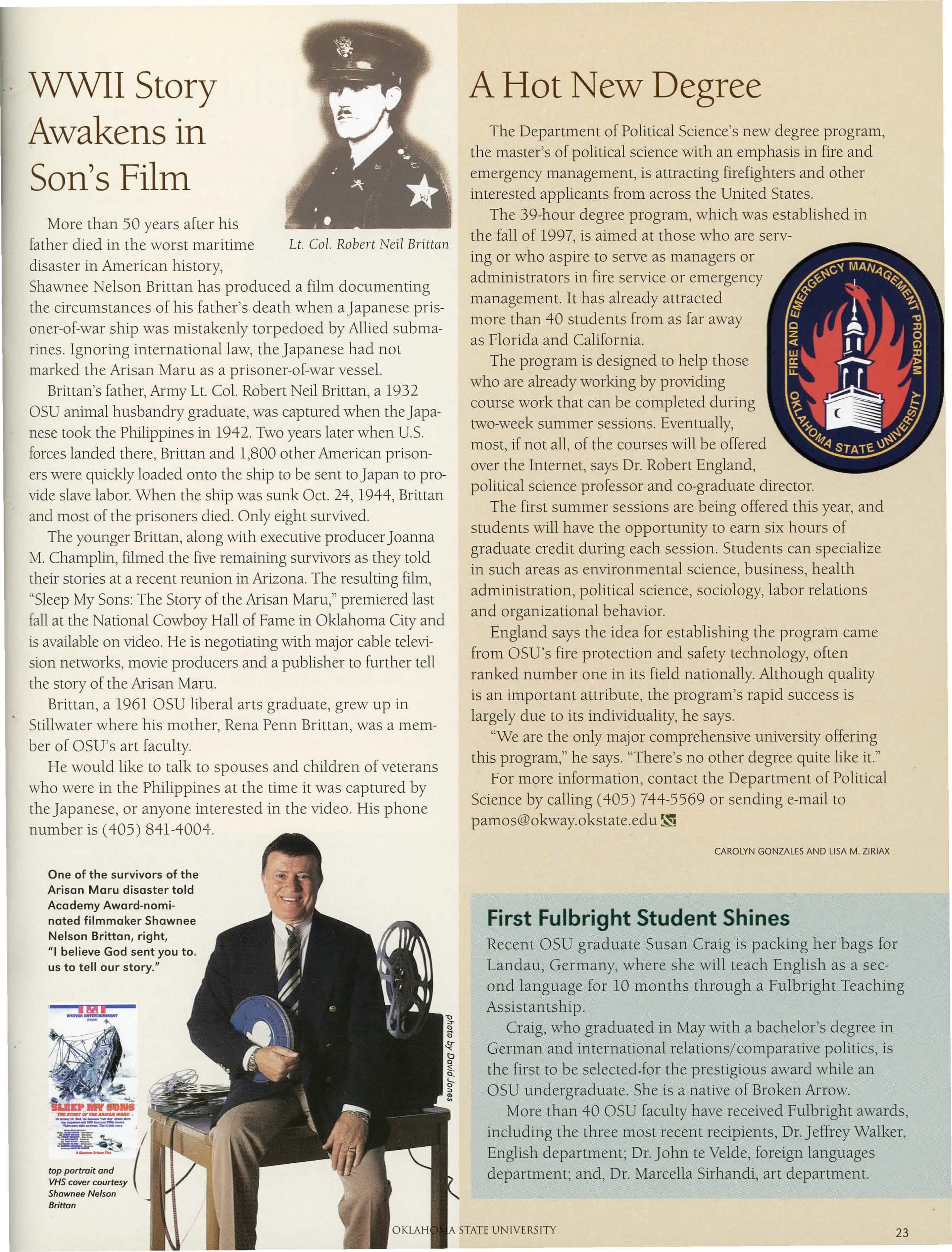
Brittan, right, "I believe God sent you to. us to tell our story."
Recent OSU graduate Susan Craig is packing her bags for Landau, Germany, where she will teach English as a second language for 10 months through a Fulbright Teaching Assistantship.
Craig, who graduated in May with a bachelor's degree in German and international relations/comparative politics, is the first to be selected.for the prestigious award while an OSU undergraduate. She is a native of Broken Arrow.
More than 40 OSU faculty have received Fulbright awards, including the three most recent recipients, Dr. Jeffrey Walker, English department; Dr. John te Velde, foreign languages department; and, Dr. Marcella Sirhandi, art department.
One of the survivors of the Arison Maru disaster told Academy Award-nominated filmmaker Shawnee Nelson
top portrait
CAROLYN GONZALES AND LISA M. ZIRIAl<
Hello, Washingto
elen Newman's summer internship with U.S. Rep. Carl Albert in 1966 changed the course of her life. Although it led to a permanent job with the congressman that lasted several years, it led to much more.
"Because I worked on Capitol Hill and learned how Washington and the legislative process work, I was able
to land my first job in the private sector as a director of governµient relations for a computer company after Mr. Albert retired," says Newman,
a 1965 OSU history graduate.
Later, Gulfstream Aerospace Corporation asked Newman to open the company's Washington office. Again, the experience gained with Albert was critical in her successful completion of the task.
"I knew where to go and what to do to set up Gulfstream's congressional relations program," she says.
Today Newman is leading the Washington, D.C., fundraising effort to establish the Henry Bellmon Leadership Intern Program through the OSU College of Arts & Sciences. Honorary co-chairmen of the campaign include Oklahoma Gov. Frank Keating, U.S. Sen. Don Nickles and U.S. Reps. Wes Watkins, Tom Coburn and Frank Lucas.
In an effort to broaden the knowledge of future Oklahoma leaders for both the public and private sectors,
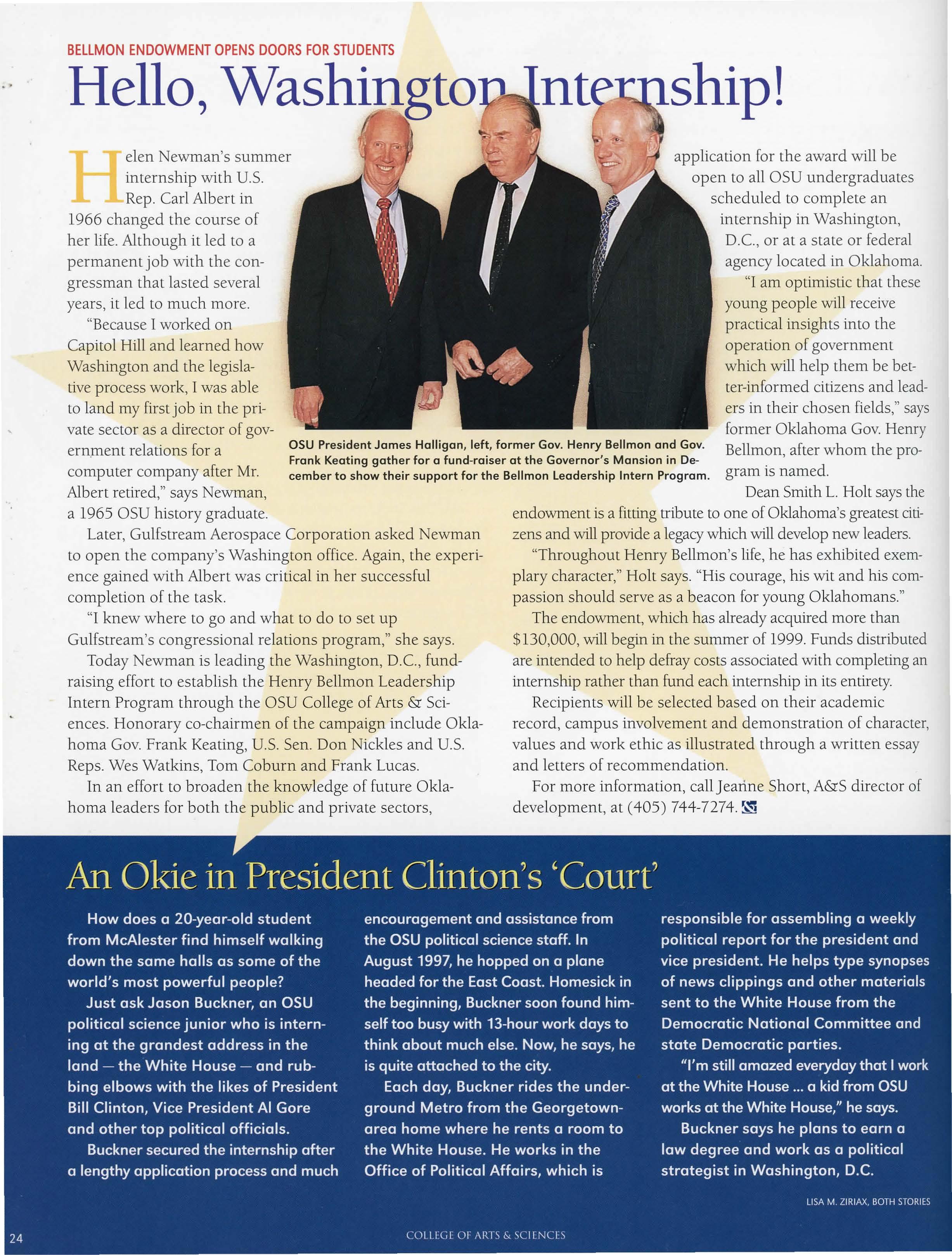
ship!
application for the award will be open to all OSU undergraduates scheduled to complete an internship in Washington, D.C., or at a state or federal agency located in Oklahoma.
"I am optimistic that these young people will receive practical insights into the operation of government which will help them be better-informed citizens and leaders in their chosen fields," says former Oklahoma Gov. Henry
Bellmon, after whom the program is named.
Dean Smith L Holt says the endowment is a fitting tribute to one of Oklahoma's greatest citizens and will provide a legacywhich will develop new leaders.
"Throughout Henry Bellmon's life, he has exhibited exemplary character," Holt says. "His courage, his wit and his compassion should serve as a beacon for young Oklahomans."
The endowment, which has already acquired more than $130,000, will begin in the summer of 1999. Funds distributed are intended to help defray costs associated with completing an internship rather than fund each internship in its entirety.
Recipients will be selected based on their academic record, campus involvement and demonstration of character, values and work ethic as illustrated through a written essay and letters of recommendation.
For more information, calljearine Short, A&S director of development, at (405) 744-7274. r~
An Okie in President Clinton's 'Court'
How does a 20-year-old student from McAlester find himself walking down the same halls as some of the world's most powerful people?
Just ask Jason Buckner, an OSU political science junior who is interning at the grandest address in the land - the White House - and rubbing elbows with the likes of President Bill Clinton, Vice President Al Gore and other top political officials. Buckner secured the internship after a lengthy application process and much
encouragement and assistance from the OSU political science staff. In August 1997, he hopped on a plane headed for the East Coast. Homesick in the beginning, Buckner soon found himself too busy with 13-hour work days to think about much else. Now, he says, he is quite attached to the city. Each day, Buckner rides the underground Metro from the Georgetownarea home where he rents a room to the White House. He works in the Office of Political Affairs, which is
responsible for assembling a weekly political report for the president and vice president. He helps type synopses of news clippings and other materials sent to the White House from the Democratic National Committee and state Democratic parties.
"I'm still amazed everyday that I work at the White House a kid from OSU works at the White House," he says.
Buckner says he plans to earn a law degree and work as a political strategist in Washington, D.C.
OSU President Jomes Halligan, left, former Gov. Henry Bellman and Gov. Fronk Keating gather for a fund-raiser at the Governor's Mansion in December to show their support for the Bellman Leadership Intern Program.
College of Arts & Sciences
DEAN
Smit L Holt
ASSOC.DEAN FOR RESEARC:::H
John Bantle
ASSOC.DEAN FOR INSTRUCTION
Bruce Crauder
DIRECTOR,STUDENT ACADEMIC SERVICES
Willia A. Ivy
DIRECTOR,EXTENSION
Robe t Brown
DIRECTOR,DEVELOPMENT
Jeanne Short
A&S Departments and Heads
AEROSPACESTUDIES
Lt. C l. Russell D. Miller
ART
Nanc B. Wilkinson
BOTANY
James D. Ownby
CHEMISTRY
Neil Bwdie
COMMUNICATION SCIENCESAND DISORDERS
Arthur L. Pentz Jr.
COMPUTERSCIENCE
Blayne E. Mayfield
ENGLISH
Jeffre B. Walker
FOREIGN LANGUAGESAND LITERATURES
Paul Epstein
GEOG~PHY
Thomas Wikle
GEOLOGY
Zuhair Al-Shaieb
HISTORY
William Bryans
JOURNALISM AND BROADCAS11NG
Paul Smeyak
MATHEMATICS
Benny Evans
MICROBIOLOGY
Robert V Miller
MILITARYSCIENCE
Lt. Col. Charles T Payne
MUSIC
Wi.lliam L. Ballenger
PHILOSOPHY
Edward G. Lawry
PHYSICS
Stephen W. McKeever.
POLITICALSCIENCE
Michael Hidinger
PSYCHOLOGY
Maureen Sullivan
SOCIOLOGY
Patricia A. Bell
SPEECH
Michael E. Stano
STATISTICS
Larry Claypool
THEATRE
Bruce Brockman
ZOOLOGY
Jim Shaw
Gift of Art BringsHarmonyto Campus
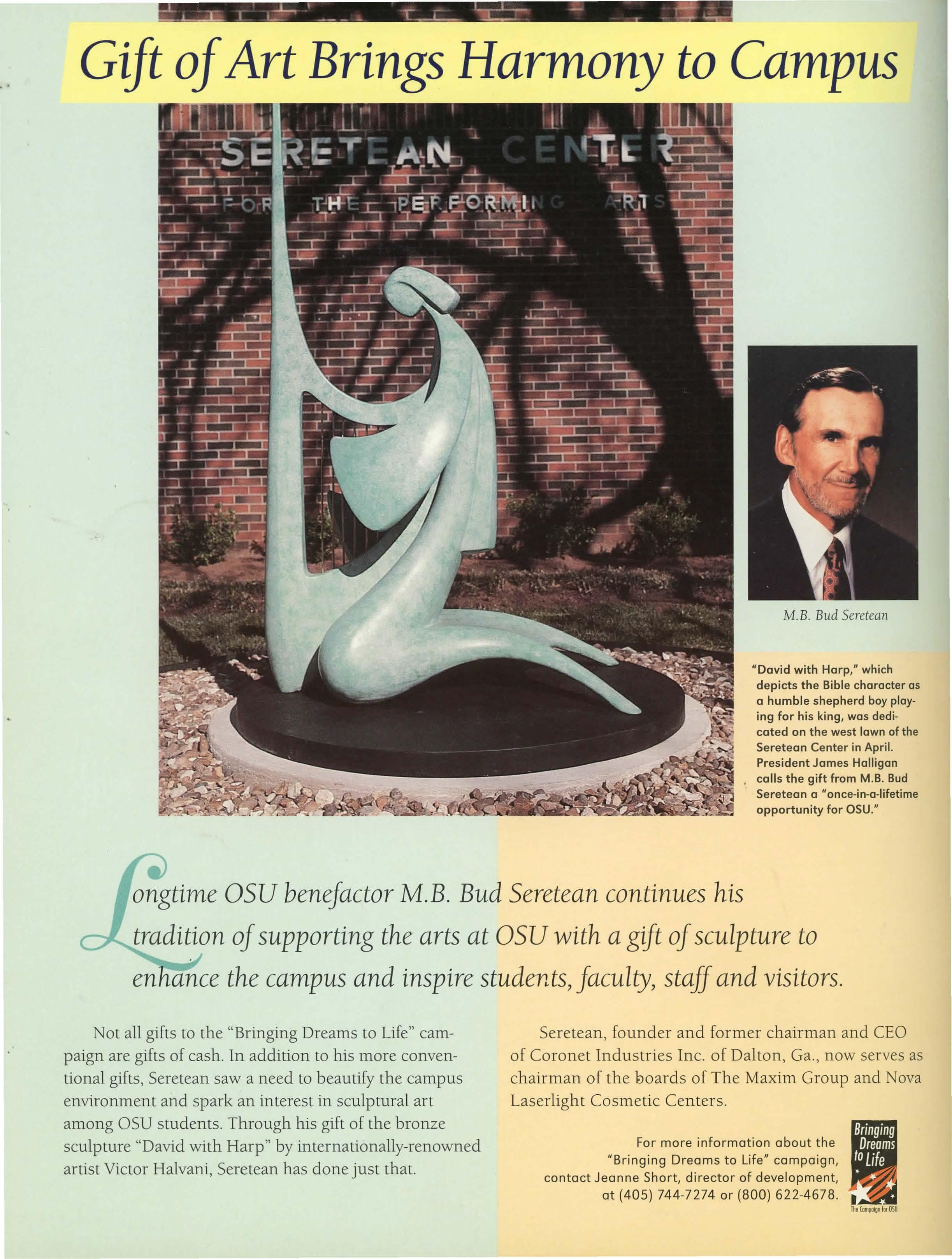
President James Halligan calls the gift from M.B.
ongtime OSU benefactorM.B. Bud Sereteancontinueshis traditionof supportingthe arts at OSU with a gift of sculptureto ennancethe campus and inspirestudents,faculty, staff and visitors.
Not all gifts to the "Bringing Dreams to Life" campaign are gifts of cash. In addition to his more conventional gifts, Seretean saw a need to beautify the campus environment and spark an interest in sculptural art among OSU students. Through his gift of the bronze sculpture "David with Harp" by internationally-renowned artist Victor Halvani, Seretean has done just that.
Seretean, founder and former chairman and CEO of Coronet Industries Inc. of Dalton, Ga., now serves as chairman of the EJOardsof The Maxim Group and Nova Laserlight Cosmetic Centers.
For more information about the "Bringing Dreams to Life" campaign, contact Jeanne Short, director of development, at (405) 744-7274 or (BOO)622-4678.
M.B. Bud Seretean
"David with Harp," which depicts the Bible character as a humble shepherd boy playing for his king, was dedicated on the west lawn of the Seretean Center in April.
Bud Seretean a "once-in-a-lifetime opportunity for OSU."