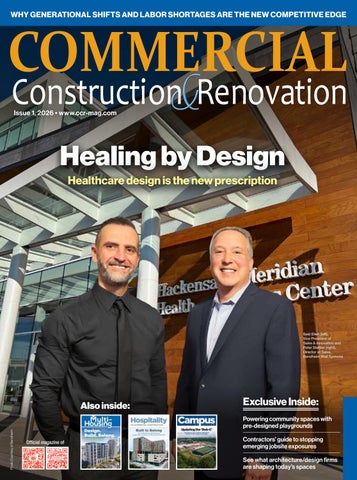
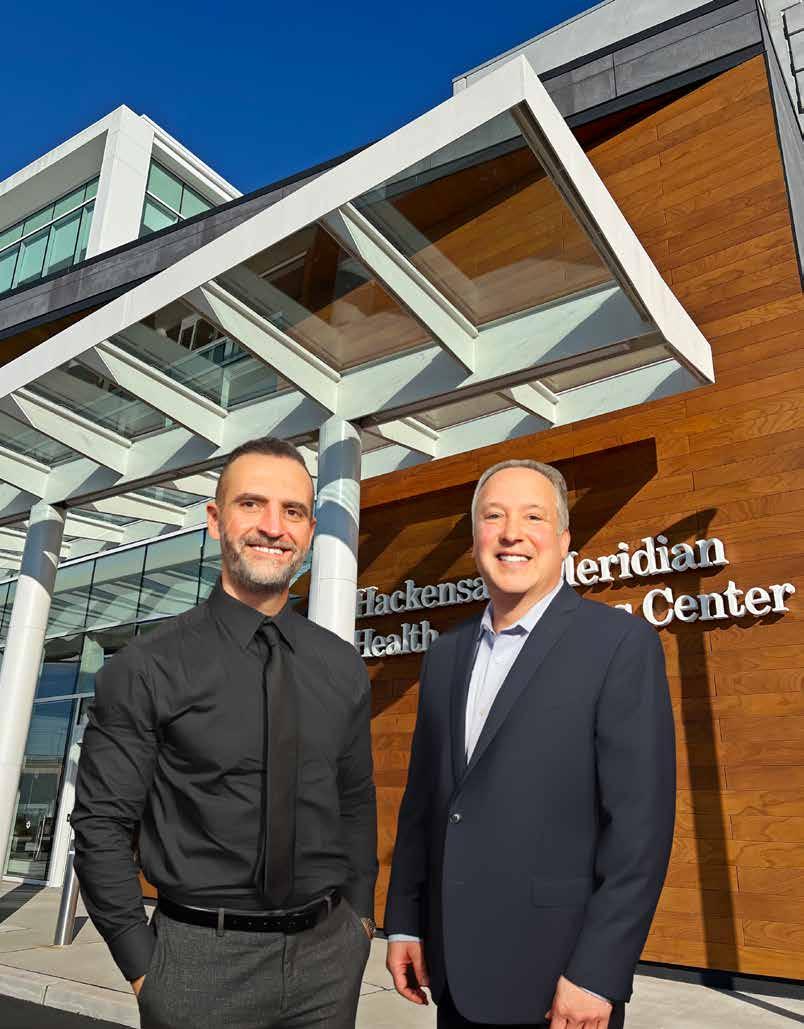
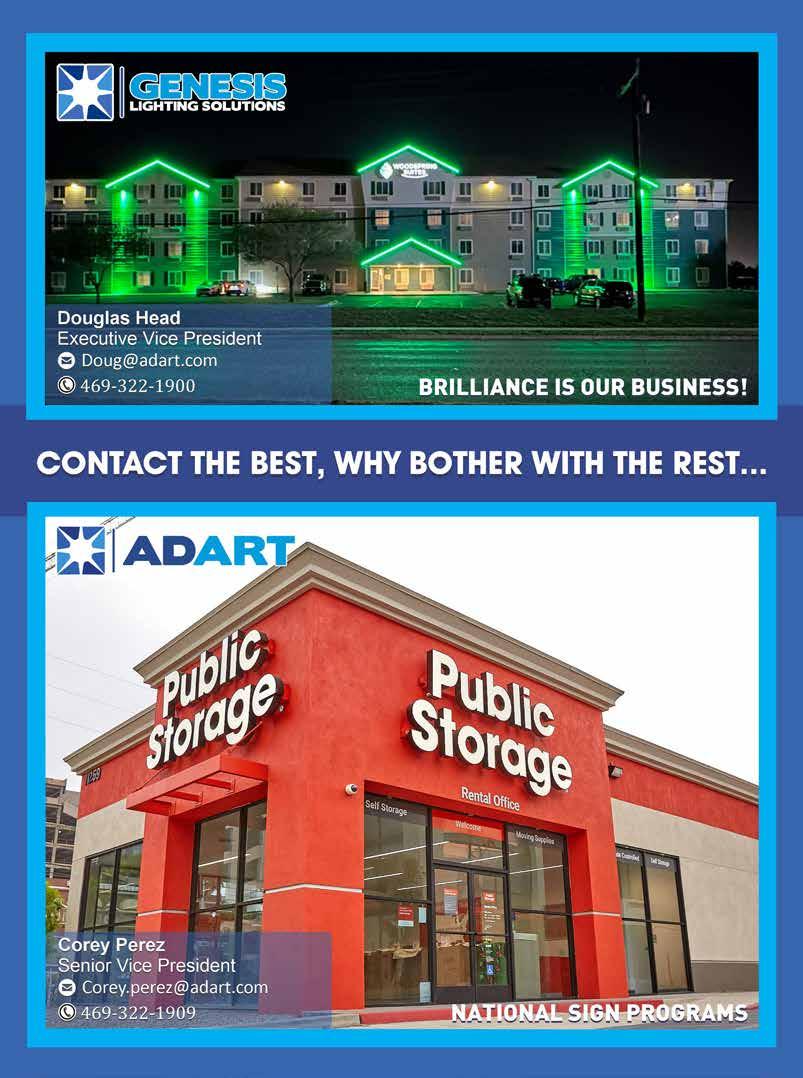
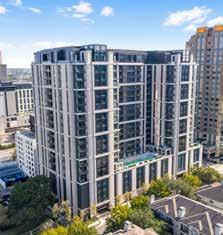
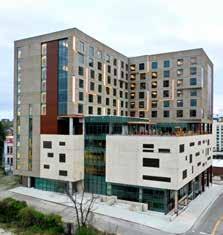
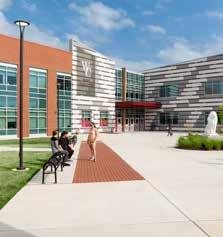
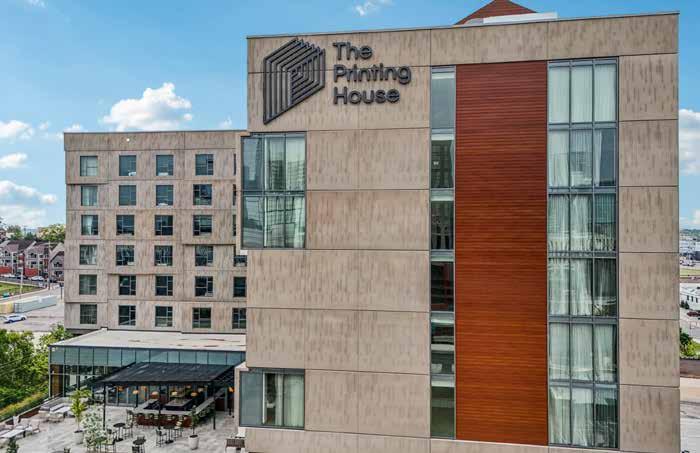
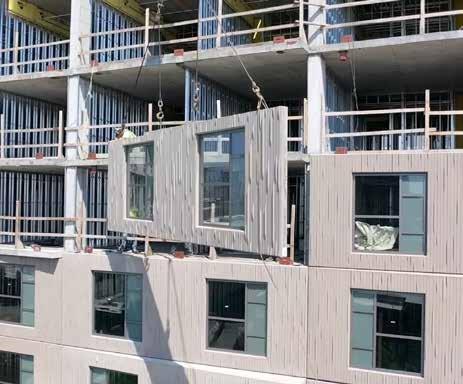
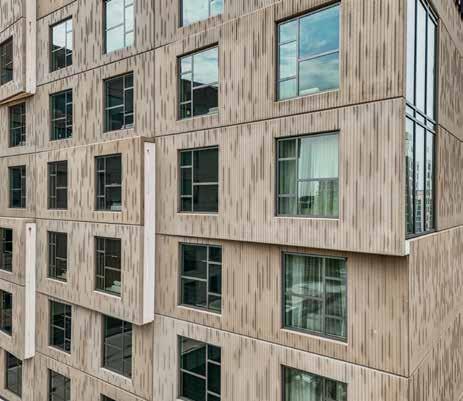
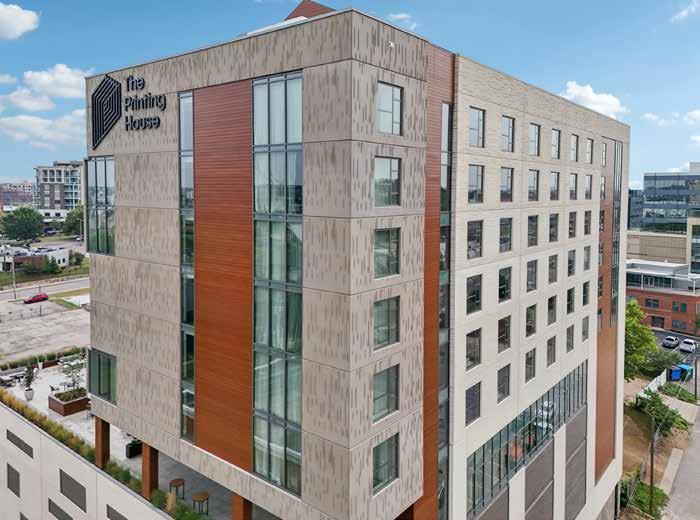
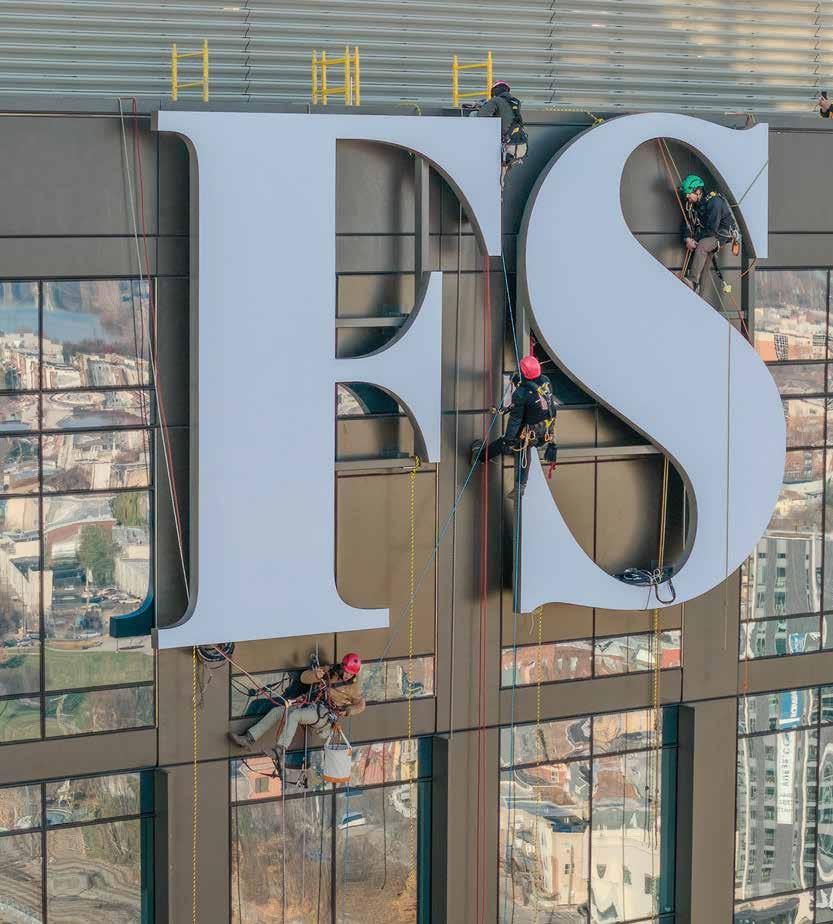
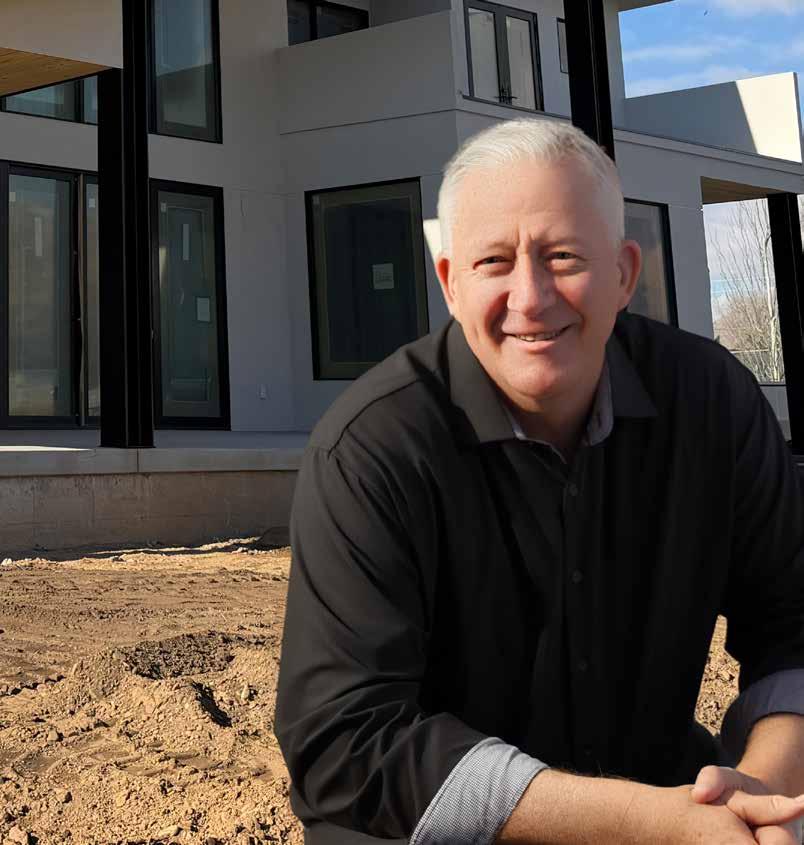
Said Elieh (left), Vice President of Sales & Innovation and Peter Stattler (right), Director of Sales, Bendheim Wall Systems
Vol. 25, Issue 1, 2026
FEATURES
36 Healing by Design Healthcare design is the new prescription.
66 Building for All Ages How pre-designed playgrounds are redefining community spaces.
76 When Risk Becomes Reality 8 trends influencing commercial construction disputes, litigation in 2026.
82 Fire-Smart Solar Reducing risk on rooftop installations.
Why automation and human intelligence will be construction’s real game-changer. Multi-Housing 95 Design. Build. Belong. Inside the design and construction of Maple Terrace Residences.
Hospitality in Commercial Construction 107 Built to Belong
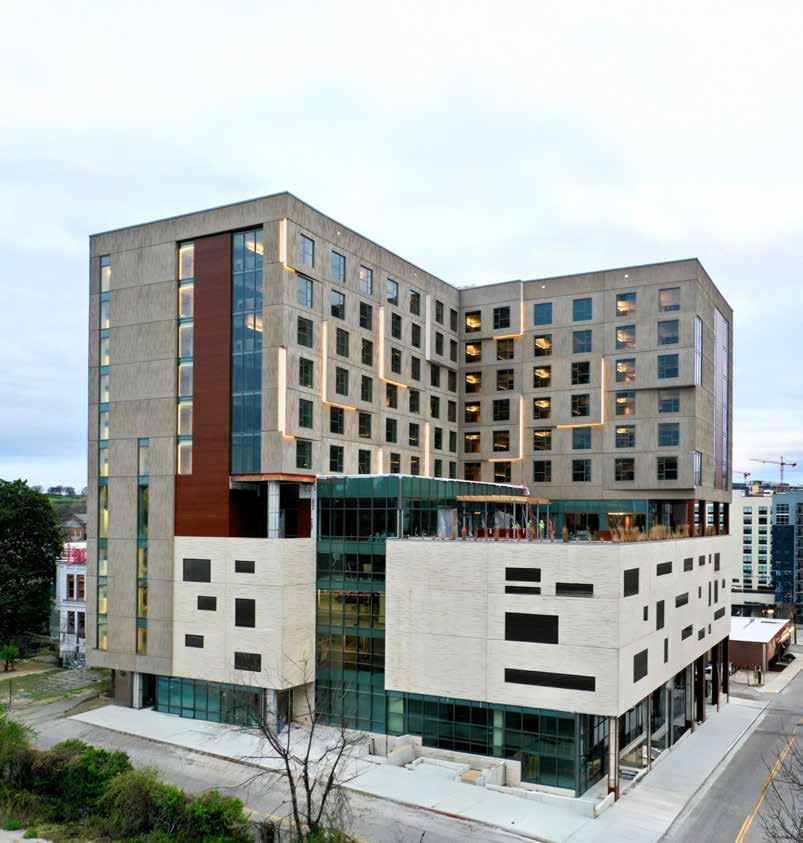
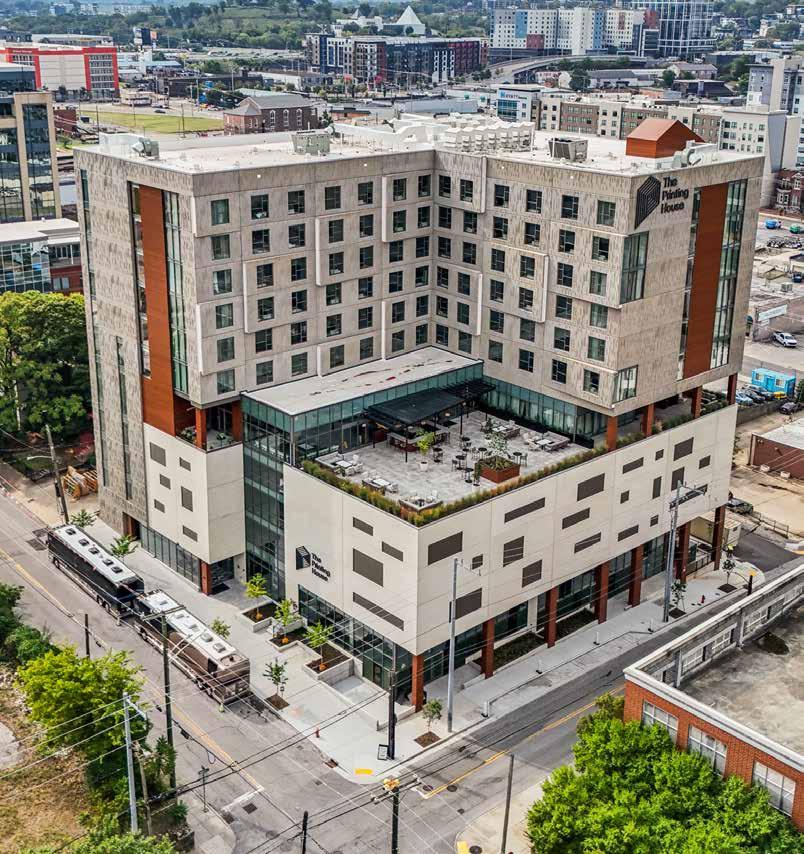
The Printing House Hotel delivers construction innovation in the heart of Nashville. Campus
119 Updating the ‘Dub-C’
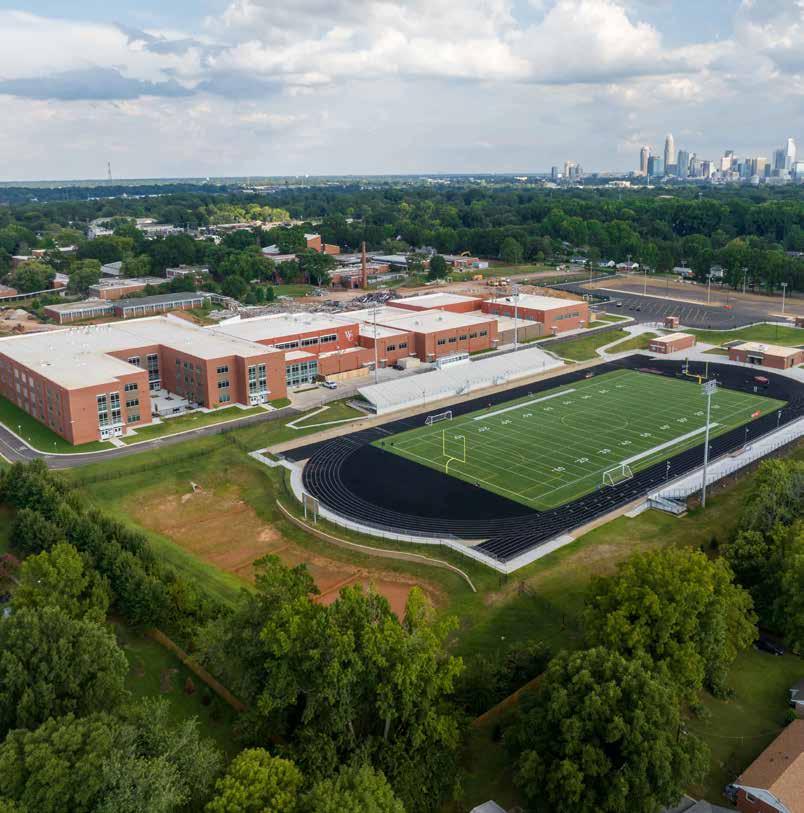
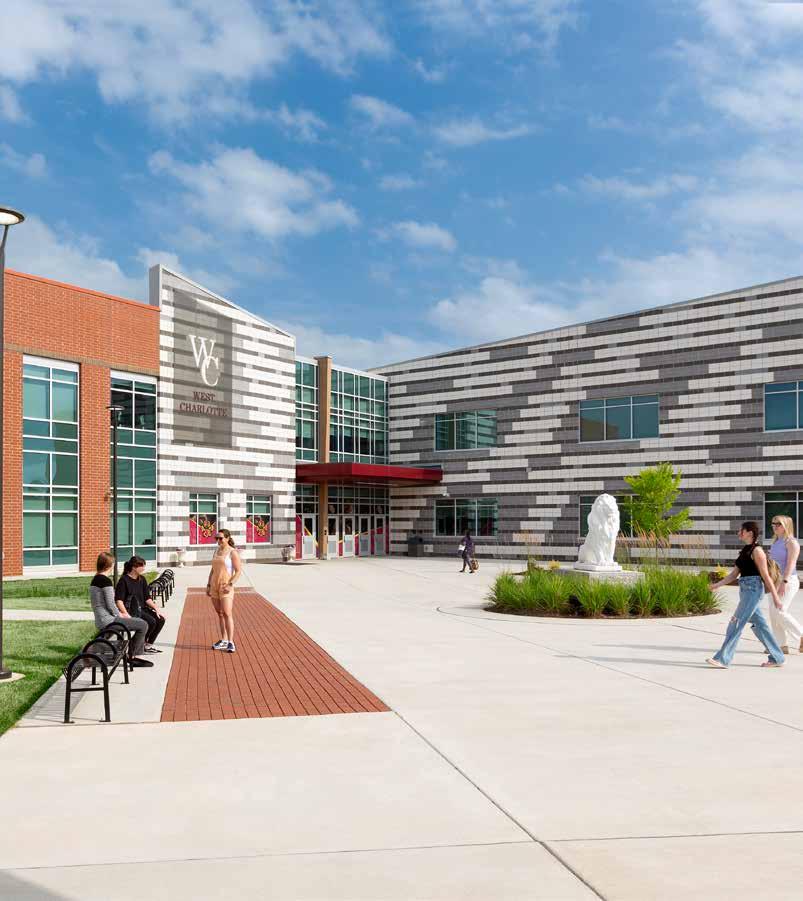
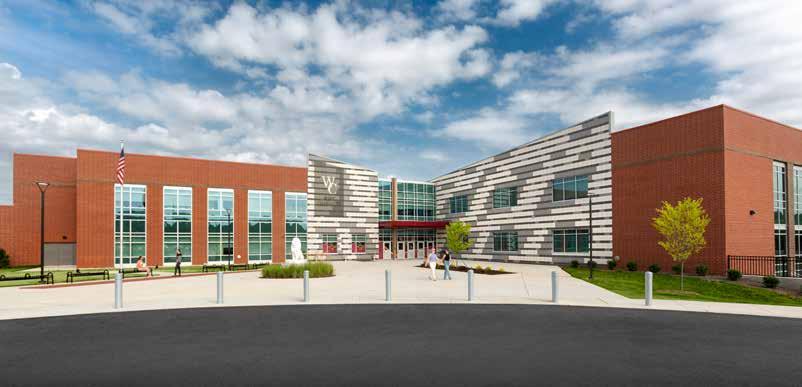
How the new West Charlotte High School weaves modern design and tradition.
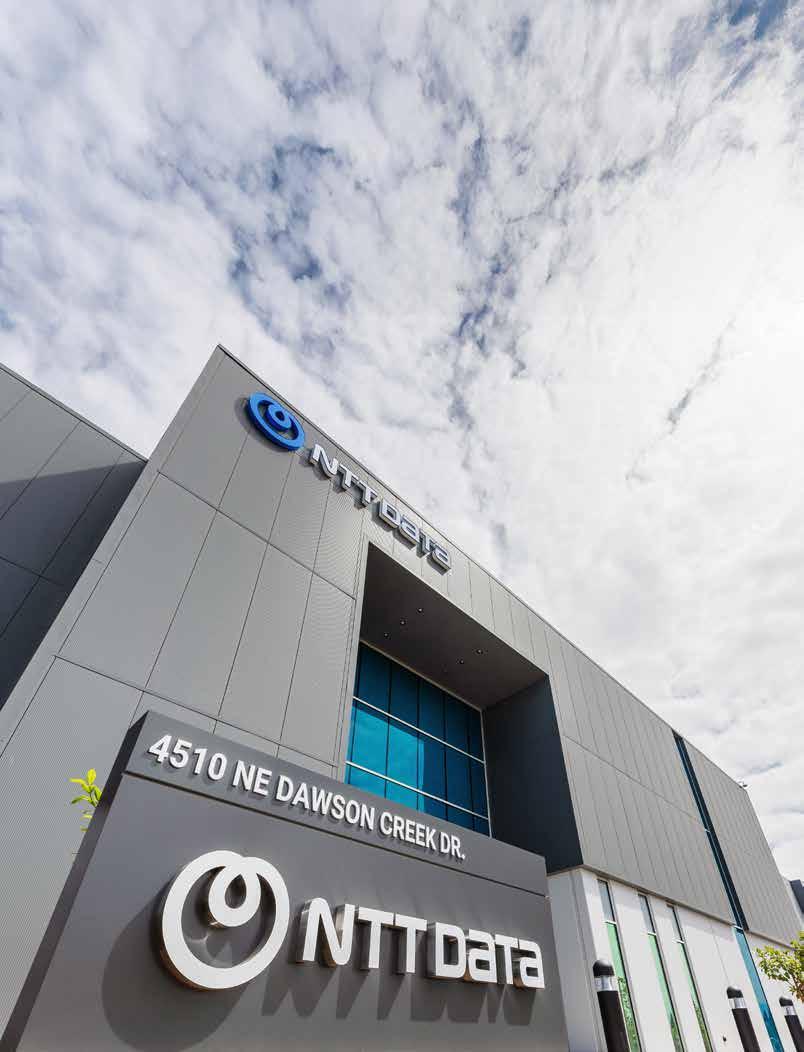
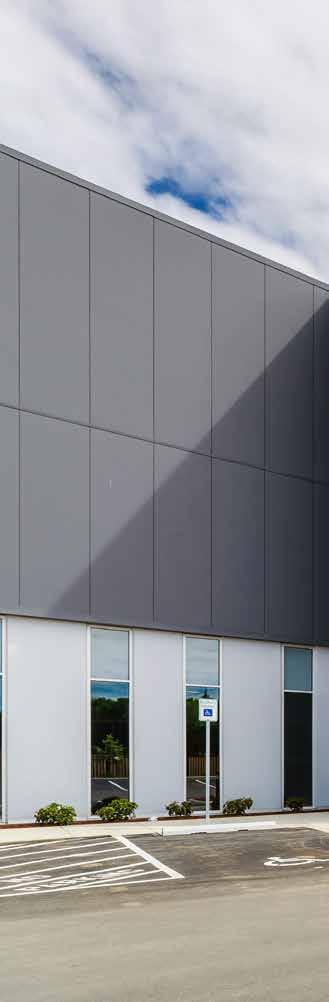
Tomorrow’s Digital Infrastructure
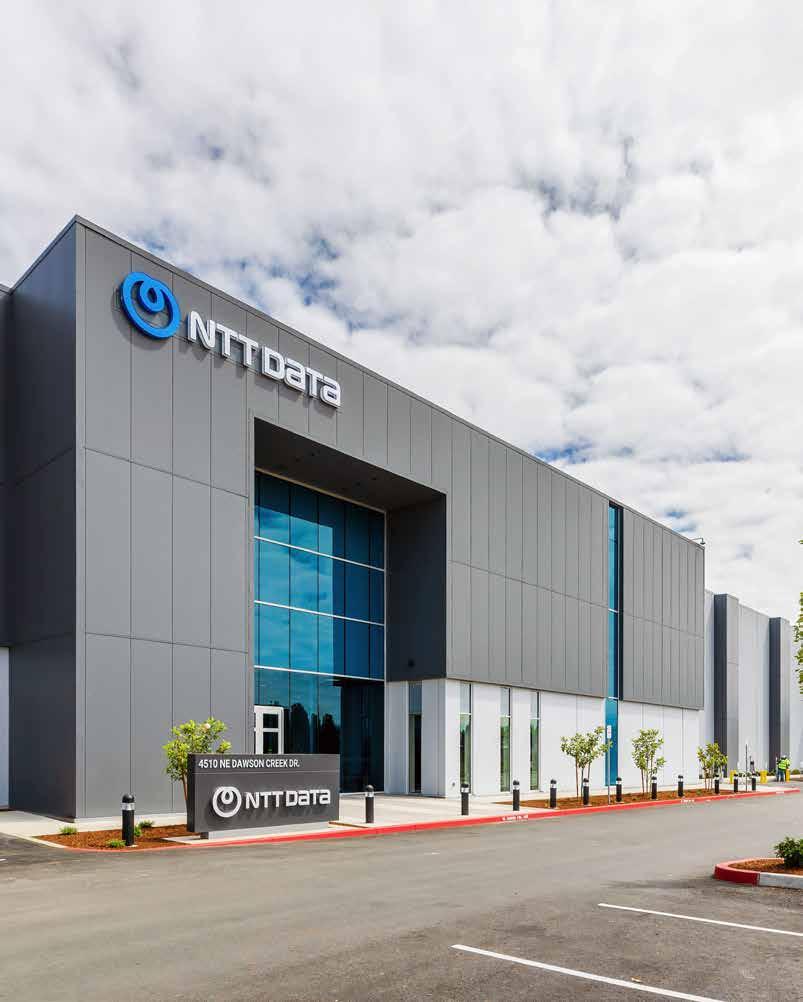
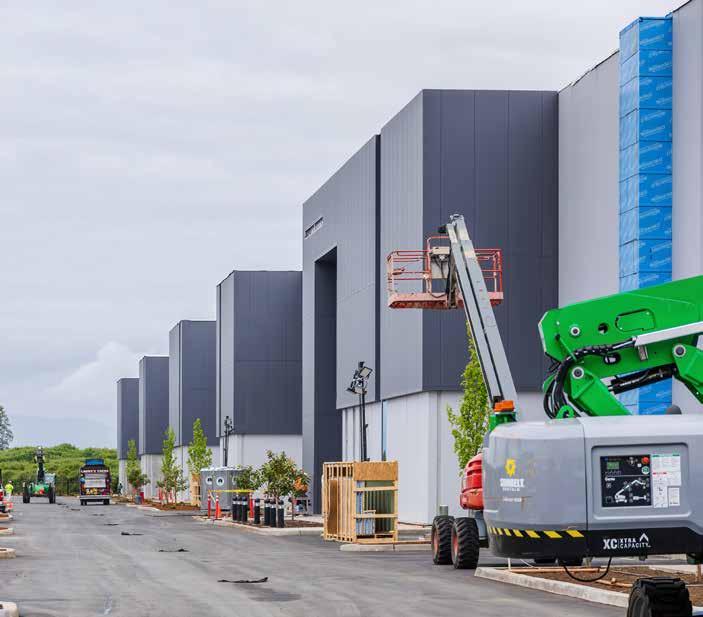
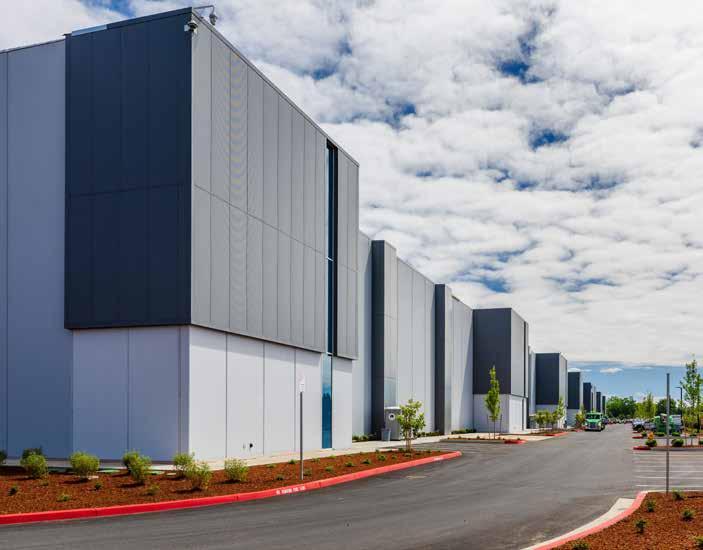
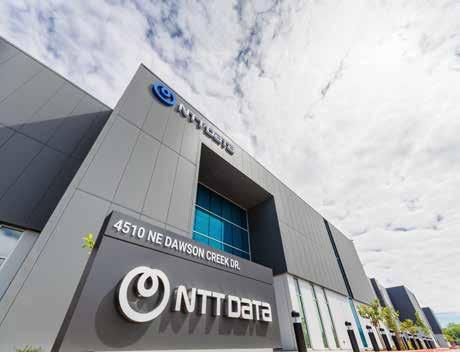
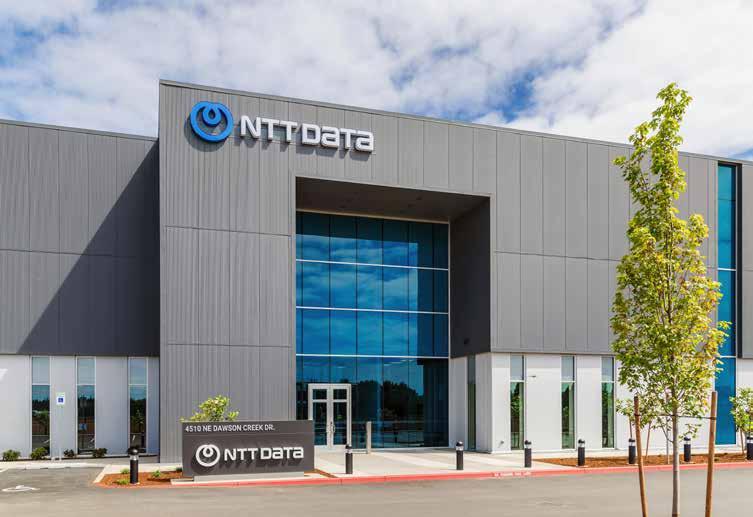
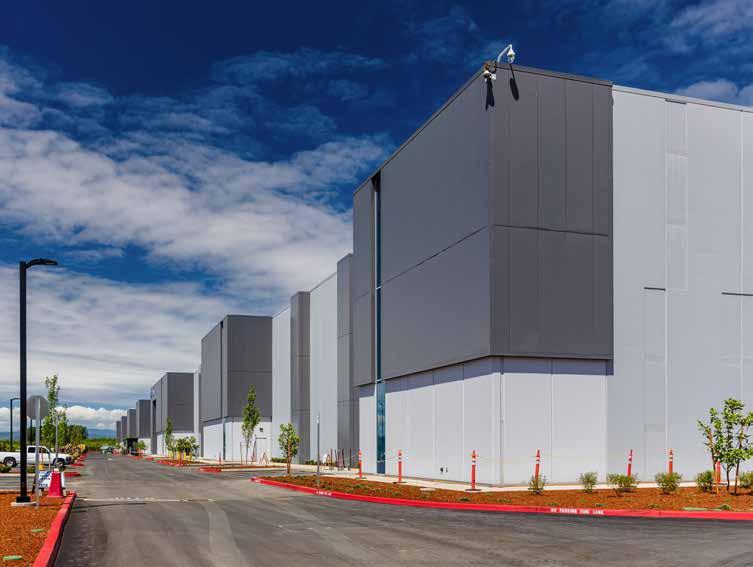
NTT’s HI2 data center sets a new standard for digital infrastructure.
Residental Construction & Remodeling
143 Breaking the Wall
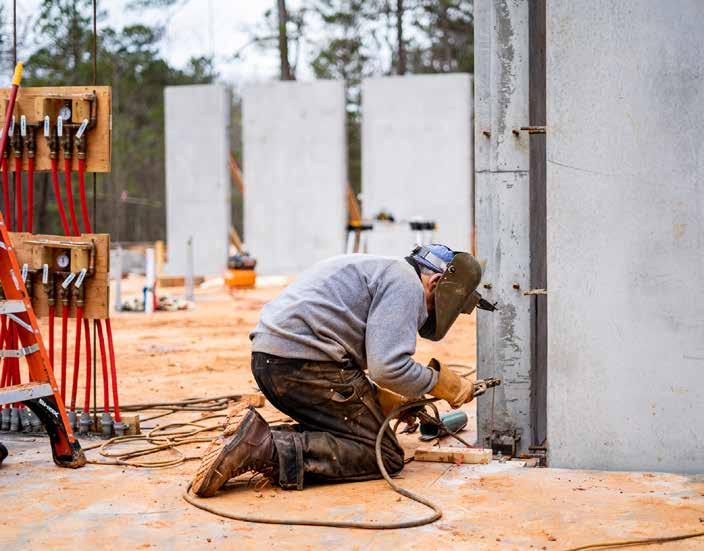
How HydroBlok is simplifying exterior construction and raising the bar for healthy homes.
152 Building Beyond the Flame
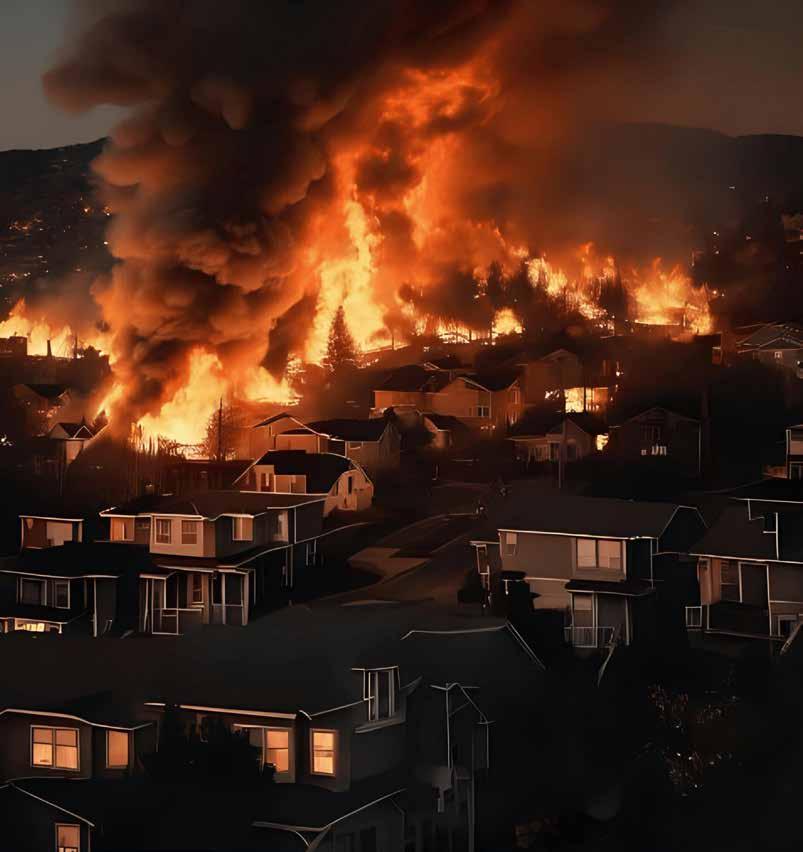
Why concrete homes are a wildfire-ready solution.
Hospitality’s New On-Ramp
Don’t look now, but there’s a quiet shift happening in hotel ownership—one that has less to do with lobbies or loyalty programs, and more to do with who gets a seat at the table. For too long, hotel ownership has felt like a closed loop—capital intensive, relationship driven and difficult to access, even for experienced real estate professionals.
Enter Hilton, which is taking a more intentional and inviting approach, working to open that world to a broader group of entrepreneurs and change the narrative around who can become a hotel owner.
Launched earlier this year, Hilton’s “Unlocking Doors” is an on-ramp for everything from education, networking to access to capital. And, as you might
imagine, the demand for this path is real, especially from owners with residential real estate backgrounds who already know how to build, finance and operate assets, but want something with brand power and long-term upside.
What really stands out is how practical the approach feels. “Unlocking Doors” is not about chasing big-name
As the hospitality industry stares down a landscape of development slowdowns, labor challenges and rising costs, expanding the ownership pool is not just inclusive, but strategic.
developers or one-off success stories, but about meeting people where they are and helping them see how hotel ownership can grow out of what they already know. To do this, the program focuses on education—covering operations, brand standards and financing—while also building a supportive community of peers who are taking the same step into hospitality together.
The brands involved—Home2 Suites, Hampton Inn and Hilton Garden Inn—are the ones that resonate most with firsttime owners. They are not experimental concepts, but proven, scalable brands that balance consistency with operational efficiency. For new owners, that matters. Predictability matters. Support matters. A clear playbook matters.
As the hospitality industry stares down a landscape of development slowdowns, labor challenges and rising costs, expanding the ownership pool is not just inclusive, but strategic. New perspectives bring new energy. New capital. New markets. And a sustainable-based mindset rooted in community investment rather than quick flips.
At its core, “Unlocking Doors” feels less like a campaign and more like a belief in what hotel ownership can become—a future where new owners are welcomed, supported and shown a clear path forward.
We have always said, if we do a good job the phones will ring.
Established in 1993, Lakeview Construction, LLC is a national commercial project solution provider specializing in all phases of construction.
From concept to completion, our professional teams deliver quality construction and outstanding service, ensuring on-time schedules and cost-effective project management.
Headquartered in Pleasant Prairie, Wisconsin, we operate across all 50 states
CCR EDITORIAL BOARD
ACADEMIA
DR. MARK LEE LEVINE Professor Burns School/ Daniels College University of Denver
ADA
BRAD GASKINS Principal The McIntosh Group
ARCHITECTS/ENGINEERS
MICHAEL MAGEE
Studio Leader Retail, Store Design Senior Associate Little
FRED MARGULIES
Director of Retail Architecture Onyx Creative
STEVEN MCKAY
Managing Principal, Global Design Leader DLR Group
STEVEN R. OLSON, AIA President CESO, Inc.
CONSULTANT
GINA MARIE ROMEO Chief Heart Officer & Principal Consultant, Allied RDI
DEVELOPMENT/PROJECT MANAGEMENT
KAY BARRETT
NCIDQ, CDP
Senior Vice President Cushman & Wakefield
PAM GOODWIN
Goodwin Advisors, LLC Goodwin Commercial The Pam Goodwin Show
SAMUEL D. BUCKINGHAM, RS AMS CMCA President of Construction Devco Development
GARY RALL Vice President of Design and Development Holiday Inn Club Vacations
ROBERT RAUCH Chairman Brick Hospitality
JOE THOMAS
Joseph K Thomas Sr. Consulting Senior Consultant Hospitality Engineering
LU SACHARSKI Vice President of Operations and Project Management Interserv Hospitality
MEGAN HAGGERTY Founder Legacy Capital Investment
MARIE ANTONETTE G. WAITE Founder and CEO Finest Women in Real Estate
RESTAURANTS
DAVID SHOTWELL Director of Construction & Facilities, BOJ of WNC, LLC
DAVID D. DILLON
Principal Design Lead, Templates & Standards Chick-fil-A Corporate Support Center
RETAILERS
AARON ANCELLO Facilities Asset Management Public Storage
DEDRICK KIRKEM Facilities Manager Alice + Olivia
DAVID THOMPSON Vice President TCB Construction Group LLC.
MATT SCHIMENTI President Schimenti Construction
JOHN STALLMAN Marketing Manager Lakeview Construction
JEFFREY D. MAHLER RCA Advisory Board Member
ANDY BRIGGS, CHA Managing Principal A14 Capital Management
INFORMATION TECHNOLOGY
CRAIG WEBER Director of Business
Prime Retail Services, US Prime 3 Retail Canada, Inc.
LAURA GROSS Retail Facilities Manager American Signature Furniture
KELLY RADFORD Vice President Facility Services CubeSmart
PERMITTING
VAUN PODLOGAR CEO, Owner, Founder State Permits, Inc.
REAL ESTATE
ROB ADKINS, LEED AP CDP Senior Project Manager Cushman & Wakefield
DESIGN EXISTING GLASS TO RESIST FORCED ENTRY
DefenseLite®Pro retrofit security glazing
Harden the building envelope without compromising budget or timelines.
DefenseLite® Pro delivers a high-performance retrofit solution for glass security in commercial environments.
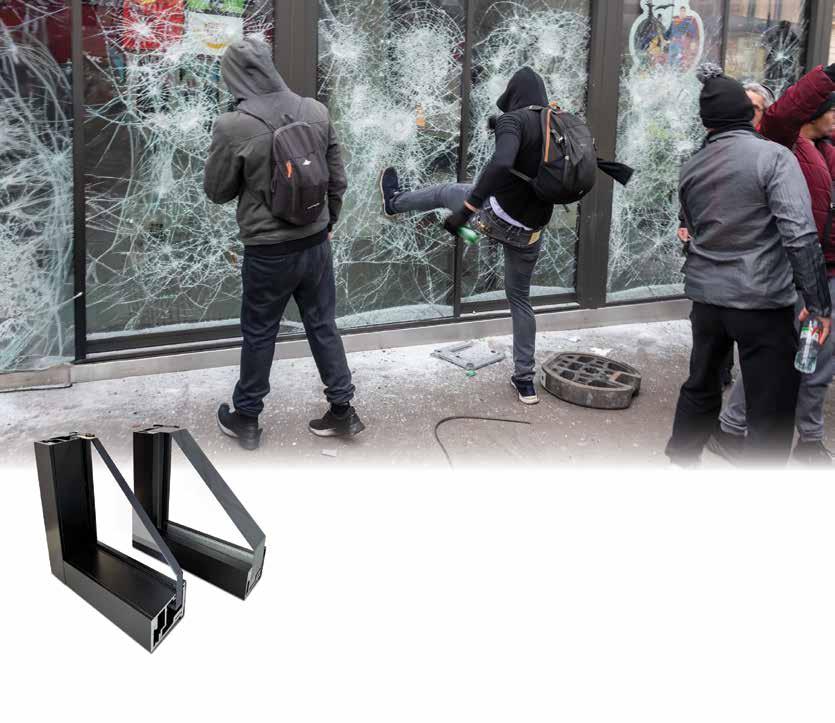
This polycarbonate security glazing system mounts directly over existing glass to help delay forced entry and resist smash-and-grab, riot, and impact events. Designed for real-world threats, DefenseLite® Pro strengthens the building envelope without demolition, downtime, or disruption to occupants.
With heavy-duty anchoring, passive protection, and clear sightlines, it allows architects to specify security that performs while preserving transparency and daylight.
• DefenseLite® Pro mounts over existing glass
• Delays forced entry and impact events
• Heavy-duty anchoring for real-world conditions
• Maintains transparency and natural daylight
• Installs without demolition or operational downtime
• Passive protection with no power required
• ASTM 3561 Level 8 performance
• Ideal for retail, offices, schools, and government
Visit www.defenselite.com or call 888-689-5502.
AroundtheIndustry
RETAIL
Ulta Beauty
Ulta Beauty debuted at Antara Fashion Hall in Mexico City, followed by a second location at Galerías Metepec. Additional stores are set to open across the country throughout 2025 including stores in Guadalajara, Monterrey, León and Tijuana. The expansion marks Ulta’s first brick-and-mortar presence outside the United States and reflects the retailer’s long-term commitment to expanding its global footprint and bringing the Ulta Beauty experience to new markets worldwide.
Level Shoes
Level Shoes, the footwear retail concept by Chalhoub Group, is coming Stateside, plotting its biggest expansion yet outside its native Middle East. Level Shoes geared up to open its first American logistics center in Florida in the first quarter of 2025.
Skechers / Performance
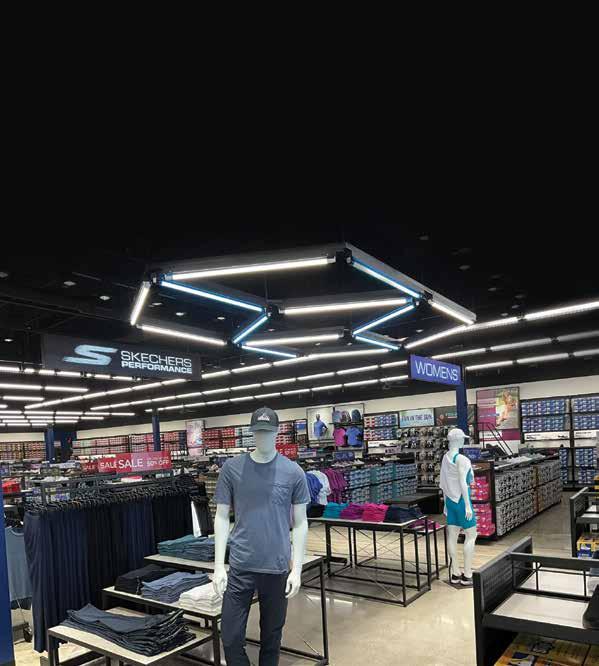
Skechers has debuted its experiential “Performance” store format in the U.S. with a 26,017-square-foot location at Dolphin Mall in Miami. The brand’s largest factory mall store worldwide features sport courts, a running track, golf green and immersive digital displays. It’s the fifth rollout globally, joining sites in Canada, Europe and Chile.
New Balance
New Balance has unveiled a major remodel of its Flatiron flagship in New York City, marking a key step in the brand’s global retail strategy. The 2,200-square-foot space at 150 Fifth Avenue features an updated facade that lets in more natural light and a reimagined interior to heighten the customer experience. The store takes inspiration from the brand’s Boston flagship, while also incorporating design aspects that reflect the energy and culture of New York City.
PayMore
PayMore will open its 100th store, in Charlotte, with plans to open 50 more stores this year and 640 over the next five years, including 180 abroad. PayMore’s tech-powered physical stores provide a modern, secure space for selling and buying used electronics, supported by proprietary tools that streamline both in-store and online sales.
Urban Outfitters
Urban Outfitters is set to open its second store in Ireland this week as part of its ongoing European expansion. The store, which will offer exclusive products, is committed to creating exceptional in-store experiences amid economic challenges.
Rack Room Shoes
Rack Room Shoes is building on its strategic growth plan with the opening of seven new “lighthouse concept stores” across the country. The locations, which aim to “reimagine and enhance the shopping experience for the entire family,” join previous lighthouse
concept stores open in Georgia, Louisiana, North Carolina, South Carolina and Texas. Seven are now open. Rack Room will continue to expand or add a layered footprint in Colorado, Florida, Maryland, North Carolina, Ohio, South Carolina and Texas.
Forever 21
Authentic Brands Group plans to drive the digital growth, wholesale expansion and kidswear innovation of Forever 21 as it transitions to a “digital-first” brand in the U.S. Authentic also said it in advanced discussions with a leading retail operating partner to open new Forever 21 U.S. stores.
Toys”R”Us
Toys”R”Us is expanding its footprint at home and abroad as it gears up for the toy industry’s busiest season. In partnership with Go! Retail Group is planning to open 10 new flagships and 20 seasonal holiday shops in the U.S. by year’s end. The first new flagship opened at Chicago Premium outlets in Aurora, Illinois in September, followed by locations opening in October at Camarillo Premium Outlets in Camarillo, California, and Arundel Mills in Hanover, Maryland.
Claire’s
Claire’s new owner outlines comprehensive comeback plans to keep up to 950 of the retailer’s stores open. To revive Claire’s, the private-equity firm plans a comprehensive turnaround centered on cleaning and renovating stores, hiring additional staff and engaging customers through social media updates on the transformation process.
Gymshark
Gymshark is beginning a measured U.S. brick and mortar rollout with its first two permanent stores in New York City including a flagship on Bond Street in Manhattan and a location at Roosevelt Field on Long Island. The brand plans a gradual east to west expansion that complements its ecommerce led business while avoiding overexpansion as it builds a long term physical retail strategy.
Michael Kors
Michael Kors has reopened its revamped flagship at Rockefeller Center in New York City following a 13 week renovation that leans into streamlined luxury and modern glamour. The refreshed store introduces a Jet Set Lounge, the brand’s first in store cafe, and a dedicated small leather goods area as part of a broader global modernization plan set to redesign more than 350 stores over the next three years.
Mejuri
Mejuri is expanding its U.S. retail presence with its first in store shop at Nordstrom’s flagship in New York City. The opening supports the brand’s push to reach customers more directly as it grows its global footprint to more than 50 stores and explores selective wholesale partnerships alongside its core direct to consumer model.
Five Below
Five Below is pushing west with its first Pacific Northwest expansion, opening eight new stores next month across Oregon and Washington. The move marks the brand’s entry into a previously untapped region and supports its broader national growth strategy focused on opening stores in high potential markets.
Shoe Carnival
Shoe Carnival is rebranding as Shoe Station Group as part of a strategy to unify its portfolio under the Shoe Station banner and position the company for long term growth. The corporate name change has been approved by the board and is expected to move to a shareholder vote at the annual meeting in June 2026.
HOSPITALITY
W New York
The W New York – Union Square has completed a $100 million renovation that refreshed nearly every part of the hotel. The project transformed the Grand Staircase, Living Room, meeting spaces, fitness center and all guestrooms and suites, while adding a rooftop bar, café and the Seafood Brasserie. The redesign blends contemporary luxury with the property’s New York City heritage.
Marriott International
Marriott International has introduced its first all-inclusive resort in Los Cabos, Mexico, rebranding the Hacienda del Mar Los Cabos as Hacienda del Mar Los Cabos, an Autograph Collection All-Inclusive Resort. The property features 270 updated rooms and suites, five pools, eight dining venues, a spa and event spaces for up to 1,600 guests.
Everhome Suites
Choice Hotels International has added seven new Everhome Suites across the US, growing the brand to 17 open locations with 16 under construction and 45 in the pipeline. The latest openings include Bozeman, Montana; Ontario and San Bernardino, California; Yuma, Arizona; Newington, New Hampshire; Rochester, New York; and Somerset, New Jersey.
Eurostars Hotels Company
Eurostars Hotels Company has acquired The Boxer Boston, an 80-room historic property in the city’s West End, from Hersha Hotels & Resorts for an undisclosed price. Built in 1904, the hotel was renovated in 2013 with additional updates in 2019–20. The Boxer becomes Eurostars’ fifth US property, with the sale brokered by JLL’s Hotels & Hospitality Group.
Hyatt Hotels
Hyatt Hotels has opened Dreams Playa Esmeralda Resort & Spa, an all-inclusive family resort in the Dominican Republic under its Inclusive Collection. The property features 500 guestrooms and suites, a
waterpark, lush gardens, 10 restaurants, seven bars and Preferred Club amenities. It is located near attractions including Montana Redonda and Los Haitises National Park.
Hilton Hotels
Hilton has introduced its Conrad brand to Germany with the opening of Conrad Hamburg in the historic Levantehaus building. The 283room hotel features a curated art collection, GRETA OTO Latin American restaurant, a 10,763-square-foot spa and nine event venues.
IHG Hotels & Resorts
IHG Hotels & Resorts will open a new Hotel Indigo in New Cairo, Egypt, in 2031 through a partnership with Jadeer Group. The 120-room hotel will anchor Jadeer’s Red (G) mixed-use development, adding to IHG’s growing Luxury & Lifestyle portfolio in Northern Africa.
Sonesta Hotels & Resorts
Sonesta Hotels & Resorts has repositioned itself as a wellness-focused brand built around self-care, discovery and fun. The shift comes as the company expands from 60 hotels to more than 1,100, marking one of the fastest growth trajectories in the industry.
Marriott International
Marriott International has launched Series by Marriott, a new collection brand designed to drive growth in the midscale and upscale segments. The concept lets hotel owners keep their independent identity while tapping into Marriott’s digital platforms and loyalty program. The first partnership is with Concept Hospitality Private Limited in India, with expansion planned across the U.S., Latin America, the Caribbean, Europe, the Middle East and Africa.
Universal Studios
Universal Studios will debut Universal Kids Resort in Frisco, Texas, by 2026. The family-focused park will showcase characters from Jurassic World and Shrek, along with immersive experiences and a 300-room hotel.
InterContinental Hotels Group
InterContinental Hotels Group will prioritize growth in Asia and the Middle East, pointing to faster GDP growth, younger demographics and strong infrastructure investment driving long-term opportunity in those regions.
Kimpton Hotel & Restaurant Group
Kimpton Hotel & Restaurant Group has debuted its first resort in Portugal with the opening of Kimpton Atlantico Algarve on Sao Rafael Beach. The 149-room luxury property, designed by Portuguese designer Nini Andrade Silva, highlights natural textures and earthy tones. Guests can enjoy multiple dining options and a full wellness hub with a heated indoor pool and spa.
(Continued on next page)
AroundtheIndustry
IHG Hotels & Resorts
IHG Hotels & Resorts is accelerating U.S. growth through hotel conversions. The company plans to add more than 120 branded hotels over the next decade, with momentum from Vignette Collection, Garner Hotels and Voco Hotels. Its recent acquisition of Ruby, a European boutique brand, is set to further strengthen expansion.
Hilton Hotels
Hilton has expanded its luxury and lifestyle portfolio with the debut of Sax Paris, LXR Hotels & Resorts, its first luxury property in the heart of Paris. The 118-room hotel, set in a restored neo-Gothic building in the 7th arrondissement, features Restaurant Le Sax and the rooftop Kinugawa Rive Gauche. In parallel, Hilton is launching Piebird, a new full-service restaurant concept exclusive to DoubleTree by Hilton, beginning in Nanuet, New York, with expansion planned for Asheville, North Carolina.
RESTAURANTS
Firebirds
Firebirds has established its brand in the polished-casual dining space by offering an experience that bridges casual and fine dining and by differentiating itself through sensory elements, such as its signature wood-fired aroma and fire-themed aesthetics. The chain grew to 69 locations across 22 states last year and plans call for seven new units to open in 2026.
TGI Fridays
TGI Fridays has unveiled a turnaround plan, called the “1-2-3 Strategic Vision,” with an objective of reaching $2 billion in revenue and 1,000-plus restaurants by 2030. The chain ended 2023 with about $1.4 billion in global systemwide sales. There are currently more than 380 total locations in more than 35 countries.
Wawa
Wawa is in the midst of an ambitious expansion that has doubled its presence from six to 12 states and Washington, D.C. since 2023, with a goal of reaching 1,700 stores by 2030. The retailer’s competitive advantage lies in its focus on fresh, high-quality food. Items like hot breakfast sandwiches and limited-time offerings have helped Wawa make inroads in the breakfast category.
Playa Bowls
Playa Bowls is expanding into Canada through a master franchise agreement with Eat Up Canada that calls for more than 160 locations nationwide. The move marks the brand’s first expansion outside the U.S. where it currently operates about 350 units.
KBP Brands
KBP Brands has debuted a new KFC prototype in Hillsdale, Michigan, designed around off-premises demand. About 30% smaller than a
traditional KFC the format prioritizes drive-thru digital and carryout orders with kiosks and limited seating to streamline operations and align with evolving customer preferences.
Angry Chickz
After six years of self-funded growth, hot chicken chain Angry Chickz has secured its first outside capital through a debt deal with Saratoga Investment Corp. The funding will fuel accelerated company-owned and franchised expansion across the United States with plans to grow from 33 locations to more than 50 by the end of 2026 including new markets in Illinois, Texas and Pennsylvania.
WingsUp!
Canadian chicken chain WingsUp! is preparing to enter the United States with initial expansion planned for Texas Florida and Georgia. The brand currently operates 38 locations in Canada, and plans to stand out with fresh never-frozen wings and a lineup of creative sauces. Site selection will focus on markets with strong late-night demand and high residential density.
Ono Hawaiian BBQ
Ono Hawaiian BBQ is planning a 10-unit launch in the Dallas–Fort Worth area by mid-2026, marking its first major expansion outside the West Coast. The family-owned fast-casual brand specializes in Hawaiian plate lunches and currently operates more than 115 locations across California and Arizona as it prepares to enter Texas.
Biscuit Belly
Biscuit Belly is expanding its southeastern United States footprint with plans to open six new locations. The rollout includes three franchised restaurants in the Florida Panhandle and three corporate joint-venture stores in North Carolina and Georgia. The openings build on the brand’s existing 13 locations and support a broader growth strategy that could see Biscuit Belly double its footprint in the coming years.
Timber Pizza Co.
Timber Pizza Co. is expanding beyond its Washington, District of Columbia roots into the Carolinas with a neighborhood-driven approach focused on premium wood-fired pizzas at accessible prices. Launched in 2014 as a mobile pizza oven concept the brand now operates eight locations and plans to open four to five more in 2026. Longer term Timber Pizza Co. is targeting eight to 10 new units annually with growth largely driven through franchising.
Burger King
Burger King is accelerating growth in China through a new joint venture with Chinese investment firm CPE. The partnership targets 4,000 locations over the next decade and supports an asset-light strategy as the brand scales in one of its fastest-growing global markets.
Shields Up
A contractors’ guide to stopping emerging jobsite exposures
The construction industry is moving faster than ever—and risk is evolving right alongside it. Labor shortages, increased material theft and jobsite vandalism are placing new pressure on contractors, making it essential for insurance and risk management strategies to keep pace with today’s realities.
Today’s jobsites are more connected than ever. From drones and project management platforms to smart equipment and digital reporting, technology is driving efficiency—but also introducing cyber exposures that didn’t exist just a few years ago. Contractors who fail to address these risks may be leaving their operations vulnerable.
At the same time, theft and vandalism claims continue to rise. Stolen heavy equipment, damaged structures, and stripped materials can derail timelines and budgets. While builder’s risk coverage plays a critical role in recovery, proactive jobsite security, such as 24/7 video surveillance, GPS-tracked equipment, and controlled access— can significantly reduce losses and deliver peace of mind to both contractors and financial stakeholders.
Weather extremes are also reshaping the construction risk landscape. Flooding, heat waves, and severe storms don’t just threaten property, they increase the likelihood of workplace injuries, delays, and unexpected costs. Contractors who plan ahead for weather impacts and align coverage with project timelines are better positioned to stay on track when conditions change.
As construction continues to evolve, contractors who take a proactive approach to risk, through training, jobsite security, cyber protection, and contract review, can reduce claims, control costs and protect what matters most: their people, their projects and their bottom line.
As a Client Executive in the Property Casualty division, Jason McMurray is responsible for growing the Holmes Murphy brand nationwide. His focus is to find and attract best-in-class businesses and educate them on the innovative solutions Holmes Murphy can provide through not only the company, but also its unique subsidiary, Innovative Captive Strategies.
Dining Green at 30,000 Feet
Paradies Lagardère turns airport concessions into a sustainability proving ground
Airport dining is not always where you expect to find sustainability leadership. But Paradies Lagardère is quietly rewriting that assumption. More than 210 of the company’s airport dining locations—over 98% of its portfolio—have earned Certified Green Restaurant® status, marking one of the largest coordinated sustainability efforts in the airport concessions space. For travelers rushing between gates, the impact may feel invisible. Behind the scenes, it represents thousands of operational decisions adding up to real environmental progress.
Over the past year, the company partnered with the Green Restaurant Association to implement more than 5,000 environmental actions across its locations. Those steps range from eliminating polystyrene foam and strengthening recycling programs to improving energy and water efficiency. The results are measurable.
Based on national restaurant averages, the certified locations are projected to save millions of kilowatt-hours of energy and gallons of water each year while diverting millions of pounds of waste from landfills. For an industry defined by speed and scale, that matters.
What makes the effort notable is its consistency across a complex, high-traffic environment. Airport dining is anything but simple, yet Paradies Lagardère is showing that sustainability does not have to slow operations down. Instead, it can be built into the system— one concession, one terminal and one traveler at a time.
Learning on the Menu
Taco Bell brings education benefits to the full franchise workforce
For Taco Bell, investing in people is becoming just as important as investing in new locations. The brand is expanding its Tacos and Tuition education benefit to all franchise employees for the first time, extending a program that was previously limited to corporate and company-operated restaurants. The move brings more than 3,000 online courses and degree programs—without upfront costs—to workers across the system, signaling a deeper commitment to talent development and retention.
The expansion reflects a growing recognition that frontline workers are the backbone of long-term growth. By removing financial barriers to education, Taco Bell is giving employees tools to build careers that extend beyond the counter. For franchisees, the program also offers a competitive edge in attracting and keeping talent in a tight labor market.
As restaurant construction and renovation continue to accelerate nationwide, workforce stability matters. Taco Bell’s approach shows how education benefits can become part of a broader growth strategy—one that supports employees while strengthening the brand’s future pipeline.
Retail’s Brain Trust
NRF and Georgetown invest in the future of the industry
The retail industry is putting serious resources behind research and talent development. The National Retail Federation has partnered with Georgetown University McDonough School of Business to launch the NRF Business of Retail Initiative, backed by a $6 million endowment aimed at shaping the next generation of retail leadership.
Based in Washington, District of Columbia, the initiative is designed to bridge the gap between academia and industry. Funding will support MBA fellowships, an annual summit, a chaired faculty position and research grants focused on emerging retail challenges— from artificial intelligence (AI), and personalization to frictionless commerce and logistics.
For developers, contractors and brands navigating evolving retail formats, the collaboration underscores a larger shift. Retail is no longer just about stores. It is about data, experience and adaptability. By investing in research and education now, NRF and Georgetown are helping ensure the industry is ready for what comes next.
TRACKING ➜ FINAL MILE & WHITE GLOVE
CORNER
Forget the AI Hype
Why automation and human intelligence will be construction’s real game-changer
Forget the AI Hype
Why
automation and human intelligence will be construction’s real game-changer
By Arman Gukasyan
There is no shortage of noise around artificial intelligence (AI).
From boardrooms to job sites, AI is being positioned as the technology that will rewrite the rules of efficiency and productivity.
At the end of 2025, just 12% of construction companies reported regular use, while 45% have no AI implementation. The gap between promise and payoff is widening; margins continue to be squeezed while risk is ever-increasing, and yet AI is not doing anything to address either of these in the world’s most exposed and risk-averse business. On today’s projects, AI remains largely aspirational.
In 2026, the projects and companies that achieve meaningful productivity gains will not be the ones using AI. It will be the companies who are doubling down and investing in automation, which may or may not be AI-enabled — in order to remove repetitive administrative work, standardize workflows, and build the operational foundation which AI depends on to deliver value.
It’s a Game of Risk
I am not blind to the awe and wonder of some of the applied use of AI. In a sector that contributes around $13 trillion to global GDP today—projected to reach $22 trillion by 2040—and employs millions worldwide, AI could reduce the complexity, at scale.
Nevertheless, many firms across industries have yet to realize return on investment for AI. In fact, a report by PWC of over 4,400 CEOs found that 56% saw neither increased revenue or decreased costs from AI initiatives despite significant financial and time investments
In construction, in particular, there are two critical barriers that AI adoption faces. First, there’s the issue of trust. Construction leaders are understandably hesitant to base high-risk decisions on unproven tech in a sector where one error can lead to catastrophic financial or safety consequences.
Second, AI works best when inputs are clean, structured, and consistent. This is the data foundation that many enterprises still
lack. Interestingly, this is exactly where we are seeing a lot of AI development for the industry: using AI to clean the data itself.
Given the impracticality of performing this time consuming task manually, AI is being deployed to learn and analyze 3D model structures and identify, for example, which materials are best suited to specific component parts.
The technology can then automatically call out if the wrong materials are being considered, fixing the data foundation before it leads to a project failure.
Investment in AI technology in construction is falling into the better mousetrap fallacy—prioritizing innovation before fixing the workflows and data that make adoption possible. In an industry defined by risk, any technology that is applied to this sector must fundamentally improve project execution.
Managing the Risk
Construction is not short on complexity. From billion-dollar infrastructure programs to refurbishment projects constrained by live environments, teams are under pressure to deliver on time, on budget and without rework. But the sector is still reliant on fragmented communication, unreliable information, analog tools and legacy workflows.
Spreadsheets, email threads, and siloed models create friction. Layering AI on
top of unstructured data and inconsistent workflows does not create intelligence, it amplifies noise, inefficiencies and cost. Consider predictive AI applied to clash detection without structured model coordination. It may generate hundreds of “potential conflicts,” most of which are false positives. Teams will then spend more time validating AI output than they would have solving the issue manually. Every hour a project manager spends chasing paperwork or reconciling systems is an hour not spent managing the risk or moving the project forward.
Why Automation is the Game Changer
Automation is not about intelligence, but it is about consistent processes and execution across day to day operations. It’s about getting the basics right from the start.
But not all automation is equal. Automation is at its best when it is working with connected datasets and workflows, rather than reinforcing existing data silos. Too many tools focus on “automating” isolated administrative tasks or document management structures. While these are important for governance,
they do little to truly enhance productivity or onsite delivery.
This is why automation has already proven its value through BIM-based workflows, enabling teams to manage large, federated models and seamlessly integrate 2D and 3D coordination as projects grow in complexity and scale. While automation improves speed and clarity, its highest impact is risk reduction—delivering more predictable cost and schedule outcomes by enforcing consistent, rules-based coordination.
This consistency in the data is automation’s real advantage, freeing up teams to focus on higher-value work while effectively managing the balance of risk and reward.
In today’s competitive landscape, automation in construction must cover coordination across 2D and 3D contexts, combined with workflow management and reporting and compliance.
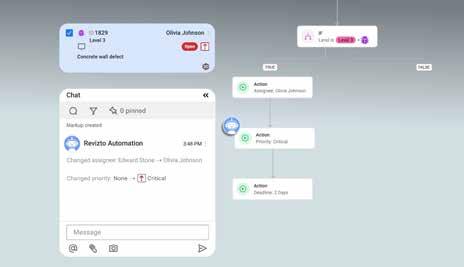
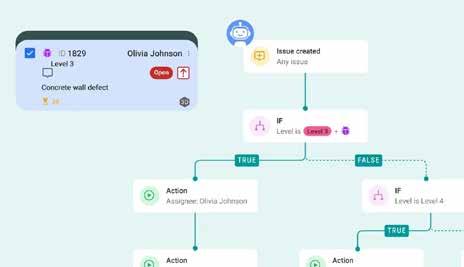
The automation needs to be seamless and handle processes that can tie them directly to issues on the model, tasks and notifications that actually matter to project teams.
For example, automation can be used to reduce manual clash checks and catch design issues earlier. Routine items such as RFIs, design clarifications and approvals can be routed, tracked and closed through standardized workflows, helping teams avoid missed handoffs and delays. Reporting, submittal logs and audit trails can also be generated automatically, easing administrative burden and supporting compliance.
AI will increasingly play a larger role over time, acting as a productivity booster by helping teams analyze data, prioritize work or remove low-value tasks. But progress in 2026 won’t come from chasing the AI hype, nor will it come from using the same processes, and analog tools we are used to. It will come from investing in automation that standardizes and streamlines workflows.
Construction and engineering companies that get the basics right will define the industry standard, long before AI enters the equation.
Arman Gukasyan is founder and CEO of Revizto, a cloud-based visual collaboration platform (BCP) designed for the architecture, engineering, construction and operations (AECO) industries.
Frame Automation
Issue Workflow Automation
in the news
Drawing the Past Forward
How Michael Epstein’s new book brings the story of Seibert Architects—and Sarasota modernism—to life
For Michael Epstein, the idea of writing a book about Seibert Architects didn’t arrive as a single moment of inspiration. The idea came gradually, shaped by time, memory and a growing sense of responsibility.
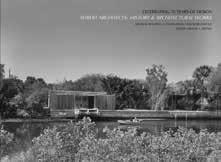
Epstein, now a principal at the firm, joined Seibert Architects in 1989. By then, the firm already carried decades of history. It was years later—after founder Tim Seibert passed away and the firm approached its 70th anniversary—that the urgency became clear. The result is “Celebrating 70 Years of Design – Seibert Architects: History & Architectural Works.”
“A few years after Tim passed, we began to think about this,” Epstein says. “It really seemed like the right time once we hit the 70th anniversary of the firm.”
What began as reflection soon became excavation. Epstein, with the help of intern architect Taylor Brunsvold, immersed himself in the firm’s archives, especially work created long before his tenure. With Brunsvold doing much of the excavation work, Epstein reviewed the findings and decided what to include.
While Epstein was familiar with many of the built projects still standing in Sarasota during the 1980s, the deeper archive revealed something more layered and, at times, surprising. Drawings of demolished structures, altered buildings and projects that were never realized filled in missing chapters.
“The archives had work that was never built or had been demolished or modified since being built,” Epstein says. “These filled in the gaps and revealed a more accurate look at the ideas behind the designs from those earlier days. Some of the most surprising ideas are in the unbuilt work.”
That ambition grew out of a larger movement—the Sarasota School of Architecture—and from the influence of architects who helped define it. Working alongside Seibert in the 1980s and 1990s, Epstein saw how ideas from figures like Paul Rudolph
and Victor Lundy filtered into the firm’s work, especially Rudolph. “Tim worked for Paul Rudolph before he opened his own office and often passed on Rudolph’s architectural tenants and ideas to those willing to listen.”
At the heart of the book is Seibert himself. An insightful, gifted and encouraging mentor, Seibert was gifted with an unmatched ability to tell stories. “Tim’s comments relative to my design work were always insightful, complimentary, and encouraging,” Epstein says. “He was amiable and charming, but nobody’s fool. He had the unique ability to simplify the complicated and to find the fun in almost any situation. He truly was a good role model.”
The book traces Seibert Architects from 1955 to today through archival photographs, drawings, renderings, writings and new documentation. It examines residential, commercial and civic projects—built and unbuilt— that continue to shape Sarasota’s physical and cultural landscape across styles, codes, materials and decades. “Times change; styles come and go; codes change,” Epstein says. “But the ideas embedded in those early works and the work since then are still valid today.”
That belief sits at the core of the book’s purpose. For readers—and especially for SARA members—Epstein says it offers a reminder that architecture grounded in place, climate and stewardship can endure. “We are still designing structures where inside and outside are a meaningful part of each other.” CCR
Michael Epstein and Tim Seibert, founder of Seibert Architect, reviewing one of his designs in the early 1990s.
Michael Epstein
Rethinking Workforce Strategy
Managing a younger construction labor force
By Kit Dickinson
ADP Research’s “Today at Work 2025 Issue 3” report revealed a clear shift across the skilled trades. The median age of electricians, plumbers, carpenters, and HVAC professionals has dropped by as much as five years since early 2020. The overall U.S. workforce, in contrast, has become only one year younger over the same time period.
For commercial construction leaders, this is more than a demographic statistic. As experienced field staff retire, they take critical knowledge with them. Younger workers are stepping in, but the transition demands careful management to protect schedules, budgets and quality standards.
The following strategies can help executives turn this generational shift—
and the ongoing labor shortage—into a competitive advantage.
Align workforce planning with project execution
New hires bring energy and digital fluency but often lack the practical depth that veteran professionals developed over decades. A proactive workforce plan that connects skills to project needs is essential.
Conduct a skills audit to identify the gaps most likely to affect delivery—such as sequencing, estimating or safety oversight—and fill them through structured development programs.
Labor shortages make this even more critical. Employers are already investing significant time and resources to recruit qualified workers. Once hired, retaining those employees becomes vital to maintaining
Where Your Vision Meets Our Expertise
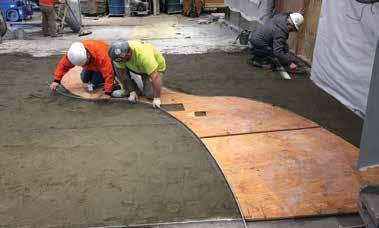
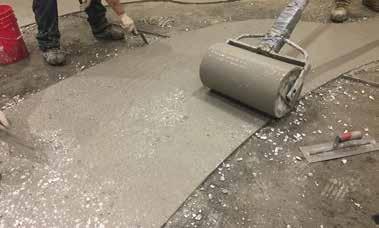
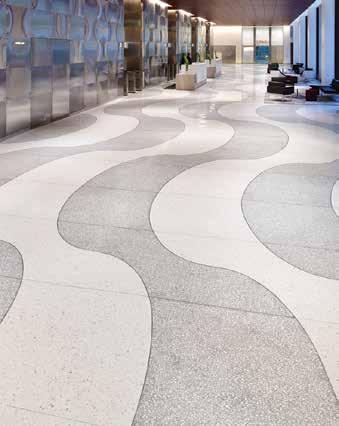
Terrazzo is a handcra ed building material; its primary components are assembled on the construction site. For 100-years, the contractor members of the National Terrazzo and Mosaic Association have brought integrity and skill to countless installations. The NTMA has the expertise your project needs. Find specifications, information, color samples, contractor and supplier members at www.ntma.com or call 800-323-9736.
Laudadio
operational stability and project continuity. Skills development not only builds capability, but also strengthens engagement, signaling that the company is committed to long-term growth for its people.
Digital workforce management platforms can support this effort by linking training access, scheduling and performance data. When learning and development are part of everyday operations throughout the right HR technology, productivity can improve and rework can decline.
Protect institutional knowledge before it leaves
The experience of senior project managers, foremen and tradespeople often determines whether jobs finish on time and within budget. Without a deliberate plan for knowledge transfer, that expertise disappears as veteran employees retire.
Establish structured mentorship programs and encourage senior staff to document their methods, lessons learned and best practices. Embedding these habits into regular operations—through project reviews, checklists, or internal knowledge libraries—ensures that critical insights remain available, and your teams remain consistent across jobs and regions as workforce demographics change.
Use technology to meet new workforce expectations
Digital tools now shape how employees experience their work. Paper-heavy systems frustrate younger workers and slow field operations. Mobile workforce platforms that manage scheduling, payroll, reporting, and performance management give employees easy access to information and improve communication between sites and offices.
For leadership, these systems also can generate valuable analytics on labor trends, resource utilization and project costs. With better visibility, executives can anticipate
workforce bottlenecks and align staffing decisions with project priorities.
Engage through culture, growth and purpose
Retention in today’s market requires more than competitive pay. Workers stay with companies that offer stability, growth and purpose. Clear advancement paths, recognition programs and visible leadership involvement help reinforce these values.
Transparent compensation practices, paired with ongoing development and cultural alignment, create a powerful retention model that goes beyond salary alone.
Build a workforce model that supports efficiency
Managing a younger workforce amid a labor shortage requires deliberate alignment between workforce strategy and business operations. Training, mentorship, technology
Generational change and labor scarcity are reshaping commercial construction. Companies that modernize how they recruit, train and retain their people will not only maintain productivity, but also gain an edge in project delivery and profitability.
Younger professionals also look for alignment with company mission—whether through safety leadership, environmental responsibility or community partnerships. When firms communicate their purpose and back it up with consistent action, employees take pride in their work and develop stronger loyalty.
Keep compensation strategies data-driven
Pay remains the strongest motivator for attracting and keeping talent, but it must be managed strategically. ADP Research’s Today at Work data shows that construction wages have increased almost 15% since 2020, with median annual compensation near $66,400 in June 2025. Bonuses also are rising, averaging more than twice those offered in other industries.
Tracking wages and benefits through robust compensation benchmarking analytics data can help firms stay competitive.
and data all play interconnected roles in meeting deadlines, controlling costs and maintaining quality.
When these elements function together, workforce management becomes a lever for operational efficiency rather than a reactive HR task. The result is improved project performance, lower turnover and greater organizational resilience.
The bottom line
Generational change and labor scarcity are reshaping commercial construction. Companies that modernize how they recruit, train, and retain their people will not only maintain productivity, but also gain an edge in project delivery and profitability.
Younger workers bring ambition, adaptability, and technical aptitude. With the right systems and leadership in place, that potential becomes a foundation for sustainable success—project by project and year after year. CCR
After spending six years at Accenture leading technology and strategy projects, Kit Dickinson moved on to IDI where he was president and responsible for managing strategic partnerships, product innovation, sales, marketing and overall company leadership. He led IDI to a successful acquisition by ADP where he was responsible for overseeing integrating IDI’s capabilities into ADP technology. Dickinson recently moved into ADP’s Business Development organization as an industry executive to help lead ADP’s industry-focused efforts.
Student Insider
Presented by
Student Insider
Dear Skills Trade Student
While construction and technical skills are your primary focus, ConstructEDU Student Insider (CEDU) is designed to supplement your education by providing content that dives into the business of the commercial construction and renovation industry. The bi-monthly newsletter covers areas such as emerging technologies, regulatory issues and other factors shaping the diverse industry’s future. CEDU also features insights and profiles from industry thought leaders on the trends and challenges affecting the marketplace.
Delivered at no charge, we not only encourage you to make CEDU a part of your educational consumption, but also to share it with your peers.
Concrete Industry Management Program Names Auction Lineup at World of Concrete ‘26
From Kentucky Derby weekends and VIP NASCAR packages to premium tools, travel getaways and custom gear, the CIM Auction at World of Concrete 2026 has something for everyone. Held this past January in Las Vegas, the annual event raises critical funds to support the Concrete Industry Management program and the future leaders of the industry.
The Rosendin Foundation doubles grant awards to $100,000
The Rosendin Foundation is doubling down on community impact. For its 2026 grant cycle, the Foundation has increased its maximum award to $100,000 and plans to distribute at least $2.5 million to nonprofits supporting emotional, occupational and nutritional health. Applications are now open, with a May 29 deadline for qualifying organizations.
Cutting-Edge Biotechnology Center Opens at San Jacinto College
San Jacinto College has opened a new Center for Biotechnology at its Generation Park campus, creating hands-on pathways into Houston’s fast-growing life sciences sector. Designed by Pfluger Architects, the flexible, immersive facility prepares students for in-demand biomanufacturing careers through real-world training environments and industry-aligned programs.
Read More HERE
Mitsubishi Electric Continues to Build Tomorrow’s Workforce
The manufacturing skills gap is no longer a future problem—it’s impacting production right now. As digital transformation accelerates, manufacturers need workers trained in automation, data and advanced systems to keep pace. Mitsubishi Electric Automation is helping close that gap by partnering with schools and training institutions to build real-world skills.
Read More HERE
Healing by Design
Healthcare design is the new prescription
By Sabrina Boccuzzi
Much like casinos, hospitals have the power to make time stand still. This ability, shaped by their infrastructure and the clinicians within, impacts patients and staff in various ways.
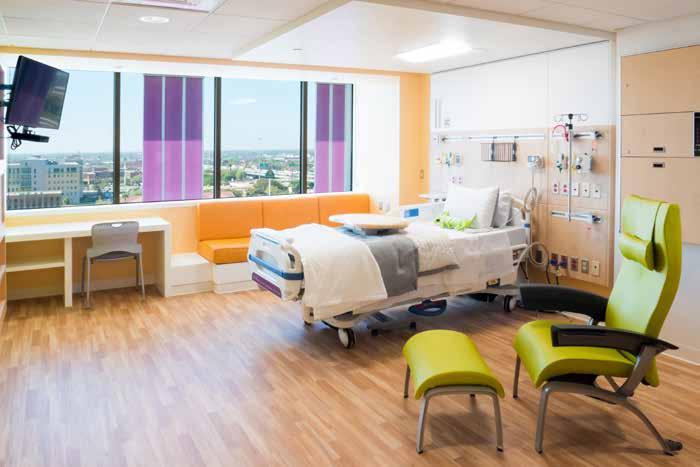
Healthcare environments are constantly transforming. No longer are hospitals and clinics designed solely for treatment. They are becoming carefully crafted spaces that promote healing, reduce stress and support both patient and staff well-being. Architectural design is at the forefront of this shift, with light materials and design elements working together to improve care delivery outcomes and redefine the healthcare experience.
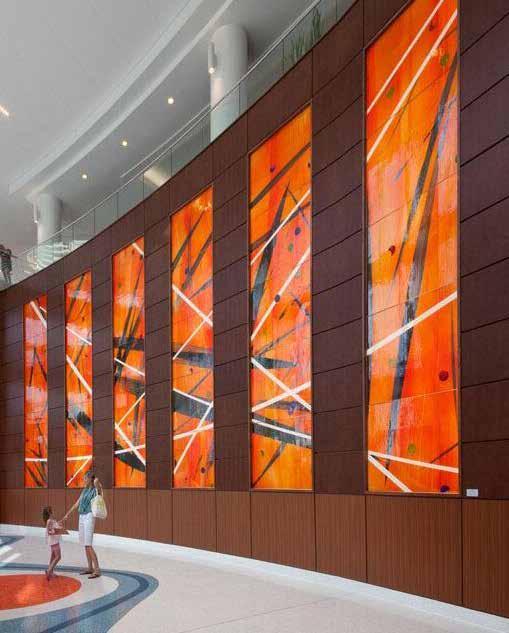
Photo Courtesy of James Steinkamp
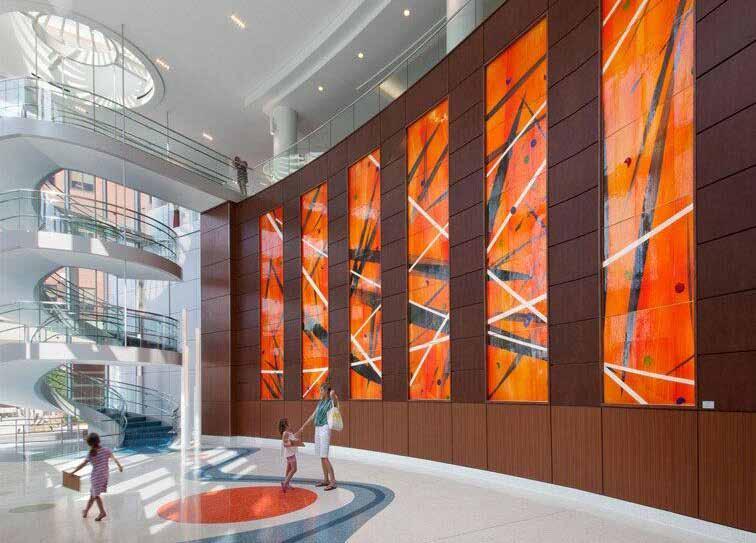
Guy Kemper’s playful installation at Children’s Hospital of Alabama is crafted from Bendheim’s Lamberts® mouth-blown art glass.
Today’s most effective healthcare designs are informed by a growing body of evidence showing that the physical environment directly impacts physical and emotional health. This understanding is shaping a new generation of medical facilities.
“I’ve made the argument that architecture is a medical intervention and has as much impact on our bodies and health as much as a pill you might take or a procedure you might get in a waiting room,’’ says Diana Anderson, MD, M.Arch,
FACHA, who brings together a background in both medicine and architecture through education and professional experience. “Existing evidence in clinical and architectural professions shows that spaces around us impact our brains and bodies just as much as medical intervention.”
WELLness Spaces
The principles of the WELL Building Standard increasingly guide healthcare design today. According to the WELL Standard, this system measures how features of the built environment—such as air quality, lighting systems and material choices—affect health and well-being.
In medical facilities, these standards are especially relevant because of the intense demands placed on patients and care providers. Buildings that Care explains that WELL-certified spaces aim to reduce burnout, improve sleep patterns and support productivity. This standard prioritizes regular access to daylight, healthy materials and supportive design for hospital staff, who are often the primary occupants of these buildings.
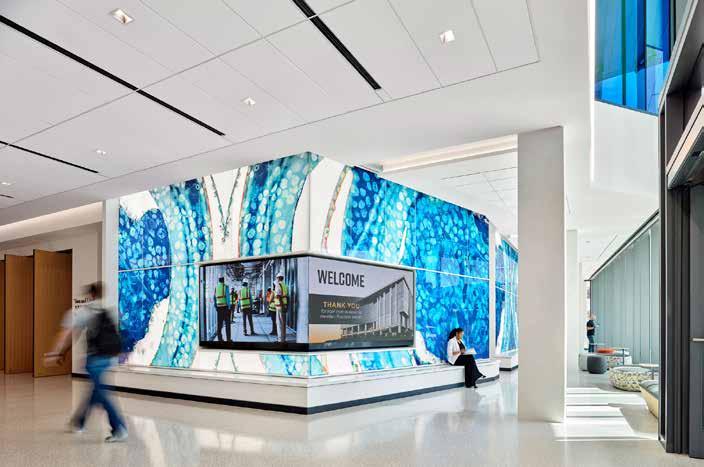
In addition to its functional properties, glass is increasingly being used as a medium for art and storytelling in healthcare settings. One example of this can be found at the Roy Blunt NextGen Precision Health Institute in Missouri, where a glass-clad installation featuring scientific imagery adds both beauty and meaning to the facility.
The artwork, created in memory of a loved one lost to cancer, serves as a powerful tribute to the ongoing pursuit of medical innovation. The piece is mounted with the UL listed Turnkey Fusion Light Wall System for backlit glass and Bendheim’s LE’Diffusion Safety Glass. Engineered to ensure shadow-free light dispersion, the system hugs the wall with its minimal 2 1/16” overall depth. By using glass as both a design and storytelling medium, healthcare institutions are able to reflect compassion in their spaces.
Natural Light as a Therapeutic Tool
Among the most influential design elements in healthcare is natural light. Exposure to daylight is now understood to play a critical
(Top)
Photo Courtesy of The Children’s Hospital of San Antonio; (Bottom) Photo Courtesy of Brasfield & Gorrie
role in mental health, sleep quality and physical healing. A 2021 study showed that patients with access to natural light experience shorter hospital stays, require less pain medication and report greater satisfaction with their care.
The value of daylight extends beyond the patient as well. Staff working in environments with natural light report increased alertness and reduced fatigue. It restores a sense of rhythm in settings where people often lose track of time and place. In hospitals across the country, glass is being used in patient rooms, corridors, waiting areas and public spaces to enhance the overall experience. Its ability to deliver light while still maintaining privacy is particularly valuable in medical environments.
At Jersey City Medical Center, architects thoughtfully integrated Bendheim’s Houdini™ linear textured and low-iron 504 Rough Cast™ textured channel glass into the hospital’s exterior design to bring in abundant natural light. These materials,
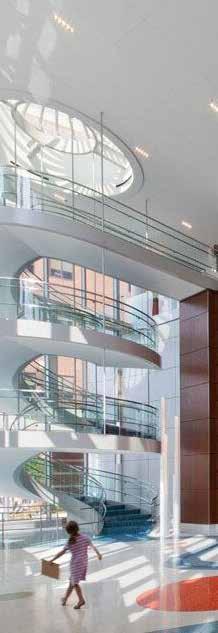
Bendheim’s EcoGlass™ railings and balustrades flow through the atrium of St. Vincent’s Bruno Cancer Center, reflecting light and movement to create a calming, healing environment for patients and visitors.
(Top)
Photo Courtesy of The Children’s Hospital of San Antonio; (Bottom) Photo Courtesy of Brasfield & Gorrie
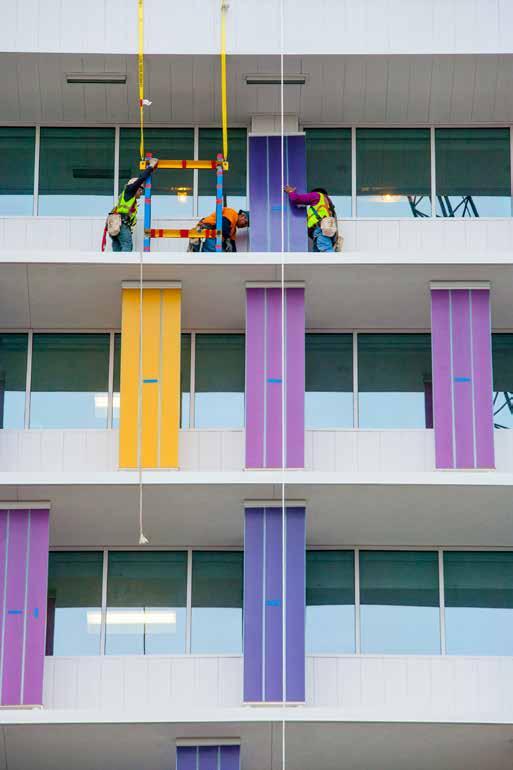
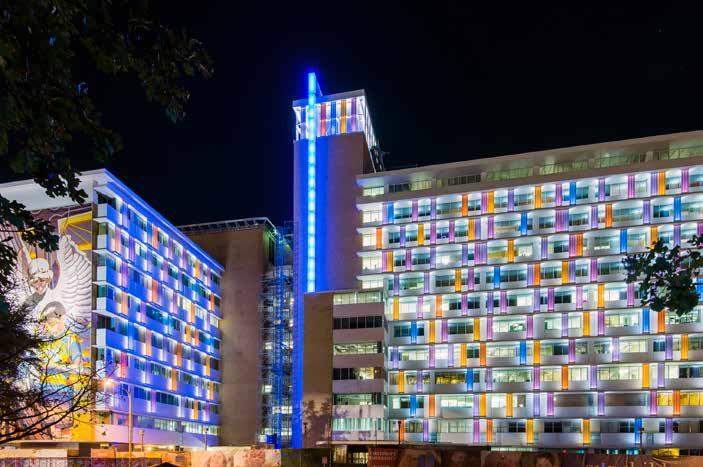
The Children’s Hospital of San Antonio glows at night, illuminated by Bendheim’s vibrant fritted channel glass facade inspired by the hospital’s logo and multi-story mural.
BUILDING YOUR BRAND
Our master builders travel wherever our customers want to grow. Decades of cross-country construction allow us to build a Wesco in the northern Michigan snow and ensure that a Real Seafood in Florida adheres to hurricane building codes.
while providing enhanced thermal performance, filter daylight into patient and care areas, creating a bright environment that supports healing.
Balancing Visibility and Privacy
In healthcare, privacy is a form of psychological safety. Patients need to feel protected and respected, especially during moments of vulnerability. At the same time, visibility supports a connection to their surroundings. Navigating this is one of the great design challenges in medical architecture.
Innovations in glass and glazing technology are helping strike this balance. Channel glass, frosted finishes and tinting systems make it possible to diffuse light and obscure views while maintaining a sense of openness. Designers now can create spaces that feel bright and breathable yet still shielded from direct exposure.
“Being aware of the spaces around you is important,’’ Anderson says. “I worked in some older emergency departments with no windows, chaos, sensory stimuli, noises, no colors and thought ‘I
“The practice of medicine has changed. It’s no longer sort of a physician in a white coat behind a desk in a clinic room, and the patient’s sitting in front of him, where the environment conveys a certain hierarchy.”
— Diana Anderson, MD, M.Arch, FACHA
can’t stand this’. I considered leaving, I didn’t think I could tolerate the environment. I started asking why we are working in these environments. How did it impact patients and could it be different?”
Even when people can see beyond their room, even faintly, it reduces feelings of isolation. Privacy and perspective are not mutually exclusive. With the right material strategies, they can coexist to foster dignity and psychological comfort.
Designing Against Germs
Every surface, corner and seam must stand up to rigorous cleaning, resist bacterial growth and endure high traffic without compromising safety. This is where material choice becomes critical. Glass offers a unique combination of visual clarity and hygienic resistance. Its non-porous surface is naturally resistant to microbes and easy to disinfect, making it ideal for high-touch zones like exam rooms, isolation units and labs.
From a patient room, Bendheim’s translucent purple channel glass is visible along the facade of The Children’s Hospital of San Antonio.
Photo Courtesy of The Children’s Hospital of San Antonio
DESIGNED TO AMAZE.
NEW! Skyline and Highrise Series Euro Style Partitions
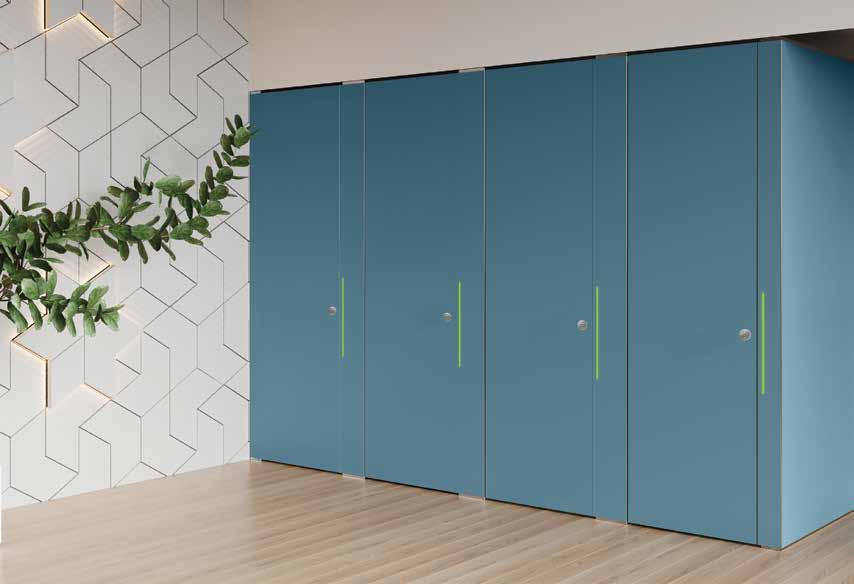
The elegant design of Bradley’s exclusive collection of Euro style partitions flawlessly combines beauty and performance raising the standard in commercial washrooms. Two new series options, Skyline and Highrise, feature high-design materials, occupancy indicators, increased privacy, and seamless construction to provide an elevated look and welcoming spaces. Commercial Washrooms. Brought to Life.
bradleycorp.com/euro-style-partitions
HIGHRISE SERIES
Phenolic LT
Unlike porous materials, glass doesn’t harbor contaminants, which helps reduce transmission risks across patient-care settings. Improved transparency with anti-reflective coatings also improves visibility for infection control teams, allowing better monitoring of both people and processes.
Beyond its sanitary properties, glass is also a practical choice for long-term use. It withstands frequent cleaning without degrading. Innovations like Bendheim’s Turnkey and Z-Kiss systems offer concealed mounting with pre-attached hardware, dramatically simplifying installation, saving downtime and money. Glass systems can reduce maintenance costs, designed for fast access to the walls, making refurbishments easy without damaging surrounding surfaces.
Glass systems have become increasingly popular, as they improve daylighting and allow for dry joint assembly, eliminating the need for silicone sealants. Bendheim systems offer third-party verified HPDs and EPDs, allowing architects to design with products that meet stringent green building requirements. Bendheim glass is manufactured in New Jersey under its comprehensive “Building a Clear Future” initiative, advancing sustainability throughout every aspect of their operations.
Toward a Healthier Future
What’s shifting in healthcare isn’t just how hospitals look, it’s how people understand healing. There’s deeper recognition now that healing begins well before treatment and that the spaces which are built speak volumes about intended care.
“The practice of medicine has changed,’’ Anderson says. “It’s no longer sort of a physician in a white coat behind a desk in a clinic room, and the patient’s sitting in front of him, where the environment conveys a certain hierarchy. Now, we practice shared decision making and as clinicians we provide information to help patients and families make the best decisions according to their views and goals of care. And so, you can think about spaces being more conducive to the model of healthcare delivery, like round tables, where everyone is equal.”
Glass, once seen as a purely functional material, has become a powerful ally in this movement, shaping how people feel, connect and recover within medical environments. CCR
Sabrina Boccuzzi covers topics related to building, construction, industry trends and broader trade topics. She can be reached at sboccuzzi@mercurymc.us.
REDEFINING TOUCHLESS WITH NO VISIBLE SENSORS
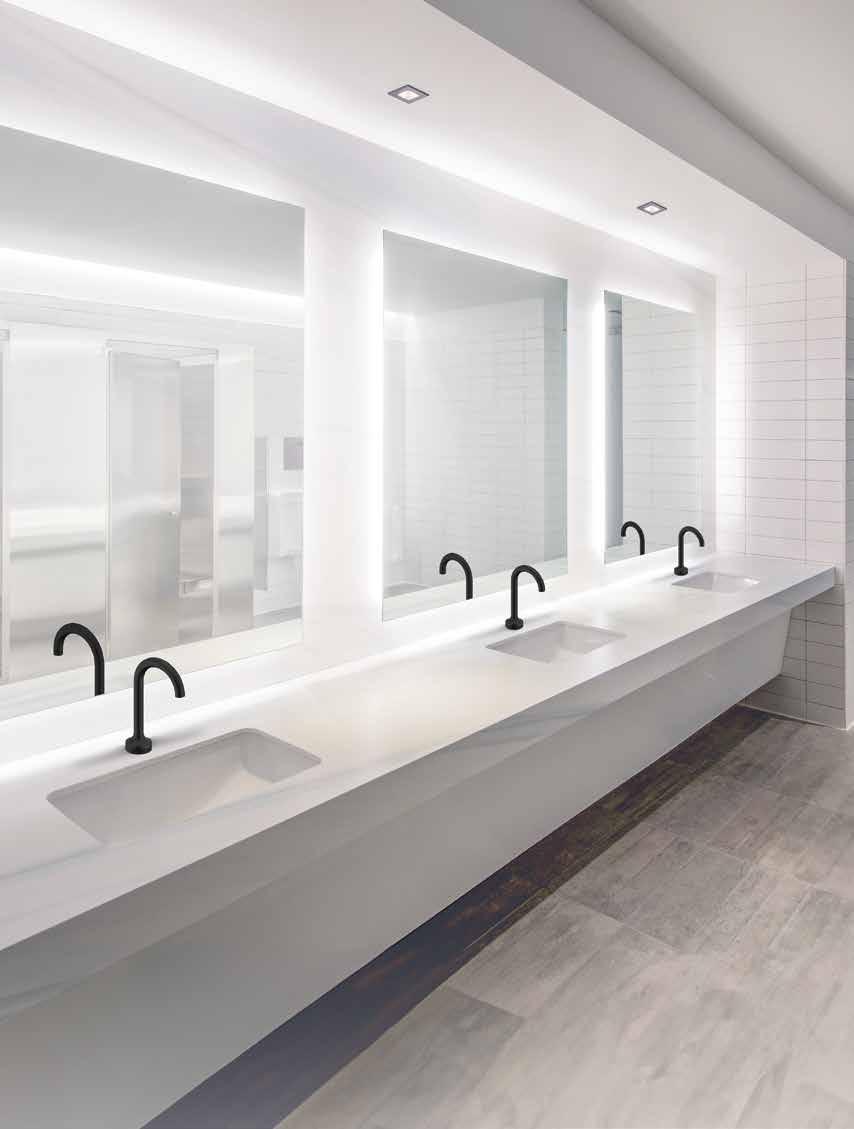
Proximity® Sensing Technology offers a new standard in faucet innovation by delivering a seamless touchless experience that enhances hygiene, durability, and design without any visible sensors.
IT’S THAT SIMPLE
We’re a company with a fresh approach. We are highly skilled and passionate design and construction experts brought together and bonded by mutual trust and respect.
Every member of the PMC team stands ready to deliver, regardless of location, complexity or challenge. We will bring your projects to market with a focus on quality, performance and speed.
Professional Design and Project Management Services for the Retail, Restaurant, Hospitality, Entertainment and the Commercial Markets.
Better. Faster. Smarter
Architecture/Design Firms Survey Highlights Teams Shaping Today’s Spaces
Fr om large-scale campuses and mixed-use developments to healthcare, education and workplace environments, our Architecture and Design Firms Survey spotlights the firms translating vision into built reality. These teams balance creativity with constructability, shaping spaces that support people, performance and long-term value. If you want to be listed in a future issue, contact Publisher David Corson at davidc@ccr-mag.com .
Top Ten Totals
//3877
David Shove-Brown, Partner
3299 K Street NW, Suite 300 Washington, DC 20007 (202) 350-4244 • (202) 258-1709 dsb@studio3877.com www.3877.design
api(+)
Juan Romero, AIA, NCARB, President + CEO
2709 N Rocky Point Drive, Suite 201 Tampa, FL 33607 (813) 281-9299
Year established: 2011, Number of employees: 47, Retail: $109,623.64, Restaurants: $3,000,529.42, Multi-Housing: $396,960.85, Hospitality: $4,919,839.91, Healthcare: $2,642,659.59, Federal: N/A, Other: $323,675.24, Total: $11,393,288.65, Completed Projects In 2025: 75 Specialize In: Cannabis, Craft Brewing, Education, Healthcare, Hospitality, Multi-Housing, Residential, Restaurants, Retail
3MG, PSC
Manuel Ray, President 1649 Ponce de Leon Ave.
De Diego Ward San Juan, PR 00926 (787) 979-9982 • (787) 375-5770 mray@3mg-pr.com www.3mg-pr.com
Year established: 2006, Number of employees: 22, Retail: $138,000.00, Restaurants: $211,000.00, Multi-Housing: N/A, Hospitality: $1,525,000.00, Healthcare: N/A, Federal: N/A, Other: $491,423.00, Total: $2,624,577.00, Completed Projects In 2025: 1
Specialize In: Hospitality, Ports, Terminals
Ankrom Moisan Architects
Dave Heater, Vice President of Business Development 38 NW Davis St., 300 Portland, OR 97209 (206) 567-1600 • (206) 902-7002 daveh@ankrommoisan.com www.ankrommoisan.com
Year established: 1983, Number of employees: 139, Retail: $335,473.39, Restaurants: N/A, Multi-Housing: $15,943,699.26, Hospitality: $2,838,237.66
Mike Pothast, Senior Director, Business Development 3601 Rigby Road, Suite 300 Dayton, OH 45342 (937) 435-8584 mike.pothast@cesoinc.com www.cesoinc.com
Year established: 1987, Number of employees: 425, Retail: $25,500,000.00, Restaurants: $4,600,000.00, Multi-Housing: N/A, Hospitality: N/A, Healthcare: N/A, Federal: N/A, Other: $42,600,000.00, Total: $72,700,000.00
Mark Landini, Co-Founder & Creative Director 43 Rainford Street Surry Hills, NSW 2010 +61 2 9360 3899 studio@landiniassociates.com www.landiniassociates.com
Year established: 1993, Number of employees: 25, Retail: N/A, Restaurants: N/A, Multi-Housing: N/A, Hospitality: N/A, Healthcare: N/A, Federal: N/A, Other: N/A, Total: N/A, Completed Projects In 2025: N/A
Douglas DeBoer, Founder / Creative Director 2554 Lincoln Blvd, PH 725 Marina Del Rey, CA 90292 (800) 92-REBEL • (857) 829-0925 douglas@rebeldesign.com www.rebeldesign.com
Year established: 1985, Number of employees: 140, Retail: $2,690,998.00, Restaurants: $6,757,800.00, Multi-Housing: $2,744,450.00, Hospitality: $19,233,222.00, Healthcare: N/A, Federal: N/A, Other: $1,473,230.00, Total: $32,899,700.00, Completed Projects In 2025: 18
Melanie Gifford, Senior Director of Business Development 461 From Road, Second floor Paramus, NJ 07947 (973) 253-9393 • (323) 775-2404 mgifford@sargarch.com
www.sargarch.com
Year established: 1997, Number of employees: 200, Retail: $20,000,000.00, Restaurants: $8,000,000.00, Multi-Housing: N/A, Hospitality: $2,900,000.00, Healthcare: $5,100,000.00, Federal: N/A, Other: $6,800,000.00, Total: $42,800,000.00, Completed Projects In 2025: 2,415
Jay Baptista, Global Retail Market Leader 3133 West Frye Road, Suite 300 Chandler, AZ 85226 jay.baptista@stantec.com www.stantec.com
Year established: 1954, Number of employees: 34,000, Retail: $18,109,443.00, Restaurants: $1,409,259.00, Multi-Housing: $39,667,746.00, Hospitality: $12,596,351.00, Healthcare: $250,760,712.00, Federal: $31,672,321.00, Other: $842,053,673.00, Total: $1,205,285,055.00, Completed Projects In 2025: 9,001
Specialize In: Craft Brewing, Data Centers, Education, Federal, Healthcare, Hospitality, Multi-Housing, Residential, Restaurants, Retail, Shopping Centers, Commercial Mixed Use
Studio Rodrigo Buelvas
Jaime Tapias, Director of Operations 25 SE 2nd Avenue, Suite 918 Miami, FL 33131 (912) 257-0585 jaime.t@rodrigobuelvas.com www.studiorodrigobuelvas.com
Year established: 2020, Number of employees: 10, Retail: N/A, Restaurants: N/A, Multi-Housing: N/A, Hospitality: N/A, Healthcare: N/A, Federal: N/A, Other: N/A, Total: $1,300,000.00, Completed Projects In 2025: 6
Karen MacCannell, COO 1850 South Boulder Avenue Tulsa, OK 74119 (918) 585-8555 x 320 karen@tmgnationwide.com www.TMGTransforms.com
Year established: 1998, Number of employees: N/A, Retail: N/A, Restaurants: N/A, Multi-Housing: N/A, Hospitality: N/A, Healthcare: N/A, Federal: N/A, Other: N/A, Total: N/A, Completed Projects In 2025: N/A
Specialize In: Hospitality, Restaurants, Retail, National ADA & Accessibility Consulting
HIGH QUALITY DELIVERABLES WITHIN 2MM
QUICK SPEED TO DELIVERY 10 DAYS OR LESS
FSU works with retailers, architects, restaurants, financial services, gas convenience, and commercial property owners nationwide. We work with everyone from development to construction managers, store planners to designers, and facilities to asset managers. WE HAVE YOU COVERED!
• 3D Surveys and BIM
• 2D Architectural As-Builts
• Due Diligence and Permit Research
• Facility Assessments, Audits, and Asset Surveys
• ADA Compliance
• Drone Surveys
The experience your project deserves
FSU works with retailers, architects, restaurant concepts, financial services, companies and facilities, and asset managers of every size across North America.
Tricarico Architecture and Design PC
John A. Czepiel, Vice President | Architecture 502 Valley Rd. Wayne, NJ 07470 (973) 692-0222
johncz@tricarico.com www.tricarico.com
Year Established: 1987, Number of employees: 50, Retail: $13,125,000, Restaurants: $1,250,000, Multi-Housing: N/A, Hospitality: N/A, Healthcare: N/A, Federal: N/A, Other: $1,625,000, Total: $16,000,000
Year established: 1968, Number of employees: 472, Retail: $47,100,000.00, Restaurants: $6,000,000.00, Multi-Housing: N/A, Hospitality: N/A, Healthcare: $27,000,000.00, Federal: N/A, Other: $3,200,000.00, Total: $59,000,000.00, Completed Projects In 2025: N/A
Specialize In: Healthcare, Restaurants, Retail
SUR FACES
Scan to View Brochure
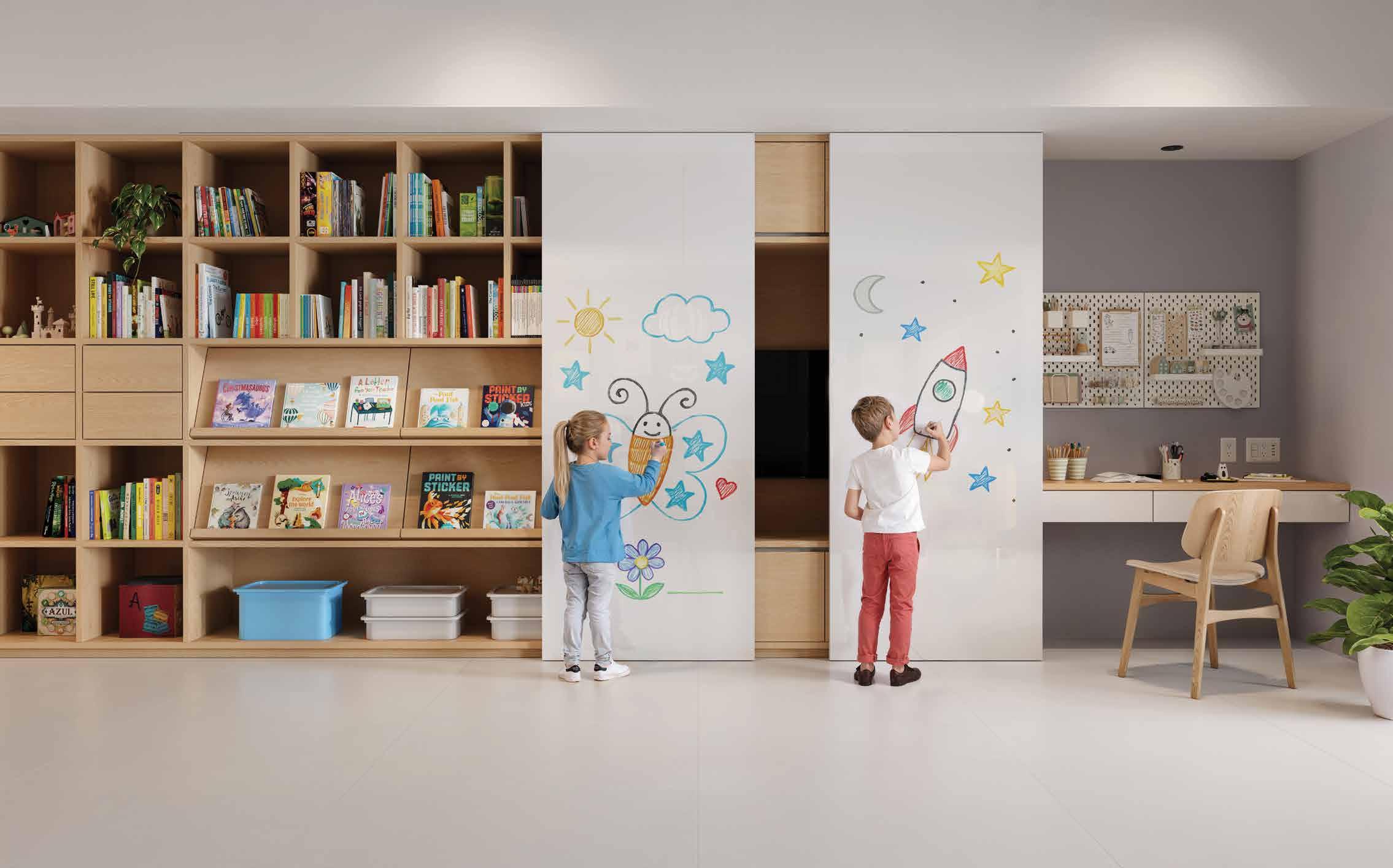
MAX™ Glassboards expand the vision and purpose of your interior spaces. Named to celebrate GGI founder, Max Balik, these made-to-order glass marker boards expand vertical and horizontal surfaces into dynamic surfaces for inspiration, collaboration, and organization. You can count on GGI for contemporary ideas, an inspired approach, and the integrity, reliability, and personal service that come from a family business. When we say we know glass from the ground up, we mean it. We see what glass can do.
info@generalglass.com | www.generalglass.com
Building for All Ages
How pre-designed playgrounds are redefining community spaces
By Rich Albright
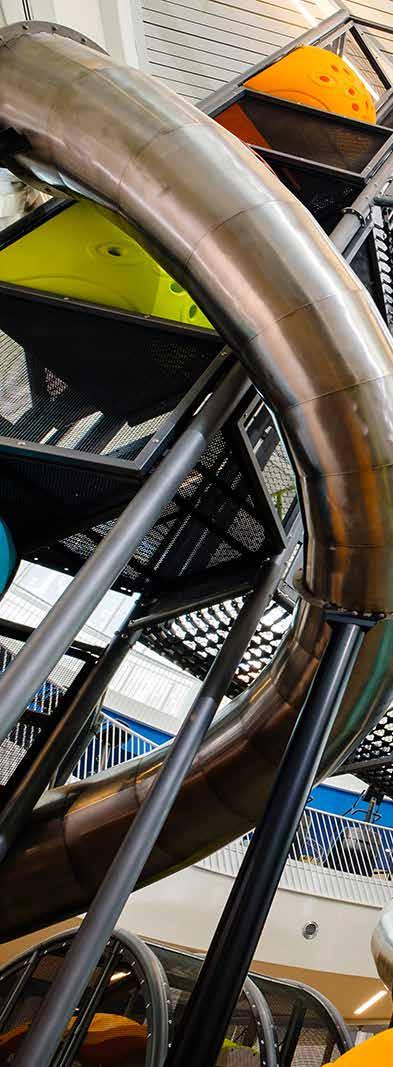
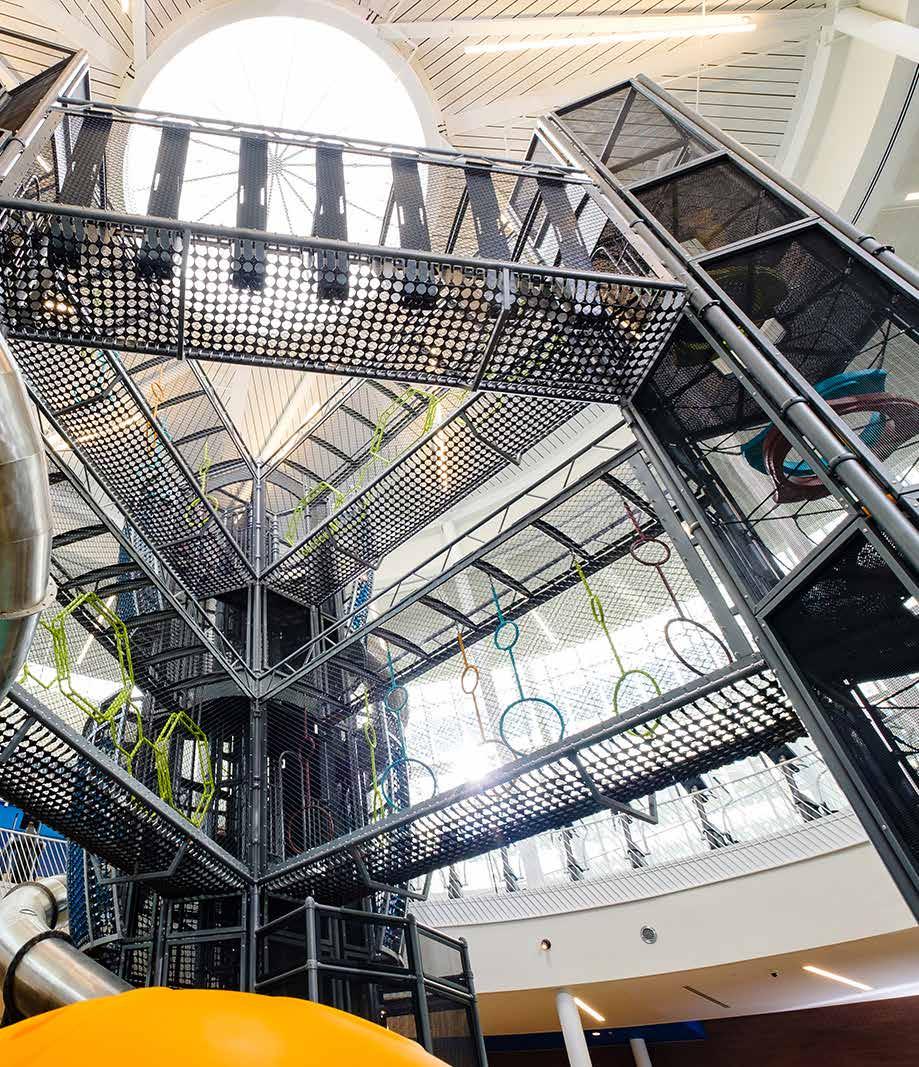
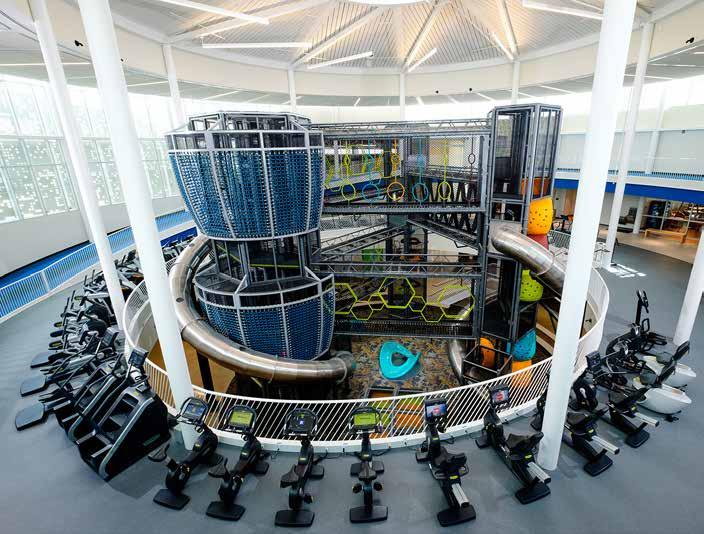
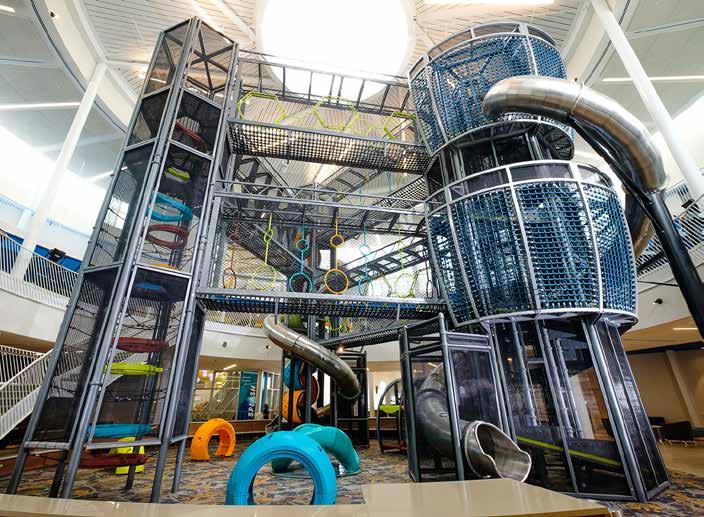
Across the country, a new generation of spaces is redefining recreational play, inviting not just children, but people of every age to move, connect and belong. This growing movement toward all-ages play is changing the landscape for developers looking to add value, attract families and foster stronger community connections.
Whether incorporated into mixed-use developments, community centers or retail destinations, play environments are increasingly being seen not as amenities, but as essential investments in community well-being.
And with an increasing demand for solutions that balance creativity, affordability and speed of installation, pre-designed playground systems are an efficient, scalable way to deliver meaningful play experiences for every generation.
The Rise of Multi-Age Play
Modern families are busier than ever. Between work, school and extracurricular activities, shared family time has become a premium commodity. As a result, the demand for spaces where families can play, relax and reconnect has surged.
Faith-based organizations, malls, mixed-use developments and community recreation centers are responding by creating environments that serve as destinations for the entire family.
Creating multi-age play spaces isn’t simply about installing larger structures— it’s about designing for diverse developmental stages and interests.
This approach isn’t just about fun; it’s about wellness and quality time. Multi-age play environments provide opportunities for physical activity, social interaction and emotional development for users across generations. For children, these spaces promote gross motor skills, sensory engagement and cognitive growth.
These modern play environments are as developmental as they are dynamic, encouraging movement, sensory discovery, and problem-solving in young children, while offering teens a place to stay active, relieve stress and connect with others. The result is a thoughtfully designed playground experience where imaginative play zones meet bold, challenge-based features.
Imagine Your Brand in Lights
We will design something that is uniquely yours using our mastery of light, color and materials.
The Power of Inclusive and Intentional Design
Creating multi-age play spaces isn’t simply about installing larger structures—it’s about designing for diverse developmental stages and interests. Play areas that balance challenge and safety help children build confidence while maintaining an appropriate level of risk.
Successful multi-age environments also incorporate separate but connected zones, such as toddler-friendly spaces alongside more advanced climbing or obstacle areas for older children. This allows families to play together while ensuring that each age group has its own area for exploration and growth.
The integration of sensory-based play features is another growing trend. These elements, from tactile panels to interactive
Thoughtfully designed play environments can bridge generations, strengthen relationships and create lasting value for the people who live, work and gather there.
sound and light features, support children with sensory processing differences while adding an extra layer of engagement for all users.
Balancing Vision, Budget and Timeline
For developers, integrating a playground or play area into a project often comes with challenges: balancing creative design goals with construction timelines, safety standards and cost considerations. In many projects,
play spaces are among the last elements to be installed, meaning they must fit into tight project schedules without compromising quality or safety.
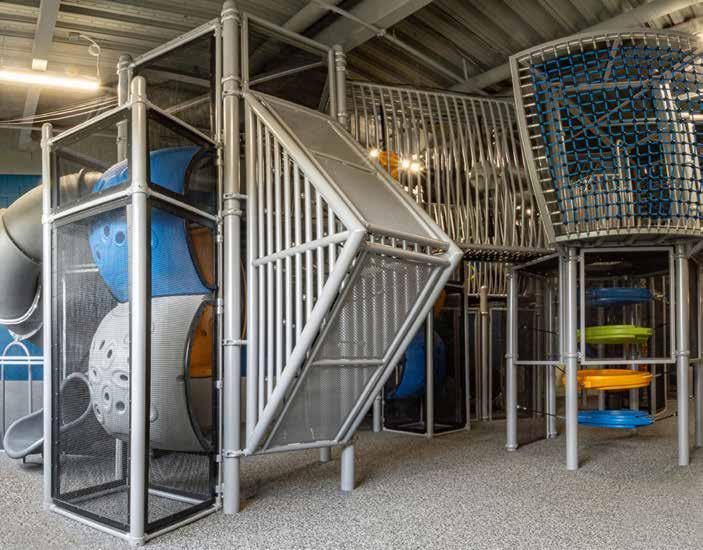
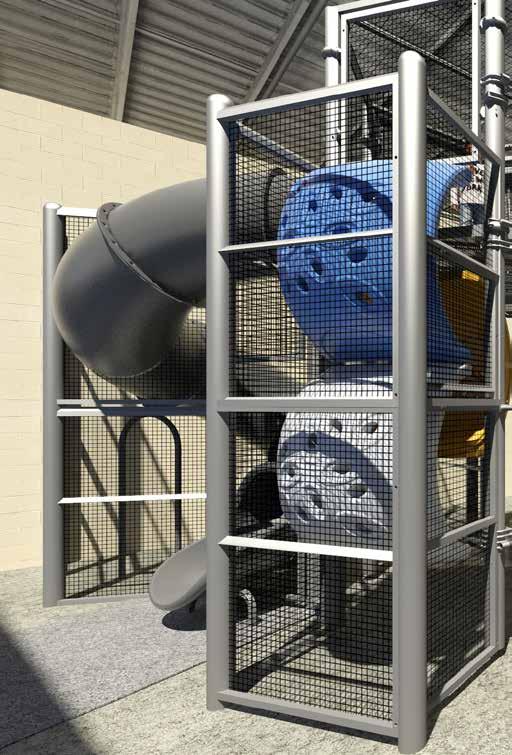
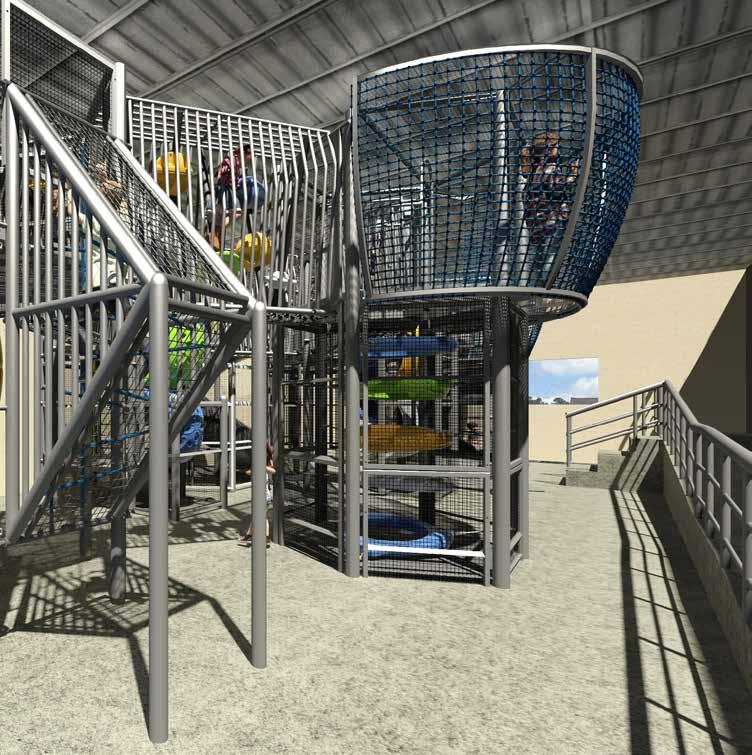
That’s where pre-designed play systems come into play. These systems are designed to streamline installation and simplify site coordination, offering pre-engineered configurations that can be tailored to a project’s footprint, audience and budget. Instead of starting from scratch, developers can choose from proven layouts
that are adaptable to various site conditions, a benefit that saves time during both design and installation phases.
Because these systems are built on tested designs, they can reduce engineering costs, minimize permitting delays and accelerate overall project completion. Juggling multiple construction partners can be tedious for developers and this efficiency helps ensure that the playground doesn’t become a bottleneck in the final stages of delivery.
The Budget-Friendly Advantage
Pre-designed playgrounds not only save time, they also offer a more predictable cost structure. With standardized components and configurations, developers can better forecast expenses.
These systems often include pre-selected combinations of slides, climbers, interactive panels, and sensory play elements, creating comprehensive play experiences without the need for higher design fees associated with more custom builds. When working with tight budgets or managing multiple properties, this predictability is invaluable.
Moreover, many manufacturers now offer pre-designed scalability, allowing developers to start with a foundational structure and expand or enhance the play area over time. This staged approach makes it possible to phase investment strategically while keeping play environments fresh and engaging for returning visitors.
What to Look for in a Playground Partner
Choosing the right playground manufacturer or partner is one of the most important decisions in the development process. A strong partner can help guide the project from initial concept through installation, acting as a consultant, collaborator and compliance expert all in one.
A turnkey provider simplifies the process by managing key steps, such as:
> Design Consultation – Helping developers select the right layout and play mix based on site, user demographics and goals.
> Permitting Support – Navigating local regulations, safety standards and accessibility codes to ensure full compliance.
> Installation Coordination –Overseeing site preparation and installation to minimize disruption and reduce costly delays.
When evaluating potential partners, developers should also look for manufacturers that prioritize the following:
> Inclusivity – Modern playgrounds should welcome children of all abilities. Seek out suppliers that specialize in inclusive design and offer elements supporting
diverse physical, cognitive and sensory needs. Inclusive play equipment ensures that every child—regardless of ability— can participate meaningfully.
> Safety and Visibility – Equipment should meet or exceed industry safety standards and layouts should provide clear
sightlines for parents and caregivers. This helps ensure that all ages can share the same space safely.
> Theming and Engagement – Thoughtful theming can dramatically elevate a play environment. Whether inspired by nature, technology, or adventure, cohesive
themes add personality and engagement—appealing to a wider audience and encouraging repeat visits.
The Future of Multi-Age Play
The future of playground design lies in adaptability. As design technology
advances, more playground systems are being created with upgradable components, allowing operators to refresh the experience without replacing the entire structure. This approach not only reduces lifecycle costs but also helps communities evolve their play offerings alongside changing demographics and trends.
The next decade will also likely see greater integration between physical and digital play. Interactive play panels and gamified features are already blending technology with movement, appealing to
older children who crave challenge and engagement in new ways.
Ultimately, the goal is to create environments that bring communities together, spaces that encourage healthy activity, creative exploration and intergenerational connection.
When it comes to developing and planning a playground, incorporating play into a project isn’t just a design choice; it’s a statement about community values. Play spaces draw families, drive foot traffic and help transform developments into true destinations.
By partnering with manufacturers that offer pre-designed and inclusive solutions, developers can deliver these benefits efficiently and affordably, without sacrificing creativity or quality.
As communities continue to evolve, one thing remains constant: the need for connection. Thoughtfully designed play environments can bridge generations, strengthen relationships and create lasting value for the people who live, work and gather there. In today’s fast-paced world, that’s not just a design advantage, it’s a community imperative. CCR
Rich Albright is VP and GM of Soft Play, a global leader in immersive indoor, outdoor, and waterplay environments. At Soft Play, a PlayPower brand, he oversees the creation of customized, imaginative play experiences—from sculpted structures to gamified environments—that inspire creativity and build brand loyalty. With over 20 years of sales and leadership experience, Rich has led high-performing teams and driven business growth across multiple industries.
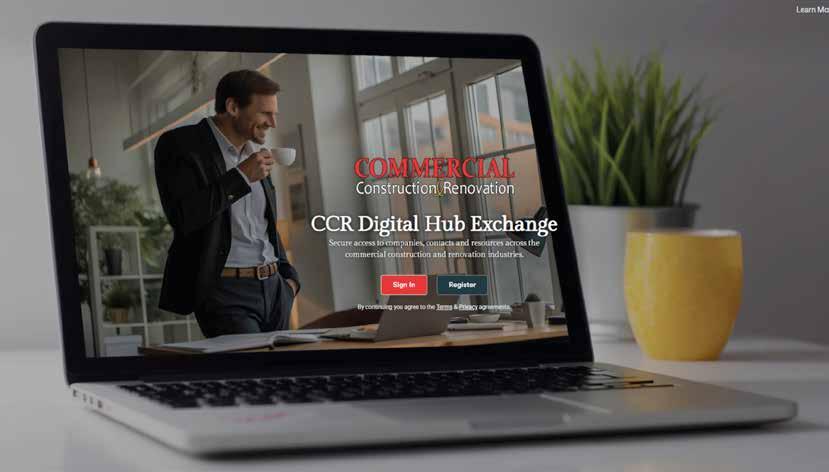
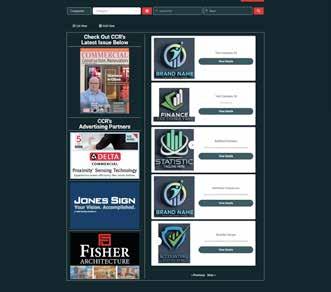
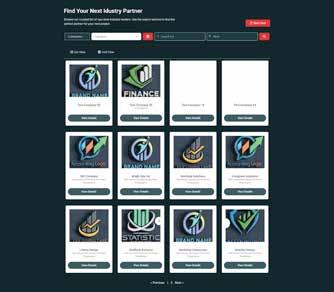
CCR Digital Hub Exchange
A secure, curated index of companies and contacts serving the commercial construction & renovation ecosystem.
When Risk Becomes Reality
8 trends influencing commercial construction disputes, litigation in 2026
By James Gallagher
In 2026, it is predicted by the American Institute of Architecture (AIA) that the construction industry will experience another year of limited growth, following a lackluster 2025. While selective bright spots are anticipated for construction in healthcare, education, infrastructure and data centers, other areas such as the construction of office buildings, residential and retail are expected to experience slow or negative growth.
In addition, factors such as materials price increases, manpower shortages, tariff uncertainty and supply chain inconsistency, among others, continue to put pressure on starts, timetables and profitability for the U.S. construction industry.
In today’s construction industry, inconsistency triggers disputes. With 2026 shaping up to be another unpredictable year on many levels, one phenomenon we anticipate with certainty is growth in the number of construction disputes. An increase in the number of disputes doesn’t necessarily mean an escalation in litigation.
With the high cost of litigation, the manner in which disputes will be handled,
with more being settled outside of the courtroom, will be an important trend in 2026.
The following will have the greatest influence in generating or preventing disputes and litigation in the construction industry in 2026. They include:
1 Whether integrating artificial intelligence (AI) into management and operations will prevent or intensify disputes.
While the construction industry has been traditionally known as a low-tech industry, AI seems to be entering construction at lightning speed. Having started to gain momentum in 2025, 2026 is likely to be the
The role of expert witnesses will evolve in 2026. Experts will be brought in earlier in the dispute process, more like consultants, to provide reports and testimony relating to cases.
year that AI is broadly utilized in many areas of construction management and operation. In many applications, AI will be present but operating in the background, especially in key areas such as scheduling, maintenance and safety. It remains to be seen whether AI has the potential to improve accuracy, efficiency and proactivity in order to be a factor in reducing or eliminating disputes.
2 Expanding usage of BIM techniques will broaden communication, but will this reduce disputes?
In 2026, it is predicted that more companies, both large and small, will incorporate Building Information Modeling (BIM) techniques into their construction management. But just because more people are planning and communicating together doesn’t necessarily mean that disagreements will diminish. That said, BIM techniques do have the potential to help identify disputes earlier in projects so that solutions can be developed earlier leading to earlier and less complicated resolution.
SIGNAGE THAT MAKES A STATEMENT
PROVIDING 60 YEARS OF CUSTOM SIGN MANUFACTURING AND INSTALLTION ACROSS THE U.S.
3 Will tariff and inflation inconsistencies increase the number of disputes?
While there was much talk about tariffs in 2025, the actual effects will be felt in 2026. Because tariffs can affect prices, higher or lower, as well as product availability, they add a dispute initiator that had not been present in previous years.
4 Workforce uncertainties can lead to quality and timing disputes. Workforce issues will continue to plague the construction industry in 2026. They consist of the industry having more job openings than there are candidates, and especially
qualified candidates. The workforce shortage phenomenon has the potential to create disputes due to their effects on quality and timing issues.
5 Inconsistencies in the utilization of robotics and other advanced technology relating to expectations. This year will be a major year for the introduction of advanced technology such as drones, AI, Internet of Things (IoT) and other technological advances to construction. As many of these are new applications of technology to construction, there are bound to be some unexpected issues that will provoke disputes.
6 Supply chain inconsistencies will continue to trigger disputes.
Over the last years, the supply chain for construction materials has been highly inconsistent. Supply and pricing of such key construction products as steel, timber, concrete and other key materials have been unpredictable. While measures are being taken to gain more control over the construction supply chain, it appears that it will continue to be inconsistent in 2026.
7 Legal language and contracts have not been modernized to account for new privacy and technology issues.
In 2026, there continues to be potential for disputes over such issues as cybersecurity, force majeure, unauthorized access to proprietary data, data mismanagement and other issues. In the legal world, many potential AI and other technology issues have yet to be addressed and properly defined.
Precedents have yet to be established. Modernizing contracts to define AI policy, information ownership, data management, utilization and other issues should be a priority in 2026 or the industry will continue to risk contract disputes.
8 So-called “expert witnesses” will be utilized outside of court in 2026. The role of expert witnesses will evolve in 2026. Experts will be brought in earlier in the dispute process, more like consultants, to provide reports and testimony relating to cases. This phenomenon will help influence quicker, earlier settlements without having to go to court.
While we expect the number of disputes to grow in 2026, those cases proceeding to court should actually decrease, largely due to the time and cost needed to pursue litigation. We can expect to see an evolution in dispute resolution in 2026 where experts will be brought into the process earlier to be able to influence quicker and lower cost resolution. CCR
James Gallagher, P.E., F.ASCE, is a construction dispute resolution thought leader and Principal at Resolution Management Consultants.
FireSmart Solar
Reducing risk on rooftop installations
By Tracey Greene & Kenneth Travers
As businesses throughout the country take steps to lower energy costs and access new power solutions, the use of solar energy continues to gain momentum. According to the Solar Energy Industries Association, solar production across the U.S. grew by 25% from 2010-2024 as many new projects came online in 2024.
The use of solar power can have positive impacts on the environment and generate long-term energy cost savings, but there are several factors that commercial property owners and facilities managers should consider prior to investing in solar energy.
One of those risks is fire. While considered to be relatively safe, when a rooftop solar panel fire occurs, it can be devastating.
Adding a renewable energy source to a building does pose potential for an increased fire hazard. That’s why it’s important that panels are installed and maintained properly to mitigate that risk.
According to leading real estate solar advisor SolarKal, while solar PV systems generally do not pose a higher fire risk compared to other electrical systems, it is important to address any potential hazards both during and after installation. When installing or maintaining existing solar panels, commercial property owners and facilities managers should consider the following suggestions to help reduce fire risk.
Work With Reputable Manufacturers and Installers
As market demand for solar has increased,
Fire hazards are not the only risk of solar panels. Damage from area vegetation or weather-related events can occur as well.
Depending on the geographic location, additional measures can be taken to reduce the likelihood of loss from weather-related events.
so has the number of contractors and companies supporting the industry. SolarKal reports that the U.S. counted more than 275,000 workers employed in solar as of 2023; of which 178,812 were installation and project development jobs.
Certification is important. Not all installers are certified for solar power, which may lead to questionable workmanship, improper installation and increased fire risk. Solar contractors and installers who have earned their North American Board of Certified Energy Practitioners voluntary certification are considered more favorably by insurers.
Building owners should confirm if an installer holds a manufacturer’s certified designation as part of their regular course of due diligence. Additionally, owners should ensure that installers follow the National Electric Code (NEC) guidelines. These have been adopted in all 50 states and represent the benchmark for safe electrical design, installation and inspection.
If a contractor is unfamiliar with NEC, that’s a red flag.
Use Quality Solar Panel Materials and Evaluate Rooftops
Facilities managers should also consider the materials that solar panels are built with. Make sure the panel module frame and back sheets are not constructed of plastic, especially foamed plastic, which can be highly combustible and lead to a rapidly developing fire.
Another frequently overlooked solar panel risk is the combustibility of a building’s roof. There are four different insurance classes for roofs. Class one is fire-rated and is the safest for solar panel installation. Lower roof classes often have combustible insulation underneath the roof cover, which can make electrical fires worse on a rooftop panel.
Combustible insulation can easily ignite and move a rooftop fire down into the building’s structure.
Create a Rapid Shutdown and Rooftop Access Plan
Solar panels can also create issues for firefighters during fires ignited elsewhere, creating a risk of shock and electrocution as they’re working and trying to put out flames. It’s important for commercial building owners and managers to create written emergency plans with clear lines of responsibility for shutting down solar power.
Those plans should be developed in partnership with the local fire department. Panels installed before 2017 may require a manual shutdown process. Those put in place after 2017 now are designed to include a rapid shutdown feature. Proper installation that adheres to manufacturer instructions is critical to ensure safety features are working correctly, as is keeping current on any product recalls.
Additionally, adequate space must be available on the roof for firefighters to combat a fire. Typically, rooftop panels should have 4-to-6-foot perimeters on the roof and 4-foot to 6-foot perimeters between panels. They may need to cut holes and open a roof to allow smoke and hot gases to exit a building. But if solar panels are placed too closely together, it may prevent them from doing this.
Inspect Solar Connectors
Solar panels rely on cables that connect inverters and combiner boxes to transfer electrical energy. When supply chains were disrupted during the pandemic, some solar panel installers used incompatible cables and connectors that were not from the same manufacturer. That can create a potential electrical failure point causing a short circuit and possibly initiating a fire.
We
Our specialized project management teams are highly effective in maintaining affordable budgets, meeting tight deadlines, and delivering quality construction turnovers on time, every time. From coast to coast, Alaska to Puerto Rico, Hunter Building Corporation has you completely covered on your next construction project!
We offer a multitude of services nationwide ranging from tenant improvements, build-outs, remodels, ground-up construction, and project management. Hunter Building Corporation takes pride in the fact that many of our clients have been repeat customers for many years.
For arrays installed between 2020 and 2023, it’s recommended to have a reputable electrician experienced in PV installation update connectors as soon as possible to ensure compatible parts are used. Electricians should also conduct a thermographic inspection of all PV panels, inverter and combiner box connectors to check for overheating and thermal damage, as well as replace any thermally or physically damaged components.
Schedule Regular Maintenance and Testing
As with any system, solar panels are susceptible to wear and tear and require regular testing and maintenance. Detailed inspections are recommended every two years. This includes powering off the entire system and testing all elements. There are a growing number of reputable national firms that building owners can hire to conduct this work.
Incorporate Battery Storage in the Equation
Battery Energy Storage Systems (BESS) are installations of one or more batteries meant to store and distribute electrical energy. They are quickly becoming popular additions to solar energy systems and require the same attention to installation detail and maintenance.
Adherence to National Fire Protection Association guidelines is necessary as these lithium-ion batteries can fail and ignite a “thermal runaway fire.” Extremely dangerous, thermal runaway occurs when
the batteries catch fire and release combustible gases, spreading flames rapidly in a cascading fire-event.
Minimize WeatherRelated Hazards
Fire hazards are not the only risk of solar panels. Damage from area vegetation or weather-related events can occur as well. Depending on the geographic location, additional measures can be taken to reduce the likelihood of loss from weather-related events.
These can include additional clearing
and trimming of trees around the building or installing special guards to protect the panels during a weather event.
Consider the Costs
Installing a solar energy system on a commercial building is a big investment. Making the choice should come after thorough research and exploration. As with any business decision, it is important to evaluate the overall risk and reward of adding solar.
Consider how energy savings and any tax incentives will offset the costs to install, insure and maintain solar panels. CCR
Tracey Greene, real estate industry Practice Leader at The Hartford; Kenneth Travers is a Technical Manager of Property Risk Engineering at The Hartford.
Size
Material
Type of Material
Layer 1 0.5 Wear layer Use layer with PU protection
Inside the design and construction of Maple Terrace Residences
Design. Build. Belong.
Inside the design and construction of Maple Terrace Residences
By Marc Angelillo
Rising 22 stories in uptown Dallas, Maple Terrace Residences strikes a careful balance between honoring the past and meeting the demands of modern city living. The project pairs a new mixeduse tower with the historic Maple Terrace building, originally designed by Alfred C. Bossom in the late 1920s. The development preserves Bossom’s limestone-clad facade while introducing a contemporary tower that integrates seamlessly into the city’s architectural fabric.
GFF Architects aimed to create a tower that honors its historic neighbor while expressing a modern, enduring Dallas aesthetic, warm, tactile, and rooted in material quality. To achieve the look and performance of natural stone with greater precision and durability, the design team selected an architectural prefabricated solution for the tower’s facade.
The prefabricated envelope emulates limestone’s texture and richness while providing design flexibility, performance, and lasting visual impact. Subtle references to the historic Maple Terrace are woven into the rhythm and detailing, allowing the tower to complement its landmark neighbor without imitation. The result is a contemporary building that feels authentic to its place, grounded in Dallas’s architectural legacy yet distinctly from its time.
Contextual Design and Massing
Positioned just behind the preserved Maple Terrace, the new tower extends the original building’s life while respecting its presence. Protecting the historic structure during construction and creating visual and structural connections required careful planning.
The tower itself is broken into sculptural “legs,” letting light reach deeper into the floor plates and avoiding the flat, boxy appearance typical of many high-rises. Prefabricated architectural concrete systems make this sculptural massing possible, offering both structural precision and visual depth.
Subtle recesses and projections in the panels create shadow and relief, giving the facade a sense of texture and scale that’s difficult to achieve with traditional construction. These articulated sections not only reduce the building’s apparent bulk from street level but also create a stronger connection with the surrounding city.
Recessed terraces, carefully placed windows, and transitions in massing allow residents to engage visually with downtown Dallas while keeping the tower approachable and integrated with adjacent historic structures. These variations also help break up the building’s silhouette in the skyline, creating visual interest from multiple vantage points across downtown Dallas.
Bringing Texture and Character to the Facade
Originally, natural limestone was on the table. However, after weighing long-term performance, the team went with emulated limestone precast. Stone facades historically encounter water intrusion problems requiring expensive repairs. Precast offered more predictable durability and less ongoing maintenance, while still capturing the texture, depth and scale of limestone.
The panels were carefully color-matched to the original Maple Terrace facade, helping the old and new parts of the building feel like one cohesive
composition. The result is a tower that feels substantial and permanent, but also thoughtfully modern.
Maple Terrace reflects a shift in Dallas architecture away from all-glass towers toward buildings with materiality, depth and personality. The precast panels allowed the design team to give the facade texture, shadow, and visual interest that resonated with both residents and the neighborhood.
Breaking the building into articulated sections also improves daylight, views, and ventilation for residents, while reducing the need for on-site labor and keeping construction efficient on a tight urban lot. The facade’s careful detailing ensures that every panel contributes to the building’s overall rhythm and proportion, giving it a sculptural quality that changes subtly as light and shadow shift throughout the day.
Preserving the 1920s Maple Terrace is a major win for sustainability. Avoiding demolition eliminated the carbon footprint associated with debris removal and replacement construction, while keeping the building’s cultural and architectural value intact.
Sustainability and Longevity
Preserving the 1920s Maple Terrace is a major win for sustainability. Avoiding demolition eliminated the carbon footprint associated with debris removal and replacement construction, while keeping the building’s cultural and architectural value intact.
The new tower continues this approach. Prefabricated concrete is durable and low-maintenance, reducing the frequency of repairs or replacements over its life. Its consistent thermal performance and resistance to weathering improve operational efficiency and its longevity helps reduce long-term environmental impacts.
Supported by platforms such as Fitwel, TRUE Carbon, Wired, LEED and WELL, the project measures and tracks its impact across health, performance, and embodied carbon, ensuring transparency
and accountability throughout the process. By thinking beyond initial construction to the full lifecycle of the building materials, Maple Terrace offers a model for sustainable urban development.
The project’s combination of preservation and innovation underscores a broader trend in urban construction: valuing not just short-term efficiency but long-term stewardship. Each design choice, from the panel articulation to material selection, was informed by a desire to create a building that lasts and ages gracefully, supporting the surrounding neighborhood.
A Thoughtful Combination of Old and New
Through careful collaboration, attention to detail, and smart material choices, Maple Terrace demonstrates how highrise construction can respect the past while embracing modern standards. The articulated massing, limestone-look precast panels, and thoughtful design all work together to create a building that feels both timeless and contemporary.
Beyond technical achievements, Maple Terrace sets an example for integrating new development with
historic preservation. Its facade, massing, and daylighting strategies show that urban towers can maintain neighborhood character while meeting today’s expectations for performance, efficiency and livability.
By blending preservation with modern construction, Maple Terrace exemplifies a philosophy where legacy informs design decisions, and materials are chosen for durability and sustainability. The tower bridges Dallas’s architectural past and its urban future, offering residents a building with personality that will last for lifetimes to come.
Marc Angelillo is Director of Architectural Systems at Wells, Hillsboro, Texas. Prior to Wells, he served as an Outside Sales Engineer for nine years, serving the industrial market, oil and gas, chemical, aggregates, cement manufacturing and power industries. His sales management experience is invaluable in his current role working with architects, contractors and owners in the early stages of design. Learn more about Wells at wells.build.
Accomplish a year's worth of geospatial business in just three days.
Geo Week brings together geospatial and mapping professionals to explore how data, maps, and advanced technologies can deepen our understanding of the world and inform solutions for complex challenges.
Geo Week’s conference program and tradeshow floor provide expert insights, real-world case studies, cutting edge tools, and unmatched peer-to-peer-networking. Harness the power of geospatial at Geo Week!
Built to Belong
The Printing House Hotel delivers construction innovation in the heart of Nashville
Hospitality in Commercial Construction
Built to Belong
The Printing House Hotel delivers construction innovation in the heart of Nashville
By Brian Griffis
The Printing House Hotel is an 11-story, nearly 200-room destination in downtown Nashville, Tennessee. Featuring ground-level retail and three levels of parking. Part of Hilton’s Tapestry Collection, it welcomes guests with a restaurant and lounge, rooftop pool and skyline views of Music City, USA. At first glance, it presents itself as another modern addition to the city’s skyline.
Yet, the story of how it came together reveals a deeper narrative about collaboration, problem-solving and the advantages of prefabrication in contemporary construction.
Why a Prefabricated Facade Was the Right Choice
From the earliest design phases, a preglazed, prefabricated concrete exterior emerged as the natural solution for this project. The downtown Nashville environment is vibrant, but noisy, making acoustic performance a key consideration.
The concrete layer offered inherent sound insulation properties that would provide guests with the quiet and comfort expected in a modern hotel, even while staying just blocks away from the Ryman Auditorium and the bustle of Broadway.
The material also offered tremendous flexibility. Hotels by nature are repetitive in their floor plates and elevations, but the design intent here called for a facade that felt anything but monotonous. Angled kickouts were introduced to break up the regularity and add dimension, creating a facade that folds outward and captures sunlight throughout the day.
Custom architectural features on the facade added another layer of depth. By introducing vertical ridges and reveals, the facade interacts with natural light to produce an ever-changing play of shadows, giving the building a human scale despite its size.
Two different patterns, paired with concrete mix color variations, differentiated the hotel’s base from its tower, grounding the space while drawing the eye upward.
Sustainability as a Focus
Sustainability was a core consideration in the design and construction of the hotel. The development team designed to LEED certification standards to qualify for Nashville’s Bonus Height Program, integrating strategies that include an urban infill location, reduced parking footprint, electric vehicle charging and proximity to public transit.
The pre-glazed precast panels contributed directly to energy efficiency by reducing air infiltration and limiting solar heat gain, while also enhancing acoustic performance.
Additional measures, such as high-efficiency mechanical systems, low-VOC materials, advanced ventilation and filtration, a non-smoking policy and customized recycling programs, further support occupant health, operational efficiency and long-term sustainability in a dense downtown setting.
Designing and Building in a Pandemic Economy
Our team began involvement in the summer of 2021, when the industry was facing the dual challenges of restarting after pandemic shutdowns and managing unprecedented cost escalation. For The Printing House Hotel, controlling budget while maintaining design intent required strategic thinking.
Using a prefabricated building envelope that was pre-glazed instead of traditional site-installed glazing offered several benefits:
> Schedule advantages: Panels arrived on site complete with windows, allowing the structure to be dried-in earlier than planned and enabling interior construction to begin ahead of schedule.
> Quality control: Installing windows in a controlled manufacturing environment reduced variables and improved consistency.
> Cost efficiency: Pre-glazing reduced the labor required onsite, a critical consideration at a time of labor shortages. The panel interiors also eliminated the need for drywall, further saving time and material costs.
The prefabricated system was not without its challenges. The design specified four different window types and finishes, and the process demanded precise coordination of staging, caulking and sequencing at the manufacturing facility. Despite this complexity, the strategy delivered seamless results, eliminating time and costs associated with misaligned or incorrect installations in the field.
Making the Most of Limited Resources
Perhaps the most technically demanding aspect of the project was the use of custom forming to achieve the desired vertical and horizontal patterns. Because the formliners were expensive and had long lead times, we had to make each one last
the duration of the project. That required both ingenuity and discipline.
Building modes on top of oversized formliners laid out directly on casting beds, established a reference line, with each panel ticket including dimensions tied back to that line to ensure patterns aligned correctly across panels. The molds had to be repositioned almost daily, and because of the process, only one panel could be cast per day for each formliner type.
To add to the challenge, punched window units needed to be post-tensioned to prevent cracking during stripping, handling, and service life. In the parking garage levels, louver openings had to be integrated for both airflow and aesthetics. Floor-to-
From the earliest design phases, a pre-glazed, prefabricated concrete exterior emerged as the natural solution for this project.
floor panel spans, eccentric bearings, and three-dimensional return legs further complicated detailing and installation, but each challenge was resolved through careful coordination and design.
Collaboration Driving Outcomes
What made this project successful was not simply the material chosen, but the way the entire team worked together to adapt and innovate. Pre-glazing became
both a design and scheduling solution. Master molds and custom rails allowed us to stretch resources without compromising quality. Structural details were refined to reduce panel stresses and accommodate setbacks in the building frame. Every step of the way, the design and construction team had to solve problems in real time. Instead of viewing budget, schedule and supply chain pressures as obstacles, we treated them
Does your project have what it takes?
That's why Commercial Construction & Renovation is looking for your team. Our ninth annual “CCR Project Profile Awards ” will recognize the best-of-the-best construction projects from the top down with awards for New Construction Project and Renovation Project. Being the best takes a team e ort.
To help select these special projects, we’re building a special committee from our Editorial Advisory Board to pour through the nominations. After they select the projects, we'll identify winners in the following sectors:
In today's commercial construction industry, the successful new builds and renovated projects are the ones with every part of the team working in unison to deliver on time, under or on budget and in sync. From design, to engineering, to building and management, the best projects feature the best teams.
So, how do you get your project nominated?
Go to: https://ccrmag.formstack.com/forms/2026_project_profile_form and fill out the online form, then submit all images for award entries to: https://spaces.hightail.com/uplink/BOC
Deadline to submit form: March 23, 2026
Send your nominations forms to David Corson, publisher, at davidc@ccr-mag.com.
Hospitality in Commercial Construction The Printing House Hotel
as opportunities to deliver smarter, more efficient solutions.
A Lasting Contribution to Nashville
The Printing House Hotel is more than just another high-rise in a fast-growing city. Its façade provides quiet refuge in a lively downtown, visual variety in a repetitive program and architectural character that shifts with the sun. Guests find themselves immersed in the energy of Music City while
enjoying a building that was carefully engineered to block out the noise.
The hotel’s modern but timeless design demonstrates the versatility of prefabricated facades as a dual structural and architectural system. It brings efficiency and resilience while creating a distinctive look that sets it apart from other projects in the area.
For me, the project stands as proof of what can be accomplished when collaboration, technical expertise and adaptability come together. The constraints we
faced—budget pressures, supply chain issues, complex detailing—ultimately pushed us toward solutions that elevated the outcome.
As Nashville continues to grow and evolve, The Printing House Hotel is positioned to welcome guests for decades to come. Behind the scenes, it also serves as a reminder to our industry that even in uncertain times, innovation and teamwork can deliver results that not only wow, but also stand the test of time.
Brian Griffis is VP of Sales at Wells, a leader in prefabricated building solutions across the U.S. Based out of Jacksonville, Florida, he brings more than 20 years of construction industry experience to his role, where he has built lasting client relationships and continuous market growth. An active industry leader, Griffis served as Chairman of the Precast/Prestressed Concrete Institute’s Architectural Precast Committee, helping to shape best practices and innovation within the field.
IS YOUR SUPERINTENDENT CERTIFIED?
Ask your GC if they have a Superintendent on your projec t.
Being a retail superintendent requires a market segments. While all construc tion superintendents have responsibilities for schedule, produc tivity, safety, and quality on the projec t site, the challenges and constraints of the retail environment mean that a special training focus is needed. Superintendents must learn how to think like a retailer and a contrac tor throughout these projec ts
RCA’s Retail Superintendent Training Program addresses this need.
• At least three years of experience in retail construc tion
• Completed OSHA 30-hour
• Completed RCA's two - day workshop, which includes in- depth training on retail-focused customer ser vice
Superintendent exam
How the new West Charlotte High School weaves modern design and tradition
Updating the ‘Dub-C’
How the new West Charlotte High School weaves modern design and tradition
West Charlotte High School was established in 1938 and is one of Charlotte-Mecklenburg’s oldest public schools. It has a rich history of producing widely noted public officials, athletes and business leaders and is affectionately known as, “Dub-C”.
The school has educated several generations of students through eras of profound change. As a historically Black high school, West Charlotte High School later became a symbol of successful integration, opening its doors to students from across Charlotte during the tumultuous years of desegregation.
The on-site replacement West Charlotte High School, located near Beatties Ford Road in Charlotte, North Carolina, represents the pinnacle of school design and construction, with 100 state-of-the-art classrooms designed to educate and inspire. This $103 Million project stands as a symbol of progress and a tribute to the school’s legacy.
Design + History Combined
Established in 1963, LS3P is a multidisciplinary firm offering architecture, interiors, and planning services to a wide variety of clients nationwide. With work on over 2,000 school facilities, LS3P has a passion for creating leading-edge learning environments.
The goal for the design was not merely to replace an old building with a new one, but to create a space that would carry forward the school’s stories, spirit and deep roots.
Key to that storied history at the exterior’s entryway was the interplay of colors and patterns using Echelon Trenwyth High Polish Architectural Masonry Units. This entryway
design includes highly durable, customcolored blocks arranged to create visually compelling angular planes that naturally guide visitors through the facility.
The resulting design of the new West Charlotte High School campus is a celebration of its rich history, woven into the building through the use of masonry to tell a continuous story. The transitions between materials and colors creates a connection to the school’s many transitions throughout its many decades of serving students.
“We felt the woven narrative was best conveyed through the use of masonry arranged in a playful and creative manner representative of texture often found
The new high school building, while modern and forward-looking, is steeped in the history of West Charlotte. It honors the struggles and triumphs of the past while providing a dynamic environment for current and future students.
Campus FACILITIES
in textiles inspired by woven fabrics and basket weave” says Andy Alicandri, Principal Architect at LS3P.
While this new school opened for the 2022 school year, design began in 2019 with an interactive and collaborative engagement process with CMS and the West Charlotte community. Meaningful feedback informed several design decisions, like the idea of “weaving,” which inspired the design of the Trenwyth High Polish concrete masonry units at the main entrance.
Bringing Design to Life with Masonry
The Trenwyth High Polish concrete masonry units were designed in a striking gray, black, and white woven-like color scheme
that leads visitors to the front doors by recalling the history of the school. As you further enter the building, you move past the colorful masonry and encounter the wall of history, which honors students across all generations.
This historic mural wall showcases imagery, photographs and people of West Charlotte, again highlighting the past, present and future. The journey through time continues as you approach the cafeteria, gym, media center and other main public spaces within the school.
A key challenge was precisely patterning the Echelon’s Trenwyth masonry in the right color schemes, but it was also a highlight of the project. “During construction it was rewarding working with the manufacturer representatives and masons to
The goal for the design was not merely to replace an old building with a new one, but to create a space that would carry forward the school’s stories, spirit and deep roots.
replicate the design intent.” Alicandri says. “Working closely with all involved helped to bring the vision to life.”
The newly constructed campus, which opened in August 2022, reflects the school’s commitment to providing a well-rounded education. The Blake Auditorium, designed with the school’s signature red elements, seats approximately 750 people and is equipped with a theater control box to enhance performances.
On the second floor, classrooms are dedicated to students pursuing trades like cosmetology and culinary arts, complemented by a career center where guest speakers from across the country inspire students with insights into their career possibilities.
The third floor includes a computer lab and an audio-visual classroom for the production of student-led morning announcements. The school’s band now benefits from new spaces, including smaller practice rooms, a music library and soundproof panels, along with a main ensemble room for rehearsals.
Outside of the main classrooms, a student-focused courtyard features vibrant artwork showcasing Lion Pride and creating an environment that encourages reflection for both students and staff.
A big source of pride for the West Charlotte High School is its Lion Pride sports teams, which practice and play on its new state-of-the-art athletic facilities, featuring a football field, indoor pool, and two gymnasiums for basketball, wrestling and volleyball.
The auxiliary gym holds a special piece of history, featuring a scoreboard donated by the class of 1986—a meaningful artifact carried over from the previous school, now preserved in this modern setting.
The new high school building, while modern and forward-looking, is steeped in the history of West Charlotte. It honors the struggles and triumphs of the past while providing a dynamic environment for current and future students. Every aspect of the design reflects the school’s many transitions and commitment to supporting students.
Challenging the Status Quo
Maximize uptime, maintain compliance, and sustain safety with a team that treats your business like its own.
WHAT SETS US APART
Maximize uptime, maintain compliance, and sustain safety with a team that treats your business like its own.
We do business differently. We prioritize building a culture of confidence — with clients, vendors, and our team alike. We believe in the transformative power of great people combined with trusted relationships. With our attention to detail and commitment to operating in the gaps, we boldly redefine industry standards. Our way has proven to be the formula for becoming a leader in infrastructure management.
Services:
» 24hr Emergency Services
SERVICES
Fire Suppression
YOUR WHY IS OUR MISSION
» Reactive Maintenance
» Preventative Maintenance WHAT SETS US APART...
Fire Life Safety
» Code Compliance Review & Reporting
» Proactive Planning Upgrades & EOL Asset Review
We operate differently. Envisioning what should be, not what is, we lead the way by creating newer, higher standards of quality for the underserved, highly technical trades of fire suppression, vertical transportation, and material handling. Our approach harnesses the power of people, data, and technology. Listening to learn, we discover each client’s why and deliver true value through partnership and expertise because your why is our mission.
» Fire Extinguishers
» Fire Suppression Systems
Vertical Transportation
» Elevator Systems
NATIONAL COVERAGE
» Fire Sprinklers
» Fire Alarms & Detection
» Passive Fire Protection
» System Monitoring
» Gas Station Suppression
» Kitchen Exhaust Cleaning
» Kitchen Suppression
» Escalator & Walkway Systems
» Upgrades & Modernization
Material Handling Systems (MHS)
» Rolling Doors
» Dock Equipment
» Forklifts
» Scissor Lifts
» Pallet Jacks
» Pallet Racking Systems
» Conveyors
» Warehouse Supplies
» Baler Compactor
» Floor Cleaning Equipment
We discover each client’s why and deliver true value through partnership and expertise because your why is our mission.
MEMBERS OF
Members Of
Nothing is more important than protecting your people (first and foremost), your property, and your business continuity. We customize our fire and life safety services around each of your unique sites and our services include: Fire Suppression Systems, Fire Sprinklers, Fire Alarms & Detection, Passive Fire Protection, System Monitoring, Gas Station Suppression, Kitchen Exhaust Cleaning, and Kitchen Suppression.
Vertical Transportation
Safe, accessible transportation throughout your facility is a must. Since no location moves like yours, our custom solutions include Preventative Maintenance, 24hr Emergency Services, Reactive Maintenance, Code Compliance Review & Reporting, Proactive Planning Upgrades & EOL Asset Review, Elevator Systems, Escalator & Walkway Systems, and Upgrades & Modernization.
Material Handling
Your supply chain is missioncritical – whether it’s delivering medical supplies, distributing food, or moving the raw materials that power your business. Our services include: Rolling Doors, Dock Equipment, Forklifts, Scissor Lifts, Pallet Jacks, Pallet Racking Systems, Conveyors, Warehouse Supplies, Baler Compactor, and Floor Cleaning Equipment.
2026 MMOC E RCIALCONSTRUCTION&RENO
NOITA HISTORY IN THE MAKING
The Hall of Fame recognizes individuals whose careers have meaningfully shaped the commercial construction and renovation industry through sustained excellence, leadership and lasting impact. This honor is not awarded for a single project or moment, but for decades of building trust, developing talent, delivering consistent results and advancing the industry as a whole.
Beyond recognition, the Hall of Fame serves a broader purpose: preserving the industry’s legacy while inspiring its future.
To that end, CCR has announced plans to develop a permanent, brick-and-mortar Hall of Fame and industry experience center in Cartersville, Georgia—the City of Museums. This facility will function as a living archive, bringing the story of commercial construction and renovation to life through curated photography, artifacts and storytelling that connect the past, present and future.
In addition, CCR plans to launch an annual Hall of Fame Reception honoring each new class of inductees, creating a dedicated opportunity for industry leaders, partners and peers to gather, celebrate achievements and recognize the individuals who continue to shape the built environment. Additional details regarding the inaugural reception will be announced in the coming months.
Inductees represent the highest standard of professional achievement in the commercial construction and renovation industry. With a minimum of 20 years of experience, they have demonstrated sustained performance and influence across multiple brands, project types and commercial sectors.
Selection is grounded in proven leadership, accountability, and consistent execution, supported by a verifiable record of successfully delivered commercial projects. Beyond results, honorees are distinguished by their innovation, adaptability and unwavering commitment to doing the work the right way—setting a standard that strengthens the industry and inspires the next generation of leaders.
The Commercial Construction & Renovation Hall of Fame represents more than recognition—it represents legacy.
An annual event to induct new nominees • location for 2026 TBD Nominate someone today here!
Building Tomorrow’s Digital Infrastructure
NTT’s HI2 data center sets a new standard for digital infrastructure
Building Tomorrow’s Digital Infrastructure
NTT’s HI2 data center sets a new standard for digital infrastructure
As the world becomes more interconnected and dependent on digital infrastructure like cloud computing and artificial intelligence, data centers are playing an increasingly vital role. They serve as the backbone for innovations across various sectors, including healthcare and finance.
The demand for data centers is increasing rapidly. Industry projections show continued expansion as businesses and consumers rely more heavily on digital tools. By 2027, global data center power demand is expected to grow by 50%, with forecasts suggesting an increase of up to 165% by 2030.
This rapid acceleration brings new challenges—from power availability to the need for more thermally efficient building design. Developers are being tasked with constructing facilities that can meet today’s needs while being able to adapt to rapid advances in the future.
In Hillsboro, Oregon, NTT Global Data Centers Americas—one of the largest data center providers worldwide—responded to this need with the HI2 Data Center, part of a larger 47-acre campus expansion designed to support the growing demands of the digital economy.
The construction of data centers has long faced the challenge of balancing quick project timelines with the technical demands of the building. NTT built the HI2 Data Center to serve as a high-capacity hub for data storage and processing. The facility’s design incorporated construction materials and methods that allowed for high speed of
build while addressing its operational and aesthetic needs.
Meeting Tight Timelines
One of the significant challenges in data center construction is the need to expedite timelines while maintaining the quality of the building. Traditional methods often require multiple contractors to handle different components of the building envelope, leading to complex coordination efforts, but in this case, insulated metal panels (IMPs) helped simplify this process.
IMPs are a building product consisting of two metal skins with foam insulation
sandwiched in between. They are prefabricated, single-component systems that can shorten construction schedules and sequencing compared to traditional concrete walls. For the HI2 Data Center, this meant that a smaller crew could install the building’s exterior shell, reducing the time and coordination required during construction.
In the data center industry, time is money. The faster a facility is completed, the sooner it can start generating revenue. For instance, IBM’s data center revenue reached $4.26 billion in the last quarter of 2024, according to Motley Fool.
Additionally, some operators and owners report that large data centers can earn anywhere from $1 million per week to $1 million per day once fully operational. Delays in construction and operationalization
By 2027, global data center power demand is expected to grow by 50%, with forecasts suggesting an increase of up to 165% by 2030.
mean delayed returns, making it crucial for these projects to be completed quickly to stay competitive as demand continues to rise.
IMPs offered a significant time advantage over alternative materials like precast concrete due to their shorter lead times. While precast concrete can take 6-12 months, especially in high-demand areas, IMPs can be ready in as little as three months, including manufacturing.
Precast concrete can also face delays due to unpredictable weather and the need for extra on-site labor and trades to finish the jobs. IMPs streamlined the installation process, allowing the project to stay on schedule while still meeting the specifications required for a facility of this scale.
Thermal Efficiency
The HI2 Data Center needed to maintain stable internal conditions to ensure the safety
and performance of its equipment. This is where the role of the building envelope becomes critical.
The IMPs on the building provide a thermal barrier that reduces the need for additional insulation systems. With their continuous insulation core and R-values of up to 8.0 per inch, IMPs minimize thermal bridging and prevent heat loss with lighter-weight material than traditional concrete wall systems. When installed correctly, this allows IMPs to provide four layers of protection – air, water, vapor and insulation—all on their own.
Aesthetic Appeal
While performance and thermal efficiency are at the core of any data center design, aesthetic appeal has become an increasingly important consideration in modern construction.
The construction of data centers has long faced the challenge of balancing quick project timelines with the technical demands of the building. NTT built the HI2 Data Center to serve as a high-capacity hub for data storage and processing.
For the HI2 Data Center, nearly 31,000 square feet of IMPs were used to deliver both strong thermal performance and a sleek, contemporary appearance. The panels’ vertical orientation and finely ribbed profile create clean lines that enhance the structure’s visual identity, giving it a polished, professional look.
Beyond form, color customization also plays a role in aligning design
with brand and environment. The HI2 facility features a custom silver finish paired with lighter gray tones, offering a refined contrast that evokes modernity and precision. These design choices demonstrate how modern data centers can marry performance with architectural sophistication.
The HI2 Data Center in Hillsboro serves as a model for how modern data
centers are built. As the demand for data storage and processing continues to rise, the use of IMPs in projects like HI2 highlights how material choices can influence the speed, performance and design of data center construction. By providing an efficient and aesthetic solution, IMPs are helping to shape the future of digital infrastructure in a rapidly evolving industry.
For architects, developers, and contactors
Mechanical Engineering
Plumbing Engineering
Electrical Engineering
Structural Engineering
bluestreak-consulting.com
CIRCLE
Would you like to be a guest or sponsor?
Latest Episodes to stream now
Retail Design at 50: Chuck Luckenbill on Experience, Brand & Profitability
With more than 50 years of experience in retail design and visual merchandising, Chuck Luckenbill, founder of Luckenbill Retail Solutions, joins the Commercial Construction Coffee Talk Podcast to share insights on creativity, customer experience and brand longevity.
Hosted by David Corson, Publisher & Editor of Commercial Construction & Renovation Magazine, the episode explores how retail environments influence customer satisfaction and profitability and why successful design extends beyond aesthetics.
From Facilities to Leadership: Danny Koontz on Legacy, Growth & Retirement
David Corson, Publisher & Editor of Commercial Construction & Renovation Magazine, sits down with Danny Koontz, a seasoned commercial facilities and operations leader who spent more than 35 years at Ruby Tuesday helping the brand grow and evolve. In this episode of the Commercial Construction Coffee Talk Podcast, Koontz shares insights from his journey from hands-on facilities management to strategic leadership, discussing mentorship, transparency, integrity and the importance of developing both technical and people-focused skills.
An interview podcast that talks to guests that will have business titles in design, construction, facilities, real estate, procurement, development, etc. in retail, restaurants, hospitality, healthcare, federal, multi-family, shopping center owners, developers, cannabis, mixed-use along with the A/E/C sectors plus vendor service suppliers & mfcs who’s products and services are specified, recommend and purchased by enduser brands to build and maintain their facilities in the Commercial Construction Building industry.
To be a guest or sponsor, reach out to David Corson your host at davidc@ccr-mag.com.
Subscribe here to listen to all episodes:
Durable Coatings & Sustainable Design: CCCT with Arkema’s Paul Lavallee
In this episode of the Commercial Construction Coffee Talk Podcast, David Corson sits down with Paul Lavallee, Global Market Manager for Arkema’s Kynar® Coatings, to discuss why PVDF-based coatings continue to set the gold standard for durability, performance and sustainability in architectural and commercial construction. Lavallee shares how Kynar 500® PVDF coatings protect buildings from UV exposure, harsh climates and environmental wear, supporting iconic design and long-term asset performance, while also highlighting Arkema’s innovative waterborne PVDF technologies that advance sustainable building practices worldwide.
Land Use Law, Zoning & Development Strategy in Arizona: Withey Morris Baugh
In this episode of the Commercial Construction Coffee Talk Podcast, David Corson, Publisher & Editor of Commercial Construction & Renovation Magazine, is joined by Adam Baugh and Jason Morris, partners at Withey Morris Baugh, one of Arizona’s leading land-use and real estate law firms. The conversation explores the complexity of zoning and land-use work, highlighting the firm’s deep expertise across political lobbying, land planning, procurement strategy and media affairs. Known statewide for delivering results, Withey Morris Baugh’s attorneys are consistently recognized among the best in Arizona.
Breaking the Wall
How HydroBlok is simplifying exterior construction and raising the bar for healthy homes
Colin House, CEO HydroBlok
Breaking the Wall
How HydroBlok is simplifying exterior construction and raising the bar for healthy homes
Colin House’s journey to the helm of HydroBlok reads like a classic builder’s story—one shaped by global perspective, entrepreneurial risk, and a relentless drive to challenge the status quo. Raised in South Africa and now nearly three decades into life in the U.S., he has built his career around identifying overlooked problems and reimagining how industries solve them.
With HydroBlok, that mindset converged with a timely opportunity: to simplify exterior wall systems, elevate performance, and push residential construction toward a healthier, more resilient future.
We asked House, CEO of HydroBlok, to reflect on the experiences that shaped his entrepreneurial mindset and the vision behind a product designed to rethink exterior wall construction. His success shows how his belief in disruption, teamwork and
simplicity has guided HydroBlok’s growth, along with his perspective on healthy building, energy performance and why the future of residential construction depends on doing more with less—without compromising protection or performance.
Tell us a little about yourself. What is your industry story?
Having grown up in South Africa and moving to America almost thirty years ago, I am a
My founding mission has typically remained the same in that I typically only focus on building and scaling companies that are disruptive.
firm believer that my story embodies living the American Dream. It is alive and well for those that want to work for it.
What inspired you to establish your company? How has your founding mission evolved over time?
I am a serial entrepreneur and have built and exited several companies. When I discovered HydroBlok, I immediately saw the vision and potential of what this could become.
My founding mission has typically remained the same in that I typically only focus on building and scaling companies that are disruptive. One thing I have become better at over the years is surrounding myself with incredible people. Having a
rock star team is paramount to building a disruptive company.
Describe the signature style or characteristics that define your residential projects.
For decades, the industry has searched for a single product that could simplify exterior wall systems, reduce labor and meet increasingly demanding energy codes—yet every iteration, from hard coat to EIFS to cement board, fell short. HydroBlok One Backer CI is the first and only board to solve all three challenges at once.
This true four-in-one system provides the WRB, Insulation, lath and scratch, delivering continuous insulation, reliable moisture protection and a faster, more predictable installation process.
What has been your most challenging project to date?
How did overcoming those challenges shape your approach to construction?
The most challenging project was landing the first one. Finding a builder to be the “first.” Fortunately, the project went exceptionally well and the builder has since switched all future projects to HydroBlok.
Can you share details about your favorite completed project and what made it particularly meaningful or successful?
One of our favorite projects to date was the personal home of an architect. He had studied and researched HydroBlok and what made his situation unique was that his family had been living in a home riddled with mold and his wife had become extremely ill from it.
They had made the decision to invest in their health and would not build with anything other than HydroBlok given its incredible mold and water-resistant properties. We see a booming trend for “healthy” construction.
Capture the world in quartz
Vadara captures the magic of nature’s most captivating corners, and sets it in one of the world’s most hard-wearing minerals to create a surface from which visions can be realized, and memories made.
SCAN & DISCOVER
Desert Blush V817
How do you integrate sustainable building practices into your construction process? What specific eco-friendly innovations have you implemented?
HydroBlok has an incredible R5 per inch, enabling it to meet and exceed the stringent energy codes. Having continuous insulation on the exterior is now becoming a standard and not the exception. HydroBlok can dramatically lower energy bills due to its incredible insulative properties.
What sets your company apart from other residential product suppliers/contractors in your market?
HydroBlok One Backer CI is a category of one. Many other building materials come
in pieces, HydroBlok is a true four in one solution for the exterior wall. HydroBlok One Backer CI delivers the long-awaited breakthrough in a direct-apply stucco and stone system, replacing multiple layers with one high-performance board.
As a true disruptor, HydroBlok modernizes exterior construction and sets a new standard the industry can no longer overlook.
How do you balance client design preferences with structural integrity and building code requirements?
HydroBlok meets and exceeds most continuous insulation requirements, something most products can’t solve for. Due to its water and mold resistance nature, HydroBlok will become a must have for
One-on-One with...
HydroBlok’s Colin House
Describe a typical day
Early to rise and late to sleep. There is so much to do each day, there simply are not enough hours to get it all done.
What’s the biggest item on your to-do list?
Responding to customers. This takes priority above all else.
What’s the most rewarding part of your job?
Without a doubt, the most rewarding part of my day is when I show someone HydroBlok for the first time, and then watch their eyes light up the minute they see how impactful and disruptive it is.
What was the best advice you ever received?
Take risks and never quit. I wrote an entire book about entrepreneuring and living the American dream. It’s called “Unstuck: Rethinking Risk and Reward.” I never would have had the opportunities without taking chances and being bold.
What’s the best thing a client ever said to you?
“Thank you for providing such an incredible product, it has given me peace of mind that my family is safe from mold and moisture in the walls.”
healthy conscious people wanting to protect their homes from moisture and mold.
What emerging trends in residential construction are you most excited about and how are you incorporating them?
We see a booming trend toward healthy building practices. Ninety-percent of exterior wall failures are due to water and moisture penetration. Protecting your home with the HydroBlok water and mold resistant board is the safest, fastest way to protect the family.
How do you approach collaboration with architects, designers and other professionals during your projects?
HydroBlok is in the exciting phase of growth where we are quickly building brand awareness across the country. We have a dedicated architectural sales team with our distribution partner that educates and trains architects and we will also be offering CE accredited courses on the benefits of building with HydroBlok.
What values drive your day-to-day operations? How do these translate into the final homes you deliver?
HydroBlok delivers on the promise to simplify the wall. It is easier and faster to complete projects. Due to the lightweight nature of the HydroBlok board, it minimizes the daily physical strain that the trades typically have to deal with in moving heavy boards around the job site.
What are your goals for your company’s growth and impact on the residential construction industry?
HydroBlok’s biggest challenge is building manufacturing plants to keep up with demand. HydroBlok One Backer CI is the next generation of exterior substrate technology—streamlining construction, accelerating installation, and redefining how stucco and stone is applied. It is the biggest breakthrough in building materials in decades.
Building Beyond the Flame
Why concrete homes are a wildfire-ready solution
For years, builders in wildfire country have watched the same scene play out after every major blaze: block after block reduced to ash, with only the occasional home left standing as a quiet outlier. Those moments linger. They spark hard questions about what works, what fails, and whether rebuilding the same way still makes sense.
Today, regulators are answering those questions with a clear message: The era of default wood-framed construction may be coming to an end.
California is leading that reckoning. This summer, the state began enforcing a new Wildland-Urban Interface (WUI) Code based on the 2024 International Wildland-Urban Interface Code, reshaping how homes are designed in fire-prone areas.
The rules scrutinize every vulnerability, from the first 5 feet around a structure— known as Zone 0—to its walls, windows, vents and roof systems, signaling a fundamental shift toward homes built to withstand fire rather than rebuild after it.
The changes are forcing builders and homeowners to confront an uncomfortable truth: Wood-framed homes, which have traditionally been cheaper to build, are no longer viable in high-risk areas. As a result, attention is rapidly turning toward concrete homes that naturally meet many of these new requirements and offer a durable, fireproof alternative.
Wildfire disasters expose the problem
While it may seem like the new codes are a direct response to the fast-moving wildfires that ripped through Los Angeles County in January 2025, their adoption is more of
an escalation of measures that have been evolving for more than two decades.
However, the LA fires do offer a perfect illustration of the potential solution: a photo of the one house that stood virtually untouched amid the charred remains of the fire in Malibu – a concrete home built entirely with noncombustible materials, from the roof to the foundation.
“WUI codes are a wake-up call,” says Alonso Forcado, an engineer with Nonquit Homes, a company at the forefront of the transition to building fireproof houses. “If you’re still building wood-framed homes in these areas, you’re building a liability. The risk is so high that insurance companies are
pulling out, and regulators are tightening the rules. The only path forward is to build with materials that don’t burn.”
The cost of vulnerability
The stakes couldn’t be higher. California experienced 8,024 wildfires in 2024, burning over one million acres and destroying more than 1,700 structures. Even homeowners who weren’t directly in the fire’s path were impacted as insurers canceled policies across the state, citing rising risk and escalating rebuilding costs.
Under the new WUI regulations, simply complying with minimum standards will add significant costs to wood-framed homes. Builders must now incorporate fire-rated roofing, ember-resistant vents, boxed eaves, tempered dual-pane windows and noncombustible siding: all layered onto a core structure made of combustible lumber.
“Wood homes were never designed to face flying embers or direct flame contact,” says Forcado. “Every upgrade you add is like a patch on a weak system. With concrete, you start with a structure that’s inherently noncombustible, so meeting WUI standards becomes a baseline rather than a challenge.”
From the ground up: Fireproof homes
With concrete, the building approach goes beyond code compliance. For example, Nonquit Homes has engineered a residential building method where every component of the home is designed to resist fire, inside and out.
These homes start with tilt-up, prestressed concrete wall panels. Unlike traditional precast systems that require cranes, the company’s panels are poured on-site and moved into place using forklifts. This innovation allows small crews, as few as three or four workers, to assemble an entire home quickly and affordably.
From there, every detail is chosen for its fireproof properties:
` Roofs are constructed entirely of metal with sealed joints to prevent ember intrusion
` Windows and doors use fire-rated tempered glass and noncombustible frames
` Eaves and vents are fully enclosed and ember resistant
` Interiors feature zero drywall or metal cabinetry, eliminating typical interior fuels
Inside the walls, this process integrates thick layers of insulation, creating an airtight, energy-efficient envelope. This addresses one of concrete’s historical weaknesses, poor thermal performance, while eliminating the need for separate insulation or interior wall systems. The result is a structure that stays cool in summer, warm in winter and inherently resistant to insects, moisture, mold, fire and wind.
“Everything about these concrete homes is designed for resilience,” Forcado
says. “They don’t just stop embers at the exterior. Even if a wildfire surrounds the property, there’s simply nothing inside to burn.”
Addressing cost and design drawbacks
For decades, cost has been the biggest barrier to widespread adoption of concrete homes. Wood-framed houses were cheaper to build and crews were already trained to work with lumber. But that equation is rapidly changing.
Lumber prices have soared, and the added expense of WUI-required upgrades is making wood-framed homes far less affordable. Even Habitat for Humanity recently announced a shift to concrete construction for some projects, citing wood’s rising costs as unsustainable.
Another common misconception about concrete homes is that they resemble stark
bunkers or lack curb appeal. However, modern design improvements prove otherwise. Tilt-up panels can be finished in virtually any architectural style with a wide range of exterior options: brick, stone, stucco or even patterned and textured concrete. This gives homeowners complete freedom to match neighborhood styles or personal preferences.
Inside, the integrated insulation provides a smooth surface for custom finishes, while open floor plans and natural light ensure these homes feel modern and inviting.
Building to survive wildfires
As wildfires grow more destructive and insurers retreat from high-risk markets, the future of homebuilding is clear: houses must be built to resist fire, not simply repaired after a disaster.
California’s new WUI code is just the beginning. Similar regulations are expected to spread across wildfire-prone regions throughout North America. Utah has already followed California’s lead, implementing WUI codes there as well.
Builders who adapt now can expect to stay ahead of the curve, while those clinging to outdated wood-framed methods will face rising costs, stricter oversight and declining insurability.
This is not just a wildfire issue. Regulators and insurers in areas of the country prone to hurricanes and tornadoes are also pushing regulations targeting wood-framed structures.
Concrete homes aren’t just a technical solution; they’re a lifeline. “We can’t stop wildfires from happening, but we can change how we build,” Forcado says. “When nothing in your home can burn, you take the fire’s power away.”
In an era where wildfires are no longer anomalies but annual realities, how we build matters as much as where we build. Concrete homes shift the conversation from recovery to resilience—meeting stricter codes, calming insurers, and giving homeowners something rare in fire-prone regions: confidence. As regulations tighten and risks rise, building beyond the flame is no longer a future idea—it is the new baseline.
Cool Under Pressure
Gil-Bar’s Danielle Gill on engineering comfort behind the scenes
Danielle Gill has built a career at the intersection of precision, problem-solving, and people. As a Senior HVAC Sales Engineer at Gil-Bar, an Ambient Company, she has spent more than 16 years navigating the mechanics behind some of New York’s most complex spaces—from iconic cultural landmarks to sprawling residential and hospitality projects.
With an engineering mindset shaped at Tulane University, Gill thrives on translating technical challenges into smart, workable solutions alongside contractors, engineers, GCs and developers. Just as important, she has helped push the industry forward, championing community and connection for women in construction through initiatives that now span the Ambient network nationwide.
For Gill, great systems are about more than air flow—they are about creating environments where people and projects perform at their best.
Tell us your story. What inspired you to pursue a career in construction?
I grew up surrounded by construction—my father, cousins and uncles all worked in the industry—so it was always familiar to me. I was also a student who excelled in math and science, so a STEM profession felt like a natural path. I began as a Mechanical Engineering major but later transferred to Biomedical Engineering and added a minor in business.
When I graduated, I gravitated toward the sales and construction side because it offered the perfect blend of engineering and business skills I had developed.
I joined my current company right out of college and now work as a sales engineer, coordinating HVAC designs with engineers, selling to contractors, and following projects from design through installation and commissioning. I’m proud to be the first woman in my family to enter this field.
Sniff out regulation changes
To track government construction regulations, you have to continually monitor key agencies and deep dive all the states you work in for those regs. Or, you can now just Hire the Hound —
The BillTrack50 Regulation Hound.
This brand new regulation tracking tool is the first truly great tracker out there.
BillTrack50's Federal and State Regulatory Tracking Hound actually tracks. It runs down the key changes that affect your business, from start to finish. See for yourself.
You can Hire our Hound for a 30-day FREE TRIAL or schedule a demo with one of our experts to see how you can start saving time and money today!
BillTrack50 software dives into the swamp of regulator bulletins, administrative websites, and hard to find documents, breaking them all into individual regulation entries for understanding, and figuring out how they are all related. It handles the mess others ignore.
Sixteen years ago, the industry looked very different, but I had strong support from both my family and my company. Early in my career, I began organizing women-focused events to support others in the field. That network—combined with supportive colleagues—was instrumental in my growth and success.
What’s been the most defining moment of your career so far?
Like many professionals, I struggled with imposter syndrome early on, questioning whether I was capable and knowledgeable enough for my role. I asked countless questions and sought mentorship wherever I could.
women today, both in engineering and on the project management/construction side. Companies now actively recognize and celebrate diversity, and women have made a measurable impact on innovation and growth in the construction market.
When I planned my first women’s event, it was just me, a coworker and each of us invited one female engineer—four women at a lunch table. Today, that initiative has grown into a multi-day event with close to 100 women attending and even more invited. Watching that transformation has been one of the most rewarding experiences of my career and a clear sign of how far the industry has come.
Every career has rewarding and challenging days and construction is no exception. When choosing a company, look for one that embraces a culture of growth and inclusion.
Over the last few years, I’ve experienced a shift—now younger colleagues come to me for guidance and advice. That transition from being a new graduate hoping to fit in to becoming a trusted resource was a defining moment for me. It affirmed my growth and expertise in the industry.
How has your leadership style evolved as you’ve advanced in the industry?
My leadership has grown beyond my day-today role. I actively volunteer with organizations like Professional Women in Construction (PWC NY) and co-chair the board for Ambient Women in Construction. These roles allow me to expand my network, plan events and encourage others to get involved. I’ve moved from simply participating to actively recruiting and mentoring, which has strengthened my ability to lead and inspire others.
What are some of the most significant changes you’ve seen in the industry?
The industry has evolved dramatically over the past 16 years. There are far more
What emerging trends will have the biggest impact on construction moving forward?
Environmental and energy codes are driving major changes. Manufacturers are under pressure to produce more efficient units with smaller carbon footprints. Sustainability and compliance with evolving regulations will continue to shape the future of construction.
What advice would you give to young women considering a career in construction?
Every career has rewarding and challenging days and construction is no exception. When choosing a company, look for one that embraces a culture of growth and inclusion. Ensure there’s a clear path for advancement. Starting at the bottom is valuable for learning, but make sure there’s a roadmap for your career progression.
What’s the best piece of career advice you’ve ever received?
It’s okay not to know the answer. The best response is honesty—acknowledge you don’t know, commit to finding out and follow through. Giving incorrect information is far worse than admitting you’ll get back with the right answer.
What’s the single most important thing every woman can do to secure—and keep— a seat at the table?
Speak up, ask questions and get involved. Quiet voices often go unnoticed. Contribute constructively and don’t be afraid to share your perspective.
How can companies better support the advancement of women in leadership roles?
I’m fortunate to work for Gil-Bar Industries and our parent company, Ambient Enterprises, which actively supports women in leadership. We sponsor PWC and host an annual multi-day conference for Women in Construction Week, which I help plan and fundraise for.
We also support ASHRAE women’s events and have women serving on rep council committees. Companies that invest in these initiatives create pathways for women to lead and thrive.
What’s the biggest item on your to-do list right now?
Finding balance. I tend to overcommit— between my sales role, client engagement, volunteer work with PWC NY and Women in Construction and personal life. My current focus is prioritizing where my time is best spent while preparing for the holidays.
What motivates you to keep pushing boundaries in your career?
I’ve seen incredible progress toward an inclusive workforce over the past 16 years, and I want to keep that momentum going. I’m passionate about encouraging young girls to pursue STEM and construction careers so these positive changes continue for future generations.
If you could change one thing about the industry, what would it be?
I wouldn’t change the industry itself, but I’d like to see the ongoing transformation accelerate—continuing to promote confident, capable women and ensuring diversity remains a priority. CCR
Ready to take your customer loyalty game to the next level?
Look no further than MarketNet – the industry leader in running effective spiff programs!
What exactly is a spiff program?
It’s an incentive program designed to reward and motivate your sales team and/or customers.
Whether you’re looking to boost sales, increase customer engagement, or drive brand loyalty, MarketNet’s spiff programs have got you covered. Here’s why ours stand out from the rest:
1. Tailored Solutions. You’re unique. So our spiff programs are fully customizable to meet your specific goals and objectives, whether you’re a small startup or a large enterprise.
2. Cash. It’s the Irresistible Incentive: With MarketNet, we’ve found cash talks, and everything else walks.
3. Cutting-Edge Technology. MarketNet leverages the latest technology and automation tools to streamline the entire process. Our “plug and play” website interface works WITH your brand, not against it.
4. Proven Results. Our clients have seen proven year-over-year improvements in sales, customer satisfaction, and brand loyalty thanks to MarketNet’s spiff programs. Let
Commercial Construction Data
SUBSCRIPTION SERVICES
Call 678.765.6550: Call anytime. If no one answers, leave a detailed message and be sure to include your name, phone number and/or email address so we can contact you if we have any questions.
Or write: Commercial Construction & Renovation P.O. Box 3908 Suwanee, GA 30024
Moving?: Please let us know eight weeks in advance to make sure you do not have interruption in service. Remember to include both your old and new contact information.
Duplicate Issues?: If you are receiving multiple copies of Commercial Construction & Renovation, please let us know. And please include information from both mailing labels.
A subscription to Commercial Construction & Renovation is your subscription to better-design, better-built and better-maintained facilities.
Please contact us for all your subscription needs. We’re here to help!
How To Reach Us Regarding Your Subscription
Visit us online: 24 hours a day at www.ccr-mag.com. All the information you need to take care of your subscription account is right here. Subscription Questions?: Please email corpcirc@ccr-mag.com.
Would you like information on Commercial Construction & Renovation People? Yes No
Please check here if you would like to receive the Commercial Construction & Renovation email newsletter. Yes No
indicate your organization’s primary business: (choose one only) (A) Retailer (U) Craft Brewery/Distributor (N) Hospitality (Hotel, Motel, Resort, Cruise Line etc., and Hospitality Management Company)
My Publisher’s Page image below catches me in a simple moment—getting ready to watch Super Bowl LX. Like many of you out there, I was sitting at the kitchen counter, elbows relaxed, focused on a plate that means more than it looks at first glance.
Fresh chicken chili steaming. Corn muffins still warm. BBQ buffalo wings unapologetically bold. It’s a meal built on intention. And that’s exactly why it belongs here.
Good projects, like good meals, don’t happen by accident.
Before a single bite, there’s vision. Someone decided this wasn’t just about eating—it was about comfort, balance, heat, texture and satisfaction. In construction renovation, vision is where everything begins, too. What should this space become? How should it feel when it’s done? Who does it serve? Without a clear picture of the finish line, even the best ingredients won’t come together.
Then comes the plan. The order matters. Chili before wings or wings before muffins—there’s logic behind the sequence. Timing. Portions. Execution windows. In renovation, planning is where we earn our confidence: scope, schedule, budget, sequencing trades, protecting what stays while transforming what must change. Planning doesn’t kill creativity; it gives it structure so it can show up on time.
Execution is where the noise starts. Heat on. Hands moving. Adjustments on the fly. Maybe the wings need another minute. Maybe the chili needs a stir. On a jobsite, this is where crews coordinate, challenges surface, and leadership matters most. You don’t panic when things sizzle—you stay present, decisive, and calm.
And then comes the part we don’t talk about enough is learning by mistakes. Not failure- but improving with action. The moment you face what didn’t go as planned and deal with it head-on. Maybe the sauce is too hot. Maybe a wall hides a surprise. This is where real professionals separate themselves. We confront problems early, solve them honestly and move forward better informed.
Finally, feedback. The bite tells the truth. The building does too. End users, owners, tenants—how does it perform? How does it feel? Feedback closes the loop and sharpens the next vision.
That plate in the photo? It worked. Because it followed the same process every successful project does: vision, plan, execute, defeat obstacles and listen.
As we move into 2026, this issue is dedicated to builders, renovators and leaders who respect the process, enjoy the work and stay positive through the heat. Progress doesn’t have to be perfect—but it does have to be intentional.
Let’s keep building with a smile on our faces, having fun because we love what we do while having safe travels, good health and prosperity.
And, always, Keep the Faith.
DC
FROM BLANK TO BRILLIANT
Custom Murals Designed to Inspire, Impress, and Engage
Your walls are more than boundaries—they’re possibilities. Transform blank walls into powerful brand statements with Window Film Depot’s custom vinyl murals. We specialize in designing, producing, and installing stunning large-scale graphics that elevate commercial spaces. Whether you want to showcase your brand, inspire employees, or create a memorable customer experience, our high-impact solutions deliver.
• Custom Designs – Tailored to your brand, vision, and space
• Seamless Installation – Expertly applied for a flawless finish
• Durable & Versatile – High-quality materials built to last Don’t settle for blank walls—make a statement. Turn your space into a work of art.