W I S D E N
S P O R T S
W R I T I N G
‘Brilliantly written … An amusing and fascinating trawl through the history of sport on TV’ Gary Lineker
On a summer’s afternoon in 1937, BBC outside broadcast cameras were sent to the Wimbledon tennis tournament for a ‘great experiment’, Britain’s first televised sporting event. Though the ball was not always visible, it was deemed a triumph. And it certainly started something. Martin Kelner has, for most of the intervening three-quarters of a century, been somewhere much better than the events themselves – on his sofa. He has seen the change from rarely shown, flickering black-and-white images to the wide-screen HD, 3D, 24/7, Sky-dominated sporting world of today. In Sit Down and Cheer he tells, with wit and insight, the story of the development of televised sport from its accident-prone early years right up to the present day.
‘A HUGELY ENJOYABLE TRIP THROUGH THE YEARS, KELNER BEING EVER-MASTERFUL AT BLENDING HILARIOUS QUIPS WITH SHARP OBSERVATIONS’ IRISH TIMES ‘FASCINATING SOCIAL HISTORY ... SIT DOWN AND CHEER IS AN ENGAGING TOUR OF THE HISTORY OF TELEVISED SPORT IN THIS COUNTRY’ NEW STATESMAN Design by Steve Leard Cover image © Getty Images www.bloomsbury.com
£8.99
‘One of the funniest writers around’ Daily Telegraph
MARTIN KELNER
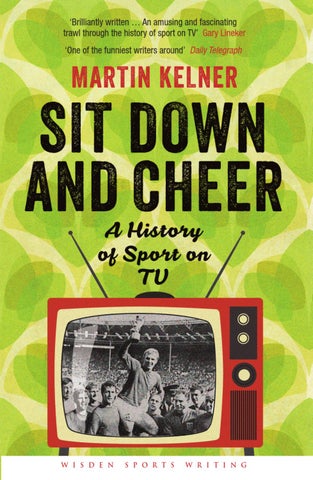
SIT DOWN AND CHEER A History of Sport on TV
MARTIN KELNER
‘WELL-OBSERVED INSIGHT, SURPRISING NUGGETS OF OBSCURE FACTS AND BRILLIANT MOMENTS OF PROSE COMEDY’ ÎÎÎÎ METRO
SIT DOWN AND CHEER
‘ANY SOFA-SPRAWLER REMOTELY INTERESTED IN HIS OBVIOUS PASSION WILL FIND THE WIT, CHARM AND SHEER EFFERVESCENCE OF KELNER’S WRITING … DEMAND IT IS 2012’S SPORTS BOOK OF THE YEAR, WHETHER OFFICIALLY CROWNED OR NOT’ FRANK KEATING, OBSERVER
W I S D E N
S P O R T S
W R I T I N G
sit down and cheer Martin Kelner
Sit Down and Cheer (Bloomsbury).indd 3
08/05/2012 16:23
First published in Great Britain 2012 Copyright © Martin Kelner 2012 The moral right of the author has been asserted. No part of this book may be used or reproduced in any manner whatsoever without written permission from the Publisher except in the case of brief quotations embodied in critical articles or reviews. Extract on pp.175–6 reprinted by permission of HarperCollins Publishers Ltd © 2005 Der Lynam I Should Have Been at Work! Lyrics on p.180 from ‘Bob Wilson, Anchorman’ written by and reproduced with the permission of Nigel Blackwell. Every reasonable effort has been made to trace copyright holders of material reproduced in this book, but if any have been inadvertently overlooked the publishers would be glad to hear from them. Bloomsbury Publishing Plc 50 Bedford Square London WC1B 3DP www.bloomsbury.com Bloomsbury Publishing, London, New York, Berlin and Sydney A CIP catalogue record for this book is available from the British Library ISBN 9781408129234 10 9 8 7 6 5 4 3 2 1 Typeset by seagulls.net Printed in Great Britain by Clays Ltd, St Ives plc
Sit Down and Cheer (Bloomsbury).indd 4
08/05/2012 16:23
contents
1 • Not Being There 1 2 • Where’s the Ball? 17 3 • Into the Light 33 4 • The Matthews Factor 45 5 • An Afternoon with Auntie Rosie 53 6 • Waiting for J. Fred Muggs 63 7 • Early Exchanges 73 8 • Saturday Afternoon In 87 9 • The Lord’s Day 99 10 • Spot the Redhead … and the Pink 113 11 • A Whole New Panel Game 125 12 • Colemantating 135 13 • Come On Everybody, Big Smile 147 14 • Scoring at Home and Away 165
Sit Down and Cheer (Bloomsbury).indd 5
08/05/2012 16:23
15 • The Bazza v. Motty War! 189 16 • It’s All Gone West 201 17 • Sky-ification, That’s the Name of the Game 207 18 • Ten Pounds Down 225 19 • What’s Your Opinion Worth? 235 20 • The Importance of Salt ‘n’ Vinegar 249 21 • The Future’s Bright … the Future’s Sportsex 267
Acknowledgements 271 Index 273
Sit Down and Cheer (Bloomsbury).indd 6
08/05/2012 16:23
one
not being there
The trouble with most histories of sport is that they are written by people who were there. Any idiot with a press card – don’t get me wrong, many of these idiots I count as personal friends – can tell you what the atmosphere is like on a big night of European Cup football in the San Siro, or capture the sights and sounds of thoroughbred racehorses charging over the fences at Aintree, or report the collected speeches of gold medal winners at the Olympic games. And any athlete with a decent ghost writer can describe the goals, the runs, the knockouts, the booze, the sex, the drugs, and (for a disturbing number of former tennis professionals these days) the rock ‘n’ roll. But to chronicle the last sixty colourful, tempestuous years of sport through the eyes of those who were present at its epoch-making events is to ignore a multi-channel elephant in the corner of the room. Because without the unholy union between sport and television, the sporting landscape we look out on today would be unrecognisable. The story of sport needs to be written by someone who stayed at home and watched, and my credentials to be its author are impeccable. I have made a kind of career out of watching sport on TV. Apologies if that does a disservice to those of you in real careers like medicine, the law, or online pornography, but for the past fourteen years, the Guardian newspaper has paid me to produce a column based, sometimes rather 1
Sit Down and Cheer (Bloomsbury).indd 1
08/05/2012 16:23
sit down and cheer
loosely, on televised sport. Before that, I watched a good deal on an amateur basis, going back to the mid-1950s when the whole business started in earnest. I only realised what an immense social history I was sitting on when I appeared on a sporting discussion programme on BBC Radio Five Live with some much younger contributors and was asked about the build-up to the 1966 World Cup final. ‘What build-up?’ I was forced to reply. We were excited, of course, largely because there was to be live football on TV, a rarity in those days, but there were no special supplements in the papers, no dedicated sports sections, it did not occupy our every waking moment. Looking at the TV schedules for Friday 29 July 1966, the eve of the great match, I note the BBC manages a half-hour show, World Cup Report, at 7pm (‘Meet the teams and the personalities who play tomorrow’), allocating precisely twenty minutes less screen time to the Match of the Century than to The Hippodrome Circus, Great Yarmouth, which occupies the peak-time slot at 8pm. ITV has no World Cup preview at all, scheduling Ready Steady Go against the BBC’s meet-the-teams programme. I can’t say for certain, but I suspect I may have been watching ITV. As a teenager in 1966, pop music took precedence over almost everything. Nor was there any great hoop-la on TV after the triumph. The BBC granted Grandstand a whole twenty minutes extra, to round up the momentous events of the day. Had West Germany not equalised in the final minute, we should all have been enjoying the Laurel and Hardy short County Hospital on the BBC by 5.20 (one of the best, as it happens, where Stan brings hard-boiled eggs and nuts to Ollie’s bedside), followed by Susan Hampshire and others discussing the latest releases on Juke Box Jury. Even less time for post-match hosannas was allowed by ITV, who scheduled Robin Hood at 5.15pm – in other words, allocating the World Cup final slightly less time than Sky in 2012 would grant a mid-table Premier League match. But, of course, we were all busy buzzing round the streets of London in E-Type Jags after the match with Rita Tushingham and Simon Dee, 2
Sit Down and Cheer (Bloomsbury).indd 2
08/05/2012 16:23
not being there
drinking whisky and Coke with Paul McCartney and Jane Asher in Le Kilt Club, or at the very least having a knees-up at one of the many street parties, our Union Jack-bedecked trestle tables groaning under the weight of light ale, pop for the kiddies, and commemorative cakes and pies. Well, not in suburban Manchester we weren’t. The Swinging Sixties did not arrive in Manchester until around 1974. Frankly, where we lived it may as well have still been wartime. The air-raid shelters down the bottom of our road had still not been demolished – possibly in case of Luftwaffe reprisals for Geoff Hurst’s dubious second goal – and the country, particularly the North, as is customary, was going through the worst economic crisis since the last worst economic crisis. In the Daily Express on World Cup final morning, the only indication there was a big match on – apart from the team news on the back page – was a story about the government barring players’ wives from the postmatch banquet and cocktail party (bunch of Normas and Susans coming down from the North with their beehive hair-dos, who did they think they were? FIFA officials’ wives were fine, by the way), and a display ad for a hair oil called Vitalis picturing Bobby Moore, and bearing the slogan, ‘The very best of luck England and Bobby Moore. We’ll be behind you’. The lead story was about prime minister Harold Wilson’s bibulous economics minister George Brown turning up two hours late for a scheduled TV appearance to explain the government’s wage freeze, because he ‘forgot’. The Express speculated this might signal the end of his career. It did not stop the minister getting a seat for the match, though. The documentary feature Goal! World Cup 1966 has a lovely sequence, which cuts from the throng on Wembley Way to the seats – armchairs, really – being prepared for the VIPs. A tartan rug is spread over the back of each seat, and the name of the dignitary is placed on it: Harold Wilson, George Brown, Sir Stanley Rous, President of the FA, and Her Majesty The Queen of course.* Whatever Time magazine said in its famous * To the chagrin of BBC director Alec Weeks, Goal! is the only colour record of the final, although the technology was available to the BBC at the time. The film boasts a fine, wry script by the journalist Brian Glanville and quirky narration by Nigel Patrick.
3
Sit Down and Cheer (Bloomsbury).indd 3
08/05/2012 16:23
sit down and cheer
Swinging London issue three months earlier, and whatever iconoclasm was implied in British films of the period, deference was still alive and well in 1966 England. In case you were in any doubt what different times those were, the throng all appear to be wearing demob suits (cheap suits given to military people in advance of their re-entry into civilian life), and sensible shoes buffed up with a decent helping of Cherry Blossom, a million miles away from the baseball-booted, replica-shirted, be-jeaned crowd you might see these days. They did not seem dressed for a party. As far as the TV coverage went, the 1966 World Cup remains Britain’s most watched broadcast, with an audience of 32.3 million, just pipping Princess Diana’s funeral in 1997, but nowhere was it discussed at the time as a television event. There were TV writers around then – notably Philip Purser at the Sunday Telegraph and Nancy Banks Smith, later a muchloved fixture at the Guardian but then at the original, pre-Murdoch Sun. But they tended to focus on programmes made specifically for television: drama and comedy mostly. No one in 1966 had yet grasped the way reality, in the shape of sport, and television could interact. Nor had anyone caught on to the comic potential of sports broadcasters. There was nobody doing what I try to do in the Guardian, and Giles Smith does in The Times, and Clive James was doing before either of us in the Observer. Even Wolstenholme’s famously felicitous valediction, ‘They think it’s all over. It is now’, failed to make any impact on the press or public. It was only when highlights of the match were replayed some months later on the BBC Sports Personality of the Year programme and on various year-end round-ups that Wolstenholme’s words began to register a little, but I wager it was the 1980s before anybody looked at a dessert trolley and said, ‘They think it’s pavlova. It is now.’ At the start of the television age in Britain, the 1950s and 1960s, the effects of the twentieth century’s two world wars were still being keenly felt. It was some years before Britain was ready to abandon the stiff upper lip that had seen us through two epic international contests. It was not about to be jettisoned in the cause of football. For an article in Intel4
Sit Down and Cheer (Bloomsbury).indd 4
08/05/2012 16:23
not being there
ligent Life magazine in 2010, the journalist Tim de Lisle unearthed the fact that on the Monday after England’s triumph, the front-page splash in Britain’s biggest-selling newspaper, the Daily Mirror, announced, ‘A BOUNCING BABY GIRL FOR PRINCESS ALEX’. ‘Winning the World Cup,’ wrote de Lisle, ‘was not as big as the birth of Marina Ogilvy, the Queen’s first cousin once removed.’ By 1990, a ticker-tape parade and Beatles-style airport welcome were being bestowed on England’s semi-final losers; not because of their stumbling, rather fortunate, progress to fourth place (fourth place!) in the competition, but because of the story reaching us through our television sets. I was there. Not in Italy, but on my sofa, watching television, the prism through which all significant sport now passes, and is given meaning. Don’t take my word for it. Simon Barnes, who has reported for The Times from pretty well every sporting arena worthy of mention, recognises in his book, The Meaning of Sport, the inadequacy of simply being there. He describes the trip in an open-topped bus by England’s World Cup-winning rugby union team in 2003, through crowds ten-deep on London’s streets, an estimated three-quarters of a million lining the route, some hanging from windows, shinning up lampposts, crowding onto balconies: ‘It struck me,’ writes Barnes, ‘that I had no understanding of the event I had just covered, not until that bus-ride. How could I have understood how much it mattered, when I was stranded out there in Sydney watching Jonny Wilkinson make the winning drop-goal? The real event happened in England, on television, where everybody surfed the wave of rising hope.’ I surfed that wave, and I am a rugby league man, a former militant. But that is what television does. It is the single most powerful homogenising, democratising force in British society. The former prime minister John Major talked about the classless society; ITV created it. Guinness and Gillette, and all the other advertisers and sponsors flinging their money at rugby, demanded nothing less. Of course, one World Cup did 5
Sit Down and Cheer (Bloomsbury).indd 5
08/05/2012 16:23
sit down and cheer
not do it. The barriers eroded over time, but 2003 was rugby’s Berlin Wall moment. Unless you were brought up in a rugby league area in the North of England, you can have no idea of the hatred for the other code. My father and all my uncles were league men, wavering between Salford and Swinton, but staunchly Swinton when they first started taking me to matches in the late 1950s. We spurned rugby union as you would a rabid dog, and the feeling was mutual. It was not just the apartheid; the Welsh league converts ostracised in their home towns just for wanting to earn a few bob from their talents, the stories of chaps who had played a little RL in the armed forces being barred from playing RU, the hypocrisy of the supposedly amateur union guys getting soft jobs and fivers in their boots. Not just that, not just the history either, but the way the fifteen-a-side game was presented to the public by the BBC: proper previews, the match in full (rugby league matches were restricted to second-half only in the 1970s and 1980s) and commentators who took it seriously, unlike our man Eddie Waring, undoubtedly a rugby league aficionado, but one who we always felt was having a laugh. Their commentators seemed like poets to us: mellifluous Cliff Morgan, the schoolmasterly Scotsman Bill McLaren, with his endearing chuckle at transgressors as if they were errant pupils and, just to really put us in our place, a chap with a hyphen, the former England fly-half Nigel StarmerSmith. Huddled in our post-industrial mining and mill towns, we were the outcasts of rugby. The joke was that their game was really rather poor compared to ours. We ran the ball out of defence, using the three-quarters and mobile second-row forwards – and Swinton were the best team in the league at this – while they just put the boot to it. They didn’t even have a league championship, for goodness’ sake. At international level, and in Wales and parts of Scotland, it was taken seriously enough, but round our way, club rugby was more to do with the beer and sticking your arse out of the minibus windows on the drive home. 6
Sit Down and Cheer (Bloomsbury).indd 6
08/05/2012 16:23
not being there
But once rugby union went professional in 1995, and had to compete on the open market for TV time and sponsors’ money, they took the best bits from our game and a little from American football, invented some decent competitions like the Heineken Cup, and now have a pretty good TV product which I am happy to settle down on my sofa to watch. No hard feelings. Let me tell you about my sofa, because home comforts cannot be discounted as a factor in the onward march of sport on television. Any historian of the cinema will tell you that the years of decline for the suburban Roxys and Regals coincided with the growth of affordable, comfortable furniture. We are all familiar with those archive photos of 1970s and 1980s families on their G-Plan sofas, coal-effect fires blazing away, watching Morecambe and Wise on TV, while the wind whistled round their local picture houses standing forlorn and unloved, awaiting the wrecker’s ball, or conversion into bingo halls. It is a simple equation really. When our homes were shit-holes with the only comfortable chairs in the front parlour for Sunday best, we went out. Once we had invested our money in decent carpets and furniture, not being there – anywhere – became an attractive option. My sofa now is called a Mitford. It is ‘custom-made and hand crafted’ according to its CV, made of ‘fully seasoned beech and hardwoods from managed sources’. The ‘managed sources’ are important to me. I should not like to think any poor trees had suffered, just so I could loll on the Mitford watching the Champions League. Its cushions are ‘Oriental duck feather pads’ (something I am sure I ordered once in a Chinese restaurant). From the heart of this Mitford I make notes on televised sport, mocking its excesses, but marvelling at its amoeba-like growth. Ten-pin bowling? Fishomania (a whole day of competitive fishing from a lake near Doncaster)? Who would have thought it? Enquiries of John Sankey, quality furniture manufacturer of Long Eaton, Derbyshire, have so far failed to reveal which Mitford my sofa is named after. I like to think Jessica, who was on the side of the rebels in 7
Sit Down and Cheer (Bloomsbury).indd 7
08/05/2012 16:23
sit down and cheer
the Spanish Civil War, like my dad and his mates, or Pamela, the Mitford nobody has heard of. (Just as the Monkees had their Peter Tork, and the Magnificent Seven its Brad Dexter, the Mitford sisters had their Pamela, the one who married a businessman and led a quiet life in the countryside as Mrs Derek Jackson.) I hope it is not named for Unity or Diana who – literally and metaphorically – got into bed with the Nazis. Although I suppose I should thank the Nazis for starting it all, because it was Hitler – now there is a name you probably weren’t expecting to crop up in a light-hearted romp through the history of sport on TV – yes, Hitler, or one of his smarter henchmen at least, who realised before anybody else that sport and television was a union devoutly to be desired, a marriage made in heaven, or possibly the opposite place in the Führer’s case. The Nazis saw the union as the perfect instrument to promote their twisted ideology – and so the Berlin Olympics of 1936 became the world’s first live television broadcast of a sporting event. According to Television and Shortwave World magazine, as many as 150,000 viewers in twenty-eight viewing rooms throughout Berlin watched the Games. Seventy-two hours of live transmission, says the magazine, went over the airwaves to ‘Public Television Offices’ in Berlin and Potsdam. An eightpage booklet trumpeted Germany’s achievements in this field, claiming regular transmissions since 1929, with a new system developed in 1934 ‘attaining remarkable picture quality’. But, as the literature is branded with a swastika, the claims may be mildly gilded. Nevertheless, as BBC cameras did not pitch up at Wimbledon to bring Britain its first televised sport until 21 June 1937, it is difficult to escape the conclusion that the Germans were slightly ahead of us, a position we have had to accept in international football tournaments – with one or two notable exceptions – pretty well ever since. The final sentence of the Berlin Olympics booklet notes perceptively: ‘From these initial stages of television in broadcasting and telephony, there is growing up a cultural development that promises to be of unsuspected importance to the progress of mankind.’ Say what you like about 8
Sit Down and Cheer (Bloomsbury).indd 8
08/05/2012 16:23
not being there
the Nazis, we have to hand it to them on the Volkswagen, the autobahns, and on recognising the huge impact of sport on TV, although I am not sure the Third Reich foresaw, as part of mankind’s progress, my watching rugby league live from Australia while still in my pyjamas on a Saturday morning, or a heavyweight boxing champion trousering $137.5 million for lending his name to a device for grilling turkey steaks, or indeed A Hundred Great Goalkeeping Gaffes on Blu-Ray. Those first television pictures of the 1936 Games were not available outside Germany, but Leni Riefenstahl’s groundbreaking official film Olympia was, and seemed to achieve everything Hitler might have wanted in propaganda terms. Not only that, but it pioneered techniques now common in the filming, and televising, of sport: using close-ups to illustrate the joy of athletic triumph, and quick cutting to accentuate the drama. The genius of the Führer’s favourite film-maker helped present the host nation in the best possible light, to which purpose normal rules of book-keeping and budgetary control were also set aside, as has been the case at more or less every subsequent Olympics. Ticket revenues at the Berlin games were said to be 7.5 million Reichsmarks, generating a profit of around one million marks. But the official budget did not include outlays by the city of Berlin (16.5 million marks) or the German national government, which did not make its costs public but is estimated to have spent 130 million marks (about £6 million), mostly on capital projects. Look out for similar creative accounting when the cost of the 2012 games is finally totted up. Michael Winner, the director of films as varied as Death Wish and Death Wish 2, once described film-making as ‘painting with money’, and you could say the same about the Olympics. ‘The largest single withdrawal on the world’s physical, mental and economic resources, and it produces nothing but two weeks of television,’ as the scabrous TV critic A.A. Gill wrote in the Sunday Times. The Berlin Games were undoubtedly the template, providing a chilling portent of what was to come in Germany, with the Ministry of the Interior authorising the arrest of all Gypsies in the German capital and 9
Sit Down and Cheer (Bloomsbury).indd 9
08/05/2012 16:23
sit down and cheer
their detention in a special camp. Scandalous of course, but not radically different from the kind of clean-up operations that have been going on at international tournaments ever since, most recently at the 2010 Commonwealth Games in Delhi, where 400,000 slum dwellers’ homes were demolished in time for the world to watch the opening ceremony. So, the ground rules for big-time international sport – especially the manicuring of the host country for the benefit of a watching world – were set in Berlin. But because of the other big fixture a few years later that engulfed in flames much of the world, especially Europe, the baton was not really picked up until Rome 1960: The Olympics that Changed the World, according to the title of a book by the Pulitzer Prize-winning American author David Maraniss. After the war, the European nations, broke and exhausted from the conflict (I recommend one of the post-war Italian neo-realist classics like Rome, Open City or Bicycle Thieves if you want to know exactly how broke and exhausted), had neither the money nor the appetite for anything very grandiose in the way of international competition, and so tended to look inward. That was the world into which I was born, and is, to all intents and purposes, where this story begins. Due credit has to be granted to the pioneers of the 1930s and 1940s, and to the major figures of the radio era, who established a style of sports commentary and an ethos of outside broadcasting their television heirs were happy to follow. However, it is clear many of the crucial developments in sport on television took place in the two decades following the end of the Second World War – slightly earlier in the US, where the war had not had such a shattering effect – and mostly at Britain’s uniquely financed BBC. Because the BBC is neither a state broadcaster nor dependent on advertising income, a spirit of experimentation was, if not encouraged, at least tolerated, and the frequent cock-ups were rarely job threatening. Into this culture arrived a remarkable cadre of men, mostly newly demobilised Royal Air Force veterans, who proceeded to trade on the wartime esprit de corps to bring to the nascent TV audience a rich diet of broadcast sport. 10
Sit Down and Cheer (Bloomsbury).indd 10
08/05/2012 16:23
not being there
Chief among their number was Peter Dimmock, who joined the BBC in 1946, as the organisation resumed broadcasting after the war. One of his first tasks in fact, as the newly appointed Assistant Head of Outside Broadcasts, was to lie on the pavement outside the BBC’s headquarters at London’s Alexandra Palace out of vision in order to cue in announcer Jasmin Bligh welcoming viewers back ‘after the short interruption’. With the sure touch the BBC has traditionally shown at great moments in the life of the nation, Bligh announced that the Mickey Mouse cartoon, Mickey’s Gala Premiere, that had been showing when the BBC’s television service was peremptorily shut down at noon on 1 September 1939, was to be shown again. But the young man lying at Bligh’s feet was convinced there were more exciting ways to unite the nation than through the medium of Mickey Mouse, as he told me when I spent a day with him at his home in Norfolk. Dimmock, was already past ninety but with razor-sharp recall, bolstered by scrapbooks full of newspaper cuttings, TV schedules and the like, confirming his memories of what has to be regarded as a golden age for the BBC. Sadly, some of Dimmock’s predecessors, like Lord Reith, the stern, founder of the BBC, and Dimmock’s former boss, the magnificently named Seymour Joly de Lotbinière (‘Lobby’ for short) who laid down many of the ground rules for sports commentary, are no longer around to share tales of the very early days. But we have their memoirs and the sheaves of papers dutifully collected at the Corporation’s written archives in Caversham, relating to their decisions, the BBC being an organisation where kicking an idea around the ballpark, running it up the flagpole and so on, has never been quite as popular as getting it down on paper and distributing it to myriad people hiding behind impenetrable collections of initials. I have before me a memo from Dimmock to Lotbinière (C.Tel – Controller, Television, one supposes) dated 10 October 1950, discussing something called Operation Pegasus, an abortive experiment in producing pictures from the air, which Dimmock was keen to persevere with. 11
Sit Down and Cheer (Bloomsbury).indd 11
08/05/2012 16:23
sit down and cheer
Copied into the correspondence are S.S.E.Tel., H.Tel.P., H.O.B., A.H.P.I.D., and E.i.C.Tel.O.B.s. I have no idea who these people are, but my experience is that memos – emails nowadays – are something of a fetish at the BBC. As anyone who has ever worked for the organisation will tell you, office politics is its main business, with broadcasting a distant second. That said, the BBC is a magnificent broadcaster, regularly topping polls as one of the most trusted and respected institutions in Britain, as befits an organisation that helped keep resistance alive when Europe cowered under the Nazi jackboot, and later produced Fawlty Towers and Strictly Come Dancing. Valued or not, the BBC is going through a crisis as I write this. The BBC is always going through a crisis. I have worked for it as a freelancer on and off for more than twenty-five years, and I cannot remember a time when one or another of its services was not under threat. On the day I presented my first show for Radio Two around 1985, I picked up a copy of The Times, and there on the front page was an item about something called ‘the Black Spot Committee’ looking for savings, and recommending the closure of the very network on which I was broadcasting. Its contention was that Radio Two was not providing a public service, although I should have said keeping me off the streets, presenting what we used to call ‘a lively blend of music and chat’, was public service enough. Radio Two, as we know, survived and flourished, and the BBC, as is its custom, reverted to the old Navajo Indian trick of arranging another round of committees, meetings, and lunches, setting up an initiative or two, and then doing nothing. This, though, is no longer an option, as the Formula One story demonstrates. In 2008, the BBC signed a £200 million five-year deal to televise the sport, but by 2011 it was finding it difficult to justify that expense in a climate of cuts in public services. The Corporation agreed, therefore, to relinquish the last two years of its exclusive deal and share coverage with Sky, halving the cost to the licence payer, but also losing 12
Sit Down and Cheer (Bloomsbury).indd 12
08/05/2012 16:23
not being there
half the races. Enthusiasts, who generally enjoyed the BBC coverage, and had become accustomed to free-to-air motor racing, cried into their Castrol GTX, but to Formula One agnostics it made sense. The BBC would now be paying £20 million a year for the sport rather than £40 million. If, as prime minister David Cameron, maintained, we were ‘all in it together,’ the BBC needed to show it was sharing the pain. By contrast, in the immediate post-war years, a nation hungry for entertainment (cinema attendances and crowds at sporting events were never higher than in the late 1940s) was generally happy for the BBC to fix its own terms of reference. Not that the corporation was immune from criticism in those days, but it was rarely more than benign satire from radio comedians like Tommy Handley and Arthur Askey, gently sending up the management’s prudery, its frosty attitude to its talent, and a tendency to act like a branch of the civil service. But this is not a book about the BBC, which may already be one of the most written-about organisations ever, so forgive me if I miss one or two of its bouts of navel-gazing. This is primarily a book about the joy of not being there, and the work that people like Dimmock and his successors at the BBC did to make that the rich, fascinating, and funny experience it continues to be. Dimmock was convinced that the future of television depended on sport. His first job was as a horse racing journalist with the Press Association, and he sensed the drama, passion, and human interest of sport unfolding live before your eyes, would cost fortunes if you were to ask producers, directors and writers to create it in a studio. Dimmock was a visionary, dedicated to the ‘progress’ and ‘cultural development’ that started at the Berlin Olympics, but came to a full stop for the hostilities. Not everyone, however, viewed the development of television so positively. A leader in The Times on 21 February 1953, just two months before sport on TV started properly, warned those running television that it did not expect screens to be filled with mere harmless diversions. Radio was still the dominant medium, but as TV licences in Britain approached the two million mark, The Times leader fulminated: 13
Sit Down and Cheer (Bloomsbury).indd 13
08/05/2012 16:23
sit down and cheer
‘Nothing would be easier than to go ahead seeking to tickle the palate of the big battalions. Nothing would be more fatal. If television were conducted with the aim of amusing the largest possible audience at all hours, it would be a Trojan horse dragged within the home and spreading ruin among the values which make national life alert, sane, and precious. A passive approach to their responsibilities by those in charge of television would create, as it appears to be in danger of creating in America, a generation that glues its eyes to the screen while its wits go wool-gathering.’ Well, here is something for irony fans. With commercial television waiting in the wings in the UK, this leader appears to be nothing more or less than a rather po-faced warning from The Times to the ‘big battalions’ of commerce that the British public expected something more from its telly than Double Your Money and I Love Lucy. That would be the same Times that was sold just over a decade later to the Canadian press magnate Roy Thomson, who described a commercial TV franchise as ‘a licence to print money’, and was gleefully and profitably helping wits go wool-gathering with a diet of lame-brained quiz shows and undemanding sitcoms on his Scottish Television. The same Roy Thomson, incidentally, whose son later sold The Times to Rupert Murdoch, who … well, you get the picture. At the BBC, meanwhile, the aim – even before the big battalions entered the fray – was to consummate the marriage between sport and television. Not that this union was what you would call love at first sight. The two circled each other warily for a while for practical reasons as much as anything; sport anxious the sofa-bound might spurn the live product, and TV still not entirely convinced that sport was its business, and in any case lacking the technology and the screen time to show much of it. But they got together, and stayed together, for the sake of the money, and now you cannot imagine one without the other. Sure, they argue and haggle like any old couple, but nevertheless are indivisible, like a pair of oldies sitting in a teashop finishing each other’s sentences. 14
Sit Down and Cheer (Bloomsbury).indd 14
08/05/2012 16:23
not being there
There is sport all over the television these days – as non-believers will readily testify – much of it sold to satellite TV to be mainlined by hopeless addicts, but with plenty of scraps left for the terrestrial channels to fight over. And an interesting recent development is that even the prime-time stuff that is not supposed to be sport looks like sport: competitive cookery, dancing, singing, antique hunting, even competitive baking. The argot of the commentary box, meanwhile, has become the lingua franca of TV: ‘she really nailed that boeuf en croute,’ ‘this is the big one’, ‘I’m going to give this Whitney Houston song 110 percent’. This is a world away from the climate into which Dimmock walked. TV in those days was mostly run by chaps in dinner jackets, who knew how to handle a cigarette holder, and in some cases had read Ibsen. They deigned to point their cameras at muddied oafs and flannelled fools – at least until the light began to fade – but only considered a sporting event truly significant if it boasted royal patronage. And the people involved in broadcast sport knew to come in via the tradesmen’s entrance, and kindly bang the mud off their boots first. Within a couple of decades, though, Dimmock and his chums in sports broadcasting were having the last laugh. Producers like Paul Fox, and Bryan ‘Ginger’ Cowgill from Clitheroe in Lancashire – who, at twenty-eight years old, had never even been to London before his BBC interview in 1955, let alone attended first nights at Covent Garden – bagged the big jobs in TV, while presenters like Frank Bough and Eddie Waring tripped lightly over into mainstream entertainment shows.* And once they had vaulted the barriers and kicked down the doors at Television Centre, the people who played sport themselves got their turn in front of the camera. Scarcely an eyebrow is raised these days when the former England international striker Gary Lineker, or the 1976 French Open tennis winner Sue Barker, pops up in prime time. Come to think of it, becoming a moderately decent tennis professional in Britain
* Cowgill, a future Head of Sport and Controller of BBC1, was described by John Motson, one of his commentators, as ‘a television storm trooper’, ruthless with his staff when they fell below his high standards.
15
Sit Down and Cheer (Bloomsbury).indd 15
08/05/2012 16:23
sit down and cheer
is probably a more effective route into the media than any BBC training scheme. Ask Andrew Castle and Annabel Croft. What follows is the story of how it happened: how sport ate your TV, and how in a reciprocal arrangement, television feasted on the flesh of almost any sporting endeavour you care to mention – from English Premier League football to the Eskimo Olympics, often adding garnishes and flourishes, sometimes radically altering the flavour. And I shall tell it from the perfect vantage point, the Mitford in my living room because, as we have established, that is where I was when most of it happened. I suspect your sporting life might be similar. Let’s be honest, very few of us get to attend a World Cup or an Olympics. I have never been to either, nor to the European Athletics Championships, the Open golf, Six Nations rugby union, the Commonwealth Games or even the World Professional Darts Championships. I have been to some cup finals – both football and rugby league – to Wimbledon once or twice, the odd Test match and a game at Euro ’96 when the tournament was held in England, but my default position for big sporting events is to be not among those present. Successive television receivers can bear witness to the great sporting occasions I have failed to attend: from my parents’ walnut veneer cabinet-style sets, sitting in the corner of the room pretending not to be anything as common as a television, via the eccentric equipment in shared student flats in Glasgow requiring one or other of the tenants to hold a twin-pronged space alien-style indoor aerial aloft so we could watch the FA Cup final through a snow storm, to my current Sky Plus High Definition 3D job. My memories – in common with almost everybody else’s – of the greatest moments in sport come filtered through the cathode ray tube, and its flatter, more technologically elaborate successors. Of all the sports books jostling for space on the shelves, this, therefore, is the one that most accurately reflects Britain’s sporting life. Here is sport, as most of us know it. It is the authentic sporting life of the common man and woman: the sofa, the snacks, the slo-mo. 16
Sit Down and Cheer (Bloomsbury).indd 16
08/05/2012 16:23
W I S D E N
S P O R T S
W R I T I N G
‘Brilliantly written … An amusing and fascinating trawl through the history of sport on TV’ Gary Lineker
On a summer’s afternoon in 1937, BBC outside broadcast cameras were sent to the Wimbledon tennis tournament for a ‘great experiment’, Britain’s first televised sporting event. Though the ball was not always visible, it was deemed a triumph. And it certainly started something. Martin Kelner has, for most of the intervening three-quarters of a century, been somewhere much better than the events themselves – on his sofa. He has seen the change from rarely shown, flickering black-and-white images to the wide-screen HD, 3D, 24/7, Sky-dominated sporting world of today. In Sit Down and Cheer he tells, with wit and insight, the story of the development of televised sport from its accident-prone early years right up to the present day.
‘A HUGELY ENJOYABLE TRIP THROUGH THE YEARS, KELNER BEING EVER-MASTERFUL AT BLENDING HILARIOUS QUIPS WITH SHARP OBSERVATIONS’ IRISH TIMES ‘FASCINATING SOCIAL HISTORY ... SIT DOWN AND CHEER IS AN ENGAGING TOUR OF THE HISTORY OF TELEVISED SPORT IN THIS COUNTRY’ NEW STATESMAN Design by Steve Leard Cover image © Getty Images www.bloomsbury.com
£8.99
‘One of the funniest writers around’ Daily Telegraph
MARTIN KELNER
SIT DOWN AND CHEER A History of Sport on TV
MARTIN KELNER
‘WELL-OBSERVED INSIGHT, SURPRISING NUGGETS OF OBSCURE FACTS AND BRILLIANT MOMENTS OF PROSE COMEDY’ ÎÎÎÎ METRO
SIT DOWN AND CHEER
‘ANY SOFA-SPRAWLER REMOTELY INTERESTED IN HIS OBVIOUS PASSION WILL FIND THE WIT, CHARM AND SHEER EFFERVESCENCE OF KELNER’S WRITING … DEMAND IT IS 2012’S SPORTS BOOK OF THE YEAR, WHETHER OFFICIALLY CROWNED OR NOT’ FRANK KEATING, OBSERVER
W I S D E N
S P O R T S
W R I T I N G