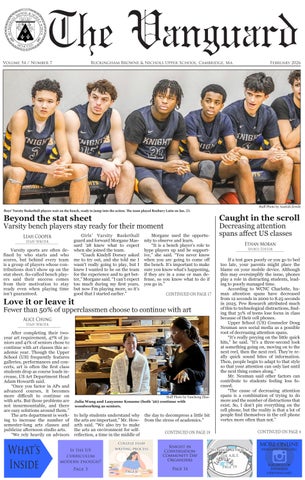
Varsity sports are often defined by who starts and who scores, but behind every team is a group of players whose contributions don’t show up on the stat sheet. So-called bench players said their success comes from their motivation to stay ready even when playing time isn’t guaranteed.
ready for their moment
Girls’ Varsity Basketball guard and forward Morgane Massard ’28 knew what to expect when she joined the team.
“Coach Kindyll Dorsey asked me to try out, and she told me I wasn’t really going to play, but I knew I wanted to be on the team for the experience and to get better,” Morgane said. “I can’t expect too much during my first years, but now I’m playing more, so it’s good that I started earlier.”
Morgane used the opportunity to observe and learn.
“It is a bench player’s role to hype players up and be supportive,” she said. “You never know when you are going to come off the bench. It’s important to make sure you know what’s happening, if they are in a zone or man defense, so you know what to do if you go in.”
CONTINUED ON PAGE 17
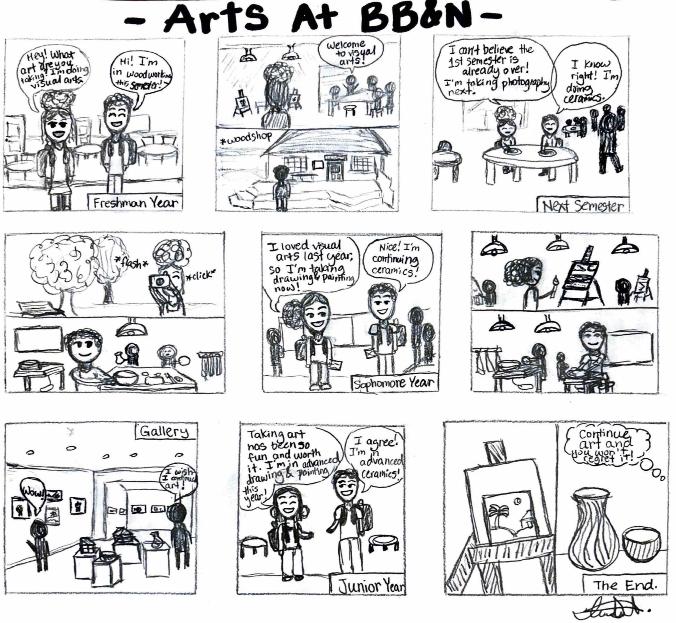
Love it or leave it Fewer than 50% of upperclassmen choose to continue with art
Alice Chung Staff Writer
After completing their twoyear art requirement, 47% of juniors and 41% of seniors chose to continue with art classes this academic year. Though the Upper School (US) frequently features galleries, performances and concerts, art is often the first class students drop as course loads increase, US Art Department Head Adam Howarth said.
“Once you factor in APs and advanced courses, it becomes more difficult to continue on with arts. But those problems are not insurmountable, and there are easy solutions around them.”
The arts department is working to increase the number of semester-long arts classes and publicize afternoon studio arts.
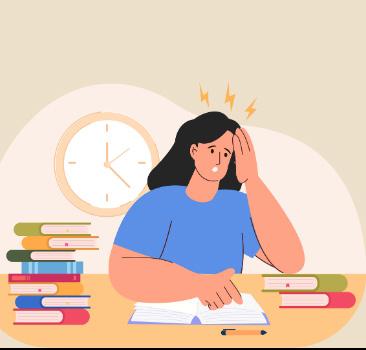
Caught in the scroll Decreasing attention spans affect US classes
Ethan Moran Sports Editor
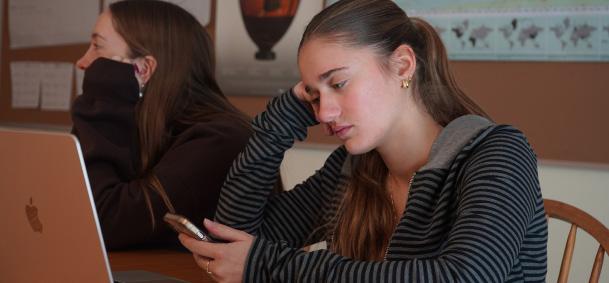
If a test goes poorly or you go to bed too late, your parents might place the blame on your mobile device. Although this may oversimplify the issue, phones play a role in distracting students, leading to poorly managed time.
According to WCNC Charlotte, human attention spans have decreased from 12 seconds in 2000 to 8.25 seconds in 2025. Pew Research attributed much of this to technological distractions, finding that 31% of teens lose focus in class because of their cell phones.
Upper School (US) Counselor Doug Neuman sees social media as a possible root of decreasing attention spans.
“It’s really preying on the little quick hits,” he said. “It’s a three-second look at something going on, moving on to the next reel, then the next reel. They’re really quick sound bites of information. Then, people begin to adapt to that style so that your attention can only last until the next thing comes along.”
Mr. Neuman said other factors can contribute to students feeling less focused.
“The cause of decreasing attention spans is a combination of trying to do more and the number of distractions that exist. So, I don’t pin everything on the cell phone, but the reality is that a lot of people find themselves in the cell phone vortex more often than not.”
CONTINUED ON PAGE 19
“We rely heavily on advisors to help students understand why the arts are important,” Mr. Howarth said. “We also try to make the arts an environment for selfreflection, a time in the middle of the day to decompress a little bit from the stress of academics.”
CONTINUED ON PAGE 4
Volume 54 / Number 7 Buckingham Browne & Nichols
Staff Photo by Azariah Zewde
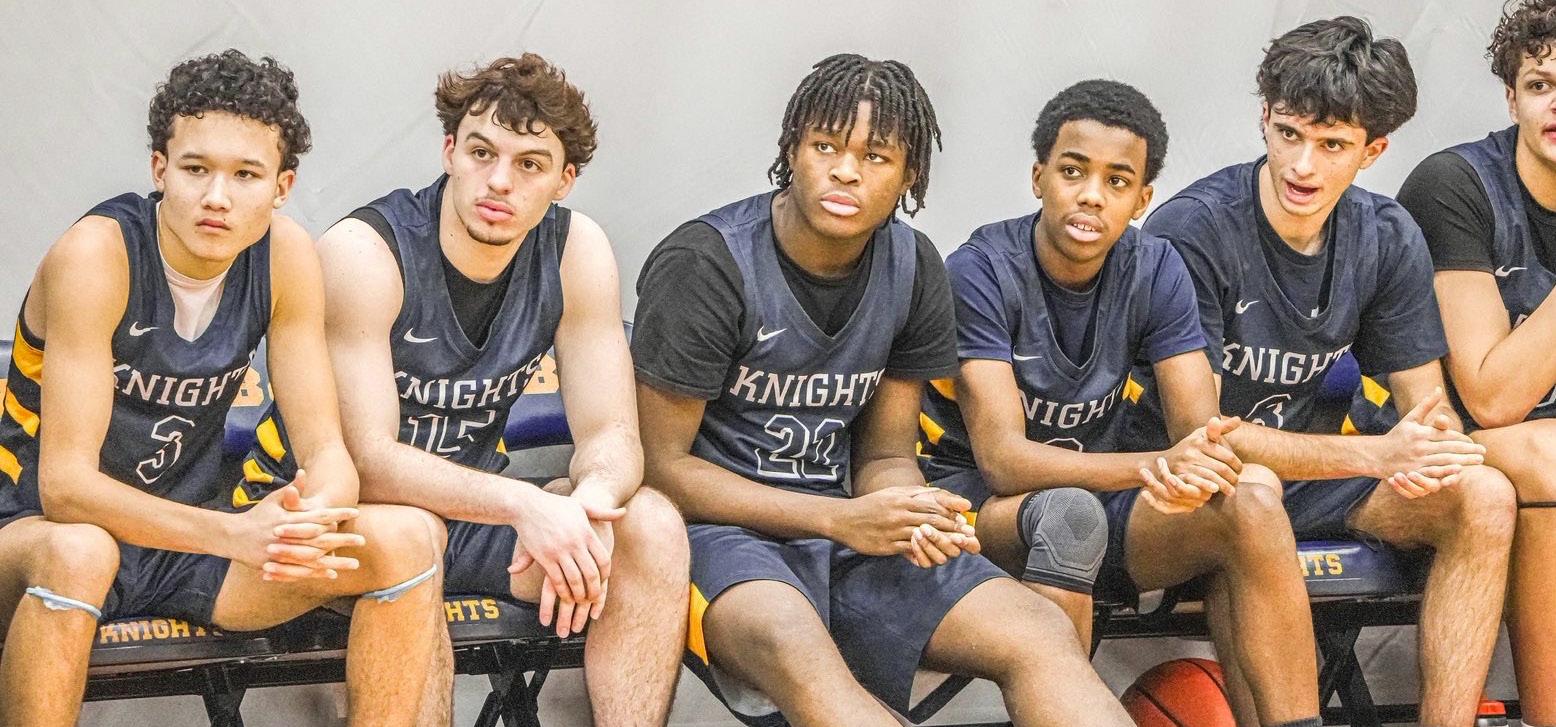
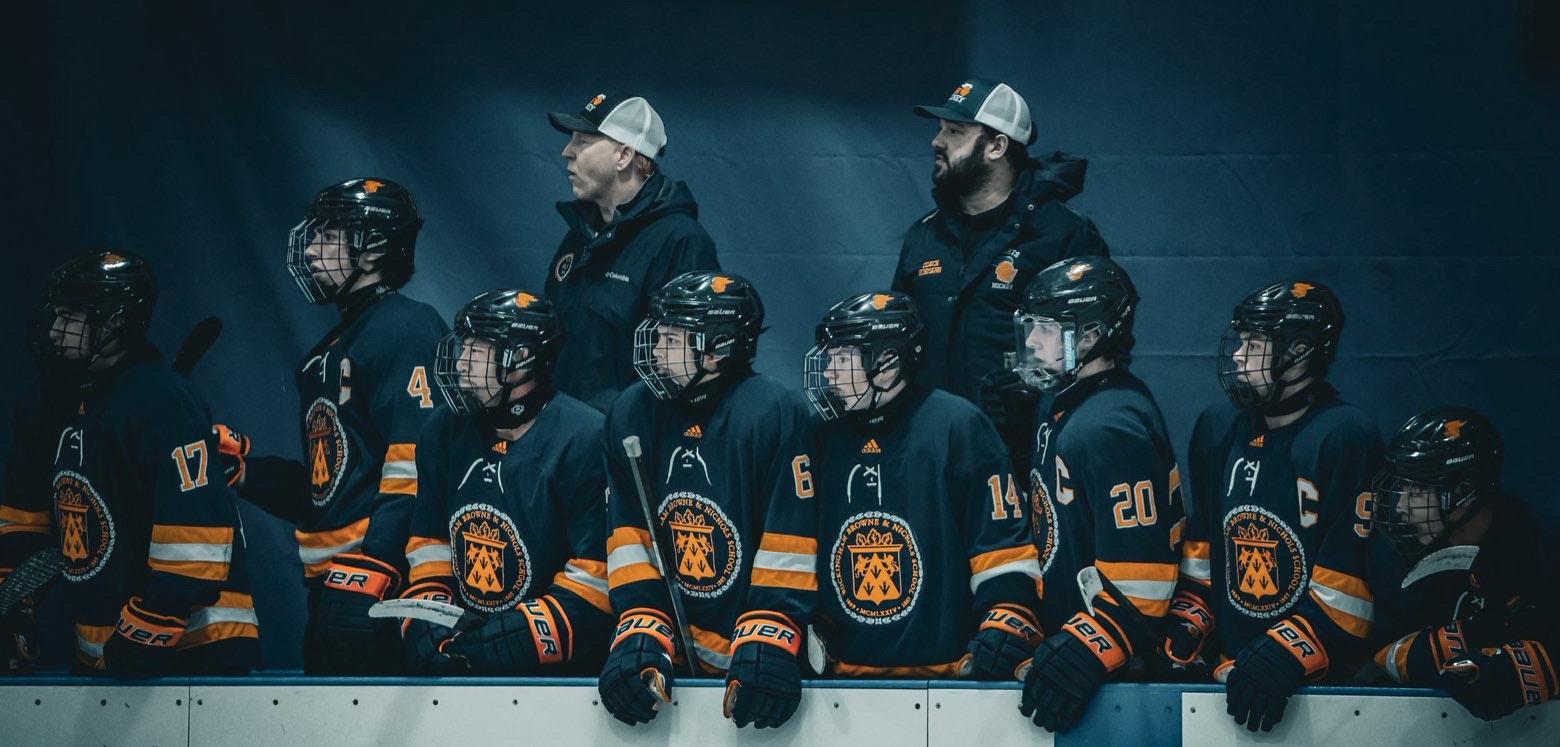
Boys’ Varsity Basketball players wait on the bench, ready to jump into the action. The team played Roxbury Latin on Jan. 23.
Staff Photo by Yancheng Zhao
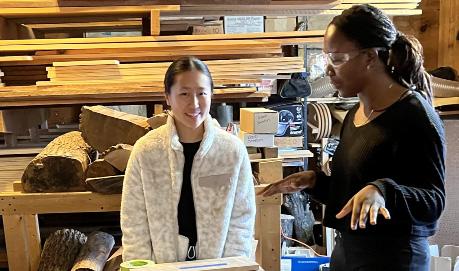
Julia Wang and Lauyanne Kouame (both ’26) continue with woodworking as seniors.
Let’s take a well-deserved breath
It goes without saying that our world is pretty crazy right now. So, let’s all take a collective deep breath.
1 ... 2 ... 3 ...
Better? We hope so. For now, take this as a formal reminder to breathe more often, especially during a time in which news headlines, the daily weather channel and “the word on the street” leave us all wondering what else could possibly go wrong. Overshadowing this pressure of simply keeping up with the news is something arguably worse, too: the pressure of having to take a side, especially with charged issues like Venezuela, Greenland and ICE shootings in Minnesota. And if you take the “wrong” side? Yikes. We are in the age of rapid-fire — and insanely polarized — media; between CNN, Fox News and the BBC, it can be easy to absorb one-sided coverage of current events within minutes of any incident. Not only does this quickly thrown together, relatively thoughtless system feed into extremism, but it leaves no time for such news stories to develop nuances. It is rare for the quick facts to be 100% correct.
Thus, we here at The Vanguard have a challenge for you all: When inundated with fast facts and NEWS HEADLINES THAT LOOK LIKE THIS
TO CAPTURE YOUR ATTENTION, take a breath. Do careful research, cross-reference multiple sources and wait a moment for the situation at hand to develop itself. You do not need to have the “correct stance” right off the bat (because who ever does?).
In the true spirit of our school, think critically while drawing on different perspectives on the matter.
Ms. Stokes’AP United States Government and Politics class does this well through mock courts; you
Buckingham Browne & Nichols School
80 Gerry’s Landing Road Cambridge, MA 02138 vanguard@bbns.org, vanguard.bbns.org
(617) 547-6100
Volume 54, Issue 7
Editor-in-Chief
Projects Editor Ayana Karthik
Opinions Editor Matthew Walsh
Editorials Editor Sonja Peetz-Larsen
On Campus Editor Mimi Shaywitz
Off Campus Editor Lucia Longstreet-Lipson
Features Editor Scarlett Hawkins
Sports Editor Ethan Moran
Gabe Cooper Managing Editor Yancheng Zhao
Arts Editor Christine Tao
Faculty Advisor Kim Whitney
Digital Media Editor Vartan Arakelian
Production Manager Carl Chen
Production Manager Charlotte Garrity
Asst. Production Manager Sydney Ruiz
Asst. Production Manager Harper Dubovik
Photo Editor Olivia Richter
Asst. Photo Editor Katy Varadi
The Vanguard’s mission is to examine and engage the school community by providing news and information about events affecting it and by featuring the diverse range of people and perspectives that comprise it. We strive for fairness and accuracy in our content, and we strive to present that content with integrity and respect.
The Vanguard is the official student newspaper of the Buckingham Browne & Nichols Upper School, which has 543 students, 96 faculty members, and 64 staff members. Affiliated with the Columbia Scholastic Press Association, the paper is a forum for differing views and welcomes comments from its readers in the form of Letters to the Editor. No anonymous letters will be printed. The Vanguard reserves the right to edit all letters for length. The Vanguard publishes eight issues per annual volume and prints between 500 and 800 copies of each issue. About 200 of those are mailed out; the rest are distributed around campus.
Hailey Jiang, David Xiong, Lucy Song, Annie Zhu, Finn Konary, Aggie Grant, Olivia Bell, Jack Reinfeld, Sydney Xu, Leah Cooper, Maggie Whitney, David Zhou, Pilar Bowen-Arce, Robbie Lally, Henry Carroll, Julia Agudelo, Alice Chung, Christian Chow
Staff Photographers: Ash Surati, Caroline Dudzinski, Ryan Figlioli, Danny West, Shirley Zhu, Hailey Jiang, Yancheng Zhao, Gabe Cooper, Azariah Zewde
Staff Artists: Izzy Doricent, Alice Wang, Lauren Li, Sydney Ruiz, Sydney Xu, Rachel Goldberg, Christine Tao, Marin MacDonald, Anthony Gao
are given a perspective that you must research and support, no matter your personal stance on the issue. Dr. Lippard’s “Beyond the Echo Chambers” Senior Spring Project seminar embodies this idea, too. Through discussions with students in Louisiana, seniors learn about political issues through the lens of high schoolers with often opposing opinions.
As students and faculty, let’s embody a patient approach to the news. Know that complex issues need never be put into black and white, as it is possible to hold multiple perspectives. Be willing to truly UNDERSTAND multiple opinions, DO your research and THINK critically. And one last time, let’s BREATHE!
1 ... 2 ... 3 ...
The last supper
On the final Thursday before March break, seniors and faculty gather for one last night of goodbyes before embarking upon Senior Spring Project, and — through organized games and a notorious trivia contest — they get the chance to reminisce. Trivia has been the go-to activity for the last five years, but that hasn’t always been the case.
Faculty and students used to perform skits in which they impersonated one another, a night sources recall as full of laughs. Unfortunately, some impressions became dicey and unintentionally left either students or teachers offended; it rarely occurred, but it happened enough to the point where the skits were discontinued, according to Upper School Math Teacher Mark Fidler.
“It was a very funny, powerful evening,” he said. “But there’s a line. The closer you get to that line, the funnier it is. But you risk going over it. They wanted it to be a completely safe space for everyone, but you can’t make a totally safe space.”
While the concern surrounding these skits is inevitable, we here at The Vanguard can’t help but wish the tradition would return.
While trivia is undoubtedly fun, the skits are an intimate activity that show two strengths in our community: 1) we care deeply about each other, and 2) we pay attention to each other to the point where we can do impersonations. At a school in which the largest class size is 20 and a grade is just 140 students, it is a privilege that we get to know each other — and our teachers — so closely; skits highlight the very best aspects of this.
Perhaps there is concern over highlighting negative qualities of our peers. However, as students, if we are worried about being ratted out through these skits, perhaps we shouldn’t have done something wrong in the first place! Doesn’t this hold us account able in a lighthearted way?
In the past, students were required to have their skits pre-approved but would often make last-min ute, offensive changes. This time around, let’s have an adult equipped with a printout of the skit, and, the moment a student goes off-script, the adult must call to end it. This will ensure respectful, regulated im pressions.
We understand the concern that comes with po tential offense, but we believe that it is worth the risk. Seriously, we can take it.
Perhaps this connects to a larger theme, too: The school giving us too much “padding.” For example, teachers aren’t allowed to discuss politics or ask us anything college-related, extensions are given out like free candy and there isn’t the slightest fragment of a dress code. Our skin has become too thin. We pride ourselves on being an immensely rigorous institution, yet the hand-holding is getting a bit insane. We want to be prepared for life beyond high school by the time we leave, not perpetually protected by a fragile bubble that has been placed around us.
Thus, we say bring it on. To the faculty, facilitate difficult conversations in our classrooms, turn down an unnecessary extension and call us out when some of us choose to wear pajamas to school. We’re tired of being treated like we’re fragile, we’re tired of being soft and we’re ready to be offended — whether it be through skits or not — as we prepare to take on the real world.
On Campus
US students, alumni reflect on whether curriculum meets modern requirements
Scarlett Hawkins Features Editor
The Upper School (US) prides itself on preparing alumni for their lives after high school. To assess whether the school meets these goals, the Office of Institutional Research conducts alumni surveys four years after graduation. According to survey results from the Class of 2021, 67.5% of alumni reported feeling adequately prepared for college life, both socially and academically, and 82.6% graduated from college with a GPA of 3.5 or higher. However, 43.5% of the class reported feeling unprepared in financial literacy.
The US curriculum includes the Senior Spring Project — a program designed for seniors to gain realworld experience through internships — as well as the AP Macroeconomics course, but it does not incorporate a microeconomics class that covers financial literacy.
US History Teacher Jennifer Wallace leads the AP Macroeconomics course.
“While I can’t teach my students everything about economics, I want my students to have a good sense of macroeconomic news and personal finance,” she said. “I teach them basic economic concepts, such as personal credit and bank balances, for their futures.”
This year, Ms. Wallace incorporated a news component, DailyDough, into her class once a week.
“I want to encourage curiosity about macroeconomic news, especially given that many tasks are being left to younger people,” she said. “The next generation must contend with AI reshaping the economy, structural budget deficits and national debt.”
She has her students listen to a brief story about the marketplace or an economic news anchor for the first five minutes of class. Then, they discuss what happened and why it’s relevant today, helping students connect class notes with real-world issues.
Ben Kaplan ’26 said he benefits from the DailyDough lessons.
“Ms. Wallace does a great job of relating topics we have learned in class to the DailyDough. It’s about how we apply the concepts we have learned. I love DailyDough because it keeps me up to date, and it’s informative.”
Ben feels prepared in financial literacy.
“Ms. Wallace does a really good job of preparing us for the future, informing us how to navigate an economic crisis and how to navigate the
economy as a whole. Because economics is more a social science than a mathematical science, she teaches us the patterns of human behavior through the economy. However, the class does not focus on personal finance because it is not microeconomics, which tends to focus more on financial literacy.”
US Director Jessica Keimowitz said cultivating creativity is key to students’ future success.
“Whether it’s through our art program, extracurricular opportunities or solving computer science problems, we don’t want students to regurgitate information. We want our students to think of new and effective ways to approach problems for their futures.”
The US encourages students to develop core skills.
“Content is important, but at the
end of the day, what’s more important: remembering the Kansas-Nebraska Act in 1854, or if someone can approach innovation at work and have the right skills to tackle the issue? The most important skills BB&N students need after they graduate are communication, collaboration, creativity and critical thinking.”
Mirabel Ge ’27 would support changes to the US curriculum.
“It would be really interesting to have a class dedicated to current events because I don’t believe history classes are sufficient in addressing this,” she said. “It would be very interesting to debate and learn about current events in a non-polarized way. Many online sources are so committed to their political party that they edit or omit information. Additionally, the majority of students don’t know the full extent of domestic and international issues.”
Sophia Cohen ’21 said she felt prepared for college.
“At BB&N, you get really familiar with reading different types of articles, books and journals throughout history and English class. Teachers especially emphasized credibility and analysis that thoroughly helped me in college. I don’t feel like there was anything research- or writingbased that I wasn’t already exposed to from BB&N.”
Still, the US could benefit from a required economics course.
“I didn’t learn any financial literacy, but then again, I never took an economics class BB&N,” she said. “I didn’t have any experience in that realm, and now, my biggest weakness in my job is that I have never taken a business class. Maybe if I had been exposed to business earlier, I would have had a different perspective.”
Drawing by Marin MacDonald
On Campus
Can student feedback shape who teaches you? Students seek greater voice in hiring decisions
Christine Tao Arts Editor
“I’m not sure if the students’ feedback mattered in his decision to be hired, but I feel like it should matter because we are the ones that see his teaching firsthand in the classroom,” Kaeleigh Neil ’27 said on observing a teaching candidate lead a sample lesson for Upper School (US) History Teacher Lina Feuerstein’s class. “The students being taught have a different perspective and see things that some adults might miss.”
Student feedback is one component of the US teacher hiring process led by administrators, department chairs, faculty members and the Diversity, Equity, Inclusion and Global Education (DEIG) Office. While administrators said student input is weighed “holistically” with a candidate’s credentials and experience, student participation is generally limited to 45-minute sample lessons and feedback through Google Forms.
Kaeleigh said a rotating group of students could provide more representative feedback.
“There should be a variation of students that sit in on different sample classes,” she said. “There could be different shared perspectives and learning styles, as having a larger sample size can help see the teacher’s effectiveness with more variation within student feedback.”
Viena Desai ’26 observed a teaching candidate last year.
“I have no perception of if my feedback mattered because I don’t know how his hiring process was deliberated,” she said. “I like the sample classes for teachers but don’t
think that forms are the most efficient way for students to relay their opinions. It may be better for them to directly tell someone so they feel more heard.”
US Math Department Head Meena Kaur said a greater emphasis is often placed on a candidate’s résumé.
“Student feedback and teacher credentials are equally important,” she said. “But the first round of reviewing applications has us looking at the résumé and cover letter more thoroughly.”
After initial résumé screenings, the school meets with candidates and then invites them to teach a sample class.
“We discuss internally some of the pros that we saw and some things that the person might need to work on,” she said. “We are looking for content knowledge, ease in the classroom and comfort around students, especially high school students. They also have to be flexible and adjust.”
After the sample class, students complete a Google Form with questions such as: “Would you want this candidate as your teacher?” and “If this candidate were to teach you tomorrow or the next day, what advice would you give them to create an even stronger class?”
“Most of the time, I’ll get some feedback from the teacher that says
Static in the classroom US teachers adapt to students’ decreasing focus
CONTINUED FROM PAGE 1
Mr. Neuman suggests students plan out their time to combat distractions.
“Setting up timers and checklists and having things coded and organized are all good ways to focus better,” he said. “Often, it’s deciding to put the phone in another room for X amount of time and acknowledging that if I’m away from that, I can focus much better.”
US Science Teacher Paige Kemezis said she feels like the brain can’t effectively multitask with distractions.
“Each time you switch to a new task, there’s time that you need to reorient yourself into the new task and decompress from the old task. So, as you’re switching between ‘Hey, I’m on my text over here,’ and your homework problem, you’re still thinking about the text, and you’re still trying to process what your homework problem is. Probably, for the first couple of minutes, you’re not fully in: You’re in between. The more you’re switching, the more you’re in the between moments where no productivity happens.”
As a result of decreasing attention spans, students often spend more time on their work than expected, she said.
that students really like that candidate and would hire them,” Ms. Kaur said. “Sometimes, it’s just that gut reaction that helps make an informed decision.”
Middle School Librarian and Human Resources Recruitment and Retention Manager Christina Dominique-Pierre said student input usually aligns with the school’s assessment.
“If student feedback is able to eliminate a candidate completely, we are not doing our job well,” she said. “It shouldn’t be a student that raises to the surface something that is so shocking to a search that we would no longer consider the character of a candidate.”
US Dean of Teaching and Learning Michael Chapman emphasized the importance of hearing from students.
“I wouldn’t say that one set of feedback matters more or less than another,” he said. “We have to look at each element, résumé, interview responses, sample lessons and student feedback through the lens of the goals of that position. If a candidate’s feedback is really positive or if something pops up that poses some questions, then the committee will discuss that.”
US Math Penn Fellow Virginia Heinsen said after leading a sample class, she talked with the hiring committee.
“After the lesson, I didn’t get the students’ feedback, but I was with everyone who was observing the lesson and we chatted about how things went,” she said. “The decision to hire me came pretty soon after.”
Students’ phone usage impacts their ability to concentrate in class.
“What I would say should take the average student 30 minutes, and moving the average to a higher time, people are now saying, ‘I couldn’t get the homework done.’ I have to adjust to that.”
Ms. Kemezis said she has changed her lesson plans.
“Recently, I’ve had to shorten directions and bold, highlight and underline the most important things,
and kids still miss it because they don’t want to read it.”
For Gabriel Matta ’27, staying engaged in class hinges on doing interpersonal work.
“Most of the time I get distracted or lose focus because what we’re doing in class isn’t really interesting to me,” he said. “I just lose attention to what we’re doing and even sometimes want to fall asleep. But,
when the class is really cool, like when working with my friends on a math problem, I can keep my attention span for a very long time. When you’re talking to one another, you can’t be zoned out.”
With attention spans shortening and distractions increasing, US teachers are striving to find new ways to keep students engaged.
Staff Photo by Olivia Richter
Staff Photo by Katy Varadi US Math Penn Fellow Virginia Heinsen leads a sample lesson during the faculty hiring process.
On Campus
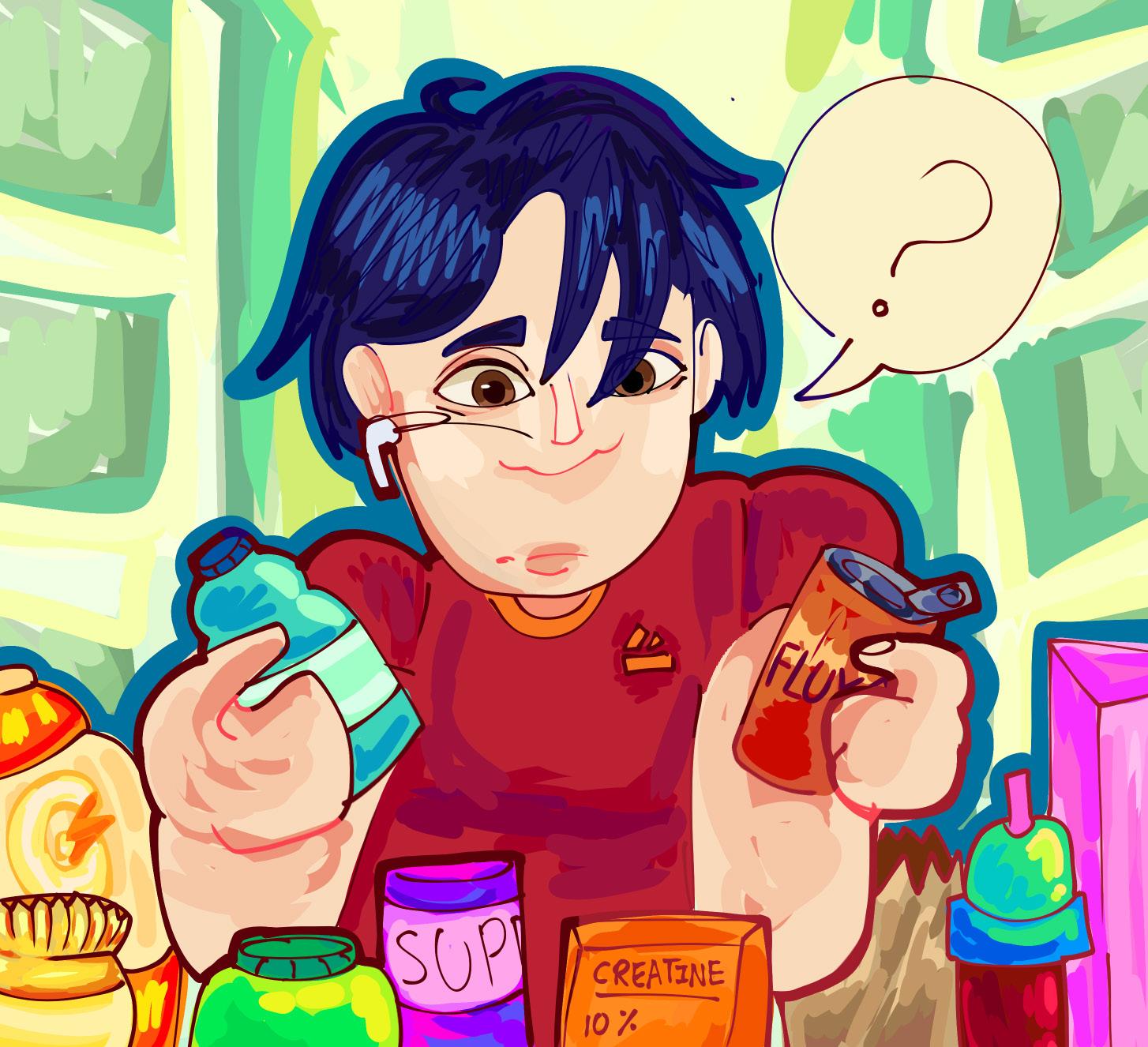
Chasing the perfect physique 37% of US students use supplements amid social media pressure
David Zhou Staff Writer
On TikTok and Instagram, algorithms often promote an idealistic body image for teenage boys: low body fat percentage, high muscle mass and exceptional strength. According to the National Library of Medicine, up to 80% of teenage boys experience body dissatisfaction.
Upper School (US) students may find themselves pressured to pursue unrealistic body standards. As a result of these expectations, products like creatine and protein powder, which are said to help boost performance, have become more popular in recent years.
In a Vanguard poll of 140 US students, 37% said they use health supplements like creatine and protein powder occasionally or regularly.
“A lot of societal pressures come from social media,” Matthew Wang ’28 said. “Especially how people are posting what they do and how they look. A lot of things on social media can influence how people feel.”
Social media feeds promote idealized physiques, Robert Lally ’28 said.
“There’s these things called the black pill edits where they’ll show handsome and strong people,” he said. “I know it might not seem serious, but social media is definitely a big aspect of why a lot of people might want to get stronger.”
Peilin Li ’28 uses protein powder for cross country and crew.
“In cross country, it’s more about your aerobic capacity, but in crew, where you need muscle mass, it’s definitely helpful for building that,” he said. “Afterward, I drink a protein shake to help with recovery.”
Ethan Yu ’28 said there is a difference between performance aids and harmful substances.
“There’s a line between what can be considered a shortcut and what can be legit,” he said. “Steroids definitely cross the line. They cause extreme muscle development, which is completely unnatural.”
Testing limits Students navigate overloaded assessment schedules
Rishaan Chowdhury Contributing Writer
Students at the Upper School (US) are supposed to have no more than four major assessments per week and no more than two major assessments per day. These expectations are outlined in guidelines from US Assistant Director Katrina Fuller, which also specify the blocks in which teachers may schedule assessments.
Despite these guidelines, students sometimes experience overloaded assessment schedules that exceed recommended limits.
According to the All-School Student and Family Handbook, “to help students maintain an appropriately balanced workload, … they should have no more than two major assessments per day and no more than four major assessments per week. If a student has assessments beyond these guidelines, the student should notify the teachers so that the teachers can reschedule the assessment(s).”
During the final week of each trimester, teachers can only schedule assessments during their long block class. However, some US students said they continue to experience weeks in which assessments exceed the limit.
US Math Teacher Chip Rollinson said he usually checks in with his students because it’s impossible to know every student’s assessment schedule.
“We don’t have a giant compilation of other classes’ assessments. I don’t have an idea of what other teachers are doing. Kids are in too many different classes, and that
might be overwhelming for anyone trying to do that.”
Mr. Rollinson works with students to adjust assessment schedules.
“Students have to be as responsible as possible,” he said. “That means foreseeing when you’re going to have too much on your plate and letting teachers know. If a student emails me the night before an assessment, I’m like, ‘You should have foreseen what was happening a little.’ But I’m usually much more flexible the further in advance that a student has approached me about a conflict.”
Mr. Rollinson said students can also speak with their advisors.
“We want students to feel more empowered to talk to their teachers or advisor if they have more than two
major assessments or assignments on the same day. We want to put students in the role of knowing what their rights are and know how to approach their teachers tactfully. If a student doesn’t want to ruffle feathers, their advisor should be able to help.”
US History Teacher Scott Tang gives a week’s heads up before major assessments.
“Aside from keeping in mind what is happening in English during Sophomore Debates and the Junior Profile, I do not take steps to avoid conflicts with other classes,” he said. “Teachers should have the freedom to manage their classes, including the pacing of learning and the timing of assessments.”
Mr. Tang schedules assessments for his designated long block classes
Colton Fischer ’28 uses supplements for football.
“There’s a lot of crazy things you hear with sports supplements, but there’s also other stuff that’s just way better for you, and it’s not that insane. I take a lot of vitamins: It’s not just straight creatine and protein, but it’s vitamin C, vitamin D and magnesium.”
People have misconceptions about the safety of creatine, Colton said.
“There’s a lot of stigma on how it is unsafe. But creatine is one of the most studied supplements in the world. I wouldn’t take any chances otherwise: It’s actually pretty safe despite what some people think.”
US Health Teacher Claire Herrmann said it can be difficult to differentiate beneficial from harmful supplements.
“If I see an influencer doing something, I might think, ‘They’re doing it, so I can do it too,’ whereas we’re very different people with different medical needs and backgrounds. And everyone’s bodies process things differently.”
US Nurse Jacquelyn Nolan said to check with a trusted adult when uncertain about supplements.
“Don’t hesitate to ask for help if you’re ever not feeling well or you have a question. Seek out an adult or your doctor.”
throughout the trimester.
“Since they are during long blocks, my assessments technically have priority over others,” he said. “I might adjust the date for a particular student, but I also make clear that my assessment should not always be the one that is rescheduled.”
Ria Nigwekar ’29 said overloaded assessment schedules increase her stress.
“I will be compromising or giving up some of my sleep to study or get ready for those tests, and that increases my stress levels,” she said.
“It’s just the idea of having to prepare for multiple things at once that gets rough mentally. I give up some of the time with friends and family to devote to studying.”
Ria said she rarely tells teachers when she feels overwhelmed.
“There’s a 90% chance I won’t tell my teacher when there’s too much work. I normally don’t tell my teachers when I feel like it’s too much work, I just deal with it.”
Erin Yu ’27 agreed.
“I usually don’t like to talk to my teachers about workload because it requires a lot of rescheduling and time coordination,” she said. “I get a little nervous talking to my teachers about accommodations because it’s difficult to reach a shared understanding.”
Erin has felt the effects of overcrowded weeks.
“I’m consistently getting less than five hours of sleep even with a regular amount of homework, and major due dates on the same day can make this a lot worse,” she said.
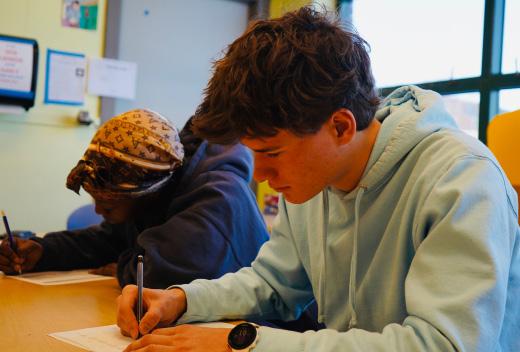
Staff Photo by Olivia Richter Lukas Wellesley ’26 completes an in-class assessment.
Drawing by Marin MacDonald
Writing a college personal statement requires seniors to look closely at who they are and how they want to be understood. Students must decide which moments best reflect who they are while balancing authenticity, structure and their own voice. The Vanguard down with three Upper School students to learn about their experiences writing their personal statements and navigating the college essay process. Bang!
The sound of the door slamming in my face was surprisingly loud, as though the elderly woman had practiced the maneuver. I jumped back instinctively. “Well, I guess she’s not voting for my candidate for City Council,” I chuckled. As I retreated out of her yard and my heart rate slowed, I mentally prepared myself for the next door. “Hi, my name is Abby Brown. I’m a volunteer for David Micley’s campaign. Do you have a few minutes to hear about his platform?”
The next few houses were less startling but no more successful. After an hour or two of unsuccessful attempts, I fell out of sorts; this was an unusual experience for me. I couldn’t understand why I was struggling. After all, my greatest skill has always been my ability to connect with people.
In many ways, I’m a textbook extrovert. Talking to people undeniably energizes me; it’s a part of life that brings me joy and fulfillment. From parties with my Spanish host family and friends, to admissions tours with anxious prospective families, to the upstairs hallways where I make a shy freshman laugh, I particularly like connecting with people who are different than I am. Whether they have different opinions, personalities, backgrounds or experiences, I thrive on finding common ground. My tennis teammates tease me because I connect with my opponents during warm-ups and changeovers, and, on more than one occasion, my opponent and I replaced the traditional match-end handshake with a hug.
Diego Abadie ’26
“I was thinking, ‘How can I have a story arc so my essay stays engaging but focuses on its message? And how can I most strategically showcase a certain set of skills?’ There’s an undertone of humbleness with the way that I’m like, ‘Okay, people did shut the door in my face,’ and I made it a little humorous. It also highlights resilience because people shut the door on me, and I kept going.”
“When I started writing, it was more of a stream of consciousness that I tried to refine from there rather than sounding polished off the bat. I tinkered with my making it sound right the first time. There were places where I wrote, ‘Insert joke or insert this,’ because I knew I wanted to convey a certain tone or follow a certain
“I looked into what I thought my strengths were from my high school experience, and I thought that one of the things I did was try to build community where I go. I was also thinking, ‘I want to go to a college that cares about creating spaces and communities where people can be collaborative.’ I wanted to highlight that in my personal statement to show an alignment of values.”
“The best way to keep an essay authentic is to write about experiences that not everyone can write about. A polished essay isn’t a bad thing, but it can’t be polished and vague: It has to be polished and personal. Otherwise, it starts to feel cliché and like anyone could have written
The end of summer brings our family and friends together for the yearly ritual of tomato canning. Steam, chatter and laughter fill my godparents’ backyard as we blanch, peel and seal through the day. By evening, jars gleam like red jewels on the garden table, a bounty for the winter ahead.
Canning day is a celebration of community, a day to enjoy with family and with close friends who have become our adoptive family in the U.S. They are people who, like my parents, came here from far away and came together to love and support one another. Growing up in this community taught me to seek connection. Whether at school, running camp or a hackathon, I work to build that same sense of belonging.
In my sophomore year, a group of friends and I created HacKnight, the first hackathon and first overnight event at our school. More than just a competition, HacKnight was designed to foster collaboration. We encouraged participants to connect through joint projects, interactive workshops and late-night games. I’m proud of the hacks we made but more so of the friendships and sense of community that grew from the event. HacKnight participants left with more than an engineering experience. They formed lasting connections and found inspiration to run similar hackathons at their own schools.
It was the opposite of Halloween. Instead of filling trick-or-treat baskets, we were giving out our candy instead. In place of goblin masks, people wore the robes of saints and the halos of angels. Instead of laughter falling from our lips, it was the prayers and hymns we had practiced over the past week. With each step across the cobblestone streets of Mende, France, I could only think: This was not how I expected to celebrate my favorite holiday.
During my junior year, I was fortunate to participate in a study abroad program. A few of my friends had participated in the experience previously and spoke incredibly highly of it. For this reason, I was excited to apply and be accepted to study in Rennes, France. When I studied there, I lived with a host family, almost all of the classes I took that semester were conducted in French, and I got to discover and explore the city of Rennes.
Deep immersion in the French way of life helped me make the most out of this experience. However, during the second week of October break, my host family offered me the chance to tag along on their vacation, and since they had extended their home to me for four months, I agreed. What I thought would be a two-hour drive to spend quality time at their summer house was actually a sevenhour car ride, ending with us pulling in front of a church for the start of a missionary week.
Sydney Francis ’26
“I focused on an experience that exemplified a trait that could help me in college, which is trying new experiences, because college brings new opportunities. In my essay, I shared how I got outside my comfort zone on a trip with my host family in France. Everyone spoke very little English, so I was speaking French with everyone there and meeting new people, and I learned to make the best of a unique situation.”
“At first, I wanted to talk about everything that I’ve done rather than centering on a specific moment. So, finding a moment was challenging because I wanted to talk about my experiences on Student Council, and this and that. But it’s less about what you do and more about who you are in certain situations, like in moments of growth.”
Abby Brown ’26
No keys, no problem 43% of eligible students choose not to drive
James Tao Contributing Writer
For decades, a driver’s license has symbolized freedom for teenagers — the ability to go anywhere, anytime, without relying on parents. At the Upper School (US), students are still seeking that autonomy, but not all are turning to driving to get there. Many students are delaying their licenses and navigating independence through public transportation, biking and walking.
In a Vanguard poll of 67 US students eligible for their licenses, 43% said they hadn’t gotten it yet. Only 58% of US students with licenses said they drive themselves to school.
MBTA Transportation Planner Miles Taylor specializes in Massachusetts transit.
“We have seen huge pickups for student ridership on buses in Revere, and we’ve been trying to adjust the schedules to help students get to school easier,” he said. “We run supplemental trips, which are buses that run specifically to a high school.”
Finley Long ’26 has no need for car keys.
“I use public transport instead of driving. I usually walk to Harvard Square, take the T to Back Bay and then I walk to my house.
There’s something about being attached to public transportation. It makes me feel connected to Boston.”
That flexibility extends beyond school.
“I feel pretty independent,” Finley said. “I can dictate when I go home, which is nice. I also don’t have to go home immediately.”
However, public transportation also comes with its downsides.
“What’s not wrong with the train?” Finley said. “Sometimes, they have to switch a schedule and change it to buses because they’re fixing the train. There is some stuff that will happen that people wouldn’t believe. I’ve seen trains on fire, even ones without the lights working.”
Cost and practicality factored into Finley’s decision.
“It’s expensive to pay for gas, and if it’s an electric car, charging
Shaping global thinkers US community reflects on Dr. Baum’s departure after
Arjun Srivastava Contributing Writer
After nearly 17 years at the school, Director of Global Education and Round Square representative Karina Baum left in November 2025. She is stepping into a new role as the director of global learning in the Teaching and Learning Department for the Boston Public Schools (BPS).
Dr. Baum joined the Upper School (US) in 2009 as a biology teacher while leading science travel programs and teaching a Global Online Academy course. After seven years, she became the director of global education, designing intercultural learning programming across the school’s three campuses.
In her role, Dr. Baum led the school’s participation in Round Square, an international community of more than 280 schools across the world. Round Square’s yearly conferences center on their IDEALS of internationalism, democracy, environmentalism, adventure, learning and service.
US Diversity, Equity, Inclusion and Global Education (DEIG) Officer Leila Bailey-Stewart worked closely with Dr. Baum.
“Dr. Baum believed strongly in the power of curiosity,” Ms. BaileyStewart said. “She leveraged that foundation to support and coach students to be critical and globally informed thinkers.”
Round Square Club Co-President Viena Desai ’26 spent time with Dr. Baum in school and on school trips.
is a hassle,” he said. “I don’t have much time. I also have no money, so I don’t know if I’d be able to afford having a car myself.”
Angus McKenna ’27 got his license in February 2025.
“I got my license mostly so my parents wouldn’t have to drive me everywhere,” Angus said. “It honestly increased their freedom more than mine.”
Despite having a car, Angus, who lives in Hingham, still relies heavily on public transportation.
“I take the MBTA ferry to school most days,” Angus said. “I only drive twice a week because I can get an extra hour of sleep without driving, so using public transportation, it’s only an hour and 25 minutes instead of two hours and 25 minutes.”
Cailan MacDonald ’27 said getting her license was necessary.
“A lot of my friends live in the city or far away, and before having my license, my parents didn’t always want to drive me 40 minutes, but now I can drive myself.”
Cailan now drives her sister to school.
“It’s my responsibility to make sure we make it on time and safely,” Cailan said. “Similarly, when my friends are in the car, I want to be able to talk, but I also know I have to pay attention because I am responsible for driving them.”
17 years
“We all went on a hike in Colombia for Round Square, and it was pretty challenging, but that was the moment where I took her out of the school context, and I was really able to get to know her as a person,” she said. “That’s a moment where I felt like I was growing a lot closer to her. Being able to talk to her and see her in this new context created that great relationship, and that’s super special for a club to have.”
Kaden Foster ’28 joined Round Square this year and attended its Dubai conference with Dr. Baum.
“Dr. Baum made me feel very welcome and included. She had
such excitement for the trip and was able to answer any question or concern I had. Whether it was greeting me in the hallways, making sure I was managing the increased workload or checking in about my day, she always made me feel supported and valued as a student.”
Dr. Baum welcomed challenging discussions with students.
“Some of my most meaningful memories are conversations with students, often before and after travel or during moments when global issues felt personal and complicated,” she said. “I think of students sitting with big questions
about identity, responsibility and their place in the world and being willing to stay in that discomfort long enough to grow.”
She hopes to have left an impact on US students.
“I have deep confidence in who the students are, in the values they carry and in the ways they show up in the world,” she said. “I know that the global education program helped nurture their curiosity and their understanding that they have a role to play in contributing to positive change. I hope they develop to be adaptable, flexible and prepared for the unknown with the confidence to ask questions and explore solutions thoughtfully.”
Dr. Baum said her work emphasized openness to differing perspectives.
“I hope we’ve shifted some of our focus toward understanding challenges deeply and identifying root causes, rather than rushing to solutions or deliverables, and that student projects incorporate multiple voices and stakeholders.”
At BPS, Dr. Baum will support educators across the district in integrating global learning into the curriculum, strengthening teacher professional development and advancing international student travel and K-12 world language learning. She said her work will continue to be grounded in equity and culturally sustaining practices with a focus on creating meaningful local and global learning opportunities for all students.
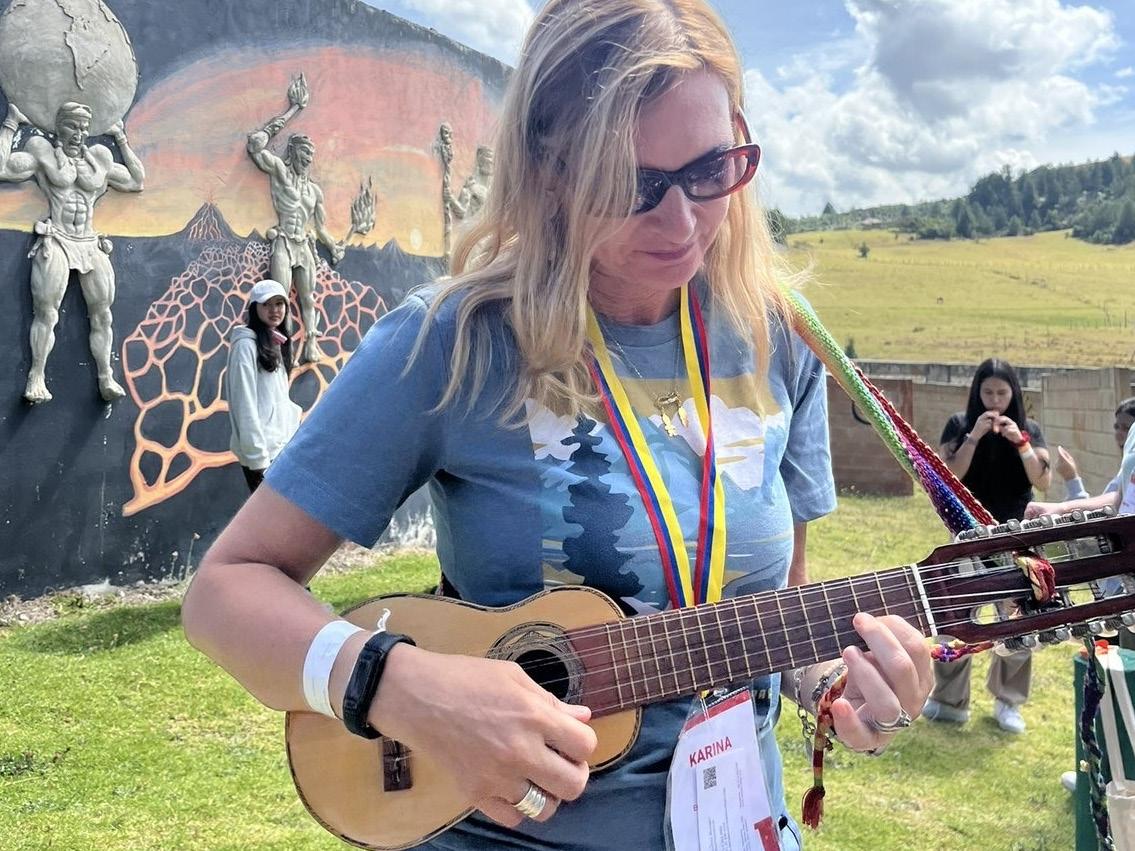
Photo Courtesy of Olivia Richter
Former Director of Global Education and Round Square representative Karina Baum led Round Square trips to the UAE, Colombia, Kenya and the UK in recent years.
Staff Photo by Katy Varadi
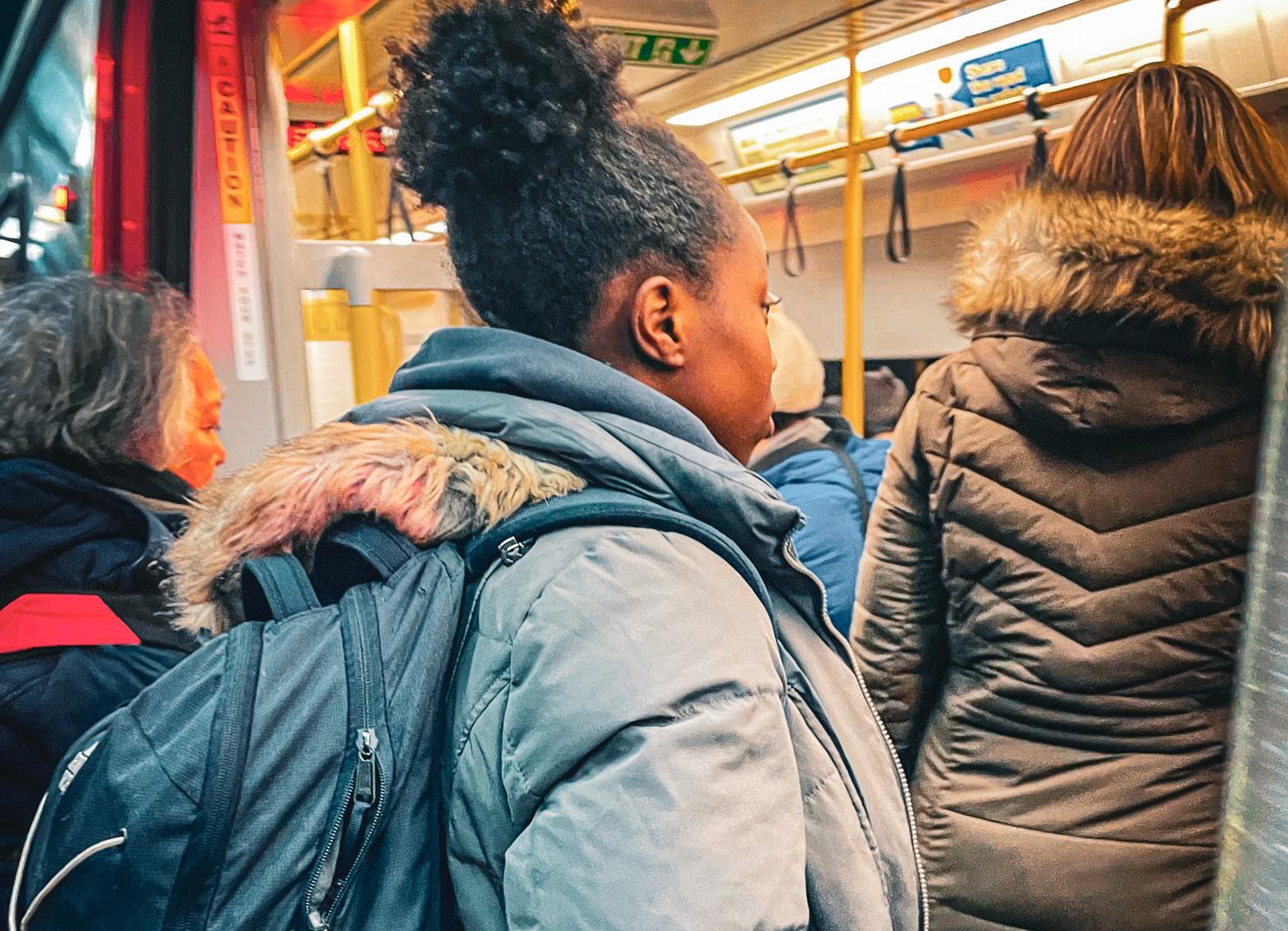
Princess Adeoye ’27 boards the T at the Harvard station.
Off Campus
SASA finds strength within Dinner unites affinity group, cross-school connections to develop
A group of Upper School (US) students carefully placed the final gumball on their gingerbread house in the hopes of winning the competition. Nine members of the South Asian Student Alliance (SASA) recently attended a Jan. 8 South Asian Community Event at The Rivers School for a night of food, trivia games and a gingerbread house-making contest. SASA Co-Presidents Shay Patel and Ayana Karthik (both ’26) organized SASA’s participation.
Ara Surati ’29 attended the event.
“I wanted to network with people in the South Asian community from other schools,” she said. “This event made me feel empowered because I met a lot of cool people with a similar background and experiences.”
Ara bonded with other SASA members.
“I made a deeper connection with a lot of the upperclassmen,” she said. “We played a lot of games that were divided by school. Learning from the upperclassmen and seeing their experiences was like a mirror. They’ve been through a lot of what I’ve been through. There’s a lot of similarities between us because we’re all at the same school with similar cultural backgrounds and values.”
Nick Narasimhan ’26 went to the event with his friends.
“Personally, I’m not too in touch with my Indian side,” Nick said. “Being able to meet people who are in touch with it and see how that looks for them helped me learn a bit more about my culture. The best part was being able to hear how Indian communities interact at different schools.”
US Math Department Head Meena Kaur chaperoned the event.
“The event was really important for kids to hear from other schools about their successes and
some of their struggles so that our own students can feel pride in what they’re doing or get ideas. It’s great to be aware of what’s going on in today’s teenage climate of affinity spaces.”
Ms. Kaur said the event aligned with SASA’s goals.
“Our goals are just to build community and have that space available to our students. It was very uplifting to see that there are communities at other schools. It’s a nice preview to what students will experience in college or at university where there will hopefully be a bigger South Asian communi-
Return to Yale pays off MUN Club competes in YMUN, wins 6 awards
Leo Brodsky
Contributing Writer
While some Upper School (US) students enjoyed the snow during MLK Day weekend, 13 members of the US Model United Nations (MUN) Club were in committee sessions trying to solve global issues. The attendees spent four days — Jan. 1518 — together in New Haven, Connecticut, at the 52nd annual conference of Yale Model United Nations (YMUN).
The US delegation brought back six awards, with Salar Sekhavat ’26 winning Best Delegate in his committee. Erin Yu and Cookie Nassif (both ’27) won Honorable Delegates and Sofia Egan ’26, Sydney Xu and Matias Egan (both ’28) won Best Position Papers.
According to its website, YMUN hopes to engage delegates to think critically about pressing global issues, including historical conflicts, along with humanitarian responses, in order to collaborate and solve these issues. The conference hosted more than 1,800 delegates from more than 25 countries.
After attending Harvard’s conference in 2025 (See Volume 53, Issue 8: “MUN Club goes local, attends Harvard Conference”), US English Teacher and MUN Faculty Advisor Sharon Krauss said the club chose to go to YMUN.
“The student experience was not as good at Harvard because that conference was considerably larger than Yale’s, so delegates did not have as much time to speak in their committees, which wasn’t as fun for them.”
Ms. Krauss said she was hopeful Yale would be an improvement.
“I hope that they are able to engage meaningfully with other students from all over the world, with global current events and historical events that bring them to a greater understanding.”
Matias said he felt that the
Harvard experience was challenging last year.
“At Harvard, we just bussed from BB&N every day, which wasn’t an awesome experience. We had to wake up really early and come here every day.”
At the Yale conference, students stayed at a hotel together. Matias said he preferred the smaller environment at YMUN.
“My last year at Harvard Model UN, I felt really overwhelmed, as there were really large rooms, and I was in a big delegation. I think there were around 200 to 300 people.”
ty that they can get involved with.”
Ms. Kaur said she wished for more interactions between the schools.
“It was a good opportunity for students to bond and connect with students from other schools. To improve, offering opportunities to mix up the students from different schools would be a good suggestion. This would help drop an ‘our school hangs out with our school, their school hangs out with their school’ precedent. It was still great to be in a small room together and hear the conversation and laughter.”
Sydney represented Austria and spoke on the topic of water scarcity and greenhouse gas management.
“I feel like the more interested you are, the better you do because you are more involved with the research,” she said.
Sydney said she hoped to gain real world skills from the conference.
“My goal is to improve my public speaking skills and my ability to voice my ideas clearly and work with other people. I feel like these skills really extend beyond school and into real life and the working environment.”
Erin represented Mongolia in the conference and worked on enhancing regional cooperation in the face of global economic uncertainty.
“For all of us, the awards and stuff, that’s all great, but the friends that you meet there and the cool stories that you get to hear from the South Americans and the kids that are coming from Asian schools, it’s so insane. It’s such a new perspective compared to a lot of the stuff that we have here.”
The club spent most of their budget on this conference, and the process took months of preparation. Erin said she expects the club to return to YMUN next year.
Photo Courtesy of of Elizabeth Velander The US MUN club wins six awards at its Yale competition.
Photo Courtesy of Ayana Karthik
Ara Surati ’29, Ayana Karthik, Shay Patel and Nick Narasimhan (all ’26) collaborate on a gingerbread house.
Bradley Shen
Contributing Writer
Off Campus
Four Upper School students spent the fall trimester in programs across Idaho, Chile and Switzerland, combining academics with outdoor learning experiences. Hazel de Winter, Tristan Ko and Pari Naga (all ’28) attended Swiss Semester in Zermatt, and Maia Dokmo ’27 participated in the Alzar School. In the spring, Ingrid Schrag ’27 will travel to the Maine Coast Semester at Chewonki. —Christine
Beyond the bubble
How can four months studying away from everyday life in the outdoors of Idaho and Chile redefine ideas of community, school and yourself? During the fall, Maia Dokmo ’27 took her learning beyond the Upper School campus, spending her semester away at the Alzar School in both Cascade, Idaho and Patagonia, Chile.
“I wanted to go on a semester abroad to experience something new,” Maia said. “To me, BB&N felt like a bubble that I just couldn’t pop, and I felt tired of being limited to this campus.”
Heading into the Alzar School, Maia didn’t know what to expect.
“I was ready for a new experience where I could learn more about the world and myself,” she said. “The best way I could describe it would be surpassing my idea of school, what it could be, and completely redefining my idea of community and travel. Every moment was so wholesome and filled with the most beautiful views I’ve ever seen.”
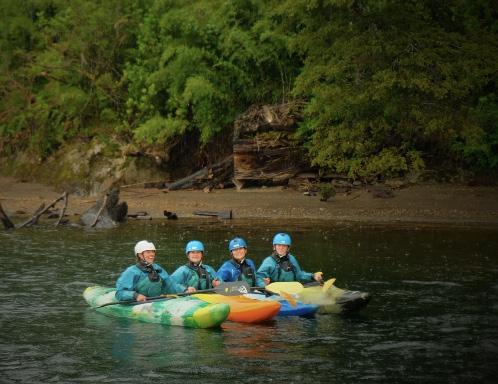
She also participated in several outdoor activities, including backpacking, kayaking and rafting.
“I fell in love with most campuses and areas and can’t wait to go back,” she said. “Highlights from this experience were getting to spend time in the backcountry or off the grid. I learned to appreciate the little things and experiences and that if I keep going, I can scale any mountain and kayak any river.”
Maia joined a strong community at the Alzar School.
Offline in the Alps
Three Upper School (US) students traded screens for summits this fall, attending the Swiss Semester in Zermatt, Switzerland, through the school’s semester away program. Hazel de Winter, Tristan Ko and Pari Naga (all ’28) took part in the four-month program, balancing academics with hiking, ice climbing and skiing — all with zero access to technology.
Hazel said the no-technology policy shaped friendships.
“It forced everyone to be more present in the moment and to interact with each other, so it led to more meaningful connections. I tried to prioritize living in the moment, exploring and making connections.”
Each day, students went to six classes before skiing or hiking for three hours. During the program, Pari traveled with a small group of students to Venice.
“It was really intriguing to go to a foreign place, not have your phone and be independent,” she said. “I learned how to function on my own and how to navigate without a phone. I definitely know how to manage my time more efficiently.”
For Tristan, the no-technology approach had its greatest impact on academics.
“It made everything more hands-on, and you really had to understand what you were learning to properly engage,” Tristan said. “Because everything was handwritten, you had to slow down and be a lot more intentional with your sentences: You couldn’t just edit it later. Research was a big change, too. Going through books to find sources and citations manually made me better at citing and paying closer attention to what I was reading.”
Geology was one of the courses.
—Andy
Wang ’29
“Everyone there, from the staff to the fellow students, was so kind and willing to teach, learn, explore, fail and grow together,” she said. “Going there truly changed my life, and I urge anyone interested to look into applying.”
“We went on three-hour hikes to do technical drawings of glaciers and mountains, and we would collect rock samples to analyze and reconstruct the history of the valleys,” he said. “We learned how to identify rocks based on where they were placed and what they look like.”
The semester abroad was Tristan’s first time experiencing boarding school.
“It changed my perspective on how a community is so much different when you live with the people in it,” he said. “We hung out with each other all the time, which I wasn’t used to back home. It’s mind-blowing how close we’ve all gotten through just three months of knowing each other.” —Christian Chow ’28
5 Things You Didn’t Know About Dr.
Walker
1 My full name is Joshua Sky Walker (I was born a year and change after the first “Star Wars” came out).
2 My name once triggered an impromptu light saber battle between two heavily armed but jolly border guards in Uzbekistan.
3 I met my spouse in Moscow, Russia.
4 I’m also a BB&N parent (P ’38).
5 I did my last degree in Dublin, Ireland.
Photo Courtesy of Dr. Walker
Photo Courtesy of Maia Dokmo Maia Dokmo ’27 spent time kayaking while in Patagonia, Chile.
Photo Courtesy of Pari Naga Hazel de Winter, Tristan Ko and Pari Naga (all ’28) skied at Zermatt during Swiss Semester.
Tao ’27
Global Unrest
The Vanguard spoke with Upper School History Department Head Stacey Spring about the developing situations in Iran and Venezuela and their potential implications.
How does recent U.S. involvement in Iran and Venezuela reflect previous patterns in American foreign policy?
There’s been heavy U.S. involvement in both places historically, but it looks different. In Venezuela, if you go back to the Monroe Doctrine, it’s always been the attitude of American leadership that this hemisphere is ours to defend or to be heavily involved in. You can trace that through Cold War actions, where in Latin and South America, we’ve propped up military dictators in favor of keeping communism out. The interpretation is, ‘This is our backyard, and we’re going to protect the border.’
U.S. involvement in Venezuela because of oil is part of it. It’s hard to explain the patterns of current foreign policy because it hinges a lot on how President Trump sees the world. He has a lot of old-school methods of the use of force to reinforce your will in a way that, more commonly among modern leaders, hasn’t been the approach. The idea of the U.S. taking out a leader in Latin or South America has strong historical precedent. The reasoning is very different in this case. There’s reasonable challenges like, ‘Is this legal? Is this something that we should be doing?’
Iran is also a heavy oil-producing country, but if you go all the way back to the 1950s, we supported a coup there in order to again put in leadership that was economically friendly to us. U.S. involvement in Iran can be traced to the emergence of the Islamic regime as a response to U.S. and British colonial presence in Iran from the ’50s through the ’70s. These actions and threats are a callback to the old realpolitik use of the U.S. military to reinforce positions in a
Why should students care about unrest in these countries?
It’s hard when places are so far away, and it feels so distant. We’re in a community where the vast majority of families lean toward the Democratic side and are already positioned to critique the president’s policies. With how interconnected the world is, if you don’t pay attention to these things, you’re going to be surprised by the major shifts. There is the potential for these aggravations to lead to a wider world war.
As future voters, if not current voters, students have a responsibility as citizens to know what they’re voting for and what risks we’re taking. Understanding the position of U.S. servicemen and women is important, as they have contributed significantly to the country’s safety and security and are the people who are going to be put at risk for this. It’s global awareness, the idea that we know we have Venezuelan and Iranian families within our community who are going to be watching this closely due to relatives being there. Any number of these things can spiral into a larger conflict, and we don’t want to be caught off guard by that.
Global Unrest
The Vanguard also spoke to Pierce Seth ’27, a member of the Upper School’s Round Square Club, and Ella Namiranian ’26, an Iranian student, about current events unfolding in Venezuela and Iran, respectively.
On Jan. 3, 2026, the United States carried out a military operation that resulted in the capture of Venezuelan President Nicolás Maduro. The U.S. government said the action was meant to uphold the rule of law and support a transition toward democracy, citing the severe impacts of Maduro’s rule, including economic collapse, political repression and mass migration. Maduro’s leadership had also been widely disputed, with about 60 countries refusing to recognize his presidency as legitimate due to concerns over past elections, leading some to view the operation as a step toward democracy.
Critics condemned the move as a violation of Venezuela’s sovereignty and international law. Many in the Venezuelan diaspora celebrated Maduro’s removal as a chance for change, while others expressed uncertainty about instability and the country’s future.
Why do you think Venezuela matters to the U.S.?
Pierce: Venezuela has the largest crude oil reserves in the world, $17 trillion worth of oil in the ground. They have some of the largest mineral deposits in the world, too. Economically, it would be important for us to gain a position in Venezuela before enemy states, like China or Russia, do. The Venezuelan crisis right now highlights a fundamental geopolitical issue. U.S. actions throughout history internationally are supposed to set the precedent, and this is the U.S. saying, ‘You don’t mess with the United States,’ especially with the Venezuelan administration’s involvement with drug cartels.
Iran Venezuela
How should the U.S. balance its own interests with respect for another country’s sovereignty?
Pierce: Though it’s a sovereign country, it’s not like Maduro hasn’t been accused of election fraud and systematic corruption. It’s not without its own failures within the country. These were terrorists who were affecting our lives through drug exploitation.
In January 2026, tensions between the United States and Iran surged amid widespread nationwide protests and a severe government crackdown. Iranian security forces and the military responded with force, leading to an estimated death toll between 20,000 and 40,000. Authorities imposed internet blackouts, restricted media coverage and canceled flights in major cities to suppress public unrest.
As repression intensified, President Donald Trump publicly warned of possible U.S. military action. Iran responded by threatening to target U.S. military bases in the region if the U.S. launched strikes, raising fears of broader regional escalation. With diplomatic contact between the two governments stalled, and only limited regional mediation reducing immediate risk, the situation remains fragile with potential U.S. action still under discussion.
How has being Iranian shaped how you understand the current situation?
Ella: Having one of my parents emigrate from Iran during the time of the Islamic Revolution, from the time when Khomeini took over, and hearing my grandparents stories of immigrating creates more significance. Forty-seven years later, people are protesting again and trying to get rid of the Islamic rule.
What are your thoughts on current U.S. involvement?
Ella: A lot of Iranians themselves are protesting and asking Trump to intervene and help with Islamic rule there. My family and a lot of Persians probably in the U.S. would agree that it would be best for somebody to go in there and dismantle the regime. Newer generations have grown up with controlled speech and controlled rights. Many see U.S. involvement as a response to this limitation on human rights.
College Campus Safety
Campus safety stats
From 2014 to 2024, gun violence increased by 43% compared to previous decades
57% of school shootings in 2025 were on college campuses
65% of college students surveyed said school shootings impacted their sense of safety on campus, and 63% favor stricter campus gun policies
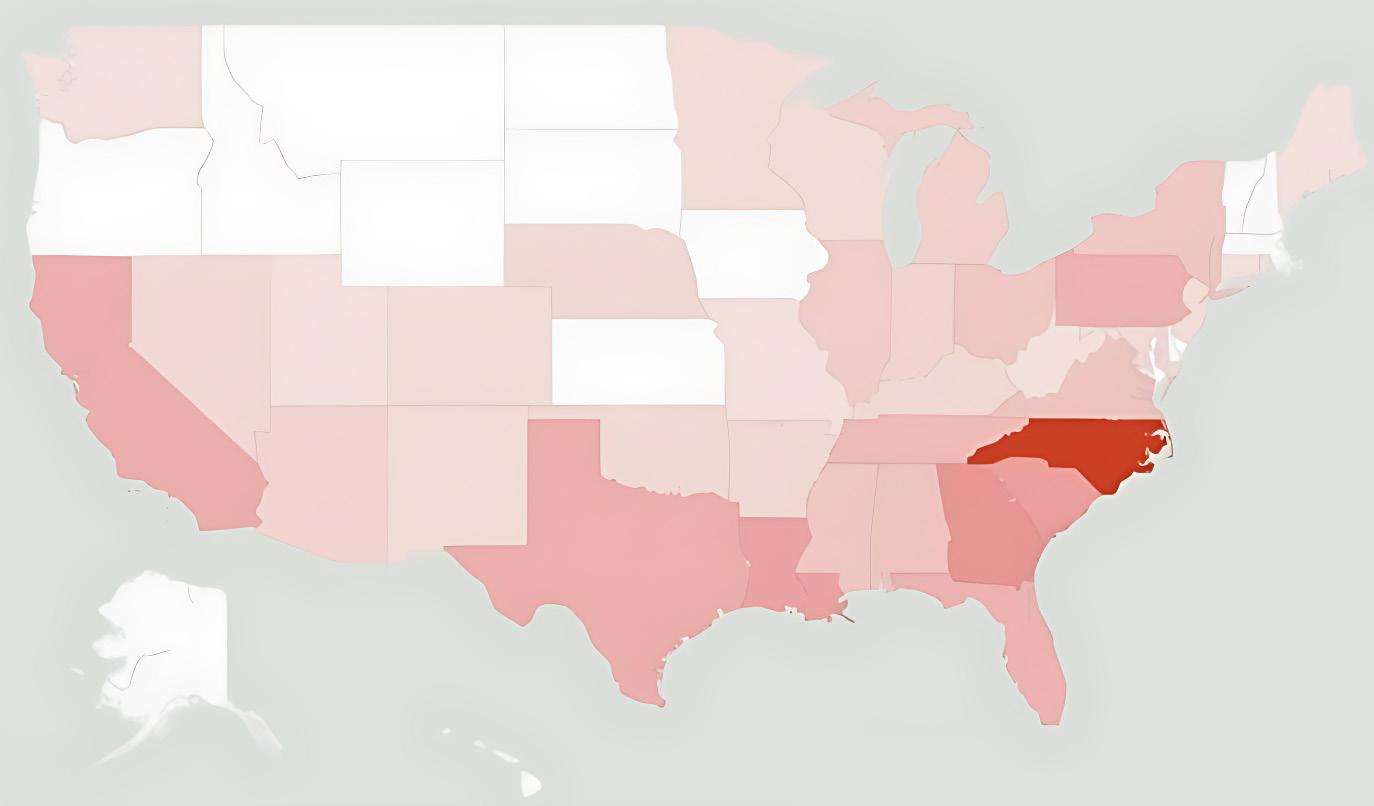
States with the highest incidents of gun violence on college campuses from Nov. 15, 2023 to Jan. 23, 2026
College Campus Safety
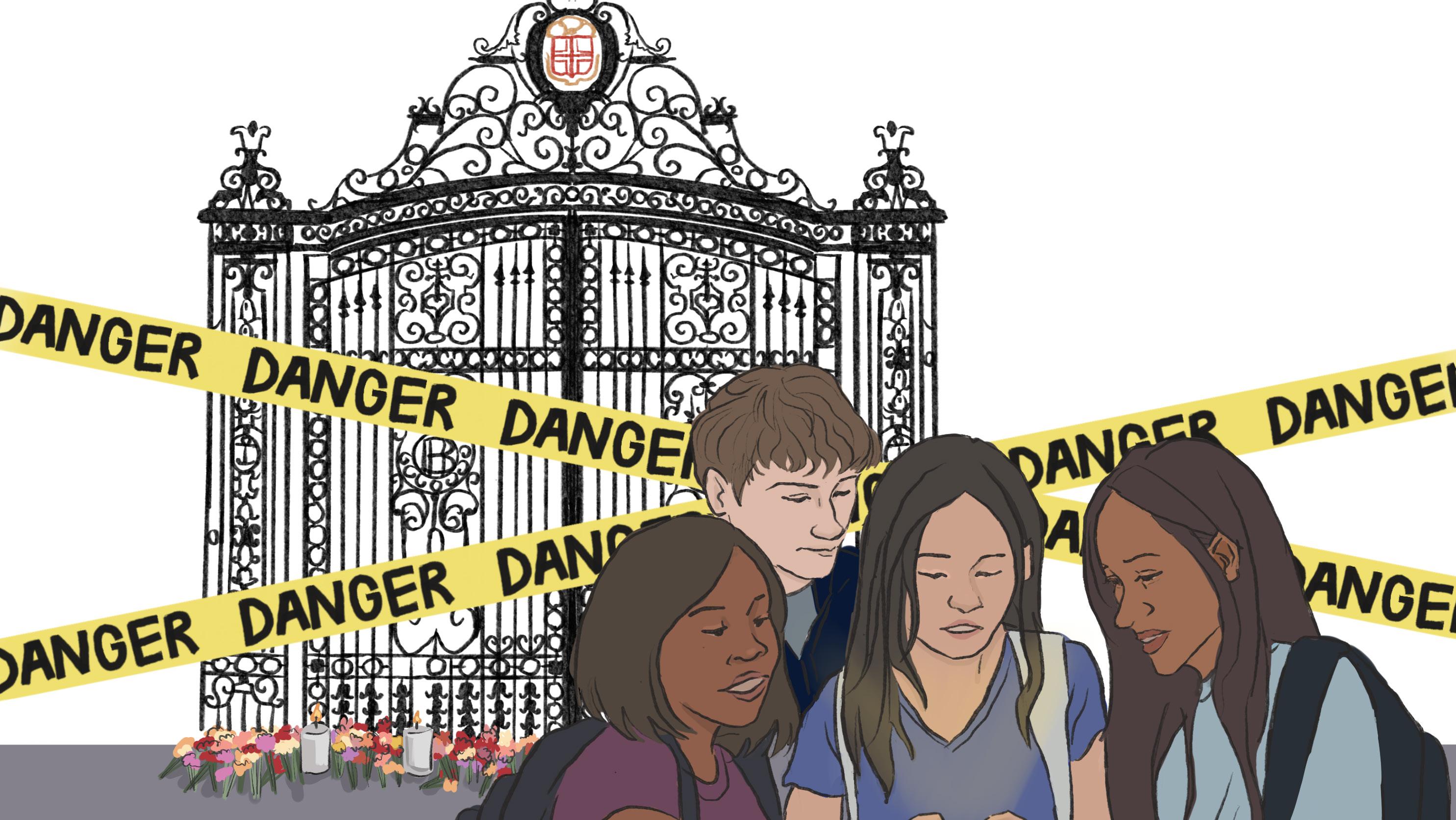
The Vanguard spoke with Upper School seniors to better understand their perspectives regarding violence on college campuses. Using the recent shooting at Brown University as a lens to explore safety issues, students considered how identity and personal security are influencing their college application processes.
Ben Friend ’26 (admitted to Brown Early Decision)
How did you feel when you heard about the shooting at Brown?
It didn’t really affect how I felt about applying. If it happened before I applied, I still would have applied early there. I was just scared because we know a lot of people there, and it’s scary thinking I could be there when something like that happens. Considering recent events at Brown and the rise in gun violence in recent years, has your perception of yourself on a college campus changed?
I might be a bit more alert just in terms of that thinking, “Oh, that’s happened here before,” but I wouldn’t say it’s gonna change how I go about my daily life. Violence on college campuses is something that everyone thinks isn’t going to happen to them in any moment, but it can. The chances of this happening twice in two years at the same university would be horrible and crazy, but I still think you need to be aware that something could happen.
Lexi Mack ’26 (currently applying to college)
Was safety a big factor for you when applying to colleges?
I’m Jewish, so that plays a really big role in terms of safety as a factor and what colleges I was allowed to apply to. My parents didn’t want me to apply to Columbia, even though they both went there, because of the huge safety risks they were having and how they just weren’t handling everything surrounding political incidents really well. City safety played a really big role in my choices, as well, especially in St. Louis because I toured and applied to WashU. Students go out in St. Louis, but it’s just not a city my parents would love me running around at night.
How was your identity a factor in where you chose to apply?
When I know there’s a big Jewish presence at a school, it definitely makes me feel safer. You have safety in numbers with that. One of the schools that I’m very happy with is Tulane, and that’s around 40% Jewish. There’s videos of people from New Orleans protesting in front of Jewish student organizations at Tulane, and none of the students were hurt. The police were there, and they mediated it. Having a big presence kind of brings more light to the situation and limits violence.
Aggie Grant ’26 (applied to Brown, brother goes to Brown)
Being heavily connected to Brown, how did the shooting there make you feel? It was really scary. It was a frantic ten minutes trying to get a hold of my brother, and it was hard because it’s a place that I’ve been to a lot and am connected to, so I couldn’t imagine that happening there. My brother was in lockdown for around 12 hours, just hiding in his bathroom. This incident didn’t deter me at all or turn me off from the school because, unfortunately, in this political climate, it’s not specific to the school. Was safety a big factor for you when applying to colleges? I’ve been lucky enough to be able to not be a targeted group, so not necessarily. I purposely didn’t apply to schools in the South just because I wanted to make sure that I felt safer as a woman with my bodily autonomy, but safety wasn’t necessarily a huge draw for me. How much responsibility do you think universities have in preventing violent incidents? It really varies. Specifically, with the Brown situation, it’s really difficult when a school isn’t expecting for anything to happen. It comes down to a larger issue around laws and gun regulations.
Community Day, an annual Upper School tradition, offers students a temporary respite from rigorous academics and brings them together to celebrate the school’s diverse community. With this year’s event coming up on Feb. 11, The Vanguard spoke with Community Day Lead Organizers Sydney Francis, Izzy Doricent and Ethan Ortega (all ’26) to get a behind-the-scenes view of their preparations.
What is unique about Community Day this year?
Izzy: Our theme for this year is Outside the Box. We’ve seen this theme at assemblies, where people have come in and talked about their experiences outside of the school. During Community Day, we hope to fuel these conversations where people can talk about what’s meaningful to them.
Sydney: Community Day is one of those unique experiences at school with community bonding and school spirit. A lot of the time, at school, we don’t have opportunities to relax and enjoy our time together. Especially for us seniors, this year, the event is going to be very special.
Ethan: It’s a time to relax and debrief. It was a very eventful year, so we should take some time, look back on it and converse with new people or your friends in a safe environment.
What are your primary goals as organizers?
—Vartan Arakelian ’26
Izzy: Another thing we’re working on is having more people engage in the assembly activities. We want to get everyone to participate and contribute.
Ethan: I agree. We want to have people either playing the games or cheering on their classmates to create a competitive aspect to it.
How has working on Community Day deepened your relationship with each other as a group?
Izzy: We have both underclassmen and upperclassmen in the leadership group, and that opportunity to collaborate across grades has been beneficial to all of us.
Sydney: I agree with Izzy. It’s nice seeing how all our different ideas can come together to create the best day possible.
Ethan: Interacting with people across grades has also helped us form a more complete understanding of the preferences of the
Opinions
The soundtrack of my childhood
My earliest memories of music are tied to my dad. Whether my dad’s singing in his pick-up work band or showing me records he stores in our basement, my relationship with music would be significantly different without him.
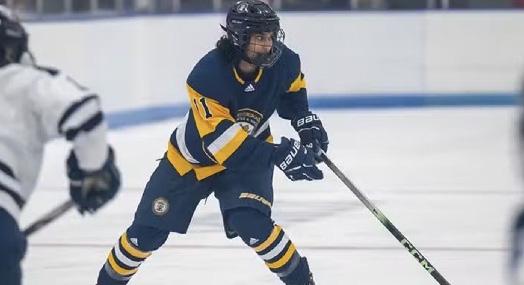
When I was just starting to play hockey as a kid, I remember driving to early morning weekend practices and cross-ice scrimmages at Pingree. On those drives, my dad would play all sorts of music, trying to figure out what my younger self enjoyed. My dad playing these songs for me is my first memory of music, and although I didn’t really get into music until much later in my life, the songs he played still bring me back to those moments today.
“Night Visions” by Imagine Dragons will always bring me back to those days. Although the band has earned a reputation for their newer, repetitive tracks, their earlier work feels more authentic. Before they went mainstream with songs like “Radioactive” amassing billions of streams, Imagine Dragons produced some surprisingly good music. Personal nostalgia aside, “Night Visions” has some truly original tracks. Tracks like “Selene” scream early 2010s alternative or indie, with catchy melodies, a driven beat throughout the song and excellent vocal work by Dan Reynolds — which has made it one of my favorite songs to revisit this year.
Each hockey season, I feel weighed down by nerves before games with no reliable way to calm them down. This season, I’ve had trouble dealing with expectations: It’s been tough for me to grasp being a senior and feeling like I have to be perfect on the ice.
Recently, however, I’ve been thinking bigger-picture and reflecting on why I play hockey in the first place. I’ve never been a musicbefore-games type of athlete. Whenever I would try to pump myself up and listen to my own music, I’d put on some rap or some hype music to try to get myself excited, but mentally, it made no difference.
“I thought of my dad and the constant sacrifices he made for me to play hockey
throughout my childhood.”
After a frustrating personal performance in our first of two games in one day, I decided to take a step back. I forgot who we were playing next, how sore I felt and how nervous I was to make more mistakes like the previous game. I put my AirPods in and listened to “Night Visions,” and it worked.
I thought of my dad and the constant sacrifices he made for me to play hockey throughout my childhood. It reminded me of 6 a.m. mornings as a seven-year-old: my dad making breakfast, packing my hockey bag and driving me thirty minutes from Marblehead to Pingree, just to watch me goofily skate around and whack a puck here and there. I remembered how he’d always pull into the Dunkin’ off the Lynnway after practice and get me a hot chocolate, whipped cream on top and a little bit of milk, no matter how I played that day.
Outside of hockey, my dad and I still communicate through music. In the car, we take turns playing songs. I don’t like every song he plays; he doesn’t always like mine, but I always cherish how excited he is to share them with me.
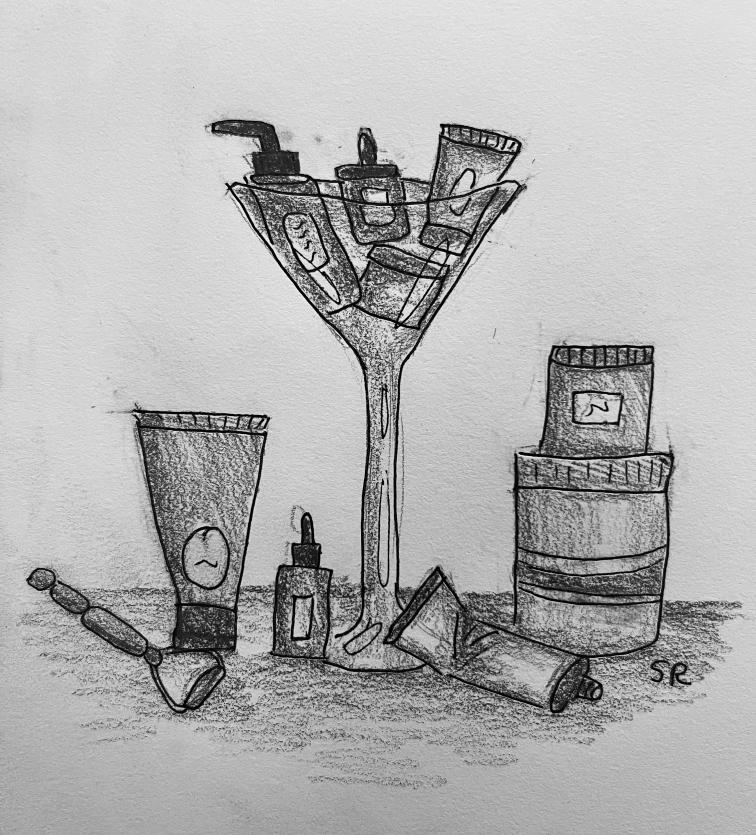
The Drunk Elephant fine print
Years ago, Sephora was a luxury cosmetics store populated by beauty enthusiasts in pursuit of the latest skincare and makeup lines. Now, among the sea of adults are swarms of preteens eager to fill their bedrooms with colorful serums and creams. Coerced by their favorite influencers, Sephora kids can be found lurking near your favorite cosmetic brand. However, encased in these sought-after, vibrant bottles are harsh ingredients like glycolic acid, retinol and vitamin C.
Beauty company Drunk Elephant is infamous for being a Sephora kid’s latest obsession. Their $72 Protini Polypeptide cream and its “iconic” pump packaging can be found in nearly every Sephora wishlist. It contains glycolic acid, a strong, odorless solid made to reduce the appearance of fine lines by working as a chemical exfoliant on the skin’s top layer, the epidermis. Obviously, every 12-year-old requires this cream; glycolic acid is essential to blurring their nonexistent wrinkles. Consumers often forget the dangers of glycolic acid, including its ability to burn and irritate the skin.
But this cream is just one product in their 10-step skincare routines. Many Sephora kids will also whip out their A-Passioni Retinol cream (yes, that’s the actual name). Retinol, also known as vitamin A, fights acne-causing bacteria and soothes skin inflammation by unclogging pores and stimulating collagen production. Product developers intentionally include retinol to create potent serums that can fight stubborn acne. Of course, retinol is also a necessity for kids with clear skin. And isn’t the hot pink packaging just irresistible? Using retinol cream religiously is part of the Sephora kid handbook. Still, an overuse of retinol can put their skin at risk of purging: a temporary increase in acne as clogged pores develop.
Even their C-Firma Fresh Day Serum, packed with vitamin C, worms its way into a Sephora kid’s vanity. Apparently, Drunk El ephant’s “50+” age recommendation is just a suggestion. While vitamin C can lighten hyperpigmentation to create a radiant complexion, it can also compromise the skin’s natural barrier by disrupting pH levels. The result? Dry and flaky skin.
And, get this: Sephora kids will mix these products together. They call it the “skincare smoothie.” Invented by these tweens, who are clearly experts in the field, the skincare smoothie aims to address all the skin’s problems with a single application. First, take your polypeptide cream. Its pump will be the canvas for your retinol cream and vitamin C serum. Combine them all with your unwashed finger until a homogeneous mixture is achieved. Apply it all over your face and … Voila! A perfectly harsh, haphazard concoction made to destroy your skin. Not only do skincare smoothies reduce the efficiency of each product, but they also create unpredictability in pH and chemical stability.
So, why do kids feel the need to ruin their supple skin with harsh creams and serums? Maybe it’s the joy of seeing a rainbow of bottles line their bedroom wall, the euphoric rush of mixing their daily skincare smoothie or finally hunting down a sold-out, overpriced moisturizer. Whatever the reason, this social media trend will continue to create unwelcome surprises on developing skin.
Violet Zhang Guest columnist
Ryan Clay ClayFM
Drawing by Sydney Ruiz
Playing the long game
US athletes reflect on short-term gains, long-term development
Mimi Shaywitz On Campus Editor
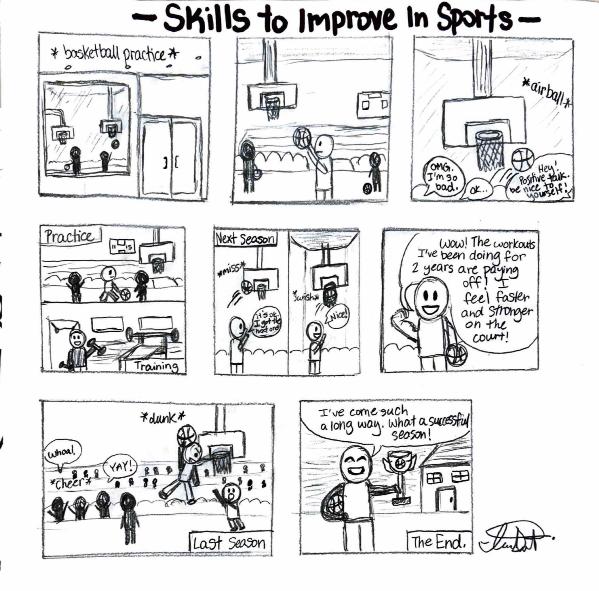
Height. Size. Strength. Speed. Agility. All of these are qualities of a successful athlete. Yet, the secret to an athlete’s improvement isn’t just physical — it’s a determined mindset, Athletic Director and Varsity Field Hockey Coach Jaye Locke said.
“It’s really easy to go through the motions at practice and just to do what’s asked of you, but you have to say, ‘I’m going to push myself, I’m going to try to do it with more intensity, with more speed.’ The more you push yourself, it may not look pretty, but it’s through those mistakes that you often gain incredible knowledge.”
New players often show more measurable improvement than advanced players, Coach Locke said.
“When somebody has never played something before, their improvement jumps are usually pretty significant. Sometimes, it can be harder when you are really advanced. Jumps might appear smaller, and you have to dig in deep to get to a new level.”
Girls’ JV Basketball and JV Field Hockey Coach Brianna Smith ’10 agreed.
“I have seen players who have never played the sport before end up learning quickly and end the season starting games. A player’s improvement is directly tied to the effort they put into practice.”
While physical development can take years, Coach Locke, Coach Smith and student-athletes said a single season can significantly change how a player performs and understands their role on a team.
Jack Reinfeld ’27 joined Boys’ Varsity Soccer after playing on JV his freshman and sophomore years.
“My goal going into the season
was to do my best and see if I can make an impact in practice or in games. Because of how things unfolded, I ended up playing a bunch. Then, my goal shifted to helping win however I can and not focusing on personal stats but just the team.”
Athletes’ stamina and endurance often develop quicker than their strength.
“It’s definitely possible to improve your cardio in season because you will be playing your sport every day of the week, so the sheer amount of reps you get will result in improved cardio,” Jack said. “As for aspects of your sport that are difficult to improve on during the season, it’s challenging to put on weight or get stronger in season. That’s because you are so drained from your sport that there is little time to do the extra work in the gym that is required for gaining muscle.”
Kaeleigh Neil ’27 has been on Girls’ Varsity Hockey and JV Field
Switching gears
Hockey since her freshman year.
“My main goal for field hockey was to be around my friends and just have a good time. My goal wasn’t to make varsity. I’ve always felt like it was more of something to do for fun and more chill. My goals for hockey have been improving my game, working toward being a better player and contributing more.”
While Kaeleigh plays hockey yearround, she only plays field hockey during the fall.
“I usually put my stick down in November and don’t touch it again until the first day of JV Field Hockey in September,” she said. “I improve throughout the season, but then, I have to start over every year. For hockey, I’m able to improve more because I play year-round. In the offseason, you have to put in a lot more effort to maintain your skills and keep improving.”
Tommy Bresler ’27 started off play-
Multi-sport athletes balan ce skills, seasons
Maggie Whitney Staff Writer
Ask an Upper School (US) student-athlete why they play multiple sports, and their answers are rarely about trophies. Several US students said playing multiple sports is one of the best ways to stay successful throughout their entire year.
Varsity Field Hockey and Girls’ Varsity Hockey (GVH) player Serena Mohsen ’29 said some movements in her two sports overlap.
“Field hockey has a lot of running, which is good cross-training for hockey, and all the lateral movements transfer from one sport to the next. To prepare my body and mindset for a new sport, I usually remind myself of the different rules and strategies each sport has. Both sports use a stick, but in field hockey, you are only able to use one side of the stick, and in hockey you can use both, so switching to hockey always requires an extra second to think about the difference.”
Some athletes feel pressure to devote their training to one sport.
“Since the biggest time for college recruiting to happen is in the fall, many coaches have told me to drop field hockey so I can focus on hockey and recruiting,” Serena said. “As I near the main recruiting time next year, I sometimes worry that I
might get hurt from playing sports six days a week. … Injuries and burnout factor a lot into my thinking since there are almost no rest days through the school year, which makes for little time to recover. But I think there are many benefits to playing multiple sports and taking a break from your main sport.”
GVH Coach Jori Balsam ’19 played hockey and lacrosse at the US and later at Wesleyan College.
“I loved being a two-sport athlete both at BB&N and in college,” she said. “At BB&N, it was great to meet additional people and work with my teammates toward a common goal. Oftentimes, athletes who play multiple team sports have higher sports IQs and better game sense. Multi-sport athletes learn to be great teammates as they participate on multiple teams and work with a variety of people.”
Varsity Volleyball and Varsity Softball player Gaella de Fontaine ’27 said she started playing volleyball to meet the school’s sports requirement.
“It’s really fun playing a sport that I’m not 100% focused on because it’s a nice break to try something new. Sometimes, though, I feel pressure to put in more work for volleyball since the entire team except for me plays year-round.”
Gaella’s volleyball practice helps
ing JV Boys’ Hockey as a freshman. Last year, Tommy made the varsity team for the first time.
“I understood my place on varsity, and I understood that I would have to improve if I were to play, so that’s what I focused on. My main goal for this year is to play as much as I can and work hard in practice. Our coach talks a lot about how if you work hard, you’re going to play. So far this season, I’ve seen that.”
Tommy gained skills from the JV team that translated across levels.
“At my JV practices, I was often better than a lot of other kids, but it was still good to skate every day,” he said. “We would play teams that were better than we were, so even if the people in practice weren’t better than me, I still got experience playing against bigger guys. Getting bigger and stronger helped me make varsity, as well.”
Now that he’s on varsity, Tommy improves more during the offseason.
“When I was on JV, I improved more in season because when I would skate outside of school, I didn’t care that much,” he said. “Once I made varsity, we started having really high intensity skating practices in the summer with the whole team.”
Girls’ Varsity Basketball Co-Captain Abby Gametchu-Walker ’26 said the offseason enables more significant progress for players.
“It’s the most crucial time to improve. Most people are playing AAU, a year-round club team environment, which includes high-level competition at a high volume. There is no shape like game-shape, but getting stronger and faster is the number one priority of the offseason so you can come in prepared.”
her with her softball performance.
“The arm path in throwing a softball is the same as the arm path of hitting a volleyball,” she said. “Doing these actions help me prepare for each season.”
Boys’ Varsity Hockey defenseman and Varsity Baseball first baseman Ryan Clay ’26 continues to compete in both sports.
“I definitely felt the pressure and necessity to pick either hockey or baseball to focus on, and I chose hockey,” he said. “After a grueling three-and-a-half month hockey sea-
son with 28 games and practices every non-game day, I’m burnt out, injured and tired. But I’m always excited for baseball season.”
Ryan made the decision not to play either sport in college.
“If I had wanted to drop baseball and focus solely on hockey training year-round, I think I could have gotten recruited and gone through the college hockey process,” he said. “But playing two sports makes me able to relax more and lets me know that I can compete and hold my own in any situation.”
Photo Courtesy of Serena Mohsen Serena Mohsen ’29 competes in both hockey and field hockey.
Drawing by Izzy Doricent
Price to play Athletic Department’s budget funds 75 teams
Alex Cederbaum Contributing Writer
With 25 different sports offered and over 75 different interscholastic teams between the Middle School and Upper School, the Athletic Department has the task of managing a single budget for all of them.
Athletic Director and Varsity Field Hockey Coach Jaye Locke said the Athletic Department works to divide its budget across teams.
“We have a lot of programs. There’s no other school in the ISL that has a fencing program. I’m in charge of doing my best to make sure all the programs are getting what they need.”
Coach Locke said she makes budget choices with the students in mind.
“There are all these different factors that go into the budget, and what I’m trying to do is to do my best to make sure that the kids here have the opportunities to play and do and participate in the activities that they’re excited about.”
One part of the budget is providing new equipment.
“We set up a system where we’re making sure that we’re getting a team new uniforms every so many years,” she said. “We’re not doing everybody’s uniform in one year and then again in five years. That would be way too much money just in one year to do everybody’s uniforms. So, one year it’s basketball, then the next year, it’s squash.”
The school’s location sometimes requires the use of off-campus facilities, which affects the budget.
“Because we’re in a city, we’re constrained in comparison to our peer schools with the space we
have,” she said. “We establish relationships and really work hard on trying to get that well in advance. Harvard Squash for the Middle School has been great.”
Director of Hockey Operations Ed Bourget ’96 said the Athletic Department deals with all the finances for his teams.
“Coach Locke handles all financial matters in regards to any team that I coach,” he said. “I make equipment requests on a yearly basis, and then they are either approved or not approved. This year, we purchased mini practice nets so we can break into smaller groups for better player instruction.”
Boys’ Varsity Crew Coach Adam Holland said his team’s support was sufficient.
“I believe our team’s funding and support to be adequate and appropriate. We rarely, if ever, feel constrained. If we do, it’s only because rowing equipment is expensive.”
Coach Holland also said both the Athletic Department and parents are important in supporting the team.
“We have an excellent relationship with the Athletic Department and also enjoy great support from the parent community.”
According to Coach Locke, parents also contribute significantly to many teams’ needs, providing snacks and team dinners for athletes.
‘I coach
them just as hard’ Bench players gain skills, experience
CONTINUED FROM PAGE 1
Morgane’s patience paid off.
“You spend a lot of time practicing, but don’t always get to play,” she said. “It’s hard, but it is very rewarding. I stuck with it, and now, I get to play more.”
Girls’ Varsity Hockey forward Grace Stafford joined the varsity team during her sophomore year.
“The first year, I was only put on the ice either while we were winning by a lot or losing by a lot,” she said. “It was still nice to be a part of a varsity team and experience the culture. I don’t do any other varsity sports, so it was nice to see what that higher level of commitment and sports looks like.”
Grace’s contributions often came through her energy and encouragement.
“I know that I still have a role on the team, even if I’m not playing,” she said. “You have to cheer on your teammates and make sure everyone else is feeling good.”
Boys’ Varsity Basketball (BVBB) guard Aiden Ashaye ’28 joined the team sophomore year.
“Basketball is my favorite sport, and I’ve been playing since eighth grade,” he said. “I had an injury boot, and I didn’t even play on the A team, but I always wanted to be on varsity. I liked the team, the culture and the competition level.”
Even when his role was limited, Aiden said he found meaning on the team.
“The most rewarding moments for me are getting to play and show love for my teammates when they are doing well. We all have to contribute to the team.”
Before finalizing rosters, BVBB Coach Rich Morantus makes expectations clear.
“If there are JV kids that really want to be on varsity, I’ll have a conversation before putting them on the team, just letting them know that they’re not going to play,” he said. “Everyone has a role that adds
to the culture of the team. Cheering on the guys, talking with the coaches and being a good teammate are all really important.”
Coach Morantus said being a player is also about the practices.
“In practice, I’m coaching the guys who don’t really get to play just as hard as the other guys who play a lot,” he said. “They really make a difference if they can challenge the other guys, so we push them all to help us get better. We want them to be just as confident because they matter to the team, and
we want to see them improve.”
Coach Morantus sees sports as a way to teach life skills to his players.
“I always use basketball to learn life lessons. Having a good work ethic and mental toughness, that goes past players playing here at BB&N. It’s really important that they grow as young men, and that is my goal: to build them up as good people.”
Staff Photo by Ryan Figlioli
Boys’ Varsity Hockey players await their turns to be subbed into the game.
Drawing by Anthony Gao
Opinions
A game of money
I’ve still got my Christmas tree up and, in terms of Boston sports, there’s a lot of presents to unwrap: the Patriots making their first AFC championship game in seven seasons, the Celtics climbing to second in the Eastern Conference and the Bruins rallying on a six-game win streak. Beyond all the noise, however, one thing remains constant: the systematic issues plaguing the Boston youth sports scene.
According to a 2024 report from Boston.gov, Boston’s high school student sports participation rate of 34% is nearly half of the state’s average for youth aged 6 to 17 (63%). The system is also marred with racial inequality, with only 25% of Asian, 27% of Latino and 41% of Black students participating on teams in comparison to 53% of white students. Involvement in the greater Boston area has plummeted by 10% compared to pre-COVID years because of rising costs in a pay-to-play system. Growing up playing on club teams helps kids find community and engage in sports that aren’t offered at their schools. However, there’s always a price tag. Take soccer, for example, generally accepted as Massachusetts’s most popular youth sport: Annual registration fees can span from $1,000 to upwards of $5,000 per year, not including the $200 uniform, $200 pair of cleats that will be replaced in six months and the travel costs that tack on another $1,000 to $2,000.
While you might not have realized it growing up, if you competed in tournament-heavy sports like hockey and lacrosse, your parents could have been looking at annual bills nearing $10,000. Even if parents say no to club teams, these additional costs don’t disappear: 59% of surveyed families told the Boston Globe that having their kids participate in fall sports is financially straining.
“Growing up playing on club teams helps kids find community and engage in sports that aren’t offered at their schools. However, there’s always a price tag.”
Youth sports are expensive, and it’s only getting worse. According to the Aspen Institute’s State of Play 2025 report, family spending on children’s sports surged by 46% since 2019, with the gap in participation rates between high- and low-income families widening from 13.1 points a decade ago to 20.12 points. Since youth sports are a vital educational resource for children that instill the importance of teamwork, persistence, community and emotional regulation, I’m shocked at the lack of airtime and measures that have been taken to address these financial obstacles.
There is some good news, however. In 2024, Mayor Michelle Wu created the Boston Sports Initiative, which has delivered $300,000 in grants to 55 groups for gear and registration expenses, as well as $100,000 in smaller stipends to support the athletic needs of Boston Public School students. Mayor Wu also signed onto Aspen’s 2030 goal of 63% nationwide youth sports participation and the institution’s Children’s Bill of Rights in Sports, committing Boston to promoting safe and equitable youth developmental athletic opportunities.
Despite Mayor Wu’s steps in the right direction, it’s clear that systemic reform is still needed within Boston and nationwide to address the growing economic inequality that is taking over youth sports.
Jan. 6 isn’t a footnote
Watching the events of Jan. 6, 2021 unfold was utterly bonkers. I still remember that Wednesday, back when hybrid learning bifurcated seventh grade into alternating remote and in-person days. I was sitting at home, bored after a day of classes on Zoom, when I read that rioters had breached the Capitol. All I could do was gasp a “holy s***.” My unread messages numbered in the hundreds as my news-junkie friends Zach and Daniel clacked away at minute-by-minute updates in group chats.
During school the next day, you couldn’t forget. In English, we paused “The Outsiders” to touch on the events of the prior afternoon; in Global Studies, you can be sure that the lesson wasn’t about WWII history anymore. At the time, it felt like a moment of reckoning in which all the polarized conversations of the past three election cycles had finally boiled over. That’s to say, this was the worst of it, right? America couldn’t just sit by and watch after citizens, egged on by the president, stormed its legislature to overturn election results, right?
Well, we did exactly that. The Tuesday after we got back from winter break marked five years since it happened. Given the chaos that’s engulfed Minnesota, Venezuela and Iran, you’d be forgiven for completely forgetting Jan. 6 even happened.
Apart from a few features of now-pardoned rioters and D.C. cops in the New York Times, it seemed as if Jan. 6 had been reduced to a mere footnote lost in an expanding list of new crises. I’d go as far as to say that the erosion of American political standards should worry you, too. How do we reconstruct norms when we’re actively shown how they can be dismantled?
“Perhaps Jan. 6 serves as our reminder that scandal and public outrage cannot self-correct America’s path when the president simply denies what we all witnessed.”
This backsliding can, in part, be attributed to the Trump administration’s deliberate efforts to reframe the events of Jan. 6. The White House website now brazenly displays a page titled, “January 6: A Date Which Will Live in Infamy.” Said infamy, however, is not the infamy you’re thinking of. The real injustice, the current administration claims, was not a violent challenge to a peaceful transition of power but rather a Democrat-orchestrated plot to conceal rampant election fraud and censor the brave individuals willing to “stop the steal.” In this revisionist history, Nancy Pelosi and Mike Pence play the villains while Trump’s sweeping pardons of J6’ers come to save the day.
The facts of this narrative simply aren’t true, though. Despite the White House’s claim that “zero law enforcement officers lost their lives,” Officer Brian Sicknick passed away from assault-related injuries, and four other officers committed suicide in the following months. Some absurd mental gymnastics are being performed to justify this terrible act. Perhaps Jan. 6 serves as our reminder that scandal and public outrage cannot selfcorrect America’s path when the president simply denies what we all witnessed.
This continual subversion of decorum in the executive branch, you could say, is shrouded by the firestorm of incredibly blunt actions and statements on the Trump administration’s part. Thanks to the unfiltered, stream-of-consciousness wisdom the president shares on Truth Social and during almost every media outing, we’re invited to spectate a new level of insanity. It is as if Trump and his allies are asking someone to call their bluff, yet it seems like no one will. We’ve talked recently in AP Comparative Government and Politics about how to fix Nigeria’s low political culture and rampant corruption. America’s answer comes around in a similar way: a generation of leaders with the courage to swallow the past and challenge the nation to do better. I mean, this is why we study U.S. History — to learn so that we don’t paper over cracks and losses with whitewashed narratives and conspiracy theories. Rather, we confront misdeeds and ensure they don’t happen again.
You-Yan Wang Wang Weighs In
Matthew Walsh
Matt’s Beantown Sports Beat
Drawing Courtesy of Creative Commons
Drawing Courtesy of Creative Commons
Review: Seeing through Auggie’s eyes
As the red curtain lifted, fog rolled across the stage, and the sound of a rocket ship echoed through the theater. At the American Repertory Theater in Harvard Square, “Wonder” begins by situating the audience inside the imagination of the main character, Auggie Pullman, as he fantasizes about outer space. This opening choice immediately immerses viewers in Auggie’s perspective and establishes the musical’s focus on emotions rather than on realism.
A musical adaptation of R.J. Palacio’s bestselling novel, “Wonder” follows Auggie, a middle schooler with Treacher Collins syndrome — a genetic condition that causes facial differences — as he transitions from homeschooling to public school. Told by multiple characters and through 19 musical numbers, the story focuses on Auggie’s navigation of classrooms, friendships and bullying, emphasizing the importance of empathy in how we see others.
Auggie’s imaginary friend, Moon Boy, functions as a translator of Auggie’s inner thoughts and feelings, which helps the audience understand his outlook. Moon Boy’s character is unique and effective in signaling Auggie’s initial loneliness, which sets the tone for his difficult transition to middle school. Moon Boy’s exaggerated facial expressions and blunt commentary reflect the thoughts Auggie cannot say out loud, and his presence signals when Auggie is lost in his own head. By externalizing Auggie’s thoughts and feelings, the character deepens
the audience’s compassion.
Once Auggie’s daily life is established, the musical shifts to his first day at Beecher Prep, where the staging becomes especially effective. A large turntable moves students quickly through halls and classrooms, creating a sense of rhythm and constant motion. Auggie, in contrast, is often physically still and isolated in the center of the stage. This visual choice captures his anxiety, disorientation and inability to socially keep up with the other students. Additionally, while the teachers were very humorous and entertaining, the recurring “precepts” they brought up throughout the play seemed forced. These separate moral lessons interrupted the momentum of the main plot and pulled the audience out of the emotional storyline rather than allowing the scenes themselves to convey the themes.
One of “Wonder’s” greatest strengths is its frequent shifts in perspective. These transitions begin with a character delivering a monologue, followed by scenes
and musical numbers from their point of view. Rather than serving as a simple description, these shifts reshape situations and reveal how the same events are experienced differently. This structure worked extremely well in a musical style because it gave different characters moments to stand out and it added more complex layers to the plot. By repeatedly exposing the audience to new lenses, “Wonder” reinforces its central themes of empathy and understanding.
A standout sequence is the social “war” scene, which develops Auggie’s internal panic into a full theatrical experience as the stage fills with sound and movement under red lighting. The overwhelming and chaotic environment allows the audience to feel the social tension as well as Auggie’s fear and discomfort. The scene’s commitment to an emotional atmosphere differentiates it from the more literal scenes.
Toward the end of the musical, however, the production’s tendencies to simplify its material become more noticeable. A few narrative
Choosing creativity in crunch time Students
weigh value of arts against academic demands
CONTINUED FROM PAGE 1
US Visual Arts Teacher Laura Tangusso coordinates the Petropoulos Art Scholars Program.
“For Petropoulos, we go out and see things that you might not normally see, like the youth film festival in November,” she said. “We also try to create more semester options, so that if a student really wants to stay with the arts, but can’t or doesn’t want to commit to a whole year, they can take a half year of art, or as another option, Afternoon Arts, which meets twice a week for a trimester.”
Students often view the arts as supplemental courses.
“The messaging to students tends to suggest that after tenth grade they’re going to have too many other things to do, so shouldn’t take more art,” Ms. Tangusso said. “But, the actual experience for a student is often that it’s not a heavy add, but instead enjoyable and calming, involving a different part of their being, their body and spirit.”
Salar Sekhavat ’26 participated in chamber music and orchestra for four years.
“The school has really good visibility and recognition of art,” he said. “You think about the walk-through galleries, the theater performances, a cappella and chorale. The school is really good at building the art community, but the art realm and classes
realm are treated separately.”
Last year, Tia Reddy ’26 dropped an art class to take a sixth academic class.
“The issue that I had with film was that I just didn’t know what I
plot points — including Julian and Miranda’s backstories — are minimized or cut. By limiting these perspectives, the musical disrupts the balance of voices, leaving certain characters, particularly those portrayed as antagonists, underdeveloped and causing the social conflict to feel rushed and less realistic. In addition, the use of double casting, especially in the last half hour, was distracting and drew attention away from the story.
“Wonder” succeeds in expressing its central message of choosing kindness. In the final moments of the musical, the production physically engages the audience, encouraging viewers to clap along to music. As the lights spill off the stage and into the audience, “Wonder” makes its message clear: Treating others with empathy isn’t something we should just applaud but something we should embody.
Rating: 4.3/5
would be able to do in it,” she said. “I didn’t know that I loved art, but I did know that I loved history, and that was something that I wanted to prioritize.”
Ella Botein ’26 said academic pressure led her to step away from the arts.
“Coming back from a semester abroad, I felt like I needed to spend a lot of time catching up on my classes. Junior year is known for having a hard curriculum, so I wanted to focus more on my academic courses.”
Students will feel motivated to continue with arts classes only if they particularly connect with a class, Ilsa Schrag ’28 said.
“The arts department does a good job of telling us about the arts, and I get a lot of emails, so I definitely know what’s happening. If I really like the class, then I’ll take another one next year. If I don’t find it particularly enjoyable, I’m not going to.”
Mr. Howarth and Ms. Tangusso said students often overestimate the time art classes require and underestimate their benefits. They said they hope more students will choose to pursue art classes as upperclassmen.
Photo Courtesy of Lucia Longstreet-Lipson
“Wonder” encourages viewers to treat others with empathy.
Lucia Longstreet-Lipson Off Campus Editor
Drawing by Izzy Doricent
The Back Page
Quotables
“If I had to choose between not eating and eating that, I would choose not to eat.” —Upper School Dean of Students Rory Morton on Abby Brown’s ’26 lunch choices
“It’s not trick or treat where you try to get as much candy as you can, but you know ...” —Upper School Senior Grade CoDean Leah Cataldo on Senior Work Week candy
“If that’s your alarm, we’ve got problems.”bigger —Upper School Science Department Head Stephanie Guilmet to Annie Zhu ’26 on her 9:30 a.m. alarm
“What’s a farmer going to do with gorillas?” —Ryan Clay ’26 on a math problem “Milk them.” —Upper School Math Teacher Tom Randall
Ins, outs and boyfriends: 2026
Happy 2026, everyone. With each new year comes a new list of cultural ins and outs: what we’re wearing, which apps we’re deleting and what habits we’re breaking. And, this fall, the internet spoke: Boyfriends are on the outs.
In October, a British Vogue article titled, “Is Having a Boyfriend Embarrassing Now?” took the internet by storm. The piece described how women increasingly hide their partners online, opting instead for the “soft launch”: a cropped face, an ominous hand.
As Vogue put it, women want “the prize and celebration of partnership but understand the norminess of it,” and “having a boyfriend typically takes hits on a woman’s aura.” Even Jaz and Halley Kate asked, “Why does having a boyfriend feel Republican?” (P.S. Everyone is entitled to their own political opinions!)
But I’ll raise Vogue one better: Having a husband is embarrassing. Not because it’s uncool. Not because it’s boring. But because statistically, historically and repeatedly, they’ll kill you.
Just recently, in Boston, Brian Walshe was sentenced to life in prison for murdering his wife, Ana Walshe. Her body has never been found. The thing is, prosecutors didn’t need it. They had his Google searches: “best way to dispose of a body,” “how long before a body starts to smell” and “hacksaw best tool to dismember.” They had surveillance footage, DNA, trash bags and tools. His best defense was calling it a “sudden, unex plained death.” Needless to say, the jury didn’t buy that.
Then, there’s Laci Peterson. In 2002, Peterson disappeared while eight months pregnant. Her husband, Scott Peterson, mourned publicly, searched tirelessly and positioned himself as the grieving spouse. Months later, her body washed up in San Francisco Bay. The lies, affairs and evidence that came out at the trial were far different from the tearful speeches Scott Peterson made at vigils.
“For some reason, the more documentaries I watch, the clearer the pattern becomes: It is always the damn husband.”
Boston has also seen this pattern before in a case that still makes my head spin. In 1989, near Commonwealth Avenue, Carol Stuart was shot in the head by her husband, Charles Stuart. Like Laci, Carol was also pregnant. Charles blamed a fictional Black man. That lie triggered months of stop-and-frisk policing in Mission Hill. An innocent man was treated as guilty, and his life was nearly destroyed. Surprise, folks: It was the husband. He murdered his wife for insurance money, got caught and jumped off the Tobin Bridge.
For some reason, the more documentaries I watch, the clearer the pattern becomes: It is always the damn husband. Venus Stewart, murdered and buried in a shallow grave, her husband waiting years to confess. Christine Koklich, killed by her husband in a sick and twisted staged murder. Kathleen Peterson, found dead at the bottom of a staircase, her husband at the top, in one of the most contested domestic-death cases in recent history.
A public health study found that homicide and suicide combined are the leading causes of death for pregnant and postpartum women in the United States. The perpetrator is most often a current or former partner. This isn’t just about true crime culture. When women hesitate to post their boyfriends or joke that having one is “lame,” it’s not just a tagline. It might be an understanding that the most dangerous person to a woman is statistically the man who says he loves her. So, yes. Crop tops are out. Snapchat is out. Bad posture is out. And I think husbands are, too.
Louisa Kirk Kirk Off The Record
Photos Courtesy of Olivia Richter, Sonja Peetz-Larsen, Mimi Shaywitz, Christine Tao, Scarlett Hawkins and Louisa Kirk