VOL. 4 ISSUE 1 • DECEMBER 2025
THE DIRECTORS' REPORT Official Newsletter of the Lower School
B Y A N T H O N Y R E P P U C C I & M A R ISS A C LA RK Welcome to the December edition of the Directors’ Report. As winter settles in, our Lower School continues to be a place of warmth, curiosity, and connection. In these pages, we share reflections, highlights, and updates that capture the steady growth and joyful learning taking place across our community.
This issue: Math Morning: Building Strong Math Foundations PAGE 01-02
Learning Beyond the Classroom: Field Trip Highlights PAGE 03
Counselor Corner PAGE 04
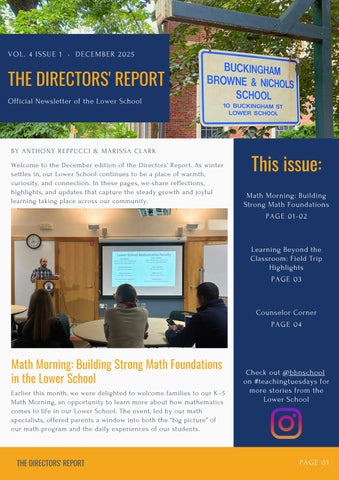
Math Morning: Building Strong Math Foundations in the Lower School Earlier this month, we were delighted to welcome families to our K–5 Math Morning, an opportunity to learn more about how mathematics comes to life in our Lower School. The event, led by our math specialists, offered parents a window into both the “big picture” of our math program and the daily experiences of our students.
THE DIRECTORS' REPORT
Check out @bbnschool on #teachingtuesdays for more stories from the Lower School
PAGE 01
Math Morning: Building Strong Math Foundations in the Lower School (cont.) The morning began with an overview of the Bridges in Mathematics curriculum, which we use across K–5. Alex Walker, our B-4 Math Coordinator & Specialist, shared how early grades focus on developing strong number sense through exploration, games, and hands-on learning. As students move into grades 3–5, the pace increases and concepts deepen, particularly in multiplication, division, fractions, decimals, and algebraic reasoning. Throughout all grades, students are encouraged to think strategically, work flexibly with numbers, and communicate their thinking clearly.
Fa m il ies a l s o l ea r n e d h o w o u r c u r r icu l u m su pp o r ts th e d ev el opm en t o f a b al ance d m at h s t u d e n t : o n e w h o c a n r ea s o n , p e r se ver e , ex pla in t h eir i dea s, an d enga ge w i th o th er s ’ t h in k in g . T h es e g o a l s a r e g r o u n de d in n a ti on al st and ar d s, in c lu d i ng t he M athe m ati cal P r a c t ic es a n d t h e F ive S t r a n d s o f M at h em at ic a l P r ofi cie ncy, w h ich hel p s tu d ent s bu il d n o t o n l y s k il l s b u t a l s o c o n f id e n c e , c u r ios it y, a nd p r o bl em - so l vi ng st am i na. A l y s o n Sw a r m , G r a d es 3 & 4 M a t h S p eci al is t , t h en l ed a p r o bl em s tr i ng d em o ns t ra ti on , w h e r e p a r e n t s e xp e r ie n c e d t h e s am e k in d of g u id ed , s te p- b y -s tep i nqu i r y t hei r chil d r en e n ga g e in ea c h d ay. T h is a c t ivit y il lu st r at e d ho w st u de n ts lear n to no ti ce p at ter ns, m ak e c o n n e c t io n s , a n d a p p r o a c h p r o b l em s w i th i ncr ea sing in d ep en d enc e. We a r e g r a t e f u l t o a l l w h o j o in e d u s a nd t o o u r de d ic at e d m at h fa cu l ty fo r cr eati ng a n e n ga g in g a n d in f o r m a t ive s es s ion . We ho pe t o se e fa m il ies aga in at o u r nex t M at h M o r n in g o n Ja n u a r y 1 3 , 2 0 2 6 , f r o m 7 : 50 – 8 :2 5 a. m .
THE DIRECTORS' REPORT
PAGE 02
Learning Beyond the Classroom: Field Trip Highlights It has been wonderful to see our students exploring the world beyond our school walls this fall. By engaging directly with their surroundings, they are making authentic connections that truly bring their learning to life. These hands-on experiences allow students to observe closely and ask big questions, helping them see how their studies apply to the real world. Just as importantly, these outings build relationships and shared memories that strengthen their sense of community. We believe these opportunities are vital for broadening perspectives and sparking a sense of discovery that stays with our students long after they get back to the classroom.
⏺
Photos, left to right: Grade 4 traveled to Drumlin Farm to expl ore how a worki ng farm operates and minimizes waste. Grade 5 visited Crane Beach to study coastal habit ats. Grade 1 went to the Boston Medical Center Rooftop Garden to learn about thei r roof top garde n and resi dent bees. Grade 2 traveled back in time at the Plimoth Patuxet Muse ums Wampanoag Homesite, l earni ng about dai ly li fe for chi ldren i n the early 1600s. Grade 3 visited the John F. Kennedy Presi dent ial Library and Museum as a part of th ei r leadership unit.
⏺
⏺
THE DIRECTORS' REPORT
⏺
⏺
PAGE 03
Counselor Corner BY DANIELLE GERVAIS & CHRISTINA PAYNE Despite the word “break” being in the title, Winter Break can sometimes feel more chaotic and dysregulating than our day to day schedules. Whether this is because we are trapped inside by chilly weather, our homes are filled with family, we have traveled far and wide or our days are less structured than we are used to, it is normal to feel overwhelmed during this period. Why Does This Happen? Routine Change: Our bodies love routines. We know what to expect and knowing our expectations makes us feel safe. As we change our routines to accommodate family, being out of school or work, we step out of our safe expectations and enter a state of uncertainty, which can cause stress. Weather: As the weather gets colder, we are outside less and get less sunlight. Our bodies need the sun to help us boost hormones like serotonin (feel good hormone). With less serotonin and being in the winter season, our sleep schedules change and we can feel more stressed and irritable. Overstimulation: During this period, we tend to be around more people in travel and in our homes, feeling physically crowded and in noisier spaces. There are more layers to wear and take off, physically changing as we go from environment to environment. We are eating foods we may not usually eat or smelling smells we may not usually smell. All of our 5 senses are constantly activated and bombarded with information to process, which can lead to more bodily stress. In the Body: When we are stressed, our vagus nerve is kicked into drive, which can lead to increased heart rate higher blood pressure faster breathing tight muscles feelings of anxiety or irritability.
THE DIRECTORS' REPORT
Resources for Caregivers What Do We Do About It? Deep breathing has been shown to stimulate the vagus nerve, helping the body feel safe and relaxed. That said, deep breathing can be challenging to access when someone is in a heightened or panicked state— sometimes focusing on the breath can even increase stress. Below are a few simple, child-friendly ways to practice deep breathing together during the break. Flower/Candle Breathing : Think about the most wonderful smell you can imagine, like a flower (or anything that smells good to you!). Breathe in slowly through your nose as if you are smelling it, counting to three. Then breathe out slowly through your mouth as if you are gently blowing out a candle. Repeat a few times. For younger students, a simple pipe-cleaner craft can help make this breathing strategy more concrete.
Box Breathing : Use your finger to draw a box in the air. Start at the top left corner and breathe in as you draw across the top for a count of four. Hold your breath as you draw down the side for four. Breathe out as you draw the bottom of the box for four, then hold again for four as you complete the square. Tracing the box while breathing can help support focus and calm.
Rainbow Breathing: Think about a colorful rainbow. Start on one side and breathe in through your nose as you imagine breathing in the first color (red). Breathe out through your mouth as the next color (orange) slowly flows away. Continue breathing in and out as you move through all the colors of the rainbow. For younger students, drawing or tracing a rainbow with their finger can help with visualization.
PAGE PAGE 04 06