2025
YOUR DONATION COUNTS
Help make our community a better place by giving to families and groups that face significant challenges. Together we can make sure that no wish goes unfulfilled this holiday season.

Help make our community a better place by giving to families and groups that face significant challenges. Together we can make sure that no wish goes unfulfilled this holiday season.
Dear Readers,
We’re reaching out to you on behalf of the 2025 Wish Book season, our 42nd year of sharing stories that uplift and transform lives in the South Bay. Your past generosity has made Wish Book a powerful community tradition of making life-changing differences. Each year, we introduce you to neighbors facing challenges, and together, we grant wishes to the organizations that provide hope and support.
As we launch this year’s campaign, we invite you to help us meet urgent needs, such as housing, food security, education and health care, for local individuals and families.
Every story in this year’s Wish Book, published on Thanksgiving Day along with continued features through December, reflects real need and real possibility. And every donation, no matter the amount, makes a lasting impact. Whether you give online or by mail, your contribution goes directly to helping local residents — The Mercury News covers nearly all administrative costs. There are two ways your secure and tax-deductible donation can be made:
Online: Go to wishbook.mercurynews.com/donate
By mail: Make your check payable to “Wish Book Fund” and send it to: Wish Book Fund
P.O. Box 909
San Jose, CA 95106
If you would like to donate stock, give through a Donor Advised Fund, or make a Qualified Charitable Distribution, we’d be happy to help. Please contact our Wish Book outreach coordinator, Andrea Altman, at (408) 920-5014 or aaltman@bayareanewsgroup.com.
We look forward to another year of stories, wishes and generosity — made possible by you. Thank you for being part of our Wish Book family.
With deepest appreciation, Sharon Ryan
Publisher, The Mercury News
P.S. Your name, if you choose, will appear on our published donor list — our way of thanking you and celebrating your role in bringing hope to the community.
ON THE COVER
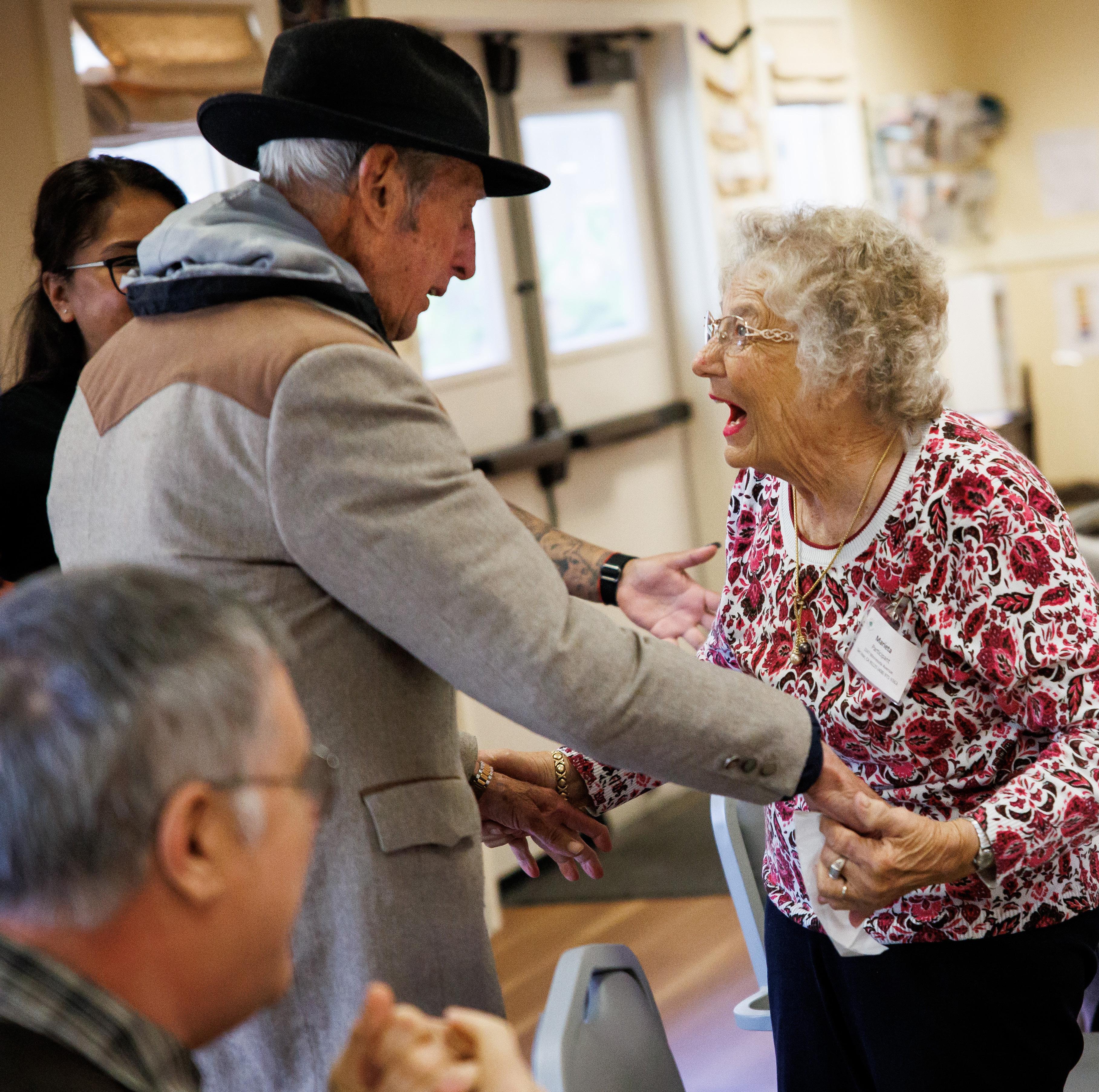
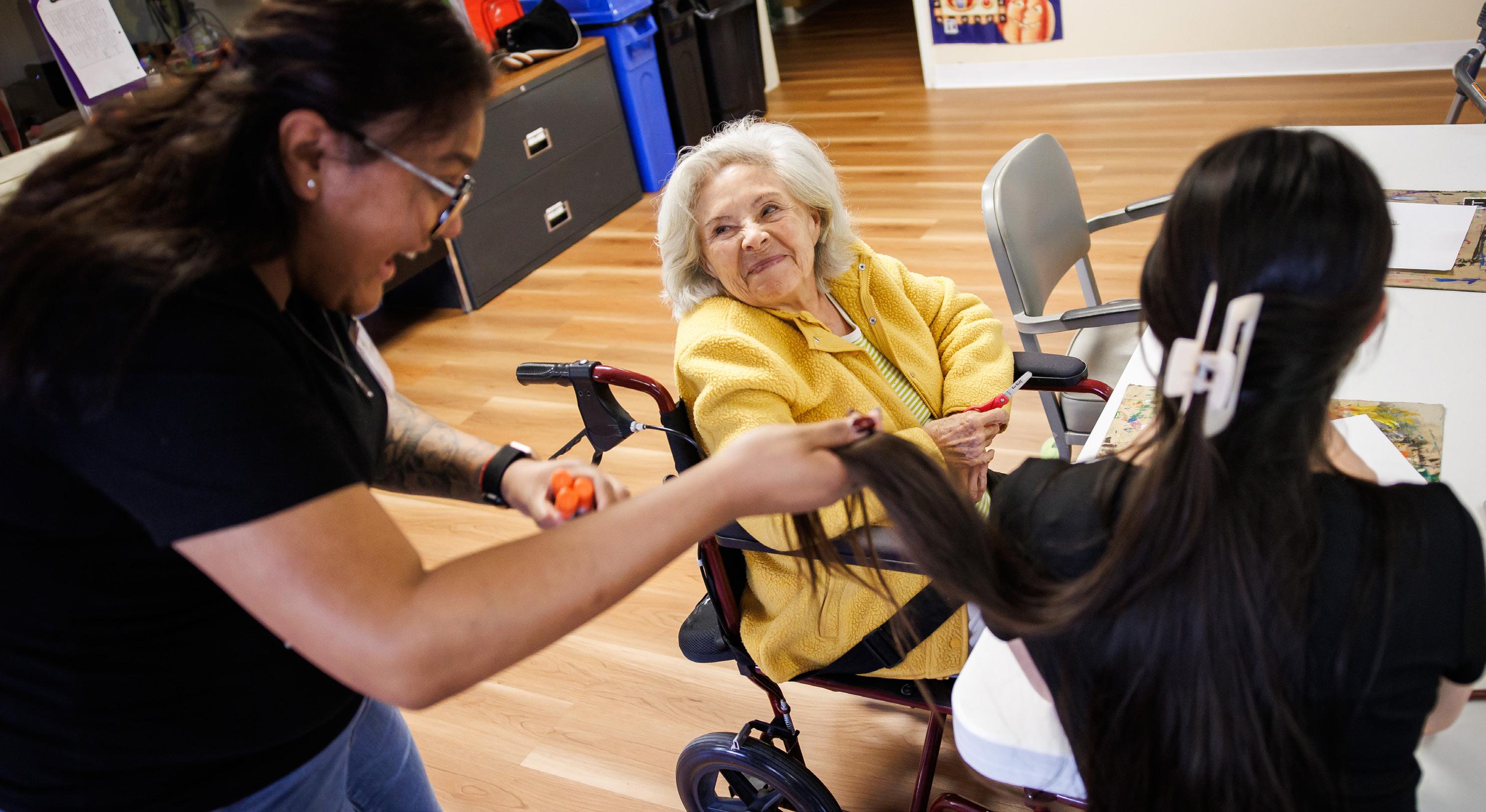
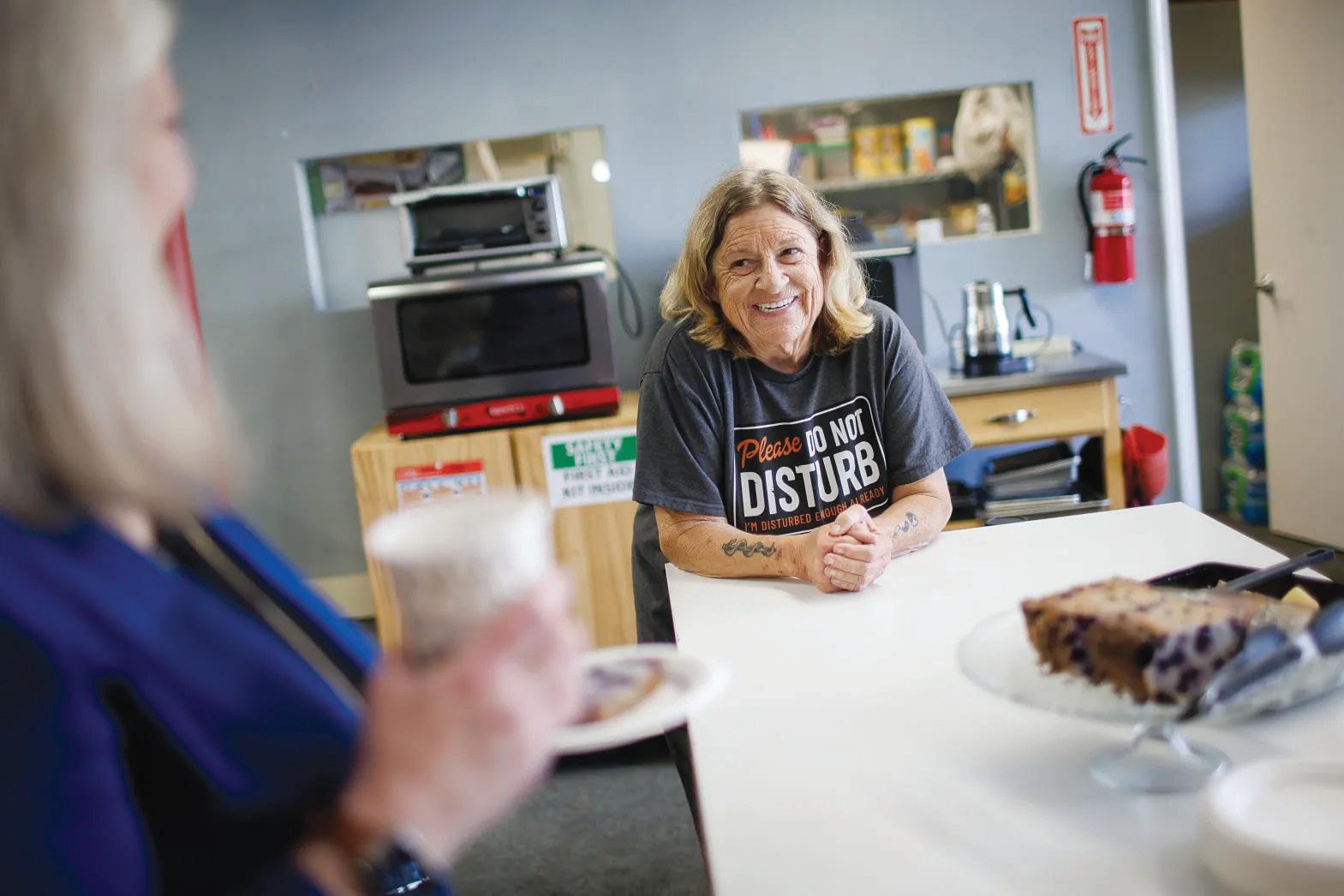
Chapman, right, lights up as Peter Arnone joins the group for afternoon activities at Live Oak Adult Day Services in San Jose. DAI SUGANO — STAFF PHOTOGRAPHER STORY, PAGE 14
Please print
Please do not send cash PAYMENT
Check (payable to: Wish Book Fund) ❑ Credit card Signature:
Yes. Please allow my name or the following (e.g. Mr. and Mrs. Doe, Smith Family or XYZ group) to be published in our tribute to donors for print and online in January:
No
Donor name(s)/group to be published
You can dedicate your donation to a person, cause, or group (optional)
In memory of In honor
Mail this form and payment to: The Mercury News Wish Book PO Box 909 San Jose, CA 95106

Thank you!
CC#: CVC: You can also donate online at wishbook.mercurynews.com/donate Scan to donate online For questions, DAF or stock gifts, charitable bequests: wishbook@bayareanewsgroup.com or call 408-920-5014 * Tax-deductible gifts of any amount are welcome. Tax ID 77-0229665 Wish Book is a program of the Bay Area News Group’s 501(c)(3) nonprofit organization
By Nollyanne Delacruz
NDELACRUZ@BAYAREANEWSGROUP.COM
With the painful memory still vividly etched in her mind, 75-yearold Mabel Yuen achingly recalled facing aging and loneliness during one of the most isolating periods in recent history: the COVID-19 pandemic.
Her husband had been dead for 33 years and she had retired early due to an injured shoulder and needed surgery. During the pandemic, Yuen couldn’t go out with people and did not get to see her children often since they lived far away. She also couldn’t travel, which was one of her favorite activities.
“At that time, I had a surgery during COVID and then I tried to get help from people,” said the Cupertino resident. “I called people. I knocked the door for a neighbor, none of them responded because of COVID. People (were) scared of me.”
After speaking with a Christian counselor, she called Eunice Cheng, Senior Wellness Program manager with Asian Americans for
Community Involvement, a nonprofit that provides health services, such as primary care, dental and mental health help, and programming that promotes a healthy life.
It turned out to be a godsend.
Yuen said Cheng got her involved in the nonprofit, delivering hot meals to her and talking to her on the phone like a counselor when she felt alone.
“We do not charge them money. We know they are immigrants. We try to make (it) easy (for them) to receive information, to communicate in (their) language, support them, providing all these cultural celebrations they might be missing,” Cheng said.
The organization was formed by a dozen Asian Americans in 1973 who wanted to support Southeast Asian refugees who were resettling after the Vietnam War. The Senior Wellness Program was established a year later and now serves over 900 older adults who have low incomes, recently immigrated to the U.S. or speak little English. It offers culturally responsive fitness classes, educational workshops like computer literacy programs, hot, nutritious meals and more.
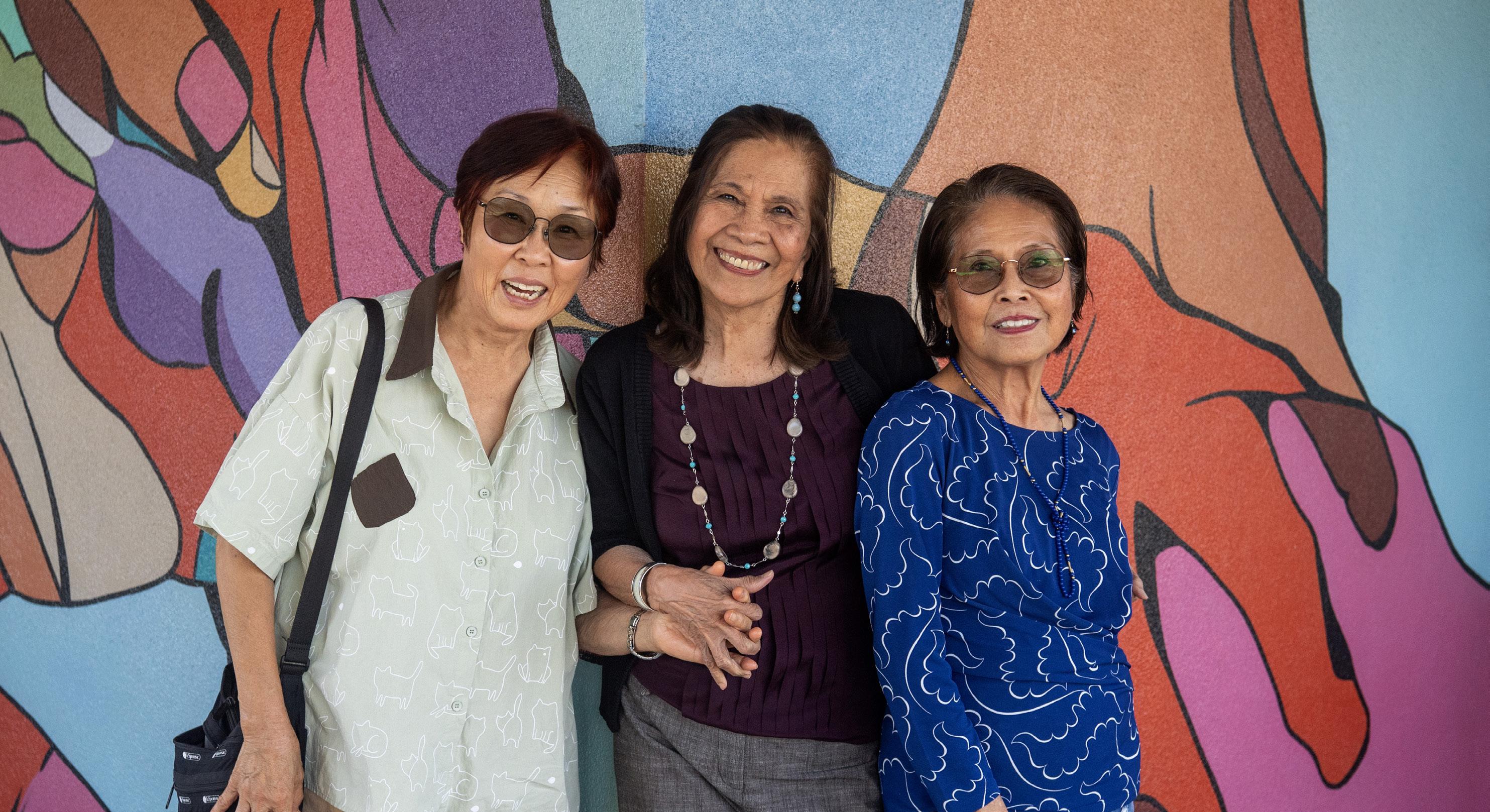
Mabel Yuen, 75, of Cupertino, left, Gracia Del Rosario, 82, of San Jose, and Claudia Hau, 80, of Fremont, find friendship and needed services at the Asian Americans for Community Involvement senior center in San Jose. DOUG DURAN — STAFF PHOTOGRAPHER

Donations to Asian Americans for Community Involvement will allow nearly 200 older adults, especially those with limited English proficiency, to access social engagement activities at the center through their Senior Wellness Program. Goal: $25,000 HOW TO HELP
By Robert Salonga RSALONGA@BAYAREANEWSGROUP.COM
When Briana and her mother emigrated from Peru, they hoped to find haven in this country, especially medical treatment to help the young girl manage a rare neurological disorder.
That dream didn’t play out at first.
At multiple clinics in the South Bay, they encountered bureaucracy, limited options and often frustrated medical staff who were unfamiliar with Landau-Kleffner Syndrome, which impaired Briana’s language and cognitive function.
After several years, the two were exhausted. The medical care Briana received felt cold and typically ended with Briana receiving prescribed medication that had severe side effects and failed to stop the seizures and hyperactivity brought on by her condition.
“I felt like I was dying,” Kathia said in Spanish. “My daughter was (hurting herself) in such a way that I felt like she was going
to die from the strong blows that she gave herself. I felt like one of those was going to kill her. And I was already on the verge of collapse. I couldn’t see my daughter like that anymore.”
Two years ago, Kathia and Briana were connected to a clinic run by Bay Area Community Health on McKee Road in East San Jose.
Clinical director Dr. Swetang Shah, who has devoted his career to nonprofit medicine, was part of the welcoming committee and has overseen Briana’s care from the start.
He and the medical staff quickly recognized her and her mother’s needs, and formed a plan to tailor visits to what Briana could handle, adjusting appointment lengths and frequency as needed.
“I’ve seen her initially every month, and if the patient doesn’t have an issue, we have separated (appointments every) two months, three months,” Shah said.
“We have seen them multiple times without worrying about what the patient needs to pay for. Then there’s the outside support they get, like member care services, enrolling in insurance, making sure they don’t have to pay out of their pocket.”
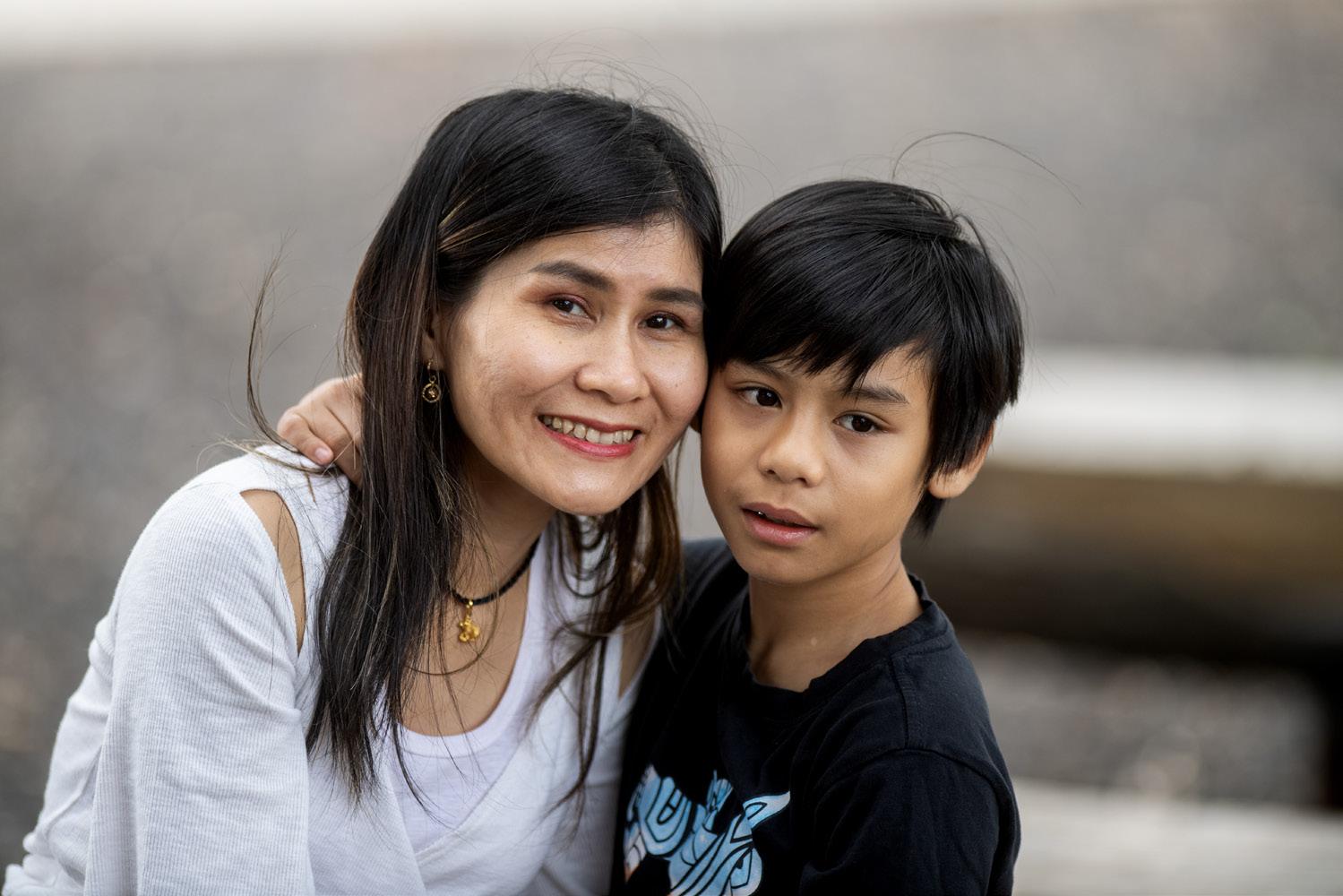
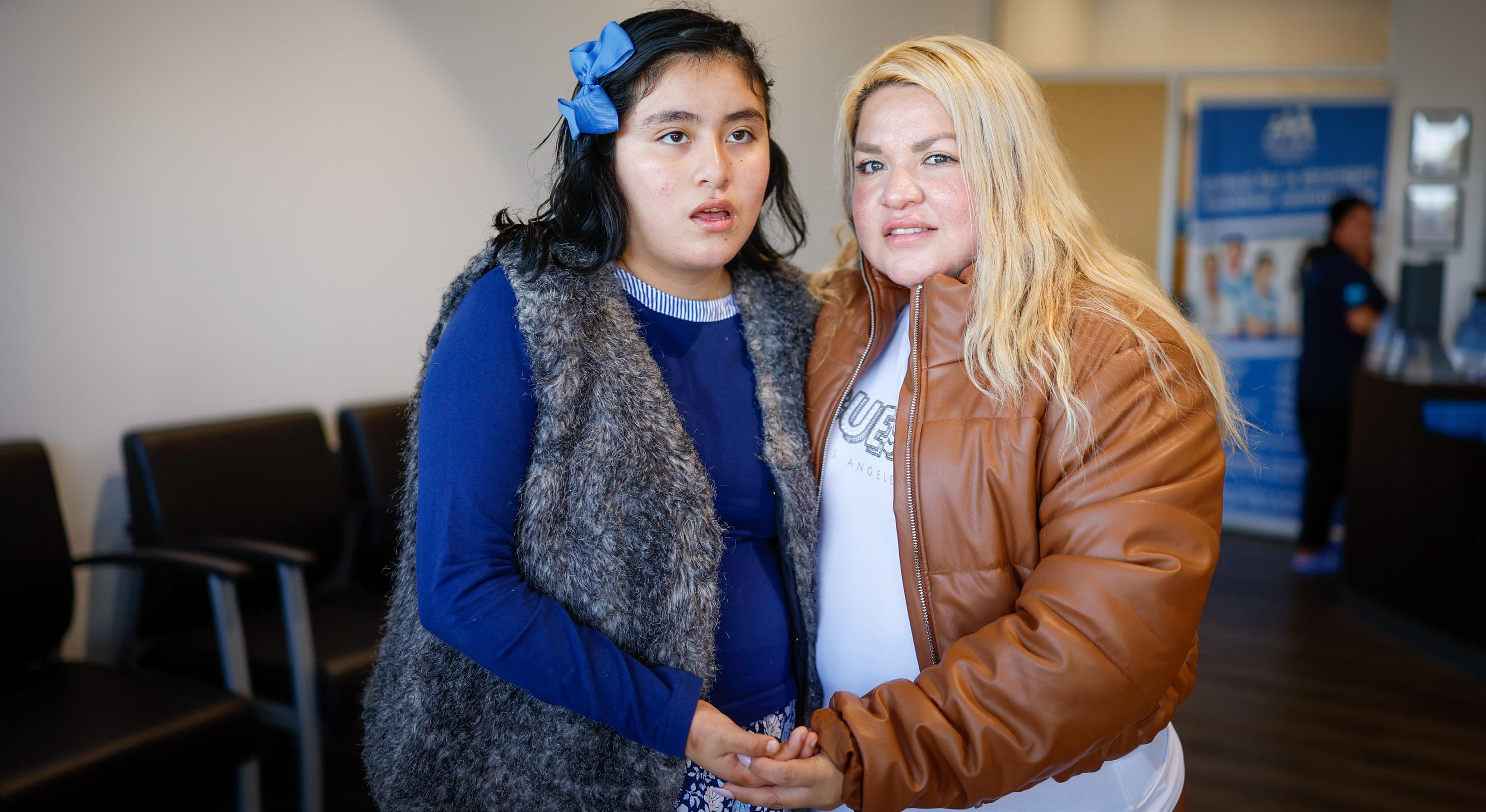
Kathia, right, who asked to withhold her full name to protect her family’s privacy, with her daughter Briana, 12, at Bay Area Community Health in San Jose, where they receive free and affordable medical care for Briana’s rare neurological disorder.
Donations to Bay Area Community Health will help the nonprofit expand its McKee Clinic, significantly increasing access to comprehensive care for underserved communities. Goal: $50,000
By Katie Lauer KLAUER@BAYAREANEWSGROUP.COM
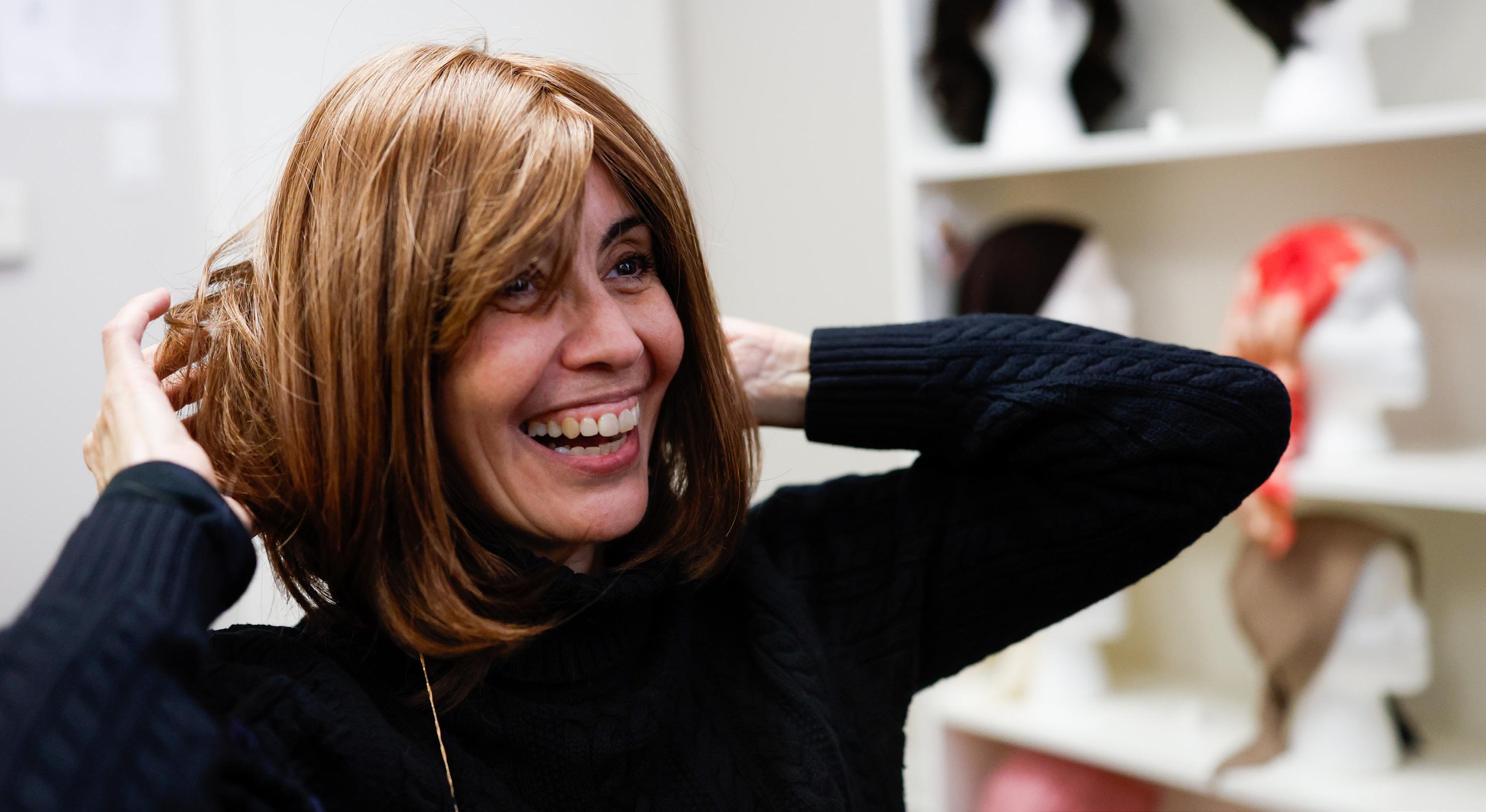
Gilma Pereda was having trouble quieting her brain. That’s where doctors found a cyst the size of an egg a few weeks before Halloween, when an unexpected trip to the emergency room turned into a lifethreatening prognosis, forcing the now-three-time cancer patient into quarantine during her favorite holiday’s festivities.
When Pereda was first diagnosed with stage 1B cervical cancer almost a decade ago — shortly after immigrating from Mexico City — the grueling treatment taught her a lesson about self-love and health. Then the cancer’s metastatic recurrence in 2021, which spread to her lungs and fractured her spine, dealt a blow of chemotherapy and immunotherapy that she barely survived.
After all that, receiving catastrophic health news again this year was a staggering blow she didn’t expect.
“I was pissed — like, ‘Come on, it’s not fair — I did what I was supposed to do,’ ” said Pereda, now in her early 50s. “But I need to
move on, because if you get stuck, it’s even more painful. I’m trying to make the best of it.”
Fear had largely replaced that anger the Sunday afternoon before she was scheduled for brain surgery at Kaiser in Santa Clara.
Pereda credits finding some relief to the weekly yoga and meditation classes she attends through Cancer CAREpoint, a San Josebased nonprofit that offers these and other resources to cancer patients living in Silicon Valley, the East Bay, the Peninsula and Santa Cruz County.
Pereda’s one lingering regret, however, is not learning how to accept help sooner. And more often.
“Everyone has their own process,” Pereda said, explaining how some people are more private, or simply not ready to share what’s on their mind with others. Treatment can be a complex journey of isolation, guilt and pain, “but, as a cancer patient, once you give yourself the permission to find community — connection, spirituality, companionship, something — things get easier. Reach out. You’re not alone.”
Gilma Pereda, of Santa Clara, tries on a wig at Cancer CAREpoint’s office at Good Samaritan Hospital in San Jose. Pereda, who was diagnosed with cervical cancer in 2016, went into remission, but her cancer returned. SHAE HAMMOND — STAFF PHOTOGRAPHER
HOW TO HELP
Donations to Cancer CAREpoint will help the nonprofit provide financial assistance to patients for rent, utilities, food and transportation. Money will also be used to fund mental health counseling and add up to 125 wigs to its wig bank. Goal: $20,000
By Linda Zavoral LZAVORAL@BAYAREANEWSGROUP.COM
Like all friends, the Friends of Grace nonprofit smooths out the rough edges of life.
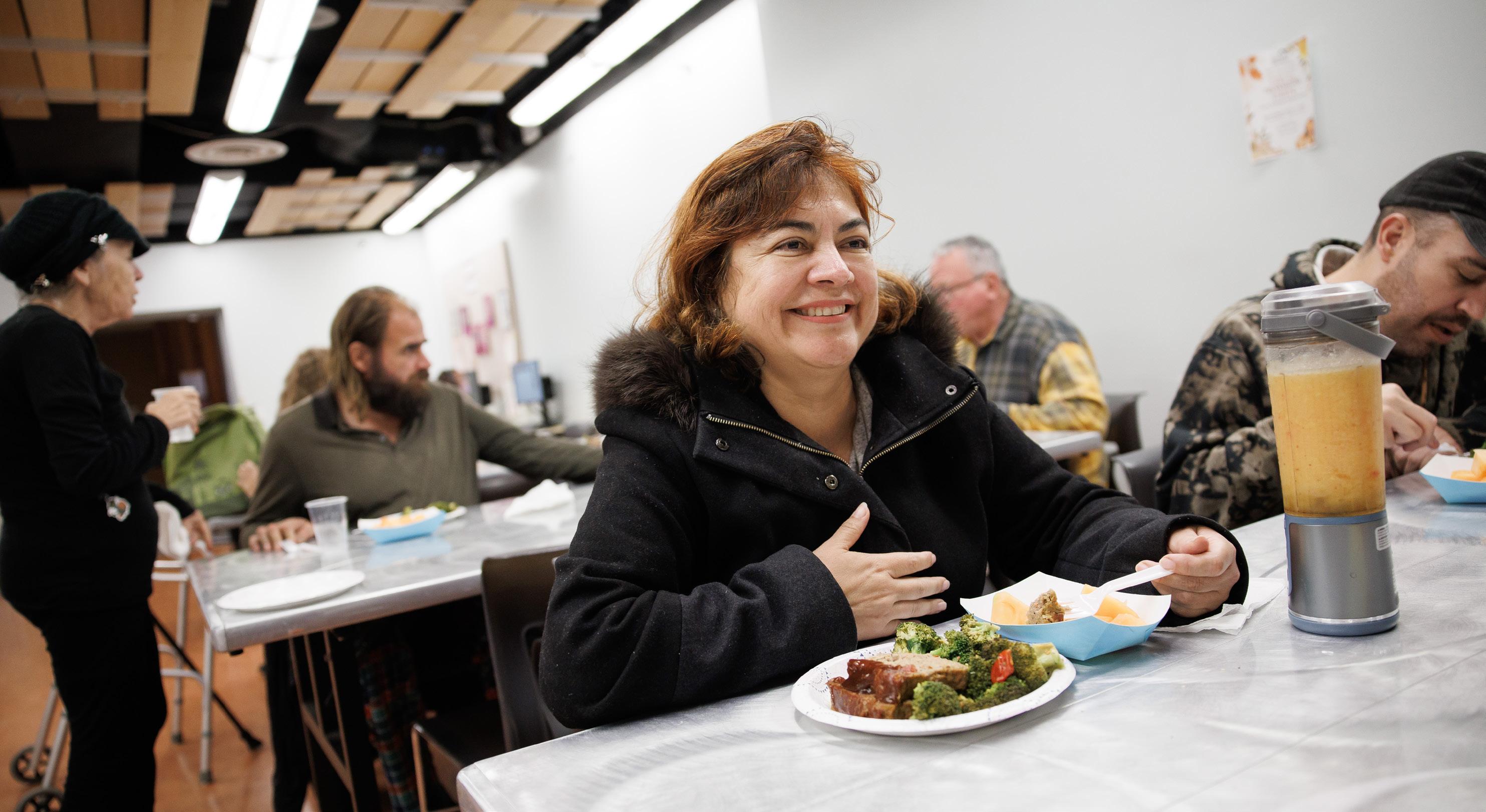
The San Jose group accomplishes this through a combination of classes, community and hot, healthy meals — a program known as Grace Art & Wellness that’s held six days a week at the city-owned Northside Community Center.
“Breakfast and lunch aren’t just meals — they’re a point of entry into healing and connection,” said Shawna Scarpitti, president of the nonprofit. She noted that more than 12,000 meals were served in 2024 to hundreds of people who have found or were referred to Friends of Grace.
Many members have developmental disabilities or are experiencing mental health challenges. For others, they’re coping with the loss of a job, housing or family — or the loneliness and isolation that can come with aging.
“We want to decrease the stigma and focus on the individual,” city recreation supervisor Josue Covarrubias said. “We provide an environment where they can feel safe to be themselves.”
The nonprofit, which grew out of the board-and-care home era, was founded in 1971. All are greeted by name when they walk through the door on North Sixth Street.
“For some folks, it’s their second home,” Covarrubias said. “For some, it’s their first.”
Anyone 18 and over may utilize the services. The lifetime membership fee is $5.
“We see some people once every year, some every five years, some every day,” said Jo Eclevia, a senior therapeutic treatment specialist who has worked with Friends of Grace for two decades.
Miriam Soto Marquez, 43, joined earlier this year after suffering a health crisis. She’s delighted to be back working part-time as a dental assistant; still, she relishes the days she can spend here.
“It helps me for my soul,” she said. “I came here because I didn’t want to stay home. … I love them like my family.”
Miriam Soto Marquez, a member of the Friends of Grace nonprofit group, eats lunch with fellow members at JTS Northside Community Center in San Jose. “It helps me for my soul,” she says, grateful to be back at work part time after a health crisis. DAI SUGANO — STAFF PHOTOGRAPHER
Donations to Friends of Grace will help pay for its weekday lunch program, which provides hot meals to low-income adults living with mental illness, cognitive disabilities or experiencing homelessness. Goal: $25,000
By Ethan Baron EBARON@BAYAREANEWSGROUP.COM
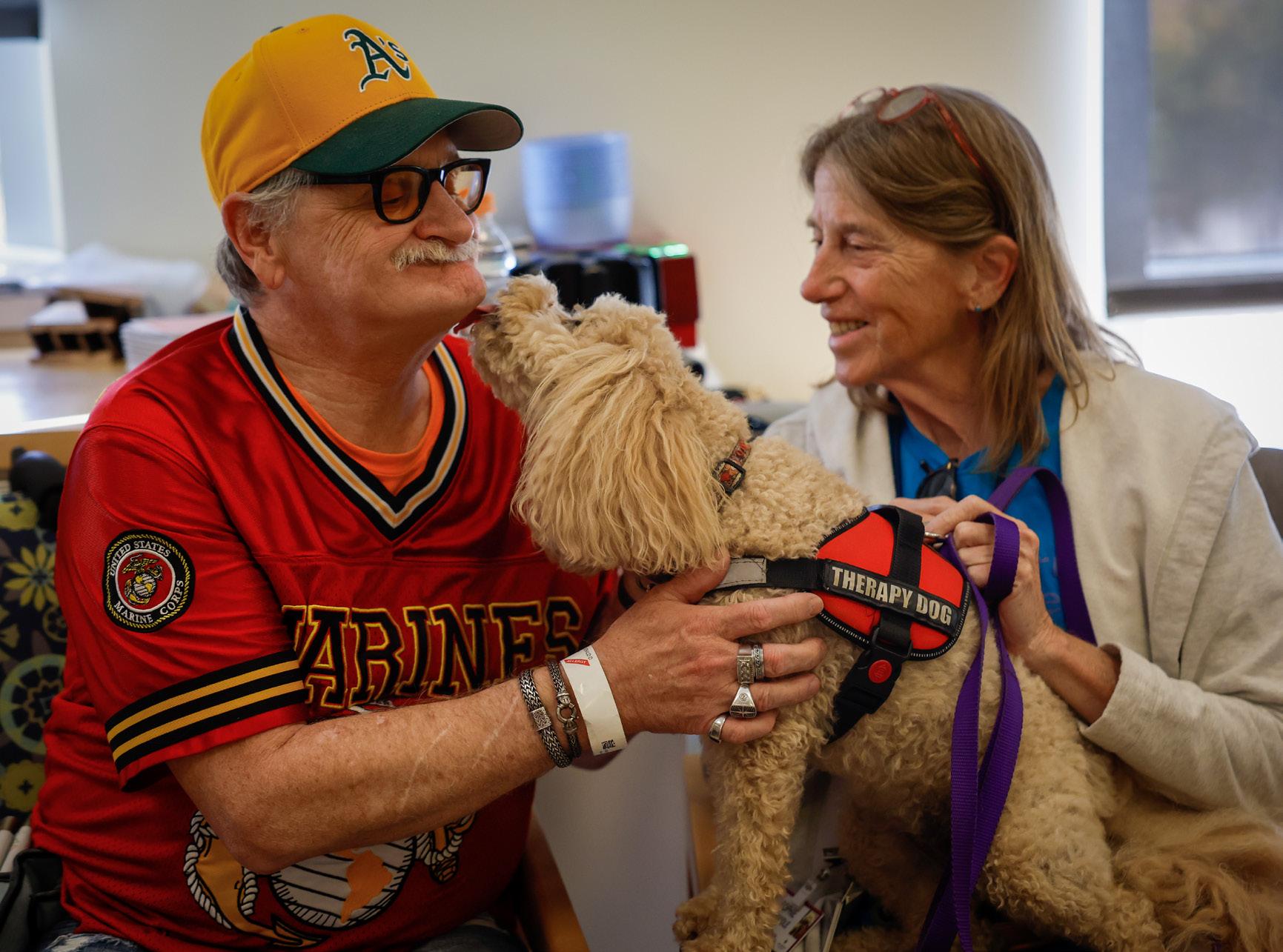
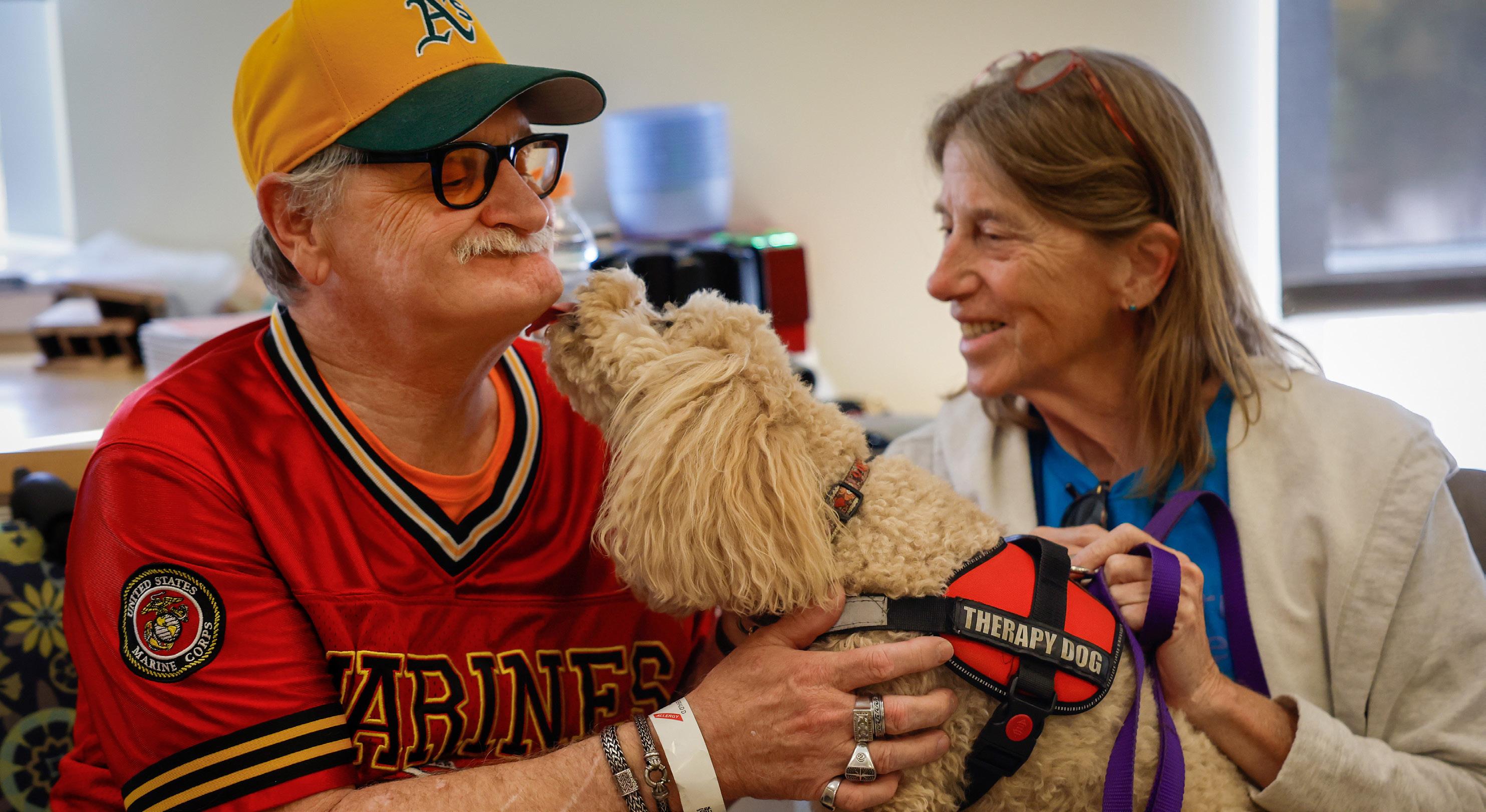
Inside the Palo Alto Veterans Affairs Medical Center, Gerry Gregg, wearing an A’s baseball cap and a U.S. Marine Corps shirt, leans down to give rubs and scratches to Murphy, a fluffy golden retriever who is part of a pet-therapy team from San Jose nonprofit Furry Friends.
“How are you doing?” Gregg, 60, croons to Murphy, who looks adoringly into his eyes. “Yeah, I know,” Gregg tells the dog.
Gregg came to the VA for a monthlong course in navigating life with limited vision. Murphy, and a small pack of other pooches from Furry Friends, came as they do every Monday to bring unconditional love.
“I’ve had dogs all my life, up until I lost my sight,” says Gregg, a Marines veteran and retired floral designer.
Facilitating temporary but meaningful contacts between human and beast is central to the mission of Furry Friends. “It’s something really special that can’t be replicated through human therapy,” says
Furry Friends volunteer and vice-president Grace Chung. “There’s this unspoken language, and animals don’t judge.”
Just the tactile pleasure of touching a pet eases stress and boosts mood, says Lindsay Conner, a recreational therapist at the VA. Contact with visiting animals often strikes deep chords in patients, Conner adds.
“It connects them to nostalgic memories,” she says, “happy childhood memories of owning pets.”
The dogs from Furry Friends appear to understand which patients require their services most, Conner says. “You’ll see the dogs moving towards different people,” she says. “The dogs have this innate sense of who needs that extra love and support.”
Furry Friends, established in 1983, has more than 300 volunteers who bring the magic of fuzzy — and occasionally feathered or scaly — critters to more than 150 diverse facilities in Santa Clara, San Mateo and Santa Cruz counties, spreading love and a sense of well-being to some 15,000 people every year.
The group’s motto? “We lick loneliness.”
SHAE HAMMOND — STAFF PHOTOGRAPHER
Donations to Furry Friends Pet Assisted Therapy Services will help the nonprofit expand access to therapy animal visits across schools, hospitals, senior care homes, jails, libraries and shelters all around the South Bay. Goal: $20,000
By Jim Harrington JHARRINGTON@BAYAREANEWSGROUP.COM
Marisa Carlini has spent her life helping others.
The 64-year-old Santa Clara resident grew up with a nurse as a mom and decided to pursue the same profession.
Yet, she didn’t do it simply because being a nurse ran in the family, but because a compassion toward others is a big part of who she is.
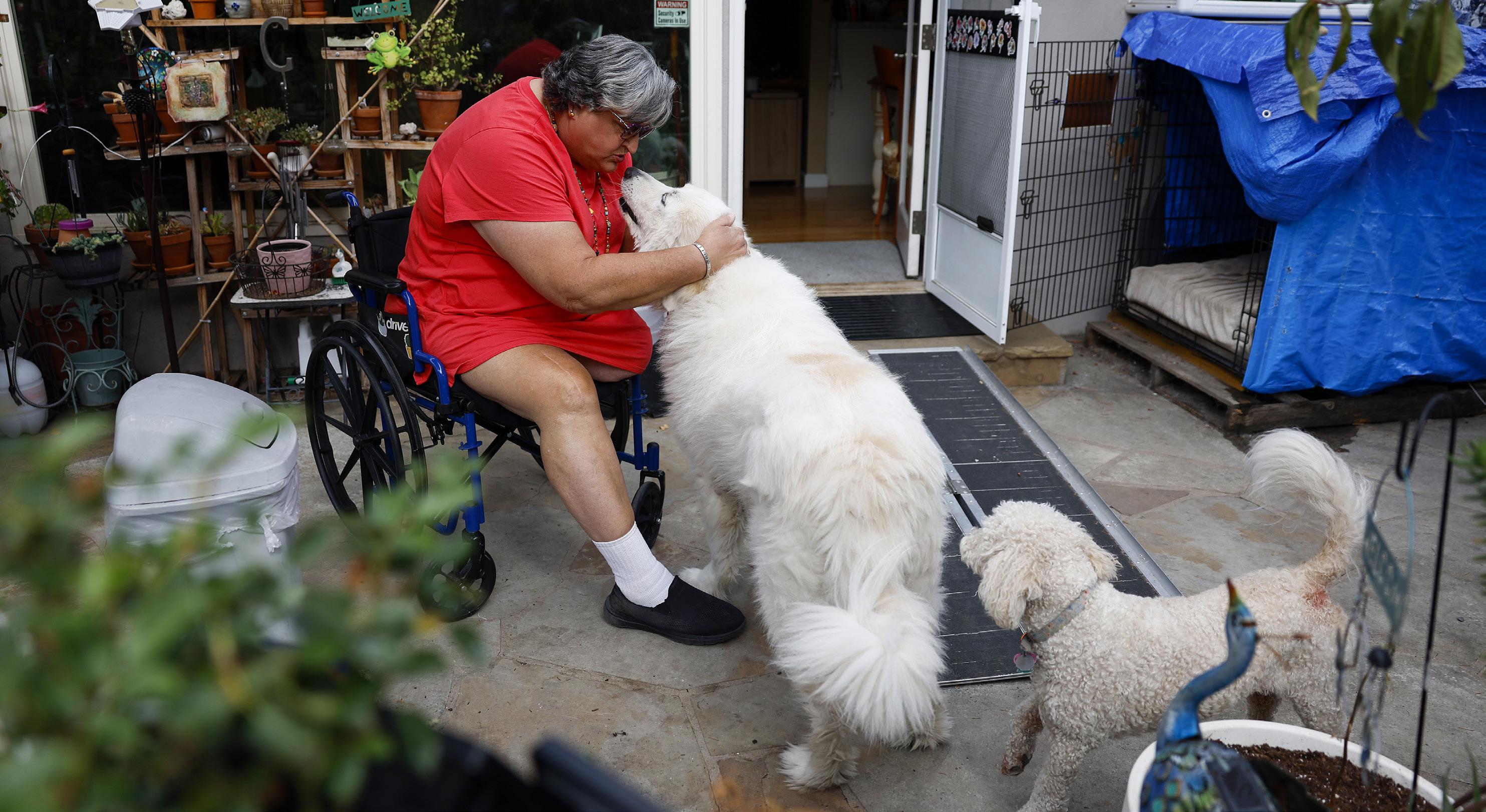
“I love to take care of people — to listen to people,” says Carlini, gazing around her home from her wheelchair. “I never thought I would be in this position.”
After dealing with severe leg problems and pain for five years — and undergoing four failed surgeries to try and correct the situation — Carlini’s left leg was amputated in late 2024.
“The pain was gone,” she remarks from the home she shares with two dogs, two birds and son Matteo.
Losing her leg, however, changed pretty much every aspect
of her life and threatened the independence that she had long enjoyed. Now, seemingly simple things — such as changing an overhead light bulb — were tasks that required the assistance of others.
“The help I would give others, now I have to take,” she says.
Fortunately, Carlini has been able to receive such assistance from Heart of the Valley, a Santa Clara-based nonprofit that supports independent living for seniors in West Santa Clara Valley.
“Over the years, Heart of the Valley has grown from a small volunteer operation into a full-fledged nonprofit that serves hundreds of seniors each year,” explains Alma Soto, Heart of the Valley executive director.
These volunteers provide a wide range of expertise and services to senior clients — such as installing grab bars in Carlini’s home so she won’t have to worry as much about falling.
“Wayne (a Heart of the Valley volunteer) came over and installed seven grab bars in just two hours,” she remembers.
Marisa Carlini gives Lilo a hug in the backyard of her home in Santa Clara. Heart of the Valley provided Carlini with home safety upgrades, including handrails, after her leg amputation. NHAT V. MEYER — STAFF PHOTOGRAPHER
Donations to Heart of the Valley Services for Seniors will help the nonprofit support seniors living independently in the West Santa Clara Valley by expanding its community outreach, improving crucial technology and growing its volunteer base in addition to delivering services such as transportation, yard work, home repairs, companionship, and wellness check-ins.
Goal: $25,000
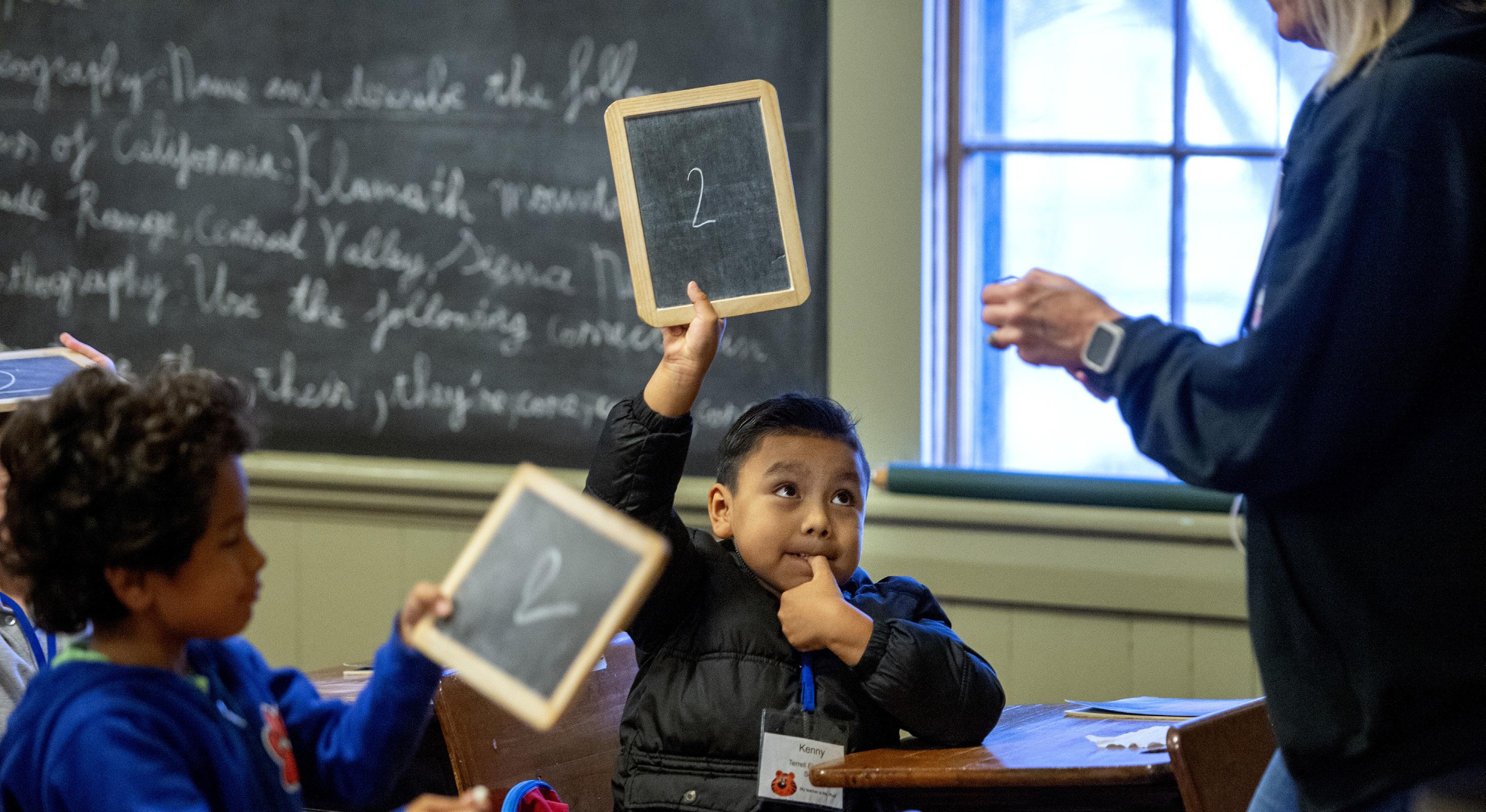
By Sal Pizarro SPIZARRO@BAYAREANEWSGROUP.COM
Today’s elementary school students in Silicon Valley are much more familiar with harvesting crops in Minecraft than they are with the thousands of acres of farmland and orchards that once dominated the Valley of Heart’s Delight.
There are Uber and Waymo kids who may have never heard the clang of a trolley bell. And phrases like “dial a phone” and “write a check”? Don’t even get started, boomer.
But thanks to History San Jose’s hands-on education programs, more than 12,000 students every year get to experience what it’s like to live as an early California pioneer, to visit a bank branch that existed long before debit cards and tap-to-pay and understand the painstaking work that went into taking a bushel of cherries from the tree into a can.
“I’ve been teaching 23 years, and this is a place that holds an important part in my heart because of the hands-on experience that each
student gets,” said Sally Vigneri, a fourth-grade teacher at Zanker Elementary School in Milpitas who was at History Park in San Jose in October with her students.
History San Jose is perhaps best-known as the repository and caretakers of the city’s long history.
Its warehouse is filled with items that chart the evolution of San Jose from a small, agricultural hub to a city of nearly 1 million people that is home to some of Silicon Valley’s most well-known tech companies.
The nonprofit, which celebrated its 75th anniversary recently, also operates three other historic sites.
But the real value in History San Jose’s mission lies in its school programs, which serve as a time machine for students, transporting them back to different historical periods.
Adobe Days covers the state’s Spanish and Mexican periods, while Westward Ho! explores the frontier experience and Valley of Heart’s Delight lets students delve into the Santa Clara Valley’s agricultural peak.
Zanker Elementary School students Kenny Rodriguez, right, and Giovanni Naughton hold up chalkboards as they answer an arithmetic question during a tour of the Santa Ana School, a former 1890s, one-room schoolhouse, at History San Jose, in San Jose. DOUG DURAN — STAFF PHOTOGRAPHER
HOW TO HELP
Donations to History San Jose will provide field trips for 500 local students and help the nonprofit update hands-on materials used in its school programs.
Goal: $7,800
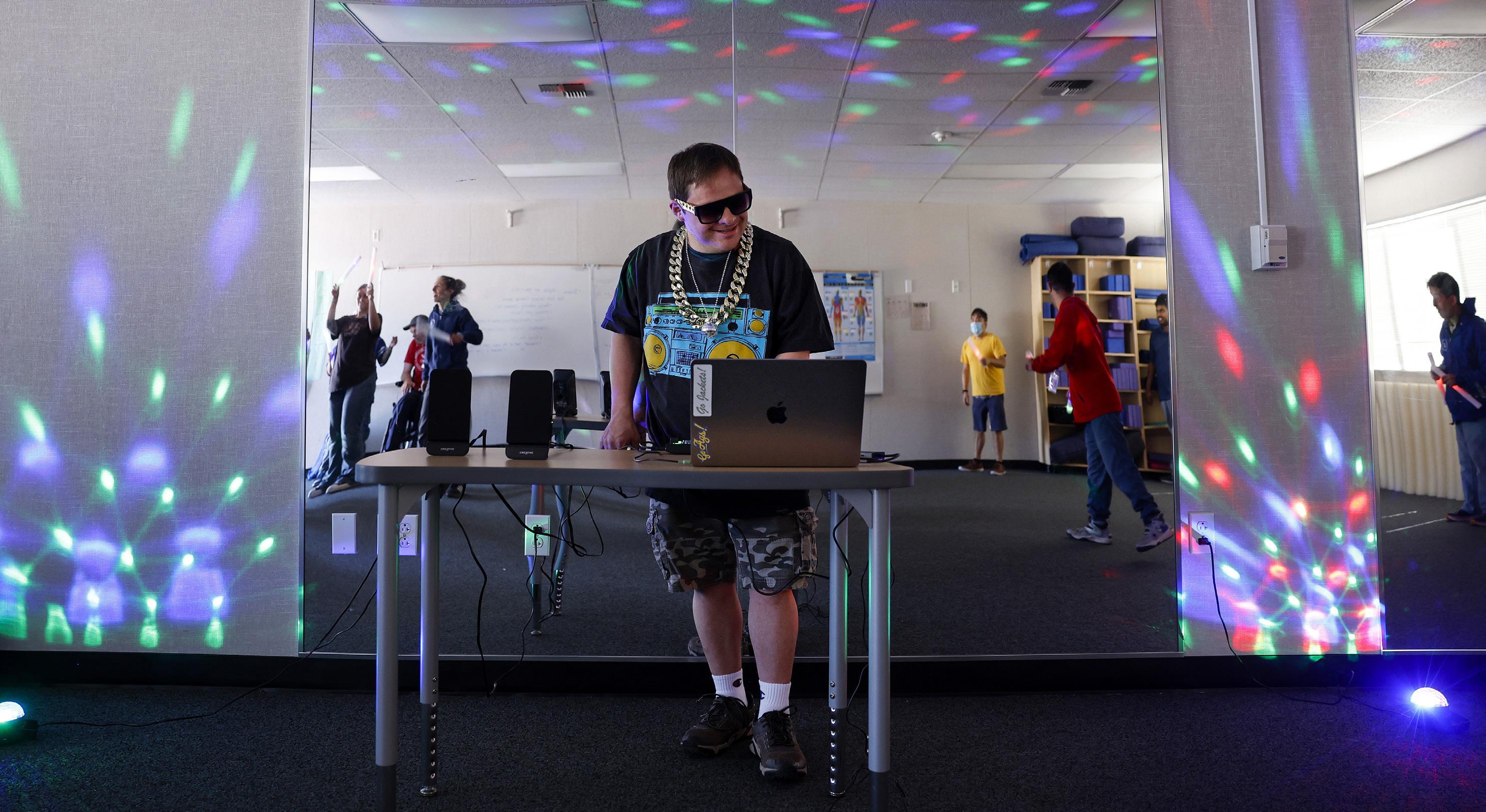
By Grace Hase GHASE@BAYAREANEWSGROUP.COM
In a portable classroom on the Santa Clara Adult Education campus, Abraham Leza prepares to teach his weekly class just after the Friday lunch hour.
He pulls on a black T-shirt embossed with a drawing of a boombox before placing a gold chain around his neck. He makes his way to the head of the classroom where atop a desk sits a turntable plugged into a laptop and he begins “scratching” out a beat as students file in.
The lights switch off but the room is illuminated by several disco balls splattering the walls and ceiling with color. The students dance along to his musical stylings while waving light sticks through the air.
Leza, 42, has long dreamed of becoming a professional DJ — he likes the technical aspect of it — and during those Friday classes he gets to transform from his usual role as a student at the Independence Network into a teacher who gets to share his passion with his fellow classmates.
A part of Santa Clara Unified School District’s adult education program, the Independence Network for the last three decades has catered to individuals with a wide range of intellectual and developmental disabilities including autism, cerebral palsy and Down syndrome.
The program offers a variety of life skills and vocational classes like cooking, sewing and adaptive fitness.
And, in October 2024, the Independence Network kicked off a new initiative that allows students like Leza to teach a weekly class in an area that interests them.
So far, students have taught classes on topics like K-Pop, candle making and football.
“The main thing we want to create here at our school is that people have a sense of belonging and connectedness to others, and an extension of that is having people feel empowered,” Daya Sánchez, the program coordinator, said.
“That is really the goal of the student-led classes — for students to feel that they have an ability to lead and make decisions.”
Abraham Leza leads a student-run music class teaching others how to DJ at the Independence Network in Santa Clara. Independence Network’s new initiative allows students like Leza to teach a weekly class in an area that interests them.
NHAT V. MEYER — STAFF PHOTOGRAPHER
Donations to Independence Network, Santa Clara Unified School District will be used to buy supplies for the studentled classes and to support community outings related to what is being taught in class. Goal: $20,000
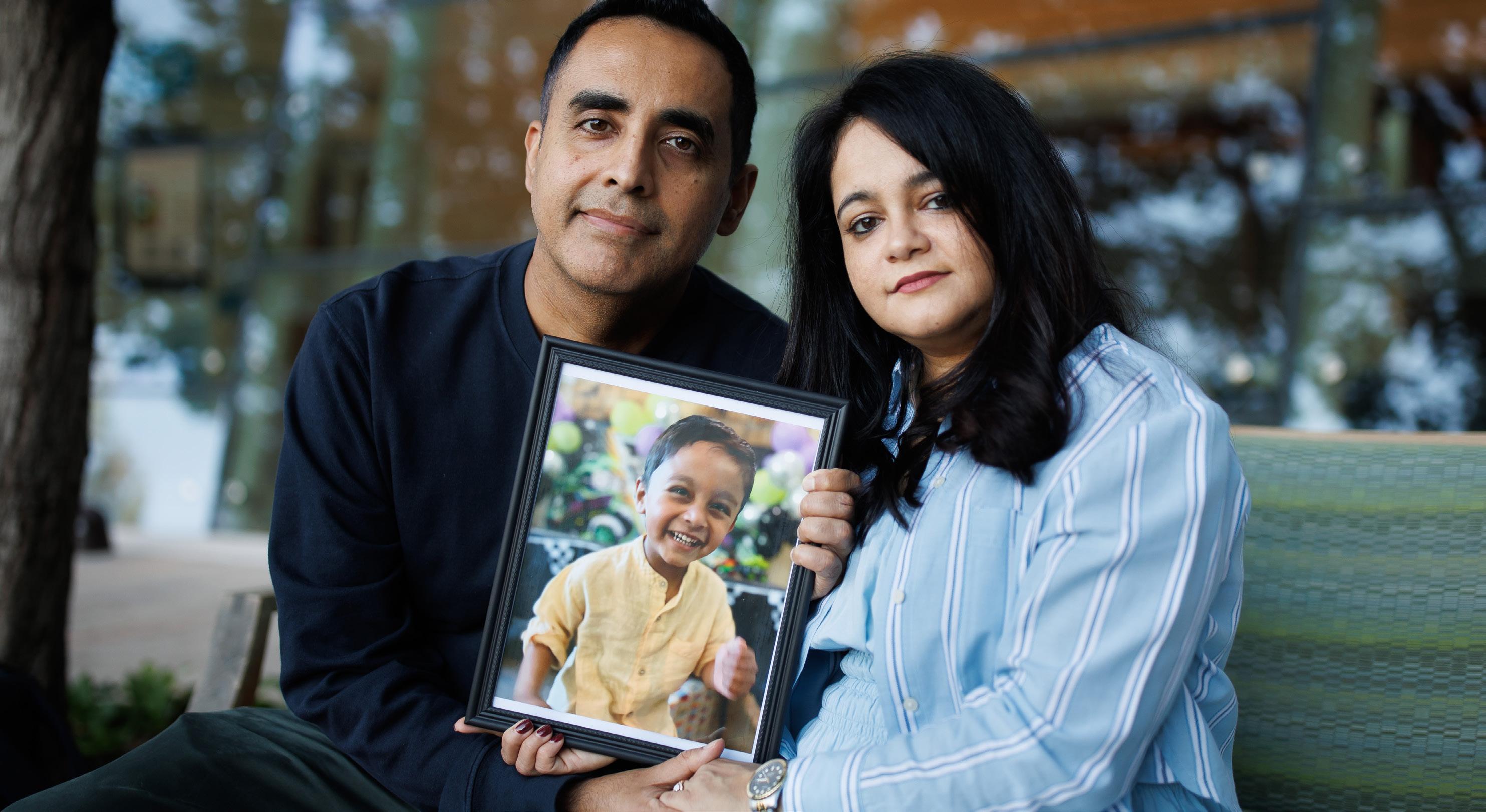
By Grant Stringer GSTRINGER@BAYAREANEWSGROUP.COM
When Teena Punjwani and Deepak Nasta take stock of the last year, they start with a sigh.
“I feel like I’ve lived too many lifetimes in this one lifetime,” Punjwani said.
The San Jose couple’s life together was thrown into chaos in February with the heartbreaking diagnosis of their five-year-old son, Jayaan, with brain cancer. His parents had sensed that something was off last winter, when Jayaan’s writing skills nosedived at preschool and he mysteriously lost balance on the left side of his body.
What followed were months and months of anxious days and long nights at clinics and hospitals as Jayaan, tough as nails, soldiered through his treatment plan: brain surgery and chemotherapy, plus a whirlwind of appointments for occupational therapy, physical therapy, blood tests and MRIs.
Through the ups and downs, though, the couple weren’t alone. Staff from Jacob’s Heart, a nonprofit based in Watsonville serving families in Silicon Valley and on the Central Coast who have a child with cancer, stepped in to help them weather an ordeal no parent should have to.
After a hospital social worker pointed them to the nonprofit, the family said Jacob’s Heart provided a slew of resources with all the care and attention of a family member. The nonprofit has paid for their energy bills at home, plus their groceries and gas. Nasta is the family’s sole breadwinner at the moment as Punjwani practically lives at Lucile Packard Children’s Hospital at Stanford with Jayaan.
When the hospital discharged Jayaan earlier this year, Jacob’s Heart staff visited and played with him, bringing some of his favorite toys, like Mickey Mouse and Bluey. In a key source of comfort and help for the family, the nonprofit dispatched van drivers to whisk them from their home to medical appointments.
“They’re such an amazing team,” Nasta said. “We honestly could not do it without them.”
DAI SUGANO — STAFF PHOTOGRAPHER
Donations to Jacob’s Heart will help the nonprofit provide clients with transportation to treatment and medical appointments, nutritious food and crisis support, in addition to helping with expenses related to the safety and care of the child with cancer.
Goal: $40,000 HOW
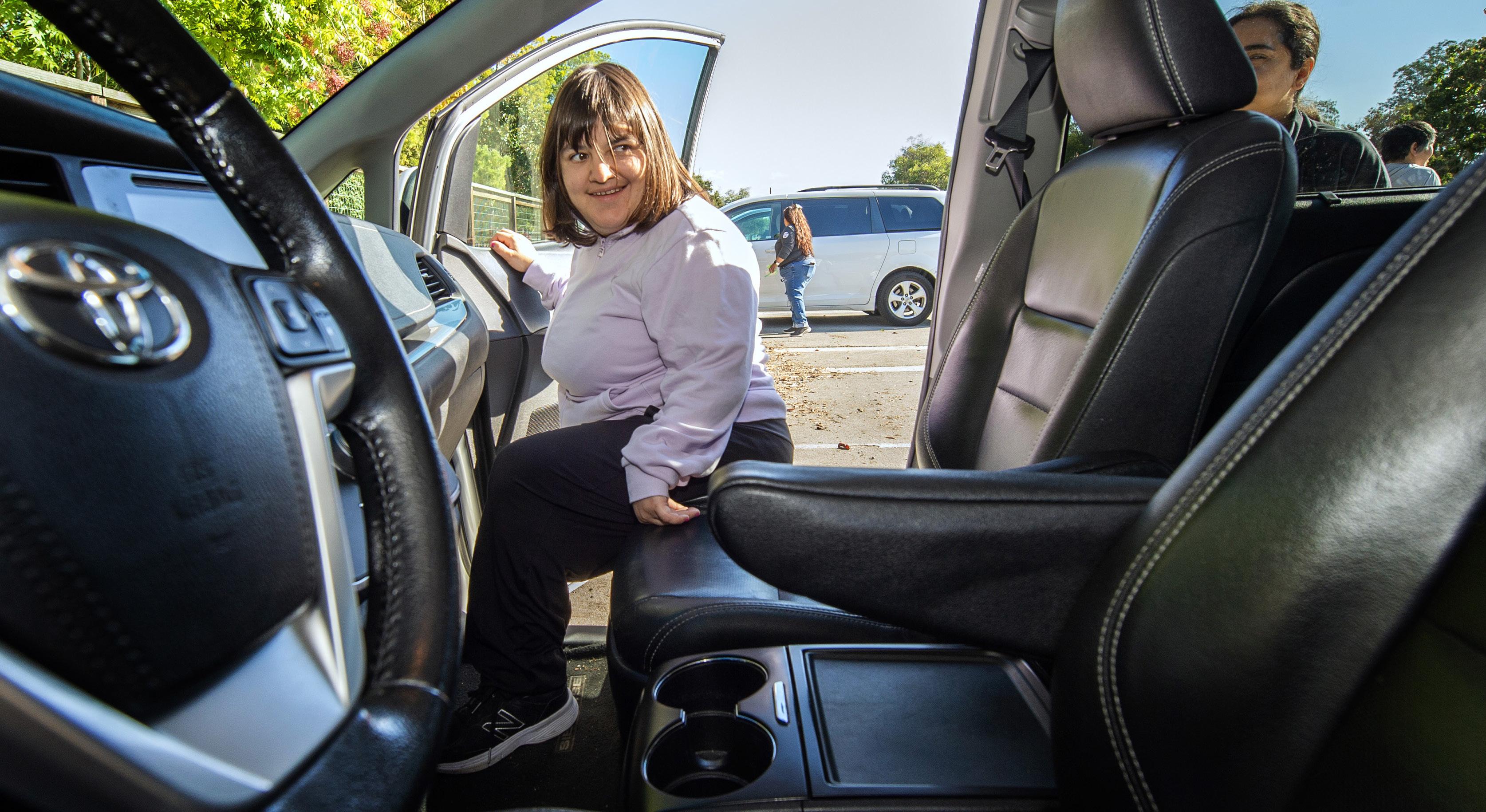
By Stephanie Lam CORRESPONDENT
Clenching a broom in one hand and a dust pan in the other, Amber Levine-Mickel furiously sweeps a dirt walkway in Sunnyvale, bending small pebbles, fallen leaves and branches to her will.
For over an hour the 31-year-old and her companions from Life Services Alternatives (LSA) brave the cold to tidy the grounds of Animal Assisted Happiness, a family-friendly barnyard in the city. Levine-Mickel volunteers there every Thursday morning.
Once she finishes, she can rest inside a cozy LSA-owned Toyota van parked nearby. Painted white on the outside and styled with black leather seats, LSA staff use the van to drive adults with intellectual and developmental disabilities from one community activity to another.
On this particular day, Levine-Mickel’s face breaks out into a wide grin as she climbs into the passenger seat. She’s still smiling as she straps on a seat belt and waits for the familiar vibrations of the
engines turning on, a sign that the LSA crew is ready to embark on their next excursion.
For Levine-Mickel, who is deaf, visually impaired and has cerebral palsy, riding in the van is the only way she can travel around the South Bay and get outside of her Campbell group home.
Although Levine-Mickel’s enthusiasm for traveling is boundless, the van’s ability to do so isn’t.
LSA needs a new vehicle to shuttle adults to their recreational and volunteer activities on a daily basis.
LSA serves around 100 adults who have varying needs and abilities. Everyday they make use of the nonprofit’s developmental programs, transportation and housing resources.
The day programs, which Levine-Mickel is a part of, offer life skills training and volunteer work to boost participants’ self-esteem and independence. Since the adults don’t drive or own a car, they rely on LSA staff to drive them to and from destinations using the van.
“(The vans) are so important for the day program,” LSA Executive Director Dana Hooper said.
Amber Levine-Mickel, 31, of Campbell, gets into one of the vans operated by Life Services Alternatives after volunteering at Animal Assisted Happiness in Sunnyvale. Levine-Mickel and other volunteers rely on these accessible vans to attend their day programs.
DOUG DURAN — STAFF PHOTOGRAPHER
Donations to Life Services Alternatives will help pay for a new van to transport up to 12 people who live in the agency’s group homes with reliable daily transportation for several years. Goal: $38,900
By Paul Rogers PROGERS@BAYAREANEWSGROUP.COM
Sally Burns celebrated a birthday recently. She had a nice party, ate some cake and opened 30 birthday cards.
She’s an expert at birthdays. She’s had 105 of them.
The year she was born, in 1920, was the first year women could vote. Babe Ruth was traded from the Boston Red Sox to the New York Yankees. America’s top-selling car was the Model T Ford. And Prohibition was just getting started.
Sally has kids. A son and a daughter. They are 74 and 75 years old. Her first job was working as a receptionist in 1938 for Franklin Roosevelt’s housing department. She’s traveled the world and seen a lot. What’s the secret to living to 105? “Eat oatmeal and drink white wine every day,” she said smiling. “But they won’t let me have wine here.”
“Here” is Live Oak Adult Day Services, in San Jose’s Willow Glen neighborhood. Despite the rules against white wine, Sally said she loves to visit at least twice a week. The nonprofit center is a gathering
place for senior citizens, many of whom are frail or have mild dementia, Parkinson’s disease or other challenges, to meet new friends and stay active.
The center, which serves roughly 100 people ages 60 to 105 at four locations in Santa Clara County, operates five days a week, from 9 a.m. to 3 p.m., offering a wide range of activities, including dancing, art projects, breakfast and lunch, current events updates, games, visits from schoolchildren and other pursuits.
“It’s a community. They look out for each other,” said Izumi Yaskawa, Live Oak’s executive director. “At home, often their world is getting smaller. This is like a second family.”
Astrid Arretz takes her father, Al Arretz, a 93-year-old retired nuclear engineer who was diagnosed with Alzheimer’s, to Live Oak two or three times a week. He loves the food, the companionship and the music. “I love being with my dad,” she said. “He’s fun. He’s a happy-go-lucky guy. But it’s a lot of work to get him up in the morning every day, to help him shower, dress him, pay the bills, provide meals, everything. I’m his main caretaker.”
Client
Live Oak Adult Day Services is seeking donations to help pay for the more frequent use of a robot that interacts with seniors and to expand its software, providing up to 100 seniors with mild-tomoderate dementia a unique social opportunity. Goal: $20,000 HOW TO HELP
By Ethan Varian EVARIAN@BAYAREANEWSGROUP.COM
As Tachiya Bryant’s work as a multimedia artist in San Jose began to gain momentum, she knew she needed a dedicated studio to take the next step in her career. But renting a workspace in the pricey South Bay was simply out of her budget.
Then, at a panel discussion Bryant moderated on the connection between African-American women’s hair and identity — a central theme of her art — she met another artist who works for Local Color, a nonprofit that leases affordable studio space to creatives in San Jose.
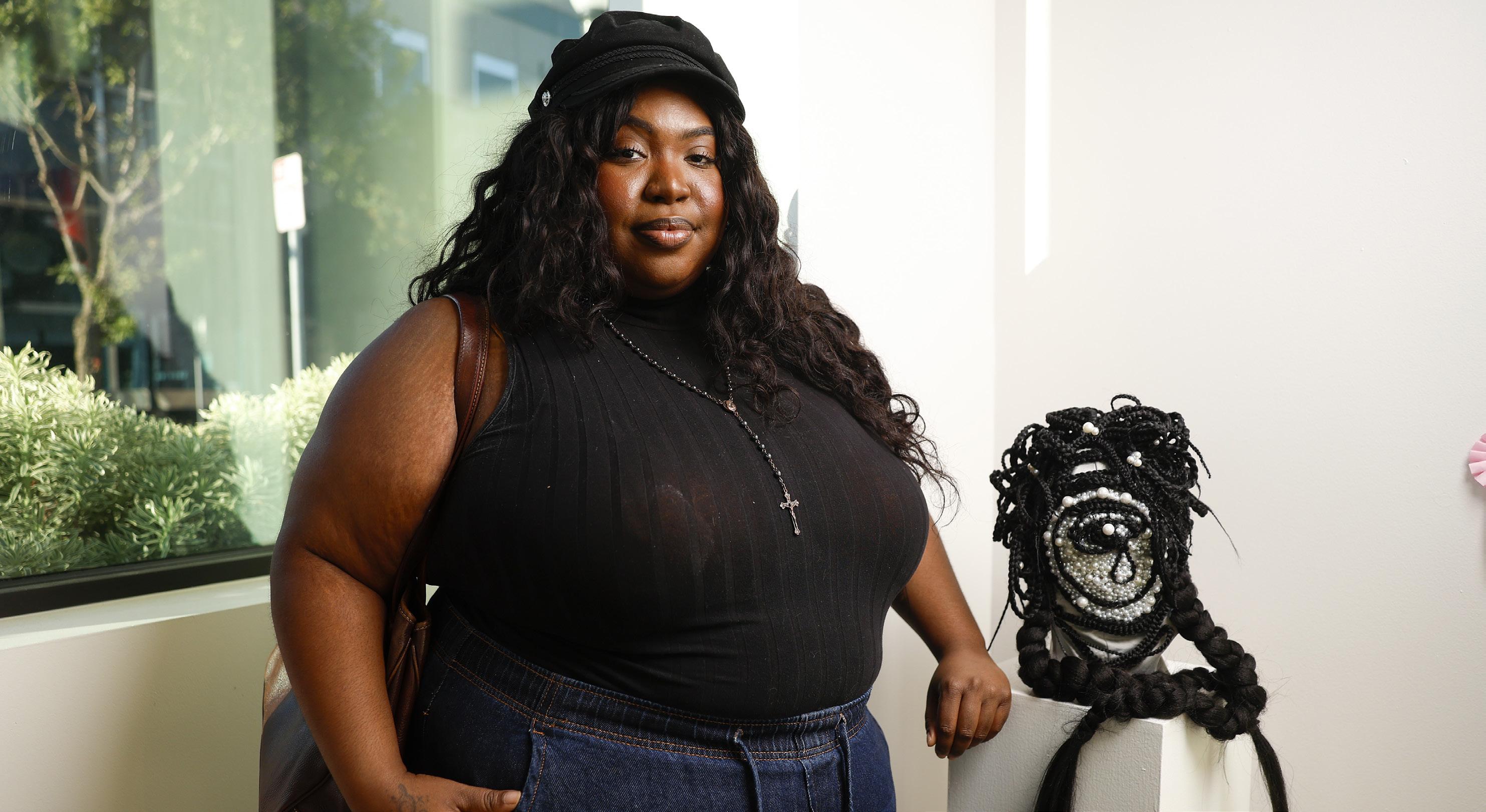
It wasn’t long before Bryant, 28, was renting a shared studio from the group for $400 a month. She’s since filled her workspace with canvases and art materials, including bags of synthetic braiding hair, which she’s used to create a series of masks for a project Local Color exhibited this year at its gallery in downtown San Jose.
Recently, she also designed a practice jersey for the San Jose
Sharks inspired by traditional Adinkra symbols for the team’s Black Excellence Celebration in February.
“It’s definitely made my dream of becoming an artist, and actually having space to branch out,” said Bryant, a San Jose native. “It was through having a space that I was able to refine my art. It wouldn’t be possible without Local Color.”
Local Color was founded 10 years ago by San Jose-based artist Erin Salazar and has since evolved.
Currently, Local Color has 25,000 square feet of studio space at two locations for more than 50 artists, including painters, graphic designers and multicultural percussion groups.
Last year, the nonprofit opened its Noble Workshop and Gallery, a small space on the ground floor of an affordable housing complex, which hosts free exhibitions, workshops and public art programming.
“There’s this added layer of cool that comes with the artist,” Salazar said. “And it allows them to see art as a vehicle in the future to whatever degree that matters to them.”
Artist Tachiya Bryant shows her artwork titled “Coquette,” made with crochet braids, pearls and cotton balaclava, at the Noble Workshop and Gallery in downtown San Jose. An opportunity to rent affordable studio space through Local Color has allowed her to hone her creative ambitions.
NHAT V. MEYER — STAFF PHOTOGRAPHER
Donations to Local Color will directly support free, community arts programming at Noble Workshop and Gallery. Goal: $10,000 HOW TO HELP
By Devan Patel DPATEL@BAYAREANEWSGROUP.COM
On a crisp autumn Saturday morning with the sky still a deep blue before hues of orange and pink line the horizon, not even the thunderous roars from airplanes overhead could drown out the enthusiasm and joy at San Jose’s Guadalupe Gardens.
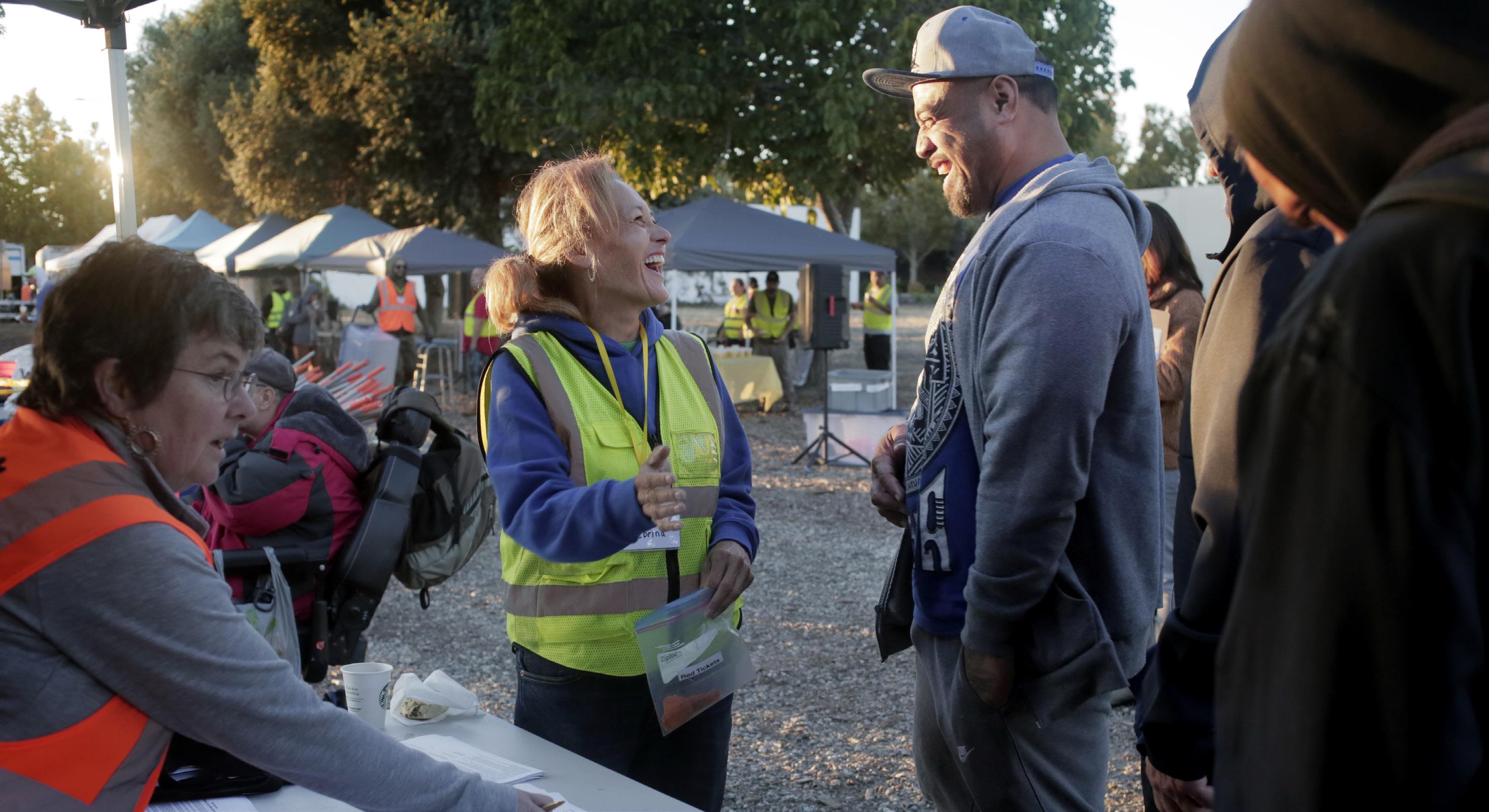
While most of the city slept in their warm, comfy beds, hundreds of homeless residents gathered around the crack of dawn to help clean up the park in exchange for a $20 cash stipend offered by the nonprofit Neighborhood Hands. It’s a familiar sight as they’ve been coming here every other weekend since the organization rebooted in 2020.
For many, it’s more than the opportunity to earn some money and clean up the park. The program has offered them hope and a sense of belonging. Just 18 months ago, Debrina Tenorio, 54, was homeless, jittery, devoid of self-esteem and support as she struggled to find stability.
Today, Tenorio proudly reflects on the progress she has made — trading a tent for interim housing, setting goals, reconnecting with her family and becoming a supervisor at her work. She sees herself as a living testimony of the power of Neighborhood Hands, which is also why she continues to volunteer.
“I’m proud to say that I continue to give back to the community,” Tenorio said. “Being able to support others on their journey has been one of the most meaningful parts of mine. I’m still growing, still healing and still moving forward, but I’m not where I used to be and for that, I’m deeply grateful.”
The roots of Neighborhood Hands sprouted in 2018 when its founder, Bill Sullivan, noticed the growing encampments at Columbus Park and sought out a few people living there to see if they would help him clean up.
“I could just see people’s eyes light up,” Sullivan said. “They were working, getting something for their work, making a difference, cleaning up a mess rather than making a mess — kind of knocking out all the stereotypes that unhoused people get.”
Debrina Tenorio, center, chats with a participant as she and volunteer Ann McMahan, left, check in helpers for the park cleanup program at Guadalupe Gardens in San Jose. Unhoused and economically insecure participants receive a $20 cash stipend for the work, as well as food and drinks. They also have access to a resource fair offering a wide range of services. LAURA A. ODA — STAFF PHOTOGRAPHER
Donations to Neighborhood Hands will help it fund five Saturday morning programs. Goal: $20,000
By Jim Harrington JHARRINGTON@BAYAREANEWSGROUP.COM
Thu Buu Vien didn’t know just what to do.
Her 2-year-old son, Hien, had just been diagnosed with autism, global developmental delay and a seizure disorder. She had questions but no answers, stacks of paperwork but nobody to help her make sense of it, and plenty of misplaced guilt surrounding the situation, blaming herself for things she may have done wrong during the pregnancy.
She also didn’t speak much English, having just arrived in the U.S. two years earlier from Vietnam in 2016, which made the whole thing even more difficult.
“My days consisted of tears,” Vien said through a translator. “I was so overwhelmed that I couldn’t understand what to do or where to start. I didn’t believe that anyone could help me at that point.”
Then she got a referral to Parents Helping Parents, a San Josebased nonprofit that aids families raising loved ones with disabilities
through advocacy, education and various means of support.
And her story changed.
“I came to the support meeting and I really felt that PHP could help me,” said the San Jose resident, whose son Hien is now 9. “I was in awe.”
And, just like that, she didn’t feel so hopeless or alone anymore, as she worked with the PHP staff members — most of whom are parents of children with disabilities themselves.
“I was able to connect with parents who had been there and with families who faced many challenges but were moving forward,” Vien says.
Vien was able to gain crucial assistance from PHP in understanding all the many agencies that could help provide support for her son. That included navigating the IEP (Individualized Education Program) process and IHSS (In-Home Supportive Services) program.
“Since then, I changed my perspective,” Vien says. “I realized that there is a community who will walk forward with me and my child.”
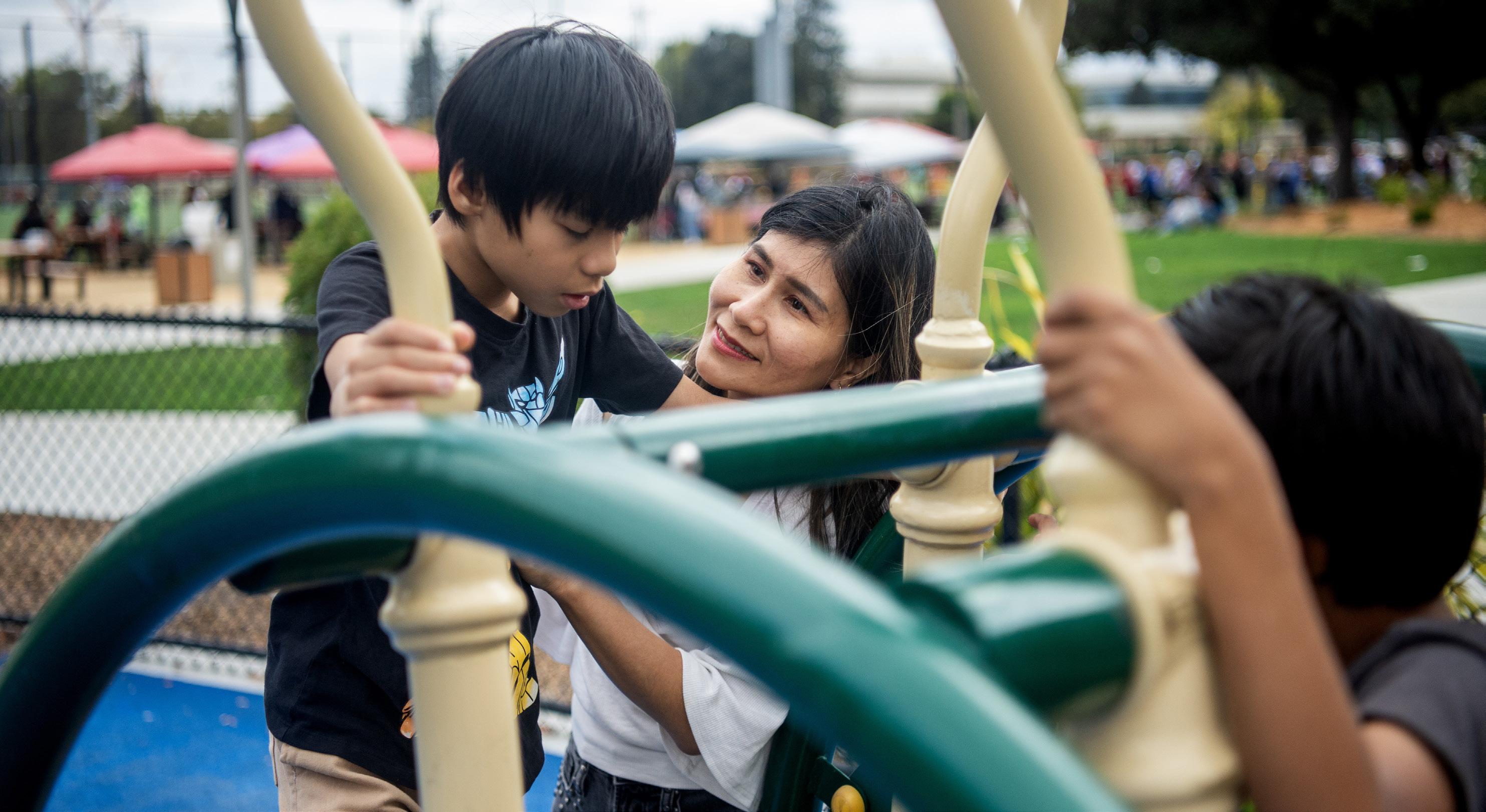
Thu Buu Vien, of San Jose, plays with her son Hien, 9, at Fair Oaks Park’s Magical Bridge Playground in Sunnyvale. Parents Helping Parents gave Vien support to find services available for her autistic son. “I realized that there is a community who will walk forward with me and my child,” she said.
DOUG DURAN — STAFF
PHOTOGRAPHER
Donations to Parents Helping Parents will support over 300 direct services to families with children with disabilities in East San Jose and South County. Goal: $25,000
By Julia Prodis Sulek JSULEK@BAYAREANEWSGROUP.COM
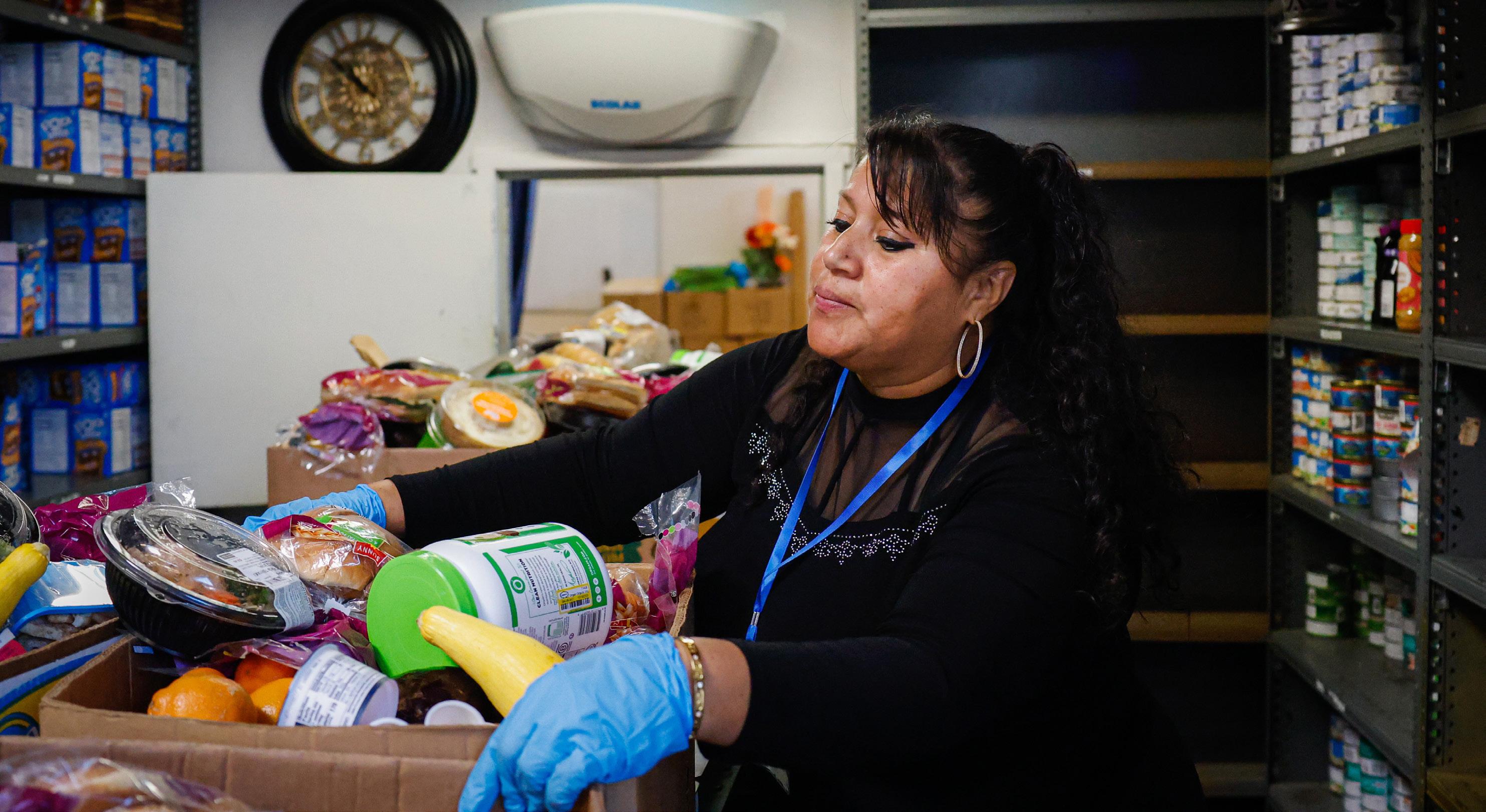
The line of people waiting their turn for free boxes of food from Santa Maria Urban Ministry on the edge of downtown San Jose used to snake out the parking lot and down a full block. Most were poor immigrants with children trying to get settled in high-priced Silicon Valley.
But ever since the Trump administration cracked down on people living in the country illegally early this year and sent masked federal agents to make sweeping arrests in immigrantheavy communities, the families are too fearful to gather in the open.
The line is gone.
Operations Director Alfonso Mendez tried to reassure them that if U.S. Immigration and Custom’s Enforcement showed up, he would rush them into the building and lock the doors. Still, they weren’t convinced.
“I’m very sad because everybody has the right to receive food,” said Mendez, who relied on these food boxes for his wife and two small children when he fled Colombia in 2000. “It’s not a good thing that they feel afraid to come.”
So now, like other local nonprofits with clients experiencing the same fears, Santa Maria Urban Ministry is taking food to the people, setting up market-style giveaways at schools and taking pallets of groceries to secret places where immigrants feel safer.
“We are doing things to get food to people without drawing attention to them or to us,” said Louis Powell, director of the nonprofit.
Established in 1983 as an outreach ministry of the local Episcopal Diocese, the nonprofit also delivers bagged meals, clothing and sleeping bags to the unhoused.
It offers classes for their clients to become literate in English and Spanish, and courses to help them learn to file their taxes.
“People need food,” Powell said, “and when that need is greater than their fear of stepping out their front door, they come.”
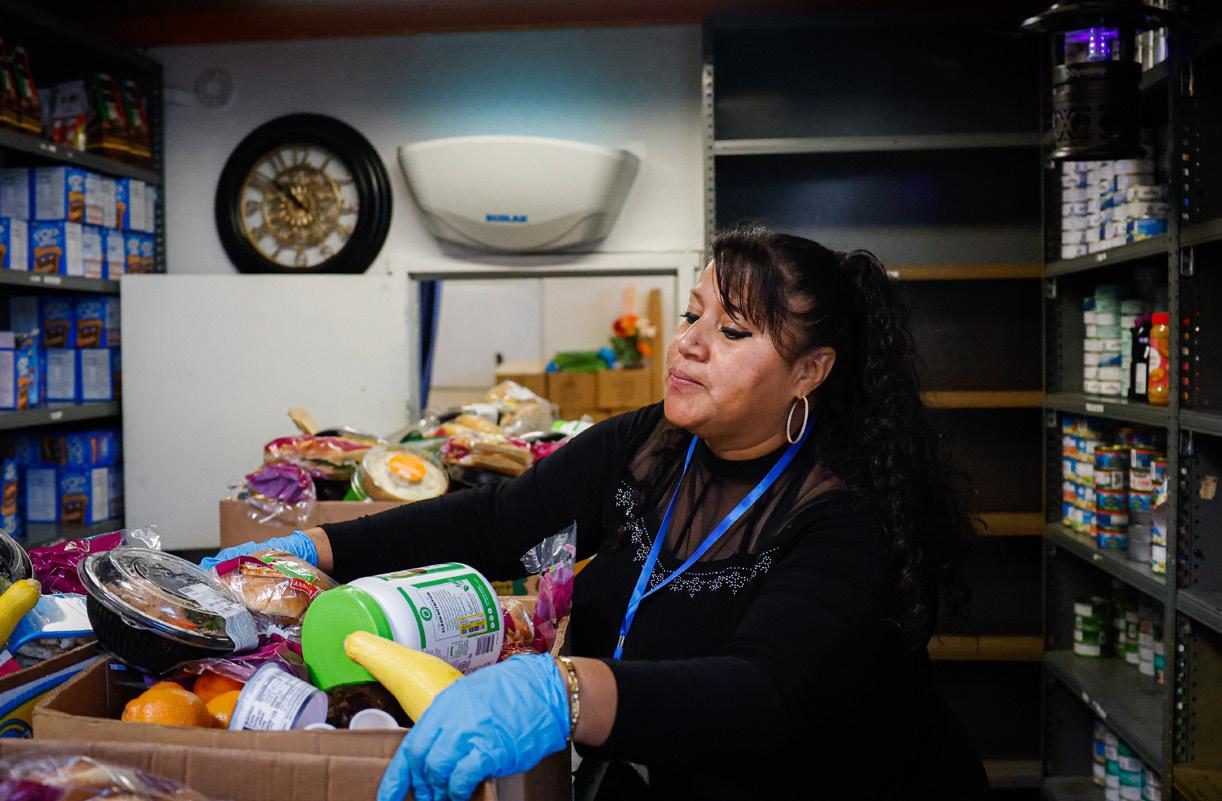
Patricia Lozano, of San Jose, helps package food for distribution at the Santa Maria Urban Ministry in San Jose, which primarily serves a poor, immigrant population.
A donation to Wish Book would help Santa Maria Urban Ministry transport food to its clients, buy more groceries to augment decreasing donations and expand its literacy programs. Goal: $50,000
By Caelyn Pender CPENDER@BAYAREANEWSGROUP.COM
Destinee Coronado was just 10 years old when her parents noticed something seemed terribly wrong: The normally happy, bubbly girl was sprawled across a set of chairs instead of joining the dance floor at a wedding with her family.
Her parents left the wedding early to take her to a hospital. There, doctors discovered a football-sized tumor on her ovary.
She was diagnosed with stage three ovarian cancer and spent the next five months undergoing chemotherapy treatment.
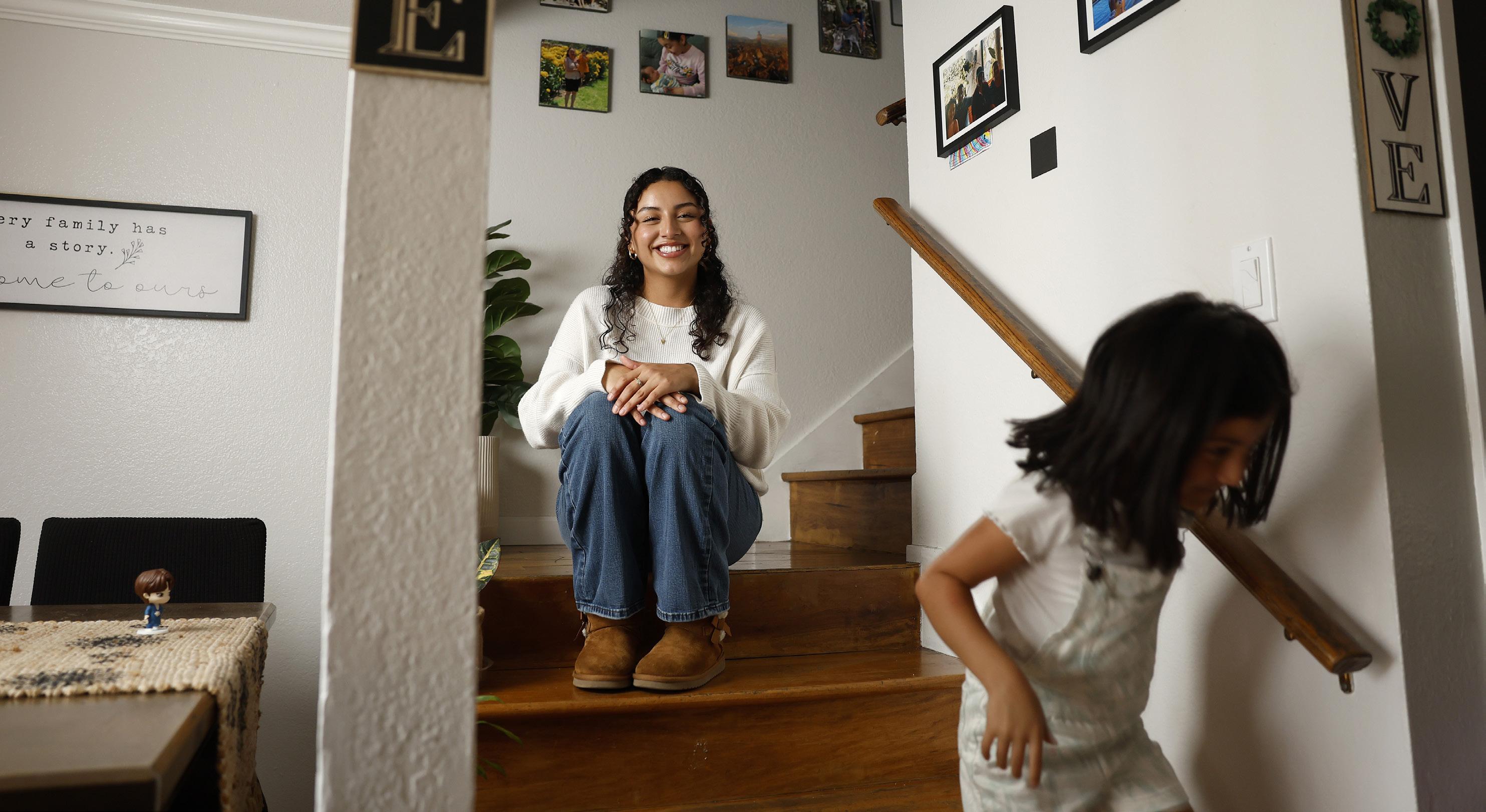
Today, she’s 18 years old, recovered from her illness and starting her first year of college at San Jose State University.
The medical bills drained her parents’ bank accounts — and possibly would have forced them to sell their condo — had it not been for the intervention of Shop with a Cop Silicon Valley Foundation, a local nonprofit that runs an annual holiday shopping spree for children in need.
After Coronado’s diagnosis, founders Darrell and Alicia Cortez stepped up to launch a fundraiser for the family that collected $10,000 — ensuring that they kept a roof over their heads, had food on their table and were not worried about their bills as their daughter underwent treatment.
“The family was not financially set, but at least they knew that they didn’t have to worry about that for a little while,” said Alicia Cortez.
Seven years later, Shop with a Cop Silicon Valley Foundation is stepping up to help the family again — this time to raise the funds for Coronado to attend college.
“I was very driven by the support and the love that they had given to me when I was sick, even though I didn’t really recognize that at the time,” Coronado said.
“They didn’t really have to do anything for me, but they just wanted to help me.”
“Given that they’ve already helped my family and I so much, I was surprised that they even offered (to help again),” Coronado added.
Destinee Coronado, 17, at her home in San Jose, is now seven years past a cancer diagnosis. Shop with a Cop Silicon Valley Foundation is stepping up to help Coronado again. This time, the organization is raising funds to help her attend college. NHAT V. MEYER —
STAFF PHOTOGRAPHER
HOW TO HELP
Donations to Shop With a Cop Foundation of Silicon Valley will help pay for Destinee Coronado’s college tuition and fees, materials, transportation, living expenses and incidental costs.
Goal: $15,000

By Molly Gibbs MGIBBS@BAYAREANEWSGROUP.COM
After the coronavirus pandemic shut down schools and ushered in a new era of “remote learning,” the parents in Ana Briones Gonzalez’s San Jose neighborhood became increasingly worried about their children’s mental health and well-being.
Briones Gonzalez— president of the Cadillac Winchester Neighborhood Association at the time — said residents had questions about how to deal with anxiety and depression and how to help their children navigate the challenges they were facing, but didn’t know where to turn.
For many in the small, predominantly Latino community, there was a stigma surrounding mental health issues, along with a lot of misinformation — all which made it difficult to get out information about resources and care.
“(It’s) not only that their kids have these issues that they’re dealing with, but the parents as well have signs of anxiety, and they don’t
know how to deal with that,” Briones Gonzalez said. Briones Gonzalez helped partner the community with the San Jose State University Healthy Development Community Clinic, which offers free health services to underserved communities. Together, the clinic and neighborhood association put together a health fair offering outdoor activities and information about health resources at a local park. The clinic also has held cooking and nutrition classes and provided child care during community meetings.
Cara Maffini, a professor in San Jose State University’s Department of Child and Adolescent Development and co-founder and director of the clinic, said when the clinic launched, students and faculty discovered that community members mostly wanted a safe space to connect with each other.
“A lot of folks really wanted to talk or wanted to learn,” Maffini said. “A lot of caregivers wanted to learn different parenting strategies. They were just struggling and wanting more information, and a lot of youth wanted safe places to connect with each other and with meaningful adults.”
HOW TO HELP
Donations to the Healthy Development Community Clinic at San Jose State University will allow it to support health screenings, mental health resources and community education programs for more than 150 people from underserved communities, as well as training and educational experiences for over 50 university students. Goal: $50,000

By Luis Melecio-Zambrano LMELECIOZAMBRANO@BAYAREANEWSGROUP.COM
When Jessica Reed first moved into her apartment, she felt like a child again. She wandered each room in awe of every nook and cranny, testing each light switch and faucet like it might lead to a mystery and even laid down on the carpet — “my carpet,” she emphasized — and made snow angels.
For over a decade, Reed had been in and out of homelessness, struggling with poverty and hunger. But thanks to South County Community Services, she finally got her own apartment to share with her infant daughter in 2021. And when she moved into the space they had prepared, every detail — from the smell of new paint to the brand new mattress — was a source of wonder.
“I was like a little kid,” said Reed, 38, who recalled embracing those who helped her move in and get her apartment. “I was at the peak of joy. I felt like they loved me, they cared about me.”
South County Community Services provides aid to those like Reed
who face poverty, homelessness and food insecurity in southern Santa Clara County. Through a suite of programs, they offer a helping hand to those in a region with some of the highest need in the Bay Area.
“There’s a lot of need. These are individuals who have struggled throughout their lives. Now, they’re ready to move forward and break the cycle,” said Veronica Guzman, Permanent Supportive Housing Coordinator for South County Community Services. “We help them do it.”
According to a United Way Bay Area analysis of Santa Clara County, Gilroy receives only 0.1% of the philanthropic donations in the county, despite being one of the ZIP codes with the highest need for aid. The city also has one of largest homeless populations in the Bay Area, with a striking lack of shelter beds and supportive housing.
“We have the highest need, and the least amount of financial support for it,” said Tim Davis Executive Director of South County Community Services. “South County has been left behind in so many ways.”
Jessica Reed, a Gavilan College student, on campus in Gilroy. South County Community Services, through a partnership with Gavilan College, secured housing for Reed that provided stability she lacked for more than a decade.
DOUG DURAN —STAFF PHOTOGRAPHER
Donations to South County Community Services will provide 357 families living in poverty with 20 pounds of assorted foods each week, for one year.
Goal: $50,000
By Ryan Macasero RMACASERO@BAYAREANEWSGROUP.COM
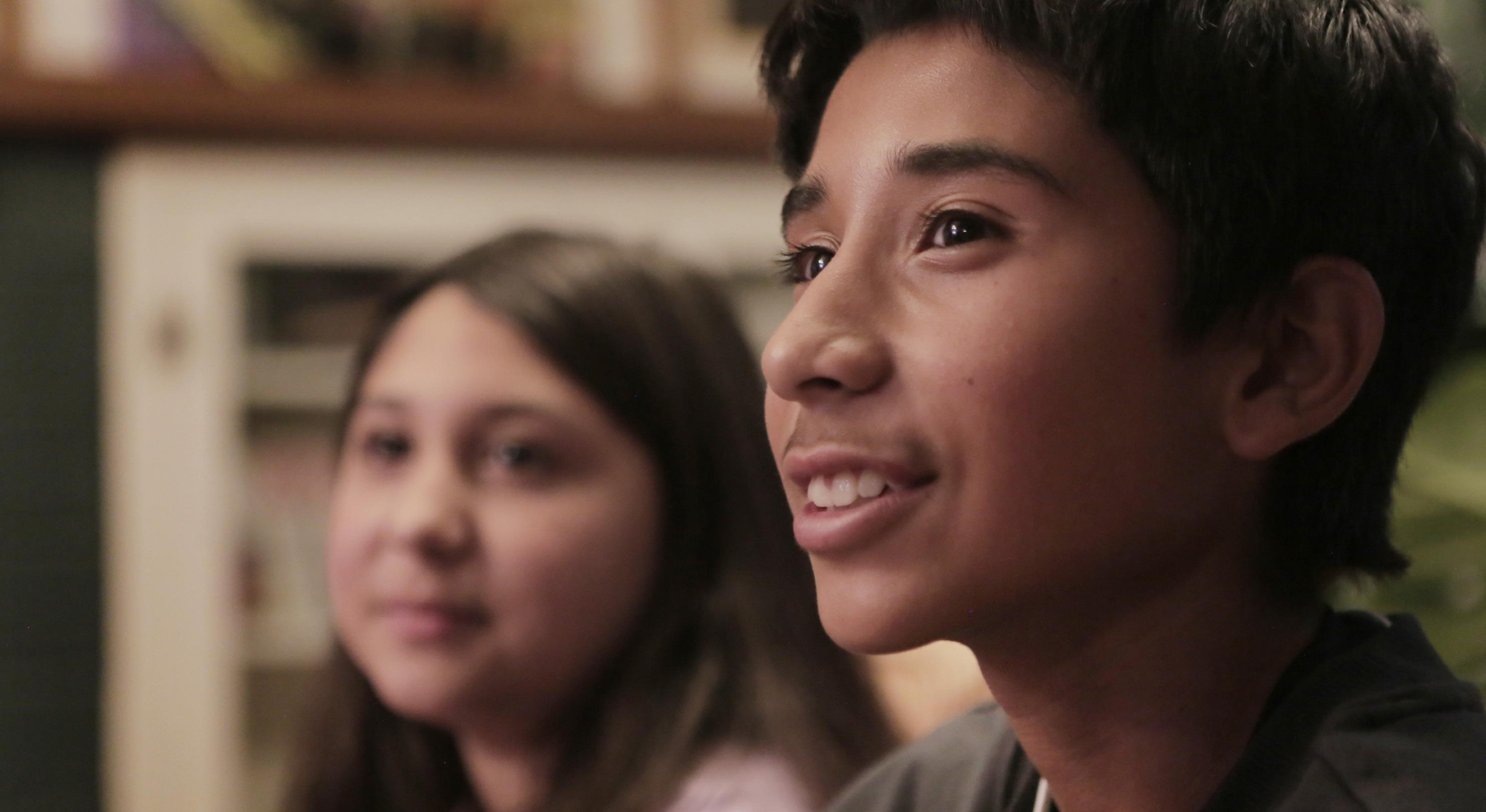
At just 3 years old, Abel Robles was already exploring technology — tinkering with ScratchJr, a kids’ programming app. By age 6, he was taking robotics classes.
Now 13, the Fremont middle schooler isn’t just playing with tech — he’s building with it.
His curiosity found a home at StreetCode Academy, an East Palo Alto nonprofit that, as its mission puts it, “empowers historically under-resourced communities to achieve their full potential by introducing the mindsets, skills, and access needed to participate in the innovation economy.”
“I’ve always been fascinated by how much you can do with technology,” Abel said.
Since joining the academy in 2019, he has set his sights on a future in software engineering.
His sister, Alexia, 11, also studies at StreetCode Academy. She aims
to be an entrepreneur and gravitates toward art and design, combining creativity with code to bring her ideas to life.
Their father, Abelino Robles, who lives in Fremont but grew up in East Palo Alto, discovered the organization while working as a security officer at Meta’s headquarters in nearby Menlo Park, where the nonprofit once had an office.
Seeing the tech world up close changed his perspective.
“To not be in tech in Silicon Valley, I feel is an injustice,” he said.
“I’ve been pushing my kids to learn skills in tech so they could be successful in the Bay Area. It’s not cheap out here.”
Robles said he has seen his children progress in mastering technology through the program.
“My son has always loved electronics,” he said. “My daughter has always been creative, and through coding, she’s been able to create stories and games. She’s very artistic, so she’s gravitated toward graphic design.”
Without StreetCode Academy, he said “they wouldn’t have access to these kinds of programs.”
Donations to StreetCode Academy will help pay for part-time instructors and program supplies such as software for students, tech accessories, and supplies. It will also cover technology access costs, including providing students with laptops and internet hotspots, and more. Goal: $35,000

By Steve Palopoli
SPALOPOLI@BAYAREANEWSGROUP.COM
Jason Foreman was on a casual stroll with his 4-year-old son, Lucas, near Cupertino’s Stevens Creek Dam when it suddenly turned into a nightmare.
He had looked away for just a few seconds to pull his phone out so he could snap a photo of his son enjoying the outdoors. When he looked back, Lucas had stepped into the deceptively shallow-looking water and disappeared underneath it.
Foreman felt an instant rush of fear and adrenaline — not only because Lucas didn’t know how to swim, but also because he had been diagnosed with autism, putting him in a group 160 times more likely to drown than a neurotypical child. Instinctively, he jumped in after his son.
“It was a raging creek — I mean, he was gone,” Foreman remembers. “I jumped in there and was just slashing arms everywhere. I was able to grab him. I got kind of bashed up by the rocks, but I pulled
him out. He’s just head-to-toe drenched. I’m drenched, and slapping water out of him as he’s coughing. That was scary. I mean, it was a few seconds, but it felt like minutes.”
That was 2021, and within a week Foreman was scrambling for somewhere he could take Lucas for swim lessons — or at least a program that would make his son feel confident and safe around water. He already knew that extracurricular activities for autistic children were scarce, but when he found the only existing options were far away and extremely expensive, he was determined to get something started closer to their San Jose home.
He knew about the YMCA’s Safety Around Water (SAW) program for kids, so he approached some administrators at the YMCA of Silicon Valley, hoping that the program could be adapted for his son and other kids like him.
“I just came in strong — stronger than I usually would — like, ‘Hey, you know, this is what we need. This is what the YMCA says it’s all about. I need you guys, man, I need you guys to do this.’ And I was very happy somebody actually responded to that,” he says.
Donations to the YMCA of Silicon Valley will allow 80 neurodiverse young people to experience the program. Goal: $50,000 HOW TO HELP
Everyone deserves joy this time of year. Help spread the love this holiday season with a gift to Wish Book.
Contributions empower our community partners to achieve real, lasting change.
1 Your Gift Delivers Immediate Help
Your donation is a direct investment in compassion and hope. By donating to Wish Book, you empower us to transform your generosity into tangible, impactful actions to serve those in need.
2 Enable Crisis Response
In the face of unexpected hardship, nonprofits swiftly mobilize, offering vital aid, relief, and support to impacted individuals. Your donation ensures a prompt and impactful crisis response to those in dire need.
3 Strengthen Your Local Community
Local communities rely on the services and resources provided by nonprofits to thrive. Your contribution has a profound impact on your community, enriching the lives of its members and promoting overall well-being.

4 Inspire Action and Grow Legacy
Your act of kindness serves as a catalyst, motivating others to engage in acts of kindness and leaves a profound, positive impact on society. Wish Book has an impact legacy of raising awareness of local issues like food insecurity.
5 Boost Your Own Well-Being
Giving to others is actually good for you. Research suggests that charitable giving is a major mood-booster that activates the pleasure centers in your brain, leading to increased happiness and satisfaction.
6
Achieve a Greater Sense of Purpose
Charitable donations and volunteer work empowers you to put your personal values into action. By supporting our mission, you’re actively engaging with the issues you care about, which enhances your sense of fulfillment and purpose in your daily life.
7 Tax-Deductible
When you donate to an IRS-approved nonprofit organization like Wish Book, your gift is tax-deductible. It may not be the main reason you give, but it can be a nice side effect.