Floor 1 / Auditorium
DPI
Design for Performance & Interaction MArch
SP
Situated Practice MA
Ground Floor
DM
Design for Manufacture MArch
DPI
Design for Performance & Interaction MArch
SP
Situated Practice MA
Fifteen is a public exhibition celebrating innovative work from graduating students on the Design for Manufacture, Design for Performance & Interaction and Situated Practice Master’s programmes.
Presented at our Here East campus in Stratford, the exhibition brings together an ambitious range of work that reflects the breadth of experimentation across these three distinct 15-month programmes.
Students have engaged with sites, systems, communities, technologies and materials through methods that span prototyping, installation, filmmaking, writing, performance, digital environments and collaborative action. Collectively, the projects on display demonstrate how new forms of architectural and spatial practice are emerging from material investigation, performance-led design and critically situated enquiry.
Across the exhibition, visitors will encounter projects that test novel modes of making, question the dynamics of interaction and
respond to the social, ecological and technological contexts shaping contemporary life. Whether working with timber assemblies, inflatable structures, robotics, XR, sound, archives, community narratives or the everyday infrastructures of the city, students have developed practices that expand the possibilities of architectural design and its role in the world.
What connects these diverse investigations is a commitment to working critically and creatively within real conditions – engaging with production cultures, ecological pressures, embodied experience and the politics of place. The work presented in this year’s Fifteen exhibition reflects a generation of emerging practitioners who are redefining how architecture and spatial practice can be conceived, performed and situated.
The in-person exhibition is accompanied by a full archive of work that can be accessed online at The Bartlett’s awardwinning virtual exhibition platform: shows.bartlettarchucl.com
Programme Director: Professor Peter Scully
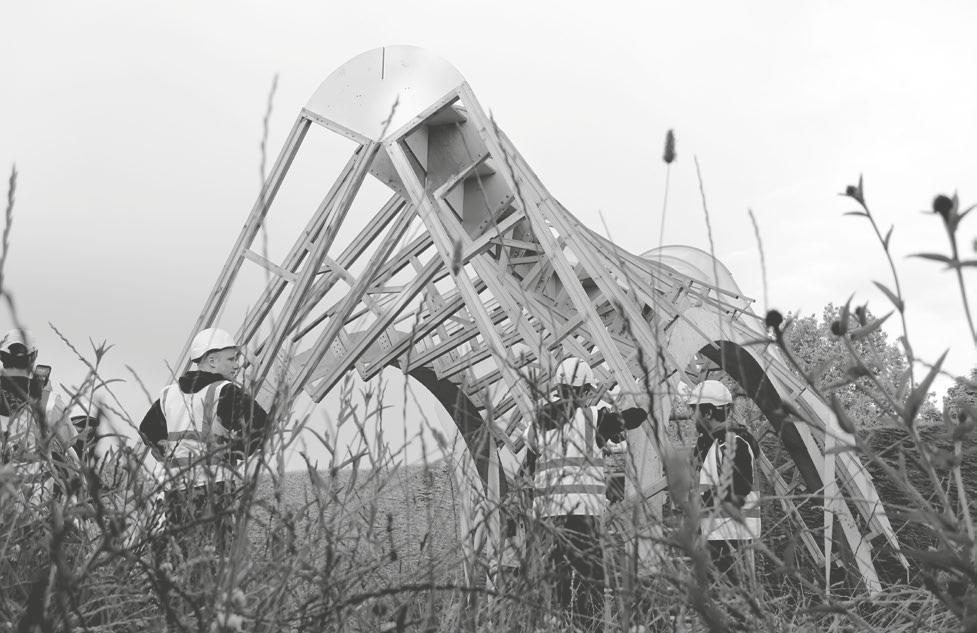
Chen, ‘Arkhive installation, St Andrews Botanic Garden’.
Students
Anuj Bajaj, Nour Beydoun, Pongpreedee Chaveegoolrat, Yanzhu Che, Hongkun Chen, Sibei Chen, Chao-Lin Cheng, Yuan Gao, Zishan Huang, Shih-Hsuan (Petra) Li, Shengtong Liu, Sihan Liu, Longfei Ma, Michael Yuntian Ma, Junyoung Myung, Xujie Shen, Muhammad (Iqbal) Utomo, Tong Wu, Ziyue Wu, Yuxuan Zhou, Qiyang Zhu, Zining Zhu
Pradeep Devadass, Sienna Griffi n-Shaw, Jenia Gubkina, Clara Jaschke, Nikoletta Karastathi, Shneel Malik, Daniel Rodriguez Garcia, Peter Scully, Ben Spong, Michiko Sumi, Samuel TurnerBaldwin, Jonathan Tyrrell, Melis van den Berg, Hamish Veitch, Barbara Zandavali
Design for Manufacture is driven by a hands-on interest in the tangible qualities and intrinsic values within creative processes. The programme addresses pressing global challenges by nurturing students’ independent explorations of materials and production techniques. Through investigative research, it supports innovation within the Architecture, Engineering and Construction (AEC) sectors.
For over two-and-a-half centuries, manufacturers have pursued resource consumption to maximise profit. Meanwhile, Design for Manufacture has emerged as a distinct discipline, formalising a design approach that integrates resource and contextual awareness to create diverse forms of value within design phases. The programme examines an expanded role for design in shaping the built environment – one that directly responds to the specific, observable challenges that have grown out of a misplaced confidence in markets to deliver.
Today’s built assets emerge from a sector plagued by rising self-employment, the highest rates of liquidation, erratic and unstable work, and a reliance on contractual risk management over best practices and innovation – resulting in buildings being delivered by large firms acting more like financial institutions than construction companies. Discourse and scholarship around design must engage with these realities as well as bring material and process innovation into the design phase.
The outcomes of much of the AEC sector reflect a collective imagination that is tethered to the logic of commercial survival rather than change, where
design stands for little against the forces within delivery that ultimately shape it. The programme seeks to empower design in positioning itself as an enabler, supporting the actors and players so often pitted against each other in a race to the bottom.
The programme’s design teams have advanced research in automated and CNC timber assemblies using a firstprinciples approach, steering clear of the pitfalls of unchecked automation that risk merely ‘building bad faster’. Projects this year investigate self-jigging minimal timber assemblies and knitted timber structures. Further research explores inflatable tectonics and robotically wound tensile structures. Assembly, disassembly and re-assembly play an important role in many projects as well as designing for determinacy within indeterminate material systems.
The cohort this year designed, manufactured and delivered a twisted box twin arch to support the ‘Arkhive’ pavilion originally fabricated by the previous cohort (2023–24). Working collectively, the students developed a structural solution that not only extended the life and adaptability of the pavilion but also demonstrated the programme’s commitment to iterative learning and cumulative innovation. Their work culminated in the successful delivery and installation of the structure in St Andrews Botanic Garden, Scotland.
Design for Manufacture explores an intervention in the AEC industries that is rooted in pragmatism and creative problem-solving, showing that emerging technologies and knowledge can provide solutions that transcend merely applying future innovations to past challenges.
Programme Directors: Jessica In, Dr Fiona Zisch and Dr Lidia Gasperoni
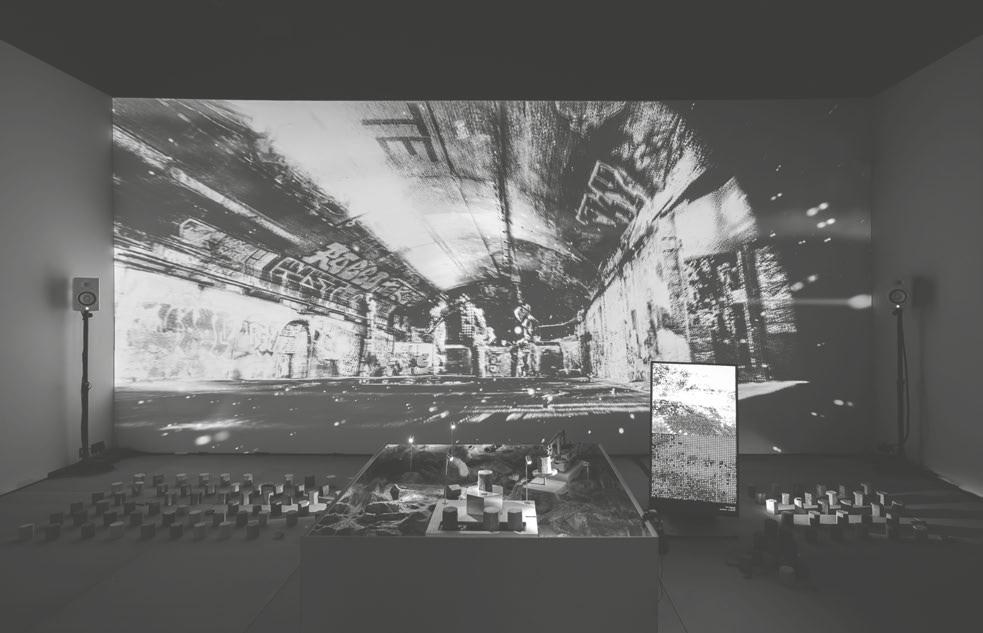
Chengying Li, Jianheng (Skylar) He, Yufeng Hu and Rixin Wang ‘Echoes of the Anthropocene’. Exhibited at V&A East Storehouse, CMMR 2025.
Students Staff
Keren (Abigail) Alvarez Aguilar, Sara Barghelameno, Sentao (Greyson) Chen, Zichen (Alexios) Deng, Bo Dong, Lane Finley, Qun Fu, Jingqi Gu, Peisheng (Kobe) Guo, Yutong Han, Jianheng (Skylar) He, Yufeng Hu, Tianxia Jia, Ziwei Jiang, Jiansheng Jin, Yoshitsugu (Yoshi) Kosaka, Chengying Li, Guanjia Li, Yanshan Li, Yiyang Liao, Zahra Malekmohammadi, Cuihong Mao, Yike Meng, Gina Oña Hidalgo, Liz
Pagett, Yue Qi, Dongting Qin, Jiemin Ren, Duo Wang, Rixin Wang, Ruoru Wang, Yichun Wang, Zhen Wang, Izza Waseem, Fanqi (Joanne) Xu, Yushi Yan, Natsuko Yonezawa, Yingying Yue, Qiu
Yulin, Li Zhang, Shuwen Zhang, Yuxuan Zhang, Silong Zhao, Danhong Zhu, Yuxi (Harley) Zhu
Vasilija Abramovic, Ava Aghakouchak, Paul Bavister, Sandra Ciampone, Alberto Fernández González, Stephen Gage, Lidia Gasperoni, Parker Heyl, Jessica In, Nikoletta Karastathi, Emma-Kate Matthews, Claire McAndrew, Daniel Rodriguez Garcia, Jonathan Tyrrell, Michael Wagner, Alice Whewell, Alexander Whitley, James Wilkie, Dominik Zisch, Fiona Zisch
Design for Performance & Interaction is grounded in the belief that the creation of spaces for performance and the creation of performances within them are symbiotic activities.
Here, architecture operates across and beyond the confines of physical space, engaging in transdisciplinary processes that involve the interactive hybridisation of scales, sites, data and communities. The programme rethinks what constitutes architectural ensembles and how events might be restaged, expanding the field of performance and interaction to include space, artefacts, and human and nonhuman inhabitants as potential performers.
At the core of the pedagogical approach, students work in four dimensions addressing behaviour, duration and changing environments to continuously reinvent the potential of architectural practice. Architecture becomes an active performer, and students are encouraged to work across opposing and unexpected fields to achieve deeper understandings and create profound experiential designs.
A central theme of the programme is ‘radical embodiment’, a term which broadens traditional understandings of embodiment to include the embedded, enacted, extended and affective. Student work embraces this understanding and is further influenced by concepts and practices such as cybernetics, systems theories, philosophy of media, cognitive science, feminist studies, ecological theories, performance studies and choreography.
This year’s projects include interactive installations, soft robotics, kinetic sculptures, eXtended reality (XR) environments, performances, wearable technologies, sound art, spatial games and speculative design experiments.
The work is both radical and critical in nature, exploring a wide range of ideas, including, but not limited to: equity, diversity and inclusion; ethics in contemporary technoculture; the impact of robotics and AI on behaviour and the built environment; and the ever-increasing importance of critical design across the reality–virtuality continuum.
Exhibitions and live prototyping play a key part in the programme. In March, students presented ‘The Queen of the South’ at FOLD nightclub’s experimental art platform ‘Abyssal’. In June, they collaborated with Design for Manufacture, Bio-Integrated Design and Cinematic and Videogame Architecture for the ‘Resonant Spaces’ open studio as part of the London Festival of Architecture.
This summer, students also had the opportunity to work with Turner Prizewinning artist Jeremy Deller for ‘The Triumph of Art’, commissioned for the National Gallery bicentenary. In a ground-breaking, cross-programme collaboration, students designed, produced and performed ‘The Indigo Pavilion’ with Architecture BSc Unit 9. In November, students successfully exhibited their design work during ‘Soundhouse’, a three-day takeover of V&A East Storehouse, part of the 17th International Symposium on Computer Music Multidisciplinary Research (CMMR 2025).
The Fifteen Show is the final exhibition that brings together the diverse and ambitious work of this year’s graduating cohort, offering a live encounter with the ideas that have shaped their journey. We celebrate their achievements, while also warmly welcoming Lidia Gasperoni, who joins us as programme co-director during Fiona Zisch’s sabbatical.
Programme Directors: Izaskun Chinchilla Moreno and Polly Gould
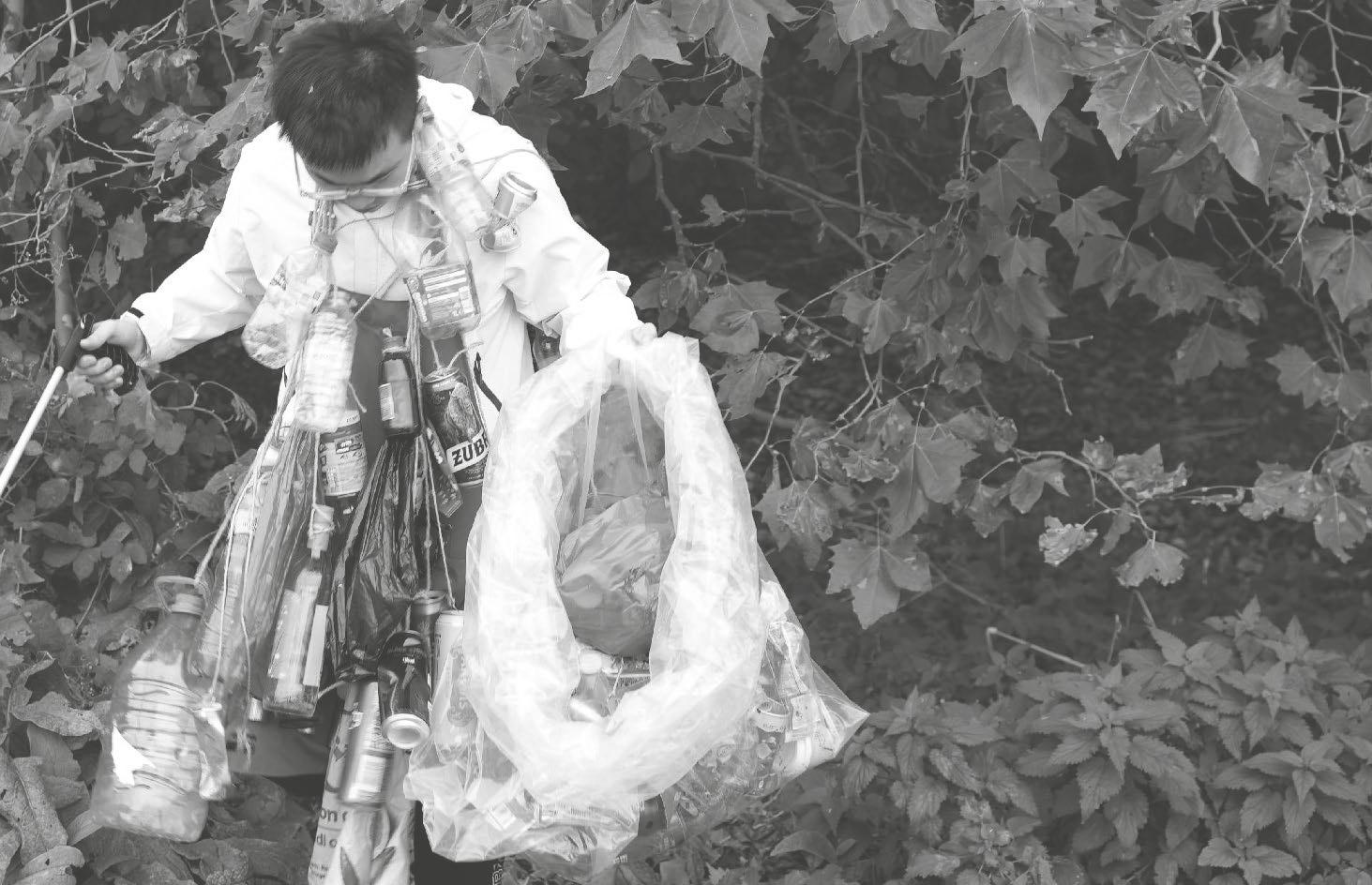
Chutian Li, ‘River Shynphony’.
Students Staff
Ilayda Coksaygili, Jiahao Huang, Chutian Li, Yuqi Li, Shu Liu, Caspar Meurisse, Siqi Qi, Yirui (Bev) Su, Qinying Xu, Shitong Xu, Shuangyu Xu, Xinyu Xu, Yao Yan, Chuling (Sue) Yang, Zhibai Zhang, Lingshuang Zhou
Fawzeyah Alsabah, Izaskun Chinchilla Moreno, Amica Dall, Polly Gould, Claire McAndrew, James O’Leary, Jane Rendell, David Roberts, Daniel Rodriguez Garcia, Merijn Royaards, Henrietta Williams
Situated Practice explores how site, situation, positionality and relationality shape the built and unbuilt environment. Through practice-led research, the programme supports the development of creative projects employing hybrid methods drawn from art, architecture, urban activism and writing.
Across fifteen months, students become ‘situated practitioners’, developing projects grounded in the specificities of their chosen site. The final work takes varied forms: installations, moving-image pieces, participatory actions, sculptural constructions or digital interventions – each shaped through an ongoing negotiation between research and practice.
This year’s cohort has worked across terrains marked by ecological precarity, industrial residue, uneven labour conditions, and the quieter rhythms of everyday infrastructures. Their sites of study range from textile markets in Ningbo to the lunar pull felt at Blackwall Point, from migrant food histories in Limehouse to the brick stacks and spoil grounds of east London, from river pollution to museum archives across China and the UK, and into the sonic and spatial politics of public space. Together, the works consider how bodies move through and are shaped by structures of care, extraction, waste, memory and translation.
The exhibited projects vary widely in material and method. Several interrogate the cycles and economies of materials: textile waste becomes a site for repair and collective action; the energy and carbon embedded in ceramic production is rendered visible; and mud is excavated as a living record of urban transformation and erasure.
Other projects address absences and fragmented histories: archives are assembled from everyday condiments carried across migration routes; Eva Hesse’s practice is re-examined through choreographic exploration; and soap-cast forms encase plaster objects as markers of memory and material change.
Sensory, spatial and perceptual encounters emerge through sound installations activated by touch; a rotating moon-form that reimagines the relation between earth and sky; and ice woven into jute rope that dissolves over time. Studies of vision and spectatorship appear in headmounted devices that condition and manipulate ways of seeing, while further works move between performance, narrative and archive: a filmed dance alongside hand-woven bone sculptures; an enquiry into river pollution through collected debris; drawings made on bus routes observing passengers; an archive of street-level tagging shifting between the legal and the illegal; and a sail bearing a historic treaty presented with a timeline and conceptual footage.
Together, these projects articulate the entanglements of material, memory, movement and perception, revealing how local gestures resonate within wider social, ecological and historical conditions, while also demanding that students negotiate the responsibilities and ethical complexities of working with and alongside communities, landscapes, archives and the political contexts that shape them.
We thank the collaborators, practitioners and communities who have supported the evolution of these projects. Most importantly, we thank the students for the generosity and commitment evident in the culmination of their situated practice.
The exhibition is open to the public on weekdays from 10:00–20:00, and on weekends from 10:00–17:00. Tickets must be booked in advance.
UCL at Here East
8–9 East Bay Lane
Queen Elizabeth Olympic Park
London E15 2GW
Hackney Wick or Stratford
Access
Our exhibition spaces are accessible. For any additional support, please email architecture.comms@ucl.ac.uk including the subject line ‘Access’.
Search Bartlett Fifteen to find out more.
Industry Showcase Thursday 04 December 08:30 – 10:30
UCL at Here East, E15 2GW
A special Industry preview ahead of the public launch, featuring a curated Pecha Kucha session and guided demos. Invitation required.
Launch Party Thursday 04 December 18:00 – 22:00
UCL at Here East, E15 2GW
Celebrating the launch of the show with live performances, demos, a drinks reception and prize giving. Invitation required.
Scan to book your ticket