Setting the Table:
Conversations Across Architectural
History
Architectural History MA 24/25
The Bartlett School of Architecture, UCL
Conversations Across Architectural
History
Architectural History MA 24/25
The Bartlett School of Architecture, UCL
Setting the Table: Conversations Across Architectural History gathers research from the 2024/25 cohort of the Bartlett School of Architecture’s Architectural History MA programme to consider how architecture is shaped by intersecting systems and practices — policy, security, coloniality and decoloniality, labour, sensing, destruction, repair, and representation. Rather than isolating buildings as autonomous objects, the projects within treat these forces as co-authors of the built environment and its histories.
The table is a space of interaction. In the accompanying exhibition, surfaces are ‘set’ with ideas and artefacts — photographs, documents, models, films, and ephemera — so visitors can serve themselves, compare approaches, and assemble their own routes through the material. It echoes the seminar table as a place to gather, question, and exchange, while the surrounding displays show the production of research around a shared centre. The table is a prompt, and an invitation to look closely and think together.
The book carries forward this invitation, unfolding across four sections — Situated Agencies, Behind the Glass, Edge Habitats, and Next Passages each staging its own conversation whilst reflecting a shared commitment to architectural history as a situated, collaborative practice.
Situated Agencies treats architecture as agency embedded in legal, ritual, media, and colonial frameworks. The contributions show how built form shapes and contests political, cultural, and ideological orders: Anna García Molina on Amancio Williams’s unbuilt Church and Preventive Health Ship as a missionary-medical instrument of moral, hygienic, and spatial control; Eden Northcott on the BBC’s acrylic screening of Eric Gill’s Prospero and Ariel and the indivisibilities of contested heritage; Guillermo Gómez Tejera on the Fashion and Textile Museum as transculturation between Mexican modernism and Bermondsey’s cultural economy; Joe Williamson on the BT Tower through Cold War Protestant ritual, telecom myth-making, and surveillance; Zaina Abou Seif on Hassan Fathy’s drawings and prose as affective instruments of cultural sovereignty. Together, the chapters locate agency in procedures, images, and institutions that often remain offstage.
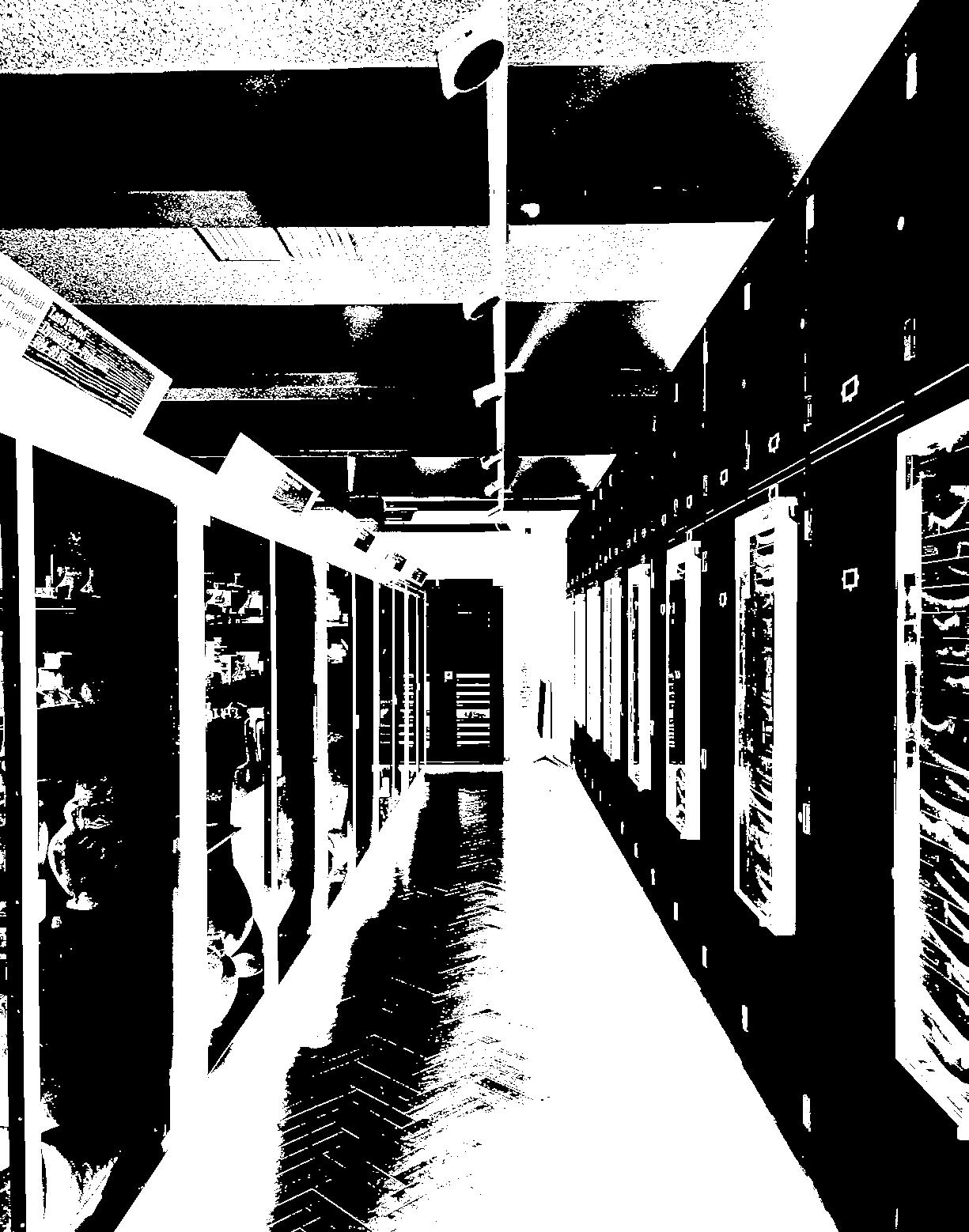
Behind the Glass brings visibility to concealed spaces, practices, and infrastructures that sustain cultural and architectural systems. The papers examine overlooked architectures of work, storage, and documentation: Claudia Vargas Franco rereads Ernö Goldfinger’s 2 Willow Road from its service rooms and routines, proposing ‘partarchitecture’ methods to address archival gaps; Helga Beshiri contrasts display and storage at the Wellcome Collection, the Petrie Museum, and the V&A Storehouse, testing how ‘open storage’ recasts accessibility, provenance transparency, and decolonial politics; Macarena González Carvajal reconstructs the Smithsons’ Painting and Sculpture of a Decade: ‘54–‘64, arguing that exhibition design operates as provisional architecture mediating artworks, viewers, and institutional narratives; Mark Bessoudo reframes Google Street View as an unintentional urban archive within traditions of architectural photography, tracking how pragmatic capture and temporal layering
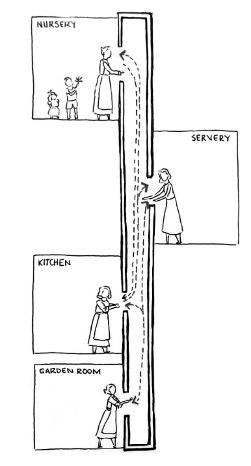
Claudia Vargas Franco, diagram illustrating how the dumbwaiter facilitates the vertical circulation of objects, maintaining the separation of bodies within the house.
migrate into historical interpretation. Mounts, crates, catalogues, servers, and screens emerge as spatial media through which value is produced and public culture kept in motion.
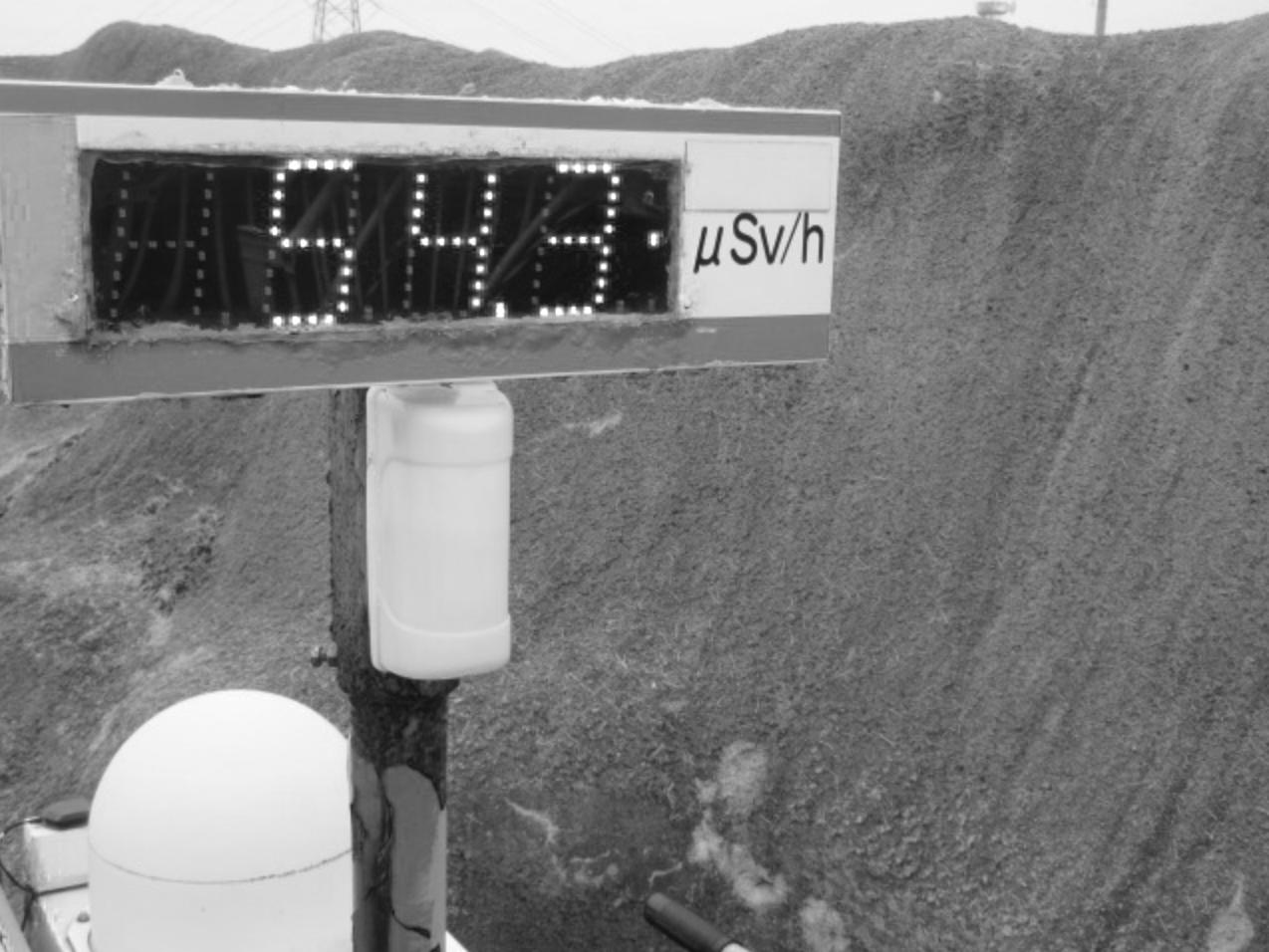
Edge Habitats follows interfaces — arks, tanks, ducts, walls, and data stacks — where environments are sensed, serviced, and made. Treating ecologies as hybrid networks, the essays trace how instruments and protocols negotiate Other-than-human life, evidence, and design across planetary, urban, and domestic scales: Issy MacGregor reads post-Fukushima marine monitoring as radiological architecture — a ‘bucket logic’ in which media apparatuses, tanks, and fish co-produce publics and proof; Qing Tang examines the architecture of digital waste, from retrofitted bunkers to university data centres and online residue, to show how destruction, disposal, and displacement organise material and immaterial ecologies of data; Ertuğ Erpek reconsiders the New Alchemy Institute’s arks and bioshelters through secondorder cybernetics, foregrounding self-regulating habitats of care and feedback; Steven Schultz relocates passive-solar technology from performance metrics to lived routine, showing how the Trombe wall scripts domestic comfort as social choreography. Edge conditions appear as laboratories of cohabitation where environmental claims are tested in practice.
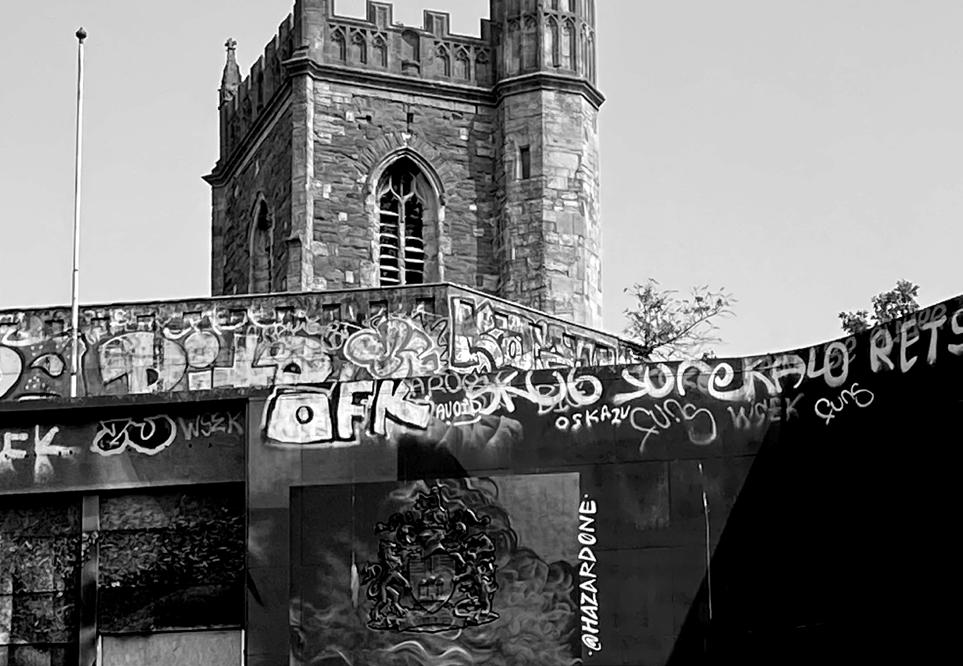
Next Passages examines how urban landscapes are shaped by overlapping temporalities — standards, images, ruins, and repairs — through which cities and structures are narrated and remade. The chapters track passages from past to next: Eleanor Moselle on Paris’s pneumatic clock network inscribing standard time via the sewer; Audrey Zhang on French Gothic Revival polychromy and the chromatic debates that recast medieval space and its futures; Kitty Alexander on Bristol’s St Mary-le-Port as palimpsest, where representation orchestrates vacancy, value, and redevelopment; Jazmine Simmons on imaginaries of a flooded London that render hydrological futures present and reshape public attachment to the Thames; Lora Lolev on Maison Martin Margiela’s off-centre runway shows as site-specific interventions rerouting attention, tenure, and meaning across urban margins. Permits, images, atmospheres, and affects operate as temporal instruments, choreographing new futures for built environments.
Across their differences, these essays speak to a common ethic — a recognition of the agencies that surround architectural design and history-making. With this in mind, the papers show how architectural history can be practiced not only as interpretation, but as care, collaboration, and repair. ∎
Editor’s note: Please be aware that some of the material in this publication deals with sensitive topics, including child sexual abuse.
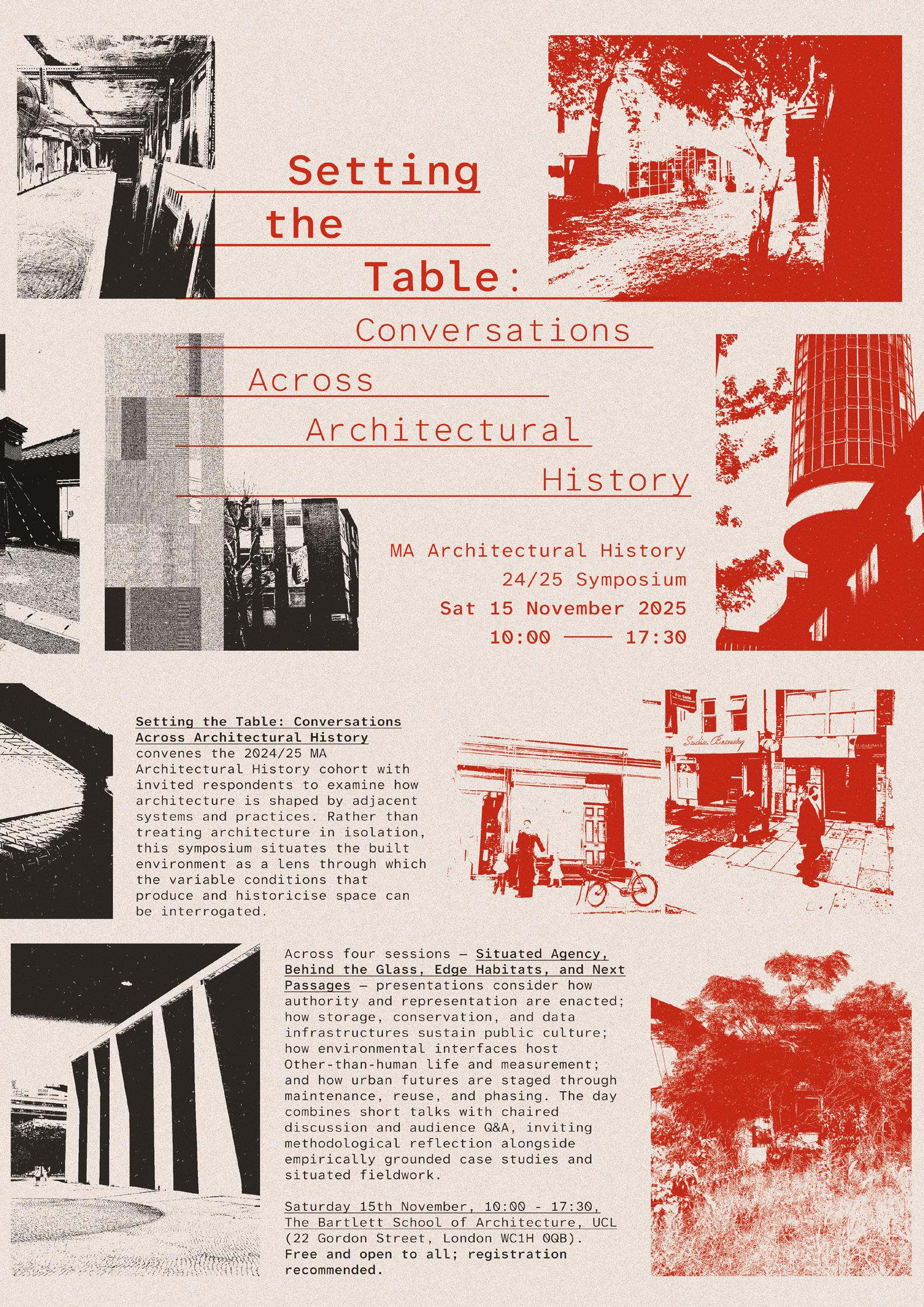
Alongside this publication and accompanying exhibition, Setting the Table was presented as a research symposium at the Bartlett School of Architecture on 15th November 2025.
Navigating the Territory: The Church and Preventive Health Ship 14
Anna Garcia Molina
Structurally Difficult Heritage: Eric Gill’s Prospero & Ariel and the Problem with Architectural Integration 20
Eden Northcott
The Fashion and Textile Museum: A Piece of Mexico in London 26
Guillermo Gómez Tejera
The Power & The Glory: Nuclear War and the Protestant Ethic at the BT Tower 30
Joseph Williamson
Between Earth and Ink: Vernacular, Memory, and Utopia in Hassan Fathy’s Architectural Visualisations
Zaina Abou Seif
02 Behind the Glass
Invisibilized Domesticities: 2 Willow Road and the Embodiment of Housework
Claudia Vargas Franco Display vs Storage: Visibility, Accessibility and Transparency in Museums with Colonial Inheritances
Helga Beshiri
A Table of Intentions: Alison and Peter Smithson’s Exhibition of a Decade ‘54–‘64
Macarena González Carvajal
Google Street View and the Architectural Image: Rethinking Histories of Urban Representation
Mark Bessoudo
Testing the Waters: On Situated Ecologies and Sensing Radiological Architectures
Issy MacGregor
Architecture of Digital Waste: Hidden networks, materialities, and myths of data destruction
Qing Tang
Eco-Recursivity: Cybernetic Thinking in Eco-Machines of the New Alchemy Institute (1969-1991)
Ertuğ Erpek
68
74
80
Living with the Beast: The Impact of Trombe Wall Technology on Residential Life
Steven Schultz
04
86
When the Cathedrals were Painted: Decorative Mural Polychromy in the French Gothic Revival, 1840–1870
Audrey Zhang
Networks of Time: Pneumatic clocks, standardised time, and underground infrastructure as expressions of modernity in 19th century Paris
Eleanor Moselle
Urban Water Imaginaries: London and its Connection to Waterlogged Realities and the Built Environment
Jazmine Simmons
The Spectacle of Decay: Ruin, Representation, and Renewal at St-Mary-le-Port, 1940–2025
Kitty Alexander
Crossing Boundaries: Subverting the Catwalk through Maison Martin Margiela (1988–1998)
Lora Lolev
94
100
106
110
116
06 Credits & Back Matter
Architecture as an active agent in shaping and contesting political, cultural, and ideological systems. These papers interrogate how built form and spatial strategies are implicated in colonial governance, postcolonial identity, religious symbolism, and geopolitical surveillance.
14 Navigating the Territory: The Church and Preventive Health Ship
Anna García Molina
20 Structurally Difficult Heritage: Eric Gill’s Prospero & Ariel and the Problem with Architectural Integration
Eden Northcott
26 The Fashion and Textile Museum: A Piece of Mexico in London
Guillermo Gómez Tejera
30 The Power & The Glory: Nuclear War and the Protestant Ethic at the BT Tower
Joseph Williamson
36 Between Earth and Ink: Vernacular, Memory, and Utopia in Hassan Fathy’s Architectural Visualisations
Zaina Abou Seif



In 1948 the Argentinian modern architect Amancio Williams designed a ‘ship destined to carry out a social and moralising action in a region that was very neglected in those aspects.’1 The region, described by Williams as being ‘socially and morally abandoned’, was the Delta del Paraná, a vast isolated wetland landscape with numerous islands formed by the sediments of the Paraná River. To save this supposedly morally corrupt region, Williams designed the ‘Barco Iglesia y Sanidad Preventiva’, which translates as the ‘Church and Preventive Health Ship’. As the name suggests, his design merged a floating health clinic and church together in order to bring ‘culture’ to the inhabitants of the Delta. Although it was never built, the project was designed to civilise that impassable region, to bring the gospel and hygiene to those living there. It is a testament to the era in which it was conceived and a direct product of the legal, political and intellectual framework formed in 19th- and 20th-century Argentina to advocate for the control and regulation of the landscape and the bodies of those inhabiting the Delta del Paraná.
1 Description in ‘The Curriculum Vitae of Amancio Williams’, Amancio Williams fonds Collection Centre Canadien d’Architecture/ Canadian Centre for Architecture, Montréal; Don des enfants d’Amancio Williams/ Gift of the children of Amancio Williams. [Quotation translated by the author].
This thesis aims to critically examine the ‘Church and Preventive Health Ship’ as a cultural and architectural artefact. This involves analysing how it reflected – and participated in –ideologies of hygiene, morality, and territorial control within its context. The text will investigate how architectural typologies can become vehicles for state power, especially in those places framed as ‘uncivilised’ by the ruling elite.
However, this critical approach to a lesser-known, unbuilt project stands in contrast to the main currents in Williams’ scholarship. The literature on Amancio Williams reflects both fascination and unevenness, shaped by the difficulty of situating his work within established historiographical categories, since many of his projects remained virtually unchanged over decades and most were never built.
Many of these unbuilt projects remain overlooked, even marginalised, within the literature of Williams’ work. The project which forms the subject of this thesis, ‘The Church and Preventive Health Ship’, has never been studied in any detail. When mentioned, it is usually grouped into a series of works he produced while advising the Argentinian Ministry of Health, rather than analysed on its own terms. This thesis addresses that absence, situating the ship within the broader context of Williams’ thought and the intersections of religion, medicine, and infrastructure in mid-20th century Argentina. By combining historical, geographical, and theoretical approaches, it examines how architectural interventions like the ‘Church and Preventive Health Ship’ were not merely technical or aesthetic solutions, but instruments through which power, morality, and social order were enacted in the Delta del Paraná.
The questions that sparked and guided this thesis were fivefold. Why did the delta even need to be ‘cured’ by modernity? What role did architecture play in this quest? In what ways were physical and moral health understood as being related? How did the ‘Church and Preventive Health Ship’ reflect Argentinian ideologies of morality, hygiene, and civilisation? What architectural, religious, and medical discourses shaped its design,and how were these translated into spatial terms? While this thesis cannot claim to have the definitive
answers, it does suggest paths for thinking about how these factors might relate, intersect, and continue to be reinterpreted.
Because the ‘Church and Preventive Health Ship’ (1948) –as well as its successor project, the ‘Health Registry Ship’ (1949) – were never built, it means that the primary sources for this thesis had to be extracted from archival material. In the manner of Le Corbusier, Amancio Williams’ archive was meticulously recorded and manipulated by keeping hundreds of drawings, correspondence letters, and texts which describe his projects, exhibitions and publications. Precisely because Williams didn’t manage to build that much, it is why architects and academics regard his archive as the most important source to understand his work and ideas.2
Williams’ archive, which is now held at the Canadian Centre for Architecture in Montreal can be publicly accessed yet is in a location far distant from where the material was created. It was at the CCA, while conducting research for some exhibitions by that organisation, when I encountered the drawings for the ‘Church and Preventive Health Ship’. I was immediately struck by the strangeness of Williams’ concept. But as I delved deeper into the conditions that shaped this project, its unusual combination of church, clinic, and ship revealed an underlying logic. It was clearly an architectural attempt to merge moral, medical, and infrastructural programs within the unique geography of the Delta del Paraná. Williams’ drawings, although small and somewhat schematic, open a window into a rich intersection of historical, geographical, political, and philosophical processes.
This kind of study of unbuilt architecture demonstrates the value of thinking beyond construction. Even in the absence of physical manifestation, drawings allow us to trace how ideas, ambitions, and social imaginaries take form. In the case of Williams’ ship, it acts as a nexus where concepts of care, morality, territorialisation, and biopolitical control converge. By following these conceptual threads, we can understand not
2 Luis Müller, ‘El Archivo Como Obra Total: Amancio Williams y La Construcción de Su Memoria,’ Bitácora Arquitectura, no. 45 (December 2020): p. 52. Available at: https:// doi.org/10.22201/fa.14058901p.2020.45.77621.
only the conditions that produced the design, but also the broader mechanisms through which modernist architecture sought to intervene in marginal or unruly spaces. In this way, unbuilt works are not merely hypothetical: they are analytical tools that reveal the workings of architecture as a social and political practice.
The ‘Church and Preventive Health Ship’ should thus not be treated as just an architectural curiosity. It is a highly charged cultural artefact that reveals the ideological labour that architecture is called upon to perform when it sails into landscapes considered as wild, impure, or uncivilised. By placing the project within a wider framework of environmental control, religious mission, and biopolitical governance, the thesis offers new ways of thinking about architecture’s role in shaping and disciplining peripheral territories. ∎
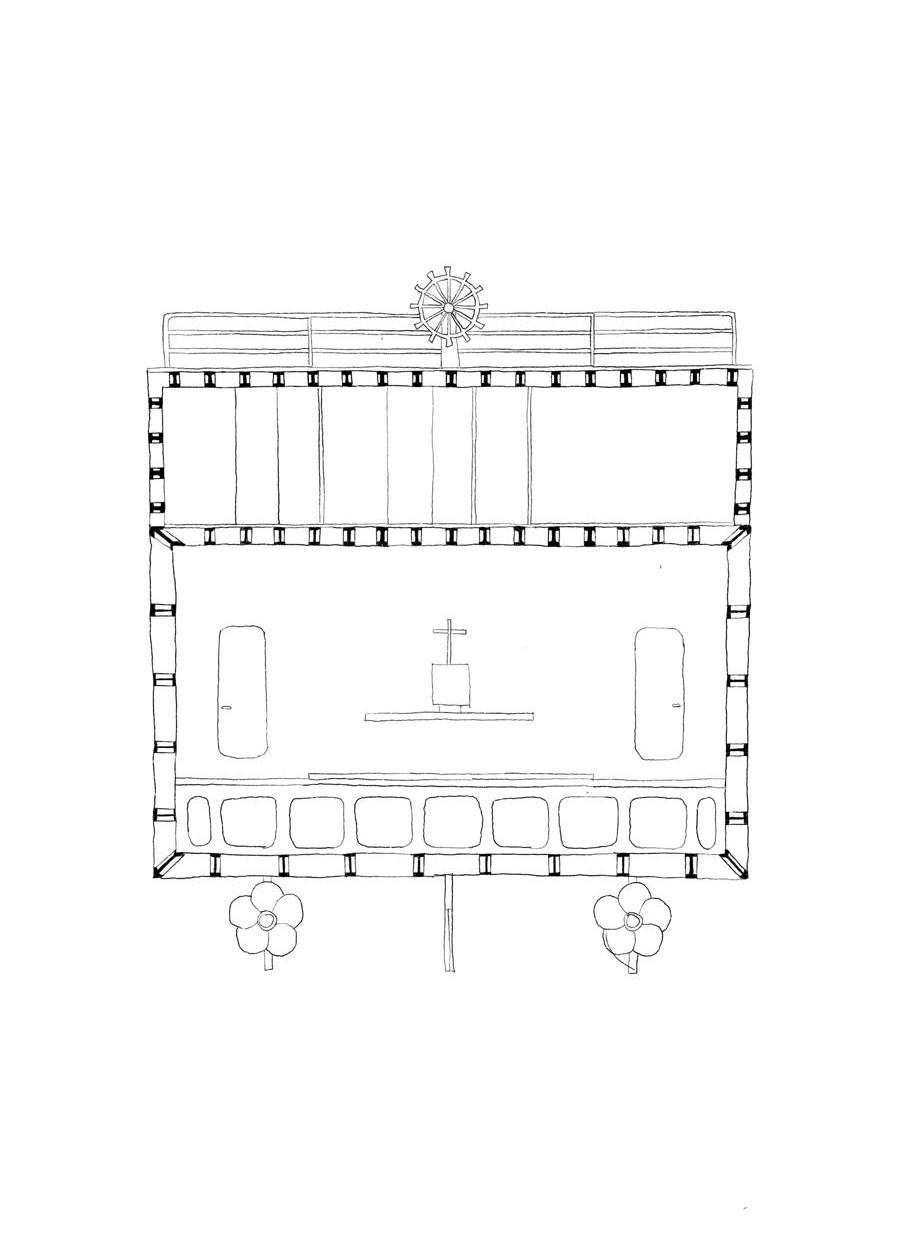
The ship as an architectural drawing. Image by the author.

Editorial note: This article contains themes of sexual abuse and child abuse that readers may find distressing. Some of the original images from the dissertation have been omitted from this article.
For further discussion of considerations in the making and reproduction of such images, please consult David Roberts, ‘Making Images’, the first of the Practising Ethics guides to built environment research, available for download from the Bartlett’s Practising Ethics open-access website: www.practisingethics.org/practices.
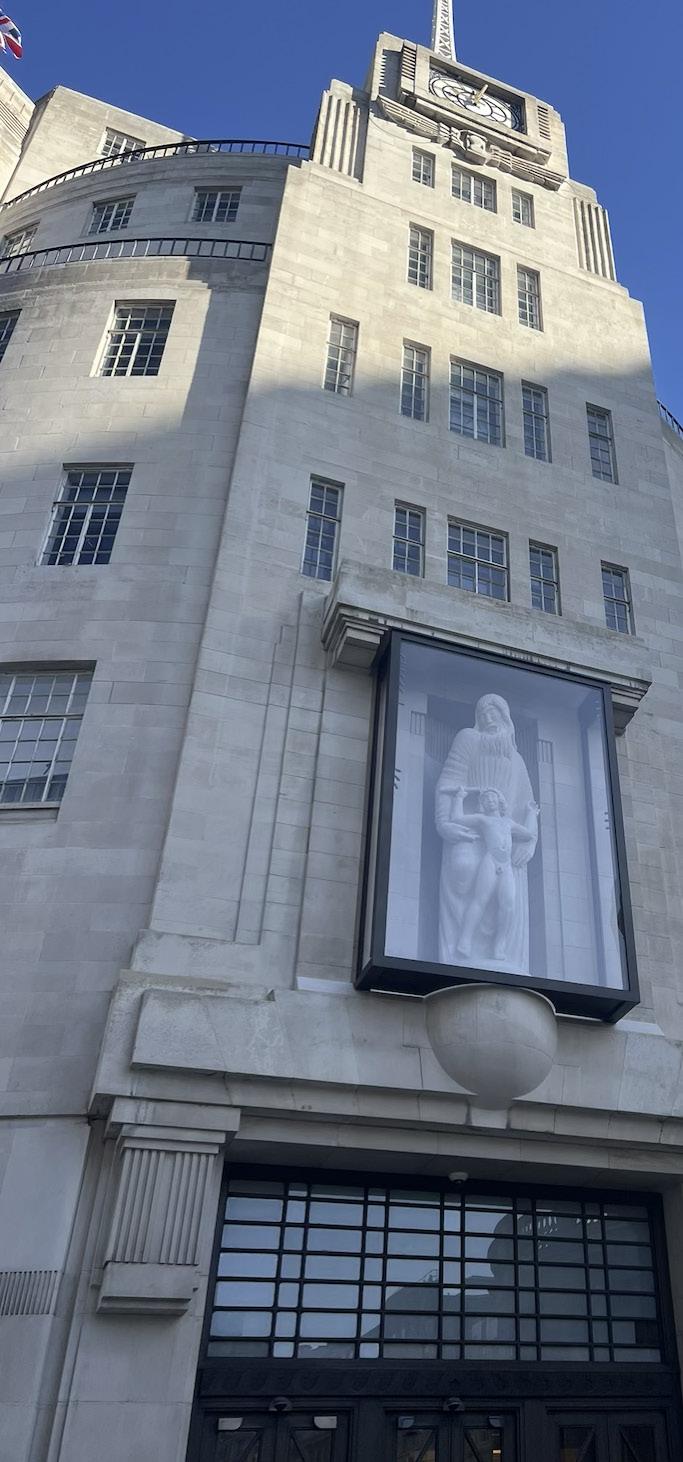
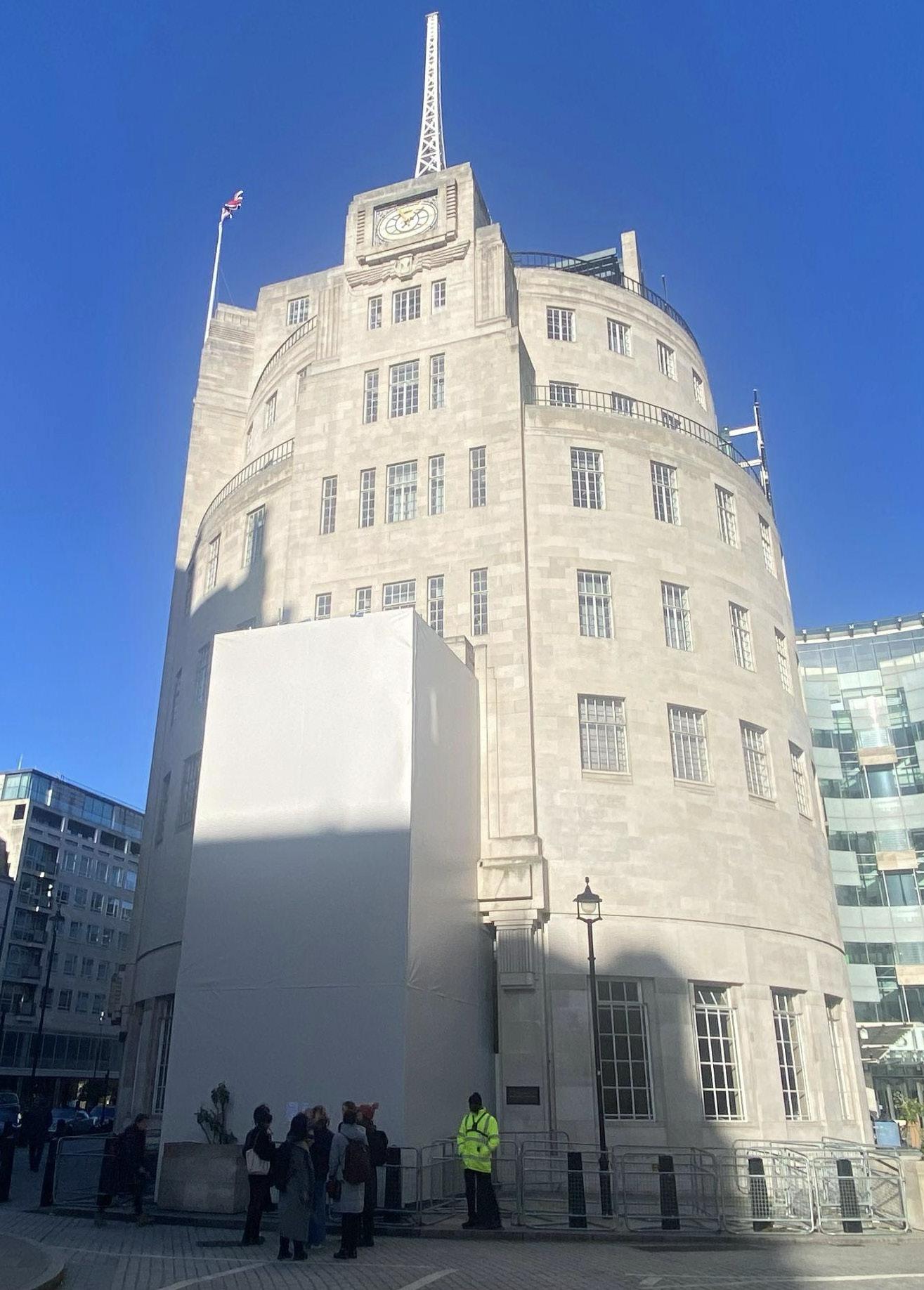
Drawing on Sharon Macdonald’s concept of ‘difficult heritage’1, this paper explores how Eric Gill’s Prospero and Ariel (1931–32), at BBC Broadcasting House, represents a new category of contested heritage: structurally difficult heritage. Unlike standalone contested monuments that may be removed when they become morally problematic, structurally difficult heritage is integrated into protected building fabric; therefore, removal is complex and damaging to the integrity of the listed building it adorns. Commanding one of London’s most prominent apex views at Regent Street’s termination, the curved BBC frontage forces Prospero and Ariel upon a compulsory public audience. This case questions whether some sculptures are ultimately too problematic to impose as public art as part of the everyday urban environment, especially if, as figural depictions, they are enmeshed with unethical, immoral, and therefore hurtful representations.
The sculpture has been controversial since its creation, experiencing a reduction in the size of
1 Sharon Macdonald, Difficult Heritage: Negotiating the Nazi Past in Nuremberg and Beyond (London and New York: Routledge, 2009).
the boy’s genitalia at the BBC’s request2 and vitriol in Parliament as ‘objectionable to public morals and decency’3. Yet this cannot be dismissed as Victorian prudishness. What distinguishes Gill’s Ariel from ubiquitous nude cherubic decoration on London’s buildings is that it abandons established artistic conventions that made such imagery morally acceptable. In Shakespeare’s play, Ariel’s gender is deliberately ambiguous, allowing for his relationship with Prospero to remain asexual. Yet Gill clearly abandoned this ambiguity for an explicitly male child in a state of undress. His genitalia prominent, his form lean — a boy old enough to be conscious of his own nudity and vulnerability, positioned in intimate dependence with an adult man whose long robes emphasise his nakedness. The problem then was not the unclothed boy, but the inappropriate power dynamic that formed the context for this juxtaposition.
Since Fiona MacCarthy’s 1989 biography exposed Gill’s sexual abuse of his sisters, daughters and family dog4, there have been calls to remove the statue. However, its architectural integration into the Grade II* Listed building complicates matters. The sculpture was carved onsite in the same Portland stone as the building’s facade, in a specifically designated niche. As Gill himself theorised, architectural sculpture is not merely decorative but integral to the building itself5. To remove the sculpture risks violating Historic England’s listing protection, potentially compromising the architectural integrity of one of Britain’s most significant Art Deco buildings. But to leave it unprotected risks further vandalism. David Chick’s
2 John Stewart, British Architectural Sculpture (1851-1951), Lund Humphries (2024), p. 172.
3 Astragal, “Notes & Topics: The Fig-Leaf Mind,” The Architects’ Journal (Archive: 1929–2005) 77 (March 29, 1933), p. 418.
4 Fiona MacCarthy, Eric Gill, (London: Faber & Faber).
5 Eric Gill, “Prospero and Ariel,” The Listener, March 15, 1933, p. 397. The Listener Historical Archive, 1929-1991
attacks in 2022 and 2023 revealed that some heritage has become so contested that it requires physical protection from the public it was intended to serve. Throughout this controversy, the BBC has firmly maintained that separation between Gill and his work is both possible and necessary.
The convergence of revelations about Gill’s crimes with the BBC’s own institutional failures — Jimmy Savile, Rolf Harris, and accusations against founding Director-General Lord Reith — fundamentally altered how the sculpture could be perceived. Within this context, the sculpture’s content has become profoundly inappropriate. Separation is now impossible. What was once an architectural ornament and metaphor for broadcasting has been exposed as a monument to institutional failure that enabled such crimes to flourish.
Many support the BBC’s position, however, we must forgo this selective blindness — Gill’s work cannot be viewed as wholly discrete from who he was and what he did. MacCarthy posits that the true subjects of Ariel and Prospero are not the Shakespearean characters but in fact Gill and his adopted son, Gordian6. Throughout his work, Gill systematically inserted himself into sacred father-son iconography, conflating his earthly paternal role with divine meaning. When we view the sculpture through this biographical lens and Gill’s documented crimes against children, it becomes increasingly difficult to justify continuing to celebrate this work simply as a mythological allegory for the BBC.
In 2025, the BBC unveiled its response: a restored sculpture enclosed in what clumsily resembles a museum vitrine in the sky. The BBC paradoxically achieves the very separation from its architecture it claimed to want to avoid, transforming it into an artefact divorced from its context. The steelwork plate slices the globe awkwardly off-centre, severing the conceptual foundation from which Ariel is to be released into the world. The sculpture can no longer be read through Gill’s definition of architectural sculpture, as ‘a flowering…of the very stones of which the
6 Fiona MacCarthy, “The Word Made Flesh.” RSA Journal 141, no. 5436 (1993): pp. 14345.
building is made’7. Instead, this continuity is interrupted by the vitrine. By separating the sculpture from the public, rendering it untouchable and separate from the architecture, the acrylic barrier inadvertently deploys the visual language of museumification that amplifies rather than manages its cultural legitimacy.
The BBC’s attempt at contextualisation fails to protect the public from the sculpture. The QR code mounted within the ground-floor window feels like an afterthought. Buried six paragraphs in, the BBC has only this to say on the sculpture’s creator: ‘revelations about Gill’s private life in a 1980s biography created a backlash against him; and while the BBC in no way condones his abusive behaviour, it draws a line between his life and his artistic creations’8. The words are careful, concise, and diplomatically evasive. The QR code is performative and meaningless while enabling the BBC to claim engagement while keeping Gill’s crimes obscured.
The vitrine in the sky can satisfy no one — it neither preserves the integrity of the imagery nor adequately addresses concerns about the artist’s motivations. Removal would represent a new path forward for the BBC. An empty niche would represent the BBC’s transparency, humility, and accountability. There would be a direct message in the emptiness — one that aligns with the BBC’s stated commitment to truth-telling.
This case illuminates the inadequacies of the government’s ‘retain and explain’ policy, suggesting that heritage management must evolve from prioritising historical over contemporary values and should never outweigh public welfare. Arguably, an empty niche on the front facade of Broadcasting House would become a more powerful symbol for the BBC than Gill’s sculpture ever was. This would not constitute heritage destruction, but heritage evolution — demonstrating that our relationship with the past can and must evolve to serve contemporary society. ∎
7 Gill, The Listener, p. 397.
8 British Broadcasting Corporation, History of the BBC - Broadcasting House, BBC, QR code at Broadcasting House.

This dissertation examines the Fashion and Textile Museum (FTM) in Bermondsey, designed by Mexican architect Ricardo Legorreta for the British designer Dame Zandra Rhodes, as a case study of architectural transculturation. It explores how Mexican architectural identity is expressed abroad and how cultural exchange between Mexico and London becomes material through architecture. The argument proposed is that the museum embodies a reciprocal process of transformation, where Mexican modernism and British urban culture meet and reshape one another.
The research began with a personal encounter in 2018, when I first came across the building’s bright orange and pink façade set among Bermondsey’s brick warehouses. Its colours and geometry felt instantly familiar, echoing the architecture I had grown up with in Mexico. Yet, within London’s context, it also appeared foreign. This dual feeling — of recognition and estrangement — became the starting point for the question that guided this research: what does it mean for a building to be ‘Mexican’ when it stands in the middle of London?
The study situates the museum within the broader history of Mexican modernism, tracing its development from post-revolutionary nationalism to its international projection through figures such as José Villagrán García, Luis Barragán, and Ricardo Legorreta. Drawing on Celia Esther
Arredondo’s The Making of Modern Mexican Architecture (2023), it challenges frameworks of acculturation that view non-Western architecture as derivative, instead adopting Fernando Ortiz’s notion of transculturation — a dynamic and reciprocal process of exchange. This perspective reframes Mexican modernism as an active participant in global architectural discourse rather than a regional response to Western influence.
To expand on this framework, the dissertation draws on Mary Louise Pratt’s concept of the contact zone, where cultures meet and negotiate, and Homi Bhabha’s theories of hybridity and translation, which describe how cultural forms change through encounter. Together, these ideas allow the museum to be read as both an object and a process of cultural negotiation, where Mexican and British identities redefine one another.
The methodology combines historical and visual research with site observation and interviews with Zandra Rhodes and Víctor Legorreta. These sources ground the theoretical discussion in practice, revealing how transculturation occurs not only through ideas but through everyday exchanges between architect, client, and local collaborators. My position as a Mexican architect living and working in the UK also shaped the research approach, allowing me to reflect on the museum through a dual lens — of both origin and reception.
The first part of the dissertation, From Mexico to London, traces how Mexican modernism developed as a hybrid formation after the Revolution of 1910. Architects such as Villagrán García and Barragán combined European modernism with local traditions, light, and materiality to form a modern language grounded in emotion and place. Legorreta continued this lineage through what he termed ‘emotional architecture’ — an approach defined by geometry, light, and vivid colour. His work carried forward the spirit of Mexican modernism while extending it internationally.
The dissertation then turns to Bermondsey, situating the museum within its post-industrial regeneration. Once defined by warehouses and food processing, Bermondsey underwent a decline before its transformation in the 1990s into a creative district. Within this context, the FTM played a significant role in
reshaping Bermondsey Street as a cultural hub, embodying the shift from industry to design-led redevelopment.
The second part, In London, from Mexico, focuses on the building itself. Located at 79–83 Bermondsey Street, the museum integrates Rhodes’s home and studio with exhibition and educational spaces. Its geometry, light, and use of pink, yellow, and orange express a shared language between Rhodes and Legorreta. For Legorreta, colour reflected Mexican light and tradition; for Rhodes, it was an extension of her textile practice. Their collaboration created an architecture that merges two creative identities and resists being attributed to a single source.
Working alongside local architect Alan Camp, Legorreta adapted his design to London’s planning requirements, demonstrating transculturation in practice. The resulting building is neither a direct export of Mexican modernism nor an imitation of London’s style, but something in between — a hybrid that carries traces of both. As Víctor Legorreta described, it is ‘Mexican, but also Zandra Rhodes, and also London’.
The museum thus operates on multiple levels of exchange: between Mexico and Britain, between architecture and fashion, and between regeneration and identity. Rather than a static object, it functions as a contact zone where cultural meanings are negotiated through form, colour, and collaboration.
The dissertation concludes that the FTM embodies architecture as a living form of cultural translation. Mexican modernism, itself a product of hybrid influences, extends outward and finds new meaning in London’s context. The building challenges linear models of cultural influence, revealing instead a two-way process of transformation. The FTM, at once Mexican and London, demonstrates that architecture is not a fixed expression of identity but a continual act of translation, shaped by movement, memory, and exchange.

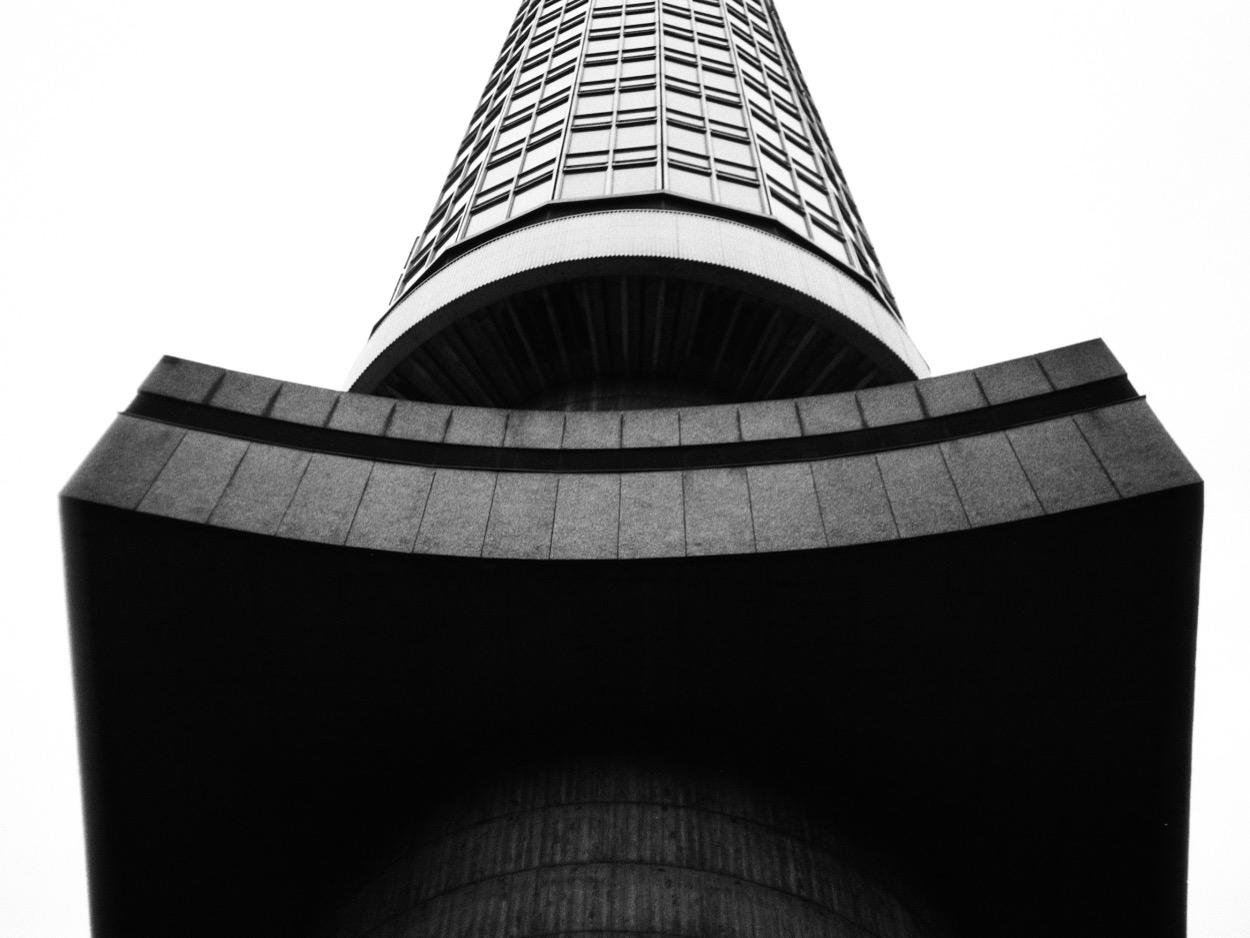
The BT Tower was originally built as a civildefence asset, part of a ‘Backbone’ microwave network designed to provide telecommunications resilience in the event of nuclear attack. Its architect, Eric Bedford, said of the Tower, ‘it was built to last, bombers or not’.1 The building’s design follows a template: ‘Chilterns-type’, which comprises several unorthodox design choices that safeguard against nuclear attack such as, a cylindrical concrete core, perspex screening around the dishes and reinforcement at the tower’s base (fig. 1). The Chilterns-type comprises a cylindrical concrete core, or ‘chimney’, with dishes and aerials attached. In the event of nuclear attack, dishes and aerials would be destroyed but their replacement would ensure quick
1 Tavia Swain, ‘How Did the BT Tower Achieve Icon Status and Has This Been Maintained Into the 21st Century?’ (Unpublished, 2023), p. 25.
re-connection to wireless national communication.2 Despite early considerations, the BT Tower in Birmingham chose to avoid the type two years later in favour of a rectangular shaft.3 This development would imply that concern about the nuclear bomb was waning by then, but in fact, it was more a case that any hope of survival was waning — and that while in 1961 the A-bomb was seen as a counterable threat, by 1963, with the emergence of the much more devastating H-bomb, all hope had been lost for any sort of telecommunications-based civil defence in the aftermath of a strike.
Beatriz Colomina states in Privacy and Publicity that, ‘The modern media are war technology’:4 As an ambassador for an age of modern media, the BT Tower itself is war technology, not just a tool of defence, but also offence. Virilio equated propagation of ‘jet-sets and instant-information banks’ to a ‘whole social illusion subordinated to the strategy of the cold war’.5 The Tower’s revolving restaurant is a ‘Fun Palace’ and a distraction from the inner workings of the tower — a diversion outwards. It is noted in the banned 1966 film The War Game about the aftermath of a nuclear bomb, that by 1966, ‘silence had descended’ around nuclear war despite the fact that warheads had doubled in the preceding five years.6 This silence is a deliberate strategy of pacification, for the threat of nuclear holocaust was increasing at a tremendous rate.
Harold Wilson, Tony Benn, Harold Macmillan and Geoffrey Rippon, engineers of the BT Tower, are equatable to the ‘priests of civilisation’, in that the engineers are those who preach and practice the doctrine of modernity most fervently.7 Benn, a devout Christian, was labelled ‘ministering priest or maintenance engineer to the great god Technology’.8 Despite the fact that
2 Peter Laurie, Beneath the City Streets: The Secret Plans to Defend the State, (Granada, 1979), p. 247.
3 B. L. G. Hanman and N. D. Smith, ‘Birmingham Radio Tower’, The Post Office Electrical Engineers Journal, 58.3 (1963).
4 Beatriz Colomina, Privacy and Publicity : Modern Architecture as Mass Media (MIT Press, 1996), p. 156.
5 Paul Virilio, Speed and Politics, trans. by Marc Polizzotti (Semiotexte, 1986), p. 136.
6 The War Game, dir. by Peter Watkins (BBC, 1966).
7 Virilio, Speed and Politics, p. 41.
8 Bernard Levin, The Pendulum Years: Britain in the Sixties (Jonathan Cape, 1970), p. 180.
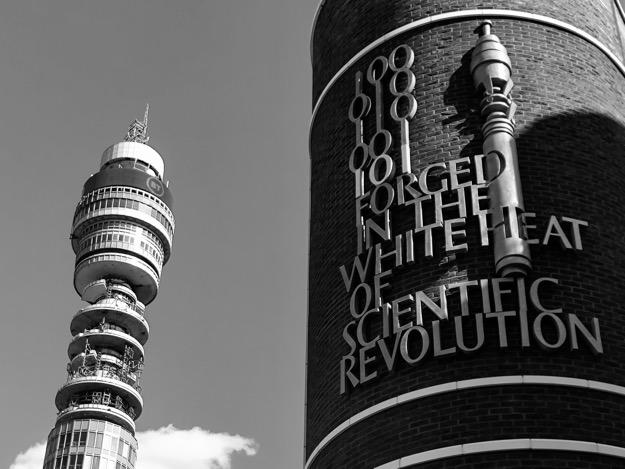
the tower was largely complete by the time that the Labour government came to power in 1964, it has become a symbol of Wilson’s ‘White Heat’ policy.9 (fig. 2) Its ‘engineers’ became a revolving cast, devoted to a form of progress dominated by control and paranoia. Virilio mentions, ‘the English engineers ended up significantly reducing their motto to UBIQUE… “everywhere.” This means the universe redistributed by the military engineers, the earth “communicating” like a single glacis, as the infra structure of a future battlefield’.
10 Mass media is itself co-opted as a civil defence asset,
9 Christopher T. Goldie, ‘“Radio Campanile”: Sixties Modernity, the Post Office Tower and Public Space’, Journal of Design History, 24.3 (2011), p. 209.
10 Virilio, Speed and Politics, p. 74.
Figure 2. Author’s Own, ‘Forged in the White Heat of Scientific Revolution’, 2025, Photograph.
‘bread and circus’ became ‘television and revolving restaurants’. Telecommunications are not only the ‘infra structure of a future battlefield’, they are the battlefield itself.
The bomb is political, ‘not because of an explosion that should never happen, but because it is the ultimate form of military surveillance’.11 The threat of the bomb is advantageous to the government, as it allows for creation of ‘war technology’ that consolidates control of their populace. This functions in the same way that religious groups use threat and fear of the Final Judgement and the Apocalypse as leverage in controlling their adherents. The possibility of the bomb is what enabled the government to encroach on telecommunications. This legitimised further encroachment during later events, i.e. the War on Terror and the War on Drugs; framed as crusades against threats to secular civilisation, but rooted in Christian eschatology. Nuclear war portended an alternative apocalypse without redemption or final judgement; pacification was no longer about a promise of a celestial future but about distraction, for which telecommunications could become a primary enabler. In this way, the BT Tower was a flagship for a new way of seeing the end of the world.
After the devastating paranoia of nuclear war; a formlessness started to emerge, a messianic hope for another kind of invisible force to rescue us. ‘It [was] shown that we cannot now change the world any longer, anything that might tend to prove the existence of another form of reality will be welcomed’.12 It became necessary to find a new way to ‘mobilise, cumulate and recombine the world’; and in this way, ‘telecommunications, not only as space and time transcending technologies, but as technological networks within which new forms of human interaction, control and organisation can actually be constructed’ became the replacement for what religion had provided before.13 Telecommunications, and the networks upon which they are built, were the first truly invisible source of power outside of
11 Ibid, p. 119.
12 Umberto Eco, ‘Signs of the Times’, in Conversations about the End of Time, trans. by Ian Maclean and Roger Pearson (Fromm International, 2001), p. 179.
13 Stephen Graham and Simon Marvin, Telecommunications and the City (Routledge, 1996), p. 54.
religion, relying on material receptacles (the antennae, aerial, dish) while dispersing an intangible presence into the lives of all who interact with it, just as the church did before.
For Teilhard de Chardin, ‘spirit looks very much like energetic information. Spirit is software in action’, a ‘Network [that] is physical but not material’.14 In this sense, the BT Tower becomes a pure material representation of the energetic information (spirit) that flows through it; conversations whizz through it, lives are broadcasted, and it enables a disembodiment from the material source of these exertions. It facilitates an invisible reality rather than embodying that reality, and holds the disembodied ‘souls’ of the people whose voices and likenesses it transmits — without any tangible physical or audible presence.
In this way, the ‘place’ of the Tower becomes wherever the network reaches. As the home becomes part of this immaterial network, it is then enabled to fulfil a break in temporal duration. The tower becomes redundant as a typology as technology surpasses it, and those who participate in this extended network become ‘cut loose from the sociality of urban life, separated from the world by the pixilated screen’.15 For someone like Benn — instrumental in the push for technology and in agreement with Gerrard Winstanley that God is ‘reason’16 — this rational application of the irrational perhaps aligns with Marx and Kierkegaard’s notion that ‘experience [...] forms the core of religious life’, and that via spiritual ascendency, ‘all confront themselves and each other on a single plane of being’.17 With the telecommunications network, an invisible Church, and an invisible elect, was created.
14 Eric Steinhart, ‘Teilhard de Chardin and Transhumanism’, Journal of Evolution and Technology, 20.1 (2008), p. 17.
15 Stephen Graham and Simon Marvin, Splintering Urbanism : Networked Infrastructures, Technological Mobilities and the Urban Condition (Routledge, 2001), p. 247.
16 Tony Benn, The Best of Benn, ed. by Ruth Winstone (Hutchinson, 2014), p. 123.
17 Marshall Berman, All That Is Solid Melts into Air: The Experience of Modernity (Verso, 1993), p. 115.


When historian Leïla el-Wakil stood before a room of Hassan Fathy’s closest admirers at the Bibliotheca Alexandrina in 2007, she began with an apology as she had dared to call him ‘unknown.’1 To those who had shared his company, the phrase seemed absurd, and even offensive. Outside that circle, perhaps her words carried a truth. Fathy remains a paradox of recognition, mythologised as a visionary figure through architectural fragments while seldom grasped in the totality of his practice.
Born in Alexandria in 1900 and passing in Cairo in 1989, Fathy remains Egypt’s most influential architect, celebrated for his advocacy of rural mudbrick construction, community-based design, and his ethical reconciliation of vernacular knowledge with modern socio-climactic imperatives. His canonical 1940s New Gourna Village garnered him international attention, rising to recognition as the architect of the poor. Whilst a fitting moniker, this paper pushes beyond the material realm of his built work to interpret Fathy’s vast — and overlooked — oeuvre of speculative drawings, gouache paintings, and fictional stories as active, autonomous components of the artist-architect’s philosophical trajectory. Attending to the interplay of form and narrative, I contend that the futurist
1 Leïla el-Wakil, ‘The Unknown Hassan Fathy,’ paper presented at the seminar Hassan Fathy and His Legacy, Bibliotheca Alexandrina, October 25, 2007, p. 1.
sensibilities often associated with his mature architecture were already present in these multimodal early midcentury explorations.
Fathy’s career spanned nearly the entire twentiethcentury, unfolding in tandem with Egypt’s own turbulent transformations. As both witness to and agent within the nation’s shifting political landscape, he operated amid the lingering imprint of successive colonial regimes, whose architectural legacies threatened to eclipse local typologies. Caught between the instability of Europeanisation and arabité, his work registers the psychic and cultural tension of a country negotiating its own modernity.
Rather than defining him through essentialist labels, I locate Fathy’s personal and polymathic dualities within the broader nahda, or the Arab Awakening, a period marked by postcolonial critique and creative renewal. Within this intellectual climate, Fathy translated the crisis of national identity into an idealistic architectural vision that sought to reclaim cultural memory through pieces of the past, projecting them into possible futures. Drawing on the vernacular ‘Arab house’ as both model and metaphor for his artworks and literature, he traced a lineage extending from Pharaonic precedents and Nubian huts, to Mamluk and Fatimid mosques and dwellings — forms he studied intimately through site visits to the Citadel, Aswan, and Luxor. These geographic encounters informed his lifelong project of reactivating indigenous knowledge systems as a radical proposition for envisioning modernity otherwise. I propose that Fathy’s utopian impulse to craft an ‘ideal’ world thus functions as a retrieval of a homeland of form — a territory that exists at once as memory and aspiration. When we embrace place as a socially constructed phenomenon achievable through imaginative engagement, imagination itself becomes constitutive of collective belonging and resistance.
Despite his Beaux-Arts training in a French-inflected cosmopolitan Cairo, Fathy’s outlook was transformed
Top Transcription of Hassan Fathy’s reflections on Nubian artistry and the inseparable bond between tradition, community, and modernity. He celebrates the psychological freedom found in building ‘with what is at hand,’ rejecting imported forms in favour of an architecture rooted in self-knowledge and place. For him, what is ‘Pharaonic’ or ‘Arab’ is not past, but modern — an affirmation that ‘they did not need anything that wasn’t already theirs.’ Image by the author.
Bottom Hassan Fathy, Abd al-Razik Eastern Rest House, gouache, 29.2 × 27 cm, 1943. Reproduced from Archnet’s Architect’s Archive: Hassan Fathy, © Aga Khan Trust for Culture.

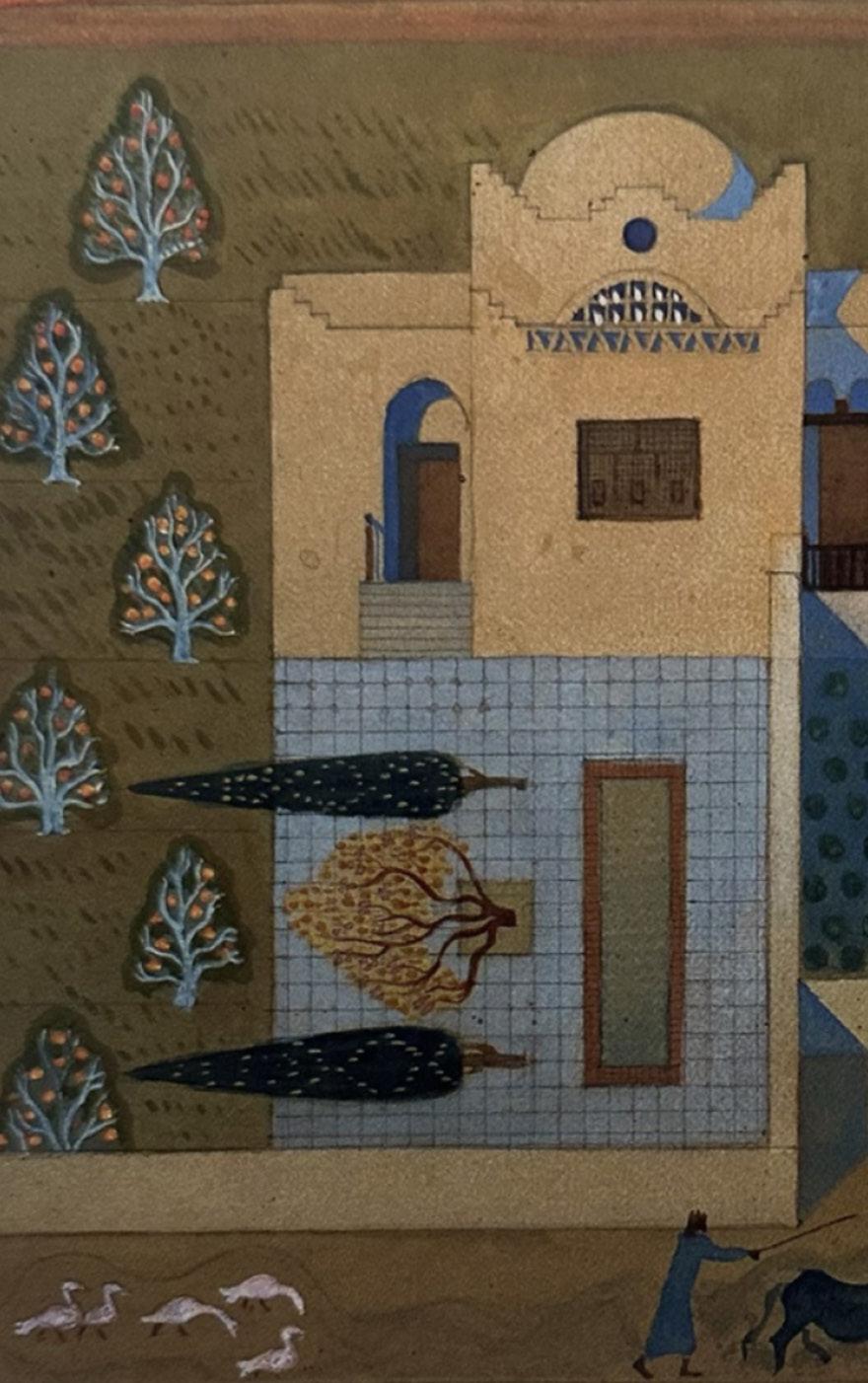
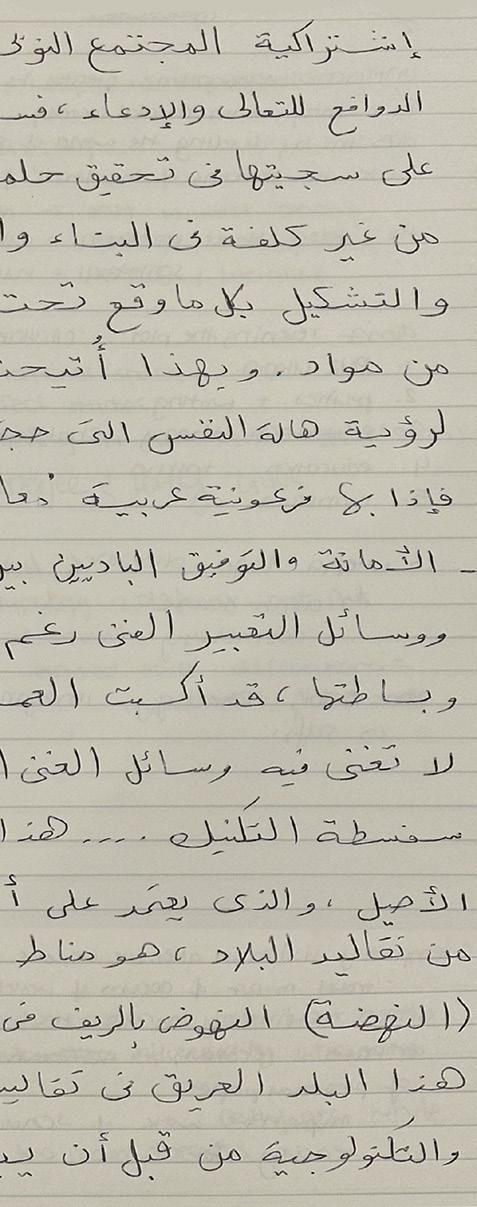
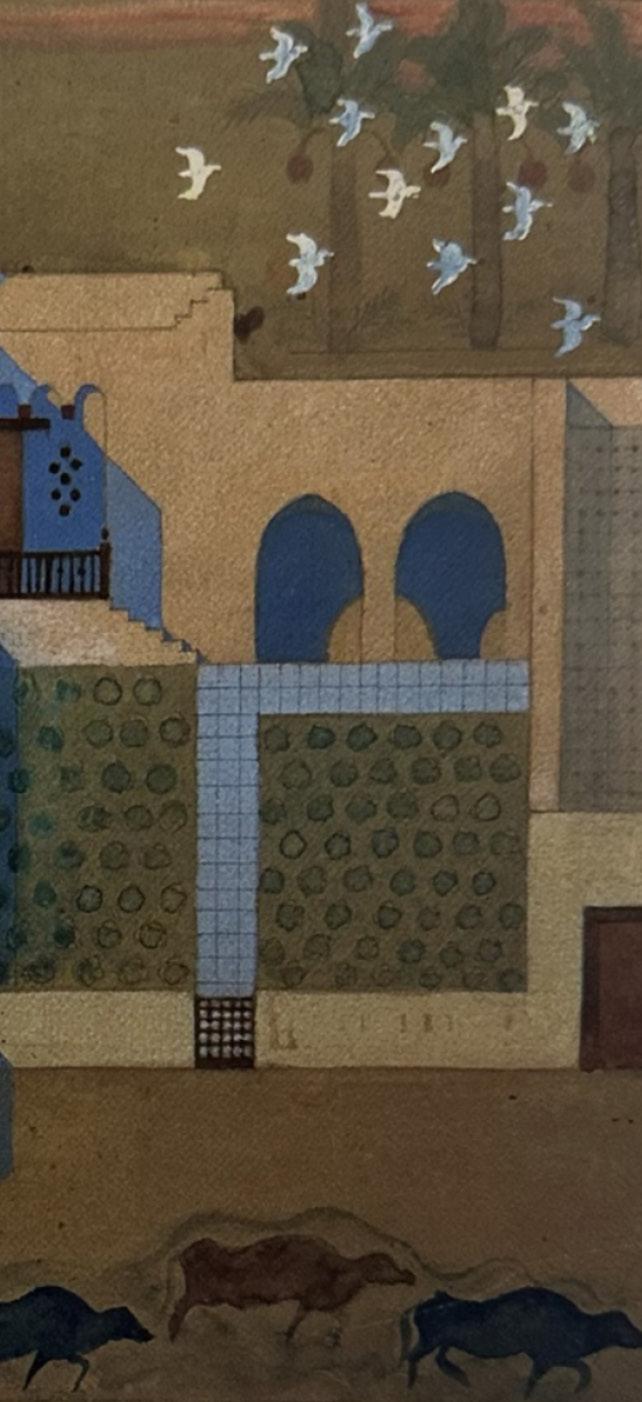
through a direct pedagogical engagement with Egypt’s rural countryside, where he encountered historic, local modes of spatial knowledge that reshaped his understanding of architecture’s social purpose. His paintings, in particular, reveal a sustained resolution between Western orthographic conventions and indigenous visual epistemologies. Drawing on Eastern techniques — such as the ornamental marginalia of miniature painting or various perspectival points within a single frame — Fathy employed a syncretic strategy that reimagined drawing as a catalyst for contemporary architectural representation. These experiments channeled his inherited methods toward inward reflection, and consequently, two mutually generative principles thread across his visual and literary work: the collapse of temporality and the multiplicity of experiential seeing. By engaging with his archival artworks as sites of theoretical production in their own right, this study expands the notion of architectural visuality, questioning what forms of making and representing are permitted to register within the discipline’s canon.
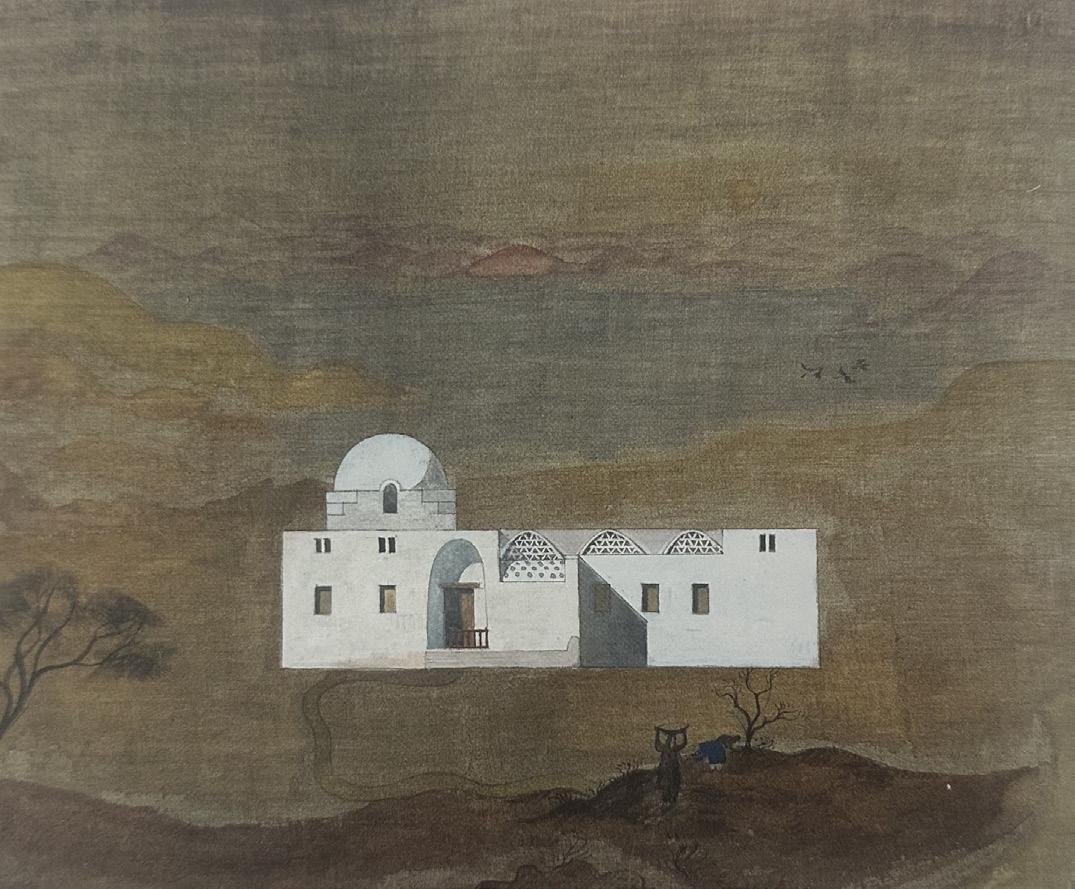
At times, Fathy’s compositions echo the symbolic precision of Pharaonic wall paintings or the rhythmic hieroglyphic inscription of form; at others, they adopt a restrained, notational clarity that allows affect to emerge through minimal means. His pictorial language is marked by a pared-down mise-en-scène, in which a few symbolically charged motifs — including botanical taxonomies, rural figures at work, cattle — enliven the central architecture whilst acting as its interlocutors. Their presence situates the manmade environment within a network of traditional sociospatial practices and natural life. Central to this ecology is the fellah, the peasant farmer, whom Fathy casts as an active, central subject sustaining reciprocity between architecture and landscape. He therefore reclaims the vernacular gaze on indigenous terms, constructing an alternate vision of the Egyptian countryside as a site of cultural continuity, quiet resistance to Western urbanism, and ethical reflection for the architect-intellectual.
These non-practical, unbuilt works operate as atmospheric constructions — sites where perception and emotion are jointly produced, rendering the act of seeing inseparable from the act of sensing. The value of visual affect, here, becomes particularly generative. His paintings indulge in the expressive capacities of
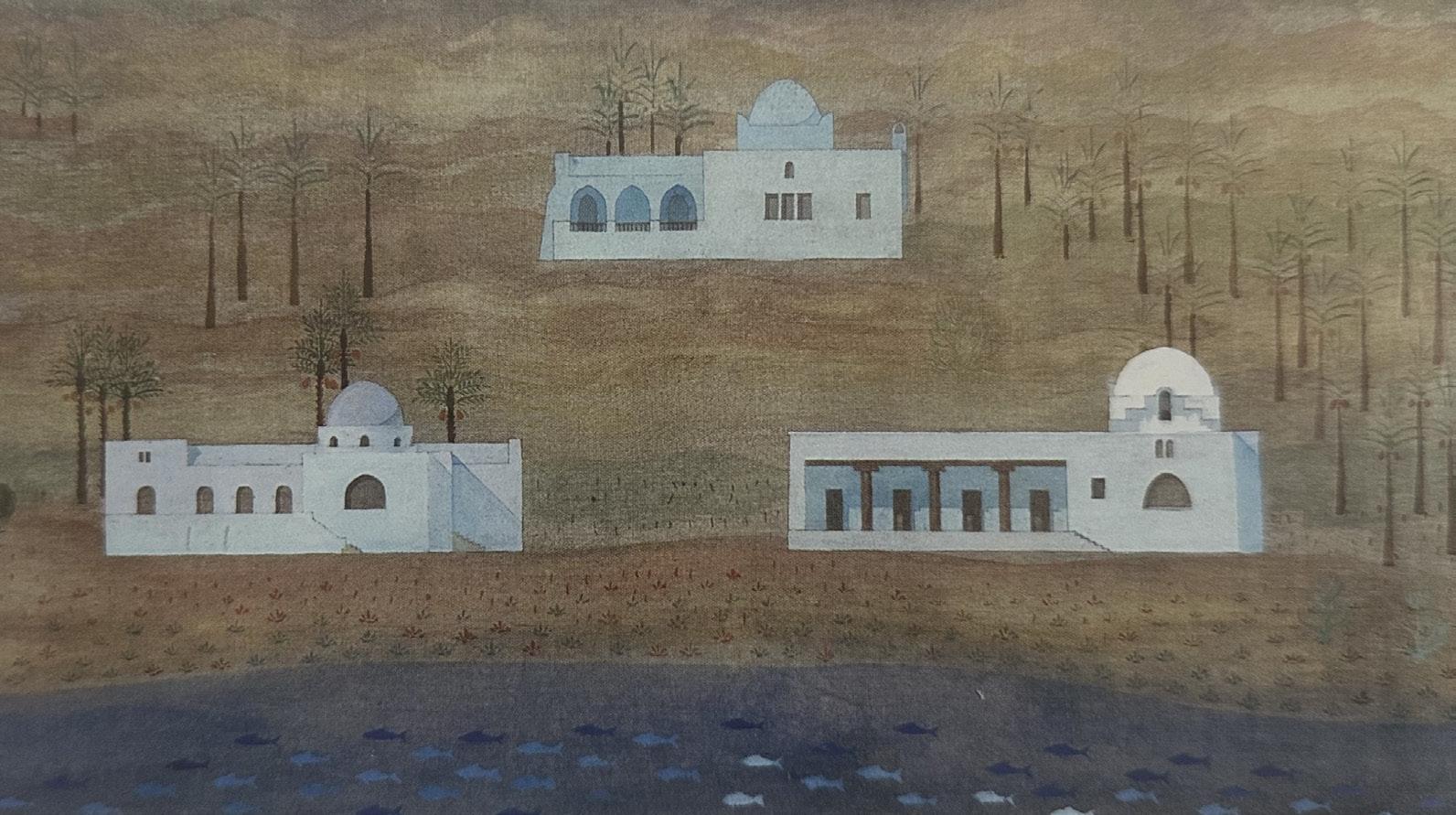
hue, often through washes of ochre, pistachio, and rust arranged around the luminous whiteness of a vernacular form, translating the fleeting play of daylight into permanent pigment. Indeed, the colour-consciousness of Fathy’s painterly imagination stands parallel to the monochromatic paleness of his realised buildings, which accept the pragmatic restraint of whitewashed adobe. However, I argue that they become participants, receptive canvases, in the daily rhythm of light and shadow, constantly reimagining themselves through their relationship with time blushing rose at sunset and bleaching to near-translucence under the midday sun. Together, these modes construct a dialectic between ephemerality and solidity, material necessity and chromatic plenitude, situating colour as both a sensory and philosophical tool to conjure the tenderness and temporality of place.
Across his repertoire runs a sensibility both devotional and rigorously mathematical, where drawing becomes a meditative, almost sacred, engagement with space and community. Each line ritually structures relations of attachment, exclusion, and belonging. In Fathy’s hands, heritage and utopia are not fixed endpoints, but surfaces to be continually reassembled. Ultimately, his paradigmatic legacy suggests that spatial imagination is a sociopolitical act — a means of claiming agency over how place and identity are constructed.
Left Hassan Fathy, Utopian Landscape series, private farmhouses overlooking Lake Qarun, gouache, 101 × 49.2 cm, 1937. Reproduced from Salma Samar Damluji and Viola Bertini’s Hassan Fathy: Earth & Utopia (London: Laurence King Publishing, 2018), p. 95. © Aga Khan Trust for Culture.
Top
Hassan Fathy, Utopian Landscape series, gouache, 53 × 42 cm, 1937. Reproduced from Damluji and Bertini’s Hassan Fathy: Earth & Utopia, p. 96. © Aga Khan Trust for Culture.
Bottom
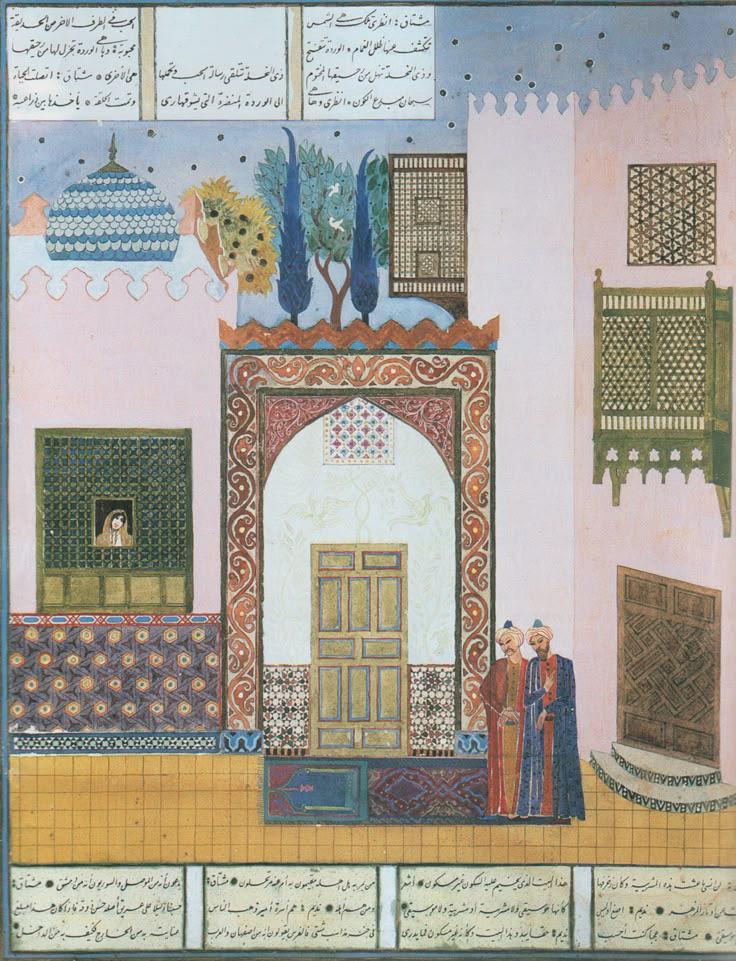
Gouache and watercolour on paper depicting Fathy’s set for his unperformed play The Story of the Mashrabiyya (1942). The characters exchange dialogue about the qualities of the lattice screen between them, visible in the surrounding calligraphic portals. Reproduced from Damluji and Bertini’s Hassan Fathy: Earth & Utopia, p. 137. © Aga Khan Trust for Culture.
Bringing visibility to the concealed spaces, practices, and infrastructures that sustain cultural and architectural systems. From service quarters to museum repositories, and the digital streetlevel view, these studies examine the overlooked architectures of work, storage, and documentation.
44 Invisibilized Domesticities: 2 Willow Road and the Embodiment of Housework
Claudia Vargas Franco
50 Display vs Storage: Visibility, Accessibility and Transparency in Museums with Colonial Inheritances
Helga Beshiri
56 A Table of Intentions: Alison and Peter Smithson’s Exhibition of a Decade ‘54–‘64
Macarena González Carvajal
60 Google Street View and the Architectural Image: Rethinking Histories of Urban Representation
Mark Bessoudo



Our bodies leave traces in the spaces we inhabit: dust made of fragments of our bodies that detach, fall, and settle onto architecture, signalling human presence. As Mary Douglas noted, we clean and discard those traces to restore order.1 But who performs this morally charged labour, and do their own traces vanish along with the dust? Housework unfolds in an intimate relationship with the materiality of the house; however the bodies performing these tasks have been invisibilized both through the canon of architectural history and within modern domestic architecture itself.
The house at 2 Willow Road in Hampstead, London (1938–39), offers a revealing case study. Designed by architect Ernö Goldfinger as his family home, it was first inhabited by himself, his wife, the artist Ursula Goldfinger, their two children, Peter and Elizabeth, and three domestic workers: Rosie Hayden, the cook; Betty Boothroyd, the nanny; and the chauffeur whose name remains unknown. However, most accounts of the house have overlooked the role of domestic service in its architectural history. A white door in the corner of the hall that once led to the servants’ quarters — later converted into a
1 Mary Douglas, Purity and Danger: An Analysis of the Concepts of Pollution and Taboo (Routledge, 1991), p. 2.
separate living unit — now stands permanently closed. This thesis aims to reopen that door to critically examine how housework was embodied in modern domestic architecture, and how space materializes and negotiates social structures of domestic life.
2 Willow Road negotiated ideas around gender, class, and service in complex and often contradictory ways. It contributed to the invisibilization of housework, both in its initial design and in its subsequent use and adaptations. Although it has often been celebrated as a modernist house, the ideas around domesticity that informed its design and inhabitation aligned more closely with nineteenthcentury traditions. In this sense, the house was transitional, embodying modernist ideals while simultaneously reproducing long-standing social and gender hierarchies. ‘Progressive’ architectural features such as folding partitions, coved skirtings, or easyto-wipe surfaces did not fundamentally challenge class or gender norms, but some of them ended up highlighting inequalities.
These tensions ran throughout the house. The first kitchen, hidden away, was located in the servants’ quarters so that smells and noises would ‘stay in their place,’ reflecting a traditional view of domestic labour as something to be concealed; yet it was large and functional. Furthermore, the compact layout of the house and Goldfinger’s dislike of corridors hindered the separation of bodies, thereby creating spaces of collision. However, a dumbwaiter was introduced to mediate this tension, encapsulating the paradox of simultaneously erasing the workers’ presence and easing their physical burden, thus functioning as a mechanism for invisibilization. This dialectic of exposure and concealment extended to other areas of the house, most notably the ground-floor cloakroom (toilet), one of the most provocative spaces. Its translucent glass and stark exposure make it sensual and playful, simultaneously obscuring and revealing,
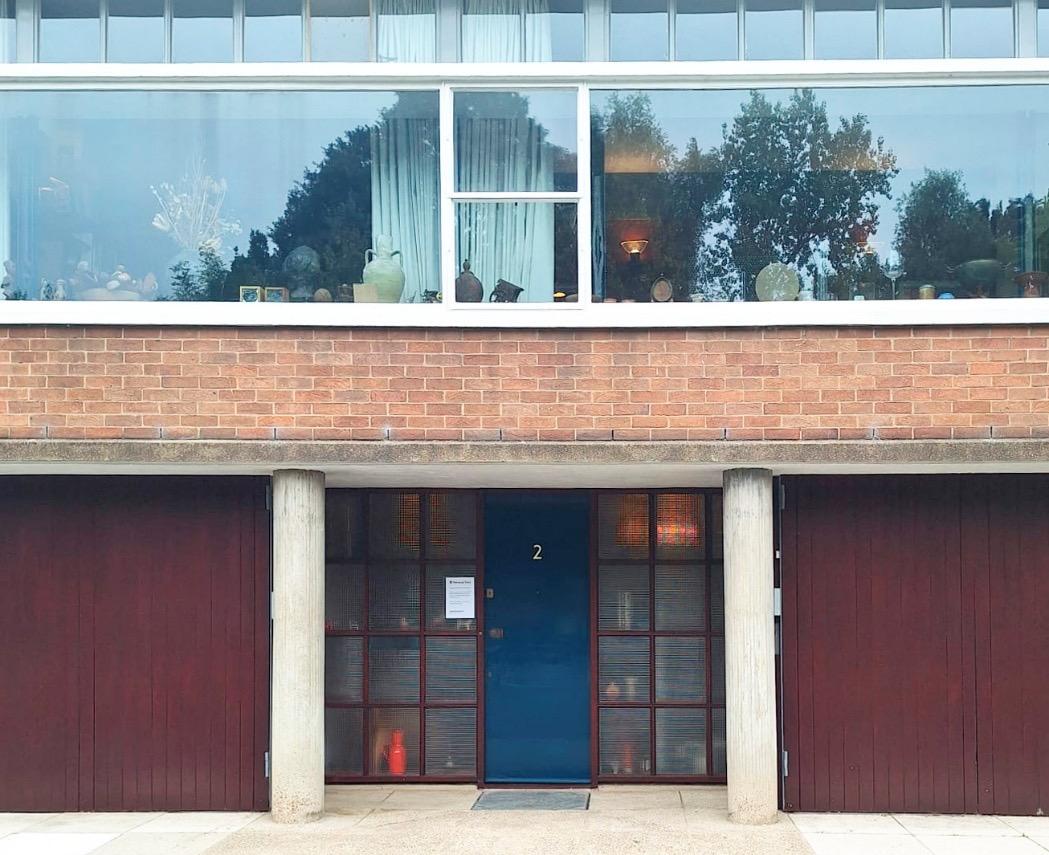
unlike Le Corbusier’s or Adolf Loos’ sinks designed to ‘clean the gaze.’2
The post-war transition to a ‘servantless’ domesticity shifted responsibilities to Ursula Goldfinger. Yet the family still relied on hired domestic help. A daily woman carried out the roughest household tasks. ‘Servantless’, then, meant a reconfiguration of service, not its disappearance. This transition did little to challenge gender roles: housework remained strongly feminized, and middleclass women like Ursula were expected to take responsibility for it. This required a reframing of domestic labour as an act of love, care, and emotional reward, while also being couched in scientific discourses of hygiene and efficiency. This dual framing sought to preserve social status, but ultimately deepened existing contradictions. Love and duty were tangled with labour and science, placing women in a conundrum of conflicting expectations. At 2 Willow Road, this meant Ursula’s responsibilities tied her to the ‘invisible’ realm of the ground-floor kitchen and the nursery, while the daily woman’s presence was rendered even more invisible, as Goldfinger’s correspondence with his father reveals an overlooking of her labour.
The disjunction between the house’s representation in architectural media — marked by austere, carefully staged interiors — and its lived reality — cluttered with objects, rugs, plants, art, and trinkets — reveals that, although hygiene remained an aesthetic value, it was more rhetorical than practiced, and the house was not shaped by modernist hygiene anxieties. Nonetheless, the kitchens designed in 1960–61 retained a stronger connection to those ideals of hygiene and efficiency. The exhibition ‘Planning Your Kitchen’ (1944), developed by Ernö Goldfinger
2 Mark Wigley, ‘La Nueva Pintura del Emperador,’ RA: Revista de Arquitectura, 13 (2011), p. 8
in collaboration with Ursula Goldfinger, seemed to have informed their design. Yet the results were ambivalent. The basement kitchen was more open and integrated with the dining room. In contrast, the first-floor kitchen — the one used by Ursula — was cramped, poorly ventilated and illuminated. Although efficient in its organization, it confined her labour to an isolated, relegated space. Meanwhile, Goldfinger gained Ursula’s studio, symbolically reinforcing a hierarchy of bodies and activities: the architect’s professional work was prioritized over the housework that sustained it.
This imbalance spatialized gendered hierarchies. The first-floor kitchen was hidden and small, barely accommodating more than one person, while Goldfinger’s studio was untouched and even took over Ursula Goldfinger’s studio, which was regarded as the heart of the house. Architecture itself thus mediated inequality — not only rendering housework invisible, but also relegating the female body to invisibility. In this light, works like Ursula Mayer’s film Interiors (2006), which stages female presences within the house, are essential in reintroducing the gendered dimensions effaced in its representation.
This dissertation argues for the critical potential of reframing such sites through the lens of housework, gender, and class. Doing so not only makes visible the often-erased contributions of women like Ursula Goldfinger, servants, and domestic workers, but also challenges the ways architectural history has naturalized their invisibility within modernism. More broadly, it opens a pathway for curating modernist homes with greater attention to housework, highlighting how these spaces were lived, negotiated, and shaped by dynamics of class and gender. Such a perspective not only enriches the narrative of 2 Willow Road but also reframes Ernö and Ursula Goldfinger within the broader discourse of domestic modernity in Britain.
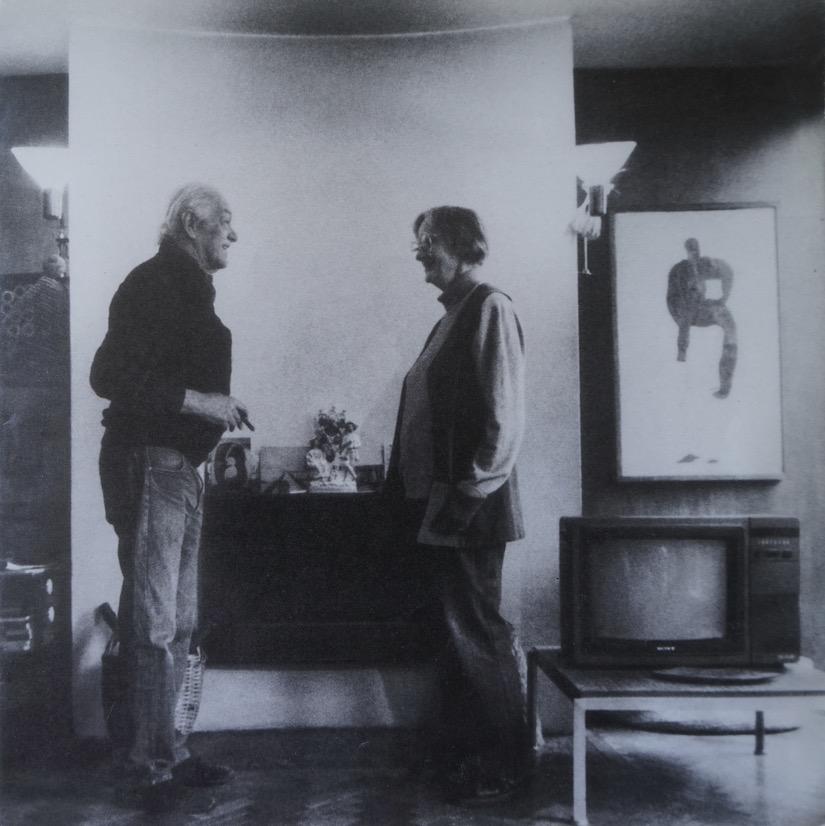
art and trinkets. Reproduced from Alan Powers and the National Trust’s booklet 2 Willow Road (Swindon: 1996).
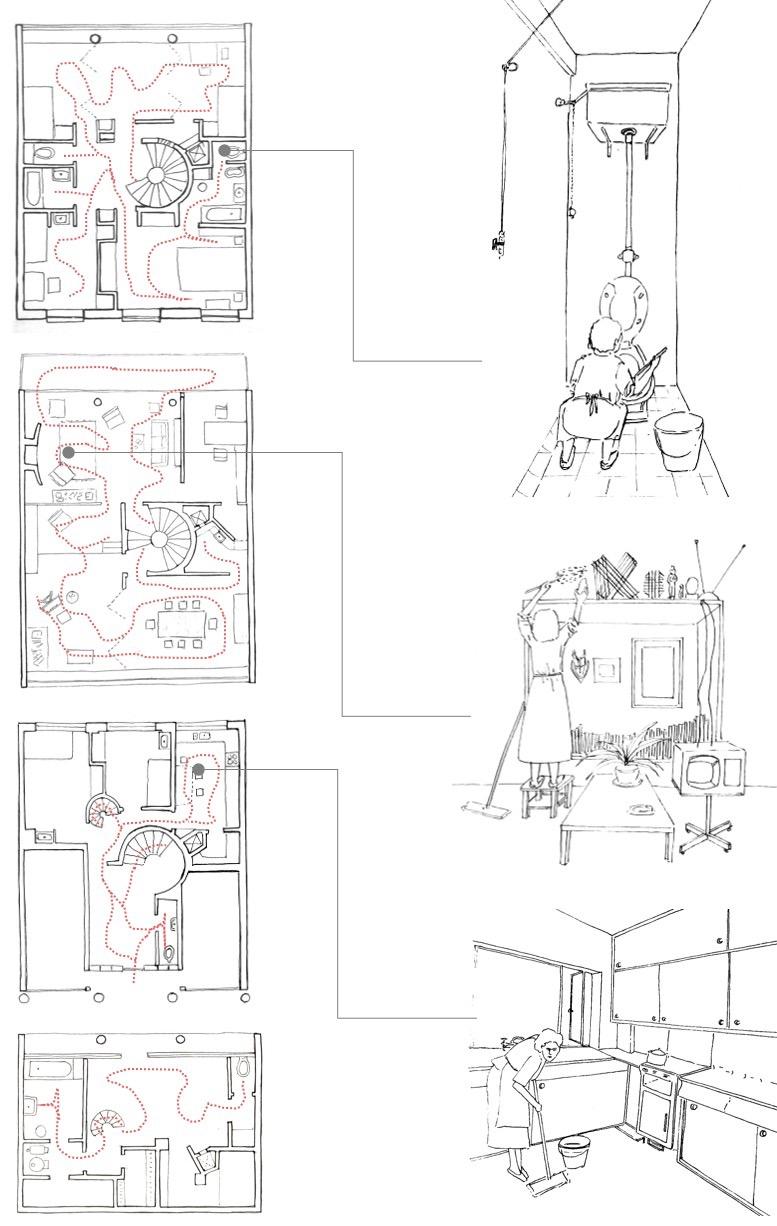
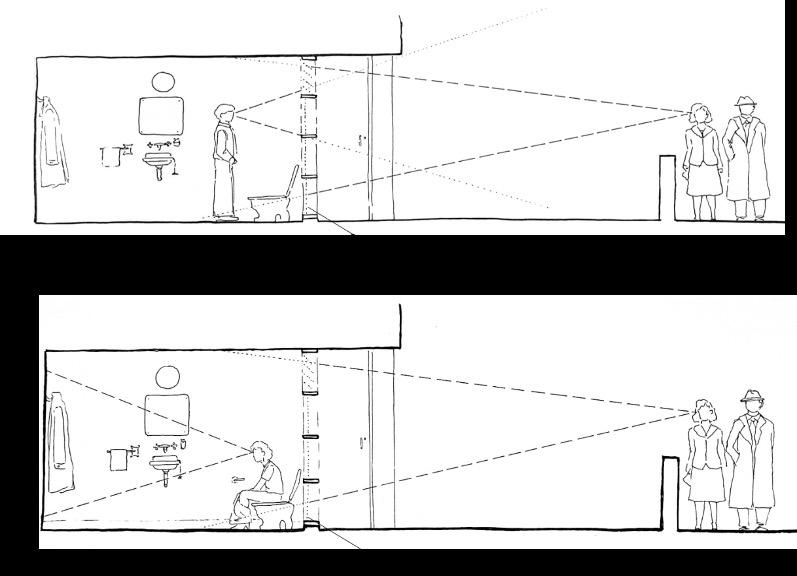
Top Diagram mapping the woman’s daily work within the house through circulation plans and perspectival vignettes. Image by the author.
Bottom Sections of the 2 Willow Road cloakroom illustrating spatial and visual dynamics: the female figure, seated with her back to the textured glass façade, is unable to see potential onlookers outside, while the male figure, facing the façade as he urinates, is more aware of possible viewers. The textured glass makes the bodies hard to read, blurring their visibility. Image by the author.
Display vs Storage: Visibility, Accessibility and Transparency in Museums with Colonial Inheritances
Helga Beshiri
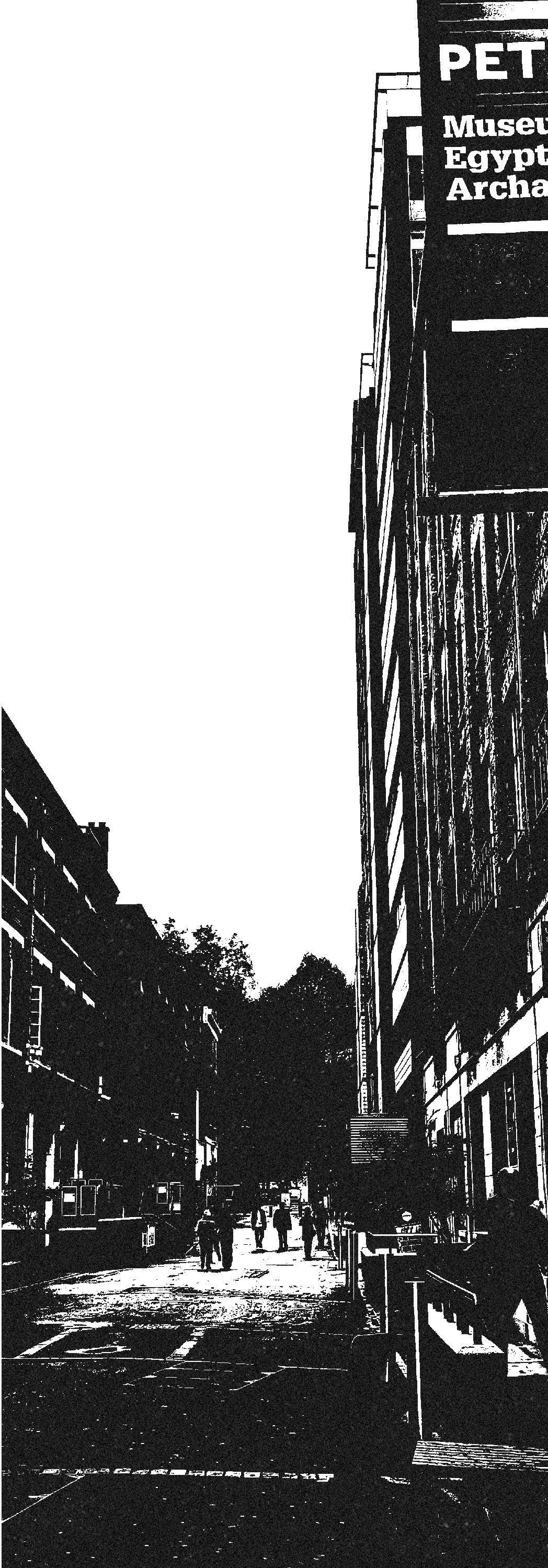
Museums with colonial inheritances have long served as instruments for organising and displaying knowledge, shaping narratives about civilisation and progress through their spatial hierarchies of display and storage. This essay explores how the visibility or invisibility of collections in such institutions reflects and perpetuates colonial power structures. Focusing on three London case studies — the Wellcome Collection, the Petrie Museum of Egyptian and Sudanese Archaeology, and the V&A Storehouse — it examines how different configurations of display and storage engage with contemporary calls for transparency and decolonisation.
Since the Enlightenment, European museums have embodied systems of classification that ranked societies from ‘advanced’ to ‘primitive’.1 They materialised imperial hierarchies by displaying ethnographic objects as evidence of Western superiority and rationality.2 The very act of collecting and displaying non-Western artefacts — detached from their original contexts—was a mode of controlling both bodies and knowledge. According to Alice Procter, the museum itself is a ‘colonialist, imperialist fantasy … that the whole world can be neatly catalogued, contained in a single building’.3
1 Tony Bennet. The Birth of the Museum: History, Theory, Politics. 1st ed., (Routledge, 1995), p. 34.
2 Adam Kuper, The Museum of Other People: From Colonial Acquisitions to Cosmopolitan Exhibitions (Profile Books, 2023), p. 5.
3 Alice Procter, The Whole Picture: The Colonial Story of the Art in Our Museums & Why We Need to Talk about It (Cassell, 2020), p. 84.
Through curatorial decisions on what to show and how to interpret it, museums construct narratives that sustain this colonial legacy. Display and storage are not neutral categories: the visible exhibition represents selective interpretation, while storage conceals the remainder of the archive. Both spaces, as Swati Chattopadhyay argues, share ‘an ontology of colonial dislocation’, manifesting the displacement and possession at the core of empire.4
Films such as Les Statues Meurent Aussi (1953)5 and You Hide Me (1970)6 expose the violence of museological display and concealment. By isolating objects from living cultures, museums render them aesthetic curiosities for Western consumption, ‘a prison of masks, jewellery, robes, statuettes’ hidden from view.7 Storage thus extends colonial control through invisibility: nearly 90% of museum collections remain inaccessible to the public.8 These unseen artefacts become ‘hoarded capital’, material assets through which Western museums assert cultural authority and generate value.9
The tension between display and storage, therefore, mirrors broader struggles over visibility, authorship, and access. Decisions on what to exhibit or withhold are inseparable from the hierarchies established during empire. Curatorial practices that claim neutrality often replicate those same structures of dominance, determining which stories are told and which remain hidden.
4 Swati Chattopadhyay, ‘[Unarchiving: Toward a Practice of Negotiating the Imperial Archive’, PLATFORM, 5 June 2023 <https://www.platformspace.net/home/ unarchiving-toward-a-practice-of-negotiating-the-imperial-archive>.
5 Les statues meurent aussi. dir. by Alain Resnais, Chris Marker, and Ghislain Cloquet (France, 1953).
6 You Hide Me. dir. by Niki Kwate Owoo (1970).
7 Swati Chattopadhyay, ‘Collections and Containment’, in Small Spaces: Recasting the Architecture of Empire (London: Bloomsbury, 2023), pp. 223–30.
8 Lara Corona, ‘Stored Collections of Museums: An Overview of How Visible Storage Makes Them Accessible’, Collection and Curation, 44.1 (2025), p. 1.
9 Chattopadhyay, ‘Collections and Containment’, p. 223.
The Wellcome Collection epitomises how colonial narratives are embedded in display. Founded from Sir Henry Wellcome’s global collecting during the British Empire, it was reorganised in 2007 around the permanent exhibition Medicine Man. This show assembled artefacts related to health and healing ‘through the lens of a single person, Henry Wellcome’.10 Objects from diverse cultures were categorised by medical theme rather than by origin, stripped of context, and re-presented as trophies of one man’s curiosity.
Despite architectural renovations intended to increase accessibility, in 2022, the exhibition was closed indefinitely for its ‘racist, sexist and ableist’ approach.11 Most artefacts were moved to their storage location in Swindon. The choice of invisibility — removing the problematic display without yet providing an alternative — was framed as an ethical pause. Yet, as critics noted, simply concealing colonial objects neither restores context nor enables restitution.
For Wellcome’s curators, invisibility was a means to avoid perpetuating colonial narratives; however, unless followed by repatriation or reinterpretation, it risks reinforcing the same erasures.
The Petrie Museum, by contrast, reveals the complexities of partial visibility. Created from the excavations of Flinders Petrie and the bequest of Amelia Edwards to University College London in 1892, the museum originated as a teaching resource deeply embedded in imperial archaeology. Its displays followed Petrie’s taxonomic logic — grouping objects by typology and chronology rather than cultural significance. While pedagogically
10 Wellcome Collection. ‘Statement on the closure of our Medicine Man Gallery’, Welcome Collection, 28 November 2022 <https://wellcomecollection.org/statement-on-theclosure-of-our-medicine-man-gallery>
11 Robin McKie, ‘Wellcome Collection in London Shuts ‘Racist, Sexist and Ableist’ Medical History Gallery’, The Guardian, 27 November 2022 <https://www.theguardian. com/culture/2022/nov/27/wellcome-collection-in-london-shuts-racist-sexist-andableist-medical-history-gallery>
coherent, this organisation reinforced colonial hierarchies of knowledge and authority.12
Today, the Petrie Museum occupies a repurposed stable on Malet Place. Its modest architecture restricts both visibility and flexibility: only 8,000 of 80,000 objects can be displayed. Nevertheless, recent curatorial projects seek greater transparency. The 2019 re-design of the entrance gallery introduced labels addressing Petrie’s involvement in eugenics and the colonial conditions of excavation. Displays now highlight neglected figures such as Ali Suefi, an Egyptian overseer, and Violette Lafleur, who safeguarded the collection during WWII.
Initiatives such as ‘Hidden Hands’13 by Steven Quirke attach the names of Egyptian workers to specific artefacts, restoring agency to those previously unacknowledged. The ‘Sudan Living Cultures’ project similarly collaborates with London’s Sudanese community to reframe the museum’s dual heritage and recognise how indigenous knowledge can be seen within existing Western collections. Although constrained by space and bureaucracy, these acts of naming and reinterpretation exemplify microdecolonial practices within a colonial institution.
The newly opened V&A Storehouse (2025) in Hackney represents an architectural and conceptual experiment in transparency. Designed by Diller Scofidio + Renfro, it embodies the idea of visitable storage — a hybrid between gallery and archive where all objects are potentially visible. By ‘flipping the usual progression from public to private’, as Liz Diller explains, visitors can see conservation work and explore vast reserves once hidden from view.14
12 Pierre Bourdieu, ‘The Forms of Capital’, in The Sociology of Economic Life (Routledge, 2018), p. 80.
13 Hidden Hands: Egyptian Workforces in Petrie Excavation Archives, 1880-1924 (Bristol Classical Press, 2010).
14 Oliver Wainwright, ‘“The National Museum of Absolutely Everythin”’: New V&A Outpost Is an Architectural Delight’, The Guardian, 28 May 2025 <https://www.theguardian.com/artanddesign/2025/may/28/v-and-a-east-storehouse-architectural-delight>
Glass walls, open shelving, and cross-sectional displays replace the opacity of the traditional museum. Every six months, the configuration changes, granting different artefacts visibility. This design literally materialises transparency, aligning architectural form with curatorial ethics. Yet full visibility does not automatically equal decolonisation: what remains to be addressed is the interpretation of these objects and the narratives surrounding their colonial acquisition.
Across these three institutions, the relationship between display and storage functions as both metaphor and mechanism of colonial power. Invisibility — whether physical or curatorial — has historically legitimised Western ownership and authority over other cultures’ material heritage. The Wellcome Collection’s retreat into storage shows the limits of erasure as a strategy; the Petrie Museum demonstrates how visibility, transparency, and community collaboration can begin to unsettle inherited hierarchies; and the V&A Storehouse pushes the logic of visibility to its architectural extreme.
Ultimately, the challenge for museums with colonial inheritances lies not merely in making objects visible but in revealing the conditions of their visibility — how space, design, and curatorial practice continue to mediate access and meaning. Only by confronting the intertwined histories of collection, concealment, and display can museums move towards genuine decolonial transparency.
González Carvajal
Alison and Peter Smithson’s Exhibition of a Decade ‘54–‘64

This dissertation examines the exhibition Painting and Sculpture of a Decade: ‘54–‘64 at the Tate Gallery in 1964, designed by the architects Alison and Peter Smithson, as a case study of exhibition-making as a form of architectural practice. While the Smithsons are widely recognised for their role in shaping post-war British architecture and the discourse of New Brutalism, their installation design for the ‘54–‘64 exhibition remains underexplored within architectural history. For the Smithsons, exhibitions and installation designs were fundamental to their practice, as they expressed in a series of writings from the 1980s.1 This perspective opens a framework for understanding exhibitions as provisional architectures: representations of spatial and conceptual ideas that often lay the ground for or run parallel to build work, but whose significance is frequently overlooked due to their ephemeral nature. Consequently, this vision raises certain questions that become the central theme of the dissertation. What are the implications of designing the display for an art exhibition in the
1 Alison and Peter Smithson and Karl Unglaub, Italienische Gedanken, Weitergedacht, 1st edn (Birkhäuser, 2014), cxxii, doi:10.1515/9783035602647; Peter Smithson, ‘Conglomerate Ordering: The Restaging of the Possible’, in Helena Webster, Modernism without Rhetoric: Essays on the Work of Alison and Peter Smithson (Academy Editions, 1997); Peter Smithson, ‘The Masque and the Exhibition: Stages towards the Real’, in ILA&UD Yearbook: Languages of Architectures (Sansoni Editore, 1981), pp. 62–67; Peter Smithson, ‘Three Generations’, in ILA&UD Yearbook: Languages of Architectures (Sansoni Editore, 1980), pp. 88–89.
practice of architecture? And at the same time, can an exhibition design be a synthesis of the intention that carries architecture?
Painting and Sculpture of a Decade: ‘54–‘64 (1964) was organised and sponsored by the Calouste Gulbenkian Foundation, a Portuguese institution that established a UK branch in 1956, dedicated to helping artists and stimulating public interest in the arts. The initiative and selection of works were led primarily by Alan Bowness, Lawrence Gowing, and Philip James.2 Conceived as a comprehensive survey of artistic developments in Britain and abroad over the preceding decade, the exhibition brought together 366 works by 170 post-war artists such as Pollock, Kline, Rothko, Dubuffet, Correll, and Paolozzi. Its scale and ambition required an equally rigorous and carefully conceived design, a responsibility entrusted to the Smithsons, which took over two years to develop.
The role of the museum’s architecture, as well as the selection of artworks to be exhibited, marked three completely different stages of the project, which are expressed very clearly through the drawings of the floor plan of the installation. For the architects, the intention behind the design of the installation for the exhibition ‘54–‘64 was to highlight the relationships between the artists’ different works, leaving the architecture of the installation and the Tate itself in the background.3 This allowed the Smithsons’ design to constitute a strategy for creating a space that would distance itself from the conventional museum environment.
From their first curatorial and installation project, Parallel of Life and Art (1953), Alison and Peter Smithson revealed their conviction that architecture develops in dialogue with history and cultural reminiscence. By collapsing disciplinary and cultural hierarchies through images in an exhibition, the Smithsons suggested that each generation of artists and architects learns from and reworks what has come before. Crucially, their first exhibition design established an approach that would shape
2 Lisa Tickner, London’s New Scene: Art and Culture in the 1960s (Paul Mellon Centre for Studies in British Art, 2020), p. 75.
3 Penelope Curtis and Dirk van den Heuvel, Art on Display 1949-69 (Calouste Gulbenkian Museum, 2019), p. 86.
the Smithsons’ later work, positioning exhibitions not only as displays but as vehicles for thinking about genealogy, intention, and the construction of meaning in architecture.
Almost thirty years after the exhibition Painting and Sculpture of a Decade: ‘54–‘64 (1964), the Smithsons’ reflections on this project and the rest of their exhibition repertoire became a much more recurring theme in their writings. These writings expressed the belief that exhibitions could embody an intention which was consistent with each generation of architects. In the draft version of the text of ‘The Staging of the Possible’, later revised and published in 1995 in Italian Thoughts, was introduced a diagrammatic ‘table’ recording relationships between generations of architects and their intentions with an image.4 This schema reframed exhibitions as historiographic tools, simultaneously retrospective and projective. Their final iteration on this idea, ‘Re-staging of the Possible’ in 1997, reinforced this vision; emphasising the exhibition as a medium for tracing genealogies and imagining futures. In this sense, their curatorial and architectural practice operated as a consistent thread linking their early post-war experiments with their later theoretical reflections.
Building on these reflections, exhibition design can be seen as a unique synthesis of architectural intentions, where spatial strategies, object relationships, and audience experience converge into a cohesive whole. In the case of the ‘54–‘64 exhibition, the installation supported the artworks while simultaneously shaping the way they related to one another, creating a dialogue between pieces that extended beyond their individual qualities. It also produced a distinct environment within the Tate Gallery, transforming the existing architecture into a provisional space capable of hosting new experiences and interactions. By bringing together objects, space, and experience, the case of the ‘54–‘64 exhibition demonstrates how architectural thinking can operate beyond permanent buildings, asserting that temporary, curated environments are not merely displays but complex frameworks in which ideas, histories, and sensibilities are communicated.
4 Smithson and Unglaub, Italienische Gedanken, Weitergedacht, cxxii, p. 44.
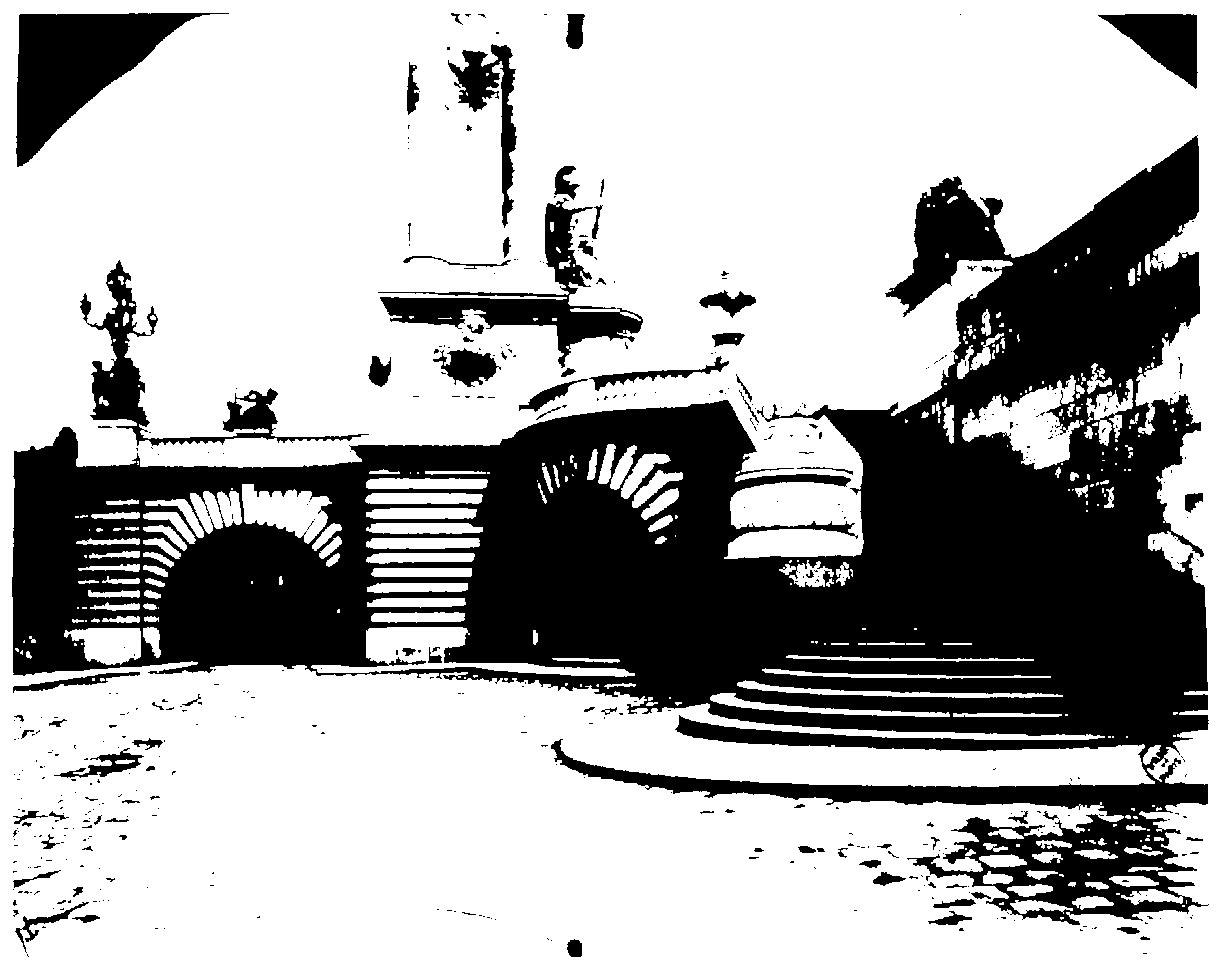

Left Eugène Atget, Port des Invalides [Pont Alexandre III. Escalier et arche, rive gauche], 1913, Bibliothèque Historique de la Ville de Paris, https:// bibliotheques-specialisees. paris.fr/ark:/73873/ pf0001820043/.
Right Port des Invalides in August of 2009. Image by the author via © Google Street View, captured 2025.
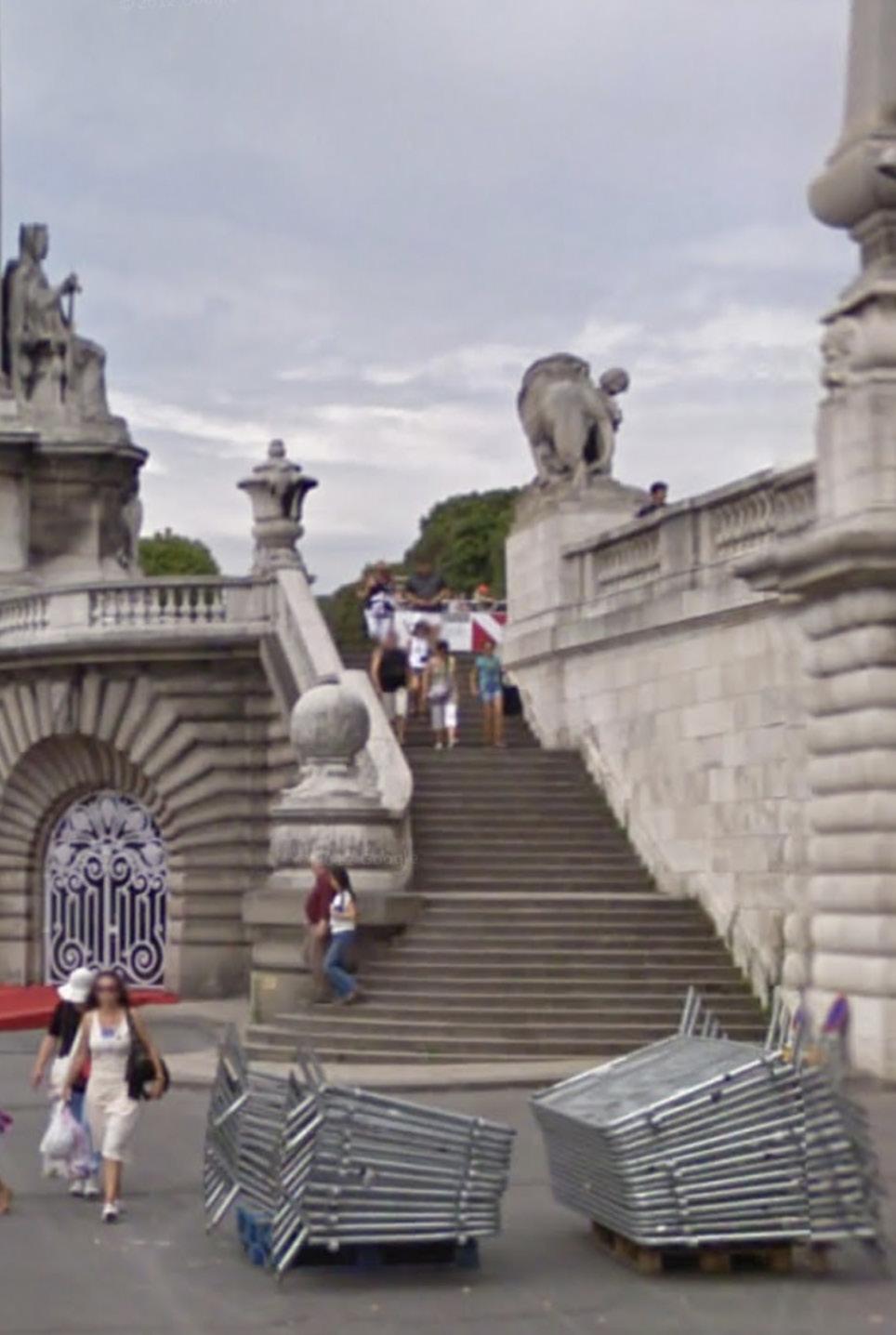
This dissertation investigates Google Street View, a component of Google Maps, as both a visual and historiographical instrument in architectural study. It argues that Street View, through its automated panoramic imaging of the built environment, has become a vast but largely unacknowledged form of architectural documentation and urban representation. The project examines how this machinic archive can be understood within the historical lineage of architectural photography.
Street View is considered not simply as a mapping technology but as a representational system that produces, archives and circulates images of the built environment on an unprecedented scale. Unlike the singular image captured by a photographer who isolates and composes, Street View operates serially and indifferently. Yet through this process it generates a continuous record of streets, buildings and urban change. The dissertation’s central claim is that these images, though made without intent, inherit the documentary impulse that has long informed architectural and urban photography.
Cheryl Gilge describes Street View as a ‘spatialised image’ that fuses photographic and cartographic operations. Her analysis establishes the conceptual ground for understanding Street View as a hybrid visual infrastructure — part image and part
interface.1 This clarifies how the platform collapses distinctions between the photographic act and the mapped territory, between representation and navigation. Drawing on Ariella Azoulay’s conception of photography as a collaborative process2, the dissertation also argues that Street View extends that relationship across code, infrastructure, and user. Meaning arises not at the moment of capture, but through acts of retrieval and reuse. The same relational logic can be traced backward through earlier photographic practices that sought to describe the city systematically rather than subjectively.
Eugène Atget’s work sits at the origin of this lineage. At the turn of the twentieth century, he documented Paris not as an artist but as a maker of documents for clients such as architects, artisans and preservationists who required visual records of façades, shopfronts and courtyards.3 His photographs were practical documents, yet their persistence and breadth turned function into history. What began as a commercial service to capture the built environment became an archive of urban space. His method established how photography could operate as both evidence and interpretation, a condition Street View later amplifies through automation.
Nigel Henderson, working in post-war London, extended this empirical impulse into the social realm. His photographs of East London neighbourhoods captured the vitality of working-class life, observing rather than idealising. Henderson’s method constituted a form of urban fieldwork that used the camera to register both physical and social texture. In
1 Cheryl Gilge, ‘Google Street View and the Image as Experience,’ GeoHumanities 2, no. 2 (2016): 469–84.
2 Ariella Azoulay, ‘Photography Consists of Collaboration: Susan Meiselas, Wendy Ewald, and Ariella Azoulay,’ Camera Obscura 31, no. 1 (2016): 187–201.
3 Molly Nesbit, Atget’s Seven Albums (New Haven: Yale University Press, 1992).
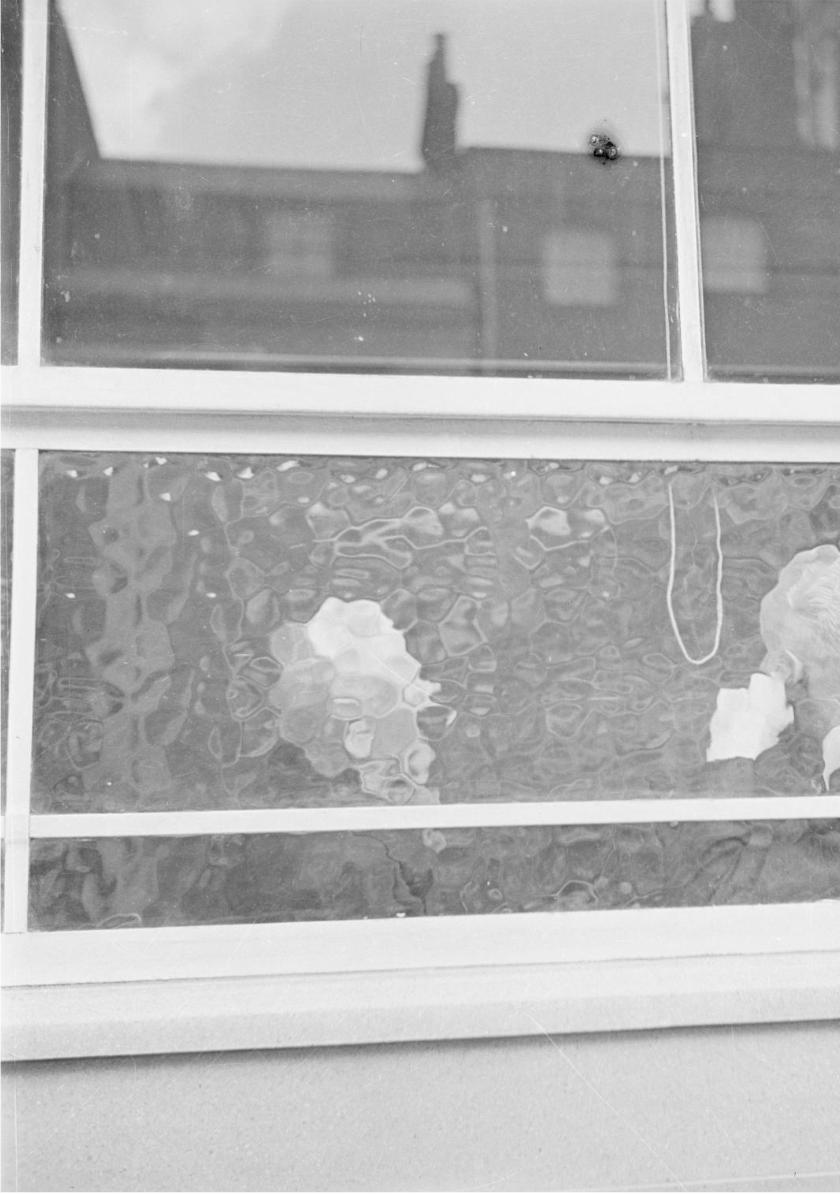
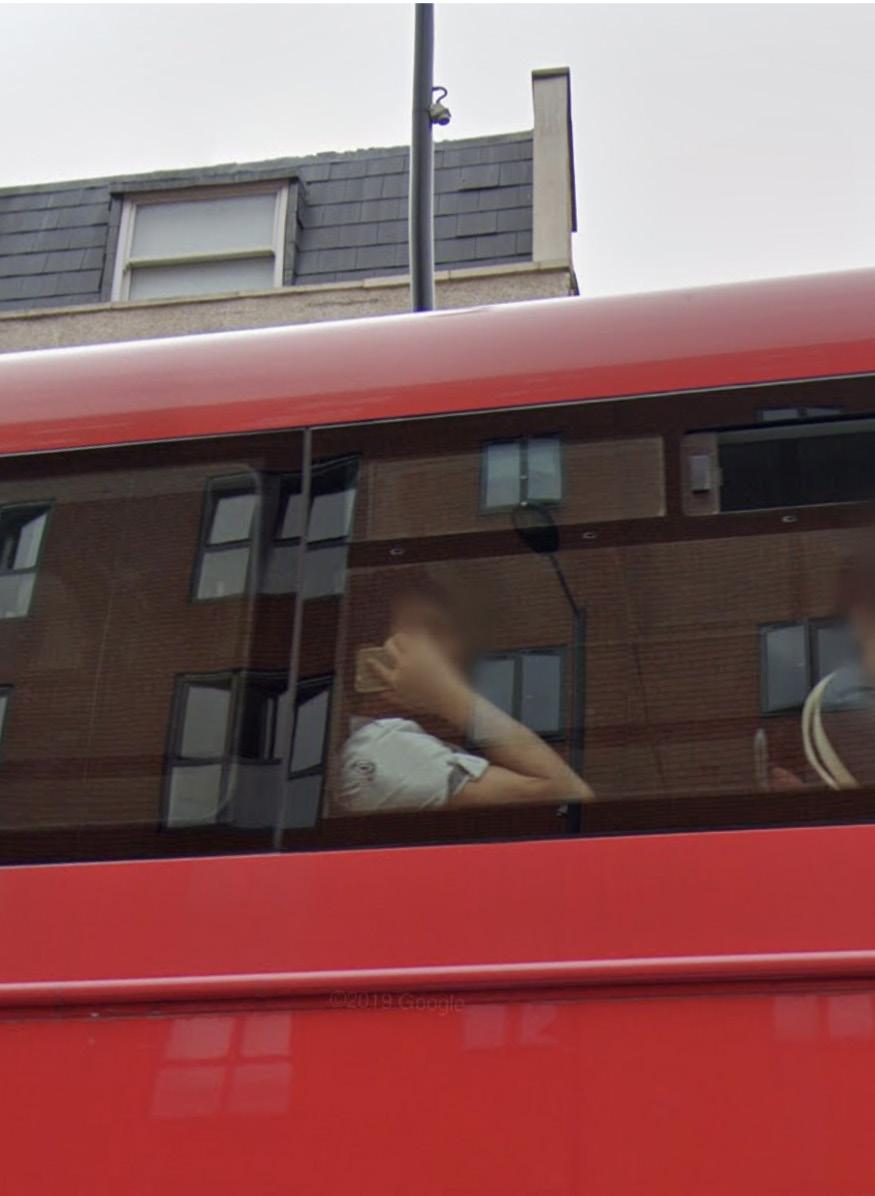
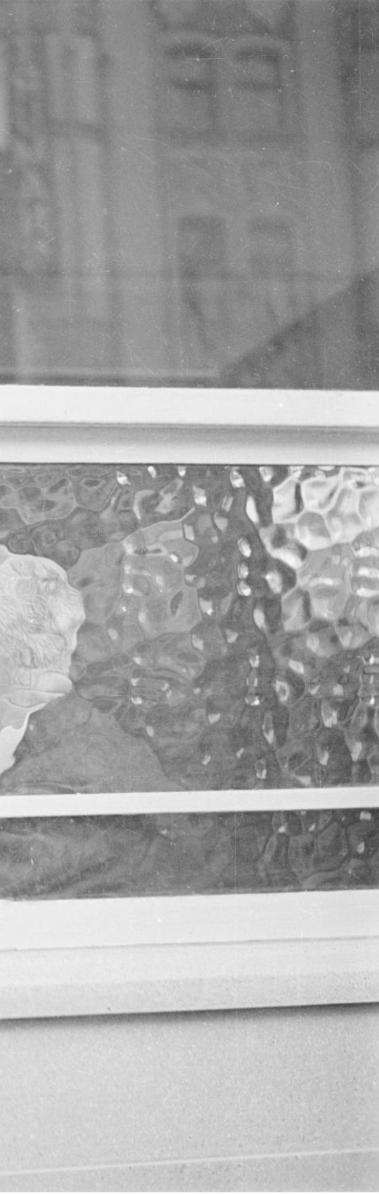

Top Nigel Henderson, Photograph of two heads through a pub window [Bethnal Green, 1949–54], Courtesy of the Tate Archive, https://www. tate.org.uk/art/archive/ items/tga-9211-96-14/hendersonphotograph-of-twoheads-through-apub-window. © Nigel Henderson Estate.
Bottom Two heads seen through a bus window in July of 2019. Image by the author via © Google Street View, captured 2025.
his work the street becomes a site of enquiry, a space where architecture and life intersect.4
Ed Ruscha, in mid-century Los Angeles, brought this documentary logic into the realm of system and procedure. In Every Building on the Sunset Strip (1966) he mounted a motorised camera to his truck and produced a continuous photographic scroll of a single street.5 Like Atget and Henderson, Ruscha pursued the ordinary, but his method was mechanised, detached, and serial. His project converts the city into a linear, unbroken record assembled through movement. The work anticipates Street View’s automated survey, turning documentation into a procedural operation rather than a subjective act.
Together Atget, Henderson, and Ruscha define the methodological and conceptual ground from which Street View emerges — a history of image-making shaped by documentation, social immersion and automated infrastructure. Street View extends these tendencies and translates them into an industrial form of visual capture. What results is a record both total and impersonal, the city rendered as archival dataset.
Street View also occupies a central position in what might be called post-photographic practice. Contemporary artists such as Jon Rafman, Doug Rickard, and Mishka Henner have reappropriated its imagery to explore the shifting boundaries between authorship and automation. Their works expose the latent aesthetics of Street View and its capacity to record the incidental life of the city without intent or judgement.
Street View continues the lineage of architectural documentation while transforming its conditions.
4 Clive Coward, ed., Nigel Henderson’s Streets: Photographs of London’s East End 1949–53 (London: Tate Publishing, 2017).
5 Edward Ruscha, Every Building on the Sunset Strip (Los Angeles: Ed Ruscha, 1966), Tate Library, London.
Mishka Henner, No Man’s Land, 2011–2013, https://mishkahenner. com/No-Man-s-Land.
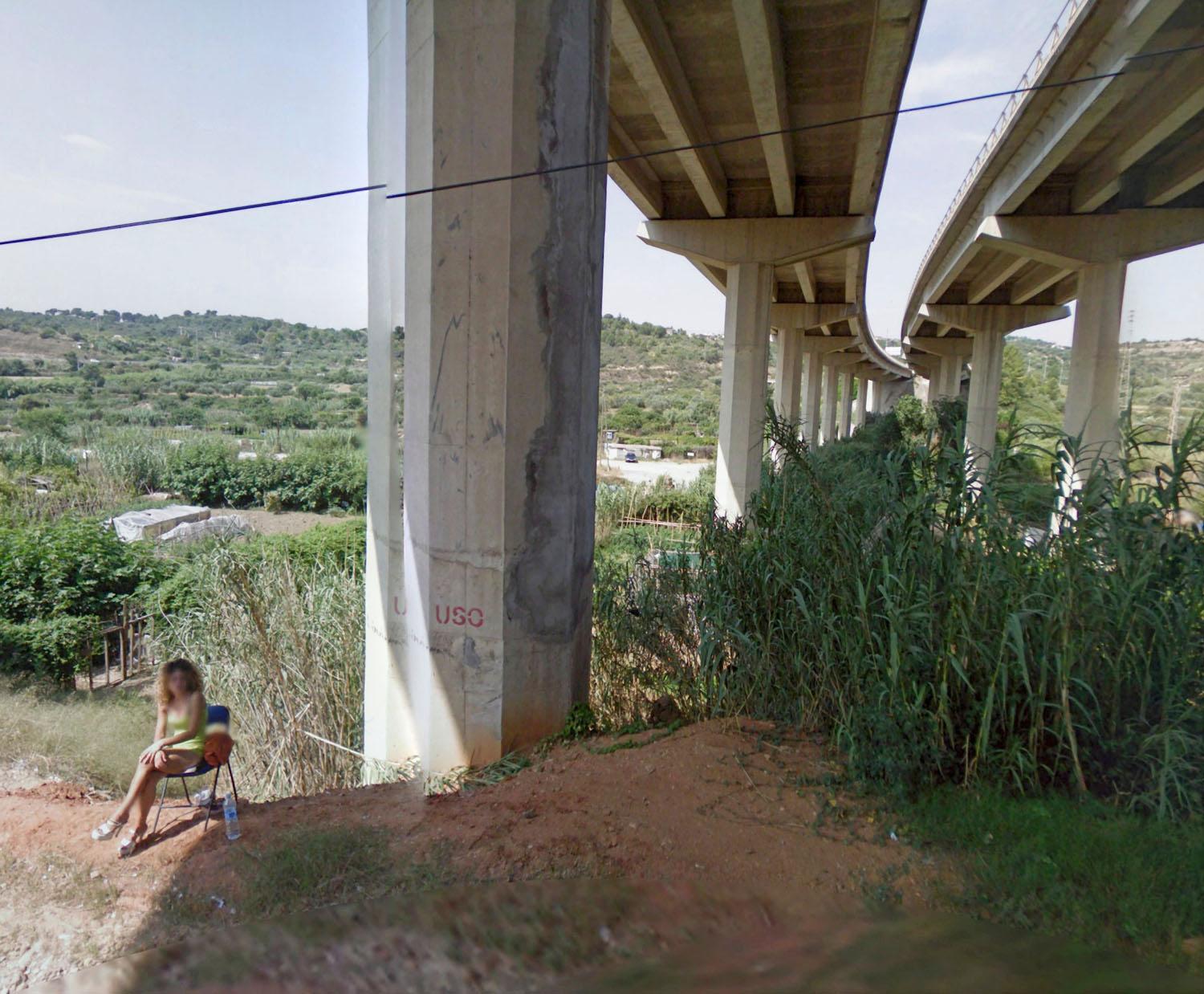
The image has become infrastructural, maintained by systems of corporate control and algorithmic surveillance that both preserve and obscure the city they record.
By situating Street View within this historical and methodological continuum, the dissertation redefines how architectural imagery can be mediated and used. It treats the platform not as a neutral mapping tool but as a living archive whose images reveal the conditions of the built environment. In doing so, it reframes architectural photography as a distributed practice, one enacted through systems rather than individuals. Street View’s automation does not end the work of the photographer; rather, it shifts attention from the moment of capture to the acts of selection and interpretation that follow. The ordinary city, endlessly imaged and re-imaged, becomes both subject and method — the ground through which architectural history continues to write itself.
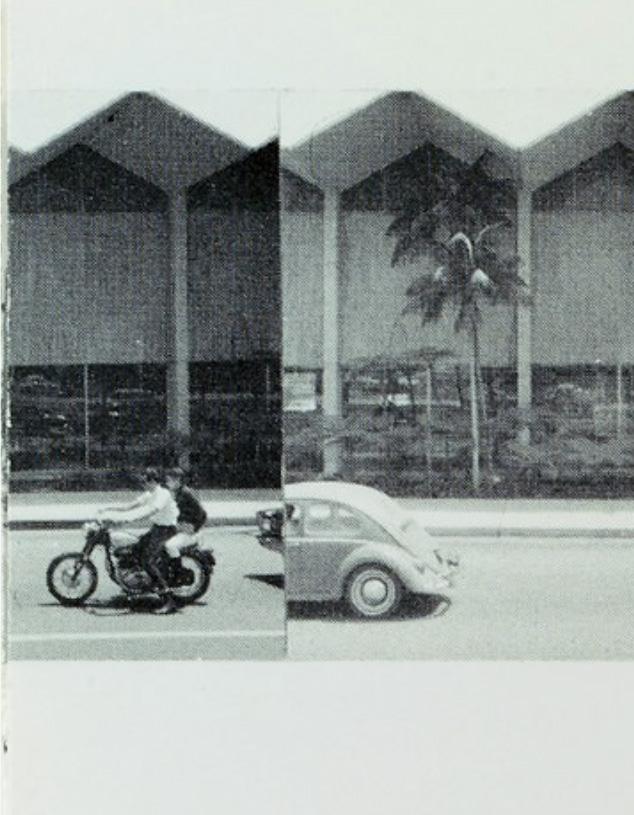
Left Eugène Atget, [Paris]. Rue des Rosiers, n° 18. Maison [et boutiques], 1910, Bibliothèque Historique de la Ville de Paris, https://bibliotheques-specialisees. paris.fr/ark:/73873/pf0001071046/.
Right Rue des Rosiers in April of 2008. Image by the author via © Google Street View, captured 2025.
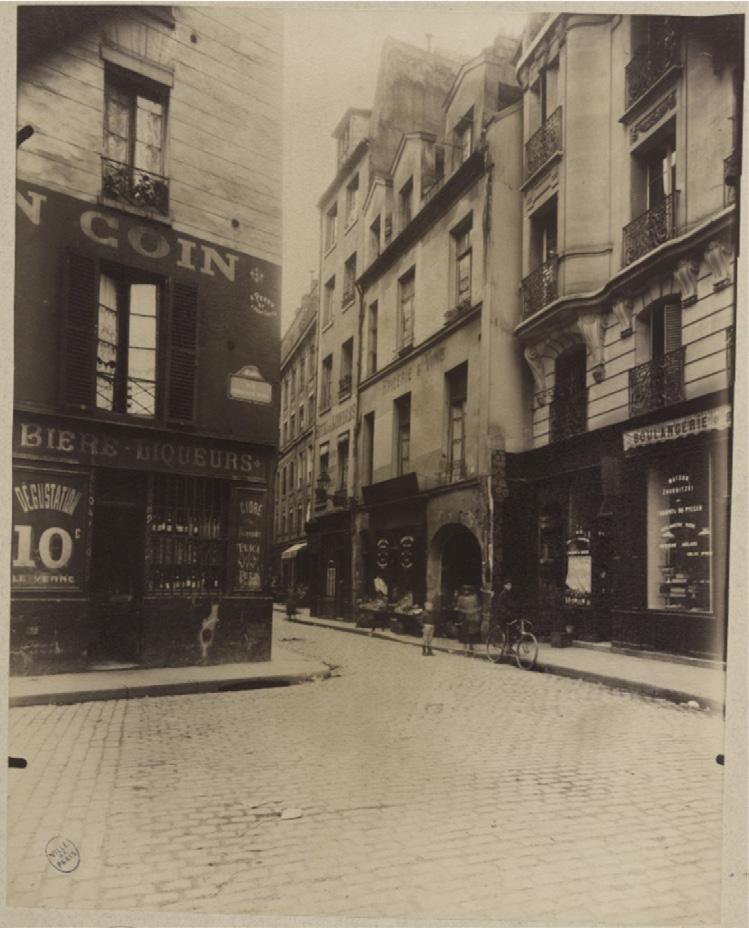
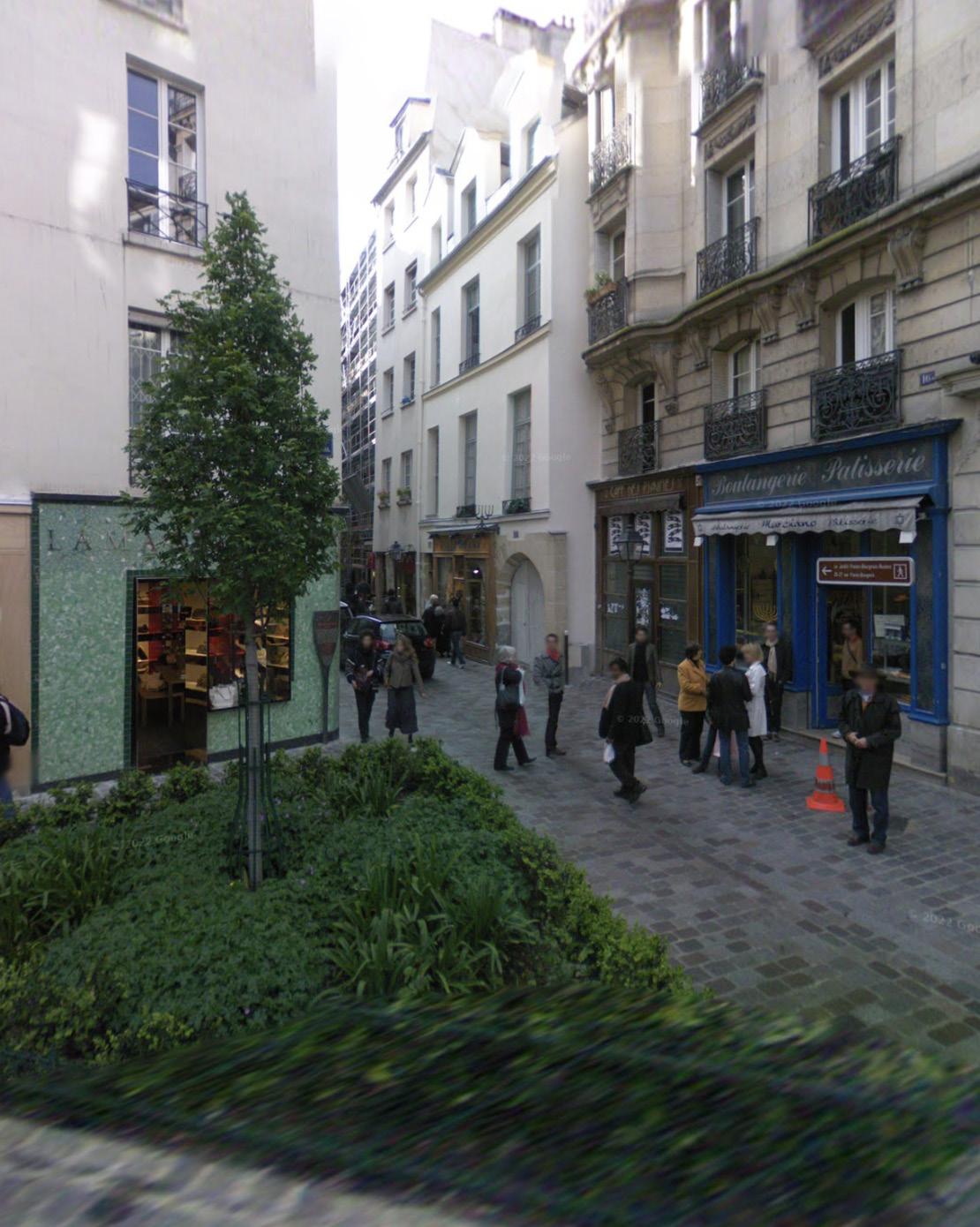
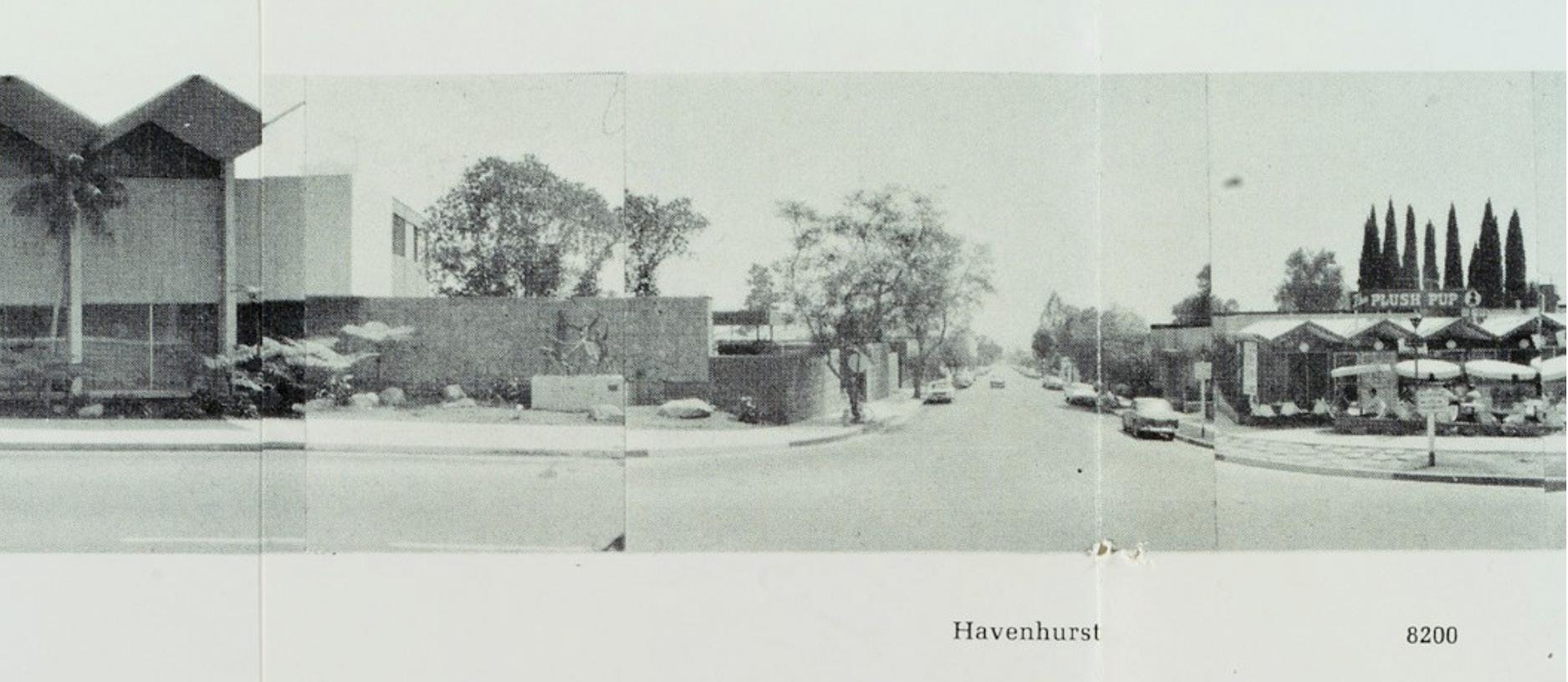
Above Ed Ruscha, Every Building on the Sunset Strip, 1966, Walker Art Center, https://walkerart.org/collections/artworks/every-building-on-the-sunset-strip. © Edward Ruscha.
From post-disaster marine environments to cybernetic habitats and thermodynamic walls, these projects explore the role of architecture in mediating complex human and nonhuman systems. Ecologies are approached here as natural, technological, and hybrid networks, operating across planetary, urban, and domestic scales.
68 Testing the Waters: On Situated Ecologies and Sensing Radiological Architectures
Issy MacGregor
74 Architecture of Digital Waste: Hidden networks, materialities, and myths of data destruction
Qing Tang
80 Eco-Recursivity: Cybernetic Thinking in Eco-Machines of the New Alchemy Institute (1969-1991) Ertuğ Erpek
86 Living with the Beast: The Impact of Trombe Wall Technology on Residential Life
Steven Schultz

Issy MacGregor


This thesis examines the infrastructure of Fukushima Daiichi’s Marine Organisms Rearing Test as an environmental architectural history. It reads the plastic laboratory container — the “bucket” — from the standpoint of an Other-than-human participant, Hirame (Paralichthys olivaceus, the Olive Flounder). The bucket, its lighting and optics, and the 24/7 YouTube livestream are treated as a single architectural system that organises what can be sensed, recorded, and believed.
On 11th March 2011, a magnitude 9.0 earthquake off the northeastern coast of Japan triggered a tsunami that breached the ten-metre seawall of the Fukushima Daiichi Nuclear Power Plant, severing external power and disabling on-site backup. The resulting loss of power precipitated core meltdowns in Units 1-3, leading to hydrogen explosions that critically damaged the reactor buildings. Since 2013, contaminated wastewater has been processed through the Advanced Liquid Processing System (ALPS), which removes most isotopes bar tritium; more than a million tonnes of treated water are stored on site, awaiting gradual discharge into the Pacific Ocean, with bioassays — centrally, Hirame — substantiating safety claims.1 Under this regime, the fish becomes a living archive
1 International Atomic Energy Agency, ‘IAEA Director General Statement on Discharge of Fukushima Daiichi ALPS Treated Water’ (2023), <https://www.iaea.org/newscenter/pressreleases/iaea-director-generalstatement-on-discharge-of-fukushima-daiichi-alps-treated-water-0> [accessed 24/08/2025].
of exposure, its tissues both repository and proof of environmental safety.
This project takes Hirame in her bucket as its point of departure, rejecting her position as an inert instrument of measurement, and instead framing her as an epistemic collaborator embedded within a highly controlled architectural and infrastructural milieu. The ALPS bucket is an epistemic device and an architectural environment designed to produce legible knowledge; it also structures a multispecies encounter that is asymmetrical, coercive, and saturated with political significance. Approaching the apparatus as a historical architectural site means tracing the spatial and material conditions through which environmental knowledge is made, and how the bucket, the laboratory, and Hirame’s own body participate in the production of scientific “truth”.
In the folkloric tradition of early-modern Japan, seismic disturbance is attributed to the Namazu — a giant catfish pinned by the Kaname-ishi, the “pivot stone” of terrestrial stability.2 The Kaname-ishi is, in effect, the original bucket; a containment apparatus calibrated not only to suppress an Other-than-human agent’s disruptive potential, but also to sustain a cosmopolitical relation with it. The contemporary testing bucket inherits this dual function. It is both a site of physical holding and an epistemic architecture, translating disturbance into legible signs for governance — a more-than-material containment.
Unlike the Kaname-ishi, the bucket is modular; off-the-shelf Sanko Jambox 1000s (blue for control water, yellow for ALPS-treated wastewater) chosen for transportability, durable polyethylene, and compatibility with filtration, aeration, and
2 Cornelius Ouwehand, Namazu-e and Their Themes: An Interpretative Approach to Some Aspects of Japanese Folk Religion (Leiden: E.J. Brill, 1964), p. 6.
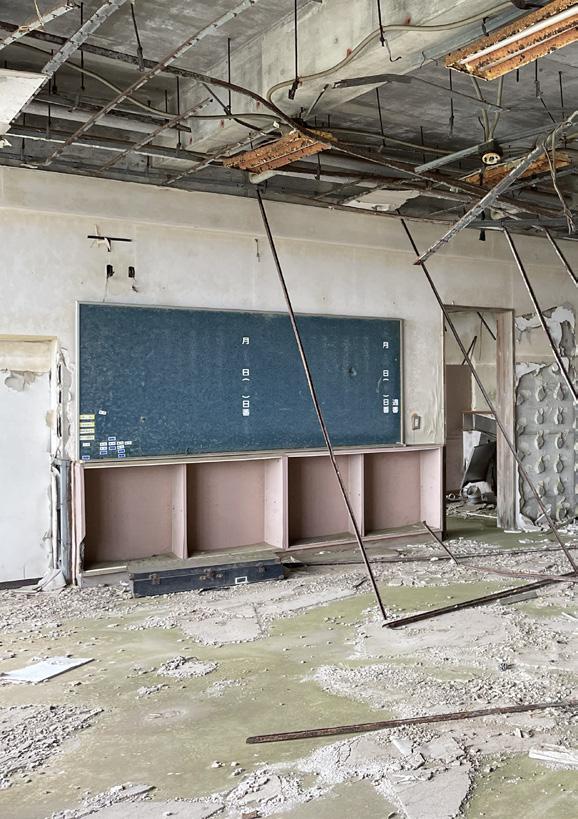

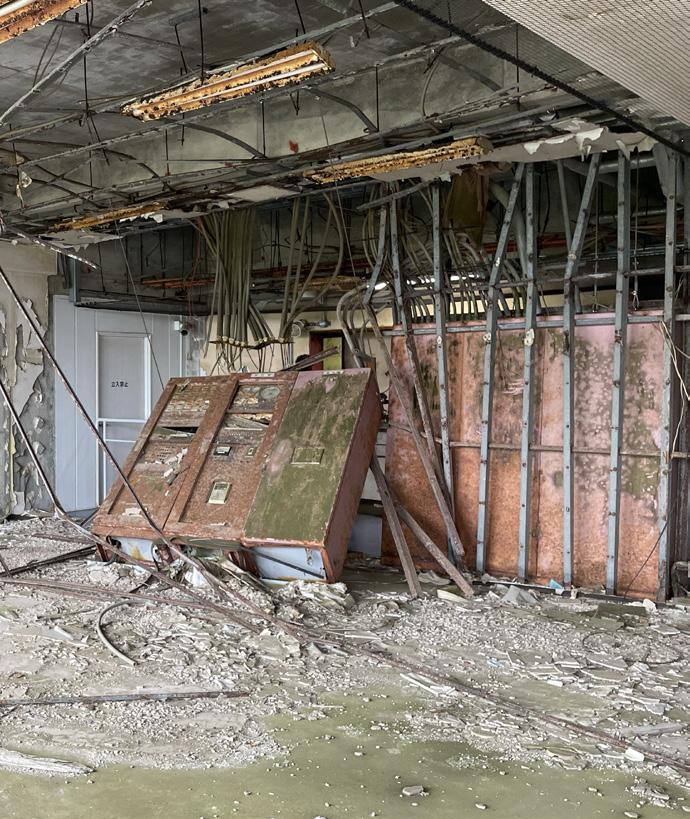
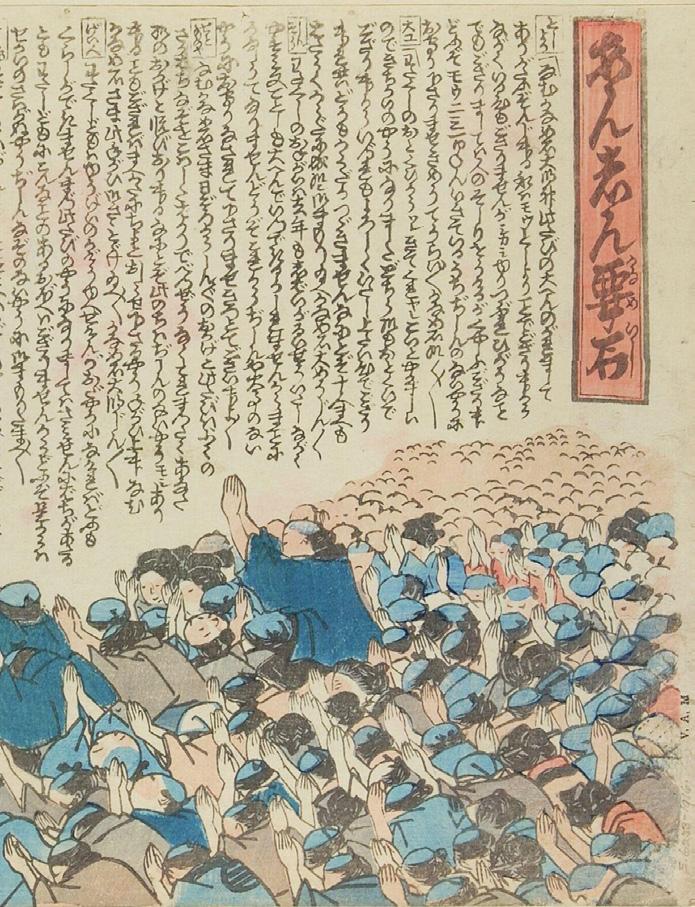
monitoring hardware. Its geometry limits unplanned ecological variation, and supports the demand for environmental constancy. This bucket logic extends into media via a 24/7 YouTube livestream. The result is a volumetric Panopticon — a ring of sensors that collapses unmonitored space. The observing eye is no longer a single inspector; it is a machinic network that records, transmits, and archives. In this sense, the bucket produces a tele-Panopticon — surveillance is intensified and deterritorialised.
Therefore, in its material, spatial, and media dimensions, bucket logic is an architecture of coercive legibility. It pins Hirame in place — much like the Kaname-ishi — disciplines her body through environmental control, and renders her visible through an integrated camera apparatus. Yet, in doing so, it exposes its own fragility. Metabolism, behaviour, and mortality are never entirely predictable. These deviations are architectural events — moments where the bucket-camera system fails to produce the seamless legibility it promises. Thus, bucket logic is a spatial-material methodology of environmental governance in which a contained Other-thanhuman body is enlisted to produce legible knowledge about conditions beyond the enclosure. Physically, it isolates, stabilises, and disciplines; epistemically, it translates environmental complexity into standardised, communicable metrics through the intermediary of a living proxy.
Bottom Anshin
Kaname-ishi (あんしん要 石, ‘Kaname-ishi: Sense of Security’), Artist Unknown, c. 1855. Woodblock print, 34.9x26.0cm.
Sensing otherwise begins where the translation of a life into metrics is neither seamless nor complete. Read from Hirame outwards, the bucket is not a neutral pseudo-seabed, but a strange and uncanny world; channels of sensation (lateral-line, benthic vision, chemoreception) are remapped by the apparatus in ways that stabilise the human view and potentially destabilise orientation for Hirame. The task is to specify how architecture might hold those worlds open; to treat the Other-than-human as a co-
constitutive participant whose differences must be maintained rather than engineered out.
A design for sensing otherwise composes a public capable of enduring opacity, accommodating partial connection, and recognising refusal as information — interfaces that withhold closure by design and make that withholding legible as a civic condition.
A process of becoming radiant names an ethic and method of co-exposure, partial opacity, and shared sensing within altered and strange ecologies. It substitutes purity with co-exposure, transparency with attunement, and consensus with negotiated encounter. Architecturally, that means apparatuses that hold contradiction in suspension by design, enough control to meet obligations of safety, and enough openness to sustain Other worlds. Ultimately, this project reads a bucket to read a politics, asking how testing architectures become stand-ins for entire ecosystems, how fish become diplomats, how images perform regulatory work — and how this bucket logic might be turned outwards toward a breathable, equivocal ground on which an Other-than-human politics proceeds as the choreography of interspecies meetings that do not end.
Left Radiation monitoring outside Daiichi NPP Reactor Building 1, August 2024. The reading is 54.3ìSv/h - the average reading in Tokyo (Shinjuku ward) is 0.035μSv/h. Image by the author.
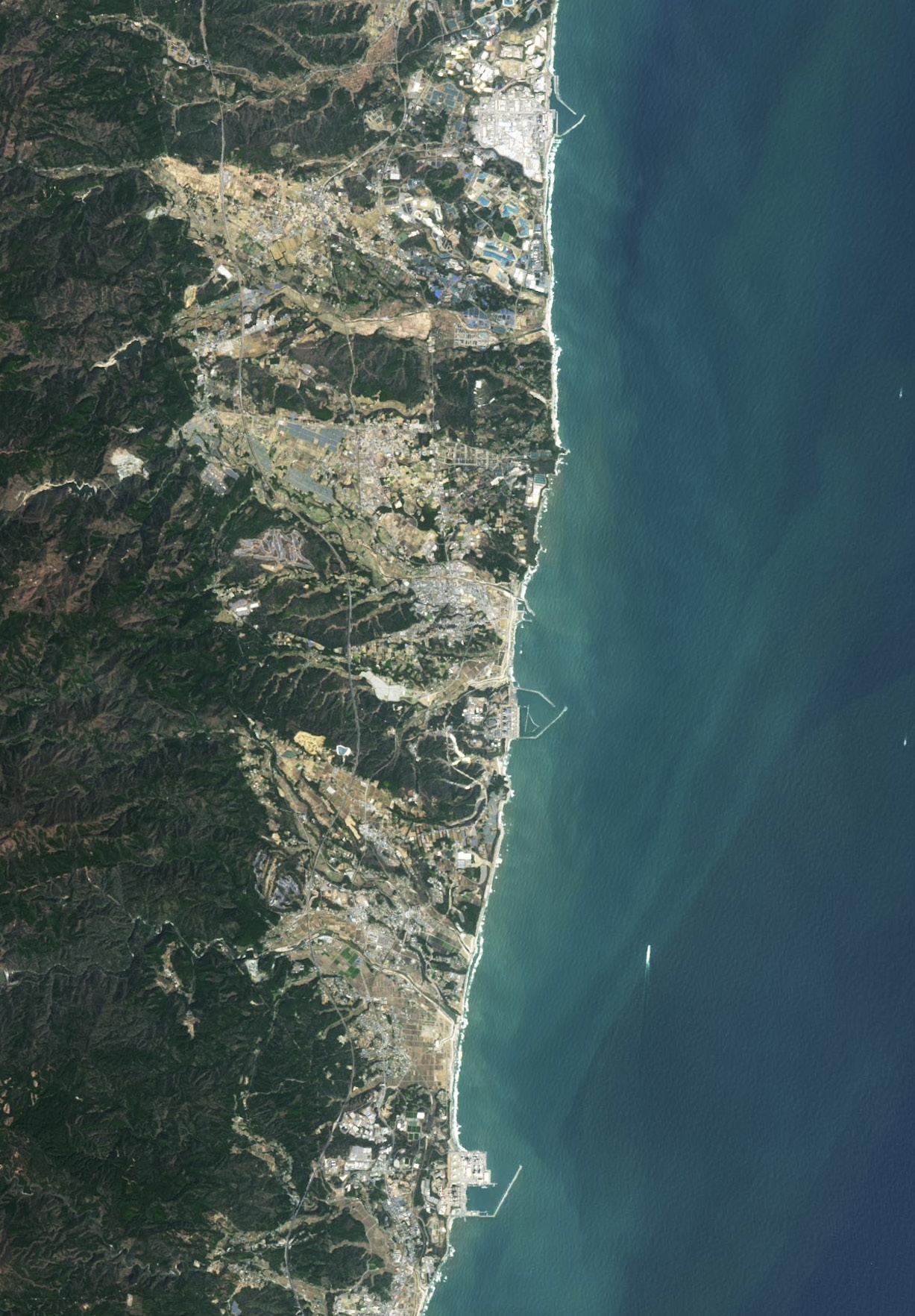

Qing Tang

On the evening of 21st May 1956, the London Fire Brigade received a call at 21:45. The duty barman at the Goodge Street Deep Shelter on Tottenham Court Road witnessed smoke coming from the mess room through its door, slightly ajar, and entered to see the partition next to the spiral staircase in flames. Two soldiers attacked the fire with a bucket of water and a fire extinguisher respectively — the building was promptly evacuated, with most personnel leaving through the normal entrance, and ‘a few by the way of the Chenies Street emergency exit’1. In 2025, the traces of its previous military purpose — in terms of shelter, protection, and anxiety — are almost illegible in the built form, but a more observant passer-by would notice that a data management company named Iron Mountain has appropriated this for storage of securitised data. Upon closer examination, there surfaces a curious idea that the need to preserve the existence of (im)material data has superseded the need to preserve human life.
This thesis observes processes of wasting, material and immaterial, housed in digital waste architectures. The narratives and subjectivities of data, data architectures, and digital waste architectures, are examined as three case studies. These three digital waste architectures, retrofitted to house, store, and destroy data, are as follows: the Eisenhower Centre,
1 London County Council, ‘Fire at Goodge Street Deep Shelter’, p. 2, 30 May 1956, The London Archives, LCC/FB/GEN/02/122.
an emergency exit to a WWII bunker known as the Goodge Street Deep Shelter; the UCL data centre in Torrington Place; and a third, immaterial site of fragments collected from the Internet.
Through these, I hypothesise that the built environment is organised invisibly to house the storage and destruction of data. This comes embedded with the more explicit and visible understandings that these architectures proliferate with their built forms. Architecture is concrete, material, and explicitly grounded in material reality, but it is also a vessel in which immaterial processes are organised, contained, and distributed. The relationship between these heavily armoured sites and the contrasting immateriality of data — in the form of discrete, quantifiable bits and bytes of information, as well as other digital material such as the web, software, the cloud, and so on — beckons a deeper examination in the material and immaterial implications and consequences of these variable states of reality.
On processes of destruction and wasting of data, human, and architecture that occur in these sites: I contextualise these within a wider framework of activities that take place and form these digital waste architectures by describing the mixing and entanglements of digital and human properties that occur within and around these architectures. In this thesis, I hypothesise that we are able to insert subjectivities into objects commonly perceived as objective: architectural components and data, and the entanglements between text, image, word, place, body, and various other materials that document these processes.
The three sites tell the invisible story of the anxieties that surround information, communication; data as an ‘immaterial’ object to be securitised to extreme, existential extents; and the ‘vulnerable
Stock imagery is often used to illustrate data destruction companies’ services, mostly in the form of Google Maps listings. The original caption is as follows: Computers and televisions for recycling, Wandsworth, London, 2020, https://unsplash.com/photos/ white-and-black-computertower-Z7pQAI0KLBg.
Photograph by John Cameron.
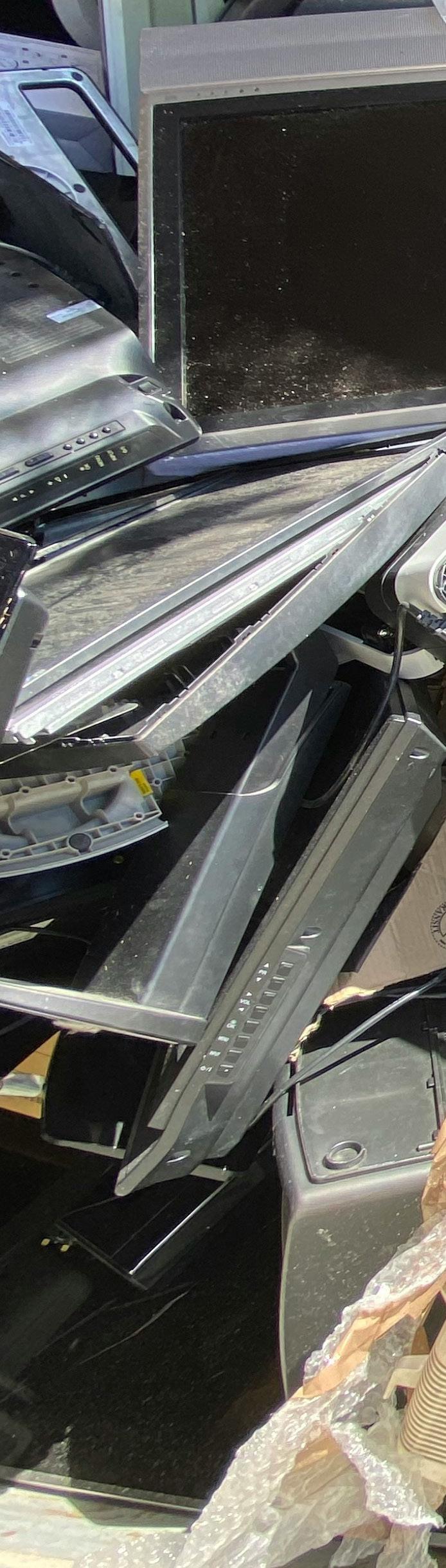
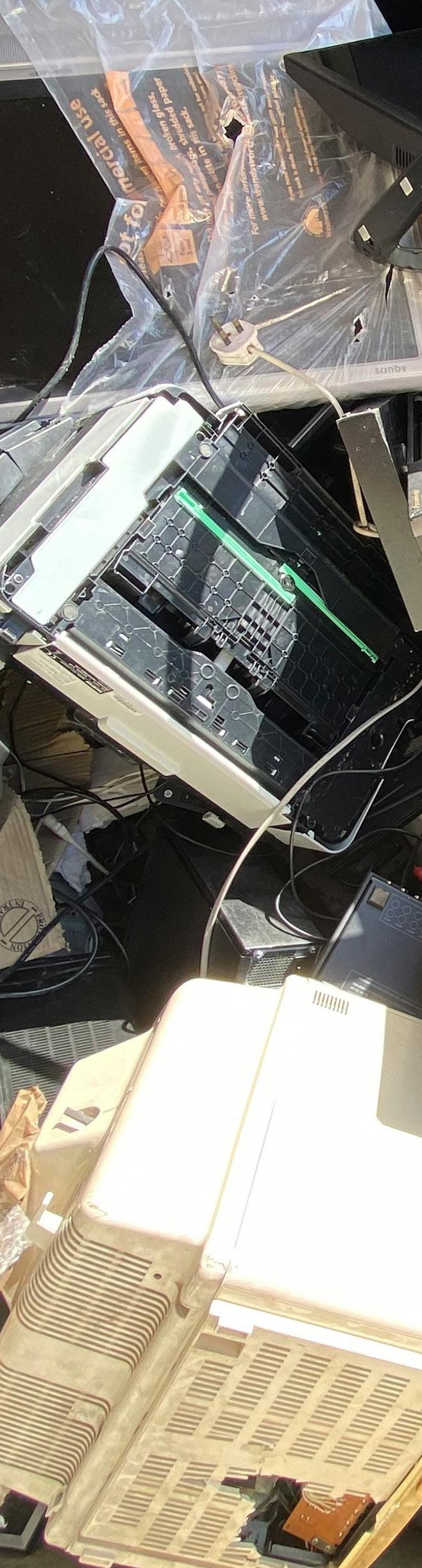
materiality’2 of these entities that house data, in the form of server farms, hard drives, and even physical documents. The constant threat of existential insecurity that has been carried forward from as early as WWII, through to the Cold War, and till today, has informed this constant anxiety that surround computing and data imaginaries in today’s terms.
Here, in this short explanatory piece, I offer a condensed fragment of these digital waste narratives that come entangled with these architectures. The historical material I scrutinise represents physical and digital, material and immaterial architectural objects and subjects, and I aim to highlight their special relationship with waste. In the full thesis I complicate these objects and subjects by documenting their processes of waste and wasting – in the form of retrofit, destruction, displacement, and disposal – rather than a more familiar logic of construction or production. These four ‘typologies’ are situated within the wider framework of subjectivities surrounding digital waste architectures, and as descriptors of the flows of data and waste data. I will now provide a short, perhaps a bit too limited, summary of one of the complications I offer in the thesis.
The fragility and vulnerability of the material reality of both human shelter and data shelter are both rooted in anxiety — for wartime purposes, the anxiety of loss of life; and for data storage purposes, loss of data. There is the overarching sense of threat towards the materiality of both human and data. The fear of data loss is compounded onto the bunker’s wartime use as shelter for humans, in which the architectural
2 A.R.E. Taylor, ‘Future-proof: Bunkered Data Centres and the Selling of Ultra-secure Cloud Storage’, Journal of the Royal Anthropological Institute, 27.S1 (2021), pp. 76–94 (p. 77), doi:10.1111/1467-9655.13481.
elements like thick, concrete walls, ultra deep-level structures to sealed from surface-level worries like ‘terrorists, nukes, floods’3, transforms the hermetic seal from outside from human-centric to data-centric.
Anxieties surround the human, as life and its preservation; anxieties surround data as ‘personal doomsdays’4 such as data leaks, data loss, and any sort of deviation from its purpose as discrete, quantifiable, and reliable mode of the machinic transmission of information. These anxieties surround destruction and the potential of destruction. Something as ‘objective’ as these bits and bytes — as we know, carry on their embedded inequities in the form of datasets constructed in unethical ways, but also, enforce a strange variable state where the reliability of standardised units of existence are at odds with its fragile materiality in the hard drives and server farms that require ‘bunkering up’ and extreme securitisation.
This forms one nice, convenient, profit-driven reason to render the data — and its potential destruction — visible and material, where anxieties of personal doomsdays are capitalised to sell more data storage, and where the data will outlive the human that stored it there in the first place by virtue of its material solidity, and its (purported) eternality in unbreachability. This is one of the variable states of reality of this data destruction, and its potentialities of being destroyed, that is at odds with the unexamined imaginary of data-as-immaterial. ∎
3 Taylor, ‘Future-proof,’ p. 85.
4 Ibid.
Scanned sketch over an Ordinance Survey plan of the Bloomsbury site referred to in the dissertation, working out the relationship between the two physical sites. Image by the author.
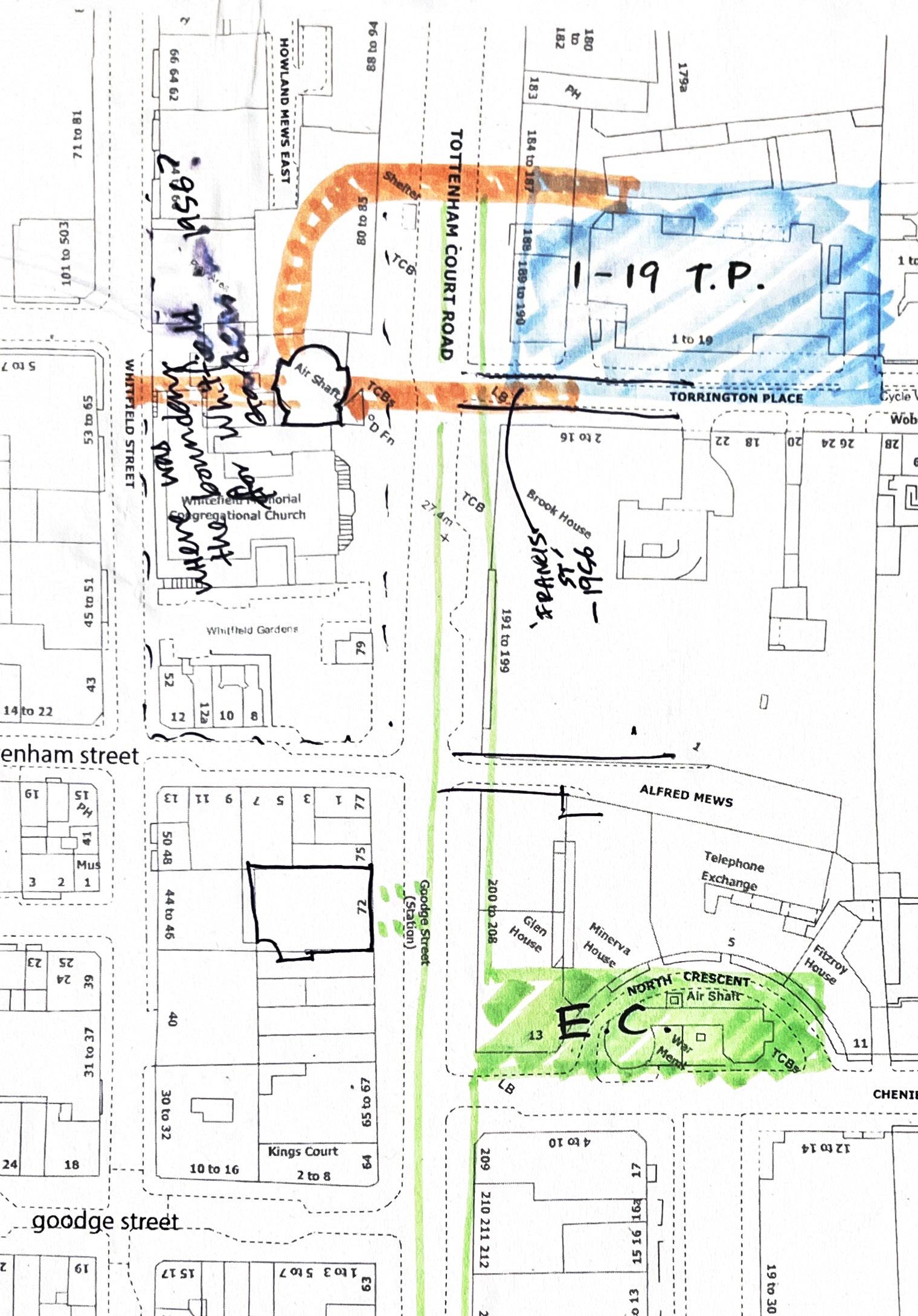

Eco-Recursivity: Cybernetic Thinking in Eco-Machines of the New Alchemy Institute (1969–1991)
Ertuğ Erpek
In the 1960s and 70s, concerns about Earth’s finite resources, limited growth capacity, and environmental degradation culminated in a series of protests, publications, and initiatives. In 1962, Rachel Carson published her seminal book, Silent Spring, which highlighted how the lack of consideration for natural processes, in her case, the misuse of biocides and pesticides, caused ecological catastrophes by damaging flora and fauna, thereby harming the environmental balance between a diverse set of species.1 Spearheaded by her work, environmentalism gained traction during that period, raising issues about resources, degradation, and ecological crisis, which led to countercultural movements such as the Student Movements in May 1968, originating in Paris. Paul Ehrlich’s book, The Population Bomb, 1968, and The Club of Rome’s book, The Limits to Growth, 1972, further highlighted the ecological problems caused by industrial society and how we could engage with them.2 These initiatives strongly criticised capitalism and consumerism. Architectural historian Steven Mannell portrays that ‘environmentalism emerged from the counterculture,’ which he defines as ‘the protest movements resisting the Cold War nuclear arms race, the Vietnam War draft, and the development of nuclear power, as well as the idealism of the civil rights movement and the youth movements of the 1960s.’3 From thereon, events follow one another: 1970, the first year Earth Day was celebrated; 1972, the United Nations organised
the first major conference on the environment in Stockholm, and 1973, the OPEC oil crisis broke out due to the Arab-Israeli Wars, showing how living systems drive their energy from finite and non-renewable fossil fuels. These findings demonstrated that alternative living modes were necessary to protect the planet from environmental degradation and to ensure sustainable energy systems for a reliable future.
Within this context, architects and landscape designers turned their attention to space ecology to explore alternative modes of living in response to the ecological crisis. As architectural historian Peder Anker illustrated, these events, such as the Arab oil embargo, had global effects, which affected not only specific regions but also their political, economic, cultural, and environmental constellations.4 A new way of thinking emerged, in which the Earth was seen as a closed cybernetic system constructed with interconnected ecosystems, much like NASA’s spaceships for astronauts. Being selfsufficient by emulating natural processes and therefore not demanding exploitation of nature, spaceships became ideal structures for architects and ecological designers during the ‘rise of environmentalism.’5 Architects and ecological designers synthetically emulated nature, trapping it in a jar, as Hans Rucker-Co’s A Piece of Nature strikingly illustrated, creating a closed system looping back onto itself, with the mission of rescuing the world from environmental crisis by fabricating an ideal microcosmos. Autonomous, self-organised, and selfregulated constructs emerged from the disciplines of cybernetics and ecology, aiming to rewrite the existing design understanding in the language of nature, with a strong belief in the power of technology. Technology was seen as the saviour that ‘could alter social structures and human relationships with the environment,’ as researcher Henry Trim portrayed with the example of the New Alchemy Institute.6
These experiments with integrated and technologically driven living systems, under the banner of ‘ecological design,’ were not without contradictions. Anker implies that this novel ‘design programme was at the expense of a wider aesthetic and social understanding of the human condition.’7 In line, architectural researcher Lydia Kallipoliti propounds that
ecological design is derived from a ‘new modernist ethos,’ replacing the concept of ‘function’ with ‘environmental performance.’8 As briefly mentioned, cybernetics emerged as a key discipline for capturing ecological complexity during this period. These projects, inspired by ecologist Howard T. Odum’s diagrammatic abstraction, employed a shared representational cybernetic language for managing ecological, biological and social systems (Fig. 2).9 Anker notes, ‘Odum’s methodological reductionism of all biological life (including human behaviour) to charts of energy circuits became the justification for his proposals for scientific management of human society.’10
According to Kallipoliti and Anker, in a way, capitalist, consumerist and neoliberalist strategies changed shape and were latently embedded within the corpus of ecological design. By recreating nature, ecological designers created a relational system that is efficient, productive, and manipulable. Philosopher Erich Hörl underscores that this highlights the processes of ‘ecologisation’ and ‘cyberneticisation’ of nature, where the ‘modes of existence, faculties, and forms of life in terms of relations’ were reconceptualised, forming a new power dynamics. To this day, this remains an inherent dilemma within closed worlds of ecological design.11
This dissertation explores the New Alchemy Institute’s (NAI) work from 1969 to 1991, scrutinising their synthetically built closed natural worlds through the lens of cybernetics and ecological design. It will focus on the architectural outputs of the Institute, namely arks and bioshelters, to explore their sustainable, environmentally performative, and self-regulating systems. Solely identifying their work as ‘back-to-the-land countercultural utopianism,’ as architectural historian Daniel A. Barber criticises, caused their lack of visibility in architectural history and theory, and environmental history. However, they oscillated between the natural and artificial in a dialogue to predict a mutual design approach, rather than championing one another, despite being named by architectural historian Lydia Kallipoliti and others as a typical example of mimicking nature to create a new mode of living. While seeking efficiency in terms of food production, energy gain, and economic sustainability, they never undermined social and cultural context; yet, their
architectural proposals lacked this context, despite their attention to the issues and criticisms posed in similar projects.
Their work challenged conventional ecological design and its problematic relationship to cybernetics elsewhere, drawing inspiration from philosophies of Margaret Mead, Ernst Schumacher, and Gregory Bateson. They used cybernetics not to control but to understand and resonate with nature. However, despite their work stemming from Bateson’s theoretical framework, their projects were unable to transform these theoretical ideas into reality. Therefore, by adopting Bateson’s second-order cybernetic framework, this study reveals the limits, implications, and potential of NAI’s arks. Drawing on interdisciplinary fields of ecological design, cybernetics, and architectural history, this study will explore how ecosystems in the arks and bioshelters are constructed through the relationships among their components, and it will critically engage with these relationalities to engage with NAI’s work and explore the reasons why it was considerably overlooked within histories and theories of ecological design, cybernetics, and architectural history.
1. Rachel Carson, Silent Spring (Houghton Mifflin Company, 1962).
2. From a dystopian perspective, Paul Ehrlich pointed out that our planet is dying because there are “too many people” and “too little food.” He calls for action and proposes strategies to water down these issues. The ubiquitous concerns of the era, such as protecting the environment, alternative ways of living, and food production, are present in his account. See: Paul Ehrlich, The Population Bomb (Ballantine Books, 1968). Founded in 1968, The Club of Rome is an interdisciplinary and non-profit organisation, aiming to address pressing environmental, social, and political issues. In 1972, they built a computer model called World3 and input real-life data on the world’s growth at its current exploitation pace. If nothing changes, the model predicts that the world will be unable to accommodate its population with its current resources, leading to an ecological collapse. See: The Club of Rome, The Limits to Growth (A Potomac Associates Books, 1972).
3. Steven Mannell, Living Lightly on the Earth: Building an Ark for the Prince Edward Island, 1974-76 (Dalhousie Architectural Press, 2018), p. 31.
4. Peder Anker, “The Closed World of Ecological Architecture,” The Journal of Architecture 10, no. 5 (2005): p. 531, https://doi.org/10.1080/13602360500463230.
5. See for the comprehensive account of the rise of environmentalism in architecture: Carson Chan, ed. Emerging Ecologies: Architecture and the Rise of Environmentalism (MoMA, 2023).
6. Henry Trim, “An Ark for the Future: Science, Technology, and the Canadian Back-to-the-Land Movement of the 1970s,” in Canadian Countercultues and The Environment, ed. Colin M. Coates (University of Calgary Press, 2016), p. 157.
7. Anker, “The Closed Worlds of Ecological Architecture,” p. 527.
8. Lydia Kallipoliti, Histories of Ecological Design: An Unfinished Cyclopedia (Actar, 2024), p. 110.
9. Odum leveraged the potential of cybernetic diagrams in controlling various systems and energy flow among them in his book, Environment, Power and Society. See: Howard T. Odum, Environment, Power and Society (Wiley-Interscience, 1971).
10. Anker, “The Closed Worlds of Ecological Architecture,” p. 531.
11 Erich Hörl, and James Burton, ed. General Ecology: The New Ecological Paradigm (Bloomsbury Academic, 2017), p. 10.

Steven Schultz
Technology Impacts Architecture Impacts Living: Trombe’s Wall
Breakthrough technology is disruptive and can have a meaningful impact on one’s life. For instance, the electric car to transportation, or the Apple Watch that goes beyond mere time-telling. Yet it is uncommon for home design to be as impactful. Breakthrough technology is often a result of scientists creating solutions for problems that do not exist in everyday life. This was the case when Felix Trombe developed a solar mass for use in a home in the 1960s, but then never tested it in an actual homelife scenario. The technology was an elegant solution to a nonexistent problem: the scarcity of fossil fuel. It was shelved until the oil crisis arose in 1973.
On the heels of the oil crisis, a fringe following gathered behind Trombe’s science and a solar revolution became prophecy. Disciples evangelized that passive solar technology was going to change how people lived and how the planet could be saved. While active solar (photovoltaic — smart technology) was not yet viable, passive solar (mass — dumb solar) could be deployed immediately. Suddenly, and
although having never been deployed commercially, architects, scientists, and historians believed Trombe’s wall was an antidote for the energy inefficiencies of a 1970s modern home.
Douglas Kelbaugh, a young and evolving architect, learned of the Trombe wall from one of the solar community’s many journals. Convinced of Trombe’s prescience, Kelbaugh designed a house for his family that fit itself around Trombe’s wall and which he believed would have a positive environmental impact. The Trombe wall met its design objective: maximized solar gain. Measured based on savings of fuel, Kelbaugh’s wall generated heating cost savings of 76% in 1975 and 84% in 1976.1 However, this experiment would transcend his family as well as subsequent ones who would live in this home, and have a greater impact on lifestyle than on its ecological footprint. Trombe’s technologydriven passive solar architecture was not perfected.
Well documented over the past fifty years, nearly all publications have discussed the science behind the Kelbaugh House’s Trombe wall. Some even describe its beauty, yet none have so far documented what it meant to live with the wall, how occupants, including the Kelbaugh’s, needed to modify everyday living habits to inhabit the house. What became evident to the Kelbaugh family and subsequent owners was that you lived with the Trombe wall, rather than the other way round. The objective of this dissertation was not to discuss the wall’s science, but to illustrate what this entailed.
While much attention was paid to using a mass to store and convert energy to heat, little was paid to what living with this science required. Kelbaugh believed this was a problem not of architectural design. According to Kelbaugh, ‘…concern in planning his home was not…the solar-heating system, but…good old-fashioned architectural problems, e.g., how to design a house that functions well as living quarters and looks attractive. I’m an architect first and a solar engineer second.’2
1 J. C. McVeigh, Sun Power: An Introduction to the Applications of Solar Energy, 2nd edn (Oxford: Pergamon Press, 1983), p. 121.
2 ‘Sun to Heat a Princeton Home,’ New York Times, 16 November 1975, p. 97.
In that regard he succeeded; the aesthetics of Kelbaugh’s house and not its science is what convinced all owners to purchase it. Subsequently, they had to change the way they lived in order to live with Trombe’s revolutionary technology.
Few instances of willing home lifestyle changes were identified during this research. What was unsurprisingly reconfirmed, however, was that homes need to provide refuge, a place where occupants turn to feel calm and safe. Home as a place to focus on family. All occupants felt burdened to ‘fix’ the discomfort which came at the cost of family time. By this measure, the Kelbaugh House failed. As some owners — like me — became obsessed, others moved on.
An owner of a house like the one designed by Kelbaugh could only find solace by having a willingness to embrace change, tolerate risk, be curious, be handy, and have a desire to be different. Even so, not even the willing always succeed — not even the original architect, Doug Kelbaugh. None of the Kelbaugh House’s owners anticipated how untested technology would change their lives as they became part of the experiment. Still, when asked, they all said they were proud to have been part of this.
In choosing the topic of living within a prototype home, I knew that an abundance of published technical data existed. I did not anticipate the absence of experiential data. Since my objective was to understand the subjective impact of Trombe wall technology on lifestyle, data had to be compiled. The research challenge was to find data that would not only be anecdotal, but could be substantiated. In the case of this document, stakeholder interviews did more than fill research gaps — they became the backbone of the narrative. Speaking with owners, trades people, and colleagues of Kelbaugh, it was remarkable how the tales fit seamlessly together. The Canadian Center for Architecture’s (CCA) Kelbaugh archive provided invaluable design data that helped frame the research. Most importantly though, was my intimate understanding of the structure. These collective experiences provided a visibility of the soft side of Trombe wall technology and its impact on residential living not found in traditional binary data.
Regardless of efficiency, had Trombe’s system been easy to live with, there would have been more Trombe wall houses built. But then time and technology moved on, disrupting previous technologies. More technical, expensive, elegant, and invisible than Trombe’s system, photovoltaic solar panels have become a desired feature of the conventional home. This technology works while being compatible with lifestyles. And because of this, Trombe’s wall will likely never be found in any new house in the future.
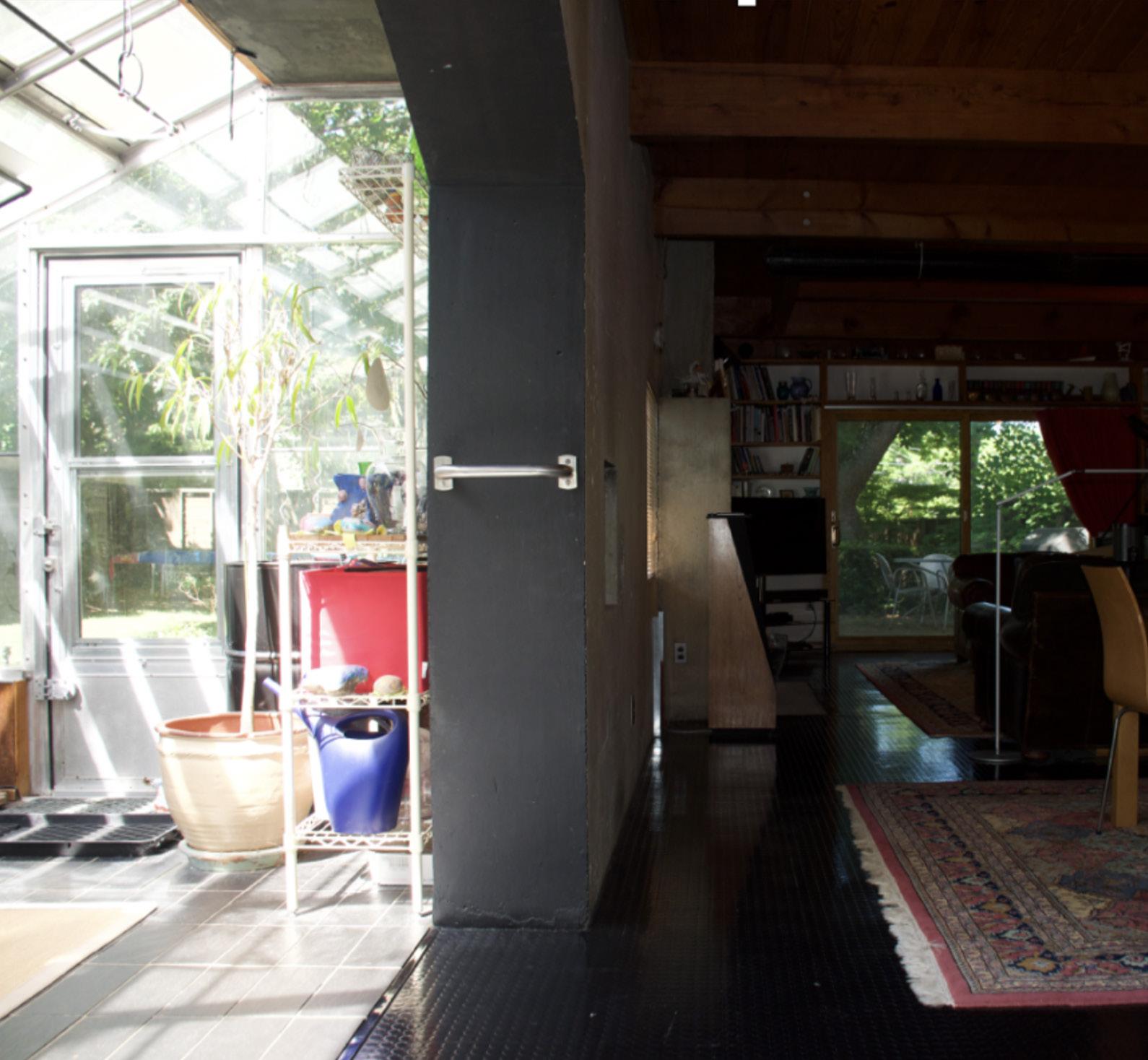
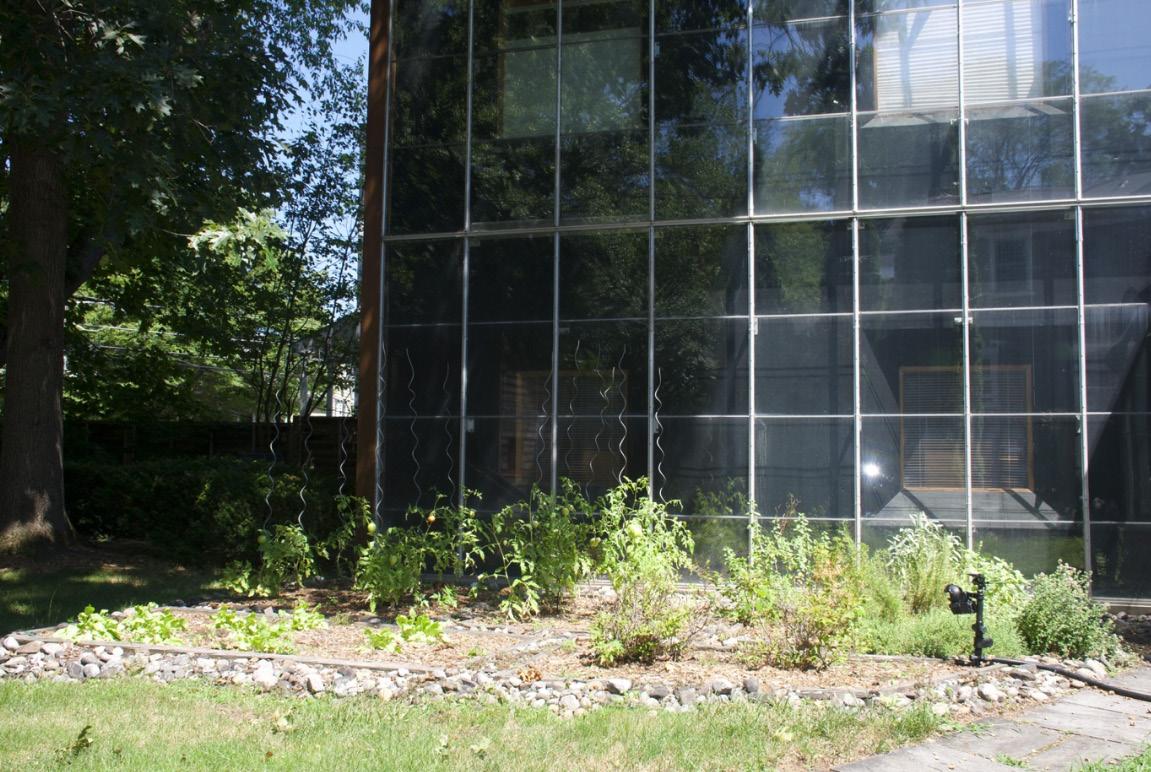
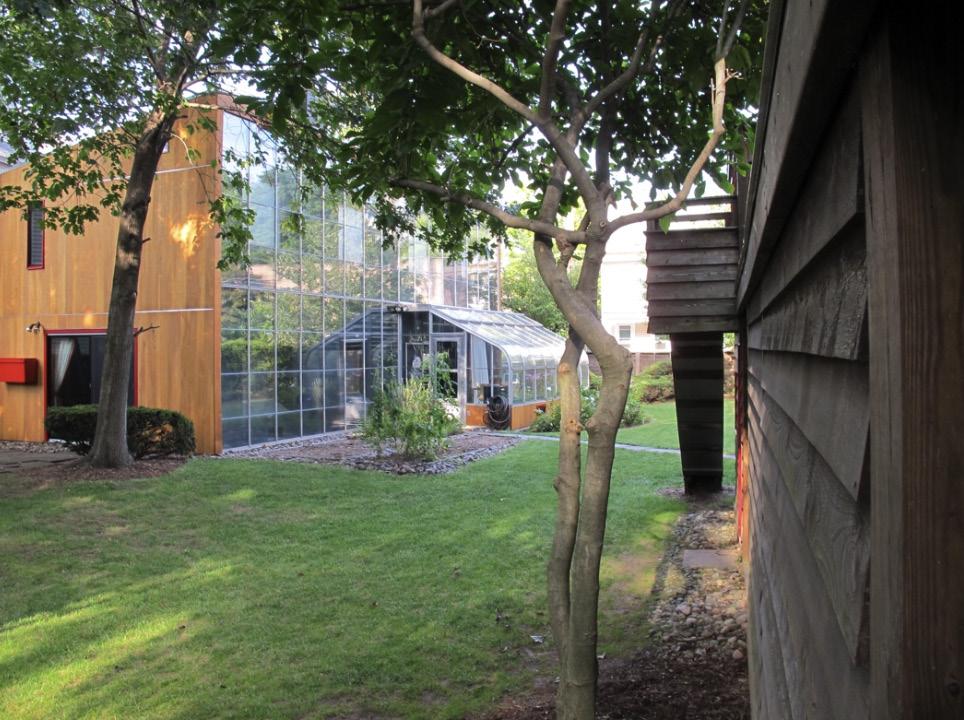
Urban landscapes are shaped by multiple, overlapping temporalities - from historical infrastructures to speculative futures. This session examines how cities are narrated, reimagined, and transformed through cycles of decay, renewal, and visionary intervention.
94 When the Cathedrals were Painted: Decorative Mural Polychromy in the French Gothic Revival, 1840–1870
Audrey Zhang
100 Networks of Time: Pneumatic clocks, standardised time, and underground infrastructure as expressions of modernity in 19th century Paris
Eleanor Moselle
106 Urban Water Imaginaries: London and its Connection to Waterlogged Realities and the Built Environment
Jazmine Simmons
110 The Spectacle of Decay: Ruin, Representation, and Renewal at St-Mary-le-Port, 1940–2025
Kitty Alexander
116
Crossing Boundaries: Subverting the Catwalk through Maison Martin Margiela (1988–1998)
Lora Lolev

Audrey Zhang


In 1869, the architect-painter AlexandreDominique Denuelle (1818–79) was entrusted with the restoration of polychromy in the fifteenthcentury palace of Jacques Coeur in Bourges.1 The fabled merchant’s abode was originally awash with colour in its interior spaces, which has faded with time, leaving only bare stone. Denuelle dutifully restored the interiors of two rooms on the upper floor — the chapel (fig. 1) and the south gallery (fig. 2) — based on traces of the original painting which he had documented in the 1840s.2 These drawings are unfortunately no longer extant, but the rooms today are preserved in the state that Denuelle had left them, vibrant and dazzling in their gilded and polychrome false masonry and tapestries, covering the walls and ceilings in their totality. The contrast to the rest of the palace, where the exposed bare stones carried at most a hint of their medieval colours, is striking.
Being a historic monument open to the public, one would think that surely visitors and conservators alike must be intrigued by this display of nineteenthcentury artistic daring. I am disappointed to report that instead of curiosity and appreciation, visitors are encouraged to harbor nothing but scorn and contempt toward this seemingly harmless and, in all respects, obscure artistic practice. The Centre des Monuments Nationaux’s official guidebook by Jean-Yves Ribault,
1 Jean-Yves Ribault, Le palais Jacques-Coeur (Paris: Éditions du Patrimoine, 2011), p. 48. All French-to-English translations by Google Translate unless stated otherwise.
2 Arcisse de Caumont, ‘Peintures murales de la France,’ Annales Archéologiques (September 1845), pp. 195–196.
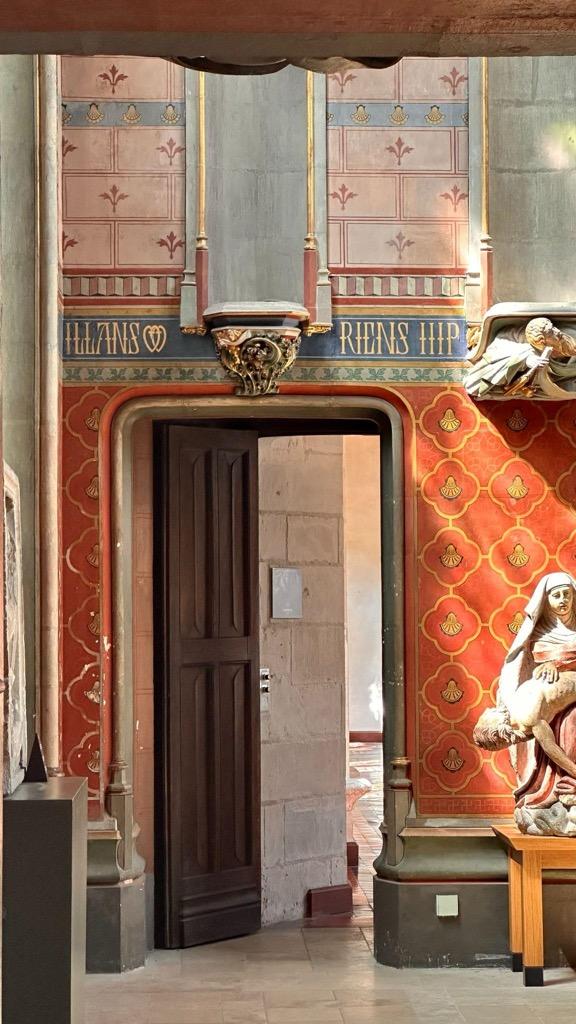
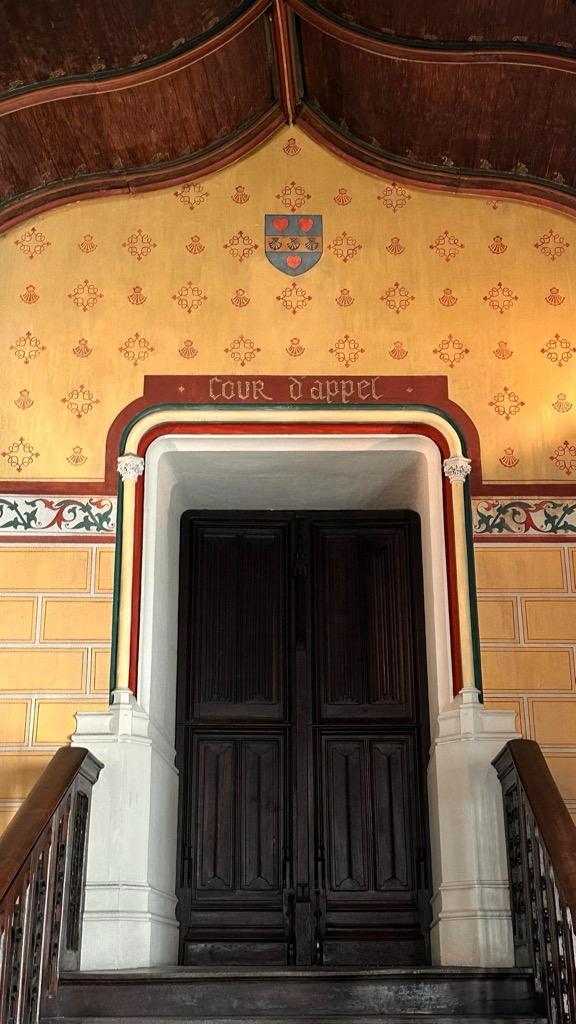
available for purchase in the gift shop, only has one sentence to say about Denuelle’s intervention, and it is that ‘his work was too forceful and slightly impaired the elegance of the angels set in the arches… .’3 If Denuelle had faithfully reproduced the original decorative scheme of the room, does that not mean Ribault objects to the appearance of the fifteenthcentury interior, rather than his restoration? No contextualization was given for this sudden interest in the restoration of decorative polychromy either. Who was Denuelle, and how come he was suddenly tasked with repainting this monument in 1869?
Image by the author.
Image by the author.
3 Ribault, Le palais Jacques Coeur, p. 48.
In his 2001 interdisciplinary study of the role of colour, David Batchelor argues that ‘colour has been the object of extreme prejudice in Western culture’, a prejudice which he termed ‘chromophobia’, i.e. fear of colour.4 This terminology establishes a link to other kinds of systemic phobias that uphold structural oppression and marginalization, to which the depreciation of colour has consistently been attached, and which in turn are strengthened by the revulsion to colour. He suggests a two-step process in which this is achieved: ‘in the first, colour is made out to be the property of some “foreign” body – usually the feminine, the oriental, the primitive, the infantile, the vulgar, the queer or the pathological. In the second, colour is relegated to the realm of the superficial, the supplementary, the inessential or the cosmetic. In one, colour is regarded as alien and therefore dangerous; in the other, it is perceived merely as a secondary quality of experience, and thus unworthy of serious consideration.’5 Take modernist hegemon Le Corbusier, for example. In his collection of essays When the Cathedrals Were White, to which my title is a response, he equated the clean whiteness of France’s first Gothic cathedrals with moral hygiene and racial superiority.6 Almost every remark regarding the chromaticity of medieval and ancient buildings made in his introduction is false: the cathedrals were not white, and his philosophical skyscraper was built on fictitious foundations. The negative perception of Denuelle’s restoration work, as well as its marginal status as an ‘unnecessary intervention’ seem pretty salient examples of chromophobia, inconvenient to the master narrative of whiteness.
Having been interested in the Gothic Revival movement for some time now, I started pondering the idea of writing a piece centering its decorative aspects — especially in relation to colour and painting — as a riposte to the chromophobic emphasis on structure and naked masonry as is too often the case in this corner of architectural history. Every piece of writing I’ve been able to locate where Denuelle’s name is mentioned (and they
4 David Batchelor, Chromophobia (London: Reaktion, 2001), p. 22.
5 Ibid., pp. 22–23.
6 Le Corbusier, When the Cathedrals Were White, trans Francis E. Hyslop Jr. (New York: McGraw-Hill, 1964), pp. 3–6.
were few and far between), the author could not be compelled to say more than one or two sentences on his work, as if his oeuvre was some dark, dangerous secret that must be guarded from the reading public at all costs. Orphaned by architectural and art history alike, Denuelle’s name drifts about as a spectre haunting holy houses all across France from Rouen to Nimes, always present yet never to be pinned down.
Upon closer inspection and reading in the footnotes, Alexandre Denuelle was not, in fact, a wandering spirit; instead he belonged to the circle of Gothic Revivalists in France whose most famous figurehead was Eugene Emmanuel Viollet-le-Duc (1814–79). From the 1840s on, this group of architects and theorists pushed back against the established academic preference for bare, plain interiors, stemming from Neoclassical dogma, and advocated for colour to be applied in restoration of medieval edifices (fig. 3, 4). Far from an incidental side-product of the conservation movement, polychromy had its own theorists and staunch defenders, and a good deal of ink was spilled in order to reify it as an important pursuit for architects and restorers. It was not restricted to restoration, but was also deliberately employed in new building projects both ecclesiastical and secular.
Even a cursory glance at the theory of architectural polychromy produced in the period between 1840 and 1870 would reveal startling connections between the role of colour in architecture and the articulation of racial whiteness. Although Gothic Revival polychromists were aware of the link between architectural and bodily whiteness established by Neoclassicism, they never abandoned white supremacy themselves; their defiant stance against monochromatic architecture was a pedantic one based on archaeological evidence, not an ideological one redressing racialization. This refusal to deconstruct structures of power ultimately contributed to the failure of the movement to change public opinion, as well as its critical obscurity in the twentieth century. A project to unearth this forgotten era in art and architectural history, then, must also examine the critical junction of chromophobia, archaeology and the articulation of whiteness.
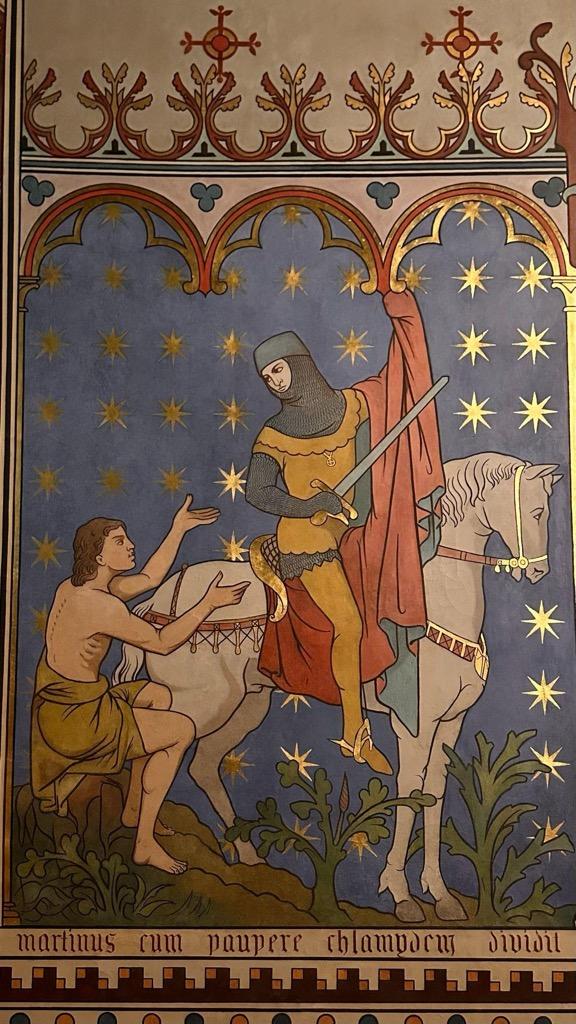
Top Figure 3. Polychrome mural painting in the Chapel of St Martin, Notre-Dame de Paris, by Viollet-le-Duc.
Image by the author.
Bottom Figure 4. Polychrome decoration of the fireplace in the Hall of Worthies, Chateau de Pierrefonds, by Viollet-leDuc.
Image by the author.
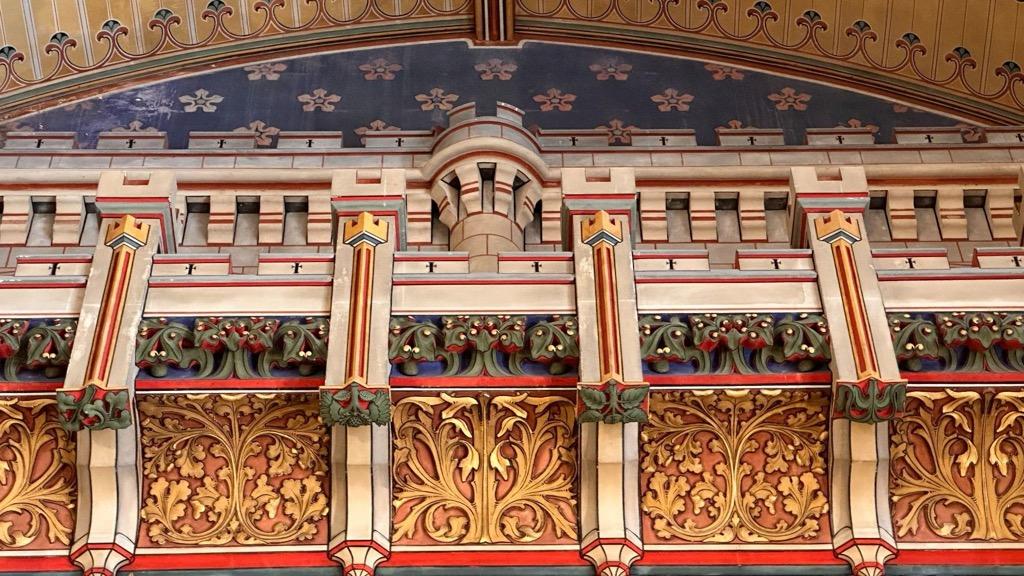
Eleanor Moselle

Paris in the late nineteenth century was a city propelling itself into modernity through urban transformation, infrastructure and technology that promised a vision of a networked future.1 An essential component of this vision of the future was widely distributed standardised time; an aspiration that Mustafa Dikeç writes that mid-nineteenth century Paris was struggling to achieve.2 The city had been attempting to install a system of electric clocks since 1852, however by the 1870s it still hadn’t taken off due to various political disruptions and technological delays.3 Therefore, when Austrian engineer Victor Antoine Popp and his coworker Ernest Resch attended the 1878 Paris Exposition to exhibit a network of pneumatic clocks, the Prefect of the Seine was receptive, and immediately authorised the system’s uptake.4
The pneumatic clock network transmitted compressed air to public and private clocks throughout Paris’s inner arrondissements.5 In a central transmitting station, a pendulum clock sent a burst of air every minute through pipes strung in the sewers, branching off into public squares, commercial venues,
1 Mustafa Dikeç and Carlos Lopez Galviz, “‘The Modern Atlas’: Compressed Air and Cities c. 1850–1930,” Journal of Historical Geography, 53, (2016), p. 14, https://doi. org/10.1016/j.jhg.2016.03.003; Steve Graham and Simon Marvin, Splintering Urbanism: Networked Infrastructures, Technological Mobilities and the Urban Condition, (Routledge, 2001), pp. 3989, doi:10.4324/9780203452202; Matthew Gandy, “The Paris Sewers and the Rationalization of Urban Space,” Transactions of the Institute of British Geographers, 24 1 (1999), pp. 23-44., https://doi.org/10.1111/j.0020-2754.1999.00023.x.
2 Dikec, “Urban Temporal Infrastructures”, p. 1.
3 Ibid, p. 10.
4 Ibid, p. 11.
5 Edmund A. Engler, “Time-Keeping in Paris,” Popular Science Monthly, (1882), https:// en.wikisource.org/wiki/Popular_Science_Monthly/Volume_20/January_1882/TimeKeeping_in_Paris; Dikec, ‘Urban Temporal Infrastructures’, pp. 1-19.; Dikeç and Lopez Galviz, “‘The Modern Atlas.’”; “The Paris Pneumatic Clock Network”, Douglas Self, last modified 2 Dec 2024, http://www.douglas-self.com/MUSEUM/COMMS/airclock/ airclock.htm; SUDAC, Histoire de la SUDAC, 1877–1996 (SUDAC, 1996), p. 64, https:// www.sudac.fr/sites/g/files/dvc4171/files/document/2021/03/Livre%20-%20Histoire%20 de%20la%20Sudac%20%281877 %20-%201996%29.pdf.
and private homes where time was to be delivered.6 It was a new urban infrastructure, moving through subterranean Paris to deliver a modern time for a modern era.
The system was initially successful but short-lived: it was terminated in 1927.7 However, despite their lack of longevity, the pneumatic clocks offer a vision of modernity from a place and time where networks and infrastructure stood as metaphors for progress.8 This dissertation treats the pneumatic clock system as a piece of infrastructure that is both a material object and, according to Nikhil Anand, Akhil Gupta and Hannah Appel’s definition of infrastructure, a ‘dense social, material, aesthetic, and political formation’.9 An investigation of the pneumatic clock network opens up rich questions concerning social time in nineteenth-century industrialisation, the spatial underground as a new conceptual site of modernisation, and the clocks’ physical presence as an infrastructure entering urban spaces.
The pneumatic clock system can be placed in a Marxist history of capitalism’s effect on temporal experience, and specifically labour patterns. Marxist historian Moishe Postone distinguishes between ‘concrete’ time, pre-industrialisation, where labour practices were organised around completing tasks, and ‘abstract’ time, developed in the advent of factory work, where labour is organised around a shift pattern. Under this latter mode of working, time becomes a unit of value, and thus is a commodity. The pneumatic clocks were widely promoted as
6 J. A. Berly, “The Distribution of Time by a System of Pneumatic Clocks,” The Journal of the Society of Arts 30.1513 (1881), p. 57, http:// www.jstor.org/stable/41327453.
7 SUDAC, Histoire de la SUDAC, p. 64.
8 Gandy, ‘The Paris Sewers’, p. 23.
9 Nikhil Anand, Akhil Gupta and Hannah Appel, “Introduction: Temporality, Politics, and the Promise of Infrastructure,” in The Promise of Infrastructure, ed. by Nikhil Anand, Akhil Gupta and Hannah Appel (Duke University Press, 2018), p. 3.
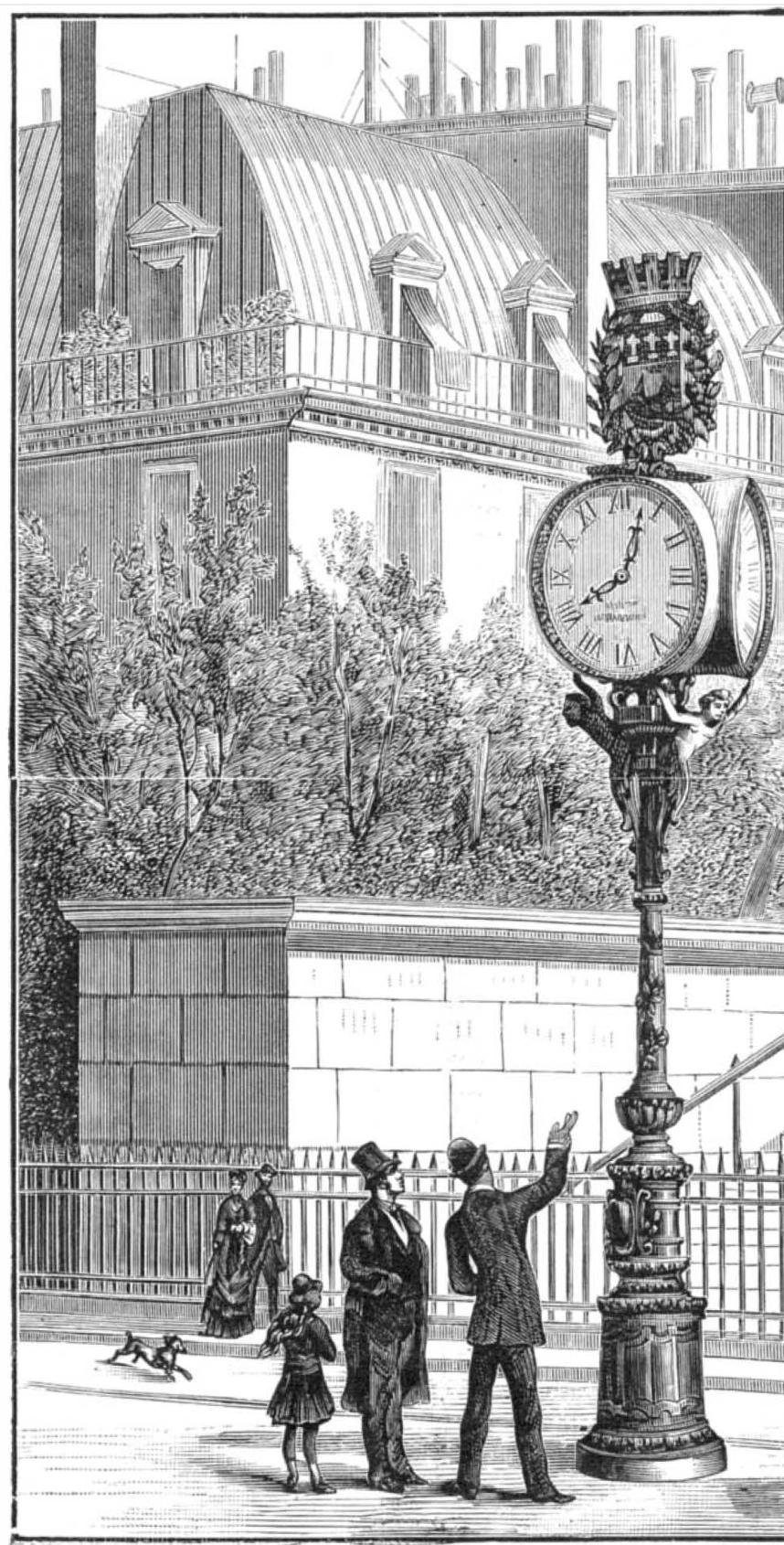
The Pneumatic Clock on the Place de la Madeleine. From Pneumatic Clocks, Nature 22 (8 July 1880): 227, figure 3. Reprinted by permission of Springer Nature. License number: 6125280836265.
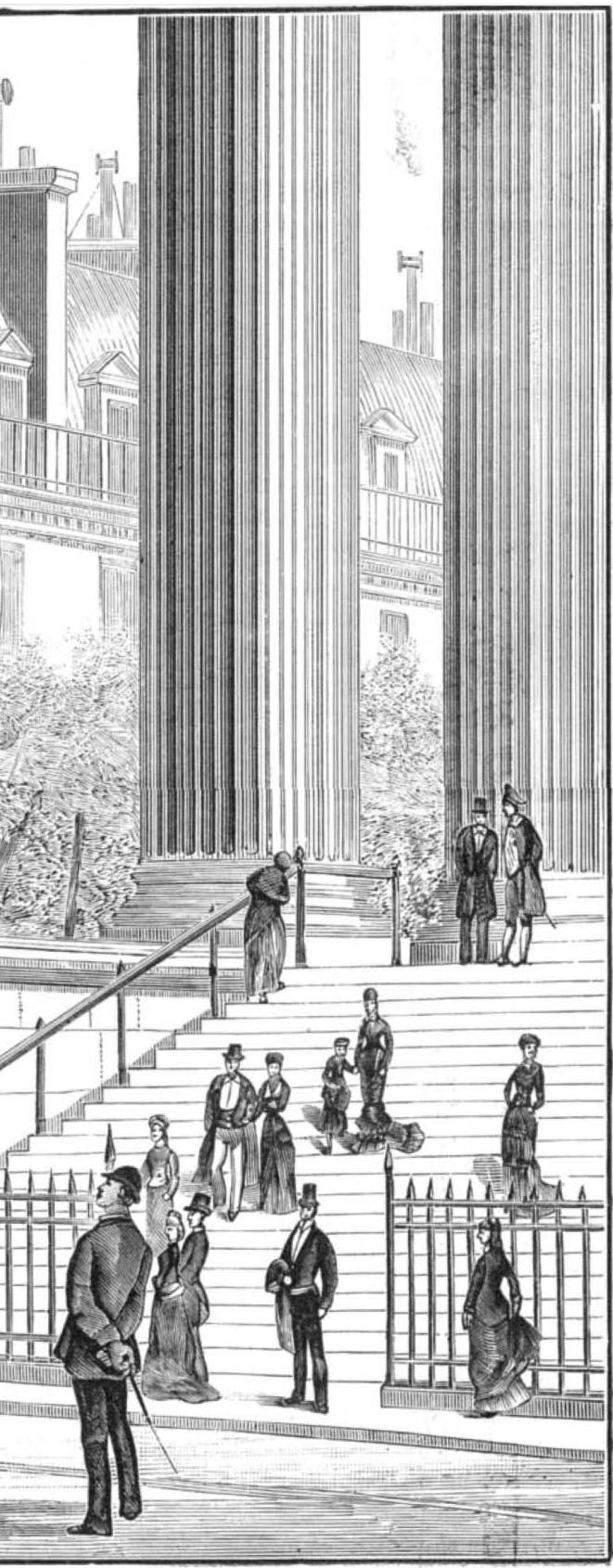
offering a material, distributable, abstract time, useful in creating a modern, commercialised city. An 1881 edition of Journal of the Society of Arts advertises the clocks through describing the increasing necessity for standardised time in urban places of business, saying that ‘Time is money’ is becoming more and more an axiom’.10 Pneumatic time’s role in supporting the commercialised city was also widely criticised in satirical publications. An 1882 edition of Le Rigolo tells a story of the advantages of pneumatic clocks in a worker’s home, allowing him to ‘not miss his workshop time’; arguably a veiled criticism of the imposition of a new temporal authority under which, as Jeremy Rifkin writes, the worker was expected to surrender his time completely to the employer.11 Another journal, La Lanterne de Boquillon (fig. 1), published a story where a protagonist spends a day walking from one pneumatic clock to another to check their accuracy (a fruitless task); rejecting the city’s new temporal doctrine through behaving in the manner of Walter Benjamin’s flâneur, a figure who uses idleness as an antithesis to an increasingly fast-paced metropolis.12
The pneumatic clocks can be read both through their offering of a new temporal experience, and through their physical presence in Paris. The company who produced the clocks published section drawings showing how pneumatic pipes were strung in the underground sewers (fig. 2), piping time from below up into houses and public spaces. The drawings were in the style of ‘coupe anatomiques’: street sections that showed the underground as a site of new networks and infrastructures such as gas, water, and electricity, placing the subsurface as an actor in the production of a socially
10 Berly, “The Distribution of Time”, p. 62.
11 Jeremy Rifkin, Time Wars: The Primary Conflict in Human History (Henry Holt & Co., 1987), https://archive.org/details/timewarsprimaryc0000rifk/ page/246/mode/2up; “Droleries,” Le Rigolo, 1.7 (1882), p. 3, https://gallica. bnf.fr/ark:/12148/bpt6k5484475h/f13.image.
12 Rebecca Solnit, Wanderlust: A History of Walking (Verso, 2001), p. 200.
and industrially modern city.13 The nineteenthcentury underground was a space of systems and networks, as well as a conceptual space of utopianism and expansion. Historian Rosalind Williams writes about the nineteenth-century underground representing both scientific and technological discovery, as well as expansion and production. A proliferation in hollow earth fiction and underground sci-fi helped in the production of a new collective imaginary space of discovery and techno-optimism. Understanding the underground as a site of modernity and futurity gives it significance as the place through which pneumatic pipes ran, so imbuing the pneumatic network with these associations.
A second space in which the pneumatic clocks exerted a material presence was the home; an examination of the clocks’ presence in the domestic sphere offers up questions concerning their relationship to women consumers, and domestic rhythms. A promotional booklet published by the pneumatic clock company in 1880 advertises the benefits of pneumatic time to housewives. This appeal to women speaks to a history of addressing female consumers as a means to market technology. The introduction of both the sewers in the 1870s, and electric networks in the 1920s, used campaigns to make housewives more comfortable with infrastructures entering the home.14 The pneumatic clock company employed similar tactics; addressing
13 Vittoria Di Palma, Diana Periton, and Marina Lathouri, Intimate Metropolis: Urban Subjects in the Modern City, ed. Vittoria Di Palma, Diana Periton, and Marina Lathouri (Abingdon: Routledge, 2009); Barbara Penner, “The Prince’s Water Closet: Sewer Gas and the City,” Journal of Architecture 19.2 (2014), pp. 249-271, https:// doi.org/10.1080/13602365.2014.908589
14 Barbara Penner, “The Prince’s Water Closet: Sewer Gas and the City,” Journal of Architecture 19.2 (2014), pp. 249-271; Katie Lloyd Thomas, “The Architect as Shopper: Women, Electricity, Building Products and the Interwar ‘Proprietary Turn’ in the UK,” in Architecture and Feminisms, ed. Hélène Frichot, Helen Runting, and Catharina Gabrielsson (London: Routledge, 2018).
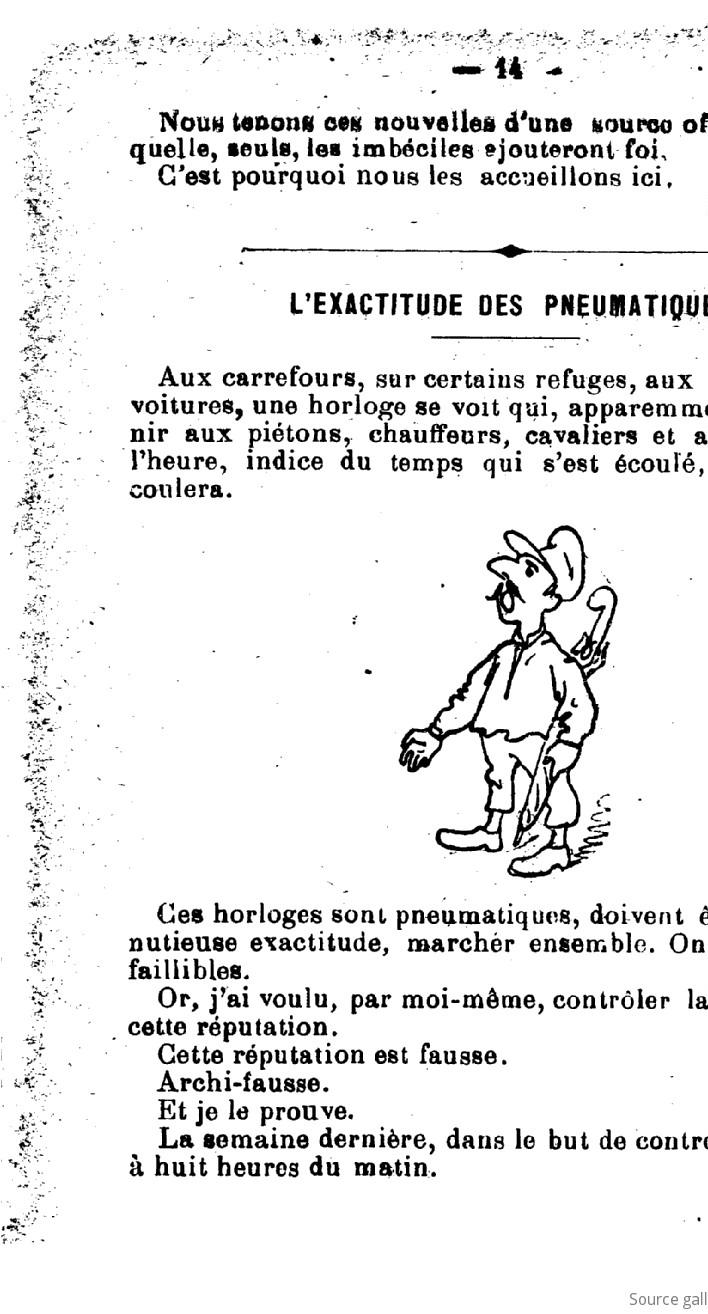
Top Figure 1. Louis Dorimat, L’Exactitude des Pneumatiques, 1899, printed journal, La Lanterne de Boquillon 3, no. 1354 (1899): 14, https:// gallica.bnf.fr/ark:/12148/ bpt6k58595670/ f1.double.r=horloges%20 pneumatique
Bottom Victor Popp manhole cover denoting the site of a pneumatic clock. Image by the author.
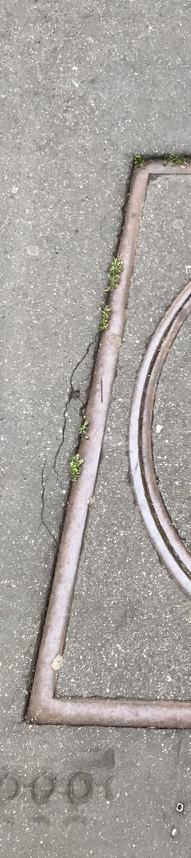
Right Figure 2. Installation générale de la canalisation pour la marche des pendules pneumatiques dans un immeuble, ~1880, printed section drawing, F/21/6279. Archives Nationales, Paris.
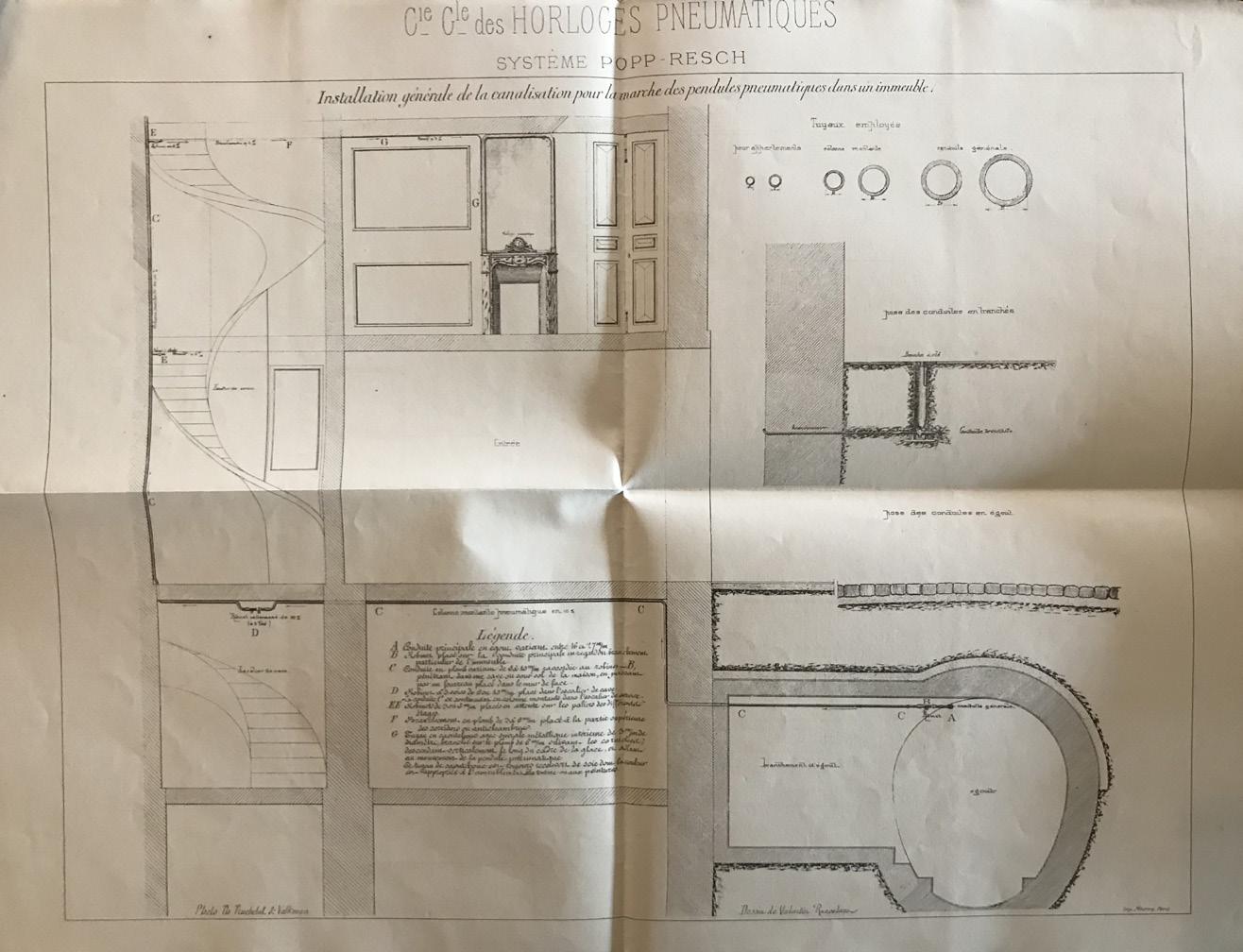
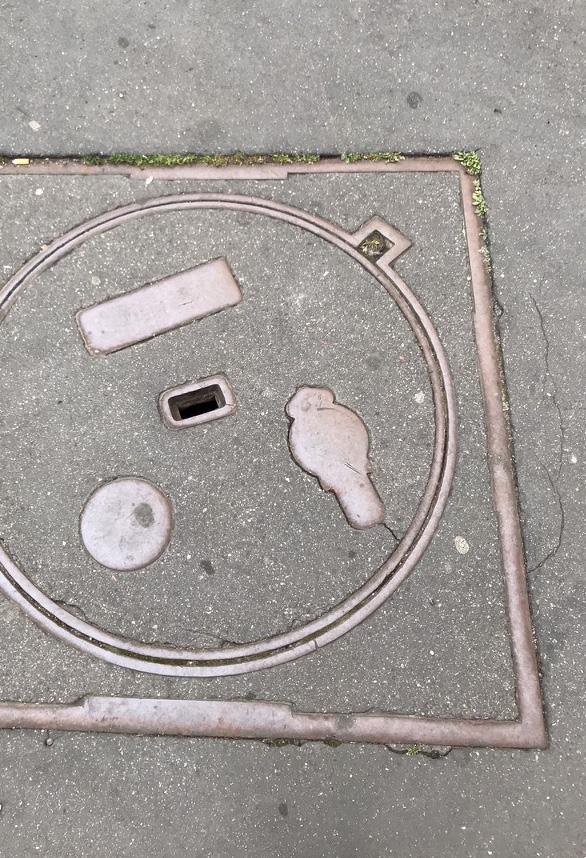
the housewife who, nervous of unknown danger and sewer gas from the underground, might have feared an infrastructure that breached the border of the home. Through speaking to the women consumer, the company is able to extend the reach of the pneumatic clocks, and thus extending abstract time, into the home and so involve the domestic sphere in the temporal rhythms of capitalism.
Reading a history of Paris’ pneumatic clock network allows a view into a city transforming under the new social structures, temporal rhythms, and urban imaginaries of nineteenth-century industrial and technological development. Telling the history of this obsolete and short-lived technology offers a reflection on the landscape of excitement about progress, networks and infrastructures which allowed them to flourish.

This research looks at the way in which architectural imaginaries can be used to examine the relationship between Modernity and the Anthropocene in correlation to bodies of water and the built environment. By using the images from the Squint/Opera media studio project, ‘Flooded London 2090’, and cultural artefacts to initiate the circulation of questions about the interaction of water and the architectural, guiding us through ideas about the posthuman, space, place, and water governance. With waterlogged realities becoming increasingly probable in our near futures, looking at these representations becomes highly valuable in reshaping our connection to infrastructure and the waters around us.
The images of ‘Flooded London 2090’ partake in this genre of urban imaginaries, and because it is fabricated in the city of London, it allows for questioning around flood infrastructure and the impact of flooding on its surrounding area. The flood of 1953 resulted in 307 deaths in counties east of London, and caused an uprising in prevention methods to deflect rising water levels.1 The 1953 flood made it apparent that a new defense system was needed and that the previous ones were not up to par for the potential natural disasters that the city faced. Thus, the Thames Barrier was proposed and finally opened in 1984, spanning 520 meters wide with ten flood gates that can withstand around 9,000 tons of water.
However, the barrier poses an interesting case, as it is no doubt providing protection to the city from tidal surges and potential flood risks that arise, but it is also emblematic of issues of water governance and the concept of ‘modern water’.2 The Thames Barrier, in providing a wall to slow down the flow of the tides, regardless of its flood prevention, is redirecting the flow of the river. The rearrangement of water goes against its natural movement, and the disruption is largely at the fault of human technological developments and the creation of governmental allocations over water. While providing a defense to the city,
1 Matthew Gandy, ‘Fears, Fantasies, and Floods: The Inundation of London’, in The Fabric of Space: Water, Modernity, and the urban imagination (The MIT Press, 2014), p. 191.
2 Jamie Linton, ‘Modern Water and its Discontents: A History of Hydrosocial Renewal’, Wiley Interdisciplinary Reviews: Water, 1.1 (2014), pp. 111-20, doi.10.1002/wat2.1009.
the barrier also acts as a symbol of the dichotomies of the human relationship to water: Nature v. Human, Tame v. Untamable, Inefficient v. Efficient.
Additionally, the Squint/Opera images draw attention to the ways in which people can occupy these urban water imaginaries and in what ways that may take shape. By pairing the images with the novel The Drowned World by J.G. Ballard3, the estrangement of living with rising levels of water can begin to be explored in these fictional representations. In Ballard’s depiction, the watery landscape of the drowned world has led to a sense of place and space being dissuaded, with the terrestrial geographical boundaries quite literally being washed away; the characters live in a world of gestationality.
The Drowned World imagines a submerged London that is characterized by generic European architecture, exotic wildlife, tropical temperatures, and decaying structures entangled with plant life and sludge. These depictions are similar to those that are represented in the images of ‘Flooded London 2090’, with inhabitants who are also shown altering their daily behavior to the watery world around them. The notions of exploration of memory and mapping processes that Ballard toys with in his novel are both components that go into the conceptualization of Water. He furthers these concepts around water by playing on the dichotomy of Man v. Nature, when, during the climax of the story, conflict arises because of a visiting outsider who dams the lagoon, unearthing the lost city of London underneath. The penetration of the lagoon is not dissimilar to the way in which the Thames Barrier opposes the River Thames and fortifies the city of London, except in The Drowned World, the characters realize they cannot exist without the aqueous reality and re-submerge the lagoon.
Moreover, ‘Flooded London 2090’ resembles visual representations of catastrophic stories that are seen in video games, causing one to wonder what the role of the human is in those examples of visual imagery. By looking at BioShock by 2K Games, you can see the ironic spin on a world that profits on
3 J.G. Ballard, The Drowned World (London Fourth Estate, 2014).
the abstraction of water and how the player becomes involved within the narrative of the story, allowing for the dissection of a fictional representation of the human in a watery world. The game explores the idea of genetic modification by the use of a sea slug that contains the ingredients for genetic engineering — the player is forced to partake in genetic modification in order to beat certain levels in the game. But, is also tormented by the moral implications of genetic engineering and the violent outcome that ensues.4 BioShock created a high-risk posthumanist society that is attributed to the watery world that was created, using the tradition of Utopian collapse into Dystopia.
The game was praised after its release in 2007 for its aesthetic waterscapes, which highlight the submarine architecture of the underwater world in the game. The storyline plays on the idea of using submarine architecture as a form of escapism from terrestrial life above, seeking refuge from the destruction of the previous world by man itself.5 Again, the inhabiting of a body of water in order to start anew, plays into concepts of Modern Water and water governance, that water can be used as a substance for human exploitation. Through its ironic narrative, BioShock provides a game that comments on politics, water governance, and posthumanism, providing support for thinking through the questions on the role of the human.
This research uses ideas from multiple disciplines and the images from Squint/Opera to begin to facilitate questions about urban water imaginaries and the potential they have for rethinking the way in which we think about architecture’s interaction with water. This means thinking through visual and literary fictions that point out common ideas about water that have come about with Modernity and need to be redeveloped. As we continue to live in the Anthropocene, increased water levels become a reality, and the way in which we think about water in relation to our livelihood will have to be adjusted. Urban water imaginaries might just be the starting point for the conversation.
4 Grant Tavinor, ‘Bioshock and the Art of Rapture’, Philosophy and Literature, 33.1 (2009), p.97, doi:10.1353/phl.0.0046.
5 Paul Dobraszcyzk, ‘Sunken Cities: Climate Change, Urban Futures and the Imagination of Submergence’, International Journal of Urban and Regional Research, 41.6 (2017), p. 13, https://discovery.ucl.ac.uk/id/eprint/10063953/1Dobraszczyk_SunkenCities_revised.pdf.
1940–2025
Kitty Alexander

November 24th, 1940, was the deadliest night of the Bristol Blitz. In the course of a six-hour assault by the Luftwaffe, the city was bombarded by approximately 12,000 incendiary bombs and 160 tons of explosives. The urban landscape was irrevocably changed that night. In the wake of the destruction, the remains of the historic heart of the city emerged in the forms of heaps of rubble and husks of burntout buildings. One of the few architectural survivors of the night was the tower of St Mary-le-Port, a medieval parish church at the centre of Bristol’s Old City. This project, ‘The Spectacle of Decay: Ruin, Representation and Renewal at St Mary-le-Port, 19402025,’ interrogates the ruin as a category of urban space and its status within contemporary society. It takes the lone tower of St Mary-le-Port, a site of such ‘ruination,’ as its case study.
In the post-war period, the site of St Maryle-Port was the focus of the city’s controversial redevelopment strategy, which, in 1979, was dubbed ‘an architectural disaster much longer drawn out than the Blitz but, in its effects, quite as severe.’1From the 1960s onwards, a series of modernist buildings, including Bank of England House, Norwich Union House and Bank House, gradually encircled the medieval fragment. The recent history of the site has been fraught. These modern structures are now, themselves, in a state of dereliction and are set to
1 Andor Gomme, Michael Jenner, and Bryan Little, Bristol: An Architectural History (London: Lund Humphries, 1979).
be demolished as part of a sweeping redevelopment scheme of the city centre. Less than a century after the devastation of the Blitz, St Mary-le-Port will, yet again, bear witness to its own destructive transformation.
St Mary-le-Port is a prototypical urban palimpsest, shaped by centuries of recurring cycles of destruction and creation. Originally, this term referred to parchment or vellum, which bore the traces of successive reuse. As Andreas Huyssen asserts, it can be used as a conceptual frame for ‘configurations of urban spaces and their unfolding in time.’2 The rich materiality of St Mary-le-Port exemplifies these processes of stratification. It has experienced life as a bustling medieval thoroughfare, a victim of wartime devastation, the subject of post-war optimism, and a site of contemporary urban decay. It is constituted of overlapping images and ideas of the past, the present, and the future of the city. The unique assemblage of ruin typologies present at St Mary-le-Port typifies the spatial, material, and temporal complexities of the ruin as a category of urban space. This project engages with the many modes of ‘ruination.’ This includes the ruin as an object, a process, and an image.
Throughout the twentieth and twenty-first centuries, the site has been taken as a tabula rasa, or blank canvas. Its immanent ‘promise’ has spawned a series of conflicting visions of what the site is, was, and will be. As Brian Dillon states, ruins are akin to a ‘desolate playground’ in which ‘we have space and time to imagine a future.’3 Thus, we witness the emergence of multiple visions of a utopian future, whether realised or unrealised, at such sites. In 1960, a group of young architects (Bristol Architects Forum) produced a short film entitled ‘Dead Centre.’ In less than 9 minutes, the film reimagined the city centre as an idealised modern city, through the segregation of vehicles and pedestrians with super-highways and elevated decks. It was a wholly new spatial and social order, truly of the twentieth century. Although never realised, this alternative vision of the site lives on through film.
2 Andreas Huyssen, Present Pasts: Urban Palimpsests and the Politics of Memory (Stanford University Press, 2003), p. 7.
3 Brian Dillon, Ruin Lust (Tate Gallery Publishing, 2014), p. 5.
Increasingly, immaterial representations of sites of ruination are experienced and emphasised over their material realities. These representations of decay and destruction range from the patriotic romanticism of John Piper’s war paintings, the bleak realism of post-war photography, to the transgressive documentation of contemporary exploration. In analysing such images, the project sought to identify the dominant (and not-so-dominant) narratives which emerge. In particular, the ‘ruin’ is especially subject to aestheticisation, fetishisation, and politicisation. We see the site as a picturesque icon of war, the photographic subject of atmospheric decay, and as an effective subcultural playground. The ruins, and their depiction, are far from objective. Inherently, the representation of architecture is fragmentary, partial, and incomplete. There is a danger that such selective visions of the past and the present neutralise the critical potential of the ruin.
The concept of the ruin can be wielded to both uphold and critique institutional norms, such as progress, use or value. What we choose to represent, and how, shapes what is then valued and preserved. Hence, the impending demolition of the modern bank buildings. What makes certain categories of ruined urban space acceptable, and others undesirable? As Gastón Gordillo puts it, the great secret of the heritage industry is that its spectacular ruins are ‘rubble that has been fetishised.’4 The abstraction of the church tower, as a ruin, is a deeply political act. Such ruins are far from neutral. These spaces are active participants in the making, unmaking and remaking of the city’s history and materiality. The overarching aim of this research was a demonstration of the fact that, contrary to prevailing narratives, St Mary-le-Port is far from ‘vacant’ or ‘derelict.’ It is constituted of rich layers of meaning, whether manifested materially, representationally, or discursively. As Henri Lefebvre states, ‘the most important thing is to multiply the readings of the city.’5 This project emphasises multiplication in the face of impending demolition.
4 Gastón Gordillo, Rubble: The Afterlife of Destruction (Duke University Press, 2014), p. 2.
5 Henri Lefebvre, Writings on Cities (Wiley-Blackwell, 1996), p. 159.
Top Norwich Union House and St Mary-le-Port, 2025. Image by the author.
Bottom Bank House, 2025. Image by the author.
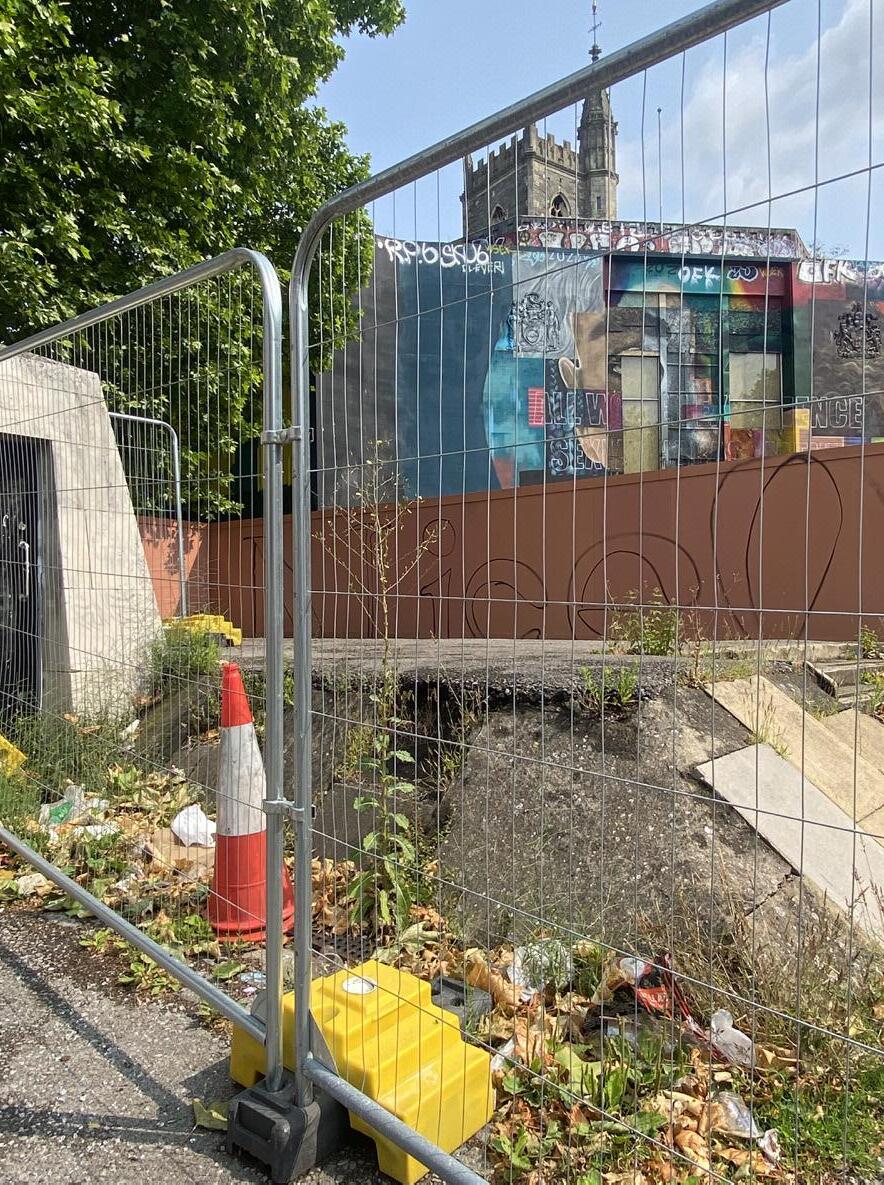
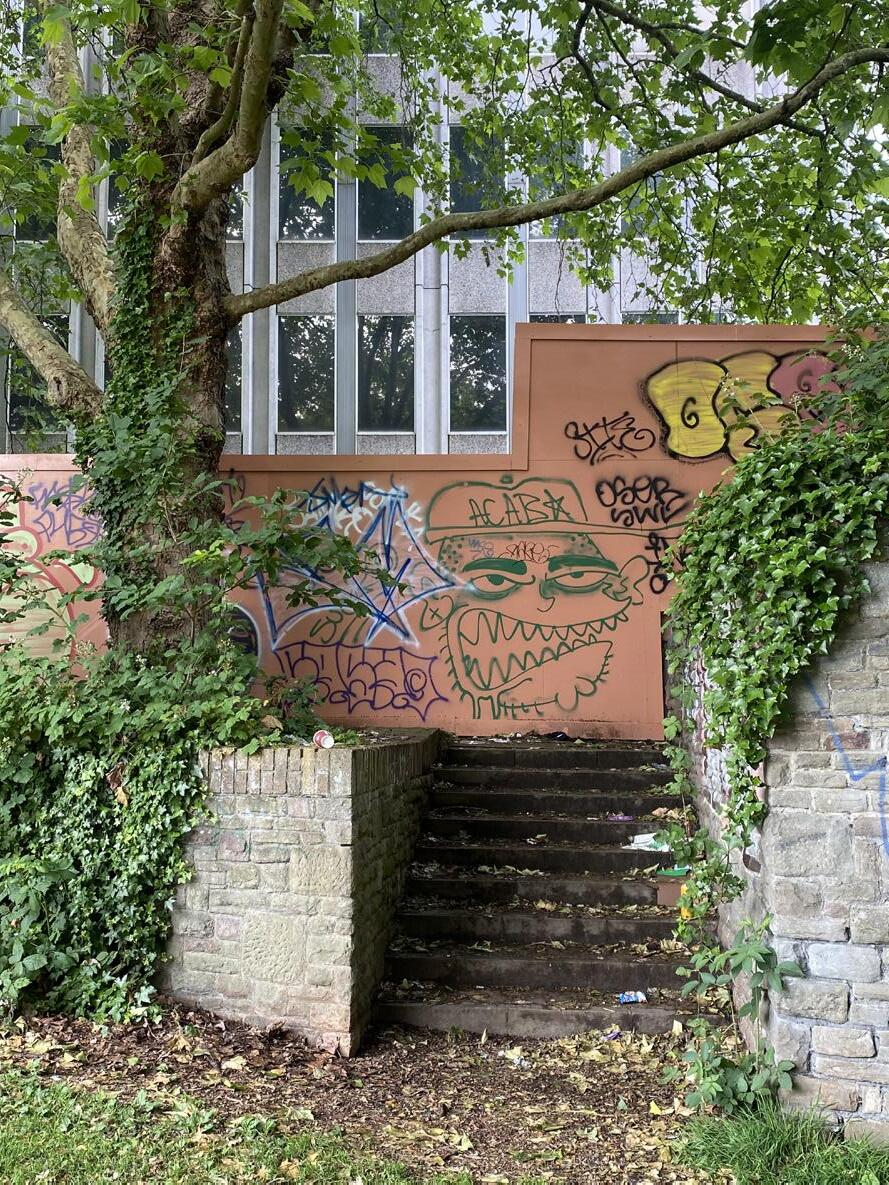
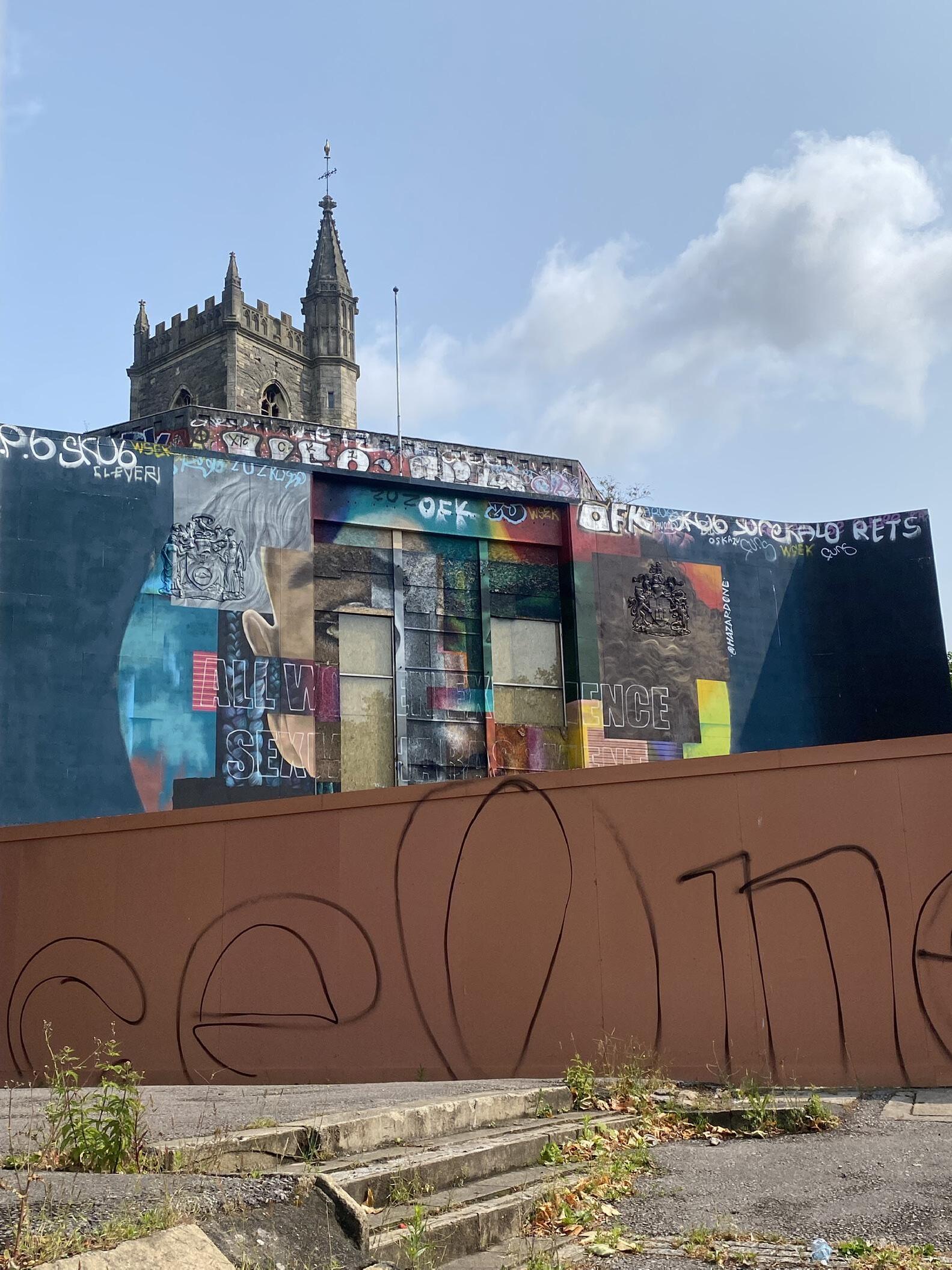
Image by the author.
Lora Lolev

This research explores the intricate relationship between fashion, space, performance, collaboration, and anonymity. By using Belgian fashion brand Maison Martin Margiela’s shows from 1988 to 1998 as the main case studies, it investigates how they position themselves as subversive situated practices within the city of Paris. The brand instilled an emphasis on space — whether through its incongruous locations, its relationship to the city’s urban fabric and daily life, or its carefully considered interiors.
A brief presentation of Martin Margiela, followed by a short history of the fashion show, is essential to understand the context of the Maison’s emergence. This research proceeds from a macro-scale reading of the city, through a meso-scale analysis of the Maison’s direct interactions with the urban and social fabric, to a micro-scale focus on the fashion show itself. Each section is supported by selected case studies that illustrate, respectively: spatial and symbolic displacement; the integration of everyday life and the importance of participation; and finally, the aesthetic and artistic dimension of the fashion show as a performance in its own right.
By compiling information from the twenty shows of the Maison’s first decade, I was able to map the presentations across Paris and create a corresponding table. (fig.1-2) This process revealed patterns and led to a typology of venue categories: repurposed, abandoned, terrain vague, multiple, showroom,
dérive, and event space. The research is strongly anchored in archival study, where visual material was carefully examined at the Fashion Museum Antwerp’s library. A close examination of primary and secondary sources completes the methodology, spanning the disciplines of fashion, urban studies, sociology, and philosophy.
The Belgian brand was founded by Martin Margiela and late business partner Jenny Meirens. Margiela himself is a private figure who, throughout his tenure as artistic director until 2008, chose to remain anonymous by giving interviews only as a collective rather than as an individual. This distanced him from the cult of the designer’s personality that became so prevalent in the 1980s1. The Maison’s ethos revolved around the emphasis on the sartorial quality of garments through the veiling of models’ faces during shows, its no-advertising policy2, and its avoidance of celebrity culture. All of these elements deliberately distanced the Maison from dominant capitalist structures.
The fashion industry undergoes constant shifts in tradition and norms, but the late twentieth century was particularly notable for the fashion show’s increasingly spectacular and constructed identity.3 The 1980s were marked by excesses in clothing, presentation, and pattern. During the 1990s, the Parisian fashion-scape witnessed a tension between two extremes: the overly theatrical and extravagant shows of designers such as John Galliano and Alexander McQueen4, and the more subversive, ‘gritty’ approach of avant-garde designers such as Rei Kawakubo.
Maison Martin Margiela emerged within this context, using the fashion show as a mise-en-scène that not only reflected society but also produced and reinforced social values and
1 Martin Margiela: In His Own Words, dir. by Reiner Holzemer (2019).
2 Giovanni Pungetti, and Stefano Caputo, ‘La création sans créateur: le cas de Maison Martin Margiela’, Le Journal de l’École de Paris du management (Paris), 94.2 (2012), pp. 8–13, doi:10.3917/jepam.094.0008. 9.
3 Louise Crewe, ‘Fashioning the Global City: Architecture and the Building of Fashion Space’, in The Geographies of Fashion: Consumption, Space, and Value (Bloomsbury Academic, 2018). p. 5.
4 Morgan Jan, ‘Le défilé de mode : spectaculaire décor à corps’, Sociétés & Représentations (Paris), 31.1 (2011), pp. 125–36, doi:10.3917/sr.031.0125. 129.
behaviours, aiding in ‘fashioning a modern, reflexive self.’ Margiela’s shows deliberately resisted spectacle. They created ‘heterotopic spaces’ by staging presentations ‘in the midst of liminal, interstitial, or relic spaces’5, echoing the strategies of contemporary art installations that rejected the glitz of the catwalk.6
Looking at the mapped shows, several stand out for their peripheral locations in contrast to the centrality of the first arrondissement, where Paris Fashion Week traditionally unfolds. The Autumn-Winter 1995–1996 show, for instance, was held under a circus tent in the Bois de Boulogne, west of the city. The physical travel induced by this offbeat location challenged the usual comfort and proximity enjoyed by fashion professionals. At the Maison, codes were often subverted through symbolic inversion. Similarly, after a journalist remarked that the clothes resembled those found in a charity shop, the Maison staged its next show at the Salvation Army headquarters. Of particular interest is the notoriety of the building itself — designed by Le Corbusier in 1933 — yet the Maison made no reference to the architectural landmark. Instead, the focus shifted to what the space represented.
Through various iterations, the Maison fully integrated everyday life into its presentation format. Through short films and collaborations with friends and clients, Margiela positioned his practice within a participatory art logic as defined by art historian Claire Bishop, who describes it as the involvement of many people while avoiding the ambiguities of ‘social engagement’7. The Maison also welcomed the unexpected. During the triple-location presentation format of the Autumn-Winter 1997–1998 show, the ensemble concluded the performance by marching through the streets of the 10th arrondissement, where models, brass-band members, guests, and passers-by mingled together. By involving non-professional models and direct audience participation in overlooked sites,
5 Crewe, ‘Fashioning the Global City’, p. 13.
6 Caroline Evans, ‘Spectacle’, in Fashion at the Edge: Spectacle, Modernity and Deathliness (Yale University Press, 2003), pp. 65–84.
7 Claire Bishop, ‘Introduction’, in Artificial Hells: Participatory Art and the Politics of Spectatorship (Verso Books, 2012), pp. 1–10.
Margiela reconfigured perceptual boundaries, fostering new forms of presentation and experience.
Finally, by drawing on philosopher Jacques Rancière’s concept of aisthesis, the Maison’s shows reveal a coherent world-building project — a series of aesthetic scenes. The fashion show thus becomes a full performance, its reality accessible only as an ephemeral happening bound to a specific site and moment in time.8 Theoretically, these shows can be read as aesthetic performances: simultaneously sitespecific and heterotopic. The tension between the specificity of a site and the ‘otherness’ of heterotopia becomes activated in the performative moment of the show. Ultimately, these performances contribute to a revaluation of the forgotten and pay homage to memory and place. By returning to the essence of sites and acknowledging their histories, they echo de Solà-Morales’s argument that in ‘forgotten places, the memory of the past seems to predominate over the present’9. Moreover, this research situates the Maison’s collection presentations within architectural history, revealing how an external cultural practice such as fashion can alter the way the city is experienced and traversed, particularly in forgotten or overlooked locations.
8 Catherine Elwes, ‘Performance’, in Installation and the Moving Image (Columbia University Press, 2015), pp. 53–75, <http://www.jstor.org/ stable/10.7312/elwe17450.8> [accessed 28 July 2025].
9 Ignasi de Solà Morales, ‘Terrain Vague’, in Terrain Vague: Interstices at the Edge of the Pale, ed. by Manuela Mariani. (Routledge, 2013), doi:10.4324/9780203552172.
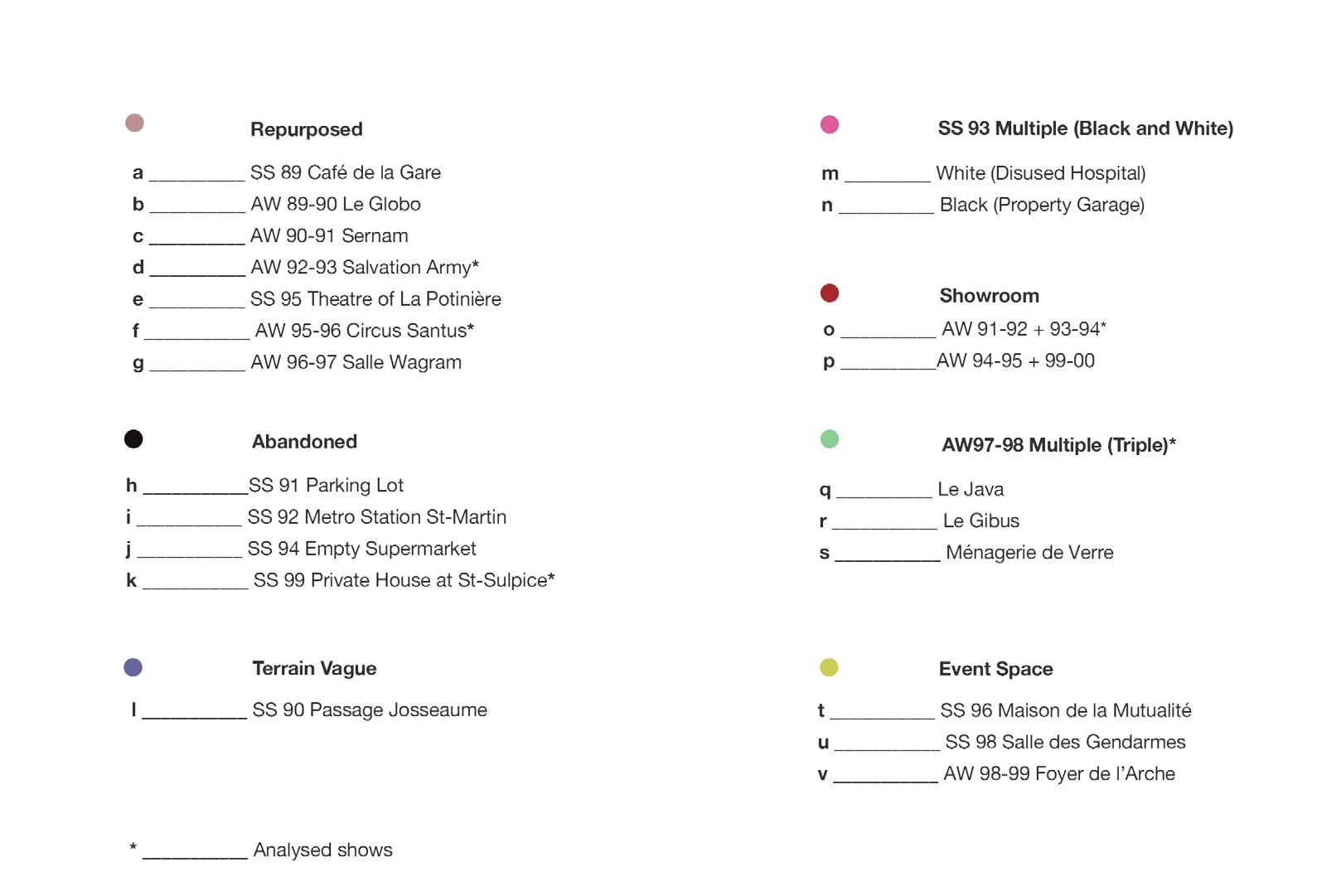
Top The Maison’s shows’ and venues’ typologies. Image by the author.
Bottom Mapping of the Parisian arrondissements with the Maison’s shows. Image by the author.
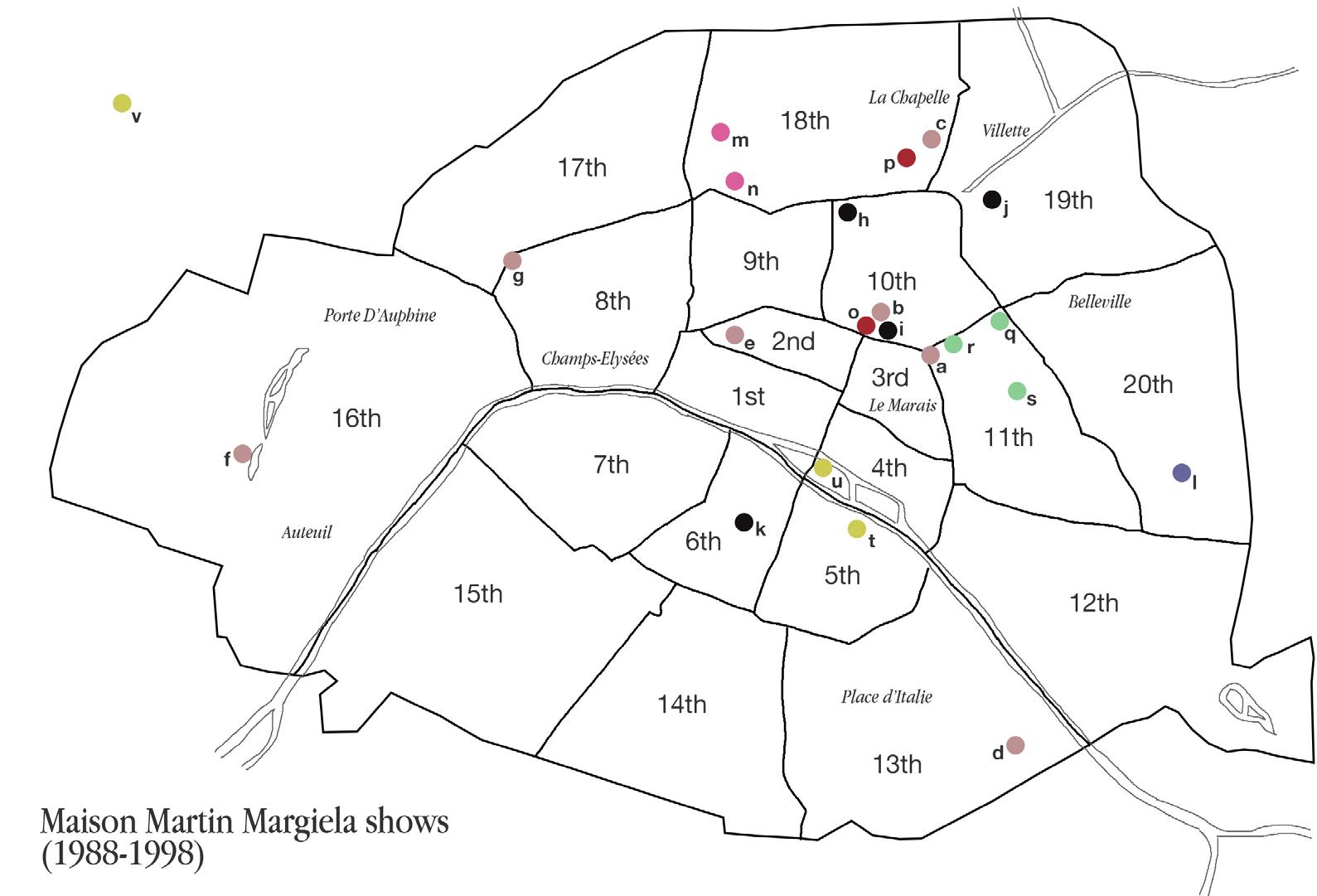
Graduating Cohort 2024-25
Zaina Abou Seif
Kitty Alexander
Helga Beshiri
Mark Bessoudo
Ertuğ Erpek
Claudia Vargas Franco
Lora Lolev
Anna García Molina
Macarena González Carvajal
Issy MacGregor
Eleanor Moselle
Eden Northcott
Steven Schultz
Jazmine Simmons
Qing Tang
Guillermo Gómez Tejera
Joseph Williamson
Audrey Zhang
2024-5 Core Teaching Staff
Professor Barbara Penner (co-director)
Dr Robin Wilson (co-director)
Professor Iain Borden
Professor Eva Branscome
Professor Ben Campkin
Professor Mario Carpo
Professor Murray Fraser
Dr Sam Grinsell
Professor Peg Rawes
Professor Jane Rendell
Professor Tania Sengupta
Dr Azadeh Zaferani
Architectural History MA
Established in 1981, the Architectural History MA is a 12 month, architectural history and theory masters course, offering full and part-time modes of study, and auditing from PhD and other masters courses.
Taught Modules
Critical Methodologies of
Architectural History
Research and Dissemination of Architectural History
Architecture in Britain Since the 17th-Century
Critical Spatial Practice: Site
Writing
Histories of Global London, 1900 to the Present
Materialist Ecological Architecture
Multiple Modernities
Practices of Criticism
Representations of Cities
Other academic colleagues and visiting speakers contributing in 2024-5:
Dr Sarah Butler
Iain Chambers
Tom Dyckhoff
Christophe Gérard
Dr Polly Gould
Ievgeniia Gubkina
Dr Fernando Gutierrez
Prof Clare Melhuish
Hilary Powell
Vicky Richardson
Dr David Roberts
Agnese Sanvito
Dr Iulia Statica
Survey of London (Dr Aileen Read and Colin Thom)
Dr Adam Walls
Dr Stamatis Zografos
Postgraduate Teaching Assistant (PGTA)
Paola Camasso
Education Administrators
Drew Pessoa and Emmy Thittanond
Departmental Tutor
Dr William Hodgson
Field Trip (Lisbon) Guides and Speakers
Dr Ricardo Agarez, Assoc. Prof., Dept of Architecture, University of Évora
Jonathan Mosley, Warren & Mosley and Assoc. Prof., Bristol School of Architecture, UWE
Dr Maria Rita Pais, Dept. of Architecture, Lusófona University, Pólo Universitário de Lisboa
Typeset in
Atkinson Hyperlegible Mono
ETbb
Publication & Communications team
Qing Tang
Issy MacGregor
Joseph Williamson
Zaina Abou Seif
Jazmine Simmons
Mark Bessoudo
Symposium team
Issy MacGregor
Qing Tang
Joseph Williamson
Exhibition team
Macarena González Carvajal
Issy MacGregor
Joseph Williamson
Anna García Molina
Claudia Vargas Franco
Helga Beshiri and with gratitude to all of the Architectural History MA 2024/25 students.
Printed with Mixam