Your barbershop’s requirements for client preparation
It is important to ensure that the client and his clothing are well protected before cutting hair. Select a gown large enough to adequately cover the client’s clothing. If carrying out this service in a unisex salon, learners should not use ‘ladies’ gowns, which tend to be too small for males or too ‘effeminate’ looking. As a minimum it is recommended that the routine below is followed:
Work station
• ensure chair is in locked position, clean and dry, worktop to be clean and tidy and free from hairs
• products and equipment on display to be clean and free from dust and debris
• tools to be cleaned and sterilised and/or disinfected before use
• all electrical tools to be visually checked for safety
• all tools and equipment needed to carry out the service to be positioned for ease of use
Client
• (first action always) – expandable and disposable neck strip to be secured adequately and completely around client’s neck
• clean and adequate sized gown to be placed on client and properly secured to protect client’s clothing from cut hairs
• thin strip of cotton wool placed fully around client’s neck and tucked down to prevent clippings irritating client’s skin
• box of tissues made available for client’s use
Towels should not be ‘tucked’ down the client’s neck during the haircut as they increase bulkiness and tend to retain clippings thus irritating the client’s neck.
State your barbershop’s procedure for preparing clients for cutting hair.
Suggest ways of improving these procedures.
© Copyright Habia 2010 - All rights reserved. Handout
GB3.1.1
Service times
There are pre-set service times to complete a cut, blow dry and finish for men within the NVQ/SVQ. This means that to show you are competent you must be able to complete the cut, dry and finish within 30 minutes.
How much time are you allowed in your own barbershop for the same service?
Notes
© Copyright Habia 2010 - All rights reserved. Handout
GB3.1.2
Electricity at Work Regulations
The purpose of these regulations is to state that electrical equipment must be adequately maintained and checked by a qualified person. A written record of the equipment tests should be kept and should be made available for inspection.
It is important to visually check if the equipment is safe for use by checking the flex and the plug. The equipment should only be used for its intended purpose and you should make sure that you know how to use it.
When you have finished with the equipment, switch off, remove from the power source and store the equipment safely away.
It is your responsibility to ensure that any faulty equipment that you find in your workplace is removed from use, labelled as faulty and reported to a relevant person.
If you were unsure of how to use an electric clipper how would you find out the correct way to use it?
Notes
© Copyright Habia 2010 - All rights reserved. Handout
GB3.1.3
Protecting your Client
The range of protective clothing and materials available for clients
You must make sure that the client’s clothing is well protected before cutting hair. As a minimum it is recommended that the routine below is followed:
Protective clothing and materials used when cutting hair are:
• disposable neck strips (always the first to be placed on the client)
• suitably sized gowns
• cotton wool strips
• box of tissues
Ensure that all protective clothing and materials are securely placed and that the client is comfortable before proceeding with the hair cut.
Some barbershops use paper napkins – often called neck strips, while others prefer the use of small strips of cotton wool inserted around the collar line to trap cut hairs and prevent them getting under the client’s clothing. Cotton wool is particularly effective in trapping tiny cut hairs.
If the hair is wet while being cut it will stick to the skin and it can be difficult to remove. Dry the skin with a fresh towel before removing the neck protection and dust the skin with talcum powder. This will let you brush all of the clippings off the skin before you remove the neck strip. Ensure that the talcum powder is un-perfumed.
The importance of protecting clients from hair clippings
Try to avoid cut hairs working their way down under the client’s clothing and onto his skin.
When this happens the skin becomes irritated and the client becomes very uncomfortable.
This is particularly important if the client has visited the barbershop during a break in his working day and will not have the opportunity to change his clothing for some hours.
In some cases a client’s skin will become inflamed due to the irritation caused by the hair clippings and by him scratching to try to relieve the irritation.
Summary: it is important to protect clients from hair clippings:
• to maintain client comfort throughout and following the service
• to protect the client’s clothing
© Copyright Habia 2010 - All rights reserved. Handout
GB3.2.1
How the position of your client and yourself can affect the desired outcome and reduce fatigue and the risk of injury
If your client sits in a hunched or slouched position or if you stand in the wrong place while cutting hair it will result in an uneven cut:
• when the client is incorrectly seated you will not be able to see or reach easily, you may have to stretch or crouch down to reach some parts of the head
• if you stand on one side of the client and cut hair that grows on the other side of the head, the result will be uneven – this can happen when inexperienced barbers cut a fringe.
If they don’t move around the head, but stand in one position throughout, then drag the hair from the far side over to them, this will result in the fringe being slightly longer on one side
You must make sure that you stand correctly when cutting hair if you are to minimise the risk of becoming very tired, very quickly. In addition, you can cause long term damage to your muscles. Also, if your posture is correct, a better working position is achieved. This will help you to increase speed and become more effective.
You should stand with legs straight and feet slightly apart to maintain balance and even distribution of your weight. Try to remain relaxed, keep your head up and avoid stretching or bending. When you become tired you lose concentration. This causes you to become slower and less effective. Good positioning allows you to work on clients more easily and efficiently.
It is important to ensure that the client’s position is correct. If he is not seated properly he may be uncomfortable and this may cause him to fidget and move around. This can result in an inaccurate haircut. You must make sure that the chair is correctly positioned.
Most barber chairs have hydraulics that can lift and lower the client to a comfortable working height. Use this facility constantly and always make sure the chair is locked before, during and after use!
Discuss with your Trainer and colleagues which muscles are most likely to be damaged if your posture is incorrect while working.
Will it be your:
• shoulders?
• neck?
• back?
• legs?
• arms?
• feet?
© Copyright Habia 2010 - All rights reserved. Handout
GB3.2.2
Health and Safety in the Workplace
The safety considerations which must be taken into account when cutting hair
You must follow the basic rules relating to safety when you cut hair:
• make sure that your client is positioned comfortably
• ensure client’s clothing is properly protected and that a disposable neck strip is used to reduce the risk of crossinfection and infestation
• place a thin strip of cotton wool all around the neck to limit clippings irritating the client
• ensure prompt removal of hair cuttings during the service
• dispose of all sharps in accordance with legal requirements and barbershop procedures
State two reasons why you must take safety considerations into account when cutting hair.
Why it is important to avoid cross infection and infestation
If effective measures are not taken to avoid cross infection and infestation the reputation of the barbershop will suffer. A barbershop with a poor reputation will not be successful, the image of the barbershop will be damaged this will result in job losses.
It is very important for the barbershop to operate high standards of hygiene to reduce the risk of passing infection or infestation to clients.
Summary: the reasons why it is important to avoid cross infection and infestation are:
• to minimise the risk of cross infection and infestation
• to ensure the image and reputation of the barbershop is maintained
What are the two main infections of which we, as barbers, must be aware of?
What is the most common infestation that we, as barbers, need to be aware of?
© Copyright Habia 2010 - All rights reserved. Handout
1.
2.
GB3.2.3
Health and Safety in the Workplace
The importance of keeping your work area clean and tidy
As a professional barber it benefits you and your barbershop if you keep up a good appearance.
This applies to your work area as well as to your own appearance. If your work area is untidy and dirty the client is likely to think that he is not going to get a good service. If it is always clean and tidy it will create a professional image of the barbershop and of yourself.
A dirty work area allows bacteria to multiply and infections are likely to be spread from one client to another or between client and barber.
You have a duty to provide a hygienic environment for clients and by so doing you will minimise the risk of spreading infection.
An untidy work area often contains hazards – loose, trailing wires, sharp cutting tools within easy reach, towels and gowns draping over chairs, etc…
By keeping work areas tidy the hazards are reduced.
Summary: The reasons why work areas should be left clean and tidy are:
• to keep up a professional image of yourself and the barbershop
• to minimise the risk of passing infection from person to person
• to reduce hazards
Whose responsibility is it to ensure that the work area is left clean and tidy?
The importance of positioning your cutting tools for ease of use
There are two main reasons for positioning your cutting tools for ease of use:
• to ensure that you work efficiently throughout the service
• to make sure that your tools are to hand when you need them
If you fail to gather together all the tools that you will need then it is likely that you will waste time in looking for something partway through the service. This means that the client will have to wait while you find the tools and this may make him feel irritated. The result may be that you will lose a client.
If you are disorganised enough to fail to properly prepare for the job then the client may feel that you may take the same approach to his haircut – this, too, can lose clients for the barbershop.
© Copyright Habia 2010 - All rights reserved. Handout
GB3.2.4
Methods of cleaning, disinfection and/or sterilisation and their suitability for use in barber shops
Cleaning
Tools must be thoroughly cleaned prior to disinfecting or sterilising by removing any loose hair and washing the tools in warm soapy water to remove any styling products, dirt grease and chemicals such as; colour.
There are three methods of sterilising/ disinfecting tools and equipment in a barber shop:
• heat, either moist or dry
• disinfectant
• UV light rays
Moist heat: This is a very effective method of sterilising tools, even cutting tools. It is created by the use of an autoclave. This is a piece of equipment that heats water to a very high temperature – higher than boiling. It creates what is known as super-heated steam and this is hot enough to quickly kill most common bacteria found in barber shops. Autoclaves are used by doctors, dentists, chiropodists, etc... Small, hand held, tools are put into the autoclave, it is sealed and the water inside it is brought to the required temperature. The temperature is maintained for the time necessary to ensure that all bacteria are dead then the water is allowed to cool before the tools are removed.
You must ensure that you have sufficient supplies of tools to allow you to work on other clients while the autoclave is in use. This is the main drawback of this method of sterilisation. Another drawback is that you must buy combs that can withstand very high temperatures if they are to go into the autoclave. People sometimes ask if the steam will cause their cutting tools to rust – this does not happen. The steam evaporates quickly, leaving the tools dry, the same way that dishwashers leave cutlery dry.
Dry heat: This method of sterilisation is rarely used in barber shops. It is a method that uses an oven to create high temperatures. Although bacteria are effectively killed by this method, tools can be damaged because they are held in the heat for an extended time.
Disinfectant: This method is often used in barber shops and is effective if used correctly. Tools must be washed before placing into the disinfectant solution otherwise the dirt on them will contaminate the solution. The disinfectant must fully cover the item – many barbers place their combs into a disinfectant jar that is only part full.
The tools must be left in the disinfectant long enough for it to do its job. This time varies, depending on the cleanliness of the item and the strength of the disinfectant solution, but it can be as long as an hour.
As with using an autoclave, this means that barbers must have enough tools to allow for the time to disinfect.
UV light rays: This method of sterilisation uses Ultra Violet (UV) light rays to kill bacteria. Tools are cleaned then placed into a UV cabinet and the light sterilises those areas that it reaches. This means that you must turn the item so that all surfaces are treated. Busy barbers don’t always do this so the method loses much of its effectiveness. The time needed to kill all bacteria using this method varies according to the cleanliness of the tools.
N.B. Don’t place electric clippers into an autoclave or any liquid. Remove cutting blades and attachments for sterilisation or use special sterilising sprays designed for this purpose.
© Copyright Habia 2010 - All rights reserved. Handout
GB3.2.5
Health and Safety in the Workplace
Methods of working safely and hygienically
The Health and Safety at Work Act requires that all people work safely. This is to help prevent accidents. We also have a duty to our clients to provide a hygienic environment in which they can have their hair done. This is to reduce the spread of disease.
Working safely and hygienically –you must ensure that you:
• use clean protective materials
• clean and sterilise/disinfect tools
• use all tools with care
• remove hair cuttings from the client throughout the service
• sweep up all hair clippings from the floor at the end of the service
• keep work area clean and tidy throughout the service
You should also ensure that you use tools only for their intended purpose and check the plug and flex of electrical equipment before use. You should position the client for comfort and ease of working and make sure that you dispose of all waste according to local bye-laws and barbershop requirements.
By following the above guidelines you can help to ensure that you work safely and hygienically and that clients can have their hair done in a healthy, safe and hygienic barbershop.
The correct use and maintenance of cutting tools
You must use tools that are in good condition and use them only for cutting hair – do not cut any other material with them. One way of ensuring that they are in good condition is to clean them after use and apply a little oil as necessary. Oil should be applied to any moving parts such as clipper blades or to the pivot of scissors. Remove excess oil before use.
Ensure that your tools are sharp and always check the clipper blades before use to make sure that they are properly set. The moving blade must not protrude beyond the edge of the still blade or the client’s skin will be cut if the clippers are used to line the haircut.
All cutting tools must be carried and used in a safe manner – do not mess around in the barbershop while cutting tools are being used or carried.
Which is the moving blade on electric clippers, the top or the bottom blade?
© Copyright Habia 2010 - All rights reserved. Handout
GB3.2.6
The Importance of personal hygiene
The most important thing a client wants when he comes to a barber shop is good barbering. If the barber provides a good service to a high standard then the client is likely to return. However, if the barber does not ensure that their personal hygiene is of the same high standard as their barbering the client may not come back. Body odour (BO) can be the result of insufficient cleanliness.
Human skin contains sweat glands that secrete waste in the form of sweat. Bacteria need warm, moist conditions to be able to multiply. There are lots of harmless bacteria in the sweaty, warm folds of the body – the groin and in the armpits, etc.. When bacteria die they decompose, they decay, and this is what causes odour.
If a person washes thoroughly at least every 24 hours it is unlikely that they will have BO unless they do not also change their clothing. All clothing that comes into contact with the skin, especially the type that is in contact with the armpits and groin, must be changed once a day. The clothing absorbs sweat and if this is not washed or dry cleaned out of the fabric it will smell.
Some people try to cover the smell of unwashed skin or clothing by using deodorants. It is not possible to do this – the odour is still noticeable to others although the person themselves may not be aware of it. Antiperspirants and deodorants are designed to be used on clean skin and should never be applied to unwashed skin.
Oral hygiene must be kept up by frequently brushing your teeth and visiting the dentist regularly to ensure that you have no decaying teeth. Bad teeth can cause bad breath.
Barbering is a very personal service and the personal hygiene and appearance of the people who work in the industry is of great importance. You must pay close attention to:
hygiene
• daily shower or bath
• the use of antiperspirants and deodorants
• oral (mouth) hygiene
appearance
• hair and makeup – the latter relating mainly to female barbers
• hands and nails
• shoes
• jewellery
• posture
Why must you change your clothing every day?
© Copyright Habia 2010 - All rights reserved. Handout
GB3.2.7
The factors that must be taken into consideration prior to cutting - (1 of 3)
Barbers have to be aware of the possibility of spreading infections or infestations from client to client or of the likelihood of contracting the condition themselves.
They must also check:
• hair type
• density
• elasticity
• texture
• growth patterns
• head and face shape
• ear or facial piercings
• presence of male pattern baldness
Suspected infections
It is possible to pass infections from one client to another. You must ensure very high standards of hygiene to minimise this risk.
There are many infections that can be transmitted in a barbers shop:
• impetigo
• barber’s rash (sometimes called barber’s itch)
• ringworm of the head
But the most dangerous infections that can be spread in a barbers shop are Hepatitis B and HIV. Both of these conditions are spread by a virus that can be passed in body fluids such as blood.
You must cover any cuts or other breaks in your skin because if your skin is broken and you nick an infected client’s skin and cause even a tiny amount of bleeding this
infected blood can transmit the virus to you through the cut in your skin.
Always clean, sterilise/disinfect all tools after each use.
Suspected infestations
It is important to ensure that infestations are not passed on but you will not be able to take steps to prevent this if you don’t recognise the two most common infestations. You must learn to recognise head lice and the signs of scabies:
• for head lice it is possible to see the lice in the hair or on the scalp, and the nits, tiny grey/white eggs, are stuck to the hairs close to the scalp, usually around the ears and in the nape area – the warm areas of the head
• the signs of scabies are the presence of a rash around the waist, wrists and behind the knees (in the folds of the body), these areas are very itchy and irritated.
Hair density
You must take the density of the hair into account when deciding on a look for the client. If his hair is very sparse or abundant certain looks may not be suitable.
Hair texture
The texture of the client’s hair may be unsuitable for the required look. Fine, soft hair often lies flat to the head whereas coarse hair is sometimes voluminous.
© Copyright Habia 2010 - All rights reserved. Handout
GB3.3.1
The factors that must be taken into consideration prior to cutting - (2 of 3)
Hair type
When the client chooses a look check that it is suitable for the hair type – the hair may be too curly or too straight for the chosen look.
Hair elasticity
You must take the hair’s elasticity into account when cutting hair – if it has good elasticity properties, it will stretch and return to the original length.
Wet hair will stretch further than dry hair so apply the correct degree of tension when cutting the hair. If you stretch wet hair too much when cutting it will be too short when it dries and returns to its unstretched state.
Head and face shape
You must choose a look that will complement the client’s head and face shape. Avoid haircuts that emphasise any bad features the client may have. Give the client advice on the most suitable look and make use of visual aids such as style books to help the client to agree the best style.
Piercings
It is fashionable at present for men to have pierced ears or eyebrows and you must check for these to ensure that you don’t catch them with the comb or cutting tools while working. It may be best to ask the client to remove any jewellery from these piercings during the cut.
Hair growth patterns
You must identify any growth patterns because these can influence the way the hair is cut as well as the choice of look. The most common are:
• cowlick – at the front hairline. Some looks are unsuitable for this pattern as the hair usually falls into a natural parting at the cowlick. You must not cut the hair too short in this area or it will stick straight out from the head
• double crown – this growth pattern is often confused with an offset crown. A true double crown is when there are two distinct whorls or circles in the crown area. The hair must be left longer in this area or it sticks up from the head and is uncontrollable
• neck or nape whorl – this is when the hair grows upwards or towards the centre at one or both sides of the neckline. The hair must either be left long enough to cover the growth pattern or cut into a very short, tapered neckline shape
• widows peak – this pattern forms a point at the centre of the front hairline because the hair grows from the centre upwards and outwards towards the sides so certain looks cannot be achieved. It is better to leave the hair longer or to cut it very short.
Presence of male pattern baldness
Depending on the stage of the male pattern baldness, you need to be aware of which styles are suitable.
© Copyright Habia 2010 - All rights reserved. Handout
GB3.3.1
The factors that must be taken into consideration prior to cutting - (3 of 3)
Hair and scalp disorders
Many hair or scalp disorders will affect the choice of haircut to be done.
The most common are:
• damaged cuticle – the hair feels dry and will be porous. Often affects the ends of the hair. Can be due to physical or chemical damage
• split ends (fragilitas crinium) – caused by physical or chemical damage. The points of the hair become dry and split
• alopecia – there are different types of alopecia but all result in areas of baldness. The skin is very smooth and looks shiny
• psoriasis – thickened, raised patches of skin. It can look silvery and is very itchy
• sebaceous cyst – a lump on the scalp caused by a blocked sebaceous gland
• eczema – red, weeping, irritated skin. Can be painful
• dandruff – greasy dandruff is a scalp condition that may be caused by a fungal infection. Dry dandruff may be due to chemical use. Small pieces of skin flake off and are trapped in the hair or drop onto the neck and shoulders. Looks unsightly.
Of the listed hair and scalp disorders, none are infectious or contagious (except if dandruff is caused by a fungus).
Notes
© Copyright Habia 2010 - All rights reserved.
Handout
GB3.3.1
Factors which should be considered when cutting wet hair and dry hair - (1 of 2)
Human hair has properties of elasticity. This means that when it is in good condition, it can stretch and return to its original length. Hair in poor condition does not have good elasticity. The elasticity of hair is just one factor that must be taken in consideration when deciding whether to cut hair wet or dry.
Cutting wet hair
• When hair is wet it stretches more than when it is dry and this must be considered when cutting. If you stretch wet hair during cutting it will be shorter when it dries and goes back to its unstretched state. This is very important, especially when cutting a fringe.
• Wet hair clings together so it stays in the blades of the scissors therefore you must avoid using thinning scissors on wet hair, as you are likely to remove too much hair.
• When thinning with a razor the hair must be wet.
• The natural lie of the hair is more easily seen when the hair is wet and this helps when choosing a suitable look.
Cutting dry hair
• When using scissors on dry hair remember that the hair will move very slightly out of the blades during cutting so it may not be possible to achieve the same degree of precision and definition as can be achieved when cutting wet hair.
• Thinning scissors and clippers should only be used on dry hair. If you use them on wet hair you may remove too much hair
• Scissor over comb technique can be completed more easily on dry hair, as the comb glides through the short dry hair more effortlessly than on wet hair.
• Tools used on dry hair must be very sharp or they will simply push the hair out of the blades.
• When the hair is dry it is easy to see its natural movement and any growth patterns. This can help you to decide how much hair to remove to achieve a specific look.
Summary: The factors to be considered for cutting hair wet or dry are:
• hair type; this can more easily be seen when the hair is dry and will help you to decide if the hair is too curly, wavy or straight to achieve the desired look
• hairstyle; when the hair is wet you can see how it lies, if it falls to one side or the other, if there is a natural parting, etc.
• hair growth patterns; these are more easily seen when the hair is dry and can influence your decision as to how short to cut the hair
© Copyright Habia 2010 - All rights reserved. Handout
GB3.3.2
Factors which should be considered when cutting wet hair and dry hair - (2 of 2)
• hair elasticity; if the elasticity is good then you should avoid putting too much tension on wet hair while cutting as it will stretch then it will be shorter than you intended once it dries and returns to its natural state
Remember that the hair may have been blow-dried and this can camouflage growth patterns, hair type and natural lie.
Should thinning scissors be used on wet hair or on dry hair?
Notes
Why should clippers only be used on dry hair?
© Copyright Habia 2010 - All rights reserved. Handout
GB3.3.2
Why hair products should be removed from the hair prior to cutting.
It is important to be able to see the hair clearly before deciding how to cut it and you will not be able to do this if it is coated with products such as wax, spray or occupational substances such as brick dust, engine oil etc.
There are various reasons why products and occupational substances must be removed:
• to let you see growth patterns, the hair type, texture, density and any male pattern baldness that may exist baldness that may exist
• so that the chosen haircut is accurate and according to what the client wishes
• to allow your cutting tools to operate effectively
• in order that the haircut can be done without causing discomfort to the client
If you intend to clipper cut a head but the hair is coated with products you may have to cleanse the hair of products then dry it before starting the cut.
The average rate of hair growth
The average rate of growth of a human hair is 1.25 cms a month. This is about the same as 1/2 inch per month.
It is important that you know this so that you can advise the client as to how soon he should return to the barbershop in order to maintain his hairstyle.
Sometimes clients ask their barber to reduce the length of their hair to the same as the last haircut. This can be difficult to calculate unless you know the average rate of growth. By finding out the approximate date of his last haircut you can work out how much hair to take off to bring the length back to the same as before.
State two cutting tools that are designed to be used on dry hair.
Why should these tools not be used on wet hair?
© Copyright Habia 2010 - All rights reserved. Handout
GB3.3.3
The growth cycle of hair
Hair grows, ceases to grow, falls out, and renews itself on a continual basis. If this growth pattern ever stops, or is temporarily halted, the hair will not replace itself and the client will go bald.
Most human hair grows continually from around 11/2 years to up to seven years. You may have noticed that some people cannot grow their hair long while others can grow their hair very long. This is because they have an unusually long growing stage in the growth.
There are three stages in the growth cycle:
Anagen
This is the main growing stage when the germinal matrix and the papilla are working hard to produce hair cells. It can last from a few months to a few years.
Catagen
This is when the hair stops growing and the hair bulb gradually separates from the papilla and shrinks away from it upwards inside the follicle.
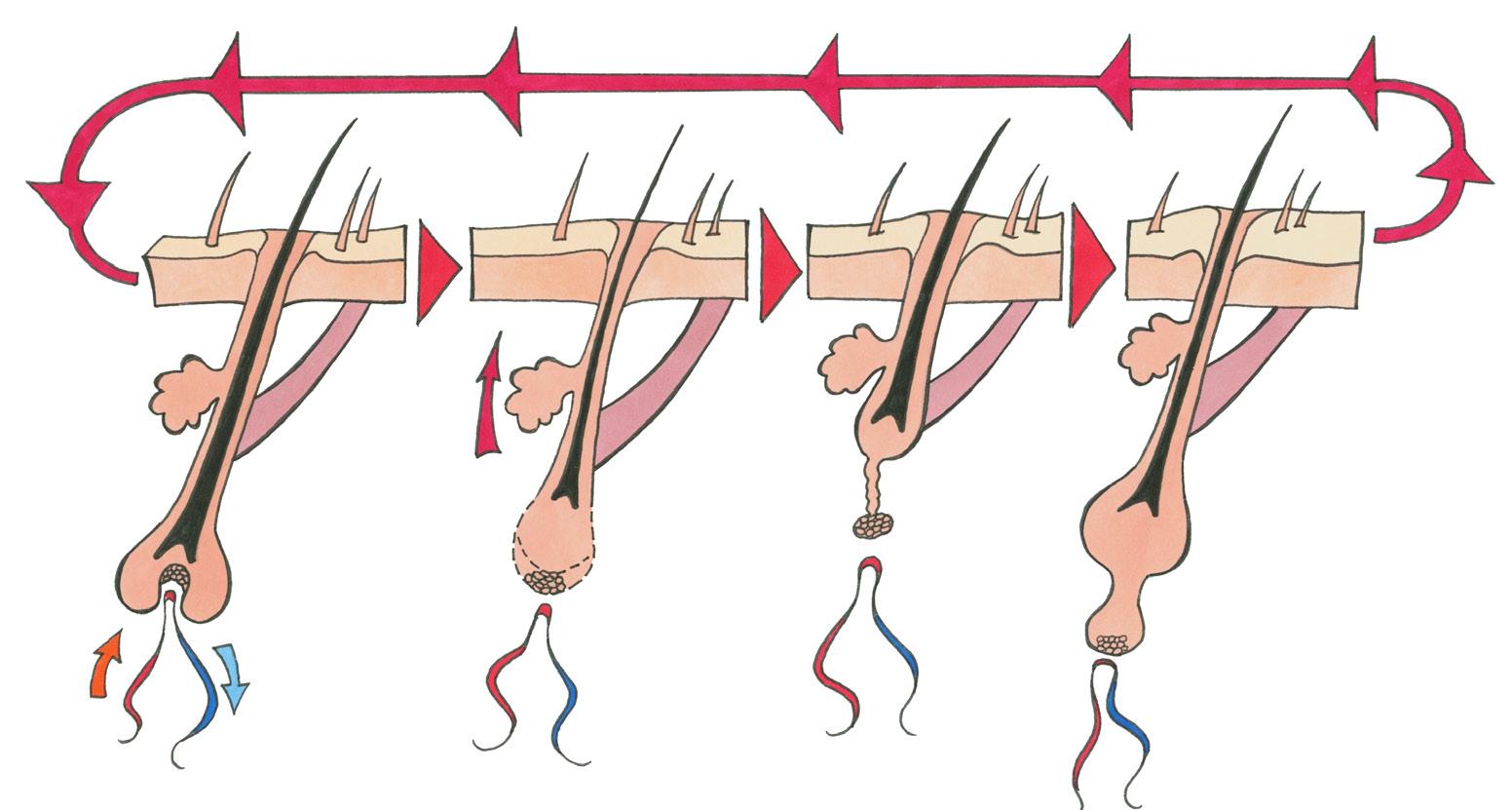
Telogen
This is the resting stage when no growth occurs. The follicle shrinks and fully separates from the papilla. This stage does not usually last very long, from a few hours up to around 4 months. However, if it does not come to an end then baldness results.
The human hair growth cycle is individual to each hair – they reach different stages at different times so that there is a continuous renewal and replacement of old hairs. Wet hair: The following tools can be used when cutting wet hair:
© Copyright Habia 2010 - All rights reserved. Handout
GB3.3.4
The known causes and the typical patterns of male pattern baldness
Before starting a haircut you must consider any male pattern baldness. Some looks or haircuts may emphasise the baldness, whereas others can help to camouflage it. If the client requests it, leave the hair longer around a small bald area or consider breaking the amount of one length hair into different lengths. This can sometimes ‘cover’ a small bald area more effectively and naturally.
Listen carefully to your client’s requirements and follow them if they are achievable. Offer advice but do not insist on cutting any section of hair too short, even if you believe it would look better.
Causes
Male pattern baldness is hereditary – it is inherited, a genetic condition. If a man’s father or grandfather is bald then it is likely that he, too, will become bald. A man can inherit his baldness from his mother’s side of the family as well as from his father’s. Male pattern baldness is thought to be a result of a hormone called androgen.
Typical patterns
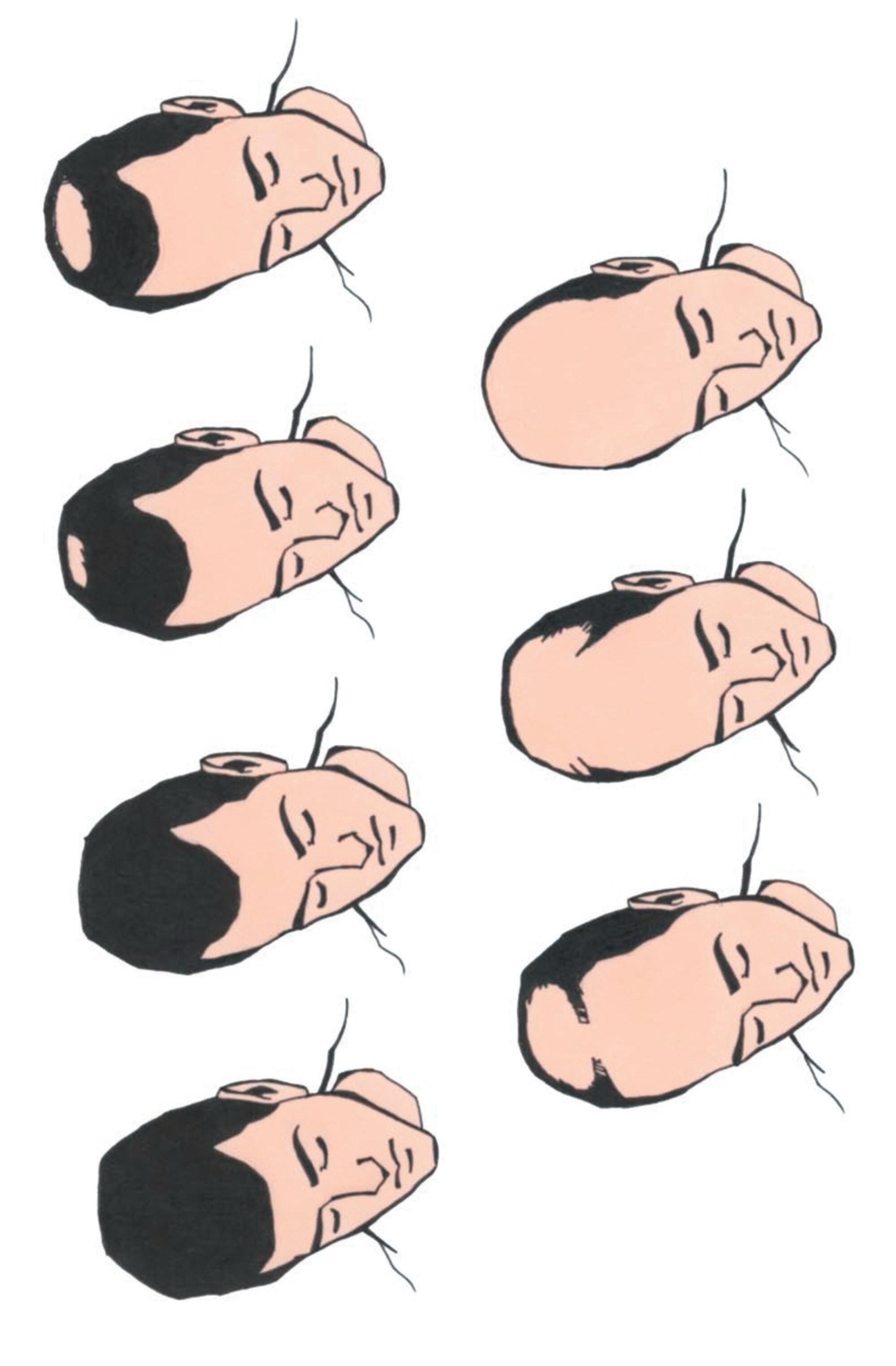
The most common pattern of male baldness is known as the Hamilton pattern. This usually begins with the hair receding at the temples, following which, an area of baldness becomes noticeable at the crown. This area gradually increases until the top of the head is devoid of hair. The bald area gets bigger until only a fringe of hair remains above the ears and around the nape.
What is the main cause of male pattern baldness?
© Copyright Habia 2010 - All rights reserved. Handout
GB3.3.5
Which tools can be used on wet hair, dry hair or both
• scissors, except thinning scissors
• a razor must only be used on wet hair
Dry Hair: The following tools can be used when cutting dry hair:
• scissors
• thinning scissors
• clippers (electric or rechargeable)
Scissors can be used on hair that is either wet or dry.
How the factors in the range can affect the way the hair is cut
Hair density can affect the way you cut the hair because:
• the hair may be too sparse for the look that the client wants
• the hair may be too abundant for the required look
The texture of the hair affects the haircut because:
• if the hair is too coarse the required look may be unsuitable
• if the hair is very fine it may not be possible to create the look that the client wants
The head and face shape influences the look because:
• the choice of look may be unflattering to the head or face shape
Hair growth patterns affect the way you cut the hair because:
• there may be a growth pattern that forces you to change the choice of haircut
• you may have to change your choice of tools to use to achieve the required look
The presence of male pattern baldness influences the haircut because:
• the choice of look may be restricted due to the pattern of baldness
• the degree of baldness may make it impossible to achieve certain looks
Hair elasticity can affect the way the hair is cut because:
• you will have to adjust the degree of tension that you put on the hair during cutting according to the amount of elasticity in the hair
Piercings need to be taken into consideration because:
• you will cause the client discomfort if you catch the piercing with the comb or cutting tools
© Copyright Habia 2010 - All rights reserved. Handout
GB3.4.1a
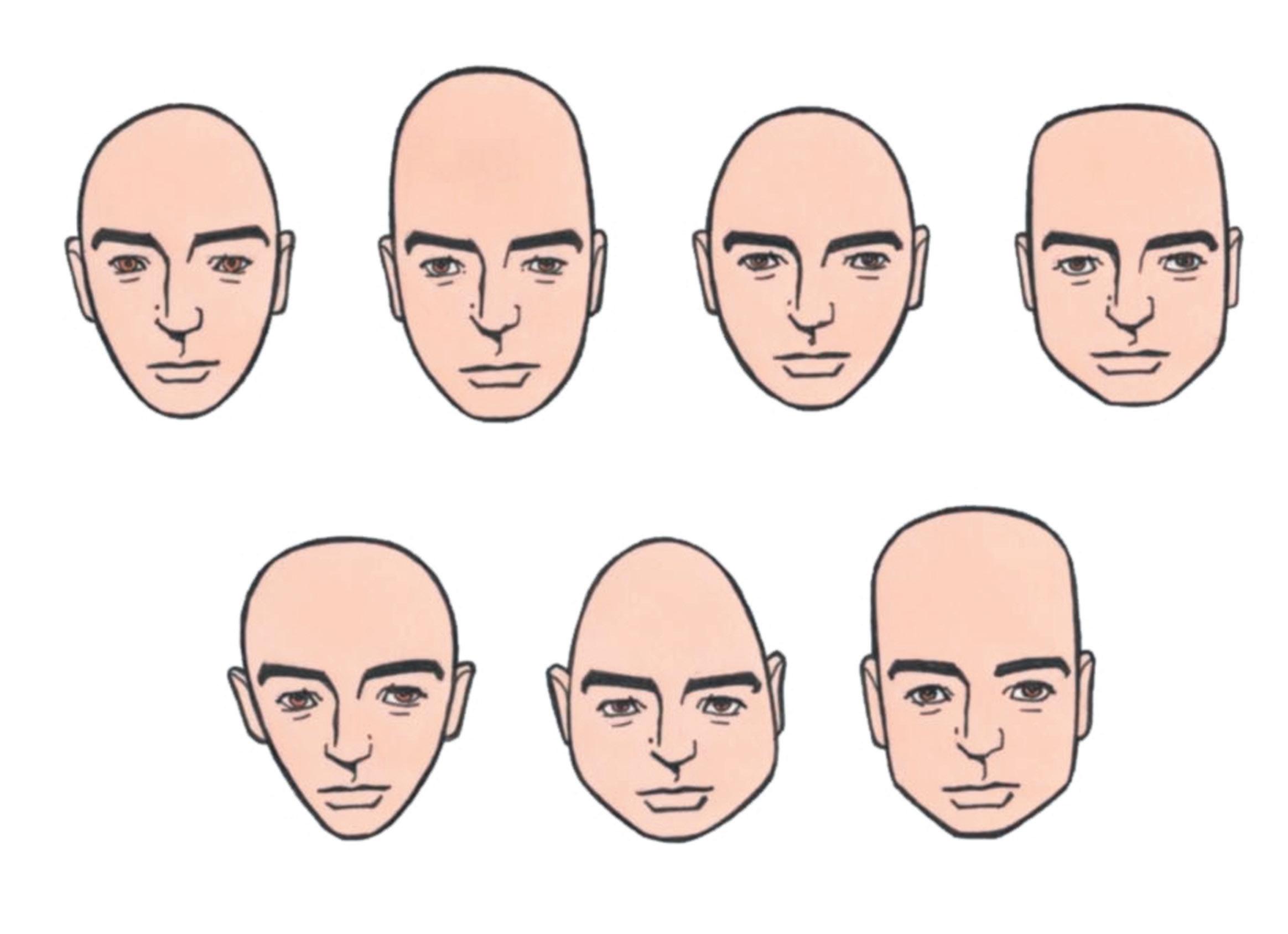
Male facial shapes
© Copyright Habia 2010 - All rights reserved. Handout
GB3.4.1b
The importance of consulting with clients throughout the cutting process
Consultation is a process that should begin when you first meet the client and then continue throughout the hair cutting service.
It is essential that you carry out a full consultation before starting the haircut. The consultation will allow you determine the client’s requirements and identify anything that may restrict the work that you intend to do.
Once this has been done and the haircut has been started, remember, it is just as important to continue to consult with the client.
This will allow you to accurately establish the client’s wishes – you will be able to:
• double check the amount of hair he wants removed from an area before you cut it
• confirm the length to leave the sideburns
• make sure you know how much thinning he wants done
It will also help you to give the client accurate information about his hair and scalp.
For example:
• the need for a conditioning treatment
You can check the progress of the haircut to meet the client’s requirements.
For example:
• have you taken enough off at the top/ back?
• are the sides close enough?
By consulting at key stages throughout the service you can provide a better service to your clients, but take care not to over consult as this may give the client concerns over your abilities.
The importance of applying the correct degree of tension to the hair when cutting
Hair has properties of elasticity. This means that it can stretch and return to its original length. Hair stretches more when wet than when dry.
If you put too much tension on the hair you will stretch it. This means that, once it returns to its original unstretched state, the hair will be shorter than you intended it to be. If the hair is wet when you cut it the likelihood is that it will be too short to meet your client’s requirements. This may result in the loss of a client.
© Copyright Habia 2010 - All rights reserved. Handout
GB3.4.2
How and when to use club, freehand, scissor over comb, clipper over comb, thinning, fading techniques and the effects achieved
You must be able to decide when to use specific techniques as well as know how to use them. This knowledge will help you to achieve the look that the client wants.
How to use different techniques:
• club cutting – comb the hair smooth from the roots, hold it securely between the fingers or in the comb at the correct angle to achieve the desired effect and cut it straight across
• freehand – comb the hair smooth and into position then cut it without holding or supporting it with either your hand or your comb
• scissors over comb – the hair is lifted and held in the comb by combing the hair in an upward motion and the hair that protrudes through the comb is cut, holding the scissors above the comb. Use the coarse teeth of the comb when cutting the longer hair and the fine teeth for holding the short hair around the ears and in the nape
• clippers over comb – the same method is used as for scissors over comb but the hair should be dry. Clippers are often used in the nape area when the hair is to be cut very short
• thinning - thinning is achieved by cutting some of the hairs in a section while others are left uncut, so that the overall length of the section remains the same.
• fading - fading is very close short graduated cut; clippers are used around the ears and nape to blend the short hair away to nothing leaving no outlinethe hair appears to fade into the skin.
This technique can also be carried out freehand ie, by not holding the hair in fingers, but by slicing through the longer lengths.
When to use different techniques:
• club cutting – to reduce the length of the hair without removing any of the bulk
• freehand – when tension is to be avoided, eg around a growth pattern or at the outside line of the haircut if the hair is curly
• scissors over comb – this technique is used to shorten hair and to achieve graduation in a haircut
• clippers over comb – mainly used on shorter looks to reduce length and to create a closer graduation in the nape area
• thinning is done to remove bulk without removing any of the hair length
• fading is mainly used on short graduated cuts to blend the short hair away to nothing leaving no outline - the hair appears to fade into the skin.
Why should the hair be dry when using the clipper over comb technique?
© Copyright Habia 2010 - All rights reserved. Handout
GB3.4.3
The reasons for establishing and following guidelines
There are three main reasons for establishing and following guidelines:
• to decide on the overall length and shape of the cut
• to help you to progress methodically through the cut
• to help you to achieve accuracy in the cut
It is very important that you determine the lengths that the hair is going to measure at the different areas of the head. This is done by creating a guideline or guidelines. A guideline can be placed to run horizontally - at the nape, from ear to ear around the back of the head or across the crown. It can also be positioned vertically, usually from the centre front hairline through to the centre back neckline.
It does not matter where the guideline starts or finishes, the important feature of any guideline is that it is accurate. If more than one guideline is prepared you must ensure that when the cut is carried out the guidelines are connected, otherwise the cut will be uneven.
As you progress from one area of the head to another, the first cut you make will be the new guideline. The next cut is made to follow the first guideline therefore this now becomes the guideline. By matching each piece of hair to the piece previously cut you will be following the original guideline. It is important to follow any graduation in the guideline or the shape of the haircut will be lost.
If you follow the guidelines you will be able to work your way over the head in a methodical, structured way and this will help to ensure an accurate, balanced haircut.
How to cross-check and balance the cut and why this is important
When a barber does a haircut s/he takes sections of hair into their comb or fingers and these sections will run:
• up and down the head – vertical sections • across the head – horizontal sections
If you have used vertical sections when cutting the hair you must take horizontal sections to check the accuracy of the cut. If you have used horizontal sections when cutting then use vertical sections when checking.
This is why the process is called ‘cross’ checking, you work across the original sectioning method.
It is very important that you cross-check the cut if you are to be sure that the cut is accurate and meets the client’s requirements.
When balancing the cut ensure that it is an even length at both sides of the head – use the features of the head and face to measure the hair. However, take into account that the features may be very slightly uneven.
What might happen if you fail to crosscheck a cut?
© Copyright Habia 2010 - All rights reserved. Handout
GB3.4.4
How to create and follow a guideline for different looks - (1 of 2)
Uniform layer
Hold the hair at 90° to the scalp with the fingers parallel to the scalp, cut to the required length. Use this section as a guide for all subsequent sections and hold these at 90° to the scalp with the fingers parallel to the scalp. The hair is cut to the same length all over.
Graduation
A graduation may be:
• a short graduation – shorter in the nape area, getting longer towards the crown
• a long graduation – longer in the nape area, getting shorter towards the crown
Graduation using vertical sections
Take a narrow section of hair at the area to be graduated and at right angles to the hairline, position your fingers in relation to the scalp at the angle of graduation that you want and cut the hair to the chosen length.
Continue taking small sections in a straight line through the head, increasing or decreasing the lengths until you reach the centre back hairline. Follow this guideline around the head.
Graduation using horizontal sections
Take a narrow section of hair across the nape or at the crown. Hold the hair at an appropriate angle to achieve the graduation that you want and cut the hair to the chosen length. Your fingers or the comb should be parallel to the scalp.
Continue taking small sections working up or down the head depending on where you positioned the guideline, increasing or decreasing the lengths as you go.
Use the sections that you have previously cut as guidelines for each new section.
This sectioning method is often used when cutting a very short graduated or tapered look with ears exposed. The comb should pick up very narrow sections for cutting.
Guideline for a fringe
If the hair is short and there is no cowlick or widow’s peak at the front hairline it is a simple matter to cut a fringe – comb the hair forward into its natural lie and cut it to the desired length.
If the hair is long and a fringe is to be separated out then you must create a guideline.
Decide how much of the hair is to be taken into the fringe – this will depend on how coarse or fine the hair is, how heavy the client wants the fringe and if there is a strong growth pattern.
Isolate the fringe from the rest of the hair. Take down a narrow section at the hairline and cut it to the desired length using a freehand technique if necessary.
© Copyright Habia 2010 - All rights reserved. Handout
GB3.4.5
How to create and follow a guideline for different looks - (2 of 2)
Now take down the remainder of the hair, section by section, and cut it to the same length as the guideline. If the hair is bulky cut the top sections a little bit shorter than the previous sections, taper them, this will help the fringe to lie properly.
Guideline for a parting
If the hair is short it may be best to cut it in an even balanced shape and then simply create the desired parting at the final dressing phase. However, if the hair is African type or long Caucasian you must make a decision where the parting will be placed then cut the hair accordingly.
As the positioning of partings varies it is not possible to be prescriptive about guidelines, you must create the guideline according to the needs of the haircut.
Guideline for around the ear outline
After the haircut is completed, use the clippers in an inverted position to create a neat accurate outline using the natural hairline around the ear as a guideline.
Guideline for a fade
Use the graduation from the haircut as a guideline to fade out the cut using clippers and clipper grades to achieve the fade.
Notes
© Copyright Habia 2010 - All rights reserved. Handout
GB3.4.5
The importance of considering weight distribution and working with the natural fall of the hair
It is very important to consider the natural fall of the hair and its weight distribution when cutting hair. If you fail to do this you may not achieve the required look.
Weight distribution
The hair may be sparse on the top, it may be very bulky in the nape or behind the ears. A barber should check the weight distribution at the consultation and design the haircut accordingly.
Remember that long lengths of hair will lie heavily on their own weight – cutting the hair shorter will release that weight and may create a totally different effect. Flat top and crew cut styles are examples of the deliberate release of weight to create the ‘hair standing up’ effect. Modern multitextured styles require cutting meshes of hair into multi varying lengths, in order to produce different degrees of hair angle and lift.
Natural fall of the hair
You must take the natural fall of the hair (sometimes called the natural lie) into consideration when choosing a look and the techniques to use. The hair may stick up from the scalp, it may lie very close to the head or it may be pushed up or to the side by a strong growth pattern or a natural parting.
If you do not work with the natural fall the result will be unsatisfactory.
How the angle at which the cutting tools, head and hair is held will affect the weight distribution, balance and degree of graduation of the cut
You must be very careful to consider the angle at which you hold the hair for cutting. If you hold it at less than 90° to the scalp and the floor it will result in the weight being concentrated at the bottom of the haircut. If you hold it at more than 90° there will be little weight at the bottom and the hair may look straggly at the nape area.
The balance of the haircut will also be affected by the angle at which you hold the hair, particularly if you hold the hair at a slightly different angle at one side. This will make the hair slightly longer and it will look fuller on one side.
The degree of graduation of the cut will be affected by the angle at which the hair is held:
• If you hold the hair at right angles to the head and cut it at 90° you will achieve a 45° graduation.
• If the hair is held at right angles to the head and cut at approximately 135° the result will be almost level – a one length cut.
• If you hold the hair at right angles to the head and cut it at 45° the result will be a steep, sharp graduation
Remember the importance of holding each section of hair with even tension. The position in which you hold and cut the hair will affect the accuracy of the cut.
© Copyright Habia 2010 - All rights reserved. Handout
GB3.4.6
Handout - (1 of 2)
As you work through a cut you will need to position yourself in relation to the clients head, for example; if you only stand square to the client’s head you will not achieve a balanced cut. You need to move around the head to achieve an accurate cut.
Notes.
© Copyright Habia 2010 - All rights reserved. Handout GB3.4.6
Handout - (2 of 2)
How to create neckline and outline shape and the importance of cutting to the natural hairline in barbering
Most men have hair that grows outside of the natural hairline and it is important to remove this hair. If you fail to do so, the haircut can look untidy and unfinished.
You should try to cut the hair to the natural hairline because, if you cut the hair within the natural hairline then remove the hair outside of the outline shape, the heavy growth of terminal hair will soon grow back and the outline shape will be lost.
There are two main reasons why it is important to cut to the natural hairline:
• the shape that is created is usually more masculine
• the outline shape will last longer
A good barber will outline the haircut at the neck, around the ears and sideburns and, in the case of African hair type men, around the front hairline.
This can be done by shaving the area outside of the natural hairline or by using small electric clippers that are designed for this purpose – they cut the hair very short and close to the skin.
The neckline shapes are:
Tapered
Tapered neckline shapes have a soft graduated outline which follows the natural hairline. They appear less severe than a squared neckline. This neckline can be achieved using scissor or clipper-overcomb cutting technique.
Squared
Squared neckline shapes have a clean distinctive outline achieved using scissors or clippers to cut the hairline straight across. The corners of the hairline should be cut square. If required, the squared neckline can tapered to give a more natural finish.
Rounded
Rounded neckline shapes are achieved the same way as a squared neckline except the corners of the hairline are slightly rounded. If required, the rounded neckline can be tapered to give a more natural finish.
© Copyright Habia 2010 - All rights reserved. Handout
GB3.4.7
The hamilton pattern of male pattern baldness
© Copyright Habia 2010All rights reserved. Activity GB3.3.5
Your Trainer will supply some items of electrical equipment.
Examine them and identify any faults they may have.
Notes.
State what you would do with any faulty piece of electrical equipment.
© Copyright Habia 2010 - All rights reserved. Activity
GB3.1.3
Your trainer will show you a range of men’s haircuts.
Look carefully at the cuts and decide which haircuts are most appropriate for the facial shapes on Handout GB3.4.1b
Note your findings here:
Notes.
© Copyright Habia 2010 - All rights reserved. Activity
GB3.4.1
