This is the season when our inboxes and WhatsApp chats, (and magazines!) are filled with campaigns, matches, countdown clocks, and urgent reminders from organizations we care about. It is a beautiful problem to have. Our community is overflowing with initiatives that support Torah, education, chesed, and every imaginable need. Yet it can also feel overwhelming. How do we stay generous when so many worthy causes turn to us at the same time. How do we give with heart instead of giving mechanically. The answer, like so many answers, begins with a shift in mindset. Giving is not a chore. It is an opportunity.
When Yaakov and Esav meet after decades apart, each describes his wealth in a way that reveals his inner world. Esav says, “I have a lot.” Yaakov says, “I have everything.” At first glance the difference seems small, but Chazal point out that it reflects two profoundly different mindsets. “A lot” implies that a person still believes there is more he needs before he can feel complete. “Everything” reflects a person who recognizes that what he has is exactly what he is meant to have. Rav Dessler explains that anything created as a tool for avodas Hashem will never bring satisfaction if it is treated as an end in itself. Money, comfort, ownership, recognition. None of it can satisfy if it becomes the destination rather than the vehicle.
That idea could not be more relevant during the fundraising rush we are in right now. Each campaign reminds us of the countless things money can do when it is treated as a means toward something higher. It can help a family in crisis. It can support a child’s education. It can build a shul, beis medrash, or
a library. It can give dignity, comfort, structure, and hope. When we think of money as a means toward personal happiness, we will always feel like Esav. We will have a lot, but it will never be enough. When we think of money as a means to serve Hashem and support others, we begin to feel like Yaakov. We have everything because everything we have is capable of becoming something meaningful.
This shift also changes how we give. Instead of looking at campaigns as another obligation, we can look at them as moments of purpose. Every request becomes a chance to say, “I get to be part of this.” It does not mean we give to every campaign, and it does not mean we give beyond our means. It means that whatever we choose to give is given with joy because we see our resources as tools for something greater. Even a small amount becomes significant when it strengthens a cause that makes a real difference.
As we move through these last weeks of the year, I keep thinking about Yaakov’s quiet confidence when he said he had everything. It feels like an invitation to look at what we have with a little more appreciation and a little less pressure. We all do what we can. Some years we give more, some years we give less, and some days it feels like the campaigns come faster than we can keep up with. But when we remind ourselves that our giving comes from a place of purpose rather than obligation, it becomes lighter and even uplifting. My hope is that each of us touches that sense of “everything” that giving can bring, the feeling that we contributed to something real and worthwhile.
Wishing everyone a peaceful Shabbos
Aaron M. Friedman
WIN with !
Comfort Year-Round:
Experience stable indoor temperatures, and reduce drafts, with warm winters and cool summers, when you upgrade to spray foam insulation in your
Save Big on Energy Costs:
Cut your heating and cooling bills by 30-50% and make your HVAC system work smarter, not harder.
Breathe Better:
Enjoy improved air quality with reduced drafts and outdoor pollutants, creating a healthier living environment.
Baltimore-Based Jewish Connection Network Helps Deafblind Delegation Experience Israel In A Profound Way
By: Sivan Rahav-Meir
At the Kotel, as I approached the stones to pray, I noticed a woman literally leaning her entire body against the wall, then relying on another woman to help her step back. Around her, I saw several others doing the same.
One of the 12 Support Service Providers, (SSP) Amian Kelemer, explained: “This is the first-ever delegation of Deaf and DeafBlind individuals to visit Israel. Everyone in this group cannot see and cannot hear, but they feel. And they feel powerfully, perhaps even more than we do.” It was extraordinary to watch them. Rabbi Yehoshua Soudakoff, Chabad’s
not on the margins, that they have a place within the Jewish people, and that they are part of something much larger than themselves.
“And it isn’t only their experience. Everyone who encountered us in Israel was deeply moved. Suddenly I realized they have a mission. Waiters, people in the street, hotel staff — everyone stopped and asked questions. Even the bus driver told us he had never experienced anything like this in his life.”
Erin Ross, one of the participants, posted the following at the end of the trip: “There have been two facts about my life that I was always embarrassed
A Morning Of Tribute And Torah Insight: Remembering Rabbi Moshe Hauer ZTV”L And Exploring The Foundations Of Beis Din
By: BJLife Newsroom | Photo: Agra D’Pirka
Once again, with great Siyata Dishmaya, Agra Dpirka hosted an amazing legal holiday program which was very well attended.
Over seventy-five attendees gathered on this meaningful morning for an uplifting program of reflection, learning, and communal growth. The event was dedicated both to Divrei Zikaron for Rabbi Moshe Hauer ZTV”L and to an in-depth exploration of the foundations and function of a Beis Din, including the origins and development of the Baltimore Beis Din.
Rabbi Shraga Neuberger: A Moving Tribute to Rabbi Moshe Hauer ZTV”L
Rabbi Shraga Neuberger opened the morning with heartfelt and penetrating Divrei Zikaron on Rabbi Moshe Hauer ZTV”L. He portrayed a towering figure whose influence reached across the entire spectrum of Klal Yisroel—nationally and internationally—yet whose personal humility and unwavering devotion to Torah remained central to his identity.
Despite the immense demands placed upon him by communal responsibilities and myriad initiatives, Rabbi Hauer never allowed himself to drift from the Gemara. Torah learning was his lifeline, his guide, and the foundation of every decision. Equally paramount was his family—always his first priority, and the
sphere in which his warmth, integrity, and dedication were expressed most intimately.
Rabbi Neuberger also emphasized Rabbi Hauer’s extraordinary ability to connect deeply with Jews from every background and affiliation. He was a Klal Yisroel Yid in the fullest sense— someone who embraced all segments of the community with sincerity, respect, and genuine care.
A New Season Of Charm City Ballers Sponsored By Diamond Auto Leasing Kicked Off With An Exciting First Two Weeks Featuring Both New And Returning Stars!
Orshan Legal Group 56 Advanced Security 39
Orshan Legal Opens Season With Comfortable Win
Orshan Legal Group opened the Charm City Ballers Winter 2025-26 season with a clear victory over Advanced Security, 56-39. Yoni Bobker was extremely efficient and effective, scoring 24 points on just 16 shots and grabbing 13 rebounds. Orshan Legal had 5 other players score at least 5 points, with Heshey Green chipping in 9. Yoseph Orshan had 10 rebounds and dished out 4 assists in the win.
Advanced Security did lead early in the game behind a breakout performance from Avi Goldstein. Goldstein scored the game’s first 4 points and singlehandedly led 6-2, but he didn’t get much support from his teammates in this one. He finished with 28 of his team’s 39 points, with 9 of the remaining 11 scored by Avi Yudkowsky (who also had 6 rebounds and 2 assists).
Councilman Schleifer 44
M&S Enterprise 31
Hariri Rolls Into New Season,
Keying Schleifer Win
Eitan Hariri carried over from his MVP season, scoring 21 points and grabbing 6 rebounds while he and his Councilman Schleifer teammates locked down M&S Enterprise to the tune of a 44-31 victory. Schleifer survived and even thrived despite Avner Shotz leaving the game with an injury early in the second half.
M&S got 15 points and 5 rebounds from Chesky Lewin, who also continued his momentum from his strong summer season with an efficient night. Mitch Gross debuted with 9 points and 4 boards, while Jonah Schindelheim grabbed 6 rebounds and dished out a pair of assists.
Schleifer also got 13 points, 9 rebounds, and 3 assists in the fiery CCB return of Nadav Spiegler. They take their season opening win into a matchup with Tov Pizza next week, while M&S matches up with Fired Up Promotions.
Councilman Schleifer 49 Tov Pizza 42
Councilman Schleifer Erases Early Deficit, Gets Tough Win
Nadav Spiegler hit 9 of his 13 free throws on his way to 19 points total as Councilman Schleifer overcame a 4 point halftime deficit to defeat Tov Pizza 49-42 and move to 2-0. Schleifer opened the second half on a 14-2 run, with Spiegler scoring 10 of his points in that stretch and the team continuing to play lockdown defense.
Tov Pizza did have significant contributions from several players. Menachem Blackman led the team in scoring and rebounding with 12 and 10 respectively. Mordi Spero had 10 points, 8 rebounds, and 3 assists, while Mordy Reches had 7 points and 8 boards. Isaac Beletskiy added 9 points as well, as Tov Pizza dropped their season opener.
Eitan Hariri didn’t put up his usual eye popping stats, but he did fill the stat sheet up with 13 points, 8 rebounds, and a game high 4 assists. Sub Zev Namrow added 11 points and 9 rebounds and was a key reason Schleifer was able to overcome not having Avner Shotz due to injury.
M&S Enterprise 56 Fired Up Promotions 47
Goldstein Subs, Stars as M&S Starts 2-0
Avi Goldstein stepped in for the absent Chesky Lewin and had a huge game, finishing with 27 points, 11 rebounds, and 3 assists and carrying M&S Enterprise to a victory over Fired Up Promotions. Jonah Schindelheim added 12 points and 8 rebounds in the win, while Mitch Gross had 7 points and 4 assists.
After running out to an early lead and extending it to 14 at 36-22 early in the second half, M&S had to withstand a big charge from Fired Up. Fired Up had the ball down 2 in the final minutes with a chance to tie or lead, but missed their opportunity and M&S put the game away at the free throw line with Goldstein going 7-8 there down the stretch.
Fired Up was led by Yisroel Luchansky, who had 20 points and 11 rebounds. Yali Rothenberg chipped in 11 points while Abie Hyatt had 8 and 6 rebounds. Avromi Gartenhaus grabbed 10 rebounds and dished out 3 assists in the loss.
Around the Community
Honoring Baltimore City Police Officers On Thanksgiving: Gratitude For Providing Kosher Meals And Meaningful Support
By: BJLife Newsroom
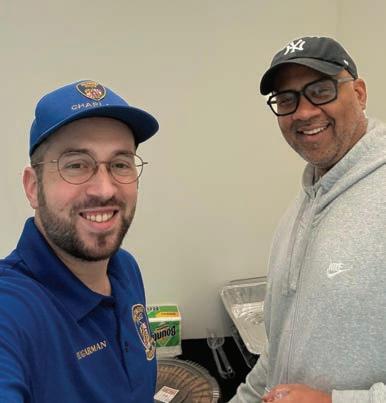
Baltimore Jewish Life received the following note from Chad Shugarman, Volunteer Baltimore City Police Chaplain, and we are pleased to share it with our readership.
“Yesterday, we provided hot, full meals to all the shifts at the Central District for BPD officers who were on duty throughout Thanksgiving—serving our communities while most families were gathered around their tables.
Because the main catered food was not Kosher, I want to publicly recognize and thank The Knish Shop for their generosity. Thanks to their donation, our Orthodox Jewish and Muslim officers were also able to enjoy a proper meal and feel appreciated while they served.
It was a simple gesture, but one that went a long way in reminding our officers that their dedication does not go unnoticed.”
Chad asked that this acknowledgment be shared with the BJL community, and we are glad to help highlight this meaningful act of support.
Harav Malkiel Kotler, Shlita, Visits TA, Inspiring Talmidim Across The Yeshiva
By: BJLife Newsroom
HaRav Malkiel Kotler, shlita, Rosh HaYeshiva of Beth Medrash Govoha (BMG) in Lakewood, paid a special visit to TA today. Throughout his visit, the Rosh HaYeshiva met and greeted talmidim from across the yeshiva — from the elementary divisions through the yungeleit of TA’s new Kollel — offering warm divrei bracha and chizuk.
After davening Mincha with the TA Mesivta, HaRav Kotler, shlita, delivered a more formal address to the
Mesivta talmidim and then continued on to meet with the TA Kollel yungeleit, further uplifting all who had the zechus to hear from him.
Chanukah Sale
NOW THROUGH DECEMBER 24, 2025
FAMILY
In this moving and practical guide to enhancing our tefillos, Rabbi Krohn shares Hashem through tefillah. As he examines many of our daily tefillos, from Modeh Ani to Ashrei to the berachos of Shemoneh Esrei and beyond, he gives us a fresh understanding and appreciation of the prayers we say each day.
A special section on bikur cholim, particularly poignant as he remembers his own struggles with rehabilitation, highlights the compassion and chessed that define Rabbi Krohn’s life and message.
Warm, uplifting, and deeply personal, this is a book that will transform the way you think about prayer — and the way you pray.
A Voice of Fire, A Heart of Compassion
MANDELBAUM FAMILY EDITION
by Gedalia Guttentag
From the historic alleyways of Yerushalayim’s Old City to the Chief Rabbinate of Rechovot, Rav Simcha Kook lived a life of courage, principle, and burning connection to Hashem. He rebuilt broken souls. He raised Torah institutions. He transformed Rechovot’s kashrus system into one of the most respected in Israel — setting a standard of halachah and integrity that reverberated throughout the country.
In this powerful biography, popular author Gedalia Guttentag brings readers into the world of a rav who never wavered. Whether facing courtroom battles, guiding baalei teshuvah, or quietly weeping before his private aron kodesh, Rav Simcha’s mission was always clear: serve Hashem and uplift His people.
BIOGRAPHY!
Around the Community Cheder Chabad Of Baltimore First Grade Talmidim Receive Their First Chumash
By: BJLife Newsroom
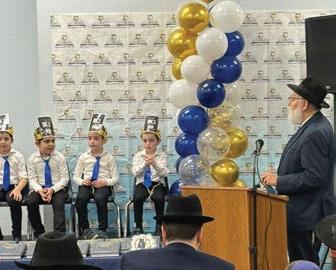
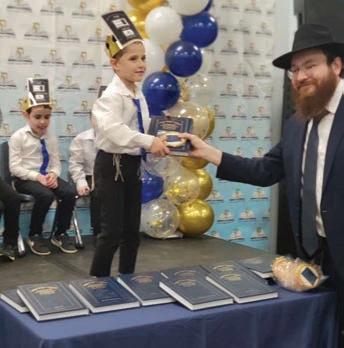
Cheder Chabad of Baltimore celebrated a momentous milestone this week as its first-grade talmidim received their very first Chumash at the annual Chumash Party—a cherished event marking the formal beginning of Torah learning.
The celebration opened with warm words of welcome from the school’s principal, Rabbi Ephraim Sorkin, who spoke about the joy and pride of seeing young children take their first steps into Torah study. The program was led by the class Rebbi, Rabbi Shmulik Raices, whose enthusiasm and dedication were reflected in every part of the presentation.
From the onset, the boys displayed tremendous chayus and eagerness for this special occasion. In keeping with Cheder Chabad tradition, they participated actively, with several students serving as MCs. The class sang a joyful song about “Ki Heim Chayeinu”—expressing that the Torah is their life—and then recited the Rebbe’s kapitel with heartfelt song.
Maryland’s head shliach, Rabbi Shmuel Kaplan, shared an inspiring message, emphasizing that real learning begins now. He explained that everything the children have learned until this point served only as preparation for the depth and beauty of beginning Chu-
mash—making this day the true start of their lifelong connection to Torah.
The boys then impressed the audience as they reviewed the shoroshim, a foundational skill essential for learning Chumash. They were addressed by Rabbi Elchonon Lisbon, founder of Cheder Chabad and the shliach to Park Heights, who lovingly engaged directly with the students’ developing ability to identify shoroshim. He challenged them to find the shoresh of the word “Chumash” and explain its meaning. The boys rose to the challenge masterfully, demonstrating a solid grasp of the concept and showing that they understand they are beginning the first of the five seforim of the Torah.
The program continued with the class proudly reciting the opening pesukim of Chumash and later featured an incredibly cute video presentation that highlighted their commitment to being
soldiers in Tzivos Hashem, bringing smiles to parents and students alike.
The celebration concluded with the highlight of the event: each boy stepping forward to receive his very own Chumash, marking the official start of his journey in Torah learning. After all the boys received their Chumash, they all grabbed their fathers and broke out into a joyous dance.
Rabbi Asher Sher Stein Speak To Toras Simcha Students
Rabbi Asher Stein spoke to the Yeshivas Toras Simcha students this afternoon. Rabbi Stein teaches Beth Tefillah and is a camp director at Camp Shoresh. He entertained and inspired the students with the story of a wagon driver and a rabbi who agreed to switch roles. The wagon driver was caught in a difficult situation when someone asked him a shaila that he did not know how to answer Quickly, the wagon driver told the person, “That question is so simple even my wagon driver can answer it.” Rabbi Stein encouraged each boy to celebrate his unique talents and strengths and not try to be someone else. Hashem gave each of us the strengths to accomplish our mission in life.
Cheder Chabad extends a special thank-you to Levik Pewzner and Rabbi Mendel Chazan for providing the music and sound, which added greatly to the simcha. A special thank you to Mrs. Chomie Raices, Associate General Studies Principal, and Mr. Neal Gerstman, Facilities Director for the setup and decor.
Photos: Dovid Kapenstein
An Interview with Zahava List, Founder of Chazkeinu
BJH: Can you tell us a little about yourself and how you came to Baltimore?
Zahava List: Absolutely. I’m originally from St. Louis, Missouri. After getting married, living in Israel and St. Louis with our 4 boys, we were looking for a community where we could put down roots, raise our children, and grow. Baltimore offered the warmth of an out-of-town feel along with the infrastructure our family needed. We’ve been living here for eight years and truly appreciate the connection and support this community provides.
BJH: You’re the founder of Chazkeinu. What inspired you to start the organization?
Zahava: Chazkeinu came from my own struggle. After having my first child in Israel, I experienced postpartum psychosis that later developed into bipolar disorder. My family and care team were incredibly supportive, but I didn’t have someone who could say, “I get it.” There was no space
for Jewish women to discuss mental health openly. I had seen the strength of peer support through 12-step programs, and when I couldn’t find anything similar in the Jewish world, I decided to create it. In 2016, I reached out to two women, one from Rochester and one from Chicago, and together we launched our first phone support meeting. From those early days, Chazkeinu has grown into a global organization.
BJH: What is the mission of Chazkeinu?
Zahava: Our mission is simple and profound: No Jewish woman should ever have to face mental health challenges alone. We work to normalize the struggle, reduce stigma, and create a safe environment where women can support one another. It’s about building a community and sisterhood where people can be real, find strength, and grow with the help of others who truly understand.
BJH: Who can participate in Chazkeinu’s programs?
Zahava: We welcome Jewish women ages 18 and up. Married, single, divorced, widowed, across all backgrounds and levels of observance. Our members include women with a wide range of mental health diagnoses, as well as women who have not been formally diagnosed. We also support family members such as wives, mothers, and daughters. Our reach spans more than 100 cities, with active branches in Baltimore, Melbourne, London, Israel, Lakewood, Brooklyn, Montreal, and more.
BJH: What programs and services do you offer?
Zahava: It begins with four weekly virtual and phone support meetings where women can share, listen, and gain strength. We send a daily email filled with resources, uplifting writing, and artwork from our members—a real “hug in your inbox.” We offer a non-emergency support hotline staffed by licensed professionals, active group chats on WhatsApp and Slack, and in several cities, in-person “chill houses” that host workshops, activities, and a warm space to connect. And more! Our leadership includes two rabbinic advisors and four clinical directors to ensure our programming is both supportive and professionally grounded.
BJH: Can you share a story that highlights Chazkeinu’s impact?
Zahava: There are many. One woman came to us after her therapist felt she needed additional support. Traditional therapy wasn’t enough on its own. Through Chazkeinu, she found women who understood her experiences and, for the first time, felt hope. She recently told me, “I finally feel like I have a life worth living.” Another story is of a young woman who joined as an 18 year old and struggled with confidence while dating. With the support of the group, she found the courage to share her journey with her future husband. Today, she’s happily married and living with pride and strength.
BJH: How important are volunteers to your organization?
Zahava: Volunteers are the heart of Chazkeinu. Most come to us as participants who want to give back once they are ready. It’s truly a model of “by the people, for the people.” The dedication and talent of our volunteer team continually inspire me.
BJH: How can the broader community help Chazkeinu grow?
Zahava: The first step is awareness. Speak openly about mental health, share resources, and encourage people to seek help without shame. Rabbanim and community leaders can make a real difference by addressing mental health in public settings. On a practical level, we’re launching a CauseMatch campaign from December 7–9 with a goal of raising $250,000. These funds will help us expand programs, reach more women, and continue breaking down stigma. Every contribution matters.
BJH: Any final message?
Zahava: To anyone struggling, please know you’re not alone. Chazkeinu is here, and support is available. My personal journey—from rock bottom to founding an international organization—should show that hope is real and healing is possible.
To donate to the Chazkeinu campaign please visit: https://causematch.com/ Chazkeinu25.
To learn more about Chazkeinu, visit chazkeinu.org.
613 Seconds with Rabbi Richard Altabe, former principal of Darchei Torah and HALB
Bringing Chinuch First Curriculum to Yeshiva Toras Simcha Baltimore
their curriculum menahel, Rabbi Shain.
My connection to Toras Simcha began through Rabbi Hillel Shepard, who had sent his son to the Cheder in Monsey and witnessed firsthand how it built strong Torah learning skills for his child. After arriving in Baltimore, Rabbi Shepard reached out to explore how Toras Simcha might be able to implement our model.
na, and Gemara. Instead of simply measuring growth through coverage of parshios in Chumash and perakim of Gemara, the focus is on the underlying skills needed to unlock the meaning of a pasuk in Chumash or a daf of Gemara.
By putting Chinuch First, we aim to ensure that each child reaches their full
training sessions with the rebbeim to help prepare them to teach to the standards we have created. They have received guidance from Rabbi Shain, who developed the curriculum for Cheder d’Monsey, and one of our rebbeim also conducted a session before the year began. I provided professional development training for the staff during teacher orientation on the topic of assess-
ments, ensuring rebbeim understand our goals in evaluating student progress.
BJH: Share with us a great success story related to the curriculum.
Here’s a wonderful example: Recently, I was looking for something in the office at Cheder d’Monsey and was told it was in a certain location. Some students were present, and when I couldn’t find the item, I remarked that not finding it was a ‘kashya.’ A fifth grader immediately corrected me, explaining that it was actually a ‘shailah.’ This student demonstrated that the concepts taught in the classroom had truly become part of him—even though the
BJH: How does this Chumash curriculum impact other learning such as
We have found that by providing students in younger grades with a strong foundation in Chumash skills, we effectively prepare them for learning Gemara. By fifth grade, students understand that the structure of a mishna involves grasping the background and often includes key components of the case and the final din..
When students begin Eilu Metzios in fifth grade, we start by teaching them the memras of the cases discussed in the famous sugya of Yeush Shelo Midaas. By teaching the memras first, the children gain sufficient background to delve deeper into the Gemara later on. This scaffolded approach ensures students are well-prepared for increasingly complex learning.
The Week In News
The Week In News
Argentina Knew About Mengele
It’s hard to hide in plain sight – or maybe it isn’t, if you’re not really hiding.
According to declassified documents reported by Fox News on Sunday, the Argentine government had maintained a detailed dossier on Nazi war criminal Josef Mengele, ym”sh, who led a relatively carefree life in the country until he fled to Paraguay in 1959.
Mengele, notoriously known as the “Angel of Death” for the brutal and sadistic experiments he conducted at Auschwitz on prisoners, initially entered the country on a fake Italian passport in 1949 under the name Helmut Gregor.
It was a well-known secret at the time that the Argentine government harbored Nazis who fled Europe after the war. By the 1950s, the government was aware
that the twisted “physician” was in the country, an analysis of the documents by Fox showed.
Up to 5,000 Nazis are said to have settled in Argentina, including Mengele and Holocaust architect Adolf Eichmann, who was captured by Israeli agents and executed after a trial in Jerusalem.
Mengele felt so comfortable in Argentina that in 1956, he began to use his real name. He asked for his original birth certificate from the West German Embassy in Buenos Aires and requested his ID cards to be remade with his original name.
A memo from Argentina’s Federal Coordinate Directorate in 1960 demonstrated the country’s knowledge of Mengele’s identity, citing his explanation of why he used a fake name to enter the country when he came forward to change his official identity.
“Thus, it appears that, while maintaining his real name, the subject belonged to the SS Society […] during which time he demonstrated being nervous, having stated that during the war he acted as a physician in the German SS, in Czechoslovakia, where the Red Cross labeled him a ‘war criminal.’ He had stud-
ied Anthropology and was known to the Justice in the courts of Nuremberg, especially regarding the study of skulls and bones, but that union was considered a crime in National Socialist Germany,” a translation of the document said.
By the time the memo was written, Mengele had fled to Paraguay after international pressure increased on Argentina to extradite him, following a request by West Germany.
The notorious Nazi arrived in Brazil around 1960. He lived there until he died in 1979 from a stroke that he had when he was swimming in the sea off the Brazilian coast. He was buried under the name Wolfgang Gerhardt.
According to the documents, Argentine intelligence tracked the Nazi throughout his life in South America.
Mengele, a German SS officer and physician, was notorious for his sadistic experiments on twins, pregnant women, and individuals with physical abnormalities, often without anesthesia and with lethal results.
He played a central role in the selection process upon prisoners’ arrival at Auschwitz, the Nazi death camp
where Yad Vashem estimates that one million Jews were murdered, deciding with a flick of a hand who would be sent to forced labor and who would be killed immediately.
Iran’s Hezbollah Funds Go Through Dubai
Over the past year, Iran has given Hezbollah hundreds of millions of dollars in funds through money exchanges and businesses in Dubai, according to individuals with knowledge of the matter.
Hezbollah, a Lebanese terror group and Iranian proxy that used to be the best-armed non-state militia in the world, has been struggling to recover from its two-month war with Israel last year. The war left the terrorist organization financially and militarily weak. Hezbollah relies on Iran for funding. Typically, Iran has smuggled funds to Hezbollah through Syria. But since the fall of the Iran-backed Syrian regime of Bashar al-Assad last year and the emergence of
Greater Washington Weekday Minyanim Guide
6:15 am Young Israel Shomrai Emunah M-F
6:25 am Southeast Hebrew Cong., Knesset Yehoshua M-F
6:30 am Beth Sholom Congregation M-F
Beit Halevi (Sfardi) M, T
Chabad of Silver Spring M-F
Ohev Shalom Talmud Torah OLNEY M-F
Young Israel Shomrai Emunah S YGW M, Th
6:35 am Ohr Hatorah M, Th
6:40 am YGW S, T, W, F
Magen David Sephardic Congregation M-Th
6:45 am Beit Halevi (Sfardi) S, T, W, F
Kemp Mill Synagogue M, Th
Ohr Hatorah T, W, F
Young Israel Shomrai Emunah M, Th
6:50 am Woodside Synagogue/Ahavas Torah M, Th Silver Spring Jewish Center M-F
Chabad of Upper Montgomery County M-F
6:55 am Young Israel Shomrai Emunah T, W, F
7:00 am Kemp Mill Synagogue T, W, F
Southeast Hebrew Cong., Knesset Yehoshua S Silver Spring Jewish Center S
Woodside Synagogue/Ahavas Torah T, W, F
Young Israel Ezras Israel of Potomac T, W, F
7:05 am Kesher Israel M, Th
7:15 am Kemp Mill Synagogue M, Th Kesher Israel T, W, F
Ohev Sholom Talmud Torah/The National Synagogue M-F
Ohr Hatorah S
7:30 am Chabad of DC M-F
Chabad of Potomac M-F JROC M-F
Kemp Mill Synagogue T, W, F
Southeast Hebrew Cong., Knesset Yehoshua M-F
Young Israel Shomrai Emunah S
Young Israel Shomrai Emunah (Sfardi) M-F
7:45 am YGW (Yeshiva Session Only) S-F
8:00 am Beth Sholom Congregation S
Kemp Mill Synagogue S
Kesher Israel S
Ohev Shalom Talmud Torah OLNEY S
Southeast Hebrew Cong., Knesset Yehoshua S Chabad of Upper Montgomery County S Woodside Synagogue/Ahavas Torah S
Young Israel Ezras Israel of Potomac S Young Israel Shomrai Emunah (Sfardi) S
8:05 am Ezras Israel Congregation of Rockville M, Th
8:15 am Ohr Hatorah S Ezras Israel Congregation of Rockville S, T, W, F
Kehilat Pardes / Berman Hebrew Academy S-F
Silver Spring Jewish Center M-F
8:30 am Chabad of DC S Chabad of Potomac S JROC S Ohev Sholom Talmud Torah/The National Synagogue S Silver Spring Jewish Center S YGW (Summer Only) S-F
8:45 am Young Israel Shomrai Emunah S-F
9:00 am Chabad of Silver Spring S Kemp Mill Synagogue S
12:30 pm YGW S
1:00 pm Silver Spring Jewish Center S-F
2:10 pm YGW M, T, W
2:45 pm YGW S-Th
3:00 pm YGW Middle School School Days mincha
mincha/maariv
Before Shkiah (15-18 minutes), S-TH
Beit Halevi (Sfardi)
Beth Sholom Congregation
Chabad of Potomac
Chabad of Silver Spring
Chabad of Upper Montgomery County
Ezras Israel Congregation of Rockville (20 min before, S-F) JROC
Kemp Mill Synagogue Kesher Israel
Magen David Sephardic Congregation
Ohev Sholom Talmud Torah/The National Synagogue Ohr Hatorah
Silver Spring Jewish Center
Southeast Hebrew Congregation
Woodside Synagogue/Ahavas Torah
Young Israel Ezras Israel of Potomac
Young Israel Shomrai Emunah (Asheknaz) Young Israel Shomrai Emunah (Sefarhadi) maariv
7:30 pm YISE M-Th
8:15
shacharis
GNIRIHGNIRIH
High School English Teachers
2:50-3:35pm 12th grade Eng 102 - Must have a Master’s degree in a related field
3:38-4:23pm 12th grade Eng
Both 12th grade classes share the same lesson plan
4:33-5:17pm 11th grade Eng
5:20-6:05pm 9th grade Eng
Bachelor’s degree required.
SE ND YO UR RESUM E : SSTEINBERG@TALMUDICALACADEMY.ORG
Food Service Team Member
Sun 8:00-10:00am, Mon-Thurs: 8:00am-5:00pm
SE ND YO UR RESUM E : TFEIGENBAUM @TALMUDICALACADEMY.ORG
C ompet iti ve C ompen s atio n Qu al ifi ed T ui ti o n Red u ctio n Caf eter ia P l an fo r V i si o n, Denta l and Dependant C ar e Di s abi lit y & L if e Ins ura nce P la ns Gr ou p Dent a l P lan s
THE KEY TO YOUR FUTURE.
The Week In News
new efforts by the Lebanese government to crack down on illegal transfers, Iran has been searching for new channels through which to send Hezbollah money.
Seminary
Mrs.
Rabbi
Rabbi Dovid
Rabbi
Rabbi
Rabbi
Rabbi
Now, Tehran is using its earnings in Dubai — from oil sales from Iran-affiliated exchange shops, private companies, businessmen, and couriers — to fund Hezbollah. Those earnings are transported to Lebanon through the centuries-old Hawala method, which allows individuals to send money solely on the basis of trust. A dealer in Lebanon pays out the funds, which are deposited with a dealer in Dubai.
Though Iran has, for years, relied on the United Arab Emirates to dodge sanctions and illegally transfer funds, the U.A.E. has reaffirmed its commitment to ending illegal financial dealings conducted in its territories. In 2022, the Financial Action Task Force placed the U.A.E. on its “gray list” for failing to prevent widespread money laundering and terror finance. Two years later, the group took the U.A.E. off the list, citing major oversight improvements.
Since the beginning of the year, Iran’s Quds Forces, which supports Tehran’s overseas proxies, has given Hezbollah over $1 million, with most of the money coming from money exchange companies, according to a November statement by the Treasury Department, which sanctioned three Hezbollah terrorists.
Hezbollah incurred major costs from its war with Israel, which left it weak. Now that the terror group is trying to rebuild, its budget has increased dramatically, according to Hanin Ghaddar, a senior fellow at the Washington Institute, who noted that their previous annual budget – one billion dollars – is no longer enough for the group.
According to a senior United States official, the U.S. is also concerned about
Hezbollah receiving funds that were smuggled through Turkey and Iraq.
In November, the Treasury’s undersecretary for terrorism and financial intelligence, John Hurley, visited the U.A.E. and Turkey before his trip to Lebanon, to speak about efforts to prevent Iranian money laundering and terror finance.
Military Youth Service in France
French President Emmanuel Macron announced, in a speech delivered in southeastern France recently, that a new 10-month military service for young people would start next summer.
The program, in ways, resembles European military programs during the Cold War era, when much of Europe required men to train in the military after becoming adults. However, unlike service during the Cold War, this program will be voluntary, as France’s mandatory military service ended in 1997.
The military’s initial goal is to recruit 3,000 young adults, mostly between the ages of 18 and 19, for the new service. By 2035, recruitment would reach 50,000 a year. Macron said that the draft would only be reinstated if Parliament approves of it during a “major crisis.” The president noted that France would not resort to conscription for now but needs to mobilize.
Germany has, similarly, been amping up efforts to recruit troops. In prepara-
Find
The Week In News
tion for a hypothetical draft, the country is constructing a database with details about young people, including their fitness and aptitude. Additionally, Germany has started a similar voluntary service program with ambitious recruitment goals. If Germany fails to meet those goals, it may make service mandatory.
Officials in Europe fear a conflict with Russia may be only three to four years away. As such, many European countries have been scrambling to rebuild their shrunken armies and prepare themselves for a potential war. Though much of the French public opposes mandatory service, around 62% of 18 to 25-year-olds are in favor of reinstating forced service, according to a 2024 Defense Ministry study.
Macron has clarified that this program’s recruits would not be going to Ukraine or anywhere abroad.
The service will include one month of basic training and nine months of active army duty. Afterwards, participants can choose to join the army full-time or join a reserve force.
Talks to End Ukraine War
United States officials recently met with a Ukrainian delegation in Florida to discuss an end to the country’s ongoing war with Russia. The talks addressed several issues, including future elections, land swaps, and security guarantees.
For over four hours, U.S. Secretary of State Marco Rubio and special envoy Steve Witkoff, as well as Jared Kushner, the sonin-law of President Donald Trump, met with a Ukrainian delegation led by Rustem Umerov, the secretary of the National Security and Defense Council of Ukraine, who replaced Andriy Yermak, an official who recently resigned over a corruption scandal. On Monday, Witkoff and Kushner went to Russia to continue the talks.
“We don’t just want to end the war –we also want to help Ukraine be safe forever so never again will they face another invasion,” Rubio said after the meeting. “There’s more work to be done. This is delicate, it’s complicated, there are a lot of moving parts, and obviously there’s another party involved here that’ll have to be a part of the equation.”
Umerov called the meeting “productive and successful” and said that their “objective is a prosperous, strong Ukraine.”
This round of negotiations started in October, when Kushner and Witkoff
crafted an initial 28-point peace plan with Kirill Dmitriev, a negotiator selected by Russian President Vladimir Putin. The plan, which leaked in mid-November, raised concerns in Ukraine and Europe, as the deal seemed to favor Russia’s demands. The plan proposed a cap on the size of Ukraine’s army, but not Russia’s, and an agreement to block Ukraine’s entry into NATO.
Whether Putin would be willing to make concessions at this point is unclear, though he said he was prepared for “serious” discussions about ending the war once Ukraine withdraws its troops from the Donbas region’s Donetsk and Luhansk, including places that Russia has yet to seize.
Discussions regarding security guarantees have been complex, as have talks on land swaps, as Ukraine is not constitutionally allowed to give up land unless a national referendum permits it.
A Bullet in His Heart
Two soldiers were critically wounded last week in southern Syria during clashes with gunmen and are now in stable condition. Surgeons at Haifa’s Rambam Medical Center managed to save the life of one of them who had arrived at the hospital with a bullet lodged in his heart.
The two soldiers were among six wounded during the brief battle, which took place as the IDF carried out an operation to arrest members of the al-Jama’a al-Islamiyya terror group in the Syrian village of Beit Jinn a few miles east of Israel’s border.
One of the soldiers was shot in the chest, and the bullet penetrated his vest and stopped inside the heart.
“The surgery was complex and challenging and included opening the chest both from the side and from the center in order to stop the source of the bleeding,” said Prof. Gil Bolotin, director of the Cardiothoracic Surgery Department at the hospital.
Chag Sameach!
Have a Happy
CHANUKAH
VISITING DATES
The Week In News
The bullet passed between the heart’s septa, the walls of tissue that separate the heart into different chambers. The doctors “unanimously” decided to leave the bullet in place.
“We may need to operate again to remove the bullet from the heart, we may choose to remove it by catheterization, and there is definitely a possibility that the bullet will remain where it is,” Bolotin explained. “Today, he is already recovering and communicating with those around him.”
The soldiers were wounded early Friday morning as the IDF carried out an arrest operation inside Syrian territory, which the military said targeted two members of the al-Jama’a al-Islamiyya (Islamic Group) terror organization who were allegedly planning attacks on Israel. The two brothers were arrested at home. When troops left the house, assailants targeted the IDF soldiers.
The military said the troops returned fire, and the Israeli Air Force also provided support with strikes from helicopters and drones. Fighter jets also conducted several strikes on predetermined targets, the IDF said.
Following the incident, Syria condemned the operation as a “war crime.”
“Syria denounces…the criminal ag-
gression” of the IDF, Syria’s Foreign Ministry said in a statement, charging that such acts aim to “ignite the region” in conflict.
The IDF has been deployed to nine posts inside southern Syria for nearly a year, since the fall of the Bashar al-Assad regime in December 2024. They are mostly within a UN-patrolled buffer zone on the border between the countries. Two posts are on the Syrian side of Mount Hermon.
Troops have been operating in areas up to around 15 kilometers (nine miles) inside Syria, aiming to capture weapons that Israel says could pose a threat to the country if they fall into the hands of “hostile forces.”
Cohen: Mossad Active in Iran
A recent clip of former Mossad director Yossi Cohen reveals that Israel has Mossad operatives in Iran. A recording of the former chief was obtained by Haaretz and was published in the newspaper last week.
According to the audio, Cohen states that Mossad operatives are active on Iranian soil. Iran is “not a place where we operate by proxy,” Cohen can be heard
STAFF APPLICATIONS NOW OPEN
Make memories while making a difference!
Mentorship from a specialized medical & therapy team
Brand-new bunk houses with AC
Private lake with a wide variety of adapted water sports
Action-packed programming for staff & campers
Mrs. Baila Vaturi Camp Director
Mrs. Yaffi Scheinberg Chief Executive Officer
The Week In News
saying in the clip. “We go in to recruit and to bring intelligence.”
Cohen was head of the intelligence agency for five years, stepping down in 2021, though he reportedly continued to work behind the scenes, including in hostage talks following Hamas’s massacre in southern Israel on October 7, 2023.
In the recording, which Haaretz said was made in the past few days, Cohen referenced public claims by U.S. President Donald Trump about the destruction of Iranian nuclear sites during the 12-day war in June: “Trump said ‘total dismantlement.’ I say, if not total dismantlement — then at least, and this is a lot — a very substantial halt.”
He also warned that Tehran still retains a nuclear capability, saying, “The Iranian regime has not given up its nuclear ambitions.”
The former spy chief also discussed the diplomatic track with Riyadh, describing meetings with Saudi Crown Prince Mohammed bin Salman while he headed Israel’s intelligence service.
“A peace deal with Israel is possible, including a way to skip over the Palestinian issue,” said Cohen of the ongoing normalization efforts, suggesting that Saudi
domestic politics could allow a deal that delays or sidelines an immediate resolution of the Israeli-Palestinian question.
The kingdom has publicly insisted on a credible pathway to Palestinian statehood in exchange for establishing formal relations with Israel, a condition rejected by the Israeli government. Prime Minister Netanyahu declared during an interview last week that “there will not be a Palestinian state,” even at the cost of normalization with Riyadh.
Dror Or, HY”D
After 782 days in Gaza, the body of Dror Or was returned to Israel last Tuesday. Or, a 48-year-old father, husband, and cheesemaker, was killed in Kibbutz Be’eri on October 7, 2023, and his body was brought to the Gaza Strip.
On Sunday morning, Or was buried alongside his wife, Yonat, who was also killed during the Hamas-led massacre.
“I will never in my life really understand how this could have happened to you and to Yonat — how you were attacked like that in your beautiful home, with such terrible evil,” Or’s older brother, Elad, said in a eulo-
gy. “And how you somehow managed to tell Alma and Noam to run, and then they caught you. I never want to understand it.”
Elad added that he would “never forget nor forgive the unbearably long time during which we had to beg for help and for rescue from the ongoing terror of your captivity.”
In her eulogy, Dorit Or, the deceased hostage’s mother, said her son and daughter-in-law were “people of freedom and light, of spirit and creativity, who knew how to dream and turn dreams into reality.” She recounted Or’s love of basketball, his travels, his time in culinary school, his childhood, and the like. She remembered Or and his wife as parents with “immense love and endless patience.”
Or’s death was confirmed on May 2, 2024.
During the October 7 massacre, as terrorists approached his home and set
it ablaze, Or and his wife told their two younger children, 17-year-old Noam and 13-year-old Alma, to jump out of the window, escape from their home in Kibbutz Be’eri, and run away. The two kids were then kidnapped by Hamas and were later freed on November 23, 2023, during the first ceasefire of the war. Their older brother, Yahli, wasn’t home at the time, as he was volunteering in the north in a year of national service. Liam Or, their cousin from Kibbutz Re’im, was visiting the family at the time and was also abducted. On November 29, 2023, Liam Or was freed.
Now, Hamas is only holding the bodies of two hostages: Ran Gvili and Sudthisak Rintalak. Since the ongoing ceasefire started, Hamas has released 20 living and 26 deceased hostages.
Many people attended Dror and Yonat Or’s funeral, including Gvili’s parents and sister and hundreds of Be’eri residents, such as Eli Sharabi, a former hostage, and Reuma Aroussi, the mother of 13-year-old former hostage Gali Tarshansky and Lior Tarshansky, the latter of whom was murdered by Hamas.
On October 7, Kibbutz Be’eri was one of the worst hit border communities, with 101 civilians and 31 security person-
The Week In News
nel killed, and 30 residents and two additional civilians kidnapped by Hamas. Be’eri residents, for hours, fought terrorists. Around 1,000 residents lived in the kibbutz prior to the attack.
Stabbing Attack in Ateret
Two IDF soldiers were lightly injured on Tuesday morning in a stabbing attack near Ateret in Judea and Samaria. The terrorist was shot dead by the soldiers.
The attack came hours after a soldier was lightly hurt in a car-ramming near the city of Hebron. The attacker was killed during a subsequent attempt to arrest him.
Tuesday’s stabbing occurred after troops were dispatched to question a suspicious individual seen near Ateret, north of Ramallah. Soldiers stopped the man and began inspecting him when he pulled out a knife and stabbed two of them before being shot and killed, the army said.
The Palestinian Authority health ministry identified the terrorist as Mohammed Asmar, 18, from the nearby village of Beit Rima.
After the attack, the IDF put up roadblocks around nearby Palestinian towns.
Hours before the stabbing attack, on Monday night near Hebron, a terrorist accelerated his vehicle into troops stationed at the Yehuda Junction, injuring one servicewoman. The car fled the scene as troops fired at it. The injured soldier was taken to a hospital for treatment.
The army then set up roadblocks in the area and conducted extensive searches. Eventually, the attacker was spotted in Hebron in the car used in the attack. During the arrest attempt, the suspect “tried to escape while endangering the fighters, the forces reacted with gunfire, and he was eliminated,” according to the army.
The Palestinian Authority health ministry identified the terrorist as 17-year-old Mohannad al-Zughayar.
Violence in Judea and Samaria has surged since Hamas’s attack on Israel in October 7, 2023. According to the Palestinian Authority, over 1,000 Palestinians have been killed by Israeli forces or settlers since then. The IDF has said that most of those killed were gunmen, rioters clashing with troops, or terrorists carrying out attacks.
During the same period, 63 civilians and Israeli security personnel were killed in terror attacks in Israel and Judea and Samaria. Another eight members of security forces were killed in clashes during raids in Palestinian cities in Judea and Samaria.
Shingles Shot Can Help with Dementia
According to a study published this week in the journal Cell, the shingles vaccine may also slow the progression of dementia. The shingles vaccine not only offers protection against the painful viral infection, but a new study suggests that the two-dose shot also may slow the progression of dementia.
Shingles, caused by the varicella-zoster virus, presents as a painful rash along one part of the body. It is estimated that about 1 in every 3 people in the United States will develop the illness in their lifetime. The vaccine is given as two shots. The risk of shingles and serious complications increases with age, which is why in the United States, two doses of the shingles vaccine is recommended for adults 50 and older. The vaccine is estimated to be more than 90% effective at preventing shingles in older adults.
“We see an effect on your probability of dying from dementia among those who already have dementia,” Dr. Pascal Geldsetzer, assistant professor of medicine at Stanford University and senior author of the new study, said about the potential effects of the shingles vaccine.
“That means that the vaccine doesn’t just have a preventive potential, but actually a therapeutic potential as a treatment, because we see some benefits already among those who have dementia,” he said. “To me, this was really exciting to see and unexpected.”
The new study comes just months after Geldsetzer and his colleagues previously found evidence that shingles vaccination may offer a “dementia-preventing” or “dementia-delaying” effect.
In that previous study, the researchers analyzed the health records of older adults in Wales, where a shingles vaccination program for adults in their 70s was introduced on September 1, 2013. The program indicated that anyone who was 79 on that date was eligible for the vaccine for one year, but those who were 80 or older were not eligible for the vaccine.
In the study in Wales, researchers found that receiving the shingles vaccine reduced the probability of being newly diagnosed with dementia by 3.5 percentage
For all your auto home life and business needs , , .
The Week In News
points over a seven-year period, compared with those not receiving the vaccine.
“We know they [the people in the study] should have similar physical activity level, diets, etc.,” Geldsetzer said. “So, we’re much more confident that what we’re actually looking at here is cause and effect, rather than just correlation.”
While the new study turned a spotlight on the possible relationship between shingles vaccination and dementia outcomes, it did not specifically uncover why the vaccine may have these potential effects.
Attack on National Guards
At around 2:15 p.m. ET on Wednesday, a terrorist fired shots in Washington, D.C., near the Farragut West Metro Station, hitting two National Guard soldiers who had been patrolling the area.
Shortly after being shot, Sarah Beckstrom, a 20-year-old from West Virginia, died of her injuries. The other victim, 24-year-old guardsman Andrew Wolfe, also from West Virginia, was in critical condition and had to undergo surgery.
At a press conference on Thursday, President Donald Trump announced Beckstrom’s death.
“Sarah Beckstrom of West Virginia, one of the guardsmen that we’re talking about, highly respected, young, magnificent person, started service in June of 2023, outstanding in every way. She’s just passed away,” Trump said. “She’s no longer with us. She’s looking down at us right now. She was savagely attacked; she’s dead now.”
He added that Wolfe is “in very bad shape,” but hopefully “we’ll get better news with respect to him.”
CIA Director John Ratcliffe noted, “The Biden administration justified bringing the alleged shooter to the United States in September 2021 due to his prior work with the U.S. government, including CIA.”
In April, the Trump administration granted Lakanwal’s asylum application.
After arriving in the U.S., the shooter worked as a delivery driver in order to financially support his family, which included his wife and five kids. He reportedly coped with post-traumatic stress by smoking marijuana and playing Call of Duty, a violent military-style first-person shooter video game. The family has been living in Bellingham, Washington State. He drove over 2,600 miles to the District of Columbia to commit the heinous crime.
The FBI is investigating whether the attack was an act of terrorism, according to senior U.S. officials. Lakanwal has reportedly been, thus far, uncooperative with the investigation. He is still receiving treatment in a hospital for what are believed to be non-life-threatening injuries, according to Jeffery Carroll, executive assistant chief of D.C.’s Metropolitan Police Department.
In the wake of the attack, the U.S. Citizenship and Immigration Services agency said it would immediately and indefinitely pause “processing of all immigration requests relating to Afghan nationals” until a security review is conducted and protocols are vetted. Trump added that he would “permanently pause” migration from “all third world countries.”
The suspect was named as Rahmanullah Lakanwal, a 29-year-old Afghan national from the province of Khost, whom Trump has called an “animal” who committed a “monstrous, ambush-style attack.”
For 10 years, Lakanwal reportedly fought in the CIA-backed Afghan Army during the War on Terror alongside U.S. Special Forces. According to The New York Post, a friend of Lakanwal said he “struggled for years” dealing with trauma induced by the war, which he had fought in since age 16.
According to Homeland Security Secretary Kristi Noem, Lakanwal arrived in the U.S. in 2021 as part of Operation Allies Welcome, a program started by the Biden administration that was meant to give a new home to around 76,000 Afghans who helped the U.S. fight the Taliban.
Lakanwal ambushed the two guardsmen and shot them with a .357 revolver. The assailant was then stopped and held down by other National Guard soldiers, following a gunfire exchange, until law enforcement arrived. According to D.C. Mayor Muriel Bowser, the incident was a “targeted” shooting.
Last Thursday, Jeanine Piro, the U.S. Attorney for the District of Columbia, said that Lakanwal would be charged with three counts of assault with intent to kill while armed. Because Beckstrom has since died, the suspect will probably be charged with first-degree murder, as well.
Youth Smartphone Use is Harmful
What is the “right” age to get your child a smartphone? It’s a question that vexes many parents — torn between their pleading tweens and researchers who warn about the potential harms of con-
The Week In News
stant connectivity. But new study findings strengthen the case for holding off.
The study, published in the journal Pediatrics on Monday, found that children who had a smartphone by age 12 were at higher risk of depression, obesity and insufficient sleep than those who did not yet have one. Researchers had analyzed data from more than 10,500 children who participated in the Adolescent Brain Cognitive Development Study — the largest longterm look at children’s brain development in the United States to date.
The younger that children under 12 were when they got their first smartphones, the study found, the greater their risk of obesity and poor sleep. The researchers also focused on a subset of children who hadn’t received a phone by age 12 and found that a year later, those who had acquired one had more harmful mental health symptoms and worse sleep than those who hadn’t.
“When you give your kid a phone, you need to think of it as something that is significant for the kid’s health — and behave accordingly,” said Dr. Ran Barzilay, lead author of the study and a child and adolescent psychiatrist at Children’s Hospital of Philadelphia.
The new study shows only an association between getting a smartphone earlier
in adolescence and poorer health outcomes, not cause and effect. But the researchers point to previous studies that suggest that young people who have smartphones may spend less time socializing in person, exercising and sleeping — all of which are essential for well-being. Adolescence is a sensitive time when even modest changes to sleep or mental health can have deep and lasting effects, they note.
The purpose of the study is not to shame parents who have already given their children devices, Barzilay said. He is realistic about how ingrained smartphones have become in American adolescence.
A rare crystal and diamond Fabergé egg crafted for Russia’s once-ruling family shattered records this week when it sold at auction for $30.2 million.
The Winter Egg, which has been compared to the iconic Mona Lisa, was just one of seven of the opulent, precious eggs remaining in private hands, according to Christie’s London auction house.
The 4-inch-tall egg is made from finely carved rock crystal, covered in a delicate snowflake motif wrought in platinum and 4,500 tiny diamonds. It opens to reveal a removable tiny basket of bejeweled quartz flowers symbolizing spring.
The sale price, which included a buyer’s premium, topped the $18.5 million paid at a 2007 Christie’s auction for another Fabergé egg created for the Rothschild banking family.
Craftsman Peter Carl Fabergé and his company created more than 50 of the eggs for Russia’s imperial family between 1885 and 1917, each elaborately unique and containing a hidden surprise. Czar Alexander III started the tradition by presenting an egg to his wife each year. His successor, Nicholas II, extended the gift to his wife and mother.
Czar Nicholas II commissioned the egg for his mother, Dowager Empress
Maria Feodorovna, as a present in 1913. It was one of two eggs created by female designer Alma Pihl; her other egg is owned by Britain’s royal family.
The Romanov royal family ruled Russia for 300 years before the 1917 revolution cut them down from power. Nicholas and his family were executed in 1918.
There are 43 surviving imperial Fabergé eggs, most in museums.
The egg that shattered records this week was bought by a dealer in London when some of Russia’s treasures were auctioned off by Communist authorities in the 1920s. At that time, it sold for 450 pounds. Since then, it changed hands numerous times. It was believed to have been lost for decades until it was auctioned by Christie’s in 1994 for more than $5.6 million. It sold again in 2002 for $9.6 million.
Each time the egg has sold, it has set a world record price for a Fabergé item, Christie’s said.
Margo Oganesian, the head of Christie’s Russian art department, called the egg “the ‘Mona Lisa’ for decorative arts,” a superb example of craft and design.
Shomrei Mishmeres Hakodesh - 2821 W Strathmore Ave
Suburban Orthodox Congregation Toras
Torah Thought The Fountain Of ‘Youth’
By Rabbi Zvi Teichman
There is a holy teaching handed down from the great Chasidic master, Reb Zvi Hersh of Ziditchov, that when Yaakov appeals to Esav not to accompany him on his journey due to the slow pace, הכאלמה לגרל — of the gait of the drove, and םידליה לגרל — the gait of the children, it is mystically alluding to two sets of holidays.
The word לגר used here to refer to their gait, alternately can be referring to the םילגר שלש — the Three Holidays the Jewish people made their pilgrimage by foot — thus its association with gait — to the Temple on Pesach, Shavuos, and Sukkos. These are days when we must refrain from הכאלמ — work activity, thus appropriately alluded to in the phrase: הכאלמה לגרל — the holidays restricted from prohibited work.
The second phrase, םידליה לגרל, can now be translated in this light as the ‘holiday’ of the ‘children’, indicating the celebration of Purim and Chanukah, days when work is permitted, which according to the Zohar correspond to the םיבורכד אזר — the Secret of the Cherubim, the angelic figures that were situated above the Holy Ark in the Temple, which possessed childlike faces.
It has been explained that when Yaakov met up with his brother, Esav pined for his dominion — the exile under the Kingdom of Edom — to be initiated from that moment. Yaakov responded that it was yet premature for that challenge. The Jewish people would first have to endure the enslavement in Egypt and the subsequent forty year sojourn in the desert, fortifying themselves in the fulfillment of the Three Regalim that were borne from those experiences. Additionally, we would yet have to withstand the exiles of Bavel, Media, and Greece, generating and celebrating the holidays of Purim and Chanukah that commemorate G-d’s miraculous intervention during two life threatening episodes, to be equipped for the final showdown between Yaakov and Esav.
Although there are deep kabbalistic implications beyond my level of comprehension within this theory, nevertheless,
I believe there is something relevant and tangible for even us simple folk to extract from these allusions.
Over the course of the next few portions there are only two people individually referred to as דלי — a child.
When Reuven returns to the pit, he exclaims upon discovering that Yosef is gone, ונניא דליה — the boy is gone!
When Yehuda makes his final heartfelt plea to the viceroy — Yosef, he reviews how they had previously mentioned about their father Yaakov who had a young םינוקז דלי — child of his old age, referring of course to Binyamin.
Yosef and Binyamin, the only two children whom the Torah explicitly states their father loved them, are depicted as םידלי — boys.
Yosef we are told is the antidote to the alluring negative influences of Greek philosophy and culture. Wasn’t Yosef the paradigm of one who remained steadfast in his principles, preserving his purity despite the powerful pull of a society that was renowned for its depravities and indulgences?
His name ףסוי is numerically equivalent to ןוי ךלמ — the King of Greece, and his name as well, סכויטנא. (156)
Binyamin, the ‘father’ of the tribe of his name, merited a descendant, Mordechai HaTzaddik, who would lead the Jewish nation back to a renewed acceptance of the Torah in the days of Purim.
These two, specifically, are known forever as םידלי — children.
Is there some secret within this appellation that contributed to their greatness that would manifest itself in future generations?
There is a common notion that children are naturally resilient. I believe it isn’t automatically so. Only those children who were loved and felt secure in that love will be capable of overcoming trauma. A child whose parents instilled a sense of trust and devotion, by being even tempered,
tolerant, and supportive, will nurture a child who will eventually translate that notion of security to a healthy belief in a G-d that is boundlessly loving. When one knows that G-d will always back him and has his interests always in mind, that child will never fear failure, nor disappointment, since he becomes secure in an unbreakable bond with the One who will be there for him and knows what is best for him.
Often as we mature, and are no longer innocent children, and we begin to develop notions of what ‘I’ like; what ‘I’ need; what ‘others’ have, we become anxious, fearful of missing out, and either become depressed or aggressive in pursuit of our desires.
A child though, who developed a healthy outlook on life, through a proper chinuch from parents who presented unquestionable love to their child, and modeled how we each have what we need in life, will parlay that experience into a trusting relationship with Hashem.
When Esav is proffered a gift from Yaakov, he declines saying, he has בר — much, and wouldn’t want Yaakov to put himself out.
Yaakov, on the other hand, tells Esav not to worry, because he has לכ — everything, and will not lose out at all.
Many suggest that when Esav says he has ‘much’ he was exhibiting an unspoken desire for more, as if to imply he still hasn’t achieved possessing ‘everything’. Yaakov, in contrast was clarifying that he needs nothing and is happy with whatever little he has.
But Rashi indicates there was something deeper being discussed. Quoting the Tanchuma, he explains that Esav was expressing that he had, יכרצ ידכמ רתויו רתוי — much more than he ever needed
I believe that what Yaakov was saying is that in the life of one who lives with trust in a G-d that provides what I need, it is never about me, but rather how I can use that bounty or paucity of it, into utilizing it in serving G-d. There is never more or less, but just right.
Esav lived with a worldview that I control my destiny and can accumulate more than I ever need, since need is only inward as far as how I can ingratiate myself, not to use my assets for others.
Yaakov is teaching Esav that by his presenting a gift to his brother it gives him the greatest pleasure. It is a benefit that goes beyond material value, it comes from a place where there is never a loss or reduction of assets, for worth is measured by purpose and its promotion of values and goodwill.
Children have an exuberance for life because their needs are taken care of, and they haven’t been poisoned by the pursuit of unnecessary desires.
That innocence and enthusiasm will be preserved into adulthood if they were raised by parents who taught them lovingly the message Yaakov sought to convey to Esav.
The love from a parent also is imperative to ward off a child’s sense of unworthiness. A child must never feel he is missing out because he is unworthy, because that sense of defeat will leave him feeling deserving of G-d’s rejection, leading to a sense of abandonment and dejection.
In the story of Purim, many in the nation felt disconnected from G-d. The power of Amalek, in the guise of Haman, played on their disunity and lack of enthusiasm in planting doubt in their minds that G-d had abandoned them.
It was Mordechai — a descendant of that beloved ‘boy’ Binyamin, who despite the trauma he experienced with the loss of his mother in childbirth, and his adored older brother sold to slavery, maintained his youthfulness, never despairing — that roused the nation to their senses.
During the exile of Greece, the people became enamored with the notion of self-determination, independent of a guiding hidden force behind every circumstance in life that was for our best interests, maneuvered by a loving parent, G-d.
The passionate ‘sons’ of Mattisyahu the Kohen Gadol embodied the youthful determinism of Yosef — one isolated soul amongst a nation of beasts, who withstood the pressures to forsake his religious beliefs, and personified one who ‘Hashem was with’ at all times.
Since October 7th we have been overwhelmingly inspired by the ardor of many young sons and daughters who were cruelly held captive yet retaining their innocence and joyfulness despite their ordeal. It was no doubt due, as evident in the many videos shared, to their loving and devoted parents, whose love instilled within them — despite the distance — the fortitude to persevere.
The Prophet Hoshea describes how we are the לארשי רענ — the young child Israel, והבהואו — and He loves us.
We are all the beloved children of Hashem. We are forever youthful.
We are in the longest exile that of Edom. This is our moment of truth.
Will we maintain the exuberance in our service to Hashem, knowing how worthy we are, never doubting whatever circumstance we face that ‘Hashem is with us’?
As we approach the Yom Tov of Chanukah, may the legacy of these ‘holy children’ inspire us to rediscover our youth!
You may reach the author at: Ravzt@ ohelmoshebaltimore.com
PARSHA
OVERVIEW
Yaakov prepares to confront his wicked brother, Eisav. Yaakov fights with the angel of Eisav, who ends up injuring Yaakov. Yaakov positions his family and sends gifts, and then confronts Eisav. Dina, the daughter of Yaakov, is abducted by Shechem. Shimon and Levi take revenge and kill Chamor, Shechem, etc. Hashem tells Yaakov to travel to Beis Ail, and his name is changed to Yisroel. The last tribe, Binyamin, is born. Rachel passes away. Yitzchak passes away.
TSorahparks
Inspiration. Everywhere.
Parshas Vayishlach
Quotable
Pesukim - 153
Words - 1976
Letters - 7458
Mitzvos - 1
ThoughtsChassidus in
Rashi tells us that Yaakov made himself into a bridge,
Quote “ ” GEMATRIA
“The Jewish people kept hope alive, and hope kept the Jewish people alive.”
-Rabbi J. Sacks zt”l
Chazal tell us ערה רצי יתארב , have created t he Yetzer Hara, but ןילבת הרות יתארב , h ave created the Torah as its remedy.
P erhaps, it’s not a coincidence that the g ematria of יתארב is the same as 613 - גירת , a reference to Torah!
W e must utilize the “weapon,” that is the T orah, to overcome the Yetzer Hara.
QUICK VORT
The Torah tells us that Yaakov Avinu sojourned in the house of Lavan, ןבל םע יתרג . Rashi says the word יתרג is the same gematria as (613) גירת , thus teaching us that יתרמש תוצמ גירת , I have kept all 613 mitzvos.
The Chasam Sofer says something startling. Yaakov could not have kept all 613 mitzvos since we know during the time he was at the house of Lavan, he did not fulfill the mitzvah of Kibbud Av Va’em.
The Chasam Sofer says a massive chiddush. The word יתרמש (I have kept) here does not mean “kept,” rather it means “I have yearned for and anticipated,” like the lashon of ויבאו רבדשה תא רמש , and his father anticipated the matter (regarding what will become of the dreams of Yosef).
What kept Yaakov Avinu spiritually strong was his constant thirst, his teshuka, his anticipation, of the fulfillment of all 613 mitz vos!
The Likutei Halachos (in Laws of Tefillin) says that the attribute of Emes, truth, is a bridge.
Yaakov was a an exemplar of the attribute of truth, as we say: בקעיל תמא ןתת
In a world filled with so much רקש and falsehood, we need to take inspiration from our father, Yaakov Avinu, and become people who live by the truth. Truth stands. Falsehood falls down.
Did You
Know?!
The mitzvas Lo Sa’aseh of not eating the Gid Hanasheh comes from this week’s Parshah, since the angel injured Yaakov in that area. This mitzvah is the first Lo Sa’aseh in the entire Torah.
PointsPonder to
B ut no, it’s not a weapon of mass d estruction; rather, the Torah is a weapon o f mass construction. It is meant to build us to become better!
Rabbi Ori Strum is the author of “Ready. Set. Grow.” “Dove Tales,” and “Karpas: The Big Dipper.”
His shiurim and other Jewish content can be found on Torah Anytime and Meaningful Minute. He may be reached at 443-938-0822 or rabbistrumo@gmail.com
In life, we must strive to always stay thirsty for more and more spirituality.
Chanukah is coming soon! My book on Chanukah, DOVE TALES, is now available on Amazon. I would honestly be so thrilled, humbled, and honored for you to get a copy. If you wouldn’t mind leaving a review too, that would be so appreciated.
What is the source for the concept of
Where can you find it in our parsha? Where can we apply this message in our lives?
Scan the QR code to view Torah classes from R’ Ori Strum on Torah Anytime!
nspiration Nation
IR’ Shmuel Luger
Battling Addiction and Finding Hashem
By Eliyahu RosEnBERg
t wasn’t the most pleasant car ride home.
Shmuel’s father sat in the driver’s seat, his expression solemn yet sad. Next to him was his son, 14-year-old Shmuel.
The two were on their way back home after visiting Shmuel’s yeshiva. Well, it actually wasn’t his yeshiva. Not anymore. Shmuel had just been kicked out, and his father had come to take him home.
In His Words…
Every second of silence was dreadful. But talking felt scarier. At that moment, something needed to be said, but it seemed like there was nothing good to say. When Shmuel’s father broke the silence, he did so with a painful question.
“Shmuel,” the boy’s father said. “Do you still want to be…frum?”
Shmuel’s sad face turned surprised. His eyes lit up.
“Yeah, of course,” Shmuel replied. But that was a lie. In truth, he want-
hashem doesn’t want us to be robots. hashem wants us to be individuals. he wants us to follow our strengths. so what is it that we’re supposed to do? how are we supposed to connect? By using our own kochos and our own abilities and our own way of connecting to connect to hashem… you have something unique that you can bring to the table. hashem doesn’t love one more than the other when it comes to yidden. he loves all of us equally. a nd whatever you bring to the table, hashem wants.
i think people talk about the halachos of tying your shoes as an example of how halacha is restrictive... [But in reality], it gives me an opportunity every moment to connect to hashem. Even something as mundane as tying your shoes is an opportunity to connect to hashem.
With Torah, the sense of accomplishment never leaves. you sit and learn, and you’re connected to hashem. you can be connected to that happiness every single day.
ed out. He was sick of the religion, of the rules. In his teenage mind, frumkeit was a prison, and he wanted his freedom.
“My Judaism was largely, ‘do what you’re told.’ There was a very open-ended quality to it,” Rabbi Shmuel Luger explains. “It wasn’t like, at some point, you’re going to find it geshmak and it’s going to be awesome and you’re going to be connected. It was just like, ‘Yeah, this is what we do.’ We’re told this is the most important thing, but I don’t really remember them ever mentioning emunah and bitachon or Hashem much in yeshiva. Kiddush Hashem was this thing that happened on trips — singing, ‘2-4-6-8, who do we appreciate? The bus driver!’ — but what does it actually mean to be mikadesh shem Shamayim?”
In school, Shmuel always learned that one who breaks Shabbos will die. So, naturally, the first time he did something muktzah, he was confused as to why he was still alive. Shmuel was seven years old, and he had mistakenly flipped on a light switch. Fearing that someone would think he did it intentionally, the young boy turned the light back off. “And I didn’t die,” he recalls. “So I thought, ‘Oh. What else isn’t true about this?’”
Rabbi Shmuel Luger’s childhood, growing up in Monsey, was normal in many ways. He went to yeshiva, had friends, and played sports. But in other ways, it was abnormal. From as young as he could remember, he felt like he didn’t belong. Tragically, he was neither comfortable in his Yiddishkeit nor in his own skin.
“When I was nine, I had my first real drink. And it was just an amazing feeling. It made me feel a lot more confident with who I was and what was happen-
ing. Life around me, to some extent, felt overwhelming,” Rabbi Luger shares. “There were definitely things that were going on. I didn’t feel comfortable in my own skin. I had been beaten and bullied. I just felt, from every possible angle, like a target — whether it was true or not didn’t really make so much of a difference. It’s just the way I felt. So, I was withdrawing more and more.”
As time went on, drinking became an increasingly consistent hobby for young Shmuel — his coping mechanism for all the negative feelings that haunted him. In high school, the habit turned into an addiction. And when Shmuel went to Israel after high school, it escalated further. When he returned to the U.S., things got even worse, as he was suddenly expected to become an adult, but he didn’t know where to begin.
“Mentally, I wasn’t in a great place. I started working, and that was great. But drinking was still a huge part of my life. And then, at work, I got injured and I got prescribed medication. And that just took it to the next level. Once you start something like that, the door kind of opens up, especially if you have an addictive personality. So, if one is good, two is better, a hundred is even better, but there’s never a number that’s enough,” Rabbi Luger shares. “Very quickly it became a habit. I can’t tell you when a person gets addicted on a chemical level, but it was definitely a big challenge. I left yeshiva and walked away from everything, not because of the drugs or drinking, but because of the whole package of everything that was happening.”
He knew it was a problem but didn’t see much point in changing. He knew it was killing him, but he couldn’t get
himself to care. One day, when he was 22, he spoke to a friend of his about his predicament. At the time, Shmuel was reeling from depression and anxiety.
“What’s your goal here? What are you trying to do?” his friend asked.
Shmuel said he doesn’t care.
“Well, this is no way to live,” his friend said. “Are you willing to try a different way and stop drinking and everything else?”
Shmuel said yes.
“I said, ‘Yeah,’ mainly because I didn’t want to lose the friendship that I had with him. I was very close with him,” Rabbi Luger recalls. “So, someone came and picked me up and took me to an Alcoholics Anonymous meeting. That was 15 years ago, and I’ve been in recovery pretty much ever since.”
After he started recovery, Shmuel’s life got worse before it got better. He had depended on the substances to cope with life; without them, he felt helpless.
“I got sober, but I was still miserable because I didn’t know how to live life. So, I just threw myself into work, got very sick from overworking myself and from my inability to deal with stress. I was a very good worker, and I just kept climbing the ladder and getting promotion after promotion. I was doing great on the surface. So, on paper, I’m great. I’m 22. I’m sober. I’m almost done with college. I’m a capable person. I have a good work ethic. I should be great. I should be really happy,” he shares. “I have no clue, but I don’t think I’d ever felt more lost in my life. I started having panic attacks, my blood pressure was through the roof. And that’s when I had the realization that I was trying to run the world; I was trying to completely control my life. It was like pure hishtadlus. I wasn’t taking what Hashem gives me and balancing emunah and hishtadlus. I was in survival mode rather than thrive mode.” He decided he had to relax. From then on, he worked fewer
hours, stopped the cycle of workaholism, and began doing things he enjoyed: going to concerts, restaurants, and spending hours in the gym. Life wasn’t perfect, but for the first time, he was taking care of himself and having fun.
He kept that up for five years. And then, his mother suddenly passed away. He was at the gym when his father called and told him that his mother wasn’t going to make it. Shmuel got in his car and headed to Monsey. As he drove, he started thinking about his relationship with his mother. There was a period of a year and nine months when he hadn’t spoken to his parents. One day, after being sober for a while, he had decided to call his mother. He’d told her everything that was going on in his life. He didn’t expect her to accept him. But to his surprise, that’s when his relationship with his mother began to flourish. For four and a half years, they had a close and real relationship, even though he wasn’t religious.
After his mother passed away, Shmuel sat shiva and went to shul to say kaddish. And though he didn’t immedi ately change his lifestyle, he gradually started returning to his roots.
Then, he and his roommate decided to take a two-week trip to Israel. The experience was grounding — he started thinking about his future and his prior ities, and what kind of family he would like to raise — and the trip was inspiring, too, so much so that he decided to make aliyah.
Within the span of six weeks, Shmuel’s life changed in four major ways. First, he moved to Israel. Two weeks af ter he made aliyah, he married his wife. Less than a month after that, he joined a semicha program at a Kollel, despite the fact that he hadn’t learned Torah se riously for a long time. And then, his wife was expecting.
“Baruch Hashem, through AA and the 12 Steps, I had a way of living life that made it that this stuff wasn’t crazy overwhelming for me. I’m not saying it
This article is based on a podcast, “Inspiration For the Nation,” hosted by Yaakov Langer. To catch more of this conversation, you can watch it on LivingLchaim.com or YouTube.com/LivingLchaim or listen wherever you listen to podcasts (just search for “Inspiration For The Nation”) or call our free hotline: 605-477-2100
was a total breeze, but at the same time, it was totally manageable. And it just catapulted me to a completely different plane of existence,” Rabbi Luger shares. “Because, once I made that right decision, it set up all the next decisions. And going and learning gave me an opportunity to work on building that connection with Hashem. I never really worked and focused on halacha, growing up. But when I went to the semicha program, it gave me structure and taught me what I’m supposed to do. And I stopped looking at it as restrictive.
“I think people talk about the halachos of tying your shoes as an example of how halacha is restrictive. First of all, I don’t think anybody’s going to gehenom because they don’t tie their shoes properly — ask bigger people than me if it’s that case. Instead, it gives me an opportunity every moment to connect to Hashem. Even something as mundane as tying your shoes is an opportunity to connect to Hashem.”
With encouragement from his mentors, Rabbi Shmuel Luger, a few years ago, started a yeshiva called Yeshivas Veshachanti for boys who, like his younger self, have trouble connecting to Yiddishkeit. But it’s not only a place where boys learn Torah; it also develops them into adults and prepares them for a career and marriage.
As Rosh Yeshiva, Rabbi Luger’s goal is to enhance each talmid’s relationship with Hashem and Yiddishkeit.
“Hashem doesn’t want us to be robots. Hashem wants us to be individuals. He wants us to follow our strengths. So what is it that we’re supposed to do? How are we supposed to connect?” Rabbi Luger asks. “By using our own kochos and our own abilities and our own way of connecting to connect to Hashem…
“You have something unique that you can bring to the table. Hashem doesn’t love one more than the other when it comes to Yidden. He loves all of us equally. And whatever you bring to the table, Hashem wants.”
Forgotten Her es Remembering the Heroes of Pearl Harbor
By Avi Heiligman
The American naval base at Pearl Harbor, Hawaii, was attacked in a surprise airstrike on December 7, 1941, coming from the aircraft carriers of the Japanese fleet. America had been a neutral country in the first two years of World War II, although they had lent support to the Allied nations that were in brutal struggle against the Axis powers. During the attack, many acts of courage and bravery from servicemen from all branches of the U.S. military took place.
Many servicemen and women received awards or citations for actions on December 7 including sixteen recipients of the Medal of Honor. Chief Boatswain Edwin Hill was stationed on the battleship USS Nevada . The Nevada was only the only battleship at Pearl Harbor that attempted to leave port during the attack. Hill jumped onto the dock to release the anchor and then jumped in the water to get back onto the moving battleship. Japanese planes sent a torpedo that hit the ship, and damage control teams attempted to stop the ship from taking on too much
water. Five bombs then hit the Nevada. More planes started strafing the deck as Hill told other crewmembers to hide behind gun turrets. These men survived the attack and credited Hill with saving their lives. Hill was killed in the attack by an exploding bomb and was one of 60 sailors killed on the Nevada
Ross had returned to the ship the night of December 6 even though he was on leave as he had a feeling that he needed to be on the Nevada. His job was to keep the boilers running through the night, and he was shaving when the Japanese planes started their attack. Ross ran back to the boiler room and then to the
The room began filling with smoke, but he remained alone, keeping the ship moving until he passed out.
on December 7. He was posthumously awarded the Medal of Honor. The ship was eventually refloated and repaired to serve throughout the rest of the war.
Hill wasn’t the only sailor from the Nevada to earn the Medal of Honor that day. Chief Machinist Donald Kirby
forward generator room where he told the sailors to leave. The room began filling with smoke, but he remained alone, keeping the ship moving until he passed out. Resuscitated, he went back to the generator where he fell unconscious for a second time. Again, he was rescued
and went back to work until the ship was beached. Ross’s actions proved vital in keeping the ship moving. He was the first sailor to be awarded the Medal of Honor during World War II.
Hundreds of Jewish sailors, soldiers, airmen and civilians were present during the air raid, and many were awarded medals for their actions that day. One of the Jewish servicemen at the naval base was Private Ira Leonard York from Columbus, Ohio. He was stationed at Pearl Harbor with the Army’s Headquarters Detachment, Demolition (DEML). During the aerial assault, he manned a machine gun with the Coast Artillery and was credited with shooting down two Japanese planes. The 25-year-old was wounded in the attack and was awarded the Purple Heart.
Seaman Irving Greenstein of Philadelphia was another Jewish serviceman cited for bravery at Pearl Harbor. He was a pharmacist’s mate in the navy and had survived a severe case of meningitis that had taken the lives of many in his unit. Stationed at Oahu, Hawaii, to recover in a medical facili -
ty, Greenstein watched as the Japanese planes relentlessly attacked American ships and installations on December 7. He sprang into action by jumping into the oil-slick water to pull out wounded sailors. It is estimated that he saved the lives of a dozen servicemen.
The Japanese plan was to deliver a knockout blow to the American ships stationed at Pearl Harbor, and the strike did cause heavy damage to the battleships and installations on the islands.
However, Japanese Vice Admiral Chuichi Nagumo, commander of the carrier strike force, decided to withdraw after the first two waves of aircraft had returned despite another group that was ready to launch. One of the reasons for the withdrawal was that American aircraft carriers were not sighted, they were out to sea, and they could strike back at his carriers at any time. Although the Americans did not launch a counter-attack that day, their carriers
became important platforms for fighting back against the Japanese in the coming months as evidenced during the Battle of the Coral Sea and the Battle of Midway.
The first minutes and hours of the American entry into World War II were chaotic, and the carnage was terrible. 2,400 servicemen, women and civilian lost their lives on December 7, and close to 1,200 others were wounded. The bravery shown at Pearl Harbor is
highlighted through the many medals and citations awarded. The story of these Forgotten Heroes is history to be remembered.
Avi Heiligman is a weekly contributor to The Jewish Home. He welcomes your comments and suggestions for future columns and can be reached at aviheiligman@gmail.com.
Edwin Hill The USS Nevada during the attack on Pearl Harbor
Donald Kirby Ross speaking at a ceremony commemorating the attack in 1991
To Raise a Laugh
Parents By Association
Parent-Teacher
Conferences are coming up, or else they happened already. You should really be on the ball about these things. Especially if you’re the teacher. It sends a bad message when a parent doesn’t show up to conferences, but it sends an even worse message if the teacher doesn’t show up.
“What?! I get 7 vacation days!”
As a parent, conferences are a rare opportunity to talk to your child’s teacher one on one, unless you bring your spouse. It’s just you, your teacher, your spouse, and the guy who comes in to remind you that your time is almost up.
As a teacher, it’s a good time to tell the parents about anything that doesn’t fit into the tiny box on the report card that cannot possibly hold enough words to describe an entire human being.
So as someone who’s been a student, a parent and a high-school teacher, I’ve come up with some tips so that you can make the most of it:
TIPS FOR TEACHERS:
1. Tips for teachers are appreciated. But tips for parents of well-behaved students are also appreciated.
2. To start, try to find something positive to say about the kid, even if he’s not great academically. For example, “He always brings good food to class.” “He’s very athletic in class.” “He has a great arm.” Parents are proud of their kids’ strong points. And while you’re talking about this, you can take the time to quickly look up his grade, and also determine genetic traits such as whether the parents are talking while you’re talking, throwing things in the garbage on the other side of the room, asking if they can go to the bathroom for 3 of the five minutes you’re allotted, or breaking out into song.
3. Now is the time to give back any Lego you confiscated.
5. If the parents say, “Well, he’s probably bored in class,” the implication being that it’s your fault that he isn’t listening when all you do is constantly try to make the lessons more fun and interesting, say, “So he’s never bored at home? That’s awesome! Give me some tips!”
4. If you say something less than positive, ask, “Is he like this at home?” (“Yeah, at home he doesn’t hand in worksheets either.”)
5. Figure out a good way to ask the parents if they’re the ones doing the homework.
TIPS FOR PARENTS:
1. Now is the time to find out if the teacher really never gives homework on Thursdays, or if your child just doesn’t like doing homework on Thursdays.
2. Walk up to random teachers and ask if they’re your child’s teacher. Teachers like to know that parents are involved like that.
3. Make sure to ask questions that show that you’re paying attention, such as, “How is my child doing socially?” “How can I help at home?” “How can I help at home if my child dorms?” and “How come you guys call it PTA? What does the A even stand for?” This is a good question, because in most of the world – public schools included – it’s called “parent-teacher conferences”, and PTA stands for “parent-teacher association”, which is like a club, sort of like the Ladies Auxiliary, which makes the shalach manos, organizes the Chinese auction, and sells a Pesach cookbook to benefit PS 613 or whatever.
But the A doesn’t have to stand for “association”. It can also stand for: Aggravation, Accords, of America, Anonymous, Adversity, Animosity, Assimilation, Agitation, After hours, Audience, Acrobatics, and Parent-Teacher Acronym. It can also stand for a third party that might be there:
-Parents, Teachers, Almighty
By Mordechai Schmutter
-Parents, Teachers, Attorney
-Parents, Teachers, Advil
4. This is also a good time to ask about any concerns you may have, such as how much glue your child eats exactly, and what kind of hechsher it has.
5. One thing you might want to do, if the conference is in your child’s classroom, is figure out which desk is his. This way you can know what he’s really doing in class, and you can also get that apple that he’s been saving since Rosh Hashanah. A good way to figure out which seat is your child’s is to look at the covers of the seforim and see what name is in them. If the seforim in a particular desk don’t have covers, that’s probably the right desk.
6. Take notes. This will show your teacher that you don’t know why your child doesn’t take notes, but he didn’t get it from you. If your spouse doesn’t want the blame either, you can both sit there taking notes.
7. Don’t walk off with the teacher’s pen.
TIPS FOR STUDENTS:
1. Prepare yourself for a bad report. Clean the house and make supper so your parents are in a better mood when they get home or so they have more time to discipline you.
2. But just in case, come up with excuses, such as, “Why are you surprised? You know how bad I am at listening!”
3. Don’t leave anything incriminating in your desk, such as tests with low scores, lunches you asked for and didn’t eat, and live animals you caught during recess. The last thing you want is for them to fall out on your parents laps during conferences.
Mordechai Schmutter is a freelance writer and a humor columnist for Hamodia and other magazines. He has also published eight books and does stand-up comedy. You can contact him at MSchmutter@gmail.com.
Mental Health Corner
By Rabbi Azriel Hauptman
“Spoken language is merely a series of squeaks” (Alfred North Whitehead). This famous quote underlies the basic wonder of language, and that is the ability to communicate a wide range of very complex ideas through a bunch of random sounds. We rarely pay much attention to the complexity of produc-
ing and understanding language. As children, we tend to pick up language without any formal instruction and we continue throughout our lives utilizing this incredible gift.
Creating speech itself requires numerous parts of our voice mechanism
to work in tandem, at great speed, and with acute precision. Our lungs send air through the larynx which contains the vocal cords. The cords can come together and vibrate or they can remain off to the side and let the air pass through.
Some sounds utilize these vibrations and some do not. For example, if you place your finger on your throat and make an “SSSSSSS” sound, you will not feel any vibrations. If you switch to a “ZZZZZZZ” sound, you will feel the cords vibrating.
The larynx can also close completely for those sounds that require an “opening” sound. For example, if you say “Ah”, you will feel your larynx close for a very brief moment and then open up when the sound begins. After leaving your larynx, your articulators modify your speech in a multitude of ways. These include your tongue, lips, teeth, etc. From the time a child can utter a word as simple as “Bye-Bye”, that child has basically mastered the art of manipulating all of these parts of the voice mechanism to produce speech.
Speech also requires a vocabulary and knowledge of how to use it. This is also an incredible skill. We take it for granted that the word “giraffe” refers to a very tall four-legged animal with a very long neck, but there is no inherent connection between the sounds that compose that word and the animal to which it refers. Human beings are blessed with the ability to think abstractly and can therefore attach meaning to various things that are not inherently meaningful.
This is why animals cannot speak. There certainly are animals that can imitate human speech. One such example is the dolphin. Dolphins are highly intelligent animals that can actually be trained to say a few words. The problem is that even the most intelligent animal has really no idea what the words mean.
This would be similar to pointing to a map and telling a three-year-old child that you live on that spot on the paper. They will have no idea what you are talking about. Similarly, an animal cannot understand that this structure in front of you is a “house”. What can the connection be between a few sounds strung
together and this large entity in front of you? Humans make that connection using abstract thought, but animals are just not able to think along those terms.
These are just some of the complexities of language. Yet, the mind of a child can cope with these staggering complexities and learn language at a very young age. They can even pick up multiple languages simultaneously if they are living in a multilingual environment.
However, there are children who do not pick up language so easily. Language disorders are generally broken down into two basic categories: receptive and expressive. A receptive language disorder refers to a child’s difficulty in understanding language that they are hearing. An expressive language disorder refers to a child’s difficulty in using language to express what they are thinking or feeling. Many children have both issues simultaneously.
Early intervention and a proper diagnosis are critical in helping a child bridge the language gap as much as possible in order that they can thrive socially and academically. The causes for a language disorder vary and include medical conditions, birth defects, or issues during pregnancy or birth. Occasionally it runs in families, and sometimes there is no known cause. Sometimes, it might not even be a language disorder and there might be some other condition that requires an entirely different intervention.
When we encounter a language disorder, we should pause for a moment and reflect on the wonders of speech. Rather than wondering why this specific child is having a hard time communicating, we should be amazed by how most of the time human beings are effortlessly endowed by Hashem with the gift of language. This will undoubtedly encourage all of us to dedicate this superpower to Lashon Tov and to making the world a better place.
This is a service of Relief Resources. Relief is an organization that provides mental health referrals, education, and support to the frum community. Rabbi Yisrael Slansky is director of the Baltimore branch of Relief. He can be contacted at 410-448-8356 or at yslansky@reliefhelp.org
Political Crossfire
50 Years Ago, He Saw a Document in the JFK File.
Where Is It Now?
In March 1976, a young Senate staffer named James Johnston who was investigating the assassination of President John F. Kennedy was summoned to CIA headquarters to meet an unidentified agency representative. The man showed him an explosive document whose existence has never been revealed publicly – until now.
The document said that “the Mexican government had investigated Kennedy’s assassination and concluded Cuba was responsible,” recalls Johnston, a lawyer and writer who has closely followed the assassination ever since. According to a vetting slip he saw that day, Johnston told me, this file had only been read by five other people, one of whom was Richard Helms, who headed the CIA from 1966 to 1973.
The CIA representative who shared the document, Johnston later learned, was Thomas Karamessines, the head of the agency’s clandestine service. Even now, Johnston won’t reveal how the CIA obtained its information, except to say that the source was “sensitive and credible.” Johnston believes the CIA had showed him the document so it couldn’t be accused of hiding it from Senate investigators. The secret Mexican assessment was compelling because about two months before Kennedy’s death, Lee Harvey Oswald had visited the Cuban embassy in Mexico City seeking a visa. He went to the Soviet embassy there, too, where he also requested a visa and met with a KGB operative.
Johnston doesn’t have a copy of the document, and this report is based on his sole account and recollection. The CIA claimed it sent all Kennedy assassination
By David Ignatius
documents to the National Archives in 1998, and they’ve been declassified and released in tranches since. With President Donald Trump’s order to release all remaining classified documents about the assassination, the Mexican report should have been included. But Johnston said he’s seen no evidence that the document he saw in 1976 has ever emerged.
“I’m not aware that the CIA has released any such document,” Jefferson Morley, a leading expert on the assassination and the editor of “JFK Files” on Substack, told me.
Johnston told me he doesn’t know if the document’s allegation of Cuban involvement is true or not, but he argued “the real question is why the CIA never released it,” even in the flood of material the agency disclosed this year. Johnston said he has come forward now because
Trump ordered all secrets about the assassination be unlocked.
Back in 1976, Johnston immediately described the document to his bosses, Sens. Richard Schweiker (R-Pennsylvania) and Gary Hart (D-Colorado), who were running the Kennedy assassination subcommittee of a groundbreaking investigation of the CIA overseen by Sen. Frank Church (D-Idaho). The Church committee’s final report faulted the CIA and FBI’s assassination investigations and added only that it had found unpursued leads related to Cuba and the assassination.
Johnston decided to share the information with me for a special reason. Back in November 1989, when I was editor of The Post’s Outlook section, I ran a piece he wrote with the headline “Did Cuba Murder JFK?” It summarized Johnston’s
continuing personal investigation of a possible Cuban link to the assassination – in particular the evidence he had gathered that on Nov. 22, 1963, at the very moment Kennedy was killed, the CIA was meeting with a high-level Cuban official named Rolando Cubela, code-named “AMLASH,” for the purpose of assassinating Cuban President Fidel Castro.
“There is no direct evidence to prove that the AMLASH operation and the JFK assassination were related,” Johnston wrote in 1989. That remains true today. But the agency suppressed so many secrets – about its attempts to murder Castro, its interest in Oswald, its intelligence about the Mexican government’s belief that Castro ordered the killing – that top CIA officials must have staggered under the burden they were carrying. Perhaps they had guilty consciences, even if the CIA had no role in the murder.
Another possible reason for the CIA’s silence: Johnston believes that President Lyndon B. Johnson feared that even a hint of foreign involvement might trigger a war with Cuba and possibly the Soviet Union.
Here’s why this story haunts me. Immediately after we ran Johnston’s piece in 1989, I received a call from Helms, the former CIA director. I had spoken with him many times since he retired, often about the Middle East, which I had covered as a reporter and continued to follow closely. He had even written an article for me in the Outlook section.
Helms was usually Mr. Cool. But in this call, following our publication of “Did Cuba Murder JFK?,” he was more upset than I’d ever heard him. “How could you publish something like that?” he asked
angrily. I didn’t understand at first. The article made no accusations against the CIA, and Johnston, unlike some investigators, didn’t believe the conspiracy theory that the CIA killed Kennedy.
But clearly this was a raw wound for Helms, maybe for a personal reason. He’d read the Mexican report, according to the vetting slip Johnston saw. Had he perhaps wondered for decades if it was true that AMLASH had tipped off Castro about the CIA’s plot – and that the Kennedy assassination had been an act of revenge? Helms died in 2002, so we’ll never know. But when I hung up the phone that day, I knew that he was genuinely troubled that The Post had surfaced these issues.
Readers who want to understand the background better should visit Johnston’s blog about the assassination or read his excellent 2019 book, “Murder, Inc.: The CIA under John F. Kennedy.” He drew his title from a comment LBJ made to a reporter shortly before his death, that Kennedy had been operating “a [darned] Murder Inc. in the Caribbean.”
After he left office, LBJ became increasingly concerned by the “possibility that Castro had Kennedy killed in retaliation for the CIA plots,” Johnston notes
in his book. Back in 1967, LBJ had asked Ramsey Clark, his attorney general, to investigate a possible link, after he was told about it by the well-sourced columnist Drew Pearson. In a March 1967 column, Pearson described “a reported CIA plan in 1963 to assassinate Cuba’s
IG turned in a 133-page report; Helms ordered that every copy but one be destroyed, writes Johnston. He says the only discussion of the JFK assassination in the document (which the CIA eventually released) was this: “It is very likely that at the very moment President Ken-
“It is very likely that at the very moment President Kennedy was shot a CIA officer was meeting with a Cuban agent in Paris and giving him an assassination device for use against Castro.”
Fidel Castro, which according to some sources, may have resulted in a counterplot by Castro to assassinate President Kennedy.”
Helms, who was CIA director at the time, asked the CIA inspector general to investigate plots against Castro. The
nedy was shot a CIA officer was meeting with a Cuban agent in Paris and giving him an assassination device for use against Castro.”
I’m not taken with conspiracy theories, and I continue to believe that the most likely explanation is that Oswald
was a lone assassin operating on his own. The Mexican government has never publicly stated its findings, Johnston says. As for Cuba, it denied any role soon after the assassination.
What I take from Johnston’s story is a lesson that’s as relevant today as it was in 1963. When the U.S. government meddles abroad, it must be wary of unintended consequences. So often, there is “blowback,” as the agency delicately puts it.
Johnston quotes from an interview Castro gave to an Associated Press reporter in September 1963, two months before Kennedy’s death, at a time when he seemed aware of the CIA’s attempts to kill him, “United States leaders should be mindful that if they are aiding terrorist plans to eliminate Cuban leaders, they themselves will not be safe.”
Why did the CIA bury its knowledge about the Castro schemes, its activities in Mexico, and a dozen other subjects related to the assassination? Surely, officials wondered if the agency had an unintentional role in one of modern history’s greatest tragedies. But the public record remains incomplete.
aniel Kravitz, the owner of a secondhand furniture shop in Denver, was taken aback by the customer who entered his store. The young man was dressed like a hoodlum, with a shaved head and bare arms covered with tattoos including the venomous message, “Kill Jews!” It was clear that he was a neo-Nazi.
Daniel was relieved that his kippah was concealed beneath a cap.
He spent the next hour assisting his customer. He took the man on a tour of the shop, helped him select a decent array of furniture, granted him a generous discount, and then helped the young neo-Nazi load his purchases into a pickup truck.
After looking the man over carefully to make sure he wasn’t carrying any weapons,
Daniel cautiously said, “Tell me, do you really feel what all those tattoos say?”
“You bet I do,” the man replied.
“Have you ever hurt anyone?” Daniel pressed.
“Yep!”
Daniel paused, then asked, “What do you have against the Jews?”
“They are thieves and liars!” The customer launched into a tirade, spewing out every imaginable anti-Semitic stereotype.
Daniel patiently listened until the man finished speaking. Then he removed his cap to reveal his kippah and said, “Are you aware that you have just spent an
hour with a Jew? Haven’t I been honest, kind, and generous this whole time?”
The neo-Nazi gaped in disbelief. “No way! You can’t be a Jew, man!”
Daniel motioned to the mezuzah on the door and then showed him a siddur on his desk. “You can see very clearly that I am Jewish, and I’m not at all like the image you have of Jews. You have been brainwashed. I can’t believe that your parents raised you with this kind of hate. You must be estranged from them,” Daniel surmised.
The neo-Nazi grimly confirmed his suspicions; he hadn’t spoken to his parents in ten years. Just then another customer came in and Daniel wished the neo-Nazi a good day and turned to assist the other customer.
Six months later, the man returned to the store, this time with a full head of hair, decent clothes and long sleeves to conceal his tattoos. To Daniel’s surprise, the man embraced him warmly.
“I need to apologize to you and thank you,” he said tearfully. “You made me reassess everything I had believed. Thanks to you, I now know what a Jew is, and I’ve decided to turn my life around. I’ve even reconnected with my parents.”
Don’t underestimate the amount of light one act can bring to the world.
(This story was beautifully reenacted in the video “Skin Deep Hate,” available on LivingKiddushHashem.org under the Video tab.)
This story was shared by Daniel Kravitz to Rabbi Shraga FreedmanDaniel Kravitz in his store, Home Again Furniture
Rabbi Shraga Freedman is the author of Sefer Mekadshei Shemecha, Living Kiddush Hashem, and A Life Worth Living.
Email LivingKiddushHashem@ gmail.com for a free sefer. Visit LivingKiddushHashem.org for more resources
Living Kiddush Hashem was founded with the goal of imbuing every Jew with a powerful sense of mission — the mission to be mekadeish Sheim Shamayim in his or her own unique way. We strive to accomplish this by raising awareness of the paramount importance of the mitzvah of Kiddush Hashem and its centrality in everything we do.
1. Which U.S. president was on the last penny minted on November 12, 2025?
a. Abraham Lincoln
b. Donald Trump
c. George Washington
d. Teddy Roosevelt
2. When was the first U.S. penny produced?
a. 1793
b. 1805
c. 1812
d. 1864
3. In 2023, a rare penny (1958 Doubled Die Obverse cent) broke the record for the most expensive penny every purchased. How much did it sell for?
a. $1,203
b. $9,465
c. $733,876
d. $1,136,250
4. What metal are modern pennies primarily made of?
a. Copper
b. Tin
c. Aluminum
d. Zinc with copper plating
5. How much did it cost the U.S. Mint to make ONE penny, as of its final day of production on November 12, 2025?
a. 1.1 cents
b. 2.5 cents
c. 3.69 cents
d. 5.2 cents
6. What design has appeared on the back of the penny since 2010?
a. The Lincoln Memorial b. Wheat stalks
c. The Capitol Building d. The Union Shield
7. In 2015, Otha Anders from Louisianna, who had been collecting pennies for 45 years, cashed in his 15 fivegallon waters containers full of pennies. How much money did he have?
a. 79,000 pennies, totaling $790
Riddle Me This
b. 152,400 pennies, totaling $1,524.00
c. 334,295 pennies, totaling $3,342.95
d. 513,600 pennies, totaling $5,136
Answers:
Wisdom key:
6-7 correct: You are a penny expert. I’m sure you are one of those people that would prefer a penny doubled every day for a month, correct? Of course, you know what I’m talking about!
2-5 correct: You are as mediocre as a penny abandoned in a cup holder since 2009.
0-1 correct: You are not penny wise but are certainly pound foolish!
Penny has five children. The name of Penny’s first child is January. The second is called February. Penny’s third child answers to the name March. The fourth one’s name is April. What is the name of Penny’s fifth child.
Answer: Penny’s child is named What.
Penny Wise, Pound Foolish
With the penny going the way of the dinosaur, it’s time to replace those penny clichés
“A penny for your thoughts.” >>>>>>> “Please share your thoughts — I promise not to judge…out loud.”
“In for a penny, in for a pound.” >>>>> “I started cleaning one drawer and now I’m elbows-deep alphabetizing the spice rack like it’s a cooking show TV set.”
“Take a penny, leave a penny.” >>>>>> “Take a charger, promise you’ll return it… but I know to say my last goodbyes because you ain’t ever brining that charger back.”
“Every penny counts.” >>>>>>>>>>>>> “Every reward point counts — even the ones that expire faster than a container of milk left in the trunk in July.”
“Not worth a red cent.” >>>>>>>>>>>> “Not worth a stress wrinkle.”
“Put in your two cents.” >>>>>>>>>>>> “Drop your unsolicited dissertation into the chat like you’re defending a PhD.”
“Cost a pretty penny.” >>>>>>>>>>>>> “Cost so much that my bank app asked if I was emotionally stable before approving it.”
“Not worth a red cent.” >>>>>>>>>>>> “Not worth the fingerprint smudge it’ll put on my screen.”
“Turns up like a bad penny.” >>>>>>>> “Shows up like the ‘update your password’ screen that refuses to go away.”
“A penny saved is a penny earned.” >> “I saved $4 today, which should totally cancel out the lifetime of financial mistakes haunting me.”
“Not one penny more.” >>>>>>>>>>>> “I refuse to invest another dime, tear, neuron, or shred of dignity into this disaster.”
“Turned on a penny” >>>>>>>>>>>>>> “Turned as quick as I do when the waiter brings the food to the table near me and I want to check out what they ordered.”
You Gotta be Kidding Me
Buddy and his buddy Jimbo were at the county fair and decided to check out the helicopter rides. When the pilot told them it was $50, they said that was way too much for them.
Being a nice guy, the pilot said, “Folks, I’ll make you a deal. I’ll take the both of you for a ride. If you can stay quiet for the entire ride and don’t say a word, I won’t charge you a penny! But if you say one word it’s fifty dollars.”
Buddy and Jimbo agreed and up they went.
The pilot did all kinds of fancy moves, but not a word was heard. He did his daredevil tricks over and over again, but still not a word...
When they landed, the pilot turned to Buddy and said, “By golly, I did everything I could to get you to yell out, but you didn’t. I’m impressed!”
Buddy replied, “Well, to tell you the truth, I almost said something when Jimbo fell out, but you know, fifty bucks is fifty bucks!”
Notable Quotes
“Say What?!”
I don’t think any of us fully realized how much life was going to change in making the transition from the sort of rank-and-file member to Speaker. It’s an all-encompassing, literal 24-hour, 7-day-a-week assignment.
- Speaker of the House Mike Johnson (R-KY) on The Katie Miller Podcast
We have this joke that I’m not really a Speaker of the House. I’m really like a mental health counselor, and so when the pressure gets turned up really high and then the stakes are so high and the votes are so tight, I just try to sit down and listen to everybody and figure out what their primary need is and how we can meet that, and sometimes those are long counseling sessions, but we get that done. It’s not unlike, I mean, it’s the same skills you use as a parent. - ibid.
The Afghan terrorist who shot 2 National Guard heroes in D.C. was welcomed into this country with open arms by Joe Biden. We must IMMEDIATELY BAN all ISLAM immigrants and DEPORT every single Islamist who is living among us just waiting to attack.
- Tweet by Sen. Tommy Tuberville (R-AL)
Miss Palestine, who is running in the Miss Universe Pageant, is married to the son of a Palestinian terrorist. The judges were tipped off when during the talent portion of the event, she blew up an orphanage… That’s a joke – or is it?
– Greg Gutfeld, Fox
After much deliberation and a grueling interview process, I’m pleased to announce that I’ve accepted a new job and will not need any financial support from my parents to cover the high costs of childcare going forward.
#AmericanDream #ThisIsYourCity.
- Democratic Seattle Mayor-elect and self-described socialist Katie Wilson, 43, boasting in a Tuesday X post that she no longer requires financial assistance from her parents to pay for childcare now that she will become the mayor
And all it took was becoming the mayor. Pretty sweet that an individual cannot manage their own life and now they are in charge of a city…. American dream.
- One of many replies to the asinine post
After leeching from your parents, you moved on to leeching from taxpayers. Good job.
- ibid.
A city which hasn’t had a GOP mayor for...let’s see here...56 years has a childcare affordability problem? Huh, isn’t that something.
- ibid
The fat drug – F.A.T. Anyone use it at the table?
Don’t answer that.
- Pres. Trump at a cabinet meeting talking about how he brought down the price of Ozempic
I feel as though I’ve been ripped in half.
- Award-winning Canadian-American author Thomas King, whose career was tied to his apparent indigenous ancestry, commenting after he learned that he has no Cherokee roots
Barbaric cartels are injecting billions of dollars of narcotics into our country, causing death, violence and addiction. That’s not a war crime, but stopping them is a war crime?
– Jesse Watters responding to Democrat outrage over the Trump administration blowing up cartel drug boats
We had to keep surviving. We had to keep being strong… It’s possible to break, and it’s okay to break, and it’s okay to cry – but I couldn’t allow myself to lose it there.
- Released hostage Guy Gilboa-Dalal in an interview with Israel’s Channel 12
There were three things I held onto to stay strong and not fall apart: That I was being filmed for my family, that they were seeing me, that my future children were seeing me, and that I would stay strong and show them that everything happens for a reason.
- ibid.
People are obsessed with Trump. They’re fixated — they’re hyper-fixated on Trump. And they talk about some of the features of this disorder: they can’t sleep, they feel traumatized by Mr. Trump, they feel restless. I had one patient who said she couldn’t enjoy a vacation because any time she saw Trump in the news or on her device, she felt triggered. So this is a profound pathology, and I would even go so far as to call it the defining pathology of our time.
- Manhattan psychotherapist Jonathan Alpert in an interview on Fox’s “The Sunday Briefing” talking about treating TDS
We’ve got 20 million people invading our country over four years. We don’t know where they’re coming from. That includes Tren de Aragua and cartels and violent criminals. They bring drugs…poisoning, an intentional poisoning of the American people, killing hundreds of thousands of Americans.
- Secretary of War Pete Hegseth when asked by the press about strikes on drug boats
This is called the fog of war. This is what you in the press don’t understand… You sit in your air-conditioned offices, or up on Capitol Hill, and you nitpick and you plant fake stories in the Washington Post about “Kill everybody!” based on anonymous sources not based in any truth at all. And then you throw out really irresponsible terms about American heroes and the judgments they make.
- ibid., when pressed about a second strike on survivors of a drug boat bombing
Suddenly, when you lose everything and realize what really matters, it’s very hard to desire material things. It doesn’t matter how much money you have or what car you drive, but how many people surround you and how many of them will stand by you in your hardest moments.
- Released hostage Eli Cohen on a recent podcast
And I always explain this to people, like, bro, you give somebody a 5-year, $100 million contract, right? What is it really? It’s 5 years for $60M. You’re getting taxed. Do the math—that’s $12M a year, you know, that you have to spend, use, save, invest, flaunt…just being real. I’m going to buy a car; I’m going to give my mom a house. Everything costs money. So, if you’re spending $4M a year, that’s really $40M over five years—$8M a year… Can you make that last forever? And you always hear the people who ain’t us and ain’t been in the position to be, “Oh, well, that would last a lifetime.”
- NFL wide-receiver Odell Beckham Jr. on a podcast explaining why a $100 million contract is not quite the windfall people think it is
You know, our country’s at a tipping point. We could go bad. We’re at a tipping point. I don’t know if people mind me saying that, but I’m saying it. We could go one way or the other, and we’re going to go the wrong way if we keep taking in garbage into our country. Ilhan Omar is garbage. She’s garbage. Her friends are garbage. – Pres. Trump talking about Somali migrants
These aren’t people that work. These aren’t people that say, “Let’s go. Come on, let’s make this place great.” These are people that do nothing but complain. They complain. And from where they came from, they got nothing. You know, they came from paradise and they said this isn’t paradise. But when they come from [gehenom] and they complain and do nothing but [complain], we don’t want them in our country. Let them go back to where they came from and fix it.
- ibid.
It can be a thankless job.
Even as a single person writing this, I’ve redt many shidduchim myself — and baruch Hashem, even made an actual shidduch! Having been on both sides, I see how utterly frustrating it can be to try to set people up.
You have feelings. You’re sincerely trying to help someone who needs your chessed. And yet, the person you’re helping may come across as ungrateful, disinterested, or even rude. Singles should definitely make a greater effort to appreciate your work and respond with derech eretz. There’s no excuse for rudeness.
That said, having stood on both sides of the shidduch process, here’s my perspective:
Shadchanim need to be the “bigger ones.”
Yes, singles should be polite and grateful, recognizing the time, thought, and care you invest in trying to make a match. But please remember — the single is the one who is in pain.
Voice N tes
Dear Shadchan
By A Single Wishing to Remain Anonymous
You may think you’re helping when you offer “unsolicited advice” or try to “set a single straight.” But that isn’t the shadchan’s role. If you find that part of the process difficult, it might simply not be for you. It takes a thick skin and a deep sense of compassion to do this kind of chessed properly.
Personally, I strive to work on myself — my middos, my connection to Hashem — despite the deep challenge of singlehood. No one would describe me as having “bad middos.” Yet when a shadchan comes on too strong, it can be triggering. As much as I try to stay calm and composed, sometimes I need to assert myself and set boundaries. That self-advocacy can easily be misunderstood as rudeness, pickiness, or ungratefulness — but often, it’s simply a single trying to protect their emotional space.
It’s a fine line. There’s still no excuse for disrespect, but when a shadchan questions a single’s judgment or challenges their decision to decline a suggestion, it can create a deeply un -
comfortable situation. The single knows you mean well — but when they feel cornered, they’re forced to “defend themselves” while trying not to “offend” you.
So, to keep it simple:
Please, put aside ego and pride. Don’t be pushy. Don’t make it uncomfortable for the single. Remember — Hashem is the True Shadchan.
Your job is to facilitate, to do the chessed, to play your role in building Klal Yisrael’s future. The single you’re helping is often already filled with doubt, insecurity, and pain — doing their best to stay hopeful and dignified through this test.
Practically speaking: if a single considers your suggestion but decides to decline, please avoid comments like:
• “Are you sure you’re being open enough?”
• “OK, suit yourself.”
• “It’s your call.”
• “I thought you wanted to get married?”
These words sting more than you
might realize.
Part of this chessed isn’t just making the match — it’s being kind and supportive throughout the process. Don’t let your beautiful chessed turn hurtful. The other side is already in pain; don’t pour salt on the wound.
On behalf of singles everywhere, I want to apologize if we’ve ever caused you frustration or hurt while you were trying to help. We truly wish things were different — that we weren’t dependent on others’ kindness in this area. Please don’t make us feel that dependence even more deeply.
Let’s all strive to approach this process with extra sensitivity. Right now, what most singles need isn’t pressure or critique — it’s a little more understanding, a little more compassion, and a lot more heart.
Thank you for your efforts, your care, and your partnership with Hashem in helping to build Jewish homes. May you continue to have hatzlachah and siyata dishmaya in this holy work.
Dating Dialogue What Would You Do If…
Moderated by Jennifer Mann, LCSW of The Navidaters
Dear Navidaters,
Thanks for the column. I love reading it. I was wondering if you could please answer this as soon as possible.
I am 35 years old, and I very rarely get set up on any dates... The very few men I do get set up with are not even close to being a decent match for me. I am saddened that it is becoming more and more likely that I may never find my bashert and have a family.
There is a single man with whom I work with who I have developed a friendship with. He is now expressing that he would like to progress the friendship into us dating each other. I think he is an amazing guy, and we really get along very well. His personality is exactly what I have been seeking in a potential spouse. The thing is, he is really not as religious as I am. Do you think I should date him?
I would like to think that this question may get very different responses from each of you. What do you think?
Esther*
Disclaimer: This column is not intended to diagnose or otherwise conclude resolutions to any questions. Our intention is not to offer any definitive conclusions to any particular question, rather offer areas of exploration for the author and reader. Due to the nature of the column receiving only a short snapshot of an issue, without the benefit of an actual discussion, the panel’s role is to offer a range of possibilities. We hope to open up meaningful dialogue and individual exploration.
The Panel
Dear Readers,
We want to offer YOU an opportunity to be part of the discussion! Please email us at MichelleMondShadchan@gmail.com, subject line “reader’s response,” if you would like to participate in the new “A Reader’s Response” columnist spot. We will send you a question and publish your answer in an upcoming Navidaters edition.
If you have a question you would like the Navidaters to answer, please reach out to this email as well.
Looking forward!
Michelle, the “Shadchan”
The Rebbetzin
Rebbetzin Faigie Horowitz, M.S.
Iam concerned about the depth of your despair more than anything. Your feelings are so strong that you it’s hard for the logic of short-term and long-term ramifications of dating someone who is not so religious to penetrate. You need support and understanding for yourself more than anything else.
A professional therapist who is frum will understand your bleak outlook now about the prospects of getting married and help you deal with your emotional and practical situation.
The Shadchan
Michelle Mond
First and foremost, I am so sorry for what you are going through. I would like to tell you that I have seen this type of scenario work out before, but first I will explain the context.
Since you left out your own religious level, it might be safe to say you are on a similar level to this man however you aim to have a home that is more religious once you settle down. I have seen many singles in this category. In the case of a woman who considers herself shomer Shabbos and kashrus for the
purpose of dating however does not fully hold herself to these standards and is very much Modern Orthodox in practice, such a scenario can work. I understand that ideally even if someone is not on that level herself, she may want that for her future.
However, one must be realistic about where she is holding currently when looking for a future spouse. Most importantly, who, in that category, is going to want to go out with her, if she herself has a certain reputation. In a case such as this, you can go out with this guy and see if the two of you can respect and grow together. If, however, you are completely religious both in mind and in practice and this man is leaning the other way, please ask yourself how you will respect him long term.
If he is interested in dating you, ask him questions about his religious level. Does he see himself growing and becoming more religious? Maybe he is. If not, you will have to make this decision with full knowledge that he may never change. Is this the lifestyle you want? Only you can answer that.
Hatzlacha!
The Zaidy
Dr. Jeffrey Galler
What a dilemma: face the possibility of a life alone and childless, or risk a future that conflicts with the
values you were raised with.
This is an extremely important question and is very relevant to many of our young singles. Should you date someone, or consider marrying someone, who is less religious than you?
The problem with formulating a cogent answer to this question is exactly what does “less religious” actually mean? If it means wearing a kippah instead of a black hat, that may sound okay; if it means keeping kosher at home but eating at non-kosher restaurants when outside of the home, that does not sound okay.
We all position ourselves differently on our religious spectrum. What may seem like being unacceptably less religious to one person might still seem like being an ultra-religious fanatic to another person.
So, how should you approach this? Here is one possible method.
Many couples sign prenuptial agreements about financial matters. You probably do not need a written agreement about observance, but you should have some serious discussions about how to handle religious practices in your married life.
Specifically, you might wish to tell him that certain elements are non-negotiable for you. For example, full Shabbos observance, keeping a strictly kosher home, following taharas hamishpacha, and giving your future children a yeshiva education are iron-clad requirements.
Of course, no short column can list every detail that deserves discussion. So let me offer a guideline that shaped my own approach to life.
Years ago, I taught dental students, lectured at continuing education courses, and served as Chairman of the New York State Dental Council on Peer Review and Quality Assurance. I often told students and colleagues: “A dental procedure does not necessarily have to be absolutely perfect in order to be acceptable. However, we must be very, very careful to never, ever convince ourselves that something is acceptable when it is clearly not acceptable.”
I have applied that mindset to many areas of life. You can apply it here, too.
Never persuade yourself that a violation of your core values is “not so bad.”
Know your essentials. Know your compromises. And never persuade yourself that a violation of your core values is “not so bad.”
Reader’s Response
Isaiah Cox
The Curmudgeon
Dear Esther,
All relationships are hard to build and preserve. Every married person “settles” in some way. If you have found an imperfect guy, then you have something in common with every married woman in the world.
Nevertheless, as you well know, Shabbos and kashrut are not minor problems. Let me share with you how my own parents addressed this challenge:
My mother was raised in a profoundly Jewish – and entirely anti-religious –home. In this respect, she was not atypical for enlightened Jews from Poland after the War. She spoke perfect Yiddish but never learned to daven.
My father, on the other hand, is a deeply spiritual and committed Jew. When he married my mother, he told her that he understood that she did not believe in practicing Judaism, but he needed her to honor his wishes and keep an observant home, complete with Shabbos and kashrus – and never tell the kids of her reservations. Though I am sure it was not a harmonious It was not until I was in my 20s that I realized that my mother, left to her own devices, would not have been observant at all. But we kids were never aware of
this. All we knew was that our mother was more skeptically-minded than our father – which was in any case true about every subject under the sun.
In the end, my mother’s observance grew and deepened much later in life. But even if it had not, the fact that she loved my father enough to agree to his
terms was a real lesson in what it means to be willing to invest into a relationship. They raised four frum children to adulthood.
If I were in your shoes, I would take a similar approach. Every relationship takes effort, investment, and
Pulling It All Together
The Navidaters
Dating and Relationship Coaches and Therapists
Dear Esther,
First, I want to acknowledge the ache beneath your letter. It’s real. The waiting, the hoping, the disappointments, the setups that feel random or mismatched… it’s exhausting. And when a kind, emotionally safe, aligned person finally appears in your orbit, of course your heart pays attention. We’re human. We’re wired for connection. And you deserve love.
This is not a “simple halachic question.”
This is a values, lifestyle, emotional compatibility, and long-term vision question.
So I want to offer you a few gentle frameworks to help you get clarity, not just a yes or no.
1. Chemistry and emotional safety matter.
You’re describing someone who treats you well, who feels familiar and kind, who sees you, and who has the personality traits you’ve been praying for. That is not something to dismiss lightly.
Many women write in with the opposite problem:
“He’s frum, but we don’t connect.”
“He checks the boxes, but I feel nothing.”
“He’s perfect on paper but not present.”
Connec - tion is not something you can manufacture, so the fact that this man has the emotional qualities you desire is significant.
But emotional safety alone isn’t the whole picture.
2. Shared values and daily life matter, too.
The question you are really presenting is this:
Can you build a peaceful, aligned home with someone whose practices may differ from yours?
Let’s look at the practical reality:
• What would Shabbos look like in your home?
• Will there be resentment if you take on all the kosher labor alone?
• Will you feel alone in your spiritual life?
• Will your children be confused?
• Will you admire him long-term or will this become a wedge?
• Does he respect your observance?
• Does he value Judaism even if he practices differently?
These are not theoretical.
They are daily reality.
Only you know the answers.
soul-searching. Marriage is hard work for everyone, even if everything is aligned.
If you love each other, you can make this work.
May you be blessed to build a bayis ne’eman B’Yisroel.
Making the decision from fear (“I may never find someone”) will never lead you where you want to go.
3. Halacha cannot be ignored — but neither can emotional truth.
A marriage doesn’t succeed because two people keep the same mitzvos. A marriage succeeds because two people walk through life with shared respect, shared meaning, shared integrity, shared devotion, and a shared willingness to grow.
There are frum marriages with no love.
There are less-frum marriages that thrive.
There are frum marriages that flourish beautifully.
The key is not the label.
The key is alignment.
4. The real question is this: Would dating him mean abandoning a core part of yourself?
Or
Would dating him mean expanding your life in a way that still honors who you are?
Only you can feel that in your bones.
If being fully religious is central to your identity — if it’s how you find meaning, purpose, grounding, and self — then dating someone who might not join you may feel lonely and misaligned longterm.
If your connection to Judaism is strong but flexible, and if his values (kindness, integrity, warmth, responsibility) matter more to you than his level of observance, then there’s room to explore — slowly, mindfully, with honesty.
5. Here’s what I know for sure:
You deserve someone who chooses you wholeheartedly.
You deserve to build a home where you feel safe and connected.
You deserve a partner who respects your faith even if he isn’t in the same place.
You deserve a future family built on love, stability, and authenticity.
This man may be part of that future. Or he may not.
But making the decision from fear (“I may never find someone”) will never lead you where you want to go.
Make your decision from hope, not panic.
From alignment, not pressure.
From your deepest truth, not your loneliness.
My advice?
Get curious.
Talk to him.
Ask him where he sees himself religiously in the future — not as a test, but as a conversation.
See how he responds to your world, your practices, your values.
See if he respects your frumkeit even if he is not on your level.
The answers will guide you.
Sincerely, Jennifer
Jennifer Mann, LCSW is a licensed psychotherapist and certified trauma healing life coach, as well as a dating and relationship coach working with individuals, couples, and families in private practice at 123 Maple Avenue in Cedarhurst, NY. To set up a consultation or to ask questions, please call 718-908-0512. Visit www.thenavidaters.com for more information. If you would like to submit a dating or relationship question to the panel anonymously, please email JenniferMannLCSW@gmail.com. You can follow The Navidaters on FB and Instagram for dating and relationship advice.
Compounding Thoughts After A Turkey Trot Common Cents
There’s a reason financial planners love talking about compound interest. The idea that small, consistent deposits can snowball into life-changing sums over time is one of the most potent forces in personal finance. We often discuss it because the math speaks for itself: disciplined investing is an effective strategy.
But the more I’ve spent time thinking about compounding, the more I’ve realized something else. The principle that makes your portfolio grow doesn’t only live inside your brokerage account. It shows up everywhere – in your career, in your habits, and in your friendships.
And this year, on Thanksgiving morning, that truth hit hard while running with Judah Katz, a close friend of mine since high school.
Last year, on Thanksgiving morning, Judah and I laced up our shoes and went for a run together. I had been running for a few years, and Judah was just starting to get into it. We huffed and puffed our way to a complete 5K (3.1 miles). We felt accomplished and proud that we got up early, braved a cold morning, and met our goal. This year, Judah and I continued our new tradition and decided to push ourselves to complete a full 10K (6.2 miles). Not only did we finish, but we also ran at a much faster pace than the first year. We didn’t just double our distance; we experienced an exponential level of growth, doing it faster and stronger than before.
When we finished, sweaty and proud of ourselves, something clicked: Our running had compounded.
This did not come easy; we both train throughout the year to become stronger runners. It is the consistency of showing up, being patient, and disciplined that fuels the compounded running results.
Compound interest doesn’t just happen in our 401(k)s; we can experience its benefits whenever we commit to something and consistently show up, putting in the work. Deliberate and repeatable steps, no matter how small, can lead to significant results once the power of compounding takes effect.
That’s when I realized that compounding lives quietly in the background of our lives, quietly multiplying our efforts while we’re busy doing the actual work.
That led me to two observations that I believe apply far beyond running and far beyond investing.
1. Patience Is an Undervalued Skill in Compounding
When discussing compound interest
in finance, we typically emphasize the importance of consistency. “Keep investing. Don’t stop. Don’t react emotionally to the market.” And that’s true. But consistency is only possible if you develop patience – a massively underrated trait.
Patience lets you accept slow progress.
Patience lets you keep going when the results aren’t visible.
Patience allows tiny improvements to accumulate quietly in the background.
In finance, patience is what allows a $200 monthly contribution to turn into something meaningful 20 or 30 years later. But patience also strengthens relationships. Judah and I have been friends since high school. That friendship didn’t deepen overnight. It is compounded through countless small interactions – shared jokes, check-ins, life updates, favors, moments that didn’t feel big at the time.
A friendship that lasts decades is just compound interest disguised as loyalty.
The same principle applies to your career. You don’t magically become an expert after one project or one year on the job. You compound skills, knowledge, networks, and opportunities over time.
The world celebrates “overnight success,” but the truth is that most success is the product of patience – the willingness to keep showing up long enough for the compounding to take effect.
2. The More You Chase the Results, the Less You Find Them
This was my second big realization: Compounding rewards action, not obsession. If you spend all your time looking for the results of compounding, you’ll miss the very actions that produce them.
Think about investing. Most people understand the importance of investing consistently, disregarding short-term fluctuations, and allowing compounding to do its work. But what derails investors? Obsessing over daily portfolio movements. Watching CNBC tickers like a stock market heartbeat monitor. Wondering why their account balance isn’t growing fast enough.
Ironically, the more you chase returns, the more likely you are to interrupt the very compounding that creates them.
The same goes for relationships. If you’re constantly measuring the “ROI” of a friendship – who called last, who did more, who initiated plans – you lose the essence of the relationship. Compounding happens through genuine, uncalculated effort.
By Elliot Pepper, CPA,
In other words, compounding comes from the reward for the work you put in –not the goal you chase.
Once you begin looking for it, compounding shows up everywhere:
In Your Habits
A five-minute walk, a single healthy meal choice, reading a page a day – small behaviors compound into significant lifestyle changes. Not immediately. But inevitably.
In Your Career
One conversation leads to an introduction. One project builds a new skill. One risk creates a new opportunity. Careers don’t advance linearly; instead, they compound.
In Nature
Trees grow rings year after year, each layer building quietly on the last. Forests regenerate. Ecosystems build resilience through small, incremental changes. Compounding is literally built into the design of the world.
In Your Family Life
A bedtime story, a weekly ritual, a thoughtful gesture – these tiny deposits create lifelong bonds. Small interactions, repeated consistently, create the kind of family memories that matter most.
How This Applies to Your Finances
Of course, this is still a financial blog. And yes, the mathematical reality of compounding in your retirement accounts is one of the single most essential tools for building longterm wealth. However, what we repeatedly see in financial planning is that compounding doesn’t just build portfolios; it builds lives.
When clients invest consistently over time, the money grows. Still, something else grows too: confidence, clarity, stabili-
ty, and the space to make future decisions from a place of strength rather than stress.
That’s the real benefit of compounding. Not just the financial return, but the emotional return.
The same dynamic is also true outside of finance. The more consistent you are with small, meaningful actions in your relationships, your health, and your career, the more you create a life that compounds in value.
This Thanksgiving run with Judah reminded me of something simple: Compounding is everywhere if we’re patient enough to let it work and humble enough to focus on the work rather than the outcome.
Whether you’re investing money, building a friendship, developing a skill, nurturing a habit, or growing your career, the formula is the same:
Small actions.
Repeated consistently.
Over long periods.
Without obsessing over immediate results.
That’s where the real magic is, both in your portfolio and far beyond it.
Subscribe to Common Cents digitally on LinkedIn.
The decision to start saving and investing is yours, but the “how” can be hard. Email commoncents@northbrookfinancial. com to schedule a financial planning consultation with our team.
Elliot Pepper, CPA, CFP®, MST is Co-Founder of Northbrook Financial, a Financial Planning, Tax, and Investment Management Firm. He has developed and continues to teach a popular Financial Literacy course for high school students.
Health & F tness
Eat Better, Think Better Foods for Brain Health
By Aliza Beer MS, RD, CDN
The human brain is an incredibly complex organ, responsible for cognition, memory, emotional regulation, and overall mental well-being. As we age, however, the brain undergoes various structural and functional changes that can impact these abilities. One of the most concerning conditions associated with aging is dementia, a broad category of cognitive decline that includes Alzheimer’s disease, the most common form.
Alzheimer’s and other types of dementia cause progressive damage to brain cells. In Alzheimer’s disease specifically, abnormal proteins (amyloid-beta plaques and tau tangles) begin to accumulate in the brain. These disrupt communication between neurons, trigger inflammation, and eventually lead to the death of brain cells. Over time, areas involved in memory, learning, and decision-making shrink, which is why symptoms gradually worsen. Reduced blood flow, chronic oxidative stress (cell damage caused by unstable molecules), and long-term inflammation also play major roles in this decline.
Research into the prevention of these conditions has focused increasingly on lifestyle factors, particularly diet. While there is no definitive cure for dementia or Alzheimer’s, studies suggest that certain foods and nutrients may play an important role in promoting brain health, improving cognitive function, and potentially reducing the risk of neurodegenerative diseases.
The Connection Between Diet and Brain Health
The idea that what we eat can impact our brain function is not new. Studies have consistently shown that diet influences not only our physical health but also the health of our brain. The brain
is an energy-intensive organ, consuming roughly 20% of the body’s daily energy. Its neurons are sensitive to damage from oxidative stress and inflammation, which play a central role in causing Alzheimer’s and other brain diseases.
In Alzheimer’s, oxidative stress and inflammation accelerate the buildup of harmful proteins, weaken brain cell membranes, and make it harder for neurons to send signals. Chronic inflammation can also damage the blood vessels that supply the brain, limiting oxygen and nutrients.
Diets rich in antioxidants, anti-inflammatory compounds, and omega-3 fatty acids have been found to help protect the brain by reducing this damage, improving blood flow, and supporting the brain’s ability to make new connections. Antioxidants neutralize harmful molecules that contribute to plaque buildup, while anti-inflammatory foods help calm the brain’s immune response, preventing further injury. Omega-3 fatty acids, found in foods like fatty fish and walnuts, support the structure of neuron membranes and help reduce inflamma-
tion, which may slow the progression of cognitive decline.
Some foods can also help prevent the buildup of amyloid plaques linked to Alzheimer’s, keep brain blood vessels healthy, and support neuroplasticity (the brain’s ability to form new connections) making them potentially powerful tools for protecting long-term brain function.
Foods That Benefit the Brain
1. Leafy Green Vegetables
Leafy greens like spinach, kale, and collard greens are rich in vitamins and minerals, particularly folate, vitamin K, and antioxidants like lutein. These nutrients support cognitive function and may help reduce the risk of dementia. Folate is especially important as it helps regulate homocysteine levels—a high homocysteine level can damage blood vessels and impair brain function. A study published in JAMA Neurology found that a higher intake of leafy greens was associated with slower cognitive decline, potentially due to the high vitamin K content, which plays a crucial role in brain cell signaling and neuroprotection.
2.
Fatty Fish
Fatty fish such as salmon, mackerel, and sardines are excellent sources of omega-3 fatty acids, specifically EPA and DHA. These fats are essential for maintaining healthy brain cell structure, supporting communication between neurons, and reducing inflammation. Research consistently shows that omega-3s improve memory, learning, and overall cognitive function, making fatty fish a cornerstone of brain-boosting nutrition.
3. Berries
Berries, particularly blueberries, are packed with antioxidants like flavonoids, which protect brain cells from oxidative stress and inflammation—two key contributors to cognitive decline. These antioxidants also enhance communication between brain cells, which is crucial for memory and learning. Regular berry consumption has been linked to improved cognitive function, so incorporating a variety of berries such as blueberries, strawberries, and blackberries into your diet can provide a wealth of brain-boosting nutrients.
4.
Nuts and Seeds
Nuts, especially walnuts, are a powerhouse for brain health. Rich in polyunsaturated fats, antioxidants, and vitamin E, walnuts help protect against oxidative stress and support cognitive function. Walnuts stand out due to their high content of omega-3 fatty acids, particularly ALA, which plays a role in improving memory and potentially reducing the risk of neurodegenerative diseases like Alzheimer’s. The vitamin E content in walnuts further supports brain health by neutralizing free radicals and protecting against age-related cognitive decline.
5. Turmeric
Turmeric contains curcumin, a compound with strong antioxidant and an-
ti-inflammatory properties. Curcumin can cross the blood-brain barrier, helping reduce inflammation and oxidative stress—both of which are linked to neurodegenerative diseases. It may also help break down amyloid plaques in the brain, which are associated with Alzheimer’s disease. While more research is needed, curcumin shows promise as a brain-boosting nutrient. Adding turmeric to your diet, whether in curries, smoothies, or teas, can be a flavorful way to support brain health.
6. Olive Oil
Extra virgin olive oil, a staple of the Mediterranean diet, is rich in monounsaturated fats and polyphenols. These antioxidants have anti-inflammatory and neuroprotective properties that may reduce the risk of cognitive decline. Studies suggest that people who regularly consume olive oil have better memory and cognitive function and a lower risk of Alzheimer’s. The polyphenols in olive oil help protect brain cells from oxidative stress and reduce the accumulation of harmful proteins associated with neurodegenerative diseases.
and brown rice, are excellent sources of fiber and B vitamins, both of which support brain health. Fiber helps regulate blood sugar levels, preventing spikes and crashes that can affect cognitive function. B vitamins, including B6, B12, and folate, are essential for maintaining healthy brain function and lowering homocysteine levels, which are associated with cognitive decline.
8. Dark Chocolate
Dark chocolate (70% cocoa or higher) is rich in flavonoids, antioxidants, and essential minerals like magnesium and zinc. These compounds improve blood flow to the brain, support neuroplasticity, and enhance memory. Studies suggest that dark chocolate can also reduce the risk of neurodegenerative diseases. The flavonoids in dark chocolate have neuroprotective effects and help support cognitive function, making it a delicious and beneficial treat for the brain.
Tips for Incorporating
These Foods:
• Mix and match: Try adding leafy greens to smoothies, incorporate fatty
• Snack: Keep a stash of nuts, especially walnuts, for a quick snack or add them to salads or oatmeal.
• Spice: Use turmeric in curry dishes, roasted vegetables, or even sprinkle it into smoothies or teas for an added boost.
• Olive oil: Use extra virgin olive oil for cooking or as a salad dressing. Drizzle it over roasted vegetables or even popcorn for a flavorful snack.
Foods to Avoid
While focusing on brain-boosting foods, it is equally important to avoid or limit foods that may contribute to cognitive decline. These include:
• Refined sugars and processed foods: Diets high in sugar and refined carbs can lead to insulin resistance, inflammation, and oxidative stress, all of which have been linked to an increased risk of Alzheimer’s and other neurodegenerative diseases.
• Trans fats: Found in many processed and fried foods, trans fats can promote inflammation and impair brain function.
Excessive alcohol consumption: Chronic alcohol use can damage brain cells
and contribute to cognitive decline.
The food choices we make can significantly impact our brain health and may play an important role in preventing or delaying the onset of dementia and Alzheimer’s disease. A diet rich in leafy greens, fatty fish, berries, nuts, seeds, and healthy fats—particularly those found in olive oil—provides the nutrients and antioxidants that support brain function, protect against oxidative stress, and reduce inflammation.
Adopting such a diet may offer a promising strategy for enhancing cognitive function and preventing age-related cognitive decline. While diet alone cannot prevent Alzheimer’s or other forms of dementia, it is a powerful tool when combined with other healthy lifestyle habits such as regular physical activity, mental stimulation, and social engagement.
Aliza Beer is a registered dietitian with a master’s degree in nutrition. She has a private practice in Cedarhurst, NY. Patients’ success has been featured on the Dr. Oz show. Aliza can be reached at alizabeer@gmail. com, and you can follow her on Instagram at @alizabeer
On a number of occasions, I’ve noted the irony that what I choose to read is often very different from what I write. While I predominantly write parenting articles and do take the time to read parenting and similar books, I usually choose fiction to relax with. There is a certain freedom fiction writers have of being able to explore issues of their choosing with characters they’ve created.
I was recently reading two books that both made me think about the challenges the main characters were facing. Like many readers, what seems obvious to me isn’t so clear to the story’s protagonist. After some time, I realized what it was that kept their conflict on my mind. As I questioned why the author made the character so uncertain despite what was clearly in front of her, it dawned on me how deeper the underlying issue was. This wasn’t simply an attempt to add more pages to a book but was reflecting the character’s unaddressed trust issues. Without an inherent ability to trust, the main character was fully incapable of recognizing care and concern, love, and stability.
The depth of this conflict weighed on
Parenting Pearls Learning to Trust
By Sara Rayvych, MSEd
my mind, which – in my brain – naturally turned towards its impact on parenting. After all, the characters’ trust issues developed in childhood, conditioned by early experiences. While the stories themselves were obviously fiction, the effect on the characters was all too real. It struck me how powerful parenting is – that we often don’t realize the many big ways we make an impact with small actions.
We assume so many things will naturally develop during childhood, such as trust, love and communication, yet they are not automatic. These seedlings naturally take root, but they need to be watered and tended to with parental input and guidance. Without the natural devotion of their caregivers, these seedlings could wither young. While possible to attain as an adult, it’s much harder to acquire these feelings when they’re not nurtured in childhood.
The Beauty of Childhood
Childhood is the natural time to develop these core emotional skills. We started off as young and helpless, dependent on someone else for our every need. Starting off, we don’t even
understand who that person is who is taking care of us. We get fed when we’re hungry, rocked when we cry, and held throughout the day. We may not have appreciated those diaper changes, but they, too, were for our benefit.
Slowly, we learn to recognize those familiar faces, and turn to them when we’re in need. We may not know much about this confusing world, but we know those loving adults will fix what is bothering us.
It is these small but daily interactions that build an infant into a person. Each time an infant turns to us with a smile and sees one returned, they know they’re loved. Each drop of milk builds trust that they’re being taken care of. Every boo-boo that is kissed lets them know the world is a good place.
Childhood is when we are so vulnerable, and it’s when we inherently need protection and help from those around us. Our dependency on others is normal, and it’s fulfilling this need that teaches us about the world. As an adult – or even a teen – we can’t accept being dependent the same way, nor can we so fully accept that level of care from others. By then we expect a certain amount
of independence from ourselves, and we may not feel as comfortable with vulnerability.
The beautiful pattern of innocence and vulnerability, paired with parental love and devotion, is the guiding hand for a child’s emotional development.
Our Job
Our job is simple yet challenging. It’s simple because parents instinctively love their children and want to take care of them. It’s challenging because it can be overwhelming and feel beyond our capabilities.
The smallest of people come with the greatest of needs. As parents of teens will testify, those needs still exist but are adjusted as they grow. Those many needs include physical and emotional ones, both crucial to their development. It’s our job as parents to be tuned into those needs and mindfully parent each unique child in their care.
Physical needs change as children grow. Newborns need sleep, food, and fresh diapers. Rinse, wash, repeat. Slightly older children will also need sleep and food, but their hygiene is different and they require more physical
activity. Teens need more sleep than they get and eat more than we anticipate. The needs may sound similar but vary in how they are carried out.
Regardless of age, tending to their physical needs teaches children to trust. They know someone is thinking of them and taking care of them. Food, being a basic human need, is a good example. A newborn needs to be fed around the clock, while an older child feels loved coming home to a meal they know was made for them. Perhaps it means making sure they have snacks for school or the flavor doughnut they like for Chanukah. These all show, in different ways, “I love you, and I’m taking care of you. You can trust me; I’m here for you.”
People do not live by food (or sleep) alone, and a child’s emotional needs are no less important. Children of all ages need physical comfort, such as hugs and being held. Compliments are one way we convey to children how much we value them and how special they are. Our opinion of them matters more than we realize, and it’s damaging when children grow up hearing constant criticism. Children of all ages will experience a variety of emotions and confusing situations. When we take the time to listen
and validate them, we demonstrate that they and their feelings matter.
Children need to hear that we love them and think highly of them. We assume they know how we feel about them, but we need to specify. “I love you!” “I think you’re amazing!” “I was impressed how you handled that.”
claimer, here it is. Parenting is intense and a full-time job. It’s hard to be oncall 26 hours a day, with no downtime or coffee breaks. We get frazzled. We get emotional. We get tired.
We love our sweet, precious charges, and they’re our biggest concerns. It’s only natural that we want to get it right
It is these small but daily interactions that build an infant into a person.
Each child has their own set of needs. What is beneficial for one child may be upsetting to another. This is one reason why there is no single parenting book (or article) that can fully cover the needs of all children. Mindfully evaluating each child’s needs will guide us in choosing the correct approach.
Parental Realities
In case every article needs a dis -
and that we may be worried if we’ve made mistakes. Every parent makes mistakes – it’s inherent in creation that nobody can be perfect. Many loving parents may panic or get nervous thinking they’re not parenting perfectly. “But I didn’t hear her crying and now her face is all red from tears.” “He wasn’t feeling well, and I didn’t realize it until he developed a fever a few hours later.” Childhood is not meant to be perfect,
and children can grow up healthy and loved with imperfect parents. Look at how you’re overall providing for your child’s needs and not at each detail with a microscope.
Parents may struggle, but sometimes we’re not coping. During these times, parents should reach out for help. For some parents, that may mean more help around the house, while for others it will require professional intervention. It’s a sign of strength – not weakness –to know when help is needed.
The key is to recognize that when we do all these small, seemingly meaningless jobs, we’re building people and the futures of those we love. We should never take for granted the impact of our actions. Every act of love and devotion is one brick more in a child’s healthy development.
Sara Rayvych, MSEd, holds a master’s degree in general and special education. She has been homeschooling for over 15 years. Sara provides personalized parent mentoring services, addressing a variety of general and specific parenting concerns. She can be contacted at Sara.Rayvych@gmail.com with comments, questions or for private consultations.
Elisheva Weiss, 6
Note:
Binyamin Schiermeyer, 5
Shmumi, 4
Esti Cherniak, 6
Ayala Khoshkerman, 4
Shlomo Goldberg, 7
Mordechai Ickovitz, 4
Doba brikman, 6
Rikki Hollander, 9
Maya Meinecke, 7
Moshe Weissmann, 6
Esti, 7 & Miri, 4 Leibovitch
Note: Not all submission have been published. Keep sending in your artwork for another chance to be featured!
Miri Lichterman, 2
Esther Rochel, 7
Ruti Tuchman, 5
Shoshana Winchell, 4
Elianna Schwarzbaum, 5
Moshe Hochberg, 6
Chava Brikman, 5
Abigail Hollander, 5
Shuki, 9
Eliana Reich, 6
Daniella Weinhouse, 4
Danziger
Tamar, 7
Elisheva Schwartz, 7
Hadar & Rosie
Golda, 3 & Chava, 5 Brikman
T. Arieh, 11
Batya Greenwald
Ezra Volkin, 4
Aidel krintzman, 9
Basya Weissmann, 8
Dovid Dov, 6
Chavi Greenwald, 4
Yehuda Weinstok, 6
Naama Schiermeyer, 9
In The K tchen
Bowtie Chicken Noodle Dish
By Naomi Nachman
I recently made this dish for a recipe development for Manischewitz. They asked me to come up with a creative recipe using their cello soup packages aside from using it as a soup. This was so quick and easy as it was a meal in one
pan with the noodles and then adding the chicken.
Ingredients
◦ 8 chicken thighs, skin on
◦ 2 large onions, sliced
◦ 1 package Manischewitz Bowtie Noodle Cello pack
◦ 1 box Manischewitz Vegetable Broth
◦ Salt
◦ Pepper
◦ Paprika
◦ 2 tablespoons canola oil
Preparation
1. Preheat oven to 400°F.
2. In a large Dutch oven, sauté the onions in 2 tablespoons of canola oil with 1 teaspoon salt on medium heat.
3. While the onions are sautéing, season the chicken with some salt, black pepper, and paprika and smear it all around.
4. Raise the oil temperature to high and place the chicken skin down on the pan; sear for a few minutes till you get some color. Flip the chicken over and sear for another minute. Remove from pan and set aside.
5. Add entire cello soup package and mix it around with the onions. Make sure everything is well coated with the spices.
6. Place the chicken back in the Dutch oven and add the box of broth.
7. Cover and cook in preheated oven for one hour.
8. Baste the chicken with the juices and then broil for a few minutes until golden brown.
Naomi Nachman, the owner of The Aussie Gourmet, caters weekly and Shabbat/ Yom Tov meals for families and individuals within The Five Towns and neighboring communities, with a specialty in Pesach catering. Naomi is a contributing editor to this paper and also produces and hosts her own weekly radio show on the Nachum Segal Network stream called “A Table for Two with Naomi Nachman.” Naomi gives cooking presentations for organizations and private groups throughout the New York/New Jersey Metropolitan area. In addition, Naomi has been a guest host on the QVC TV network and has been featured in cookbooks, magazines as well as other media covering topics related to cuisine preparation and personal chefs. To obtain additional recipes, join The Aussie Gourmet on Facebook or visit Naomi’s blog. Naomi can be reached through her website, www.theaussiegourmet.com or at (516) 295-9669.