Finding Joy
Inside Atrium October 2018 To Awaken Joy
by Marshall Carter, Head of School Last summer I visited an artist’s studio in coastal Maine, a painter whose work I admire. Jessica’s subjects mirror many of my own beloved experiences—skating on hard-frozen lakes, swimming in sun-dappled ponds, and hiking weather-swept peaks. Over many years I’ve experienced both deep emotions and intense challenge in these pastimes. In her studio, there was one particular work I loved. Across a five-foot canvas, a hiker pauses on Mt. Katahdin amidst a panorama of rock and forest, sky and lake. I recalled my own experiences and emotions on that mountain, the careful skill and dogged persistence it takes to ascend the famously precipitous “Knife Edge” ridge, the warm camaraderie of a group, and the gleeful swell of confidence we felt at the summit. In such moments of having put so much into it, we can feel integrated, present and whole. We’ve learned deeply—and we are exuberant. How apt, then, that this painting is entitled “Joy Is Your Lesson”. Whether climbing a mountain, struggling productively to discern scientific concepts, or mastering skills in the art studio, there is a powerful and necessary bond between strong emotions and meaningful education. In his essay “The Learning Curve” in a recent edition of NAIS’s Independent School magazine, writer and educator Alden Blodget presents neuroscience research which “provides important insights into the connections between emotion, thinking, and learning that have profound implications for
how we might improve our schools.” Blodget notes that “motivation, engagement, perseverance, creativity, optimism, resilience—pretty much all the ‘soft skills’— are rooted in emotion.” Nationwide, many schools are working to integrate these important (dare I say, intuitive) insights. Ultimately, Blodget concludes that new models of learning must “transform the experience of school by giving students the freedom to connect learning to their emotional lives.” Atrium has been long ahead of the curve in merging children’s emotional lives with the depth of their academic learning. In recent days I’ve heard community members tell wonderful stories of founder Ginny Kahn (rest in peace, dear Ginny) vigorously asserting the necessity of joy to Atrium’s mission. Here, at every grade level and age and for every kind of learner, joy propels curiosity and wonder, which deepens intellectual pursuit. In turn, the confident sense of accomplishment children feel when breaking through a rigorous challenge inspires intense satisfaction. Einstein wrote that it is “the supreme art of the teacher to awaken joy in creative expression and knowledge.” In this first edition of Atrium’s new community newsletter, you’ll hear teachers and students telling how they awaken and find joy at Atrium. You’ll read about the illuminating power of poetry, and the importance of making mistakes when solving complex mathematical problems. You’ll be reminded why, at Atrium, we believe in excellence with joy. -Marshall
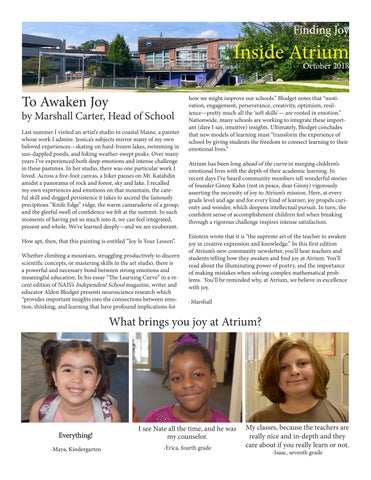
What brings you joy at Atrium?
Everything!
I see Nate all the time, and he was my counselor.
-Maya, Kindergarten
-Erica, fourth grade
My classes, because the teachers are really nice and in-depth and they care about if you really learn or not. -Isaac, seventh grade
The Joy of Making Mistakes
by Liz Caffrey, Middle School math teacher The longer I teach, the more I am struck by what happens in the first few weeks of school. There is so much purpose layered into those first moments together, be it in classes, time in community, in advisory, out at recess. When I think back to my first year teaching math (I was teaching high school Algebra 2 and Geometry), I was eager to dive in to the curriculum and to avoid all the messy stuff that comes with new beginnings, new faces, new feelings. Now in my seventeenth year of teaching (and most of that at the middle school level), I know full well that we must spend time crafting the culture of our classrooms at the outset of the year. That culture comes from mindfully, purposefully, explicitly laying out what we want learning to look like. One of the most important pieces of math culture I want to encourage is collaboration and sharing one’s thinking. That means being willing to take risks and share ideas that may be wrong, so we need to be comfortable talking about our mistakes. Without explicitly teaching that, I realized that in subtle ways, this message of being comfortable making mistakes has permeated so much of my early lesson plans and collaborative work across grades 6 through 8. And just two weeks into school, I have witnessed several moments of downright joy in mistake-making. My eighth graders have been with me the longest–most of them are starting their third year with me. They are steeped in the culture of mistake-making, but I am still blown away by their non-attachment to mistakes, their willingness to dive back in after a setback. In their first encounter with the Desmos calculator, a specialized tool, last week, students worked on creating graphs that precisely matched the rate of filling of different glasses:
But then, they got to create their own glasses, graph the rates of filling, and challenge their classmates to try their glasses. And what they made for one another was WAY more challenging than the original activity:
And they were super excited to try one another’s creations, even if it meant going back over and over again to revise and refine their matching graphs. Their tenacity in attending to precision was astounding. You could have heard a pin drop in the room as kids were poised over their computers. And there were several instances of joyful jazz hands when they were able to achieve the ranking of “very precise.”
In seventh grade, students are doing corrections from their end of year quiz last year. Many of them are looking at the question that asked them to find the volume of a trapezoidal prism and wondering why they multiplied l*w*h. This is a powerful misconception that must be unlearned and reinforced with cognitive dissonance though problems like these. And while it may be a strong statement to say their corrections bring them joy, they are certainly satisfied with themselves for completing a complex problem like this, comprised of many sub-problems. In sixth grade, my newest students have impressed me right out of the gate with their willingness to engage in debate over the “right” answer. During a “Which One Doesn’t Belong” activity (where students find ways that each number may not belong), they stated that 16 in the following image doesn’t belong because it is the only one with an odd tens digit.
There was then a very involved debate about whether 0 was even, odd, or neither, with many arguments formed on either side. Later that week, we did the Four 4’s activity and someone put up the following expression that equalled 5:
As we closed class, I put it up on the board and asked the class what they thought it equalled. There were 2 answers: 5 or 17. Again, both sides weighed in and we talked about order of operations which settled it for 17. In both of the cases with sixth grade, I assured them that even math teachers have trouble with these types of questions. My mentor teacher Henri used the term “mathematical consensus” to describe how we as a community of mathematicians have decided to agree upon such “right” answers, and I love this term. It makes math a dynamic subject, one where logical arguments are vetted together rather than answers handed down from the holy textbook on high. As we embark on another year of messiness (in the best way) in middle school, I also must take a moment to pay homage to those teachers that have come before me, laying the groundwork for kids to feel safe taking risks, to feel valued for their deep thinking rather than their speed of computation, to have the courage to question things we seem to tacitly accept, to know that mistakes are part of the learning process. For beyond each mistake, each frustration, each wrong solution path lies the aha moment. The joy in that is audible, palpable, contagious. Which why I love teaching middle school. For more, visit Liz’s blog at https://q-greater-than-a.blogspot.com.
The Unexpected Gift of Joy
by Jill Ferraresso, second grade teacher On my first day of school, a parent greeted me warmly, a present in her hands. The gift was wrapped in beautiful paper, white and orange swirls with a white lace ribbon. It reminded me of a creamsicle on a hot day. She handed it to me, an unexpected treat, and wished me a happy first day. I placed it on my desk where all day it sat, reminding me that I had something special to look forward to. After I said goodbye to the children, I picked up the gift and admired the paper again. I unwrapped it carefully, savoring the surprise a little longer. I saved the paper, tucking it in one of my desk drawers, already thinking about its future as a paper doll dress or a bookmark for everyone, or the wrapping of a new gift, given by me to someone else when they least expect it. Underneath that delicious paper I found a poetry book, the sun and her flowers by rupi kaur. I was touched that it was poetry, and excited that it was poetry that I don’t know. I opened the front cover and found an inscription telling me that “You are the sun and the kids are the flowers.” I shut the book for a moment and closed my eyes. What a beautiful thing to say and how I hope it’s true, and how I want nothing more than to be exactly that, the sun to all the children’s flowers. When I teach poetry, I tell children that learning to be like a poet, noticing everything and finding beauty everywhere, is to learn to be more alive and in love with life. Through poetry we can capture sparkling moments of joy and spread that joy to others. We learn to see life through the lens of joy catchers, those who savor the beautiful moments that come their way. Children learn that they can write a beautiful poem about a bug or a stone, and that in ordinary things a poet can find treasures. When children learn to see the world as a place full of unexpected treasures, when they learn to savor ordinary moments and things, such as bare feet in sand or an orange butterfly flitting over a stone wall, they learn that joy does not come from extravagant gestures like a big trip or an exciting toy, though those things bring temporary pleasure. Joy bubbles up from a place much deeper inside of us, a place that we come to know as our own spirit, a place where ordinary things can be beautiful and we are always enough. For more, please visit Jill’s blog at: https://poetryatatrium.blogspot.com.
Kayaking With my mom Her smile Lights my face up The mountain Before us As Soft As Her hair Blowing in the wind As she laughs - By Oona, age 8
Snow Sagging Subdued by heat Green floats in lazily Filling the world with song Winter’s thrumming patterns Filled with harmonious Beauty
So much depends upon The minute details The little things Beauty in ordinary things The words you use The small stuff that has a big impact How you use the words you choose What’s there What isn’t there The patterns, big and tiny And also some of the obvious things.
-By Aidan, age 11
- By Maya, age 13
Spring
Fifth Graders Help to Spread Joy If you’ve walked past the fifth grade classroom, you’ve seen them: the Post-It notes on the wall saying positive things. Be you. You are strong. You have the courage. Have faith. A picture of a bee next to a smiley face. Next to them is a note asking the Atrium community to “take what you need” and to take a piece of encouragement, or to “give what you can” and to write a note of support for someone else. The bulletin board is fifth grade teacher Nicole Moran’s brainchild. She came up with the idea to create interactive bulletin boards that communicate who Atrium fifth graders are. “I wanted to make fifth graders the leaders of a positive classroom community,” she said. “What can we do to lead a campaign of kindness and positive thought? Having these Post-Its is so accessible: anyone can do it, and everyone needs it.” As accessible as the Post-Its are, it soon became obvious that they couldn’t reach everyone. Nicole explained, “The kids started writing picta-notes for PreK, Kindergarteners and first graders because not everyone can read, which creates a lack of accessibility. We started asking, ‘What are other ways to communicate kindness?’” In contemplating the methods of sharing kindness, students were able to consider the needs of everyone around them. “Sometimes people just need something to cheer them up. If you feel sad about something you can pass the wall and take something,” fifth grader Maggie explained. “A note saying ‘You can do it,’ or ‘You’re the best’, those words can make you feel better.” The campaign of kindness doesn’t end with Post-Its. Nicole explained, “Later in the year, I want to make a board to promote random acts of kindness, like hug your teacher, or high-five someone sitting alone. I want to add and create positivity as a classroom culture, and I want the community to participate.” The campaign seems to be working, even for Atrium faculty and staff. Atrium librarian Susan Jacoby stopped by the board on her first day of teaching. “I saw a Post-It that said ‘Be you’ and I thought that was a good message to keep in my pocket as I was meeting new students at the beginning of the year—that it was important to be myself.” Fifth graders said that a lot of kids have the Post-Its in their lockers, and they have seen a lot of their notes be taken, including one very popular uplifting message: “Always be yourself, unless you can be a unicorn. Then, always be a unicorn.”
How do you spread joy at Atrium?
We give hugs! -Power and Maya, first grade
I try to be kind, to respect myself, to respect others, and to respect the environment. -Alec, fifth grade
I talk with new people and help them feel part of the community. -Molly, sixth grade
Joy and Play in PreK
by Kristin Botnen and Mia Bullock PreK teachers Learning in PreK is full of joy and play. If you peek into our classroom you are likely to see our students having a lot of fun. And they are, but when you step inside and carefully observe what is going on, you will see the intense learning that is taking place. In their many different forms of play, our students experiment with things they know. And then are able to test ideas in a world they create around them. They pretend to cook a meal and serve it to their teachers and classmates, writing/ drawing a menu and remembering each other’s likes and dislikes. They pretend to make a phone call, practicing navigating a conversation and stretching their imagination. They build a tower as tall as they can, measuring it with objects around the room, testing physical forces, their spatial reasoning and ability to problem-solve. They watch it collapse into a big pile before they rebuild it to see if they can build it stronger. They carefully line up all the cars and count every one of them before they drive them over a ramp to see how far they can jump. In all of this, they learn important life skills, experimenting with the world around them and building relationships with others. There is an old saying in Finland:“Those things you learn without joy you will forget easily.” We asked our PreK students about what joy is. At first they had a difficult time answering the question. They played with the word and began talking about the word “enjoy” and things they enjoy, like parties. Then one student said, “Joy is when you read a book, play with cars, go outside, and play in the kitchen.” His answer gives us confidence that our students will remember what they learn in PreK for a very long time.
Where You Find Joy at Atrium
Written by Henry Wilson ‘19, Editor of The Sun If you want to know where people find their joy at Atrium, simply ask. Atrium is a place where you can simply walk up to someone and start a conversation. This could be a friend, a new student or an adult staff member. Walking past the front desk, you might be greeted by classmates, teachers and even parents who you never imagined knew your name. Maybe they want to ask a question of you. Atrium naturally puts people into a good mood and inspires them to want to connect and be available to help others. As a student who has been part of this community since I first walked up the ramp in Kindergarten, I could list countless examples of my own joyful experiences. But I don’t think I have to. Joy is so present in people’s lives at Atrium, you can feel it in the air. It can feel calm and comforting or filled with laughter and noise. I think I speak for almost everyone in the school when I say that Atrium is a large part of their identities and that joy is a large part of Atrium. And so, logic would say that we must be in large part joyful. People find joy in the welcoming, happy, forgiving and inclusive environment that is the Atrium School. I know I’m lucky to be part of such a small community with such a big commitment to joy.
Ginny Kahn believed joy was at the center of learning. Celebrate our founder’s life at noon on Saturday, October 13 at Atrium.
Notes of remembrance can be sent to RememberingGinny@atrium.org. Memorial service parking will be available at 65 Grove Street.
The Impact of Joy on Learning In the perfect classroom, joy is everywhere. Children enter school happy and eager to come to class, and end the day equally joyous, having spent their day doing things that bring them happiness. Teachers enjoy their lessons and are excited to share their experience and insight with their students. When joy is absent in the classroom, children are bored, disinterested—or worse, anxious in their time at school. At Atrium, teachers work toward a common goal: to make learning joyful so that children are engaged, and thus, learning more. Young children find joy in many places and the teacher’s goal is to maintain that playful joy in the classroom. First grade teacher Melissa Burns said, “Most first graders are naturally joyful—they carry that positive energy with them to school each day. Our goal is to keep that happiness and direct it toward learning, not to squelch it.” If work feels like play, joy and wonder transcend all other emotions. Melissa explained, “When you are happy about something you do it more often, more openly, and with more of your whole self engaged. That all contributes to a fuller learning experience. Our affect toward learning something really matters in terms of the quality and quantity of the output. Love counting? You count
everything around you. Love reading? You read everything you can see. Love the natural world? You notice so much about it.” At Atrium, joyful moments are everywhere, from assemblies to recess, from children’s classroom collaborations to their focus on finding independent creative solutions in math class. Intentional opportunities are created to spark joy, like Put-Ups in Middle School when children compliment each other, or Constellations, where children of varied ages spend time together. Students are encouraged to find their passions, while at the same time tackling cognitive challenges that will spark wonder and joy. Part of the teacher’s responsibility is to recognize what brings their students joy, and nourish it. “There is nothing more joyful than when students recognize themselves in a book’s character and see a sudden clarity or a rush of possibilities reflected back at them,” said Julia Schroeder, Middle School ELA teacher. “In writing about their own lives, students can take an everyday experience and craft it into something extraordinary and illuminating. Even bad memories can be polished into pearls of joy with the help of paper and pencil.” “Joy in learning is that moment when you are completely immersed in something you are passionate about, and even if it is hard, it is easy to persevere because you want to see it to completion,” said Laura Page, Middle School science teacher. “Joy in learning is a feeling of awe and wonder and excitement when something tickles your curiosity bone. Joy in learning is that place where ‘work’ feels like ‘play.’”
www.atrium.org | 69 Grove St., Watertown, MA 02472 | 617-923-4156