October 2020
INSIDE
ATRIUM
And so it is through Zoom conferences, weekly classroom snapshots, your children’s own excited stories, and this issue of Atrium’s newsletter, that we bring you Inside Atrium. Whether it is the triumphant return of Pizza Thursday, paleontological fossil studies, the six-pod Middle School structure, or budding engineers designing recess games for their fellow students, the building (and surrounding outdoor areas!) are excitedly buzzing with new experiences, complex questions and probing conversations amongst students and teachers. This issue of Inside Atrium features a taste of what’s happening here at school. My own travels through our classrooms are also limited and brief, and so I’ve taken lately to walking through the building on weekends or in the evenings, to linger and look more deeply in each classroom. Already, walls and tables are filled with artifacts, student writings, artwork and projects in the making. This past weekend, I was seeking signs of the deep habit-building we do
ni
ra E x pl o
L e ar rest.
fo
o
o mb
e ba
Marion Kindergarten
ea
l
th
o
o
Maverick Kindergarten
m
I get t
s!
a bout nu
rs!
Zippy PreK
t
d
ng
be
Luke Kindergarten
ic
g
n
MWC Signature
G oin
w it h frie
Warmly,
e.
i
g
The final declaration on that science classroom list speaks to a broader credo at Atrium: “Take ownership of your own participation.”I am immensely grateful and proud for the ownership students have taken this fall. Your children have slung on their masks, kept their distance, and joyfully and energetically jumped into their learning.
Tim
Be n
at Cho
e
n ti o
Dylan 1st Grade
This cultivation of habits of mind and heart grows in the middle school years. For example, in a science classroom students develop a distinctive group culture and constructive academic tone in their seminars: messages such as “Keep discussion moving and on-topic” and “Consider all viewpoints and ideas” help deepen their skills as scientists, and collaboration is encouraged through precepts like “Talk to each other (no leader)” and “Take turns without raising hands.”
l e a r n.
Fortunately, we’ve since reopened our doors! And yet, only teachers, staff and students may actually come “inside Atrium!” It can be disheartening––maddening, even––to refrain from welcoming parents, guests, and friends into the building, as so much of Atrium’s strong community is built through informal and spontaneous conversations, shared assemblies, mutual hugs and daily fist bumps. I want to acknowledge how challenging this must be for parents! For safety’s sake, we hold back from these beloved habits for now, and look forward to the day when we can flow freely in and out of the building, chat on the paths, and drop children off at their classroom doors again.
In third grade, students absorb daily a chart they compiled, comparing fixed mindset statements with open mindset prompts: “I should give up” is improved to “I can learn”; “I will never learn this” is upgraded to “I didn’t learn something new YET.” Similarly in second grade, the Classroom Rules chart is a Leo Lionni-inspired aquarium collage, filled with guidance: “Be open-hearted” reads one; “Be a problem-solver” reads another. The wisdom and inspiration goes on: “Take responsibility”; “Look for meaning” and my personal favorite these days: “Look for beauty.”
to
Each Inside Atrium conveys a particular theme; we’ve focused on curricular innovation and equity & inclusion work, to recall just a few recent issues. Last spring’s “Atrium from Afar” edition explored Atrium’s remote learning program, called into action when the pandemic first closed schools in Massachusetts in March.
at Atrium––beneath the facts and concepts, the questions and explorations, there is an underlying and enduring architecture of learning. Every classroom has visible evidence of these habits of mind and habits of heart.
rn,
l and I
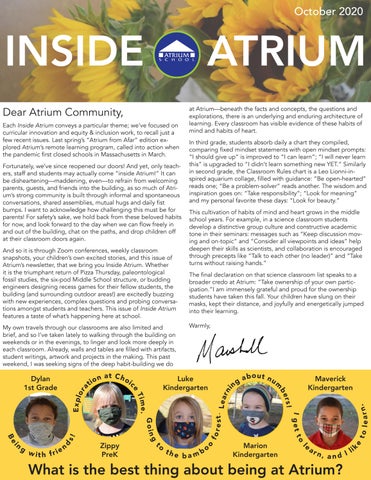
What is the best thing about being at Atrium?
ik
e
Dear Atrium Community,
Middle School Moves to New Pod System Given the size of our Middle School cohort, it became apparent early on that to reopen and have our students on site, extensive reevaluation and reorganization of the Middle School space and class sizes would be necessary. Facing many unknowns, science teacher Laura Page led the Middle School team in a reinvention of our Middle School space. The restructuring was focused on students’ social and academic needs, as well as the requirements from the Department of Elementary and Secondary Education (DESE). “We wanted to create a robust and flexible year-long plan that would easily transition between in person learning and remote learning with little loss of instructional time, and that would be responsive to the needs of students who would be remote full time in the fall,” Laura explained. “We also needed to meet or exceed state guidelines for physical distancing and cross-contact of student groups and protect teacher health.” Teachers considered the equal importance of academic learning and student socialization. Laura said, “It was import-
ant to us that, if possible, all students be physically present in the building, that they had plenty of time to socialize and build relationships with teachers and peers, have off-screen times for physical activity, and that unique and robust programmatic pieces like Clusters, the arts, cross-grade and interdisciplinary work, and advisory be maintained.” The first step was to split each grade into two smaller pods. Next, teachers reimagined the existing trimester schedule to reduce the number of people each teacher was in contact with, giving each grade one or two core teachers at a time in person, rotating through their core classes throughout the year. Two courses from the Clusters program, Digital Storytelling and Drama, were shifted into the trimester coursework, instead of occurring once a year for two weeks. Sophie Rich and Ellie Kozcela expanded their roles as Clusters teachers to join the Middle School team. To preserve the concept of “deep dive” time from Clusters, “intentional periods of concentrated learning in a particular subject area that allow students to ‘sink in’ to a learning experience,”
I art c studen been le about d plane sphe
Get Out! Maximizing Our Outdoor Space
Historically, Atrium students have spent a significant amount of time outdoors. In addition to recess, classes explore our own campus and make frequent trips to Mt Auburn Cemetery and the Charles River. With the safety protocols required for Covid-19, our boundaries have expanded even further. To increase the amount of space and access to fresh air, Atrium acquired three outdoor tents for students to use as classroom space. In addition, classes are able to use the “Green Alley” behind 65 Grove Street as a classroom extension, as well as the space in the bowl outside the Middle School door. Younger students now begin their day outside. Giving the youngest students an opportunity to get their wiggles out before school starts has both emotional and physical advantages. “We are noticing it is an easier transition for students,” said kindergarten teacher Mia Bullock. “We have had zero separation issues; it is a clean, fast drop off. Also, the kids are getting time for big body movement before the academic day starts. We are seeing the benefits during structured learning time. The children are settled and ready to focus.” To give younger students even more access to fresh air and open space, first grade and kindergarten have a daily movement break in the morning. The two classes gather in the “Bamboo Forest,” otherwise known as the Green Alley. Teachers set up an organized game like Fishy Fish or What Time is it, Mr Fox? As the children move their bodies and play with other students in their pod, the teachers have the opportunity to align their schedules and design projects across the classrooms. It is commonplace to see older students working in the Green Alley or beneath one of the tents. Teachers have regularly scheduled tent time for their classes, and Middle School students eat their snacks and meals outside, in addition to their outdoor lessons. No matter their age, all of our students are benefiting from the change of scenery and staying invigorated and healthy!
Laura said. “The new trimester rotations ‘clumped’ content areas together, so that students would have an intense trimester of art or music or storytelling or math with more periods per week than in our ‘normal’ schedule.” To preserve relationships and continuity of learning, the school schedule evolved to include a third of the day taught in remote classes after lunch, to maintain contact with the grades that weren’t being taught live. Some students are able to travel home at noon to reduce exposures, while on-site students have lunch, outdoor time and homework time at Atrium. Doing remote lessons in the afternoon allows the entire grade to be together, instead of being separated by pod as they are for live morning lessons. To reduce the amount of time students need to complete assignments outside of school, multiple periods of supervised independent work were built into the schedule. “The community that exists across all grades at Atrium Middle School is one of the highlights of our program,” Laura said. “One of our biggest challenges was figuring out how to
In class, nts have earning drawing ets and eres.
build and maintain cross-grade relationships when students form different grades and pods can’t interact physically!” This led to remote Fridays, when the entire Middle School learns from home. The highlight is Community Time meeting, when all 57 community members come together for games, civic work, and the much-anticipated weekly ritual of “put-ups,” in which students and teachers practice gratitude by acknowledging each other. While the reinvention of Middle School was not without its challenges, Laura and the Middle School team were able to address the numerous considerations facing them to allow our entire Middle School to return to school on site––and to continue learning with few adjustments should we need to return to distance learning. Laura explained, “If we need to shift to remote learning, either for an individual pod or as a whole school, the schedule will continue with few adjustments, with live classes shifting to online. This continuity allows for long-term planning and student independence–and has already been put in practice for students who needed to be remote for a few days!”
Engineering is All Fun & Games Engineering is all around us, from the cars we drive to school to our school building itself. What better way to teach children about the marvels of engineering than to give them practical design experience on projects that interest them? With that in mind, Innovators and Visionaries have begun their engineering units, with a focus on designing games and golf courses. Students are instructed to ask, imagine, plan, create and improve their plans. Leading with questions about their project allows them to get basic information before creating their design. In the design process, students consider precedents and the work of engineers before them to see what has been successful. They contemplate what their clients need to succeed at their game, and what obstacles should or could stand in the way before drawing possible scenarios. Once the games are imagined and planned, students are able to build their courses and see how they work. By actually building their plans, they are able to gain first-hand practical knowledge of how their designs function, instead of guessing based on a theoretical drawing. After the build, students test their games to see how they can be improved. Working in teams, fourth graders have been designing and constructing small scale golf courses. Fifth graders are creating marble runs, bowling lanes and basketball games for the PreK and kindergarten students to play. Remote fifth graders are making their projects from home, and checking in with their teachers regularly for advice. By working in peer teams with the guidance of their teachers, students are able to collaborate to create the most effective design, while gaining a real-life understanding of the engineering process––and hopefully, an appreciation for the systems in place that create so many of the products and structures in our world.
• • • • •
72 privacy shields to put on their desks to maintain safety while eating lunch and snack without masks on 72 special “seat sacks” to go on the back of each chair 72 “Go” boxes or bags for each child to keep materials in, which facilitate going distant if necessary 72 full sets of work materials, instead of sharing classroom materials like markers, colored pencils 15 outdoor desks & 15 outdoor chairs
Individual Classroom Upgrades • • • • • • • • • •
PreK: 7 New individual tables and new sleep mats K: New floor chairs and lap desks, and seat sacks for when they are working at a table or desk 1st Grade: New desks and chairs for each child 2nd Grade: New desks, floor chairs, lap desks and a room divider 3rd Grade: All new individual desks 4th Grade: Two new projectors 5th Grade: All new individual desks Electronic versions of books for all students, in case of distance learning 45 iPads for all K-3 students, 74 Chromebooks for all 4th-8th graders Created two new Middle School classrooms
General School Upgrades • • • • • • • •
• • •
Front desk covered in oilcloth New barrier on Front Desk Most flat surfaces around school covered by teachers in washable materials or contact paper Five air purifiers New waterbottle filler station instead of drinking fountain in lobby area, donated by the Class of 2020 Three outdoor tents Portable hand washing sink Three sturdy travelling carts for music, art and library, individual (filled) canvas bags with each child’s materials for art class New speakerphones for zoom calls 24 new “sanitization stations” and the gallons of hand sanitizer to go with them 20 touchless thermometers for all pods and classrooms
un
nt
One of the most popular Atrium traditions is our pizza lunch fundraiser, which was thrown into jeopardy this year. Given the safety precautions regarding food sharing, it became necessary to find a new vendor. Our PTA rose to the task and chose Oath Pizza, which comes in a 7-inch or half pizza size—just enough for one, with gluten-free and vegan cheese options. Needless to say, Pizza Thursday is a hit! Thanks for all of your hard work, PTA!
Triu m p h e h T a
PreK–Grade 5 Upgrades
Re
of Piz za n r L tu
Did you know? There are three new members of the Explorers classroom!
Meet Sweet, Tea & Pie!
ch
To educate students in a pandemic, it takes more than hand sanitizer and masks. Over the summer, Atrium made dozens of purchases to ensure the safest environment for our students, faculty and staff.
Have you seen Sunny? Our school mascot is traveling around the school, keeping a journal of their travels to kindergarten, 2nd, 3rd and 8th grades so far. Sunny could be coming to your class soon!
Making an Impression: Trailblazers Study Fossils
During science in the Trailblazers’ classroom, you will see students studying objects intently, before pressing them into dough to make a mold. Some are triumphant, while others are frustrated by the difficulties of capturing the intricacies of their object. This month third graders have become paleontologists, examining fossils and learning how to make their own. Trailblazers are learning that examining fossils and their traits can help them understand the environments in which these organisms lived and how those environments changed over time. In their fossil studies, Trailblazers discovered the difference between mold and cast fossils. To better understand how fossils are created, students made their own fossils by using a variety of objects to make molds in play dough. Students were asked to make observations of shells, leaves and other items before pressing into the dough, and then filling the impressions with glue to create casts.