Mining-corridors-as-catalysts

Page 1


Mining corridors as catalysts for US-African partnerships: Building on the Lobito model

Aubrey Hruby
The Africa Center

Led by Rama Yade, previously an ambassador and minister in the French government, the Atlantic Council’s Africa Center champions a new African narrative prioritizing investment opportunities and forward-looking partnerships. The center promotes dynamic geopolitical partnerships with African states, and the redirection of US and European policy priorities toward strengthening security and bolstering economic growth and prosperity on the continent.

ISBN: 978-1-61977-542-8

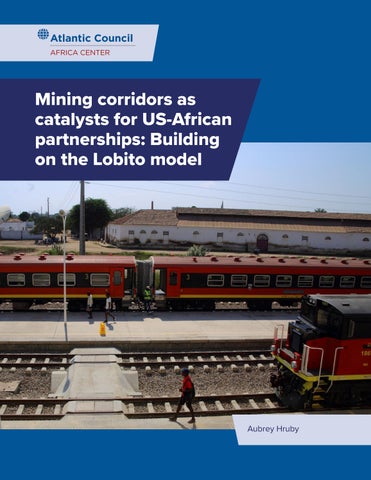
Cover: Trains parked at Lobito station, which forms part of the Benguela Railway line, in Lobito, western Angola, July 23, 2021. The railway, part of the US-backed Lobito Corridor, is a key transport link for regional trade.

Source: REUTERS/Cesar Muginga

© 2026 The Atlantic Council of the United States. All rights reserved. No part of this publication may be reproduced or transmitted in any form or by any means without permission in writing from the Atlantic Council, except in the case of brief quotations in news articles, critical articles, or reviews.

Please direct inquiries to:

Atlantic Council

1400 L Street NW, 11th Floor Washington, DC 20005

Acknowledgments

This report is part of the Africa Center’s Critical Minerals Task Force published with support from Aiteo Group.

Mining corridors as catalysts for US-African partnerships: Building on the Lobito model

Introduction

African critical minerals have emerged as central to US economic competitiveness and national security in an era defined by technological advancement and strategic competition.1 The continent holds approximately 30 percent of the world’s known mineral reserves, including resources essential to defense systems,2 energy technologies, and the digital economy. Of the fifty minerals identified as critical by the US Geological Survey (USGS), thirty-two are found in substantial quantities across African nations. This geological endowment places Africa at the nexus of the global supply chain and energy security.

Current US dependence on adversarial nations—particularly China—for processed critical minerals creates strategic exposure that African partnerships can mitigate. The Democratic Republic of Congo accounts for over 70 percent of global cobalt production—a mineral essential to lithium-ion batteries powering electric vehicles and energy storage systems. South Africa, Gabon, and Ghana collectively contribute over 60 percent of global manganese production, critical for steel manufacturing and battery technologies. Zimbabwe, the DRC, and Mali hold substantial lithium deposits that remain largely unexplored, while Guinea possesses the world’s largest bauxite reserves. Zambia and the DRC together account for over 12 percent of global copper production, with copper demand expected to increase by 30 percent by 2035.3

There is a bipartisan consensus in Washington on the need to take action to shore up US competitiveness at home and abroad. The successful development of the Lobito Corridor linking Zambia and the DRC to Angola’s port of Lobito over the past three years has demonstrated that collaborative

partnerships between the US government and African development finance institutions (DFIs) can create transformative infrastructure projects that unlock mineral wealth while fostering regional economic integration.4 The US-DRC critical minerals agreement represents an opportunity to deepen that progress and accelerate investment into the mineral and processing sector.5 African countries increasingly recognize the strategic value of their mineral endowments and are implementing policies to capture greater value from resource extraction.

But much remains to be done. Chinese entities own or hold stakes in fifteen of the DRC’s nineteen cobalt mines and have made substantial investments in lithium production in Zimbabwe. Since launching the Belt and Road Initiative in 2013, Beijing has established significant economic inroads through billions of dollars of investments in transportation, infrastructure, and energy across the continent. The US response must prioritize not only access to raw materials but also the development of processing infrastructure, transparent governance frameworks, and equitable partnerships that deliver mutual prosperity. Logistic corridors and processing hubs are the way forward. Corridor projects that integrate mining operations with transportation networks and energy systems offer the most promising pathway to unlock African critical mineral wealth at scale. These corridors reduce logistics costs, deepen regional integration, create employment opportunities, and advance economic diversification. This report examines how the Lobito Corridor model can be replicated across four additional African mining corridor and hub projects, providing a blueprint for expanded US-Africa partnerships that enhance supply chain resilience, counter Chinese influence, and promote sustainable development across the continent.

1 Aubrey Hruby, Critical Minerals in Africa as an Investment Challenge, Atlantic Council, June 2024, https://www.atlanticcouncil.org/ wp-content/uploads/2024/06/Critical-minerals-in-Africa-as-an-investment-challenge.pdf

2 Aleksandra Gadzala Tirziu, Keeping China at Bay and Critical Minerals Stocked: The Case for U.S.-Africa Defense Collaboration, Atlantic Council, https://www.atlanticcouncil.org/in-depth-research-reports/report/keeping-china-at-bay-and-critical-mineralsstocked-the-case-for-us-africa-defense-collaboration/

3 “Global Critical Minerals Outlook 2025: Overview of Outlook for Key Minerals,” International Energy Agency, 2025, https://www. iea.org/reports/global-critical-minerals-outlook-2025/overview-of-outlook-for-key-minerals

4 Rawbank, which supports the Atlantic Council Africa Center’s work on the Democratic Republic of Congo, has an equity stake in the Africa Finance Corporation, which leads the development of the Lobito Corridor.

5 “Strategic Partnership Agreement between the Government of the United States of America and the Government of the Democratic Republic of the Congo,” US Department of State, December 4, 2025, https://www.state.gov/strategic-partnership-agreementbetween-the-government-of-the-united-states-of-america-and-the-government-of-the-democratic-republic-of-the-congo

The Lobito Corridor: Origin, structure, and status

The Lobito Corridor stands as the most significant USbacked infrastructure investment in Africa in a generation, representing a new model for partnership that prioritizes African leadership while advancing American strategic interests. Connecting Angola’s port to the mineral-rich regions of the Democratic Republic of Congo and Zambia’s Copperbelt, the 800 mile multimodal transport network that is the Lobito Corridor evolved from a regional transportation initiative into a flagship example of infrastructure investment led by the US Development Finance Corporation (DFC) in Africa, 6 positioned as an alternative model to Chinese Belt and Road financing.

The Benguela backbone

The Benguela railway infrastructure underlying the Lobito Corridor dates to the early 1900s and was operational until the mid-1970s when Angola’s postindependence civil war caused extensive damage and curtailed operations for decades. Between 2004 and 2014, the Chinese restored basic functionality of the railway under a $2 billion rail-for-oil financing program through the Export-Import Bank of China. All equipment was sourced from China while 100,000 Angolans worked on the project.7 In 2015, the presidents of Angola, the DRC, and Zambia inaugurated the rehabilitated railway and pledged to deepen regional cooperation in building out supporting rail lines.

6 “DFC CEO Ben Black Signs Loan Agreement for Lobito Atlantic Railway,” US International Development Finance Corporation, December 17, 2025, https://www.dfc.gov/media/press-releases/dfc-ceo-ben-black-signs-loan-agreement-lobito-atlantic-railwaysecuring

7 David Briginshaw, “Three Presidents Inaugurate Rebuilt Benguela Railway,” Railway Gazette International, February 16, 2015, https://www.railwaygazette.com/infrastructure/three-presidents-inaugurate-rebuilt-benguela-railway/40531.article

Figure 1: The Lobito development corridor

Mining corridors as catalysts for US-African partnerships: Building on the Lobito model

Private-sector concession

From 2015 to 2022, under Angolan state operations, the rail line operated below its design capacity and lacked a viable business model.8 The Angolan government turned to the private sector to enhance operations. In 2022, the Angolan government awarded a concession to operate and upgrade the rail to both the DRC border and the minerals port terminal to a private joint-venture consortium called the Lobito Atlantic Railway (LAR) composed of a global trader, Trafigura, a Portuguese construction firm, Mota-Engil, and the South African rail-operator Vecturis.9 Committing to invest $455 million in Angola and up to $100 million in the DRC,10 LAR commenced operations in July 2023 and assumed management of the rail in January 2024.

Alongside the creation of the public-private partnership represented in LAR, the governments of Angola, the DRC, and Zambia deepened their collaboration. They signed an agreement in January 2023 that created a transit-facilitation agency that would advance harmonization of key regulations and coordinate related infrastructure development.11 Based on this regional cooperation, international support materialized in 2023 when the Group of Seven’s Partnership for Global Infrastructure and Investment identified the Lobito Corridor as a priority project. In September 2023, the United States and European Union (EU) announced they would invest in the corridor’s development and the Africa Finance Corporation (AFC) joined as the lead developer of the greenfield rail line extension into Zambia, backed by a financing commitment of $500 million from the African Development Bank (AfDB).12 African DFIs play a critical and central role in the Lobito Corridor as primary implementers.

$553 million DFC loan to LAR

$500 million to $1 billion

$500 million

US AfDB AFC Italy

$250 million loan to AFC

Development Bank of Southern Africa (DBSA)

$200 million loan to LAR

European Commission

€50 million grant for agricultural supply chains

Source: “Lobito Corridor: Building the Future Together,” International Partnerships, European Commission.

Beyond rail infrastructure, the corridor includes hundreds of miles of feeder roads to facilitate first-mile connectivity from mines to rail-loading facilities. Port improvements at Lobito are essential to handle increased mineral export volumes and larger vessels. Energy infrastructure investments along the corridor will provide power to mining operations and local towns, addressing one of the region’s most significant development constraints. A $300 million grid interconnection project has been signed to extend electricity access to

8 “Lobito Corridor Policy Brief,” United Nations Development Programme, October 2024, https://www.undp.org/sites/g/files/zskgke326/files/2024-10/lobito-corridor-policy-brief.up_.pdf

9 “Angola’s Lobito Corridor Transferred to Private Freight Concessionaire,” International Railway Journal, July 10, 2023, https://www. railjournal.com/freight/angolas-lobito-corridor-transferred-to-private-freight-concessionaire/

10 Trafigura, “Concession for Railway Services Transferred to Lobito Atlantic Railway in Angola,” Press Release, 2023, https://www. trafigura.com/news-and-insights/press-releases/2023/concession-for-railway-services-transferred-to-lobito-atlantic-railway-in-angola/

11 Republic of Zambia Parliament, “Report of the Committee on Transport, Works and Supply on the Lobito Corridor Transport Facilitation Agreement,” December 2023, https://www.parliament.gov.zm/sites/default/files/documents/committee_reports/REPORT%20 FOR%20THE%20COMMITTEE%20ON%20TRANSPORT,%20WORKS%20AND%20SUPPLY%20ON%20THE%20LOBITO%20 CORRIDOR%20TRANSPORT%20FACILITATION%20AGREEMENT.pdf

12 Africa Finance Corporation, “Africa Finance Corporation to Lead U.S.-Backed Development of the Lobito Corridor and Zambia–Lobito Rail Line,” https://www.africafc.org/news-and-insights/news/africa-finance-corporation-to-lead-us-backed-development-ofthe-lobito-corridor-and-zambia-lobito-rail-line

Table 1: Financial commitments to the Lobito Corridor

Mining corridors as catalysts for US-African partnerships: Building on the Lobito model

two million Zambians along the Lobito corridor by 2030.13 Agricultural projects will create demand for greater freight volumes, and investments in water projects will expand access to potable water.14 Digital connectivity is expanding as well. Luanda and Kinshasa were connected by terrestrial fiber in July 2025 and Liquid Dataport has plans to extend the fiber all the way to Lobito.15

Making progress

The Lobito Corridor has achieved significant operational milestones since the US financial commitment was announced

in late 2023. Despite slow disbursement of financing, the first 1,100-ton shipment of copper from the DRC on LAR arrived after eight days in transit on December 31, 2023,16 reducing transport time to Atlantic markets by two-thirds compared to alternative routes through South African, Tanzanian, or Namibian ports. The LAR now handles approximately 230,000 tons of cargo annually, including 10,000 tons of sulfur imports monthly to support mining operations in the DRC, and has a target capacity of one million tons by 2030 annually.

Four corridors for future development

The Lobito project has benefited from key advantages: strong African leadership, geopolitical tailwinds, increasing global investor interest in critical minerals, existing rail infrastructure, a strong anchor in the mining sector, and a multiuser, openaccess model17 that allows third parties to use the infrastructure to enhance the economics of the corridor. While it’s still early days in the development of the multibillion-dollar corridor, trains are already running several times a week; sulfur goes east, copper comes west; and customers are testing annual volumes with commitments exceeding 100,000 tons. Plans are moving forward to break ground on the Zambia-Lobito rail link this year.

The progress made on the Lobito Corridor should not be seen as a one-off or a trophy project, but rather a template for expanding US-Africa critical minerals partnerships through additional transport and infrastructure corridors, and local value addition. Four other corridors have the geological endowments, grounding in regional cooperation, existing foundational infrastructure, and economic potential meriting strong consideration from African capitals and Washington. The Lobito-tested playbook of African capital derisking, global blended finance, private-sector expertise, required regional integration, and open-access rules that make it different from the colonial projects of the pastcan be applied to all four future corridors.

13 Africa Business, “Zambia signs $300m joint venture to electrify Lobito Corridor,” https://african.business/2025/08/energy-resources/zambia-signs-300m-joint-venture-to-electrify-lobito-corridor

14 Carrinho Group, “Carrinho Group,” https://www.carrinho-sa.com/en/; and “DFC Announces Investments Supporting Development along the Lobito Corridor,” US International Development Finance Corporation, December 4, 2024, https://www.dfc.gov/media/ press-releases/dfc-announces-investments-supporting-development-along-lobito-corridor

15 Africa Press, “Angola, Zambia and DRC connected via Fiber Optics,” https://www.africa-press.net/angola/all-news/angola-zambiaand-drc-connected-via-fiber-optics

16 Ivanhoe Mines, “Ivanhoe Mines’ Exports Commence from the Kamoa-Kakula Copper Complex along the Lobito Atlantic Rail Corridor,” Press Release, January 2, 2024, https://www.ivanhoemines.com/news-stories/news-release/ivanhoe-mines-exports-commence-from-kamoa-kakula-copper-complex-along-lobito-atlantic-rail-corridor/

17 Open-access infrastructure means that multiple mining companies and commodity exporters can utilize the rail system rather than serving a single firm. The multiuser model increases utilization rates, improves project economics, and distributes benefits across a broader range of stakeholders. It also positions the corridor as a public good that catalyzes regional integration rather than an extractive enclave serving narrow commercial interests.

Mining corridors as catalysts for US-African partnerships: Building on the Lobito model

Filtering opportunities

In selecting corridors to feature in this report, a six-part scorecard was used. Corridor projects were assessed based on:

• Economic viability

• Strategic relevance for critical minerals

• Meaningful headroom for improvement

• Regional integration potential

• Local diversification and development advancement potential

• Limits to Chinese or Russian dominance in operations, governance, or capital

Regional diversity was considered and bias placed on projects with existing infrastructure that would deliver speed-to-market of critical minerals.

The Liberty Corridor (Guinea and Liberia)

Guinea has long been a mineral powerhouse. Home to the world’s largest bauxite reserves and multibillion tons of iron ore deposits, Guinea exports between 20 percent and 30 percent of bauxite production and has entered export phase for the giant Simandou iron ore project.18 The proposed Liberty Corridor, which would link Guinea’s iron ore belt to Liberia’s coast in a public-private partnership, is a US-aligned, multiuser brownfield rail-and-port project with rich potential. The US firm Ivanhoe Atlantic is developing one of the world’s highest grade iron ore deposits at Kon Kweni, just 10 miles from the Liberian border. Ivanhoe proposes to transport Guinean ore on the existing Yekepa-Buchanan rail into Liberia which is made possible by a concession and access agreement that was ratified by the Liberian legislature in December 2025.19

The CAA explicitly frames a public–private, multiuser model—critical in a region where single-mine control has historically limited broader industrial spillovers. While subject

to future government approvals and funding arrangements, the multiphased project envisions more than $1.5 billion in investment into Liberia, with the first “brownfield” phase focusing on road connections, track rehabilitation, and port repairs. The second “greenfield expansion” phase, if approved, will see $888 million in additional investment in rail upgrades to add capacity, Buchanan port expansion, and a potential third phase including the construction of a new port at Didia. To date, Ivanhoe Atlantic has paid roughly $37 million to the Liberian Revenue Authority via the Central Bank of Liberia and has committed an additional $35 million to support the creation and operations of the National Rail Authority.

Guinea and Liberia have a long record of infrastructure cooperation through the Mano River Union (MRU), particularly in cross-border roads, border posts, and postconflict transport rehabilitation in the Nimba–Lofa–Guéckédou zone since 2004. While the MRU has not financed railways or ports directly, it has functioned as a coordination platform aligning customs procedures, border management, and donor-supported infrastructure investments. In 2019, the two countries ratified an agreement that enabled the export of mineral products from Guinea via Liberian infrastructure20—creating institutional precedent for regional corridors such as the Liberty Corridor.

The Northern Corridor of East Africa (Kenya, Uganda, Rwanda, Burundi, South Sudan, and the DRC)

The Northern Corridor represents East Africa’s most established and highest-volume trade route, connecting Kenya’s port of Mombasa to Uganda, Rwanda, Burundi, South Sudan, and the mineral-rich eastern province of the Democratic Republic of Congo through a comprehensive multimodal network. The land-locked Great Lakes area is strategic given its critical mineral endowment of the “3Ts” (tin, tungsten, and tantalum/ coltan). The corridor includes operational rail networks from Mombasa through Nairobi to Malaba and Kampala, with branch lines serving Kisumu on Lake Victoria and connections to South Sudan through river transport. As the region’s primary transport artery, the corridor handled over thirteen million metric tons in 2024 (exports and imports that were bound for countries outside of Kenya) with year-on-year increasing

18 “Guinea: Mining and Minerals,” International Trade Administration, US Department of Commerce, April 24, 2024, https://www.trade. gov/country-commercial-guides/guinea-mining-and-minerals

19 Oracle News Daily, “House Approves Ivanhoe Atlantic Rail Access,” December 11, 2025, https://oraclenewsdaily.com/2025/12/11/ liberia-house-approves-ivanhoe-atlantic-rail-access-and-concession-agreement-paving-way-for-1-8-billion-investment-in-liberiaseconomy/

20 Republic of Liberia, “An Act Ratifying the Implementation Agreement between the Republic of Guinea and the Republic of Liberia,” Ministry of Foreign Affairs, May 6, 2021, via Liberian Observer (official document reproduction), https://bloximages.chicago2.vip. townnews.com/liberianobserver.com/content/tncms/assets/v3/editorial/d/f7/df75ac00-c3c9-4853-98ad-9c2bf88fad11/692f93eb390a4.pdf.pdf

Mining corridors as

and Liberia)

GUINEA

TRANS-GUINEA RAILWAY

Conakry

SIERRA LEONE

NORTH

ATLANTIC OCEAN

LIBERIA

Buchanan port

Didia port

Simandou mine

LIBERTY CORRIDOR

IVORY COAST

Kon Kweni mine

Source: Ivanhoe Atlantic

volumes. Mombasa dominates the East African coast as a port, processing over forty million metric tons of cargo in 2024.21

The countries of East Africa have long pursued deepening regional integration through the East African Community and the Northern Corridor Integration Process (NCIP), which was launched in 2013. The Northern Corridor is not a new political invention: It is undergirded by the Northern Corridor Transit and Transport Agreement, signed in 1985 and revised in 2007, which provides a standing framework to harmonize transit procedures and support interstate trade. As part of the NCIP, each country leads on some aspect of advancing the free movement of people, goods, capital, and data. Rwanda has led efforts to ensure ease of internal travel and work for East Africans, Uganda has led coordination on energy and the inland

transit spine, and the Kenyans focus on the maritime gateway and first-mile corridor functions. Progress is driven through designated national coordinators that work together on key sectors such as information communication technology, defense and security, immigration and labor, trade, and tourism. The most recent cluster meetings held in 2024 and 2025, focused on security cooperation, regional satellite programs, and transport corridor performance.22

The Chinese have financed over $5 billion in major transport infrastructure relevant to the Northern Corridor, with the Standard Gauge Railway (SGR) in Kenya making up the largest share.23 The Chinese loan package was controversial in Kenya and the country struggled to service the loan—in 2025, SGR payments to China accounted for over 80 percent of Kenya’s

21 Kenya News Agency, “Mombasa Port Records 14 Percent Surge in Cargo Throughput,” January 9, 2025, https://www.kenyanews. go.ke/mombasa-port-records-14-percent-surge-in-cargo-throughput/

22 Northern Corridor Transit and Transport Coordination Authority, Transport Observatory Repository, Northern Corridor Transport Observatory documents, various dates, https://top.ttcanc.org/documents?append=1&limit=10

23 AidData, “China Eximbank-Financed Transport Project in Kenya,” Project ID 37103, https://china.aiddata.org/projects/37103/

Figure 2: The Liberty Corridor (Guinea
Monrovia
Morébaya port

highway (30 Km)

2. Mombasa - Kilifi Highway (inaugurated)

Mining

Upgrading of two dual standards of MombasaKilifi Highway (54 km)

(172km) and associated feeder roads (230 km)

4. Kitale – Morpus Highway

Rehabilitation of the Kitale – Morpus Highway (75km)

*DISCLAIMER

SOURCE: European Commission

Four highway projects Other corridors Areas of interest of the corridors

Four highway projects

Other Corridors Area of interest of the Corridors

* This map and the content therein do not necessarily represent the official position of the European Commission or of the European Union. It is to be considered as an internal working document for study purposes.

total foreign debt service to bilateral lenders.24 Trying to avoid increasing that amount, Kenya in late 2025 turned to Chinese state owned firms for the construction of a $1.5 billion highway expansion project structured as a public-private partnership and partly funded by Kenya’s state pension fund.25

While there is a deep legacy of Chinese financing in Kenya, there are lanes for US and aligned-country participation as a defensive move against PRC influence in this strategic corridor. Uganda’s $3.15 billion SGR new build, which connects Kampala, Uganda, to Malaba, Kenya, is now being constructed by Turkish firm Yapi Merkezi and financed by the Islamic Development Bank ($800 million), the Ugandan budget, and other DFIs such as the AfDB.26 Uganda is also upgrading the existing

narrow-gauge rail connection to Kenya with financing from the national budget, the AfDB, and European Union. Of the total volume of transit throughput coming from Mombasa along the Northern Corridor in the third quarter of 2025, 69 percent was destined for Uganda and 11 percent for the DRC.27

Infrastructure development along the Northern Corridor has achieved substantial progress while requiring continued investment for optimization. A Shippers Council of East Africa Logistics Performance Survey reported transport costs of about $1.80 per kilometer per container against an international best practice of $1 per km in 2021,28 and the port of Mombasa is mainly a gateway for regional import trade rather than export of strategic minerals or processed goods. In 2024, only

24 “Kenya Feels the Squeeze of China’s Railway Debt Trap,” ADF Magazine, October 14, 2025, https://adf-magazine.com/2025/10/ kenya-feels-squeeze-of-chinas-railway-debt-trap/

25 Reuters, “Kenya Turns to China for $1.5 Billion Highway Expansion,” November 28, 2025, https://www.reuters.com/world/africa/ kenya-turns-china-15-billion-highway-expansion-2025-11-28/

26 Reuters, “Uganda Negotiates Debt Financing for 85% of Planned $3 Billion Railway Project,” August 20, 2025, https://www.reuters. com/world/africa/uganda-negotiates-debt-financing-85-planned-3-billion-railway-project-2025-08-20/

27 Northern Corridor Transit and Transport Coordination Authority, Transport Observatory Repository, Documents.

28 Shippers Council of Eastern Africa, “Logistics Performance Survey 2021,” August 2024, https://shipperscouncilea.org/wp-content/ uploads/2024/08/SCEA-LOGISTICS-PERFORMANCE-SURVEY-2021.pdf

Map courtesy of the European Commission
Figure 3: The Northern Corridor of East Africa

12 percent of the total throughput of Mombasa was exports, indicating substantial efficiency improvement potential.29

The Northern Corridor has many of the same characteristics of the Lobito Corridor. It is a brownfield project with greenfield elements. It has a stronger DNA of regional cooperation and can yield strategic and developmental dividends. Projects are well-scoped and investment to fill critical gaps can deliver speed to market results. This is not a “no-China footprint” corridor; rather, it is a corridor where non-Chinese incremental investment can still be decisive because the next binding constraint is not only investment, but border efficiency, interoperability, and last-mile connectivity into Great Lakes mineral belts.

Nacala Corridor (Mozambique–Malawi–Zambia)

The Nacala Corridor is an Indian Ocean logistics system linking northern Mozambique to Malawi and serving Zambia and other inland markets through rail, road, and port infrastructure anchored on the deepwater Port of Nacala in Mozambique. Built initially to move bulk commodities such as coal, the 570mile rail and port corridor now offers a practical platform for critical minerals logistics and regional trade—especially where export reliability and time-to-market are binding constraints for investors and end buyers. Critically, it sits on Mozambique’s Indian Ocean rim—adjacent to the Mozambique Channel, a maritime lane whose relevance has risen as shippers diversify

The World Bank Nacala Corridor Regional Trade Project (P164847)

Source: World Bank Group

17. Large-scale and medium scale agricultural investments along the corridor, such as forestr and commercial farming investments in soybeans, maize, sunflower; banana, horticulture, animal h bioffuel plantations, have great potential to boost exports for international trade. The population along corridor is mostly engaged in subsistence and smallholder farming of food crops which include cassava, and beans. Horticulture and cash crop production has only recently been developing with cotton,

29 Northern Corridor Transit and Transport Coordination Authority, 20th Edition Northern Corridor Transport Observatory Report: 2024 Performance Report, April 2025, https://top.ttcanc.org/documents?append=1&limit=10

Map courtesy of the World Bank Group
Figure 4: The Nacala Corridor

Mining

away from Red Sea risk of attacks on vessels. Notably, the United States has well established and compelling energy and mineral interests in Mozambique.

Since gas was discovered in vast amounts in Mozambique in 2010, the country has attracted over $30 billion in investment in the energy sector, with a significant level from the United States. Offshore gas has already moved from promise to exports: Eni’s floating liquefied natural gas terminal shipped Mozambique’s first LNG cargo in November 2022.30 ExxonMobil holds an indirect interest in Area 4 and is positioned to lead the Rovuma LNG project. The United States is already financially and commercially exposed, making Mozambique a strategic priority. In March 2025, the US Export-Import Bank (Ex-Im) approved $4.7 billion in support for Mozambique LNG, and US majors and suppliers are embedded across the project stack.31 As the gas economy deepens, Mozambique’s ability to support downstream processing (fertilizer, fuels, midstream services, and eventually minerals processing) improves.

On the minerals side, the corridor is tightly coupled to Malawi’s Kasiya deposit, the world’s largest known natural rutile resource and one of the largest flake graphite deposits32—both designated as critical minerals by the United States an/d in key allied economies. Sovereign Metals, which is developing Kasiya, plans to move production to the Nacala Logistics Corridor via a short road-to-rail linkage, with scope for future rail connectivity. Malawi’s current export options have historically relied on longer and often less efficient routes via Beira in Mozambique or Tanzania’s Dar es Salaam, while Zambia’s copper—central to global energy security—has traditionally moved south through congested routes to Durban or east via Dar es Salaam corridor. The copper super cycle and the Zambian government’s push to lift output toward three million metric tons per year within a decade will stress Dar es Salaam and the Durban route;33 adding a competitive eastern outlet via Nacala reduces route risk for cathodes, concentrates, sulfuric acid, and inputs.

At present, Nacala’s rail and port system was built principally to serve the export of coal from the Moatize basin in Tete Province, but the corridor’s infrastructure also supports general cargo freight, providing a logistical backbone that could accommodate other commodities over time such as rutile, graphite, copper, and manufactured goods. US DFC-backed Syrah Resources, operator of Mozambique’s Balama graphite mine, exports natural graphite through Nacala, supported by a dedicated cross-dock facility.34 As Mozambique’s LNG and renewable resources mature, the country will be able to offer increasingly competitive power costs, opening the door to on-corridor processing and value addition.

Japan’s decision to commit around $7 billion to the Nacala Corridor and related projects turns a promising logistics asset into a potential US allied platform.35 Tokyo’s program—structured through enhanced private-sector assistance via the African Development Bank and direct support for mining and infrastructure—explicitly targets strengthening the global supply chain.36 For the United States, this is an opportunity to coinvest alongside a trusted G7 partner that has already derisked the political and technical groundwork. While the rail and port have already been constructed, opportunities exist for the US government to actively support diversified, multiuser trade for time-sensitive critical minerals by investing in:

• Upgrading general freight and container handling to reduce cost and increase reliability for higher-value cargo

• Financing interoperable customs and cargo-tracking systems

• Strengthening feeder-road connectivity from mineral regions to railheads

• Developing power, water, and services in industrial nodes near Nacala to support processing and local supplier development

30 Eni, “Eni: Mozambique’s First LNG Cargo Departs from Coral Sul FLNG,” November 13, 2022, https://www.eni.com/en-IT/media/ press-release/2022/11/eni-coral-first-cargo.html

31 Export-Import Bank of the United States, “EXIM Board of Directors Votes to Proceed with $4.7 Billion LNG Equipment and Services Transaction,” Press Release, March 19, 2025, https://www.exim.gov/news/exim-board-directors-votes-proceed-47-billion-lngequipment-and-services-transaction-after

32 Mining Technology, “Kasiya Rutile-Graphite Project, Malawi,” December 22, 2025, https://www.mining-technology.com/projects/ kasiya-rutile-graphite-project-malawi/

33 Ministry of Mines and Minerals Development of Zambia, “National Three Million Tonnes Copper Production Strategy,” August 30, 2024, https://www.mmmd.gov.zm/?p=3159

34 Syrah Resources, “Sales, Marketing, and Logistics,” https://www.syrahresources.com.au/our-business/sales-marketing-logistics

35 Mining.com, “Japan Pours $7 Billion into African Corridor, Backing Sovereign Metals’ Kasiya Project,” https://www.mining.com/ japan-pours-7b-into-african-corridor-backing-sovereigns-project/

36 Ministry of Foreign Affairs of Japan, “Strengthening the Global Supply Chain through Nacala Corridor Development,” August 20, 2025, https://www.mofa.go.jp/ic/cap3/pageite_000001_00002.html

Mining corridors as catalysts for US-African partnerships: Building on the Lobito model

Targeted US financing and technical assistance in these areas would convert an already-built coal artery into a competitive, diversified regional corridor for Malawi, Zambia, and northern Mozambique along a strategic route aligned with US and Japanese interests rather than Beijing’s. As Washington looks to derisk critical mineral supply chains, Nacala provides an immediately upgradable platform.

Morocco as a continental processing hub

Morocco is emerging as one of the most plausible near-term candidates to serve as a mineral processing and manufacturing hub for African feedstock—especially for battery supply chains. Rather than a linear route moving minerals from point A to point B, Morocco can aggregate feedstock sourced from various African countries, add value and export into the EU and US. It combines:

• An established manufacturing base

• Port-led logistics proximate to European demand

• An expanding pipeline of battery-related investments

• An unusually dense set of preferential trade arrangements, including a free trade agreement with the United States

Over the past two decades, Morocco has established itself as a major automotive export manufacturer. In 2023, Morocco exported nearly 550,000 vehicles to Europe, making it second only behind China.37 The same year, finished exports of cars were valued at $6.5 billion while ignition wiring sets for vehicles, aircrafts, and ships were valued at $4.4 billion.38 This automotive ecosystem creates a strong base for attracting

investment into battery component manufacturing and related mineral processing.

In June 2024, Morocco signed an investment deal with China’s Gotion High Tech for a $1.3 billion gigafactory to produce batteries, cathodes, and anodes for exports to Europe with an initial capacity of 20 gigawatt-hours (GWh), with plans discussed publicly to scale toward 100 GWh and a multibillion-dollar, multiphase buildout.39 Production is expected to commence late this year. This major investment builds on investments in battery materials from Chinese firms such as BTR New Material Group ($300 million cathode plant), Hailiang ($450 million copper plant), Shinzoom ($460 million for an anode plant), and CNGR Advanced Materials (battery cathode production in a $2 billion joint venture with a Moroccan partner, Al Mada).40 The CNGR and Al Mada facility became operational in mid-2025.

Mineral processing and precursor production are power intensive. Morocco’s industrial power costs, at $0.10 to $0.12 kilowatt-hour are competitive for export-oriented manufacturing with countries such as Mexico, India, and Poland. Morocco generated 25 percent of its power from renewables in 2024, which matters for firms selling into Europe, where carbon disclosure and adjustment pressures are tightening.41 Morocco’s investment proposition for large-scale projects often hinges on custom power solutions via renewables—a flagship example is the $800 million ACWA Power-Gotion arrangement for a 500 megawatt wind plant paired with 2,000 megawatt-hour of storage to supply the planned gigafactory.42

In addition to power, Morocco has launched an “Atlantic Initiative” to connect the landlocked Sahelian countries sea access and was an early signatory of the African Continental Free Trade Area (AfCFTA). The AfCFTA creates the policy plan— although still uneven in implementation—to create regional

37 Vladislav Vorotnikov, “Leaps and Bounds across the Strait: How Morocco Has Become the New Hub Driving Exports to Europe,” Automotive Logistics, October 31, 2024, https://www.automotivelogistics.media/vehicle-logistics/leaps-and-bounds-across-thestrait-how-morocco-has-become-the-new-hub-driving-exports-to-europe/215841

38 “Cars Exported by Morocco,” Observatory of Economic Complexity (OEC); https://oec.world/en/profile/bilateral-product/cars/reporter/mar; and “Ignition and Wiring Sets for Vehicles, Aircraft, and Ships,” OEC, https://oec.world/en/profile/hs/ignition-and-wiringsets-for-vehicles-aircraft-and-ships

39 “Gotion to Begin Building Morocco Gigafactory ‘Within Days,’” Reuters, May 21, 2025.

40 Ahmed Eljechtimi, “China’s Hailiang and Shinzoom to Build Auto Battery Plants in Morocco,” Reuters, May 15, 2024, https://www. reuters.com/business/autos-transportation/chinas-hailiang-shinzoom-build-auto-battery-plants-morocco-2024-05-15/; Ahmed Eljechtimi, “Sino-Moroccan COBCO Begins Producing EV Battery Materials,” Reuters, June 25, 2025, https://www.reuters.com/ world/africa/sino-moroccan-cobco-begins-producing-ev-battery-materials-2025-06-25/; and “China EV Battery Maker BTR to Build Cathode Plant in Morocco,” Reuters, March 29, 2024, https://www.reuters.com/business/china-ev-battery-maker-btr-buildcathode-plant-morocco-2024-03-29/

41 Morocco World News, “Wind Power Emerges as a Key Driver of Morocco’s Energy Transition,” January 2026, https://www.moroccoworldnews.com/2026/01/273871/wind-power-emerges-as-key-driver-of-moroccos-energy-transition/

42 ACWA Power, “ACWA Power Signs Agreements Worth USD 1.784 Billion at FII 8 in Riyadh,” News Release, October 29, 2024, https://www.acwapower.com/news/acwa-power-signs-agreements-worth-usd-1784-million-at-fii8-in-riyadh-en/

Mining corridors as catalysts for US-African partnerships:

value chains in Africa in which producing countries supply feedstock and intermediate products into a smaller number of processing and manufacturing nodes that have the port, power, and financing capacity to rapidly industrialize. The AfCFTA and Morocco’s deep engagement across francophone and West Africa gives an element of regional integration to the hub approach to accelerate the mine-to-hub-to-buyer journey.

To take advantage of Morrocco’s many geographic and economic benefits while counterbalancing Chinese interests, US and aligned nations can invest in areas ignored by the incu-

Recommendations

Drawing on lessons learned from the Lobito Corridor process and the strategic opportunities presented in the four corridors examined in this report, the following recommendations outline how the United States and aligned partners can more effectively advance future mining and industrial corridors in African markets.

Anchor US-Africa critical minerals engagement in regional corridor-based PPPs

Countries seeking bilateral critical minerals partnerships with the United States should be encouraged to frame their proposals around regional corridor-based public-private partnerships (PPPs), rather than stand-alone mine or processing projects. Corridor-level proposals force early consideration of logistics, power, permitting, land access, environmental standards, and cross-border trade—the constraints that have historically undermined project bankability. By elevating corridors as the unit of engagement, the United States can shift discussions from transactional access to minerals toward system-level competitiveness, supply-chain resilience, and regional integration.

For US policymakers, this approach also improves project selection and sequencing. Corridor-based PPPs allow governments to bundle anchor assets (mines, ports, rail, power, and processing) into coherent, large-scale investment platforms that can attract multiple financiers and operators over time. They create clearer pathways for US government agencies and their tools—DFC, US Trade and Development Agency (USTDA), the Millennium Challenge Corporation (MCC), and the

mbent players and advance US security and competitiveness. In the same way that the US and Chinese military bases in Djibouti are roughly 10 miles from each other, strategic proximity need not imply strategic surrender: Parallel engagement can coexist with competition when it is anchored in differentiated capabilities and trusted partnerships. Morocco is the oldest treaty partner of the United States, and a partnership approach would deepen its commercial relations with the United States and EU, strengthen African regional integration, and reduce single-supplier risk for batteries and battery components for the US market.

Ex-Im—to work in sequence rather than in parallel silos, while giving African governments a concrete framework to demonstrate measurable progress on reform, private-sector engagement, and regional integration.

Deepen structured partnerships between the DFC and African DFIs

The DFC should institutionalize deeper partnerships with the Africa Finance Corporation, African Development Bank, and other regional institutions such as DBSA to leverage local expertise and regulatory navigation capabilities, tap into early-stage financing, and reduce project development timelines. The Lobito Corridor experience demonstrated the value of financial specialization. African DFIs are often better positioned to originate projects, manage early-stage development risk, and engage governments, while DFC brings balance-sheet scale, comfort to global investors, and construction-phase financing capacity.

These partnerships should move beyond ad hoc cofinancing toward formal secondment arrangements, with DFC and African DFI staff working side-by-side in each other’s offices on priority transactions. In parallel, DFC should help establish joint corridor investment facilities—on the order of $5 billion or more in combined capital—that blend development capital, commercial finance, technical assistance, and risk-sharing instruments. Such facilities would reduce transaction costs, align due diligence standards, signal seriousness to global investors and create predictable financing channels for multiyear corridor development rather than one-off deals.

Mining corridors as catalysts for US-African partnerships: Building on the Lobito model

Launch a commerce-led corridor tech mission initiative to close data and mining-tech

gaps

One of the most persistent—and underappreciated— constraints to corridor development in African mining markets is the lack of reliable, interoperable data across geology, logistics performance, land tenure, environmental baselines, and cross-border trade flows. These information gaps raise risk premiums, slow project development, and disadvantage both host governments and credible investors. Given its world-leading tech ecosystem, the United States is uniquely positioned to unlock value through targeted tech investment. The US Department of Commerce, through the International Trade Administration, should lead a targeted effort to mobilize US technology firms to advance mining tech and AI in African markets. This highly publicized effort should focus on identifying business opportunities for US firms and venture investors in geospatial analytics, satellite imagery, AI-enabled geological modeling, digital cadastres, port and rail performance dashboards, and supply-chain traceability tools.

The operating model should borrow explicitly from the proven “Geeks on a Plane” concept43—short, intensive, problem-driven missions that place technical experts directly alongside decision-makers to diagnose constraints and prototype solutions. Rather than generic trade promotion, each mission would be organized around a defined corridor challenge—such as reducing dwell times, standardizing geological data, or digitizing land rights and permitting—so that firms engage as solution providers from day one. This approach emphasizes digital and data infrastructure as catalytic public goods—low-cost relative to physical assets, scalable across corridors, and decisive in crowding in private capital. By working with the USGS, USTDA, MCC and DFC, the Department of Commerce can also mobilize US government resources for US AI/data and mining tech firms to enter new markets in Africa, while helping to advance US mineral security and competitiveness.

Deploy MCC regional compacts as the central tool of US-supported corridor development

The Millennium Challenge Corporation’s unique authorities for regional compacts and cross-border programming provide

essential tools for addressing the multicountry coordination challenges inherent in corridor development projects.44 MCC should develop regional compacts specifically designed to support corridor development across multiple countries. These compacts should address policy harmonization, regulatory coordination, and institutional integration requirements that facilitate cross-border infrastructure and trade, as well as resources for infrastructure development. These compacts can align incentives across multiple governments while anchoring reforms in measurable, timebound commitments.

MCC was designed to turn political will into economic transformation. Through its deep experience in African markets and its flexible funds, MCC can plug gaps that other agencies and private investors face. From quickly financing feasibility studies to grants for data fathering and workforce upskilling, MCC can enhance bankability of corridor-linked projects, thereby playing a critical and catalytic role.

Establish US-Africa corridor investment councils through AFC leadership

Successful corridor development requires substantial private-sector investment that complements government financing and brings operational expertise, technological capabilities, and commercial sustainability to infrastructure projects. As the leading project developer among African DFIs, AFC, working with DFC, should establish investment councils for each priority corridor that brings together US companies, African partners, and government agencies to coordinate commercial engagement and identify investment opportunities. These councils should include mining companies, infrastructure developers, equipment manufacturers, logistics providers, and financial institutions with corridor development capabilities.

Investment council activities should include business matchmaking events, trade missions, and investment promotion activities that connect US companies with corridor opportunities. The councils should also provide market intelligence, regulatory guidance, and partnership facilitation services that reduce transaction costs, accelerate commercial engagement, and advance project completion.

43 “USAID and 500 Startups Organize ‘Geeks on a Plane – Africa Tour,’ ” AWP Network, January 30, 2017, https://staging.awpnetwork. com/2017/01/30/usaid-and-500startups-organize-geeks-on-a-plane-africa-tour/ 44 Aubrey Hruby, “The Millennium Challenge Corporation Could Prove Essential in the Race for Critical Minerals: Reform It, Don’t Shut It Down,” Issue Brief, Atlantic Council, April 24, 2025, https://www.atlanticcouncil.org/in-depth-research-reports/issue-brief/ the-millennium-challenge-corporation-could-prove-essential-in-the-race-for-critical-minerals-reform-it-dont-shut-it-down/

Conclusion

The success of future corridor development strategy will depend on its ability to demonstrate tangible benefits for all stakeholders: enhanced supply chain security and commercial opportunities for the United States, economic development and regional integration for African countries, and commercial sustainability for the private sector. By learning from the Lobito

About the author

Aubrey Hruby is a senior adviser and senior fellow at the Africa Center at the Atlantic Council and leads the center’s Critical Minerals Task Force. Hruby is the co-founder of Tofino Capital and transaction lead at the Palladium Group. She is the former managing director of the Whitaker Group, an Africa-focused advisory firm that has helped facilitate well over two billion dollars in capital flows to the continent. Hruby

Acknowledgments

Corridor’s successes and pursuing corridor-based partnership strategies in resource-rich African markets, the United States can establish itself as the preferred partner for African infrastructure development while advancing national security and access to the critical minerals essential for sustained economic competitiveness.

teaches at Georgetown University and is the co-author of the award-winning book The Next Africa: An Emerging Continent Becomes a Global Powerhouse (Macmillan, 2015). She earned an executive MBA from the Wharton School at the University of Pennsylvania, an MA from the School of Foreign Service at Georgetown University, and BAs in economics, political science, and international relations from the University of Colorado.

This report is part of the Africa Center’s Critical Minerals Task Force, sponsored in part by Aiteo Group.

Atlantic Council Board of Directors

CHAIRMAN

*John F W Rogers

EXECUTIVE CHAIRMAN

EMERITUS

*James L Jones

PRESIDENT AND CEO

*Frederick Kempe

EXECUTIVE VICE CHAIRS

*Adrienne Arsht

*Stephen J� Hadley

VICE CHAIRS

*Robert J Abernethy

*Alexander V� Mirtchev

TREASURER

*George Lund

DIRECTORS

Stephen Achilles

Elliot Ackerman

*Gina F Adams

Timothy D Adams

*Michael Andersson

Alain Bejjani

Colleen Bell

Sarah E Beshar

*Karan Bhatia

Stephen Biegun

Linden P Blue

Brad Bondi

John Bonsell

Philip M Breedlove

David L Caplan

Samantha A Carl-Yoder

*Teresa Carlson

*James E� Cartwright

John E� Chapoton

Ahmed Charai

Melanie Chen

Michael Chertoff

George Chopivsky

Wesley K Clark

*Helima Croft

Ankit N� Desai

*Lawrence Di Rita

*Paula J Dobriansky

Joseph F Dunford, Jr

Richard Edelman

Stuart E Eizenstat

Tara Engel

Mark T� Esper

Christopher W K Fetzer

*Michael Fisch

Alan H Fleischmann

Jendayi E Frazer

*Meg Gentle

Thomas H� Glocer

John B Goodman

Sherri W Goodman

Marcel Grisnigt

Jarosław Grzesiak

Murathan Günal

Michael V� Hayden

Robin Hayes

Tim Holt

*Karl V Hopkins

Kay Bailey Hutchison

Ian Ihnatowycz

Deborah Lee James

*Joia M Johnson

*Safi Kalo

Karen Karniol-Tambour

*Andre Kelleners

John E� Klein

Ratko Knežević

C� Jeffrey Knittel

Joseph Konzelmann

Keith J Krach

Franklin D Kramer

Laura Lane

Almar Latour

Yann Le Pallec

Diane Leopold

Jan M Lodal

Douglas Lute

Jane Holl Lute

William J� Lynn

Mark Machin

Marco Margheri

Michael Margolis

Chris Marlin

William Marron

Roger R� Martella Jr�

Judith A� Miller

Dariusz Mioduski

*Richard Morningstar

Georgette Mosbacher

Majida Mourad

Mary Claire Murphy

Julia Nesheiwat

Edward J Newberry

Franco Nuschese

Joseph S Nye

*Ahmet M Ören

Ana I� Palacio

*Kostas Pantazopoulos

David H� Petraeus

Elizabeth Frost Pierson

*Lisa Pollina

Daniel B Poneman

Robert Portman

*Dina H Powell McCormick

Michael Punke

Ashraf Qazi

Laura J Richardson

Thomas J Ridge

Gary Rieschel

Charles O Rossotti

Harry Sachinis

C� Michael Scaparrotti

Ivan A Schlager

Rajiv Shah

Wendy R Sherman

Gregg Sherrill

Jeff Shockey

Kris Singh

Varun Sivaram

Walter Slocombe

Christopher Smith

Clifford M Sobel

Michael S� Steele

Richard J�A� Steele

Mary Streett

Nader Tavakoli

*Gil Tenzer

*Frances F Townsend

Melanne Verveer

Tyson Voelkel

Kemba Walden

Michael F Walsh

*Peter Weinberg

Ronald Weiser

*Al Williams

Ben Wilson

Maciej Witucki

Neal S Wolin

Tod D Wolters

*Jenny Wood

Alan Yang

Guang Yang

Mary C Yates

Dov S Zakheim

HONORARY DIRECTORS

James A Baker, III

Robert M Gates

James N Mattis

Michael G Mullen

Leon E� Panetta

William J� Perry

Condoleezza Rice

Horst Teltschik

William H Webster

*Executive Committee Members

List as of March 24, 2025

The Atlantic Council is a nonpartisan organization that promotes constructive US leadership and engagement in international affairs based on the central role of the Atlantic community in meeting today’s global challenges

© 2026 The Atlantic Council of the United States All rights reserved No part of this publication may be reproduced or transmitted in any form or by any means without permission in writing from the Atlantic Council, except in the case of brief quotations in news articles, critical articles, or reviews� Please direct inquiries to:

Atlantic Council

1400 L Street NW, 11th Floor Washington, DC 20005

Turn static files into dynamic content formats.

Create a flipbook