Forward Defense leads the Atlantic Council’s US and global defense programming, developing actionable recommendations for the United States and its allies and partners to compete, innovate, and navigate the rapidly evolving character of warfare. Through its work on US defense policy and force design, the military applications of advanced technology, space security, strategic deterrence, and defense industrial revitalization, it informs the strategies, policies, and capabilities that the United States will need to deter, and, if necessary, prevail in major-power conflict.
The Scowcroft Center for Strategy and Security works to develop sustainable, nonpartisan strategies to address the most important security challenges facing the United States and the world.
Authors
John J. Klein
Clementine G. Starling
Daniels
With contributions from Dean Cheng
John Reed
Jonathan Rosenstein Cheyenne Tretter
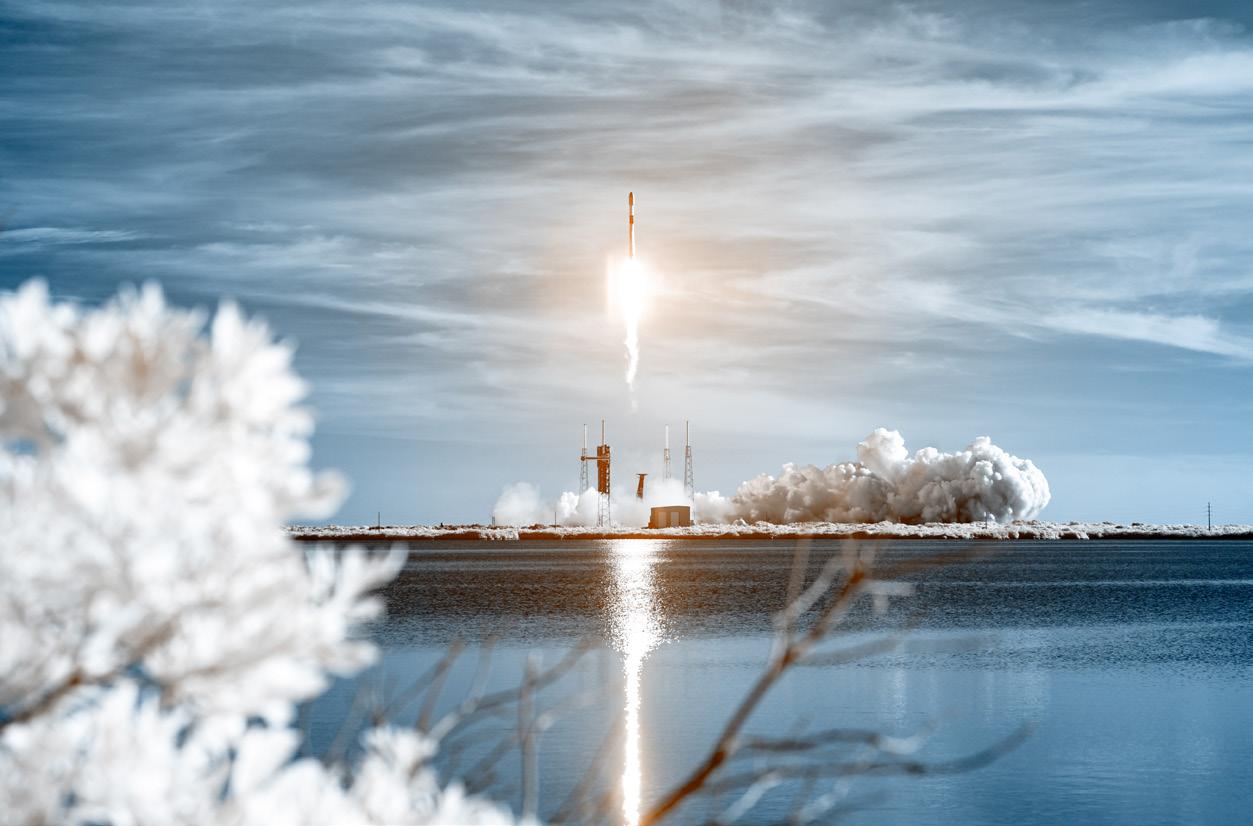
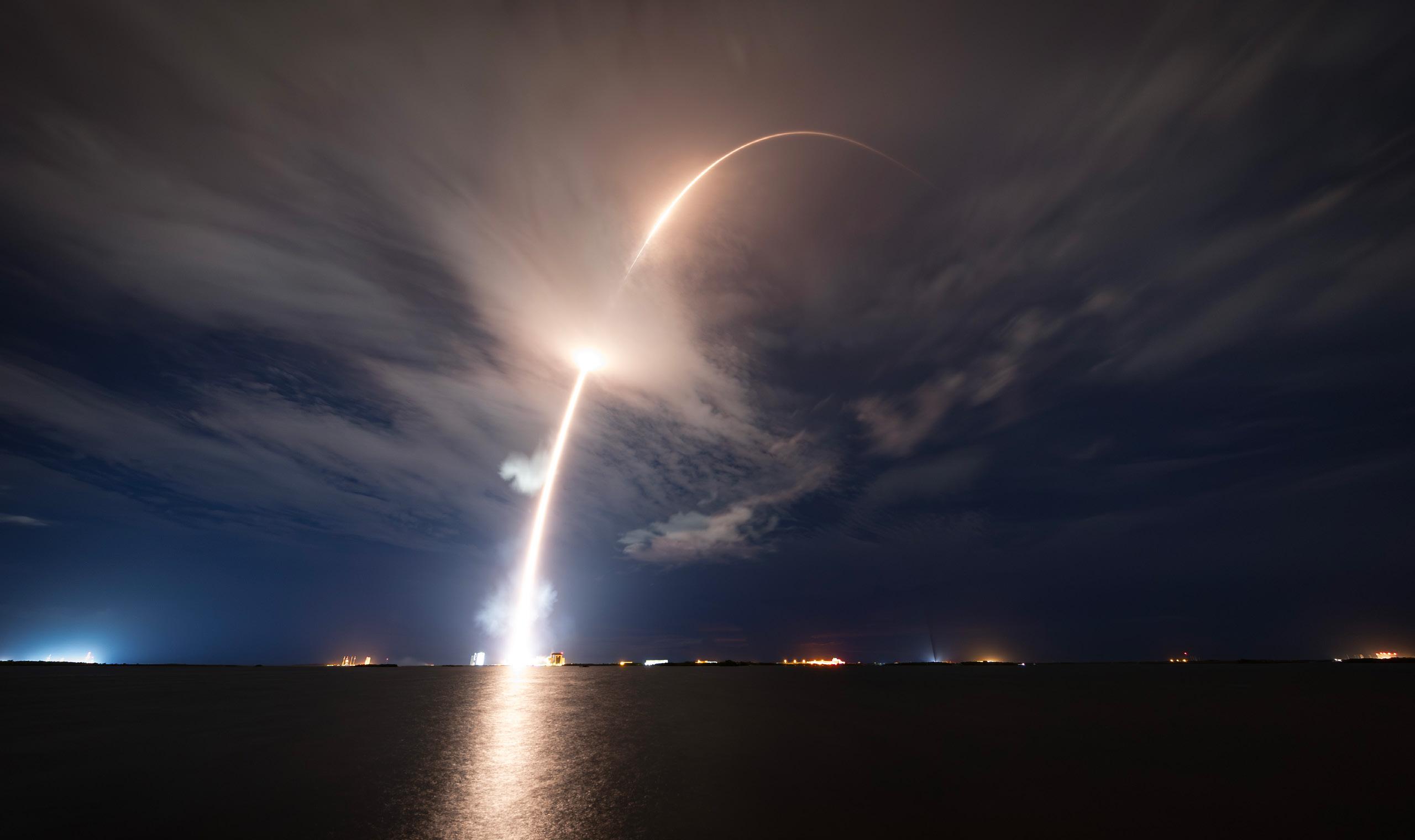
Cover: A Falcon 9 rocket carrying the SXM-10 mission lifts off from Space Launch Complex 40 at Cape Canaveral Space Force Station. (US Space Force photo illustration by Robert Mason)
Atlantic Council 1400 L Street NW, 11th Floor Washington, DC 20005 2026
Acknowledgments
This report was made possible by the generous sponsorship of the Smith Richardson Foundation
Countering Russian escalation in space
This report was produced in accord with the Atlantic Council’s policy on intellectual independence, which states that the Atlantic Council and its staff, fellows, and directors generate their own ideas and programming, consistent with the Council’s mission, their related body of work, and the independent records of the participating team members. The Council as an organization does not adopt or advocate positions on particular matters. The Council’s publications always represent the views of the author(s) rather than those of the institution.
The Atlantic Council maintains strict intellectual independence for all of its projects and publications. Council staff, fellows, and directors and those who the Council engages to work on specific projects, are responsible for generating and
communicating intellectual content resulting from Council projects. The Council requires all donors to agree to the Council maintaining independent control of the content and conclusions of any products resulting from sponsored projects. The Council also discloses sources of financial support in its annual reports to ensure transparency.
This report does not necessarily reflect the views of the US Department of Defense, the US Department of the Air Force, or any other institution with which either of the co-authors or any of the contributors are now, or have in the past been, affiliated.
The co-authors acknowledge with gratitude the sponsorship of the Smith Richardson Foundation for this project.
List of abbreviations and acronyms
ASAT: Anti-satellite weapon
BRICS: A bloc of emerging economies that coordinate economic and diplomatic efforts as an alternative to what they perceive as Western dominance in multilateral institutions. Originally only Brazil, Russia, India, China, and South Africa, it has expanded to also include Egypt, Ethiopia, Indonesia, Iran, and the United Arab Emirates.1
C2: Command and control
(DA)-ASAT: Direct-ascent anti-satellite weapon
DOD: US Department of Defense
ECS: Environmental control system
EMP: Electromagnetic pulse
FOBS: Fractional orbital bombardment systems
GEO: Geostationary Earth orbit
GPS: Global Positioning System
HEO: Highly elliptical orbit
ISAC: Space Information Sharing and Analysis Center
ISS: International Space Station
JP: Joint publication
LEO: Low-Earth orbit
LOAC: Law of armed conflict
MEO: Medium Earth orbit
NASA: National Aeronautics and Space Administration
NATO: North Atlantic Treaty Organization
NC3: Nuclear command, control, and communication
NSSA: National Security Space Association
NPR: Nuclear Posture Review
NUDET: Nuclear detonation
OST: Outer Space Treaty
PAROS: Prevention of an Arms Race in Outer Space
PNT: Positioning, navigation, and timing
PPWT: Prevention of the Placement of Weapons in Outer Space and of the Threat or Use of Force Against Outer Space Objects
PRC: People’s Republic of China
PWSA: Proliferated Warfighter Space Architecture
RPO: Rendezvous and proximity operations
SATCOM: Satellite communication
SDA: Space Development Agency
SPACECOM: US Space Command
SSO: Sun-synchronous orbit
SWIFT: Society for Worldwide Interbank Financial Telecommunication
TEL: Transporter erector launcher
UNCOPUOS: United Nations Committee on the Peaceful Uses of Outer Space
UNSC: United Nations Security Council
WMD: Weapons of mass destruction
1. Mariel Ferragamo, “What Is the BRICS Group and Why Is It Expanding?” Council on Foreign Relations, June 26, 2025, https://www. cfr.org/backgrounder/what-brics-group-and-why-it-expanding.
Executive summary
This report’s findings are meant to guide policymakers in making important decisions about safety, security, and sustainability in the space domain, as well as to better inform the public on these issues. The report explains why current US space policy, Department of Defense (DOD) acquisition programs, and commercial integration strategies by themselves are inadequate to address the growing threats from Russia in space. The report makes the case for the development of policies, practical strategies, and more effective acquisition programs to better address a range of potential futures, considering possible space-related actions by Russia’s political leadership.
Beyond recommending changes to US declaratory policy, this report details why the United States needs a more resilient space architecture. It examines how Russia’s nuclear threat— specifically, its designs to place a nuclear weapon in orbit, in clear violation of its obligations under international law— could alter the rationale for pursuing proliferated low-Earth orbit (LEO) constellations. This report also explores the kind of space architecture the United States would need during a conflict against a major power, and how the United States can further integrate the private sector and allies in pursuit of its national security objectives. Each of these issues carries significant near-term policy and acquisition implications.
This report explains why some US policymakers might be reluctant to take the necessary coercive action to compel acquiescence by Russian political and military leaders. This reluctance is driven by a Western sense of morality and “rightness,” an inherent right of self-defense mentality, and current conceptions of international humanitarian law. US
anticipatory actions seeking to deter Russian malicious actions might prove unreliable because any anticipatory action will be a political decision based upon a Western mindset and worldview. This observation underscores that deterrence by denial of benefit—including resilience and active defense— should play a substantial role in military strategies, one even more substantial than cost-imposition efforts. Additionally, assurance and reassurance efforts directed toward Chinese and Indian leadership could help dissuade potential Russian aggressive behavior and deescalate crises.
This report’s analysis illuminates important defense and force planning considerations. Its three scenarios span a catastrophic nuclear detonation (NUDET) in LEO to debrisgenerating anti-satellite (ASAT) weapons to less aggressive action against commercial satellites. A qualitative assessment using a detailed framework highlights the relative importance of the methods used to dissuade potential aggression while also prevailing in conflict. In priority order, the relative importance of affecting Russian leadership’s decision calculus is: deterrence by denial of benefit; assurance and reassurance; and deterrence by cost imposition.
Finally, this report provides fifteen actionable policy and defense acquisition recommendations for advancing a comprehensive and practical framework to counter potential Russian aggression and escalation in space. Should dissuasion efforts fail and conflict in space occur, it is necessary that the United States, its allies, and commercial partners fight through Russia’s irresponsible and aggressive actions in space, while working to deescalate any crisis and seek a lasting peace.
I. Introduction and overview
In a crisis or conflict with Russia, the United States and its allies and partners would likely face Russian aggression in space. Its capabilities and current military doctrine make it highly plausible that Russia would consider nuclear, debris-generating, and counter-commercial attacks in space against US, allied, or commercial space assets. Moscow might do so to diminish critical allied capabilities or to “escalate to deescalate”—the strategy of deliberately escalating a conflict with the expectation that an opponent will back down—if it perceives it is losing a conventional conflict or seeks to lock in early gains. Recent developments have made it clear that Moscow is unafraid of nuclear saber rattling, and it is willing to conduct counterspace attacks as part of its military doctrine. Russia’s reported development of a nuclear-armed ASAT weapon, its destructive ASAT tests, and ongoing interference with commercial space services to Ukraine make it urgent that the United States and its allies and partners work today to better understand and counter Russian coercion and escalation in space prior to and during conflict.
Western analysts and government leaders would view certain Russian attacks in space—namely nuclear, debris-generating, and widespread counter-commercial attacks—as unacceptable and irresponsible behavior. Indeed, General B. Chance Saltzman, chief of staff of the United States Space Force, has referred to the potential launch date of a Russian nuclear ASAT weapon as “Day Zero” because, from that day, no one can count on space the next day. US Representative Michael Turner, chairman of the House Permanent Select Committee on Intelligence, said that such a nuclear “threat would mean that our economic, international security and social systems come to a grinding halt. This would be a catastrophic and devastating attack upon Western economic and democratic systems.”2
Western mirror imaging has led US analysts to systematically underestimate the risk and likelihood of Russia conducting such attacks as part of a coercion strategy that might escalate in space prior to and during conflict. Given this, analysis and options regarding how the United States could deter or respond to nuclear, debris-generating, and counter-commercial attacks in space have been limited. As such, the United States remains unacceptably vulnerable to such attack methods. To fill this analytical gap, this report provides a comprehensive and practical framework for the United States and its allies and partners to take proactive steps to better understand and
counter Russian coercion and escalation in space prior to and during conflict.
To that end, this report will
y explore why Russia might be more inclined than US analysts commonly assess to execute nuclear, debrisgenerating, or counter-commercial attacks in space, particularly as part of a coercive strategy;
y detail existing and planned US, allied, and commercial methods to impede the effectiveness of Russian counterspace capabilities, enhance the resilience of US forces and space-enabled networks, and communicate clear deterrent messages to Moscow to prevent escalation in space;
y advance a framework to assess the sufficiency and deficiencies of these current methods; and
y outline new methods for the United States, its allies and partners, and the commercial sector to better deter and mitigate the effectiveness of Russian counterspace capabilities, including potential responses to Russian aggression and escalation, if deterrence fails and conflict in space occurs. The proposed comprehensive and practical alternative framework aims to enable the United States and its allies and partners to fight through Russia’s irresponsible and hostile actions in space.
Moscow might be more likely to conduct escalatory attacks in space as part of a coercion strategy; therefore, it is imperative that Western policymakers and companies better prepare to deter such attacks and defend against them.
Russia’s current space capabilities: Charting Moscow’s ability to conduct nuclear, debrisgenerating, and counter-commercial attacks
Prior to or during a conventional conflict, Russia is likely to conduct attacks in space. In 2018, Russian President Vladimir Putin first announced Moscow’s intent to invest in superoruzhie (“super weapons”) to counter the perceived conventional military superiority of the United States.3
Russia has developed a suite of capabilities enabling it to counter and disrupt an adversary’s satellite operations in space.
Russia’s military strategy emphasizes degrading US space capabilities in recognition of their critical role in enabling US air
2. “Turner Warns of Russia’s Nuclear Anti-Satellite Weapons Program during Speech at CSIS,” US House Permanent Select Committee on Intelligence, press release, June 20, 2024, https://intelligence.house.gov/news/documentsingle.aspx?DocumentID=1425.
3. Samuel Bendett, et al., “Advanced Military Technology in Russia,” Chatham House, September 2021, 23, https://www.chathamhouse.org/sites/default/files/2021-09/2021-09-23-advanced-military-technology-in-russia-bendett-et-al.pdf.
and missile strikes and supporting joint operations.4 Russia’s focus on countering US space capabilities aligns with its broader active defense framework, which seeks to disrupt its adversary’s ability to fully project power, thereby constraining the duration and intensity of military hostilities.5
Russian perceptions of cost imposition and acceptable use of force are starkly different from those of the West, meaning that Russian political and military leaders could elect to take action in space considered escalatory.6 In Russian military thought, the threat of limited (or non-strategic) nuclear weapon use is supposed to have deterrent, coercive, and battlefield effectiveness.7
Despite ongoing technical challenges, Russia’s leadership has signaled its ongoing commitment to attain strategic parity with the United States in the space domain.8 As has been well-documented by the Secure World Foundation’s annual Global Counterspace Capabilities report and the annual Center for Strategic and International Studies (CSIS)
Space Threat Assessment, Russia since 2010 has embarked on a set of programs to build up offensive counterspace capabilities.9 Moscow is developing a suite of ground-, air, and space-based offensive capabilities while expanding the integration of advanced electromagnetic warfare (EW) systems across its military to safeguard its own space assets and disrupt those of its competitors. Since 2020, Russia’s counterspace capabilities have evolved from a focus on technological development and demonstration to increasing operational use (primarily non-destructive jamming and
Three types of potential Russian actions deserve further attention: the planned stationing of nuclear weapons in LEO; ASAT attacks that generate large amounts of orbital debris that can indiscriminately affect other satellites on orbit; and
4. Michael Connell, “The Role of Space in Russia’s Operations in Ukraine,” Center for Naval Analyses, November 2023, https://www. cna.org/analyses/2023/11/role-of-space-in-russia-operations-in-ukraine.
5. Michael Kofman, et al., “Russian Military Strategy: Core Tenets and Operational Concepts,” Center for Naval Analyses, August 2021, https://www.cna.org/reports/2021/08/Russian-Military-Strategy-Core-Tenets-and-Operational-Concepts.pdf.
6. See Appendix A of this report by Cheyenne Tretter, “Appendix A: Russia’s Approach to Deterrence and Coercion,” 95–101.
7. Sidharth Kaushal and Sam Cranny-Evans, “Russia’s Nonstrategic Nuclear Weapons and Its Views of Limited Nuclear War,” Royal United Services Institute, June 21, 2022, https://www.rusi.org/explore-our-research/publications/commentary/russias-nonstrategic-nuclear-weapons-and-its-views-limited-nuclear-war.
8. Victoria Samson and Laetitia Cesari, eds., “2025 Global Counterspace Capabilities Report,” Secure World Foundation, June 12, 2025, xxi–xxii, https://www.swfound.org/publications-and-reports/2025-global-counterspace-capabilities-report.
9. Ibid.; Clayton Swope, et al., “Space Threat Assessment 2025,” Center for Strategic and International Studies, April 25, 2025, https://www.csis.org/analysis/space-threat-assessment-2025.
10. Victoria Samson and Emily Kunasek, eds., “Russian Military and Intelligence Rendezvous and Proximity Operations Fact Sheet,” Secure World Foundation, June 12, 2025, https://www.swfound.org/publications-and-reports/russian-military-and-intelligence-rendezvous-and-proximity-operations-fact-sheet; Bart Hendrickx, “Project Nivelir: Russia’s Inspection Satellites (Part 1),” Space Review, April 28, 2025, https://www.thespacereview.com/article/4979/1.
11. Samson and Cesari, “2025 Global Counterspace Capabilities Report.”
12. “Russian Direct-Ascent Anti-Satellite Missile Test Creates Significant, Long-Lasting Space Debris,” US Space Command, November 15, 2021, https://www.spacecom.mil/Newsroom/News/Article-Display/Article/2842957/russian-direct-ascent-anti-satellite-missile-test-creates-significant-long-last.
13. Olga R. Chiriac and Thomas Withington, “Russian Electronic Warfare: From History to Modern Battlefield,” Irregular Warfare Initiative, January 10, 2025, https://irregularwarfare.org/articles/russian-electronic-warfare-from-history-to-modern-battlefield.
14. “Satellites Face Growing Security Risks from Russia and China with 10,000+ Incidents per Year,” Satnews, May 5, 2025, https:// news.satnews.com/2025/05/05/satellites-face-growing-security-risks-from-russia-and-china-with-10000-incidents-per-year/.
15. Kari A. Bingen, Kaitlyn Johnson, and Zhanna Malekos Smith, “Russia Threatens to Target Commercial Satellites,” Center for Strategic and International Studies, November 10, 2022, https://www.csis.org/analysis/russia-threatens-target-commercial-satellites. proximity operations). Moscow has tested rendezvous and proximity operations (RPO) technologies in both LEO and geostationary orbit (GEO), and evidence suggests it has initiated a new co-orbital ASAT program known as Burevestnik, supported by a surveillance and tracking effort called Nivelir.10 Russia’s Luch and Luch 2 satellites continue to carry out RPO maneuvers, including suspicious maneuvering near critical foreign satellites, which analysts assess have utility for both intelligence collection and potential co-orbital ASAT missions.11 In 2021, Russia demonstrated a DA-ASAT capability using its A-325 Nudol system by destroying its own defunct satellite in LEO.12 Since then, however, Russia’s most sustained and prolific counterspace activities have involved EW, including widespread Global Positioning System (GPS) and satellite communications jamming, spoofing, and cyber interference.13 These efforts escalated significantly with the invasion of Ukraine and now routinely affect military and civilian satellite services, including Starlink, particularly in Eastern Europe and the Middle East.14 Russia is reportedly developing spacebased EW platforms to augment its already robust groundbased systems, signaling its intent to build a full-spectrum counterspace arsenal. In 2018 alone, Russia was responsible for twelve counterspace weapons activities, amounting to nearly half of these activities as recorded by CSIS.15
Countering Russian escalation in space
the targeting of Western commercial space systems and associated computer networks. The capabilities that enable Russia to conduct these three types of attacks are as follows.
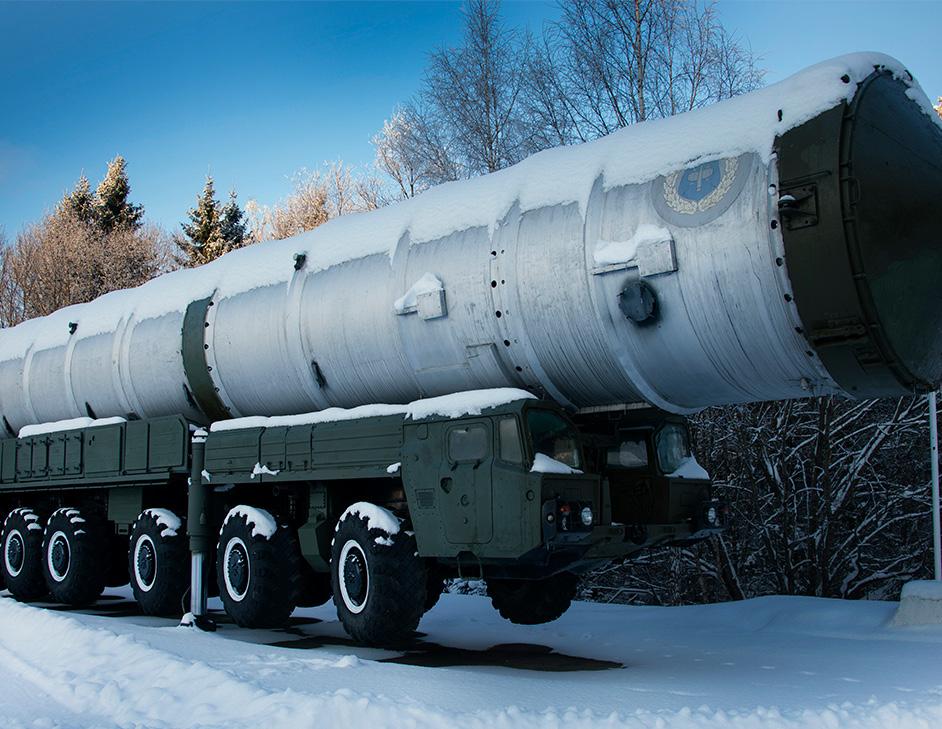
A transport and reloading vehicle on the for 51T6 long-range interceptor missiles as part of the A-135 Amur anti-missile defense complex (Yuriy Shipilov, Ministry of Defense of the Russian Federation)
Russia’s nuclear attack capabilities
Threatened nuclear detonation in space is not a new challenge, but public reporting in 2024 regarding Russia’s possible development of a nuclear-armed ASAT has reinvigorated questions about how Russia’s approach to nuclear coercion and limited nuclear use might apply to space.16 Both Washington and Moscow tested nuclear weapons in space during the Cold War. These tests harmed satellites. However, over time, the
salience of nuclear attacks in space gradually waned due to improvements in non-nuclear ASATs.
Several developments suggest that this restraint might be fading. Fractional orbital bombardment systems (FOBS), an old Soviet technique originally designed to circumvent US missile-defense radars in the Arctic Circle, have been revitalized. FOBS partially orbit Earth before reentry, attacking from different trajectories than those of ballistic missiles. While Russia last tested FOBS in the 1960s, China did so in 2021, and the 1979 Strategic Arms Limitation Talks II (SALT II) treaty that banned FOBS is no longer in force.17 Today, FOBS paired with a hypersonic glide vehicle (HGV) challenge current understandings of missile defense.18 This pairing creates an exceptionally rapid delivery system—it matches the speed of an intercontinental ballistic missile but is far less predictable and harder to track—capable of delivering a nuclear payload from space.19 This leaves the US National Command Authority with less time to react and undermines the ability to launch on warning—a critical part of deterrence. Orbital hypersonic delivery systems would represent a significant advancement in first-strike capabilities. Russia’s substantial nuclear assets, paired with its development of a fractional orbital hypersonic delivery system, could allow it to deliver large nuclear payloads with less warning time than any system currently in existence, while remaining undetected for a significantly longer portion of the weapon’s flight.20
The most significant development in Russia’s ASAT capabilities came in February 2024, when the US government confirmed that Russia was developing a nuclear ASAT capability. Turner raised the alarm that Russia might deploy a nuclear-armed ASAT and, in April 2024, then US National Security Advisor Jake Sullivan publicly confirmed the Joe Biden administration’s belief that Russia was pursuing a nuclear ASAT.21
For decades, Soviet and Russian military strategists discussed the desirability of nuclear ASATs to deliver reliable, rapid, and wide-area effects.22 Since the 2024 announcement, Russian
16. Shane Harris, Ellen Nakashima, and John Hudson, “Officials Sound Alarm about New Russian ‘Space Threat,’” Washington Post, last updated February 14, 2024, https://www.washingtonpost.com/national-security/2024/02/14/national-security-threat-mike-turner.
17. David E. Sanger and William J. Broad, “China’s Weapon Tests Close to a ‘Sputnik Moment,’ U.S. General Says,” New York Times, last updated November 3, 2021, https://www.nytimes.com/2021/10/27/us/politics/china-hypersonic-missile.html.
18. “Defense Primer: Hypersonic Boost-Glide Weapons,” Congressional Research Service, last updated November 1, 2024, https:// sgp.fas.org/crs/natsec/IF11459.pdf.
19. Ritwik Gupta, “Orbital Hypersonic Delivery Systems Threaten Strategic Stability,” Bulletin of the Atomic Scientists, June 13, 2023, https://thebulletin.org/2023/06/orbital-hypersonic-delivery-systems-threaten-strategic-stability/.
20. Ibid.
21. Harris, et al., “Officials Sound Alarm about New Russian ‘Space Threat”; “Statement from National Security Advisor Jake Sullivan on Russia’s Veto of the UN Security Council Resolution on the Outer Space Treaty,” White House, April 24, 2024, https:// bidenwhitehouse.archives.gov/briefing-room/statements-releases/2024/04/24/statement-from-national-security-advisor-jake-sullivan-on-russias-veto-of-the-un-security-council-resolution-on-the-outer-space-treaty/.
22. Brian Weeden and Victoria Samson, eds., “Global Counterspace Capabilities: An Open Source Assessment,” Secure World Foundation, April 2024, 2–20, https://www.swfound.org/publications-and-reports/2024-global-counterspace-capabilities-report.
leaders have issued blanket denials of such a program.23 Nevertheless, nuclear ASATs would threaten large numbers of satellites, including the proliferated constellations that the United States and its allies are deploying to bolster resilience against space threats.24
US officials have been concerned enough to engage China and India, urging both nations to help persuade Russia to halt its plans.25 In May 2024, Mallory Stewart, then serving as assistant secretary at the State Department’s Bureau of Arms Control, Deterrence, and Stability, cited “credible evidence” that Russia was exploring incorporating nuclear weapons into its counterspace programs. US intelligence has long been aware
of Russia’s interest in this capability, but the US government has only recently gained a precise assessment of Moscow’s progress.26 Russia claims its satellite has scientific purposes, but its orbit—located in a region with few other satellites in its vicinity—is unusual and raises suspicion.27 Furthermore, this orbit lies in a region of higher radiation than normal LEO, but this orbit is not too irradiated an environment to allow accelerated testing of electronics—contradicting Moscow’s stated rationale. There is credible reason to assess that Russia could be considering the nuclear armament of its Nudol ASAT missile. The Secure World Foundation’s 2025 report notes that “available depictions of the Nudol [Transporter-Erector-Launcher] TEL have features that appear to be environmental control systems (ECS) on the missile tubes—a feature typically associated with nuclear-armed missiles.”28 This design characteristic, while not definitive, raises legitimate concerns about the system’s possible payload. There is historical precedent for such an approach. Nuclear-tipped missile defenses—including the Soviet-era Galosh and 51T6 Gorgon missiles—were widely deployed throughout the Cold War.29 Additionally, Moscow itself is currently protected by a ring of nuclear-tipped missile interceptors, though Russia is reportedly in the process of replacing these with conventional interceptors.30 Nuclear detonations have a much wider area effect against incoming missiles. As a result, the United States has in the past used, and Russia currently uses, nuclear-tipped interceptors to hedge against inaccuracies in the hit-to-kill or conventional explosive missile interceptors that these countries have also fielded. Additionally, some Russian military thinkers have advocated for nuclear-armed ASATs to ensure a more reliable, rapid, and wide-area destruction capability—both kinetic and electromagnetic.31 Public evidence remains inconclusive, but
23. Guy Faulconbridge, “Kremlin Denies U.S. Reports Moscow Plans to Put Nuclear Weapons in Space,” Reuters, February 20, 2024, https://www.reuters.com/world/europe/russia-denies-us-claims-that-moscow-plans-deploynuclear-weapons-space-2024-02-20/; Guy Faulconbridge, Patricia Zengerle, and Steve Holland, “Kremlin Dismisses U.S. Warning about Russian Nuclear Space Capability,” Reuters, February 15, 2024, https://www.reuters.com/world/kremlin-dismisses-us-warning-about-russian-nuclear-capabilityspace-2024-02-15/.
24. Clayton Swope, et al., “Space Threat Assessment 2024,” Center for Strategic and International Studies, April 17, 2024, https://www. csis.org/analysis/space-threat-assessment-2024; Weeden and Samson, “Global Counterspace Capabilities.”
25. Erin Banco, “Biden Admin Was Working behind Closed Doors to Dissuade Russia from Testing Space Weapon,” Politico, February 20, 2024, https://www.politico.com/news/2024/02/20/biden-white-house-russia-space-weapon-00142172.
26. “The Nuclear Option: Deciphering Russia’s New Space Threat,” Center for Strategic and International Studies, May 3, 2024, https:// www.csis.org/analysis/nuclear-option-deciphering-russias-new-space-threat.
27. Jonas Schneider and Juliana Süß, “Russian Nuclear Weapons in Space?” Stiftung Wissenschaft und Politik (SWP), May 15, 2025, https://www.swp-berlin.org/10.18449/2025C21.
28. Samson and Cesari, “2025 Global Counterspace Capabilities Report,” 2–21.
29. Sean O’Connor, “Russian/Soviet Anti-Ballistic Missile Systems,” Air Power Australia, last updated January 27, 2014, http://www. ausairpower.net/APA-Rus-ABM-Systems.html#mozTocId371125; Pavel Podvig, ed., Russian Strategic Nuclear Forces (Cambridge, MA: MIT Press, 2001), 416; Laura Grego, “A History of Anti-Satellite Programs,” Union of Concerned Scientists, January 2012, https:// www.ucsusa.org/sites/default/files/2019-09/a-history-of-ASAT-programs_lo-res.pdf.
30. Kyle Mizokami, “Could Russia’s Nuclear ‘Shield’ Let Moscow Survive a Nuclear War?” National Interest, October 17, 2020, https:// nationalinterest.org/blog/reboot/could-russias-nuclear-shield-let-moscow-survive-nuclear-war-170839.
31. Samson and Cesari, “2025 Global Counterspace Capabilities Report.”
the technical indicators and doctrinal context suggest that nuclear armament of the Nudol cannot be ruled out. Nuclear weapons have been detonated in space before, by both the Soviet Union and the United States during the early days of the Cold War. The largest detonation, conducted by the United States in 1962, created an electromagnetic pulse and lingering radiation belts that destroyed most satellites that were then on orbit.32 Since 1967, parties to the Outer Space Treaty (OST) have honored its ban on stationing nuclear weapons and other weapons of mass destruction (WMD) in space.33 Russia’s April 2024 veto of a US- and Japan-led United Nations Security Council (UNSC) resolution reaffirming this ban has heightened
concern about Moscow’s willingness to continue being bound by this provision of the OST.34 This resolution marked the first time the issue of outer space security was put before the UNSC, and it sought to affirm the obligation of all states to fully comply with the OST—including not to place in orbit around the Earth any objects carrying nuclear weapons or any other kinds of WMD, and not to install such weapons on celestial bodies nor station them in outer space in any other manner. Additionally, the resolution went beyond the OST in calling for countries not to develop WMD capabilities that would be placed in orbit.35 The resolution gained sixty-five co-sponsors, signaling that the United States is not alone in its concern about the threat of a Russian nuclear weapon in space, nor is the concern limited to only European allies.36 Notably, China abstained from voting.37 The 2024 intelligence announcement and Moscow’s veto undermine confidence in Russia’s planned adherence to arms control agreements and exposes the hypocrisy of Moscow’s claims against the “weaponization of space.”
A nuclear-armed ASAT weapon would advance Moscow’s coercive nuclear threats and, if detonated in or near LEO, would disable most satellites at that altitude. The Defense Threat Reduction Agency assesses that a nuclear detonation in LEO would render the orbit unusable for three hundred days, and a detonation in GEO would render it unusable for thirty days.38 This was affirmed by then Assistant Secretary of Defense for Space Policy John Plumb in 2024.39 A nuclear detonation in LEO would have cascading effects on the global economy that could be catastrophic. It would disrupt critical infrastructure, emergency services, and economic activities that sustain the lives of millions.40 Fatalities or radiation sickness would occur
32. Liz Boatman, “Sixty Years After, Physicists Model Electromagnetic Pulse of a Once-Secret Nuclear Test,” American Physical Society News, November 10, 2022, https://www.aps.org/apsnews/2022/11/electromagnetic-pulse.
33. “Treaty on Principles Governing the Activities of States in the Exploration and Use of Outer Space, Including the Moon and Other Celestial Bodies,” United Nations Office for Outer Space Affairs, 1967, https://www.unoosa.org/oosa/en/ourwork/spacelaw/treaties/outerspacetreaty.html.
34. Theresa Hitchens, “Russia Vetos US-Japan Resolution Against Nukes in Space, ‘Unprecedented Escalation’ in UN Fight,” Breaking Defense, April 25, 2024, https://breakingdefense.com/2024/04/russia-vetos-us-japan-resolution-against-nukes-in-space-unprecedented-escalation-in-un-fight/.
35. “Security Council Fails to Adopt First-Ever Resolution on Arms Race in Outer Space, Due to Negative Vote by Russian Federation,” United Nations, press release, April 24, 2024, https://press.un.org/en/2024/sc15678.doc.htm.
36. “Vote on Draft Resolution on Weapons of Mass Destruction in Outer Space,” Security Council Report, April 23, 2024, https://www. securitycouncilreport.org/whatsinblue/2024/04/vote-on-draft-resolution-on-weapons-of-mass-destruction-in-outer-space.php; Hitchens, “Russia Vetos US-Japan Resolution Against Nukes in Space, ‘Unprecedented Escalation’ in UN Fight.”
37. “Security Council Fails to Adopt First-Ever Resolution on Arms Race in Outer Space, Due to Negative Vote by Russian Federation.”
38. Edward E. Conrad, et al., “Collateral Damage to Satellites from an EMP Attack,” Defense Threat Reduction Agency, August 2010, https://apps.dtic.mil/sti/pdfs/ADA531197.pdf.
39. Audrey Decker, “Russian Space Nuke Could Render Low-Earth Orbit Unusable for a Year, US Official Says,” Defense One, May 1, 2024, https://www.defenseone.com/threats/2024/05/russian-space-nuke-could-render-low-earth-orbit-unusable-year-us-officialsays/396245/.
40. Marc Berkowitz and Chris Williams, “Russia’s Space-Based, Nuclear-Armed Anti-Satellite Weapon: Implications and Response Options,” National Security Space Association, May 16, 2024, executive summary, https://nssaspace.org/wp-content/uploads/2024/05/ Russian-Nuclear-ASAT.pdf.
depending on the nuclear detonation’s proximity and line-ofsight orientation from a crewed space station or spacecraft.41
Developing a nuclear ASAT is consistent with Russia’s heightened emphasis on nuclear weapons and its perception that “space is a domain in which the United States can be coerced because of its reliance on vulnerable space systems.”42 Deploying a nuclear ASAT in space would provide Moscow with a unique capability to escalate nuclear threats, instill fear, and exert psychological pressure on its adversaries. The potential deployment of a nuclear weapon on orbit would have farreaching consequences, amplifying socioeconomic instability and compelling governments to either comply with demands or risk escalation.
Russia’s debris-generating ASAT capabilities
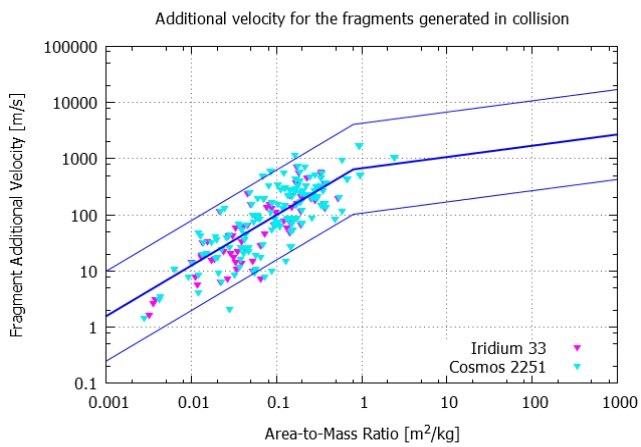
As noted earlier, Russia could use its variety of kinetic ASATs for coercive leverage or warfighting purposes. In November 2021, after more than a decade of development and testing, Russia destructively tested its Nudol direct-ascent (DA)-ASAT against a satellite in LEO.43 The demonstration created more than eighteen hundred pieces of trackable orbital debris and hundreds of thousands of smaller fragments.44 The test forced astronauts and cosmonauts aboard the International Space Station to take cover, highlighting the immediate dangers posed by such actions.45
The Nudol interceptor is mounted on a mobile launcher that allows it to target across a range of orbits. It might also include a dedicated radar to guide the interceptor to the target.46 Russia’s destructive tests of direct-ascent ASAT (DA-ASAT) weapons clearly demonstrate its disregard for the security and long-term sustainability of the space domain, its willingness to test the West’s boundaries with irresponsible behavior, and
its commitment to continue pursuing counterspace weapon systems that undermine strategic stability.
Russian satellites have also demonstrated post-mission hazards, raising further concerns about the creation of orbital debris. Increasing orbital debris risks additional collisions, generating even more debris and starting a vicious cycle.47 A possible cascading debris effect, difficult to control once started, echoes the logic of nuclear escalation and its deterrent power.
In 2020, the propulsion tank of Russian satellite Cosmos 2491 unexpectedly exploded after its mission ended.48 A similar incident occurred in 2023, when Cosmos 2499 experienced an explosion likely caused by the same propulsion tank issue. Both incidents generated large clouds of debris that will persist in orbit for decades or even centuries, exacerbating the risks to active satellites and spacecraft.49 Washington views debrisgenerating ASAT tests as undermining space sustainability and integrity, but Moscow might see debris generation as advantageous.50
Russia’s counter-commercial capabilities
During a crisis or conflict, Russia is also likely to interfere with or attack space assets of the United States, its allies and partners, and commercial assets upon which the United States relies. Key space services, such as Earth observation and communications, are increasingly performed by commercially launched and operated small satellite constellations. Working through commercial proxies is a feature of hybrid warfare— allowing states to advance strategic aims indirectly, obscure attribution, and blur the lines between civilian and military activity. In space, where commercial industry plays an outsized role, this dynamic is likely to become even more pronounced as strategic competition intensifies. As a result, irregular warfare— leveraging nontraditional actors, dual-use technologies, and
41. Ibid.; John S. Foster, Jr., et al., “Report of the Commission to Assess the Threat to the United States from Electromagnetic Pulse (EMP) Attack,” EMP Commission, 2004, http://www.empcommission.org/docs/empc_exec_rpt.pdf.
42. Berkowitz and Williams, “Russia’s Space-Based, Nuclear-Armed Anti-Satellite Weapon.”
43. Weeden and Samson, “Global Counterspace Capabilities,” 2–17.
44. “Russian Direct-Ascent Anti-Satellite Missile Test Creates Significant, Long-Lasting Space Debris.”
45. Victoria Samson, ed., “Russian Direct Ascent Anti-Satellite Testing,” Secure World Foundation, June 12, 2025, 4, https://www. swfound.org/publications-and-reports/russian-direct-ascent-anti-satellite-testing-fact-sheet; Ankit Panda, “The Dangerous Fallout of Russia’s Anti-Satellite Missile Test,” Carnegie Endowment for International Peace, November 17, 2021, https://carnegieendowment.org/posts/2021/11/the-dangerous-fallout-of-russias-anti-satellite-missile-test?lang=en.
46. Bendett, et al., “Advanced Military Technology in Russia,” 42.
47. “The Kessler Effect and How to Stop It,” European Space Agency, 2025, https://www.esa.int/Enabling_Support/Space_Engineering_Technology/The_Kessler_Effect_and_how_to_stop_it.
48. Jasper Hamill, “A Top-Secret Russian Military Satellite Has ‘Exploded in Space,’ Astronomer Says,” Metro, January 14, 2020, https:// metro.co.uk/2020/01/14/top-secret-russian-military-satellite-exploded-space-astronomer-says-12054460/.
49. LeoLabs (@LeoLabs_Space), “ATTN �� Our *Preliminary* Analysis of the Cosmos 2499 Fragmentation Event (using LeoLabs LeoRisk) Points toward a Low Intensity Explosion with Moderate Confidence. #SpaceDebris,” X (formerly Twitter), February 8, 2023, 10:23 a.m., https://twitter.com/LeoLabs_Space/status/1623387025725353985.
50. “Fact Sheet: Vice President Harris Advances National Security Norms in Space,” National Archives and Records Administration, April 18, 2022, https://bidenwhitehouse.archives.gov/briefing-room/statements-releases/2022/04/18/fact-sheet-vice-president-harris-advances-national-security-norms-in-space/.
Countering Russian escalation in space
commercial infrastructure—will almost certainly be the defining characteristic of modern space competition and conflict.51
The growing role of commercial space assets in shaping battlefield outcomes has made them a compelling target for Moscow. Through its rhetoric and actions, Russia has demonstrated its military thinking regarding space and counterspace responses throughout its war against Ukraine, particularly how it might attempt to degrade commercial space capabilities. Russia has shown intent to interfere with commercial space capabilities, as demonstrated by its cyberattacks on Viasat at the start of Moscow’s invasion of Ukraine.52 Systems such as SpaceX’s Starlink communications network and Maxar’s imaging satellites have demonstrated their strategic value in supporting Ukraine’s resistance. Given their high visibility and critical contributions, interfering with or denying access to these commercial systems presents an
appealing avenue for Russia to pressure its adversaries in competition or conflict. Indeed, in September 2022, a Russian official taking part in a United Nations (UN) working group on space made a similar threat, warning that Russia could retaliate against Starlink for its military support role in Ukraine.53
In October 2022, a senior Russian Foreign Ministry official warned that commercial satellites “may become a legitimate target for retaliation.”54 The ministry has since ratcheted up its threats against commercial entities, including warning SpaceX and other commercial satellite operators that support US and allied space operations that they could “become a legitimate target for retaliatory measures, including military ones.”55 Russian leaders have referred to commercial satellites as Western “quasi-civilian” satellites, indicating a worldview that commercial space assets run by US or Western companies are not clearly distinguishable from US or Western government assets. In October 2024, Russian officials complained during the UN General Assembly that the United States and its allies are using civilian and commercial space infrastructure for intelligence and military purposes.56
Russia has developed a range of capabilities that could enable it to conduct counter-commercial attacks in space. First, cyber and space are interdependent, meaning that Russia’s advanced cyber capabilities can attack space assets and architecture to interfere with and disrupt commercial satellites or the ground stations with which they communicate. For example, right before its invasion of Ukraine in 2022, Russia hacked US satellite company Viasat, ostensibly to cripple Ukrainian command and control ahead of the ground invasion the following day.57 The US National Security Agency concluded that Russian hackers only needed forty-five minutes to activate malware that took forty-five thousand satellite modems offline at the start of Russia’s invasion.58 As General Stephen Whiting, commander of US Space Command, put it, “[c]yberspace is the soft underbelly of [the US] global space networks.”59 The
51. John Klein, Fight for the Final Frontier: Irregular Warfare in Space (Annapolis, MD: Naval Institute Press, 2023).
52. Patrick Howell O’Neill, “Russia Hacked an American Satellite Company One Hour before the Ukraine Invasion,” MIT Technology Review, May 10, 2022, https://www.technologyreview.com/2022/05/10/1051973/russia-hack-viasat-satellite-ukraine-invasion/.
53. Michael Kan, “Russia Makes Veiled Threat to Destroy SpaceX’s Starlink,” PC Mag, September 19, 2022, https://www.pcmag.com/ news/russia-makes-veiled-threat-to-destroy-spacexs-starlink.
54. “Russia Warns West: We Can Target Your Commercial Satellites,” Reuters, October 27, 2022, https://www.reuters.com/world/russiasays-wests-commercial-satellites-could-be-targets-2022-10-27/.
55. “Russia Warns United States: Use of SpaceX for Spying Makes Its Satellites a Target,” Reuters, March 20, 2024, https://www.reuters.com/world/russia-warns-united-states-use-spacex-spying-makes-its-satellites-target-2024-03-20/.
56. Isabel van Brugen, “Russia Threatens to Shoot Down Western Satellites,” Newsweek, last updated October 19, 2023, https://www. newsweek.com/russia-shoot-western-satellites-ukraine-war-1835049; Kevin Holden Platt, “Russia Threatens Space Strikes On Western Satellites At UN Peace Forum,” Forbes, September 25, 2024, https://www.forbes.com/sites/kevinholdenplatt/2024/09/25/ russia-threatens-space-strikes-on-western-satellites-at-un-peace-forum.
57. O’Neill, “Russia Hacked an American Satellite Company One Hour before the Ukraine Invasion.”
58. Joseph Gedeon, “For the First Time, U.S. Government Lets Hackers into Satellite in Space,” Politico, August 11, 2023, https://www. politico.com/news/2023/08/11/def-con-hackers-space-force-00110919.
59. Sandra Erwin, “Space Force to Shore Up Cybersecurity as Threats Proliferate,” SpaceNews, April 6, 2022, https://spacenews.com/ space-force-to-shore-up-cybersecurity-as-threats-proliferate/.
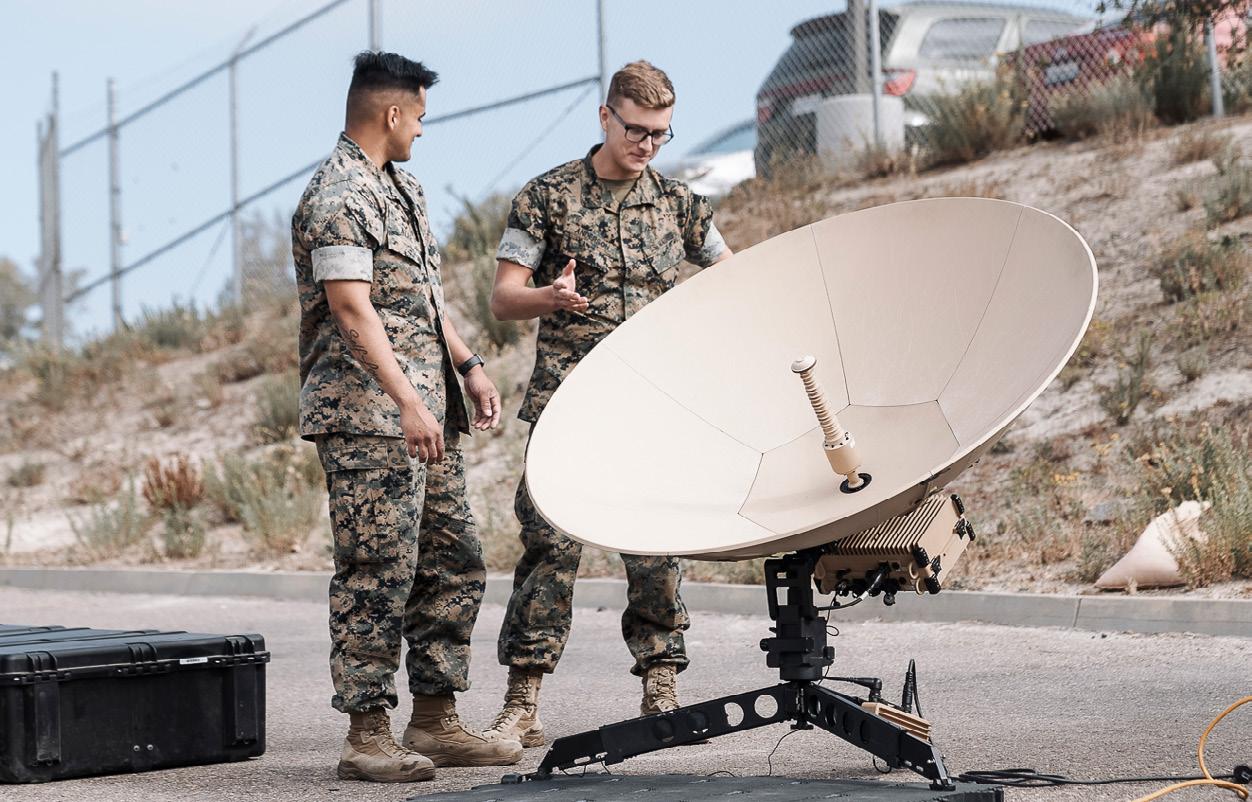
US Marines conduct a test on ground communications terminals on Camp Pendleton (US Marine Corps photo by Corporal Atticus Martinez)
Space Information Sharing and Analysis Center (ISAC), a space industry group, warned in 2024 that cyberattacks against companies’ critical infrastructure related to space systems are increasing and outpacing their defenses—with the ISAC recording more than one hundred attacks a week.60
Second, Russia has made several developments in nonkinetic or electronic counterspace weapons. Jamming and spoofing of communications or positioning, navigation, and timing (PNT) signals, like those used by the GPS, can target satellites on orbit, satellite ground components, or the links between them. Russia’s Peresvet ASAT laser dazzling weapon has yet to prove its worth in combat but might have enough power to dazzle or blind optical sensors or reconnaissance satellites.61 US intelligence reports leaked in 2023 indicated that Moscow had experimented with its Tobol electromagnetic warfare systems to disrupt Starlink’s transmissions in Ukraine. The reports showed that the program, reportedly designed to protect Russia’s satellites, can be employed instead to attack those used by its adversaries. Starlink satellites pass over the Earth at a low enough orbit such that Tobol is likely able to beam interference signals toward them.62 Reports show that Russia has repeatedly tried and failed to effectively jam Starlink and prevent users in Ukraine from accessing it, but interfering with even a few satellites could disrupt Ukrainian communication, to Russia military advantage.63 The playbook that Moscow is using in Ukraine is applicable elsewhere in future conflicts, and it is being observed by other adversaries.
Third, Russia could interfere with government and commercial satellites kinetically through RPO. Since 2013, Russia has deployed satellites, including under its Nivelir program, with demonstrated capability to approach and inspect satellites in orbit, marking a notable evolution in its space capabilities.64 For example, in July 2019, Russia’s Cosmos 2535 and Cosmos 2536 performed proximity maneuvers, which the Russian Ministry of Defense publicly acknowledged.65 Similarly, in July 2020, Cosmos 2543 positioned itself to observe the US optical reconnaissance satellite USA 245 and subsequently
released an object. US Space Command described this event as an “in-orbit weapons test.”66
More recently, in November 2023, the Russian satellite Cosmos 2570 released a “daughter satellite.”67 It, in turn, deployed another satellite, with all three engaging in close-approach maneuvers. That same month, the presumed-defunct Russian remote-sensing satellite Resurs-P3 unexpectedly resumed activity and approached the satellite Cosmos 2562 for unclear purposes, raising concerns about the potential for dormant “sleeper” satellites in space. This came as an unexpected development for Western analysts, in part due to mirror imaging assumptions—it was not something the United States would have done, and so they did not anticipate another country executing such maneuvers.
Russia’s RPO activities extend beyond potential kinetic operations. In March 2023, Russia launched a second Luch/ Olymp electronic intelligence satellite capable of intercepting communications between GEO satellites and their ground stations.68 This satellite has since maneuvered near Western assets, including a US Wideband Global communications satellite and Eutelsat satellites, thereby demonstrating its ability to conduct surveillance and potentially interfere with communications.69
Russia has yet to conduct a confirmed anti-satellite RPO attack against another nation’s satellites, but these demonstrated proximity capabilities suggest a clear potential for damaging or destroying them. Such maneuvers could serve to test or operationalize orbital ASAT weapons, conduct espionage, or achieve both objectives simultaneously.
Russia is likely evaluating the boundaries of space activities and operations it can pursue without provoking a response or escalation from the United States and its allies and partners. At the same time, Moscow is likely identifying and analyzing vulnerabilities in its adversaries’ space capabilities.
60. Sandra Erwin, “Space Industry Group Warns of Escalating Cyber Threats, Outmatched Defenses,” SpaceNews, June 18, 2024, https://spacenews.com/space-industry-group-warns-of-escalating-cyber-threats-outmatched-defenses/.
61. Swope, et al., “Space Threat Assessment 2024”; Bart Hendrickx, “Peresvet: A Russian Mobile Laser System to Dazzle Enemy Satellites,” Space Review, June 15, 2020, https://www.thespacereview.com/article/3967/1.
62. Alex Horton, “Russia Tests Secretive Weapon to Target SpaceX’s Starlink in Ukraine,” Washington Post, last updated April 18, 2023, https://www.washingtonpost.com/national-security/2023/04/18/discord-leaks-starlink-ukraine/.
63. Paul Mozur and Adam Satariano, “Russia Is Increasingly Blocking Ukraine’s Starlink Service,” New York Times, May 24, 2025, https://www.nytimes.com/2024/05/24/technology/ukraine-russia-starlink.html.
64. Bendett, et al., “Advanced Military Technology in Russia,” 42.
65. Weeden and Samson, “Global Counterspace Capabilities.”
66. “Russia Conducts Space-Based Anti-Satellite Weapons Test,” US Space Command, July 23, 2020, https://www.spacecom.mil/ Newsroom/News/Article-Display/Article/2285098/russia-conducts-space-based-anti-satellite-weapons-test/.
67. Samson and Kunasek, “Russian Military and Intelligence Rendezvous and Proximity Operations Fact Sheet.”
68. Bendett, et al., “Advanced Military Technology in Russia,” 42.
69. Swope, et al., “Space Threat Assessment 2024”; Weeden and Samson, “Global Counterspace Capabilities.”
II. Russian vs. Western views of deterrence: What it means for space
Russia’s space capabilities and operational testing have been detailed by open-source observers, but there has been little analysis on the Russian nuclear threat to space systems or how and why Russia might compete or escalate in space in other ways that counter US strategic advantages. Russian perspectives on cost imposition and acceptable use of force are starkly different from those of Western decision-makers, meaning that Russian political and military leaders could elect to take military action in space that is destabilizing, in violation of international law, outside of internationally accepted behavior, or outside the realm of what US policymakers or planners might expect. One way the United States and the West could hamper themselves is by mirror imaging; that is, imagining that Russia will not act in an escalating crisis or conflict in ways that are fundamentally different from, or even the opposite of, Western norms and habits. This logical error could blind Western strategists from considering the potential ways that Russia might see nuclear, debris-generating, and counter-commercial attacks in space as not only viable
Western views of deterrence, compellence, and dissuasion
The ideas of deterrence, compellence, coercion, and dissuasion apply in the context of space warfare.70 US and Western perspectives on space deterrence theory are broadly categorized into deterrence by punishment on one hand, and deterrence by denial of benefit on the other.
Coercion is the ability to get an actor to do something it does not want to do. It is exercised through implicit or explicit threats or through deliberate actions. It usually, but not always,
70. John J. Klein, “Deterrence and Space Warfare,” NSI, January 3, 2024, 1, https://nsiteam.com/social/deterrence-and-space-warfare/. options but also in Moscow’s best interest. A study of Russian views of deterrence as compared to Western views, and how they might be applied to space, is valuable here. The below section details Western and Russian views of deterrence, compellence, coercion, and dissuasion, and how these divergent perspectives must inform the development of a more effective US space strategy toward Russia.
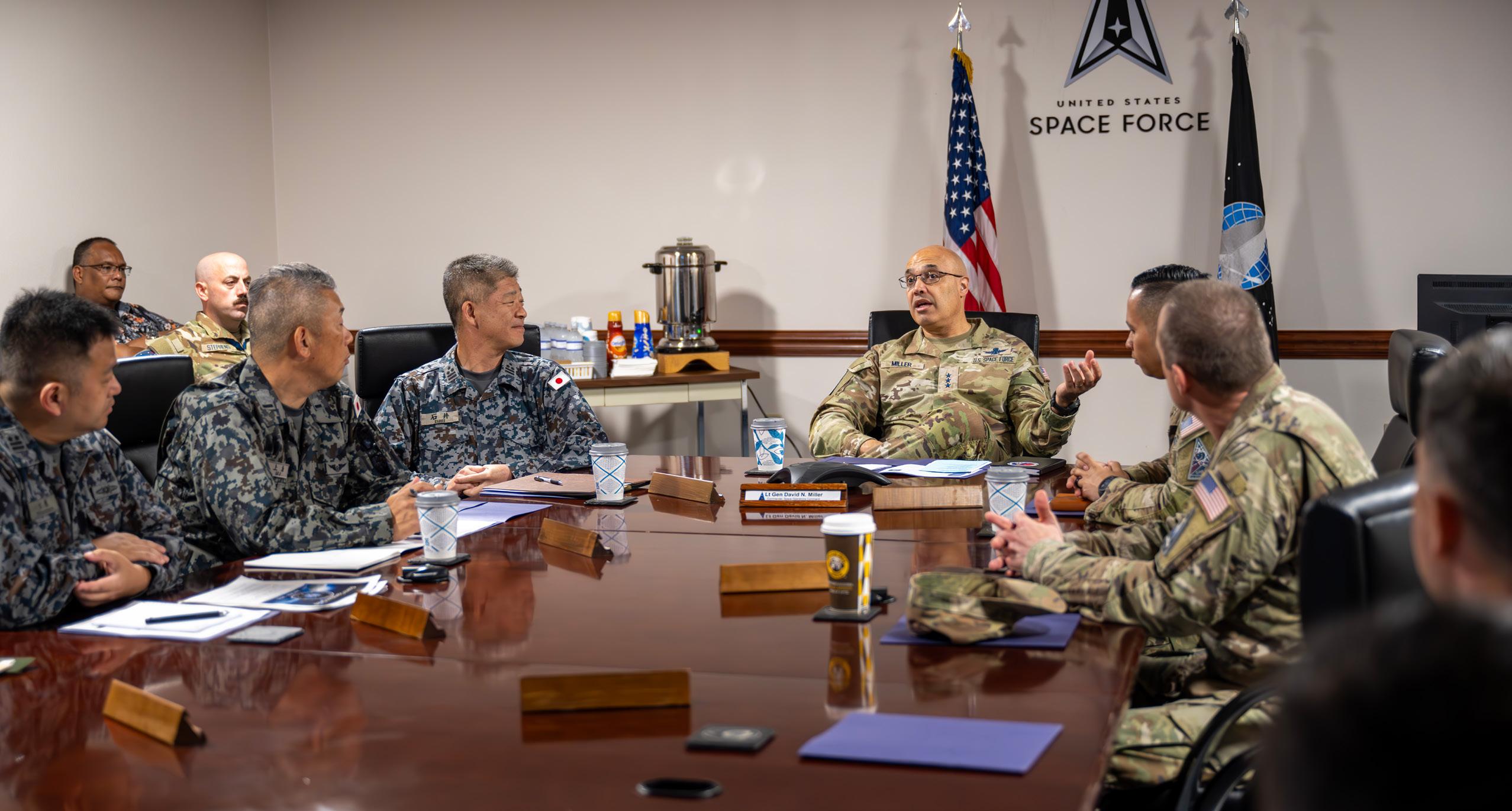
Space Operations Commander briefs the 20th Space Surveillance Squadron and the Japan Air Self-Defense Force (Matthew Veasley, US Space Force)
involves military threats or active military measures; it might also employ positive inducements.71
There are two basic forms of coercion: deterrence and compellence. As Nobel Prize-winning economist and game theorist Thomas Schelling explained, deterrence is a coercive strategy that involves persuading an adversary to refrain from taking a particular action or to cease its behavior; deterrence is designed to prevent a target from changing its behavior.72 The underlying assumption is that the credible threat of overwhelming force or retaliatory action can deter most adversaries from acts of aggression.73 This is often termed deterrence by punishment or deterrence by cost imposition.
In contrast, compellence is a coercive strategy that seeks to alter an adversary’s behavior, persuading it to do something
or act in a way it otherwise would not, by harming a target or threatening to do so.74 As opposed to deterrence, it is designed to convince an adversary to change its behavior.
A complementary concept to deterrence is dissuasion, which aims to prevent aggression by an adversary by making it clear that any action it might wish to take would be ineffective or futile.75 Dissuasion functions outside the traditional scope of military threats and often leverages deterrence by denial, which denies an adversary the potential gains of an attack.76 It aims to either discourage military competition in the first place or to convey the futility of military activities by demonstrating or signaling that the desired objectives cannot be achieved.77
A potential adversary might be dissuaded if it determines that an attack would fail to achieve its intended objectives,
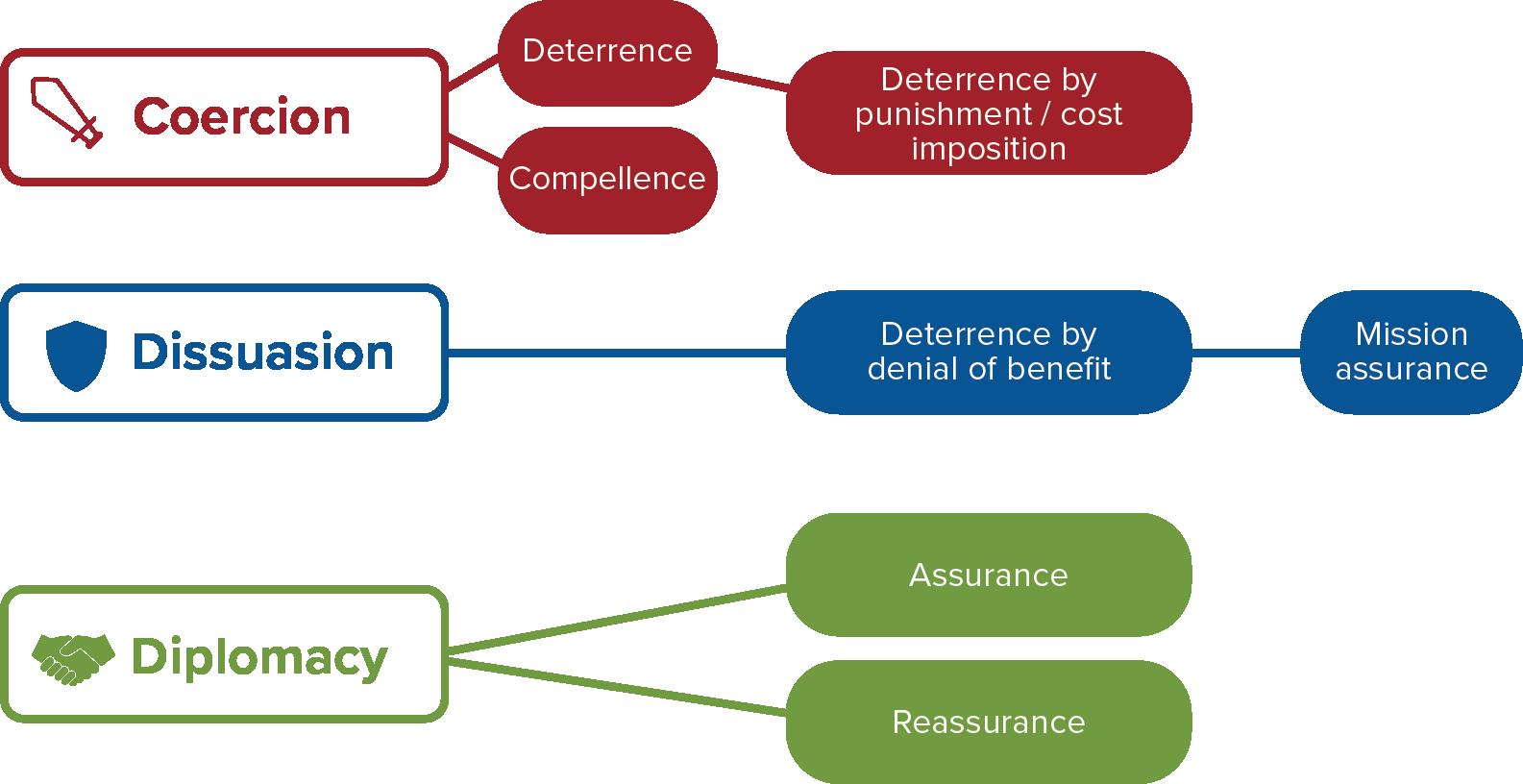
Figure 1 shows the relationships between Western concepts in relation to three core approaches the United States takes toward managing space escalation, including: coercion, deterrence, compellence, and deterrence by punishment or cost imposition; concepts of dissuasion, deterrence by denial, and mission assurance; and approaches to diplomacy, including assurance, and reassurance.
71. Robert J. Art and Kelly M. Greenhill, “The Power and Limits of Compellence: A Research Note,” Political Science Quarterly 133, 1 (2018), 78, https://www.jstor.org/stable/45176183.
72. Thomas C. Schelling, Arms and Influence (New Haven, CT: Yale University Press), 69–72.
73. Klein, “Deterrence and Space Warfare,” 2.
74. Schelling, Arms and Influence, 69–72; Art and Greenhill, “The Power and Limits of Compellence,” 78.
75. Klein, “Deterrence and Space Warfare,” 2; Andrew F. Krepinevich and Robert C. Martinage, “Dissuasion Strategy,” Center for Strategic and Budgetary Assessments, May 6, 2008, https://csbaonline.org/research/publications/dissuasion-strategy; Glenn Snyder, “Deterrence and Power,” Journal of Conflict Resolution 4, 2 (1960), 163–178, https://www.jstor.org/stable/172650.
76. Snyder, “Deterrence and Power,” 163–178.
77. Dean Cheng and John Klein, “A Comprehensive Approach to Space Deterrence,” Strategy Bridge, March 31, 2021, https://thestrategybridge.org/the-bridge/2021/03/31/a-comprehensive-approach-to-space-deterrence.
Fig. 1: Western concepts for shaping adversary (and allied) behaviors
Countering Russian escalation in space
leading its leadership to avoid initiating a military confrontation altogether.78
Modern Western space deterrence emphasizes three core principles: imposing costs, denying benefits, and encouraging restraint.79 Among US space professionals today, deterrence by denial of benefit or dissuasion is essentially achieved through mission assurance. Mission assurance strategies include
y defensive operations, such as off-board protection mechanisms;
y reconstitution capabilities, such as rapid satellite replacement or activating alternative ground stations; and
y resilience measures, including onboard protections, proliferation, disaggregation, distribution, and diversification of space capabilities.80
To be effective in dissuading aggression, these efforts must be publicized to potential adversaries. This visibility ensures that adversaries understand the futility of attacking space assets, thereby deterring hostile actions.81
Russian views of strategic deterrence, escalation to de-escalate, and unacceptable losses
Cultural and strategic differences between Russia and the West create potential gaps in understanding between the two that could affect deterrence and escalation control, especially in space. Misinterpretations of intent can lead to dangerous miscalculations, inadvertently escalating conflicts. It does not matter whether one thinks a potential adversary should be deterred by a particular action; it only matters how the adversary’s leadership interprets actions within its worldview and mental constructs.82 When seeking to deter, you must consider the adversary’s perception of your action, rather than how you would perceive the action if it was done to you. This might sound easy, but decision-makers can easily fall into the trap of mirror imaging—expecting their adversary to
understand their intent or respond to an action as they would themselves.
Russian conceptions of deterrence are broader than Western conceptions. This is particularly true of Anglophone interpretations. As political scientist Cheyenne Tretter outlines, this divergence stems in part from linguistic differences: the Russian term for deterrence, sderzhivanie (сдерживание), is more accurately translated as “restraint” or “containment.” As a result, Russian strategic thought blends the Western notions of deterrence, containment, and compellence into a more expansive framework for shaping adversary behavior.83
Over the past two decades, Russia has expanded its vision of strategic deterrence into a doctrine that integrates a broad spectrum of military capabilities and is centered on demonstrating Moscow’s resolve to use military force. Unlike the Western definition, which often equates strategic deterrence with nuclear weapons, Russia’s concept encompasses conventional, non-conventional, and even informational tools. The objectives of strategic deterrence extend to all phases of peace and conflict, including intra-war deterrence. Intra-war deterrence is designed to contain the emergence of threats, to deter aggression, and to coerce adversaries to end conflicts on terms that are “acceptable to Russia.”84 This approach aims to induce fear in adversaries at all stages of competition, whether in peace or war, blending deterrence, coercion, and containment.85 This means that Russian strategic deterrence involves messaging to the United States and others using multiple tools of national power—at multiple stages during peacetime, competition, and conflict—that Moscow is willing to use force to achieve its goals. This could explain why some Russian actions or reactions during peacetime or early conflict might be interpreted by Western watchers as unexpectedly strong or escalatory in nature. Applying Western conceptions of a rational or proportionate response might lead to misinterpretation or missed opportunities for anticipation of Russian actions.
Russia’s strategic deterrence approach is grounded in its perception of military asymmetry with the West, and it is not purely defensive. A central aspect of Russian deterrence
78. Klein, “Deterrence and Space Warfare,” 3.
79. Ibid., 2; James P. Finch and Shawn Steene, “Finding Space in Deterrence: Toward a General Framework for Space Deterrence,” Strategic Studies Quarterly 5, 4 (2011), 13, http://www.dtic.mil/dtic/tr/fulltext/u2/a569581.pdf.
80. Klein, “Deterrence and Space Warfare,” 3; “Space Domain Mission Assurance: A Resilience Taxonomy,” Office of the Assistant Secretary of Defense for Homeland Defense and Global Security, September 2015, 3, http://policy.defense.gov/Portals/11/Space%20 Policy/ResilienceTaxonomyWhitePaperFinal.pdf?ver=2016.
81. Klein, “Deterrence and Space Warfare,” 4.
82. Ibid., 5.
83. Cheyenne Tretter, “Exploring Factors for U.S.-Russia Crisis Stability in Space,” RAND, January 21, 2025, 11–12, https://www.rand.org/ pubs/research_reports/RRA2313-3.html.
84. Ibid., 12.
85. Yu. A. Pechatnov, “Deterrence Theory: Beginnings,” Vooruzheniye I Ekonomika, February 2016, as referenced in Fink, “The Evolving Russian Concept of Strategic Deterrence.”
is its military’s strategy of “unacceptable losses”—to inflict enough damage up to a threshold that an adversary will find unacceptable, thereby compelling concession.86 Closely related is Moscow’s concept of “dosed damage”—the idea that calculated doses of pain can be inflicted on an adversary to coerce it without provoking uncontrolled escalation.87 This approach reflects a greater confidence, among Russian thinkers rather than Western thinkers, in the belief that escalation can be controlled. By emphasizing the controlled use of military force—including nuclear weapons—Russia seeks to manage escalation, compel adversaries to back down, and, ultimately, deescalate conflicts on its own terms.88 Overall, Russia’s strategic deterrence seeks to influence its adversary’s calculations by demonstrating Russian willingness to use coercive measures or inflict unacceptable damage upon the enemy.89 For example, Moscow might threaten or employ nuclear weapons in a limited way to demonstrate its
resolve, signaling the potential for further escalation—while seeking to coerce adversaries into concessions or to choose surrender by making them see conflict as too costly to risk potentially uncontrollable nuclear escalation.
Official Russian doctrine states that nuclear weapons would only be considered in situations posing an existential threat to the Russian state, such as in response to nuclear use by an adversary or if Russia’s nuclear capabilities were targeted. However, as political scientist Mark B. Schneider outlines, Russia’s true policy around nuclear use is likely different from its public doctrine.90 Moscow’s statements and actions often suggest a broader willingness to employ nuclear weapons in a limited way, using such threats to demonstrate resolve, signal the potential for escalation, and coerce adversaries into concessions. In this sense, Russia’s approach might be less about outright military victory and more about ending conflicts quickly—on terms favorable to Moscow—by convincing opponents that the costs of continued resistance could spiral into uncontrollable nuclear escalation.91
In the space context, this could translate to Russia launching a major counter-commercial, nuclear ASAT, or debrisgenerating attack in order to induce fear in the West of an impending escalation if it does not de-escalate and make concessions to Moscow. According to assessments, “Russia’s emerging approach to escalation management in space—a cost imposition strategy based on a belief that escalation can be controlled—might reinforce its perceived incentives to escalate early in a crisis.”92
Unlike the Western perspective, which sees the outbreak of conflict as evidence of deterrence failures, Russia views deterrence as a continuous process closely linked to warfighting. In Moscow’s view, deterrence in times of war can manage escalation, ensure de-escalation, or terminate conflicts swiftly under conditions acceptable to Russia.93
86. Michael Kofman, Anya Fink, and Jeffrey Edmonds, “Russian Strategy for Escalation Management: Evolution of Key Concepts,” Center for Naval Analyses, April 2020, ii and 53–54, https://www.cna.org/analyses/2020/04/russian-strategy-for-escalation-management-key-concepts.
87. Dave Johnson, “Russia’s Conventional Precision Strike Capabilities, Regional Crises, and Nuclear Thresholds,” Lawrence Livermore National Laboratory Center for Global Security Research, February 2018, https://cgsr.llnl.gov/sites/cgsr/files/2024-08/Precision-Strike-Capabilities-report-v3-7.pdf.
88. Mark B. Schneider, “Escalate to De-escalate,” US Naval Institute, Proceedings 143, 2, 1 (2017), https://www.usni.org/magazines/ proceedings/2017-02/escalate-de-escalate.
89. Matthew Kroenig, “A Strategy for Deterring Russian Nuclear De-Escalation Strikes,” Atlantic Council, April, 2018, 5, https://www. atlanticcouncil.org/in-depth-research-reports/report/a-strategy-for-deterring-russian-de-escalation-strikes/.
90. Schneider, “Escalate to De-escalate.”
91. Daniel R. Post, “Escalating to De-escalate with Nuclear Weapons: Research Shows It’s a Particularly Bad Idea,” Bulletin of the Atomic Scientists, February 9, 2024, https://thebulletin.org/2024/02/escalating-to-de-escalate-with-nuclear-weapons-research-shows-its-a-particularly-bad-idea/.
92. Tretter, “Exploring Factors for U.S.-Russia Crisis Stability in Space.”
93. Military-Encyclopedic Dictionary of the Russian Ministry of Defense,” Russian Federation Ministry of Defense, last visited August 11, 2018, http://encyclopedia.mil.ru/encyclopedia/dictionary/details.htm?id=14206@morfDictionary, as referenced in Kristin Ven Bruusgaard, “Russian Strategic Deterrence,” Survival: Global Politics and Strategy 58, 4, (2016), 7–26.
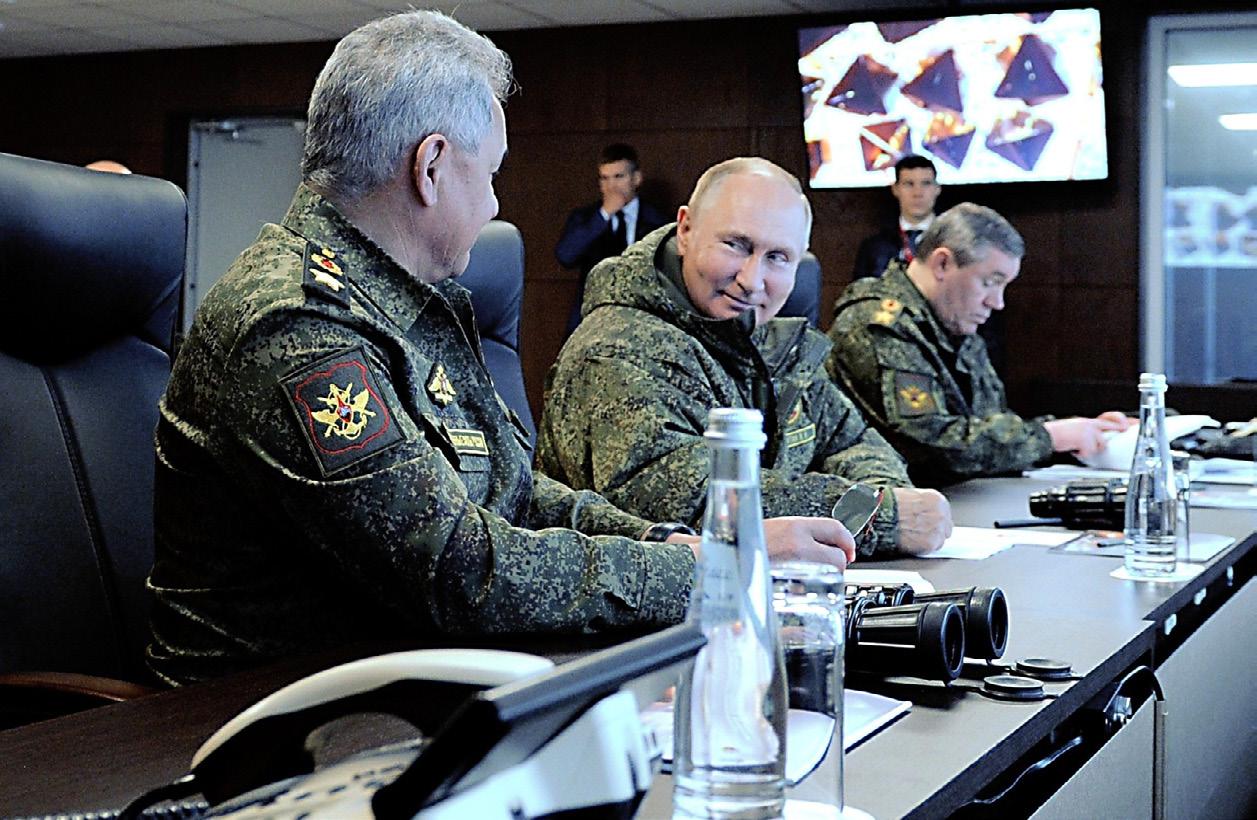
Vladimir Putin observes the main stage of the Vostok-2022 military exercise (Kremlin)
Going nuclear in space
Russia’s approach to strategic deterrence creates unique incentives for Moscow to consider nuclear escalation in space. A nuclear ASAT or strike might be seen as a deterrent or compellence measure designed to influence adversary decision-making.
Evidence of this strategic thinking is found in official Russian military doctrine, the writings and statements of Russian strategists and generals, and recent actions. Russia’s 2020 doctrine states that the purpose of nuclear deterrence is for “the preclusion of the escalation of military actions and their cessation on conditions acceptable to the Russian Federation and (or) its allies.”94 Since the invasion of Ukraine, Putin has put Russia’s forces on “high combat alert,” and high-level Russian officials have issued explicit nuclear threats to deter NATO intervention and to prevent more advanced Western weapons being sent to Ukraine.95 Military exercises involving and ending in simulated nuclear strikes demonstrate Moscow’s preoccupation with this type of scenario.96 Further evidence includes Russia’s investments in advanced nuclear forces, such as theater-ranger, low-yield, and dual-capable cruise missiles—each of these characteristics makes these forces more suitable for limited, coercive use that aligns with this strategy.97 Some of these capabilities are now deployed in Kaliningrad and Belarus, placing them within striking distance of a greater range of European targets.98
The 2018 US Nuclear Posture Review stated that “Russian strategy and doctrine emphasize the potential coercive and military uses of nuclear weapons. It [sic] mistakenly assesses that the threat of nuclear escalation or actual first use of nuclear weapons would serve to ‘de-escalate’ a conflict on terms favorable to Russia.”99 Russian experts acknowledge that this basic logic of threatening limited nuclear use to compel the adversary to refrain from further action is “widely accepted” by
Russia’s leadership.100 This highlights the potential for space to become another domain in which nuclear escalation could occur.
By comparison, the 2022 Nuclear Posture Review highlighted US declaratory policy: “The United States affirms that its nuclear forces deter all forms of strategic attack. They serve to deter nuclear employment of any scale directed against the U.S. homeland or the territory of Allies and partners, whether on the ground, in the air, at sea, or in space. Any adversary use of nuclear weapons, regardless of the location or yield, would fundamentally alter the nature of a conflict, create the potential for uncontrolled escalation, and have strategic effects.”101 This declaratory policy, although subject to interpretation depending on the greater geopolitical context, will have a
94. “Foundations of State Policy of the Russian Federation in the Area of Nuclear Deterrence,” translated by the Center for Naval Analyses Russia Studies Program, June 2020, https://www.cna.org/archive/CNA_Files/pdf/foundations%20of%20state%20policy%20 of%20the%20russian%20federation%20in%20the%20area%20of%20nuclear%20deterrence.pdf.
95. Heather Williams, “Why Russia Keeps Rattling the Nuclear Saber,” Center for Strategic and International Studies, May 20, 2024, https://www.csis.org/analysis/why-russia-keeps-rattling-nuclear-saber.
96. Andrew Osborn, “Russia Says It Rehearsed Delivering a Massive Retaliatory Nuclear Strike,” Reuters, October 25, 2023, https:// www.reuters.com/world/europe/russia-says-it-rehearsed-delivering-massive-retaliatory-nuclear-strike-2023-10-25/.
98. “Russia Deploys Iskander Nuclear-Capable Missiles to Kaliningrad: RIA,” Reuters, February 5, 2018, https://www.reuters.com/article/us-russia-natomissiles/russia-deploys-iskander-nuclear-capable-missiles-to-kaliningrad-ria-idUSKBN1FP21Y; Lidia Kelly and Andre Osborn, “Belarus Starts Taking Delivery of Russian Nuclear Weapons,” Reuters, June 14, 2023, https://www.reuters.com/ world/europe/belarus-has-started-taking-delivery-russian-tactical-nuclear-weapons-president-2023-06-14/.
99. “Nuclear Posture Review,” Office of the Secretary of Defense, February 2018, https://media.defense.gov/2018/feb/02/2001872877/1/-1/1/executive-summary.pdf.
100. Katarzyna Zysk, “Escalation and Nuclear Weapons in Russia’s Military Strategy,” Royal United Services Institute, May 25, 2018, https://rusi.org/explore-our-research/publications/rusi-journal/escalation-and-nuclear-weapons-russias-military-strategy.
101. “2022 National Defense Strategy of the United States,” US Department of Defense, October 27, 2022, 7, https://media.defense. gov/2022/Oct/27/2003103845/-1/-1/1/2022-NATIONAL-DEFENSE-STRATEGY-NPR-MDR.pdf.
Starlink 10-20 Launches from Cape Canaveral Space Force Station (Gwendolyn Kurzen, US Space Force)
bearing for this report’s first scenario of a NUDET in LEO and potential US responses.
While the desired deterrent effect of Russia’s nuclear threats during its war against Ukraine remains a topic for debate, Russia has faced minimal tangible costs for its nuclear saber rattling. Public outcry has been limited to US and European leaders, with limited criticism from the Global South and non-Russia members of the BRICS (Brazil, Russia, India, China, and South Africa).102 This lack of accountability might encourage further nuclear saber rattling, raising the likelihood that Moscow could extend its nuclear threats to new domains such as space. For Russia, the strategic gains from nuclear threats or limited use might outweigh the risks, underscoring the importance of robust countermeasures by the United States and its allies. Unless Russia perceives any costs to its nuclear threats, the behavior is likely to continue—and potentially increase.
Four applicable lessons for space from differing Russian and Western deterrence approaches
This section outlines the implications of differing Western and Russia deterrence approaches toward space. Given Russia’s framework and approach to deterrence and compellence, there are four implications that might make Moscow more likely to escalate in space, whether to achieve its intended goals or because of misinterpretation.
1) Russian perceptions of Russia’s vulnerability and increasing risk tolerance post-2022 heighten the risk of escalation in space
Views in Russia of the country’s own vulnerabilities and Russians’ belief in US desires for space dominance might feed into potentially escalatory interpretations of US space activities, thereby increasing Russia’s risk tolerance for space escalation. Russian strategic thinking reflects acute concerns about Russia’s own vulnerabilities—particularly the exposure of its nuclear deterrent to space-enabled US capabilities. This threat perception is rooted in long-standing fear of US technological prowess and stated skepticism toward US intentions, with the Kremlin citing past US withdrawals from arms control agreements such as the Anti-Ballistic Missile Treaty and the Intermediate-Range Nuclear Forces Treaty.103 Russia’s 2021 National Security Strategy, for example, explicitly
highlights concerns about US reconnaissance, counterspace, and missile defense capabilities that could undermine the survivability of Russia’s nuclear forces. Russian analysts have voiced fears that Washington might conduct a “sudden, massive, and rapid” space-enabled strike to neutralize Russia’s retaliatory capacity.104
This distrust extends to legal frameworks as well. Recent Russian military writings express doubt that the United States intends to uphold the 1967 Outer Space Treaty, particularly its prohibition on the stationing or nuclear weapons and other WMDs in space.105 These anxieties fuel a broader narrative that the United States is using the space domain to gain strategic superiority at Russia’s expense.
The risk of Russian misinterpretation of US space actions increases against this backdrop. In a crisis, even routine or defensive US space operations could be seen through a worstcase lens—potentially triggering early and disproportionate Russian responses. Russia’s belief that the United States might be preparing for a disarming first strike could drive Moscow to preempt perceived threats, especially if it fears losing its second-strike capability.
Compounding this danger is Russia’s apparent shift toward greater risk acceptance in space. Cheyenne Tretter observes that, since 2022, Russian strategists have become more explicit in discussing warfighting and offensive operations in space—marking a departure from the primarily deterrencefocused thinking that characterized the 2014–2022 period.106 Recent Russian military publications have argued for early, highdamage strikes in space that could deny adversaries access to critical space assets. These writings emphasize “offensive operations . . . to dominate the enemy in a certain layer of outer space” and to degrade the adversary’s capabilities “at the early pre-conflict stage.”107
This growing emphasis on preemptive and asymmetric escalation suggests that Russia increasingly sees space as a domain in which it can act decisively and manage escalation on its own terms. If Moscow believes it can contain escalation at higher levels of conflict, it might feel emboldened to take greater risks at lower thresholds—potentially destabilizing the strategic balance. Additionally, Russia’s fears about US incentives for early escalation in the space domain and its broader perceptions of US hostility further heighten the risk
102. Williams, “Why Russia Keeps Rattling the Nuclear Saber.”
103. “National Security Strategy of the Russian Federation [Strategiya Natsional’noy Bezopasnosti Rossiiskoi Federatsii],” President of Russia, July 2, 2021, 6, 13, https://rusmilsec.blog/wp-content/uploads/2021/08/nss_rf_2021_eng_.pdf.
104. A. G. Semyonov, Yu. V. Krivitsky, and V. G. Chekhovsky, “Combat in an Aerospace Theater of Operations,” Military Thought 32, 2 (2023), 51, translated by East View Press; Tretter, “Exploring Factors for U.S.-Russia Crisis Stability in Space.”
105. Tretter, “Exploring Factors for U.S.-Russia Crisis Stability in Space,” 22–23.
106. Ibid., 24–25.
107. V. A. Kalganov, G. B. Ryzhov, and I. V. Solovyov, “Strategic Deterrence as a Factor Ensuring Russia’s National Security,” Military Thought 4, 2022, East View Press, 34, https://on-demand.eastview.com/browse/doc/82119908/strategic-deterrence-as-a-factor-ensuring-russia-s-national-security.
that it will misinterpret US actions in space. In a crisis, these misperceptions could be particularly dangerous, especially if Russia believes it must act quickly to avoid a space-enabled US disarming strike against its nuclear retaliatory forces. In such a scenario, Russian planners could see early escalation not as a provocation, but as a necessary form of preemption— underscoring the urgent need to clearly signal to the United States by engaging in strategic communication to reduce the risk of miscalculation in space.
2) Asymmetries in US vulnerabilities in space compared to Russia
Russia’s strategic focus on exploiting asymmetric advantages could make it more likely to conduct attacks in space, as it perceives the United States as having critical vulnerabilities in the space domain. US weapons systems’ reliance on satellite-enabled data and the essential role of space-based intelligence in sustaining US military superiority underscore the high strategic value of US and commercial space assets.
Russian analysts often portray US space reliance as both a critical vulnerability and a source of overconfidence. On one hand, they see the US dependence on space systems as an Achilles’ heel—an opportunity for Russia to exploit through advanced counterspace capabilities, particularly electronic warfare.108 On the other hand, they argue that that US space power is less formidable than Washington portrays and US efforts to build a more resilient, proliferated satellite architecture are deeply flawed. For example, in 2020, Russian military expert Alexei Leonkov dismissed US satellite proliferation plans as “perfect only on paper,” asserting that such systems would remain susceptible to disruption, especially from EW attacks.109 He predicted that by the time the United States fields its next-generation architecture, Russian EW capabilities would already be more advanced. Together, these views reinforce a broader Russian narrative that the US space advantage is both fragile and illusory, and that Russia is well-positioned to counter it.
108. “Challenges to Security in Space 2022,” US Defense Intelligence Agency, March 2022, iv, https://www.dia.mil/Portals/110/Documents/News/Military_Power_Publications/Challenges_Security_Space_2022.pdf; Tretter, “Exploring Factors for U.S.-Russia Crisis Stability in Space,” 7–8.
109. Irina Taran and Elizaveta Komarova, “‘Many Vulnerabilities’: How the U.S. Plans to Develop its Military Infrastructure in Space [‘Множество
Russia Today, June 7, 2020; Tretter, “Exploring Factors for U.S.-Russia Crisis Stability in Space.”
US Space Force guardian monitors workstations in the Combined Space Operations Center at Vandenberg Space Force Base (David Dozoretz, US Space Force)
If not corrected, the perceived vulnerability of the United States due to its reliance on space architecture can both invite and reward attack. Russia might view this asymmetric disadvantage as an opportunity to hold US space assets at risk, threatening what the United States values most to weaken its strategic position and disrupt its military operations.
3) Escalate to de-escalate: Inflicting unacceptable damage to coerce the United States
The Western strategy of dissuasion or deterrence by denial— focused on ensuring mission assurance and enhancing space resilience—might be insufficient to deter Russia from initiating attacks in space. Even if US satellites demonstrate resilience or US missions maintain continuity—thus denying Russia the supposed benefit of its attacks (in Western deterrenceby-denial logic)—Moscow might still be motivated to attack. Russia’s dosed damage approach and its belief in the ability to manage escalation could drive it to inflict significant damage on US space assets to coerce the United States into altering its actions or policy decisions.
This approach reflects Russia’s readiness to undertake dramatic measures in space, including debris-generating attacks on commercial space assets, to provoke fear among Western decision-makers regarding escalation management. Such actions could be aimed at compelling the United States to scale back its activities or yield to Russian demands, even in other domains of conflict. Moscow’s calculus might prioritize the perceived strategic benefits of coercion by conducting escalatory space attacks. Thus, a US deterrent strategy that is overly dependent on deterrence by denial might be insufficient to deter Russia.
4) Russian culture of suffering and willingness to accept self-damage in space escalation
Some US scholars have noted that “Russia has little to lose from a disruption to space access, whereas the United States has everything to lose.”110 However, in a nuclear ASAT scenario, the effects of such a detonation would, depending on the warhead’s yield, extend indiscriminately across the surrounding orbital region and affect Russia’s own systems as well.111 It is true that Russia possesses fewer satellites than the United States—and China—but it would be inaccurate to assume that Moscow would not also sacrifice aspects of its
own technological infrastructure and way of life by deploying a nuclear weapon in space.112
The critical question is whether Moscow would be willing to accept damage to its own assets—and even risks to Russian cosmonauts on the International Space Station (ISS)—in a space attack, such as employment of a nuclear ASAT. While public Russian doctrine indicates that nuclear weapons would only be used in the face of an existential threat, the willingness to endure loss of space capabilities could still align with a broader strategic calculus: Better to sacrifice some assets in space than risk the survival of the state itself. Russian culture and strategic norms often embrace the concept of suffering as a unifying force, a sentiment deeply ingrained in Russia’s military strategy, cultural identity, and historical narrative. This ethos is exemplified by the immense loss and suffering endured by the Russian population during World War II, a legacy that Moscow continues to invoke to assert moral authority and justify its actions.113 But while these wartime resilience narratives centered on enduring suffering inflicted by an invader, a more apt historical parallel might be the Soviet-era purges—self-inflicted losses borne for overarching political purposes. In this framework, Moscow could view the destruction of its own space infrastructure not as an irrational act, but as an acceptable price to pay for resisting Western aggression or preserving regime survival.
In this context, Russian leadership’s willingness to accept self-inflicted damage to its space assets and services might be higher than Western policymakers anticipate. Moscow’s calculated risk appetite might prioritize achieving a perceived strategic or geopolitical goal more than preserving its own assets.
Recent actions, such as Russia’s conduct in the ongoing war against Ukraine, underscore this point. Despite substantial military personnel losses, severe economic damage from international sanctions, and a degraded quality of life for its population, the Kremlin has demonstrated a willingness to endure significant sacrifices to pursue its objectives. A nuclear ASAT detonation would have catastrophic, far-reaching consequences, creating a scenario in which “everybody loses.” However, it is critical for the United States, Western allies, and commercial stakeholders to avoid mirror imaging. Moscow’s calculus might be fundamentally different, shaped by a higher tolerance for sacrifice in pursuit of perceived strategic gains.
110. Clayton Swope and Makena Young, “Is There a Path to Counter Russia’s Space Weapons?” Center for Strategic and International Studies, June 28, 2024, https://www.csis.org/analysis/there-path-counter-russias-space-weapons.
111. Juliana Suess, “The Nuclear Option—Russia’s Newest Counter Space Weapon?” Royal United Services Institute, February 27, 2024, https://rusi.org/explore-our-research/publications/commentary/nuclear-option-russias-newest-counter-space-weapon. 112. Ibid.
113. Elizabeth Wood, “Performing Memory: Vladimir Putin and the Celebration of World War II in Russia,” Soviet and Post-Soviet Review 38, 2 (2011), 172–200, https://www.researchgate.net/publication/233566311_Performing_Memory_Vladimir_Putin_and_the_Celebration_of_World_War_II_in_Russia.bration_of_World_War_II_in_Russia.
US Space Force aggressors replicate adversary electromagnetic tactics during Resolute Space
III. Existing and planned US methods to address Russian counterspace capabilities
The United States has taken steps to strengthen its space posture and overall national defense capabilities; these methods have applicability to countering Russian nuclear, debris-generating, and commercial attacks in space. While necessary, such measures across the tools of US national power have not been sufficient to address the serious challenges posed by Russia’s potential modes of attack.
This section creates a baseline understanding of existing and planned US, allied, and commercial methods to impede the effectiveness of Russian counterspace capabilities; it also evaluates their sufficiency. Overall, this section shows that current or planned methods to deter or impede the effectiveness of Russia counterspace attacks are inadequate to address growing space threats from Moscow. Current US posture is not fully optimized to respond to these threats because it places insufficient focus on these escalatory potential Russian attacks. This leaves the United States dangerously unprepared and potentially vulnerable.
Categorizing existing and planned US methods
US methods to impede the effectiveness of Russian counterspace capabilities and deter Russian escalation in space are categorized as follows.
y Assurance and reassurance methods seek to influence the decisions of allies and partners. Assurance involves the perpetual process and product of actions taken to enhance an ally or partner’s confidence in the securities provided through US military capability and national will.114 Reassurance is a means by which one state assures another that its intentions are not aggressive.115 In space, this is done primarily through US and allied diplomatic measures, including communication to US domestic audiences, allies and partners, commercial partners, and Russian political leadership.
114. Luke R. Stover, “Effective Assurance: A Strategic Imperative,” Æther: A Journal of Strategic Airpower & Spacepower 3, 2 (2024), 72, https://www.airuniversity.af.edu/Portals/10/AEtherJournal/Journals/Volume-3_Number-2/Stover.pdf. 115. Ibid., 74.
2025 exercise (William Pugh, US Space Force)
y Deterrence by denial of benefit seeks to influence the potential adversary’s decision-making. It is aimed at deterring aggression by making it clear that any action would be ineffective or futile. In space, this is done primarily through military and resilience efforts, including protection; fires (defensive operations and active defense); command and control; information and intelligence; movement and maneuver; protection; and sustainment.
y Deterrence by cost imposition seeks to influence the potential adversary’s decision-making. It involves the credible threat of force or retaliatory action to deter acts of aggression in space. In space, this is done primarily through military efforts, including joint fires (offensive military operations), as well as economic sanctions, diplomatic and informational naming and shaming, and démarches.
Assurance and reassurance methods
Assurance is a strategy that seeks to assure other states through promises to respect or ensure their security.116 The goal of assurance is to reduce conflict and dissuade other states from seeking weapons by alleviating those states’ feelings of insecurity. Assurances involve declarations or signals meant to convey a commitment to take, or refrain from taking, certain actions in the future—the signal centers around the sender communicating that it either will not harm the recipient’s security or will not allow it to be harmed.117
In DOD parlance, assurance refers to the commitment and confidence conveyed by the United States to its allies and partners that it will defend them—and the commitment to adversaries of US follow-through on stated commitments through diplomatic tools. Reassurance is the act of actively demonstrating those commitments through ongoing actions and capabilities, aiming to alleviate anxieties and solidify trust with allies, as well as communicating that any actions taken by the United States are not aggressive toward allies and partners.118 Both are key elements in promoting space security and stability.
Diplomacy, coalition building, and confidence-building measures are the primary vehicles of US assurance and reassurance to address concerns around potential Russian nuclear, debris-generating, and counter-commercial attacks in space. So, what are the assurance messages that the United States wishes to convey to different audiences (allies and partners, adversaries, and commercial space companies)
in relation to these types of attacks? The following section examines US communications and diplomatic measures with five key audiences: the US general public, Russian politicalmilitary leadership, US allies and international partners, commercial space firms, and People’s Republic of China (PRC) leadership. These are the most important audiences to formulate a comprehensive response to Russian aggression in space.
US general public
The US government must communicate a careful balance of urgency and safety to the US public. This is needed to maintain public support for the often-expensive measures to enhance resilience against possible attacks in space, as well as to avoid panic in the event of such attacks.
On one hand, the US public should better understand the high degree of US government and civilian reliance on satellites and other space-related assets for its national security and everyday activities. Conveying this requires telling the story of how access to the internet, automatic teller machines, GPS, and many other everyday things the public takes for granted are made possible by satellites. The message must explain that any disruption to satellites can result in direct public consequences, ranging from inconvenient disruption of an everyday activity to catastrophic economic and safety concerns. US public understanding of the importance of satellites to internet access and livelihood has increased
116. Jeffrey W. Knopf, “Varieties of Assurance,” Journal of Strategic Studies 35, 3 (2012), 375, https://www.tandfonline.com/doi/abs/10.1 080/01402390.2011.643567.
117. Ibid., 376.
118. Linton Brooks and Mira Rapp-Hooper, “Extended Deterrence, Assurance, and Reassurance in the Pacific during the Second Nuclear Age,” Strategic Asia, National Bureau of Asian Research, October 2, 2013, https://www.nbr.org/publication/extended-deterrence-assurance-and-reassurance-in-the-pacific-during-the-second-nuclear-age/; Stover, “Effective Assurance.”
Chief master sergeant of the Space Force John Bentivegna delivers keynote at the Air, Space & Cyber Conference in National Harbor, Maryland, September 23, 2025 (US Air Force photo by Eric Dietrich)
Countering Russian escalation in space
since the start of Russia’s war against Ukraine in 2022—the highly publicized value of Starlink to Ukraine’s maintenance of communication and linkages to the outside world has resonated among the broader public. However, the extent to which the US public connects Ukraine’s reliance on space to US society is probably more limited. And while the US public is highly aware of US strategic competition with China and is generally supportive of efforts to maintain a competitive edge vis-à-vis Beijing, the importance of space to that endeavor might not be widely understood.119 Beijing has created a national campaign to connect its national strength to its space power, but the United States has not embraced such an approach in the way it did so viscerally with respect to nuclear weapons during the Cold War.
On the other hand, the US public must also have confidence that the US government—Space Command, Space Force, the National Aeronautics and Space Administration (NASA), and other bodies—is on top of safeguarding US national interests and civilians. An important element of this is demonstrating not only that the United States remains a leading space power, but that it can identify and respond to current and future vulnerabilities to US space architecture, and that it has plans to mitigate risks to such assets. A key part of this is communicating robust investments in, and cooperation with, other states on space situational awareness.
It is also important to rekindle public enthusiasm for the broader narrative of space as a source of inspiration and an opportunity to enhance American lives, while sustaining support for US leadership in space. Continued public interest and backing are essential, as both the space economy and government initiatives rely on federal funding and public support to maintain the rapid pace of activity, research, and development needed to protect US interests in and through space.
The main method for such assurance methods includes public statements and public education campaigns about space. These would serve as assurances to the US public around the two messages outlined above.
Allies and partners
Assurances from the United States to its allies and partners take three main forms. The first is building coalitions of likeminded nations to align space policies and create norms against counterspace capability development and testing,
which helps increase stability and avoid increased investments in space weapons by other states. The second is signaling to allies and partners that they are secure, and that the United States will back them if they are under threat or attack. The third is signaling to allies and partners that the United States’ investments in its own capabilities that could be used for counterspace activities are not targeted at these allies or partners and are fielded for defensive rather than escalatory purposes.
US efforts toward goal one: Build coalitions to align space policies and norms
The current US method of achieving this goal involves a focus on space assurance, including stances against the weaponization of space.120 In 2023, the US State Department published its first Strategic Framework for Space Diplomacy, which sought to advance continued US space leadership, expand international cooperation on mutually beneficial space activities, promote responsible behavior from all space actors, strengthen the understanding of and support for US national space policies and programs, and promote international use of US space capabilities, systems, and services.121 Additionally, the United States has pushed other countries to make a commitment not to conduct destructive DA-ASAT missile tests. Space diplomacy aims to build best practices and principles between the United States and its allies and partners to help guide outer space activities.
US space policy informs diplomacy efforts. Previous space policy, specifically the 2020 National Space Policy and the 2021 United States Space Priorities Framework, articulated the US commitment to both minimizing the negative effects of space activities on the outer space environment and reducing the potential for conflict.122
US space diplomacy centers on affirming international space law—in part through the United Nations Committee on the Peaceful Uses of Outer Space (UNCOPUOS) and existing international treaties like the 1967 Outer Space Treaty—though these regimes alone are not completely sufficient. The United States engages with foreign partners and the public through bilateral dialogues, multi-country coalitions, multilateral governmental bodies, nongovernmental conferences and forums, partnerships and exchanges, industry symposiums, and embassies abroad. US assurance is primarily conducted through its leadership at UNCOPUOS and in disarmament
119. Craig Kafura, “American Views of China Hit All-Time Low,” Chicago Council on Global Affairs, October 24, 2024, https://globalaffairs.org/research/public-opinion-survey/american-views-china-hit-all-time-low.
120. Michael Krepon and Christopher Clary, “Space Assurance or Space Dominance: The Case Against Weaponizing Space,” Henry L. Stimson Center, 2003, 57, https://www.stimson.org/wp-content/files/file-attachments/spacebook_1.pdf.
121. “A Strategic Framework for Space Diplomacy,” US Department of State, May 2023, 3, https://www.state.gov/wp-content/uploads/2023/05/Space-Framework-Clean-2-May-2023-Final-Updated-Accessible-5.25.2023.pdf.
122. “The National Space Policy,” Executive Office of the President, December 9, 2020, https://www.federalregister.gov/documents/2020/12/16/2020-27892/the-national-space-policy.
and international security forums, as well as through political commitment and statements.123
The United States sometimes discusses issues surrounding debris generation and the use of nuclear weapons in space at the UN by focusing on countering WMD use, defending the space domain, and advancing a rules-based international order for outer space activities. The prospects for legally binding arms control treaties are dim across domains, given Russia’s serial cheating on arms control regimes, Russia’s 2024 refusal to reaffirm its Article IV OST obligations at the UNSC, and China’s lack of interest in engagement. In its place, the United States is attempting to employ other diplomatic tools to counter Russia’s possible nuclear, debris-generating, and counter-commercial attacks in space, such as modeling responsible behavior and forging coalitions of aligned states. The thinking here is likely that a combination of public warnings, private threats, and a coalition of states could convince Russia not to deploy a nuclear weapon in space.
Diplomacy efforts also focus on engaging emerging space partners, balancing space relationships between the United States and its strategic competitors, and setting international standards for space activity. US space diplomacy also seeks to work with new partner governments to help new space actors recognize the vulnerabilities of increased intermingling with competitors’ space industries.124
US efforts toward goal two: Assure allies they are secure through extended deterrence
Extended deterrence is another key element of US assurance to its treaty allies. The 2022 Nuclear Posture Review “commits the United States to a safe, secure and effective nuclear deterrent. It commits [the United States] to providing strong and credible extended deterrence.”125 Through its public messaging that “nuclear weapons undergird all of our national defense priorities,” the United States has sought to instill confidence that both its commitment to maintaining a capable nuclear capability and its commitment to the security of its allies remain strong.126 International views of broad US commitments to treaty allies, however, affect the credibility
and trust in traditional US assurances. In short, to achieve effective assurance and reassurance to allies and partners around the reliability of US responses to space-based threats, the US government’s public messaging to allies must remain consistent and affirm the will to respond if an ally is attacked.
US efforts toward goal three: Reassure allies and partners that US capabilities are largely defensive, not offensive
The current US method of achieving this goal centers around clear messaging and measures to increase space situational awareness.127 Increased transparency of space activities through space domain awareness (SDA) and space situational awareness (SSA) increases US and allied abilities to characterize developments in space and, therefore, to make sense of the developing capabilities. These actions help make attribution easier. Improved monitoring techniques and SSA data sharing help provide assurance and reassurance to US allies and partners that US capabilities that could be used for counterspace reasons are not targeted at them.128
Additionally, the United States has traditionally signaled that its capability development and activities in space are defensive in nature by leading through an example of restraint. For example, in April 2022, the United States became the first nation to publicly commit to a self-imposed moratorium on destructive ASAT missile tests, leading the UN to formally adopt a similar resolution in November 2022.129 While not legally binding, the championing of the resolution by the United States helped increase international political support for prohibiting ASAT weapons tests that destroy objects in space, as well as reassuring allies and partners about responsible US defensive behavior in space.
The exercise of restraint by the United States in the flight testing and deployment of space warfare capabilities, or in testing military capabilities designed for other purposes in an “ASAT mode,” is a key method for the United States to communicate space assurance to allies and adversaries alike. 130
123. “A Strategic Framework for Space Diplomacy,” 18. 124. Ibid., 15–16.
125. “2022 National Defense Strategy of the United States.”
126. “Transcript: Senior Defense Officials Hold a Background Briefing on the National Defense Strategy,” US Department of Defense, October 27, 2022, https://www.defense.gov/News/Transcripts/Transcript/Article/3202416/senior-defense-officials-hold-a-background-briefing-on-the-national-defense-str/.
127. Krepon and Clary, “Space Assurance or Space Dominance,” 50.
128. Space situational awareness is the detecting, tracking, and identifying of artificial objects in space. Space domain awareness encompasses SSA, as well as characterization of adversaries and intentions to enable strategic decision-making within the space environment. For more information, see: Sandra Erwin, “Air Force: SSA Is No More; It’s ‘Space Domain Awareness,’” SpaceNews, November 14, 2019, https://spacenews.com/air-force-ssa-is-no-more-its-space-domain-awareness/.
129. Heather Foye and Gabriela Rosa Hernandez, “UN First Committee Calls for ASAT Test Ban,” Arms Control Association, December 2022, https://www.armscontrol.org/act/2022-12/news/un-first-committee-calls-asat-test-ban.
130. Krepon and Clary, “Space Assurance or Space Dominance,” 56.
Commercial space sector
US assurance and reassurance efforts to the commercial space sector center on articulating and demonstrating guarantees of safety and security in partnering with the United States, including protection from adversarial attacks on commercialprovided platforms and services that support US government operations.
The US government will need to better share with commercial entities the vulnerabilities and degree of risk posed by Russia or other adversaries, while also fostering mutual trust in commercial service provisions to the US government in both peacetime and conflict. The 2024 Department of Defense Commercial Space Integration Strategy issued a stark assurance to the commercial space sector—and a signal to adversaries—that there might be conditions under which US military force could be authorized to protect commercial assets: “In appropriate circumstances, the use of military force to protect and defend commercial assets could be directed.”131
The extent to which the US government should extend national security protections to commercial entities upon whose services or capabilities it relies for military operations remains an important and actively debated topic. The US government reserves the right to use military force to protect commercial assets that are providing it with critical services, but this is not a guarantee of military force. Discussion around such assurances surfaced prior to SpaceX’s formal agreement
with the Department of Defense to provide Starlink services to Ukraine in its war with Russia. What security provisions the DOD might have given to SpaceX are not public knowledge, but the dynamic, relationship, and contract between them have set an important precedent and might signal to other commercial entities regarding how the US government manages future risk and escalation in space involving commercial operators.
In general, however, the DOD strategy outlined three main methods to assure and reassure the commercial sector: setting best practices and standards for responsible behavior in space; sharing threat data with commercial providers; and evaluating financial protection—such as commercial or US government-subsidized war-risk insurance, US governmentprovided insurance, and possibly even indemnification—for commercial space entities employing solutions in support of US military operations.132
Additionally, the US Space Force (USSF) released its Commercial Space Strategy in 2024 shortly after the release of the DOD strategy. The USSF strategy document primarily aimed to incentivize and create pathways for commercial entities to work with the US government across key lines of effort. The strategy acknowledges the risks associated with integrating commercial space solutions into the USSF architecture, for both the Space Force and the commercial entities themselves. It states that companies choosing to support military operations must “accept the inherent risk of doing so and take actions to protect their capabilities to ensure availability when needed, including in wartime.”133 In other words, the strategy emphasizes that commercial entities must take ownership of risk management for their capabilities and services related to national security missions, and must accept higher levels of risk tolerance for such work. However, the Space Force also outlined how it would partner with commercial entities in support of this. For its part, the Space Force committed to establishing a process to aid commercial entities in identifying risks and to “provide actionable, timely data to aid in risk mitigation.”134 The deputy chief of space operations for strategy, plans, programs, and requirements was charged with primary responsibility for developing a means to share threat information more broadly and fully with the commercial sector and to identify barriers to sharing actionable threat data. This commitment represents an important step in reassuring commercial entities of US government support during times of crisis.
These commitments by the DOD and the Space Force were made only a year ago, so publicly available information
131. “Commercial Space Integration Strategy,” US Department of Defense, April 2, 2024, 3, https://media.defense.gov/2024/Apr/02/2 003427610/-1/-1/1/2024-DOD-COMMERCIAL-SPACE-INTEGRATION-STRATEGY.PDF.
132. Ibid., 4.
133. “U.S. Space Force Commercial Space Strategy,” US Space Force, April 8, 2024, 12, https://www.spaceforce.mil/Portals/2/Documents/Space%20Policy/USSF_Commercial_Space_Strategy.pdf.
134. Ibid., 12.
A United Launch Alliance Atlas V rocket supporting the USSF-5 mission launches from Cape Canaveral Space Force Station (US Space Force photo by Joshua Conti)
regarding progress toward their goals is limited. It is not yet clear how effectively or regularly the US government is communicating with commercial entities to discuss the degree of risk posed by adversarial attack, or the extent to which it has established effective processes for timely threat information dissemination to commercial entities. Barriers to information sharing are likely to persist due to challenges related to classification—including overclassification, security clearance processes, and access to cleared facilities. Establishing mechanisms to overcome these barriers is critical but time intensive, and requires persistent commitment to developing scalable procedures for unclassified communications between the DOD and the commercial sector.
Additionally, the type and degree of security commitments the DOD will make to commercial entities whose services or capabilities come under attack during peacetime or conflict remain unclear—and might remain so unless or until tested. Progress on the establishment of a US government-provided insurance framework for the space domain—such as those that exist for the air and maritime domains—remains uncertain. The extent to which financial protections like insurance provide sufficient assurance for commercial entities to continue service to the US government during crisis or conflict is difficult to assess and likely varies depending on the company and the nature of the conflict, including the adversarial nation involved. For example, it might be more difficult to ensure continuation of service to the US government by commercial entities with significant business interests in China during a US-China
conflict, as broader business incentives could outweigh the risk mitigated through insurance protections.
Russian political and military leadership
Assurances to an adversary involve promising not to impose costs on the other side if it heeds one’s deterrent threat. If one does not do so, the other side has no rational incentive to comply.135 This can be considered the carrot to the proverbial stick of punishment.
The use of cooperative measures to reward and provide greater assurance to one’s adversary or other states that are exercising restraint is one possible assurance method. Russian political and military leadership is the key audience for messages of deterrence and restraint. Deterrence and diplomatic messages must be tailored to resonate with this group’s worldview.
In that context, US efforts to assure and reassure Russia (and China) in the space domain must factor in deeply rooted perceptions that the United States seeks space dominance. Since Russia’s invasion of Ukraine, Russian strategists have portrayed diplomatic engagement with Washington on space arms control as increasingly futile. These strategists argue that despite repeated joint efforts by Russia and China to negotiate new agreements, the United States has consistently dismissed or ignored these overtures.136 Russian analysts cite Washington’s refusal to engage on the Prevention of an Arms Race in Outer Space (PAROS) treaty and the establishment of the US Space Force as evidence of US “aggressive intentions” in space.137 The creation of the Space Force, in particular, is portrayed as a turning point: a symbolic and strategic break from the more cooperative spirit of the late Cold War, when the Soviet Union suspended its own Space Forces as a gesture of goodwill amid warming relations with the West.138 However, Russia established its aerospace force in 2015, before the United States created the USSF. These narratives—whether grounded in honest perceptions or strategic messaging— complicate US efforts to reduce tensions and suggest that managing escalation in space will require more than just doctrinal transparency; it will demand proactive and sustained diplomacy and clear assurance messaging to counter entrenched mistrust.
US current or planned efforts to assure and reassure Russia in space rely, in part, on traditional tools such as transparency measures and crisis communications—but these mechanisms
135. Knopf, “Varieties of Assurance.”
136. A. P. Kovalev, S. A. Sotnik, and D. S. Sotnik, “Space as a New Sphere of Armed Struggle [Космос
Military Thought [Военная
1 (2023), 7.
137. Ibid., 4; A. A. Romanov and S. V. Cherkas, “Prospective Developments of the Space Troops of the Russian Federation in the Conditions of Contemporary Trends in Military-Space Activity [Перспективыразвития
9 (2020), 33–44; Tretter, “Exploring Factors for U.S.-Russia Crisis Stability in Space.”
138. Kovalev, et al., “Space as a New Sphere of Armed Struggle,” 6.
President Donald J. Trump welcomes Russian President Vladimir Putin to Joint Base Elmendorf-Richardson in Alaska (DOD photo by Benjamin Applebaum)
face significant limitations given current geopolitical tensions and long-held Russian mistrust of US intentions.
One approach to reassurance involves increasing transparency around space activities to reduce the risk of misinterpretation. In the past, proposals have included mutual agreements to launch space assets from only declared or agreed upon test ranges, advance notification of space launches and flight tests, and public disclosure of launch objectives to verify peaceful intent. Russian insistence that the United States pay for prelaunch notification and shared early warning systems is among the primary reasons more cooperative approaches broke down in the immediate post-Cold War period. Today, mutual measures could help demonstrate that the United States is not engaging in covert flight testing or deployment of space weapons, thereby lowering the risk of miscalculation.139 However, the effectiveness of such measures depends heavily on Russia’s willingness to accept US transparency as credible— something that might be in short supply given Russia’s entrenched suspicions about US strategic goals in space. At the same time, it would be fair for the United States and the West to expect corresponding reassurance and transparency from the Russians regarding their space activities.
Crisis communication channels represent another pillar of US reassurance strategy. The most obvious example is the US-Russia hotline, established after the Cuban Missile Crisis, which has been updated over the years to improve reliability and responsiveness.140 More recently, in 2022, Russia and the United States established a military-to-military deconfliction line to manage risks related to Russia’s invasion of Ukraine.141 Yet, despite the availability of these tools, their actual use has been limited. The deconfliction line, for example, was reportedly used only once by late 2022 and was notably silent during high-risk incidents, including the errant missile strike in Poland and Russian activity around a Ukrainian nuclear power plant.142
This pattern reveals a critical gap. The infrastructure for crisis communications exists, but Russia’s reluctance to use these tools—especially during tense and ambiguous moments— undermines their utility as reliable mechanisms for de-
escalation. This reflects a broader issue of mistrust, which the United States must factor into its crisis communications and transparency-based assurance measures. US assurance and reassurance methods toward Russian leadership should focus on rebuilding a baseline of mutual trust and finding ways to incentivize Russian engagement with these mechanisms to prevent escalation in the space domain. Admittedly, this is a daunting task given today’s geopolitical context and the war in Ukraine.
A final consideration for US assurance and reassurance efforts toward Russian leadership is the disconnect that can exist between Russia’s military doctrine and its behavior in practice. US approaches should, therefore, be careful not to rely too heavily on doctrine when predicting or responding to Russian actions. This gap was demonstrated during Russia’s 2022 invasion of Ukraine, as Russia bypassed doctrinal sequencing that ground forces should follow a prolonged aerospace campaign targeting an adversary’s critical infrastructure.143 Official doctrine and statements remain valuable tools for understanding Russian strategic thinking, but they should not be interpreted literally—after all, plans are aspirational. The divergence between doctrine and behavior suggests that Russian decision-making is malleable and not strictly bound by stated doctrine. This flexibility creates opportunities for US messaging to influence Russian choices, making strategic communication and assurance and reassurance methods important tools for shaping deterrence and managing escalation in space.
Chinese political leadership
China is an important audience for assurance and reassurance, given its near-peer status to the United States in the space domain and Chinese President Xi Jinping’s past dialogue with Putin. Indeed, much has been made of the improvements in Russo-Chinese relations since the end of the Cold War.144 In a formal statement issued by Putin and Xi on the eve of the Ukraine war, the two leaders stated that “friendship between the two States has no limits, there are no ‘forbidden’ areas of cooperation, strengthening of bilateral strategic cooperation is neither aimed against third countries nor affected by
139. Krepon and Clary, “Space Assurance or Space Dominance,” 83.
140. Tretter, “Exploring Factors for U.S.-Russia Crisis Stability in Space.”
141. W. J. Hennigan, “U.S., Russia Open Hotline to Prevent Accidental Clash in Europe,” Time, March 3, 2022, https://time.com/6154459/ russia-backchannel-ukraine.
142. Sophia Ankel, “A Hotline Set Up Between Russian and US Militaries at the Start of the Ukraine War Has Been Used Just Once, Report Says,” Business Insider, November 29, 2022, https://www.businessinsider.com/hotline-between-russia-us-only-used-oncesince-ukraine-report-2022-11; Phil Stewart and Idrees Ali, “U.S., Russia Have Used Their Military Hotline Once So Far During the Ukraine War,” Reuters, November 29, 2022, https://www.reuters.com/world/us-russia-have-used-deconfliction-line-once-so-farduring-ukraine-war-source-2022-11-28/.
143. Tretter, “Exploring Factors for U.S.-Russia Crisis Stability in Space.”
144. Guihai Guan, “Thirty Years of China–Russia Strategic Relations: Achievements, Characteristics and Prospects,” China International Strategy Review, May 13, 2022, https://pmc.ncbi.nlm.nih.gov/articles/PMC9105580/.
the changing international environment and circumstantial changes in third countries.” 145
Next to the United States, China has the most to lose regarding Russian aggression in space or conflict escalating into the space domain. Therefore, the United States must consider China as a key audience during strategic communication concerning Russian aggressive or irresponsible behavior in space and US strategic intent during any response. China is likely to assess Russian counterspace activities in the context of the geopolitical environment at the time and in terms of global responses, including whether these responses could constitute the creation of a new international norm. The United States will not want Beijing to believe that Chinese space capabilities are being targeted as part of a US response to Russian actions. Also, China could be a potential partner for dissuading Russian potential aggression and limiting any conflict escalation in the space domain.
Deterrence by denial of benefit
The United States has primarily sought to deter by denial of benefit through proliferation of satellites in LEO and by enhancing its space architectures’ resilience to attack.
The United States has made the most progress in advancing deterrence by denial of benefit methods to deter Russian escalation in space. The United States has sought to manage
the consequences of possible Russian counterspace attacks through denial of benefit by fielding resilient space architectures and by developing viable alternatives to spacebased services.
Satellites in the same orbits have common vulnerabilities, with those closer to the Earth’s surface more vulnerable to varied means of attack. Most US military satellites are in LEO and GEO—except GPS, which is in medium Earth orbit (MEO). In general, constellations of many satellites executing critical functions are less vulnerable to mission failure than single satellites performing the same function. For example, a remote-sensing satellite might have an identical counterpart in orbit, but the loss of one to an ASAT attack still degrades overall mission capability and cannot be fully offset by the survival of the other.146
A range of resilience policies exist to help protect vulnerable US satellites from adversary attack. First, the United States must have back-ups, spares, or alternative means ready to replace or compensate for the loss of satellites or space assets. If potential adversaries know or presume that multiple attacks against satellites would be required to impair US military capabilities on the ground—and that US space assets could be quickly reconstituted—these adversaries might well conclude that the initiation of space warfare would be both inadvisable and unsuccessful. However, these resiliency measures would not necessarily be successful if an adversary detonates a nuclear weapon of sufficient yield, because insufficiently hardened satellites at certain altitudes will be disabled by the residual radiation.147 Second, improving US situational awareness of an adversary’s actions in space could provide early and repeated warnings of unwelcome developments warranting a US response. Increased US space domain awareness could clarify to potential adversaries that the United States will detect unwelcome steps promptly and that stealthy attacks on US satellites with the expectation of plausible deniability will be hard to achieve, thereby increasing the prospect of deterrence.148
Mission assurance through proliferation, dispersal, and resilient architectures
As evidenced by then US Strategic Command Commander General John Hyten’s memorable statement that the United States would no longer acquire billion-dollar, exquisitely capable yet highly vulnerable satellites—or “fat, juicy targets”— the United States has been moving toward distributing the
145. “Joint Statement of the Russian Federation and the People’s Republic of China on the International Relations Entering a New Era and the Global Sustainable Development,” President of the Russian Federation, February 4, 2022, http://en.kremlin.ru/supplement/5770.
146. Krepon and Clary, “Space Assurance or Space Dominance,” 63.
147. Ibid., 72.
148. Ibid., 72.
The Navigation Technology Satellite-3, or NTS-3, spacecraft in a test chamber prior to launch (Air Force Research Laboratory)
Countering Russian escalation in space
functionalities of its key space assets among constellations of small satellites.149 This distribution, embodied by the Space Development Agency’s Proliferated Warfighter Space Architecture (PWSA), is designed to complicate adversary targeting by forcing adversaries to expend significant resources to neutralize dozens or even hundreds of distributed satellites, rather than just a handful of critical nodes.150
This strategy of proliferation and dispersal is a key method of US deterrence by denial and aims to ensure continued mission assurance even in the face of kinetic, directed-energy, or electromagnetic attacks. Space Development Agency Director Derek Tournear has described this PWSA architecture, alongside commercial networks such as SpaceX’s Starlink communications satellites, as “game-changing,” emphasizing the value of resilience through scale, redundancy, and rapid refresh rates.151
However, the effectiveness of this strategy is not absolute— and it might be particularly limited when viewed through the lens of Russian threat perceptions and capabilities. The PWSA and similar constellations might complicate the effectiveness of kinetic ASAT attacks, but they could remain vulnerable to other forms of disruption, including nuclear effects in space or other non-kinetic attack modes such as EW and cyberattacks.152
Moreover, Russian strategists remain skeptical of the efficacy of US space resilience efforts. As discussed earlier, Russian military expert Alexei Leonkov has argued that even proliferated systems will retain “many vulnerabilities, especially to EW.”153 This skepticism is not merely rhetorical; Russia spent the 2020s investing heavily in its EW capabilities, which are increasingly capable of degrading or denying US and allied space assets without resorting to costly or more escalatory kinetic means. In short, the deterrent value of proliferation might be weakened significantly if Russia believes it can circumvent US resilience through non-kinetic tools, even if Russia’s effectiveness in countering Starlink in Ukraine via cyber and EW tools appears to be relatively limited.
Additionally, resilient architecture must be assessed in the context of nuclear threats. The potential for the use of nuclear
weapons in space—whether through high-altitude detonations that create widespread electromagnetic pulse (EMP) effects and radiation pumping or other forms of nuclear ASAT—could severely undermine the survivability of LEO constellations. This might require the United States to rethink its current architecture, especially if it must prosecute a conflict with one major power while simultaneously deterring another. National security space analyst Peter Hays has outlined three alternatives for rethinking current US architecture: emphasizing multi-orbit constellations, with a particular focus on MEO, which would be far less vulnerable to a nuclear ASAT detonation at 2,000 kilometers (km) while remaining significantly closer to Earth than GEO; investing in more radiation-hardening capabilities; and expanding the use of optical cross-links to integrate US space assets and create multiple pathways for mission execution.154
In sum, while proliferation and resiliency are necessary components of a modern US space strategy, they are not sufficient on their own to ensure mission assurance or effective deterrence through denial of benefit—particularly against a capable and risk-tolerant adversary like Russia.
To strengthen its posture, the United States might need to diversify its space architecture beyond LEO constellations, develop active defenses, and more deeply integrate allied and commercial capabilities.
Only through a layered and adaptive approach can the United States credibly deny benefits to adversaries and maintain space superiority in a contested environment.
The other main way the United States has sought to address threats to its space systems is developing alternate ways to carry out space-based military functions should space access be denied or degraded. One notable way that US military services have done so is through developing alternate solutions for positioning, navigation, and timing (PNT). Currently, the military is heavily reliant on the GPS for PNT. However, alternate PNT solutions, from highly accurate inertial
149. Sandra Erwin, “Hyten Blasts ‘Unbelievably’ Slow DOD Bureaucracy as China Advances Space Weapons,” SpaceNews, January 23, 2023, https://spacenews.com/hyten-blasts-unbelievably-slow-dod-bureaucracy-as-china-advances-space-weapons/#:~:text=Because%20of%20DoD’s%20failure%20to,could%20have%20done%20something%20differently.%E2%80%9D.
150. “SDA Layered Network of Military Satellites Now Known as ‘Proliferated Warfighter Space Architecture,’” Space Development Agency, January 23, 2023, https://www.sda.mil/sda-layered-network-of-military-satellites-now-known-as-proliferated-warfighter-space-architecture/.
151. David D. Chen and Peter W. Singer, “How Russia, China Envision Nuking US Satellites,” Defense One, October 11, 2024, https:// www.defenseone.com/ideas/2024/10/how-russia-and-china-envision-nuking-us-satellites-above-and-below/400235/.
152. Peter L. Hays and Sarah Mineiro, “Modernizing Space-Based Nuclear Command, Control, and Communications,” Atlantic Council, July 15, 2024, https://www.atlanticcouncil.org/in-depth-research-reports/issue-brief/modernizing-space-based-nuclear-command-control-and-communications/; Berkowitz and Williams, “Russia’s Space-Based, Nuclear-Armed Anti-Satellite Weapon: Implications and Response Options.”
153. Tretter, “Exploring Factors for U.S.-Russia Crisis Stability in Space.”
154. Recommendations made during peer review of this paper by Dr. Peter L. Hays, a professorial lecturer of Space Policy and International Affairs at George Washington University’s Space Policy Institute, August 2025.
navigation equipment to old-fashioned training in celestial navigation, provide solutions if GPS is degraded.
To put the above military solutions into practice, the United States is partnering more closely with key actors in the space domain, including commercial satellite operators and spacefaring allies and partners. For instance, US Space Command (SPACECOM)’s Commercial Integration Cell facilitates information sharing among certain key commercial satellite operators and the US military.155
Denial of benefit also requires an honest assessment of the current and future vulnerabilities of US space assets. This, in turn, mandates increased situational awareness of potential threats to space systems, as well as plans and programs to reduce current and future vulnerabilities. The possibility of single point failures—the loss of a single component or satellite that would result in significant or long-lasting losses of critically important data—must be dramatically reduced. These kinds of assessments are necessary to support DOD efforts to establish alternate means of carrying out space-based military functions in the event of denied or degraded space access. Another key part is preparing the Joint Force and other military services, through plans and exercises, to ensure the combatant commands and services can temporarily conduct
joint (and combined) operations without support from space services and capabilities should they be disrupted.
Deterrence through cost-imposition methods
The United States has also sought to deter counterspace attacks through threat of retaliation (or cost imposition and punishment methods). The goal of deterrence by punishment methods in space is to convey to potential adversaries that any deployment of space warfare capabilities would trigger a decisive and credible US response. There are several forms of punishment, including joint fires, economic sanctions, diplomatic and informational naming and shaming, and foreign policy démarches. The United States has pursued three forms of deterrence by punishment or cost imposition to deter counterspace attacks are: demonstration of the will to use joint fires; diplomatic and informational naming and shaming, and international pressure; and economic costs such as sanctions and asset freezing.
Military threats
In the realm of military threats, the United States relies, in part, on the threat of deterrence by retaliation (or punishment), as spelled out explicitly in its national strategy for nuclear use. US declaratory policy for nuclear weapons use seeks to deter attacks on nuclear command, control, and communication (NC3), a subset of key US space capabilities. The Pentagon outlined a strategy in its 2022 Nuclear Posture Review (NPR) that relies on nuclear weapons to deter all forms of strategic attack. It warned that “high-consequence attacks of a strategic nature [including] using non-nuclear means” could draw a US nuclear response.156 Additionally, Pentagon officials outlined that “any adversary use of nuclear weapons would fundamentally alter the nature of a conflict.”157
The 2018 NPR more explicitly described attacks on NC3 as the sort of non-nuclear strategic attack that could draw a nuclear response.158 Strategists and outside analysts are revisiting whether US deterrence-by-retaliation declaratory policy for attacks on NC3 capabilities are sufficiently clear. US planners must assess whether the United States needs to develop (or reveal) further counterspace capabilities to symmetrically deter or respond to Russian attacks in space. Planners must also consider whether asymmetric options (as opposed to responses solely within the space domain) might credibly deter Russia; the United States can impose military consequences on Russia outside of the space domain.
155. “Commercial Integration Cell Fact Sheet,” US Space Command, June 2021, https://www.vandenberg.spaceforce.mil/Portals/18/ documents/CFSCC/CIC-FactSheet-June2021.pdf?ver=NltPql_eH7Xhm_7sNaUeCg%3D%3D.
156. “2022 National Defense Strategy of the United States.”
157. “Transcript: Senior Defense Officials Hold a Background Briefing on the National Defense Strategy.”
158. “Nuclear Posture Review.”
Patches on a US Space Force guardian’s sleeve are visible during a briefing (U.S. Air Force photo by Airman 1st Class Karina Lopez)
Countering Russian escalation in
Diplomatic costs
Along with deterrence by punishment using military threats, the United States has also used diplomatic and informational tools and naming and shaming of Russia to impose costs. Diplomatically, the United States seeks to affirm that aggressive actions in space risk harm to others’ space assets and are detrimental to the safety and sustainability of the space environment. Tools for deterrence by punishment in the diplomatic sphere include a combination of public warnings, private threats, and acting through a coalition of states to possibly convince Russia not to deploy a nuclear weapon in space, conduct a debris-generating attack in space, or attack commercial space entities.
To date, the United States has sought to impose diplomatic costs on Russia for its potential development of a nucleararmed ASAT through condemnations, action at the United Nations, and bilateral diplomacy. First, in April 2024, the United States sought to put Russia on the spot through a UN Security Council resolution calling for compliance with the OST’s ban on space-based nuclear weapons and the US- and Japan-sponsored resolution called on states to refrain from developing weapons designed for such a purpose.159 Russia vetoed the resolution. In December 2024, the UN General Assembly passed a resolution co-sponsored by the United States on this same topic.160 Second, the United States used diplomatic tools to try convincing China and India to pressure Russia to stop its nuclear-armed ASAT development. The very public campaign can be seen as a strategy to ostracize Russia for pursuing a dangerous strategy. However, it seems to have had little effect, and China abstained from the 2024 UNSC vote.
Beyond Russia’s on-orbit nuclear aspirations, the United States has worked to generate international diplomatic pressure on Moscow over its testing and potential use of debris-generating ASATs, primarily through the pursuit of a US-led ban on DA-ASAT destructive missile tests. US officials condemned Russia’s 2021 Nudol missile test, which destroyed
the Russian Cosmos 1408 satellite and created 1,789 pieces of tracked debris, some of which are expected to remain in orbit for at least fifteen years.161 Washington emphasized to the international community that the test posed a direct threat to human spaceflight, endangering astronauts, cosmonauts, and taikonauts working in LEO.162 NATO also issued a swift condemnation.163 In April 2022, the United States announced a unilateral moratorium on destructive DA-ASAT missile testing and launched a global campaign encouraging other states to follow suit. To date, thirty-eight countries have joined the pledge, which has also been endorsed by a UN General Assembly resolution.164 Some critics, however, have argued that the initiative is too narrowly confined to DA-ASAT systems and should extend to all destructive ASAT tests. Still, the deterrent effect on Russia is likely limited, as Moscow has declined to adopt the voluntary US commitment, preferring to keep its options open.
In the long term, the United States needs to assess how best to maintain the diplomatic high ground and counter Russia’s and China’s proposed Treaty on the Prevention of the Placement of Weapons in Outer Space and of the Threat or Use of Force Against Outer Space Objects (PPWT). On paper, the treaty would commit states “not to place any weapons in outer space” and not to use or threaten force against space objects.165 In practice, however, both China and Russia have continued advancing anti-satellite capabilities while simultaneously championing the PPWT in the United Nations and other forums. They have also pushed complementary measures such as the annual UN General Assembly resolution on “no first placement” of weapons in space, first introduced in 2014, which calls on states to pledge not to be the first to place weapons in orbit. These initiatives allow Moscow and Beijing to portray themselves as defenders of international norms while seeking to constrain Washington’s freedom of action.166 Their track record, however, undercuts the credibility of such efforts. Both states have repeatedly demonstrated a willingness to disregard international legal obligations
159. “Statement from National Security Advisor Jake Sullivan on Russia’s Veto of the UN Security Council Resolution on the Outer Space Treaty.”
160. “Resolution Adopted by the General Assembly on 2 December 2024,” United Nations General Assembly, December 9, 2024, https://docs.un.org/en/A/RES/79/18.
161. David Todd, “One Year After Russian ASAT Test: What Has Changed?” Slingshot Aerospace, November 15, 2022, https://www. slingshot.space/news/one-year-after-russian-asat-test.
162. Antony J. Blinken, “Russia Conducts Destructive Anti-Satellite Missile Test,” US Department of State, press release, November 15, 2021, https://2021-2025.state.gov/russia-conducts-destructive-anti-satellite-missile-test/; “NASA Administrator Statement on Russian ASAT Test,” National Aeronautics and Space Administration, November 15, 2021, https://www.nasa.gov/news-release/ nasa-administrator-statement-on-russian-asat-test/.
163. “Statement by the North Atlantic Council on the Recent Anti-Satellite Missile Test Conducted by the Russian Federation,” NATO, press release, November 19, 2021, https://www.nato.int/cps/en/natohq/news_188780.htm.
164. “Fact Sheet: Vice President Harris Advances National Security Norms in Space.”
165. Bradley Bowman and Jared Thompson, “Russia and China Seek to Tie America’s Hands in Space,” Foreign Policy, March 31, 2021, https://foreignpolicy.com/2021/03/31/russia-china-space-war-treaty-demilitarization-satellites/.
166. Ibid.
Economic and financial costs
In addition to military threats and diplomatic costs, the final— and often preferred—method the United States uses to deter by retaliation or punishment is imposing economic and financial costs on a bad actor or adversary.
Throughout Russia’s war against Ukraine, the United States and its allies and partners have leaned heavily on economic statecraft to impose costs, encourage de-escalation, and bring Moscow to the negotiating table—with limited and inconsistent success. Following Russia’s full-scale invasion in 2022, the United States and Europe enacted one of the broadest and most intensive packages of modern sanctions, far exceeding the narrower measures applied after Moscow’s 2014 annexation of Crimea.167 These included freezing the Russian Central Bank’s assets, cutting major commercial banks out of the Society for Worldwide Interbank Financial Telecommunication (SWIFT) financial messaging system, and imposing export controls on advanced technologies for defense, aviation, and high-tech industries.168 Energy-related measures, asset freezes, and travel bans targeting Russian elites further tightened restrictions, while hundreds of major foreign firms curtailed or exited operations in the country, deepening Russia’s economic isolation.169
once those commitments prove inconvenient—from China’s dismissal of the 2016 South China Sea ruling to Russia’s violations of the Intermediate-Range Nuclear Forces (INF) and Open Skies Treaties and its invasion of Ukraine under the pretense of self-defense. Russian and Chinese diplomatic maneuvering nonetheless underscores that space diplomacy matters to them as a deterrence tool. If they succeed in reframing themselves as the champions of restraint in space despite clear noncompliance, US diplomatic efforts to deter through punishment will face significant limits.
The impact has been significant but uneven. Immediately after the 2022 invasion, sanctions triggered capital flight, market instability, and a sharp contraction in trade. However, Russia has adapted over time, blunting some of the intended effects. Moscow shifted to war mobilization, leveraged domestic fiscal measures, redirected trade flows to non-Western states, and expanded sanction-circumvention networks. As a result, while sanctions have imposed real structural costs—curtailing longterm growth, access to advanced technologies, and foreign investment—the Russian economy has continued to show headline resilience, even posting growth in 2023–2024 despite deepened distortions.170 This divergence reflects the limits of sanctions as a coercive tool against a large, resourcerich state that retains trading partners outside the Western coalition.
In terms of deterrence, sanctions have constrained Russia’s economic prospects, reduced its access to key military inputs, and signaled sustained Western resolve. Yet they have not compelled Moscow to end its aggression in Ukraine or
167. Emily Kilcrease, Jason Bartlett, and Mason Wong, “Sanctions by the Numbers: Economic Measures against Russia Following Its 2022 Invasion of Ukraine,” Center for a New American Security, June 16, 2022, https://www.cnas.org/publications/reports/sanctions-by-the-numbers-economic-measures-against-russia-following-its-2021-invasion-of-ukraine.
168. Erika Szyszczak, “Sanctions Effectiveness: What Lessons Three Years into the War on Ukraine?” Economics Observatory, February 19, 2025, https://www.economicsobservatory.com/sanctions-effectiveness-what-lessons-three-years-into-the-war-on-ukraine; Barry Eichengreen, “Sanctions, SWIFT, and China’s Cross-Border Interbank Payments System,” Center for Strategic and International Studies, May 20, 2022, https://www.csis.org/analysis/sanctions-swift-and-chinas-cross-border-interbank-payments-system.
169. Kilcrease, et al., “Sanctions by the Numbers.”
170. Anders Åslund and Maria Snegovaya, “The Impact of Western Sanctions on Russia and How They Can Be Made Even More Effective,” Atlantic Council, May 3, 2021, https://www.atlanticcouncil.org/in-depth-research-reports/report/the-impact-of-westernsanctions-on-russia/; Szyszczak, “Sanctions Effectiveness.”
President of Ukraine Volodymyr Zelenskyy meets with National Security Advisor to the President of the United States Jake Sullivan in November 2022 (President of Ukraine)
Countering Russian escalation in space
fundamentally shifted the Kremlin’s strategic calculus. Russia’s continued reliance on non-Western trade partners, willingness to absorb long-term economic damage, and ability to circumvent restrictions through complex supply chains illustrate why sanctions alone are unlikely to deter major geopolitical or space-related escalation. In practice, sanctions have functioned more as punishment and signaling—demonstrating unity and resolve—than as an effective deterrent preventing further Russian aggression, whether in Ukraine or in outer space domains.
Overall, sanctions have imposed severe punitive costs on Russia but their effectiveness as a tool of deterrence—whether in preventing renewed aggression on the ground or escalation into new domains such as space—has been limited. While sanctions have constrained elements of Russia’s economy and defense industrial capacity, there is little evidence to suggest they have directly influenced Moscow’s space conduct to date. Their primary value has been as part of broader Western
coercive diplomacy, serving both as punishment for Russia’s actions in Ukraine and as a signal of allied resolve. However, compelling a substantive change in Kremlin space policy— or deterring space-related escalation—through economic statecraft alone remains unlikely without complementary military, diplomatic, and normative measures.
Summary of methods
Figure 2 details the full range of methods that the United States could use to deter Russian counterspace aggression.
As shown in Figure 2 and discussed in this section, existing and planned US methods to deter Russian counterspace attacks do not fully take advantage of the range of options currently available to the United States. There are additional methods that the United States is not already using or planning to use (or is not using well) across assurance and reassurance, deterrence by denial, and deterrence through cost imposition.
Fig 2: The range of potential methods the United States could use to deter Russian counterspace aggression
- Diplomatic influence - US domestic audience
- Diplomatic influence - llies and commercial partners
ASSURANCE AND REASSURANCE
- Diplomatic Influence - Russian political leadership
-Protection
- Fires (defensive operations/ active defense)
DETERRENCE BY DENIAL OF BENEFIT
- Diplomatic Influence - PRC political leadership -C
Information - Intelligence - Movement and aneuver
Sustainment
DETERRENCE BY COST IMPOSITION
- Fires (o ensive operations)
- Economic sanctions
- Diplomatic and informational actions
- Démarches
IV. Analytical framework and methodology
This report considers three scenarios: Russia conducting a nuclear detonation (NUDET) affecting LEO; conducting purposeful debris-generating ASAT events; and attacking US commercial actors, systems, or architectures. The three scenarios—selected for their plausibility and ability to illustrate current US policy and strategy gaps—are articulated next. Furthermore, the report applies an audience-specific lens to questions of US and allied diplomatic responses and the joint functions as described in US joint doctrine. Diplomatic actions are categorized according to the target audience described below.
Audiences
First, Russian political and military leaders are key audiences for messages of deterrence and restraint. This analysis presumes that Russian leaders may be willing to pursue military actions in space that US analysts would consider highly escalatory (see Section III). Deterrence and diplomatic messages must thus be tailored to resonate with Russian leadership’s worldview. Second, the US government must communicate a balance of urgency and safety to the US public, in order to maintain public support for measures to enhance US space posture, be more resilient to possible attacks in space, and avoid panic in the event of such attacks. Third, US diplomatic and messaging efforts must influence allied leadership and commercial partners. The US government will need to conduct messaging to allied governments both pre-crisis and post-crisis so that Russian attacks in space do not undermine US extended deterrence pledges and security assurances. For commercial firms, the US government will need to share intelligence, space domain awareness, domain-specific vulnerabilities, and the degree of risk for industry operating in the space domain— whether or not the commercial entity supports US strategic objectives. Fourth, addressing Chinese leadership is also important because of the significance of China’s current and planned activities in space, particularly in LEO, and because of China’s history of diplomatic efforts and cooperation with Russia.
Of note, India will be considered part of the allies category, although it is acknowledged that India does not always fit neatly in that category. India will be discussed separately in Section VIII as it relates to strategic communication with Russia.
Seven joint functions of the US military
Military activities are categorized according to the seven joint functions as detailed in Joint Publication (JP) 3-0, “Joint Operations”: command and control; information; intelligence; joint fires; movement and maneuver; protection; and sustainment. These functions constitute common activities detailed in current US military doctrine. Therefore, these functions serve as a comprehensive point of reference for US defense policymakers, military planners, and key implementers of the report’s actionable recommendations. Moreover, these joint functions span the US military services and, therefore, span all operational domains (i.e., they are not focused solely on the space domain, US Space Command, or the USSF). This applicability across multiple services and operational domains helps ensure the widest possible applicability and implementation of this report’s recommendations.
Per JP 3-0 doctrinal terminology, joint function refers to a grouping of capabilities and activities that enable Joint Force commanders to synchronize, integrate, and direct joint operations.171 A number of subordinate tasks, missions, and related capabilities help define each function, and some tasks and systems could apply to more than one function. Commanders might leverage the capabilities of multiple joint functions during operations. These joint functions apply to all joint operations across the competition continuum and enable both traditional warfare and irregular warfare—but to different degrees, conditions, and standards, while employing different tactics, techniques, and procedures.172 The integration of activities across joint functions to accomplish tasks and missions occurs at all levels of command. Joint functions can reinforce and complement one another, and integration across the joint functions is seen as essential to mission accomplishment. For example, joint fires can enhance the protection of a joint security area by dispersing or disrupting enemy assets threatening the area.173
Details of the seven joint functions are as follows.
y Command and control (C2) encompasses the exercise of authority and direction by a commander over assigned and attached forces to accomplish the mission.174
y Information encompasses the management and application of information to support achievement of ob-
171. “Joint Publication (JP) 3-0,” Joint Chiefs of Staff, June 18, 2022, III–1, https://www.jcs.mil/doctrine/joint-doctrine-pubs/3-0-operations-series/.
172. Ibid., III–1
173. Ibid., III–1
174. Ibid., II–1.
jectives; it is the deliberate integration with other joint functions to change or maintain perceptions, attitudes, and other elements that drive desired relevant actor behaviors and to support human and automated decision-making.175 Unlike intelligence, information can exist everywhere in all mediums at once and can be interpreted differently.176
y Intelligence informs Joint Force commanders about adversary intentions, capabilities, centers of gravity, critical factors, vulnerabilities, and future courses of action. It also helps commanders and their respective staffs understand friendly, neutral, and threat networks.177
y Fires are the use of weapon systems or other actions to create specific lethal or non-lethal effects on a target or objects of influence, in accordance with US and international law.178 Joint fires are delivered during the employment of forces from two or more components in coordinated action to produce desired results in support of a common objective. The Joint Force commander counters air and missile threats to help create friendly freedom of action, provide protection, and deny the enemy freedom of action. Importantly for this report’s analysis, fires include both offensive and defensive actions, whose category is determined by the intent of the specific action. Joint doctrine also notes that fires can be part of active defense (i.e., activities seeking to disrupt, degrade, and destroy adversary forces before they can inflict significant damage) and can include cyberspace actions creating various direct denial effects in cyberspace (i.e., degradation, disruption, or destruction) or actions that lead to denial that appears in the physical domains.179
y Movement and maneuver encompass the disposition of the Joint Force to conduct operations by securing positional or informational advantages across the competition continuum and exploiting tactical success to achieve operational and strategic objectives.180 Movement is deploying forces or capabilities into an operational area and relocating them within an operational area without the expectation of contact with the enemy. Maneuver is the employment of forces for offensive and defensive purposes while in, or expecting, contact with the enemy. It also includes assuring the mobility of friendly forces.
175. Ibid., III–16.
y Protection refers to all efforts to secure and defend the effectiveness and survivability of mission-related military and non-military personnel, equipment, facilities, information, and infrastructure deployed or located within or outside the boundaries of a given operational area to maintain mission effectiveness.181
y Sustainment is the provision of logistics and personnel services support to maintain operations through mission accomplishment and redeployment of the force. Sustainment gives the Joint Force commander the means for freedom of action and endurance and to extend operational reach. For this report, launching replacement satellites to support reconstitution will be part of sustainment.182
This report uses the concepts and definitions detailed above to provide an analytical framework to develop assessment and recommendations in Table 1 for its research methodology, subsequent analysis, and final recommendations. The framework considers the three scenarios described previously. The rows are divided by the four diplomatic influence audiences, along with the seven joint functions. The columns detail the actions and qualitative assessments using color coding (red, yellow, and green) for both pre-crisis and postcrisis actions for each of the three scenarios. The last column details actions based upon assessments and analysis that inform the report’s key observations and recommendations (see Section VIII).
176. “Joint Publication 1-0 Vol. 1,” Joint Chiefs of Staff, June 19, 2020, II–4.
177. “Joint Publication (JP) 3-0,” III–28.
178. Ibid., III–30.
179. Ibid., III–32 and III–36.
180. Ibid., III–37.
181. Ibid., III–40.
182. Ibid., III–48.
Table 1: General analytical framework for assessment and recommendations
Recommendation for alternative action (whether pre- or post-crisis)
Recommendation for alternative action (whether pre- or post-crisis)
Continuing the analysis from Section III, Figure 3 uses additional labels to convey the deterrence model used in this report using simple terms. The figure illustrates the linkages among: the carrot—assurance and reassurance; the shield— deterrence by denial of benefit; and the stick—deterrence by cost imposition. This overall construct will be used for subsequent macro-level trend analysis.
As highlighted in Figure 3, assurance and reassurance (the carrot) mostly entail diplomatic actions and soft power elements, including positive public statements and actions toward current allies and non-aligned countries.183 Assurance and reassurance are also directed toward US rivals to communicate the desire for peace, de-escalate any crisis, and help avoid strategic ambiguity (i.e., conveying that a state is not seeking conflict or war). This report examines communications and diplomatic measures with four key audiences—Russian political-military leadership, the US public, US allies and commercial space firms, and Chinese political leadership— to assess the diplomacy-focused research questions. These are important audiences for formulating a comprehensive approach to assurance and reassurance in the context of Russian malicious behavior in space.
Deterrence by denial of benefit (the shield) mostly entails the joint functions of protection (e.g., space resilience); fires when pertaining to defensive operations (including active defense and missile defense); and the scenario-specific use of C2, information, intelligence, movement and maneuver, and sustainment (e.g., resilience, reconstitution, and replenishment).
Deterrence by cost imposition (the stick) entails fires when pertaining to offensive operations, along with militarily relevant use of C2, information, intelligence, movement and maneuver, and sustainment. This category of deterrence can also include diplomatic influence and economic actions against Russia to actively dissuade present or future aggressive Russian behavior in space.
Next, this report examines the three scenarios of Russian nuclear, debris-generating, and counter-commercial attacks in space. Each section details the specific scenario and tailored response frameworks and linkages to counter Russian aggression and escalation.
Figure 3: The carrot, the stick, and the shield—the range of potential methods the United States could
Scenario: Russia conducts a NUDET using an ASAT weapon at an altitude and inclination that limit prompt and residual nuclear effects mostly to LEO. This scenario assumes that MEO and GEO systems are not significantly affected by the detonation and nuclear blast.184 All LEO satellites within line of sight of the nuclear detonation fail immediately.185 Any crewed spacecraft or space stations in LEO and within line of sight of the detonation experience human fatalities. The resulting charged particles from detonation remain contained within the LEO regime due to the Earth’s magnetic field, and all nonnuclear hardened spacecraft fail within approximately 30–45 days. Any functional crewed spacecraft or space stations return humans to Earth (potentially with radiation sickness). Radiation levels in LEO drop off marginally after several months to allow for replenishment of radiation-hardened and non-hardened satellites. Russia does not publicly admit to being the cause of the NUDET, denies any wrongdoing, and tries to deflect
blame on others. See Appendix D for additional scenario and background information.
Assessment
The overall assessment of this scenario, with recommendations across the various audiences and seven joint functions, is shown in Table 2.
Table 2: NUDET in LEO pre- and post-crisis assessment and recommendations
Nuclear detonation in low-Earth orbit
Diplomatic influence and audience
Pre-crisis action
Russian political leadership Issue a diplomatic communique to Russian leadership stating that nuclear weapons in space are prohibited per the 1967 Outer Space Treaty.
Pre-crisis assessment (red, yellow, green)
Red: Given the difference between Russian and Western views of cost and the use of military action in deterrence, it is unlikely that diplomatic actions alone will dissuade Russian hostile action.
Post-crisis action
State Department condemnation; UN General Assembly resolution seeking condemnation of Russia (though it is unlikely that the UNSC will pass it).
Post-crisis assessment (red, yellow, green)
Red: Destructive action has already occurred. Russian leadership is not dissuaded from future action.
Recommendation action (whether pre- or post-crisis)
US declaratory policy could be for weapons that can be used with significant effect without the means for discrimination, like this particular nuclear weapon, to never reach orbit. US actions must be consistent and in line with declaratory policy.
184. W. J. Hennigan, “The Warning,” New York Times, December 5, 2024, https://www.nytimes.com/interactive/2024/12/05/opinion/ nuclear-weapons-space.html.
185. Decker, “Russian Space Nuke Could Render Low-Earth Orbit Unusable for a Year, US Official Says”; “The Detonation of Even a Single Nuclear Weapon in Space Could Destroy a Significant Proportion of Satellites in Orbit around Earth: Statement by Ambassador Barbara Woodward at the UN General Assembly debate on the Outer Space Treaty,” UK Foreign, Commonwealth and Development Office, May 6, 2024, https://www.gov.uk/government/speeches/the-detonation-of-even-a-single-nuclear-weaponin-space-could-destroy-a-significant-proportion-of-satellites-in-orbit-around-earth-uk-statement-at-th.
US domestic audience Issue public statements that nuclear weapons in space are prohibited per the 1967 Outer Space Treaty.
Yellow: Official public statements require political will to act, which might be uncertain or unreliable in this scenario. The president and White House make public statements urging calm. They explain actions being taken to mitigate the NUDET effects in LEO and prevent future detonations.
Red: Given historical experience with Sputnik I and the taboo against nuclear weapons, there will likely be widespread US hysteria.
Maintain consistent public messaging. It will be difficult to calm the public postdetonation, but public fears can wane over several months.
US allies, partners, and commercial actors
Work with allies and partners to issue a joint statement reemphasizing that nuclear weapons in space are prohibited per the 1967 Outer Space Treaty. Work with commercial actors to meet the intelligence collection needs to determine Russian intent.
Chinese political leadership Work with Chinese leadership to convey common problems with a Russian nuclear threat in space. Convey the need to avoid nuclear escalation.
Yellow: Given the difference in Russian and Western views of cost and the use of military action in deterrence, it is unclear if allied diplomatic actions will dissuade Russian hostile action. Political will to act across the Alliance might be uncertain or unreliable.
The president and the State Department make public assurances to allies to avoid escalation and additional nuclear weapons use. Communicate with commercial actors on the need to work together to address the crisis and reestablish stability and security in space.
Yellow: While it will be difficult for the United States alone to dissuade Russian bad behavior, Chinese leadership might be better positioned to do so than the United States and its allies and partners.
Work with China’s leadership to condemn the NUDET in space and diplomatically isolate Russia. Collaborate on a combined US-China response to the catastrophic damage in LEO.
Yellow: Allies and partners are gravely concerned about nuclear war and escalation. Allies and partners might rally to US leadership, but damage has been done and will last for a significant period of time. Commercial actors might be unconvinced by US commitments and seek to take unilateral action for the company’s benefit.
Yellow: Chinese involvement is essential to condemn Russian action and avoid further escalation.
Sustain US leadership and UN and NATO dialogue to ease the concerns of allies and partners and mitigate the risk of escalation and conflict pre-crisis and post-crisis. As a coalition and with commercial actors, create more resilient satellites with radiation hardening capabilities to lessen impact if there were to be a NUDET in LEO. Ramp up production of space-qualified components and radiation-hardened semiconductors. Work with commercial actors toward follow-on replenishment of LEO constellations.
Issue a joint US-China declaratory policy about nuclear weapons being prohibited in space, in line with the Outer Space Treaty, to deter potential future NUDETs in space. Postcrisis, issue joint US-China statement on condemning NUDET in LEO and the two countries working together to address Russian action.
Joint warfighting functions
Pre-crisis action
Command and control Take preparatory actions and optimize C2 based on the NUDET threat in LEO (increase C2 in MEO and GEO). Inventory C2 capabilities, prepare for a US or coalition response, and declare US and coalition operational capabilities.
Information Leverage national and international media, along with intelligence reporting, to discern Russian intent and inform the commander and staffs of the situation. Take actions to drive Russian behavior and decision-making.
Intelligence (e.g., understanding intent and attribution)
Optimize collection and analysis related to both the Joint Forces’ capabilities and the adversary. Conduct analysis in a timely manner to get ahead of Russia’s decision cycle.
Pre-crisis assessment (red, yellow, green)
Yellow: Taking preparatory actions in all orbital regimes might help mitigate potential degradation operational loss from NUDET in LEO.
Post-crisis action
Use operational space-based and terrestrial C2 networks. Optimize C2 based upon any degradation.
Post-crisis assessment (red, yellow, green)
Yellow: C2 in MEO, GEO, and terrestrial networks areas might be minimally affected. Any inoperable LEO C2 satellites cannot be controlled or usable. Defunct LEO satellites cannot be controlled.
Recommendation for alternative action (whether pre- or post-crisis)
Take preparatory actions and optimization to mitigate some degradation in C2. Increase C2 resilience across space architectures to ensure this mission area is not lost. As practical, command LEO satellites to de-orbit before they are operationally defunct due to NUDET, in order to minimize the threat of cascading debris.
Yellow: Understanding Russian intent might prove elusive despite information actions. It is unclear if information actions will shape Russian behavior or decision-making.
Coordinate with national and international media, along with intelligence reporting, to discern the effects of Russian LEO NUDET action along with the damage to the space domain and architectures. Take actions to drive future Russian behavior and decision-making.
Yellow: It might be difficult to formulate a useful operational picture despite intelligence collection and analysis.
Prioritize intelligence efforts related to attribution, threat of a second attack, determining what is functioning and not functioning, and Chinese willingness for future combined efforts.
Red: Anticipate panic, Russian disinformation efforts, and general chaos in the information domain soon after the NUDET in LEO.
Develop a plan for commanders and their staff to best develop information before and after such a crisis. Prioritize actions to mitigate Russian disinformation campaigns.
Yellow: NUDET in LEO will likely be seen as an intelligence failure. Intelligence collection is essential for determining future action and facilitating de-escalation.
Optimize collection and analysis using satellites in MEO, GEO, and highly elliptical orbit (HEO), along with terrestrial solutions. Seek to avoid future strategic and operational surprise.
Take preparatory action to ready operational forces consistent with the inherent right of self-defense as codified in Article 51 of the UN Charter and US Standing Rules of Engagement.
Yellow: Preparatory actions will be marginally effective to posture military forces but will be unlikely to deter Russian aggression. Anticipatory self-defense requires the political will to act and sufficient intelligence to justify the action, both of which might be uncertain.
Optimize satellite positioning during pre-crisis.
Protection (e.g., mission assurance, resilience)
Capitalize on the resilience of satellites in MEO and GEO, and alternative capabilities in the terrestrial domain to ensure continuity of essential space services.
Red: Many satellites normally do not have propulsive capability to provide the requisite delta-v for significant changes in orbits in a short time. Terrestrial forces and capabilities can be moved for optimization.
Green: Optimize some services outside of LEO to carry essential services. Space resilience (such as hardening and having other constellations) requires a long lead time.
Be prepared to conduct targeting and joint fires against additional Russian nuclear weapons capabilities. This includes kinetic and non-kinetic actions (e.g., cyber operations).
Red: Joint fires will not be effective in mitigating effects (damage to LEO has been done) but can potentially neutralize future nuclear weapons use.
Establish US declaratory policy that anticipatory or preemptive (but not preventive) self-defense might be justified to deny Russia’s ability to conduct a NUDET in the first place. Assessing the imminence of the threat of Russia’s armed attack and use of force is key.
Reposition satellites to optimize available coverage and services. The United States, its allies and partners, and commercial actors work together in a coordinated fashion.
Determine what protection methods have been successful. Future protection is designed into a satellite and constellation.
Red: Some optimization in other orbits can be done, but the damage in LEO will be devastating. Satellites normally do not have the propulsive capability to provide the delta-v needed for significant changes in orbits in a short time.
Green: Protection through resilience will be essential post-NUDET. Diversification in MEO and GEO is helpful.
Develop more advanced propulsive and maneuvering capabilities to move spacecraft to optimize coverage and performance, while mitigating the worst of the NUDET effects.
Include more radiation hardening in future spacecraft (this will potentially add cost and weight), along with having the ability to mass produce space-qualified components and radiation-hardened semiconductors.
Sustainment (e.g., reconstitution, replenishment)
Reconstitution and replenishment capabilities are readied and on standby ahead of a potential crisis.
Yellow: While reconstitution and replenishment are not necessarily credible to dissuade Russian aggression, action before the threat manifests can be helpful for overall protection and resilience efforts to prepare for potential aggression.
After several weeks or months, look to replenish lost or degraded satellites in LEO.
Yellow: Debris created will be difficult to monitor and track to facilitate future space launch and reconstitution. Replenishment through commercial launch is essential, yet demand for space launch and building replacement satellites will outpace availability for launch and production services. The United States and its allies and partners might compete for launch vehicles, launch windows, and preferred orbits.
Synthesis and analysis
Rocket scientist John Reed’s research analysis (see Appendix C) explains that a NUDET in LEO will send electrons flying thousands of kilometers in all directions, indicated by the artificial aurora created as some electrons flow along Earth’s magnetic field before intersecting the upper atmosphere. Another effect will be an electromagnetic pulse wreaking havoc on terrestrial electrical infrastructure, power grids, and systems far and wide. Many of the resulting electrons will be effectively sent into higher Earth orbits, thereby avoiding decay with atmospheric interactions. Trapped by Earth’s magnetic field, these particles will linger in space for months or longer, creating an artificial radiation belt.
From a commercial perspective, this creates losses across internet services, communications, imaging, and weather forecasting. The impact would be broadly felt by the customer base for companies like Starlink, Amazon Kuiper, OneWeb services, and any proliferated LEO commercial constellation. The service loss could last for years before replacement systems can be deployed.
The biggest challenge facing the space ecosystem would be how to recover post-NUDET in LEO. This paper considers two primary courses of action. The first is the ability to return the
Develop the requisite technical capabilities to monitor and track the extensive debris created following a NUDET in LEO, to facilitate the launch and reconstitution of proliferated LEO constellations. Develop a sustainment strategy with the United States, its allies and partners, and commercial actors to prioritize launch and replenishment following such devastating events.
radiation belt levels to pre-event levels as quickly as possible. The second would be a significant increase in the current efforts to reduce risk from higher-altitude LEO debris. Current thinking to address this problem is focused on removing the risk from defunct satellites, but the NUDET in LEO scenario creates far more debris than could reasonably be mitigated in a timely manner. Thus, new techniques for remediation of debris clouds from operational orbital regimes would need to be developed quickly. Open and rapid development of new debris removal capability is essential for reinforcing the deterrent mindset.
Significant investment in technological solutions to repair or deflate the radiation belts and clear the debris fields is needed to address the space domain post-NUDET in LEO. This investment should prioritize capabilities that can handle heavier, harder to manipulate debris fragments. The lowestaltitude debris might quickly decay and burn up, but the higher-altitude fragments will slowly decay through all LEO altitudes and take centuries to burn up.186 It will also be a nontrivial effort to create systems capable of deploying any spacebased clearing solutions without significant risk of simply creating more debris.
For the joint functions, fires go from yellow pre-crisis to red post-crisis. This is because the benefits of fires, inclusive of
186. Thomas J. Colvin, John Karcz, and Grace Wusk, “Cost and Benefit Analysis of Orbital Debris Remediation,” NASA Office of Technology, Policy, and Strategy, March 10, 2023, https://www.nasa.gov/wp-content/uploads/2023/03/otps_-_cost_and_benefit_analysis_of_orbital_debris_remediation_-_final.pdf.
Countering Russian escalation in space
active defense and missile defense actions (e.g., Golden Dome) are critical to prevent the NUDET from happening in LEO in the first place. Relevant fires also include cyberattacks before the launch of ASAT weapons. Fires are less meaningful post-NUDET, so pre-crisis action is essential to neutralize or mitigate the threat.
Additionally, protection and sustainment are key considerations for the NUDET in LEO scenario. Protection remains green both pre-crisis and post-crisis. Protection includes space resilience measures such as using multiple orbits like MEO and GEO, along with terrestrial capabilities, for space-based services and radiation hardening against nuclear effects.
Movement and maneuver remain red both pre-crisis and postcrisis because of the limited technical capability to move or reposition large numbers of satellites in a timely manner.
Sustainment remains yellow both pre-crisis to post-crisis. Sustainment includes replenishment and reconstitution activities that launch new satellites to replace those damaged or destroyed by a NUDET in LEO. For sustainment, demand would likely outstrip the availability of radiation-hardened semiconductors and space-qualified components to operate in a high-radiation environment post-crisis, as well as high demand for launch vehicles to replace critical constellations and services in LEO. As noted above, however, the persistent debris generation will negatively impact the ability to reconstitute proliferated LEO commercial constellations.
The macro-level trend analysis for the scenario is detailed in Figures 4 and 5 and the table below. Assurance and reassurance have medium effectiveness both pre-crisis and post-crisis. Dialogue and coordination with China, allies, partners, and commercial actors are important for this effort. Deterrence by denial of benefit has high effectiveness both pre-crisis and post-crisis because of the importance of protection and resilience efforts in a NUDET affecting LEO scenario. Yet deterrence by cost imposition (predominantly through joint fires) has medium effectiveness pre-crisis, due to uncertainty of acceptability under current conceptions of international law with respect to the jus ad bellum and Russian thinking about acceptable cost being different than that of the United States and the West. It has a notable drop-off in effectiveness to low post-crisis given cost imposition occurring too late, although cost imposition is still relevant for a scenario with multiple Russian nuclear ASAT weapons.
4: Qualitative comparison of NUDET in LEO precrisis actions
ASSURANCE AND REASSURANCE (Medium)
DETERRENCE BY DENIAL OF BENEFIT (High)
DETERRENCE BY COST IMPOSITION (Medium)
5: Qualitative comparison of NUDET in LEO postcrisis actions
ASSURANCE AND REASSURANCE (Medium)
DETERRENCE BY DENIAL OF BENEFIT (High)
DETERRENCE BY COST IMPOSITION (Low)
Figure
Figure
Table i: Comparison of NUDET in LEO pre- and post-crisis actions
NUDET in LEO pre-crisis
The carrot: assurance and reassurance
The shield: deterrence by denial of benefit
The stick: deterrence by cost imposition
Medium (build trust, coalition building of likeminded countries)
High (active defense, joint fires that include active defense and missile defense)
Medium (Russia has a different view of cost, but the United States and allies can have some potential effect)
Effectiveness trend
NUDET in LEO post-crisis
Medium (widespread panic, underscore the prohibitions of nuclear weapons in space, highlight Russia’s egregious action)
High (sustainment and replenishment, need for radiation-hardened semiconductors and debris tracking)
Low (too late, widespread damage to the space environment has occurred, but can deter further action)
2. Debris-generating ASATs
Scenario: Russia purposely launches six anti-satellites weapons (each separated by four hours) into a sun-synchronous orbit (SSO). The weapons destroy Russian satellites but result in large amounts of debris in the polar orbit (more than six thousand pieces of trackable debris). Within hours of ASAT intercept, the debris will be spread along the original orbital track—some above the original altitude, but most at the original altitude and below.187 The debris results in “conjunction squalls” that require satellite operators to expend fuel to move their satellites that are threatened by potential conjunctions. Of note, many Earth observation, reconnaissance, and remotesensing satellites operate in this desirable SSO regime. The region of debris slowly grows over a period of several weeks, causing widespread disruption to satellite operators. There are more than fifty serious conjunction warnings for the International Space Station, causing NASA to start planning for potential maneuvers and resulting in three actual maneuvers.
China is required to take similar actions for the Chinese Space Station.188 A Russian spokesperson states that the event was just another weapons test and denies the purposeful generation of space debris. Russian official statements advocate that the country has been and remains a responsible space actor. It is expected that nearly two-thirds of the resulting debris will deorbit within a year, while it could take more than a decade for the rest to reenter the Earth’s atmosphere.189 See Appendix E for additional scenario and background information.
Assessment
The overall assessment of this scenario, with recommendations across the various audiences and seven joint functions, is shown in Table 3.
Table 3: Debris-generating ASAT pre- and post-crisis assessment and recommendations
Debris-generating ASATs in low-Earth orbit
Diplomatic influence and audience
Russian political leadership
Pre-crisis action
Diplomatic communication to Russian leadership stating that purposeful debris creation is irresponsible behavior and against international legal regimes.
Pre-crisis assessment (red, yellow, green)
Red: Given the difference between Russian and Western views of cost and the use of military action in deterrence, it is unlikely that diplomatic actions alone will dissuade irresponsible Russian action.
Post-crisis action
State Department condemnation; UN General Assembly resolution seeking condemnation of irresponsible Russian actions (though the UNSC will not pass it because of Russia’s veto power).
Post-crisis assessment (red, yellow, green)
Red: Debris is created with long-term effects. Russian leadership is not dissuaded from future action.
Recommendation action (whether pre- or post-crisis)
US declaratory policy should be that purposeful debris generation that creates an indiscriminate hazard is an irresponsible action and against the 1967 Outer Space Treaty, and that the United States and its allies and partners reserve the right to take anticipatory action against such a threat, consistent with customary and international treaty law.
187. Brian Weeden, email to author, July 14, 2025. 188. Ibid.
189. Jeff Foust, “Majority of Tracked Russian ASAT Debris Has Deorbited,” SpaceNews, September 29, 2022, https://spacenews.com/ majority-of-tracked-russian-asat-debris-has-deorbited/.
US domestic audience
US allies, partners, and commercial actors
Restate US policy that purposeful debris generations is irresponsible behavior. Space is a shared domain, and space actors need to ensure safety and sustainability of space.
Work with allies, partners and commercial actors to issue a statement on the need to maintain the safety and sustainability of the space domain and that purposeful debris generation is irresponsible behavior.
Chinese political leadership Work with Chinese leadership to convey common problems concerning purposeful debris generation in LEO.
Yellow: Unlikely the information will resound with US public, given that space is often “out of sight, out of mind.” State Department issues public statements urging calm. Explain multiple actions being taken to monitor and track resulting debris.
Yellow: Unlikely that the public will be concerned unless human fatalities result.
Maintain continuous messaging regarding the importance of safety, security, and sustainability of the space domain.
Yellow: Broad international support is critical but still might not be enough to dissuade Russian action. A coordinated statement is beneficial for solidifying the need for unified response following a Russian ASAT event.
Green: While it will be difficult to dissuade Russian bad behavior, Chinese leadership might be better positioned to do so than the United States and its allies and partners.
The State Department makes remarks on Russian irresponsible action and the need to maintain safety and sustainability of the space domain. Assure allies and partners to avoid escalation and allay concerns of commercial partners.
Work with Chinese leadership to condemn irresponsible Russian behavior. Collaborate on a combined US-China response to the long-term debris effects and seek restitution for any lost capabilities and services. Convey the threat caused by debris to human spaceflight on crewed space stations.
Yellow: Allies, partners, and commercial actors are concerned with the longterm effects of debris generation. Coordinated condemnation of Russian action by allies and industry might result, along with the need to seek restitution for any lost capabilities and services.
Yellow: Long-term debris is already caused. A joint USChina statement on debris remediation and impact on human spaceflight will not change the situation in the near term.
Develop consistent messaging to avoid purposeful debris generation and the importance of maintaining safety and sustainability of the space domain. Establish US declaratory policy (and act on it) that restitution and compensation will be sought for any lost capabilities or services resulting from irresponsible and damaging actions in space, in line with the 1967 Outer Space Treaty and Liability Convention.
Work with China in peacetime on a joint statement regarding the need for a safe and sustainable space domain.
Countering Russian escalation in space
Joint warfighting functions
Pre-crisis action
Command and control Take preparatory actions and optimize C2 based on the debris threat. Take preparatory C2 action in orbits that might be affected in LEO. Make declarations of US or coalition capabilities to dissuade ASAT action.
Information Leverage national and international media, along with intelligence reporting, to discern Russian intent and inform the military commander and staffs of the situation. Take actions to drive Russian behavior and decisionmaking.
Intelligence (e.g., understanding intent and attribution)
Optimize collection and analysis related to both the Joint Forces’ capabilities and Russia. Conduct analysis in a timely manner to determine Russian intent and get ahead of Russia’s decision cycle.
Pre-crisis assessment (red, yellow, green)
Yellow: Preparatory actions and C2 optimization will mitigate some degradation caused by debris generation. LEO degradation occurs over time and is not catastrophic. C2 in MEO, GEO, and terrestrial networks areas might be minimally affected.
Utilize established nonLEO and LEO C2 networks. Optimize C2 based upon any degradation.
Post-crisis assessment (red, yellow, green)
Yellow: Still some negative effects due to loss of LEO capabilities over time, but MEO, GEO, and terrestrial networks are sufficient for continued operations and services.
Recommendation for alternative action (whether pre- or post-crisis)
Take preparatory actions and C2 optimization to mitigate some degradation caused by debris generation. Increase C2 resilience across space architectures to ensure this mission area is not lost by purposeful debris generation.
Yellow: It might be difficult to determine Russian strategic or operational intent despite intelligence collection and analysis.
Coordinate with national and international media, along with intelligence reporting, to discern the effects of Russian purposeful debris generation along with the damage to the LEO environment. Take actions to drive Russian future behavior and decisionmaking.
Prioritize intelligence efforts related to attribution and the threat to satellites in LEO, and determine Chinese willingness to combine future efforts to affect Russian decision-making.
Yellow: Despite information actions, understanding overall Russian intent might prove elusive. Unclear if Russian decisionmaking can be affected given the different worldview between the United States and Russia.
Develop plans to best utilize information before and after such a debris-generating event. Develop plans and information networks to share threat and debris conjunction information among United States, allies and partners, and commercial actors, and across various classification levels.
Yellow: It might be difficult to determine Russian strategic or operational intent despite intelligence collection and analysis.
Optimize intelligence collection and analysis using satellites in MEO, GEO, and HEO, along with terrestrial solutions. Avoid future strategic and operational surprise, as able.
Prepare military measures to counter purposeful debris generation by Russian ASATs.
Red: It is unlikely that the threat posed by purposeful debris generation by Russian ASATs will be viewed as an armed attack, thereby warranting a military and anticipatory self-defense response.
Optimize satellite positioning precrisis.
Red: Satellites do not normally have propulsive capability to provide the requisite delta-v for significant changes in orbits in a short amount of time.
Be prepared to conduct targeting and joint fires against additional Russian ASAT launch sites, to include kinetic and non-kinetic actions (e.g., cyber).
Yellow: Debris generation will likely be seen as an irresponsible and unsafe action, but not rising to a threshold to warrant a military response. Nonkinetic, temporary, and reversible actions against additional ASATs launches might be available.
Maneuver and reposition satellites to optimize available coverage and services. The United States, its allies and partners, and commercial actors might work together in a coordinated fashion to mitigate debris threats. Maneuver space stations to mitigate debris threats and minimize conjunctions.
Yellow: Some movement and optimization in other orbits can be done post-crisis, but debris fields will continue to grow over time and satellites normally do not have propulsive capability to provide the requisite delta-v for significant changes in orbits in a short amount of time.
Issue declaratory policy that irresponsible or aggressive actions that create an indiscriminate hazard to satellites, crewed spacecraft, and space stations can be addressed preemptively at a time, place, and manner of the United States’ choosing, consistent with US policy and international law. Justifying actions in anticipatory selfdefense will necessitate robust intelligence measures to understand the adversary's capability and intent.
Develop more advanced propulsive capabilities to move spacecraft from debris threat.
Protection (e.g., mission assurance, resilience)
Utilize other satellites in MEO, GEO, and terrestrial systems to ensure continuity of essential space-related services.
Green: Given the amount of time for debris fields to grow and have a significant negative effect, there will be some success optimizing services both inside and outside of LEO to carry essential services.
Determine what additional protection and resilience methods are needed to address growing debris fields.
Green: Protection through mission assurance and resilience using MEO, GEO, and terrestrial solutions should be sufficient in the long term.
Include more resilience through the use of MEO and GEO for essential space capabilities and services. Invest in more debrismonitoring and tracking capabilities.
Sustainment (e.g., reconstitution, replenishment)
Develop reconstitution and replenishment capabilities well before crisis manifests, and ready launch vehicles and replacement satellites.
Red: Reconstitution in LEO will not be directly helpful in the short term given the growing debris fields. Replenishment capabilities are not considered effective in dissuading irresponsible or unsafe Russian debris generation.
Synthesis and analysis
After months have passed, seek to replenish lost satellites in LEO as needed.
It is unclear whether this scenario will elicit a forceful or effective US or allied and partner response, given the tepid US and international reaction to Russia’s debris-generating ASAT use in November 2021. Purposeful debris generation may be viewed as merely a nuisance and not a significant threat. A US or international response could be more significant if human fatalities occur aboard crewed spacecraft, the ISS, or the Chinese Space Station. That said, future US declaratory policy should highlight anticipatory self-defense actions that could be taken to preempt actions where those actions amount to an armed attack or might pose an imminent threat directed toward vital satellites, crewed spacecraft, or space stations. A revised declaratory policy would be beneficial for dissuading such debris-generating events (whether in number or severity) and laying the groundwork for international condemnation and response to such debris-generating ASAT actions.
For the joint functions, fires go from red pre-crisis to yellow post-crisis. This is because the effectiveness of fires—inclusive of active defense and missile defense actions such as Golden Dome capabilities, either in existence or development—can be seen as needed after the first debris-generating ASAT event occurs (the scenario includes six events). Active defense and missile defense systems might be available to neutralize threats to national security, civil and commercial satellites, and space stations, consistent with US domestic law and policy and the jus ad bellum, especially where a declaratory policy is in place.
Movement and maneuver go from red pre-crisis to yellow post-crisis. Movement and maneuver include dynamically repositioning spacecraft and space stations from the debris threat through onboard propulsive capability. Repositioning satellites to mitigate the threat from large debris-generating events will require substantial debris-monitoring and tracking capabilities, in addition to high-specific impulse propulsion of spacecraft. Also, moving satellites will often result in the spacecraft going “out of mission,” a status in which the
Red: Debris created might be difficult to monitor and track to enable future space launch and reconstitution. In this scenario, replenishment and reconstitution will have a minimal positive effect.
Develop the requisite technical capability to monitor and track the extensive debris created by purposeful debris generation in LEO.
satellite cannot perform its intended functions. Movement and maneuver are more effective post-crisis, given the long duration of the debris threat and the potential ability to move satellites, albeit slowly, to mitigate conjunctions.
Protection remains green both pre-crisis and post-crisis. Protection includes space resilience measures using multiple orbital regimes for space-based services, along with terrestrial capabilities, to mitigate the threat of debris in LEO.
Sustainment remains red from pre-crisis to post-crisis. Replenishment using launch vehicles and deploying new spacecraft will have minimal impact on those polar SSOs impacted by the growing debris field and the need for much of the debris to deorbit and burn up over time.
Macro-level trend analysis is detailed in Figures 6 and 7 and the table below. Assurance and reassurance maintain medium effectiveness both pre-crisis and post-crisis because of the uncertainty of whether purposeful debris generation will be considered a threat warranting concern. Deterrence by denial of benefit maintains high effectiveness both pre-crisis and post-crisis given the importance of resilience in other orbits. Deterrence by cost imposition has a low effectiveness precrisis (due to Russian thinking about acceptable cost being different from that of the West) and increases to medium post-crisis, given the resulting large-scale debris might elicit a forceful US and allied and partner response to address additional debris-generating ASAT launches.
Figure 6: Qualitative comparison of ASAT pre-crisis actions
7: Qualitative comparison of ASAT post-crisis actions
ASSURANCE AND REASSURANCE (Medium)
DETERRENCE BY DENIAL OF BENEFIT (High)
DETERRENCE BY COST IMPOSITION (Low)
Table ii: Comparison of ASAT pre- and post-crisis actions
Debris-generating ASAT pre-crisis
The carrot: assurance and reassurance
The shield: deterrence by denial of benefit
The stick: deterrence by cost imposition
Medium (expect mixed results across allies and commercial partners, likely ineffective against Russia)
High (convey and signal resilience, debris remediation efforts)
Low (dissuading aggression seems unlikely but not impossible)
ASSURANCE AND REASSURANCE (Medium)
DETERRENCE BY DENIAL OF BENEFIT (High)
DETERRENCE BY COST IMPOSITION (Medium)
Effectiveness trend
Debris-generating ASAT post-crisis
Medium (event may be considered irresponsible and not warranting a significant response, although loss of life could change that)
High (debris remediation efforts and reconstitution are important)
Medium (joint fires increased in effectiveness due to the need to neutralize additional ASAT threats after the first debris-generating event)
Figure
3. Counter-commercial attacks
Scenario: Russia conducts cyberattacks, jamming, and lasing (i.e., reversible and non-reversible, non-kinetic attacks) against US commercial satellites providing space-based internet, communications, and remote sensing used by Ukrainian military forces. In some cases, Russian lasing results in permanent damage and mission loss to critical US commercial satellites, such as those providing exquisite Earth-observation and remote-sensing services. Russian leadership makes public statements of “unrestricted space warfare” against all US commercial companies providing military services used by Ukrainian military forces, arguing that US commercial companies are in violation of accepted international law pertaining to neutrality, sovereignty, international humanitarian
law, and the law of armed conflict (both the jus ad bellum and jus in bello). Russia declares US commercial companies providing services used by Ukrainian forces “unlawful combatants” and declares them to be legitimate military targets. For this scenario, only US commercial systems have been attacked and affected, not allied ones. See Appendix F for additional scenario and background information.
Assessment
The overall assessment, with recommendations, of this scenario across the various audiences and seven joint functions is shown in Table 4.
Diplomatic communication to Russian leadership stating that attacks against US commercial satellites and infrastructure are unacceptable.
Red: It is unlikely that diplomatic actions alone will dissuade Russian attacks on commercial satellites, given the difference between Russian and Western views of cost and the use of military action in deterrence.
The State and Commerce Departments condemn the attacks.
Red: Russian leadership is not dissuaded from conducting similar future actions, given no significant consequence or cost imposition.
Recommendation action (whether pre- or post-crisis)
Issue declaratory policy that the United States will respond to attacks against US commercial space infrastructure that violate international law at a time, place, and manner of US choosing. Follow through on declaratory policy by having consistent, known, and credible consequences for such commercial attacks through consistent demonstrated action.
Table 4: Counter-commercial attacks pre- and post-crisis assessment and recommendations
US domestic audience
Convey publicly that attacks against US commercial satellites and infrastructure are unacceptable.
Red: It is unlikely that the public will care about the issue, given that space is often “out of sight, out of mind,” nobody has died in such attacks (i.e., the “satellites don’t have mothers” adage), and the topic pertains to commercial activities and is seen as not really urgent.
US allies and commercial partners
Work with allies and partners to issue a joint statement that attacks against US commercial satellites and infrastructure are unacceptable.
Red: Broad international support is critical but still unlikely to dissuade Russian action. It is expected that allies will not achieve a consensus about whether the threshold reached by commercial attacks warrants a military response.
Chinese political leadership
Work with Chinese leadership to convey that attacks against US commercial satellites and infrastructure are unacceptable.
Yellow: While it will be difficult to dissuade Russian bad behavior, Chinese leadership might be better positioned to do so than the United States and its allies and partners. Given the extent of its commercial space activities, China has a potential stake in dissuading Russian behavior.
The State and Commerce Departments issue statements condemning the attacks against US commercial space systems and explaining the repercussion to Russian commercial attacks.
Red: It is unlikely that the public will be concerned unless human fatalities result.
The State and Commerce Departments issue statements condemning the attacks against US commercial space systems and stating the US government will support its commercial entities against such attacks using all instruments at its disposal.
Work with Chinese leadership to condemn Russian attacks against US commercial space capabilities. Collaborate on a joint US-China statement on the legal basis for seeking restitution and compensation for any lost commercial capabilities and services.
Maintain continuous messaging that attacking commercial systems is unacceptable and that the United States will take appropriate action at a time, place, and manner of its choosing.
Red: Without a known and significant US response, allies and commercial partners might not believe there is a credible US response to commercial attacks.
Consistent messaging is needed that attacks against US commercial satellites and infrastructure are unacceptable. So is a consistent demonstrated history of taking appropriate action in response to commercial attacks, as well as an established US declaratory policy that restitution and compensation will be sought for any lost capabilities or services resulting from attacks against commercial companies.
Yellow: It is unclear if a joint USChina statement condemning commercial attacks will dissuade future Russian action.
Work with China in peacetime on joint statement regarding the need for a safe and sustainable space domain, along with conveying that attacks against any country's commercial satellites and infrastructure are unacceptable. Doing so will help shape future norms of behavior.
Command and control Take preparatory actions and optimize C2 based on the threat to commercial satellites. Increase C2 on purely military or governmental systems. Make declarations of US or coalition capabilities to dissuade attacks on commercial satellites.
Information Leverage national and international media, along with intelligence reporting, to discern Russian intent ahead of commercial attacks and inform the commander and staffs of the situation. Take actions to drive Russian behavior and decisionmaking.
Yellow: Preparatory actions and C2 optimization will mitigate some degradation from commercial attacks, although commercial networks are widespread and extensively used. Non-commercial capabilities and services in space and terrestrial networks might be minimally affected.
Yellow: Russian intent is clearly understood given Russian public statements and actions, but it is unlikely that the United States can drive changes in Russian behavior.
If able, utilize more noncommercial satellite networks, including those of the US government, allies, and non-aligned countries. Optimize C2 based upon any degradation.
Yellow: There are still some negative effects due to loss of commercial capabilities, given the wide extent of the commercial space sector.
Recommendation for alternative action (whether pre- or post-crisis)
Increase C2 resilience across space architectures and US and allied governmental architectures to ensure critical mission areas are not lost when commercial entities are attacked. Develop a concept of operation of allied cooperation to ensure C2 resilience.
Coordinate with national and international media, along with intelligence reporting, to discern the effects of Russian commercial attacks. Take actions to drive Russian behavior and decision-making.
Yellow: Russian intent is clearly understood given Russian public statements and actions, but it is unlikely that the United States can drive changes in Russian behavior.
Develop plans and concepts of operation to share threat and damage information between the United States, allies and partners, and commercial actors.
Intelligence (e.g., understanding intent and attribution)
Optimize collection and analysis related to both the Joint Forces’ capabilities and Russia’s. Conduct analysis in a timely manner to determine Russian intent and get ahead of Russia’s decision cycle.
Prepare military measures to counter attacks against commercial satellites.
Yellow: It might be difficult to know the extent of potential effects or to determine Russian strategic or operational intent because attacks are against commercial operators.
Prioritize intelligence efforts related to attribution and threats to commercial satellites. Determine the willingness of China and India to cooperate with the United States.
Red: It is unlikely that the threat posed by commercial attacks by Russia will be viewed as a use of force or armed attack to warrant a military and anticipatory self-defense response. Russian leadership will not consider US deterrence by cost imposition credible.
Be prepared to conduct targeting and joint fires against Russian systems used for commercial attacks, including kinetic and non-kinetic actions (e.g., cyber).
Red: It might be difficult to know the extent of potential effects because attacks are against commercial space operators and industry might be reluctant to share negative information.
Develop plans and concepts of operation to share intelligence and threat information among the United States, allies and partners, and commercial actors, along with potentially including China and India. Develop information sharing protocols so adverse information regarding commercial companies can be anonymized.
Red: Commercial attacks might be seen as being below the threshold to warrant a military response, though non-kinetic and reversible actions against Russian systems are possible.
Issue declaratory policy that attacks against US companies will be addressed at a time, place, and manner of the United States’ choosing, consistent with US policy and international law. This might include taking legal action or seeking financial restitution and compensation.
Countering Russian escalation in space
Movement and maneuver (e.g., RPO, repositioning)
Optimize satellite positioning precrisis.
Protection (e.g., mission assurance, resilience)
Utilize other satellites in orbit and terrestrially to ensure continuity of essential space services.
Red: Satellites do not normally have propulsive capability to provide the delta-v for significant changes in a short amount of time.
Maneuver and reposition satellites to optimize available coverage and services. The United States, its allies and partners, and commercial actors work together in a coordinated fashion to mitigate attacks against commercial satellites. Maneuver satellites to mitigate debris conjunctions with defunct satellites threats.
Green: Given the proliferated constellations in all orbital regimes, expect success optimizing services both in space and terrestrially.
Determine what additional protection and resilience methods are needed to address attacks on commercial satellites.
Red: Some optimization can be done post-crisis, but movement has minimal impact mitigating threats to commercial attacks.
Develop more advanced propulsive capabilities to move spacecraft to mitigate impact caused by attacks to US commercial companies.
Sustainment (e.g., reconstitution, replenishment) Develop reconstitution and replenishment capabilities well before crisis manifests.
Yellow: Despite the peacetime preparation, reconstitution of high-end (exquisite) commercial satellites will take time to field. Launch capabilities will be able to support replenishment once satellites are ready.
Replenish and reconstitute essential commercial satellites impacted by Russian attacks, as needed.
Green: Protection through resilience using proliferated constellations, US and allied and partner governmental systems, and nonaligned commercial providers should be sufficient in the long term.
Yellow: Reconstitution of high-end (exquisite) commercial satellites will take time. Launch capabilities will be able to support replenishment once satellites are ready.
In peacetime, develop plans and service agreements among the United States, allies and partners, and commercial providers (both aligned and non-aligned) to work together to ensure continuity of space-enabled services during crisis.
Develop the requisite technical capability to mass produce high-end critical commercial satellites.
Synthesis and analysis
Based upon historical experience, the United States might consider a response to non-kinetic Russian attacks (whether reversible or non-reversible) against essential commercial systems differently than a response to kinetic actions. This means the United States might treat such attacks as being below the threshold of warranting a military or forceful response. This is because cyberattacks, jamming, and lasing of satellites occur on a regular basis, with seemingly few or no repercussions.190 A response using legal action seeking damages and restitution for lost commercial revenue is plausible, depending on the extent of the permanent damage and whether the commercial entity is willing to publicly acknowledge the attack and loss of service.
Permanent damage to commercial satellites used for missioncritical functions could be considered differently under some circumstances, but this difference does not necessarily work to the United States’ advantage. US rivals will likely exploit this perceived difference in levels of aggression by conducting malicious actions that the United States and the West consider below the threshold of warranting a military or non-military response. Through past inaction to ongoing cyberattacks, jamming, and lasing, the United States has established the normative behavior that such non-kinetic actions against commercial satellites are just part of day-to-day operations. Consequently, rivals might construe that aggressive actions using non-kinetic methods (causing either reversible or nonreversible effects) will not evoke a forceful response. This undermines deterrence by cost imposition.
A big detriment of using diplomatic instruments and military joint functions is the expected apathy regarding commercial attacks and in trying to assess whether actions against commercial satellites warrant a response. The prevalent thinking that “satellites don’t have mothers” and the belief that commercial companies will eventually receive financial compensation for their damage and lost revenue could undermine many meaningful actions both pre-crisis and postcrisis.
For the joint functions, fires remain red both pre-crisis and post-crisis. This is because commercial interference in a manner that is limited in terms of scale and effects might be seen by US policymakers as being below the threshold to warrant a military response, though non-kinetic, temporary, and reversible actions against Russian systems could remain a possible response option.
Movement and maneuver remain red both pre-crisis and postcrisis. Satellites do not normally have propulsive capability to provide the delta-v for significant changes in a short amount of time to counter emerging threats. Some optimization can be
done post-crisis, but the viability of movement depends on the duration of the crisis.
Protection remains green both pre-crisis and post-crisis and is the single most important consideration for this scenario. Protection that includes space resilience through the use of multiple constellations and orbital regimes is critical for mitigating threats to commercial satellites. The use of US government and allied and partner systems, as well as nonaligned countries’ satellites, will help convey widespread resilience. This resilience can help communicate the ineffectiveness of attacks against commercial providers to a potential aggressor, thereby deterring such action.
Macro-level trend analysis is detailed in Figures 8 and 9 and the table below. Both assurance and reassurance and deterrence by cost imposition remain low both pre-crisis and post-crisis. Given the past nonexistent or ineffectual response to commercial attacks, the effectiveness of US assurance and reassurance for this scenario seems doubtful. US deterrence by cost imposition of aggression against commercial entities and services seems doubtful for similar reasons, given historical experience of inaction. Furthermore, US response to non-reversible actions causing permanent damage might be considered unnecessary, given that indemnification of loss in hardware or services could be included in the service contract or through underwriting an insurance policy.
Deterrence by denial of benefit remains high both pre-crisis and post-crisis, given the importance of resilience in potentially dissuading aggression and restoring services post-attack. Resilience is a part of a hedging strategy should conflict not be avoided.
190. Weeden and Samson, “Global Counterspace Capabilities.”
Figure 8: Qualitative comparison of counter-commercial attacks pre-crisis
Figure 9: Qualitative comparison of counter-commercial attacks post-crisis
ASSURANCE AND REASSURANCE (Low)
DETERRENCE BY DENIAL OF BENEFIT (High)
DETERRENCE BY COST IMPOSITION
ASSURANCE AND REASSURANCE
DETERRENCE BY DENIAL OF BENEFIT (Low)
DETERRENCE BY COST IMPOSITION
(Low) (High)
Table iii: Comparison of counter-commercial attacks pre- and post-crisis actions
The carrot: assurance and reassurance
The shield: deterrence by denial of benefit
The stick: deterrence by cost imposition
Low (uncertain implementation of policies regarding the protections for commercial satellites and services against cyberattacks, jamming, and lasing)
High (known and credible resilience through diversification, proliferation, distribution, and hybrid architectures can convey the ineffectiveness of attacks against commercial capabilities and services)
Low (unlikely that the threat posed by commercial attacks will be viewed as an armed attack that warrants an anticipatory self-defense response)
Low (uncertain implementation of policies regarding responses to attacks against commercial satellites)
High (resilience through diversification, proliferation, distribution, and hybrid architectures mitigates many significant effects from malicious or nefarious actions)
Low (commercial attacks could be seen as being below the threshold to warrant a military response)
(Low)
V. Key observations and recommendations
This report highlights that many current space policies, deterrence approaches, acquisition programs, and commercial integration strategies are inadequate for addressing the growing threats posed by Russia in space. The analysis makes the case for the development of updated and meaningful US deterrence approaches and the acquisition of meaningful space systems and architectures to improve resilience and active defense measures. Importantly, this report offers actionable policy recommendations for US policymakers and DOD officials, given the potential for Russian malicious or aggressive actions in space or against space architectures.
Key observations
This report illuminates two key observations pertaining to the challenges associated with the Western view of deterrence and mirror imaging. First, the United States and its allies and partners view deterrence mostly as dissuasion, or actions designed to prevent conflict. Those in Russia (along with in China) have different worldviews regarding deterrence (see Appendix G). Ultimately, deterrence is about affecting the decision calculus of others, and those in the United States and the West have different cultural, societal, and historical differences than those in Russia. Yet despite being told or even acknowledging these differences, US national security professionals and analysts have an overwhelming propensity to mirror views of cost in deterrence measures.
Second, even when making a conscious effort not to mirror Western views of deterrence by cost imposition, there will be a significant reluctance on the part of US policymakers to take the necessary coercive action to compel acquiescence by Russian political and military leaders. This reluctance is driven by a Western sense of morality, “rightness,” or a just-war mentality, as well as the current application of international humanitarian law, including how to operationalize the inherent right of self-defense.
US anticipatory actions seeking to deter Russia malicious actions are unreliable because any anticipatory action will be a political decision based upon a Western mindset and worldview. There is no guarantee that the United States will preemptively act in the timely manner needed to prevent Russian aggression.
These two observations mean that US deterrence approaches that include a strong component of cost imposition will likely be ineffective, or at least unreliable, against Russian leadership. This insight helps reveal a way ahead. US deterrence approaches
must plan on deterrence “failing” or, more correctly, conflict not being avoided. US deterrence approaches, strategies, force structures, and acquisitions programs must plan for war. This observation does not mean that the United States should become the aggressor, but practical defense strategies must account for Western deterrence efforts failing to prevent conflict. Moreover, policymakers and strategists must plan for a range of potential futures, including even when deterrence efforts do not prevent conflict. In those cases, deterrence by denial of benefit measures that include resilience and active defense measures serve as a hedging strategy to fight through aggression and hostilities should conflict not be avoided. This observation underscores that deterrence by denial of benefit should play a substantial role in military strategies, often more than costimposition efforts. Deterrence by denial of benefit for space warfare includes what is commonly known as space mission assurance and resilience.191
Weapons are still needed for defensive and offensive purposes. Specifically, weapon systems are needed for defensive operations and active defense methods. In the case of a potential Russian nuclear ASAT capability, this malicious capability poses a catastrophic threat to the United States and the international community, is an indiscriminate weapon, and goes against accepted international treaty law (i.e., the 1967 Outer Space Treaty prohibiting nuclear weapons in orbit). The conclusion reached is that any credible threat posed by Russia or any other country to deploy a nuclear weapon in orbit should be negated or neutralized before the weapon gets to orbit (either before launch or during the launch vehicle’s boost phase) using active defense capabilities, such as missile defense, terrestrial forces, and cyber effects.
Employing active defense measures to counter the Russian nuclear threat will require credible intelligence, sharing intelligence at different classification levels with allies, partners, and trusted commercial actors, and robust missile warning capabilities. The use of these active defense measures should align with the US Standing Rules of Engagement for acting against imminent threats of an armed attack, the law of armed conflict, and the time-honored legal principle of anticipatory selfdefense.
Furthermore, for the case of debris-generating ASATs and commercial attack scenarios, offensive space capabilities have utility to defeat an adversary once an armed attack has occurred, which is in line with the inherent right of self-defense as codified in Article 51 of the UN Charter.192
191. “Space Domain Mission Assurance: A Resilience Taxonomy.”
192. “Charter of the United Nations and Statue of the International Court of Justice,” United Nations, June 26, 1945, Chapter 7, Article 51, https://legal.un.org/repertory/art51.shtml.
At first look, the conclusion this report reaches might seem overly pessimistic and fatalistic. Surely, assurance and reassurance, diplomatic efforts, and strategic communications between state leaders are helpful and serve some practical purpose to dissuade conflict between rivals. Yes, diplomatic efforts and actions seeking to avoid conflict remain necessary. This is because diplomatic and economic methods underpin the legitimacy of Western countries’ response if they are attacked. Therefore, assurance and reassurance still play key roles in deterrence strategies. The United States will be able to form a coalition of likeminded countries and commercial actors more quickly if it has tried and exhausted every reasonable effort to prevent conflict, which includes assurance and reassurance efforts. Diplomatic efforts seeking to prevent conflict align with the Western view of being the non-aggressor during any conflict, while supporting the inherent right of self-defense and the rule of law. Moreover, assurance and reassurance efforts directed toward Chinese and Indian leadership can help dissuade Russian aggressive behavior and deescalate crises.
Policy and acquisition recommendations
Given the range of space capabilities needed to address potential Russian aggression across the report’s three scenarios, the following fifteen actionable policy recommendations for the US national security community and DOD leadership are provided.
y Develop and field credible and known active defense and missile defense capability (including Golden Dome), as well as other kinetic and non-kinetic capabilities, to provide a measure of defense against the threat of nuclear and debris-generating ASAT weapons ever manifesting.
y Work with allies, partners, and commercial actors to field a resilient space architecture spanning multiple orbital regimes (i.e., not just proliferated LEO constellations), disaggregated and diversified systems, and non-space solutions.
y Develop the requisite technical capability to monitor and track extensive debris fields created following a NUDET in LEO or purposeful debris-generating ASATs, to facilitate space domain awareness, launch, and reconstitution of proliferated constellations.
y Develop the requisite manufacturing capability and robust industrial base to mass produce high-end commercial satellites, space-qualified components, and radiation-hardened semiconductors.
y Ensure significant national security launch capability and dispersed launch locations for reconstitution of proliferated LEO post-crisis.
y Work more closely with India’s political and military leadership in peacetime to build the needed relationships to dissuade potential Russian aggression and deescalate any future crisis.
y Work with China’s political leadership in peacetime to dissuade Russian potential aggression, and communicate US strategic intentions to minimize strategic ambiguity, potential escalation, and unintended consequences.
y Incorporate known and credible commercial space capabilities and services into deterrence strategies and operational concepts to help dissuade conflict and mitigate the most severe consequences of hostile actions in space.
y Determine which commercial space systems are critical due to their capabilities and services, along with whether or in what manner the United States should protect and defend them during times of crisis or conflict, and then communicate that determination.
y Issue a declaratory policy stating that aggressive actions in any domain amounting to an armed attack and that pose an indiscriminate hazard to satellites, crewed spacecraft, and space stations might be addressed preemptively, consistent with domestic and international law, where the United States assesses that these aggressive actions are imminent.
y Maintain continuous messaging for all audiences on the importance of safety, security, and sustainability of the space domain.
y Develop more advanced propulsive and sustained maneuvering capabilities, including on-orbit refueling options and space propulsion augmentation “tugs,” along with other self-protection measures, to better enable spacecraft to move away from emerging threats or conjunctions resulting from space debris.
y Issue a policy statement that attacks against US commercial satellites and infrastructure that, due to their scale and effects, amount to an armed attack might draw an appropriate US response. Establish a consistent and demonstrated history of responding to such commercial attacks and seeking restitution or compensation for any lost capabilities or services.
y Increase C2 resilience across space architectures of US and allied governmental architectures to ensure this mission area is not lost from adversaries attacking commercial satellites.
y Develop plans and networks to share intelligence, threat information, conjunction warnings, and damage assessments across different levels of classification (including unclassified information sharing) among US agencies, allies, partners, and commercial actors, while allowing commercial companies to anonymize negative information as desired.
Conclusion
US deterrence strategies seeking to prevent conflict with rivals that have cultural, historical, and societal differences are unreliable given leaders’ different worldviews regarding acceptable cost. This means that, despite the most earnest US efforts to prevent it, conflict might still occur. Regrettably, this observation requires the United States to plan for conflict occurring, so that it can fight through aggression and achieve post-conflict peace and security. This thinking aligns with “peace through strength” defense policy seeking to dissuade aggression but to prevail if conflict occurs. The United States needs to have combat-credible space forces and resilient space architectures, along with demonstrating a consistent response to malicious or aggressive actions.
This report’s analysis illuminates important defense and force planning considerations. Its three scenarios spanned a catastrophic NUDET in LEO to debris-generating ASAT weapons to less aggressive action against commercial satellites. The qualitative assessment using the detailed framework highlights the relative importance of the methods used to dissuade potential aggression and prevail if conflict occurs. In priority order, the relative importance of impacting Russian leadership’s decision calculus is: deterrence by denial of benefit; assurance and reassurance; and deterrence by cost imposition.
Deterrence by denial of benefit measures include resilience and active defense methods, are critical for dissuading wouldbe aggressors, and serve as a hedging strategy to fight through aggression and hostilities should conflict not be avoided. Allies and industry contribute to resilient space architectures across a range of potential threats, while also conveying known and credible capabilities that deter aggression.
This report highlights that cost imposition through joint fires has increasing effectiveness when responding to several sequential hostile actions, such as adversaries employing multiple ASAT weapons or conducting multiple commercial attacks. This is because once a threat is known to be imminent, the ability to impose costs through offensive or preemptive action can dissuade future attacks or negate the manifestation of future threats.
Although often an afterthought in many deterrence studies, assurance and reassurance remain a key function for preventing conflict and addressing aggressive behavior. Activities that include diplomatic actions and strategic messaging convey the need for safety, security, and sustainability in the space domain. Also, assurance and reassurance efforts enable allies and commercial partners to work together, de-escalate hostilities, and reach a lasting peace more quickly.
A Falcon 9 rocket carrying the Nusantara Lima mission launches from Space Launch Complex 40 at Cape Canaveral Space Force Station, Florida, on September 11, 2025 (Robert Mason)
About the authors
John J. Klein, PhD, is a nonresident senior fellow in the Forward Defense program of the Atlantic Council’s Scowcroft Center for Strategy and Security. Klein is a subject-matter expert on space strategy and also instructs space policy and strategy courses at the undergraduate, graduate, and doctorate levels at several universities around Washington, DC. He routinely writes on space strategy, deterrence, and the law of armed conflict. He is the author of the books Space Warfare: Strategy, Principles and Policy, 2nd Edition (2024), Understanding Space Strategy: The Art of War in Space (2019), and Fight for the Final Frontier: Irregular Warfare in Space (2023), along with a score of other book chapters and articles.
Klein is also a retired United States Navy commander, receiving his commission through the Navy Reserve Officer Training Corps program at Georgia Tech. He served for twenty-two years as a naval flight officer, primarily flying in the S-3B Viking carrier-based aircraft. Klein supported combat operations in Iraq and Afghanistan. His tours included service as the executive officer of Sea Control Squadron Twenty-Four and the final commanding officer of the Sea Control Weapons School.
Clementine Starling-Daniels is a vice president at Beacon Global Strategies, the former director of the Atlantic Council’s Forward Defense program, and a nonresident senior fellow at the Council’s Scowcroft Center for Strategy and Security. At Beacon, she advises at the intersection of national security and technology policy, helping clients navigate evolving defense, intelligence, and technology landscapes. As a national security expert, her research explores how emerging technologies and operational innovation enhance US and allied deterrence, defense, and joint warfighter capabilities amid strategic competition with China and Russia. Her work particularly focuses on space strategy and policy, and on the role of special operations and unconventional warfare in modern deterrence and conflict.
As founding director of Forward Defense, Starling-Daniels led a team advancing research and thought leadership on the future of warfare. She spearheaded bipartisan commissions on Defense Innovation Adoption and Software-Defined Warfare, developing approaches to leverage technologies—including AI, hypersonics, autonomy, and space systems—to solve complex defense challenges. Earlier in her career, she served as deputy director of the Atlantic Council’s Transatlantic Security Initiative, guiding task forces on NATO force posture, military mobility, contested logistics, and Arctic security. She also supported NATO’s Public Diplomacy Division during key summits and gained extensive experience in NATO and EU defense policy and industrial cooperation.
VI. Appendices
This report contains seven appendices. The first three are short papers by experts on Russia, China, and the commercial space sector. Cheyenne Tretter, a PhD candidate at Columbia University, draws on her previous research on US-Russia crisis stability in space to examine Russia’s approach to deterrence and coercion. Dean Cheng—an expert on China, its space programs, military capabilities, and doctrine, and Chinese science and technology—writes about likely Chinese reactions to Russian counterspace activities. John Reed, a rocket scientist at United Launch Alliance, draws on his experience in the commercial space sector to write commercial reactions to counterspace activities. The next three appendices by Jonathan Rosenstein, a research assistant for this project, further illuminate the history and background on the three scenarios contemplated in the main report. The last appendix by John J. Klein and Clementine Starling-Daniels details China and India considerations for the report’s three scenarios.
Appendix A: Russia’s approach to deterrence and coercion
By Cheyenne Tretter
Russian understandings of deterrence differ from those held in the West, both in terminology and in strategic application. Western strategic thought traditionally separates deterrence, an attempt to dissuade an actor from taking an undesired action, from compellence, an effort to force an actor to take a desired action. In Russian doctrine, however, the word for deterrence—сдерживание—merges these ideas under a single conceptual umbrella. Cдерживание is most closely translated as “to contain,” and Russian understandings of the concept encompass the Western ideas of deterrence, compellence, and containment.193 As a result, Russian deterrence strategy is inherently more expansive than its Western counterpart, encompassing a wider range of actions
designed to influence an adversary’s behavior in different ways.194
In recent years, particularly since the 2000s and accelerating significantly with the publication of its 2014 Military Doctrine, Russia has developed and institutionalized a deterrence framework known as strategic deterrence.195 Strategic deterrence is designed to offer a spectrum of options applicable to various levels and types of conflict—from fullscale war to gray-zone and nonmilitary confrontations. The goal of this strategy is to deter adversaries across a broad range of scenarios—not solely through nuclear threats but also via nonnuclear and even nonmilitary means. Though nuclear weapons remain central to Russia’s deterrence posture, they are increasingly framed as tools reserved for preventing or confronting existential threats such as largescale military conflict with NATO or the United States.196 At lower levels of conflict, and even in peacetime, strategic deterrence depends on a combination of conventional forces, cyber and information warfare, economic pressure, and political and diplomatic elements, enabling Russia to pursue the full spectrum of its national goals without resorting to nuclear threats.197
Accompanying these shifts in Russia’s deterrence strategy is a distinct approach to escalation management. Russia’s current ideas about escalation management have roots in early Russian strategy and have evolved significantly with the adoption of strategic deterrence. The tools of strategic deterrence are intended to be employed continuously—in peacetime and in times of crisis, as well as during conflict.198 Since 2014, Russia has increasingly emphasized the utility of cost imposition as a means of shaping conflict dynamics and adversary behavior.199 This tactic is intended to raise enemy costs to unacceptable levels by inflicting progressively higher levels of damage on valuable targets. There is some evidence to suggest that this approach to cost imposition
193. Samuel Charap, “Strategic Sderzhivanie: Understanding Contemporary Russian Approaches to ‘Deterrence,’” George C. Marshall European Center for Security Studies, September 2020, https://www.marshallcenter.org/en/publications/security-insights/strategic-sderzhivanie-understanding-contemporary-russian-approaches-deterrence-0.
194. Ven Bruusgaard, “Russian Strategic Deterrence,” 18–19.
195. Ibid., 7–23.; “Military Doctrine of the Russian Federation [Военная
President of Russia, December 26, 2014, https://rusmilsec.blog/wp-content/uploads/2021/08/mildoc_rf_2014_eng.pdf.
196. Ibid.
197. Anya Loukianova Fink, “The Evolving Russian Concept of Strategic Deterrence: Risks and Responses,” Arms Control Today, July/ August 2017, https://www.armscontrol.org/act/2017-07/features/evolving-russian-concept-strategic-deterrence-risks-and-responses.
198. Anya Fink and Michael Kofman, “Russian Strategy for Escalation Management: Key Debates and Players in Military Thought,” Center for Naval Analyses, April 2020, https://www.cna.org/archive/CNA_Files/pdf/dim-2020-u-026101-final.pdf.
199. Ibid.
Countering Russian escalation in space
is not limited to the use of conventional weapons—former Russian officials have stated that existential threats such as a NATO attack on Russian might call for the dosed use of strategic nuclear weapons to de-escalate aggression.200
Rather than viewing escalation as inherently dangerous or destabilizing, Russian strategists often treat it as a controllable and potentially advantageous tool. Escalation, in this framework, is used to raise the stakes for adversaries and compel concessions by demonstrating resolve and capability, often through graduated use of force or coercive messaging. This belief in the manageability of escalation is tightly woven into Russia’s broader deterrence strategy. Consequently, any confrontation with Russia might involve the early use of varied and sometimes unconventional tools. US and allied strategists must therefore be prepared to confront a multi-domain approach that blends military and nonmilitary measures from the outset of a crisis, reflecting a Russian deterrence doctrine that is different in both logic and structure from Western paradigms.
Russian threat perceptions and escalation risks in the space domain
Russia’s strategic behavior across all military domains is shaped by long-standing perceptions of US hostility. This perception is not only rooted in the United States and Russia’s history of rivalry but is continually reinforced by developments in US military capabilities and policies that appear, from Moscow’s perspective, as efforts to achieve US dominance at Russia’s expense. Russia’s sense of vulnerability and its fear of US intentions are especially acute in space, which has historically been a domain of intense competition between the two powers. The growing militarization of space has highlighted both its strategic importance and the inherent vulnerabilities associated with military activity in the domain.
Space as a unique vulnerability
Space systems underpin a wide range of military functions, but they are particularly critical for Russia, due to their integration with its NC3 infrastructure. Russian satellites enable early warning, intelligence gathering, secure military communications, navigation (via the GLONASS constellation), and coordination of strategic and tactical forces.201 Consequently, any perceived threat to Russian space-based assets could be interpreted as a direct threat to its nuclear deterrent.202 In recent years, Russian strategists have repeatedly emphasized the growing reliance of modern warfare on space infrastructure and the asymmetric vulnerability such dependence introduces.203
From Russia’s perspective, the United States has a considerable advantage in military space technology and is moving deliberately toward space dominance. This concern is exacerbated by the opacity of US space programs and the rapid growth of dual-use space technologies in the commercial sector, many of which are closely integrated with the US military.204 Russia’s own space industry has struggled since the collapse of the Soviet Union. Chronic underinvestment, bureaucratic fragmentation, corruption, and Western sanctions have all weakened Russia’s ability to modernize and scale its space capabilities.205 This technological and industrial lag fuels a sense of strategic inferiority and deepens Russian anxieties about US intentions in space. There is evidence that Russia believes the United
200. “Army Disbandment Plan Approved [план развала армии
Novaya Gazeta, October 6, 2003.
201. Elena Grossfeld, “Russia’s Declining Satellite Reconnaissance Capabilities and Its Implications for Security and International Stability,” International Journal of Intelligence and CounterIntelligence 38 (2025), 1–30, https://www.tandfonline.com/doi/full/10.1080/08 850607.2024.2330848.
202. Kovalev, et al., “Space as a New Sphere of Armed Struggle,” 7; “National Security Strategy of the Russian Federation,” 11.
203. Challenges to Security in Space 2022,” iv.
204. Kovalev, et al., “Space as a New Sphere of Armed Struggle”; Danilo Delle Fave, “The Challenges of Dual-Use Space Technologies: The Non-Peaceful Use of Satellites,” Space Generation Advisory Council, 2023, https://www.researchgate.net/publication/382384941_Space_and_National_Security_Points_of_interaction_Opportunities_and_Issue_of_Priority.
205. Bruce McClintock, “The Russian Space Sector: Adaptation, Retrenchment, and Stagnation,” Space and Defense 10, 1 (2017), 3–8, https://digitalcommons.unomaha.edu/cgi/viewcontent.cgi?article=1101&context=spaceanddefense.
US Space Force guardian monitors a workstation in the Combined Space Operations Center (US Space Force photo by Technical
States is seeking to achieve uncontested dominance in space, and Russian leaders have expressed concern that this would allow Washington to threaten or neutralize critical Russian capabilities with impunity.206 From Moscow’s standpoint, this possibility represents not just a threat to conventional or regional balances of power but a challenge to strategic stability itself.
Russia’s overarching deterrence posture, especially as articulated in its concept of strategic deterrence, reinforces the potential for early escalatory actions in a space-related crisis. The Russian belief that carefully calibrated escalation can shape the behavior of adversaries and produce favorable outcomes introduces significant risks in a crisis involving space. The very features that make space militarily valuable— such as its global reach, dependence on dual-use systems, and lack of established norms or arms control regimes—also make it prone to misperceptions and inadvertent escalation. In a confrontation with the United States, even actions that are routine or benign from a Western operational perspective could be perceived by Russia as aggressive, escalatory, or preparatory for a first strike. Russia’s strategic culture, shaped by the expectation of hostility and a preference for preemption in high-stakes scenarios, might lead it to escalate early in order to seize initiative, impose costs, and signal resolve.
Uncertainty and instability in the space domain
The risks associated with escalation in space are compounded by a high degree of uncertainty. Unlike more established military domains, space lacks a defined framework for how conflict unfolds, what actions constitute thresholds for escalation, and how adversaries interpret signaling and intent. Russian doctrine offers little operational clarity about how Russia would behave in a space-centric conflict with a peer adversary. One major source of ambiguity stems from the nature of space weapons themselves. Many potential counterspace capabilities are covert, dual-use, or simply poorly understood by analysts and policymakers.207 Russia is believed to possess a range of kinetic and nonkinetic counterspace systems, including electronic warfare tools, directed-energy weapons, co-orbital “inspector”
satellites capable of proximity operations, and ASAT missiles.208 However, the specific operational status, rules of engagement, and strategic thresholds for the use of these systems remain unclear. As such, even attempts at deescalation or defensive behavior could be misread.
The growing integration of commercial space systems into military operations introduces another layer of uncertainty. Commercial satellites, such as SpaceX’s Starlink, have been actively used by Ukraine to support military operations, providing critical communications capabilities during the war.209 Russia has already signaled its view that these commercial systems might constitute legitimate military targets. In 2022, the deputy head of the Russian delegation to the United Nations warned that “quasi-civilian infrastructure” used in support of military operations could be subject to retaliation.210 Yet there is no international consensus on the legality or acceptability of targeting commercial space assets, and such actions could easily spark escalation.
Secretary of Defense Lloyd J. Austin III and Ukrainian President Volodymyr Zelenskyy host the 24th meeting of the Ukraine Defense Contact Group, September 9, 2024. (DOD photo by Chad J. McNeeley)
206. Kovalev, et al., “Space as a New Sphere of Armed Struggle”; Jaganath Sankaran, “Russia’s Anti-Satellite Weapons: An Asymmetric Response to U.S. Aerospace Superiority,” Arms Control Today, March 2022, https://www.armscontrol.org/act/2022-03/features/ russias-anti-satellite-weapons-asymmetric-response-us-aerospace-superiority; Holly Ellyatt, “Putin Fears the US and NATO Are Militarizing Space and Russia Is Right to Worry, Experts Say,” CNBC, December 5, 2019, https://www.maplecroft.com/insights/maplecroft-in-the-media/2019/cnbc-putin-fears-the-us-and-nato-are-militarizing-space-experts-say/.
207. Terri Moon Cronk, “Space-Based Capabilities Critical to U.S. National Security, DOD Officials Say,” US Department of Defense, May 24, 2021, https://www.war.gov/News/News-%20Stories/Article/Article/2629675/space-based-capabilities-critical-to-us-national-security-dod-officials-say.
208. “Challenges to Security in Space 2022,” 20–30.
209. Nick Paton Walsh, et al., “Ukraine Relies on Starlink for Its Drone War. Russia Appears to Be Bypassing Sanctions to Use the Devices Too,” CNN, last updated March 26, 2024, https://www.cnn.com/2024/03/25/europe/ukraine-starlink-drones-russia-intl-cmd.
210. Ivana Saric, “Russia Warns U.S. Satellites Could Be Targets for ‘Retaliation,’” Axios, October 27, 2022, https://www.axios. com/2022/10/27/russia-satellites-target-retaliation-ukraine.
Countering Russian escalation
Lessons from the Russia-Ukraine war—and their limits
Russia’s behavior in the Ukraine conflict offers some insights into how it might employ space and counterspace capabilities in wartime. So far, Moscow’s actions have been less aggressive in space than some analysts anticipated. While Russia has employed extensive electronic warfare operations to jam or disrupt satellite communications and GPS signals, it has refrained from using the most escalatory tools in its arsenal, such as DA-ASAT weapons.211 This relative restraint might seem at odds with Russian doctrine, which emphasizes preemption and escalation in certain scenarios.
However, Russia’s limited use of space capabilities in Ukraine should not be taken as a reliable indicator of how it would behave in a different conflict. First, the war in Ukraine, while important to Russia, is likely not perceived as an existential threat to the survival of the Russian state—at least not yet. Russian doctrine explicitly reserves the use of its most destructive capabilities, including certain space weapons and nuclear responses, for existential scenarios.212 A direct conflict with the United States or NATO, particularly one in which Russian space assets critical to strategic deterrence were perceived to be under threat, would almost certainly meet this threshold. Second, Russia might be intentionally preserving its most advanced capabilities for a potential future conflict with NATO. Revealing these tools in Ukraine could allow adversaries to study and develop countermeasures to them. Finally, Russia might believe that using escalatory space weapons in Ukraine could provoke NATO intervention or elevate the conflict to a much higher level of risk—something Russia has explicitly tried to avoid.213
For these reasons, analysts should be cautious about assuming that Russia’s behavior in Ukraine reflects the upper limits of its willingness to escalate in space. The restraint observed in that conflict is likely contextual and not indicative of how Moscow would behave if core strategic interests, such as the survivability of its nuclear deterrent, were perceived to be at risk.
Anticipating escalation in a space crisis
In sum, Russia’s approach to space is defined by a mix of strategic vulnerability, technological inferiority, and deep suspicion of US intentions. These conditions create an environment ripe for misperception and inadvertent escalation. Given Russia’s belief in the utility of escalation and the controllability of its outcomes, a space-related crisis— especially one involving US or NATO forces—could escalate
quickly, with Russia seeking to impose costs and shape outcomes through the early use of counterspace capabilities.
For US and allied planners, this means several things. First, they must treat space as a fully contested domain in which crisis stability is fragile. Second, they should invest in resilience and redundancy across both military and commercial space systems, as these might be among the first targets in a crisis. Third, they must improve strategic communication and signaling to reduce the likelihood of misinterpretation. Finally, policymakers should engage in serious international dialogue about norms, signaling mechanisms, and escalation thresholds in space, because the fog of uncertainty will be thick once a crisis begins.
In short, space is no longer a domain in which the absence of conflict implies stability. Rather, it is an emerging arena of strategic competition where Russian paranoia, doctrinal ambiguity, and asymmetric capabilities create real risks of early and uncontrolled escalation. Understanding this environment and planning accordingly is essential for deterring war and maintaining strategic stability in the twentyfirst century.
About the author
Cheyenne Tretter is a PhD student in the department of political science at Columbia University, specializing in international relations. Her research interests include nuclear weapons and proliferation, international security, and emerging technologies. Prior to coming to Columbia, she received a BA from the University of Minnesota, where she studied political science.
Appendix B: Likely Chinese reactions to Russian counterspace activities
by Dean Cheng
Executive Summary
y Russia and China are aligned but not allied. The two states share a common antagonism toward the West and are likely willing to coordinate some of their activities, but are unlikely to engage in joint military action.
y Russia and China do not have a “unlimited friendship,” despite the rhetoric from both Putin and Xi, but are unlikely to have major divides in the five-year time horizon of this paper.
y China will likely assess Russian counterspace activities in the context of the broader conflict, and in terms of global responses (including whether they constitute a
211. Kari A. Bingen, et al., “Space Threat Assessment 2023,” Center for Strategic and International Studies, April 14, 2023, 17, https:// www.csis.org/analysis/space-threat-assessment-2023.
212. “Military Doctrine of the Russian Federation.”
213. Becky Sullivan, “How NATO’s Expansion Helped Drive Putin to Invade Ukraine,” NPR, February 24, 2022, https://www.npr. org/2022/01/29/1076193616/ukraine-russia-nato-explainer.
new norm). The specific effects will likely be a consideration but will be less important than the circumstances of the conflict and the broader international response.
y Chinese assessments of Russian counterspace actions—whether attacks on commercial systems, debris-generating attacks, or a nuclear detonation—will depend, in part, on whether the action in question is part of an escalating series of actions or the start of counterspace activities.
y Russian attacks on commercial systems that are softkill and non-debris-generating attacks (e.g., cyberattacks) are unlikely to be seen as a radical departure from existing wartime norms and activities. Russia is believed to have conducted cyberattacks on commercial space systems during the Ukraine conflict.
y China will likely assess debris-generating attacks in terms of the scale of the attack and debris generated, and the orbits that the debris is in. Attacks on GEO satellites will likely lead to a different Chinese reaction than attacks on LEO systems. Similarly, escalatory attacks will likely be assessed differently than a debris-generating attack that serves as the opening Russian salvo.
y China might assess a Russian nuclear detonation in space as being partly motivated by the desire to weaken Chinese military and national capabilities, given that China and the People’s Liberation Army (PLA) have greater reliance on space systems than the Russian military or economy.
Introduction
Over the past year, there have been multiple reports that Russia is considering the deployment of a nuclear-armed ASAT system. In February 2024, US Representative Mike Turner declared that Russia was working on a “destabilizing” new military capability.214 A number of Joe Biden administration sources later said this was referring to a new Russian ASAT system.215 Subsequently, the Biden administration declassified
information “that Russia is developing a nuclear anti-satellite weapon intended to be placed in orbit in outer space.”216
These discussions have highlighted the concern that Russia will actively undertake counterspace operations in the near future, whether as part of the Ukraine conflict or some other contingency. This occurs in the shadow of ongoing electronic warfare (or electromagnetic interference or electromagnetic spectrum operations), with active interference in such spacerelated systems as GPS, to the point that such activities are no longer seen as fundamentally challenging international norms. While narrowly targeted attacks, especially with softkill techniques such as hacking specific satellites (which would also be difficult to attribute in a timely fashion) might not generate far-reaching policy responses, less discriminate attacks would more likely lead to wide-ranging repercussions.
One factor that might influence Russian thinking is China’s potential responses to its actions. Much has been made of the improvements in Russo-Chinese relations since the end of the Cold War. In particular, the formal statement issued by Putin and Xi on the eve of the Ukraine war has often been cited as heralding a new phase in Sino-Russian relations. In that statement, the two leaders noted, “Friendship between the two States has no limits, there are no ‘forbidden’ areas of cooperation, strengthening of bilateral strategic cooperation is neither aimed against third countries nor affected by the changing international environment and circumstantial changes in third countries.”217
This statement capped more than two decades of steadily growing interaction, especially military and security activities, between the two countries. In 2001, China and Russia, along with Kazakhstan, Kyrgyzstan, and Tajikistan, formalized their dialogue as the Shanghai Cooperation Organization (SCO). This organization has been described as an alternative to NATO or a “rogue” NATO.218 In 2005, Russia and China undertook their first major bilateral exercise, Operation Peace Mission 2005, under the aegis of the SCO. While officially dubbed an anti-terrorism exercise, Peace Mission 2005 included bombers, heavy armored formations, and naval task groups from both countries.
214. John Parkinson, et al., “GOP Warning of ‘National Security Threat’ Is about Russia Wanting Nuclear Weapon in Space: Sources,” ABC News, February 14, 2024, https://abcnews.go.com/Politics/white-house-plans-brief-lawmakers-house-chairman-warns/story?id=107232293.
215. Ibid.; Daryl G. Kimball, “US Warns of New Russian ASAT Program,” Arms Control Today, March 2024, https://www.armscontrol.org/ act/2024-03/news/us-warns-new-russian-asat-program.
216. “Turner Warns of Russia’s Nuclear Anti-Satellite Weapons Program During Speech at CSIS.”
217. “Joint Statement of the Russian Federation and the People’s Republic of China on International Relations Entering a New Era and the Global Sustainable Development,” China Aerospace Studies Institute, February 4, 2022, https://www.airuniversity.af.edu/Portals/10/CASI/documents/Translations/2022-02-04%20China%20Russia%20joint%20statement%20International%20Relations%20 Entering%20a%20New%20Era.pdf.
218. James Stavridis, “China and Russia Are Quietly Building a NATO Rival,” Bloomberg, July 18, 2024, https://www.bloomberg.com/ opinion/articles/2024-07-18/china-and-russia-are-quietly-building-a-nato-rival; Asli Aydintasbas, et al., “Rogue NATO: The New Face of the Shanghai Cooperation Organisation,” European Council on Foreign Relations, September 16, 2022, https://ecfr.eu/ article/rogue-nato-the-new-face-of-the-shanghai-cooperation-organisation/.
Countering Russian escalation in space
Since that initial exercise, the two states have conducted a number of major bilateral and multilateral military exercises. Chinese forces have joined Russian forces in the latter’s major Zapad and Vostok exercises, while Russian forces have been invited to join their Chinese counterparts as well. The latter includes the Joint Western-2021 exercises of August 2021.219
In addition, the two states have regularized their military cooperation beyond periodic exercises. They now frequently conduct joint maritime patrols in the Western Pacific, including transits of the Japanese straits, as well as the joint dispatch of coast guard vessels into the Arctic.220 The two have also conducted joint bomber patrols that have approached the North American air defense identification zone (ADIZ).221
There has also been evidence of broader technological cooperation. In 2019, Russia and China jointly announced that Russian telecom MTS would work with Huawei to field a fifthgeneration (5G) network in Russia.222 Huawei later indicated it would also train fifty thousand Russian engineers and expand its research and development footprint in Russia.223
The two states are also cooperating in space. This is most publicly visible in lunar activities. The International Lunar Research Station (ILRS) effort is led by China and Russia, although Russia’s role has been lower profile since the invasion of Ukraine. This builds on previous cooperative ventures, including the sale of Russian spacesuit technology to China and the joint Phobos-Grunt mission, in which China provided the Yinghuo-1 Mars orbiter while the Russians planned to land a sample retrieval mission on the Martian moon Phobos.224
While this array of engagements, joint exercises, and cooperation is extensive, it is not clear how close Moscow and Beijing actually are. Underneath the public image of close alignment, there are limits to their cooperation. This is perhaps most evident in the Chinese reaction to the Ukraine war. Despite the claims of a “no limits” friendship, China has not thrown open the doors to its arsenals and warehouses. As of April 2025, there is little public evidence of Chinese provision of munitions, much less entire weapon systems, to the Russian military. By contrast, North Korea is believed to have shipped more than sixteen thousand containers of munitions to Russia.225 South Korean officials
219. Rod Lee, “Russian Participation in PRC Strategic Exercise Emblematic of Improving Military Cooperation,” China Aerospace Studies Institute, August 2, 2021, https://www.airuniversity.af.edu/CASI/Display/Article/2716494/russian-participation-in-prc-strategic-exercise-emblematic-of-improving-militar/.
220. Seong Hyeon-Choi, “What Does China’s First Artic Coastguard Patrol with Russia Reveal About Its Ambitions?” South China Morning Post, October 6, 2024, https://www.scmp.com/news/china/military/article/3281228/what-does-chinas-first-arctic-coastguardpatrol-russia-reveal-about-its-ambitions.
221. Oren Lieberman and Natasha Bertrand, “NORAD Intercepts Russian and Chinese Bombers Operating Together Near Alaska in First Such Flight” CNN, July 25, 2024, https://www.cnn.com/2024/07/24/politics/norad-russian-chinese-bombers-alaska/index. html.
222. Sherissa Pham, “China’s Huawei Will Build Russia’s 5G Network,” CNN, June 6, 2019, https://www.cnn.com/2019/06/06/tech/huawei-china-russia-5g/index.html.
223. Lauren Dudley, “Part Two: Huawei Enlists Russian Talent and Technology to Ensure Future Innovation,” Council on Foreign Relations, October 28, 2020, https://www.cfr.org/blog/part-two-huawei-enlists-russian-talent-and-technology-ensure-future-innovation.
224. “Phobos Soil Mission Summary,” European Space Agency, last visited October 2, 2025, https://sci.esa.int/web/solar-system/-/51037-phobos-soil-mission-summary.
225. Josh Smith, “North Korean Weapons Extending Russian Stockpiles, German General Says,” Reuters, September 9, 2024, https:// www.reuters.com/world/north-korean-weapons-extending-russian-stockpiles-german-general-says-2024-09-09/.
President of Russia Vladimir Putin with General Secretary of the Chinese Communist Party Xi Jinping during Putin’s 2024 state visit to China (Kremlin)
estimate that Pyongyang has provided as many as 5 million artillery shells to the Russian military.226 Munitions on such a scale could make a substantial difference in Russia’s ability to sustain its war effort in Ukraine, but they are being supplied by North Korea, not China.
Instead, Xi’s support for Putin is mostly in terms of soft power. For example, by not joining the rest of the world in condemning the Russian invasion of Ukraine, China has provided diplomatic cover and weakened the level of political pressure on Putin. This has not really cost China very much; no states have cut diplomatic ties with Beijing because of its support for Russia.
Similarly, while China has supported and even grown its trade with Russia, it has been careful not to overtly cross the line of sanctioned activities. Indeed, Chinese direct exports to Russia since the outbreak of the war have fallen twice, “both during times Chinese firms feared sanctions risks.”227
Beijing might align itself with Moscow, but not so deeply as to jeopardize its economic ties with New York, London, and Tokyo.
China is therefore unlikely to be aloof to Russian military actions in space. This will likely be even more true in the future, as China has a substantial space footprint with thousands of satellites (including three mega-constellations currently under way) that would be potentially affected by Russian actions. And while Beijing has a larger economy to absorb and defray costs of damaged or lost space systems, it would also be substantially affected by such losses.
China’s reactions to any large-scale, less discriminate Russian counterspace operations are therefore likely to be heavily influenced by a range of factors beyond simply spacerelated ones. For the purposes of this paper, the following assumptions are made.
226. Soo-Hyong Choi, “North Korea Sent Russia Millions of Artillery Shells, South Korea Says,” Time, June 14, 2024, https://time. com/6988568/north-korea-russia-artillery-shell-south-korea-defense-minister/.
227. Joseph Webster, “Indirect China-Russia Trade Is Bolstering Moscow’s Invasion of Ukraine,” Atlantic Council, June 18, 2024, https:// www.atlanticcouncil.org/blogs/new-atlanticist/indirect-china-russia-trade-is-bolstering-moscows-invasion-of-ukraine/.
Artist rendering of US Advanced Extremely High Frequency communications satellite (US Space Force)
Countering
y During the next five years, there are no changes in government in either Russia or China. As important, there is no fundamental change in the Chinese situation (i.e., no invasion of Taiwan).
y There is no formal alliance between Russia and China, and the two states will not engage in detailed coordination of any military activities.
y There will, however, be mutual (vague) informing of developments that might be of interest.
The deep-rooted suspicion in both Moscow and Beijing of the other arguably precludes either close coordination or advanced notification of specific military actions (e.g., the Russian invasion of Ukraine). Nonetheless, the provision of sufficient warning and signals to allow some preventive or protective measures and preparations is likely, as it is presumed that Russia is unprepared to completely surprise China (with no provision of any warning or signaling), for fear of arousing fundamentally antagonistic reactions while maintaining high levels of operational security.
For China, it is essential to remember that its assessments of the situation, whether in space or terrestrially, will be determined by the larger geostrategic context. The nature, goals, and circumstances of the conflict within which any Russian counterspace activities occur will be key determinants of Chinese reactions and responses. Similarly, post-conflict Chinese policies will be heavily influenced by the global balance of power after the conflict. Just as Beijing currently sees a defeated Russia in the context of the Ukraine conflict as hurting China’s ability to balance the West, how Russia fares in its overall conflict—not just its future space operations—will almost certainly influence Chinese reactions.
The range of
Russian actions
Further complicating any assessment of Chinese reactions to Russian moves in space is the range of activities that Moscow might undertake. The three scenarios presented here are
y Russian reversible actions against commercial systems, including cyberattacks, jamming, and potentially low-level dazzling;
y Russian kinetic attacks against adversary space systems, whether direct ascent or co-orbital; and
y Russia detonating a nuclear weapon in LEO.
These three scenarios reflect an escalation ladder, with each signaling a more substantial Russian move. China would likely adjust its responses by scenario, but this would be affected by whether the three are linked (e.g., debris-generating actions
occur after attacks on commercial systems) or whether they stand alone.
Russian attacks on commercial systems
The first scenario is Russian attacks against commercial systems that support “blue” (i.e., US and allied countries’) forces and operations. It is presumed that the Russians would limit such attacks to reversible, and plausibly deniable, measures including cyberattacks against the operating companies; jamming of telemetry, tracking, and command or communications channels; and possibly limited dazzling of key sensors.
While attacks on commercial systems would notionally only affect Western corporations, this might extend to companies incorporated or based out of neutral states including India and, potentially, even China. Indeed, as past tabletop exercises and discussions have indicated, the commercial space world (especially space services) broadly comprises five categories: firmly and only supporting blue; leaning blue; varying degrees of neutral; leaning red (i.e., Russia and Russian-allied countries), and firmly and only supporting red. While few would expect Lockheed Martin or China Aerospace Science and Technology Corporation to refuse support to their respective governments, a Planet (US), Spacety (China), or Antrix Corporation (India) might well supply one or both sides of a conflict in which their nation is not involved.
One of the factors that would certainly influence overall Chinese responses would be the scale and discrimination of any Russian attack on commercial systems. Attacks on individual commercial satellites, with little or no collateral damage, are unlikely to engender a significant Chinese response—especially if no Chinese systems are affected. One of Russia’s first targets was Ukraine’s ViaSat KA-SAT network, to damage Ukraine’s ability to communicate and share data.228 If for the prompt intervention of SpaceX with Starlink terminals, the Russian advantage might have been decisive. Throughout the conflict, Russia has also undertaken extensive electronic warfare and electromagnetic spectrum operations, degrading PNT accuracy with little global response.229 However, China did not publicly condemn the Russian attacks on ViaSat systems. Nor is there much indication of Chinese condemnation of Russian electronic warfare activities against GPS and other satellite services in the Ukraine theater.
From the Chinese perspective, foreign reactions to Russian activities would certainly influence Beijing’s perceived options should it need to go to war over Taiwan (or the South China Sea). The actual history of Russian attacks is likely already influencing Chinese assessments of the legal precedents
228. Theodora Ogden, et al., “The Role of the Space Domain in the Russia-Ukraine War,” RAND, March 4, 2024, https://www.rand.org/ pubs/external_publications/EP70408.html.
229. Ron Gurantz, Satellites in the Russia-Ukraine War (Carlisle, PA: Strategic Studies Institute US Army War College, 2024), 6–9.
for actions against commercial space service providers and satellite operators in event of a Taiwan contingency. Russian actions against commercial providers would also fortify Chinese arguments that commercial space providers must act in a truly neutral fashion if they wish to avoid being targeted. A Chinese professor took to the blog of the International Committee of the Red Cross to argue that “relevant states should accelerate their domestic legislative process and take corresponding measures to prevent commercial space actors from intervening in other parties’ armed conflicts.”230 The author further noted that an aggrieved belligerent state has the legal right to act should the neutral state housing the commercial space company fail to do so. This could include jamming, “or any other means (even selfdefense in case of an armed attack) which is necessary and proportional to the intervention acts.”231 This suggests that the Chinese do not see commercial companies as enjoying a neutral status if they provide services (even under contract) that offer strategic benefits.
In the wake of conflict, China will continue to assess the consequences that Russia suffers (if any) for its targeting of commercial space-related companies and incorporate those lessons into China’s own doctrine. At the same time, Chinese companies (private and state-owned) are likely to exploit any losses suffered by Western companies to expand their markets and customers. To this end, Chinese companies are likely to expand their production of satellites and offer subsidized pricing for their services.
Debris-generating attacks
In assessing the scenario of Russian debris-generating attacks and likely Chinese responses, the key determinants are the basis and origin of the terrestrial conflict that provides the context. Even if Beijing disagrees with Russian space actions, it is more likely to pass judgment based on the grounds of the conflict and the broader strategic context. In any case, any Chinese response is far more likely to be private than public, and much less in concert with the West.
With that in mind, one consideration would be whether this is part of an escalatory ladder, occurring after Russian attacks on commercial assets (presumably non-kinetic attacks involving electromagnetic and cyberattacks), or whether this is the opening move of a Russian counterspace plan.
A series of attacks on commercial systems is likely to alter global expectations, including the prospect of kinetic, debrisgenerating attacks, even if the attacks on commercial systems
had not involved such measures. Overt commercial attacks would make clear that space systems could be targeted and escalation in space is an accepted part of the Russian war plan.
In this situation, depending on the timeframe (e.g., whether there were days or months of such interference prior to debris-generating attacks), China would likely build additional satellites, activate on-orbit standby satellites, or activate dormant transponders and channels to serve as potential replacements or to replenish constellations (in the event of horizontal escalation). This would be consistent with PLA writings on space deterrence, in which one rung is “space strength deployment (kongjian liliang bushu; 空间力 量部署).”232 It would also be consistent with Chinese writings on the contribution of mobilization measures to deterrence; “undertaking proper wartime mobilization preparations is a necessary measure for increasing national defense deterrence strength (guofang weishe liliang; 国防威慑力 量) and ensuring national security.”233 The act of mobilizing is seen as a vital contributor to deterrence. The heavy role of state-owned enterprises would allow China to undertake such measures with less regard for financial concerns.
Notably, China would be interested in deterring Western, Russian, and third-party actions against it. Substantially improved capabilities would not only allow China to maintain improved situational awareness as the global security situation deteriorated but would also send a signal to other states that the PLA had not been degraded in its ability to defend China (which, therefore, would serve to deter “chainreaction warfare”).
On the other hand, if the first sign of Russian intentions is actual kinetic destruction of one or more satellites, there will be two key questions.
y How much debris is generated?
y What orbits are affected by said debris?
A limited number of attacks in LEO, generating a small amount of debris with largely downward trajectories, is likely to generate different perceptions and responses than largescale destruction of satellites in GEO, where the debris would be much longer lasting. For China, in addition to the previously noted concerns about the strategic context and nature of the war, its response will likely be influenced by the extent to which Chinese constellations are affected, both immediately and in the longer term. China is already populating three
230. Guoyu Wang, “The Complex Neutrality of Commercial Space Actors in Armed Conflict,” International Committee of the Red Cross, November 16, 2023, https://blogs.icrc.org/law-and-policy/2023/11/16/the-complex-neutrality-of-commercial-space-actorsin-armed-conflict/.
231. Ibid.
232. Jiang Lianju, Space Operations Teaching Materials (Beijing: Military Science Publishing House, 2013), 126–132.
proliferated low-Earth orbit (pLEO) constellations, and attacks in LEO could well affect one or more of them. Another troublesome possibility is the destruction of GPS satellites in MEO orbits. Given the Chinese Beidou satellites that are in roughly the same volume of space, Chinese decision-makers will be concerned with how kinetic attacks on GPS systems might affect China’s PNT functions. In all of these cases, there would also be questions about how much it would cost for China to replace satellites damaged by any debris that is generated.
Despite the likelihood of debris-generating attacks affecting Chinese space assets and services, it should not be assumed that Beijing would necessarily condemn Russian actions. China’s responses to the Russian invasion of Ukraine should serve as a cautionary example against assuming it will follow other countries’ leads. A key part of China’s reactions will likely depend on who wins the overall war.
In the post-conflict situation, Chinese space-related actions will likely be predicated, in part, on global reactions to Russia’s debris generation. If there is a strong global reaction (e.g., Russian actions being labeled as “crimes against humanity”), Chinese leaders might be deterred from undertaking comparable actions themselves in a Taiwan scenario. But if actions are mainly legal and financial (such as rooted in terms of liability), it is not at all clear that China would be deterred from emulating Russian actions.
In a situation with extensive debris, one post-conflict consideration for Beijing would be the quality of its SSA. If its SSA systems are unable to handle the mushrooming of orbiting objects, China might see Russia’s actions as destabilizing. However, such a situation might alternatively encourage closer Russian and Chinese SSA cooperation after the conflict, with Russia “making amends” by providing China greater access to its own space object surveillance and identification network.
Russian nuclear detonation in space
The deployment of a nuclear ASAT system would create a major threat to space-based systems. A NUDET in LEO would potentially disable a vast swath of currently deployed systems in LEO, either promptly or through steady degradation from heightened radiation over the ensuing weeks.
For US policymakers, the assumption is that such a Russian system is intended to degrade US satellite systems. In particular, the use of a nuclear ASAT is seen as a response to the growth of US pLEO constellations. Proliferated constellations are seen as inherently less vulnerable to traditional ASAT systems because it is uneconomical to target
individual satellites in a system that numbers in the hundreds or even thousands. The head of the Space Development Agency, in remarks in February 2024, discussed the effect of a nuclear detonation on the Proliferated Warfighter Space Architecture. If such a system were employed, it would affect an enormous volume of space, “leaving debris and lasting radiation in the band,” and neutralizing even proliferated satellite constellations.234
But the effects from a nuclear ASAT would not be limited to the United States. Any non-hardened (or insufficiently hardened) satellites would be affected, regardless of ownership. This would include space systems of US allies, as well as those of neutral parties, commercial operators, and China.
Publicly, China has had little reaction to the reports of Russian interest in a nuclear ASAT. Indeed, much of the Chinese media coverage has focused on whether this is a Western effort at “public opinion warfare” aimed at generating widespread opprobrium of Putin and Russia. A Global Times article, for example, specifically suggests that these claims are a Western attempt to sully Russia’s international reputation.235 This would suggest that Beijing will not necessarily respond to accusations or claims of an impending NUDET in future crises.
As with the other two scenarios, assessing Chinese reactions to an actual NUDET in space would be rooted in the larger geopolitical context. There would be far more implications for this scenario, however, because the use of nuclear weapons raises a slew of questions.
For example, why would Russia set off a nuclear weapon in space? Given the global ramifications, how would the act (as opposed to threat) benefit Moscow if it antagonized states such as India and Japan, not to mention most of Europe? If the goal is primarily to secure military advantage by scouring space of NATO or Western systems, what are Moscow’s overall war aims? Would there be terrestrial nuclear use as well?
As in the debris-generation scenario, another question is whether the NUDET was part of a chain of escalating behaviors, or whether it occurs as more of a bolt-out-ofthe-blue attack. A “space nuclear Pearl Harbor” would presumably presage some larger Russian conflict with the West, and Chinese reactions would be extremely hard to predict in such a scenario.
If the use of nuclear weapons in space is part of an escalatory chain following attacks on commercial systems and use of more conventional kinetic (and likely directedenergy) weapons, the question then becomes why Russia
234. Greg Hadley, “SDA Director: Launching a Nuclear Weapon in Space Would Be ‘Attack on the World,’” Air & Space Forces Magazine, February 27, 2024, https://www.airandspaceforces.com/sda-director-satellites-russian-nuclear-weapon/.
235. “The West Wildly Claims ‘Russian Space-Based Nuclear ASAT Weapon,’ Experts: This Is Public Opinion Warfare, Trying to Smear Russia’s International Image,” Global Times, February 19, 2024, http://www.news.cn/mil/2024-02/19/c_1212334776.htm.
is escalating in such a manner. One answer might be that Moscow chose to use such weapons because it was losing either the larger war or the space war, and it sought to restore its military advantage. Such conditions would clearly influence Chinese perceptions of both Russia and a nuclear use decision.
Alternatively, a NUDET might be intended as a form of “escalate to de-escalate,” in which Moscow is making a final warning to the adversary to conclude hostilities. This option might be exercised if Russia is losing a broader war and is seeking to halt hostilities (perhaps because regime stability is called into question). Or this option might be exercised as a “safe” use of nuclear weapons (with minimal physical damage terrestrially and negligible human casualties) to call for a prompt end to hostilities (perhaps after terrestrial gains were made).
For China, actual Russian use of nuclear weapons would mark a radical transformation of the global environment. In particular, a Russian bolt-out-of-the-blue nuclear detonation in space would not only catch China off guard (as Russian would be unlikely to provide much advance notice or even hint at such a move), but would potentially hurt the PLA substantially.
Such an effect might be an integral part of the Russian calculus—or might be assessed as such by PLA planners. Even before the Ukraine war, the underlying presumption that Russia could maintain escalation dominance against China was eroding. China’s steadily modernizing conventional forces, coupled with its massive nuclear expansion, meant that Russia’s ability to deter Chinese aggression through either conventional or nuclear deterrent efforts was weakening. This does not mean that Russian military authorities are necessarily worried about an imminent Chinese invasion. Indeed, the willingness of the Russian military to denude its eastern frontier of forces suggests that, at some level, there is confidence that Sino-Russian friendship is sufficiently real. Moreover, until China actually produces hundreds of additional missiles (and, more importantly, hundreds of nuclear warheads), Russian nuclear deterrence is likely to be sufficient.
But a prudent military must nonetheless plan for even unlikely contingencies. Moreover, a variety of tensions in the SinoRussian relationship remain. The two states are competing for influence in Central Asia. China’s hedging actions indicate that Beijing pays at least as much attention to Western leaders (especially financiers) as it does to Russian ones.
Perhaps most problematic is the strategic balance at the end of the Russia-Ukraine war. Whether the conflict concludes with an armistice, Ukrainian political collapse, or some other political settlement, Russia’s armed forces will be far less capable and less well equipped than they were in January 2022. Much of its best equipment has been expended, and
any rebuilding effort will not only take years but might need to be implemented in the face of sustained Western economic and technological sanctions. The Russian track record with advanced weapons such as the PAK-FA fighter aircraft and the T-14 Armata main battle tank suggests that the Russian defense industrial base is not able to mass produce cuttingedge weapons. Without access to Western microchips, Russian modernization efforts might be even more arduous.
Chinese strategic planners are almost certainly aware of all of these considerations. Therefore, they are likely to examine the prospect of a Russian nuclear ASAT capability through this contextual lens of Russian efforts to secure overall national security in the wake of the postulated conflict— including against China.
By contrast, Russian efforts to “escalate to de-escalate” or to use nuclear weapons to improve a deteriorating situation might be less likely to engender a negative Chinese reaction. Such use would be more explicitly intended to counter an adversary, rather than to weaken all of Russia’s competitors. Nonetheless, the resulting impact on Chinese space support systems, including those for the PLA, would arouse concern.
Conclusions
Russian counterspace activities, in the context of either the Ukraine war or another potential conflict, would mark a fundamental shift in the nature of space and would clearly end any notion of space as a sanctuary in event of war. Every other nation would need to recognize that it could not safely assume access to space-based information or systems in future conflicts. Much as air combat in World War I eventually led to the massive air forces of World War II and the Cold War, space warfare as posited here would open the door for all nations to develop new space systems, space military forces, and space military doctrine. China and the PLA would be no different; indeed, they might well be at the forefront.
Chinese reactions to Russia’s extension of military operations to space will not be strictly, or even mainly, focused on the space dimension. Chinese leaders will almost certainly assess the situation and developments in the context of the terrestrial war and its course. For the Chinese leadership, just as “space deterrence” is not simply about deterring activities in space but about exploiting activities in space to enhance terrestrial deterrence, Chinese assessments of Russian counterspace activities will be tied to their broader assessments of the terrestrial conflict. China’s reactions to Russia’s invasion of Ukraine—including both its refusal to condemn the action and its reluctance to provide support on the scale of, say, North Korea—reflect the likely reality that China’s reactions to Russian counterspace activities will not mirror or parallel those of Western nations.
About the author
Dean Cheng is a nonresident senior fellow with the George Washington University Space Policy Institute. Cheng was formerly a senior research fellow at the Heritage Foundation focusing on Chinese security policy and political developments. He is an expert on China’s space program, Chinese military capabilities and doctrine, Chinese science and technology, and Asian security affairs.
Appendix C: Nuclear events in space and considerations for the commercial space enterprise
By John Reed
Background
In a crisis or conflict with Russia, the United States and its allies and partners would likely face Russian aggression in space. Russian capabilities and current military doctrine make it highly plausible that Russia would consider nuclear, debris-generating, and counter-commercial attacks in space. Indications from Russia’s reported development of a nuclear-armed ASAT, to its destructive ASAT test, to ongoing Russian interference with commercial space services to Ukraine, make it urgent that the United States and its allies and partners understand and counter Russian coercion and escalation in space prior to and during conflict. In part due to Western mirror imaging, US analysts have systematically underestimated the risks of these attacks; thus, the United States remains unacceptably vulnerable to these attack methods.
Military strategists must also come to grips with the impact of the threat from Russian nuclear, debris-generating, and counter-commercial attacks in space. The US military is investigating measures to deter, respond to, and fight through these potential attacks. Strategists and outside analysts are revisiting whether US deterrence-by-retaliation declaratory policy for attacks on NC3 and commercial capabilities are sufficiently clear. US planners must assess whether the United States needs to develop (or reveal) further counterspace capabilities to symmetrically deter or respond to Russian attacks in space. Planners must also consider whether asymmetric attack options (as opposed to responses solely within the space domain) might credibly deter Russia.
This paper examines how the US commercial space sector might regard possible Russian (or proxy state) nuclear, debris-generating, or counter-commercial attacks in space. Consideration of the measures commercial firms could likely take, or be induced to take, are also discussed. One possible scenario is developed for understanding the extent of possible commercial implications but is clearly not the only form of disruption. The scenario is used to explore the implications of a Kessler event. The commercial market’s response to such an event is then discussed.
The history of commercial activity
At the turn of the last century, the United States was a burgeoning superpower, one of the world’s largest economies and strongest militaries. While US leaders sought to extend their sphere of control, the United States generally adopted an isolationist foreign policy, separating from the disputes and tensions of Europe. The US economy was in recession ahead of the war.
With the advent of war, commercial segments were willing to ramp up production to support the war efforts in Europe. This pulled many elements of the economy out of recession. The sinking of the Lusitania early in the war energized a preparedness movement that drove industrial growth in capabilities. Scaling up for the war effort brought about price controls to ensure US forces were well provisioned. After the war ended, however, the United States reentered recession. The takeaway for today is that, while commercial entities might be divided regarding active conflict, most understand the limit to economic upside from any declared war and the recognition that a war economy will only stimulate short-term demand and not repair any underlying market forces.
It has become clear through World War II and subsequent war actions that, whether the United States paid for its wars through debt, taxation, or inflation, private-sector consumption and investment have been constrained. Regardless of the way in which the United States has financed its conflicts, the economic effects have generally been negative.
Today, much of the space-based economy focuses on terrestrial value creation. While many will seek to support government needs, they will expect their governments to temper the voices pushing for open conflict and seek to support deterrence.
The road to conflict
While the scenario’s premise supposes one conflict scenario, it is worth first examining the generalized situation. For any emerging conflict, there will be market forces and eddies that will play out. Long before active conflict, efforts to impact the situation will have played out on the diplomatic and economic fronts. Sanctions and other economic tools will have reduced the impact and influence of the commercial sector. While there will be elements pushing for renewed commercial activity, if information campaigns are employed, this will reduce commercial market impact.
Another aspect is the space-based economic activity itself. Unlike the terrestrial domains, commercial space sectors are inherently global, emerging from the orbital mechanics of the domain. While shipping or terrestrial communications are inherently point-to-point, with only the seas between the points being some form of global commons, the financial implications are typically two-party efforts. Even for a proliferated constellation of satellites, each asset circumnavigates the Earth about every ninety minutes with coverage spanning the entire globe twice each day. To create
value from the asset or network, any operator will seek to expand communications or data collection and sharing with every country being overflown. Of course, each country has sovereign control over the information sent to its territory, but the key aspect is the financial incentive for commercial operations to expand worldwide. Thus, the implications for disruption are global rather than localized.
Given the US government’s expanding reliance on commercial services, clearly there will be significant operators capable of engaging and shaping the US government response to rising tensions. This engagement was already seen with events in Ukraine, but it will only be effective if other participants across the diplomatic, informational, military, and economic (DIME) ecosystem recognize the risk. One other wrinkle that must be considered is the numerous new entrants working on slim budgets to bring new systems and untried capabilities into the market. This is relevant for the need to proactively engage, support, and guide them toward behaviors and norms that preserve the domain while supporting continued growth in the US space sector. Without appropriate US government support to space entrants, other nation-states are likely to fill the gap. These states might accelerate capability from new entrants but, in doing so, will miss the operational integration that allows safe navigation across the LEO domain.
On nuclear effects
Probably the best documented unclassified source of insights into nuclear effects from detonation in space was Starfish Prime. The United States conducted this high-altitude nuclear test in 1962. As described by Discover magazine for the fiftieth anniversary of the testing, a 1.4-megaton device was lofted to an altitude of 1,100 km and detonated as it fell back through 400 km.236 The resulting blast sent electrons flying thousands of kilometers in all directions, indicated by the artificial aurora created as some electrons flow along Earth’s magnetic field before intersecting the upper atmosphere. Another effect was an EMP, which was far larger than predicted and blew out streetlights in Hawaii hundreds of kilometers away. The detonation’s high-speed electrons damaged at least six active satellites. This disruption tends to be the effect most discussed in outcomes because it immediately disables any unprotected space vehicles within a thousand kilometers.
There were other effects that are rarely discussed. Many of the electrons were effectively blown into HEO, avoiding
decay with atmospheric interactions. These particles lingered in space for months, trapped by Earth’s magnetic field, creating an artificial radiation belt. Neutron beta decay can contribute energy more broadly (across L-shell levels), albeit at lower levels, given the longer decay period of nine hundred seconds.237 This effectively creates a long-term effect, pumping up a Van Allen Belt throughout the L-shell nearest the blast by orders of magnitude.238 Worse, the effect could linger for more than a year. The pumped electron field impacts every satellite passing through the inflated belt. This effectively shortens design lifetimes from years to months or days, all from a single event.
Domain implications
From a commercial services perspective, this creates losses across internet services, communications, imaging, and weather forecasting worldwide. The impact would be broadly felt, as the customer base for Starlink, Amazon Kuiper, and OneWeb services is expanding rapidly. But the impact will grow as services expand to support localized weather prediction, farming, and cell services that will utilize spacebased data services. The service loss might extend for years before replacement systems could be deployed.
Of course, the residual electron flux is one driver for a reconstitution delay. But there could be other effects given how many satellites would be impacted. The advent of proliferated architectures operating from LEO dominate the growth in Earth-orbiting satellites. While predictions vary, it seems prudent for the purpose of this conversation to assume operators will meet their targeted constellation extensions (e.g., forty-two thousand satellites in the Starlink constellation requested in 2019). Accounting for all operators combined pushes the estimated population beyond one hundred thousand satellites operating in LEO.
While the mass of these platforms continues to grow with each generation, it is still clear that these are smaller systems than the larger GEO satellites like Intelsat 33. Proliferated platforms have lower costs and lower lifetime designs than their GEO-based equivalents, designed for fifteen-year lifetimes at approximately five to ten times the mass of the LEO vehicles. The loss of Intelsat 33-e resulted in some five hundred to seven hundred observable pieces of debris, with about fifty larger-diameter pieces quickly trackable.239 The debris field spread so quickly that, in less than a week, debris was spread across the entire 265,000-km GEO belt. The
236. Phil Plait, “The 50th Anniversary of Starfish Prile: The Nuke that Shook the World,” Discover, July 9, 2012, https://www.discovermagazine.com/the-sciences/the-50th-anniversary-of-starfish-prime-the-nuke-that-shook-the-world.
237. R. E. Mars, “Contribution of Neutron Beta Decay to Radiation Belt Pumping from High-Altitide Nucelar Explosions,” Lawrence Livermore National Lab, November 12, 2002, https://www.osti.gov/biblio/15004871.
238. “High Altitude Nuclear Detonations Against Low Earth Orbit Satellites,” US Defense Threat Reduction Agency, April 2001, https:// spp.fas.org/military/program/asat/haleos.pdf.
239. Jason Rainbow, “Intelsat 33e Demise Exposes Vulnerabilities in the Space Domain,” SpaceNews, December 10, 2024, https:// spacenews.com/intelsat-33e-demise-exposes-vulnerabilities-in-the-space-domain/.
Countering Russian escalation in space
orbital period shift implies imparted velocities of 130–500 meters per second (m/s).
The low cost and roughly three-year design life, along with the competition for communications and internet services, makes it likely that these systems would be susceptible to damage resulting in loss of control from a nuclear event. For consideration, one planned shell will operate at 350 km, with forty-eight planes inclined at 38 degrees, each ring with 110 satellites. These satellites travel at 7.7 kilometers per second (km/sec), so the satellites are only 46 seconds apart, intersecting the other forty-seven planes. Loss of control likely results in widely ranging tumble behaviors, creating drag variations, closing the gaps, and impacting these intersections.
The models discussed in ref x allow characterization of the effects of collision, which is relevant for crossing planes at a common altitude. The smaller mass of these satellites impacts the result of the collision, but the number of fragments is a function of the fragment diameter and the ejecta mass. And the ejected mass depends on whether the collision is catastrophic or non-catastrophic, which is determined by the specific kinetic energy of the collision.240 For simplicity, first contemplate the collision of two defunct satellites of similar masses from crossing planes in a single shell. Given orbital speeds of 7.7 km/sec, the crossing velocities could range from 0.62 to 12.3 km/sec, depending on which planes intersect. Any of these velocities result in the catastrophic collision between similar-mass satellites once they meet.
Equation 1: Number of fragments
The primary challenge for characterizing outcomes is twofold. First, breakup fragmentation characterization is addressing
Equation 2: Ejecta mass
the number of fragments based upon the physical size of the piece. This characterization of the debris acknowledges the expectation that the vast majority of the debris generated will be flecks below 2 millimeters (mm), and every subsequent impact of small pieces will drive fragmentation to myriad
small bits. Thus, the number of fragments is a scaled function of the size of the fragments.
However, for collisions, the damage is also a function of the mass of the colliding bodies.
Thus, the area-to-mass ratio of the resulting debris field becomes the critical term for assessing the ramifications. For this scenario, study ranges were assumed based upon the figures from the Fragmentation Event Model and Assessment Tool developed by Andrișan et al.241
Figure range of area mass ratios
The second piece, not reflected in the modeling, is the distribution (or additional velocities) of the heavy fragments capable of inducing further destructive collisions. While one could assume that the denser or heavier fragments will not have the higher additional velocities induced from a collision event, the issue is less significant for intersecting orbits than for in-plane collisions. At the relevant intersecting velocities, even fragments of 2 grams result in catastrophic impact energies.
Thus, the first catastrophic collision creates two clouds of debris, each with a few hundred fragments capable of creating catastrophic collisions with in-plane vehicles but thousands of fragments capable of continuing a cascade
240. Roxana Larisa Andrișan, et al., “Fragmentation Event Model And Assessment Tool (FREMAT) Supporting On-Orbit Fragmentation Analysis,” 7th European Conference on Space Debris, 2017, https://conference.sdo.esoc.esa.int/proceedings/sdc7/paper/678/ SDC7-paper678.pdf.
241. Ibid; “Fragmentation Event Model and Assessment Tool (FREMAT) Supporting On-Orbit Fragmentation Analysis,” Roxana Larisa Andrișan, Alina Georgia Ioniță, Raúl Domínguez González, Noelia Sánchez Ortiz, Fernando Pina Caballero, and Holger Krag, Proceedings of the 7th European Conference on Space Debris, Darmstadt, Germany, 18–21 April 2017, published by the European Space Agency Space Debris Office, ed. T. Flohrer and F. Schmitz, June 2017, http://spacedebris2017.sdo.esoc.esa.int.
with intersecting planes. These are not constant or slowly expanding but an oscillating, circulating cloud expanding along the tracks. The models also predict a range of delta-vs imparted on the fragments, which are sufficient to intersect satellites across the LEO regime. This Kessler syndrome cascade could easily result in billions of fragments each capable of destroying any upper stage and spacecraft attempting to push through to deploy replacement systems. The good news is that the volume is larger still and the destructive debris will not be uniformly distributed. But the particulate debris from these vehicles might approach a quadrillion tiny fragments capable of degrading replacement systems or interfering with operations.
Commercial market responses
One of the ironies in this ecosystem has been a shared challenge to garner investment. While recent venture capital has seen value in emerging markets, the general population does not recognize the importance of space. Many attempts to convey the value of space-based infrastructure have fallen short. However, often the best way for the populous to see the value of something is to take it away. If the result of a nuclear event touches everyday Americans—be it the event described above, a lower-altitude EMP wreaking havoc in terrestrial electrical systems, or any of myriad impacts— one should expect the groundswell to quickly shift from the companies failing to provide the desired services to the US government and its representatives. There have been other space incidents, from radioactive debris from a Russian satellite breakup over Canada to recent launch failures dropping debris on foreign soil. Fortunately, no lives have been lost in these events; however, government responses under the OST have not built confidence in international commitments to repair the impacts from the catastrophic loss of one asset, let alone a hundred thousand.
Obviously, the cost from the destruction of thousands of satellites would likely result in operators and their insurers turning to the US government for support, but the impact might be too large for any government to assume. The commercial sector would likely act as quickly as possible to develop techniques and systems to deflate the belt and create systems to traverse and accelerate the removal of debris. However, there would likely be unforeseen impacts with reentry and burning up tens of thousands of tons of debris in the upper atmosphere.
The biggest challenge facing the space ecosystem is how to recover post-event. Two primary courses of action are considered. First is the ability to return the radiation belt levels to pre-event levels as quickly as possible. While there might be classified efforts in this regard, given the emergent
implications for adverse results contemplating a single event and the near-term volume of LEO assets, broader focus is desired. Building upon the work of leading space physicists Jacob Bortnik and Richard Thorne is one option to develop a terrestrial mitigation scheme.242 They found that with resonant wave–particle interactions, the particles undergo a change in both energy and pitch angle and could be permanently lost to the atmosphere within one bounce period. More work is needed to scale theoretical interactions to define and develop terrestrial mechanisms and create the effect.
The second area of focus would be a significant increase in the current efforts to derisk higher-altitude LEO debris. Current efforts are focused on removing the risk from defunct bodies, but the events contemplated create far more debris than could reasonably be countered. Thus, new techniques will need to be developed for aggregation of debris clouds and removal from operational orbital regimes. While the spacefaring nations remain committed to managing this risk, rogue actors might see the reliance asymmetry on space assets as a justification for setting the domain back decades. Thus, open development of new removal capability is essential to reinforcing the deterrent mindset.
There is also an equal likelihood that commercial pressure could force an economic response pushing further instability on the world stage. In some eyes, any of these nuclear events would be seen as a first-strike maneuver, even if an aggressor signaled and assumed it was a limited event. It cannot be overstated how destructive even a single poorly placed event could be.
Summary
Whether the impact from a nuclear event is the total loss of the proliferated networks or a hole 1,000 kilometers across, the recurring effect will migrate worldwide. The pressure on any state actor to respond will derive from commercial operators and the terrestrial users of the services being impacted. The duration of impact should a Kessler syndrome be triggered should not be underestimated. There will need to be significant investment in technological solutions to repair or deflate the radiation belts and clear the debris fields—unfortunately with priority on the heavier, harder-tomanipulate fragments. While the lowest-altitude debris might quickly decay and burn up, the higher-altitude fragments will slowly decay through all LEO altitudes, naturally taking centuries to burn up. It will also take a nontrivial effort to create systems capable of deploying any space-based clearing solutions without significant risk of simply creating more debris. Thus, significant effort will be required to repair and regain use of the space domain.
242. Jacob Bortnik and Richard M. Thorne, “The Dual Role of ELF/VLF Chorus Waves in the Acceleration and Precipitation of Radiation Belt Electrons,” Journal of Atmospheric and Solar-Terrestrial Physics 69, 3 (2007), 378–386, https://www.sciencedirect.com/science/article/abs/pii/S136468260600277X?via%3Dihub.
About the author
John Reed is chief rocket scientist and former senior technical fellow for guidance navigation and control at United Launch Alliance (ULA). Reed manages the technical fellows program at ULA. He is currently focused on a wide variety of initiatives, from principal investigator for launch vehicle reuse to enhanced navigation and trajectory planning, from defining next-generation capabilities to creating a culture of innovation and protecting intellectual property.
Appendix D: History and context for a nuclear detonation in low-Earth orbit
By Jonathan Rosenstein
Effects of a nuclear detonation in space
As the Cold War drove rapid advancements in nuclear and missile technologies, both the United States and the Soviet Union sought a deeper understanding of how these technologies interacted with the environment at a granular level, while also developing new capabilities to counter emerging threats. In 1958, US physicist James Van Allen discovered bands of high-energy particles trapped by Earth’s magnetic fields, later named the Van Allen Belts. Shortly thereafter, the US military wanted to see if these radiation belts could be weaponized, with a former Lockheed Martin scientist who worked on the program saying, “It was a military idea—that you might be able to create a weapon by artificially pumping up radiation in the belts by detonating explosions in them and trapping the radiation.”243 In his memoir, Atomic Energy Commission Chairman Glenn Seaborg noted that the 1962 Starfish test, the largest nuclear detonation ever recorded in space, “to great surprise and dismay . . . added significantly to the electrons in the Van Allen Belts,” a result that defied all predictions.244 Van Allen described nuclear tests in space as “the greatest geophysical experiment ever conducted by man,” with the tests having unforeseen
impacts on a planetary scale.245 The detonations mimicked solar activity, triggering auroras and magnetic disturbances, with some of the tests creating artificial radiation belts.246
If a nuclear weapon is detonated 100 km above Earth’s surface, producing a high-altitude electromagnetic pulse (HEMP), “there would be no sound, no fire, and no shockwave;” instead, the blast would release “X-ray, gamma, and ultraviolet photons” into space.247 This blast mimics the most powerful of solar storms, with Tamas Gombasi, a professor of space science at the University of Michigan, warning that “a highaltitude nuclear explosion would be like having millions of lightning strikes hit the US in less than one second.”248 The radiated particles from this explosion become trapped in Earth’s magnetic field, persisting for weeks or even a year. The rate of particle diffusion depends on altitude; “taking roughly 30 days for geosynchronous earth orbit (GEO) and nearly 300 days for low earth orbits (LEO).”249
The damage of the nuclear blast would have both prompt and lingering effects. The end effects of a nuclear detonation in LEO, or space more broadly, depend on numerous factors, including the explosion’s yield and altitude.250 The damage of the blast would be indiscriminate, with the degradation to the protective coatings of affected solar cells leading to partial or complete loss of power generation in satellites.251 Additionally, damage to onboard semiconductors “can cause short-circuiting, known as latch-up,” leading to component failure and loss of functionality.252 These satellites would now be reduced to unguided projectiles traveling at speeds up to 17,000 miles per hour, meaning that “any debris—even as small and light as a paint chip—would pose real danger to other objects or people in space.”253
The trapped charged particles would continue to pose varying levels of risk to satellites in orbit. The charged particles released from the blast would create an artificial Van Allen Belt that would dose satellites stuck in this belt for months or
243. Richard Sale, “U.S. Physics Blunder Almost Ended Space Programs,” UPI, December 8, 2000, https://www.upi.com/Archives/2000/12/08/US-physics-blunder-almost-ended-space-programs/4311976251600/.
244. Nicole Casal Moore, “Airborne Nuclear Tests Can Mimic Solar Storms,” Michigan Engineering, May 30, 2017, https://news.engin. umich.edu/2017/05/airborne-nuclear-tests-can-mimic-solar-storms/.
245. Ibid.
246. Ibid.
247. Victoria Samson and Seth Walton, “Insight—FAQ: What We Know About Russia’s Alleged Nuclear Anti-Satellite Weapon,” Secure World Foundation, June 11, 2024, https://swfound.org/news/all-news/2024/06/insight-faq-what-we-know-about-russia-s-allegednuclear-anti-satellite-weapon.
248. Moore, “Airborne Nuclear Tests Can Mimic Solar Storms.”
249. Samson and Walton, “Insight—FAQ: What We Know About Russia’s Alleged Nuclear Anti-Satellite Weapon.”
250. Allison Parshall. “What Happens if a Nuclear Weapon Goes Off in Space?” Scientific American, June 13, 2024, https://www.scientificamerican.com/article/what-happens-if-a-nuclear-weapon-goes-off-in-space/.
251. Samson and Walton, “Insight—FAQ: What We Know About Russia’s Alleged Nuclear Anti-Satellite Weapon.”
252. Ibid.
253. Hennigan, “The Warning.”
years.254 As most commercial LEO satellites are not hardened to be able to withstand this level of radiation exposure, they would “likely experience a circuitry failure, have degraded power supplies, or both,” with US intelligence analysts assessing that LEO would be inhospitable to satellites for an unknown period of time.255 Beyond detrimental effects in the extraterrestrial environment, a detonation closer to Earth’s atmosphere could have physical effects on the ground, as evident in early US and Soviet testing.
Following the first Soviet high-altitude nuclear test above the Sary Shagan anti-ballistic missile (ABM) test range on October 27, 1961, officers at the site reported that their radios were fried, and they later observed that rodents in the surrounding steppe had gone blind.256 Similarly, the US Starfish test temporarily knocked out Hawaii’s electrical grid and radio communications.257 The detonation also knocked out eight of the twenty-four satellites then in LEO.258 A 1982 Department of Defense report described the aftermath, stating that “the debris left satellites in its path malfunctioning ‘along the lines of the old Saturday matinee one-reeler.’”259 The electrons produced from the Starfish Prime blast became trapped in Earth’s magnetic field, “creating an artificial radiation belt.”260
The impact of a modern nuclear detonation in space would be catastrophic, with a “widespread impact on travel and shipping, banking and financial markets, the oil and gas industries, and farming and supply chains.”261 While the blast itself would not produce casualties on Earth, according to the Commission to Assess the Threat to the United States from EMP Attack, depending on detonation yield and altitude, the EMP effect “has the capability to produce widespread and long lasting disruption and damage to the critical infrastructures that underpin the fabric of US society . . . many people may
ultimately die for lack of the basic elements necessary to sustain life in dense urban and suburban communities.”262
Historical precedent
The scenario outlined in the main report draws on historical lessons learned from nuclear detonations in space, as well as reporting from 2024 about a Russian nuclear-armed onorbit ASAT.
To address the growing threat posed by US ballistic missiles in the late 1950s, the Soviets considered the applicability of both conventional and nuclear ABM systems.263 Following Soviet nuclear scientist Yuri Khariton’s successful Kaputsin Yar (“K”) test, a proof of concept for a nuclear-tipped ABM, a series of further tests was ordered to “determine the impact of high-altitude and space explosions on the warheads of incoming missiles [and] on the lower reaches of space the upper atmosphere.”264 These tests marked the end of the thirty-four-month nuclear testing moratorium with the United States. On October 27, 1961, the Soviets conducted their first high-altitude nuclear test.265 Over the following year, they carried out three additional K tests at various altitudes.266 During this period, the United States also conducted its own exo-atmospheric nuclear tests under Operation Fishbowl.267 Nuclear testing in space ceased following the K and Fishbowl tests. Influenced by the near nuclear exchange during the Cuban Missile Crisis, President John F. Kennedy and Premier Nikita Khrushchev signed the Limited Nuclear Test Ban Treaty, which, in part, prohibited nuclear testing in space. In his memoirs, Sergei Khrushchev described high-altitude nuclear explosions (HANE) as “political trump cards,” noting that his father, Nikita, sought to maximize Soviet technology before the arms control dialogue with the United States resumed.268
254. Parshall, “What Happens if a Nuclear Weapon Goes Off in Space?”
255. Samson and Walton, “Insight—FAQ: What We Know About Russia’s Alleged Nuclear Anti-Satellite Weapon.”
256. Anatoly Zak, “The ‘K’ Project: Soviet Nuclear Tests In Space,” Nonproliferation Review 13, 1 (2006), 143–150, https://www.tandfonline.com/doi/abs/10.1080/10736700600861418.
257. Tara Copp, “Before Russia Satellite Threat, There Was Starfish Prime, Project K,” Associated Press, February 16, 2024, https://www. c4isrnet.com/battlefield-tech/space/2024/02/16/before-russia-satellite-threat-there-was-starfish-prime-project-k/.
258. Unshin Lee Harpley, “DOD Official Confirms Russia Is Developing an ‘Indiscriminate’ Space Nuke,” Air & Space Forces Magazine, May 2, 2024, https://www.airandspaceforces.com/dod-official-russia-indiscriminate-space-nuke/.
259. Copp, “Before Russia Satellite Threat, There Was Starfish Prime, Project K.”
260. Plait, “The 50th Anniversary of Starfish Prime.”
261. Hennigan, “The Warning.”
262. Berkowitz and Williams, “Russia’s Space-Based, Nuclear-Armed Anti-Satellite Weapon.”
263. Zak, “The ‘K’ Project.”
264. Zak, “The ‘K’ Project.”
265. “Operation Dominic,” Nuclear Weapon Archive, last updated June 27, 2021, https://nuclearweaponarchive.org/Usa/Tests/Dominic. html.
266. Ibid.
267. Ibid.
268. Zak, “The ‘K’ Project.”
Countering Russian escalation in space
In February 2024, the White House confirmed reporting that Russia was developing a nuclear-armed on-orbit ASAT weapon. Then Assistant Secretary of Defense for Space Policy John Plumb warned that, if operationalized, this weapon “could pose a threat to all satellites operated . . . around the globe.”269 Plumb further cautioned that LEO is particularly vulnerable, as most satellites lack protection against nuclear detonations.270 A well-positioned, high-yield explosion could render LEO inoperable for as long as a year.271
Russia’s development of this weapon was potentially in response to proliferated satellite architectures used in Ukraine and as part of the evolving US satellite architecture.272 The United States has been moving away from large satellites and transitioning toward smaller, cheaper, more resilient constellations that are less vulnerable to kinetic attacks.273 Putin has denied US accusations that Russia intends to put such a weapon into space. Consequently, Russian officials have vetoed a UN Security Council resolution that would reiterate the Outer Space Treaty “to not place any objects carrying nuclear weapons, or other weapons of mass destruction, in orbit around the Earth” and “not to develop nuclear weapons or any other kinds of WMDs specifically designed to be placed in orbit around the Earth.”274
The historical evidence of the destructive effects of NUDET—combined with indicators of Russia’s development of a nuclear-armed ASAT weapon, the demonstrated effectiveness of proliferated satellite constellations in Ukraine and US strategy more broadly, and Russia’s denial of the weapon’s existence—informed the NUDET scenario presented in the main report.
Appendix E: History and context for debris-generating ASAT attacks
By Jonathan Rosenstein
Kinetic ASAT systems and space debris
Since the launch of Sputnik 1 on October 4, 1957, which marked the dawn of the Space Age, space has become increasingly militarized, with growing prospects for its weaponization. As militaries become more reliant on satellites and spacebased capabilities for intelligence and reconnaissancestrike complexes, they are also increasingly developing the ability to target and disrupt an adversary’s space assets. Space weapons exist in various forms but can be broadly categorized into kinetic and non-kinetic systems.275 These weapons can also be classified based on their operational domain, specifically Earth-to-space, space-to-space, and space-to-Earth.276 This section focuses on kinetic, debrisgenerating attacks.
Kinetic-kill ASATs, including DA-ASATs and co-orbital ASATs, are operationally tested systems that produce, or have the potential to produce, space debris. DA-ASATs are launched from the ground, air, or sea using a rocket that propels a kinetic kill vehicle (KKV) into space on a ballistic trajectory.277 Once separated from the rocket, the KKV uses “onboard guidance, navigation, and control systems to identify and control systems to identify and track a targeted space object and fine-tune its trajectory to create a hypervelocity collision.”278 Co-orbital ASATs are space-to-space weapons that involve an in-orbit satellite capable of maneuvering to intercept its target.279 This can be achieved either through
269. “Statement of Dr. John F. Plumb, Assistant Secretary of Defense for Space Policy, before the House Armed Services Committee Subcommittee on Strategic Forces on Fiscal Year 2025 National Security Space Programs,” US House of Representatives, May 1, 2024, https://docs.house.gov/meetings/AS/AS29/20240501/117236/HHRG-118-AS29-Wstate-PlumbJ-20240501.pdf.
270. Ibid.
271. Harpley, “DOD Official Confirms Russia Is Developing an ‘Indiscriminate’ Space Nuke.”
272. John “Slick” Baum, “Russian Nukes in Space? Understanding the Threat and Implications,” Aerospace Advantage, February 20, 2024, https://www.mitchellaerospacepower.org/podcast/episode-169-special-edition-russian-nukes-in-space-understanding-thethreat-and-implications/.
273. Clementine G. Starling-Daniels and Mark J. Massa, “Russian Nuclear Anti-Satellite Weapons Would Require a Firm U.S. Response, Not Hysteria,” Atlantic Council, February 15, 2024, https://www.atlanticcouncil.org/blogs/new-atlanticist/russian-nuclear-anti-satellite-weapons-would-require-a-firm-us-response-not-hysteria.
274. “U.S. and Japan-Drafted UN Security Council Resolution on Preventing Nuclear Weapons in Space Receives More Than 60 Cosponsors,” US Mission to the United Nations, press release, April 24, 2024, https://usun.usmission.gov/press-release-u-s-andjapan-drafted-un-security-council-resolution-on-preventing-nuclear-weapons-in-space-receives-more-than-60-cosponsors/.
275. Todd Harrison, Kaitlyn Johnson, and Makena Young, “Defense Against the Dark Arts in Space: Protecting Space Systems from Counterspace Weapons,” Center for Strategic and International Studies, February 25, 2021, https://www.csis.org/analysis/defenseagainst-dark-arts-space-protecting-space-systems-counterspace-weapons.
276. Ibid.
277. Victoria Samson, “Chinese Direct-Ascent Anti-Satellite Testing,” Secure World Foundation, December 1, 2024, https://www. swfound.org/publications-and-reports/chinese-direct-ascent-anti-satellite-testing-fact-sheet.
278. Ibid.
279. Carlos Alatorre, “Hiding in Plain Sight: Is China’s Spaceplane a Co-Orbital ASAT in Disguise?” Space Review, September 25, 2023, https://www.thespacereview.com/article/4656/1.
direct impact or by detonating a conventional or nuclear warhead in proximity to the target.280
Space debris poses significant risks to “current and future satellite operations, space launches, and manned missions.”281 The buildup of debris has led to situations in which there have been tens of thousands of “conjunction squalls” per week.282 A conjunction is a close approach, or when a satellite is on a collision course with a piece of space debris or another satellite. A conjunction might cause the satellite to maneuver off its current orbiting path to avoid the collision. Conjunction squalls can shorten the lifespan of a satellite as it is forced to consume more fuel to maneuver, or it is pushed off its ideal orbital trajectory.283
Orbital physicists warn of the so-called Kessler syndrome, a phenomenon in which collisions between space debris and satellites, systems, or other debris trigger a cascading chain reaction, generating even more debris. This self-perpetuating cycle can eventually render a specific orbit unusable, posing a significant challenge to space operations. If the Kessler effect were to impact multiple orbits, it could cripple military reconnaissance-strike complexes and precision warfare. As General John Hyten warned, this scenario would force a return to Industrial Age warfare: “It’s Vietnam, Korea, and World War II; no more precision missiles and smart bombs— which means casualties are higher, collateral damage is higher.”284 The loss of space-based assets would significantly degrade modern military operations, increasing reliance on less precise, more conventional methods of warfare.
Historical precedent
The three leading space powers—the United States, China, and Russia—have all tested ASAT capabilities since the 1960s, conducting a total of sixteen destructive tests to date.285 The United States and the Soviet Union conducted the majority of these tests during the Cold War era. However, the twenty-first century has witnessed three particularly notable DA-ASAT tests.
On January 11, 2007, China tested its SC-19—a modified DF-21 road-mobile medium-range ballistic missile—as a DAASAT weapon against a FengYun 1C weather satellite.286 This test produced more than three thousand pieces of trackable space debris and an estimated 150,000 debris particles.287 In 2008, the United States conducted a controlled DA-ASAT test dubbed Operation Burnt Frost. The test was conducted to intercept a nonfunctioning US National Reconnaissance Office (NRO) satellite before it reentered Earth’s atmosphere, preventing potential hazards if the satellite survived reentry.288 This test occurred at an altitude of 153 miles above the Earth’s surface, in contrast to the Fengyun-1C test, which occurred at more than 500 miles.289 Due to the lower altitude, most debris reentered the atmosphere within forty-eight hours, with all remaining fragments reentering within forty days, and with no pieces large enough to survive reentry.290
The scenario outlined in this research paper draws from the 2021 Russia ASAT test, in which Russia tested its Nudol DAASAT, hitting a defunct Soviet satellite known as Cosmos 1408.291 This satellite was a large target that generated
280. Harrison, et al., “Defense Against the Dark Arts in Space.”
281. Bruno Martini, et al., “The Prospects of Brazil’s Strategy Towards the Pledge on Non-Destructive DA-ASAT Missile Tests,” Secure World Foundation, 2024, https://cdn.prod.website-files.com/66dcc6872f6ed23bce1db235/6866af7c9a788b612a7c7548_martinez-samson-space-security-in-multilateral-fora.pdf.
282. Ibid.
283. Mohamed Karim, et al., “MILP-MPC for Planned Maneuver Station-Keeping and Collision Avoidance of GEO Satellites Using OnOff Chemical Thrusters,” Ain Shams Engineering Journal 15, 12 (2024), 103–145, https://www.sciencedirect.com/science/article/pii/ S2090447924005264?via%3Dihub.
284. Christian Davenport, “The Battlefield 22,000 Miles Above Earth,” Wilson Quarterly, Winter 2019, https://www.wilsonquarterly.com/ quarterly/the-new-landscape-in-space/the-battlefield-22-000-miles-above-earth.
285. Martini, et al., “The Prospects of Brazil’s Strategy Towards the Pledge on Non-Destructive DA-ASAT Missile Tests.” India has also conducted a debris-generating ASAT test in 2019. The scope of this appendix focuses on the United States, Russia, and China.
287. T. S. Kelso, “Satellite Orbital Debris Events – ASAT Tests, Collisions, and Breakups,” CelesTrak, last updated June 22, 2012, https:// celestrak.org/events/asat.php
288. Jay Raymond, “Operations Group Blazes New Trail During Operation Burnt Frost,” Peterson and Schriever Space Force Base, March 11, 2008, https://www.petersonschriever.spaceforce.mil/Newsroom/News/Display/Article/328607/operations-group-blazes-new-trail-during-operation-burnt-frost/.
289. Ibid.
290. Nicole Petrucci, “Reflections on Operation BURNT FROST,” Air Power & Strategy, March 5, 2017, https://www.airpowerstrategy. com/2017/03/05/burnt-frost/.
291. Chelsea Gohd, “Russian Anti-Satellite Missile Test Was the First of Its Kind,” Space.com, August 10, 2022, https://www.space.com/ russia-anti-satellite-missile-test-first-of-its-kind.
Countering Russian escalation in space
significant debris.292 While it took place at a lower altitude than the 2007 Chinese ASAT test, it occurred at a much higher altitude than the 2008 US test, at an altitude of roughly 479 km.293 This means the debris will take an “intermediate” amount of time to descend.294 SPACECOM assessed that the test “generated more than 1,500 pieces of trackable orbital debris and will likely generate hundreds of thousands of pieces of smaller orbital debris” and the “debris will remain in orbit for years and potentially decades.”295 The debris resulting from the test caused astronauts and cosmonauts on the ISS to undertake emergency safety procedures as the station passed through or near the debris cloud every ninety minutes.296 As of August 2022, the debris from the 2021 Russian ASAT test had resulted in more than six thousand conjunctions.297
Following the incident, then US Secretary of State Antony Blinken stated, “The events of November 15, 2021, clearly demonstrate that Russia, despite its claims of opposing the weaponization of outer space, is willing to jeopardize the long-term sustainability of outer space and imperil the exploration and use of outer space by all nations through its reckless and irresponsible behavior.”298 US Army General and SPACECOM Commander James Dickinson avowed that “Russia is developing and deploying capabilities to actively deny access to and use of space by the United States and its allies and partners,” looking to “undermine strategic stability.”299 Russian officials denied the allegations, with Defense Minister Sergey Shoigu describing the test as a routine measure aimed at bolstering national defense.300 He also cited the perceived threat posed by the United States’ pursuit of a “comprehensive military advantage” in space.301 The nature of the test conducted by Russia in 2021, combined with its response to international backlash, shaped
Appendix F: History and context for counter-commercial attacks against space systems
By Jonathan Rosenstein
Commercial space vulnerabilities
292. Ibid.
Commercial firms are becoming increasingly prominent in the space domain, and US and allied governments and militaries are growing more dependent on commercial space services and capabilities. The robust space private sector offers significant advantages for the United States. As the US Space Force Commercial Space Strategy states, “The USSF will leverage the commercial sector’s innovative capabilities, scalable production, and rapid technology refresh rates to enhance the resilience of national security space architectures, strengthen deterrence, and support Combatant Commander objectives in times of peace, competition, crisis, conflict, and post-conflict.”302 NATO, following suit, asserts that “a closer relationship between the Alliance and commercial space partners from Allied nations is key to advancing the Alliance’s operational space capabilities, enabling better integration of commercial space services” in its own Commercial Space Strategy.303 However, this growing reliance creates vulnerabilities that adversaries can exploit.
Commercial satellites continue to play an important part in military operations. According to a RAND study, “All military services use some level of commercial satellite communication in their daily operations” and “commercial space services make considerable contributions to DOD
293. Ibid.; Mark Matney, “Analysis of Russian ASAT Debris Cloud,” National Aeronautics and Space Administration, February 25, 2022, https://ntrs.nasa.gov/api/citations/20220008798/downloads/20220008798-Matney_Russian%20ASAT%20NESC%20Talk.pdf.
294. Gohd, “Russian Anti-Satellite Missile Test Was the First of Its Kind.”
295. “Russian Direct-Ascent Anti-Satellite Missile Test Creates Significant, Long-Lasting Space Debris.”
296. “NASA Administrator Statement on Russian ASAT Test,” National Aeronautics and Space Administration, November 15, 2021, https://www.nasa.gov/news-release/nasa-administrator-statement-on-russian-asat-test/.
297. Jeff Foust, “Starlink Satellites Encounter Russian ASAT Debris Squalls,” SpaceNews, August 9, 2022, https://spacenews.com/ starlink-satellites-encounter-russian-asat-debris-squalls/.
298. “U.S. Response to Russian Anti-Satellite Test,” US Office of Space Commerce, November 15, 2021, https://space.commerce.gov/us-response-to-russian-anti-satellite-test/.
299. “Russian Direct-Ascent Anti-Satellite Missile Test Creates Significant, Long-Lasting Space Debris.”
300. “New Russian System Being Tested Hit Old Satellite With ‘Goldsmith’s Precision’—Shoigu,” TASS, November 16, 2021, https://tass. com/science/1362219.
301. Ibid.
302. “U.S. Space Force Commercial Space Strategy.”
303. “NATO Commercial Space Strategy,” NATO, February 13, 2025, https://www.nato.int/cps/en/natohq/official_texts_236520.htm. the debris-generating attack scenario outlined in the main report.
missions.”304 Commercial space systems have become so heavily intertwined with military operations that Michael Moran, a retired US Air Force officer, referred to the Ukraine war as the first “commercial imagery conflict.”305 This is because commercial satellite imagery has been used to track Russian movement, connect Ukrainian troops across the battlefield, and aid in humanitarian efforts.306
While commercial space services can increase the resiliency of DOD space architectures, this partnership opens the door for commercial space companies and their hardware and software to come under attack from US adversaries. Commercial companies recognize the threats posed by adversaries, but significant questions remain about how to effectively integrate commercial space capabilities with DOD strategies and policies, particularly to keep pace with rapid commercial innovation and the growing threat landscape.307 Exacerbating this threat is that “the consensus among policy, legal, and military experts is that commercial satellite supporting military operations is a legitimate military target under international law.”308
The 2024 DOD Commercial Space Integration Strategy offers some clarity on how the department and USSF would address the growing risk to commercial space companies—by providing financial incentives and assurances. The document proposes that “traditional commercial insurance, commercial war-risk insurance, US government-provided insurance, and indemnification as defined in statute are all possible financial protection tools to mitigate that risk.”309 It added that “the Department will evaluate gaps in protection from commercial insurance providers, the conditions under which U.S. Government-provided insurance would be needed for the space domain, and whether those conditions have been met.”310 The USSF is also exploring its own indemnification options through the development of the Commercial Augmentation Space Reserve (CASR).311 While the strategy
offers possibilities for financial indemnification, its language around the circumstances in which “the use of military force to protect and defend commercial assets could be directed” is far more ambiguous.312 With underdeveloped solutions and opaque language surrounding if and when the military would protect commercial space infrastructure, commercial companies remain increasingly vulnerable to threats.
If an adversary were to target commercial space systems, the enterprise is vulnerable to ASAT threats across the entire space system architecture. Satellites face risks not only from kinetic DA-ASATs and co-orbital ASATs but also from electronic warfare (jamming and spoofing of satellite signals), cyberattacks on space infrastructure, and kinetic strikes targeting ground stations.
Historical precedent
US adversaries have already demonstrated a willingness to target commercial space assets as part of their military strategy. Hours before Russia’s 2022 invasion of Ukraine, Russian hackers launched a cyberattack on the US satellite company Viasat, disrupting its KA-SAT network.313 This attack, using malware, resulted in a significant loss of communication for the Ukrainian military, highlighting the vulnerability of commercial space infrastructure in modern conflicts. The attacks and other unfriendly acts persisted, with Finnair reporting GPS jamming as its commercial aircraft approached Kaliningrad; Starlink engineers successfully countering Russian attempts to jam satellite communications; and Russia’s Luch inspector satellite maneuvering to closely shadow Intelsat 37 for approximately 145 days.314 Following these events, Russian officials continued to make threats against commercial satellites. Konstantin Vorontsov, deputy director of the Russian Foreign Ministry, told the UN First Committee that “quasi-civilian infrastructure may be a legitimate target for a retaliatory strike” and called the use
304. Yool Kim, et al., “Operational and Policy Implications of Integrating Commercial Space Services into U.S. Department of Defense Operations,” RAND, February 11, 2025, https://www.rand.org/pubs/research_reports/RRA2562-2.html.
305. Sandra Erwin, “Drawing Lessons from the First ‘Commercial Space War,’” SpaceNews, May 20, 2022, https://spacenews.com/onnational-security-drawing-lessons-from-the-first-commercial-space-war/.
306. Ibid.
307. Kim, et al., “Operational and Policy Implications of Integrating Commercial Space Services into U.S. Department of Defense Operations.”
308. Ibid.
309. “Commercial Space Integration Strategy.”
310. Ibid.
311. Theresa Hitchens, “Space Force ‘Framework’ for Commercial Reserve Satellite Fleet Coming in Summer,” Breaking Defense, April 21, 2023, https://breakingdefense.com/2023/04/space-force-framework-for-commercial-reserve-satellite-fleet-coming-in-summer/.
312. “Commercial Space Integration Strategy.”
313. Patrick Howell O’Neill, “Russia Hacked Viasat’s Satellites Hours Before the Ukraine Invasion,” MIT Technology Review, May 10, 2022, https://www.technologyreview.com/2022/05/10/1051973/russia-hack-viasat-satellite-ukraine-invasion/.
314. Bingen, et al., “Space Threat Assessment 2023.”
Countering Russian escalation in space
in Ukraine “provocative.”315 Russia’s willingness to target commercial space systems before and during the ongoing war in Ukraine, along with its permissive interpretation of the legality of such actions, helped shape the countercommercial attack scenario.
About the author
Jonathan Rosenstein is a assistant director on the Forward Defense team of the Atlantic Council’s Scowcroft Center for Strategy and Security. He supports its work on nuclear strategy and space security.
Appendix G: China and India considerations
By John J. Klein and Clementine Starling-Daniels
China considerations
This report focuses on affecting the behavior and decision calculus of Russian leadership, but many of the key observations and recommendations are relevant when considering deterrence options for potential Chinese aggression as well. China and Russia share similar views on compellence and accepting higher cost imposition as part of deterrence approaches, although each are distinct due to their historical, societal, and cultural differences. There are sufficient differences between Chinese and Russian cultural norms such that the application of this paper’s conclusions would not be a one-to-one correlation between Russia and China.
China’s concept of deterrence (weishe) is fundamentally different from the Western definition. Beijing does not see deterrence as simply dissuasion—as the United States does—i.e., persuading an adversary to refrain from taking a particular action or to cease its behavior. Rather than separating dissuasion and coercion, Chinese strategic thinking combines them. Beijing sees two roles for deterrence: dissuading the adversary from doing something and persuading the adversary what ought to be done—both demand the adversary to submit to the deterrer’s volition.316 Additionally, China takes a holistic approach to deterrence in terms of the means used. Deterrence involves the use of all components of comprehensive national power, including military forces, economic power, diplomatic influence, science and technology capabilities, political power, and cultural power.317
As Dean Cheng describes it, China does not seem interested in “deterrence in space”—the act of deterring an adversary from acting in or against an asset in the space domain. Rather, it is focused on “deterrence through space,” i.e., integrating space activities with conventional, cyber, and even nuclear forces in order to influence an adversary.318 US leadership might not have grasped this important distinction, which might affect the effectiveness of US deterrence efforts aimed at China.
US deterrence approaches toward China should, therefore, focus on communication efforts through assurance and reassurance and deterrence by denial of benefit, which include resilience and active defense measures. In many cases, China has a higher acceptable cost threshold than the United States and the West do, so deterrence by punishment measures—although still necessary in some degree— could have limited effect due to the two countries’ different worldviews. In short, China is more willing to take a hit. Still, communicating US strategic intent, known and credible capabilities, and multi-domain resilience can help dissuade Chinese aggression.
In this report’s three scenarios, China might play a key role in the United States seeking to dissuade Russian aggression in the first place and, should crisis occur, an important role in preventing further escalation. This is due to China and Russia’s past coordination and current geopolitical relationship. Their leaders have made public comments of support for each other in the past, but the two countries are aligned rather than allied. Even though the two states share a common antagonism toward the West and are likely willing to coordinate some of their activities, they are unlikely to engage in joint military action. As Cheng explains (see Appendix B), Russia and China do not have an “unlimited friendship,” despite the rhetoric from both Putin and Xi. China’s assessments of Russian counterspace actions, ranging from attacks on commercial systems to debris-generating attacks to a nuclear detonation, will depend partly on whether Russia’s actions are part of an escalating series or the start of more widespread counterspace activities—and, of course, how those actions might benefit China.
315. “Russia Warns West: We Can Target Your Commercial Satellites,” Reuters, October 27, 2022, https://www.reuters.com/world/russia-says-wests-commercial-satellites-could-be-targets-2022-10-27/; “‘We Have Not Passed the Point of No Return,’ Disarmament Committee Told, Weighing Chance Outer Space Could Become Next Battlefield,” United Nations First Committee, press release, October 26, 2022, https://press.un.org/en/2022/gadis3698.doc.htm.
316. Cheng and Klein, “A Comprehensive Approach to Space Deterrence.” 317. Ibid.
318. Dean Cheng, “Are We Ready to Meet the Chinese Space Challenge?” SpaceNews, July 10, 2017, https://spacenews.com/op-edare-we-ready-to-meet-the-chinese-space-challenge/.
India considerations
This report did not specifically consider India as a separate actor, instead treating India under the allies and partners section of the analytical framework. But the United States should acknowledge India and its political leadership when seeking to prevent conflict or deescalated hostilities with Russia. As with China, India and Russia have a long history of dialogue and cooperation. The United States should consider engaging with India’s political leadership for assistance, given that that United States and India often have shared interests regarding security and safety of the space domain.
Political signaling can be a sensitive matter for India’s political leadership. US public statements regarding Taiwan, China, or Russia will likely be instant turnoffs for Indian officials. For example, Indian officials often do not want to overtly show public support for Taiwan even though these officials might view China as an existential threat. Yet, behind closed doors, India often aligns closely with US views on China and Taiwan. Also, India frequently privately acknowledges that Russian counterspace activities are unsafe and irresponsible.319 India’s leadership is loath to publicly criticize Russia but might be willing to say Russian counterspace activities are dangerous for all members of the international community.
Indian officials often view a good relationship with Russia as mitigating the potential of Russia developing closer strategic ties with China. For this reason, India’s political leaders might make public statements that avoid offending Russian leadership but might also have unofficial and back-channel communication with US diplomats on areas of common interest, such as space security and sustainability.320
India is generally non-aligned and will make political decisions independent of US and Russian political desires, and the United States should focus on working with India’s leadership during peacetime to foster good relations and work on areas of common security interests. Strong ties with India provide the United States with an alternative negotiation channel to mitigate a potential conflict and deescalate a future crisis. Doing so might also help dissuade Russian aggression in space.
319. Pratnashree Basu and Soumya Bhowmick, “India-Taiwan Economic Ties: Synergies, Challenges, and Strategies,” Taiwan Politics, January 2025, 1–14, https://taiwanpolitics.org/article/127681-india-taiwan-economic-ties-synergies-challenges-and-strategies.
320. Mehtap Kara, “India’s Hedging Strategy in Great Power Competition,” Pacific Focus, March 6, 2025, https://onlinelibrary.wiley.com/ doi/10.1111/pafo.12271.
Atlantic Council Board of Directors
CHAIRMAN
*John F.W. Rogers
EXECUTIVE
CHAIRMAN EMERITUS
*James L. Jones
PRESIDENT AND CEO
*Frederick Kempe
EXECUTIVE VICE CHAIRS
*Adrienne Arsht
*Stephen J. Hadley
VICE CHAIRS
*Robert J. Abernethy
*Alexander V. Mirtchev
TREASURER
*George Lund
DIRECTORS
Stephen Achilles
Elliot Ackerman
*Gina F. Adams
Timothy D. Adams
*Michael Andersson
Alain Bejjani
Colleen Bell
Sarah E. Beshar
*Karan Bhatia
Stephen Biegun
Linden P. Blue
Brad Bondi
John Bonsell
Philip M. Breedlove
David L. Caplan
Samantha A. Carl-Yoder
*Teresa Carlson
*James E. Cartwright
John E. Chapoton
Ahmed Charai
Melanie Chen
Michael Chertoff
George Chopivsky
Wesley K. Clark
*Helima Croft
Ankit N. Desai
*Lawrence Di Rita
*Paula J. Dobriansky
Joseph F. Dunford, Jr.
Richard Edelman
Stuart E. Eizenstat
Tara Engel
Mark T. Esper
Christopher W.K. Fetzer
*Michael Fisch
Alan H. Fleischmann
Jendayi E. Frazer
*Meg Gentle
Thomas H. Glocer
John B. Goodman
Sherri W. Goodman
Marcel Grisnigt
Jarosław Grzesiak
Murathan Günal
Michael V. Hayden
Robin Hayes
Tim Holt
*Karl V. Hopkins
Kay Bailey Hutchison
Ian Ihnatowycz
Deborah Lee James
*Joia M. Johnson
*Safi Kalo
Karen Karniol-Tambour
*Andre Kelleners
John E. Klein
Ratko Knežević
C. Jeffrey Knittel
Joseph Konzelmann
Keith J. Krach
Franklin D. Kramer
Laura Lane
Almar Latour
Yann Le Pallec
Diane Leopold
Jan M. Lodal
Douglas Lute
Jane Holl Lute
William J. Lynn
Mark Machin
Marco Margheri
Michael Margolis
Chris Marlin
William Marron
Roger R. Martella Jr.
Judith A. Miller
Dariusz Mioduski
*Richard Morningstar
Georgette Mosbacher
Majida Mourad
Mary Claire Murphy
Julia Nesheiwat
Edward J. Newberry
Franco Nuschese
Joseph S. Nye
*Ahmet M. Ören
Ana I. Palacio
*Kostas Pantazopoulos
David H. Petraeus
Elizabeth Frost Pierson
*Lisa Pollina
Daniel B. Poneman
Robert Portman
*Dina H. Powell McCormick
Michael Punke
Ashraf Qazi
Laura J. Richardson
Thomas J. Ridge
Gary Rieschel
Charles O. Rossotti
Harry Sachinis
C. Michael Scaparrotti
Ivan A. Schlager
Rajiv Shah
Wendy R. Sherman
Gregg Sherrill
Jeff Shockey
Kris Singh
Varun Sivaram
Walter Slocombe
Christopher Smith
Clifford M. Sobel
Michael S. Steele
Richard J.A. Steele
Mary Streett
Nader Tavakoli
*Gil Tenzer
*Frances F. Townsend
Melanne Verveer
Tyson Voelkel
Kemba Walden
Michael F. Walsh
*Peter Weinberg
Ronald Weiser
*Al Williams
Ben Wilson
Maciej Witucki
Neal S. Wolin
Tod D. Wolters
*Jenny Wood
Alan Yang
Guang Yang
Mary C. Yates
Dov S. Zakheim
HONORARY DIRECTORS
James A. Baker, III
Robert M. Gates
James N. Mattis
Michael G. Mullen
Leon E. Panetta
William J. Perry
Condoleezza Rice
Horst Teltschik
William H. Webster
*Executive Committee Members List as of March 24, 2025