Empowering community resilience
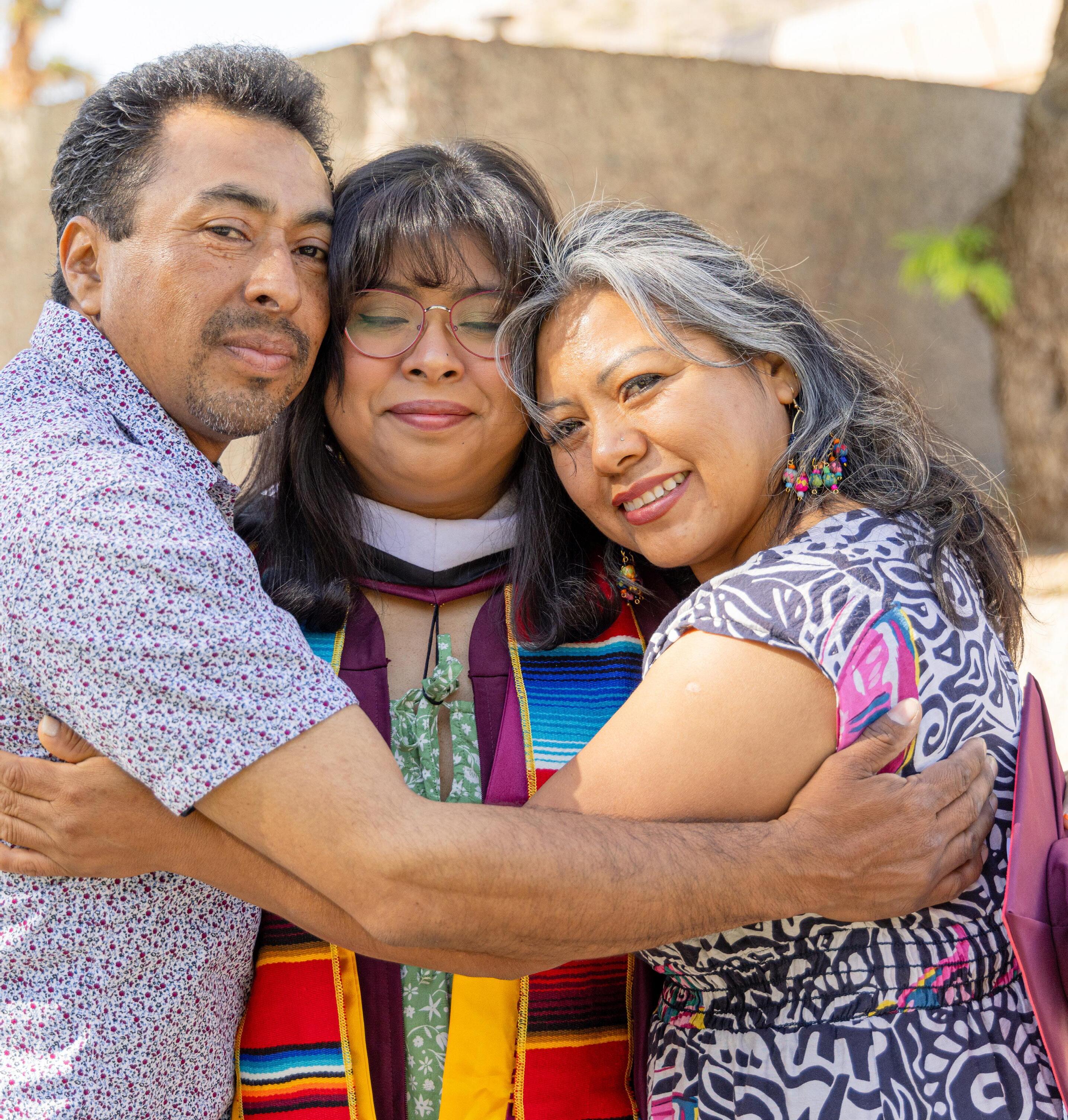
School of Transborder Studies’ graduate Debanhi Reyes poses with her family at the spring graduation ceremony.
Cultivating strength and wellness
Local and global communities are facing environmental, social and economic pressures. From improving social services for populations to mitigating insect devastation on land, the integration of science and human experience is developing solutions to modern challenges. Faculty and students are using their research and education in the humanities, natural sciences and social sciences to drive effective change.
The College of Liberal Arts and Sciences is dedicated to empowering community resilience through the advancement of collaborative research and discovery that makes communities better, stronger and healthier.
Bilingual students find community
Designed for students who learned Spanish at home or in their community, the Spanish Heritage program and degree track in the School of International Letters and Cultures helps bilingual students expand their Spanish skills. The program creates an inclusive and nurturing environment that bridges community and language while meeting students’ unique learning needs.
Solving challenges through statistics
The Data Devils initiative partners ASU faculty and students with Arizona nonprofits like Hope Women’s Center and St. Mary’s Food Bank to transform community data into actionable insights. Students develop professional analytics skills while organizations gain sophisticated capabilities to optimize resource allocation, expand services and strengthen community resilience across the state.
Imagining tomorrow through fiction
A better, more innovative and inclusive future is imagined through the Worldbuilding Initiative. Housed in the Humanities Institute, Worldbuilding brings together prominent storytellers for conversations through workshops as well as a distinguished lecture series. The community of participants promotes interdisciplinary and humanistic creative works.
Helping communities combat insect harm
The Social Insect Research Group, housed in the School of Life Sciences, is creating a lasting impact on communities that are negatively affected by insect migrations. Researchers are helping community members become resilient to destruction caused by insects by working directly with on-ground collaborators to put prevention methods into practice.
Providing an opportunity for social and academic success
Preparing Arizona’s future workforce
Hosted in the School of Transborder Studies, the Migratory Student Summer Academy (MSSA) is an Arizona Department of Education-funded enrichment program for high school-aged children of Arizona’s migratory seasonal farmworkers. Every summer, students are selected to visit campus for hands-on lab visits and workshops that focus on leadership and STEM subjects through a community of peers and mentors.
How you can engage with our efforts
Whether you are able to attend an event, donate to a cause close to your heart or share your own story, your support can help The College educate the next generation and fuel world-class research in language, culture and society, critical thinking, scientific exploration and discovery.
Experiential learning, such as internships, study abroad opportunities and research apprenticeships, prepare students with careerreadiness skills that are essential for entering the workforce.
“At first you feel like, ‘I can’t believe I’m at a university. I’m with actual professors, talking to them and getting advice,’” said Victor Sandoval Limon, a participant of MSSA from Yuma, Arizona. “It doesn’t feel real, but the more you hear, the more comfortable you feel with one another. It’s just an amazing experience.”
Arizona State University is the only four-year institution in the state to host the MSSA, in collaboration with the Arizona Department of Education’s Migrant Education Program, and the program is expanding educational pathways across the state.
Unfortunately, for first-generation and lowerincome students, these programs can often seem out of reach. The Futures Initiative at The College of Liberal Arts and Sciences hopes to change that.
Advancing child welfare through research and policy
Through career counseling, internship and research scholarships and adaptable new programs, the Futures Center will help all of our over 30,000 become strong candidates in the job market.
For decades, research has made it clear what children need: nurturing caregivers, quality health care and education, safe communities and economic security. Yet for far too many, especially those from historically marginalized communities, these conditions remain out of reach. The Children’s Equity Project (CEP) is a child policy center dedicated to providing every child with a fair chance to thrive.
Connecting studies to careers
Expand your Spanish-speaking skills and cultural knowledge through the Spanish Heritage program silc.asu.edu/spanish-heritage.
Discover how the Migratory Student Summer Academy is supporting students in their learning of leadership skills and STEM subjects at sts.asu.edu/ programs/migratory-student-summer-academy
Imagine a brighter and more equitable future by attending a Worldbuilding lecture or workshop in the Humanities Institute at humanitiesinstitute.asu. edu/worldbuilding-initiative
Support the ASU community of bilingual Spanish learners, fostering identity with a donation to asufoundation.org/silc
Learn more about the statistical and social work of the Data Devils initiative at thesanfordschool.asu. edu/data-devils.
Help build a future where all children can reach their full potential with a donation to asufoundation.org/childrensequity.
Amplify the work of insect researchers and their impact on global communities with a donation to asufoundation.org/insect
Explore how SATRN’s cutting-edge research, student opportunities and community practitioner training are improving lives affected by addiction by visiting satrn.asu.edu
@ASUTheCollege
Through rigorous data analysis, developmental science and policy expertise, the group of researchers and advocates uncovers where systems fail children, develops practical solutions and equips decision-makers at every level of government to create meaningful change. With more than 50 reports published, the CEP has shaped reforms that advance fairness for children nationwide and build a future where all children — regardless of race, income or circumstance — can reach their full potential.
Real-world experience, in tandem with a college education, prepares students for career success. The Futures Center, housed in Armstrong Hall, offers career services for all of our students, including Pre-Health Advising, Prelaw Advising, internship placement and scholarship support.
Addressing substance use and addiction through interdisciplinary network
Improving internship access
The Woodside Scholar Program removes the financial burden for students with unpaid internships at nonprofit organizations, encouraging students to pursue these internships, prepare for careers in the nonprofit sector and develop a commitment to lifelong community service.
Engaging online learners
The Substance use and Addiction Translational Research Network (SATRN) is a collective of university researchers — including faculty from the Department of Psychology and T. Denny Sanford School of Social and Family Dynamics — and community partners dedicated to reducing distress, disease and death associated with addiction. SATRN’s activities unite expertise from disciplines throughout ASU, including psychology, human development, social work, neuroscience, epidemiology, public policy and data science.
SATRN facilitates innovative, community-engaged addiction science with real-world impact; encourages evidence-based best practices in substance use disorder prevention, harm reduction and treatment; and supports training for a new generation of addiction treatment specialists.
Research experience is critical in preparing students for graduate school and other career paths. Online students at The College can get that hands-on learning opportunity through the Online Undergraduate Research Scholars (OURS) program, which provides remote and hybrid research opportunities to students in the humanities, natural sciences and social sciences.

SATRN’s members and affiliates are all passionate about making a difference in the lives of people touched by addiction. It’s an amazing team, committed to onthe-ground impact in local and national communities.
— Michelle “Lani” Shiota Director of the Substance use and Addiction Translational Research Network (SATRN)