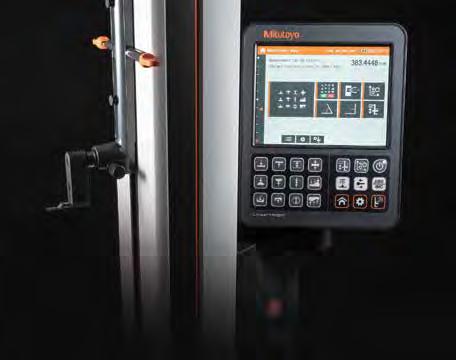
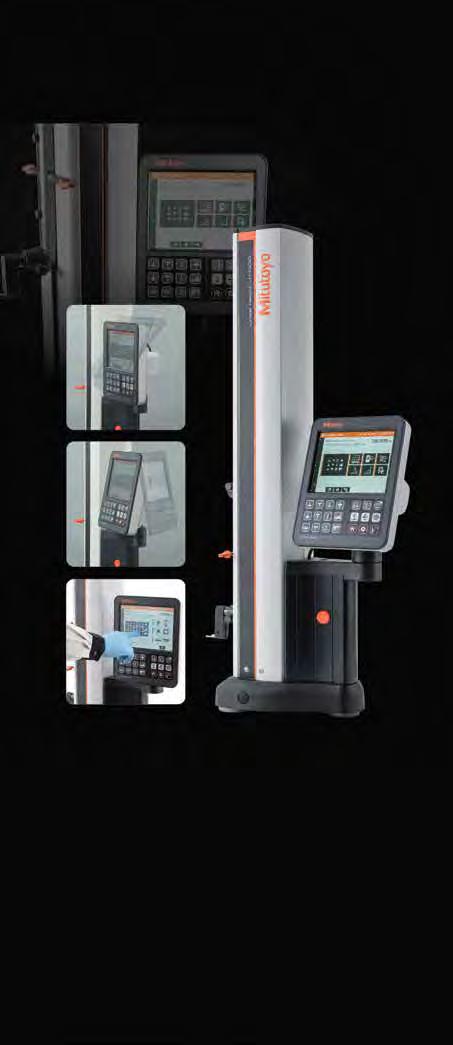
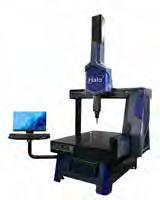
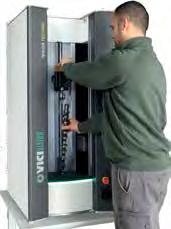
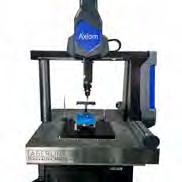
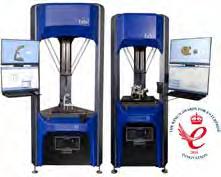
Intuitive operation and outstanding ease of use. Best-in-class accuracy of ± (1.1+0.6L/600) μm
• Easy operation using keypad and touch screen navigation, even suitable for beginners
• Conduct various measurements such as 2D measurement and perpendicularity measurement
• Versatile measurements through optional probes
• Enhanced data output functions make it easier to manage your measurement data
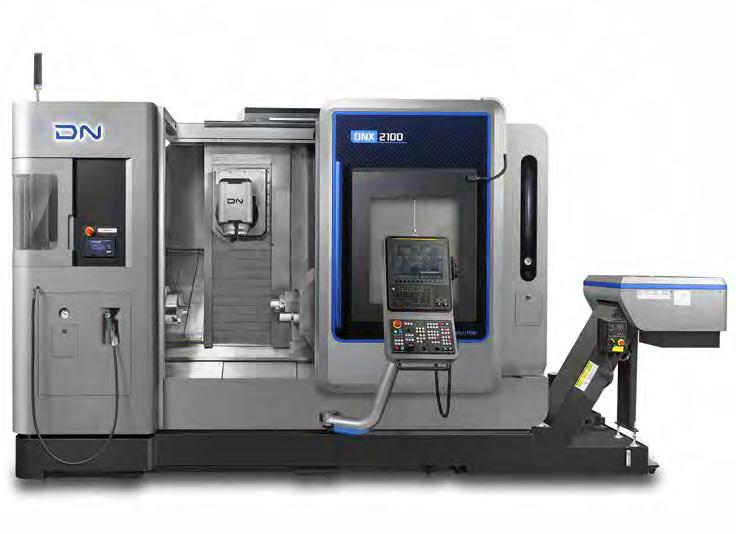
DNX 2100SB SUB SPINDLE MULTI TASKING TC
A compact multi-tasking machine for those looking to upgrade from traditional turret style turning centres. Using a single DNX machine, multiple processes can be seamlessly integrated to maximise productivity while minimising operation time and labour requirements.
• 410Ø X 1100Lmm MACHINING CAPACITY
• 255mm CHUCK, 81mm BAR CAPACITY – RIGHT SIDE
• 230mm (±115mm) Y & 240º B AXIS TRAVELS
• 18kW, 12,000rpm CAPTO or HSK MILLING SPINDLE
• MULTIPLE OPTIONS & ACCESSORIES TO SUIT
A NEW ERA OF PRODUCTIVITY
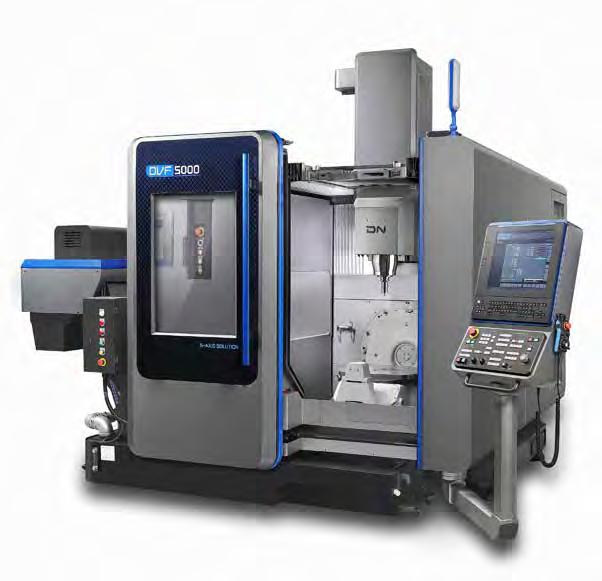
DVF 5000 5 AXIS VERTICAL MC
DVF 5000 5-axis machining centres are designed for component manufacturers looking to machine high-precision, complex parts in one hit. Equipped with leading edge technology and supplied ‘automation- ready’, these machines will take your productivity and performance to a whole new level.
• 600Ø x 500Hmm WORKING ENVELOPE
• 140º (-30º ~ +110º) & 360º B & C AXIS TRAVELS
• 42,000mm/min ~ 9,000
• AWC, APC & ROBOT AUTOMATION OPTIONS AVAILABLE
• 3 Full Days
• 15000 sqm
• 230 Exhibitors
• Practical Sessions
• Industry Experts
• Technology
• Innovation
• Onsite Machinery
• Face to Face
• Live Demonstrations
Experience
12-14 May 2026
(Scan
14
ADDITIVE MANUFACTURING
A new world of manufacturing –where Australia’s right at the forefront
AMW PREVIEW
Australia’s leading manufacturing suppliers reveal what’s on show at AMW 2026
INDUSTRIES
In automotive and construction manufacturing, Australian companies are finding new ways forward 32
AWARDS SHOWCASE
Recognised as leaders across the country, these are the stories of 2025’s award winners and outstanding nominees
Industry voices on how to prepare for 2026 8 From the CEO
For story leads, sales enquiries or any other feedback related to AMT, contact AMTMagazine@amtil.com.au
Publisher
AMT Magazine
AMTIL
Suite 10, 5 Corporate Boulevard Bayswater VIC 3153
AUSTRALIA
T 03 9800 3666
E info@amtil.com.au
W amtil.com.au
Prepress & Print
Printgraphics Australia
AMT Magazine is printed in Australia under ISO140001
Environmental Certification using FSC® Mix certified paper sourced using sustainable tree farming practices.
The opinions expressed within AMT Magazine from editorial staff, contributors or advertisers are not necessarily those of AMTIL. The publisher reserves the right to amend the listed editorial features published in the AMT Magazine Media Kit for content or production purposes. AMT Magazine is dedicated to Australia’s machining, tooling and sheet-metal working industries and is published four times per year. Subscription to AMT Magazine (and other benefits) is available upon application.Contact AMTIL on 03 9800 3666 for further information.
1986AMTV26.N1FEBRUARY
100%
Locally
Quality
Local
Repair
Excellent
National
Free
Why Mental Health Matters for Manufacturing Businesses
Manufacturing has always been about precision, productivity, and safety. Traditionally, that has meant protecting workers from physical hazards like machinery or repetitive strain. But today, mental health is just as important as physical safety—and new psychological safety laws across Australia are making sure it’s front and centre.
For employers, there are new compliance requirements on managing risk and identifying hazards on psychological safety. These appear at the national level through Safe Work Australia and each state and territory has its own regulator with tailored resources. While new regulation is rarely welcome, the new laws provide an opportunity to build stronger, more resilient teams, reduce turnover, and create a workplace where people genuinely want to stay and grow. Mental health is no longer a peripheral issue—it is central to workplace safety and success. Manufacturing environments can be demanding with shift work, tight deadlines, and production targets. These pressures can lead to stress, fatigue, or burnout if not managed well. When employees struggle silently, productivity drops, absenteeism rises, and turnover costs increase.
Psychological
Safety Laws: A Helpful Framework
Employers should manage psychological risk by treating it just like any other workplace hazard: identify it, assess it, control it, and review it. This means looking for stressors such as bullying, excessive workloads, or poor communication, putting practical measures in place to reduce them, and fostering a culture where employees feel safe to speak up.
Think of it as a framework to: Spot issues early before they escalate; Put controls in place; and Build a culture where employees are encouraged to speak up.
Employee Assistance Programs: A Practical Tool
Many AMTIL members have already committed to the wellbeing of their teams through the provision of an Employee Assistance Program (EAP). These confidential services give employees access to counselling and advice when they need it most. Offering an EAP sends a powerful message: “We care about you, not just your output.” It helps make mental health part of everyday work and is one of the biggest shifts employers can make – by normalising conversations about mental health. When leaders and supervisors talk openly about wellbeing, it breaks down stigma and encourages help-seeking.
The manufacturing industry has always been about building things that last. By investing in mental health, employers are building something even more valuable: a resilient workforce. However, improving mental health in manufacturing is not solely the employer’s responsibility. It requires collective and individual action. Employees can contribute too by looking out for colleagues, engaging with support services, and practicing self-care.
Looking Ahead
The introduction of psychological safety laws across Australia represents a turning point. Manufacturing businesses that embrace these changes will not only meet compliance requirements but also unlock long-term benefits: healthier workers, stronger teams, and more resilient organisations. . In addition, many of you will be familiar with "Mates in Manufacturing", the workplace suicide prevention program,
adapted from the successful MATES in Construction model, that provides mental health support and awareness training for workers in the Australian manufacturing industry. It aims to reduce suicide rates by creating a culture of peer support, training staff to identify and help those in distress, and connecting workers with professional services. The program includes training such as General Awareness Training (GAT) and Applied Suicide Intervention Skills Training (ASIST).
AMTIL’s charity golf day this year will see part proceeds from each registration going to support the work of Mates in Manufacturing. The website, helpline and training offer an important resource for Australian Manufacturing. By collectively normalising discussions, encouraging helpseeking, and embedding support systems like EAPs, the manufacturing industry can lead the way in creating workplaces where both body and mind are protected.
Managing psychological risk isn’t just about compliance— it’s about building a safer, stronger, and more productive workplace. By embedding mental health into everyday safety practices, employers in manufacturing can protect their people and strengthen their business at the same time.
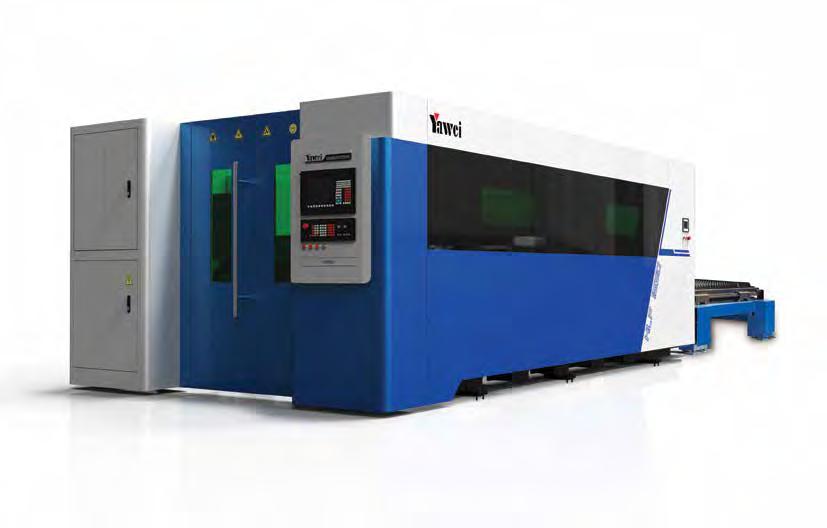
Dollar for dollar, Yawei HLF series fiber lasers have always been in a league of their own, providing possibilities for all size companies. And with 2026 models featuring 25% more acceleration, the business case stacks up even more. Real Service. Real Support. Real People. That’s Applied Thinking.
A 3D Future for Aussie Industry
Additive manufacturing is transforming modern industry the way interchangeable parts and the production line transformed industrial development in the 19th and 20th centuries. The task for Australia today is to lean in and secure the key advantages these technologies offer local industry.
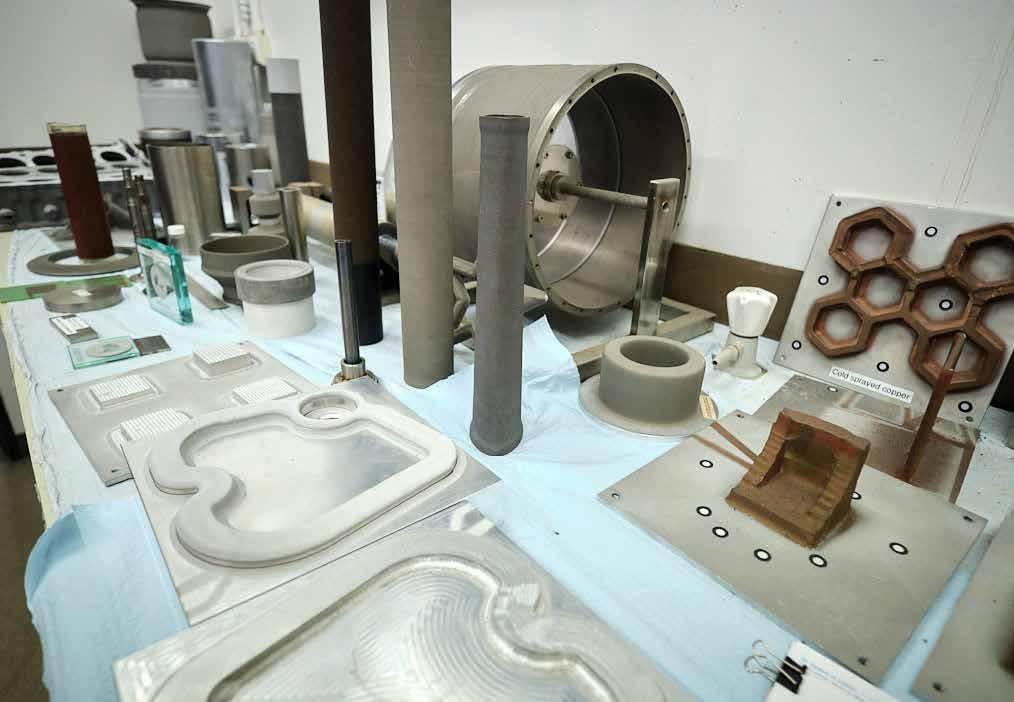
Fifteen years ago, RMIT University saw the enormous potential of additive manufacturing. That institution, which has worked at the intersection of technological innovation and practical expertise for over 150 years, set up its Centre for Additive Manufacturing with a mission to experiment, collaborate, and lift the technological capabilities of Australian industry. Its multi-disciplinary teams have paved the way for new techniques for making everything from tools capable of cutting titanium to copper surfaces that can eliminate bacteria.
Versatile technologies like additive manufacturing enable remarkable design creativity and bring bespoke products, parts and materials into existence using a broad range of materials – in fact, everything from metals and plastics to composites can be processed through these platforms. The technologies and their outputs have proven transformative for various industries, including defence, aerospace, healthcare, automotive, construction, and others.
The inventiveness and adaptability of Australia’s industrial workforce, combined with the wealth of minerals beneath their feet, makes Australia a great place to develop and commercialise new additive manufacturing technologies. Industries like polymer and plastics manufacturing are rapidly transitioning to sustainable and waste-minimising technologies, among which additive manufacturing and 3D printing are key. And all of this is to say nothing of Australia’s vast clean energy potential.
SPEE3D is one of the private sector firms stepping up to the plate to distribute additive manufacturing capability across the Australian economy. As of September 2025, the firm had 50 machines in operation worldwide and held 25 patents in cutting-edge processes such as cold spray additive manufacturing.
SPEE3D’s factory-based printers have created the possibility of large product fabrication for industrial use, while its portable variations are already lifting the maintenance and logistical capabilities of armed forces from Australia to Ukraine. When the Prime Minister visited SPEE3D’s Darwin facility a couple of years ago, he described it as a great example of Aussie innovation leading to “Australian jobs” and “Australian wealth”. This technology matters not just for Australian defence industry, but also for Australia’s heavy industrial regions. Additive manufacturing accelerators like The Melt, located in Muswellbrook’s Hunter Innovation Precinct, are sought after for their prototyping, R&D support, investment, and production capabilities. The special purpose tools – everything from spanners to agricultural implements – they design and produce for their clients make a real difference for industrial efficiency and competitiveness within and beyond the Hunter, creating hundreds of good jobs along the way.
The Albanese Labor Government has put the foundations in place to back in the additive manufacturing sector. We’ve invested in the new Additive Manufacturing Cooperative Research Centre (AMCRC), launched in October 2025, to the tune of $58 million. That investment will leverage and crowd in more than $190 million in industry and research sector contributions. The AMCRC will help Australia’s existing
additive manufacturers to develop into a multi-billion-dollar industry that gives Australia a competitive edge in valuable niches of the global marketplace and creates good jobs in our regions and suburbs.
There’s a role for the $15 billion National Reconstruction Fund to play here. Additive manufacturing falls within the Fund’s priority area of “enabling capabilities” for Australian industry. These technologies are also included on the List of Critical Technologies in the National Interest, for which the Fund has set aside $1 billion for investment over the medium to long term. I’m looking forward to seeing the Fund lift the intensity of its engagement with this segment of Australian industry in 2026.
Finally, the adoption of AI in Australian firms and factories will lift the speed limits on innovation and unlock new uses for additive manufacturing. The National AI Plan that I released last year, along with the data centre principles that the government is working on (at the time of writing) will help attract the global investment that Australia needs to seize the AI opportunity and share the benefits across small and medium enterprises, regional communities and underserviced parts of the economy. Together, government, unions, researchers and industry are working towards a 3D future for manufacturing in Australia; one that will make Australia a natural destination for investment in high value-add, high skill, high productivity manufacturing.
SENATOR HON TIM AYRES
Minister for Industry and Innovation and Minister for Science
Engineering Excellence.
RJS Tech Group advanced Australian manufacturing and engineering businesses, united by innovation, precision, and certification excellence.
• Whitelaw Engineering Machinery – Premium European lathes and milling machines
• MetalTech – Industrial metal 3D printing specialists
• Wood Tech – National supplier of CNC and woodworking equipment
• PPE Tech – ISO-certified, TGA-listed P2 face masks made in Australia
Certified quality, local capability, and industry-leading solutions.
ISO 9001ISO 13485
Registered Australian Made
CMI Certified TT10061
AS/AZS 1716:2012
ARTG 352290
The Case for 'Modern' Work Hours
AMWU National Secretary Steve Murphy on why the union is pushing for a shorter work week.
Discussions about our work hours are not a sideline issue. From the AMWU's perspective, they are central to building a productive, resilient, and competitive Australian manufacturing sector. While corporate commentary often frames shorter work time as a simple 'cost,' our position is rooted in longterm workforce sustainability. This isn’t a union luxury — it's a fundamental operational factor that directly affects investors, employers, and our national industry capability.
Look at the history of Australian industry. Every major reduction in work hours — from the shift away from the 84hour week of the 1800s to the eight-hour day, the 44-hour week in the 1940s, and later gains in the 1980s — was more than a social victory.
It was an essential stability mechanism. It improved safety, reduced fatigue, and allowed us to develop the skilled, reliable manufacturing base we rely on. At every step, the fearmongering about economic collapse proved false. Instead, the sector won: better retention, fewer injuries, higher quality output. This history proves that industry and unions can and must continually adapt to technological change and productivity gains.
Today, the need to modernise work hours is driven by four clear facts on the shop floor:
Firstly, the productivity disconnect: Productivity has surged in recent decades, thanks to our hard work and new technology. But wages and work hours have stagnated. This disconnect crushes morale, spikes turnover, and harms long-term engagement.
Secondly, wellbeing is operational stability: Workers who have adequate time for family, rest, and personal life return to work healthier, sharper, and more focused. For manufacturers, this directly means better quality control, lower absenteeism, and consistent, reliable output.
Thirdly, burnout is a safety risk: Manufacturing demands focused, alert workers. Fatigue directly causes higher error rates, serious safety incidents, and expensive rework.
Improved rest cycles are an investment in higher productivity. And lastly, skills retention is a competitive edge: Modern manufacturing competes globally on precision, quality, and reliability. A respected, well-rested workforce is the most capable of meeting these high demands. Work-hour reform is a future-proofing strategy to retain our specialised skills.
The AMWU is leading the push for a shorter work week because workers are the driving force of productivity.
This conversation is not about reducing output; it's about sustainability. It's about ensuring that the people who drive manufacturing performance can sustain high-quality work in a demanding sector.
Our position is clear and unified, with the goal of a productive, stable, and competitive manufacturing industry capable of supporting Australia’s economic future. Modern work-hour structures are not a dream — they are the pragmatic pathway to getting our local industries back on track and being more competitive.
National Secretary Australian Manufacturing Workers Union
STEVE MURPHY
ADDITIVE MANUFACTURING
A new world of manufacturing –where Australia’s
right at the forefront
16 Interview with Terry Wohlers – Emerging trends in additive manufacturing and where Australia fits in a changing world
18 Brains Trust – The organisations dedicated to helping Australian industry branch out into additive manufacturing
20 Blast from the Future – Cold Spray Additive Manufacturing has a strong future as an Australian industry, thanks largely to its strong history
24 All Dimensions – Additive manufacturing is sound in Australia across a variety of media – these are some of the companies leading the way
26 New Addition – Industry experts discuss how artificial intelligence will help improve additive manufacturing – and where the human element remains essential
28 Flying High – How additive manufacturing is rewriting the rules of unmanned aerial vehicles (UAVs), and vice versa
30 AXT adds Stratasys – Polymer 3D printing company Stratasys joins the AXT line-up
31 Flexible Focus – Anti cross-contamination measures feature in new 4D printer
Emerging Additive Manufacturing Trends and Australia
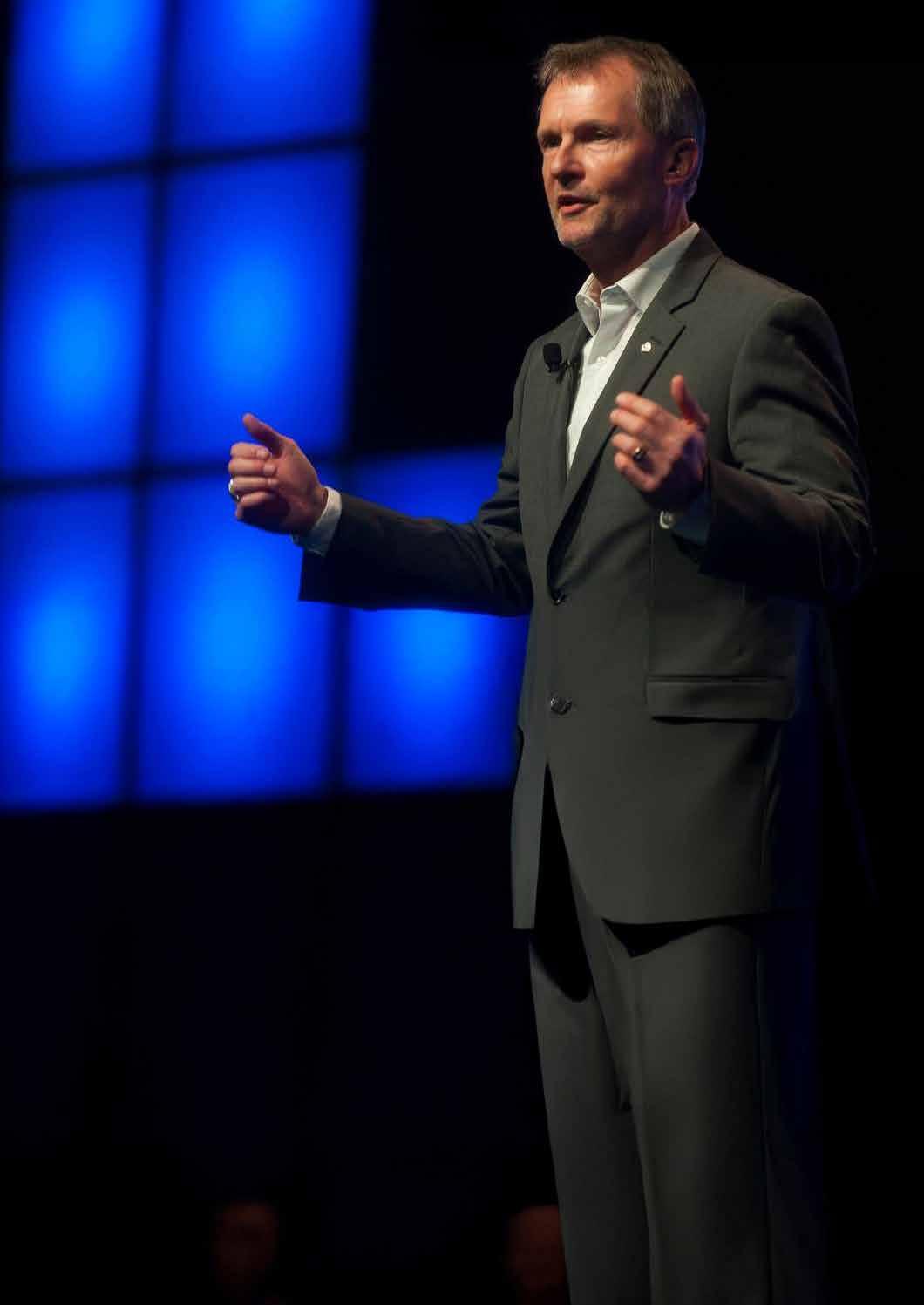
Interview with Terry Wohlers, distinguished fellow of advanced manufacturing at Wohlers Associates, powered by ASTM International. Terry Wohlers has provided technical and strategic advisory services on rapid product development, additive manufacturing (AM) and 3D printing for 38 years –to more than 280 organisations in 27 countries. As a principal author of industry-leading publication the Wohlers Report, he has an earned reputation as an industry leader. Here he discusses some of the trends emerging in AM and where Australia can make the most of new opportunities.
Image courtesy Terry Wohlers
Looking at AM on a global scale, where does Australia sit?
The growth of AM globally has been historically strong. In the past 15 years, it has grown more than 22 per cent on average every year. This past year has not been as strong, but still a growth rate of 9.1 per cent. Of the US$21.9 billion of revenue the sector generated in 2024, about US$3.7 billion is tied to production applications – parts made for final use – a figure which grew by 12.1 per cent last year.
Adoption of AM in the Asia Pacific region grew 31 per cent in 2024, of which Australia is a part. That’s the good news –maybe less than good news is that China makes up the lion’s share of this growth. Europe, the Middle East and Africa grew by 3.2 per cent and the USA declined by slightly more than 4.8 per cent.
I want to add that directed energy deposition (DED) AM has really taken off. It has gained more traction in the last 3-4 years than it did in all the other years combined. If you think of the old saying of a solution looking for a problem – it’s found the problems, and it’s a solution – not for everything, but for the right types of large parts.
What can we learn from China and its adoption of AM?
When it comes to scaling, China is doing it. The US isn’t even remotely close to China in terms of adoption – in which hundreds of millions of parts are being built by AM. The West, including Australia, really pioneered it with significant investment, and now we have this to consider. Perhaps now is the time for us to take a closer look at what China is doing. They’re also automating AM process chains, and even cheap labour can be more expensive than automation. They have benefited from what we’ve done, made improvements to their machines, materials, and postprocessing, and taken it to another level in some cases. I think we can learn from some of that work as well. China’s central government, its provincial governments, they’re all in – and they understand its value.
What has increasing adoption of AM enabled companies to do?
I had an opportunity to visit Additive Flight Solutions (AFS), a company in Singapore whose customers are airlines. Lufthansa, Qantas, United and most others wait 6-12 months to get replacement or refurbished parts. In one example, AFS reengineered 35 different parts for Singapore Airlines. The work involved about 40 parts per part number and about 1000 total parts – an example of short-run production. It would be far too expensive to produce 35 moulds for a quantity of 1000 total. It just doesn’t make sense. So, if you can “grow” the parts additively, it becomes practical and affordable.
AFS practices real distributed manufacturing – printing 300 parts for 17 different aircraft for Finnair in Europe, Singapore, UAE, and USA. Rather than centralising and shipping around the world, they’re building them where they’re being used.
SPEE3D demonstrated with the production of a transmission mount by putting an additive machine and CNC machining in a portable shipping container. This has supported quick manufacturing close to where parts break or wear out.
What do you think are the main obstacles to increasing the take-up of AM?
Well, I believe number one is cost – pretty much for all industries. Cost of machines, materials, and services is still an issue, and that’s why automotive has not adopted it in a bigger way. Once we can drive costs down and volumes up, we will open up many new applications. The automotive industry has typically been the early adopters and are big users for jigs, fixtures and other forms of tooling, but for end-use parts, unless it’s Aston Martin or a high-end Cadillac – AM is the exception.
With a few exceptions, we’re not seeing the automotive industry use AM for series production. Once this happens, AM will become more affordable in other industrial sectors, such as consumer products. It is taking much, much longer than many of us expected.
What can be done to increase the adoption of AM in Australia?
Years ago, Fried Vancraen, the founder of Materialise, said applications will drive the future growth of this industry… and I couldn’t agree more. If you don’t have strong applications, you really don’t have an industry. It’s about looking at what applications are a good fit for Australia and where you can see the opportunity for startup companies that can drive those applications to commercial success. When Australia makes, Australia works.
Brains Trust
Support is available for Australian additive manufacturers, helping everyone from first-time adopters to teams pushing their projects further.
Two organisations are emerging as central pillars of Australia’s push to strengthen its additive manufacturing – each supporting industry at different stages of adoption and maturity. The Australian Manufacturing Technology Institute Ltd (AMTIL)’s Australian Additive Manufacturing Network (AAMN) and the Additive Manufacturing Cooperative Research Centre (AMCRC) share a common goal – to accelerate the adoption of additive manufacturing across Australia. Their roles, target audiences and mechanisms are quite distinct yet complementary.
Matthew Wall – who both chairs AAMN and is a member of the AMCRC Innovation Taskforce – says additive manufacturing offers unique opportunities to Australian manufacturers but uptake has been slow because these opportunities are so new, many need to learn how to identify the right technology for their needs.
“People aren’t prepared to invest in a technology just because it’s cool – they need to have a clear application and a business case,” Wall says. AAMN membership is obtained through AMTIL, and the group operates under AMTIL’s governance. Its role is to help industry understand what can be done with additive manufacturing and how it might be applied to real-world problems, with a focus on awareness, education and connection. AAMN delivers this through networking events, focused workshops, webinars, presentations, and site tours of organisations already using additive manufacturing technologies.
Ultimately, the AAMN is designed to create the conditions for budding additive manufacturers to exchange knowledge and ideas, identify opportunities and collaborate with the aim of taking these ideas further, Wall says. “Commercialisation starts with ideation – the creation of ideas – and then our ability to collaborate with the resources that we’ve got to bring those ideas to reality – and this is a mechanism to do that,” he says.
AAMN also provides a pathway for research outcomes to be shared with industry, including those emerging from AMCRC projects. Where AAMN builds understanding and connection, AMCRC focuses on translating ideas into commercial outcomes. AMCRC chief operating officer Matthew Young says the Cooperative Research Centre was established in June 2025, following the award of $57.5m in Commonwealth funding to co-invest in industry-led research projects and education programs that build a world-class additive manufacturing ecosystem and strengthen Australia’s manufacturing capability.
“AMCRC does not undertake discovery or fundamental research,” Young says. “Our focus is on proof of concept through to prototype development, where there is a clear path to industry adoption and commercial impact.
Australia is among the top five countries in the world for additive manufacturing research output, according to the Australian Strategic Policy Institute. However, Young notes translating research into industrial applications remains a challenge.
“Closing this gap is AMCRC’s focus,” he says.
AMCRC support a wide range of projects - from focused projects for small to medium enterprises, though to larger, multi-year collaborations involving significant industry investment including from Boeing – typically between $250k and $5m – matched by AMCRC funding. “The AMCRC team supports industry throughout the full project lifecycle process,” Young says. “From shaping project ideas and connecting the right research partners, to building strong project applications for assessment by our independent investment committee.”
“All projects are designed with a strong focus on manufacturing deliverables, commercial impact, and industry adoption, supported by transparent governance and regular progress reviews, ensuring projects remain on
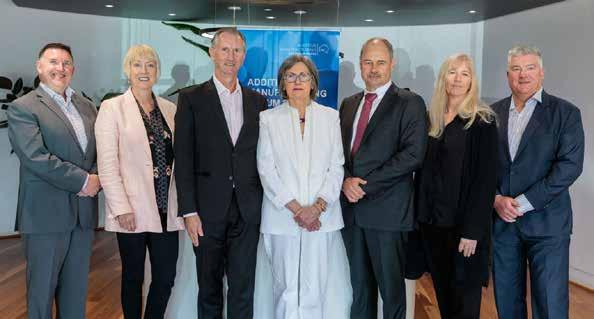
The AMCRC Board, from left: Jason Coonan, Lorraine Maxwell, Graham Mclean, Susan Jeans (AMCRC Chair), Simon Marriott, Jennifer Loy, Andrew McLellan
AMCRC Funding Round Open
The Additive Manufacturing CRC (AMCRC) is a $57.5 million Commonwealth-backed Cooperative Research Centre established in June 2025 to help Australian industry unlock the transformative potential of additive manufacturing (AM).
AMCRC brings together ambitious, forward-thinking businesses across the entire AM value chain - from materials and design through to production and postprocessing – with 13 leading Australian universities and/or CSIRO to co-invest in industry-led research, development and education programs that will build a world-class AM ecosystem and strengthen Australia’s manufacturing capability.
Driven by its “Australia Makes” vision, AMCRC will focus over the next seven years on translating cutting-edge AM research into real-world commercial outcomes. Its work centres around accelerating innovation, enabling more sustainable and resilient supply chains and reinvigorating local manufacturing though the adoption of advanced AM technologies. At the core of this approach is AMCRC’s collaborative funding program, designed to support projects ranging from targeted indicatives for small to medium enterprises (SMEs) to large-scale, multi-year collaborations involving significant industry investment. By offering access to world-class research expertise and matched cash funding, AMCRC reduces adoption risks, stimulates long-term investment in AM research and development, and delivers measurable benefits for industry and the broader economy.
AMCRC works with start-ups, SMEs, large enterprises and multinational organisations across diverse sectors including
track and achieve their intended outcomes.” Young adds AMCRC is keen to see broad participation across the manufacturing sector – “especially through AMTIL and its partner organisations. With AMTIL being a member and network partner of AMCRC, there are plenty of opportunities for collaboration,” he says. “Currently, AMCRC is holding $3m in Commonwealth funding to co-fund collaborative, industry-led R&D projects with AMTIL members, helping them tap into Australia’s leading research expertise and accelerate innovation.” Looking ahead, AMCRC plans to introduce short, low risk funding models in 2026 to help SMEs explore additive manufacturing opportunities and “test the waters”.
“We encourage our partners to take an ecosystem approach to R&D, particularly within extended supply chains, by involving their suppliers, customers and OEMs where appropriate to strengthen outcomes,” Young says.
Beyond R&D, AMCRC has a strong focus on education and workforce development, with roughly 20% of its budget committed to these initiatives. This includes industry-focused training programs, post-graduate training and microcredentials to bridge the skills gap between traditional and additive manufacturing.
“The first step is simply a conversation,” says Young. “We will work with industry to understand their needs and explore how AMCRC and its partners can support their goals.”
While AMCRC and AAMN operate independently, both Wall and Young emphasise their complementary roles. “AAMN is designed to be very accessible and acts as a pipeline for collaborations,” Wall says. “It helps identify industry needs that later could result in AMCRC research projects
manufacturing, medical technologies, resources, transport, construction and defence. It seeks projects that address industry-identified challenges, align with national industry and science priorities and support one or more of its four research programs:
• Sustainable and environmentally friendly manufacturing
• Advanced materials development, including critical mineral processing and feedstock enhancement
• Technology and certified process development
• Enhanced finishing and surface technologies, particularly for medtech and defence applications
Funding Round #1: Now Open
AMCRC has opened its first competitive funding round, offering dollar-for-dollar matched funding for multi-year research projects undertaken with AMCRC’s partner universities and/or CSIRO. Manufacturers willing and able to co-invest between $250,000 up to $5 million in industry-led collaborations are encouraged to apply. This is a unique opportunity to shape the future of Australian manufacturing - delivering breakthrough technologies, real-world applications and a skilled workforce that strengthens competitiveness and delivers lasting economic, environmental and social value.
Learn more about AMCRC’s collaborative funding program and your eligibility at www.amcrc.com.au
being independently taken up with the AMCRC, but it’s the networking that’s the precursor to it,” he says.
Young adds that as a cooperative research centre – a fully funded not-for-profit organisation – AMCRC brings national and international capability, dedicated resources and a structured project investment process to solve industryidentified challenges. “Together, AAMN and AMCRC provide a connected pathway – from awareness and networking via AMTIL through to research, development and commercialisation – supporting Australian manufacturers at every stage of their AM journey,” he says.
MATTHEW WALL AAMN Chair and Additive Manufacturing & Innovation Centre Lead, Boeing Aerostructures Australia
MATTHEW YOUNG Chief Operating Officer at AMCRC
Blast from the Future
Today Australia holds a world-leading position in cold spray additive manufacturing (CSAM) –thanks to years of work in making the technology more widely accessible.
Developed by accident overseas, adopted in Australia after investments from a food packaging printer and today used to restore fast jets – cold spray additive manufacturing (CSAM) technology is, one Melbourne specialist insists, “just another tool” in the advanced manufacturing toolbox.
What Rosebank Engineering Senior manager, engineering and projects Jarrod Watts means, as he wraps up his interview with AMTIL, is that CSAM technology should be considered the same as any other specialist manufacturing process – like semi-automated shot peening or precision multi-axis CNC machining – a highly technical innovation, but one which is accessible to a wide pool of manufacturers. “There’s no doubt Australia is seen as a world leader in this innovative technology,” he says. “We’re no longer just sustaining Australian assets – we’re part of a global supply chain, and technologies like this help us compete and win on a global stage,” he says.
“The momentum is certainly building, and the customer base is expanding. People are recognising the opportunity of cold spray… it’s just about building the confidence, building the trust and expanding the knowledge-base across multiple domains – that’s where the productivity benefits will come.”
Much of the reason for this initial success is down to the hard work of Australia’s national science agency CSIRO and the courage, passion and resilience of the people that work there.
So says Saden Zahiri, who is a principal research scientist for cold spray platform technology at CSIRO and an adjunct professor at Swinburne University of Technology. As he explains, cold spray technology was first developed in the early 1980s by Anatolii Papyrin in what today is Russia, when he found the bits of metal he was using to simulate high velocity particles hitting satellites were instead becoming welded to the walls of the wind tunnel where his experiments took place. “The cold spray system accelerates particles to well above supersonic speeds (typically >1500 m/s) to create a unique solid-state bonding under impact, similar to explosive welding,” Zahiri says. The main benefit, he says, is that the metal particles are never melted into place – meaning heat does not impact either the material being added, or its destination.
“This overcame a major challenge in joining dissimilar metals/ materials and was a dream come true for many industrial applications, to coat dissimilar metals such as copper and aluminium or titanium and aluminium, cost effectively and at scale.” Today, Watts says that Rosebank Engineering uses cold spray technology in the same way, for new wear-resistant coatings and restoration of specific materials.
The company has long been providing aircraft sustainment services to both the Royal Australian Air Force (RAAF) and Royal Malaysian Air Force (RMAF), including supporting the RMAF to establish in-country deep-level maintenance capability during the COVID-19 pandemic. “The first aircraft entered its 12-year maintenance activity in 2020, and very quickly the cost and lead-time improvements that could be realised through cold spray restorations were an avenue the RMAF were keen to explore.”
Watts explains that using cold spray technologies enables Rosebank to design the repair solution without being constrained by the substrate material, enabling restorations which exceed prior material performance, and overcome identified modes of degradation. “We've spot-repaired electroplated nickel coatings on F/A-18 components in the past – so rather than stripping the component and re-electroplating it, we can locally repair the damage with cold spray nickel.
“That was a much faster, more-cost effective restoration. In a similar manner, cold spray enables us to move away from toxic plating chemicals such as chrome – it’s a fantastic alternative.”
The company’s work and collaboration with RMAF and the US Navy led to Rosebank designing a series of non-structural cold spray repairs an F/A-18 airframe and, in May 2025, the company applied the first cold spray repairs to an F/A-18 jet on site at RMAF Butterworth.
“That was a world first activity, and one which drew a lot of interest, but with it came almost with a sense of admiration that we’d been able to work so collaboratively to achieve the outcome. As a follow up to that activity, our team has just returned from Malaysia, completing a number of repairs on a different tail, where we're recovering damage on both aluminium and titanium substrates,” Watts says.
“By recovering worn titanium in a damaged area, we're effectively building a sacrificial layer that can continue to wear in the future without the damage progressing into the primary structure… it’s a really simple and cost-effective process.”
Watts says there’s now growing interest in expanding the application across different aircraft types.
“I think the key to its broader uptake is that the technology is answering the need of a customer, it’s solving a problem in a more cost-effective and efficient way, rather than the technology trying to drive the solution,” he says. “The customer is coming to us saying, ‘here's our problem, how can you help us Rosebank? And that's where, if it makes sense, we’re using cold spray.”
“The technology has matured to the point where people understand its application now. It's certainly not for every repair, but in the right application, with the right materials, and under the right loading conditions, it's excellent,” he says. Watts adds that Australian cold spray technology is competitive on the global stage, and that there are numerous future opportunities for success. “We’re no longer just supporting an Australian fleet – we’re part of a global supply chain, so we’re leveraging our local success to a global customer,” he says. To look at how Australia got to that position, we need to look back to 2003, when through the efforts of Mahnaz Jahedi and Stefan Gulizia, the first robotic cold spray additive manufacturing facility in the Southern Hemisphere was established in Melbourne through CSIRO. Saden Zahiri says this was achieved with the support of Kirk Group – which at the time was the leading company in Australia for gravure printing rollers that produced colourful product packaging. “Mahnaz had to bring a commercial project to be able to get the funding for the cold spray
machine before even having the machine at CSIRO,” he remembers. “She persuaded Kirk Group to invest sufficient funding in the technology – and CSIRO supported Mahnaz to purchase the machine after Kirk Group’s support.”
Once established, it didn’t take long for other industry sectors to take an interest. Neil Matthews, now a senior technical fellow with Titomic, was assisting the Defence Science and Technology Group (DST) at the time.
“We were looking at trying to repair helicopter gearboxes for the Seahawk – there was really not the fine technology for repair, and all the repair solutions were short lasting,” he says.
Aware of its potential as a coating material, the DST Group used its engineering expertise use cold spray technology for repairs, with the Australian Navy ultimately investing with Rosebank Engineering to buy a system and provide repair solutions for gear boxes, which Matthews says was “very successful”.
“The certification for utilisation was done in Australia because there was nowhere else in the world that was doing it,” he says. “In 2009 we had our first repair and I think since then, over that period, there were at least some 50 repairs done to defence aircraft.” The Light Metals Flagship (LMF) launched in 2005 at CSIRO as part of a drive to create a local industry around titanium – a critical metal of which Australia holds one of the largest global ore deposits.
Zahiri says it was a good match.
“Cold spray technology was the only technology available that was able to manufacture titanium parts under atmospheric conditions and without a costly controlled atmosphere for melting and manufacturing,” he says. Group leader of advanced manufacturing and metals for CSIRO Daniel East says the organisation pioneered the application of titanium in cold spray, helping to transform the technology from being coatings-focused to one that could be used to make 3D parts.
“The traditional metrics for a good material for cold spray is one that is dense and malleable,” East says. “Titanium is neither of these things, but the work done at CSIRO has enabled titanium to become a key material in the cold spray landscape.” The LMF led to the establishment in 2010 of the Victorian Direct Manufacturing Centre (VDMC) – a consortium of nine companies and three universities that worked to facilitate robotic cold spray additive manufacturing take up by the industry. The VDMC, in turn, led some of those Australian companies to establish patents in cold spray technology – which East says helped to establish a foundation for Australia’s current strength in CSAM.
“From the very early days there were Australian companies like Laserlife Littlejohn that were willing to introduce new technologies into their businesses,” East says. “Titomic and Spee3D are globally recognised as makers and technology leaders of cold spray equipment – and to have two such companies based in Australia is a testament to the local talent that exists.”
Continued next page
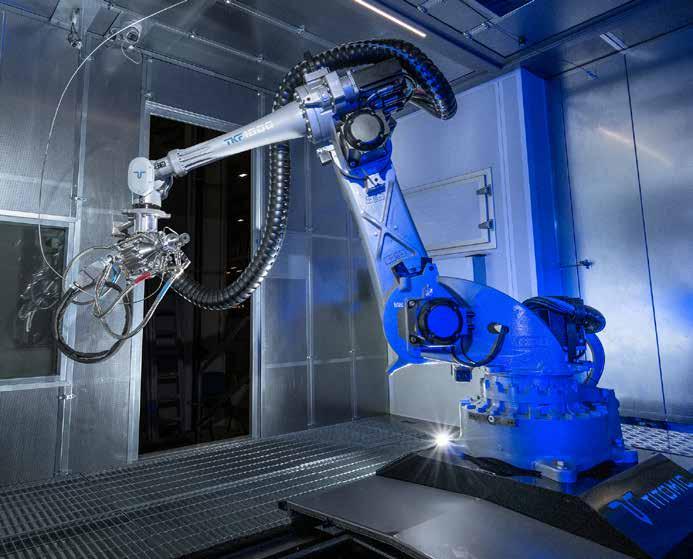
Image courtesy Titomic
Continued from previous page
Matthews recalls that it was CSIRO’s work in parts manufacture that first led to the spinoff of Titomic – which takes its name from the titanium the researchers were working with. Since then, the company has gone from strength to strength, signing a US$1.7 million early manufacturing development contract with a leading defence prime contractor late last year for the use of its Titomic Kinetic Fusion CSAM technology.
This followed a successful hot fire test carried out on a solid rocket motor thrust chamber, also built by Titomic’s CSAM technology, that exceeded the performance expectations required for aerospace and defence propulsion systems.
The also worked with standards development association SAE International to develop the AMS 7057, the world’s first CSAM specification. Despite those achievements, Matthews says CSAM is still fighting an uphill battle for recognition, with the size of material sometimes considered a limitation more broadly. “I think it’s taken us a while to be accepted and we are still not, really,” he says.
“We’re called an infant in the additive manufacturing process, even though CSAM has been around for about 30 years. It just hasn’t got the impetus and, obviously challenging against other additive manufacturing processes, you’ve had to show a disruptive approach.”
“You get to a point where you have to say to somebody in the current environment ‘we’ve made an alternate path out of additive manufacturing’, and then you’ve got to generate the business case and the risk mitigation case… you’ll see enormous potential but you’ll also see a high level of risk perceived by customers and regulators because they haven’t seen it,” he says.
“It does have value as a part of additive manufacturing; you have just got to find the right niche to work in that environment. I think in the future you will see combinations of laser and cold spray and all those sorts of things as we learn more.”
For its part, CSIRO is continuing to work with third parties to develop both new knowledge and patented developments in cold spray technology, continuing to advance the field in what has become a tradition of research and innovation leadership.
“The best vehicle for CSIRO to deploy these technologies is through collaboration with the Additive Manufacturing CRC, universities and other grant providers as this assists industry to reduce risks for technology take up, in the same way that CSIRO successfully demonstrated in VDMC,” he says.
East agrees, saying companies and scientists are now developing materials specific to CSAM as increasing numbers of companies take it up.
“As cold spray matures as a technology, custom alloys that take advantage of the high strain rate forming that takes place within the process are being developed,” he says.
“Sensing, monitoring and control systems are also being developed, as are digital tools that allow for easier use and higher repeatability of the process as cold spray moves to a fully industrial manufacturing process from the niche market it currently exists in.”
“No one research group can do everything, and by working together and focusing on our respective strengths, we will further increase the application and robustness of cold spray,” he says.
Cold spray components since 2003. Image courtesy CSIRO.
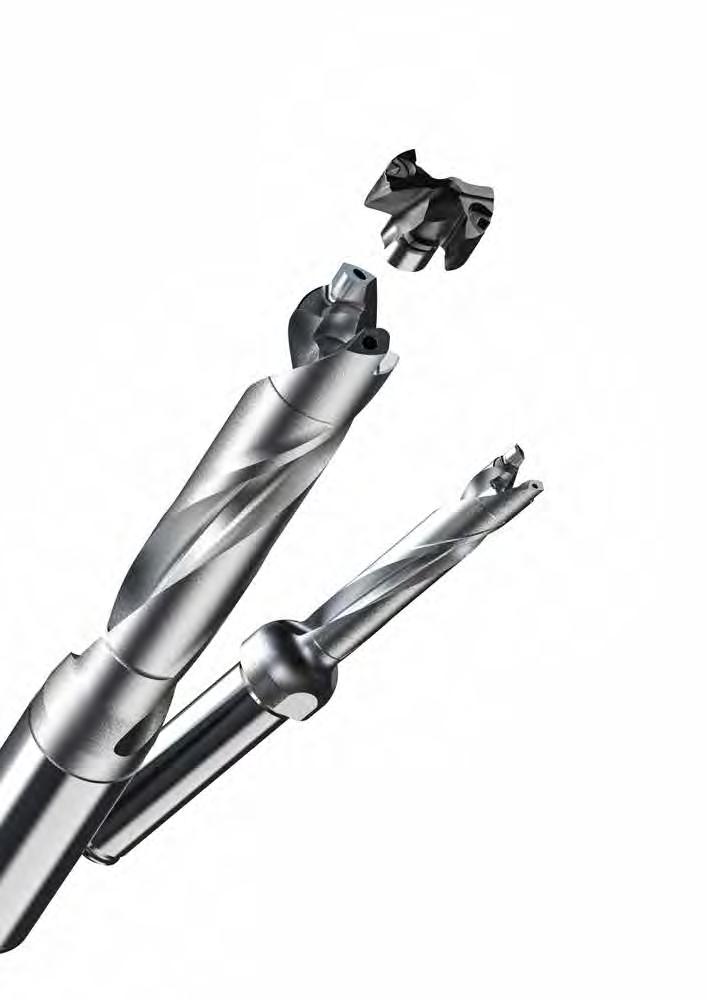
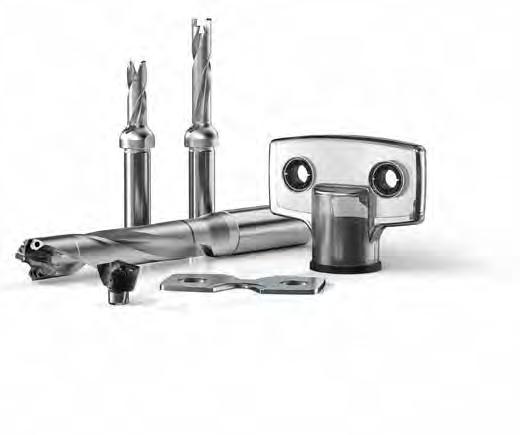
Seco® X-Tip Drill.
Reduce your Inventory with Cost-Efficient Drills.
Full compatibility of drill tips and shanks
Change the drill tip fast and easy with the provided key without readjusting the settings
Improve chip evacuation with internal coolant supply
Model Citizen
Australia’s additive manufacturing companies are growing and the industry maturing – far beyond its early days of prototypes only.
For Elias Baini, general manager of Melbourne-based additive manufacturing solutions provider Objective3D, the nation-wide shift to additive manufacturing is real and accelerating.
Baini says while offshore manufacturing has been considered a way to reduce costs and improve profitability for some high volume manufacturers, the same approach can pose challenges for low-to-medium volume producers.
“At this scale, long lead times, limited design flexibility, and high upfront tooling costs often erode profitability and competitiveness,” he says. “This is where additive manufacturing shines and offers the ability to scale from lowmedium volumes in a cost-effective manner, whilst also giving users the ability to modify designs at any time and maintain security of intellectual property.”
While manufacturers in the defence, aerospace and medical fields were the leaders of additive manufacturing five years ago, today SMEs are seeing the value 3D printing can offer as an alternative to injection moulding, he adds. “The majority of projects we work on are for end-use parts – either part of an assembly, a stand-alone product, or something to aid in the manufacture of something else (i.e. tools, fixtures, etc.),” he says.
“Companies that produce hundreds to thousands of parts per year, anything from speciality commercial products to customised consumer products – all designed with 3D printing in mind from the get-go.” Baini notes that previously in Australia, the high cost of entry was prohibitive. “Only five to six years ago, the only option businesses had for a reliable production grade 3D printer cost mid-six figures and above,” he says. Today, a selective laser sintering printer (SLS) capable of producing hundreds of nylon end-use parts per day costs less than $100,000, which Baini says has made the barrier to entry far lower.
Innovation in Action
With the barrier to entry lower and additional SMEs joining the trend, additive manufacturing is on the rise across the Australian manufacturing landscape. These case studies reveal how additive technologies are being used to solve real operational challenges.
Perth-based Hyperion Systems secured a major accolade this year, with company founder and CEO Joshua Wigley being named Young Innovator of the Year at the Innovation Pitchfest Awards, held during the Indo Pacific International Maritime Exposition. Key to the win is the company’s TitanCell 3D manufacturing system, designed to fit within a standard 6 metre shipping container and to be a mobile, self-contained and rapidly deployable system that can be operated either remotely or on-site.
“Our mission is to build a distributed manufacturing network that is scalable, circular, and sovereign,” says Wigley.
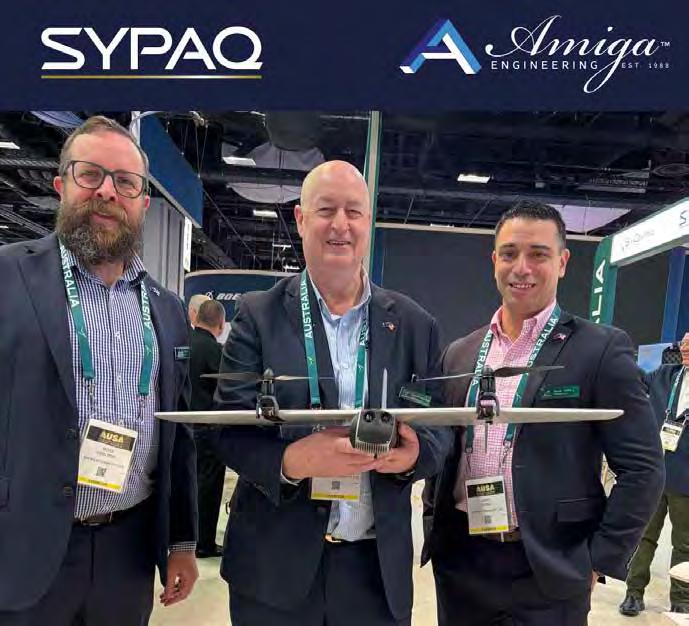
At the same time, SYPAQ Systems announced it was working with Melbourne-based metal and polymer additive manufacturer Amiga Engineering to produce components for the Corvo X Uncrewed Aerial System it is developing for the Australian Army. SYPAQ chief executive Amanda Holt says
the partnership underscored its focus on developing Australian sovereign capacity, with the company underlining the fact that Amiga is certified to metal 3D print using Scalmalloy – a lightweight aerospace-grade aluminium alloy.
“By combining SYPAQ’s innovation with Amiga’s precision engineering and manufacturing expertise, we’re ensuring Corvo X showcases the depth of advanced manufacturing capabilities right here in Melbourne,” she says.
In November, Australian wire additive manufacturing company AML3D secured a $1.7 million deal to provide its Arcemy X system to US additive manufacturing provider FasTech in the third quarter of the 2026 financial year.
FasTech provides additive manufacturing services to the US defence, aerospace and energy sectors, AML3D says, with the new system to be the ninth installed in the country.
AML3D chief executive Sean Ebert says the deal will help demonstrate the advantages of the system across a broad range of industrial manufacturing sectors. “Arcemy technology delivers large-scale industrial parts faster, using less energy, creating less waste and to a higher standard than traditional manufacturing process,” he says. “AML3D is becoming increasingly embedded and indispensable at multiple levels across the US manufacturing landscape.”
Closer to home, Bremar Automation turned to its Markforged Metal X additive manufacturing system to produce a custom reverse gear for a performance car that offered very limited space due to the mid-engine design of the vehicle.
Bremar engineering manager Tim Woods said the company was initially quoted over $1,200 per gear and faced minimumorder quantity issues for what he says is a niche component. Instead, the company designed the gear in house, printing it using a Markforged 17-4PH Stainless Steel printer, a move the company says consolidated multiple manufacturing steps into a single, automated workflow
The Road Ahead
Objective3D hit its own milestones in 2025, merging with TCL Hofmann (Australia) and TCL Hunt (New Zealand) in May, a move Baini says gives customers access to a broader range of technologies and services, including work with Nikon SLM Solutions.
“Nikon SLM, being a pioneer of the Selective Laser Melting technology, has been at the forefront of metal AM and its commercialisation in defence, aerospace, automotive and energy industries for over 30 years,” Baini says.
“Here in Australia, we don’t see the same level of adoption as that in China, Europe or the US – various factors including government support, and lack of skilled designers/operators familiar with metal AM can be associated with this.”
“But opportunities such as AUKUS, and increased government spending in defence where local production, high-value product, and light-weight designs become relevant, will offer an unprecedented opportunity for this technology to thrive.”
More broadly, Baini says Objective3D’s aim is to either help companies acquire and operate their own additive manufacturing systems, or outsource their production through Objective3D’s service bureau, which today produces well over 300,000 parts annually. Objective3D offers SLS models among its range of resin, filament and powder polymer printers, which also includes Fused Deposition Modelling (FDM), Stereolithography (SLA), Digital Light Processing (DLP), PolyJet (PJ) and Selective Absorption Fusion (SAF/MJF).
The company operates over 15 Stratasys systems spanning FDM, SAF, PJ & DLP processes, which Baini says is among the most advanced in Australia for aerospace and defence certified materials.
Performance vehicles company Walkinshaw Group uses a Stratasys Fortus 450mc FDM 3D printer that is supplied and supported by Objective3D – albeit primarily for prototyping and reworking left-hand drive components.
“The Stratasys machines are integral to Walkinshaw’s ability to react to quick iterations in product designs, or workflow changes on the assembly line – printing shop-floor tooling and fixtures to aid in the assembly and re-manufacture of their vehicles,” Baini says. “In the medical space, we operate a fleet of EOS Formiga SLS machines for producing a range of
medical devices in bio-compatible nylons, along with various SLA resin printer for surgical guides, and dental applications,” Baini adds.
Despite the momentum, Baini says that challenges remain for the broader adoption of additive manufacturing. Aside from the cost of entry, skills shortages also pose a barrier, as a does the low-risk appetite among some manufacturers where the cost of failure can be high. “This is changing as companies embrace digital workflows, become more familiar with the technology and look to differentiate themselves on the global stage,” Baini says.
Nonetheless, he adds that he sees this changing in the very near future. “For everyday users and small businesses, the growing accessibility of 3D printing will encourage more skilled designers to adopt the technology for a wide range of practical products and applications,” he says.
“At the higher end, companies aiming to re-shore manufacturing or strengthen supply chain resilience will increasingly turn to additive manufacturing as a long-term solution.”
“Meanwhile, personalised consumer goods and medical devices will continue to drive AM’s expansion into mainstream industries,” he says.
New Addition
When combined with additive manufacturing, the promise of artificial intelligence (AI) – to carry out routine works faster – offers a world of possibility. A recent expert panel discusses what’s probable, what’s possible –and what’s problematic.
“I call them bobblehead quality – they’re toy quality, they’re not engineering quality parts.”
Olaf Diegel, a professor of Additive Manufacturing at the University of Auckland, says that despite many advances, the 3D models generated by artificial intelligence through text prompts alone are not yet up to the standards required in engineering. “A lot of them are organic models or toys, for example, where engineering precision doesn’t matter all that much,” he says.
“There’s one when you can design, say, a mounting plate that is 12 inches by six inches tall with four holes on each corner… and it generates a sharp edge, semi-engineering quality model. But is it really? How big are the fillets? What’s the distance between the holes and the corner of the plate?”
“That is part of the problem with texting model generation – how do you tell it in words the details you need for an engineering product?” he asks.
Diegel joined a group of other experts for the Design, Data & Disruption: AI in Additive Manufacturing panel session, held at the launch of the Additive Manufacturing CRC in October last year. He told the panel session that, these days, 3D models are all but essential for product development – with computer aided design (CAD) programs having been very popular in putting them together.
“A lot of the work we do now on automated product development is more computational design rather than AI, but it uses AI quite heavily,” he says. “The difference is, with computational design the engineer determines all the rules and the software does the actual building of the CAD for you… whereas with pure AI, the AI makes the decisions for you and often gets them wrong.”
“That will change as we move forward.”
Diegel says that so far, the most transformative benefits have come from automating those engineer-created rule-based workflows and using implicit modelling to help reduce the complexity of CAD models. “In the next 2-5 years we will have ChatGPT-style systems that will be able to generate engineering-quality 3D models, providing we give them enough information, but not quite yet,” he says.
A World of Possibility
University of Technology Sydney data scientist and strategist Bogdan Gabrys, speaking in an earlier presentation on the day, says AI offers additive manufacturers the opportunity of process optimisation as their work moves from prototyping to scaling up and mass production.
One way is through the creation of a digital twin – a faithful digital replica of company processes, machines or products that can be used to simulate potential future scenarios well before the events could actually take place.
“Things in digital, active spaces can be running much, much quicker than in real life – so as things are happening in real time, you could run multiple scenarios of what to do next, providing that you’ve got faithful representation of this process, product or thing you are trying to model.”
With the large number of sensors and other measuring equipment currently installed on machinery, digital twins are becoming increasingly true to life, Gabrys says. But even in cases where direct measurement is not possible, Gabrys says some mathematical predictive models can be used to estimate hidden variables and keep processes within target specifications.
Combining the data from a variety of sensory technologies in a multimodal data function, to help AI move from reactive troubleshooting to proactive, autonomous control, is “a big, big area of research with a potentially huge impact,” Gabrys says. “Your outcomes from machine learning or AI approaches are only as good as the data – the amount and the quality of the data – and it doesn’t necessarily have to be just the data that you produce from your processes. It’s amazing how much there is available in the outside that you can use.”
Gabrys adds that once well automated, interconnected systems are established, it will be important to bring humans back into the loop to ensure that any machine autonomy does not go unchecked. This, he adds, is the realisation of Industry 5.0.
All Ears
Melbourne-based H3D shows what this rules-based approach looks like in action. The company set out to address the bottleneck found in the custom fitting of hearing aids – where a specific CAD must be developed for each ear, often based on physical impressions.
H3D runs a cloud service that uses AI to produce the necessary CAD drawings, using 3D scans to automatically generate around 150,000 custom ear-piece designs each month. H3D executive chair Anthony Shilton says there are “a series of constraints that need to be factored into this type of design.”
“It needs to be manufacturable, it needs to be comfortable, it needs to stay in the ear. Also, our customers want to be able to offer something that is somewhat bespoke,” he says.
“It’s not 100% perfect at this stage. We get about a 95% success rate of our system – the other 5% goes back and is designed by humans,” he says. Shilton says in the early days, H3D collaborated with customers – sharing data with them and then later giving them benefits in the form of a reduced rate, as well as agreeing to only charge for designs that were successful. This also meant asking customers to agree to allow the data they provided be used to train an AI model.
“Not everyone wants to do that. Some are happy, some are not – you have to really think about that,” he says.
H3D also goes out of its way to ensure the data it uses is de-identified, he adds, noting the privacy requirements of some customers mandating that cloud data remain in its country of origin. “This is most pertinent in Europe, where there are quite clear guidelines around the customer interface – a company that interfaces directly with a customer has a lot of responsibilities around privacy to the end customer. So we have to integrate or enter into similar agreements as someone who is going to handle a subset of that data,” he says.
“I call them bobblehead quality – they’re toy quality, they’re not engineering quality parts.”
Olaf Diegel, a professor
of Additive Manufacturing at the University of Auckland,
Checks and Balances
Part of the team mandated with helping Australian industry rise to that challenge is Michelle Circelli, research and insights lead at the government-funded Future Skills Organisation (FSO), one of the ten federally-funded Jobs and Skills Councils. She referred to the Generative AI Capacity Study released by Jobs and Skills Australia in 2025, which found that only 4% of Australian occupations are at a high risk of being fully automated by AI in the future.
“By contrast, the absolute vast majority will be augmented by AI – implying most jobs won’t disappear, but almost all jobs will evolve with AI taking over certain aspects within jobs, allowing people to focus on other aspects,” she says.
While AI offers a way to drive productivity growth, FSO research released earlier this year found 35% of Australian finance workers were avoiding using the technology.
“Now the reason why is that many don’t trust AI’s outputs, or they haven’t been trained to use the tools… So we’ve got the technology, but not everyone feels ready or confident to use it.” Circelli says this will have to change as AI adoption becomes more commonplace, noting that studies already show that companies that invest in training staff on the ethics and responsible use of AI see a jump in its adoption.
“Essentially, training for broad AI literacy is key, and it’s very much like basic computer literacy for folks in the past.
[For some] this is the second major digital disruption to our workplace… and this is even more exciting.”
For manufacturing, that equates to workers needing to be able to read data outputs and use them in decision-making – and to exercise critical thinking when analysing AI outputs.
“As AI handles more routine decision-making, human oversight and that critical thinking becomes more important, not less,” she says. “If we’re going to use this properly and really integrate it in the work that we do, we actually have to allow the time to do it right – which is a concern when you have a business and there are certain other priorities.”
Circelli says all employees working with AI will need to be prepared to act as an auditor.
“We have to evaluate the AI inputs and outputs critically –we’ve got to spot when something seems to be a bit off. We’ve got to question those recommendations. We’ve got to apply our expertise, our domain knowledge,” she says.
“We do know AI makes mistakes. It’s going to get better, but it will only get better if we use it and train it more. But all of us need to be able to say ‘Hey, this doesn’t look right, and here’s why it doesn’t look right. And that critical thinking is imperative.”
H3D executive chair Anthony Shilton
Flying High
Additive manufacturing is rewriting the rules of production for unmanned aerial vehicles (UAVs) – aka drones – and the reverse is also true.
Fast production is vital for the team at Melbourne-based C2 Robotics, mechanical engineer Dung Phan explains –as a manufacturer that aims to be as quick and nimble as the drones it produces. Addressing attendees of the Next Horizons: AM Transforming the UAV Industry roundtable held in October, Phan held up a fully assembled drone for the crowd to inspect.
The Optically Guided Remote Effect – or OGRE – drone, weighs 2kg, measures 350mm wide, 250mm along and 245mm high and can travel in a 20km range with a payload of 1kg. “All the components you see here, apart from the electronics, were Multi Jet Fusion (MJF) printed – a whole drone could be sent out, printed, assembled and flying in less than two weeks,” he says.
“And as just one example, a recent drone of similar size to this one, developed in house, from ideation to the first flying prototype, happened in under three weeks.” As far as the manufacture of drones is concerned, additive manufacturing is no longer only about prototype production – it’s creating the finished product. And for C2 Robotics, that has been the plan since its first day of research and design development.
“Instead of big, expensive, exquisite systems, which could take decades and billions of dollars to develop… we aim to build many small and smart drones that could improve sovereign capability with a core design philosophy rooted in manufacturing at scale,” Phan says.
“We’re talking about weeks of development, instead of months and year, and you know design iterations happen on a week to week basis.”
Reaching new heights
Whether they’re used for work servicing the resource sector, infrastructure, agriculture, defence or inspection services, the market for drones is currently growing about 12% year on year, Australian Design Council chair Sam Bucolo told the audience. “The opportunity Australia has is in its unique operating environment, where we can do a lot of testing –we’ve got a lot of large open areas and we’ve now got a lot of additive manufacturing capacity sitting within there.”
Airservices Australia predicts the annual number of drone flights in Australian skies will reach 60.4 million by 2043, up from 1.5 million in 2023, driven by increasing demand from the transport and logistics sector, which is forecast to make up 77 per cent of the increase.
Airservices Australia also predicts farmers will be making 500,000 drone flights annually to monitor crops, that drones will make 1.5 million food deliveries to Australian households and more than 300,000 drone flights will be made annually to support frontline police by 2043.
For Daniel Thomsen, head of Go-To-Market for HP Additive Manufacturing Solutions for Asia-Pacific and Japan, drones are “very quickly becoming one of our biggest business units”.
“To come up with a design like this takes a lot of thought, a lot of knowledge and a lot of experience not just in additive but possibly also in aerospace.”
“We proactively set up a drones team because we needed to learn for ourselves – what are we actually providing as a solution, and how can we help people get there?” Among other things, the combined team working on HP’s MJF process focused on lightweighting – developing what the company says are the lightest possible airframe structures at scale in additive manufacturing.
Thomsen discussed one example, where the team had held an internal competition based on an off-the-shelf drone to see how light they could make it, while still being operational. “This drone weighed 1.9kg in foam. We used additive and got it to 1.3kg. With the additional 600 grams in weight saving, we put a bigger battery in it and flew it 40 per ent further… If you’re increasing the range on a drone, your market has now expanded and you can sell the same drone to a much wider pool.”
“Additive manufacturing is something that is growing rapidly. We don’t see an end to it in the near future, but there are a lot of challenges on the design side,” he says.
Design obstacles
One of those obstacles was pointed out by Bucolo, who told attendees that as an industrial designer he could see that this process would remove the need for a production engineering team, which normally optimises a design for production.
“That’s a massive shift in how we design… and it’s a cultural change of what needs to happen as part of the CRC. It’s a massive point to get across to SMEs, because they’ve invested a lot into their current processes,” Bucolo says.
Thomsen agreed.
“I suppose one of the challenges as well is we’re trying to change things – that’s not always well received.”
“It’s not about the printer, it’s about the parts that come out of the printer and how you optimise that design. How do you gain that knowledge and who has that knowledge that you can access to get something like this?”
Another challenge in the design process is the availability of suitable materials for additive manufacturing – or rather, the hunt for the perfect product. Phan says the company has stayed loyal to the polymer-based Nylon 12 material it uses as it has had no need for metal-based printing, but adds that the company would be interested in any lightweight, tough material that proved to be better.
“If there is more material available for these highly accurate printing process, we would be more than happy consider them for different applications,” he says. “But at the moment, due to the material that is readily available for MJF and SLS,
we tend to stick to the one that has been proven to work.”
Thomsen says HP also primarily uses Nylon 12 as a production material. “We don’t see a problem with the material. We design the strength into the part,” he says.
Ingomar Kelbassa is head of the Fraunhofer Institute for Additive Production Technologies in Hamburg, one of the leading institutions for the industrialisation of additive manufacturing.
For him, the faster design of higher performance components will not be enough if the official certification routes take longer.
“That is why in Germany we at least talk with certification authorities, saying the certification route needs to be shortened significantly, because otherwise there is no gain,” he says. “This might also be a discussion we can tackle within AMCRC, because it doesn’t matter if it is Germany or Australia, I think we can learn from each other.”
Whether it’s for making drones or other structures, Kelbassa says ongoing work in this area will be a complementary process. “Meanwhile I wouldn’t really say the problems we are facing are physical problems any longer. They are mainly, right now, an engineering problem – and there we can contribute significantly,” he says.
“It doesn’t really make sense to print everything out. It’s really a question of where additive manufacturing makes sense to contribute to the entire picture. It’s a puzzle.”
AXT adds Stratasys
Additive manufacturing products from Stratasys will now be available in Australia through AXT, including the new PolyJet range.
AXT has expanded its additive manufacturing portfolio after being appointed an official reseller in Australia for polymer 3D printing company Stratasys. The agreement positions AXT to supply Stratasys’ fused deposition modelling (FDM), PolyJet, SAF and stereolithography systems, among others, to customers across the aerospace, automotive, medical, research, education and industrial sectors.
AXT managing director Richard Trett says the partnership represents a significant expansion of its advanced manufacturing portfolio. “Stratasys’ comprehensive range of 3D printers will empower Australian manufacturing with unmatched precision and reliability,” he says.
As a distributor, AXT will provide sales and application support for the full product range of Stratasys FDM, PolyJet and P3 digital light processing (DLP), as well as consultation for solutions, installation and technical servicing, training for operators and product demonstrations.
Stratasys general manager Australia and New Zealand Fred Fischer welcomed AXT as a regional partner, citing the company’s technical capability and customer-focused approach as key to expanding the adoption of AM solutions nationwide. “Their proven expertise, customer focus, and technical capability make them an ideal partner to drive customer understanding, adoption, and success in Australia.”
AXT is also promoting Stratasys’ PolyJet technology, which uses inkjet-style deposition of photopolymer droplets, followed by UV curing, to produce highly detailed models with smooth surfaces, fine edges and complex geometries.
Stratasys says PolyJet is often the technology of choice for design and marketing prototypes, multi-material concept models, high-fidelity visualisations, anatomical/medical applications and tooling aids (jigs, fixtures with integrated flexibility or transparency). For true production of functional end-use parts with demanding structural or thermal requirements, complementary technologies may be required
The process prints layer thicknesses as thin as 14 microns and supports rigid, flexible, transparent, opaque and even full-colour materials within a single build, making it suitable for product design and development, medical and dental modelling, consumer product ergonomics, engineering validation and testing and educational, art and visualisation models. These thin layers allow the PolyJet to produce some very fine features, with thin walls and smooth surfaces that require minimal post-processing, the company says, as well as for printing multiple materials with one build.
Some PolyJet systems, including the Stratasys J850 Prime, can print in hundreds of thousands of colour combinations –an ability valuable for visual prototypes, anatomical models, educational tools and design review applications where realism of appearance is important.
It can also print with a variety of photopolymers – ranging from basic materials, design materials and functional materials used for validation prototypes, as well as biocompatible photopolymers for medical and dental uses.
The breadth of material options enables users to specify not only geometry and surface finish, but also mechanical behaviour (rigid vs flexible) and optical appearance (transparent vs opaque). For industrial-grade prototypes, such flexibility ensures models closely mimic end-product behaviour even before tooling is committed.
“While it may not supplant production-grade technologies for high-load, high-temperature or large-volume manufacturing, it remains an important pillar in the additive manufacturing toolbox for Australian industry,” AXT says.
“Manufacturers, design engineers, tooling specialists and service bureaus should consider PolyJet within their broader AM strategy—especially where realistic representation, multimaterial functional prototypes or medical modelling are key deliverables.”
Flexible Focus
Able to prevent cross contamination between polymers, a new 4D printer promises to overcome major bottlenecks in additive manufacturing.
A multi-material polymer 4D printer now available in Australia aims to help manufacturers move from research concepts to functional, production-ready components in demanding sectors such as soft robotics and aerospace. 4D printing enables printed parts to respond to heat, light or chemical stimuli — a capability increasingly sought in biomedical engineering, soft robotics, flexible electronics and aerospace applications.
Jointly launched by US-based BMF APAC and Shenzen MultiMatter Science and Technology, the microArch M150 prints with 25 µm optical resolution and processes a wide range of functional photopolymers, including hard resins, elastomers, hydrogels, shape-memory polymers and conductive elastomers.
BMF and MultiMatter built the M150 around a centrifugal photopolymerisation architecture that tackles one of the hardest problems in multi-material resin printing: preventing cross-contamination and removing residual resin between material changes. The build platform incorporates high-speed centrifugal action that spins at up to 10,000 RPM, clearing liquids rapidly and allowing full material changeover in about 60 seconds. The machine can perform as many as 2,000 switches in a single print, which the companies say is at the leading level of the industry.
The system also incorporates a multi-material slicing software that supports the arbitrary spatial distribution of materials within a single model. It has processing speeds of up to 500 slices per minute, which its manufacturers say reduces data-preparation time and helps users handle more complex structures.
Able to support diverse functional materials – with a viscosity range of 5-5000 CPS - the M150 can deposit up to three materials in one build with layer-and-in-layer switching. It can also maintain intra-layer transition zones under 100 µm, giving manufacturers tight control over functional gradients and material interfaces.
Manufacturers exploring next-generation flexible electronics can use the platform to co-print conductive elastomers and elastic substrates, enabling integrated circuit traces and flexible base structures in one build.
Able to co-fabricate multiple functional materials with tight control over microstructure and intermaterial transitions, the microArch M150 offers a single-platform solution for prototyping and production of products including wearable electronics, micro-robotics, advanced medical devices, adaptive aerospace components and more.
The microArch M150 is now available in Australia through AXT.
Metr
Metr Metr
AISA SA
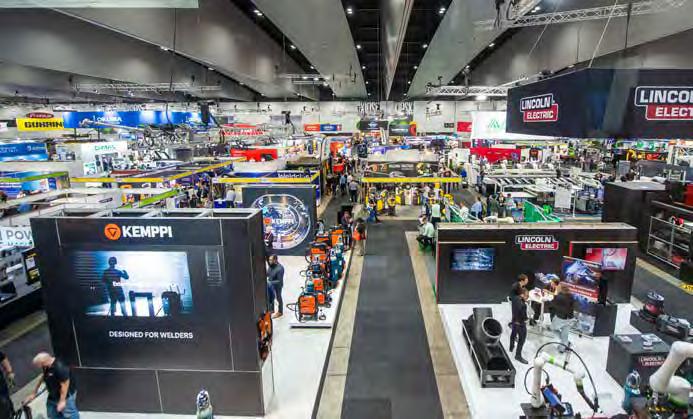
AMW 2026 PREVIEW
Australia’s leading manufacturing suppliers reveal what’s on show at AMW 2026
34 Sunshine State – Australian Manufacturing Week makes its Brisbane debut
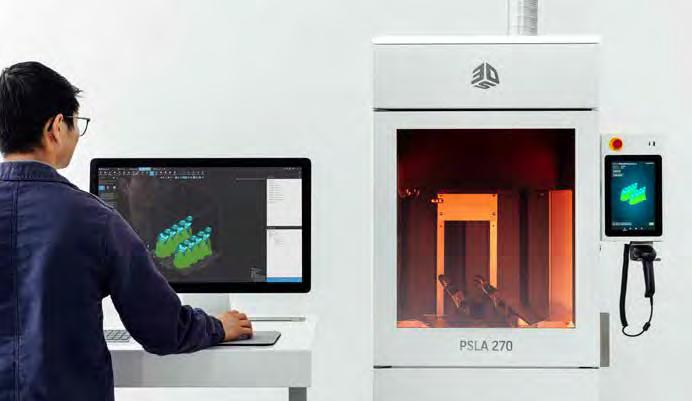
35 Precision Plastics – 3D Systems showcases industrial stereolithography and projector-based stereolithography at AMW
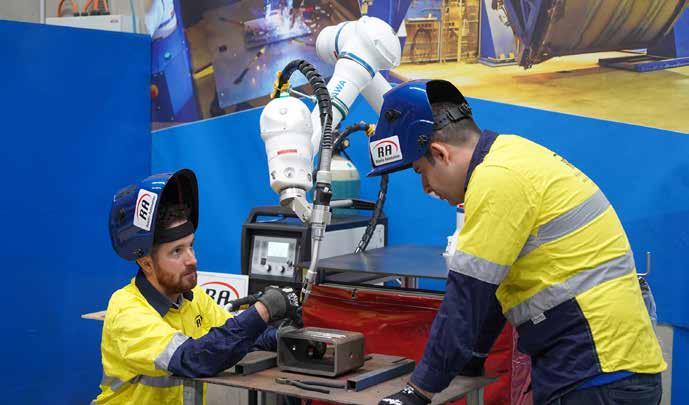
36 At Your Service – Robotic Automation presents Motoman Yaskawa welding cobots, its mobile robot cart delivery system and more at AMW
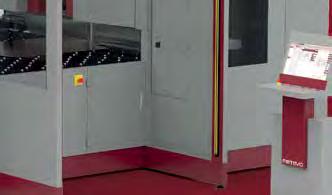
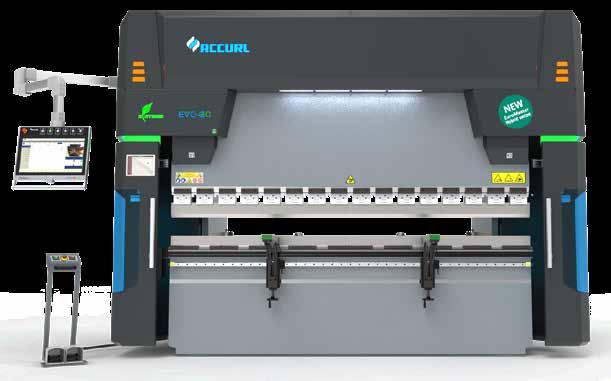
38 Complete Picture – Accurl steel metalworking equipment to offer a leap forward at AMW, according to Complete Machine Tools
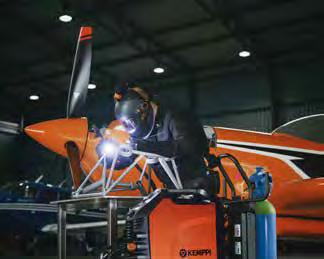
39 Finland’s Finest – Kemppi’s Master T premium TIG welding machines on show after February launch
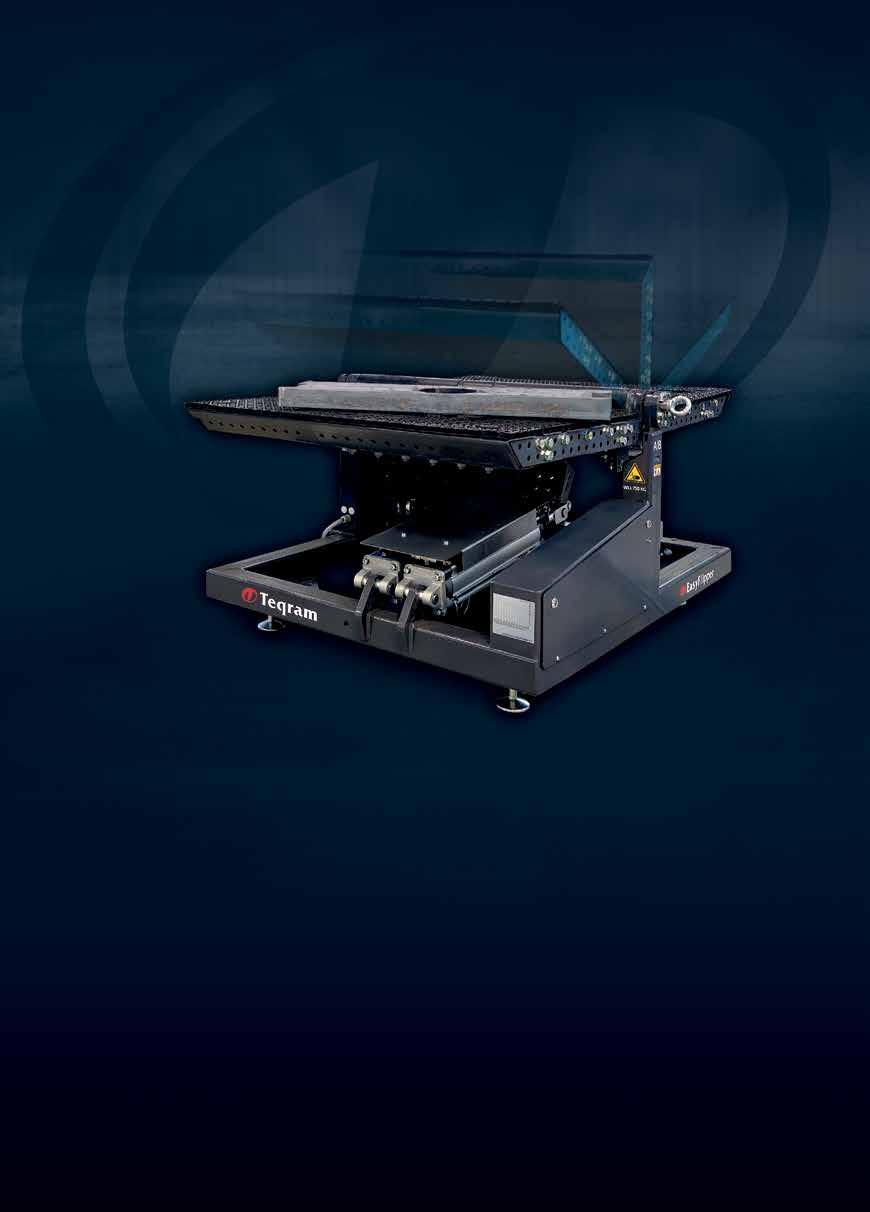
39 Flipping Fantastic – The Teqram EasyFlipper makes its debut at AMW, supported by Protube Engineering
40 Generous Offer – Amada brings advanced sheet metal equipment to AMW for broad client base
40 A New Era – Sutton Tools takes over as Australia’s new Mitutoyo distributor
41 On the Right Path – A series of new features on display or Bystronic’s Xpert Pro 150 press brake
41 Laser Focus – Advances in fibre laser cutting and forming nd joining tech on display at AMW
42 The Queensland Advantage – Queensland’s manufacturing sector is going from strength to strength
Sunshine State
Australian Manufacturing Week Comes to Brisbane for the First Time in 2026.
Australian Manufacturing Week (AMW), hosted by AMTIL, will be held in Brisbane for the first time in 2026. As the nation’s premier showcase for advanced manufacturing, AMW brings together the latest technologies, processes and ideas shaping the future of Australian industry.
Running from Tuesday 12 to Thursday 14 May at the Brisbane Convention and Exhibition Centre, AMW 2026 will feature a wide range of precision engineering and smart manufacturing solutions. The exhibition will highlight technologies including CNC machining, robotics, additive manufacturing, software, and more. It is designed to connect professionals, promote innovation and support industry growth.
The event will include six dedicated product zones: Machine Tools, Additive Manufacturing, Robotics and Automation, Welding and Air Technology, the Australian Manufacturers’ Pavilion, and Manufacturing Solutions. A comprehensive speaker program will run alongside the exhibition, offering insights into emerging technologies, industry trends and practical strategies for business development.
“Manufacturing is evolving rapidly across Australia, and Queensland is no exception,” says AMTIL chief executive Lorraine Maxwell. “Queensland is home to a growing number of innovative manufacturers. AMW 2026 will highlight the strength of this local industry while continuing to serve as a national platform for showcasing excellence in advanced manufacturing.”
The Queensland Government is a major sponsor of AMW 2026, working in partnership with AMTIL to ensure the event reflects the state’s growing capabilities and ambitions in manufacturing.
“We’re proud to host Australia’s leading manufacturing event here in Queensland,” Manufacturing and Regional and Rural Development Deputy Director-General Jason Kidd says. “AMW 2026 is a valuable opportunity to connect with a highly engaged national audience of industry leaders, and it represents a strong investment in the continued growth of Queensland’s manufacturing sector.”
“We’re excited to bring AMW to Brisbane for the first time,” says Kim Banks, Exhibition Director at AMTIL. “Each year, AMW connects thousands of professionals from across the country. This move gives us a fantastic opportunity to engage with a new audience while continuing to support the national manufacturing community.”
Whether you are looking to upgrade your capabilities, explore new markets or stay ahead of the curve, AMW 2026 is the place to be. Registration will open in late 2025, be sure to follow AMTIL’s website and LinkedIn accounts for updates.
Precision Plastics
3D Systems to showcase latest industrial stereolithography (SLA) and projection-based PSLA progress at Australian Manufacturing Week.
The latest advances in stereolithography (SLA) will be on display at Australian Manufacturing Week as 3D Systems moves to position polymer additive manufacturing firmly within real-world production environments.
SLA – a 3D printing process that uses UV lasers and other light sources to cure liquid photopolymer resins – was invented by 3D Systems founder Chuck Hull, who went on to release the world’s first commercial 3D printer, the SLA-1, in 1987. More than four decades later, that same technology continues to evolve, with the recent launch of the SLA 825 Dual - aimed squarely at large part and high volume production. The SLA 825 Dual delivers a new larger build volume of 830 x 830 x 550mm coupled with new workflow efficiencies and throughput enhancements - squarely aimed at improving output for large investment casting foundry patters, motorsport wind tunnel testing models and 3D printing service bureau prototypes, tooling and production. 3D Systems also aims to have a P-SLA 270 3D printer on display at Australian Manufacturing Week, showing off its capacity for high-speed, precision production for mid-size parts.
Rather than laser scanning, the P-SLA 270 uses a dual HD projector based- system, with two 7 watt projectors delivering curing times up to five times faster than traditional laser-based SLA, the company says. With a pixel resolution of 90 microns, a combined projection resolution of 3840 × 2160 dpi for highdefinition projection, and a build volume of 242 × 265 × 300 mm, the P-SLA 270 is aimed at batch plastics production and mid-size casting applications, supporting everything from oneoff parts through to full production runs. New software, for the SLA large-frame system includes including ArrayCast, further
extends its value for foundries by enabling the rapid generation of customised casting trees for foundries – reducing manual labour and accelerating pattern preparation.
The company will be showing off two new casting resins for large-frame SLA systems: at the event: Accura SbF, which with no detectable antimony is perfect for printing 3D printing QuickCast investment casting patterns, and Accura Xtreme Black, which offers exceptional durability for challenging 3D assemblies such as snap-fit components, rugged enclosures, and consumer electronics.
3D systems says these new technologies allow for rapid material changeovers and production-grade accuracy – enabling SLA to support the output of batch plastics, investment casting patterns and functional end-use components – often within the same workflow. This versatility is proving particularly valuable for Australian manufacturers operating in low-volume, high-complexity markets, where short production runs and frequent changeovers are the norm.
3D Systems says by integrating SLA and P-SLA technologies, Australian foundries are addressing structural challenges including limited access to training, skills shortages and an ageing workforce. Foundries can move towards more automated production models as well as reducing production times and reducing reliance on imported tooling by integrating SLA and P-SLA technologies, the company says.
Beyond these technical advances, 3D Systems is engaging with the broader Australian additive ecosystem, working with the AAMN subcommittee to support collaboration, innovation and sustainability across the sector.
At Your Service
Robotic Automation (RA) to present machines and technologies designed to make welding easier for small to medium enterprises.
Whether it’s the mobile robot cart delivery system, it will have on display, Robotic Automation’s (RA) stand at Australian Manufacturing Week is one not to miss.
With more than 35 years experience in delivering automation and robotics to manufacturers across Australia and New Zealand, the team at RA forms an integral part of Australian Manufacturing Week. Welding is a specialty of the company, with over 540,000 robots from its Motoman robotic welder range installed worldwide since 1977.
A variety of Motoman robots will be demonstrated during the event – chief among them the Motoman Yaskawa welding cobot – also known as Weld4Me – an easy-to-use, Cobotbased MIG or MAG welding station. Ideal for small batch production, custom fabrication, and job shops where frequent changeovers occur, the Weld4Me cobot combines the strength and accuracy of an industrial robot with the safety features necessary for human-robot collaboration.
The cobot offers direct teaching and intuitive software to help reduce programming time, enabling operators without robotics experience to set up jobs quickly – minimising downtime and increasing throughput. RA says small to medium enterprises that buy the cobot typically earn back their costs within 12 to 18 months, due to lower labour costs and improved weld consistency leading to fewer re-works and scrap. In addition RA will also be exhibiting its RA-MR250 mobile robot cart delivery system, which autonomously transports components between stations in manufacturing facilities. The robot cart eliminates manual material handling, reduces bottlenecks, and supports just-in-time workflows, integrating seamlessly with
robotic cells and ERP systems for dynamic routing. RA will also be displaying its MotoSim simulation software package which provides accurate 3D simulations of robot cells for welding, cutting or material handling. Accurate 3D simulation allows cycle time analysis and collision detection before physical deployment, reducing commissioning time and risk.
A working Laser Vision system will be on demonstration. The system enables the Motoman robot to precisely find and track weld joints at high speeds and in real-time, even while the parts are turning on a coordinated positioner, resulting in precise optimised, highly accurate welds.
Robotic Automation will also showcase its MotoSim simulation software, designed to deliver precise 3D simulations of robotic cells for welding, cutting, and material handling. This intuitive offline programming tool enables programming directly from CAD data, eliminating manual teaching and cutting setup time by up to 80%. With accurate 3D simulation, users can perform cycle time analysis and detect potential collisions before physical deployment, reducing commissioning time and minimizing risk. The result is faster product introduction and enhanced support for high-mix, low-volume manufacturing environments .
NEW GENERATION OF PANEL BENDERS
More productive than a traditional press brake
Ideal for medium-to-high volumes
Fully CE compliant, designed with safety and reliability in mind
Metevo introduces a new generation of panel benders, a cost-effective solution designed to boost productivity, reduce labour costs and the need for press brakes in standard panel production.
Complete Picture
Items in the Accurl equipment range will have plenty to grab the attention of visitors to Australian Manufacturing Week, Complete Machine Tools says.
Queensland’s own Complete Machine Tools is predicting three new pieces of steel metalworking equipment from Accurl will make a strong impression at Australian Manufac-turing Week 2026. The 2026 Accurl TubeLINE 6524A 3D pipe laser it distributes is a significant leap forward in semi-automated tube-laser cutting, Complete says – making it the smartest entry point into high-efficiency tube cutting.
Optioned with an explosion-proof dust extraction system, a semi–automatic in-feed system, a CNC Servo-driven unload system and Industry 4.0 module, the T 6524A is versatile, for both one-off production and high-volume tube profiling.
Complete says the TubeLINE 6524A has design intelligence built into its workflow, with its automatic focus adjustment, optimised piercing strategies, anti-collision cutting-head protection and optional finished-part out-feed making it easier to maintain consistent quality across varying wall thicknesses and tube geometries.
With processing capability up to 240 mm round and 240 mm square, a 6m in-feed, 3m out-feed and all paired with a 3kw laser power source from Raycus, Complete says the unit is spec’d and ready for work in the modern manufacturing era. Also on display at AMW, the Accurl EuroMaster hybrid servo press brake is helping to transform bending workflows and substantially reduce cycle times with its Industry 4.0 intelligent systems. The Euro Master Hybrid boasts rapid ram speeds (descent/ascent rates up to 230–250 mm/s) with the speed change at only 2mm above the material, as well as high-speed back-gauge positioning featuring fully automatic rear thin material sheet supports and more.
Spec’d at 135t x 3.2m capacity and optioned with a dual screen controller set up featuring the Delem DA69S,
the EuroMaster will also showcase the iMeasure automatic angle measurement and correction system and the full suite of offline functionality, boasting the fully integrated iBend system from Metalix 3D.
Finally, Complete Machine Tools says the Accurl EM-X 1000 goes well beyond being merely another deburring line. Instead, it’s a full-scale finishing powerhouse built for the demands of modern metal fabrication. Engineered around a high-capacity system featuring six rotary brushes, two sanding belts, and a dual air and magnetic table, the EM-X takes on everything from laser-cut to punched, plasma-cut or sheared parts with absolute authority. It erases burrs and delivers a uniform 360-degree radius finish across edges, holes and contours – consistently outperforming anything achievable by manual labour, Complete Machine Tools says.
Accurl’s intelligent sequential finishing system is central to this performance: heavy burrs are levelled by the sanding belt stations, slag is demolished with hammer-disk action, and the six-brush planetary head delivers high-speed, multi-directional edge rounding without distorting part geometry.
Whether used in full-combination mode or with each station running independently, the EM-X ensures flawless hairline finishes, polishing, peeling and film-safe deburring – even on coated material, Complete Machine Tools says.
Servo-controlled accuracy down to 0.01 mm, paired with the dual air/magnetic work-holding table and an integrated wetfiltration dust collector, ensures high-volume consistency in a cleaner, safer, modern workshop environment. The result is faster throughput, dramatically improved surface quality, lower labour cost, and a reliable finishing standard that elevates every part that passes through the machine.
Finland’s Finest
After its February 2026 launch, Kemppi’s Master T premium TIG welding machine series will be a highlight of AMW.
Kemppi’s Master T series of premium TIG welding machines is set to make a splash at Australian Manufacturing Week 2026 – one of its first Australian expos following its official launch in February.
Available in power variants up to 500A, the Master T ACDC models include some unique performance modes, with its Max WeldClean mode positioning the Master T as an electrolytic weld cleaner, while the demagnetisation mode helps it eliminate recent magnetic fields in a workplace. It delivers smooth and reliable arc ignition, reduced noise levels and enhanced arc control – with Weld Assist guiding the user to faster weld parameter set-up, which Kemppi says helps ensure consistent, high-quality results.
Value based specifications combine powerful welding capability with additional performance features like Pulse, MicroTack and AutoCool technology, influencing improved welding control, quality, speed, and energy efficiency.
Designed and manufactured in Finland, the DC and ACDC 1ph and 3ph models offer a gas or liquid cooled configuration with a 7-inch premium display specification, and the optional WeldEye cloud service for quality welding management.
Flipping Fantastic
WeldEye will also be on display during AMW at the Kemppi stand, as well as the existing popular X5 FastMig welders, X3 FastMig models, the Minarc T223 ACDC and its sister model, the Minarc T223 DC.
The Teqram EasyFlipper is set to make its debut at Australian Manufacturing Week, supported by Adelaide-based Protube Engineering.
Teqram will showcase its solution to flipping heavy parts at Australian Manufacturing Week, the first of many products it plans to bring Down Under as part of a new deal with Protube Engineering. Primarily used for sheet metal parts, the EasyFlipper helps to flip heavy loads within seconds, removing the need for cranes and slings, belts or clamps – reducing risk as well as any risk the workpiece will be scratched.
Teqram chief executive Frans Tollenaar says the EasyFlipper is “a very, very simple little machine, but we were amazed by the fact that it didn’t exist,” he says. “We were quite amazed that we were the first ones to have this idea of having a rotating axis in the middle, and then using a throwing motion the way you would like it’s a clam-shell or a book.”
Able to handle weights of between 750kg and 5 tonnes, and with a table size of 1200mm by 800mm, the EasyFlipper can be fitted with rubber mats or brushes to prevent scratch-es to the parts it flips. The EasyFlippers can also be connected to each other, acting simultaneously to turn bulky or heavy loads – with some users having gone as far to connect 20 units together, while additional extension riggers and width riggers are also available. Once flipped, workers can carry out deburring, or other machining work on the other side of the panel. It’s the first in a series of Teqram machines that South Australia’s Protube Engineering will be bringing to Australia, with the Australian company to offer service and support to local customers from its bases around Australia.
Protube general manager Anton Resch says he sees a parallel for future customers with its existing robotic welding base – many of which will need to flip the sheet metal they are working on. “Safety is paramount for our top tier customers, and productivity as well – so these customers fit in perfectly with each other. For Tollenaar, the EasyFlipper is the perfect introduction to the company’s broader range of vision-guided robotics and other flexible automation solutions for the metalworking industry.
“The next step will probably be the robotic grinding, loading of deburring machines, unloading laser machines… we have a number of products we’d like to launch in the next few years, and depending on how the Australian market receives it, we will accelerate stuff,” he says.
Generous Offer
With three new machines now available Down Under, Amada aims to make advanced sheet metal processing achievable for a broader range of manufacturers.
Amada will showcase a new generation of sheet metal processing equipment at AMW 2026, designed to lower the barriers to automation while maintaining precision and reliability. The centrepiece of Amada’s display will be the CR010B collaborative bending robot, supported by the ORSUS3015AJe fibre laser cutting machine and information about the SRB-1003 press brake
The CR-010B is detachable and can be retrofitted on existing press brakes equipped with NC equipment from AMNC 3i onward – making it possible to switch the use of the press brake between human and robotic operation.
It is also equipped with a simplified robot program creation tool that links with the numerical control equipment of the press brake for the creation of robot programs without CAM software – reducing introduction costs by making it easier for anyone to perform program creation and operation.
Additionally, the collaborative robot has an external force detection function and a scanner that monitors the proximity of individuals – eliminating the need for a physical barrier and reducing the space the unit requires.
The lineup of ORSUS-3015AJe fibre laser cutting machines will offer a working range up to 3,070 mm x 1,550 mm, and oscillator outputs of 3kW, 6kW and 8kW. The machines realise high-speed, high-quality machining due to the adoption of a carriage with a low 2 centre of gravity to support high acceleration and deceleration.
A New Era
The SRB-1003 press brake has a press capacity of 1,000 kN and a bending length of 3,110 mm. It has a combination of left and right independently controlled hydraulic cylinders and a natural crowning mechanism, which Amada says enables it to achieve high precision. The system is packaged with safety devices and options that contribute to work improvement and setup time reduction.
Amada also says the ORSUS-3015AJe and the SRB-1003 have both had their costs reduced through the rationalisation of the design and by conducting procurement globally.
As Australia’s new Mitutoyo distributor, Sutton Tools will have plenty to display at Australian Manufacturing Week 2026.
After acquiring the Mitutoyo distribution business in Australia from MTI Qualos in August last year, this year Sutton Tools is ready to bring the range to the masses.
The acquisition, made with the endorsement of Mitutoyo Japan, brings metrology to Sutton’s existing cutting tool and industrial product ranges.
In a note to staff, Sutton Tools commercial director Robert Sutton says the Mitutoyo brand had established a marketleading position in Australia, having been distributed locally by the Smith family since 1968.
That legacy will continue, he says, with the Smith family remaining actively involved in the business following the transition, and all current staff brought on board by Sutton. Importantly for customers, there will be no immediate changes to trading arrangements. Mitutoyo products will continue to be serviced by MTI Qualos, which will retain responsibility for stock holding, freight, deliveries and accounts management from its Heidelberg, Victoria head office until further notice. In the medium term, MTI Qualos is expected to transition to Sutton Tools’ ERP and mySutton systems. This integration
is intended to streamline operations and enable a single, simplified ordering experience for customers across the combined product portfolio.
Commenting on the acquisition, Sutton Tools said the move represents a strong opportunity to further invest in and grow the Mitutoyo brand in Australia, while maintaining the service levels and technical support customers have come to expect.
It will be a continuation of the company’s founding mission statement – to “contribute to the wellbeing of society through precision measurement technologies.”
“Our challenge now is not in measurement alone, but to create solutions for our customers’ futures,” Sutton Tools says.
“From developing optimum analysis environments, to process improvement for on-site applications of Mitutoyo equipment, and onto the realisation of factories that do not sleep through the utilisation of measurement data – the foundations of manufacturing run deep and the possibilities run deeper.”
On the Right Path
Bystronic says its Xpert Pro series of sheet metal benders are the innovations that occur when advanced technology meets years of experience.
Weighing between 100 and 320 tonnes and with a bending length of between 3100 and 4300mm, the Xpert Pro series comes with new features it says will help it continue to set standards in sheet metal bending.
Bystronic will have an Xpert Pro 150 press brake on display at AMW; showing off a variety of new features, including a sliding table, offering greater flexibility and the fast, precise, and effortless positioning of tools, especially for flat bending. Fully automatic calculations enable tool changes in record time. The press brake also has a handwheel for manual control, which Bystronic says enables operators to adjust the angle exactly and intuitively – making precise work even easier. Especially for complex workpieces with small batch sizes and the highest requirements, it offers maximum control over every bending process.
A second screen extension allows CAD models to be opened directly on the bending machine without any detours.
Geometries can be checked directly on the machine, and even hidden features are easy to measure and validate – turning the bending machine into a digital control centre in production.
Laser Focus
The Servo Dynamic drive system on the Xpert Pro also shortens cycle times and increases part output per shift without compromising quality, Bystronic says. The machine also operates more quietly and energy-efficiently, which reduces operating costs in the long term. Bystronic spokesman Benjamin Rödiger says the company has invested “a tremendous amount of development effort” in the platform.
“This makes it clear that the Xpert Pro series is an investment in the future from which our customers will benefit in the long term," he says. With the new functions of the Xpert Pro series, Bystronic is setting new standards in precision, efficiency, and flexibility. The use of durable components and the latest technologies ensures that the machines will remain available for years to come.
In addition, the models in the Xpert Pro series are fully prepared for automation. They can be flexibly combined with the Modular Tool Changer or the Bending Cell. This allows production to be adapted to requirements, from manual single-piece production to fully automated series production.
Refinements to forming and joining technologies and advances in fibre laser cutting and downstream processing will be on display from Laser Machines at AMW.
Laser Machines Australia boasts a range of new and recently updated technologies designed to enhance accuracy, efficiency, and workflow integration across metal fabrication environments. The company’s offering spans cutting, forming, finishing, welding, and marking, with several of its latestgeneration systems set to be showcased in Brisbane at AMW 2026.
Recent developments in the company’s fibre laser cutting portfolio include upgraded sheet, tube, and combinationformat machines featuring improved structural rigidity, faster motion response, and expanded intelligent control functions. These enhancements enable more stable processing across varied materials and thicknesses while supporting greater automation and consistency in day-to-day production.
Laser Machines has also introduced advancements in downstream processing and part preparation. Newer deburring and finishing systems in the range incorporate multi-stage abrasive configurations and user-friendly digital controls, allowing manufacturers to achieve more uniform edge conditions and surface finishes with reduced reliance on manual intervention. These updates help create a smoother, more efficient transition between cutting and subsequent fabrication steps. Forming and joining technologies have likewise seen significant refinement. The latest CNC press brake models deliver improved bending accuracy through optimised hydraulic performance, precise back-gauge control, and advanced crowning capabilities. In parallel, next-generation handheld laser welding units provide
high weld speeds, low heat input, and multi-function operation suited to both general fabrication and precision work. Rounding out the technology suite, recent updates to the company’s laser marking systems offer improved beam control, faster marking cycles, and broader material compatibility.
These systems support traceability, identification, and finedetail engraving requirements across a range of industrial applications. Together, these newly introduced and recently enhanced systems represent Laser Machines’ ongoing commitment to supporting manufacturers as they adopt more modern, efficient, and integrated fabrication technologies. The company continues to focus on providing equipment and technical expertise that help Australian businesses improve productivity and maintain high-quality output across all stages of metal processing.
The Queensland Advantage
Queensland’s manufacturing sector is surging ahead as Australian Manufacturing Week readies for its Brisbane debut.
Contributing about $29 billion annually to the state’s economy and supporting over 175,000 jobs, Queensland stands out as an attractive place to build and scale manufacturing – thanks in no small part to government support.
A spokesperson for Queensland’s Department of Natural Resources and Mines, Manufacturing and Regional and Rural Development says the state is proud to play a leading role in Australia’s push toward greater sovereign capability and advanced manufacturing. “Over the next five years, we see significant growth opportunities in advanced manufacturing, particularly in areas like aerospace, defence, medical technologies, and renewable energy,” they say.
“We are investing heavily in programs like the $79.1 million Transforming Queensland Manufacturing grants program, which is helping local businesses adopt advanced technologies, boost productivity, and create high skilled jobs over the next three years.” The program will provide grants of $25 million to businesses across Queensland, with the stated aim of supporting manufacturers to adopt advanced technologies, boost productivity, attract investment, and create high-skilled jobs.
The grants program will be launched shortly and will be open to all manufacturing businesses in Queensland that meet eligibility criteria. It is only one part of the Queensland Government’s Transforming Queensland Manufacturing Strategy 2025–30 launched last year—setting out a clear, practical vision to drive innovation, lift productivity, and grow exports by value adding in mining and agriculture, while also expanding in growth sectors such as defence and biomedical.
The state’s eight manufacturing hubs—including recently added centres in Toowoomba and the Sunshine Coast— are a key part of that strategy, developed jointly with industry through the Queensland Manufacturing Advisory Council.
The hubs provide hands-on guidance to help businesses adopt new technologies, improve processes, and lift capability – by enabling access to expert advice, holding manufacturing leaders’ forums and encouraging the development of connections to the resources needed to support growth.
In Toowoomba, Maskill chief financial officer Erin Wright sees the benefits of Queensland’s regional manufacturing ecosystem – with 48% of those 175,000 manufacturing jobs based in the state’s regions.
Maskill, which specialises in the repair and refurbishment of track frames and tracks of Cat D10 and D11 dozers, is currently expanding its Queensland facility and building a new facility in Western Australia, Wright says. “Toowoomba has put real effort into making this an attractive manufacturing base—with the Toowoomba Bypass, Wellcamp Airport… We’re in a manufacturing area and there’s quite a lot of land still for sale,” she says.
“There’s lot of bespoke little micro robotic factories, but there’s also the ones with the bigger footprint, like Maskill, that need the land for workshops with bigger machines.”
“If you’re looking to put a manufacturing base up here, look further afield than Brisbane,” she says.
With a combination of a highly skilled workforce, a strategic location with access to domestic and international markets, and backing from the government, Queensland boasts a strong manufacturing support ecosystem.
Regional Strength
Another part of the manufacturing ecosystem – Manufacturing Skills Queensland – opened a manufacturing Centre of Excellence (CoE) in Maryborough in November. Supported by the Queensland Government and foundation partner Downer, the CoE offers fitting and machining areas, welding and fabrication spaces, electrical workshops, augmented reality training stations, and design rooms equipped with design workstations and 3D printing technology.
The government spokesperson says the government is also working with local manufacturers to help them compete for work in rail projects as part of the Queensland Train Manufacturing Program. As part of this program, 65 new six-car passenger trains will be built at a purposebuilt manufacturing facility at Torbanlea, about 20km from Maryborough, in the state’s Fraser Coast region.
The Queensland government has also installed what it says is an Australian-first train welding robot at the Queensland Train Manufacturing Program (QTMP) site – where it expects to start building trains in 2026. The cutting-edge Resistance Welding Robot, which is currently being installed at Torbanlea, will streamline train car assembly by precisely welding components and allowing simultaneous operations for efficient, high-quality production, the government says.
“Once installed, local teams will undertake training on the equipment, with a recruitment drive currently underway to mobilise the 300 staff needed to operate the facility,” it adds. Minister for Manufacturing Dale Last said the arrival of specialist equipment signalled the start of a new era in Queensland manufacturing – and one that will deliver highly skilled people to regional Queensland.
“This is what delivery looks like, with specialist equipment going in, manufacturing infrastructure rising out of the ground and a tradie job bonanza underway to get the Queensland Train Manufacturing Program back on track,” he says.
GMG’s new Mazak CNC turning centre.Image courtesy GMG
For Phil Dowling, the Maryborough-based business development director of steel fabricator Global Manufacturing Group (GMG), it’s the latest chapter of his region’s work on the state’s trains. “The train industry has been pretty consistent in this area for a long, long time,” he says.
“Maryborough and the region have a past culture of engineering and manufacturing anyway, going right back to when gold was discovered – so the local population has been brought up in that sort of frame,” he says.
In Dowling’s words, GMG is a fully turnkey metal components manufacturer – working in “every conceivable industry that requires our expertise in manufacture and finish and quality,” he says. Not content to rely on government contracts, today GMG boasts a base of more than 70 clients working in mining, energy and other industries, a deliberate strategy to diversify rather than riding a boom-and-bust cycle.
MASTER YOUR CRAFT WITH MASTER T
Master T series are premium TIG welding machines for professional AC and DC TIG welding. Delivering exceptional weld quality, precision and energy efficiency, specified Master T models also include advanced features like MAX WeldClean and DeMagnetization mode, boosting productivity and ensuring consistent return on investment. Call (02) 8785 2000 or visit www.kemppi.com
Doing this has required a sharp focus on staying in front of technology across the company’s work centres in Maryborough and Gladstone. In 2025 GMG invested in a new laser welding system and a new Mazak CNC Turning Centre, with another twin pallet machine on the way, Dowling says.
“We relentlessly seek machines that will give us improvement. In Australia, time is money—so everything we do targets productivity, lean training, and systems,” he says. “We’re selling a service, not a product. Our unique selling point is that we do all the things that other people can’t do, don’t want to do, haven’t got time to do or don’t know how to do.”
“We used up a lot of boot leather, and we had a fairly good two-minute elevator presentation to sell… and it’s worked for us, but you’ve got to keep your foot on the accelerator all the time,” Dowling says.
With a diversity of projects, Toowoomba has a lot of potential as a manufacturing hub
The Queensland Government is throwing its support behind the state’s manufacturing sector.
INDUSTRIES
46 Full Throttle – Australia’s automotive manufacturers have found new markets as the sector settles
48 Panel bending to grow: Metevo makes panel bending accessible for a broader range of manufacturers
49 Walkinshaw new factory opens – Expanded Dandenong South facility a vote of confidence in Australia, performance vehicles developer says
50 High Speed Cutting – Cutting tools with specific characteristics are needed for high-speed aluminium milling.
52 Fresh Air – New factory to focus on Australia-specific designs and local training strategy, Daikin Australia says.
54 Bulletproof idea – Australia’s first manufacturer of bulletproof glass is getting ready to set up shop in Darwin
Going Off-Road
How Australian automotive manufacturers have moved up the curve – and how they’re finding the skills to pursue the next growth project.
New Touch Industries sales manager Sean Marceddo jokes that the market for aftermarket parts for four-wheel drives is constantly growing, fuelled by social media. “Particularly the young fellas. They want to have all the lights and the bull bars, all the bracketry and the crash panels underneath so they can go off and challenge not only themselves, but their vehicles out in the bush,” he says.
“I constantly say I’m the only person I know of who goes camping who doesn’t have a drone.” Comparing it to the Caravan industry during the COVID-19 pandemic, Marceddo says the appeal of offroad driving has led to surging interest in aftermarket parts at all levels.
“Social media influence is taking these aftermarket parts a long way, and if you look at some of the websites out there, and the enjoyment that people get out of going on holiday, I don’t see how that’s going to stop for 4WDs.”
Offering services in bending and folding, welding and fabrication, laser cutting and marking and assembly and project management across a number of industries, New Touch Industries manufactures for corporate customers, rather than providing direct to client. This work includes light brackets and support for bull bars, but not the lighting or the wiring that goes on behind it, Marceddo says.
“This is where communication with our customers comes into play… We’ve worked very, very closely with them to ensure that we not only had raw energy, or stock, to make sure we can do it, but we can also fit the work in with our scheduling.”
“It’s a wonderful segment of industry to be involved in.
For us, we are working hard with the customers we have in this industry, and we pick up another one here and there.”
New Touch is far from the only company benefiting from resurgent interest in the market for 4WD aftermarket parts, with Newcastle-based Lovells Group announcing a new home base and an expansion into Western Australia in 2025.
Offering dedicated kits for Gross Vehicle Mass Upgrades for vehicles such as the Toyota LandCruiser direct to customers, Lovells also recently invested in a $1 million research and development hub in Edwardstown, South Australia.
At the same time, the company has added to its engineering team with the appointment of Dutch polymer chemist and emeritus Professor Jacques W.M. Noordermeer to its engineering team. Lovells managing director Simon Crane says the appointment will fill a knowledge gap in Australia.
“Since the demise of Australia’s motor vehicle and tyre industries, our polymer engineering knowledge has been eroded and R&D in this field is now almost non-existent,” he says.
“Lovells is one of the few remaining Australian manufacturers with expertise and production capabilities spanning elastomer technology. By bringing Professor Noordermeer on board, we are strengthening that capability, imparting knowledge to the next generation of engineers and strengthening our global business opportunities.” Lovells says the vibration dampers it provides to the mining and mineral processing sectors complements its work in vehicle suspension and towing solutions, and it hopes to apply that expertise to locally manufactured suspension systems for the rail industry.
Melbourne-based gear manufacturer Ronson Gears also knows the value of diversifying – with most of its clientele in mining, defence and aerospace, the automotive sector was never a priority, managing director Gavin New says.
“I’m going to stop reporting on it [separately] now, because it’s just so minuscule for us – now it’s 0.2-0.7% of our turnover –and in 2015 it was 10% of our turnover,” he says.
In years gone by, Ronson had worked with the companies that supplied drive shafts for Corvettes and Cadillacs for General Motors in the United States – between 70,000 and 80,000 every year. “We were doing seat adjustor pinions for a company in Adelaide – 250,000 pinions a year, and then the aftermarket for the likes of ARB,” he says.
“They were great projects, and we knew that as they were going to leave our shores that it would leave a bit of a dent in our business. It was never massive, but we did take steps to replace it, knowing that the writing was on the wall.”
Professor Jacques W.M. Noordermeer
Engines managing director Colin Doherty has been in the business for some 35 years and, he says, it’s “amazing, trying to understand what’s happening in the auto market,” he says. “It is expensive to manufacture here in Australia compared to offshore – and it’s all globally based now, with large manufacturing structures.”
“But what I’ve found is that our demand is just massive. We are only just scratching the surface for what we could do to support industry here in Australia plus New Zealand…It’s crazy good. I have to pinch myself sometimes,” he says.
Original Engines specialises in remanufacturing engines back to the OEM specifications, doing a lot of work on Ford Ranger engines while also servicing engine components for the warranty programs of Crown forklifts.
With the company’s work on refurbishing existing engines growing strong, and enthusiasm for electric vehicles growing alongside it, Doherty says he has opened a book on whether the company should consider moving into battery remanufacturing.
“There’s been a lot of conjecture about EVs and the vehicles coming on board… the government made these bold statements of carbon neutral by 2030 and all the rest of it,” he says. But, he reflects, sales of electric vehicles have dropped in recent months, and the level of support infrastructure for the vehicles across Australia is low.
“There is definitely a market for it, but it is only very minimal at the moment... and the technology is changing so much with batteries – we could invest all this money into doing battery remanufacture, but I’m not 100% sure whether that’s the direction to go in yet.”
In the meantime, and to cope with surging demand for the company’s engine remanufacture services, Doherty has worked to create new pathways through local TAFEs, engaged with teachers and opened new opportunities for apprentices at the company – with three currently on board.
“You can’t outsource skills. Yes, people have mechanical aptitude and an understanding of engineering, but to have a fully-fledged apprenticeship or engineering trade behind you is rare,” he says. “Because the growth we’ve had over the past five years has been extraordinary and with skills shortages in mind, we’ve developed an education and competency structure internally, as well as outsourced with apprentices and combining that in our system.”
This structure has created a quarterly review of various competencies for each of Original Engines’ 37 staff members – measuring their training and progress. “I think if you’ve got a passion for what you do in your industry and you want to continue to have a good part of that industry, you need the skills and the people around you to do that,” he says.
“Everybody has different quality skills… but it’s about then understanding where their skills lie and bringing those qualities out in people.”
Original
Panel Bending within Reach
Panel bending is now available for companies big and small – including automotive manufacturers at all levels.
While automation has long powered the work of major automotive suppliers, new technologies are emerging to make it accessible to a much broader range of manufacturers. While large automotive suppliers can invest in fully automated systems, thousands of smaller fabricators across Australia are working with traditional press brakes and operator-dependent processes. To address this sector, Salvagnini has teamed with China’s Nanjing Lanhao Intelligent Technology to develop the Metevo line of panel benders.
Aiming to 'bridge the gap' between traditional press brakes and high-end panel benders — the Metevo system uses a bending unit with four standard tools and a modular blankholder that can handle a wide range of geometries without constant tool changes.
Once the sheet is centred, the manipulator manages all movements and rotations automatically, allowing positive and negative bends in sequence. The operator’s role reduces to loading and unloading sheets into the panel bender, rather than worrying about punches and dies to be changed and tested and other segments of the production cycle.
The result is a predictable, continuous bending flow with consistent quality — and a smaller dependence on highly skilled brake operators at a time when such skills are increasingly scarce, because the bending unit with four standard tools and the modular blankholder covers many geometries without continuous downtimes.
The Metevo MX panel bender series comes into production at a time when many companies are facing the combined challenges of rising costs, tighter delivery requirements and a shortage of skilled personnel. The aim is to help automate repetitive work and free up resources, helping make panel bending an enabling factor for growth and for automating production.
The series is designed for medium to large batches and for simple, standard parts, where repeatability and pace matter first. The series is available in three models, with bending lengths from 1400 to 2500mm and a height of 170mm.
Available options include those for asymmetric partial bends, PL panel lifters for extracting panels with a final negative bend of up to 60mm and HMI 3DCam for 3D programming with direct import of STEP files. The Metevo range is currently being distributed across Australia.
New Walkinshaw Factory Opens
Expanded facility a vote of confidence in Australian automotive manufacturing, company says.
Performance vehicles developer Walkinshaw Group has opened the doors of a 100,000 square metre facility in the Melbourne suburb of Dandenong South, in a move the company says marks a new era in its history.
The new site will see over 800 people working daily across two shifts, includes four manufacturing lines, for some of the largest automotive Original Equipment Manufacturer (OEMs) in the world – producing over 10,000 units per year.
It also includes Walkinshaw’s leading engineering centre, which provides engineering and design services to a broad range of industries, as well as warehousing, office space, hardstand, 700 staff carparks, and more than 500 storage spots for remanufactured vehicles.
Walkinshaw TWG Racing, the new name for Supercars Championship team Walkinshaw Andretti United, will also move into the facility in the second quarter of 2026.
Walkinshaw group director and chief executive Ryan Walkinshaw said the new facility opening was “an incredibly proud day” for the Walkinshaw Group.
“Since 2018, our business has seen remarkable growth and our capabilities have expanded significantly,” he says.
“It left us needing a bigger footprint, one that not only fit our unique requirements, but would continue our expansion into the future.”
“We truly believe in the strength of Australian manufacturing and engineering, and this should show everyone how committed we are for the long term,” he says.
Images courtesy Walkinshaw Group
Needs for High Speed Cutting
High speed aluminium milling requires cutting tools with specific characteristics, Iscar managing director Jason Allen says.
The high speed milling (HSM) of aluminium and its alloys requires cutting speeds at significantly higher than the standard rates. This approach ensures efficient material removal and excellent surface finish and accuracy. While there is no strict definition for what constitutes HSM speeds, it is generally accepted that they range from 1.5 to 4 times more than the typical speeds. Achieving HSM cutting speeds requires operating milling cutters at extremely high rotational velocities, often reaching 30,000 RPM or more.
From a design perspective, general purpose milling cutters and cutting tools for (HSM) of aluminium and its alloys are typically classified as either indexable tools, solid cutters –typically solid carbide endmills (SCEM), or SCEM assembled tools that mount replaceable cutting heads, primarily made of tungsten carbide. Machining at exceptionally high rotational velocity demands that milling tools withstand substantial centrifugal loads, maintain balancing quality, and ensure safety.
A key goal is to achieve, at the design stage, a mass distribution that is theoretically symmetric about the tool axis, producing a “balanced-by-design” tool structure. This engineered balance applies to the virtual model and does not replace physical balancing of the finished tool. However, this design significantly reduces residual mass imbalance in the manufactured tool and makes subsequent physical balancing faster, easier, and more reliable.
Solid tools and replaceable solid cutting heads (designed on similar principles) are essentially monolithic. This greatly simplifies achieving a balanced-by-design structure, especially when using 3D modelling in a modern CAD environment. By contrast: for indexable milling cutters, which consist of multiple assembled elements, HSM requirements are particularly critical. The design of indexable tools intended for high-speed milling of aluminium and its alloys focuses on addressing various specific challenging characteristics of HSM. These include preventing insert radial displacement caused by significant centrifugal forces and reducing the mass of tool components to decrease centrifugal load. Instead, the aim is to ensure a soft, light cutting action, to improve coolant channels for effective coolant supply and to maximise space for chips to be evacuated by making the best of the chip-gullet profile while maintaining the strength of the tool-body core. A brief overview of Iscar’s products for indexable milling of aluminium provides an example of how the leading cutting tool manufacturers rise to the challenges. These products are categorised into three groups: multipurpose milling tools, HSM milling cutters and prolific milling tools with enhanced ramp-down capabilities, enabling cutting speeds that fall between the spans of the first two types. The tools in the first group are general-duty cutters that hold indexable inserts suitable for milling various materials, including those designed specifically for aluminium. Principally, these cutters are used to mill a wide range of engineering materials and accept inserts that have the same basic shape and datum surfaces, which locate the insert in the pocket. By mounting inserts with different rake and relief face geometries, the same cutters can be configured to machine
specific material types. The first group tools are typically operated at cutting speeds that do not exceed 1000 m/min.
In HSM at exceptionally high rotational speeds, centrifugal forces become substantial. To prevent radial displacement of the inserts caused by these forces, second group tools incorporate an insert retention mechanism. As a result, cutting speeds increased significantly - for example, up to about 5000 m/min when radial engagement is small. The third group of tools have been developed for applications requiring intensive ramp-down milling passes. The aggressive cutting geometry of the inserts used in these tools enables cutting speeds of up to 2000 m/min.
In high-speed milling of aluminium, elevated centrifugal forces impose significant loads on the insert's clamping screws. To ensure high reliability, these screws should be replaced in accordance with tool-specific instructions. As a general guideline, ISCAR recommends replacing a clamping screw after every ten insert replacements for the insert it secures. In some HSM tool designs, inserts are supplied together with their clamping screws in combined packages. The inserts and screws are selected within tight tolerances to meet the required balance grade of the assembled cutter. In such cases, the screws should be replaced whenever the inserts are replaced.
It is important to note that balancing requirements are not limited to the tool assembly comprising the tool body, inserts, and clamping elements such as screws. The entire tooling system - including the tool assembly, the basic adaptor mounted in the machine tool spindle, and any intermediate elements (extensions or reducers) - must be balanced. This rigorous requirement is emphasised also in the ISO 16084 standard. Iscar’s group of general-duty indexable milling cutters has been expanded with various original designs. For example, the range of tools carrying round inserts now includes new inserts intended for machining aluminium and other non-ferrous metals. These inserts, which feature a polished top (rake) face to improve chip flow and eliminate
Fig. 2
built-up edge formation, are produced in two geometries: one with a plain cutting edge and one with a serrated cutting edge. Inserts with a plain edge are typically used for semi-finishing operations, while inserts with a serrated edge are primarily designed for roughing and for machining under unstable conditions, such as long-reach applications requiring high tool overhang and the machining of thin-walled workpieces (Fig. 1)
Recently introduced endmill heads with Multi-Master and Flexfit threaded connection, available with a high-pressure coolant (HPC) option, provide another example (Fig. 2) These heads accept Iscar’s classic Helialu inserts with a helical cutting edge. The coolant delivery design was upgraded, using computational fluid dynamics (CFD) modelling, to maximise flow rate while minimising pressure drop. The screw-in configuration significantly broadens customisation by enabling the use of Multi-Master and Flexfit shanks, adapters, extensions, and reducers that are widely represented on the market.
Over the last years, Iscar has emphasised a portfolio of indexable milling tools for aluminium designed for very high cutting speeds to boost metal removal rate (MRR). These tools are engineered to prevent radial insert movement caused by strong centrifugal forces. A dedicated anti-movement locking mechanism ensures reliable cutting during extended highspeed machining (HSM) operations. The latest development expands the portfolio’s performance with new tools that accept large inserts, enabling depths of cut up to 22 mm (Fig. 3). This addition supports more effective use of modern, high-power machine tools with high-speed main drives.
The newest product, recently unveiled, is a 14 mm serrated insert designed to be mounted on existing Helialu high-speed milling cutters. The insert combines a polished rake face, super-positive cutting geometry and sharp serrated cutting edges for chip-splitting action. Breaking wide chips into small segments improves chip evacuation, reduces re-cutting, enhances the tool’s dynamic stability and enables higher feed rates, thereby increasing productivity in rough milling operations.
Naturally, solid carbide end mills (SCEM) and assembled tools with replaceable carbide heads are also undergoing continued development. Recent innovations include several SCEM and heads with various profiles. For example, a fourflute Multi-Master head, 32 mm in diameter employs variable flute helix angles to improve dynamic stability, enabling consistent cutting across a wide range of operations from roughing to finishing.
Advances in machine tools have significantly expanded the limits of rotational velocity and feed rate, allowing higher cutting speeds. Ultra-high-speed milling of aluminium is emerging as a guiding paradigm, which in turn places new demands on cutting-tool design. How tool manufacturers will meet these challenges remains to be seen.
Fig. 1
Fig. 3
Fresh Air
New factory to focus on Australia-specific designs and local training strategy, Daikin Australia says.
Daikin Australia has opened a new factory in the Sydney suburb of Chipping Norton which it says will help put local designs and skills at the centre. The new $28.2 million Factory 2 expands Daikin’s capability to produce customised Air Handling Units and Rooftop Packaged Air Conditioners for Australian buyers.
Daikin Australia manufacturing general manager Nick McDonald explains the company’s Australian-made ducted units were engineered from the ground up for local clients.
“They are designed to suit the Australian home… they have geometry such that they fit inside an Australian roof space, so they’re easy to install. They are designed so they come apart into several pieces, so they can be easily manhandled up into the roof space by our dealer group.”
That Australian focus extends to performance in harsh conditions: “If you go to South Australia, the roofs are very hot. The temperature inside the roof cavity can be well in excess of 60 degrees, for example. So our equipment has to operate inside that sort of environment, and our equipment is designed for that,” he says.
On the commercial side, the new facility expands Daikin’s air handling unit (AHU) capabilities – giant units designed to regulate heating, ventilation and air conditioning in large-scale buildings. Every AHU is engineered as a one-off solution.
“Every single air handling unit is a unique, customised product – it all depends on the project it’s going into,” McDonald says.
“We have local engineers who design for local customers –the customers can come and speak with their engineers and get very close to the design process, and then we can build exactly what the customer wants.”
“We are not trying to be China or Southeast Asia – we’re not trying to move huge volumes of highly mass-produced product. We are on selling our engineering expertise,” he says.
The new plant is supported by solar PV – a key lever for Daikin’s plan to reach carbon-neutral manufacturing by 2030 – and by autonomous mobile robots as part of a broader automation strategy that, McDonald stresses, is “for growth, and… for enhanced safety [and] quality.” Alongside new lines and autonomous mobile robots, one of the most significant investments is Daikin’s Skills Dojo – an in-house training centre to turn new recruits into skilled manufacturing professionals.
“We can bring them from just straight out of the labour force, school, or a very fundamental level of qualification. We can bring them to our factory, and we can teach them to be manufacturing professionals, and that’s what we do,” McDonald says. “We train our people to go from zero to be basically really highly skilled brazing technicians in the space of about three months… we then move on to the production line in a straightforward job, and we do on-the-job training and gradually coach them up to the point where they can work on every assembly.”
Nick McDonald, Daikin Australia Manufacturing General Manager
Hideaki Furihata, Managing Director of Daikin Australia, said the expansion reflects confidence in Australia’s market strength and skilled workforce.
“Our decision to invest locally stems from Daikin Australia’s strong market position, our confidence in our people, technology and network, and our plans to broaden our range of locally designed and produced products,” he says.
“This new factory strengthens our ability to meet the needs of Australian customers with products that are designed, engineered and built here, while advancing our goal of carbon-neutral manufacturing by 2030.”
Bulletproof Idea
Australia’s first manufacturer of bulletproof glass is getting ready to set up shop in Darwin.
Bulletproof glass will be made Down Under for the first time with the opening of a new specialty glass manufacturing facility in the Northern Territory. Northern Glass Solutions (NGS) , a subsidiary of construction company Northern Trade Solutions, will establish a factory in Darwin’s East Arm Business Park to produce special-purpose and energy-efficient glass products that are otherwise not easily accessible in the Northern Territory.
Alongside the bullet-proof glass, NGS will make safety glass and glass that is triple-glazed and quadruple-glazed, laminated, tempered, acoustic, fire-resistant and cycloneresistant. They will also comply with the 2022 National Construction Code (NCC) updated 7-star efficiency rating, and meet the requirements of the Window Energy Rating Scheme (WERS), which classifies Northern Australia as a Cooling Climate Zone – where the focus is on preventing solar heat gain in buildings.
NGS will also collaborate with the Australian Glass & Window Association, as well as James Cook University (JCU) and RMIT University on a project to research, test, and establish manufacturing capabilities for special-purpose products suitable for Cooling Climate Zones.
The project seeks to establish an in-house research and development department that collaborates with the universities on research and development for future technologies and applications, including prototyping and testing with JCU for cyclonic regions.
The 12-month, $5.4 million project is being supported by a $668,072 co-investment from the Northern Territory Advanced Manufacturing Ecosystem Fund (AMEF), administered by the Advanced Manufacturing Growth Centre (AMGC).
NGS owner Jiayun Li says the existing gap in the local market, and need to buy in glass from other parts of Australia, can lead to increased costs, longer lead times and potential delays – as well as the increased danger of product damage due to transportation distances that are sometimes over 3,000 kilometres by road.
“With over 15 years of experience guiding us, we’re proud to be expanding NTS into glass manufacturing – supporting our loyal customers and helping build a more self-sufficient and resilient Territory,” he says.
AMGC’s Northern Territory director Charmaine Phillips says the increased capacity will address a “yawning gap” in the market. “This will provide a comprehensive range of specialised glass solutions, designed for our demanding climate and with great value outside of it as well,” she says. With strong local and export potential to the Pacific Islands and Southeast Asian countries, the project is expected to create $12.6 million in new revenues and 22 jobs within five years.
AWARDS SHOWCASE
Recognised as leaders across the country, these are the stories of 2025’s award winners and outstanding nominees
58 Award Showcase – Recognising the quiet achievers powering Australian precision manufacturing
59 Interview with Jane Oppenheim – Ego Pharmaceuticals chief executive discusses leadership and opportunity in Australian manufacturing
62 Fit to Print – Amiga Engineering is an Australian pioneer in additive manufacturing, and its legacy continues
64 Of All Trades – Adaptable, capable and committed, Jourdan Webb’s apprenticeship has set him up well for a future in manufacturing
65 Drive for Success – Matilda Robins spent a lifetime working on cars – now she’s built a career out of it
66 The Cutting Edge – Specialising in edge preparation and surface finishing for precision componentry, Minh Dang’s work is breaking new ground
68 Digital Age – Integra’s digitalisation system offers a pathway to growth for companies across Australia
69 The Path Ahead – Good training, industry support and an open mind are key to the future of Australian manufacturing, Copamate finance manager Jo Hocking says
70 True Blue – Packserv keeps production local – just like its target market
71 Attention to Detail – Brooke Kreuzer’s depth of talent on show after move from beauty therapy to manufacturing
72 Lasered Beams – Collaborative work with suppliers and customers key for Industrial Machinery Sales
73 On Target – Providing the right parts to the right customers at the right time keeps New Touch Industries kicking goals with its “background” work.
74 Out of the Box – Focusing on the values of new staffers, rather than their CVs, adds new strength to AW Bell
75 Moulding Master – PPC Moulding Services tur ns complex ideas into cost-effective, high-performance parts –with unique equipment and ongoing reinvestments
76 Military Precision – How BAC Systems turns its storage systems into a sustainable advantage
77 Polished Performance – Ensitech aims to take its Australian-made innovations to the world in 2026
78 All the Stops – How BOC is helping industry meet the new welding fume standard
Award Showcase
Recognising the quiet achievers powering Australian precision manufacturing.
Australian precision manufacturing is full of potential, and it is being driven by companies and people who often prefer to let their work speak for itself.
Recent award shows, celebrating achievements within Victoria and nationally, remind us why recognition matters. They shine a light on innovation that is often hidden inside clean rooms, toolrooms and production cells, and give the broader industry a chance to learn from the capabilities being built right here. The Australian Manufacturing Awards and the Victorian Manufacturing Hall of Fame Awards, both held in October, celebrated a spectrum of excellence, from advanced processes and digital transformation to skills.
Across both programs, many AMTIL members were nominated or took home honours, underscoring the depth of talent in our community. In Victoria, recognition for Amiga Engineering and the achievements of its apprentices such as Jourdan Webb speak to the strength of our skills pipeline and the importance of hands-on learning that scales into advanced capability. Likewise, individual recognition for leaders including Brooke Kreuzer of Jenera and Jo Hocking of Copamate shows how modern manufacturing is as much about operational excellence, culture and customer focus as it is about machines and materials.
On the national stage, the Australian Manufacturing Awards showcased the breadth of precision work being done by AMTIL members and peers. Names familiar to our readership include Integra Systems, Packserv, Ensitech, Minh Nhat Dang
of ANCA CNC Machines, Industrial Machinery Sales, PPC Moulding Services, BAC Systems and BOC South Pacific. They featured among the finalists and category winners, reflecting leadership in sheet metal and fabrication, production automation, plastics and composites, and plant-wide safety. These are practical capabilities with real outcomes: faster set ups, tighter tolerances, cleaner workflows, and products that compete globally.
What can we learn from this year’s cohort of winners and nominees? First, the skills pipeline is no longer a nice to have; it is the engine of productivity and resilience. Apprentices and young manufacturers are being trusted with complex work and advanced materials, and they are delivering. Second, emerging technologies such as AI enabled inspection, robotics, additive manufacturing and digitally connected production are being integrated systematically to lift quality, traceability and speed. These themes were evident across both programs and they map directly to the priorities we hear every day from AMTIL members.
As you read the member features that follow, consider these awards as more than office decorations. They are signposts for where Australian manufacturing is heading and a prompt for all of us to speak up about the wins. In a sector full of quiet achievers, recognition helps ideas travel, encourages collaboration and accelerates capability across the ecosystem. That is good for our businesses, good for our people and good for Australia’s place in global manufacturing.
Interview with Dr Jane Oppenheim: Envisaging Success
Jane Oppenheim is CEO and director of Melbourne-based Ego Pharmaceuticals. In 2025 she was named CEO of the Year at The CEO Magazine’s Executive of the Year Awards, as well as joining the Honour Roll of the Victorian Manufacturing Hall of Fame for service to industry. In this interview, she discusses the company’s expanded production facilities, planning and leadership and some of the underappreciated strengths of Australian manufacturing.
Congratulations on your recent award wins! What does peer recognition like this mean to you?
Look, I think it's terrific. I am really pleased that manufacturing has been recognised as being so important by this group of CEOs – and also the recognition that Ego is up there as a company that should be recognised as having their CEO as the CEO of the Year, is a real thrill to me as well.
I really believe in manufacturing in Australia. I believe it’s really vital to the community that we live in. We're able to provide not only jobs and careers; being in manufacturing means you can determine your own future – you can respond to the community, and what's important to the community. And that's not only being able to innovate, but also being able to meet local community concerns – which can be things like sustainability but also how we respond to the workforce and employing local people. That all is part of the great cycle of building a vibrant community in Australia. I think manufacturing is the basis on which society is built, so I'm really pleased it's being recognised.
Ego Pharmaceuticals opened its Zorzi Innovation Centre in July 2025, which you expect will allow you to double your production capacity. What goes into a decision to make that kind of investment?
When I first came into this role some 15 years ago, the thing that hit me was the fact that we were then a substantial company, and we were growing at between 10% and 15% every year. So, then we start thinking to ourselves, what’s our output today and what does it need to be in two years, five years, 10 years’ time? Fortunately, I was surrounded by a great group that really wanted the challenge. We significantly redesigned the whole of our production space. We realised that to make more product faster, we needed more automated equipment – and that we had to gradually swap out the slower equipment. At first we thought, well, perhaps we could contract manufacture the things that we would be doing on those slower lines. And then we realised that another way of doing it was to build a nursery plant, a plant where we could put our slower equipment –because it was still pretty good equipment – to allow us to do proof of concept and help us introduce new trial products that aren't yet at the size that requires the fast lines.
So we built the nursery area and converted the existing area, with all new electrics, all new air conditioning to help us meet the exacting requirements of the Therapeutic Goods Administration and set ourselves up for Industry 4.0 – the ability to connect all the machines to each other. Now we’ve got our Braeside facility to where we wanted to be, now we’re turning our minds to thinking about our site at Dandenong, where we’ve got plenty of land to continue to grow. One of my challenges now is to make sure we have the sales to need to double our manufacturing capacity in the next five years, so we’ve got the ability to build.
It seems you’re often thinking fairly long term –well more than only five years down the track?
We’ve got our plans for next year and the year after – which are the things we’d really like to do this year but can’t –but we’re always trying to think what do we need to have achieved in five years to get the sales we want? One of the things I worked out early on is that if we don't have those plans, then the salespeople think “Well, what's the point? You're not going to be able to produce the products.”
We have to be absolutely confident that we can keep up, to keep our salespeople confident that they need to keep growing. It's about constantly creating a positive environment. You’ve been described as a “people-focused leader”. Is that how you’d describe your leadership?
And what does that term mean to you?
I think you can't be a leader unless you're people-focused, can you? Leadership to me is forming a view – not necessarily on your own but getting contributions from all the people in the environment we live and work with, to help form that view. Once you have a view, I think it’s really important to develop plans that people can and will buy into. There’s got to be a forward view, and forward motion all the time.
After that, it’s about knowing the strengths of the people and making sure that everybody is able to contribute to that futurefocused activity.
Continued next page
Continued from previous page
The most important thing is maintaining communication, making sure people know how important they are to the project, and they're not going off on some tangent that isn't going to help the whole team get there. In our team, that’s been working together for quite a long time, we’ve developed quite a number of mechanisms to help us manage that, so that we understand what everybody wants, what everybody's ambitions are, but we try and bring it together into one cohesive team as well. We do by identifying major projects –we agree on the major projects so that everybody's working on the same things. They're not doing what they think is important, if it isn't important to the whole team.
Would you say that type of collaboration is particularly important in manufacturing?
Oh absolutely. The great part about manufacturing is there's just so many parts of it – we do everything from research and development, which leads on to quality control and regulatory affairs – interacting with health departments in Australia and all over the world. That leads on to sales and marketing, distribution and having distributor companies or subsidiary companies around the world, which means you've got to have the legal expertise to handle all of that. There's also all the logistics things and all the automation that goes into that – so it's, a very broad group of skills.
One of the things I think that's really important at the moment is making sure you're always thinking, and you're encouraging the people in the industry and people in your teams to be thinking about what's going to make a difference. Just constantly thinking through, you know, how do we have to change today to be able to be competitive tomorrow?
And that's the real excitement, I think, of manufacturing in Australia. We've got a lot of advantages in being Australian: we come from a great environment, we've got vibrant communities, an education system as good as any in the world and the good raw talent to be able to bring to face these challenges. We don't congratulate ourselves enough as Australians for being where we are today, and what we've got to do is to recognise that and build on that for the future.
What are some of the biggest challenges you encounter when looking to sell overseas?
Export is always important, and it starts off with a big decision. Do you go deeper in your existing market and try and get more market share and or do you go broader and get more geopolitical resilience? Of course, you're always competing for money, but have specifically aimed to develop geopolitical resilience.
I really commend my husband (Ego Pharmaceuticals managing director Alan Oppenheim). He started going into the Middle East and Saudi Arabia in particular, about 30 years ago, but it took us 10 years of regulatory activity, 10 years of constantly interacting with the regulatory department in Saudi Arabia to get a foothold in the market. What really made a difference was getting registration in the UK – because at the time Saudi Arabia was looking to the UK as a point of reference.
The rate of change in Saudi Arabia is just amazing, and we're positioned very well being a well-known brand in a market that is growing. That said, every time we look at a new country, it's a really important decision to say, “Should we be spending that money on that country, or should we be going deeper in any one of the existing 20 or so countries we're already in?” At the end of the day, it doesn't matter what decision you make, as long as you make it as a team and you really commit to that decision.
You’ve introduced a range of sustainability initiatives to Ego Pharmaceuticals. How do you balance the sustainability standard with the need for productivity?
Well fortunately that has actually been very easy. Sustainability is so close to the heart of so many of our employees… all I have to do, basically, is get out of the way and let them do it. What I’ve observed through watching these minds at work is that it’s all really about measuring first and monitoring, which is something we incorporated into the refurbished production facility. We had our facilities wired in a way that we could measure everything that was coming in and where it was being distributed to, which helps us understand where we're using our energy, and therefore where the biggest opportunities are to reduce.
Continued next page
Five years into the program we’ve probably gotten rid of the lowest hanging fruit, but there’s still some that is easy to reach, so we’ve set some ambitious targets. We’ve put solar panels on all the accessible roof that we have, giving us a system of 500 kilowatts, or 20% of the energy we use.
We’ve been able to save at least a million litres of water by taking the retentate waste water from our pharmaceutical grade water purification plant, heating it up to 80 degrees and using it as our cleaning water. We’re constantly looking at what we are generating as waste, and how we can use that waste better than just sending it to the landfill? So there's a team that works on that – our best minds in the business just want to be part of those projects. And so that's how we make some really significant contributions to our sustainability.
What are you most proud of?
I just love what we've done at Braeside, that we've built a really advanced manufacturing facility, and I'm really proud that it has supported and encouraged our sales and marketing initiatives all around the world. Now this isn't just what I've done, but by building sales and marketing all around the world, we've been able to provide products that improve the lives of people through the science of healthy skin. But also, while doing that, we've spread the Australian values of how to work ethically, how to work collegiately, with so many communities. When I see the women coming into the workforce in Saudi Arabia, they're really looking at how Australian women combine their lives with their workplace, and how Australian men are accepting of Australian women. I think there is the opportunity of spreading that business acumen to more countries in its own right.
If you could offer one piece of advice to small to medium sized Australian manufacturers, what would it be?
Prepare for the success you want to have, that’s what’s sustained me. Envisage what you’d like to be and work to it. I think it’s amazing – when you do that, the success comes.
*This interview has been edited for clarity and length*
Flexing Flexibility
One man’s search for greater flexibility has taken Amiga Engineering to a key role in Australian additive manufacturing – and being named Manufacturer of the Year – Small Business in the 2025 Victorian Manufacturing Hall of Fame Awards.
The Global Financial Crisis of 2008 was a time of contraction and restriction for many Australian manufacturers – and unfortunately for Michael Bourchier, the problem was also physical. Amiga Engineering had been a successful small machine shop in Melbourne’s northern suburbs since its foundation in 1988, working on flanges and pipe fittings for the oil and gas industry as well as components for use in heavy transport.
Dee Bourchier, today RFP Program Manager for the company, says that as buyers began to prefer “cheapand-cheerful” imports rather than staying with Australianmade products, Michael’s health also took a turn. “He was told spinal fusion surgery was required, which would have significantly limited his neck movement,” she says. Seeking out another option, Michael found a Sydney-based doctor who was able to provide a 3D-printed titanium device that could be implanted in the neck, allowing for full movement and a solution to the problem.
Dee says that the reality of having a 3D-printed metal device in his body helped to bring the extent of the opportunity 3D printing offered into focus for Michael– and it was one that Amiga Engineering embraced wholeheartedly. “We actually moved into metal 3D printing before polymer, which is the opposite of how most companies approach it,” Dee says.
“From the outset, we deliberately invested in high-end industrial systems from 3D Systems. As our capability progressed, it opened more doors. That momentum became the catalyst for investing in additional machines and expanding and supporting growth in sectors like defence and aerospace, where we could clearly see the long-term potential.”
Today, Amiga continues to manufacture in advanced metals, including Inconel718 and titanium – with the company producing 3D-printed ballistic titanium armour, alongside high-performance scandium aluminium alloy Scalmalloy and even tungsten. “There are only around five companies globally capable of metal 3D printing tungsten, and Amiga is now one of them. It was a bold and courageous decision Dad made to bring that capability in, because we could clearly see the potential,” Dee says.
The weight and density of tungsten make it suitable for radiation shielding and hypersonic applications – able to handle temperatures up to 3,400 degrees Celsius. “It was very much a ‘build it and they will come’ approach. That doesn’t always work, but in this case it has particularly with tungsten,” Dee says. “Interestingly, we’ve seen strong interest from the medical sector, as tungsten can be used safely in implantable applications and radiation shielding,”
That said, Dee notes that a significant part of her role still involves working closely with customers and industry to deepen understanding of advanced materials and the nuances between polymer and metal additive manufacturing, including the different variables each process introduces.
Amiga’s metal printers use laser powder bed fusion technologies, which Dee says have important differences to other additive manufacturing techniques.
“There’s a broad spectrum of metal additive manufacturing technologies. Part of our role is helping customers understand the difference between entry-level systems and high-end industrial platforms, particularly in terms of density, porosity and structural performance, and what’s required for real-world, end-use applications,” she says.
Amiga was the first privately owned metal 3D printing service bureau in Australia when it invested in the technology in 2017; an early move that helped accelerate local understanding and adoption, but also required significant industry education, despite the technology having been in use globally for decades. “This isn’t just confined to research, these are realworld applications. The technology is already well established overseas and widely adopted across Europe and the United States,” she says.
“Australia is making strong progress, and industry is far more open than it used to be.” Beyond its metal powder atomisation capabilities and fleet of 3D Systems metal additive manufacturing systems, Amiga Engineering also provides CNC machining and fabrication services, and manufactures Australia’s only Australian-made industrial gearbox brand, Genat & Wood. Dee says it’s important to respect both worlds.
“Our metal additive manufacturing delivers complex geometries and tight tolerances directly off the build plate. Where designs demand even finer precision, machining complements the process, and we’ve built that understanding into our design approach from day one,” she says.
“We’re finding that 3D scanning often removes the need for a coordinate measuring machine because it delivers more information, provides richer data, deeper insights and more comprehensive results.” She notes that metal 3D-printed components are produced with support structures sometimes limited to the build interface, which must be removed as part of post-processing, typically using conventional machining or wire-EDM techniques.
“Even looking ahead, traditional CNC machining will remain essential, working alongside additive manufacturing to complement and strengthen each other.” she says.
Small Business
Amiga Engineering was named Manufacturer of the Year - Small Business in the 2025 Victorian Manufacturing Hall of Fame Awards, a level of recognition that Dee says is “phenomenal.”
“I’ve been in the business now for 13 years and before all this we didn’t really have anything – but now the foyer has awards everywhere. It was great to be recognised, appreciated and acknowledged for something like that.” For Dee, Amiga’s success in additive manufacturing is inseparable from its identity as an Australian manufacturer, shaped by years spent supplying into much larger organisations, often behind the scenes.
“We were the world’s best-kept secret for decades,” she says. “Large organisations are just that - very large and with frequent changes in personnel, long-standing SME suppliers can sometimes be overlooked or quietly dropped.”
“In a few years’ time, I’d really like to see small businesses being supported more.” Recognition such as this award from the Victorian Manufacturing Hall of Fame is helping to change that. “It gives you the confidence to keep going, to know you’re doing the right thing. To keep building, keep improving, and let the recognition follow.”
Dee adds that continuing to build Australia’s sovereign manufacturing capability is critical. “Even before we invested in additive manufacturing and advanced CNC capability, we
were strong supporters of local industry,” she says. “I’d love to see Australia stop importing complexity and start exporting capability; shifting the focus from sourcing parts offshore to recognising and engaging the capability already around us.”
She recalls a time when government policy and procurement appeared to favour imported products over local manufacturing.
“I was managing the gearbox side of the business, and it was the only Australian-made brand left,” she says. “Yet we were still losing out to cheap imports.”
“I remember asking how that was supporting Australian manufacturing or our sovereign capability. I felt strongly about it… but I’ve also seen a real shift since then, which has been incredibly encouraging.”
“There are opportunities for support available, and I think businesses should be aware of them and use what’s accessible, but there’s still more that can be done to strengthen and sustain sovereign capability long term.”
Amiga may not be a large organisation, but it’s a highly capable one, with the experience and systems in place to deliver complex work.
“Because we’re all versatile, everyone understands more than just their own role,” she says. “We don’t hire people who only want to do one thing. Everyone learns across the business, so if someone’s away, there’s always someone else who can step in.”
“That flexibility is important. It keeps us adaptable, innovative, and constantly aware of what’s happening across industry,” she says.
Above and Beyond
Jourdan Webb knows the importance of going the extra mile to get the job he wanted –and to build a well-rounded career.
Amiga Engineering RFP program manager Dee Bourchier jokes that she decided to hire Jourdan Webb once he brought his own engine components to his interview.
“I always tell people, if you’ve made something you’re really proud of, you’re welcome to bring it in… so when he’d brought in miniature engine components that he’d machined up outside of school… we were just like – ‘these are really good… when do you want to start?’” she says.
Webb is one of two apprentices named as Manufacturing Apprentice of the Year at the 2025 Victorian Manufacturing Hall of Fame Awards, having recently entered the fourth year of his apprenticeship as a fitter and turner.
But it was a career that almost came to a premature end when his first employer, which he describes as “an old-school valve shop,” closed shortly after he’d completed his first year as an apprentice.
“I decided straight away I’d have to look for jobs, and I thought, ‘there’s no point downgrading. The only thing I should be doing is upgrading – finding something better, where I can really push myself as much as possible to learn more and get as much out of my apprenticeship as possible.”
That led to the meeting with Bourchier and the Amiga team –and exactly the challenges that Webb first wanted. “I hadn’t really touched a CNC machine before, so we started up just learning programming and running CNC machines – and that took a couple of months to get going on my own,” he says.
After that, he moved on to the CNC Zayer horizontal milling machine, then training in fabrication, including Amiga’s Mazak Integrex 5-axis machining centre.
“It’s enjoyment. When something’s enjoyable, it’s a lot easier to take in because your mind’s in a good place – your brain takes in the information better,” he says. Bourchier says she and the wider Amiga team were impressed by Webb’s willingness and enthusiasm to learn more.
“When you have someone come in, you want them to grow with the company, and you want them to grow with the new technology… he’s got that mindset, we can help him grow with that machine, and it can be one of his ‘babies’ that he looks after as well.”
For those starting out in manufacturing, Webb encourages perseverance. “There’s something for everyone, and you’ve got to find what you love – but it's not a walk in the park… that experience comes after all the hard work, which comes with a lot of plateaus and a lot of stone walls that you're going to have to get through,” he says. As a child watching his parents work on cars, to completing Certificate II in Automotive and in Engineering while in high school, to working on his own cars today – Webb believes in the importance of understanding the full picture.
Even today, Webb is working on completing his Certificate IV in Engineering, taking additional welding classes to add another string to his bow. “They really do go hand in hand –you can’t have one without the other. So being able to be an all-rounder and do everything, that’s really important to me,” he says.
“If you have a good understanding of what is required for every part of the business and every part of how things work and come together, then you better help not only yourself but other people.”
“I’ve just started my fourth year now – and what excites me would have to be some of the more complex parts… just having the knowledge of the leading edge technology, being right at the forefront – that’s probably the coolest part,” he says.
Backing Yourself
Manufacturing apprentice of the Year winner Matilda Robins on how good self-confidence and a supporting team can work wonders.
Matilda Robins spent a healthy portion of her childhood holding the torch or fetching different sockets for her dad as he worked on cars at home – but these days it’s the old man getting the tools.
Robins was one of two recipients of the Manufacturing Apprentice of the Year awards at the Victorian Manufacturing Hall of Fame Awards handed out in 2025, with her Certificate III in Engineering – Mechanical Trade. Today, she works as a mechanical engineer for Melbourne-based engine remanufacturer and Ford Ranger specialist Original Engines, as part of a three-person team working on cylinder heads.
“In other areas you’re often the only person there, so the person you go to ask for help is the foreman – but in the head section, you don’t always have the option, so a lot of times, you’ve got to figure it out yourself,” she says.
“When you can figure it out yourself and still create that product at the end of it – one that functions and ticks all the boxes, you feel pretty good about yourself.”
With Robins’ father having worked as a production line manager for Tyco – today TE Connectivity – making wiring looms for cars, she grew up in a household where “we’ve always got some project going on in the shed,” she says.
“I think it’s just growing up in a household where there’s no expectations on gender roles – it’s just, you’ve got to do it. Anyone can do it – a lot of it has come from my dad just treating me like anyone else.” Robins says that support has been very helpful in her career to date – and she’s hopeful she can pay it forward.
“It is quite scary, especially stepping into a workshop where you’re the only female, but in saying that, I work with some really, really great people – I’ve never been made to feel any different. Everyone always helps out,” she says. “But I think even though it is quite daunting, you’ve just got to back yourself and you can have a really good career.”
And the same is true, she says for apprenticeships.
“There’s an apprenticeship for any interest you have – so if you are interested in something, and you are wholeheartedly interested, I think that you can make the most of the opportunities your apprenticeship can give you – especially if you are in the manufacturing or engineering industry,” she says. “You can go anywhere with it. I think the opportunities are endless – it’s how much drive and passion you have for that particular area that you would like to work in.”
Managing director Colin Doherty – himself a former apprentice who went on to toolmaking – is full of praise for Robins and her approach. “You can tell when someone has a gift in that engineering space,” he says.
“I could see in Matilda her skills, her dexterity, her passion for what she does and how she engaged.” Over about 25 years, Original Engines has taken on 10–12 apprentices – with three on board right now and plans afoot for a fourth. The company has now also established a structured competency program with quarterly reviews for all staff, combining on-the-job training with close cooperation with TAFE.
For Doherty, the return on investment is as much cultural as financial: watching an apprentice like Robins grow into an award-winning tradesperson and future leader of the industry. While Robins says she’s had a lot of surprises during her time with Original Engines, what has surprised her the most is the strength and diversity of Australia’s manufacturing industry.
“Manufacturing in Australia is actually a very big deal… and it’s definitely given me more of an appreciation of it out in the general world,” she says. “I think the great thing with manufacturing is there’s so much diversity to it, there’s always room for improvement.”
The Cutting Edge
Minh Nhat Dang’s research is helping to extend the lifetime of precision tooling and help manufacturers save a significant sum.
Edge preparation application engineer, Minh Nhat Dang says, is a niche title, for a niche role – in his ongoing work at Melbourne-based CNC grinding machines-maker ANCA.
Dang is part of a highly specialised team working on ANCA’s EPX-SF machine – equipped with a Fanuc cobot and 11-axis automation and dedicated to smoothing and honing tool surfaces at the micron-level and below. “We all talk about ‘cutting edge technology’ that transforms the world. I work with the real cutting edge – the actual cutting edge – that is the cornerstone of all technology,” he says.
“It doesn’t matter whether it’s making AI chips for smartphones or parts for space exploration… everything needs to have a very precise cutting edge.” The EPX-SF uses a precisely controlled flow of abrasive media—what Dang likens to a miniaturised thunderstorm—to gently round and polish the edges of conventional cutting tools.
Placing the article to be refined – anything from carbide endmills and cutting taps through to aerospace parts or medical implants – into a flow of the media allows for the accurate and high precision sharpening and smoothing of the surface down to the micron and sub-micron level. “It’s not just about making it look nicer and glossier – it offers a way longer lifespan. We are talking about two, three times, or in some cases, even 10 times longer… and these tools aren’t cheap,” he says.
“If we can increase a tool’s life by two to three times, we save a lot of money. It's like millions of dollars over the year for one big company, and it protects the environment as well.” Among the demonstrated successes so far are customers whose cutting taps were rendered burr-free within two minutes, and others who achieved over a 500 % increase in tool lifespan and a doubling of cutting performance through optimisation of cutting forces.
"In another case with orthopaedic reamers, my recipe delivered a repeatable mirror-finish polishing that replaced traditional hand-polishing, reducing the time required by a factor of 20," Dang says.
Today, Dang says, he works with a broader team at ANCA – product, software, mechatronic, robotic and systems engineers to help with the machine’s ongoing improvement.
“We’ve set a new global benchmark for the customer, and we have to keep doing better – not just make it look nice and shiny,” he says. “We need to control how many microns or nanometres we have removed from the surface –that keeps me excited.”
“And now with the deployment of machine learning – where we look at fluid dynamics and how to predict the process before it occurs – is a new challenge, and I feel very lucky to be a pioneer in that field,” he says.
Dang is also hoping to further the use of more environmentally friendly abrasive materials for this process. “My aim is that I want to use agricultural byproducts: walnut shells, corncobs, rice husks or even coffee residues to polish the very highperformance surface,” he says.
“We want to make the process very eco-friendly and have less impact on the environment in the meantime, while we also support local farmers as well.”
Rising Star
When Dang was named a finalist for the Rising Star category in the 2025 Australian Manufacturing Awards, he didn’t quite believe it – instead celebrating with colleagues in Germany, following a major industry show there.
Only later did it truly sink in, he says, adding that it came at the time that when his work was now receiving higher level recognition. “I still feel very lucky. It’s very fortunate to be nominated and have support from ANCA,” he says.
“My background is really humble and coming from a poor family in Vietnam, and now to stand alongside some of the most talented people in Australia, one of the biggest manufacturing economies in the world, makes me really proud of myself, and my family feels very proud of me as well."
The family pride is important, as the story – with Dang now working in specialised mechanical micro engineering – was never the original plan his parents had for their scientificallyminded son. “I studied in advanced chemistry in high school, and then aimed to be a pharmacist – at that time, pharmacy seemed a lot of money, and would provide stable income… it was something like an arranged marriage, but an arranged career,” he says.
That plan changed abruptly when he failed an entrance examination for the University of Pharmacy – a setback Dang now describes as being “lucky in the good way” as it set him on a different path – to the Vietnam–France University, housed within the Vietnamese Academy of Science. This change of pace came with its own unique obstacles.
“I never meant to speak English,” Dang says. “I studied at a French university and somehow the program was 100 per cent taught in English – and because I had failed the pharmacy exam, I had no choice.”
“In my first two years I didn’t understand anything, but luckily everything was taught in science,” he says. “I could still understand the chemical equation and physical concept of the fluid dynamic and so thermodynamics as well.” Graduating with a Bachelor of Materials Science and Nanotechnology, Dang says university was the place where he first discovered what he calls “wonder materials” – graphene, quantum dots, ultra high-performance concretes among others – and his realisation he wanted to do more than simply study them for applications decades away.
With this ambition, Dang secured a PhD scholarship through the Australian Research Council, through the Centre in Surface Engineering for Advanced Materials at Melbourne's Swinburne University, as well as a research role at Sutton Tools. It is one of many grant-supported schemes to encourage companies to join universities in investing in R&D funding, allowing industry to improve product quality or develop ground-breaking technologies with reduced financial risk, while universities strengthen their research output and PhD candidates gain hands-on industrial experience.
"I was the product of this model and am currently with ANCA to train new talents under same type of grants," Dang says. That scholarship brought Dang to Melbourne at arguably the worst possible time: 2020, which saw the onset of COVID-19 and almost two years of lockdowns across the city.
“I had no lab access, but somehow still managed to do a lot of my industry placement with Sutton Tools, which was very valuable to me.”
Deprived of laboratory access, Dang redirected his energy toward the factory floor—talking to machinists, understanding failure modes, and immersing himself in the realities of industrial manufacturing. “I talk with the shop floor workers, to understand what they're doing, and then from that, understand the pain points, how tools are breaking, the cracking, stability of the materials, and more importantly, the importance of the cutting edge.”
And Beyond
Today, open communication is a vital part of Dang’s work.
“It's not just about my being a nerd who talks a lot of jargon. In the field, I have had to learn how to communicate fundamental concepts to the top tier professor at the university, to the business decision making leader, and also to the shop floor worker, to make it simple to the way that they understand.” It’s the latter, and their experience with tools, that provide his most valuable feedback, he says.
“It's very hard to describe how happy I am when I see the eyes of the machinist who has worked on their tools for 30 years, once they see their tools after going through only two minutes [treatment] process. They not only become way shinier but also last twice as long in terms of life,” he says.
“Their eyes are very excited, very happy when they see their
masterpiece become even better in terms of quality. So that moment, is worth more than any citation from my paper.”
Aside from a commitment to improving environmental sustainability, in the long term, Dang hopes to use his expertise and skill in surface engineering in aerospace –helping to increase the durability and lifespan of materials used in space exploration as well as medical implants.
“In the short term I hope that I can learn more about machine learning in manufacturing, especially in surface finishing,” he says. “And in the meantime, I hope to supervise more PhD students to help create a new talent pool in the field for Australian manufacturing, to make sure that Australia is still ahead of the game.”
“I’ve been lucky, lucky, lucky – to meet the right people at the right moment, and get the right luck to be here,” he adds.
“I really hope that I can use my intelligence, my time, my effort, to train the people in between… We have the core materials, and we have the top tier applications - somehow, we need to train the team to come to support in the middle.”
Early on, before his PhD study, Dang recalls getting the opportunity to fly to the United States – his first time on an aeroplane – to meet researchers from MIT and Harvard University.
“I looked at the people there and I thought ‘Oh! They are also just human, with the same passion, flaws and also curiosity’. And I thought, if they can do it, I can do it as well. They can excel in this one field, I can do the same,” he says.
“I realised that to succeed, it's not limited by the passport or the postcode, the limits are from imagination - you have to follow your passion and believe in yourself, and also get people who believe in you.”
At your Service
With an innovative digitalisation system and a wider community mindset, Integra Systems secured nominations for two awards this year.
Integra Systems’ in-house solution to digitalise its operations secured it one of the company’s two award nominations at this year’s Australian Manufacturing Awards – and it’s now commercially available. The company was nominated for both the Medium Business and Digital Transformation awards at the Australian Manufacturing Awards, with its Integra K4.0 Kiosk platform a standout factor in both nominations.
The K4.0 is an industry 4.0 touchscreen system developed in-house to connect Integra’s enterprise resource planning, computer-aided designs and live production data, providing real-time visibility across its design, production and management functions.
Integra customer solutions specialist Ellida Grixti says the K4.0 enables practical, scalable digitalisation in industry across Australia. “By replacing paper-based processes with digital job bags, interactive 3D drawings, and live data capture, the K4.0 has created a leaner, more transparent, and agile factory,” she says. “It allows issues to be identified instantly, workflows to be optimised, and quality and compliance to be maintained across every stage of production.”
Grixti says digitalisation is both a critical challenge and a defining opportunity for medium-sized manufacturers –defining it as “a pathway to growth, efficiency, and long-term sustainability.”
“It is a challenge because implementing new technologies requires investment, upskilling, and a cultural shift to integrate data, automate processes, and move away from traditional workflows - which can feel complex and resource-intensive,” she says. “Businesses that adopt Industry 4.0 tools, AI-driven solutions, and real-time data systems can streamline operations, improve decision-making, enhance product quality, and respond faster to market demands.” Grixti says Integra itself is a good example of this – ensuring products are
efficient, cost-effective and designed with longevity and waste reduction in mind. “Offering comprehensive, end-to-end design and manufacturing solutions, from initial concept and product development through to advanced manufacturing, assembly, and deployment, Integra provides a seamless service that combines precision, innovation, and sustainability,” she says.
Beyond that, Grixti says Integra sets out to actively support the wider manufacturing industry in Australia – investing heavily in skills development through mentoring, internships, and partnerships with leading universities, sharing handson expertise in digitalisation, circularity, and advanced manufacturing. “Integra’s success is built on a culture of curiosity, collaboration, and continuous improvement,” she says. “The leadership team empowers people to experiment, learn, and contribute ideas, creating an environment where innovation is encouraged and supported at every level.”
“By opening its doors and sharing real-world expertise, Integra provides guidance on digitalisation, advanced manufacturing, and circular design, helping other Australian manufacturers thrive while shaping the future of the sector,” she says. This work is set to continue into 2026 as Integra continues to enhance its K4.0 platform and its digitalisation capabilities.
“In 2026, Integra is planning new initiatives designed to support the broader Australian manufacturing sector, including tools and solutions that help manufacturers adopt Industry 4.0 practices, improve productivity, and build resilience,” Grixti says. “Through these ongoing efforts, Integra remains committed to driving innovation, sustainability, and sovereign capability in Australian manufacturing, positioning itself as both a leader and a collaborator in the sector’s future growth.”
Members of the Integra Systems team
Image courtesy Peter Secheny Photography/Australian Manufacturing Awards
The Path Ahead
Navigating the path ahead for manufacturing requires good training, industry support and an open mind, Copamate’s Jo Hocking says.
When Jo Hocking was named Woman Manufacturer of the Year at the 2025 Victorian Manufacturing Hall of Fame Awards, she saw it not just as a personal accolade, but as recognition of a much wider contribution. “It’s an honour, especially following in the footsteps of the predecessors who won it, and a recognition of our contribution to the industry and sector,” she says.
Hocking has been with Copamate since 1993 and became general manager in 2008 - moving into the finance manager role in 2015 whilst her now business partner Chandra Shanmugam moved into the GM role. This was a time where both supported the company through major change, including a 2020 expansion that saw the business move premises, double staff and triple turnover – after Copamate secured a major tram refurbishment contract.
She’s helped turn Copamate into a project-based company that can take work from de-sign right through to manufacture, bringing precision machining, fabrication, sheet metal, painting and engineering under one roof. Today serving as the company’s director of finance, sales and marketing, Hocking says it’s important for managers to be willing to embrace innovation and change, even when it’s uncomfortable.
“To embrace new technologies, often you have to take a step backwards to go forwards, because there’s always a cost of implementation… Don’t ever stop doing it, because otherwise you get left behind,” she says. “We have to keep investing in new technologies – it’s efficient and it’s the way we can keep being competitive in Australia – but the challenges are the volumes if we limit ourselves to the Australian market. It has to be taken on as a global approach.” Her advice to young people entering manufacturing starts with rejecting the idea that your first role defines you forever.
“When you start out, never just think that that’s what you’re going to do for the rest of your life. It’s just a starting point of your career… It’s good to actually start on the ground… there’s nothing better than having that hands-on experience.”
“You can lead on to so many other things and opportunities f you keep an open mind.” Hocking also believes the future of Australian manufacturing depends on investing in technology and people at the same time – and particularly encouraging young people to pursue skills-based roles.
“Right now our education system is heavily focused on white collar roles. I think we need to bring back the technical option from Year 7 so the next generation can tap into trades at a much earlier age – because there is at least a quarter to 50 per cent of people inclined that way.”
She argues for a stronger emphasis on trades and practical pathways in education, and is backing that belief through planned apprentice intakes and Copamate’s New Talent Pathway Program with universities, where the company sponsors numerous competitions.
She links this to a broader national need for sovereign capability and a more circular, less wasteful economy.
Hocking adds that another lesson she’s learned over time is the importance of networks and collaboration, something she admits she once overlooked. “I probably undervalued the power of that in my younger years… whereas now I’m really putting a value on the networking and relationships in industry.
I think it’s really, really powerful,” she says.
“Just having industry support… having those good relationships and people knowing about you, if they come across a problem, they can steer people to you. You can, conversely, do the same back to them.”
“I think it’s just that collaborative approach that everyone in the industry wants to see keep going,” she says.
True Blue
Sydney-based packaging machinery manufacturer Packserv was named Best Small Business at the 2025 Australian Manufacturing Awards, recognised for its long-term commitment to local manufacturing and support for Australia’s fast-moving consumer goods (FMCG) sector.
Packserv chief marketing officer Julia Casey said the award reflects its strategy of keeping production, innovation and intellectual property in Australia at a time when many machinery suppliers have shifted offshore. “By keeping production onshore, we support jobs, retain intellectual property, and ensure businesses have access to advanced packaging technology without relying on imports,” she says.
“We have been able to respond immediately to the needs of FMCG manufacturers, minimising lead times and providing a high level of support to ensure that they can compete effectively both domestically and internationally.”
Casey says an example of this is the company’s PLC Twin Head Filling Machine – launched in 2025 and offering small and medium-sized businesses access to Industry 4.0 technology at a scale that suits them. “For many smaller producers, advanced automation has remained out of reach due to cost, complexity, or requiring too much space,” she says.
“[With this machine], operators can make quick product changeovers using a touchscreen interface, maintain filling accuracy through automated controls, and monitor performance in real time with integrated data capture.”
The result is faster machine set-up, less downtime, and consistent output, with the machine’s an intuitive design, pre-set configurations and predictive maintenance designed to help minimise waste and be user-friendly for new operators.
Packserv also released a new square infeed conveyor in 2025 – which indexes and aligns containers using sensors –thus preventing misfeeds and reducing the need for manual correction. One conveyor can manage both cylindrical and non-cylindrical containers, reducing capital costs, improving safety, reducing manual handling and streamlining production.
Casey says all Packserv machines are designed for highspeed production and optimal energy consumption with a smaller footprint, reducing factory space requirements.
“These innovations matter because they arrive at a critical time,” she adds, citing international supply chain pressures,
Packserv says its Australian Manufacturing Awards win reflects its commitment to Australian manufacturers – by being an Australian manufacturer. Members
rising costs and greater global competition. They also come as Packserv recorded its strongest ever year of trade in the 202425 financial year, following several months of record-breaking sales. “By focusing on operational efficiency, we tripled our manufacturing output and doubled our spare parts inventory,” Casey says. “This has allowed us to reduce response and delivery times, improve technical support, and better serve our clients across Australia and New Zealand.” Packserv also recently added a new mezzanine floor to its facility in Marrickville, Sydney, and made “a significant investment” in developing its own in-house manufacturing capability with investments in Computer Aided Design (CAD) and Computer Aided Manufacturing (CAM) technologies.
“By designing equipment that is practical and affordable, Packserv gives Australian businesses access to the same technological advantages as their global competitors, without the challenges associated with relying on offshore suppliers.”
“Our ‘Buy for Life’ philosophy means equipment is designed to last indefinitely, with refurbishment options and trade-ins added to our rental fleet. This reduces waste and ensures equipment doesn’t end up in landfill,” she says.
Casey adds that the company’s sustainability programs, including waste product reclamation and using recycled material in manufacturing, saw it reclaim and recycle more than 3.1 tonnes of metals in 2024 alone, including 1,600 kg of 316 stainless steel, 1,400 kg of aluminium, and 53 kg of brass. For 2026, she adds, the company will be focusing on its recently-launched four head, 5-litre pneumatic filling machine suitable for food, pharmaceutical, HACCP and TGA-compliant facilities, and industrial, IECEx or ATEX-rated environments.
Designed to fill four containers ranging in size from 500 ml to 5L, it also has the capacity to fill containers up to 200L or 1000L intermediate bulk containers. Packserv is also expanding internationally, exporting through trusted distributors, which Casey says will see it extend its reach while focusing on maintaining its high standards and reliability.
“Packserv has a culture where creativity, knowledge-sharing and critical thinking are not only encouraged but expected,” Casey says. “This mindset equips our team to think laterally, solve complex problems, and develop original solutions that benefit both our customers and the local industry.”
Attention to Detail
How former beauty therapist Brooke Kreuzer took her skills to Jenera’s production line – and picked up an award nomination in the process.
When Brooke Kreuzer walked into precision machining and metal fabrication company Jenkin Bros Engineers two and a half years ago, she was ready for a change. “I was a beauty therapist before this, for like, 13 years,” she says.
But COVID-19, the resulting lockdowns and a desire to buy a house pushed her to leave beauty, try employment services, and eventually take a chance on manufacturing through a family friend, Helen, also worked at Jenkin Bros - today known as Jenera, a tier one supplier to the automotive industry.
“I have no idea about what you do,” Kreuzer told Helen, when Helen advised her of a vacancy that had opened up in the company’s administration arm. “Well, come in. We’ll have a chat.” That chat led to a role entering sales and purchase orders and running the trip line for cross members that Jenera makes for a major truck manufacturer.
“I asked a lot of questions in the beginning. I’m terrified of stuffing up or making a mistake… I just want to make sure that all the processes I’m following are the right processes, so that no huge disaster happens,” she says. “I feel like I was really well supported… If I had questions, they were answered. If I had more follow-up questions, things were explained to me,” she says. Two and a half years later, in 2025, Kreuzer was nominated for the Woman Manufacturer of the Year Award at the Victorian Manufacturing Hall of Fame Awards –an achievement that she is modest about. “The honour and everything of being a finalist is fantastic, but I just come in and do my job every day. I don’t think of it as ‘oh, I need an award to validate my work’,” she says.
Today, Kreuzer's role has grown into coordinating special projects, managing stock, chasing suppliers, booking couriers, solving shortages, dispatch, and customer communication. Her attention to detail and focus on getting the process right has become an asset in a high-stakes logistics environment, with Kreuzer and the Jenera team now running regular cycle counts on stock to ensure that enough is in place to meet requirements. “I speak to customers a lot during the day. I have that people-person contact, which comes from beauty therapy as well, because you’ve got to make people comfortable when they’re laying half naked on the table,” she says. “I’m constantly back and forth with our people and their people and our production manager to make sure that everything he’s fabricating, manufacturing, lasering, painting, VMCing all gets out the door.”
“It’s just making sure that the orders are put in properly, making sure that the stock that I order is ordered properly, making sure that our cycle counts are all done properly and recorded, so there is that attention to detail,” she says.
Kreuzer says that while it has been a steep learning curve, her attitude of “giving 110%” and being prepared to help out wherever is needed was a key to succeeding in the role.
“Also being given a chance with no experience, and people having the trust in me that things will be streamlined and flow… that was huge in the beginning,” she says. “It’s really hard to just to say ‘oh, give people a chance’… But you know, if a little old beauty therapist slash swimming teacher can work in manufacturing… I guess anyone can.”
Lasered Beams
With an eye to the next generation of automation, a focus on suppliers and customers and a bit of small-team agility, Industrial Machinery Sales gives new meaning to Advanced Manufacturing.
With more than 30 years’ experience, Industrial Machinery Sales is familiar to many in the sheet metal and fabrication sectors – and it’s the strength of those networks that director Ben George says is key to the company’s recent award nomination. IMS was nominated for the Advanced Manufacturing Award in the 2025 Australian Manufacturing Awards 2025, which he attributes to its “close-knit, collaborative approach”.
“Our biggest strength is that we run a lean, tight operation built on strong, long-term relationships with a small group of highly capable, high-quality manufacturers,” he says. “We’ve aligned ourselves with suppliers who genuinely support us, and who continue to push innovation in laser cutting, beam processing, material handling, automation and factory-level integration.”
“That alignment, backed by our ability to respond quickly, stay agile as a small team, and deliver solutions that genuinely improve our customers’ operations, is what I believe led to the nomination,” he says. Based in the Adelaide suburb of Regency Park, IMS supplies machinery and equipment covering almost every facet of steel fabrication — from lasers and beam lines through to automated storage systems, loading arms, racking, press brakes, guillotines, deburring equipment, sawing machinery and consumables.
The company distributes products from manufacturers including Cosen, Technomark, Perfect, Maruhide, OMSG and Kotec System – a group he says includes some of the largest and most innovative in the industry. “That partnership approach allows us to deliver reliable equipment, consistent quality and long-term confidence to our customers,” he says.
But he says one of the company’s biggest steps forward of late has been expanding beyond its partnership with structural steel processing machine manufacturer Daito Sieki by partnering with a new laser supplier, Aore, for its beam line business. “This has been extremely positive, delivering strong results almost immediately and giving our customers access to high-quality, high-value laser technology,” he says.
He says the company is also “extremely proud” of its Daito DCM beam line projects. “IMS is now the leading supplier of beam-processing equipment in Australia, with Daito’s drilling, sawing and plasma-robot coping lines widely regarded as the benchmark,” he says. “These systems allow local steel fabricators to adopt practical, achievable automation while significantly reducing their workshop footprint — which ultimately delivers major cost and productivity benefits.”
The rapid shift towards automation, labour reduction and smarter, safer workflows is among the greatest opportunities in advanced manufacturing right now, he adds. “Nearly every fabricator is looking to increase throughput, reduce manual handling and streamline production—and that aligns perfectly with our growing range of automation, loading systems and high-density storage solutions,” he says.
“Our next major push is in automation and fully integrated material-handling systems — including automated sheet and profile storage warehouses, laser loading and unloading
systems, and a complete range of storage and racking solutions tailored to both large industrial facilities and smaller fabrication workshops.”
“The work we’re doing in lights-out laser automation, combined with advanced racking and sheet-handling solutions, clearly shows our commitment to helping Australian fabricators lift efficiency, improve safety and become more competitive,” he says. Looking ahead, he says IMS is expanding its abilities in key areas including developing fully automated (non-repetitive) welding lines for structural steel and automated material handling and warehouse solutions.
Building CNC laser cutting and lights-out manufacturing cells, integrated production systems combining storage, loading and cutting, high power laser processing and the continued development of its national services support network are also on the cards, he says. “There’s a lot happening in advanced manufacturing, and we’re excited to keep contributing to the industry and supporting Australian fabricators as they step into the next generation of automation,” he says.
“The next few years are about building a stronger, more capable organisation while keeping the agility and personal service our customers rely on.” He adds it’s the service IMS offers that sets it apart. “Decisions are fast, support is personal, and customers deal directly with people who understand the equipment and the industry,” he says.
“We’ve made major steps forward by opening clearer, direct lines of communication with our service team. Issues that once took days now take hours, and in many cases minutes, simply because customers can reach the right person straight away. That accessibility and responsiveness has become a real point of difference for us.”
“IMS is also in a strong growth phase, which is exciting. We’re taking a measured, structured approach so we build capability without compromising reliability. For us, maintaining the trust of our customers is far more important than growing too quickly.”
Positive Signals
Improved processes and an investment in machinery have seen New Touch Industries take odium position in Victoria’s rail market.
When it comes to defining New Touch Industries’ position in Australia’s manufacturing market, sales manager Sean Marceddo prefers a sporting analogy. "Whilst New Touch Industries is not a Tier 1 supplier, we work directly with the Prime Contractor…. We’re the back line, getting the ball forwards forward to kick the goal," he says.
The Bayswater-based precision sheet metal parts manufacturer was nominated as Leader in Transport and Rail at the Victorian Manufacturing Hall of Fame Awards in 2025 – which Marceddo says is important recognition for its work serving the rail and growing aftermarket four-wheeldrive market.
“I think it was just recognition for a lot of hard work that’s been going on with a small to medium company set out in Bayswater,” Marceddo says. “It was important… for everybody to recognise that we’ve done some pretty good work over the time.”
In rail, the company supplies extensive bracketry and cut-andfold components to a major rolling stock builder delivering trains and trams for the Victorian Department of Transport, with work spanning facilities in Dandenong and Ballarat.
That “background” work is substantial. New Touch is currently fulfilling a long-running agreement covering an estimated 400–500 parts across around 20 trains, each with six carriages, with scope for the program to extend beyond 2026.
Internally, New Touch supports that work with a rigorous quality culture. Quality checks start from the moment raw sheet arrives, continue through each stage of the process –laser cutting, deburring, folding, and fabrication.
“At each stage all the way through, the parts are monitored… They’re not passed on if they’ve got scratches on them, or at the very least, questions are asked by the guys to make sure that things are being done once they get to other areas,” Marceddo explains.
Marceddo says the company keeps a close eye on its machines, monitoring the time each task takes to determine whether any changes need to be made.“If you make mistakes, you want to learn from your mistakes,” he says.
“We send some quite sizeable parts interstate, so making sure they get freighted the best way, so that they’re not damaged –all that sort of stuff…”
“It’s not really a technology advance, but just a process and procedural advance, making it a little bit smarter,” he says.
That said, he adds that New Touch has also benefited from improving technology, noting the company has invested in new laser cutters, new press brakes, and an automated deburring ‘time saver’ capable of processing up to 1,000 parts an hour, Marceddo says. “Instead of having maybe five people doing that by hand, you have one person loading the machine, and they’re able to get around the other end of the machine and unload it as well,” he says.
New Touch added two new robotic bending machines to the Bayswater factory about 18 months ago – a move Marceddo says has helped the company to “stay on top of the market.”
“They’re not faster than a human, but what they do is they don’t take breaks, so it allows us to put longer running jobs on,” Marceddo notes. “It’s set and forget, so to speak, until they need to be reloaded with the blank parts.”
The bending machines complement the robotic welding cells New Touch added to its fabrication arm about 4-5 years ago, Marceddo says. “That takes the place of a fabricator for the … simple but very boring and tedious jobs where you might be running 400-500 parts on it, and a human fabricator gets bored pretty quickly with doing that day in, day out. So they get to do the more exciting, complicated welding jobs – we’ve brought that in line to make it a little better for the team,” he says.
“We’re very pleased that’s helping us to retain and attract staff – just to make sure we’re getting the right people on board, and keeping them on board – making sure they’re happy.” That approach extends to New touch’s work with customers, Marceddo says, with New New Touch deliberately positions itself on value and reliability, not on lowest price. “Our aim is not to be the cheapest in the marketplace,” he says. “Our aim is to ensure that we are providing the highest quality of parts and the highest service that we can do for our customers.”
“It doesn’t always work – but we try to plan it all out. You make an error, you make some changes, and then you succeed. That’s 100% what our aim is.”
Out of the Box
AW Bell HR manager Michael O’Meara says a focus on the values of new staffers, rather than their CVs, is one of the company’s greatest strengths.
“We don’t expect someone to walk through the door with decades of foundry experience - that talent pool doesn’t exist in Australia anymore. What we look for is potential and alignment with our culture,” AW Bell HR manager Michael O’Meara says. “By training people from scratch, we can bring in individuals with the right attitude and develop their technical skills over time.
“It also means people feel invested in. They know we are committing to their growth, which builds loyalty and confidence, especially for those starting in a completely new industry or new country,” he says.
Investing in modern technology and equipment enabled AW Bell to create its own OEM division to design and manufacture foundry specific equipment which helps make the casting process safer and more efficient, O’Meara says.
“With greater automation and robotics, many areas now rely more on precision, problem solving and technical aptitude than physical strength alone,” he says.
“As a result, we’re able to attract a more diverse range of people into the industry, even while acknowledging that some parts of foundry work will always remain physically demanding.
“This means our recruitment is less about ticking boxes and more about understanding the person. Many of our roles are highly specialised or niche, so a great attitude and ability to collaborate matter as much as technical experience,” he says.
“The traits we value most are reliability, adaptability, humility and a desire to learn. We hire people who genuinely care about their work and the people around them.”
That approach led AW Bell to being named Leader in Gender Equality and Inclusion at the 2025 Victorian Manufacturing Hall of Fame Awards – without setting quotas, targets or even a particular goal. “It’s been organic in many ways, but not accidental,” O’Meara says. “When you remove traditional barriers and provide real training pathways, you open the door to people of all backgrounds, including those who might not have considered advanced manufacturing as a career. Couple that with a culture where everyone is treated with dignity, and diversity takes root very naturally.”
“You don’t need a 40-page strategy to build an inclusive workplace. You do, however, need leadership that genuinely cares about people and sets clear expectations for how everyone is treated,” he says.
Here, he pays tribute to company CEO Sam Bell along with AW Bell’s leadership team and the wider Bell family – who, he says, “know employees as individuals, understand their roles, and set the tone that respect and fairness aren’t negotiable.”
“At AW Bell, our values have always centred on respect, trust, curiosity and doing right by people. We’re a family-owned business, and that naturally shapes how we operate. People are seen as individuals, not headcount.”
O’Meara says AW Bell focuses “heavily on connections” when hiring. “We very rarely use external recruiters, which means new employees have already had real conversations with key people in the business before they even start and come in with an understanding of our culture.”
“We also recognise the small things matter: having someone check in regularly, making sure language or cultural differences are respected, and giving people the assurance that they can ask questions without judgment.”
The company also works to tailor development to the individual, whether that be technical upskilling, leadership opportunities or building confidence, communication skills or cross-functional exposure. “The common thread is simple: we listen, we look at the whole person and their circumstances, and we do what we reasonably can to set them up for longterm success, O’Meara says.
“When people feel safe, they’re more willing to speak up, collaborate, and try new things,” he says. “This provides better problem solving, innovative thinking and more resilient operations because people bring varied perspectives to the table.” That said, he urged employers not to rely solely on their “gut feel”.
“Measure and re-measure. We use surveys, our forums and day-to-day conversations to understand how people are experiencing the workplace and to make sure our intent matches their reality,” he says. “If you focus on people first, lead consistently, and stay open to who can succeed, diversity will follow naturally, and often far more sustainably than if it were driven by targets alone.”
Moulding Master
With unique equipment and ongoing reinvestment, PPC Moulding Services can turn complex ideas into cost-effective, high performance parts.
Sydney-based injection moulding company PPC Moulding Services sets out to offer its customers value for money, managing director Grahame Aston says. A nominee for the advanced manufacturing award at the most recent Australian Manufacturing Awards, the company has a major contract to manufacture medical devices for people with breathing difficulties and sleep disorders.
“It’s become more technical than it’s ever been,” Aston says.
“But when they become more complex and more difficult to make, they can often reduce the number of components that go in there. We’ve been able to come up with designs in terms of how we tool things which reduce the number of components that go into the parts which we make.”
PPC specialises in injection moulding in both thermoplastics and liquid silicone rubber, with some work in assembly and packaging and tooling design and manufacturing.
The business runs what Aston says is the only 3D liquid silicone rubber printer outside Europe, enabling customers to prototype complex silicone components before committing to expensive tooling.
Another prototyping system uses injection-grade polymer pellets, producing parts with around 90 per cent of the integrity of a moulded component, Aston says. Customers can perform functional and drop testing on these prototypes, dramatically reducing development risk. PPC also recently won a contract with HoseLink to manufacture components for its Evolve range of Garen Reels.
“We don’t make hoses and things like that, but we do the moulding, the assembly… all the internals that put it
together, and the reals, brakes, covers and whatnot. It’s a good Australia design, a good Australian invention and a good Australian family,” Aston says. After a recent visit to plastics and rubber trade fair K-Fair in Düsseldorf, in 2025, PPC purchased some scanning and CMM technology for its factories in Sydney and Malaysia. These systems allow the team to scan parts and overlay them onto CAD models, precisely measuring any deviation from the design.
“It’s certainly cutting-edge technology that we try to be at the forefront of the field with,” he says.
“If we haven’t invested in the latest technologies and equipment, we wouldn’t be able to give the offering we can and we wouldn’t be able to fulfil our clients’ requirements.”
While operating in Australia brings some challenges, including higher operating costs, skills shortages and material supply pressures, PPC is always looking for ways to offset the cost, with a focus on in-house training and carrying higher levels of inventory following the COVID-19 pandemic. PPC also recently opened a facility in Malaysia, where it currently employs about 600 people, and Aston said he was also considering the opportunity for another overseas expansion into the future.
“You’ve got to look for the opportunity, to create your luck, so to speak. You can’t wait for it to come to you – it won’t come and knock down your door,” he says.
“The key for me is to make sure that we make the right decisions to keep everybody here employed and keeps the company going and going.”
Image courtesy Peter Secheny Photography/Australian Manufacturing Awards
Military Precision
How BAC Systems turns its storage systems into a sustainable advantage.
BAC Systems sales manager Bob Griffin is happy to concede that to an outsider, his company might seem like an unlikely nominee for the Defence award at the latest Australian Manufacturing Awards. “I think we were nominated for our ongoing supply contribution – most of the time it’s just humbly doing its thing quietly in the background, and they don’t notice it because it’s doing its job well,” he says.
“BAC Systems sells industrial storage – and everyone, including Defence, needs industrial storage. We were nominated on that basis, because we’re extremely prolific in selling to Defence.”
Indeed, Griffin says, a visitor could find BAC Systems’ storage systems and work benches at almost every active base in Australia, many local reserve bases and some in New Zealand.
BAC Systems is also a go-to partner for the development of bespoke storage solutions for Defence, he says. One standout example is in its Flightline tool boards, originally developed two decades ago at request as secure, mobile shadow boards for air-craft tools – and today now sold into the civilian market.
“It’s a popular item, and it’s been accepted in many other industries as a result of that, and Defence still buys plenty of them because they’re useful,” Griffin says.
Other Defence-specific solutions include pull-out racking systems for large under-wing aircraft assets, copper-top workbenches for explosive ordnance facilities, and deployable container fit-outs and fly-away kits.
Today, Griffin says, the company is moving towards more modular cabinetry systems, rather than flatpack, build-ityourself models.
“You can configure it in an infinite number of ways to suit your need – and most customers won’t see anywhere near the full extent of that ability because we go in and deal with their need – they’re content with it and that’s it.” He adds that sustainability is key to the company’s approach – not only environmental, but social and economic. Less a marketing slogan, Griffin says, and more a design rule.
“We apply sustainable principles in our design – and it starts with not trying to design something within an inch of its life,” he says. “The materials we use have adequate strength, adequate thickness for longevity… BAC Systems doesn’t want to sell something that has a shelf life of 5-10 years. They want to sell products that don’t have a shelf life.”
“We’re still selling dividers and partitions that are used in cabinets that are 40 years old,” he adds. “Secondly, as much as possible, we source our materials locally… When your main product is steel, as ours is, you’re mad if you’re not doing a deal with a local steel manufacturer.”
“In many ways a local supply chain is a sustainable approach for our company, because it gives us security in our material sourcing, it’s sustainable for the country’s economy and sustainable for our suppliers’ industry.”
As such, there’s no flashy reinvention on the horizon, Griffin says – just more of the same high-quality Australian-made, modular storage that outlasts some careers, underpinned by long-term partnerships like Defence.
“Our best salesperson is the quality,” he says.
“And in that regard, every person in our company has a role in sales, because every person in the company helps with us with the quality of the product and service.”
Polished Performance
Ensitech aims to take its Australian-made innovations to the world in 2026.
Focusing on quality, durability and safety is key for metal surface finishing technology developer Ensitech, it says, both now and into the future. The Sydney-based company was nominated for the “Made in Australia” award at the 2025 Australian Manufacturing Awards, which company marketing manager Susan Howe says is the result of a long-standing commitment to Australian made quality and engineering.
Ensitech’s flagship product is its TIG Brush stainless steel weld cleaning system, which Howe describes as “a practical, portable electrochemical weld cleaning system that used a carbon fibre brush to replace harsh pickling pastes and abrasive methods.” The company says this process removes heat tint, surface oxides and other impurities from welds while restoring the chromium oxide layer that protects stainless steel from corrosion.
“That innovation set a new standard for safety, speed and surface quality, and it became the foundation of everything we’ve built since,” Howe says. “We are constantly looking ahead, challenging how stainless steel fabricators work and finding better, safer and more efficient ways to achieve the results they need.” Howe says Ensitech believes that every product the company ships represents both the company, and Australia.
“Since the beginning, our mission has been to ensure that customers not only recognise our products as Australianmade, but also trust that this label represents uncompromising performance, reliability and safety,” she says. “To uphold that promise, every TIG Brush system is designed and manufactured in Australia under strict quality controls, meeting relevant ASTM International standards and operating within ISO-certified processes.”
Howe notes that Ensitech, like many Australian manufacturers, now finds itself competing with lower-cost overseas-made alternatives. “There will always be companies looking for cheaper ways to enter the market, but these short-term approaches often sacrifice long-term performance, reliability and customer support," she says.
“We have seen many times that customers eventually return to products that perform consistently and last. That reinforces our belief in building technology that prioritises long-term value instead of short-term cost savings.” At the same time, she says, the company sees significant opportunities into the future. “We continue to improve our machines in speed, performance and reliability, and we have expanded our range to include more accessible introductory models like the TIG Brush 330 to reach emerging segments of the market,” she says.
“Combined with our strong warranty, technical support and global service network, benefits that are rarely offered by low-cost alternatives, we are able to compete not just on price but on the total value we deliver over the life of the product.”
The company’s new TIG Brush 330 offers refined power management, a 100% duty cycle and a compact, purposebuilt design, she says, adding that the unit delivers consistent results on demanding jobs at a lower price point than its competitors.
Its new Dual LokWand adaptor, replacement shroud and complete kit, meanwhile, were developed through local engineering, customer feedback and controlled in-house testing. “Together, these releases reflect our focus on designing and producing solutions in Australia that directly improve safety, efficiency and performance for stainless steel fabricators worldwide,” she says.
Having already opened offices in some key markets overseas, including in the United States, Ensitech is now aiming to make its machines and chemicals available across Europe and Asia.
“To support this, we’re establishing Ensitech BV in the Netherlands, which will strengthen our service to European distributors and improve speed, efficiency and freight costs,” she says. “We’re also partnering with a trusted chemical blender in India to support the rapidly growing demand from our Indian distribution network. These initiatives will allow us to be closer to our customers, streamline supply chains, and ensure consistent product availability.”
Alongside this expansion, Ensitech is also developing new products that it plans to introduce in 2026, which it says strengthens its commitment to innovation in stainless steel weld cleaning technology. “Overall, our next chapter is about smarter global growth, localised support, and continuing to push the boundaries of what's possible in surface finishing,” she says.
All the Stops
How BOC is helping industry meet the new welding fume standard.
When Australian states lowered the workplace exposure standard for total welding fumes from 5 mg/m³ to 1 mg/m³ throughout 2024 and 2025, the message to fabricators and manufacturers was clear: fume control must be engineered into the job, not treated as an afterthought. The tighter eight-hour time-weighted average places a sharper focus on how work is specified, how fumes are captured and ventilated, and how teams are trained and equipped to work safely.
Against this backdrop, BOC’s practical leadership on welding fume control earned the company a Safety Award nomination at the Australian Manufacturing Awards; recognition for on-the-ground education, demonstrations and support delivered across diverse workplaces. The program’s goal is simple: translate standards into action and help businesses of all sizes reduce exposure at the source.
“We saw an opportunity to use our technical expertise to support the welding industry through significant change,” says Richard Fowles, Manufacturing Gases Application Manager at BOC. “By raising awareness of the risks associated with welding fume and providing practical solutions to meet the new standard, we’ve helped customers understand both the hazard and the pathway to compliance.”
At the heart of BOC’s approach is STOP, a framework that maps to the hierarchy of controls: Substitution, Technical/ Engineering, Organisational/Administration, and Personal Protective Equipment. It gives teams a practical language for everyday decisions and a clear order of operations for fume control. 1. Begin with how the job is specified and the process chosen. 2. Add engineering controls that capture and extract fumes close to the arc. 3. Strengthen procedures, training and supervision. 4. Use suitable respiratory protection where residual risk remains.
“STOP gives people a practical way to think through the controls that genuinely reduce exposure,” says Kyle Scott, Marketing Manager, Manufacturing at BOC. “We emphasise
substitution and technical measures upfront as best practice, with organisational and PPE measures contributing to overall risk minimisation.”
To make STOP real on the shop floor, BOC has delivered interactive, real-world demonstrations that compare fume controls and workplace set-ups, and has worked side by side with welders, supervisors and safety leaders to assess processes and install appropriate extraction and ventilation. The company’s technical teams help customers review hazards, select equipment, and embed training and monitoring so improvements stick. Solutions are tailored to the needs of each client, considering available physical space and budget while focusing on consistency across lines and shifts. Strong leadership and a data-driven focus underpin the work. BOC leverages technology from OEM partners, the expertise of technical innovation centres, and training relationships with education providers to build repeatable pathways that lift fume management capability. The emphasis is on measurable reductions in exposure, not just compliance on paper, supported by follow-up advice and continuous improvement. Culture comes first and safety is a core value at BOC, shaping how programs are designed and delivered. The company frames welding fume management as a continuous journey rather than a one-off compliance exercise. “Standing still is not an option for safety,” Scott says. “We will continue to invest in programs, technologies and training that help customers meet the standard and protect their people.”
Looking ahead, BOC will expand STOP across customer engagements, deepening support for process substitution, engineering controls and workplace training. With exposure limits tightened and expectations higher, the combination of practical demonstrations and tailored advice will remain central, helping Australian manufacturers turn guidance into safer, cleaner work and measurable reductions in risk.
YOUR BUSINESS
Industry voices on how to prepare for 2026
82 How Things Work – Four women in manufacturing share their experiences, and tips for those starting out
84 Beyond the “Black Box” – JasperNode founder Alex Sharikov looks into how AI could be the answer to those mysterious, unexpected faults
85 Power Surge – Things are looking up for Australian manufacturing, but keep an eye on power costs, a Commonwealth Bank economist says
86 Eyes Right – Safety experts explain how change management is essential to maintaining workplace safety
88 Individual Protection – New Guardware software suite offers persistent file encryption
88 Supply Chain Solutions – Oracle launches AI agents and Microsoft collaboration
89 Supply Chain Poised for AI Breakthrough – Epicor Australia and New Zealand regional vice president Graeme Evans proposes AI focus areas for logistics operators
90 Building Financial Foresight – William Buck business advisory principal Jeremy Raniti discusses cash flow management and three-way forecasting
91 Optimisation and Transformation – SeerPharma director Ian Lucas works with industry leaders to develop a holistic framework to assist Australian manufacturing
How Things Work
Ahead of International Women’s Day, four women in manufacturing discuss their experiences, and give advice for the next generation.
“It’s really, really interesting seeing how things are made, and what it takes… Now I know and understand much of what was required to assemble things. It’s interesting seeing how things work.” Ten years ago Melanie Kramer walked away from her retail job at a jewellers in inner-city Melbourne to help her sister Simone and Simone’s partner Brian at Boss Tooling, their year-old CNC machining company in Dandenong South. She’s still there today – running machines which today include two new Okuma 5-axis CNC mills, and helping to refine designs on the factory floor to keep processes running smoothly. Both Melanie and Simone say they did a lot of learning on the job, with Simone initially learning management skills at Brian’s family company Cogley Enterprises before the couple branched out on their own.
“I didn’t have any skills when I started – I got put in an office and didn’t even know what a purchase order was,” Simone says. “But because they are small companies, you learn to do every aspect – and then work ten times more when you’re running your own company. But I like having that control –being a business owner and having that responsibility.”
Like Simone, KH Equipment general manager Narelle Crook also started in the office, “as a receptionist/Girl Friday – back when you were allowed to have Girl Fridays.”
“I had a lot to do with the quality systems – quality auditing, that sort of thing – which gave me early exposure to the shop floor and the systems out there,” she says. “[It was about] making things more practical. I was spending time on the floor – auditing, but asking questions, getting interested and just working out what the guys needed to make their lives simpler in their day to day. Some 30 years later, she is running the place – but she’s still asking questions of the team on the factory floor.
“I have a genuine respect for the trades and operators out there. They’ve often got the solutions to the quality or efficiency issues…You’re never telling them what to do really –it’s more of a collaboration,” she says. “You’re asking them for feedback, and trying to get their input – because day in, day out, they know what’s required, or what could make things better.”
For Erin Wright, chief financial officer at Maskill – which specialises in undercarriage solutions for heavy mining equipment – a sense of curiosity is important as a leadership quality. “I’m out on the workshop floor every Friday, seeing what machines have landed, what capexes have been completed… I’m very invested in the whole process of how things are made and how things are done,” she says. Having started her career in financial services, Wright later worked on logistics and complex supply chains in defence industry roles before the opportunity came up to bring her experience in governance to manufacturing.
“With the increased focus on governance and ethics in mining manufacturing, that’s where I thought I could bring a lot of value to a company in that industry,” she says. Moving to Maskill was part of a career plan to diversify her skills set and to plan for her career going forward.
“I stayed in financial services for a very long time because I was at the top of my game in those roles, and I was a single parent,” she says. “Once you’re very good at your job, you get a lot of flexibility – but I always studied the whole way through… I’m still studying, I’m doing my MBA now.”
“If you want to get somewhere you have to put the work in, and the work happens outside of your actual job – so where you’re working on yourself, and you’re working on that next role that you want to get.”
The next big thing
When it comes to a general discussion of women in manufacturing roles, Wright describes what she sees as a “two-speed economy” – where there are more women in leadership or administrative roles, but far fewer on the factory floor. “Heavy plant manufacturing is physically demanding. In a tight labour market it doesn’t always stack up with your recruitment strategy because traditionally female roles have, perhaps, a better working environment,” she says. Among the changes that Maskill has introduced are removing physical impediments through the installation of plate lifters and other equipment, as well as fixed child-friendly rosters and leadership training and apprenticeships. “It’s really important to us that whatever initiatives come about… benefit the male workforce as well, so we’re not inadvertently fostering resentment."
“I think perhaps in more automated, advanced manufacturing there might be differences… we’ve made efforts to make it more attractive to women, but in a tight labour market, I just don’t think that women want the job.” At KH Equipment, where Narelle Crook says the workshop environment has changed significantly over time, one solution to that problem is improving career education for young people.
“It’s hard enough getting the male students exposed to the trade as a career, let alone females, and it’s changed so much that they would have no idea the sorts of things that these tradespeople can do… the technology, the software systems –they can do amazing things,” she says. “It’s still not normal to see females out on the shop floor for those places that I have been at, but as a general rule … it’s all very respectful – but it’s a mutual respect, I think.”
“Occasionally you come across some that will explain things with a bit of condescension, but they’re usually that way with everyone – they’re not very good at explaining without talking down to people in general. It’s not a gender thing.”
At Boss Tooling, Simone and Melanie joke that they do outnumber Brian – “and he knows it!” but see that it is not the first assumption that visitors usually make. “We do notice if someone, male or female, comes in… they will automatically assume Brian’s the leader and Brian’s the one to talk to,” Simone says. “I probably do it too – it’s just a reflex, it’s ingrained in us at a young age… and in saying that, it’s only first impressions. Once they know who we are, they treat us equally to Brian, understand what our understanding and capabilities are and respect that.”
Melanie also sees this as a reflex. “We don’t combat it with aggression or defensiveness. We just redirect: ‘The boss isn’t in at the moment, but I can help you.’ And most of the time, I can,” she says.
Working on the shop floor means that Melanie also encounters some “shop talk” that brings off-colour jokes and old-school attitudes to the surface. “I can give it back just as easily… but it’s a survival thing. We have to do it if we want to thrive in our roles and in this industry, we can’t just sit there and complain, because the reflex will be ‘she’s whinging’,” she says.
“We kind of have to rise above that… assert our authority and say, ‘Hey, not okay,’ or roast them a little bit,” Melanie says.
“Or ‘Get out’,” Simone adds. “It’s a really interesting situation that we’re in, because we have a power that a lot of other women would not have had, and we have had it from the beginning.”
A force for good
Wright says she has found it important to be able to match her leadership style with the needs of her workforce – allowing autonomy to some and providing structure for others.
“I’ve always found the most effective leaders are kind of naturally curious… they don’t necessarily go straight into behaviour correction, but they ask why? What is happening that is creating this, and how do we go about solving it?”
“I think leaning into your strengths and working on the areas you’re not strong in – being able to have that introspection will get you very far as a leader,” she says. That introspection is also important for the type of work hat one does, Wright adds, saying it’s important to avoid wasting time in in roles with workplace ethics and culture that do not align with your own.
“I think a lot of people get stuck working in places that they don’t fit culturally – and they’re wasting all this energy when they could be using their powers for good in another company, or a role that fits better,” she says.
Narelle Crook says she’s seen a real change in attitudes about what women can do in the workplace over the course of her career – adding that this attitude change is helping open the doors for a new generation of women to consider manufacturing.
“If they’re considering it, it’s probably because they like problem solving and working in a challenging environment. So I would say: go for it,” she says. “Manufacturing is pretty broad—you can be involved in all sorts of areas. There’s lots to learn, and more and more people are getting involved.”
As KH Equipment pursues its ambitious scaling goals, she sees both challenge and opportunity—for herself, her team, and whoever follows. “There’s always another hurdle to jump,” she says. “But it keeps it interesting. There’s never a dull moment.” Asked what they’d say to young women considering manufacturing, both Simone and Melanie come back to passion and self-belief.
“If you’re passionate about what you’re doing, you’ll do well –and don’t let anyone make you think otherwise,” Simone says. “Being female can mean you start a bit behind the line — but you’re also more noticeable because you’re part of the minority.” Melanie echoes her sister.
“Don’t assume you’ll be unsafe or incapable just because it’s male dominated. You’re just as capable as any guy, as long as you’ve got a passion for it,” she says. “It’s tough work, but it’s not too tough for you.”
Melanie Kramer
Narelle Crook
Simone Kramer
Erin Wright
Beyond the 'Black Box'
How to get production back on track when an unexpected fault occurs? JasperNode founder and controls engineer Alex Sharikov discusses how AI might be the answer.
It is a scenario every plant manager knows, and every maintenance lead dreads. A critical production line stops. The mechanical components are fine. The motors are cool. The sensors appear to be powered. Yet, the red light is flashing, and the HMI displays a generic "Fault" message. The maintenance team—skilled tradespeople who know the machine inside out—are standing in front of the cabinet. They check the wiring. They clean the sensors. They reboot the system. Nothing happens. They are blindfolded. The problem lies deep inside the logic of the Programmable Logic Controller (PLC)—a "Black Box" that they are locked out of.
Eventually, someone makes the call, and an external systems integrator or the OEM’s specialist is brought in. They charge a call-out fee and then, a wait – hours, perhaps days before they arrive. When they finally plug in their laptop, they find a simple interlock was waiting for a signal that never came because a limit switch had drifted two millimetres.
They adjust the logic or the timer. The machine restarts. The fix took 10 minutes. The downtime cost thousands. This is the high cost of operational rigidity.
The Troubleshooting Guessing Game
In the Australian manufacturing sector, we often conflate "maintenance" with "software engineering." We accept that because the machine runs on code, only a coder can fix it. This creates a dangerous disconnect. The people responsible for the machine’s uptime (the maintenance staff) are separated from the machine’s brain (the logic).
Without visibility into the control logic, maintenance teams are forced to play a guessing game. We have witnessed highly competent electrical teams spend a week troubleshooting a sorting line, swapping out perfectly good sensors and rewiring cabinets, simply because they couldn’t see why the PLC was rejecting a start command.
In that specific instance, once the logic was made visible, the fault was identified in 30 minutes. The week of lost production was not a mechanical failure; it was an access failure. Operational rigidity doesn't just cause downtime; it kills optimisation.
Manufacturing is dynamic. Raw materials change slightly; conveyor speeds need tweaking; dwell times need adjustment for a new product run. In a flexible environment, these are fiveminute adjustments made by the floor supervisor. In a "Black Box" environment, these are significant engineering change requests. If a maintenance manager wants to extend a pump sequence by five seconds to clear a line better, they often cannot. They must run sub-optimally—wasting energy or risking blockages—until they can justify the budget to bring in a programmer. We are starving our factories of small, incremental improvements because the cost of implementing them is artificially high.
The Solution: The AI-Powered Equipment Control
We don't need to imagine this future; the technology exists today in the form of AI-powered "Soft PLCs" and edge controllers.
Tools like JasperNode are now bridging the gap between human language and machine code. But how does this work on a factory floor?
Unlike a chatbot that guesses, these systems gather data directly from the equipment. The AI-powered controller presents the machine's hardware connections and control logic to the AI, giving it access to live data from sensors and visibility into how pumps and conveyors are controlled.
When a maintenance technician needs to make a change, they don't open a code editor. They simply type a command into a secure interface: "Keep the cooling pump running for an extra 10 seconds after the cycle finishes."
The AI analyses this request against the machine's specific hardware map and existing control code. It then generates the precise logic required to execute that request.
Crucially, the AI does not indiscriminately "rewrite" the machine’s brain in real-time. It describes the proposed code changes to the technician in plain English for verification.
The AI is the co-pilot that handles the complex syntax.
This allows the maintenance staff to confirm the AI's intent without needing to be a programmer. However, the system also provides the option to reveal the actual generated code if a technician wants to "dive in" and inspect the syntax directly.
By adopting control systems that understand natural language, manufacturers can finally break the "Black Box."
We stop treating maintenance teams as passive observers and empower them to become active problem solvers.
No more complex code. Just machines that speak our language
ALEX SHARIKOV Founder and Controls Engineer at JasperNode
Power Surge
Things are looking up for Australian manufacturing right now, but it might pay to keep an eye on power costs, according to a Commonwealth Bank economist.
Australian manufacturing could be at the start of a positive trend, a Commonwealth Bank economist says. Speaking in late October, CBA Energy and Sustainable Economist John Oh told a group of manufacturers that recent Purchasing Managers’ Index (PMI) surveys, produced by S&P Global Ratings, were indicating an encouraging trend among manufacturers.
With any number over 50 indicating positive sentiment, the Manufacturing PMI hit 53.0 in August and was at 51.6 in November – indicating that conditions in the manufacturing sector are improving. Oh says this upward trend coincides with an increase in new orders for both domestic and export markets, along with rising job vacancies and an increase in manufacturing capital expenditure, specifically in buildings and structures.
“A combination of all that data points to the idea that we may be at the beginning of a pickup cycle in manufacturing,” he says. “Now it is just an indicator, but what this data suggests is that perhaps likely that Australian manufacturing is actually doing well in this uncertain environment.” Australia’s own economy has picked up – recovering to pre-pandemic levels, Oh says.
“As labour markets have improved, as real household disposable income has improved … and with rising house prices that have improved the wealth of some consumers, we have seen consumption bounce back, and we’re likely to see the consumer drive this growth until 2026.” Oh says he expects to see broader economic growth in Australia in the second half of 2026, following a period of cuts to interest rates in both Australia and the USA in a bid to moderate inflation. He adds the situation is evolving in China, after its economy expanded by 5.3% in the first half of 2025 following a concerted push to support industrial activity and expand exports. Despite falling domestic construction activity and negative steel margins, “Chinese steel product exports… [have] been increasing at pretty rapid rates. It’s been above 10 million tons a month. The last time we were at this point was in 2015,” he says.
For Australian manufacturers, this means access to cheap steel imports from China are likely to continue to remain until 2026, Oh says. These changes come among a period of transition within energy systems – where power systems that once were entirely driven by coal and gas are now using power generated through solar, wind, hydro and other sources, among others. “We have seen fossil fuel generation come down and be replaced by renewables. Last financial year, around 41 per cent in the east coast was met by renewable energy,” Oh says.
But the shift isn’t without its pains: “We have seen emissions intensity fall. But when we look at other measures like electricity price and reliability, those outcomes have actually worsened. And what this really shows is how complex this energy transition is… for a successful consensus approach to the energy transition, we need all three.”
Oh emphasises the need for vigilance around changes in the energy system and attention to structural trends, noting that a demand surge from data centres is poised to further strain the electricity market.
While affordable access to gas on Australia’s east coast is providing a welcome safety net during this time of transition, Oh says supply from Victoria’s Gippsland Basin is dwindling, with shortfalls expected in 2028-29, though he adds that new discoveries continue to be made.
While Oh notes the Australian Energy Market Operator has stated that risks are balanced for the next three years, he says there are a series of variables at play, with the retirement of old power stations and the construction of new generation storage projects.
“Hand to heart, it’s very difficult to see stability in the next five years, just given that it’s contingent on so many things going as planned – construction, generation, projects, storage projects, transmission lines… That’s our outlook.”
One proposal to help avoid shortfalls is to establish an LNG import terminal at Port Kembla, which Oh says will likely push the anticipated shortfall out from 2028 to 2034 – but noted that this would have implications in terms of pricing.
“I would see this as an opportunity to see whether those that have high exposure to gas will consider perhaps hedging products with your energy provider… it’s really worthwhile, considering the fact that gas prices have a really powerful role in setting the price of electricity,” he says.
Managing Change
Tips on dealing with changing safety risks in manufacturing workplaces – and how to make risk prevention a company-wide effort.
“Every single time something changes, do a risk assessment,” Machine Safety Australia senior safety automation engineer Sergej Patkovic says. Speaking at the AMTIL-run Machine Safety Assessment Workshop in Western Australia, Patkovic says risk assessments should not be considered a “one time process”.
“You don’t do a risk assessment on a machine and say ‘well, I’m done’… It’s dynamic in nature, because tasks can change, the process itself can change… All this stuff will play a big factor,” he says. When a risk assessment identifies the need for a change, it can be challenging to bring that change into the workplace – with some staffers resisting the need to alter existing processes.
WorkSafe Victoria senior ergonomist Michael Ferraro told the Occupational Health and Safety Essentials for Manufacturing workshop it is vital employers remember that regulations require a review of controls whenever there are changes to plant, process, or tasks. “The belief might be that those measures were adequate at the time, but when those alterations occur, it alters the way those controls are actually working in place,” he says. Ferrero stresses this goes beyond hazardous manual handling to considering the way new equipment or new processes could impact the way work is done further down the line.
He adds the need to change is heightened by increasing numbers of transient and casual workers carrying out manufacturing work, who may need additional supervision or training. “So it’s really important to look at the situation and ask – do you have embedded processes? Are they written down?... and look at the demographics of staff coming in – how are you going to train them? And are they potentially going to work around systems you’re not even realising?”
WorkSafe health and safety representative support officer Mike Craig says that while consultation with staff members is mandatory to determine where controls need to be reviewed, the method is deliberately kept vague. “It's a continual improvement piece… it's never not reasonable and never not practical to take a moment to stop work and have a chat,” he says. “We now work in the modern world. What’s the best way to communicate with the people that are doing the work? Bring those ideas from the floor, from the break room – get it to the people that need to hear it and hopefully there’s going to be some respectful dialogue.”
Patkovic says that this work needs to be a collaborative exercise – ranging from operators and health and safety representatives, through to supervisors, managers and to cleaners and maintenance staff. “If you’re getting everyone involved, everyone feels like they’re providing a piece to the puzzle… If people feel valued and their opinions are valued, then they are more likely to speak up when something goes wrong,” he says. “A lot of times operators don’t get consulted. You put something in… it could be a fantastic solution, but it’s not something they’re used to, so they don’t accept it. Or it could be something more emotional… it’s really, really important, from the initial stage, that all of that stuff is taken into consideration.”
WorkSafe senior engineer Geoff Ooi says he finds resistance to change is one of the biggest barriers to improved health and safety at workplaces, especially for people who have established practices. “We are creatures of habit,” he says.
“It’s the biggest challenge… to convince people that you may have been doing that that way for the last 20 or 30 years, but that doesn't mean it's the right way, or… the best way right now.” Patkovic says retrofitting an old piece of equipment could be quite expensive, given the potential cost of installing both the machine and updated safety protections.
“[It comes after] assessing the extent of the risk and available ways of minimising that risk, the costs associated with the ways of eliminating minimising risk, including whether the cost is grossly disproportionate to the risk,” he says. “It doesn’t really make sense to spend a lot of money to go from a very high risk to high risk.”
“Some machinery is going to be high risk, and you can't do much about it. And if you did something about it, you're paying more than what the actual machine is worth,” he says – in which case, other safety controls might be considered.
When it comes to looking at existing machinery, and the potential for high retrofit costs, Ooi says the most important thing to consider is the wording of the Work Health Safety Act and regulation. “I have a two-word answer for you: Reasonably practicable,” he says.
“It’s incumbent on the duty holder to engage someone to provide expert advice, if they don’t have it already within the organisation. It’s incumbent on the duty holder to then take heed of that advice and do what is reasonably practicable with regards to it.” In cases where the third-party recommendations are not considered practicable or possible, Ooi recommends documenting that decision, and what other “reasonably practical” controls are put in place instead of what was recommended.
He also recommended that persons conducting a business or undertaking take the opposite tack as well – and assess whether there were controls that could be in in place beyond a consultant’s recommendations. In particular, he urges manufacturers to scrutinise reports that rely solely on standards, or suggest doing something (or not) based on frequency of access: “The legislation talks about assessing and controlling a risk based on a couple of factors, being
BUILD PARTS BIGGER, STRONGER,
FASTER & GREENER
likelihood, consequence, knowledge availability and suitability of control and cost – frequency is not in there,” Ooi says.
“If I’m going to be doing a task and there’s a 100% chance I’m going to lose my arm, does it really matter if I’m doing that task every five days or every five years?”
He also says that duty holders should be wary of relying too strongly on standards – saying they represent the minimum level of safety that is acceptable – not the maximum.
“If they quote the standards endlessly, that should be alarm number one, because you have to ask yourself if they are considered ‘as far as reasonably practicable’, because standards are always playing catch-up,” he says.
•
•
•
•
Guardware offers Individual Protection
Focusing on encryption of specific files rather than a wider network is the aim of a new Guardware software suite, developed with support from Defence Trailblazer.
Cybersecurity developer GuardWare has launched a new encryption software suite that it says can persistently protect sensitive data while in use. The Protect encryption software suite promises to protect data files, such as computer aided design (CAD) files, sensor data, source code and other intellectual property at the individual file level.
Guardware chief executive Rizwan Mahmood says the suite supports persistent file encryption in-use, meaning that files remain encrypted during editing, not just at rest or in transit.
“We’ve built a scalable solution that keeps each individual file encrypted everywhere – on endpoints, in the cloud, across supply chains – without disrupting the way engineers, designers, and staff work,” he says.
In the event of a system breach, data owners with Protect are safeguarded as any stolen or lost data is worthless, Guardware says, while users also have control over data through revoking access or deleting files anywhere in the world. Encryption is also quantum-resilient, providing futureproof protection aligned with Defence and national security standards, Guardware says. The Protect suite is the outcome
of a collaborative project between GuardWare and researchers from the University of New South Wales, supported by funding from collaborative partnership Defence Trailblazer.
UNSW researchers Professor Salil Kanhere and Dr Sushmita Ruj provided their academic expertise to the project, with Kanhere saying that ensuring persistent encryption could operate at scale without producing noticeable delays was a key focus.
“By addressing computational overheads early, we aimed to deliver a solution that provides strong security guarantees while remaining seamless and practical for end users,” he says. “The second stage of the project, planned for 2026, looks beyond individual files to the entire supply chain… we are designing mechanisms to seamlessly integrate encryption keys from multiple providers, enabling Defence and Primes to retain end-to-end control over their information assets.”
“Looking ahead, this will not only harden supply chains against compromise but also pave the way for scalable, post-quantum ready solutions that can adapt to future opera-tional demands across Defence and critical industries,” he says.
Oracle sets AI for Supply Chain Solutions
Oracle launches Microsoft collaboration and AI agents it says will support manufacturers.
Software giant Oracle has debuted two developments it says will help manufacturers automate responses on the shop floor and reduce downtime across operations. The company has launched a new integration blueprint developed with Microsoft, alongside a suite of AI agents embedded directly in its Oracle Fusion Cloud Supply Chain & Manufacturing (SCM) application.
The arrangement with Microsoft will see the Oracle Fusion Cloud SCM connect with Microsoft Fabric and Microsoft Azure internet of things operations, enabling manufacturers to feed live machine data directly into planning, maintenance, logistics and quality processes. Oracle supply chain planning and execution product strategy vice president Vikash Goyal says the collaboration reflects Oracle’s commitment to smart operations.
“By integrating Azure IoT Operations and Microsoft Fabric with Oracle Cloud SCM, manufacturers can increase visibility across the supply chain, accelerate decision-making, and reduce downtime by turning operational insights into immediate business action and measurable impact,” he says.
Integrating the live data from factory equipment and sensors into the Oracle Cloud SCM will help manufacturers improve planning, decision-making and visibility, as well as enabling automated business events such as order updates, quality checks or maintenance requests. The embedded AI will act as an advisor to help analyse supply chain data, generate content and augment or automate processes to help improve business
operations and create a resilient supply network to outpace change, Oracle says. Alongside the integration announcement, Oracle also introduced new AI agents within Oracle Fusion Cloud Applications, including Oracle Cloud SCM.
The agents help to automate time-consuming routine tasks and to make faster, data-driven decisions, Oracle says, including recommending actions across planning, procurement, manufacturing, maintenance, logistics and order management.
The agents can help inventory planners quickly understand various details of supply chain plans, assess product availability, open orders and usage across locations, generate side-by-side comparisons of products or components and automate the supplier quote intake to requisition process.
They can also help assess, analyse and resolve item shortages, identify expiring material lots, simplify the creation of advanced shipment notifications (ASNs) and help shipments meets policy standards such as placarding, hazardous weight limits and item compatibility.
In addition to the new AI agents embedded in Oracle Fusion Applications, customers and partners can also create and manage their own unique AI agents using AI Agent Studio for Fusion Applications, a comprehensive platform for building, testing, and deploying AI agents and agent teams across the enterprise.
Supply Chain Poised for AI Breakthrough
Graeme Evans, Regional Vice President, Epicor Australia & New Zealand, offers four critical focus areas for companies considering using AI to complement their logistics operations.
Across the globe, supply chains are under pressure. Rising costs, shipping delays, labour shortages, and the ongoing unpredictability of global trade have forced organisations to rethink how they make, move, and sell. For years, leaders have spoken about agility as the ultimate goal. Now, a new catalyst is driving this shift faster than ever before: artificial intelligence (AI).
Epicor’s 2025 Agility Index reveals a striking truth: While supply chain organisations worldwide are scaling AI, embedding AI-specific roles, and investing in real-time data platforms, adoption in Australia and New Zealand is still emerging. That doesn’t signal a weakness, but rather, it signals an inflection point. The groundwork has been laid, ambition is clear, and the opportunity for a breakthrough has arrived. Internationally, AI is no longer experimental – it’s operational. More than 56 per cent of global supply chain organisations report high AI readiness. Over 90 per cent are embedding roles such as logistics optimisation specialists, AI data scientists, and automation engineers directly into planning and logistics functions.
This is a fundamental change in mindset. AI isn’t sitting in a lab, separate from the business. It’s integrated into the dayto-day mechanics of supply chains, enabling organisations to adapt at speed and with confidence. AI is being used to predict demand shifts, reroute freight dynamically, and optimise inventory in ways that manual processes alone cannot achieve.
Digitally mature companies are also investing in platforms that connect and analyse operational data. Those who have embraced these systems are 1.4 times more likely to deploy AI applications successfully. By creating a single source of truth, these platforms provide the fuel for AI-driven insights, accelerating adoption and improving resilience.
If we frame this adoption as a combination of technology, people, process and leadership, then Epicor’s work with supply chain organisations across Australia and New Zealand points to four critical areas of focus to unlock AI’s full potential: Firstly, building a digital foundation. Organisations must prioritise integrated data platforms that enable real-time visibility. This foundation not only breaks down silos but also creates the connective tissue AI needs to generate insights.
Secondly, embed human-centric AI roles. AI isn’t about replacing people—it’s about augmenting their expertise. Leading organisations are embedding AI-specific roles within their core operations, ensuring that technology is paired with human adaptability.
Thirdly, leverage purpose-built solutions. Off-the-shelf tools are rarely sufficient. What’s needed are industry-focused applications—like Epicor’s Prism and Grow AI—that slot seamlessly into existing ERP systems, reducing time to value and delivering tangible results.
Finally, lead with actionable insights. AI generates predictions, but leadership determines whether those predictions translate into outcomes. Companies that empower decision-makers to act quickly on AI-driven insights will be the ones to thrive.
Historically, digital transformation was seen as a long-term investment. Today, expectations have tightened. Businesses across Asia-Pacific now anticipate returns on AI and ERP investments within six to 18 months.
This evolution is crucial. Shorter time-to-value demands solutions that deliver measurable impact quickly – whether that’s optimising routes to reduce fuel costs, balancing inventory more efficiently, or accelerating order fulfilment. Organisations that act now will not only capture these benefits but will also position themselves ahead of competitors who wait.
Australia and New Zealand have all the ingredients for success: ambitious organisations, world-class industries, and a growing appetite for digital transformation. The next step is turning ambition into action.
Imagine a supply chain where disruptions are anticipated, not endured. Where customer demands are forecasted and met before they arise. Where teams spend less time reacting to problems and more time driving growth. That is the promise of AI-powered agility, and it is within reach.
As Epicor’s 2025 Agility Index makes clear, the global shift is already underway. For Australia and New Zealand, the time to move is now. Those who embrace AI will unlock new levels of efficiency, resilience, and competitiveness. Those who delay risk being left behind.
At Epicor, we see this as a transformative moment for the region. With the right digital foundation, empowered people, and industry-specific tools, Australia and New Zealand can not only catch up – but lead.
Graeme Evans, Regional Vice President, Epicor Australia and New Zealand
Image courtesy DCM Group
Building Financial Foresight
William Buck Business Advisory principal Jeremy Raniti discusses cash flow management and three-way forecasting in Australia's manufacturing sector
In Australia’s dynamic manufacturing landscape, financial resilience is not just a strategic advantage, it’s a necessity. With fluctuating demand, rising input costs and global supply chain disruptions, manufacturers face increasing pressure to maintain operational stability while pursuing growth. At the heart of this challenge lies two indispensable financial tools: effective cash flow management and three-way forecasting.
Forecasting isn’t just a process of putting numbers in a spreadsheet hoping they’ll predict the future. It’s an opportunity for business owners to work alongside their finance departments and advisors to take a deep dive into the drivers of a business and really understand the cause and effect of change that can move the dial.
Why cashflow management matters
Cash flow, the movement of money in and out of a business, is the lifeblood of any manufacturing operation. Unlike profitability, which is often measured on paper, cash flow reflects the real-time ability of a business to meet its obligations, pay suppliers, invest in equipment and fund expansion.
Key reasons why cash flow management is vital in manufacturing:
• Capital intensive operations: Manufacturing businesses often require significant upfront investment in machinery, raw materials and labour. Without careful cash flow planning, these costs can quickly outpace incoming revenue.
• Seasonal and cyclical demand: Many manufacturers experience peaks and troughs in demand. Cash flow forecasting helps ensure liquidity during slower periods and prepares the business for ramp-up during busy seasons.
• Supply chain volatility: Delays in receiving materials or changes in vendor pricing can disrupt production and cash cycles. A strong cash flow strategy cushions these shocks.
• Credit and financing: Lenders and investors scrutinize cash flow statements to assess risk. A healthy cash flow profile improves access to funding and better terms. In short, cash flow management enables manufacturers to stay agile, avoid insolvency and seize opportunities when they arise.
The power of three-way forecasting modelling
Three-way forecasting integrates three core financial statements; Profit & Loss (P&L), Balance Sheet, and Cash Flow, into a single, dynamic model. This holistic approach allows manufacturers to simulate financial outcomes under various scenarios and make data-driven decisions. What makes it so effective?
• Comprehensive financial visibility: By linking revenue, expenses, assets, liabilities and cash movements, manufacturers gain a 360-degree view of their financial health.
• Scenario planning: Want to know how a new product line, price change, or shift in labour strategy will impact your bottom line? Three-way forecasting lets you test assumptions and model outcomes before committing.
• Risk mitigation: Forecasting helps identify potential cash shortfalls, enabling proactive measures such as renegotiating supplier terms or adjusting production schedules.
• Strategic decision-making: Whether expanding operations, investing in automation or applying for grants, manufacturers can present robust financial projections to stakeholders.
• Compliance and reporting: Australian businesses face strict financial reporting standards. A three-way forecast ensures accurate, up-to-date data for audits and regulatory filings.
Impact in Australian manufacturing
Australian manufacturers, are increasingly adopting threeway forecasting to navigate economic uncertainty and global competition. For example, a Melbourne-based beverage packaging manufacturer used three-way modelling to assess the impact of acquiring a competitor. The forecast revealed that while there would be a requirement to increase the entity’s debt profile and manage the integration of synergies across two locations, long-term margins and cash flow would improve significantly.
Implementing these tools effectively
To harness the full potential of cash flow management and three-way forecasting, manufacturers should:
• Invest in financial software: Tools like Xero, MYOB or custom ERP systems can automate data collection and forecasting.
• Engage financial experts: Accountants or consultants with manufacturing experience can tailor models to your business needs.
• Review regularly: Forecasts should be updated monthly or quarterly to reflect changing market conditions.
• Train internal teams: Empower operations and finance teams to understand and use forecasts in daily decision-making.
In a sector where precision, planning and adaptability are paramount, cash flow management and three-way forecasting are not optional, they’re foundational. For manufacturers, these tools offer clarity amid complexity, enabling smarter decisions, stronger resilience, and sustainable growth. By embedding financial foresight into the core of operations, manufacturers can transform uncertainty into opportunity and build a future that’s not just profitable, but predictable.
Optimisation and Transformation
SeerPharma Director Ian Lucas has been working with industry leaders and creative pioneers to develop a holistic framework to assist the Australian manufacturing industry.
Some may remember when 42 was "the Answer to the Ultimate Question of Life, the Universe, and Everything."
“Deep Thought” gave us this after seven and a half million years of calculation; even though we never found out what the exact question was. These days we have tools, concepts and processes such as AI, Industry 4.0/5.0 and business transformation / optimisation to grapple with. Change, and where and how to even start, may seem beyond reach while you’re still needing to balance current productivity, efficiency and compliance.
By taking a more holistic view of what you do (in fact, what everybody does), it can be reduced to performing processes and managing data. Processes may interact with other processes and data may be both an input and output from these processes. Setting up frameworks at all levels to better understand and control these processes (and related data) provides the fundamental harness for business optimisation and transformation.
These levels include ‘above company’ (government, regulatory, academia, etc) ‘across company’ (translational research centres, collaborative societies, etc) and ‘within company’. These levels are not truly separate and need to be integrated to be truly effective. Australia already has frameworks in place that can be expanded and tuned to make this happen.
By assessing and benchmarking companies for Industry X.0 maturity, both individual company and sector specific data can be reported on dimensions of process, technology and organisation (culture and leadership).
One such platform is SIRI (the Smart Industry Readiness Index), used in over 60 countries worldwide. Outputs from SIRI help companies to plan integrated projects to improve these dimensions and help ‘above’ and ‘across’ company entities to plan and collaborate on solutions to more fundamental and sector-based problems.
Process mining, data mining and process modelling can complement and sit just under a company assessment to help define both the ‘as-is’ and ‘to-be’ company processes. We have all heard how important data is to AI, but data is equally important to all processes. AI has just forced us to pay more attention to this. As mentioned previously, processes interact with other processes – at all levels. Real time interfaces may exist between some processes, but on the whole, interfaces are manual, point-to-point and piecemeal between different software platforms and solutions. It may be difficult to see how a current brownfield site (with supposedly “dumb devices”) can be raised to an Industry X.0 level without lengthy and costly redesign.
The Unified Namespace (UNS) should not be considered as an engineering solution (although at the technical level it is), but as a ‘business connectivity’ platform. It can be implemented as a non-proprietary real-time data broker that, together with additional sensors, probes, vision cameras etc. can help a company both better understand and refine current processes.
A UNS could also be used at the ‘across company’ level to highlight and expose translation research centre assets across centres for better utilisation and collaboration.
The UNS not only provides process and data connectivity, but it helps collate data (with data warehouses and lakes) ready for AI/ML and internal LLM use.
To support the above frameworks, it is vital that Australia continues to produce a job-ready workforce to support our manufacturing industries. We do have a current Australian Qualification Framework that would support a more translational training pathway approach to develop a foundational or sector/job specific theoretical and vocational skills matrix. Targeted job-ready training (Universities, TAFEs and company specific) could work under this, together with agile micro credentialling.
There are obviously many frameworks above, all of which are part of a holistic way forward. They will require government, industry and academic support; not to mention funding. Some initiatives are already underway and others are in discussion.
IAN LUCAS Director at
AMTIL Events
A Busy Window for Growth
Recent events have presented AMTIL members with plenty of ways to grow: government interface, networking, site tours, and upskilling opportunities delivered practical insights and new connections. Whether you were sharpening safety compliance, exploring advanced manufacturing capability, meeting leaders and government officials, or simply celebrating the wins, the AMTIL events were designed to help you learn faster, collaborate deeper and build momentum for 2026.
Machine Safety Workshops
Building Safer, Smarter Factories Together
Across five cities, AMTIL’s Machine Safety Assessment Workshops brought users and suppliers together around the AS4024 standards framework. Facilitated by Machine Safety Australia, the sessions focused on risk assessment, guarding, lockout procedures and safe integration of automation. Members valued the practical guidance and shared learning, leaving with clearer actions to reduce hazards and lift shop floor performance. With a certificate of attendance and member access at no charge, the workshops underlined AMTIL’s commitment to safety and continuous improvement.
AGM (Bosch, Melbourne)
Governance Modernised, Leadership Renewed
AMTIL’s Annual General Meeting at Bosch’s Clayton facility combined in person participation with live streaming to broaden access nationwide. Members adopted constitutional changes that broaden eligibility for Board representation and confirmed a refreshed leadership team. Long-standing contributions were recognised with 10 and 20 year member awards, reflecting the people and companies that keep our ecosystem strong. It was a clear signal that AMTIL’s governance continues to reflect the industry we serve, while staying anchored in member value.
AMRF Tour
(Bradfield, NSW)
A Window into Next Generation Capability
Members visited the Advanced Manufacturing Readiness Facility (AMRF) for a behind the scenes look at how Australian manufacturers can de risk, innovate and scale. The tour showcased integrated capability across precision machining, additive manufacturing, advanced composites, robotics, factory digitisation and metrology. Seeing platforms like multi axis machining and large format 3D printing in context helped members translate technology into pathways for faster product development and capability uplift.
CSIRO Tour (AAMN inaugural event, Clayton)
Inside Lab 22: Metallic AM, End to End
The Australian Additive Manufacturing Network (AAMN) launched its first industry event with a tour of CSIRO’s Lab 22, offering unique insight into metallic additive manufacturing. Beyond printers, the session covered feedstock and post processing, giving companies practical options to explore, prototype and scale AM solutions. Members left with a clearer view of how to choose processes, validate parts and progress adoption alongside technical leaders.
G.James
Aluminium Site Visit (Eagle Farm, QLD)
Australian Manufacturing at Production Scale
An exclusive visit to G.James Aluminium Products Division took members inside one of Australia’s most impressive end to end operations. Established in 1981, the division specialises in Australian-made custom and standard geometric extrusions, supported by in-house die design, surface finishing, processing and machining. The experience highlighted how vertical integration shortens lead times, improves consistency and enables tighter collaboration on design for manufacturability, with networking on site rounding out the value.
CEO Roundtables
Real
Issues, Real Dialogue, Real
Outcomes
AMTIL’s CEO Roundtables connected senior leaders with government representatives to surface challenges and identify growth pathways. Conversations centred on the skills pipeline, digital adoption, export opportunities and supply chain resilience, with participants comparing practical responses and highlighting where policy can accelerate industry progress. These forums underscore AMTIL’s role as a conduit between manufacturers and decision makers.
Christmas celebrations
Relationships that Power the Year Ahead
End of year events across Brisbane, Adelaide, Sydney and Melbourne brought together nearly 200 members to connect, reflect and toast the wins. It was a chance to welcome new faces, reconnect with long time members and set intentions for 2026. The relaxed format and focused conversations speak to the strength of the network: relationships are the multiplier that turns capability into growth.
Looking ahead
More Connection, More Capability, More Momentum
In 2026, Australian Manufacturing Week comes to Brisbane for the first time, and AMTIL will offer site tours and networking events nationwide. Whether you seek practical workshops, access to world class facilities, leadership forums or opportunities to celebrate the wins, AMTIL’s program is built to help you learn faster, collaborate deeper and grow stronger.
Check the AMTIL website regularly for updates and registrations.
Engineered buillt and manufactured, locally designed products for industrial applications and merchandising across sectors.
ADVANCED MANUFACTURING GROUP
3 Dedham St, Wivenhoe, TAS 7320 advancedmanufacturinggroup.com.au
Supplies advanced CNC machining centres for wood, composites, and metal, with nationwide sales and support.
ANDERSON GROUP AUSTRALIA PTY LTD
11 Vangeli Street, Arndell Park, NSW 2148 andersonaustralia.com
Provides casting and CNC machining, from design to production, producing custom ferrous and non-ferrous components.
APCO ENGINEERING PTY LTD
14 Bender Drive, Hobart, TAS, 7009 apcoengineering.com
Supplies solenoids, valves, pneumatics, and pressure switches, delivering customised OEM valve solutions with local support.
The Summit will explore how advanced digital technologies can be integrated into the entire lifecycle of the built environment, from design and construction to operation and maintenance. It encompasses digital twins, AI, BIM, data analytics, automation and smart infrastructure to enhance efficiency, sustainability and decision-making for AECs and clients. The event covers ROI strategies, digital decision-making, AI integration, workforce development and industry collaboration. Digitalbuiltworldsummit.com
ENERGY EXCHANGE AUSTRALIA PERTH CONVENTION & EXHIBITION CENTRE
10-12 MARCH 2026
For over 40 years Energy Exchange Australia (EXA), previously known as AOG Energy, has cemented itself as a critical event in the oil, gas and energy market. Held annually in Perth, EXA builds on the strong legacy AOG Energy has established but with a modern outlook and new opportunities. exaexpo.com.au
AUSTRALIAN MANUFACTURING WEEK (AMW) 2025
BRISBANE CONVENTION & EXHIBITION CENTRE
12-14 MAY 2026
The ONE event that showcases the latest innovations, technologies and equipment in the advanced manufacturing sector. Explore new opportunities, meet and network with industry leaders and technology experts, all under ONE roof at ONE show. australianmanufacturingweek.com.au
AUSTRALIAN AUTO AFTERMARKET EXPO
MELBOURNE CONVENTION & EXHIBITION CENTRE
14-16 MAY 2026
The auto aftermarket expo is Australia’s largest Auto Aftermarket event. Organised by the industry to ensure technicians, business owners, suppliers and parts manufacturers have one place to see the latest tech, network and learn.
autoaftermarketexpo.com.au
CEMAT AUSTRALIA
MELBOURNE CONVENTION & EXHIBITION CENTRE
23-25 JUNE 2026
A leading trade show for Intralogistics, Robotics and Automation, Warehousing, Supply Chain Management and Materials Handling cemat.com.au
Australian Manufacturing Week
The Cars I Didn't Make
Sir Laurence Hartnett explains the work he did to create a truly Australian car manufacturing industry.
The average Australian hearing the name ’Hartnett’ will likely respond by saying, “Hartnett? Oh, yes, he’s the joker who had a go at bringing out a new car, but something went wrong, and the whole business was dropped. Cost him a packet, too, I’ve heard.”
He would have heard right, by golly! The Hartnett car project cost me a packet, and I don't measure the cost by money alone. I think of it in terms of the five years it took of my life and the most challenging work that ended in the cruellest disappointment any man could ever be expected to endure. If I were a vain man, there would also be a lasting ironic legacy: my name is better remembered for an enterprise that failed than for any of the things I've done, in peace and war, that succeeded.
To a degree, the man in the street's impression that I tried to bring out a car but failed is correct. But the reasons for the failure, told in their proper sequence, will, I think, be a lesson to anyone who considers taking on a project that depends on a government undertaking for its success.
This project, on which I embarked with magnificent hopes and confidence in its worth to Australia, ended by temporarily shattering my faith in my fellow man and even in my country.
When I left Australia in 1946 for my holiday trip, I had no idea I'd plunged so quickly back into the car manufacturing business and on a project destined for so miserable an end. Out of the blue, the announcement from Canberra that I “planned to make a car” sparked the whole tragic affair. Chifley was determined that I should do all I could to get a car into production, and it seemed the Government would be eager to support the project. So, I made one resolution on the boat: I would not look at any car proposition dominated by overseas capital or interests.
In London, I went straight to Australia House and discovered that Chifley had sent a cable and letters telling the officials there to do everything possible to help me. That included arranging meetings with British and Continental car manufacturers and designers.
I knew the British motor scene very well, and it did not take many inquiries to prove that Britain, at that stage, had nothing to interest me. However, the Australia House fellows reported that they had made good progress on my behalf in Paris. Several appointments had been lined up for me with leaders of the European motor industry. By this time, my thoughts on the project had begun to crystallise. I wanted a small, economical car, priced lower than the GM-H car. I knew the Holden would be priced too high to be classed as the ‘working man’s car’, which is a great need in Australia.
The Australian Ambassador in France had tasked arranging my itinerary and appointments to a man named Voss. This Australian World War I flyer had married a Frenchwoman and had settled in France. Voss tackled the job enthusiastically. He arranged a whole list of appointments with the top car-makers of Europe. My first stop was the Renault plant, owned by the French Government, to see tests of the first models of the little rear-engined Renault 750. This is the same Renault that later became so common worldwide. I drove the little car a few miles and liked the feel of it. The Renault people said they'd be happy to come to an arrangement with me to manufacture it in Australia. They'd expect a royalty, of course, and, naturally, they would have to insist that the car we made was exactly the same as the one produced in France. No, Mr. Hartnett, you would not be able to modify it in any way, and if Renault made a change in design, Hartnett must follow it. I thanked them and left.