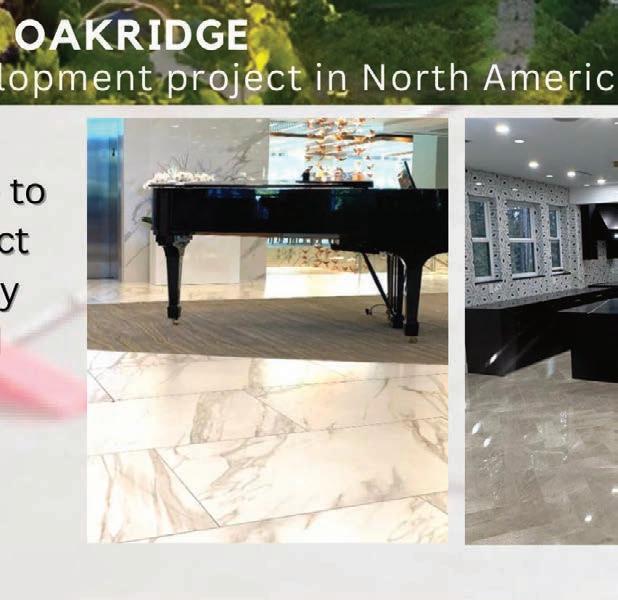
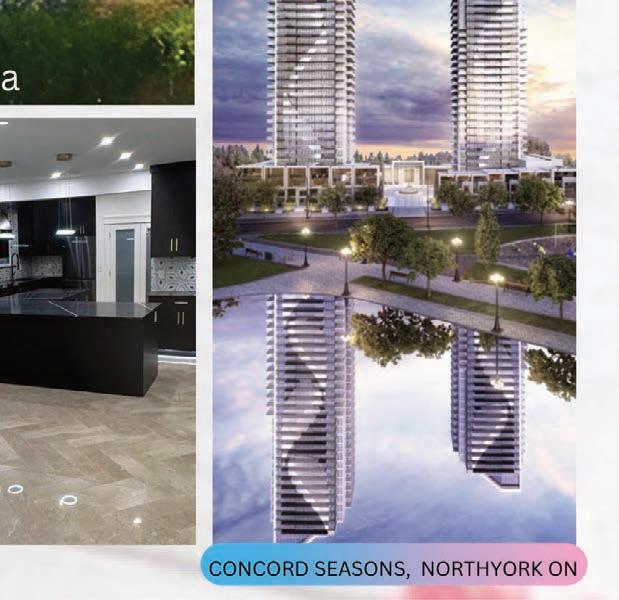
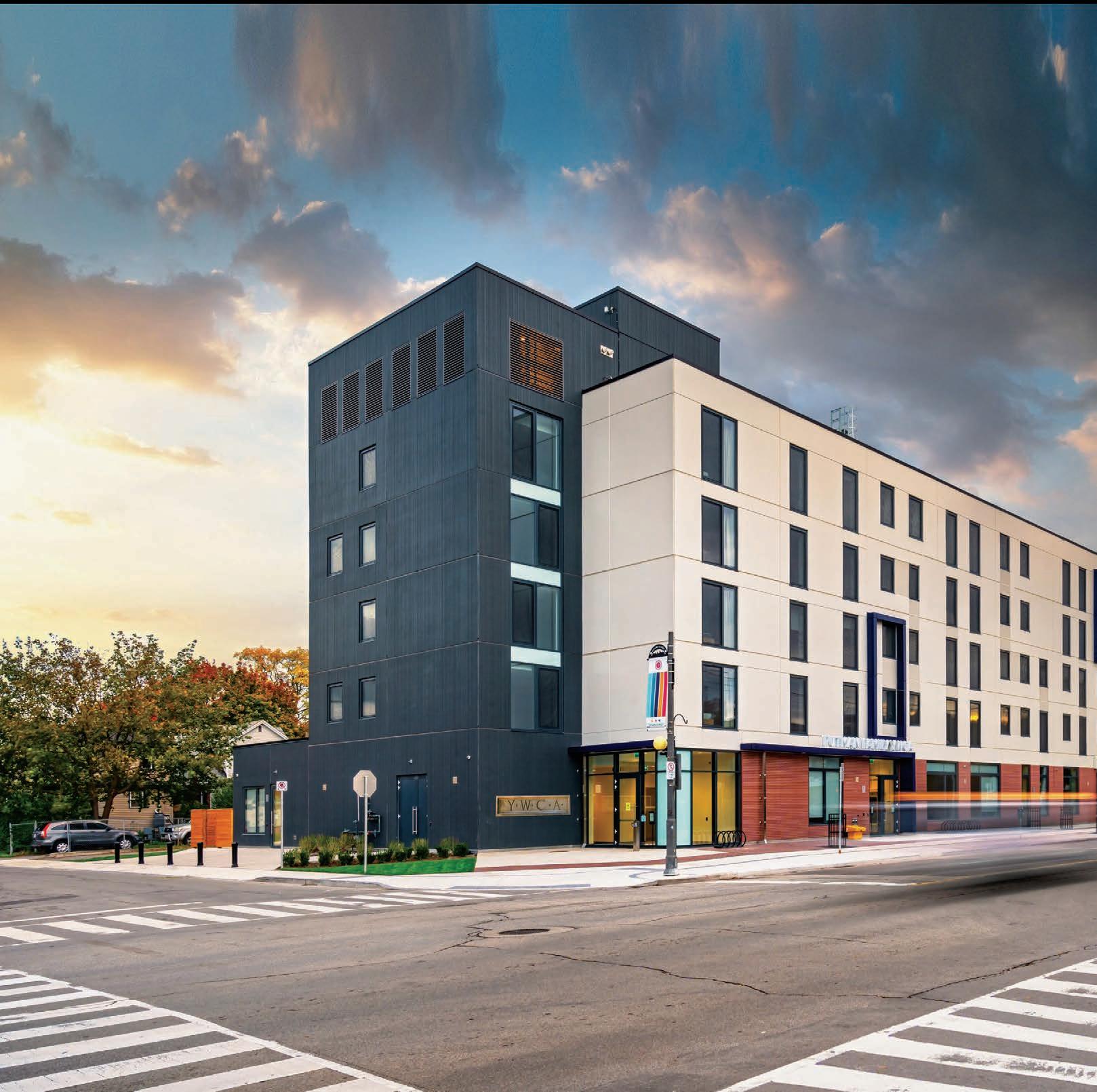
Contact us to discuss how Elevate Roofing Systems can enhance your next project:
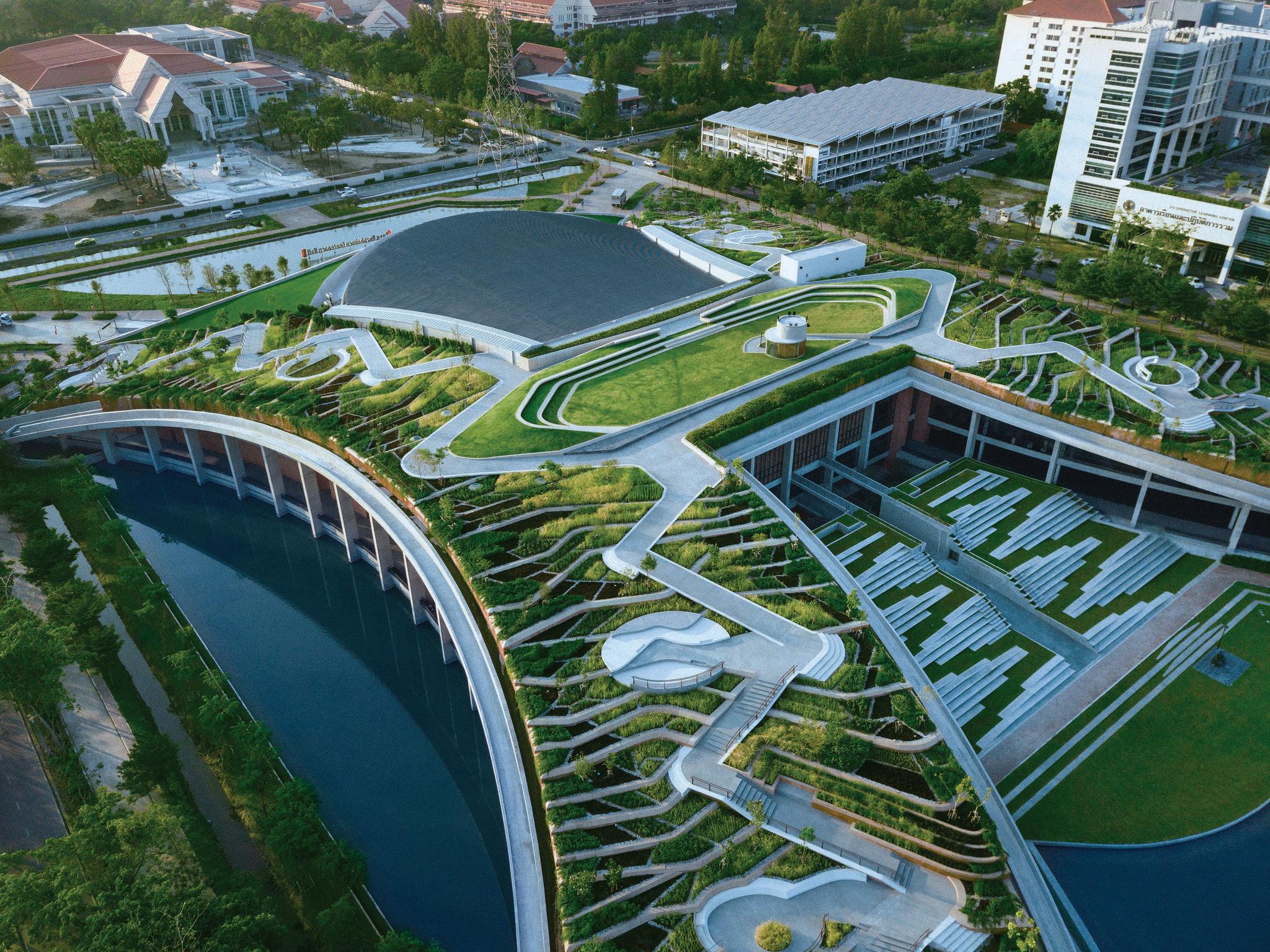
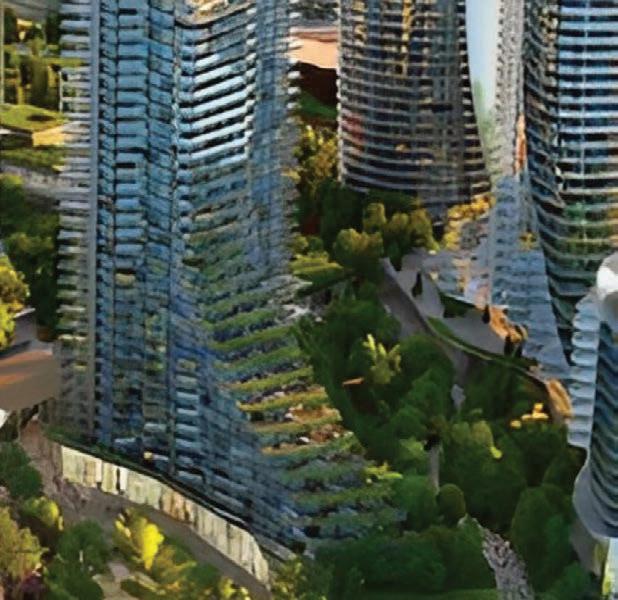
Asia's largest urban rooftop garden at Thailand’s Thammasat University protected by UltraPly TPO TM
Connecting architects, ideas, & communities.
Revery Architecture’s innovative designs continue to enrich lives and cultivate joyful connections.
The window industry embraces both efficiency and aesthetics whole-heartedly with its 2024 offerings.
Appliances are reaching unprecedented heights in tech and innovation, pushing the boundaries of what was once thought possible.
Versatility and seismic code shifts fuel a surge in demand for steel building systems.
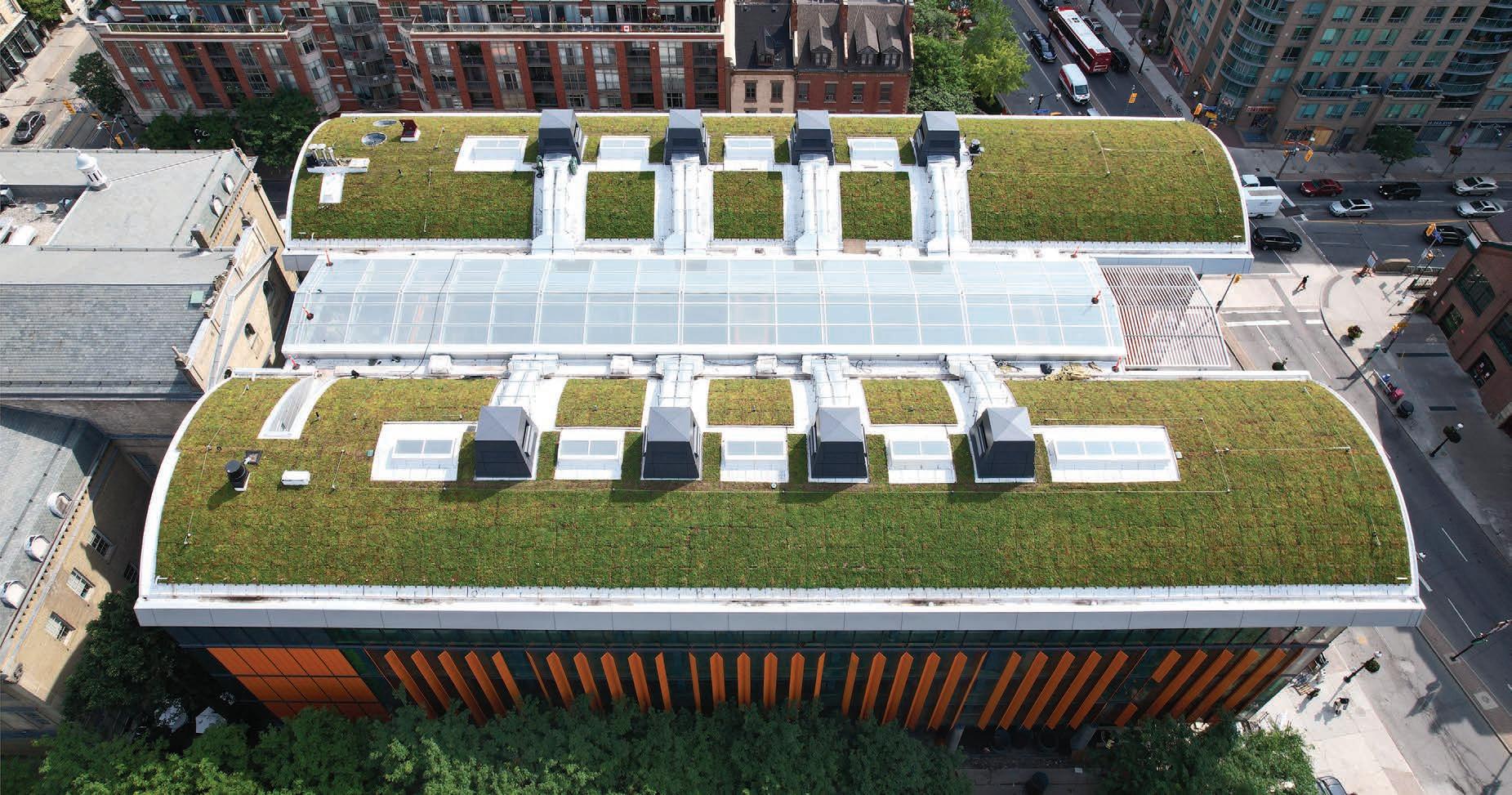
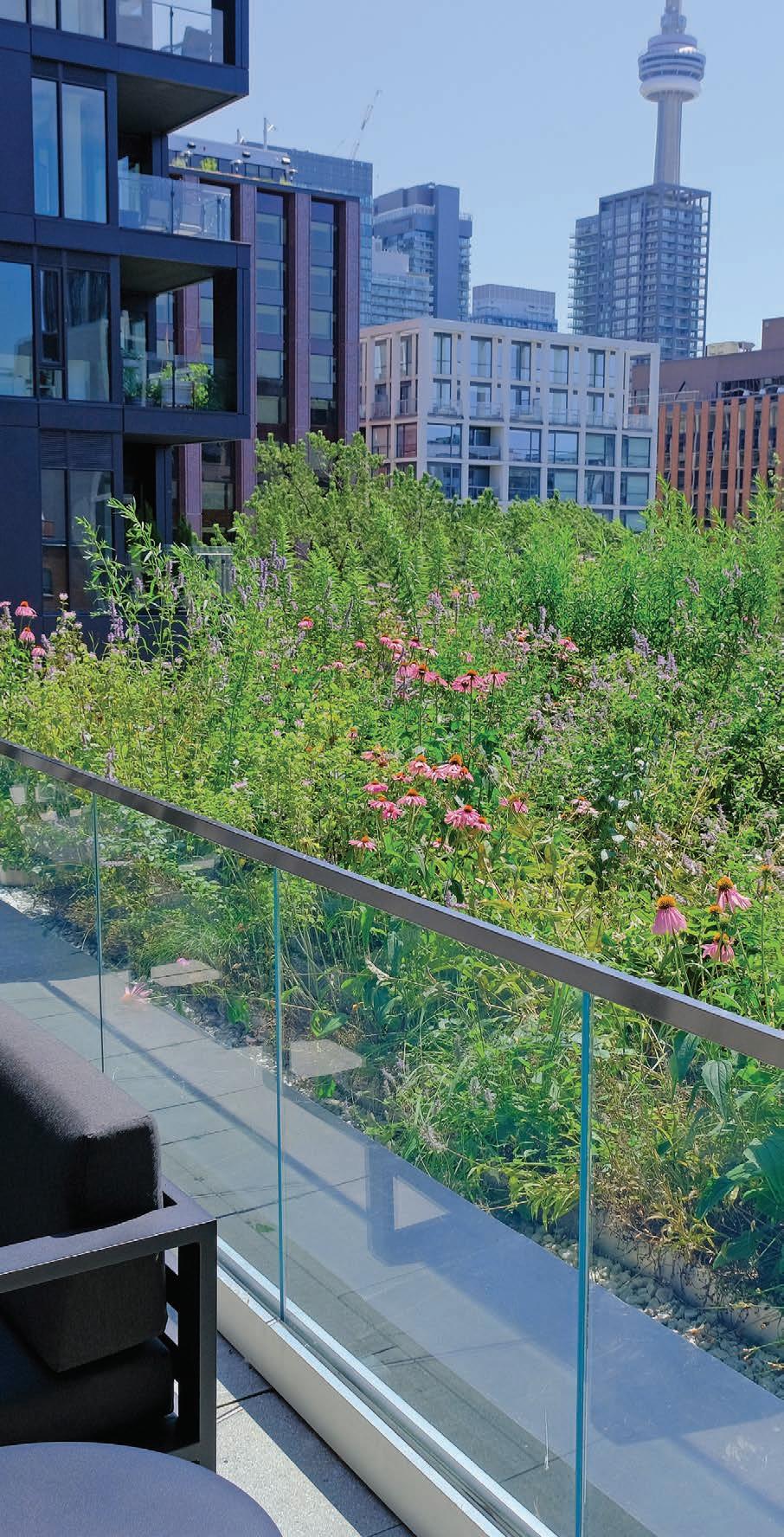
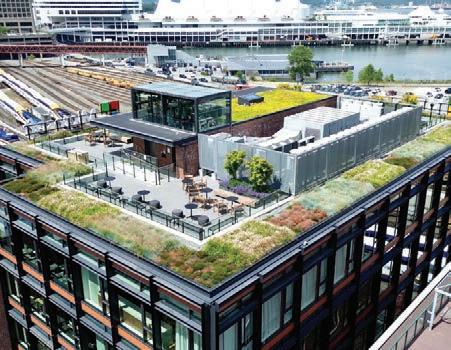
Green roofs and walls are redefining Canada’s urban landscape.
Plumbing products deliver a wave of dynamic trends and sleek designs.
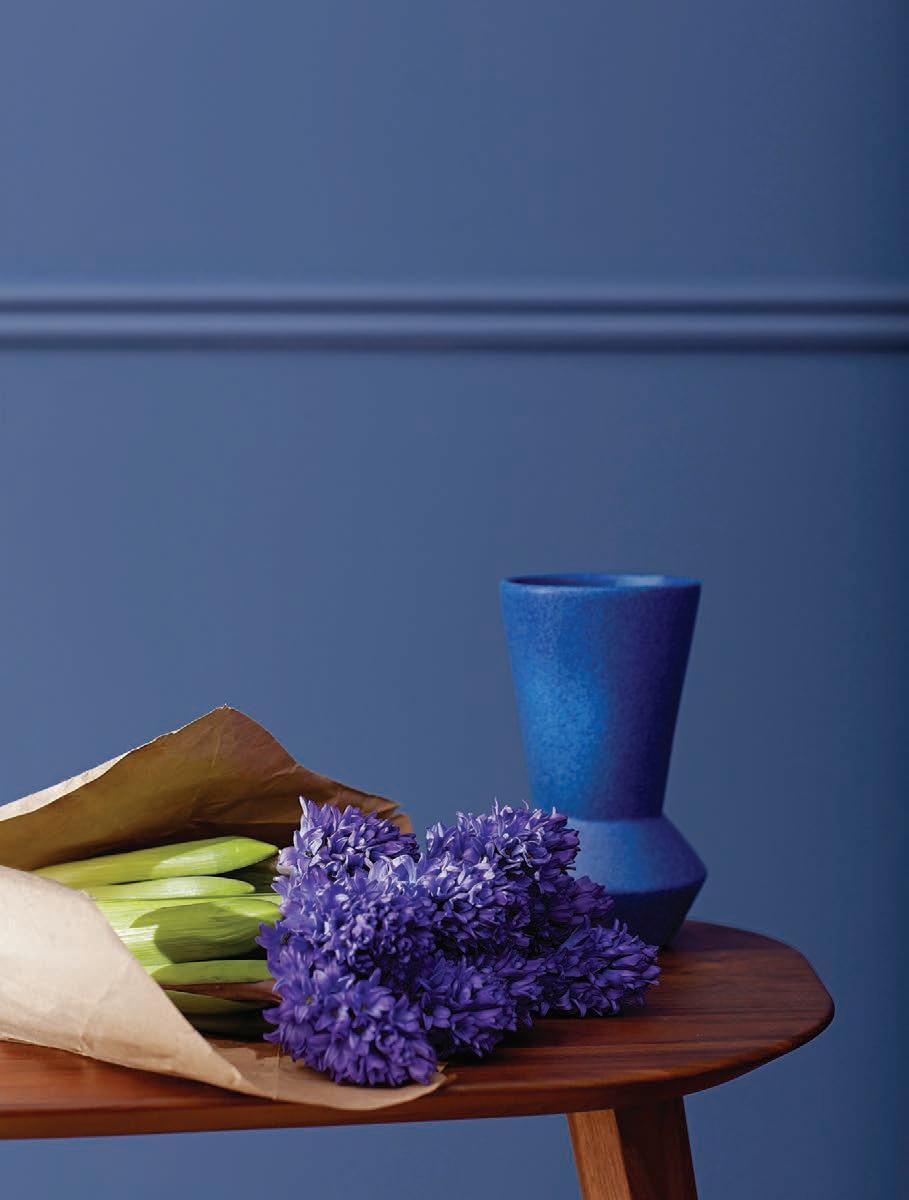
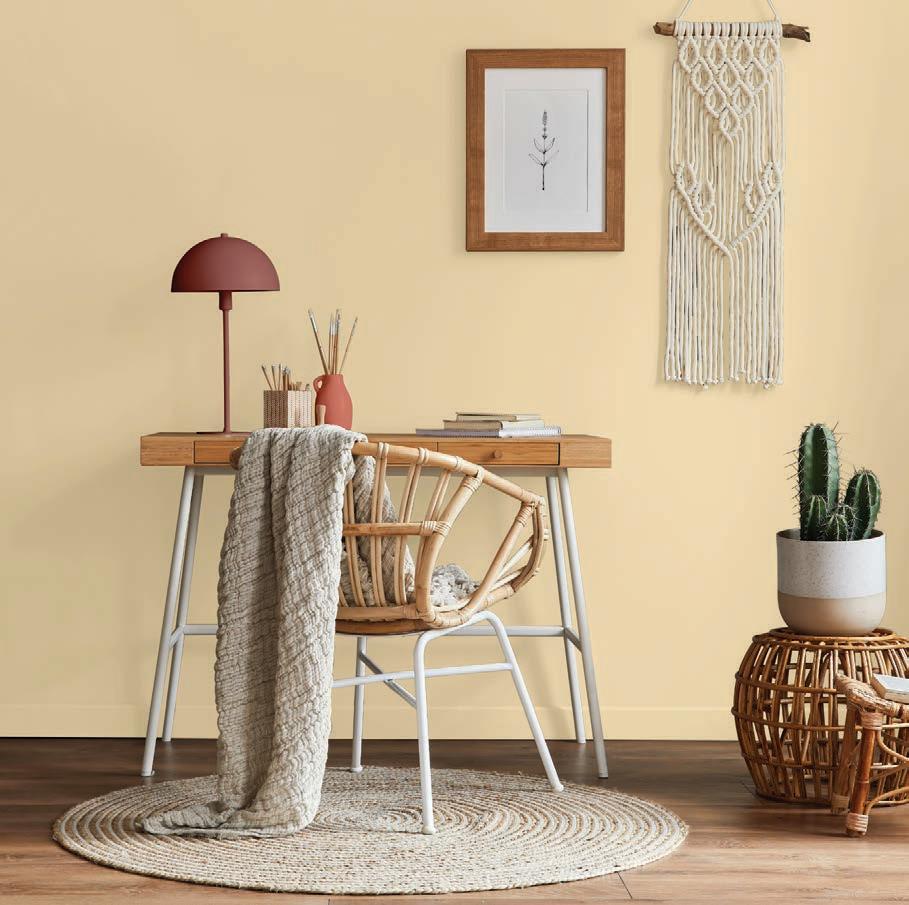
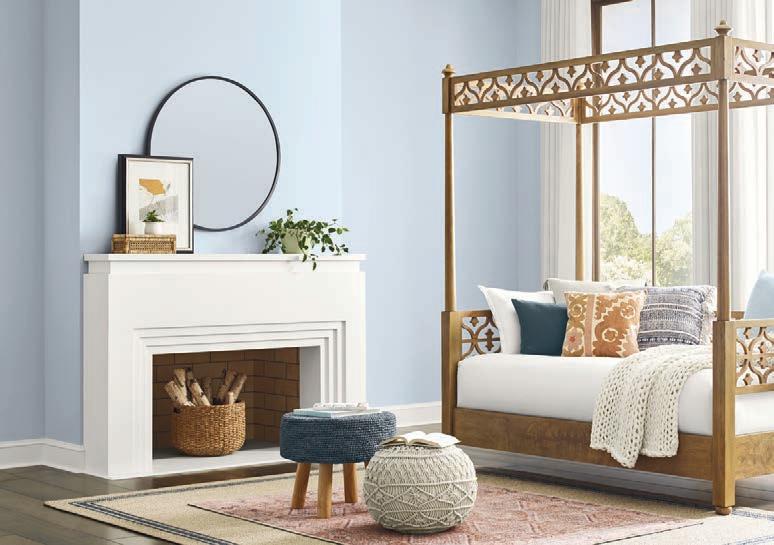
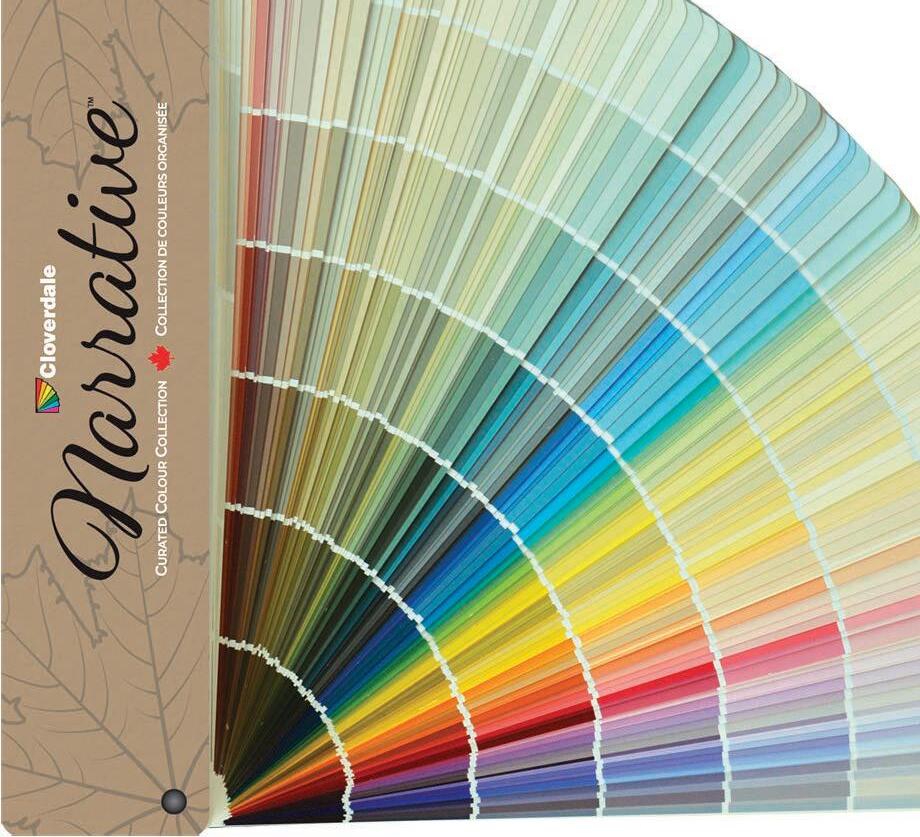
Paint and coatings explore a diverse spectrum, weaving tales of innovation, sustainability, and personal expression in every hue.
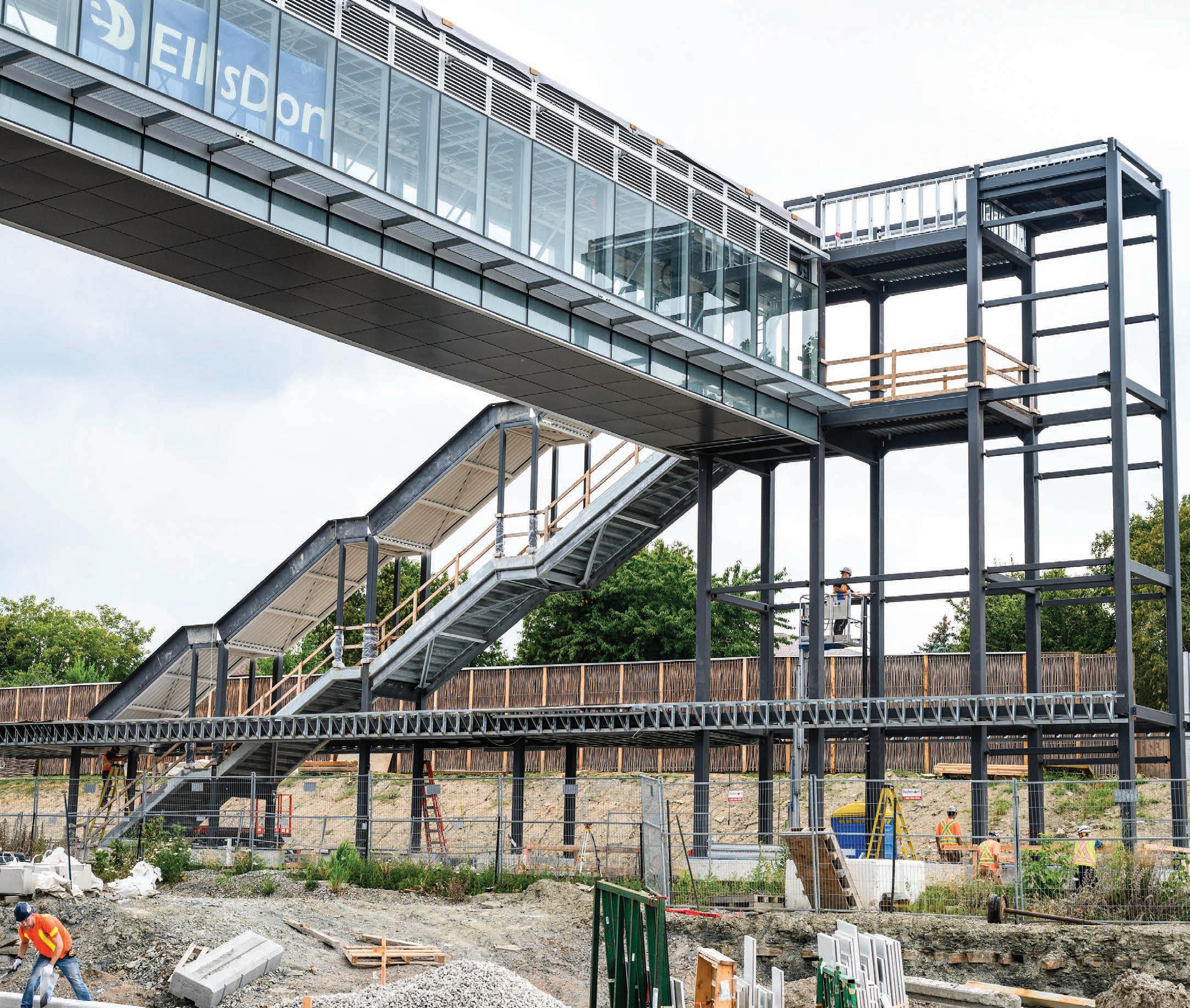
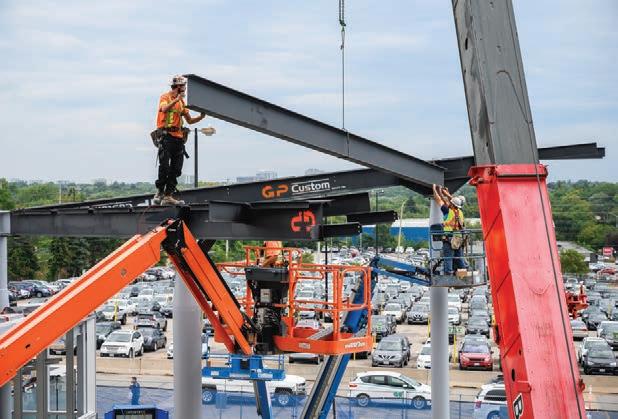
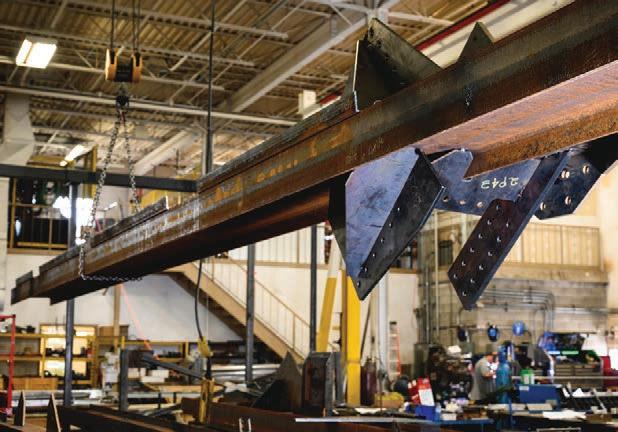
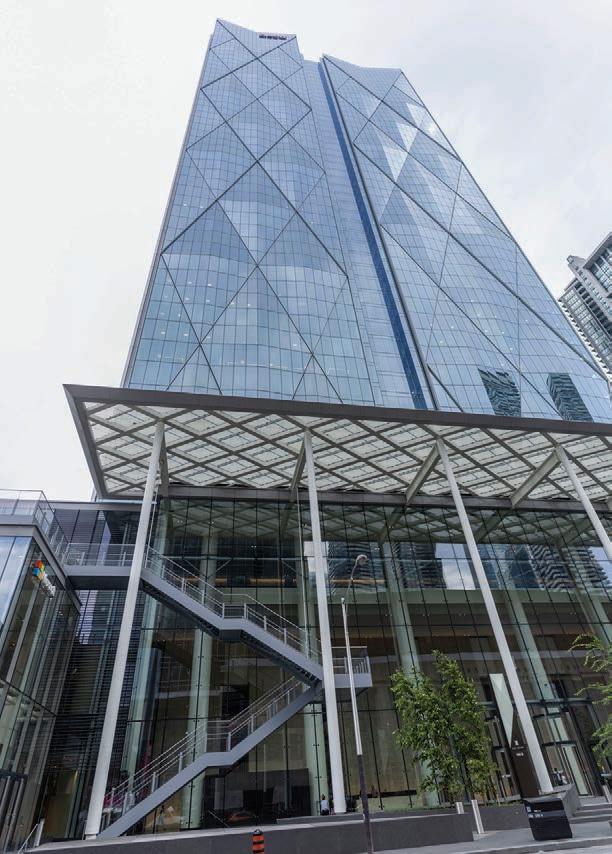
Structural steel continues to wow with its ability to reach great heights.
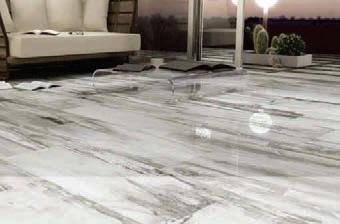
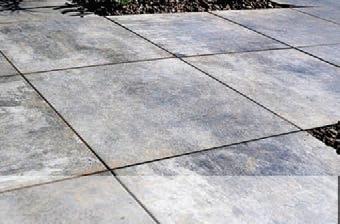
Uncovering the eco-friendly elegance and versatile trends in hard surface flooring.
Growing demand for restoration projects stirs up heightened interest in associated products and services.
EDITOR
Bruckner nbruckner@canadawide.com SENIOR
by GIOVANNA BONIFACE Chief Implementation Officer, RAIC
Connecting Architects, Ideas, & Communities
Join us for Canada’s premier annual gathering for the architectural community at the 2024 Conference on Architecture in Vancouver, B.C. from May 14 to 18, hosted by the Royal Architectural Institute of Canada (RAIC). Over five days, architects, interns, students, and associates will gather in Vancouver to network and discuss issues related to the practice of architecture, celebrate achievements, and socialize.
As the RAIC’s premiere face-to-face event, this year’s conference will be drawing industry leaders from all realms of the design and architecture community. With our commitment to empower Canada’s architectural community we have developed a program that feeds directly into our goal of providing the tools, educational opportunities, and practice supports to advance a built environment that is more livable and sustainable.
The 2024 Conference Program features high-quality learning opportunities that include interactive content, innovative ideas, and engaging discussions. Participants at all career levels will take away insights, inspiration, and ideas for practical application.
The program includes over 50 Continuing Education sessions led by industry experts covering eight (8) streams including:
• Climate Justice and Resilience, Sustainability, Adaptation and Mitigation
• Equity, Diversity, Inclusion and Social Justice
• Health, Safety, and Accessibility
• History, Heritage and Culture
• Housing, Planning and Urbanism
• Indigenous-Led Architecture
• Innovation in Materials, Technology and Construction
• The Practice and Business of Architecture
In addition to education sessions, the conference program also features an Opening Ceremony with renown speakers, a Keynote Lunch, the RAIC Expo on Architecture, and events, including architectural tours, studio crawls, the RAIC College of Fellows and Syllabus Graduates Convocation, and the RAIC Presidents Dinner – Celebration of Excellence, among others.
The opening ceremony will feature a keynote speech by James P. Cramer, Hon AIA, Hon IIDA, from the Georgia Institute of Technology School of Architecture. Cramer will discuss “7 Lessons on Agility Leading to New Success and Significance,” which will focus on the future of the procession.
The keynote lunch, organized by the RAIC Foundation, will be centred around the current challenges faced by women in architecture. While the profession is moving towards achieving gender parity goals, women in architecture still encounter difficulties in their education, work, and career advancement. The event aims to facilitate a discussion on
diversity, equity, and inclusion to better understand how the profession can support women in architecture. This inter-generational panel brings together architects Camille Mitchell of SvN and BAIDA (Toronto), Marie-Odile Marceau of McFarland Marceau Architects (Vancouver), architectural editor Elsa Lam of Canadian Architect and BEAT (Toronto), and Eladia Smoke (Smoke Architecture and the RAIC Indigenous Task Force).
The Architecture Expo provides an opportunity to connect with the architectural community and engage with decision-makers from various organizations. Whether you attend as a guest at the free afternoon session or as part of your conference pass, the expo is a great place to gather, learn, share ideas, and explore the best products and services available to the industry.
The Studio Crawl offers a unique opportunity for conference attendees and the public to visit the offices of architectural practices in the Railtown area. Please visit our conference website for a list of participating firms.
The RAIC Convocation Ceremony is a longstanding tradition hosted by the College of Fellows for Syllabus Graduates and includes an induction ceremony for the 2024 Fellows and Honorary Fellows.
The President’s Dinner will celebrate award-winning architecture and acknowledge those who exemplify excellence in their work and commitment.
The RAIC Conference on Architecture offers a unique opportunity for architects, interns, students, and associates from across Canada to connect, learn, and grow together.
For more details regarding the 2024 RAIC Conference on Architecture visit the conference website.
ARCHITECTURAL POETRY In Motion
Revery Architecture’s innovative designs continue to enrich lives and cultivate joyful connections
n the world of architecture, there is form and function, and then there’s Revery – a name synonymous with dreams, vision, and an unwavering commitment to architecture that positively influences people’s emotions. The story of Revery Architecture is a testament to the pursuit of extraordinary design rooted in inclusivity and joy.
The story began with Bing Thom Architects, founded in 1989 by the visionary Bing Thom. Following Bing’s passing in 2016, the torch of this architectural legacy was handed to Venelin Kokalov. Hailing from Bulgaria, Kokalov’s creative journey started with co-founding a successful architectural studio in his homeland before coming to Canada in 2002. Thom recognized something special in Venelin and entrusted him to be the studio’s design lead. For the past two decades, Venelin’s creative flair has become fundamental to the firm’s identity.
When the time came, Venelin took the reins and transitioned the firm to Revery Architecture. “I chose a name that I believe articulates our continued vision, ambition, and creative rigour. I believe great works of art start with reverie [Revery],” explains Kokalov. Revery’s design philosophy is best described with the maxim of building beyond buildings, which illustrates the firm’s fundamental mission of community placemaking.
The team is driven by a belief that the built environment should engage with, and positively influence, the community into which it is knit. They are committed to designing meaningful architecture – authentically responsive spaces that stimulate human interactions, engage the senses, improve quality of life, and bring joy. “My mission is to keep the firm focused on what we are about – extraordinary design. My goal is to maintain an atmosphere of creativity and happiness from great work in the studio,” says Kokalov.
Revery is a Vancouver-based firm with international reach. The team of 45 hail from 17 countries, and while the design studio has deep roots in Vancouver, a service-based, agile approach has led the firm to establish satellite offices in Hong Kong, Washington, DC, and Milan.
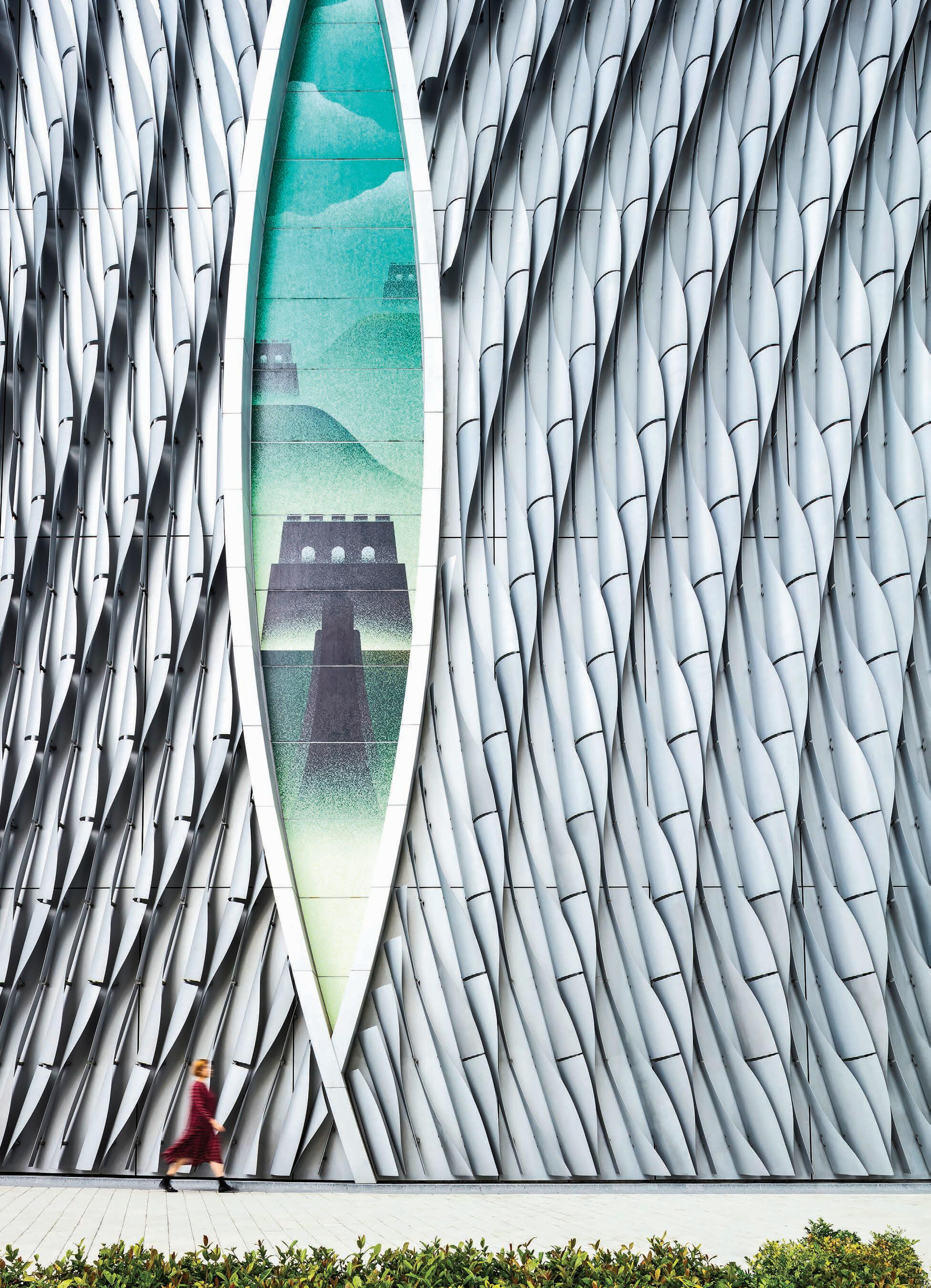
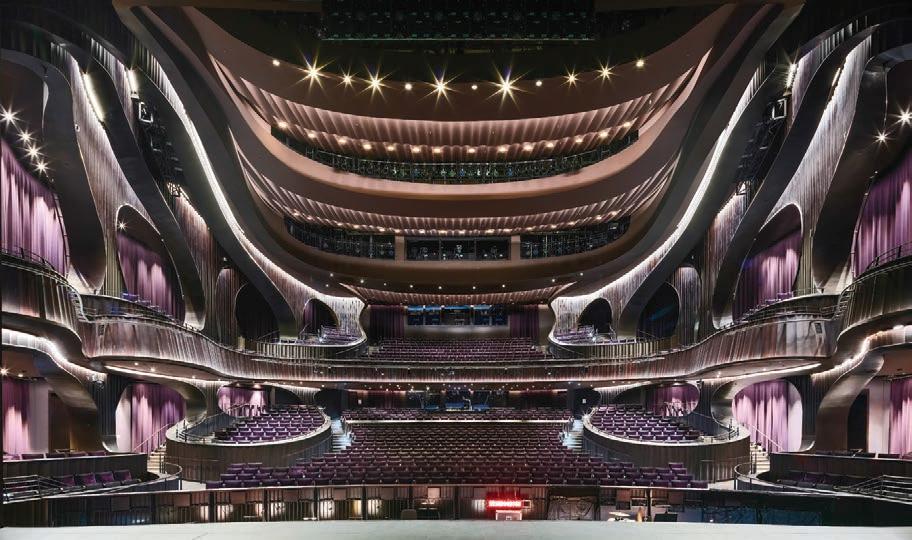
Projects like Xiqu Centre and the University of Chicago Campus in Hong Kong stand tall as testaments to Revery’s ethos. Xiqu Centre helped establish the West Kowloon Cultural District, creating a sanctuary for the preservation and evolution of Chinese opera, while also providing the community with an “urban living room” in the form of a covered plaza that is naturally ventilated and open to the public 24/7. Meanwhile, the award-winning University of Chicago Campus in Hong Kong transformed a challenging, abandoned site with a difficult history into an oasis of wonder, culture, and ecological resiliency for the community.
Closer to home, The Butterfly + First Baptist Church Complex in Vancouver redefines high-rise living, prioritizing wellness, community, and a connection to nature. Addressing social barriers associated with such structures, this project embodies the firm’s commitment to integrating nature and fostering human connections across all their endeavours.
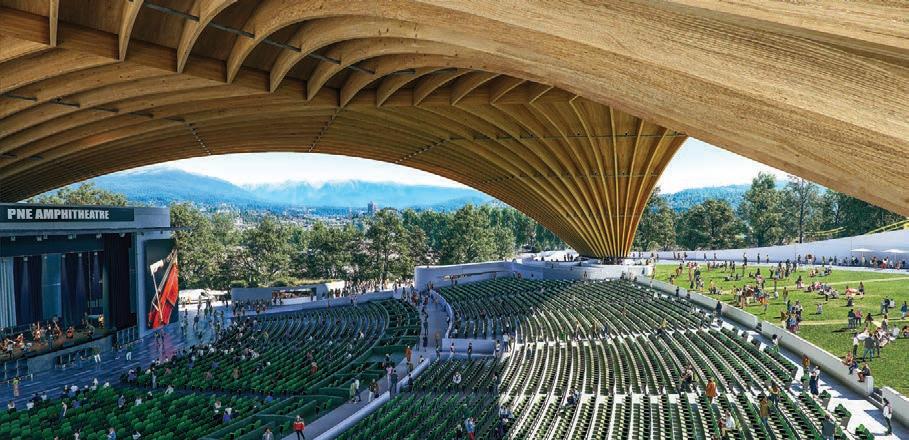
Another notable project, the PNE Amphitheatre renewal, epitomizes Revery’s knack for transforming limitations into opportunities. Tasked with creating a covered venue for 10,000 attendees without obstructing Vancouver’s scenic mountain views, the firm devised a precedent-setting solution. They pioneered a colossal mass timber starburst arch roof spanning 105 metres, reimagining a traditional concrete shell in a renewable, acoustically beneficial material. “We wanted to create a unique experience for both the audience and performers, in a world-class amphitheatre. Our architectural solution was an elegant structure that will cover the amphitheatre, gracefully touching down into the landscape at three points. This gesture will frame vistas to the mountains and the surrounding context, creating transparency at the human level and an intimate atmosphere under the warmth of the wood,” says Kokalov.
Today, at the helm of Revery’s leadership stands a team that’s more than just executives – they are the architects of the firm’s success. All 12 leaders are united by a common purpose – to create extraordinary buildings that resonate with the soul.
While the firm has achieved countless accolades and groundbreaking projects, it’s this unwavering commitment to technical excellence and inspiring design that truly encapsulates the spirit of Revery. Revery Architecture isn’t just about creating spaces; it’s about crafting experiences, nurturing connections, and etching joy into the very fabric of our built environment.
“At Revery we passionately believe in social sustainability and the social mission of architecture. Each of our projects is unique. Each of our projects has different human agendas but with one purpose: to bring joy and well-being. For us, it doesn’t matter if we are designing a theatre, a concert hall, a library, a residential tower, or a piano, we always create new typologies. We always push the boundaries. We always want to improve the way people live, improve the quality of life, and help people create lasting memories,” explains Kokalov. A
University of Chicago Campus, Hong Kong
PNE Amphitheatre, Vancouver, B.C.
Xiqu Centre, Hong Kong
School of Sustainable Energy Engineering, Simon Fraser University, Surrey, B.C.
We’re finding low-carbon energy in unlikely places
Like biogas captured from compost to create Renewable Natural Gas1 (RNG). It’s a low-carbon2 energy that can be used in homes and businesses across the province—and we’re adding more to our supply every year.
Our gas system can provide RNG to buildings and developments to reduce greenhouse gas emissions. This means buildings can meet strict emissions guidelines without expensive upgrades or retrofits.
Find
Find out more about RNG at fortisbc.com/rngbuild.
Connect with us @fortisbc
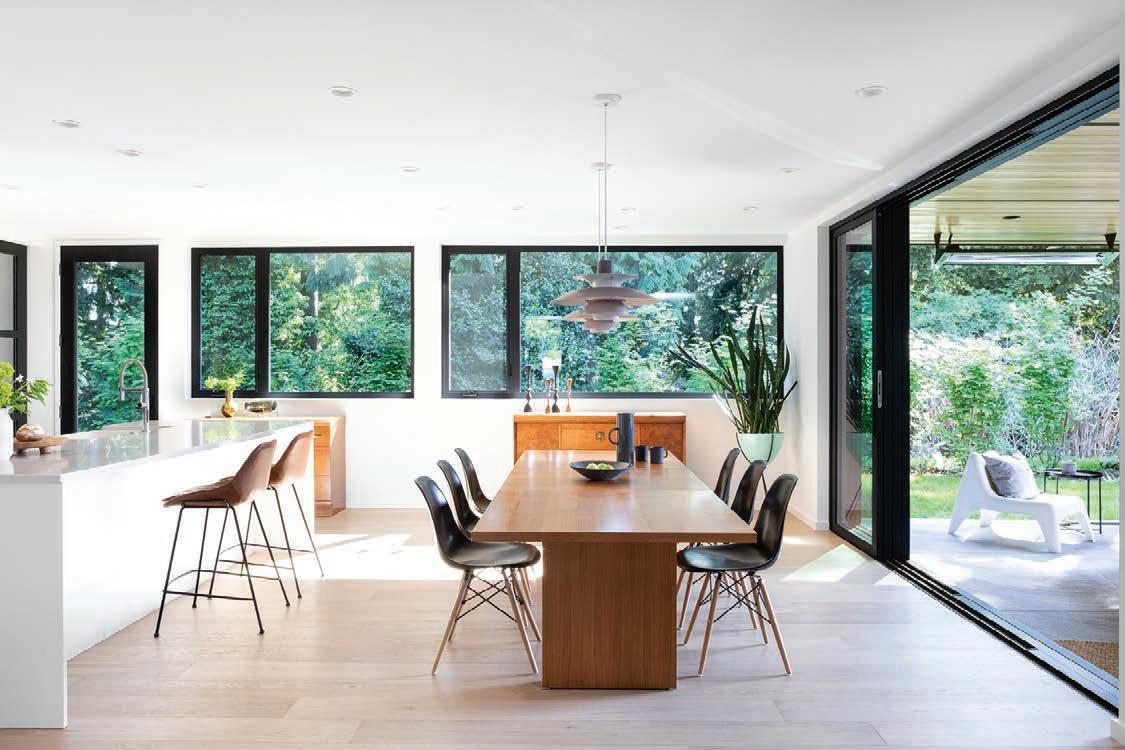
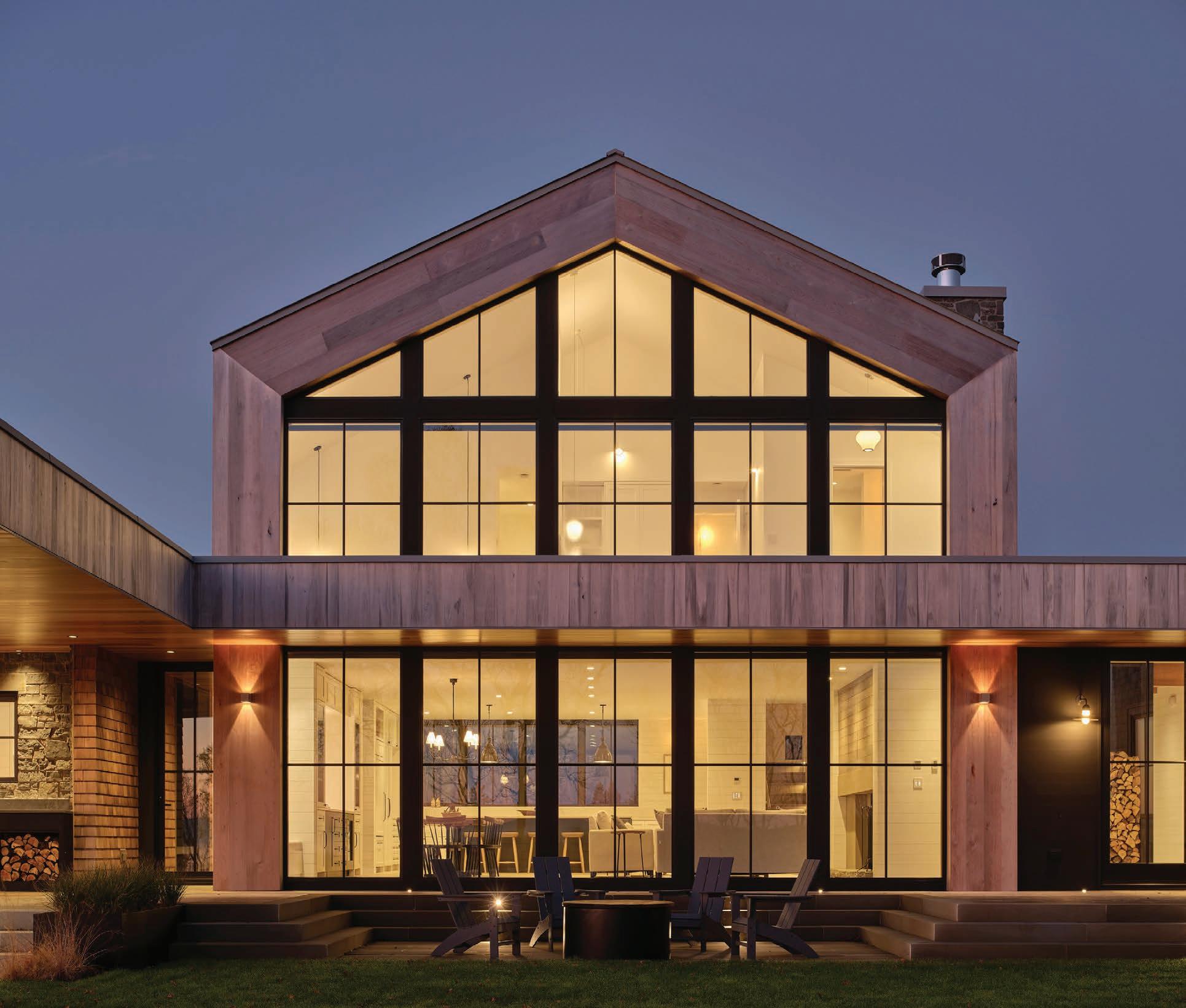
WEST COAST CONTEMPORARY LINE
A custom home build is quite often the single largest investment in one’s life. This is a tremendous responsibility to entrust to the construction community.
Understanding this concept and exceeding customers’ expectations are what Westeck strives for and is at the core of the Westeck culture.
BIG PRODUCTS FOR ALL SIZES EMBRACE THE PATIO EXPERIENCE INDOOR/ OUTDOOR LIVING VANCOUVER 1480 Kootenay St, 1‑877‑606‑1166 CHILLIWACK 8104 Evans Rd 1‑877‑606‑1166
westeckwindows.com sales@westeckwindows.com
Framing The Future
The window industry embraces both efficiency and aesthetics whole-heartedly with its 2024 offerings
by STACEY MCLACHLAN
It’s time to get a little frank: the world of windows hasn’t changed too much in the past year. Energy-efficiency is still top priority, oversized panes continue to be in high demand, and minimalist designs are as popular as ever – in a way, the market in 2024 doesn’t look that different from 2023. That doesn’t mean we’re not excited about what’s going on in the industry right now. Quite the opposite: what we’re seeing for 2024 is an industry that has doubled down on these enduring trends, with manufacturers bringing expertise to their work that creates simple-to-use, highly beautiful products that easily marry form and function.
Here’s how the window industry’s top players are elevating their craft right now… and what the outlook is for the future of this pivotal residentialdesign product.
INVITING NATURE IN
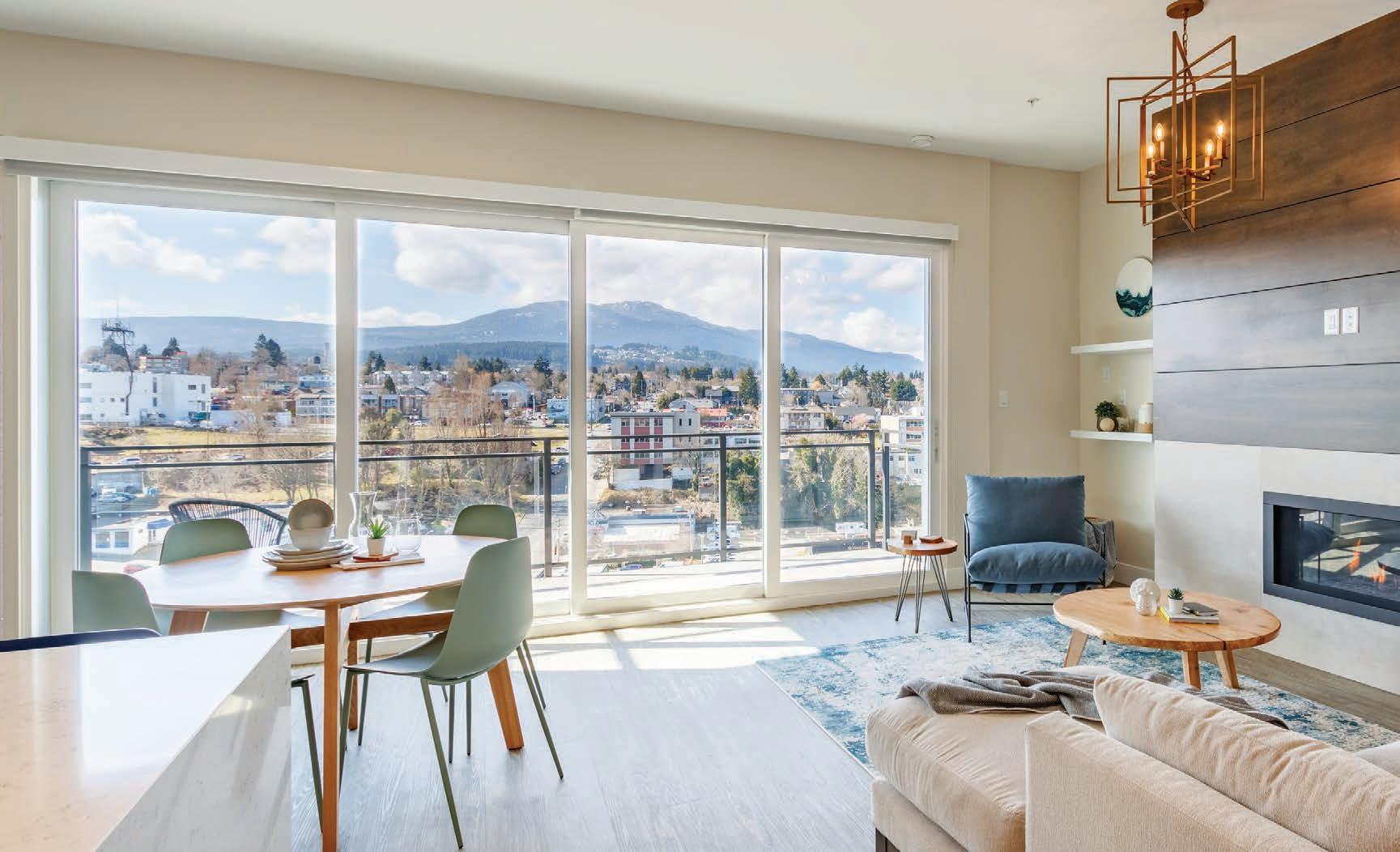
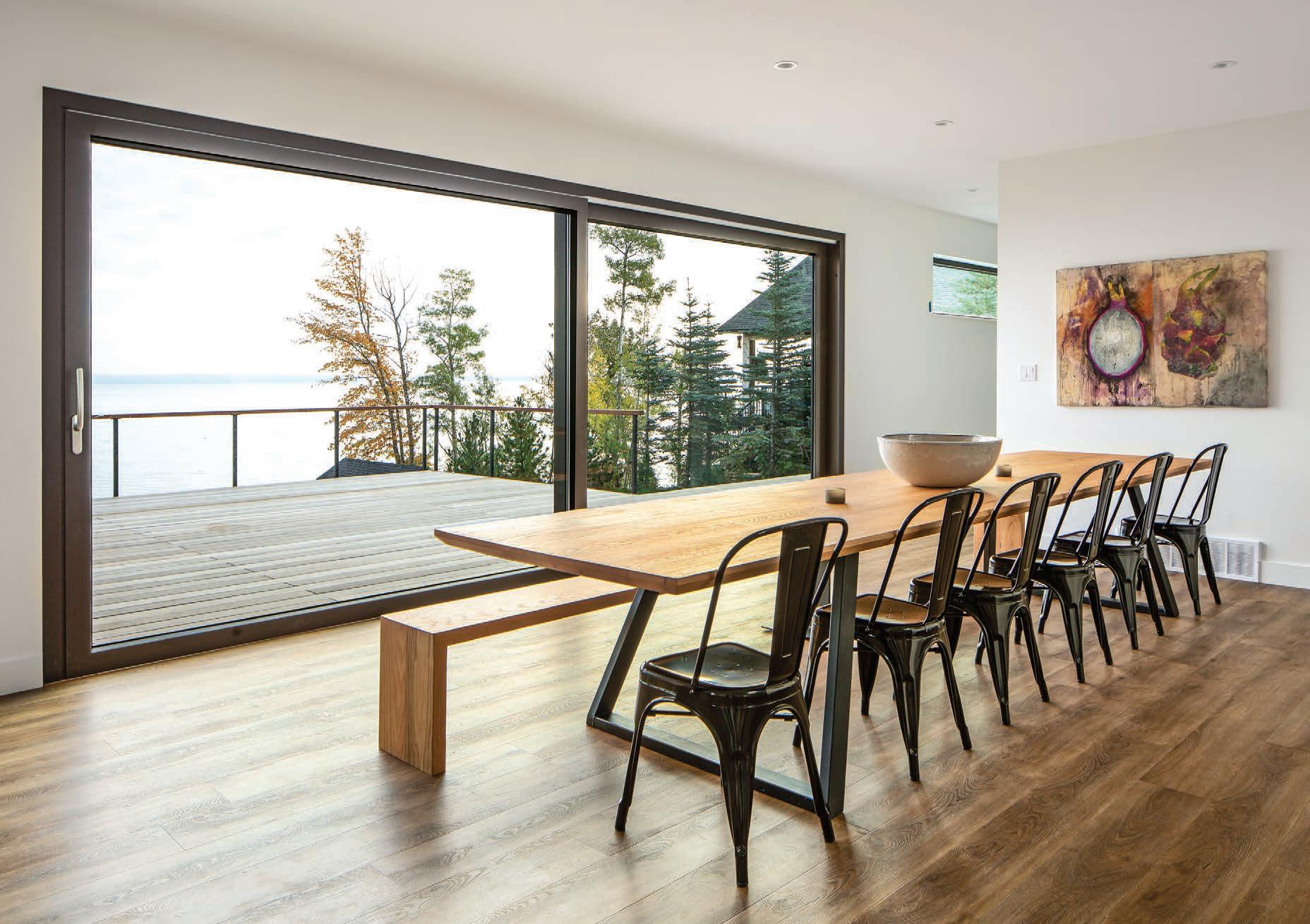
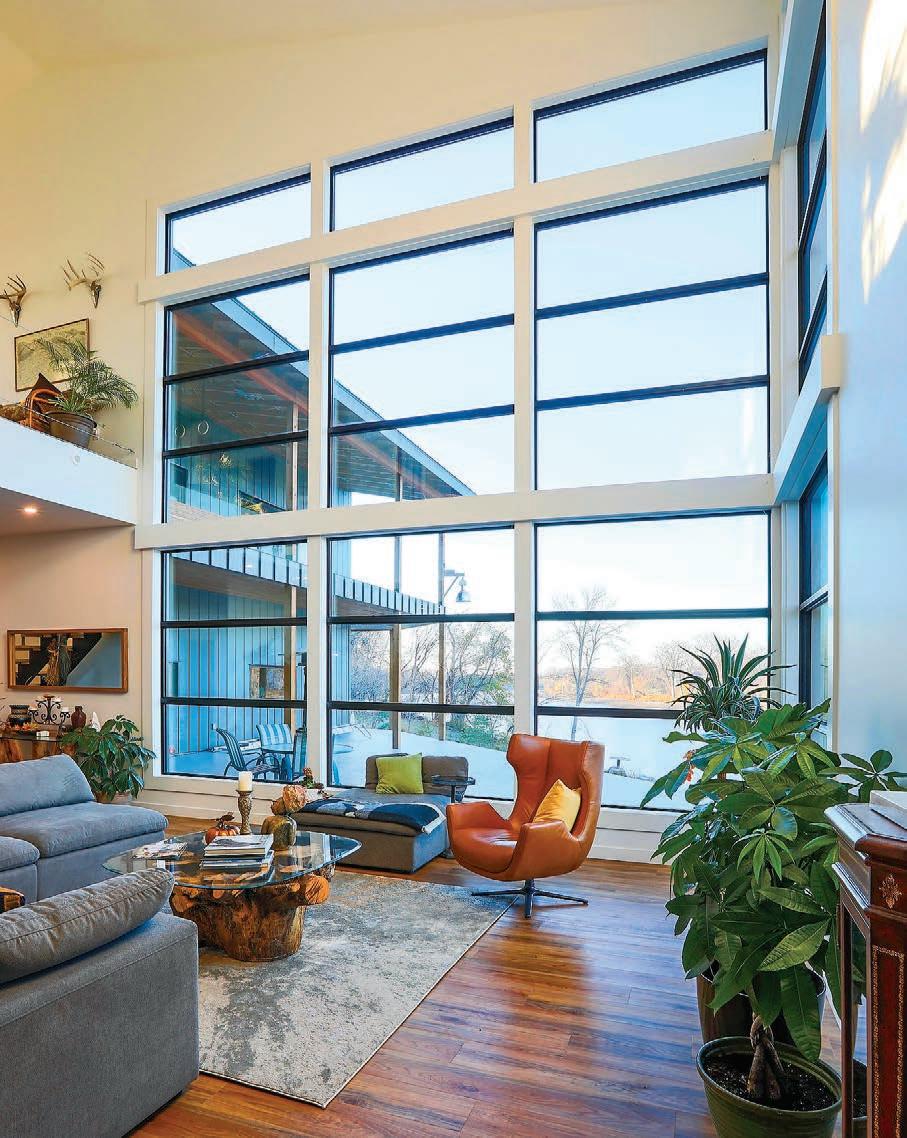
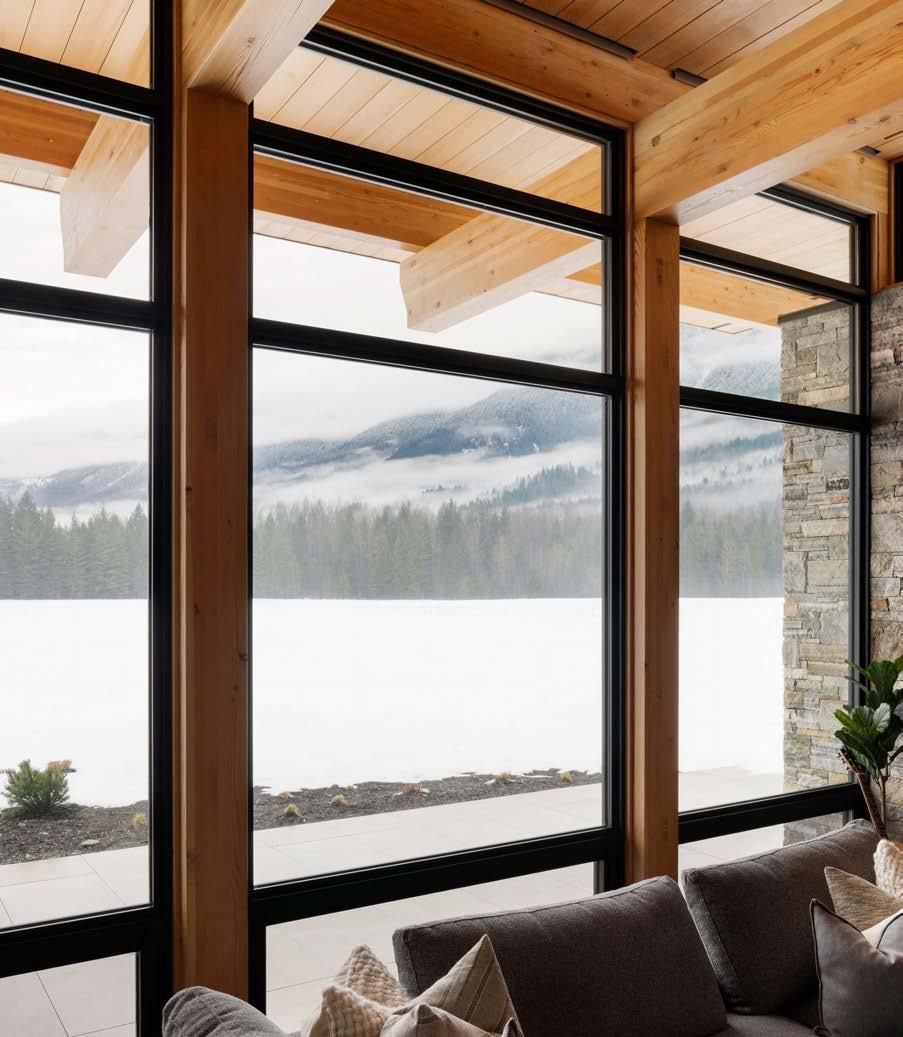
Since the dawn of time, humans have been drawn to nature, so it’s really no surprise that the last few years of architectural trends have focused on the connection of indoor spaces to outdoor ones. Larger windows and doors have been, and continue to be, a top trend in home design. “Homeowners are choosing bigger expanses of glass and minimal hardware for unobstructed views, and this extends to the rising popularity of indoor-outdoor living, with a focus on using large doors to create a seamless connection to the outdoors,” says Christine Marvin, chief marketing and experience officer for Marvin Canada. Appropriately, in 2024 floor-to-ceiling sliding glass doors are still all the rage, designed to create a harmonious blend of indoor and outdoor living.
Lift and slide designs in particular have proved to have staying power. Michael Bousfield, technical
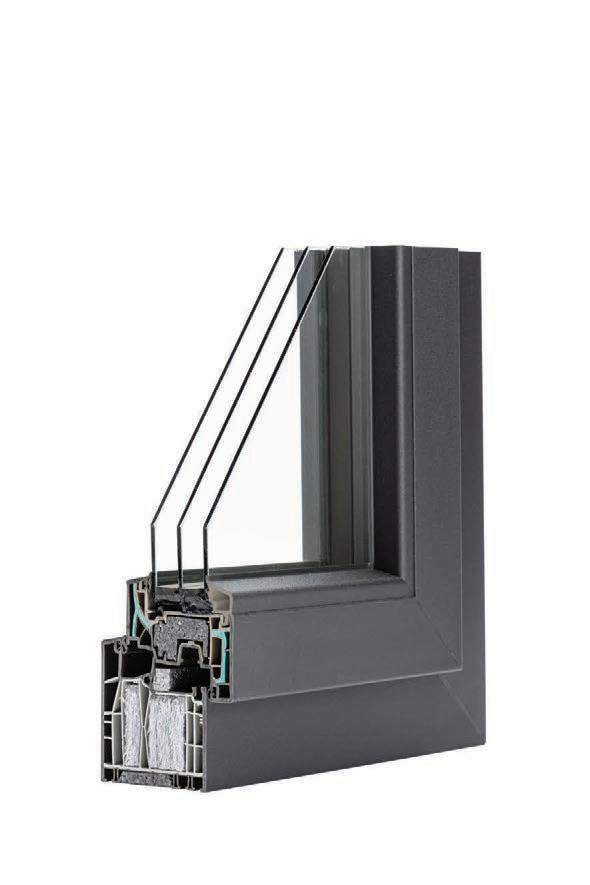
Energy-efficient fibreglass window wall.
director of Cascadia Windows & Doors, reports seeing fewer accordion-style doors lately, likely due to the complex hardware this design requires. “The lift and slide has the benefit of simpler hardware but also larger panel sizes,” says Bousfield.
“More glass and less solid area is valued more by designers and customers,” Bousfield continues.
“When there’s a view to show off, people want large openings and glazing areas”.
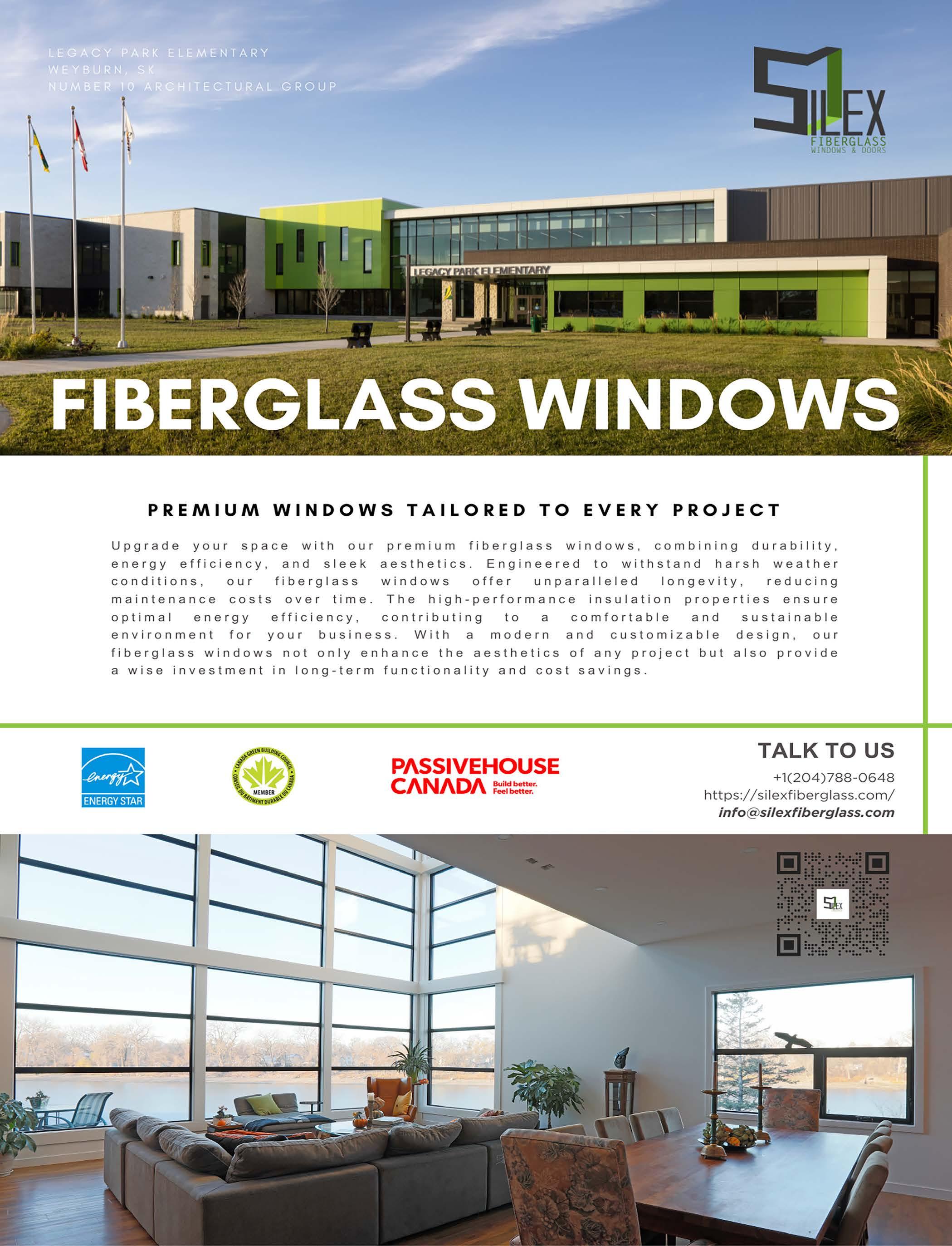
Zhen Liu, owner of Silex Fiberglass Windows and Doors, agrees. “Customers are focused on maximizing natural lights, more sleek designs, slim window profiles, and larger glass panes,” he says.
The Lift and Slide door by Innotech Windows and Doors is one example of the oversized door trend. Enthralling designers and homeowners alike, it’s a design that provides greater performance than traditional sliding doors and can span widths of more than 20 feet. Available in two, three, or four panels, the doors offer greater flexibility, without compromising energy efficiency. “They’re ideal to maximize views and natural light while creating large indooroutdoor spaces,” says Jessica Owen, brand champion for Innotech Windows and Doors. These sorts of products create a symbiotic relationship between private abodes and the great outdoors. And beyond their aesthetic allure, window-doors serve as conduits for natural light and promote improved air circulation.
Big windows don’t just look nice: they can make inhabitants feel good, too. “We know that natural light has the power to elevate moods, regulate daily rhythms, support our physical health, and more,” says
that allow for larger, high-performing windows and doors, there has been a consistent demand for more glass, more views, and more light at home.”
TECH TALK
In addition to the demand for large-scale windows, Marvin notes that homeowners are gravitating toward automation features, particularly on large doors and skylights, making these easy to operate at the push of a button or through a mobile app. “We’re
seeing an increased desire for smart technology and automation in homes,” she says. “I’m excited about how it will evolve in new and exciting ways throughout the next year.”
Smart-home options like windows that can be open and closed even when a homeowner is away through an app may be popular in 2024. Smart glass is another high-tech option making an impression right now, with products able to adapt to climate conditions to provide insulation and translucency control.
Windows + Doors for Passive House Projects
Innotech Windows + Doors is a Canadian manufacturer of high-performance windows and doors. The Defender 88PH+ System combines decades of fenestration knowledge to deliver a robust window and door system that is not only Passive House Institute certified, but that also delivers the air, water and structural performance required for highly sustainable housing developments.
innotech-windows.com
Universal Series high-performance fibreglass windows from Cascadia Windows & Doors.
EVOLVE IN VANCOUVER, BC
Passive House Multi-Family Project by ZGF Architects and Peak Construction.
Thermochromic glass, for instance, responds to rising temperatures with intensifying tints, transforming windows into dynamic, responsive elements of home design. Window treatments have gotten “smarter” this year too: on the market, you’ll now find motorized blinds and automated shades which seamlessly integrate with smart home systems, offering homeowners unprecedented control over ambient light, privacy, and temperature.
MAKEOVER MANIA
The tight real estate market is likely to inspire an increased interest in renovations – if homeowners can’t move, they may just be keen to improve their existing properties. “We expect homeowners will be making thoughtful changes at home to support and extend all the ways they are using every bit of their spaces,” says Marvin.
She predicts home upgrades that of course include windows, with renovations that incorporate bigger expanses of glass, narrow frames, and minimalist hardware, along with increasingly popular automation features, as mentioned above, for ease of operation.
EFFICIENCY IS EVERYTHING
In an era marked by environmental consciousness, sustainability is naturally a recurring theme for the window industry. As homeowners and designers become acutely aware of humanity’s carbon footprint, there’s a mass gravitation towards energy-efficient doors and windows.
All of which is to say, at this point, energy efficiency isn’t really a trend – rather, it’s a way of life now for the building industry. But year by year, exciting new technological developments continue to arrive to change the game for the better. “The Canada Greener Homes program is increasing the demand for Energy Star products,” explains Liu. “Everyone’s pushing the limits of performance.” Many manufacturers are also pushing sustainable production, too. “Reducing the environmental impact during the process is a focus now,” Liu says. Luckily, modern homes can style while also embodying responsible, energyconscious living. Energy-efficient windows, equipped with Low-E glass technology and the superior insulation of triple-pane options, are a widely available option that allow consumers to showcase a commitment to eco-friendly living. Fibreglass in particular – renowned for both its strength and sustainability – is emerging as the
Energy-efficient fibreglass window wall.
Aluflam.indd 1
choice of green builders for window walls. “Lots of window systems use aluminum window systems, but it’s not the most sustainable or energy efficient,” says Liu. It’s easier than ever for projects to incorporate best-in-class window products, thanks to newly updated guidelines for lifecycle assessments of windows. These guidelines are substantially strengthening the accuracy and relevance of information reported. “Life cycle assessments previously just didn’t have a level of sophistication to match the product,” explains Bousfield. In previous iterations of these sorts of reports, generic industry materials would be listed and quantified, but without any information about the actual value of those materials. “It was almost a placeholder,” says Bousfield. The new product category rules (PCR), conversely, will produce what Bousfield calls “good, meaningful, and accurate life cycle assessments.”
For design professionals with an interest in this sort of information, this is an exciting change. The Cascadia Clip product (a thermal spacer for interior insulated walls) will be one of the first window products in Canada to publish an environmental product declaration; the brand’s Universal Series windows will follow suit this calendar year.
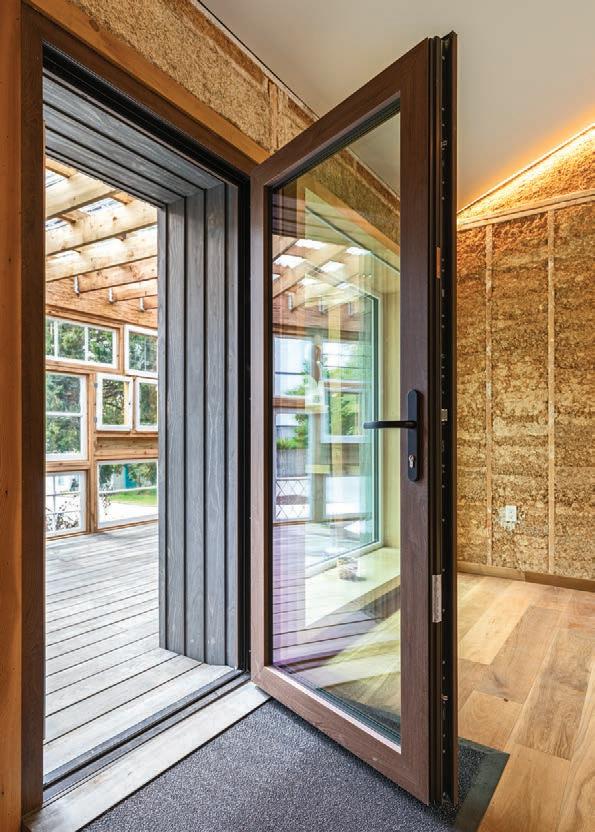
Another highly efficient option for residential homes are Passive House Institute-certified windowdoors. Innotech, for example, makes the Defender 88PH+ Pro terrace doors, which are cool-temperate certified by the Passive House Institute. For any highperformance project where airtightness, thermal performance, and overall durability are important, these sort of glass doors are a great choice.
A PERSONAL TOUCH
Of course, functionality isn’t everything. Homes are not just shelters; they are canvases for self-expression. Custom windows and doors continue to be a popular way for homeowners and architects to personalize a space. Unconventional shapes, modern grilles, and custom colours are all easily acces sible in today’s market. This customization trend underlines the importance of individuality in home design – and offers proof that craftsmanship and personalization can coexist.
While black window frames have been popular for some time, there’s now a bit of a shift back to less high-contrast finishes. “Homeowners and designers are leaning towards serene and calming hues, balanced by warmer earth tones,” notes Marvin. “The combination of light, airy neutrals with natural materials like wood and leather is visually soothing, and aligns with the broader movement towards designing spaces that support better living.”
White, grey, and beige are increasingly popular, though more-so for bigger projects. “Anthracite grey exterior is a popular colour choice for multi-family developments, while black exterior remains popular for single family homes,” notes Owen.
Natural materials are taking centre stage in modern interior design, with wood leading the way. Wooden window frames, in conjunction with this trend, are rising in prominence, bringing both a timeless appeal and sustainable edge. Wood, a renewable resource, aligns with ethical commitments to sustainability, and adds a touch of natural beauty to homes in the process.
In a nutshell, the window industry in 2024 thrives in the balance between enduring design trends, technological innovation, environmental consciousness, and self-expression. Where will we go from here? As this always exciting field evolves, these elements will continue to shape the future of
Defender 88PH+ Pro Terrace doors from Innotech.
HOME On The RANGE
Appliances are reaching unprecedented heights in tech and innovation, pushing the boundaries of what was once thought possible
by LAURIE JONES
Savvy designers and consumers are excited about the range of appliance offerings in 2024 that can make life simpler, or suitably impress friends and clients.
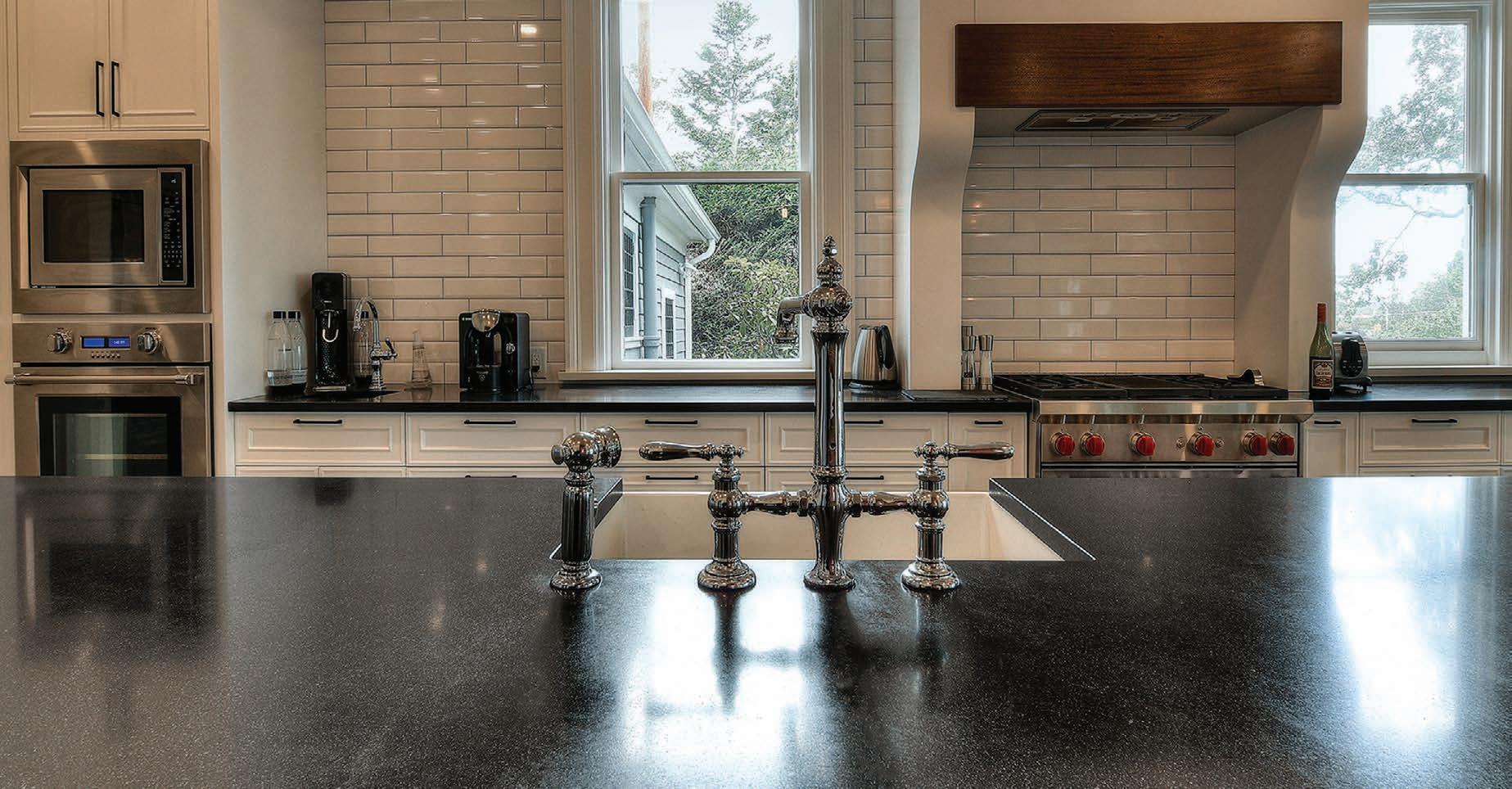
Michael Gnat, director of commercial sales for Midnorthern Appliance, says they are seeing a continued trend towards induction cooking. “It’s a bit of a learning curve to use the products, but once the consumer adapts to it, they’ll wonder how they’ve lived without it,” he says, noting the options include a full-size stove that has an induction cooktop with an electric oven. “The cooktop is what we call full surface induction, where you don’t have designated burners.”
Gnat explains that unlike other surface cooking where there are fixed positions where the pots and pans need to be placed, this new design allows users to put pots anywhere they want. “There are only a few companies that offer full surface induction, but more will be rolling out this option as the next step in cooking.”
Sizes of the units come in 24-, 30-, and 36-inches wide. Gnat says induction is already being used professionally for things like a buffet where dishes are made in front of customers, like custom omelettes.
Another product that continues to gain consumer appeal is ventless dryers, due to significantly improved performance from past models. “In multi-unit residential, a lot of developers are moving towards ventless laundry and it’s not a matter of cost savings because ventless laundry is more expensive than vented laundry. Every builder has told me the reason why they go ventless is because they can eliminate bulkheads in the unit,” says Gnat.
Mark Eglington, president of Euro-Line Appliances Inc., says one of their key products for 2024 is the OpenStage refrigerator – a 24-inch, fully integrated refrigerator with BioFresh drawers by Liebherr Appliances, an industry first innovation designed to revolutionize the residential appliance market. “Imagine a regular dry storage pantry where you have the shelves that pull out so that you can get to all the little items at the back,” he says. “Liebherr essentially emulated that but made it an application of a functioning refrigerator with pullout shelves or drawers. Users can access everything at the back of the fridge without having to push everything else aside to get what they’re looking for.”
The special BioFresh compartments are ideal for fresh fruits and vegetables. “This Liebherr unit offers Hydro Breeze, another new industry leading technology that helps to provide a humidity inside these drawers technology,” he says. “It’s not like the spray you see in a grocery store, but rather Liebherr has patented a technology that looks like a cloud, or fog has been injected into the
BioFresh compartments. It creates a humid environment without actually using moisture or water droplets on the food. That creates an elevated level of humidity inside those doors that fruits and veggies can use to reabsorb and stay fresh longer, reducing wastage.”
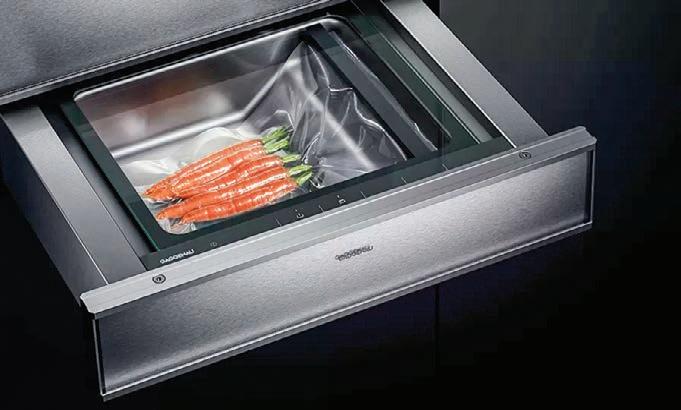
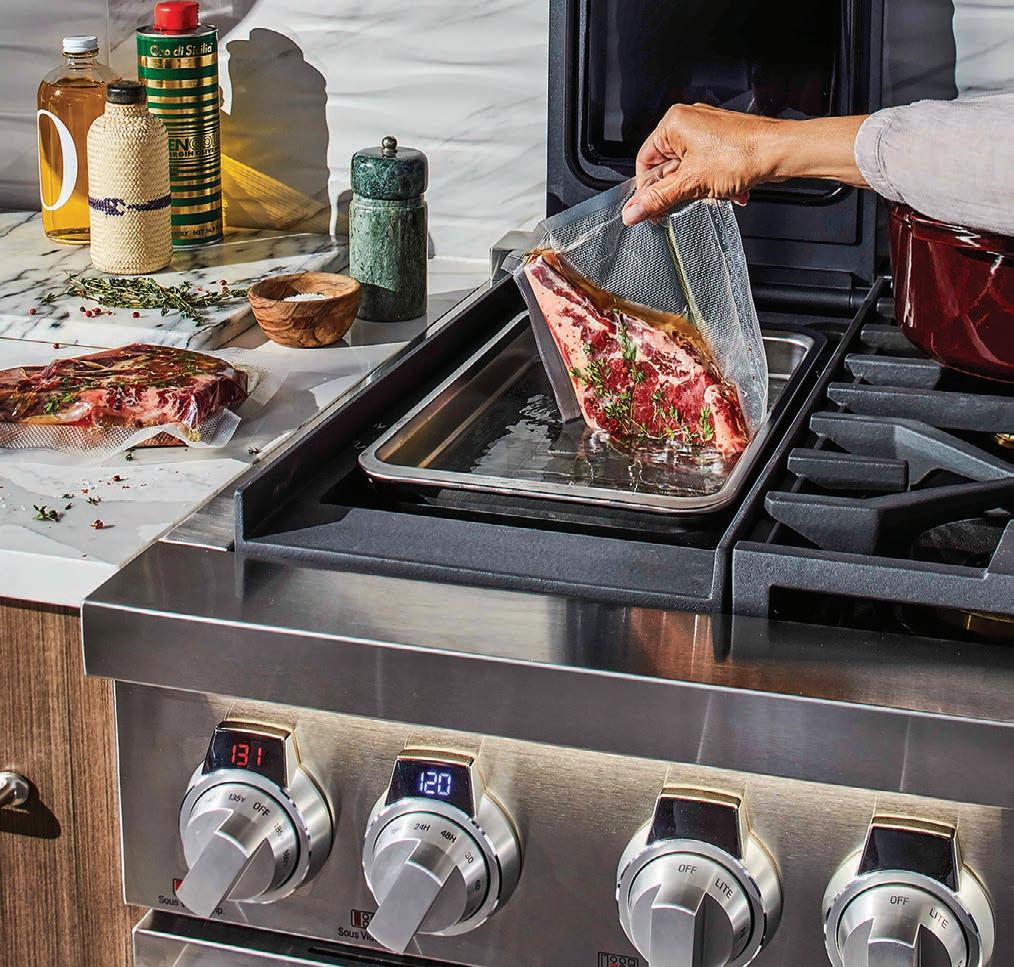
With the rising cost of food, it is more important than ever to preserve foods properly and save on waste. To address this, Midland Appliance now carries the Vacuum Seal Drawers from Gaggenau, Miele, and Wolf that allow consumers to keep food fresher longer by removing air from the packaging. Ideal for preserving leftovers, marinades, and proteins, these drawers come in 24-inch and 30-inch widths and are compact enough to easily fit into any kitchen design.
“Gaggenau was one of the first on the market, introduced in 2017,” says Sylvia McDonald, client relations representative at Midland Appliance. “It offers three levels of seal. Level 1 removes 80 percent of air for delicate items such as baking and berries, Level 2 removes 95 percent for softer foods such as vegetables and fruits and leftovers, and Level 3, the strongest setting, removes 99 percent of air for proteins, marinating, and Sous Vide cooking.”
McDonald explains Sous Vide cooking, French for “under pressure,” originating from the commercial kitchens, is fast becoming a staple in home cuisine. “Food freshness is locked in with your vacuum sealer, then Sous Vide cooked slowly to produce perfect results. Pair your Vacuum drawer with a combi-steam oven Sous Vide function to prepare the perfect meal.” She adds vacuum drawers also come with an external sealing attachment to seal jars and bottles such as olive oil and wine.
The Signature Kitchen Suite has taken Sous Vide one step further with a dedicated station featuring a temperature-controlled water bath for the perfect results. “People can prepare a healthy family meal plan by sealing and Sous Vide in advance. Foods simply have to heated and served.”
Vacuum Seal Drawer from Gaggenau,
Sous Vide cooking.
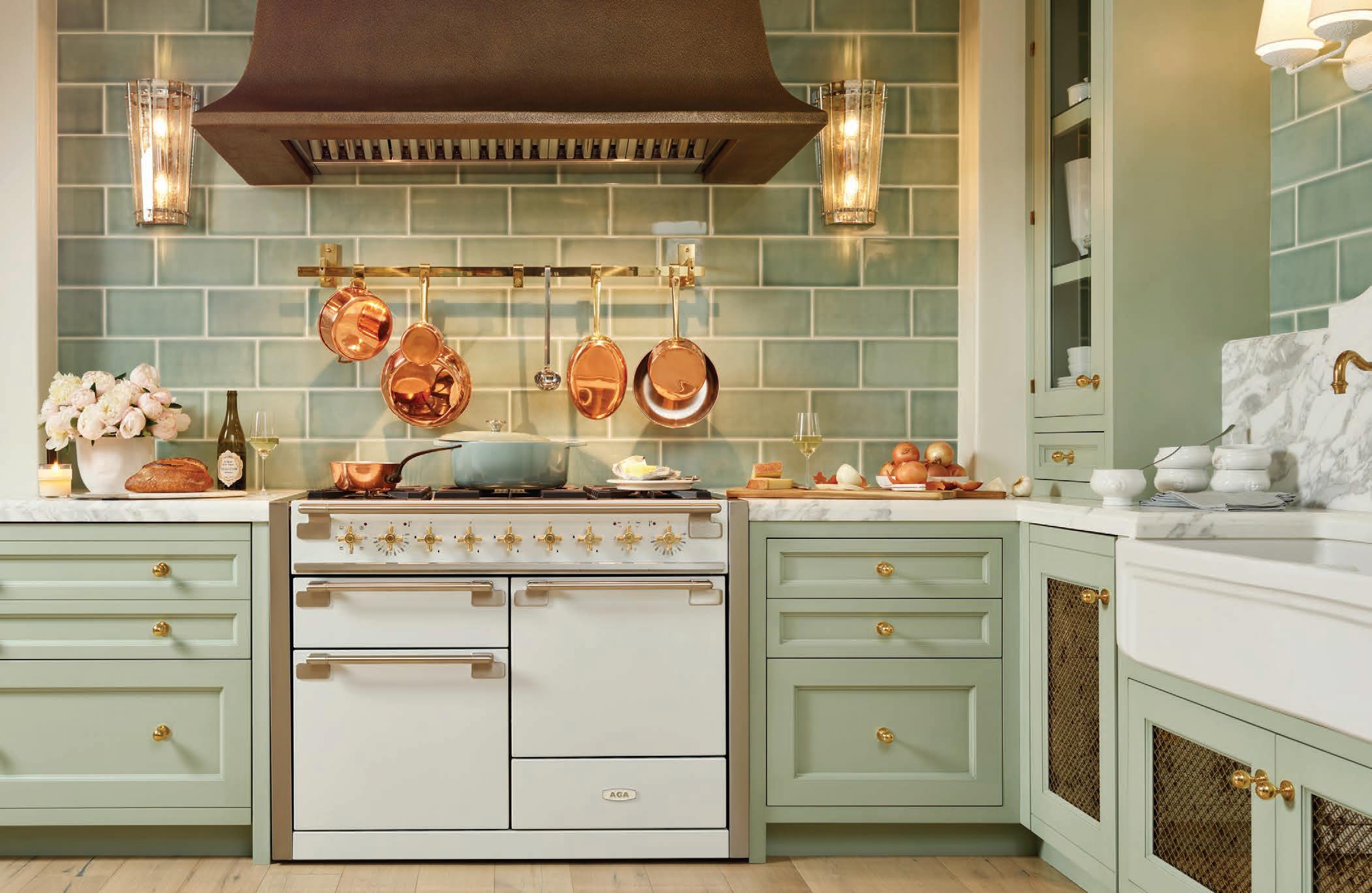
THE AGA ELISE
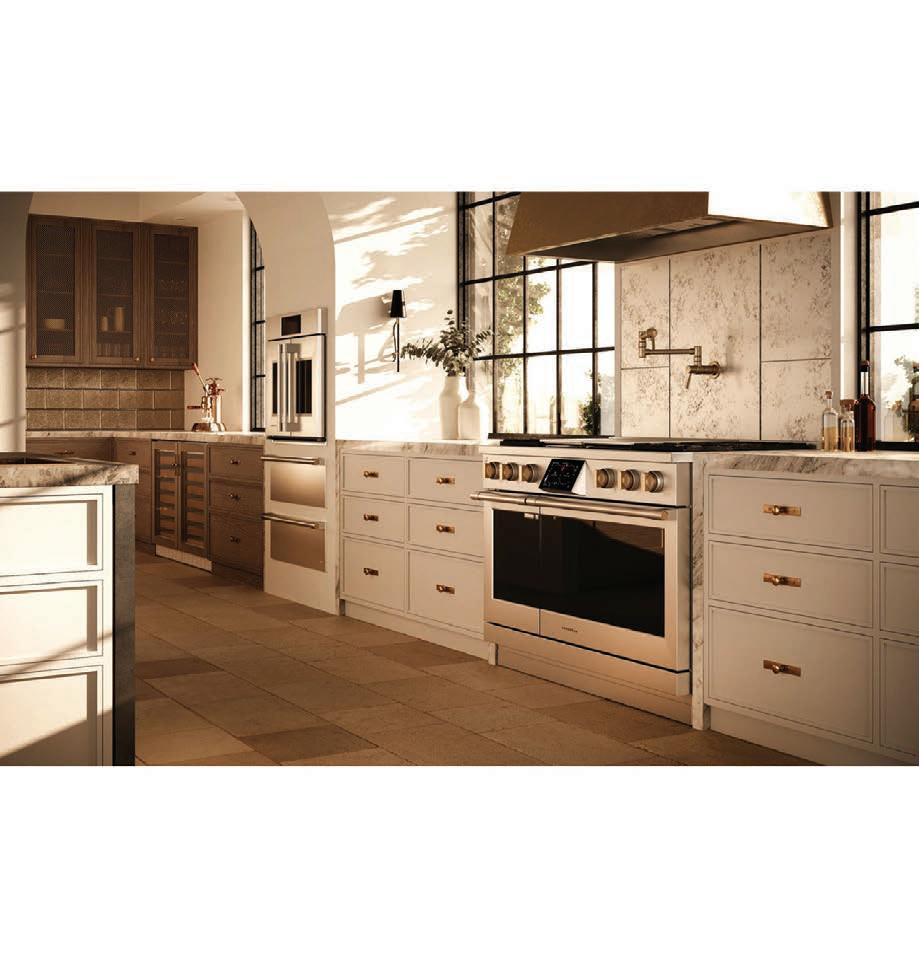
The AGA Elise Series 48" Range with three ovens and a full Induction or dual fuel cooktop.
The AGA Elise is available in a full palette of fourteen colour options from modern contemporary to British traditional. Each Elise range is complemented by stunning cruciform knobs with knurling, shipping standard in Brushed Nickel, but also available as an after-market option in five additional hardware finishes. The refined elegance can be further customized with stately Antique Brass Handle Stantions and Knobs.
THE NEW ELISE AND MERCURY RANGES AND VENTILATION HOODS ARE GUARANTEED TO
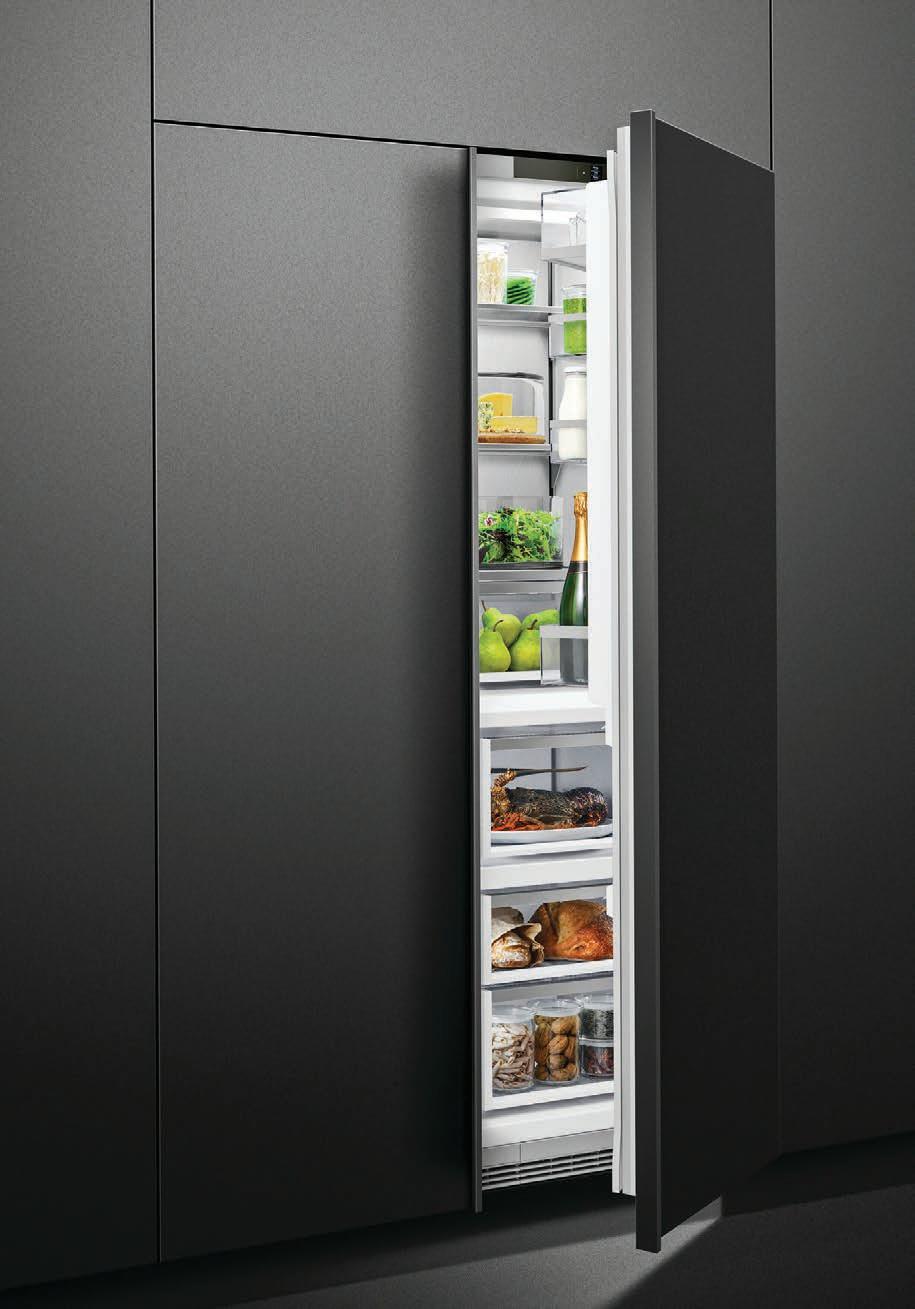
Fisher & Paykel announces the debut of its revolutionary new cooling product, the Series 9 24-inch Integrated Triple Zone Refrigerator. This innovative system expands on Fisher & Paykel’s existing refrigeration technology by introducing three independent cooling zones for optimal temperature control and flexibility.
Offered in both refrigerator and freezer models as well as stainless steel and integrated panel configurations, the brand’s Integrated Triple Zone Refrigerator showcases new levels of innovation and performance for the market. “With the launch of our Triple Zone cooling technology, the brand continues to set industry standards across innovative food care and preservation to reduce waste, save resources, and ensure perfect results,” says Shadi Ammouri, senior project manager. “The Integrated Triple Zone Refrigerator expands standard market cooling capabilities by applying three evaporators to independently control three different areas of cool storage. Each zone can be configured to best match the ingredients on hand, offering the perfect storage environment with optimal temperature and humidity settings.”
Ammouri adds that users can choose from the three refrigeration modes including Chill (from 29 to 32 degrees Fahrenheit), Fridge (from 34 to 44 degrees Fahrenheit), and Pantry (from 52 to 56 degrees Fahrenheit). For extra flexibility and storage, the Triple Zone Freezer modes include Freezer (from -6 to 7 degrees Fahrenheit), Soft Freeze (from 14 to 18 degrees Fahrenheit), and Chill (from 29 to 32 degrees Fahrenheit).
Alan Alibhai, senior manager of Trail Appliances’ Multi-Family Builder division, notes three trends emerging in the appliance industry. “It’s no surprise that smart appliances are gaining traction. With oven features like pre-programmed cooking modes and automated temperature control, preparing dinner isn’t stressful anymore. Laundry days are a breeze with washers and dryers that choose a cycle on their own based on detected load size, dirt level, and dampness. Life is so much easier when chores can be done with the push of a button.
The second trend is customization and minimal designs. “The sleek and minimal kitchen design is still trending, but there’s a growing appetite for unique touches,” says Alibhai. “As colourful appliances make a comeback, more kitchens now have pops of colour. Samsung’s Bespoke line takes this trend a step further by giving consumers the flexibility to change the colour of their appliances whenever they like. As manufacturers marry designs with functionality, we’re seeing more glass exteriors for a sleek and sophisticated look, a contrast from the industrial feel of stainless steel.”
The third trend is sustainable living through clean energy. “The push for sustainable living, due to the growing concern for the environment, has led to an increased demand for appliances that use clean energy,” says Alibhai. “As a result, top energy-efficient appliances like heat pump dryers and induction cooktops continue to increase in popularity.”
Tasco Appliances has introduced multiple products to enhance lifestyles at home, including the Monogram Force ice gems, the Handleless Combi Steam Oven, and Zip Water HydroTap water filter.
“The Monogram Force unit is a heated press that creates an ice sphere in 60 seconds or less, and doesn’t need any pre-heat or recovery time,” says Andrew Borsk, director of marketing. “This works well for back-to-back ice making with the impressive, slow-melting spheres that provide an upscale look to premium drinks.”
Also, in the world of drinking options, the Zip Water HydroTap features advanced technology in its activated carbon water filter that provides pure tasting, filtered boiling, chilled, and sparkling water instantly. The taps are available in chrome or black finishes that fit into a broad scope of kitchen designs.
Adding to the high-tech options from Tasco Appliances, the 30-inch Handleless Combi Steam Oven offers a variety of cooking styles, including steam, baking, roasting with a roasting probe, and menu cooking. “This unit is great for people who love to cook as it offers so many different styles that are easy to use,” says Borsk. “Beyond the different cooking options, it also features a stainless-steel interior, a motorized lift-up control panel, and automatic menu cooking – even cooking multiple items at the same time.”
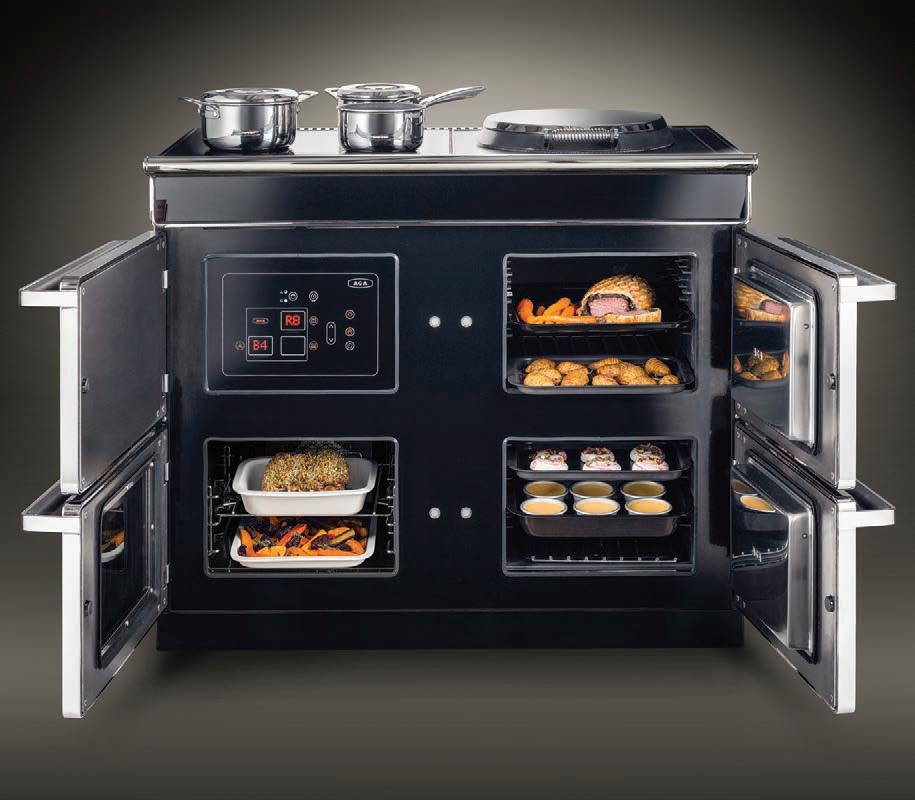
Middleby Residential Canada offers a variety of luxury brands for food lovers, including the new AGA Era range, known as a mix of evolution and revolution. “It’s where technology meets design and where heritage meets modernity, with glass being used for the first time to create a striking, contemporary look for modern kitchens” says Mike Withers, Aga brand specialist. He explains the castiron heat-storage oven uses radiant heat to retain the food’s moisture, flavour, texture, and goodness.
The roasting/baking oven has eight temperature settings; from high temperature roasting to gentle baking and heats up in just 60 minutes along with an integrated 2.1kW grill, providing four grilling positions. “Behind the lower glass door is a conventional fan oven with nine temperature settings and a heat up time of 15 minutes,” says Withers. “The fan oven door features a heat reflective, tinted window and the oven is internally lit to view your cooking.”
Series 9 24-inch Integrated Triple Zone Refrigerator.
AGA Era range.
Inspire The Next Generation of Tradeswomen Through Jill Of All Trades TM
Only 5% of tradespeople in Canada are women
Jill of All TradesTM is an international series of events aimed at inspiring young women in Grade 9-12 to pursue careers in skilled trades.
Each event features hands-on workshops in the motive power, industrial and construction trades led by female mentors.
• 1300+ students participated at 10 events last year
• 93% are considering careers in skilled trades after attending
• 50,000+ participants at 123 events by 2027
Jill of All TradesTM events are being organized at colleges across North America. Learn how you can get involved at www.jillofalltrades.college or by emailing jillofalltrades@conestogac.on.ca.
The cooking surface features both a large cast-iron hotplate and a simple touch-control, four zone induction hob. “The large cast-iron hot plate holds up to four pans and can be set to either boiling or simmering mode,” he explains. “The induction hob includes a bridging function for use with a griddle or large pans, boil dry detection, timer, pot detection, child lock, pause button, and ‘power boost’ function that provides 10 minutes of maximum power.”
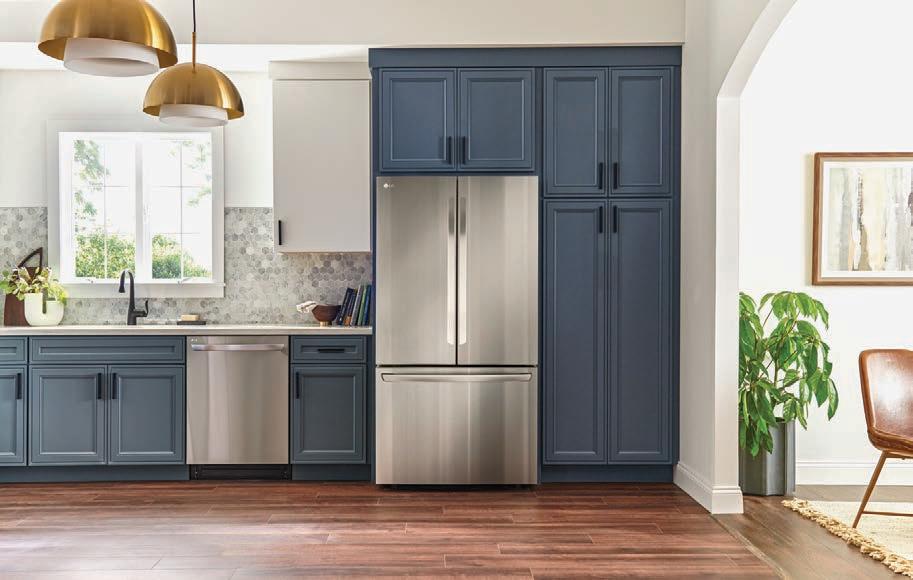
According to Alicia Harmon, national flooring manager, Canadian Appliance Source (CAS), savvy clients want appliances that maximize value but offer more features per dollar. “A rising trend is the demand for appliances that go beyond appearances, for good reason,” she says. “For example, counter-depth refrigerators that conceal unsightly lines and optimize precious kitchen space, creating a cleaner aesthetic, can be found in units like LG’s Counter-Depth MAX and Samsung’s SpaceMax fridges. They offer full-size space without the premium price tag.”
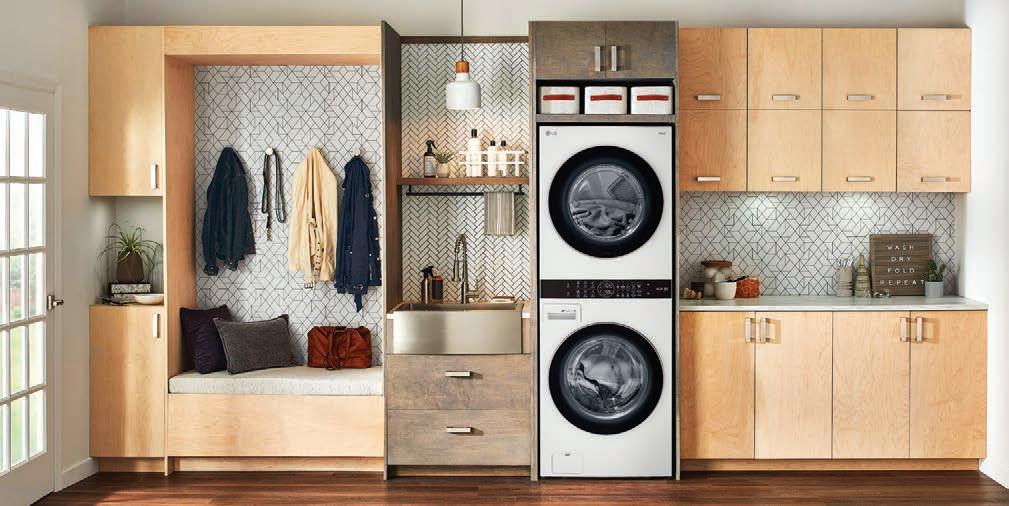
Harmon says All-In-One laundry towers are also on the upswing at CAS. “Laundry towers, including models made by LG and Electrolux, blend front-load capacities, advanced features, and stylish designs into one singular appliance. These units are perfect for condos, laundry closets, and laundry rooms. No more finding the right stacking kit, matching colourways, or guessing how long to wash or dry your clothes. With AI and other Smart features built right in, these towers make buying and doing laundry simple.” She adds ventless All-In-One laundry units are another newer trend dominating the market. “From trusted brands like GE, LG, and Whirlpool, these compact two-in-one machines – available in 24-inch or full-size 27-inch – eliminate the need to bounce between appliances.” A
LG’s Counter-Depth MAX Refrigerator.
All-In-One laundry tower from LG.
Steel On Top
Versatility
and seismic code shifts fuel a surge in demand for steel building systems
by ROBIN BRUNET
The steel building sector continues to be one of the bright spots for the construction sector overall, defying economic headwinds for simple reasons: commercial, institutional, and industrial clients need new or updated facilities, especially in the north. Plus, the manufacturers can supply them with product that is both visually pleasing, cost competitive (compared to traditional structures), and very quick to erect.
Honco Steel Buildings is a prime example of a steel building company going flat-out in 2024 to meet demand. “We’re so busy we’re actually refusing jobs right now,” says Genevieve Filteau, Honco’s director of marketing.
One reason why Honco is so prolific is because its steel buildings are self-supporting; some years ago, after undertaking research with several Quebec universities, Honco developed a patented construction technology based on steel structural panels. Unlike conventional framed buildings, the weight of a Honco building and the load it supports is distributed evenly over the foundation walls, the loads concentrated at the base of the columns. The advantage of this kind of engineering is that foundations with pilasters and reinforcements are not required; plus, a self-supporting building is much easier to build and reduces construction costs by up to 15 percent in some cases.
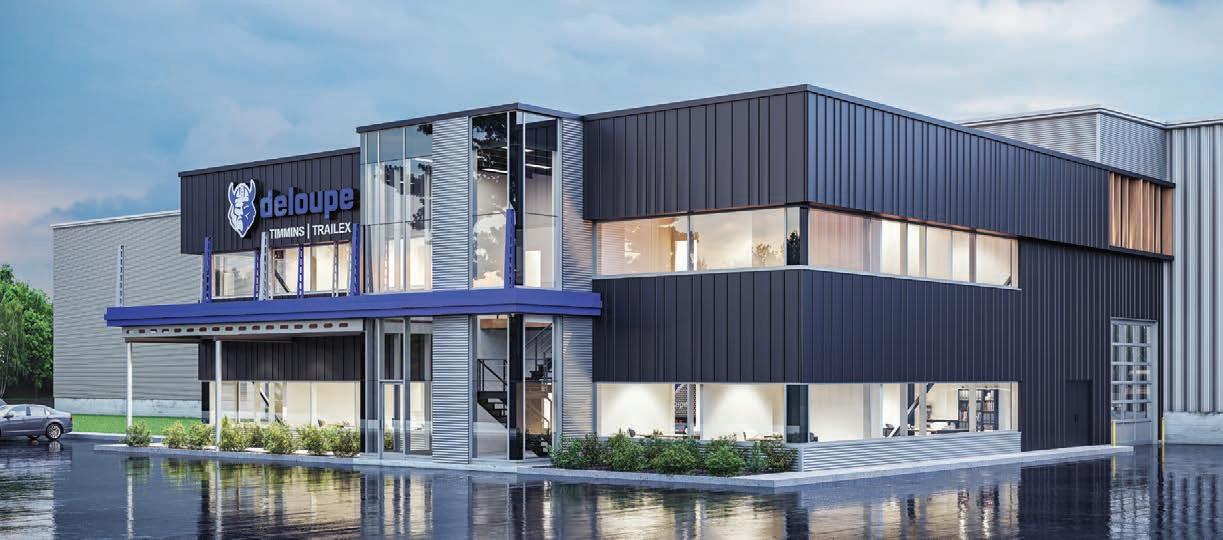
Of the diverse projects Honco is currently handling, Filteau singles out the new Trailex facility in Rimouski for special mention. “This is a huge manufacturing facility for trailers in Eastern Quebec that we’re in the middle of,” she says. “As of January we just finished the structural work and are now focused on the interior.”
Designed by architect James Leeming, the Trailex complex brings all of that company’s operations together in one location – and with a total space of 90,000 square feet over three structures, there is ample room for future expansion.
Sean Lepper, VP and general manager of Behlen Industries, says the only thing that could top activity in 2023 for his company is the unfolding prospects of the New Year. “We came off an excellent year capped by us shipping 2.5 million pounds of steel for a Marathon Gold project in Newfoundland and working on a convention centre in Manitoba, plus
we were busy with lots of welcomed bread and butter work,” he says. “This year is shaping up nicely thanks to a very strong backlog of projects: we’ll be busy right through the spring with forestry and mining projects.”
Key to Behlen’s ongoing success is its frameless buildings and insulated metal panels.
Behlen Frameless steel buildings, constructed with the company’s engineered panel system, eliminates the need for structural steel and can offer obstruction-free spans of up to 95 metres, completely independent of structural elements such as columns and rafters. The lack of structural steel helps give these buildings an insulation advantage, because inexpensive batt insulation is installed easily to the interior with insulation supports, thus minimizing energy loss caused by thermal bridging.
As for the insulated metal panels, Behlen supplies a variety of configurations through its sister company, Artspan Inc.
But as busy as Lepper is in 2024, he acknowledges that challenges lie ahead. “The big news this year is that the new 2020 building code with its new seismic requirements took effect in January,” he says. “We’re literally at the drawing board with our engineers trying to determine all the implications of the code, and designs might have to change as a result. Simply put, buildings will need more steel, and bigger cavities will have to be created in order for us to insert a larger amount of insulation. However, this will drive more demand for our insulated metal panels, so there are definitely opportunities ahead.”
A broad range of capabilities is one reason why Nucor Buildings Group continues to be in high demand as one of North America’s largest and most experienced manufacturers of metal building systems. Its metal building brands include American Buildings; CBC Steel Buildings (which specializes in unique designs and complex projects, with a focus on energy efficient structures); Kirby Building Systems; and Nucor Building systems, which provides solutions for the agricultural, community, and retail sectors. However, Nucor also manufactures its own MetlSpan and Centria insulated metal panels to help deliver an economical and efficient building envelope, with a longer lifespan and less maintenance requirements. Also, in light of the ongoing push for renewable energy development, Nucor also offers a unique service with its NBG Solar Structures division.
NBG provides custom-engineered elevated steel structures that support solar panels for parking garages, solar farms, carports, canopies, charging stations, ground mounts, and roof mounts. Nucor typically combines these structures with Nucor PowerShingle, an innovative solar panel system that serves as the roof of the structure and whose watershed design eliminates leaks. This eliminates the need for costly sub-roofing that is typically required to waterproof conventional solar systems.
In addition to consistently delivering quality of product as well as offering a versatile product range, Toro Steel Buildings has become a preferred source for clients in many sectors, due to the company’s collaborative approach with clients and ensuring that the right product is selected for their needs. Aiding Toro is a specialized team of designers, engineers, and customer service specialists, all of whom are experts in creating solutions for residential, commercial, and industrial applications worldwide.
As for the buildings themselves, Toro is famous for its Quonset hut-style steel building with arch frame construction. Toro’s “Q” and “S” styles both feature a curved roof, but the “S” also has straight sidewalls, allowing for the storage of larger equipment and machinery. Each design is available in varying widths, depending on requirements and intended use.
Ben Koslik, Toro’s leader, Special Projects Group, says, “Typically we deliver over 3,000 buildings internationally per year, and we have a tremendous amount of leads for 2024, especially for buildings 10,000 square feet in size or larger. Frankly, the demand is overwhelming, and I would love to hire five project managers right now just to handle the inquiries.”
As such, Laura Betancourt, Toro’s recruitment and success manager, anticipates hiring two new sales teams in the first quarter as the company targets record-breaking revenue. “The need for new talent is robust, and we’re especially keen to hear from people already in our industry who are looking to maximize their potential,” she says.
For over 120 years, Butler Manufacturing has consistently been an innovator within the steel building sector, and two of its most recent featured products bear this out.
The Butler Tier II Classic building system, which is suitable for almost any use, offers a competitive
Nebs
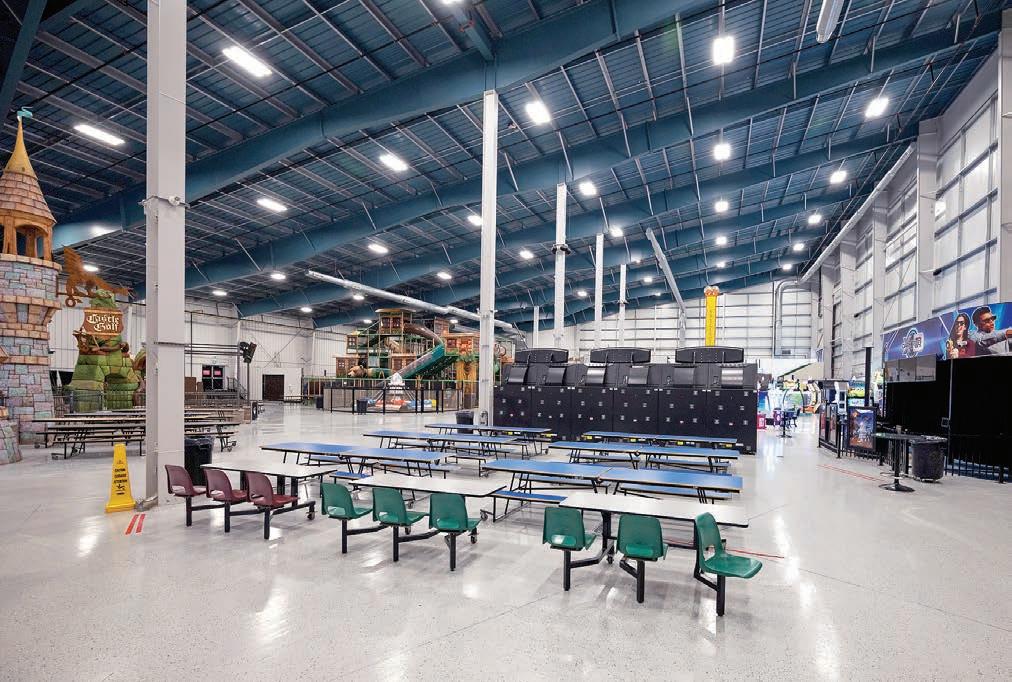
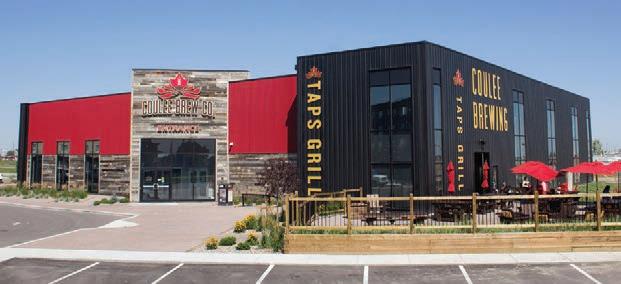
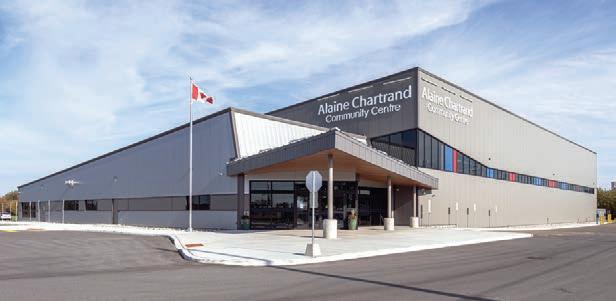
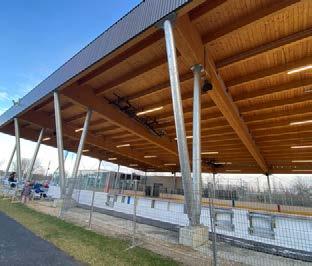
Fun World, Oshawa, ON
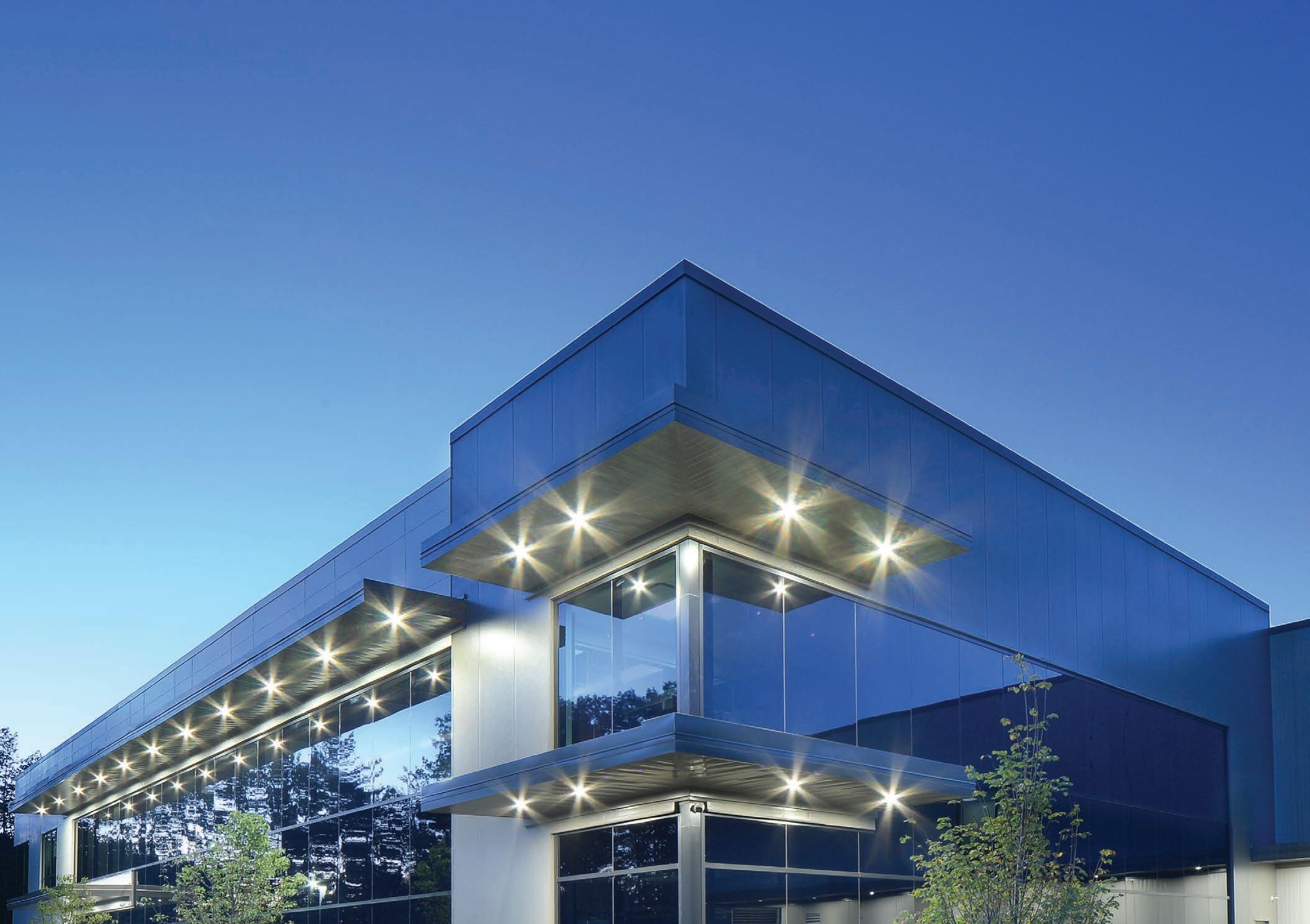
EXPERIENCE THE NUCOR ADVANTAGE
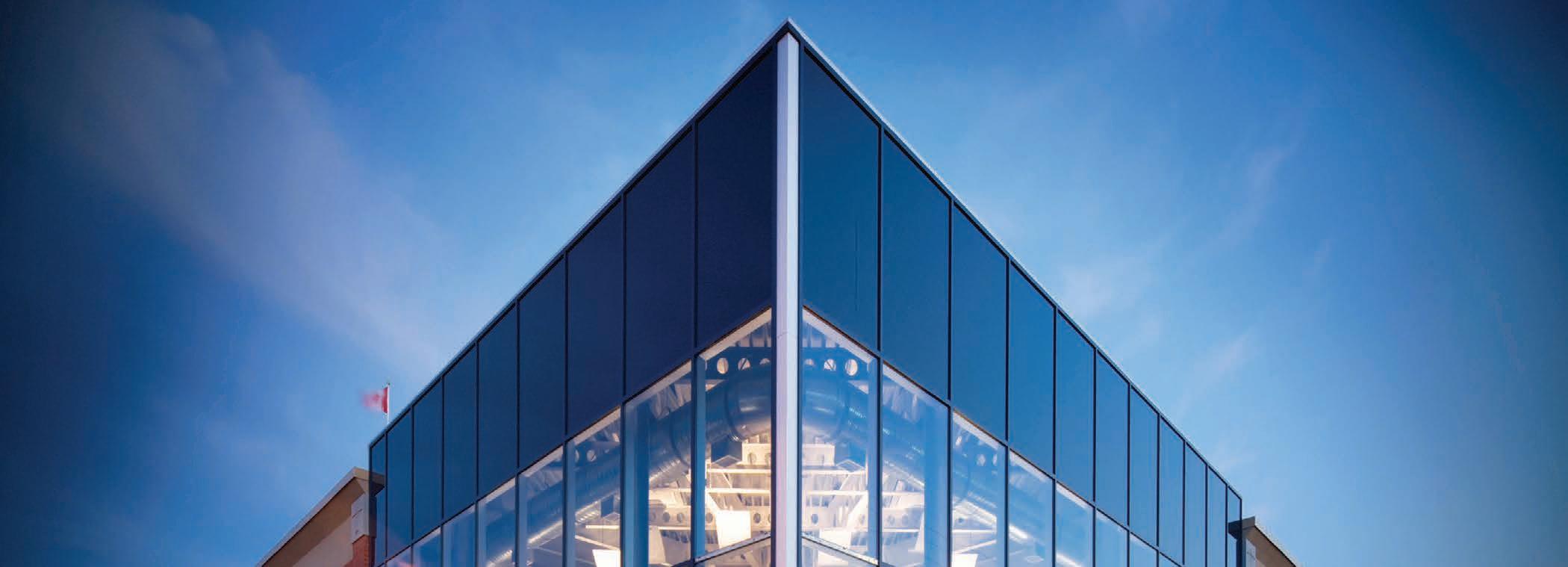
As the construction industry has grown more sophisticated, so has the versatility of custom metal building systems. By adopting advanced tools, practices and products, Nucor Buildings Group actively evolves to meet industry demands. Metal building systems are flexible by design and can be tailored to fit the needs of any market, offering the ability to incorporate energy-efficient products like insulated metal panels and advanced insulation systems alongside architectural elements such as stone and glass.
Whether your building is architecturally complex or value engineered, from a 1-million square foot mega project to a small specialty building, we work together with our Authorized Builder Network to offer products and solutions that bring our customers’ dreams to life.
price with a short lead time and faster assembly. Design flexibility allows for a wide variety of slopes, widths, and heights, and structures can be assembled up to 30 percent faster than conventional construction. Also, multiple units can be added at or below a building eave, making Tier II a cost effective way to quickly expand an existing facility.
The second product is an innovative mezzanine structure. The Butler Express Mezz System can be added to a building project or ordered standalone; no welding is required for all Express Mezz parts, thus reducing install time, and several module sizes can be chosen for everything from light loads (such as an office space) or heavy loads for storage. The system also has six economical floor surface options, including ResinDek, which include pallet
jack ratings up to 2,800 pounds, a four-inch cast-inplace concrete flooring option, and a three-quarter inch board option.
Innovation of another kind can be found at Braemar Building Systems, which specializes in manufacturing traditional rigid-frame, red-iron metal buildings that have hot-rolled and welded main frames (its buildings come as kits or do it yourself, and Braemer offers the option of providing custom design services). However, Braemer has always adjusted to new opportunities, and so today it also manufactures cold-formed (or cold-rolled) metal buildings. While these structures have been around for more than a decade, they are becoming more mainstream, especially in areas that don’t receive heavy snow loads.
DISCOVER
Cold-formed buildings typically weigh less, are cheaper, and have a quicker lead time than rigidframe buildings. They can include mezzanines, be designed with single-slope, gable-style, and gambrel roofs, have been used in commercial, residential, and agricultural applications, and have similar flexibility as rigid-frame buildings.
Braemer suggests that cold-formed buildings are a good option for clients wanting clear spans of 50 feet or less, or who want a foundation design with their building (most metal building manufacturers won’t engineer a foundation on a typical rigid-frame product). They are also suitable for clients who want to use their own crews to erect the building, as coldformed framing members are lighter and require less large equipment.
Lastly, founded in 1950, Bailey Metal Products Ltd. offers building solutions to the commercial framing and drywall finishing residential markets. Some of its more innovative products include ComSlab, a deep steel decking and a concrete cover slab cured together and bonded structurally as one element. This construction technique results in significant cost savings and is ideal for fast track construction, especially in tight working spaces.
Additionally, Bailey has two options of LSF floor systems: the Bailey C-Joist Floor System comes in a variety of depths, flange sizes and steel thicknesses, while the TradeReady Steel Joists feature large, reinforced service holes to accommodate mechanical and plumbing services in addition to smaller knockouts for electrical, sprinkler and smaller plumbing services. A
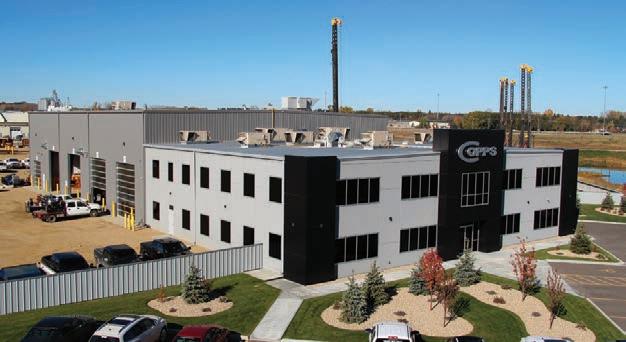
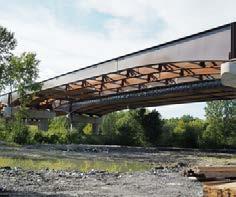
Trailex manufacturing facility, Rimouski, QC
A Blooming Marvel
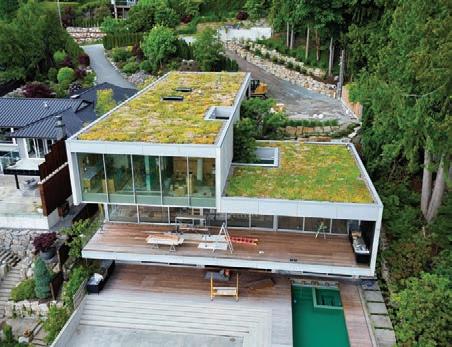
Green roofs and walls are redefining Canada’s urban landscape
by NATALIE BRUCKNER
The rising interest in green roofs and walls across Canada goes beyond mere compliance with regulations. It reflects a profound shift in urban thinking, recognizing the crucial roles of biodiversity and effective stormwater management in our cities. Despite supply chain disruptions and inflation, green roofs continue to gain significant traction, marking a five to 10 percent growth in North America, according to Steven Peck, founder and president of Green Roofs for Healthy Cities. This steady growth is exemplified by Toronto’s recent achievement, marking the installation of over 1,000 green roofs within the city. Peck highlights this upward trajectory, emphasizing the blossoming interest in biodiverse roofs and the recent integration of bifacial solar panels with green roof structures for greater energy production.
Peck also highlights a crucial but less-discussed aspect: the significant role of green roofs in combatting climate change, particularly regarding property damage from wildfires. “Green roofs, particularly substrates, have demonstrated exceptional efficacy in shielding buildings from fires, surpassing even some waterproofing measures. Several studies conducted at Laval University support the claim that irrigated green roofs offer substantial fire protection. Surprisingly, this information remains largely absent from mainstream discussion when it comes to adapting to wildfire threats,” notes Peck.
Moreover, as discussions on the overlooked benefits of green roofs persist, Peck directs attention to a broader global shift. This shift is exemplified by policies like the UK’s Environment 2021 Bill, mandating Biodiversity Net Gain (BNG) in new developments. According to Peck, these policy changes represent a pivotal moment, potentially setting a global precedent for transformative policy approaches ahead. “If the footprint of your project is 5,000 square metres, then these policies require at least an equal amount of quality greenspace be incorporated into the overall design,” he explains.
BIODIVERSITY & TECH
Over at ZinCo, the team is also seeing a surge in popularity of biodiverse roofs, which is marked by a substantial move from soilless setups to six-inch soil beds housing perennials and native grasses for diverse habitats. “This is being driven by the new Toronto Green Roof Construction Standard [TGRCS] that requires plant species to be a minimum 50 percent native species from a regionally appropriate seed source. That’s good news for us because at ZinCo we are geared towards native and biodiversity,” explains Stephen Seccareccia, business development and project manager at ZinCo.
ZinCo is also witnessing other emerging trends such as blue roofs, podiums and amenity gardens, as well as the integration of green roofs with solar panels. According to Seccareccia, “the decreasing price per KW hour for solar energy has driven its integration onto rooftops, notably on numerous government buildings, aligning with the federal green building mandate.”
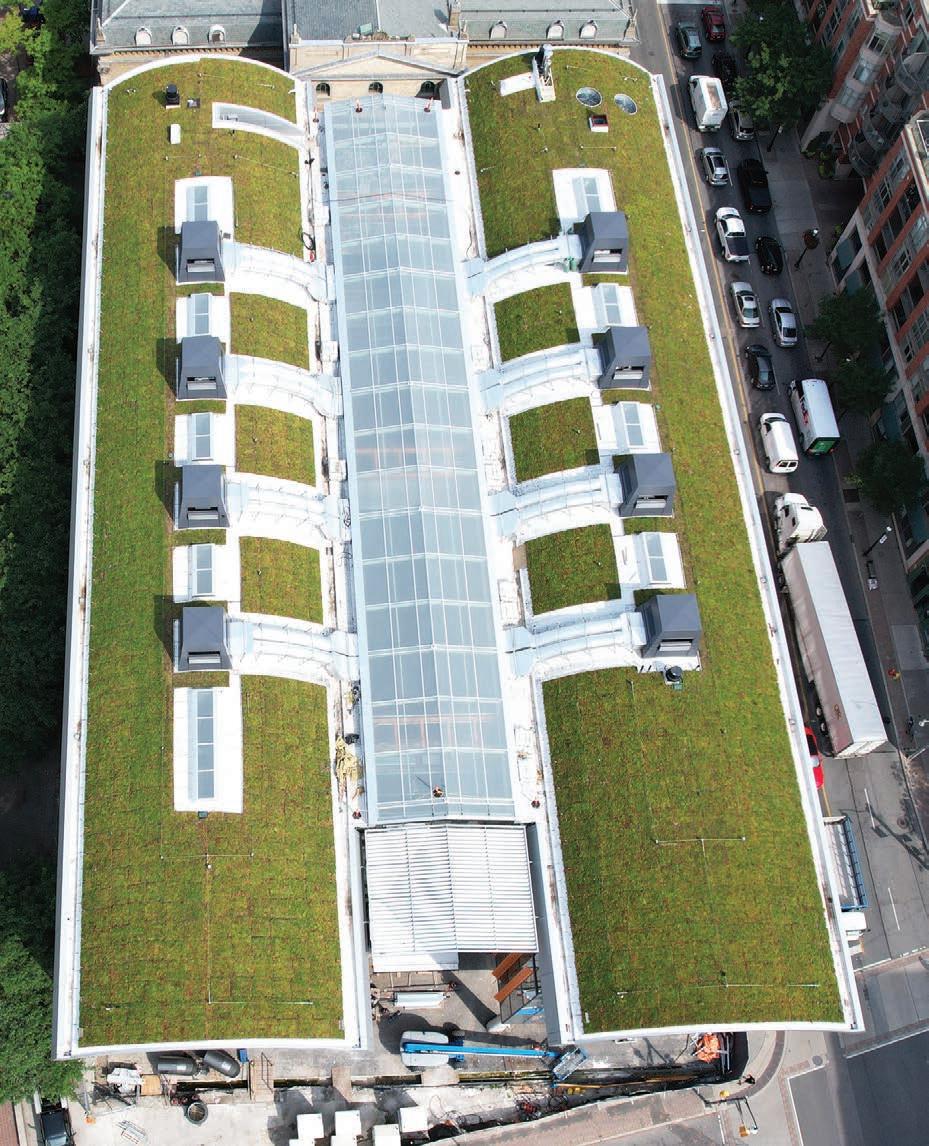
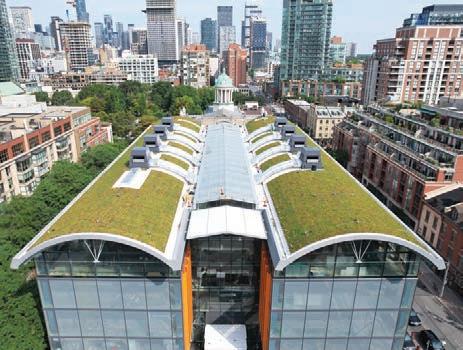
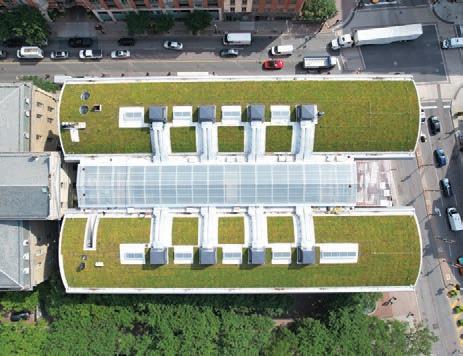
ZinCo has been instrumental in several remarkable projects lately, notably the St. Lawrence Market Redevelopment, where they implemented the ZinCo Georaster system enabling green roofs on slopes exceeding 20 degrees (the St. Lawrence Market has a 45-degree slope to it). Another standout is the 1090 West Pender project in Vancouver, boasting North America’s tallest 35-storey sloped roof.
This year, ZinCo’s slate includes the King Condos in Toronto, praised as an urban forest with a tree on every terrace, creating a forest that ascends into the sky. Additionally, there’s involvement in the LiUNA Headquarters in Vaughan and the Oakridge Mall Redevelopment. “Roofs are evolving into assets for developers, with the integration of solar energy and blueroofs for water storage. The financial incentives for green or blue roofs are becoming increasingly apparent. It’s going to be an exciting year,” says Seccareccia.
With extreme climate events on the rise bringing with them floods and heat waves, Soprema has responded accordingly and introduced the Skywater systems. Soprema’s Skywater systems are tailored to meet North America’s specific norms and environmental hurdles. Take the ballasted blue roof system, for instance. It utilizes Sopraretentio Boards to temporarily hold rainwater, easing pressure on municipal sewers. Similarly, the plaza deck blue roof, featuring Sopraflow Control, not only manages water flow but also crafts usable rooftop areas. Roxanne Miller, director at Sopranature Canada, foresees installations of the Skywater kicking off within the next year.
St. Lawrence Market Redevelopment, Toronto, ON
When it comes to projects, Miller highlights the Inuusirvik Community Wellness Hub in Iqaluit. This hub integrates Sopranature System’s green roof, fostering biodiversity with lichen, mosses, and native perennials. Noteworthy are the environmentally conscious approaches employed, such as curved subtractions and roof terraces on the second floor. These innovative designs not only deflect winds but also foster arctic green roofs, perfectly aligning with the project’s sustainability objectives.
EFFECTIVE STORMWATER MANAGEMENT
Experts at Architek have observed a remarkable uptick in the demand for highperformance blue roofs within urban landscapes. Ron Schwenger, principal and founder, underscores the industry’s responsiveness to municipal policies, citing Vancouver’s Rain City Water Strategy as a key driver prioritizing stormwater management. “While Vancouver currently lacks a green roof mandate, the Rain City Water Strategy is a highly progressive initiative gaining traction and positive attention. It now requires developers to retain 50 percent or more of land-fallen rainwater,” he notes.
Letitia Silk, Architek’s national director of business development, highlights the challenges posed by intensified urban density, restricting space for conventional stormwater solutions like rain gardens. “To meet upcoming water policies now being considered nationally by many city planning authorities, it is recognized that this primarily relies on buildings, particularly at podium or rooftop levels, where blue roofs become essential,” she explains. Architek utilizes a highly effective product called Permavoid, a high-capacity water retention system engineered to create functional and aesthetically pleasing urban development drainage. It treats stormwater as a resource, rather than a waste product.
Architek is just in the final stage of finishing the first high-capacity water retention series of roofs on a singular building on 150 West 4th in Vancouver. “It is the first major blue roof retention system in Vancouver as a result of the Rain City Water Strategy and even includes deck areas with pavers that connect to the green roof,” explains Ryan Vasseur, manager of Living Architecture Ecosystems.
Looking ahead, Architek has a number of exciting projects coming, notably 489 King West is poised to revolutionize biophilic elements within a large
multiblock development in downtown Toronto. Additionally, the company notes a growing interest in Quebec and the maritime regions, signalling expanding opportunities and interest in those areas.
LiveRoof Ontario Inc. recently celebrated its most successful year yet. Kees Govers, technical sales manager at LiveRoof, attributes this success to the increasing embrace of green roofs across Ontario, citing an expanding provincial acceptance of the benefits of green roofs as a contributing factor, “especially as a stormwater management system that doesn’t eat up valuable land.” Govers mentions completing over 75 projects in the past year, showcasing the company’s bustling activity.
Permavoid high-capacity water retention system.
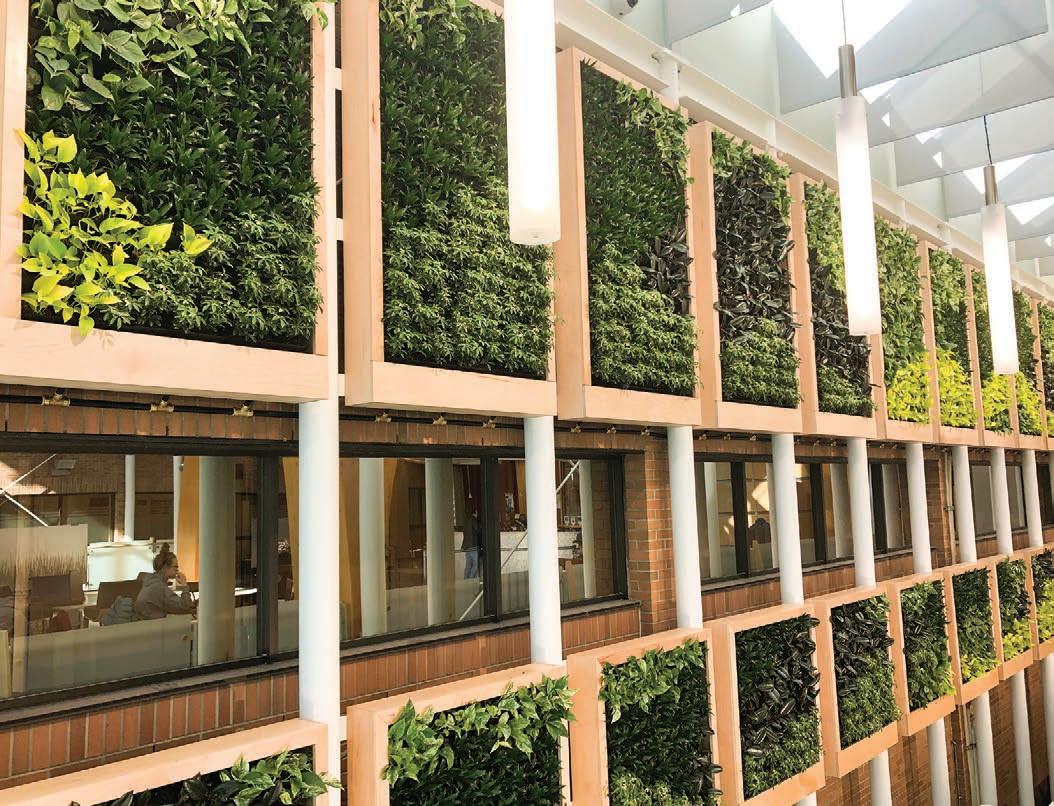
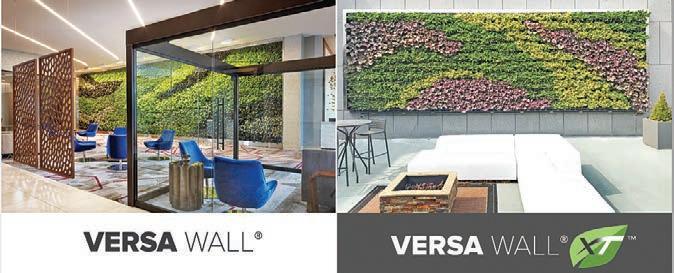
Above Left - Versa Wall picture is “The College of the Rockies” in Cranbrook BC
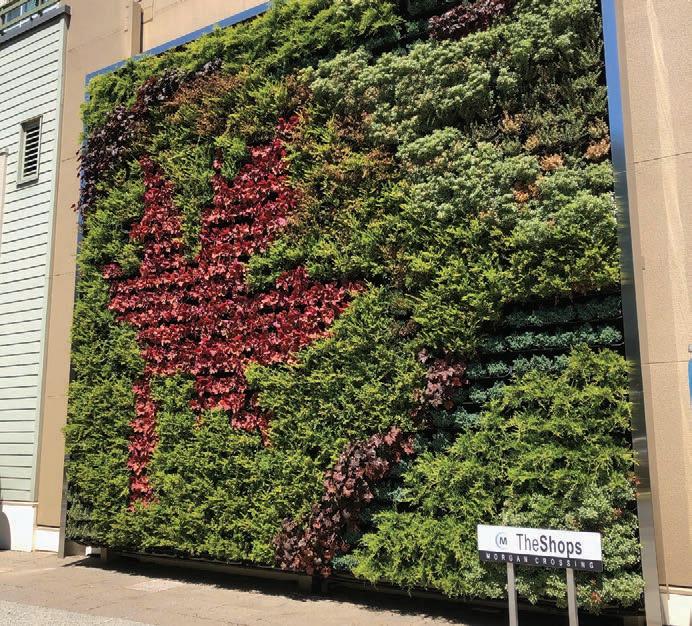
Above Right- Versa Wall XT is “The Shops at Morgan Crossing” in Surrey BC. GSKY HAS CREATED 1,000 WALLS IN 20 COUNTRIES
For the complete line of proven LiveRoof fully vegetated modular green roof systems visit liveroof.ca or call us at (800) 875-1392
Highlighting the evolving landscape, Govers emphasizes the rising interest in blue-green roof systems like RoofBlue RETAIN, which offers a remarkable 25 percent increase in stormwater retention compared to older systems. Outside the GTA, “buildings, particularly in places like downtown Hamilton, London, and Kitchener/Waterloo, are scaling up from 20-storey structures to towering 40-storey buildings with expansive podiums. Combined with the cost of development lands, this shift drastically alters the dynamics of stormwater management on-site,” he says.
Biodiversity emerges as a pivotal focus, with Govers stressing the importance of “getting it right.” He underscores that a biodiverse green roof should support a wide array of species beyond just pollinators. In addition to nurturing diverse
plant communities, encouraging naturally occurring species – such as beetles, bugs, and various plant-eating larvae – is crucial, as these serve as vital highprotein and high-fat food sources for birds. Interestingly, Govers points out that while hives of non-native honeybees may seem beneficial, they can hinder the establishment of native bees and other pollinator populations on vegetated roofs accessible to those pollinators, because of competition for food resources.
Looking ahead, Govers is enthusiastic for upcoming projects and the diverse range of systems offered by LiveRoof. He is looking forward to the completion of George Brown College’s Limberlost Place, a mass timber high-rise, where a LiveRoof Biodiverse green roof is schedule to be installed in spring 2024.
ENHANCING BUILDING HEALTH
Over the past year, Sean Ludchen, director of sales at New Earth Solutions, has witnessed substantial improvements in environmental, social, and governance (ESG) practices, alongside a focus on improving the health of buildings. These developments have spurred significant leaps forward in the industry, notably enhancing indoor air quality.
New Earth Solutions continues to make significant strides in the living wall market, and one system in particular is gaining traction: the Respira Pro system. This cutting-edge technology uses a unique biological air filtration method for the efficient removal of indoor air contaminants and achieves an impressive 97 percent removal rate of volatile organic compounds. “In a commercial setting we can integrate the living wall into the HVAC system and reduce the amount of ventilation required in a building by up to 47 percent. We can now finally quantify the ROI on living walls and provide a product where the value meets the price,” says Ludchen.
In Ontario, New Earth Solutions recently finalized two impressive multi-storey living walls at the University of Windsor. These living walls, fully integrated into the HVAC system, boast significant dimensions – one measuring 36-feet tall by 36-feet wide, while the other spans 32 feet by 20 feet. Sean Ludchen highlights, “We’re strategically pulling air through the system to minimize the necessary air changes.” This integration showcases an innovative approach to air management and quality within these structures.”
RoofBlue RETAIN blue-green roof system installation.
Ask for our latest Virtual Lunch & Learn "GREENROOFS FOR STORMWATER PERFORMANCE" (1 CEU/HSW)
GreenRoofs
Every major Urban Centre has to deal with Combined Sewer Overflows, caused by insufficient storm sewers during peak rain events, making sanitary sewers overflow, bringing effluent into our waterways and destroying our natural environment
Bioroof's vegetated systems are the civil engineer's best tool to mitigate peak flows during storms while saving on expensive infrastructure by managing water at the source... on the roof.
www. bioroof .com (866) 377 5177
A few of Bioroof's greenroof projects:
Canadian War Museum
Canadian Museum for Human Rights Women's College Hospital
Toronto Transit's 1.7 hectare Bus Garage
Manitoba Hydro Head Office Etobicoke Hospital
...and millions more m2 of innovative projects throughout Canada and the USA.
An exciting advancement in the living wall sector involves the integration of smart monitoring capabilities, allowing for comprehensive system monitoring and potential analysis of its health. “This proactive approach enables us to intervene precisely when necessary, therefore reducing ongoing costs for our clients. By implementing these smart monitoring features, we aim to optimize efficiency and maintenance while ensuring the system operates at its best,” explains Ludchen.
In 2023, Nedlaw Living Walls experienced pivotal moments, including innovation, resilience, challenges, and changes, according to Jugal Kajiwala, the living roofs and living walls manager. Notably, the passing of its owner, Randy Walden. “Sadly, we lost our beloved owner, Randy Walden. Drew Walden is now leading his father’s vision, propelling the company to new heights,” explains Kajiwala. With more than 350 installations, Nedlaw’s emphasis on bio-filter living walls continues to revolutionize air purification. Their unique technology offers real-time air quality improvement, setting a benchmark in the industry. A standout project, the City Hall Cambridge retrofit, exemplifies this innovation. “The multi-phase project was completed successfully in December 2023. The Nedlaw Bio-filter wall stands at four-storeys tall and 25-feet wide and is intricately connected to the building’s HVAC system. Its goal? To regulate indoor humidity and reduce energy consumption by up to 40 percent. This wall filters 100,000 square feet of indoor air, curbing VOCs by an impressive 80 percent.”
Looking ahead, anticipation brews around Nedlaw’s compact bio-filter wall that is capable of filtering 2,100 square feet of space. With global demand surging from the U.S. to Singapore, ongoing research and development (R&D) will be necessary for continual enhancement. “We are looking forward to an excellent year with more than 10 projects on the books already. This means we will be able to filter one-million square feet of indoor air space in 2024 alone,” says Kajiwala.
SKY’S THE LIMIT
In 2023, GSky Plant Systems achieved a record number of sales, showcasing remarkable growth. The company expanded its presence in airports, with Delta Airlines joining its ongoing efforts in collaboration with American Express. Furthermore, GSky made significant strides in the landscape sector, particularly with its innovative Versa Wall XT featuring one-gallon potted plants. Hal Thorne, chairman and CEO, shares insights into the company’s recent developments, highlighting the introduction of a fire-rated product, Versa Wall SNAP, designed for the European market and set for expansion into North America.
Living walls’ increased interest has been driven by a variety of factors. Thorne attributes this surge to the growing demand for flexibility in office space planning, the desire to incorporate more biophilic elements into workspaces, the necessity for cleaner and fresher air, and the drive to create better acoustical environments.
Thorne further explains that the success of Versa Wall XT can be attributed to its ease of installation and maintenance, a diverse and visually appealing plant palette year-round, and its suitability for installation in northern regions.
Looking ahead to 2024, Thorne expresses enthusiasm for GSky Plant Systems’ accumulated experience and product offerings. Thorne says, “We are one of the few full-service companies, providing support from project initiation to completion and beyond, offering services for maintaining walls. Our various products are now being specified in more projects than ever, transcending the simple green wall designation.”
TotalDesign
MAINTENANCE FOR LONGEVITY
Experts at Ginkgo Sustainability say that as the popularity of green roofs and walls continues, education around maintenance is needed more than ever.
“Green Roof maintenance is crucial for a green roof’s longevity and costeffectiveness, but it can be challenging, especially for first-time owners and/ or managers. Often, hiring professionals is the most effective way to keep your green roof costs down. When properly looked after, they also offer a highly competitive ROI [Return on Investment],” the team says in a blog.
Among the things to look out for when it comes to maintenance are regular inspections of at least twice a year, ensuring green roof drainage systems are functioning correctly, and keeping on top of unruly weeds.
One element that can’t be overlooked, according to the experts, is pest management. Once pests have started to invade a roof, it can be difficult to remove them properly. Professional teams have the experience to assess the extent of the problem and handle it right the first time, keeping costs down (both in terms of time and money).
“Green roofs can quickly become ugly, inefficient, and expensive if left unattended for too long. Don’t let your green roof go to waste! Maintaining it properly will allow you to enjoy its many benefits for decades to come,” the team mentions. A
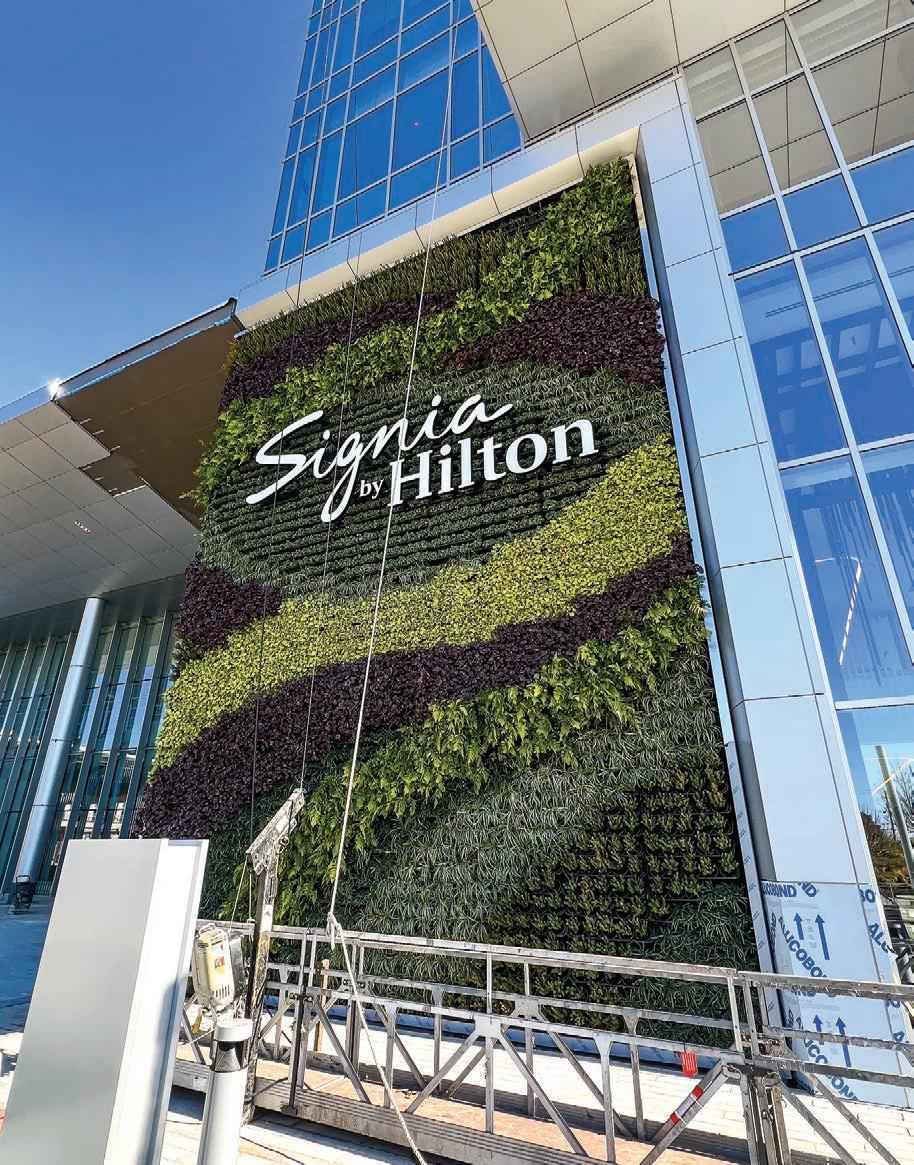
Versa Wall XT installation at Signia by Hilton, Atlanta, GA.
KOHLER.ca /StudioMcGee
KITCHEN AND BATH COLLECTION
Go With The Flow
Notwithstanding their utilitarian importance, plumbing fixtures are a simple way for designers to make an entire kitchen or bathroom on-trend; and therefore, they are fodder for experts predicting aesthetic preferences. For example, the National Kitchen & Bath Association recently released its 2024 Bath Trends Report, and it cites everything from smart toilets and black faucets to doorless showers as items that will be popular moving forward.
As for the kitchen, stainless steel finishes continue to rise in popularity alongside traditional white and grey tones, and smart and touchless faucets will become increasingly prevalent in 2024, and beyond.
BATHROOMS
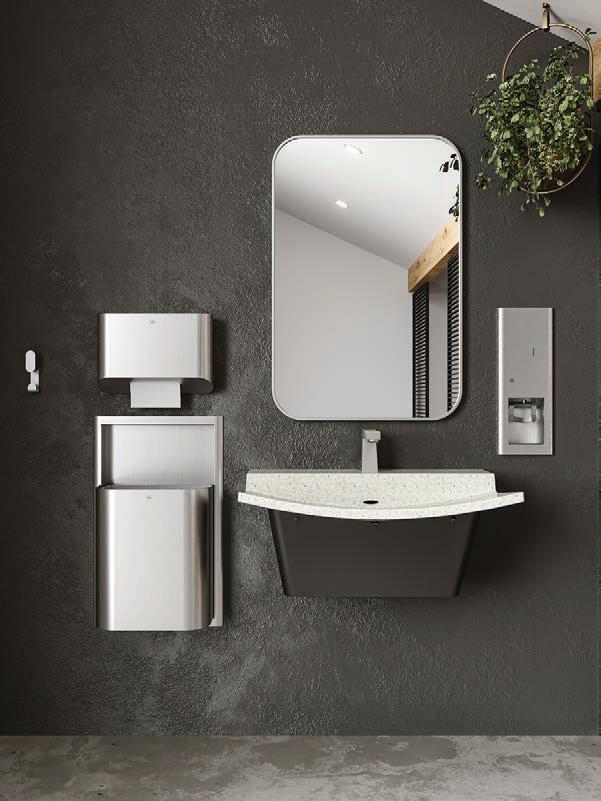
Kris Alderson, senior marketing manager for Bradley Company (a global manufacturer of commercial restroom equipment) reports that her company has been focusing on developing products that elevate commercial washroom designs in terms of functionality, aesthetics, and uniformity. “We’ve been expanding our portfolio of washroom products to help designers create complete and cohesive looks with carefully curated and matching product styles and finishes,” she says. “Comprehensive collections of washroom accessories with a uniform look give designers more options and flexibility to meet project specifications and building requirements, while expressing their own individual visions.”
Bradley’s newest product line – the Elvari Washroom Accessories Collection – helps designers achieve a cohesive, modern, and complete look, while adding functionality to both the toilet stall and handwashing areas. The products in this collection incorporate a common aesthetic with a euro style pill-shape design (smooth curves and soft edges).
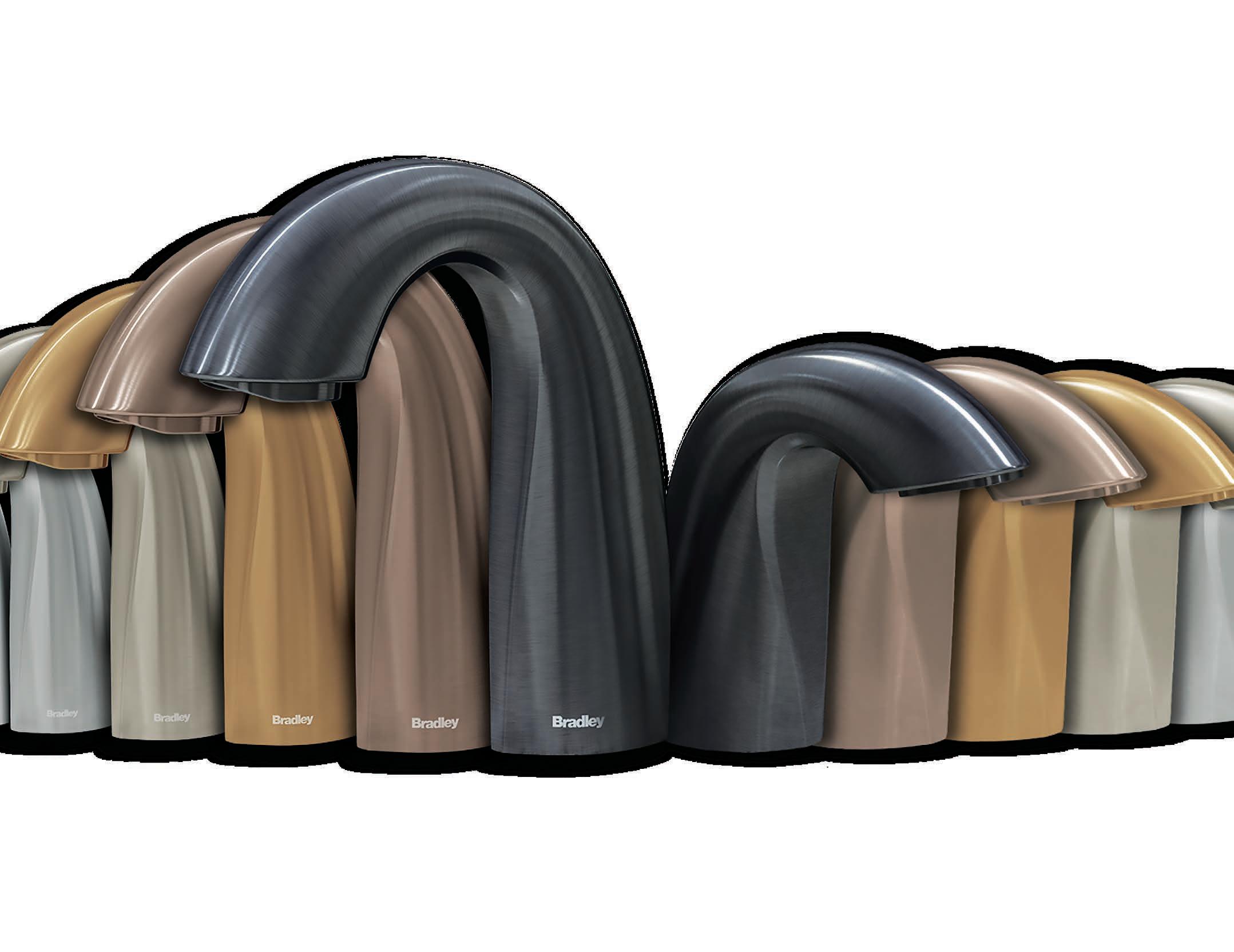
Elvari accessories include grab bars, paper dispensers, waste receptacles, shelves, soap dispensers, and LED mirrors. “Elvari is currently available in satin finish stainless steel, but we’re adding five additional finishes in 2024, including brushed bronze, brushed stainless, brushed black, brushed nickel, and brushed brass,” Alderson says.
Bradley’s touch-free Verge soap dispensers and faucets also impart a unified design element to washrooms. “These matching hand washing pairs are available in four styles and six finishes that will match Elvari’s finishes, available this year,” Alderson says. The faucets feature advanced sensing touchless technology, with optimized sensing eliminating false activations while enhancing accuracy and power consumption.
In keeping with Bradley’s commitment to craftsmanship, the Verge soap dispensers and faucets also contain hidden sensors to deter tampering, longer spouts to increase hand washing space, and cast brass spout construction.
Sarah Bernard, senior product manager – adjacent categories at Maax Bath, says, “We launch new products throughout the year, but now more than ever, considering the impact inflation and interest rates are having, we try to develop affordable offerings.”
Plumbing products deliver a wave of dynamic trends and sleek designs
by ROBIN BRUNET
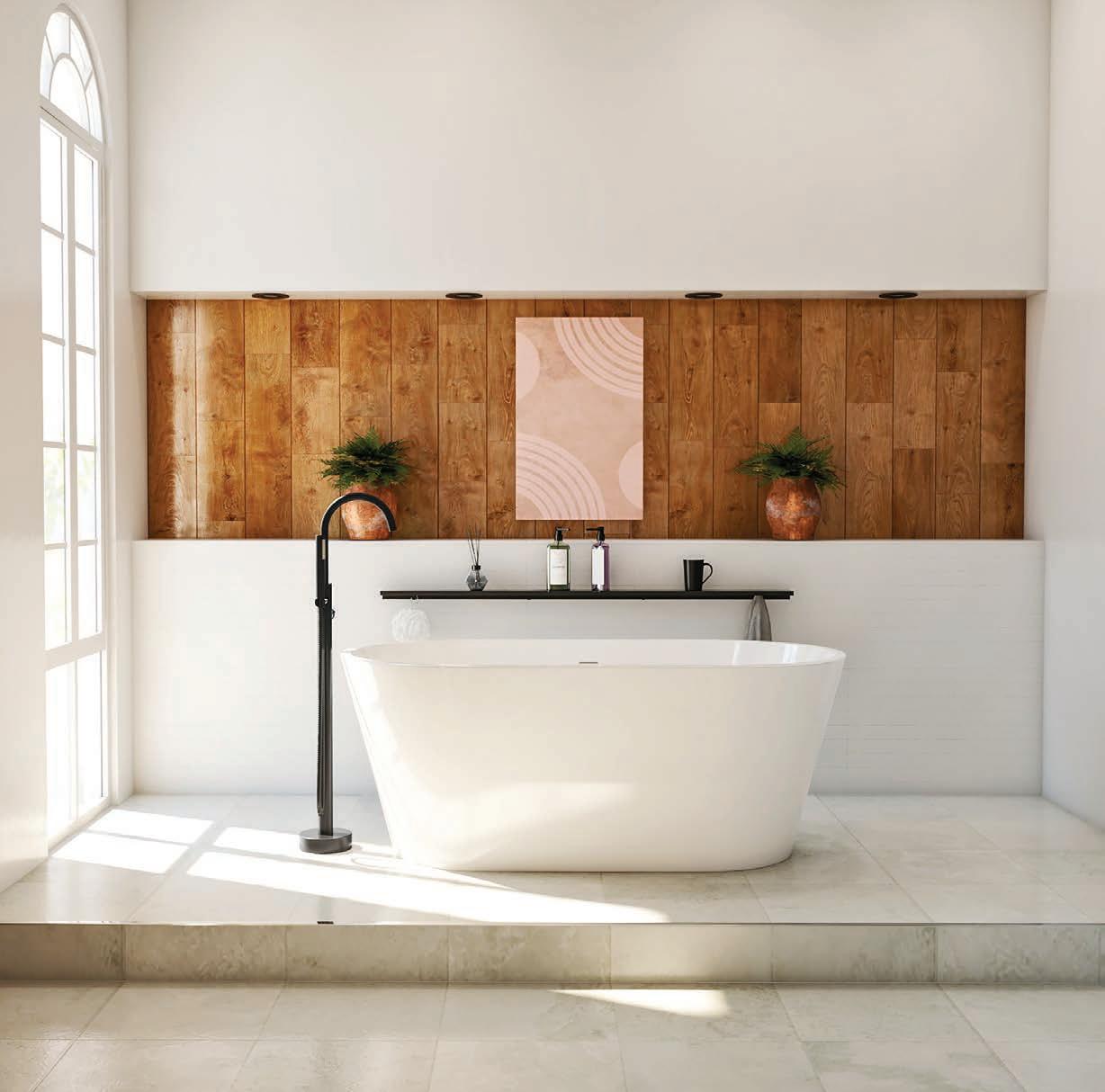
Two new tubs from Maax have been launched this year to date: Valentina is an acrylic freestanding centre drain bathtub, in matte white with matte white skirt. The Calinda is also a freestanding tub with similar specifications. “The acrylic mimics solid surface materials and is repairable, lightweight – it can be moved to different locations with relative ease – and more affordable than the luxury tubs both lines are inspired by,” Bernard says.
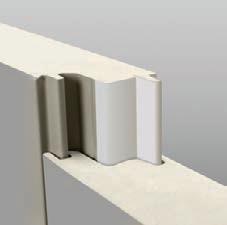
Also new from Maax are several Manhattan products: Manhattan Wall Covering tiles “are a smaller version of our shower walls with tile patterns and therefore sold in easier to handle boxes,” says Bernard. “They are installed easily, thanks to a tongue and groove system like flooring, and can be installed over existing old tiles in addition to gypsum using regular silicone as the adhesive.”
The Manhattan Wall Covering is also a light, compact, tongue and groove system and non-adhesive. It can be repositioned and wiggled in place. The stainless steel Manhattan Long Shelf embodies the fusion of minimalism and functionality and can be installed on any wall surface. Although it was designed for showers, it is very convenient next to a minimalist freestanding tub to keep bathing necessities within reach. “We’re also launching new shower doors later this year,” Bernard says. “This is in addition to our Capella door with a unique patented hinge with three inches of adjustment to fit in all kinds of situations. Its GlassShield technology provides a superior level of security; but for contrast and for those preferring a minimalist solution, our Capella shower screen imparts a light and airy appeal to bathrooms.”
The Elvari Washroom Accessories Collection.
Calinda Acrylic Freestanding Bathtub.
Verge™ Matching Soap & Faucet
With the new Verge matching soap and faucets you won’t have to compromise your restroom design with mismatched soap and faucets ever again. Available in multiple styles and finishes, each set pairs seamlessly with the Verge ® handwashing basin or any commercial basin to provide the finishing touch to your one-of-a-kind restroom design. Part of the comprehensive washroom from Bradley. Commercial Washrooms. Brought to Life.
bradleycorp.com/harmony
The products from BainUltra fulfill another ongoing trend: bathtubs that are technologically advanced and also works of art, made of high-quality materials and handcrafted. BainUltra’s latest offerings reflect the ongoing desire to impart a genuine sense of luxury in bathrooms. It is also adept at launching unique products, case in point: BeOne, the first of its kind Japanese-style bathtub featuring air jets coupled with its circular design to create a powerful massage unlike any other offered by traditional air systems.
BainUltra’s Libra Aurora and Libra Oval tubs are examples of how the company integrates advanced technology to enhance the bathroom experience. These free-standing tubs come with the MiaPlus ThermoMasseur and give users the possibility to add the BU-Touch virtual control smart phone app to navigate through all the settings of the air jet bath, while taking a bath from anywhere in the house. The BU-Touch application mimics the same functional and operational features as the control that comes with the air jet bath.
Ryan DeBoer, leader, trade showroom sales – west for LIXIL Canada, agrees that plumbing fixtures such as faucets and other fixed decorative items have a powerful ability to make an entire bathroom or kitchen seem refreshed. “And that’s why a lot of home renovations are still happening even though inflation has shrunk disposable incomes: homeowners and interior designers don’t need to invest tons of money on comprehensive upgrades,” he says.
Lixil, which was launched in 2011 and expanded internationally by acquiring Grohe, American Standard, and other trusted brands, is the ideal venue for kitchen and bathroom fixtures that are both striking and high quality. “Even the latest Retro-Fit shower kits from American Standard and Grohe impart a touch of class, plus they’re easy to install, no alterations to existing plumbing required,” DeBoer says.
DeBoer goes on to cite another trend that is being addressed by American Standard: the lingering post-COVID need for cleanliness. “For some years the brand has made its EverClean surfaces – an antimicrobial additive that inhibits the growth of stain and odour-causing bacteria, mould, and mildew – standard on our products such as toilets sinks and faucets, and we’re marketing this more than ever,” he says. “EverClean also means less time cleaning, which is a big plus for end users.”
Smart technology is an American Standard focus. The Aspirations bathroom collection features an eight-inch widespread pull-down swivel spout
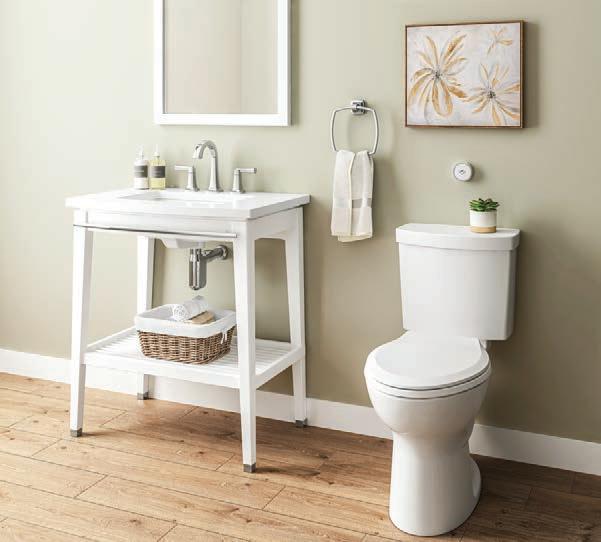
with dual spray, and according to DeBoer a sensor version is now available “whereby all you do is wave your hand under the faucet for water activation – no touching required. We’ve had touchless faucets for kitchens for some time now, but this is new to residential bathroom settings.” Further, American Standard offers a touchless flush toilet with a remote sensor as options on their top performing models; the Cadet Pro and Studio Toilets.
KITCHENS
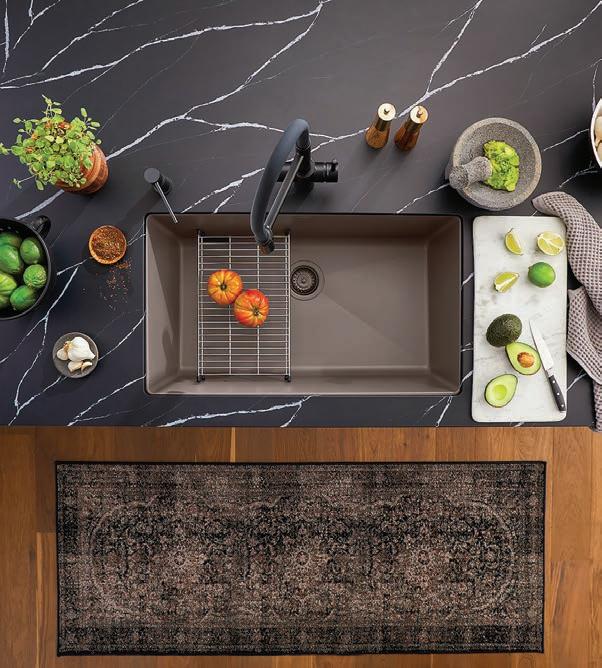
Blanco Canada’s sinks, faucets, and accessories were developed to accommodate any creative new build or remodelling project, and two new Silgranit colours reflect the National Kitchen and Bath Association’s findings that earthy tones will continue to be predominant in kitchens in the years ahead.
Blanco Silgranit sinks feature bold styles as part of a Blanco Unit, a customizable combination of a Blanco sink, faucet, accessories and organization systems into one streamlined solution (designers and homeowners can reference unit inspiration concepts to tailor their kitchen sink space to their specific household needs and interior style).
The two new Silgranit colours, Volcano Gray and Soft White, join the nature-inspired Silgranit colour palette; the former is a mid-tone grey inspired by volcanic ash and natural clay with hints of brown for warmth, ideal for complementing darker industrial and transitional kitchen design styles. Soft White is a dove grey with nuances of beige that adapts to both warm and cool tones and works well with organic, contemporary, and Scandinavian design styles.
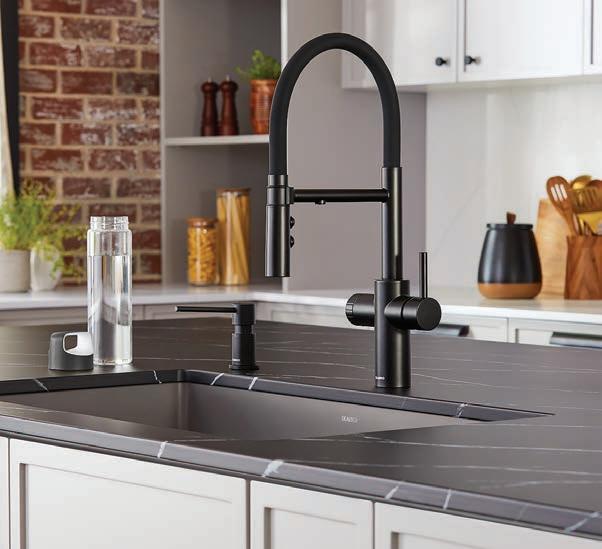
Blanco also recently distinguished itself by introducing the new Catris Flexo Filter faucet. Designed to optimize workflow at the Blanco Unit, this twoin-one faucet features both filtered and non-filtered water delivery on demand and seamlessly connects to all common water filtration systems. It also has an insulated pull-down dual spray with a magnetic docking arm that delivers filtered water through a discrete waterspout. A single lever for tap water is located on the right side of the faucet and a dial on the left accesses cold filtered water.
In general, collaborations with outside parties have been a time-honoured way to foster design innovation, and the latest example of this is provided by Kohler.
Donna Church, manager – marketing and communications at Kohler Canada, says that while Kohler owns many brands, “it’s rare when we partner, but we made an exception with interior designer and influencer Shea McGee, and the relationship proved to be productive.”
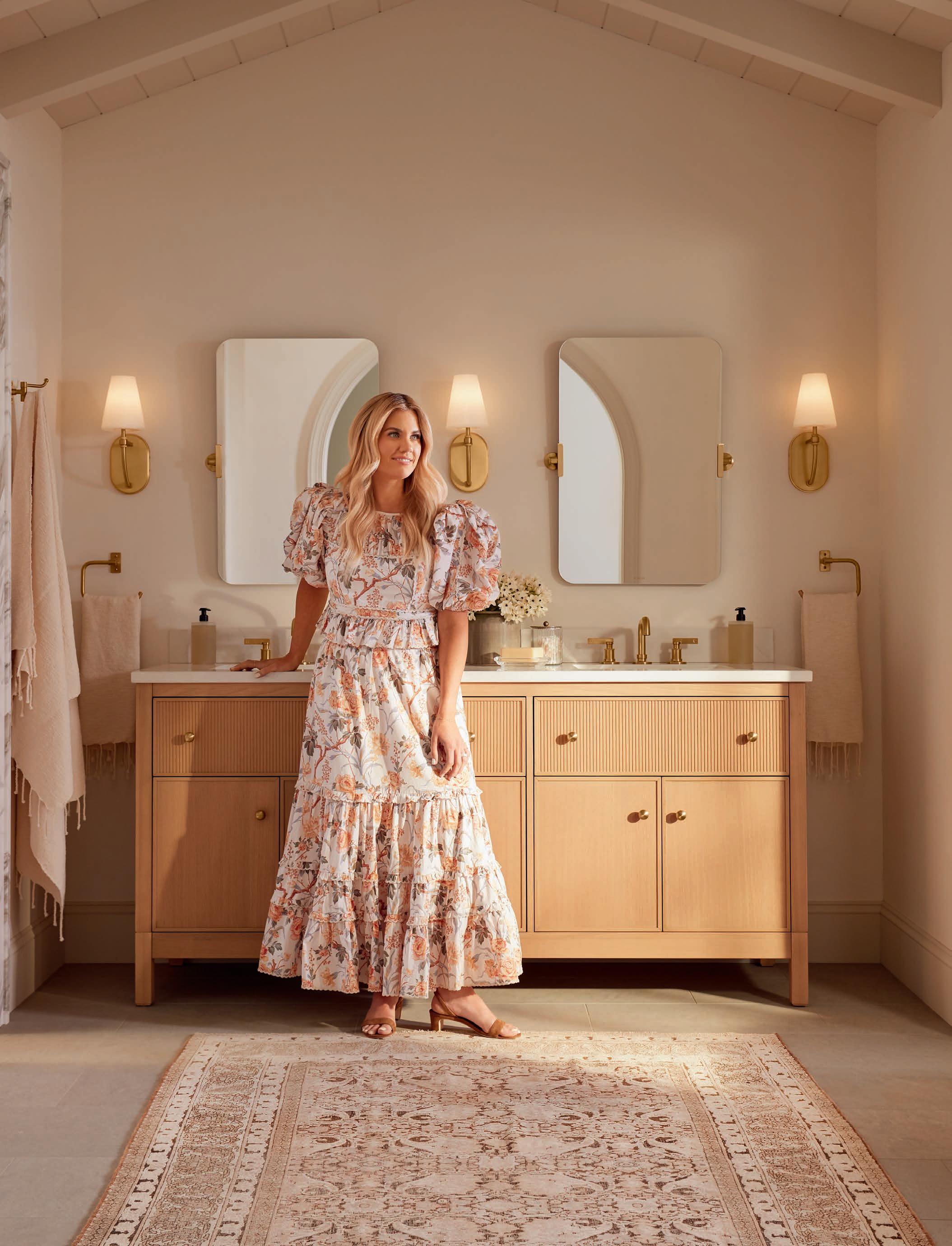
Studio McGee and Kohler combined styles and craftsmanship to design a timelessly versatile kitchen and bath collection, with McGee reportedly pulling nuanced details like font choices, faucet lever engravings, and ribbed textures from Kohler’s 150-year-old archives and bridging them with her modern sensibilities. The Kohler x Studio McGee Collection is currently available at Kohler Signature Stores and will be extended to all distributor showrooms later in 2024.
The Kohler x Studio McGee Collection includes six distinct product lines: Edalyn Kitchen Faucets; Castia Bathroom Faucets; Malin Vanities (featuring square legs and clean lines, Shaker style); Seagrove Vanities (mid-century modern style); Embra Lighting; and Kernen Lighting.
Studio McGee also worked with Kohler brand Ann Sacks to create The Ann Sacks x Studio McGee Collection, which features two finely executed porcelain designs – the result again of McGee going “deep into the Kohler archives to find some of the historical details and styling that make a fixture timeless,” she says. “From there, I gave them modern updates for a mix that’s uniquely Studio McGee.”
The Ann Sacks x Studio McGee Collection can be specified for wall or flooring installations and include two different porcelain tiles (Canyon Lake and Novah), and a stone mosaic (Willow Heights). A
Cadet
Pro touchless flush toilet.
Blanco Unit featuring the Silgranit sink.
Catris Flexo Filter faucet.
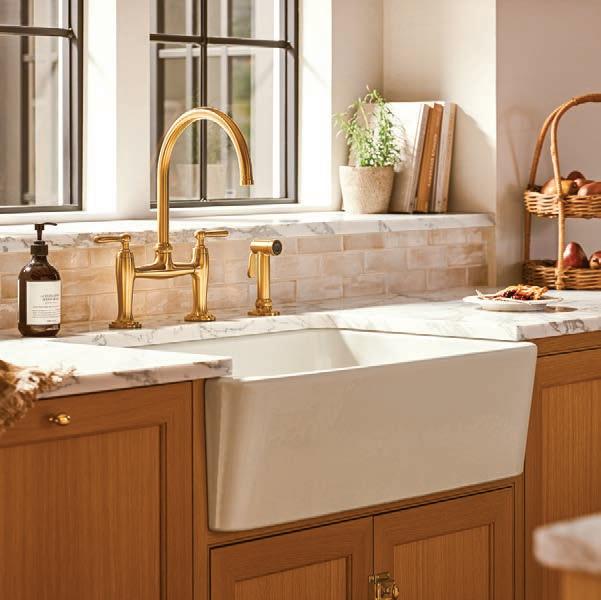
Edalyn Kitchen Faucet from the Kohler x Studio McGee Collection.
Paint and coatings explore a diverse spectrum, weaving tales of innovation, sustainability, and personal expression in every hue
by NATALIE BRUCKNER
As we dive headfirst into 2024, the world of paint and coatings reflects the dynamic evolution of our world, bursting with a kaleidoscope of colour options and selections.
Experts over at PPG understand that 2024 brings with it a new era of self-expression and personalization in the built environment, and as such have come up with some beautiful options that will help designers and architects meet client requests for colours that help them build a stronger connection to their space.
Martin Fuchs, PPG senior marketing manager steering the Sico paint brand, sheds light on the backstory of this year’s chosen colours. Gone are the days of cool, muted tones; today sees a fresh era where energizing neutrals take centre stage. “Sico’s Colour of the Year, Satin, and Dulux Paints by PPG’s Limitless offer a unique opportunity for designers and architects to express themselves with the subtle energy of a warming neutral,” says Fuchs.
So, what’s so special about these colours? “Energizing, comforting neutrals are here to stay, replacing cool tones like grey for commercial and residential spaces in 2024 and beyond,” explains Fuchs. “That said, they also need palettes that offer versatility to work with both new and existing décor. Warm neutrals like Limitless and Satin can serve as a neutral backdrop for bolder colours, complement warm or cool tones, or standalone as a fresh, energized colour for a whole room or exterior.”
Pairing these colours is a delightful game of mix and match. Fuchs and the team at PPG have crafted palettes that serve as guides for those seeking inspiration. “Because these colours are so versatile, it is hard to go wrong with pairings. That said, we have created palette collections for anyone looking for inspirational pairings for Satin or Limitless. I always encourage people, whether working in residential or commercial spaces, to use Sico, Dulux, and colour visualizer tools to help their clients visualize colour palettes before committing,” says Fuchs. Afterall, in the world of paint and coatings, it’s the subtle strokes that often make the grandest impressions.
2024’s Canvas Unveiled
COLOURS OF 2024
Prepare to embrace a journey into the vibrant unknown as Benjamin Moore unveils its newest Colour of the Year for 2024. Sharon Grech, media spokesperson for colour marketing and development at Benjamin Moore & Co., proudly introduces the captivating Blue Nova as the pinnacle shade of the year.
“We chose Blue Nova to depart from the familiar and embrace a sense of adventure, particularly with travel resuming,” Grech explains. Inspired by the brilliance of a new star formed in space, Blue Nova beckons us to unknown places in search of new experiences. Pairing suggestions in the 2024 palette include Blue Nova with Antique Pewter for a sophisticated contrast. Grech highlights the interplay of light and dark tones, recommending combinations such as Blue Nova with Topaz or Teacup Rose with Polar Sky for dynamic contrasts. When it comes to emerging trends, Grech notes the rising trend of “colour drenching,” enveloping entire rooms in a single hue. Innovative enhancements in Benjamin Moore paints include Regal Select Interior with increased durability and Element Guard for harsh weather protection. “If you’re more conservative, consider painting a singular wall like the ceiling in a dining room or an accent wall in a small powder room to create visual interest,” explains Grech.
Innovative technologies continue to enhance Benjamin Moore’s products. Regal Select Interior paint now boasts enhanced stain-release technology, increased scuff-resistance, and washable features without compromising colour or sheen integrity. Meanwhile, Element Guard stands out as a premium exterior paint built to withstand harsh weather conditions.
Satin by Sico.
“The Benjamin Moore Colour Marketing and Development team, which I am proud to be a part of, uses a process of continuous research, observation, and collaboration to spark a wide range of concepts and ideas that ultimately guide our Colour Trends palette and Colour of the Year. As well as from the design and fashion world, our team takes into consideration cultural and societal influences and the emotional associations that different colours evoke,” says Grech.
This year, Sansin welcomes a harmonious blend of natural-translucent colour palettes and the commanding allure of bold contrasts, with Onyx as the chosen hue for 2024. This striking and potent dark tone is available in various transparencies and holds court across Sansin’s exterior products like SDF, Dec, and ENS. Sjoerd Bos, managing director of Sansin, explains that the commanding presence of Onyx adorns residential and mass timber projects alike, adding depth and allure.
As for rising finishes and textures, the art of wood profiling takes precedence, tailored to individual preferences and regional influences. This is why
Sansin has developed the IRIS program, aiding architects, building owners, and engineers in aligning desired aesthetics with optimal performance.
Sansin’s collaborations with architects and designers continue to redefine innovation. The KF Centre for Excellence, designed by Meiklejohn Architects, stands as a testament, securing the prestigious Wood Design & Building Sansin Award. “Sansin partner StructureCraft provided the structural engineering and mass timber for the building. To showcase the beauty of the wood and provide superior protection, the mass timber is finished with a comprehensive system of Sansin’s environmentally-friendly protective coatings, including SDF clear on the exterior glulam, KP12W clear on the exterior DLT [dowel laminated timber] soffit, KP12 clear on the interior glulam, and low-luster Purity Glacier on the interior handrails,” explains Bos.
Breaking news from Sherwin-Williams is that Upward SW 6239 has been unveiled as their 2024 Colour of the Year – a serene blue symbolizing the ever-present sense of peace found when slowing down. “Upward SW 6239
Exterior dark tone Onyx by Sansin.
Upward SW 6239 by Sherwin-Williams.
Aerospace & Aviation Museum | Kelowna, British Columbia
Photo: Shawn Talbot courtesy naturallywood.com
WHAT’S YOUR Colour Narrative?
Urban or Rustic?
Neutral or Colourful?
Modern or Classic?
Find your Colour Narrative in our fullspectrum palette that captures more of the widely specified paint colours from across Canada, determined by our Customers and Colour Experts.
represents the gentle forward momentum in all of our lives,” explains Sue Wadden, director of colour marketing at Sherwin-Williams. “It brings to life that carefree, sunny day energy that elicits a notion of contentment and peace. With this colour, we invite our consumers to take a pause and infuse a new sense of ease and possibility into their spaces – one that doesn’t overwhelm, but rather establishes meditation and tranquility.”
Upward SW 6239 welcomes a weightless, buoyant peace; an invitation to open minds to a colour of ethereal calm that is ever-present – if we remember to keep looking up.
“As we play with colours, it’s essential to consider their interactions thoughtfully,” adds Wadden. “Warmed-up blues might lead to hues that appear muddled and lackluster, which is why preserving the crisp edge and magnetic allure of cool blues is vital. It’s these subtle nuances that create spaces that are timeless and inspired. We’re excited to share this beautiful colour and craft interiors that exude harmony and evoke a sense of enchantment.”
Wadden recommends pairing the hue with blues and greens, deeps and darks, and delicate tints like Snowbound SW 7004, Drift of Mist SW 9166, Gale Force SW 7605, Tricorn Black SW 6528, Honeydew SW 6428, Palm Leaf SW 7735, and Antiquarian Brown SW 0045.
SPECIALTY PAINT SOLUTIONS
In the world of brick makeovers, Nawkaw’s the crew to trust. Their advice? Skip the paint aisle if you’re eyeing a colour change for your masonry. They’ve got tricks up their sleeve that work like magic without messing with your brick’s natural vibe. Stains, their top pick, dive deep into brick pores, giving a lasting colour upgrade that won’t fade or mess with the brick’s texture.
Nawkaw custom-make new stain for every project they work on. From NawTone-K, the advanced stain for complete design control, and NawTone-K Opaque that offers complete hiding power and beautiful colour options to NawTone+Plus, a stain the provides colour plus water repellant in one step.
Now, if you’re after a subtle shift, they’ve also got the options. This is where limewash steps in, offering a softer, weathered charm while keeping that natural brick feel intact. Coloured mortar? It’s there too, tweaking shades without
the paint roller fuss. Their tip? Let the coloured mortar gig be their headache – it’s a tricky process that needs a pro touch. Nawkaw has got your brick’s back when it comes to switching hues hassle-free.
Colours can truly pack a punch. They steer our actions, wherever we are. Whether it’s the sky’s hue, the vibe of a place, or even what we wear, colours matter. However, when it comes to colouring our spaces, it’s not just about the aesthetics; it’s about making a choice that matters. That’s where the experts at PLC come in, shedding light on a crucial decision: traditional paint or ecofriendly Cork Spray?
Breaking it down, the benefits of Cork Spray become evident. Unlike regular paint, it adheres seamlessly to various surfaces, from wood to concrete, requiring less upkeep. Its durability surpasses paint, resisting cracks, and standing strong against water damage. Think of it as armour, safeguarding your space and maintaining comfort despite weather extremes.
Cork Spray doesn’t merely coat surfaces; it shields against salt, mould, and fire. And it’s a superhero for the planet, being 100 percent natural, recyclable, and renewable – aligning your space with eco-consciousness.
In their blog, the experts champion Cork Spray as a durable, cost-friendly, and eco-smart alternative to traditional paint, available in a variety of hues to match your mood and property’s ambiance. It’s not just a choice for your space; it’s a choice for a greener tomorrow.
INDUSTRY DEMAND
Demand for quality paint continues, and as such, Cloverdale Paint Inc., North America’s largest privately-owned paint and coatings manufacturer, this year announced upgrades to its Surrey, B.C. manufacturing plant and the establishment of a distribution facility and warehouse in North Surrey.
Cloverdale Paint’s Surrey plant in Newton has expanded its manufacturing capabilities by investing in automated, high speed paint processing that more than doubles its decorative paint production capability. Along with the improvements to plant throughput, the automated batch-making system reduces the amount of time it takes to produce paint, thus ensuring higher service levels and reduced inventory requirements. A
RISE ON UP
IStructural steel continues to wow with its ability to reach great heights
by ROBIN BRUNET
t’s an increasingly familiar story in 2024: inflation and high interest rates have caused their fair share of pain for Canada’s structural steel sector, yet demand is so strong that fabricators and suppliers are busy with a variety of projects.
Supermétal-CANAM is a prime case in point, thanks partly to the company’s capabilities. Supermétal’s pre-construction, engineering, and construction services are supported by parent Canam Group’s ownership of Canada’s largest steel fabrication company. This backing provides clients with a complete steel solution ranging from structural steel, open-web steel joist, and metal deck. In Western Canada, Supermétal’s most prominent project continues to be the massive Oakridge redevelopment in Vancouver, Canada’s largest mixed-use project at 4.3-million square feet and with 12 tower cranes currently in operation. Supermétal Construction is erecting two sweeping canopies that require large HSS pieces formed in a 3D axis. The installation needs to be precise, requires multiple lifts, and detailed sequencing between the shops and the site team.
In the east, Supermétal recently applied its skills to CIBC Square II in Toronto. With mega nodes cast in place, the installation team installed massive diagonal columns and tie-back beams to the core of the tower, which was followed by the more familiar process of repetitious floor installation up to level 54.
Supermétal’s prominence in the structural steel sector has not gone unnoticed, having won the most recent Architectural and Engineering award from the Canadian Institute of Steel Construction Awards of Excellence for British Columbia. This was for Vancouver’s Deloitte Summit tower, a 24-storey stacked cube office building for which Canam Structures delivered and erected over 5,000 metric tons of steel. The tower features continuous megacolumns, beams with mechanical openings, and exterior trusses tying back to the core with heavy cast steel nodes.
Jean-Paul Philippon Jr., president of JP Metal Masters, agrees that demand is as strong as ever despite inflation squeezing the construction sector. “Projects have been cancelled or put on hold due to high costs over the past year, and yet we’re busier than ever,” he says. “The reason why is because
our niche is high-rise development: we know how to build and service our clients and their towers. We have a housing crisis in Canada; that being known to all, construction is going full steam – and one of these requirements is high-rise residential development.”
JP Metal Masters brings considerable value to any project, having evolved into one of B.C.’s top structural and miscellaneous steel fabricators and erectors. Augmented by the fact that in 1997 JP created JP Drafting to provide itself as well as outside clients with complete steel detailing services for their fabrication.
One of JP Metal Masters’ ongoing projects is the Oakridge redevelopment. “We’re working on Tower 2 primarily at the moment, which required us to fabricate and install over 100 tons of structural steel on the roof, to enclose mechanical units, and the power supply for all six new Oakridge towers,” Philippon says.
A recent project on the architectural side showcases a new direction for JP Metal Masters: Gordon Ramsey Burger Vancouver at the Hard Rock Casino in Coquitlam. “The exterior consists of an all-aluminum outside patio enclosure, which was our responsibility,” Philippon says. “It’s our first job using almost 100 percent aluminum, and we have just been Aluminum CWB Certified, with the intention of expanding more into this busy market.”
Based in Burnaby, KWH Constructors is a structural erection firm augmented by Somerset Engineering, a construction engineering division. With this expertise in-house, KWH provides value-added services such as lifting equipment operation, field erection, seismic retrofits of bridges and buildings, port facilities maintenance, and the installation of precast/prestressed concrete.
While it is well known for the structural steel and mechanical machinery erection of the Johnson Street Bridge project some years ago, KWH of late
Steel and aluminum details at the Gordon Ramsey Burger Vancouver, Coquitlam, B.C.
Galvanize Better.
Corbec is the leading hot-dip galvanizer in Canada, offering unrivaled service, unparalleled expertise and bold innovation.
Why Galvanize?
Maximum Protection
Galvanizing forms a durable barrier against corrosion, for prolonged structural integrity.
Durability & Adaptability
The robust zinc coating is resilient, withstanding harsh conditions, extreme weather, and diverse environments, resulting in long-lasting performance and versatility.
Maintenance Free
Galvanizing offers the optimal and best performing protection saving time, resources and money.
Longer Lasting than any Coating
Galvanizing guarantees longevity against corrosion and wear, more than any other coating, as confirmed by industry and indicated in codes.
Best Return on Investment
Galvanization delivers an unmatched value, a cost-effective solution, maximizing your investment and peace of mind.
Sustainability
To Corbec what Matters is:
• Galvanizing Better
• Quality & Innovation
• Expertise & Quality Assurance
• Service - Pre-During and After the project
• Collaboration and assistance to the project team
It’s the lowest carbon footprint option – The durable solution that offers protection without maintenance and no added costs throughout the Life Cycle of the project – Zinc is Recyclable and Reusable.
Galvanize Better!
Hamilton Montreal Quebec Halifax
Buildings Bridges
Galvanized Rebar Steel Structures
San Diego Central Library, Credit: AGA
has been involved in equally demanding work in the U.S., including the Pretty Rocks Slide Bridge, a 475-foot modified Warren Truss spanning the Pretty Rocks Slide in Denali National Park, Alaska. The remote site and geotechnical conditions required extensive project planning, one outcome being a unique launch scheme using a temporary truss within a permanent truss. KWH managed procurement of all superstructure related materials and relied on Integrated Design Detailing to meet the compressed schedule. Construction took place during two six-month summer seasons, with KWH crews living in work camps.
In Seattle, KWH supplied and installed 1,000 tons of structural steel for the Lower Podium at the Washington State Convention Center. Originally, structural steel for the project was fabricated years ago in accordance with an earlier design of the convention centre addition; KWH managed the re-detailing and refabrication of the steel to meet the current design. In addition, it designed crane supports and temporary shoring as well as erected two levels of steel and decking to meet an accelerated schedule.
Among many other projects, Benson Steel spent the last two years fabricating the two new Porter Airlines Hangars at the Ottawa airport. The 150,000-squarefoot facility was designed to house all of Porter’s E-2 aircraft maintenance; the hangers have indoor parking for up to eight aircraft and were built with sustainability in mind. “We finished work over the course of the winter and are proud of the outcome,” says Benson Steel CEO Steve Benson.
Benson adds, “We’re currently involved in the Ādisōke library in Ottawa, supplying structural steel that is being used in conjunction with extensive mass timber.” At 216,000-square-foot, this $326-million facility will be one of the largest libraries and archives in the world when it opens in 2026; it’s also on track to being the first public building of its kind in Canada to achieve net zero carbon emissions, thanks to elements such as advanced energy saving systems, a green roof, and strategically located skylights.
Benson Steel provides a full range of services from design, detailing, and construction engineering, through fabrication of special steel pieces to special finishes with architectural features. Structural steel for every project is fabricated off-site in Bolton, Ontario; at the right time it is brought to the construction site and rapidly erected, accelerating project schedules.
Benson reports that the New Year is very much a time of change for his company. “I recently stepped down as president and was replaced by long-time colleague Alex Baldissera,” he says. “Alex now oversees daily operations, while I’m managing the future of our company and long-term investments.”
Currently, Benson is scrutinizing the potential for robotics and AI to enhance operations of companies such as his. “AI is definitely on the horizon for us, but I’m still researching what it can do specifically and how it would impact the industry. Even if its role was to help us facilitate communications between our sub trades and clients, that would be enormously helpful.”
Benson concedes that all this is unfolding during a time of considerable headwinds. “Inflation is having a big impact on high-rise tower projects: we saw one 20-storey tower in Ontario recently cancelled and the land sold, and there are many similar examples. But I remain optimistic about the future, considering that increased immigration is making housing and related infrastructure and services a priority.”
STRUCTURES
Ottawa Public Library Library and Archives
MUCH MORE THAN A HOUSE FOR BOOKS
The story of this project is about two major public institutions coming together to create a place where Canadians and visitors from around the world will gather to connect, to learn, discover, and create.
A TRUSTED PARTNER FOR OVER 40 YEARS
Steel frame erection at the Porter Airlines hangars, Ottawa, ON.
Dare to Accelerate Change
BUILDEX
As a fourth-generation family business, Walters Group is responsible for many iconic Canadian structures, including Calgary’s The Bow featuring full height atrium spaces and exposed structural framing for all 58 floors. Two of its more recent projects also approach iconic status and are prime examples of tricky engineering logistics accomplished with maximum efficiency.
In December, Walters Group along with EllisDon installed the long-awaited North Bay Pedestrian Bridge that connects CIBC Square to Union Station
in Toronto. The 220-ton bridge girder was shipped in a single piece by barge from Hamilton, and an engineered ramp was constructed to offload and transport the girder to the site. Pinnacle Logistics, along with Western Mechanical Electrical Millwright Services Ltd. (a heavy transport company) were credited for managing the logistics that enabled Walters Group and its partners for taking only six days to complete the entire installation. Meanwhile, Walters Group and Suffolk Construction held a topping off ceremony in Boston
for the new 10 World Trade building, a 555,000-squarefoot structure with flexible floor plates and designed with swooping geometric forms (the building was also designed to address the effect of a predicted 40-inch rise in harbour water levels by 2070).
Last but hardly least, family-owned Corbec, which has been providing solutions in the structural steel realm since 1965, has of late focused increasing attention on the benefits of galvanizing – in which Corbec is a leader thanks to four galvanizing facilities and generations of expertise.
Corbec cites the Cariboo Falls project as an example of galvanizing being specified for its coating durability, corrosion performance, sustainability, plus initial and life-cycle costs.
The four generating stations and other infrastructure clustered around Cariboo Falls in Northern Ontario were hot-dipped galvanized 60 years ago and remained maintenance free, so when it came time to undertake the first major upgrade, Ontario Power Generation again specified galvanizing for all the exposed steel, including structural, fasteners, railings, and walkways.
Corbec’s experience with extra-durable HDG coating was vital for this project, and the high capacity of the HDG steel ensured rapid reliable turnaround of the two-and-a-half million pounds of steel needed during the short northern construction season. Also, Corbec’s on-floor information systems ensured the proper identification and delivery of every piece of steel to each work site location, facilitating seamless assembly and erection across the remote project complex. A
Diamond Polished Concrete is a unique, advanced flooring system that brings out the natural beauty of concrete, helps reduce maintenance costs and enhances the natural durability of concrete surfaces. The Tri-Con Diamond Polish System employs an innovative 7-step grinding and polishing process that utilizes progressively finer diamond grinding heads. This system also uses the most advanced penetrating sealer technology.
Tri-Con Concrete Finishing is an industry leader with more than 30 years experience in the concrete industry. We are a one-stop supplier capable of pouring new floors to exact specifications as well as restoring existing concrete surfaces with endless versatility. We guarantee that we deliver on time, on budget and on spec every time.
Installation of the 220-ton bridge girder for the North Bay Pedestrian Bridge, Toronto, ON.
GOLDEN TROWEL AWARD WINNER
On Solid Ground
Uncovering
the eco-friendly elegance and versatile trends in hard surface flooring
by LAURIE JONES
Manufacturers, importers, and distributors of hard surface flooring are showcasing the wide variety of unique options to satisfy the most discerning homeowners, designers, and developers, with environmental benefits to round out the mix.
The Abpure Infinity Collection from American Biltrite is the first carbon-neutral rubber sheet flooring collection produced with renewable natural gas from organic waste, helping to reduce greenhouse gases at the source. “Abpure Infinity is our first cradle-to-gate carbon-neutral rubber sheet flooring,” says Catherine del Vecchio, VP of marketing. “Our research and development team looked into a number of ways to make this new product line carbon neutral without purchasing carbon credits. The clear solution was to manufacture Abpure Infinity with renewable natural gas derived from organic waste. This is a new energy source produced locally by collecting society’s organic waste and transporting it to biomethanation farms, where the waste is fermented and purified to generate renewable natural gas [RNG]. We use the full amount of RNG made from 100 percent organic waste to offset Abpure’s cradle-togate carbon footprint, as measured in our Environmental Product Declaration [EPD].”
Abpure Infinity is a three-millimetre rubber sheet flooring that features an elegant tone-on-tone chip visual. The Infinity palette features foundational base colours running from light to dark within hue families to create harmonious tonal combinations. The line has a large selection of foundational greys and beiges, environmental blues and greens, and uplifting accent colours. “The Infinity colour line is based on the concept of four pillars, each one representing a different avenue for healing through colour therapy,” says Lora Di Fabio, head of design at American Biltrite and Color Marketing Group board member. “The specific colour choices were based on a matrix of natural hues with therapeutic properties and crossed with forward-trending colour directions: Engage, Oasis, Nexus, and Jovial.”
The focus of Ames Tile & Stone’s offerings for 2024 are on a versatile series that can create stunning indoor and outdoor living spaces. “There are two comprehensive lines that have seamless options for a variety of applications,” says Nicole Goetz-Turner, product development co-ordinator. “Vibes and Fjord both lend themselves to harmonious multi-use spaces in timeless and natural tones.”
The Fjord series draws inspiration from Scandinavia, where stone is a dominant part of the landscape, and embraces the natural beauty of eroded rock. “This series is extremely
The Abpure Infinity Collection from American Biltrite.
The Fjord series from Ames Tile & Stone.
versatile, and can be applied both indoors and outdoors, interpreting the most contemporary and minimal designs as well as more sophisticated and elegant tastes” Goetz-Turner explains. “It’s also technically sound being a through-body porcelain tile suited for residential and heavy commercial applications.”
Goetz-Turner says Vibes has the beauty of stone, in a stunning natural colour palette, that lends character and depth to any space. “This line brings a harmonious and primordial style that interprets minimalism not as a sacrifice, but as a perfect balance in our way of life. Inspired by nature with the usability of porcelain makes this line a great option for residential and commercial projects.”
Tri-Con Concrete Finishing offers products that fulfill the needs of industrial clients, such as high loading, high wearing, flat, multi-functional custom concrete floors with joint-free options that also apply to commercial concrete floors with joint-free flooring, as well as polished concrete flooring that creates architecturally stunning designs with custom colours and imbedded logos for branding. “An important consideration for the industrial commercial client are structural features and the flatness of the concrete floor for racking mobility and support loading on the racks,” says Frank Guida, president.
Guida says Tri-Con has been using steel fibre technology in concrete since 1982 to replace conventional reinforcing and to widen joint spacing with crack control. “Previously, rebar was used for stability. Steel fibres used to go from 20 kilograms to 40 kilograms per cubic metre, depending on the strength needed to support the load. If we are doing a joint-free floor, they are seamless and as such much smoother. This is important in areas like warehouses because the machines running over the concrete can go faster without bumps in the floor or concrete joint breakdowns. It’s all done in conjunction – you start off with the loading, and design the concrete slab including the centre with optimized steel fibres for a joint-free floor. Then there are recommended custom additions like the Cosinus armoured metal joints at the end of the pour.”
For the more architectural look to floors, Guida says they can make concrete look like Terrazzo. “We can use a polishing process, with or without colour, and depending on the type of aggregate, we can use different grinders to expose the aggregates. One method is called the salt and pepper look, because only the fine aggregates on the surface are revealed. It can be polished to a high shine, or, using products that are embedded into the concrete, can create a look and feel like polished marble.”
Olympia Tile + Stone has introduced two new Italian lines for their 2024 selection. “Unica is a beautiful onyx look with exquisite depth and character,” says Oren Gal, sales manager, builders and commercial divisions. “We stock it in three colours – Cloud Gray, which is a white/grey blend, Green, and Deep Dark, which is black. It’s available in two large format sizes: 35-inch by 35-inch and 30-inch by 60-inch in a polished finish.” The tiles are chemical resistant and stain resistant.
The second selection from Olympia Tile is Moon. “This glazed porcelain tile is a replica of the London Brick in two-inch by nine-inch size, and we stock it in six colours, as well as an imprinted décor for each colour,” Gal explains. “The tiles are variegated and textured to enhance the authenticity of the products.” Colour options include Bianco Minerale, Argilla Naturale, Bruno Bistro, Nero Fumo, Verde Muschio, and Rosso Mattone.
Brent Fisher, manager of Flesher Marble & Tile 1910 Ltd., explains that porcelain tile is a very versatile product. “We all know that it is extremely durable, but the product can be configured in many ways to offer interesting design impacts. These designs tend to be limited to boxed shapes, but the shapes can be customized a variety of ways. We recently did a high-end restaurant whose designer was looking for something unique.”
He says the porcelain tile selected for this project was beautiful, yet not overly expensive. “The designer carefully selected four colours of 24-inch by 48-inch tile that formed the basis of design. Three of the colours are an obvious combination but the addition of a deep green to the mix was an interesting choice that simply set the design apart.”
Fisher notes the original design had many different random shapes that created a logistical problem with the project execution. “Because the shapes were random the only option would be to treat each piece individually and cut by hand with a tile cutter. This would require the skills of a master tile installer with incredible patience. It would make the installation very inefficient and ultimately effect the project schedule.
“We went back to the designer and suggested that we needed to establish standardized shapes so that we could approach the cutting another way. The shapes were ultimately re-worked and went from over 40 different shapes to six shapes. With standardized shapes, that would also have standardized opposing pieces, we could now have the pieces cut precisely by cutting them with a waterjet cutting supplier. Not only did we get accurately dimensioned cuts, but we were able to manage our waste efficiently.” Fisher says a collaboration between trades and designer produced the nicest looking restaurant floor in town and maintained the budget.
The Abpure Infinity Collection from American Biltrite.
Custom designed porcelain tile from Flesher Marble & Tile 1910 Ltd.
Total Precast Concrete Key Attributes to Passive House Development are:
· Manufactured in local precast facilities under controlled conditions
· The whole building envelope in one composite panel; air barrier, moisture control, insulation and the structure
· Hollowcore floor slabs allow for a much lower depth to span ratio
· Hollowcore provides the lowest GWP per m2 of concrete floor area
· Precast concrete dramatically reduces the construction schedule, site congestion, noise and environmental impacts
For more information and educational presentations check out Learn on Demand, a 24/7/365 Educational Platform. Visit: cpci-learnondemand.com/
For more information on Passive House Total Precast Concrete, visit www.cpci.ca/publications to download your free copies of the Structural Solutions Guide and the Putman Family YWCA Total Precast Concrete Case Study.
Project: The Putman Family YWCA, Hamilton, ON Architect: Kearns Mancini Architects Inc., Toronto, ON
ADHESIVES/SUBSTRATES
The Peel & Stick Ditra-Heat Floor Warming Membranes Floor continues to be a growing trend for new and renovated homes and businesses alike. “Flooring installers are using uncoupling membranes with floor heating cables because they offer the luxury of warm tiles, combined with an ease of installation,” says Tod Valickis, global product manager. Now, installing a floor warming system just got easier. Schluter-Systems is introducing two new peel and stick floor warming membranes: Schluter Ditra-Heat-PS and Ditra-Heat-Duo-PS.
“Both new products are available in rolls and sheets to accommodate various room sizes,” Valickis notes. “These peel and stick membranes feature a pressuresensitive adhesive to bond the membrane to the substrate, replacing the need for thin-set mortar. You simply remove the transparent release film from the fleece side of the membrane to expose the layer of adhesive and embed into the substrate. The membrane can easily be repositioned until pressure is exerted. This adhesive is very strong and once installers try it; they are convinced.”
Quick and easy to install, Ditra-Heat-PS and Ditra-Heat-Dup-PS integrate customizable, comfortable electric floor warming. Both peel and stick membranes are designed to secure the Ditra-Heat-E-HK electric floor heating cables and provide uncoupling, waterproofing, vapour management, and support to ensure a long-lasting installation. Ditra-Heat-PS features a nominal quarterinch thickness to minimize tile assembly thickness and reduce transitions to lower surface coverings. Ditra-Heat-Dup-PS is 5⁄ 16-inch thick and additionally offers sound control and a thermal break.
ENVIRONMENTAL STEWARDS
Mapei Corporation launched its collection of carbon-neutral products, offering specifiers, contractors, and homeowners the option of products that are fully offset throughout their entire lifecycle. “For Mapei, our carbon-neutral status is achieved by calculating the product’s carbon footprint and reducing it to zero through a combination of efficiency measures in-house, as well as through the acquisition of certified carbon credits in support of renewable energy and forestry protection projects,” said Brittany Storm, sustainability manager. “We understand that being carbon neutral is not enough. This is just the start; we’re looking at our products and in our facilities themselves to reduce our carbon emissions.”
Luigi Di Geso, president and CEO of Mapei Corporation adds, “Mapei’s carbon-neutral product family is one of many of our sustainable offerings, which include a variety of health and environmental certifications, and is the latest offering in our long-ranging efforts to be good shepherds of the environment.” He says these products join their Re-Con Zero Evo powder product, which turns waste concrete into usable material. “Now, by using CO2 offsets through renewable energy and reforestation projects, the Mapei family of carbon-neutral products offers our customers a way to make a contribution to the well-being of the environment, the planet, and the future, while still providing the strength and durability for which Mapei is so well known.”
The family of carbon-neutral products include: Keraflex Super, Large Tile & Stone Mortar, Light Mortar for Tile & Stone, Mapecem Quickpatch, Mapefer IK, Mapei Ultralight Mortar, Panitop XS, Ultracolor Plus FA, and Ultraflex LFT. A
The Peel & Stick Ditra-Heat Floor Warming Membranes Floor from Schluter-Systems.
*(CPCQA) CERTIFICATION PROGRAM BY PROCESS OFFERS KEY BENEFITS TO ARCHITECTS, CONTRACTORS, ENGINEERS, GOVERNMENT AUTHORITIES AND OWNERS.
Project: Champagne Quarry Park, Calgary, AB Architect: Gibbs Gage Architects
Revive & Thrive
Growing demand for restoration projects stirs up heightened interest in associated products and services
by ROBIN BRUNET
At a time when many projects across Canada are being cancelled or put on hold due to high interest rates, restoration projects continue to proliferate, for a simple reason. “A lot of restoration is vital, considering building or infrastructure operations are often at stake,” says Jeremy Horst, principal, building science and restoration at RJC Engineers (RJC).
RJC’s specialized structural restoration teams deliver the company’s collective structural engineering, building science, materials science, and prime consulting expertise. The combined skills have led to the successful restorations of a huge variety of facilities, ranging from unique (the 257-year-old Sambro Island Lighthouse in Halifax), heritage (the massive redevelopment of the mid-century Canada Post Vancouver headquarters, now known as The Post, and nearing completion) to institutional.
Horst notes that “in the past five or so years we’ve seen a revision of repair methodology for belowgrade work: Instead of excavation from the exterior and applying bitumen-based products to stop building foundation leakages, we’re increasingly being called upon to perform injection drilling on grid pattern spacing from the inside of the structure.”
Specifically, to achieve an elastic sealing of cracks or joints in the structure, the broader area is sealed
over its entire course with an acrylic gel waterproofing resin via pressure injection. This is known as the area injection method. “We use Koster products that we pump through half-inch diameter holes that are drilled straight through to the structure’s exterior, and the system is so effective it comes with a 10-year warranty,” Horst says.
Currently, RJC is using the system to seal 3.2 kilometres of service tunnels at a Toronto university, and it was recently tasked with waterproofing stone rubble foundations of a historic Toronto building. But the solution isn’t cheap: over $10 million is being spent on the university project; Horst points out that
“the system is ideal for situations where exterior excavation isn’t feasible – such as leaky elevator pits. And its effectiveness is increasingly being recognized in the restoration sector, so we anticipate many more projects of this kind in 2024.”
Brothers Jonathan, Matthew, and Mark Atwill-Morin are the third generation along with Nicolas Croteau to run Atwill Morin & Associates, whose rehabilitation of the McGill University Strathcona Music Pavilion project recently won the International Concrete Repair Institute’s Award of Merit in the masonry category. For this project, Atwill-Morin was the first Canadian contractor trusted by Mapei and engineers to use Mapei’s new Fibre Reinforced Cementitious Matrix (FRCM) system designed for masonry.
The Strathcona project required damaged bricks to be replaced or repointed, with stainless steel bars inserted for local reinforcement. The FRCM system was used to smooth wall surfaces in specified areas, and layers of structural mesh were added to wrap and strengthen the walls held in place by the mortar. Additionally, carbon fibre cords inserted into drilled holes spread out in a star formation and covered with epoxy were used as a strengthening solution.
Matthew Morin reports that even though the volume of new construction declined in 2023, “We had a 22 percent growth – which is further evidence that restoration projects continue to be a priority for many clients.”
Application of Mapei’s Fibre Reinforced Cementitious Matrix (FRCM) system.
Service tunnel waterproofing via the area injection method.
Rehabilitation of the McGill University Strathcona Music Pavilion.
Strong, innovative, sustainable
EvoBuildTM is the evolution of sustainable building materials designed to meet today’s sustainability targets.
With knowledgeable experts, science-backed data and sustainable product formulations, we’re able to work alongside you, offering unparalleled service from concept to completion.
EvoBuild™ Low Carbon Concrete is part of Heidelberg Materials’ Evolve™ Family of Products. Learn how these revolutionary products can help your project be part of a greener tomorrow.
heidelbergmaterials.ca
Material to build our future.
Morin’s team recently finished a three-year phased stint of brick and stone replacement plus structural upgrading of the Chateau Frontenac in Quebec City, and projects in Charlottetown and Cape Breton are currently keeping the company busy. “Also, in Saint John, New Brunswick we’re restoring the Carleton Martello Tower, which dates back to 1812 and is made of extremely thick stone, brick, and mortar,” Morin says. “We’re dismantling the structure brick by brick and resetting every piece, which requires a lot of know-how.” The restoration even includes laboratory testing of the old mortar to determine its composition, in order to decide the proportional mix of new formulations.
Mick Kopis, marketing director at Mapei Canada, is especially proud of the ICRI’s recognition of the McGill University Strathcona project and notes that no less than 11 different products from his company were used, including the high-performance fast setting Mapecem Quickpatch; MapeWrap 12 (structural epoxy putty adhesive); Planitop 23 (vertical and overhead repair mortar); and Planitop 25, a shrinkage-compensated, cementitious, flowable resurfacing mortar with a corrosion inhibitor.
Mapei is famous for developing long-lasting products that serve every type of construction need, and recently the company introduced a new family of carbon-neutral products. They include Mapecem Quickpatch and a variety of other mortars, and they join the company’s CUBE System and Re-Con line of cement admixtures, which reduce the carbon levels of the concrete mix itself and turn waste concrete into usable material, respectively.
Even though Heidelberg Materials isn’t a restoration and repair specialist, sales manager Byron Young points out that contractors occasionally use its shotcrete or concrete for such projects, and he is particularly proud of Heidelberg being involved in the MacLeod Building Renewal at the University of British Columbia – for which Heatherbrae Builders won a 2023 ACI Excellence in Concrete Construction award. “The concrete was supplied by our team at Ocean Concrete,” he says. The concrete being used to refresh the university’s electrical and computer engineering facilities after the 1967 building was renovated down to its basic structural elements.
Maxime Duzyk, global director, building science and engineering at Huntsman Building Solutions, reports that his company’s insulation solutions were deployed in a host of projects in 2023, and the New Year is shaping up to be equally busy.
Huntsman Building Solutions’ spray foams and coatings continue to earn designations that boost their status as important solutions not only for new builds but also in the restoration realm. Duzyk points out that HBS coatings are among the best solutions for below-grade waterproofing, while the spray foam products can help add structural strength, prevent wind uplift, reduce embers from entering attics, are resistant to floods, act as a radon barrier, and have a higher wind load resistance.
Last year, Huntsman Building Solutions received product code compliance (NBC 2015) recognition from the Canadian Construction Materials for its Radon Protection System, i.e.: the Heatlok Soya HFO, a closed-cell polyurethane spray foam insulation
that has proven to be an effective radon barrier. Duzyk says. “The key difference between our products versus others is that only 38 millimetres [mm] of spray foam is needed for a solid soil gas barrier, versus other spray foam products needing 50mm.
This year, Huntsman Building Solutions is set to convert all its production to Heatlok Soya HP, boasting the highest R-Value in the industry. It is also Greenguard Gold certified, and has undergone testing for radon diffusion, air barrier systems, and fire resistance to meet Canadian requirements for tall buildings. Additionally, in 2024, the company’s Coatlok Coatings achieved UL certification. These waterproofing polyurea products are nontoxic, fast drying, and can be applied to virtually any shape to create a monolithic waterproofing barrier.
Brian Salazar, national business development manager at Euclid Canada, corroborates the sentiments of his colleagues regarding the restoration sector in 2024 when he says, “We seem to be very busy despite the economic headwinds; there are no slowdowns to speak of.”
It helps that Euclid continues to make the process of restoration easier and more effective with a steady stream of new and refined products, the latest of which is Level Top PC-AGG, which Salazar describes as “an interior overlay material that imparts a new concrete look. It’s a cement-based and polymer modified product that can be polished just a day after it is poured. It’s great for resurfacing old, beat-up floors, and is stronger than the concrete it’s bonded to, so it’s extremely long-lasting.” Part of the resiliency is due to micro-fibres that prevent shrinkage and cracking.
Level Top comes in three formulas including Level Top PC-AGG, Level Top Stain, and Level Top Polish. Level Top Stain can be integrally coloured or stained within hours of placement, and Level Top Polish is uniquely engineered as a high strength overlay that may be polished 24 hours after placing. “Level Top’s use in U.S. showrooms has led to the product winning awards from the American Society of Concrete Contractors, and it’s effectiveness in restoration projects is substantial,” Salazar says.
Finally, experts at Lafarge note that the growing demand for sustainable and environmentally friendly materials within the restoration sector is “unmistakable.” According to Nicolas Ginouse, technical director, Lafarge Canada (East): “Customers are increasingly prioritizing products that align with green building practices as they seek LEED certification, and they express a keen interest in innovative technologies that enhance structure durability and minimize environmental impact.”
Ginouse goes on to note that, “At Lafarge, our commitment to remaining at the forefront of these trends is unwavering. Researching and developing solutions to meet these evolving demands is integral to our mission. Our recent acquisition of Solhydroc, a Quebecbased company specializing in concrete protection and repair products, enhances our ability to merge expertise and pioneer solutions in concrete renovation and refurbishment. This strategic move introduces our new product line, BMQ Solutions, featuring specialized bagged ready-mixed concrete products. This revolutionary offering simplifies construction, requiring only the addition of water to unleash its full potential.”
Lafarge is also introducing to the market Chronolia ECO, its latest high-early-strength sustainable concrete. This innovative product sets Lafarge apart as the only ready-mix concrete supplier in Eastern Canada, offering a sustainable solution with high early strength. Chronolia ECO challenges the conventional notion that high early strength contradicts sustainable construction, showcasing Lafarge’s commitment to pushing the boundaries of sustainable practices in the industry. A
The most effective waterproofing protection for construction joints & penetrations.
Swells up to 1000%
Withstands extreme hydrostatic pressure
Resists dislodgement due to it’s unique shape
Before and after application of Level Top PC-AGG interior overlay material.
BMQ Solutions floor application.
ECHO – UBC
by NATALIE BRUCKNER
Located in the vibrant neighbourhood of Wesbrook Place on Gray Avenue at UBC Point Grey, the newly constructed sixstorey Echo building stands tall as a testament to sustainable and community-centric living.
The wood frame rental building, developed, owned, and operated by UBC Properties Trust (UBCPT), presents 152 thoughtfully designed studio to four-bedroom rental homes catering to the diverse needs of UBC faculty and staff. Seamlessly blending modern living with environmental consciousness, Echo represents a harmonious synthesis of thoughtful design and sustainable living principles.
Echo’s origin traces back to UBC’s standard practice of providing its faculty and staff with below-market rental housing on campus. As well as maximizing housing options for faculty and staff, Echo aims to provide a balanced variety of unit types for a variety of renters and consolidate open space with adjacent sites while providing thoughtful connections with the neighbourhood.
In a commitment to walkability, nature, green streets, and a pedestrian scale, UBCPT has meticulously ensured that Echo’s design philosophy aligns seamlessly with UBC’s dedication to fostering a sustainable environment.
Sophia Zhu, an associate at ZGF Architects and a certified passive house designer, elaborates on the design principles guiding Echo. Three primary goals shaped its design:
maximizing housing; seamlessly integrating open spaces with neighbouring sites; and providing a diverse mix of unit types to cater to various renters. In the effort to tackle the challenge of maximizing density, the building diverts itself from the traditional L-shaped footprint. The staggered form on the courtyard side allowed for innovative unit layouts that prioritize efficient space utilization, offering residents distinctive living experiences.
“The project seeks to establish itself as a means of enhancing the pedestrian experience within the natural setting of Wesbrook Village. This targets the human scale within the first two levels as means of generating a dialog with the surrounding landscape,” says Zhu.
Overcoming the grading challenges posed by the sloping site allowed the team, which included Peak Construction Group as construction manager, to create and build dynamic architectural solutions. While some units may have varying relationships to grade, this adds character to the community and creates diverse living environments within the development.
Notably, Zhu explains that Echo departs from traditional massing approaches by creating the two-storey datum at ground level, allowing upper massing expansion into the public realm without compromising open space. “The upper massing is encapsulated with three intersecting framed elements. Positioned at the crossroad
LOCATION
5768 Gray Avenue, Vancouver, B.C.
OWNER/DEVELOPER
UBC Properties Trust
ARCHITECT
ZGF Architects Inc.
CONSTRUCTION MANAGER
Peak Construction Group
STRUCTURAL CONSULTANT
WSB Engineering
MECHANICAL CONSULTANT
Introba
ELECTRICAL CONSULTANT
Smith + Andersen
LANDSCAPE ARCHITECT
R. Kim Perry & Associates
TOTAL SIZE
139,173 square feet
TOTAL COST
Undisclosed
of multi-use corridors, the frames are highlighted at their exposed ends with a palette of colours to establish the building’s identity. The strategy brings a unique visual backdrop within the lush green corridors of Wesbrook Village, further enhancing the pedestrian experience,” Zhu says.
The three elevating frames utilize three distinct tones strategically to emphasize and dissect elements of the mass. A light grey panelling, serving as the primary facade material, lightens the overall mass and enhances colour accents and textures against a neutral backdrop, creating a simple yet robust scheme. Dark grey panelling unifies the building at the inner crotch area and entrance, striking a balance in proportions with the lighter panels and avoiding an industrial or institutional feel. Additionally, wood accent siding seamlessly connects windows between L1 and L2, forming a continuous base that supports the elevated frames, while infusing a sense of warmth at the pedestrian level.
“The colours at the end of the elevated frames are selected from the colour spectrum typically seen in a cross section of wood – earth tones in brownish red, orange, and yellow.
The combination mimics the effect of wood instead of using physical wood grained elements,” says Zhu.
In fostering human connections among residents, the aforementioned shared courtyard with its neighbouring building, Evolve, provides a communal space that encompasses a BBQ and children’s play area, a covered terrace with seating, a lawn area, designer landscaping, and a convenient bike rack. Furthermore, Echo enhances the resident experience with an indoor amenity area featuring a kitchen and lounge area. The rooftop, another enticing space within Echo, offers additional BBQs, a lawn, and ample seating. Emphasizing integration with the broader neighbourhood, Echo features a direct entrance for bikes from the green street, as well as a direct connection to a nearby park that includes a children’s playground.
With Echo now complete, it stands as yet another milestone in UBC’s commitment to sustainability and adds 139,173 square feet of purpose-built space to UBCPT’s overall portfolio, which continues to build financial legacy, expand communities, and create innovative spaces for learning and living at UBC. A
Isidore Landscapes
ANISHNAWBE HEALTH TORONTO INDIGENOUS COMMUNITY HEALTH CENTRE
by ROBIN BRUNET
The new Anishnawbe Health
Toronto Indigenous Community Health Centre (AHTICHC), is a key project on the site of a new 2.4-acre Indigenous community hub, a mixeduse city-block cluster consisting of the four-storey AHTICHC, a five-storey training centre for Miziwe Biik, and two 13-storey and 11-storey residential rental apartment buildings.
Designed by BDP Quadrangle, Stantec, ERA, and Two Row Architect, the complex is one of the first mixeduse, purpose-built Indigenous Hubs in the country and the first in Ontario. BDP led the design; Stantec and Two Row focused on the AHTICHC building, and ERA Architects presided over the restoration of the Canary building.
Joe Hester, chief director of Anishnawbe Health Toronto, says, “This project is the culmination of more than 20 years of planning and, quite frankly, an uphill battle for the integration of our health care, with architectural expression through an Indigenous lens.”
Anishnawbe Health Toronto established its first permanent home in 1989, but its facilities were soon outdated and overcrowded, and the organization began making submissions for an integrated hub in 2000. “We eventually purchased land in the West Don area from the province that was part of the 2015 PanAm/ParaPanAm Games Athletes’ Village,” Hester says. “This is adjacent to the Distillery District and the new Cherry Streetcar line, and it helped kickstart our project.”
During an extensive engagement process with Toronto’s Indigenous
peoples including service providers, residents, and aboriginal businesses, initial plans evolved from the provision of an aboriginal community health centre to a larger hub concept. Stantec collaborated with BDP Quadrangle and Two Row Architect on the master plan, which features a public piazza at the corner of Mill and Cherry streets as well as a central landscaped courtyard fully visible from the surrounding street edges.
Hester says, “Designing through an Indigenous lens meant rethinking basic concepts. For example, circular forms are prevalent throughout our culture, so why not use that for offices spaces instead of squares or rectangles? Also, we pushed for the AHTICHC building to rest directly on the land rather than having a parking lot underneath.”
For the 44,000-square-foot facility, Stantec created an exterior cladding of perforated aluminum panels that curves and folds like an Indigenous woven shawl, with stainless steel mesh suspended from the bottom edge that sways in the breeze. The façade to the east opens to a four-storey atrium that organizes the facility’s clinical spaces and connects to a landscaped courtyard, where a bioswale collects rainwater for irrigation.
Key programs on the ground floor – ceremonial space, traditional healer, and the community kitchen – are established as standalone pavilions inspired by pebbles in the stream of the Don River delta. The elevated central courtyard serves several purposes, including concealing services and support spaces as well as
being an amenity for the surrounding residential portion of the hub.
Stantec embraced natural forms whenever possible: the pavilions on the ground floor and the shape of the floor plates from level two to four. All of these took on curvilinear forms. The spaces for the Traditional Healer on levels two, three, and four are curved. This is expressed in the exterior as a Corten-clad cylinder culminating in the entry vestibule at street level.
Interior glass panels display artwork and patterns reflecting Indigenous culture, while a central red staircase was inspired by ‘the red road,’ an Indigenous metaphor for making wise choices and taking the right path in life.
Harbridge + Cross Limited broke ground on the AHTICHC building in August of 2021, and while the project was challenged by supply chain slowdowns and other outcomes of the COVID lockdowns, Hester says
LOCATION
425 Cherry Street, Toronto, Ontario
OWNER/DEVELOPER
Anishnawbe Health Toronto ARCHITECTS
Stantec / BDP Quadrangle / Two Row Architect / ERA Architects Inc.
“the site is taking shape, and everything is tying in nicely with our approach to building community.”
As of February, the AHTICHC building was nearing completion, and Hester and his colleagues were anticipating occupancy in the spring. “Overall, the site will be a gathering place for the Indigenous people from across Turtle Island and support the reclamation of culture and identity,” he says. “Plus, lease agreements with development partners will guide and support the Hub forward for seven generations and more.” A
18,027 sq ft | 24 days to erect shell | 212 precast panels | 104 hollowcore panels
The Pinnacle of Precast Concrete Design | Manufacture | Build Vision Made Reality: Burman University Library
• Agricultural
• Commercial
• Industrial
• Infrastructural
• Institutional
• Multi-Residential
SHELDON KENNEDY CENTRE OF EXCELLENCE
by JESSICA KIRBY
The Sheldon Kennedy Centre of Excellence – named after the first NHL player to speak out against sexual misconduct by a coach – is a beacon of hope, learning, and connection for Central Alberta youth. The 69,000-square-foot structure brings together Central Alberta Child Advocacy Centre (CACAC), the Central Alberta Sexual Assault Support Centre, Alberta Health Services: Red Deer Child and Youth Addiction and Mental Health Outpatient Clinic, Move Your Mood Studio, and the Step Up Step Down live-in youth mental health program together under one roof. This one-of-a-kind building, strategically located on land gifted by the Red Deer Polytechnic campus, fulfils a longstanding vision to connect essential services for youth experiencing abuse.
“The layout strengthens integration for all partners involved, but most importantly, it is designed using an evidence-based model proven to reduce long-term impacts of abuse on children, youth, and families, cut back on systemic costs of child abuse, and, ultimately, save more lives,” says CACAC CEO, Mark Jones.
Seven years ago, Jones, then a school administrator, was inspired to create a mental health hub for youth after a rash of suicides among young people in Red Deer. Research and consultation with experts in understanding child abuse and trauma shifted the project vision to a facility that would have the most significant impact possible on children and families.
“The vision was a place the children could go and tell their story one time,” Jones says. “Then practitioners, parents, and children can work together on these complex issues in one place.”
The three-storey structure includes 41 counselling rooms, shared meeting spaces, therapy rooms, and a gym that provides physical and mental wellness for staff, as well as a 16-bed residential treatment centre for children experiencing mental health and addiction challenges. “These robust services are wrapped in an education program and supplemented by the Move Your Mood studio, which connects mind, heart, and body,” Jones says.
A communal lunchroom seats 88 and connects to a sheltered and heated rooftop patio called the Four Seasons Room that seats 112 with large, south-facing operable windows for year-round use. Shared observation rooms allow Polytech students to learn and apply their experience toward prevention and to create better ways to address childhood trauma in the future.
Brett Reynolds, project manager with Eagle Builders, says the building was constructed using a combination of structural steel and precast components. “We have a standard interior beam and column layout, and the exterior walls pick up the beams in the trusses so there are no beams on the exterior walls,” he says. “The building is situated on a cast-in-place foundation and from there we went with a PVC roofing membrane that has an R-value of 50.”
The high R-value and a solar array on the roof are congruent with Red Deer Polytech’s Green Campus initiative. The precast panels are also 12-inches thick with an R-value of 20. “That might not seem high, but when you consider the thermal mass and the lack of cold transfer through the precast, and wythe ties made of fibre glass so there is no combustion, it performs
LOCATION
70 College Circle, Red Deer, Alberta
OWNER/DEVELOPER
Central Alberta Child Advocacy Centre
ARCHITECTS
PLACE architect ltd. / Aggregate Design Studio
GENERAL CONTRACTOR
Eagle Builders
STRUCTURAL CONSULTANT
Grubb Engineering
MECHANICAL CONSULTANT
TWS Engineering Ltd.
ELECTRICAL CONSULTANT
Phase 3
TOTAL SIZE
69,000 square feet
TOTAL COST
$29 million
well above R-20,” Reynolds says. “There are slow temperature changes, which makes it easier on the HVAC system.”
Using precast concrete as a primary construction element allowed for quick construction, as well as being extremely low maintenance and durable. Eagle Builders also uses CarbonCure technology, which uses carbon that has been sequestered from the atmosphere, converts it to a liquid state, and injects it into precast concrete structures where it remains inert. “This gives the liquefied carbon somewhere to live and allows us to reduce the amount of cement in the product itself,” Reynolds says.
CACAC wanted positive flow of access and natural, intuitive movement throughout the space. The interior was also designed to optimize mental health and well-being, with curvature, open ceilings, and abundant natural light that removes the institutional aesthetic.
Heather Johnston, architect with PLACE, says the building’s main requirement was creating a playful, safe inviting place for kids. “We ran through several design options before landing on one that showcases the interconnected nature of the building’s purpose, in a colourful way that is unique and interesting to children,” she says.
Adam Berezanski, project lead, Aggregate Design Studio, says the elevation features varied colour bands representing different groups within the building. “A dark blue line snakes across the entire building, visually connecting all the bands of colour,” he says. “The building’s purpose was to create a union of services under one roof, and we wanted the look to mirror that.”
In the waiting room for children, custom seating, ceiling baffles, and unique furniture create an area suited to the children and families who will spend time there. “Natural light was also a huge client priority, and the hallways of the space feature both skylights and clerestory windows to bring light deeper into the space,” Berezanski says.
The building came together well with just a few minor challenges. For instance, the building shell was
designed and prefabricated well before the tenants were finalized and their requirements realized. “As this is a multi-tenant building, we needed to co-ordinate several ongoing sets of improvements and designs at the same time,” Johnston says. “Constant communication, weekly meetings, and a shared goal among all groups kept our eyes on the finish line.”
Eagle Builders was challenged to learn and understand the design and engineering parameters for specialized spaces. For example, the number of air changes required in
an overnight care facility compared with a typical office was considerable. “Some of the spaces are orders of magnitude different,” Reynolds says. “The air supply shafts feeding that floor are four times bigger than we usual see.”
A project with this many stakeholders, constructed on donated land, privately owned, and funded by donations requires impeccable stakeholder interaction and engagement.
“So many have a valid voice and must be heard makes ensuring everyone is
on the same page a bit of a challenge,” Reynolds says. “However, everyone came to the table with a great attitude and saw the benefit of this project, and that really helped push people in the right direction.”
“Our community has been behind this project completely, and it is exciting to see the collective come together,” Jones says. “To be in the building and see our original dream created is a tremendously satisfying experience for all of us.”
The building started in August 2022 and the tenants had full occupancy by mid-February 2024. A
• 143 kilometers of radiant tubing
• 79,477 pounds of sheet metal
• 47,828.5 Man Hours
• Zero safety incidents
• One project our team is proud to be a part of
LOCATION
3161 Lakeview Avenue, Regina, Saskatchewan
OWNER/DEVELOPER
Regina Public Schools / Regina Catholic School Division
ARCHITECTS
Number TEN Architectural Group / 1080 Architecture Planning + Interiors
GENERAL CONTRACTOR
Quorex Construction Services Ltd.
STRUCTURAL CONSULTANT
JCK Engineering Inc.
MECHANICAL CONSULTANT
MacPherson Engineering Inc.
ELECTRICAL CONSULTANT
ALFA Engineering Ltd.
TOTAL SIZE
11,050 square metres
TOTAL COST
$47 million
ARGYLE ELEMENTARY SCHOOL & ÉCOLE ST. PIUS X
by ROBIN BRUNET
As provinces across Canada tackle the challenge of building enough new school infrastructure to keep pace with a growing student population, a solution of joint-use facilities occupied by different school divisions is underway in Saskatchewan, with the new Argyle Elementary School & École St. Pius X being a prime example.
The $47-million, 11,050-squaremetre facility was designed along 21st century learning principles; the two schools (each of which can accommodate up to 400 students) are linked by a community space with access to both school gyms, a 51-space childcare centre, a shared commercial kitchen, and community classroom.
According to the Regina Board of Education, the project was several decades in the making, with stakeholders agreeing in 2009 to create a new learning facility that would replace the original Argyle school (built in 1950) and École St. Pius X (built in 1953). “These had reached the end of their life,” says LeeAnn Croft, principal architect at 1080 Architecture Planning + Interiors.
Number TEN Architectural Group partner Gabe Derksen says his firm was retained as the prime consultant and lead designer: “We led the early conceptual processes and exterior design, and 1080 Architecture was responsible for the interior of the facility.”
The early stages of the project saw stakeholders debate whether to build the new schools in one or two phases. Single-phase construction meant opening both schools at the same time before demolishing the old Argyle school – a cheaper option that would shorten the construction schedule but require the new facility to be built
around the old school. Two-phased construction meant the new Argyle school would open first, then the old school could be demolished and the site prepped for the new St. Pius.
The single-phase option was ultimately chosen in 2020, and a detailed design plan was undertaken based on initial calculations of the new facility’s footprint, its orientation, and storeys (two for Argyle, three for St. Pius including basement, as requested by the respective school districts).
Derksen says the biggest challenge of the project from his perspective was that COVID hit: “Just as we were getting underway, and valuable consultation had to switch from in-person to online. That was the start of many pandemic-related challenges.”
The exterior form of the new facility was developed around the old school as a series of blocks (wings) of varying heights, with extensive use of masonry and bold vertical strips of glazing (double height for the Argyle main entrance, augmented by tall pillars) giving it a modernistic, warm appeal.
Argyle’s interior ambiance was developed around a tree house theme playing with form, pattern, and colour using a leaf and tree house motif, while St. Pius took inspiration from a circle feature in the old school entrance that became a jumping off point for a water theme. “Colour played a huge role in distinguishing the two schools both inside and out and tying the old school colours into the new building theming, with Argyle incorporating its historic ‘Gator’ green into the treehouses and St. Pius using its ‘Patriot’ blue in the water theme,” Croft says.
The penetration of natural light deep into the facility added to the appeal, as do grand staircases in both schools that open onto the learning commons and multi-purpose space. “And since the gyms connect to the multi-purpose space, we used acoustic foldable dividers to segregate these areas or open them up depending on the need,” Croft says. In-floor heating and displacement ventilation was designed to very high standards.
Quorex Construction Services Ltd. broke ground on the site in 2021; the Argyle portion of the new facility was built first, followed by the demolition of the old school, followed in turn with the Pius portion built and then the original school’s demolition. In addition to Quorex having to co-ordinate all deliveries along a single access road, “Costs and material availability were badly affected by the pandemic,” according to Derksen, who adds that, “the number of products for the exterior and interior were off the charts, and many substitutions were required. It’s a testament to the skill of contractors, trades, and the consulting team that the new facility was able to enjoy a grand opening in September of 2023.”
Another joint-use school has been approved for Harbour Landing and the Regina school boards are seeking approval for another such facility in the east end of the city. “It’s definitely an effective model for growing student populations, and the Argyle/St. Pius project proves that it is also attractive for end users,” Derksen says. A
ALFA Engineering Ltd.
&
Pius X
Only Sherwin Williams supports you with a national network of professionals who can provide specifiers, designers and applicators with products specs, computerized colour matching, technical assistance and consistent product performance.
The Sherwin-Williams Co. is proud to be associated with Regina Painting & Decorating Ltd. on the Argyle Elementary School & École St. Pius X project.
Please call 1-800-4SHERWIN for the location nearest you or visit our website at www.sherwin-williams.ca
INNOVATION VILLAGE –FANSHAWE COLLEGE (PHASES 1, 2, & 3)
by ROBIN BRUNET
Increasingly, institutes of higher learning are becoming innovation hubs where students develop reallife skills and transform ideas into viable ventures, helping to ensure they flourish in a disruptive work world.
This is the idea behind Innovation Village, 95,000 square feet of space in the heart of the Fanshawe College of Applied Arts and Technology’s London Campus. With the amalgamation of several older buildings plus new space, this hub fosters creative collisions between industry and community partners and includes a modernized library, Indigenous spirit assembly, ideas and pitch rooms, augmented reality (XR) centre, creative production spaces, Centre for Research and Innovation, and the Leap Junction entrepreneurship incubator.
Thanks to Diamond Schmitt Architects, the facility reflects a rare achievement: a seamless design embracing the past as well as the future. One example is a custom façade of photovoltaic cladding that forms a weaving pattern, giving Innovation Village a distinctive appearance and also producing onsite renewable energy to power it.
Another example is a learning commons featuring a Kalihwíy o Circle for Indigenous students: sculpted ceiling shapes resemble the back of a turtle, while glass doors on one side provide direct access to a courtyard.
Simon Trevarthen, chief innovation officer at Fanshawe College, says, “Apart from the programming,
so many elements speak to our Indigenous heritage as well as sustainability, with passive design features, anticipated heat reduction islands on the roof, and low-flow fixtures. Yet it’s all done in a very light and inviting way.”
Ewa Rudzik, architect at Diamond Schmitt, says the project involved the transformation of two adjacent buildings and a new five-storey addition as well as partial demolition of old facilities. “Within the existing buildings we had to reconcile several different vintages and deal with challenges such as low ceilings – which we opened up, along with existing floor plates.”
Rudzik credits her firm’s ability to contribute meaningful architectural expression of Indigenous values to extensive collaboration with stakeholders, including prolonged conversations with Guy Williams, Fanshawe’s special advisor, Indigenous Education and Development. “To give an example, the input we received enabled us to design not just a new entry, but a beautiful canopy with an NLT deck, supported by interweaving glulam beams and, in particular, seven glulam and steel columns representing Fanshawe College’s Seven Job Skills for the Future,” she says. “They also stand for the Seven Grandfather Teachings, which are further presented inside as beautiful wall graphics designed by Indigenous artist Hawlii Pichette.”
Phase 1 and 2 of the project was a modernization and redevelopment within existing L and F Buildings
(clerestories and custom millwork were among the many elements of the transformation); phase 3 involved partial demolition and replacement of the Student Union Building.
Trevarthen says, “The amalgamated building was almost a T-shape from above, and a car park was turned into a courtyard. Learning was key to the design process, with students submitting ideas to Diamond Schmitt and the decision being made to expose mass timber pillars and beams in the interior, for educational purposes.”
Diamond Schmitt was the lead architect and worked with Philip Agar Architect Inc. as the local architect on certain aspects of the project, including evaluation of existing site conditions and contract administration during construction.
Construction on the facility began in 2020. Brian Adams, senior project manager at D. Grant Construction Limited, says, “Fibre optic and data lines running through our demolition areas had to be rerouted, and that was the start of our challenges.”
However, while acknowledging that the site was tight, Adams says, “We did have laydown space in two areas and access from three points, which was to our advantage.”
Heating and cooling for the new spaces were provided by a new central campus plant via underground piping, with high-efficiency fan coils utilized for temperature control. High-efficiency LED lighting and fully addressable lighting controls were installed throughout, and the campus’s telecommunications network was upgraded and the entire fibre backbone distribution was redesigned.
Innovation Village received a grand opening in late January, and Trevarthen couldn’t be happier with the outcome. “The project was five years in the making, and it’s a milestone in our commitment to innovation in education and collaboration with industry partners,” he says. “This is a place for our innovators to experiment and pitch directly to industry.” A
OWNER/DEVELOPER
ARCHITECTS
CONSTRUCTION
STRUCTURAL CONSULTANT
VanBoxmeer & Stranges Engineering Ltd.
MECHANICAL/ELECTRICAL CONSULTANT
Smith + Anderson
TOTAL SIZE
95,000 square feet
TOTAL COST
$58 million
Coreslab - Wasaga Beach.indd
TOWN OF WASAGA BEACH ARENA & LIBRARY
by ROBIN BRUNET
As far back as 2013, an assessment by the Town of Wasaga Beach determined that the original Wasaga Stars Arena, built in 1973, was nearing the end of its lifespan as a full-service facility. Meanwhile, the Wasaga Beach Public Library, which opened in 1994, became too small at 4,500 square feet to accommodate the town’s growing population.
In 2017, planning began for a community hub that included a twin-pad arena and library, and in 2019 it was identified as a capital priority. Later that year a development site was secured about a mile from the community’s iconic Beach Area 1, and Colliers Project Leaders was retained as the project manager. “We deliver many of these types of facilities in Canada, and for this venture we worked with an architect with equal experience in the realm of municipal buildings: MJMA Architecture & Design,” says project manager Ron Spina. MJMA led stakeholders and user groups through sequential design meetings from early concept to design documents, and Town staff worked with MJMA design consultants to develop a welcoming facility that complements the community’s natural elements.
Given the municipality’s high profile as a tourism destination and its high growth projections, it was decided early on that the new facility should be a true community
destination, as well as an event venue and tourism destination, with program space and meeting rooms in the library, an indoor walking track, an outdoor reading garden, and basketball courts. Ample parking for over 375 vehicles, an electric vehicle charging station, and a stormwater pond were also among the project’s long list of features.
Spina notes that while function was the defining characteristic of the design, the desire for a facility that could serve as a community hub, event venue, and tourism destination led to a final project that is not a typical municipal building. “To take one example, MJMA designed the twin-pad arena as something that could accommodate various spectator events,” says Spina.
Another example of flexible spaces was the parking lot, which MJMA designed to serve double duty as an area for outdoor summer festivals and events, thanks to incorporating power outlets on the light poles. In fact, the facility needed to be able to power both indoor and outdoor rock concerts and music festivals; as a result, MJMA delivered super power with outdoor power at 200A 3Phase 208V.
But a major challenge was delivering all of this on a fairly modest budget of $43.48 million. Spina says, “MJMA had a cost consultant who helped us stay within that budget, and one outcome was that while iterations of municipal facilities sometimes evolve
LOCATION
544 River Road West, Wasaga Beach, Ontario
OWNER/DEVELOPER
Town of Wasaga Beach
PROJECT MANAGER
Colliers Project Leaders
ARCHITECT
MJMA Architecture & Design
GENERAL CONTRACTOR
Aquicon Construction
STRUCTURAL CONSULTANT
Blackwell Structural Engineers
MECHANICAL/ELECTRICAL CONSULTANT
Smith + Andersen
TOTAL SIZE
117,669 square feet
TOTAL COST
$43.48 million
radically, our final design didn’t differ significantly from the initial concept.”
Also atypical was the modernist appeal of the building form, which MJMA designed as a series of staggered horizontal shapes clad with architectural masonry, cantilevered over a double height recessed entrance as well as over the floorto-ceiling glazing of the library.
Bold vertical window arches continue the cantilever effect, as does the library entrance. The horizontal forms also define the lobby, augmented by a clerestory running the length of this area. A louvered ceiling caps the double-height space in which a grand staircase looks onto the arena, which is filled with natural light coming from clerestories of translucent glass.
Given that staying within budget and on schedule were prime considerations, an old chamber of commerce building on the development site was demolished ahead of the construction contract. “There was also a huge pile of dirt on the property that we used for rough grading, which also saved time and money compared to the alternative of trucking it away,” Spina says.
Michael Salij, project manager at Aquicon Construction, lists some of
the challenges facing construction: “Wasaga winters are tough, and we lost 75 working days due to weather. Also, a Local 793 International Union of Operating Engineers job action affected excavation work, pumping of concrete, as well as steel erection.”
If that wasn’t enough, deliveries of key items such as some wood products were delayed due to the pandemic. Still, Aquicon worked with the project team and suppliers to source alternative building products equal in quality to those originally specified.
Acknowledging that a nearby paramedic station would be built in coming years, Aquicon and Colliers worked with local officials to convey stormwater across their property, and, in a gesture of goodwill, provided the future development site with a wastewater connection.
Spina expresses his enthusiasm for the final product: “With its ability to host events as well as sport, and with smaller elements such as touchless fixtures and a higher level of security that reflects wants and needs in our post-COVID era, the Wasaga Beach Arena & Library is a refined example of the new generation of municipal buildings.” A
HAZEL MCCALLION CENTRAL LIBRARY
by NATALIE BRUCKNER
When the newly transformed Hazel McCallion Central Library opened its doors for the grand unveiling on February 3, 2024, it was met with eager anticipation and a collective sense of pride from the Mississauga community.
Eight years in the making, the Library underwent its most extensive renovation since its initial opening in 1992, ushering in a new era with approximately 28,000 square feet added to the existing structure. An additional 6,000 square feet of secondary space now graces the fourth floor, overlooking Celebration Square, showcasing the commitment to expanding and enhancing the Library’s offerings for the community.
“The idea for the renovation dates back to about 2015. The building looked tired and dated, needing a refresh to become more inviting and customer-friendly. With the downtown core rapidly expanding, including the addition of multiple new towers, we aimed to ensure the library was wellpositioned for the planned growth in the surrounding areas,” explains Raj Sheth, commissioner of corporate services at the City of Mississauga.
Built before the Internet age, the goal was to upgrade and modernize the building into a 21st-century digital library for a growing downtown core. “Additionally, with lifecycle assets [envelope, mechanical, and electrical] coming due for an aging 30-yearold building, it was time to improve energy efficiency and reduce the carbon footprint,” adds Sheth.
To bring this vision to life, an extraordinary team was chosen, including RDH Architects Inc. (RDHA) and Aquicon Construction, working seamlessly over the two-year renovation. Collaborating closely with the City, the team conceived and built out a timeless design paying homage to the library’s origins.
“The primary vision was to transform the interior environment by deconstructing the physical barriers between what were two almost distinct buildings within one envelope. This involved the removal of many interior partitions throughout to connect and reshape two existing atrium spaces to create a significant amount of physical and perceptual interconnection across the plan and within the section of the new spaces,” says Tyler Sharp, principal at RDHA. “The approach with this project was not to think of the existing building as a piece of heritage architecture that needed to be protected, but rather to aspire to create the experience of a very different contemporary architectural experience that contrasts from what one sees on the exterior of the building.”
As with any renovation of this scale, challenges were present. Sharp explains, “The primary design challenge was changing an existing building with a distinct pre-existing architectural style. This involved significant reworking of spatial geometries and structure throughout the interiors, intensified by a modest budget for a building requiring substantial updates and the hope for a major experiential transformation.”
While the exterior remains untouched, the interior is a stark contrast. What was once a standard corporate-looking space has transformed into a bright and airy environment. One of the most striking elements was of course the two atriums. “We rebuilt the two main atriums in the library, connecting them with free-flowing soft lines that create an open and inviting atmosphere. This, coupled with the light art piece and views through the library, is simply spectacular,” says Sheth.
Other stand-out elements include the cloud like suspended acoustic
LOCATION
301 Burnhamthorpe Road West, Mississauga, Ontario
OWNER/DEVELOPER
City of Mississauga
ARCHITECT
RDH Architects Inc.
CONSTRUCTION MANAGER
Aquicon Construction
STRUCTURAL CONSULTANT
LEA Consulting
MECHANICAL/ELECTRICAL CONSULTANT
MCW Consultants Inc
TOTAL SIZE
28,000 square feet (addition)
TOTAL COST
$49 million
textiles and the hanging light installations – all elements that Sharp explains work together to help create the feeling of a new, progressive, interconnected, and fully transformed library experience.
The aforementioned light installation, Lightfall, designed by Nathan Whitford of Urban Visuals, is a pair of light installations suspended within the two atria of the Library. “The installations are created with an arrangement of LED fixtures that are hung in a spiral form extending within the voids of the two atria,” explains Whitford.
The arrangement of the fixtures attempts to mimic the way objects often form in nature. The hanging fixtures are distributed according to a dictated form, or set of rules (the spiral shape), but the placement of each fixture deviates a little from the base spiral so the whole form is not immediately revealed to the viewer.
Innovation permeates every aspect of the renovation. “This project integrates one of the largest public makerspace floors I have worked on within a public library,” says Sharp. “The library has dedicated the full public area of the lowest level to the
concept of public creation in many forms. The notion of encouraging public creativity, acquiring the knowledge to use various tools, and to actually build within a public space is something I continue to find innovative as a public library program.”
A fourth-floor reading lounge has also been added, overlooking Celebration Square. It’s the ideal place to study or simply enjoy the views of the growing downtown landscape.
The lighting and HVAC systems have all been updated and more power outlets and internet access points have been added on every floor to ensure the project met the City’s Green Building Standards.
Now reopened to the public, the team couldn’t be prouder. Sheth credits Michael Ferreira, senior project manager at the City, and Alessandra Aquino and Anthony Zanuzzi at Aquicon, for putting their hearts and souls into the project. “Together with RDH Architects Inc. they achieved something remarkable. It has been a journey, but the vision, planning, execution, and commissioning have been amazing, and the public is over the moon,” concludes Sheth. A
AURORA TOWN SQUARE
by NATALIE BRUCKNER
The evolution of the Aurora Town Square project can be likened to an acorn maturing into an oak tree. Originating as a humble urban design initiative, it has burgeoned into a sophisticated tapestry that now proudly stands as a cultural hub within York Region.
David Leinster, principal at The Planning Partnership, explains: “We were working with the town for a number of years on an initiative to revitalize this historic downtown Aurora neighbourhood. Yonge Street, in this historic area of downtown Aurora, had been struggling to meet the expectations. The town had an idea to develop a public square adjacent to their library and the cultural centre, adjacent to the school. As we moved through the design process, council got more and more excited about the opportunity to develop a strong cultural core that would draw people down into the historic centre, even more than it does today.”
In 2019, the project secured Council’s approval, a significant endorsement reflecting the Town’s recognition of the pivotal role culture plays in economic development, community revitalization, and quality of life. “The goal for Town Square is to bring energy to the area and contribute to revitalization plans in the heart of the community,” says Mayor Tom Mrakas.
The realization of the project owes its success to the exceptional collaboration of a talented team, comprising the Town of Aurora, RAW Design Inc., The Planning Partnership, Colliers Project Leaders, and Chandos Construction. Today, Aurora Town Square boasts five essential elements: enhancements to the Aurora Public Library; the restoration of the heritage-designated Church Street
School; the expansion of a museum and cultural centre linked to the school; the creation of an enclosed pedestrian bridge; and the development of an outdoor public square enriched with diverse amenities.
Leinster explains that the outdoor public square was the genesis of the project and will serve as a new community gathering space year-round with an amphitheatre for outdoor performances.
A notable visual highlight awaiting visitors is the bronze anodized expanded metal veil enveloping the Cultural Centre, providing a contemporary aesthetic that seamlessly complements the brick facade.
Thomas Nemeskeri, architect, RAW Design Inc. explains: “The veil serves as a focal point for the project, unifying the structure.” Softening the massing of the addition, the veil has an ephemeral quality and varies in appearance from muted tones on overcast days, to a soft glow on bright days. Its bronze finish is repeated throughout the project in smaller details, like accents on wayfinding elements and hardware.
The bridge that links the Library and Cultural Centre transcends mere functionality; it stands out as a unique feature. Nemeskeri elaborates: “We didn’t settle for a conventional truss bridge; instead, we expanded it at the midpoint to fashion a lounge, serving as both a study area and a space for interaction. On the south side of the bridge there’s a bar area equipped for charging devices. The bridge not only facilitates connection but also asserts its distinctiveness through the incorporation of unique materials.”
The outdoor public square was the genesis of the project and will serve as a new community gathering
space year-round with an amphitheatre for outdoor performances. Water features in summer that convert to a skating loop in winter will provide year-round activation.
Within, the Cultural Centre showcases an intricate design. The triple-height glazed atrium serves as a unifying element, seamlessly connecting the addition to the school. Here, visitors are greeted by a striking floating feature stair. “We paid a lot of attention to the touch points of the building with custom door handles and marques above the doors. They add a degree of elegance to the building and become a signature for the project,” says Nemeskeri.
The flexible performance hall’s wall and ceiling finishes feature wood meticulously crafted to meet acoustic specifications and stained to align with the bronze veil embracing the structure. Specifically designed for optimal acoustics, quadratic residue diffusers in the stage area disperse sound, eliminate flutter echoes, and enhance the acoustic envelopment for musical performances. Reflectors on the ceiling contribute to natural sound reinforcement for the hall. Surrounding the room, custom wood panels in a waveform module finish the walls, effectively diffusing sound and extending higher low-frequency reverberation times, catering to the requirements of symphonic music recording.
Sustainability was a top priority in Town Square, built to high standards with features like maximizing natural light. “We also used recycled, low-VOC, and local materials. The project focuses on high thermal standards, minimizing energy consumption, a resilient building envelope, bird-friendly glazing, green roofs, cisterns, and permeable
landscaping to manage stormwater through extreme conditions, meeting a 200-year storm standard,” says Phil Rose, manager of cultural services at the Town of Aurora.
Aurora Town Square faced challenges typical of any project, including safeguarding the rubble foundation and navigating existing infrastructure complexities. Chandos Construction successfully overcame these hurdles.
“Connecting to the heritage building was a significant challenge,” adds Leinster. “With ERA Architects, we ensured stability during excavation for the public square. Complex soils posed technical challenges. Designing stormwater retention systems onsite, avoiding drainage to the nearby creek, was another hurdle. Lowering the plaza a storey below the cultural centre added complexity, aligning the library’s main floor with the Cultural Centre’s lowest level, even below the historic building’s basement.”
Les Camm from Colliers Project Leaders mentions that his team utilized project management tools such as Earned Value Management (EVM), Risk Analysis, Cost Benefit Analysis, and critical analysis of construction schedules to monitor and track development on behalf of the Town, allowing for more accurate forecasting of end dates and cost management.
As the project nears completion, Rose says he and the team couldn’t be happier with the outcome: “The Aurora community has been increasingly positive. Many members of the community are eagerly anticipating this new indoor and outdoor facility and all of the opportunities it will soon provide, amplifying the Town’s amenities and creating a hub of arts and culture.” A
ONCHAMINAHOS ELEMENTARY SCHOOL
by JESSICA KIRBY
Anew elementary school on Treaty 6 Territory 180-kilometres northeast of Edmonton is more than a place to learn. It is a collaborative, inclusive, welcoming space where design expertise, Traditional Knowledge, and community spirit unify to inspire a learning journey for students and faculty. When 533 students from K-6 entered the school in fall 2023, it was a moment of pride for the construction team and of magic for the students.
Onchaminahos Elementary School replaces the former elementary school in Saddle Lake, which was built in the 1970s, and integrates learning practices of the 21st century, embracing technology and innovation.
Much of the school’s space is dedicated to opportunities for land-based learning, including gardens and outdoor tables for traditional activities and an outdoor classroom designed in a traditional circular formation found north of the school building.
Claudia Yehia-Alaeddin, architect with Reimagine Architects, says the Nation, the people she had the honour to work with for the past seven years, have truly shaped the work she does.
“As of substantial completion back in July 2023, the student registration number for the school stood at 109 students,” she says. “Upon the opening in September 2023, there was a remarkable surge, with the student registration number skyrocketing to 380 on the first day. The Nation’s objective had consistently been to bring students back to the Nation. There was such an overwhelming excitement.”
Driven by the goal to see the children of the Nation educated within their Nation’s land, surrounded by their culture, community, language, and traditional teachings, the school’s vision was created by many voices – from students to elders. “The community
wanted to have a school that embodies an authentic learning environment and celebrates the pride and resilience in the Saddle Lake Cree Nation way of life,” Yehia-Alaeddin says.
The site selection and massing of the building was designed from the guidance of the community’s Elders, ensuring the location for the school had significance to the community, and the building’s orientation and program aligned physically and symbolically with the cardinal directions. Dedicated spaces for story telling, gathering, and connection to the land outside were also essential.
“Spaces were designed to focus on embracing creative teaching opportunities, incorporating the digital world, encouraging innovation, and connecting learning to local and global communities through interactive spaces for student-teacher collaboration, and with spaces that enable students to access learning according to their individual passions, curiosities, and needs,” Yehia-Alaeddin says.
Each time students move through the school they undertake a field trip of sorts as they experience a series of varied learning destinations throughout the building. “As a student passes through the school, their senses of touch, smell, taste, hearing, sight, and balance are engaged, and each pass through the building sparks unique experiences,” Yehia-Alaeddin says.
For example, in order for the kindergarten students to reach the Learning Commons on the second level of the building, they must walk up the collaborative staircase, which has Cree language learnings inscribed on it. The group will then pass by the mechanical room, which, instead of being hidden away, is showcased by a large window. “Students can watch the building systems at work,” YehiaAlaeddin says. “Perhaps this will spark curiosity in a future engineer.”
“The Cave” is a unique space that offers inspiration and magic for students, evoking casual conversations around a fire pit. Located under the stair, this space features a light display, depicting the Big Dipper and Little Dipper engraved into the concrete. Trips down to the first floor are enriched by the “twirly slide,” which is not only a playful invitation for students, but also a way of engaging their sense of balance.
“In the same way that the mechanical room is exposed as a learning opportunity, the kitchen is also revealed by a series of large windows through which students can observe food preparation,” Yehia-Alaeddin says. “This is an opportunity to learn from the kitchen staff.”
JEN COL Construction oversaw everything from the contract to procuring labour and materials to complete the build. “The building is primarily made of concrete, including a suspended concrete slab used to develop the second floor,” says Darryl Podlosky, project director for JEN COL Construction. “An extensive structural timber package, which includes glulam beams and purlins complete with Westdeck, creates the vertical shell and roof structure.”
The exterior is comprised of phenolic panels, standing seam metal cladding, and linear metal panels, all on an exterior insulated girt assembly, providing a durable exterior finish and an energy-efficient assembly.
Numerous concrete elements within the building required meticulous attention and extended craftsmanship to ensure they met stringent aesthetic standards. A standout example is the main gathering stair, intricately cast-in-place after the completion of primary slabs and certain interior components.
“One of the primary challenges we faced on this project was ensuring the
LOCATION
Saddle Lake, Alberta
OWNER/DEVELOPER
Saddle Lake Cree Nation
ARCHITECT/ELECTRICAL CONSULTANT
Reimagine Architects
GENERAL CONTRACTOR
JEN COL Construction
STRUCTURAL CONSULTANT
Fast + Epp
MECHANICAL CONSULTANT
D.A. Fox Engineering Ltd.
LANDSCAPE ARCHITECT
Katharina Kafka Landscape Architecture
CIVIL CONSULTANT
V3 Companies of Canada
TOTAL SIZE
4,324 square metres
TOTAL COST
$26.4 million
timely delivery of mechanical and electrical equipment to the site, which was crucial for maintaining the project schedule,” Podlosky says. “To address this, we held weekly check-in meetings with all our trade partners, keeping a detailed record of potential issues and the strategies we employed to overcome them, ensuring the project’s success.”
Podlosky says challenges on any project are opportunities to succeed, and the Onchaminahos was no different.
Reimagine implemented its integrated design process (IDP), which Yehia-Alaeddin says brings out the best in the team and communities, lifting up voices that are often overlooked and engaging the talented architects and engineers in a refinement of their design to achieve regenerative buildings.
To prepare for the school’s opening and support the Nation’s long-term goals, Reimagine engaged school leadership, administrators, educators, educator assistants, and operational staff in an Authentic Learning Educational Workshop Series – seven customizable sessions developed from aligning the Cree Seven Grandfather teachings, Indigenous Knowledge, and Reimagine’s IDP. This helped the education team align the opportunities of architecture, interior design, and pedagogy to create an authentic learning environment for students and staff.
“These workshops co-create a sharing circle that empowers educators to integrate culture, tradition, community, and 21st-century learning in a reimagined school and prepare teachers for transition, ongoing professional development, and coaching,” Yehia-Alaeddin says. “A school building is more than just an architectural structure; it provides an important framework for the school’s ambiance and helps ensure the best possible conditions for educational success.” A
Custom Ice is a leader in the ice rink industry employing professional engineers who design refrigerated ice rinks to meet the specific demands of each project. We provide consulting engineering services to architects and engineers for their ice rink projects. Our specialties include indoor and outdoor rinks, skating paths and multipurpose ice rink/water feature combinations.
Custom Ice is proud to be a part of the team that designed and constructed the skating loop and splash pad at Aurora Town Square.
ALLIANCE FRANÇAISE VANCOUVER BUILDING
by ROBIN BRUNET
The directors of Alliance Française (one of Vancouver’s oldest and most enduring institutions, founded in 1904) and McFarland Marceau Architects spent a great deal of time and effort creating a new community hub for French language culture and events, replacing a facility that had been in operation since 1968.
Alliance executive director Damien Hubert says, “The classrooms and small theatre that comprised the old facility on Cambie Street were badly undersized and had structural problems, so we embarked on developing a new facility on the site in 2015.”
But the project wasn’t merely a replacement that would triple the space of the original facility at 28,720 square feet; it also needed to visually represent Alliance’s cultural values and commitment to sustainability. The design solution proposed a mass timber superstructure, with CLT wall and roof panels plus Glulam columns and beams providing a serene interior throughout the facility.
Craig Duffield of McFarland Marceau Architects adds, “Responding to the clients’ desire to immerse visitors in a French cultural experience, we created a skylit atrium at the heart of the building, with an open stairway that rises through all storeys, and transparency into surrounding spaces – allowing views of the cultural
activities and filling the building with natural light.” Other features included a third-storey outdoor space for students, reflecting a ground level outdoor space for the public.
Getting approvals for the project proved to be a major challenge, not just for the mass timber aspect but also the building’s size. “We were very close to the Oakridge redevelopment project and the city envisioned large new condos along the Cambie corridor, far larger than our project,” Duffield explains. “Our concept was to pull back from the street wall to create a forecourt with a French café and art gallery – fostering street life, engaging the public, and supporting taller massing with greater presence.”
Fitting in all the programming was yet another challenge, and a demonstration kitchen and theatre were ultimately located behind the café and gallery. “The third-floor houses our education spaces and our library,” Hubert says. The top floor was initially designed for leasable offices but was subsequently – and more fittingly –changed to art studios and classrooms. Ironically, Alliance Française’s comparatively small size helped in the city ultimately approving it as Vancouver’s first mass timber assembly occupancy building taller than two storeys. “Our code consultant also proposed a fire-rated roof
structure and fire-retardant sealer on the exposed CLT, along with other measures,” Duffield says.
The visual warmth of wood is put to good effect with an extensive amount of timber components left visible in the interior rather than covered in wallboard. “Materials for the interior also include acoustic panels, wood slats, and exposed concrete for the floor,” Duffield says. “The exterior is mostly curtain wall with a few spandrel panels, high pressure laminate panels, and corrugated metal.”
“The design came together quickly compared to permitting, which took four years.” The old Alliance Française headquarters was emptied in May of 2021 then demolished, and The Haebler Group began construction with one level of underground parking. “It was a chaotic time to construct with labour shortages, cost increases, and even a concrete strike affecting us,” Hubert says.
Duffield adds, “With tight clearances, the use of steel columns and beams for the theatre became necessary, as mass timber would have been too large. It was also a task to route services due to the mass timber.”
Hubert is keenly anticipating moving into the completed facility in the spring. “Thanks to COVID it took three years instead of 20 months to finish, but the wait was worth it,” he says.
For his part, Duffield says it was fulfilling to contribute something unique and culturally significant to the redeveloped Cambie corridor. “Alliance Française will act as a pause in the line of condos that will march up Cambie Street, a cultural node, a stage that draws the eye.”
Hubert concludes, “This was a once in a lifetime opportunity for us to participate in creating something really special, and we couldn’t be happier with the result.” A
LOCATION
6161 Cambie Street, Vancouver, B.C.
ARCHITECT
McFarland Marceau Architects
GENERAL CONTRACTOR
The Haebler Group
STRUCTURAL CONSULTANT
Equilibrium Consulting Inc.
MECHANICAL CONSULTANT
Rocky Point Engineering
ELECTRICAL CONSULTANT
Jarvis Engineering Consultants Ltd.
CIVIL CONSULTANT
CREUS Engineering
CODE CONSULTANT
Thorson Consulting | Certified Professionals
TOTAL SIZE
28,720 square feet
TOTAL COST
$23 million
We extend our congratulations and are proud to have been chosen to collaborate on the Alliance Française Vancouver Building.
For more than three decades, High Point Electric has been the trusted partner for clients across the Lower Mainland and Vancouver Island, delivering comprehensive electrical design,
Backdrop
Defining Space, Inspiring Moments
We believe that for design to be truly great, it must stand the test of time, be sustainably crafted, and proudly North American made.