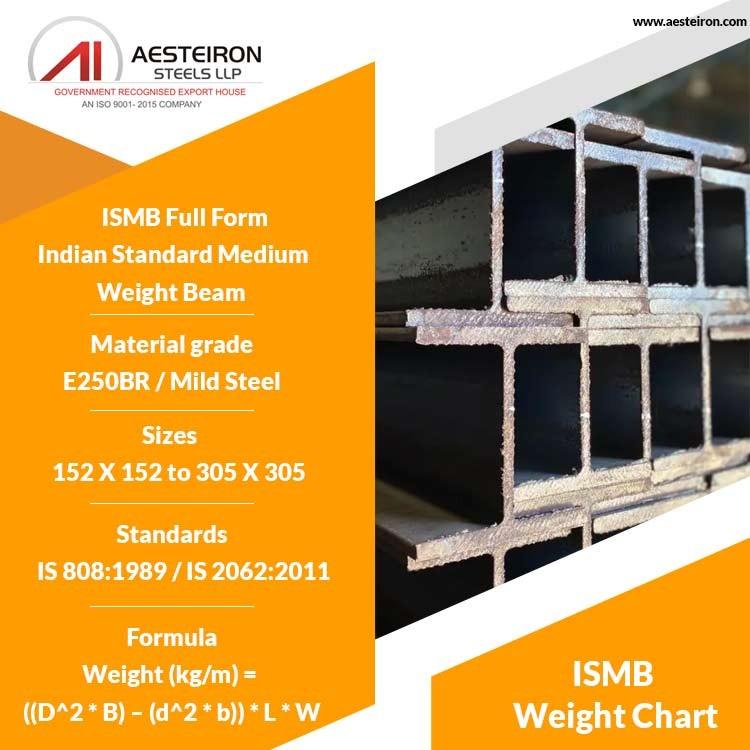
● ISMB stands for Indian Standard Medium Weight Beam, a type of structural steel beam widely used in construction.
● These beams are essential for providing support in various structures, including buildings, bridges, and industrial facilities.
● ISMB beams are designed to carry heavy loads, making them crucial for ensuring the stability and safety of structures.
● Different types of beams include ISMB (medium weight), ISHB (heavy weight), and ISLB (light weight), each suited for specific applications based on load requirements.
ISMB Weight Specifications
Size Range
ISMB beams are available in sizes ranging from ISMB 100 to ISMB 450, allowing for various construction needs.
Length
ISMB beams can be manufactured up to lengths of 12 meters, accommodating large structural applications.
Material Grade Manufacturing Standards
ISMB beams are typically made from IS 2062 Mild Steel, ensuring high strength and durability.
Manufactured according to Indian Standard IS 808, ISMB beams also comply with international standards like ASTM A36 and EN 10025-2.
Choosing the Right ISMB Beam
Load-Bearing Capacity
Span Length
Select ISMB Size
Cost Considerations
Assess the total load the ISMB must support, including dead and live loads. Consult load tables to identify the required capacity for your application.
Identify the distance the beam will span between supports. Longer spans require larger beams to distribute loads and minimize deflection.
Refer to standard ISMB tables using load capacity and span length to choose a beam size that meets or exceeds requirements for your project.
Analyze costs of the selected ISMB size, considering material costs, availability, and installation expenses to balance integrity with budget.
All workers handling ISMB beams must wear appropriate PPE, including hard hats, gloves, and steel-toed boots to protect against injuries from sharp edges and falling beams.
Correct Lifting Techniques
Suitable Training
Secure Storage
Workers should be trained to use proper lifting techniques, relying on their legs instead of their backs, and avoiding twisting movements to prevent strains and injuries. ISMB beams should be stored on a flat, level surface with adequate support. When stored vertically, they must be secured with straps to prevent falling.
Clear Communication
Effective communication among workers is crucial. Hand signals and verbal instructions help coordinate movements and ensure everyone is aware of their surroundings.
Only trained and experienced workers should handle ISMB beams. They must understand beam dimensions and proper handling techniques to ensure safety during installation.
Inspection and Maintenance
Before installation, beams should be thoroughly inspected for any damages or defects. Damaged beams must not be used to avoid structural failures.
Comparing ISMB and ISMC Beams
Key Differences Between ISMB and ISMC Beams
● ISMB beams are medium weight, while ISMC beams are medium channel beams.
● ISMB dimensions include width, height, and length tailored for beams, whereas ISMC dimensions follow channel specifications.
● Weight per meter for ISMB 100 is approximately 8.2 kg, while ISMC 100 weighs around 8.90 kg/m.
● ISMB is typically used in structural applications requiring higher load-bearing capacity, compared to ISMC which is used in lighter structural applications.
Applications and Uses
● ISMB beams are used in bridges, refineries, and industrial sheds due to their robust nature.
● ISMC beams are more suited for framing and bracing in lighter construction projects.
● ISMB supports heavier loads, making it ideal for structural frameworks.
● ISMC is frequently employed in residential applications where weight restrictions are prevalent.
Differences Between ISMB and ISHB Beams
ISMB Advantages
+ ISMB beams are lighter, making them easier to handle and install in various construction projects.
+ Cost-effective option due to lower material usage compared to ISHB beams, reducing overall project expenses.
+ Suitable for applications where moderate load-bearing capacity is required, such as residential and light commercial structures.
ISHB Advantages
– ISHB beams provide higher load-bearing capacity, making them ideal for heavy-duty structural applications such as bridges and industrial buildings.
– Heavier weight can pose challenges during transportation and installation, requiring more robust handling equipment.
– Generally more expensive due to the increased material and manufacturing costs.
ISMB Beam Weight Calculations
Formula for Calculating Weight Factors Affecting Weight
● Weight (kg/m) = ((D² * B) – (d² * b)) * L * W
● D = Depth of the beam (mm)
● L = Length of the beam (m)
● Beam size: depth, width, and thickness influence overall weight.
● Material type: heavier materials yield heavier beams.