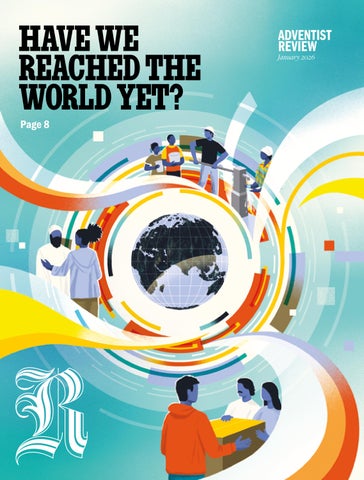

Have We ReacHed tHe WoRld Yet?
tHe tHRee “NataNs” of daNiel 1
Why God gives victories, favors, and abilities JUSTIN KIM
one of my favorite names is Nathan. It means “to give” and is better described as the three Hebrews letters n-t-n. It’s a palindrome that reads the same way whether you go from right to left or left to right, suggesting that giving can be seen as receiving and vice versa. It’s the root in such names as Jonathan, Nathaniel, and Matthew. Interestingly, the word is found in reference to God three times in the first chapter of Daniel.
In verse 2 God “nataned” military power and political victory into the hand of Nebuchadnezzar. Why political power is given into the hand of enemy monarchs warrants a longer discussion. But in short, God at times uses unconventional sources of power to enact justice and judgment. This does not justify everything they have done. Scripture clearly points to numerous instances when these entities themselves

Assyrians and Babylonians. Regardless of geopolitics, it is ultimately God who gives victories in power.
The second instance is found in verse 9, where God “nataned” favor from the Babylonian eunuch to Daniel. It is not through charm, wit, cleverness, or humor that the Christian gains favor from people. We dress to impress, act to attract, and play sycophant to enchant. We want to be in favor with our in-laws, bosses, and others who have some power over us. Rather than merit or allure, it is through the noble attributes of the divine that people are truly attracted to character. This distinction places Daniel in a favorable position to allow God’s will to be done. God is the source of social favor.
It is a temptation to simply request political, social, and intellectual blessings from God.
receive God’s judgment when they have exceeded their parameters. We are free to act however we wish, but it is God who gives opportunities, and all will be held accountable for their actions. No matter how politics may play out on the human level, the verse is saying that God is the source of political and military power. God originally wanted Israel to be the greatest, where other nations would have learned about Him through Israel’s economics, judicial system, religious ecosystem, and even calendric cycles. Israel was even placed geographically where three continents would have to pass through it to trade, war, or conduct diplomacy. Israel could not be ignored. Unfortunately, she wanted to be like the surrounding nations, apostatized, was divided into northern Israel and southern Judah, and eventually taken over by the
The last instance is found in verse 17, where God “nataned” knowledge and skill in all learning and wisdom. Daniel 1:4 lists the standards for qualification. Daniel 1:17 lists what abilities God gave. Daniel 1:19, 20 lists what was tested and the results. The powers of the mind were created by God, and it is He alone who is the source of all abilities of the intellect.
It is a temptation to simply request political, social, and intellectual blessings from God. But this first chapter of Daniel opens with the secret of the purpose of these gifts. First, they help us survive in unspiritual environments that also “natan” us things: new identities in name and religion, temptations of consumption, and surroundings designed to remove heaven’s influence. Second, they empower His people to become participants in the plan of salvation to the world. Not only for their immediate survival, but the book eventually zooms out to the largest prophecy that points to the reconciliation of the universe! And last, they point to the mission and character of Christ whatever circumstance we may be in.
May we look to the God who “natans” the same blessings today—not victories, favors, and abilities alone—to see them used for the kingdom of God in Babylon and wherever else His people may be.

MoR e tHaN 250
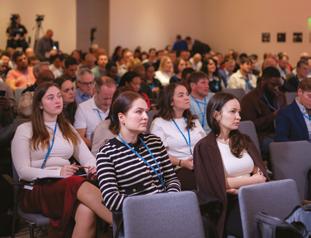
The number of communication professionals from 37 countries that gathered in Pravets, Bulgaria, November 12-15 for the Global Adventist Internet Network (GAiN) Europe 2025 convention. The event, attended by Adventist communicators working in radio, television, social media, IT, and publishing across Europe, sought to showcase what has been already accomplished and seek ways to collaborate even further on innovative digital mission strategies.
“As the ‘mouthpiece of Zion,’ every communicator, pastor, and believer is called to speak God’s words, live His truth, and echo His joy until the world is filled with the sound of His glory.”
—Carlito Quidet, Jr., communication director of the Southern Asia-Pacific Division, during a communication advisory in southern Luzon, Philippines. During the event regional communication leaders emphasized the need to strengthen digital strategy as a vital arm of the Adventist Church in accomplishing its mission in the digital age.
The number of beds that Good Hope Adventist Clinic in Lima recently donated to Dos de Mayo National Hospital, one of Peru’s leading public health institutions, to improve patient care. The beds are intended to enhance patient safety and care. “Sharing what we have is part of our mission,” said clinic director Sara Muñoz. “We are pleased to collaborate with an institution that has cared for the country with effort and dedication for decades.”
“Mission itself is a miracle, born of divine power and personal transformation, and every believer is called to be part of that miracle.”
—Saw Samuel, a vice president of the General Conference, during the recent annual council of the Southern Africa-Indian Ocean Division. He delivered the message at meetings held by regional church leaders to plan and gear up for Impact Mozambique 2026, an evangelistic series planned for May.
Do you want to keep up with what is happening in our church? If you want to receive our weekly newsletter that features news, inspirational stories, videos, and more, sign up today.
Seventh-day Adventist communicators from across Europe follow the proceedings of the GAiN Europe 2025 convention in Pravets, Bulgaria, November 13. Photo: Nikolay Stoykov/Adventist Media Exchange (CC BY 4.0)
82
The number of children at the Lavhelesani Drop-In Centre in Thohoyandou, Venda, in South Africa, which benefited from an initiative from Adventist World Radio (AWR) in the region to distribute toiletries. After a campaign in partnership with the Southern Africa-Indian Ocean Division, the AWR team raised funds to purchase comprehensive hygiene packs containing lotions, bar soaps, roll-on deodorants, toothpaste, toothbrushes, and much-needed sanitary pads for the older girls.
“We have about 35 clinics in the Solomon Islands and roughly 55 in Papua New Guinea. Because of the weather and
mold has
conditions out there,
entered the buildings,
the cyclonic weather has taken roofing iron off, and plumbing is no longer working. We’re going to be fixing them up to make them a standard that I’d be happy to have my baby at.”
—10,000 Toes campaign director Pamela Townend, in describing the efforts to improve infrastructure across the Pacific islands. The campaign seeks to create awareness about how to prevent and fight diabetes and other noncommunicable diseases across the region.
sHould i pa Rticipate MoR e
i N eva Ngelistic out R eac H ?
Global church members were asked whether they thought they should increase their involvement in evangelistic outreach to the local community.
“I am deeply moved by the commitment of the volunteers. It is something truly worth highlighting, as Adventist volunteers serve with genuine dedication and a Christlike spirit.”
—Ruben Ponce, emergency response coordinator for ADRA International, during the “Yes With ADRA” training in Mandeville, Jamaica, on November 4, after the destruction provoked by Hurricane Melissa. The training focused on policies to prevent abuse and sexual exploitation, field safety protocols, conducting needs assessments, and the use of a data collection tool for reporting and monitoring relief efforts.
“No MoRe delaY— tHe MissioN Must Move foRWaRd,” gc pResideNt saYs
In the Philippines, Erton Köhler calls for bold faith and mission engagement.
aspirit of unity and renewed commitment to mission filled the Philippine International church at the Adventist University of the Philippines (AUP) as global Seventh-day Adventist Church leaders joined members for a special Sabbath worship on November 8. The gathering was held in conjunction with the Southern Asia-Pacific Division (SSD) annual council, where leaders meet to assess progress, strengthen mission initiatives, and plan the church’s strategic direction for the next five years.
The worship service brought together the three executive officers of the General Conference of Seventh-day Adventists (GC)—president Erton Köhler, secretary Richard McEdward, and treasurer Paul Douglas. Joining them were Magdiel Pérez Schulz, assistant to the GC president, and Robbie Berghan, the newly elected vice president for global media and engagement at Hope Channel International.
A Call
to Bold Faith and Urgent Mission
In his Sabbath message Köhler drew lessons from Revelation 10, highlighting the Adventist movement’s prophetic identity and mission-driven calling. Referring to Revelation 10:2, he explained that the “little book open in his hand” symbolizes the book of Daniel—once sealed but now revealed—signifying that God’s truth continues to unfold for His people.
“The Adventist movement was born with an open Bible in its hand,” he said. “We are a people of the Book—a movement that from the beginning is grounded in the Bible.”
“ BOLD IN COURAGE, BOLD IN FAITH, BOLD IN OUR INVESTMENTS—BECAUSE MONEY FOLLOWS MISSION—BOLD IN PREACHING WITH A LOUD VOICE, AND BOLD IN PLANNING BEYOND THE ORDINARY. IF THE HOLY SPIRIT IS LEADING, NO ONE CAN BE AGAINST US.”
Referring to Revelation 10:6, Köhler reminded listeners that there should be “no more delay any longer.” He called for renewed urgency in fulfilling the church’s gospel commission. “We are born with a sense of urgency. The time is short—no more delay. We must move forward now to accomplish the task God has given us. We cannot be afraid.”
The Remedy for Disappointment
Köhler reflected on Revelation 10:8-10, describing the experience of the Great Disappointment—sweet in the mouth but
bitter in the stomach. “That day was filled with expectation,” he said, “but it was also a day of hope.”
He emphasized that God provided a remedy for the church’s early disappointment, found in Revelation 10:11: “You must prophesy again.” “Mission is the remedy,” he said. “God’s response to disappointment is the call to go—to preach again, to witness again, to share hope again. We are a movement born for mission.”
Bold in Faith, Bold in Mission
Drawing parallels between Revelation 10 and Revelation 14, Köhler underscored that both chapters proclaim their message “with a loud voice.” He urged the church to be bold in every aspect of its mission.
“Our church, from its beginning to its end, is called to be bold in faith,” he said. “Bold in courage, bold in faith, bold in our investments—because money follows mission—bold in preaching with a loud voice, and bold in planning beyond the ordinary. If the Holy Spirit is leading, no one can be against us.”
One Voice for a Global Message
Concluding his message, Köhler called the world church to united action. “We are part of a movement. We are called to be God’s voice, not the echo of the culture,” he said. “We are calling our church worldwide to speak with one voice—using all forms of media—in one global movement to share that Jesus is coming soon.”
Edward Rodriguez, Southern Asia-Pacific Division News
In the Philippines, General Conference president Erton Köhler highlighted the Adventist movement’s prophetic identity and mission-driven calling. Photo: SSD Communication Department
cHuRcH leadeR at tHe Well
How a brief visit connected an Adventist officer with his memories, hopes, and dreams.
on October 24 the Toyota pickup trucks arrive unexpectedly, sending dust billows through the grassless soccer field where a group of teenagers are enjoying a late-afternoon game. The heart-and-soul players see the vehicles approaching and decide to take a break. They walk toward the trucks, which have stopped by the dirt path, as other village residents also come closer to find out what is going on.
A delegation of Maranatha Volunteers International, a supporting ministry that builds churches and schools and drills water wells around the world, has made a stop near Chipata, in eastern Zambia, to check on one of the Seventh-day Adventist one-day church structures and a water well they gifted the community some time before. The trucks carry Maranatha leaders, supporters, and a special guest: Harrington Akombwa, a pastor who is currently president of the Southern Africa-Indian Ocean Division (SID) of the Adventist Church.
Tears by the Well
As the guests descend from their vehicles, dozens of children and a few adults are already walking to meet them. Not even the ubiquitous reddish dust can hide their wide smiles. “Let’s check to see how your water well is doing,” one of the visitors tells them after exchanging customary greetings. “And let’s also see how your church building is progressing.”
Locals lead the visitors to the well, around which a dozen smiling children, mostly barefoot, are buzzing.
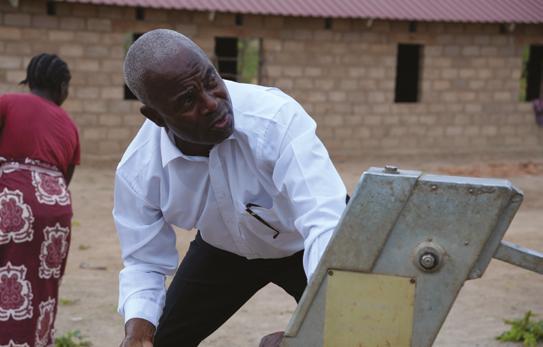
A Maranatha worker soon starts pumping out water, and Akombwa bends down to check the spurting liquid himself.
“EDUCATION CHANGES PEOPLE,” HE SAYS. “WHAT WOULD I BE WITHOUT THE OPPORTUNITY OF GETTING AN EDUCATION?”
“This is good, good water,” he says after taking a few sips. “Sweet, sweet water.”
Then, as he turns around, Akombwa sees the dust-blanketed, barefoot children looking expectantly at him.
“When I see these kids, I see myself reflected in them,” Akombwa says, suddenly fighting back tears. “You know, I used to be one of them.”
Bible Truth and Education
Harrington Simui Akombwa, a native Zambian, was elected for a second term to his current position at the 2025 General Conference Session in St. Louis, Missouri, United States in July. An experienced leader, he has served in church administration positions for more than 30 years, including as secretary and then president
of the Zambia Union Conference (and the Southern Zambia Union Conference after the territory was divided in two in 2015).
But it was not always so. Akombwa grew up in Zambia’s western region, in a village very similar to the one he is now visiting on the other side of the country. He knows firsthand some of the major challenges the locals feel: extreme poverty, a subsistence-based economy, and often a lack of long-term vision and opportunities.
At the same time, Akombwa knows by experience how much power there is in the message of the gospel and in education. He’s also a believer in the strong bond between the Adventist Church’s steady growth and Adventist education. “Studies consistently show that those who get to know the Adventist message in an Adventist school are very likely to stay as church members for the rest of their lives,” he emphasizes.
Once more, Akombwa’s comments are based on his personal experience.
Growing up amid major family challenges, Akombwa didn’t know about the Adventist message. After he found God and Bible truth, however, his life experienced a marked turnaround, he says. Akombwa completed undergraduate and graduate studies at Solusi College (later Solusi University) in Zimbabwe, and in 2010 a Doctor of Ministry in Leadership at Andrews University in the United States.
Now as a father of five adult sons and as a grandfather, Akombwa says Bible-based
Marcos Paseggi, Adventist Review
education is more than ever the way to go. “Education changes people,” he says. “What would I be without the opportunity of getting an education?”
A Game Changer
In extremely challenging social and economic contexts, supporting ministries such as Maranatha are essential to providing opportunities for growth, Akombwa says. In Zambia, he explains, education—even private education—is paid by the government, which also trains and provides as many teachers as possible, so tuition is not an issue. Still, school buildings can’t keep up with the growth of the general population and of the Adventist Church across the nation (Zambia has an estimated 1.5 million baptized Adventist members, second only to Brazil).
It is against this backdrop that the work of Maranatha, which is fully funded by private donors, comes into focus, Akombwa says. In a region with an extremely long dry season, a free water well for the community is usually the first entry and meeting point that locals value and cherish. Then,
as much as possible, Maranatha provides church buildings, usually a one-day church, which is a simple but reinforced steel frame and a roof under which church members and their families can meet.
To serve and benefit as many people and villages as possible, Maranatha often uses volunteers to raise the basic steel structure produced by local crews and then leaves members with the task of building up the church walls, providing seats or pews, and finding ways to purchase doors and windows. “It is something that encourages ownership of the building,” Maranatha leaders explain. “It fosters self-sufficiency and a sense of belonging.”
Singing of God’s Miraculous Love
During the October 24 visit Akombwa and the rest of the visiting crew saw firsthand the progress on the members’ one-day church. Residents proudly showed visitors how much progress they had made on the building since the leaders’ last visit. Block walls have now joined the base of the roof, and stone logs now double as pews. “We still need to raise funds to purchase
windows and doors,” a local church member shares. “We would like to finish our building as soon as possible.”
Akombwa, Maranatha team members, and church members in charge of the building remove wooden branches on a side door and walk into the bare sanctuary. Once inside, Akombwa walks to the stage and starts leading in an impromptu rendition of the well-known Christian song “Jesus Loves Me.” For just a couple of seconds his words bounce back from the walls of the cavernous sanctuary before guests and members rush to join him. “Yes, Jesus loves me, the Bible tells me so,” they sing.
When the singing fades, a local member politely presses on what they are still missing. “What about those doors and windows?” she asks.
“Having a church here is a miracle,” a Maranatha team member answers. “So keep praying that the miracle may keep unfolding!”
Akombwa agrees. “Certainly, this is just the beginning,” he says. “We haven’t seen the end of the story.”
Southern Africa-Indian Ocean Division president Harrington Akombwa tries the water at a well by a Seventh-day Adventist church near Chipata, Zambia. Photo: Marcos Paseggi, Adventist Review

Have We ReacHed tHe
WoRld Yet?
A reality check
Brad Mills

A Tale of Two Cities
Depending on where you grow up in the world, your view and understanding of Christianity will be very different. For example, if you grow up in a bustling city in Brazil, you can hardly leave your house and arrive at work without seeing several Protestant churches along the way. For a typical Brazilian in metropolitan São Paulo—with more than 20 million people—a normal day might look like this: You walk out your front door, and on your brisk walk to the subway you pass a billboard advertising the neighborhood Seventh-day Adventist elementary school. When you squeeze into the crowded subway, you bump into someone wearing a T-shirt that says Impact Hope, with a message proclaiming that Jesus is coming again and the Adventist Church logo stamped on the sleeve.
When you get off the metro and stop by the grocery store for a snack, the health food section has several items produced by Superbom, the Adventist food company. And finally, after a long day of work, you head to the doctor for a quick checkup. While you’re waiting, the TV in the reception area plays a healthy cooking program from Novo Tempo, Hope Channel in Brazil. All in a day’s work, you’ve brushed up against the Seventh-day Adventist Church several times. In some areas of Brazil, such as Manaus, the capital of Amazonas State, one in every 34 people is a Seventh-day Adventist.
Of course, your city may not look like that. If you drive through many American cities, you may not find as many Adventist churches scattered around, but you will certainly find other Christian churches. On some streets you can see multiple churches within a stone’s throw of one another. So when your pastor talks about witnessing and sharing Jesus, you might be tempted to think the job is finished. Are there really still people who have never heard about Him?
Imagine visiting one of the wonders of the world—the mysterious pyramids of ancient Egypt. While you might picture them standing alone in the desert, the truth is they sit on the edge of a rapidly growing metropolis. Greater Cairo has more than 20 million residents, close in size to São Paulo. During the workday an additional 10 to 15 million people commute into the city, meaning that on any given weekday you could be moving through a city of 30 million. The streets overflow with honking cars, shouting drivers, and people everywhere. Cairo never sleeps.

In some areas of Brazil, such as Manaus, the capital of Amazonas State, one in every 34 people is a Seventh-day Adventist.
But as we explore the city, we notice something very different from São Paulo. One huge difference grabs our attention: Where are all the churches? Yes, there is a recognized Seventh-day Adventist church in Cairo. But with only about 300 members, that means instead of one Adventist for every 34 people (as in Manaus), there is only roughly one for every 100,000 residents. There are no Adventist hospitals and no Hope Channel broadcasting the message of Jesus. The chances of casually meeting a Seventh-day Adventist are very slim.
So what is the real situation of our world? Have we really reached it yet?
Mission agencies studying this question divide the world into what they call “people groups”—groups often defined by common language, culture, and identity. Estimates vary depending on the database, but most agree that there are about 17,000 distinct people groups worldwide.1
Of these, between 7,200 and 7,500 are considered “unreached.” Unreached people groups usually have fewer than 5 percent Christian adherents and fewer than 2 percent evangelical believers.2 Some mission agencies add that if a group lacks a strong national church capable of reaching the rest of its own people without outside help, it is considered unreached as well.
When we include those definitions, the shocking conclusion is this: nearly 3.5 billion people—more than 40 percent of the world’s population—are still unreached. Let that sink in. Almost all mission agencies agree that more than 40 percent of the world remains completely unreached.3 That means in their people group, fewer than 5 percent are Christian.
How can this be possible, when in some countries you can hardly drive to the grocery store without passing several churches?
The bulk of the unreached live in the 10/40 window—a geographical belt stretching from North Africa through the Middle East into Asia.4 Many of these people groups, often numbering in the millions, live in countries in which missionary work is restricted or prohibited. To make matters worse, only a small fraction of all foreign missionaries serve among the
Almost all mission agencies agree that more than 40 percent of the world remains completely unreached.

hardest-to-reach groups. For many complex reasons, most mission agencies still concentrate their workers among already-reached peoples.
So how should we respond to these facts? What can you and I personally do?
It’s like going to the doctor and being told you have a serious disease. Would you want him to hide the truth from you? Of course not—especially if something could be done about it.
What We Can Do
Every reader of this article can become an active prayer warrior. Open an online map, zoom in until you see the names of streets, hospitals, and universities in countries within the 10/40 window, and pray for them. Adopt a specific city and pray for it daily. Remember that Gabriel came to Daniel only after 21 days of prayer, delayed because of spiritual conflict with the prince of Persia. We are in a real spiritual war. Pray for the outpouring of the Holy Spirit on these cities. Ask God directly for places and people by name.
You can also join the Mission Refocus movement.5 The Seventh-day Adventist Church is reshaping its mission strategy, placing new emphasis on reaching the unreached. Funds and calls are being redirected to church planting among unreached groups. Supporting ministries such as Adventist Frontier Missions (AFM)6 are also sending workers into unreached communities. Consider whether God may be calling you to go. Prayerfully ask if He has prepared you “for such a time as this”—to leave home and country to serve elsewhere. If not going yourself, you can still give, helping support missionaries who are preparing to go.
The facts are clear: the work is not finished. God Himself is responsible for saving humanity, but He has commissioned us to take part. Jesus told His disciples—and us:
“Go therefore and make disciples of all the nations, baptizing them in the name of the Father and of the Son and of the Holy Spirit, teaching them to observe all things that I have commanded you; and lo, I am with you always, even to the end of the age” (Matt. 28:19, 20).
This is a call to action. It is a call for you and me to get on our knees and ask God, What is my part in reaching the unreached?7
Jesus is coming again. Jesus is coming soon. May we be found active, sharing the joy we have in Him!
1 The Traveling Team, “Missions Statistics.” Accessed Sept. 21, 2025. https:// www.thetravelingteam.org/stats.
2 International Mission Board, “Global Research Department” (GRD). Accessed Sept. 21, 2025. https://grd.imb.org.
3 Joshua Project, “Unreached People Groups.” Accessed Sept. 21, 2025. https://joshuaproject.net.
4 “Project 42 Partners,” Statistics. Accessed Sept. 21, 2025. https://www. project42partners.org/stats.
5 Adventist Mission, Mission 360, vol. 12, no. 4-10. Accessed Sept. 21, 2025. https://am.adventistmission.org/m360v12n4-10.
6 Adventist Frontier Missions (AFM), Adventist Frontier Missions Online. Accessed Sept. 21, 2025. http://www.afmonline.org.
7 Global Frontier Missions, “What is a UPG?” Accessed Sept. 21, 2025. https:// www.globalfrontiermissions.org/missions-101/the-unreached-peoples-andtheir-role-in-the-great-commission.
Brad Mills is the president of Adventist Frontier Missions.
a WoRld still uNReacHed
By Jerry Chase and Jonathan Walter
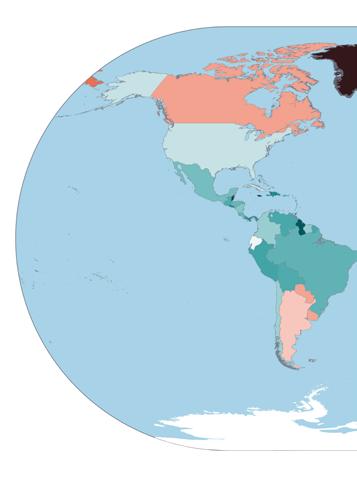
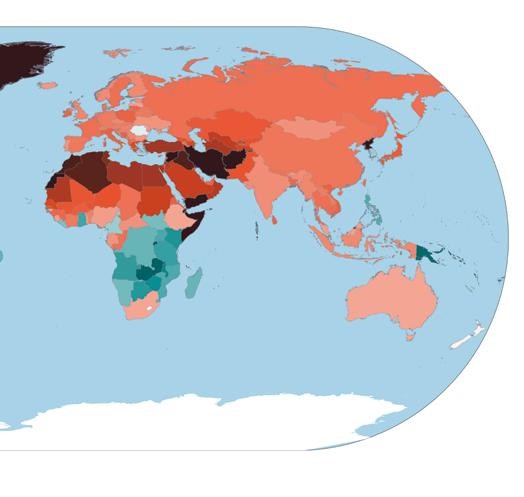
this map shows the average likelihood of a non-Adventist meeting an Adventist, based on each country’s and area’s populationper-member ratio. This is shown via a color spectrum. Green = higher chance. Brown = lower chance. The darker the green, the lower the ratio, the higher the chance.
People living in Belize, Grenada, Jamaica, and Montserrat have the highest chance, with 1 Adventist per 8 people in each country. The global average currently stands at 1 in 341 people being Adventist. There are about 24 million members worldwide.
The light- to dark-brown spectrum indicates the territories in which meeting an Adventist is less likely or nearly impossible. This spectrum represents ratios of 1:342 to 1:600,000. The latter means, for example, that if a country has a population of 30 million, there would be only 50 Adventists to reach that entire population.
Countries with a darker brown tone have virtually no Adventist presence. The darkest brown represents areas with no Adventist members.
To give a different perspective, when countries and territories are ranked by Adventist density, the first half of the world’s population lives where 96 percent of all Adventists are found. The other half—around 4 billion people—resides in regions that collectively hold only 4 percent of the global Adventist Church membership.
If you are an Adventist in a green territory, you have a calling. While you certainly need to reach your immediate sphere of influence, you shouldn’t overlook the more than 4 billion people who need to hear the gospel but have virtually no access to and a very low chance of ever meeting a Seventh-day Adventist. Prayerfully consider sending missionaries, becoming one, adopting cities, or finding other ways to support the mission in the lesser reached and unreached parts of the world.
The need is tremendous; the potential is magnificent! Will you make yourself available to the Holy Spirit and dare to go reach the world?

Jerry Chase is the geographic information systems specialist for the Adventist Church Management System. Jonathan Walter is an assistant editor of the Adventist Review
Republic of Korea (pop. 26,299,000)
Population-per-member ratios
No Reported Members* 1:10

Somalia (pop. 19,009,000)
State of Palestine (pop. 5,483,000)
Djibouti (pop. 1,037,000)
Comoros (pop. 867,000)
Maldives (pop. 602,000)
Western Sahara (pop. 591,000)
Brunei Darussalam (pop. 455,000)
Jersey (pop. 101,000)
Guernsey (pop. 67,000)
Greenland (pop. 57,000)
Monaco (pop. 38,000)
San Marino (pop. 33,000)
Aland Islands (pop. 31,000)
Saint Pierre and Miquelon (pop. 6,000)
Tokelau (pop. 2,500)
Holy See (Vatican City) (pop. 1,000)
The map, country statistics, and ratios are based on mid-year 2024 membership and population data, which will be published in the 2025 Annual Statistical Report by the General Conference Office of Archives, Statistics, and Research.
Map data © OpenStreetMap contributors, Microsoft, Facebook, Google, Esri Community Maps contributors, Map layer by Esri
How God Measures success
God’s Word does not come back void.
Ken Denslow
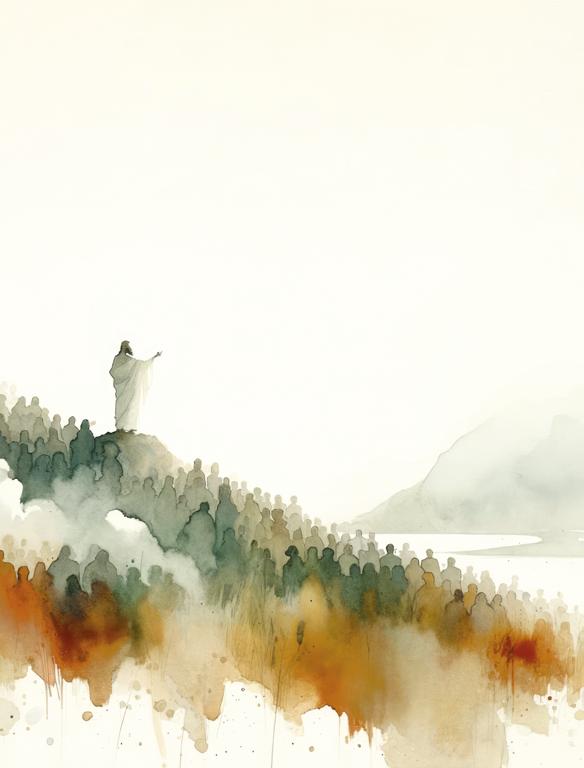
afew times in life I have had individuals tell me that some small thing that I shared long ago had a life-altering impact on them. Usually when that has happened, I have not been able to remember the moment, or it seemed like a small thing to me at the time. Sometimes what may look to the human eye to have been insignificant or maybe even an utter failure was, in God’s view, a success.
Let me tell you a story.
Years ago, while serving as president of the Illinois Conference in the United States, I passed through a town in the southern part of the state where I knew there were evangelistic meetings being held by the local church. I had some time and decided to stop by unannounced at the hotel where the meetings were being held. When I arrived, the meeting was already in progress. I bypassed the registration table and went straight into the hall. It was all set up with a screen, projector, and sound system. The stage was nicely arranged, including plants and floral arrangements along the edge. The musicians had just concluded their part in the program; it was time for the pastor to preach. But as I looked around the room, I saw that there were very few people in attendance. In fact, I knew everyone in the room. Not a good sign!

The preacher stood up and launched into his sermon with gusto. He preached his heart out. You would have thought that he was preaching to thousands instead of the handful that were actually there. As I sat and listened, I wondered how he was able to throw himself so completely into a situation that others might have deemed a failure.
Later that evening, as I continued my drive toward home, I reflected on what I had experienced. Frankly, I was discouraged for the pastor and his congregation. They clearly had worked hard and spent significant dollars to make this meeting a success, but what I had just seen did not look like a win to me.
And then I remembered a Bible passage that seemed to speak directly to this situation:
“For as the rain comes down, and the snow from heaven, and do not return there, but water the earth, and make it bring forth and bud, that it may give seed to the sower and bread to the eater, so shall My word be that goes forth from My mouth; it shall not return to Me void, but it shall accomplish what I please, and it shall prosper in the thing for which I sent it” (Isa. 55:10, 11).
Could it be that this preacher’s efforts had not been in vain—that he had not failed? He had faithfully preached the Word of God and left the results to Him. Could it be that in the cosmic and invisible struggle between good and evil, ground was actually gained by the forces of good just because God’s Word had been spoken in that place?
SOMETHING HAPPENED
I don’t remember if there were any conversions or baptisms at the end of those meetings, but I can tell you that for a few weeks God’s Word was preached in that town, and He has promised that His Word will not come back to Him void. Something happened even if I didn’t see it with my eyes.
I heard another preacher some time ago proclaim on YouTube: “God didn’t call me to fill the pews; He called me to preach the Word.” Preachers are often called (inspired?) to preach difficult and unpopular messages. The YouTube preacher understood that just because he isn’t preaching to large crowds, that doesn’t mean he isn’t preaching “God’s Word.”
God’s Word is powerful. Through His Word the earth was created. At His Word the Red Sea was split. Hebrews 4:12 describes God’s Word as alive, active, and sharper than a two-edged sword.
While we don’t know the size of the crowd to which he preached, we do know that Noah’s preaching resulted in no converts except his seven family members. What we do know is that Noah preached faithfully for 120 years. Did he make an impact? Despite his seeming failure as a preacher, his adherence to and trust in the Word of God led to the saving of the human race and earned him a place in the list of faithful heroes in Hebrews 11.
One day in Capernaum Jesus spoke difficult words to His followers. He revealed Himself as having come from the Father. He spoke about His flesh and blood being the food and drink of eternal life. These were hard words for the crowd to understand, and the Bible says in John 6: “From that time many of His disciples went back and walked with Him no more” (verse 66). It was a difficult sermon. The message
was not popular with the crowd, and soon they drifted away. Jesus, left only with His 12 disciples, His inner circle, asked: “And what about you? Will you leave Me too?”
Peter, as he did so often, answered for the group: “Lord, to whom shall we go? You have the words of eternal life” (verse 68).
Some might have looked at Jesus’ teaching and its results that day as a failure. The crowd dwindled because He faithfully taught the Word of God. Yet through His teaching and His actions He changed the course of humanity.
Could it be that this preacher’s efforts had not been in vain— that he had not failed?
In 2000 Malcolm Gladwell popularized the phrase “tipping point” through his book of the same title. He maintains that major societal changes (tipping points) come about when a grouping of circumstances converge to make a major societal shift. No one action by itself causes the seismic shift. Gladwell’s work is not without challenges from sociologists, but one thing is certain: tipping points never come except through actions. If we do nothing, nothing will happen.
When I was young, I nearly wore out an album of music by T. Marshall Kelly. My favorite song on that album is “Little Is Much When God Is in It.” One verse goes like this:
“Does the place you’re called to labor
Seem so small and little known?
Well, it is great if God is in it
And He will not forsake His own.”
Reframing our definitions of success and failure is not a call to complacency in the preaching and teaching of God’s Word. The world doesn’t need more half-baked preaching. But it is a call to faithfulness in proclaiming the Word of God regardless of the size of the audience—whether it be through preaching or teaching. It is a call to recognize that God does not measure success the way that we do. It’s a call to understand that the faithful words we speak have power in both the visible and invisible realms. And when you are tempted to feel discouraged, to harbor thoughts of failure, remember that your simple actions may have an eternal impact in the struggle for good.
Ken Denslow, former Lake Union president, is now retired and living near Andrews University in Michigan, United States.
Simple steps to live more intentionally
MissioN a
Amy Whitsett

ResolutioN
new year. I don’t know about you, but I am thankful for this annual cycle. While I don’t necessarily like that it means adding another year to my age, there is something exciting about resetting my calendar to January 1. It’s a time to reflect on the previous year, rejoicing in the successes, and yes, mourning the losses. It’s also an opportunity to reevaluate my priorities and
recommit to living with more purpose.
I am also keenly aware that it means we are one year closer to Jesus’ coming. And with that perspective comes the realization that before me stretches another 365 days of opportunities to participate more fully and intentionally in God’s mission.
As we begin a new year, I want to challenge you (and myself) to make some New Year’s resolutions to help us stay mission-focused. Here are just a few ideas to stimulate your creativity:

NsA new year is an opportunity to reevaluate priorities and recommit to living with more purpose.
PERSONAL GROWTH
• Pray daily for a missionary. Choose a missionary and pray for them the entire year. If you don’t know a missionary, your pastor can help.
• Read one (or more) books on mission or cross-cultural ministry to grow your understanding of mission or to learn about another culture or religious group so you are better equipped for mission, either locally or globally.
• Learn a new spiritual discipline, such as fasting, prayer journaling, or Scripture memorization, but with a missional mindset—asking how it shapes or equips you for service.
• Step outside your comfort zone each month—whether that’s initiating a spiritual conversation, serving in a new way, or engaging a different culture. Doing something we’re not used to doing is an opportunity for the Holy Spirit to be strong in our weakness (2 Cor. 12:9, 10).
• Reduce distractions, such as social media, entertainment, or overwork, to make space for missional living. Use the reclaimed time to engage in mission and outreach.
• Practice hospitality once a month by inviting someone new, such as a neighbor or coworker, into your home for a meal. Invest in getting to know your new friend. Then send them off with a prayer of blessing.
LOCAL MISSION
• Skip the self-checkout. Instead, take a few extra moments to have a short conversation with a cashier. Not sure what to say? Notice people’s eyes: they communicate a lot. Are they happy? sad? tired? bright and excited? Use those cues to connect. Not only do eyes communicate emotion; in many cultures looking someone in the eye and smiling communicates care. It says, “I see you,” and can validate and encourage someone if they are feeling insignificant or unappreciated, or are just having a tough day.
• Stock up on a variety of evangelistic sharing tracts you find interesting. Keep a few with you and share one with the bus or taxi driver, the shop cashier, the hotel cleaning staff, the office security personnel, etc. Ellen White likened small tracts to the leaves of autumn—so spread them liberally!
• Engage your neighborhood intentionally. Draw or print a map of the homes in your neighborhood and write in neighbors’ names. Then make a point of meeting those you don’t yet know. Pray over your map each day and ask God for opportunities to be a channel of blessing. Then listen for His promptings and commit to following them.
• Adopt a “shalom” budget for generosity. Beyond your tithe and regular offerings, set aside a budget to bless others. Use it to buy a bouquet of flowers for a lonely neighbor, purchase school supplies for a needy child, pay the Uber fare for someone to come to church, etc.
• Share a personal testimony each month of how God is working in your life. You might share it with your Sabbath School class or small group to encourage prayer and deeper involvement in mission, or with someone you are ministering to as a way of showing God’s love and inspiring them to trust Him.
GLOBAL MISSION
• Adopt a missionary family. Learn about the country and culture the missionaries are serving in. Pray for them daily. If possible, send them encouraging messages. Living far from “home,” learning a new language, and sharing the gospel in culturally sensitive and appealing ways is challenging and can be discouraging. Let them know that you’re praying for the Holy Spirit to surround, protect, and enable them.
• Mentor a missionary kid. Like many Adventist youth, missionary kids often attend a boarding academy and/or university far from their family. The transition to living away from parents can be difficult. Even if they are studying in their passport country, missionary kids can experience significant cultural shock as “hidden immigrants.” Most missionary kids benefit greatly from adult mentors who can listen, offer practical support (such as taking them shopping or being a home away from home), and encourage them as they navigate their faith journeys.
• Pray for the unreached peoples of the world. Find a list of the unreached and pray for them. Adventist Mission has a plethora of materials that can help you, including a Prayer Map that guides you through praying for the world’s unreached cities.
• Support mission financially by setting a recurring monthly gift to Adventist Mission or your favorite mission organization.
• Go on a mission trip. There are many ministries that host short two- or three-week mission trips. Or if you’re ready for more, check out the mission calls on VividFaith.com, the church’s go-to site for mission opportunities. There you’ll find listings for volunteer needs, employment openings, locum tenens, remote jobs, group mission trips, etc.
FAMILY AND CHURCH
• Choose a “missional family verse” each month. Find verses that motivate and challenge you to engage in mission. Commit to memorizing each new verse as a family and explore ways to apply them to your lives.
• Participate in a quarterly family service project that helps someone outside your usual circle. Paint an elderly neighbor’s shed. Serve a

meal at a soup kitchen. Create and deliver welcome baskets for refugee or immigrant families. Host a community cleanup day. The opportunities are endless!
• Celebrate our global church. Dedicate one fellowship meal a quarter to celebrating the food and culture of another country. Challenge your congregation or children’s Sabbath Schools to learn a song or hymn in another language. If available, take time to watch Mission Spotlight videos (available online) or read the Adventist Mission quarterly. Pray for the church members and leadership represented by the food, language, or story and ask God to give them wisdom and courage to press forward in mission—and send them an encouraging card or email with a photo of your group.
Pray for the unreached peoples of the world. Find a list of the unreached and pray for them.
• Mentor or encourage younger believers to step into mission-minded living. Christianity is so much more than going to church each week—it is a lifestyle, and young people are ready, willing, and eager to live purposefully. Encourage them by helping them find ways to do that. You might even sponsor one or two to participate in a short-term mission project—an experience that will change their lives!
The opportunities to be engaged in mission are endless! As you change your calendar to a new year, I pray that you will join me in committing to becoming a more mission-engaged disciple of Jesus and being more intentional about inviting people to join us in the discipleship journey. Let’s make the most of this new year—all 365 days of it!
A longtime missionary, Amy Whitsett is the International Service Employee care and support manager at the General Conference of Seventhday Adventists.
ai MeNtal
HealtH “tHeRapists”
What is their proper place?
I am one of a handful of trained mental health counselors in my country. I am very concerned about the lack of affordable and available mental health services, especially for young adults and adolescents. Is artificial intelligence (AI) hype or help?
thank you for asking such a thoughtful question. Around the world young people are struggling with loneliness, anxiety, and fear, and suicide has become a growing statistic. The need for mental health services exceeds the supply since the number of affected individuals is growing and the number of trained counselors is very small. Your community’s situation is not unique. In this space of deep need, people are asking whether artificial intelligence—the new “chatbot companions” that can talk with us anytime—might be part of the answer.
Our reply is both hopeful and cautious: AI can be of help, but we should understand what it is and what it is not and employ it for its benefits while avoiding its pitfalls.
Unlike a counselor with a crowded schedule, an AI app is available at any hour of the day or night. For a teenager who wakes in the night with anxious thoughts, having something immediately responsive can feel like a lifeline. These programs also cost far less than professional therapy. And for those who feel judged or silenced when they speak to adults, a chatbot can feel like a safe place to pour out their hearts without fear of criticism. So long as there is electricity, internet, and cell service, these tools are often accessible even in resource-limited communities.
But there is more to the story. The potential for problems with AI chatbot
counseling is real. An AI chatbot is not a true friend. It may say “I care about you” or even “I love you,” but those are only words written into or generated by its programming. Furthermore, an AI mental health “therapist” cannot respond to the promptings of the Holy Spirit. Their words, however soothing they may be, do not come from someone who knows the young person’s heart. Worse still, AI has no responsibility when life is on the line. Unlike trained counselors, these tools may not recognize a cry for help. Added to this is the fact that most AI platforms are built by companies whose goal may be to keep people using their product, not to heal them. That can mean endless soothing talk that avoids the harder work of growth, change, and accountability.
It is also important to remember that AI does not always give reliable and culturally sensitive answers. Because it generates responses by predicting patterns in language, it can sometimes produce biased or even completely wrong information. Experts call these mistakes “hallucinations.” In everyday matters this might cause only confusion, but in critical or emotional situations the results can be harmful or misleading. And finally, we must admit: the scientific evidence is still thin. One strong study shows promise, but that is far from enough to entrust our children’s well-being to machines.


So is AI hype or help? We would say it can be a help, but only as a bridge—something to hold a young person steady until a real human being can step in with presence, love, and responsibility. It can never replace the counselor, the parent, mentor, pastor, teacher, or friend. In reality, no matter how many institutions or remedies we create, true healing is grounded in caring relationships. It is the work that we do with our hearts, in sympathy with the hearts of those we seek to benefit, that is most successful.
We must not forget or overlook the biblical fact that “God is our refuge and strength, a very present help in trouble” (Ps. 46:1). He is the original and genuine ever-available counselor and comforter, and it is He who gives His children the ability to help while He heals. Real comfort and hope flow through living relationships—with God and with each other.
Our counsel, then, is to keep AI in its proper place. Be clear with the youth that it is a tool, not a friend. Encourage them to use it alongside—not instead of—real conversations with caring people. And as communities of faith, let us not allow technology to excuse us from our calling. The church must continue to train, support, and send out more human counselors, mentors, and compassionate leaders who will walk beside our young (and not-so-young) people in love and truth.
Zeno L. Charles-Marcel, a board-certified internist, is the director of Adventist Health Ministries at the General Conference. Peter N. Landless, a board-certified nuclear cardiologist and General Conference Adventist Health Ministries director emeritus, is also a boardcertified internist.
“
He Keeps
tWo suNdaYs”
The quiet flame of William Hunt
Markus Kutzschbach

in the dry, dusty diamond fields of Kimberley in the early 1870s, a solitary figure stood out—not for his wealth, strength, or status, but for what he didn’t do. Each Saturday, while hundreds of miners toiled under the African sun, William Hunt sat by his mining claim, Bible in hand, dressed in his Sabbath best. In a town where digging meant survival, he became known, half in jest and half in awe, as “the laziest man in town” because, as the locals said, “he kept two Sundays a week.”
William Hunt may not appear in many history books. He was not a preacher. To the best of our knowledge, he never baptized a single soul. But his simple, steadfast witness helped light the first spark of Adventism in South Africa—more than a decade before any official missionaries arrived.
From Wales to Nevada
William was born October 17, 1824, in Llananno, Wales, the tenth child of Samuel and Elizabeth Hunt. After his father’s death in 1841, William and his brothers John and James left Britain in
search of a better life. On May 5, 1842, they sailed from Liverpool and landed in New York six weeks later. But tragedy struck soon after their arrival—James died just days after reaching America.1
William and John eventually settled in Whitby, Ontario. William was a restless adventurer. Like many of his generation, in 1863 he was drawn westward—this time not to escape hardship, but to find gold. One last time he said goodbye to his mother in Ohio and headed for the mines of Gold Hill, Nevada, seeking treasure. But the treasure he found wasn’t buried in the ground.
A Question, a Book, and a Turning Point
By the time William arrived in Nevada, he had already spent two decades studying the Bible, especially the book of Revelation. Over the years he had written to publishers from New York to Philadelphia, searching for a book that could help him understand its meaning, but always in vain.
Then in 1869 he came across a scathing article in the Californian Christian Advocate ridiculing a group of Adventist preachers who had held a tent meeting in Healdsburg, California. The article claimed they were selling books on the book of Revelation. Intrigued, William wrote a letter to “The Elders at the Tent.” He explained his long and fruitless search and requested a copy of a book mentioned in the article. He offered to pay cash on delivery. “I will . . . be greatly obliged to you,” he wrote, for he had been searching for 20 years.2
That letter reached Elder J. N. Loughborough, sparking a correspondence that lasted more than 18 months. William read every tract and book the church sent him. He subscribed to the Review and Herald and, step by step, began to build an understanding of the Adventist message. Eventually William wrote that he had accepted “the whole truth” and had reorganized his life to keep the seventh-day Sabbath.3
A Final Visit—and a Farewell Gift
In December 1870 Elder Loughborough stood to preach in Bloomfield, California, and noticed a man in the audience paying intense attention. It was William Hunt. He had stopped there for a few days on his way to the Pacific.
Before leaving California, William purchased all the remaining literature he didn’t already have. He asked Elder Loughborough for the prophetic charts he had used during the meetings. Loughborough offered to provide him with new ones, but he insisted on the ones Loughborough himself had been using. He paid in gold and added a $10 coin as a personal gift. “I shall probably never see you again,” he said. “But you will hear from me . . . , if I get safely through to my destination. I shall, by the Lord’s help, ever faithfully obey the truth.”4
The First Adventists and the Church in Africa
In October 1871 William arrived in Kimberley, South Africa, where a booming diamond rush was underway. The town was rugged and spiritually barren. Churches were rare, and spiritual life was nearly absent. Yet William refused to conform to the prevailing culture. Each Sabbath he stopped working. He walked to his claim, opened his Bible, and sat in peace amid the noise of shovels and pickaxes that rang around him. He offered literature to those who asked. His witness was not through sermons, but through living out his faith.
One man who took notice was J.H.C. Wilson. After reading a copy of the Signs of the Times William gave him, J.H.C. found answers to questions that had long troubled him. He decided to keep the Sabbath. In 1878 he wrote to the Review and Herald, publicly crediting William’s quiet witness for his decision.5
Another pair of eyes watched William Hunt with curiosity: George van Druten and his friend Pieter Wessels. One day George and his wife, while driving, passed Hunt, who was walking. George joked to his wife that “the people say he is lazy—he keeps two Sundays.” She looked at him and replied, “He looks to me like an old saint.”6
William began studying prophecy with the two men. Both were impressed— not by arguments, but by his deep knowledge of Scripture and unwavering faith. Eventually they too accepted the Adventist message. Soon a letter was sent from Kimberley to the General Conference in Battle Creek, Michigan, asking for a Dutch-speaking minister to be sent. Enclosed was £50 to cover travel expenses.7 The response came swiftly.
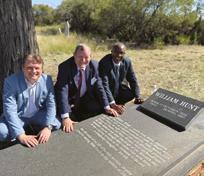
When the first Adventist missionaries arrived in Kimberley on July 28, 1887, they found something astonishing: 26 people were already prepared for baptism. A formal church was organized the following month.8 Though William Hunt’s name does not appear on official membership rolls, legal documents show he handled money for a meeting tent purchased in 1887 or 1888 —a sign of his quiet leadership behind the scenes.9
The Final Chapter and Legacy
William Hunt died on April 28, 1897, in his home in Kimberley. His estate was valued at £3,358—a considerable sum for a man who never seemed to chase wealth. George van Druten was at his side during his final hours.10 William left behind no sermons, no books, no published theology—only a story passed down in letters, articles, and the memories of those he influenced. He never stood behind a pulpit or founded an institution. Yet his life of quiet devotion helped ignite the Adventist message on a new continent. His story reminds us that some of the most powerful missionaries are not those who preach loudly, but those who sit still with an open Bible while the world keeps digging.
1 Family letters, 1/KTW 2/1/1/72, National Archives, Cape Town.
2 “Present Truth on the Pacific Coast XXII,” Pacific Union Recorder, June 28, 1906, pp. 1, 2.
3 “Present Truth on the Pacific Coast XXIII,” Pacific Union Recorder, July 5, 1906, pp. 1, 2.
4 “Present Truth on the Pacific Coast XXVIII,” Pacific Union Recorder, Aug. 9, 1906, p. 1.
5 J.H.C. Wilson, “A Letter From Africa,” Review and Herald, June 6, 1878, p. 183.
6 A. W. Staples, “Obituary of George Jakob van Druten,” Southern African Division Outlook, Jan. 1, 1933, p. 8.
7 J. B. Cooks, “Our First Church in South Africa—Beaconsfield, Kimberley,” South African Union Lantern, Aug. 1, 1885, p. 3.
8 L. Francois Swanepoel, “The Origin and Early History of the Seventh-day Adventist Church in South Africa, 1886-1920” (M.A. thesis, UNISA, 1972).
9 Unpublished letter, Ellen G. White Research Center, Helderberg College, South Africa.
10 Family letters, 1/KTW 2/1/1/72, National Archives, Cape Town.
Markus Kutzschbach is an associate director of the Ellen G. White Estate and president of Adventist Heritage Ministries.
Markus Kutzschbach, Merlin Burt, and Michael Sokupa at the recently rediscovered gravesite of William Hunt in the Dutoitspan Cemetery outside of Kimberley, South Africa.
Photo
The Problem Was That She Was Inspired
An anxious heart’s guide to reading
Ellen G. White
Callie Buruchara

as far back as my memory goes, Ellen White’s writings were there. My dad read her devotionals during family worship. Her quotes appeared in Bible class quizzes and on church PowerPoint presentations. I didn’t know life before her name. As a fourth-generation Adventist, I inherited the Spirit of Prophecy.
And I never doubted she was inspired. That wasn’t the problem.
The problem was that she was inspired. That meant I couldn’t dismiss her strong words as opinion or outdated cultural takes. If she was inspired, then everything she said about judgment, accountability, health, and wasted time mattered. And for the anxious, perfectionistic, sensitive soul that I was, that was overwhelming.
I could read the book of Leviticus with curiosity. I could wrestle with the violence of the Old Testament and the seemingly contradictory messages of James and Paul. I could read Jesus’ rebukes without flinching. But Ellen White’s words? They pierced straight through.
Take this quote from Christ’s Object Lessons: “We shall individually be held responsible for doing one jot less than we have ability to do. The Lord measures with exactness every possibility for service. The unused capabilities are as much brought into account as are those that are improved. For all that we might become through the right use of our talents God holds us responsible. We shall be judged according to what we ought to have done, but did not accomplish because we did not use our powers to glorify God. Even if we do not lose our souls, we shall realize in eternity the result of our unused talents. For all the knowledge and ability that we might have gained and did not, there will be an eternal loss.”1
I don’t know how many unused capabilities I’ve left behind. Dozens? Hundreds? Thousands? How many people have I passed by, how many times have I walked away from a conversation, how many times have I not studied the Bible, how many times have I not eaten well? So I stopped reading her. I knew it was all supposed to point to Jesus, but it didn’t
And yet.
I had mentors who loved her writings and loved me. I had friends who took her counsel seriously and still basked in the joy of salvation. These weren’t gullible people. They were sharp, Spirit-filled, theologically grounded.

So I asked my questions, and they answered with grace. I prayed as I returned to her words. Slowly the fear gave way to beauty.
But not everyone has mentors like mine. People walk away from God because they unnecessarily cut themselves on her words. Her words are sharp. But if they’re not cutting to heal, we’re doing it wrong.
This piece is for the weary-hearted. The ones who’ve shut her books because it was too much. The ones who want to love her writings but find themselves flinching.
I should add that I’m a highly sensitive person,2 which means I feel things deeply—emotionally, spiritually, even physically. So while this is for everyone, it’s especially for those who carry that kind of tenderness.
I’ve come to believe Ellen White’s writings are not only safe for the anxious heart; they’re essential. But only when read rightly. That’s what this guide is for.
Let’s begin.
Are You Sure Ellen White Wrote That?
People love to quote Ellen White. In sermons, on Facebook, in arguments. Her name gets invoked often, but less often with a source. I’ve been guilty of this too. Sometimes we trust what we’ve heard without verifying its accuracy. But that’s dangerous. We can’t wrestle with what she actually wrote if we’re reacting to something she didn’t. Even a true quote, taken out of context, can distort her meaning.
It’s worth stating clearly: some quotes floating around are completely fabricated. Others are real but misunderstood. So the first step is simple: find the source. Read it in context. Check whom she’s talking to, what prompted the comment, and what else she said around it. You can’t apply what doesn’t exist.
This piece is for the weary-hearted. The ones who’ve shut her books because it was too much. The ones who want to love her writings but find themselves flinching.
The Harsh Words Are for the Stubborn, Not the Sensitive Ellen White didn’t write in a vacuum. She wrote to real people, in specific situations, with very real blind spots. Sometimes those people were lazy. Sometimes they were self-righteous. Sometimes they were flat-out disobedient. And when she saw that, she didn’t hold back.
But if you’re already burdened with guilt, already wondering if God is disappointed in you, already trying your best and feeling as though it’s not enough, then those words probably weren’t aimed at you.
Here’s what James White said about her writings: “[Ellen White] works to this disadvantage, namely: she makes strong appeals to the people, which a few feel deeply, and take strong positions, and go to extremes. Then to save the cause from ruin in consequence of these extremes, she is obliged to come out with reproofs for extremists in a public manner. This is better than to have things go to pieces; but the influence of both the extremes and the reproofs are terrible on the cause, and brings upon Mrs. White a threefold burden. Here is the difficulty: What she may say to urge the tardy is taken by the prompt to urge them over the mark. And what she may say to caution the prompt, zealous, incautious ones is taken by the tardy as an excuse to remain too far behind.”3
That’s exactly what used to happen to me. A warning meant to shake the apathetic would crush me instead. A rebuke meant to call out hypocrisy would make me spiral, even though I was already repentant.
So here’s the practical takeaway: if you read something that feels too harsh, pause. Ask whom it was written to. Ask why it was written. Ask the Spirit if it applies to you, or if it’s being misapplied by your own overresponsibility. And remember: just because something is inspired doesn’t mean it was meant for you in that very moment.
Context, Context, Context
Some of Ellen White’s quotes seem extreme. So do some Bible verses. Such as this one: “You see that a person is justified by works and not by faith alone” (James 2:24, ESV).
Taken by itself, that sounds like the opposite of the gospel. Paul writes the exact inverse: “For by grace you have been saved through faith. . . . It is . . . not a result of works” (Eph. 2:8, 9. ESV).
But when you read both in context, it becomes clear: James is writing to people who claimed to have faith while living selfishly. Paul is writing to people who believed they could earn salvation through performance. Both were addressing different problems. And both were right.
I’ve come to believe that Ellen White’s writings are not only safe for the anxious heart; they’re essential.
The same principle applies to Ellen White. At one point she wrote strongly against spending money on bicycles. That sounds absurd today, until you read what was happening. At the time, bikes were luxury items that cost more than some people’s annual income. Families were going into debt trying to keep up with a trend, and people were literally skipping out on mission giving to buy the latest model.
So she wrote: “There have been plenty of strange doings in Battle Creek with the bicycle craze, which has greatly displeased the Lord and greatly dishonored the cause of present truth. God holds those responsible who have expended money in this direction.”4
In context, that wasn’t a universal ban on bicycles. It was a specific warning about distraction, debt, and misplaced priorities. If Ellen White were alive today, she might write something similar about smartphones, subscriptions, or the need to be seen on every platform. So before you dismiss or panic over a quote, ask: What was happening? Whom was she writing to? What problem was she trying to solve?
Use Your Brain
God never asked us to outsource our thinking to Ellen White. She gave principles. Sometimes she gave applications. But she never meant for us to apply everything everywhere without thought. And she said so herself. During a school board meeting in which people were justifying rigid policies with “Sister White said,” she stopped them:
“God wants us all to have common sense, and He wants us to reason from common sense. Circumstances alter conditions. Circumstances change the relation of things.”5
In other words: don’t blindly copy and paste. Think. Not everything she said will apply directly to your life. But that doesn’t mean you dismiss it. It means you slow down, pray, study, and reflect. What’s the principle? What’s the issue she was speaking to? How might this apply today? And if your application leads to guilt, fear, or extremes, check your interpretation. God is not the author of confusion—or fanaticism. Use your brain. God gave it to you for a reason.
Let’s go back to that quote from Christ’s Object Lessons: “We shall individually be held responsible for doing one jot less than we have ability to do. . . . For all that we might
become through the right use of our talents God holds us responsible. . . . Even if we do not lose our souls, we shall realize in eternity the result of our unused talents.”6
If my anxious interpretation of that quote were correct, then Jesus should have spent every waking moment preaching, healing, and personally chasing down every soul He could find. But He didn’t. He rested. He took time away. He even left one town while people were still looking for Him (Mark 1:37, 38). Was He being careless? lazy? No. He was being led.
So clearly, that quote can’t mean “do everything.” What it does mean is this: I am called to obey Jesus. To give Him my all. To surrender my gifts to His use; not to run myself into the ground trying to prove something He never asked me to prove. That paragraph wasn’t written to the tenderhearted who already lose sleep wondering if they’re doing enough. It was written to the indifferent. The ones who bury their talents out of convenience, not exhaustion.
For people like me—people who carry the weight of the world and assume it must be ours to carry—other quotes speak more directly:
“Put away the suspicion that God’s promises are not meant for you.”7
“You are just as dependent upon Christ, in order to live a holy life, as is the branch upon the parent stock for growth and fruitfulness. Apart from Him you have no life.”8
“No man is safe who lives that he may please men, and does not seek first for the approbation of God.”9

Photo by Kristin Arbucklez / Lightstock
“Feelings are no evidence of God’s displeasure.”10
And even the very next paragraph after that intense quote from Christ’s Object Lessons says this:
“But when we give ourselves wholly to God and in our work follow His directions, He makes Himself responsible for its accomplishment. . . . Real humility fulfills God’s purposes by depending on His strength.”11
That’s the shift. Not less urgency, but more Jesus. Less fear, more faith. Less pressure to do everything, more surrender to the One who does what matters most.
Some of Ellen White’s writings still challenge me. Some still hit hard. But with a clearer lens—one rooted in context, principle, and the person of Jesus—I’ve come to love them. I read her differently now.
If you’ve felt cut by her words, I get it. But don’t walk away. Look again. Look for the principle. Look for the Person. You might be surprised by what you find.12
1 Ellen G. White, Christ’s Object Lessons (Washington, D.C.: Review and Herald Pub. Assn., 1900, 1941), p. 363.
2 https://hsperson.com/
3 In Review and Herald, Mar. 17, 1868. (Emphasis supplied.)
4 Ellen G. White letter 19 1897.
5 Ellen G. White, Selected Messages (Washington, D.C.: Review and Herald Pub. Assn., 1958, 1980), book 3, p. 217.
6 E. G. White, Christ’s Object Lessons, p. 363.
7 Ellen G. White, Steps to Christ (Mountain View, Calif.: Pacific Press Pub. Assn., 1956), p. 52.
8 Ibid., p. 69.
9 Ellen G. White, Patriarchs and Prophets (Mountain View, Calif.: Pacific Press Pub. Assn., 1890, 1908), p. 650.
10 Ellen G. White, Daughters of God (Hagerstown, Md.: Review and Herald Pub. Assn., 1998), p. 146.
11 E. G. White, Christ’s Object Lessons, p. 363.
12 Note from the author: This isn’t a comprehensive guide. It’s just what has helped me. But if you want to keep exploring, I recommend Reading Ellen White, by George R. Knight, and the short article “Basic Rules of Interpretation” from the White Estate. Both offer tools for reading her writings responsibly and redemptively. Always start with prayer. Always stay rooted in Scripture. And always, always look for Jesus.
Callie Buruchara is a boarding academy chaplain and Bible teacher in Virginia, United States.
Look Heavenward
they desire a better country, that is, an heavenly: wherefore God is not ashamed to be called their God: for he hath prepared for them a city.” Hebrews 11:16. I wish you a happy new year. The old year with its burden of record has passed into eternity. Now let every thought, every feeling be that of remembrance of God’s love. Let us gather up one token after another. . . .
Hope for a Better Home
The evidence we have of God’s care and love for us is expressed in the lessons Christ gave to His disciples upon the things in nature. . . . The eye is not to be fastened upon deformity, upon the curse, but upon the riches of the grace of Christ that has been provided so abundantly, that we may live in this world, and act our part in the great web of humanity, and yet not be of the world. As pilgrims, as strangers looking for the bright things of God, the joy that is set before us, seeking a city whose builder and maker is God, and by beholding the provisions made for us, the mansions Jesus has gone to prepare for us, talking of the blessed home, we forget the annoyances and the fretting cares of this life. We seem to breathe in the very atmosphere of that better, even the heavenly country. We are soothed, we are comforted; we are more than this, we are joyful in God.
We could not know that gracious purposes of God toward us, but for the promises, for it is from them alone we learn what He has prepared for those who love
Words of encouragement for the new year
Ellen G. White
lives of others. Then let us appropriate these promises to ourselves. . . . They are like the precious flowers in the garden of God. They are to awaken our hope and expectation, and lead us to a firm faith and reliance upon God. They are to strengthen us in trouble and teach us precious lessons of trust in God. He in these precious promises draws back from eternity and gives us a glimpse of the far more exceeding and eternal weight
We draw from God’s promises all that peace, that comfort, that hope that will develop in us the fruits of peace, joy, and faith. And by bringing these promises into our own life we bring them always into the lives of others.
Him. As the flowers in God’s wise economy are constantly drawing the properties from earth and air to develop into the pure and beautiful buds and flowers and give forth their fragrance to delight the senses, so shall it be with us.
Catching a Glimpse
We draw from God’s promises all that peace, that comfort, that hope that will develop in us the fruits of peace, joy, and faith. And by bringing these promises into our own life we bring them always into the
of glory. Let us then be quiet in God. Let us calmly trust in Him and praise Him that He has shown us such revelations of His will and purposes that we shall not build our hopes in this life but keep the eye upward to the inheritance of light and see and sense the amazing love of Jesus.
Seventh-day Adventists believe that Ellen G. White (1827-1915) exercised the spiritual gift of prophecy during more than 70 years of public ministry. This excerpt was taken from The Upward Look, p. 15.
Photo by Bohdan
WHeN tHeodicY is evil
When you don’t want an explanation
theodicy,” a fancy word that every Adventist should know, tackles a question that every Adventist should ask (and surely has): If an all-knowing, all-powerful, and all-good God in heaven loves us so much, why is there so much suffering here on earth?
The great controversy metanarrative is a theodicy, a freewill theodicy (different types exist). Lucifer, with some angels, abusing the free will necessary for love (forced love is not love), rebelled in heaven. Expelled (Rev. 12:7-9), he then caused Adam and Eve to abuse the same free will that he had, but only here on earth. Ultimately, God will make all things right, and in a manner so that every rational intelligence in the cosmos, including Lucifer and the fallen angels, will acknowledge God’s goodness, grace, and justice in dealing with evil.
But still, how fair is it that, through our blood, through our sweat, through our tears and our suffering, God will resolve the issues—all the while He remains safely ensconced in heaven, continuously worshipped and praised by the angels and the “principalities and powers in the heavenly places” (Eph. 3:10) et al.?
Not quite. On the cross, Jesus had “borne our griefs and carried our sorrows” (Isa. 53:4). The word “sorrows,” from macav, appears in 2 Chronicles 6:29, which says that “each one knows his own burden and his own grief [from macav].” In other words, though the numbers stun us (millions killed here, millions there), in all of the earth’s population through the millennia, not one person has ever suffered more macav than any individual, alone, can suffer. Except Jesus, who on the cross bore all the world’s macav. So crucial, then, was the freedom required for humans to be able to love, that—knowing beforehand that our freedom would lead Him to suffer corporately what every human can know only individually—God gave us this freedom anyway. However, God Himself suffering because of evil still doesn’t explain evil. In God, Evil, and the Limits of Theology Karen Kilby wrote that theologian Jürgen Moltmann viewed God’s suffering as “a
source of comfort to those in Auschwitz.”* Really now? I wonder how much comfort Moltmann’s famous “crucified God” gave to the father in Auschwitz who watched his wife and children leave in a cloud of smoke?
The book of Job isn’t particularly helpful here either, at least as a theodicy. Sure, it reveals the great controversy, which provides a framework, a context for our miserable world. But who, having read the book of Job, leaves satisfied with its answers about evil and suffering? Despite the “happy” ending, would Job have declared: Oh, yes, Lord, now I fully understand the reason for the death of my 10 children. It makes such perfect sense. Thank You?
Or maybe the book of Job gave no good answers for evil because there are no good answers, and any theodicy that seeks them, or rational explanations for evil, is itself deluded. To logically explain evil, or to give a good reason for it, is to justify it, and who wants to do that?
Or what? Oh, yes, Jesus, now I know why my wife and three children, hiding in a bomb shelter during the Allied firebombing of Dresden, were baked—baked!—alive. Yes, it makes perfectly good sense now that You have explained it all to me. Of course!
That’s sick. Better there be no reason for that family to be cooked alive than there be a good one. (If there were a good one, I’d shudder to know it.) Theodicy is the justification of God, as revealed at the cross, and not of evil; on the contrary, to justify evil—or to try to by explaining it—is an evil itself.
* Karen Kilby, God, Evil, and the Limits of Theology, p. 108, Kindle Edition.

To justify evil— or to try to by explaining it— is an evil itself.
, published by the Inter-American Division Publishing Association (IADPA).
Clifford Goldstein is the editor of the Adult Bible Study Guide. His latest book is An Adventist Journey
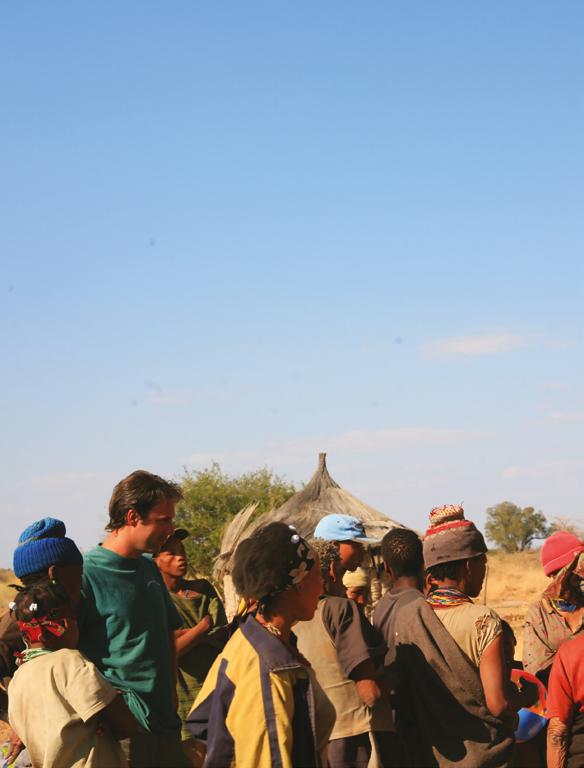
From Transylvanian Nights to the Kalahari Sands
A journey of faith and mission
Dan Serb
some of my earliest and most treasured memories are rooted in the small village of Cincșor, tucked away in the heart of Transylvania. Life in Communist Romania was often marked by scarcity and uncertainty, but those challenges also created moments of unexpected beauty. Power outages were a common occurrence, plunging our home into darkness without warning. Yet in those quiet evenings when the electric lights failed, another kind of light filled the room.
We would gather around the crackling fireplace, its flames dancing across the walls, as my grandfather began to speak. To me, he was a giant of faith, a man whose voice carried both authority and tenderness. With wide eyes my cousins and I leaned in as he recounted stories from the Bible or told us stories of brave missionaries who had carried God’s Word to distant and unfamiliar lands. Those moments, wrapped in both the warmth of the fire and the warmth of his faith, left an indelible mark on my soul.
As I drifted to sleep after those evenings, my imagination would soar far beyond the borders of Romania. I dreamed of Africa, with its vast savannas and hidden deserts; of the Amazon, with its dense, mysterious jungle; and of a God who called ordinary men and women to extraordinary journeys. Before he passed away, my grandfather entrusted me with what remains my most cherished earthly possession: a bundle of Signs of the Times magazines from the 1930s and 1940s. They had survived a house fire, their pages charred and fragile, yet alive with stories of faith. For hours I would pore over those yellowed pages, captivated by photographs of faraway places and inspired by the courage of missionaries who had gone wherever God had led them. That humble bundle of magazines was more than reading material. It was a legacy—a call to mission, a reminder that faith is not meant to stay still but to move, to go, to serve.
Called to Namibia
Fast-forward to 1996. A year earlier my friend Sebastian Tirtirau and I had left Romania to continue our theological studies at Helderberg College in South
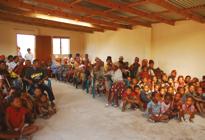
I dreamed of Africa, with its vast savannas and hidden deserts; of the Amazon, with its dense, mysterious jungle; and of a God who called ordinary men and women to extraordinary journeys.
Africa. We were young, full of questions, but also filled with eagerness to serve. Near the end of that academic year an appeal was made that would forever change the course of our lives. The Southern Africa Union Conference was calling for volunteers to begin work with the San people in Namibia, one of the most remote and marginalized communities in the region at the time.
We barely hesitated. Without fully grasping the challenges ahead, we said yes. We did not know that November was the height of the rainy season in the Kalahari Desert, bringing both flooding and an explosion of mosquitoes that carried the ever-present threat of malaria. We had no idea how vast, dry, and isolated Tsumkwe would feel—or how unprepared we truly were.
When we finally arrived, the reality was sobering. We spoke neither Afrikaans nor the San dialects. We had no vehicle to reach the scattered villages. And, in our youthful ignorance, we had unknowingly purchased secondhand clothing that resembled military uniforms. To the San people, this was no small matter. For years, young men had been conscripted into the South African army as guides, and so they assumed we had come to recruit them. They kept their distance, wary and silent.
Discouragement pressed heavily on us, but we prayed earnestly for God’s help. A few days later an answer quite literally knocked on our hut door. Standing there was a young man named Erastus. He greeted us—in English. Though not San himself, he had grown up among them and was fluent in several local dialects. With kindness and humility he offered to be our translator. That moment changed everything. Erastus became more than a translator; he became our brother in mission, a bridge between cultures, and a reminder that God provides the right people at the right time.
It did not take long for me to discover that ministry in the Kalahari required more than zeal. It required patience, humility, and an openness to be shaped by the people we came to serve. In Romania punctuality had been ingrained in me. So when I scheduled our first Bible study for noon, I arrived 15 minutes early. I waited. And waited. Hours passed. The meeting finally began around 4:00 p.m.
At first I was frustrated. But then I learned: In the desert, life bends to different rhythms. The heat of midday silences activity; the shade of
a newly built church in a San village
late afternoon welcomes gatherings. More important, I discovered that there it was not the ticking of the clock that mattered, but the value of the encounter itself. Time was measured not in hours but in presence, in relationships, in shared moments of listening and learning.
Despite our inexperience and frequent mistakes, by the end of those first six weeks God had done what we could not. Thirty-two men and women chose to be baptized. What began as a short-term mission trip planted the seed of a lifelong calling.
A Ministry That Spanned Continents
After completing my studies, I began serving as a pastor in South Africa. Sebastian, meanwhile, moved first to the United States and later to Canada, but his heart never left the Kalahari. He returned again and again to those desert communities and, eventually, expanded his reach to other parts of the world. With a deep sense of purpose, he founded a charitable organization that grew into a multifaceted ministry—installing solar-powered water systems in parched villages, distributing mosquito nets in malaria-affected regions, delivering food and aid, and constructing churches and small clinics.
In 2005 I rejoined him, and together we embarked on new journeys of service. We found ourselves deep in the Amazon rainforest, navigating the lush jungles of Africa, traveling to the islands of the South Pacific, the remote communities of South America, and even the icy vastness of the Canadian Arctic. Each place was different, each culture unique, but everywhere we went we saw the same truth: God’s love transcends geography.
We established a missionary training school in Romania, which, for me, felt like completing a circle: the faith planted in me during my childhood in Transylvania now returned to inspire and equip a new generation. Dozens of young men and women trained there, preparing to serve as volunteer missionaries in regions in which doors for service had opened.
Looking back, I see how these experiences transformed me. I began with dreams of preaching and teaching, yet what I found was something deeper. I learned that true mission is not about delivering answers, but about walking alongside people on their life and spiritual journeys. It is about listening before speaking, learning before teaching. It is about recognizing that it is God who changes hearts and minds. Our calling is to help create the conditions, the sacred spaces, where people can encounter Him for themselves.
This shift in perspective also reshaped how I understood evangelism. Being welcomed into communities so different from my own forced me to confront my assumptions and to see the beauty of God’s image reflected in faces, languages, and cultures across the world. Humility became not an abstract virtue but a daily necessity.
A Legacy of Faith
In 2011 I returned to pastoral ministry in South Africa, grateful for the foundation those years of mission service had given me. Two years later I moved to Ireland, where I was blessed with the opportunity to serve as president of the Irish Mission from 2016 until 2024. Leading in that context brought new lessons—about administration, community building, and the challenges of faith in an increasingly
secular environment—but it was always informed by the experiences I had carried with me from my time in the mission field.
Today I serve as principal of Newbold College of Higher Education, where I continue to invest in the next generation of leaders. Meanwhile, Sebastian has returned to some of the communities where we once labored, continuing the mission in a personal capacity. Our paths have diverged, but the calling remains the same.
When I trace the thread of God’s providence through my life, it always leads back to that Transylvanian fireplace, to the flickering light that illuminated
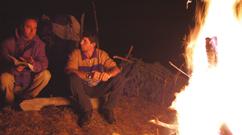
True mission is not about delivering answers, but about walking alongside people on their life and spiritual journeys.
my grandfather’s face as he told stories of faith and courage. The bundle of worn magazines he entrusted to me was never just about ink on paper. It was a sacred inheritance, a reminder that the call to mission is passed from generation to generation, each adding their own chapter to the story.
What I inherited from him was not wealth or property, but something far greater: the conviction that God can use anyone who is willing to go where He leads, even when the road is uncertain. My journey— from the quiet nights of Transylvania to the burning sands of the Kalahari, and from there to so many corners of the globe—has been one of grace upon grace. And through it all, I have learned this: when we entrust our lives to God, He takes even our small beginnings and weaves them into a tapestry far more beautiful than we could imagine.
Dan Serb is the principal of Newbold College of Higher Education in England.
From Transylvania Nights to Kalahari Sands
Worship during mission school in Romania
new Year, new Heaven
Nothing to fear
the calendar has turned, but the world’s cries have not fallen silent. While colorful fireworks flashed for some, multitudes crossed into a new year under the roar of artillery, sirens, and bombs. Wars persist across continents, humanitarian catastrophes are worsening, some nations are in civil upheaval, and places once peaceful now face violence on an unprecedented scale. All these dynamics confirm the most current diagnosis: we are living during a historic level of armed conflict. If things don’t improve, what then?
Scripture prophesied this scenario. “And you will hear of wars and rumors of wars. See that you are not troubled” (Matt. 24:6). This command of Jesus is not naïveté; it is sovereignty. He does not deny conflict, but He calls His people to a purposeful life, free from panic. Therefore, as we usher in 2026, may our reference point rest not on the euphoria of the new but on the certainty of the eternal. Will it get better? Absolutely, and eternally. “Nevertheless we, according to His promise, look for new heavens and a new earth in which righteousness dwells” (2 Peter 3:13). For the Adventist, hope does not ignore the alarms; it listens for a much louder trumpet, “looking for the blessed hope and glorious appearing of our great God and Savior Jesus Christ” (Titus 2:13).
uncertainty grows, identity rises. When violence expands, compassion enlarges. And if geopolitics tremble, faithfulness stands tall. “Now when these things begin to happen, look up and lift up your heads, because your redemption draws near” (Luke 21:28).
Our pioneers have already taught us how to endure times like these. “A storm is coming, relentless in its fury. Are we prepared to meet it?”1 Those who prepare for heaven do not stockpile fear on this earth; they direct their lives, schedules, and resources to mission. They strengthen their knees in prayer, their hands in service, and their voices in proclamation. “We have nothing to fear for the future, except as we shall forget the way the Lord has led us, and His teaching in our past history.”2
Will it get better? Certainly and eternally.
As we enter 2026, may our feet stand in reality, and our eyes fix on eternity. May every home start the year in fellowship, may every worshipper renew their trust, and may every church reaffirm its calling. As the world’s noise increases, let us increase the boldness of our witness. As the world grows unstable, let us steady our steps in the Word. Let us press on, grounded in the Bible, focused on the mission, without retreat until the precious day when “God will wipe away every tear from their eyes” (Rev. 21:4).
Maranatha.
The biblical, prophetic voice summons the church to respond with mission, not fear. A swift angel announces the everlasting gospel to the whole world; he does not wait for stability to preach it (Rev. 14:6). Where
1
2
Erton C. Köhler is the president of the General Conference of Seventh-day Adventists.
Founded 1849. Published by the General Conference of Seventh-day Adventists, Northern Asia-Pacific Divison
PUBLISHING BOARD
Erton Köhler, chair; Pierre E. Omeler, vice chair; Justin Kim, secretary; Audrey Andersson, G. Alexander Bryant, Zeno CharlesMarcel, Sabrina DeSouza, Paul H. Douglas, Mark A. Finley, James Howard, Leonard Johnson, Mario Martinelli, Richard E. McEdward, Magdiel Perez Schulz, Artur Stele, Alyssa Truman, Ray Wahlen, Karnik Doukmetzian, legal advisor
MANAGEMENT BOARD BASED IN SEOUL, KOREA Soon Gi Kang, chair; Justin Kim, secretary; Karnik Doukmetzian; SeongJun Byun; Toshio Shibata; Tae Seung Kim; Ray Wahlen Ex-officio: Paul H. Douglas; Erton Köhler; Richard E. McEdward
EDITOR Justin Kim
ASSOCIATE EDITORS Shawn Boonstra, Sikhululekile Daco
ASSOCIATE DIRECTOR Greg Scott
ASSISTANT EDITORS Hannah Drewieck, Beth Thomas, Jonathan Walter
EDITORS BASED IN SEOUL, KOREA Jae Man Park, Hyo-Jun Kim, SeongJun Byun
NEWS CORRESPONDENT Marcos Paseggi
FINANCE MANAGER Kimberly Brown
DIRECTOR OF SYSTEMS INTEGRATION AND INNOVATION Daniel Bruneau
ART DIRECTION AND DESIGN Brett Meliti, Ellen Musselman/Types & Symbols
CUSTOM TYPEFACE DESIGN RK Type
LAYOUT TECHNICIAN Fred Wuerstlin
COPY EDITOR James Cavil
EDITORIAL ASSESSMENT COORDINATOR Marvene Thorpe-Baptiste
KIDSVIEW DESIGN Merle Poirier
SENIOR ADVISOR E. Edward Zinke
AD SALES Glen Gohlke
DISTRIBUTION Sharon Tennyson
WEBSITE: www.adventistreview.org
TO WRITERS: Writer’s guidelines are available at www.adventistreview.org at the footer. For further correspondence, email manuscripts@adventistreview.org. Unless otherwise noted, Bible texts in this issue are from the New King James Version. Copyright © 1979, 1980, 1982 by Thomas Nelson, Inc. All rights reserved. Bible texts credited to NIV are from the Holy Bible, New International Version. Copyright © 1973, 1978, 1984, 2011 by Biblica, Inc. Used by permission. All rights reserved worldwide. Bible texts credited to NRSV are from the New Revised Standard Version of the Bible, copyright © 1989 by the Division of Christian Education of the National Council of the Churches of Christ in the U.S.A. Used by permission. Scripture quotations marked ESV are from The Holy Bible, English Standard Version © 2001 by Crossway, a publishing ministry of Good News Publishers. ESV Text Edition: 2016. Used by permission. All rights reserved. Scripture quotations marked NASB are from the New American Standard Bible, copyright © 1960, 1971, 1977, 1995, 2020 by The Lockman Foundation. All rights reserved.
The Adventist Review (ISSN 0161-1119) is the general paper of the Seventh-day Adventist® Church. It is printed simultaneously around the world in Argentina, Australia, Austria, Brazil, Germany, Indonesia, Korea, Mexico, South Africa, and the United States. It is published monthly by the General Conference of Seventh-day Adventists®, 12501 Old Columbia Pike, Silver Spring, MD 20904, U.S.A. The Korean editorial and business offices are located at the Northern Asia-Pacific Division, 67-20 Beonttwigi-gil, Paju-si, Gyeonggi-do 10909, Republic of Korea.
Copyright © 2026, General Conference of Seventh-day Adventists®.
Ellen G. White, Testimonies for the Church (Mountain View, Calif.: Pacific Press Pub. Assn., 1948), vol. 8, p. 315.
Ellen G. White, Life Sketches of Ellen G. White (Mountain View, Calif.: Pacific Press Pub. Assn., 1915), p. 196.