
New titles 2025
january tonovember 2025
Graphic novel… 4
Non-fiction… 15
Essay
Linguistic
Nature
Practicalbook
Cookery
Health
Arts… 49
Fine Arts
Performing Arts
Music
Cinema Photography
Graphic novel...
>ACTES SUD BD
Jean Lecointre, Barcarolle. 6
Mathieu Flammarion, L’Allée des frênes. 7
Brecht Evens, Le Repaire de la Méduse. 8
Paola Guzzo and Cécile Rousset, Nous sommes la voix de celles qui n’en ont plus. 9
Maxim Cain, Démontagner. 10
Jens Harder, Gamma... visions. 11
>ACTES SUD BD - VIRAGES GRAPHIQUES
Dimitri Tsekenis, La Timidité des arbres. 12
Rosalie Stroesser and Vincent Farasse, Des vies multiples. 13
Maëlle Reat, Murmures de cafés. 14
Jean Lecointre Barcarolle
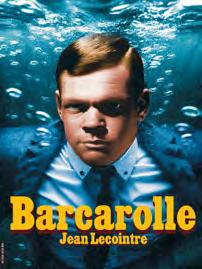
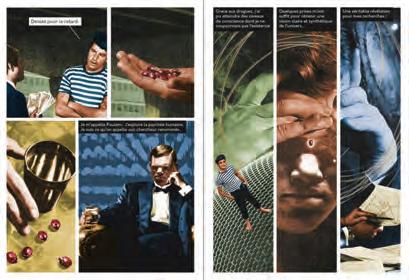
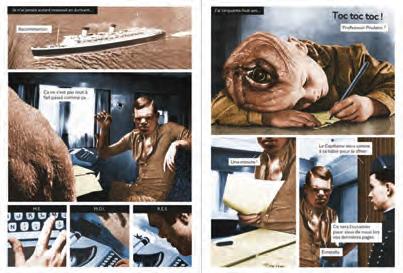
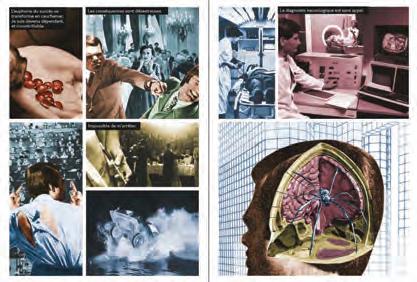
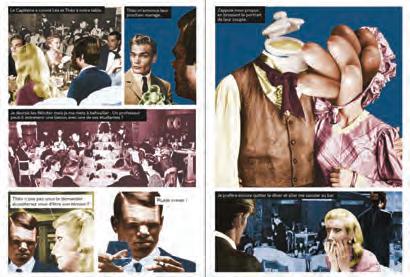
Jean Lecointre, at the height of his powers of image manipulation, takes his hero on an introspective-fantasmagorical voyage to Barcarolle, the island of all possibilities. Will he rediscover the desire and the need to live? Poulenc, a ‘star’ researcher in his field, explores the human psyche. Thanks to drugs, he is able to reach levels of consciousness never imagined. The euphoria of success has turned into a nightmare. He became dependent and uncontrollable. In the grip ofanexistentialcrisis,theoverwhelmedherolooksforawayout.
-There's nothing more for me to do here, but... I'm afraid it's going to hurt... Can you get me a gun?
-For people like you, there might be a place... an island... Barcarolle. Don't be late, the liner won't wait for you.
Born in 1964, Jean Lecointre is an atypical artist on the contemporary graphics scene. A student of Roman Cieslewicz, he draws his inspiration from dissecting all kinds of old paper to create strange atmospheres that evoke both the world of David Lynch's Eraserhead period and the destabilising associations of Luis Bunuel. In 1995, Jean Lecointre published his first illustrations for Libération. In 2003, he moved into animation with Turkish Delights, broadcast on Canal+. At the same time, he published Les Dents du loup (2002), Les Animaux domestiques (2007) and À la mode (2010) with Thierry Magnier. In 2019, the children's album Cache-cache cauchemars received the special mention Photo Album for Young People at the Bologna Fair.
17×23cm/400pages April2025

19,5×26cm/160pages
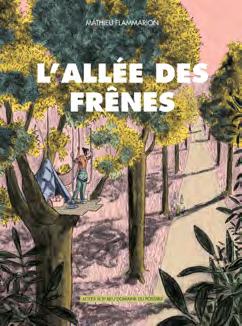
Mathieu Flammarion L’Allée
des frênes
[The Ash
Path]
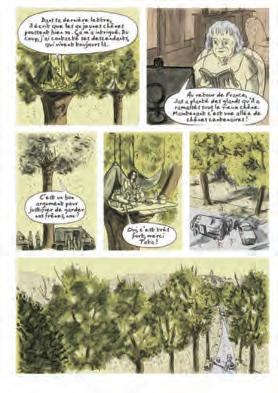
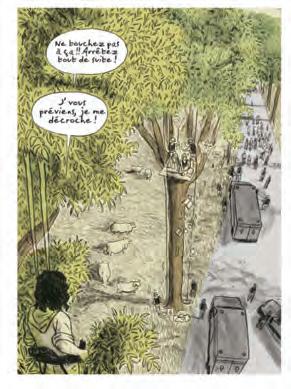
In the village of Mahaut, an independent market gardener, the avenue of hundred-year-old ash trees that runs alongside the road is to be razed. The village is going to get organised, learn how to fight back and get back in touch with the history of these trees, because there is history. Mahaut and Xavier will each climb into an ash tree, tie themselves to it and begin their fight in the branches. A docudrama that puts trees back at the centre of the action and helpsusunderstandthepolitical,ecologicalandhistoricalissuesatstake.
Mathieu Flammarion is a librarian at the Bibliothèque nationale de France. He has already produced several fanzines in which he paints portraits of collective struggles. L'Allée des frênes is his first documentary.
Brecht Evens Le Repaire de la Méduse
[The Lair of the Medusa]
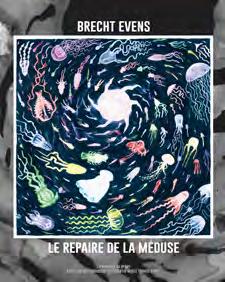
After Nicolas de Crécy in 2023, the Musée Thomas Henry is to showcase Brecht Evens for a journey through one of the most flamboyant graphic universes of our age. The exhibition will feature drawings, lithographs and original illustrations associated with his major works, not least the Le Roi Méduse trilogy And Evens will also be creating a large-format work inspired by Cherbourg-en-Cotentin in front of a live audience. This first solo exhibition dedicated to Brecht Evens in France has been curated in partnership with Amélie Payan and the Atelier Michael Woolworth. Actes Sud is the publisher of the official catalogue. Brecht Evens first experimented with lithography in Michael Woolworth’s studio while he was working on Paris, a travel book published by Louis Vuitton, and he subsequently adopted the technique for much of his work It was also in this same studio, which he calls the ‘Lair of the Medusa’, that he cre-ated the first images for his graphic novel Le Roi Méduse (published in January 2024): prints bursting with moving colours and textured chiaroscuro patterns that were latercombinedwiththeartist’scoloureddrawingsforthefinalwork.
Brecht Evens is a Dutch-speaking Belgian graphic novel artist who was born in Hasselt in the province of Limburg in 1986. Since 2013, he has been living and working in Paris. His five graphic novels have been published by Actes Sud BD.
24 x 30 cm / 96 pages Bilingual English catalogue June 2025
> The Musée Thomas Henry in Cherbourgen-Cotentin is hosting the Brecht Evens exhibition, Le Repaire de la Méduse, from 21 June to 16 November 2025 as part of the 12th Biennial of the 9th Art.
> The lithographs from the exhibition will also be on display at the Centre de la Gravure et de l’Image Imprimée in La Louvière, Belgium, from 13 June to 30 December 2025.
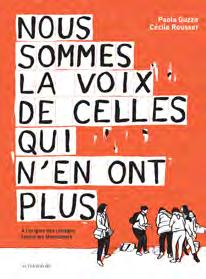
Paola Guzzo and Cécile Rousset
Nous sommes
la voix de celles qui n’en ont plus A l’origine des collages contre les féminicides
[We Are the Voice of the Voiceless –Behind the poster pasting campaign againstfemicide]
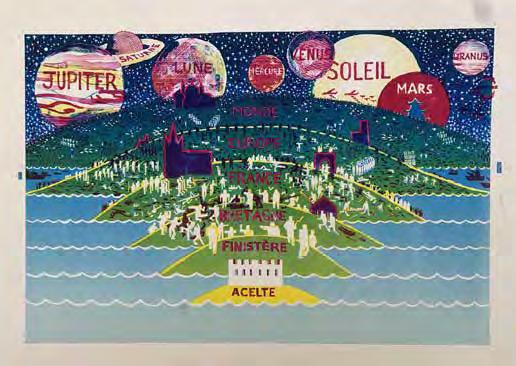
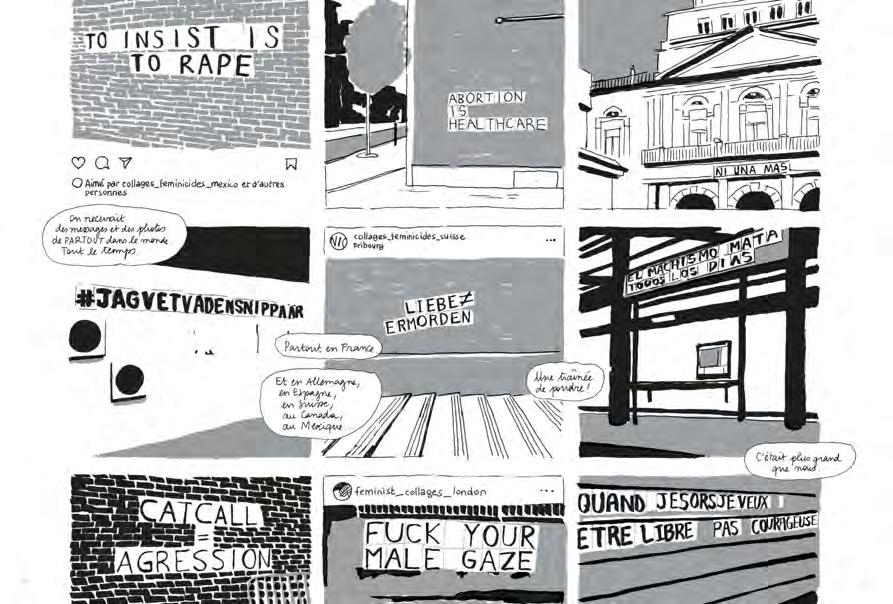
In late August 2019, a campaigner put out a call to women on Instagram to meet up for a first collective pasting of anti-femicide slogans on the walls of Paris. She didn’t know any of them, but in the space of a few weeks the movement had spread like wildfire. The journalist Paola Guzzo has been investigating the campaign since the outset and has kept a dairy and collected the first-hand accounts of the ‘pasters’. She met Cécile Rousset, the winner of several awards for her animated documentaries, and the two women decided to tell the story of a movement that has left its mark on this rapidly changing age of ours, in France but also all around the world. Their starting point is the trial, constantly postponed over the course of five years, of four women charged with violently resisting the police officers who intervened after they had pasted the slogan ‘Liberty, Equality, Impunity’ on the façade of a bank in Nantes, Brittany, on 14 July.
The journalist Paola Guzzo, who has worked for Radio France, France Bleu and Nova among others, has been part of the movement from the outset. She has followed the development of the movement, kept a diary and reported on the story of this feminist collective.
Cécile Rousset is an illustrator and maker of animated documentaries (Le C.O.D et le coquelicot). She is also behind the Arte series Elle vit à Paris
Maxim Cain Démontagner
[Coming Down from the Mountain]
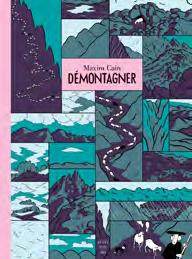
Up in the mountains, pastoralism is still alive and well. But it does not afford some sort of ideal refuge, cut off from the world below. Neither is it one long siesta for the herder beneath a gentle sun and beside a gushing crystal-clear stream, with a docile herd for company and a little flute carved from bone in his calloused hand that he plays to summon his dog when he awakes. It’s not that at all, in fact, and yet Maxim Cain has stuck to his task of herding his ewes in the Pyrenees for the last decade.
Maxim Cain is a comic strip illustrator and a shepherd who takes his sheep up into the Pyrenees in the summer. His work has been published in the review Bento (which won the prize for best alternative comic strip at the Angoulême International Comics Festival in 2022), and along with Léo Duquesne he is the creator of the bitter-sweet La mer est calme comme un lac comic strip published in the bi-monthly La Disparition
23 × 32 cm / 140 pages September 2025
19,5 × 31,5 cm / 224 pages
October 2025
>
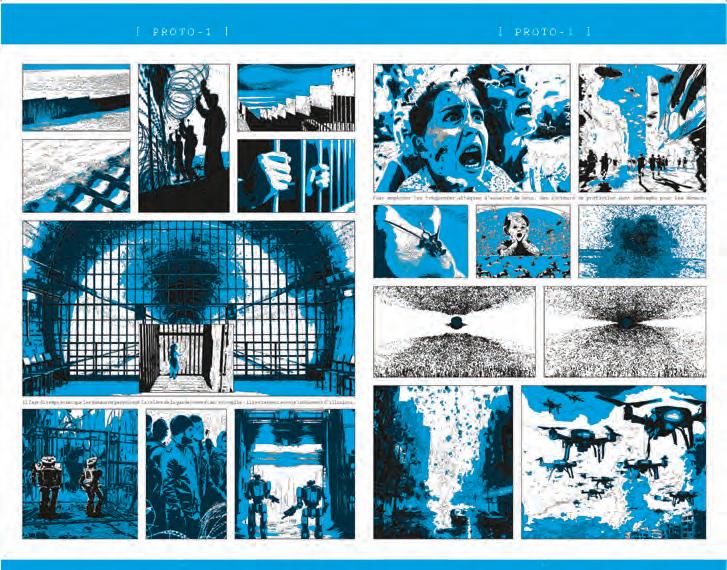
> Gamma... visions is the fourth and final instalment of the ‘Great Story’ tetralogy.
> An impressive artistic achievement
> 1,400 pages and 16 years of work
– that epitomises the extraordinary educational power of comic books.
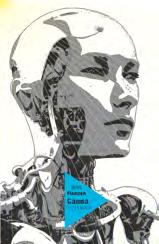
Jens Harder Gamma... visions
TranslatedfromGermanbyÉtienneDiemert
Having explored in the first three volumes the imagery that has been used to represent the evolution of the universe and the history of the human race, Jens Harder’sfocusswitchesinthisinstalmenttothefuture.Howisourplanetgoingto turnout?Whatfateisinstoreforusamiddramaticclimatechangeandtheadvent of mass extinctions? What role will technology play in our survival?All of these questions and more are addressed in this final volume of his ‘Great Story’. A dazzlingfinaletothismonumentaloeuvre.
Born in 1970 in Weißwasser in the then East Germany, Jens Harder is a German comic book writer. In 1999, he co-founded of the Monogatari artists’ collective. His works are characterised by their ambitious blending of cosmology and the history of the human race, often without accompanying words. The French editions are published by Actes Sud BD / L’An 2. He is based in Berlin.
The rest of ‘Great Story’ series featuring new covers:


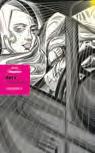

Dimitri Tsekenis
La Timidité des arbres
[The Shyness of Trees]
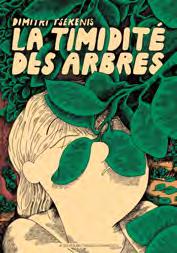
There are branches atop the dense forest canopy that never touch each other – a behavioural phenomenon that botanists call the ‘shyness of trees’. César moved to a city a few months ago to study at college, but he is suffering from insomnia and an ill-defined malaise that prompts him to abandon his classes and cut himself off from his fellow students. His rare outings are mainly con-finedtothegrocer’s,and he can’t help noticing that the flora is gradually invad-ing the streets, eating away at thestreetfurnitureandredrawingthecitymap.The roots penetrate his little flat too, raising up the floor, and foliage is soon decorating the walls and ceiling. Under such circumstances, how is he sup-posed to find his own path in life?
Dimitri Tsekenis was born in Paris in 1995 and is currently based in Angoulême. He studied illustration and animation but also engraving, which has given rise to the screentone quality of his drawings, reminiscent of etchings. La Timidité des arbres is his first comic book.
19,5 × 28 cm / 144 pages

16 × 21 cm / 240 pages
>

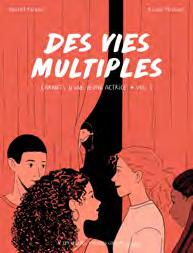
Rosalie Stroesser and Vincent Farasse Des vies multiples
Carnets d’une jeune actrice
[Multiple LivesNotebooks of a young actress]
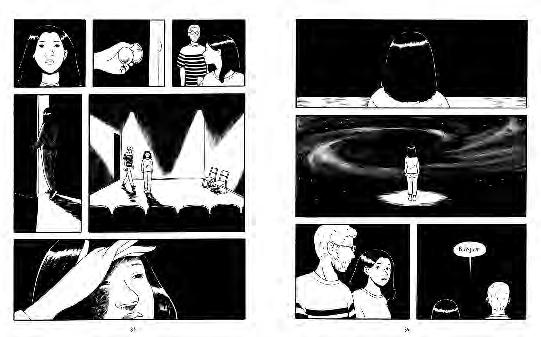
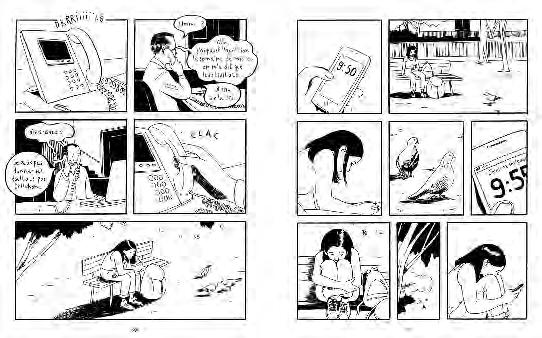
This story takes place behind the scenes and before the curtain is raised, in that period preceding the theatrical illusion. Jeanne, a young introvert who carries her life around with her in a big bag that never leaves her side, is hoping to get in to a highly rated drama school and become an actress. From her auditions to her first classes, the comedies of error and dramatic asides, and the little lies and the make-believe, her initiation to the boards prior to the glare of the limelight is imbued with a personal authenticity. A case of being oneself before donning the apparel of somebody else.
Vincent Farasse is an author, theatre and film director, actor and scriptwriter. His plays are published by Actes Sud-Papiers. Since 2015, he has been giving regular talks about the art of acting to drama school and university students. Following on from Les Représentants (2022), Des vies multiples. Carnets d’une jeune actrice is his second comic book.
Rosalie Stroesser is a comic strip artist and illustrator for the press (New York Times, Le 1 hebdo, etc.). Following on from Shiki (2023), Des vies multiples. Carnets d’une jeune actrice is her second comic book.
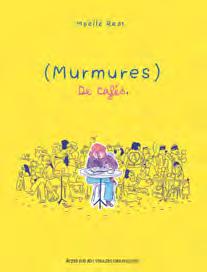
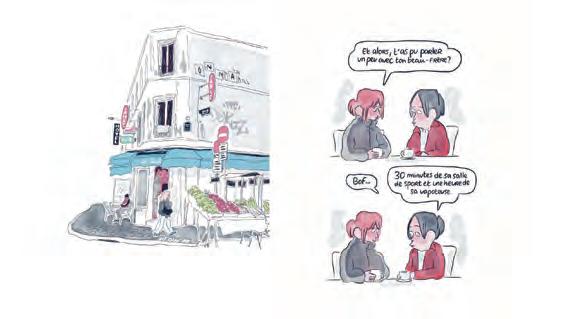
[Café Murmurings]
16 × 21 cm / 144 pages
> Maëlle Reat Murmures de cafés

Murmuring 1. The soft continuous sound of human voices. 2. Several people quietly expressing an opinion.
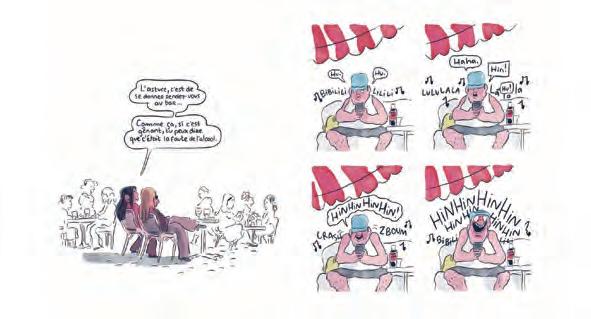
In Maëlle Reat’s illustrations, murmurings rarely go unnoticed. Whether emanating from those standing at the bar or seated on the terrace, they make themselves heard over the general background noise.
A hilarious and impertinent collection of short sketches, Murmures de cafés showcases the author’s talent for capturing the juicy morsels of conversations and the burlesque side to the social interactions of every age group.
Maëlle Reat is a comic book writer and illustrator. Following on from Comme une grande (2022), Murmures de cafés is her second comic book to be published by Virages Graphiques.

Nonfiction…
Essay.18
PierreWeill,Uneseulesanté.18
Jean-PhilippedeTonnac,LeTempsminéraldelaguérison.18
OlivierBessard-Banquy,Élogedelapetiteéditionlittéraire.19
LionelAstruc,Activisted’élite.19
ÉricLaBlanche,Osonslacolère.20
Anne-MarieLoPrestiandSabineOppliger,Àl’écoleduvivant.20
CyrilDion,LaLutteenchantée.21
>DOMAINEDUPOSSIBLE.
MartinArnould,Aupieddubarrage. 21
>MANIFESTES.
SébastienMabile,Justiceclimatique.22
>MEMOIRES,TEMOIGNAGESETAUTOBIOGRAPHIES.
NellyPons,LeGrandÉpuisement.22
>LACOMPAGNIEDESLANGUES.
AnnaArzoumanov,Jugerlesmots 23
JulienBarret,Retouràlaparole 23
>ERRANCE&PICARD.
JérômeandLaurentTriolet,Souterrainsdumonde.24
FranckMonnier,Lasciencefaceauxdossiersmystérieuxdel’Égypteancienne.24
FrançoisZossoandChristianZingg,LesEmpereursromains.25
IaroslavLebedynsky,LesAmazones.25
>LE SOUFFLE DE L'ESPRIT.
Carolyn Carlson, Un saut dans le bleu. 26
Alain Sainte-Marie, Prières d’écrivains – Morceaux choisis. 26
Linguistic. 27
Stéphane Gendron, C’est du pipeau !. 27
Nature. 28
>MONDES SAUVAGES.
Olivier Bleys, La Marche aux étoiles. 28
Jacques Blondel et al., La mésange et la chenille. 28
Sylvère Petit, En attendant les vautours. 29
François Sarano and Marine Calmet, Justice pour l’étoile de mer. 29
Simonetta Greggio and Olivier Weber, Un été en mer. 30
Vinciane Despret, Le Chez-soi des animaux (new edition). 30
David Grémillet, Les Discrètes. 31
Caroline Audibert, Les Audionautes. 31
>VOIX DE LA TERRE.
Damien Delorme, L’Autre Rêve américain. 32
Estelle Castro-Koshy, Et fleurit l’espérance. 32
Sophie Swaton, L'œil du jaguar. 33
>CAHIER MILITANT.
Tanguy Descamps and Côme Girschig, Engagez-vous ! (Qu’ils disaient). 33
>MONDES GRAPHIQUES.
Sébastien Cazes and Laurent Tillon, Chroniques d’une vie à l’envers. 34
>SYSTEME TERRE.
Nathanaël Wallenhorst, Contenir l’emballement bioclimatique. 35
Bruno Villalba, Au-dessus du gouffre. 35
Dominique Bourg, Leçons des limites planétaires. 36
Valérie Guillard, Être, faire et avoir. 36
Claude Siméon, Herbier des collines. 37
Arnaud Béchet et al., Atlas et herbier de Camargue. 38
Hubert Voiry, 10 champignons qui ont changé la vie des hommes. 39
Laurence Paoli, Le Chant perdu des baleines. 39
>ARTS EQUESTRES.
Mario Luraschi, Mille vies en une. 40
Anne Konitz-Hoyeau, Chevaux de course. Propriétaires. 40
Nuno Oliveira and Jean-Louis Sauvat, Dialogue équestre. 41
Practical Book. 42
>JE PASSE À L'ACTE.
Claire Sejournet, Manger du poisson ?. 42
Terre & Humanisme, Adapter son jardin nourricier au changement climatique. 42
Julia Zimmerlich, S’impliquer dans sa commune. 43
Corentin de Chatelperron, L’Appart’ du futur. 44
>ROUERGUE
Laetitia Roux, Sauvage des villes. 45
Julie Laussat, Plantez des fleurs à couper. 45 Cookery. 46
Pierre Tallet, Cuisine et saveurs de l’Égypte ancienne. 46
>ROUERGUE
Colette & Genet, Gâteaux frigo. 47
Health. 48
Stéphanie Brillant, Quand le corps n'est plus d'accord. 48
Anthony Berthou, Remettez du bon sens dans votre assiette. 48
Pierre Weill
Une seule santé
Enquête sur les sols où nos maladies prennent racine
[A single health -
Investigation into the soil where our diseases take root]
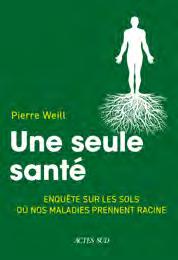
A first-person narrative of almost thirty years spent studying the links between the poor soil health, the animals that graze on it and the people who feed on it. Surrounded by searchers, farmers, and doctors, Pierre Weill, founder of BleuBlanc-Coeur asks a simple question, but with complicated answers: what if the health of men depended on the health of the soil they cultivate, of the animals they feedon?
After thirty years, seven clinical studies and nearly five hundred publications in the press, this book, written in simple, enthusiastic language, outlines the conclusionsofthislifelonginvestigation.
Pierre Weill is an agronomist who lives and works near Rennes. He has been joint president of Bleu-Blanc-Coeur until 2024. He has been working for seven years on the connection between agricultural production, environment and health. He has taken part in a number of clinical studies about the effects of the environment on human health. He is also the author of several best-selling popularisation books, including Tous gros demain ? (Plon, 2007) and Mon assiette, ma santé, ma planète (Plon, 2010).
Jean-Philippe de Tonnac
Le Temps minéral de la guérison
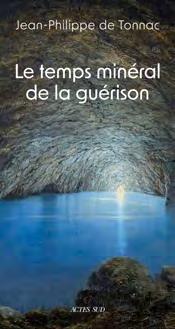
‘The food entered a body where it had to feel immediately that it was not welcome, to say the least, or welcomed with closed arms. It's not easy to immerse yourself in the sensations of a body that has cut itself off from them. No heat, no cold, no sleep, no hunger: Jean-Philippe de Tonnac's text aims to do justice to this ‘out of body’ experience that is restrictive anorexia nervosa. Although he suffered from it for part of his life, this text is the story of how he gradually ‘took on a body’, in other words, learned to inhabit this flesh. In contrast to treatises on lightning cures or miracle texts on personal development, his account is an ode to the slow, subterranean transformations that nonetheless change thecourse of a life.
Essayist, journalist and publisher, Jean-Philippe de Tonnac has published several works, including interviews (N'espérez pas vous débarrasser des livres, with Umberto Eco and Jean-Claude Carrière, Grasset, 2010), biographies, essays and the Dictionnaire universel du pain (Robert Laffont, 2010), featuring 150 specialists from around the world. He has also taken an interest in healing practices in texts that have been a great success in bookshops (Le Cercle des guérisseuses, Guy Trédaniel, 2019).
[The Mineral Time for healing]
17 × 24 cm / 320 pages
September 2025
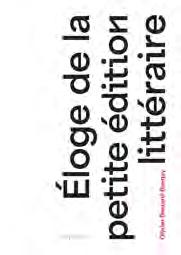
Olivier Bessard-Banquy
Éloge de la petite édition littéraire
[InPraiseofSmallandIndependentLiteraryPublishers]
To do justice to the sheer vitality and diversity of the publishing houses that have contributed in a tangible way to the richness of French literature, and that are currently spearheading what might aptly be termed a ‘renaissance’ in French publishing, Olivier Bessard-Banquy has necessarily cast his net wide. He presents a panorama of the industry from the late 19th century until the present day, acquainting us with the men and women who have put their own personal stamp on their distinctive book catalogues and celebrating their remarkable intellectual, artistic and typographical innovations. He explores the intersections between significant historical events and the evolution of phil-osophical and aesthetic perspectives, as well as the technical advances in the last century or so that have had an impact on printing and reproduction. He examines the primordial role of bookshops, but also the growing importance of new means of distribution and dissemination. And above all he highlights the crucial contribution of small independent publishers to the preservation of ‘bibliodiversity’, that vital source of nourishment for the imagination and the thinking mind. In the process, he implicitly points us down the avenues that may lead to the new publishing adventures of the future.
OlivierBessard-Banquy is a university lecturer and specialist in the contemporary publishing world and its associated professions at the University of BordeauxMontaigne. Co-author of L’Édition française depuis 1945, edited by Pascal Fouché and published by the Cercle de la Librairie in 1998, he published La Fabrique du livre with Du Lérot in 2016.
10 × 19 cm / 256 pages September 2025
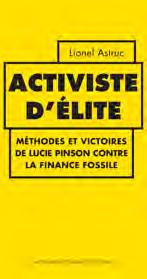
Lionel Astruc
Activiste d’élite
Méthodes et victoires de Lucie Pinson contre la finance fossile
[Champion Campaigner –
The keys to Lucie Pinson’s victories against the fossil fuel financiers]
Amid a prevailing atmosphere of defeatism, there is nevertheless one campaigner who is achieving decisive environmental victories. Her name is Lucie Pinson and she has become a genuine icon in the NGO world. In this book, she takes us behind the scenes of her battles against huge fossil fuel infrastructure projects in the United States, Australia, Indonesia and Uganda. How does she do it? She exposes the realities of the industry and she threatens the reputations of some its most powerful funders around the world. And though she is also willing to negotiate with them and assist them, she is prepared if necessary to occupy their premises and deposit several tonnes of coal on site.
Lionel Astruc has written some twenty books on environmental, social and humanitarian issues. His Traque verte. Les dernières heures d’un journaliste en Inde (2017) and L’Art de la fausse générosité La fondation Bill et Melinda Gates (2019) are published by Actes Sud. He lives in the Vercors region in the south of France.
Lucie Pinson is the founder of the NGO Reclaim Finance and is based in Paris.
Éric La Blanche
Osons la colère
Éloge d’une émotion rebelle par temps de crise écologique
Preface by Pablo Servigne
[DaretobeAngry–
In praise of the rebellious spirit in times of environmental crisis]
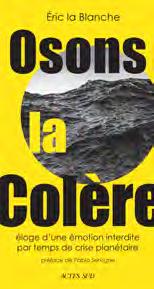
We all bear our share of responsibility for the environmental crisis – so goes the deceptively egalitarian mantra of those who would have us forget that some bear much more responsibility for it than others. The worst culprits are the powerful of this world: the individuals who run the industrial and financial multinationals that do so much damage to people and nature and claim we could save the planet with a few paltry gestures towards protecting the environment when they are in fact ruining it as they make their billions. Confronted by the madness of those who lord it over us, we have the right – indeed the duty – to get angry. There is no contradiction between heartfelt emotions and rationality – anger can be wise, and our ire is necessary. We are demanding urgent measures and justice.
A journalist, author, scriptwriter and lecturer, Éric La Blanche specialises in the domains of ecology, feminism and modes of dialogue between the scientific community and the general public. He is also behind the Bridget Kyoto videos – a vintage icon of environmental humour – and creates the educational comic strips for the Secours Catholique’s ‘Idées reçues sur les pauvres’ series. He lives in Paris.
Anne-Marie Lo Presti and Sabine Oppliger
À l’école du vivant
S’éduquer par et pour la nature
Preface by Ernst Zürcher
[The School of the Living World –Learning from and for nature]
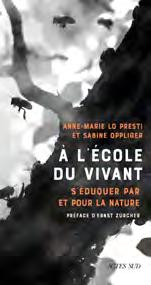
This essay reflects on how our relationship with nature and the living world can be conducive to learning insofar as it can operate as a space for social transformation, leading us to examine human and non-human relations in our shared environment and reconnecting us with the Earth. It draws on the experiences of teachers, nature lovers and children to offer the poetic and sensory material we need to imagine a different world that we can inhabit in a more harmonious way. It is addressed both to professional educators and to a wider public who are interested in green citizenship issues and our relationship with our environment and the living world.
Sabine Oppliger is a researcher at the Haute École Pédagogique du Canton de Vaud in Switzerland. A researcher in the field of creativity and a teacher who places an emphasis on narrative approaches and conceptualisation in the transmission of manual techniques, she is also herself a painter and sculptress who seeks poetic collisions between the sensory, the cultural, the ecological and different art forms.
Anne-Marie Lo Presti is a researcher and lecturer at the Haute École Pédagogique du Canton de Vaud. As a historian and anthropologist, she is interested in how narrative approaches can be used as tools for learning and emancipation. A qualified coach in change management and professional development, she addresses human and environmental health issues, connecting the process of looking after oneself with looking after the world.
11,5 × 21,7 cm / 224 pages September 2025
11,5 × 21,7 cm / 256 pages
August 2025
11,5 × 21,7 cm / 200 pages
October 2025
> Co-publicationwith RadioFrance
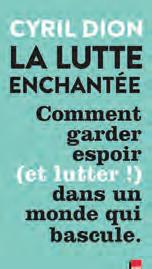
Cyril Dion La Lutte enchantée
Comment garder espoir (et lutter !) dans un monde qui bascule
[The Enchanted Struggle –How to Stay Optimistic (and struggle!) in a World on the Brink]
‘I’m going to talk about everything you’re not supposed to talk about on the morning show. I’m going to share what’s on my mind and how I think we can sort things out.’ In August 2024, Cyril Dion agreed to do a Wednesday morning guest slot on France Inter radio station. This is a collection of her contributions, which joyfully plunder every disciplinary field imaginable. There is talk of civil disobedience, the politics of the environment, democracy, mental health, algorithms, capitalism, plastics, dead fish, dog turds and strategies for opposing a pipeline or toppling a dictator, as well as space for poetry, the Beatles and love. The message of the book is that small gestures are not enough to change a system that is loaded against us, but that we can nevertheless try to change the rules of the game.
Until 2013, Cyril Dion ran the Colibris citizens’ movement, which he set up with the farmer and philosopher Pierre Rabhi. With Mélanie Laurent, he co-directed the film Demain, which won the César for best documentary in 2015. He published his first poetry collection, Assis sur le fil, in 2014 (La Table ronde). In 2018, he published his Petit manuel de résistance contemporaine with Actes Sud, and in 2019 he was one of the guarantors of the independence of the Citizens’ Convention for the Climate. In 2021, he made the film Animal about the mass extinction of species, which was entered into the special ‘Cinema for the Climate’ category at the Cannes Film Festival in 2021. In September 2024, he joined the ‘La Terre au Carré’ team on France Inter, affording him a regular radio slot.
March2025
> Domaine du possible 14×19cm/240pages
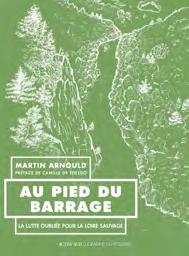
Martin Arnould Au pied du barrage
La lutte oubliée pour la Loire
sauvage
PrefacebyCamilledeToledo
[At the bottom of the damThe forgotten struggle for the wild Loire]
Between Larzac and Notre-Dame-des-Landes, there was the fight for the wild Loire. At the end of the 1980s, the government decided to build fourdams on what is considered to be one of thelast wild rivers in Europe. At Serre-de-la Fare, in the Haute-Loire, the dam threatened to swallow up twenty kilometres of magnificent gorges. It was then that a group of residents decided to occupy the site at the foot of the future dam. This book tells the story of this forgotten yet victorious struggle, which helped change the culture of river development and flood risk management in France. A crucial issue today in the face of climateupheaval.
Martin Arnould has been involved in protecting rivers since 1988. He took part in the ‘sos Loire vivante’ campaign to save Europe's ‘last wild river’. He is committed to saving migratory fish, in particular salmon and eels, and strives to reconcile the issues of biodiversity and renewable energy. He is a director of the association Rivières Sauvages.
Sébastien Mabile Justice climatique
Pour une nouvelle lutte des classes
[Climate JusticeA new class struggle]
In order to not cross the irreversible threshold of 1.5°C of global warming, we can still issue 247 gigatons of carbon in the atmosphere. This is when the idea of justice comes in, and when Sebastien Mabille, advocate for the environment and the victims of environmental injustice asks the only relevant question: How do we want to distribute the consumption of this quantity of greenhouse gases? In any case, the ultra-rich are currently taking the lion's share of it… to the detrimentoftherestofhumanity.
Sébastien Mabile lives and works near Arles. He holds a doctorate in law and is a member of the Paris Bar. He has been practising environmental law for twenty-five years and has acted as counsel for a coalition of associations and local authorities suing TotalEnergies for its failure to act on climate change, and for associations representing the indigenous peoples of Amazonia in their fight against deforestation. Sébastien Mabille has taught environmental law at Science Po Paris for ten years and still teaches at Aix-Marseille University and Catholic University of Lille.
Nelly Pons Le Grand Épuisement
[The Great Exhaustion]
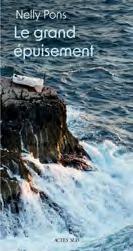
From one day to the next, the author of this book was unable to get out of bed. Total psychological, physical and mental exhaustion. In the motionless, silent experience recounted here, which is particularly at odds with the demands for productivityandprofitabilityatworkintheworldofwork,NellyPonshasfounda powerful driving force for questioning our collective assumptions, which are leading to the depletion of individuals, resources and our ecosystem. And what if the multiplication of these signs of breakdown, on an individual scale, were simply asignofthefailureofoursocietalmodels?
Born on an agricultural land, Nelly Pons has always been sensitive to her surroundings. With a double degree in science and culture, her work combines creativity (dance, writing, sound) and commitment (journalism, events, agro ecology.) Her books include Océan plastique (2020), Débuter son potager en permaculture and Choisir de ralentir (illustrations by Pome Bernos, 2017). Her writing is an extension of her commitment to the living world. She lives and works in Ardèche
> Mémoires, témoignages et autobiographies
10×19cm/160pages
April2025
> La Compagnie des langues
Anna Arzoumanov
Juger les mots
Liberté d'expression, justice et langue
[Judging the wordsFreedom of speech, justice and language]
Freedom of expression and its limits are regularly at the heart of debate in France. When judges are called upon to assess disputed words, they are often described as censors and accused of being relentless. Such mistrust is based on a lack of understanding of the judicial process for assessing the limits of freedom of expression. Based on a ground-breaking interdisciplinary research project involving linguistic analysis of many French court rulings, this book seeks to shed light on and discuss the criteria on which they are based.
Anna Arzoumanov is a senior lecturer in linguistics and discourse analysis at Sorbonne University. A specialist in freedom of expression under the Ancien Régime and in contemporary times, she has published La Création artistique et littéraire en procès (Classiques Garnier, 2022).
10 × 19 cm / 176 pages
May 2025
> La Compagnie deslangues
Julien Barret
Retour à la parole
[Return to the Spoken Word]
What does the current return to the spoken word herald? This book investigates the return of the art of oratory to centre stage over the last decade or so in French-speaking countries and the forms that eloquence has assumed at school, at work and on social media. It also delves into the history and traditions of oratory to trace its origins and then examines the factors that have turned the liberation of the spoken word into a key driver of our social lives and our wellbeing, both individually and collectively. Speaking up involves asserting ourselves but also running risks. We all have the right to speak out, so let’s make use of it!
A poet, linguist and speech coach, Julien Barret is on a mission to champion the forgotten tradition of poetic art and revive its full potential. As well as giving talks in schools and at cultural events, he has published some dozen books on slam, rap and the French language.
Jérôme
& Laurent Triolet Souterrains
du monde
[Undergrounds of the world]
Almost everywhere in the world, human groups faced with periods of lasting insecurity have dug, with great effort and with the help of picks, ingeniously organised underground refuges to disappear from the surface, shelter and defend themselves underground. The authors invite us to discover these discreet monuments of unique architecture in France, Ireland, Bavaria and Austria, Benin, Cappadocia, Spain and Vietnam, as well as in Afghanistan, LebanonandGaza.
Jerôme Triolet is an engineer with a doctorate in chemistry. Laurent Triolet has a degree in natural sciences. For some forty years, they have been studying the underground world dug out by man. 17×24cm/
Franck Monnier La science face aux dossiers mystérieux de l’Égypte ancienne
[Science tackles the mysteries of ancient Egypt]
The architectural prowess of the ancient Egyptians is so impressive that some people find it hard to believe they could have been built without the help of advanced technology from an antediluvian or extraterrestrial civilisation! For the very first time, disturbing theories and mysterious artefacts are analysed and compared with scientific and archaeological data. They will lead us to question the brilliant civilisation that inspired them and thesurprisingaspectsofarealitythattendstoescapeourunderstanding.
Franck Monnier is an engineer and a world-renowned specialist in construction and architecture in ancient Egypt. He is an associate member of the CNRS's 7041 Archéologies et Sciences de l'Antiquité joint research unit.
16 × 24 cm / 472 pages May 2025
>
> New edition
François Zosso and Christian Zingg
Les Empereurs romains 27 av. J.-C.-476 apr. J.-C.
[Roman EmperorsFrom 27 BCE to 476 AD]
Everybody has heard of Augustus, Tiberius, Nero and Constantine. But what about Balbinus, Macrinus, Attalus and Olybrius? Just 105 men succeeded in donning the imperial crown, and over half died a violent death. This book presents the stories of their lives in the form of curricula vitae, which are enriched by extensive annexes to help history buffs, students, teachers and numismatists glean the essence of their individual personalities in the space of a few pages.
François Zosso is a history teacher who devoted his life to historical research. Christian Zingg was a respected numismatist specialising in Roman history.
14,5×21cm/208pages
March2025
>
> New edition
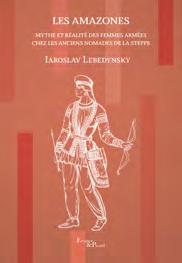
Iaroslav Lebedynsky
Les Amazones
[The Amazons]
The Amazons, of Greek mythology, are a people of independent women warriors, living without men. Very early on, their legend was fuelled by information about the presence of armed women among the nomadic peoples of the Eurasian steppes. Myth and reality became intertwined. Today, an abundance of archaeological material attests to this phenomenon of women arming themselves, but its significance remains controversial. This second edition, completely revised, updated and much expanded, includes the most recent discoveriesanddebates.
Iaroslav Lebedynsky is a historian specialising in the ancient warrior cultures of the Eurasian steppe and the Caucasus. He has published numerous books and articles on these subjects. He teaches Ukrainian history at the Institut national des langues et civilisations orientales in Paris.
Carolyn Carlson Un saut dans le bleu
Translated from English (United States) by Jean-Pierre Siméon
[A Leap into the Blue]
In addition to her choreography, Carolyn Carlson is a poet and calligrapher. Following on from Le Soi et le Rien in 2002 and Brins d’herbe in 2011, ? is her third book of poetry to be published in the ‘Le Souffle de l’esprit’ collection. Her trademark sense of image and rhythm and her elliptical style are perfectly complemented by the two dynamic calligraphies she has created specially for this book.
Carolyn Carlson has created some one hundred shows, many of which have been landmarks in the history of dance. Her life’s work was recognised in 2006 when she became the first choreographer to be awarded the Golden Lion at the Venice Biennale. In 1999, she founded the Atelier de Paris – Carolyn Carlson à la Cartoucherie, from 2004 to 2013, she ran the Centre Chorégraphique National de Roubaix Hauts-de-France. Together with the Carolyn Carlson Company, she was associate artist at the Théâtre National de Chaillot from 2014 to 2016.
Alain Sainte-Marie Prières d’écrivains
Texts selected and translated from English by Alain Sainte-Marie
[Writers’ PrayersSelected Texts]
Prières d’écrivains takes us into the minds of internationally recognised writers who have aspired to the absolute, courtesy of selected texts that are not confessional in the religious sense but do carry a strong poetic charge. They are contextualised by an introduction that posits prayer as a human phenomenon that transcends geographical borders. Though it makes no claims to being exhaustive, this book nevertheless offers a broad panorama of the literature of Europe and beyond, reflecting a rich literary heritage that is epit-omised by outstanding passages from Fyodor Dostoevsky, Emily Dickinson, Henry Bauchau and Antonin Artaud among others.
Born in 1969, Alain Sainte-Marie is a writer (Le Flux de la vie, Les Deux Océans, 2016; Le Grand Ailleurs, Accarias, 2019; Origine, Unicité, 2021), a translator and a radio presenter (‘À mots couverts’). A regular contributor to the ‘Le Souffle de l’esprit’ collection, for Actes Sud he has translated Flannery O’Connor’s A Prayer Journal, various essays by Wendell Berry and The Fury of Beautiful Things by Akram Khan. He lives and works in the Auvergne region of central France.
11,5 × 17 cm / 64 pages October 2025
> LeSou���ede l’esprit
11,5 × 17 cm / 64 pages October 2025
> LeSou���ede l’esprit
14,5 × 21 cm / 216 pages
September 2025
> Linguistic
Stéphane Gendron
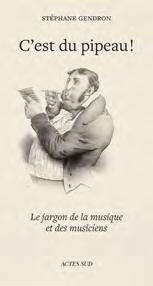
C’est du pipeau !
Le jargon de la musique et des musiciens
[Hitting the Right Note –The jargon of music and musicians]
This is a book that trumpets the important place occupied by musical expressions and vocabulary in the French language. To express the different ways of playing music on different instruments and instrument types, employing a wide variety of styles and techniques, musicians of all kinds have developed an extensive range of idioms that have entered the everyday written and spokenlanguage.Thisisnota one-way street but rather an ongoing interaction between music and other domains of life, such as sport, medicine, justice and food. And the author, rather than producing a simple dictionary of terms and expressions, seeks to identify the mechanisms through which turns of phrase have become colloquial or proverbial. Etymology is a key tool in this process, as it can restore an original meaning that has sometimes been forgotten and situate words and expressions in the social and culturalcontextinwhichtheyfirstappeared.
Stéphane Gendron is a linguist specialising in the study of proper nouns. He is president of the Société Française d’Onomastique and managing editor of the Nouvelle Revue d’Onomastique, as well as being a pianist himself and the director of a group of music schools in the Loire Valley region.
Olivier Bleys
La Marche aux étoiles
En quête de ciels sauvages
[The walk to the starsIn search of wild skies]
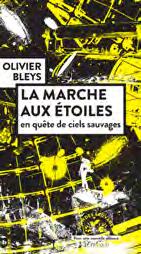
The sky is the most forgotten when we think of nature. Because it is at the periphery of our consciousness, we almost always neglect this half of the visible world that stretches above our heads. And yet the sky is the source of all poetry, the fertile source of our greatest dreams. Unfortunately, confronting a pitch-black night studded with stars has become an increasingly rare experience. Looking for a pure sky, clean of all pollution (chemical, light, satellites and debris), novelist Olivier Bleys crossed the wildest spaces of American West and hiked the high ridges of the Sierra Nevada. But it is also one of the places where this natural treasure is under the greatest threat. California is both the epicentre of today's threats to the dark skies and one of the areas working most actively to preserve them. Peril and salvation go hand in hand. The walk to the stars is the highly personal - and scientifically based - account of this solitary American trekinsearchofadisappearingsky.
Olivier Bleys published more than thirty works (novels, essays, travelogues, comic strips), translated in eleven languages. Member of the Société des explorateurs français¸ he walked all the way through Europe in 2019. He lives and works near Toulouse.
Jacques Blondel, Anne Charmantier, Claire Doutrelant & Philippe Perret
La mésange et la chenille
50 ans d’enquête évolutive
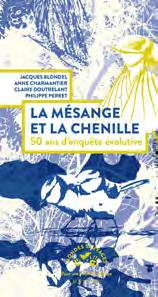
[The blue tit and the caterpillar50 years of evolving research]
A fascinating look at the blue tit and the researchers who study it This book reveals the thousand and one tricks that evolution has found to adapt this little bird to the many constraints ofMediterraneanbioclimates. For more than fifty years, generations of researchers have been trying to unravel the countless mysteries hidden in the nests of this seemingly common bird: the structure of its song, the reasons for its marital infidelity... This approach reveals the beauty of science: the more we try to answer the questions that life poses, themore new questions emerge.
The four authors are researchers and research engineers at the Centre d'écologie fonctionnelle et évolutive - CNRS in Montpellier. Jacques Blondel initiated the programme to monitor blue tits and great tits in the early 1970s, and it is continuing thanks to new generations of young researchers, supervised by Anne Charmantier and Claire Doutrelant.
11,5 × 21,7 cm / 304 pages January 2025

11,5 × 21,7 cm / 304 pages March 2025 >
11,5 × 21,5 cm / 144 pages
April 2025
>
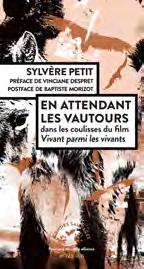
Sylvère Petit
En attendant les vautours
Dans les coulisses du film
Vivant parmi les vivants
PrefacebyVincianeDespret PostfacebyBaptiste Morizot
[Waiting for the vulturesBehind the scenes of the film Living among the living]
Behind the scenes of the first inter-species film, Vivant parmi les vivants, director Sylvère Petit spent seven days trapped in a tiny blind waiting for the vultures to descend on the carcass of a mare, the star of the film, to shoot the main scene. Seven days of introspection bordering on delirium, always funny, fed by the philosophies of Vinciane Despret and Baptiste Morizot, interwoven with extremely prosaic and selfdeprecatingconsiderationsonwaiting,emptiness,coldandhunger.
Sylvère Petit is a wildlife photographer and filmmaker. This is both his first feature film and his first book.
10 × 19 cm / 96 pages
May 2025
> François Sarano and Marine Calmet
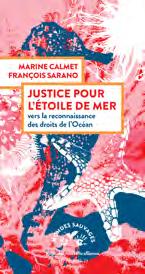
Justice pour l'étoile de mer
Vers la reconnaissance des droits de l'Océan
[Justice for the Starfish –Recognising Rights in the Oceans]
As it stands, only commercial or protected fish species have rights in the ocean world. This doesn’t add up to much given the richness of the oceans and our heavy dependence on healthy, functioning marine ecosystems. François Sarano and Marine Calmet have teamed up to appeal for greater respect for every liv-ing species in our seas, from the biggest to the smallest, as a crucial step in rethinking the nature of our relationship with marine life.
François Sarano is one of the star authors of Actes Sud Nature. He is the founder of the ocean conservation organisation Longitude 181.
Marine Calmet is a young lawyer and environmental campaigner. She set up the annual ecological transition programme Wild Legal.
Simonetta Greggio and Olivier Weber
Un été en mer Voyage en Pelagos, sanctuaire de la Méditerranée
[A Summer at SeaA Journey to the Mediterranean Sanctuary of Pelagos]
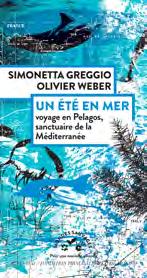
Simonetta Greggio and Olivier Weber are two renowned writers who were invited by the Prince Albert II foundation in Monaco to spend the summer of 2024 in the Pelagos sanctuary in the Mediterranean, situated off the coasts ofmainland France, Corsica, Monaco and Italy. They sailed, dived, explored and met fishermen, scientists, free-divers, ferry captains, whale observers and sea turtle conservationists. And in this book, they deploy their storytelling arts to convey their love for this little corner of the Mediterranean that is so rich in marine biodiversity and yet so threatened. An ideal gift for any holidaymaker intending to spend time on the Côte d’Azur next summer!
Simonetta Greggio is an Italian writer, scriptwriter and radio producer. She has published some fifteen novels and a number of short story collections with Stock, Flammarion and Albin Michel. Of late, she has been addressing ecological themes. She loves dogs and trees, and doesn’t eat animals.
Olivier Weber is a war reporter and travel writer. He has covered some twenty conflicts and spent time with around fifteen armed and guerilla movements. He has organised various expeditions to Siberia, the Himalayas, Cambodia and Amazon rainforest, and written several prize-winning books. His most recent publications are Dictionnaire amoureux de l’aventure (Plon) and Ma vie avec Gérard de Nerval (Gallimard).
Vinciane Despret
Le Chez-soi des animaux
Preface by Stéphane Durand and Vinciane Despret [New edition]
[Animals at Home]
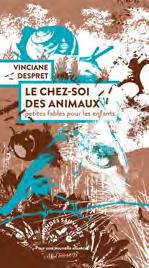
Le Chez-soi des animaux is being published to mark the revival and anniversary of the opening to the public of the Branféré zoo and botanical garden in the Morbihan region of Brittany. In this special place where the interconnected-ness of the living world is tangible, adults and children can stay overnight and immerse themselves in the lives of the animals and plants, observing the interactions between them and becoming aware of humans’ own distinct niche within this ecosystem. Branféré Park blends the exotic and the local, creating the biodiversity expected of a natural haven but featuring an unexpected range of species. It is an experience that will help every child to understand that our relationship with the living world needs to change.
Vinciane Despret is a philosopher and psychologist who teaches at the University of Liège. Since taking an interest in ethology, she has orientated her research towards the philosophy of science. She is the author of several internationally acknowledged works exploring our relationship with the animal world.
11,5 × 21,7
11,5 × 21,7 cm / 240 pages
September 2025
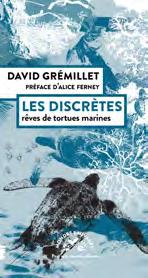
David Grémillet
Les Discrètes
Rêves de tortues marines
PrefacebyAliceFerney
[Discreet Creatures –Sea turtle dreams]
Over the course of 250 million years, sea turtles have already survived two mass extinction events, and they are now facing a third. They may look vulnerable, but they have held out against the dinosaurs, sharks and saltwater crocodiles. Might they also outlive humans? Sailors of the past would haul them aboard their boats in untold numbers, and in modern times they were made into soup for gourmets. Hundredsofthousandsofthemarestilldrowningeveryyearaftergetting caught up in fishing nets. These discreet creatures just keep on going, however, and some populations are showing signs of rallying from the carnagesof the past. What is the secret of sea turtles’ vigour and endurance, at a timewhenhumankindseemsintent on destroying itself? In this worldwide investiga-tion, we follow these ‘beautiful swimmers’ from the equator to the polar regions and meet the men and women who are fighting tirelessly to protect them. In the process, we learn about their long history on Earth, their remarkable physical prowess, their transoceanic migrations and their life cycles, which can span a century – a dreamlike immersion that is also anodetoslowness.
David Grémillet is an oceanographer and director of research at the Centre d’Écologie Fonctionnelle et Évolutive in Montpellier (part of the CNRS). Actes Sud has previously published his Les Manchots de Mandela (“Mondes sauvages”, 2021) and Dans les bras du poulpe (“Les chroniques de Libération”, 2024). He is based in Montpellier and enjoys travelling when his research duties allow.
13,5 × 23 cm / 448 pages
October 2025
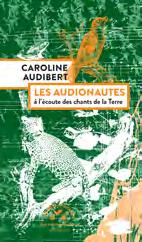
Caroline Audibert Les Audionautes
A l'écoute des chants de la Terre
[The Audionauts –Listening to the Songs of the Earth]
What if our current lack of awareness of the living world were down to our deafness to the thousand and one voices emanating from the Earth? This is the starting assumption of the writer and naturalist Caroline Audibert as she sets out to interview those who are still sensitive to the murmur of the plant and animal worlds and the elements, or as she calls them the audionauts. In the course of her peregrinations across the Alps, the Amazon rainforest, the Russian taiga and the most damaged places on the planet, taking in hightech laboratories along the way, her ears become increasingly receptive and she comes to appreciate more fully the connections that characterise ecology and the need to repair the damage done.
Caroline Audibert’s blend of non-fiction and nature writing might aptly be described as geopoetical. A philosopher by training and a writer and journalist by trade, she is the author of Des loups et des hommes (Plon, ‘Terre humaine’, 2018, Prix 30 Millions d’Amis) and of the novel Nés de la nuit (Plon, 2020, shortlisted for the Prix Roblès and winner of the Prix Pauline de Simiane), in which she experiments with the ‘language of the wild’. She lives in Nice between the Mercantour National Park and the Mediterranean Sea.
Damien Delorme
L’Autre Rêve américain
Un voyage à vélo vers le soi écologique
[The Other American DreamA bicycle Journey to the ecological self]
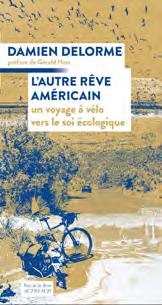
Travelling 10,000 kilometres across North America, in the heart of the temple of capitalism, the author explores a ‘green line’ in search of ecotopiasplaces of resistance where groups of citizens, activists, farmers and philosophers experiment with new forms of thought and life organised according to ecological virtues, on the fringes of an excluding and destructive system. The cyclist-philosopher guides us through an innovative travelogue in which ecolibertarian, ecofeminist and decolonial approaches shake up the lines, transforming our sensitive relationship with the world and revealing an ecologicalself.
Damien Delorme has a doctorate in philosophy. He teaches philosophy and environmental ethics at the universities of Geneva and Lausanne. His research focuses on the ecological self and political ecology. His field philosophy explores travel, ecotopias, eco spirituality, environmental art and peasant alternatives. He co-edited the Manifeste pour une philosophie de terrain (Éditions universitaires de Dijon, 2023). He lives and works in Lausanne.
Estelle Castro-Koshy
Un firmament d'histoires
La littérature aborigène et îlienne du détroit de Torres [And Hope Blossomed –Aboriginal and island literature in the Torres Strait]
Followed by a bilingual poetry anthology translated from Australian English by Estelle Castro-Koshy and Philippe Guerre
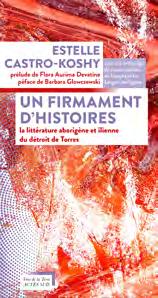
40,000 years of history recounted through a contemporary Aboriginal literature of exceptional vitality. A literary tour de force and a ground-breaking publishing venture that introduces readers to an ancient literature that is still very much alive today. For the first time in the history of francophone publishing, we are offered an immersion in the effervescent universe of Aboriginal literature, affording us a completely different conception and perception of the Aus-tralian continent and the history of its inhabitants. This book analyses how Aboriginalauthorscelebrate the resilience, richness, beauty and importance of indigenous cultures, while condemning the colonialism that Aborigines have had to contend with for more than two hundred years.
Since obtaining her PhD in Aboriginal literature in 2007, Estelle Castro-Koshy has pursued her research into the Aboriginal literary corpus, developing friendships with many authors in the process and becoming an acknowledged expert in this domain. She also makes documentaries with and about writers in Polynesia.

11,5 × 21,7 cm / 240 pages September 2025
>

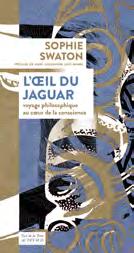
Sophie Swaton L’œil du jaguar
Voyage philosophique au coeur de la conscience
[The eye of the jaguar
-A philosophical journey into the heart of consciousness ]
A specialist in political philosophy and economics, Sophie Swaton found her-self experiencing paranormal and extra-sensory phenomena After doctors gave her mental health the all-clear, she decided to undertake an in-depth investigation into indigenous cultures to arrive at a better understanding of what was happening to her Is it possible that the real world is deeper, richer and more complex than the world perceived by Westerners? Could it be that our Western culture confines us to only perceiving the superficial varnish of reality? Do techniques exist for opening up the doors of perception ?
SophieSwaton is a philosopher and economist. A researcher and lecturer at the University of Lausanne, she has conceptualised the notion of an ecological basic income (Pour un revenu de transition écologique, PUF, 2018) and put it into practice through the non-profit Fondation Zoein, which she set up in Switzerland in 2017. Her most recent publication is a commentary on a work by Charles Fourier, Détérioration matérielle de la planète (PUF, 2024). She lives and works in Lausanne, and travels regularly to France.
15 × 21 cm / 192 pages
May 2025
Tanguy Descamps and Côme Girschig
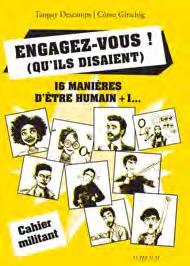
Engagez-vous ! (Qu’ils disaient)
16 manières d'être humain +1...
[Sign Up! (they said)16 ways to be human +1...]
The aim of this playful but incisive essay is to help people – particularly young adults – find their niche as committed participants in the ecological network. It adopts a sociological perspective to describe the different types of personali-ies who get involved, using short fictional scenarios to illustrate what engagement looks like in concrete terms.
These portraits are based on actual people and experiences to which readers can readily relate so that they can work out how they can contribute in their own way and finally find their niche…
Tanguy Descamps is a Sciences Po Bordeaux graduate who teaches and and coordinates ecological and social transition efforts at the University of Rennes. He is also the co-author with Maxime Ollivier of Vivre avec l’éco-lucidité (“Je passe à l’acte”, 2024) and Basculons ! (“Cahier militant”, 2022), both published by Actes Sud.
Côme Girschig, a graduate of the École Nationale des Ponts et Chaussées and Sciences Po Paris, teaches and lectures on ecological issues and new conceptual perspectives. He also runs an ecology consultancy firm.
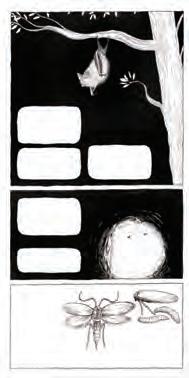
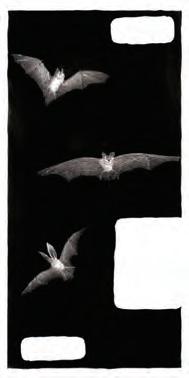
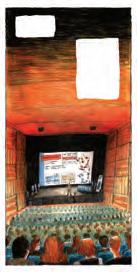
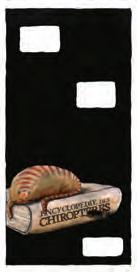
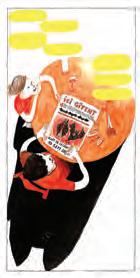
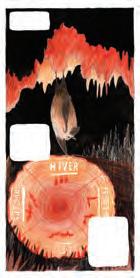
Sébastien Cazes & Laurent Tillon
Chroniques d’une vie à l’envers
Une nuit avec les chauves-souris
[Chronicles of a life upside downA night with the bats]
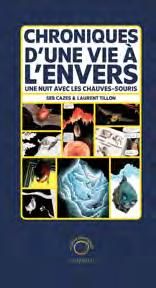
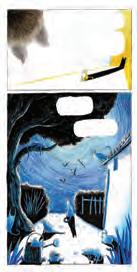
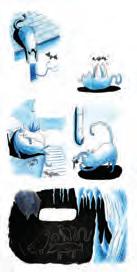
A funny, well-documented comic strip that follows on from Laurent Tillon's latest essay in the ‘Mondes sauvages’ collection, Les Fantômes de la nuit. Illustrator Sébastien Cazes depicts an educational bat having fun observing two chiropterological scientists, one of whom is called Laurent (sic), who are wondering about their accounts. A tender mise en abyme that reveals whole sections of their daily lives. The omnipresent humour, the off-centre narration and the delicate pen and coloured pencil drawings, which combine poetry with finesseandscientificprecision,makethisabookforeveryone.
A graduate of the Beaux-Arts in Angoulême, Sébastien Cazes lives and works in the Hautes-Pyrénées. He has produced numerous posters for the theatre, dance and circus. He has produced several artists' books and works for animated films. He is also a seasoned naturalist, and this childhood passion has led him to join Laurent Tillon on the bat trail.
A forestry engineer with the Office National des Forêts and bat specialist, Laurent Tillon has already published Être un chêne and Les Fantômes de la nuit in the ‘Mondes sauvages’ collection. He lives and works in Paris.
15 × 28 cm / 136 pages

17×24cm/64pages
March2025
> SystèmeTerre
> Newcollection
Rights not available for the english article
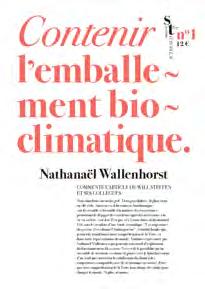
Nathanaël Wallenhorst
Contenir l’emballement bioclimatique
[Containing the bioclimatic runaway]
For this first title in the ‘Système Terre’ collection, Nathanaël Wallenhorst, director of the collection, has chosen to translate ‘Les trajectoires du système Terre durant l'Anthropocène’, the seminal article by Will Steffen and his colleagues published in 2018 in the prestigious American journal pnas. The aim is to help people discover, share and comment on what scientists call ‘planetary limits and thresholds’, which, if crossed, will tip the Earth system into chaos... This scientific article will enable everyone to understand and integrate this fundamental concept if we are to contain bioclimatic runaway and move towards a ‘stabilised Earth path’. This knowledge is essential if we are to embark on an essential political, socialandeconomicpath.
Nathanaël Wallenhorst has a doctorate in educational science, environmental science and political science. He is Professor and Dean of the Faculty of Education at the Université catholique de l'Ouest. He works on the political, educational and anthropological implications of entering the Anthropocene and is the editor of an Encyclopedia of the Anthropocene - Pluriversal Perspectives (Springer-Nature) involving some 1,000 researchers from all disciplines.
17×24cm/80pages
March2025
> SystèmeTerre
> Newcollection
Rights not available for the english article
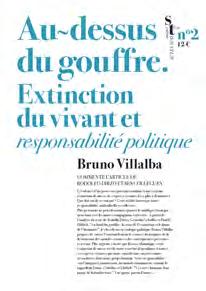
Bruno Villalba
Au-dessus du gouffre
Extinction du vivant et responsabilité politique
[On the brink of an abyssExtinction of living organisms and political responsibility]
The collapse of biodiversity is still not being taken seriously by politicians. We are on the brink of an abyss... In the new ‘Earth System’ collection, Bruno Villalba presents an article from the journal Philosophical Transactions B of the British Royal Society, written by leading experts who make a clinical assessment of the catastrophic situation of living organisms on a planetary scale, not hesitating to point out the main culprits and propose possible political solutions. Bruno Villalba, a specialist in environmental political theory, comments on this seminal article so that decision-makers, capitalists and ordinary citizens can no longer pretend that this is not a priority.
Bruno Villalba is a professor of political science at AgroParisTech and a member of the CNRS Printemps laboratory (umr 8085). Since 2005, he has designed various university courses on ecology, sustainable development and ecological transition (Sciences Po Lille and AgroParisTech). His thinking is informed by his commitment to the environment.
Valérie Guillard Être, faire et avoir
Penser la sobriété matérielle par la justice sociale
[Being, Doing and HavingConceptualising material restraint through social justice]
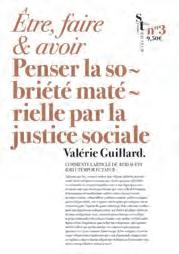
What can we do collectively to stop destroying the Earth system that keeps us alive? In this work of political philosophy, Valérie Guillard, an expert in consumer attitudes towards waste, analyses the work of Amartya Sen, winner of the Nobel Prize for economics, with a particular focus on his concept of capabilities. This provides a springboard for identifying and illustrating empirically what aspects of being, doing and having could contribute to a form of consumption that is both restrained and socially equitable. This book is ultimately a reflection on what every component of human society (individuals, regional authorities, companies, organisations and political players) can do to put an end to the erosion of the Earth system on which our survival depends. This is the third titleinthe‘SystèmeTerre’collectioneditedbyNathanaëlWallenhorst.
ValérieGuillard is a lecturer at the University Paris Dauphine-PSL. Her research focuses on social practices associated with the possession, dispossession and non-possession of material items with a view to better understanding consumers’ attitudes to waste, wastage and material restraint. She has coordinated various research projects financed by ADEME, the French government’s environmental and energy agency. Her book Garder à tout prix. Décryptage d’une tendance très tendance (Vuibert, 2013) won the FNEGE Prize, while Du gaspillage à la sobriété. Avoir moins et vivre mieux ? (De Boeck, 2019) won the Pépite Prize awarded by Grand Prix jury. She lives in the Paris region.
Dominique Bourg
Leçons des limites planétaires
Based on the translation of the article by Katherine Richardson et al., ‘Earth beyond six of nine planetary boundaries’, Science Advances, 2023
[The Lessons of Planetary Boundaries]
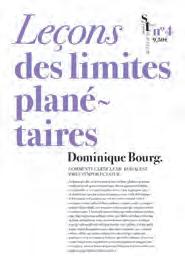
This book sets out in clear terms the latest version, elaborated in 2023, of the framework of planetary boundaries – or ‘safe zone’ for human societies on the planet – and draws attention to the crossing of the sixth boundary (the alte-ration of freshwater cycles) and the imminent crossing of the seventh (ocean acidification). The two remaining boundaries simply cannot be crossed. The article by Katherine Richardson and her co-authors proposes a definitive version of this framework, which has since become the benchmark and deserves to reach as wide a public as possible. This book sets out to draw general lessons from these boundaries in terms of how human society needs to change, assu-ming we want to live on an Earth that is not scorching and offers more than a barely habitable environment for ourselves and our fellow species. It explores both the guidingprinciplesofsuchareorientationandpotentialwaysinwhichitcanbetaken forward.
Dominique Bourg is a philosopher and honorary professor at the University of Lausanne. He edits Presses Universitaires de France’s ‘L’écologie en questions’ and ‘Classiques de l’écologie’ series. He has been a visiting professor at numerous universities around the world. His previous book was entitled Dévastation. La question du mal aujourd’hui, PUF, 2024. He lives in Switzerland
17 × 24 cm / 64 pages September 2025
> SystèmeTerre
>Newcollection
17 × 24 cm / 64 pages September 2025
> SystèmeTerre >Newcollection
16 × 21 cm / 440 pages May 2025
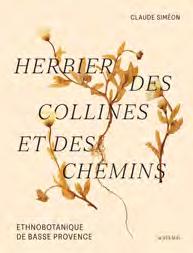
Claude Siméon
Herbier des collines et des chemins
[Herbarium of the Hillsides and Pathways]
‘On Sundays we used to go out into the countryside and we never came back empty-handed. Everything was centred around foraging: wild asparagus, blackberries, thyme, rosemary, fennel, sage… We wouldn’t have dreamed of just rambling for pleasure – there had to be a point to it.’
The 150 wild plants focused on in this book are still growing on hills, along paths and around houses today, but not many people think to pick them anymore, still less to use them. The aim of L’Herbier des Collines is to rescue these plants from the oblivion into which they have gradually fallen and rediscover the secrets and popular tales associated with them. With the help of photographs, illustrative plates and recipes, this ethnobotanical exploration is designed to revive our interest in getting out into nature to forage.
ClaudeSiméon is passionate about botany. He has spent fifty years researching how plants are used locally in Provence, talking not only to locals but also fellow researchers and historians. His goal has always been to secure recognition for the botanical heritage of this region where he has spent so much of his life and to spread the word. The illustrations in this book are based on the herbarium he has himself compiled over the course of thirty years and which has been described as ‘remarkable’ by the Muséum d’Histoire Naturelle of Aix-en-Provence.

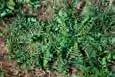
SALADES SAUVAGES
AIGREMOINE Agrimoina Agrimoino
Agrimonia eupatoria L. Rosacées. Plante pérenne, de 40 à 70 cm, dressée, velue hérissée. Les feuilles sont pennatiséquées à 5/9 segments ovales et dentés, alternés de segments plus petits. Les fleurs, jaunes, sont portées par des grappes allongées. Elle pousse dans les lieux incultes et au bord des chemins. Son nom agrimonia, fait référence au côté sauvage de son milieu de prédilection ; eupatoria rappelle Mithridate Eupator, roi du Pont, connu pour ses connaissances et expériences sur les plantes et les poisons. La plante contient des tanins, silice, vitamines (K et P) terpènes, et des pigments flavonoïdes. La pratique populaire tire profit de sa richesse en tanins qui en fait une plante de prédilection pour les affections rhinopharyngées et intestinales.
« Quand j’ai mal à la gorge, je la fais bouillir et je m’en fais un gargarisme » « Un fois que j’étais aphone, j’ai fait le gargarisme et j’ai retrouvé la voix » (M. B St Chamas. 1979.)
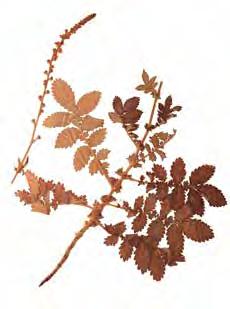
Agrimonia eupatoria L
Arnaud Béchet, Luc Douzon, Hugo Fontès and Anne Fourès
Atlas et herbier de Camargue
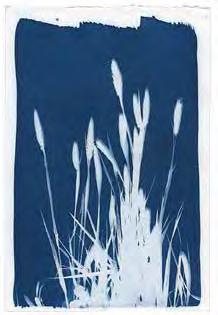
Cyanotypes des plantes rares menacées et protégées
[Atlas and Herbarium of the Camargue –Cyanotypes of Threatened Rare and Protected Plants]
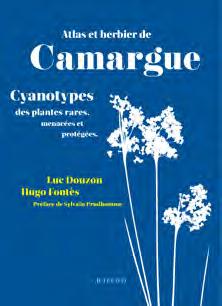
The sunshine, the Rhône delta, the flora, a handful of passionate cyanotype photographers, a botanist, a writer and hours spent wandering through the dunes and marshes and along the riverbanks in every season. This collection of cyanotype plates is an extensive photographic and poetic exploration of the Camargue on the southern coast of France as well as a unique inventory of some of the most remarkable plants of the region, captured in bloom Enriched with a logbook and diverse botanical information, it alsoexaminesthemajorchallengesofconservingthisveryspecialecosystem.
Arnaud Béchet is an ecologist and head of research at the Tour du Valat research centre.
Luc Douzon, a photographer and naturalist, is particularly involved in conservation efforts.
Hugo Fontès is a botanist and technical researcher at Tour du Valat.
Anne Fourès is a photographer who is in charge of cultural and publishing projects.
24 × 32 cm / 312 pages June 2025
11,8 × 15,8 cm / 144 pages
October 2025
Hubert Voiry 10 champignons qui ont changé la vie des hommes
Illustrations by Guillaume Reynard
[Ten Mushrooms That Have Changed Our Lives]
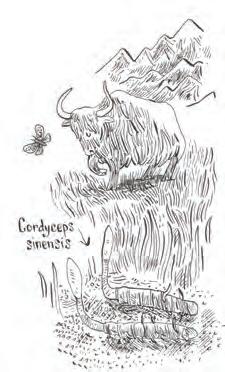
If, instead of describing and categorising mushrooms, we tell their story, it becomes clear just how central a role they have played since the very dawn of mankind. There are ones who sank the English fleet in the 19th century and the one that led to hundreds of women being burnt at the stake, but also more prosaically the ones that helped us light the first fires, healed our wounds and blighted our homes. This little book, illustrated like a fairy tale, tells the story of the amanitas, the tinder fungus, the dry rot and ergot fungi, the humble oyster mushroom and the other small and large mushrooms that have always lived among us and have sometimes changed the course of our lives.
Hubert Voiry is a forester and mycologist who from a young age took an interest in the relationship between fungi and forests. After a long career at the Office National des Forêts where he spent 25 years teaching foresters about the role played by mushrooms in the forest ecosystem, in 2017 he was seconded to the French National Museum of Natural History.
Guillaume Reynard is an illustrator based in Paris who has worked with various publishing houses on comic albums aimed at a young readership and on graphic novels. He also illustrates reports and features for daily newspapers and magazines. His illustrations are used by public bodies, PR and advertising agencies, and even winegrowers. He has illustrated many novels and nonfiction books for Actes Sud Jeunesse.
14 × 20,5 cm / 352 pages
October 2025
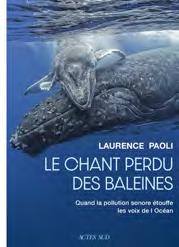
Laurence Paoli
Le Chant perdu des baleines
Quand la pollution sonore étou�fe les voix de l’Océan
[The Lost Whalesong –How sound pollution is drowning out the voice of the oceans]
The silent world of the sea is in fact anything but silent. Sea creatures deploy all kinds of sonic strategies to orientate themselves, feed and mate. But when human beings jam communications with the din of the machines they use in fishing, freight, watersports, military exercises, seismic prospecting, offshore facilities and the like, the sound pollutionconsiderablydisruptssubaquaticecosystemsandiscontributingtothecurrent collapse of biodiversity. This is the first in-depth investigation into this fraught subject, whichisneverthelesstreatedwithalightnessoftoneandahealthydoseofhumour.
LaurencePaolisetupandranthefirstcommunicationsdepartmentdevoted toconservationandanimalbiodiversityattheFrenchNationalMuseumof NaturalHistoryinParisbeforegoingontofoundUrbanNomad,a PRconsultancy specialisinginlifeandearthscience.Shenowdevoteshertimetowritingandhas publishedwithBuchet-Chasteltwopopularscienceessays: Zoos.Unnouveaupacte aveclanature in2019and Quandlesanimauxnousfontdubien.Enquêtesurces compagnonsquirendentnosviesmeilleuresin2022.
Mario Luraschi
Mille vies en une
Une vie de chevaux et de cinéma
[A thousand lives rolled into oneA life of horses and cinema]
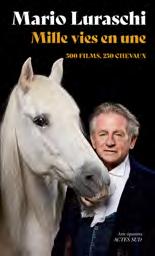
From encounters to opportunities seized or provoked, the unusual journey of a small immigrant in the 1950s who went on to become one of the greatest in his profession, making over five hundred films and rubbing shoulders with the stars. The adventures follow one another as he meets new people, travels, shoots, and seizes every opportunity to create a fictional account of a life lived at full throttle, during which the reader meets as many stars as horses, and revels in funny or moving scenes from life and filming anecdotes. Made up of exploits, projects and laughs, Mario Luraschi's life is like a Hollywood blockbuster for which Jacques Audiardwouldhavewrittenthedialogue.
Mario Luraschi is one of the world's most famous show and film horse trainers and equestrian stuntmen. He has trained more than 250 horses and taken part in 570 films.
Anne Konitz-Hoyeau Chevaux de Course. Propriétaires
[Racehorses.
TheOwners]
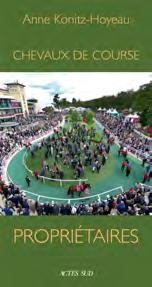
Following on from Éleveurs. Femmes et Hommes de Cheval, a 2019 book that took us inside the world of racehorse breeders and revealed the thought processes and techniques that go into breeding a future champion, Chevaux de Course. Pro-priétaires explores the second phase of the horse-racing odyssey. For the pur-poses of this book, Anne Konitz-Hoyeau spent time with a dozen owners of racing stables – safes of a very particular kind that instead of car collections house living and whinnying jewels: pampered thoroughbred super-athletes on whom great hopes rest.
Anne Konitz-Hoyeau, herself once an elite sportswoman, is an architect by trade and a keen amateur horserider. She discovered the world of horse-racing through her husband (a former amateur jockey) and went on to run France’s largest racehorse auction house for many years. Fascinated by these accomplished animal athletes, she learnt how to read and decrypt the codes of this thrilling world. As the owner of several racehorses over the years who were stabled along with other horses in France and abroad, she has come into contact with a wide range of industry players. Actes Sud published her Éleveurs. Femmes et Hommes de Cheval in 2019.
11,5 × 21,7 cm / 192 pages May 2025
rassurer, d’activer,
19,6 × 25,5 cm / 112 pages October 2025
> Equestrian arts
Nuno Oliveira and Jean-Louis Sauvat Dialogue équestre
[Equestrian Dialogue]
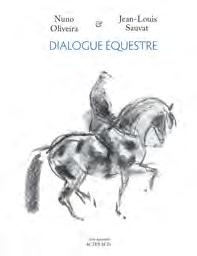
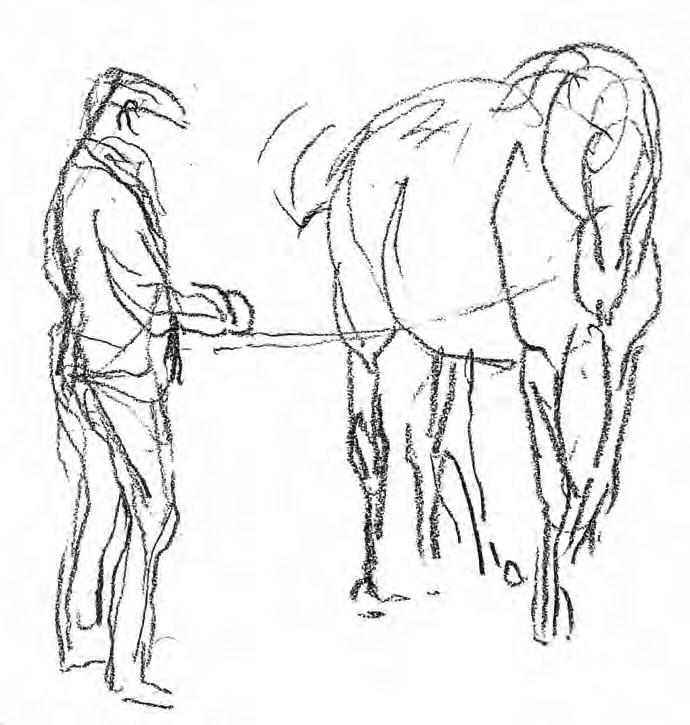
When students and disciples of the pre-eminent Portuguese horse trainer Nuno Oliveira (1925- 1989) urged him to author a manual for posterity explaining how he managed to realise the full potential of his horses, his response was to ask one of them – the sculptor Jean-Louis Sauvat, himself a fine rider – to create drawings to illustrate the principal stages of training a horse. Oliveira’s idea was that he would then add comments to these sketches made during actual training sessions. This original approach involving a collaboration between a horseman and an artist should come as no surprise, as Oliveira always believed that horsemanship was an art. And he agreed with Napoleon that a good drawing was worth a thousand words.
Nuno Oliveira (1925-1989) was born in Lisbon. He learnt to ride at a very early age, and by the time he was 23 he was acknowledged as a leading trainer of horses and horseriders. His reputation soon spread abroad, and in 1967 he gave his first lessons outside Portugal, rapidly becoming a master of the French style of horseriding and its technical and artistic traditions. He authored several books, which were published as his collected works in 2006 (initially by Belin and then by Vigot). An insightful addition was published in 2021: Les Écrits de jeunesse de Nuno Oliveira (1951-1956), with an introduction by Jean Magnan de Bornier (Actes Sud).
A sculptor, illustrator and painter, as well as being a keen horserider, Jean-Louis Sauvat lives and works in the Perche region, not far from Chartres. Born into a family with a long artistic heritage in 1947, he initially trained in arts and crafts and subsequently in the fine arts. Horses occupy a central place in his oeuvre. An accomplished horse trainer himself, his daily horse rides feed into his creative endeavours.
Claire Sejournet
Manger du poisson ?
Illustrationsby Le Cil vert
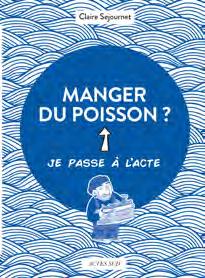
At a time when overfishing and pollution are decimating the oceans' populations, this book provides concrete information to help us think about our consumption of fish and the keys to changing our behaviour. Despite the difficult situation and the advanced state of degradation of the oceans, this book tries to remain optimistic about the future of the blue planet. It underlines the extent to which human beings are in constant interaction with their environment, and how we can do our bit to help protect it. This new title in the ‘Je passe à l'acte’ collection is the ‘fish’ counterpart to Manger moins (et mieux) de viande, by Gilles Daveau, publishedin2017andselling7,300copies.
A former journalist, Claire Sejournet is interested in solutions for ethical, sustainable and ecological consumption. In the ‘Je passe à l'acte’ collection, she has written S'habiller mieux en achetant moins (2022), Mettre de l'éthique dans ses cosmétiques (2020) and Brasser sa bière (with Charlotte and Alexis Champoiseau, 2021), illustrated by Emmanuelle Teyras. She lives and works in Paris.
As a comic strip artist, Le Cil Vert works for committed magazines and NGOs. His autobiographical work, Un faux boulot (Delcourt, 2015), won the Human Values prize at the Angoulême festival in 2016. He has illustrated four other titles in the ‘Je passe à l'acte’ collection. He lives and works in Nantes.
Terre
& Humanisme
Adapter son jardin nourricier au changement climatique
[Adapting our food garden to climate change]
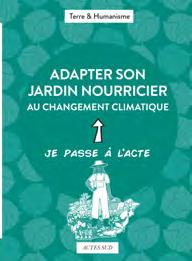
Climate change is an inescapable reality, as are its consequences for ecosystems. Frédéric Fortin and Arnaud Vens, trainers at Terre & Humanisme, invite you to act! Adapting your food garden to climate change is essential if it is to become resilient, robust and able to withstand current and future upheavals, while feeding itself sustainably. Rooted in the thirty years' experience of the Mas de Beaulieu educational gardens, this positive and motivating book takes you step by step through every aspect of this gardening revolution. Atmospheres, soils, seeds, water management, alliances with living organisms: every lever for action is explained in concrete terms, from soil structuring to plant cover, fromshadetothenewcalendar.
Initiated by Pierre Rabhi, Terre & Humanisme has been promoting agro-ecological practices for thirty years. Passionate gardeners and agro-ecology trainers within the association, Frederic Fortin and Arnaud Vens are actively involved in the Mas de Beaulieu gardens in the southern Ardèche. They support various groups and organisations (Restos du Cœur, Habitat et Humanisme) as well as private individuals in their agro-ecological apprenticeships.

[Eatingfish?]
>
14 x 19 cm / 64 pages

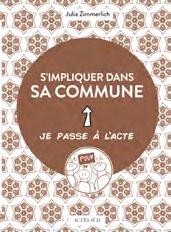
Julia Zimmerlich S’impliquer dans sa commune
IllustrationsbyAnne-SophieHellard
[GettingInvolvedintheLocalCommunity]
If you find yourself tempted to play a more active role in your local community, then your instincts are sound because the future will depend to a large extent on what happens at the local level Though the guiding principles for climate action are decided at the national or European level, they take concrete form locally, whether it be as initiatives to restore biodiversity, protect remarkable trees, create cycle paths, support non-industrial farming, source food locally or curb excessive property development schemes.
Drawing on her time as a municipal councillor in a commune of 4,000 inhabitants and her extensive experience of the NGO world, as well as her own research into grass-roots activism, Julia Zimmerlich argues passionately that cooperation between locally elected officials, citizens and NGOs is an indispensable driver of change. Whether it be for an hour a month, part-time or more, discover all the ways you can help depending on your interests and your availability This might include joining or setting up a sustainable collective near you to translate your ideas into action.
Julia Zimmerlich, a specialist in climate and environmental issues, worked as a journalist for various media outlets for a decade. As a socially engaged citizen and a municipal councillor, she now focuses on promoting innovation in public policy-making. She lives in Carignan-de-Bordeaux in south-western France.
A trained architect, Anne-Sophie Hellard specialises in creating images of architectural projects and urban planning and landscaping schemes. She also deploys her drawing talents to illustrate books aimed at a young readership in a minimalist style characterised by playfulness, directness and a certain poetry.
Corentin de Chatelperron
L’Appart’ du futur
Une aventure low-tech dans la biosphère urbaine
[TheApartmentoftheFuture–Low-techadventuresintheurbanbiosphere]
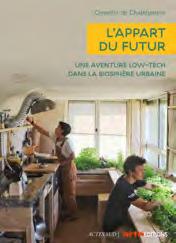
A shower that doubles up as a mushroom fruiting chamber, a worktop from which hydroponically and organically grown aromatic herbs sprout, a mechan-ical grinder for waste, and an energy-efficient pressure cooker – welcome to the apartment of the future! Corentin de Chatelperron, an engineer, researcher, sailor and adventurer, has taken inspiration from the innovations he has come across in some twenty countriesaround the world that make it possibleto live in a more resilient fashion He has also drawn on his shared experiences of alternative lifestyles at sea and in the desert to transform a 26m2 studio in the suburbs of Paris into a veritable low-tech laboratory. The aim of this ‘urban biosphere’, which conforms to a rigorous scientific protocol and is complemented by a citizen science programme, is to test and refine a way of living that generates resources instead of waste, consumes limited energy, and is well within the reach of the average budget.
This book, like his web series L’Appart’ low-tech – Bienvenue dans la ‘biosphère urbaine’ broadcast on arte.tv, is all about sharing his experiences Adopting an accessible tone to explain the concrete science behind these experiments, and with the help of practical and amusing sketches, Corentin de Chatel serves up an ambitious but reader-friendly manual. Realistic in his expectations, refreshingly honest about his doubts, and consistently encouraging, he shows us the way forward to the apartment of the future.
Born in 1983 and an engineer by training, Corentin de Chatelperron has sailed the world aboard a ship cum laboratory, discovering along the way innovative low-tech technologies. Since 2024, he has been experimenting with a new approach to urban living with his ‘Biosphere Experience’. He has published several books and made a number of films and series, including L’Expérience biosphère : 120 jours dans le désert, Arte, 2023. He lives in Brittany.
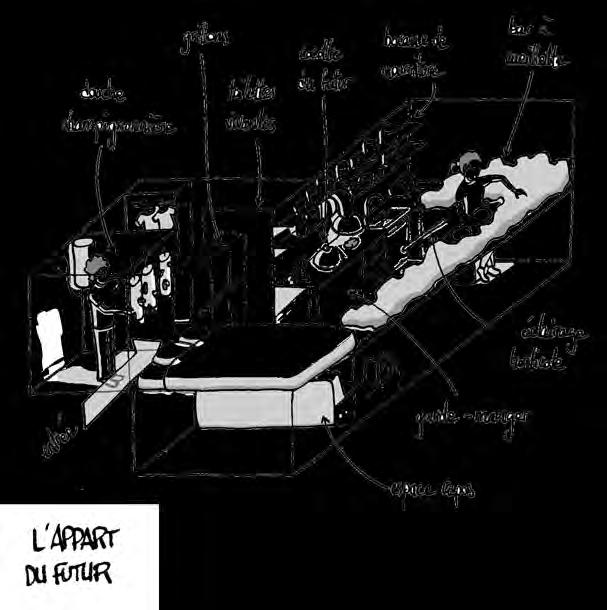
> Co-publication with Arte
17.8 X22cm/176pages
March2025
>ÉDITIONSROUERGUE
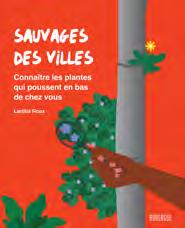
Laetitia Roux Sauvage des villes
Connaître les plantes qui poussent en bas de chez vous
[Wild plants in the cityLearning to see the plants outside your home]
Wild plants also live in the city. They may not be as obvious or as attractive as the superb flowerbeds maintained by our city's parks and gardens department, but they are there, and they are fascinating. Yes, you have to make a little effort to spot them, but once you've started, you can see them everywhere: in the smallest crack in the pavement or wall, between the paving stones, in the gutters, among the rubbish. These warriors adapt to any terrain and deploy strategies to survive in this hostile environment, growing faster, lower... Laetitia Roux knows this wild urban flora inside out, and is campaigning for city-dwellers to learn to look at it and protect it. In five chapters, she explains why they are essential, how they manage to survive, how we can make their task easier and profiles 30 wild plants thatareeasytospotaroundthehome.
Laetitia Roux is co-founder of Veìr Magazine, an independent print magazine dedicated to gardening, plants and biodiversity. For the past five years, she has been writing and editing articles to help city-dwellers (and others!) reconnect with nature, starting with a better understanding of the plants that surround them. Passionate about wild plants, she regularly attends field courses run by botanists in her region.
17.8X22cm/184pages
March2025
>ÉDITIONSROUERGUE
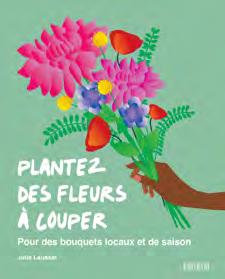
Julie Laussat
Plantez des fleurs à couper
Pour des bouquets locaux et de saison
[Plant flowers to be cutFor local and seasonal bouquets]
Planting flowers only to cut them back may seem counter intuitive. And yet there areonlygoodreasonsfordoingso.
Firstly, it avoids supporting the current flower production system. In France, 85% of cut flowers come from far away, and the ecological and human toll is disastrous.ThesituationisnobetterinEurope.
Secondly, growing flowers is easy. You don't need much space, you don't need much time, and you don't need much water. It's also a good way of discovering the seasonal nature of flowers, as well as local, ancient and original varieties. Finally,it'sthewaytogetuniquebouquetsallyearroundatalowercost.
Julie Laussat goes through each stage in detail and explains the specifics of this crop. Starting with the choice of species: vase life, flowering period, stem length, productivity... so many new criteria to consider! She also explains how to create a space dedicated to this particular crop, and the specific gestures you need to know to look after the flowers, cut them and preserve them. An avid gardener, shehelpsuspreparethesoil,sowtheseedsandplanttheplants.
Julia Laussat is co-founder of Veìr Magazine. A bit of a multi-tasker, she is also the author of several books on ecology and gardening and a content creator on the web (@julie_pancakes).
Pierre Tallet
Cuisine
et saveurs de l’Égypte ancienne
[The Cuisine and Tastes of Ancient Egypt]
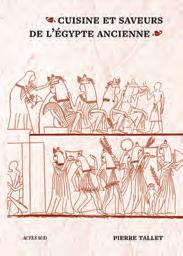
Extant Egyptian documents tell us how basic foods were prepared and the mindset behind the cooking of dishes. But there are no actual recipes, meaning that we can only guess at what precisely featured on the table of an Ancient Egyptian, whether of the pharaoh and his entourage or the average subject. But there would have been bread and cakes, meat and fish, fruit and vegetables, sugar and spices, and oils and drinks of various kinds. We can deduce this from ancient Red Sea papyri that provide details of what the builders of the Great Pyramid of Giza ate. On the basis of the available data, this book serves up some thirty simple recipes that offer us the chance to eat, banquet and get merry just as the ancient pharaohs did!
Pierre Tallet, a graduate of the prestigious École Normale Supérieure in Paris, is a doctor of Egyptology and teacher of history. He has led various digs in Egypt, including at the sites of the ancient Wadi al-Jarf and Ayn Sukhna harbours on the Red Sea coast and on the Sinai Peninsula. He currently holds the chair of Egyptology at the Sorbonne and is the director of the Institut Français d’Archéologie Orientale in Cairo. He is the author of Les Papyrus de la mer Rouge. L’inspecteur Merer : un témoin oculaire de la construction des pyramides de Chéops (Actes Sud, 2021).

animaux, sauvages cette fois, qui sont manifestement élevés et gavés pour être ensuite savourés il s’agit de gazelles et de différents types d’antilopes (oryx, addax, ibex) que l’on retrouve figurés à plusieurs reprises dans les bas-reliefs funéraires. Mais l’alimentation égyptienne s’enrichit visiblement d’autres proies sauvages, moins attendues le plus surprenant est la représentation fréquente e hyènes dans le répertoire égyptien. Certes, on ne voit jamais de scène d’abattage et de dépeçage les concernant. Le fait, cependant, qu’on ait pu les entretenir en captivité, voire les gaver – ce qui apparaît clairement dans le mastaba de Mererouka, où
T Retour de la chasse on ramène des gazelles et une hyène dynastie, tombe d’Amenemopet, Gournet el-Mourraï, Thèbes-Ouest (TT 276).
Gazelles traquées lors d’une partie de chasse dans le désert. dynastie, tombe d’Amenemopet, Gournet el-Mourraï, Thèbes-Ouest (TT 276).
Lièvre apeuré, fermement saisi par un chasseur. dynastie, tombe d’Amenemopet, Gournet el-Mourraï, Thèbes-Ouest (TT 276).
Gazelles entières (et canards délicatement posées sur elles !) XIX dynastie, temple de Ramsès II, Abydos.
Deux scènes exceptionnelles montrant des éleveurs gavant des hyènes Pour éviter tout accident, on a pris soin de leur ligoter les pattes, puis on les a couché sur le dos et on les tient ferment par le cou. VI dynastie, mastaba de Mererouka, Saqqara-Nord. Y VI dynastie, mastaba de Kagemni, Saqqara-Nord (LS 10). X Une très belle prise de canards sauvages XVIII dynastie, tombe d’Amenemhab, Cheikh Abd el-Gourna, Thèbes-Ouest (TT 85).
17 × 24 cm / 184 pages October 2025
semblent pas avoir été connus en Égypte avant l’époque gréco-romaine, où ils sont vraisemblablement importés d’Europe. Les oies – dont on connaît une dizaine d’espèces en Égypte pharaonique – sont élevées en troupeaux par un personnel spécialisé et sont populaires, autant pour la consommation de leur chair que pour leur faculté à assimiler de la graisse. Ce produit est en effet couramment utilisé aussi bien dans la cuisine que pour la confection de potions médicinales. Peut-être est-ce la raison pour laquelle on connaît tant de scènes de gavage de ces volatiles – il Une
Pêcheur à la ligne et pêcheur au haveneau. VI dynastie, mastaba de la princesse Idout, Saqqara-Nord, d’après Daumas, 1964, fig. 4.
raissent le plus souvent dans les sources les oies et les canards les poulets, quant à eux,
Un pêcheur arrache l’épine dorsale d’un synodontis. dynastie, mastaba de Ti, Saqqara-Nord, d’après Daumas, in Bifao 62, 1964, fig. 11. W Pêcheur à la ligne. VI dynastie, mastaba de Mererouka, Saqqara-Nord, d’après Daumas, in Bifao 62, 1964, fig. 7. T Pêcheur à la ligne et pêcheur au haveneau on distingue très bien le hameçon et l’index du pêcheur tendu sur la corde pour lui signaler quand le poisson a mordu. VI dynastie, mastaba de Kagemni, SaqqaraNord (LS 10).
d’un petit gourdin pour assommer sa proie lorsqu’il la tire hors de l’eau. Tous les spécimens qui sont représentés sur les monuments égyptiens sont des poissons du Nil: ils ont depuis longtemps été identifiés grâce à la précision du dessin qui en a été fait. On trouve ainsi parmi eux des poissons-chats, des carpes, des perches, des tilapias… L’une des prises les plus appréciées est manifestement le mulet (ou muge), un poisson de mer qui remonte le Nil, dont les œufs sont utiliséspourfaire la poutargue (voir infra). Après avoir été pêché, le poisson connaît différents types de traitements: être immédiatement préparé pour la consommation ou bien encore être séché pour une conservation prolongée. La seconde méthode est couramment employée: on sait en effet que les poissons séchés sont livrés avec une grande régularité aux ouvriers de Deir el-Medina; cette denrée vient, selon les comptes retrouvés dans le village, juste après le pain et les céréales. Nul doute qu’elle constitue le principal apport en protéines de l’alimentation du peuple. Les étapes de la préparation du
15 × 21 cm / 88 pages
June 2025
>ÉDITIONSROUERGUE
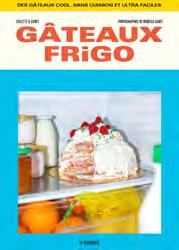
Colette & Genet
Gâteaux frigo
PhotographsbyRebeccaGenet
[FridgeDeserts]
Even if you know nothing about making desserts, if you have a fridge, you can make fridge desserts consisting of alternating layers of whipped cream and biscuits. It could hardly be easier, and there are infinite variations on the theme. You can use speculass, shortbread, wafers or sponge fingers, and add fresh fruit, chocolate, lemon curd or spices if you like. You can cover them in powdered chocolate, matcha tea or marshmallows. As for the whipped cream, it can be flavoured with vanilla, orange blossom or coffee, depending on how the fancy takes you. And fridge desserts can be made with or without a mould, in one large piece or as individual servings. The only rule is that they need to go in the fridge, because that’s where the magic takes place... All the recipes come with illustrations that artfully evoke the origins of these deserts, which were invented in 1920s America when the refrigerator was starting to become a familiar appliance in people’s homes.
Artistic director Colette and photographer Rebecca Genet have become friends over the course of their collaborations on several cookery books. Lovers of desserts as well as images, they have pooled their respective skills to create Gâteaux frigo, a book of ultra-simple recipes.
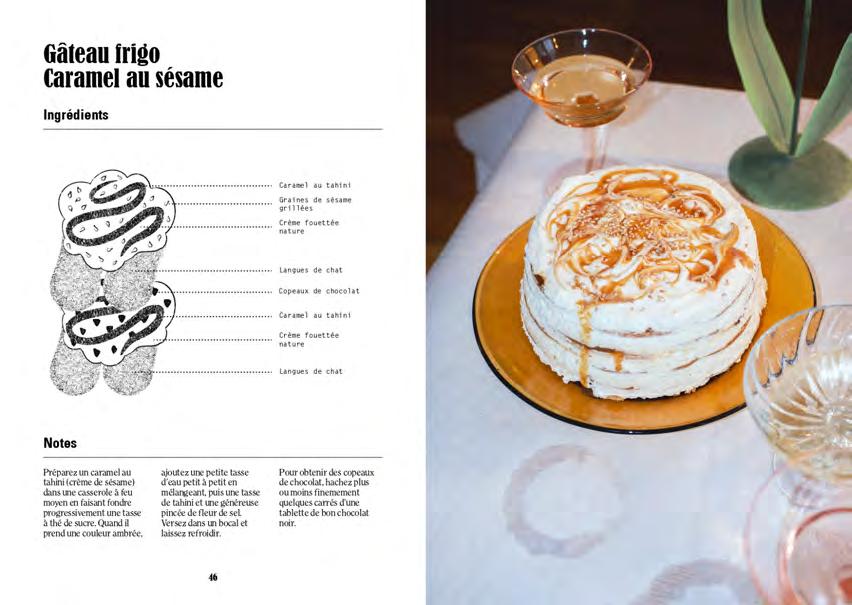
Stéphanie Brillant
Quand
le
corps n’est plus d’accord
[When the body rebels]
We've stopped listening to our bodies, imposing our modern lifestyles on them. Yet more and more of them are malfunctioning: minor inflammations, fatigue, pain that keeps coming back... Stéphanie Brillant is taking up the challenge of getting to the root of the problem and listening to the signals our bodies are sendingus.Theaimissimple:tousethebodyasastartingpointforrethinkingthe way we live, interact, work and sleep... By incorporating contributions from medicine, sociology and journalism, the author conducts an accessible investigationthatteachesustolivebetterwiththebodieswelivewith.
Journalist, director, television presenter, producer and lecturer, Stéphanie Brillant has been working for seven years on themes linked to the liberation of human potential. She directed the documentary film Le Cerveau des enfants, un potentiel infini (2017) and has published three books with Actes Sud, including L’Incroyable Pouvoir du souffle (2021), which was a big hit in bookshops.
Anthony Berthou
Remettez du bon sens dans votre assiette
41 préjugés déconstruits par un nutritionniste
Preface by François-Régis Gaudry
[Return common sense to your plate41 prejudices deconstructed by a nutritionist]
“Gluten is bad for your intestines”, “coffee is bad for your blood pressure”, “eggs are bad for your cholesterol” ... This book tackles forty-one of the most persistent nutritional prejudices, to finally disentangle the true from the false, in the unequivocal light of the most recent studies. Bread, apples, salmon, avocado, chocolate, cider vinegar, Tefal... With his usual clarity and pedagogy, Anthony Berthou helps us to understand how our bodies work, to decipher the jargon used bymanufacturersanddoctors,andtomakeinformedchoicesaboutwhatweeat.
Anthony Berthou is a nutritionist. He promotes an integrative approach to nutrition among health professionals and in various universities. He is the author of several reference works, including Du bon sens dans notre assiette (Actes Sud, 2023) and Traité de la pleine santé par l'alimentation durable (Dunod, 2023). He is also an expert in sports nutrition, a former top-level triathlete and the nutritionist for several Olympic teams.
14 × 20,5 cm / 224 pages March 2025
16,5 × 22,5 cm / 304 pages March2025
RightssoldtoSpain
Arts…
Illustrated Books. 51
Yann Arthus-Bertrand and Hervé Le Bras, France, un album de famille. 51
Fine arts. 52
Michaël de Saint Cheron, Les Sept palais célestes de Anselm Kiefer. 52
Jacques Leenhardt, Le Brésil illustré. 53
Jean-Pierre Formica, Panta Rhei. 54
Jean-Michel Othoniel and Colin Lemoine, Cosmos ou les Fantômes de l’amour. 55
Sophie Calle, Catalogue raisonné de l'inachevé. 56
Jérémie Koering, Enquête sur Les Ménines 57
Baptiste Morizot, Le Regard perdu. 57
>LES APPARENCES.
Cyril Gerbron, Les Pierres et le Rêve. 58
Performing Arts. 59
Béatrice Picon-Vallin, Le Théâtre du Soleil (new edition). 59
Laurette Burgholzer and Lucie Doublet, L’Art du marionnettiste. 60
>ACTES SUD DANSES
Corinne Frayssinet-Savy, Israel Galván. Danser le silence. 61
Music. 62
Alexis Brodsky, Jérôme Duval-Hamel and the Art faber Collective, La Muse méconnue de Maurice Ravel. 62
>ACTES SUD MUSIQUES
Jérôme Bastianelli, Edvard Grieg. 62
Cinema. 63
>ACTES SUD | INSTITUT LUMIERE
Gérard Camy, Sam Peckinpah. 63
Thierry Frémaux, L’Aventure Lumière. 64
Photography. 65
Stephan Gladieu, On allait au bord de la mer. 65
Collective work, Sarah Carp. Sans visage. 65
>PHOTOPOCHE.
Letizia Battaglia. 66
Louis Stettner. 67
Claudia Andujar. 68
La photographie moderniste brésilienne. 69
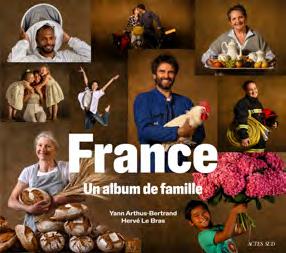
Yann Arthus-Bertrand & Hervé Le Bras
France, un album de famille
[France, a family album]
For more than thirty years, Yann Arthus-Bertrand has been photographing the French and other residents of France. In this book, they have all been captured in their everyday or work clothes against a hessian cloth backdrop. The resulting visual and sensory panorama highlights the sheer diversity of France’s population. The 800 photographs, accompanied by texts by Hervé Le Bras, also reflect the need for more subjective representations of the country than those afforded by official socio-economic classifications.
A photographer, film director and president of the GoodPlanet foundation, Yann Arthus-Bertrand champions a humanist form of ecology through his passionate engagement with the animal world and natural spaces. He is the author of the bestselling La Terre vue du ciel and has made numerous documentaries aimed at raising awareness of environmental issues. His most recent book, Devenir cheval, was published by Actes Sud in 2024. He lives and works in Paris.
Hervé Le Bras is a historian, demographer, director of studies at the School for Advanced Studies in the Social Sciences (EHESS) and director of research at the French Institute for Demographic Studies (INED). In the past, he has run the review Population and the historical demography laboratory at the CNRS, and he also chaired the academic board of the regional development authority Datar. He has written some forty books on demographics, the history of populations, and moral and political opinions observed in detail at a regional level. He lives and works in Paris.
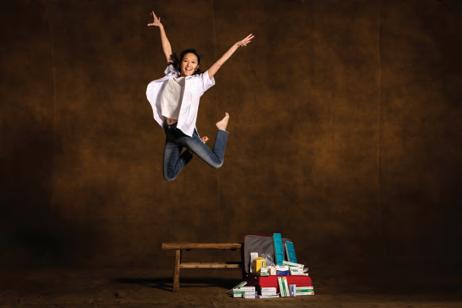
Michaël de Saint Cheron
Les Sept Palais célestes de Anselm Kiefer
La Mémoire du monde
[TheSevenHeavenlyPalacesbyAnselmKieferMemoryoftheWorld]
This book looks at Anselm Kiefer, whose eightieth birthday is in 2024, through the lens od the seven Kabbalistic concepts that haunt him and provide a key to understanding his work. A demiurge, Anselm Kiefer fascinates through the dizzying themes he paints, builds and dreams about, as much as through his imposing formats. He fascinates as much as he offends, and it is the very purpose of art to offend, to dissent from the politicalcorrect.
Michaël de Saint Cheron is a philosopher of religion, art critic and associate researcher at the Histara Centre (ephe). He examines the place of art in modern and contemporary thought. He is the author of Soulages. D'une rive à l'autre (Actes Sud, 2023).
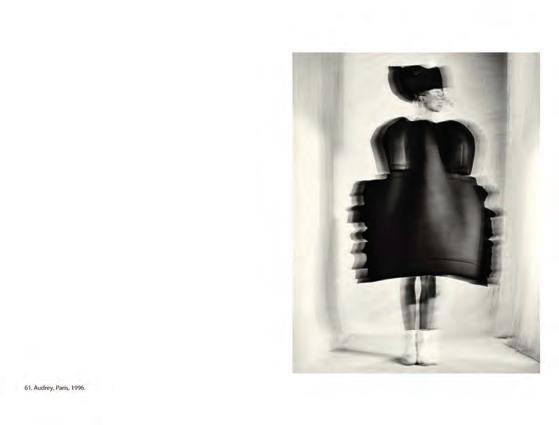
17×24cm/144pages
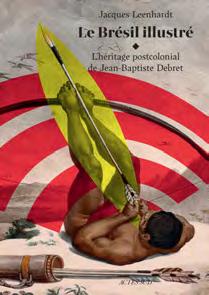
Jacques Leenhardt
Le Brésil illustré L’héritage de Jean-Baptiste Debret
[Brazil illustratedThe legacy of Jean-Baptiste Debret]
Official court painter to the King of Portugal, recently installed in Rio de Janeiro, Debret witnessed a historic upheaval: from a Portuguese colony, Brazil was becoming an empire. On hisreturn in 1831, he published a sumptuous Voyage pittoresque et historique au Bresil. Through his personal approach, he sets the scene for a social and political question that goes beyond the usual exoticism of travelogues: how to build a nation out of atragichistoryandbatteredpopulations?
JacquesLeenhardtistheDirectorofStudiesatEHESS(Paris).Heworks onartandliterature,particularlyinLatinAmerica.Heisaspecialistinthe workofJean-BaptisteDebret.
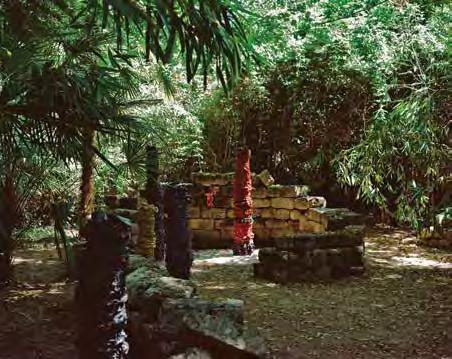
Jean-Pierre Formica Panta Rhei
Texts by Matthieu Bameule and Florence Taddei
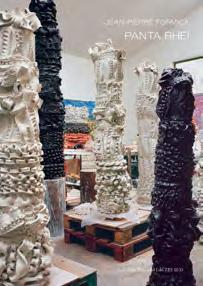
Panta Rhei embodies the vision of the artist Jean-Pierre Formica, whose multi-disciplinary oeuvre – sculpture, ceramics and bronze – proposes a ‘contemporaryarchaeology’:aworldperpetuallybeingrebornthatcapturesthepast all the better to reinvent the future, drawing inspiration from myths, history and memory to construct an elliptical world. This book reflects on both his overall approach and the specifics of his forthcoming project at the Alyscamps Roman necropolis in the south of France in the summer of 2025. The artist transforms materials such as salt, bronze and earth to fashion forms imprinted with an almost palpable resonance, as if the centuries themselves had preserved within them the living memory of the people who lived through them.
Jean-PierreFormica is a visual artist who divides his time between Arles and Paris. He draws his inspiration from Mediterranean culture, working through the filter of mythology to address the phenomena of memories, traces, imprints, accumulation and sedimentation. His work (re)invents a ‘contemporary archaeology’ through painting, drawing, washes, engravings, sculptures and ceramics.
17 × 24 cm / 96 pages
June 2025
Jean-Pierre Formica © ADAGP Paris, 2025 / photographie : Virgile Roger Arts.
17 × 23,5 cm / 112 pages
June 2025
Jean-Michel Othoniel and Colin Lemoine
Cosmos, ou les Fantômes de l’amour
[Cosmosor The Ghosts of Love]
This book, conceived of by Jean-Michel Othoniel in collaboration with the writer Colin Lemoine, is presented as if it were his own working notebook. Following the order of the exhibition, it takes us on a stroll through the artist’s prepara-tory watercolours and sketches, overlaid by drawings created specially for the book. Accompanied by a map, it departs from a standard guide to become a poetic workinitsownright,invitingreadersandvisitorstodreamandmarvel.
Colin Lemoine is an art historian and critic, publisher and writer. A contributor to the specialist press (including Art Press and Connaissance des Arts), he is well-versed in the work of Jean- Michel Othoniel, to whom he has devoted several articles. His books Giacometti devant Bourdelle De la conversion au reniement (Les Presses du réel, 2016) and Bernard Pagès. Le chant des possibles (Ceysson, 2020) both won Académie des Beaux-Arts prizes. He has also written two novels, Qui vive and Malgré. Published in 2019 and 2023 (Gallimard) respectively, they were critically well received.
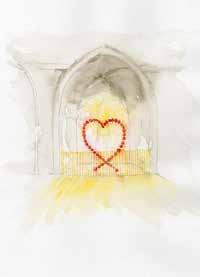
Jean-Michel Othoniel © ADAGP Paris, 2025
Sophie Calle Catalogue raisonné de l’inachevé
[Catalogue raisonné of the Unfinished]
On her exhibition A toi de faire, ma mignonne at the Musée Picasso in Paris, Sophie Calle unveiled her unfinished ideas, which are also her failures. In this eventful collection, which reveals all the submerged aspects of a body of work spanningseveraldecades,wefindthemainmotifsofherwork,suchaschance,chance encounters and, above all, her key idea of incompletion as a result, trial and failure as corollaries of artistic action.
Since the late 1970s, Sophie Calle has been the subject of numerous exhibitions around the world. Alternately described as a conceptual artist, photographer, videographer and even detective, she has develope.d an instantly recognizable practice, combining text and photography to nou.rish a narrative ail lier own. She has just been awarded the Praemium lmperiale 2025 prize in Japan.




19,6 × 25,5 cm /272 pages November 2025
English version available
11,5 × 21,7 cm / 192 pages
September 2025
Longlisted for PRIX
MALRAUX 2025 - ESSAI SUR L'ART.
Jérémie Koering
Enquête sur Les Ménines
Velázquez et le regard du roi
Preface by Tanguy Viel
[An Investigation into the Las Meninas –Velazquez and the king’s gaze]
Las Meninas occupies a place apart in our artistic landscape that is no doubt inspired by the mystery surrounding it But can we put our fingers on the nature of that mystery? And shouldn’t that be mysteries in the plural, as on closer inspection there seem to be at least three? Firstly, there is an objective mystery arising from our unfamiliarity with the codes of 17th-century painting and the customs and expectations associated with the conception and execu-tion of such a work. Then there is the subjectivemystery, given that Velazquez appears to have been determined to implicate the viewer in the scene through the reciprocal interplay of gazes And finally there is the self-referential mys-tery, which is the most striking of all: a canvas turned away from us that obsti-nately shrouds its subject in secrecy.
Adopting a distinctively personal approach, Jérémie Koering serves up a historical investigation that reveals how the painter transforms the representational act into a genuine pictorial intrigue.
Jérémie Koering is a lecturer in modern art history at the University of Fribourg, where his research focuses on Renaissance art and the epistemology of art history. He also edits the ‘Les Apparences’ collection and is the author of Les Iconophages (Actes Sud, 2021).
14 × 20,5 cm / 256 pages October 2025
Baptiste Morizot Le Regard perdu
À l’origine de l’art pariétal animal
[The
Lost Gaze –The Origins of Animal Cave Paintings]
Baptiste Morizot invites us to accompany him to the Palaeolithic to rediscover cave paintings and to adopt a fresh perspective on the origins of figurative art. He also reflects on how our specifically Western relationship with the world – our way of seeing and apprehending it – has evolved. Unlike prehistoric Man, we have lost the ability to seize what ornithologists and naturalists call the ‘jizz’ (or essence) of an animal – in other words, the capacity to intuitively and immediately identify it. It is an ability that the author has patiently developed in the course of his field work, and this book is an invitation to rediscover this gaze, which calls into question our certainties about the living world and encourages us to alter our conceptions.
Baptiste Morizot is a philosophy lecturer at the University of Aix-Marseille and a writer. His research, which focuses on the relationship between humans and the living world, is founded on field work often conducted in remote natural environments. He has emerged as one of the leading French environmental thinkers.
Cyril Gerbron
Les Pierres et le Rêve
Regard sur la peinture religieuse de la Renaissance italienne
Prefaceby Jérémie Koering
[StonesandDreams–Perspectives on Italian Renaissance religious painting]
This book functions as a guide to understanding the theological underpinningsand the poetic strategies of Italian Renaissance religious painting, which was still imbued with the mysteries of the incarnation, the resurrection and sal-vation. Cyril Gerbron’s starting point is always the visual form and impact of the works he insightfully analyses, meaning that this is very much an exer-cise in art history that seeks to identify the genesis, visual characteristics and formal inventions of the works in question.
Cyril Gerbron (1983-2019) has been an artist in residence at the Villa Médicis and a fellow at the Villa I Tatti. He is the author of a very well received book on the art of Fra Angelico (Fra Angelico, liturgie et mémoire, Brepols, 2016) and has co-edited several books on Renaissance art.
14 × 22,5 cm / 304 pages September 2025
> Collection “LesApparences”
Béatrice Picon-Vallin
Le Théâtre du Soleil
Les soixante premières années
Foreword by Ariane Mnouchkine
[The Theater of the SunThe first sixty years]
Le Théâtre du Soleil is sixty years old. Founded by Ariane Mnouchkine, the world-renowned company is intriguing for its longevity, its track record and the unique artistic quality of its productions. Béatrice Picon-Vallin looks back over thecompany'sentirehistory,consideringitscollectivedimension. It all began in 1964, when Ariane Mnouchkine, accompanied by her comrades (Philippe Léotard, Jean-Claude Penchenat, Françoise Tournafond, etc.), launched the Théâtre du Soleil company with the firm intention of reinventing popular theatre that was close to the public and open to the world. From its very first shows, the company distinguished itself by the originality of its operations and working methods: a flat organisation with equal salaries, unanimous decisionmaking, the participation of everyone in the daily life of the company and collectivereflectionattheheartofthecreativeprocess
EmeritusresearchdirectorattheCNRSandprofessoroftheatrehistoryatthe Conservatoirenationalsupérieurd'artdramatiqueinParis,BéatricePicon-Vallin devotespartofherresearchtothehistoryofthetheoryofstagedirection.Sheisalsoa specialistinVsevolodMeyerhold,whosecompleteworksshehastranslated.
Laurette Burgholzer and Lucie Doublet
L’Art du marionnettiste
Pratiques de transmission
[The Art of the Puppeteer –Handing down the tradition]
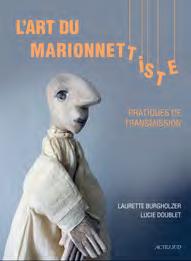
For a long time considered to be a minor art, puppetry is now asserting itself as a discipline in its own right. Blending tradition and innovation, it deploys dexterity, drama and varied materials and technologies to claim its own unique place in the performing arts. Is a puppet a living object, a transgressive tool or a conduitforemotion?LauretteBurgholzerandLucieDoubletnotonlyexplorethe rich diversity of this art, from shadow puppetry and traditional represen-tations to cyber puppets and contemporary spectacles, but also afford us an unprecedented glimpse into how puppeteers learn their craft, the authors themselves having observed at first hand how the masters of the art pass on their skills to the next generation. For bringing a puppet to life involves more than just mastering a technique – puppeteers must also develop a sense of drama and staging, control bothobjectsandthespacesinbetween,andunder-stand the grammar of gestures, all the while remaining at one remove from the action. They must also learn how to make their own puppets. It is a all-encompassing discipline that lies at the intersection of the performing and visual arts, and this book offers us an unparalleled insight into an art form that is constantly evolving.
A researcher in the domain of the performing and visual arts, Laurette Burgholzer lectures at universities and runs classes for arts organisations in Paris and Stuttgart. She has a PhD in drama studies and her research focuses on the handing on of skills and knowledge in the arts, puppet and mask theatre, and the channels of communication between the visual arts and set design.
Lucie Doublet has co-managed the Théâtre aux Mains Nues in Paris with Pierre Blaise since 2020. A doctor of philosophy, she taught for a decade at school and university level. She is also the author of literary and academic works, including Emmanuel Levinas et l’héritage de Karl Marx. Sublime matérialisme (Otrante, 2021) and L’Émergence d’une île (Les Cahiers de l’Égaré, 2016).
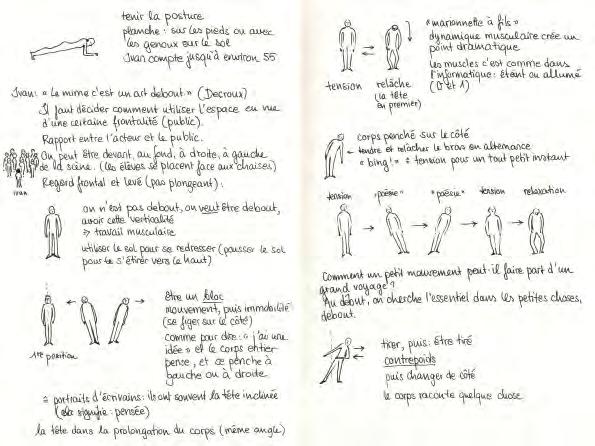
15 × 20,5 cm / 288 pages September 2025
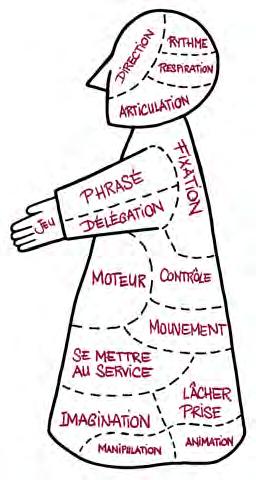
The hand puppet is a useful tool for teaching certain central principles, as it requires the puppeteer to ‘sculpt’ their body, movements and pauses.
In a course at the Théâtre aux Mains Nues, Ivan Bacciocchi and Natalie Stadelmann train students in the mime techniques developed by Étienne Decroux and their application to puppetry.
10 × 19 cm / 112 pages
Corinne Frayssinet Savy
Israel Galván. Danser le silence
Une anthropologie historique de la danse flamenca
[IsraelGalván.DancingsilenceAhistoricalanthropologyofflamencodance]
With Israel Galván, flamenco dance moves into the realm of performance, conceived as an experimental process. It becomes a ‘proposition’, a ‘creation in act’. Since 1998, with the show ¡Mira! Los zapatos rojos, the solo has imposed itself on Israel Galván as a necessity of being, in the face of the flamenco heritage he carries within him. It takes him back to the ethical foundation of flamenco, una forma de ser, in other words a way of being. Defying all artistic posturing, it is a question of putting oneself on the line through vocal or dance gesture. By listening to this practice, Israel Galván re-evaluates flamenco dance in its concept of the number, developed in the era of the cafés cantantes (concert cafés) and still present today in the cuadro flamenco (show with sung, danced and instrumental numbers). His shows mark a definite ‘before’ and ‘after’ in the evolution of flamencochoreography.
Israel Galván de los Reyes, winner of the 2005 National Dance Prize, was born in Seville in 1973 to parents who were dancers. His father ran an academy in Seville and introduced him to dance from an early age. In 1992, he joined the Compañía Andaluza de Danza directed by Mario Maya. In 1998, he began creating his own work. This marked the start of an uncommon trajectory for him which, in a short space of time, led to him winning some of the most important prizes in flamenco and dance, including the Premio Nacional de Danza from the Spanish Ministry of Culture. He is an associate artist at the Théâtre de la Ville in Paris.
Jérôme Bastianelli Edvard Grieg

Edvard Grieg (1843-1907), Norwegian composer and pianist of the Romantic period, is a paradoxical figure: one of his melodies, taken from Peer Gynt, is among the best-known in classical music, yet his life remains little-known. Jérôme Bastianelli's biography fills this gap. It reveals the singular journey of Edvard Grieg, whose entire body of work lies at the point of balance between German Romanticism and Norwegian folklore. Written in a fluid, accessible style, the book weaves links between the musician and literature as well as with other composers and also provides a better understanding of the history of nineteenth-century Norway.
A senior civil servant, writer and music critic, Jerome Bastianelli has published four biographies of composers with Actes Sud. He contributes to Diapason magazine and is a regular contributor to La Tribune des critiques de disques, broadcast on France Musique. He is also president of the Societe des amis de Marcel Proust, to whom he has dedicated two studies, two novels and numerous articles. Since 2015, he has been Deputy Director General of the Quai BranlyJacques Chirac Museum. He lives in Paris.
Alexis Brodsky, Jérôme Duval-Hamel and the Art faber Collective
La Muse méconnue de Maurice Ravel
[Maurice Ravel’s Secret Muse]
In the early 20th century, artistic representations of the workplace and the business world – these days designated as ‘Art faber’ – proliferated at an unprecedented rate. The industrial world has inspired a broad range of painters, writers, photographers and composers. Of the latter, one of the most important was Maurice Ravel (1875-1937), who became a leading exponent of Art faber in music. Not only Bolero but also many of the works that preceded it were strongly imbued with industrial themes.
Alexis Brodsky is a psychologist, human resources consultant specialising in the industrial sector, a writer about music, a member of the Art faber Collective, and head of research into musical expressions of Art faber at the Arts, Economics & Law Lab of Paris 2 University.
Jérôme Duval-Hamel is a university lecturer, author and president of both the Paris 2 Lab and the Art faber Collective. He also presides over the jury for the Franco-German Cultural Sectors Prize and sits on the board of an international music ensemble.
For more on the Art faber Collective, visit www.artfaber.org.
10×19cm/208pages April2025
> ACTESSUD MUSIQUES
10 × 19 cm / 96 pages October2025
> Co-publication withArtfaber
14,5 × 24 cm / 848 pages
30 photographs
> Co-publication with Institut Lumière
Gérard Camy Sam Peckinpah
Le rebelle mélancolique [The Melancholic Rebel]
Although some of his films are very well-known (La Horde sauvage, Les Chiens de paille, Le Guet-apens, Le Convoi) and he became a major Hollywood player on the cusp of the 1970s, these days Sam Peckinpah is far from being the most popular of American directors. And yet this maverick, who died at 59 and never hadan easy relationship with the studios, developed over the course of his four-teen films a distinctive ‘Peckinpah touch’ that has influenced, and is continuing to influence, many filmmakers, among them Alain Corneau, Kathryn Bigelow, John Woo, Martin Scorsese and Quentin Tarantino. His works have becomeclassics of American cinema and are still studied for what they say about the violence of the world and the complexity of the human soul. In this book, Gérard Camy serves up the first in-depth biography of this giant of cinema.
A cinema teacher and historian as well as a critic (Télérama, Jeune Cinéma), Gérard Camy wrote the first monograph in French on Sam Peckinpah back in 1997. With his son Julien, he has also published an anthology of sport and cinema, published by Amphore in 2021.
Thierry
Frémaux
L’Aventure Lumière
[The Lumière Brothers’ Great Adventure]
This illustrated book features the first compilation of Thierry Frémaux’s spoken and written commentaries in the films Lumière, l’aventure commence and Lumière, l’aventure continue, in which he pays homage to the Lumière brothers. Each text accompanies a restored still, affording both a visual and intellectual route back into the very first films ever made. From his own distinctive perspective, Thierry Frémaux conveys his admiration for the sheer creativity of the new cinematic medium and the humanity contained in the images, blending analysis, history and his own emotional responses.Thisisthestoryinwordsandimagesofthebirthofcinema.
Born in 1960 in south-eastern France, Thierry Frémaux runs the Institut Lumière in Lyon and is responsible for the artistic content of the Cannes Film Festival. Together with Bertrand Tavernier (1941-2021), he organised the Centenaire du Cinéma and founded the Festival Lumière. The two men also published a collection devoted to cinema with Actes Sud.

28 × 24 cm / 416 pages October2025
> Co-publication with Institut Lumière

24 × 30 cm / 272 pages
June 2025
Stephan Gladieu
On allait au bord de la mer
[We All Went to the Seaside]
Texts by Leïla Slimani and Christophe Granger
Between the summers of 2022 and 2023, Stephan Gladieu clocked up 11,000km and 55 French coastal resorts. The gallery of portraits that he produced for a major photography commission from the French culture ministry and the BNF national library focuses on the French on holiday at the seaside. Alone, in couples, with their families or their friends, the people he met were asked to pose however they liked with the natural surroundings providing the backdrop He imposed no staging or artifice – everyone chose their own pose. The resulting series is a life-size tableau of French society in all its diversity, singularity, pride and spontaneity. The second instalment of the ‘Idéal Standard’ trilogy,thisbookfollowsonfrom Corée du Nord, published by Actes Sud in 2020.
As a historian and writer, Christophe Granger is interested in the transformations of bodies and social activities in both their political and private manifestations.
The socially engaged Franco-Moroccan Leïla Slimani is a subtle explorer of social contradictions, with a particular focus on sexuality and women’s freedom.
The self-taught Stephan Gladieu started out in 1989 as a photographer interested in documenting the conflicts and social issues that define so much of our world. These days, he focuses on more personal series that examine the relationship between identity and appearance and explore how the standardising of collective ideals fashions society and reveals the unique yet multiple nature of individual identity.
18 × 24 cm / 128 pages
June 2025
Sarah Carp Sans visage
[Faceless]
Texts by François Ansermet, David Le Breton, Julie Enckell Julliard and Gaëlle Droz-Sauthier
Confined to her flat, Sarah Carp started taking photos of her children during the Covid-19lockdowns Thegirls’fathertookissuewiththesephotosandpre-vented their publication in the name of protecting his children. Sarah decided to restage the scenes with other children, but their expressions lacked the previous spontaneity And so she applied coloured dots to the faces of these children actors, the artifice creating a mask-like effect. This book speaks subtly of the forbidden and hidden – of the subterfuge that can be necessary to get round censorship.
The work of Sarah Carp, who studied photography in Vevey in Switzerland, blends reportage and staged images. In 2021, she won the Swiss Press Photo Award for best photographer and also first prize in the ‘Everyday Life’ category.

Letizia Battaglia
Text by Walter Guadagnini
Letizia Battaglia (1935-2022) should have been gunned down by the Mafia countless times, having doggedly documented their killings and in particular those of the Corleone clan, which was responsible for the deaths of over a thousand people in Palermo in the early 1980s. One of the few female photojournalists, she taught herself photography while working at L’Ora, a Palermo-based communist daily newspaper In 1985, she won the W Eugene Smith photojournalism prize, which marked the beginning of her international recognition.
Since 2016, Walter Guadagnini has been running CAMERA (Centro Italiano per la Fotografia) in Turin. In 2018, the became artistic director of the Fotografia Europea à Reggio Emilia festival. He has been a member of the academic board of the Fondazione Alinari per la Fotografia in Florence since 2021.
12,5 × 19 cm / 144 pages
Photo Poche no 182 June 2025
> PHOTO POCHE
> New title
12,5 × 19 cm / 144 pages
Photo Poche no 76
2025
> PHOTO POCHE
> New title
Louis Stettner
IntroductionbyVirginieChardin
Louis Stettner’s oeuvre (1922-2016) reflects his constant toing and froing between France and the United States, which at the same time forms a bridge between French humanist photography and American street photography Irreducible to a certain period or aesthetic movement, his images have conserved their mystery and in certain cases their oddness.
Virginie Chardin is an independent exhibition curator who specialises in photography and the visual image. She has curated among others the Sabine Weiss (Jeu de Paume, 2016) and Frank Horvat (Château de Tours, 2022) exhibitions. She has also written the introductions to several books in the ‘Photo Poche’ collection.


La photographie moderniste brésilienne
[Modernist Brazilian Photography]
Text by Marcella Legrand Marer and Helouise Costa
TranslatedfromPortuguesebyAntoineChareyre
Brazilian modernist photography emerged in the 1940s and 1950s in response to the age of modernity then sweeping across Brazil, which also produced bossa nova, Cinema Novo and the modern architecture exemplified by Oscar Niemeyer’s creations.
Featuring120works,thebookisdividedintothreeparts:photo-clubphotography, photojournalism and documentary photography Works from the movement, which has never before been the subject of a book published in France, will also be exhibited at the Rencontres d’Arles 2025.
Helouise Costa, a specialist in the history of Brazilian photography and of exhibitions, is a curator, teacher and researcher at MAC/USP in São Paulo.
Marcella Legrand Marer is an exhibition curator and PhD student at the University of Zurich. An expert in the regional histories of photography, she works with specialist reviews, publishing houses and festivals.
The two women are co-curators of the exhibition on modernist Brazilian photography at the Rencontres d’Arles 2025.
PHOTO POCHE
New title
12,5 × 19 cm / 216 pages
Photo Poche no 183
June 2025

12,5 × 19 cm / 144 pages
August 2025
Poche no 184
> PHOTO POCHE
> New title
Claudia Andujar
Text by Thyago Nogueira
Born in Neuchâtel, Switzerland, in 1931, Claudia Andujar has lived in São Paulo since 1955. After a childhood spent in Transylvania with her father, she left for Switzerland with her mother to escape Nazi persecution in Eastern Europe. A first project focusing on the Karajá people of central Brazil led to her working as a photojournalist for various magazines, including Life, O Cruzeiro, Aperture and Realidade. She is now particularly associated with her photographs of the Yanomami people in the Amazon rainforest, in whose culture she immersed herself. There is an advocacy dimension to her work that sets it apart from the purely documentary, and in her early days she experimented with a variety of techniques to capture her perceptions of the Yanomami shamanic experience. Reflecting her dual aesthetic and political approach, this ‘Photo Poche’ edition highlights Andujar’s major contributions to the art of photography as well as her crucial role in championing the rights of the Yanomami and defending the forests in which they live.
Thyago Nogueira runs the contemporary photography department at the Instituto Moreira Salles in Brazil and is also the editor in chief of the photography magazine Zum.
60-62, avenue de Saxe
75015 Paris
01 55 42 63 00
Place Nina-Berberova
13200 Arles
04 90 49 86 91
Foreign Rights
Isabelle Alliel
04 90 49 56 69 / i.alliel@actes-sud.fr
Sandra Martel
04 88 65 90 35 / s.martel@actes-sud.fr
