ANDRÉ VAN DER GOES 330 Dresden in the Augustan Era, 1694 1764
JENNIFER MASS, 564 VANESSA SIGALAS, AND AARON SHUGAR
VANESSA SIGALAS 370 The Court
VANESSA SIGALAS 414 Entertainment in Dresden Walking through 328 Dresden
Commedia dell’Arte 426 and Other eatrical Performances A Glimpse 430 of a Performance at an Outdoor Theatre In the Chinese Taste 474 Shepherd Lovers 524 e London Criers 218 e Paris Criers 250 Savoyards 306 Russian Peasants, 310 or St. Petersburg Criers A Glimpse 368 of a Masquerade at Court
The Post Eighteenth Century Decoration of Meissen Porcelain Figures: A Collaboration between Art History and Science
JENNIFER MASS, 568 VANESSA SIGALAS, AND AARON SHUGAR A Scientific Assessment of the Meissen Porcelain Figures and Groups in the Shimmerman Collection
AARON SHUGAR 600 AND JENNIFER MASS Compositional Analysis of the Porcelain Paste
VANESSA SIGALAS 610 e History of Porcelain Decoration in the Nineteenth Century
VANESSA SIGALAS 618 e Late Paris Criers –Table of Drawings and Transcriptions
SIGALAS 530 The Sounds of Dresden
My Journey of Collecting
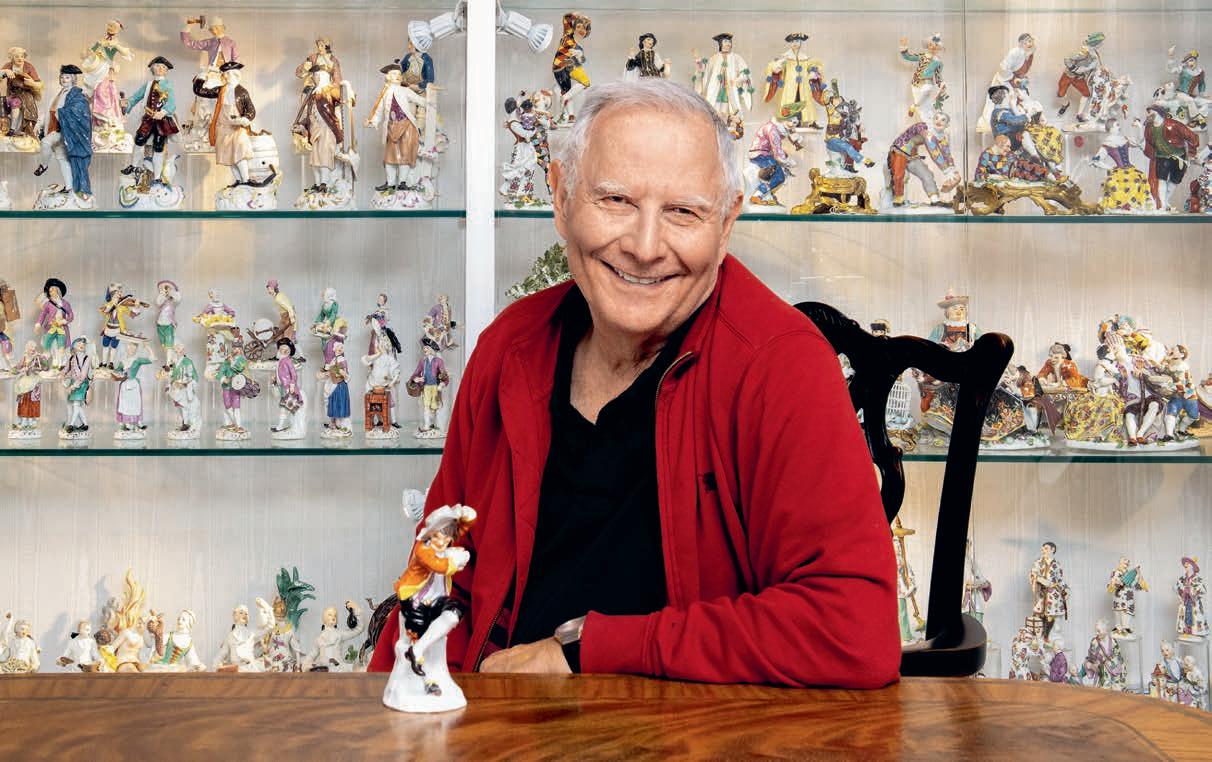
It’s not possible to reduce a thirty-five-plus-year journey of collecting to just a few words. Certainly a collection of over 250 individual figures and this wonderful publication are a testament to the e ort made and are, of course, extremely gratifying, but the journey was every bit as exciting.
I’ve met dozens and dozens of fellow collectors and specialists working for museums and auction houses, as well as lecturers, authors, scientists, restorers, and photographers, many of whom have become my friends, and of course Meredith Chilton. Over the many years since we first met, we have become very close, a friendship that is more precious to me than any of the wonderful figures in the collection.
is book would not have been possible without the outstanding scholarship and dedication of the principal author, Vanessa Sigalas. Her tireless devotion and enthusiasm enliven both this publication and my collection. I am profoundly thankful to her.
In addition, I would like to thank the contributing authors, André van der Goes, Jennifer Mass, and above all Aaron Shugar, who became an invaluable addition to the team; the editorial team from Canada and Germany; and of course Arnoldsche, our incomparable publisher.
With the exception of filling in a few obvious gaps, my collecting journey is coming to an end. ank you to so many for your counsel, your knowledge, your support, and in many cases your friendship.
To my beautiful wife, Melissa, your photography is every bit as spectacular as you are. ank you for attending to the minutest details. Your patience over the three years of photographing these figures is nothing less than marvellous. It all shows in every photo you took.
ALAN SHIMMERMAN
Johann Joachim Kaendler
between Artist and Manufactory Worker
1 He was assisted by Ehrenfried Walther von Tschirnhaus (1651–1708) and Gottfried Pabst von Ohain (1656–1729).
2 Maureen Cassidy-Geiger and Mogens Bencard (2007) discuss the exchange of Meissen wares by European courts in the eighteenth century.
3 For a discussion of the place of Meissen in Saxony’s mercantilist strategy from 1710 to 1830, see, e.g., Monti 2011.
4 Nowak 2007, 5. Nowak thinks that Kaendler was born in Seeligstadt. Usually, however, Fischbach is given as his place of birth.
5 Gröger 1956, 19–21.
BY VANESSA SIGALAS
Johann Joachim Kaendler (1706–1775) transformed the history of European porcelain. As a young sculptor, he was employed at the Meissen Porcelain Manufactory at the court of King Augustus the Strong of Saxony (1670–1733). ere he invented and popularized small-scale porcelain sculpture for the European market. e figures Kaendler created represented people from all walks of life, from the aristocracy to tradespeople to simple peasants, and he brilliantly brought them to life with characteristic humour. e story of this ingenious artist is of critical importance to the Alan Shimmerman Collection, as many of the sculptures in the collection are Kaendler’s original creations.
When Johann Joachim Kaendler was born in 1706, the alchemist Johann Friedrich Böttger (1682–1719) was feverishly trying to discover the process for producing hard-paste porcelain, or true porcelain. is was a much-sought secret, as no one in Europe was able to recreate the formula for the beautiful white and translucent wares that were being imported from China. East Asian porcelain had reached Europe through trade and as diplomatic gi s, and by the late seventeenth century porcelain wares were regularly being traded between European states. Chinese and Japanese porcelain was an especially important export from e Netherlands.
With these imported porcelain pieces being valued as highly as gold, the quest for the arcanum, the secret formula to create porcelain, was on! Many tried and failed. e final success of Böttger in 17081 at the court of Augustus the Strong in Dresden not only sealed his own fate—his knowledge of the priceless secret made him a lifelong prisoner—it transformed Saxony and eventually Europe. European hard-paste porcelain came to play a major role in diplomatic gi giving and was o en used to reinforce political bonds and secure favours. 2 e establishment of a manufactory for this “white gold” thus enhanced Saxony’s reputation and state diplomacy. Additionally, the Meissen Porcelain Manufactory was intended to give a boost to the state economy—the manufactory was part of an export-oriented mercantilist strategy.3 Augustus was eager to prove that his Meissen porcelain excelled that of East Asia, with the great prestige and reputation for innovation and taste that this would bring to Saxony and to his own reign.
The Young Johann Joachim Kaendler
When the Meissen Porcelain Manufactory was founded on January 23, 1710, the three-year-old parson’s son Johann Joachim Kaendler could not know that its material was to become his destiny. His father, who was also named Johann Joachim, was the pastor for two small towns in Saxony, Fischbach and Seeligstadt, which are about 25 kilometres (15 miles) from Dresden. e young Johann Joachim Kaendler might have been born in either one of these towns—his birth is not noted in either town’s records.4 Although the boy was raised in a clerical household, the Kaendler family looked back on a long line of stonemasons and sculptors,5 and the young Kaendler was encouraged to follow his artistic talents. He is said to have received a well-rounded education in classical mythology from
Walking through Meissen
Albrechtsburg
Domplatz
Meissen’s Vineyards
Life in Meissen
as a
Porcelain Manufactory Worker
1 A mile (Meile) varied from place to place and time to time. e German mile, or Landmeile, also known as a Prussian mile, was, for example, 7,532.5 metres (4.68 miles), while the Postmeile in Saxony was 9,062 metres (5.63 miles).
2 “Der Weg von Dresden nach Meißen übertri an reizenden Aussichten, treflichen Straßen und mannichfacher Abwechslung der Gegenstände alle Art von Beschreibung. Die schönsten Weinberge mit prachtvollen Landhäusern, Ruinen, wie in einem Busch versenkt, Birken: und Tannenwäldchen, Schlösser, gut gebaute Dörfer, Fahrzeuge, die auf der nahen Elbe hinabgleiten, das alles giebt den seltensten Kontrast, und macht den Weg angenehm. Wirtlich fuhren wir mit der sogenannten gelben Kutsche, die 3 Meilen von Dresden nach Meißen in noch nicht vier vollen Stunden. Während des Umspannens der Pferde, das drei ganze Stunden dauerte, besah ich mit einem venezanischen Schi skapitän und einem emigrierten französischen Bischof aus Toul die berühmte Porzellanfabrik auf dem alten Schlosse, welche für die älteste in Europa gehalten wird Uebrigens scheint Meißen ein reinliches gut gebautes Städtchen zu seyn, und hat eine tre iche Brücke über die Elbe, und auf dem Markt einige gut gebaute Häuser” (Ka a 1798, 197–98).
BY VANESSA SIGALAS
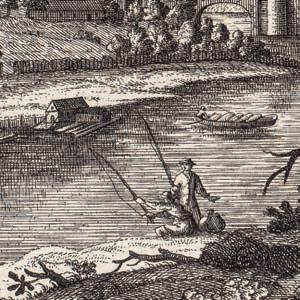
The charming town of Meissen is beautifully situated on the banks of the river Elbe, some 23 kilometres (14 miles) northwest of Dresden (fig.1). In the eighteenth century, a common workman with business in town would walk there from the capital, but anyone who could a ord it would take a carriage. e carriage took about four hours. It must have been a very scenic ride, for, as the composer Johann Christoph Ka a (1754–1815) wrote in 1798:
“ e route from Dresden to Meissen surpasses all description in terms of charming views, pleasant streets, and a wide variety of things to see. e gorgeous vineyards with splendid country houses, ruins as if sunk in the brushwood, groves of birch and fir, castles, well-built villages, river tra c gliding down the nearby Elbe, all of this makes a most uncommon contrast and makes the trip pleasant. We drove with the so-called yellow coach, the 3 miles1 from Dresden to Meissen in less than four full hours. While the horses remained unhitched, which lasted a full three hours, I visited the famous porcelain factory in the old castle, which is believed to be the oldest in Europe, with a Venetian ship’s captain and an émigré French bishop from Toul. … Meissen seems to be a neat, well-built town and has a fine bridge over the Elbe and a few well-built houses on the market.”2
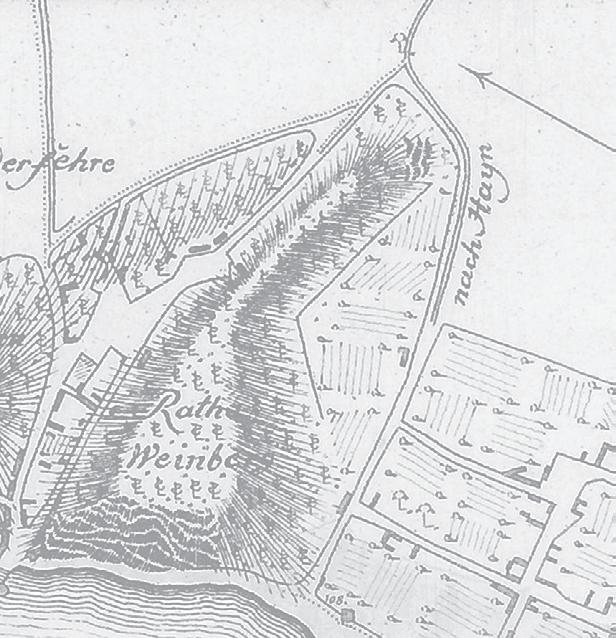
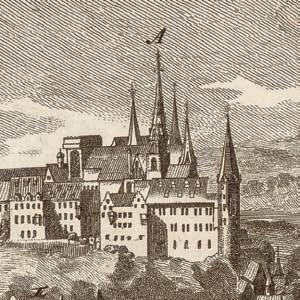
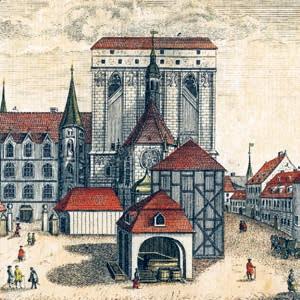
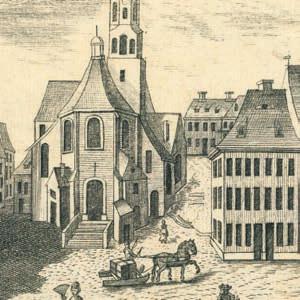
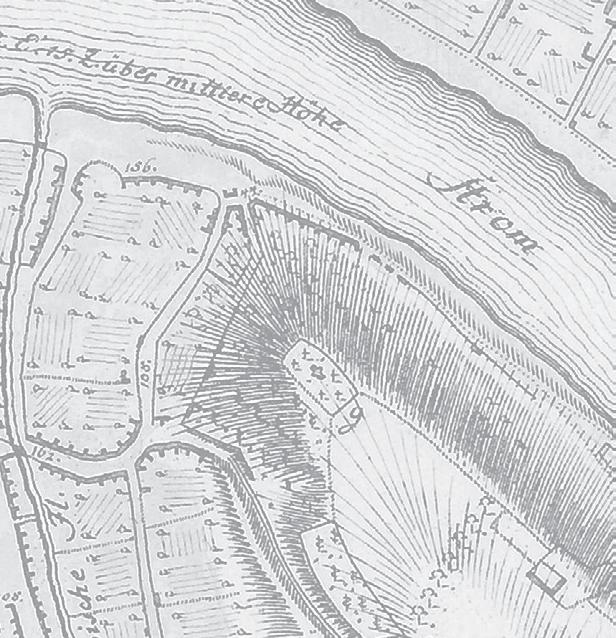
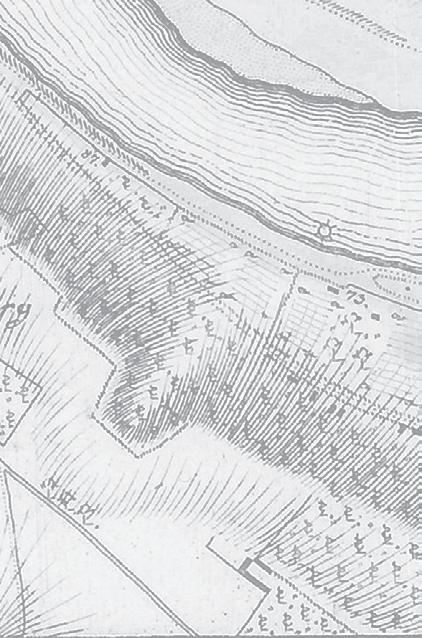
Within the Saxon state Meissen was an important town. Founded in the tenth century, it was, from 1423 to 1464, the capital of the Electorate of Saxony, before Dresden became the first city of the realm. At the beginning of the eighteenth century, Meissen was brought back into the limelight when Augustus the Strong chose the town for the brand-new porcelain manufactory he had founded in 1710. Once Johann Friedrich Böttger (1682–1719) had managed to produce the first European hard-paste porcelain in 1708, which he was only able to achieve with the help of the physicist and philosopher Ehrenfried Walther von Tschirnhaus (1651–1708), a safe and well-located site for production had to be found. A er all, the arcanum, as the formula of hard-paste porcelain was termed, was a secret of such immense prestige and economic potential that it had to be protected. e old late-Gothic castle in Meissen, called the Albrechtsburg (fig.3), built between 1471 and 1524, seemed to be the perfect solution: close to Dresden, it was situated on a river with ease of access to raw materials such as the much-needed wood for the kilns and ease of transportation of goods to clients and fairs. But most of all, owing to its position on an unassailable blu , access could be controlled and unauthorized entry avoided (fig.2).
Before Augustus the Strong decided to establish his porcelain manufactory at Albrechtsburg Castle, Meissen’s economy was mainly based on local cra smanship. By this time, though, the town’s cra s were in decline and the town’s wealth was dwindling. However, thanks to the additional business the manufactory was creating, the di cult economic situation started to improve in the 1730s and the town grew. While in 1719 only twenty-six workers were employed at the manufactory, this number had increased significantly by the mid-century. e workers would bring in their families, and in 1751 a manufactory report lists 553 manufactory workers, 398 wives, 719 children, and 138 servants, who together
1 Goose Seller
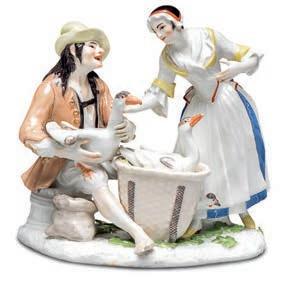
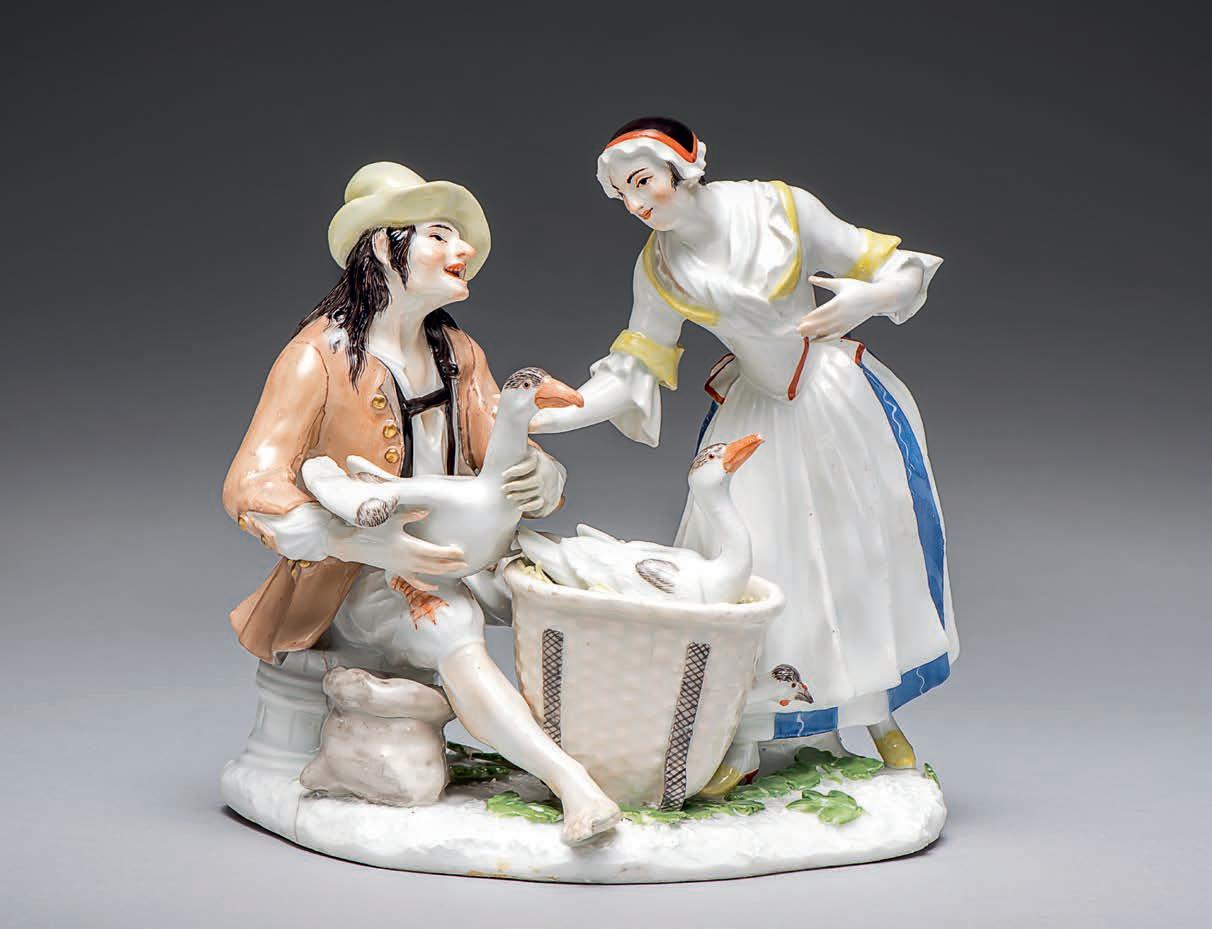
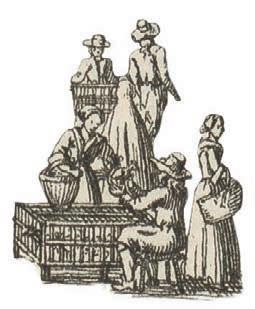
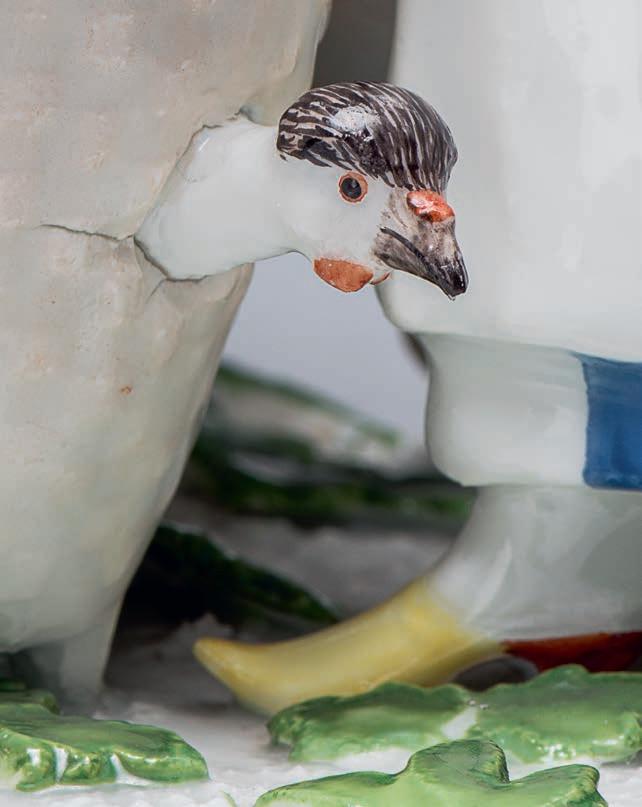
is charming porcelain group captures a precise but very ordinary moment on a typical market day in eighteenth-century Germany. A young maid is handing over the money for a goose she is about to buy. e goose is sitting on the peasant’s lap, ready for the maid to take it home and for the cook to prepare it for dinner. e maid and peasant seem to be holding a conversation; maybe he is singing the praises of his poultry or is giving her a compliment. He has grain in the bag to feed to the geese. Although print sources have been suggested as the inspiration for the group15 and might have been seen by Kaendler (fig.2 and p.89), the taxa’s reports’ wording “in his usual attire” might suggest the group as having been inspired by real peasants from the area.
Kaendler depicts this transaction with a lively sense of detail and realism, but not without humour. e group warrants closer examination, and this lets us see Kaendler’s humorous side: one of the chickens has managed to pick a hole in the woven basket and is poking its head out, trying to escape its fate.
15 See, e.g., Georg Pencz (1500–1550), Der Markt ( e Market), sixteenth century, Herzog Anton Ulrich-Museum Braunschweig, Monogrammist IB AB 3.25; see Andres-Acevedo, in Antonin 2019, 37.
Purchased from Christie’s London, November 21, 2005, lot93
EXHIBITION
Au pays de l’or blanc. Une collection privée de porcelaine de Meissen (In the Land of White Gold: A Private Collection of Meissen Porcelain), Musée Ariana, Geneva, April29–September 27, 199916
Savour: Food Culture in the Age of Enlightenment, Gardiner Museum, Toronto, October 17, 2019–January 19, 2020
Savor: A Revolution in Food Culture, Wadsworth Atheneum Museum of Art, Hartford, Connecticut, February29–March 13, 2020, and September5–January3, 2021
Kaendler’s Taxa, November 20, 1745 “1. Grouppée, vorstellend einen Bauern in seiner gewöhl. Kleidung wie er auf seinem Fäßgen sizet, und eine Gannß in Händen hält, neben sich aber einen Tragekorb stehen hat, darinnen noch eine Ganß und Hühner befindl. neben ihm ist eine Weibes-Person, so ihm abkau et, und ihm Geld reichet, u. einen Marckt-Top in Händen hält, worinnen ein Karp en, neben dem Bauer stehet ein Sack mit Aeppfeln _ _ _ 16 lr. --” (1 Group of a peasant in his usual attire, sitting on a small barrel and holding a goose in his hands, beside him a basket containing another goose and chickens, next to him a woman who buys from him and o ers him money, holding a market pot in her hands containing a carp; next to the peasant there stands a sack with apples _ _ _ 16 talers --)17
Meissen Directory of Models, 1730–1831 (transcript), a er 1900
“720 / Gruppe 2 Bauern m. Gänsen / 15.5 16.5 12 /Kaendler / Taxa” (720 / Group 2peasants with geese / 15.5 16.5 12 / Kaendler / Taxa)18
16 Christie’s catalogue, Christie’s London, November 21, 2005, lot 93.
17 Cited a er Rafael 2009, 65.
18 Meissen, Manufactory Archive, BA III H 121, 28.
In the Garden
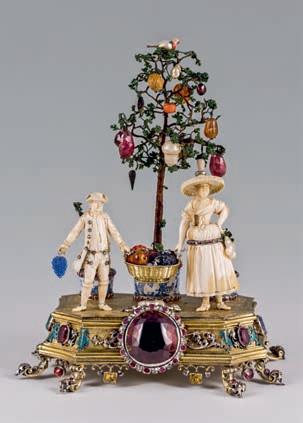
Fig. 20 Gardener Couple, Dresden, ivory, perhaps South Germany, jewellery work Johann Heinrich Köhler (1669–1736), c. 1720–25, ivory, silver-gilt, gold, enamel, traces of paint, precious stones, glass, and Baroque pearls, incl. pedestal and tree: h. 21 cm (8 ¼ in.). Grünes Gewölbe, Staatliche Kunstsammlungen Dresden, VI 206.
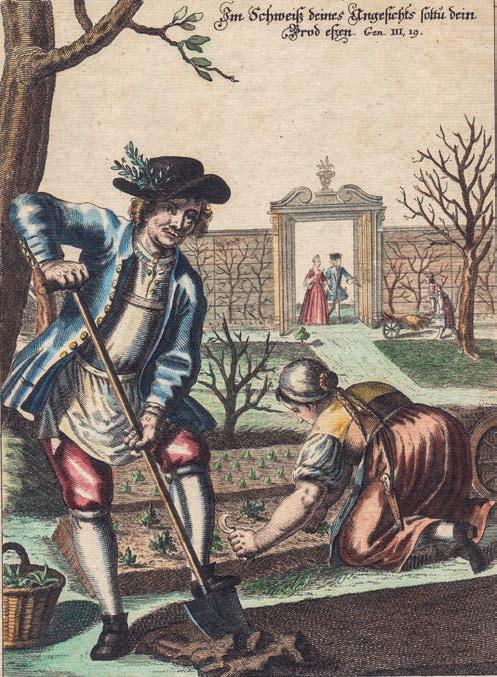
Fig. 21 Harte Müh und saure Garten Arbeit (Hard Labour and Bitter Gardening), published by Martin Engelbrecht (1684–1756), Augsburg, 2nd quarter eighteenth century, hand-coloured engraving with stippling. George Gazer Gallery, New York.
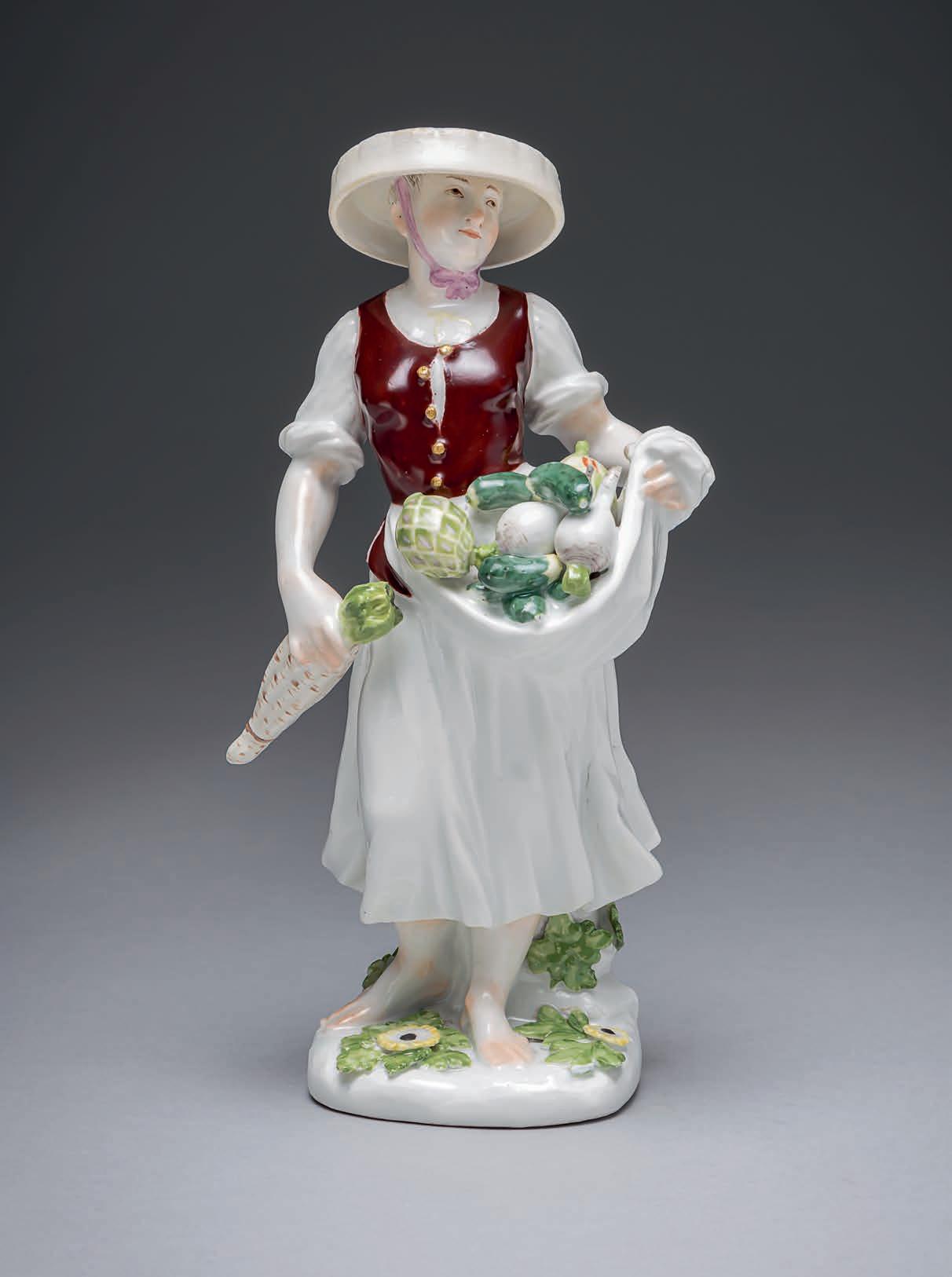
As the print exemplifies, gardening was, and is, hard manual labour (fig. 21). is gardener has filled her apron with fresh produce from the garden. She seems to be caught in the moment and has not had the time to button up her bodice properly. Two buttons probably came undone when she stooped to grab the cucumbers or radishes. It must be a sunny day, as she is wearing a so-called Schaubhut, a broad-brimmed sun hat made of straw with the rim pulled down, worn mostly by women in the countryside (fig.20). In her right hand she is holding a large radish. In addition to garlic and onions, radishes are found on the supposed “peasant coat-of-arms” in late medieval satirical engravings. ese illustrate what was seen as the inappropriate (and even laughable) aspiration of the peasant and middle classes to be on the same social level as the nobility.89
89 Hess 2017, 229.
Female Gardener
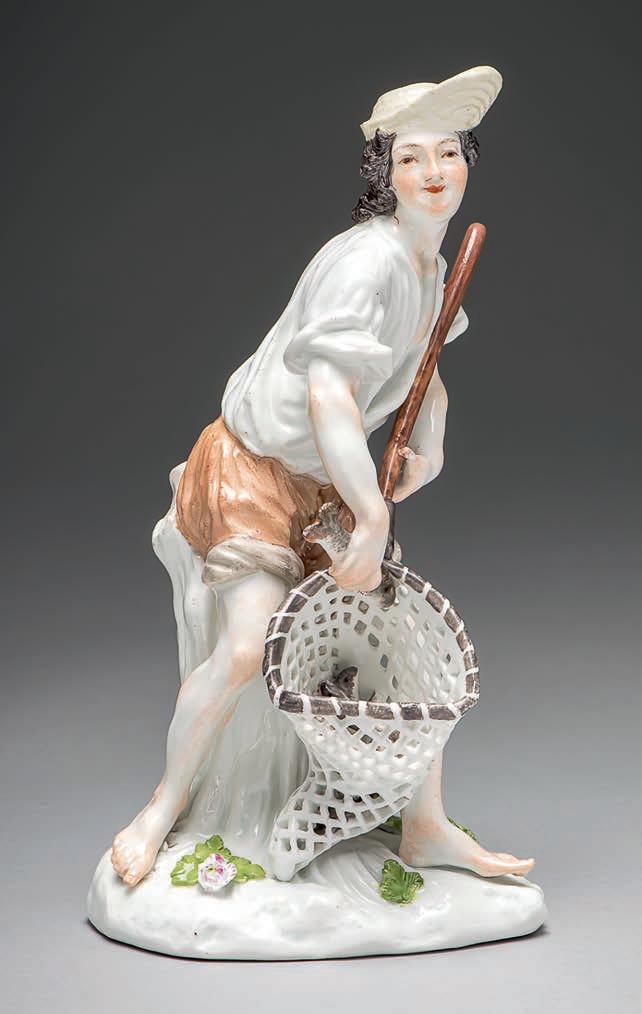
22Fisherman with Net
Meissen Porcelain Manufactory
Probably Johann Joachim Kaendler (1706–1775)
Original year of modelling: c.1745
Date of porcelain paste: c.1730–65
Date of decoration: 18th century Hard-paste porcelain
Small underglaze blue crossed swords on back of base
Purchased from Yvonne Adams Antiques, Worcestershire, England, July 18, 1988
Oldest Surviving Mould Book of the Meissen Manufactory, c.1780–c.1810
“165 [?] / Fischer mit einen durchbrochenen Hahmen vor sich habend / 9 / 1220”102 (165 [?] / Fisherman with an openwork net before him / 9 / 1220)
Meissen Directory of Models, 1730–1831 (transcript), a er 1900
“1200 / Fischer mit Netz / 18.5 10.5 10” (1200 / Fisherman with net / 18.5 10.5 10)103
e Fisherman is usually combined with the Fisherwoman (cat. no. 21).
e model number 1220, however, would indicate that the fisherman is later than the woman (she has model number 380). She is mentioned in Kaendler’s taxa report. e entry there suggests that there had been an earlier fisherman to whom she was modelled as its partner.
102 Meissen, Manufactory Archive, BA III H 164, 218.
103 Meissen, Manufactory Archive, BA III H 121, 148.
Savour: Food Culture in the Age of Enlightenment, Gardiner Museum, Toronto, October17, 2019–January 19, 2020
Savor: A Revolution in Food Culture, Wadsworth Atheneum Museum of Art, Hartford, Connecticut, February29–March 13, 2020, and September5–January3, 2021
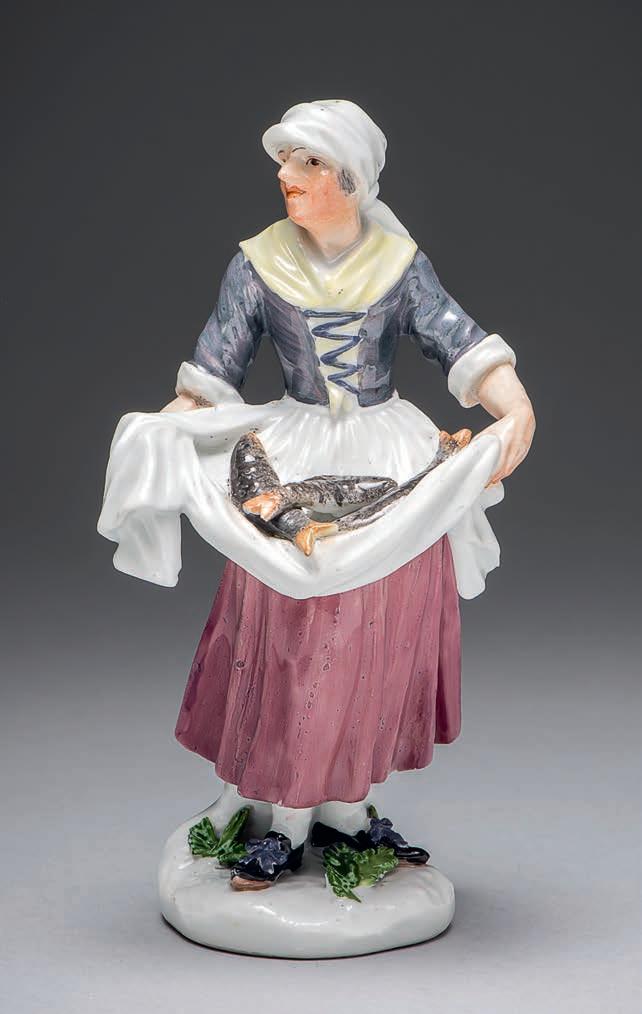
Meissen Directory of Models, 1730–1831 (transcript), a er 1900 “1573 / Bauersfrau / 13.5 7. 5.5” (1573 / Female peasant / 13.5 7. 5.5)104
Included in the German Democratic Republic sales catalogue, 1963, in English as “Peasant’s wife”; modeller and year are listed as unknown.105
104 Meissen, Manufactory Archive, BA III H 121, 62.
105 VEB Porzellan-Manufaktur Meissen 1963, vol.2, Peasants, 1.
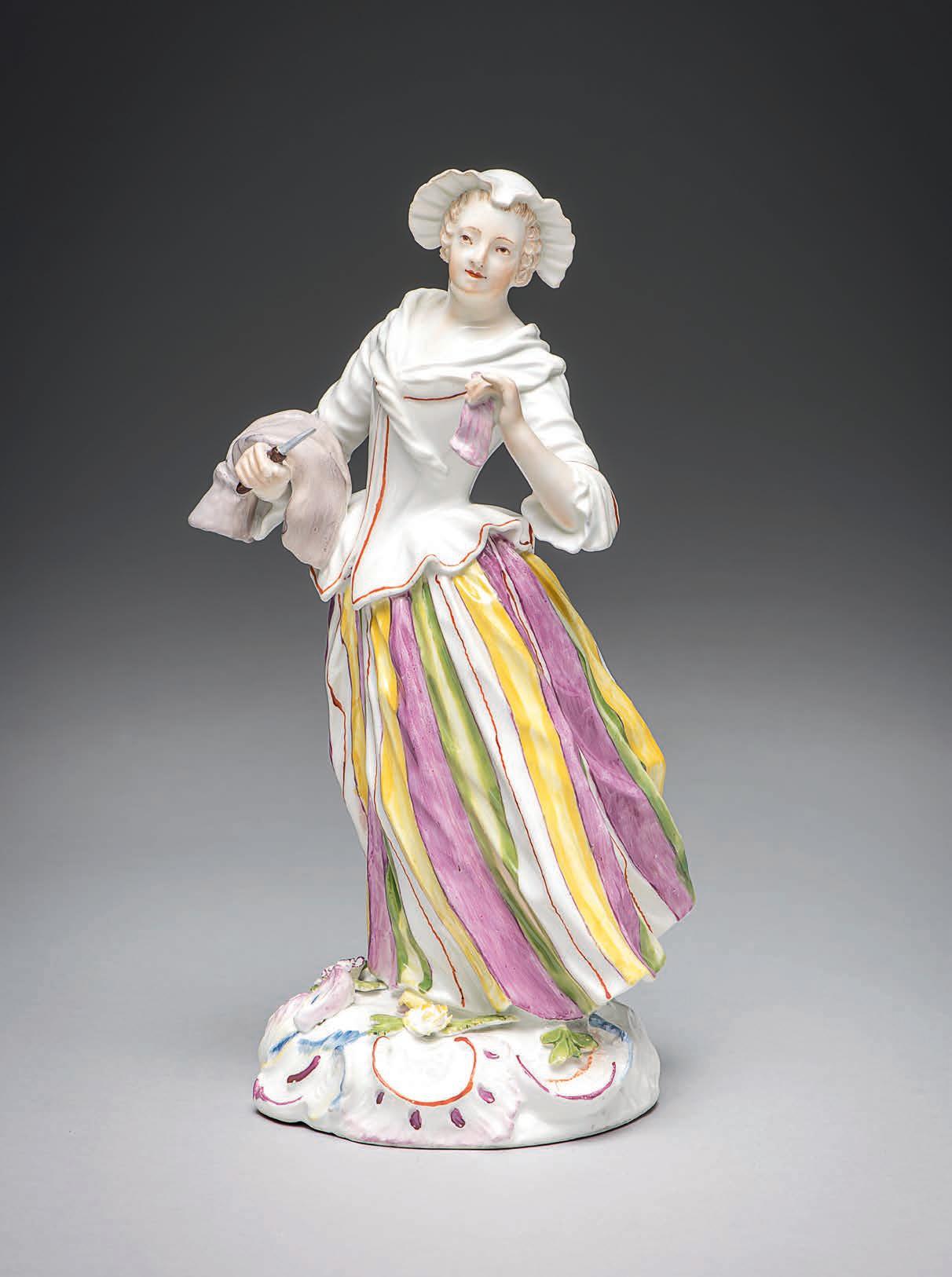
The great Meissen collections of the past are largely represented by Comedy and court-related figures. e Criers, Hawkers, Peasants, Musicians, and Artisans are the primary focus of my collection. ese figures were simply not targeted as su ciently important enough by any of the past collectors. e Tailor’s Wife (cat. no. 34), for example, from the Artisan series, was previously in the Pauls-Eisenbeiss Collection and it was my good fortune that they decided to sell her. Years later, Iwas in Basel and had the opportunity to view the Pauls-Eisenbeiss Collection, and the curator explained that the Seamstress just didn’t fit into their collection. And that describes the di erence between my collection and most of the other great collections. e Seamstress is magnificent, she’s important, and she belongs where she is.
ALAN SHIMMERMAN
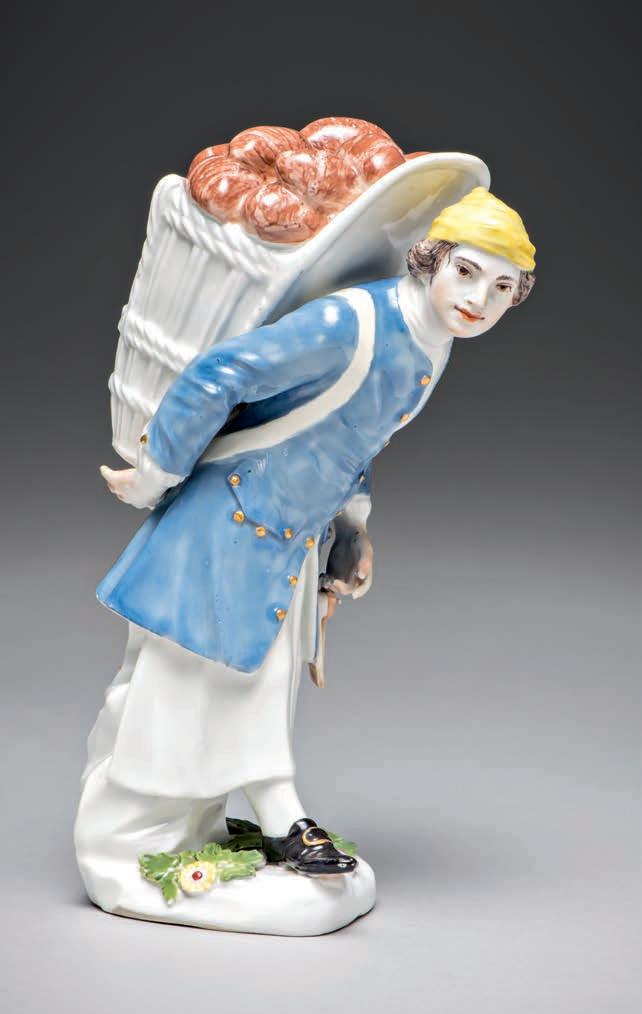
66Bread Boy
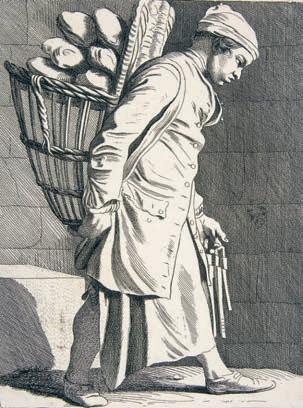
Fig. 18 Garçon Boulanger (Baker Boy), from Caylus’s Études prises dans le bas peuple ou les Cris de Paris, 1746, etching with some engraving. e Metropolitan Museum of Art, New York, 53.600.588(59). is print did not survive in the Prints and Drawings Archive of the Meissen Manufactory.
Like most of the early Paris Criers, the porcelain figure is very close to the print. However, Reinicke incorporated a couple of modifications: in the print the bread boy is gazing at the ground while the Meissen figure looks straight at us. He seems to want to interact with us and maybe sell us some of his bread.
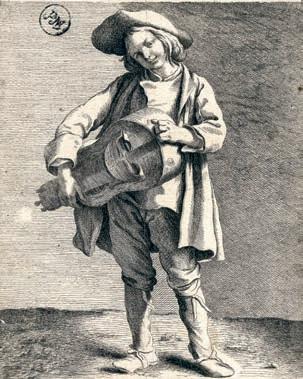
Fig. 19 Le Vieilleux [sic] (Vielle Player), from Caylus’s Études prises dans le bas peuple ou les Cris de Paris, 1737, etching with some engraving. Meissen Manufactory, Prints and Drawings Archive, VA 6544. e Meissen archive has twelve engravings from di erent suites, this one among them. e engraving has the “PM” for Porzellanmanufaktur (porcelain manufactory) stamp as well as “No.22” and “No.19” written in two di erent hands.
66Bread Boy
Meissen Porcelain Manufactory
Peter Reinicke (1711–1768) and maybe Johann Joachim Kaendler (1706–1775)
Original year of modelling: 1747
Date of manufacture: 18th century*
Date of decoration: 18th century
Hard-paste porcelain
No marks
Model no. 877
h. 18.7, w.8, d.10.8cm (7⅜, 3 3⁄16, 4 ¼ in.)
Shimmerman Collection no. MPPCE_2
PROVENANCE
Purchased from Christie’s New York, December 14, 2015, lot 226
Reinicke’s Work Report, August 1747 “1 Figur 10 Zoll hoch mit einem Trage Korbe mit Brodt, einen französischen Brodträger vorstellend, in on boussirt” (1 Figure 10 inches high with a basket with bread, representing a French bread boy, modelled in clay)86
PICTORIAL SOURCE
Garçon Boulanger, Bouchardon/Caylus
86 Meissen, Manufactory Archive, BA III H 117 (transcript), 78.
67 Hurdy Gurdy Player
Meissen Porcelain Manufactory
Peter Reinicke (1711–1768) and maybe Johann Joachim Kaendler (1706–1775)
Original year of modelling: c. 1745
Date of porcelain paste: c. 1730–65
Date of decoration: 18th century Hard-paste porcelain
Purchased from Yvonne Adams Antiques, Worcestershire, England, February 1, 2002
PICTORIAL SOURCE
Le Vieilleux [sic], Bouchardon/Caylus
67 Hurdy Gurdy Player
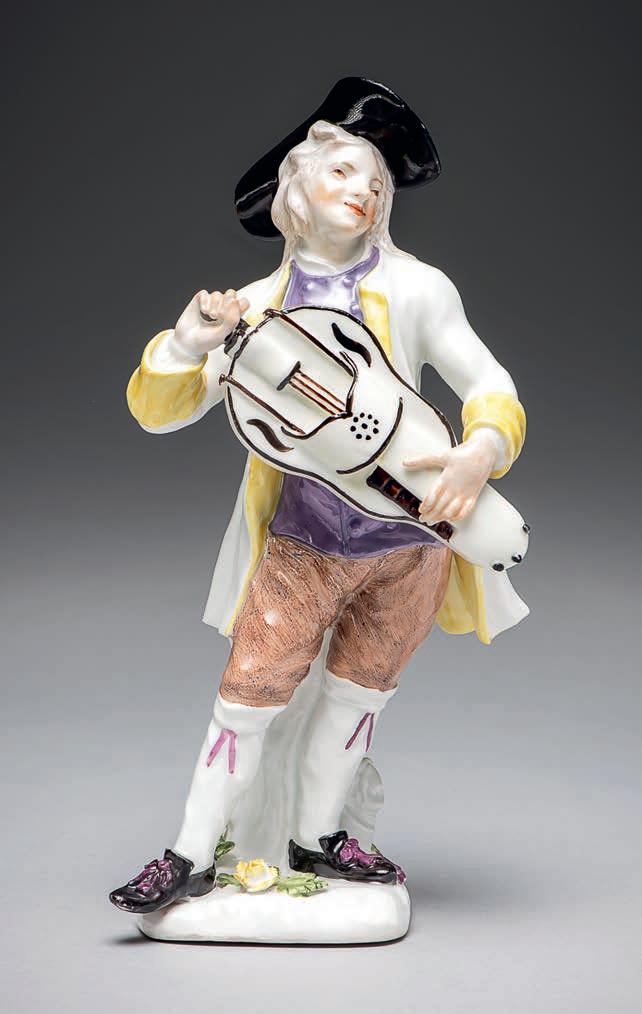
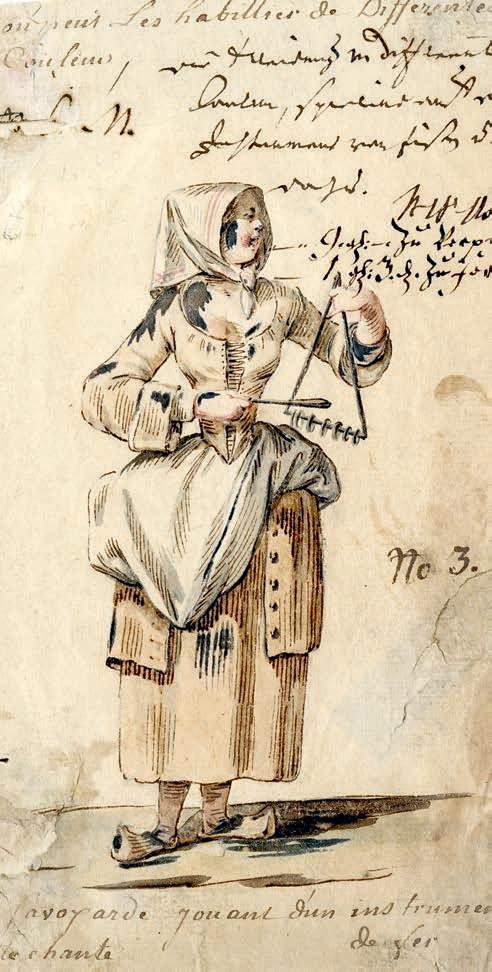
e colourful painting with floral decoration on this figure is very di erent from the drawing—which was apparently what the client wanted and on which he noted in French, “they can be dressed in di erent colours.”126 It therefore seems as if the painter could choose the design for this figure at his discretion.
126
“[O]n peut Les habillier de Di erentes Couleurs.”
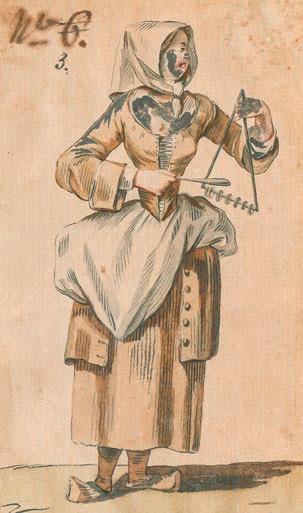
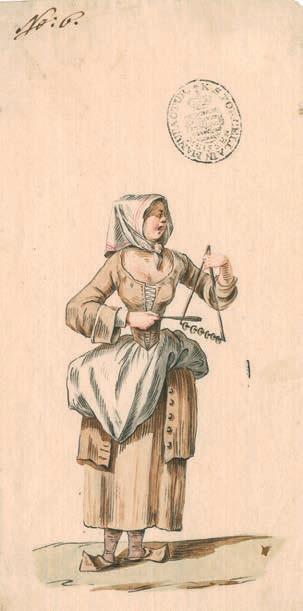
Fig. 28 Drawings for Crier with Triangle, Set 1–3. Meissen Manufactory, Prints and Drawings Archive, VA 145, 139-3 & 140-2.
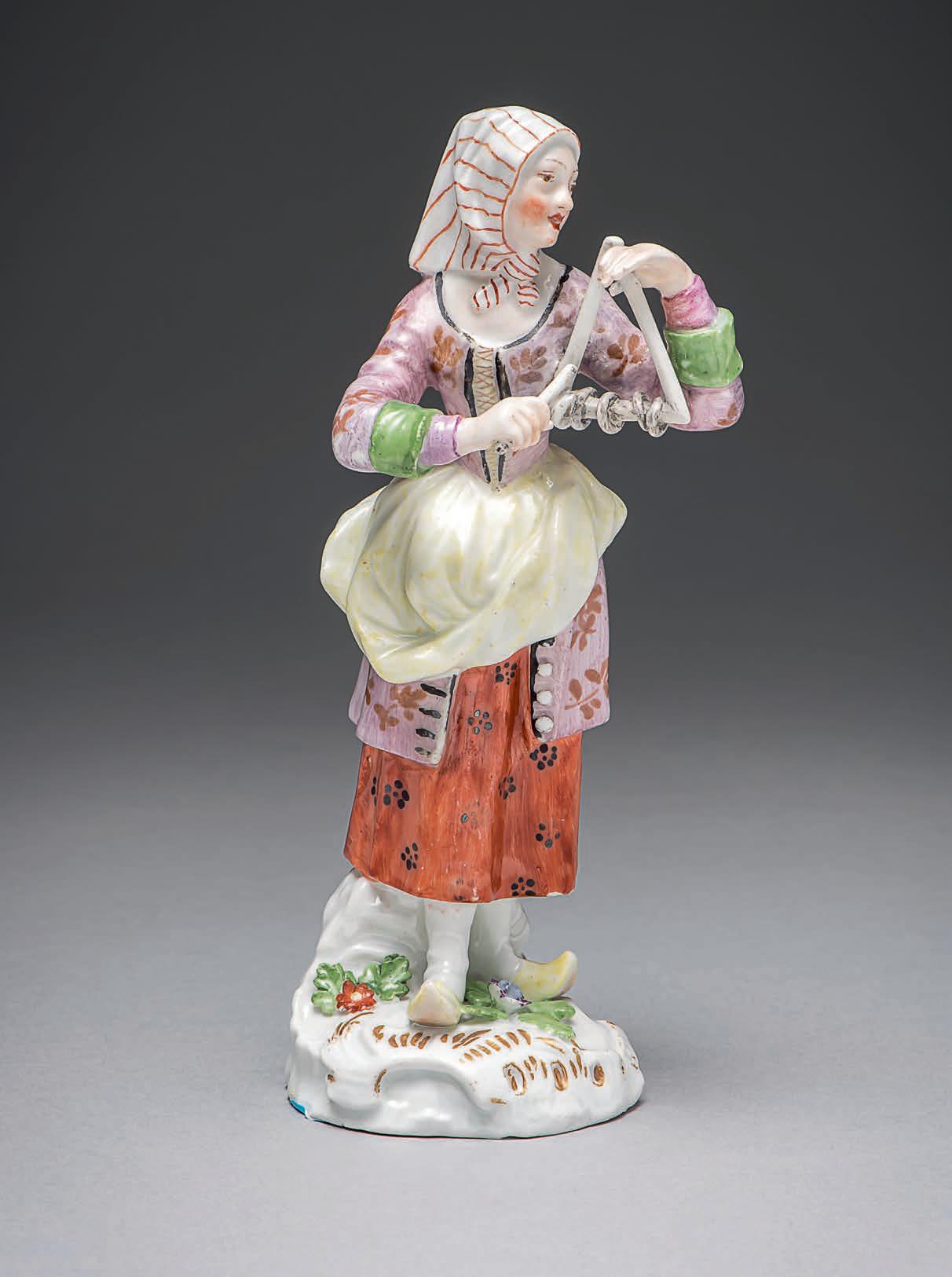
74 Crier with Triangle
Dresden in the Augustan Era, 1694
1764
1 Hanway 1753, vol.2, 234.
2 Lady Mary, letter XV to Frances Erskine (néePierrepont), Countess of Mar (1690–1761), in Montagu 2013, 32.
3 Montagu 2013, 32.
4 Montagu 2013, 32.
BY ANDRÉ VAN DER GOES
There is hardly any place in EUROPE more devoted to pleasures and diversions
Jonas Hanway, 17531
Weary and rather shaken by the hazardous journey from Prague, in a post chaise, passing along the precipices above the river Elbe by moonlight with her “postilions nodding on horseback while the horses were on a full gallop,”2 Lady Mary Wortley Montagu (1689–1762) reached Dresden on November 19, 1716. She stayed for only twenty-four hours in Dresden and wrote to her sister: “ e town is the neatest I have seen in Germany; most of the houses are new built, the elector’s palace very handsome and his repository full of curiosities of di erent kinds.”3 She devoted the rest of her letter to describing the ladies of Dresden and the mistresses of Elector-King Augustus II: “ ey are very genteelly dressed, a er the French and English modes, and have generally pretty faces, but they are the most determined minaudières [simperers] in the whole world. ey would think it a mortal sin against good breeding if they either spoke or moved in a natural manner. ey all a ect a little so lisp, and a pretty pitty-pat step; which female frailties ought, however, to be forgiven them in favour of their civility and good nature to strangers, which I have a great deal of reason to praise.”4
ese words set the stage for the fascinating world of the Meissen figures of the eighteenth century.
To appreciate Meissen figures fully, it is not enough to admire their great technical or sculptural qualities, or their creativity, for, more than that, they a ord us a glimpse of the world of an ancien régime with the colourful elegance of its courtiers and where even the common people and the poor have become decorative performers. ese figures bring a society back to life and, more specifically, a court and town of nearly three hundred years ago, the echoes of which can still be heard in the music of its composers and seen in the paintings of its artists. Yet, though delightful and telling, paintings are always two-dimensional. But the figures are three-dimensional and can be turned around and thereby almost seem to move. It would only take a Pygmalion to kiss them to life.
What better way to meet the personas portrayed by the figures than to stroll through the Dresden depicted by Bernardo Bellotto (1722–1780) in his paintings created in the times that Johann Joachim Kaendler (1706–1775) was making many of his figures? Bellotto (known under the sobriquet of Canaletto the Younger) worked in Dresden from 1747 to 1758, and it is to him that we owe urban views of Dresden painted with such precision that they almost allow us to walk through the streets and admire the monumental buildings, o en lavishly decorated with sculptures and ornaments. But more than that, he populated the streets and squares of the town with society in all its colourful diversity, ranging from street vendors and beggars to aristocrats and royalty, of whom some persons can even be identified. And it is there, on the streets and squares, in palaces, houses, and other buildings
Walking through Dresden
121Writing Cavalier
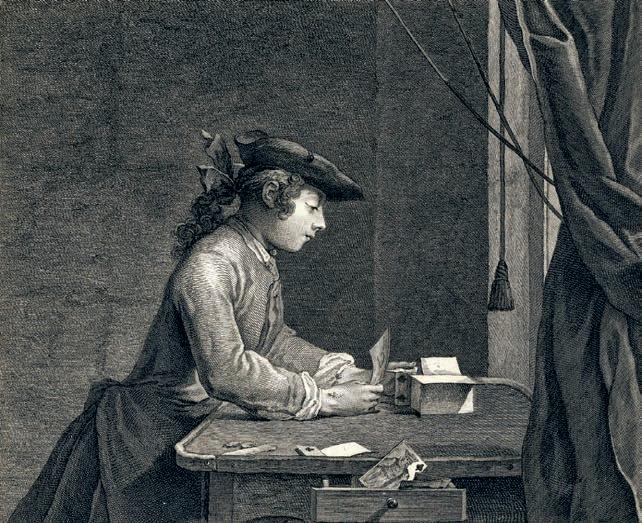
Fig. 5 Le Château de carte ( e House of Cards), etching by Pierre Filloeul (1696–1754) a er a painting by Jean-BaptisteSiméon Chardin (1699–1779), 1737. e British Museum, London, 1922,0410.287.
25 Pietsch and Antonin 2006, 20, cat. no. 13. e figure has the accession number PE 529.
26 Menzhausen 1993, 185.
27 Pietsch and Banz 2010, 314, cat. no. 341.
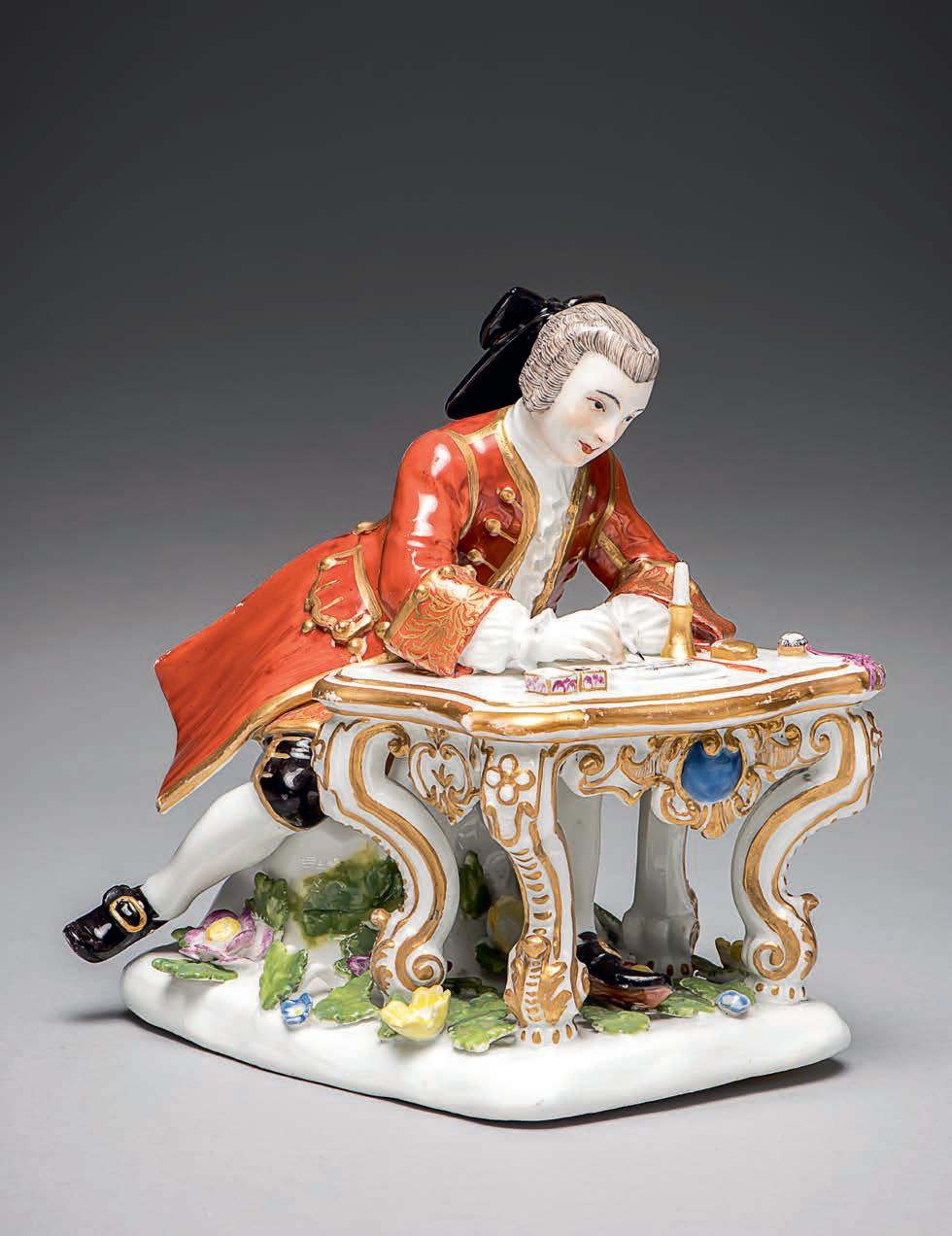
“Mademoiselle / Depuis que j’ai eu la permission…” (Mademoiselle / Since I have been allowed…). us begins the letter the gentleman is about to write to an unknown lady whom he is probably courting. e arrow on his little pocket watch lying on the table points to XII. Is it midday or midnight? e half-burned candle right next to his letter indicates that he is writing at night. A gilt snu ox, a red pen, an inkwell, and a sander complete the arrangement on the desk.
Although the figure of the Writing Cavalier was produced many times, each figure shows a slightly di erent arrangement of the writing utensils and, even more astonishingly, each letter is unique. e gentleman in the Dresden porcelain collection, for example, starts his letter with “Mademoiselle, pardonnez moi” (Mademoiselle, forgive me…),25 while the letter in the Pauls-Eisenbeiss Collection reads, “Mademoiselle, je ne me consoleres [sic] pas aisement…” (Mademoiselle, I shall not easily console myself…).26 Not all letters are in French; sometimes they are in German. Many are addressed to an anonymous lady for whom the writer seems to yearn; some, however, are written to a rival suitor.27 Clearly, both the repairer who was responsible for assembling the small accessories on the table and the painter enjoyed a fair degree of freedom finishing these figures.
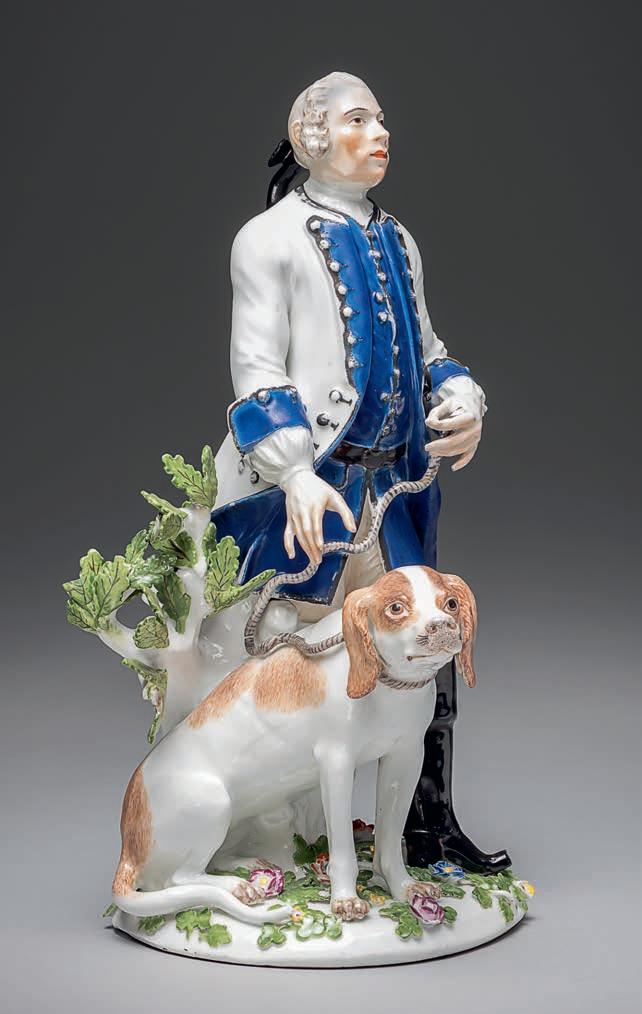
128Johann Georg Wenzel
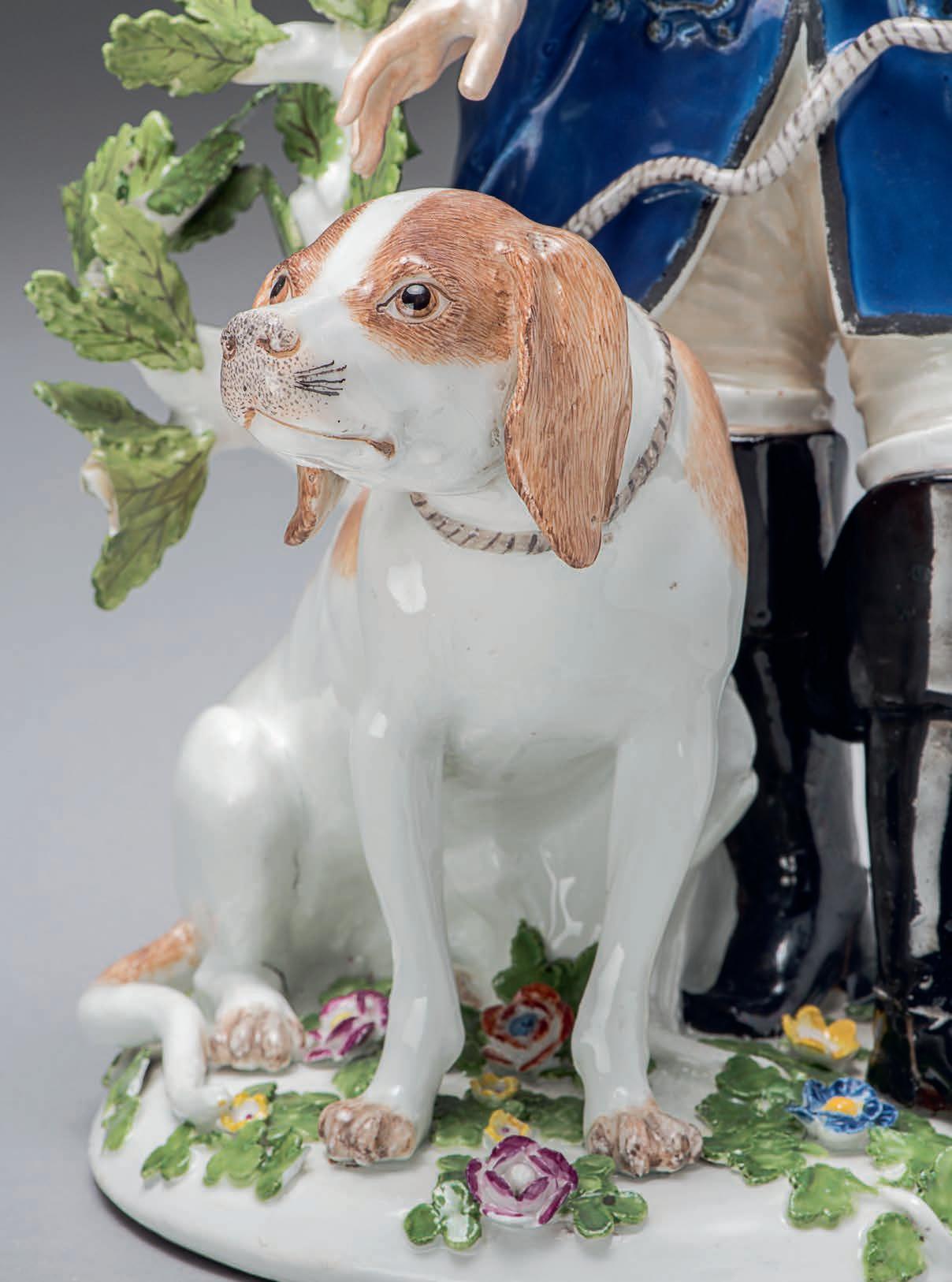
e figure of Wenzel is one of the rare instances of figural sculpture at Meissen where a real person has been portrayed and identified as such by the modeller. Johann Georg Wenzel (1700–1752) was the courtly huntsman (Ho äger) of Electoral Princess Maria Anna (1728–1797), the daughter of Augustus III and Maria Josepha. Like her father, Maria Anna was very fond of hunting and was said to be an excellent shot. She had her own favourite dog when participating in the par force hunt (see essay “Dresden in the Augustan Era”), which she wanted to have portrayed in porcelain.70 So, the figure faithfully portrays the dog as well as the hunter.
70 Pietsch 2006, 25, cat. no. 19.
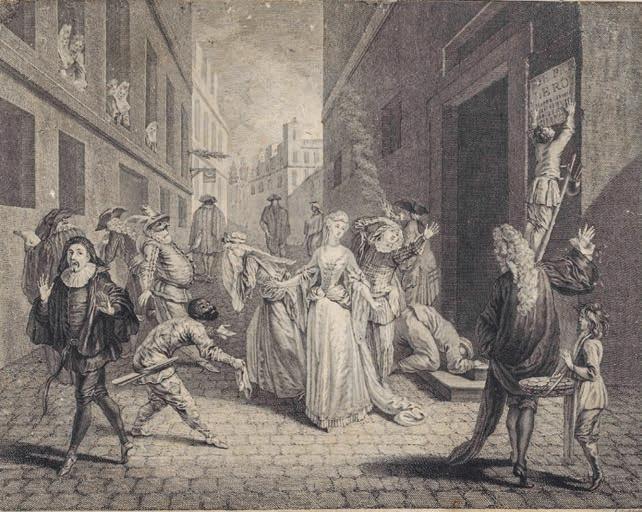
Fig. 28 Départ des comédiens italiens en 1697 (Expulsion of the Italian Comedians), engraving by Louis Jacob (1696–c. 1760) a er a lost painting by Antoine Watteau (1684–1721), 1729. Victoria and Albert Museum, London, S.3774-2009.
124 For more information about gestures for commedia dell’arte characters, see Chilton 2001a, chapter 3.
125 Chilton 2001a, 126.
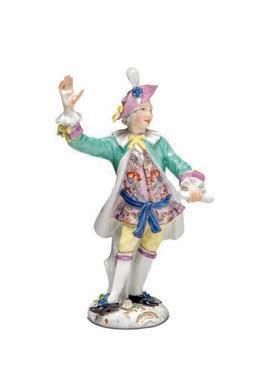
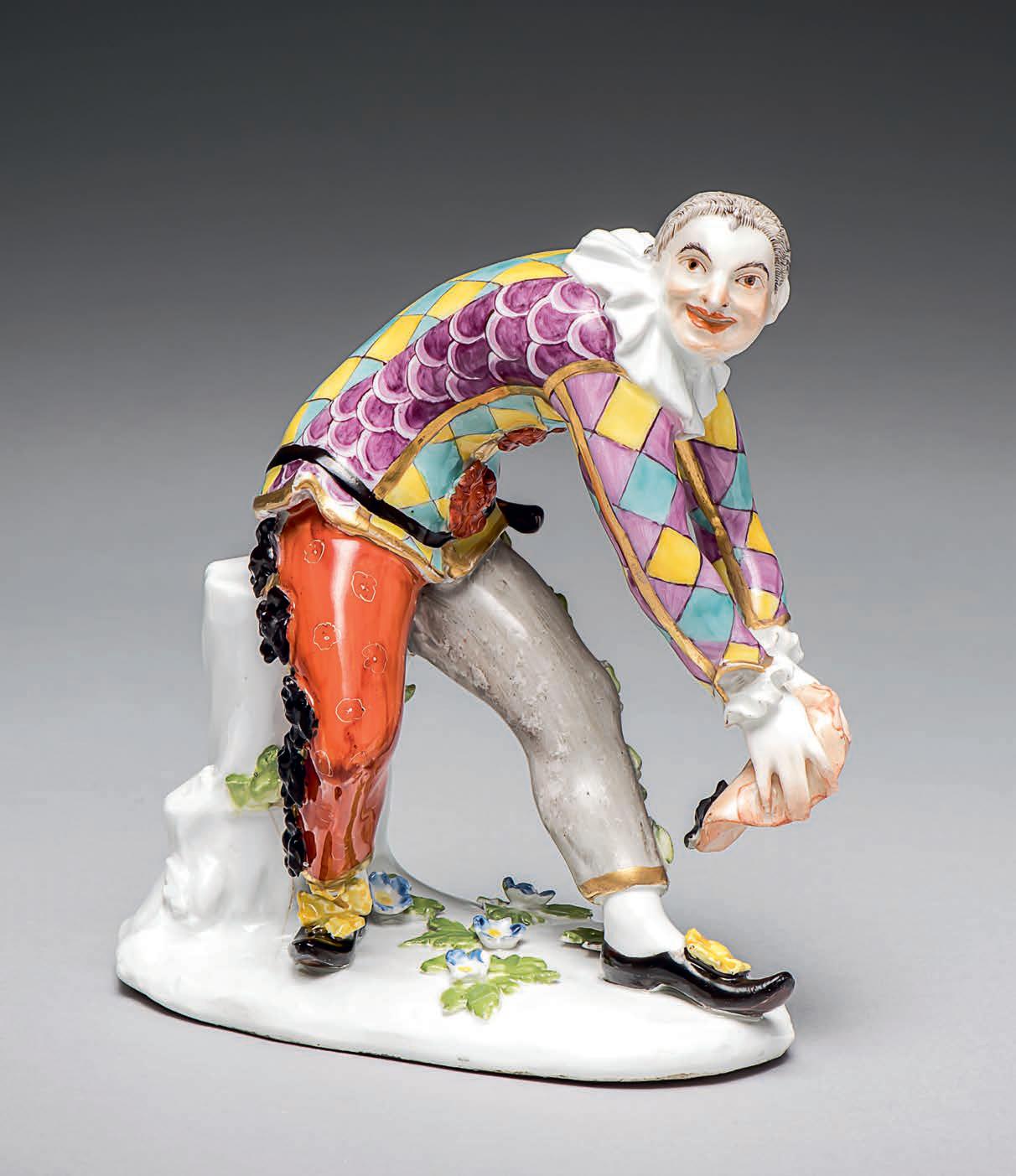
Mime, gestures, and poses, o en exaggerated, were extremely important for every Italian comedian. ey were carefully thought out and rehearsed and were distinct for each character.124 e Meissen Harlequin is greeting or welcoming his unseen audience, maybe inviting them to watch a play that is about to begin. His deep bow “clearly reflects an actual movement that was performed by the dancers in this role and was most likely adapted by choreographers from the commedia dell’arte itself.”125
e Greeting Harlequin of the Shimmerman Collection shows one of the most sophisticated and genuine decorations on Meissen porcelain. e patterns on his jacket alternate from diamond-shaped patches in yellow, turquoise, and purple (for the arms) to a fish-scale pattern in a deeper purple. One leg of his hose is red with scratched-out flowers and a row of applied flowers in black; the other is grey with applied flowers in green.
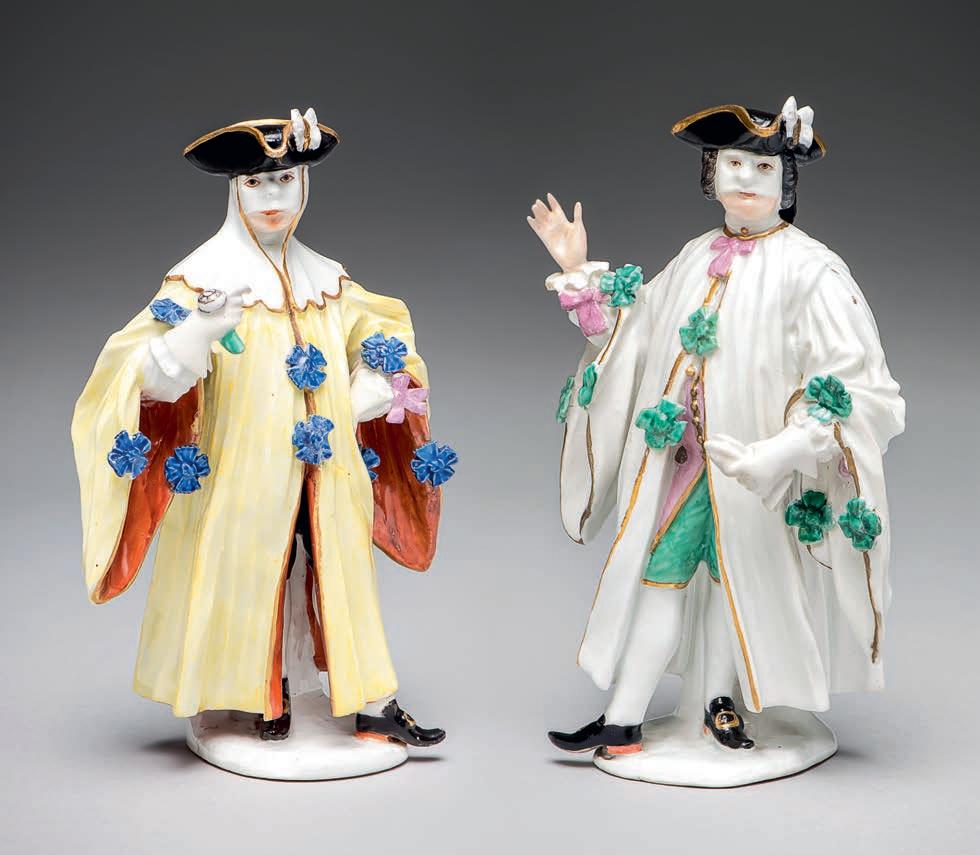
Both Avvocato figures are wearing a Venetian domino, a wide coat worn over a costume popular during Carnival. e Avvocato, or lawyer, in the Italian comedy was an alleged scholar who turned out to be a confusing and annoying wiseacre. It has been pointed out, however, that the Meissen figure is rather generically dressed, “as neither his costume nor his posture has anything to do with the legal profession, nor do they indicate an actor dressed as lawyer.”
151 A domino, or Fledermaus (bat) as it was called in Dresden, was indeed not a costume in the sense of a certain role but rather showed the state of being disguised. e Avvocato with the yellow domino wears also the matching bauta, a short length of cloth covering the shoulders and worn as a hood on which a three-cornered hat was placed.