Mustafa Akyol is a senior fellow at the Cato Institute’s Center for Global Liberty and Prosperity, where he focuses on the intersection of public policy, Islam, and modernity. For several years, he served as a contributing opinion writer for the New York Times, covering religion and politics in the Muslim world, and worked as an opinion columnist in the Turkish press. He is also the author of several books, including, in 2024, The Islamic Moses, and is editor of No Compulsion in Religion—No Exceptions: Islamic Arguments for Religious Freedom.
Ankur Barua is a senior lecturer in Hindu studies at the University of Cambridge. His primary research interests are Vedantic Hindu philosophical theology and Indo-Islamic styles of sociality. He researches the conceptual constellations and the social structures of Hindu traditions, both in premodern contexts in South Asia and in colonial milieus where multiple ideas of Hindu identity were configured along transnational circuits between India, Britain, France, Germany, and the US. He read theology and religious studies at the Faculty of Divinity, Cambridge.
Khalid Y. Blankinship is professor and department chair of religion at Temple University and is a noted historian, with expertise in Muslim history, Islamic studies, religion and science, environmental ethics, world history, theories of religion and secularism, and Just War theory. He has translated two volumes of The History of alŢabarī and published a study on the collapse of the Umayyad Caliphate. More recently, he published Murshid al-Qari’: A Reader’s Guide to Classical Muslim Religious Literature in English through the Lamppost Education Initiative.
Juan Cole is Richard P. Mitchell Collegiate Professor of History at the University of Michigan. For three and a half decades, he has sought to put the relationship of the West and the Muslim world in historical context. He published Muhammad: Prophet of Peace amid the Clash of Empires in 2018. He is also the author of The New Arabs: How the Millennial Generation Is Changing the Middle East; Engaging the Muslim World; Napoleon’s Egypt: Invading the Middle East; and many other books.
Scott F. Crider is a professor of English at the University of Dallas in the Constantin College of Liberal Arts and the Braniff Graduate School. He has published extensively on the works of Shakespeare and maintains the English Renaissance as a major research interest. His other academic interests include the ancient and modern rhetorical tradition, the history and character of liberal education, and the Englishlanguage Bible as literature.
Stephen A. Gregg is a monk of the Cistercian Abbey of Our Lady of Dallas, in Texas. At both the University of Dallas and the Cistercian Preparatory School, he teaches courses in English literature, grammar, music, Latin, philosophy, and theology. He earned his PhD, writing his dissertation on the poet Edmund Spenser, from the Institute of Philosophic Studies at the University of Dallas.
Hina Khalid completed her BA, MPhil, and PhD in theology and religious studies at the University of Cambridge. Her doctoral dissertation offered the first comprehensive comparative study of the metaphysical and aesthetic visions of Muhammad Iqbal (1877–1938) and Rabindranath Tagore (1861–1941). She is particularly interested in the possibilities of comparative theology across Islamic and Indic traditions and in the ways that shared devotional idioms have formed in and across the Indian subcontinent.
Marwa Al-Sabouni is an award-winning architect and author based in Syria. She is the author of two books, The Battle for Home (2016) and Building for Hope (2020). Her forthcoming book Mosque: An Architect’s Exploration of Form, Faith, and Meaning will be published in 2026 by Thames & Hudson. She holds a PhD in architectural design and is the cofounder of Arabic Gate for Architectural News, the world’s only website dedicated to architectural news in Arabic.
Michael Sugich studied at UCLA and the California Institute of the Arts. He has also studied Sufi doctrine and practice with spiritual masters across the Muslim world. He has written and edited three books on spiritual topics, including Signs on the Horizons, a record of his meeting with Sufis in the Middle East and North Africa. He also served as series editor of Exemplars for Our Time, a nine-volume set of illustrated biographies of some of the most influential and inspiring Muslim saints and sages of our time.
John Walbridge is a Near Eastern languages and cultures professor at Indiana University Bloomington. His research interests include Islamic philosophy, Islamic intellectual history, Baha’i studies, Islamic studies, and Islamic history. He earned his PhD in Near Eastern languages from Harvard University. His publications include God and Logic in Islam: The Caliphate of Reason and The Wisdom of the Mystic East: Suhrawardī and Platonic Orientalism
Jacob Williams is a PhD candidate in political theory at the University of Oxford, where his research focuses on the normative theory of religious and cultural pluralism and on defenses and critiques of liberalism. He has co-organized and co-taught a course at Oxford on Islam and modern political thought. His testimony of becoming Muslim was published in First Things, and he has also written for Public Discourse, Law & Liberty, Academic Questions, and other publications.
An Ottoman Response to Enforcing Piety
Mustafa a kyol
God preserve us from those who show fanaticism in religion. otto M an scholar ta ş köprülüzâde ah M ed (d. 1561 )1
the seventeenth century was a turbulent era for the Ottoman Empire, the Muslim superpower that held the caliphate and controlled much of what we today call the Middle East. In the previous century, the empire had reached the zenith of its power, especially during the victorious reign of Sultan Süleyman the Magnificent (r. 1520–66), extending its western borders all the way to Vienna. Soon afterward, however, a long period of stagnation began, tainted by external setbacks and internal rebellions.
No wonder, then, that in that century, some Ottoman scholars began to ponder what had gone wrong and what needed to be fixed. One of them was Koçi Bey (d. 1650), a highranking bureaucrat who submitted critical reports to two subsequent sultans pointing out serious problems, such as corruption in the military, bribery in the bureaucracy, nepotism among religious scholars, and a heavy yet inefficient system of taxation. Another scholar, the polymath Kâtip Çelebi (d. 1657), probably the most important Ottoman intellectual of his century, also criticized some narrow-minded religious scholars of his time who “rejected and repudiated… what they called ‘the philosophical sciences,’” such as geometry and astronomy.2 In his remarkable book Mîzânü’l-Hakk, or
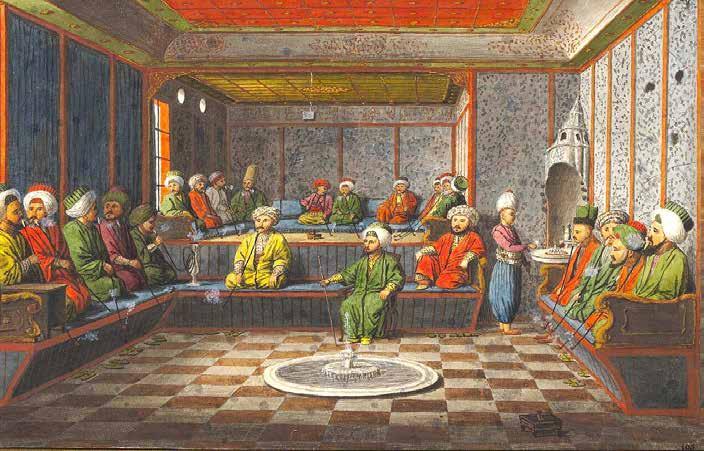
Turkish coffeehouse, ca. 1809
On the Nature of Revolutions
k halid y. b lankinshi P
d efining T he T erm revolution can be difficult, as it has been appropriated for many purposes, even commercial advertising that promises a “revolution” in one’s life if one adopts a certain product. Here, I propose to go back to the more common usage of the word, meaning “an instance of great change in affairs,” or, more narrowly, the “overthrow of an established political or social system,” meanings that gained particular currency in the English-speaking world from the Glorious Revolution of 1688–89 that overthrew King James II.1 But while the term is early modern (ca. 1500–1800), the concept of revolution is much, much older, dating back to ancient history, and was already notably described and developed by the Greek historian Thucydides in his descriptions of the revolutions in Greek cities as a result of the Peloponnesian War, from the revolt at Corcyra in 427 BCE on. Thucydides paints a very bleak picture of such events,2 but much else can be said about them.
Going back to prehistory, it is presumed that nonliterate tribal communities existed without much specialization, and also that, because they consisted of such a small number of individuals (maybe a few hundred), everyone knew everyone else personally,
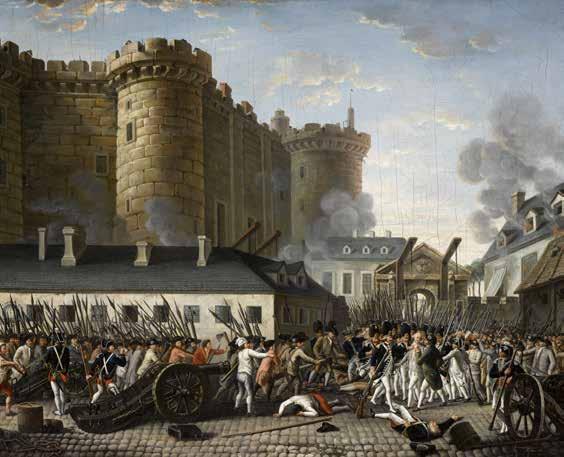
Storming of the Bastille, a flash point of the French Revolution, 1789
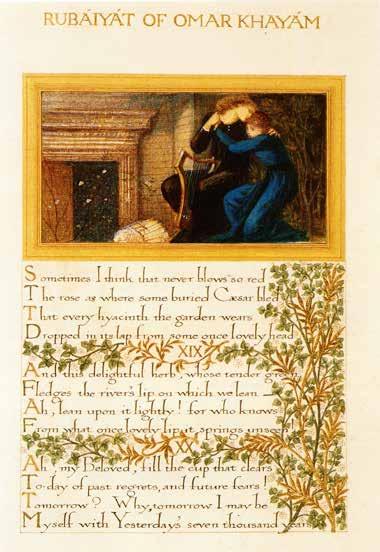
Page from an illuminated manuscript of the Rubáiyát of Omar Khayyám, with William Morris’s calligraphy and ornamentation, and illustration by Edward Burne-Jones
“Persia Has Become a Holy Land” What English Artists Found in Their Rebellion against Industrial Britain
Juan Cole
william morris was a nineteenth-century artist, poet, designer, craftsman, and socialist who reacted against the squalor of Britain under industrialization and took the side of put-upon workers against the new class of industrialists. Ironically, he came from a well-off family that had invested in copper and tin mines. Born in Walthamstow, near London, he attended Oxford and joined the avant-garde Pre-Raphaelite movement of poets and artists as an undergraduate. Eclectic in his tastes and open to the wide world into which Victorian Britain insistently inserted itself for trade and colonialism, he encountered, and was enamored by, Islamic arts, alongside his fascination with Vikings for which he is better known. Above all, Morris was a peaceful rebel, using his art and craftsmanship to mount a powerful protest against the miseries of Victorian factory regimentation, the brutality of colonialism, and the easy bigotry of an elite that condemned other cultures as barbarous and unworthy of the notice of a superior race.
Although Victorian Orientalism is rightly denounced for its supercilious sense of superiority and negative depictions of the Middle East and Asia, Morris found genuine elements of beauty in those cultures and acknowledged classical Persian design as his master. Revolting against a soulless modernity, he exemplifies a different motivation for the appropriation of Eastern culture, what English novelist George Eliot referred to as the enlargement of the self through travel. In her journal of her trip to Italy in 1860, she wrote that she had looked forward to the journey “rather with the hope of the new elements it would bring to my culture, than with the hope of immediate pleasure.” The toil of travel, she added, would be “a disappointment if the main object is not the enlargement of one’s general life.”1 She spoke of the “double consciousness” experienced in the presence of great works of art, both of the physical act of seeing and of the later act of imagination in remembering details not immediately noticed.
English poet and painter Dante Gabriel Rossetti founded the Pre-Raphaelite Brotherhood in the late 1840s as a movement of artists and painters rebelling against what they viewed as the glib and sterile style favored by Renaissance and later artists and exemplified by Raphael. In the 1840s, art historians were discovering late medieval artists, including Giotto and Fra Angelico in Italy, whose work the Pre-Raphaelites found dynamic, vigorous, and idiosyncratic. They also loved Dante, the Arthurian legends, and the tales of The Arabian Nights, also known as The Thousand and One Nights. 2 Though the Pre-Raphaelite Brotherhood fell apart by the mid-1850s, its themes were taken up by a looser movement of artists under Rossetti’s spell. Ultimately, the Pre-Raphaelites were not medieval romanticists. They did not wish to go back to a medieval world but to use what they saw as the unpretentious honesty of medieval poetry and art to counter and confront the dreary world of manufacturing plants and railroads, even while the
“The
Fiery Hunt”
Moby-Dick and the Quest for God
sT e P hen a . g regg
no one who considers the study of literature important for life can long avoid Moby-Dick; or, The Whale. Yet its author said of it, “I have written a wicked book, and feel spotless as the lamb.”1 Can we become spotless lambs reading this wicked book? What authority can we grant to imaginative fiction in our real lives?
This is a question to be asked of all “profane” literature by those whose lives are informed by sacred texts and religious practice. So, to better understand the place of fiction in our religious quest, we need to return to the heart. We can be awoken to fascination with reality and a sense of responsibility by the impulses of bodily action and by intellectual formation, but we must always also attend to the tangle the heart is in, its interplay of hope, desire, anger, and fear. It will often be the enchantment of stories that brings urgent questions to life in us, that reveals us to ourselves.2 Sacred texts have their literary forms and their literary enchantments (to say the least); intellectual puzzles have their magic; engaged life drives us directly into human fascination and responsibility. Nonetheless, the heart achieves the clarity it needs by encountering
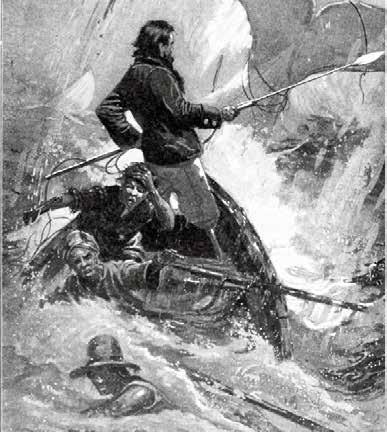
The final chase of Moby-Dick, showing Ahab harpooning the white whale
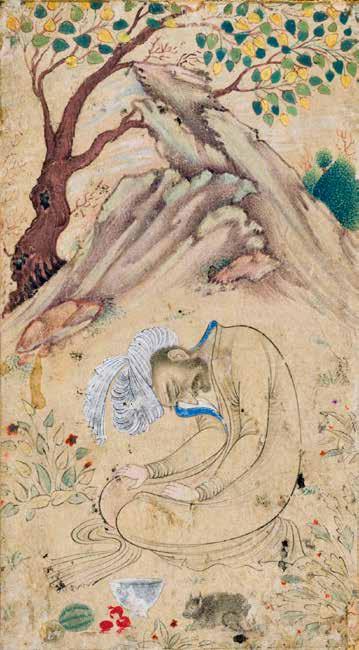
A Sufi in Ecstasy in a Landscape, Isfahan, ca. 1650
Transcending Meritocracy
Can We Move from an Economic Hierarchy to a Metaphysical and Spiritual One?
m i C hael s ugi C h
T he ameri C an hierar C hy was defined by the democratic ideal, as interpreted by the Founding Fathers and articulated in the Declaration of Independence: “We hold these truths to be self-evident, that all men are created equal, that they are endowed by their Creator with certain unalienable Rights, that among these are Life, Liberty and the pursuit of Happiness.” Its author, Thomas Jefferson, also subscribed to English philosopher John Locke’s assertion that “neither pagan, nor mahometan, nor jew, ought to be excluded from the civil rights of the commonwealth, because of his religion.”1 This declaration of tolerance inspired Jefferson to confirm the separation of church and state, embedded in the Bill of Rights, effectively secularizing the governance of the republic fifteen years after its creation. So religious freedom and equal rights are the foundational ideals of America. Yet the Founding Fathers were all white, all Christian, all slave owners, and they intended a government controlled exclusively by landowners—that is, themselves.
The de facto hierarchy of America was based on property, pedigree, and literacy. At first, only landowners could vote and participate in the new democracy, making property ownership the key to a place in the hierarchy. George Washington was not born into great wealth, and he “lacked the liberal education that then distinguished gentlemen, setting him apart from such illustrious peers as Jefferson, Hamilton, Adams, and Madison.”2 Washington achieved his place in pre-independence society by acquiring vast tracts of land while working as a surveyor and, by the age of eighteen, assuming the role of tobacco planter, while distinguishing himself as a soldier on the frontier. Washington was a paragon of upward mobility, his marvelous estate at Mount Vernon a proof of his attainment.
There were no kings, principalities, or feudal lords in our history or mythology. The American symbol of success was the presidency. “Honest Abe” Lincoln, born in a log cabin, symbolized the democratic ideal that was ingrained in generations of Americans through textbooks, the press, literature, and popular entertainment. The idea of upward mobility was popularized in the wildly successful young adult novels by Horatio Alger, beginning in 1867 with the Ragged Dick series, a rags-to-riches-and-respectability saga about a fourteen-year-old bootblack who escapes poverty and achieves middle-class respectability through hard work and virtuous living.
These were the antecedents of the American meritocracy: the belief that if one works hard and lives a good life, one can ascend the social, political, and economic hierarchy on merit, that anyone could become president (that is, anyone white, Anglo-Saxon, and male).