THE MESSENGER
The Catholic Newsletter of Xavier University of Louisiana

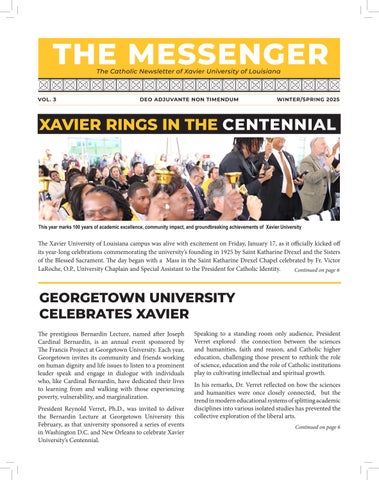

The Xavier University of Louisiana campus was alive with excitement on Friday, January 17, as it officially kicked off its year-long celebrations commemorating the university’s founding in 1925 by Saint Katharine Drexel and the Sisters of the Blessed Sacrament. The day began with a Mass in the Saint Katharine Drexel Chapel celebrated by Fr. Victor LaRoche, O.P., University Chaplain and Special Assistant to the President for Catholic Identity.
The prestigious Bernardin Lecture, named after Joseph Cardinal Bernardin, is an annual event sponsored by The Francis Project at Georgetown University. Each year, Georgetown invites its community and friends working on human dignity and life issues to listen to a prominent leader speak and engage in dialogue with individuals who, like Cardinal Bernardin, have dedicated their lives to learning from and walking with those experiencing poverty, vulnerability, and marginalization.
President Reynold Verret, Ph.D., was invited to deliver the Bernardin Lecture at Georgetown University this February, as that university sponsored a series of events in Washington D.C. and New Orleans to celebrate Xavier University’s Centennial.
Continued on page 6
Speaking to a standing room only audience, President Verret explored the connection between the sciences and humanities, faith and reason, and Catholic higher education, challenging those present to rethink the role of science, education and the role of Catholic institutions play in cultivating intellectual and spiritual growth.
In his remarks, Dr. Verret reflected on how the sciences and humanities were once closely connected, but the trend in modern educational systems of splitting academic disciplines into various isolated studies has prevented the collective exploration of the liberal arts.
Continued on page 6
FR. VICTOR LAROCHE, O.P.
University Chaplain and Special Assistant to the President for Catholic Identity


Dear Xavierites,
March 3, 2025 was the 70th anniversary of the death of Mother Katharine Drexel. Since the Jubilee Year 2000, when she was declared a Saint by then Pope John Paul II, March 3 has been set as her Memorial for the Catholic Church in the US.
The late Sr. Mary Ann Stachow, S.B.S., who followed Christ in the way of Mother Katharine until her death in 2024, shared that October 1st, 2000, was a cloudy Sunday in Rome. However, the sun came out briefly when the name of Saint. Katharine Drexel was mentioned as a new Saint by then Pope John Paul II.
As all Xavierites and friends of Xavier know, Xavier University of Louisiana, the crown jewel of Saint. Katharine and her Sisters of the Blessed Sacrament is celebrating its first hundred anniversary in 2025. “Let us press forward and fear nothing”, while we anticipate the 25th anniversary of the canonization of Mother Katharine Drexel on October 1, 2025.
We can be assured that Mother Katharine is interceding for us. As she did in October 2000, she will dissipate the clouds that may dampen our enthusiasm to continue her mission during this Jubilee Year and beyond.
St. Francis Xavier, pray for us! Saint Katharine Drexel, pray for us!
Xavier University had a significant presence at the 2024 National Conference of the Knights of Peter Claver.
Several Xavier students who are members of Xavier University of Louisiana Knights of Peter Claver Collegiate Unit 403 attended the 2024 Knights of Peter Claver National Convention and Conference in Oklahoma City. Xavier University was the first university to establish a collegiate chapter of the Knights of Peter Claver and Ladies Auxiliary in the U.S. The students who participated as delegates for the two-day conference event from Collegiate Unit 403, the nation’s first Knights of Peter Claver Collegiate Unit, were Grand-lady Shaylyn Cothron and Vice Grand-lady Taylor Simpson, Grand-knight Nehemiah Strawberry, and Vice Grand-Knight Paschal Unini. Lisa McClain, Director of Campus Ministry, accompanied the group. Grand Lady Dr. Rosalind P. Hale, (’69) was afforded the privilege of presenting the case for Knights of Peter Claver financial support of Xavier University’s Centennial Campaign to the assembly.


The joy of welcoming in a new year quickly faded as we awakened to learn of the horrific terrorist attack in New Orleans in the early hours of 2025. The tragic loss of 14 innocent souls and the and life-changing injuries that countless others endured by the act of one person consumed with hatred shattered what could have and likely would have been a joyous, beautiful dawn of the new year.
This tragedy once again called New Orleanians to bond together in prayer and support of those most personally impacted to not let the terrorist achieve his goal. Within hours of being able to access the crime scene, an impromptu memorial sprung up along Bourbon Street as we all sought to process the magnitude of this act.
Although Xavier University was on holiday break when the attack happened, many of our students felt a deeppersonal connection to those many young lives lost. Some had been on the streets of downtown New Orleans
“It was important for us to come together to help our students process and bring closure after such a traumatic event.”
- Lisa McClain, Director of Campus Ministry
just hours, while others just came to a realization of innocence lost. On January 15, 2025, the Xavier University community gathered inside the St. Katharine Drexel for a candlelight vigil to mourn and to pray for those who died and those who were fighting to live and regain the lives they once had. The vigil was highlighted with prayers in word and song for all victims. “It was important for us to come together to help our students process and bring closure after such a traumatic event and to come together as community to pray and show our support and solidarity with the victims,” said Lisa McClain, Director of Campus Ministry, who credits Rev. Dr. Mitchell Stevens, Interfaith Chaplain for the University, for his efforts orchestrating this vigil for the Xavier community.

Xavier University’s President, Dr. Reynold Verret, was one of five presidents of Catholic universities in the U.S. who participated in a forum on the changing nature of Catholic higher education held in February in New Orleans. Loyola University in New Orleans hosted the event which also featured Dr. Xavier Cole, President of Loyola University New Orleans, Vincent Rougeau, President of College of Holy Cross (Massachusetts), Dr. Robert Kelly, President of the University of Portland, and Dr. Steve Stoute, President of Canisius University. All five of these university Presidents are among the first lay leaders of their respective institutions, and all but Dr. Verret were the first person of color to lead their institution.
Fr. R. Bentley Anderson, a Jesuit priest who teaches religion at Loyola, served as moderator of the event during which the panelists discussed various topics facing Catholic higher education, including the changing priorities of younger generations and the role of Catholic academia in reaching marginalized populations. The panel also addressed how the decline in vocations to the priesthood and religious orders since the Second
Vatican Council has impacted Catholic institutions that were once led by clerical or religious orders, but are now lay-led institutions- such as Xavier University. In his comments, Dr. Verret recalled a quote of Pope Francis, “Accountability and responsibility in the Church derives from baptism, not from ordination,” a message Pope Francis communicated to Catholic educators during a conference in Rome, adding, “That notion of how we form students, and the formation of faculty, staff, and everyone around us is about giving that accountability, because Church is actually each of you and each of us,” said Dr. Verret.
All of the panelists agreed that despite the exponential rise in the cost of Catholic education, the mission is worth the price, recognizing the reality of the situation demands robust financial support and creative strategies. “People are coming to us despite the cost and despite the challenges because they see the value…We should commit ourselves to making sure that we get our message out about the value of Catholic higher education and its results, because the country and the world have never needed us more, ” said Dr. Rougeau, who appeared virtually.
A large crowd gathered in the Qatar Pharmacy Pavilion auditorium on Xavier University’s campus one late January evening to be inspired by the words of Dr. Andrew Prevot, the Joseph and Winifred Amaturo Chair in Catholic Studies and professor of Theology and Religious Studies at Georgetown University and a senior fellow at the Berkley Center for Religion, Peace, and World Affairs. He came to Xavier as part of Georgetown University’s joint lecture series with Xavier recognizing and celebrating Xavier University’s Centennial. Dr. Prevot’s visit to Xavier was coordinated by Xavier’s student-led Theology Club and its faculty advisor, Dr. Joseph Drexler-Dreis, and the Institute of Black Catholic Studies. His lecture was entitled, “Faith Seeking Liberation: Xavier University’s Contribution to Theology”. Dr. Steven Battin of Notre Dame University served as moderator for the evening, with an introduction by XU alum, Dr. Rufus Burnett, Jr., now a theologian teaching at Fordham University.
Dr. Prevot expounded on his research of the vital role that Christian spirituality plays in contemporary theology, philosophy, culture, and politics, with a particular focus on Roman Catholic and Black/African American traditions, and Xavier University’s rich history and contributions to Theology.
An exhibition and lecture was held at the Georgetown campus in February, “Reflecting on the Significance of the Institute of Black Catholic Studies and the Journey Toward Reconciliation,” which featured the President/ CEO and a Board member of the “Descendants Truth & Reconciliation Foundation.



Continued from page 1
“Part of the problem that keeps occurring is that we educate in the humanities in such a way that very often many humanists are not steeped in the sciences,” Verret said.
“In the major issues confronting the church, the sciences pose important questions — they may not have the answers,” Verret said. “They pose important questions that we don’t get to dance around and avoid.” It is this dynamic that Verret said makes it essential for theologians and philosophers to be well-educated in many areas of study.
“In order to do moral philosophy, he said you have to take seriously the results of the emerging sciences — psychology, neuroscience… Theology by itself doesn’t get there,” he added. “Because as we engage in what we need to be fully human is to understand that we are empirical creatures.”
President Verret called on Catholic higher education institutions to uphold the “thinking church,” a vision of a Catholic Church which pursues theological inquiry in response to developments in science.
Continued from page 1
The official launch celebration then moved to the patio of the University Center where the Xavier community and friends gathered for the official bell ringing celebration
“As we reflect on the century of achievements, let us set forth our sights on the next 100 years. Xavier’s story is one of innovation and perseverance. It’s a story of resilience in the face of adversity and hope for a brighter future,” said Reynold Verret, Ph.D., Xavier University of Louisiana President. “Together, we have an opportunity to build upon the remarkable foundation, ensuring that Xavier continues to be a beacon of opportunity and excellence for all who come through these incredible doors.”

“That thinking church means that we struggle with things that trouble us many times,” Verret said. “And revelation comes to us through the Holy Spirit, not immediately, not without some battles, but eventually we come to grasp it.”
Brandon Batiste, one of the many Xavierite’s in attendance for the lecture, called Dr. Verret’s remarks powerful, adding “His message was clear: science and humanity must remain inseparable.”

It is not every day that one encounters a young person who has decided to devote themselves to the rigors and sacrifices of religious life, but Xavier University has two such young women among its ranks. Two students studying in the Master of Theology program with the Institute for Black Catholic Studies have recently taken vows to devote themselves to a God in religious order.
Sister Seyram Mary Adzokpa, S.S.F., a first-year graduate student at the Institute of Black Catholic Studies, entered the Novitiate of the Sisters of the Holy Family this fall. She worked as a nurse at Lafon Nursing Facility in New Orleans during her postulancy. She said she grew in patience and humility there and most appreciated the privilege of spending time before the Blessed Sacrament after work during the first year of her postulancy. This Ghanian native said that as a canonical novice, she hopes to spend more time in prayer and studies and learn the spirituality of the Sisters of the Holy Family.


Another IBCS student, Sister Jamie Caporizo, O.P., has taken vows to enter the Adrian Dominican Sisters. She had worked for the Sisters of Holy Cross for five years as Director of Music and Liturgy after completing her graduate degree in music. While discerning her call to enter the Adrian Dominican Sisters, Jamie began serving as Director of Campus Ministry and Senior Director of Mission and Ministry at Alvernia University in Reading, Pennsylvania. She continued to feel her call to religious life with the Adrian Dominican Sisters and applied for entrance in December 2022.
Both Sisters expect to return to the Institute for Black Catholic Studies in the summer to continue their spiritual educational journey at Xavier.
Xavierites near and far came together earlier this fall to extend best wishes and to bid farewell to Sister Nathalee Bryant, S.B.S., Xavier’s long-serving librarian, as she relocated from New Orleans to join her fellow congregation members in Trevose, Pennsylvania. Sister Nathalee’s tenure at Xavier began in 1974, and she continued as its librarian until the mid-2000’s when she was asked to serve as the librarian at the newly reopened Saint Katharine Drexel Prep, formerly Xavier University Prep in New Orleans.
At a reception held in her honor on campus this past fall, she was showered with words of praise and special wishes of appreciation for her kindness and years of dedicated service. The Office of Campus Ministry and the Office of Institutional Advancement hosted the reception in her honor. Like the rest of the Sisters of the Blessed Sacrament, Sister Nathalee will remain close in our hearts. Despite the distance, Sr. Nathalee and all of the Sisters of the Blessed Sacrament will never be forgotten and they will remain close in our hearts always.


Travel with Xavier University of Louisiana in celebration of the Jubilee of Saint Katharine Drexel
Philadelphia, Pennsylvania | October 2 to October 6, 2025
Pope Francis has designated the 2025 Holy Year as a time to renew ourselves as “Pilgrims of Hope.” It is his desire that in this Jubilee year, each of us can experience an encounter with Christ through pilgrimage to sacred spaces and in meeting the poor, sick, and vulnerable that we are called to serve as a means helping restore a climate of hope and trust around the world.
Commemorate the 25th anniversary of the Canonization of Saint Katharine Drexel in her hometown of Philadelphia.
Join Xavier University in Philadelphia October 2, 2025 – October 6, 2025. Celebrate the closing Mass of the Canonization Jubilee at the Basilica of Saints Peter and Paul in Philadelphia. Visit the National Shrine of Saint Katharine Drexel on your faith journey through her hometown.
Our trip will include a visit with the Sisters of the Blessed Sacrament. Optional pilgrimage to other shrines and historic landmarks in Philadelphia, as well as other activities.
For more information on this exciting faith journey, visit https://veptravel.com/page/xavieruniversityoflouisianaCanonization-anniversary Email ia@xula.edu or call (504)520-7575.

The year 2025 is the Jubilee Holy Year, the 2,025th anniversary of the Incarnation of our Lord. The concept of “Jubilee” has its origins in the Book of Leviticus (chapter 25) as a special year for Catholics as a time of reconciliation, pilgrimage, and coming home. Ever since the 1300s when Pope Boniface declared the first Jubilee year, a Jubilee Holy Year is an “event of great spiritual, ecclesial, and social significance in the life of the Church.
If you love to travel, Xavier University welcomes you to join fellow Xavierites and Friends of Xavier on two of pilgrimage trips to Philadelphia and Rome, as we commemorate Xavier’s centennial and the 25th Anniversary of the Canonization of Saint Katharine Drexel, foundress of the Sisters of the Blessed Sacrament and Xavier University.
Xavier University will lead two pilgrimages, one to Rome in November 2025, styled “Faith and Food Pilgrimage to Italy”. This ten -day pilgrimage, from November 17November 27, 2025 to Rome and Assisi will visit sacred sites of St. Peter’s Basilica, Basilica of St. Mary Major, Basilica of St. John the Lateran and a Papal Audience in Vatican City. Those not able to pilgrimage to Rome may also obtain a Jubilee Indulgence by making a pious pilgrimage to a sacred Jubilee site, including any national minor basilica, Marian sanctuary, or national sanctuary.
Pilgrims in the U.S. can travel with Xavier University on a pilgrimage to the National Shrine of Saint Katharine Drexel, Foundress of the Sisters of the Blessed Sacrament and Xavier University of Louisiana, and celebrate the 25th anniversary of Saint Katharine Drexel’s canonization in her home diocese. Participants will be able to pray at the Shrine of Saint Katharine Drexel and the Basilica of Saints Peter and Paul. Other highlights include a visit with the Sisters of the Blessed Sacrament and to the Catholic Archives in Philadelphia which is the repository of items from the former convent of the Sisters of the Blessed Sacrament. Optional pilgrimages can be made to other national shrines in the city, including the National Shrine of Saint Rita of Cascia and the National Shrine of Saint John Neumann, as well as other historic sites in Philadelphia.
More information on participating in either of these two pilgrimages, Rome and Philadelphia, can be obtained from the Office of Institutional Advancement, Xavier University of Louisiana. Ia@xula.edu (504)520-7575.”

Fuengirola, Málaga, Home-Hosted Lunch, Marbella, Ronda, The Arab, Old and New Bridge, The Alhambra, Granada, Madrid, Plaza Mayor
June 28 — July 6, 2025
9 Days • 11 Meals
https://gateway.gocollette.com/link/1263139

Faith & Food Pilgrimage to Italy
November 17 – 27, 2025
Spiritual Director: Fr. Ajani Gibson
Spiritual Director: Fr. Daniel Green
Optional Post Tour to MILAN & PAVIA
November 27 – 29, 2025
https://www.206tours.com/cms/stpeterclaver/


During the fall semester, the Xavier family gathered for a memorial service in the Saint Katharine Drexel Chapel on campus to honor and celebrate the life of Sister Grace Mary Flickinger, S.B.S., Professor Emeritus of Biology at Xavier University.
Sister Grace Mary was a beloved member of the Sisters of the Blessed Sacrament, Xavier University biology professor, and athletic advisor to many throughout her Xavier tenure.
Sister Grace Mary Flickinger was a New Jersey native. She served with the Sisters of the Blessed Sacrament in Philadelphia before joining the biology faculty at Xavier in

1968, where she would serve as a professor for nearly five decades until her retirement in 2016. She was renowned for her research on the study of palm prints and fingerprints for clues to genetic defects and other health problems. In June 2017, Xavier named her professor emerita. She also served as the university’s Faculty Athletics Representative for 36 years, and she was the longest-serving NAIA faculty athletic representative in conference history.
Sr. Grace Mary was a campus legend who was respected and adored by her students, both in the classroom and on the court. She passed away at age 88.
The Xavier community sorely misses Sister Grace Mary. We continue to pray for the repose of her soul and the souls of all the other members of the S.B.S., Xavier faculty, staff, and Xavierites who have earned their eternal reward.
The Xavier community gathered for the Anniversary Mass of the Sisters of the Blessed Sacrament in the St. Katharine Drexel Chapel on February 17, 2025, to pray for and honor the many women who dedicated their lives to the education of so many at Xavier over the past 100 years. A special performance by the Xavier University Concert Choir preceded the Mass celebration. After the Mass, which featured singing by the Xavier University Gospel Choir and a moving liturgical performance by the Liturgical Dance team, the congregation gathered for fellowship and a reception in the atrium of the Qatar Pharmacy Pavillion.


Lent offers us a time to deepen our relationship with God. Through our fasting and prayers, we strive to draw closer to God, as we prepare for the blessed season of Easter which begins on April 20.
There will be special services in the Saint Katharine Drexel Chapel during the 40 days of Lent. Stations of the Cross will be prayed on Fridays after the noon Mass during Lent. Palm Sunday Mass will be held at 12:30 pm in the Saint Katharine Drexel Chapel on April 13, 2025.
Psalm Sunday Mass • April 13, 2025 12:30 p.m.
Easter Sunday Mass April 20, 2025 12:30 p.m.
Stations of the Cross • 1st Friday of the Month during Lent Mass Weekdays • Noon (During the semester only) Sunday Mass • 12:30 p.m.
For Holy Week, Palm Sunday Mass will be celebrated in the Saint Katharine Drexel Chapel on April 13, 2025 at 12:30 p.m. Although the University will be closed for Easter Break beginning on Holy Thursday, April 17 and Good Friday, April 18, there will be a celebration of the Mass in the Saint Katharine Drexel Chapel on Easter Sunday this year. Easter Sunday Mass will be celebrated on April 20, 2025 at 12:30 p.m.
Feast of Saint Katharine Drexel – March 3, 2025
Ash Wednesday • March 5, 2025
Solemnity of St. Joseph, Spouse of the Blessed Virgin Mary • March 19, 2025
Student Retreat • March 28-29, 2025
Baccalaureate Mass
May 9, 2025 • Saint Katharine Drexel Chapel
Solemnity of the Ascension of Jesus • May 29, 2025
Pentecost Sunday • June 9, 2025
Institute for Black Catholic Studies (Summer Session)
June 29, 2025 – July 18, 2025
Solemnity of The Most Holy Body and Blood of Christ (Corpus Christi)
June 22, 2025
*Campus closed for Easter Tridium


This momentous event will be a night of reflection, celebration, and looking forward. Join us as we honor outstanding leaders, enjoy live entertainment, and raise critical funds to support need-and merit-based scholarships for future generations of Xavier students.

