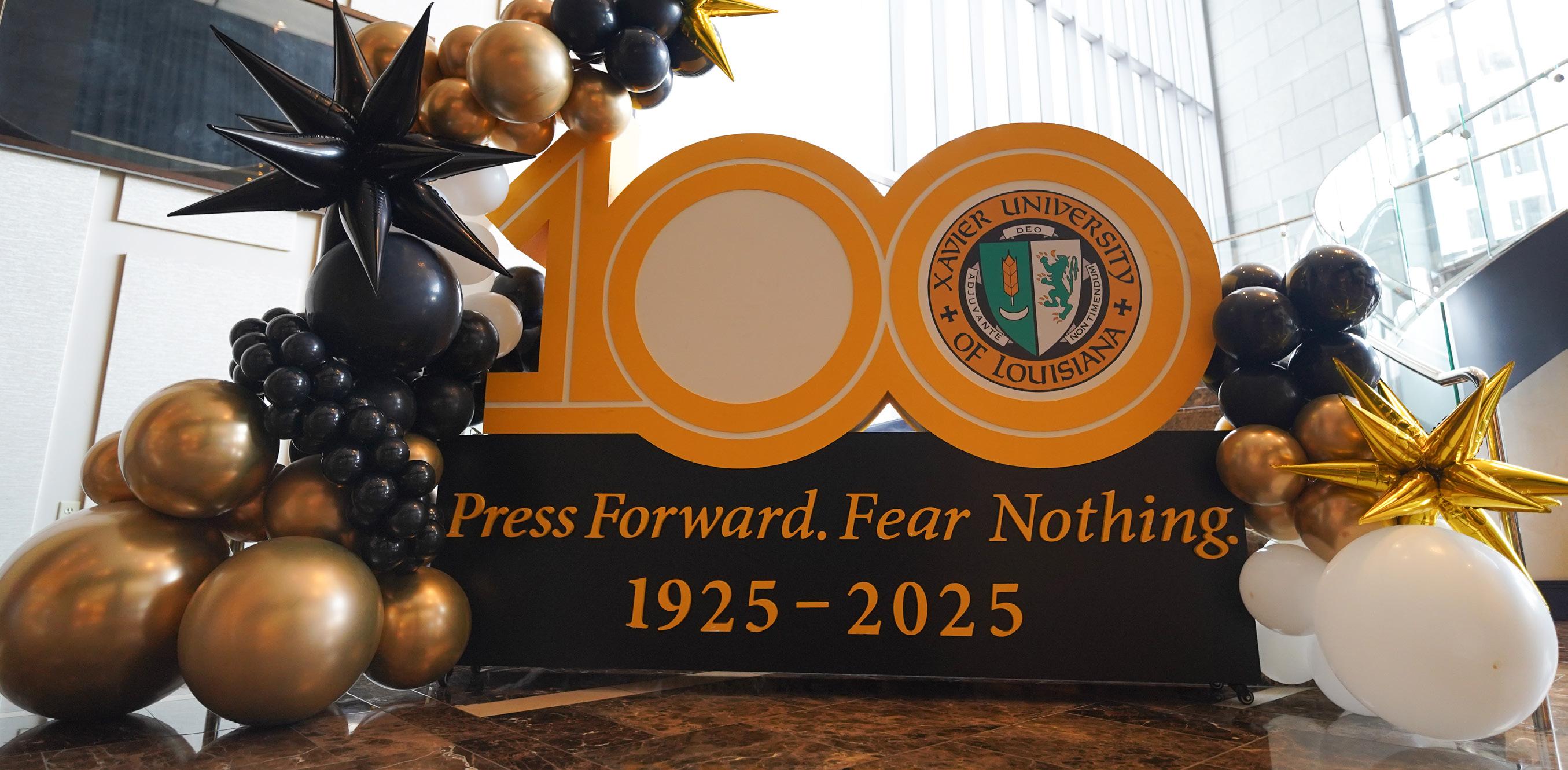
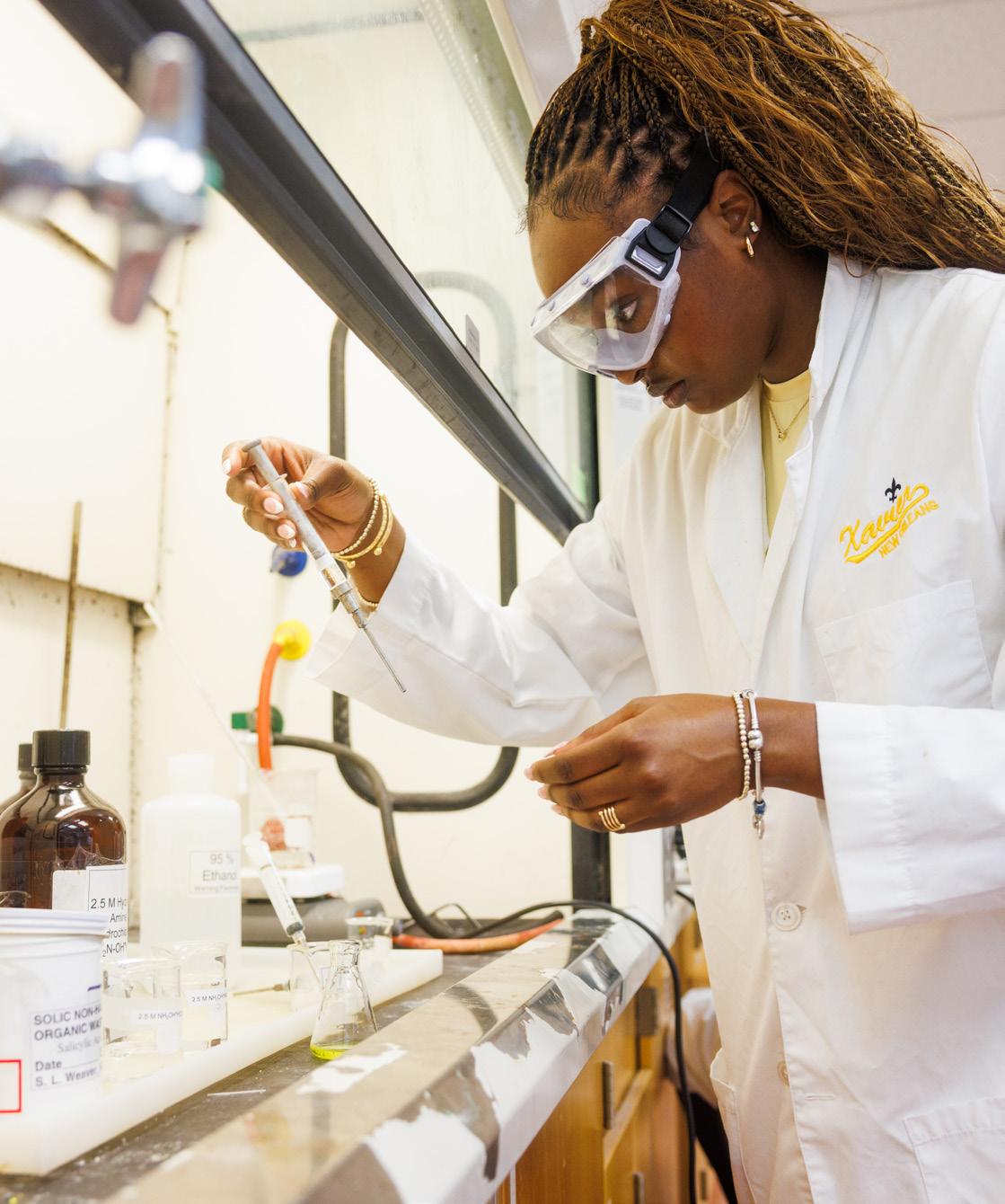
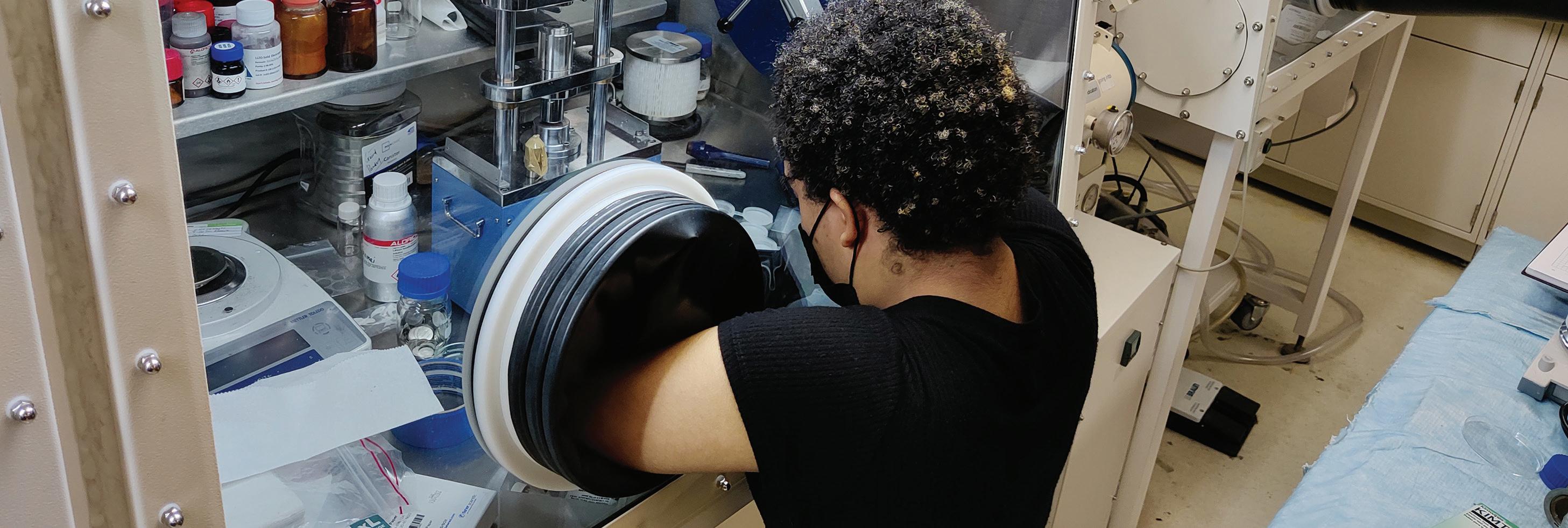
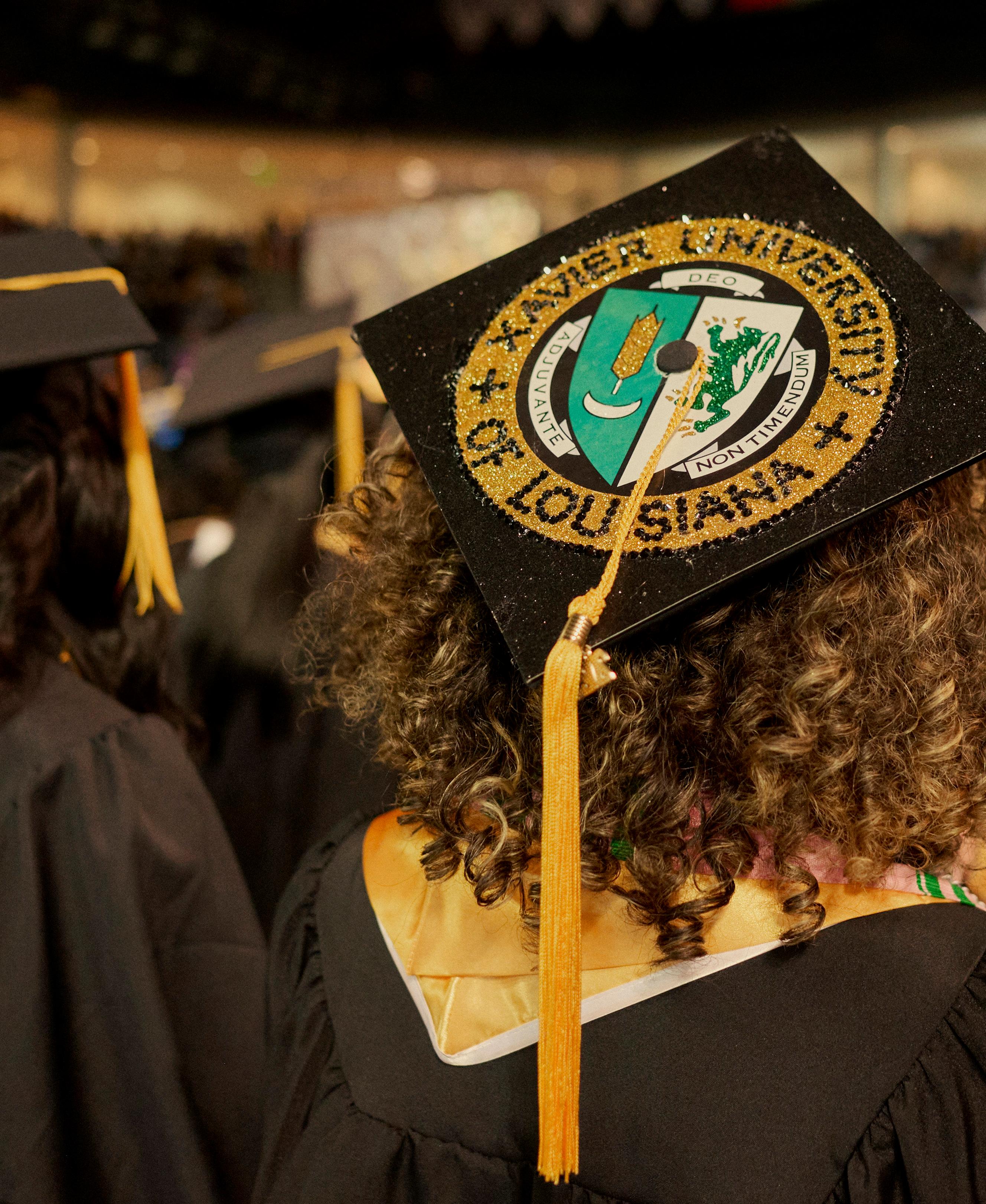
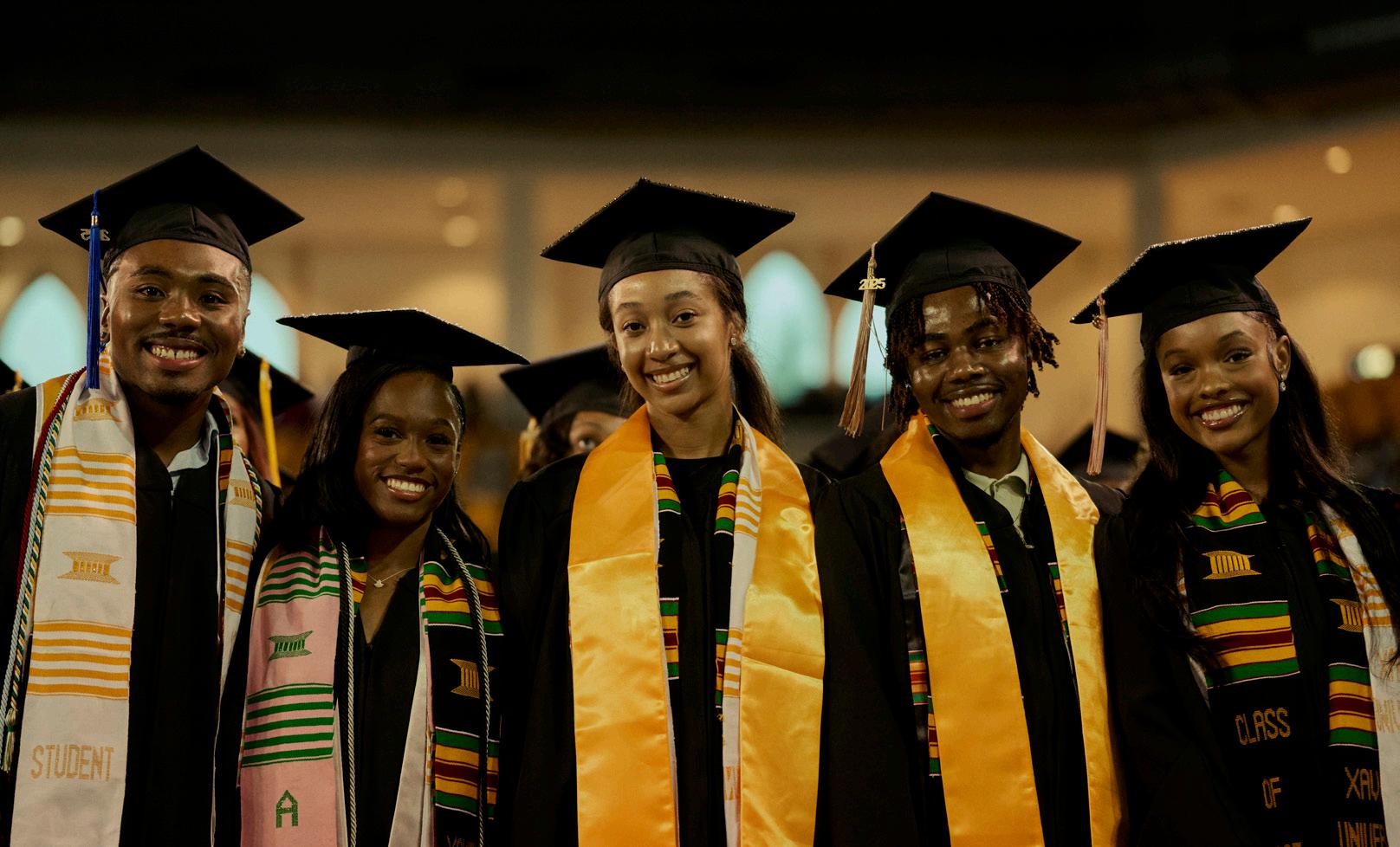
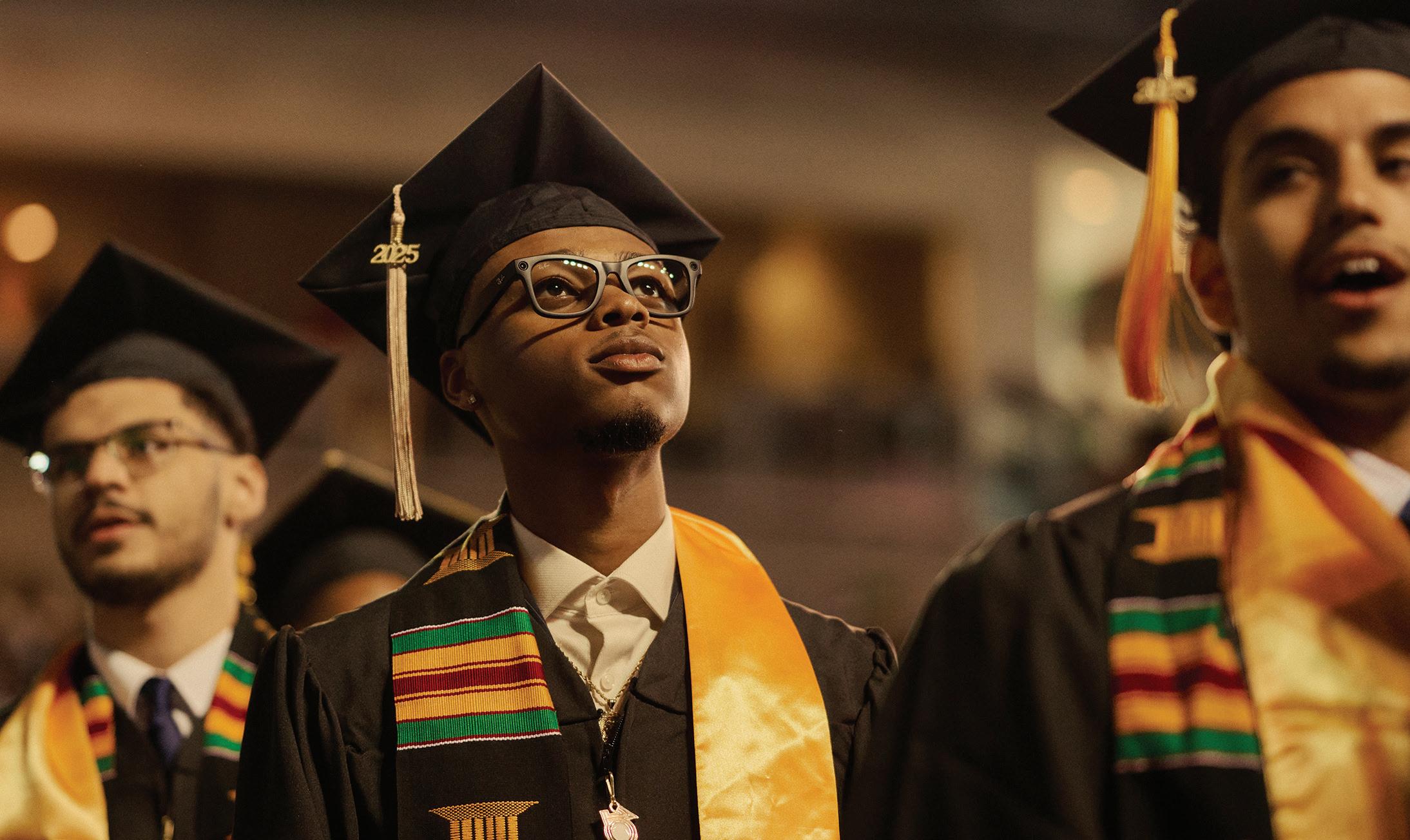
100 Years of Triumph, Resilience, and Black Excellence
No tempest and no troubled waters can drown the brilliance and resilience of a mission built to last.
New
Carnegie Classification
Two new Carnegie classifications laud Xavier as an emerging leader in higher education research.
Xavier Bridges the Speech Pathologist Gap
Xavier University of Louisiana prides itself on creating programs that increase broad representation across industries.
XAVIER UNIVERSITY OF LOUISIANA
At a Glance
2024 - 2025
A 2024 American Association of Medical Colleges (AAMC) report revealed that Xavier maintains its highranking status in sending Black/African American graduates to medical school.
In its 2025 report, college research resource website OnlineU once again recognizes Xavier University of Louisiana as an HBCU which offers one of the highest financial payoffs nationally for Black graduates. Military Friendly designated Xavier as a 2024-2025 Silver Military Friendly School. Xavier was also recognized in the 2024 Best for Vets Colleges rankings released by Military Times.
Xavier is among only 33 institutions awarded illustrious Research and Opportunity Carnegie classifications when designated this year as both a Research College and University (RCU) and an Opportunity College or University (OCU).
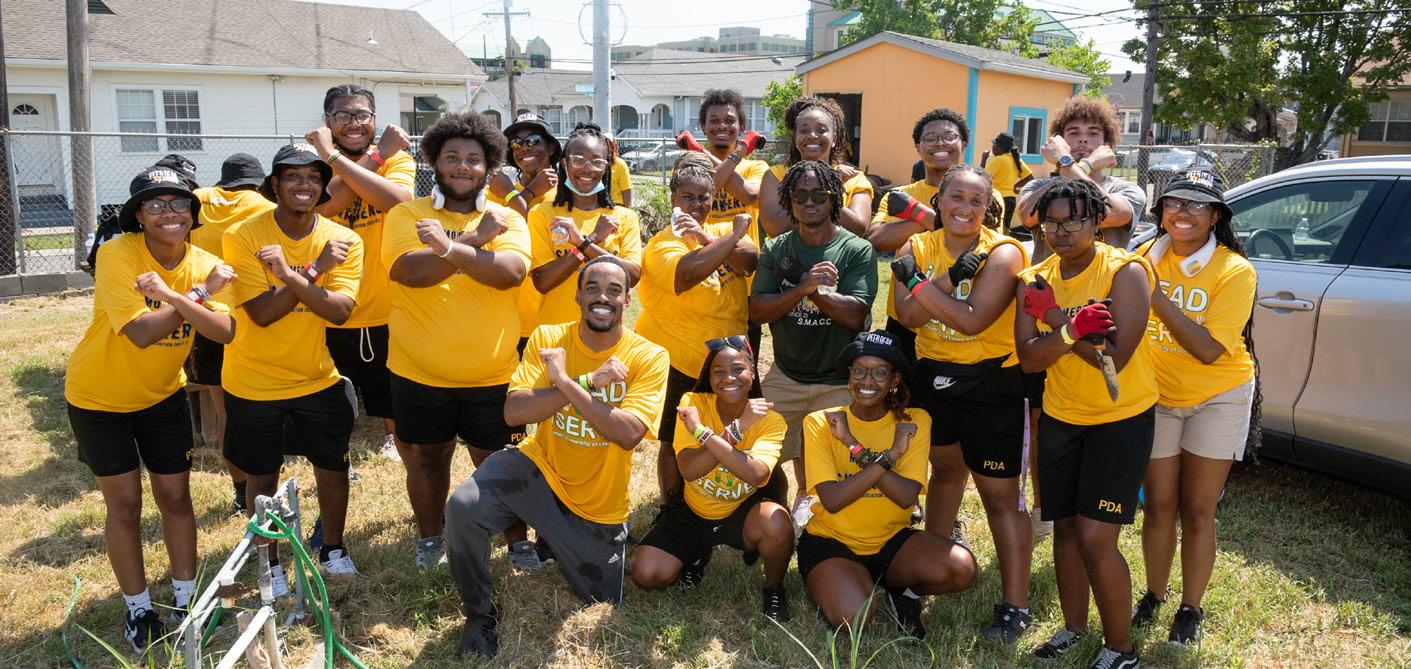
Xavier recognized by The Princeton Review as a top five institution for students most engaged in community service.
Xavier was singled out as one of the nation’s best institutions for undergraduate education by The Princeton Review in the 2025 edition of its “The Best 390 Colleges.”
A UNCF study reports that in 2024, Xavier generated $251.1 Million in total economic impact and 1,933 jobs for its local and regional economies.
HBCU
Xavier was recognized as one of the Nation’s top HBCUs as well as #27 in “Best Value” for “Regional Universities South” by the U.S. News Media Group.
Dear Xavier Community and Friends
As we celebrate this historic centennial year, the stories in this edition of Forward remind us of who we are and, more importantly, who we are becoming. For one hundred years, Xavier University of Louisiana has embodied faith, resilience, and the unshakable belief in excellence. The work featured here shows that the mission entrusted to us by Saint Katharine Drexel is alive in every classroom, lab, stage, and community where Xavierites make their mark.
In these pages, you will see students breaking barriers as the university’s first Truman Scholars, faculty leading groundbreaking research recognized at the national level, and alumni transforming industries from medicine to media. You will read about initiatives that are shaping the next century— such as our new genetic counseling and speech pathology programs. Each story is a powerful reminder that Xavier is not just reflecting on the past, but boldly pressing forward.
The next century of Xavier demands courage, creativity, and collaboration. As we expand research, deepen global engagement, and prepare students for leadership in fields yet to be imagined, we remain rooted in our founding mission: to create a more just and humane society. The resilience that carried Xavier through a century of triumph ensures that our future is limitless.
I invite you to read these stories not only as a celebration of what has been achieved, but as a call to action. Together, we will continue to press forward—fearlessly—toward a future where Xavier’s impact is felt across generations and around the world.
Reynold Verret, Ph.D. President
As we turn the pages of this edition of Forward, we see more than a reflection of where we have been—we see a map of where we are going. The stories within highlight Xavierites who embody excellence, resilience, and purpose. From pioneering research that addresses health disparities, to students whose creativity and leadership are transforming their communities, to alumni who are charting bold paths in business, the arts, and service, each story speaks to the living mission of Xavier University of Louisiana.
Our legacy is not a static one. Just as our founders envisioned education as a transformative force for justice and equity, we too must look ahead with courage and imagination. Xavier is preparing the next generation of leaders who will address global challenges with faith, integrity, and innovation.
As we invest in new academic programs, expand opportunities for research, and strengthen our partnerships across the city, the nation, and the world, we do so with one goal: to ensure that our students are equipped not only to succeed, but to lead.
I encourage you to read these pages as an invitation to celebrate the achievements of our Xavier family, and to join us in building what comes next. The future of Xavier is bright because of the brilliance, commitment, and vision of its people.
Marguerite S. Giguette, Ph.D. Senior Vice President of Academic Affairs and Provost
Is the magazine of Xavier’s research, innovation, and engagement initiatives.
Reynold Verret, Ph.D. President
Marguerite S. Giguette, Ph.D.
Senior Vice President of Academic Affairs and Provost
Phillip D. Adams Vice President of Institutional Advancement
Leslie D. Rose ‘05
Interim Associate Vice President of University Communications
EDITED BY Amaya Woodley
CONTRIBUTING WRITERS
Jalah Bates ’24
Meaghan Walsh Gerard Mitti Hicks
Cierra Johnson
Reenúa Jones
Allissa V. Richardson, Ph.D. ‘02 Alisha Tillery
SPECIAL RECOGNITION:
Anderson Sunda-Meya, Ph.D. Dean of the College of Arts & Sciences
Kathleen Kennedy, Pharm.D. Dean of the College of Pharmacy
Kaneisha Bailey Akinpelumi
Associate Vice President, Office of Research and Sponsored Programs
Jeff A. Hale, Ph.D.
Executive Director of Corporate and Foundation Relations
Ashley Marshall Associate Graphic Designer
Kaye Rolland ‘83 Visual Communications Specialist
PHOTOS COURTESY OF SUBJECTS AND BY Steve Cohn, Darrin Defillo, Veronica Farve, Joe Gaylor, Cierra Johnson, Leslie D. Rose, Jeremy Tauriac, Ibim Cheetham-West, and Jim Young.
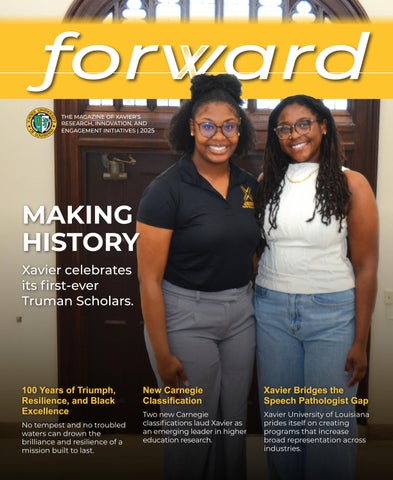
On the Cover: (L to R) Aarinii Parms-Green and Keziah-Yvonne Smith are Xavier’s first-ever Truman Scholars.
Two Xavierites Become Only HBCU Students Selected as 2025 TRUMAN SCHOLARS
By Cierra Johnson Graduate Programs Marketing and Communications Specialist
Photos by Veronica Farve
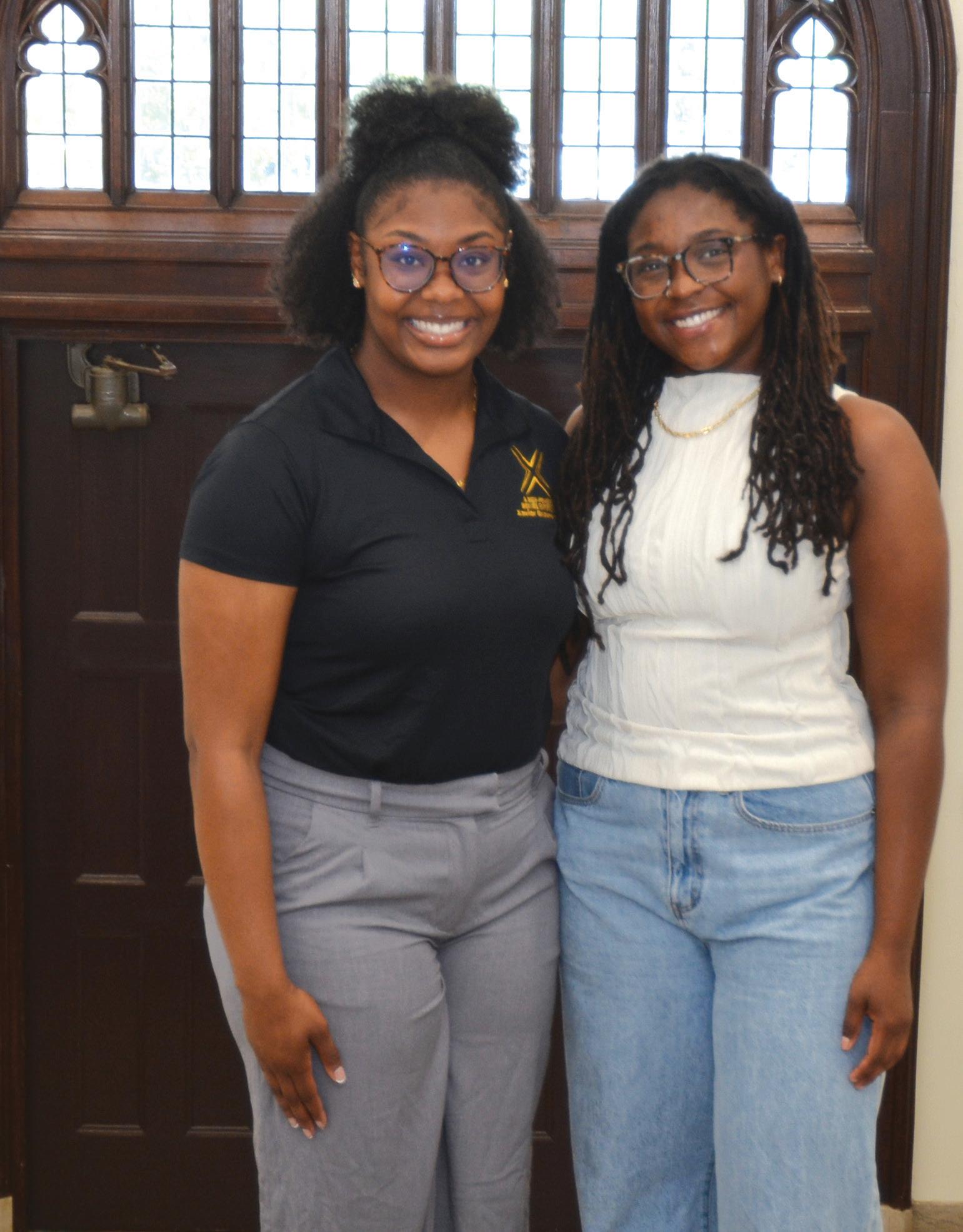
Xavier University of Louisiana has encouraged its students to pursue academic excellence and strive toward their career aspirations for a century. Oftentimes, this pursuit of excellence is acknowledged and rewarded by those who recognize the path that Xavier students are on. As such, two Xavierites, KeziahYvonne Smith and Aarinii Parms-Green, have been announced by the Harry S. Truman Scholarship Foundation as two of the 54 college students selected as 2025 Truman Scholars. This marks the first time Xavier students have been selected for the scholarship. Smith and Parms-Green are the only HBCU students to earn this year’s designation.
“What an honor that two Xavier students have been selected as 2025 Truman Scholars,” said Reynold Verret, President of Xavier University of Louisiana. “For 100 years, Xavier has produced students who have gone forth to shape the world and create a more just and humane society. Keziah and Aarinii are shining examples of what Xavierites do. We are immensely proud and look forward to their accomplishments.”
aspiring public service leaders in the United States. Established by Congress in 1975 as the living memorial to President Harry S. Truman and a national monument to public service, the Truman Scholarship carries the legacy of the United States’ 33rd President by supporting and inspiring the next generation of public service leaders. Truman Scholars demonstrate outstanding leadership potential, a commitment to a government or nonprofit career, and academic excellence. Each Truman Scholar receives funding for graduate studies, leadership training, career counseling, and special internship and fellowship opportunities within the federal government.
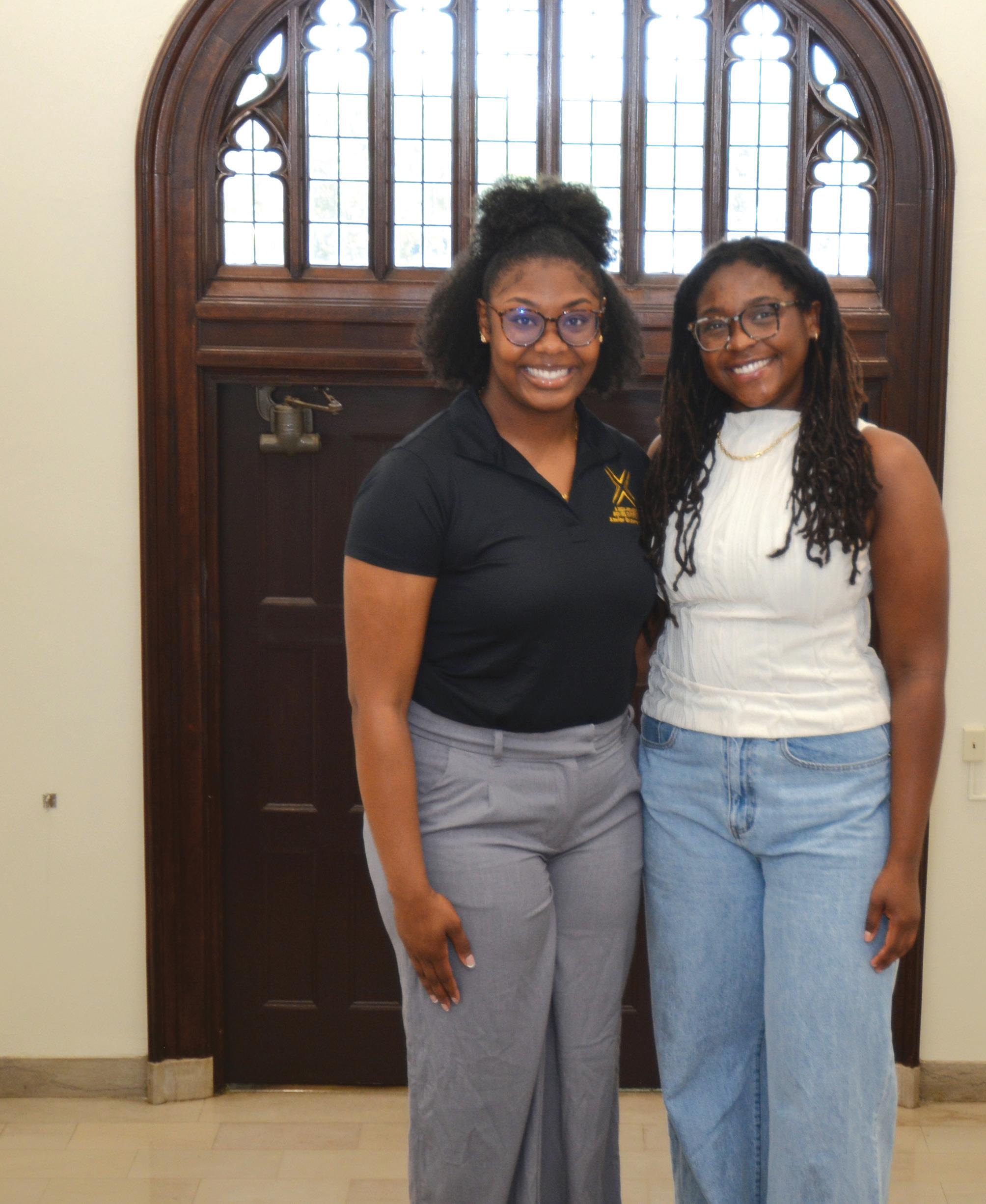
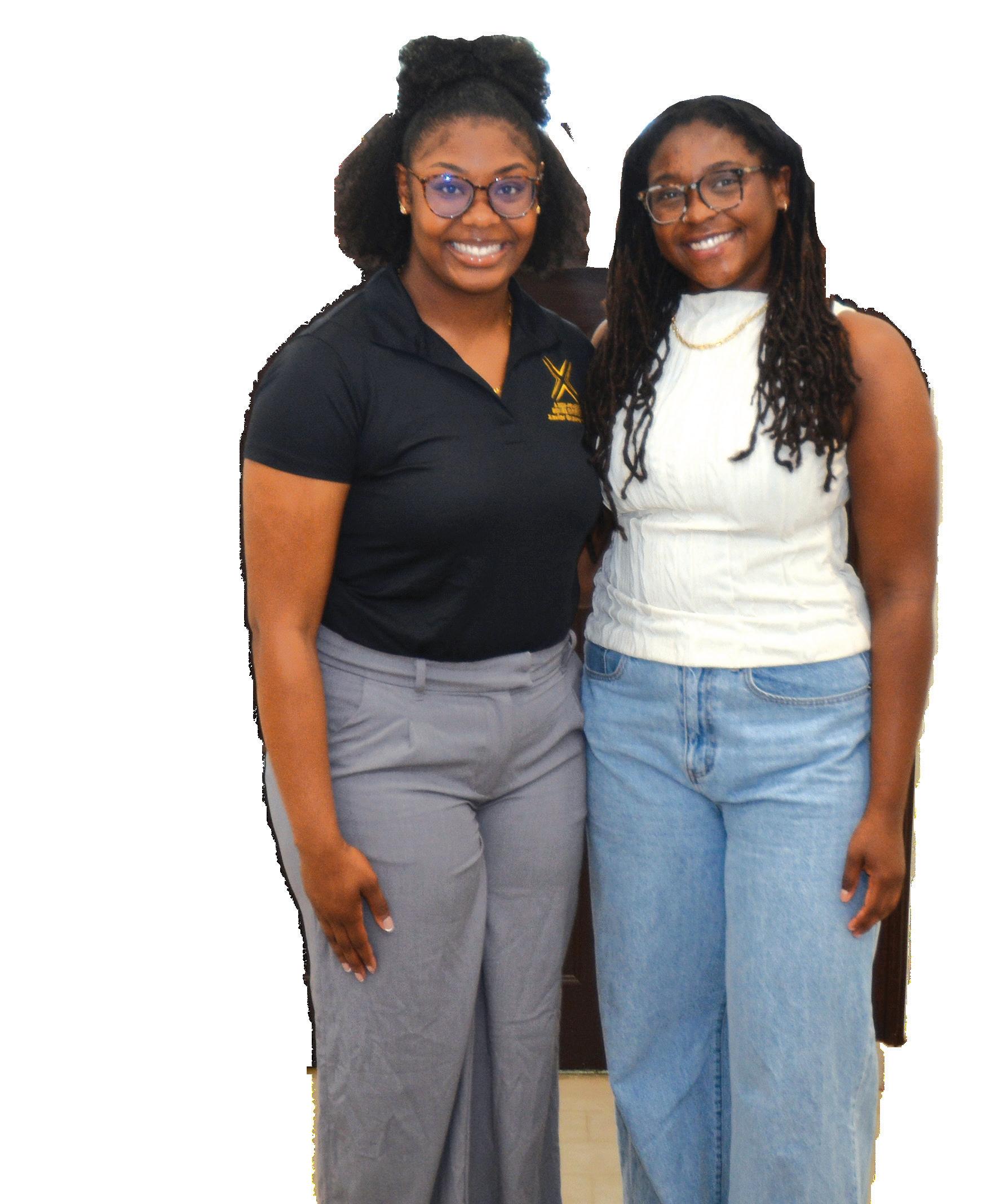
L to R: Aarinii Parms-Green and Keziah-Yvonne Smith
“Aarinii and Keziah both embraced public service from an early age and at Xavier, their commitment to making a difference in society flourished and grew,” said Dr. Shearon Roberts, associate dean for Xavier’s Exponential Honors Program and associate professor of Mass Communication. “It is only fitting that they would both be selected as Xavier’s first Truman scholars in our centennial year because they both exemplify Xavier’s mission.”
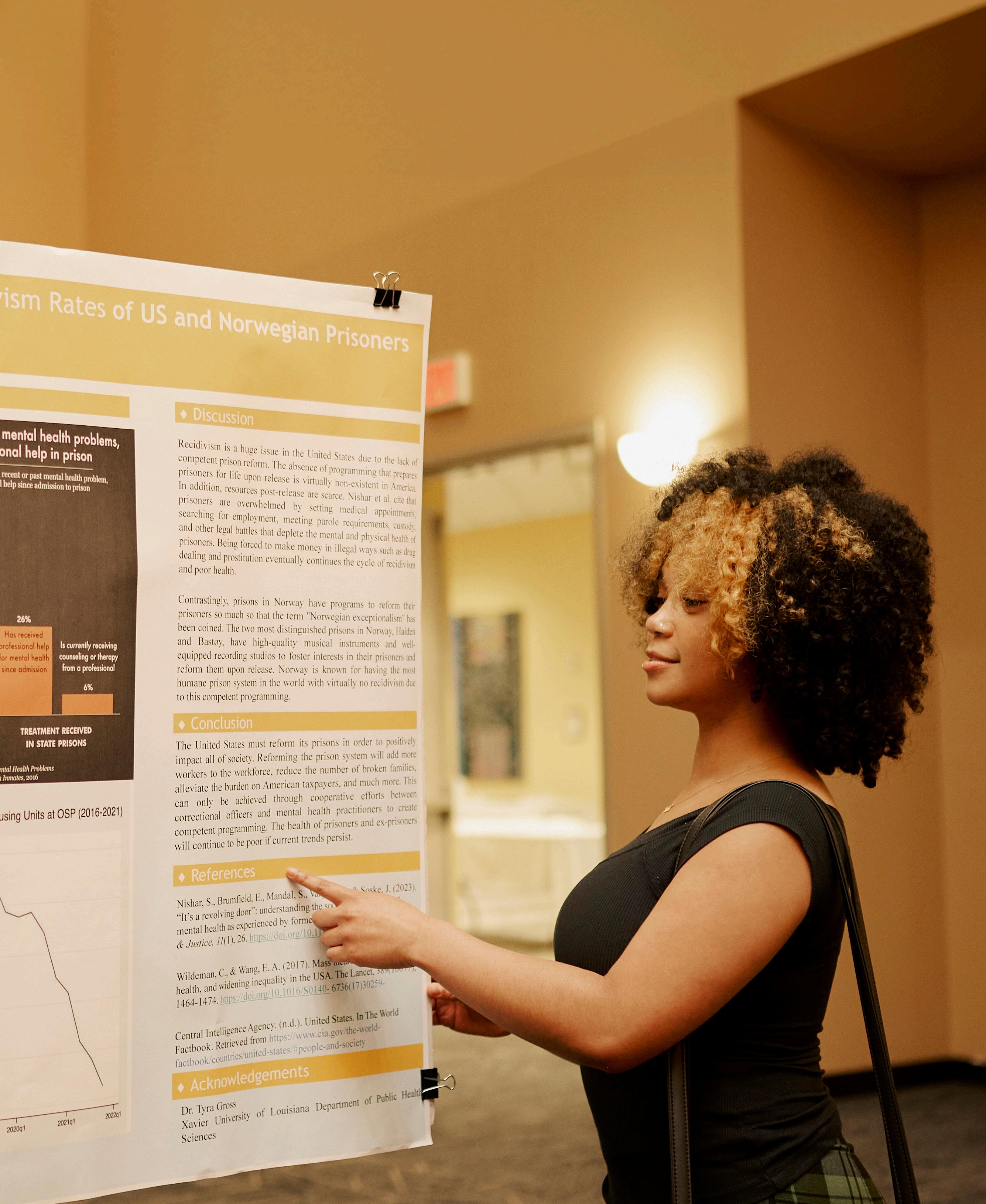
Aarinii Parms-Green is a junior double major in political science and psychology with a minor in history. Keziah-Yvonne Smith is also a junior Political Science major with a minor in Mass Communication. They are both a part of Xavier’s Exponential Honors Program, where they have reportedly emerged as leaders in their respective pursuits, building coalitions that can advance social justice. For Parms-Green, she was one of the main student contributors involved in Xavier’s first-place win in the Department of Homeland Security’s Invent2Prevent Competition, with the project focusing on improving the relations between Black and Jewish communities. For Smith, her work has involved advocating for the rights of formerly incarcerated individuals.
The students were excited about their selection as Xavier University of Louisiana’s first Truman Scholars.
“I am so beyond excited and proud to announce that I have been selected as one of Xavier University of Louisiana’s FIRST-EVER Truman Scholars along with Aarinii Parms-Green!” Smith wrote in a LinkedIn post. “We are the only two selected from an HBCU. We are now joining some of the brightest and most dedicated minds in public service. I am so excited to be a part of this special group of people and continue my fight for voting justice!”
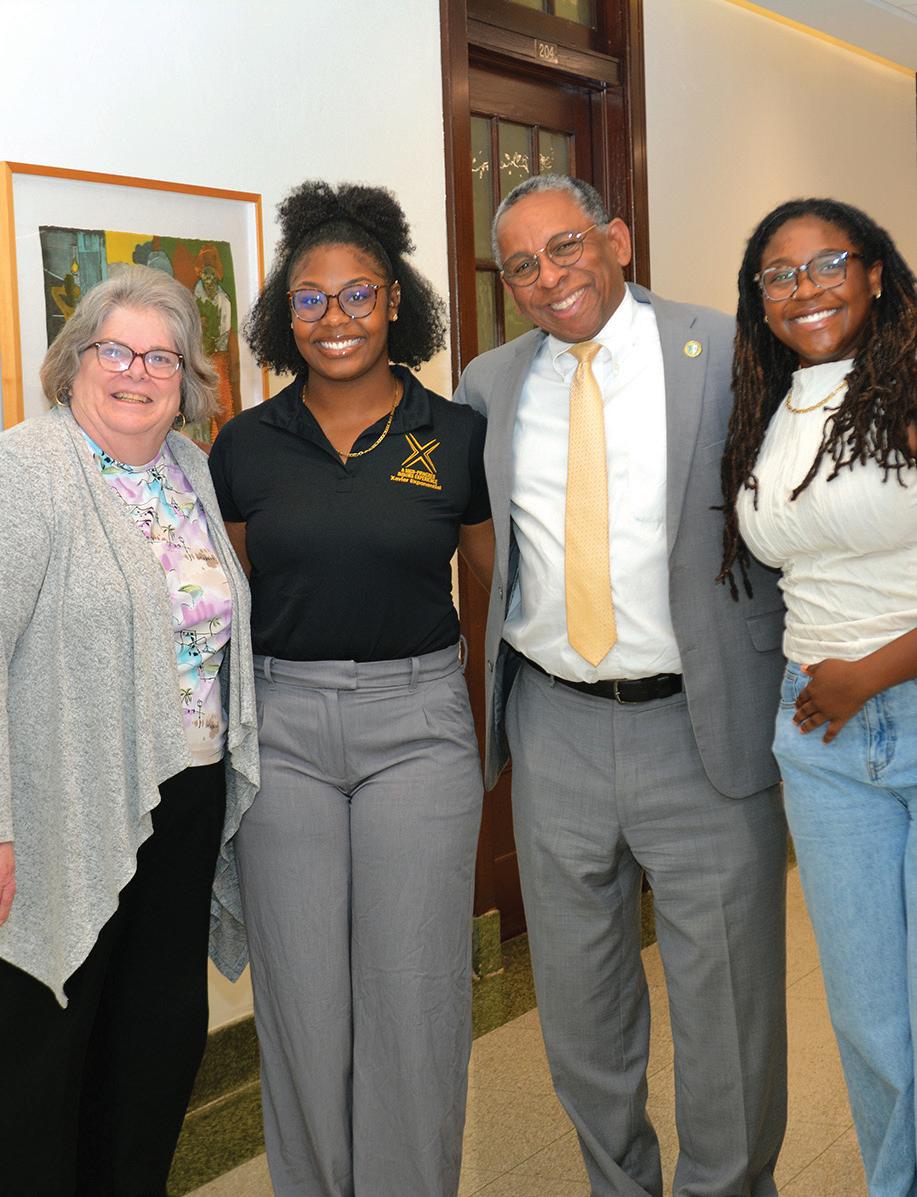
L to R: Marguerite S. Giguette, Ph.D., Aarinii Parms-Green, Reynold Verret, Ph.D., and Keziah-Yvonne Smith
“Truman Scholars demonstrate outstanding leadership potential, a commitment to a government or nonprofit career, and academic excellence.”
Xavier University of Louisiana
100 Years of Triumph, Resilience, and Black Excellence
By Allissa V. Richardson, Ph.D. ‘02
Contributing Writer
Xavier University of Louisiana was born in a world that often tried to wash away Black ambition, yet it has stood firm—weathering the storms of segregation, inequality, and even the floodwaters of Hurricane Katrina. Like a mighty current carving its way through stone, Xavier has persisted, shaping generations of leaders, healers, and advocates for justice. Now, as it celebrates 100 years, its legacy is clear: no tide, no tempest, and no troubled waters can drown the brilliance and resilience of a mission built to last.
A hundred years is never guaranteed, after all. For Xavier University of Louisiana, reaching this centennial was not inevitable—it was earned through faith, perseverance, and an unshakable commitment to excellence. Today, as the university celebrates 100 years of transforming lives, it stands as a symbol of what is possible when faith, education, and community
converge. This centennial is more than a milestone—it is a victory. A victory over the forces of history that once sought to deny Black students an education. A victory over the elements that tried to wash away a legacy. A victory for every student who has walked through Xavier’s halls and emerged as a leader, healer, and change-maker.
For a century, Xavier has been more than a university. It has been a movement—a beacon of Black excellence, a champion of justice, and the foundation for a brighter future. Founded by Saint Katharine Drexel to provide opportunities where there were none, Xavier has shaped the course of history, sending generations of Black professionals into medicine, law, education, and advocacy. Now, as we honor this centennial, we don’t just celebrate 100 years of existence—we celebrate 100 years of triumph.
A Legacy That Could Not Be Washed Away
When Hurricane Katrina devastated New Orleans in 2005, it could have been the end. The floodwaters swallowed nearly 70% of Xavier’s campus, destroying classrooms and making dormitories uninhabitable. Other institutions might have shuttered permanently, but Xavier refused to fall. Through sheer resilience and an unwavering belief in its mission, Xavier rebuilt, rebounded, and
returned stronger than ever. Xavier’s origins are rooted in an audacious idea: that Black students in the segregated South deserved access to a world-class education. When Saint Katharine Drexel, a Catholic heiress who rejected wealth in favor of service, founded Xavier in 1925, she did so in direct defiance of a society built on exclusion. Xavier became the first and only historically Black Catholic university in the nation, offering academic training and a sense of purpose and belonging.
From the very beginning, Xavier students were expected to lead. And lead they did. Xavierites became doctors, pharmacists, civil rights lawyers, educators, and activists. Under the leadership of Dr. Norman C. Francis, the university’s longest-serving president, Xavier expanded into a national powerhouse, producing more Black medical school graduates than any other institution.
Then, in 2005, Hurricane Katrina struck, threatening to erase nearly a century of progress. In the storm’s aftermath, many questioned whether Xavier could survive. Instead, it defied the odds. Within just months, students returned, classrooms reopened, and Xavier recommitted itself to its mission with even greater urgency.
Black Excellence in STEM: Xavier’s Unmatched Legacy in Medicine and Science
For decades, Xavier has led the nation in producing Black doctors, scientists, and pharmacists. It is a leading producer of Black students who go on to complete medical school, a statistic that speaks to its unparalleled commitment to academic rigor and mentorship.
The numbers alone tell a powerful story, but behind those statistics are real lives transformed. Xavier graduates have gone on to become groundbreaking researchers, chief medical officers, and public health leaders. Dr. Regina Benjamin, a Xavier alumna, served as U.S. Surgeon General, advocating for health equity across the nation. Dr. Pierre Johnson, an OBGYN and co-author of “Pulse of Perseverance,” credits Xavier with giving him the confidence and preparation to excel in a field where Black doctors remain underrepresented.
The university’s impact extends beyond the medical field. Xavier has also produced leaders in biomedical research, environmental science, and engineering, fields where Black representation has historically been minimal. Through initiatives like the Xavier-LSU Biomedical Collaborative and its STEM Scholars Program, the university continues to break barriers, ensuring that the next century of scientific advancement includes Black innovators at the forefront.
A Mission Rooted in Faith, Service, and Justice
At Xavier, education has never been just about personal success—it has always been about service and justice. The university’s Catholic roots, infused with the teachings of Saint Katharine Drexel, emphasize that knowledge must be used for the betterment of communities.
Xavier students and alumni have consistently been at the forefront of social change. From the civil rights movement to today’s battles for voting rights, health equity, and environmental justice, Xavierites have used their education as a tool for activism. Alumni including Judge Carl Stewart, the first Black chief judge of the U.S. Fifth Circuit Court of Appeals, have redefined justice from the bench, while countless Xavier-trained doctors have worked to eliminate racial disparities in healthcare.
Even in the aftermath of Katrina, Xavier’s students didn’t just rebuild their university—they helped rebuild New Orleans. They worked in hospitals, volunteered in devastated neighborhoods, and advocated for policies that protected vulnerable communities from future disasters.
The Xavier mission is clear: education must be a force for good. As the university embarks on its next century, that mission is more vital than ever.
The Next 100 Years: A Future Fueled by Innovation and Purpose
Xavier’s centennial is not just a celebration of the past—it is a launching pad for the future. The university is expanding its reach,
ensuring that the next generation of Black scholars has access to the best opportunities available.
Xavier is deepening its commitment to producing Black leaders in biotechnology, artificial intelligence, and climate science, ensuring that Black excellence shapes the industries of tomorrow. At the same time, the university is expanding its global impact, increasing opportunities for students to engage in international research, medical missions, and study abroad programs, preparing them for leadership on a global scale.
Xavier also remains a catalyst for change through new initiatives focused on economic empowerment, environmental justice, and health disparities, reinforcing its long-standing mission of equity and advocacy. Xavier’s resilience over the past century proves one thing: its impact is unstoppable.
A Centennial of Triumph, A Future Without Limits
One hundred years ago, Xavier University of Louisiana was founded on faith and an unshakable belief in Black potential. One hundred years later, it stands as one of the most influential HBCUs in the country, a leader in STEM education, a champion of social justice, and a symbol of resilience.
Hurricane Katrina could have ended our story. It didn’t. Because Xavier is more than a university—it is a legacy. A force. A promise to every Black student that their dreams are valid, their potential is limitless, and their future is theirs to claim.
As Xavier embarks on its second century, one thing is clear: the best is yet to come.
XAVIER RANKED A TOP INSTITUTION FOR STUDENTS MOST ENGAGED IN COMMUNITY SERVICE
Xavier University of Louisiana was singled out as one of the nation’s best institutions for undergraduate education by The Princeton Review in the 2026 edition of its “The Best 391 Colleges” publication. The publication recognizes Xavier as a top institution nationally for students who are most engaged in community service.
The university, founded upon the mission of promoting a more just and humane society through preparing students for leadership and service roles, has historically been infused with a spirit of community commitment. Volunteer hours are not a graduation requirement at Xavier, yet the student body averages between 16,000 and 20,000 service hours each academic year.
Mobilization at Xavier, or M.A.X., a coalition of students who promote social awareness and social responsibility through community service, works to source volunteer opportunities and helps students track their service hours.
Generations of Xavierites recognize service as professional and cultural development, as well as a way to form meaningful connections with their community. Jeanine Hall ’03, a clinicianscientist working as a pediatric emergency medicine physician, studied biology premed at Xavier. While an incredibly rigorous course of study, she regularly made time to serve.
“Community service is at the heart of Xavier,” Hall said. “Serving in the community where I attended school helped me feel connected to that community. It would not be until later in life that I realized that volunteering at Xavier was a formidable time in my life. It ignited the desire to serve in many capacities within my professional and personal life.”
By Leslie D. Rose ’05 Interim Associate Vice President of University Communications
The culture of care for the community remains ever-present at Xavier, with students volunteering in projects focused on advocacy, philanthropy, environment, animal welfare, health and wellness, youth education, hunger, homelessness, disaster relief, mentoring, and elder care.
Yara Bou Harb, a senior neuroscience major with a double concentration in biology and chemistry, said that service is at the heart of Xavierites of all generations.
“Xavier University of Louisiana produces true leaders more than any other institution. I claim so because service is ingrained in our mission, in our image, and in the way the institution raises up leaders,” Bou Harb said. “No leader would be successful without serving the community in which they lead. Service to me means that I get to raise up my community and meet their needs, however small or large they may be. I serve with a lot of pride because I get to witness alumni serve our student body so selflessly. Service is the true identifier of a leader, and being a Xavierite comes with an innate drive to serve, making us Xavierites the most perfect leaders to carry on the mission that our institution has set out to accomplish.”
In the 24-25 academic year, the student body logged 21,361 service hours, including work on a community garden, food insecurity projects, and independent hours outside of M.A.X. and student clubs and organizations.
Xavier is proud to be recognized in the community service category, a notion a century in the making for the university, celebrating 100 years of excellence.
Xavier University Launches the CLEAN ENERGY & SUSTAINABILITY INSTITUTE
By: Alisha Tillery Contributing Writer
Raising the bar to ensure we have a viable and future-forward environment, Xavier University of Louisiana launched its Clean Energy and Sustainability Institute in Fall 2024. Introduced by the Office of Research and Sponsored Programs, the initiative is led by Asem Abdulahad, Ph.D., associate professor of chemistry and director of the XULA-UChicago PREM. Dr. Abdulahad said the Institute will be an asset to the university and the community by championing interdisciplinary thought and practice among faculty and staff.
“Looking across our campus, we have so many talented faculty, staff, and students who are already doing so much meaningful work through their research and community engagement,” Abdulahad said. “Leading this institute is all about facilitating the work that we are doing and working to expand and publicize that work.”
This work is critical and essential due to environmental justice’s direct effects on the public.
“Traditionally, we [Black Americans] have been at the bottom of the pole [in sustainability]. When private industries or the government decide to erect a power plant or dig up oil—it ends up impacting our communities first before it impacts anyone else negatively,” Abdulahad said. “This is the future–the future of our economy and our jobs. If we don’t have clean sources of energy, if we can’t work in the clean energy economy, we can’t be environmentally sustainable.”
The institute focuses on four primary areas that require collaboration from faculty and staff, including: (1) incorporating clean energy and sustainability topics within the curriculum, (2) policy and advocacy work, (3) working with the community to help build economic resiliency, and (4) sustainability-related research.
Although Xavier already has student organizations that focus on sustainability, such as the Chemistry Club, the Biology Club, and Gumbo Garden, other opportunities can capitalize on existing knowledge and experiences that directly impact students.
The institute is still in its infancy stages, yet has made immediate gains to advance its mission. It was selected as one of only 21 institutions nationwide by the Carnegie Foundation for the Advancement of Teaching and the American Council of Education
(ACE) to be part of the new Carnegie Elective Classification for Sustainability pilot phase designed to recognize higher education institutions that embed sustainability and climate action into their core missions. The Carnegie Foundation and ACE developed the Sustainability Elective Classification to support thriving, sustainable communities for generations through culturally, regionally, and contextually informed efforts.
“This is an excellent opportunity for us to learn other institutional approaches to campus sustainability and to share what we are doing at Xavier,” Abdulahad said.
The institute is working on a Faculty Learning Community (FLC) focused on infusing curriculum with courses that incorporate sustainability and clean energy topics. Primarily funded by the Greater New Orleans Foundation, some funds from the National Science Foundation’s PREM program will support a forthcoming K-12 educational outreach initiative.
Faculty have submitted proposals to create or modify existing courses to elevate clean energy and sustainability curricula.
“The most exciting aspect of this FLC for me is that most of the course proposals are for core classes,” Abdulahad said. “The group is interdisciplinary with contributions from departments in the Humanities, Social Sciences, and our Physical/Biomedical Sciences.”
Proposals for additional classes include Chemistry, Global Food and Water Security (Chemistry), and Determinants of Health: Public Health and Biological Implications of Clean Energy and Sustainability (Biology). Additionally, these proposals include more opportunities, including research and funding options for students.
Xavier continues to embed its mission to create a more just and humane society in all facets of its institution for the greater good.
“It’s important for us to make sure we take care of ourselves, make sure we take care of the next generation,” Abdulahad said. “If we can lead them to the right education, prepare them for real jobs that we don’t even know exist yet, in an economy that has to include environmental responsibility and sustainability, then that’s going to look good for them.”
Xavier University of Louisiana
Among Only 33 Institutions
Awarded Illustrious Research and Opportunity
CARNEGIE CLASSIFICATIONS
By: Cierra Johnson Graduate Programs Marketing and Communications Specialist
The Carnegie Commission on Higher Education’s Carnegie Classification has added a double stamp of excellence to Xavier, making it among a few institutions to achieve such a distinction. While relatively small —awarding about 700 degrees annually —Xavier’s mighty impact does not go unnoticed. With Carnegie’s new designations, it has achieved research and opportunity accolades similar to those previously given to larger colleges and universities. Designated this year as both a Research College and University (RCU) and an Opportunity College or University (OCU), these two new Carnegie Classifications laud Xavier as an emerging leader in higher education research and as a provider of access to its students. This makes Xavier among only 33 institutions with both RCU and OCU designations.
“Receiving the Carnegie RCU designation is a testament to the hard work and dedication of our faculty, staff, and students. This recognition highlights the relentless efforts of those here at Xavier to push the boundaries of knowledge and innovation, and it affirms that our research initiatives are not only growing but making a significant impact on a larger scale,” said Marguerite S. Giguette, senior vice president and provost at Xavier University of Louisiana. “We are also honored to be recognized as an Opportunity College and University, which shows Xavier’s capacity for promoting success for our students, an achievement that we have done for the last 100 years and will continue to do for the next century.”
federal funding or doctoral degree production. The RCU designation is a new classification created to acknowledge historically unrecognized institutions for their research contributions, now designating 216 universities.
Xavier’s RCU designation highlights the strength of its expanding research infrastructure. Previously, the university held a Carnegie Classification as a Master’s College and University: Medium Programs. Due to the expansion of research activity, the newest designation signifies that the university is among the 26 HBCUs that spend at least $2.5 million on research and development, making it a premier research institution.
In 1970, the Carnegie Commission on Higher Education began developing a classification system for colleges and universities to support its research and policy analysis program. The framework was first published in 1973 and has since been updated every three years to reflect changes among institutions. The Carnegie Classification is the leading framework for recognizing and describing institutional diversity in U.S. higher education.
Earlier this year, Carnegie unveiled its redesigned research activity designations for U.S. higher education institutions.
The new classifications reflect a more inclusive, transparent approach to recognizing colleges and universities’ diverse and expanding research landscape nationwide. Among the changes, the new criteria offer more precise categorizations, emphasizing the breadth of research activities rather than focusing solely on
Xavier’s recognition in this category also reflects the university’s broader vision for growth in critical areas of community development, such as public health, science, and education. The university’s research has been driven by this deep commitment to advancing social good, and this designation further highlights that ongoing mission. The designation was determined by the university’s $15,519,000 in research expenditures in 2023 and the research doctorates it has awarded in recent years.
The OCU designation is based on the Student Access and Earnings Classification, which is determined first by students’ access to an institution and, subsequently, by how much they earn relative to their peers in the labor market after leaving the institution. To determine access, Carnegie evaluates whether institutions enroll a student population representative of the locations they serve. For this, Carnegie uses undergraduate
enrollment by Pell Grant status (indicating that students come from lower-income households) and undergraduate enrollment from underrepresented racial and ethnic groups, compared with the demographics of the areas that institutions serve.
To determine earnings, Carnegie evaluates the median earnings of undergraduate students eight years after they enter an institution, comparing them with those of a similar population in their home locations. The IPEDS (Integrated Postsecondary Education Data System) data used by Carnegie to evaluate access revealed that 52% of Xavier’s undergraduates received Pell Grants and that 96% of Xavier’s undergraduates were from underrepresented racial/ethnicities. The College Scorecard data used by Carnegie to evaluate earnings showed that, eight years after enrollment, the median income of Xavier students was 79.3% higher than the median earnings of a similar population in the locations from which the students came.
The Student Access and Earnings Classification calculations underscore Xavier’s commitment to providing access in the areas it serves (Higher Access), coupled with comparatively higher median earnings for students who enroll at Xavier (Higher Earnings). This culminated in Xavier’s recognition as an OCU,
the highest possible Carnegie Student Access and Earnings Classification. The institutions in this category can be a model for Carnegie to study how campuses can foster student success. This new classification and the RCU designation highlight Xavier’s ability to provide a rewarding pathway for its students through access, research, and future earning opportunities.
“This success Xavier fosters would not be possible without the faculty and staff who are integral to the institution,” Giguette said. “It does not happen in a vacuum. It is dependent on the research our faculty conducts and the work they do with our students. That is what makes Xavier who we are.”
For the Carnegie Classifications, the data used to reach these designations highlight Xavier University of Louisiana’s long tradition of preparing its students to assume leadership and service roles in a global society. In its centennial year, the university’s storied legacy lives on in everyone who has had the opportunity to walk its halls. While each student who chooses Xavier has a different path, in most cases, the outcome is the same: success.
Pioneering Healthcare Equity through Technology
Ebenezer Nyenwe, a bioinformatics student at Xavier, is at the forefront of healthcare innovation. Nyenwe, the founder and CEO of Electronic Record Bias Detection (ERBD), is working on a cutting-edge health technology solution for detecting bias in electronic health information. His interest in this field was sparked by his early observations of discrepancies in healthcare access and treatment, particularly among vulnerable people.
Nyenwe’s engagement in the HBCU Partners Initiative reinforced his understanding of healthcare equity disparities. This program gave him the resources and mentorship necessary to refine his idea into a tangible product. ERBD seeks to evaluate electronic health records and produce reports identifying potential patient care biases. The goal is to deliver actionable information that allows healthcare practitioners to correct inequities in real-time.
As the leader of ERBD, Nyenwe spends his days securing funding, fostering relationships, and developing the minimum viable product, a project management development strategy to introduce new products for early adopters.
“My day-to-day looks different every day,” Nyenwe explained. “I tend to spend most of my time looking at funding opportunities and ways to make sure that the company can get access to more capital and relationships.”
Like any entrepreneur, Nyenwe has faced significant challenges. He has encountered setbacks, from securing funding to refining the accuracy of ERBD’s bias detection algorithm. However, he views each challenge as an opportunity for growth.
SCHOLAR
“It’s not always easy when you’re trying to explain this concept, and you are seeing rejections,” he said. “But I take the criticism, I take the feedback, and I apply it to the product or how I market the product idea.”
One of Nyenwe’s most rewarding milestones was generating his first bias reports. Although the early iterations were not perfect, they demonstrated the potential of ERBD to revolutionize healthcare accountability.
“I remember when I was able to generate some of my first biased reports, and even though they weren’t 100% what I wanted them to be, just being able to say that I have something that can take in a healthcare record and create an analysis that might be useful to the industry—that was a very exciting moment for me.”
Nyenwe credits much of his success to the nurturing environment of Xavier’s Exponential Honors Program. The program encouraged him to push the boundaries of traditional healthcare roles and explore innovative solutions beyond clinical practice. Key mentors, including Shearon Roberts, Ph.D., played a pivotal role in guiding him through the complexities of grant applications and business development.
“Dr. Roberts was one of the first people I came to about the idea for ERBD. She was on the original grant application along with Mr. Mark Quinn and Dr. Matthew Hayes.”
His interdisciplinary education at Xavier, which combined technical expertise with the social sciences, has equipped him with a holistic perspective on healthcare innovation.
“I came to Xavier thinking that the best I could do in healthcare was to become a doctor,” Nyenwe reflected. “But taking computer science courses and being exposed to different disciplines showed me that there is more to do in healthcare and that I can bring about change outside of clinical practice.”
Looking ahead, Nyenwe aims to refine ERBD’s algorithm, secure additional funding, and collaborate with healthcare institutions to test and implement the technology on a larger scale. His vision extends beyond ERBD—he plans to further his education in health informatics or public health while potentially pursuing a medical degree.
“The next big step for ERBD is to test the product and make it a better algorithm,” he shared. “Right now, I’m developing the first version myself, but I want the next phase to be well-funded so I can bring in public health specialists and equity experts to enhance the analysis.”
Nyenwe is not only producing a product with ERBD; he is also defining the future of healthcare equity. His work demonstrates the strength of creativity and tenacity and the influence that a single determined individual can have on an entire sector.
HIGHLIGHTS
By Jalah Bates, ‘24 Contributing Writer
Crafting A Legacy in Sports Media
For Zora Thomas, the path into sports journalism was not about waiting for opportunities to present themselves but about figuring out how to create her own. Thomas, a junior mass communication major at Xavier University of Louisiana with a double minor in history and French, has made the most of every chance to advance in a field where Black women are still underrepresented behind the scenes.
Thomas’ love for sports began on the court, but when COVID-19 forced her to step away from volleyball, she found a new way to stay close to the game—through media production.
“I used to watch volleyball games all the time, and I realized that even if I wasn’t playing, I wanted to be involved in how the game was presented,” she said. That realization led her to dive into social media, marketing, and sports broadcasting, unknowingly setting the stage for what would become her career path.
Choosing Xavier was a deliberate decision, shaped by both legacy and a desire to grow in a space that felt like home.
“I knew I wanted to go to an HBCU, especially with everything that was happening in 2020. I wanted to be in an environment that would help me develop as a young Black professional,” Thomas said.
While initially unsure about finding her place in a STEM-heavy institution, she quickly sought out mentors like Scott Lipscomb, who had carved a path in sports media. That connection and covering Xavier athletics propelled her into student media. She quickly became adept at volleyball and basketball games, doing sideline reporting and play-by-play commentary.
Her relentless drive led to a pivotal opportunity: an internship with NBC Sports covering the Paris Olympics.
“I spent two weeks working crazy hours—4 a.m. to 4 p.m.—watching and selecting shots for different events. I learned so much about production, even for sports I never followed before,” she recalled.
That experience opened another door, leading her to NFL Films, where she worked on “Inside the NFL,” contributing to segments and making an unexpected on-camera debut.
“One day, they needed someone to bring in a prop during a live segment. The next thing I know, I’m walking onto the set, and Chris Long is saying my name on national television. I just kept thinking, ‘Don’t trip,’” she laughed. Despite the fast-paced nature of her work, balancing school and professional commitments has been a challenge.
“There were days when I was literally under my desk doing homework between assignments. My professors were understanding, but I had to be disciplined,” she admitted.
Yet, every experience reinforced her passion for sports media and storytelling.
“I want to be part of the decision-making process, to help shape how Black athletes—especially Black women— are represented in sports media.”Looking ahead, Thomas sees herself not just as a broadcaster but as a producer, a storyteller, and an advocate for representation.
“In five years, I want to produce content that highlights the untold stories in sports. Whether it’s women’s basketball, volleyball, or athletes whose voices don’t always get amplified, I want to be part of changing that narrative.”
From the control rooms of NBC and NFL Films to her time as a student reporter at Xavier, Zora Thomas has demonstrated that representation isn’t just about being in the room—it’s about reshaping the conversation. And she’s just getting started.
Global biopharma giant MERCK SHARP & DOHME has surpassed $1,000,000 in philanthropic support to Xavier University of Louisiana via our Shoring Up Pathways to Biomedical Sciences initiative. To date, more than 100 talented undergraduate students majoring in biology, chemistry, and related sciences have received scholarships and other support, as well as the distinction of being named “MERCK Scholars.” The design of the project – the brainchild of Xavier Arts & Sciences Dean Anderson Sunda-Meya, Ph.D., combines classroom training, research-derived empirical study, service learning, and career transition activities.
Healthy Blue Louisiana recently renewed and expanded its support for Xavier University of Louisiana via a new $500,000 donation. The gift will both reinforce the company’s existing scholarship support for Minority Public Health and other students while also establishing a new endowment to support the planned Xavier Ochsner College of Medicine (XOCOM). To date, Healthy Blue’s support for Xavier’s students has exceeded $1 million.
With the acquisition of a substantive multi-year donation, Xavier University of Louisiana was a top recipient of the recent Impact 59 Super Bowl LIX Legacy Program, a $3.5 million initiative supporting education, workforce training, and community development across the Greater New Orleans region.
Healthy Blue PARTNERSHIP INITIATIVES
Successfully competing against a vast field of applicants, the Xavier initiative selected for funding is the Pre- College ACHIEVE Dual Enrollment program, which provides eligible high school students in the greater New Orleans area with the opportunity to enroll in credit- bearing courses at Xavier at no cost. Courses are offered in the fall, spring, and summer terms, and students receive support through advising and mentoring from Xavier faculty, staff, and students. ACHIEVE is one of nearly a dozen nationally recognized Pre-College programs offered by Xavier, which brings several hundred middle, high school, and incoming freshman students to campus annually for both residential and daytime coursework. Xavier is proud to uphold a nearly 50-year legacy of providing summer opportunities for academic enrichment, mentorship, career exploration, and lifelong friendships.
The internationally renowned Hank Aaron Chasing the Dream Foundation has recently renewed its commitment to funding endowed scholarships for Xavier students through two new sixfigure donations. Established in honor of “Hammerin’ Hank” Aaron, one of the all-time greatest professional baseball players, the foundation’s lifetime giving to Xavier is rapidly approaching the $1 million mark.
XAVIER CELEBRATES INAUGURAL GENETIC COUNSELING MATCH DAY
Program Fills 100% of Spots in First-Ever Match
Staff Report
Xavier University of Louisiana proudly celebrated its inaugural Genetic Counseling Match Day, marking a historic milestone as Louisiana’s first and only genetic counseling program and the only such program housed at an HBCU.
Xavier’s Master of Science in Genetic Counseling Program, with clinical support from Ochsner Health, successfully matched all five open spots with students for a 100% fill rate on April 16. Program leaders filled top-ranked candidates for its first incoming class, reflecting a strong start and promising future. Rooted in academic excellence, the program aims to improve health outcomes and will demonstrate exceptional community impact. The inaugural cohort began in Fall 2025.
“This Match Day represents more than numbers; it symbolizes Xavier’s commitment to fostering inclusivity in the healthcare workforce. Our mission is to equip our students with the necessary skills to become ethical, compassionate, culturally aware, and forward-thinking genetic counselors,” said Adel Gilbert, Program Director, Xavier University of Louisiana Genetic Counseling Program. “We are thrilled to welcome our first cohort of students who will help shape the future of personalized medicine and genetics across Louisiana and the Gulf South.”
A signature initiative of Xavier, the program features clinical rotations at Ochsner. Physician and genetic counseling faculty members serve as course instructors, fieldwork supervisors, and student mentors, providing students with practical, handson learning opportunities in some of the region’s leading healthcare environments.
Through a rigorous 21-month curriculum that blends didactic coursework, fieldwork rotations, and a capstone research project, the program aims to produce graduates who are not only prepared to lead in a rapidly evolving medical field but are also deeply committed to promoting the health of individuals and making healthcare more accessible to all communities throughout the Gulf South.
“We are proud to contribute to a rigorous and innovative curriculum that incorporates the latest technologies and emphasizes best practices in genetics and genetic counseling,” said Carl Tholen, Vice President of Medical Education, Ochsner Health.
The genetic counseling program launched late last year and is accredited by the Accreditation Council for Genetic Counseling (ACGC). Graduates will be eligible for board certification through the American Board of Genetic Counseling (ABGC). By combining Xavier’s legacy of educational excellence with Ochsner’s healthcare innovation, the program seeks to be a national leader in preparing professionals equipped to improve health outcomes by providing cutting-edge research and medicine in genetics and genomics.
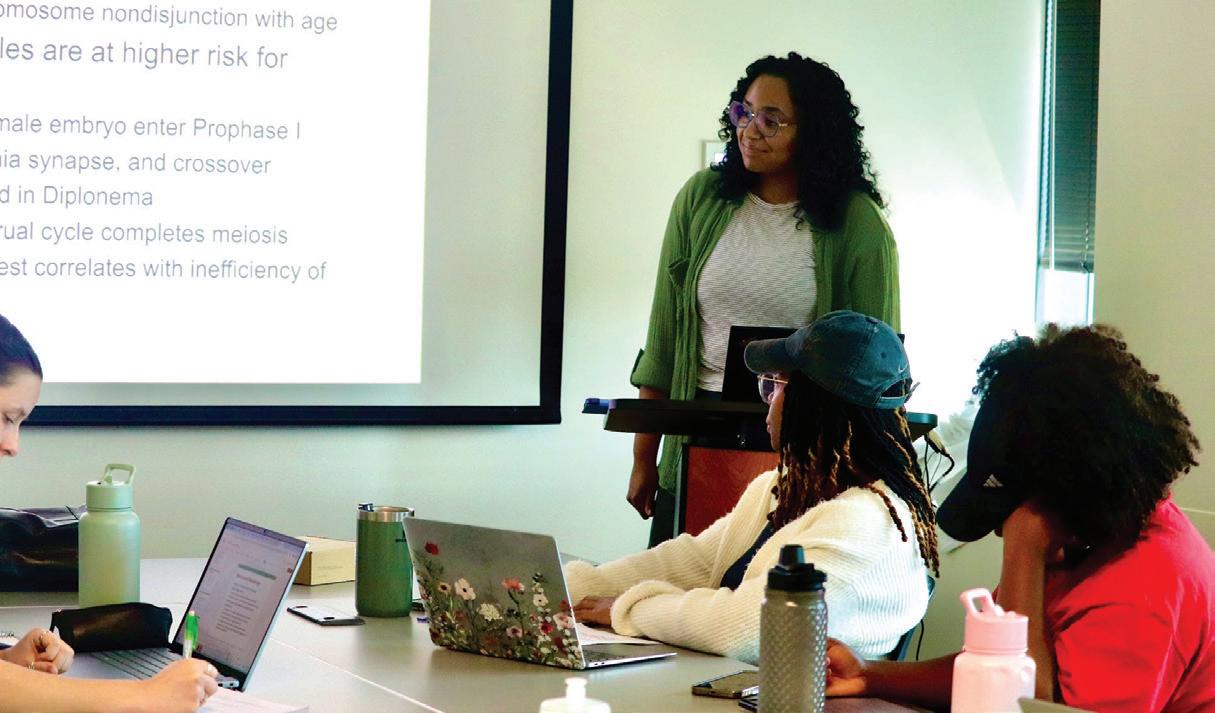
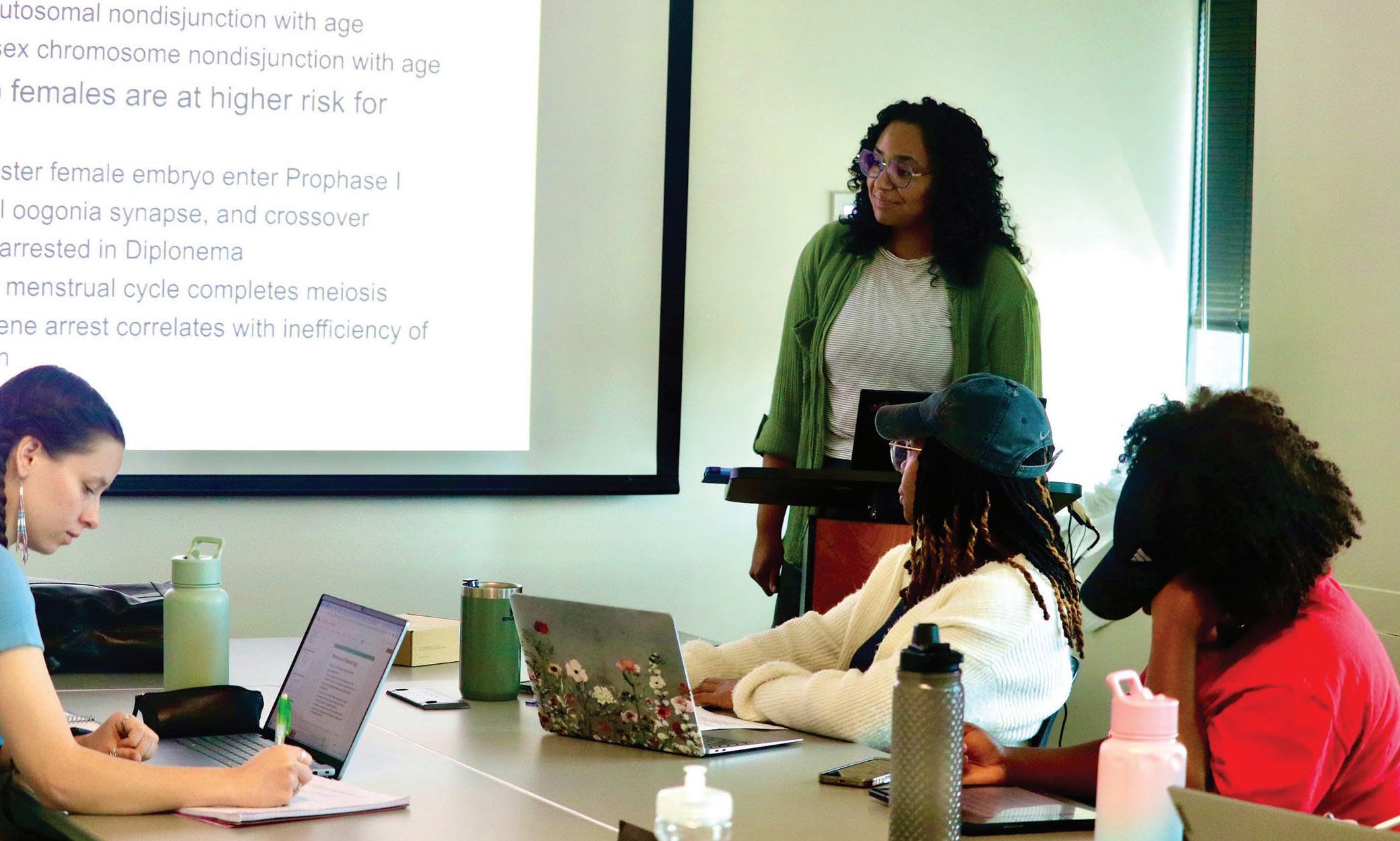
Future genetic counselors gain hands-on insight during a classroom lecture at Xavier University of Louisiana.
As the Great Wars gave way to the long Civil Rights Movement, also known as the Sec ond Reconstruction, Los Angeles-based Black photojournalists lide the California Eagle’s Charles Williams and Los Angeles Sentinel’s Harry Adams amplified the Western fight for racial equality nationwide.
ALLISSA RICHARDSON’S SECOND DRAFT PROJECT:
REWRITING THE NARRATIVE OF BLACK LIVES
By: Reenúa Jones Contributing Writer
Photo credit | Steve Cohn
For generations, Black lives have been narrated by outsiders— journalists, historians, and media institutions that often misrepresent, distort, or erase essential truths. These incomplete narratives shape public perception, influence policy, and reinforce systemic injustices. Allissa Richardson, Ph.D. ’02, a journalist, scholar, and media justice advocate, is determined to disrupt this cycle.
As an alumna of Xavier University of Louisiana, Dr. Richardson’s HBCU foundation instilled in her a deep commitment to truthtelling, justice, and advocacy. That mission led her to establish a Black media center at one of the world’s top journalism schools and develop a pioneering project leveraging artificial intelligence to document Black life.
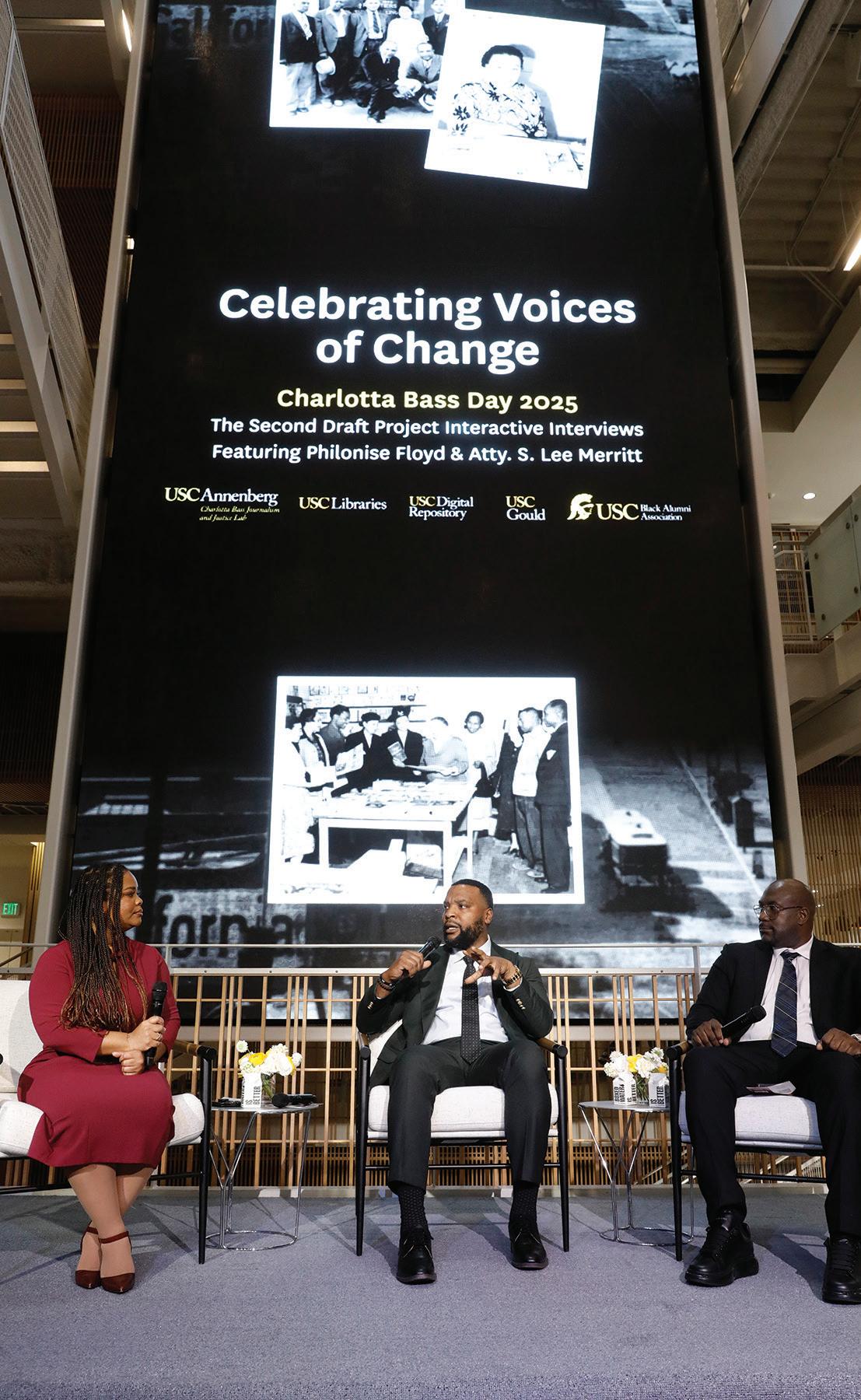
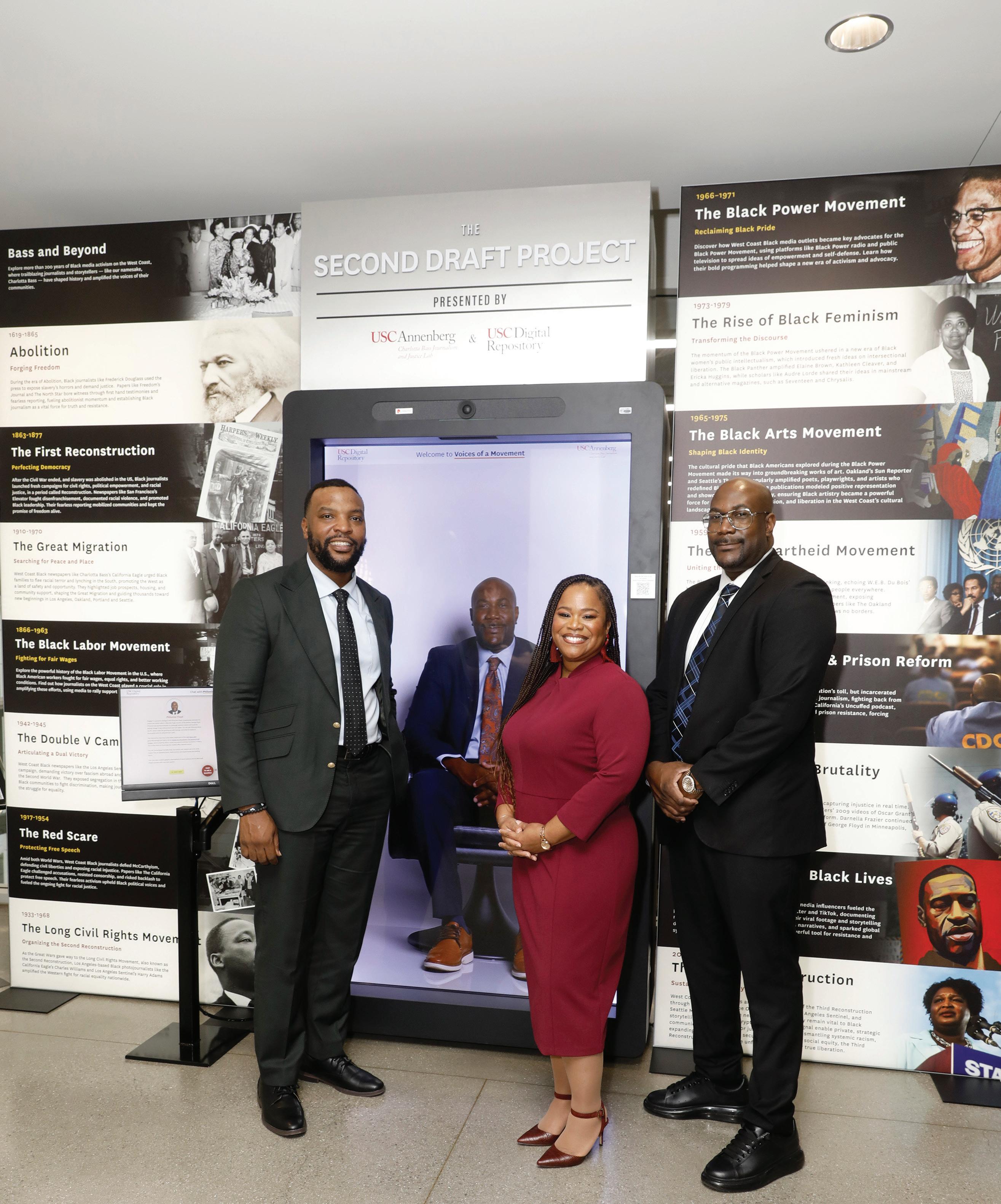
Dr. Richardson’s Charlotta Bass Journalism and Justice Lab at the University of Southern California is leading an innovative “Interactive Interview” format, allowing users to engage in AIpowered conversations with the loved ones of individuals impacted by police brutality. The Second Draft Project features dialogues with Lora King, daughter of Rodney King; Dr. Ilyasah Shabazz, daughter of Malcolm X and Dr. Betty Shabazz; Philonise Floyd, brother of George Floyd; and Attorney Lee Merritt, a civil rights lawyer representing families in high-profile cases, including Xavier alumna Atatiana Jefferson.
“The Second Draft Project ensures that the voices of those directly impacted by injustice are heard, unfiltered and in their own words,” Richardson said. “By deploying AI, we are not just preserving history—we are making it accessible, interactive, and deeply personal, so future generations can engage with these stories in a way that fosters understanding.”
Leading a Cultural Intervention
Dr. Richardson launched the Charlotta Bass Lab in response to the 2020 Black Lives Matter uprisings, recognizing that systemic racism was not only embedded in policing but also in media narratives.
“I was appalled not only by the brutal murder of Mr. Floyd but also by the way it was being portrayed on television—looped endlessly, dissected without care, and retraumatizing Black people,” she said.
“I knew we needed a media space that didn’t just document Black death but explored Black life and loss with humanity, dignity, and depth,” she added. “That’s why I created the [Charlotta] Bass Lab—to challenge the way these stories are told and ensure our narratives are handled with care.”
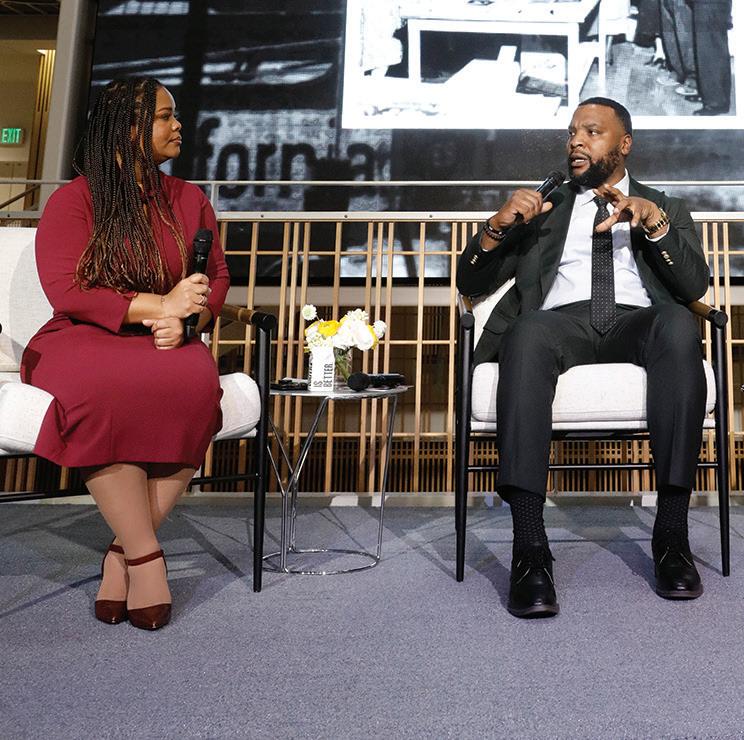
Dr. Allissa Richardson hosts the Bass Lab’s annual panel with Attorney Lee Merritt
Inspired by her days as a biology major at Xavier, she envisioned the Lab as a hub for rigorous research and investigative storytelling. During the 2020 uprisings, she searched for living relatives of Charlotta Bass, the first Black woman to own a West Coast newspaper. Dr. Richardson found Bass’s 100-year-old grand-niece, Muriel Tinsley, who gave her blessing for the Lab’s name. In 2022, she successfully petitioned the Los Angeles City Council to establish Charlotta Bass Day on February 14, honoring Bass’s legacy as a pioneering journalist and civil rights activist.
“When the City Council read the proclamation, I felt an overwhelming sense of pride,” Richardson recalled. “Hearing her name honored in such an official capacity, in the very city where she broke barriers, was both humbling and exhilarating— like history was being corrected in real-time.”
Previous page: Dr. Allissa Richardson (center) and Second Draft participants Attorney Lee Merritt (left) and Philonise Floyd (right).
Photo credit | Steve Cohn
Rewriting Narratives with AI
The Second Draft Project serves as a corrective space for Black stories misrepresented in mainstream media. Dr. Richardson and her team conduct extensive interviews, capturing hundreds of responses that AI later retrieves to create fluid, immersive conversations.
“The Second Draft Project is a direct response to the old adage that journalism is the first rough draft of history. Too often, that first draft is incomplete, biased, or outright harmful—especially when it comes to Black people,” she said. “The Second Draft Project exists to challenge and correct those narratives, offering deeper, more accurate, and more humane storytelling that reflects the full truth of Black life.”
Her interviews also uncover personal details often missing from news reports.
“When I sat with Lora King, I learned that Rodney King loved Chinese food, Tupac, and surfing. Dr. Shabazz shared that Malcolm X loved oatmeal cookies. Philonise Floyd shared that George Floyd loved to dance with his mother,” she said. “All of these facts humanize these departed souls, moving beyond the tragic imagery of police brutality to paint a fuller picture of how they lived and loved.”
Unveiling the Interactive Interviews
Each Interactive Interview takes approximately four months to produce. The process begins with recording the core interview and then developing a companion website and mobile application. During the fall semester, Dr. Richardson’s team collaborates with the USC Digital Repository to film, code, and securely store the interactive experience. Then, in the spring semester, she debuts the latest Interactive Interviews on Charlotta Bass Day, ensuring each launch celebrates Bass’s legacy of truth-telling and justice.
This year, marking the fifth anniversary of George Floyd’s murder, Dr. Richardson invited Philonise Floyd and attorney Lee Merritt to USC’s campus to unveil their Interactive Interviews in person.
“I wanted Philonise [Floyd] and Lee [Merritt] to see that, historically, Black media has always pushed for change and that—in capable hands—it does not have to harm. It can uplift,” Richardson said.
Looking to the Future
Dr. Richardson’s Charlotta Bass Lab extends beyond the Second Draft Project. It designs media ethics courses, leads career treks to Black-led media companies, and awards the annual Charlotta Bass Media Trailblazer Award to Black media makers driving change.
“I am really proud to have created a new concentration for master’s students, which is called Reporting on Raceand Justice,” she said. “Students who come to USC Annenberg and declare this concentration can now learn all about redlining in Los Angeles, how to conduct investigations into racial inequities in the city, and more.”
The Lab has honored changemakers such as Nikole HannahJones, Common, and Brittney Griner, all of whom have visited USC for discussions with Dr. Richardson. In May 2024, she received the Dr. Betty Shabazz Changemaker Award for her advocacy, standing alongside Sunny Hostin, Elaine Brown, Lora King, and Lee Merritt. Afterward, she connected with Eric Garner’s daughter Emerald, a moment Dr. Richardson said was “surreal.”
“To be joined onstage by Dr. Shabazz, Lora [King], and Emerald [Garner]; to know that these women have lived through the media’s careless portrayals of their fathers—and can still smile—made me want to continue teaching my students to be better and do better,” she said.
She envisions the Second Draft Project transforming into a traveling museum exhibit that illustrates the combination of empathy and AI in representing Black American life with greater humanity. Additionally, she is developing the second edition of Bearing Witness While Black, which explores the nation’s progression since Darnella Frazier captured George Floyd’s last moments on video.
“If my [Charlotta Bass Lab] and its Second Draft Project can inspire journalists and storytellers to approach their work with more thoughtfulness, responsibility, and humanity, then we are making real change,” she said.
For more information, please visit basslab.usc.edu.
TWO XAVIER FACULTY MEMBERS NAMED
FELLOWSHIP AWARDEES
Staff Report
The American Council of Learned Societies (ACLS) has announced Dr. Shearon Roberts and Dr. Sharlene Sinegal-DeCuir as two of its HBCU Faculty Fellowship awardees. Drs. Roberts and Sinegal-DeCuir are among eight fellows who will receive up to $50,000 each to support long-term engagement with a research project. Additionally, awardees will have access to networking and scholarly programming responsive to their academic goals and disciplinary and institutional contexts.
“We are immensely proud of Dr. Roberts and Dr. Sinegal-DeCuir for their groundbreaking project concepts, which have earned them this fellowship,” said Provost and Senior Vice President, Academic Affairs, Marguerite S. Giguette.
“Drs. Roberts and Sinegal-DeCuir are shining examples of deeply dedicated scholars whose commitment to Xavier, and especially to our students, enhance the preparation of our students and the university as a whole.”
The ACLS HBCU Faculty Fellowship and Grant Program supports exceptional research by faculty in the humanities and interpretive social sciences at HBCUs.
According to ACLS, this year’s awarded projects cover a wide range of disciplines, including African American studies, history, philosophy, political science, theater studies, and women’s studies. Dr. Roberts, Associate Dean of Honors Programs and Director of the Exponential Honors Program, is working
on a project titled “Black Press New Orleans: A Century of Pleading Our Own Cause.” Dr. Sinegal-DeCuir, Professor of History and Chair of African American and Diaspora Studies, is working on a project titled “Forging a Path: Chief Justice Bernette Joshua Johnson and Louisiana State University Law School.”
“ACLS is proud to support this vibrant group of scholars and celebrate their important contributions to the humanities and interpretive social sciences,” said Nike Nivar Ortiz, ACLS Program Officer in U.S. Programs, in a press release. “ACLS HBCU Faculty Fellows and Grantees exemplify the wealth of scholarship found across HBCU campuses, which is keenly attentive to underrepresented histories and voices, as well as timely social issues that intersect with their campus communities.”
According to its website, over the past century, ACLS has supported individual scholars and scholarly teams worldwide in their pursuit of research with the potential to advance knowledge in the humanities and interpretive social sciences.
Dr. Sharlene Sinegal-DeCuir
Dr. Shearon Roberts
Dr. Laura Oliver’s Creative Vision BEAUTY SHOP OF HORRORS:
By: Amaya Woodley
Contributing Writer
What started as an idea exploring the intricate relationship between Black women and their hair turned into a production in which Dr. Laura Oliver, Program Director and Assistant Professor of Performance Studies at Xavier University of Louisiana, is profoundly pleased. Beauty Shop of Horrors, an original production by Dr. Oliver, premiered on campus in October to a crowd that saw parallels between the play and their personal lives.
“So, Beauty Shop of Horrors was a show that I was wanting to work on in conversation with my previous research about natural hair as a performance,” Oliver said of the inspiration behind the play. She added that the play also took a deep dive into the “respectability” some families experience navigating various environments.
“I needed to bring something that was going to engage a younger audience but also have the content that was relatable to more mature audiences,” she said, adding the importance of telling the story on the campus of an HBCU. The play was also an opportunity to showcase the Department of Art and Performance Studies’ work ahead of Xavier’s centennial.
Dr. Oliver discussed how the show displays the beauty of natural hair under the theme of “horror” experienced in various settings including hair salons and stylists. The professor said she incorporated personal experiences to shape the narrative of the production, including a song she made up about her mom burning her with a hot comb while styling her hair.
“There were some really crazy and bad experiences that I have gone through personally that I’m pretty sure are relatable to other people,” Oliver said of incorporating her personal experiences. She said after discussions with students from her Black Horror in Performance class, the students started framing the story, starting with women ideating over their next hairstyle to “booking a stylist from hell.”
Dr. Oliver said she was inspired by Little Shop of Horrors when she named the show.
Leaning on the contributions of her students, the Beauty Shop of Horrors director said this was a collaborative effort. Dr. Oliver worked alongside her students to develop different scenes and creative elements for the play, an opportunity she said allowed
Photos By Ibim Cheetham-West
them to contribute their own skills and perspectives. Students TaShia Hogue, Serenity Griffin, Aaliyah Hunter, and Madison Thompson were also featured performers in the show.
“Beauty Shop of Horrors was an impactful performance to be a part of because it shed light on the day-to-day horrors we face not only as Black women, but as Black individuals, particularly regarding a significant part of our identity: our hair,” Hogue said of her participation in the production. “It wasn’t until I became a contributing performer in this show that I fully unpacked my lovehate relationship with my hair—the negatively charged words used to describe Black hair and the differences in shared Black experiences.”
“What I truly enjoyed, though, was the mentorship and bonding that came with the process of putting the show together. Dr. Laura D. Oliver was incredibly welcoming, contributing bits and pieces of ideas to what was already a masterpiece,” she added.
Well received among audiences, the show was also performed at another university and later showcased at the Petit Jean Performance Festival, where Dr. Oliver was the festival leader and keynote speaker. The professor also acknowledged the different audiences and the varying reactions to the show.
As for what’s next for Dr. Oliver and her students, she shared that they are working on a show for the centennial. She is looking forward to the next performance, which will reflect on the past while celebrating the university’s future through storytelling.
Madison Thompson, TaShia Hogue, Aaliyah Hunter, Serenity Griffin, and Dr. Oliver.
When it comes to being a leading university, the numbers are clear
Xavier is Excellence
For the number of African American students earning baccalaureate degrees, Xavier is ranked
First in the nation in Chemistry
Second in the Physical Sciences
Third in Biological and Biomedical Sciences
In the top ten in Public Health
We are also
Top 15 in Neuroscience despite the four-year degree program in Neuroscience only starting in 2017. Plus, we graduate the highest percentage of Black/African American students in the nation from a Neuroscience program.
We remain a leading
Undergraduate source of Black/African American students who complete Medical Degrees
Institution in Black/African American students completing first professional Doctor of Pharmacy Degrees.
In the past 25 years, our graduates have gone on to receive over 7,000 additional academic qualifications since completing their degrees at Xavier, including
3,751 Master's degrees
467 Doctoral degrees (342 of which are Ph.D. degrees)
1,775 first professional degrees (over 1,100 of which are medical degrees)
XAVIER ENTERS UNIQUE STUDENT PARTNERSHIP WITH TOP UNIVERSITY IN AFRICA
By: Mitti Hicks
Contributing Writer
As Xavier’s Exponential Honors Program continues to grow, it is adding a groundbreaking partnership with a leading institution on the African continent. Xavier signed a memorandum of understanding with the University of Witwatersrand in Johannesburg, South Africa, a top-ranked institution on the continent.
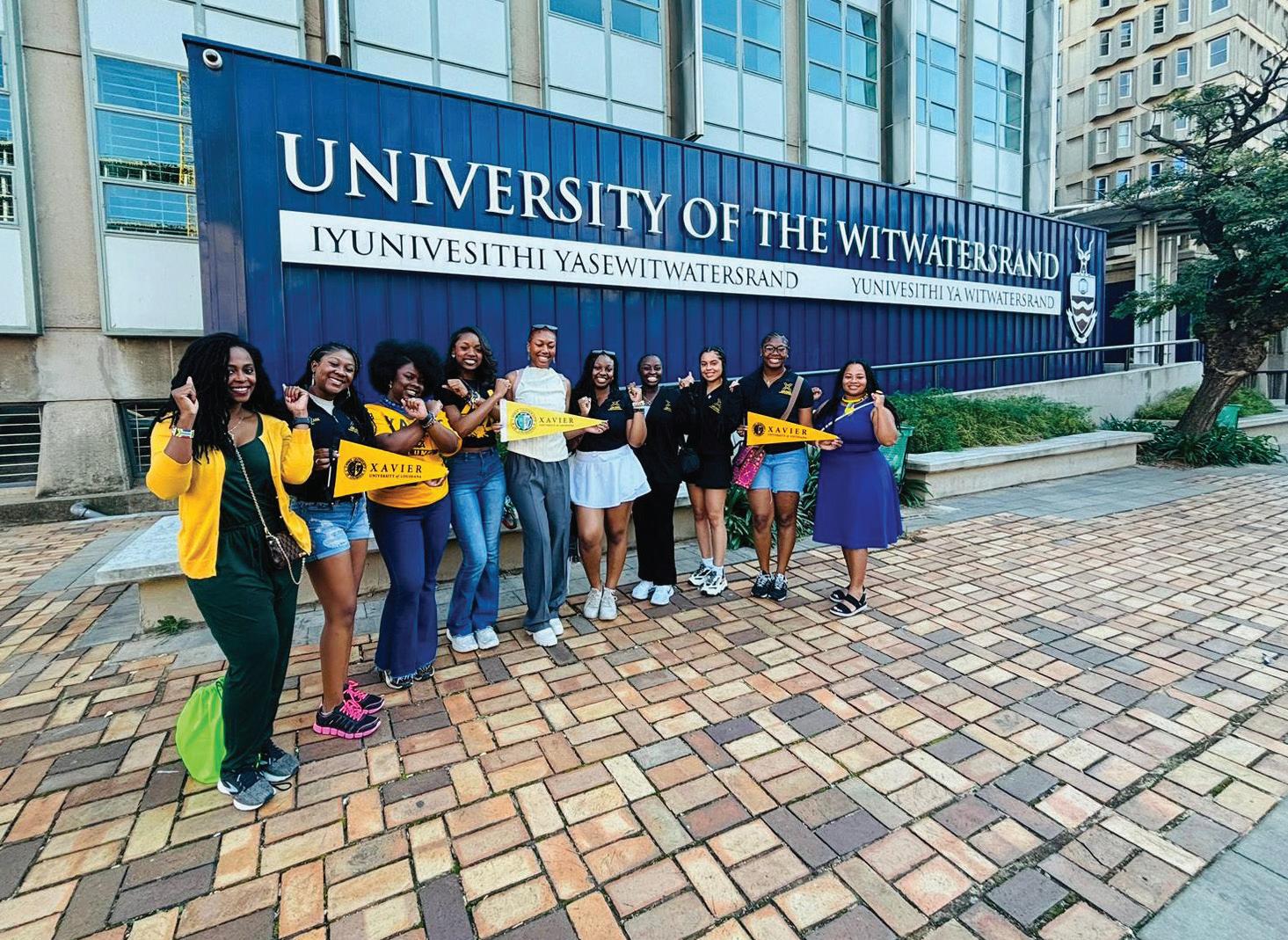
With the new partnership, a group of high-achieving students from Xavier’s Honors Program attended the Witwatersrand over the summer for research, launching student, faculty, and staff exchanges between the two universities.
“It was really important for me that as an HBCU, we had a strong relationship with an institution on the African continent,” said Shearon Roberts, Ph.D., the Associate Dean of Honors Programs and Director of the Xavier Exponential Program.
“The university is considered what they call ‘Afropolitan University,’ which means that all of its programs, from the
sciences to the humanities, are rooted in African thought, African knowledge, and African ideas. It is an Afrocentric University, and that is one of the reasons why we wanted to partner with them.”
At least four students in Xavier’s Exponential Honors Program have received Benjamin A. Gilman International Scholarships and attended the university during the summer to study postapartheid South Africa. According to Dr. Roberts, four additional Mellon Summer Scholars studied arts and culture.
“The goal is that every year, from this honors program, we will have faculty-led exchanges, where our students will go study different things from an African perspective,” she said. “Also, our exchange agreement is so that our Xavier students can pursue a semester studying in South Africa, and we will then invite and host two South African students to study at Xavier. We hope to pilot that this year.”
Students who participated in the first exchange with the University of Witwatersrand had a unique opportunity to learn how policies are being implemented as South Africa tries to move past 40 years of racial segregation and discrimination known as apartheid.
“What has been very special for our students, especially since we are in the Deep South, is [visiting] a country that is taking strides to address its own segregation, and understanding the kinds of policies and decision-making that are needed to repair the kind of disenfranchisement that Black South Africans experienced during apartheid.”
Xavier’s Honors Program is a relatively new academic feature. Dr. Roberts says that while the HBCU celebrates 100 years, the program is in its seventh year and only accepts 3% of the incoming freshmen class. Incoming students who receive the highest academic scholarships are invited to the program. Once accepted, students are required to maintain a 3.5 GPA.
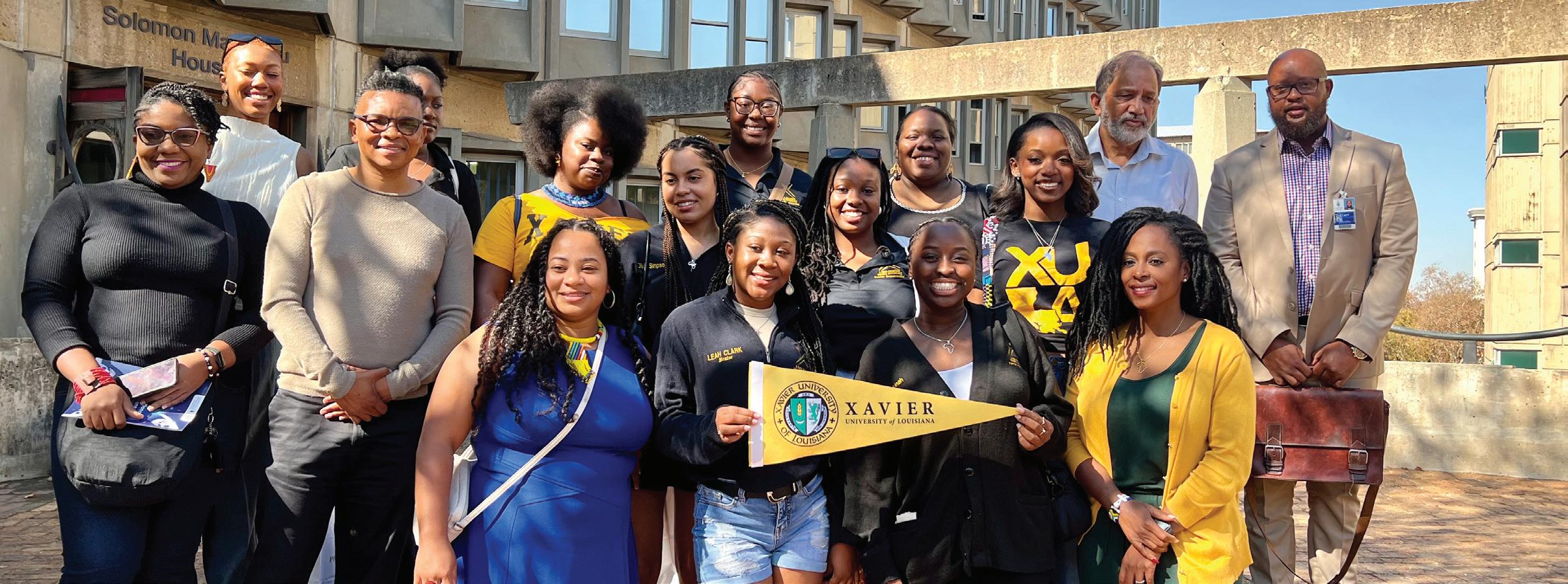
Xavier students stand in front of the University of Witwatersrand in Africa. Xavier Exponential
From Chemistry to Service
Joshua Adkins’s Journey from Xavier to Groundbreaking Research
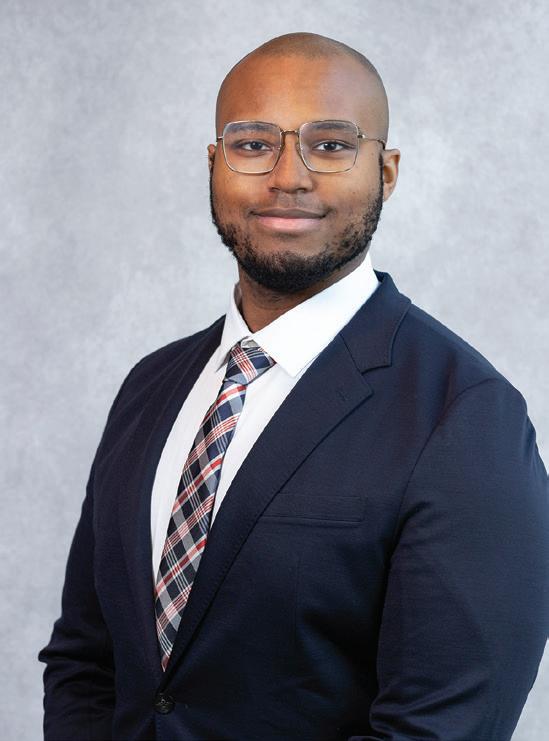
Joshua Adkins ‘18 started at Xavier University of Louisiana with the intention of studying pharmaceutical chemistry. He lost both of his parents before graduating from high school and was determined to research medical treatments for future patients. Once enrolled at Xavier, Adkins immersed himself in the chemistry department and eventually became a student researcher, though not in a medical field.
“Our work focused on studying various oxide materials for use as energy storage components in lithium-ion batteries, which exposed me to the ways in which the principles of chemistry could be applied,” Adkins said. Noting that a world of possibilities opened up, he quickly realized he wanted to pursue a Ph.D. and teach.
“It was a desire to contribute to the [Xavier] legacy of which I had been a part that drove me to pursue a doctoral education,” Adkins says of his undergraduate alma mater. “My time at [Xavier] was filled with both scholarship and service, so I felt empowered to find ways to continue that work as a career.”
His stellar academic study at Xavier earned him offers to doctoral programs at Howard, Princeton, and Penn State before he found a match at the University of Illinois Chicago (UIC). Joining the Department of Mechanical and Industrial Engineering at UIC allowed Adkins to work with the Argonne National Laboratory. Argonne was founded after Enrico Fermi produced the first human-caused and self-sustaining nuclear reaction in 1942, propelling its work at the forefront of atomic energy.
Adkins’ work at Argonne included groundbreaking research in ferroelectrics, a special class of materials that can “remember”
By: Meaghan Walsh Gerard Contributing Writer
electrical stimuli. “They can also be used to create electricity from temperature fluctuations and change shape under applied electric fields, which make them highly functional as a building block for new technologies,” Adkins said, adding, “Like very small classical and quantum computers, infrared/heat sensors, ultrasound instruments, and artificial muscles.”
Adkins remains grounded in his work, pursuing his promise to be a scholar-servant. He said he is fulfilled by focusing on engaging BIPOC students in scientific research activities and volunteering to speak with high school and college students about their educational and personal aspirations.
“College grants us degrees, but it can also grant us new perspectives, personal growth and self-discovery, and lifelong friends,” he said. “This is true even for students who aren’t quite sure what their passion or mission is just yet.”
As for Xavier, Adkins says it provided an amazing foundation, close ties with instructors and mentors, and a clear mission. “XULA’s liberal arts education and institutional mission work together to raise graduates who will go on as servant-leaders in whatever discipline they are trained,” he said.
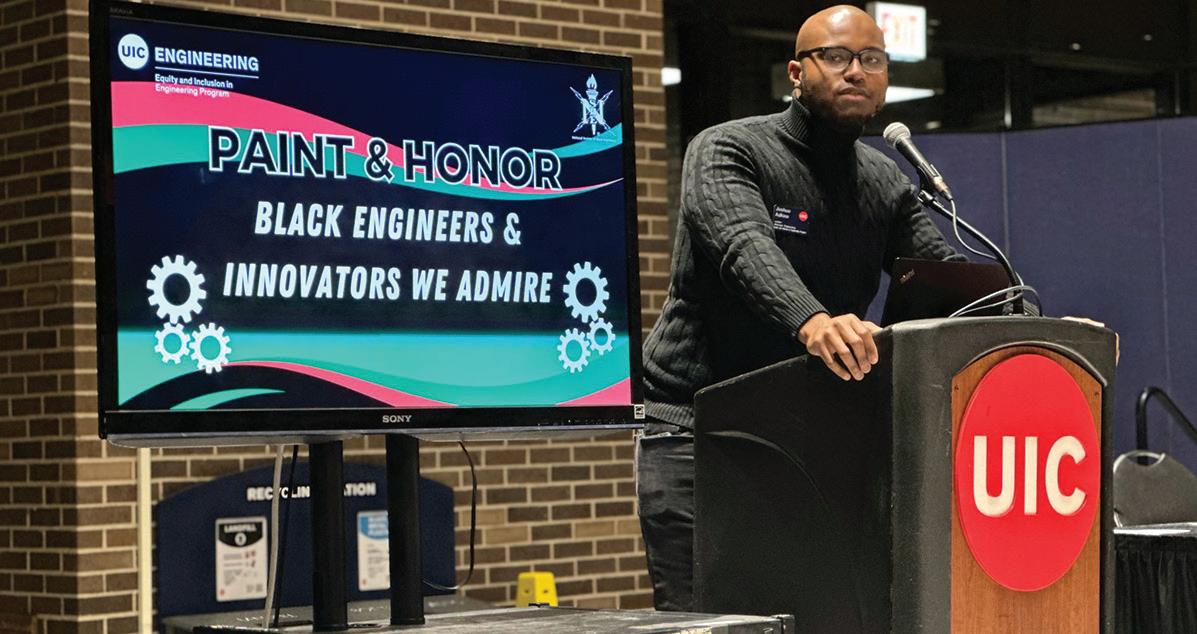
Joshua Adkins speaking at the University of Illinois Chicago about Black engineers and innovators for Black History Month.
XAVIER UNIVERSITY OF LOUISIANA EARNS 2024 TREE CAMPUS RECOGNITION FROM ARBOR DAY FOUNDATION
Staff Report
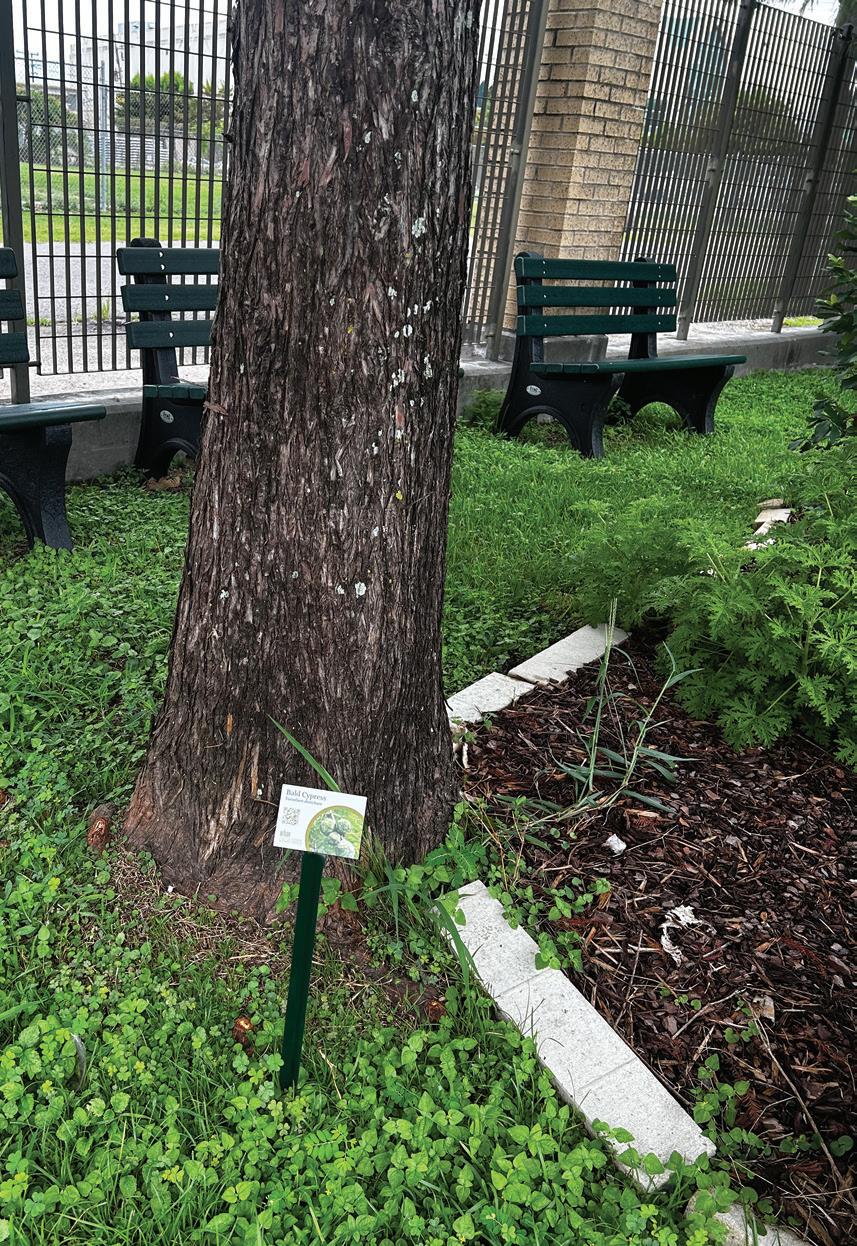
For the fourth consecutive year, the Arbor Day Foundation recognized Xavier University of Louisiana as a 2024 Tree Campus for its dedication to enhancing community wellbeing through tree education, investment, and community engagement.
The Arbor Day Foundation is a global nonprofit organization that inspires people to plant, nurture, and celebrate trees. Since 1972, its network of more than a million supporters and partners has helped the organization plant more than 500 million trees in forests and communities across more than 60 countries. The Tree Campus program recognizes schools, universities, and healthcare facilities that use trees to improve their communities.
“This recognition is a testament to the tireless efforts of Xavier University of Louisiana’s maintenance and sustainability team, who continue to expand our campus tree canopy, engage students in environmental stewardship, and grow our urban orchard,” said Helena Robinson, Xavier’s Director of Sustainability & Quality Control. “As a historically Black and Catholic institution committed to climate justice and community resilience, we see this work as vital. Every tree planted reflects our dedication to building a greener, healthier, and more equitable future for Xavier and the Gert Town community.”
To earn Tree Campus recognition from the Arbor Day Foundation, colleges and universities must uphold five core standards, including maintaining an advisory committee, setting a campus tree care plan, verifying annual investment in the tree care plan, celebrating Arbor Day, and creating a service-learning project aimed at engaging the student body.
Xavier incorporates trees into most of its new construction projects and plants new trees yearly for decoration, to reduce heat island effect, and to replace damaged or dead trees.
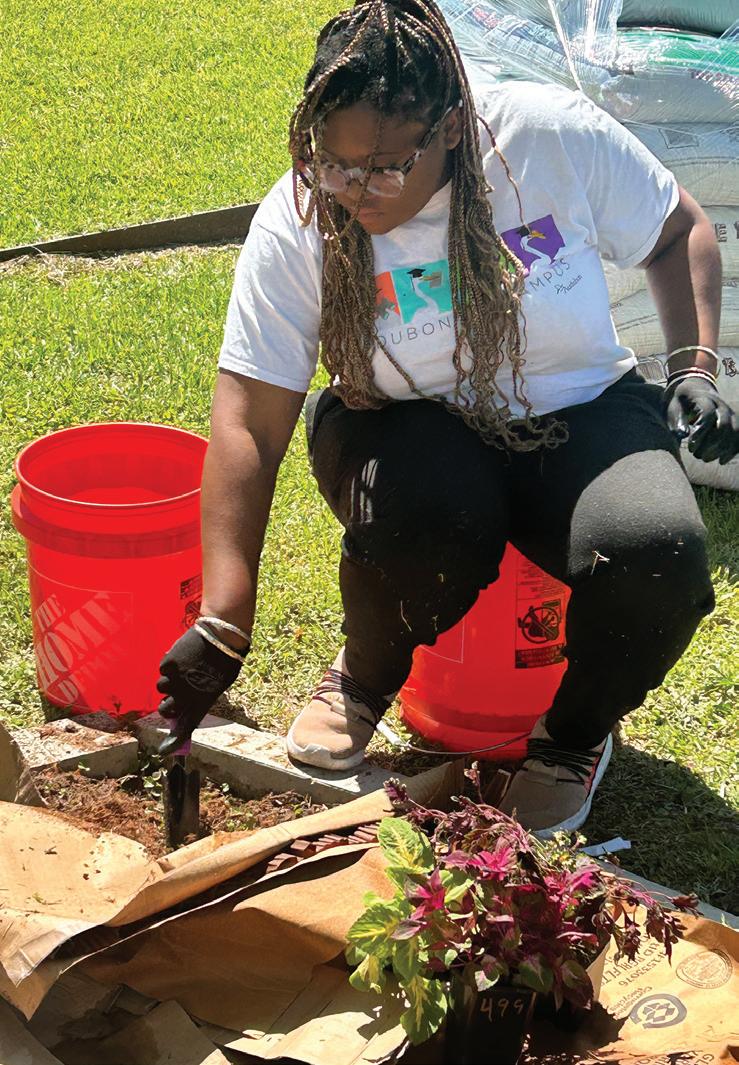
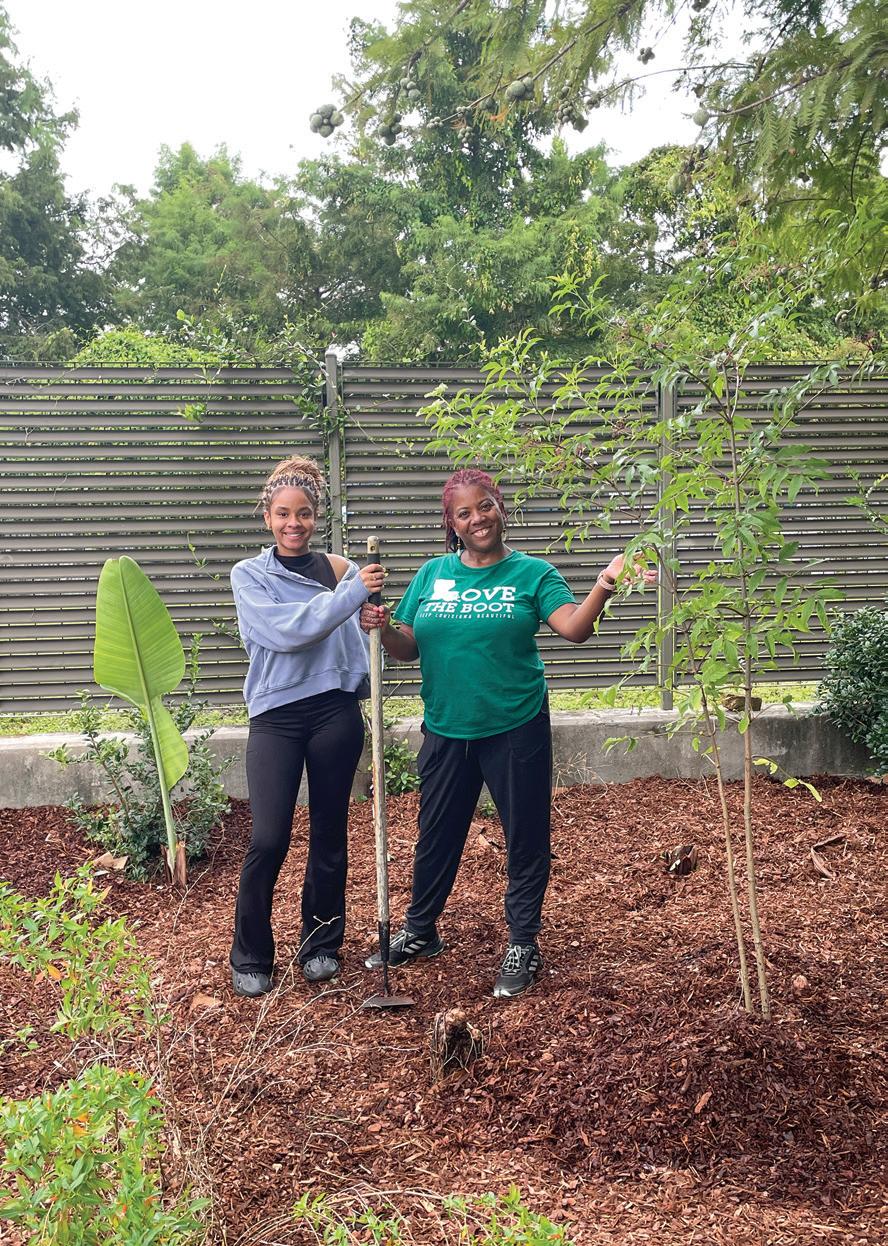
A newer project is the Wildlife and Native Art Garden at the Art Village. The purpose of the art garden is to transform the campus art village into a vibrant wildlife garden through a service-learning initiative.
“Our vision is to enhance the art village’s beauty by incorporating a variety of native plants and trees as well as sculptures crafted by Art Village faculty and students. Additionally, we plan to integrate bird feeders and create dedicated spaces to promote biodiversity,” Robinson said.
Native plant species provide the best sanctuary for wildlife and have adapted and evolved to tolerate flooding and natural disasters in Louisiana. Additionally, fruit trees can provide students, campus, and the surrounding communities with fresh produce.
With the understanding that native plants in New Orleans are essential for repairing endangered ecosystems and provide habitats for pollinators and a surprisingly diverse array of local wildlife, Xavier will be able to offer students and the surrounding community local access to food sources, protect more of our region’s wildlife, and provide opportunities to learn about the importance of New Orleans ecology.
“Trees have the power to inspire learning and improve well-being,” said Michelle Saulnier, Vice President of Programs at the Arbor Day Foundation. “By growing campus green spaces, forward-thinking higher education leaders like Xavier are cultivating vibrant learning communities that also benefit the greater environment.”
Trees on campus can lower the energy cost of campus facilities by providing shade cover, reducing extreme heat, improving air quality, and boosting physical health benefits for students and staff. In addition, trees improve students’ mental and cognitive health, provide an appealing aesthetic for campuses, and create shaded areas for gathering and studying.
The Arbor Day Foundation’s Tree Campus program is operated in partnership with the National Association of State Foresters and support from professional partner Bartlett Tree Experts.
“As a historically Black and Catholic institution committed to climate justice and community resilience, we see this work as vital. Every tree planted reflets our dedication to building a greener, healthier, and more equitable future for Xavier and the Gert Town community.”
– Helena Robinson
A PIVOT TO PURPOSE HOW XAVIER UNIVERSITY SHAPED KRISTA BURTON’S STEM CAREER
By: Amaya Woodley Contributing Writer
Krista Burton ‘13, a therapeutic medical physicist at Emory University, discussed her journey at Xavier University of Louisiana, the impact of her research advisor, and how a transformative class led to a pivot in her career goals. Burton, who was initially interested in nuclear engineering, said the opportunities offered on campus ultimately guided her career path, and now she is the only Black medical physicist at Emory University.
As a student, Burton received scholarships and research opportunities under the guidance of Dr. Anderson Sunda-Meya, which she said were “life-changing.” She valued his support during her tenure at Xavier, saying that without his encouragement to participate in research, “I wouldn’t have known that I didn’t like specific areas of physics.”
“I didn’t like the engineering that I thought I was going to really get into. And so, while I ended up going to graduate school for nuclear engineering, which is something that I did do summer research in, I noticed that I didn’t like it very much. I landed in medical physics, and that’s kind of where I flourished, and that’s what I am now,” Burton said, emphasizing the impact of her research experiences at Xavier.
Despite changing paths, Burton said her research experience shaped her confidence as a Black woman in STEM. As a result, she encourages students to be flexible and willing to pivot.
“It’s OK to expose yourself to so many different things, and if one thing doesn’t work out, you need to be able to recognize that in yourself and go with what makes you happy,” Burton said. “I think being multifaceted and trying new things allows you to gain skills that you probably didn’t come to college with.”
As Xavier celebrates its centennial, Burton is thankful for attending a university that taught her how to focus on her goals.
“[Xavier] teaches you how to be an individual. Xavier just did so much for me and my confidence,” Burton said. “It prepares you for all the things in this life including navigating life as an African American in these big spaces. It gives you the confidence to go forward and do that.”
As for what’s next for the Xavierite, Burton is excited about the Atlanta Science Festival at Emory Proton Therapy Center, where students will engage in a hands-on STEM activity focused on cancer research. She is also publishing a children’s book titled Little Lady STEM that celebrates representation.
“Representation is so big. And that’s another thing that Xavier taught me is that you represent everywhere you go,” Burton said.
CREATING POWERFUL COMMUNITY IMPACT
XAVIER BRIDGES THE SPEECH PATHOLOGIST GAP
By Alisha Tillery Contributing Writer
Just 4.5% of speech language pathologists identify as Black despite the Black population in the United States being about 14%. However, Black Americans across diagnoses are referred for more speech therapy services than their counterparts of other races/ethnicities, according to the American Speech-Language Hearing Association (ASHA).
Xavier University of Louisiana prides itself on creating programs that increase broad representation across industries. Such is the case with its dynamic Speech Pathology program, which charts the career path for Black speech pathologists and celebrates a powerful community impact through practitioner-based programming that provides students with real-world experience working with people in need.
“Statistically, our field is primarily comprised of white individuals and those younger than 45, and that’s what really makes up the full-time workforce,” said Melissa Handy, MS, CCC-SLP, Director of Clinical Education.
Speech pathology first appeared in the university catalog in the 1967-1968 school year. It was part of Speech and Drama, which initially offered bachelor’s degrees in Speech Arts and Speech Education, as well as a pre-professional degree in Speech Pathology.
Since career options can be limited for professionals with only a bachelor’s degree, Xavier’s groundbreaking Master of Science in Speech-Language Pathology (MS-SLP) program also provides students with the necessary experience for careers in healthcare, private practice, education, and more.
Launched in 2019, the graduate program has a 100% completion rate and is staffed with top faculty and an administrative team. The student clinical experience has advanced, boasting at least 40 clients in the Xavier University Speech, Language, and Hearing Center each semester. Research is also being conducted to advance the program and industry while highlighting other careers in speech pathology.
“I think we have the best academic program. We stand up against any program in this nation as far as academics are concerned,” said Terrilynn Jenkins, Ph.D., CCC-SLP, head of the Speech Pathology Department and Graduate Program Director. “We have a very unique clinical program; our students are doing some things that students at the R1 (programs) are not doing.”
EXCELLENCE IN ACTION
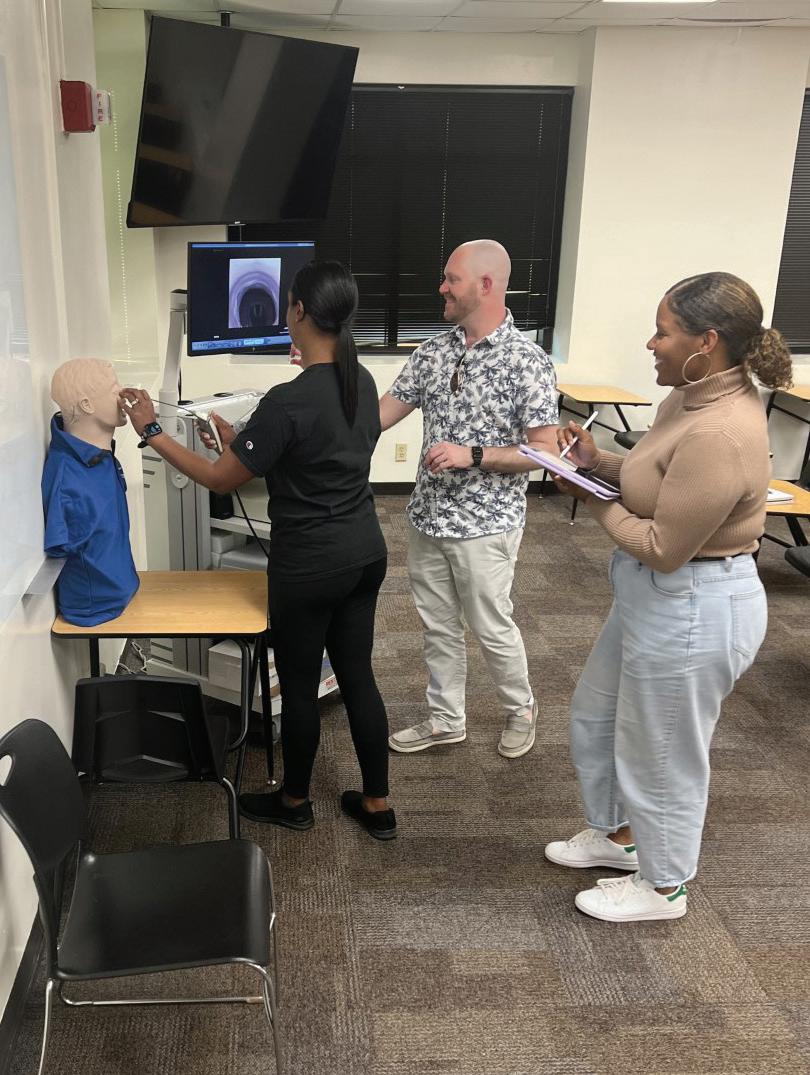
Xavier’s Speech, Language and Hearing Clinic (XUSHC) offers advanced Speech Pathology majors the opportunity to engage in clinical practicum experiences. Students work under the supervision of ASHA-certified and Louisianalicensed speech- language pathologists.
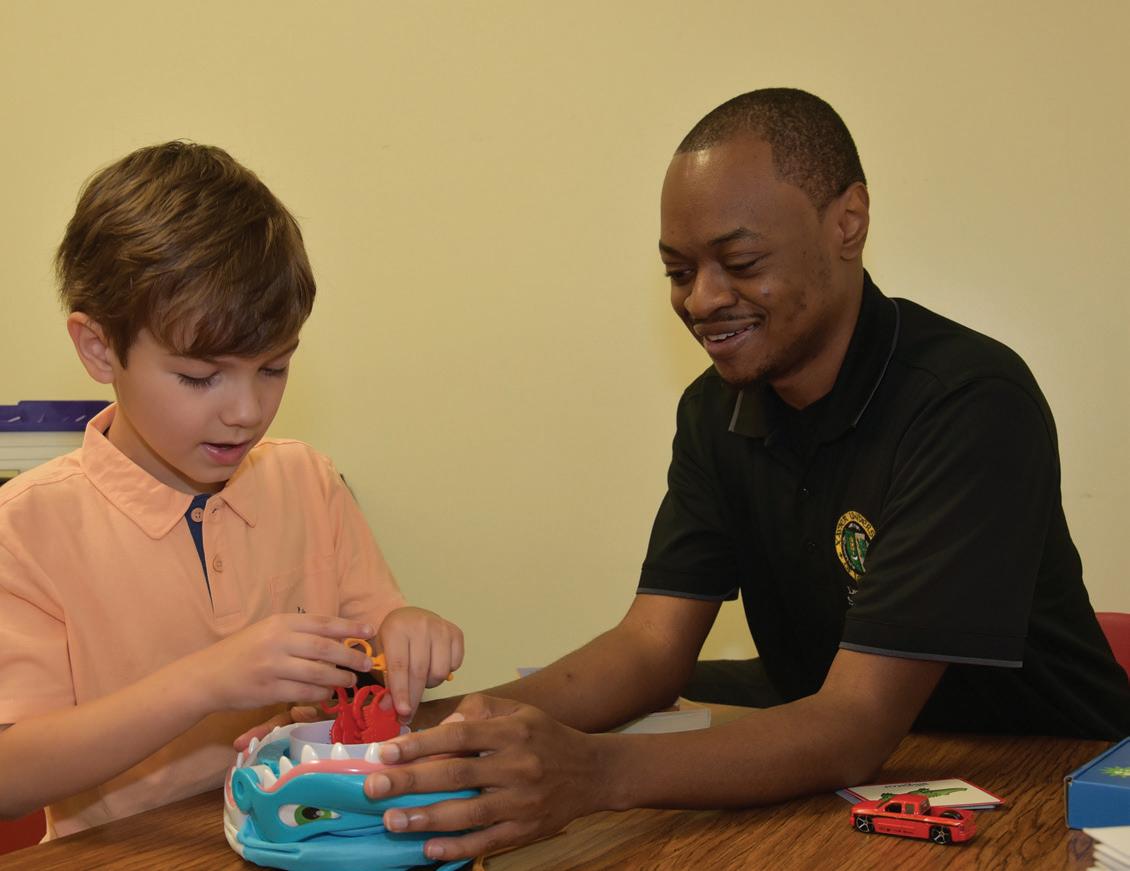
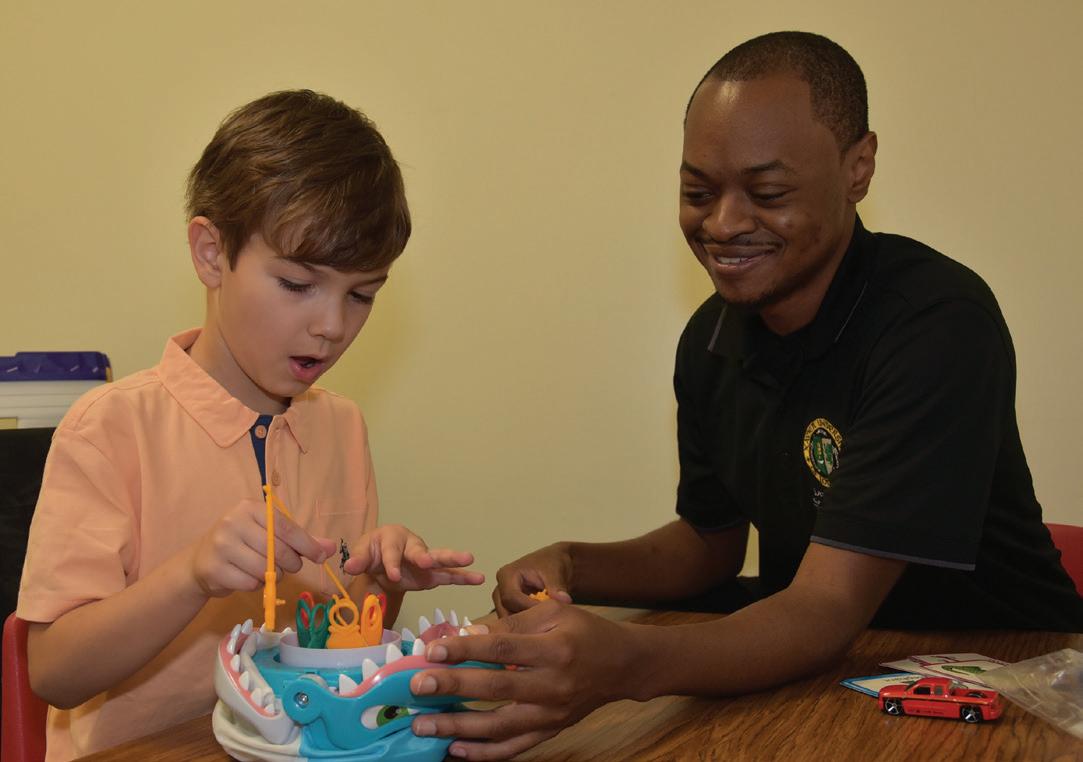
There’s at least one very proud parent who would wholeheartedly agree with Dr. Jenkins. Lisa Laird was referred to the Clinic by a speech therapist for her son Kaleb’s apraxia diagnosis. This neurological disorder affects the ability to plan and execute purposeful movements, such as speaking, writing, or making gestures. Kaleb, then three
years old, was nonverbal, affecting his social skills. Since arriving at the Clinic, Kaleb has made extraordinary progress, engaging in therapy sessions twice a week since 2022. Instructors and students worked with him extensively, using creative learning models to boost his speech improvement.
“I’m happy to tell you, he’s no longer non-verbal,” Laird said. “He is even reading at a kindergarten level. He started talking in sentences at age 5. You cannot tell me what they have done has not helped.”
Laird added, “I believe speech therapy is why he reads so well; they use books to teach, flashcards, pictures, and letters. That’s why my child aced the sight word section.”
The six-year-old has improved his social skills and actively engages with his peers. He’s also been moved from special education to resource classes and now attends the Clinic once a week. Laird said the instructors and their commitment to her son’s progress have made the Clinic a success.
Stories like Laird’s showcase Xavier’s significance in the community it serves and its nurturing ability to shape highquality professionals of the future.
“We’re showing that we have interprofessional education and interprofessional practice, so we can meet the standard and meet it at a high level,” Jenkins said.
Since its inception, XUSHC has provided services to hundreds of members of the New Orleans community and serves as the training ground for Xavier Speech Pathology majors preparing to work in schools and hospitals.
GROWING BLACK SPEECH PATHOLOGISTS
Interdisciplinary collaboration and community support have also contributed to students’ growth and expertise. Students regularly participate in community health events with physicians, dentists, and other professionals to conduct cognitive screenings, feeding and swallowing screenings, and, most recently, swallow studies for the uninsured. In addition to promoting collaboration among departments and
community partner engagement, Jenkins said crossfunctional work also adds validity and value to the program.
“That’s what we work towards, helping them to achieve their goals to diversify and increase the cultural humility of individuals in our field,” Handy said. “What we’re trying to do with those students is increase that culture of humility, decrease the bias, and increase their knowledge and awareness of other cultures.”
There is an ecosystem that leads to success and it includes key investments in mentorship and philanthropic efforts, including funding scholarships to ensure student retention. In addition to completing a graduate program, a key pathway to job placement is passing the PRAXIS exam. XU graduate cohort students have an average pass rate of 87.24% over three years, demonstrating the program’s dynamic nature.
“We’ve done what we needed to do to say that this is a
rigorous program, and students when they leave here, they’re competent professionals,” Jenkins said. “Our students are passing the PRAXIS, making greater gains every year, and this year, I expect no less.”
MSLP student Vaughn Saunders works with Kaleb Laird.
Photo by Leslie D. Rose
PREPARED FOR THE FUTURE
After obtaining a degree in communication from Clark Atlanta University and completing a summer prerequisite program, Spring 2024 graduate Sydney Turner enrolled in Xavier’s MS-SLP program.
“If you want an experience that prepares you for a diverse world, you should definitely come to Xavier because they include cultural responsiveness in literally every aspect of the program. It’s important because we come out into the world, and we’re not just serving one sector, and they prepare you for that,” Turner said. Turner works in an elementary school in Duval County, Florida, that serves students with autism in the communication and social skills program. She said Xavier’s program provided comprehensive exposure to various career and service opportunities in the field.
Speech Pathology and Audio Education alumna, Gina Smith ‘84, uses her educational experience as a way to give back, serving as a mentor to current and former students.
“I believe it is in the fruit of Xavierites to give of themselves, personally, time-wise and financially because we are our village,” Smith said. “We have to protect our campus. We have to protect our school, we have to protect our heritage, we have to protect our legacy, and we have to protect the students who are here so that when they come out, they know that they have someone to care.” Smith, a fierce champion of the Speech Pathology program, is excited about the MS-SLP program’s recent accreditation and bright future.
Now, in Year 6, the MS-SLP program has become a premier offering as one of only a few HBCUs to offer a graduate degree. It’s positioned for growth to move the needle in the industry with more practitioners and researchers of color. Justly, the Speech Pathology department has experienced acclaim and growth across programs throughout its seven-decade existence.
The Speech Pathology program continues to impact generations of Xavierites who have matriculated through the program in both undergraduate and graduate studies.
Recent graduates engaged in hands-on learning during the Dysphagia class.
A PIVOT TO PURPOSE HOW XAVIER’S RESEARCH OPPORTUNITIES DROVE THIS ALUM’S SUCCESS
By: Amaya Woodley Contributing Writer
Desiree Smith ’13 said that the resources and opportunities she was provided as a student at Xavier influenced her current career path in the automotive industry. Smith was a dual-degree major in physics and mechanical engineering, where she conducted research on cancer cell mapping using a nanoscale microscope. Using the tool, she said she was able to map the properties and chemistry of cancer cells, with the goal of gaining a better understanding of cancer and developing targeted treatments.
“What we did was we used this device to map out certain properties, certain strengths about how the cell substance would adhere to different proteins, as well as understanding the different strengths as well when you’re probing the surface,” Smith said, adding that their research team was able to replicate and build upon previous research in the field.
The research, motivated by the ongoing search for a cancer cure, aimed to enhance the understanding of cancerous cells at the nanoscale level, leading to more effective treatments. The opportunity, Smith said, was instrumental in providing valuable experience that ultimately prepared her for graduate school and her career in the automotive industry.
Now, Smith works on powertrain systems as part of a team that focuses on the design and safety of engines and transmissions. Her work, which also ensures the validity of the check engine light, requires the same attention to detail that she acquired while at Xavier.
She stated that transferable skills, such as professionalism and the ability to navigate complex problems, have proven to be some of her most significant assets in her role.
“Being at Xavier was great, especially because of these opportunities,” Smith said. “At work, I show up very prepared in whatever situation I’m in. And that is definitely due to the education that I got at Xavier.”
Smith acknowledged that although she pivoted from her original research focus at Xavier, there are still some parallels.
“So, the tools and the methods, and the sequence and the logic of how to question or the systematic process of how to navigate through certain physics concepts as you’re looking at a vehicle that carries you through, that’s something that crosses over from research to research,” she said of the similarities between her current work and research as a student.
“I handle myself. I lead programs, and when I do, it’s very effective, it’s very efficient,” she said.
Let's CONNECT!
Office of Institutional Advancement
(504) 520-7575
IA@xula.edu
University Communications (504) 520-5424
XULANews@xula.edu
Office of Admissions (504) 520-7388
Apply@xula.edu
giving.xula.edu
Office Of Research And Sponsored Programs - FY25 ACTIVE AWARDS
Kaneisha Bailey Akinpelumi NSF FUEL - Use-Inspired Research and Development
Kaneisha Bailey Akinpelumi NSF
Sara Al-Dahir Federal
Rami Al-Horani NIH
Arts & Sciences Chemistry Mehnaaz Ali NSF
NSF Engines: Louisiana Energy Transition Engine - Future Use of Energy in Louisiana (FUEL)
Using a Telehealth and Shared Decision-Making Model to Address Preventative Medicine Strategies Among Communities in Louisiana
Inhibitors of Human Factor XIIIa as New Anticoagulants
Excellence in Research: MicroRNA Detection Strategies via Exploration of Flavin Binding Allosteric Switches
Arts & Sciences Biology Hector Biliran NIH Role of the Transcriptional Corepressor TLE1 in the Lung Adenocarcinoma Aggressiveness and Progression
Arts & Sciences Biology Hector Biliran NSF
Robert Blake NSF
Pharmacy Div. of Basic and Pharmaceutical Sciences (DBPS)
Arts & Sciences Biology Christopher Bolden National Academies of Sciences (NAS)
Arts & Sciences Biology Christopher Bolden NIH
Arts & Sciences Genetic Counseling Program Alix D'Angelo NIH
Arts & Sciences Chemistry Samrat Dutta NSF
Arts & Sciences Chemistry Samrat Dutta NSF
Arts & Sciences Chemistry Maryam Foroozesh NIH
Arts & Sciences Physics & Computer Science Morewell Gasseller NASA
Arts & Sciences Physics & Computer Science Morewell Gasseller NASA
Excellence in Research: Molecular characterization of the TLE1-mediated transcriptional and epigenetic program as a modulator of epithelial cell survival and a target of integrins
Excellence in Research: Spectroelectrochemical Measurements on Intact Microorganisms Under Oxic and Anoxic Conditions
Early-Career Research Fellowship – Award Year 2025
Evaluating DR2 agonism as a potential therapeutic approach to substance abuse and traumatic brain injury
A National Curriculum in Cancer Genomics for Physicians and Medical Students
Excellence in Research: Molecular-level Investigations on Binary Imidazolium-Based Ionic Liquids Mixture
ORE-CZ: Methane emission from wetlands surrounding Lake Pontchartrain
Ceramide analogs for Use in Breast Cancer Treatment
XULA Surface-Based Measurement Initiative for Environmental/Air Quality Monitoring
Mission Earth: Fusing GLOBE with NASA Assets to Build Systemic Innovation in STEM Education
Institutional Academic Affairs Marguerite Giguette HUD FY2022 Community Project Funding
Arts & Sciences Education & Counseling Timothy Glaude NSF
Arts & Sciences Physics & Computer Science Ouloide Yannick Goue DoE
Arts & Sciences Physics & Computer Science Ouloide Yannick Goue DoE
Arts & Sciences Public Health Sciences L. Faye Grimsley National Academies of Sciences (NAS)
Arts & Sciences PublicHealth Sciences Tyra Gross HRSA
Arts & Sciences PublicHealth Sciences Tyra Gross Office of the National Coordinator
Arts & Sciences Biology Joanna Haye-Bertolozzi NIH
Broadening Participation Research Center: HBCU Center for Math Education and Research
Training the future of Renewable Energy
Hubs for Energy Resilient Operations (HERO)
Bridging the Gap between Climate Change and Determinants of Health in South Louisiana
Maternal and Child Health Equity Research and Engagement Center (MA CHERE)
TRIUMPH-Training in Informatics for Underrepresented Minorities in Public Health
Regulation and Localization of Mismatch Repair Proteins
Institutional Academic Affairs Tracey Jackson DoEd XULA McNair Scholars
Arts & Sciences Biology/Chemistry Thomas/Guangdi Huckaba/Wang NIH
Developing a Selective PROTAC of Anaplastic Lymphoma Kinase for Treatment of ALK+ NSCLC
eMB: Collaborative Research: Using mathematics to bridge between evolutionary dynamics in the hematopoietic systems of mice and humans: from in vivo to epidemiological scales
Energy Storage Research Alliance (ESRA)
EFRC: Center for Mesoscale Transport Properties
EiR: Investigation of Interfacial Chemical and Ion Transport in Solid Inorganic-Polymer Electrolytes
LA Alliance for Minority Participation Senior Alliance - LAMP
Pharmacists for Prevention (P4P)
Irreversible Estrogen Receptor Inhibitors
Advancing Diversity in Life Sciences
The Mississippi River Delta Transition Initiative (MissDelta)
Clean Energy Awareness through Art
Charging and Fueling Infrastructure
Xavier University of Louisiana EVSE VW Settlement
Awareness to Transformation (A2T): Accelerating Student Learning & Employment Outcomes in Clean Energy - Phase I & II
Pollution Prevention & Workforce Development Program
Arts & Sciences English Robin Runia NEH Maria Edgeworth Letters
Pharmacy Div. of Basic and Pharmaceutical Sciences (DBPS) Sunil Sirohi NIH
Arts & Sciences Chemistry Jayalakshmi Sridhar LA Cancer Research Ctr
Arts & Sciences Chemistry Jayalakshmi Sridhar NSF
Arts & Sciences Chemistry Jayalakshmi/ Christopher Sridhar/Williams USDA
Arts & Sciences Chemistry Jayalakshmi/Kevin Sridhar/Riley NSF
Alcohol use disorder and related health disparities: Evaluating the impact of stress and disordered eating on alcohol drinking and related pathology
Novel MERARs to Target Era in Breast Cancer
Enabling deliberative science communication between science and non-science faculty, students at Xavier University of Louisiana
Activated Foods Promote Health
Excellence in Research- Dimeric Bis-Naphthoquinone Formation Via a Green and Straightforward Approach Mechanistic and Adaptability Studies
Arts & Sciences Business Tina Langlois State Louisiana Small Business Development Center
Institutional Business Tina Langolis St. John The Baptist Parish Louisiana Small Business Development Center
Arts & Sciences CAS Dean's Office Anderson Sunda-Meya DoCommerce
Arts & Sciences Public Health Sciences Amy Thierry NIH
Arts & Sciences Chemistry Abha Verma NSF
Arts & Sciences Political Science Pamela Waldron-Moore NSF
Arts & Sciences Chemistry Guangdi Wang NIH
Arts & Sciences Chemistry and Div. of Basic and Pharmaceutical Sciences (DBPS) Guangdi/Chris Wang/Williams NIH
H2theFuture: A Transformative Energy Cluster Strategy to Decarbonize the South Louisiana Industrial Corridor
Examining the Role of Allostatic Load and Neighborhood Disadvantage in Cognitive Function Trajectories among Midlife and Older Black Americans
Conversion of CO2 into Higher Value Products using Microwave-Driven Plasma Reactors
How Built and Social Environments Affect COVID-19 Disaster Impacts in the Gulf of Mexico
Targeted Degradation of HIV Integrase as a Novel Treatment of Infection
RCMI: Xavier RCMI Center for Cancer Research
Arts & Sciences Chemistry Terry Watt LA Cancer Research Ctr Roles of HDAC6 and HDAC8 in cellular processes
Pharmacy Div. of Basic and Pharmaceutical Sciences (DBPS) Christopher Williams LA Cancer Research Ctr Louisiana Cancer Research Center - Operating Grant
Pharmacy Div. of Basic and Pharmaceutical Sciences (DBPS) LaKeisha Williams NIH
Arts & Sciences Computer Science Kun Zhang NIH
Louisiana Clinical and Translational Science Center (LaCaTS)
Trans-omics Integration of Multi-omics for Male Osteoporosis