August 2000
The monthly newsletter for people who live, work or play on the Upper Mississippi River
Pearly Gates the Past, Present and Possible Future of Clamming ith surgical skill, Oli Varia implants another akoya oyster for Mikimoto company near Ago Bay, Japan. Her precision is part of a high-tech, secretive, billion-dollar cultured pearl industry. Over thousands of years, Mississippi River clamshell has figured in commerce from village barter to worldwide trade. A creature with all the appeal of a buffalo chip splits open into luminous beauty.
$2.75
Reading Between the Lines - the Corps' Cumulative Effects Study By Reggie McLeod
By Roger Lacher
W
Vol. 8, No. 8
Though we usually refer to all the bivalves as clams, there is only one clam species in the Upper Mississippi, the fingernail, and dozens of freshwater mussels, many appropriately named: heelsplitter; pimpleback; threeridge. Folks on the river are familiar with the shiny half shells washed up on shore or jagged for a wader's foot. But that's just the tip of the critter as a fascinating part of the ecosystem's biota, (Pearls continues on page 2)
W
hat isn't in the recently released "Upper Mississippi River and Illinois Waterway Cumulative Effects Study" may be more revealing than the contents of the three-volume, 572-page report. This study is part of the Army Corps of Engineers' $54-million study of the feasibility of expanding the locks and dams to accommodate more shipping on the Mississippi River. The final, environmental part of the study is scheduled to be released when the entire study is released in October. Volume One of the Cumulative Effects study examines the physical (Corps continues on page 4)
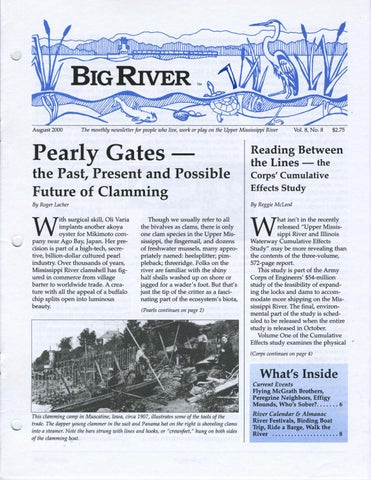
What's Inside Current Events Flying McGrath Brothers, Peregrine Neighbors, Effigy Mounds, Who's Sober? ....... 6 This clamming camp in Muscatine, Iowa, circa 1907, illustrates some of the tools of the trade. The dapper young clammer in the suit and Panama hat on the right is shoveling clams into a steamer. Note the bars strung with lines and hooks, or "crowsfeet," hung on both sides of the clamming boat.
River Calendar & Almanac River Festivals, Birding Boat Trip, Ride a Barge, Walk the River ..................... 8
(Pearls continued from page 1)
the tip sticking out of the bottom to multiple hits on an immobile, out1910, the U.S. Bureau of Fisheries feed. of-sight critter have yet to eliminate expressed concern. Could the MisPearls of all sorts hold a certain it, but it faces a looming new foe, sissippi system continue to stand attraction lacking in mineral gems. another mussel - the zebra. the pressure of almost 10,000 musTo some they seem more natural, sel collectors? On the Button Motors supplanted oars on fishespecially nonspherical "baroques." Settlement of the Midwest genering boats dragging the river, taking The Mississippi produces a range of shapes and colors; a mussel's deated new regional markets for advantage of the clams' habit of fense mechanism can surround the wheat and timber. Then as transclamping onto any intrusion. Rows oddest invader. A shop in Stockportation and information technoloof suspended steel "crowsfeet" holm, along the Wisconsin side of gies progressed, national and world were inched along the bottom. This Lake Pepin, features a wide selecmarkets for clamshell and pearls "brailling" caught most any open tion of regional pearls. flourished. Mussels were free for mussel. The creatures were heaped Clams are clannish, stacking up the picking to anyone willing to get to shore for steaming in smelly barvertically in multilayered beds in wet feet - transient immigrant or rels, or hogsheads, to clean the stretches with suitable substrate steamboat captain. Considering the shell, then sorted and sacked for and current. A bed may remain in tiny percentage of pearls per clam dealers. Good beds of large thick the same spot for decades or mi- .--------------.-■-■-■-■-■----, mussels got harder to find. In the 11 grate en masse up to 200 yards late '30s as plastic buttons forced per year to a better habitat. the riverbank factories out of Their requirements can be exactbusiness, a new trend appeared ing, depending on species. Typion the global scene - cultured cally, flowing water is crucial, pearls. but far enough away from main Pearl Farms channel turbulence, dredge sites The Japanese had developed a or areas subject to heavy siltamethod to grow an artificial tion. A mature mussel siphons pearl around a mother-of-pearl about two quarts per hour for core inside a living oyster. The algae and diatoms, effectively filtering the water for a cleaner L - - - - - - - - - - - - - - - = ' - - - - - - - - - ' best material turned out to be North American clamshell. Like Mississippi. Mother-of-pearl buttons were first cut from shells, then Mussels reproduce by releas- polished and drilled. One can still find heaps of drilled-out ginseng, we exported our shiny shell half way around the world. ing larvae, or glochidia, into the mussel shells near old button factory sites. In this case, to be fragmented inriver current where some attach to cubes and sonic-tumbled into bed, the devastation was incalculato the gills or fins of "host" fish. In perfect spheres. This "nucleus" is ble. Clammers killed off all age some cases a sticky glob of tiny larcarefully implanted in a four-inch vae or "conglutinate" is presented classes, ending reproduction. Wis"akoya" oyster for up to four years. consin alone produced $300,000 as a food item attractive to particuThe creature encases the intrusive lar fish species. The minuscule molworth of pearls in 1889. Rumor had orb with nacre, calcium carbonate. lusks clamp onto the fish for a few it that a single pearl found near It forms, in effect, a fancy scab. The Lansing, Iowa, sold for $65,000 in weeks, grow fast, then drop off resulting pearl is an opalescent 1902, a true fortune. sometimes miles away - leaving coating over a Mississippi core. It is But by then, the scene had the fish unharmed. This dispersal valued according to size, color, lusincreases the chances of a given changed. John Boepple, a German ter and thickness of nacre. species finding a suitable habitat. button maker, propelled the harvest Oriental pearl farming is a cominto a frenzy with establishment of Dams, however, effectively block plicated business. Specific coastal a button factory in Muscatine in fish, and thus mussel, mobility. and inland fresh waters are parti1891. Now the by-product of pearlMussels have suffered the effects tioned off into virtual pens of susing, mother of pearl, could be sold of humans for thousands of years, pended young oysters. At the apto be punched and drilled for a bursince Hopewell culture pearl neckpropriate size they are carefully geoning button demand. In two laces, 19th century pearl rushes, the wedged open and implanted with decades, clamming became an inmould-board plow, pearl-button one or more little Mississippi marmachines, locks and dams, the industry making nearly six billion bles. Then back to the water to buttons valued at over $12 million. vention of pesticides, increased ingrow beauty around the sphere. Piles of perforated shells grew next dustry, dredges and, recently, the The Japanese have had a marketto numerous button factories. By advent of cultured pearls. These
2
Big River
August 2000
ing monopoly and secretive culture techniques for over a century. Japan exports over $300 million worth of pearls a year, about half to the U.S. However, all mollusks are sensitive to environmental degradation and viruses, so their future may depend on global factors.
River Mussel Man We tend to think the last of the clammers (or should we call them musselers) disappeared from the river with the market hunter. But there remain a few hardy souls who ply the depths for shell and, just maybe, a retirement-size pearl. With quarry up to 60 years old out there, anything's possible. A lackluster dullard the size of a frisbee could flower into a dazzling towboat searchlight. David Adcock is one such rubberized musselman. Based in Houston, Minnesota, but diving West Newton Chute, Lake Pepin and the Winona levee, he harvests threeridge clams only. And they better not fit through the three-inch hole in his wooden measuring paddle, and he better account for the shell in his gunny sacks, and he better hoist his safety flag high enough, plus dang well better not drift off his side into Wisconsin waters, sayeth the Department of Natural Resources. The paucity of our mollusk resource requires highly regulated harvesting. Monthly reports detail poundage and selling price. Inspection of the boat or stored shells can occur at any time. The meats must be disposed of away from the river; it's not even fit for pig feed due to high mercury contamination. "At least it's okay for 'coon bait," quips one veteran trapper. It's a rather expensive hobby, compared to most fishing. Adcock's rig includes his motorboat outfitted with a gas powered air compressor, SO-foot air hose, regulator, emergency tank, wetsuit and a 75-pound harness to help him stay down and lean into strong currents. A marker
August 2000
flag signals topsiders that this boat is not abandoned, there's some odd duck down there doing his thing. At a likely spot the diver slips into the river and - going strictly by feel - searches upstream for mussels. It can be an empty enterprise for a long time and space, disorientation comes naturally in cold flowing limbo. Musseling along seems a visceral way to visit the old Miss up close and personal. An object thought to be the desired clam, when tugged up to face mask with yellow rubber glove, may turn out to be a boat light or loaded derringer or old grenade or just the wrong species. Bigger surprises in-
Almost 300 freshwater species exist in the U.S., more than elsewhere in the world. Seventy percent of them are in jeopardy. elude cars and other sorts of jagged metal, dead animals, the forged fittings and draped chains of wrecks or rafts. A. great day for David Adcock would be discovering the Father of Waters' mother lode: an unknown clam bed three feet deep in threeridge mussels over three inches at their smallest diameter. Picking would be like pulling teeth on a comb, then another layer packed upright, then another. Size sorting is quick through the paddle hole and species feel different under the thumb, all underwater, kneeling. It is possible to fill a hundred pound sack within arm's reach and spend over a month on the same bed. Such a harvest would be considered sustainable by most biologists, provided size and species rules were strictly followed. Legal threeridges are over 25 years old, can be aged by growth rings like a tree. They have reproduced for a couple of decades and can make way for younger
Big River
clans on this special stretch.
Uncertain Future Shell collecting continues on this limited basis throughout the country. Almost 300 freshwater species exist in the U.S., more than elsewhere in the world. Seventy percent of them are in jeopardy. Minnesota lists about 40 species, 25 of them protected under endangered species laws. Only the threeridge can be collected, possessed and sold. However, anyone with a fishing license may hand collect and keep up to 24 dead mussels or 48 exact-match halves. Wisconsin also enforces strict regulations, except that mapleleaf and pimpleback mussels may be taken for the commercial market. But the thundering invasion of the zebra mussel spells trouble for its native cousin. Attaching to any surfaces, it effectively seals other mussels shut, killing them. Marian Havlik, founder of Malacological Consultants, La Crosse, Wis., is recognized as a mussel expert and conservationist on the upper river. While she has worked hopefully for years, Havlik predicts the rapid infestation of zebras will displace the majority of mussels within the decade. Is there a miracle cure somewhere out there? Germ, fish, predatory eel, rain forest extract, beams from Venus? Four hundred feet above the Mississippi limestone bluffs weather slowly exposes fossilized shells from an ancient sea bed. Like the foundations of rivertown buildings, maybe healthy mussels can form the foundation of an ecological ethic helping the Mississippi flow intact for another millennium. Roger Lacher writes from the northern end of the Root River Watershed. Photos courtesy of Murphy Library, University of Wisconsin-La Crosse.
3
(Corps continued from page 1)
changes in the rivers after the lockand-dam system was installed, from about 1940 until 1989. Volume Two examines the ecological changes. The studies also list what changes are likely to occur from 1989 to 2050. They do not paint an encouraging picture: islands are eroding away and backwaters are filling with silt. As beds of rooted submersed plants disappear, fish lose habitat. The study also lists the impacts of power plants cooled by river water, agricultural runoff, urbanization and other modern activities that damage the river ecosystem. However, the study carefully sidesteps two very important issues: What have the locks and dams done to the river; and is the big river in big trouble?
What Have the Locks and Dams Done to the River? The period of the study begins after the locks and dams are in place. It does not consider how the river functioned as a natural system. Thus, it avoids asking whether the existing lock-and-dam system makes sense when one considers the true environmental costs. A lot of detailed information was gathered on the river in the 1920s and 1930s, to prepare for building the locks and dams. But that prelock-and-dam data was not directly used in the Cumulative Effects Study. "In some cases they only had information from 1974 and 1989," explained Gretchen Benjamin, Mississippi River planner for the Wisconsin Department of Natural Resources and a member of the Navigation Study's Environmental Coordinating Committee. "They had no way to know how degraded the system was in 1974." The methods used to project future environmental changes "made no sense to us at all," she added.
4
Is the Big River in Big Trouble? · The conclusions of the Cumulative Effects Study are very general, explaining why, for instance, groups of wildlife or sections of the river are in decline, but not attempting to measure the decline or
The study ignores evidence that the Upper Mississippi River ecosystem may already be stressed to the point that it has begun to collapse. estimate the costs of the damage. The study ignores evidence that the Upper Mississippi River ecosystem may already be stressed to the point that it has begun to collapse. Many river biologists believe that this happened to the Illinois River in the 1950s, when many plant, duck and fish populations declined very quickly (see "The Last Straw," Big River, September 1993). In the late 1980s large beds of underwater plants, such as wild celery, all but disappeared in much of the Upper Mississippi. ·while some plant beds have partially recovered, they may never return to their previous state, taking with them thousands of acres of habitat for young fish and the small animals that fish and other wildlife eat. These plants also helped buffer the erosive action of wind and waves and helped clear the water. The study also ignores other environmental damage, such as the damage caused by stone riprap, which blocks turtles from climbing up the bank to lay eggs. Ken Barr, environmental leader for the Navigation Study, admits that information about the depth of backwaters and side channels immediately after the locks and dams were built is limited. Information about seasonal conditions is also lacking, because most of the old
Big River
aerial photographs were taken during "flat pool" conditions, when the flow is low and all of the dam gates are in the water. He said he is concerned with the environmental limits of the system. "At what point can a couple of more boats cause enough turbulence that the plants will not be able to continue photosynthesis?" He is also concerned about the rapid disappearance of submersed, rooted plants. "Below Pool 13 [Clinton, Iowa] there are none left." One positive change is a dramatic decline in the need for dredging the Main Channel. Farmers practicing better soil conservation have reduced the soil washing into streams and rivers on the Upper Mississippi Watershed. Also, more dams on streams and rivers may be holding back more soil, which may be causing problems in the Mississippi's tributaries.
J
'J
Coming in October The complete Navigation Study will only estimate the costs of repairing damage caused by the expansion it proposes - probably extending locks 20 through 25, ex(Corps continues on page 7)
Big River™ Big River (ISSN 1070-8340) is published monthly by Riverwise, Inc., 111 Riverfront, Suite 204, Winona, MN 55987; (507) 454-5949; fax: (507) 454-2133; email: editors@big-river.com; web site: www.big-river.com Reggie McLeod editor/publisher Molly McGuire assistant editor Mi Ae Lipe-Butterbrodt associate editor Trudy Balcom associate editor Kathy Delano design/marketing Joshua Wolfe researcher Mary Feathergill office manager Subscriptions are $28 for one year, $50 for two years or $2.75 per single issue. Send subscriptions, single copy orders and change-ofaddress requests to Big River, PO Box 204, Winona, MN 55987. Second-class postage paid at Winona, MN. POSTMASTER: send change-of-address requests to Big River, PO Box 204, Winona, MN 55987. Big River, Volume 8, Number 8, copyright August 2000. Reproduction in whole or in part without written permission of the publisher is prohibited. Printed on recycled paper.
August 2000
,,
)
By Trudy Balcom
Mussel Nursery
I J
I
r
Genoa, Wisconsin - The Genoa National Fish Hatchery has five new guests: endangered Higgin' s eye pearly mussels. The adult mussels from the St. Croix river were put in specially designed tanks with fingerling bass and walleye. When the mussels released their fertilized microscopic larvae, called glochidia, the fish became hosts for the glochidia, which attach to the gills until they mature and drop off. Together, the mussels and the hatchery fish produced about 55,000 young mussels, according to Todd Turner, hatchery biologist. The Higgin' s eye mussel is on the federal endangered species list, and is further threatened by the zebra mussel infestation. Zebra mussels smother native mussels. Juvenile mussels have been placed in the test beds in the Wisconsin River that have not been invaded by zebra mussels. The young mussels are in cages so they can be easily monitored. Fish and Wildlife Service (FWS) biologists will closely monitor the young mussels, and make the decision to release the mussels from the cage in the fall if enough of them survive to establish a bed. According to Pam Thiel, FWS biologists are guardedly optimistic, so far. "This is the first time Higgin' s eye mussels have been raised in a hatchery," she notes. Thiel adds that not much is known about mussels and their role in the river ecosystem, "We're pretty low on the learning curve." Funding for the project (about $45,000) came from fines paid by violators of mussel collection regulations, funneled to the FWS. Additional funding will be needed to keep the project running. Other mussel conservation activi-
August 2000
ties are being carried out in Minnesota and Wisconsin. The Minnesota Department of Natural Resources (DNR) is conducting the first statewide mussel survey to locate and identify the population densities of various species. Over half of Minnesota's native mussel population is listed as endangered, threatened or of special concern. The Wisconsin DNR is relocating Visit the Big River Homepage (www.big-river.com) for links to information about stories marked with the .1i-. Also, check our web site for many other useful river links, updated calendar information and river books, t-shirts and other interesting gifts. adult mussels of state-listed threatened or endangered species to different rivers in order to enhance their chances of survival. Another potential threat to native mussels may be looming on the southern horizon. Asian black carp are being used in commercial catfish production in the South to control snails that carry a disease that infects catfish, according to the Upper Mississippi River Conservation Committee. Since the fish feed almost exclusively on mussels, their escape could spell doom for struggling native mussel species. Conservation advocates are urging that the uncontrolled commercial use of the fish be banned.
More Mounds Harpers Ferry, Iowa - Effigy Mounds National Monument may almost double in size if Congress approves funding. Iowa senators Charles Grassley (R) and Tom Harkin (D) have introduced a bill to
Big River
acquire 1,045 acres adjacent to the monument, according to a report from the Associated Press (6-16-00). The proposed site would add four additional mounds, two of which are bear shaped. The addition would be particularly significant for wildlife habitat. The land was purchased on a contract by the Iowa Natural Heritage Foundation for $300,000. The total purchase price is over $1.5 million. The initiative has broad support from the state of Iowa, the state's congressmen and the U.S. Department of the Interior. Funding must be secured by December. .1i-
Troubled Bridge Marquette, Iowa, and Prairie du Chien, Wis. - Perhaps the U.S. Highway 18 bridge between Marquette and Prairie du Chien should have been named the Highway 13 bridge. In mid-June, the bridge began losing fist-sized chunks of concrete, one of which narrowly missed a Marquette city employee trimming grass under the bridge, according to the Prairie du Chien Courier Press, (6-19-00). On June 27, the Wisconsin Department of Transportation (DOT) sent a crew in a "Snooper," a machine which allows workers access to the underside of the bridge, to locate and knock off any loose chunks, according to the Dubuque Telegraph Herald, (6-27-00). The DOT described the chunks as "non-structural," and the bridge is deemed safe to cross. Back in the early 1980's the bridge was closed when impurities in the steel of the West Channel portion of the bridge were discovered. Cold winter temperatures could have made the poor quality
5
steel shatter, and the bridge collapse. The ensuing closure and repair made tough going for the local economy, when commuters had to cross on a ferry or the bridges in Lansing or Dubuque, Iowa, according to the Prairie du Chien Courier Press (6-19-00). The trouble with the bridge goes back even further. According to a November, 1974, Courier Press article, in December of 1973, during construction, one of the piers collapsed.
Flying McGrath Brothers On July 2, Sean and Brenton McGrath arrived at the Gulf of Mexico after water-skiing the navigable length of the Mississippi -1,819 miles from St. Paul to New Orleans in seven days. In 1996, the Australian brothers water-skied the Murray River, the longest in Australia. The skiers were hindered by heavy debris and logs in the water above St. Louis and rough towboat wakes. They were helped by the kindness and cooperation of lockand-dam operators all along the route. The previous record for water-skiing the Mississippi, 12 days, was set by Frank Beddor in 1953, according to the Associated Press, (73-00). Not just a stunt, the event was organized as a fund raiser for the Leukemia-Lymphoma Society of America. Brenton McGrath is a leukemia survivor. ~
Peregrine Neighbors Minneapolis - A pair of peregrine falcons who were evicted from their rooftop nest on a suburban Minneapolis office building have been welcomed back by the building's management. Kato and Mendota occupied a rooftop nest at the Colonnade Building for eight years, according to the St. Paul Riverview Times (6-1600). The Colonnade's manager became frustrated when tenants complained about the grisly bits of prey
6
the birds dropped while dining and their propensity to kick gravel out of their nest box and break atrium windows below. So the efficient manager simply removed the nest box. But Kato and Mendota didn't leave, and continued to go about the business of raising a family. Alarmed tenants watched Kato, the male peregrine, dramatically diving trying to save eggs that his mate had laid on the sloped roof of the building. The birds lost four eggs that fell 15 stories. Twin Cities media picked up the story, and Bob Arnosti of the Minnesota office of the Audubon Society stepped in. He discovered that the insurance company that owns the building is the same company that insures Audubon. He suggested that the management of the building install a new nesting tray lined with sand, away from the atrium. Within a few days the birds settled in, and Mendota laid three new eggs.
Who's Sober? Iowa - A new Iowa law that took effect on July 1 requires individuals to submit to a breath test for alcohol if asked by a Department of Natural Resources (DNR) enforcement officer, arid establishes 0.10 percent blood alcohol limit. Boaters who refuse to take the test will be subject to a $500 fine and the loss of boating privileges for one year. Randy Evans, assistant chief of law enforcement for the Iowa DNR, says "This year, we're really trying to educate people about the new law." On July 3, 1999, five boaters died in an accident on the St. Croix River south of Stillwater, Minnesota. All of the victims were legally intoxicated. According to the Minneapolis Star Tribune (7-1-00), arrests for drunken boating in Minnesota dropped sharply after the accident. Sober boaters may need to watch themselves too. According to a report on safe boating in the Corps of Engineers' magazine The Tower,
Big River
(June /July 2000), "Four hours of boating, exposure to noise, vibration, sun, glare, and wind produces fatigue which makes you act as if you were legally intoxicated." Tell that to the officer.
Feds Study Frogs Washington, D.C. -The Fish and Wildlife Service (FWS) has launched a nation-wide study of deformed frogs, perhaps the most comprehensive study to date. The study will involve 43 refuges in 31 states. This year the study will focus on malformed amphibians and eggs to determine any possible connections to pesticides. The FWS intends to use this information and other data to identify deformed amphibian "hot spots."
Toward Cleaner Waters Washington, D.C. - Several major government efforts to reduce water pollution may help the Mississippi. In a comprehensive effort to clean up the 40 percent of U.S. waters that do not meet clean water standards, the Environmental Protection Agency (EPA) issued new Total Maximum Daily Load (TMDL) Program Rules. According to the Minneapolis Star Tribune (7-12-00), the rules are opposed by the Farm Bureau, some members of Congress, the U.S. Chamber of Commerce and many governors. The new rules call for states to identify and list problem waters, identify the sources of pollution and create plans to clean up the waters within 10 years. The term "TMDL" refers to the allowable pollution budget for a particular water body, according to a report from United Press International (7-12-00). Under the new rules, TMDL's can be established by the states. If states fail to create TMDL plans, the EPA will do it for them. The program focuses on the reducing polluted runoff, the largest remaining threat to clean water. Polluted runoff is also the focus of the EPA's Mississippi River/ Gulf
August 2000
.,
(Corps continued from page 4)
of Mexico Watershed Nutrient Task Force. The task force issued an ambitious draft plan to reduce the nutrients (mostly nitrates and phosphorus) in the river by 20 to 40 percent by 2010 in order to improve low oxygen conditions (hypoxia) in the Gulf of Mexico. Marine life cannot survive in hypoxia conditions, thus the area below the mouth of the Mississippi has been dubbed the "dead zone." In 1999 the dead zone covered 8,000 square miles, about the size of New Jersey. Some 56 percent of these nutrients come into the river above its confluence with the Ohio River, which means that agricultural states on the upper river will carry the burden of reducing runoff. The EPA is seeking public comments on the plan through September 15. A copy of the plan can be downloaded over the Internet, or by writing John Wilson, U.S. EPA Assessment and Watershed Project Division, 1200 Pennsylvania Ave. NW, Washington, D.C. 20460, (202) 260-7878. ~
Reforming the Corps La Crosse - The Corps of Engineers may have to change their ways if a bill proposed by Congressman Ron Kind (3rd dist.) makes its way through Congress. The Army Corps Reform Act of 2000 seeks to make the Corps more accountable to the public. The Act would create several citizen review committees that would oversee Corps projects and spending. It would also require the Corps to revise their mission statement to include review of environmental impacts of their activities, according to the La Crosse Tribune (7-19-00) Interest in reforming the Corps has grown since the allegations of false data in the Corps' $50 million dollar Upper Mississippi River Illinois Waterway Navigation Study were made by a Corps economist last February.
August 2000
tending two locks on the Illinois River and adding guide walls and moorings to other locks. These costs will probably add up to about $10.5 million a year. Most of the money will go to projects managed by the Corps. "We have not endorsed that, because we didn't think those dollar figures represent the impacts," Benjamin said. The plan favored by the Corps provides an economic benefit of about $21 million, so if the environmental mitigation costs increase much, they will cancel out the benefit, she pointed out. Despite arguments by economists and biologists, the final study
Environmental groups are certain to haul the Corps into court when the final study is released. will ignore the environmental costs · of the existing lock-and-dam system and will not explore its overall economic and technological feasibility. Environmental groups are certain to haul the Corps into court when the final study is released. The economic part of the study is already under scrutiny by the National Science Foundation, Congress, the Pentagon and the Office of Special Council, because Corps economists accused their bosses of changing the numbers to make expansion look economically feasible (see "Did the Corps Cook the Books?", Big River, March 2000). Benjamin said that many committee members are unhappy with the limited scope and methodologies of the Cumulative Impact Study. "We don't think we are being listened to all that well." "In 90 and 91 we almost had a system-wide collapse of the environmental system. We don't think
Big River
the system can handle what is out there today," she said. "We have outlined those concerns time and time again." The Navigation Study will cost about $54 million and take a total of seven years. The most important results will be revealed by the shape of what is missing, by the important questions that were avoided. Those tough questions will have to be asked in the courts and at the hearings that follow in the wake of the study, at enormous expense and adding further delay to addressing problems that threaten the river's future. Barr cannot comment on the economic part of the study, but he said his bosses have not pressured him to change any of the environmental part of the study. Reggie McLeod is editor of Big River. His last article was "Corps Scandal Simmers," July 2000.
Big River Pelican T-Shirts Celebrate summer and the return of the pelicans to the Upper Mississippi on our exclusive Big River pelican t-shirt. The beautifully detailed drawing of the pelican was created by wildlife artist Vera Ming Wong. • Heavyweight cotton, full cut • Heather Gray or Oceana Blue with black image • Medium, Large, X-Large • $14.95 plus $2.75 shipping Send to Big River, PO Box 204, Winona, MN 55987, or call 1-800-303-8201.
7
Special Events & Festivals
Meetings & Hearings
Workshops & Conferences
August Every other Friday through Sept. 22, 7 p.m., Chautauqua Series, Effigy Mounds National Monument, Harpers Ferry, Iowa, (319) 873-3491. 4-6 River City Days, Red Wing, Minn., 1800-762-9516. 9 Bird Watcher's Boat Trip, 10 a.m., Departs from Boom Island, Minneapolis, Minn., (651) 290-4160 ext. 230. 10-13 Great River Jazz Fest, La Crosse, Wis., (608) 791-1190. 11-12 Tug Fest, Port Byron, Ill., and Le Claire, Iowa, (309) 523-3312. 11-13 Riverfront Summer Blast, Marquette, Iowa, 1-800-896-0910. 11-13 Fish Days, Lansing, Iowa, (319) 538-4211. 12-13 Good Old Nelson Days, Nelson, Wis., (715) 673-4804. 12-13 Catfish Festival, Potosi, Wis., (608) 763-2261. 18-20 Fly Fish Days, De Soto, Wis., (608) 648-2700. 23 Ride a Working Barge, 6:30 p.m. - 9:30 p.m., Aggregate Industries, Distribution Yard D, 65 North 26th Ave., Minneapolis, Minn., (651) 683-8172. 26 Six-Mile Canoe Trip, noon - 3 p.m., East Coon Rapids Dam Regional Park, Coon Rapids, Minn., (651) 429-8007. 26 Bird Walk, 8 a.m., Effigy Mounds National Monument, Harpers Ferry, Iowa, (319) 873-3491.
August 7-8 National Research Council Committee to Review the Upper Mississippi River-Illinois Water Navigation System Feasibility Study, 10 Stadium Plaza, St. Louis,Mo . .$. 10 Lower Wis. Riverway Board, 5 p.m., Wyalusing State Park, Prairie du Chien, Wis., 1-800-221-3792.
August 9-10 Upper Mississippi River Basin Association, Four Points Hotel Sheraton, Rock Island, Ill., (651) 224-2880. 23-27 Mississippi River Parkway Commission annual meeting, Radisson Quad City Plaza Hotel, Davenport, Iowa, (763) 212-2560.
September 1 German Fest, Dubuque, Iowa. 1-3 Old Time Farm Fest, Fountain City, Wis. 2 Rock At the Dock, Maiden Rock, Wis. 2-3 Lumberjack Fest, McGregor, Iowa. 2-4 Mark Twain Days, Alma, Wis. 2-4 Melon Days, Thomson, Ill. 8-10 Prescott Daze, Prescott, Wis. 8-10 Riverfest, Dubuque, Iowa. 9-10 Watermelon Fest, Kellogg, Minn. 14-17 Applefest, La Crescent, Minn. 16-17 Victorian Fair, Winona, Minn. 16-17 Laura Ingalls Wilder Festival, Pepin, Wis.
8
Mississippi Tours Friends of the Mississippi River Pre-registration required, (651) 222-2193.
August 5 Paddle in Spring Lake, 9 a.m. - 4 p.m., Hastings, Minn.
September 8-9 Mississippi River Basin Alliance Annual Conference, Memphis Marriott, (612) 870-3441. 15-17 Audubon Society Conference and Celebration of the Upper Mississippi, Sinsinawa (Wis.) Mound Conference Center, (651) 290-1695.
26 Mississippi Gorge Walk and Talk, 2 p.m. - 4 p.m., Lock and Dam 1, Minneapolis, Minn.
Almanac By Kenny Salwey Cottonwood leaves whispered a lullaby as the warm breeze drifted and danced among the riverbank trees. The shade of the gnarly old trees felt good to my bones. The relentless currents of the big river had swept away tons of sandy soil from beneath the "feet" of several nearby river birch and silver maples, until they toppled headfirst into the water, where they now lay half in, half out. This was a great place to watch the comings and goings of frogs, turtles and water snakes ... all of whom seem to be in general decline along the Upper Mississippi. But here, especially on sunny days, many can be found resting in the shade, taking a dip and basking on the sun. I recognized one water snake. It was a good three feet long, heavy and muscular, with a long, jagged scar running lengthwise down its back. I'd named it, Jake the Snake. Today, 01' Jake was soaking up rays on his favorite tree about 10 feet downstream. I must have dozed off, when I was awakened by a garbled croaking sound not six feet away. It was a mid-sized leopard frog clenched around its belly by old Jake's jaws. Jake was lying in a loose "s" shape not doing much except grinding his jaws back and forth now and then. When he did, the frog gurgled out a croak that got weaker each time. My first instinct was to rescue that poor frog. But knowing Jake's temperament, I'd have to take him behind the head and pry the frog loose. The frog probably wouldn't live anyway, so I just sat there, mesmerized. It took 01' Jake a long time to turn the frog around in his mouth and swallow it head-first. Death for the frog meant life for the snake. Guess that's the way the Great Circle turns. Then 01' Jake the Snake headed back to his sunning log to watch the big river roll by. $
Big River
August 2000
"