August 1998
The monthly newsletter for people who live, work or play on the Upper Mississippi River
Vol. 6, No. 8
$2.75
Where Does All That Sand Cotne Frotn?
The Kingfish and the Combat Zone
By Robert E. Sloan
By Lee Hendrix
A
M
ost of us when traveling up or down the river see the big piles of sand the Corps of Engineers has dredged out of it. No matter how much the Corps dredges, there is still more sand. Then we track it in the house all winter and wish it would stay on the roads where it's needed. In fact, beneath the river of water is a river of sand. It not only has to be dredged out of the channel, but it continually shapes the big river, far more efficiently than can dredges. For instance, Point Douglas (near Hastings, Minn. and Prescott, Wis.) forms where the current on the north side of the Mississippi spills over into the slower St. Croix River current, loses speed quickly and drops its sand and silt to form a levee. During flood stage the levee gets built up higher. This levee forms the finger that nearly blocks the St. Croix, backing up the river to form Lake St. Croix. It has been doing this for the past 10,000 years and is an obvious place for railroads and Highway 10 to cross the St. Croix.
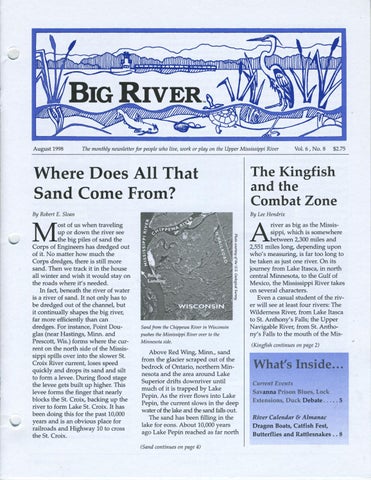
Sand from the Chippewa River in Wisconsin pushes the Mississippi River over to the Minnesota side.
Above Red Wing, Minn., sand from the glacier scraped out of the bedrock of Ontario, northern Minnesota and the area around Lake Superior drifts downriver until much of it is trapped by Lake Pepin. As the river flows into Lake Pepin, the current slows in the deep water of the lake and the sand falls out. The sand has been filling in the lake for eons. About 10,000 years ago Lake Pepin reached as far north (Sand continues on page 4)
river as big as the Mississippi, which is somewhere between 2,300 miles and 2,551 miles long, depending upon who's measuring, is far too long to be taken as just one river. On its journey from Lake Itasca, in north central Minnesota, to the Gulf of Mexico, the Mississippi River takes on several characters. Even a casual student of the river will see at least four rivers: The Wilderness River, from Lake Itasca to St. Anthony's Falls; the Upper Navigable River, from St. Anthony's Falls to the mouth of the Mis(Kingfish continues on page 2)
What's Inside ... Cu"ent Events Savanna Prison Blues, Lock Extensions, Duck Debate ..... 5 River Calendar & Almanac Dragon Boats, Catfish Fest, Butterflies and Rattlesnakes .. 8
(Kingfish continued from page 1)
souri River; the Middle Mississippi River, from the mouth of the Missouri to Cairo; and the Lower Mississippi, from Cairo to the Gulf. For those who have journeyed the Mississippi by water, however, there is a fifth river. It is what professional navigators refer to, not affectionately, as "The Combat Zone." On southbound trips, they begin looking forward to entering the Combat Zone several hours before they arrive. They look forward to this event like Eastern Europe looked forward to the invasion of Genghis Khan. The gateway and symbol of the Combat Zone is the bridge that guards it like Cerberus guarding the Underworld. It is the Huey P. Long Highway/ Railroad Bridge, or the U.S. 190 Bridge - often referred to simply as the Upper Baton Rouge Bridge. This is not to be confused with another Huey P. Long Bridge that spans the river above New Orleans. The Baton Rouge bridge, like the man it is named after, has an unsavory reputation among some people, but it turns out that the bridge's reputation, at least, is undeserved. That reputation is tied to the Combat Zone, and the common navigator's aversion to it. Boats enter the Combat Zone just above Baton Rouge at a navigation light fittingly called "Devil's Swamp", where their navigators switch their VHF bridge-to-bridge radios from Channel 13 to Channel 67. This switch is one of the rites of passage. Boats leave the Zone either below New Orleans, about 150 miles downriver, or back at Devil's Swamp after having turned around somewhere in between the Gulf and the bridge. This re-emergence from the underworld is a blessed event for most navigators, who by that time have spent the better part of three or four days contemplating
2
alternative careers, swallowing headache remedies and practicing abusive language. Some pilots, like ship pilots and fleet pilots, are doomed to this Hades forever; they either acclimate or perish. If they do accidentally ever make it above Baton Rouge, they suffer from acute paranoia over the relative peace and quiet. It isn't the river itself that makes this stretch the Combat Zone. On the face of things, piloting should become easier below Baton Rouge, because the water is much deeper. Instead of a 12-foot channel, a
it quickly. At the top of the order are state-appointed ship pilots. At the bottom is everybody else. That pecking order is partly based on size. Ocean-going ships are big and fast. Simple logic dictates moving out of their way. There is, however, another reason for deference. Much of the economy of the state of Louisiana depends upon the products in the big ships' holds, and so their pilots' association is rich and powerful. If you aren't a member, you are the stranger passing through a hostile town.
l
I
Dangers and the Legend
Gateway to the Combat Zone
depth of 40 feet is maintained for deep-draft, ocean-going ships. Therein lies a big part of the prob-
For those who have journeyed the Mississippi by water, however, there is a fifth river. It is what professional navigators refer to, not affectionately, as "The Combat Zone." lem: There is too much traffic, too many different types of boats, too many docks and very little (if any) control. That's not to say the Combat Zone is a free for all. There is a hierarchy, or pecking order, in the Combat Zone, and neophytes must learn
Big River
At the head of this economic and political zone stands the Huey P. Long Bridge. At first glance, the bridge appears in.:......:......:;..i.i:w;ilillllf nocuous, although its ugly mustard color is either an extremely poor exercise in the visual arts or primer that was never painted over. Like its color, the bridge's design was not chosen to attend to the sensibilities of pilots. The navigator coming down on this bridge has three spans to choose from. The Baton Rouge, or left descending, is the widest, at 748 feet, but it also has the swiftest current. The Port Allen, or right descending, is generally considered to be the channel span, but it is closed off by a sandbar in low water. It is also difficult to navigate into during high water, necessitating a "flanking maneuver" by large tows. The center span is 623 feet wide, but it offers two piers to worry about rather than one and is difficult to line up for. None of these options are any good. After bridges in Greenville and Vicksburg, Miss., the Upper Baton Rouge Bridge is the most clobbered bridge on the Lower Mississippi River. It sits immediately below a sharp turn at Wilkinson Point and
August 1998
,
¡"
feet would be considered a very high bridge on the Upper Mississippi, it is not nearly high enough for deep-draft, high-profile ships to fit under, especially when high water cuts 35 to 40 feet off the clearance. The bridge is a barrier across the river for the big ships, and thus the end of the Combat Zone. That, the legend goes, is exactly what Huey Long planned when he had the bridge built. According to the legend, Long wanted none of the international business represented by the ships to escape his state, so he dictated that the bridge be built low
4
Huey P. Long
has several pesky docks right above it. The bridge was hit by a chemical barge last year during high water, forcing the closing of the river and the evacuation of hundreds of people. Still, the unsavory reputation of the bridge has little to do with its decor or its navigational oddities. It does have to do with the person it was named after. Huey P. Long was the governor, senator and some say dictator of Louisiana from 1928 until his assassination on the steps of the state capitol in 1935. Depending on how one viewed him, he was either a 20th-century Robin Hood the "Kingfish" who helped the downtrodden - or else a rude and despicable tyrant. Two things, however, are indisputably true about him: He was the quintessential Louisiana politician, and he brought the state into the 20th century. In his four years of governorship, he oversaw the construction of 1,583 miles of concrete roads, 718 miles of asphalt roads and 111 bridges - awesome totals for that period of history. Among the bridges was the Upper Baton Rouge Bridge. Its vertical clearance is 110 feet above the low water reference plane, or 62 feet lower than the 1-10 Bridge a mere four miles downriver. Although 110
August 1998
Although 110 feet would be considered a very high bridge on the Upper Mississippi, it is not nearly high enough for deep-draft, high-profile ships to fit under... the bridge is a barrier across the river for the big ships, and thus the end of the Combat Zone. enough to keep ships from going up to Natchez, Vicksburg or Memphis. That is, he created the Combat Zone to keep money in his state. Such a Machiavellian scheme would doubtlessly have appealed to Long. The trouble with the legend is that it's not true. It appears that, as far as Long was concerned, the bridge was just another bridge, if he paid any attention to it at all. Clara Isenhour, the riverlorian on the American Queen, debunks the legend by pointing out a report done by Karen "Toots" Maloy of the Mississippi Queen. Maloy wrote, "In 1996, I had the good fortune to meet the son of C. A. Myers, head designer for the Upper Baton Rouge Bridge. He gave me his father's phone number and I called. Myers was in his 90s at the time and hard of hearing, but he was quite adamant about the real reason the
Big River
bridge was built so low. He said the federal government did not want to maintain a 40-foot channel above Baton Rouge, so there was no need to build the bridge high enough for ships to pass beneath. Myers also informed me that the bridge was completed in 1940. Huey Long was killed in 1935. But did he have a hand in the planning stages? Not according to Myers." When asked, historians in the Old State Capitol-Louisiana Center for Political and Government History in downtown Baton Rouge say the same thing. Too bad. Another good legend blown out of the water. History aside, pilots are happy the bridge is so low. It keeps the Combat Zone where it is.= Lee Hendrix is a pilot for the Delta Queen Steamboat Company and when shoreside a storyteller in the St. Louis area. His last story for Big River was "The Sultana Tragedy - Worse than the Titanic " (November 1997).
Biglmi: (ISSN 1070-8340) is monthly by 'Riverwise, Inc., Ill Riverfront, Suite 204, Winona, MN 55987; (507} 454--5949; f= (507) 454-2133; email: editors@big-riveT.r.om; web site: http://wu,w.big-river.com Reggie McLeod editor/publisher Molly McGuire assistant editor Mi Ae Lipe-Butterbrodt associate editor David Syring associate editor Bill Jacobs associate editor Kathy Delano dc'Signlmarketing Nancie McCormish graphic design Mary Feathergi/1 office manager Subscriptions are $28 for one year, $50 for two years or $2.75 per single issue. Send subscriptions, single copy orders and change-ofaddress requests to Big River, PO Box 204, Winona, MN 55987. Second-class postage paid at Winona, MN. POSTMASTER: send change-of-address requests to Big River, PO Box 204, Winona, MN 55987. Big River, Volume 6, Number 8, copyright August 1998. Reproduction in whole or in part without written permission of the publisher is prohibited. Printed on recycled paper.
Mailing Change Beginning this month, we are mailing Big River without an envelope. We hope you like the change. If your copy arrives damaged, give us a call at 1-800-303-8201 and we'll send a replacement free of charge.
3
(Sand continued from page 1)
as St. Paul, but the sand grains carried by the river have been filling it in until now its head is at Red Wing.
durable, but when brought to the surface by erosion it will decompose. Of all the minerals in granite, quartz is the most stable. All but a few others (diamond, garnet, rubies, Moving Sand sapphires, for instance) decompose The important thing about sand is through the action of water and air how it moves in the air and the wainto clay. ter. To geologists, sand is anything at As decomposition continues, the all that behaves like sand, even angular, sand-sized quartz grains snow in the winter, or sugar or salt are left surrounded by clay until spilled on a table. Specifically, it's they are washed away by running anything between one-sixteenth and water. In the process, they rub two millimeters across. Most of it is against each other, grinding off quartz. Sediments the size of sand sharp corners as they are carried are the easiest for water and air to . downstream by currents to be demove. Granules, pebbles, cobbles or posited where the current slows, boulders all need very fast currents for erosion. So, oddly, do finer particles, like clay, which is less than About 10,000 years ago Lake l / 256 mm - so fine it doesn't even feel gritty between your teeth - and Pepin reached as tar north as silt, 1/256 mm to 1/16 mm -which St. Paul, but the sand grains does. They have such smooth surfaces that they need fast currents to carried by the river have been erode them. Once moving, they fall filling it in until now its head out of the water only when the current gets very, very slow. That's why is at Red Wing. it takes a day or so for a cup of muddy water to settle out. But sand is eroded by very slow such as at sand bars or shores. This currents. A current of only one foot creates sedimentary beds of sand, per second will move sand down which are then cemented into sandthe river. Any time the local current stone. Much later these rocks are liftspeed drops below that value, the ed above sea level and re-eroded insand grains fall out of the current to loose sand grains, to be transportand stop moving. Sand grains in a ed again, and rounded still more, river move mostly by saltation and then redeposited. hopping a couple of inches above Nothing is lost, because once a the bottom for a foot or so then quartz sand grain has been freed falling back to the bottom and from the rock, the only way to get knocking another sand grain loose rid of it is to melt it into glass. Many to hop some more. sandstones, such as the St. Peter sandstone of the cliffs along the river in the Twin Cities, have been Making Sand through as many as eight cycles of To move down the river, sand erosion, transport by running water first has to get into the river. Quartz and redeposition. During each cycle grains, the primary component of the number of grains other than sand, form in granites and gneisses quartz goes down and the quartz deep in the interior of mountains at grains get progressively smaller and temperatures of 800° Celsius. They more round. While the St. Peter make up about 20 percent of a grans. ndstone is about 450 million years ite. The rest of the grains are other old, as rock, the individual sand minerals, such as feldspar, mica or grains were first crystallized as long hornblende. Granite seems hard and ago as 2,700 million years ago, and
4
Big River
have been rattling around ever since.
Sculpting a River So there is a never ending supply of sand helping to form the Mississippi. The sand moves into the big river from such tributaries as the Chippewa, the Zumbro, the Black, the Trempealeau and the Root rivers, the character of each river determining how the sand affects the Mississippi. The Chippewa is a fast moving stream carrying lots of sand and silt from central Wisconsin. It flows into the Mississippi where the larger river is moving more slowly and can't carry the sand away. As a result the delta of the Chippewa fills nearly all of the three-mile-wide valley of the Mississippi, forcing it over to the Minnesota side at Reeds Landing and backing the water up to form Lake Pepin. Even wildlife is affected by sand. Eagles are common between Reads Landing and Wabasha, Minn., for instance, because the river is only 500 yards wide there. All the fish in the river are concentrated into in a narrow stretch of fast-moving current, open most of the winter, so the eagles stay where the fishing is easy. The Zumbro does the same thing at Wabasha and forces the river to the Wisconsin side. The Trempealeau and the Black force the Mississippi over to the Minnesota side and the Root shoves it back over towards Wisconsin south of La Crosse. All along the river, the sand moves, shaping the shoreline and the islands and the channel, and the Corps of Engineers keeps dredging it away to keep the river traffic going, and we keep tracking it in all winter.
.,
=
Robert E. Sloan was professor of Paleontology at the University of Minnesota for 44 years. He now resides on the big river in Winona. His last story for Big River was "Living Fossils in the Big River" (May
J
J
1998).
August 1998
_J
Current EveJl~ Ill ~~Aa
Big House on the Prairie
[ f
l
l
Savanna, Ill. - An Army depot in the process of being decommissioned has quickly turned into a battleground for environmentalists, citizens eager for local development, the Illinois governor and gubernatorial candidates. The Local Redevelopment Authority (LRA) charged with finding developers for part of the 13,000acre Savanna Army Depot has been courting Illinois prison officials (see Big River, August 1998). Last April Gov. Jim Edgar announced plans to build a 1,000-cell prison on a 140acre site on the depot. However, the site is in the midst of what may be the largest sand prairie in the state, according to an article in the Chicago Tribune (7-1-98) entitled "Big House on the Prairie." Environmentalists prefer building the prison on the depot where there are already buildings and utility hookups. Candidates for governor from both parties agree that the prison should not be built on the prairie. Proponents of the prairie site worry that most other sites on the depot may require extensive environmental cleanups, pushing the project beyond its required time table. Gov. Edgar listed nearby Thomson as an alternative site. More than 400 people worked storing, maintaining and shipping bombs, grenades and other munitions at the depot, which stretches along 13 miles of the river north of Savanna. Its thousands of acres of backwaters and prairie provide homes to 28 species on Illinois' threatened and endangered lists.
Strike Ends Money did in the strike on the lower Mississippi River by members of Pilots Agree, a representative for
August 1998
the union says. The union ended the strike that began April 3 because the towboat companies simply had enough money to outlast striking pilots. Pilots demanded higher wages to make up for inflation and reduced benefits. Towboat company officials say the impact of the strike on shipping never amounted to much. The union now plans a different set of tactics to force towboat companies to the bargaining table. The union distributed pledge cards to 15,000 deckhands and 3,000 pilots. Under federal law, if more than 30 percent of a company's employees sign pledge cards to indicate that they want union representation, the union will hold elections. If more than 50 percent of the employees then vote for union representation, the company will have to bargain with Pilots Agree, according to an Associated Press story (6-25-98).
New Lock Design The Army Corps of Engineers took what it considered to be a good idea and improved it. The Corps refined a design for lock extensions that might provide an alternative to adding new locks to the river. The idea is to build extensions of existing locks, usually on the downstream side. By reinforcing guidewalls with metal tubes filled with sand, the Corps would use existing structures to form the land side of the extensions. A row of similar metal tubes, or cells, filled with concrete would make up the river side of the extensions. The plan calls for constructing gates for the locks on shore and floating them into place after they are built. These measures would reduce the impact on navigation during construction because the existing lock could be used while the modi-
Big River
fications were being made, according to the Upper Mississippi RiverIllinois Waterway System Navigation Study Newsletter (June 1998). While the new design would make expanding the lock and dam system less costly, Congress hasn't yet decided whether expansion is necessary or desirable. The Corps' is scheduled to deliver its navigation study to Congress in 1999.
Duck Flap A flock of negative reactions led the U.S. Fish and Wildlife Service to shoot down a longer duck-hunting season in six southern states. Members of Congress from the six states, hoping to give their constituents a chance at late season stragglers fleeing cold weather, asked for an extension of the season to Jan. 31. Rather than make piecemeal changes in the rules, the Service will join in a national review of hunting seasons on all four of the major flyways in North America the Atlantic, Mississippi, Central and Pacific. The review will begin this fall, with recommendations for changes expected in time for the 2000-2001 season, according to a Service news release (7-8-98). Southern hunters take home the lion's share of ducks from the Mississippi Flyway. In 1995-1996, northern hunters shot 3.6 million ducks, mid-tier hunters shot 1.7 million and southerners shot 7.5 million. The average number of ducks taken per hunter further emphasizes the advantage southern hunters have: northern hunters averaged 6.0 ducks each in 1995-1996, .while mid-tier hunters averaged 6.3 ducks each and Southern hunters averaged 20.8 ducks apiece, according to the Chicago Tribune (5-7-98). In other waterfowl hunting news, the Service extended until
5
October 1 the comment period on changes to simplify baiting regulations. The suggested rule changes can be found in the March 25 Federal Register. Send comments to: Director, U.S. Fish and Wildlife Service, P.O. · Box 3247, Arlington, VA 22203-3247.
Bait Foot Dodgeville, Wis. - You have to keep on your toes when you're on the water, as a Platteville, Wis., man found out. Dan Droessler dangled his foot into the water to cool down while canoeing at Twin Valley Lake near Dodgeville, Wis., and caught a tiger muskellunge with it. His inadvertent bait had to be stitched up, and the 36-inch muskie probably will be, too. Although the fish was smaller than the 40-inch limit for muskies - and catching them with your feet isn't a legal fishing method - the Wisconsin Department of Natural Resources allowed Droessler to keep the fish if he paid $10.55 for a special permit. Droessler, a Platteville police officer, said he planned to have the fish mounted (Associated Press 7-4-98).
Critter News • The U.S. Fish and Wildlife Service seeks public comment on a plan for restoring the endangered Higgins eye pearly mussel to the Upper Mississippi River. The Higgins eye has declined because of deteriorating water quality, threats from zebra mussels, habitat changes, overharvesting and commercial shipping. The plan includes ways to preserve the Higgins eye's habitat and restore its population in its historic range, according to a Wildlife Service press release (7-2-98). Copies of the plan can be seen by appointment at Wildlife Service offices. Comments will be accepted through August 21, 1998. • Efforts by state wildlife officials to re-introduce endangered pere-
6
grine falcons to the Upper Mississippi blufflands have progressed this season. Biologists tagged and banded two, 22-day-old chicks on June 18 at the Dairyland Power Cooperative power plant in Genoa, Wis. Their parents had nested 375 feet up on the power plant's 500foot smokestack. One of the chicks died two days later when lightning hit the smokestack (The Capital Times 6-26-98). In mid-July, five young falcons were released at the Effigy Mounds National Monument near Marquette, Iowa, by members of The Raptor Resource Project. They plan to have other releases nearby. • Some Wisconsin snapping turtles are sporting bands and radio transmitters attached to them by the Wisconsin Department of Natural Resources (DNR) due to concerns that fewer snappers might be surviving to maturity. The monitoring project looks at survival rates and causes of death. Males and females caught by the DNR carry bands, but only females of minimum legal harvesting size have transmitters glued to them. The.DNR locates the transmitter-tagged turtles at least once a week (La Crosse Tribune 7-2-98). The DNR asks anyone who spots marked turtles to report to biologist Neal Paisley. Bands and transmitters taken from harvested turtles should be returned to the DNR. • Muskrats in the 1990s were not significantly affected by fluctuating water levels in the Upper Mississippi, according to a study done under the Long Term Resource Monitoring Program (LTRMP). The study, conducted on the Upper Mississippi River National Wildlife and Fish Refuge, tracked fur harvesting data on muskrats taken from pools 4 through 14 for the 1990 and 1992 through 1996 seasons. Average
Big River
yearly ranges of water levels were between two and six feet at pool headwaters and six and twelve feet in tailwaters. The study, however, warns that its conclusions conflict with other studies that indicate muskrat populations are affected by water level changes, and that "harvest may not be a good .estimator for muskrat populations." The study· revealed a connection between plant increases and increased muskrat numbers. Further studies are under way to look at this relationship. Contact the Environmental Management Technical Center at (608) 783-7550 or visit the Big River website for more information on this and other LTRMP studies.
Levee Districts Sue Saying changes in how the U.S. Army Corps of Engineers maintains the nine-foot channel have created problems with their levees, 15 levee districts on the Mississippi and Illinois rivers have filed suit against the U.S. in the Court of Federal Claims. The districts, led by Henderson County (Ill.) Drainage District No. 3, want to be reimbursed for damaged levees and want the court to order the Corps to stop practices they say caused the erosion damage. Corps lawyer Tom Crane said the Corps denies that anything has changed since the early 1960s. That's when the levee districts agreed not to file claims against the government in exchange for payments to make up for damage caused by the creation of the navigation system. Besides the possibility that the suit could be thrown out because it was filed long after the six-year deadline for such suits, the Corps is relying on agreements the districts signed in the 1960s. "Our contention is, a deal is a deal," Crane said.
August 1998
Drawdown Gets Iffy Fluctuating river levels taught the U.S. Fish and Wildlife Service and the the U.S. Army Corps of Engineers a lot about managing a drawdown this summer. To maintain the lower water level in pool 13 for the Rock Island District's first-ever drawdown, river flow can't be too great or too small. The flow exceeded the maximum early in July. Managers re-established the lower level on July 11, but then the river started dropping. The goal is to maintain the water level at the downstream end of the pool about a foot lower than normal, for 30 consecutive days between mid-June and mid-August. If river flow drops below the minimum 50 cubic feet per second the drawdown will have to be abandoned. That rate of flow would make it impossible for dam operators to maintain the pool level sought by biologists. The drawdown would then have little effect on the pool's ecosystem. The Fish and Wildlife Interagency Committee planned the drawdown to repair damage to plants from the 1993 flood. The committee' s plan, modeled on successful drawdowns in the St. Louis District, was conceived in 1994. While the Wildlife Service was getting the clearances, and the cooperation of the Corps of Engineers, the vegetation pretty much came back on its own. The committee went ahead with the plan to learn how to manage a drawdown and get more detail about its effects. "Part of the reason is the question about operability; [the St. Louis District's drawdowns] have had some tremendous responses, but it's a different operating style here, so there is some question whether it could even be done," said biologist Bob Clevenstine, who chairs the committee. The point of the exercise is to recreate the low water levels that the river often had before the lock
August 1998
Dresbach, Minn. - Four runaway barges stopped river traffic by trying to go through the dam rather than the lock at Lock and Dam 7 near Dresbach, Minn. The barges broke free and lodged against the dam when the towboat Arrowhead approached the lock at about 3:45 p.m. in early July. The barges blocked water flow over the dam, and caused a traffic delay. By 9:30 p.m. a towboat rescued the barges, though traffic was delayed until morning, according to the La Crosse Tribune (7-3-98).
Botanical Center has opened. Nearly 15 years in the planning, the center has a 6,400-square-foot display area, the "Sun Garden," built around a 14-foot waterfall under a 70-foot-high ceiling. The center is creating outdoor gardens around the main building, and the riverfront site connects to the bike trail that winds through the Illinois Quad-Cities. The center plans to add two more large display areas. Funded by local donations and a $500,000 challenge grant from the Doris and Victor Day Foundation, the center was built on a former factory site cleared by the city at a cost of $1.3 million. The center cost about $3.8 million to build, including $80,000 for the first plants. For information call (309) 7940991, or visit the Big River website for a link.
Threatened Bridge
Resources
Lansing, Iowa - The threat of a bridge closure has sent local leaders scrambling for funds to save their link between Wisconsin and Iowa. The Iowa Department of Transportation (DOT) says the 66-year old bridge at Lansing, which began as a. private toll bridge in 1932, will last only about 11 more years. The bridge might then be abandoned. Many employees of Lansing companies live in Wisconsin. Closing the bridge would force them to drive an extra 60 miles a day, either 30 miles north to cross the river at La Crescent, Minn., or 30 miles south to cross at Marquette, Iowa. The Iowa DOT says the bridge doesn't carry enough traffic to merit replacement. About 2,500 cars and trucks cross the bridge each day. Lansing leaders plan to seek the help of Rep. Jim Nussel, Rlowa, to save the bridge or get funding for a new one, according to an Associated Press story (7-7-98).
• New canoeing and boating maps of the Mississippi from Lake Itasca to St. Cloud are available through the Mississippi Headwaters Board or the Minnesota Department of Natural Resources. Check at tourist information spots, or call the DNR at 1-888646-6367 or (612) 296-6157.
and dam system was built. That would allow some plants important as food for migrating birds and as cover for larval fish to re-establish themselves in the backwaters.
Broken Tow
Plant Showcase Rock Island, Ill. - The Quad City
Big River
• For a free poster Toads and Frogs of Minnesota and Their Habitats, call A Thousand Friends of Frogs at (612) 523-2812.
Loosestrife Invasive purple loosestrife is such a showy ornamental flower that people plant what is marketed as a sterile variety in gardens. According to the The Resource Volunteer (July/ August 1998) these may cross with wild loosestrife and set viable seed that could infest wetlands. Watch for names like pink and purple spirea, rose gleam, rocket, beacon or lythrum. Better to plant species like blazing star, delphinium, false spirea, foxglove, lupine or lobelia.
7
Special Events and Festivals August 1 Festival of Lanterns, Riverside Park, La Crosse, Wis. 1 Mississippi River Canoe Day Trip, 10 a.m., West Coon Rapids Dam Regional Park, Mpls., Minn., (612) 559-6700. 1-2 River City Days, Red Wing, Minn., 1800-498-3444. 4 Lawn Concert with Charlie Maguire, 6:30 p.m., Grandview Park, South St. Paul. 5 Taste of Dubuque (Iowa), Ice Harbor, 1800-226-3369. 6-9 Great River Jazz Fest, La Crosse, Wis., (608) 791-1190. 7-9 The Tug, Le Claire, Iowa, and Port Byron, Ill. 8 Fourth Annual Blues Fest, Dubuque, Iowa, (319) 557-7010. 8-9 Good Old Nelson (Wis.) Days. 8-9 Catfish Festival, Potosi, Wis. 9 Prairie Day, Great River Bluff State Park, Dakota, Minn., (507) 643-6849. 10 Lawn Concert with Charlie Maguire, 7 p.m., Nicollet Island Amphitheatre, Minneapolis. 12 Mississippi River Landscape painting series, 9 a.m., Harriet Island, St. Paul, (612) 290-4160, ext. 221. 13 Audubon Society Picnic, 6:30 p.m., Eagle Point Park, Dubuque, Iowa. 14-16 Riverfeast, Wabasha Street Bridge, St. Paul, Minn., (651) 228-0018. 14-16 Fish Days, Lansing, Iowa. 15-22 Elvis Cruise, American Queen, 1-800543-1949. 16 Annual Catfish Tournament, Bellevue, Iowa; (319) 872-3225. 22 Bird Walk, 8 a.m., Effigy Mounds National Monument, Marquette, Iowa, (319) 873-3491. 22-24 Fish Fly Days, De Soto, Wis. 28-30 Great River Folk Fest, UW, La Crosse, Wis., (608) 784-1830. 29-Sept. 1 Fire Dept. Celebration, Stoddard, Wis.
September 11-13 Riverfest, Dubuque, Iowa, (319) 583-8535. 11-13 International Dragon Boat Festival, Dubuque, Iowa, (319) 582-5406. 12 Light up the Night, 6 p.m. - 9 p.m., Harriet Island Park, St. Paul, Minn., (651) 293-6860. 12 Butterfly-Tagging Demonstration, Bellevue, Iowa, (319) 872-5830. 12-20 Iowa Archaeology Week, events at
August 1998
Effigy Mounds National Monument, Marquette, Iowa, (319) 873-3491.
Meetings and Hearings August 13 Lower Wisconsin State Riverway Board, Wyalusing State Park, (608) 7393188 or 1-800-221-3792. 17 Mississippi River Commission public meeting aboard the Mississippi, 8:30 a.m., city landing, Red Wing, Minn., (601) 634-5766. 19-21 Mississippi Water Resources Association, annual meeting, Biloxi, Miss., (601) 957-6536. 27 Clean Up our River Environment (CURE), general meeting, Montevideo, Minn., (320) 269-2105. Upper Mississippi meetings, Moxie's, La Crosse, Wis. 18 Army Corps Navigation Study, Economics Committee, 9 a.m. - 2 p.m.; Governors' Liaison Committee, 3:30 p.m. - 6:30 p.m.
19 Upper Mississippi River Basin Association Quarterly, 9:00 a.m. - 3 p.m.; pre-EMP meetings, 3:30 p.m. 5:30p.m. State EMP-CC Members, 3:30 p.m 5:30p.m. 20 EMP Coordinating Comm., 8 a.m. 3 p.m.
Workshops and Conferences August 2-7 Rivers Curriculum teacher's workshop, Edwardsville, Ill., (618) 692-3359. Rare Snake Workshops, sponsored by Wisconsin Dept. of Natural Resources 15 Alma, Wis., 10 a.m. - noon, (608) 685-3549. 15 Nelson, Wis., 2 p.m. - 4 p.m., (715) 673-4804. 22 Cassville, Wis., 10 a.m. - noon, (608) 687-7481. 22 Ferryville, Wis., 2 p.m. - 4 p.m., (608) 734-3360. 1ยง
By Ke"Jtny Salwey The whirr of a male cicada pierces the evening air.as he calls out his woes among the cottonwoods. In lowland meadows and riverbank prairies, the grasses are alive with hoppers of every size. From evening 'til morning crickets chirp their merry song. Mosquitoes hum menacingly, suggesting an imminent bite. I've always thought ear plugs might be as useful as bug spray when it comes to skeeters! It is August - the month of the insect. To sit with a soda, to clean fish or to have a picnic is to invite flies, gnats and the ever-present yellow jacket and sweat bees! Dive bombing deer flies become scarce by the end of the month as their cycle nears completion. Islands and lowland forests fall silent in August since the task of nesting is mostly over and birds "fatten up" for journeys south. Egrets and herons fish from dawn to dusk. All things in the circle make use of this last full month of summer. I am awakened at night by a cricket with a notion to serenade me from some nook or cranny in the cabin. A bumping, stumbling search and destroy mission with a fly swatter and flashlight ends it. Guess I'll have to take a nap this afternoon under the old whispering weeping willow tree, aye my friends? -
Big River
8
,,