![]()


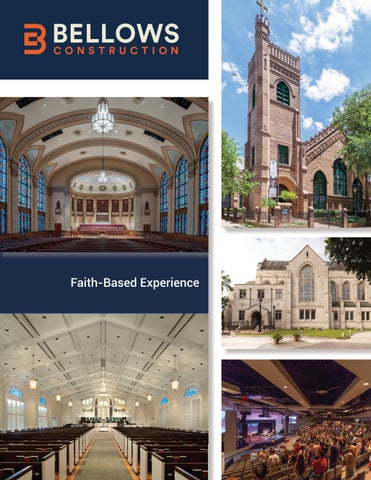
Christ Church Cathedral’s current church building is a nationally registered historic Houston landmark that was built in 1893. Bellows teamed up with Stern and Bucek Architects for the most recent $5.6 million, 11,000-sf restoration which focused on the sacristy, cathedral, and vesting areas. Exterior restoration work included masonry repair and repointing; removal and reapplication of stucco protective coatings at projections; rust jacking repairs; and repair and reconditioning of original wood windows, doors and features. All exterior finishes were restored to historic 1893 colors. Interior restoration work at the cathedral included the installation of new tie rods; floor refinishing; plaster repair; repainting of walls and trim to historic 1893 finishes; LED lighting retrofit; and the modification of existing underwindow voids to conceal new individual VRF air conditioning units as part of a complete HVAC overhaul. Interior work at Golding Chapel included plaster repair and repainting and the relocation of air grilles. Interior renovation work at the sacristy and vesting areas included a complete spatial reconfiguration. All vesting areas were relocated to the second level, allowing the first level sacristy to significantly expand. All original materials were retained and restored, and new finishes and cabinetry were meticulously detailed to complement the historic character.
Winner of the 2020 Good Brick Award for Excellence in Historic Preservation


Bellows, in conjunction with architect Maurice J. Sullivan, built the original sanctuary and campus in 1945. Expansion projects designed by Merriman Holt include a new Fellowship Hall (1987), Lancaster Center (2000), Memorial Garden (2003), an outdoor Education Center (2007), as well as renovations to the existing facility. The Lancaster Center is an 80,000-sf multi-function, three-level addition which houses classrooms, a library, science and computer labs, and administrative offices. The north campus houses the youth ministry with classrooms, recreational facilities, and lounge. The south campus includes a mini-gym, three rock-climbing walls, dance/ballet room, and basketball and volleyball courts. The Grand Hall, the Center’s focal point, is a gymnasium that easily converts to an 1,100-seat amphitheater. The Center also houses staff offices, storage space, Sunday school classrooms and a youth area. Bellows has a long-standing relationship with First Presbyterian Church of Houston.


In 2012, a $1.3M worth of upgrades were made throughout the sanctuary. The church updated their assisted listening devices for hearing impaired members and upgraded lighting equipment, electrical, and HVAC systems. A new stage, updated finishes, and stained glass windows were also included. This project was completed in the summer of 2012 with the design team from Jackson & Ryan Architects.


This 31,491-sf renovation project encompassed the fellowship hall, sanctuary, and balcony. Demolition of the sanctuary flooring and chancel were completely demolished and the chancel was extended to better accommodate large services. The sanctuary also received restorative paint on the entire ceiling with new acoustical plaster and new HVAC, lighting and audio/visual as well as finishes that match the existing original design. The balcony’s plaster walls were replaced and the organ rearranged. The fellowship hall was completely gutted and renovated to include new HVAC, plumbing, electrical, kitchen equipment audio/visual, and finishes. The Bellows team knocked out perimeter walls revealing hidden windows, and reduced the size of the overhead mechanical equipment allowing them to raise the ceiling four feet. Finally, the entire kitchen underwent major upgrades and was replaced with a new commercial-style layout. The team installed new drain lines, vent lines, a grease trap with a 1200-gallon tank, industrial sinks, a new dishwashing facility, a walk-in cooler, a 16-foot fume hood, four stove tops, and a new servery area. The entire renovation is one that the Church had been waiting on for many years. All of the decisions for this remodel were based on renovating a building that will stand the test of time. This project was completed in April 2018 at a construction cost of $6,168,000.
Winner of the 2020 Good Brick Award for Excellence in Historic Preservation.


Gulfton and Sharpstown are two of the most diverse neighborhoods in Houston. However, due to years of disinvestment, this largely immigrant neighborhood has become an area of concentrated poverty. Ever since St. Luke’s merged with Gethsemane UMC in 2009, the Church has made it their mission to be an epicenter of hope. The new 54,335-SF Community Center on the Gethsemane Campus will provide operating spaces for partnerships and programs and a safe, secure space where children can gather and foster a stronger community. The Center will house Legacy Health Care, a client-centered health services clinic; Houston reVision, a ministry dedicated to breaking the cycle of isolation for at-risk youth; the PX Project, a workforce development program; Connect Community, a social services networking organization; and a commercial kitchen..


The church suffered a major fire on September 20, 2019 which significantly impacted the church’s campus. Due to the fire damage, the church required significant interior and exterior repairs and renovations totalling 17,208-SF. Renovations included fellowship hall and kitchen renovation, chancel and chore loft renovation, installation of new pews, fellowship gathering space, youth hall renovation, restroom renovation on all floors, and code compliance.
Winner of the 2024 Good Brick Award for Excellence in Historic PreservatioN


The St. Michael Catholic Church addition consists of adding a new 3,000-sf narthex with a 40-foot vaulted ceiling. The addition was clad with cast stone and brick to match the original 1962 construction, and the east elevation mirrors the old exterior wall forming a 40-foot tall cross with windows. Several interior modifications have been made including laying stone on the altar, choir room upgrades and a restroom pod for the cry room area. A new parking lot was also added at the corner of Sage and Del Monte to alleviate the parking shortage.


St. Paul’s neo-Gothic sanctuary building has been an iconic and sacred treasure in the heart of Houston for nearly 90 years. In an effort to address some of the wear and tear of the building and preserve this beautiful building, the church initiated the Revive Campaign that would help replace outdated mechanical equipment, repair exterior stone walls that required masonry work, and renovate the building to make it more accessible while still retaining its historical integrity. The Bellows team performed a 100,000-sf renovation of the exterior, reception area, and plaza; made the campus ADA compliant; demolished and renovated the basement (classrooms and administration space); reinforced the existing basement structure; completed concrete excavation; installed new footings; and replaced windows, all on an active, occupied site. The Bellows team was in continual communication with St. Paul’s in order to coordinate schedules around their daily needs, activities, and events. Bellows previously completed a two-phase project for St. Paul’s school which included an addition to the existing Jones Education Building and major demolition and renovation with minor work in the basement.
Winner of the 2022 Good Brick Award for Excellence in Historic Preservation


St. Paul’s United Methodist Church is a fully-functioning church and school campus used as a day school for children during the day and by children and members on weekends. This LEED Silver certified, 56,000-sf project was built in two phases with the school continuing operations throughout the project. Phase I was a 10,000-sf addition to the existing Jones education building, including all sitework, and new terrace. Phase II included major demolition and rebuilding of levels one and two, with some minor work in the basement.
Since this project, we were hired to construct the Bankston Green Plaza arena, and recently completed a major HVAC and exterior facade restoration project, including a fully renovated basement for classrooms, offices, and gathering spaces.


Jones Basement is primarily used for 3rd–5th grade Sunday School classrooms. While 3rd–5th graders have not returned to pre-covid attendance, their Sunday School teachers have recently reported that children are arriving at their classes with friends in tow––ready to worship, learn, and play. After the recent renovation, the basement was transformed into an attractive, usable space not only for 3rd–5th grade Sunday School but for many other purposes, including Vacation Bible School, Fine Arts Academy, Wonderfully Made Workshop, St. Paul’s School, Fey y Esperanza, Rutabaga After-School Program, Seminary classes through Perkins School of Theology (HoustonGalveston), and Overnight mission groups like UM ARMY. The new space accommodates three times its former capacity—up to 70 children in the Assembly Room and 17 children in each of four flexible classrooms. A brighter, newer, and more functional Jones Basement demonstrates St. Paul’s commitment to their children, inspires the faithful volunteers who work with them, and expands the program to new levels of participation.


The 38,888-SF Bankston Green project, named after the longest serving Senior Pastor in the church’s history, Dr. James L. Bankston, completely reworked this area to create a new prayer garden with a large labyrinth, offering an oasis for prayer and contemplation for members and the over two million annual visitors to the city’s surrounding museum district. The project won a 2014 Keep Houston Beautiful Landmark Award and is welcoming to members and the general public alike, serving as a new “door” to the church. Broad steps and a gently sloping sidewalk provide comfortable and accessible paths to the site. A continuous low retaining wall at the periphery of the site provides an urban edge and offers an amenity to pedestrians. Natchez crepe myrtles provide shade over slab stone benches, and were selected to offer solar protection without overwhelming the scale of the prayer garden or blocking sight lines from the street to the historic sanctuary. African lilies and Asian jasmine provide a relaxing setting with a soft, green edge to the outdoor “room.” An existing Christus statue was relocated to the center of the prayer garden atop a new, taller stone pedestal to protect it and provide a greater sense of reverence. Black Star gravel flows between the benches and trees and around the labyrinth to provide a comfortable walking surface that is pervious to water, which significantly reduces the storm water detention requirement for the project.