
Cultural & Community Experience

Page 1


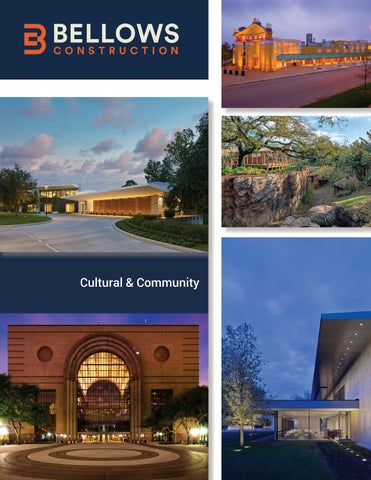
Cultural & Community

Asia Society of Texas

Asia Society of Texas was designed by world renowned Japanese architect Yoshio Taniguchi. The 38,000-SF building, located in the museum district, features the 4,000 SF Louisa Stude Sarofim Gallery, 273-seat Brown Foundation Performing Arts Theater, the 3,000 SF Edward Rudge Allen III Education Center, store and café, and other amenities. The Water Garden is a marvel in itself as 12,000 gallons of constantly recirculating water fill the stainless steel tank. The facility serves as a public meeting place for the city’s diverse communities, especially Asian American groups. This project was completed in 2012.

2014 AIA Design Awards, Architecture Less than 50,000 SF 2012 APEX (Award for Project Excellence), Houston Chapter AGC, Entertainment

Children’s Museum of Houston

After ten years of planning and fund raising for the museum’s expansion, The Children’s Museum of Houston chose Bellows to be their General Contractor for this three-phase project. The project included a new administration building, new addition to the main building, and a parking garage. The 3- story, 18,000 sq. ft. administration building houses the entire staff under one roof. Bellows was able to complete this portion of the project in seven months, allowing the museum to relocate their staff before demolishing the previous space. The second phase of the expansion was above-ground parking structure. This solar panel, energy-efficient structure was constructed with structural steel and has a concrete ramp and parking deck. The final phase of the expansion was the 40,000-SF addition to the museum’s main building. The addition included a major renovation to the outdoor exhibit area and three stories of new exhibit halls.

All of the construction was undertaken while the museum remained open. Special care was taken to ensure the safety of all children, families, and staff. With the timely completion of the building addition, Bellows remained on site, facilitating the museum’s exhibit installation. The final connection to the existing building was carried out in the last few weeks before the grand opening. Careful planning and extensive overtime was expended to minimize inconvenience to the visitors and staff.

Lyndon B Johnson Monument, Apollo I Memorial, Tranquility Park

The unveiling of the President Lyndon B. Johnson Monument, Apollo I Memorial, and official opening of the 44,000-SF newly landscaped Little Tranquillity Park took place on August 6, 2021, the same date President Johnson signed the Voting Rights Act in 1965. The statue is surrounded by curved pathways that guide visitors through a series of inscriptions with a particular narrative of Johnson’s administration: his support for civil rights, his plans for the Great Society, and other positive moments. Along with Bellows Construction, the team was comprised of renowned sculptor Chas Fagan, Gensler as the architect, and Lauren Griffith as the landscape architect. The LBJ Monument and Apollo I Memorial join a series of monuments along Bagby Street, including ones dedicated to George Bush and James Baker.

The LBJ monument is located in Downtown Houston’s Tranquility Park. The project is built on an existing underground parking garage and incorporates the installation of a bronze statue, curved pathways that will guide visitors through a series of inscriptions, and complementary landscape.

Museum of Fine Arts Houston Center for Conservation

Anchoring the eastern perimeter of the campus is the new site for the 39,000-SF Sarah Campbell Blaffer Foundation Center for Conservation. Constructed on top of the Fannin Service Center parking garage, the glass rooftop structure houses state-of-the-art conservation labs and studios. In addition to the sustainable design, one of the most interesting elements is the finished wood that was used to frame the studio spaces in the building. The wood was manufactured in both Canada and Austria and fabricated using a Dowel Laminated Timber (DLT) system. The wood is unique because it’s not just an ornamental architectural finish - it also serves as structural support for the building. The center brings the conservation team together under one roof and in close proximity to the Museum for the first time, allowing them to work more closely with their curator colleagues and carry out ongoing research. The open concept design gives the building a more interactive feel. The project transforms not only the MFAH, but also its surrounding neighborhood by making a major contribution to Houston’s overall efforts to improve the pedestrian experience of the city.

Winner of a Associated General Contractors of America (AGC) APEX Award, Gold, 2021

Winner of a Texas Society of Architects Design Award, 2020

Museum of Fine Arts Houston Audrey Jones Beck Building

The completion of the Audrey Jones Beck Building more than doubled the institution’s exhibit space and moved the Museum of Fine Arts, Houston from the 30th to the 6th largest fine arts museum in the nation. The seemingly simple exterior, clad in Indiana limestone, is not indicative of the intricate systems that make the building the acclaimed structure it is. Once inside, those who enter the four-story, 192,000-sf landmark experience “a museum filled with an explosion of overhead natural light,” according to the New York Times. The Museum makes intense use of the natural light that illuminates the rooms and galleries from above. The variety of the galleries is reflected in the fragmented and broken outline of the roof. The roof becomes the most characteristic image of the museum, showing the importance given to the light, the real protagonist of an architecture whose substance is found in the interior space. Additionally, Bellows built a fourstory, 348-car parking garage, complete with office and maintenance facilities and two underground tunnels connecting the garage, Beck Building, and Law Building.

Museum of Fine Arts Houston, Kilroy Visitor & Education Center

The Lora Jean Kilroy Visitor and Education Center at Bayou Bend is a 17,598-SF, high-performance, new building designed to transport patrons back in time to discover America’s cultural heritage. It advances the visionary collection of Texas icon, Miss Ima Hogg, by creating a new research library and expanding the reach of the museum’s programs. Housed in a modern, two-story metal clad building; the Visitor & Education Center gives a much needed visible presence on Memorial Drive to the previously hidden Bayou Bend Museum.

With LEED® Silver certification, this building is the first LEED® certified museum in Houston and only the second in Texas. At the start of the project, a charette was held to establish sustainable goals and responsibilities in order to reach LEED® certification. In addition to being a key factor in LEED® certification, Bellows completed the project in 2010 under budget and before the original scheduled completion date.

Alley Theatre Original Building and Renovation/Restoration

Bellows is responsible for building the original Alley Theatre in 1968 in downtown Houston, the restoration/renovation that was completed in 2015, and the Hurricane Harvey recovery in 2017. In 2001, Bellows completed a 75,000-SF facility for producing sets, props and costumes and for holding rehearsals as well as a 17,000-SF scene shop. Bellows returned in 2014 for the 102,030-SF project that included lobby renovations, new skyline view, new four-story fly loft, a fully-trapped stage floor, state-of-the-art lighting/sound/electrical enhancements, a fiber optic network, a new catwalk, expanded restrooms, and theatre seating renovations. This renovation gave the Alley the ability to put on 500+ performances a year which is more than all other performing arts organizations in the Houston Theater District combined. This renovation project was completed September 2015. Bellows also completed flood remediation after Hurricane Harvey hit Houston in August 2017. The water reached 10 feet high in the Neuhaus Theatre and lobby and 15 feet high in the basement level (16”18” higher than Hurricane Allison) with everything below ground flooded. In between the basement remediation and Neuhaus renovation, Bellows was able to get the Hubbard Stage up and running for the staff by the week of November 6, 2017.

The Center at Glenwood Cemetery

The 14,394-SF building is organized around a central lobby and an outdoor terrace which separates public areas from administrative functions. This larger facility addressed the need for additional space for current and future staff as well as accommodates the scope of future business. Opposite the public space, support services are discreetly contained while still easily accessible for the staff. Beyond the administrative space the Center provides dedicated space with access to Glenwood’s many archival treasures for research and educational purposes. A new assembly space allows Glenwood to host gatherings and other functions. This multi-use area provides a much needed space for families to gather, which Glenwood currently lacks. The Center addresses the growing needs of Glenwood as well as preserving and showcasing the historical, architectural, and horticultural assets of the cemetery. This multi-purpose facility allows Glenwood to better serve families, conduct business, and have the capacity to share all that the cemetery has to offer with the city

Jones Hall for the Performing Arts

In the summer of 2022, Bellows began a $50M phased renovation over the summer breaks to avoid interrupting Jones Hall’s regular season productions. Jones Hall’s iconic exterior remains intact, while the interior has been redesigned to enhance the concert-going experience. The new vertical aisles and dramatically improved acoustics were just the beginning. New seats have been installed as well as a new orchestra shell and a sizeable increase to the number of bathroom facilities. Additional changes include a reconfigured lobby to create more spaces for patrons, including expansion and enhancement of the green room.

The overhauled backstage technical infrastructure included modernized stage automation control and fiber networks, ushering in a new era for state-of-the-art audio and visual capabilities for broadcasts, livestreams, and stage effects. ADA improvements to the entrance and auditorium make the Hall more accessible, including more seats for those in wheelchairs, improved cross-hall access, and more access points from Texas Avenue to reduce elevator usage. The remainder of the updates will be completed in time for Jones Hall to celebrate its 60th anniversary in 2026.

Houston Christian University Morris Cultural Arts Center

The project was comprised of four major campus additions. The new Belin Chapel and Recital Hall has 365 seats and is the campus’ first on-campus chapel. McNair Hall is 18,000-SF and serves as an anchor to the complex. The University Theater and Auditorium has 1,200 seats with three levels of seating, a theater stage, orchestra pit, and dressing rooms. The University Museums now boast 12,000 SF of exhibit space distributed between the Dunham Bible Museum, the Museum of American Architecture and Decorative Arts, and the Museum of Southern History.

Houston Ballet School of Dance

The ballet facility next to the principle performing venue, the Wortham Theater Center, consolidated rehearsal studios, offices and dormitories for the Houston Ballet. Sitting on a half block at the gateway to downtown Houston, this striking 150,000-SF granite-clad facility stands six stories tall with an 88-foot tall glass entry archway. A black box theater is situated on the first floor along with a generous drop-off area and ramp to basement parking. The two-story rehearsal studios with dramatic full-height windows are housed on levels 3 and 5 along with dressing rooms and toilet facilities. A glass-railed connecting stair climbs through the center of each floor ending at the dormitory on level 6. Other facilities include the Ballet offices, wardrobe storage, and a wardrobe workshop. A beautiful stainless steel clad bridge spans Smith Street to the Wortham Theatre Center, also built by Bellows in 1987.

2012 Special Project Award, Houston Business Journal, Landmark Awards

2011 Institutional/Educational Design Excellence Award, Texas/Oklahoma Chapter of IIDA

2012 AIA Houston Architecture Design Award Winner

2011 Honoree in the education category by Interior Design Magazine

Houston Zoo African Gorilla Forest

The African Gorilla Forest was one of the most highly anticipated exhibits at the Houston Zoo. After a 10-year hiatus, the Houston Zoo is now home to seven gorillas that are broken up into two groups: the first group is a family unit of three (mother, father, and child) and one single female, and the second is a group of three bachelors. The two distinct troops of gorillas will spend their days alternating between an outdoor habitat and a multi-tiered night house that includes private bedrooms, an artistic 23-foot tall climbing tree, and a behind-the-scenes outdoor yard. The forest is a state-of-the-art natural habitat with features that include a waterfall, flowing stream, natural and artificial logs, and boardwalks where visitors can get a closer look. There is also a huge, sloping berm with a dense forest and moat.

Wortham Theater Center

The Wortham Center stands as a monument to the generosity of Houston’s foundations, corporations, and individuals and is a symbol of the heart and spirit of Houston. This performance arts center consists of two theaters: The Alice and George Brown Theater with 2,405 seats and the Lillie and Roy Cullen Theater with 1,100 seats. Stunning elements like an 88-foot tall glass archway entry, high ceilings, and a multi-terraced grand foyer earned the Wortham Center recognition as the most significant new opera and ballet house in the nation upon its original completion in 1987.

Museum of Fine Arts Houston Rienzi Renovation

Rienzi was originally designed by nationally acclaimed architect John Staub and built in 1954 as the home of Harris Masterson III and his wife, Carroll Sterling Masterson. After the Mastersons donated their home to the Museum of Fine Arts, Houston, the Bellows team restored Rienzi and transformed the 11,000-SF home into a museum, doing extensive work throughout the masonry structure and expansive grounds. This included converting the swimming pool into a reflecting fountain, demolition and replacement of 1,000-SF of terrazzo terraces, mechanical alterations, ultraviolet light filtrations, and replacing finishes. Bellows completed the renovation project while preserving the eligibility of the property to become part of the National Register of Historic Places. The greatest challenge of this project was working around parts of the collection which, due to size, fragility, or storage constraints, could not be moved from the building during the construction period.

Byzantine Fresco Chapel and Museum

The Byznatine Fresco Chapel is a part of the Menil Collection in Houston, Texas. From February 1997 to February 2012, it displayed the only intact Byzantine frescoes of this size and importance in the entire western hemisphere. The Menil Foundation built this beautiful building to specifically house the frescoes. The building featured a lobby, a reception area, a small meditation room overlooking the reflection pool, and an elevated sacristy. In 2012, the Byzantine frescoes were returned by the Menil to the Church of Cyprus, their owners, following the conclusion of a long-term loan agreement with the Greek Orthodox Church of Cyprus. The chapel has since housed long-tern art installations.

San Jacinto Monument and Museum

The San Jacinto Monument was built in dedication to those who fought for Texas’ Independence. The design was the brainchild of architect Alfred C. Finn, engineer Robert J. Cummins, and Jesse H. Jones. Construction ran from 1936 to 1939. With continued support, the San Jacinto Museum of History Association has occupied the facility since its doors first opened. At 570 feet, this Texas giant one of the finest examples of Modern (Art Deco) architecture in the United States. The monument has been recognized as a National Historic Civil Engineering Landmark by the American Society of Civil Engineers. The innovative project included the first continuous pouring of a mat foundation. The museum is located in the base of the monument, greeting visitors with bronze doors emblazoned with the six flags of Texas. The base is 125 feet square, with text panels highlighting significant events in history leading up to and resulting from the Texas Revolution. Bellows Construction is returning to this site for an extensive renovation project that will include restoration to the monument, underground museum, and additional site work and landscaping.

Turn static files into dynamic content formats.
Create a flipbook