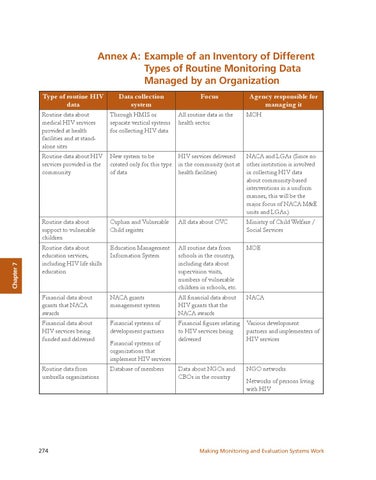
Annex A: Example of an Inventory of Different Types of Routine Monitoring Data Managed by an Organization
Chapter 7
Type of routine HIV data
Data collection system
Focus All routine data in the health sector
Agency responsible for managing it MOH
Routine data about medical HIV services provided at health facilities and at standalone sites
Through HMIS or separate vertical systems for collecting HIV data
Routine data about HIV services provided in the community
New system to be HIV services delivered created only for this type in the community (not at of data health facilities)
NACA and LGAs (Since no other institution is involved in collecting HIV data about community-based interventions in a uniform manner, this will be the major focus of NACA M&E units and LGAs.)
Routine data about support to vulnerable children
Orphan and Vulnerable Child register
All data about OVC
Ministry of Child Welfare / Social Services
Routine data about education services, including HIV life skills education
Education Management Information System
All routine data from schools in the country, including data about supervision visits, numbers of vulnerable children in schools, etc.
MOE
Financial data about grants that NACA awards
NACA grants management system
All financial data about HIV grants that the NACA awards
NACA
Financial data about HIV services being funded and delivered
Financial systems of development partners
Financial figures relating to HIV services being delivered
Various development partners and implementers of HIV services
Routine data from umbrella organizations
Database of members
Data about NGOs and CBOs in the country
NGO networks
274
Financial systems of organizations that implement HIV services
Networks of persons living with HIV
Making Monitoring and Evaluation Systems Work